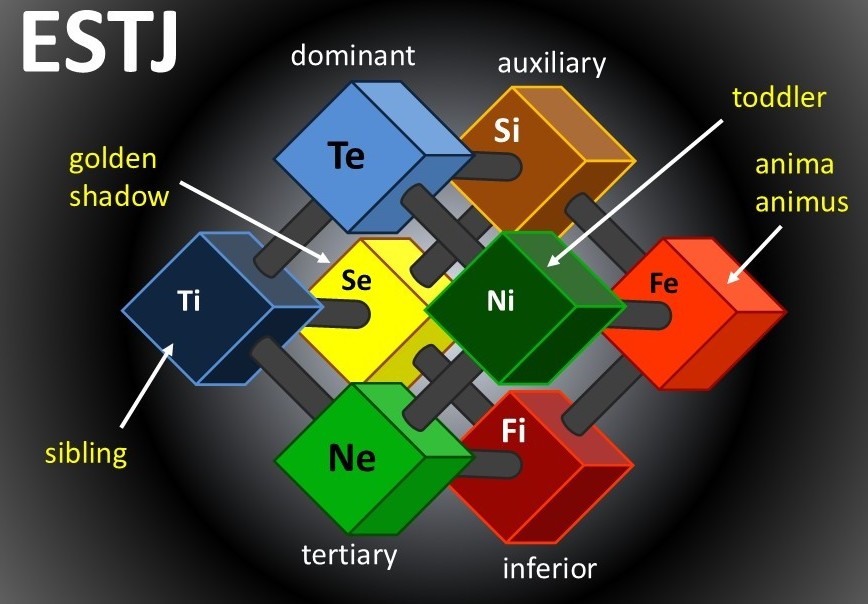
ESTJ – The Untold Truth
To understand the ESTJ psychologically, one has to move beyond the familiar caricature of the efficient manager, the strict administrator, the person who naturally takes charge when everybody else is still discussing what should be done. That stereotype contains a fragment of truth, but it mistakes the visible surface of the personality for its entire psychological architecture. The ESTJ is not simply a person who likes rules, productivity, hierarchy, or responsibility; more fundamentally, the type can be understood as a psyche that attempts to make reality dependable by transforming uncertainty into structure, responsibility into action, and collective expectations into concrete standards. In the Ontolokey framework, this organizing impulse is represented by Extraverted Thinking, or Te, as the dominant function, supported by Introverted Sensing, Si, while the remaining six functions reveal a much more complicated psychological landscape than the conventional image of the decisive executive suggests. The deeper truth is therefore paradoxical: the same psychological mechanism that can make an ESTJ extraordinarily reliable, courageous, productive, and capable of protecting people from disorder can, when defended too rigidly, become controlling, intolerant, emotionally avoidant, or excessively identified with performance. This tension between competence and vulnerability is essential to understanding the ESTJ, because what looks like confidence from the outside may sometimes be the psychological compensation for an inner difficulty with uncertainty, ambiguity, helplessness, or the possibility that life cannot always be made orderly through effort.
The Ontolokey cube becomes particularly useful when the ESTJ is viewed not as a collection of fixed traits but as a dynamic field of psychological tensions. According to the Ontolokey model, the ESTJ’s dominant Extraverted Thinking occupies the central position of conscious executive organization, while Introverted Sensing provides the stabilizing auxiliary structure through memory, precedent, experience, and established patterns. Introverted Thinking occupies the Sibling position, offering an internal logical counterweight to Te; Introverted Intuition appears as the Toddler function, representing a less mature but potentially transformative capacity for abstraction, symbolic perception, and long-range synthesis; Introverted Feeling occupies the Inferior position and therefore represents one of the most psychologically vulnerable yet developmentally important regions of the personality. Extraverted Feeling functions as the Anima or Animus, introducing an unconscious longing for emotional reciprocity and social harmony, while Extraverted Intuition is identified as the Blindspot or neglected possibility-oriented function and Extraverted Sensing constitutes the Golden Shadow, the hidden capacity for immediacy, physical presence, spontaneity, and direct engagement with life. This arrangement matters because it changes the central question from “What is an ESTJ like?” to the far more psychologically revealing question, “What happens inside an ESTJ when these different modes of experiencing reality come into conflict?” A mature ESTJ is therefore not simply someone who becomes better at Te, but someone who gradually learns that effectiveness is only one dimension of psychological health and that a life organized entirely around effectiveness can eventually become strangely ineffective at answering the question of what the life is actually for.
At the heart of this architecture lies a particular relationship with reality: the ESTJ tends to trust what can be acted upon, organized, measured, remembered, verified, or made dependable. This orientation gives the type an unusual capacity to convert abstract responsibility into visible behavior, which helps explain why ESTJs can become formidable organizers, administrators, leaders, commanders, business operators, institutional builders, and protectors of systems that other people depend upon. The deeper Ontolokey interpretation of Te emphasizes that the ESTJ does not merely enjoy getting things done; action itself can become a psychological language through which commitment, integrity, competence, and even affection are expressed. In the extended ESTJ material associated with Ontolokey, this tendency is portrayed as a powerful devotion to follow-through, standards, responsibility, and the belief that effort should have consequences, with the healthy ESTJ often measuring integrity less by what someone says than by whether that person actually does what they promised. Yet this strength contains its own psychological trap, because once effectiveness becomes synonymous with worth, failure ceases to be merely an undesirable outcome and begins to feel like a threat to identity. An ESTJ can then unconsciously move from “I need this system to function” toward “I need this system to function because my competence proves that I am competent, responsible, and worthy,” creating a feedback loop in which control is no longer merely practical but emotionally protective.
This is where the untold dimension of the ESTJ begins to emerge, because the personality’s greatest strength can become its preferred defense mechanism. When uncertainty appears, the instinct may be to organize; when another person behaves irresponsibly, the instinct may be to correct; when emotions become confusing, the instinct may be to search for an actionable solution; when the future becomes ambiguous, the instinct may be to rely more heavily on what has already worked. None of these responses is inherently pathological, and in ordinary circumstances they can be precisely what makes an ESTJ invaluable. The difficulty begins when the psyche applies the same solution to problems that cannot actually be solved through structure, discipline, precedent, or increased effort. Grief cannot always be optimized, intimacy cannot be administered like a department, human motivation cannot be reduced entirely to compliance, and personal identity cannot ultimately be established through an endless accumulation of achievements. The psychological development of the ESTJ therefore begins at the point where competence encounters something it cannot command, because that encounter exposes the functions and emotional capacities that the dominant personality structure has historically kept at a greater distance.
The central paradox can be stated without romanticizing either the strengths or the shadow: the ESTJ may spend much of life learning how to control circumstances before learning how to remain psychologically intact when circumstances cannot be controlled. This is why the inferior Introverted Feeling function, Fi, is so significant in the Ontolokey architecture. Fi represents the inner question that Te cannot answer for the ESTJ: not “What works?” or “What is objectively required?” but “What matters to me when nobody is measuring the result?” and “Who am I when my usefulness is no longer the basis on which I evaluate myself?” Ontolokey places Fi at the farthest and most vulnerable point of the ESTJ’s psychological structure, while simultaneously describing it as a potential gateway toward authenticity, moral depth, compassion, inner dignity, and a life no longer defined exclusively by output or status. This makes the ESTJ’s deepest development less about becoming softer in some superficial sense and more about discovering that personal values are not an obstacle to strength; rather, they provide the internal meaning that prevents strength from degenerating into mere control.
The ESTJ, at its healthiest, is therefore not the authoritarian stereotype sometimes associated with the type, but the person who can carry responsibility without needing responsibility to define the entire self. Such an individual can use Te to build functioning systems while allowing Ti to question whether those systems are logically coherent, Si to preserve what genuinely deserves preservation without worshipping precedent, Ni to imagine what has not yet become obvious, Fi to determine what is personally and ethically meaningful, Fe to recognize the emotional field created by leadership, Ne to remain open to alternatives that contradict established assumptions, and Se to experience reality directly rather than always approaching the present as another task to be managed. The Ontolokey cube is compelling precisely because it presents these functions as a developmental architecture rather than as a list of flattering strengths and embarrassing weaknesses. The mature ESTJ does not cease being demanding, organized, decisive, or practical; instead, those qualities become less defensive because they are no longer required to carry the entire psychological burden of identity. What emerges is a fundamentally different kind of authority: authority that does not need constant enforcement because it is increasingly rooted in self-knowledge, ethical conviction, emotional awareness, intellectual flexibility, and the ability to distinguish between a problem that genuinely needs to be solved and a human experience that simply needs to be understood.
The most important distinction in the ESTJ psyche is therefore not between “strong” and “weak,” but between strength that remains psychologically flexible and strength that has become defensive. Ontolokey’s shadow analysis makes this distinction particularly stark by describing how responsibility can harden into control, discipline into rigidity, authority into domination, and confidence into an increasingly unquestionable conviction of being right. The mechanism is psychologically plausible even when the typological framework itself should be regarded as interpretive rather than diagnostic: a person who repeatedly experiences competence as the most reliable route to security can gradually begin to depend upon competence for emotional stability. Under favorable conditions, this produces resilience, decisiveness, and a remarkable willingness to carry burdens that others avoid; under prolonged frustration, however, the same pattern can create an intolerance of uncertainty and a growing need to make the external world conform to an internal expectation of order. What makes the shadow particularly difficult to recognize is that it rarely feels like corruption from inside the person experiencing it. The ESTJ who is becoming excessively controlling may sincerely believe that they are simply being responsible, just as the resentful ESTJ may genuinely have been treated unfairly and the rigid ESTJ may genuinely have identified a real problem that requires correction. The danger begins when a legitimate perception becomes an all-encompassing interpretation of reality, so that every disagreement confirms incompetence, every challenge resembles disrespect, and every failure becomes evidence that somebody else has failed to do what they should have done.
Resentment consequently deserves a much deeper psychological examination than the simple observation that ESTJs can “hold grudges.” According to the Ontolokey shadow analysis, resentment develops when repeated experiences of perceived injustice, betrayal, insufficient recognition, or violated expectations accumulate without genuine emotional processing, gradually transforming memory into an internal ledger of debts and offenses. This is particularly significant for the ESTJ because the type’s orientation toward responsibility can generate a powerful expectation of reciprocity: if I have done my part, you should do yours; if I have remained loyal, you should remain loyal; if I have sacrificed for the group, the group should recognize that sacrifice; if I have demonstrated competence, competence should matter. There is nothing inherently irrational about such expectations, and in a functional social environment they are often necessary for cooperation, but human beings and institutions routinely violate them because life is not an objective meritocracy in which effort and reward maintain a perfect correspondence. When the ESTJ encounters that discrepancy repeatedly, the psychological wound may be deeper than disappointment because it challenges an implicit philosophy of reality: that responsible action should produce responsible outcomes. The shadow begins when the person cannot metabolize this contradiction and instead constructs an increasingly comprehensive narrative in which other people become debtors, obstacles, opportunists, or enemies, while the self assumes the role of the person who has consistently carried more than everyone else.
This process explains why the ESTJ can sometimes become psychologically attached to being right in a way that exceeds ordinary confidence. The healthy form of Te is fundamentally pragmatic: it asks what works, what produces the desired result, what resources are available, and what decision will move reality forward. Yet when competence becomes fused with identity, the question subtly changes from “What is effective?” to “How can I preserve the belief that my judgment is reliable?” Ontolokey describes this transition as a movement toward psychological infallibility, in which the recognition that one is often right gradually becomes the assumption that one is entitled to be right. At that point criticism becomes unusually threatening because it does not merely challenge an opinion; it potentially challenges the person’s entire self-concept as the competent one who sees what others fail to see. The resulting defensiveness can paradoxically make an otherwise highly rational person less rational, because evidence is no longer processed solely according to its informational value but according to whether it strengthens or threatens the established identity. A colleague who disagrees may therefore be experienced not as someone contributing another perspective but as someone obstructing the correct course of action, while an emotional objection may be dismissed as irrelevant precisely because acknowledging its significance would require entering psychological territory in which objective efficiency no longer provides sufficient guidance.
This brings us directly to one of the most misunderstood aspects of ESTJ psychology: emotional blindness does not necessarily mean emotional emptiness. In fact, the shadow analysis argues almost the opposite, suggesting that the ESTJ can possess powerful emotions while having a comparatively underdeveloped conscious relationship with those emotions, particularly when the personality has learned throughout life that action, competence, reliability, and self-control receive greater social reinforcement than vulnerability or introspection. The consequence is that emotion may enter consciousness disguised as something else: fear may become control, humiliation may become aggression, anxiety may become micromanagement, hurt may become anger, and accumulated disappointment may emerge as moral judgment. This distinction is crucial because the ESTJ can then experience themselves as acting from principle while being driven partly by an emotional injury they have not consciously acknowledged. They may genuinely believe that they are “just enforcing standards” when the intensity of enforcement is actually disproportionate because something personal has been touched. The psychological task is therefore not to suppress emotion in favor of reason, but to make emotion conscious enough that reason is no longer secretly being recruited to defend an unexamined wound.
The inferior position of Introverted Feeling, Fi, becomes especially important within this developmental problem because it confronts the ESTJ with precisely the dimension of experience that cannot be reduced to efficiency or external validation. Fi asks the individual to develop an internally grounded relationship with personal values, authenticity, emotional meaning, conscience, and the subjective significance of experience, even when those things cannot be quantified or translated into an operational plan. In an immature state, this territory can feel strangely inaccessible or even irritating because it offers no immediate procedure for resolution; someone who is suffering does not necessarily need a solution, a relationship conflict cannot always be repaired through a better system, and a moral decision cannot always be settled by determining which option is most efficient. Yet the very absence of an immediately actionable answer is what makes this function psychologically transformative for the ESTJ. If Te teaches the individual how to make reality function, Fi gradually asks why that functioning matters, whose values it serves, what sacrifices are ethically acceptable, and whether success obtained at the expense of inner integrity is actually success at all. The development of Fi therefore does not weaken the ESTJ’s authority; it gives that authority a conscience capable of existing independently from performance.
There is consequently a profound difference between an ESTJ who has developed emotional depth and one who has merely learned socially acceptable emotional behavior. The first can recognize that compassion is not the abandonment of standards, that forgiveness is not the denial of wrongdoing, and that vulnerability does not automatically imply incompetence. The second may still use emotional language strategically while remaining internally governed by the same rigid equation between worth and performance. Genuine development requires something more uncomfortable: the willingness to discover that one’s own standards can sometimes become defenses against experiences that feel uncontrollable, including dependency, grief, uncertainty, failure, rejection, and the realization that other people possess autonomous inner worlds that cannot be managed into compliance. Ontolokey’s discussion of the ESTJ shadow identifies precisely this danger when it describes how fear of weakness can gradually turn into contempt for weakness, causing compassion to be interpreted as indulgence and human limitation to be experienced as a character defect. The mature ESTJ does not have to abandon the admiration of strength; rather, strength becomes more sophisticated when it includes the capacity to tolerate weakness without contempt, including one’s own. That is the beginning of a psychologically integrated form of authority, because a person who no longer needs to despise vulnerability in order to feel strong has far less reason to control other people whenever vulnerability appears.
The next layer of the ESTJ’s psychological architecture becomes clearer when the eight Ontolokey positions are examined not merely as labels, but as different relationships to reality that can either cooperate or compete within the same individual. Dominant Extraverted Thinking, Te, occupies the position of the primary conscious instrument through which the ESTJ evaluates situations according to effectiveness, organization, measurable consequences, competence, and external logic. This is the part of the personality that instinctively asks what needs to be done, who is responsible, which procedure is functional, what standard has been violated, and how available resources can be coordinated toward a concrete result. The important psychological distinction is that Te is not synonymous with intelligence, rationality, or authoritarianism; it is a particular orientation toward thinking in which thought naturally seeks implementation in the external world. For the healthy ESTJ, this can produce extraordinary executive capacity because thinking does not remain indefinitely in abstraction but becomes decision, coordination, accountability, and action. The danger arises when the dominant position becomes so trusted that whatever cannot be translated into practical terms is unconsciously downgraded in importance, causing subjective meaning, ambiguity, imagination, and emotional complexity to be treated as secondary simply because they resist immediate operationalization.
The auxiliary position, Introverted Sensing, Si, provides the ESTJ with something that pure Te would lack: continuity with what has already been learned through direct experience. Si does not simply mean “having a good memory,” nor does it mean that every ESTJ is nostalgic or conservative in the ordinary sense; within this framework it represents a psychological tendency to compare present circumstances against accumulated experience, established knowledge, precedent, familiar standards, and previously demonstrated ways of functioning. This creates a powerful stabilizing mechanism because the ESTJ is rarely forced to reinvent reality from scratch when a comparable situation has already been encountered. A mature Si can therefore protect institutions, traditions, procedures, and relationships from the destructive impulse to change something merely because a new idea happens to be fashionable or intellectually interesting. Yet the same mechanism can become restrictive when previous success is mistaken for universal validity, because what worked yesterday can acquire the psychological status of what must work tomorrow. The mature ESTJ learns to distinguish between experience as evidence and experience as dogma, preserving what deserves preservation while remaining capable of recognizing that circumstances change and that loyalty to a method is not the same thing as loyalty to the underlying purpose.
The third position, Introverted Thinking, Ti, described within the Ontolokey cube as the Sibling, introduces an especially interesting internal relationship because it resembles the ESTJ’s own thinking process while operating according to a different criterion. Te asks whether an external system works effectively, whereas Ti is concerned more deeply with whether an internal conceptual structure is logically precise, coherent, and free of contradiction. The Sibling metaphor is psychologically useful because Ti can feel both familiar and irritating to the ESTJ: it belongs to the same broad intellectual family as Te, yet it refuses to accept practicality as sufficient proof of logical validity. This creates the possibility of a productive internal argument in which Te says, “This works,” while Ti responds, “But do you actually understand why it works, and under what conditions would it stop working?” In an integrated ESTJ, that internal friction becomes a major source of intellectual sophistication because decisions are no longer based solely upon established procedures or observable outcomes but can be examined for hidden assumptions and structural weaknesses. In an immature or stressed ESTJ, however, Ti may instead become an argumentative instrument used to rationalize an already predetermined conclusion, producing the illusion of rigorous analysis while the underlying motivation remains the preservation of control or certainty.
Introverted Intuition, Ni, occupies the Toddler position in the Ontolokey model, and this designation captures something psychologically subtle about the ESTJ’s relationship with abstraction and future-oriented synthesis. Ni is concerned with patterns beneath the immediately visible surface, with convergence, implications, symbolic meaning, long-range trajectories, and the possibility that apparently separate events are expressions of a deeper underlying process. Because the ESTJ’s habitual orientation is toward concrete organization and established reality, Ni can initially feel less trustworthy than direct evidence or accumulated experience. Yet this apparently less mature function can become extraordinarily important when developed, because no complex organization can remain successful indefinitely by responding only to what has already happened. The ESTJ eventually needs to perceive where a system is heading before its consequences become obvious, and this requires tolerating uncertainty long enough to recognize an emerging pattern rather than immediately forcing the situation into an existing framework. The “Toddler” quality is therefore not a judgment that intuition is useless; it suggests that this mode of consciousness may initially be less differentiated, more tentative, and more difficult for the ESTJ to trust, yet precisely for that reason it can become a developmental frontier through which the personality acquires foresight rather than merely excellent reaction.
The Inferior position, Introverted Feeling, Fi, is perhaps the most psychologically consequential position in the entire ESTJ structure because it represents the domain in which external effectiveness meets the irreducibly personal question of value. Fi does not primarily ask whether a policy is efficient, whether an organization is functioning, or whether a person is fulfilling an assigned responsibility; it asks whether something is internally meaningful, morally congruent, authentic, and consistent with one’s deepest personal convictions. For an ESTJ who has built identity around being useful, reliable, competent, and responsible, these questions can be unsettling because they cannot be answered by accumulating more evidence or increasing productivity. Fi may therefore remain relatively quiet for long periods and then emerge with disproportionate intensity when the individual encounters betrayal, moral violation, personal humiliation, profound attachment, grief, or a situation in which external success conflicts with internal conscience. The developmental challenge is not to replace Te with Fi, but to prevent Te from becoming the sole authority over the self, because without Fi the ESTJ can become exceptionally effective at accomplishing goals without ever examining whether those goals genuinely deserve to be accomplished.
Extraverted Feeling, Fe, occupies the Anima or Animus position in Ontolokey’s formulation, and this gives the ESTJ’s social psychology a dimension that is often missed by simplistic descriptions of the type as emotionally insensitive. Fe is oriented toward interpersonal atmosphere, collective emotional needs, social reciprocity, harmony, belonging, and the emotional signals circulating between people. When this function is less consciously differentiated, the ESTJ may nevertheless possess a strong unconscious sensitivity to whether people respect them, whether the group is functioning cohesively, whether loyalty is being reciprocated, and whether social relationships are becoming unstable. This can produce an intriguing contradiction in which the ESTJ appears to care primarily about performance while being deeply affected by interpersonal recognition and rejection beneath the surface. Development of Fe allows the person to recognize that leadership is not only the distribution of tasks but also the management of human meaning, morale, dignity, trust, and emotional consequence. Without that development, the ESTJ may assume that treating everyone according to the same objective standard is inherently fair, overlooking the fact that people experience fairness not only through consistency but also through being understood as individual human beings.
Extraverted Intuition, Ne, is identified as the Blindspot, and this position illuminates why an ESTJ can sometimes react skeptically to possibilities that have not yet demonstrated practical credibility. Ne continually generates alternatives, hypothetical scenarios, unconventional connections, divergent interpretations, and potential futures; its psychological movement is therefore expansive rather than convergent, and exploratory rather than immediately decisive. For a personality organized around Te and supported by Si, this proliferation of possibilities can feel inefficient because every additional possibility potentially delays commitment and destabilizes the established frame of reference. Yet the blindspot is not simply a deficiency; it identifies an area in which the ESTJ may underestimate how much valuable information is contained in what initially appears impractical, speculative, or unconventional. Psychological maturity requires learning to distinguish between useless novelty and genuinely informative novelty, because rejecting every unproven alternative protects stability in the short term but can make a person remarkably vulnerable to gradual environmental change. An ESTJ who develops Ne does not become indecisive; rather, the person becomes better at entertaining several possible explanations before committing to the one that deserves implementation.
Finally, Extraverted Sensing, Se, occupies the Golden Shadow, representing a particularly fascinating hidden potential. Se is concerned with immediate sensory reality, direct engagement, physical presence, responsiveness to what is happening now, and the willingness to encounter experience without filtering everything through past precedent or future consequence. For the ESTJ, this can appear both natural and strangely liberating because Te normally approaches the present with an implicit question about what should be done, while Se can simply register what is actually happening and respond to it with immediacy. The Golden Shadow therefore represents a capacity that may emerge most powerfully when the ESTJ stops trying to organize every moment into a larger plan and permits reality itself to become psychologically informative. This can manifest as spontaneity, embodied confidence, appreciation of the physical world, rapid adaptation, enjoyment, and a more direct relationship with experience. In its mature form, Se reminds the ESTJ that life is not merely a sequence of problems awaiting competent management, but also an unfolding reality that can be perceived, inhabited, enjoyed, and responded to without first being converted into a project.
Taken together, these eight positions reveal why the ESTJ cannot be adequately described by the familiar image of the “strict leader.” Te gives the personality executive force, Si gives it continuity, Ti gives it analytical discrimination, Ni opens the possibility of deeper foresight, Fi introduces personal conscience and authenticity, Fe expands awareness of interpersonal and collective emotional reality, Ne challenges premature certainty, and Se reconnects the individual with immediate experience. The psychological problem is not that some of these functions are “good” while others are “bad,” but that consciousness naturally privileges some forms of information while neglecting others, and neglected information does not cease to exist merely because the conscious personality prefers not to deal with it. Indeed, much of what appears in the ESTJ’s shadow can be understood as information that has been excluded from conscious authority and therefore returns indirectly through defensiveness, irritation, projection, emotional intensity, or compulsive behavior. The mature ESTJ consequently becomes less interested in proving that one function is superior and more interested in establishing an internal government in which no single psychological authority is allowed to become a dictator. This is ultimately the deeper promise of the Ontolokey cube: it portrays personality not as a prison of fixed characteristics, but as an architecture in which development means gradually bringing previously neglected dimensions of consciousness into a more constructive relationship with the dominant self.
The positive side of the ESTJ becomes much clearer once the shadow is understood, because the purpose of examining the shadow is not to condemn the personality but to separate genuine strength from psychological compensation. The same Te-Si structure that can become rigid under threat can also produce one of the most dependable forms of practical leadership: the ability to take responsibility when circumstances are ambiguous, resources are limited, and somebody must translate intention into coordinated action. Ontolokey itself emphasizes that the ESTJ often emerges naturally wherever systems must be maintained, standards enforced, resources allocated, and collective efforts coordinated, and it stresses that these capacities are not inherently problematic but can represent some of the most valuable human abilities when exercised consciously. This observation also finds a broader psychological parallel in research-oriented personality literature, where conscientiousness—particularly responsibility, dependability, organization, and persistence—is associated with important forms of job performance, although its value depends strongly upon the demands of the particular environment. The healthy ESTJ therefore possesses something that is increasingly rare in environments saturated with discussion, interpretation, and endless possibility: the willingness to accept that intentions are meaningless unless someone eventually assumes responsibility for their consequences.
This capacity for responsibility can have a profound moral dimension when it is separated from the need for domination. A mature ESTJ often understands that leadership is not primarily the privilege of giving orders but the burden of making decisions when there is no perfect option and accepting accountability for what follows. Such a person can enter situations in which other people are overwhelmed and instinctively begin creating sequence, priorities, roles, deadlines, and measurable objectives, thereby reducing psychological chaos for everyone involved. Their decisiveness can be particularly valuable during crises because they are less likely to become immobilized by the fact that every possible outcome contains uncertainty; instead, they identify the information available, determine what can be influenced, and move toward the most workable course of action. The psychological virtue here is not simply efficiency but agency, because the ESTJ’s instinctive response to difficulty is often to ask what can still be done rather than surrendering to what cannot be controlled. When that agency is combined with humility, it becomes protective rather than oppressive, allowing the ESTJ to become the person others trust precisely because authority is being used to carry responsibility rather than to demand submission.
The relationship between Te and Si also explains why ESTJs can become exceptionally effective builders of institutions and long-term structures. Te supplies the drive toward implementation while Si remembers what has already been learned, creating a combination capable of turning experience into repeatable practice and practice into reliable systems. In its healthy form, this does not necessarily mean blind conservatism; rather, it means understanding that civilization itself depends upon accumulated knowledge, standards, procedures, traditions, and institutional memory that would be impossible to reconstruct from nothing each generation. An ESTJ may therefore possess a particular respect for craftsmanship, professional competence, proven methods, and the accumulated lessons contained in experience, because to discard everything that came before in the name of novelty can appear not progressive but irresponsible. The danger is obvious when this becomes rigid, but the strength is equally obvious when discernment remains intact: the mature ESTJ can ask which traditions preserve wisdom and which merely preserve habit, which rules protect people and which merely protect authority, and which procedures still serve their original purpose. This capacity to conserve without becoming imprisoned by the past is one of the clearest signs that Si has become an ally of Te rather than its unquestioned master.
Another major strength of the ESTJ is the unusual seriousness with which the personality can approach commitment. When an ESTJ genuinely accepts responsibility for a person, project, organization, family, or principle, that commitment can become remarkably concrete because loyalty is frequently expressed through action rather than sentiment. The person may not always be the one who produces the most emotionally elaborate declarations of affection, but they may be the one who arrives when something goes wrong, makes the necessary phone call, handles the practical crisis, remembers what needs to be done, protects the group’s interests, and continues carrying responsibility long after the excitement surrounding the original commitment has disappeared. This is important because psychological care is often misunderstood as verbal warmth alone, whereas human beings also experience care through reliability, protection, provision, consistency, and the willingness to assume burdens when circumstances become difficult. The ESTJ’s challenge is not therefore to become a completely different, softer personality, but to recognize that these concrete expressions of devotion become far more powerful when accompanied by explicit emotional recognition. When action and emotional awareness eventually cooperate, the ESTJ can communicate something extraordinarily reassuring: “You do not have to carry everything alone, because I am willing to carry something with you.”
Yet the mature ESTJ must also confront one of the most uncomfortable truths about responsibility: not every burden that can be carried should be carried by the same person. A personality that derives identity from competence can unconsciously create dependency by repeatedly rescuing systems and people from the consequences of their own irresponsibility, because being indispensable can feel safer than discovering that one is not actually needed. This can lead to a subtle form of control disguised as helpfulness, in which the ESTJ takes over because others are inefficient, then becomes resentful because others do not take sufficient responsibility, and finally uses their own resentment as evidence that only they can be trusted to handle things properly. The cycle is psychologically self-reinforcing because every intervention proves the original assumption: “If I do not do it, it will not be done correctly.” Breaking that cycle requires a surprisingly difficult form of restraint—the willingness to allow other people to make mistakes, to tolerate temporary inefficiency, and to accept that competence includes teaching, delegating, and trusting rather than merely performing. The strongest ESTJ is therefore not the person who can do everything personally, but the person who can construct a system in which other people become capable of doing what previously depended upon them.
This distinction also transforms the ESTJ’s relationship with authority. Authority at its best is not the psychological opposite of equality; it is the assumption of differentiated responsibility, where someone accepts greater accountability because their role requires them to make decisions, coordinate resources, or protect the functioning of the whole. The unhealthy ESTJ confuses this with personal superiority, whereas the mature ESTJ understands that occupying a position of authority does not make one’s perceptions infallible and does not eliminate the autonomy of those being led. The deepest form of leadership therefore emerges when the ESTJ can hear disagreement without automatically interpreting it as insubordination, because disagreement may contain information that the dominant perspective has missed. This is where the previously discussed Ti, Ne, Fi, and Fe functions become essential rather than decorative additions to the personality: Ti can interrogate the internal logic of the decision, Ne can introduce alternatives, Fi can ask whether the decision remains ethically defensible, and Fe can reveal how the decision is actually affecting the human beings who must live with it. Leadership becomes psychologically mature when these perspectives are permitted to challenge Te without being treated as enemies of Te.
The result is an ESTJ who remains decisive without becoming authoritarian, structured without becoming rigid, demanding without becoming contemptuous, and confident without requiring psychological submission from others. Such an individual can still have high standards and can still be blunt, practical, competitive, and intensely focused on results, but the psychological motive underneath those characteristics has changed. The goal is no longer to control reality in order to remain secure; it is to participate effectively in reality while accepting that uncertainty, difference, imperfection, and emotional complexity are permanent features of being human. This distinction is crucial because the Ontolokey shadow analysis describes the deepest danger as a gradual imprisonment in the very structures that originally created security, where authority can replace intimacy, achievement can replace meaning, respect can replace love, and control can replace trust. The mature ESTJ reverses this process by retaining the structure while relinquishing the compulsion, retaining standards while relinquishing contempt, and retaining authority while relinquishing the need to be psychologically indispensable. At that point, the ESTJ’s defining strength is no longer simply the capacity to make the world obey a plan, but the much rarer capacity to build order without losing contact with the humanity of the people living inside that order.
A further dimension of the ESTJ becomes visible when one examines what happens during major transitions, because the personality is often at its most psychologically revealing when the external structures that normally confirm competence begin to disappear. As long as there is a task to complete, a problem to solve, a position to occupy, or a responsibility to carry, the ESTJ can remain deeply connected to a recognizable sense of identity. But retirement, career failure, divorce, illness, bereavement, professional humiliation, the departure of children, or any other experience that removes a familiar source of usefulness can expose a question that Te cannot easily answer: who am I when there is nothing I need to fix? Ontolokey’s discussion of inferior Fi explicitly describes this possibility as a moment in which achievements can begin to feel hollow and relationships can reveal their transactional dimensions, forcing the individual to confront values and meaning that previously remained in the background. This should not be interpreted as an inevitable “midlife crisis” for ESTJs, but as a developmental possibility inherent in any personality structure that has placed unusually strong psychological investment in achievement, responsibility, and external effectiveness. The crisis, when it occurs, is therefore not necessarily evidence that the person has failed; it may instead represent the psyche demanding a broader definition of success.
This is also why the ESTJ’s relationship with work deserves to be understood with more nuance than either admiration or criticism can provide. Ontolokey’s deeper ESTJ analysis describes work not merely as an activity but as an arena in which purpose, identity, discipline, and personal worth can become intertwined, while simultaneously warning that the relentless drive toward productivity can produce overwork and burnout when rest, spontaneity, and emotional reflection are repeatedly subordinated to output. The psychological problem begins when productivity stops being something the person does and becomes something the person believes they are. If “I am valuable because I contribute” gradually becomes “I am valuable only when I contribute,” rest becomes psychologically suspicious, leisure becomes guilt-inducing, and failure becomes existential rather than situational. The person may then continue working long after the practical justification has disappeared because stopping would force contact with an identity that has not been sufficiently developed outside achievement. In this sense, the ESTJ’s greatest achievement may eventually be learning that disciplined effort is a tool of life rather than the definition of life itself.
The same developmental tension appears in relationships, where the ESTJ can initially assume that love is demonstrated primarily through reliability, loyalty, protection, and practical assistance. These are genuine forms of love, and it would be simplistic to dismiss them merely because they are less verbally expressive than the relational styles preferred by other personalities. Yet intimacy demands another form of presence: the capacity to reveal internal experience without first converting it into a problem that someone else can solve. An ESTJ may be extraordinarily willing to help a partner through financial difficulty, organize a family crisis, defend someone against external threats, or shoulder practical responsibilities, while simultaneously struggling to say that they are frightened, lonely, ashamed, hurt, or deeply dependent upon the relationship emotionally. The Ontolokey model’s treatment of Fi and Fe illuminates this tension by distinguishing between inner personal values and emotional attunement to others, suggesting that development involves moving beyond simply acting upon relational systems toward actually resonating with the emotional reality within them. The mature ESTJ therefore learns a difficult lesson: sometimes the most loving response is not to repair another person’s problem but to remain present while they experience it, because emotional intimacy is not always an engineering problem and vulnerability cannot be delegated to someone else.
This becomes particularly important in conflict because the ESTJ’s natural confidence in direct confrontation can be either an extraordinary relational strength or a source of considerable damage. In a healthy form, directness protects relationships from passive aggression, ambiguity, and endless avoidance; the ESTJ is often willing to say what other people are thinking but are afraid to articulate, and this can make difficult conversations substantially more honest. Under shadow conditions, however, the same directness can become prosecutorial, particularly when the individual has already reached an internal verdict about another person’s motives. Ontolokey’s shadow analysis describes the progression from justified confidence toward psychological infallibility, where alternative interpretations are increasingly experienced as obstacles and people become categorized according to competence, loyalty, usefulness, or obstruction. Once that happens, conflict ceases to be an investigation into what occurred and becomes a trial in which the ESTJ unconsciously assumes the roles of investigator, prosecutor, judge, and enforcer. The developmental correction is not passive tolerance; it is epistemic humility—the willingness to recognize that being highly competent does not guarantee complete access to another person’s motives, that one’s interpretation can be factually incomplete, and that understanding someone does not require agreeing with them.
This is where Ne, the tertiary function in the Ontolokey model, becomes far more important than its relatively playful description might initially suggest. Ne introduces the capacity to generate alternative interpretations, possibilities, explanations, and future scenarios rather than immediately collapsing ambiguity into a single conclusion. Ontolokey explicitly pairs Ne against Si, presenting their balance as a determinant of whether the ESTJ becomes adaptable or dogmatic, and this is psychologically significant because the ESTJ’s reliance on experience can become extremely powerful precisely because experience is usually useful. The problem is not trusting experience; the problem is assuming that experience has already exhausted the possible explanations for what is happening now. Ne creates a mental pause between perception and conclusion, allowing the ESTJ to ask whether there might be another reason, another method, another interpretation, or another future that has not yet been considered. This capacity can feel inefficient at first because it multiplies possibilities instead of immediately reducing them, but psychologically it acts as an antidote to certainty addiction, giving the ESTJ permission to be temporarily unsure without experiencing uncertainty as incompetence.
Ni introduces an even more subtle form of uncertainty because it does not primarily multiply possibilities; it attempts to perceive the deeper trajectory underneath them. Ontolokey characterizes Ni as the ESTJ’s Toddler function, describing how it can emerge as vague intuition, anticipatory concern, existential questioning, or sudden recognition of long-term consequences, sometimes producing excessive preparation and preoccupation with future threats. This is one reason an ESTJ under stress can paradoxically become more controlling precisely when they are less certain: an indistinct internal sense that something may go wrong can trigger an intensified attempt to eliminate every possible variable. Yet the same function, once developed, can transform the ESTJ’s leadership from tactical management into genuine strategic vision. The person begins to ask not only whether the current system works, but what kind of world the current system is creating; not only whether today’s target is being achieved, but what consequences today’s success will have five or ten years from now. Ni therefore teaches the ESTJ that foresight sometimes requires tolerating the uncomfortable period in which a pattern is sensed before it can be proven, and that not every important truth arrives with a spreadsheet attached to it.
The Golden Shadow of Extraverted Sensing, Se, offers perhaps the most unexpected developmental lesson because it concerns not responsibility or morality but the ability to inhabit the present. Ontolokey describes Se as the ESTJ’s hidden capacity for sensory immediacy, spontaneity, vitality, aesthetic experience, movement, pleasure, and direct engagement with the world, suggesting that the ESTJ may admire such qualities in people who appear more spontaneous, physically expressive, adventurous, or artistically alive. Psychologically, this is important because a life organized exclusively around future outcomes can become strangely detached from the actual experience of living. The ESTJ can become exceptionally good at preparing for the vacation while barely experiencing the vacation, building the house while barely inhabiting the home, planning the celebration while barely participating in the moment, or achieving financial security while postponing the question of what security was supposed to make possible. Se interrupts this pattern by insisting that reality is not merely raw material for future improvement; the present itself has psychological value. The mature ESTJ does not abandon planning, but learns that sometimes the highest form of control is the conscious decision to stop controlling the experience and simply be there.
At the deepest level, then, the development of the ESTJ is a movement from external mastery toward internal sovereignty. External mastery asks whether the person can organize circumstances, solve problems, establish standards, lead people, protect institutions, and produce measurable results; internal sovereignty asks whether the person can remain psychologically grounded when circumstances refuse to cooperate. The first creates competence, while the second creates freedom from dependence upon competence as the sole source of identity. This distinction explains the central paradox of the Ontolokey model: the functions that initially appear peripheral or uncomfortable are not obstacles placed in the ESTJ’s path but precisely the capacities required to prevent its greatest strengths from becoming prisons. Fi provides meaning beneath achievement, Fe provides emotional reciprocity beneath leadership, Ne provides openness beneath certainty, Ni provides vision beneath procedure, and Se provides lived experience beneath planning. The mature ESTJ consequently does not become less powerful; the nature of power changes, because power is no longer measured by how completely reality can be controlled but by how much complexity the individual can tolerate without losing direction, integrity, compassion, or self-command.
One of the most revealing positions in the ESTJ cube is the Anima or Animus function, Extraverted Feeling, Fe, because it complicates the popular assumption that ESTJs are fundamentally indifferent to emotional life. Within Ontolokey, Fe is not simply an auxiliary emotional function but an archetypal counterweight to Te, representing the ESTJ’s relationship with collective emotional reality, interpersonal recognition, social belonging, morale, and the human atmosphere surrounding an organized system. This helps explain why an ESTJ may appear intensely task-oriented while simultaneously being highly sensitive to whether people respect them, appreciate their contribution, remain loyal to the group, or acknowledge the social consequences of their decisions. The contradiction is only apparent: Te asks whether the external system functions, whereas Fe asks whether the people inhabiting that system remain connected to one another, and both questions can become important to the same leader. The less conscious Fe becomes, however, the more easily its needs can be displaced into a craving for recognition, status, loyalty, or social validation, meaning that the ESTJ may insist that “results are what matter” while being surprisingly wounded when those results fail to generate appreciation or belonging. Psychological development therefore requires the ESTJ to recognize that the desire for respect is not necessarily weakness, but it becomes psychologically dangerous when recognition is required before the individual can feel secure in their own worth.
The Persona position adds another layer to this complexity because Ontolokey associates the ESTJ outwardly with the ISFJ pattern. This does not mean that an ESTJ literally becomes an ISFJ or that the two types are interchangeable; rather, the Persona describes an outwardly accessible mode through which the individual can present themselves in a socially recognizable and acceptable form. For the ESTJ, this can involve appearing dutiful, dependable, service-oriented, protective, conventional, and attentive to established expectations, even when the internal motivational engine is fundamentally Te-driven. The psychological consequence is that other people may sometimes misunderstand what actually motivates the ESTJ, interpreting their practical acts of responsibility as expressions of quiet selflessness when those acts may simultaneously contain a strong need for competence, order, accountability, or functional control. This does not make the behavior insincere, because human motives are rarely singular; rather, it illustrates how personality can operate simultaneously at different psychological levels, with one function organizing behavior while another supplies the socially acceptable form through which that behavior is expressed. The danger appears when the Persona becomes so convincing that the ESTJ begins to confuse the role with the self, believing that being the dependable one, the responsible one, or the person who always handles everything is not merely something they do but something they must perpetually remain.
The Toddler function, Introverted Intuition, Ni, introduces a very different problem because it represents a form of perception that does not readily submit to the ESTJ’s preferred demand for immediate evidence and practical verification. Ontolokey places Ni in the Toddler position, describing it as a function that may initially be ignored, misunderstood, or used awkwardly, yet it can become increasingly important as the ESTJ confronts complexity that cannot be solved through precedent alone. Ni perceives trajectories, underlying patterns, implications, and possible meanings beneath the visible surface, and therefore asks a fundamentally different question from Te: not “What can we do about this now?” but “Where is this actually going?” An ESTJ who dismisses this perspective may become extraordinarily competent at managing the present while repeatedly being surprised by developments that were already forming beneath the surface. Under stress, the neglected Ni function may appear in distorted form as ominous forecasting, excessive suspicion, catastrophic anticipation, or a vague conviction that something is wrong without a sufficiently articulated explanation, which can then drive even more aggressive attempts at control. Developed consciously, however, Ni gives the ESTJ something extremely valuable: the ability to recognize that today’s functioning system may contain the seeds of tomorrow’s failure and that genuine leadership sometimes means abandoning a successful method before circumstances force the abandonment upon you.
The Blindspot, Extraverted Intuition, Ne, presents almost the opposite challenge because whereas Ni narrows toward an underlying trajectory, Ne expands outward into multiple possibilities, interpretations, alternatives, and hypothetical futures. Ontolokey explicitly identifies Ne as the ESTJ’s Blindspot, which means that the issue is not simply lack of creativity but a potential difficulty recognizing the informational value of possibilities that have not yet acquired sufficient practical credibility. This can make the ESTJ particularly vulnerable to what might be called premature closure: once a workable explanation has been found, the psychological pressure to move toward implementation can become stronger than the curiosity required to investigate whether another explanation might fit the evidence better. In organizational environments this can be an advantage when endless brainstorming would merely delay necessary action, but it becomes a liability when the environment is changing rapidly and yesterday’s reliable assumptions are becoming obsolete. The developmental task is therefore not to turn the ESTJ into an endlessly speculative personality, because that would undermine its natural strengths, but to create a deliberate space in which alternatives can be entertained before judgment is finalized. A mature ESTJ can say, in effect, “This is the best explanation we have at present, but it is not sacred,” and that small psychological distinction can protect an otherwise highly decisive person from turning certainty into dogmatism.
The Golden Shadow, Extraverted Sensing, Se, is perhaps the most beautiful counterpoint to the ESTJ’s relationship with responsibility because it represents a capacity for direct contact with life that exists outside the usual economy of planning, productivity, and future consequence. Ontolokey describes Se as the ESTJ’s hidden potential for physical engagement and immediate experience, positioning it not as a weakness but as an unclaimed form of psychological vitality. Se notices what is happening now, responds to concrete reality as it unfolds, and can experience the sensory world without constantly translating it into an abstract objective or future obligation. For an ESTJ, this can become a profound corrective to the tendency to live one step ahead of the present, always preparing, organizing, improving, anticipating, or solving. The integration of Se does not mean abandoning ambition or discipline; it means discovering that presence itself is a legitimate form of psychological activity. An ESTJ who develops this capacity may become more spontaneous, physically grounded, perceptive, adventurous, and capable of enjoying experiences without immediately converting them into achievements, and this can be psychologically liberating because it weakens the unconscious equation between existence and usefulness.
The Royal Archetype, associated by Ontolokey with INFP dynamics, represents an even deeper developmental possibility because it symbolically places the ESTJ opposite its habitual orientation toward external organization. The INFP configuration emphasizes Introverted Feeling and Extraverted Intuition, and therefore brings together precisely those dimensions that can challenge an ESTJ most strongly: inner authenticity, subjective value, personal meaning, imagination, openness, and the willingness to allow an experience to unfold without immediately imposing an external structure upon it. Within the logic of the Ontolokey system, the Royal Archetype should not be interpreted as a claim that an ESTJ ought to become an INFP or abandon Te-Si functioning; it is better understood as a symbolic image of psychological sovereignty that becomes possible when the opposite qualities have been sufficiently integrated. The “royal” dimension is significant because genuine psychological authority ultimately requires the individual to possess an inner kingdom rather than merely govern an outer one. The ESTJ who can encounter the values represented by Fi and Ne without contempt or defensiveness discovers that personal meaning does not have to compete with practical effectiveness, and that imagination does not necessarily undermine responsibility; instead, these qualities can reveal what responsibility is ultimately supposed to serve.
The Sibling function, Introverted Thinking, Ti, completes this architecture by providing the ESTJ with an internal intellectual counterpart that can either strengthen or undermine the dominant Te orientation. Ontolokey identifies Ti as the ESTJ’s Sibling function, and its broader cube framework associates this role with a psychologically accessible but differently oriented mode of thought. Ti asks for conceptual precision, internal consistency, definitions, distinctions, and an understanding of why a system works rather than merely whether it produces the desired outcome. The healthy relationship between Te and Ti therefore resembles a conversation between an engineer and an auditor: Te wants the bridge built and functioning, while Ti wants to understand whether the principles underlying the bridge actually hold together. When these functions cooperate, the ESTJ becomes difficult to deceive with superficial efficiency because practical success is subjected to conceptual scrutiny. When they become polarized, however, Ti can be recruited as a weapon for intellectual self-justification, allowing the ESTJ to construct increasingly sophisticated arguments in defense of conclusions that were emotionally or practically determined beforehand. The developmental goal is consequently not simply “more logic,” but a more honest relationship with logic in which reasoning remains capable of changing the conclusion rather than serving merely to defend it.
Seen as a complete structure, the ESTJ cube describes a personality whose psychological evolution depends upon expanding the definition of what counts as useful information. Te initially privileges action, Si privileges experience, Ti privileges coherence, while the less familiar functions introduce values, emotion, intuition, possibility, and immediate presence into the field of consciousness. Ontolokey’s broader model explicitly presents the cube as a representation of conscious and unconscious functions whose integration belongs to a process of individuation rather than to the acquisition of a fixed collection of traits. This is perhaps the most important point for understanding the ESTJ without reducing the type to stereotypes: psychological maturity is not measured by how perfectly the person embodies the dominant function, but by how successfully the entire psychological system can tolerate and integrate its opposites. The strongest ESTJ is consequently not the one who eliminates doubt, emotion, intuition, spontaneity, or subjectivity, but the one who can allow those experiences to enter consciousness without immediately experiencing them as threats to order. The final form of strength is therefore not greater rigidity but greater range, because a person who can remain decisive while simultaneously remaining open to correction possesses something more durable than certainty: the capacity to act without needing to pretend that reality is simpler than it is.
The deepest question for the ESTJ is therefore not whether structure is good or control is bad, but whether structure remains subordinate to meaning. Every healthy personality needs some way of transforming experience into order, and for the ESTJ that capacity is unusually pronounced, which is why the type can become such a stabilizing force in families, organizations, communities, and institutions. The shadow begins when the instrument becomes the purpose, when maintaining order becomes more important than understanding why the order exists, or when enforcing a standard becomes more important than asking whether the standard remains just. Ontolokey’s treatment of the ESTJ shadow repeatedly returns to this danger: the strengths of decisiveness, discipline, responsibility, and authority can become distorted when they are driven by fear of incompetence, vulnerability, disorder, or loss of control rather than by conscious choice. (ontolokey.com) This distinction is subtle because the external behavior may look almost identical in both cases; two ESTJs may demand excellence, correct mistakes, establish boundaries, and insist upon accountability, while internally one is acting from mature conviction and the other is desperately attempting to prevent an intolerable feeling of helplessness. Psychological maturity therefore cannot be judged simply by how effective an ESTJ appears, because the same behavior can arise from radically different internal motivations.
This is particularly important when considering the ESTJ’s relationship with failure. A psychologically integrated ESTJ can experience failure as information, disappointment, or a temporary consequence without allowing it to destroy the underlying sense of identity, whereas an ESTJ whose self-worth has fused with competence may experience failure as humiliation and therefore react defensively. The latter may search immediately for someone responsible, identify procedural errors, reconstruct the chain of events, and determine precisely where another person failed, all of which can be objectively useful while simultaneously serving an unconscious emotional function: avoiding the terrifying possibility that the self might simply have been wrong. Ontolokey’s shadow discussion of blame, resentment, and psychological infallibility is significant here because it illustrates how external accountability can become a defense against internal vulnerability. (ontolokey.com) The mature alternative is not self-condemnation, because excessive self-blame merely reverses the same rigid logic and keeps the person trapped in performance-based worth; the alternative is accurate responsibility, which means being able to say, with equal honesty, “This was my mistake,” “This was someone else’s responsibility,” “This was genuinely unforeseeable,” and “This outcome cannot be assigned entirely to anyone.” Such psychological differentiation is a profound form of strength because it permits accountability without requiring a villain.
The same principle applies to the ESTJ’s relationship with rules. Rules are psychologically attractive to a Te-Si personality because they transform ambiguity into shared expectations and make responsibility visible, but a rule can never replace judgment. Institutions become dangerous when procedures continue to be enforced after their original purpose has disappeared, and individuals become rigid when they confuse consistency with justice. The mature ESTJ therefore develops the ability to distinguish between a principle and the particular procedure currently used to express it. This distinction permits the person to defend standards while changing methods, to preserve values while abandoning outdated practices, and to enforce boundaries without turning every exception into moral weakness. Si then becomes a guardian of accumulated wisdom rather than a prison constructed from precedent, while Te becomes an instrument for serving the purpose rather than merely enforcing the mechanism. In this form, the ESTJ can become an unusually effective reformer from within an institution because they understand both why systems exist and how systems actually function.
Perhaps the greatest transformation occurs when the ESTJ discovers that compassion and accountability are not opposites. An immature form of Te may interpret compassion as lowering standards because it focuses on the observable consequence: someone failed, therefore something must be corrected. A more integrated ESTJ recognizes that accountability concerns behavior while compassion concerns the human being who produced the behavior, and that these dimensions can coexist without contradiction. Someone can be held responsible for a mistake while still being treated with dignity; a boundary can be enforced without humiliation; incompetence can be addressed without contempt; and forgiveness can coexist with the decision not to restore trust immediately. This is where Fi and Fe become psychologically indispensable, because Fi prevents moral judgment from becoming merely procedural while Fe reminds the ESTJ that every decision enters a social and emotional field inhabited by real people. The result is not sentimental leadership but humane leadership, in which standards remain real precisely because the people subject to them are regarded as human beings rather than as components of a system.
There is also a quieter form of ESTJ development that receives less attention because it produces no obvious external achievement: learning to receive. The ESTJ is often psychologically comfortable with giving in concrete ways because giving confirms competence, usefulness, responsibility, and control over circumstances, whereas receiving requires a temporary surrender of those positions. To accept help, admit uncertainty, allow another person to take responsibility, or confess that one does not know what to do can therefore feel disproportionately exposing, particularly for someone who has spent years being the person others rely upon. Yet relationships become reciprocal only when both people are permitted to give and receive, and psychological intimacy becomes possible only when competence ceases to function as a permanent barrier against dependency. The mature ESTJ can eventually discover that allowing another person to help is not an admission of inferiority but an act of trust, and that trust itself is a form of strength because it acknowledges that no individual, however capable, was designed to carry an entire world alone.
This leads directly to the deepest meaning of Fi within the ESTJ architecture. Personal values are not merely private preferences or emotional impulses; they constitute an internal criterion by which the individual can determine what deserves loyalty even when external rewards disappear. An ESTJ who has developed this dimension can continue working hard without worshipping work, lead without needing admiration, enforce standards without deriving pleasure from domination, and pursue achievement without confusing achievement with human worth. The question gradually changes from “What must I accomplish to prove that I am responsible?” to “What am I willing to be responsible for because it reflects who I choose to be?” That is a radically different psychological foundation because it transforms responsibility from an external obligation into an expression of identity and conscience. At this stage, Te no longer has to manufacture meaning through productivity because meaning has begun to exist independently of productivity.
The mature ESTJ consequently becomes capable of a form of authority that is fundamentally different from the stereotypical image of command. Such a person can be decisive without being threatened by disagreement, disciplined without being obsessed with control, traditional without being imprisoned by precedent, ambitious without being consumed by achievement, and emotionally restrained without being emotionally disconnected. Their strength becomes quieter because it no longer needs constant demonstration, and their standards become more credible because they are applied with discrimination rather than reflexively. The Ontolokey cube, read developmentally, suggests that this maturity emerges through an increasingly conscious relationship among all eight positions: Te learns humility from Ti and Fi, Si learns flexibility from Ne and Se, Ni learns confidence through experience, Fe becomes less dependent upon recognition, and the shadow functions cease to appear only as disruptive forces and begin to contribute information that the dominant consciousness genuinely needs. (ontolokey.com) The result is not an ESTJ who has transcended their type, but an ESTJ who has become sufficiently psychologically developed that the type is no longer a narrow identity and instead becomes a foundation from which a much larger personality can emerge.
For anyone who recognizes themselves strongly in this description, the most useful conclusion is therefore not that the ESTJ must become less ESTJ. The task is almost the opposite: to become so conscious of the architecture that its strengths can operate without being hijacked by its fears, and so sufficiently acquainted with its shadow that defensive behavior can be recognized before it becomes destructive. The Ontolokey framework offers one interpretive map for undertaking that process, particularly through its detailed discussions of the ESTJ functions, archetypal positions, and shadow dynamics; readers who want to explore these mechanisms in greater depth can consult the extended ESTJ analyses and the broader personality material available at Ontolokey.com. It is worth remembering, however, that typological frameworks are best used as instruments for reflection rather than as scientific diagnoses or immutable descriptions of individual people, and that a person will always be more complex than any eight-function model can capture. Used carefully, the model becomes valuable precisely because it generates questions rather than final verdicts: Where does my need for order come from, what happens when I cannot control an outcome, which emotions do I translate into action, what values remain when achievement disappears, and which forms of experience have I unconsciously excluded because they cannot be measured? Those questions take the ESTJ beyond the flattering mythology of competence and beyond the equally simplistic mythology of the controlling executive, toward the much more uncomfortable and ultimately more human territory in which strength, vulnerability, responsibility, meaning, and freedom have to coexist.
The untold truth about the ESTJ is therefore neither that the type is secretly tyrannical nor that it is secretly misunderstood and heroic. The deeper truth is that the ESTJ possesses an extraordinary capacity to impose order upon complexity, and that every extraordinary capacity creates an extraordinary temptation to overuse it. The person who can build structures can eventually become trapped inside them; the person who can carry responsibility can eventually believe that nobody else is trustworthy enough to carry it; the person who values competence can eventually mistake incompetence for moral failure; and the person who protects others through action can eventually forget that people sometimes need understanding more than intervention. But precisely because these patterns are recognizable, they are not destiny, and the shadow does not have to remain a prison. When Te becomes guided by conscience, Si becomes informed by openness, Ti becomes genuinely self-questioning, Ni becomes trusted without becoming catastrophic, Fe becomes relational rather than approval-seeking, Ne becomes tolerated rather than dismissed, Se becomes lived rather than admired from a distance, and Fi becomes conscious rather than buried, the ESTJ discovers that true authority does not require domination. It requires enough inner freedom to act decisively without needing reality, other people, or even one’s own identity to remain permanently under control.
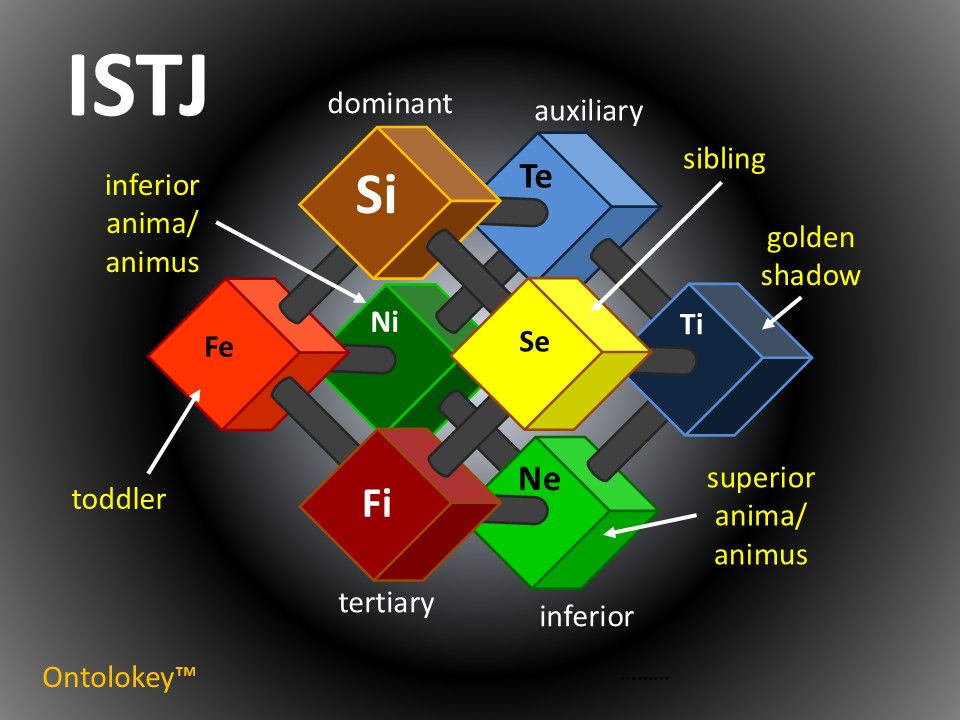
ISTJ – The Untold Truth
Introduction: Beyond the Stereotype of the Reliable One
The ISTJ is one of the personality configurations most easily misunderstood precisely because its visible strengths are so socially recognizable. Reliability, discipline, conscientiousness, realism, loyalty, precision, and an almost instinctive respect for responsibility make the ISTJ appear psychologically straightforward: the person who remembers what others forget, finishes what others abandon, maintains what others neglect, and quietly carries obligations without demanding applause. Yet this surface description captures only the architecture of the conscious personality and says considerably less about the psychological tensions that sustain it. The deeper ISTJ is not simply a “responsible person,” but a psyche organized around a continuous negotiation between experience and action, stability and possibility, private values and external standards, control and uncertainty. Ontolokey’s distinctive contribution is to interpret this personality not as a static four-letter category but as a dynamic three-dimensional system in which conscious functions, shadow functions, developmental vulnerabilities, and opposing psychological tendencies remain in constant interaction. In that sense, the ISTJ is not merely the guardian of what already exists; it is a personality whose central developmental question concerns what happens when the structures that have made life safe begin to compete with the parts of the self that want life to become larger.
Traditional Jungian and MBTI-derived descriptions generally place Introverted Sensing (Si), Extraverted Thinking (Te), Introverted Feeling (Fi), and Extraverted Intuition (Ne) at the center of the ISTJ configuration, although the cognitive-function model should be understood as a typological framework rather than as a scientifically established map of discrete brain mechanisms. Within that framework, Si gives the ISTJ its profound relationship with accumulated experience, internal reference points, sensory memory, continuity, and familiarity; Te transforms those internal reference points into externally effective procedures, standards, decisions, and results; Fi supplies a quieter and more private moral center; and Ne introduces precisely the kind of uncertainty, multiplicity, and possibility that the conscious personality finds hardest to control. Ontolokey expands this conventional picture by explicitly examining additional positions—Extraverted Sensing (Se), Extraverted Feeling (Fe), Introverted Intuition (Ni), and Introverted Thinking (Ti)—and by treating them as meaningful dimensions of psychological development rather than irrelevant “extra” functions. Its cube therefore presents the ISTJ as an organism of tensions rather than a collection of adjectives, with the twelve possible functional relationships represented through dynamic sliders between opposing or complementary tendencies. This approach is particularly valuable for understanding the shadow, because the psychological material most likely to cause difficulty is often not what the individual consciously identifies with, but what the conscious identity has learned to distrust, suppress, postpone, or regard as unnecessary.
The central paradox of the ISTJ is therefore that the very qualities that make this personality extraordinarily dependable can, when absolutized, become mechanisms of psychological imprisonment. Discipline can become self-denial, responsibility can become compulsive burden-carrying, standards can become rigidity, competence can become an inability to admit weakness, and emotional restraint can gradually become estrangement from one’s own emotional life. Ontolokey’s deeper shadow analysis argues that the most serious danger is not obvious irresponsibility or chaos but something considerably more subtle: the replacement of authentic life with functional life, in which a person becomes exceptionally good at fulfilling obligations while becoming progressively less able to identify what they themselves actually want. The shadow may then emerge through resentment, fantasies of escape, disproportionate reactions to spontaneity, attraction toward people who embody disowned freedom, excessive control, moral rigidity, or sudden behavior that appears radically inconsistent with the established identity. None of this means that every ISTJ will display these patterns, nor does typology diagnose psychological dysfunction; rather, these themes provide hypotheses for self-examination. The “untold truth” of the ISTJ is thus not that the responsible exterior is false, but that it is incomplete: behind the person who can always be counted upon may exist another person who is quietly asking whether being needed has gradually become a substitute for being fully alive.
This essay will therefore examine the ISTJ through the full Ontolokey architecture, beginning with the conscious psychological orientation and moving through the principal functions and their corresponding developmental positions before entering the deeper territory of the shadow. Particular attention will be given to the meaning of each position—Dominant Si, Auxiliary Te, Sibling Se, Toddler Fe, Inferior Ne, Anima/Animus Ni, Tertiary Fi, and Golden Shadow Ti—because these positions reveal different psychological relationships to memory, action, sensation, emotion, possibility, meaning, morality, and internal logic. The purpose is not to glorify the ISTJ as the dependable guardian nor to expose it as secretly pathological, but to show why both interpretations are inadequate when taken alone. A mature ISTJ does not have to abandon structure, become emotionally demonstrative, or transform into an improvisational personality in order to grow; the deeper task is to make structure serve life rather than replace it, to allow responsibility to coexist with desire, and to develop the capacity to tolerate uncertainty without experiencing it as a threat to identity. In that movement, the ISTJ’s greatest strength and deepest vulnerability turn out to be two expressions of the same psychological principle: the extraordinary human need to create order in a world that can never be completely controlled.
I. The Psychological Foundation: Introversion, Perception, and the Need for Continuity
Before examining the individual functions of the Ontolokey cube, it is necessary to understand the psychological orientation from which the ISTJ experiences reality. In the Ontolokey interpretation, the ISTJ is described as introverted and irrational, with both terms carrying their specifically Jungian meanings rather than their everyday connotations. Introversion does not mean shyness, social incompetence, or an aversion to people; it describes the direction in which psychic energy is preferentially organized, namely toward an internal world of impressions, memories, subjective reference points, and personally processed experience. Likewise, “irrational” does not mean unreasonable or unintelligent, but refers to a perceptual orientation in which the individual initially seeks to apprehend what is present rather than immediately imposing a judgment upon it. This distinction is fundamental because it explains why the ISTJ can appear extraordinarily decisive and structured while nevertheless possessing a deeply observational psychological core: the external decisiveness is largely the consequence of what happens after perception has already been internally organized. Ontolokey therefore presents the ISTJ not as someone who instinctively rushes toward conclusions, but as someone who first establishes an internal sense of what is real, familiar, verifiable, and consistent before converting that perception into an externally organized course of action.
This orientation produces a distinctive relationship with uncertainty. An ISTJ does not necessarily fear change itself; what tends to create psychological friction is change that arrives without sufficient information, precedent, preparation, or intelligible structure. The difference is subtle but extremely important, because it means that what outsiders sometimes interpret as stubbornness may actually be an attempt to protect the integrity of an internally coherent map of reality. When an established procedure has repeatedly demonstrated its reliability, abandoning it merely because something newer is fashionable can feel irrational from the ISTJ’s perspective, while preserving it can represent intellectual honesty rather than blind conservatism. This is also why experience carries such unusual psychological authority for this type: experience is not merely a collection of memories but a database against which present circumstances can be compared, tested, and interpreted. Contemporary descriptions of the conventional ISTJ function stack similarly emphasize that Introverted Sensing compares present conditions with remembered experience, while Extraverted Thinking translates that information into externally effective organization and measurable results. The resulting personality is consequently grounded not simply in “the past,” but in accumulated evidence about what reality has previously demonstrated itself to be.
The psychological strength of this orientation becomes particularly visible when circumstances demand reliability rather than improvisational brilliance. The ISTJ can preserve institutional memory, recognize discrepancies that others overlook, remember precisely how a system is supposed to operate, and distinguish between an actual improvement and a superficial alteration that merely looks innovative. Dominant Introverted Sensing provides the internal archive, while Extraverted Thinking gives that archive practical force by asking how information can be organized into procedures, priorities, standards, responsibilities, and outcomes. In this sense, the ISTJ’s competence is often cumulative rather than spectacular: it grows through repetition, refinement, observation, correction, and an increasingly sophisticated understanding of what works under real conditions. The danger begins when this strength becomes fused with identity, because the person can gradually stop asking whether an established structure remains appropriate and begin treating its preservation as an obligation in itself. Ontolokey’s model is valuable precisely here because it does not portray the ISTJ’s preference for continuity as either inherently healthy or inherently pathological; instead, it places that preference within a dynamic system in which stability must eventually encounter immediacy, possibility, emotion, intuition, and alternative forms of reasoning.
At the center of this system stands Dominant Introverted Sensing (Si), the Archivist of Experience, which is arguably the most consequential psychological position for understanding the ISTJ. Si does not simply “remember facts,” nor is it equivalent to photographic memory; within the Jungian framework it represents an inwardly referenced perception of sensory impressions and their relationship to previous experience. The present is therefore continuously compared with an internal record of what has already been encountered, allowing the ISTJ to notice deviations, inconsistencies, recurring patterns, familiar sequences, and subtle differences that may be invisible to a person who primarily seeks novelty. Ontolokey describes this function as a psychological anchor because it provides continuity in a world that otherwise presents an endless stream of changing stimuli, and this anchoring quality can have a profoundly regulating effect on the personality. What appears externally as caution, conservatism, meticulousness, or resistance to spontaneous disruption can therefore serve an internally coherent purpose: Si reduces psychological noise by connecting the unfamiliar present to something already understood. When healthy, this produces one of the ISTJ’s greatest gifts—the ability to transform experience into dependable judgment without needing constant external reassurance.
Yet the same function can become defensive when continuity is unconsciously confused with safety. The more an ISTJ has learned that careful preparation prevents mistakes, the more tempting it becomes to expand that principle into a general philosophy in which unpredictability itself is treated as evidence of danger. At that point, Si no longer merely consults the past; it begins policing the present according to the past, and experiences that cannot be assimilated into established categories may be dismissed before they have been genuinely understood. This is one of the central psychological tensions of the type because the ISTJ’s extraordinary sensitivity to precedent can either produce wisdom or produce overidentification with precedent. The mature form of Si says, in effect, “I know what has happened before, so I can use that knowledge intelligently”; the defensive form says, “I know what has happened before, therefore I already know what this must be.” The difference between these two positions is the difference between experience functioning as wisdom and experience functioning as a prison, and it will become increasingly important as the essay moves from the conscious architecture of the ISTJ into its shadow dynamics.
II. Auxiliary Extraverted Thinking: The Architecture of Competence
If Introverted Sensing provides the ISTJ with an internal archive of experience, Auxiliary Extraverted Thinking (Te) is the mechanism through which that accumulated knowledge becomes action in the external world. This is the position that gives the ISTJ its characteristic ability to transform complexity into procedure, ambiguity into priorities, and intention into measurable execution. Ontolokey portrays this side of the personality as the practical, efficient, systems-oriented dimension that asks not merely whether something is true or meaningful, but whether it can actually be made to work. The ISTJ therefore tends to approach a problem by decomposing it into manageable elements, establishing an order of operations, identifying the relevant standards, and then pursuing completion with sustained consistency. This can produce an unusually high degree of dependability because the ISTJ does not generally rely upon temporary enthusiasm to accomplish something; once the task has been accepted as legitimate and necessary, the individual can continue working long after the emotional excitement surrounding it has disappeared. Ontolokey emphasizes that this productivity is not necessarily motivated by a desire for recognition, because the satisfaction frequently comes from the internal experience of competence itself—the quiet knowledge that something has been done correctly, thoroughly, and in a manner that will continue to function after the ISTJ has walked away from it.
The psychological importance of Te becomes clearer when it is understood as a complement to Si rather than as an independent trait. Si asks, in effect, what experience has already taught me about reality, while Te asks how that knowledge can be organized into an effective response to reality. The combination is extraordinarily powerful in environments where precision, accountability, continuity, and long-term execution matter, because the ISTJ can draw upon precedent without becoming immobilized by it. A complex project can be broken down into sequential tasks, an inefficient system can be examined for weaknesses, and a vague objective can be translated into concrete responsibilities, deadlines, standards, and procedures. This is one reason ISTJs often become the people others trust when something genuinely has to be completed rather than merely discussed. Their competence is frequently understated because they do not necessarily advertise the amount of cognitive labor involved in maintaining a system, yet their absence can reveal how much invisible structure they had been providing all along. In psychological terms, Te converts the ISTJ’s private relationship with reality into an externally testable form, which gives the personality a strong orientation toward accountability and results.
There is, however, a shadow hidden inside this admirable competence: the possibility that usefulness becomes the primary criterion by which the ISTJ evaluates both the world and the self. When Te is healthy, efficiency is a tool serving a meaningful objective; when it becomes defensive, efficiency can quietly become the objective itself. The person may begin measuring situations according to productivity, measurable outcomes, correctness, or practical value while becoming increasingly impatient with experiences whose value cannot be immediately quantified. Conversations that exist primarily for emotional connection can appear inefficient, artistic exploration can appear indulgent, and periods of rest can generate an uncomfortable sense that time is being wasted. The danger is not that the ISTJ becomes incapable of feeling or imagination, but that these dimensions of experience receive legitimacy only after they have been translated into something useful. This creates a subtle psychological hierarchy in which action outranks reflection, competence outranks vulnerability, and demonstrable contribution outranks subjective need. The resulting person can become extraordinarily capable while simultaneously becoming strangely uncertain about what they are allowed to want when no external task requires them to want it.
This tension also explains why an ISTJ may respond to interpersonal problems by attempting to solve them rather than by entering fully into the emotional experience behind them. If someone is distressed, the instinctive response may be to identify the practical cause, determine what can be changed, and initiate corrective action, because this is the language in which Te naturally expresses care. Ontolokey explicitly describes the ISTJ as someone who may show concern through practical assistance—repairing something, organizing something, providing food, creating order, or helping another person become capable—rather than through elaborate emotional declarations. This should not be mistaken for an absence of affection; indeed, for many ISTJs, practical reliability is one of the most sincere forms of affection they know how to offer. Yet the limitation becomes significant when the other person does not need a solution and instead needs emotional witnessing, ambiguity, patience, or permission to experience something that cannot yet be fixed. In those moments, Te can unintentionally communicate a message it never consciously intended: your problem matters to me, therefore I must solve it. The deeper developmental task is learning that some human experiences are not defective systems awaiting correction, and that sometimes remaining present with another person is more psychologically intelligent than making the situation efficient.
The mature expression of Te consequently involves a crucial distinction between control and stewardship. Control attempts to make reality conform to an internally preferred structure, whereas stewardship recognizes reality as something that must be managed responsibly without pretending that every variable can be mastered. An integrated ISTJ can retain extraordinary organizational ability while accepting that human beings are not machines, relationships cannot be optimized like workflows, and uncertainty is not automatically evidence of poor preparation. This is where the apparently rigid ISTJ can become surprisingly wise: the same person who once needed every variable accounted for can gradually learn which variables actually matter and which merely represent an understandable desire for certainty. Te then becomes less about proving competence and more about creating conditions in which competence serves something larger—responsibility, fairness, craftsmanship, protection, contribution, or loyalty. The deepest version of ISTJ practicality is therefore not sterile efficiency but respect for reality, including the inconvenient reality that people, including the ISTJ themselves, sometimes need time, emotional space, forgiveness, and meaning rather than another perfectly executed solution.
III. Sibling Extraverted Sensing: The Encounter with the Immediate World
Within the Ontolokey cube, Sibling Extraverted Sensing (Se) occupies a particularly revealing position because it represents a form of perception that is simultaneously close to the ISTJ and fundamentally different from its dominant mode of experiencing reality. Si looks at the present through the accumulated imprint of previous experience, whereas Se seeks to encounter the present with minimal mediation, attending directly to what is physically happening here and now. For the ISTJ, this creates an intriguing psychological tension: the individual may be exceptionally observant of concrete reality while still being uncomfortable with the psychological demand to respond spontaneously to it. The distinction matters because observation and immediacy are not identical capacities; an ISTJ can notice an enormous amount of detail and nevertheless prefer to process that detail through an established internal framework before acting. Ontolokey therefore describes Se as a sibling rather than simply an inferior opposite, suggesting that it is accessible to the ISTJ but operates according to a different energetic logic. It is the part of the personality that quietly asks the question Si is least inclined to ask: not “What does this remind me of?” but “What is actually happening right now?”
This distinction becomes psychologically important whenever circumstances cannot be adequately handled through preparation or precedent. In ordinary life, the ISTJ may prefer to anticipate requirements, establish procedures, understand expectations, and create a reliable sequence through which events can unfold, but reality inevitably produces situations that refuse to cooperate with such preparation. A sudden change of plan, an unexpected opportunity, a physical challenge, a rapidly evolving social environment, or a situation requiring immediate improvisation can temporarily deprive the ISTJ of the familiar advantage provided by Si. Se then becomes both challenge and resource because it directs attention away from accumulated interpretations and toward the concrete information arriving through the senses at this exact moment. Ontolokey notes that this capacity can emerge particularly strongly during experimentation or crisis, sometimes producing brief episodes of striking boldness or spontaneity. The paradox is that the ISTJ may occasionally discover, under pressure, that they are far more capable of improvisation than their normal self-image suggests, precisely because circumstances temporarily force them to stop consulting the internal archive and start trusting direct perception.
The shadow side of this relationship appears when suppressed immediacy returns without sufficient integration. An ISTJ who spends prolonged periods controlling impulses, postponing pleasure, suppressing physical needs, or treating spontaneity as irresponsible may eventually experience Se not as a refined capacity for presence but as a compensatory hunger for sensory intensity. The resulting behavior can seem strangely uncharacteristic: impulsive spending, excessive physical stimulation, sudden risk-taking, compulsive environmental rearrangement, or an almost desperate need to escape the repetitive structure of ordinary obligations. Ontolokey specifically associates Se with bursts of boldness and with hands-on attempts to impose order upon the physical environment, which illustrates the ambiguity of this function in the ISTJ psyche. What appears to be an irrational impulse may therefore contain a legitimate psychological message: the organism has been living too exclusively through abstraction, memory, duty, or planning and is demanding contact with embodied existence. The healthier alternative is not to suppress Se but to give it a legitimate place in ordinary life, allowing pleasure, physical movement, aesthetic experience, travel, experimentation, and spontaneous engagement to exist without requiring them to become acts of rebellion.
There is also a deeper existential significance to Se because it confronts the ISTJ with the irreversibility of time. Si is intimately connected with what has already been experienced, while Se insists that reality is continuously occurring and cannot be preserved indefinitely in advance. Every moment that the ISTJ spends attempting to prepare for life is simultaneously a moment of life itself, and this creates a subtle danger for a personality that derives security from readiness. Excessive preparation can become a sophisticated form of postponement in which the person continually believes that genuine participation will begin once everything has been organized sufficiently well. Yet the world never becomes sufficiently predictable to satisfy that condition, and the resulting pattern can lead to a life that is technically well managed but insufficiently inhabited. Integration of Se therefore means learning to distinguish preparedness from postponement and responsibility from avoidance. The mature ISTJ does not discard planning; instead, planning becomes a foundation from which presence is possible, rather than a wall behind which experience is permanently deferred.
At its healthiest, Se can consequently become one of the ISTJ’s most underrated developmental assets because it teaches the personality that reality does not always need to be interpreted before it can be experienced. An integrated ISTJ can enter a room and simply perceive it, engage with another person without immediately categorizing the interaction, respond to an unexpected development without assuming that unpredictability equals danger, and allow an experience to remain valuable even when it produces no measurable result. This does not transform the ISTJ into an impulsive personality, nor should psychological development be confused with becoming the opposite type. Instead, Se adds a dimension of immediacy to the existing Si architecture, allowing experience to become something more than stored information: it becomes lived presence. Ontolokey’s broader principle is that personality development occurs through dynamic equilibrium rather than replacement, and the Si–Se tension illustrates this particularly well. The ISTJ does not become psychologically whole by abandoning the archive, but by learning that an archive is ultimately meaningful only because there is a living present in which its accumulated knowledge can be used.
IV. Toddler Extraverted Feeling: The Difficult Education of Emotional Reciprocity
Toddler Extraverted Feeling (Fe) occupies one of the most psychologically revealing positions in the Ontolokey architecture because it concerns an area in which the ISTJ may possess considerable goodwill while lacking equal confidence in the language through which that goodwill is communicated. Fe is concerned with the emotional field between people: shared atmosphere, interpersonal harmony, social responsiveness, emotional reciprocity, and the capacity to recognize what a situation requires emotionally rather than merely procedurally. Ontolokey places Fe in the Toddler position, describing it as comparatively immature, vulnerable, and prone to misunderstanding, while explicitly cautioning that this does not mean the ISTJ lacks empathy or human feeling. (ontolokey.com) The distinction is crucial because the ISTJ may care profoundly while remaining uncertain about how much emotional expression is appropriate, how directly feelings should be communicated, or how much emotional dependency can safely be tolerated. Consequently, the ISTJ can sometimes be perceived as cold by people who equate emotional warmth with verbal expressiveness, even though the individual may be demonstrating attachment through reliability, protection, practical assistance, and an extraordinary willingness to carry burdens for the people they consider their own. The psychological problem therefore is not necessarily insufficient feeling but insufficient translation: the internal experience of caring may be considerably richer than the interpersonal language available for communicating it.
This helps explain a recurring relational paradox in the ISTJ. The person may believe that their actions should communicate what their words do not, because from their perspective actions are more substantial evidence than emotional declarations. If someone remembers every practical detail, keeps promises, solves problems, protects another person’s interests, remains present during difficult circumstances, and reliably fulfills commitments, the ISTJ may reasonably regard these behaviors as an unmistakable demonstration of affection. Yet interpersonal relationships operate through multiple symbolic systems, and another person may need explicit reassurance, emotional validation, tenderness, enthusiasm, or verbal recognition in addition to practical reliability. Ontolokey’s description of Fe as an underdeveloped social compass captures this gap without reducing it to emotional deficiency: the ISTJ may know what is objectively responsible while being less certain about what will make another person subjectively feel understood. (ontolokey.com) This becomes especially complicated when emotional situations are ambiguous, because there may be no established procedure that tells the ISTJ exactly what to say or do. In such moments, the individual can become uncomfortable not because the other person’s emotions are unimportant, but because the normal instruments of competence—precedent, analysis, structure, and practical correction—do not provide an obvious solution.
The shadow dimension of this difficulty can become considerably more painful when emotional needs remain unspoken on both sides. The ISTJ may give extensively while assuming that the other person recognizes the significance of those sacrifices, while the recipient may appreciate the practical support but still experience an emotional absence because certain feelings have never been articulated. Ontolokey’s shadow analysis describes precisely this potential accumulation of unacknowledged needs: the dependable ISTJ can become the person upon whom everyone relies, while simultaneously finding it difficult to admit that they themselves require support, recognition, tenderness, or reassurance. Over time, this asymmetry can produce an internal ledger of disappointments in which the person remembers everything they have done for others but has never clearly communicated what they hoped to receive in return. Because the grievance has not been openly negotiated, it may emerge indirectly through withdrawal, criticism, stubbornness, emotional distance, or disproportionate anger rather than through a vulnerable statement such as “I need you to recognize what this has cost me.” The tragedy is that the ISTJ may experience this as evidence that other people are ungrateful, while the other person experiences it as an unexpected change in behavior, without either side fully recognizing that the underlying problem was an emotional contract that was never consciously articulated.
This is where Fe development becomes an important part of psychological maturity rather than merely a matter of becoming “more emotional.” A mature ISTJ does not need to become socially performative, excessively expressive, or dependent upon constant interpersonal affirmation; instead, the developmental task is to become more accurate in recognizing that other people do not necessarily receive care in the same form in which the ISTJ naturally gives it. Emotional intelligence in this context means learning to ask what another person is actually experiencing before deciding what should be done about it, and learning to distinguish emotional validation from agreement. It also means becoming capable of communicating one’s own needs before they harden into resentment, because responsibility without reciprocity eventually becomes a form of self-abandonment. Ontolokey describes development along the Si–Fe axis as increasing emotional literacy and a deeper interpersonal ethic, in which the ISTJ learns not merely to do what is correct but to express that correctness in a form another human being can genuinely receive. (ontolokey.com) This is a profound distinction: moral behavior is not only about having good intentions or fulfilling one’s obligations, but also about understanding the psychological reality of the person standing on the other side of one’s actions.
There is consequently something deceptively tender about the Fe Toddler in the ISTJ. The very awkwardness surrounding emotional expression can conceal an intense desire to belong, to be appreciated, and to know that one’s loyalty is reciprocated rather than merely exploited. The person who appears least likely to ask for reassurance may sometimes need it deeply, precisely because asking would expose a part of the self that has been trained to remain competent and self-sufficient. Ontolokey’s broader conception of individuation suggests that this vulnerable function should not be conquered or forced into the dominant personality, but gradually integrated into a larger psychological equilibrium in which duty and feeling can coexist. (ontolokey.com) The mature ISTJ therefore does not abandon practical love but learns to supplement it with emotional presence, just as they do not abandon self-sufficiency but learn that accepting support does not invalidate competence. When this development occurs, the ISTJ’s loyalty becomes warmer without becoming sentimental, their honesty becomes more compassionate without becoming dishonest, and their reliability becomes relational rather than merely functional. What once appeared to be emotional awkwardness can then become something more valuable: a quiet, deliberate capacity to treat another person’s inner world as seriously as the ISTJ has always treated external reality.
V. Inferior Extraverted Intuition: The Fear of Possibility and the Liberation Hidden Within It
Inferior Extraverted Intuition (Ne) is perhaps the most psychologically decisive function in the ISTJ configuration because it represents both the personality’s deepest source of uncertainty and one of its most important developmental opportunities. Ne turns attention toward alternatives, possibilities, hypothetical outcomes, emerging patterns, and futures that have not yet been verified through experience. For a dominant Si personality, this orientation can initially feel destabilizing because Ne refuses to guarantee which possibility will become reality; it multiplies rather than reduces the number of potential interpretations. Ontolokey therefore describes Ne as the ISTJ’s “Shadow of Chaos and Creativity,” emphasizing that the same function capable of generating anxiety and worst-case scenarios can, when consciously integrated, become a source of innovation and psychological freedom. This duality is essential because the inferior function is not simply a weakness that should be eliminated, but a neglected psychological capacity that can eventually compensate for the limitations of the dominant orientation. The ISTJ does not suffer because possibilities exist; the deeper difficulty arises when the psyche feels compelled to eliminate possibilities before it can feel safe enough to act.
In everyday life, this can create a peculiar relationship with uncertainty in which the ISTJ may be simultaneously highly imaginative and highly distrustful of imagination. A healthy Ne allows a person to ask, “What else could be true?” or “What might happen if I approached this differently?”, but an insecure Ne can transform the same cognitive openness into an uncontrolled proliferation of potential problems. Instead of generating creative alternatives, the mind begins generating contingencies: What if this goes wrong? What if I overlooked something? What if the apparently harmless change produces consequences I cannot predict? What if the person I trust behaves differently than expected? Ontolokey explicitly associates inferior Ne under stress with irrational fears, worst-case scenarios, and mental chaos, which explains why an ISTJ who normally appears calm and grounded can occasionally become consumed by possibilities that are statistically remote but psychologically vivid. The irony is that the ISTJ’s normal strategy for reducing uncertainty—gathering information and establishing order—can actually intensify the problem when applied compulsively, because every additional possibility generates another variable that appears to require control. At its extreme, preparation ceases to be preparation and becomes an attempt to create certainty in a reality that cannot provide it.
This is one of the places where the ISTJ’s shadow can be profoundly misunderstood from the outside. People may see someone who is ordinarily practical and methodical suddenly become suspicious, catastrophizing, indecisive, or unusually preoccupied with unlikely scenarios, and conclude that the person has simply become irrational. Psychologically, however, the phenomenon can be understood as an inversion of the normal hierarchy: the function that ordinarily remains subordinate begins demanding attention because the dominant strategy is no longer sufficient to regulate the situation. The ISTJ’s mind may then move from the familiar logic of “I know what has worked before” toward the destabilizing realization that the current situation contains variables for which there is no reliable precedent. This can produce either paralysis or compulsive preparation, depending on the individual and circumstances. The deeper developmental challenge is to recognize that uncertainty cannot always be defeated by more information, because some decisions require action before certainty becomes available. Ne becomes healthier when the ISTJ learns to regard possibility not automatically as danger but as information about the range of reality.
The positive potential hidden inside inferior Ne is therefore much greater than the stereotype of the cautious ISTJ suggests. Once sufficiently developed, Ne gives the personality permission to experiment intellectually, revise assumptions, entertain unconventional solutions, and imagine futures that are not simply repetitions of the past. Ontolokey describes this capacity as an engine of innovation because it enables the ISTJ to break established patterns rather than merely perfect them. This can produce a particularly formidable form of creativity: instead of generating novelty for novelty’s sake, the ISTJ can combine the exploratory breadth of Ne with the empirical discrimination of Si and the executional strength of Te. Such a person is capable not merely of imagining ten alternatives but of determining which one has enough structural integrity to survive contact with reality. The resulting creativity is often quieter than the stereotypical image of the visionary, because it may appear as incremental invention, system redesign, strategic contingency planning, technical refinement, or the discovery of an unconventional solution to a practical problem.
The deepest transformation occurs when the ISTJ stops demanding that every new possibility prove itself safe before it is allowed psychological space. This does not mean becoming reckless, abandoning standards, or treating every idea as equally valid; rather, it means learning to distinguish uncertainty from danger. A possibility can be unverified without being threatening, and an unfamiliar path can be approached experimentally without requiring a lifelong commitment. In this sense, Ne can teach the ISTJ an emotional lesson as much as a cognitive one: reality does not have to be completely known before it can be trusted enough to be explored. The person who once used experience primarily to protect against uncertainty can gradually begin using experience as a launching point from which new experience becomes possible. This is why Ontolokey treats the inferior function as a potential gateway to individuation rather than merely a defect in the personality architecture. The mature ISTJ eventually discovers that the opposite of chaos is not absolute control but flexible order, an order strong enough to absorb surprise without collapsing, and this may be one of the most important psychological freedoms available to the type.
VI. Anima Introverted Intuition: The Hidden Vision Beneath the Practical Mind
Anima Introverted Intuition (Ni) occupies a very different psychological territory from the ISTJ’s dominant Si, even though both functions are introverted forms of perception and therefore can appear superficially similar. Si gathers and organizes lived impressions through continuity, comparison, familiarity, and accumulated experience, whereas Ni seeks an underlying trajectory, symbolic meaning, singular pattern, or future direction that may not yet be consciously demonstrable. Ontolokey places Ni in the Anima position for the ISTJ, describing it as a hidden capacity for long-term vision, insight, and deeper interpretation rather than as an ordinary conscious operating mode. This position is psychologically significant because it suggests that beneath the ISTJ’s concrete orientation toward what has been established there can exist a surprisingly abstract capacity to perceive where things are heading. The ISTJ may therefore occasionally produce an insight that seems disproportionate to the person’s otherwise empirical style, not because the individual has suddenly abandoned reality, but because Ni has momentarily condensed numerous observations into a single internal conclusion. What makes this function difficult is that the insight may arrive without the kind of sequential evidence that Te and Si normally prefer, leaving the ISTJ uncertain whether to trust it.
The distinction between Si and Ni can be understood as the difference between recognizing continuity and perceiving direction. Si may notice that a particular situation resembles previous situations and therefore activate a repository of relevant experience, while Ni may notice that apparently unrelated developments are converging toward one underlying outcome. The former asks, “Where have I encountered something like this before?” whereas the latter is more concerned with “Where is this ultimately going?” Neither is inherently superior, and neither should be reduced to simplistic stereotypes about memory versus prophecy, but they organize perception according to fundamentally different principles. Ontolokey’s designation of Ni as the ISTJ’s Anima is therefore useful because it identifies an internal capacity that can feel both attractive and unfamiliar: the ability to step outside immediate procedures and contemplate the deeper trajectory of a system, relationship, institution, or personal life. When developed, this can transform the ISTJ from an excellent maintainer into an unusually perceptive strategist, because accumulated evidence is no longer used only to preserve what works but also to infer what may need to change before the consequences become obvious.
The difficulty is that Ni can become psychologically distorted when it is activated without sufficient grounding in the ISTJ’s normal empirical discipline. Under pressure, the mind may leap from a handful of observations toward an apparently inevitable conclusion and then treat that conclusion as though it were already established fact. This can produce a particularly subtle form of rigidity because the person may believe they are being intuitive when they are actually constructing a closed narrative about what is going to happen. The same psychological capacity that produces strategic foresight can therefore produce fatalism, suspicion, excessive interpretation, or an unwarranted conviction that a particular future is already determined. The broader Ontolokey framework explicitly treats the Anima as a shadowed but meaningful function rather than simply a defect, which means that Ni should neither be suppressed nor granted unquestioned authority. For the ISTJ, the healthiest relationship with Ni is consequently one of dialogue: experience supplies evidence, intuition proposes a trajectory, and thinking tests whether that trajectory deserves to guide action.
There is also a deeper developmental implication in the fact that Ni occupies an Anima position. The ISTJ may spend much of life concentrating on what must be done next, what has worked previously, what responsibilities currently exist, and what practical problem requires attention, while the question of ultimate direction remains strangely underdeveloped. Such a person can build an exceptionally stable life without ever asking whether the life being stabilized is actually the life they want to continue living. Ni introduces precisely this uncomfortable question because it shifts psychological attention from maintenance toward destiny, from individual tasks toward the meaning of the larger trajectory. This does not necessarily produce dramatic existential crises; it can appear much more quietly as a growing realization that professional competence, financial security, family obligations, or social respect are not identical to personal fulfillment. The ISTJ may eventually recognize that a perfectly maintained structure can still be built around an outdated purpose, and that preserving something indefinitely does not automatically make it worth preserving. Ni therefore becomes psychologically valuable when it enables the individual to distinguish continuity from direction: the fact that something has always been done does not tell us whether it is leading toward the future we actually intend.
At its most mature level, Ni gives the ISTJ a form of strategic depth that can be remarkably powerful because it is supported by the accumulated realism of Si and the executional discipline of Te. The result is not a visionary personality in the stereotypical sense, but a person capable of seeing long-term consequences without becoming detached from practical reality. Such an ISTJ can recognize when an institution is slowly becoming obsolete, when a relationship is developing toward a predictable rupture, when a recurring pattern is pointing toward a larger systemic problem, or when an apparently minor decision will have significant consequences years later. Ontolokey’s broader model places Ni alongside the other functions as part of a dynamic architecture in which hidden capacities can become sources of integration rather than permanent weaknesses. The deepest lesson of the ISTJ’s Anima is therefore that practicality does not have to mean confinement to the immediately verifiable; sometimes the most practical thing a person can do is to perceive where the current trajectory leads before reality makes the destination unavoidable. In that sense, Ni does not ask the ISTJ to abandon evidence for intuition, but to allow evidence to become the foundation from which deeper vision can emerge.
VII. Tertiary Introverted Feeling: The Private Moral Core
Tertiary Introverted Feeling (Fi) introduces one of the most important contradictions within the ISTJ because it reveals that the personality’s commitment to rules, standards, responsibility, and objective correctness does not necessarily mean that the individual lacks a deeply personal system of values. On the contrary, Fi represents a private evaluative dimension in which experiences are measured against an internal sense of authenticity, personal loyalty, moral significance, and what feels fundamentally right or wrong to the individual. In the conventional ISTJ function model, Fi is positioned as tertiary, meaning that it is considerably more accessible than the inferior or shadow functions but generally less developed and consciously confident than Si and Te. This helps explain why an ISTJ can appear highly objective in public while holding intensely personal convictions that are not easily negotiable. The person may follow established rules for years without complaint, yet if a rule eventually violates a deeply held principle of fairness, loyalty, integrity, or personal conscience, the response can be surprisingly absolute. What outsiders sometimes interpret as inconsistency is therefore better understood as the interaction between two different forms of judgment: Te asks whether something is objectively effective or procedurally correct, while Fi quietly asks whether it is morally acceptable to the individual who must live with the consequences.
The tertiary position also explains why Fi may remain largely invisible until something important crosses an internal boundary. The ISTJ is often willing to tolerate inconvenience, follow procedures, fulfill obligations, and subordinate personal preference when a responsibility is considered legitimate, but this should not be mistaken for the absence of personal preference or emotional depth. In many cases, the individual has simply learned to keep these things private because openly foregrounding subjective feelings can appear less reliable than presenting objective reasons. This creates a psychological economy in which the ISTJ may be much more emotionally invested in an issue than their language suggests, yet communicate their position through principles, facts, responsibilities, or consequences rather than explicitly saying, “This matters deeply to me.” Ontolokey’s model is especially useful here because it prevents the common stereotype of the ISTJ as someone governed exclusively by external rules; the tertiary Fi position indicates that beneath the visible structure exists an increasingly important private moral landscape. When that landscape is respected, the ISTJ can possess exceptional integrity because external responsibility is reinforced by an internal conviction that certain things simply should or should not be done. When it is chronically suppressed, however, the same person can become resentful because other people may repeatedly benefit from sacrifices whose personal emotional cost was never acknowledged.
This suppression can become particularly dangerous when the ISTJ confuses self-control with self-erasure. Because Te and Si are naturally comfortable with duty, consistency, and delayed gratification, an ISTJ can become extremely skilled at placing personal needs at the bottom of the priority list, especially when other people or institutions depend upon them. The problem is that Fi does not disappear merely because it is ignored; it continues recording subjective experiences of violation, disappointment, loyalty, betrayal, appreciation, and meaning. Over time, these experiences can accumulate into a private emotional history that may be invisible even to the people closest to the ISTJ. The person may continue functioning normally while internally reaching a point at which a previously tolerated situation suddenly becomes morally intolerable, producing a decisive withdrawal that seems abrupt to everyone else. Ontolokey’s shadow-oriented treatment of the ISTJ emphasizes the danger of accumulated resentment and the consequences of a life in which personal needs remain subordinated to responsibility for too long. (ontolokey.com) The psychological lesson is therefore not that the ISTJ should become more self-centered, but that genuine responsibility must include responsibility toward one’s own inner life, because a person who continually violates their own values in order to satisfy external obligations eventually ceases to act from integrity and begins acting from exhaustion.
A healthy tertiary Fi can instead become the source of the ISTJ’s quietest and most powerful form of loyalty. When an ISTJ decides that a person, principle, institution, or commitment genuinely matters, the resulting devotion may be extraordinarily durable because it is supported by both practical responsibility and personal conviction. This helps explain why the type can be deeply loyal even when its emotional expression is understated; the absence of theatrical affection should not be confused with the absence of attachment. Fi gives the ISTJ the ability to distinguish between what is merely expected and what is personally meaningful, and this distinction becomes increasingly important as the individual matures beyond simply fulfilling externally defined roles. It can also provide an ethical counterweight to Te, preventing efficiency from becoming the sole criterion for decision-making. A highly developed ISTJ can therefore ask not only whether a decision works, but whether it is fair, honorable, loyal, humane, and consistent with the kind of person they want to be. In this form, Fi does not undermine the ISTJ’s objectivity; it gives that objectivity a conscience.
The deepest developmental movement of tertiary Fi is consequently the transition from being responsible because responsibility is expected to being responsible because it expresses a consciously chosen value system. This distinction may appear subtle, but psychologically it represents a major shift from externally structured identity toward internal authorship. The immature ISTJ can define the self through roles: employee, parent, partner, provider, expert, organizer, protector, or reliable friend, while the mature ISTJ increasingly asks which of these roles genuinely correspond to personal convictions and which have merely been inherited from expectation. That question can be uncomfortable because it may reveal that some forms of loyalty have become habits rather than choices, or that some responsibilities are maintained primarily because abandoning them would produce guilt. Fi introduces the possibility that saying “no” can sometimes be more ethical than continuing to perform a role that has become destructive, and that personal authenticity is not the opposite of responsibility but one of its foundations. When Si supplies wisdom from experience, Te supplies execution, and Fi supplies inner value, the ISTJ becomes capable of something far more sophisticated than simple rule-following: the ability to decide which rules deserve loyalty in the first place. In that integration, the ISTJ’s characteristic integrity becomes genuinely personal rather than merely procedural, because the individual is no longer simply preserving what is right according to an external structure but consciously choosing what is worth preserving according to an internal moral core.
VIII. Golden Shadow Introverted Thinking: The Hidden Architect
The final major functional position in the Ontolokey architecture is Golden Shadow Introverted Thinking (Ti), and it may represent the most intellectually liberating dimension of the mature ISTJ. Whereas Extraverted Thinking is concerned with applying objective standards, organizing external systems, and producing demonstrably effective outcomes, Ti turns inward and asks whether the underlying structure of an idea is internally coherent in its own right. Ontolokey therefore describes Ti as the ISTJ’s “Hidden Architect”: an unconscious reserve of analytical depth, independent logic, theoretical refinement, and intellectual creativity that can remain largely invisible during ordinary functioning. (ontolokey.com) The distinction between Te and Ti is subtle but psychologically transformative, because Te is comfortable asking whether an established method works while Ti asks why the underlying principle should be considered valid at all. An ISTJ dominated by Te can become exceptionally competent within an existing system, whereas an ISTJ who develops Ti can eventually become capable of examining the architecture of the system itself. This is one of the points at which the personality can move beyond being merely a guardian of established knowledge and become an independent thinker who possesses the confidence to construct, critique, and revise principles from the inside.
The Golden Shadow designation is particularly important because it differs psychologically from the more threatening forms of shadow material. In Ontolokey’s formulation, the Golden Shadow contains qualities that the conscious personality may admire, project onto others, or initially experience as belonging more naturally to someone else. (ontolokey.com) The ISTJ may therefore be fascinated by people who appear intellectually autonomous, theoretically sophisticated, philosophically independent, or capable of questioning assumptions that everyone else takes for granted, without immediately recognizing that these qualities represent an unrealized dimension of their own psyche. This can produce an interesting form of admiration in which the ISTJ sees another person as possessing a kind of intellectual freedom that they themselves have not yet consciously claimed. Yet the psychological potential is already latent: the ISTJ’s meticulousness, attention to consistency, and refusal to accept unsupported claims can provide an excellent foundation for Ti once the person becomes willing to detach analytical validity from external authority. The hidden architect does not destroy the existing structure; it asks whether the structure is internally sound.
This is also where the ISTJ’s relationship with authority can undergo one of its most significant transformations. In its less developed form, Te can become overly dependent upon established standards, recognized procedures, institutional rules, measurable evidence, or socially validated methods, particularly when those structures have proven reliable over time. There is nothing inherently problematic about this orientation, and in many professional contexts it is precisely what makes the ISTJ trustworthy, but it can become restrictive when external validity is unconsciously equated with truth itself. Ti introduces a more radical question: does this make sense independently of who says it should make sense? That question can be uncomfortable because it potentially destabilizes systems that have previously provided certainty and identity. Ontolokey notes that shadow Ti can also manifest negatively as rigid skepticism, compulsive analysis, or the devaluation of intuition, which demonstrates that the function becomes problematic when it is used defensively rather than integratively. (ontolokey.com) Mature Ti is therefore not contrarianism for its own sake; it is the ability to distinguish genuine logical necessity from mere procedural convention.
The relationship between Ti and Ne is particularly important because Ontolokey explicitly identifies the Ti–Ne axis as a bridge between scattered possibility and refined insight. (ontolokey.com) Ne generates alternatives, questions assumptions, and expands the range of conceivable explanations, while Ti evaluates those possibilities according to internal coherence and conceptual precision. For the ISTJ, this combination can initially feel destabilizing because it temporarily suspends the normal Si–Te process of recognizing precedent and implementing an established solution. Yet it also creates an entirely new intellectual mode: instead of asking only which solution has worked before, the individual can ask which solution makes the most sense given the principles involved. This can lead to theoretical innovation, sophisticated problem-solving, philosophical inquiry, technical mastery, and an ability to recognize flaws in systems that function adequately on the surface. The danger is that the same capacity can become obsessive when the ISTJ refuses to act until every conceptual inconsistency has been resolved, effectively replacing Te’s practical rigidity with Ti’s analytical rigidity. Integration therefore requires knowing when internal coherence has been established sufficiently for action and accepting that reality will always contain variables that no conceptual system can completely eliminate.
At its deepest level, Golden Shadow Ti represents the possibility of self-authorized thought. This is psychologically different from merely becoming more intelligent, because intelligence can operate perfectly well within inherited frameworks while still depending upon external permission to determine what counts as valid. Self-authorized thought means that the ISTJ gradually becomes capable of saying, “I understand the established system, I respect the evidence that supports it, but I am also capable of examining its foundations and deciding whether they remain intellectually defensible.” This can be liberating because it reduces the need to derive identity from being correct according to an external standard and replaces it with a more mature confidence in one’s own capacity for discernment. Ontolokey describes this developmental movement as a transition from rule-bound cognition toward independent reflection, ultimately connecting the ISTJ’s practical competence with intellectual autonomy. (ontolokey.com) The mature ISTJ can therefore retain the extraordinary discipline of Te while gaining the conceptual independence of Ti, producing a person who does not merely know how systems work but understands why they work, where they fail, and under what conditions they should be redesigned.
The Golden Shadow consequently completes an important psychological movement that began with Dominant Si. Si initially asks the world to demonstrate continuity, Te asks that continuity to become effective structure, Fi asks whether that structure remains morally meaningful, Ne challenges it with alternative possibilities, Ni asks where the larger trajectory is leading, and Ti ultimately asks whether the underlying architecture makes sense on its own terms. None of these functions invalidates the others, and the Ontolokey model explicitly presents the personality as a dynamic system of tensions rather than a fixed hierarchy in which some functions are permanently “good” and others permanently “bad.” (ontolokey.com) For the ISTJ, Ti therefore represents something close to intellectual individuation: the movement from preserving reliable knowledge toward becoming an author of knowledge. The person who once derived security from knowing the correct procedure can eventually derive something deeper from understanding the principle beneath the procedure, and that shift changes the meaning of competence itself. Competence is no longer simply the ability to perform correctly within a system; it becomes the capacity to understand, evaluate, and—when necessary—rebuild the system without losing one’s grounding in reality.
IX. The Shadow Beneath Competence: When Responsibility Becomes Identity
The most difficult question raised by the ISTJ is not whether this personality can be responsible, disciplined, loyal, or competent, but what happens when these qualities become so central to identity that the person no longer knows who they are without them. Ontolokey’s deeper shadow analysis argues that every personality develops a private psychological territory containing impulses, emotions, desires, fears, resentments, fantasies, and vulnerabilities that do not fit comfortably with the public identity, and that the ISTJ is particularly susceptible to concealing this territory because its conscious identity is strongly associated with stability, reliability, predictability, duty, and control. The paradox is severe: the better the ISTJ becomes at functioning, the easier it can become for both the individual and the surrounding environment to overlook the possibility that something inside is no longer functioning well. A person can continue arriving on time, fulfilling obligations, solving problems, maintaining standards, supporting others, and performing competently while becoming progressively less connected to desire, vulnerability, spontaneity, and emotional need. The external evidence says that everything is working, while the internal evidence may quietly be saying something entirely different.
The shadow begins to acquire particular force when the ISTJ learns that competence receives more reliable social reinforcement than vulnerability. Ontolokey describes the pattern in stark terms: reliability is rewarded, self-control earns respect, and the ability to endure discomfort without complaint can gradually become part of the person’s identity. There is nothing inherently unhealthy about resilience, and indeed the capacity to continue functioning under pressure is one of the ISTJ’s genuine strengths, but psychological resilience becomes dangerous when it is confused with the obligation never to need anything. The individual can become exceptionally practiced at swallowing disappointment, postponing exhaustion, rationalizing loneliness, suppressing anger, and continuing to perform the role that everyone expects. Eventually the personality may no longer distinguish between “I can handle this” and “I am not allowed to admit that this hurts.” That distinction matters enormously because the first statement expresses strength while the second expresses psychological imprisonment, and an ISTJ can move from one to the other so gradually that the transition remains invisible even to the person experiencing it.
One of the most consequential consequences is emotional alienation. The shadow analysis describes an ISTJ who may understand responsibilities in extraordinary detail while becoming increasingly uncertain about personal desires and emotional needs, because feelings have repeatedly been evaluated through practicality, usefulness, legitimacy, or relevance before they have been fully experienced. This creates an unusual psychological split in which the individual may possess excellent cognitive self-understanding while having surprisingly limited emotional self-understanding. They can explain why they made a decision, identify what went wrong in a situation, reconstruct an argument from years ago, or describe precisely what another person should do next, yet struggle with the deceptively simple question, “What do you actually want?” The difficulty is not necessarily that the answer does not exist, but that desire has received insufficient practice compared with duty. When a person has spent years organizing life around what is necessary, appropriate, useful, or expected, spontaneous preference can begin to feel almost illegitimate unless it can be justified by a rational purpose.
This is where the shadow becomes particularly dangerous because society can inadvertently reinforce the very pattern that produces the internal problem. The dependable employee is praised for always being available, the responsible family member is admired for carrying burdens, the loyal partner is valued for enduring difficulties, and the conscientious person receives recognition for never becoming “a problem.” Ontolokey points out that the deepest shadow may therefore develop under conditions of social success rather than obvious failure: the individual receives external validation precisely while internal dissatisfaction is expanding. The person may consequently have little incentive to examine the psychological cost of their lifestyle because the lifestyle appears objectively successful. This is one reason burnout can become so disorienting for an ISTJ: exhaustion does not necessarily arrive after obvious recklessness or failure, but after years of doing almost everything “right.” The crisis then feels inexplicable because the conscious personality has followed its own rules faithfully, yet the psyche is demanding something those rules never accounted for.
The deepest shadow, according to Ontolokey, is therefore not simple irresponsibility, laziness, emotional instability, or a secret desire to destroy everything that has been built. Those can occur as compensatory expressions, but they are not the underlying issue. The deeper danger is the replacement of authentic life with functional life—the gradual transformation of existence into duty and the unconscious equation of usefulness with worth. This distinction cuts directly into the moral identity of the ISTJ because usefulness often feels virtuous, while desire can feel selfish and spontaneity can feel irresponsible. Yet a human being cannot remain psychologically nourished by function alone, because meaning requires some relationship to subjective experience, pleasure, curiosity, attachment, creativity, and personal choice. If these dimensions are continuously sacrificed to preserve external order, the result may be a person who is admired by almost everyone and deeply estranged from themselves. The uncomfortable truth is therefore not that the ISTJ’s responsibility is false, but that responsibility becomes destructive when it is used to avoid the more frightening work of discovering what life means when no one is asking anything from you.
This also provides a deeper explanation for the resentment described in Ontolokey’s shadow analysis. The ISTJ can become the person upon whom others rely precisely because they are exceptionally capable of carrying responsibility, but the ability to carry responsibility can gradually invite more responsibility than any human being should reasonably be expected to bear. If the ISTJ simultaneously struggles to communicate personal needs, the relationship becomes asymmetrical: others receive reliability while the ISTJ receives the implicit expectation to remain reliable. Over time, the individual may begin keeping what Ontolokey effectively describes as an internal ledger of disappointments, inequities, betrayals, and sacrifices that have never been openly discussed. Because the resentment is not consciously negotiated, it can emerge through criticism, withdrawal, stubborn resistance, passive refusal, or sudden disproportionate anger rather than through direct vulnerability. The person may sincerely believe that others should have noticed what was never explicitly communicated, while others may sincerely believe that everything was fine because the ISTJ continued to perform exactly as expected.
The psychological task at this point is not to condemn the ISTJ for having needs, nor to romanticize the shadow as though every suppressed impulse were inherently authentic. Some impulses genuinely require restraint, and not every desire deserves to become behavior merely because it has been suppressed for a long time. Integration requires something more demanding: the capacity to acknowledge an impulse without automatically obeying it and to acknowledge a responsibility without automatically submitting to it. This is where the Ontolokey cube becomes more than a typological classification system, because its twelve bidirectional relationships can be interpreted as invitations toward psychological flexibility rather than as fixed prescriptions. The ISTJ does not need to abandon Si for Ne, Te for Ti, or responsibility for spontaneity; instead, the mature psyche learns to let these apparently opposing forces communicate with one another. Stability can ask possibility what it is protecting against, possibility can ask stability what it has learned, external logic can consult private values, and private values can learn to express themselves without destroying external responsibility.
Ultimately, the healthiest ISTJ is not the person who has eliminated their shadow but the person who no longer needs to hide it from themselves. Such an individual can say, without shame, that they sometimes want to escape, sometimes need reassurance, sometimes dislike being responsible, sometimes feel anger toward people they love, sometimes desire experiences that have no practical purpose, and sometimes question structures they once defended. None of these admissions automatically constitutes a moral failure; they constitute psychological information. The crucial difference is that the mature ISTJ can process that information consciously rather than allowing it to accumulate underground until the shadow has to force recognition through crisis. Ontolokey’s central insight is therefore particularly relevant here: psychological development is not the destruction of the personality that made a person successful, but the expansion of that personality so that success no longer requires the exclusion of everything that does not fit its original identity. The ISTJ’s ultimate challenge is not learning how to become less responsible, but learning that responsibility toward the world and responsibility toward the self are not opposing duties; they are two halves of psychological integrity.
X. The ISTJ in Relationships: Loyalty, Reciprocity, and the Problem of Unspoken Contracts
The relational life of the ISTJ reveals perhaps more clearly than any other domain how the conscious functions and shadow functions interact. The stereotypical image of the ISTJ as emotionally reserved can obscure the remarkable depth of loyalty that often accompanies the type, because loyalty is frequently expressed through continuity rather than intensity. An ISTJ may remember details that another person has forgotten, keep promises long after the excitement surrounding them has disappeared, remain physically or practically present during difficult periods, and assume responsibilities that nobody explicitly asked them to assume. These behaviors can constitute a profound language of attachment, particularly because the person often understands commitment as something demonstrated through repeated action rather than dramatic declaration. The problem begins when the ISTJ assumes that this language is universally understood and reciprocated in the same form, because other people may experience love primarily through emotional availability, verbal affirmation, spontaneity, or shared experience. The resulting mismatch can create one of the most painful patterns in the ISTJ personality: the individual gives what they themselves regard as substantial evidence of devotion while quietly waiting for another person to recognize its meaning without being told what recognition is actually needed.
This is where the combination of Si, Te, Fi, and Fe becomes especially important. Si remembers the history of the relationship in extraordinary detail, Te notices whether commitments are being honored, Fi privately evaluates whether loyalty and integrity remain intact, while the relatively vulnerable Fe monitors the emotional atmosphere without always feeling confident about how to influence it. The ISTJ may therefore possess a highly developed internal record of relational reciprocity, remembering who appeared when things became difficult, who kept promises, who betrayed confidence, who showed gratitude, and who repeatedly relied upon them without offering comparable reliability in return. This memory can be an enormous relational strength because it allows the ISTJ to recognize patterns that others might overlook, but it can also become an internal courtroom in which past disappointments are continuously entered as evidence. When this occurs, the relationship is no longer being experienced exclusively in the present; it is being evaluated against an accumulated historical record. The psychological maturity of the ISTJ lies not in forgetting that history, but in learning when history represents legitimate pattern recognition and when it has become an emotional ledger that makes genuine renewal almost impossible.
The shadow becomes particularly visible when the ISTJ has difficulty expressing dissatisfaction before it becomes resentment. Because Te is comfortable with responsibility and Fi tends to keep personal evaluations private, the person may initially respond to relational disappointment by simply doing more, tolerating more, or correcting problems independently. This can create a deceptive period of apparent stability in which the relationship looks functional even though one participant is becoming increasingly depleted. Eventually, however, the accumulated imbalance may become intolerable, and the ISTJ can make a decision that appears sudden to the other person but is actually the culmination of months or years of internal processing. Ontolokey’s discussion of the ISTJ shadow emphasizes precisely this danger: the individual may suppress personal needs for so long that resentment becomes the only remaining mechanism through which those needs can demand recognition. (ontolokey.com) This is why direct communication is not merely a social skill for the ISTJ but a form of psychological prevention. Saying “I cannot continue doing this,” “I need more reciprocity,” or “This hurt me” while the problem is still manageable is far healthier than waiting until the internal verdict has already been reached.
At the same time, relationships can provide an unusually powerful developmental environment for the ISTJ because intimacy repeatedly confronts the personality with experiences that cannot be reduced to procedure. Another human being does not remain predictable simply because one understands them well, and emotional closeness frequently requires responses that have no established precedent. This activates the very functions that the conscious personality tends to control most carefully: Fe asks for emotional reciprocity, Ne introduces uncertainty and alternative interpretations, Se demands presence rather than preparation, and Fi requires the individual to reveal personal values and vulnerabilities rather than merely perform responsibilities. The partner or friend who can tolerate the ISTJ’s slower emotional processing without interpreting it automatically as indifference can therefore become an important developmental catalyst. Equally, the ISTJ can offer something many relationships desperately need: stability that does not disappear when circumstances become difficult. The mature relationship is consequently not one in which the ISTJ becomes emotionally expressive at all times, but one in which practical loyalty and emotional communication learn to reinforce rather than invalidate one another.
There is also a profound lesson for the ISTJ in learning that being needed is not identical to being loved. These two experiences can overlap, but they are psychologically different, and a personality organized around usefulness can unconsciously gravitate toward relationships in which its competence is constantly required. Such relationships can feel secure because they provide an unmistakable role: there is always something to fix, organize, protect, finance, manage, or endure. Yet if the relationship depends primarily upon what the ISTJ does rather than who the ISTJ is, the person may eventually discover that their usefulness has become a substitute for intimacy. The deeper developmental challenge is to tolerate being valued even when nothing needs to be repaired, and to allow another person to care for them without immediately attempting to restore the balance by becoming useful again. This is where tertiary Fi and vulnerable Fe can mature together: Fi permits the ISTJ to recognize personal needs as legitimate, while Fe teaches the individual to communicate those needs within a reciprocal human relationship. The result is not dependence but a more sophisticated form of mutuality in which love is no longer measured exclusively by sacrifice, endurance, or practical service.
For the ISTJ, therefore, healthy intimacy ultimately requires a movement from silent reliability toward conscious reciprocity. Reliability remains one of the type’s greatest gifts, but it becomes psychologically richer when the individual can explain what that reliability means, what it costs, what they need in return, and where their limits actually lie. The partner, friend, or family member does not have to decode years of behavior in order to understand the ISTJ’s emotional world; the ISTJ gradually learns to make that world more accessible through language. This does not require theatrical confession or constant emotional disclosure, but it does require enough vulnerability to prevent the relationship from becoming an arrangement of unspoken obligations. In the fully developed ISTJ, loyalty ceases to mean “I will endure anything because I gave my word” and becomes something more mature: “I will honor my commitments, but I will also remain honest about whether those commitments continue to reflect what is right, reciprocal, and meaningful.” That distinction transforms loyalty from endurance into conscious choice, and conscious choice is ultimately a much stronger foundation for intimacy than obligation alone.
XI. Work, Responsibility, and the Ethics of Competence
The professional environment often brings out the ISTJ’s strengths with unusual clarity because many institutions reward exactly the qualities this personality naturally develops. Attention to detail, procedural consistency, reliability, punctuality, documentation, long-term memory, accountability, and the ability to work without constant supervision can make the ISTJ indispensable in environments where mistakes have consequences and systems need to remain stable. Ontolokey’s Si-centered architecture explains why the ISTJ often excels at preserving institutional knowledge while Te provides the capacity to convert that knowledge into repeatable processes and measurable outcomes. (ontolokey.com) The individual may not always seek the most visible leadership position, but can become the person whose judgment quietly determines whether a system actually functions. This is one reason ISTJs can be profoundly influential without appearing particularly charismatic: their authority often emerges from demonstrated competence rather than social performance. Over time, colleagues learn that when the ISTJ says something has been checked, it has probably been checked carefully, and when the ISTJ commits to a responsibility, the probability of follow-through is unusually high.
The danger is that competence can become an addictive form of identity reinforcement. When an organization repeatedly rewards the ISTJ for solving problems, absorbing additional responsibility, and remaining calm under pressure, it may inadvertently create a situation in which saying “no” feels like a betrayal of both the organization and the self. The person becomes the reliable exception to ordinary human limitations, and eventually others begin planning around that reliability without recognizing its cost. Ontolokey’s shadow analysis is relevant here because it identifies the possibility that the ISTJ can become trapped in a cycle of responsibility in which personal needs are continuously subordinated to what must be done. (ontolokey.com) This is particularly dangerous because the ISTJ may not immediately experience the pattern as exploitation; they may initially experience it as pride in being capable. Only later does the psychological equation become visible: because I can carry it, I must carry it. The mature correction is not to become unreliable but to recognize that capability creates an opportunity for contribution, not an obligation to accept every burden that happens to be transferable.
The ISTJ also has a distinctive relationship with organizational change. Change is not inherently threatening to this personality when it is justified, well structured, and demonstrably superior, but change for its own sake can trigger skepticism because Si asks whether the proposed innovation actually improves upon what already exists. This skepticism can be enormously valuable in environments dominated by fashionable management language, technological enthusiasm, or poorly tested reforms. The ISTJ is often willing to ask the inconvenient question that others avoid: what concrete problem does this solve, what evidence supports it, and what happens if the new system fails? Yet the same strength can become an obstacle when familiarity acquires more authority than evidence, particularly if an old system has become intertwined with professional identity. Here again, Ne and Ti offer necessary counterweights. Ne allows the ISTJ to consider possibilities before dismissing them, while Ti permits an examination of whether the logic of the existing system remains sound independent of its age or institutional prestige.
The highest professional expression of the type therefore combines conservatism of standards with flexibility of methods. An immature ISTJ may preserve both the objective and the procedure because the procedure has become psychologically associated with correctness, whereas a mature ISTJ distinguishes between what must remain stable and what can be redesigned. The standard may be non-negotiable while the method remains experimental; accuracy can remain sacred while the workflow changes; ethical responsibility can remain constant while technology transforms the means through which it is expressed. This distinction allows the ISTJ to become an unusually effective reformer because the person does not confuse innovation with virtue or tradition with virtue. Instead, both are evaluated according to consequences, evidence, integrity, and long-term sustainability. In this form, the ISTJ’s apparent conservatism becomes something more sophisticated: a resistance not to change itself, but to unearned change.
Ultimately, the professional maturation of the ISTJ requires learning that an organization is not entitled to every ounce of competence an individual possesses. A person can be indispensable and still require rest, boundaries, recognition, autonomy, and a life outside the system they maintain. Indeed, remaining psychologically independent may make the ISTJ more valuable in the long term because judgment deteriorates when responsibility becomes chronic exhaustion. The strongest ISTJ professional is therefore not the person who can work indefinitely without complaint, but the person who understands where their contribution creates genuine value and where their continued sacrifice merely allows dysfunctional systems to avoid changing. Te becomes healthier when it serves purposeful execution rather than compulsive productivity, while Fi provides the internal boundary that says a successful outcome is not automatically worth every personal cost. The mature ISTJ can consequently leave a dysfunctional structure, reject an inefficient tradition, delegate a task, or refuse an unreasonable demand without experiencing these actions as evidence of personal failure. Competence then becomes a form of freedom rather than a sentence to permanent responsibility.
XII. The Deepest Shadow: Control, Rigidity, and the Fear Beneath It
The ISTJ’s relationship with control is one of the most psychologically revealing aspects of the type, because control is rarely about domination for its own sake. In the Ontolokey model, the conscious ISTJ is built around continuity, reliability, proven experience, practical order, and the ability to make reality manageable through structure. This makes control an extraordinarily effective adaptive instrument: schedules reduce uncertainty, procedures reduce error, standards protect quality, and preparation creates a buffer against the unpredictable. The problem begins when a useful instrument quietly becomes an emotional necessity. At that point, the ISTJ is no longer simply organizing life; organization is organizing the ISTJ. The distinction is subtle because the resulting behavior can remain outwardly rational, responsible, and even admirable. Yet psychologically, the person may have crossed from using structure into needing structure in order to feel internally safe. Ontolokey describes precisely this transition when it argues that control can move from being a tool to becoming an unconscious necessity, so that disruption of familiar structures begins to feel like a threat to the self rather than merely an inconvenience.
This is where rigidity becomes psychologically more interesting than the stereotype of “the stubborn ISTJ” suggests. Stubbornness is the surface behavior; underneath it may be an attempt to preserve continuity in the face of uncertainty. If a method has worked repeatedly, abandoning it does not merely introduce a new technique; it introduces the possibility that one’s accumulated knowledge may no longer be sufficient. The deeper threat is therefore epistemic as well as emotional: What if what I know cannot protect me here? The ISTJ’s dominant Si, understood within the Ontolokey framework as the “Archivist of Experience,” naturally looks backward for patterns that have already demonstrated reliability, while Te seeks to convert those patterns into effective external systems. Together they can create extraordinary competence, but they can also create a closed loop in which experience validates structure and structure determines which new experiences are permitted. The person may become increasingly difficult to surprise, but also increasingly difficult to change. What looks like confidence in established knowledge can therefore become an unconscious refusal to enter situations in which knowledge has not yet been established.
The most important point is that the fear beneath rigidity is not necessarily fear of disorder in the ordinary sense. It can be a fear of psychological disintegration: the suspicion that if the standards are relaxed, responsibilities are abandoned, routines are disrupted, or emotions are allowed to become less controlled, something essential will fall apart. This is why highly controlled ISTJs can sometimes appear disproportionately disturbed by changes that other people regard as minor. The external event may be objectively small, but it symbolically represents the loss of predictability. A changed plan can become evidence that the environment can no longer be trusted; an unreliable person can become evidence that dependence itself is dangerous; an emotional conversation can become a situation in which there is no clear procedure for achieving a correct outcome. In such circumstances, Te may attempt to solve what is fundamentally an emotional problem by increasing organization, while Si searches for precedent and Ne, in its inferior position, generates possible negative outcomes. The resulting behavior can look like excessive planning or criticism when, at a deeper level, the psyche is attempting to restore a feeling of internal ground beneath its feet. Ontolokey explicitly interprets this pattern as control functioning as protection against uncertainty and describes the underlying rigidity as defensive rather than merely temperamental.
The paradox is that the strategy works extremely well until life presents a problem that cannot be solved by more structure. Human beings eventually encounter experiences that refuse to become orderly: grief, love, aging, betrayal, illness, creativity, sexuality, existential uncertainty, and the contradictory emotions that accompany intimate relationships. These experiences cannot be mastered simply by collecting more information or constructing a better procedure. One can prepare for a conversation, but not completely control what another person will feel; one can plan a career, but not guarantee that the resulting life will remain meaningful; one can establish financial security, but not eliminate mortality. At precisely these points the ISTJ’s greatest strength can become its greatest temptation: the instinct to respond to uncertainty by increasing control. Yet there are circumstances in which increasing control does not solve the problem but instead prevents the person from psychologically entering the experience. Ontolokey captures this distinction in unusually stark terms when it contrasts structure that supports life with rigidity that protects against life. The mature question is therefore not whether the ISTJ should become less organized, but whether organization remains subordinate to reality or has begun replacing reality.
This distinction also explains why an ISTJ can sometimes become extraordinarily competent at maintaining a life while becoming less capable of inhabiting it. Maintenance rewards predictability. It asks whether bills are paid, commitments are honored, tasks are completed, systems remain functional, and foreseeable problems are prevented. Living, however, includes dimensions that cannot be reduced to maintenance: curiosity, desire, play, emotional risk, discovery, aesthetic experience, intimacy, and the willingness to be changed by something that was not planned. When the maintenance principle expands too far, life becomes a perpetual management problem. The person does not necessarily suffer dramatically; in fact, they may look successful from almost every external perspective. The danger is subtler: the individual may gradually lose the ability to distinguish safety from aliveness. Ontolokey calls the deeper version of this process the replacement of “authentic life with functional life,” in which usefulness becomes more important than being fully alive.
This is also where the ISTJ’s shadow becomes paradoxical. The conscious personality may increasingly identify with responsibility, restraint, and reliability, while the unconscious begins carrying everything that consciousness has excluded: spontaneity, excess, freedom, pleasure, irresponsibility, experimentation, and the desire to stop being responsible for everyone and everything. The more completely these impulses are rejected, the more psychologically charged they can become. This does not mean that every ISTJ secretly wants to destroy their life or abandon their responsibilities; such a conclusion would be both simplistic and psychologically irresponsible. It means instead that the psyche tends toward compensation, and a personality that gives very little legitimate space to freedom may eventually experience freedom with unusual intensity. Ontolokey describes this dynamic through fantasies of escape, sudden attraction toward radically different experiences, or impulses that seem strangely out of character after prolonged periods of excessive self-regulation. The apparent contradiction is therefore meaningful: the disciplined self and the escaping self are not necessarily two unrelated personalities, but two sides of an unresolved psychological economy.
The deepest development of the ISTJ therefore does not consist in destroying control but in making control voluntary again. A psychologically mature ISTJ can still love routines, standards, preparation, historical knowledge, responsibility, and practical competence without requiring those things to guarantee emotional safety. They can recognize that a changed plan is not necessarily a collapse, that uncertainty is not synonymous with danger, and that another person’s different method is not automatically evidence of incompetence. More importantly, they can learn to tolerate the internal experience that arises when no immediately correct action exists. This is where the shadow becomes a teacher rather than an enemy. The purpose of integration is not to turn the ISTJ into a spontaneous, chaotic, emotionally demonstrative person, because that would simply replace one form of adaptation with another. The purpose is to create enough psychological flexibility that order becomes a chosen expression of the self rather than a defense against the parts of life that cannot be controlled.
In that sense, the deepest fear beneath the ISTJ’s control is not really chaos outside the self but chaos within the self. The person may fear what could happen if anger were fully acknowledged, if desire were taken seriously, if vulnerability were admitted, if old assumptions were questioned, or if the future were approached without a complete plan. Yet these experiences do not become dangerous merely because they exist; they become dangerous when they are denied until they can only emerge indirectly. The shadow does not disappear when it is disciplined into silence. It becomes more autonomous. Integration therefore requires a different kind of strength: not the strength to suppress every disruptive impulse, but the strength to remain psychologically intact while experiencing uncertainty, contradiction, desire, grief, dependence, and change. The truly stable ISTJ is not the person who has eliminated inner disorder. It is the person who no longer needs to eliminate every part of themselves in order to feel stable. That is a much deeper form of control, because it is no longer control over the self but a developing capacity to remain present with the whole self.
XIII. The Rejected Self: Projection, Envy, and the Roads Not Taken
One of the most uncomfortable truths about psychological development is that the traits we condemn most intensely in other people can sometimes point toward qualities we have excluded from ourselves. This is the classical psychological mechanism of projection, although it is important not to reduce every dislike to projection; sometimes another person really is irresponsible, manipulative, chaotic, or inconsiderate. The more useful question is not whether the judgment is factually justified, but why the emotional reaction is so disproportionately powerful. Ontolokey’s shadow analysis places particular emphasis on this mechanism in the ISTJ, because a strong conscious identity built around responsibility, discipline, competence, consistency, and self-control can leave relatively little room for their opposites. The person may therefore encounter spontaneity, emotional expressiveness, unconventionality, or apparent carelessness not merely as behaviors belonging to someone else, but as encounters with a psychologically disowned possibility within themselves. What makes the experience uncomfortable is precisely that the rejected quality may be both threatening and strangely attractive at the same time.
This is why an ISTJ can sometimes react with surprising intensity to people who appear carefree. The obvious interpretation is that the ISTJ simply values responsibility more highly, and there may be considerable truth in that interpretation. Yet another layer can coexist beneath it: the carefree person may embody a freedom that the ISTJ has rarely permitted themselves to experience. The person who can change plans without anxiety, spend an afternoon without producing anything, travel without exhaustive preparation, pursue an unconventional interest, express emotions spontaneously, or simply say “I want this” without first constructing a rational justification may represent something psychologically foreign to the disciplined self. That foreignness can produce criticism precisely because it touches a boundary within the personality. The reaction may become stronger when the carefree person appears happy despite violating standards that the ISTJ has spent years respecting. Ontolokey interprets this contradiction as an important shadow signal: the irritation can contain not only rejection but fascination, because the other person is living out a possibility that the ISTJ has kept outside the boundaries of acceptable identity.
Envy becomes especially complicated here because the conscious ISTJ may have difficulty recognizing it as envy. A person who has built their identity around self-sufficiency may not consciously think, “I want what that person has.” Instead, the mind may immediately begin producing an analysis of why that person’s lifestyle is impractical, unstable, irresponsible, inefficient, or morally questionable. Those observations may be entirely accurate, but accuracy does not invalidate the psychological meaning of the reaction. Someone can genuinely recognize the destructive aspects of another person’s lifestyle while simultaneously longing for the freedom represented by it. The distinction is between wanting the behavior and wanting the psychological permission underlying the behavior. The ISTJ does not necessarily want irresponsibility; they may want relief from responsibility. They may not want chaos; they may want freedom from having to keep everything under control. They may not want to abandon commitment; they may simply want to experience the possibility of choosing themselves without immediately feeling guilty for doing so. Ontolokey’s discussion of the shadow makes precisely this distinction, suggesting that beneath exaggerated forms of irresponsibility, pleasure-seeking, or avoidance can exist legitimate human needs for freedom, enjoyment, relief, and spontaneity.
This creates an important reinterpretation of the so-called “roads not taken.” Every personality structure is also a structure of exclusion. To become highly reliable means learning to say no to many impulses; to become disciplined means repeatedly choosing long-term consequences over immediate gratification; to become dependable means accepting obligations even when one would rather do something else. These choices can create a remarkable life, but they also create alternative lives that were never lived. The shadow sometimes appears when those unlived possibilities become psychologically active. An ISTJ who spent decades being responsible may suddenly become fascinated by art, travel, entrepreneurship, spirituality, unconventional relationships, physical adventure, or radically different forms of self-expression. This does not necessarily mean that the previous life was a mistake. Nor does it mean that the person must suddenly become the opposite of who they were. It may instead mean that a previously neglected dimension of the personality has reached a developmental threshold and is demanding recognition. Ontolokey describes this process especially in connection with periods of transition, including midlife, when accomplishments that once provided sufficient meaning may begin to feel strangely incomplete.
The psychological danger lies in interpreting this awakening too literally. When a neglected part of the personality suddenly becomes conscious, it can initially appear in exaggerated form because it has accumulated psychological energy while excluded from ordinary life. The disciplined person may fantasize about abandoning everything; the restrained person may imagine radical freedom; the dutiful person may dream about disappearing from every obligation; the practical person may become fascinated with experiences that seem completely impractical. Such fantasies can be alarming precisely because they feel disproportionate to the conscious identity. But a fantasy of escape does not necessarily mean that escape is the appropriate solution. It may be the psyche’s crude way of communicating that something essential has been missing. The question therefore becomes less “Should I destroy my current life?” and more “What legitimate need is this fantasy expressing?” That distinction is psychologically crucial, because shadow integration means translating the symbolic message of an impulse into a mature form rather than obeying its most extreme expression.
The same principle applies to emotionality. An ISTJ who has spent years identifying with composure may encounter highly expressive people with a mixture of admiration, embarrassment, irritation, and fascination. Again, this does not mean that emotional restraint is pathological or that dramatic expression is healthier. It means that emotional intensity itself may have become psychologically foreign. Ontolokey describes the ISTJ’s Fe position as an underdeveloped social-emotional function: the person can perceive atmosphere and may sincerely want harmony, but can struggle with the direct language of emotional exchange. Practical care therefore becomes easier than emotional exposure. An ISTJ may cook for someone, repair something, solve a practical problem, remain loyal for twenty years, or quietly remember every important detail about another person while still finding it extraordinarily difficult to say, “I am hurt,” “I need you,” or “I am afraid of losing you.” The danger is that the person eventually begins judging emotional openness as weakness simply because it is a language they have not developed fluency in.
Projection can therefore operate in both directions. The ISTJ may project rejected weakness onto emotional people, but may also project rejected vitality onto spontaneous or creative people. The first projection says, “They are unstable because they allow themselves to feel too much.” The second says, “They are irresponsible because they allow themselves to want too much.” In both cases, the external person becomes a screen onto which the ISTJ’s own unintegrated possibilities are projected. This is why some people can provoke an almost inexplicable psychological charge: they represent something that the conscious personality has defined itself against. The healthiest response is not to eliminate the reaction through forced tolerance, because superficial tolerance can simply become another form of control. The deeper task is to become curious about the reaction itself. What exactly is intolerable about this person? What quality do they possess that I would never permit myself to possess? What would happen if I allowed a small, responsible version of that quality into my own life? Such questions transform projection from an accusation against another person into information about the self.
This is also where the ISTJ’s tertiary Fi and shadow Ti become psychologically significant within the Ontolokey system. Fi can gradually force the individual to distinguish between values that were genuinely chosen and values that were simply inherited from duty, family, institution, culture, or personal history. Ti can then question the internal logic of those inherited structures with greater independence, asking whether the rules that once made perfect sense still describe the person’s present reality. Together, these developments can destabilize a previously coherent identity, but that destabilization may be developmental rather than destructive. The person begins discovering that being responsible and being free are not necessarily opposites, that discipline and pleasure can coexist, and that commitment becomes more meaningful when it is chosen rather than psychologically compulsory. The rejected self does not need to overthrow the responsible self. It needs representation within it. A mature ISTJ therefore does not become less principled by integrating shadow material; paradoxically, they may become more authentically principled because their principles are no longer built around denying everything that contradicts their preferred self-image.
The ultimate lesson of projection is therefore deeply humbling: the people who irritate us can sometimes reveal not what we should become, but what we have forbidden ourselves to be. For the ISTJ, the forbidden qualities may include play, experimentation, dependence, sensuality, emotional vulnerability, purposeless enjoyment, creative uncertainty, and the simple right to want something without first proving that it is useful. None of these qualities automatically deserves expression, and integration does not mean acting out every impulse. It means recognizing that these capacities belong to the human personality and therefore deserve conscious evaluation rather than unconscious exile. Once the ISTJ can say, without shame, “A part of me wants freedom,” the shadow loses some of its need to dramatize freedom through resentment, fantasy, projection, or sudden rebellion. The person can then build freedom into responsibility rather than waiting for responsibility to become unbearable. This may be one of the most important transitions in the entire ISTJ developmental journey: moving from a life in which the self is protected from unwanted possibilities to a life in which the self is large enough to contain them.
XIV. Escape, Burnout, and the Return of Vitality
There is a point at which responsibility can stop functioning as a virtue and start functioning as a psychological enclosure. This usually does not happen suddenly. The ISTJ may spend years becoming increasingly capable, increasingly dependable, increasingly difficult to replace, while simultaneously becoming less aware of what they themselves require from life. Because competence produces tangible rewards, the process can remain almost invisible: people trust them, institutions depend on them, family members rely on them, and the person receives confirmation that their way of living is working. Yet external functionality is not identical with psychological vitality. Ontolokey’s shadow analysis describes a particularly important sequence in which prolonged responsibility can move toward exhaustion, exhaustion toward resentment, and resentment toward fantasies of escape. The fantasy is not necessarily evidence that the person wants to destroy their commitments; it may instead be the psyche’s increasingly desperate attempt to communicate that a life organized entirely around obligation has become too narrow to contain the person living it.
Burnout is therefore especially significant when examining the ISTJ because the personality’s strengths can conceal the early stages of depletion. A person who is accustomed to functioning under pressure may interpret exhaustion as something to be managed rather than something to be listened to. They may optimize their schedule, improve their routines, take fewer unnecessary breaks, become more efficient, and attempt to eliminate whatever is producing friction. In ordinary circumstances this approach is highly effective, but burnout is often not an efficiency problem. It can be the consequence of a deeper mismatch between what a person continuously gives and what their psychological life receives in return. When every problem is interpreted as another task to solve, the individual can become extraordinarily skilled at maintaining the conditions that are exhausting them. The result is a disturbing paradox: the more competent they become at coping, the longer they may postpone recognizing that the way they are living has become unsustainable.
This is where resentment becomes psychologically important. The dependable person often becomes the person whom everyone assumes will cope, because they have repeatedly demonstrated that they can. Once this role becomes established, other people may unconsciously stop noticing the cost of the reliability. The ISTJ may also participate in this process by failing to communicate needs until those needs have accumulated into frustration. Practical service can then become a hidden relational currency: “I do this for you, therefore you should understand what I need from you without my having to ask.” When the expected reciprocity does not appear, disappointment can become resentment, and resentment can become moral judgment. The person may begin thinking that others are selfish, incompetent, immature, or ungrateful, when part of the underlying problem is that an implicit contract was never consciously negotiated. Ontolokey’s shadow account is particularly perceptive here because it connects the ISTJ’s capacity for loyalty and service with the danger of silently accumulating grievances when personal needs remain unspoken.
The resulting fantasy of escape can therefore have a very specific psychological meaning. The ISTJ may imagine quitting the job, moving somewhere completely different, disappearing from social obligations, traveling alone, changing careers, breaking routines, refusing to answer messages, or simply living for a period without being responsible for anyone else. Sometimes the fantasy is extreme precisely because the underlying need has been suppressed for so long. If ordinary freedom has never been granted legitimate space, the unconscious may represent freedom as total abandonment of the existing structure. This is why shadow material should not be interpreted literally. The appropriate response to an intense escape fantasy is not necessarily to burn down the life one has built; it is to ask what the fantasy is trying to restore. It may be autonomy, rest, play, novelty, recognition, emotional intimacy, creative expression, or the feeling that one’s existence belongs to oneself rather than permanently serving external demands.
The role of inferior Ne becomes especially interesting at this stage. Within the Ontolokey framework, Extraverted Intuition occupies the ISTJ’s inferior position and is associated with possibilities, alternatives, uncertainty, and “what if” thinking. In a relatively secure ISTJ, this function can broaden the world by introducing experimentation and alternative futures, but under stress it can become catastrophic, producing an endless stream of possible failures and negative outcomes. The irony is that the same function that can make an ISTJ afraid of uncertainty can also become the psychological doorway through which a different future becomes imaginable. This creates a developmental tension: possibility initially feels like danger because it destabilizes certainty, yet without possibility the person may become trapped inside a life that is technically stable but psychologically exhausted. Ontolokey’s broader model treats the eight functions not as isolated traits but as interacting positions within a dynamic system, which makes this tension especially important rather than incidental.
A mature relationship with Ne therefore does not require the ISTJ to become adventurous in the stereotypical sense. It can begin with something much quieter: allowing the possibility that there is more than one correct way to live. That realization can be surprisingly disruptive to a personality built around proven methods. If the person has spent decades believing that responsibility means doing what is necessary, they may eventually have to ask whether necessity itself has been defined too narrowly. Perhaps not every free evening needs to be productive. Perhaps not every purchase needs to be justified by utility. Perhaps a career can be changed before it becomes intolerable rather than after. Perhaps a relationship can include explicit requests instead of silent expectations. Perhaps an unfamiliar experience can be approached without first determining exactly how it will end. These are small permissions, but psychologically they represent a major shift from life as something to be managed toward life as something that can also be explored.
This transition is closely connected to the ISTJ’s relationship with Se, the Sibling function in Ontolokey’s model. Extraverted Sensing represents immediate sensory contact with reality: the physical body, the environment, movement, direct experience, aesthetics, pleasure, and responsiveness to what is happening now. For someone heavily oriented toward memory, precedent, and future consequences, the present moment can become strangely instrumentalized. Food becomes fuel, exercise becomes maintenance, travel becomes logistics, nature becomes scenery, and physical pleasure becomes something earned after responsibilities have been completed. The neglected Se dimension asks a more primitive question: What does it feel like to actually be here? This is not an invitation to impulsivity, but an invitation to embodiment. A person can know exactly what they are supposed to do while remaining surprisingly disconnected from the physical experience of doing it.
The danger of ignoring this dimension is that the body eventually becomes the messenger for needs the conscious personality has refused to hear. Fatigue, irritability, tension, restlessness, sensory deprivation, and the craving for novelty may appear long before the person consciously acknowledges that life has become too repetitive. Again, this should not be turned into a simplistic claim that every physical symptom in an ISTJ has psychological meaning; human physiology is more complicated than any personality model. The psychological point is narrower: when a person consistently suppresses rest, pleasure, movement, sensory enjoyment, and spontaneous engagement, the neglected need does not become nonexistent simply because it has been excluded from the official schedule. It continues to exist as part of the human organism. Ontolokey’s interpretation of Se as a sibling or balancing force to Si captures this developmental possibility well: stability becomes healthier when it can coexist with responsiveness, and continuity becomes richer when it remains open to immediate experience.
There is also a deeper existential dimension to burnout that cannot be solved by vacation alone. An ISTJ may achieve the stability they spent years pursuing and then encounter an unsettling question: What now? When security has been achieved, when the career is established, when the finances are under control, when responsibilities have been fulfilled, and when the house, family, routines, and systems are functioning, the absence of immediate problems can expose a problem that efficiency cannot solve. The person may discover that they were extraordinarily good at answering the question “What needs to be done?” but have spent much less time answering “What do I actually want?” This is where Fi, Ni, Ne, and Se begin to matter as developmental counterweights to the Si–Te identity. Personal values, long-term meaning, alternative possibilities, and immediate experience all ask questions that cannot be answered by duty alone.
The resulting crisis can therefore be mistaken for ingratitude. The ISTJ may possess a life that objectively contains many things worth appreciating and nevertheless feel restless, empty, or strangely disconnected from it. That does not automatically mean that the life is wrong. It may mean that the person has reached the limits of a developmental strategy that once served them extremely well. A strategy designed to establish safety cannot necessarily provide meaning once safety has been established. A strategy designed to prevent failure cannot automatically tell a person what success is supposed to mean. A strategy designed around usefulness cannot answer whether usefulness is the highest human value. This is one of the most important “untold truths” of the ISTJ shadow: the personality may become exceptionally successful at constructing a life that is difficult to criticize from the outside while privately wondering why that life does not feel as alive from the inside.
This is where the Ontolokey concept of individuation becomes particularly valuable as a metaphor. Its model does not describe maturity as abandoning the dominant Si and auxiliary Te, but as developing a broader relationship with the entire functional system, including Ni, Fe, Ne, Fi, Se, and Ti. In the Ontolokey interpretation, the mature ISTJ gradually moves beyond pure execution toward foresight, personal morality, relational reciprocity, creativity, embodiment, and independent conceptual thought. The point is not to weaken the original strengths but to prevent them from becoming monopolistic. A person who remains responsible while becoming more emotionally articulate is not becoming less ISTJ; they are becoming less psychologically one-dimensional. A person who maintains standards while tolerating alternative methods is not betraying their nature; they are gaining flexibility. A person who continues to value stability while consciously choosing moments of novelty is not abandoning order; they are making order serve life rather than allowing life to serve order.
The return of vitality therefore begins with a deceptively simple psychological reversal: instead of asking only what life requires from the ISTJ, the ISTJ begins asking what life is asking for from within the ISTJ. That distinction creates room for desire, curiosity, imagination, pleasure, and meaning without requiring a rejection of responsibility. The mature person does not need to escape their life because they have learned to inhabit it differently. They can take a day off without needing to justify it, express a need before it becomes resentment, experiment without demanding certainty, and allow themselves experiences that have no obvious productive purpose. They can preserve what deserves preservation while letting outdated structures die. Most importantly, they can discover that freedom does not have to mean the absence of responsibility. Sometimes freedom means being responsible for one’s own life rather than merely being responsible to everything and everyone outside oneself. That is the beginning of vitality returning not as rebellion, but as integration.
XV. Moral Certainty and the Prison of Principles
One of the most sophisticated forms of ISTJ shadow material is not obvious rigidity but moral certainty. A person who has spent years learning that reliability matters, that promises should be kept, that standards exist for a reason, and that consequences follow actions can gradually develop an extraordinarily coherent internal philosophy of responsibility. This coherence is one of the type’s greatest strengths, because it allows the ISTJ to remain dependable even when circumstances are difficult or emotionally inconvenient. Yet coherence can harden into certainty, and certainty can eventually become a psychological prison. The danger begins when principles cease to function as instruments for navigating reality and instead become substitutes for examining reality. At that point, the individual no longer asks whether a rule is appropriate to the present situation; they ask whether the present situation conforms to the rule. The distinction appears small, but psychologically it marks a movement from wisdom toward ideology, because the map has begun to acquire greater authority than the territory it was created to describe.
This is particularly relevant to the Ontolokey model because its ISTJ architecture gives enormous psychological significance to Si and Te. Si looks toward accumulated experience, precedent, continuity, and what has previously proved trustworthy, while Te translates that accumulated knowledge into externally effective systems. Together they can create a remarkably stable ethical and practical orientation. The problem emerges when “what has worked” becomes confused with “what must always be right.” Experience is evidence, but it is not infallible evidence; consistency is valuable, but consistency can also preserve outdated assumptions; efficiency is useful, but efficiency does not determine meaning. Ontolokey’s wider cube model is valuable precisely because it refuses to treat any single function as sufficient for the whole psyche: the eight functions are represented as interacting positions, with tensions between them rather than a simple hierarchy of superior and inferior human qualities. In this symbolic architecture, development requires the ISTJ to encounter perspectives that Si–Te alone cannot generate, including personal values, alternative possibilities, intuition, embodiment, relational awareness, and independent conceptual questioning.
The prison of principles becomes particularly visible when moral judgments become substitutes for curiosity. Suppose an ISTJ encounters a person who repeatedly changes careers, relationships, locations, or life plans. The immediate evaluation may be that the person lacks commitment, discipline, or maturity. Sometimes that judgment will be correct. But a psychologically mature response does not end with the judgment; it asks what the judgment cannot see. Perhaps the person is genuinely unstable, but perhaps they are also capable of adapting to realities that the ISTJ would find difficult to tolerate. Perhaps their inconsistency is avoidance, but perhaps their willingness to abandon a bad situation represents a form of courage that the disciplined person has underdeveloped. The point is not to romanticize instability or declare every opposing behavior secretly healthy. The point is that moral certainty can become a defense against ambiguity, and ambiguity is precisely where the psyche encounters information that cannot be absorbed into an existing framework. When curiosity disappears, principles stop guiding perception and begin controlling it.
This is where Fi becomes indispensable in the Ontolokey interpretation of the ISTJ. Fi, described there as the tertiary or “Moral Kernel,” does not simply add more morality to an already principled personality; it introduces a different source of moral authority. Te can ask whether a system works, Si can ask whether it is consistent with established experience, but Fi asks whether the action is personally congruent with what the individual actually values. That distinction becomes crucial when inherited duty and authentic conviction begin to diverge. An ISTJ may discover that some of the principles they defend most strongly were never consciously chosen at all. They may have been absorbed from parents, institutions, religion, professional culture, family expectations, or years of being rewarded for being the responsible one. Fi therefore introduces an uncomfortable question: Is this genuinely my value, or is this simply the rule I became good at obeying? The answer can destabilize the personality temporarily, but it also creates the possibility of integrity that is deeper than compliance.
The same developmental movement can occur through Ti, which Ontolokey identifies as the ISTJ’s Golden Shadow. Ti is concerned with internal coherence, conceptual precision, and the independent examination of logical structures rather than simply their practical usefulness. Its psychological contribution is therefore potentially subversive in the best sense. Ti can ask why a system works, what assumptions it contains, whether two apparently obvious concepts have been confused, and whether the authority supporting a principle actually deserves that authority. This is different from Te’s question of whether something produces the desired result. A mature ISTJ who develops this capacity can become much harder to manipulate by institutional logic, because they no longer equate official procedure with truth. They can respect expertise without surrendering independent thought, and they can respect tradition without assuming that tradition has completed the work of justification. Ontolokey explicitly describes the Golden Shadow as a source of hidden intellectual depth and independent conceptual clarity, making its integration an important counterweight to excessive reliance on externally validated systems.
Ni introduces another challenge to moral certainty because it changes the question from “What happened before?” to “Where is this going?” This difference can be profound. Si can provide an enormous archive of relevant precedent, but precedent does not always predict transformation. A situation can resemble something from the past while moving toward an entirely different outcome. Ni, in Ontolokey’s framework, occupies the Anima position for the ISTJ and represents hidden long-range vision, symbolic understanding, and an emerging capacity to perceive underlying trajectories. Its contribution is not to invalidate experience but to place experience inside a larger pattern. A mature ISTJ may therefore begin recognizing that fidelity to a principle sometimes requires changing the way that principle is expressed. The deeper value may remain stable while its practical form evolves. This is how wisdom differs from rigidity: wisdom preserves what matters while remaining willing to revise the form through which it is preserved.
Ne creates an even more uncomfortable challenge because it asks the ISTJ to entertain possibilities that have not yet earned the dignity of evidence. In its inferior position within the conventional ISTJ model and in Ontolokey’s broader symbolic system, Ne can initially feel destabilizing because it expands rather than narrows the field of interpretation. It asks what else could be true, what alternative explanation might exist, what unexpected opportunity could emerge, and what would happen if the established path were not the only path. An ISTJ operating under stress may experience this openness as dangerous because every possibility can become another potential failure. But healthy development requires learning that possibility and uncertainty are not synonymous with irresponsibility. The ability to imagine alternatives can actually make principles more robust, because a principle that survives contact with multiple possibilities is stronger than one that survives only because alternatives were never considered.
Fe, meanwhile, introduces perhaps the most relational challenge to moral certainty. A principle can appear perfectly rational when viewed from inside an individual’s ethical framework and still produce consequences that another person experiences as cold, humiliating, or unnecessarily harsh. Fe asks the ISTJ to become conscious of the emotional field created by their decisions. This does not mean that other people’s feelings should automatically override standards. It means that consequences are not exhausted by measurable outcomes. A policy can be technically fair while being experienced as dehumanizing; an honest statement can be factually correct while being delivered in a way that unnecessarily wounds; a boundary can be justified while still requiring emotional sensitivity. Ontolokey places Fe in the ISTJ’s Toddler position, emphasizing its awkwardness and relative underdevelopment, but precisely because of that position, learning its language can become an important developmental achievement. The mature ISTJ does not abandon standards for harmony; they learn that humane implementation is part of competent implementation.
Se contributes yet another corrective by returning the personality to immediate reality. Moral certainty tends to operate in abstractions: responsibility, fairness, loyalty, discipline, proper conduct, acceptable behavior. Se asks what is actually happening here, in this body, in this room, between these particular people, under these particular circumstances. It interrupts the tendency to apply a general rule without noticing the concrete reality that makes this situation different. This can be especially important for someone whose dominant orientation is toward internalized experience and established patterns. A mature ISTJ can therefore learn to distinguish between honoring a principle and mechanically reproducing its previous form. Sometimes the most responsible action is not the most conventional one. Sometimes preserving the deeper purpose of a rule requires temporarily violating its usual procedure. The psychological achievement lies in knowing the difference rather than automatically choosing either conformity or rebellion.
This is why the phrase “principles as guides, not masters” captures something essential about mature ISTJ development. Principles are necessary because a life without standards becomes vulnerable to impulse, manipulation, and inconsistency. But principles become dangerous when they are used to avoid perception, reflection, or responsibility for consequences. A person can become so committed to being correct that they lose contact with what correctness was supposed to protect. They can defend fairness while becoming unfair in practice, defend honesty while using honesty as a weapon, defend loyalty while remaining loyal to something that should have been left behind, or defend responsibility while assuming responsibility for things that were never theirs to carry. The shadow is therefore not simply “being too strict.” It is the transformation of a value into an identity, followed by the unconscious belief that protecting the identity is more important than serving the value.
The final stage of this development is not moral relativism. The ISTJ does not need to abandon standards, become endlessly permissive, or treat every perspective as equally valid. In fact, such a reaction would merely constitute another form of rigidity, this time rigidly rejecting rigidity. The deeper achievement is discriminating flexibility: the ability to know when a principle should be defended, when it should be adapted, when it should be questioned, and when it should finally be discarded. That requires the whole psychological system to participate. Si contributes memory, Te contributes execution, Fi contributes authenticity, Ti contributes conceptual independence, Fe contributes relational awareness, Se contributes contact with immediate reality, Ne contributes alternatives, and Ni contributes direction and meaning. Within Ontolokey’s cube, this is precisely the movement away from a static type identity toward a dynamic system in which the functions can enter into dialogue.
The untold truth is therefore that the ISTJ’s greatest danger may not be excessive morality but insufficiently examined morality. The person can become so accustomed to being the one who knows what should be done that they gradually forget how to remain curious about why it should be done. They can become so good at preserving standards that they fail to notice when the standards have outlived the reality that created them. They can become so identified with being right that admitting uncertainty feels like weakness rather than intelligence. Yet uncertainty, when consciously tolerated, can become one of the most powerful forms of intellectual honesty available to them. The mature ISTJ does not lose their principles; they gain enough inner freedom to examine them. They do not become less reliable; they become more discerning about what deserves their reliability. And they do not abandon structure; they finally understand that the highest purpose of structure is not to imprison life inside a system, but to create conditions in which life can be lived with greater integrity, freedom, and depth.
XVI. Integration: From Guardian to Whole Person
The central developmental question for the ISTJ is not how to become less structured, less responsible, or less serious, because those qualities are not defects that need to be corrected. The deeper question is whether the person can remain profoundly responsible without allowing responsibility to become the entire definition of the self. Ontolokey’s most distinctive contribution is its insistence that the psyche should not be understood only through the four functions traditionally emphasized in type descriptions, but through a three-dimensional configuration of eight functions, each occupying a different psychological role and each carrying both potential and limitation. In its cube, the ISTJ is anchored by dominant Introverted Sensing and auxiliary Extraverted Thinking, while Ni appears as Anima, Fe as Toddler, Ti as Golden Shadow, Fi as Tertiary, Ne as Inferior, and Se as Sibling. The model therefore changes the psychological question from “What kind of person is an ISTJ?” to something considerably more interesting: “What happens when all these different tendencies have to coexist within one person?”
Integration begins when the dominant function no longer has to defend its supremacy. Si does not need to stop valuing history, memory, familiarity, continuity, and accumulated experience. In fact, these remain some of the ISTJ’s deepest resources, allowing the individual to recognize patterns over time, preserve what is valuable, notice details that others overlook, and build a stable relationship with reality. But Si becomes healthier when it recognizes that the past is a source of information rather than a permanent authority. Te likewise does not need to become softer or less decisive; its capacity to organize, implement, evaluate, and make systems work is one of the personality’s greatest practical strengths. What changes is the psychological status of these functions: they become instruments consciously chosen by the person rather than mechanisms through which the person unconsciously proves their worth. The mature ISTJ can therefore say, in effect, “I value order, but I am more than my order; I value competence, but I am more than what I can accomplish.” This is the beginning of differentiation between identity and function.
Ni then becomes less of a mysterious interruption and more of a source of depth. Ontolokey places Introverted Intuition in the ISTJ’s Anima position, associating it with long-range vision, hidden patterns, meaning, and forms of insight that cannot be derived simply by repeating what has worked before. This creates a profound developmental tension with Si. Si asks what has been experienced and retained; Ni asks what those experiences might mean when viewed as part of a larger trajectory. Si preserves the map of the territory already traveled, while Ni becomes interested in the direction toward which the territory is changing. An ISTJ who develops this capacity may become much less dependent on precedent because they begin to recognize that the future cannot always be solved by extrapolating the past. The resulting personality is not less practical; it is more strategically intelligent, because practicality now includes the ability to recognize transformation before it becomes obvious. Ontolokey explicitly describes mature development in terms of this movement toward intuitive planning and broader systemic awareness.
Fi changes the ISTJ in an equally important but more intimate way. If Si asks what has proven true and Te asks what works, Fi asks what is personally worth standing for. This distinction becomes increasingly important as the individual matures because adulthood eventually requires choices that cannot be justified entirely by external usefulness. A person may have a successful career and still discover that the work violates something essential in their values; they may have fulfilled family expectations and still realize that the resulting life does not feel authentically theirs. Fi, as Ontolokey’s “Moral Kernel,” gives the ISTJ a way to encounter these questions without reducing them to efficiency or obligation. Its development does not make the person selfish or sentimental. It gives them access to an internal source of meaning that allows duty to become chosen commitment rather than automatic compliance. The mature ISTJ therefore becomes capable of saying not merely “This is what should be done,” but also “This is what I believe is worth doing, and I choose it.”
Fe creates another form of maturation by forcing the individual to acknowledge that relationships cannot be managed exclusively through practical service. The ISTJ may naturally express affection through reliability, protection, problem-solving, remembering details, keeping promises, and making another person’s life easier. These are genuine forms of love, but relationships also require emotional communication that cannot always be inferred from behavior. Ontolokey’s placement of Fe as the Toddler function captures the awkwardness that may accompany this developmental task, because emotional reciprocity can initially feel less concrete and less controllable than practical assistance. Yet the solution is not to become theatrically expressive. It is to become emotionally legible. A mature ISTJ learns to tell another person what they feel before resentment has translated the feeling into criticism, to ask for support before exhaustion becomes withdrawal, and to recognize that someone can need reassurance even when nothing practical needs fixing. This is not a rejection of the ISTJ’s natural language of care; it is an expansion of that language.
Ne then teaches perhaps the most difficult lesson: that uncertainty does not automatically represent danger. In the shadow system of the ISTJ, possibility can initially appear as destabilization because possibilities multiply rather than resolve. Yet psychological maturity requires the capacity to hold more than one possible future without immediately demanding certainty. This can manifest in surprisingly ordinary ways: considering a different career path without committing to it, listening to an unfamiliar opinion without immediately evaluating it, changing a routine simply to discover what happens, or allowing a plan to remain partially undefined. These behaviors may seem trivial from the outside, but psychologically they represent a major shift. The person is learning that the absence of a predetermined answer does not mean the absence of competence. Instead, competence begins to include the capacity to navigate situations in which no established procedure exists. Ontolokey’s cube is useful here precisely because its eight-function architecture conceptualizes personality as a dynamic balance rather than a single linear stack.
Se brings the integration process back into the body and the present. The ISTJ can become extraordinarily skilled at living through memory and anticipation: remembering what happened, preparing for what might happen, preventing mistakes, and ensuring that the next step is taken correctly. Se interrupts this temporal orientation by demanding contact with what is happening now. It asks the person to notice the environment without immediately interpreting it through precedent, to experience physical reality without turning every experience into a task, and to allow sensory pleasure to exist without requiring a productive justification. This can be as simple as walking without an objective, cooking because the process is enjoyable, appreciating music without analyzing its usefulness, traveling without trying to optimize every minute, or participating in physical activity because the body enjoys movement. The significance is not the particular activity but the psychological permission behind it: existence does not have to justify itself through productivity. When Se is integrated, the ISTJ does not become reckless; they become more embodied.
Ti completes another part of the transformation by giving the ISTJ greater intellectual independence. Te is exceptionally powerful when it comes to implementing systems and determining what works in the external world, but Ti asks a different question: Does the underlying structure actually make sense to me? This can liberate the ISTJ from excessive dependence on institutions, procedures, experts, traditions, and conventional definitions of competence. It allows them to question the architecture behind the system rather than merely optimizing their performance inside it. Ontolokey describes Ti as the Golden Shadow, suggesting that what initially feels foreign or hidden may contain an important source of psychological development. The mature ISTJ therefore does not merely become better at following or improving systems; they become capable of examining whether the system itself deserves to exist in its present form. That is a profound transition from competent executor to independent thinker.
The integration of all eight functions also changes the meaning of the word “strength.” In an immature personality, strength is often defined as the ability to remain unaffected by what one cannot easily control. The mature personality defines strength differently: as the capacity to remain coherent while encountering experiences that challenge one’s preferred mode of functioning. The ISTJ who can tolerate uncertainty without becoming paralyzed, emotion without becoming overwhelmed, novelty without becoming defensive, ambiguity without becoming cynical, and vulnerability without becoming ashamed has not become weaker. They have become harder to destabilize precisely because fewer parts of their psyche need to remain hidden. Ontolokey’s image of the cube unfolding into a cross is psychologically appropriate as a symbolic representation: what was previously contained within a compact structure becomes visible as a larger arrangement of relationships and oppositions. Individuation, in this interpretation, is not the destruction of the original structure but its opening.
This also explains why integration should not be confused with balance in the simplistic sense of giving every function equal weight. A human personality does not become psychologically mature by turning every tendency into an equally strong tendency. The ISTJ will probably remain more naturally oriented toward Si and Te than toward Ne or Fe, and there is nothing inherently wrong with that. The developmental achievement lies in increasing access, not necessarily equalizing strength. The person should be able to reach for the less familiar functions when circumstances require them. They should be capable of saying, “My first instinct is to rely on precedent, but perhaps this situation requires imagination,” or “My first instinct is to solve the problem, but perhaps this person needs emotional understanding before a solution.” That flexibility is more psychologically meaningful than any numerical symmetry. It represents freedom from automaticity.
The result is a very different conception of the mature ISTJ. The mature person is still the guardian of continuity, but no longer its prisoner. They still care about competence, but no longer need competence to prove their right to exist. They still respect rules, but can distinguish rules from values and procedures from purposes. They still love stability, but can tolerate periods of uncertainty when stability would require sacrificing authenticity. They remain loyal, but their loyalty becomes conscious rather than compulsive. They remain private, but privacy no longer requires emotional isolation. They remain practical, but practicality expands to include the psychological, relational, symbolic, and existential dimensions of human life.
This is why Ontolokey’s broader claim—that the psyche becomes more whole when its different functions are brought into dialogue—is more psychologically interesting than simply ranking functions as strong or weak. Its cube gives the ISTJ a symbolic language for understanding why certain capacities feel natural, why others feel awkward, why some appear under stress, and why seemingly foreign qualities can become sources of development. The model itself remains a typological interpretation rather than an established scientific map of discrete mental mechanisms, but as a reflective framework it can be useful precisely because it encourages the individual to look beyond the familiar identity of “the reliable one.” The cube does not have to be treated as a literal neurological diagram to have psychological value. Its usefulness lies in making inner tensions visible enough to examine.
Ultimately, integration means that the ISTJ no longer has to choose between being reliable and being alive. The person can preserve the past without worshipping it, build systems without becoming imprisoned by them, uphold principles without confusing them with absolute truth, love others without silently keeping score, pursue excellence without making usefulness the measure of worth, and plan for the future without sacrificing the present. They can allow imagination to challenge memory, values to challenge duty, intuition to challenge precedent, emotion to challenge efficiency, and embodiment to challenge abstraction. None of these forces needs to defeat Si or Te. They simply need to be heard. The guardian becomes a whole person when the gates of the inner fortress open from the inside. What once existed as shadow can then become resource, and what once felt like weakness can become another form of strength. That is the deeper promise of individuation within the Ontolokey vision: not becoming someone else, but finally becoming large enough to contain everything that was already there.
XVII. The Untold Truth: What the ISTJ Must Learn About Being Alive
The deepest truth about the ISTJ is not that they are rigid, unemotional, conservative, dutiful, or overly serious, although each of those descriptions can capture a distorted version of something real. The deeper truth is that the ISTJ often possesses an extraordinary capacity to build continuity in a world that constantly threatens to fragment it. They remember what happened, recognize what matters, preserve what has proven valuable, organize what is disordered, and assume responsibility when other people hesitate. In Ontolokey’s formulation, Si and Te form the central structure of the ISTJ: Introverted Sensing provides continuity and accumulated experience, while Extraverted Thinking turns that knowledge into systems, standards, and practical execution. Yet precisely because these capacities are so effective, they can become psychologically dangerous when the individual begins to confuse maintaining life with living it. The untold truth is therefore not that the ISTJ needs to become someone else, but that they eventually have to discover whether the life they have so carefully maintained actually belongs to them.
This question becomes unavoidable because responsibility can produce a peculiar kind of identity fusion. At first, being responsible is simply something the person does. Over time, however, other people begin to rely on it, praise it, expect it, and organize their own lives around it. The ISTJ receives confirmation that reliability is not merely useful but morally valuable, and eventually the distinction between “I am responsible” and “I am the responsible one” begins to disappear. Once that happens, saying no can feel selfish, changing direction can feel like failure, making a mistake can feel like a threat to identity, and needing other people can feel humiliating. The person may become extraordinarily good at carrying burdens while becoming increasingly uncertain about what they themselves would choose if no one needed them to carry anything. That is the psychological trap hidden inside competence: the ability that once gave the person freedom can eventually become the mechanism through which they lose it.
The Ontolokey cube makes this dilemma particularly visible because it refuses to describe the ISTJ solely through Si and Te. Its broader architecture places Ni in the Anima position, Fe in the Toddler position, Fi as a tertiary or moral dimension, Ti as Golden Shadow, Ne as Inferior, and Se as Sibling, creating a symbolic map of capacities that are simultaneously available and differently developed. This means that the reliable exterior is only one layer of the personality. Beneath it exists an intuitive self that wants meaning, a feeling self that wants authenticity, an emotional self that wants reciprocity, a conceptual self that wants independent understanding, an imaginative self that wants possibility, and a sensory self that wants direct contact with life. The problem is not that these dimensions are absent when the ISTJ appears highly conventional. They may simply be less consciously authorized. The shadow, in this sense, is not a collection of defective traits waiting to be corrected; it is partly the psychological territory that the conscious personality has not yet learned how to inhabit.
One of the hardest lessons is therefore that being needed is not the same as being loved. The distinction can remain invisible for years because practical devotion feels profoundly meaningful. The ISTJ may show love by remembering, providing, fixing, protecting, organizing, staying, and doing what was promised. These actions can communicate an enormous amount of affection without a single dramatic emotional declaration. But if the person becomes dependent on being useful as proof of their value, relationships can quietly become transactional without anyone consciously intending them to be. “I do everything for you” can eventually carry an unspoken second sentence: “Therefore you should understand me without my having to tell you what I need.” When that understanding fails to appear, disappointment becomes resentment, and resentment can gradually poison precisely the relationships the person was trying so hard to protect. The mature ISTJ therefore has to learn a difficult relational truth: genuine intimacy requires allowing another person to know what cannot be inferred from competence.
The same principle applies inwardly. An ISTJ can know exactly what needs to be done while having surprisingly little clarity about what they actually feel. They can identify an obligation, a practical problem, a logistical constraint, and a rational solution within seconds, yet remain unable to answer a much simpler question: What do I want? This is not necessarily emotional emptiness. It may instead reflect years of prioritizing what is necessary over what is personally desired. Ontolokey’s treatment of Fi as a private moral core is particularly useful here because it reframes the question of personal desire as one of inner congruence rather than selfishness. The mature ISTJ does not need to become constantly expressive or emotionally demonstrative; they need to become capable of recognizing their own internal signals before those signals have to become symptoms, resentment, withdrawal, or rebellion.
There is also a profound lesson about uncertainty. The ISTJ’s relationship with uncertainty can become adversarial because experience and preparation are so central to their sense of competence. If something can be researched, prepared for, systematized, or anticipated, the psychological world becomes more manageable. But the most important human experiences cannot be made completely predictable. Love cannot be guaranteed, grief cannot be scheduled, creativity cannot be forced into a procedure, and the future cannot be reduced to an extension of the past. Ne therefore represents more than “creativity” in the simplistic personality-test sense. It symbolizes the capacity to remain psychologically open when the available evidence does not justify certainty. Within the Ontolokey model, this is one of the reasons the inferior position is developmental rather than merely deficient: what initially feels like instability can eventually become flexibility, imagination, and resilience.
The same applies to spontaneity. An ISTJ may spend years believing that spontaneity means irresponsibility because they have repeatedly observed the consequences of people acting without thinking. Sometimes that conclusion is justified. But spontaneity itself is not the enemy of responsibility. There is a profound difference between impulsiveness and responsiveness. Impulsiveness acts without considering consequences; responsiveness allows reality to influence action instead of forcing reality to conform to a predetermined plan. This is where Ontolokey’s Se Sibling becomes psychologically significant: Extraverted Sensing can provide the immediate contact with reality that prevents Si from becoming trapped inside its own archive. The mature ISTJ can therefore preserve structure while remaining responsive to what is actually happening, which is a much more sophisticated form of stability than simply insisting that the original plan be followed.
Another untold truth concerns anger. The ISTJ’s anger is often imagined as the anger of someone who has been inconvenienced, contradicted, or exposed to incompetence. Sometimes that is exactly what it is. But deeper anger can arise when the individual has violated their own boundaries for too long. The person who constantly says yes may eventually become furious that nobody respects their limits, even though those limits were never clearly communicated. The person who continually solves everyone else’s problems may eventually become contemptuous of people for depending on them, even though they have trained those people to expect their assistance. The person who never asks for recognition may eventually become bitter that recognition does not spontaneously arrive. Anger in these cases is not merely an emotional failure; it is information about a system that has become unsustainable. The mature ISTJ learns to listen to anger earlier, before it needs to become destructive enough to force change.
This is also why the ISTJ’s shadow can contain a powerful desire for escape. The fantasy of leaving everything behind may seem completely incompatible with the reliable identity, but psychologically it can be the exact opposite: an exaggerated expression of the need for autonomy that the conscious personality has denied. The person may fantasize about moving away, changing careers, disappearing socially, traveling alone, abandoning routines, or living without obligations. The literal fantasy may be unrealistic, but its symbolic meaning can be highly accurate. Something inside the person is saying that the existing arrangement contains too little room for self-directed existence. The answer is not necessarily to destroy the structure; it may be to introduce freedom before the psyche demands it in destructive form. A life that contains legitimate rest, pleasure, experimentation, privacy, creativity, and self-chosen commitments has less reason to generate rebellion through crisis.
Perhaps the most painful discovery comes when the ISTJ realizes that some of their most cherished principles may not actually be their own. A person can inherit an enormous amount of moral architecture without consciously choosing it. Family expectations, cultural standards, professional norms, religious teachings, social definitions of success, and early experiences of reward and punishment can all become internalized as apparently self-evident truths. Si remembers the framework, Te knows how to operate it, and the personality eventually experiences the framework as simply “reality.” Fi and Ti introduce the possibility of questioning this inheritance from two different directions: Does this actually align with what I value? and Does this actually make sense? The resulting uncertainty can feel destabilizing because the person is not merely changing an opinion; they may be revising the internal architecture around which their identity has been organized. But this is not necessarily a loss of integrity. It may be the first time integrity becomes genuinely personal.
The deepest development therefore involves replacing inherited certainty with conscious commitment. There is an enormous psychological difference between “I have to do this because this is what responsible people do” and “I choose to do this because this responsibility expresses something I genuinely value.” The outward behavior may be identical, but the internal experience is completely different. The first creates psychological compulsion; the second creates agency. A person can make enormous sacrifices voluntarily and remain psychologically free if those sacrifices are consciously chosen. Conversely, a person can live an externally comfortable life and remain psychologically trapped if they believe they are not permitted to choose differently. The mature ISTJ therefore does not necessarily reduce their obligations. They become more selective about which obligations deserve the authority they have been given.
This leads to a broader definition of strength. The immature version of strength says: I can handle it. The mature version asks: Should I have to handle it? The first statement is about capacity; the second is about boundaries, meaning, and choice. The immature ISTJ may pride themselves on requiring little from others, while the mature ISTJ recognizes that interdependence is not incompetence. They may still be exceptionally self-sufficient, but they no longer treat dependence as humiliation. They can receive care without immediately calculating how to repay it. They can admit uncertainty without experiencing it as intellectual defeat. They can allow another person to help without feeling that they have surrendered authority over their life. In this sense, vulnerability becomes not the opposite of strength but one of its most advanced forms.
The final lesson concerns time. Si naturally creates a deep relationship with what has already happened, and this can give the ISTJ an unusually rich sense of continuity. But continuity can become nostalgia, and nostalgia can quietly turn into captivity. The person may remain loyal to a career because they have already invested so much in it, loyal to a relationship because of its history, loyal to a routine because it once represented safety, or loyal to an identity because abandoning it would make past sacrifices feel meaningless. Yet the fact that something once mattered does not automatically mean that it must remain central forever. The past deserves respect, but it does not possess ownership rights over the future. Sometimes honoring what something once gave you means allowing yourself to outgrow it. That is one of the most difficult freedoms for the ISTJ because it requires acknowledging that continuity is not always preserved by keeping things unchanged; sometimes continuity is preserved by allowing the self to evolve.
The “untold truth,” then, is not that the ISTJ is secretly chaotic, emotional, irresponsible, or desperate to escape. That interpretation would merely reverse the stereotype and create another caricature. The deeper truth is that the ISTJ contains far more psychological complexity than the identity of “the reliable one” allows them to display. Beneath the competence is vulnerability; beneath the discipline is desire; beneath the loyalty is a need for reciprocity; beneath the certainty is uncertainty; beneath the attachment to precedent is a capacity for vision; beneath the practical mind is a private moral world; beneath the controlled exterior is a human being who occasionally wants to stop being responsible and simply exist. Ontolokey’s eight-function model gives symbolic names to these tensions, but the underlying psychological question is broader than typology: how does a person become whole without destroying the structure that helped them survive?
The answer is neither rebellion nor obedience. It is integration. The ISTJ does not need to become spontaneous at the expense of reliability, emotional at the expense of reason, imaginative at the expense of realism, or flexible at the expense of principle. They need to develop the ability to move between these capacities consciously. Structure should protect life, not replace it. Responsibility should express values, not erase them. Loyalty should be reciprocal, not silently contractual. Principles should guide perception, not prevent it. Competence should increase freedom, not become the price of admission for self-worth. When these distinctions become conscious, the ISTJ can finally possess the qualities that once possessed them.
And perhaps that is the most honest definition of maturity for this personality: to become reliable enough to trust yourself without needing to control everything, principled enough to question your own principles, independent enough to receive love, disciplined enough to permit pleasure, and stable enough to survive uncertainty. The ultimate achievement is not becoming less of an ISTJ. It is becoming less imprisoned by the narrowest interpretation of what an ISTJ is allowed to be.
XVIII. Beyond Type: From Psychological Map to Human Being
At this point, the ISTJ cannot be understood adequately as a collection of strengths, weaknesses, functions, and shadows. The more interesting conclusion is that the type itself eventually becomes something that must be transcended without being rejected. Ontolokey’s central image of the cube is useful here because it represents personality as a structure containing eight psychological functions rather than as a single linear stack, and because its movement from cube toward an unfolded cross is explicitly connected with the Jungian idea of individuation. The dominant function is no longer allowed to define the entire person; instead, the conscious and unconscious dimensions of the psyche are gradually brought into relationship. This is important because every typology has a built-in danger: the description that initially gives someone language for understanding themselves can eventually become another cage. The ISTJ who says “That is just how I am” may be using a psychological model not for self-understanding, but for self-exemption.
A mature reading of type therefore requires a paradoxical attitude toward the type itself. The ISTJ should take the description seriously enough to recognize recurring patterns, but not so literally that the description becomes destiny. Si can explain why continuity and accumulated experience may feel psychologically compelling, but it cannot determine what an individual will choose. Te can illuminate a natural attraction toward organization and effectiveness, but it cannot establish whether a particular person will become compassionate, authoritarian, generous, perfectionistic, humble, or controlling. Fi can provide a language for personal values, but it does not automatically make someone morally good. Ne can be associated with possibility and uncertainty, but its presence does not guarantee creativity. This distinction matters because personality typology describes tendencies within a theoretical framework; it does not provide a complete account of character. The Ontolokey model itself presents its cube as a symbolic architecture for exploring psychological functions and individuation, which makes it most valuable when used as a map for reflection rather than as a verdict about identity.
The most psychologically mature ISTJ therefore becomes increasingly difficult to stereotype. They may still be punctual, methodical, private, realistic, loyal, and deeply uncomfortable with unnecessary disorder. But none of these characteristics necessarily tells us whether they are psychologically integrated. An extremely organized person can be profoundly lost, while an apparently unconventional person can possess extraordinary inner structure. The real question is whether the individual has freedom of movement within their own personality. Can they rely on precedent when precedent is useful, but abandon it when reality demands something new? Can they impose structure when structure protects something valuable, but tolerate ambiguity when structure would become avoidance? Can they express loyalty without remaining trapped by history, and can they change without treating everything they once believed as meaningless? These questions move the analysis away from personality aesthetics and toward psychological maturity.
This is also where the distinction between function and character becomes essential. A person can possess a strong preference for organization and still choose to use that capacity ethically or unethically. They can be exceptionally competent and still use competence to dominate others. They can value tradition and use tradition to preserve wisdom, or use it to justify prejudice and stagnation. They can be skeptical of novelty because they recognize genuine risks, or because novelty threatens their identity. The psychological function does not make the ethical decision. Human character emerges through the relationship between temperament, development, experience, values, circumstances, and conscious choice. The Ontolokey framework becomes most interesting when it helps illuminate those choices rather than pretending to replace them. Its eight-function architecture can reveal where a person tends to be comfortable, where they may become defensive, and where development may feel psychologically expensive, but the final responsibility remains with the person.
The same principle changes how we should understand the shadow. The shadow is not simply the “bad ISTJ” hiding underneath the respectable one. It is not a secret personality that will eventually emerge and reveal the person’s true nature. The shadow is better understood as a symbolic name for aspects of psychological life that the conscious identity has not adequately incorporated. Ontolokey explicitly emphasizes the interaction of conscious and unconscious functions and describes integration as a process through which previously hidden psychological potentials can become consciously encountered. For the ISTJ, this can mean learning to recognize emotional needs before they become resentment, possibilities before they become panic, personal values before they become moral rigidity, intuition before it becomes unexplained anxiety, and spontaneity before it becomes desperate escape. The shadow becomes less threatening when it no longer needs to communicate exclusively through extremes.
This is why the deepest form of ISTJ development may look surprisingly quiet from the outside. There may be no dramatic personality transformation. The person simply begins saying what they need instead of waiting to be understood. They take a vacation before exhaustion forces them to. They question a rule without immediately replacing it with another. They allow themselves to enjoy something that has no measurable utility. They change their mind without experiencing the change as humiliation. They recognize that someone else can do something differently without doing it incorrectly. They apologize without constructing a defense. They ask for help without first proving that they have exhausted every alternative. These behaviors may seem ordinary, but psychologically they represent a profound movement from automatic self-protection toward conscious choice.
The mature ISTJ also learns that not every problem is asking to be solved. This may be one of the hardest lessons because problem-solving is such a deeply reinforced competence. When another person is suffering, the instinct may be to identify the cause, propose a solution, remove the obstacle, or provide practical assistance. Sometimes that is exactly what love requires. At other times, the deeper need is presence. There are experiences in which the most useful response is not an answer but accompaniment. Grief cannot always be repaired. Ambivalence cannot always be eliminated. Another person’s emotional pain cannot always be converted into an actionable plan. The development of Fe therefore does not require the ISTJ to become sentimental; it requires them to tolerate the frightening possibility that being present with another human being can itself be a meaningful form of action.
Ni introduces a similar lesson concerning meaning. A life can be extremely well organized and still lack a coherent sense of significance. The ISTJ may become excellent at answering practical questions while postponing existential ones because existential questions do not produce immediate results. What kind of person am I becoming? What does all this effort serve? What do I want my life to mean when efficiency is no longer enough? Which responsibilities are genuinely mine, and which have simply accumulated around me because I was capable of carrying them? What remains when the identity of “the competent one” is temporarily removed? These are not questions that Si can answer by looking backward or that Te can answer by measuring outcomes. They require a different kind of psychological attention, one that allows meaning to emerge rather than demanding that it first prove its usefulness.
This is where the concept of individuation becomes more than a decorative Jungian term. In the Ontolokey framework, the movement from the compact cube toward the unfolded structure symbolizes a movement from a limited conscious orientation toward a wider encounter with the psyche. For the ISTJ, that movement can be understood as an expansion of what counts as legitimate psychological experience. Memory becomes one source of truth rather than the only one. Efficiency becomes one criterion among several. Duty becomes one expression of value rather than a substitute for value. Rationality learns to coexist with emotion. Stability learns to coexist with change. Practicality learns to coexist with imagination. The person does not abandon their original architecture; they become capable of seeing the rooms that architecture had previously hidden.
There is also an important ethical consequence to this development. A psychologically integrated ISTJ becomes less likely to confuse personal preference with objective necessity. This can make them not weaker but fairer. They can distinguish “I dislike this” from “this is wrong,” “I would not do this” from “nobody should do this,” and “this method works for me” from “this is the only competent method.” Such distinctions are signs of sophisticated judgment because they preserve standards without turning standards into weapons. They also make relationships easier, because other people no longer have to defend their autonomy against the ISTJ’s internal model of how things should be done. The mature person can remain highly discerning while becoming less compelled to make the entire environment conform to their preferred structure.
The same maturity transforms leadership. An immature version of ISTJ leadership often depends on being the person who knows how things should work and making sure that they do. A mature version creates conditions in which other people can become competent themselves. The leader no longer needs to be indispensable because their success is measured by whether the system can function without constant personal intervention. Te becomes stewardship rather than control. Si becomes institutional memory rather than institutional inertia. Ti allows the leader to question the architecture of the system. Ni helps anticipate where the system is going. Fe makes the human consequences visible. Fi protects integrity. Ne keeps alternative futures imaginable. Se keeps attention grounded in what is actually happening. The result is not simply a more effective ISTJ; it is a more psychologically differentiated human being.
Perhaps the most profound transformation concerns failure. The identity organized around competence can experience failure as disproportionately threatening because failure seems to contradict the self-definition: If I am the reliable one, how could I have failed? But once identity becomes less dependent on flawless functioning, failure can return to its proper psychological scale. It becomes information, experience, sometimes grief, sometimes consequence, but not necessarily condemnation. The person can admit that they misjudged something without concluding that their entire way of understanding the world is invalid. They can change course without rewriting history. They can make an imperfect decision while remaining a responsible person. This is a crucial freedom because the ability to fail consciously is what allows experimentation, and experimentation is impossible when every deviation from competence is experienced as an existential threat.
The final movement is therefore from self-control toward self-possession. These concepts sound similar, but psychologically they are very different. Self-control asks the person to regulate impulses so that behavior remains within chosen boundaries. Self-possession means that the person can encounter impulses, emotions, uncertainty, desire, contradiction, and vulnerability without being either ruled by them or terrified of them. The former is discipline; the latter is psychological freedom. An ISTJ who possesses themselves can still be extraordinarily disciplined, but discipline is no longer required to suppress everything unpredictable inside them. Their inner life has become a place they can inhabit rather than a territory that must constantly be policed.
This is ultimately why the “untold truth” of the ISTJ cannot be reduced to a darker list of flaws. The shadow is not the final revelation. The final revelation is that the person was always larger than the role they learned to perform. The reliable one contains the uncertain one. The practical one contains the visionary. The disciplined one contains the playful one. The moralist contains the questioning skeptic. The private person contains someone who longs to be deeply understood. The guardian contains someone who wants, at times, to put down the shield. Integration does not destroy the guardian; it allows the guardian to discover that the purpose of protection was never to keep life outside the gates forever.
In the end, the healthiest ISTJ is not the person who becomes perfectly balanced, perfectly flexible, or perfectly self-aware. No human being reaches such a state. The healthier person is simply one who has become less afraid of their own complexity. They can recognize their strengths without worshipping them, recognize their shadows without fearing them, and recognize their type without becoming imprisoned by it. The cube becomes useful precisely at this point: it ceases to be an answer to the question “Who am I?” and becomes a more valuable question, “What else in me needs to become conscious?” Ontolokey’s own language of individuation points toward this larger task of becoming whole through the encounter with previously hidden parts of the psyche. And that, ultimately, is where the psychological journey of the ISTJ stops being about personality type and becomes about something much more universal: the difficult, lifelong work of becoming a person rather than merely becoming very good at being a role.
XIX. Conclusion: The Untold Truth Is Not About Being an ISTJ
The deepest conclusion of this exploration is that the ISTJ’s central psychological task is not to become less structured, less responsible, or less disciplined, but to discover whether these qualities are expressions of a free personality or defenses against uncertainty, vulnerability, and the unknown. The reliable exterior can be genuine, but genuineness alone does not make a psychological pattern healthy. A person can be extraordinarily competent while remaining emotionally estranged from themselves; they can be loyal while secretly keeping score, principled while becoming rigid, independent while being terrified of dependence, and productive while having gradually forgotten what they actually want. This is why the most important distinction is not between the “good ISTJ” and the “bad ISTJ,” but between conscious structure and defensive structure. Conscious structure serves life. Defensive structure protects the person from experiences they have not yet learned to tolerate. The difference may be invisible from the outside, because both can look equally responsible, composed, organized, and dependable.
Ontolokey’s eight-function cube provides a useful symbolic language for describing this tension because it refuses to reduce the personality to only its preferred functions. Its model places Si, Te, Se, Fe, Ne, Ni, Fi, and Ti into a dynamic system of relationships, including the positions it calls Dominant, Auxiliary, Sibling, Toddler, Inferior, Anima/Animus, Tertiary, and Golden Shadow. Within that framework, development means more than strengthening the familiar functions; it involves gradually establishing a more conscious relationship with what initially feels foreign, inconvenient, irrational, emotional, chaotic, or unnecessary. Ontolokey’s “The ISTJ Through the Lens of Ontolokey” This is psychologically valuable as a metaphor even when one does not accept the typological architecture literally. It gives language to a familiar phenomenon in personality development: human beings tend to overidentify with capacities that have been rewarded and underdevelop capacities that have not. For the ISTJ, that can mean becoming exceptionally good at preserving continuity, executing obligations, and maintaining order while becoming progressively less practiced at improvisation, emotional disclosure, existential reflection, and openly confronting personal desire.
The untold truth, then, is that competence can become a remarkably sophisticated defense. Because competence receives social approval, the defensive function can remain hidden for decades. People praise the person who never forgets, never complains, always delivers, remains calm in emergencies, takes responsibility, and does what needs to be done. Yet those same qualities can gradually become compulsory when the individual begins to experience rest as guilt, uncertainty as danger, emotional need as weakness, and dependence as humiliation. The problem is not responsibility itself; the problem begins when responsibility becomes the primary justification for existence. At that point, the person may no longer ask whether an obligation is meaningful, whether a relationship is reciprocal, whether a rule is still necessary, or whether the life being maintained is actually the life they want. Ontolokey’s description of the ISTJ shadow captures this danger particularly sharply in its distinction between a functional life and an authentic one: the shadow emerges when suppressed desires, emotions, spontaneity, and uncertainty accumulate beneath an identity organized around control and reliability. Ontolokey’s “The ISTJ’s Deepest Shadow Side”
Psychological maturity therefore does not require the ISTJ to abandon structure but to stop confusing structure with safety. A mature person can plan without believing that everything must be predictable, preserve tradition without treating precedent as proof, work hard without deriving their entire worth from usefulness, and maintain high standards without turning every deviation into a moral failure. They can say, “I do not know,” without experiencing the statement as incompetence. They can say, “I need you,” without experiencing dependence as defeat. They can say, “I changed my mind,” without interpreting revision as weakness. They can also encounter their own emotions before those emotions have accumulated into resentment, withdrawal, exhaustion, or anger. This is perhaps the most important developmental movement of all: from unconscious self-control toward conscious self-possession. The former says, “I must remain in control because otherwise something will go wrong”; the latter says, “I can experience uncertainty, emotion, desire, and imperfection without losing myself.”
In that sense, the mature ISTJ is not the stereotype perfected but the stereotype transcended. The disciplined person remains disciplined, but discipline becomes a chosen instrument rather than an identity prison. The loyal person remains loyal, but loyalty is no longer confused with enduring everything indefinitely. The practical person remains practical, but practicality is widened to include psychological reality, relationships, meaning, pleasure, and long-term inner health. The responsible person remains responsible, but responsibility finally includes responsibility toward the self. And the person who once believed that life was safest when properly organized begins to discover something more demanding: life is not a system that can ever be completely secured, and its value cannot be measured by how efficiently it is maintained.
That is ultimately why the “untold truth” of the ISTJ is not that there is a secret chaotic personality hiding underneath the responsible exterior. The deeper truth is more human than that. Beneath the need for order is often a profound desire for trust; beneath independence, a need for dependable connection; beneath criticism, a sensitivity to things that matter; beneath rigidity, fear of consequences; beneath relentless competence, the wish to finally be allowed to stop proving oneself. The psychological task is not to destroy these defenses but to understand what they have been protecting. Once they become conscious, they no longer have to govern the entire personality. The ISTJ can then become what every psychologically integrated human being ultimately has to become: not merely someone who knows how to function, but someone who knows why they are living.
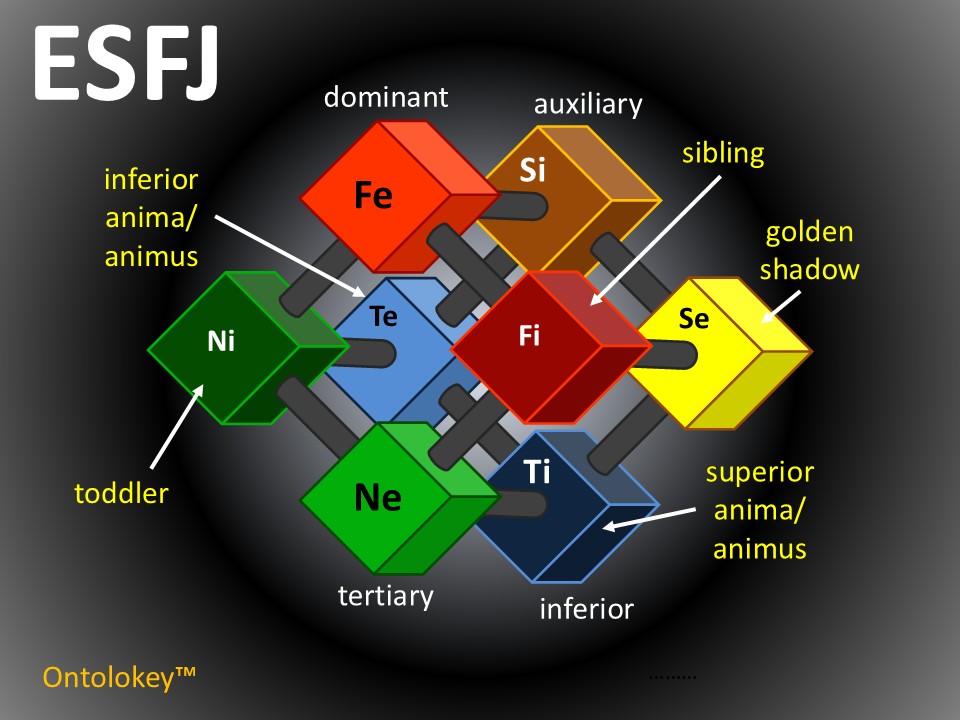
ESFJ – The Untold Truth
Beyond the Social Stereotype: The Psychological Architecture of the ESFJ
The ESFJ is often described through familiar social images: the caregiver, the host, the organizer, the loyal friend, the person who remembers birthdays, notices discomfort in a room, and instinctively tries to restore warmth when relationships become strained. These descriptions contain an important truth, but they also risk reducing a complex psychological structure to a collection of pleasant behaviors. Within the Ontolokey framework, the ESFJ is not simply “friendly” or “people-oriented,” but an extraverted rational personality whose primary psychological orientation is directed toward evaluating and organizing the interpersonal world through Extraverted Feeling, or Fe. This means that social harmony is not merely something the ESFJ happens to enjoy; it can become an active psychological task through which the individual interprets situations, regulates relationships, and determines what ought to be done. The Ontolokey model attempts to make this structure visible by treating the ESFJ as a dynamic configuration of eight psychological functions rather than as a fixed four-letter label, distinguishing the conscious functions from less conscious positions such as the Anima/Animus, Toddler, Sibling, and Golden Shadow. This perspective is particularly useful because the very qualities that make the ESFJ socially effective can, under psychological pressure, become sources of rigidity, dependency, resentment, or control; the shadow is therefore not an alien personality hiding underneath the “nice” ESFJ, but a distorted extension of mechanisms that are already present in the ordinary personality.
The central paradox of the ESFJ begins here: the capacity to care for other people can gradually become inseparable from the need to be valued by them. In its mature form, Fe allows the ESFJ to perceive emotional atmospheres rapidly, recognize exclusion or tension, coordinate people around shared values, and translate empathy into concrete action, while Introverted Sensing, or Si, provides continuity through memory, routine, familiarity, tradition, and accumulated experience. This combination can produce an exceptionally reliable human presence because the ESFJ does not merely notice that somebody is struggling; they often remember what has helped that person before and attempt to recreate the conditions under which emotional stability can return. Yet precisely because interpersonal awareness can become so highly developed, the ESFJ may begin to experience the emotional condition of others as a personal responsibility, carrying burdens that cannot actually be controlled and gradually linking personal worth to usefulness. The deeper shadow described by Ontolokey emerges when genuine generosity becomes psychologically entangled with the unconscious requirement to remain needed, appreciated, or socially indispensable. The crucial developmental question therefore reaches beyond whether the ESFJ is caring or controlling, generous or approval-seeking, traditional or adaptable; it concerns whether connection remains an expression of an autonomous self, or whether connection has quietly become the condition upon which that self depends.
The Ontolokey Cube: Eight Positions of the ESFJ Psyche
The distinctive contribution of the Ontolokey model is that it refuses to treat the ESFJ as a simple hierarchy of four functions and instead presents the personality as an eight-function psychological architecture. In this model, the ESFJ is organized around Extraverted Feeling (Fe) as the Dominant, Introverted Sensing (Si) as the Auxiliary, Extraverted Thinking (Te) as the Anima, Introverted Intuition (Ni) as the Toddler, Introverted Feeling (Fi) as the Sibling, Extraverted Sensing (Se) as the Golden Shadow, Extraverted Intuition (Ne) as the Blindspot, and Introverted Thinking (Ti) as the Tertiary/Royal Archetype. This arrangement is important because the positions do not merely indicate whether a function is “strong” or “weak”; they describe different psychological relationships to consciousness, development, motivation, vulnerability, and projection. Ontolokey’s cube gives these relationships a spatial form, with the eight functions occupying the vertices and with the architecture unfolding into interconnected functional groupings rather than appearing as a flat sequence. In this sense, the cube can be read psychologically as a map of what the ESFJ naturally inhabits, what they can access with effort, what they tend to avoid, what they unconsciously desire, and what may emerge in distorted form when the ordinary personality structure becomes overloaded.
At the center of the ESFJ configuration stands Fe, the Dominant function, which represents the personality’s most conscious and authoritative mode of psychological orientation. Fe evaluates reality primarily through the interpersonal field: what people feel, what relationships require, what a group considers meaningful, which emotional tensions need attention, and what can be done to restore cooperation or belonging. This is why the ESFJ’s social sensitivity is more profound than simple sociability; their attention is repeatedly drawn toward the emotional organization of the environment, allowing them to detect changes in atmosphere and translate those perceptions into practical relational behavior. Ontolokey’s description of the ESFJ emphasizes precisely this capacity to maintain social cohesion, while the shadow analysis demonstrates the danger of allowing that capacity to become an unconscious obligation to regulate everyone else’s emotional state. The mature expression of Fe therefore resembles emotional stewardship rather than emotional ownership: the ESFJ contributes to the psychological climate without assuming that they are responsible for controlling it. The immature expression reverses this distinction, turning interpersonal sensitivity into hypervigilance, approval-seeking, conflict avoidance, or subtle pressure on others to restore the emotional equilibrium that the ESFJ requires.
The Auxiliary function, Si, gives this outwardly relational personality its remarkable continuity, concreteness, and attachment to lived experience. Introverted Sensing does not merely mean having a good memory or preferring routine; within the Ontolokey interpretation it provides an internal reference system through which present experience is compared with what has previously been known, experienced, trusted, and emotionally established. For the ESFJ, this creates a powerful combination with Fe: the person not only notices what another human being needs in the present but often remembers what has mattered to that person before, what traditions hold the family together, which routines create stability, and which familiar forms of care communicate belonging. This explains why ESFJs can become exceptionally dependable custodians of relationships, institutions, rituals, celebrations, family histories, and communal expectations. Yet Si also creates one of the central tensions of the type, because continuity can gradually become conservatism, familiarity can become resistance to change, and accumulated experience can be mistaken for universal truth. The psychologically mature ESFJ therefore uses Si as a source of grounded knowledge without allowing the past to become an unquestionable authority over the future.
The Anima position, represented by Extraverted Thinking (Te), introduces a particularly revealing dimension because it concerns a function that can appear both attractive and psychologically complicated to the ESFJ. Te represents measurable effectiveness, external organization, objective standards, efficiency, implementation, and the capacity to ask whether something actually works rather than merely whether it feels socially appropriate. Ontolokey places Te in the ESFJ’s Anima position, meaning that this mode of functioning can possess a certain psychological fascination or aspirational quality while remaining less naturally integrated than Fe and Si. This helps explain why an ESFJ may admire people who appear highly decisive, technically competent, strategically organized, or capable of reducing complicated situations to clear objectives, while simultaneously feeling uncomfortable when those qualities require emotionally detached judgments. In healthy development, Te can become an invaluable corrective to excessive accommodation because it teaches the ESFJ to establish standards, measure outcomes, say no, delegate responsibility, and distinguish between genuinely helping someone and merely making them temporarily comfortable. When poorly integrated, however, Te can emerge defensively as sudden bluntness, managerial rigidity, excessive emphasis on productivity, or an attempt to solve relational problems through external control rather than emotional understanding.
The Toddler position, Introverted Intuition (Ni), represents another vulnerability, but its psychological character is different from the Anima. Ni is concerned with underlying trajectories, symbolic meaning, long-range implications, converging possibilities, and the question of where events are ultimately leading rather than simply what has happened before. Ontolokey identifies Ni as the ESFJ’s Toddler function, suggesting an area that can appear psychologically young, uncertain, or inconsistently developed, particularly when the individual is required to trust an internal vision that cannot yet be validated through familiar experience. This creates an important counterforce to Si because Si asks, in effect, “What do I know from experience?” whereas Ni asks, “What does this mean, and where might it lead?” The ESFJ may therefore possess strong practical knowledge while feeling less secure when confronted with ambiguous futures that demand symbolic interpretation rather than established precedent. Under pressure, this can produce either dismissal of intuition as impractical or an exaggerated, anxious form of forecasting in which uncertain possibilities are treated as impending certainties; development requires learning to tolerate not-knowing without abandoning either experience or imagination.
The Sibling function, Introverted Feeling (Fi), is particularly significant because it introduces the question of personal values into a personality that naturally orients toward collective emotional reality. Fe asks what is happening between people and what emotional atmosphere or shared value system should be cultivated, whereas Fi asks what is personally and internally authentic, regardless of whether the surrounding group approves. Ontolokey identifies Fi as the ESFJ’s Sibling function, placing it in a relationship of psychological kinship rather than simple opposition with the dominant Fe. This position can become an important developmental resource because it allows the ESFJ to recognize that caring for others does not eliminate the legitimacy of private preferences, individual boundaries, and personal moral convictions. The shadow problem appears when Fi remains insufficiently differentiated, because the ESFJ may then confuse collective approval with personal goodness and experience independent preferences as selfishness or betrayal. Integrating Fi does not require becoming detached from relationships; it means developing the capacity to say, with equal psychological legitimacy, “This matters to other people” and “This matters to me,” without automatically sacrificing one statement to preserve the other.
The Golden Shadow, Extraverted Sensing (Se), occupies a particularly fascinating position because Ontolokey treats the Golden Shadow not simply as a weakness but as a hidden reservoir of psychological potential. Se is immediate, embodied, direct, responsive to the physical environment, and willing to engage reality as it exists in the present rather than continually interpreting it through past experience or social expectation. For the ESFJ, whose consciousness is strongly organized around Fe and Si, Se can represent a freer relationship with spontaneity, physical presence, assertive action, pleasure, risk, and direct engagement with the world. Ontolokey explicitly identifies Se as the ESFJ’s Golden Shadow and associates it with an underused playful or expressive dimension of the personality. This is psychologically important because the ESFJ’s growth does not consist merely in correcting weaknesses; it can also involve discovering capacities that have remained outside ordinary identity. A developed Se allows the ESFJ to stop overinterpreting every social situation, inhabit the present more directly, enjoy experience without needing it to serve a relational purpose, and act decisively when circumstances require immediate engagement.
The Blindspot, Extraverted Intuition (Ne), represents perhaps the clearest cognitive vulnerability in the ESFJ architecture. Ne opens reality outward into alternatives, hypothetical possibilities, unusual interpretations, speculative connections, and futures that have no established precedent, whereas the ESFJ’s Si naturally seeks continuity and reliable reference points. Ontolokey explicitly places Ne in the ESFJ Blindspot position, indicating that the problem is not necessarily an inability to generate ideas but a relative difficulty recognizing the value of radically divergent possibilities when they destabilize established assumptions. This helps illuminate why an ESFJ can sometimes respond defensively to unconventional ideas, not because the person lacks intelligence or creativity, but because novelty may initially appear to threaten the coherence of the relational and experiential world that gives them psychological security. The developmental task is therefore not to become an Ne-dominant personality but to learn that unfamiliar possibilities do not automatically invalidate established values, traditions, or relationships. Without this flexibility, Si can become a closed epistemology in which “what has worked before” gradually becomes indistinguishable from “what is true.”
Finally, Introverted Thinking (Ti) occupies the Tertiary/Royal Archetype position in the Ontolokey ESFJ configuration, corresponding to the model’s association of the ESFJ with the INTP as its Royal Archetype. Ti represents internal logical coherence, conceptual precision, analytical differentiation, and the capacity to examine whether a belief is structurally sound independently of its social usefulness. Its position is psychologically intriguing because it provides the ESFJ with access to an internal world that is less dependent upon interpersonal consensus and more concerned with whether things make sense on their own terms. Developing Ti can therefore become one of the most important safeguards against the shadow of emotional consensus described by Ontolokey: it gives the ESFJ the ability to ask not merely whether an idea maintains harmony, but whether the idea itself is logically defensible. When integrated, Ti does not make the ESFJ cold; rather, it gives their warmth intellectual independence and prevents compassion from becoming an excuse for avoiding difficult truths. The complete cube consequently reveals a developmental trajectory in which the ESFJ’s psychological maturity depends not on abandoning Fe and Si, but on allowing Te, Ni, Fi, Se, Ne, and Ti to complicate and refine the dominant social orientation until care becomes compatible with autonomy, tradition with openness, and harmony with truth.
The Gift of Fe — Why the ESFJ Becomes the Emotional Architecture of a Community
The greatest strength of the ESFJ is not simply that they care about people, but that they possess an unusual capacity to organize human relationships into a functioning emotional environment. Extraverted Feeling, as the dominant function, directs attention toward the interpersonal field and asks what is happening between people, which values are being expressed, where tension is accumulating, and what can be done to restore cooperation. Ontolokey describes the Fe-centered configuration as the “diplomat” of the cube, emphasizing its ability to create unity while simultaneously identifying the danger of self-neglect when interpersonal responsibility becomes excessive. The mature ESFJ therefore often becomes the person who remembers what others need, recognizes when someone has been excluded, translates unspoken discomfort into words, and turns abstract goodwill into concrete acts of support. Their social intelligence is consequently less superficial than the stereotype of the outgoing “people person” suggests, because it involves continuous monitoring of emotional relationships and an intuitive understanding of the rituals through which belonging is communicated. When psychologically integrated, this capacity produces a person who can make other people feel not merely welcomed but located within a human structure in which they matter.
This ability becomes particularly powerful when Fe is stabilized by the ESFJ’s auxiliary Si, because emotional responsiveness is then combined with continuity and experiential memory. Si does not simply preserve factual memories; in the Ontolokey interpretation, it processes perception through an internal framework of subjective experience, memory, and affective resonance. Consequently, an ESFJ may remember not only that a person was present at a particular event but also how that person felt, what circumstances surrounded the experience, what traditions gave the event meaning, and what previously helped when something similar occurred. This combination explains the ESFJ’s potential as a custodian of family, community, institutional, and interpersonal continuity, because they can transform memory into practical care. A celebration, a family ritual, a workplace tradition, or a longstanding friendship can become more than repetition: it can function as a psychological container that reassures people that their shared history has not disappeared. The shadow of this gift appears when continuity becomes compulsory, but at its healthiest, Si gives Fe something extremely valuable—the ability to care with memory rather than merely react to the present.
The positive ESFJ is therefore not psychologically weak because they are relational, nor are they necessarily dependent simply because appreciation matters to them. There is a profound difference between needing admiration and possessing a naturally relational conception of human existence. A mature Fe orientation understands that individuals are formed through networks of reciprocity, obligation, affection, recognition, and shared meaning, and it can therefore take responsibility for relationships without reducing every relationship to personal validation. Ontolokey’s broader model is useful here because it explicitly treats personality as a dynamic balance among functions rather than as a rigid categorical identity, allowing the same Fe capacity to become either constructive or destructive depending upon how the other functions participate in the psychological system. The healthy ESFJ can consequently be extraordinarily generous without being psychologically enslaved by generosity, because the underlying motivation gradually shifts from “I must be needed” toward “I choose to contribute.” That distinction may appear subtle from the outside, yet internally it marks one of the most important transitions from personality-driven behavior to psychological maturity.
The ESFJ’s strength becomes even more apparent in environments where human beings must cooperate rather than merely coexist. In families, communities, educational settings, organizations, healthcare environments, and social institutions, there are countless forms of invisible labor that cannot be reduced to formal responsibilities: noticing who is struggling, maintaining traditions, remembering important personal details, smoothing unnecessary conflicts, making newcomers feel included, preserving morale, and ensuring that practical arrangements do not destroy the human meaning behind them. The ESFJ often performs precisely this connective labor, and because successful connective labor frequently leaves no visible trace, the contribution can be underestimated by cultures that reward only measurable individual achievement. Yet without such work, institutions can become technically efficient while psychologically impoverished, populated by people who accomplish tasks but no longer experience genuine belonging. The mature ESFJ instinctively understands that social cohesion is itself a form of infrastructure, and this insight represents one of the most constructive expressions of the Fe–Si combination. The challenge is not to abandon this role, but to recognize that a community is healthiest when its caretaker does not become its prisoner.
This distinction leads directly toward the central psychological danger of the type: the same person who can create belonging may eventually begin to believe that maintaining belonging is their responsibility, and the same sensitivity that allows them to recognize another person’s needs can become hyper-attunement to approval and rejection. When Fe is no longer simply an instrument of authentic connection but becomes the primary regulator of self-worth, generosity begins to acquire an unconscious transaction beneath its surface. The ESFJ may give, organize, remember, accommodate, mediate, and protect, while quietly expecting recognition, loyalty, gratitude, or compliance in return, even if they consciously reject the idea that their kindness should be transactional. This is precisely where the positive architecture begins to turn toward the shadow: the psychological problem is not that the ESFJ cares too much, but that care can become fused with identity, obligation, and the fear of becoming unnecessary. The deeper truth of the ESFJ therefore cannot be understood by celebrating their warmth alone; it requires examining what happens when the person who has spent years creating emotional security discovers that other people are free to reject, disappoint, misunderstand, or leave them despite everything they have done.
When Care Becomes Control — The Shadow of Fe and Si
The darker side of the ESFJ begins not with cruelty, but with a psychological confusion between care and responsibility. Because dominant Fe naturally monitors the emotional condition of the interpersonal environment, the ESFJ can gradually develop the assumption that if something is wrong between people, something must be done about it, and that doing something about it is somehow their responsibility. This tendency becomes particularly intense when Si reinforces it with memories of previous relational experiences, allowing the ESFJ to accumulate an internal catalogue of what people have done, failed to do, promised, forgotten, and repeated. Ontolokey’s analysis of the ESFJ shadow emphasizes precisely this potential transformation of care into control, in which the desire to maintain harmony can become an attempt to manage the behavior and emotional responses of other people. (ontolokey.com) The resulting behavior can remain superficially benevolent because it is frequently expressed through advice, assistance, reminders, concern, hospitality, or appeals to what is “best” for everyone. Psychologically, however, the crucial question is whether the other person’s autonomy remains intact, because care becomes controlling when the ESFJ can tolerate another person’s freedom only as long as that freedom does not disrupt the emotional order they have constructed.
This dynamic becomes particularly complicated because ESFJs may genuinely perceive themselves as acting from good intentions. A person who has spent years anticipating needs can find it difficult to understand why someone would reject assistance, ignore advice, decline a tradition, or choose a path that appears unnecessarily painful or irresponsible. The ESFJ’s internal logic may be coherent: “I know you, I remember what happened last time, I can see where this is going, and I am trying to prevent you from suffering.” Yet this apparently compassionate logic contains a hidden psychological assumption—that the ESFJ’s interpretation of another person’s needs should carry greater authority than that person’s own interpretation. Once this occurs, empathy subtly changes from understanding another person’s experience to defining it for them. The ESFJ can then experience resistance not merely as disagreement but as evidence of ingratitude, irrationality, immaturity, or lack of appreciation, particularly when substantial emotional or practical effort has already been invested. What began as sensitivity becomes a form of interpersonal management, and the person being “helped” may eventually experience the ESFJ’s care as pressure rather than freedom.
The role of Si makes this shadow particularly persistent because memory can become a moral archive. Healthy Si allows the ESFJ to learn from experience and reproduce what has previously created stability, but an unhealthy expression can preserve grievances with extraordinary emotional precision, especially when those grievances concern broken trust, violated expectations, forgotten sacrifices, or departures from established relational norms. The ESFJ may not consciously think, “I am keeping score,” yet internally there can develop a sophisticated accounting system in which favors, sacrifices, disappointments, anniversaries, promises, and emotional injuries remain psychologically available long after the immediate event has passed. This can produce what might be called implicit emotional bookkeeping, where generosity creates an expectation of reciprocal loyalty even when no explicit contract was ever established. When reciprocity fails, resentment can become disproportionate because the ESFJ is not reacting solely to the current event; they are reacting to the accumulated meaning of many previous events that the other person may not even realize are still psychologically active. The danger is therefore not simply remembering too much, but interpreting memory as evidence of what other people owe the self.
This is where the ESFJ’s avoidance of interpersonal rupture can paradoxically become a source of greater relational damage. A person deeply invested in harmony may suppress irritation, disappointment, or anger because openly expressing these emotions appears threatening to the relationship, particularly when the ESFJ has internalized the belief that a good person should be accommodating and emotionally supportive. Suppression does not eliminate the underlying emotion, however; it merely deprives the relationship of an honest opportunity to process it. Over time, the ESFJ can become increasingly exhausted while simultaneously becoming increasingly convinced that nobody recognizes how much they have sacrificed, producing the painful psychological sequence of overgiving, under-communicating, resentment, and eventual emotional withdrawal or explosion. The resulting conflict can be bewildering to others because the ESFJ may appear to have tolerated everything willingly until suddenly revealing a large reservoir of accumulated grievances. From the ESFJ’s perspective, the anger may feel completely justified because the evidence has been accumulating for years; from the other person’s perspective, it may seem as though a previously invisible contract has suddenly been presented for enforcement.
The deepest problem therefore concerns boundaries, because the ESFJ can confuse emotional closeness with emotional obligation. Genuine intimacy requires the ability to remain connected while accepting that another person has thoughts, preferences, priorities, and decisions that cannot be controlled, whereas the shadow-oriented ESFJ may unconsciously interpret separation, disagreement, or independence as evidence that the relationship itself is weakening. Ontolokey’s shadow analysis points toward this darker possibility by emphasizing how the ESFJ’s desire for harmony and recognition can become distorted when the person is emotionally overextended or insufficiently differentiated from the needs of others. (ontolokey.com) The mature alternative is psychologically demanding because it requires the ESFJ to tolerate something their dominant function instinctively dislikes: another person’s negative feelings without immediately attempting to repair them. It requires recognizing that someone can be disappointed without having been betrayed, disagree without being disrespectful, reject help without being ungrateful, and choose differently without invalidating everything the ESFJ has previously given. In that transformation, care becomes cleaner because it is no longer secretly asking, “Will you behave in a way that proves that my care was worthwhile?”
The ESFJ’s shadow becomes most dangerous when social morality is unconsciously recruited to legitimize personal emotional needs. Because Fe naturally perceives collective values and interpersonal expectations, an ESFJ under strain may frame personal preferences as objective standards of decency: what a “good friend” should do, what a “proper family member” should understand, how a “respectful” person ought to behave, or what people who genuinely care about one another would supposedly never do. This does not mean ESFJs are inherently manipulative or morally authoritarian; rather, it describes a potential mechanism through which the legitimate language of shared values can conceal an illegitimate demand for personal compliance. The person may sincerely believe they are defending respect, loyalty, family, tradition, or consideration when, psychologically, they are also defending themselves against rejection and uncertainty. The resulting pressure can be subtle precisely because it rarely sounds like naked domination; it may arrive as disappointment, emotional distance, reminders of past sacrifices, appeals to family expectations, or carefully communicated hurt. The shadow is therefore most difficult to recognize when the ESFJ is technically telling the truth about their feelings while unconsciously using those feelings to restrict another person’s freedom.
There is, finally, a painful irony in this pattern: the ESFJ may become the architect of precisely the loneliness they fear. The more intensely they attempt to secure relationships through usefulness, emotional regulation, obligation, or moral expectation, the more difficult it becomes for other people to know whether they are loved freely or required to reciprocate correctly. Relationships can then become psychologically crowded, because gratitude is expected, independence becomes suspicious, disagreement feels threatening, and spontaneous affection is gradually replaced by the maintenance of an invisible emotional contract. Yet this pattern is not an inevitable destiny of the type; it is what occurs when Fe loses contact with an independent sense of self and Si turns experience into unquestionable precedent. The way out is consequently not to become less caring, less loyal, or less relational, but to develop the neglected functions that allow the ESFJ to discover that love does not require management and harmony does not require uniformity.
The Untold Wound — Approval, Rejection, and the Fear of Becoming Unnecessary
The deepest wound of the ESFJ is not necessarily a fear of being alone, nor even a simple desire to be liked; it is the possibility that their value might disappear when they are no longer useful to the people around them. Because dominant Fe naturally experiences identity through relationship and social participation, appreciation can become psychologically intertwined with existence itself, particularly when the ESFJ has learned early in life that being helpful, agreeable, responsible, or emotionally attentive reliably produces acceptance. Ontolokey’s analysis of the ESFJ shadow describes this darker dimension of the type by examining how the desire to care for others can become entangled with recognition, approval, and the need to feel significant within relationships. (ontolokey.com) The resulting vulnerability is subtle because it can hide beneath genuinely admirable behavior: the ESFJ may be generous, attentive, loyal, and extraordinarily responsive to other people’s needs, while simultaneously deriving an increasing proportion of their self-esteem from evidence that these efforts are noticed and reciprocated. What begins as healthy relational sensitivity can therefore become a psychological economy in which usefulness functions as currency and appreciation becomes the confirmation that the self still has a secure place within the social world.
This explains why rejection can affect an ESFJ with an intensity that appears disproportionate to the immediate event. A disagreement may not remain a disagreement; it can become evidence that the relationship has changed, that one’s efforts have been misunderstood, or that one’s place in another person’s life is no longer secure. The ESFJ may consequently replay conversations, remember previous acts of generosity, examine changes in tone, and search for the point at which relational security supposedly began to deteriorate, with Si supplying an unusually rich archive of interpersonal evidence. What makes this psychologically painful is that the ESFJ’s memory is not merely informational: experiences may remain connected to the emotional significance they originally possessed, allowing old disappointments to become active again when a present event resembles them. The person may therefore experience rejection on several temporal levels simultaneously, reacting not only to what happened today but also to everything today appears to confirm about previous experiences of being overlooked or insufficiently valued. The healthier psychological response is not to suppress this sensitivity, but to differentiate present rejection from global worth, because another person’s withdrawal can describe the state of a relationship without constituting a verdict on the value of the person who is being rejected.
The most consequential distinction is consequently between attachment and validation dependency. Attachment says, “I want to be connected to you because you matter to me,” whereas validation dependency quietly says, “I need your positive response in order to know that I matter.” These statements can look almost identical from the outside because both may produce loyalty, affection, attentiveness, and an intense investment in relationships, yet their internal structures are radically different. In the first case, generosity remains voluntary because the individual’s identity survives another person’s disagreement, distance, or refusal; in the second, generosity becomes increasingly compulsive because giving is unconsciously recruited as a strategy for preserving relational security. This distinction also explains why an ESFJ can experience profound exhaustion while continuing to overextend themselves: stopping the behavior may feel psychologically dangerous because it raises the question of whether people will remain connected when the ESFJ is no longer performing the role of caretaker, organizer, mediator, or dependable supporter. The developmental achievement is therefore not emotional independence in the sense of becoming detached, but relational autonomy, meaning the ability to remain deeply connected without requiring other people to continuously confirm one’s legitimacy.
This is also where the ESFJ’s relationship with boundaries becomes psychologically decisive. A boundary can initially feel to an approval-oriented ESFJ like a withdrawal of love because saying “no,” refusing responsibility, declining an invitation, disappointing someone, or allowing another person to struggle without intervening may activate the fear that connection will be withdrawn in retaliation. Yet psychologically mature relationships cannot depend upon perpetual accommodation, because a relationship in which one individual must constantly suppress personal limits is not genuinely reciprocal even when it appears harmonious. The ESFJ must therefore learn that disappointing someone is not the same as harming them, just as refusing to rescue someone is not necessarily an act of abandonment. This realization can be especially difficult because Fe naturally experiences the emotional consequences of one’s behavior as highly salient, but maturity requires tolerating the fact that other people are allowed to experience disappointment without the ESFJ immediately taking responsibility for eliminating it. The ability to withstand another person’s temporary dissatisfaction without collapsing into guilt is therefore one of the clearest psychological markers that care has become differentiated from approval-seeking.
The same developmental process applies to praise, gratitude, and recognition. An ESFJ does not need to become indifferent to appreciation; appreciation is a legitimate human need, and relational acknowledgment can strengthen bonds and communicate reciprocity. The danger begins when praise becomes evidence of identity rather than simply a pleasant confirmation of contribution, because then the absence of praise becomes psychologically threatening and the person begins unconsciously increasing their efforts in order to recreate the emotional reward. This can produce an exhausting cycle in which the ESFJ gives more, anticipates more, remembers more, organizes more, and increasingly expects others to recognize the magnitude of what has been given, while those around them may become accustomed to the assistance and consequently offer less explicit acknowledgment. Resentment then emerges not because the original generosity was false, but because the generosity was carrying an unspoken psychological need that was never directly communicated. Breaking the cycle requires the ESFJ to become capable of asking for appreciation openly, receiving it without needing it constantly, and—most importantly—continuing to experience personal worth during periods in which nobody is applauding the contribution.
At the deepest level, the ESFJ’s developmental task is therefore an encounter with existential non-necessity. The person who has built an identity around being reliable eventually has to discover that they can step back and allow other people to solve their own problems, maintain their own relationships, make their own mistakes, and even live without the ESFJ’s constant intervention. This can initially feel like irrelevance, but psychologically it is the beginning of freedom because it separates being loved from being indispensable. The mature ESFJ can eventually reach a paradoxical position in which they become even more generous precisely because they no longer need generosity to secure their place in the world. Their care becomes less anxious, their boundaries become less defensive, their relationships become less transactional, and their presence becomes lighter because other people are permitted to remain autonomous. The untold truth is therefore not that the ESFJ secretly wants everyone to need them; it is that the healthiest ESFJ must learn that being needed is profoundly different from being loved, and being loved is profoundly different from being necessary.
The Functions in Conflict — Fe, Fi, Ti and Te
The ESFJ’s inner development becomes particularly visible when the four judging functions—Fe, Fi, Te, and Ti—are understood not as competing intellectual abilities but as different criteria for deciding what is valid, valuable, and worth doing. Fe asks what preserves or creates a viable human relationship and what shared emotional values are operating within a social environment, while Fi turns inward and asks what is personally authentic, morally congruent, and emotionally true to the individual. Te shifts the criterion toward external effectiveness, measurable results, organization, and practical execution, whereas Ti asks whether an idea or conclusion possesses internal logical consistency independent of social approval or immediate usefulness. Ontolokey’s ESFJ configuration places Fe in the Dominant position, Te in the Anima, Fi in the Sibling, and Ti in the Tertiary/Royal Archetype position, creating a particularly interesting developmental tension between relational intelligence and forms of judgment that are less naturally authoritative for the type. (ontolokey.com) The ESFJ does not need to choose one of these criteria permanently, because psychological maturity consists precisely in becoming capable of moving among them without allowing the dominant function to silence the others. The central developmental question is therefore not whether Fe is superior to Ti, Fi, or Te, but whether the ESFJ can allow truth, effectiveness, authenticity, and harmony to correct one another.
The conflict between Fe and Fi is perhaps the most intimate because it concerns the difference between relational values and personal values. Fe naturally asks what the emotional field requires, which values are shared, and how individual behavior affects collective cohesion, while Fi protects the individual’s private evaluation of what feels morally or emotionally authentic. When Fi is insufficiently developed, the ESFJ can become extraordinarily skilled at knowing what everyone else needs while remaining surprisingly uncertain about what they themselves genuinely want when nobody else is present to provide a relational reference point. This can produce a peculiar form of self-neglect in which personal preferences are continually translated into the language of what is convenient, appropriate, kind, or expected, until the person eventually discovers that they have been living according to a social identity that is only partially their own. Ontolokey’s placement of Fi as the ESFJ’s Sibling suggests that this function is neither simply hostile nor irrelevant; it represents a related but differently oriented psychological perspective that can assist the dominant Fe when consciously integrated. (ontolokey.com) The mature ESFJ therefore learns to preserve the capacity to say “we” without losing the capacity to say “I,” recognizing that authentic relationships require two differentiated people rather than one person continuously adapting to the other.
The relationship between Fe and Ti is equally consequential because Ti introduces a criterion of judgment that does not require interpersonal consensus. An ESFJ may instinctively evaluate an idea by asking whether it will hurt someone, create unnecessary tension, damage trust, or undermine cooperation, while Ti asks a colder but indispensable question: whether the proposition itself is coherent. This difference can create discomfort because logical analysis sometimes produces conclusions that are socially inconvenient, emotionally disappointing, or incompatible with established expectations, and the ESFJ may initially experience such conclusions as unnecessarily disruptive. Yet an inability to separate emotional consequences from logical validity can make a person vulnerable to accepting weak arguments simply because those arguments preserve harmony, particularly when the person is surrounded by people they care about. Ti provides an antidote by teaching the ESFJ to examine assumptions, define concepts precisely, identify contradictions, and tolerate the temporary discomfort of discovering that something socially accepted may nevertheless be wrong. The goal is not to turn the ESFJ into an emotionally detached analyst, but to give their interpersonal intelligence a reality-testing mechanism strong enough to prevent compassion from becoming intellectual surrender.
Te, occupying the Anima position, introduces a different form of corrective pressure because it evaluates the world according to external efficiency and demonstrable effectiveness. An ESFJ can become deeply invested in whether people feel supported and whether social expectations are being respected, yet still struggle to ask whether the structure through which everyone is being supported is actually efficient, sustainable, or producing the intended result. Te can therefore be uncomfortable precisely because it sometimes demands the abandonment of emotionally meaningful practices that no longer work. An ESFJ may preserve an arrangement because it represents history, loyalty, or somebody’s expectations, while Te asks whether continuing it makes practical sense; conversely, the ESFJ may try to become excessively Te-like under pressure, suddenly imposing rigid systems, productivity standards, or organizational rules in an attempt to regain control. Ontolokey’s identification of Te with the Anima captures this ambivalence: the function can represent something the ESFJ admires and wants access to while remaining less naturally integrated than Fe and Si. (ontolokey.com) Healthy integration means learning from Te without performing Te, allowing efficiency to serve human values rather than allowing efficiency itself to become another source of control.
The four judging functions become most psychologically powerful when they are allowed to form a sequence rather than a hierarchy. Fe can identify the human consequences of a situation, Fi can ask whether the proposed response violates personal integrity, Te can examine whether the response will actually work in practice, and Ti can test whether the reasoning behind it is internally coherent. Such a process protects the ESFJ from four different distortions: Fe without Fi can become excessive conformity, Fi without Fe can become isolated subjectivity, Te without emotional awareness can become instrumental control, and Ti without relational awareness can become sterile intellectualism. The Ontolokey cube is valuable precisely because it encourages the personality to be understood as a system of interacting psychological positions rather than a single dominant trait, making development a matter of integration rather than replacement. (ontolokey.com) For the ESFJ, this integration creates a particularly sophisticated form of judgment: the ability to care about people without automatically agreeing with them, to maintain personal integrity without abandoning relationships, to pursue efficiency without dehumanizing others, and to pursue logical truth without forgetting that truth always enters a human world. Psychological maturity is reached when these criteria no longer compete for dominance but become complementary instruments of discernment.
This integration also changes the ESFJ’s relationship with disagreement. An immature Fe orientation can interpret disagreement primarily as a relational event, meaning that the fact that someone opposes an idea becomes more psychologically significant than the reasons behind the opposition. Once Ti and Fi become more differentiated, however, disagreement can be separated into several independent questions: Is the argument logically sound, is it personally authentic, is it practically effective, and what will it do to the relationship? This decomposition is psychologically liberating because it prevents one dimension from contaminating all the others; someone can be wrong without being bad, disagreeable without being disloyal, inefficient without being worthless, and emotionally distant without necessarily being hostile. The ESFJ thereby becomes less vulnerable to the hidden coercion of harmony because disagreement no longer automatically threatens identity or belonging. What initially feels like emotional risk becomes intellectual and moral freedom, allowing the ESFJ to remain connected to people whose conclusions, values, or lifestyles may differ profoundly from their own.
The ultimate achievement is a form of integrated discernment in which the ESFJ retains the extraordinary relational sensitivity of Fe while becoming increasingly capable of standing outside the emotional field they are observing. This distance does not diminish empathy; it makes empathy more accurate because the ESFJ no longer needs another person’s emotional state to be different before they can tolerate it. Fi teaches them that personal authenticity has legitimacy, Te teaches them that good intentions require effective implementation, and Ti teaches them that social consensus does not determine logical truth. These functions therefore gradually dismantle the unconscious belief that being a good person means keeping everyone comfortable, meeting every expectation, or preserving every relationship at any cost. The result is not a colder ESFJ but a more formidable one: someone capable of warmth without submission, loyalty without self-erasure, leadership without coercion, and compassion without the need to be indispensable. In that sense, the shadow functions do not destroy the ESFJ’s natural gift; they complete its psychological architecture.
Si, Tradition and the Prison of the Past
If Fe gives the ESFJ its extraordinary sensitivity to the social present, Introverted Sensing gives that sensitivity a memory. Si continually relates present experience to what has already been lived, remembered, tested, and emotionally established, which helps explain why ESFJs can become such powerful custodians of family traditions, institutional customs, interpersonal rituals, and collective history. Ontolokey’s account of the ESFJ emphasizes this relationship between Si and the preservation of what has proven meaningful over time, while its broader explanation of Introverted Sensing describes a function concerned with internalized experience, familiarity, and the subjective impressions accumulated through life. (ontolokey.com) This gives the ESFJ a psychological capacity that is frequently underestimated in contemporary cultures obsessed with novelty: they understand that stability itself has value, and that human beings often require continuity in order to feel secure enough to grow. A family meal repeated every year, a remembered birthday, an established ritual of hospitality, or a familiar way of caring for someone may appear trivial to an outsider while carrying enormous emotional significance for the ESFJ. Through Si, the past is not dead information but a living repository of meaning, and the ESFJ often experiences the preservation of meaningful continuity as an act of love.
The strength of this orientation becomes particularly apparent during periods of instability. When circumstances change rapidly, people often seek something that remains recognizable, and the ESFJ can instinctively provide precisely that psychological continuity. They remember how things were done, which relationships have survived previous crises, what rituals previously restored a sense of normality, and which practical details must be maintained even when circumstances are chaotic. This makes the ESFJ potentially indispensable in families and communities because they preserve the connective tissue that allows people to experience themselves as part of an ongoing story rather than as isolated individuals reacting to disconnected events. Yet the very quality that makes continuity psychologically nourishing can become restrictive when the ESFJ unconsciously equates familiarity with correctness. Something can feel safe because it is familiar without being healthy, and something can feel wrong simply because it is new without actually being harmful. The mature use of Si therefore requires an important distinction between preserving what carries genuine value and preserving something merely because changing it would create emotional discomfort.
This becomes particularly complicated in relation to family systems, because tradition often contains both wisdom and unresolved psychological material. An ESFJ may inherit patterns of loyalty, hospitality, responsibility, respect, and mutual care that genuinely strengthen relationships, but the same inheritance may also contain expectations concerning gender, status, obedience, reputation, emotional expression, career choices, marriage, family roles, or acceptable lifestyles. Because Fe experiences belonging as psychologically meaningful and Si gives inherited patterns continuity, questioning such expectations can feel like questioning the people who transmitted them. Ontolokey’s shadow analysis identifies precisely this danger when it describes the ESFJ’s potential tendency to preserve collective harmony and established expectations even when those expectations conflict with individual authenticity. The psychological difficulty is therefore not simply conservatism in the political or cultural sense; it is the possibility that inherited relational scripts become so deeply internalized that the ESFJ experiences deviation from them as disloyalty rather than development. A tradition then ceases to be something the individual participates in freely and becomes something the individual feels morally obligated to defend.
The distinction between memory and truth becomes essential at this point. Si can tell the ESFJ what has happened repeatedly, what has previously worked, what a community has traditionally believed, and how a familiar situation usually unfolds, but repetition does not by itself establish universal validity. The shadow emerges when accumulated experience becomes epistemological authority, because the individual begins to reason that something must be correct because it has survived for a long time, or that a new alternative must be dangerous because nobody in their trusted environment has attempted it before. Ontolokey’s discussion of the ESFJ’s cognitive vulnerabilities similarly warns of the possibility that emotional and social consensus can substitute for independent examination, particularly when unfamiliar perspectives threaten established assumptions. This is where the ESFJ’s Ne Blindspot becomes psychologically relevant: radically different possibilities may initially appear unnecessarily destabilizing because they do not yet possess the credibility that accumulated experience provides. Development therefore requires learning to hold two propositions simultaneously—that the past deserves respect because it contains knowledge, and that the future deserves openness because it contains possibilities the past could never have experienced.
There is also a more personal dimension to Si that concerns nostalgia. Nostalgia can be profoundly healthy when it reconnects a person with meaningful memories, relationships, places, and experiences, but it becomes psychologically restrictive when the remembered past becomes an implicit standard against which every present experience is judged. The ESFJ may then compare current relationships with how they once felt, contemporary social behavior with how people “used to” behave, or present family life with an idealized version of an earlier period. Because memory selectively preserves emotionally significant experiences, however, the remembered past is not necessarily an objective reconstruction of what actually occurred. The danger is that the ESFJ can become loyal not to history itself but to an emotionally edited version of history, defending an image of how things were because that image provides continuity, identity, and belonging. When this happens, nostalgia stops functioning as remembrance and begins functioning as resistance to psychological change.
The mature ESFJ eventually discovers that honoring the past does not require obeying it. A tradition is strongest when its underlying value can survive transformation, because this demonstrates that the meaning has been understood rather than merely repeated. If a family ritual exists to communicate belonging, for example, its form can change without destroying its purpose; if loyalty exists to protect relationships, loyalty cannot logically require tolerating abuse or suppressing truth; if respect is genuinely valuable, respect must also include the right of another person to become someone their predecessors never anticipated. This is where Si must enter into dialogue with the more exploratory functions of the cube, particularly Ne and Ni, because continuity without possibility becomes stagnation while possibility without continuity can become fragmentation. The psychologically mature ESFJ therefore becomes neither a guardian of everything old nor an enthusiast of everything new, but a curator of meaning who asks which parts of the past deserve to be carried forward and which belong to a previous psychological world.
The deepest liberation occurs when the ESFJ realizes that abandoning an inherited pattern is not necessarily an abandonment of the people who created it. Psychological individuation requires the capacity to love one’s origins without allowing those origins to dictate the limits of one’s future, and this can be extraordinarily difficult for a personality whose identity is strongly intertwined with relational continuity. The shadow fears that change will sever belonging; maturity discovers that authentic belonging can survive differentiation. The ESFJ can preserve the emotional essence of a family, community, or relationship while changing the behaviors through which that essence is expressed, thereby transforming tradition from a command into a conscious choice. In this form, Si becomes one of the ESFJ’s greatest gifts: not a prison constructed from yesterday, but a living memory capable of informing tomorrow without possessing it.
The Hidden Functions — Ni, Ne and Se
The less conscious functions reveal a different dimension of the ESFJ because they represent psychological possibilities that are not usually experienced with the same effortless authority as Fe and Si. Introverted Intuition (Ni), Extraverted Intuition (Ne), and Extraverted Sensing (Se) relate to the ESFJ’s capacity to interpret emerging possibilities, tolerate uncertainty, inhabit the present directly, and perceive reality without immediately filtering it through established social or experiential frameworks. In the Ontolokey configuration, Ni occupies the Toddler position, Ne the Blindspot, and Se the Golden Shadow, meaning that these functions have very different psychological relationships to consciousness and development. This distinction matters because calling a function “weak” can be misleading: a less conscious function can be inexperienced, defensive, fascinating, underestimated, or even psychologically idealized without being permanently inaccessible. For the ESFJ, these three functions collectively represent an invitation beyond the familiar world of interpersonal expectations and accumulated experience, toward a reality that is less predictable, less controllable, and therefore potentially more psychologically liberating. The shadow is not simply what the ESFJ cannot do; it also contains capacities that the conscious personality may need precisely because its normal strengths have become too dominant.
Ni as the Toddler represents the ESFJ’s developing relationship with inner vision, long-range trajectory, symbolic meaning, and the possibility that events may possess implications that cannot yet be verified through experience. The ESFJ’s Si orientation naturally trusts what has been lived, remembered, and established, whereas Ni asks the individual to remain receptive to what is emerging before there is sufficient evidence to make that emerging reality feel secure. Ontolokey’s positioning of Ni as the Toddler therefore suggests a psychological function that may initially feel less mature or dependable, particularly when the ESFJ is confronted with situations that require trust in an internally perceived direction rather than confidence derived from precedent. This can produce an interesting tension: the ESFJ may be extraordinarily perceptive about people while still feeling uncertain about the deeper trajectory of a situation, especially when there is no established pattern against which to compare it. At its immature extreme, this can manifest as premature certainty about what something “must mean,” anxious forecasting, or alternatively a refusal to take intuition seriously because intuition cannot yet be justified through familiar evidence. Development means learning to hold an intuitive impression as a hypothesis rather than a verdict, allowing it to inform perception without demanding immediate certainty.
The Ne Blindspot is different because it concerns the ESFJ’s relative difficulty with unrestricted possibility generation. Ne looks outward across the field of potential: what else could this mean, what alternatives have not been considered, what unexpected opportunity might emerge, and what assumptions might be overturned by introducing a new variable? For a personality organized around Fe and Si, such openness can be psychologically disruptive because every new possibility potentially alters an established social arrangement or invalidates a previously trusted interpretation of experience. Ontolokey’s shadow analysis makes this broader vulnerability intelligible by emphasizing the danger of accepting familiar beliefs, collective assumptions, and emotionally reassuring interpretations without sufficiently independent examination. The ESFJ may therefore react to radical novelty not because they are incapable of understanding it, but because the psychological cost of entertaining it can feel unnecessarily destabilizing. The mature response is not to abandon tradition or become perpetually experimental, but to develop the capacity to say, “This is unfamiliar, but unfamiliar does not mean wrong.”
This is particularly important because Ne can function as an antidote to the ESFJ’s tendency to turn experience into expectation. If a relationship has behaved in a particular way for ten years, Si can reasonably conclude that the pattern has significance, but Ne asks whether the pattern could change; if a family has always followed a particular tradition, Ne asks whether the tradition might be expressed differently; if a person has always been perceived according to one role, Ne asks whether that individual might have capacities nobody has yet seen. Such questions can initially feel destabilizing because they loosen the psychological certainty provided by established categories. Yet they also protect the ESFJ from a subtle form of determinism in which people become permanently identified with their past behavior. This is especially important for relationships, because an ESFJ who remembers everything can inadvertently remember people into fixed identities: the reliable one, the irresponsible one, the difficult one, the sensitive one, the person who always disappoints, or the person who can always be counted upon. Ne introduces psychological mercy by reminding the ESFJ that human beings are not merely repetitions of their previous behavior.
The Golden Shadow of Se introduces an entirely different possibility because Se represents immediate engagement with concrete reality, sensory presence, direct action, spontaneity, physical awareness, and responsiveness to what is happening now. Ontolokey’s treatment of the ESFJ places Se in this unusually positive shadow position, suggesting a latent capacity that can become psychologically attractive precisely because it offers something the ordinary Fe–Si orientation does not naturally prioritize. The ESFJ can spend enormous amounts of psychological energy interpreting social situations, remembering histories, anticipating reactions, and maintaining continuity, whereas Se asks a simpler question: what is actually happening right now? This can be liberating because it interrupts excessive mental and interpersonal processing, allowing the individual to experience the body, environment, pleasure, movement, action, and sensory reality without immediately converting them into relational obligations or symbolic meaning. In this sense, Se is not merely an alternative cognitive skill; it can become an escape from the ESFJ’s tendency to live excessively through other people’s emotional realities.
The Golden Shadow can nevertheless be psychologically double-edged because what fascinates us can also become something we imitate without fully integrating. An ESFJ under prolonged pressure may suddenly become unusually impulsive, assertive, indulgent, confrontational, or sensation-seeking, particularly after an extended period of suppressing personal needs in order to maintain social expectations. The problem is not spontaneity itself; the problem is that suppressed spontaneity can emerge in compensatory rather than integrated form. Instead of consciously choosing immediate experience, the person may seek it reactively, almost as if attempting to escape the identity that has become too restrictive. A mature Se integration looks different: it means being able to experience pleasure without guilt, act without excessive anticipation of social consequences, respond decisively when circumstances demand it, and recognize one’s own physical needs before exhaustion forces them into awareness. The ESFJ does not need to become reckless or sensation-driven; they need to discover that being present is not the same as being irresponsible.
The interaction between Ni, Ne, and Se therefore reveals a developmental triangle that can substantially expand the ESFJ’s psychological world. Ni teaches depth and trajectory, helping the individual tolerate uncertainty about where life is going; Ne teaches openness to alternatives, preventing established experience from becoming an unquestioned boundary; and Se teaches immediacy, allowing the person to inhabit reality before interpreting or organizing it. Together they challenge three characteristic forms of psychological overcontrol: the assumption that the future must resemble the past, the assumption that the established interpretation is the only plausible interpretation, and the assumption that every present experience must be managed according to social meaning. These functions do not replace Fe and Si; they loosen the rigidity that can arise when Fe and Si become overidentified with the self. The result is an ESFJ who can preserve what matters without becoming imprisoned by it, anticipate what may come without becoming anxious about it, and experience what exists now without needing to make it socially significant.
At the deepest level, the hidden functions confront the ESFJ with a reality that can initially be unsettling: life cannot be completely organized around responsibility, continuity, and interpersonal security. Some experiences cannot be predicted, some relationships cannot be preserved, some futures cannot be known, and some moments have value precisely because they serve no larger social purpose. Ni asks the ESFJ to trust that meaning can emerge before certainty arrives; Ne asks them to remain open when reality refuses to conform to precedent; Se asks them to stop occasionally and experience the world before attempting to improve it. When these capacities become integrated, the ESFJ does not lose the qualities that make them dependable, warm, and socially intelligent. Instead, those qualities become less defensive because they are no longer required to provide the entirety of the individual’s psychological identity. The ESFJ begins to discover that a life can contain tradition without stagnation, intuition without fantasy, spontaneity without chaos, and belonging without surrendering freedom.
The Social Power of the ESFJ — Influence, Morality and the Dark Side of Belonging
The ESFJ possesses a form of social power that is easy to underestimate precisely because it rarely looks like power in its stereotypical form. It does not necessarily depend upon formal authority, intellectual dominance, physical intimidation, or overt ambition; instead, it operates through relationship, recognition, emotional coordination, reputation, and the ability to establish what feels normal within a group. Contemporary descriptions of ESFJs repeatedly emphasize their sensitivity to interpersonal dynamics, their tendency to maintain social harmony, and their ability to notice when people are uncomfortable or excluded. This means that an ESFJ can influence a social environment simply by determining which behaviors receive warmth, which receive concern, which are interpreted as respectable, and which are subtly treated as disruptive. At its healthiest, this influence is constructive leadership: the ESFJ creates conditions in which people cooperate, participate, and feel recognized rather than invisible. At its darkest, however, the same psychological sensitivity can become an informal system of social enforcement in which belonging is implicitly conditioned upon conformity.
The crucial issue is that social influence does not require conscious manipulation. An ESFJ may never deliberately attempt to control another person’s behavior, yet their emotional reactions can carry considerable interpersonal weight because other people understand how strongly the ESFJ values cooperation, loyalty, consideration, and relational reciprocity. A disappointed expression, withdrawal of warmth, repeated reminder of an obligation, or appeal to what “people normally do” can therefore communicate a standard without ever becoming an explicit command. Research-oriented personality descriptions likewise associate ESFJs with high agreeableness, conscientiousness, cooperation, and a strong concern for social approval, while noting that excessive approval-seeking can become dependence upon others’ agreement. The shadow appears when the ESFJ becomes unaware of the difference between communicating a value and making another person responsible for validating that value. A person may genuinely believe that they are simply defending respect, family, loyalty, or good manners while simultaneously creating an emotional environment in which disagreement becomes costly. This is one of the reasons the ESFJ’s shadow cannot be reduced to overt aggression: its most sophisticated form operates through the social consequences of approval and disapproval.
The relationship between Fe and morality makes this especially complex. Fe is naturally interested in shared emotional values, and therefore an ESFJ can become highly skilled at articulating the unwritten rules that make a community function: how people should treat one another, what constitutes consideration, which obligations accompany friendship or family membership, and what behavior communicates respect. Such moral sensitivity can be profoundly beneficial because societies depend upon norms of reciprocity, responsibility, and mutual recognition; without them, individual freedom can easily become indifference toward everyone else. The problem begins when a particular social norm is unconsciously mistaken for a universal moral law, because the ESFJ may then experience deviation not merely as difference but as evidence of defective character. Contemporary accounts of ESFJ relationships similarly note a potential tendency toward social conformity and strict expectations concerning how partners should behave in shared social environments. The psychologically mature ESFJ must therefore learn to distinguish between “this behavior violates my values” and “this behavior is objectively wrong,” because that distinction protects both moral integrity and other people’s autonomy.
This becomes particularly visible in close relationships, where the ESFJ’s investment can create legitimate expectations of reciprocity but also unconscious demands for conformity. An ESFJ may reasonably want a partner or friend to demonstrate reliability, affection, loyalty, and consideration, yet the shadow begins when these preferences become comprehensive standards governing how the other person should dress, socialize, communicate, spend time, manage friendships, or publicly represent the relationship. Contemporary relationship research and personality literature describe this risk in terms of social conformity, external validation, jealousy, and expectations surrounding reciprocity, while also emphasizing that these tendencies vary considerably between individuals. The distinction is psychologically important because reciprocity is not symmetry: loving someone does not mean behaving identically to them, and commitment does not require surrendering independent preferences. A mature ESFJ can ask for loyalty without demanding sameness, express hurt without weaponizing it, and establish relational standards without converting personal expectations into universal rules. In doing so, social influence becomes negotiated rather than imposed.
The ESFJ can also become extraordinarily powerful in organizational environments because their natural concern with roles, responsibilities, morale, and interpersonal cooperation allows them to shape the informal culture of a group. They may know who trusts whom, where tensions exist, who needs encouragement, which traditions hold the team together, and which apparently small social problems could eventually become larger ones. Current descriptions of ESFJs in workplace settings emphasize their preference for social order and harmony and their ability to use warmth and social intelligence to help people understand responsibilities and cooperate effectively. This makes the healthy ESFJ a potentially exceptional community leader, because they understand that organizational effectiveness depends partly upon the emotional infrastructure connecting individuals. Yet precisely because they are sensitive to that infrastructure, they can also become overly invested in maintaining hierarchy, reputation, consensus, or established roles, particularly when ambiguity feels threatening. The mature leader therefore uses social influence to increase participation rather than manufacture compliance, creating an environment in which people cooperate because they understand the purpose of the structure rather than because they fear exclusion from it.
There is another dimension to ESFJ influence that deserves particular attention: the ability to define the emotional interpretation of events. When something happens within a group, people do not merely need information; they also need to understand what the event means, whether it should be regarded as serious, whether someone deserves sympathy, whether a conflict is repairable, and whether trust has been damaged. The ESFJ’s sensitivity to emotional context can make them exceptionally influential in these interpretive moments because they often have both the social access and the emotional vocabulary required to frame what has happened. This can be beneficial when the interpretation is balanced and compassionate, but dangerous when personal hurt becomes confused with objective assessment. An ESFJ who feels betrayed may unintentionally recruit the surrounding community into their interpretation of the event, especially when their account is emotionally persuasive and supported by a history of loyalty and perceived sacrifice. The resulting social polarization may occur without conscious malicious intent, because the ESFJ may genuinely believe they are simply explaining what happened; nevertheless, the psychological consequence can be that one person’s emotional narrative becomes the group’s moral narrative.
This is why the healthiest form of ESFJ leadership requires an unusual degree of self-suspicion. The person must occasionally ask whether their desire for harmony is actually producing harmony, whether their moral language is defending a principle or a preference, whether their concern is helping another person or managing them, and whether the group agrees because it genuinely agrees or because disagreement feels socially expensive. Such questions do not undermine Fe; they refine it. They introduce the Ti capacity for analytical distance, the Fi capacity for personal differentiation, the Te capacity for objective effectiveness, and the Ne capacity to consider interpretations outside the established social narrative. In the Ontolokey framework, this is precisely why the ESFJ’s less conscious functions matter: they provide psychological counterweights to the extraordinary persuasive and coordinating power of dominant Fe. The mature ESFJ ultimately understands that belonging is most valuable when it remains voluntary, and that a community is strongest when people can disagree with its emotional center without being expelled from its moral universe.
The deepest form of ESFJ maturity therefore transforms social influence into social stewardship. Stewardship does not require the absence of standards, nor does it mean tolerating every behavior in the name of acceptance; rather, it means exercising influence while remaining conscious of the freedom of those being influenced. The mature ESFJ can establish traditions without demanding worship of tradition, articulate values without claiming ownership of morality, express disappointment without creating shame, and lead a group without needing everyone within it to reflect the leader’s preferences. Their greatest social gift then becomes something more profound than being liked: they become capable of creating environments in which people can belong without having to disappear into belonging. That is perhaps the most important correction to the ESFJ shadow, because the ultimate purpose of relational intelligence is not to make everyone emotionally identical but to make genuine coexistence possible between people who remain fully themselves.
Love, Family and Intimacy — The ESFJ Without the Social Mask
The intimate ESFJ reveals perhaps the clearest difference between ordinary social competence and genuine psychological vulnerability, because close relationships remove many of the protective structures that allow the ESFJ to function confidently in public. In a social environment, the ESFJ can rely on recognizable roles—host, friend, organizer, mediator, colleague, parent, caretaker—but intimacy eventually asks a more difficult question: Who are you when there is nobody left to manage, impress, reassure, or rescue? The Ontolokey model is particularly useful here because it places Fe at the center of the ESFJ’s conscious orientation while identifying Fi as a crucial counterweight concerned with private authenticity and Ti as an unconscious opposite concerned with internal logical consistency. This means that intimacy confronts the ESFJ with precisely those dimensions of selfhood that social competence can sometimes postpone: personal boundaries, private desires, irrational fears, unresolved resentment, and the need to be loved without performing a useful function. The deepest romantic or familial development therefore occurs when the ESFJ stops treating intimacy primarily as an environment to maintain and begins experiencing it as a place in which two autonomous inner worlds are allowed to meet without either being absorbed by the other.
In love, the ESFJ’s generosity can be extraordinary because affection is frequently translated into concrete acts rather than remaining an abstract sentiment. They may remember details that their partner mentioned months earlier, organize meaningful occasions, anticipate practical needs, create sensory comfort, maintain family rituals, and intuitively notice changes in mood long before those changes are verbally articulated. Ontolokey’s description of Fe emphasizes the ESFJ’s ability to monitor emotional cues and actively cultivate connection, while its discussion of Si explains why memories, familiar rituals, and accumulated experiences become powerful carriers of emotional meaning. Consequently, an ESFJ may experience love partly through continuity: remembering what happened, preserving what mattered, repeating meaningful rituals, and demonstrating through behavior that the relationship has a history worth protecting. This can make the ESFJ deeply reassuring to people who value consistency and visible affection, because their love is often tangible rather than merely verbal. The danger emerges only when the same investment creates an unconscious expectation that the other person must demonstrate love through equivalent forms of attention, because genuine reciprocity does not necessarily mean reciprocal style.
This distinction becomes crucial when an ESFJ loves someone whose emotional language is fundamentally different. A partner may feel profound affection but express it through privacy, problem-solving, intellectual companionship, independence, physical presence, or simply the freedom to share silence, while the ESFJ may interpret these behaviors as emotionally ambiguous because they do not provide the same visible signals of relational engagement. The result can be a painful interpretive gap: the ESFJ increases emotional expression in an attempt to obtain reassurance, while the more private partner experiences that increase as pressure and retreats further, which then intensifies the ESFJ’s fear that something is wrong. Neither person necessarily intends to harm the other; they are simply using different psychological languages to establish security. The ESFJ’s developmental task is to learn that absence of visible emotional performance is not necessarily absence of love, just as visible affection is not automatically evidence of relational health. Intimacy becomes mature when the ESFJ can recognize affection in forms that do not naturally resemble their own.
The family dimension can be even more psychologically complex because the ESFJ often experiences family not merely as a group of individuals but as an ongoing emotional ecosystem whose history, rituals, obligations, and loyalties deserve preservation. This can make them exceptionally devoted parents, siblings, adult children, and extended-family members, particularly because Si gives them an unusually strong relationship with shared history and Fe motivates them to keep relationships emotionally connected. Yet family devotion can become problematic when loyalty is unconsciously equated with agreement, availability, or obedience. The ESFJ may feel that family members should remain involved in one another’s lives, celebrate together, help one another, and honor established traditions, and these expectations can be deeply meaningful when freely shared. They become restrictive when an adult family member’s independence is interpreted as rejection or when leaving an inherited role is treated as betrayal. The mature ESFJ must therefore discover that family continuity does not require psychological sameness, and that allowing another person to become different can itself be an expression of love.
One of the most difficult challenges in intimate relationships is the ESFJ’s tendency to detect emotional problems before the other person is ready to discuss them. This sensitivity can be a gift when it creates space for communication, but it can become intrusive when every change in tone, expression, or behavior is treated as a problem requiring immediate resolution. Ontolokey’s description of Fe explicitly warns of over-identification with social roles, people-pleasing, and emotional enmeshment when the function becomes unbalanced. In practical terms, the ESFJ may sometimes need to learn that an intimate partner is entitled to moods that do not require interpretation, periods of silence that do not require intervention, and internal experiences that they may not yet understand themselves. This can be particularly difficult because the ESFJ’s instinct is often benevolent: they want to restore closeness before distance becomes permanent. Yet genuine intimacy cannot be built upon constant emotional surveillance, because a relationship becomes secure not when every emotional fluctuation is prevented but when both people trust that temporary emotional distance will not destroy the bond.
The shadow becomes especially visible when the ESFJ feels that their devotion is not being recognized. The person may begin by giving more—more attention, more practical help, more emotional labor, more gifts, more organization, more accommodation—in the hope that increased generosity will restore the relationship’s emotional balance. If recognition still does not arrive, the accumulated investment can become a source of resentment, particularly because Si preserves the memory of what has been given and Fe remains acutely aware of the absence of reciprocal acknowledgment. Ontolokey’s discussion of the ESFJ’s Te Anima describes precisely the possibility that perceived unfairness can activate a more strategic, forceful mode in which resources, influence, or practical leverage become instruments for restoring what the ESFJ perceives as balance. This is the point at which affection can become entangled with power: “I have done so much for you” ceases to be merely an expression of hurt and begins functioning as evidence that the other person has incurred an obligation. The psychologically honest solution is not to deny the ESFJ’s need for reciprocity, but to communicate that need before generosity becomes an invisible contract.
Intimacy also forces the ESFJ to confront Fi, the quieter question of personal truth that can become obscured by the constant question of what everyone else needs. Ontolokey describes Fi as the ESFJ’s Sibling function and emphasizes its role in internal emotional integrity, particularly when external expectations conflict with private values. In a romantic or family context, this means that the ESFJ eventually has to ask questions that cannot be answered by observing other people’s reactions: What do I actually want? What am I unwilling to tolerate? Which sacrifices are freely chosen and which ones are motivated by fear? Which parts of my identity exist because they are genuinely mine, and which exist because they make me lovable to others? These questions can initially produce discomfort because there is no external social answer that can guarantee correctness. Yet without them, the ESFJ risks constructing relationships around an expertly performed version of themselves and then becoming resentful when nobody recognizes how much of their authentic self has been sacrificed behind the performance.
The most mature ESFJ in love is therefore not the person who gives the most, anticipates everything, or keeps the relationship perpetually harmonious. It is the person who can remain loving when they cannot control the outcome. Such an ESFJ can communicate disappointment without turning it into punishment, offer care without creating debt, maintain traditions without enforcing them, and remain emotionally available without treating another person’s emotional state as a personal responsibility. They can also receive care without immediately reciprocating, accept help without proving usefulness, and allow another person to love them when they are tired, uncertain, imperfect, or unable to perform the familiar role of caretaker. At this level, the ESFJ’s deepest relational gift becomes visible: not the ability to make everyone feel good, but the ability to create a relationship in which people can be fully human without having to earn their place in it. That is the point at which the social mask finally becomes unnecessary, because the ESFJ discovers that the most enduring form of belonging is not created by perfect emotional management but by the freedom to be known without performance.
The ESFJ Under Stress — Persona, Regression and the Collapse of Emotional Control
The ESFJ under ordinary conditions often appears psychologically available, socially responsive, and unusually capable of maintaining continuity between people, obligations, and practical realities. Yet the very system that makes this possible can become unstable when emotional demands exceed the person’s capacity to regulate them, particularly when the ESFJ feels rejected, unappreciated, betrayed, or unable to restore harmony. Ontolokey’s model is useful here because it does not treat stress as the sudden appearance of an unrelated personality; instead, it shows how less-developed or shadow functions can become disproportionately influential when the dominant structure loses flexibility. The ESFJ may then retreat from relational responsiveness into procedure, correctness, duty, and controlled execution, corresponding to the ISTJ-like Persona described in Ontolokey’s account of the type. This defensive movement can look impressive from the outside because it produces competence and order, while internally it may represent a withdrawal from emotional uncertainty that has become temporarily intolerable.
The Persona is particularly revealing because it demonstrates that psychological defense does not always look weak, chaotic, or obviously distressed. An ESFJ who has become overwhelmed may become more formal, more rule-conscious, more exacting, and less willing to negotiate the emotional ambiguity that normally characterizes interpersonal life. Instead of asking what someone feels, the stressed person may concentrate on what was agreed, what was promised, what the rules require, or what has traditionally been done. The psychological logic is understandable: concrete procedure provides a sense of certainty when interpersonal reality has become unpredictable, while Si supplies familiar structures through which experience can be organized and controlled. Ontolokey describes the ESFJ Persona as resembling an ISTJ, particularly through an intensified reliance on Si and Te, creating a more procedural and emotionally distant presentation. The danger is not organization itself, but the possibility that organization becomes a substitute for emotional processing.
This is where the ESFJ’s relationship with Si becomes psychologically complicated under pressure. Si normally gives the personality continuity, practical memory, loyalty to established patterns, and an ability to preserve what has proven valuable over time, but stress can transform continuity into rigidity. The person may begin comparing the present obsessively with the past, measuring current behavior against previous agreements, previous sacrifices, previous standards, or previous versions of the relationship. Because memory in the ESFJ is often emotionally textured, these comparisons are rarely neutral inventories of facts; they can carry the accumulated emotional meaning of disappointments, obligations, and perceived injustices. Ontolokey emphasizes that Si preserves experiential frameworks and continuity, while the ESFJ shadow material also highlights the tendency to remember slights and unresolved interpersonal injuries. Under stress, therefore, memory can cease to be a source of wisdom and become a courtroom in which the present is continually judged according to everything that happened before.
The defensive attraction toward Te creates another layer of complexity because Te represents a form of decisiveness that the ESFJ may normally experience as less natural than Fe. When relational persuasion fails, the stressed ESFJ may become unusually concerned with efficiency, consequences, resources, authority, fairness, or measurable results. This can produce a striking transformation: the person who previously explained, accommodated, encouraged, and emotionally negotiated may suddenly begin issuing conclusions, setting conditions, calculating costs, or demanding practical accountability. Ontolokey places Te in the ESFJ’s Anima position and describes its unhealthy expression as potentially controlling when emotional investments are not respected, while its integrated form can translate emotional intentions into concrete results. The psychological problem begins when strategic competence is recruited not to clarify reality but to force reality to compensate for an emotional injury that has not been consciously acknowledged.
Stress can also produce an unusual paradox in which the ESFJ becomes simultaneously more controlling and less emotionally articulate. The person may know exactly what others should do while having difficulty admitting what they themselves actually need. This is one of the most important distinctions between emotional influence and emotional self-awareness: being highly sensitive to interpersonal conditions does not automatically mean being equally capable of recognizing one’s own psychological motives. The stressed ESFJ may therefore communicate through expectations, corrections, withdrawal of warmth, practical consequences, or intensified responsibility rather than through a direct statement of vulnerability. Ontolokey’s discussion of the shadow warns that care can become coercive when belonging, approval, or emotional warmth becomes conditional, especially when the caregiver begins using influence to secure significance or compliance. In this state, the person may genuinely believe they are simply restoring fairness while simultaneously attempting to repair an injured sense of personal worth.
The deepest regression occurs when the ESFJ can no longer tolerate the possibility that harmony may not be recoverable. Ordinarily, Fe searches for a relational adjustment, Si looks for precedents and stabilizing patterns, and the practical personality attempts to preserve the functioning of the group. Under severe pressure, however, these mechanisms can reinforce one another until the individual becomes trapped inside a closed psychological system: something feels wrong, the past is consulted for evidence, rules are intensified, others are evaluated according to those rules, and their failure to comply becomes further evidence that the relationship or community is unsafe. The result can be an increasingly rigid interpretation of interpersonal reality in which disagreement is experienced not merely as difference but as evidence of disloyalty, ingratitude, irresponsibility, or moral failure. Ontolokey’s account of the ESFJ shadow specifically identifies this danger in the transformation of harmony into a form of emotional consensus that can become coercive when difference is no longer psychologically permitted. The stressed personality therefore does not simply lose kindness; it can lose the capacity to distinguish relational discomfort from genuine relational danger.
At the same time, the shadow functions can become psychologically provocative because they represent capacities the ESFJ needs but does not always trust. Ti, in particular, challenges the personality to separate emotional certainty from logical certainty and to ask whether an interpretation remains valid even when no one emotionally confirms it. Ni introduces another challenge by asking what the current pattern may become over time rather than merely what has happened before, while Ne can force the mind to consider alternatives that disrupt the comforting certainty of established explanations. Se, as the Golden Shadow, presents perhaps the most radical contrast because it represents immediacy, embodied presence, spontaneity, and participation in life without first organizing the emotional field around other people. Ontolokey treats these less-conscious functions not as enemies but as developmental possibilities that become increasingly important as the personality seeks greater integration. Stress becomes psychologically transformative when the ESFJ begins to recognize these capacities not as threats to identity, but as missing dimensions of identity.
The recovery from stress therefore cannot consist merely of becoming pleasant again. If the ESFJ simply returns to smiling, helping, organizing, forgiving, and restoring social equilibrium without examining what produced the breakdown, the original psychological structure remains unchanged and the same crisis will eventually return. Genuine recovery requires the person to investigate the emotional contract beneath the behavior: what did I expect others to understand without being told, what did I give in order to secure belonging, what resentment did I disguise as generosity, and what part of myself became unacceptable when others disappointed me? These questions move the personality away from external correction and toward internal differentiation, particularly through the development of Fi and Ti as counterweights to Fe. Ontolokey’s shadow psychology repeatedly returns to the idea that mature individuation requires the ESFJ to recover private values, independent judgment, and desires that do not depend upon social approval. The purpose is not to become detached from people, but to become capable of loving them without requiring their behavior to stabilize one’s identity.
Ultimately, the ESFJ under stress reveals something important about the personality as a whole: its greatest psychological vulnerability is not excessive caring but the possibility of confusing care with responsibility for everyone else’s emotional reality. When that confusion becomes unbearable, the personality may retreat into the Persona, where rules replace dialogue, procedure replaces vulnerability, memory replaces curiosity, and strategic control replaces trust. Yet the Persona also contains a developmental message because it shows what the ESFJ is trying to acquire through defense: boundaries, structure, decisiveness, independence, and protection from emotional chaos. The task of maturity is therefore not to destroy these qualities but to integrate them without allowing them to become substitutes for emotional truth. A psychologically mature ESFJ can remain warm without becoming porous, responsible without becoming controlling, loyal without becoming imprisoned by the past, and structured without becoming emotionally bureaucratic. The final movement is from “I must restore harmony” toward the deeper realization that sometimes psychological health requires tolerating temporary disharmony while remaining truthful to oneself and respectful toward others.
The ESFJ and Individuation — Becoming a Person Beyond the Role
Individuation is perhaps the most important word for understanding the mature ESFJ because it describes the movement from living primarily through a social identity toward becoming a psychologically differentiated individual. In the early development of the personality, the ESFJ can derive considerable meaning from being a daughter or son, partner, parent, friend, colleague, organizer, helper, host, or dependable member of a community. These roles are not false; they can express genuine affection, responsibility, and moral commitment, and the ESFJ’s Fe–Si structure gives particular strength to maintaining continuity between people and obligations. The psychological difficulty begins when the role becomes indistinguishable from the self, so that losing the role feels like losing the person who occupied it. Ontolokey’s account of the ESFJ shadow identifies precisely this danger, describing life transitions such as retirement, separation, children leaving home, or loss of community as potential moments of profound identity disruption. The central developmental question therefore becomes increasingly difficult and increasingly necessary: Who am I when nobody needs me?
The question is more radical than it initially appears because the ESFJ may have spent years receiving genuine psychological reinforcement from usefulness. Being needed provides evidence that one belongs, that one matters, and that one has a meaningful place within the emotional structure of other people’s lives. This can become so deeply integrated into identity that helping is no longer experienced simply as an act of generosity; it becomes a way of confirming existence itself. The shadow emerges when the individual unconsciously begins creating circumstances in which usefulness must remain permanent, because psychological security has become attached to being indispensable. In that state, another person’s independence can feel strangely painful even when the ESFJ consciously celebrates it. A child becoming autonomous, a partner becoming emotionally self-sufficient, a colleague no longer requiring assistance, or a community changing beyond recognition may therefore evoke feelings that seem disproportionate to the external event. The deeper wound is not necessarily “I am losing you,” but “If you no longer need me, what confirms my value?”
This is why individuation can initially feel like selfishness to an ESFJ who has built a moral identity around care. The personality may have learned, through family, culture, relationships, or repeated social reinforcement, that good people anticipate needs, maintain harmony, fulfill obligations, remember important details, and place the well-being of others before themselves. Such qualities can become virtues, but virtues become psychologically dangerous when they are permitted no opposite. A person who is always giving may eventually become unable to receive without guilt, unable to disappoint without shame, and unable to pursue private desires without questioning their moral legitimacy. Ontolokey’s discussion of the ESFJ shadow repeatedly returns to the tension between authentic care and self-abandonment, particularly when belonging becomes dependent upon compliance or usefulness. Individuation therefore requires a difficult realization: self-care is not a betrayal of care, and personal desire is not automatically selfish simply because another person might be disappointed by it.
The development of Fi is especially important at this stage because Fi represents an internal criterion of value that does not require collective agreement. For an ESFJ, whose dominant Fe naturally evaluates situations through interpersonal and shared emotional realities, the question “What does everyone need?” may arise more automatically than “What do I actually want?” or “What feels morally true to me when nobody else approves?” Fi introduces the possibility that an inner conviction can remain legitimate even when it produces temporary social friction. This does not mean abandoning Fe or becoming indifferent to others, because such a transformation would merely replace one imbalance with another. Rather, Fi allows the ESFJ to discover that compassion without self-reference can become enmeshment, while authenticity without compassion can become isolation. The psychological achievement is the ability to hold both truths simultaneously: other people matter, and I exist independently of their expectations. That internal distinction is one of the foundations of genuine individuation.
Ti contributes a different form of liberation because it gives the ESFJ permission to examine beliefs without immediately evaluating their interpersonal consequences. An ESFJ may know that a particular tradition is important to the family, that a certain behavior is considered appropriate by the community, or that an established interpretation keeps everyone comfortable, yet Ti asks a more uncomfortable question: does this actually make sense? This question can initially feel cold because it interrupts the emotional continuity through which the personality normally organizes experience. Yet psychological maturity requires precisely this capacity for intellectual separation. A belief does not become true because everyone agrees with it, and a relationship does not become healthy merely because open disagreement has been avoided. The Ontolokey model places analytical differentiation among the less-developed capacities that can strengthen the ESFJ when consciously integrated, particularly by helping the individual establish boundaries and distinguish emotional certainty from objective reasoning. The mature ESFJ therefore learns to tolerate the temporary discomfort of thinking independently without interpreting independence as disloyalty.
Individuation also changes the meaning of loyalty. Immature loyalty often means remaining psychologically attached to an established identity even when reality has changed, because abandoning the old pattern feels like abandoning the people or values associated with it. Mature loyalty is more demanding because it distinguishes love from repetition. One can honor a family without reproducing every family expectation, respect a tradition without obeying every tradition, and remain grateful for a relationship without allowing gratitude to become permanent indebtedness. This is particularly important for the ESFJ because Si can preserve not only useful knowledge but emotionally significant histories, and the emotional weight of those histories can make change feel morally suspicious. The past deserves respect, but respect does not require permanent obedience. Individuation asks the ESFJ to become capable of saying, with genuine gratitude, “This shaped me, but it does not have to define me.”
The same transformation occurs in relationships when the ESFJ learns to distinguish intimacy from psychological fusion. Genuine intimacy does not require two people to think alike, feel alike, spend every important moment together, or continually confirm one another’s emotional significance. In fact, intimacy becomes deeper when two differentiated individuals voluntarily choose connection rather than requiring connection for psychological stability. The ESFJ who has individuated can tolerate a partner’s private world, a friend’s independent choices, a child’s different values, and even another person’s temporary emotional distance without immediately interpreting these realities as rejection. This is not emotional indifference; it is emotional security. The person can remain available without intruding, supportive without directing, and loving without attempting to manage every emotional variable within the relationship. Care becomes an offering rather than a claim.
The transformation becomes particularly visible when the ESFJ discovers private desires that were never socially necessary. These desires may involve a career change, artistic expression, solitude, intellectual interests, unconventional relationships, personal aesthetics, travel, spirituality, sexuality, or simply a different way of living. The important point is not what the desire contains but why it was previously excluded. Sometimes it was suppressed because it genuinely conflicted with deeply held values, but sometimes it was suppressed merely because it might have disappointed someone. Individuation requires learning the difference. The ESFJ must become capable of asking whether a desire is actually wrong or merely unfamiliar, whether a boundary is cruel or simply inconvenient to another person, and whether a life choice is irresponsible or simply different from what the surrounding culture expects. This is where the shadow becomes a source of psychological information rather than a source of shame: the qualities projected onto independent, unconventional, or emotionally autonomous people may reveal dimensions of the self waiting to be reclaimed.
There is also a profound reversal in the meaning of generosity. Before individuation, giving can contain an unconscious hope that the relationship will remain secure because the ESFJ has made themselves valuable to it. After individuation, giving becomes freer because it no longer needs to purchase significance. The mature person can help without keeping an invisible record, love without calculating repayment, and sacrifice without secretly demanding recognition for the sacrifice. If appreciation comes, it can be received with pleasure; if appreciation does not come, the act does not suddenly become meaningless. This is one of the clearest signs that the emotional economy has changed. Generosity is no longer an investment made against abandonment. It becomes an expression of choice. The person gives because giving is consistent with who they are, not because giving is the price of belonging.
The deepest form of individuation therefore requires the ESFJ to tolerate being misunderstood. This may be one of the most difficult psychological developments because a person accustomed to reading others can become unusually sensitive to how others interpret them. When someone disapproves, the ESFJ may instinctively search for what should be repaired, explained, softened, or corrected. Yet there are moments when misunderstanding cannot be solved without betraying oneself. Some people will interpret boundaries as rejection, independence as selfishness, disagreement as hostility, and authenticity as disloyalty. The mature ESFJ learns that another person’s interpretation is psychologically meaningful but not automatically authoritative. This does not justify arrogance or insensitivity; it establishes a boundary between responsibility and omnipotence. One can be responsible for communicating oneself honestly without becoming responsible for controlling every reaction that communication produces.
Eventually, individuation changes the ESFJ’s relationship with the very idea of belonging. Belonging no longer means fitting perfectly into a predetermined emotional environment. It becomes the experience of remaining oneself while participating in something larger than oneself. This is a profound distinction because it allows community without conformity and loyalty without self-erasure. The ESFJ can become a particularly powerful force for such communities precisely because the individual understands both sides of the equation: the importance of connection and the necessity of differentiation. Instead of demanding that everyone harmonize, the mature ESFJ can create environments in which disagreement remains survivable. Instead of defining love as agreement, the person can define love as continued recognition of another person’s humanity even when agreement disappears.
At the deepest level, individuation answers the question that has appeared beneath almost every shadow explored in this essay: What remains when the role disappears? The answer cannot be another role, because replacing one identity with another simply postpones the same crisis. The answer must be a more fundamental sense of self that can survive usefulness, praise, family position, professional identity, social relevance, and even the temporary withdrawal of belonging. The mature ESFJ does not stop caring when this realization arrives; the opposite is often true, because care becomes less contaminated by fear. The person no longer has to control others in order to remain significant, accumulate sacrifices in order to justify resentment, or maintain harmony in order to feel psychologically safe. They can love because they choose to love, serve because they choose to serve, and remain connected without making connection the condition of existence.
This is the point at which the ESFJ’s shadow begins to reveal its final purpose. The shadow was never simply trying to destroy the personality’s goodness. It was forcing the personality to discover that goodness without individuality is incomplete. Care without boundaries becomes control, loyalty without selfhood becomes submission, generosity without limits becomes resentment, harmony without truth becomes conformity, and belonging without differentiation becomes psychological dependence. Individuation does not ask the ESFJ to become less humanly connected; it asks the ESFJ to become connected without disappearing. The person finally becomes capable of saying, with neither guilt nor defiance, “I am here, I love you, I care about what happens to you, and I am still allowed to be myself.” That is not the abandonment of the ESFJ’s deepest gift. It is the moment when that gift becomes fully conscious.
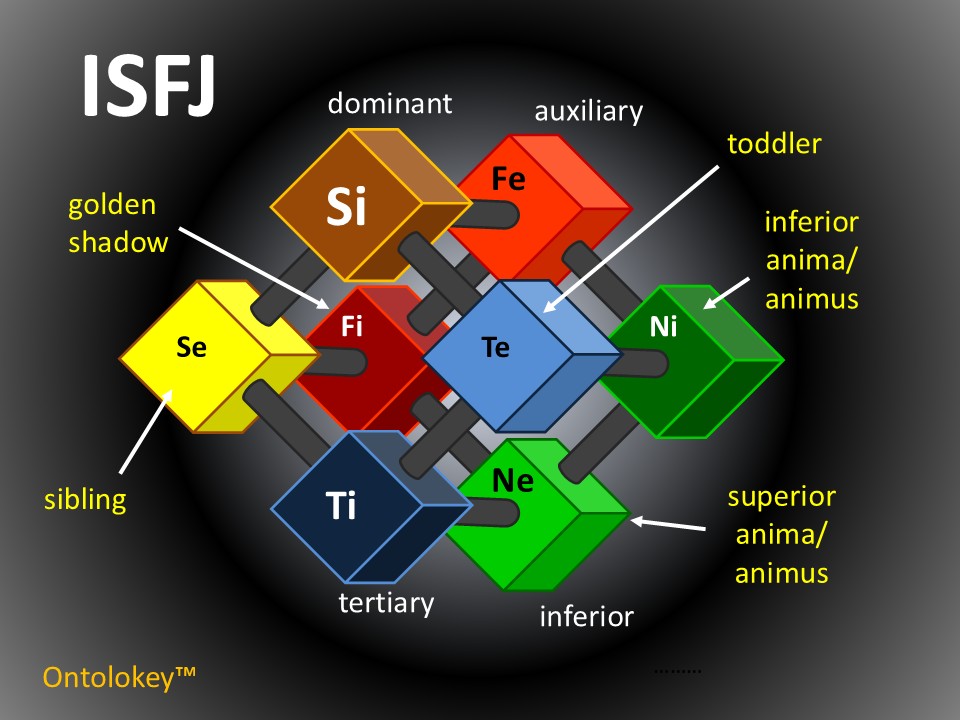
ISFJ – The Untold Truth
The Personality Beneath the Reputation
The ISFJ is perhaps one of the easiest personality types to misunderstand precisely because its most visible qualities are so socially reassuring. The familiar portrait is that of the loyal protector: conscientious, considerate, dependable, emotionally attentive, devoted to family and community, and instinctively inclined to preserve whatever gives human life continuity and security. Yet this description, although not necessarily false, describes the ISFJ primarily from the outside, through the behaviors that other people experience and appreciate, rather than through the psychological architecture that produces them. Ontolokey approaches the type differently by placing the ISFJ within a three-dimensional system of eight Jungian psychological functions, thereby treating personality not as a list of traits but as a dynamic arrangement of conscious strengths, underdeveloped capacities, unconscious tensions, and latent possibilities. In this model, the ISFJ is organized around Introverted Sensing (Si) as its dominant function and Extraverted Feeling (Fe) as its auxiliary function, a combination that creates an unusual psychological synthesis of inwardly anchored experience and outwardly oriented emotional responsibility.
The significance of this combination becomes clearer when one stops thinking of Si as simply “good memory” and Fe as simply “being nice.” Si, in the Ontolokey interpretation, represents an inwardly organized relationship with experience in which sensory impressions, memories, familiar patterns, emotional associations, and accumulated personal knowledge become part of an internal psychological landscape. The past is therefore not merely something that happened to the ISFJ; it becomes a reference system against which present experience is evaluated, allowing the individual to recognize subtle deviations, preserve continuity, and remember what has mattered before. Fe then carries this internally grounded sensitivity outward into the interpersonal world, where the ISFJ becomes highly responsive to emotional atmosphere, social expectations, the needs of others, and the implicit rules governing relationships. The result can be extraordinary attentiveness: the ISFJ may remember what another person prefers, notice changes in mood that others overlook, preserve traditions that give a family its identity, or quietly perform countless practical acts that make other people feel protected. Yet the same psychological architecture that makes such care possible can also create vulnerability, because the preservation of harmony can gradually become more important than the preservation of the self.
This is where the deeper psychological paradox of the ISFJ begins. The personality’s greatest virtues are not separate from its potential difficulties; they are structurally connected to them. Loyalty can become attachment, responsibility can become over-responsibility, empathy can become emotional enmeshment, stability can become resistance to change, and self-sacrifice can eventually become resentment when needs that were never openly acknowledged remain unmet. The ISFJ may sincerely experience itself as giving freely while simultaneously developing unconscious expectations that others will recognize, reciprocate, or at least appreciate that giving. When those expectations remain unspoken, disappointment can accumulate without a clear psychological explanation, because consciously the individual may continue to identify with being generous, patient, and undemanding. This is one reason the darker dimensions of the type cannot simply be dismissed as “negative traits”: they are often the shadow consequences of strengths that have become too central to identity. Ontolokey’s shadow-oriented analysis makes precisely this point, arguing that the ISFJ’s deepest difficulties can arise when the identity of being good, caring, dependable, and self-sacrificing becomes so psychologically important that contradictory emotions are pushed outside conscious awareness.
The central question, therefore, is not whether the ISFJ is genuinely kind, loyal, or caring, because these qualities can be profoundly authentic. The more difficult question is what happens when a person becomes psychologically dependent upon being perceived — by themselves and by others — as the good, reliable, indispensable one. At that point, personality becomes identity, identity becomes defense, and defense begins filtering reality. Anger may become difficult to acknowledge because it conflicts with the self-image of kindness; personal desires may be minimized because they interfere with the role of caretaker; uncertainty may become intolerable because it threatens the internal order built through experience; and change may feel dangerous because it requires abandoning familiar psychological coordinates. The shadow is therefore not the opposite of the ISFJ’s personality but its hidden complement, containing precisely those dimensions that conscious identification has left insufficiently developed. The deeper truth of the ISFJ is consequently neither the flattering stereotype of the gentle protector nor the sensationalized image of a secretly manipulative person, but a far more human psychological tension: the lifelong movement between preserving what is loved and becoming someone capable of living beyond what is familiar.
The Ontolokey Cube: Eight Functions, One Psychological Architecture
The most useful way to enter the Ontolokey model is to stop imagining the ISFJ as a four-function personality and instead regard it as a psyche containing eight potential modes of consciousness, each occupying a different psychological position. Ontolokey places the eight Jungian functions on the eight vertices of a cube and uses the spatial relationships between them to express differences between conscious preference, developmental immaturity, unconscious attraction, vulnerability, and shadow potential. The ISFJ therefore does not simply “have” Si, Fe, Ti, and Ne while lacking the remaining functions; rather, all eight belong to the psychological landscape, although they do not possess equal accessibility or authority. In the Ontolokey formulation, Si is the Dominant, Fe the Auxiliary and Persona, Se the Sibling, Te the Toddler, Ne the Inferior, Ni the Anima, Ti the Tertiary, and Fi the Golden Shadow. This distinction is psychologically important because it changes the meaning of “weakness”: a less conscious function is not necessarily absent, but may instead represent a capacity that appears awkwardly, defensively, aspirationally, or symbolically until it becomes more integrated. The cube thus becomes a map of psychological tension rather than a hierarchy in which four functions are valuable and four are defective, allowing the ISFJ to be understood as a developing whole whose apparently contradictory impulses are actually expressions of different regions of the same psyche.
At the center of that architecture stands Introverted Sensing (Si), the Dominant function, and its position explains why continuity is such a profound psychological principle for the ISFJ. According to Ontolokey, Si does not merely remember factual details but internalizes impressions, bodily sensations, emotional associations, familiar patterns, and contextual nuances, creating an individualized archive against which present experience is continuously compared. The psychological question of Si is therefore not simply “What happened before?” but something closer to “What does this present experience mean in relation to everything I already know, remember, trust, and have emotionally encoded?” This gives the ISFJ an unusual capacity for consistency, careful observation, preservation, conscientiousness, and loyalty, because what has once become meaningful is rarely experienced as disposable. Yet the same mechanism can become restrictive when familiarity is unconsciously equated with safety or truth, making novelty feel less like opportunity and more like a disturbance of psychological order. Ontolokey consequently presents Si as both the ISFJ’s great stabilizing power and one of the places where rigidity, rumination, perfectionism, and resistance to unpredictability can develop.
Extraverted Feeling (Fe), the Auxiliary function, transforms this inwardly preserved world into interpersonal responsibility. Fe directs attention away from the isolated individual toward the emotional field surrounding them: what another person needs, what the group expects, what is appropriate in a particular context, and what might restore harmony when relationships become strained. This is why the ISFJ can appear considerably more socially expressive than the stereotype of the quiet introvert would suggest, because social fluency and social energy are not the same psychological phenomenon. Ontolokey specifically describes Fe as a kind of Persona function for the ISFJ, meaning that the individual can become exceptionally skilled at presenting a socially appropriate, reassuring, attentive, and emotionally responsive self while still requiring substantial solitude to recover internally. The danger emerges when this adaptive capacity becomes so successful that the social role begins to replace the private person underneath it, producing compliance, emotional overextension, difficulty saying no, or the unconscious belief that love must be earned through usefulness. Thus the ISFJ’s kindness can be profoundly authentic while simultaneously functioning as a psychological defense: caring for everyone else may become a way of avoiding the frightening question of what the ISFJ itself wants.
The remaining positions reveal why the ISFJ’s inner life becomes substantially more complicated than its public reputation suggests. Extraverted Sensing (Se), the Sibling function, represents an alternative relationship to sensory reality: instead of interpreting the present through accumulated experience, it permits the present to be encountered directly, spontaneously, and without excessive reference to the past. Extraverted Thinking (Te), the Toddler, introduces external efficiency, measurable results, organization, and assertive control, but because it is comparatively immature, it can appear abruptly under pressure as rigidity, command-giving, checklist mentality, or an urgent attempt to impose order when the familiar psychological structure has been disrupted. Extraverted Intuition (Ne), the Inferior function, stands opposite Si’s need for continuity by opening consciousness toward alternatives, uncertainty, hypothetical futures, experimentation, and possibilities that cannot yet be verified; consequently, it may initially feel liberating and frightening at the same time. Introverted Intuition (Ni), the Anima, introduces an entirely different form of knowing, one concerned with symbolic meaning, underlying patterns, existential significance, and the possibility that life possesses a deeper coherence than observable facts alone can establish. Finally, Introverted Thinking (Ti), the Tertiary, and Introverted Feeling (Fi), the Golden Shadow, challenge the ISFJ to develop two forms of inward authority that can be uncomfortable precisely because they reduce dependence upon external agreement: Ti asks whether the individual’s understanding is internally coherent, while Fi asks whether the individual’s life is personally and morally authentic regardless of what others expect. The mature ISFJ therefore does not abandon Si and Fe; psychological development consists in allowing these less familiar functions to correct their excesses, so that preservation becomes wisdom rather than inertia, care becomes love rather than self-erasure, and loyalty becomes a conscious choice rather than an unconscious obligation.
When Care Becomes Identity: The Psychology of Self-Sacrifice
The ISFJ’s capacity for care becomes psychologically complicated when caring ceases to be something the person does and becomes the principal evidence for who the person is. At first, this distinction seems semantic, but psychologically it is profound: a person who helps others because they freely choose to can also choose not to help, whereas a person whose identity depends upon being helpful experiences refusal as a threat to self-worth. Ontolokey’s shadow analysis places considerable emphasis on this transition, describing how caregiving can gradually become intertwined with an unconscious need to be needed, appreciated, trusted, or morally recognized. The ISFJ may therefore insist, quite sincerely, that they expect nothing in return while simultaneously experiencing deep hurt when their sacrifices go unnoticed, unreciprocated, or treated as ordinary. This does not mean that the kindness was fraudulent, nor does it reduce genuine generosity to manipulation; rather, it suggests that several motives can coexist beneath the same behavior, with conscious altruism existing alongside unconscious needs for attachment, security, recognition, or control. Psychological maturity begins when the ISFJ can tolerate that complexity without needing to convert the self into either a saint or a victim.
This becomes particularly important in relationships because the ISFJ often expresses affection through practical investment rather than abstract declarations. Remembering details, anticipating needs, maintaining routines, providing assistance, protecting traditions, absorbing responsibilities, and remaining present during difficult periods can become the individual’s natural language of love. Such behavior can create extraordinarily stable relationships because the ISFJ frequently notices the small forms of maintenance upon which intimacy actually depends, while other people may focus primarily on dramatic expressions of affection. Yet the very subtlety of this contribution can create an invisible emotional accounting system in which sacrifices accumulate without ever being explicitly negotiated. The ISFJ may remember what was done for another person, what was endured, what was postponed, and what was given up, while simultaneously believing that keeping such an account contradicts the purity of their generosity. When reciprocity fails to appear, resentment can therefore emerge indirectly rather than through clear confrontation. Ontolokey describes the resulting pattern in terms of suppressed anger, passive resistance, guilt-inducing behavior, emotional withdrawal, and a developing narrative of being unappreciated, illustrating how the refusal to acknowledge legitimate needs can paradoxically make those needs more controlling.
The most uncomfortable truth is that self-sacrifice can contain an element of power without the person consciously intending to exercise power. A caregiver who does everything for another person acquires influence over that person’s emotional environment, practical functioning, and sometimes even sense of obligation. If the ISFJ repeatedly solves problems before others can solve them themselves, protection can gradually become interference; if they repeatedly anticipate what others need, attentiveness can become surveillance; if they repeatedly sacrifice themselves without communicating their limits, generosity can become an unspoken contract. The recipient may eventually feel guilty for not reciprocating adequately, while the ISFJ feels exploited for having given so much, producing a relational system in which neither person understands why affection has begun to feel like debt. The psychological irony is that the ISFJ may genuinely resent dependence in others while simultaneously creating circumstances in which others become dependent upon them. This is not an indictment of the type but an illustration of why unconscious motives matter: a behavior can be loving in intention and controlling in effect, and mature self-awareness requires the ability to hold both truths simultaneously.
The shadow becomes especially powerful when anger is treated as morally unacceptable. Because the ISFJ often identifies strongly with patience, reliability, and emotional consideration, ordinary aggression can appear incompatible with the person’s preferred self-concept, causing frustration to be suppressed rather than metabolized. But anger is not synonymous with cruelty; in psychologically healthy functioning, anger can communicate violated boundaries, accumulated exhaustion, injustice, or the need for change. When that information is repeatedly rejected, the emotion does not simply disappear, and it may instead return through irritability, withdrawal, coldness, passive resistance, excessive criticism, or an intensified memory of everything the person has previously endured. Ontolokey’s shadow account describes precisely this movement from unacknowledged resentment toward covert forms of retaliation and victimhood, emphasizing that the problem is not the existence of anger but the inability to recognize it consciously. The mature ISFJ therefore does not need to become harder, colder, or less caring; rather, the task is to become sufficiently psychologically honest to say “I do not want to do this,” “I am angry,” “I need something,” or “I feel taken for granted” before the unspoken emotion has accumulated enough pressure to distort the relationship.
There is consequently a profound difference between selflessness and self-abandonment, and the ISFJ can spend years confusing the two because society often rewards the latter when it is performed gracefully. Genuine selflessness involves choosing to contribute while retaining awareness of one’s own boundaries, motives, limitations, and desires; self-abandonment involves repeatedly suppressing those elements until the individual no longer knows where generosity ends and obligation begins. The first creates freely chosen intimacy, while the second can produce an increasingly fragile identity dependent upon being indispensable. Once the ISFJ recognizes this distinction, care becomes psychologically cleaner because it no longer needs to function as proof of moral worth. The person can help without secretly demanding recognition, refuse without experiencing unbearable guilt, receive without feeling indebted, and allow others to struggle without interpreting their struggle as evidence of personal failure. That transformation represents one of the most important developmental movements available to the type: from being needed toward being freely chosen, from sacrifice toward reciprocity, and from the performance of goodness toward the more difficult reality of authentic goodness.
The Inferior Function: Ne and the Fear of the Unknown
If Si provides the ISFJ with psychological continuity, then Extraverted Intuition (Ne) represents the force that continuously threatens to dissolve that continuity by opening consciousness toward alternatives, ambiguity, novelty, and futures that cannot yet be verified. Ontolokey therefore places Ne in the ISFJ’s Inferior position, not because imagination is absent, but because unrestricted possibility can initially feel psychologically destabilizing to someone whose dominant mode of orientation depends upon accumulated experience and familiarity. Ne asks questions that Si cannot answer through precedent: What if something completely different is possible? What if the old solution no longer applies? What if the future cannot be controlled by preparing correctly for it? In a healthy ISFJ, these questions gradually become liberating because they introduce flexibility into a consciousness naturally inclined toward preservation, allowing the individual to experiment without immediately demanding certainty. In an overwhelmed ISFJ, however, the same function can become distorted into catastrophic possibility-generation, where every uncertainty becomes a potential problem and every unfamiliar development becomes evidence that something may go wrong. Ontolokey explicitly describes this duality, presenting Ne both as a source of anxiety and as a developmental gateway through which the ISFJ can acquire creativity, playfulness, reinvention, and a greater tolerance for uncertainty.
This explains a paradox that can otherwise appear contradictory: an ISFJ may be extraordinarily imaginative while simultaneously appearing highly conservative. Imagination itself is not the issue; the psychological question is whether imagination is experienced as an open field of possibilities or as an uncontrollable multiplication of risks. When Ne is poorly integrated, the mind can begin generating scenarios faster than Si can verify them, creating a peculiar form of anticipatory anxiety in which the person mentally rehearses possible failures, betrayals, illnesses, accidents, conflicts, disappointments, or irreversible mistakes. The individual may believe that this mental preparation is responsible because it appears to serve the same protective purpose as careful planning, yet psychologically it can become an attempt to achieve certainty where certainty is impossible. The more the ISFJ attempts to eliminate every possible negative outcome, the more possibilities the mind produces, and the resulting anxiety becomes self-reinforcing. Ontolokey’s shadow analysis adds another dimension to this process by describing how subjective impressions can become increasingly detached from external verification, so that an emotionally convincing possibility may gradually acquire the status of an established fact. The developmental challenge is therefore not to suppress imagination but to distinguish possibility from probability, intuition from evidence, and preparation from compulsive control.
At its healthiest, Ne gives the ISFJ something that cannot be obtained from Si alone: the permission to become someone who has not yet been fully defined by the past. This is psychologically significant because a strong attachment to continuity can quietly transform into a belief that the person must remain consistent with everything they have previously been. Family expectations, established roles, old promises, familiar relationships, professional identities, and earlier versions of the self can all acquire a moral weight that makes transformation feel like betrayal. Ne introduces a different proposition: continuity does not require repetition, and loyalty to one’s history does not require permanent obedience to it. An ISFJ who develops this capacity may discover that changing a tradition does not necessarily dishonor it, leaving a dysfunctional relationship does not invalidate previous loyalty, and choosing a new career or lifestyle does not mean that the earlier self was mistaken. Instead, the past becomes a foundation rather than a prison. In this sense, the inferior function can become one of the most important instruments of individuation because it forces the personality to confront the fact that life cannot be preserved by refusing to let it change.
The confrontation with Ne also exposes one of the ISFJ’s deepest fears: the fear that a single wrong decision could destroy an entire structure of security. Because the ISFJ often evaluates the present through accumulated experience, decisions can carry more emotional history than outsiders realize; choosing something new may appear to involve not merely a new option but the possible abandonment of everything that previously provided stability. This can create hesitation, excessive consultation, waiting for the perfect moment, or an unconscious preference for familiar dissatisfaction over unfamiliar possibility. Yet the tragedy of excessive caution is that it can produce precisely the instability the person hoped to avoid, because relationships deteriorate while one waits, opportunities disappear while one prepares, and identities become constricted while one attempts to remain faithful to an earlier version of oneself. The Ontolokey model therefore treats the inferior Ne not merely as a weakness to be overcome but as a developmental initiation into uncertainty, creativity, and psychological expansion. The mature ISFJ eventually learns that security does not mean knowing what will happen; it means developing enough inner resilience to remain psychologically intact even when the future refuses to resemble the past.
This is one of the places where the ISFJ’s shadow and its potential for growth become indistinguishable from one another. The same imagination that can produce catastrophic scenarios can also generate solutions; the same sensitivity to what might go wrong can become sensitivity to what might become possible; the same caution that prevents reckless decisions can become thoughtful experimentation when balanced by curiosity. Psychological development therefore does not demand that the ISFJ become spontaneous in the manner of a natural Se or Ne dominant, because such a transformation would amount to abandoning the personality’s genuine structure rather than integrating it. What matters is learning to let possibility enter the psychological room without immediately giving it either absolute authority or absolute rejection. The ISFJ can say, in effect, “I do not know what will happen, and I do not need to know yet; I can remain grounded while allowing reality to surprise me.” That capacity represents a profound movement away from fear-based preservation and toward mature trust, because the person no longer requires the future to be predictable before allowing themselves to participate fully in it.
The Golden Shadow: Fi and the Self the ISFJ Does Not Easily Permit
Among the most psychologically intriguing positions in the Ontolokey cube is Introverted Feeling (Fi), designated as the ISFJ’s Golden Shadow. The term “Golden Shadow” is important because it suggests not simply an inferior or destructive capacity, but a neglected quality that can appear strangely compelling, admirable, threatening, or even idealized when encountered in other people. Fi represents an inwardly anchored relationship with personal values, subjective emotional truth, conscience, authenticity, and the question of what something means to the individual independently of collective expectations. For an ISFJ whose auxiliary Fe is naturally attentive to interpersonal harmony and whose identity can become deeply invested in fulfilling relational obligations, Fi can therefore feel simultaneously attractive and disruptive. It asks a question that Fe can easily postpone: “What do I actually feel and value when nobody else’s needs, expectations, approval, or disappointment are being considered?” Ontolokey’s treatment of Fi as the Golden Shadow consequently points toward one of the deepest developmental tensions in the ISFJ psyche: the possibility that the person can become exceptionally skilled at understanding what other people need while remaining surprisingly uncertain about what they themselves authentically want. (ontolokey.com)
This does not mean that ISFJs lack personal values or possess no individual emotional life; such an interpretation would be both simplistic and psychologically inaccurate. The issue is one of psychological authority rather than emotional capacity. Fe naturally evaluates experience through the interpersonal field, asking how feelings affect relationships and how behavior contributes to social equilibrium, whereas Fi evaluates experience through an inward sense of personal congruence, asking whether something feels morally or emotionally true to the self. An ISFJ may therefore know perfectly well that something is wrong while still struggling to articulate whether it is wrong for them personally, because years of adaptation may have trained them to evaluate their choices through consequences for other people. This can produce an extraordinary ability to accommodate, but accommodation becomes dangerous when it silently replaces preference. The person may say, “It is fine,” not because it is genuinely fine but because acknowledging that it is not fine would create conflict, disappointment, or guilt. In this sense, the Golden Shadow can contain a buried psychological voice that has been saying, perhaps very quietly for years, “Your inner experience matters even when nobody else needs you to have it.”
The shadow quality of Fi becomes particularly visible when the ISFJ encounters someone who appears unapologetically authentic, emotionally self-defined, or unwilling to sacrifice personal conviction for social harmony. Such people may provoke admiration because they embody something the ISFJ secretly longs to possess, but they can also provoke irritation because their independence violates assumptions that the ISFJ has internalized about responsibility and consideration. The unconscious reaction may therefore oscillate between idealization and moral criticism: the other person seems wonderfully free, yet also selfish; wonderfully authentic, yet insufficiently considerate; courageous, yet difficult; deeply principled, yet unnecessarily individualistic. Ontolokey’s Golden Shadow concept is valuable precisely because it recognizes this ambivalence as psychologically informative rather than merely interpersonal. (ontolokey.com) What irritates us can sometimes reveal what our conscious identity has excluded, and the ISFJ may discover that some of the freedom they condemn in others is actually a developmental capacity they have never given themselves permission to exercise. The integration of Fi does not require abandoning compassion or becoming self-centered; it requires recognizing that consideration for others and loyalty to oneself are not mutually exclusive psychological principles.
The absence of this integration can create a particularly subtle form of resentment because the ISFJ may continue to give while privately feeling that nobody truly understands the cost of what is being given. If personal desires are repeatedly sacrificed without being consciously acknowledged, the individual may eventually experience an existential loneliness that practical affection cannot repair. Other people may love the ISFJ deeply and still fail to know the person underneath the role because the ISFJ has become exceptionally good at presenting what others need while withholding what they themselves need. This creates a paradoxical interpersonal situation in which the person is surrounded by relationships yet feels unseen, because being appreciated for usefulness is not equivalent to being known as a complete individual. Fi offers a route out of this paradox by encouraging the ISFJ to reveal subjective preferences, private convictions, emotional boundaries, and values that do not require external justification. The psychological risk is that this process initially feels selfish, especially for someone accustomed to measuring goodness by the degree to which other people are cared for, but the deeper reality is that authentic relationships require two subjects, not one caretaker and a collection of recipients.
Integration of the Golden Shadow ultimately means that the ISFJ learns to care without disappearing. This is not a rejection of Fe but its maturation, because interpersonal love becomes healthier when it is offered by a differentiated individual rather than by someone whose boundaries have dissolved into the emotional requirements of the surrounding environment. The ISFJ can learn to distinguish guilt from responsibility, disappointment from wrongdoing, and another person’s emotional reaction from evidence that the ISFJ has behaved immorally. This distinction is psychologically liberating because it permits the person to tolerate being misunderstood without immediately correcting the misunderstanding through further self-sacrifice. In the deepest sense, Fi teaches the ISFJ that an inner life does not need democratic approval: a preference can be legitimate without being useful, a boundary can be legitimate without being convenient, and an emotion can be real without needing to be justified by everyone affected by it. When this hidden function is integrated rather than projected, the ISFJ does not become less loving; instead, love becomes less compulsive, less transactional, and less dependent upon the preservation of a morally impeccable self-image.
The Tertiary Mind: Ti and the Need to Understand
If Fi confronts the ISFJ with the question of personal authenticity, Introverted Thinking (Ti), the Tertiary function in the Ontolokey model, confronts the person with the question of internal coherence. Ti is concerned with conceptual precision, logical consistency, categorization, definitions, and the internal architecture of an explanation, and its presence means that the ISFJ is not psychologically reducible to sentiment, tradition, or interpersonal concern. Beneath the practical attentiveness and emotional responsibility there can exist a quiet analytical mind that wants to understand why things work, whether a conclusion actually follows from its premises, and whether the explanations being offered are internally consistent. Because Ti is tertiary rather than dominant, this analytical tendency may not always be displayed continuously or confidently, but it can become increasingly important as the individual matures. Ontolokey’s placement of Ti in this position therefore adds an essential corrective to the popular stereotype of the ISFJ as simply “the caring one,” revealing a capacity for detached analysis that can remain underestimated by both the individual and the people around them. (ontolokey.com) When developed consciously, Ti enables the ISFJ to step outside emotional atmosphere and inherited assumptions long enough to ask whether the system itself actually makes sense.
This capacity can become especially important because the ISFJ’s strong Si–Fe orientation can sometimes make familiarity and social consensus feel more persuasive than they objectively deserve to be. Si may say, “This is how it has always worked,” while Fe may add, “This is what everyone expects,” and together these forces can create a powerful psychological presumption in favor of continuity. Ti interrupts that presumption by asking whether tradition is necessarily justified merely because it is established and whether harmony is necessarily healthy merely because conflict is uncomfortable. This does not make Ti superior to Si or Fe; rather, it introduces a different criterion for evaluating reality. A mature ISFJ can therefore preserve traditions because they understand their meaning rather than because they are afraid to abandon them, and they can maintain relationships because the relationships are genuinely valuable rather than because separation would violate an internalized duty. Ti can also help the ISFJ recognize manipulative dynamics that Fe might otherwise excuse and cognitive distortions that Si might reinforce through repeated recollection. The function thus provides an internal intellectual filter through which compassion can become more discerning, allowing the ISFJ to distinguish between what is familiar, what is socially approved, and what is actually coherent.
Yet the tertiary position also explains why Ti can become defensive rather than genuinely analytical. When threatened, an ISFJ may suddenly retreat from emotional complexity into an insistence upon facts, rules, technicalities, or categorical distinctions, using analysis as a way of creating psychological distance from feelings that have become overwhelming. In such moments, the person may appear unusually rigid or argumentative, particularly if they believe that another individual has violated an established principle or behaved inconsistently. The irony is that tertiary Ti can sometimes be recruited in the service of the very emotional position it appears to transcend: instead of asking an open-ended question, the ISFJ may construct a highly logical case for why their accumulated interpretation is correct. Because Si preserves detailed memories and Fe preserves interpersonal impressions, Ti can potentially become the lawyer defending the emotional archive rather than the impartial investigator examining it. This distinction is crucial because intellectual sophistication does not automatically equal psychological objectivity. The healthier expression of Ti is not “I can prove that I am right,” but rather “I am willing to discover that my interpretation may be incomplete.”
Developing Ti also gives the ISFJ greater protection against one of the darker consequences of excessive Fe: the tendency to absorb other people’s interpretations of reality. A highly relational person can become so attentive to emotional context that the boundary between empathy and identification becomes porous, particularly when the surrounding environment is intense or when significant relationships carry strong expectations. Ti creates a psychological room in which the ISFJ can temporarily step back and examine the situation without immediately deciding whose feelings need to be protected. This capacity is particularly valuable in conflict, where the instinctive desire to restore harmony can otherwise lead to premature concessions, unexplored assumptions, or acceptance of responsibility for problems that do not belong entirely to the ISFJ. Analytical distance does not have to destroy compassion; indeed, it can make compassion more accurate by preventing the person from confusing emotional intensity with objective truth. In this sense, Ti becomes a quiet form of self-protection because it allows the ISFJ to say, “I understand why you feel this way, but your feeling does not automatically establish that your interpretation is correct.”
At a deeper developmental level, Ti contributes to the ISFJ’s movement from inherited certainty toward consciously examined conviction. The young or psychologically less differentiated ISFJ may trust what has been proven by experience, endorsed by significant people, or preserved through tradition, while the mature ISFJ gradually becomes capable of questioning even cherished assumptions without experiencing that questioning as disloyalty. This is an important psychological achievement because genuine maturity requires the capacity to revise one’s internal model of reality while retaining continuity of identity. Ti makes such revision possible by transforming knowledge from a collection of trusted conclusions into an evolving system that can tolerate contradiction, evidence, ambiguity, and correction. The ISFJ does not need to become emotionally detached to achieve this; instead, the analytical function can serve the deeper goal of making the person’s care more intelligent, their loyalty more discerning, and their boundaries more defensible. Ultimately, Ti teaches a lesson that complements the lessons of Ne and Fi: the truth does not become less true because examining it might disturb the harmony around it, and understanding oneself requires the courage to question even the beliefs that once made life feel safe.
The Sibling Function: Se and the Forgotten Present
Extraverted Sensing (Se), which Ontolokey places in the Sibling position, represents one of the most understated resources in the ISFJ psyche because it offers a radically different relationship to sensory reality from dominant Si. Si experiences the present through the accumulated meaning of previous experience, whereas Se encounters what is actually happening now with comparatively little need to interpret it through memory first. Ontolokey describes Se as an underutilized but potentially refined capacity in the ISFJ, particularly in areas involving tactile experience, aesthetics, craftsmanship, food, physical surroundings, and direct sensory awareness. This distinction matters because the ISFJ can become so occupied with remembering how things have been, anticipating what others require, or maintaining familiar standards that the immediate moment itself becomes secondary. Se offers a corrective by asking the person to notice the world before evaluating it, to experience the body before analyzing its meaning, and to permit reality to exist without immediately comparing it with an internal template.
The healthy development of Se can therefore be understood as a movement from preservation toward presence. An ISFJ who is excessively identified with Si may experience the present as something that must be interpreted, managed, or fitted into an established framework, whereas Se invites direct participation: seeing the color of the room, hearing the precise tone of a voice, noticing bodily tension, enjoying a meal without mentally evaluating it, or allowing an unplanned experience to remain valuable simply because it is happening. This does not require the ISFJ to become reckless or impulsive, because Se at its healthiest is not synonymous with sensation-seeking; it is fundamentally an attentional capacity that permits reality to make an impression before the mind decides what that impression means. Ontolokey connects this development with mindfulness and body awareness, suggesting that greater contact with immediate experience can interrupt the tendency toward rumination and perfectionistic repetition. Psychologically, this is significant because an individual cannot remain permanently anchored in remembered experience without gradually losing contact with the changing reality that memory is supposed to help navigate.
The shadow of underdeveloped Se appears when the ISFJ becomes trapped in comparison with an idealized past. The person remembers how something should have been, how a relationship once felt, how a family tradition was originally practiced, how a workplace previously functioned, or how another person behaved years earlier, and the present is then judged against that internal reference point. Such comparisons can be useful when they reveal genuine deterioration, but they become problematic when memory acquires more authority than current evidence. The ISFJ may then continue responding to a person who no longer exists psychologically, defending a tradition whose original purpose has disappeared, or maintaining standards that have become disconnected from present circumstances. Se interrupts this temporal bias by forcing attention back toward observable reality: What is actually here now? Who is this person now? What does this situation require now? This can be uncomfortable because the answer may reveal that something once worth preserving has already changed, but it can also be liberating because it prevents loyalty to memory from becoming disloyalty to reality.
There is also a quieter, more positive dimension to Se that deserves attention because it reveals why the ISFJ can possess an unexpectedly rich aesthetic and sensory intelligence. The same person who carefully preserves objects, recipes, rituals, family spaces, clothing, crafts, photographs, or physical environments may possess a sophisticated appreciation for texture, atmosphere, craftsmanship, and material detail that outsiders interpret merely as sentimentality. When Si and Se cooperate, memory and presence become mutually enriching: the individual does not merely preserve the past but knows how to embody meaning in the physical world. A familiar meal can become a living expression of belonging, a carefully maintained home can become an environment of psychological safety, and an inherited craft can become something creatively renewed rather than mechanically repeated. The developmental goal is therefore not to weaken Si in favor of Se but to allow the two to enter dialogue, so that the past informs perception without dictating it and the present becomes something to inhabit rather than merely something to compare.
In its mature form, Se teaches the ISFJ a deceptively simple psychological lesson: not everything valuable has to be remembered, anticipated, or preserved; some things are valuable precisely because they are happening only once. This is particularly important for a personality that can carry emotional history with unusual intensity, because an excessive attachment to what has been can make the present feel like an inferior copy of something that can never return. Se offers another possibility in which the individual does not need to make every moment permanent in order for the moment to matter. The ISFJ can allow an experience to arrive, affect them, and disappear without turning its disappearance into a loss that must be mentally reconstructed. This capacity becomes especially powerful when combined with Ne, because both functions loosen the grip of psychological certainty in different ways: Ne opens the future to possibilities, while Se opens the present to immediacy. Together they help the ISFJ discover that life does not become meaningful only when it is preserved; sometimes its deepest meaning lies in the willingness to be fully present while it is still alive.
The Toddler and the Anima: Te, Ni, and the Crisis of Control
The two remaining positions that deserve particular attention are Extraverted Thinking (Te), the Toddler, and Introverted Intuition (Ni), the Anima, because together they reveal what can happen when the ISFJ’s ordinary methods of maintaining stability stop working. Te is concerned with external efficiency, measurable outcomes, organization, decisive execution, and the practical restructuring of circumstances, whereas Ni seeks underlying patterns, symbolic meaning, long-range implications, and a unifying interpretation beneath observable events. In the Ontolokey model, neither occupies a position of ordinary conscious authority for the ISFJ, and both can therefore emerge in psychologically uneven ways. (ontolokey.com) Te may appear when familiar methods have failed and the individual suddenly feels compelled to impose order upon an external situation, while Ni may emerge through powerful intuitions about what an experience “really means,” where a relationship is heading, or what hidden pattern connects seemingly unrelated events. Their developmental importance lies precisely in their unfamiliarity: they force the ISFJ beyond the territory in which accumulated experience and interpersonal accommodation normally provide sufficient guidance.
The Te Toddler can be understood as the ISFJ’s immature relationship with externalized efficiency and direct instrumental control. Under ordinary conditions, an ISFJ often prefers to work carefully within established structures, maintaining reliability through attention to detail and interpersonal cooperation rather than through overt domination. When overwhelmed, however, the individual may abruptly move toward the opposite strategy, attempting to make everything efficient, orderly, measurable, and immediately executable. Ontolokey associates this less-developed Te with the possibility of becoming unusually controlling or blunt when the person feels that circumstances have become chaotic or unmanageable. (ontolokey.com) The psychological mechanism is understandable: when Si can no longer rely upon precedent and Fe can no longer restore harmony, the psyche searches for another instrument capable of producing certainty. Te offers the seductive promise that if the problem can simply be organized, measured, prioritized, and executed correctly, emotional ambiguity will disappear. Yet because this function is not naturally central, its stressed expression may lack nuance, producing rigidity, impatience, excessive correction, or an almost bureaucratic insistence that everyone follow the “right” procedure.
This is one reason the ISFJ under severe stress can sometimes surprise people who know them as gentle and accommodating. The person who ordinarily avoids confrontation may suddenly become authoritarian about details, standards, responsibilities, schedules, or procedures, particularly when they believe that others are being careless or incompetent. The danger is not simply anger but the transformation of emotional overwhelm into external control. Instead of consciously acknowledging fear, exhaustion, disappointment, or helplessness, the ISFJ may attempt to solve the psychological problem as though it were a logistical problem. More rules are created, more responsibilities are assigned, more errors are catalogued, and more insistence is placed upon doing things correctly. Yet no amount of external efficiency can permanently resolve an internal conflict that has never been acknowledged. The healthier development of Te therefore involves learning to use structure without weaponizing it, to make decisions without confusing decisiveness with certainty, and to recognize that not every human problem can be solved through better administration.
Ni, the Anima, operates in a very different psychological register. Rather than asking how to organize observable reality, Ni seeks to penetrate beneath it and perceive a deeper trajectory, symbolic pattern, or hidden meaning, and this can be deeply attractive to an ISFJ precisely because it offers access to a form of understanding that Si does not naturally prioritize. Ontolokey describes Ni as an important but less conscious dimension of the ISFJ psyche, capable of bringing depth, intuition, symbolism, and long-range insight into an otherwise strongly experience-based orientation. (ontolokey.com) When integrated, Ni can help the ISFJ recognize that individual events belong to larger developmental patterns, making it easier to understand why a relationship has evolved, why a particular life structure has become unsustainable, or what direction a period of transition may be taking. When poorly integrated, however, intuition can become fused with emotional certainty, producing conclusions that feel profoundly meaningful but have not been sufficiently tested against reality. The person may begin to believe that they “know” what another person secretly intends, that an ambiguous event carries an inevitable significance, or that several unrelated experiences constitute evidence of a single hidden narrative.
This distinction between intuition and projection becomes especially important in the shadow psychology of the ISFJ. A strong intuitive impression can be psychologically real without being factually reliable, and an emotionally compelling interpretation can reveal something about the individual’s internal state without necessarily revealing the hidden intentions of another person. When Ni is integrated, the ISFJ can hold intuitive insights provisionally, allowing them to guide inquiry rather than prematurely conclude it. When Ni is captured by fear, however, the mind can construct an increasingly coherent story around incomplete information, particularly when Ne is simultaneously generating possible negative scenarios and Si is supplying emotionally charged memories that appear to confirm them. This creates a potentially powerful feedback loop in which the past provides evidence, intuition supplies meaning, and imagination supplies possible consequences, while Fe then searches the interpersonal environment for confirmation. The result can feel like extraordinary psychological insight while actually representing an internally consistent but insufficiently tested interpretation.
The mature integration of Te and Ni therefore gives the ISFJ something remarkably valuable: the ability to act decisively without abandoning reflection and to perceive meaning without surrendering critical judgment. Te can teach the person that boundaries sometimes require action rather than endless accommodation, while Ni can teach that life occasionally demands a vision of what lies beyond established patterns. Neither function needs to replace Si or Fe; instead, each expands the range within which those dominant capacities can operate. The ISFJ can preserve what deserves preservation while recognizing when a system has reached the end of its usefulness, and can care deeply about people while accepting that some relationships have developmental trajectories that cannot be reversed through greater effort. In this sense, the Anima and the Toddler are not merely exotic corners of the Ontolokey cube but psychological invitations to become more complete: to stop believing that everything can be stabilized through care, and to discover that some forms of maturity require interpretation, decision, endings, and change.
The Shadow Beneath the Protector
The darker side of the ISFJ becomes most intelligible when it is understood not as a hidden personality that suddenly replaces the “good” ISFJ, but as the accumulated consequence of unconscious psychological compromises. The person who spends years suppressing anger may eventually become resentful; the person who continually anticipates the needs of others may become controlling; the person who equates loyalty with endurance may remain in destructive situations long after loyalty has ceased to be virtuous; and the person who defines goodness through usefulness may experience another person’s independence as rejection. Ontolokey’s discussion of the ISFJ shadow emphasizes these possibilities, including resentment, passive-aggressive tendencies, martyrdom, rigidity, fear-driven interpretations, and the temptation to use one’s history of sacrifice as moral leverage. (ontolokey.com) None of these tendencies should be treated as inevitable characteristics of ISFJs, and they certainly should not be used to pathologize ordinary conscientiousness or emotional sensitivity. Their significance lies instead in showing how a virtue becomes distorted when it is repeatedly used to avoid an underlying psychological truth.
One of the most consequential distortions is martyr consciousness, the state in which suffering gradually becomes evidence of moral superiority. The ISFJ may never consciously decide to become a martyr; indeed, the person may actively reject the label while continuing to behave in ways that make martyrdom increasingly central to identity. The pattern develops when sacrifice is repeatedly chosen without boundaries, resentment is repeatedly denied, and reciprocity is repeatedly assumed rather than negotiated. Over time, the individual can acquire a powerful internal narrative: I am the one who always shows up; I am the one who remembers; I am the one who forgives; I am the one who carries everyone else. Such a narrative may contain considerable truth, but its psychological danger emerges when suffering becomes the basis for entitlement. The individual may begin to feel that because they have endured more, their interpretation of events should carry greater moral authority, making disagreement appear not merely different but ungrateful. Ontolokey identifies this shadow dynamic as one of the ways suppressed needs can become indirect forms of control, particularly when the person expects others to recognize sacrifices that were never explicitly negotiated. (ontolokey.com)
A related danger is the transformation of memory into evidence for prosecution. Si’s extraordinary capacity to preserve details can be one of the ISFJ’s greatest strengths, particularly when those details concern people, commitments, promises, and emotionally significant experiences. Yet memory is not a neutral recording device, and psychologically charged memories can become organized around themes of betrayal, injustice, abandonment, or disrespect. When resentment has accumulated, the mind may repeatedly retrieve confirming examples while overlooking contradictory evidence, allowing the past to become a courtroom in which the present is continually judged. The ISFJ may remember precisely what was said, when it happened, who failed to help, what promise was broken, or how often they themselves sacrificed, and this factual specificity can make the resulting interpretation feel indisputable. But factual memories can be assembled into inaccurate psychological conclusions, particularly when the emotional meaning attached to them has remained unexamined. The shadow challenge is therefore not to distrust memory but to ask whether memory is being used to understand experience or to preserve a verdict.
This becomes particularly dangerous when Fe and Si combine to create a sophisticated form of silent relational bookkeeping. The ISFJ may notice every small act of care, every omission, every change in tone, every forgotten promise, and every instance in which another person failed to behave according to the standards of loyalty that the ISFJ considers self-evident. Because many of these expectations remain implicit, the other person may not even know that a psychological debt is accumulating. The ISFJ then experiences the other person’s behavior as proof that they do not care, while the other person experiences the ISFJ’s growing withdrawal or disappointment as confusing and disproportionate. What began as sensitivity has become surveillance; what began as responsibility has become accounting; what began as loyalty has become an expectation that the relationship should reproduce the ISFJ’s own standards of devotion. The way out is not to become indifferent but to replace implicit contracts with explicit communication, because another person cannot reliably honor boundaries, expectations, or needs that have never been made visible.
There is an even deeper shadow beneath this pattern: the possibility that being needed can become safer than being loved. To be loved as a complete person requires vulnerability because love can be withdrawn, misunderstood, or changed, whereas being useful provides a more concrete psychological role. If I solve the problem, remember the detail, protect the person, maintain the household, absorb the crisis, or remain loyal when everyone else leaves, then my place appears secure. This can create a subtle dependence upon indispensability, in which the ISFJ unconsciously maintains situations where others require their intervention because being unnecessary feels dangerously close to being irrelevant. Such a pattern can prevent genuine reciprocity because equal relationships require allowing other people to contribute, make decisions, solve problems, and sometimes even fail. The deepest liberation for the ISFJ is therefore not learning how to give more effectively but learning that their worth does not disappear when nobody needs rescuing.
The shadow, finally, becomes psychologically constructive when it is brought into consciousness without shame. An ISFJ does not become healthier by convincing themselves that they are never resentful, never controlling, never rigid, never afraid, and never self-interested, because such perfection would merely reproduce the original problem at a higher level of denial. Integration requires the more difficult admission that compassion can coexist with anger, generosity with self-interest, loyalty with the desire to leave, and tenderness with the capacity for aggression. Once these opposites can coexist consciously, they no longer need to fight for expression through distorted behavior. The person can say no before resentment forms, confront a problem before withdrawal becomes punishment, leave before loyalty becomes self-destruction, and ask for reciprocity without disguising the request as sacrifice. In that sense, the ISFJ shadow is not the enemy of the personality but the psychological price of everything the conscious personality has refused to admit about itself.
From Devotion to Individuation
The central developmental task of the ISFJ can therefore be understood as a movement from externalized responsibility toward differentiated selfhood, without sacrificing the capacity for devotion that gives the personality much of its strength. In Jungian terms, individuation does not mean becoming detached from other people or abandoning the social world; it means gradually becoming more conscious of the parts of oneself that have previously remained unconscious, allowing contradictory tendencies to coexist without one part having to dominate the others. The Ontolokey cube provides a particularly useful symbolic framework for this process because it portrays the ISFJ not as a fixed collection of four preferred functions but as a psychological structure containing multiple possible modes of consciousness. Si can preserve experience without imprisoning the person inside it, Fe can create connection without demanding self-erasure, Ti can introduce intellectual discrimination without becoming defensive rationalization, and Ne can open possibilities without overwhelming the psyche with catastrophe. Meanwhile, Se, Te, Ni, and Fi can increasingly move from unconscious or awkward territories into conscious capacities that enlarge the personality rather than compete with its original nature. (ontolokey.com) The goal is therefore not to become a different type, but to become a more psychologically complete version of the type one already is.
This process inevitably challenges the ISFJ’s relationship with duty. Duty can be one of the noblest psychological forces because it allows people to act according to commitments even when immediate gratification points elsewhere, and ISFJs can possess an unusually strong capacity to sustain responsibility over time. But duty becomes psychologically dangerous when every obligation is treated as equally sacred, because life contains competing responsibilities and some commitments become obsolete as circumstances change. The mature question is not simply, “What am I supposed to do?” but “Which responsibility is genuinely mine, which belongs to someone else, and which am I continuing only because abandoning it would threaten my identity?” This distinction becomes particularly important in families, long-term relationships, and professional environments where the ISFJ may have gradually become the person everyone expects to manage, mediate, remember, or repair. Individuation requires the courage to disappoint people who have benefited from an older version of the self. Sometimes the healthiest psychological act available to an ISFJ is not another sacrifice but the refusal to continue performing a role that has become incompatible with the person they are becoming.
This is also why boundaries are not fundamentally an interpersonal technique for the ISFJ; they are an ontological declaration of selfhood. A boundary says that there is a distinction between my emotional world and yours, between my responsibilities and yours, between what I can offer freely and what you have come to expect from me. For a person strongly oriented toward Fe, this differentiation can initially feel strangely cold because the nervous system has learned to interpret relational equilibrium as evidence of safety. Yet healthy differentiation does not reduce empathy; it makes empathy less engulfing. The ISFJ can understand another person’s disappointment without assuming responsibility for eliminating it, can witness another person’s pain without automatically turning it into a personal assignment, and can allow conflict to exist without interpreting conflict itself as proof that the relationship has failed. This is where Fi, Ti, and Ne become especially important: Fi establishes personal legitimacy, Ti clarifies responsibility, and Ne creates alternatives when the old relational pattern appears to offer only compliance or rupture. The result is a more mature form of Fe in which connection becomes chosen participation rather than psychological obligation.
The integration of the shadow also changes the ISFJ’s relationship with anger and aggression. Rather than treating these experiences as evidence of moral failure, the individual can begin to regard them as information about boundaries, values, exhaustion, and violated expectations. Anger can reveal that a promise has been broken, that an unequal relationship has developed, or that the person has repeatedly consented to something they never genuinely wanted. Properly integrated, this awareness allows the ISFJ to intervene early, before resentment becomes a historical archive of grievances. The person can confront rather than accumulate, negotiate rather than silently endure, and leave when necessary without first requiring the other party to become unquestionably evil. This is psychologically more mature than either passive endurance or explosive retaliation because it accepts aggression as part of the human emotional repertoire while refusing to let aggression become destructive. The ISFJ does not need to become ruthless to become strong; they need to become sufficiently conscious that strength no longer has to arrive disguised as resentment.
Perhaps the most profound developmental transformation occurs when the ISFJ learns to distinguish continuity from repetition. Si’s loyalty to what has been valuable does not require permanent loyalty to every circumstance inherited from the past, and honoring history does not mean allowing history to dictate the future. A tradition can be preserved by changing it, a relationship can be honored by ending it, a family role can be respected without being continued, and an earlier version of oneself can be loved without being obeyed. Ne provides the imagination necessary to envision alternatives, Ni provides the capacity to recognize deeper trajectories, Se returns attention to what is actually happening in the present, and Fi asks whether the resulting life remains personally authentic. The ISFJ gradually discovers that stability is not the absence of change but the presence of an inner center capable of surviving change. Once that realization becomes embodied rather than merely intellectual, the personality’s relationship with uncertainty changes fundamentally: the future no longer has to resemble the past in order for the individual to trust themselves within it.
This is ultimately where the positive and shadow dimensions of the ISFJ converge. The same person who once feared becoming selfish can discover that self-respect makes generosity more sustainable, while the person who feared disappointing others can discover that honest disagreement often produces more authentic relationships than perpetual accommodation. The person who once preserved everything can learn what deserves preservation and what has simply become familiar, while the person who once carried everyone can learn that allowing others to carry themselves is not abandonment. In psychological terms, the ISFJ becomes less dependent upon a singular identity — the reliable one, the good one, the caring one, the protector — and develops the freedom to occupy multiple psychological positions without experiencing any one of them as a threat to worth. The protector remains, but the protector is no longer required to stand permanently at the door.
The Untold Truth: Becoming More Than the Role
The untold truth about the ISFJ is ultimately neither flattering nor condemning: the person who appears to be the most stable may carry an extraordinary amount of psychological complexity beneath that stability. The protector, caretaker, loyal friend, responsible family member, conscientious colleague, and keeper of continuity are not false identities, but they become psychologically dangerous when they are treated as the entirety of the self. The Ontolokey model makes this tension visible by placing Si, Fe, Ti, and Ne alongside Se, Te, Ni, and Fi, suggesting that the ISFJ’s psychological development cannot be reduced to becoming better at the functions that already come naturally. (ontolokey.com) The deeper task is to develop a relationship with everything that the conscious personality has historically found inconvenient: uncertainty, anger, autonomy, spontaneity, intellectual disagreement, personal desire, symbolic meaning, and the possibility that one’s own interpretation of reality may be incomplete. In this sense, the ISFJ’s greatest developmental achievement is not becoming less caring but becoming conscious enough to care without unconsciously controlling, sacrificing, rescuing, or disappearing.
The darkest insight of the Ontolokey shadow analysis is therefore also its most constructive one: the fundamental problem is not that the ISFJ possesses a dark side, because every psychologically complete human being possesses impulses that contradict their preferred self-image. The danger begins when goodness becomes an identity that must be defended rather than an ethical orientation that can survive honest self-examination. Ontolokey’s shadow essay repeatedly returns to the possibility that subjective certainty, suppressed resentment, dependency upon being needed, and protective self-narratives can gradually distort perception while allowing the individual to remain completely sincere about their own motives. (ontolokey.com) The answer is not self-condemnation, because shame merely creates another reason to hide unwanted aspects of the personality, but radical psychological honesty: I can love people and still want control; I can be generous and still want recognition; I can be loyal and still be angry; I can feel something intensely and still be wrong about what it means. Once these contradictions become conscious, they cease to require covert expression, and the personality becomes substantially freer because it no longer needs to maintain innocence in order to maintain self-worth.
The ISFJ at psychological maturity is therefore not the endlessly patient person who never complains, never changes their mind, never leaves, and never places themselves first. It is the person who can preserve without clinging, remember without living backward, care without rescuing, forgive without forgetting boundaries, and remain loyal without becoming imprisoned by loyalty. It is the person who can tolerate another person’s disappointment without immediately assuming guilt, experience anger without turning it into punishment, and acknowledge personal desire without interpreting desire as selfishness. The mature ISFJ can allow reality to contradict memory, allow evidence to contradict intuition, and allow the needs of the self to exist beside the needs of others. This is the point at which the Ontolokey cube ceases to function merely as a classification system and becomes, at least symbolically, a map of psychological integration: every neglected corner of the psyche represents not an enemy to defeat but a capacity to understand. (ontolokey.com)
There is also an important intellectual qualification to the entire discussion. The ISFJ, Jungian functions, and the Ontolokey cube should be approached as interpretive frameworks for personality and self-reflection rather than clinical diagnoses or literal measurements of an individual’s unconscious structure. Research on the MBTI has produced evidence for aspects of reliability and associations with broader personality dimensions, while other research has questioned the categorical interpretation of personality types and argued that continuous trait models such as the Big Five provide a stronger empirical framework for understanding personality. Consequently, the value of the present analysis does not depend upon treating every function or shadow position as an experimentally established psychological mechanism; its value lies in whether the model generates useful questions that lead to greater self-observation, behavioral flexibility, and psychological responsibility. The most constructive way to read the ISFJ archetype is therefore not to ask, “Is this what I am?” but rather, “Where does this description illuminate something I have previously failed to see?” That shift from identification to investigation is itself an expression of maturity.
For readers who recognize themselves strongly in this portrait, the most productive next step is not to collect more flattering descriptions of the ISFJ but to examine the uncomfortable places where the personality resists its own development. Ontolokey’s more extensive writings on the ISFJ, including The Soul of the ISFJ and The ISFJ’s Deepest Shadow Side, provide a deeper exploration of the function architecture, conscious and shadow dynamics, and the psychological tensions represented by the cube. The Soul of the ISFJ: A Deep Psychological Essay Based on the Ontolokey Model The ISFJ’s Deepest Shadow Side The wider Ontolokey project also offers analyses of other personality types for readers who want to compare psychological architectures rather than treating one type in isolation. The greatest benefit of such material, however, comes when typology is used as a mirror rather than a cage, because no model should be permitted to explain away personal responsibility or reduce a living human being to four letters. The ISFJ is not ultimately defined by Si, Fe, duty, kindness, memory, shadow, or sacrifice; the deeper possibility is that the ISFJ can become the person who consciously chooses what to preserve, what to release, whom to care for, when to speak, when to leave, and who to become when nobody else is telling them who they should be.
Conclusion
The deepest truth of the ISFJ is therefore not that beneath kindness lies darkness, but that beneath every stable identity lies a larger psychological potential waiting to become conscious. The protector must eventually discover the individual being protected; the caretaker must discover the self capable of receiving care; the loyal person must discover that loyalty without freedom becomes captivity; and the keeper of memory must discover that the past can be honored without being obeyed. The ISFJ’s shadow is not a secret evil personality hiding behind a gentle exterior, but the accumulation of everything that could not safely be admitted into the conscious self. When those rejected dimensions are integrated, the ISFJ does not lose the qualities that make the personality remarkable; those qualities become less defensive, less compulsory, and more freely chosen. The final movement is therefore from being good toward being whole, because wholeness does not require the absence of darkness but the courage to know what lives within it.
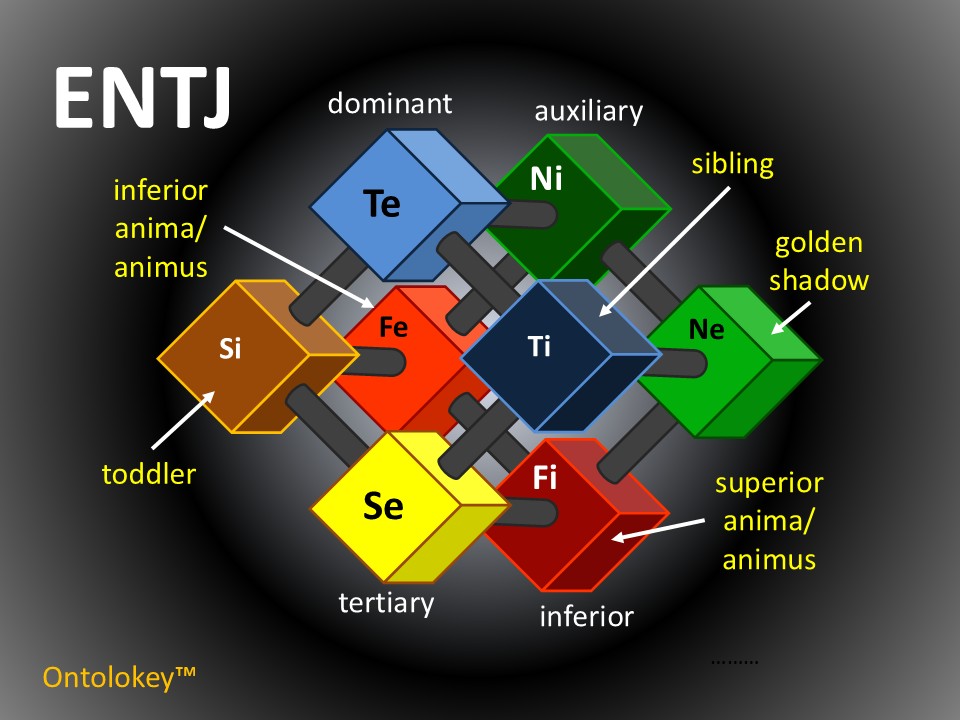
ENTJ – The Untold Truth
Beyond the Commander Archetype
The ENTJ is often described as the strategist, executive, commander, or architect of systems: a personality oriented toward action, competence, leadership, and the transformation of abstract intentions into concrete results. Such descriptions capture something important, but they also risk reducing a psychologically complex person to an external performance style, as though decisiveness, ambition, and organizational ability were the whole story. The Ontolokey framework offers a different perspective by treating personality as a dynamic architecture in which conscious preferences coexist with less developed, unconscious, and potentially transformative functions. In this model, the ENTJ is not simply someone who wants to control the external world, but someone whose dominant orientation toward external effectiveness can become both a remarkable strength and a psychological defense. The deeper question therefore becomes not merely why ENTJs are capable of taking command, but what happens when the need for effectiveness becomes so central that vulnerability, uncertainty, bodily limitation, emotional subjectivity, or unexplored possibilities are pushed into the background. Ontolokey’s three-dimensional model is particularly useful for examining this tension because it places the ENTJ’s eight psychological functions into relationships rather than treating them as an isolated list of personality characteristics.
Before going further, however, it is important to distinguish the psychological value of this framework from the status of established scientific personality assessment. The ENTJ designation belongs to the Jungian/MBTI tradition of typological personality theory, while Ontolokey extends that tradition through its own spatial interpretation of the eight psychological functions; these ideas can provide a useful language for introspection, but they should not be confused with a clinical diagnosis or with experimentally established laws of individual psychology. Ontolokey itself presents the cube as a model of interacting conscious and unconscious tendencies, drawing on Jung while also incorporating elements associated with MBTI, Socionics, HEXACO, the NEO model, and the Enneagram. Its central innovation is to represent the eight functions spatially, with the cube’s corners corresponding to the eight Jungian function orientations and its sliders representing degrees of functional balance rather than an absolute possession or absence of a function. This is particularly significant for the ENTJ because it moves the discussion away from the simplistic idea that an ENTJ “is” Te, Ni, Fi, or Se, and toward the more psychologically interesting question of how these different modes of consciousness cooperate, compete, compensate for one another, or remain insufficiently developed. The resulting portrait is therefore best understood as an interpretive psychological map: a framework for examining recurring tendencies, developmental tensions, and possibilities for greater integration rather than a deterministic description of every individual who receives the ENTJ label.
In the Ontolokey interpretation, the central structure of the ENTJ begins with Extraverted Thinking (Te) as the dominant function and Introverted Intuition (Ni) as the auxiliary function, creating a psychological combination of external execution and internal strategic direction. Te asks what works, what produces results, how resources can be organized, and how a system can be made more effective, while Ni supplies an underlying orientation toward patterns, consequences, trajectories, and the future. This combination explains why the mature ENTJ can appear unusually decisive without necessarily being merely impulsive: the visible action is often supported by an internal model of where events are heading and what should be done before others recognize the same trajectory. Yet the same structure contains an inherent danger, because a mind highly adapted to transforming complexity into strategy may begin to experience everything through the categories of utility, optimization, control, and progress. The Ontolokey analysis consequently treats the remaining functions not as decorative additions but as necessary counterweights to the dominant configuration, including Ti as the sibling function, Si as the toddler function, Se as the tertiary or blindspot function, Fi as the inferior function, Fe as the Anima, and Ne as the Golden Shadow. The psychological story of the ENTJ therefore begins with extraordinary effectiveness, but it does not end there: the deeper developmental task is to discover whether power can coexist with receptivity, whether leadership can coexist with vulnerability, and whether achievement can eventually become an expression of an integrated self rather than a substitute for one.
The ENTJ Cognitive Architecture: Te–Ni and the Logic of Direction
At the center of the ENTJ configuration stands Extraverted Thinking (Te), the dominant function through which the individual habitually encounters the external world as something that can be structured, evaluated, organized, and improved. Te is not simply “being logical,” because its defining concern is not abstract correctness but objective effectiveness: what works, what produces an outcome, what resources are available, which sequence of actions is most efficient, and where unnecessary friction can be removed. This gives the ENTJ a characteristic psychological movement from perception toward intervention; rather than merely observing that a system is dysfunctional, the ENTJ is inclined to ask what must be changed to make the system function. In healthy development this can produce extraordinary competence in leadership, strategic organization, crisis management, entrepreneurship, institutional reform, and any environment in which ambiguous circumstances must eventually become coordinated action. Ontolokey places Te at the head of the ENTJ’s primary tripod, and this is psychologically important because it suggests that the ENTJ’s identity is constructed around agency through external organization: the world becomes intelligible to the degree that it can be acted upon, measured, directed, and transformed.
Yet Te alone does not explain the characteristic depth of the ENTJ, because its effectiveness is accompanied by Introverted Intuition (Ni) as its auxiliary function. Ni supplies the internal trajectory behind Te’s external movement: it searches beneath immediate events for patterns, implications, converging tendencies, and possible long-term outcomes, allowing the ENTJ to operate not merely as an administrator of existing structures but as someone capable of envisioning where those structures should go next. The psychological sequence can therefore be understood as vision becoming strategy and strategy becoming execution: Ni distills an emerging direction, while Te translates that direction into objectives, systems, priorities, and decisions. This combination explains why ENTJs can become impatient with activity that lacks a discernible purpose; action for its own sake is not enough when the mind is simultaneously asking where the action leads and whether the resources invested in it are justified. The strength of this pairing is considerable, because it combines abstraction with implementation, but it also contains the seed of rigidity: once Ni has formed a compelling interpretation and Te has constructed an efficient method for realizing it, contradictory information can become psychologically inconvenient rather than intellectually interesting. The ENTJ can then confuse clarity with certainty, and certainty with authority, particularly when success has repeatedly reinforced the belief that decisive intervention is preferable to prolonged ambiguity. Ontolokey’s model is valuable precisely because it prevents Te–Ni from becoming the entire definition of the personality; the remaining six functions reveal what this powerful executive structure tends to overlook, repress, require, or eventually need to integrate.
The first of these counterweights is Introverted Thinking (Ti), the Sibling function, which represents an internal form of logical analysis that is related to Te but governed by a different psychological question. Te asks whether a method works effectively in the external world, whereas Ti is more concerned with whether an internal conceptual structure is coherent, precise, and logically consistent. For an ENTJ, Ti can therefore function as an intellectual corrective to the natural tendency to privilege implementation: it forces the strategist to examine whether the model itself is sound rather than merely whether it produces acceptable results. Ontolokey describes the Sibling as a natural counterpoint to the dominant function, and within the Te-centered architecture this makes Ti particularly significant because it can challenge external efficiency with internal rigor. When insufficiently integrated, the ENTJ may regard such analysis as unnecessary hair-splitting, especially when a practical decision is urgently required; when mature, however, Ti can produce a more sophisticated leader who understands that an efficient system built upon a flawed premise remains fundamentally flawed. This is one of the first developmental movements away from “I know how to make this work” toward the more demanding question “Do I actually understand what this is?”, and that distinction can mark a major transition from forceful competence to genuine intellectual maturity.
The opposite side of the architecture contains Extraverted Feeling (Fe), the Anima, a function that introduces an entirely different form of intelligence into the ENTJ psyche: the capacity to register, shape, and participate in the emotional and relational field shared by other people. Ontolokey associates the ENTJ’s Fe with relational success and approval, which creates an intriguing paradox because the ENTJ may appear highly independent while still possessing a deep and sometimes poorly understood need to be recognized as valuable, respected, effective, or socially significant. Fe is not equivalent to kindness or emotional softness; psychologically, it concerns the interpersonal atmosphere, collective values, social expectations, and emotional synchronization through which human groups maintain cohesion. Consequently, an ENTJ who develops Fe does not become less decisive but becomes more capable of understanding that people cannot always be mobilized through efficiency alone, because commitment, trust, belonging, dignity, and shared meaning are themselves forms of psychological infrastructure. The immature expression of this function can create an uncomfortable dependence on external approval, social status, admiration, or the perception of being influential, whereas its mature expression allows leadership to become relational rather than merely directive. In that sense, Fe challenges one of the ENTJ’s deepest assumptions: that if the objective is sufficiently rational and the strategy sufficiently effective, people will naturally understand and follow it; human beings, however, do not function exclusively as resources within a system, and psychological leadership begins precisely where instrumental logic reaches its limits.
Introverted Sensing (Si), the Toddler function, introduces another form of resistance to the ENTJ’s forward-driving psychology because Si represents continuity, accumulated experience, familiarity, embodied memory, and the stabilizing information contained in what has already happened. An ENTJ naturally oriented toward future possibilities and external transformation can experience established procedures, historical precedent, routine, and repeated patterns as obstacles when they appear to slow progress, yet Si asks whether the past contains information that the future-oriented mind is overlooking. Ontolokey characterizes the ENTJ Toddler as potentially resistant to new methods, an apparently paradoxical description for a type commonly associated with innovation and strategic change; the deeper point is that every personality contains blind spots even within its apparent strengths, and the ENTJ may be highly innovative at the strategic level while simultaneously becoming attached to familiar operational habits once those habits have proven effective. Si can therefore emerge in a somewhat childlike or defensive form when the individual is tired, threatened, or confronted with uncertainty, producing a sudden desire for established procedures, known environments, familiar standards, or “the way we know works.” Integrated consciously, however, Si gives the ENTJ something indispensable: respect for institutional memory, attention to accumulated evidence, bodily limits, maintenance, repetition, and the quiet reality that not every problem requires reinvention. Without this corrective, the ENTJ risks becoming addicted to transformation itself, changing systems not because change is necessary but because remaining still feels psychologically intolerable.
The Inferior Heart: Fi, Vulnerability, and the Problem of Inner Value
The most psychologically consequential counterweight to the ENTJ’s Te–Ni structure is Introverted Feeling (Fi), which Ontolokey places in the inferior position of the ENTJ configuration. Fi represents a radically different criterion of psychological truth: instead of asking whether something is objectively effective, strategically coherent, or externally justifiable, it asks whether an experience, decision, or action is personally authentic and congruent with deeply held values. For an ENTJ, this territory can feel unusually private because it cannot easily be converted into the familiar language of measurable outcomes or universally applicable principles. The ENTJ may be perfectly capable of knowing what ought to be done in a strategic sense while having considerably less conscious clarity about what they themselves genuinely feel, desire, need, or value independent of achievement and external recognition. This is why the inferior position should not be interpreted simply as “weak emotion”; it is better understood as an underdeveloped but psychologically powerful dimension of selfhood that can become increasingly important precisely because it has been neglected. The official MBTI description likewise associates Fi with personal values and inner congruence, while noting that dominant-function overuse can produce imbalance when other processes are neglected.
The vulnerability surrounding Fi becomes clearer when the ENTJ’s relationship with achievement is examined psychologically rather than behaviorally. If competence repeatedly produces respect, autonomy, security, and influence, it can gradually become more than a capacity; it can become the unconscious basis upon which self-worth is organized. The ENTJ may consequently learn to experience failure as a technical problem rather than an existential wound, because technical problems can be solved through greater effort, better information, or a revised strategy. Emotional exposure is fundamentally different because it places the individual in a situation where competence cannot guarantee the desired outcome, and another person’s feelings cannot be controlled through superior reasoning. Ontolokey’s shadow analysis identifies precisely this tension, arguing that the ENTJ can become highly capable of confronting external defeat while finding emotional helplessness much more threatening because vulnerability challenges the identity built around strength and effectiveness. The resulting defense can be remarkably sophisticated: pain becomes analysis, disappointment becomes criticism, fear becomes strategic vigilance, and the admission of needing another person is replaced by an offer to solve that person’s problems. Such behavior may look emotionally controlled from the outside while concealing a considerable amount of emotional intensity underneath.
This is where the distinction between emotional suppression and emotional integration becomes essential. An ENTJ who suppresses Fi may conclude that emotions are unreliable because emotions cannot always be justified according to objective standards, but this conclusion does not eliminate the underlying emotional processes; it merely removes them from conscious dialogue with the rest of the personality. The shadow material describes the resulting paradox with unusual clarity: the more strongly the individual identifies with rational objectivity, the easier it becomes for unconscious emotional motives to disguise themselves as purely rational conclusions. A person may therefore believe that they are defending a principle when they are defending their pride, believe they are correcting an error when they are reacting to humiliation, or believe they are demanding excellence when they are protecting themselves against the fear of inadequacy. This does not mean that ENTJ reasoning is secretly irrational, nor that every strong conviction conceals an emotional wound; rather, the psychological danger arises when the individual loses the capacity to distinguish objective judgment from personal investment. Mature Fi restores that distinction by allowing the ENTJ to say, in effect, “This is what I believe is objectively sound, and this is what I personally feel,” without requiring one category to invalidate the other.
The developmental importance of Fi therefore lies not in transforming the ENTJ into a softer or less ambitious personality, but in giving ambition an internal ethical and emotional foundation. Without sufficient access to personal values, achievement can become self-referential: goals are pursued because they demonstrate capability, success creates further expectations of success, and the individual gradually discovers that attaining objectives does not necessarily answer the question of what the objectives were ultimately for. This is one reason the ENTJ can experience an unsettling form of emptiness despite considerable external accomplishment, particularly when an externally successful life has been constructed without enough attention to private meaning, intimacy, affection, or personal desire. The problem is not ambition itself; ambition becomes psychologically dangerous only when it is asked to perform the work of identity, belonging, emotional security, and self-worth simultaneously. Fi introduces a different measure of a life, one that cannot be reduced to productivity because it concerns what the individual considers worth protecting, loving, refusing, sacrificing for, or remaining faithful to even when no measurable advantage results. In this sense, the development of Fi does not weaken the ENTJ’s power but answers a deeper question that Te alone cannot answer: what is all this power ultimately in service of?
The Shadow Reversal: When the Strength Becomes the Trap
The deepest shadow of the ENTJ does not emerge simply because the person becomes ambitious, controlling, arrogant, or emotionally distant; those are possible manifestations, but they are not the underlying mechanism. Ontolokey’s analysis identifies a more fundamental process in which a successful cognitive strategy gradually becomes an unquestioned philosophy of reality. Te is extraordinarily effective when used as an instrument, because external systems genuinely benefit from organization, standards, accountability, measurable objectives, and decisive action. The danger begins when the ENTJ unconsciously assumes that whatever cannot be organized according to those principles is either inferior, irrational, inefficient, or irrelevant. At that point, the psychological instrument has become a worldview, and the person no longer merely uses strategic thinking but increasingly identifies with being the person who knows how reality should be organized. The shadow is therefore not the opposite of the ENTJ’s strength; it is the strength becoming so dominant that it begins to exclude the psychological information supplied by everything else.
This process can produce what Ontolokey calls the “tyranny of certainty,” in which an internally coherent model becomes increasingly difficult to distinguish from reality itself. The ENTJ can be particularly vulnerable to this because genuine success provides reinforcing evidence: decisions work, organizations improve, predictions prove accurate, and other people begin to defer to the individual’s judgment. Each successful outcome strengthens confidence in the underlying cognitive framework, while disagreement may increasingly be interpreted as evidence that others simply do not understand the situation as clearly. The crucial distinction is between confidence in a conclusion and identification with certainty; the former remains open to correction, while the latter experiences correction as a threat to psychological stability. Once this happens, intellectual disagreement can acquire an emotional intensity disproportionate to the actual subject under discussion, because what is being defended is no longer merely an idea but the individual’s relationship with competence, authority, and reality itself. The mature ENTJ must therefore cultivate an unusual form of strength: the ability to remain decisive while retaining the psychological freedom to discover that the decisive interpretation was wrong.
This becomes especially consequential in intimate relationships, where the principles that produce excellence in organizations can become destructive when applied without modification to human beings. Projects can be optimized, processes can be redesigned, deadlines can be imposed, and organizational weaknesses can be diagnosed, but another person’s inner world cannot legitimately be treated as a malfunctioning system awaiting correction. Ontolokey’s shadow analysis emphasizes that what the ENTJ experiences as guidance may be experienced by a partner or family member as control, while what feels like necessary honesty to the ENTJ may feel like judgment to someone who needs understanding before solutions. This creates one of the central interpersonal paradoxes of the type: the person may possess extraordinary capacity to solve other people’s practical problems while remaining comparatively inexperienced at simply accompanying another human being through an experience that cannot be solved. Emotional intimacy requires a temporary suspension of optimization, because the purpose of listening is not always to produce an improved outcome. The ENTJ’s developmental challenge is therefore not to abandon leadership, standards, or directness, but to learn that not every human difficulty is an operational problem and not every form of help should take the form of intervention.
The Shadow Functions of the Cube: Se, Ne, and the Expansion of the ENTJ Psyche
The Ontolokey cube becomes particularly revealing when the ENTJ is examined beyond the familiar Te–Ni–Fi axis and the less conscious functions are understood as psychologically meaningful positions rather than as mere deficiencies. In the Ontolokey model, Extraverted Sensing (Se) occupies the ENTJ’s tertiary or “blindspot” position, while Extraverted Intuition (Ne) appears as the Golden Shadow, and these positions illuminate two very different forms of possibility that the ENTJ may have difficulty integrating into the dominant strategic architecture. Se is concerned with immediate reality, direct sensory information, physical presence, environmental responsiveness, and what is actually happening in the present rather than what should happen according to an internal strategic projection. Ne, by contrast, proliferates possibilities, alternative interpretations, unexpected connections, and divergent futures rather than converging toward one preferred trajectory. Their positions therefore create an important psychological tension with Ni and Te: the ENTJ naturally tends to narrow complexity into a strategically meaningful direction, whereas Se and Ne can reopen complexity and force the mind to encounter information that does not fit the established plan. In this sense, the shadow functions are not simply weaknesses to be corrected but alternative modes of consciousness capable of disrupting the ENTJ’s habitual certainty and thereby expanding psychological flexibility. The Ontolokey conception of the cube is especially useful here because it presents these functions spatially, making visible the fact that a personality is not exhausted by its most accessible processes but contains a broader psychological field in which neglected functions remain potentially available for development.
Se as the blindspot is particularly interesting because the ENTJ can be extraordinarily action-oriented while nevertheless having a complicated relationship with immediate experience. At first this seems contradictory: how can someone who is so decisive and externally active be insufficiently attuned to the present moment? The distinction lies between acting upon reality and perceiving reality without immediately converting it into strategy. The ENTJ may enter an environment already carrying an interpretation of what matters, what needs to happen, and what outcome should be produced, which means that concrete sensory information can be filtered according to strategic relevance rather than appreciated on its own terms. In a healthy state, Se can provide valuable grounding by forcing attention toward observable facts, physical circumstances, timing, environmental feedback, and the actual behavior of people rather than the anticipated behavior of people. In an unbalanced state, however, the ENTJ can become so committed to an anticipated trajectory that immediate evidence is unconsciously subordinated to the plan, especially when accepting that evidence would require abandoning a hard-won strategic conclusion. This is one reason the integration of Se is psychologically important: it teaches the ENTJ that reality is not merely the material upon which a strategy operates; reality is also the source of information that must continuously correct the strategy.
The Golden Shadow of Ne introduces an even more disruptive possibility because Ne challenges the ENTJ’s tendency toward convergence. Ni typically seeks the underlying pattern that unifies disparate information and eventually arrives at a relatively singular interpretation of where circumstances are leading, whereas Ne continually asks what else might be possible, what alternative explanation could account for the evidence, and what unexpected direction might emerge from apparently unrelated factors. For an ENTJ, this can initially feel inefficient because generating possibilities without immediately selecting one can resemble indecision or intellectual wandering. Yet the very quality that can make Ne uncomfortable is also what makes it psychologically valuable: it prevents the strategic mind from becoming imprisoned by its first coherent model. The Golden Shadow can therefore function as a kind of intellectual liberation, encouraging the ENTJ to entertain possibilities without immediately demanding that they justify themselves through utility or implementation. This does not require abandoning decisiveness; rather, it introduces a more sophisticated sequence in which possibilities are allowed to multiply before strategy reduces them. The mature ENTJ can thus move from “I have identified the trajectory” toward “I have identified several plausible trajectories, and I will now test which one reality supports,” thereby combining strategic decisiveness with epistemic humility.
This is also where the Ontolokey cube reveals an important developmental principle: psychological maturity does not mean making every function equally strong or turning the personality into a perfectly balanced collection of eight competing processes. Such a state would probably be neither psychologically realistic nor particularly functional. The more meaningful objective is integration without dissolution of identity, whereby the dominant configuration remains recognizable while previously neglected perspectives become accessible enough to correct its excesses. For the ENTJ, that means Te can remain Te without becoming authoritarian, Ni can remain Ni without becoming dogmatic, Fi can become more conscious without overwhelming strategic judgment, and the shadow functions can contribute information without displacing the personality’s fundamental orientation. This interpretation also prevents a common misunderstanding of shadow psychology: the shadow is not necessarily an evil personality hidden underneath the conscious personality, nor is every uncomfortable behavior evidence of a repressed function. Rather, shadow material represents aspects of psychological life that are less consciously integrated and therefore more likely to emerge defensively, disproportionately, or indirectly. The ENTJ’s developmental task is consequently not to “defeat” the shadow but to make its information conscious before the unconscious has to make itself heard through distortion.
The eight-function structure therefore describes a psychological dialogue between competing definitions of what counts as valid information. Te privileges external effectiveness, Ni seeks underlying direction, Ti examines conceptual coherence, Si preserves accumulated experience, Se attends to immediate reality, Fi protects personal value and authenticity, Fe registers interpersonal and collective emotional dynamics, and Ne opens alternative possibilities. None of these perspectives is inherently sufficient on its own, because each answers a different psychological question and becomes distorted when treated as the only legitimate question. The ENTJ’s distinctive challenge arises because Te and Ni are naturally capable of producing a remarkably compelling sense of coherence: the world can appear understandable, the future can appear strategically readable, and action can appear both justified and necessary. The shadow functions interrupt that coherence by asking inconvenient questions: What if the immediate facts contradict the plan? What if another interpretation is possible? What if the people involved do not experience the situation as you do? What if the objective you are pursuing is successful but personally meaningless? These questions are not obstacles to ENTJ development; they are precisely the questions that prevent strength from becoming psychological confinement.
The deepest implication of the cube is therefore that the ENTJ’s potential cannot be measured exclusively by how effectively the individual commands the functions they naturally trust. A person can become exceptionally powerful at strategy while remaining psychologically narrow, just as another person can become highly reflective without acquiring the ability to act decisively upon what they understand. The integrated ENTJ represents something more demanding: the preservation of executive power while becoming increasingly capable of receiving information from outside the executive worldview. This is particularly relevant to the shadow analysis because Ontolokey describes the ENTJ’s danger not primarily as a lack of strength but as the concentration of too much psychological authority in one mode of functioning. When certainty becomes more important than curiosity, control more important than connection, and effectiveness more important than meaning, the very qualities that produced success begin to imprison the individual. But when Te becomes an instrument rather than an identity, Ni becomes a hypothesis rather than an absolute truth, and Fi, Se, Ne, Fe, Si, and Ti are allowed to contribute their respective forms of information, the ENTJ can retain its extraordinary capacity for direction while becoming substantially more psychologically spacious.
Leadership, Excellence, and the Shadow of Superiority
The positive side of the ENTJ should not be treated merely as the polite counterpart to its shadow, because the shadow itself grows out of qualities that are often genuinely valuable. The ENTJ’s capacity to impose structure on complexity, assume responsibility, establish standards, and convert abstract intentions into coordinated action can make this personality exceptionally effective in environments where indecision carries real costs. Ontolokey’s shadow analysis explicitly acknowledges the ENTJ as a builder of systems, reformer of institutions, and person often willing to make difficult decisions when others hesitate, while simultaneously warning that every psychological strength can become distorted when it acquires excessive authority over the personality. This distinction is essential because it prevents the analysis from collapsing into the simplistic claim that ambition, authority, or confidence are inherently pathological. A mature ENTJ may possess substantial authority without being psychologically dependent upon authority, may demand excellence without needing to feel superior, and may act decisively without believing that disagreement constitutes disloyalty. The central psychological question is therefore not whether the ENTJ has power, but whether power remains an instrument of conscious purpose or gradually becomes a defense against insecurity, uncertainty, and vulnerability.
The same distinction applies to the ENTJ’s relationship with competence, which can become one of the most constructive and most dangerous elements of the personality. Genuine competence produces real-world consequences: it allows an individual to solve difficult problems, protect other people from avoidable chaos, improve dysfunctional systems, and create opportunities that would otherwise remain unrealized. An ENTJ who develops these capacities responsibly can become an unusually effective steward of collective resources because Te naturally notices inefficiencies and inconsistencies that other people may tolerate for much longer. Yet repeated success can generate a subtle psychological asymmetry in which the individual begins to assume that the ability to solve problems also grants superior authority over the people who cannot solve them as quickly. Ontolokey describes this as a potential “hidden narcissism of competence,” emphasizing that the difficulty lies precisely in the fact that the underlying competence may be real rather than imagined. The danger begins when the legitimate observation “I can do this better” quietly transforms into the much broader conclusion “therefore my way of seeing people, values, relationships, and reality is superior,” because technical superiority in one domain provides no automatic evidence of psychological superiority in another.
This is where contempt becomes more psychologically significant than ordinary arrogance. Arrogance can be superficial and even performative, whereas contempt changes the fundamental way another human being is perceived: the other person is no longer simply different, slower, less experienced, or less capable in a particular area, but begins to be interpreted as intrinsically deficient. For the ENTJ, this can be especially seductive because environments really do contain inefficiency, incompetence, irrational decision-making, and avoidable weakness, meaning that the initial observations can be entirely accurate. The problem is the psychological leap from identifying a limitation to reducing the person to that limitation, particularly when the ENTJ begins evaluating human worth through performance, productivity, intelligence, reliability, or usefulness. Ontolokey’s analysis warns that the shadow can gradually transform people into functions within a strategic equation, where those who contribute to objectives are valued and those who obstruct them are dismissed. Such a worldview may function efficiently inside a narrowly defined organizational context, but when transferred into friendship, love, family, or ordinary human interaction, it impoverishes the personality because human beings possess value that cannot be calculated through utility.
The corrective is not sentimentalism but psychological differentiation. An integrated ENTJ can recognize that a person may be incompetent at one task and nevertheless possess profound emotional intelligence, loyalty, creativity, courage, wisdom, or moral insight in another domain. More importantly, the mature individual can tolerate the possibility that someone else may possess forms of knowledge that cannot be converted into the ENTJ’s preferred language of measurable competence. This is where the previously discussed Fi, Fe, Se, and Ne functions become more than abstract components of a typological model: they represent alternative sources of information that can interrupt the automatic equation between effectiveness and value. Fi asks whether an action remains internally authentic and ethically meaningful; Fe asks what is happening within the relational field; Se forces attention back toward observable present reality; Ne introduces alternative interpretations that challenge premature closure. When these perspectives are permitted to influence Te–Ni rather than being dismissed as distractions, leadership becomes less dependent upon superiority and more capable of incorporating information that executive intelligence alone cannot generate.
The healthiest expression of ENTJ leadership therefore contains an important paradox: the more secure the leader becomes internally, the less psychologically necessary it becomes to dominate externally. A person who knows that their worth does not disappear when someone else disagrees can tolerate dissent without interpreting it as rebellion; a person who does not need to be indispensable can delegate without experiencing another person’s competence as a threat; and a person who can acknowledge uncertainty does not need to manufacture certainty merely to preserve authority. Ontolokey’s analysis draws precisely this distinction between leadership and domination, describing mature leadership as something capable of relinquishing control when circumstances require it, whereas domination becomes increasingly dependent upon maintaining influence. This provides a useful psychological criterion that is more subtle than simply asking whether an ENTJ is “controlling”: the decisive question is what happens internally when control is lost. If relinquishing control produces curiosity, trust, and adaptation, authority remains instrumental; if it produces disproportionate anger, contempt, anxiety, or an urgent need to reassert dominance, power may have become emotionally compensatory.
There is consequently a profound positive potential hidden within the ENTJ shadow: the very capacities that can produce domination can, when integrated, produce stewardship. The strategist can become a builder rather than merely a conqueror; the executive can become a custodian rather than an owner; the person who sees inefficiency can reform systems without humiliating the people trapped inside them. Such an ENTJ does not need to abandon high standards, because standards are not the problem; the transformation lies in separating standards from personal superiority and accountability from contempt. Nor does emotional integration require endless introspection at the expense of action, because Fi and Fe become most useful when they inform action rather than replace it. The mature ENTJ can still say, “This needs to change,” while also asking, “What am I failing to perceive?” and “What will this change mean for the human beings who must live with it?” That second layer of questioning is not weakness added to strength; it is strength becoming sufficiently sophisticated to recognize that effectiveness without psychological awareness can solve the wrong problem extremely efficiently.
Love, Intimacy, and the Fear of Being Needed
The ENTJ’s interpersonal world reveals perhaps more clearly than any professional environment why psychological integration matters. In work and leadership, the ENTJ can rely heavily upon explicit objectives, competence, standards, and measurable outcomes, whereas intimacy introduces conditions that cannot be controlled through superior organization. Love requires exposure to another person’s subjectivity, and subjectivity cannot be optimized without destroying the very thing one is trying to understand. The ENTJ may therefore be highly generous in practical ways while remaining less comfortable with forms of intimacy that require emotional transparency rather than problem-solving. Ontolokey’s discussion of the ENTJ shadow describes a pattern in which vulnerability may be experienced as threatening because the personality has learned to derive security from capability and control. (ontolokey.com) This can produce a peculiar relational contradiction: the ENTJ may desperately want loyalty, admiration, emotional depth, and genuine connection while simultaneously resisting the surrender of control required to receive those things. The result is not necessarily emotional coldness, but a tendency to protect emotional vulnerability behind competence, humor, intellectualization, activity, or the continual assumption of responsibility.
One of the most revealing manifestations of this pattern is the ENTJ’s tendency to solve what should first be witnessed. When someone they love expresses distress, the instinctive response may be to identify the problem, locate its cause, and formulate a solution, because this is how Te naturally expresses care. The intention can be deeply benevolent: if someone is suffering, why allow the suffering to continue when something can be done about it? Yet emotional experience does not always seek intervention, and a person who says “I am hurting” may be communicating a need for recognition rather than requesting a strategy. When the ENTJ immediately converts emotion into a practical problem, the other person can experience the response as invalidating even when the underlying intention is protective. This creates an important developmental distinction between helping someone change their situation and helping someone feel less alone within their situation. The former is a natural strength of Te, while the latter requires greater access to Fi and Fe, because it demands tolerance for an experience that cannot immediately be made more efficient.
The inferior Fi position can also influence the ENTJ’s romantic psychology through the tension between independence and emotional significance. An individual accustomed to functioning autonomously may genuinely value freedom and self-sufficiency, yet simultaneously possess a deep desire to be understood at a level that cannot be achieved through competence alone. This can make intimacy unusually consequential because it creates the possibility of being known without the protective structure of performance. Someone who sees only the ENTJ’s competence may reinforce the existing identity, while someone who sees the vulnerable person beneath that competence may activate both longing and defensiveness. Ontolokey’s shadow account suggests that the ENTJ can experience a strong need for recognition and approval while disliking the psychological dependence implied by needing another person’s recognition. (ontolokey.com) The mature resolution is not to eliminate the need for others, which would be psychologically unrealistic, but to recognize dependence and interdependence as ordinary dimensions of human life rather than as evidence of weakness.
This becomes particularly important when conflict occurs. The ENTJ may enter an argument believing that the objective is to determine what is true, identify what went wrong, and establish what should happen next, while the other person may experience the same conversation primarily as a question of respect, emotional safety, loyalty, or recognition. Both participants can therefore believe they are addressing the central issue while actually operating according to different psychological criteria. Te tends to seek resolution through clarity and decision, whereas Fi and Fe may require emotional acknowledgment before resolution is possible. If the ENTJ insists on resolving the factual issue while ignoring the relational issue, the disagreement can paradoxically become longer and more intense precisely because the ENTJ is trying to make it end. An integrated ENTJ learns to distinguish resolution from closure: a conflict may be factually settled while emotionally unresolved, and emotional resolution may sometimes require listening, acknowledgment, or apology rather than another argument establishing who was objectively correct. This does not mean abandoning truth for harmony; it means recognizing that interpersonal reality contains more than one legitimate dimension.
The deepest relational lesson for the ENTJ is therefore that being loved is not the same as being useful. If self-worth has become strongly associated with competence, it is tempting to express affection primarily through protection, provision, advice, problem-solving, or taking responsibility for burdens that others cannot carry. These behaviors can be profoundly loving, but they become psychologically restrictive when the individual begins to believe that their place in another person’s life must continually be earned through usefulness. Fi offers a different possibility: the right to exist within a relationship not because one is currently solving something, but because one’s inner life itself has value. This can initially feel unfamiliar to a personality organized around achievement because it removes the reassuring metric of performance. Yet precisely here lies the developmental opportunity: the ENTJ can discover that intimacy does not require surrendering competence, but it does require allowing another person to encounter the parts of the self that competence cannot protect.
Once this integration begins, the ENTJ’s natural loyalty and protective instincts can become considerably more profound. Instead of controlling circumstances to prevent loved ones from experiencing difficulty, the individual can learn to trust their capacity to face difficulty themselves; instead of immediately correcting another person’s emotional response, the ENTJ can become curious about what the emotion reveals; and instead of interpreting vulnerability as dependence, the person can understand reciprocal vulnerability as a form of relational strength. Fe contributes awareness of the emotional atmosphere, Fi contributes personal authenticity, and Te continues to provide the capacity to act when action is genuinely needed. The result is not an ENTJ who becomes indistinguishable from a feeling-dominant personality, but an ENTJ whose executive intelligence is no longer required to perform every psychological function. That distinction is crucial because genuine maturity does not consist of becoming someone else; it consists of becoming less defended against the parts of oneself that were never allowed an equal voice.
The ENTJ Under Pressure: When the System Turns Against Itself
Stress exposes the architecture of personality because it reduces the psychological freedom available for reflection, making familiar strategies increasingly automatic. For the ENTJ, this can mean an intensified reliance on Te: more planning, more intervention, more demands, more insistence upon standards, and a progressively narrower tolerance for ambiguity or resistance. What normally functions as leadership can then become compulsive control, because the mind attempts to restore internal security by making the external environment more orderly. The difficulty is that stress frequently produces precisely the opposite of the certainty the ENTJ seeks, since complex human systems become less predictable when people feel pressured, misunderstood, or dominated. The individual may therefore respond to uncertainty by increasing the very behavior that contributes to instability, creating a self-reinforcing loop in which greater control produces greater resistance, which then appears to justify still greater control. Ontolokey’s shadow analysis describes this movement as part of the ENTJ’s darker developmental territory, particularly when effectiveness becomes fused with personal identity and the inability to control an outcome becomes experienced as a threat to the self. (ontolokey.com)
A second stress pattern can arise when the ENTJ’s normally strategic Ni becomes excessively rigid, causing the person to interpret new information primarily according to an established internal trajectory. Ni is powerful precisely because it can reduce enormous amounts of information into an intelligible pattern, but this compression also creates the possibility of premature closure. Once the mind has decided what a situation “really means,” subsequent information may be assimilated into the existing interpretation rather than genuinely reconsidered. Under pressure, this can create an increasingly closed psychological system in which contradictory evidence is treated as noise, resistance is interpreted as incompetence, and alternative explanations are experienced as distractions from what seems obvious. The antidote is not perpetual indecision but deliberate disconfirmation, the disciplined willingness to ask which evidence would demonstrate that the current interpretation is wrong. This is where Ti and Ne become particularly valuable to the ENTJ, because Ti can challenge the internal coherence of the model while Ne can generate alternative hypotheses that prevent Ni from becoming indistinguishable from certainty.
There is another, less obvious form of stress in which the ENTJ may lose contact with the very functions that ordinarily compensate for the limitations of Te–Ni. If Se is insufficiently integrated, immediate bodily and environmental information may be ignored until it becomes impossible to ignore, while neglected Fi may remain outside conscious awareness until accumulated emotional pressure erupts in ways that appear disproportionate to the triggering event. The individual may have spent months functioning at a high level, dismissing fatigue, frustration, disappointment, loneliness, or resentment as secondary concerns because the objective still needed to be completed. Eventually, however, psychological material that has been excluded from conscious processing does not simply disappear; it may return through exhaustion, emotional volatility, impulsive behavior, withdrawal, or an unusually intense reaction to criticism or personal rejection. Such episodes should not be interpreted as inevitable features of ENTJ personality, and typology cannot establish a clinical mechanism for any particular person’s symptoms, but the broader psychological principle is well established: sustained suppression of relevant emotional or bodily information can impair self-regulation. The developmental lesson is therefore surprisingly practical—the ability to notice one’s limits before they become emergencies is itself a form of strategic intelligence.
The ENTJ may also encounter a particularly painful form of pressure when external achievement stops providing the psychological reinforcement it once supplied. A career milestone, financial success, organizational victory, intellectual accomplishment, or position of authority can temporarily confirm the identity of the competent strategist, but achievement inevitably becomes normalized, and the psychological system then requires a new objective to reproduce the same sense of vitality. If this cycle continues without deeper reflection, life can become an endless sequence of solved problems in which every accomplishment immediately generates another demand. The individual may be highly productive while becoming progressively less certain about what would constitute “enough,” because the mechanism of achievement has become detached from a clearly articulated personal value system. This is where inferior Fi becomes existentially important: it asks not merely what can be achieved, but what is worth achieving when achievement itself no longer answers the question of meaning. The question can be uncomfortable precisely because it cannot be solved by greater efficiency.
Pressure can also reveal whether the ENTJ’s relationships are built upon mutuality or upon functional dependency. If the individual has unconsciously constructed an identity around being the one who knows, decides, protects, organizes, finances, fixes, or leads, then situations in which another person becomes more competent, more knowledgeable, or simply unwilling to be directed can provoke disproportionate internal resistance. The mature response is to recognize that another person’s autonomy does not diminish one’s own significance, whereas the shadow response is to restore psychological equilibrium by reclaiming authority. Ontolokey’s broader account of the ENTJ shadow emphasizes the importance of relinquishing control and developing humility toward perspectives that cannot be subordinated to the executive worldview. (ontolokey.com) This distinction becomes especially important in leadership because organizations eventually punish leaders who require personal control over every important decision: delegation becomes impossible, dissent becomes dangerous, and talented people gradually withdraw from environments in which competence is perceived as competition. Psychological security therefore has a structural consequence—the more secure an ENTJ becomes about their own worth, the more freely they can permit capable people to operate independently.
The healthiest response to pressure is consequently not to suppress the ENTJ’s natural intensity but to broaden the information entering the decision-making system. Te should still organize, but it should receive information from Fi about values, from Fe about relationships, from Se about present reality, from Ne about alternatives, from Si about precedent and accumulated experience, and from Ti about conceptual consistency. The cube can be understood here as a psychological reminder that no single function possesses a monopoly on truth; every function sees something that another function cannot see in exactly the same way. When stress narrows consciousness, integration restores dimensionality by reopening channels that the dominant process has closed. For the ENTJ, this may ultimately be one of the most important forms of self-mastery: not learning how to control more effectively, but learning when control has ceased to be the appropriate response to reality. That transition marks the difference between a personality that merely excels under favorable conditions and one capable of remaining psychologically coherent when circumstances refuse to cooperate.
The Mature ENTJ: From Control to Integration
Psychological maturity does not require the ENTJ to become less ambitious, less decisive, or less demanding, because these qualities can represent genuine capacities rather than psychological defects. What changes is the source and flexibility of those qualities: the mature ENTJ can pursue difficult objectives without requiring achievement to prove personal worth, exercise authority without needing submission, and impose structure without assuming that every alternative structure is inferior. This is the point at which Te begins to function as an instrument of conscious intention rather than as an automatic defense against uncertainty. Ni likewise becomes more sophisticated when the individual treats its insights as highly informed hypotheses rather than infallible revelations about the future. The result is not diminished confidence but a more resilient form of confidence, because the individual no longer needs to preserve every prediction, decision, or strategy in order to preserve a coherent identity. In psychological terms, maturity increasingly means being able to change one’s mind without experiencing the change as a loss of self.
The development of the ENTJ can therefore be understood as a movement from external mastery toward internal differentiation. Early or less integrated Te may define success primarily through visible results, while increasingly mature Te understands that results are only meaningful within a larger system of human values and consequences. Ni develops from strategic foresight into a capacity for recognizing complexity without prematurely reducing it, while Ti provides the discipline to distinguish elegant explanations from genuinely valid ones. Si can teach respect for continuity and accumulated experience, Se can reconnect the strategist with the concrete present, and Ne can keep possibility alive when the preferred future becomes too rigidly defined. Fi and Fe perhaps make the greatest difference to the emotional maturation of the personality because they force the ENTJ to recognize that human beings cannot be understood exclusively through external performance or strategic behavior. Together, these functions enlarge the definition of intelligence itself: intelligence becomes not merely the capacity to determine what should happen, but the capacity to understand what is happening, why it matters, whom it affects, and what cannot legitimately be reduced to a calculation.
One of the most important developments is the transformation of the ENTJ’s relationship with uncertainty. The immature strategist often experiences uncertainty as a problem requiring immediate reduction, because ambiguity creates friction between the mind’s need for direction and the environment’s refusal to provide sufficient information. The mature strategist can tolerate a temporary absence of certainty without abandoning agency, understanding that action sometimes has to proceed under conditions in which the available model is incomplete. This creates a more sophisticated form of decisiveness because decisions are no longer confused with absolute knowledge; the individual can say, in effect, “This is the best decision available given what we currently know,” while remaining prepared to revise it when reality changes. Ne and Se become crucial here because one expands the field of possibilities while the other grounds attention in immediate evidence, creating a continual feedback loop around Ni’s strategic vision. The result is adaptive certainty rather than rigid certainty: enough conviction to act, enough humility to observe, and enough psychological flexibility to change course without humiliation.
The integration of Fi changes the ENTJ’s relationship with ambition in an equally profound way. When personal values remain largely unconscious, goals can acquire an addictive quality because each accomplishment temporarily substitutes for the deeper question of meaning. Once Fi becomes more accessible, ambition can become selective rather than compulsive, because the individual begins to distinguish between what is merely impressive and what is personally significant. This can lead to choices that appear less spectacular from the outside but are psychologically more authentic: refusing an opportunity that conflicts with one’s principles, protecting time for relationships that cannot be measured in productivity, acknowledging emotional needs without immediately converting them into problems, or walking away from an achievement that no longer represents anything meaningful. Such decisions may initially feel strangely inefficient to a Te-dominant mind because they are not justified primarily through external optimization. Yet they can represent a higher-order form of self-governance in which the question is no longer simply “Can I achieve this?” but “Should I give my life to achieving this?”
The development of Fe introduces a complementary transformation in leadership. An ENTJ who relies predominantly upon Te may attempt to create compliance through clarity, competence, incentives, standards, and consequences, all of which can be legitimate organizational tools. An integrated ENTJ increasingly recognizes that durable cooperation also depends upon whether people feel respected, understood, psychologically safe enough to disagree, and connected to a meaningful collective purpose. This does not mean that every decision should be made democratically or that leadership requires universal approval, because effective leadership sometimes demands decisions that will not please everyone. Rather, Fe allows the leader to understand the human consequences of authority without becoming enslaved to them. The leader can maintain a difficult standard while communicating why it exists, hear dissent without automatically treating dissent as resistance, and distinguish disagreement from disloyalty. Authority consequently becomes less about proving who is in charge and more about creating conditions in which other people can contribute their own competence.
This is perhaps the most important distinction between the powerful ENTJ and the integrated ENTJ. The powerful ENTJ can make things happen; the integrated ENTJ increasingly understands what should happen, what should not happen, and what consequences accompany both choices. The powerful ENTJ can build organizations; the integrated ENTJ understands that organizations eventually shape the psychology of the people inside them. The powerful ENTJ can win arguments, negotiate aggressively, and overcome resistance; the integrated ENTJ knows that winning an argument can sometimes destroy the relationship required to make the resulting decision work. These are not arguments against strength but arguments for greater dimensionality, because strength without self-awareness can become compulsive while strength integrated with self-awareness becomes increasingly deliberate. Ontolokey’s eight-function architecture provides a useful symbolic map for this transition precisely because it refuses to define the ENTJ solely through the functions that come most naturally and instead directs attention toward the psychological territory that remains less consciously accessible. (ontolokey.com)
The final stage of development is therefore not perfection but psychological sovereignty. Sovereignty means that the ENTJ can use Te without being possessed by Te, pursue Ni’s vision without worshipping certainty, access Fi without drowning in subjectivity, employ Fe without becoming dependent upon approval, and permit the shadow functions to challenge habitual conclusions without interpreting their presence as weakness. The personality remains recognizably ENTJ, but its relationship to itself becomes less adversarial because previously excluded dimensions no longer have to fight for recognition through unconscious compensation. This is ultimately what makes the Ontolokey cube more psychologically interesting than a simple hierarchy of strengths and weaknesses: it suggests that development occurs through dialogue among different forms of consciousness rather than through the elimination of unwanted traits. The ENTJ’s highest potential is therefore not to become invulnerable, omniscient, or universally dominant, but to become sufficiently integrated that power no longer has to defend itself against vulnerability, intelligence no longer has to defend itself against uncertainty, and achievement no longer has to defend itself against the question of meaning.
Conclusion: The Untold Truth of the ENTJ
The untold truth of the ENTJ is therefore not that beneath competence lies weakness, nor that beneath leadership lies some secretly defective personality waiting to be exposed. The more psychologically meaningful truth is that the ENTJ possesses an unusually powerful capacity for directing reality, and precisely because that capacity works so well, it can become difficult to recognize when direction has ceased to be necessary. The shadow emerges when the instrument becomes an identity: when strategic intelligence becomes certainty, responsibility becomes control, competence becomes superiority, independence becomes isolation, and emotional restraint becomes a defense against vulnerability. Ontolokey’s analysis describes this progression in particularly direct terms, emphasizing that the ENTJ’s deepest difficulty is not a lack of strength but the possibility that one form of strength acquires too much authority over the rest of the psyche. The developmental task is consequently not to dismantle the executive personality but to make it sufficiently conscious that power can coexist with receptivity, ambition with meaning, authority with humility, and decisiveness with the willingness to be wrong. What must ultimately be overcome is not strength itself, but the unconscious belief that strength must always be maintained.
Seen through the Ontolokey cube, the ENTJ becomes a study in psychological tension rather than a collection of personality labels. Te provides the capacity to organize and execute; Ni supplies strategic depth and directional vision; Ti can interrogate the internal logic of conclusions; Si can reconnect the strategist with accumulated experience and continuity; Se can return attention to immediate reality; Fi can reveal personal values that cannot be derived from efficiency; Fe can disclose the emotional and relational consequences of action; and Ne can reopen possibilities when certainty has become too narrow. The significance of these positions lies not in producing an artificially balanced personality, but in showing that every dominant strength exists within a larger psychological ecology. The ENTJ becomes more complete not when every function becomes equally powerful, but when the dominant functions can listen to information they would otherwise dismiss. In that sense, development is an expansion of consciousness rather than a replacement of personality, because the individual remains strategically oriented while becoming progressively less imprisoned by strategy.
The most mature ENTJ eventually discovers a distinction that can be difficult to grasp earlier in development: control and agency are not the same thing. Agency means possessing the capacity to choose, act, influence, create, refuse, negotiate, and take responsibility; control means attempting to determine outcomes that may ultimately belong to other people, circumstances, or reality itself. The first creates freedom, while the second can eventually create captivity, because the person who believes everything depends upon their control must remain perpetually vigilant. This is why relinquishing control can paradoxically make the ENTJ more powerful rather than less powerful: once the individual no longer needs to control every variable, attention can be directed toward the variables that genuinely matter. The mature strategist learns that delegation is not surrender, uncertainty is not incompetence, vulnerability is not helplessness, and another person’s autonomy is not a threat to one’s authority. Leadership then becomes less about making oneself indispensable and more about creating conditions in which reality can function effectively even when one is not personally directing every movement.
There is also a deeper existential transformation involved. If achievement has been the principal language through which the ENTJ has measured progress, then psychological development eventually forces a confrontation with questions that achievement cannot answer: What do I actually value? Who am I when I am not performing? What remains meaningful when nobody is impressed? Whom do I love when there is nothing to gain? What am I unwilling to sacrifice even for success? These are Fi questions, but they are ultimately human questions, and their importance does not depend upon whether one accepts the MBTI or Ontolokey as a scientific model. The ENTJ may discover that the life they were exceptionally capable of building is not automatically the life they most deeply wanted, and this realization can initially feel like a crisis because it cannot be solved through another strategic achievement. Yet it can also become the beginning of genuine freedom, because ambition becomes something chosen rather than something compulsively pursued. Achievement can then return to its proper place: not as proof that the self deserves to exist, but as one possible expression of what the self considers meaningful.
The deepest integration therefore occurs when the ENTJ can remain formidable without needing to appear invulnerable. There is nothing psychologically immature about being ambitious, competitive, demanding, strategic, direct, or intensely goal-oriented; these qualities become problematic only when they are recruited to protect an identity that cannot tolerate uncertainty, dependence, imperfection, or emotional exposure. Ontolokey’s shadow essay ultimately arrives at a similar distinction, portraying the mature movement as one in which certainty can give way to trust, control to connection, and achievement to a broader conception of fulfillment. The ENTJ who reaches this stage does not become less of a commander; rather, the commander is no longer required to govern every territory of the psyche. There can finally be room for the strategist and the human being to exist simultaneously, without one having to silence the other.
For readers who want to explore this architecture in greater depth, the Ontolokey material provides an extended framework for examining the ENTJ through its three-dimensional cube and for comparing the same functional architecture across other personality types. The ENTJ-specific analysis, “ENTJ Through the Lens of Ontolokey,” focuses on the individual functional positions within the cube, while “A Deep Dive into the ENTJ Personality” develops the broader personality portrait, and “The ENTJ’s Deepest Shadow Side” explores the darker developmental territory in considerably greater detail. These texts can be found on Ontolokey.com, where the framework is also applied to the other Jungian personality types. The most productive way to approach such material is not as a verdict about who a person “really is,” but as an invitation to examine recurring psychological patterns with enough honesty to recognize both one’s strengths and the defenses hidden inside those strengths.
Ultimately, the untold truth of the ENTJ is that the personality does not need to become less powerful in order to become more human. Its deepest development lies in discovering that power does not have to protect the self from feeling, that intelligence does not require certainty, that leadership does not require domination, and that independence does not require emotional isolation. The extraordinary capacity to transform the external world becomes most valuable when it is accompanied by an equal willingness to allow the external world—and the people within it—to transform the individual in return. The mature ENTJ can still build, lead, challenge, organize, compete, reform, and achieve, but these activities no longer function primarily as defenses against helplessness or insignificance. They become conscious expressions of a self that knows its values, accepts its limitations, tolerates uncertainty, and does not need to win every psychological battle in order to remain whole. That is the point at which the ENTJ stops merely mastering systems and begins mastering the relationship between power, consciousness, and humanity.
 Ontolokey