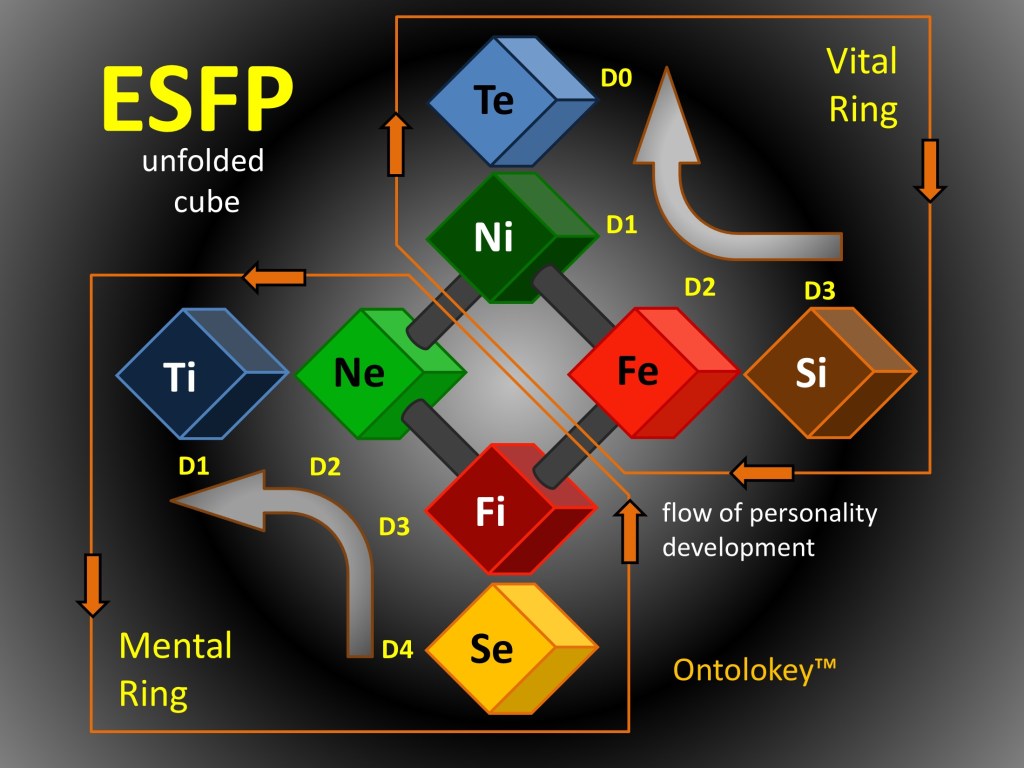
In the Ontolokey model, D0 to D4 describe the degree to which a psychological function has become consciously accessible, developed, and integrated within the personality. D4 represents the highest level of conscious development, while D0 indicates a function that remains largely unconscious and therefore tends to operate as a blindspot; D1, D2, and D3 represent successive stages of increasing awareness and integration between these two poles. Psychological development therefore means gradually bringing less conscious functions into awareness and allowing them to become more differentiated and usable, rather than trying to replace the dominant personality with something fundamentally different. The movement from D0 toward D4 is consequently a process of integration in which previously unconscious psychological capacities become increasingly available to consciousness and contribute to a more complete experience of the Self.
From Personality to Psychological Wholeness
The ESFP is often encountered first through what is most visible: vitality, spontaneity, sociability, emotional expressiveness, adaptability, sensual awareness, and an unusually direct participation in the present moment. Yet the visible personality is only the uppermost layer of a much larger psychological structure, because the same capacity that allows the ESFP to enter life wholeheartedly can also become a means of avoiding the quieter experiences that cannot be resolved through action, stimulation, pleasure, or immediate interpersonal engagement. In the Ontolokey perspective, the ESFP is therefore not adequately understood as a “performer,” an entertainer, or a pleasure-seeker, but as a personality organized around a powerful relationship with direct experience through Extraverted Sensing (Se), supported by an inner system of values through Introverted Feeling (Fi) and surrounded by increasingly less conscious psychological functions. The deeper question is consequently not simply what an ESFP does naturally, but what happens psychologically when the conscious identity becomes strongly attached to its natural strengths while the less developed functions remain outside awareness. From this perspective, individuation becomes a gradual movement from identification with the immediately accessible self toward a more complete Self in which conscious and unconscious dimensions can participate in one psychological whole.
Ontolokey provides a particularly useful symbolic landscape for this developmental journey because it transforms the eight-function architecture into a spatial and dynamic model in which psychological relationships can be visualized rather than merely described abstractly. Its underlying conception presents the personality as an interconnected system in which some functions are naturally strong and conscious while others remain vulnerable, less accessible, projected, or only partially integrated; the Ontolokey Cube and its functional sliders are intended to make these relationships visible and therefore easier to contemplate during personal development. For the ESFP, this makes the developmental sequence especially significant: Se begins as the dominant D4 function of the Mental Ring, Fi follows as the auxiliary D3 function, Ne occupies the Anima/Animus position at D2, and Ti forms the vulnerable Toddler function at D1, while the Vital Ring extends the process through Si, Fe, Ni, and finally Te at D0. The movement toward wholeness therefore cannot be understood as an attempt to leap directly into the most unconscious territory, because psychological integration proceeds progressively: what is already relatively developed must first become sufficiently conscious and differentiated before it can support the integration of what lies further beneath it. The purpose of this essay is to follow that movement as an inward developmental path, in which the ESFP gradually encounters its own shadow, understands the psychological reasons behind its vulnerabilities, and ultimately learns to experience the world without needing to use experience as an escape from itself.
From Se to Fi: When Experience Becomes Conscious Meaning
The first developmental task of the ESFP is not to weaken Se, suppress spontaneity, or become less engaged with the concrete world, but to transform an already powerful capacity for experience into a more conscious relationship with experience. Se at D4 is the psychological foundation of the ESFP’s Mental Ring: it gives the personality immediacy, responsiveness, courage, sensory intelligence, adaptability, and the ability to meet reality without excessive mediation through abstraction. The healthy ESFP therefore possesses something psychologically valuable that should not be sacrificed in the name of “depth”; the task is precisely to preserve this vitality while discovering what lies beneath it. The shadow begins when direct experience becomes an end in itself, because then activity can gradually become a substitute for reflection and stimulation can become a defense against inner tension. Ontolokey describes this danger as the transition from experience that expands consciousness toward experience that distracts consciousness, a distinction that is difficult to recognize precisely because the outward behavior can remain equally energetic, adventurous, and socially successful. Individuation therefore begins not by asking the ESFP to stop living intensely, but by asking a more demanding question: what psychological purpose is being served by the intensity?
This question leads directly from Se D4 toward Fi D3, the auxiliary function and first conscious developmental step beyond the dominant orientation. Fi represents the inner criterion of personal significance: what do I actually value, what do I genuinely feel, what is personally meaningful to me, and where does my authentic self begin and end in relation to the expectations of other people? For the developing ESFP, this is a crucial transition because experience alone cannot determine meaning; two people can participate in precisely the same event while experiencing completely different psychological realities. Fi gives the ESFP the capacity to stop for long enough to distinguish between what is exciting and what is valuable, between what is desired and what is actually needed, and between being wanted by others and being inwardly aligned with oneself. The development of Fi therefore introduces an internal axis into a personality naturally oriented toward the external world, without requiring the individual to abandon sociability, sensuality, sexuality, ambition, or pleasure. Instead, these dimensions become increasingly conscious expressions of an inner value system rather than automatic attempts to regulate psychological tension through external experience.
The decisive transformation occurs when the ESFP begins to recognize that not every impulse deserves immediate expression and that not every desire contains a command. In the less integrated state, desire can acquire an almost authoritarian quality: attraction demands pursuit, boredom demands stimulation, frustration demands discharge, and emotional discomfort demands immediate movement. The deeper shadow described in the Ontolokey material emerges when action ceases to be an expression of freedom and becomes a mechanism for escaping internal pressure; under those conditions, the individual may confuse intensity with depth, movement with growth, pleasure with fulfillment, and control with strength. Fi begins to interrupt this automatic sequence because it asks the ESFP to remain psychologically present long enough to discover what the impulse actually means. Anger may conceal hurt, possessiveness may conceal fear of loss, seduction may conceal a need for validation, and restlessness may conceal an inability to tolerate inner stillness; when these underlying meanings become conscious, the behavior no longer needs to carry the entire burden of psychological regulation. This is the beginning of self-mastery, because the individual does not become less passionate but becomes increasingly capable of deciding what deserves passion.
The movement from Se D4 toward Fi D3 can therefore be understood as a movement from immediate participation toward conscious authorship of experience. The ESFP does not become whole by turning away from the world but by developing an inner relationship with the person who enters that world, because without such an inner relationship external life can become an endlessly changing mirror in which identity is repeatedly confirmed and repeatedly lost. This is particularly important when recognition, attractiveness, social influence, romance, achievement, or excitement begin to carry the psychological burden of proving personal worth; the shadow can then become organized around the fear of insignificance, abandonment, humiliation, or emptiness rather than around genuine enjoyment of life. The deeper developmental achievement of Fi is consequently the discovery that personal worth does not have to be continuously demonstrated through external impact, and that vulnerability does not cancel strength. Once Se is supported by a sufficiently mature Fi, experience becomes capable of serving consciousness rather than replacing it, and the ESFP acquires the psychological foundation necessary for the next descent into the Mental Ring: the encounter with Ne D2, the Anima/Animus function, where possibilities, uncertainty, imagination, and unfamiliar perspectives begin to challenge the security of the immediately tangible world.
Ne D2: The Anima/Animus and the Encounter with Possibility
The movement from Fi D3 toward Ne D2 represents a qualitatively different psychological challenge because the ESFP is now asked to leave the territory of what is personally felt and enter the much less controllable territory of what might be. Extraverted Intuition does not primarily ask whether something is immediately real, personally authentic, or presently desirable; it opens the mind toward alternatives, potential meanings, hypothetical futures, unexpected connections, and possibilities that have not yet acquired concrete form. For an ESFP whose natural psychological confidence is rooted in Se, this can feel strangely destabilizing because Se trusts what can be encountered, perceived, tested, and acted upon, whereas Ne deliberately suspends certainty and allows several possible realities to coexist. In the Ontolokey developmental sequence, Ne therefore occupies the D2 Anima/Animus position, immediately following the auxiliary Fi, which makes its integration dependent upon an already established capacity for inner valuation and self-awareness. The Anima/Animus is particularly important because it introduces a psychological dimension that can feel both fascinating and foreign: it represents something the conscious personality needs, yet does not initially possess with the same ease as its preferred functions. Consequently, the encounter with Ne may evoke not merely intellectual curiosity but attraction, uncertainty, projection, fascination, anxiety, or an unusually strong sensitivity toward people who embody qualities that the ESFP has not yet consciously developed.
The psychological significance of the Anima/Animus becomes clearer when one considers what happens whenever an unfamiliar function enters consciousness through another person. An ESFP may encounter someone who appears extraordinarily imaginative, unpredictable, abstract, visionary, intellectually exploratory, or capable of seeing possibilities where the ESFP sees only the immediate situation, and this difference can produce an intense psychological response. The person may be idealized because they seem to possess an elusive quality that promises access to an unexplored part of the self, or they may instead be experienced as irritating, impractical, evasive, or disconnected from reality because their psychological orientation violates the ESFP’s preferred way of establishing certainty. In both cases, the intensity of the reaction can reveal something about the observer rather than simply something about the other person. Projection is psychologically significant precisely because the unconscious often communicates through exaggeration: what is excessively admired can contain an undeveloped potential of one’s own, while what is excessively rejected can contain a capacity that consciousness has not yet learned to tolerate. Ne integration therefore requires the ESFP to become curious about strong reactions to possibility, ambiguity, fantasy, unconventional thinking, and alternative interpretations rather than immediately reducing them to either attraction or rejection.
This process can be uncomfortable because Ne destabilizes one of Se’s most valuable psychological assumptions: that reality can be met directly and dealt with through immediate responsiveness. Possibility cannot always be acted upon, because the moment it is acted upon it becomes one concrete reality among many possibilities that have been abandoned. The developing ESFP must therefore learn to tolerate psychological openness without converting every possibility into an experience, decision, adventure, relationship, or dramatic change. This is one of the subtler forms of maturation because the unconscious temptation is to use Se to domesticate Ne: whenever uncertainty arises, the personality can simply do something, go somewhere, meet someone, change circumstances, or create a new stimulus, thereby transforming an inner question into an outer event. Yet individuation requires precisely the opposite movement at certain moments: allowing the question to remain unanswered long enough for the unconscious material behind it to become visible. Ne becomes healing when possibility is no longer experienced merely as a demand for novelty but as an enlargement of psychological reality, allowing the ESFP to recognize that several interpretations of a situation can coexist and that the future cannot always be controlled through immediate action.
At a deeper level, Ne D2 confronts the ESFP with the limits of identity itself. If Se says, in effect, “I know what is happening because I am here experiencing it,” and Fi adds, “I know what matters because I can feel its personal significance,” Ne introduces the unsettling possibility that both perceptions may be incomplete. The ESFP begins to discover that an experience can mean more than it initially appears to mean, that a person can be more complex than the role assigned to them, and that the self itself contains possibilities that have not yet been lived. This can produce a form of psychological humility that is fundamentally different from self-doubt: the individual does not become less confident but becomes less certain that the first interpretation is the final one. In this sense, Ne functions as a bridge between the conscious personality and deeper unconscious material, because it teaches the mind to remain receptive rather than immediately defensive when confronted with ambiguity. When this capacity has become sufficiently differentiated, the ESFP is prepared to approach the next and considerably more vulnerable stage of the Mental Ring: Ti D1, the Toddler function, where the question is no longer merely whether alternative possibilities can be tolerated, but whether the ESFP can remain psychologically intact when confronted with its own perceived inadequacy in the realm of detached analysis, precision, and internal logical structure.
Ti D1: The Toddler Function and the Wound of Inadequacy
The movement from Ne D2 toward Ti D1 brings the ESFP into the most vulnerable territory of the Mental Ring, because Introverted Thinking occupies the Toddler position and therefore represents not simply an underdeveloped ability but a psychologically sensitive point around which shame, defensiveness, helplessness, and compensatory behavior can accumulate. Ti seeks internal coherence: it wants to understand how something works, separate concepts precisely, identify contradictions, establish distinctions, and construct an internally consistent explanation rather than relying primarily on what is immediately useful, socially accepted, personally meaningful, or experientially convincing. For an ESFP, these operations can feel disproportionately effortful when they are demanded under pressure, particularly when the individual is expected to explain something abstractly, reason through an unfamiliar conceptual system, or remain detached from the emotional and sensory immediacy of a situation. The resulting difficulty should not be interpreted as a deficiency of intelligence, because the Toddler function concerns the developmental relationship to a particular mode of cognition rather than the overall intellectual capacity of the person. What becomes psychologically important is the emotional reaction to the perceived weakness: an ESFP may become impatient, dismissive, humorous, overly confident, evasive, or excessively action-oriented precisely when the situation touches the vulnerable area that Ti represents.
The Toddler metaphor becomes especially meaningful when understood psychologically rather than literally, because a toddler does not possess the mature cognitive resources required to regulate frustration when confronted with something it cannot yet master. The ESFP may therefore experience certain Ti-related demands with a disproportionate sense of exposure, as though being unable to formulate an elegant explanation or follow an intricate logical structure threatens something much deeper than the immediate task. This is where the shadow can become defensive: instead of acknowledging “I do not understand this yet,” the psyche may protect itself by deciding that the subject is pointless, the other person is pretentious, excessive analysis is unnecessary, or practical action is inherently superior to conceptual reflection. Such reactions can preserve self-esteem in the short term while preventing development in the long term, because the vulnerable function remains associated with humiliation rather than curiosity. The healing movement begins when the ESFP can experience cognitive limitation without translating it into personal inadequacy, allowing the statement “I cannot do this easily yet” to remain a factual observation rather than becoming “I am incapable.” Once shame is separated from cognition, Ti can gradually become an object of conscious learning rather than an unconscious trigger.
This is also where the integration of the Toddler function becomes connected to forgiveness, both toward oneself and toward other people. An ESFP who understands the structure of Ti D1 may reinterpret past failures that previously seemed inexplicable: perhaps a situation demanded prolonged abstraction when the personality naturally sought concrete engagement, perhaps a conflict required detached analysis when emotions were already intense, or perhaps another person communicated through conceptual precision that was experienced as criticism rather than as a different cognitive language. Such retrospective understanding does not erase responsibility, nor does it excuse harmful behavior, but it can transform the emotional meaning attached to the past. The person can begin to distinguish between deliberate refusal and genuine developmental vulnerability, between malicious criticism and an interaction that activated an old insecurity, and between personal failure and the ordinary limitations of a particular psychological configuration. This distinction is central to cognitive self-healing because unconscious shame tends to compress all these possibilities into a single conclusion: something is wrong with me. Conscious differentiation creates another possibility: something in me was underdeveloped, something was triggered, something was misunderstood, and therefore something can now be understood and integrated.
The mature relationship to Ti is consequently not an attempt to turn the ESFP into a detached analyst, but to establish a modest inner capacity for logical self-observation that can protect the personality from its own blind reactions. Ti D1 becomes increasingly useful when the ESFP learns to pause before acting, define the actual problem, distinguish facts from interpretations, examine contradictions, and tolerate the temporary discomfort of not knowing. These capacities are especially important because Se can produce extremely rapid engagement with reality, and rapid engagement is powerful precisely because it does not wait for exhaustive conceptual certainty; however, the same speed can become impulsivity when reflection is habitually bypassed. Ti introduces a small but consequential interval between stimulus and response, creating the possibility that action can emerge from understanding rather than merely from momentum. Once that capacity begins to develop, the first developmental cycle of the Mental Ring has been traversed from Se D4 through Fi D3 and Ne D2 toward Ti D1, and the ESFP is psychologically better prepared to turn toward the Vital Ring, where the unconscious encounter becomes less concerned with strengthening the conscious identity and more concerned with confronting the neglected dimensions of instinct, interpersonal emotionality, temporal depth, and the final blindspot of Te D0.
The Vital Ring: Entering the Deeper Unconscious
Once the Mental Ring has been sufficiently developed, the psychological movement turns toward the Vital Ring, beginning for the ESFP with Si D3, the Sibling function. This transition is significant because Si introduces a form of awareness that Se naturally tends to overlook: instead of emphasizing what is happening now, Si attends to what has already happened, how experiences have been retained within the organism, what has become familiar, and how continuity shapes present functioning. The ESFP can therefore begin to encounter its own history not merely as a sequence of events but as something psychologically embodied, with memories, habits, bodily impressions, accumulated experiences, and unresolved patterns exerting influence beneath conscious awareness. The Sibling designation is important because Si is not as alien to the ESFP as the deeper functions of the Vital Ring; it represents a relatively accessible neighboring perspective that can initially be approached without overwhelming the personality. Developing Si means learning to notice fatigue before exhaustion, bodily limits before collapse, repetition before compulsion, and the difference between genuine vitality and the nervous pursuit of stimulation. In this sense, Si becomes an important corrective to Se because it teaches the ESFP that being fully alive does not require continuously moving forward, and that psychological presence can sometimes mean remaining with what has already happened long enough for its significance to become conscious.
This confrontation with personal history can become particularly powerful because the ESFP’s natural orientation toward the present may have enabled it to recover quickly from experiences that would cause another personality to dwell upon them for much longer. That capacity is often a genuine strength, but psychological resilience and psychological avoidance can look remarkably similar from the outside. A person may appear to have “moved on” while an unresolved experience continues to influence reactions, relationships, expectations, and bodily states beneath awareness. Si makes the past psychologically retrievable, allowing the ESFP to ask not only what happened but what was retained from what happened, what meaning became attached to it, and what recurring situations still activate the original emotional pattern. This can reveal why certain forms of criticism feel disproportionately threatening, why particular kinds of rejection provoke unusually rapid defensive action, or why some environments create exhaustion despite appearing outwardly stimulating. The purpose is not nostalgic regression or endless examination of the past, but the restoration of continuity between past and present, because an unconscious past does not disappear simply because consciousness prefers the immediacy of the present. When memory becomes integrated rather than merely remembered, the past ceases to function as an invisible behavioral command and becomes part of the conscious narrative of the Self.
From Si D3, development proceeds toward Fe D2, the Golden-Shadow function, where the ESFP encounters a more complex interpersonal dimension of emotional life. Fe concerns the emotional field shared among people: atmosphere, collective feeling, interpersonal attunement, emotional expression, social harmony, and the implicit regulation of a group’s affective environment. An ESFP already possesses considerable social responsiveness through Se and can therefore appear highly emotionally attuned, but Fe asks a different question from Fi: not simply “What do I authentically feel?” but “What is happening emotionally between us, and what does this shared emotional field require?” The Golden Shadow can initially emerge through projection, particularly when the ESFP encounters people who seem excessively concerned with emotional consensus, group sentiment, social expectations, or the explicit management of interpersonal harmony. Such behavior may be admired as warmth and compassion in one context and condemned as artificiality or emotional manipulation in another, depending on the ESFP’s own psychological relationship to collective feeling. Integration requires recognizing that interpersonal emotional reality cannot always be reduced either to individual authenticity or to immediate action; sometimes the emotional truth of a situation exists precisely in the space between people.
The development of Fe also introduces an important distinction between authentic emotional expression and emotional impact. A highly expressive ESFP may be capable of changing the atmosphere of an entire room, but psychological maturity requires becoming conscious of what that influence is doing and why it is being used. When emotional energy becomes unconscious, charm can become seduction, humor can become deflection, enthusiasm can become pressure, and social responsiveness can become a way of controlling the emotional environment so that uncomfortable feelings never have enough space to emerge. Fe D2 asks the ESFP to tolerate the possibility that another person’s emotional reality cannot always be made pleasant, resolved immediately, or brought into alignment with one’s own preferred atmosphere. This is a subtle but profound development because genuine compassion sometimes requires remaining present with another person’s pain without converting it into entertainment, reassurance, advice, or action. In that sense, Fe deepens the ESFP’s natural relational gift: instead of merely knowing how to make people feel alive, the individual gradually learns how to remain emotionally present when life is painful, contradictory, unresolved, or collectively uncomfortable.
The progression from Si D3 to Fe D2 therefore marks a widening of consciousness from personal continuity toward relational consciousness, preparing the ESFP for the still deeper confrontation with Ni D1. At this stage, the developmental process becomes increasingly inward and less immediately gratifying, because Ni asks the ESFP to perceive underlying patterns, symbolic meaning, long-term direction, and the hidden trajectory connecting apparently separate experiences. The movement is no longer primarily toward more experience but toward the meaning beneath experience, and this distinction becomes crucial as the unconscious begins to expose material that Se alone cannot resolve. The ESFP gradually discovers that the present moment is not isolated from the past, that relationships contain emotional fields larger than individual intentions, and that recurring events may be expressions of an underlying psychological pattern. This creates the foundation for the next stage of individuation, where Ni D1, the inferior function, becomes a gateway into temporal depth, symbolic understanding, mortality, purpose, and the uncomfortable recognition that life cannot be mastered simply by responding effectively to whatever happens next.
Ni D1: The Inferior Function and the Discovery of Inner Direction
Ni D1 represents one of the most consequential thresholds in the ESFP’s individuation because Introverted Intuition asks the personality to relinquish its habitual reliance on immediate evidence and encounter a dimension of psychological reality that cannot be grasped through direct sensory confirmation. Ni seeks the underlying pattern, the trajectory behind events, the symbolic meaning beneath appearances, and the direction toward which an experience is gradually moving; it is therefore concerned less with the richness of what is happening now than with what the present may ultimately reveal. For an ESFP, this orientation can initially feel strangely distant from ordinary psychological confidence because Se can establish certainty through contact with reality while Ni often requires a period of uncertainty, silence, contemplation, and inward synthesis before anything becomes clear. The inferior position of Ni means that this capacity can remain relatively fragile and may emerge most strongly during periods when the usual strategies of activity and adaptation no longer provide sufficient answers. In such moments, the ESFP may suddenly become preoccupied with questions of destiny, purpose, mortality, irreversible choices, hidden motives, or the long-term consequences of a life that previously seemed perfectly manageable from one immediate situation to the next.
The shadow expression of inferior Ni can be particularly difficult because what is underdeveloped is often experienced not simply as unfamiliar but as threateningly absolute. Instead of calmly perceiving one possible trajectory among many, the ESFP under psychological strain may become captured by a single interpretation of what the future means, what another person’s behavior “really” signifies, or where an entire situation is inevitably heading. Possibilities collapse into certainty, and uncertainty becomes intolerable because the psyche is attempting to compensate for its lack of confidence in sustained intuitive synthesis. This can produce pessimistic forecasting, suspicion, fatalistic conclusions, or an abrupt conviction that an apparently temporary difficulty reveals a permanent truth about one’s life. The same function that, when integrated, can provide profound insight can therefore become distorted when consciousness encounters it prematurely or under pressure. The developmental task is not to trust every intuitive impression but to learn how to hold emerging patterns provisionally, allowing intuition to inform consciousness without becoming its unquestioned ruler.
The healing potential of Ni becomes visible when the ESFP begins to recognize that a meaningful life requires more than responsiveness to circumstances; it requires some relationship to direction. Se is extraordinarily capable of answering the question, “What can I do with what is happening right now?” Ni introduces the more difficult question, “What kind of person am I becoming through repeatedly doing this?” That question transforms isolated decisions into a developmental pattern and allows the ESFP to recognize that a life can gradually become organized around unconscious repetition even when every individual choice appears reasonable. Relationships, occupations, pleasures, conflicts, ambitions, and escapes can form a trajectory long before the conscious personality recognizes that it is moving somewhere. Ni D1 therefore contributes a capacity for psychological retrospection and prospective vision at the same time: the individual begins to see the pattern connecting yesterday, today, and tomorrow, and this can reveal why certain experiences repeatedly produce the same emotional outcomes. Such insight can be profoundly liberating because what once seemed like bad luck, personal weakness, or inexplicable fate may gradually become recognizable as a pattern that can be consciously interrupted.
This is also where the ESFP can encounter a deeper form of existential vulnerability. The present moment is endlessly renewable, but time itself is not, and the integration of Ni makes this fact psychologically harder to avoid. Awareness of mortality, irreversibility, aging, missed opportunities, and the finite nature of attention can initially feel like a restriction of freedom, particularly for a personality that instinctively experiences freedom through openness to immediate possibility. Yet mature Ni does not diminish freedom; it gives freedom direction by making consequences psychologically real. Pleasure can become more meaningful when it is understood within a finite life, relationships can become deeper when their impermanence is acknowledged, and spontaneous choices can become more authentic when they are connected to a consciously recognized trajectory. The ESFP does not need to become solemn or future-obsessed to integrate Ni; rather, the person learns that the present becomes richer when it is experienced as part of a larger story instead of as an isolated moment that must continually replace the previous one.
When Ni D1 has become sufficiently integrated, the ESFP can approach the final and most archaic territory of the Vital Ring: Te D0, the tertiary function and Blindspot. This is not merely another cognitive skill to acquire but the point at which the developmental descent reaches the function assigned the lowest original developmental state. Te concerns externalized effectiveness, objective measurement, operational structure, efficiency, prioritization, implementation, and the translation of intentions into measurable results. Because it occupies D0, the ESFP may encounter this dimension in an especially childlike or distorted form, oscillating between underestimating its importance and suddenly demanding external proof of competence when self-esteem is threatened. Yet precisely because Te lies at the deepest end of the developmental sequence, approaching it only after Si, Fe, and Ni have been sufficiently integrated allows the ESFP to encounter effectiveness without making effectiveness the foundation of identity. The final stage of the Vital Ring is therefore not about becoming more productive for productivity’s sake, but about learning to act in the external world with structure and accountability while no longer requiring performance to answer the deeper question of personal worth.
Te D0: The Blindspot and the Liberation from Performance
Te D0 occupies the most archaic position in the ESFP’s Vital Ring, and for precisely this reason it can carry an unusual psychological charge around competence, measurable achievement, organization, authority, and external standards of effectiveness. Te asks questions that can feel deceptively simple but psychologically demanding: What actually works, what are the facts, what is the measurable outcome, what resources are available, what must be prioritized, and what concrete structure will turn an intention into an effective result? The ESFP may readily perform many practical tasks through Se without consciously formulating these questions, but Te requires a more detached and systematic relationship to effectiveness itself, and that distinction becomes important when circumstances become complex or prolonged. At D0, the function can remain associated with a relatively primitive relationship to external standards, so criticism concerning competence may be experienced more personally than the situation warrants, while the ESFP may alternatively dismiss planning, metrics, procedures, or efficiency as lifeless constraints. The developmental purpose is not to replace spontaneity with bureaucracy but to integrate enough Te that external reality can provide useful feedback without becoming a tribunal before which the self must constantly prove its worth.
The shadow of Te becomes especially visible when effectiveness becomes confused with superiority. An ESFP under pressure may become unusually forceful about what should happen, impatient with people who appear inefficient, or defensive when confronted with evidence that enthusiasm and good intentions have not produced the desired result. Conversely, when Te is experienced as an intimidating territory, the person may avoid explicit standards altogether and retreat into the argument that authenticity, enjoyment, relationships, or personal freedom matter more than measurable outcomes. Both reactions protect the same vulnerability: the fear that objective reality might expose an inadequacy that the conscious personality cannot easily repair through charm, adaptability, or renewed activity. Integration begins when the ESFP can allow reality to say, without humiliation, “This did not work,” and can then ask what can be learned rather than immediately searching for someone or something to blame. This creates an important distinction between failure of a strategy and failure of the self, and that distinction is one of the final psychological achievements of the Vital Ring. Te becomes useful when it can provide correction without condemnation, structure without rigidity, and accountability without shame.
At this deepest level, the entire developmental sequence can be seen as preparing the ESFP to encounter Te without being possessed by it. Se has taught the individual how to engage reality, Fi how to remain internally authentic, Ne how to tolerate possibility, and Ti how to acknowledge the limits of one’s own conceptual certainty; Si then reconnects present experience with personal history, Fe expands awareness into the emotional field between people, and Ni reveals the patterns and direction underlying a life. Te can finally enter this structure as a servant of the whole rather than as a substitute for the whole. The mature ESFP does not need to become obsessed with productivity, optimization, status, measurable success, or external authority because these are no longer being unconsciously recruited to stabilize an insecure identity. Instead, Te can perform its legitimate function: clarifying priorities, establishing workable systems, measuring consequences, organizing resources, and translating values into sustainable action. The paradox is that the function becomes psychologically healthier precisely when the personality stops demanding that it provide existential validation.
This final point is essential to understanding why the development of the Vital Ring should not be mistaken for a rejection of the ESFP’s original personality. The goal is not to turn Se into Ni, Fi into Fe, or spontaneity into Te-driven control, but to allow each previously less conscious function to occupy an appropriate place within an increasingly differentiated Self. The Ontolokey developmental model describes this as a sequential movement rather than a random collection of self-improvement exercises: the individual progresses through the functions in their developmental order because each stage establishes psychological capacity for the next. The ESFP who tries to “fix” the deepest blindspot without developing the preceding functions is therefore likely to encounter frustration, artificiality, or compensatory behavior, whereas gradual integration allows unconscious material to become conscious without overwhelming the existing personality structure. In this sense, the Vital Ring does not represent a descent into weakness but a descent into previously unclaimed psychological territory, where vulnerability can eventually be converted into understanding.
The culmination of this descent is the recognition that the functions called “shadow,” “inferior,” “Toddler,” “Anima/Animus,” or “Blindspot” are not foreign enemies living inside the personality; they are neglected dimensions of the same psychological organism. Their emergence can initially feel like a loss of control because the familiar conscious identity no longer explains everything that is happening internally, but that destabilization is precisely what makes deeper individuation possible. The ESFP begins to discover that the traits it once admired, feared, rejected, projected, or experienced as inexplicable in other people may correspond to capacities that require integration within itself. The previously fragmented personality can then become more capable of holding opposing truths simultaneously: spontaneity and reflection, pleasure and restraint, authenticity and relational responsibility, action and contemplation, confidence and uncertainty, freedom and consequence. This is where the developmental process begins to reveal its ultimate purpose: not the construction of a better-performing ESFP, but the gradual recovery of a more complete human being.
The ESFP Shadow: What the Conscious Personality Cannot See
The ESFP’s shadow cannot be reduced to a list of negative traits because shadow psychology concerns precisely those aspects of the personality that consciousness does not experience as fully belonging to itself. The qualities most visible in the conscious ESFP—energy, spontaneity, sociability, sensuality, emotional warmth, adaptability, courage, humor, and an instinctive capacity to respond to circumstances—can become defensive when they are recruited to protect the personality from experiences that feel psychologically intolerable. In that state, the same Se that ordinarily creates vitality can become compulsive stimulation, the same Fi that ordinarily protects authenticity can become hypersensitive self-reference, and the same social ease that ordinarily creates connection can become a mechanism for avoiding loneliness, shame, grief, or uncertainty. The deepest shadow therefore emerges not when the ESFP becomes “bad,” but when a strength becomes overburdened with a psychological task it was never designed to carry. Ontolokey’s discussion of the ESFP’s less visible side emphasizes precisely this tension between the outwardly vibrant personality and the inner vulnerabilities that can remain concealed beneath that vitality. The task of individuation is consequently to identify what the conscious personality is doing not because it genuinely wants to do it, but because some unconscious anxiety has made the behavior feel necessary.
One of the most important shadow dynamics concerns the ESFP’s relationship with discomfort. A personality naturally oriented toward direct engagement has an extraordinary capacity to change its environment, and this capacity can become an unconscious escape route whenever an internal state cannot be changed so easily. Boredom, sadness, ambiguity, rejection, shame, existential anxiety, and unresolved grief cannot always be solved through movement, entertainment, social contact, achievement, sexuality, novelty, or sensory pleasure, yet the psyche may repeatedly attempt exactly that solution because it has worked before. The resulting cycle can be subtle: an uncomfortable feeling appears, Se searches for something immediate and absorbing, the external stimulation temporarily regulates the feeling, and the absence of genuine psychological processing eventually allows the original tension to return. Because the strategy produces short-term relief, it can become self-reinforcing without the individual consciously deciding to avoid anything. Development begins when the ESFP learns to remain present long enough to discover what the discomfort contains, using Fi to identify its personal meaning, Ne to consider alternative interpretations, and Ti to separate emotional conclusions from objective facts.
The relational shadow can become equally complex because the ESFP often possesses a natural ability to affect other people’s emotional states through presence, responsiveness, humor, warmth, enthusiasm, and sensory engagement. This capacity can create genuine generosity, but it can also produce an unconscious expectation that relationships should remain emotionally alive, responsive, affirming, and immediately reciprocal. When that expectation is frustrated, the ESFP may experience another person’s withdrawal or emotional complexity as rejection rather than as an independent psychological reality. The resulting reaction can involve intensified attention, emotional pressure, withdrawal disguised as indifference, provocative behavior, or an abrupt search for a new source of connection, depending on the individual’s particular history and degree of development. Here the integration of Fe becomes important because it allows the ESFP to perceive the emotional field between people without assuming ownership of it, while Ni makes it possible to recognize recurring relational patterns instead of treating every conflict as an isolated event. Mature Fi then adds an equally important boundary: another person’s inability or unwillingness to respond does not automatically invalidate the ESFP’s worth, just as one’s own emotional authenticity does not give unlimited authority over another person’s emotional life.
The deepest shadow may nevertheless appear when the ESFP’s identity becomes dependent upon being alive, desirable, successful, entertaining, socially relevant, or emotionally impactful. In such circumstances, stillness becomes threatening because stillness removes the external mirrors through which identity has been repeatedly confirmed. The person may then unconsciously construct a life that contains enough stimulation to prevent the emergence of the question beneath the question: Who am I when I am not actively experiencing, achieving, attracting, helping, entertaining, pursuing, or responding? That question is psychologically difficult because it cannot be answered through another experience; it requires the development of an observing consciousness capable of remaining present when nothing is immediately demanding attention. The Ontolokey model’s developmental sequence offers a way of conceptualizing precisely this movement, because each successive function introduces a capacity that weakens the monopoly of the dominant mode without destroying it. The ultimate goal is therefore not to deprive the ESFP of its extraordinary appetite for life, but to ensure that the appetite for life is no longer required to conceal an unexamined fear of inner emptiness.
Shadow integration becomes genuine when the ESFP can recognize these patterns without turning the recognition itself into another form of self-judgment. The purpose of seeing one’s shadow is not to discover evidence that one’s personality is defective, nor to construct a new identity around being “deep,” wounded, complex, or psychologically evolved. It is to reclaim energy that has previously been spent defending against parts of oneself that consciousness could not yet tolerate. When vulnerability can be acknowledged without shame, when uncertainty can exist without immediate action, when failure can be examined without humiliation, and when solitude no longer automatically signifies rejection, the shadow gradually loses its need to express itself indirectly. This is the psychological movement from compulsion toward choice, and it is perhaps the clearest sign that individuation is actually occurring: the ESFP still loves intensity, people, beauty, movement, pleasure, and experience, but increasingly chooses them because they express life rather than because they are needed to escape what lies beneath it.
The Vulnerable Functions: Ne and Ti as Pathways to Self-Healing
The deepest healing potential of the ESFP’s developmental process becomes particularly visible when attention turns toward the vulnerable functions, because psychological wounds often remain confusing precisely where the conscious personality lacks an adequate conceptual language for what has happened. Ne D2 and Ti D1 occupy different positions, yet together they can explain two recurring forms of vulnerability: uncertainty about possibilities and insecurity about one’s ability to understand, analyze, or intellectually structure experience. When these functions remain largely unconscious, the ESFP may interpret certain painful encounters as evidence of personal inadequacy, betrayal, rejection, foolishness, or bad judgment without recognizing that the situation activated a developmental boundary within the personality. Ne can become sensitive to the uncertainty of what might happen, while Ti can become sensitive to the possibility of not understanding what is happening at all. Because both experiences threaten the ESFP’s natural confidence in direct engagement, the psyche may compensate by moving more forcefully into Se, attempting to regain certainty through action. The healing process begins when cognition creates a bridge back toward the vulnerable experience and allows the individual to understand not merely that something hurt, but why that particular kind of situation had such psychological power.
Ne as the Anima/Animus function can be especially important in relationships because intimate relationships frequently activate precisely those qualities that remain less conscious within the individual. The ESFP may encounter a partner, friend, colleague, or rival whose imagination, unpredictability, abstraction, or capacity to question assumptions evokes fascination or irritation far beyond what the observable interaction would ordinarily justify. Instead of dismissing the reaction as simply interpersonal chemistry, the individual can begin asking what psychological quality has been encountered and why it carries such emotional charge. Perhaps the other person represents freedom from convention, the courage to imagine alternatives, the capacity to tolerate uncertainty, or the ability to perceive a future that is not yet visible; alternatively, perhaps the person evokes fears of instability, deception, irrelevance, or loss of control. Neither reaction needs to be taken literally, because the psychological value lies in discovering what the reaction reveals about the observer’s own unconscious landscape. As Ne becomes more conscious, projection can gradually return its contents to their source, allowing the ESFP to recognize that some of what was idealized or condemned in others represents an undeveloped potential within the self.
Ti D1 introduces a different but equally important healing process because its vulnerability often becomes visible through situations in which the ESFP feels intellectually cornered. Someone may challenge an assumption, demand a precise explanation, expose an inconsistency, or ask the ESFP to defend a conclusion in purely logical terms, and the resulting discomfort may exceed the objective importance of the disagreement. The unconscious reaction can then become defensive because the psyche experiences cognitive exposure as personal exposure, making it tempting to redirect the conversation toward practical outcomes, emotional authenticity, social dynamics, or the perceived personality of the person asking the question. Yet the healing opportunity lies precisely in separating cognition from self-worth: a flawed argument is not a flawed person, and not knowing is not humiliation. Once this separation becomes stable, Ti can develop gradually through simple acts of intellectual honesty—defining terms, checking assumptions, examining contradictions, distinguishing evidence from interpretation, and accepting that another person may be correct without that fact diminishing the self.
This process can radically change the ESFP’s relationship with past injuries. Instead of viewing every painful experience exclusively through the lens of what another person did, the individual begins to recognize the interaction between external events and internal developmental vulnerabilities. Someone may genuinely have behaved cruelly, manipulative circumstances may genuinely have existed, or a relationship may genuinely have been unhealthy, while the ESFP’s particular psychological configuration nevertheless influenced how the event was interpreted, endured, or subsequently repeated. This does not shift responsibility for another person’s behavior onto the ESFP; rather, it restores agency by identifying the part of the experience that belongs to the self and can therefore be consciously transformed. Cognitive understanding can then soften the rigid emotional conclusions that trauma, humiliation, or repeated disappointment sometimes produce, replacing “people always hurt me” with a more differentiated understanding of who did what, under which circumstances, what was actually known at the time, and what can now be recognized with greater maturity. Forgiveness can emerge from this differentiation not as an obligation to excuse harm, but as the gradual release of psychic energy that no longer needs to remain attached to an unresolved interpretation of the past.
The integration of vulnerable functions therefore produces a very different kind of strength from the ESFP’s original confidence. The earlier strength says, “I can handle what happens,” whereas the more mature strength says, “I can remain conscious even when I cannot immediately handle what happens.” That distinction is crucial because psychological wholeness does not eliminate vulnerability; it increases the capacity to experience vulnerability without being governed by it. Ne teaches the ESFP that uncertainty can be inhabited rather than immediately resolved, while Ti teaches that not knowing can become an invitation to investigate rather than a reason for defensiveness. Together they reduce the compulsion to convert every internal disturbance into external action, creating a psychological space in which pain can be understood before it is acted out. This is why the Ontolokey developmental model can be approached as a practical map of individuation: the less developed functions are not merely weaknesses to compensate for, but doors through which previously unconscious aspects of the personality can become available to consciousness and eventually participate in a more integrated Self.
Individuation: Turning the Psychological Iceberg
The developmental process can now be understood through the image of the iceberg, which provides a powerful metaphor for the relationship between conscious personality and unconscious psychological life. What is visible above the water represents only a fraction of the total structure, while the much larger submerged portion contains tendencies, sensitivities, memories, projections, fears, potentials, and cognitive capacities that have not yet been fully integrated into conscious identity. For the ESFP, the visible structure initially rests upon the extraordinary accessibility of Se D4 and the increasingly conscious development of Fi D3, while the deeper functions remain progressively less differentiated. The development of Fi begins to destabilize the original equilibrium because an inner value-consciousness makes the ESFP increasingly aware that external experience alone cannot explain the whole person. As the process continues through Ne, Ti, Si, Fe, Ni, and eventually Te, the psychological iceberg symbolically rotates, bringing previously submerged material into awareness and forcing the individual to encounter aspects of the self that may initially feel foreign, uncomfortable, or even contradictory. Individuation therefore does not mean adding a collection of new personality traits onto an existing identity; it means allowing the entire psychological structure to become increasingly conscious.
This process also explains why genuine psychological development can feel less comfortable before it feels liberating. The conscious personality is accustomed to interpreting reality through its strongest functions, and those functions provide a coherent sense of identity because they tell the individual what feels natural, effective, meaningful, and familiar. When less developed functions begin to emerge, the established self-image can no longer explain every reaction, attraction, fear, failure, or recurring conflict, and this temporary loss of psychological certainty can be mistaken for regression. The ESFP may discover, for example, that a supposedly spontaneous choice was partly driven by avoidance, that an intense attraction contained projection, that an apparently confident reaction concealed shame, or that a repeated relational conflict reflected an unconscious pattern rather than merely the shortcomings of other people. Such discoveries can initially threaten the ego because they complicate the flattering simplicity of the previous self-narrative. Yet complexity is not psychological deterioration; it is often the beginning of psychological truth, because the mature personality can hold contradictory information about itself without needing to immediately eliminate whatever does not fit the preferred identity.
The developmental sequence is therefore inherently gradual, and the order of the functions matters because consciousness needs sufficient stability before it can assimilate increasingly unfamiliar material. For the ESFP, Fi D3 must become substantially developed before Ne D2 can be approached constructively, because an individual without a sufficiently differentiated inner value system may use the openness of Ne merely to chase new possibilities rather than to explore consciousness. Likewise, Ti D1 cannot be integrated simply through intellectual effort if Ne has not first created enough tolerance for uncertainty and alternative perspectives; otherwise, logical analysis may become another defensive performance rather than an instrument of self-understanding. The same principle applies to the Vital Ring: Si D3 establishes continuity with experience and personal history before Fe D2 expands awareness into the shared emotional field, Ni D1 then deepens that awareness into pattern and direction, and only afterward can Te D0 be approached as the final blindspot. Development is therefore less like collecting psychological abilities and more like descending a staircase, where each step creates the psychological footing required for the next.
As the iceberg continues its symbolic rotation, the meaning of “self” changes. The ESFP begins with a relatively natural identification with the conscious personality—its preferences, talents, relationships, experiences, values, and characteristic ways of responding to life—and gradually discovers that none of these alone constitutes the complete Self. The unconscious functions are not simply defects waiting to be repaired but dimensions of psychological existence that have been operating without sufficient conscious participation. Their integration can therefore produce an unusual form of compassion, because understanding one’s own psychological architecture makes it easier to recognize that other people also act from structures they do not completely understand. A person who once seemed irrational may become comprehensible when one recognizes the function through which that person is perceiving reality; a former personal humiliation may acquire a different meaning once one’s own vulnerability is understood; and a painful conflict may become less psychologically imprisoning when both parties are seen as more complex than the conscious narratives assigned to them. This is where self-knowledge begins to become relational wisdom, because the purpose of individuation is ultimately not isolation within oneself but a greater capacity to encounter other human beings without requiring them to conform to one’s unconscious projections.
The completion of the symbolic rotation does not mean that the ESFP ceases to be an ESFP. Quite the opposite: when the developmental process has sufficiently integrated the unconscious functions, Se D4 can return to the surface with greater freedom because it no longer has to carry the entire burden of psychological adaptation. The spontaneous, sensual, energetic, relational, and life-affirming qualities of the ESFP can then be expressed from a larger psychological center that also contains reflection, personal depth, imaginative possibility, logical discrimination, historical continuity, collective emotional awareness, intuition, and practical structure. The “rebirth” of the original personality is therefore not a return to the beginning but a return with greater consciousness, in which the familiar personality becomes the visible expression of a much larger internal whole. This is the central promise of individuation in the Ontolokey framework: the shadow does not ultimately destroy the conscious personality, but completes it by returning to consciousness what had previously remained submerged.
From Insight to Practice: The ESFP Path of Conscious Development
Psychological insight becomes transformative only when it changes the way a person actually relates to experience, and for the ESFP this means translating the architecture of the functions into concrete acts of consciousness. The developmental sequence should therefore not be treated as an intellectual hierarchy in which some functions are “better” than others, but as a direction of attention: Se D4 remains the foundation, Fi D3 must become sufficiently mature to provide an inner center, Ne D2 then expands tolerance for possibility, and Ti D1 develops the capacity to examine experience with greater precision. Only after this Mental Ring has gained sufficient stability does the deeper movement through Si D3, Fe D2, Ni D1, and Te D0 become psychologically sustainable. The Ontolokey material emphasizes that its cube and sliders are intended to make these relationships visible, turning an abstract map of functions into a dynamic landscape in which movement between psychological orientations can be contemplated. For the ESFP, the practical implication is that growth should not begin by attempting to suppress the dominant personality but by repeatedly asking whether each familiar reaction is an expression of conscious choice or an automatic attempt to regulate discomfort.
The first practical discipline is therefore conscious pausing, particularly at moments when the impulse to act is unusually strong. The pause does not have to be long, dramatic, or meditative; its purpose is simply to create enough psychological distance to distinguish perception from impulse, emotion from interpretation, and interpretation from action. An ESFP might ask: What am I experiencing right now? What am I feeling about it? What do I actually value here? What else could this situation mean? What evidence supports my interpretation? These questions activate Fi, Ne, and Ti in sequence without requiring the individual to abandon Se, and they gradually teach the psyche that immediate action is one possible response rather than an unavoidable one. Over time, this small interval can become one of the most important developmental achievements because it transforms spontaneity from compulsion into freedom. The mature ESFP still acts quickly when quick action is appropriate, but the speed is now chosen rather than psychologically required.
A second discipline concerns remaining present when stimulation disappears. Because Se can make external engagement extraordinarily rewarding, silence, boredom, solitude, and inactivity can initially feel less like neutral states and more like psychological deprivation. Instead of immediately filling that space, the developing ESFP can use it as an observational laboratory: what feelings arise when nothing is happening, what memories return, what fantasies appear, what anxieties become noticeable, and what the mind begins trying to avoid? Here Si becomes the first bridge into the deeper unconscious because it allows bodily states and remembered experiences to become information rather than background noise. Ne can then observe the associations that emerge without forcing them into immediate action, while Ni gradually begins to recognize recurring patterns. This practice is particularly valuable because it reverses the usual defensive sequence: rather than using experience to silence inner material, the individual allows inner material to become visible before deciding what experience is needed.
The third discipline is learning to tolerate the difference between emotional truth and objective certainty. Fi deserves respect precisely because it can register personal meaning with remarkable depth, but an authentic feeling does not automatically constitute a complete explanation of external reality. The ESFP can therefore practice statements such as: I genuinely feel betrayed, but I do not yet know what the other person intended; I genuinely feel unsafe, but I need to distinguish present danger from remembered danger; I genuinely dislike this situation, but I should still determine whether my judgment is accurate. This does not weaken emotional authenticity; it protects authenticity from becoming fused with interpretation. Ti contributes differentiation, Ne introduces alternative explanations, and Si can reveal whether the present reaction resembles an earlier experience. In this way, emotional self-respect and cognitive humility cease to be opposites and become complementary aspects of psychological maturity.
The fourth discipline concerns the conscious integration of failure and limitation. The ESFP can be exceptionally resilient when resilience means getting back into life, but deeper individuation requires another kind of resilience: remaining psychologically intact when one cannot immediately fix, perform, persuade, charm, understand, or change the situation. Ti D1 and Te D0 are especially important here because they expose two different forms of vulnerability—internal intellectual coherence and external effectiveness. Instead of asking whether a failure proves something about personal worth, the developing ESFP can ask what specifically failed: perception, reasoning, timing, communication, preparation, strategy, emotional regulation, or execution. Such differentiation converts shame into information, and information can be used for development. The purpose is not ruthless self-optimization but the creation of an inner environment in which reality can provide correction without threatening the existence of the self.
Finally, the ESFP’s growth requires a conscious relationship with time. Se naturally encounters life through immediacy, but individuation gradually teaches that every present experience also becomes part of a personal history and contributes to a future trajectory. Si asks what has already been learned, Ni asks where the pattern is leading, and Te eventually asks what must be organized if the desired direction is to become real. The practical question therefore evolves from “What do I want to experience now?” toward “What kind of life does repeatedly choosing this create?” That question does not diminish spontaneity; it gives spontaneity context, because freedom becomes more meaningful when it is exercised by a person who understands consequences, patterns, values, and direction. Ontolokey’s ESFP material similarly presents development as a movement from sensory immediacy toward greater symbolic and psychological depth rather than as a rejection of the ESFP’s natural vitality.
The Mature ESFP: Integration Rather Than Transformation
The mature ESFP is not a personality that has escaped its original nature but one that has become sufficiently conscious to inhabit that nature without being imprisoned by it. Se remains the dominant D4 function, and this is important because individuation does not culminate in the destruction of the starting point; the developmental journey ultimately returns to it. What changes is the psychological position from which Se operates: experience is no longer required to manufacture identity, regulate every uncomfortable emotion, or prove vitality to the outside world. Fi D3 gives experience an inner ethical and emotional center, Ne D2 prevents the present moment from becoming the only conceivable reality, and Ti D1 provides a modest but increasingly reliable capacity to examine assumptions rather than reacting automatically to them. The Vital Ring adds further depth by reconnecting the ESFP with embodied history through Si, interpersonal emotional reality through Fe, long-term pattern and meaning through Ni, and objective effectiveness through Te. The result is not a diluted ESFP but a more internally spacious one, capable of remaining spontaneous while also possessing enough psychological distance to decide when spontaneity is serving life and when it is serving avoidance.
This distinction becomes particularly important in relationships, where the mature ESFP’s natural warmth can become one of its greatest instruments of psychological healing. A less integrated ESFP may unconsciously seek relationships that continually confirm aliveness, desirability, loyalty, or emotional significance, and may experience distance or disappointment as threats to identity rather than as ordinary features of human autonomy. A more integrated ESFP can still love intensely and form powerful bonds, but no longer needs another person’s emotional response to establish the legitimacy of the self. Fi permits genuine authenticity without demanding constant agreement, Fe permits sensitivity to the shared emotional field without requiring control of it, Ne allows another person to remain psychologically mysterious rather than being reduced to a fixed interpretation, and Ni recognizes recurring relational patterns before they become destructive repetitions. This creates a more mature form of intimacy in which presence is not confused with possession and emotional intensity is not confused with psychological depth. The ESFP can increasingly say, in effect, I can love you without needing to control what you feel, and I can remain myself without requiring you to continuously mirror me.
The mature relationship with pleasure is equally revealing. Pleasure itself is not the ESFP’s problem, and any developmental philosophy that treats sensual enjoyment as inferior would misunderstand the psychological gift of Se. The issue is whether pleasure is consciously chosen or unconsciously required, whether enjoyment enriches an already meaningful life or functions as medication for feelings that have not been processed. A mature ESFP can therefore enjoy beauty, food, sexuality, music, travel, movement, celebration, social contact, humor, luxury, adventure, and embodied experience without needing these experiences to silence the unconscious. Because Fi has established an inner value system, the individual can distinguish genuine nourishment from compulsive consumption; because Si has developed, bodily limits can be respected; because Ni has developed, immediate gratification can be considered within a longer trajectory; and because Te has begun to emerge, resources and consequences can be acknowledged without allowing practical concerns to extinguish vitality. Pleasure then becomes an expression of being alive rather than a defense against being alive.
The mature ESFP also develops a fundamentally different relationship with vulnerability. Earlier in life, vulnerability may appear to contradict strength because the conscious personality has learned that action, confidence, adaptability, and emotional resilience are effective ways of navigating the world. Yet the deeper functions reveal that some experiences cannot be overcome by force of personality: uncertainty cannot always be eliminated, grief cannot always be accelerated, another person’s feelings cannot always be changed, the future cannot always be known, and some problems cannot be solved immediately. The integration of Ne, Ti, Fe, Ni, and Te gradually teaches the ESFP to remain psychologically present in precisely those situations where its instinct would previously have been to move. Vulnerability then ceases to mean helplessness and begins to mean permeability—the capacity to allow reality to affect consciousness without immediately defending against what it reveals. This is a profound form of strength because it permits experience to become psychologically transformative rather than merely memorable.
At the deepest level, wholeness means that the ESFP no longer has to divide life into “me” and “everything that is not me.” The shadow functions become recognizable as aspects of the same psyche, projections become opportunities for self-recognition, failures become information, vulnerabilities become developmental thresholds, and conflicts become occasions to examine both external reality and internal participation. The personality becomes less polarized because it can contain seemingly opposite capacities without forcing one to annihilate the other: Se can coexist with Ni, Fi with Fe, Ne with Si, and Ti with Te. This does not mean that all functions become equally strong or equally conscious, because the developmental architecture remains asymmetrical; rather, each function acquires a more appropriate relationship to consciousness and can contribute something that was previously inaccessible. The ESFP’s ultimate development is therefore not perfection but integration, not the elimination of shadow but the increasing ability to recognize the shadow as part of the Self.
Wholeness and Healing: The Return to the Self
Psychological healing, in the sense suggested by the Ontolokey developmental model, begins when the individual no longer experiences the personality as a collection of isolated strengths and weaknesses but as a single living system whose conscious and unconscious dimensions are continuously influencing one another. For the ESFP, this means understanding that the visible vitality of Se was never the whole story; it was the conscious summit of a much larger psychological landscape containing Fi, Ne, Ti, Si, Fe, Ni, and Te in different degrees of accessibility and development. The movement toward wholeness makes it increasingly possible to recognize that what once appeared as inexplicable contradiction often represented an unconscious function attempting to enter consciousness without yet possessing a mature language. The overly intense reaction, the inexplicable attraction, the disproportionate shame, the recurring relational pattern, the fear of being misunderstood, or the sudden experience of inadequacy can therefore become psychologically intelligible when viewed within the larger functional structure. Healing occurs not because every wound disappears, but because the person develops enough consciousness to understand the internal conditions under which the wound was activated. What was previously lived blindly can then be lived consciously, and that transition from unconscious repetition to conscious understanding is one of the central meanings of individuation.
This expanded awareness also changes the ESFP’s relationship with forgiveness. Forgiveness does not require denying that someone caused harm, pretending that an unhealthy relationship was acceptable, or abandoning appropriate boundaries; such interpretations would confuse psychological integration with passivity. Rather, forgiveness becomes possible when the psyche no longer needs to maintain an absolute, emotionally frozen explanation of why something happened in order to preserve a coherent identity. Understanding one’s own vulnerabilities can reveal why certain words penetrated so deeply, why particular people acquired disproportionate psychological significance, why certain situations repeatedly produced the same defensive reaction, or why one’s own behavior sometimes contributed to an outcome that was nevertheless painful. At the same time, understanding another person’s psychological limitations can make it possible to distinguish deliberate cruelty from unconscious defensiveness, incompatibility from rejection, and developmental immaturity from intentional malice. This does not absolve anyone of responsibility, but it reduces the unconscious tendency to preserve old conflicts as permanent psychological realities. Forgiveness, in this sense, is the gradual release of the need to remain psychologically organized around what happened.
The same principle applies to self-forgiveness, which may be particularly important for an ESFP because the conscious personality can possess a strong instinct to remain effective, resilient, socially functional, and capable of moving forward. When that identity encounters a period of confusion, dependency, impulsivity, relational failure, or emotional collapse, the individual may judge the earlier self harshly because the behavior appears inconsistent with the person one believes oneself to be. Yet the developmental model offers another interpretation: the earlier self was operating with a particular distribution of conscious and unconscious resources, and some of the functions necessary to understand or regulate the situation had not yet developed sufficiently. This does not eliminate agency, because growth requires acknowledging one’s choices and their consequences, but it introduces developmental compassion into the judgment. The question becomes less “Why was I so foolish?” and more “What could I not yet see, and what can I see now?” Such a question transforms regret into knowledge, and knowledge can become the basis for a different future rather than a permanent punishment imposed upon the past.
The iceberg metaphor reaches its fullest meaning here because the process of turning the structure is not merely an intellectual exercise but an alteration in the relationship between consciousness and unconsciousness. At the beginning, the ESFP may identify strongly with what is above the surface: the ability to engage, respond, enjoy, connect, improvise, and create immediate vitality. As development proceeds, the submerged functions become increasingly visible, and the individual may temporarily feel less certain about who they are because the old self-definition no longer contains the whole psychological reality. Yet as the process matures, the apparent fragmentation begins to resolve into greater coherence, and the personality can eventually return to its original conscious orientation with the knowledge that it is only one expression of a much larger Self. Se can once again occupy the surface without needing to deny the depths beneath it. The return is therefore not regression but renewal: the ESFP becomes capable of being spontaneous without being impulsive, passionate without being consumed by passion, social without being dependent upon social validation, and present without being trapped exclusively in the present.
This is the deepest meaning of ESFP – Wholeness & Healing: the goal is not to become someone other than an ESFP, but to become an ESFP who is increasingly conscious of the whole psychological landscape from which that personality emerges. The developmental path begins with the natural strength of Se, deepens through Fi, opens into Ne and Ti, descends through Si and Fe, confronts Ni, and finally approaches the blindspot of Te, before consciousness can return to the original dominant function with a broader sense of Self. Each stage asks the individual to integrate something that was previously less accessible, and each integration reduces the amount of psychological energy required to defend the conscious identity against its own unconscious contents. The Ontolokey Cube can serve as a visual representation of this movement, giving the ESFP a symbolic map through which the developmental direction can be contemplated and the sliders of the functions can be used as reminders of where consciousness is currently being invited to expand. For readers who wish to explore these dimensions in greater detail, the extended ESFP texts and the broader personality-type material available through Ontolokey provide further descriptions of the individual functions, their relationships, their shadow manifestations, and possible avenues of growth.
The completed journey can therefore be understood as a movement from identification toward integration. At first, the ESFP experiences the world primarily through the functions that come naturally; later, life itself begins to expose the limitations of that one-sided consciousness, often through relationships, failures, crises, transitions, loss, dissatisfaction, or encounters with people who embody unfamiliar psychological qualities. These experiences can initially feel like disruptions of identity, but they can become invitations to discover what has remained unconscious, especially when the person learns to examine rather than immediately escape the discomfort they produce. The shadow then changes from an enemy into a teacher, vulnerability from a weakness into a doorway, and cognitive understanding from detached analysis into a form of compassion for the self and for others. In the final movement, the ESFP does not lose the immediacy that made life vivid in the first place; instead, that immediacy becomes rooted in a deeper consciousness capable of remembering, imagining, questioning, feeling, anticipating, organizing, and reflecting. Wholeness is reached not when the unconscious disappears, but when increasingly little of the Self needs to remain unconscious in order for the personality to function.
Living as a Whole ESFP
The completed developmental path of the ESFP can therefore be understood not as a movement away from Se, but as a gradual enlargement of what Se is capable of containing consciously. Se remains the dominant function at D4, because the purpose of individuation is not to dismantle the original personality but to allow its natural mode of being to become less vulnerable to unconscious compensation. The first essential movement is from Se toward Fi, where immediate experience begins to acquire an inner standard of meaning and personal truth. When Fi has developed sufficiently, the process can continue into the Sibling function Si, followed by the deeper stages of the Vital Ring, while the Mental Ring continues through Ne and Ti according to its own developmental sequence. The order matters because each function prepares consciousness for the next; skipping levels would mean attempting to use psychological capacities before the personality has developed the inner stability required to integrate them. Ontolokey’s growth model therefore presents development as gradual movement through a psychological landscape rather than as a demand to become someone fundamentally different.
This also explains why the second half of life can become especially important for ESFP individuation. Earlier in life, the natural strengths of Se and the developing Fi may be sufficient to create an effective and expressive personality, but eventually the limitations of remaining primarily within familiar consciousness become more difficult to ignore. Experiences that once seemed accidental begin to reveal patterns; relationships expose recurring vulnerabilities; achievements lose some of their power to provide permanent reassurance; and the future begins asking questions that cannot be answered by simply doing more. At this point, the unconscious functions become less like distant theoretical possibilities and more like psychological necessities. Si asks the individual to metabolize the past rather than continually moving beyond it, Ne opens alternative possibilities when the present seems psychologically closed, Ti introduces distance between perception and interpretation, Ni confronts the question of direction, Te gives durable form to intention, and Fe enlarges personal authenticity into relational responsibility. The result is not an equalization of all functions, but an expansion of freedom: more of the psyche becomes available before an impulse automatically becomes an action.
The iceberg metaphor makes this process especially understandable because psychological development is rarely experienced as the acquisition of something completely new. Much of what emerges was already present, but outside ordinary awareness. The conscious personality initially occupies only the visible portion of the psychological iceberg, while the greater mass remains submerged and therefore capable of influencing behavior without being recognized as part of the Self. The development of Fi begins to destabilize that arrangement because personal meaning forces the ESFP to look beneath immediate experience and ask what the experience means internally; from there, the gradual integration of Si, Ne, Ti, Fe, Ni, and Te exposes further layers of the personality. The iceberg does not simply become larger—it turns, slowly and sometimes painfully, so that previously hidden material becomes increasingly visible. What can initially feel like a loss of certainty is therefore also a recovery of psychological territory. The person discovers that many former weaknesses, irrational reactions, repeated conflicts, failures, and sensitivities were not meaningless defects, but signals from functions that had not yet been consciously understood.
This is where the idea of healing through cognition becomes especially important. When the ESFP begins to recognize the vulnerable Toddler function Ti and the sensitive Anima/Animus function Ne, experiences that once produced shame can be reconsidered with greater compassion and precision. A person who once thought, “Something is wrong with me because I cannot think this through,” may begin to understand that Ti D1 simply represents a mode of cognition that was never meant to operate with the effortless authority of dominant Se. Someone who repeatedly felt overwhelmed by possibilities, ambiguity, or psychological uncertainty may similarly recognize that Ne D2 can create a particular kind of vulnerability precisely because it operates outside the familiar center of consciousness. This does not excuse destructive behavior, nor does it eliminate responsibility, but it changes the emotional interpretation of one’s history. The individual can begin to distinguish between having been immature and having been psychologically organized around functions that were still unconscious. Through that distinction, self-forgiveness becomes possible without self-deception, and forgiveness of others can become more nuanced because their behavior can also be understood as an expression of partially unconscious psychological structures.
The deepest meaning of wholeness is therefore not perfection. It is the gradual disappearance of the need to remain divided against oneself. The mature ESFP can still be spontaneous, passionate, sensual, humorous, emotionally expressive, socially magnetic, adventurous, and intensely responsive to life, but these qualities no longer have to carry the entire burden of psychological existence. Stillness does not automatically mean emptiness, reflection does not automatically mean weakness, structure does not automatically mean imprisonment, uncertainty does not automatically demand action, and vulnerability does not automatically require defense. The person can experience a powerful desire without obeying it, an intense emotion without becoming identical with it, an ambiguous situation without forcing certainty, and a painful memory without immediately escaping into a new experience. This is the freedom that shadow integration ultimately creates: not freedom from feeling, but freedom within feeling; not freedom from personality, but freedom within personality. In this sense, the return to the original Se personality at greater consciousness can genuinely be understood as a rebirth of the Self rather than a return to the person one once was.
The Ontolokey Cube and its sliders can serve as a practical visual reminder of this entire process. They allow the ESFP to see personality not merely as a fixed description, but as a developmental landscape in which some functions are highly accessible while others require deliberate attention. When a recurring problem appears, the question can shift from “Why am I like this?” to “Which part of my psychological landscape is asking to become conscious?” When immediate stimulation becomes compulsive, Fi or Ni may provide the missing perspective; when the same relational pattern repeats, Si may reveal what experience has already taught; when an interpretation becomes absolute, Ti can separate observation from assumption; when only one future seems possible, Ne can widen the field; when intentions repeatedly fail to become reality, Te can supply structure; and when personal authenticity begins to dominate the relational field, Fe can restore awareness of other people’s psychological reality. The sliders thus become meaningful not because the ESFP must make every function equally strong, but because they provide a language for noticing where consciousness is expanding and where the shadow is still operating automatically.
Ultimately, the ESFP path of healing is a movement from unconscious immediacy toward conscious participation. The goal is not to become less alive, less emotional, less spontaneous, or less intensely engaged with the world, because those qualities belong to the very center of the personality and should remain alive. The goal is to allow more of the Self to participate in that aliveness: the memory of Si, the alternatives of Ne, the discrimination of Ti, the direction of Ni, the structure of Te, the relational awareness of Fe, and above all the inner truth established through Fi. When these dimensions are progressively integrated according to their developmental sequence, the ESFP no longer has to choose between being fully alive and being psychologically deep. Experience itself becomes the material of consciousness, consciousness becomes the instrument of integration, and integration gradually transforms the relationship with the shadow. The iceberg turns until what was once hidden can be recognized as belonging to the same Self that was visible all along. That is the deeper meaning of wholeness: not becoming someone else, but finally becoming fully present as oneself.
For readers who want to continue this exploration, the fuller psychological texts on Ontolokey provide more detailed descriptions of the ESFP and the other personality types, including their conscious functions, shadow dimensions, developmental possibilities, and the wider Ontolokey model. The most important invitation, however, is not simply to read more about personality, but to use psychological understanding as a means of looking differently at one’s own life. Every recurring reaction can become information, every uncomfortable contradiction can become an opening, every previously rejected part of the personality can become a potential source of consciousness. The movement toward wholeness is gradual and sometimes uncomfortable, but it is also deeply restorative because it replaces unconscious compulsion with increasing choice. For the ESFP, healing ultimately means learning that the richness of the immediate moment does not have to exclude the depths beneath it. When the visible personality and the once-hidden psychological functions can finally belong to one integrated Self, the journey of individuation has fulfilled its deepest purpose.


Leave a comment