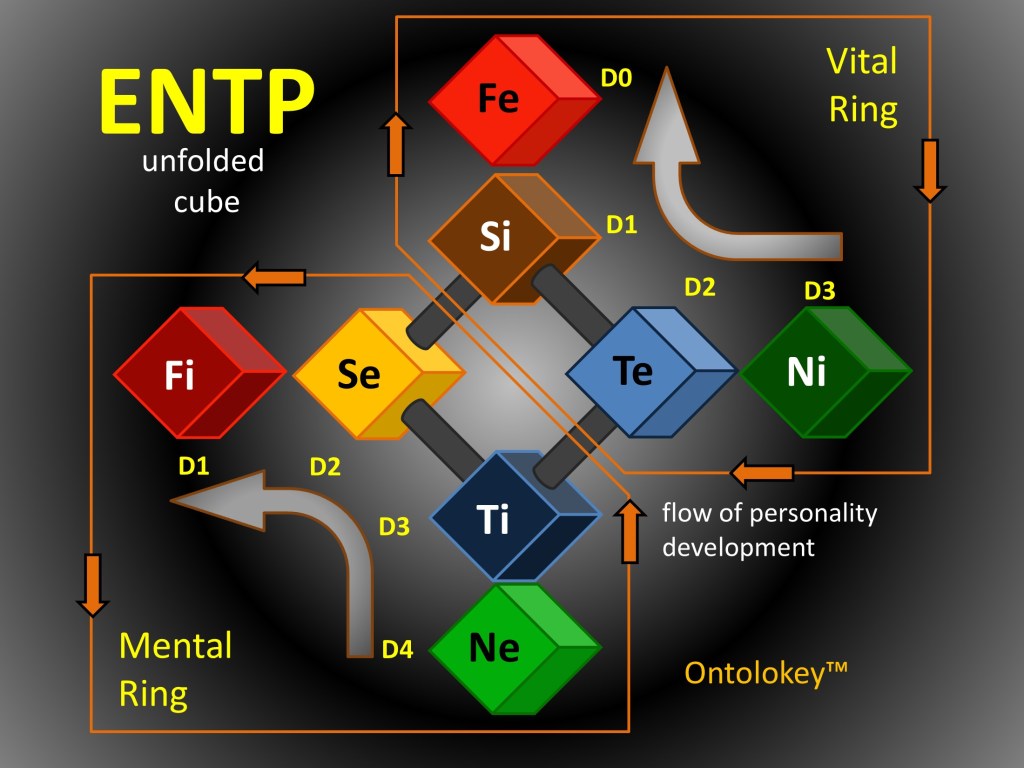
In the Ontolokey model, D0 to D4 describe the degree to which a psychological function has become consciously accessible, developed, and integrated within the personality. D4 represents the highest level of conscious development, while D0 indicates a function that remains largely unconscious and therefore tends to operate as a blindspot; D1, D2, and D3 represent successive stages of increasing awareness and integration between these two poles. Psychological development therefore means gradually bringing less conscious functions into awareness and allowing them to become more differentiated and usable, rather than trying to replace the dominant personality with something fundamentally different. The movement from D0 toward D4 is consequently a process of integration in which previously unconscious psychological capacities become increasingly available to consciousness and contribute to a more complete experience of the Self.
The Psychology of Possibility
The ENTP begins life psychologically close to possibility itself. Extraverted Intuition, Ne, is not merely a tendency to have many ideas; it is a characteristic way of experiencing reality in which the visible world continually appears incomplete, provisional and open to transformation. Where another person may encounter an established situation and perceive its structure, the ENTP instinctively notices alternatives, connections, contradictions, latent opportunities and possible futures, so that almost any circumstance can become the starting point for another line of thought. This gives the personality its familiar intellectual vitality: curiosity, improvisation, originality, humor, conceptual agility, appetite for complexity and a natural resistance to unquestioned assumptions. Yet the same psychological gift contains the seed of the ENTP’s deepest developmental conflict, because a consciousness that instinctively perceives what could be can eventually struggle with what is; every commitment closes possibilities, every completed project excludes alternative futures, and every stable reality imposes the very limits that the ENTP’s imagination instinctively wants to transcend. The central task of ENTP individuation therefore cannot be to become still, conventional or less imaginative, but to discover whether freedom can survive commitment and whether possibility can become more than an endless escape from the necessity of choosing.
At its healthiest, Ne gives the ENTP an extraordinary capacity to enlarge consciousness rather than merely accumulate information. The ENTP can look at an apparently closed situation and discover an opening, connect concepts that normally remain separated, question assumptions that have become invisible through familiarity, and imagine futures that have not yet acquired social legitimacy. This is why ENTPs often become natural innovators, strategists, entrepreneurs, inventors, intellectual provocateurs and catalysts for change: they are psychologically oriented toward emergence, toward the moment when something not yet visible begins to take form. Their mind can move laterally across disciplines and perspectives with unusual speed, and conversation itself can become a laboratory in which assumptions are tested, dismantled and reconstructed. Yet the psychological danger begins when the ability to perceive alternatives becomes an unconscious requirement to keep alternatives alive. Then exploration ceases to be an instrument of consciousness and becomes a defense against limitation, because selecting one possibility means grieving the others that will never be lived. The mature ENTP must therefore learn a difficult distinction: the existence of another possibility does not automatically make the present possibility wrong, and the disappearance of novelty does not necessarily mean the disappearance of meaning.
The first great movement toward wholeness consequently occurs through Ti, the Auxiliary function, because Ne without an inner architecture can become a perpetual multiplication of possibilities. Introverted Thinking gives the ENTP the capacity to ask whether an idea actually coheres, whether its premises are sound, whether contradictions have been overlooked and whether an apparently convincing explanation survives closer examination; it converts the ENTP from a mere generator of alternatives into an architect of conceptual structures. This is why debate can feel intrinsically pleasurable to the ENTP even when there is no personal hostility involved: argument becomes a cognitive workshop in which ideas can be stress-tested and reconstructed, and intellectual disagreement can generate energy rather than merely threaten identity. In the developmental language of the Mental Ring, Ti represents the necessary descent from the D4 freedom of possibility toward D3 coherence, because the ENTP must first learn to give form to the extraordinary material produced by Ne before attempting to integrate the deeper and more vulnerable layers of the psyche. The crucial danger, however, is that Ti can become so sophisticated that it begins to protect the personality from anything that cannot be solved intellectually; the ENTP may understand an emotion, relationship or failure with astonishing precision while remaining psychologically untouched by the experience itself.
This is where the deeper shadow begins to reveal itself: the ENTP can use the very faculty that makes self-understanding possible as a mechanism for avoiding self-experience. Instead of asking, “What am I feeling?” the mind asks why the feeling exists; instead of allowing grief to be felt, it constructs a theory of grief; instead of admitting personal hurt, it analyzes the other person’s motives, the relational dynamics and the logical structure of the conflict. Such cognition is not necessarily false—in fact, it may be remarkably accurate—but accuracy is not the same as integration. The unconscious is not transformed merely because the conscious intellect has found an elegant explanation for it, and emotional material that remains unexperienced does not disappear simply because it has been conceptualized. For the ENTP, psychological healing therefore requires a gradual shift in the function of intelligence: cognition must cease to serve primarily as a shield against vulnerability and become an instrument through which vulnerability can safely enter consciousness. The mature ENTP does not abandon analysis; rather, analysis becomes spacious enough to receive what it cannot control, allowing the question “What is true?” to stand beside the equally important questions “What hurts?”, “What matters to me?”, “What am I afraid of losing?”, and “What responsibility follows from what I now understand?”
Se D2 — The Anima/Animus and the Return to the Living Present
The transition from Ti D3 to Se D2 marks a fundamentally different kind of psychological development because the ENTP can no longer rely exclusively on the medium in which it feels most competent: thought. Se, as the Anima/Animus function in the Ontolokey configuration, confronts the ENTP with immediacy, embodiment, sensation, physical presence and the irreducible reality of the present moment. Ne naturally moves beyond what is immediately given, while Ti abstracts and organizes experience into internally coherent structures; Se reverses this movement by demanding contact with what actually exists here and now, before it has been transformed into an idea. This can be strangely intimate for the ENTP because presence cannot be solved conceptually: the body has its own rhythms, limits, appetites, fatigue and forms of knowledge, and reality frequently refuses to wait until the mind has finished interpreting it. The developmental movement toward Se therefore represents not a rejection of imagination but a grounding of imagination in lived experience, allowing the ENTP gradually to discover that reality itself contains a richness that does not need to be mentally reinvented in order to be meaningful.
The Anima/Animus quality of Se also explains why this function can possess an unusual psychological fascination for the ENTP while simultaneously feeling somewhat foreign or destabilizing. The ENTP may be attracted to people who embody decisiveness, physical confidence, sensuality, spontaneity, courage or an apparently effortless ability to inhabit the moment, because these qualities represent something that the ENTP psyche has not yet fully claimed for itself. What appears externally as admiration, fascination or even projection can therefore contain an unconscious message: the qualities being admired may be precisely those that consciousness has neglected. At the less integrated end, Se can emerge through compensatory behavior, such as impulsive stimulation, excessive novelty seeking, physical risk, overindulgence or attempts to escape mental saturation through intense sensory experience. The problem is not pleasure, adventure or spontaneity themselves; the problem arises when the body becomes an emergency exit from a mind that has become overextended, so that sensory intensity is used to silence psychological tension rather than to deepen contact with life. Development begins when the ENTP can experience sensation without needing either to intellectualize it or to flee into it.
This distinction is especially important because the ENTP’s characteristic relationship with novelty can easily disguise an avoidance of presence. An ENTP may constantly seek new environments, conversations, projects, relationships or experiences and interpret this movement as freedom, while a deeper psychological examination may reveal that movement itself has become a defense against staying long enough for an experience to become emotionally consequential. The new possibility is psychologically safe because it has not yet demanded commitment, while the present moment can become threatening precisely because it contains consequences, bodily signals, attachment, limitation and the possibility of disappointment. Se D2 therefore asks the ENTP to develop a different relationship with intensity: instead of pursuing stimulation because stillness feels empty, the individual learns to remain sufficiently present that even ordinary experience becomes perceptible in its full texture. Eating without distraction, listening without mentally preparing a response, noticing bodily tension before it becomes exhaustion, remaining with another person without converting the interaction into an intellectual game, or completing an activity simply because it deserves completion are psychologically modest acts, but they gradually establish an entirely different relationship between consciousness and reality.
The deeper significance of Se integration is that the ENTP begins to discover the body as a source of information rather than an obstacle to cognition. The body frequently registers what consciousness has not yet formulated: attraction before explanation, exhaustion before admission, anxiety before the rational mind has identified its cause, and resistance before the conscious personality has decided that something is wrong. Because the ENTP is naturally skilled at constructing explanations, there can be a tendency to override these signals whenever they interfere with an attractive theory, ambitious project or stimulating possibility. Developing Se means learning to pause before interpretation and to ask what is actually happening in the organism, because psychological truth is sometimes first encountered as sensation rather than as language. In this sense, Se becomes a bridge between cognition and existence: the ENTP does not become less intelligent by listening to the body, but more complete, because intelligence is no longer permitted to float above the conditions under which the person actually lives.
Once Se has been sufficiently developed, the movement toward Fi D1 becomes possible in a profoundly different way. Fi is the Toddler function in this developmental architecture, and therefore it should not be approached as though it were merely a weaker version of an already familiar mental capacity; it represents a young, vulnerable and easily wounded dimension of the personality concerned with personal values, emotional authenticity, inner attachment and the question of what matters independently of intellectual elegance or social approval. For an ENTP, this can be one of the most uncomfortable territories precisely because Fi does not primarily ask whether an argument is coherent or whether a possibility is interesting; it asks whether something is personally true, whether a boundary has been crossed, whether an attachment matters, whether an experience has caused pain, and what the individual genuinely loves or cannot accept. The ENTP may therefore experience strong Fi reactions without possessing an equally developed language for them, producing sudden moral intensity, defensiveness, guilt, shame or an almost childlike sensitivity when something touches a deeply personal value. The developmental sequence is crucial here: Fi is not reached by simply deciding to “be more emotional,” but through the prior grounding supplied by Ti and Se, which makes it increasingly possible to encounter personal feeling without either rationalizing it away or becoming overwhelmed by it.
Fi D1 — The Toddler Function and the Wound Beneath the Intellect
The descent from Se D2 into Fi D1 brings the ENTP into perhaps the most psychologically delicate territory of the Mental Ring, because Fi represents a form of inner experience that cannot be comfortably externalized, debated or solved through abstraction. As the Toddler function, Fi carries the symbolic quality of something young within the personality: spontaneous, personal, easily hurt, intensely attached to what feels authentic, yet not necessarily equipped to articulate its needs in an adult and differentiated manner. The ENTP can therefore possess powerful personal feelings while simultaneously experiencing uncertainty about what those feelings mean or whether they are legitimate, particularly when emotional experience conflicts with the personality’s habitual preference for intellectual autonomy. A common defense is to convert personal pain into analysis, irony, detachment or argument, thereby regaining the psychological distance in which the ENTP feels competent. Yet the very intensity with which an apparently minor interpersonal event can sometimes affect an ENTP may indicate that something deeper has been touched, because the reaction does not originate exclusively in the conscious situation but may activate an older layer of vulnerability that has never received adequate recognition. (ontolokey.com)
This helps explain a paradox that can otherwise be difficult for both the ENTP and the people around them to understand: a personality that can appear remarkably emotionally detached can nevertheless be profoundly sensitive to rejection, betrayal, humiliation, being misunderstood or having its intentions interpreted as malicious. The ENTP’s external flexibility can conceal an internal insistence that certain things must not be violated, even when those principles have never been consciously formulated. Because Fi is located at D1, these values may initially appear less as mature ethical convictions and more as immediate emotional reactions: “That was unfair,” “You do not understand me,” “You crossed a line,” or “This matters to me more than I can explain.” The danger is that the ENTP may either dismiss such reactions as irrational or, at the opposite extreme, become temporarily possessed by them and defend them with the same argumentative force normally applied to intellectual questions. Integration requires a third possibility: neither suppressing the feeling nor treating every feeling as unquestionable truth, but learning to listen to the emotion long enough to discover the value, wound, attachment or unmet need contained within it. In this sense, Fi development is not emotional indulgence; it is the gradual acquisition of an inner vocabulary through which the ENTP can distinguish between transient affect, genuine personal values, unresolved wounds and projections onto other people.
The Toddler metaphor becomes particularly meaningful when viewed through the history of psychological injury. A young psychological function does not necessarily mean that the individual is emotionally immature in every respect; rather, it identifies an area in which the person may have comparatively little conscious differentiation and therefore relatively few internal tools for regulation. When the ENTP is hurt in this region, the adult intellect can remain sophisticated while the wounded inner part reacts with disproportionate urgency, defensiveness or withdrawal. The resulting experience can be confusing because the conscious mind knows that the event “should not matter that much,” yet the emotional system insists that it does, creating a split between intellectual appraisal and subjective reality. Instead of condemning this discrepancy, individuation invites the ENTP to become curious about it: what exactly was threatened, what expectation was violated, what older experience might have been activated, and what does the intensity reveal about something personally significant? This is where cognitive self-healing becomes possible within the Ontolokey developmental model—not because cognition magically erases pain, but because conscious understanding can gradually connect an apparently irrational reaction to the psychological structure that produced it, transforming confusion into intelligibility and self-rejection into compassion. (ontolokey.com)
Fi integration also changes the ENTP’s relationship with conflict. The undeveloped ENTP can unconsciously treat interpersonal disagreement as an intellectual arena in which the strongest explanation should prevail, and because Ne-Ti can generate counterarguments almost indefinitely, the individual may continue debating long after the actual psychological issue has ceased to concern the proposition being debated. The hidden question may instead be whether the person feels respected, valued, trusted or emotionally safe, but admitting this can feel more exposing than continuing the argument because the admission places the ENTP in a position where intelligence offers less protection. Consequently, sarcasm, intellectual dominance, provocative questioning or strategic detachment can function not merely as personality traits but as defenses against the experience of being personally vulnerable. The development of Fi does not require the ENTP to stop questioning, challenging or debating; it requires learning when the argument is genuinely about truth and when truth has become a vehicle through which an injured part of the personality is trying to defend itself. That distinction can profoundly alter relationships because the ENTP begins to recognize that winning an argument can sometimes preserve the ego while simultaneously damaging the attachment that the ego was secretly trying to protect.
At the deepest level, Fi D1 introduces the possibility of self-forgiveness because it reveals that many of the ENTP’s apparently contradictory behaviors may have been attempts to protect an underdeveloped psychological territory. The person who repeatedly escaped into novelty may have been avoiding the grief associated with limitation; the person who intellectualized emotion may have been protecting a vulnerable inner life that did not yet possess adequate language; the person who appeared insensitive may have been unable to recognize the emotional significance of an interaction until the consequences had already become visible. None of this removes responsibility, and genuine individuation cannot become an excuse for harmful behavior, but understanding changes the psychological meaning of responsibility: one can acknowledge what one did without reducing oneself to what one did. The same principle can be extended toward other people, because recognizing the architecture of one’s own defenses makes it easier to imagine that another person’s destructive reaction may also have emerged from fear, immaturity, wounded attachment or an unconscious attempt at self-protection. Forgiveness in this sense is not the denial of injury or the cancellation of boundaries; it is the release of the compulsive need to remain psychologically imprisoned by an event that has finally become understandable. Through that process, the ENTP begins to approach the first real threshold of wholeness: the realization that the parts of the personality once experienced as weaknesses may contain precisely the information required to become psychologically complete.
Ni D3 — The Sibling Function and the Discovery of Direction
The transition from Fi D1 in the Mental Ring to Ni D3 in the Vital Ring represents a decisive change in the ENTP’s relationship with the unconscious because the developmental movement is no longer primarily inward toward personal vulnerability but downward into a deeper organizing principle beneath conscious possibility. Ni, as the Sibling function, does not compete with Ne by producing more possibilities; instead, it gradually asks which of the innumerable possibilities actually belongs to the deeper trajectory of the person. For an ENTP, this can initially feel restrictive because Ne is accustomed to preserving openness while Ni seeks convergence, pattern, direction and an underlying meaning that becomes visible only when competing alternatives are allowed to recede. Yet this is precisely why Ni becomes so important after Ti, Se and Fi have been sufficiently developed: the ENTP has first learned to generate possibilities, examine them, experience reality directly and recognize personal significance, and can now begin asking what all these experiences are pointing toward. In the language of individuation, Ni introduces the possibility that the unconscious is not merely a collection of rejected or undeveloped traits but also a source of orientation, and that beneath the ENTP’s conscious appetite for endless potential there may exist a quieter psychological movement toward a particular life, a particular meaning and a particular form of becoming. (ontolokey.com)
This is often where the ENTP encounters one of the most uncomfortable truths about freedom: unlimited possibility is not the same thing as unlimited life. Human existence is finite, and therefore every actual life requires selection, continuity and sacrifice; something must be chosen precisely because everything cannot be chosen. Ne can postpone this confrontation by continually discovering another road, another intellectual interest, another project or another interpretation, but Ni gradually makes postponement psychologically expensive because it begins to perceive the pattern created by all those choices and non-choices. The Sibling quality is important here because Ni is not experienced as a foreign enemy but as something strangely familiar, almost like an internal companion whose perspective has existed beside consciousness without being granted equal authority. At first, the ENTP may experience Ni as vague intuition, recurring themes, inexplicable certainty, symbolic associations or an increasing awareness that certain experiences keep returning in different forms; over time, these fragments can begin to form a coherent direction. Individuation therefore requires the ENTP to resist the temptation to immediately convert every intuitive impression into another hypothesis, because Ni becomes intelligible through sustained observation of patterns rather than through the rapid multiplication of explanations.
The psychological maturation of Ni also changes the meaning of the ENTP’s famous curiosity. At an earlier stage, curiosity primarily expands the field of consciousness, asking what else might be possible; at a later stage, curiosity becomes more selective and asks what deserves sustained attention. This distinction is crucial because the mature ENTP does not necessarily become less curious, but becomes capable of tolerating the psychological narrowing that depth requires. A person cannot deeply understand a subject, relationship, vocation or creative project while continually abandoning it whenever something newer appears, and Ni begins to expose the hidden cost of perpetual cognitive mobility. The ENTP may discover that many abandoned projects were not failures of ability but failures of psychological continuity, in which enthusiasm was mistaken for commitment and inspiration was mistaken for destiny. Ni offers another conception of creativity: not the constant production of alternatives, but the patient recognition of an underlying pattern and the willingness to remain with it long enough for its implications to unfold.
This is also where the ENTP can begin to experience the difference between intellectual identity and existential identity. Intellectual identity answers questions such as what one believes, what one knows, what one can explain and which problems one finds fascinating, whereas existential identity concerns the deeper question of what one is actually becoming through the way one lives. An ENTP can be extraordinarily successful at constructing a sophisticated intellectual self while remaining uncertain about the direction of the actual person underneath that construction. Ni gradually closes this gap by bringing long-term consequences, recurring psychological patterns and latent aspirations into the field of awareness, making it harder to hide indefinitely behind potential. The question therefore shifts from “What could I do?” to “Which possibility, if lived consistently, would make the rest of my life intelligible?” That question can be unsettling because it transforms possibility from an endless playground into a field of responsibility, but it is precisely this transformation that allows the ENTP’s intelligence to become existentially meaningful rather than merely impressive.
When Ni begins to develop, the ENTP may also recognize that some of the personality’s earlier conflicts were not random contradictions but expressions of an incomplete developmental sequence. The hunger for novelty, the resistance to closure, the attraction to unconventional people and experiences, the intellectualization of emotion and the occasional difficulty translating insight into sustained action can all be reconsidered as parts of a psychological system that was organized around maintaining possibility. This retrospective recognition can be deeply healing because it allows the individual to see continuity where previously there appeared to be inconsistency or personal failure. Yet Ni must not become another instrument of self-mythologizing, because an ENTP can just as easily turn individuation into an elaborate theory about being uniquely complex, misunderstood or destined for an exceptional future. Genuine Ni development moves in the opposite direction: it makes the personality quieter, more honest and more willing to accept what repeated experience actually reveals, even when that revelation is less glamorous than the identity the imagination preferred. The deeper unconscious does not necessarily tell the ENTP that they are destined for something extraordinary; it may simply reveal what they have been avoiding, what they genuinely value, what repeatedly gives their life meaning and which direction remains psychologically alive when novelty has exhausted itself.
Te D2 — The Golden Shadow and the Transformation of Insight into Reality
The movement from Ni D3 toward Te D2 introduces another essential confrontation for the ENTP: the difference between understanding what could be done and actually making something happen. As the Golden Shadow, Te represents a form of extraverted thinking that can appear both attractive and threatening because it embodies qualities the ENTP may admire intensely while resisting their demands for discipline, measurement, hierarchy, efficiency and externally verifiable results. Ne-Ti can produce an extraordinary abundance of conceptual material, and Ni can gradually identify which possibilities possess deeper significance, but Te asks the uncompromising practical question of what will actually be implemented. It evaluates resources, deadlines, consequences, procedures, priorities and outcomes, thereby bringing the ENTP into contact with a reality in which intellectual brilliance has no automatic authority. This can generate an ambivalent relationship with highly organized, decisive or operationally competent people: the ENTP may admire their ability to execute while simultaneously perceiving their methods as unnecessarily rigid, simplistic or unimaginative. The Golden Shadow becomes psychologically valuable precisely because it reveals that the qualities one instinctively critiques in others may contain capacities one has not yet learned to integrate consciously. (ontolokey.com)
The ENTP’s resistance to Te is often less about laziness than about autonomy. External systems can feel threatening when they appear to dictate how something must be done, because the ENTP instinctively sees alternative methods and may experience imposed procedures as unnecessary constraints on intelligence. Yet the mature development of Te requires distinguishing between meaningless bureaucracy and useful structure, between conformity and coordination, and between obedience and strategic execution. A structure is not inherently the enemy of creativity; in many circumstances it is what allows creativity to survive long enough to produce an enduring result. The ENTP therefore begins to develop Te when structure is no longer experienced primarily as an external authority but as a tool that serves a consciously chosen purpose. This is a major psychological shift because it allows the individual to say, in effect, “I do not have to love the system in order to use it,” and even more importantly, “I can construct systems of my own that protect my ideas from my own inconsistency.”
The Golden Shadow becomes especially revealing when the ENTP repeatedly experiences the frustration of having excellent ideas that remain incomplete. There can be a painful discrepancy between internal potential and external achievement: the person knows that they are capable of producing something significant, yet projects remain fragmented, abandoned or perpetually redesigned. Because Ne can always identify a more interesting possibility and Ti can always find another conceptual refinement, there are sophisticated ways to postpone the moment when an idea must submit itself to reality. Te breaks this psychological loop by establishing criteria of completion that do not depend upon whether the mind has exhausted every alternative. A finished imperfect project can possess more transformative power than an infinitely refined idea that never leaves consciousness, and the acceptance of this fact can be one of the most important developmental thresholds in an ENTP’s life. Te therefore does not diminish the ENTP’s imagination; it gives imagination consequences, allowing the individual to discover the particular satisfaction that comes from seeing an internally conceived possibility acquire independent existence in the world.
At a deeper level, Te also confronts the ENTP’s relationship with competence and failure. Intellectual environments can reward the ability to improvise, debate and expose flaws in other people’s reasoning, but external execution eventually creates situations in which the ENTP’s own performance becomes measurable and cannot be protected by verbal agility. A plan either works or it does not; a commitment is either honored or it is not; a project either reaches completion or it remains unfinished, regardless of how compelling the explanation for its incompletion may be. This can activate a shadow vulnerability because the ENTP may unconsciously prefer domains in which intelligence remains difficult to measure, thereby preserving the possibility of being capable without having to endure the definitive evidence of limitation. Te integration reverses this strategy by making feedback psychologically tolerable: failure becomes information about the system rather than a verdict on the self. Once the ENTP can tolerate measurable feedback without experiencing it as an assault on autonomy or intelligence, execution becomes less threatening and the personality gains an entirely new form of freedom—the freedom that comes from being able to rely upon oneself.
The integration of Te also transforms the ENTP’s relationship with other people because collaboration requires more than the exchange of ideas. A mature ENTP eventually discovers that constantly challenging every procedure, reopening every decision or proposing an alternative can exhaust the very people whose cooperation is necessary to realize a shared vision. Te introduces an appreciation for role clarity, delegation, sequencing and decision closure, while preserving the ENTP’s capacity to question whether a system remains useful. This creates a more sophisticated form of leadership in which the ENTP no longer needs to prove intelligence by destabilizing every structure, but can instead destabilize structures selectively when doing so serves a larger purpose. The Golden Shadow thus ceases to be a projection onto supposedly rigid or overly controlling people and becomes an internal capacity for turning insight into coordinated action. When Ni supplies direction and Te supplies implementation, the ENTP begins to move from the psychological experience of “I can see countless possibilities” toward the far more mature experience of “I can choose one, build it, learn from reality and remain psychologically free while doing so.”
The deepest lesson of Te D2 is therefore not productivity but incarnation. An idea that remains exclusively within the mind is psychologically incomplete because it has never entered the world where consequence, resistance and relationship can test it. By accepting these tests, the ENTP discovers that reality is not merely an obstacle to imagination but a partner in its refinement, and that external resistance can reveal dimensions of an idea that abstract reasoning could not anticipate. This prepares the next developmental movement toward Si D1, the inferior function, because once the ENTP has learned to direct energy toward meaningful objectives and to execute them in reality, the psyche must confront an even less familiar territory: continuity, repetition, memory, limitation, maintenance and the accumulated weight of lived experience. The developmental path therefore continues downward, from direction to implementation and from implementation toward the humble recognition that a life is not built only through breakthroughs, but also through everything that must be repeatedly maintained after the breakthrough has occurred.
Si D1 — The Inferior Function and the Psychology of Continuity
The movement from Te D2 into Si D1 brings the ENTP toward a psychological territory that can feel almost antithetical to its natural orientation, because Si asks the individual to remain with what already exists rather than continually seeking what might exist next. Introverted Sensation, as the Inferior function in this developmental architecture, concerns continuity, accumulated experience, bodily condition, memory, repetition, familiarity and the concrete consequences of how one has lived over time. For the ENTP, whose consciousness is naturally stimulated by change, novelty and conceptual expansion, repetition can easily be interpreted as stagnation and routine as an unnecessary limitation on freedom. Yet what appears psychologically mundane from the perspective of Ne can contain an enormous amount of neglected information, because the psyche does not live exclusively through exceptional experiences; it is also shaped by sleep, health, habits, environments, memories, recurring relationships, unfinished obligations and the gradual accumulation of small decisions. Si therefore confronts the ENTP with a reality that cannot continually be reinvented, because the body remembers what the mind has moved beyond and because consequences remain present even after attention has shifted elsewhere. (ontolokey.com)
The shadow side of Si can emerge when the ENTP repeatedly treats continuity as something beneath consideration. New projects are psychologically attractive because they contain potential, while maintenance contains little novelty and therefore produces comparatively little immediate stimulation. This can create a characteristic asymmetry in which the beginning of a project receives enormous intellectual energy while the repetitive middle and the necessary maintenance afterward gradually lose their appeal. The same pattern can appear in relationships, professional commitments and personal development: the ENTP may be highly engaged while discovery is occurring but become restless once familiarity replaces uncertainty. Si development requires recognizing that repetition is not necessarily the opposite of growth; in many areas of life, repetition is precisely the mechanism through which growth becomes embodied. A musical skill, a relationship of trust, physical health, professional mastery or a long-term creative undertaking cannot be sustained through inspiration alone, because eventually the extraordinary becomes ordinary and the psychological task changes from discovery to stewardship.
This is also why Si can become an important corrective to the ENTP’s relationship with the body. A personality that spends substantial psychological energy in abstraction can sometimes notice bodily needs only after they have become impossible to ignore, particularly when enthusiasm, intellectual stimulation or ambitious projects temporarily override signals of fatigue and depletion. The body does not negotiate with conceptual brilliance, however, and exhaustion eventually imposes a form of reality that cannot be debated away. Developing Si means learning to recognize patterns in one’s own physical and psychological functioning before they become crises: what conditions produce sustainable energy, which habits repeatedly lead to depletion, which environments support concentration, and which forms of stimulation gradually erode stability. Such awareness may initially appear boring to an ENTP precisely because it does not provide the dramatic cognitive reward of discovering something new, but its deeper function is liberating: when the individual learns to maintain the foundations of life, more energy becomes available for exploration without requiring repeated cycles of collapse and recovery.
Si also brings the ENTP into a different relationship with personal history. Ne can move rapidly toward alternative interpretations of the past, while Ti can analyze the causal structure of previous events, but Si preserves the felt continuity of experience and reminds the individual that the past is not merely an intellectual dataset from which conclusions can be extracted. Memories carry atmosphere, sensory detail, emotional association and accumulated meaning, and some psychological wounds remain active precisely because they have never been integrated into a coherent continuity of self. An ENTP who continually reinvents identity may unconsciously distance the present self from earlier versions of the personality, particularly from periods that feel embarrassing, painful, unsuccessful or emotionally dependent. Si development allows those earlier selves to be remembered without either romanticizing them or disowning them, creating a more continuous identity in which the person can say, psychologically, “That was also me, and what happened then still belongs to my story.” This continuity becomes particularly important during the individuation process because wholeness does not mean constructing a superior new self that replaces the old personality; it means gradually recognizing the previously fragmented experiences as belonging to one life.
The mature integration of Si consequently changes the ENTP’s conception of freedom. At a younger stage, freedom may mean having as few constraints as possible, maintaining open options and resisting circumstances that appear to limit future possibilities; with development, freedom increasingly means possessing enough internal and external stability to choose deliberately rather than react compulsively to novelty. A person who can maintain commitments, care for the body, preserve important relationships, learn from accumulated experience and tolerate periods of repetition is not less free than the constantly improvising individual; in many respects, that person has become more free because novelty is now a choice rather than a psychological necessity. Si also introduces humility into the ENTP’s self-understanding by revealing that some problems cannot be solved through another insight, because they require time, repetition, patience and acceptance of limits. This prepares the final movement of the Vital Ring toward Fe D0, the tertiary function and deepest blindspot in the developmental sequence, where the ENTP must encounter perhaps the most socially and emotionally disorienting question of all: how the self exists not only as an autonomous mind but as a participant in a shared emotional field.
Fe D0 — The Tertiary Function, Blindspot and the Shared Emotional Field
The final descent of the Vital Ring leads toward Fe D0, the tertiary function and, in the developmental model specified here, the most archaic and least differentiated layer of the ENTP’s functional architecture. Extraverted Feeling concerns the emotional atmosphere between people, interpersonal reciprocity, shared values, social cohesion and the ability to recognize that human beings are continually influencing one another through tone, expression, attention, affirmation and emotional presence. For the ENTP, this territory can be particularly difficult because the personality may be highly socially capable without necessarily being deeply emotionally attuned; wit, charisma, verbal agility and intellectual engagement can create the appearance of interpersonal fluency while leaving subtler emotional processes insufficiently recognized. The ENTP may therefore understand people conceptually and still fail to notice what another person is emotionally experiencing in the moment, particularly when the situation demands sustained sensitivity rather than stimulating conversation. Fe at D0 should consequently not be interpreted as an absence of feeling or humanity, but as an area in which conscious differentiation may initially be weak, inconsistent or developmentally immature. Its position at the end of the Vital Ring makes it the final frontier of the descent: after the ENTP has confronted direction, execution, continuity and embodiment, the personality must recognize that the self is never psychologically isolated but always exists within relationships and emotional fields. (ontolokey.com)
One of the ENTP’s characteristic blindspots can therefore involve confusing interpersonal stimulation with interpersonal intimacy. Conversation may be energetic, humorous, provocative and intellectually intimate while remaining emotionally evasive, because the exchange of ideas allows two people to reveal much about how they think without necessarily revealing what they fear, need, grieve or love. The ENTP can be exceptionally interested in another person and yet unconsciously redirect the interaction toward concepts whenever emotional exposure becomes uncomfortable. In conflict, this may appear as an attempt to clarify the facts while the other person is actually asking to have the emotional impact of those facts acknowledged; the ENTP may believe that an accurate explanation should resolve the problem, whereas the other person may experience the explanation as evidence that their emotional reality has not been heard. Fe development begins when the ENTP learns that emotional recognition is not equivalent to agreement, submission or loss of intellectual independence. To acknowledge another person’s emotional reality simply means recognizing that it exists and has psychological consequences, and this capacity can profoundly improve relationships because it allows truth and empathy to coexist rather than forcing one to defeat the other.
The D0 quality of Fe can also explain why social approval may sometimes be experienced in strangely polarized ways. The ENTP can appear highly independent and resistant to conventional expectations, yet may become surprisingly affected by interpersonal rejection, public misunderstanding or the withdrawal of affection when these experiences touch an insufficiently conscious need for belonging. This can produce a paradoxical relationship with the social environment: the individual may consciously insist that other people’s opinions do not matter while unconsciously reacting strongly when social connection is threatened. The shadow may then emerge through provocative behavior, performative contrarianism, excessive charm, withdrawal, emotional detachment or attempts to regain social control through humor and intellectual superiority. Development does not require the ENTP to become conventionally agreeable or dependent upon approval; rather, it requires enough Fe awareness to recognize when rebellion is genuinely principled and when it is partly a strategy for controlling vulnerability. Once this distinction becomes conscious, social freedom becomes more authentic because the individual no longer needs either conformity or opposition to regulate the deeper question of whether they feel accepted.
Fe integration also completes an important reversal in the ENTP’s understanding of responsibility. Earlier stages of development may emphasize intellectual independence, personal authenticity and freedom from arbitrary structures, but mature individuation reveals that every psychologically autonomous person remains embedded in networks of consequence. Words affect people, attention affects relationships, absence affects attachment, and even intellectually justified behavior can produce emotional consequences that cannot simply be dismissed because the underlying argument was correct. The integrated ENTP therefore begins to ask not only whether something is true or effective but also what its expression does to the human field in which it occurs. This does not mean suppressing uncomfortable truths to preserve harmony; in fact, mature Fe can make honesty more compassionate because the ENTP becomes increasingly capable of delivering difficult truths without using truth as an instrument of domination. The psychological achievement is not niceness but relational consciousness: the ability to remain intellectually independent while understanding that independence does not exempt one from reciprocity, responsibility or the emotional consequences of one’s presence.
When Fe finally becomes sufficiently conscious, the entire developmental architecture begins to reorganize itself retrospectively. Ne no longer has to generate endless alternatives merely to preserve freedom, because Ti has supplied discrimination and Ni has supplied direction; Se has taught the personality to inhabit reality, Fi has revealed personal vulnerability and values, Te has provided execution, and Si has introduced continuity and maintenance. Fe then adds the missing interpersonal dimension by showing that a complete self cannot be defined solely by what happens inside the individual. The ENTP begins to recognize that psychological wholeness includes the ability to remain present with another person without immediately converting the encounter into a problem to solve, a debate to win or an experience to escape. At this point the shadow functions cease to be enemies and become sources of psychological information: the vulnerable Fi reaction reveals what matters, Se reveals what the body knows, Ni reveals what the life is becoming, Te reveals what must be done, Si reveals what must be maintained, and Fe reveals whom the individual affects and depends upon. The unconscious has therefore become less frightening because it is no longer experienced as an alien territory; it has become an extension of the self that consciousness had previously failed to recognize.
The completion of this descent does not mean that the ENTP permanently operates all eight functions with equal strength, nor does individuation erase the original personality. Quite the opposite is implied by the image of the rotating iceberg: the purpose of the journey is eventually to return to the original conscious orientation with a radically expanded relationship to everything that once existed beneath its surface. Ne can return to the foreground without again becoming an escape from reality because the personality now possesses Ti’s discrimination, Se’s presence, Fi’s self-knowledge, Ni’s direction, Te’s implementation, Si’s continuity and Fe’s relational awareness. What returns is therefore not the psychologically younger ENTP but a more complete version of the same underlying personality, capable of preserving its characteristic curiosity while no longer being unconsciously governed by its need for endless possibility. In that sense, the culmination of individuation is not the destruction of the ENTP’s nature but its liberation from the defensive patterns that distorted its nature, allowing the original gift of possibility to become the conscious expression of a much larger and more integrated Self.
The Iceberg Turns — Individuation, Shadow Integration and Psychological Healing
The developmental sequence described by the Ontolokey model can ultimately be understood as a gradual rotation of consciousness around the hidden dimensions of the personality. The familiar ENTP begins with Ne D4 at the visible summit of the Mental Ring, where possibility, curiosity, conceptual exploration and freedom dominate psychological life, and then gradually encounters Ti D3, Se D2 and Fi D1 as increasingly intimate dimensions of cognition, embodiment and personal vulnerability become conscious. The Vital Ring then extends this descent through Ni D3, Te D2, Si D1 and finally Fe D0, moving from unconscious direction and implementation toward continuity, embodiment and the shared emotional reality of other people. The metaphor of the iceberg is particularly useful because it emphasizes that the unconscious is not necessarily something foreign that must be conquered; it is the much larger portion of the same psychological structure that has simply remained outside ordinary awareness. As the iceberg turns, what was previously beneath the surface becomes visible, and the individual gradually discovers that many traits experienced as weaknesses, contradictions or inexplicable reactions were actually expressions of functions that had never received sufficient conscious development. Individuation therefore becomes less a process of constructing a new personality than of becoming conscious of the personality that has always been present in incomplete form. (ontolokey.com)
The order of development is psychologically significant because premature confrontation with the deepest shadow can overwhelm rather than integrate the personality. The ENTP cannot simply decide to “fix” Fi D1 or Fe D0 while bypassing the capacities that provide the psychological structure necessary to hold those experiences, just as one cannot meaningfully cultivate stable execution while refusing to develop the discernment and direction that determine what deserves execution in the first place. Ti must first become sufficiently mature to distinguish insight from rationalization, Se must provide sufficient grounding in immediate reality to prevent cognition from becoming disembodied, and Fi must become sufficiently conscious to establish an authentic relationship with personal values and vulnerability. In parallel, Ni can gradually transform multiplicity into direction, Te can translate direction into action, and Si can establish the continuity required to sustain what has been created before Fe finally confronts the relational and emotional field in which the individual exists. The developmental principle is therefore not “develop everything at once,” but to allow each psychological layer to prepare the ground for the next, so that integration becomes an organic expansion of consciousness rather than an artificial attempt to manufacture traits that feel psychologically foreign. The Ontolokey Cube can serve as a practical visualization of this process because its arrangement of functions and developmental positions makes the movement from the familiar toward the neglected psychologically visible, turning an abstract map of personality into a landscape through which the individual can orient their own development. (medium.com)
For the ENTP, perhaps the most important psychological discipline is therefore to stop interpreting every uncomfortable inner experience as evidence that something has gone wrong. The impulse to escape discomfort through another idea, another project, another relationship, another intellectual explanation or another future possibility can be so deeply habitual that the individual may not recognize it as avoidance at all. Yet the very experiences that provoke the strongest desire to move forward can contain the material required for the next stage of development: restlessness may conceal an inability to tolerate limitation, anger may conceal violated values, physical exhaustion may reveal chronic disconnection from the body, indecision may conceal fear of closing possibilities, and interpersonal conflict may expose an emotional reality that argument alone cannot resolve. Shadow integration begins when these reactions become objects of compassionate investigation rather than immediate correction or self-condemnation. The question changes from “How do I get rid of this?” to “What is this trying to tell me about myself?” and that seemingly simple change can fundamentally alter the relationship between consciousness and the unconscious. The shadow then becomes less a repository of defective traits and more a messenger carrying information from psychological regions that consciousness previously refused or was unable to hear.
This process also offers a deeper explanation of psychological healing through cognition. Understanding does not automatically heal an injury, but conscious understanding can create the conditions under which an injury is no longer forced to govern behavior invisibly. When an ENTP recognizes that a disproportionate emotional reaction originates in a vulnerable Fi pattern, the experience can become intelligible rather than shameful; when Se reveals that chronic overstimulation has been masking exhaustion, the body no longer has to communicate exclusively through increasingly severe signals; when Ni identifies a recurring life pattern, apparently unrelated events can be understood as expressions of a consistent psychological trajectory. Such recognition creates psychological distance without creating emotional dissociation, allowing the person to observe a reaction while remaining connected to it. This is the crucial distinction between repression and integration: repression says, “This part of me must not exist,” whereas integration says, “This part of me exists, and I need to understand its place within the whole.” Through that process, the ENTP can reinterpret earlier failures and injuries with greater compassion, not by denying responsibility or pretending that painful experiences were beneficial, but by understanding why certain reactions once made sense within the psychological structure available at the time.
Self-forgiveness becomes particularly powerful at this stage because the ENTP can begin to distinguish intention, capacity and consequence. A person may have harmed someone without consciously intending to do so, may have failed to recognize an emotional need because Fe was insufficiently developed, may have abandoned something important because Si could not yet tolerate the required repetition, or may have defended against vulnerability through Ti because Fi did not yet possess an adequate conscious voice. Understanding these mechanisms does not absolve the individual from responsibility, but it makes responsibility more constructive because guilt no longer needs to remain a permanent identity. The same principle can gradually be extended toward others: once the ENTP has experienced how unconscious functions can shape behavior without conscious permission, it becomes easier to recognize that other people also act from psychological structures they do not fully understand. Forgiveness then becomes neither sentimental nor naïve; it becomes an informed decision to stop allowing unconscious causation to dictate the future. The past remains real, the consequences remain real and boundaries may remain necessary, but the psychological compulsion to repeat, resent or endlessly reconstruct the event can gradually weaken as consciousness takes ownership of what previously operated in darkness.
The mature ENTP therefore does not become the opposite of an ENTP through individuation. The goal is not to transform an explorer into a conformist, a provocateur into a passive harmonizer or an independent thinker into someone who seeks approval, because such a transformation would amount to abandoning the original personality rather than completing it. Instead, Ne returns to its rightful position with greater freedom because it no longer has to carry the entire burden of psychological life; it can generate possibilities while Ti determines coherence, Se grounds experience, Fi protects authenticity, Ni identifies direction, Te creates implementation, Si preserves continuity and Fe recognizes relational consequence. The original strengths remain, but they are no longer compelled to compensate for what consciousness has neglected. Curiosity can coexist with commitment, intellectual independence with emotional intimacy, spontaneity with discipline, individuality with belonging and imagination with embodiment. The ENTP becomes capable of choosing reality without experiencing choice as psychological death, because the mature personality has learned that closing one possibility does not destroy the capacity to imagine others.
Wholeness as the Return of the Self
The final rotation of the iceberg can therefore be understood as a symbolic return to the beginning, but it is not a return to the psychological state from which the journey started. When Ne once again occupies the conscious foreground, it does so after consciousness has expanded through the functions that previously existed beneath the surface, and this gives the original personality a qualitatively different depth. The ENTP can once again explore, question, invent, challenge and imagine without being unconsciously driven by the need to escape limitation, emotional vulnerability or existential uncertainty. The personality’s characteristic hunger for possibility becomes less compulsive because the individual has learned to remain present when possibility contracts into reality. What once appeared to be a conflict between freedom and commitment can become a creative tension in which commitment provides the stable ground from which freedom can operate. This is the psychological meaning of the “rebirth” of the original personality: not the restoration of the past, but the emergence of the same fundamental nature after it has become conscious of a much greater portion of itself.
For the ENTP, wholeness is consequently best understood not as perfection but as increasing internal cooperation. The functions no longer need to compete for control because each has acquired a legitimate psychological role within a larger system, and the formerly unconscious functions no longer have to express themselves primarily through projection, compensation or crisis. Fi can say what matters without having to erupt through defensiveness; Se can bring the person into the present without requiring reckless stimulation; Ni can provide direction without becoming fatalistic; Te can impose structure without becoming authoritarian; Si can preserve continuity without becoming imprisoned by the past; and Fe can acknowledge emotional reciprocity without dissolving individuality. The conscious personality remains recognizably ENTP, but its relationship to itself has changed because internal difference is no longer experienced as fragmentation. Psychological maturity is therefore not the elimination of contradiction but the capacity to hold apparently opposing truths without immediately reducing one of them: freedom and commitment, reason and feeling, novelty and continuity, individuality and relationship, possibility and limitation can all belong to the same Self.
The practical invitation of this developmental model is consequently one of patient attention rather than forced transformation. An ENTP does not need to manufacture an entirely different character, nor should development become another intellectual project in which the individual collects psychological concepts without allowing them to alter lived behavior. The more useful practice is to observe which function is currently asking for consciousness and to work with the developmental sequence rather than against it: strengthen Ti before demanding mastery of deeper emotional material, establish sufficient Se presence before interpreting every sensation psychologically, listen to Fi before attempting to regulate it, cultivate Ni before multiplying new possibilities, develop Te before judging oneself by unrealized potential, strengthen Si before expecting sustainable achievement, and approach Fe with humility rather than performance. The Ontolokey Cube can support this process by making the architecture visually concrete, allowing the individual to identify where conscious energy naturally resides and where development may be calling attention. In this way, the model becomes less a label and more a reflective instrument: a means of repeatedly asking what has become conscious, what remains projected, what is being avoided and which neglected function is now ready to enter the larger field of awareness.
The deepest form of ENTP healing therefore lies in no longer needing to be defended against oneself. When the mind can recognize its own defenses without contempt, the body can be heard without being treated as an inconvenience, personal values can be acknowledged without embarrassment, direction can emerge without destroying freedom, structure can serve rather than imprison, continuity can replace compulsive novelty, and relationships can become places of mutual recognition rather than arenas in which intellectual control must be maintained. The ENTP who reaches this point has not lost the restless intelligence that made exploration possible; that intelligence has finally acquired roots. The iceberg has turned far enough that the distinction between “conscious personality” and “shadow personality” becomes less absolute, because what was formerly unconscious has been brought into relationship with consciousness and can participate in the life of the whole. This is the movement from personality toward Self: not an escape from one’s nature, but the gradual realization that one’s nature was always larger than the portion one initially knew.
Continuing the Work of Individuation
Individuation does not conclude with the intellectual comprehension of the eight functions, because knowledge about a psychological structure and transformation through that structure are fundamentally different achievements. The ENTP may understand every stage described here and still repeat the same defensive patterns if insight remains detached from behavior, relationships and embodied experience. The real evidence of development appears in small but consequential changes: staying with an important project after novelty fades, listening to an uncomfortable emotion without immediately explaining it away, recognizing physical exhaustion before collapse, allowing another person’s emotional reality to exist without debating it, choosing a meaningful direction despite the existence of alternatives, and accepting that some aspects of life must be maintained rather than reinvented. These changes can appear ordinary from the outside, but psychologically they demonstrate that previously unconscious functions have begun participating in conscious choice. Development therefore becomes a lifelong practice of converting recognition into relationship with oneself, with other people and with reality.
Readers who wish to explore the ENTP architecture in greater detail, examine the shadow dimensions more deeply, or compare this developmental landscape with the configurations of other personality types can continue with the more extensive personality writings available through Ontolokey.com. The individual texts on the ENTP provide additional perspectives on its conscious strengths, hidden vulnerabilities, shadow dynamics and possibilities for growth, while the broader Ontolokey material offers a larger framework for understanding how different functional configurations can be visualized and contemplated. The purpose of returning to these materials should not be to find a final definition of oneself, because individuation is precisely the process through which a fixed self-description gradually becomes insufficient. Their greater value lies in providing language and imagery with which previously unconscious experiences can be recognized, examined and integrated.
Ultimately, the ENTP’s developmental journey can be summarized as a movement from possibility toward presence, from analysis toward experience, from vulnerability toward self-acceptance, from multiplicity toward direction, from insight toward realization, from novelty toward continuity, and from autonomy toward conscious relationship. The movement is not linear in ordinary life, and the individual will inevitably move backward, become defensive, rediscover old patterns and encounter new layers of the same functions at different stages of development. What changes is the capacity to recognize these movements without becoming completely identified with them. When consciousness can turn toward its own shadow with curiosity rather than fear, psychological healing becomes possible because the person no longer has to divide the self into acceptable and unacceptable territories. The ENTP’s deepest individuation is therefore not the achievement of a flawless personality but the gradual emergence of a Self sufficiently spacious to contain the whole psychological landscape: the explorer and the builder, the skeptic and the believer, the intellect and the body, the autonomous individual and the relational human being, the childlike vulnerability and the adult capacity to protect it. In that sense, wholeness is not becoming someone else; it is finally becoming conscious of everyone who has always been there.


Leave a comment