In the Ontolokey model, D0 to D4 describe the degree to which a psychological function has become consciously accessible, developed, and integrated within the personality. D4 represents the highest level of conscious development, while D0 indicates a function that remains largely unconscious and therefore tends to operate as a blindspot; D1, D2, and D3 represent successive stages of increasing awareness and integration between these two poles. Psychological development therefore means gradually bringing less conscious functions into awareness and allowing them to become more differentiated and usable, rather than trying to replace the dominant personality with something fundamentally different. The movement from D0 toward D4 is consequently a process of integration in which previously unconscious psychological capacities become increasingly available to consciousness and contribute to a more complete experience of the Self.
The Journey Toward Psychological Wholeness
The INTJ personality is often associated with strategic intelligence, independence, intellectual precision, long-term vision, and an unusual ability to recognize patterns beneath the surface of everyday experience. Within the Ontolokey model, these characteristics represent more than a collection of recognizable personality traits; they form the visible expression of an underlying psychological structure whose strengths and vulnerabilities influence how the individual perceives reality, makes decisions, establishes relationships, and understands the self. Introverted Intuition (Ni), the dominant function of the INTJ, seeks the essential meaning behind events, connecting apparently unrelated observations into an internally coherent vision of what may emerge in the future. Extraverted Thinking (Te), the auxiliary function, transforms this vision into plans, systems, decisions, and tangible results, giving the INTJ the capacity to organize complexity and pursue long-term objectives with considerable determination. Yet the very faculties that make this personality effective can also become instruments of psychological restriction when they are used to compensate for experiences, emotions, and human needs that remain insufficiently understood or consciously integrated. The deeper developmental challenge is therefore not to abandon the INTJ’s distinctive strengths, but to discover what those strengths may conceal when they become the exclusive foundation of identity.
Psychological wholeness begins when the INTJ recognizes that personal development cannot be reduced to becoming more intelligent, more productive, more disciplined, or more independent than before. These achievements may strengthen the conscious personality while leaving its less developed psychological dimensions untouched, particularly those concerned with emotional vulnerability, embodied experience, spontaneous openness, and the need for meaningful human connection. The shadow, understood here as the collection of psychological tendencies, capacities, sensitivities, and conflicts that remain insufficiently acknowledged, is not simply a repository of undesirable characteristics; it also contains essential aspects of the person that have not yet found an adequate place within conscious life. Consequently, the process of individuation requires the INTJ to turn the same investigative attention normally directed toward external systems inward, examining not only whether a belief is logically defensible, but also what emotional need it serves, what experience it excludes, and what consequences follow from maintaining it. The purpose of this inquiry is neither self-condemnation nor the dismantling of a carefully constructed identity, but the gradual development of a more comprehensive relationship with oneself, in which reason can coexist with feeling, foresight with presence, and autonomy with intimacy. Within the developmental framework presented by Ontolokey, this journey becomes a progressive integration of psychological functions, offering the INTJ a conceptual map for recognizing neglected dimensions of the self and transforming unconscious limitations into opportunities for greater freedom, understanding, and inner reconciliation.
The Architecture of the INTJ Psyche: The Mental Ring and the Vital Ring
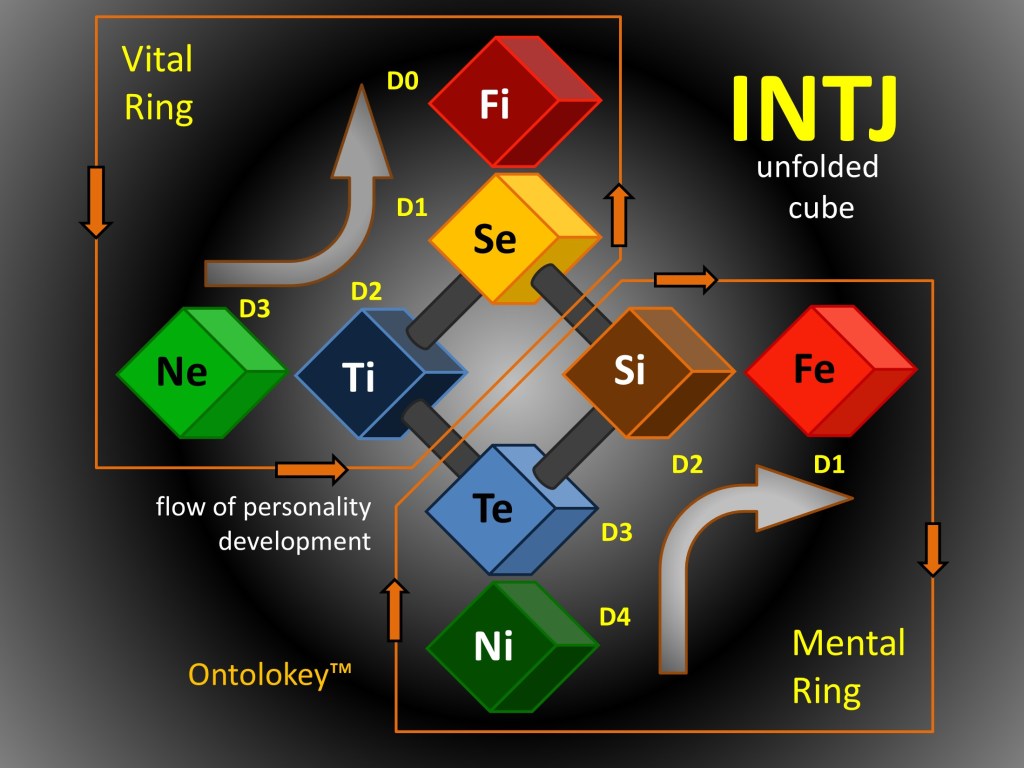
Within the Ontolokey model, the INTJ personality can be understood through the interaction of eight psychological functions, organized into two interconnected structures known as the Mental Ring and the Vital Ring. The Mental Ring comprises Introverted Intuition (Ni), Extraverted Thinking (Te), Introverted Sensing (Si), and Extraverted Feeling (Fe), while the Vital Ring comprises Extraverted Intuition (Ne), Introverted Thinking (Ti), Extraverted Sensing (Se), and Introverted Feeling (Fi). Each function represents a distinct mode of psychological engagement with reality, ranging from the recognition of underlying patterns and the organization of external circumstances to the interpretation of personal experience, the awareness of immediate sensations, and the navigation of emotional relationships. The developmental significance of this arrangement lies not merely in the presence of all eight functions, but in their unequal degrees of maturity and accessibility within the individual psyche. In the INTJ, Ni occupies the highest developmental position at D4, followed by Te at D3, whereas Si and Fe occupy D2 and D1 respectively; in the Vital Ring, Ne begins at D3, Ti occupies D2, Se D1, and Fi D0. These developmental designations provide a framework for understanding why certain psychological capacities feel natural and reliable to the INTJ, while others may appear unfamiliar, disproportionately demanding, or difficult to integrate into a stable sense of identity.
The distinction between the two rings is especially important because the INTJ’s conscious competence may conceal the degree to which other psychological capacities remain underdeveloped. The Mental Ring describes the primary sequence through which the personality organizes its conscious orientation, develops its established abilities, and gradually encounters increasingly vulnerable dimensions of its own psychological life. The Vital Ring introduces another developmental sequence in which less familiar modes of perception, reasoning, experience, and personal valuation become progressively accessible as the individual acquires the capacity to tolerate what previously felt confusing or threatening. In this framework, developmental levels are not simply measurements of intelligence or moral worth; they indicate the relative maturity, stability, and availability of a psychological function within the individual’s established personality structure. A function at D1 or D0 is therefore not evidence of a defective person, but an indication that the associated capacity may still operate in a relatively immature, reactive, or poorly differentiated manner. The central task is to establish a more conscious relationship with these dimensions without prematurely demanding that they perform at the level of the dominant function. Such a perspective shifts the objective of personal growth away from perfecting an already effective personality toward gradually developing the psychological capacities that its established strengths have not adequately cultivated.
3. The Developmental Principle: Why Integration Must Proceed Step by Step
The central developmental principle of the Ontolokey framework is that psychological integration proceeds sequentially, from a relatively mature function toward the next less developed function, rather than through arbitrary attempts to overcome the most uncomfortable vulnerability immediately. For the INTJ, this means that Ni at D4 provides the original foundation, while Te at D3 becomes the first major developmental task through which the dominant vision acquires practical expression, discipline, and effectiveness in the external world. Only when Te has become sufficiently mature and flexible can the individual meaningfully proceed toward the less familiar dimensions represented by Ne, Si, and the subsequent functions in their respective developmental sequences. The same principle applies within the Vital Ring, where the movement from Ne at D3 through Ti at D2 and Se at D1 eventually opens the way toward a more conscious relationship with Fi at D0. Attempting to force direct access to the most vulnerable function without developing the intermediate capacities may produce confusion, resistance, or a superficial imitation of psychological maturity, because the individual has not yet established the internal resources required to sustain the experience. Gradual integration therefore demands patience, observation, and a willingness to recognize that genuine change is often less dramatic than the conscious mind expects, unfolding instead through repeated encounters with previously neglected aspects of ordinary life.
This sequential approach also offers an important distinction between intellectual insight and psychological transformation. An INTJ may understand a psychological theory almost immediately, identify its internal logic, and formulate an elegant explanation of personal difficulties without necessarily changing the emotional patterns that sustain those difficulties. Conceptual understanding can illuminate the structure of a problem, but integration requires the individual to experience the relevant situation differently, recognize habitual defensive responses as they arise, and practice alternative forms of engagement until these become increasingly accessible. Developing Te, for example, involves more than improving productivity or becoming better at organizing people; it also requires learning when efficiency has become a defense against uncertainty, when control has displaced collaboration, and when a logically consistent decision fails to account for important human consequences. Similarly, beginning to recognize Ne requires a growing tolerance for possibilities that challenge an established interpretation, while developing Ti encourages the INTJ to examine the internal coherence of personal reasoning rather than relying exclusively on external effectiveness. Each developmental step thus prepares the psychological ground for the next, allowing the individual to approach deeper vulnerabilities with greater stability instead of turning self-development into another performance standard against which the self must be judged.
The First Developmental Task: From Introverted Intuition (Ni) to Extraverted Thinking (Te)
For the INTJ, the development of Extraverted Thinking (Te) represents the first essential movement from an internally organized vision toward an effective and consciously directed engagement with the external world. Ni, operating at D4 within the Mental Ring, seeks underlying patterns, anticipates consequences, and constructs an integrated understanding of reality, often long before the individual can fully articulate how a particular conclusion was reached. This capacity can create a powerful sense of direction, allowing the INTJ to recognize structural weaknesses, anticipate future developments, and formulate strategies that others may initially struggle to understand. Yet intuition alone cannot guarantee that an insight will translate into a workable outcome, because a compelling internal vision must still encounter practical constraints, competing interests, imperfect information, and the unpredictability of human behavior. Te, occupying D3, provides the organizational capacity through which Ni can be tested, communicated, implemented, and refined through observable results. The developmental task is therefore to transform intuitive certainty into effective action without confusing the internal coherence of a vision with proof that the vision is correct, learning to treat feedback not as a threat to intellectual authority but as information that can improve the original understanding.
The maturation of Te typically involves the development of planning, prioritization, accountability, and the capacity to coordinate external resources, but its deeper psychological significance emerges when the INTJ begins examining the emotional motives concealed within the pursuit of competence. The desire to establish order may arise from a genuine appreciation of efficiency, yet it can also become a strategy for avoiding helplessness, unpredictability, dependence, or the discomfort of not knowing what will happen next. When this defensive dimension remains unconscious, the INTJ may respond to uncertainty by increasing control, to disagreement by intensifying argument, and to emotional complexity by reducing the situation to a problem that can supposedly be solved through better procedures. Mature Te does not eliminate structure or decisiveness; instead, it distinguishes between situations that genuinely require intervention and those in which control has become an attempt to regulate internal anxiety through external arrangements. An important practical exercise is to examine difficult decisions from three perspectives: what the available evidence supports, what the desired outcome demands, and what emotional need may be influencing the urgency to act. By repeatedly making this distinction, the INTJ develops a form of competence that remains effective without becoming rigid, allowing intelligence to serve reality rather than requiring reality to conform to an established interpretation.
The First Signs of Individuation: Awakening the Vital Ring Through Extraverted Intuition (Ne)
Within the developmental sequence described by Ontolokey, the transition toward the Vital Ring becomes especially significant when Te has matured sufficiently to support the personality without requiring constant conscious supervision. Extraverted Intuition (Ne), positioned at D3 within the Vital Ring, introduces a complementary orientation that explores alternative interpretations, emerging possibilities, unexpected connections, and outcomes that cannot be fully contained within the dominant function’s existing vision. Whereas Ni tends to converge upon an underlying pattern and develop a coherent account of where events are leading, Ne expands the field of consideration, allowing several potential explanations or futures to remain open simultaneously. For an INTJ who has invested considerable psychological energy in constructing a reliable internal model of reality, this expansion can initially feel inefficient or destabilizing, particularly when alternative possibilities appear to undermine a carefully developed strategy. Yet the capacity to entertain possibilities without immediately selecting one of them represents an important movement toward psychological flexibility, because it loosens the unconscious identification between having a convincing interpretation and possessing the complete truth. The emerging individual learns that a vision can be meaningful without being final, and that uncertainty may contain information rather than merely represent an obstacle to be eliminated.
The deeper significance of Ne lies in its ability to interrupt the closed feedback loops through which the INTJ may unconsciously reinforce established assumptions. When Ni and Te operate without sufficient openness to alternative interpretations, an initial hypothesis can become the foundation of an increasingly elaborate system in which contradictory evidence is dismissed, other people’s motives are interpreted through a predetermined framework, and subsequent decisions appear to confirm the original conclusion. Ne creates room for another possibility: perhaps the situation has been misunderstood, perhaps another person possesses information that is not available to the INTJ, or perhaps an apparently irrational response makes sense within a different emotional or experiential context. Developing this function does not require abandoning discernment or treating every conceivable explanation as equally plausible; rather, it involves postponing premature closure long enough to investigate meaningful alternatives. In practical terms, the INTJ can cultivate Ne by deliberately generating several plausible interpretations before reaching a conclusion, engaging with unfamiliar disciplines, inviting disagreement from trusted people, and allowing exploratory activities to retain their value even when they produce no immediate result. As these practices become more natural, the personality gains a wider field of awareness, preparing the ground for the subsequent development of Introverted Thinking (Ti) and the deeper examination of how its own conclusions are constructed.
The Golden Shadow: Introverted Thinking (Ti) and the Examination of Inner Logic
Introverted Thinking (Ti), occupying D2 in the Vital Ring, introduces a form of analytical scrutiny that differs from the externally oriented effectiveness associated with Te. Although the INTJ is commonly comfortable with logical reasoning, the distinction between these functions becomes important when the individual must examine not merely whether a decision works, but whether the underlying conceptual structure is internally consistent, precisely defined, and free from assumptions that have escaped conscious examination. Te evaluates systems in relation to practical objectives, measurable outcomes, and the demands of the external environment, whereas Ti turns attention toward the logical architecture of the reasoning itself, examining definitions, causal relationships, conceptual boundaries, and contradictions that may remain hidden beneath an apparently successful result. In the Ontolokey framework, Ti as the Golden Shadow represents a less accessible but potentially valuable psychological capacity that can correct the INTJ’s tendency to identify effectiveness with correctness. A strategy may produce the intended result while relying on an incomplete explanation, and a system may appear efficient while concealing conceptual inconsistencies that will eventually undermine its stability. The development of Ti therefore invites the INTJ to become an investigator of personal assumptions rather than merely an architect of external solutions, learning to distinguish what has been demonstrated from what has simply become familiar or useful.
This inward examination becomes particularly important when intellectual competence has acquired a defensive function within the personality. An INTJ may construct an elaborate justification for a decision that was initially influenced by pride, fear of rejection, resentment, or an unacknowledged need to preserve autonomy, subsequently mistaking the sophistication of the explanation for evidence that its emotional origins are irrelevant. Ti can help expose weaknesses in such reasoning, but only when the individual is willing to apply the same standards of scrutiny to personal convictions that would ordinarily be applied to another person’s argument. The practical exercise is to identify the assumptions supporting an important judgment, define the terms being used, distinguish direct observations from interpretations, and consider what evidence would require the conclusion to be revised. This process can reveal that a belief once experienced as self-evident was actually sustained by selective attention or by the desire to protect a preferred identity. Mature Ti consequently contributes not only to greater intellectual precision but also to psychological humility, because the individual begins to recognize that the ability to explain a position does not necessarily establish its truth. By learning to tolerate the possibility of being mistaken without experiencing error as a fundamental injury to the self, the INTJ develops the internal stability necessary to approach the more vulnerable domains of immediate experience and personal feeling.
Returning to the Present: Extraverted Sensing (Se) and the Recovery of Embodied Life
Extraverted Sensing (Se), positioned at D1 within the Vital Ring, represents a particularly important developmental challenge for the INTJ because it directs attention toward the immediate, tangible reality that can easily become secondary to an internally constructed vision of the future. The dominant Ni naturally searches for meaning, anticipates consequences, and interprets present circumstances in relation to larger patterns, while Te seeks to organize those circumstances in the service of defined objectives. This orientation can make the INTJ remarkably effective at long-range planning, yet it may also encourage a habitual postponement of direct experience, as though the present were merely a transitional stage that must be managed until a more desirable future arrives. Se introduces a different psychological demand: to perceive what is actually happening now, to register sensory information without immediately subordinating it to an interpretation, and to participate in the world without requiring every experience to justify itself through productivity or strategic significance. In the Ontolokey developmental framework, Se at D1 is not an absence of sensory ability, but a comparatively vulnerable capacity for spontaneous engagement with immediate circumstances. Its integration therefore begins with the recognition that reality is not exhausted by the meanings assigned to it, and that an individual can understand a situation intellectually while remaining insufficiently present to the experience itself.
When Se remains poorly integrated, the INTJ may become so invested in anticipation and analysis that the body is treated primarily as an instrument for achieving objectives rather than as an indispensable source of information about psychological well-being. Fatigue may be ignored until it becomes debilitating, physical tension may remain unnoticed while attention is absorbed in a problem, and ordinary pleasures may be postponed because they appear less important than a future achievement. In interpersonal situations, the same tendency can lead the INTJ to focus on the presumed implications of a conversation rather than the actual tone, facial expressions, gestures, and changing emotional atmosphere through which the other person is communicating. Developing Se requires a gradual restoration of direct contact with these immediate realities through activities that cultivate sensory awareness, such as walking without a predetermined destination, preparing food attentively, engaging in physical exercise, or observing the surroundings without converting every observation into an analytical conclusion. The purpose is not to suppress Ni or abandon long-term thinking, but to allow immediate experience to correct and enrich the internal model of reality. As Se becomes more accessible, the INTJ can discover that presence does not diminish intellectual depth; it gives that depth a living foundation, enabling the individual to respond to the world as it unfolds rather than exclusively to the future anticipated by the mind.
The Deepest Blind Spot: Introverted Feeling (Fi) and the Vulnerability of Personal Values
Within the Ontolokey model, Introverted Feeling (Fi) occupies D0 in the Vital Ring and represents the most developmentally vulnerable function in the INTJ’s configuration. This designation points toward a comparatively immature or insufficiently differentiated relationship with personal values, emotional authenticity, and the private experience of what matters deeply to the individual. Fi concerns neither emotional intensity alone nor the ability to recognize that feelings exist; it involves the capacity to understand the personal significance of those feelings, distinguish one’s own values from external expectations, and remain in contact with an inner sense of integrity even when no immediately defensible logical explanation is available. For the INTJ, whose conscious identity may be strongly organized around Ni’s vision and Te’s effectiveness, this dimension can remain difficult to articulate because emotional experience is often approached through interpretation, evaluation, or problem-solving rather than encountered directly. The individual may know precisely what should be done while remaining uncertain about what is personally painful, what feels deeply meaningful, or why a seemingly insignificant interaction has produced a disproportionate emotional response. The resulting difficulty is not necessarily an absence of feeling, but a limited capacity to recognize, tolerate, and interpret the personal significance of feeling before it becomes entangled with defensive reasoning.
The shadow side of Fi can become visible when emotions that have not been consciously acknowledged begin influencing judgments, relationships, and decisions indirectly. The INTJ may experience an intense reaction to perceived incompetence, betrayal, unfairness, or disrespect while explaining that reaction exclusively in terms of objective standards, even when a more personal wound lies beneath the surface. Alternatively, the individual may dismiss emotional needs as irrelevant, only to discover that prolonged self-neglect has produced resentment, isolation, or an unexpected loss of motivation. Because these experiences can conflict with an established self-image of rational independence, the resulting vulnerability may be defended against through intellectualization, withdrawal, rigid standards, or an insistence that personal feelings must be justified before they deserve consideration. The developmental task is to learn that an emotion can be acknowledged without being treated as an objective verdict, and that understanding its origin does not require obeying every impulse it generates. A useful practice is to ask what an experience meant personally before determining what should be done about it, distinguishing the observable event from the emotional interpretation and the underlying value or need that may have been affected. Through this process, Fi gradually becomes less of an unconscious source of disproportionate reactions and more of a conscious capacity for personal integrity, compassion, and emotionally informed choice.
The integration of Fi also changes the INTJ’s relationship with other people because it makes room for the recognition that emotional reality cannot always be reduced to a problem requiring a correct solution. When someone expresses distress, the instinctive response may be to identify the cause, explain the underlying mechanism, and propose an effective remedy, yet this approach can inadvertently communicate that the person’s emotional experience is merely an obstacle to be removed. Developing a more mature relationship with feeling involves learning to remain present with another person’s pain without immediately correcting it, acknowledging that understanding an emotion and resolving its practical cause are related but distinct processes. The same principle applies inwardly: self-compassion does not require abandoning accountability, and accepting one’s limitations does not mean refusing to change them. Rather, the individual begins to recognize that the self must be understood as a whole, including those experiences that cannot be transformed into competence, achievement, or intellectual certainty. When Fi becomes more consciously accessible, the INTJ can preserve independence without emotional isolation, maintain standards without contempt, and pursue meaningful goals without sacrificing the personal values that originally gave those goals significance.
The Mental Ring’s Vulnerable Dimensions: Introverted Sensing (Si) and Extraverted Feeling (Fe)
The development of Introverted Sensing (Si) at D2 within the Mental Ring introduces another important dimension of psychological integration by directing attention toward remembered experience, personal continuity, familiar patterns, and the accumulated information contained in the individual’s lived history. While Ni seeks overarching patterns and anticipates future developments, Si can help the INTJ recognize what has actually occurred over time, including repeated bodily signals, established routines, specific details, and the concrete consequences of earlier decisions. Without a sufficiently conscious relationship with this dimension, the INTJ may privilege a compelling interpretation of the future over evidence contained in past experience, overlooking recurring interpersonal difficulties because each new situation appears conceptually distinct. Si encourages a more grounded examination of personal history, allowing the individual to distinguish between a genuinely new problem and a familiar pattern that has merely acquired a different appearance. Its development does not require the INTJ to become rigidly attached to tradition or habitual behavior; instead, it offers a more reliable relationship with continuity, helping intuition benefit from the accumulated evidence of experience rather than treating every situation primarily as a new problem to be solved.
The practical integration of Si begins with a willingness to observe the details that the strategic mind may ordinarily overlook, including recurring sources of exhaustion, the circumstances under which concentration deteriorates, the consequences of particular working habits, and the patterns that repeatedly emerge in close relationships. Keeping a record of experiences and outcomes can help the INTJ identify discrepancies between anticipated consequences and actual results, while establishing sustainable routines can reduce the unnecessary cognitive effort involved in repeatedly managing ordinary responsibilities. More deeply, Si can support the recognition that personal history is not simply a collection of mistakes to be corrected or achievements to be surpassed, but a source of information about the conditions under which the individual thrives, struggles, and develops. Past disappointments can then be examined without allowing them to dictate future expectations, while positive experiences can be preserved as evidence that stability and familiarity may sometimes provide the foundation for growth rather than obstruct it. As this function becomes more integrated, the INTJ gains a more balanced relationship with time, allowing the past to inform the present, the present to test the future, and the future to remain open to revision.
Extraverted Feeling (Fe), positioned at D1 within the Mental Ring and described in the Ontolokey framework as the Toddler function, presents a different challenge because it concerns the interpersonal emotional field: the recognition of shared feelings, social signals, relational expectations, and the effects one’s behavior has on the emotional experience of others. For an INTJ who naturally prioritizes conceptual clarity and effective outcomes, the conventions through which people communicate belonging, reassurance, appreciation, and emotional solidarity may appear indirect or unnecessarily complicated. The individual may assume that loyalty is sufficiently demonstrated through practical assistance, that honesty should be appreciated regardless of delivery, or that a well-reasoned explanation should resolve a disagreement even when the other person first needs acknowledgment of the injury experienced. Yet emotional communication is not merely an ornamental addition to rational interaction; it is one of the ways human beings establish trust, coordinate expectations, and repair relational ruptures. The Toddler designation emphasizes the possibility that Fe-related difficulties may emerge with disproportionate sensitivity, defensive reactions, or a lack of practiced skill when interpersonal harmony and emotional recognition become important. Developing Fe therefore requires the INTJ to learn how to recognize the emotional impact of words and actions, communicate appreciation explicitly, listen without immediately correcting, and acknowledge another person’s experience without automatically accepting every interpretation of it.
The vulnerability associated with Fe becomes especially significant when an INTJ’s apparent emotional detachment conceals a strong but insufficiently understood sensitivity to interpersonal rejection, embarrassment, or the loss of respect. An individual who believes that other people’s opinions should not matter may nevertheless react intensely when criticized, excluded, misunderstood, or confronted with evidence that a valued relationship has deteriorated. If this sensitivity remains unconscious, it may be defended against through withdrawal, sarcasm, excessive self-reliance, or the conviction that emotional distance demonstrates strength. The path toward integration is not to seek universal approval or sacrifice personal judgment for the sake of harmony, but to develop enough emotional awareness to recognize when a relationship has been affected and to participate consciously in repairing it. This can involve asking how a statement was received, acknowledging unintended harm without arguing immediately about intentions, and expressing personal needs before frustration becomes resentment. As Fe matures, the INTJ becomes better able to distinguish genuine incompatibility from avoidable misunderstanding, discovering that emotional responsiveness need not compromise intellectual independence. Instead, it enables the individual to bring clarity and honesty into relationships in a manner that preserves both personal integrity and the dignity of others.
The INTJ’s Deepest Shadow: The Tyranny of Inner Certainty
The deepest shadow of the INTJ emerges when the capacity to perceive underlying patterns becomes inseparable from the conviction that those patterns have been understood correctly. Ni can generate an extraordinarily coherent interpretation of a person, a relationship, or an unfolding situation, and Te can then construct an effective strategy around that interpretation, producing a self-reinforcing combination of insight and action. The difficulty begins when the individual no longer distinguishes between an intuitive conclusion and the evidence that would justify treating it as reliable, allowing an internally persuasive explanation to acquire the status of unquestionable reality. Under these conditions, the INTJ may become increasingly resistant to contradictory information, interpreting disagreement as evidence that others have failed to understand the situation rather than as a reason to reconsider the original assessment. What initially appears to be intellectual independence can gradually become a closed psychological system in which every new observation is filtered through an established narrative, and even genuine mistakes are absorbed into explanations that preserve the individual’s sense of being right. The resulting shadow is not intelligence itself, but the defensive use of intelligence to protect the self from uncertainty, correction, and the unsettling possibility that an important part of reality has remained unseen.
This defensive certainty can affect relationships with particular intensity because the INTJ may believe that accurately understanding another person’s behavior grants sufficient grounds for judging that person’s motives. Once an internal interpretation has become established, subsequent actions may be evaluated according to the presumed pattern rather than encountered with genuine openness to new information. A partner’s hesitation may be interpreted as evidence of unreliability, a colleague’s disagreement as proof of incompetence, or a friend’s emotional reaction as confirmation that the person is incapable of rational discussion, even when other explanations remain plausible. The INTJ may then withdraw emotionally or impose stricter boundaries without recognizing how much the decision depends upon an untested assumption. Such behavior can create a painful paradox: the individual seeks relationships characterized by honesty, loyalty, and intellectual depth, yet the very mechanisms intended to protect these values may prevent others from being understood on their own terms. The developmental challenge is to recognize that an interpretation, however sophisticated, remains an interpretation, and that understanding another person requires a willingness to revise one’s conclusions when their lived experience does not fit the existing model.
Another expression of the INTJ shadow appears when independence becomes a defense against vulnerability and the need for connection is reinterpreted as weakness. The capacity to function alone can be a genuine strength, enabling the individual to work without constant reassurance and to remain committed to personal convictions despite external pressure. However, when autonomy becomes an absolute requirement, accepting help may feel like surrendering control, expressing uncertainty may seem humiliating, and emotional dependence may be confused with a loss of freedom. The individual may consequently cultivate an image of self-sufficiency that conceals unacknowledged needs for recognition, affection, reassurance, or belonging. When these needs remain unspoken, disappointment can accumulate because other people are expected to recognize what the INTJ has difficulty admitting even to themselves. The movement toward wholeness begins when independence is no longer measured by the absence of need, but by the ability to acknowledge needs consciously and decide how to respond to them without surrendering personal agency. True psychological autonomy includes the freedom to depend on others appropriately, to admit uncertainty without humiliation, and to remain emotionally present even when an interaction cannot be controlled or resolved through reasoning.
The Hidden Cost of Perfectionism, Control, and Emotional Withdrawal
Perfectionism in the INTJ often develops from a combination of high internal standards, future-oriented thinking, and a strong desire to prevent avoidable errors. When these tendencies are integrated constructively, they support careful planning, intellectual discipline, and the pursuit of excellence, allowing the individual to produce work of considerable depth and quality. Yet the same orientation can become psychologically costly when the desire to improve a result turns into an inability to tolerate the ordinary limitations of human performance. The INTJ may repeatedly revise a project that is already adequate, postpone action until uncertainty has been reduced to an unrealistic degree, or judge personal worth according to standards that continually move beyond what has been achieved. Beneath this pattern may lie an unacknowledged fear that imperfection will expose incompetence, invite criticism, or undermine an identity built around being capable and prepared. The result is that a strength intended to support meaningful accomplishment becomes a source of chronic internal pressure, making satisfaction increasingly difficult because every achievement immediately reveals another deficiency that must be corrected. Development requires learning to distinguish the pursuit of excellence from the pursuit of psychological invulnerability, recognizing that some errors are unavoidable, some decisions must be made with incomplete information, and some valuable experiences are lost when life is postponed until everything has been optimized.
Control can become similarly problematic when the INTJ uses planning and organization not only to manage external complexity but also to regulate emotions that feel difficult to tolerate. Faced with ambiguity, interpersonal conflict, or an unpredictable change of circumstances, the individual may respond by developing more elaborate explanations, stricter procedures, or increasingly detailed plans, hoping that sufficient intellectual effort will eliminate the discomfort associated with uncertainty. Although this response can produce temporary relief, it may also reinforce the underlying belief that uncertainty itself is intolerable and that emotional security depends upon anticipating every possible outcome. When reality inevitably resists these efforts, frustration can turn into impatience, criticism, or withdrawal, especially when other people introduce variables that cannot be incorporated into the preferred system. The more deeply the INTJ identifies with being the person who sees ahead and understands what must be done, the more threatening it may become to acknowledge that some circumstances cannot be controlled and some problems cannot be solved immediately. A more integrated approach involves identifying which elements of a situation can realistically be influenced, which require negotiation, and which must be accepted without surrendering responsibility for one’s own choices. By learning to remain psychologically stable in the presence of unresolved circumstances, the INTJ gradually replaces compulsive control with deliberate agency and discovers that flexibility can strengthen, rather than weaken, effective action.
Emotional withdrawal frequently completes this defensive pattern because distance can offer immediate relief from situations in which reasoning alone cannot restore a sense of order. When a conversation becomes emotionally charged, the INTJ may retreat into analysis, reduce communication, or conclude that further engagement is pointless, particularly when the other person expresses feelings in a manner that appears inconsistent or difficult to interpret. From the individual’s perspective, this withdrawal may seem like a rational refusal to participate in unproductive conflict, yet from the perspective of the other person it may communicate indifference, rejection, or punishment through silence. The INTJ may then interpret the resulting distance as confirmation that relationships are unreliable or excessively demanding, overlooking the contribution of their own defensive response to the deterioration of trust. Integration requires the capacity to recognize when a temporary pause is genuinely constructive and when withdrawal is being used to avoid vulnerability, accountability, or the discomfort of being misunderstood. It also requires learning to return to difficult conversations after emotions have settled, communicating what was experienced internally and listening to the other person’s account without assuming that disagreement must be resolved through intellectual victory. In this way, emotional presence becomes a practiced capacity rather than a demand to abandon reason, allowing the INTJ to remain both clear-minded and relationally available when circumstances become difficult.
The Ontolokey Cube as a Map for Conscious Development
The Ontolokey Cube offers a visual way to understand the relationship between the INTJ’s established strengths and the psychological functions that require greater awareness and development. By representing the eight functions within a three-dimensional structure, the model turns an abstract arrangement into a spatial landscape that can be explored through the relationships between its different positions. Its developmental value lies in helping the individual recognize that the personality is not defined exclusively by the functions that feel most familiar, but also by the less accessible capacities that may influence behavior without being fully understood. For the INTJ, the Mental Ring provides a sequence beginning with Ni at D4 and proceeding through Te at D3, Si at D2, and Fe at D1, while the Vital Ring follows the progression from Ne at D3 through Ti at D2 and Se at D1 to Fi at D0. The sliders associated with the cube can serve as a practical reminder of the direction in which attention may be turned, helping the individual visualize developmental priorities instead of treating every perceived weakness as an equally urgent problem. The model thus becomes most useful when it encourages sustained self-observation, offering a structured way to ask which psychological capacities are already well established, which remain comparatively vulnerable, and what intermediate development may be needed before a deeper challenge can be approached constructively.
Used as an instrument of reflection, the cube can help transform vague dissatisfaction into a more specific inquiry into recurring patterns of thought, feeling, and behavior. An INTJ who repeatedly experiences interpersonal misunderstandings, for example, might examine whether the difficulty involves premature certainty in Ni, excessive reliance on practical logic in Te, insufficient attention to concrete relational experience in Si, or a vulnerable response to emotional expectations associated with Fe. These possibilities need not be treated as mutually exclusive explanations; rather, the model encourages the individual to investigate the sequence through which a difficulty develops, from the initial perception of a situation to the subsequent interpretation, emotional response, and outward behavior. The same approach can be applied to the Vital Ring by examining whether alternative possibilities are dismissed too quickly, whether internal reasoning is being used to defend a preferred conclusion, whether immediate sensory information is being overlooked, or whether personal values and emotional needs remain difficult to articulate. The aim is not to force every experience into a predetermined functional category, but to develop a more differentiated vocabulary for observing the self and identifying useful avenues for reflection. In this sense, the cube becomes a developmental companion: a reminder that psychological growth is not achieved by attacking the weakest part of the personality directly, but by building the awareness and stability necessary for each successive step.
The most productive way to use Ontolokey is therefore to combine its visual structure with regular reflection on actual experiences rather than allowing the model to become another intellectual system that the INTJ masters without personally changing. A brief journal entry after a difficult interaction might record what happened, what the individual initially assumed, what was felt but not expressed, what evidence supported the interpretation, and what alternative explanation might deserve consideration. Over time, such observations can reveal recurring patterns that are difficult to recognize while the individual remains absorbed in the immediate demands of a situation. The cube can then help organize these observations into a developmental sequence, encouraging attention to the function most relevant to the current difficulty while preserving the principle that deeper integration depends upon prior development. The objective is not to achieve an idealized state in which every function becomes equally effortless, nor to replace individuality with a standardized model of psychological maturity. It is to cultivate an increasingly conscious relationship with the whole personality, so that strengths can be used deliberately, vulnerabilities can be approached without shame, and previously neglected capacities can become sources of understanding rather than recurring obstacles to growth.
The Second Half of Life: The Turning of the Inner Iceberg
The process of individuation becomes particularly significant when the INTJ begins to recognize that the capacities responsible for earlier success may no longer be sufficient to meet the psychological demands of a changing life. In the first decades of adulthood, the development of Ni and Te can provide a powerful foundation for establishing independence, building a career, mastering complex subjects, and constructing a coherent sense of personal direction. These achievements are important because they enable the individual to establish a functional relationship with the external world, but they can also strengthen an identity that depends heavily on competence, foresight, and the ability to maintain control. As life progresses, experiences such as intimate relationships, professional disappointments, changing responsibilities, personal losses, and the limitations of achievement may expose dimensions of existence that cannot be adequately understood through strategic thinking alone. The individual may discover that intellectual clarity does not automatically resolve emotional pain, that independence does not eliminate the need for connection, and that a carefully designed future cannot protect against every form of uncertainty. Within the Ontolokey developmental narrative, these encounters can mark the beginning of a deeper phase of psychological development in which attention gradually shifts from perfecting the established personality toward recognizing and integrating the capacities that have remained outside its preferred field of awareness.
The image of an iceberg provides a useful metaphor for understanding this gradual expansion of consciousness. The portion visible above the water represents the aspects of personality most readily recognized and consciously employed, while the much larger submerged portion symbolizes the experiences, reactions, sensitivities, and psychological capacities that remain less accessible to direct awareness. For the INTJ, the dominant Ni and the increasingly developed Te may initially define much of the visible structure, giving the individual a strong sense of direction and an effective means of organizing experience. As development proceeds, however, previously neglected dimensions begin to exert a greater influence on conscious life, sometimes appearing through emotional reactions, recurring relationship conflicts, unexpected changes in priorities, or an increasing dissatisfaction with patterns that once seemed entirely adequate. The metaphorical iceberg does not turn because the individual consciously decides to abandon the old personality, but because sustained experience and reflection gradually change the relationship between conscious identity and the less familiar regions of the self. The developmental aim is to bring more of this submerged material into awareness, allowing the individual to recognize how earlier defenses were formed, why particular situations remain sensitive, and which capacities must be cultivated to respond to life more freely.
The second half of life can therefore be understood as an opportunity to reconsider the meaning of success, maturity, and personal identity. The INTJ may begin by asking whether familiar achievements still express deeply held values or whether they have become ways of maintaining an identity that no longer accommodates the full range of personal experience. Questions that once seemed secondary can acquire new importance: whether relationships provide genuine intimacy, whether work remains meaningful beyond recognition and performance, whether emotional needs have been acknowledged, and whether the individual can tolerate being imperfect without experiencing a loss of self-respect. In the developmental sequence described by Ontolokey, the Vital Ring becomes increasingly relevant as the individual explores alternative perspectives, examines personal reasoning, reconnects with immediate experience, and gradually develops a more conscious relationship with private values. This process may involve periods of uncertainty because established ways of understanding the self are being expanded rather than simply reinforced. Yet such uncertainty can also create the conditions for a more mature identity, one that preserves the strengths of the earlier personality while allowing previously excluded dimensions to participate in the individual’s decisions, relationships, and understanding of what makes life worthwhile.
Cognitive Self-Healing: Understanding the Origins of Psychological Wounds
One of the most meaningful possibilities offered by the integration of psychological functions is the capacity to reinterpret painful experiences through a more comprehensive understanding of oneself. Many recurring difficulties are sustained not only by what happened, but also by the meanings subsequently assigned to the experience, the defensive strategies developed in response, and the assumptions that remain unexamined over time. An INTJ who has been criticized harshly, for example, may conclude that emotional openness invites exploitation, that dependence inevitably compromises autonomy, or that personal worth must be demonstrated through competence. These conclusions can initially function as protective adaptations, helping the individual avoid situations that resemble an earlier injury, but they may eventually restrict the possibility of forming trusting relationships or responding flexibly to new circumstances. As the less developed functions become more consciously accessible, the individual can begin to distinguish the original event from the interpretation formed around it, recognizing how a particular vulnerability influenced the response and why the resulting defense once appeared necessary. This process can support cognitive self-healing by replacing an unquestioned personal narrative with a more differentiated understanding of what occurred, what was beyond the individual’s control, and what choices remain available in the present.
For the INTJ, the integration of Fe and Fi is particularly relevant when earlier experiences have involved rejection, humiliation, emotional misunderstanding, or the perception that personal feelings were not taken seriously. A vulnerable Fe may contribute to difficulties interpreting interpersonal signals or responding constructively to emotional tension, while a less developed Fi may make it difficult to identify the personal values, attachments, and sensitivities affected by an interaction. When these functions remain insufficiently understood, the individual may respond to pain through intellectual distancing, rigid judgments, or a withdrawal into self-sufficiency, thereby protecting against immediate vulnerability while leaving the underlying experience unresolved. Cognitive reflection can gradually illuminate this sequence by helping the INTJ identify what happened, what was felt, what was assumed about the other person’s intentions, and what personal significance made the experience particularly painful. Such understanding can create room for a different response, allowing the individual to recognize a genuine injury without generalizing it into a permanent judgment about all relationships or about personal worth. The resulting self-healing lies not in explaining away the pain, but in understanding its origins sufficiently well that the experience no longer has to govern present behavior through unconscious repetition.
Forgiveness may become more accessible through this process because a broader understanding of psychological differences can reduce the tendency to interpret every hurtful interaction as evidence of deliberate malice. Another person may have acted from insecurity, limited emotional awareness, conflicting priorities, or an inability to communicate effectively, while the INTJ may have contributed to a misunderstanding through premature conclusions, excessive detachment, or an unspoken expectation that others should intuitively understand what was needed. Recognizing these possibilities does not require denying responsibility, excusing harmful behavior, or restoring relationships that remain unsafe or destructive. Rather, it allows the individual to separate an understanding of the causes of behavior from a judgment about whether that behavior should be accepted. Forgiveness of oneself can follow a similar path: the INTJ may begin to recognize that earlier decisions were made using the awareness, resources, and emotional capacities available at the time, even when those decisions produced consequences that are now regretted. This recognition can support accountability without perpetual self-punishment, enabling the individual to learn from the past while directing attention toward the choices that remain possible. Where painful experiences continue to produce severe distress or persistent difficulties, structured psychological support may also help complement this reflective process, ensuring that insight develops alongside the emotional resources needed to integrate what has been understood.
Practical Integration: Turning Insight Into a Daily Developmental Practice
The transition from intellectual understanding to lived psychological change requires a deliberate practice that connects abstract insights with recurring situations in everyday life. For the INTJ, a useful starting point is to observe moments in which a familiar strength becomes disproportionately rigid: when analysis turns into rumination, when planning becomes an attempt to eliminate uncertainty, when standards become intolerant of ordinary mistakes, or when emotional distance replaces necessary communication. Rather than immediately judging these reactions as personal failures, the individual can examine what preceded them, what outcome was being pursued, and what discomfort the response may have been intended to prevent. This method allows the dominant Ni to identify patterns while inviting Te to organize observations into practical experiments, creating a bridge between the personality’s established strengths and its less developed capacities. A written record can be particularly useful when it distinguishes observable events from interpretations, emotional responses, and subsequent actions, because this separation makes it easier to recognize where assumptions entered the sequence. Over time, repeated observation can reveal not only the situations that trigger defensive behavior, but also the intermediate developmental steps needed to respond differently.
The Mental Ring and the Vital Ring can then be used as complementary guides for choosing appropriate developmental exercises. When the INTJ’s principal difficulty involves ineffective implementation or excessive control, attention may first return to the maturation of Te, including the capacity to prioritize realistically, delegate appropriately, and revise plans in response to new evidence. When this foundation is sufficiently established, the individual can increasingly explore Ne by considering alternative explanations, Ti by examining the internal consistency of personal reasoning, and Se by strengthening awareness of immediate circumstances and bodily experience. Si can support this process by identifying recurring patterns in personal history, while Fe and Fi invite a more conscious relationship with interpersonal emotions and private values. The essential principle is to select a manageable next step rather than attempting to transform every aspect of the personality simultaneously, since ambitious self-improvement projects can themselves become expressions of the perfectionism that development is intended to soften. Progress is better assessed through observable changes in behavior, such as recovering more quickly after criticism, listening more patiently during disagreement, recognizing fatigue before exhaustion, or acknowledging a personal need without immediately dismissing it. These changes may appear modest, but their cumulative effect can be substantial when they gradually alter the way the individual responds to the ordinary challenges of life.
A sustainable developmental practice should also include periods of rest, reflection, and non-instrumental experience, because the pursuit of wholeness can otherwise become another demanding objective organized around achievement. The INTJ may be tempted to approach individuation as a complex project that requires comprehensive analysis, measurable progress, and eventual mastery, thereby reproducing the same relationship with control that initially made deeper integration necessary. Yet some psychological capacities develop through experiences that cannot be forced into a strict timetable, including the gradual building of trust, the willingness to remain present during emotional uncertainty, and the discovery of personal values through lived experience. It is therefore useful to allow reflection to coexist with play, creativity, physical activity, and relationships in which the individual does not need to demonstrate exceptional competence. These experiences provide opportunities to encounter aspects of the self that are not defined by productivity or strategic achievement, while also allowing new insights to become embodied in ordinary habits. The aim is not to abandon discipline, but to establish a more balanced form of discipline that supports psychological development without turning the entire process into another test of personal worth.
Integration in Relationships: From Intellectual Understanding to Emotional Presence
The ultimate significance of psychological integration becomes particularly visible in the INTJ’s closest relationships, where the limitations of purely intellectual understanding are often revealed most clearly. The ability to anticipate another person’s behavior, recognize recurring patterns, and formulate convincing explanations may create an impression of deep understanding, yet genuine intimacy requires something more than accurate interpretation. It requires the willingness to encounter another person as an independent psychological reality whose experiences cannot always be predicted, categorized, or reconciled with one’s own expectations. For the INTJ, this means learning to distinguish between understanding why someone feels a certain way and allowing that person’s feelings to be expressed without immediately evaluating their rationality. The development of Fe supports emotional responsiveness, while Fi encourages a more direct recognition of personal attachment, vulnerability, and values, allowing the individual to acknowledge both sides of an interpersonal encounter. As these capacities become more integrated, relationships can become less dependent on the INTJ’s ability to solve problems and more grounded in mutual recognition, emotional honesty, and the freedom to remain different without becoming adversaries.
An essential part of this transformation is the willingness to communicate vulnerability before it becomes disguised as criticism, indifference, or withdrawal. When the INTJ feels misunderstood, the instinctive response may be to explain the situation more precisely, demonstrate the inconsistency in another person’s reasoning, or retreat until the emotional disturbance has subsided. Although taking time to reflect can be constructive, repeated reliance on these strategies may prevent the other person from discovering what actually matters to the INTJ beneath the analytical response. A more integrated approach involves expressing the personal experience directly, perhaps acknowledging disappointment, uncertainty, hurt, or the need for reassurance without immediately attempting to justify those feelings through an elaborate argument. This does not mean that every emotional reaction should determine the outcome of a disagreement, but that emotions should be recognized as relevant information about the relationship rather than excluded until they can be translated into logical propositions. By learning to remain engaged during uncomfortable conversations, the INTJ gradually discovers that vulnerability need not diminish respect or autonomy; it can create the conditions in which trust becomes possible and differences can be addressed without threatening the relationship itself.
Forgiveness and relational repair also become more attainable when the INTJ recognizes the difference between intention, impact, and responsibility. A person may intend to be helpful while communicating in a manner that feels dismissive, just as an INTJ may intend to be honest while delivering a judgment that leaves another person feeling diminished. Understanding the intention can prevent unnecessary assumptions about malice, but it does not erase the impact or eliminate the need to take responsibility for one’s actions. Likewise, acknowledging that another person has caused genuine harm does not require accepting that person’s explanation or allowing the same behavior to continue indefinitely. Psychological maturity involves holding these distinctions together, recognizing complexity without using complexity to evade accountability. Through the gradual integration of Ni, Te, Si, Fe, Ne, Ti, Se, and Fi, the INTJ can develop a more flexible understanding of human behavior in which insight is balanced by humility, honesty by consideration, and independence by the capacity for meaningful connection. The resulting relationships need not be free from conflict; rather, they become more capable of surviving conflict without reducing either person to a fixed interpretation of who they are.
The Emergence of the Whole Self: Beyond the Limitations of the Established Personality
The ultimate goal of individuation, as understood within the Ontolokey developmental framework, is not to replace the INTJ personality with a different personality type, but to expand the original personality until its less developed dimensions can participate more fully in conscious life. Ni remains the dominant function, preserving the ability to perceive underlying patterns, envision future possibilities, and seek coherent meaning, while Te continues to provide the practical intelligence required to organize intentions and achieve meaningful objectives. What changes is the relationship between these established strengths and the other psychological functions, which gradually become less threatening, less mysterious, and more available as complementary resources. Si can contribute continuity and grounded awareness of experience, Fe can support emotional communication and relational sensitivity, Ne can expand the field of possibilities, Ti can refine internal reasoning, Se can restore contact with immediate reality, and Fi can clarify the personal values that give direction to individual choices. The personality becomes more integrated not because its original hierarchy disappears, but because its dominant functions no longer need to exclude or suppress the capacities that seem less compatible with its established identity. Within this understanding, wholeness means that a greater proportion of the individual’s psychological life can be acknowledged, understood, and consciously directed rather than remaining outside awareness until it emerges through conflict or distress.
The metaphorical completion of the iceberg’s rotation captures this developmental possibility by imagining that what once remained submerged gradually becomes visible, allowing the individual to recognize a larger proportion of the self that was always present but not fully understood. In the Ontolokey narrative, the return of the dominant function to its prominent position after this symbolic rotation represents a renewed encounter with the original personality, now informed by a broader awareness of its own psychological structure. The INTJ may still prefer solitude, abstract thinking, strategic planning, and intellectually demanding pursuits, yet these preferences no longer need to function as defenses against every experience that does not conform to them. Emotional sensitivity can be acknowledged without being mistaken for weakness, uncertainty can be tolerated without provoking an immediate need for control, and spontaneous experience can be appreciated without requiring a measurable outcome. The individual becomes increasingly capable of recognizing when a familiar strength is appropriate and when a less familiar capacity is needed, allowing psychological flexibility to replace the compulsion to respond to every situation in the same established way. The metaphor of rebirth therefore refers not to the destruction of the earlier personality, but to the possibility of inhabiting it more consciously, with greater freedom to choose how its strengths and vulnerabilities are expressed.
This transformation also changes the INTJ’s understanding of personal identity because the individual begins to recognize that the self is not identical with any single function, achievement, interpretation, or defensive strategy. The belief that one must always be competent, rational, independent, and prepared may gradually give way to a more spacious understanding in which competence remains valuable without becoming the sole measure of worth. Mistakes can become opportunities for learning rather than threats to identity, emotions can become sources of information rather than disturbances to be eliminated, and relationships can provide opportunities for mutual discovery rather than tests of compatibility with a predetermined model. Such development does not imply permanent freedom from conflict, nor does it guarantee that every psychological wound can be resolved through reflection alone. Rather, it describes an increasingly conscious capacity to encounter difficulty without automatically repeating the same patterns of avoidance, control, or self-judgment. The whole self emerges through the repeated willingness to recognize what is present, acknowledge what has been excluded, and respond to experience with greater awareness than was previously possible.
A Lifelong Commitment to Wholeness and Healing
The developmental journey described throughout this essay begins with the recognition that the INTJ’s greatest strengths and deepest vulnerabilities are not necessarily separate aspects of the personality, but may be closely connected expressions of the same psychological organization. The capacity to anticipate future developments can become rigid certainty, intellectual independence can become emotional isolation, and the pursuit of excellence can become an inability to accept ordinary human limitations. Conversely, the same intelligence that once sustained these defenses can become the instrument through which they are recognized, examined, and gradually transformed. The progression through the Mental Ring and the Vital Ring offers a structured way of approaching this work, beginning with the consolidation of established abilities and continuing toward increasingly vulnerable dimensions of experience. Its essential discipline is patience: the recognition that deeper integration depends upon sufficient development of the capacities that precede it, and that meaningful psychological change cannot be forced simply because the individual understands what ought to change. Each step provides the foundation for the next, allowing awareness to develop alongside practical experience and enabling insights to become increasingly visible in everyday decisions, emotional responses, and relationships.
For the INTJ, the commitment to wholeness ultimately means accepting that the search for truth must include truths about the self that are not always comfortable, flattering, or easily reconciled with an established identity. It means investigating the emotional needs beneath the desire for control, the vulnerabilities beneath apparent indifference, the personal values beneath strongly defended opinions, and the limitations concealed by intellectual certainty. It also means recognizing the strengths that have made survival, achievement, and independence possible, rather than treating earlier adaptations as enemies that must be defeated. The purpose of integration is to understand why these adaptations developed, where they remain useful, and where they now prevent a fuller engagement with life. Through this process, the INTJ can learn to combine clarity with compassion, discipline with flexibility, and independence with the courage to be emotionally present. Healing through wholeness becomes possible insofar as greater understanding creates new choices, allowing the individual to respond to the present rather than remaining unconsciously governed by the limitations of earlier experience.
The Ontolokey Cube can serve throughout this journey as a visual reminder that psychological development is a progressive movement through a landscape of familiar strengths and less familiar possibilities, rather than a single achievement that can be completed once and for all. Its value lies in helping the INTJ maintain an overview of the developmental process while directing attention toward the next appropriate step, particularly when the desire for rapid transformation threatens to overwhelm the patience required for lasting change. Those wishing to explore the model further, examine its underlying developmental concepts, or discover how its framework is applied to other personality types can consult the detailed essays and explanatory materials available at www.Ontolokey.com. The INTJ-specific discussions, including The INTJ in the Ontolokey Model, The INTJ: The Untold Truth, and INTJ Suggestions for Growth, offer further opportunities to examine the relationship between personality structure, shadow integration, and individual development. The broader origins and conceptual orientation of the model are also discussed in Ontolokey Turns the Map Into a Landscape. Ultimately, the journey toward wholeness remains a personal undertaking: the gradual process of bringing what has been unconscious into awareness, what has been rejected into understanding, and what has been feared into a more conscious relationship with the self. For the INTJ, the fullest expression of psychological strength may therefore emerge not from becoming invulnerable, but from developing the capacity to remain intellectually clear, emotionally open, and authentically human while continuing to engage with the complexity of life.


Leave a comment