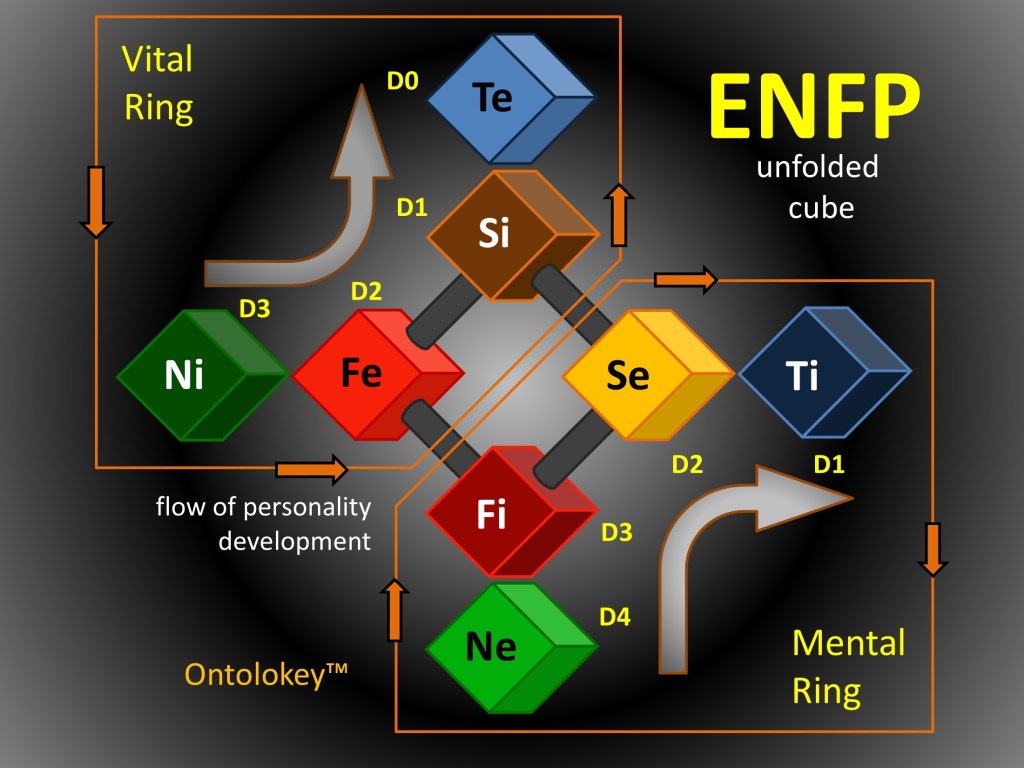
In the Ontolokey model, D0 to D4 describe the degree to which a psychological function has become consciously accessible, developed, and integrated within the personality. D4 represents the highest level of conscious development, while D0 indicates a function that remains largely unconscious and therefore tends to operate as a blindspot; D1, D2, and D3 represent successive stages of increasing awareness and integration between these two poles. Psychological development therefore means gradually bringing less conscious functions into awareness and allowing them to become more differentiated and usable, rather than trying to replace the dominant personality with something fundamentally different. The movement from D0 toward D4 is consequently a process of integration in which previously unconscious psychological capacities become increasingly available to consciousness and contribute to a more complete experience of the Self.
The Psychology of Possibility and the Search for Wholeness
The ENFP psyche begins with an extraordinary psychological movement toward possibility: an instinctive tendency to perceive what might exist beyond what is immediately visible, established, or already known. Within the Ontolokey model, Extraverted Intuition (Ne) occupies the Dominant position, functioning as the primary orientation through which the ENFP encounters reality, while Introverted Feeling (Fi) provides an inner axis of personal meaning, authenticity, and ethical coherence. This combination explains why the ENFP can appear simultaneously expansive and deeply selective: outwardly, almost every possibility may be worth exploring, yet inwardly, only those possibilities that resonate with a deeply personal sense of truth are ultimately allowed to matter. Creativity, enthusiasm, idealism, empathy, spontaneity, psychological curiosity, and the ability to recognize unrealized potential in people are therefore not isolated characteristics but expressions of a larger psychological architecture. The Ontolokey conception of the personality as an interconnected landscape of eight functions makes it possible to interpret these familiar qualities not merely as strengths, but as the conscious surface of a much larger inner structure containing less familiar, vulnerable, and potentially transformative dimensions.
The central developmental problem of the ENFP begins precisely where its greatest gift becomes capable of functioning as a defense. The capacity to perceive another possibility can make it extraordinarily easy to leave an unsatisfying reality before fully understanding it, to transform disappointment into evidence that something better must exist elsewhere, or to preserve freedom by avoiding the finality that accompanies commitment. Possibility can therefore become more psychologically attractive than actuality, and imagination can gradually become a refuge from the ordinary limitations through which an imagined life must eventually become a real one. This creates a subtle form of fragmentation: the individual may remain endlessly connected to potential versions of life while becoming increasingly disconnected from the concrete experience of completing, inhabiting, remembering, sustaining, and accepting one particular life. The shadow does not arise because the ENFP possesses excessive imagination, emotion, freedom, or idealism; it arises when these capacities cease to serve consciousness and begin instead to protect consciousness from experiences it does not yet know how to integrate. Individuation consequently requires not the destruction of the ENFP’s natural expansiveness, but its gradual transformation into a more complete psychological freedom in which possibility and reality can coexist without one being used to escape the other.
In this sense, the purpose of ENFP development is not to become less ENFP, but to become more completely oneself by allowing the neglected dimensions of the psyche to enter consciousness. The Ontolokey Cube provides a visual language for this process by representing the eight psychological functions as different positions within a three-dimensional psychological landscape, thereby making visible relationships that otherwise remain largely abstract. For the developmental pathway considered in this essay, the Mental Ring begins with Ne at D4 and proceeds through Fi at D3, Se at D2, and Ti at D1, while the Vital Ring develops through Ni at D3, Fe at D2, Si at D1, and finally Te at D0. The direction is therefore not arbitrary: development proceeds from the more established psychological capacity toward the next less-developed capacity, and genuine integration cannot be achieved by simply leaping toward the function that appears most deficient or uncomfortable. The deeper purpose of this gradual movement is to make the unconscious increasingly conscious until the personality no longer experiences its shadow as an alien force, a weakness, or an inexplicable source of suffering, but recognizes it as previously unintegrated psychological life that can finally be understood, assimilated, and brought into relationship with the whole.
The First Threshold: From Dominant Ne to Conscious Fi
The first decisive movement in ENFP development is not toward the shadow in its most alien or uncomfortable form, but toward the auxiliary function, Introverted Feeling (Fi), because the psyche can only descend into deeper unconscious material after it has established a sufficiently differentiated inner center. Ne gives the ENFP an almost instinctive capacity to move outward into alternatives, associations, interpretations, people, ideas, and emerging possibilities, yet Fi determines which of these possibilities possess genuine personal significance. Without sufficiently developed Fi, the ENFP can become psychologically dependent upon the stimulation generated by Ne, confusing intensity with meaning and novelty with truth, while simultaneously finding it difficult to distinguish an authentic inner desire from an idea that merely happens to be fascinating. The development of Fi therefore represents the first major act of psychological grounding: instead of asking only what could happen, the individual increasingly learns to ask what actually matters to me, what do I genuinely value, what am I unwilling to betray, and what remains meaningful when external stimulation disappears. In this transition, individuality ceases to mean simply being different from others and begins to mean becoming internally recognizable to oneself, which is essential because individuation cannot begin with an undefined self.
When Fi develops from its initial D3 position toward a state approaching D4, the ENFP begins to experience a profound change in the relationship between freedom and commitment. Earlier in life, freedom may be experienced primarily as the preservation of open possibilities, whereas psychological maturity gradually reveals that genuine freedom also requires the capacity to choose, remain, endure consequences, and take responsibility for what one has chosen. Fi introduces an inner criterion that Ne alone cannot provide, because Ne can endlessly multiply interpretations while Fi asks which interpretation is personally and existentially true. This can be uncomfortable because a more developed Fi exposes the difference between the life one imagines and the life one actually lives, between ideals that sound beautiful and values that survive disappointment, and between compassion that is genuinely grounded in another person’s humanity and compassion that unconsciously protects the ENFP from conflict, guilt, or rejection. The auxiliary function therefore does not merely make the ENFP more emotional or introspective; it makes the personality more internally accountable, because the individual increasingly becomes responsible for the meaning assigned to experience rather than allowing the surrounding world to determine that meaning. The movement toward wholeness begins here: the ENFP learns that authenticity is not the spontaneous expression of every inner impulse, but the gradual alignment of perception, feeling, choice, and action around an increasingly conscious inner truth.
This development also changes the way the ENFP encounters relationships, because other people can no longer function merely as mirrors, sources of stimulation, or carriers of unrealized potential. A less differentiated ENFP may instinctively perceive what another person could become and then relate partly to that imagined potential, sometimes loving the possibility of a person more intensely than the person who is actually present. Fi gradually interrupts this projection by requiring a more difficult form of recognition: the other person must be allowed to possess an independent reality that may not correspond to the ENFP’s hopes, interpretations, or emotional narrative. This can produce grief, because psychological maturation often involves relinquishing imagined futures that were emotionally invested with enormous significance, but the grief itself becomes developmental when it teaches the ENFP to distinguish love from projection and empathy from psychological fusion. At the same time, Fi gives the ENFP a stronger capacity to tolerate solitude, because inner meaning becomes less dependent upon continuous interpersonal confirmation; the individual can withdraw from stimulation without experiencing that withdrawal as psychological emptiness. The emerging self is consequently less scattered across possibilities and relationships, and this consolidation prepares the psyche for the next developmental movement, in which the increasingly grounded Fi can begin to open the door toward the much more vulnerable territory represented by Se.
The completion of this first developmental threshold should therefore not be understood as perfecting Fi in isolation, nor as replacing Ne with a quieter and more serious personality. Ne remains the dominant organizing intelligence of the ENFP, and its capacity for possibility remains indispensable; what changes is its psychological relationship with the inner value system. At greater maturity, Ne can generate possibilities without demanding that every possibility be pursued, while Fi can evaluate possibilities without prematurely reducing the world to a fixed set of personal preferences. This creates a more stable polarity between exploration and discernment, imagination and identity, openness and commitment, and it is precisely this polarity that makes deeper unconscious integration possible. Once Fi has acquired sufficient strength, the ENFP no longer needs to descend into the next developmental function through force or self-rejection, because the conscious personality has developed enough internal coherence to encounter aspects of experience that previously felt foreign, threatening, or psychologically disproportionate. The transition toward Se therefore represents something qualitatively different: the movement from the question of what is meaningful to me toward the difficult encounter with what is actually happening here and now, including the bodily, sensory, concrete, immediate, and often uncontrollable dimensions of existence that the ENFP’s natural orientation toward possibility may have habitually relegated to the background.
The Descent into the Immediate: Se as the Anima/Animus
Once Fi has become sufficiently differentiated, the ENFP reaches the threshold of the third Mental Ring function, Extraverted Sensing (Se), which in the developmental architecture described here occupies the Anima/Animus position at D2. This transition is psychologically significant because Se confronts the ENFP with a mode of consciousness that is far less concerned with what could become possible and far more concerned with what is concretely present. The ENFP naturally tends to move through reality by interpreting, associating, anticipating, imagining, and extending experience into alternative futures, whereas Se demands contact with the immediate world as it actually appears through the senses, the body, physical circumstances, timing, action, and environmental feedback. Because this function is positioned in the Anima/Animus role, its psychological appearance can be unusually compelling and unusually destabilizing: what has been neglected may simultaneously fascinate and threaten the conscious personality. The encounter can therefore occur through intense attraction to people who embody decisiveness, physical presence, spontaneity, sensuality, realism, or an effortless ability to act without first constructing an elaborate conceptual map, because the ENFP may unconsciously recognize in such qualities something that belongs to the larger personality but has not yet been fully possessed consciously. The shadow begins to become visible precisely where admiration, attraction, irritation, envy, fascination, and disproportionate emotional reactions reveal that another psychological mode has been carrying material that the conscious self has not yet integrated.
The vulnerable quality of Se is particularly important because the ENFP can experience concrete reality as psychologically constraining when reality refuses to behave like possibility. Ne can move effortlessly from one interpretation to another, but the body cannot live in several places simultaneously, time cannot be indefinitely postponed, and circumstances eventually demand an actual response rather than another conceptual possibility. The unintegrated Se therefore tends to become visible at precisely those moments when life becomes insistently physical and immediate: exhaustion, sensory overload, sexuality, confrontation, practical crisis, environmental disorder, bodily limits, sudden opportunity, or the necessity to make a decision before every variable has been intellectually explored. When this function remains largely unconscious, the ENFP may oscillate between neglecting the concrete world and becoming temporarily overwhelmed by it, sometimes reacting with impulsive intensity precisely because ordinary contact with the present has not been gradually cultivated. What appears externally as spontaneity can consequently have two very different psychological origins: mature spontaneity emerges from a person who is sufficiently present to respond freely to reality, whereas compensatory impulsiveness may represent an unconscious attempt to escape the burden of reflection, uncertainty, or emotional complexity through immediate action. The developmental task is therefore not to become permanently practical or sensory-oriented, but to discover that presence itself can be liberating when the present moment is no longer experienced as the enemy of possibility.
This is where the Anima/Animus quality of Se becomes particularly transformative, because integration requires the ENFP to stop treating embodiment as something secondary to psychological meaning. A person can understand their emotions beautifully and still remain disconnected from the body through which those emotions are actually experienced; they can imagine countless futures while failing to notice the fatigue, tension, desire, fear, pleasure, or physical resistance that is already communicating something important in the present. Se begins to restore this missing channel of information by teaching attention without immediate interpretation, observation without projection, and action without the demand that every action first be justified by an ideal future. The ENFP may gradually discover that reality contains information that cannot be obtained through intuition alone: the expression on another person’s face, the atmosphere of a room, the physical consequences of a decision, the rhythm of one’s own energy, the difference between genuine attraction and imagined potential, or the simple fact that something either works in lived experience or does not. Such awareness can be deeply humbling because it weakens the privileged position of imagination, but this is precisely why it is developmental rather than merely corrective. Se does not ask the ENFP to abandon the world of possibility; it teaches possibility to become embodied, tested, experienced, and therefore capable of becoming something more substantial than an attractive mental projection.
The psychological healing associated with this stage can become especially profound when the ENFP begins to reinterpret past failures, conflicts, and vulnerabilities through the newly conscious relationship with Se. Experiences that were once understood simply as personal inadequacy may reveal a more differentiated pattern: perhaps the individual was attempting to solve an immediate problem through abstraction, interpreting a concrete situation through an idealized narrative, overlooking bodily exhaustion, reacting too quickly when overwhelmed, or expecting reality to conform to an imagined emotional or relational possibility. This does not mean that every painful experience can be explained away by personality structure, nor that responsibility disappears once a function is identified; rather, cognition can create a more compassionate account of why a particular response became psychologically likely. The same insight can transform the ENFP’s relationship with other people, because behavior that once appeared incomprehensible or malicious may become more intelligible when one recognizes the different psychological pressures operating within another person and within oneself. In this sense, integration produces forgiveness not through denial but through understanding: the past remains real, consequences remain real, and boundaries remain necessary, yet the compulsion to condemn oneself or others can weaken when unconscious psychological dynamics become visible. The ENFP’s developing Se thus becomes more than an ability to live in the present; it becomes a bridge between psychological insight and lived reality, allowing understanding to descend from the realm of interpretation into actual experience.
Ti and the Recovery of Inner Coherence
After the ENFP has begun to establish a more conscious relationship with Fi and has learned to tolerate the immediacy represented by Se, the next developmental threshold within the Mental Ring is Introverted Thinking (Ti), the Toddler function at D1. Its position is significant because Ti is not simply a weaker version of the ENFP’s existing intelligence; it represents a qualitatively different relationship to thought, one in which ideas must increasingly be examined for their internal coherence rather than evaluated primarily through possibility, personal resonance, or emotional significance. The ENFP’s natural thinking process can be extraordinarily inventive, associative, and capable of making connections that a more linear mind might overlook, yet the same freedom can permit contradictions to coexist without being fully examined. Ti introduces the psychologically demanding question of whether an idea actually holds together when its assumptions are separated, tested, and followed to their logical consequences. Because this function is described as the Toddler, its first manifestations may feel playful, awkward, overly curious, or even frustratingly immature, but that very quality is developmentally important: the ENFP does not need to become a cold logician, but must learn to approach thought with the humility of someone willing to discover that a cherished interpretation may be incomplete. The task is not intellectual self-punishment but the gradual construction of an inner capacity for discrimination that allows intuition and feeling to become more precise rather than merely more intense.
The shadow difficulty surrounding Ti becomes especially apparent when the ENFP has become emotionally attached to an interpretation of reality. Fi may experience an idea as deeply meaningful because it expresses something authentic, while Ne may perceive numerous connections that appear to support it, and the combination can create a powerful subjective conviction that is nevertheless insufficiently examined. When challenged, the ENFP may respond by generating additional possibilities, changing the frame of reference, introducing another metaphor, or moving toward a different level of abstraction rather than remaining with the original proposition long enough to determine whether it is coherent. This does not indicate an absence of intelligence; indeed, the ENFP’s capacity for conceptual association can be formidable, particularly when a subject genuinely engages the imagination. The developmental problem is that intelligence without disciplined self-examination can become a sophisticated instrument of self-protection, capable of producing increasingly elaborate explanations for conclusions that have never been adequately tested. Ti therefore becomes a psychological antidote to rationalization: it teaches the ENFP to distinguish between an explanation that is beautiful and one that is structurally sound, between an intuition that is illuminating and one that has merely become emotionally persuasive through repetition. In this respect, developing Ti can become an important form of truthfulness, because the individual learns to say, with increasing comfort, “I may feel this deeply, I may intuit this strongly, and I may still be wrong.”
This capacity has direct consequences for psychological healing because unconscious suffering often survives through narratives that are emotionally compelling but insufficiently differentiated. An ENFP may, for example, interpret rejection as proof that they were fundamentally misunderstood, interpret another person’s withdrawal as evidence of betrayal, or reinterpret an abandoned project as evidence that the project was never truly meaningful in the first place. Such narratives may contain genuine truth, but they can also protect the psyche from more uncomfortable possibilities: perhaps the timing was wrong, perhaps expectations were unrealistic, perhaps responsibility was shared, perhaps fear influenced a decision, or perhaps something meaningful simply reached its natural end. Ti does not invalidate the emotional experience; instead, it creates enough distance to examine the architecture surrounding it. This distinction is crucial for forgiveness, because forgiveness becomes psychologically deeper when it no longer requires the past to be simplified into innocent victim and guilty perpetrator, nor does it require the ENFP to deny legitimate injury. Through increasingly conscious Ti, the person can reconstruct painful experiences with greater complexity and thereby discover that several truths can coexist: someone may have caused harm without being wholly malicious, the ENFP may have been genuinely wounded while also participating unconsciously in the pattern, and an experience may have been deeply meaningful even though its outcome was destructive. Such cognitive differentiation can loosen the grip of shame, resentment, idealization, and self-deception because experience no longer needs to be organized around a single emotionally satisfying explanation.
The completion of the Mental Ring’s developmental descent from Ne through Fi and Se toward Ti therefore represents an important form of psychological integration. Ne remains the ENFP’s source of expansive possibility, Fi preserves the inner sense of authenticity and personal value, Se restores contact with immediate reality, and Ti gradually teaches the personality to examine the structures through which all three are interpreted. None of these functions needs to conquer the others; their maturation instead allows them to correct one another. Ne prevents Ti from becoming rigid, Fi prevents Ti from becoming emotionally sterile, Se prevents Ne and Ti from drifting indefinitely into abstraction, while Ti protects Fi and Ne from confusing subjective conviction with objective coherence. Once this internal relationship becomes sufficiently established, the ENFP possesses something far more valuable than greater efficiency or intellectual sophistication: a more stable observing consciousness capable of witnessing its own psychological activity without immediately identifying with it. That expanded capacity for observation is what makes the next stage of individuation possible, because the psyche can now begin turning toward the Vital Ring, beginning with Ni at D3, where the central developmental question changes from “What possibilities can I perceive?” to the much quieter and more demanding question of “Which underlying direction is actually emerging from all these possibilities?”
Entering the Vital Ring: Ni and the Discovery of Inner Direction
The movement from the Mental Ring into the Vital Ring marks a deeper stage of individuation because the ENFP is no longer merely developing neglected capacities within the conscious personality; the individual is beginning to encounter psychological material that has operated farther from ordinary awareness. In the developmental sequence described by Ontolokey, Introverted Intuition (Ni) occupies the Sibling position at D3, and its development follows the substantial strengthening of Fi rather than occurring as an isolated exercise in intuition. This distinction matters because the ENFP already possesses an extraordinarily powerful intuitive orientation through Ne, yet Ne and Ni relate to possibility in fundamentally different ways: Ne expands the field, while Ni gradually condenses it toward an underlying pattern, trajectory, or singular significance. For the ENFP, whose consciousness may habitually experience vitality through multiplicity, Ni can initially feel strangely restrictive because it asks the psyche to remain with one emerging direction long enough for its deeper implications to become visible. The developmental challenge is therefore not to replace expansive intuition with convergent intuition, but to allow the mind that habitually asks “What else could this mean?” to eventually ask “What is this experience, across time, actually becoming?” In the language of individuation, this represents a shift from the abundance of possibilities toward the recognition of an underlying psychological direction that may have been present all along but obscured by the constant movement of conscious attention. (ontolokey.com)
Ni can become particularly important for the ENFP because an unconscious relationship with possibility may produce a peculiar form of existential dispersion. The individual can perceive so many plausible futures that choosing one begins to feel like the death of all the others, and consequently the psyche may remain attached to alternatives long after circumstances have already selected a direction. Ni introduces the opposite movement: instead of multiplying futures indefinitely, it allows meaning to accumulate across experiences until certain patterns become difficult to ignore. A mature relationship with Ni therefore does not necessarily produce certainty in the conventional sense; rather, it produces a tolerance for psychological depth, ambiguity, and gradual revelation, allowing the person to recognize that some truths cannot be discovered by generating more alternatives but only by remaining sufficiently still for an existing pattern to disclose itself. This can be transformative for the ENFP because the future no longer has to function exclusively as an imaginative escape from the present; it can become an unfolding trajectory that emerges from the interaction between past experience, present reality, unconscious tendencies, and consciously chosen values. The individual begins to recognize that life is not merely a collection of opportunities but also a developmental process, and that repeatedly encountering the same relational patterns, emotional conflicts, fears, or aspirations may indicate something deeper than coincidence. Ni consequently gives temporal depth to Ne, turning the ENFP’s remarkable capacity to perceive connections into a capacity to understand direction. (ontolokey.com)
The Sibling designation is psychologically revealing because Ni may initially be experienced less as a commanding inner authority than as a quieter psychological companion whose perspective becomes increasingly trustworthy with maturity. The ENFP may encounter it through sudden realizations that emerge after long periods of apparently unstructured reflection, through dreams or symbolic associations, through an unexpected recognition of a recurring life pattern, or through the intuitive sense that a particular path is becoming inevitable even though the rational mind cannot yet fully explain why. What matters developmentally is learning not to force such perceptions into immediate certainty, because premature certainty would simply turn one unconscious function into another form of dogmatism. Ni needs time, silence, observation, and distance from the constant stimulation of Ne; it becomes clearer when the psyche is no longer compelled to respond to every possibility as though it demands immediate engagement. This can make solitude unexpectedly valuable to an ENFP, not because withdrawal is inherently superior to social connection, but because psychological depth often requires periods in which external possibilities are temporarily quiet enough for internal patterns to emerge. The Sibling gradually becomes recognizable as a different kind of intelligence: less expansive but more penetrating, less concerned with generating alternatives and more concerned with discovering what remains after the alternatives have been allowed to settle.
At this stage, individuation begins to acquire a distinctly existential character because the ENFP is increasingly confronted with the difference between a life that contains many experiences and a life that possesses an underlying direction. Earlier developmental work has helped establish personal values, embodiment, and cognitive discrimination; Ni now asks what those developments mean when viewed across the whole arc of a human life. This question can expose an uncomfortable shadow in the ENFP: the possibility that constant movement has sometimes served to postpone a deeper confrontation with destiny, limitation, mortality, or the consequences of becoming one particular person rather than maintaining psychological access to countless potential selves. The integration of Ni does not demand that the ENFP abandon experimentation, curiosity, or openness; instead, it introduces a deeper form of commitment in which openness exists within an emerging trajectory rather than functioning as an escape from trajectory itself. As the unconscious becomes more visible, the individual may begin to understand why certain choices repeatedly failed, why certain relationships reproduced the same emotional structure, why particular ambitions remained strangely unsatisfying, or why certain apparently irrational longings persisted despite changing circumstances. This is one of the points at which the metaphor of the turning iceberg becomes especially meaningful: what was previously submerged does not suddenly appear as an entirely foreign personality, but gradually reveals itself as an aspect of the self that had been present beneath the conscious surface and was waiting for sufficient psychological maturity to be recognized.
Fe and the Golden Shadow: Learning to Belong Without Losing the Self
With Ni sufficiently integrated, the ENFP reaches Fe, Extraverted Feeling, which occupies the Golden-Shadow position at D2 within the Vital Ring. This is a particularly subtle stage because Fe may initially appear both strangely familiar and psychologically foreign: the ENFP is naturally capable of profound empathy and interpersonal sensitivity, yet Fe asks for something different from the deeply personal valuation of Fi. Fi tends to ask whether an experience is authentic to the individual, whereas Fe turns attention toward the emotional field shared among people and toward the question of what sustains connection, reciprocity, belonging, and collective emotional coherence. Because Fe is described as the Golden Shadow, its qualities can become projected onto people who seem exceptionally socially attuned, emotionally influential, gracious, diplomatic, or capable of creating harmony among groups, while the ENFP may simultaneously feel admiration and irritation toward such individuals. The unconscious message contained within this attraction can be psychologically significant: the personality may be recognizing a capacity that it possesses in latent form but has not yet learned to employ consciously without feeling that doing so compromises authenticity. Integration therefore requires discovering that sensitivity to the collective emotional environment does not necessarily mean abandoning individual truth, just as maintaining personal authenticity does not require remaining psychologically indifferent to the emotional reality shared with others.
The tension between Fi and Fe can become one of the most revealing conflicts in the ENFP’s individuation process because both functions are concerned with feeling, yet they organize feeling according to different psychological principles. A strongly identified Fi perspective can regard external expectations with suspicion, particularly when social conformity appears to demand the suppression of something personally important, and this resistance can be an essential protection against losing oneself in other people’s values. Yet when that resistance becomes unconscious and absolute, it can also prevent the ENFP from recognizing how profoundly every individual exists within relational systems whose emotional dynamics cannot simply be dismissed as external interference. Fe introduces the recognition that communication itself has consequences, that intentions do not exhaust the meaning of an action, and that the emotional atmosphere created between people is a psychological reality in its own right. The mature ENFP therefore becomes increasingly capable of holding two truths simultaneously: “This is authentic for me” and “This also affects the people around me.” Such integration is not a demand for people-pleasing, because unconscious Fe can itself become distorted into excessive accommodation or dependence upon collective approval; rather, the goal is a conscious ability to participate in shared emotional reality while retaining the differentiated inner center developed through Fi. The Golden Shadow is integrated when social consciousness becomes an extension of humanity rather than a replacement for individuality.
This development can profoundly transform the ENFP’s relationships because it weakens one of the more subtle forms of projection: the expectation that other people should intuitively understand the ENFP’s inner world simply because the ENFP is often highly capable of intuiting theirs. Ne and Fi can produce an impressive sensitivity to another person’s potential motives, emotions, and unspoken meaning, but this can paradoxically create unrealistic expectations when the ENFP assumes that emotional depth should automatically produce mutual comprehension. Fe introduces a more conscious understanding of interpersonal translation: what is obvious internally may remain invisible externally, and what feels authentic to one person may be experienced very differently by another. The ENFP begins to recognize that empathy is not merely the ability to perceive another person’s emotional state, but also the ability to communicate one’s own state in a form that another person can actually receive. This can reduce resentment because the individual becomes less likely to interpret misunderstanding as evidence of indifference or rejection and more willing to recognize the practical work required for genuine mutual understanding. In this sense, Fe becomes an instrument of relational healing, allowing the ENFP to transform emotional intelligence from an intuitive talent into a consciously reciprocal practice.
The Golden Shadow also becomes important in relation to the ENFP’s idealism, because the individual may gradually discover that a genuinely humane life cannot be built solely from personal authenticity and visionary possibility. Human beings exist in families, friendships, communities, cultures, institutions, and networks of mutual obligation, and psychological wholeness therefore includes the capacity to participate in something larger than the individual self without dissolving into it. Fe can teach the ENFP that harmony is not necessarily superficial, compromise is not necessarily betrayal, and social responsibility is not necessarily conformity, provided that these concepts are consciously differentiated rather than accepted as unquestioned demands. At the same time, the ENFP must learn to recognize the shadow version of Fe: the temptation to create harmony by suppressing difficult truths, to rescue others from emotions they need to experience themselves, or to derive self-worth from being emotionally indispensable. Such patterns can become especially seductive for a naturally empathic personality because helping another person can provide immediate confirmation of one’s goodness and significance. The mature integration of Fe therefore requires a more demanding form of compassion—one that can remain warm without becoming intrusive, supportive without becoming controlling, and socially conscious without turning approval into a substitute for inner worth.
As Fe becomes more conscious, the ENFP’s understanding of the Golden Shadow changes from fascination with an external quality into recognition of an internal capacity. The individual no longer needs to idealize people who appear effortlessly socially integrated, nor does the ENFP need to react against them as though collective emotional awareness were inherently superficial or compromising. Instead, the personality can borrow the strengths of Fe while allowing Fi to remain the guardian of personal integrity and Ni to maintain awareness of the deeper trajectory behind immediate social demands. This is another important stage in the turning of the psychological iceberg: an aspect that once appeared to belong to other people becomes recognizable as part of the self. The resulting personality is capable of greater relational maturity because it can move between inner authenticity and interpersonal responsibility without treating them as mutually exclusive. What was previously experienced as a conflict between “being true to myself” and “being there for others” can gradually become a more integrated question: how can my truth enter the shared human world in a way that remains truthful while also acknowledging the reality of everyone affected by it? That question prepares the ENFP for the next descent into the Vital Ring, where the psyche encounters the far less glamorous but equally necessary territory of Si—memory, continuity, routine, preservation, limitation, and the accumulated weight of lived experience.
Si and the Burden of What Has Been
The next developmental threshold is Introverted Sensing (Si), which occupies the inferior position at D1 within the Vital Ring and therefore confronts the ENFP with one of the most consequential forms of unconscious material: the accumulated reality of what has already happened. Where Ne naturally opens toward possibility and Ni seeks an underlying direction, Si turns consciousness toward continuity, memory, embodied history, familiarity, repetition, and the concrete traces that experience leaves behind. For an ENFP, this territory can initially feel restrictive because the psyche is naturally energized by emergence rather than preservation, by what is becoming rather than what has already become. Yet the very qualities that can seem limiting—routine, repetition, careful attention to detail, established rhythms, physical maintenance, memory, and respect for accumulated experience—can become psychologically restorative when they are no longer experienced as imprisonment. Si asks the ENFP to acknowledge that a human life is not composed solely of moments of inspiration or transformative possibility; it is also built from thousands of ordinary repetitions through which relationships, bodies, skills, identities, and commitments acquire continuity. The developmental movement toward Si therefore represents a confrontation with temporal reality itself: the recognition that what is neglected does not disappear, that the past remains active within the present, and that psychological integration requires making peace with the life that has actually been lived rather than remaining permanently oriented toward the life that might still be lived.
The inferior position makes this encounter especially sensitive because Si can carry memories that have never been adequately metabolized by consciousness. An ENFP may remember the emotional meaning of an experience more readily than its precise sequence of concrete circumstances, and Ne can subsequently reinterpret those circumstances through new narratives as life develops. This capacity for reframing can be psychologically liberating, but it can also become a mechanism through which painful details are repeatedly reorganized before they have been fully acknowledged. The emerging Si perspective asks the individual to slow down and recover what actually happened: what was said, what was done, what was promised, what was repeatedly tolerated, what physical or emotional warning signs were ignored, and what consequences accumulated over time. Such attention can be uncomfortable because memory is not always flattering to the self, and a more differentiated account may reveal not only injuries received but opportunities missed, boundaries not established, responsibilities avoided, or patterns unconsciously repeated. Yet this is precisely where cognition can contribute to healing without requiring self-condemnation. When experience is reconstructed with greater specificity, the ENFP can begin separating what truly belonged to another person from what belonged to the self, what was unavoidable from what was preventable, and what was once adaptive from what has subsequently become destructive. Si thus becomes a form of psychological historical consciousness: it allows the individual to remember without being imprisoned by memory and to learn from the past without continually recreating it.
The integration of Si also requires the ENFP to develop a new relationship with repetition, which may be one of the least intuitive aspects of maturation for a personality oriented toward novelty and possibility. Growth is often imagined as expansion, discovery, travel, experimentation, or transformation, yet much of genuine psychological development consists of doing the same meaningful things repeatedly until they become embodied rather than merely understood. Emotional regulation, healthy boundaries, physical care, creative practice, sustained relationships, professional competence, and self-knowledge all require continuity, and none can be permanently maintained through inspiration alone. The immature relationship with routine may interpret repetition as stagnation, whereas integrated Si recognizes that repetition can create depth by allowing experience to accumulate. This distinction is particularly important for the ENFP because the desire for a new beginning can become seductive whenever ordinary life becomes demanding; a new possibility may feel psychologically cleaner than remaining with the slow work of repairing, maintaining, practicing, or completing what already exists. Si introduces the insight that not every period of reduced excitement represents a wrong direction, just as not every recurrence of difficulty means that one must begin again somewhere else. Sometimes the developmental task is precisely to remain present long enough for familiarity to become mastery and for continuity to reveal meanings that novelty cannot provide.
At the level of shadow integration, Si can also transform the ENFP’s relationship with vulnerability and personal history. The individual may discover that certain apparently irrational reactions have roots in earlier experiences whose concrete details had been psychologically displaced by more general narratives about identity, relationships, or the future. A disproportionate response to criticism, abandonment, disorder, physical exhaustion, or loss of control may become more comprehensible when viewed against the accumulated history of similar experiences rather than treated as an isolated event. This recognition can produce a profound form of self-compassion because the person begins to understand that present reactions sometimes contain echoes of earlier psychological learning, even when the present situation is objectively different. Such understanding does not mean that every reaction is justified or that the past determines the future; it means that unconscious continuity becomes visible and therefore available for conscious choice. The ENFP can then begin distinguishing between an old emotional alarm and a present-day reality, between a remembered pattern and a current fact, and between genuine intuition and a nervous system responding to something familiar. In this way, Si becomes unexpectedly important for healing: it reconnects the ENFP with the temporal body of the personality, allowing the past to become information rather than destiny.
When Si develops, the ENFP does not become less spontaneous, imaginative, or future-oriented; instead, possibility acquires a memory. Ne can begin to draw upon lived experience rather than endlessly generating alternatives independent of what experience has already taught, while Ni can interpret long-term patterns with greater accuracy because those patterns are anchored in concrete history. Fi gains greater depth because personal values are no longer merely ideals but values tested against years of actual choices, and Fe becomes more grounded because empathy can include awareness of the accumulated history carried by other people. Even the previously developed Se benefits, because present-moment awareness becomes less impulsive when it is informed by memory and bodily knowledge. This is why the developmental sequence cannot simply be reversed or accelerated: Si becomes psychologically meaningful precisely because the preceding functions have created enough consciousness to receive what it reveals. The ENFP begins to understand that the past does not have to compete with the future, just as stability does not have to destroy freedom; when integrated, continuity becomes the ground from which genuine possibility can emerge. The personality is therefore approaching the final and most archaic position of the Vital Ring, Te at D0, where the developmental task becomes even more challenging because the ENFP must encounter the shadow of external effectiveness, measurable results, impersonal execution, hierarchy, and the hard boundary between what one intends and what one actually accomplishes.
Te at D0: The Blindspot of Execution and External Reality
The final position of the Vital Ring is Extraverted Thinking (Te), described here as the tertiary function at D0, the most archaic and least developed point of the ENFP’s developmental landscape, and therefore a genuine psychological blindspot. This position is especially revealing because Te represents an orientation toward measurable effectiveness, external organization, objective criteria, implementation, prioritization, systems, efficiency, and demonstrable results, all of which can feel strangely impersonal to an ENFP whose conscious life is more naturally organized around possibility, personal meaning, interpersonal significance, and emerging potential. The problem is not that ENFPs are incapable of achievement or practical intelligence; many can become remarkably productive when a goal genuinely engages their imagination and values. The deeper difficulty emerges when reality demands execution independently of inspiration, when an idea must be converted into a sequence of decisions, deadlines, structures, measurements, and completed outcomes, or when effectiveness requires temporarily setting aside the question of whether the process feels personally meaningful. Because Te exists at D0, these demands may evoke disproportionate psychological reactions precisely because they touch an underdeveloped part of the personality. What appears externally as procrastination, disorganization, resistance to bureaucracy, difficulty with prioritization, or frustration with rigid systems can therefore sometimes conceal a more intimate conflict between the ENFP’s need for meaningful possibility and the uncompromising external question of whether something has actually been made real. (ontolokey.com)
The shadow expression of Te can be particularly painful because the ENFP may oscillate between underidentification with external standards and sudden overcompensation through them. When effectiveness has been neglected for too long, accumulated obligations can eventually create pressure strong enough to produce an abrupt, rigid, or unusually controlling mode of functioning in which everything must suddenly be organized, optimized, measured, and brought under control. In such moments, Te may not feel like a mature psychological capacity but like an emergency mechanism that appears only when disorder has become intolerable. The individual may then judge both self and others according to harsh external standards, reducing complex human realities to productivity, competence, success, failure, or visible results, before eventually becoming exhausted and retreating back into the familiar psychological world of possibilities and meanings. This oscillation can create a destructive cycle: avoidance permits practical disorder to accumulate, accumulated disorder produces stress, stress triggers compensatory control, excessive control becomes psychologically alienating, and alienation drives the personality back toward avoidance or imaginative escape. Development therefore requires something subtler than simply “becoming more organized.” The task is to gradually establish a conscious relationship with effectiveness so that execution becomes a servant of values and possibilities rather than either an enemy of authenticity or a weapon against the self. (ontolokey.com)
At its deepest level, Te asks the ENFP to accept a difficult truth about manifestation: an intention does not become an accomplishment merely because the intention is sincere. An idea may be brilliant, a value may be deeply held, a vision may be emotionally compelling, and a potential may be genuinely recognized, yet none of these qualities guarantees that anything will exist in the external world as a consequence. This confrontation can be psychologically sobering because Ne is exceptionally skilled at experiencing the richness of what something could become, sometimes allowing the imagined potential itself to generate a feeling of partial completion. Te disrupts this illusion by introducing external feedback: the project either exists or it does not, the appointment was kept or it was missed, the promise was fulfilled or it was not, the system functions or it fails, and the intended result was achieved or it was not. Such distinctions are not intended to humiliate the ENFP’s idealism but to give it a body in reality. The integration of Te consequently becomes a form of respect for one’s own vision, because taking an idea seriously enough to structure its realization means refusing to leave it permanently in the protected realm of possibility. The ENFP gradually learns that disciplined execution does not necessarily betray spontaneity; when consciously chosen, structure can protect creativity from dissipation and transform inspiration into something capable of affecting the world beyond the private imagination.
Because Te is positioned at D0, its integration should not be understood as a demand to leap directly into highly developed strategic efficiency. The developmental logic described by the Ontolokey model explicitly prevents such a shortcut: the Vital Ring proceeds from Ni to Fe to Si and only then toward Te, meaning that the capacity for external effectiveness is approached after deeper work has already been done with direction, relationship, and continuity. This sequence is psychologically meaningful because effective action without direction can become pointless productivity, effectiveness without relational awareness can become coercive, and efficiency without respect for continuity can become unsustainable. The ENFP must therefore arrive at Te carrying the psychological gains of the preceding functions: Ni provides orientation, Fe provides awareness of the human field, and Si provides respect for reality, history, embodiment, and continuity. Only then can Te begin to function as a mature instrument rather than a compensatory reaction. The blindspot gradually becomes visible not because the ENFP forces it into consciousness, but because the rest of the psychological structure has become sufficiently developed to tolerate what Te reveals: that some dreams require administration, some values require boundaries, some relationships require agreements, some creative visions require repetition, and some forms of freedom can only exist when certain structures are deliberately maintained.
The healing potential of this final Vital Ring stage lies in the possibility of reconciling the ENFP with the very external reality that may previously have felt like a threat to individuality. Once effectiveness is no longer unconsciously associated with soulless conformity, the personality can discover a different relationship with responsibility: not “I must become someone else in order to succeed,” but “I can construct enough structure for the person I am to become effective.” This distinction is crucial because the deepest integration does not erase the original personality architecture; it reorganizes the relationship among its parts. Ne can generate the vision, Fi can determine why the vision matters, Ni can recognize its deeper direction, Fe can consider its human consequences, Se can bring it into immediate experience, Si can sustain it through continuity, Ti can test its conceptual coherence, and Te can finally help translate the whole constellation into observable reality. At that point, the function that once represented a D0 blindspot has begun to participate in consciousness, not as a replacement for the dominant personality but as one of its previously inaccessible instruments. The ENFP becomes less divided between inspiration and execution, authenticity and responsibility, imagination and fact, because the unconscious opposition between these dimensions has begun to dissolve through conscious understanding. This is the point at which the developmental process starts to reveal its larger purpose: not optimization of individual functions, but the gradual recovery of a personality capable of containing more of its own psychological reality without needing to exile uncomfortable aspects into the unconscious.
The Shadow Is Not the Enemy: From Projection to Integration
The developmental sequence becomes psychologically meaningful only when the shadow is understood not as an inferior or defective version of the personality, but as a repository of capacities and experiences that consciousness has not yet learned to hold. For the ENFP, this distinction is essential because the conscious identity can become strongly attached to being imaginative, emotionally authentic, open-minded, spontaneous, empathic, and capable of seeing potential where others see limitations. These qualities are genuine strengths, yet any strength can become defensive when the personality begins using it to avoid what feels psychologically foreign, painful, restrictive, or threatening. The shadow then appears indirectly through projection: the qualities one cannot comfortably recognize in oneself are experienced disproportionately in other people, in relationships, in recurring conflicts, or in circumstances that seem inexplicably provocative. A person who unconsciously struggles with decisiveness may idealize decisive people and simultaneously resent their apparent rigidity; someone uncomfortable with concrete limitation may admire grounded individuals while experiencing them as unimaginative; someone uncertain about personal effectiveness may alternate between dismissing achievement-oriented people as superficial and secretly envying their capacity to produce visible results. Shadow work begins when these reactions are no longer treated solely as judgments about external reality but become questions directed inward: what is this person or situation activating in me, why does this particular quality carry so much emotional charge, and what part of myself might I be encountering through the other?
This does not mean that every negative reaction is projection, nor that harmful behavior should be excused by turning every conflict into a psychological lesson. Such an interpretation would itself become another form of avoidance, because genuine individuation requires the ability to distinguish between what belongs to oneself and what genuinely belongs to another person. The developmental value of the shadow lies precisely in increasing this discrimination rather than dissolving all boundaries between inner and outer reality. When an ENFP encounters someone who is controlling, emotionally manipulative, chronically irresponsible, excessively rigid, or dismissive of individuality, the appropriate response may still include distance, confrontation, or firm boundaries; psychological integration does not require tolerating behavior that causes harm. What changes is the internal reaction to the encounter, because the ENFP can simultaneously recognize the external problem and investigate why it has produced a disproportionate psychological response. This dual awareness prevents the common trap of either blaming everything on oneself or blaming everything on others. Over time, the personality becomes capable of saying, in effect, “This behavior is genuinely unacceptable, and my reaction to it may also be teaching me something about myself,” thereby converting conflict into information without surrendering discernment. Such differentiation is one of the clearest signs that shadow integration has moved beyond intellectual fascination and has begun to affect actual consciousness.
The most vulnerable shadow material is often encountered not through abstract reflection but through emotional disproportion. The ENFP may encounter particular situations in which the intensity of the reaction seems greater than the immediate circumstances would logically explain, and these moments can function as psychological entry points into previously unconscious material. The Anima/Animus function Se and the Toddler function Ti are especially important in this respect because both may expose vulnerabilities that the conscious personality would prefer to reinterpret rather than directly experience. A failure to perform under pressure, an inability to respond effectively in a concrete situation, feeling physically overwhelmed, being criticized for inconsistency, discovering that an idealized interpretation was logically flawed, or realizing that another person’s perception differs radically from one’s own can trigger shame that appears to be about the present while actually touching older layers of psychological experience. When such reactions are met only with self-judgment, the unconscious material becomes more deeply defended; when they are approached cognitively and compassionately, the individual can begin asking what the reaction is protecting and what developmental capacity was missing at the time. The aim is not to excavate the past endlessly, but to understand enough of its structure that the present no longer has to carry the full emotional weight of what happened before.
This is where the idea of psychological healing through cognition becomes particularly significant within the developmental framework presented here. Understanding does not magically erase pain, and intellectual insight alone cannot substitute for emotional processing, embodied experience, or changed behavior, but conscious understanding can fundamentally alter the relationship a person has with previously incomprehensible parts of themselves. When the ENFP recognizes that a particular vulnerability arose from an underdeveloped function rather than from a global defect of character, shame can begin to lose its authority. The person can distinguish “I struggled because this psychological capacity was not yet accessible to me” from “I struggled because there is something fundamentally wrong with me,” and that distinction can profoundly change the possibilities available for future development. The same process can extend toward other people: understanding that another person’s behavior may have emerged from their own limitations, defenses, fears, or developmental structure can make forgiveness psychologically possible without requiring the denial of injury. Forgiveness in this context is not an obligation to reconcile, forget, or approve; it is the gradual release of the demand that the past remain psychologically active in the present through hatred, shame, compulsive explanation, or unresolved projection.
The shadow therefore becomes less threatening as consciousness becomes more capable of containing contradiction. The ENFP no longer needs to choose between being spontaneous and disciplined, authentic and socially responsible, imaginative and concrete, emotionally sensitive and logically rigorous, future-oriented and rooted in memory. These apparent oppositions can begin functioning as complementary dimensions of one personality rather than as competing identities. The developmental sequence through the Mental and Vital Rings provides a map for this integration, while the Ontolokey Cube can serve as a visual reminder that the less conscious functions are not outside the personality but occupy positions within its larger structure. The purpose of turning toward them is consequently not self-correction in the narrow sense, but expansion of the conscious self until fewer psychological experiences need to be rejected, projected, rationalized, or unconsciously acted out. Individuation becomes the gradual capacity to recognize oneself in what one previously rejected, to understand one’s vulnerabilities without becoming defined by them, and to transform unconscious reaction into conscious choice. For the ENFP, this is ultimately the movement from living primarily through the gifts of Ne and Fi toward becoming a person whose entire psychological landscape can participate in consciousness.
The Turning of the Iceberg: Individuation as a Second-Half-of-Life Process
The developmental model reaches its deepest meaning in the metaphor of the turning iceberg, because individuation is not simply the acquisition of new skills but a gradual reversal in the relationship between consciousness and the unconscious. At the beginning of life, only a relatively small portion of the psychological structure is ordinarily accessible to conscious awareness, while much of the personality operates beneath the surface through tendencies, defenses, projections, vulnerabilities, instincts, and capacities that have not yet been sufficiently differentiated. The development of the auxiliary function represents the first significant disturbance of this equilibrium: Fi strengthens the ENFP’s inner center to such an extent that the previously unquestioned dominance of Ne can no longer contain the entire psychological reality of the individual. As this conscious structure becomes more stable, the psyche can progressively encounter Se, Ti, Ni, Fe, Si, and finally Te, not as unrelated psychological traits but as increasingly unfamiliar aspects of the same self. The iceberg therefore does not become larger merely because more information is accumulated; it turns because the center of psychological gravity changes, allowing what was once submerged to become visible and what was once automatically conscious to be understood from a wider perspective. Individuation is consequently a process of psychological rotation in which the person gradually encounters the self from angles that were previously inaccessible.
This explains why the developmental process can become especially significant in the second half of life, when the accumulated consequences of earlier choices begin to confront the individual with questions that cannot be resolved through further expansion alone. During the first decades, Ne can be extraordinarily adaptive because life genuinely contains countless possibilities that need to be explored, while Fi gradually helps the ENFP determine which experiences correspond to an emerging personal identity. Career changes, relationships, experimentation, travel, intellectual exploration, creativity, and the discovery of values can all serve a legitimate developmental purpose during this period because the personality needs to discover what kind of life feels genuinely its own. Yet eventually the question changes from “What could I become?” to “What have I become, and what remains unrealized within me?” This shift can be unsettling because the individual may discover that certain strengths have been developed repeatedly while other capacities have remained psychologically young, vulnerable, or almost invisible. The apparent crisis of midlife can therefore be understood, within this model, not merely as dissatisfaction with external circumstances but as the psyche demanding a broader form of consciousness. What previously worked may cease to be sufficient, not because it was false, but because the personality has reached a developmental boundary beyond which the neglected dimensions of the self can no longer remain unconscious without producing psychological tension.
For the ENFP, this turning can initially feel like a loss of identity because the qualities that once provided certainty about who one was may no longer be sufficient to explain one’s experience. The person who has always understood themselves as the visionary, the idealist, the empath, the creative explorer, or the person who sees potential in everything may encounter periods in which these identities feel strangely incomplete. The temptation is then to interpret the discomfort as evidence that one has lost oneself, when the deeper possibility is that the previous self-concept is becoming too narrow to contain the emerging personality. This is why individuation can resemble a psychological death and rebirth: an earlier organization of identity must loosen before a larger organization can become conscious. The familiar personality does not disappear, however; Ne remains Ne, Fi remains Fi, and the ENFP’s fundamental orientation remains recognizable, but these functions cease to monopolize the definition of the self. The individual begins to understand that being authentic does not mean remaining identical to one’s younger self, because authenticity can also require allowing previously unconscious aspects of the personality to mature. Psychological rebirth therefore means returning to the original personality with greater consciousness rather than returning to the original level of awareness.
The metaphor also clarifies why development cannot be rushed by deliberately attacking the weakest function first. An ENFP might become fascinated by Te because external organization feels like the obvious missing ingredient, or by Si because greater stability appears to promise relief from chaos, yet forcing either function prematurely can produce compensation rather than integration. The developmental sequence assumes that each function prepares the psychological conditions necessary for the next: Fi creates inner differentiation, Se establishes contact with immediate reality, Ti strengthens reflective discrimination, Ni develops awareness of deeper direction, Fe expands relational consciousness, Si reconnects the individual with continuity and lived history, and only then can Te begin to emerge from its archaic D0 position with a more mature psychological foundation beneath it. Skipping stages would therefore resemble attempting to build the upper floors of a structure before the lower ones can support their weight. The point is not that psychological development follows a mechanical timetable, but that consciousness requires sufficient internal capacity to assimilate whatever it encounters. The Ontolokey developmental map gives the ENFP a way of visualizing this progression, allowing the Cube and its sliders to function as a symbolic representation of where attention might next be directed rather than as a demand to become something alien to one’s nature.
At the completion of the turning process, the image of the iceberg acquires its most important implication: what was unconscious has not been destroyed but brought into relationship with consciousness. The dominant Ne can once again occupy the visible summit, but it is no longer the same Ne that existed at the beginning of the journey because it has been transformed by contact with the functions that previously existed beneath the surface. It can now generate possibilities informed by memory, embodied reality, logical examination, relational awareness, deeper direction, and practical consequence, while Fi can provide the ethical and existential center around which these possibilities are organized. The ENFP’s return to the original dominant function is therefore not regression but completion—a return to the beginning after having traveled through the hidden dimensions of the personality. In psychological terms, the goal is not perfection but increasing wholeness: fewer parts of oneself need to remain unconscious, fewer vulnerabilities need to be defended through projection, and fewer contradictions need to be resolved by choosing one side and rejecting the other. The personality becomes capable of carrying more of its own complexity, and this expanded capacity is perhaps the most meaningful definition of healing available within the individuation process described by Ontolokey.
What Wholeness Changes: From Potential to Embodied Selfhood
When the developmental movement is understood as a process of integration rather than self-improvement, the meaning of ENFP maturity changes considerably. The mature ENFP is not simply a more productive, disciplined, calm, or socially agreeable version of the younger personality, because such a definition would measure development according to external adaptation rather than psychological wholeness. Instead, maturity becomes visible in the increasing ability to remain psychologically present when reality contradicts expectation, when another person does not fulfill an imagined potential, when an emotional truth cannot immediately be transformed into a new possibility, or when an important goal requires repetitive effort rather than inspiration. Ne remains the central source of openness and creative perception, but it is increasingly accompanied by functions capable of asking what should actually be chosen, embodied, remembered, examined, sustained, and completed. The ENFP’s freedom consequently becomes less dependent upon keeping every door open, because the individual has developed enough inner differentiation to close some doors consciously without experiencing the decision as the destruction of the self. This is a profound shift from possibility as psychological escape toward possibility as creative material that can be selected, shaped, and brought into reality.
One of the clearest signs of this integration is a changed relationship with failure. An immature or partially integrated ENFP may experience failure as disproportionately threatening because it can collide simultaneously with idealism, identity, imagined potential, and the desire to see meaning in one’s actions. Ne can rapidly generate alternative explanations or new futures, Fi can protect the sense of personal integrity by redefining what the experience meant, and the personality can move forward before the full psychological significance of the failure has been absorbed. At greater maturity, however, the ENFP can remain with failure long enough to extract its information without allowing it to become a verdict on personal worth. Se can ask what actually happened, Ti can examine the reasoning behind the choices, Si can identify what previous experience was overlooked, Ni can search for the larger pattern, Fe can consider the effects upon other people, Fi can determine what remains personally meaningful, and Te can eventually ask what must change in concrete behavior. Failure therefore becomes multidimensional rather than existentially absolute. The individual can experience disappointment without collapsing into shame, learn without constructing a defensive narrative, and begin again without pretending that nothing was lost or that the previous attempt had no value.
The same integration transforms the ENFP’s relationship with idealism. Idealism does not have to disappear in order to become mature; what changes is its relationship with limitation. The younger psyche may experience limitations as evidence that reality has failed to live up to its potential, while the integrated personality increasingly recognizes that limitation is one of the conditions through which potential becomes form. A relationship becomes meaningful partly because two people cannot simultaneously live every possible relationship; a vocation becomes meaningful partly because choosing one direction means relinquishing others; a creative work becomes real only when infinite possibilities are eventually reduced to particular words, images, sounds, structures, or actions. Limitation therefore ceases to represent the enemy of imagination and becomes the medium through which imagination acquires existence. This is perhaps one of the most important lessons for an ENFP because it reconciles the two psychological experiences that can otherwise remain opposed: the intoxicating openness of possibility and the sober necessity of choice. The integrated personality does not stop dreaming; it becomes more capable of giving dreams a body, a history, a structure, and consequences.
Wholeness also changes the ENFP’s relationship with other people’s judgments. As Fi becomes more differentiated, the individual becomes less dependent upon external approval for the determination of personal worth, while Fe gradually introduces the complementary understanding that other people’s perspectives nevertheless contain information that should not automatically be dismissed. This creates a more mature psychological boundary between self-definition and defensiveness. Criticism can be examined without being automatically internalized, just as praise can be appreciated without becoming indispensable. The ENFP becomes increasingly capable of asking whether criticism reveals a genuine blindspot, a difference in values, a misunderstanding, or simply another person’s projection, rather than reacting immediately according to emotional intensity. Such differentiation is particularly healing because it reduces the need to construct an identity that must constantly be defended against the world. The self becomes sufficiently secure to permit correction without humiliation and sufficiently autonomous to reject correction without contempt, creating a psychological flexibility that is neither submissive nor oppositional.
Ultimately, the integrated ENFP begins to experience the personality less as a collection of competing functions and more as a living psychological ecosystem. The functions that once appeared threatening, inferior, foreign, or even painfully vulnerable become sources of information that enrich rather than undermine the dominant consciousness. Se teaches presence, Ti teaches discrimination, Ni teaches depth and direction, Fe teaches participation in shared emotional reality, Si teaches continuity, and Te teaches manifestation; none of these capacities needs to become dominant for the ENFP to benefit from them. Their value lies precisely in their ability to correct the excesses and blindspots of the conscious personality while preserving the central gifts of Ne and Fi. This is the meaning of psychological wholeness in the developmental framework: not becoming equally strong in everything, but becoming sufficiently conscious of one’s entire psychological landscape that no major part of oneself must remain permanently exiled. The ENFP can then return to possibility without fleeing reality, return to feeling without losing discrimination, return to freedom without avoiding commitment, and return to the future while remaining reconciled with the past. The personality has not been replaced; it has become larger than its original conscious definition.
A Practical Inner Discipline: How the ENFP Can Consciously Continue the Process
The developmental map becomes most useful when it is translated into a disciplined practice of observation rather than treated merely as a description of personality. For the ENFP, this means learning to notice which psychological function is already operating naturally and which function is being avoided, projected, exaggerated, or experienced disproportionately in a given situation. The Ontolokey Cube can serve as a concrete visual aid for this process because the eight functions and their developmental positions make the direction of psychological attention easier to conceptualize. The essential principle is to resist the temptation to “fix” the weakest function immediately: development proceeds sequentially, from the more developed function toward the next less-developed function, and each stage prepares the psychological ground for the next. In practical terms, the ENFP can repeatedly ask not only “What am I feeling?” or “What do I want to do?” but also “What psychological operation am I using right now, what am I avoiding, and what information would become available if I allowed another function to participate?” Such questioning converts personality theory into metacognition, because the individual begins observing the architecture of their own responses rather than simply identifying with those responses as the self.
The first discipline is therefore the cultivation of conscious Fi after the natural activity of Ne: before pursuing another possibility, the ENFP can pause long enough to determine whether that possibility actually corresponds to a value, commitment, or authentic desire. Once Fi has become sufficiently differentiated, the next discipline is conscious Se, which means returning attention to what is concretely present rather than immediately interpreting it through possibility. The ENFP can ask what the body is communicating, what the environment is objectively showing, what another person actually said rather than what they might have meant, and what action the present situation genuinely requires. Ti then introduces another pause before conclusion, encouraging the individual to examine whether an interpretation is internally coherent and whether contradictory evidence has been unconsciously excluded. In the Vital Ring, Ni asks the ENFP to observe patterns across time rather than merely reacting to individual events, while Fe asks how one’s behavior participates in the emotional field between people. Si asks what previous experience has already taught, including lessons that enthusiasm or novelty may have obscured, and Te ultimately asks what concrete structure is required for an intention to become an observable result. These questions should not become a rigid checklist; their purpose is to create enough psychological distance for unconscious tendencies to become visible.
A particularly powerful practice is to examine moments of disproportionate emotional activation, because these often reveal where conscious identity and unconscious material are colliding. When an ENFP feels unusually fascinated, irritated, threatened, ashamed, envious, rejected, or compelled by a person or situation, the immediate reaction can be treated as information rather than unquestionable truth. The individual can reconstruct the event as concretely as possible, identify the interpretation that appeared automatically, distinguish the observable facts from the meaning assigned to them, and then ask which function might be dominating the response and which function might be missing from it. A conflict may reveal an unintegrated Fe issue, an inability to tolerate concrete limitation may point toward Se, recurring confusion about one’s own history may invite Si, intellectual defensiveness may expose Ti, and chronic difficulty translating vision into results may reveal the Te blindspot. The important point is that these observations should lead toward greater responsibility rather than greater self-labeling: the purpose is not to announce “this is my shadow function” and thereby explain the problem away, but to discover what new psychological response becomes possible once the pattern has been recognized. Consciousness becomes transformative only when insight changes the range of choices available in the next encounter.
The practice of integration also requires patience because unconscious material does not become conscious simply because the intellect has named it. The ENFP may understand perfectly well that routine is valuable and still resist it, know that another person’s perspective is legitimate and still become defensive, recognize a recurring relational pattern and still repeat it, or understand the importance of execution while continuing to postpone the practical step. Such discrepancies should not automatically be interpreted as hypocrisy or failure; they demonstrate the difference between cognitive recognition and psychological integration. The developmental process becomes deeper when the individual repeatedly brings the same insight into lived situations until the new response becomes increasingly natural. In this sense, healing through cognition is not a single moment of revelation but an iterative process in which understanding modifies perception, modified perception changes behavior, and changed behavior produces new experience that can then be understood at an even deeper level. The iceberg turns gradually, not because the individual forces it to rotate, but because consciousness repeatedly returns to what was previously beneath the surface until the unconscious material can be held without the same degree of fear, projection, or compulsion.
The final discipline is therefore one of compassionate honesty. The ENFP must become willing to recognize both the extraordinary gifts of the personality and the ways those same gifts can become defensive strategies when used unconsciously. Imagination can become avoidance, empathy can become emotional overextension, authenticity can become inflexibility, openness can become indecision, idealism can become projection, spontaneity can become impulsivity, and intellectual creativity can become rationalization. Conversely, the shadow functions can become exaggerated when compensation takes over: organization can become control, social awareness can become approval-seeking, memory can become fixation, intuition can become certainty, sensory engagement can become excess, or analytical thought can become detachment. The goal is neither to condemn the conscious personality nor to romanticize its shadow, but to establish an increasingly honest internal dialogue in which every psychological function is allowed to contribute information. This is the attitude that makes individuation sustainable: the ENFP does not have to become a different kind of person, but must become increasingly willing to know the person who is already there in greater completeness.
Healing Through Cognition: Re-reading the Past Without Rewriting It
One of the deepest consequences of integrating the unconscious functions is that the ENFP can eventually reinterpret parts of the past that were previously experienced only as failure, rejection, inadequacy, or personal defect. This does not mean inventing a more flattering version of one’s history, but acquiring enough psychological differentiation to understand why certain situations were difficult at particular stages of development. A vulnerable Toddler function may have made some forms of reasoning, organization, continuity, or practical execution feel disproportionately difficult, while an underdeveloped Anima/Animus function may have made direct engagement with immediate reality emotionally charged or unstable. When these limitations remain unconscious, the mind can easily construct a global conclusion such as “something is wrong with me,” because the individual experiences the consequence without understanding the psychological mechanism behind it. Once the mechanism becomes visible, the same event can acquire a different meaning: what appeared to be a character flaw may have been an undeveloped capacity, what appeared to be laziness may have contained avoidance of an overwhelming psychological demand, and what appeared to be personal weakness may have reflected a function that had not yet acquired sufficient conscious participation. This is where cognition becomes potentially healing, because understanding creates the possibility of separating the event from the identity that was unconsciously built around it.
The reconstruction of the past should therefore begin with facts rather than judgments. An ENFP can take a significant episode and distinguish three layers: what actually happened, what was felt at the time, and what conclusion was subsequently drawn about the self or about other people. These layers often become fused over the years, so that a painful interpretation acquires the status of objective history even though it was only one possible meaning assigned to the event. A more differentiated examination may reveal that the younger self was responding with the psychological resources available at that stage, while lacking access to functions that could have supplied perspective, structure, emotional differentiation, sensory grounding, or analytical distance. This does not eliminate responsibility for harmful behavior, nor does it require blaming parents, partners, colleagues, circumstances, or society; rather, it makes responsibility more precise because the individual can finally see what was known, what was not known, what could realistically have been done, and what was psychologically unavailable at the time. Such precision is fundamentally different from self-exoneration, because it does not erase consequences but places them within a comprehensible developmental context.
Forgiveness can emerge from this differentiation, but it is important to understand forgiveness as a consequence of consciousness rather than as a moral command imposed upon oneself. The ENFP may discover that resentment toward another person has been carrying an unconscious projection, or that shame toward the younger self has been based on expectations that person could not realistically have fulfilled. At the same time, greater consciousness may reveal genuine injuries that should not be minimized merely because the individual now understands the psychological dynamics involved. Integration does not require declaring that everything happened for a reason, that every relationship was secretly beneficial, or that harmful behavior should be excused; it requires becoming capable of holding complexity without collapsing into either total condemnation or idealized absolution. The person who caused pain can remain responsible for what they did, while the ENFP becomes responsible for deciding what psychological meaning that experience will have in the present. Likewise, the younger self can be understood with compassion without being transformed into an innocent abstraction who never made mistakes. This distinction is crucial because psychological healing becomes deeper when compassion and accountability can occupy the same inner space.
The most important change may occur when the ENFP stops demanding that the past prove the worth of the present self. Earlier experiences of not being understood, not performing adequately, losing opportunities, disappointing others, or failing to live up to one’s own ideals can become emotionally charged because Ne continually generates alternative versions of what life might have been. The mind can therefore remain trapped in counterfactual possibility: if only I had acted differently, chosen differently, recognized the pattern earlier, stayed longer, left sooner, been more disciplined, or understood myself before making that decision, everything might have become different. Mature integration does not abolish these possibilities, but it prevents them from becoming an endless tribunal against the present. Ni can recognize the larger pattern, Si can establish what actually occurred, Ti can separate inference from fact, Fi can determine what remains personally meaningful, and the remaining functions can contribute their own perspectives to the reconstruction. The past then ceases to be a collection of alternative lives and becomes something more useful: a source of differentiated knowledge about how this particular person became who they are.
This is also why the vulnerable functions can become gateways to self-healing rather than merely reminders of weakness. When the ENFP consciously recognizes the Toddler and the Anima/Animus, previously incomprehensible experiences may become intelligible without becoming insignificant. A person may finally understand why certain practical demands felt paralyzing, why particular forms of criticism penetrated so deeply, why immediate sensory reality was sometimes escaped through imagination, or why a seemingly minor failure triggered an unusually large emotional response. The discovery can be painful because it removes the protective simplicity of the old explanation; yet it can also be liberating because the individual no longer has to interpret every limitation as evidence of a defective Self. The psychological wound becomes information about development, and information can be integrated into a larger identity. In that movement, cognition does not replace emotion but gives emotion a structure within which it can finally be understood.
The deeper form of healing arrives when the ENFP can remember without needing to become the person who experienced the memory. This distinction is particularly important for a personality organized around possibility, because memory can easily be reopened through imagination until the past becomes psychologically present again. Si contributes factual continuity, Ni extracts the pattern, Ti examines the interpretation, Fi determines the personal meaning, Fe recognizes the relational dimension, Se returns awareness to the present body and environment, and Te eventually asks what can concretely be done now. The event remains part of the life story, but it no longer has to occupy the center of the identity. In this sense, integration does not destroy the past; it changes the relationship between the conscious Self and the material that the past has deposited in the unconscious. What was once experienced as an invisible force can gradually become something that is seen, named, understood, mourned where necessary, forgiven where possible, and incorporated into a larger sense of self.
The ENFP Shadow in Relationships
Relationships provide perhaps the clearest stage on which the ENFP’s conscious and unconscious functions become visible because intimacy removes many of the psychological protections available in more distant social contexts. Ne can perceive extraordinary potential in another person and may intuitively construct an entire field of possible futures around a relationship before the relationship itself has had time to become fully concrete. Fi then invests the connection with personal meaning, often making authenticity and emotional truth central to the bond. When these functions operate together consciously, they can produce remarkable depth, enthusiasm, loyalty, and capacity to recognize what another person might become. When they operate without sufficient integration, however, the ENFP may fall in love not only with the person but with the possibility represented by the person, and the eventual discrepancy between possibility and reality can feel like betrayal even when the other individual has simply remained human. The psychological task is therefore to learn to love reality without requiring reality to maintain the imaginative perfection with which the relationship began.
This is where Se becomes especially important, because it asks the ENFP to encounter the other person as they actually are in the present rather than continuously interpreting them through potential. The question is no longer only what this relationship could become, but what happens when two actual bodies, histories, habits, limitations, needs, and nervous systems meet in ordinary life. Se can reveal the mundane details that Ne tends to overlook: how someone behaves under stress, whether they keep agreements, how they treat service workers, whether affection is expressed consistently, how conflict actually unfolds, and whether the relationship functions outside moments of intensity. Such details may initially feel disappointingly ordinary to a personality drawn toward emotional and imaginative possibility, yet they are precisely what allows intimacy to become real rather than symbolic. The integration of Se therefore protects the ENFP from both idealization and unnecessary disillusionment, because reality no longer has to compete with fantasy. Love becomes less dependent on the preservation of an imagined future and more capable of surviving contact with the present.
Fe introduces another essential correction by making the emotional field between people visible. Fi asks whether something is true to the individual’s inner values, whereas Fe asks what is happening relationally and how one’s expression affects the shared atmosphere. An ENFP who has not integrated Fe may assume that sincere intention is sufficient, because authenticity can feel morally decisive from within the Fi perspective. Yet another person experiences not the intention alone but the entire relational impact of words, timing, tone, withdrawal, enthusiasm, criticism, and emotional intensity. Conscious Fe does not require the ENFP to abandon authenticity or become agreeable to everyone; it makes authenticity relationally intelligent. The mature ENFP learns that “I am only being honest” is not always the end of the ethical question, because truth can be delivered in ways that either preserve or destroy connection. Conversely, Fe must not become compulsive emotional caretaking, because then the ENFP begins managing everyone else’s feelings in order to maintain belonging and gradually loses contact with Fi. Integration means being able to care about the emotional field without becoming responsible for controlling it.
The shadow becomes particularly intense when the ENFP confuses being needed with being loved. The combination of idealistic Ne, emotionally committed Fi, and an unconscious Fe can create a powerful temptation to rescue, inspire, heal, or transform another person. The ENFP may sense possibilities in someone that the person cannot yet see in themselves and may then invest enormous energy in helping that possibility become real. When the other person resists, remains unchanged, or chooses a different direction, the ENFP can experience the outcome as rejection of the relationship rather than recognition of the other’s autonomy. Conscious Fe helps differentiate empathy from intervention, while Se forces contact with the person’s actual behavior and Si remembers the historical pattern rather than allowing each new promise to erase the previous evidence. Ni can then recognize whether the relationship is evolving or merely repeating itself under different circumstances. The healing movement is away from the fantasy that love proves itself by changing another person and toward the more difficult recognition that genuine love can coexist with boundaries, limits, disappointment, and the other’s freedom.
Conflict is another area in which integration becomes decisive. An immature ENFP may experience disagreement as evidence that the emotional or moral bond has been damaged, particularly when Fi interprets criticism as an attack on authenticity or identity. Ti can initially appear threatening because it may dissect the logic of an argument that the ENFP experiences intuitively or emotionally as meaningful, while Te can feel even more uncomfortable when it reduces an idealistic intention to questions of evidence, performance, consistency, or measurable consequence. Yet precisely these uncomfortable perspectives can prevent the ENFP from turning every conflict into a referendum on personal worth. A criticism can be examined for its factual content through Ti, its practical implications through Te, its relational impact through Fe, its historical context through Si, and its immediate reality through Se before Fi decides what, if anything, genuinely violates a core value. This creates a much larger psychological space between “someone disagrees with me” and “I have been invalidated.” Within that space, the ENFP becomes capable of remaining emotionally alive without becoming psychologically governed by every interpersonal reaction.
The integrated ENFP therefore becomes capable of a different kind of intimacy: intense without being consuming, empathic without being rescuing, authentic without being rigid, imaginative without being idealizing, and committed without losing freedom. Such intimacy requires the whole developmental sequence because no single function can solve the relational problem alone. Ne recognizes possibility, Fi establishes personal truth, Se encounters the person as they actually are, Ti examines interpretations, Ni recognizes the deeper pattern, Fe understands the shared emotional field, Si remembers what has consistently happened, and Te eventually determines what the relationship requires in concrete terms. The result is not a colder form of love but a more reality-based one, because affection no longer depends upon excluding inconvenient information. The ENFP can finally allow another person to be fully real without experiencing that reality as the death of possibility. That is one of the clearest signs that the shadow is becoming integrated: the other person no longer has to serve as a projection screen for the ENFP’s unconscious material and can instead become a genuinely separate human being.
From Insight to Practice: A Stepwise Path of Individuation
The developmental sequence becomes most powerful when it is lived as a disciplined movement rather than merely understood as an attractive psychological model. For the ENFP, the essential rule is that development cannot be accelerated by jumping directly to the functions that appear weakest or most uncomfortable. The Mental Ring begins with the conscious strength of Ne at D4, moves through Fi at D3, then gradually encounters Se at D2 and Ti at D1; only after this movement has sufficiently matured does the Vital Ring become the next field of development, beginning with Ni at D3 and proceeding through Fe at D2, Si at D1, and finally Te at D0. Each stage therefore has to be approached as a new form of psychological relationship rather than as a skill that can simply be acquired. The purpose is not to become equally strong in every function, because the personality retains its characteristic center, but to reduce the unconsciousness surrounding the less-developed functions so that they no longer have to operate through distortion, projection, avoidance, or compensatory behavior. Individuation begins when the ENFP stops asking how to become more impressive as an ENFP and begins asking what parts of the psyche have not yet been permitted to participate in the definition of the Self.
The first practical stage is the conscious strengthening of Fi, and this requires a form of inner honesty that is more demanding than simply knowing one’s preferences. The ENFP can begin by distinguishing between what is genuinely valued and what is merely exciting, between what feels meaningful and what produces temporary emotional intensity, and between an authentic commitment and an attractive possibility that has not yet earned commitment. Decisions should therefore increasingly be examined through the question of whether they remain meaningful after the initial enthusiasm has passed. Fi develops when the ENFP learns to say both “this matters to me” and “therefore I am responsible for what I do with it,” because personal values become psychologically mature only when they are embodied in choices. The practical danger at this stage is using authenticity as a justification for refusing every form of limitation, because genuine values often require precisely the discipline of choosing one path while relinquishing many others. When Fi approaches the strength of the dominant Ne, the ENFP does not lose freedom; rather, freedom becomes more conscious because it is no longer confused with keeping every possibility open.
The second stage begins when Se can be consciously invited into ordinary life. This means practicing attention to what is actually happening before generating interpretations about what it means or what it could become. Eating, walking, working, speaking with another person, noticing bodily tension, observing the physical environment, completing a concrete task, and responding to immediate circumstances without mentally escaping into alternatives all become psychologically meaningful acts. Se develops through contact, and contact is often uncomfortable for an ENFP precisely because reality has boundaries that imagination does not. A possibility can remain perfect in the mind, whereas an actual action produces consequences, an actual conversation contains misunderstandings, and an actual body becomes tired, hungry, ill, excited, attracted, or overstimulated. The integration of Se therefore teaches the ENFP that embodiment is not the enemy of imagination but its grounding condition: possibilities become trustworthy only when they can survive contact with reality.
The third stage, Ti, demands an even quieter form of discipline because it requires the ENFP to examine the internal architecture of ideas that may feel personally or emotionally significant. The question is not whether an argument is inspiring, morally attractive, or consistent with one’s identity, but whether its components actually fit together. An ENFP can practice this by writing down important assumptions, separating observations from interpretations, identifying contradictions, asking what evidence would change a conclusion, and deliberately formulating the strongest version of an opposing argument. This is particularly valuable when emotional investment is high, because the mind is most tempted to use intelligence defensively when it feels that something personally important is threatened. Ti at D1 should not be forced into the role of replacing Ne; its task is to become an internal instrument of clarification. When it develops, the ENFP’s creativity becomes less dependent on improvisational conviction because ideas can increasingly be tested, refined, and differentiated without losing their imaginative vitality.
Only after this Mental Ring has been sufficiently integrated does the Vital Ring become the central developmental horizon. Ni at D3 introduces a different relationship with time, because instead of multiplying possibilities it begins to perceive the underlying trajectory connecting them. The ENFP can practice Ni by periodically withdrawing from the constant generation of alternatives and asking what pattern has actually been unfolding across years. Which situations repeatedly return? Which kinds of relationships produce the same emotional sequence? Which ambitions survive periods of enthusiasm and disappointment? Which apparent detours have ultimately served the same deeper direction? These questions become especially significant in the second half of life, when the accumulation of experience provides enough material for patterns that were previously invisible to become discernible. Ni does not eliminate possibility; it selects the deeper trajectory within possibility, allowing the ENFP to experience direction without requiring certainty about every step.
Fe follows by teaching the ENFP to experience relationships not only through personal authenticity but through the shared emotional field. A practical exercise is to distinguish what one intended to communicate from what another person actually received, without immediately deciding that one interpretation must invalidate the other. This creates room for relational translation: Fi can remain faithful to inner values while Fe learns how those values are communicated and experienced by others. The danger here is swinging toward the opposite extreme and becoming responsible for everyone’s emotional state, so Fe must remain connected to Fi rather than replacing it. Healthy development means being able to say, in effect, “I care about how this affects you, and I will take that seriously, but I will not surrender my entire inner position simply to eliminate your discomfort.” Such a capacity is particularly important for an ENFP because emotional sensitivity can otherwise turn into invisible obligation, in which connection is preserved at the expense of psychological differentiation.
Si then asks the ENFP to build continuity with the life that has already been lived. This may initially feel less stimulating than Ne’s constant movement toward the new, yet it becomes increasingly valuable when the individual begins to understand that memory is not merely a record of what happened but a source of embodied knowledge. Reviewing old decisions, maintaining personal routines, preserving meaningful objects or records, revisiting important places, documenting recurring patterns, and noticing bodily responses to familiar circumstances can strengthen this relationship with continuity. Si also introduces an important corrective to the ENFP’s tendency to treat each new possibility as potentially capable of transforming everything: history matters because previous experience places constraints on what is likely to happen next. The past does not have to dictate the future, but neither does the future have to erase the past. As Si becomes more conscious, the ENFP can distinguish genuine renewal from the unconscious repetition of an old pattern dressed in new circumstances.
The final movement toward Te at D0 is deliberately last because execution cannot be fully integrated if it is used prematurely as a weapon against the rest of the personality. Te asks a simple but uncompromising question: what actually works? It examines resources, sequence, deadlines, measurable outcomes, systems, responsibilities, and the difference between intention and accomplishment. For an ENFP, this can initially feel reductive because an idea may possess enormous meaning before it possesses any practical structure. Yet mature Te does not diminish meaning; it provides the external architecture through which meaning can become effective in the world. The crucial developmental shift is from “I could do this” to “what would have to happen for this to exist?” Once the ENFP can tolerate that question without experiencing structure as imprisonment, Te becomes a final bridge between inner possibility and outer reality. The blindspot is no longer something that silently sabotages execution but a domain in which conscious participation becomes possible.
The sequence should therefore be understood less as a ladder of achievement than as a gradual expansion of psychological citizenship. At every stage, the ENFP is inviting another previously marginal part of the psyche into conscious participation. Fi teaches the self to choose, Se to inhabit reality, Ti to discriminate, Ni to recognize direction, Fe to participate in relationship, Si to preserve continuity, and Te to manifest intention. The dominant Ne remains the initiating intelligence, but it is no longer required to perform every psychological task by itself. This is why skipping stages tends to be counterproductive: attempting Te before Si, for example, may produce forced productivity without sufficient relationship to continuity, while attempting Ni before Fi has matured can turn the search for deeper meaning into another escape from personal commitment. Development becomes coherent when every function receives the support of the functions that precede it. The ENFP gradually moves from a personality that generates an extraordinary amount of psychological material toward a Self capable of containing, interpreting, selecting, embodying, remembering, relating, and realizing that material.
The Return to the Self: Rebirth, Wholeness, and Mature ENFP
The paradox of individuation is that the process of becoming whole ultimately brings the ENFP back toward the personality with which the journey began. At the beginning, Ne stands at the conscious summit and defines the characteristic movement toward possibility, novelty, connection, imagination, and expansion. During development, however, the conscious center is disturbed by the gradual emergence of material that had previously remained beneath the surface. The iceberg turns: what had been submerged becomes visible, while the familiar conscious identity temporarily loses its unquestioned authority. This can feel like a psychological death because old explanations of the self no longer organize experience adequately, and yet it is precisely this destabilization that makes a deeper Self possible. When the process has matured, Ne can return to the top without needing to exclude the functions that once lived in its shadow. The ENFP is therefore not reborn as someone else, but returns to the original personality with a much larger internal world.
At this point, the meaning of wholeness becomes clearer. Wholeness does not mean that the ENFP has eliminated contradiction, vulnerability, uncertainty, or inner conflict; it means that these experiences no longer have to be assigned to an alien part of the personality and rejected. The person can be imaginative without denying reality, principled without becoming rigid, spontaneous without becoming chaotic, analytical without becoming detached, intuitive without escaping into abstraction, relational without becoming self-sacrificing, grounded in memory without becoming trapped in the past, and effective without reducing life to productivity. Each capacity remains distinct, but none needs to overthrow the others in order to be heard. The Self becomes less like a single voice demanding obedience and more like an integrated psychological organism in which different forms of information can enter consciousness and contribute to judgment. For the ENFP, this represents a profound transformation of freedom: freedom is no longer the absence of limitation but the capacity to respond to reality without being unconsciously controlled by what has been excluded from awareness.
This is also where the deepest meaning of psychological healing appears. The wounds associated with the shadow do not necessarily disappear as historical facts, and some consequences may remain irreversible, but the individual can cease reproducing them as unconscious identity. The vulnerable Toddler is no longer mocked or despised for not having been capable of what was demanded; the Anima/Animus is no longer treated as an irrational disturbance simply because its needs or sensitivities were difficult to understand; the less-developed functions are no longer forced to express themselves through projection and compensation. The ENFP can look backward and recognize that some of the most painful aspects of the personality were also messages from parts of the psyche that had not yet found a conscious language. This recognition makes forgiveness possible in a more profound sense, because forgiveness is no longer based on forgetting the injury but on understanding the psychological structure through which the injury acquired its power. The past can be mourned without becoming a prison, and the future can be imagined without becoming an escape.
The mature ENFP consequently develops a different relationship with possibility itself. Earlier in development, possibility can function almost like an imperative: because another path exists, the present path may feel insufficient; because a better future can be imagined, the present may appear disappointing; because another interpretation is possible, commitment may seem premature. After individuation, Ne becomes less compulsive and more creative because it no longer needs endless alternatives to protect the self from reality. Fi gives possibility a value-based center, Se tests it against immediate experience, Ti clarifies it, Ni determines whether it belongs to a deeper trajectory, Fe considers its human consequences, Si compares it with accumulated experience, and Te asks whether it can actually be brought into existence. Possibility therefore becomes a servant of consciousness rather than an escape from it. The ENFP remains unmistakably expansive, but expansion now has a center from which it can expand and to which it can return.
The deepest transformation may be that the ENFP no longer experiences the shadow as something that must be defeated. The shadow becomes a territory that has gradually been explored and inhabited, containing capacities that were once frightening precisely because they were unfamiliar. What was previously projected onto others can increasingly be recognized internally; what was previously experienced as weakness can become a source of humility; what was previously avoided can become a source of competence; and what was previously judged can become understood. This does not make the personality perfectly balanced, nor does it remove the natural asymmetry created by the dominant Ne. Instead, it makes the asymmetry conscious. The ENFP knows where the personality naturally leads, knows where it tends to avoid, and increasingly knows how to bring the neglected dimensions into the conversation before they have to demand attention through crisis.
Wholeness is therefore not the end of development but the end of psychological exile. The functions that once stood at different distances from consciousness can increasingly be experienced as parts of one Self, each carrying information that the others cannot fully provide. Ne gives breadth and possibility; Fi gives personal meaning; Se gives presence; Ti gives internal precision; Ni gives depth and direction; Fe gives relational participation; Si gives continuity; Te gives manifestation in the external world. The mature ENFP does not have to choose between being visionary and being grounded, between being authentic and being connected, or between being free and being responsible. The developmental work has made those apparent oppositions more permeable because the psyche no longer depends upon one function carrying the entire burden of identity. In that sense, the return of Ne to the summit is not a return to the beginning but a return to the beginning after the whole landscape has been discovered.
The final image is therefore not an ENFP who has conquered the unconscious, but an ENFP who can finally stand inside it without being swallowed by it. The iceberg has turned, the submerged material has become visible, and the original personality can once again occupy the conscious surface while remaining connected to everything that has been discovered below. The journey through Fi, Se, Ti, Ni, Fe, Si, and Te has not diminished the imaginative core; it has given that core a deeper foundation from which to operate. Psychological healing through wholeness means that the Self no longer has to define itself through exclusion, projection, compensation, or perpetual escape into possibility. The ENFP becomes freer precisely because more of the psyche has become conscious. And that is the deepest form of individuation: not becoming somebody other than oneself, but becoming sufficiently whole that one can finally inhabit oneself without leaving essential parts behind.


Leave a comment