In the Ontolokey model, D0 to D4 describe the degree to which a psychological function has become consciously accessible, developed, and integrated within the personality. D4 represents the highest level of conscious development, while D0 indicates a function that remains largely unconscious and therefore tends to operate as a blindspot; D1, D2, and D3 represent successive stages of increasing awareness and integration between these two poles. Psychological development therefore means gradually bringing less conscious functions into awareness and allowing them to become more differentiated and usable, rather than trying to replace the dominant personality with something fundamentally different. The movement from D0 toward D4 is consequently a process of integration in which previously unconscious psychological capacities become increasingly available to consciousness and contribute to a more complete experience of the Self.
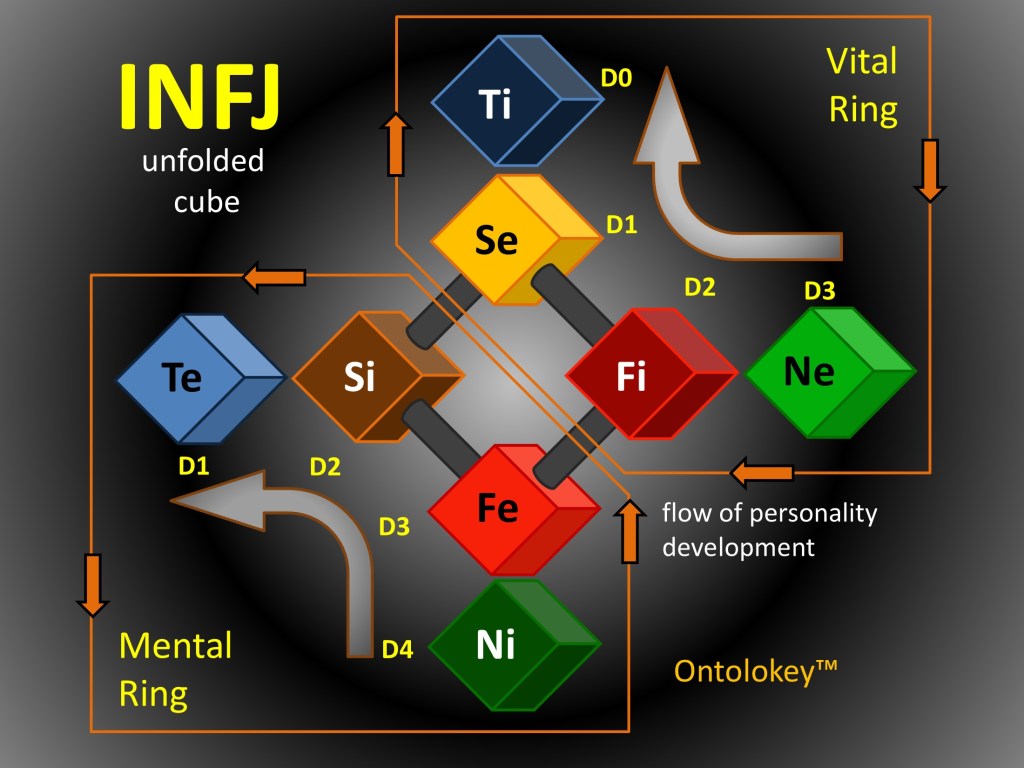
The Architecture of the INFJ Psyche: From Inner Vision to Psychological Wholeness
The INFJ personality is often associated with intuition, empathy, idealism, and an unusually deep interest in the inner lives of other people. Beneath these familiar characteristics, however, lies a more complex psychological structure in which insight coexists with vulnerability, compassion with hidden resentment, and the desire for harmony with an equally powerful need for personal authenticity. The INFJ may possess an extraordinary capacity to recognize emotional patterns, anticipate the consequences of human behavior, and perceive meanings that remain invisible to others, yet these abilities do not automatically translate into self-understanding. Indeed, the more convincingly a person understands the psychological realities of others, the easier it can become to overlook the unresolved conflicts within their own personality. The central challenge is not simply to cultivate the qualities that make the INFJ perceptive and compassionate, but to recognize how those same qualities can become entangled with unconscious defenses, idealized self-images, and unacknowledged emotional needs. Psychological maturity begins when the individual stops treating personal insight as proof of inner completion and starts examining the parts of the self that contradict the identity they have learned to cherish.
Within the Ontolokey framework, this developmental task can be understood as a gradual integration of eight psychological functions arranged across two interconnected structures, the Mental Ring and the Vital Ring. Each function represents a different way of perceiving experience, responding to the world, or organizing inner reality, and each occupies a particular developmental position that influences how consciously and reliably it can be expressed. For the INFJ, the dominant function, Introverted Intuition (Ni), provides the organizing vision of the personality, while Extraverted Feeling (Fe) supports its engagement with the emotional lives of others. Beneath these more accessible capacities lie functions associated with personal memory and groundedness, practical execution, exploratory possibility, individual values, direct sensory experience, and analytical consistency. The developmental journey described in this essay follows the principle that psychological integration proceeds incrementally rather than through isolated acts of will: more developed capacities must provide the foundation upon which less developed ones can gradually emerge. The objective is not to eliminate the INFJ’s characteristic sensitivity or transform the individual into a fundamentally different personality, but to make previously unconscious tendencies available to conscious understanding, responsible choice, and compassionate self-acceptance. In this sense, wholeness means becoming capable of inhabiting the full range of one’s psychological reality without allowing any single function, moral ideal, or defensive identity to define the entire self.
The Light and Shadow of Introverted Intuition (Ni): The Search for Meaning and the Danger of Certainty
Introverted Intuition is the dominant function of the INFJ and occupies developmental level D4 within the Mental Ring, representing the most developed and influential psychological capacity in this personality structure. Ni seeks the underlying meaning of experience by connecting observations, memories, emotional impressions, and abstract patterns into an internally coherent understanding of reality. Rather than approaching life as a sequence of unrelated events, the INFJ tends to perceive situations as parts of a larger psychological or existential pattern, often sensing where a relationship, personal conflict, or unfolding situation may eventually lead. This orientation can produce remarkable foresight, an ability to understand complex interpersonal dynamics, and a persistent desire to discover the deeper truth behind appearances. Yet the strength of Ni also creates a particular vulnerability: when an interpretation becomes internally convincing, the INFJ may begin to experience it as an established truth rather than as a hypothesis that remains open to revision. The mind can construct an intricate explanation of another person’s motives without adequately distinguishing direct evidence from intuition, emotional inference, or assumptions shaped by earlier experiences. Consequently, the very function that enables the INFJ to recognize hidden patterns can also reinforce confirmation bias, overinterpretation, and an attachment to an imagined future that reality may never fulfill.
The shadow of Ni becomes especially consequential when the INFJ’s inner vision is used to protect an idealized understanding of the self or the world. An individual who strongly identifies with being perceptive may find it difficult to acknowledge that a supposedly profound insight was mistaken, that a cherished relationship was understood inaccurately, or that another person’s behavior cannot be explained by a single coherent psychological narrative. Disappointment can then become more than a painful experience; it can threaten the INFJ’s sense of identity as someone who understands what others fail to see. In response, the mind may reinterpret contradictory evidence, withdraw into private conclusions, or construct increasingly elaborate explanations that preserve the original conviction. Under emotional pressure, this process can lead to suspicion, silent judgment, and a growing distance between the INFJ’s internal world and the people with whom they are attempting to connect. The necessary developmental task is therefore not to suppress intuition, but to distinguish intuition from certainty and meaning from projection, allowing the complexity of reality to challenge even the most compelling inner interpretation. When Ni becomes more flexible, its gift of foresight is no longer used primarily to anticipate disappointment or defend a private worldview, but to support a mature relationship with uncertainty, in which understanding remains a living process rather than a final verdict.
The Ontolokey model places the INFJ’s initial developmental emphasis on strengthening the auxiliary function, Fe, before attempting to integrate the less developed functions that follow within the two rings. This sequence matters because the dominant function cannot resolve every psychological difficulty simply by becoming more active; in fact, excessive reliance on Ni may deepen isolation if inner interpretation is not balanced by genuine interpersonal exchange. Developing Fe enables the INFJ to test private impressions against the emotional realities of other people, to communicate insights without treating them as unquestionable conclusions, and to remain receptive when others describe experiences that contradict the INFJ’s expectations. Such engagement does not require abandoning discernment or accepting every explanation offered by another person, but it does require recognizing that understanding is reciprocal and that no individual has unrestricted access to another person’s inner world. In practical terms, the INFJ can begin by asking clarifying questions before drawing conclusions, separating observed behavior from inferred motivation, and allowing important judgments to remain provisional until further experience provides context. These practices gradually transform intuition from a potentially closed interpretive system into an instrument of conscious reflection, while preserving its capacity to recognize patterns and imagine possibilities. The deeper achievement is an inner vision that can withstand correction without collapsing into self-doubt, because its value no longer depends on being infallible.
Extraverted Feeling (Fe): From Compassionate Attunement to Authentic Connection
Extraverted Feeling occupies developmental level D3 within the INFJ’s Mental Ring and serves as the auxiliary function through which inner insight becomes relational awareness, emotional communication, and participation in the shared human world. While Ni seeks coherence and meaning within the individual’s inner landscape, Fe directs attention toward interpersonal relationships, collective values, emotional atmospheres, and the needs of others. This combination can make the INFJ exceptionally attentive to subtle changes in tone, unspoken tensions, and the emotional consequences of words or actions, often creating a strong desire to facilitate understanding and restore harmony where conflict has emerged. In its mature expression, Fe allows empathy to become an active and responsible form of care, enabling the INFJ to recognize the humanity of others without losing sight of their own principles. Nevertheless, the same sensitivity can become a source of psychological entanglement when the INFJ begins to equate being needed with being worthy, being agreeable with being good, or preserving harmony with fulfilling a personal obligation. What initially appears to be generosity may then conceal a fear of rejection, an aversion to conflict, or an unconscious expectation that emotional investment will eventually be reciprocated. The developmental challenge is to transform interpersonal sensitivity into a conscious capacity for connection rather than allowing it to become a strategy for securing acceptance, avoiding abandonment, or maintaining an idealized image of oneself as the person who understands and supports everyone else.
The shadow of Fe often emerges through the discrepancy between the INFJ’s outward composure and the emotional burdens accumulating beneath it. Because the individual may be highly skilled at accommodating others, communicating diplomatically, and anticipating relational needs, dissatisfaction can remain unexpressed long after personal boundaries have been crossed. The INFJ may continue to offer understanding while privately recording disappointments, hoping that others will eventually recognize the extent of their sacrifice without requiring an explicit conversation about it. When this unspoken expectation is repeatedly frustrated, compassion can gradually turn into resentment, disappointment into moral judgment, and emotional withdrawal into a means of expressing displeasure without openly acknowledging anger. In more difficult circumstances, the individual may become subtly controlling, using silence, guilt, excessive accommodation, or the withdrawal of affection to influence another person’s behavior while maintaining a conscious self-image of kindness. Such patterns do not necessarily indicate deliberate manipulation; they may arise when legitimate needs have become difficult to recognize and communicate directly. Nevertheless, good intentions cannot eliminate the consequences of indirect behavior, and genuine psychological development requires the INFJ to acknowledge that suppressed anger remains anger, that excessive self-sacrifice can contain an unspoken demand, and that another person’s failure to intuitively recognize a need does not automatically constitute indifference or betrayal.
Within the Ontolokey developmental sequence, Fe is the first major function to be consciously strengthened after Ni, and its maturation creates the relational foundation for the subsequent integration of less developed functions. The practical objective is not to increase empathy indefinitely, since the INFJ may already possess considerable interpersonal sensitivity, but to make that sensitivity more balanced, transparent, and psychologically sustainable. This involves learning to express needs before they become grievances, establish boundaries without interpreting them as acts of selfishness, and tolerate disagreement without experiencing every relational rupture as evidence of personal failure. It also means allowing others to experience disappointment, frustration, or emotional discomfort without immediately assuming responsibility for correcting their feelings. Mature Fe recognizes that genuine harmony cannot be manufactured by one person’s continual accommodation, because relationships require mutual responsibility and the freedom to express incompatible perspectives. As the auxiliary function approaches the upper end of its developmental range, the INFJ becomes increasingly capable of engaging with the world without relying on approval as the principal measure of personal worth. This growing stability provides the necessary transition toward the deeper work of individuation, in which the individual must begin to encounter psychological experiences that cannot be resolved through intuition or interpersonal understanding alone.
The Transition to Individuation: When the Familiar Self Begins to Change
Within the Ontolokey model, the maturation of the auxiliary function marks a decisive transition in the INFJ’s psychological development, because it establishes the conditions under which previously less accessible aspects of the personality can begin to enter conscious awareness. The initial task is to develop Fe from its established D3 position toward a level approaching D4, allowing interpersonal sensitivity to become more stable, self-aware, and independent of external validation. During this period, which may unfold substantially between early adulthood and the middle years of life, the INFJ gradually learns that genuine compassion does not require self-abandonment and that emotional understanding is most effective when accompanied by personal responsibility and clear boundaries. Once this foundation becomes sufficiently reliable, the developmental emphasis can shift toward the Sibling function, Extraverted Intuition (Ne), which occupies D3 within the Vital Ring. This transition represents the beginning of individuation in the specific developmental sequence described here, because the individual starts moving beyond the familiar ways of understanding and managing experience toward psychological capacities that have not yet been integrated into the conscious identity. What previously appeared to be a stable personality may begin to feel incomplete, not because its established strengths have disappeared, but because those strengths can no longer adequately explain the full complexity of the individual’s inner life.
The process can be compared to an iceberg whose visible portion represents conscious awareness while its much larger submerged mass represents psychological material that remains outside immediate recognition. As the INFJ develops the familiar functions of Ni and Fe, the established personality becomes more capable of engaging with the world, yet this very development can create the conditions for deeper internal tensions to surface. Contradictory feelings, unexpected impulses, recurring relationship difficulties, and previously unexplored possibilities may begin to challenge the coherent self-image through which the individual has understood their life. Rather than treating these experiences as evidence that something has gone wrong, the INFJ can learn to recognize them as invitations to expand the boundaries of self-understanding. The iceberg metaphor describes this movement as a gradual rotation through which what was once submerged becomes visible, until the individual has encountered and integrated a much larger proportion of their psychological reality. This is not necessarily a comfortable process, because greater awareness may initially intensify uncertainty, grief, anger, or regret before it produces a more comprehensive sense of self. The purpose is not to discard the original personality, but to bring its conscious strengths into a more complete relationship with the needs, limitations, and possibilities that were previously concealed beneath them.
Individuation therefore requires a different attitude toward personal development from the one that often governs the INFJ’s earlier efforts at self-improvement. Instead of asking how to become more insightful, more compassionate, or more consistent with an ideal of personal goodness, the individual begins to ask what has been excluded from that ideal and what psychological function the exclusion has served. An INFJ who has always valued understanding may discover an unacknowledged need to be understood; someone who has built an identity around emotional generosity may encounter envy, competitiveness, or a desire for recognition; and someone who has sought to remain composed may begin to recognize the anger that has accumulated beneath years of accommodation. These discoveries can feel threatening because they challenge the assumption that psychological maturity consists of strengthening admirable qualities while eliminating undesirable ones. Yet integration does not mean endorsing every impulse or acting upon every newly recognized desire, but understanding its origin, function, and possible constructive expression. The Ontolokey sequence provides a framework for approaching this work without attempting to develop every neglected capacity simultaneously, allowing each emerging function to build upon the psychological stability established by the preceding one. Through this gradual process, self-knowledge becomes less concerned with preserving an idealized identity and more concerned with understanding the actual person who exists beneath it.
Extraverted Intuition (Ne): The Sibling Function and the Liberation from a Single Reality
Extraverted Intuition occupies developmental level D3 within the INFJ’s Vital Ring and represents the first function encountered in the model’s sequence of unconscious integration. Whereas Ni seeks to discover an underlying pattern and organize experience around an increasingly coherent inner vision, Ne opens the mind toward alternative interpretations, emerging possibilities, unexpected connections, and outcomes that cannot be predicted with certainty. Its developmental significance lies in its capacity to loosen the INFJ’s attachment to a single explanation of reality, particularly when that explanation has become emotionally important or central to personal identity. An INFJ may possess a profound ability to envision what a relationship could become, recognize the direction in which another person appears to be developing, or imagine a more meaningful future than present circumstances seem to permit. Yet this ability can become restrictive when the imagined possibility gradually replaces the actual person or situation, leaving the individual emotionally invested in a future that depends upon assumptions that have never been tested. Ne introduces a complementary movement of consciousness by inviting the INFJ to consider that several interpretations may be plausible, that unforeseen opportunities may emerge from disappointment, and that the future can remain open without becoming meaningless. As the Sibling function becomes more accessible, psychological flexibility begins to counterbalance intuitive certainty, enabling the INFJ to encounter life as a field of possibilities rather than as a predetermined narrative that must be preserved.
The shadow of insufficiently integrated Ne may appear in the INFJ’s difficulty tolerating uncertainty, revising expectations, or allowing an established interpretation to coexist with alternatives. When emotionally invested in a particular understanding, the individual may repeatedly revisit conversations, search for hidden meanings, or construct elaborate explanations intended to reconcile contradictory evidence with an existing belief. This tendency can be especially pronounced in intimate relationships, where hope and fear encourage the mind to alternate between idealized possibilities and imagined catastrophes. The INFJ may envision a person’s potential so vividly that present behavior becomes secondary, or interpret an ambiguous interaction as confirmation of a conclusion that has already taken shape internally. Conversely, when disappointment becomes overwhelming, the same imagination may generate increasingly negative scenarios that reinforce withdrawal and mistrust. Developing Ne means learning to recognize the difference between possibility and probability, imagination and observation, and openness and indiscriminate speculation. The practical exercise is to deliberately generate alternative explanations before reaching a conclusion, ask what evidence might contradict an emotionally compelling interpretation, and remain willing to revise expectations when reality provides new information. In this way, Ne does not weaken Ni’s capacity for insight but makes it more resilient, because an intuition that can accommodate competing possibilities is less likely to become imprisoned within its own internal coherence.
The designation of Ne as the Sibling function also offers a useful image for the emotional attitude required during this stage of individuation. A sibling introduces difference into the familiar psychological world, sometimes challenging established assumptions, exposing blind spots, or revealing possibilities that the dominant personality would not have discovered independently. For the INFJ, this encounter may involve accepting spontaneity, intellectual experimentation, humor, social exploration, or the freedom to change direction without first constructing a complete explanation of why the change is necessary. Rather than requiring every experience to contribute to a long-term purpose, the individual can begin to appreciate experiences whose value lies in discovery itself. This does not mean abandoning discernment or becoming scattered across endless alternatives; it means allowing exploration to correct the tendency to overdetermine reality through an internally compelling vision. Within the Ontolokey developmental sequence, strengthening Ne also establishes the foundation for approaching the next function, Introverted Feeling (Fi), which occupies D2 within the Vital Ring and brings the question of personal values into sharper focus. Once the INFJ becomes more capable of imagining realities beyond the familiar narrative, the next developmental challenge is to distinguish what genuinely matters to the individual from what has been adopted to maintain emotional harmony, fulfill expectations, or preserve a cherished image of being a good person.
Introverted Feeling (Fi): The Golden Shadow and the Recovery of the Authentic Self
Introverted Feeling occupies developmental level D2 within the INFJ’s Vital Ring and is described in the Ontolokey framework as the Golden Shadow, a designation that points toward psychological qualities that may be both deeply valuable and insufficiently acknowledged within the conscious personality. Whereas Fe directs attention toward interpersonal harmony, shared values, and the emotional experiences of others, Fi turns inward toward personal convictions, individual preferences, private emotional truths, and the question of whether one’s life genuinely reflects one’s own values. For an INFJ who has learned to understand themselves through their capacity to support others, anticipate emotional needs, and preserve meaningful relationships, this inward orientation can initially feel unfamiliar or even morally uncomfortable. The individual may have developed an elaborate understanding of what others need while remaining comparatively uncertain about what they themselves want, particularly when personal desires conflict with the expectations of people they care about. Consequently, the INFJ may mistake the absence of open conflict for inner peace, or interpret self-denial as evidence of maturity even when it produces a persistent sense of emptiness or resentment. Integrating Fi means discovering that authenticity is not the opposite of compassion, but one of its necessary foundations, because genuine care becomes distorted when the individual must continually suppress personal convictions to preserve acceptance. The Golden Shadow therefore represents not simply an undesirable tendency to be corrected, but a neglected capacity for self-respect, emotional honesty, and fidelity to an inner life that cannot be defined exclusively through relationships.
The difficulties associated with insufficiently integrated Fi often become visible through the discrepancy between the INFJ’s outwardly considerate behavior and the private emotional reality beneath it. An individual may repeatedly agree to commitments they do not genuinely wish to undertake, tolerate relationships that violate important boundaries, or adapt personal opinions to avoid disappointing someone whose approval has become emotionally significant. Because these choices can be justified through the language of empathy and responsibility, their underlying costs may remain difficult to recognize until accumulated exhaustion, bitterness, or a sense of having lost oneself becomes impossible to ignore. The INFJ may then experience guilt for wanting distance, shame for feeling anger, or confusion about desires that do not fit the identity of the understanding and selfless person they have tried to become. In some cases, suppressed preferences return indirectly through sudden emotional withdrawal, rigid moral judgments, or intense reactions to situations that appear insignificant to others but touch a long-standing wound involving autonomy or recognition. The developmental task is to understand these reactions without either condemning them or automatically treating them as reliable instructions for action. By identifying the need beneath the emotion, the INFJ can begin to distinguish a legitimate boundary from a defensive impulse, a personal conviction from an inherited expectation, and an authentic desire from a temporary attempt to escape discomfort. Such differentiation allows personal feeling to become a source of information and self-understanding rather than a force that remains hidden until it emerges through resentment or emotional crisis.
The integration of Fi becomes especially important when the INFJ confronts the possibility that being understood, appreciated, or loved cannot be guaranteed through perfect sensitivity to other people. Mature personal values must remain meaningful even when they are not universally shared, and an authentic decision must sometimes withstand disapproval without being interpreted as proof of selfishness or relational failure. The INFJ can begin this process by examining situations in which agreement was given despite an internal refusal, identifying the values that were compromised, and practicing direct communication about preferences before resentment develops. Equally important is learning to recognize personal needs without requiring them to be justified through their usefulness to others, since rest, privacy, creative expression, and the freedom to pursue individual interests are not legitimate only when they improve one’s capacity to serve. Within the Ontolokey sequence, Fi’s development also prepares the ground for Extraverted Sensing (Se), the inferior function at D1 within the Vital Ring, by restoring a more direct relationship between inner values and lived experience. Once the INFJ becomes more honest about what matters personally, it becomes easier to ask whether the life actually being lived corresponds to those values, rather than relying on an imagined future or an idealized self-concept to provide a sense of fulfilment. The recovery of the authentic self is therefore not a retreat from human connection, but a movement toward relationships in which care and individuality can coexist without either being sacrificed to the other.
Extraverted Sensing (Se): The Inferior Function and the Return to Embodied Life
Extraverted Sensing occupies developmental level D1 within the INFJ’s Vital Ring and represents the inferior function in the Ontolokey developmental sequence. While Ni naturally directs attention toward patterns, meanings, implications, and possible futures, Se draws awareness toward immediate sensory experience, observable circumstances, physical surroundings, and the concrete reality of the present moment. For the INFJ, whose consciousness is often absorbed in interpreting what experiences mean or anticipating what they may eventually become, direct engagement with the present can feel comparatively unfamiliar. The individual may be physically present while mentally preoccupied with an unresolved conversation, an anticipated difficulty, or a complex internal narrative about the direction of a relationship. This orientation can contribute to remarkable foresight and reflective depth, but it may also create distance from the body, from spontaneous enjoyment, and from the simple information supplied by immediate experience. Se becomes particularly important during individuation because it challenges the assumption that life must first be understood before it can be fully experienced. The developmental task is to recognize that reality is not merely material for interpretation, but an immediate encounter that possesses value independently of the meanings the mind assigns to it. By learning to attend to what is actually happening, the INFJ gradually develops a more balanced relationship between inner vision and the tangible world in which that vision must ultimately be lived.
The shadow of an insufficiently integrated Se may emerge through neglect of physical needs, discomfort with spontaneity, excessive anticipation, or difficulty responding flexibly when circumstances depart from an internal plan. An INFJ may spend considerable energy contemplating the emotional implications of a situation while overlooking straightforward evidence that would clarify it, or become so invested in a long-term objective that ordinary pleasures and immediate opportunities appear trivial by comparison. Under intense stress, the relationship with Se may become more complicated, as prolonged self-restraint and mental overactivity give way to impulsive consumption, excessive stimulation, abrupt decisions, or an unusually strong preoccupation with sensory experiences. Such reactions can be understood as possible expressions of a capacity that has received insufficient conscious attention and therefore becomes harder to regulate when psychological pressure increases. The objective is not to eliminate reflection or replace intuition with constant activity, but to develop a more dependable capacity for direct contact with the present. Walking without mentally rehearsing future conversations, preparing food with deliberate attention, engaging in physical exercise, noticing changes in the surrounding environment, and completing practical tasks can all help restore this connection. These activities may appear modest compared with the INFJ’s usual concern for psychological meaning, yet their developmental significance lies precisely in their simplicity: they teach the individual to encounter reality without continually transforming it into a problem that must be interpreted or a future that must be controlled.
As Se becomes more consciously accessible, the INFJ can begin to experience embodiment not as a distraction from inner development but as one of its essential conditions. Physical sensations provide information about fatigue, tension, hunger, excitement, and discomfort that abstract reflection may overlook, while direct engagement with the environment offers opportunities to correct assumptions through observable experience. This can be especially valuable in relationships, where the INFJ may otherwise give greater weight to imagined intentions than to repeated patterns of actual behavior. Rather than relying exclusively on an intuitive impression of what another person might become, the individual learns to attend to how that person behaves in the present and how the relationship affects everyday life. Within the Ontolokey sequence, the development of Se also establishes the necessary foundation for approaching Introverted Thinking (Ti), the tertiary function positioned at D0 within the Vital Ring and designated the Blindspot in this model. The progression is significant because analytical examination becomes more constructive when it is grounded in both authentic personal values and concrete experience, rather than functioning as an abstract instrument for defending pre-existing conclusions. By integrating Se, the INFJ moves toward a more immediate, flexible, and embodied relationship with life, preparing the personality for the final and particularly delicate stage of the Vital Ring: the conscious encounter with the analytical capacity that may have remained comparatively immature or insufficiently recognized.
Introverted Thinking (Ti): The Blindspot and the Integration of Inner Clarity
Introverted Thinking occupies developmental level D0 within the INFJ’s Vital Ring and represents the most developmentally vulnerable function in the Ontolokey model, where it is designated the Blindspot. Ti seeks internal logical consistency by examining concepts, distinguishing assumptions from evidence, identifying contradictions, and determining whether an explanation remains coherent when subjected to careful analysis. Although the INFJ may be capable of sophisticated reflection, this does not necessarily mean that analytical precision is consistently available when personal values, emotional attachments, or deeply held intuitive convictions are involved. Ni can produce a compelling interpretation, and Fe can make that interpretation emotionally meaningful, while insufficiently integrated Ti may struggle to examine the reasoning independently of its psychological appeal. The INFJ may therefore understand a situation intuitively without being able to explain precisely how the conclusion was reached, or may defend an interpretation because it feels profoundly meaningful rather than because its underlying assumptions have been adequately examined. In this sense, the Blindspot concerns not an absence of intelligence, but a potential difficulty in separating the validity of an argument from the emotional significance attached to it. Developing Ti means acquiring the capacity to examine one’s own reasoning with the same seriousness one might apply to the reasoning of others, allowing intellectual clarity to emerge without requiring every conclusion to confirm an established self-image.
The shadow expression of insufficiently integrated Ti can take several forms, particularly when the INFJ experiences criticism, uncertainty, or disagreement about a subject that carries substantial personal meaning. The individual may become defensive when asked to justify an intuitive conclusion, substitute moral conviction for logical explanation, or interpret disagreement as evidence that another person has failed to understand the deeper significance of the situation. Alternatively, the INFJ may become trapped in repetitive analysis, attempting to resolve emotional uncertainty through increasingly elaborate conceptual distinctions while remaining disconnected from the feelings that originally generated the conflict. These apparently opposite tendencies can arise from the same underlying difficulty: analysis has not yet become a sufficiently flexible instrument for examining experience without either serving a defensive purpose or attempting to eliminate all ambiguity. The developmental objective is to learn how to identify premises, distinguish observable facts from interpretations, recognize contradictions, and revise conclusions when the available evidence requires it. A useful practice is to write down a strongly held belief, identify the observations supporting it, consider evidence that challenges it, and articulate at least one alternative explanation that could also account for the situation. Such exercises do not diminish intuitive insight or emotional sensitivity; instead, they create a reflective space in which these capacities can be examined without automatically being accepted or rejected. As Ti becomes more accessible, the INFJ gains greater freedom to acknowledge uncertainty, admit mistakes, and distinguish intellectual disagreement from personal rejection.
The designation of Ti as a D0 function emphasizes the importance of approaching this stage with patience rather than demanding immediate analytical mastery. Within the Ontolokey developmental sequence, Ti follows Se and therefore becomes the final function to be integrated within the Vital Ring, after the individual has developed greater openness to possibilities, clarified personal values, and strengthened contact with immediate experience. This order provides a meaningful psychological foundation: logical analysis becomes more balanced when it can draw upon multiple interpretations, remain accountable to authentic values, and examine concrete circumstances rather than operating exclusively within an abstract inner narrative. The INFJ can then use Ti to investigate not only the behavior of others but also the internal reasoning through which personal expectations, judgments, and emotional responses have developed. This includes recognizing that an interpretation may be psychologically understandable without being factually accurate, that a feeling can be genuine without proving the conclusion associated with it, and that an explanation can be logically consistent while remaining incomplete. The mature expression of Ti is therefore not cold detachment, but intellectual honesty in the service of greater self-understanding. By learning to question personal conclusions without humiliating the self that formed them, the INFJ gradually integrates analytical discernment into a personality that may previously have relied more heavily on intuition and interpersonal feeling. The result is a more dependable capacity to hold complexity, tolerate contradiction, and make decisions that are simultaneously thoughtful, humane, and responsive to reality.
The Mental Ring: Integrating Si and Te Through Memory, Reality, and Responsibility
While the Vital Ring brings the INFJ into contact with possibilities, personal values, immediate experience, and analytical reasoning, the Mental Ring contains two additional functions that deepen the relationship between inner vision and practical life: Introverted Sensing (Si) at D2 and Extraverted Thinking (Te) at D1. Within the developmental sequence established for the INFJ, these functions follow the dominant Ni and auxiliary Fe, with Si occupying the position of the Anima/Animus and Te representing the Toddler function. Their integration addresses a different dimension of psychological development from that of the Vital Ring, because the central challenge is no longer simply to encounter unfamiliar aspects of the self, but to understand how vulnerability, personal history, and practical limitations shape the expression of the established personality. Si directs attention toward accumulated experience, familiar patterns, personal history, and the specific details through which life becomes tangible and continuous. Te, by contrast, emphasizes external organization, measurable outcomes, effective procedures, and the capacity to translate intentions into coordinated action. For an INFJ who naturally prioritizes meaning and interpersonal significance, these functions can expose difficulties that remain concealed behind insight and empathy, including an insufficient appreciation of concrete evidence, reluctance to impose structure, and frustration when a meaningful intention fails to produce a practical result. Their gradual development helps bridge the distance between understanding what matters and establishing the conditions necessary to live accordingly.
10. Introverted Sensing (Si): The Anima/Animus and the Healing of Personal Vulnerability
Introverted Sensing occupies developmental level D2 within the INFJ’s Mental Ring and is designated the Anima/Animus function in the Ontolokey framework. This position gives Si particular importance in the exploration of vulnerability, because it concerns the relationship between present experience and the accumulated impressions through which the individual has learned to interpret safety, familiarity, trust, and personal continuity. Whereas Ni seeks to discover overarching patterns and future implications, Si brings attention to the specific experiences that have shaped the individual over time, including emotional memories, established habits, bodily responses, and the personal significance of seemingly ordinary events. For the INFJ, whose intuitive orientation may rapidly transform an experience into a broader psychological interpretation, Si can provide an essential counterweight by restoring attention to what actually happened and how it was experienced at the time. A painful interaction, for example, may become embedded within a larger narrative about betrayal or rejection, even when the original event contained ambiguities that were never fully explored. By returning to the concrete details of such experiences, the INFJ can begin to distinguish the event itself from the meanings subsequently attached to it, allowing personal history to become more differentiated and less governed by generalized expectations. The developmental significance of Si lies not in encouraging the individual to remain attached to the past, but in helping them recognize how past experiences continue to influence present perceptions, emotional reactions, and relational choices.
The Anima/Animus designation emphasizes the particular sensitivity that this function may carry within the developmental model, especially when memories and embodied experiences have not been consciously integrated. The INFJ may appear emotionally composed and psychologically perceptive while remaining vulnerable to reminders of earlier rejection, humiliation, instability, or unmet emotional needs. A seemingly minor criticism may reactivate a familiar sense of inadequacy, while an ambiguous change in another person’s behavior may evoke an expectation of abandonment that originated in a different relationship or period of life. Because these reactions can arise before conscious reflection has begun, the individual may interpret them as accurate judgments about the present rather than as responses shaped partly by earlier experience. Such patterns can contribute to disproportionate emotional reactions, persistent rumination, reluctance to trust, or an attempt to control circumstances in order to prevent the recurrence of previous pain. Integrating Si involves developing the capacity to recognize these emotional echoes without dismissing them or allowing them to determine present decisions automatically. The INFJ can examine recurring triggers, identify the memories or learned expectations associated with them, and ask whether the current situation genuinely reproduces the earlier circumstances or merely resembles them in some emotionally significant respect. This process can support psychological healing through understanding, because the individual begins to see why a particular experience was painful and why its effects may have persisted beyond the original event.
The healing potential of Si becomes especially apparent when the INFJ learns to approach personal history with both accuracy and compassion. Rather than interpreting past difficulties as proof of personal weakness or another person’s inherent malice, the individual can examine the interaction between circumstances, emotional needs, available resources, and the limitations of everyone involved. Such understanding does not require excusing harmful behavior, minimizing genuine injury, or abandoning appropriate boundaries; it creates the possibility of responding to the past without remaining psychologically organized around it. The INFJ may discover that a previous failure occurred because a necessary skill had not yet developed, that a relationship became painful because important needs remained unspoken, or that an earlier judgment was shaped by information that was incomplete at the time. Recognizing these factors can reduce unnecessary self-blame and make forgiveness more accessible, while preserving the ability to acknowledge responsibility and learn from experience. Within the Ontolokey sequence, Si must be developed sufficiently before Te becomes the next major focus, because practical effectiveness is more sustainable when it grows from a grounded understanding of personal history rather than from the desire to compensate for old wounds. By integrating Si, the INFJ begins to experience the past not as an invisible force that repeatedly dictates the present, but as a source of information that can be consciously understood, emotionally processed, and incorporated into a more compassionate sense of self.
Extraverted Thinking (Te): The Toddler Function and the Courage to Act in Reality
Extraverted Thinking occupies developmental level D1 within the INFJ’s Mental Ring and represents the Toddler function in the Ontolokey framework. Its psychological domain includes external organization, objective criteria, systematic planning, measurable results, and the ability to coordinate resources toward a defined outcome. For the INFJ, whose dominant Ni seeks meaning and whose auxiliary Fe prioritizes interpersonal understanding, the challenge is often not a lack of vision or motivation, but the translation of insight and intention into consistent, practical execution. An individual may understand a problem with considerable depth, recognize the emotional needs of everyone involved, and imagine an ideal solution while struggling to establish priorities, make firm decisions, or implement the necessary steps. This discrepancy can create a painful sense of unrealized potential, particularly when the INFJ measures personal worth against an internal image of what life could become. Te introduces a different question into the developmental process: not simply whether an intention is meaningful or psychologically coherent, but whether it can be translated into action under actual conditions. Its integration allows the INFJ to recognize that a worthy purpose requires more than insight and goodwill, because meaningful change depends equally upon planning, accountability, resource management, and the willingness to confront practical limitations. Developing Te therefore means learning to give external form to inner understanding without requiring every action to feel intuitively perfect or emotionally comfortable before it begins.
The shadow of insufficiently integrated Te can appear through procrastination, disorganized commitments, difficulty prioritizing competing demands, or an excessive dependence on internal readiness before action is taken. The INFJ may continue refining a vision because implementation introduces the possibility of measurable failure, criticism, or evidence that the imagined outcome was unrealistic. In other circumstances, the individual may resist external standards because they appear impersonal, overlooking the possibility that clear procedures and objective feedback can protect both personal energy and interpersonal relationships. Under pressure, this vulnerability may produce abrupt attempts to impose control, excessive self-criticism, or frustration with people who appear more practically decisive but less attentive to psychological nuance. These reactions can be understood as difficulties in establishing a balanced relationship with external structure rather than as proof that the INFJ is inherently incapable of practical competence. The developmental task is to begin with manageable commitments, define realistic objectives, establish deadlines, and evaluate progress through observable results rather than through the subjective intensity of effort or intention. Breaking a large project into smaller steps can reduce the distance between an imagined outcome and the actions required to achieve it, while learning to tolerate imperfect beginnings prevents the pursuit of an ideal solution from becoming an excuse for indefinite delay. Through repeated practice, Te becomes less threatening because action no longer has to serve as a definitive judgment of personal worth; instead, it becomes a source of feedback through which understanding can be refined and competence gradually acquired.
The designation of Te as the Toddler function also suggests that development should proceed through experimentation, repetition, and proportionate expectations rather than through demands for immediate mastery. An INFJ who has spent years relying primarily on intuition and interpersonal sensitivity may initially experience practical organization as restrictive, impersonal, or emotionally unrewarding. Yet a well-developed capacity for external structure can protect the very qualities the individual values most, because reliable routines, realistic boundaries, and clearly defined responsibilities reduce the exhaustion produced by disorganization and overcommitment. In relationships, Te can help transform compassionate intentions into specific agreements, making it easier to distinguish between what one hopes to offer and what one can realistically sustain. In professional or creative pursuits, it allows the INFJ to evaluate whether a project is progressing, whether a method is effective, and whether adjustments are necessary without interpreting every setback as a personal failure. Within the Ontolokey developmental sequence, Te is approached after Si has been sufficiently integrated, allowing practical decisions to draw upon a more conscious understanding of past experience and recurring vulnerabilities. The deeper achievement is the reconciliation of inner meaning with external responsibility: the INFJ becomes increasingly capable of turning insight into action, ideals into workable commitments, and personal aspirations into outcomes that can be experienced and evaluated in the real world.
The Deepest Shadow of the INFJ: Idealization, Resentment, and the Fear of Being Seen
The deepest shadow of the INFJ emerges when the qualities that organize the conscious personality become entangled with unconscious needs that the individual finds difficult to acknowledge. The desire to understand others may conceal a need to feel indispensable, the commitment to harmony may conceal a fear of rejection, and the pursuit of an ideal future may function as protection against the disappointment of present reality. These contradictions are particularly difficult to recognize because they can develop around qualities that are genuinely admirable, allowing defensive patterns to appear indistinguishable from compassion, moral conviction, or psychological insight. An INFJ may sincerely wish to help another person while also hoping that the relationship will provide recognition, loyalty, or a sense of being uniquely understood. When these expectations remain unconscious, the individual may interpret disappointment as evidence of another person’s ingratitude rather than recognizing the unspoken agreement that had gradually formed within their own mind. Similarly, an INFJ who strongly identifies with being perceptive may unconsciously use psychological interpretations to maintain a position of superiority, particularly when another person’s behavior challenges the INFJ’s preferred understanding of the relationship. Such tendencies do not invalidate genuine empathy or idealism, but they reveal that human motives are rarely as pure or internally consistent as the conscious self would prefer to believe. Psychological integration begins when the INFJ can acknowledge mixed motives without collapsing into shame, recognizing that the presence of an unconscious need does not erase the sincerity of the accompanying care.
One of the most consequential expressions of this shadow is the transformation of disappointment into silent resentment. Because the INFJ may be reluctant to express anger directly, personal boundaries can remain unspoken while emotional expectations continue to accumulate beneath the surface of an apparently harmonious relationship. The individual may repeatedly offer support, accommodate another person’s preferences, or suppress disagreement while privately expecting a comparable degree of sensitivity in return. When that reciprocity fails to materialize, the resulting pain may become entangled with the conviction that the other person should have understood what was needed without being told. This expectation can be especially persistent when the INFJ regards intuitive understanding as a fundamental expression of love, making another person’s failure to anticipate an emotional need appear to demonstrate a lack of genuine concern. Yet even profound emotional attunement cannot eliminate the need for communication, and the expectation that others should intuitively recognize unexpressed needs can place an impossible burden on relationships. The resulting resentment may be expressed through withdrawal, emotional coldness, subtle criticism, or the gradual removal of support that was previously offered without explicit conditions. Integrating this shadow requires the INFJ to examine the difference between freely chosen generosity and generosity that carries an unspoken expectation of repayment, while learning to communicate needs and limits before disappointment becomes a moral judgment about another person’s character.
Another difficult aspect of the INFJ shadow concerns the relationship between idealization and control. The ability to perceive potential can lead the individual to recognize possibilities in people and relationships that are not yet reflected in their actual behavior, creating a powerful attachment to what might eventually become possible. When reality repeatedly contradicts this vision, the INFJ may alternate between defending the imagined potential and condemning the person who fails to fulfill it. In some circumstances, the individual may attempt to guide, interpret, or emotionally influence others toward an outcome that appears beneficial, while overlooking the fact that another person has the right to choose a different path. The wish to help can then become entangled with an unconscious need to preserve coherence between the INFJ’s inner vision and the external world. The corresponding developmental task is to distinguish loving someone from believing that one understands what that person ought to become, and to recognize that insight does not confer authority over another person’s choices. Genuine compassion requires the willingness to encounter people as they are, including their contradictions, limitations, and capacity to disappoint, without reducing them either to idealized potential or to the mistakes they have made. When the INFJ relinquishes the need to control the meaning or direction of another person’s life, relationships become less dependent on projection and more capable of supporting authentic difference, mutual responsibility, and emotional freedom.
The deepest movement toward healing occurs when the INFJ no longer treats the shadow as an enemy that must be eliminated to preserve a morally acceptable identity. Anger can reveal a violated boundary, envy can identify an unacknowledged desire, resentment can expose an imbalance between giving and receiving, and the need for recognition can reveal how strongly personal worth has become tied to being useful or uniquely understanding. None of these emotions automatically justifies a particular action, but each can become valuable psychological information when examined without denial or self-condemnation. The task is to accept responsibility for how these tendencies influence behavior while also recognizing the experiences and vulnerabilities from which they may have developed. This distinction makes genuine change possible because the individual no longer needs to defend against the mere existence of uncomfortable feelings and can instead decide how to respond to them. As the INFJ gradually integrates the functions of the Mental and Vital Rings, the capacity for self-observation becomes more comprehensive, allowing intuition, empathy, personal values, memory, action, and analysis to participate in a more balanced understanding of experience. The resulting maturity is not the perfection of the conscious personality, but a greater willingness to acknowledge its contradictions and remain accountable for their consequences. Wholeness begins when the INFJ can recognize both the light and the shadow as parts of one psychological reality without allowing either to become the sole definition of the self.
The Ontolokey Cube: Making the Unconscious Visible
The Ontolokey cube offers the INFJ a practical way to visualize the developmental relationships between the eight psychological functions and to translate an abstract understanding of individuation into a more tangible process of self-observation. Rather than treating personality as a fixed collection of characteristics, the cube presents the psychological structure as a multidimensional landscape in which familiar capacities occupy more accessible positions while less-developed functions represent potential directions for conscious growth. Within the developmental arrangement described in this essay, Ni and Fe provide the initial foundation of the Mental Ring, while the subsequent integration of Si and Te expands the individual’s capacity to acknowledge vulnerability, engage with personal history, and translate intentions into practical action. The Vital Ring follows its own sequence through Ne, Fi, Se, and Ti, progressively introducing alternative possibilities, authentic personal values, immediate experience, and analytical clarification. The sliders on the Ontolokey cube can serve as visual reminders of these relationships, helping the INFJ recognize which psychological capacities are habitually relied upon and which may require deliberate attention. Their purpose is not to prescribe a rigid transformation or suggest that every function must become equally developed, but to make the direction of possible growth easier to recognize. The cube becomes most useful when it encourages reflection on actual experience rather than merely reinforcing an intellectual understanding of personality.
To use the cube constructively, the INFJ can begin by examining a recurring difficulty and identifying which function tends to dominate the initial response. When a relationship becomes uncertain, Ni may immediately search for hidden meanings, while Fe attempts to restore harmony or anticipate the other person’s emotional needs. The individual can then consciously introduce another perspective by asking Ne to generate alternative explanations, Fi to identify personal needs and boundaries, Se to examine what is concretely observable, or Ti to assess the reasoning behind the original interpretation. Similarly, when an important project remains indefinitely unfinished, the INFJ can recognize the limits of continued reflection and invite Te to establish a realistic objective and a specific next step. These deliberate shifts do not require the individual to abandon the natural strengths of the dominant personality, but they prevent a familiar response from monopolizing consciousness when the situation demands a different psychological resource. The sliders can therefore function as prompts for experimentation, helping the INFJ recognize that development involves learning to respond differently rather than merely acquiring additional knowledge about the self. Over time, repeated encounters with unfamiliar functions can make previously awkward responses more accessible, allowing greater psychological flexibility to emerge through practice.
The deeper value of this visual approach lies in its capacity to transform shadow recognition from an abstract exercise into an ongoing dialogue with the self. When irritation, envy, resentment, or uncertainty arises, the INFJ can use the cube as a reminder to investigate what has been neglected rather than immediately suppressing the emotion or constructing an explanation that protects the established self-image. Resentment may point toward an unacknowledged boundary associated with Fi, while excessive interpretation may signal the need to return to the present through Se or consider alternatives through Ne. A recurring inability to implement an intention may reveal an opportunity to strengthen Te, whereas an emotionally charged reaction to a familiar situation may invite closer attention to the personal history represented by Si. Such interpretations should remain responsive to the circumstances rather than becoming another rigid system of labels, because the purpose of the model is to expand self-awareness, not replace one predetermined explanation with another. As the INFJ becomes more accustomed to examining these relationships, the cube can serve as a continuing visual companion to the process of individuation, encouraging the individual to move beyond the question of which function defines the personality toward the more constructive question of which psychological capacity is needed now. In this way, the Ontolokey cube becomes a map for conscious exploration, supporting the gradual integration of neglected aspects of the psyche and the development of a more complete, flexible, and self-directed personality.
Forgiveness and Psychological Healing: Understanding Without Excusing
One of the most profound consequences of psychological integration is the possibility of understanding past suffering without remaining permanently defined by it. For the INFJ, painful experiences can become embedded within complex internal narratives that connect particular events to broader conclusions about trust, loyalty, rejection, or personal worth. Because Ni naturally searches for meaning, the individual may continue revisiting an experience in the hope of discovering an explanation that finally resolves its emotional contradictions. Yet understanding does not always emerge from further interpretation alone; sometimes it requires recognizing how the individual’s own psychological vulnerabilities shaped the experience, the subsequent response, and the meaning assigned to what happened. The gradual integration of Si can help distinguish the original event from the accumulated memories and expectations surrounding it, while Fi can reveal the personal needs or values that were injured. Ne allows alternative interpretations to emerge, and Ti can examine whether the conclusions drawn from the experience remain justified by the available evidence. Through this process, the INFJ may begin to recognize that a painful encounter can have several contributing causes, including another person’s limitations, inadequate communication, incompatible expectations, and the individual’s own developmental vulnerabilities. Such recognition does not diminish the reality of the suffering, but it can reduce the psychological burden of treating every painful outcome as proof of personal inadequacy or deliberate betrayal.
Forgiveness becomes more accessible when the INFJ can distinguish understanding from approval and emotional release from the obligation to restore a relationship. Recognizing why another person acted hurtfully does not make the behavior acceptable, just as acknowledging one’s own contribution to a conflict does not mean accepting responsibility for everything that occurred. The purpose of psychological understanding is to replace undifferentiated blame with a more accurate perception of circumstances, motives, boundaries, and consequences. Sometimes this process leads to reconciliation, particularly when both people can acknowledge their actions and establish healthier patterns of communication; in other situations, it reveals that distance is necessary to protect emotional well-being. Forgiveness may also concern the self, especially when the INFJ recognizes that earlier decisions were made with limited awareness, under considerable emotional pressure, or without access to psychological capacities that have since developed. The individual can accept responsibility for mistakes without demanding that the person they once were should have possessed the understanding available only in retrospect. This distinction is essential because self-punishment can become another expression of perfectionism, allowing the individual to remain attached to the past through continuous moral evaluation rather than learning from it and moving forward. Genuine forgiveness therefore involves neither denying injury nor erasing accountability, but developing the capacity to remember without continually reproducing the same emotional judgment.
Within the Ontolokey developmental sequence, healing through cognition emerges from the growing ability to recognize the relationship between psychological function, emotional response, and lived experience. The vulnerable Anima/Animus function, Si, can help explain why certain experiences remain especially painful, while the Toddler function, Te, can support the practical changes needed to prevent similar difficulties from recurring. At the same time, integrating Fi allows the INFJ to acknowledge personal needs more honestly, and developing Ti helps distinguish justified conclusions from interpretations reinforced by fear, guilt, or idealization. This process does not imply that all emotional suffering can be resolved through intellectual understanding alone, since grief, trauma, and deeply established relational patterns may also require time, supportive relationships, or professional psychological assistance. Rather, cognitive integration creates conditions under which experience can be understood more accurately and responded to more consciously, reducing the tendency to repeat familiar patterns without recognizing their underlying causes. As the INFJ develops this capacity, the past becomes less exclusively a source of injury and more a source of knowledge about personal limits, needs, values, and possibilities for change. The resulting freedom lies not in becoming immune to disappointment, but in developing a more compassionate and differentiated relationship with the experiences that have shaped the self.
INFJ Growth in Practice: Turning Psychological Insight into Conscious Change
The practical development of the INFJ begins when self-observation becomes a regular part of everyday life rather than an activity reserved for moments of crisis. Insight alone does not guarantee transformation, because an individual may understand the origins of a recurring pattern while continuing to reproduce it whenever familiar emotional pressures arise. The essential task is to create a conscious interval between an internal reaction and the behavior that follows, allowing less-developed psychological capacities to participate before an established response takes control. When Ni produces a compelling interpretation, the INFJ can invite Ne to consider alternatives and Ti to examine the supporting evidence; when Fe encourages accommodation, Fi can clarify whether the decision respects personal values and boundaries. If reflection becomes detached from present reality, Se can restore attention to observable circumstances, while Si can help identify whether earlier experiences are influencing the current response. When an intention remains unrealized, Te can translate the desired outcome into manageable actions, deadlines, and practical commitments. These exercises are most effective when applied to recurring situations rather than treated as abstract intellectual exercises, because the purpose of development is to change how the individual responds to actual life. Gradually, the INFJ learns that psychological maturity depends less on eliminating uncomfortable reactions than on recognizing them early enough to choose a more constructive response.
A sustainable approach to individuation also requires the INFJ to abandon the expectation that personal growth should proceed without setbacks, contradictions, or periods of uncertainty. Development within the Ontolokey framework follows a specific sequence, moving from the more developed function toward the next less-developed function within each ring, rather than attempting to transform every psychological vulnerability simultaneously. In the Mental Ring, this means consolidating Fe before progressing toward Si and then Te; in the Vital Ring, it means developing Ne before proceeding to Fi, Se, and finally Ti. The two sequences can advance at different rates, with the Vital Ring following the Mental Ring with some delay, so that expanding awareness does not outpace the individual’s ability to establish emotional and practical stability. In everyday terms, this calls for concentrating on one recurring pattern at a time, observing its triggers, experimenting with an alternative response, and reviewing the consequences without turning every difficulty into a verdict on personal worth. The INFJ should also recognize the difference between genuine developmental resistance and the understandable discomfort of learning an unfamiliar skill, since unfamiliarity does not necessarily indicate that a direction is inappropriate. Patience, repetition, and honest evaluation allow growth to become a lived capacity rather than another ideal against which the individual measures an allegedly inadequate self.
The recommendations presented in Ontolokey’s INFJ Suggestions for Growth can be approached through this broader commitment to conscious, incremental development. The INFJ benefits from cultivating relationships in which honesty is more important than maintaining an appearance of perfect understanding, activities that reconnect attention with the physical world, and practical routines that support the completion of meaningful intentions. Equally important is the willingness to recognize when solitary reflection has become repetitive rumination, when empathy has become self-neglect, or when idealism has become an excuse for postponing difficult decisions. Keeping a reflective journal can help identify recurring patterns, provided that writing leads toward clearer understanding and constructive action rather than endless reinterpretation of the same events. Honest conversations can reveal discrepancies between the INFJ’s intentions and the effects of their behavior, while feedback from trusted people can challenge assumptions that remain difficult to recognize from within. Where emotional wounds are persistent or overwhelming, professional support may provide additional resources for working through experiences that cannot be adequately resolved through self-reflection alone. Ultimately, the most meaningful evidence of development is not a sophisticated vocabulary for describing psychological functions, but a growing ability to establish boundaries, tolerate uncertainty, accept correction, act responsibly, and remain compassionate without abandoning oneself.
The Rotation of the Iceberg: The Return to the Whole Self
The deeper movement of INFJ development can be understood through the image of an iceberg slowly rotating in the water. What we call consciousness is only the visible portion of a much larger psychological reality; beneath it lie functions, memories, impulses, vulnerabilities, and possibilities that have not yet found a stable place in our conscious identity. In the first half of life, an INFJ may identify strongly with the clarity of Introverted Intuition and the relational intelligence of Extraverted Feeling, experiencing these functions as the natural foundations of the self. The remaining functions can seem secondary, awkward, or even threatening because they challenge the familiar image of being perceptive, compassionate, and inwardly coherent. Yet psychological wholeness begins when these submerged dimensions are no longer treated as defects to be concealed but as parts of the personality waiting to be understood. The iceberg does not become whole by adding another layer to its visible surface; it becomes whole as its hidden mass gradually enters awareness and the relationship between its parts changes.
Within the Ontolokey model, this transformation is represented through two developmental rings whose functions have different levels of maturity and different tasks to fulfil. The Mental Ring moves from dominant Ni at D4 through auxiliary Fe at D3, Anima/Animus Si at D2, and Toddler Te at D1, while the Vital Ring moves from Sibling Ne at D3 through Golden Shadow Fi at D2 and inferior Se at D1 toward tertiary or Blindspot Ti at D0. These levels are not simply a ranking of personal worth; they represent differing degrees of development, accessibility, and conscious integration within the model. The developmental direction matters because growth in one area provides the foundation for approaching the next. Rather than trying to master every neglected function at once, the INFJ begins by strengthening Fe until it approaches the maturity of Ni, then gradually opens toward Ne and the further dimensions of the Vital Ring. The rings may develop almost in parallel, although the Vital Ring is understood to follow with some delay, allowing the personality to expand without demanding that every part of the psyche change at the same pace.
This process often gathers momentum in the second half of life, when the achievements that once defined the self no longer provide sufficient answers to the questions that have emerged. A person may have developed considerable insight, built meaningful relationships, and learned to navigate the expectations of the outer world, yet still feel that something essential remains unexpressed. Such dissatisfaction does not necessarily mean that the earlier life was false; it may mean that the earlier identity served a necessary purpose but cannot contain the whole person indefinitely. The INFJ is then invited to encounter the neglected dimensions of experience: the freedom to imagine alternatives without immediately interpreting them, the courage to honour personal values even when they disappoint others, the willingness to inhabit the body and the present moment, and the patience to develop practical clarity without demanding immediate mastery. Each encounter alters the meaning of the functions already familiar. Intuition becomes less isolated, empathy becomes less dependent on approval, and inner conviction becomes more capable of surviving contact with reality.
The final image of the rotating iceberg is therefore not a personality that abandons its dominant function, but one in which the dominant function returns to its former position within a fundamentally changed whole. Ni remains central, yet it no longer has to carry the impossible burden of explaining everything, anticipating every danger, or guaranteeing that life will unfold according to an inner vision. Fe can remain compassionate without sacrificing authenticity; Si can preserve personal history without imprisoning the present; and Te can support action without becoming a measure of human worth. The formerly submerged functions do not replace the conscious self but enter into a more conscious relationship with it, allowing qualities once experienced as weaknesses to become sources of balance. In the language of this model, the rotation culminates in a kind of psychological rebirth: not a return to innocence, but the emergence of a self that has encountered more of its own reality. Wholeness is not the disappearance of shadow; it is the ability to recognise the shadow as part of oneself without surrendering one’s life to it.
Wholeness Without Perfection: Becoming More Than the INFJ Ideal
One of the final obstacles on the path toward psychological wholeness is the belief that healing should eventually produce a flawless version of the self. For the INFJ, this expectation can be especially seductive because the desire for meaning often becomes intertwined with the desire to live according to an inner ideal. The person may imagine that sufficient insight will eliminate contradictions, that sufficient compassion will prevent resentment, or that sufficient self-awareness will make future mistakes unnecessary. Yet this ideal can become another form of psychological confinement, turning personal development into an endless examination of everything that remains inadequate. The shadow then survives beneath the language of growth, disguised as perfectionism, moral superiority, or disappointment with the ordinary limitations of human life. Genuine integration begins when the INFJ recognises that awareness does not abolish vulnerability and that maturity does not mean never becoming confused, defensive, selfish, or afraid. It means learning to notice these states without allowing them to define the entirety of one’s identity.
This shift also changes the way the INFJ relates to other people. When the self is organised around an ideal of being unusually understanding, perceptive, or emotionally generous, relationships can become quiet tests of whether others recognise and reciprocate these qualities. Disappointment then carries a double wound: the immediate pain of feeling misunderstood and the deeper fear that one’s identity as a caring, insightful person has not been confirmed. The integrated INFJ gradually releases the need to be the person who always understands, always forgives, or always sees the hidden truth beneath another person’s behaviour. Sometimes understanding requires distance; sometimes compassion means allowing another person to face the consequences of their choices; sometimes honesty means admitting that one’s interpretation may be incomplete. These are not betrayals of the INFJ’s deeper nature but expressions of a more grounded humanity. The person becomes less invested in performing goodness and more capable of practising it freely, without making personal worth dependent on the outcome.
Wholeness also requires a more forgiving relationship with one’s own history. The INFJ may look back on years of excessive accommodation, unspoken resentment, idealised relationships, or opportunities abandoned because action felt too uncertain. With greater awareness, these experiences can become painfully visible, inviting the temptation to condemn the earlier self for not knowing what seems obvious now. Yet the earlier self acted with the awareness, resources, and psychological maturity available at that time, often attempting to protect something deeply valued even when the chosen strategy caused suffering. Recognising this does not require denying responsibility or pretending that every decision was wise; it allows responsibility to emerge without being fused with shame. The person can acknowledge harm, make amends where possible, and learn new ways of responding while granting the past self the same human complexity that they would grant someone they love. In this sense, self-forgiveness is not an escape from growth but a condition that makes sustained growth possible.
The INFJ ideal therefore reaches its most mature expression when it becomes less concerned with appearing exceptional and more concerned with being present, honest, and whole. Insight remains valuable, but it must coexist with uncertainty; empathy remains powerful, but it must include the self; and vision remains meaningful, but it must be tested through the lived reality of relationships, decisions, and consequences. The functions that once seemed inferior or inconvenient can then contribute something the dominant functions alone could not provide: the capacity to remain grounded, to act imperfectly, to think carefully, to honour personal values, and to encounter the world without requiring it to confirm an inner picture. The result is not a person who has transcended ordinary human struggles, but one who is less divided against themselves when those struggles arise. Wholeness is not the achievement of an ideal personality; it is the growing freedom to inhabit one’s actual personality with awareness, responsibility, and compassion.
The Living Landscape: Using Ontolokey as a Map for Continued Growth
The value of the Ontolokey model lies not merely in naming the functions associated with the INFJ, but in offering a way to imagine their relationship as a living psychological landscape. A personality description can feel reassuring when it explains familiar experiences, yet recognition alone does not necessarily lead to change. The deeper question is what a person does with that recognition: whether it becomes another fixed identity to defend or an invitation to explore the capacities that remain underdeveloped. The Ontolokey cube makes this exploration more tangible by representing the functions and their developmental levels as dimensions of a larger structure rather than isolated traits. Its sliders can be understood as visual guides to the relative maturity of different functions, helping the individual recognise where a familiar strength may be overburdened and where an unfamiliar capacity may need attention. The purpose is not to turn personal growth into a competition between levels, but to make an otherwise abstract inner process easier to observe, reflect upon, and approach with intention.
For the INFJ, this visual approach can be especially useful because inner experience often feels more coherent than outward behaviour. A person may understand the motives behind a difficult relationship yet struggle to express a boundary, recognise the need for change yet hesitate to act, or possess a powerful vision while finding practical implementation exhausting. By distinguishing between the functions that are already relatively developed and those that remain more vulnerable, the model invites a more precise question than the familiar demand to become a better person: Which capacity is this situation asking me to develop? Sometimes the answer involves Fe and the courage to communicate honestly rather than accommodate automatically; at other times, it involves Ne and the willingness to consider possibilities that challenge an established interpretation. In still other situations, growth may require the grounded presence of Se, the personal discernment of Fi, or the practical organisation associated with Te. The cube becomes meaningful when its categories lead back to concrete experiences and choices rather than remaining abstract descriptions of identity.
The developmental sequence also encourages patience by acknowledging that lasting change rarely occurs through force of will alone. In the model, progress through the Mental and Vital Rings follows an ordered direction, with each stage providing a foundation for the next; this offers a reminder that neglected capacities may need to be approached gradually rather than demanded into maturity overnight. An INFJ who has spent years relying on intuition and interpersonal attunement may initially experience practical assertiveness, personal preference, or spontaneous engagement with the physical world as strangely uncomfortable. That discomfort does not automatically indicate failure, nor does every difficulty prove that a particular function is responsible. It can instead become a prompt for careful observation: What am I avoiding, what am I protecting, and what small action would allow me to encounter this experience differently? The model’s developmental language is most useful when it supports such questions, allowing the individual to translate insight into manageable experiments in everyday life. Over time, these experiments can expand the range of responses available without requiring the INFJ to reject the qualities that have served them well.
Ontolokey’s broader landscape can also help place the INFJ experience within a wider understanding of personality differences. Exploring the model’s descriptions of other types may reveal that people approach meaning, relationships, decisions, and uncertainty through different psychological priorities, rather than through variations of a single preferred style. This perspective can soften the INFJ’s tendency to interpret misunderstanding as evidence of emotional shallowness or a lack of insight in others. Someone who values direct evidence, rapid execution, personal independence, or immediate experience may be attending to dimensions of reality that the INFJ habitually overlooks. Such differences do not need to be romanticised or treated as automatically complementary; they can still produce genuine conflict, and understanding another person’s orientation does not remove the need for boundaries or accountability. Yet the possibility of recognising a different psychological landscape can replace some of the loneliness of feeling fundamentally misunderstood with curiosity about how different people organise their experience. For further exploration of the INFJ and other personality types, the Ontolokey homepage offers the natural starting point:
The Courage to Become Whole
Ultimately, the INFJ’s journey toward wholeness is a movement away from the need to make the self perfectly coherent and toward the courage to embrace its full complexity. The familiar gifts of intuition, empathy, and the search for meaning remain essential, but they are no longer asked to carry the entire weight of existence. Beneath the perceptive mind and the compassionate heart lie other dimensions of the person: the memories that still hurt, the desires that have been silenced, the practical abilities that have not yet matured, the spontaneous experiences that resist interpretation, and the truths that challenge an idealised self-image. These dimensions do not make the INFJ less authentic; they reveal how much larger authenticity is than the identity originally built around it. The shadow becomes less frightening when it is no longer treated as proof of personal failure, and vulnerability becomes less humiliating when it is recognised as part of being human. Healing begins when the individual stops asking how to eliminate every contradiction and starts learning how to remain conscious within contradiction.
In the Ontolokey perspective, this transformation unfolds through the gradual integration of the personality’s different functions, each approached according to its developmental place and potential. The movement from Ni and Fe toward the less familiar dimensions of the Mental and Vital Rings represents a widening of psychological participation: more of the self becomes available to consciousness, more responses become possible, and fewer experiences must be rejected simply because they do not fit the established identity. The cube and its sliders offer a way to visualise this movement, but the actual work takes place in ordinary life—in difficult conversations, in the acceptance of personal needs, in decisions made without certainty, in the willingness to act imperfectly, and in the reconsideration of old wounds. No diagram can perform this work on someone’s behalf. Its value lies in helping a person recognise where attention may be needed and approach that place with greater patience, honesty, and responsibility. The model thus serves not as a final verdict on personality but as a map for an unfolding process whose meaning emerges through lived experience.
The deepest possibility of this journey is not that the INFJ becomes invulnerable, endlessly wise, or permanently at peace. It is that the person becomes less afraid of being fully human, less compelled to hide behind competence or compassion, and less dependent on an idealised future self to justify the present one. Intuition can then become a way of exploring reality rather than controlling it; empathy can become a free expression of care rather than a strategy for securing belonging; and self-understanding can become the beginning of responsibility rather than an excuse for remaining unchanged. The submerged parts of the iceberg gradually enter awareness, not to destroy the familiar self, but to give it a wider foundation. What emerges is neither the abandonment of the INFJ’s distinctive nature nor the triumph of one function over the others, but a more spacious relationship among the different dimensions of the psyche. The journey toward wholeness is complete not when the shadow disappears, but when the whole self is finally allowed to belong.


Leave a comment