| Your TYPE Description -> | Your TYPE – Description |
| Your SHADOW Description -> | Discover Your Shadow Personality |

Making Personality Visible
| Your TYPE Description -> | Your TYPE – Description |
| Your SHADOW Description -> | Discover Your Shadow Personality |
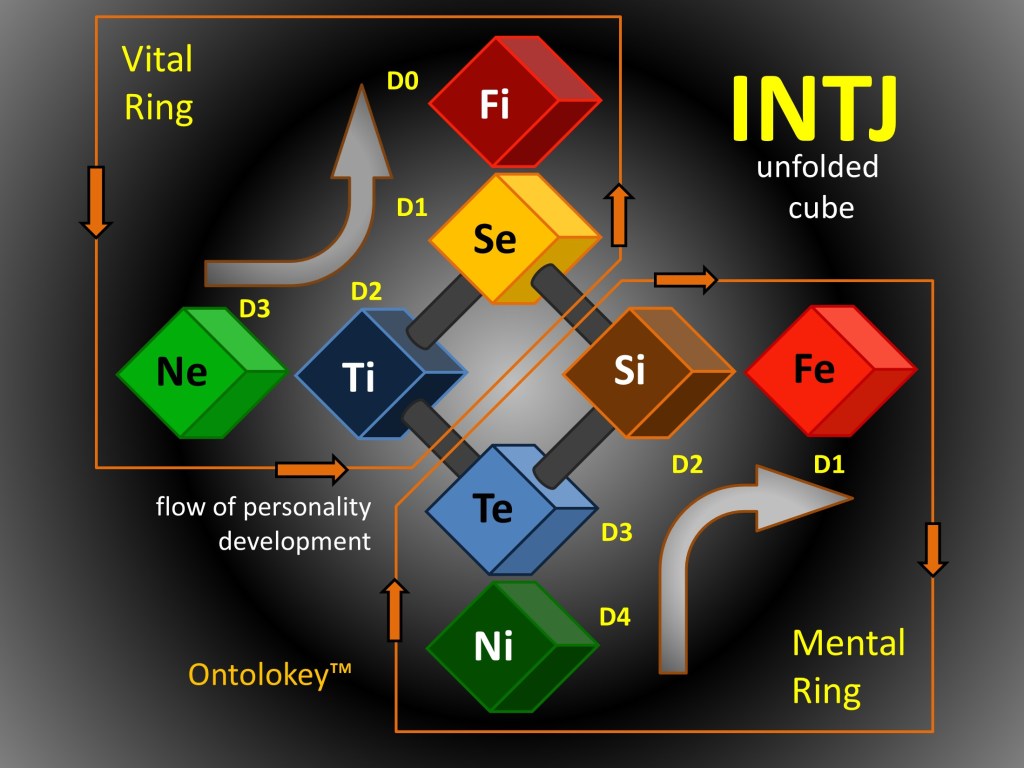
In the Ontolokey model, D0 to D4 describe the degree to which a psychological function has become consciously accessible, developed, and integrated within the personality. D4 represents the highest level of conscious development, while D0 indicates a function that remains largely unconscious and therefore tends to operate as a blindspot; D1, D2, and D3 represent successive stages of increasing awareness and integration between these two poles. Psychological development therefore means gradually bringing less conscious functions into awareness and allowing them to become more differentiated and usable, rather than trying to replace the dominant personality with something fundamentally different. The movement from D0 toward D4 is consequently a process of integration in which previously unconscious psychological capacities become increasingly available to consciousness and contribute to a more complete experience of the Self.
The Journey Toward Psychological Wholeness
The INTJ personality is often associated with strategic intelligence, independence, intellectual precision, long-term vision, and an unusual ability to recognize patterns beneath the surface of everyday experience. Within the Ontolokey model, these characteristics represent more than a collection of recognizable personality traits; they form the visible expression of an underlying psychological structure whose strengths and vulnerabilities influence how the individual perceives reality, makes decisions, establishes relationships, and understands the self. Introverted Intuition (Ni), the dominant function of the INTJ, seeks the essential meaning behind events, connecting apparently unrelated observations into an internally coherent vision of what may emerge in the future. Extraverted Thinking (Te), the auxiliary function, transforms this vision into plans, systems, decisions, and tangible results, giving the INTJ the capacity to organize complexity and pursue long-term objectives with considerable determination. Yet the very faculties that make this personality effective can also become instruments of psychological restriction when they are used to compensate for experiences, emotions, and human needs that remain insufficiently understood or consciously integrated. The deeper developmental challenge is therefore not to abandon the INTJ’s distinctive strengths, but to discover what those strengths may conceal when they become the exclusive foundation of identity.
Psychological wholeness begins when the INTJ recognizes that personal development cannot be reduced to becoming more intelligent, more productive, more disciplined, or more independent than before. These achievements may strengthen the conscious personality while leaving its less developed psychological dimensions untouched, particularly those concerned with emotional vulnerability, embodied experience, spontaneous openness, and the need for meaningful human connection. The shadow, understood here as the collection of psychological tendencies, capacities, sensitivities, and conflicts that remain insufficiently acknowledged, is not simply a repository of undesirable characteristics; it also contains essential aspects of the person that have not yet found an adequate place within conscious life. Consequently, the process of individuation requires the INTJ to turn the same investigative attention normally directed toward external systems inward, examining not only whether a belief is logically defensible, but also what emotional need it serves, what experience it excludes, and what consequences follow from maintaining it. The purpose of this inquiry is neither self-condemnation nor the dismantling of a carefully constructed identity, but the gradual development of a more comprehensive relationship with oneself, in which reason can coexist with feeling, foresight with presence, and autonomy with intimacy. Within the developmental framework presented by Ontolokey, this journey becomes a progressive integration of psychological functions, offering the INTJ a conceptual map for recognizing neglected dimensions of the self and transforming unconscious limitations into opportunities for greater freedom, understanding, and inner reconciliation.
The Architecture of the INTJ Psyche: The Mental Ring and the Vital Ring
Within the Ontolokey model, the INTJ personality can be understood through the interaction of eight psychological functions, organized into two interconnected structures known as the Mental Ring and the Vital Ring. The Mental Ring comprises Introverted Intuition (Ni), Extraverted Thinking (Te), Introverted Sensing (Si), and Extraverted Feeling (Fe), while the Vital Ring comprises Extraverted Intuition (Ne), Introverted Thinking (Ti), Extraverted Sensing (Se), and Introverted Feeling (Fi). Each function represents a distinct mode of psychological engagement with reality, ranging from the recognition of underlying patterns and the organization of external circumstances to the interpretation of personal experience, the awareness of immediate sensations, and the navigation of emotional relationships. The developmental significance of this arrangement lies not merely in the presence of all eight functions, but in their unequal degrees of maturity and accessibility within the individual psyche. In the INTJ, Ni occupies the highest developmental position at D4, followed by Te at D3, whereas Si and Fe occupy D2 and D1 respectively; in the Vital Ring, Ne begins at D3, Ti occupies D2, Se D1, and Fi D0. These developmental designations provide a framework for understanding why certain psychological capacities feel natural and reliable to the INTJ, while others may appear unfamiliar, disproportionately demanding, or difficult to integrate into a stable sense of identity.
The distinction between the two rings is especially important because the INTJ’s conscious competence may conceal the degree to which other psychological capacities remain underdeveloped. The Mental Ring describes the primary sequence through which the personality organizes its conscious orientation, develops its established abilities, and gradually encounters increasingly vulnerable dimensions of its own psychological life. The Vital Ring introduces another developmental sequence in which less familiar modes of perception, reasoning, experience, and personal valuation become progressively accessible as the individual acquires the capacity to tolerate what previously felt confusing or threatening. In this framework, developmental levels are not simply measurements of intelligence or moral worth; they indicate the relative maturity, stability, and availability of a psychological function within the individual’s established personality structure. A function at D1 or D0 is therefore not evidence of a defective person, but an indication that the associated capacity may still operate in a relatively immature, reactive, or poorly differentiated manner. The central task is to establish a more conscious relationship with these dimensions without prematurely demanding that they perform at the level of the dominant function. Such a perspective shifts the objective of personal growth away from perfecting an already effective personality toward gradually developing the psychological capacities that its established strengths have not adequately cultivated.
3. The Developmental Principle: Why Integration Must Proceed Step by Step
The central developmental principle of the Ontolokey framework is that psychological integration proceeds sequentially, from a relatively mature function toward the next less developed function, rather than through arbitrary attempts to overcome the most uncomfortable vulnerability immediately. For the INTJ, this means that Ni at D4 provides the original foundation, while Te at D3 becomes the first major developmental task through which the dominant vision acquires practical expression, discipline, and effectiveness in the external world. Only when Te has become sufficiently mature and flexible can the individual meaningfully proceed toward the less familiar dimensions represented by Ne, Si, and the subsequent functions in their respective developmental sequences. The same principle applies within the Vital Ring, where the movement from Ne at D3 through Ti at D2 and Se at D1 eventually opens the way toward a more conscious relationship with Fi at D0. Attempting to force direct access to the most vulnerable function without developing the intermediate capacities may produce confusion, resistance, or a superficial imitation of psychological maturity, because the individual has not yet established the internal resources required to sustain the experience. Gradual integration therefore demands patience, observation, and a willingness to recognize that genuine change is often less dramatic than the conscious mind expects, unfolding instead through repeated encounters with previously neglected aspects of ordinary life.
This sequential approach also offers an important distinction between intellectual insight and psychological transformation. An INTJ may understand a psychological theory almost immediately, identify its internal logic, and formulate an elegant explanation of personal difficulties without necessarily changing the emotional patterns that sustain those difficulties. Conceptual understanding can illuminate the structure of a problem, but integration requires the individual to experience the relevant situation differently, recognize habitual defensive responses as they arise, and practice alternative forms of engagement until these become increasingly accessible. Developing Te, for example, involves more than improving productivity or becoming better at organizing people; it also requires learning when efficiency has become a defense against uncertainty, when control has displaced collaboration, and when a logically consistent decision fails to account for important human consequences. Similarly, beginning to recognize Ne requires a growing tolerance for possibilities that challenge an established interpretation, while developing Ti encourages the INTJ to examine the internal coherence of personal reasoning rather than relying exclusively on external effectiveness. Each developmental step thus prepares the psychological ground for the next, allowing the individual to approach deeper vulnerabilities with greater stability instead of turning self-development into another performance standard against which the self must be judged.
The First Developmental Task: From Introverted Intuition (Ni) to Extraverted Thinking (Te)
For the INTJ, the development of Extraverted Thinking (Te) represents the first essential movement from an internally organized vision toward an effective and consciously directed engagement with the external world. Ni, operating at D4 within the Mental Ring, seeks underlying patterns, anticipates consequences, and constructs an integrated understanding of reality, often long before the individual can fully articulate how a particular conclusion was reached. This capacity can create a powerful sense of direction, allowing the INTJ to recognize structural weaknesses, anticipate future developments, and formulate strategies that others may initially struggle to understand. Yet intuition alone cannot guarantee that an insight will translate into a workable outcome, because a compelling internal vision must still encounter practical constraints, competing interests, imperfect information, and the unpredictability of human behavior. Te, occupying D3, provides the organizational capacity through which Ni can be tested, communicated, implemented, and refined through observable results. The developmental task is therefore to transform intuitive certainty into effective action without confusing the internal coherence of a vision with proof that the vision is correct, learning to treat feedback not as a threat to intellectual authority but as information that can improve the original understanding.
The maturation of Te typically involves the development of planning, prioritization, accountability, and the capacity to coordinate external resources, but its deeper psychological significance emerges when the INTJ begins examining the emotional motives concealed within the pursuit of competence. The desire to establish order may arise from a genuine appreciation of efficiency, yet it can also become a strategy for avoiding helplessness, unpredictability, dependence, or the discomfort of not knowing what will happen next. When this defensive dimension remains unconscious, the INTJ may respond to uncertainty by increasing control, to disagreement by intensifying argument, and to emotional complexity by reducing the situation to a problem that can supposedly be solved through better procedures. Mature Te does not eliminate structure or decisiveness; instead, it distinguishes between situations that genuinely require intervention and those in which control has become an attempt to regulate internal anxiety through external arrangements. An important practical exercise is to examine difficult decisions from three perspectives: what the available evidence supports, what the desired outcome demands, and what emotional need may be influencing the urgency to act. By repeatedly making this distinction, the INTJ develops a form of competence that remains effective without becoming rigid, allowing intelligence to serve reality rather than requiring reality to conform to an established interpretation.
The First Signs of Individuation: Awakening the Vital Ring Through Extraverted Intuition (Ne)
Within the developmental sequence described by Ontolokey, the transition toward the Vital Ring becomes especially significant when Te has matured sufficiently to support the personality without requiring constant conscious supervision. Extraverted Intuition (Ne), positioned at D3 within the Vital Ring, introduces a complementary orientation that explores alternative interpretations, emerging possibilities, unexpected connections, and outcomes that cannot be fully contained within the dominant function’s existing vision. Whereas Ni tends to converge upon an underlying pattern and develop a coherent account of where events are leading, Ne expands the field of consideration, allowing several potential explanations or futures to remain open simultaneously. For an INTJ who has invested considerable psychological energy in constructing a reliable internal model of reality, this expansion can initially feel inefficient or destabilizing, particularly when alternative possibilities appear to undermine a carefully developed strategy. Yet the capacity to entertain possibilities without immediately selecting one of them represents an important movement toward psychological flexibility, because it loosens the unconscious identification between having a convincing interpretation and possessing the complete truth. The emerging individual learns that a vision can be meaningful without being final, and that uncertainty may contain information rather than merely represent an obstacle to be eliminated.
The deeper significance of Ne lies in its ability to interrupt the closed feedback loops through which the INTJ may unconsciously reinforce established assumptions. When Ni and Te operate without sufficient openness to alternative interpretations, an initial hypothesis can become the foundation of an increasingly elaborate system in which contradictory evidence is dismissed, other people’s motives are interpreted through a predetermined framework, and subsequent decisions appear to confirm the original conclusion. Ne creates room for another possibility: perhaps the situation has been misunderstood, perhaps another person possesses information that is not available to the INTJ, or perhaps an apparently irrational response makes sense within a different emotional or experiential context. Developing this function does not require abandoning discernment or treating every conceivable explanation as equally plausible; rather, it involves postponing premature closure long enough to investigate meaningful alternatives. In practical terms, the INTJ can cultivate Ne by deliberately generating several plausible interpretations before reaching a conclusion, engaging with unfamiliar disciplines, inviting disagreement from trusted people, and allowing exploratory activities to retain their value even when they produce no immediate result. As these practices become more natural, the personality gains a wider field of awareness, preparing the ground for the subsequent development of Introverted Thinking (Ti) and the deeper examination of how its own conclusions are constructed.
The Golden Shadow: Introverted Thinking (Ti) and the Examination of Inner Logic
Introverted Thinking (Ti), occupying D2 in the Vital Ring, introduces a form of analytical scrutiny that differs from the externally oriented effectiveness associated with Te. Although the INTJ is commonly comfortable with logical reasoning, the distinction between these functions becomes important when the individual must examine not merely whether a decision works, but whether the underlying conceptual structure is internally consistent, precisely defined, and free from assumptions that have escaped conscious examination. Te evaluates systems in relation to practical objectives, measurable outcomes, and the demands of the external environment, whereas Ti turns attention toward the logical architecture of the reasoning itself, examining definitions, causal relationships, conceptual boundaries, and contradictions that may remain hidden beneath an apparently successful result. In the Ontolokey framework, Ti as the Golden Shadow represents a less accessible but potentially valuable psychological capacity that can correct the INTJ’s tendency to identify effectiveness with correctness. A strategy may produce the intended result while relying on an incomplete explanation, and a system may appear efficient while concealing conceptual inconsistencies that will eventually undermine its stability. The development of Ti therefore invites the INTJ to become an investigator of personal assumptions rather than merely an architect of external solutions, learning to distinguish what has been demonstrated from what has simply become familiar or useful.
This inward examination becomes particularly important when intellectual competence has acquired a defensive function within the personality. An INTJ may construct an elaborate justification for a decision that was initially influenced by pride, fear of rejection, resentment, or an unacknowledged need to preserve autonomy, subsequently mistaking the sophistication of the explanation for evidence that its emotional origins are irrelevant. Ti can help expose weaknesses in such reasoning, but only when the individual is willing to apply the same standards of scrutiny to personal convictions that would ordinarily be applied to another person’s argument. The practical exercise is to identify the assumptions supporting an important judgment, define the terms being used, distinguish direct observations from interpretations, and consider what evidence would require the conclusion to be revised. This process can reveal that a belief once experienced as self-evident was actually sustained by selective attention or by the desire to protect a preferred identity. Mature Ti consequently contributes not only to greater intellectual precision but also to psychological humility, because the individual begins to recognize that the ability to explain a position does not necessarily establish its truth. By learning to tolerate the possibility of being mistaken without experiencing error as a fundamental injury to the self, the INTJ develops the internal stability necessary to approach the more vulnerable domains of immediate experience and personal feeling.
Returning to the Present: Extraverted Sensing (Se) and the Recovery of Embodied Life
Extraverted Sensing (Se), positioned at D1 within the Vital Ring, represents a particularly important developmental challenge for the INTJ because it directs attention toward the immediate, tangible reality that can easily become secondary to an internally constructed vision of the future. The dominant Ni naturally searches for meaning, anticipates consequences, and interprets present circumstances in relation to larger patterns, while Te seeks to organize those circumstances in the service of defined objectives. This orientation can make the INTJ remarkably effective at long-range planning, yet it may also encourage a habitual postponement of direct experience, as though the present were merely a transitional stage that must be managed until a more desirable future arrives. Se introduces a different psychological demand: to perceive what is actually happening now, to register sensory information without immediately subordinating it to an interpretation, and to participate in the world without requiring every experience to justify itself through productivity or strategic significance. In the Ontolokey developmental framework, Se at D1 is not an absence of sensory ability, but a comparatively vulnerable capacity for spontaneous engagement with immediate circumstances. Its integration therefore begins with the recognition that reality is not exhausted by the meanings assigned to it, and that an individual can understand a situation intellectually while remaining insufficiently present to the experience itself.
When Se remains poorly integrated, the INTJ may become so invested in anticipation and analysis that the body is treated primarily as an instrument for achieving objectives rather than as an indispensable source of information about psychological well-being. Fatigue may be ignored until it becomes debilitating, physical tension may remain unnoticed while attention is absorbed in a problem, and ordinary pleasures may be postponed because they appear less important than a future achievement. In interpersonal situations, the same tendency can lead the INTJ to focus on the presumed implications of a conversation rather than the actual tone, facial expressions, gestures, and changing emotional atmosphere through which the other person is communicating. Developing Se requires a gradual restoration of direct contact with these immediate realities through activities that cultivate sensory awareness, such as walking without a predetermined destination, preparing food attentively, engaging in physical exercise, or observing the surroundings without converting every observation into an analytical conclusion. The purpose is not to suppress Ni or abandon long-term thinking, but to allow immediate experience to correct and enrich the internal model of reality. As Se becomes more accessible, the INTJ can discover that presence does not diminish intellectual depth; it gives that depth a living foundation, enabling the individual to respond to the world as it unfolds rather than exclusively to the future anticipated by the mind.
The Deepest Blind Spot: Introverted Feeling (Fi) and the Vulnerability of Personal Values
Within the Ontolokey model, Introverted Feeling (Fi) occupies D0 in the Vital Ring and represents the most developmentally vulnerable function in the INTJ’s configuration. This designation points toward a comparatively immature or insufficiently differentiated relationship with personal values, emotional authenticity, and the private experience of what matters deeply to the individual. Fi concerns neither emotional intensity alone nor the ability to recognize that feelings exist; it involves the capacity to understand the personal significance of those feelings, distinguish one’s own values from external expectations, and remain in contact with an inner sense of integrity even when no immediately defensible logical explanation is available. For the INTJ, whose conscious identity may be strongly organized around Ni’s vision and Te’s effectiveness, this dimension can remain difficult to articulate because emotional experience is often approached through interpretation, evaluation, or problem-solving rather than encountered directly. The individual may know precisely what should be done while remaining uncertain about what is personally painful, what feels deeply meaningful, or why a seemingly insignificant interaction has produced a disproportionate emotional response. The resulting difficulty is not necessarily an absence of feeling, but a limited capacity to recognize, tolerate, and interpret the personal significance of feeling before it becomes entangled with defensive reasoning.
The shadow side of Fi can become visible when emotions that have not been consciously acknowledged begin influencing judgments, relationships, and decisions indirectly. The INTJ may experience an intense reaction to perceived incompetence, betrayal, unfairness, or disrespect while explaining that reaction exclusively in terms of objective standards, even when a more personal wound lies beneath the surface. Alternatively, the individual may dismiss emotional needs as irrelevant, only to discover that prolonged self-neglect has produced resentment, isolation, or an unexpected loss of motivation. Because these experiences can conflict with an established self-image of rational independence, the resulting vulnerability may be defended against through intellectualization, withdrawal, rigid standards, or an insistence that personal feelings must be justified before they deserve consideration. The developmental task is to learn that an emotion can be acknowledged without being treated as an objective verdict, and that understanding its origin does not require obeying every impulse it generates. A useful practice is to ask what an experience meant personally before determining what should be done about it, distinguishing the observable event from the emotional interpretation and the underlying value or need that may have been affected. Through this process, Fi gradually becomes less of an unconscious source of disproportionate reactions and more of a conscious capacity for personal integrity, compassion, and emotionally informed choice.
The integration of Fi also changes the INTJ’s relationship with other people because it makes room for the recognition that emotional reality cannot always be reduced to a problem requiring a correct solution. When someone expresses distress, the instinctive response may be to identify the cause, explain the underlying mechanism, and propose an effective remedy, yet this approach can inadvertently communicate that the person’s emotional experience is merely an obstacle to be removed. Developing a more mature relationship with feeling involves learning to remain present with another person’s pain without immediately correcting it, acknowledging that understanding an emotion and resolving its practical cause are related but distinct processes. The same principle applies inwardly: self-compassion does not require abandoning accountability, and accepting one’s limitations does not mean refusing to change them. Rather, the individual begins to recognize that the self must be understood as a whole, including those experiences that cannot be transformed into competence, achievement, or intellectual certainty. When Fi becomes more consciously accessible, the INTJ can preserve independence without emotional isolation, maintain standards without contempt, and pursue meaningful goals without sacrificing the personal values that originally gave those goals significance.
The Mental Ring’s Vulnerable Dimensions: Introverted Sensing (Si) and Extraverted Feeling (Fe)
The development of Introverted Sensing (Si) at D2 within the Mental Ring introduces another important dimension of psychological integration by directing attention toward remembered experience, personal continuity, familiar patterns, and the accumulated information contained in the individual’s lived history. While Ni seeks overarching patterns and anticipates future developments, Si can help the INTJ recognize what has actually occurred over time, including repeated bodily signals, established routines, specific details, and the concrete consequences of earlier decisions. Without a sufficiently conscious relationship with this dimension, the INTJ may privilege a compelling interpretation of the future over evidence contained in past experience, overlooking recurring interpersonal difficulties because each new situation appears conceptually distinct. Si encourages a more grounded examination of personal history, allowing the individual to distinguish between a genuinely new problem and a familiar pattern that has merely acquired a different appearance. Its development does not require the INTJ to become rigidly attached to tradition or habitual behavior; instead, it offers a more reliable relationship with continuity, helping intuition benefit from the accumulated evidence of experience rather than treating every situation primarily as a new problem to be solved.
The practical integration of Si begins with a willingness to observe the details that the strategic mind may ordinarily overlook, including recurring sources of exhaustion, the circumstances under which concentration deteriorates, the consequences of particular working habits, and the patterns that repeatedly emerge in close relationships. Keeping a record of experiences and outcomes can help the INTJ identify discrepancies between anticipated consequences and actual results, while establishing sustainable routines can reduce the unnecessary cognitive effort involved in repeatedly managing ordinary responsibilities. More deeply, Si can support the recognition that personal history is not simply a collection of mistakes to be corrected or achievements to be surpassed, but a source of information about the conditions under which the individual thrives, struggles, and develops. Past disappointments can then be examined without allowing them to dictate future expectations, while positive experiences can be preserved as evidence that stability and familiarity may sometimes provide the foundation for growth rather than obstruct it. As this function becomes more integrated, the INTJ gains a more balanced relationship with time, allowing the past to inform the present, the present to test the future, and the future to remain open to revision.
Extraverted Feeling (Fe), positioned at D1 within the Mental Ring and described in the Ontolokey framework as the Toddler function, presents a different challenge because it concerns the interpersonal emotional field: the recognition of shared feelings, social signals, relational expectations, and the effects one’s behavior has on the emotional experience of others. For an INTJ who naturally prioritizes conceptual clarity and effective outcomes, the conventions through which people communicate belonging, reassurance, appreciation, and emotional solidarity may appear indirect or unnecessarily complicated. The individual may assume that loyalty is sufficiently demonstrated through practical assistance, that honesty should be appreciated regardless of delivery, or that a well-reasoned explanation should resolve a disagreement even when the other person first needs acknowledgment of the injury experienced. Yet emotional communication is not merely an ornamental addition to rational interaction; it is one of the ways human beings establish trust, coordinate expectations, and repair relational ruptures. The Toddler designation emphasizes the possibility that Fe-related difficulties may emerge with disproportionate sensitivity, defensive reactions, or a lack of practiced skill when interpersonal harmony and emotional recognition become important. Developing Fe therefore requires the INTJ to learn how to recognize the emotional impact of words and actions, communicate appreciation explicitly, listen without immediately correcting, and acknowledge another person’s experience without automatically accepting every interpretation of it.
The vulnerability associated with Fe becomes especially significant when an INTJ’s apparent emotional detachment conceals a strong but insufficiently understood sensitivity to interpersonal rejection, embarrassment, or the loss of respect. An individual who believes that other people’s opinions should not matter may nevertheless react intensely when criticized, excluded, misunderstood, or confronted with evidence that a valued relationship has deteriorated. If this sensitivity remains unconscious, it may be defended against through withdrawal, sarcasm, excessive self-reliance, or the conviction that emotional distance demonstrates strength. The path toward integration is not to seek universal approval or sacrifice personal judgment for the sake of harmony, but to develop enough emotional awareness to recognize when a relationship has been affected and to participate consciously in repairing it. This can involve asking how a statement was received, acknowledging unintended harm without arguing immediately about intentions, and expressing personal needs before frustration becomes resentment. As Fe matures, the INTJ becomes better able to distinguish genuine incompatibility from avoidable misunderstanding, discovering that emotional responsiveness need not compromise intellectual independence. Instead, it enables the individual to bring clarity and honesty into relationships in a manner that preserves both personal integrity and the dignity of others.
The INTJ’s Deepest Shadow: The Tyranny of Inner Certainty
The deepest shadow of the INTJ emerges when the capacity to perceive underlying patterns becomes inseparable from the conviction that those patterns have been understood correctly. Ni can generate an extraordinarily coherent interpretation of a person, a relationship, or an unfolding situation, and Te can then construct an effective strategy around that interpretation, producing a self-reinforcing combination of insight and action. The difficulty begins when the individual no longer distinguishes between an intuitive conclusion and the evidence that would justify treating it as reliable, allowing an internally persuasive explanation to acquire the status of unquestionable reality. Under these conditions, the INTJ may become increasingly resistant to contradictory information, interpreting disagreement as evidence that others have failed to understand the situation rather than as a reason to reconsider the original assessment. What initially appears to be intellectual independence can gradually become a closed psychological system in which every new observation is filtered through an established narrative, and even genuine mistakes are absorbed into explanations that preserve the individual’s sense of being right. The resulting shadow is not intelligence itself, but the defensive use of intelligence to protect the self from uncertainty, correction, and the unsettling possibility that an important part of reality has remained unseen.
This defensive certainty can affect relationships with particular intensity because the INTJ may believe that accurately understanding another person’s behavior grants sufficient grounds for judging that person’s motives. Once an internal interpretation has become established, subsequent actions may be evaluated according to the presumed pattern rather than encountered with genuine openness to new information. A partner’s hesitation may be interpreted as evidence of unreliability, a colleague’s disagreement as proof of incompetence, or a friend’s emotional reaction as confirmation that the person is incapable of rational discussion, even when other explanations remain plausible. The INTJ may then withdraw emotionally or impose stricter boundaries without recognizing how much the decision depends upon an untested assumption. Such behavior can create a painful paradox: the individual seeks relationships characterized by honesty, loyalty, and intellectual depth, yet the very mechanisms intended to protect these values may prevent others from being understood on their own terms. The developmental challenge is to recognize that an interpretation, however sophisticated, remains an interpretation, and that understanding another person requires a willingness to revise one’s conclusions when their lived experience does not fit the existing model.
Another expression of the INTJ shadow appears when independence becomes a defense against vulnerability and the need for connection is reinterpreted as weakness. The capacity to function alone can be a genuine strength, enabling the individual to work without constant reassurance and to remain committed to personal convictions despite external pressure. However, when autonomy becomes an absolute requirement, accepting help may feel like surrendering control, expressing uncertainty may seem humiliating, and emotional dependence may be confused with a loss of freedom. The individual may consequently cultivate an image of self-sufficiency that conceals unacknowledged needs for recognition, affection, reassurance, or belonging. When these needs remain unspoken, disappointment can accumulate because other people are expected to recognize what the INTJ has difficulty admitting even to themselves. The movement toward wholeness begins when independence is no longer measured by the absence of need, but by the ability to acknowledge needs consciously and decide how to respond to them without surrendering personal agency. True psychological autonomy includes the freedom to depend on others appropriately, to admit uncertainty without humiliation, and to remain emotionally present even when an interaction cannot be controlled or resolved through reasoning.
The Hidden Cost of Perfectionism, Control, and Emotional Withdrawal
Perfectionism in the INTJ often develops from a combination of high internal standards, future-oriented thinking, and a strong desire to prevent avoidable errors. When these tendencies are integrated constructively, they support careful planning, intellectual discipline, and the pursuit of excellence, allowing the individual to produce work of considerable depth and quality. Yet the same orientation can become psychologically costly when the desire to improve a result turns into an inability to tolerate the ordinary limitations of human performance. The INTJ may repeatedly revise a project that is already adequate, postpone action until uncertainty has been reduced to an unrealistic degree, or judge personal worth according to standards that continually move beyond what has been achieved. Beneath this pattern may lie an unacknowledged fear that imperfection will expose incompetence, invite criticism, or undermine an identity built around being capable and prepared. The result is that a strength intended to support meaningful accomplishment becomes a source of chronic internal pressure, making satisfaction increasingly difficult because every achievement immediately reveals another deficiency that must be corrected. Development requires learning to distinguish the pursuit of excellence from the pursuit of psychological invulnerability, recognizing that some errors are unavoidable, some decisions must be made with incomplete information, and some valuable experiences are lost when life is postponed until everything has been optimized.
Control can become similarly problematic when the INTJ uses planning and organization not only to manage external complexity but also to regulate emotions that feel difficult to tolerate. Faced with ambiguity, interpersonal conflict, or an unpredictable change of circumstances, the individual may respond by developing more elaborate explanations, stricter procedures, or increasingly detailed plans, hoping that sufficient intellectual effort will eliminate the discomfort associated with uncertainty. Although this response can produce temporary relief, it may also reinforce the underlying belief that uncertainty itself is intolerable and that emotional security depends upon anticipating every possible outcome. When reality inevitably resists these efforts, frustration can turn into impatience, criticism, or withdrawal, especially when other people introduce variables that cannot be incorporated into the preferred system. The more deeply the INTJ identifies with being the person who sees ahead and understands what must be done, the more threatening it may become to acknowledge that some circumstances cannot be controlled and some problems cannot be solved immediately. A more integrated approach involves identifying which elements of a situation can realistically be influenced, which require negotiation, and which must be accepted without surrendering responsibility for one’s own choices. By learning to remain psychologically stable in the presence of unresolved circumstances, the INTJ gradually replaces compulsive control with deliberate agency and discovers that flexibility can strengthen, rather than weaken, effective action.
Emotional withdrawal frequently completes this defensive pattern because distance can offer immediate relief from situations in which reasoning alone cannot restore a sense of order. When a conversation becomes emotionally charged, the INTJ may retreat into analysis, reduce communication, or conclude that further engagement is pointless, particularly when the other person expresses feelings in a manner that appears inconsistent or difficult to interpret. From the individual’s perspective, this withdrawal may seem like a rational refusal to participate in unproductive conflict, yet from the perspective of the other person it may communicate indifference, rejection, or punishment through silence. The INTJ may then interpret the resulting distance as confirmation that relationships are unreliable or excessively demanding, overlooking the contribution of their own defensive response to the deterioration of trust. Integration requires the capacity to recognize when a temporary pause is genuinely constructive and when withdrawal is being used to avoid vulnerability, accountability, or the discomfort of being misunderstood. It also requires learning to return to difficult conversations after emotions have settled, communicating what was experienced internally and listening to the other person’s account without assuming that disagreement must be resolved through intellectual victory. In this way, emotional presence becomes a practiced capacity rather than a demand to abandon reason, allowing the INTJ to remain both clear-minded and relationally available when circumstances become difficult.
The Ontolokey Cube as a Map for Conscious Development
The Ontolokey Cube offers a visual way to understand the relationship between the INTJ’s established strengths and the psychological functions that require greater awareness and development. By representing the eight functions within a three-dimensional structure, the model turns an abstract arrangement into a spatial landscape that can be explored through the relationships between its different positions. Its developmental value lies in helping the individual recognize that the personality is not defined exclusively by the functions that feel most familiar, but also by the less accessible capacities that may influence behavior without being fully understood. For the INTJ, the Mental Ring provides a sequence beginning with Ni at D4 and proceeding through Te at D3, Si at D2, and Fe at D1, while the Vital Ring follows the progression from Ne at D3 through Ti at D2 and Se at D1 to Fi at D0. The sliders associated with the cube can serve as a practical reminder of the direction in which attention may be turned, helping the individual visualize developmental priorities instead of treating every perceived weakness as an equally urgent problem. The model thus becomes most useful when it encourages sustained self-observation, offering a structured way to ask which psychological capacities are already well established, which remain comparatively vulnerable, and what intermediate development may be needed before a deeper challenge can be approached constructively.
Used as an instrument of reflection, the cube can help transform vague dissatisfaction into a more specific inquiry into recurring patterns of thought, feeling, and behavior. An INTJ who repeatedly experiences interpersonal misunderstandings, for example, might examine whether the difficulty involves premature certainty in Ni, excessive reliance on practical logic in Te, insufficient attention to concrete relational experience in Si, or a vulnerable response to emotional expectations associated with Fe. These possibilities need not be treated as mutually exclusive explanations; rather, the model encourages the individual to investigate the sequence through which a difficulty develops, from the initial perception of a situation to the subsequent interpretation, emotional response, and outward behavior. The same approach can be applied to the Vital Ring by examining whether alternative possibilities are dismissed too quickly, whether internal reasoning is being used to defend a preferred conclusion, whether immediate sensory information is being overlooked, or whether personal values and emotional needs remain difficult to articulate. The aim is not to force every experience into a predetermined functional category, but to develop a more differentiated vocabulary for observing the self and identifying useful avenues for reflection. In this sense, the cube becomes a developmental companion: a reminder that psychological growth is not achieved by attacking the weakest part of the personality directly, but by building the awareness and stability necessary for each successive step.
The most productive way to use Ontolokey is therefore to combine its visual structure with regular reflection on actual experiences rather than allowing the model to become another intellectual system that the INTJ masters without personally changing. A brief journal entry after a difficult interaction might record what happened, what the individual initially assumed, what was felt but not expressed, what evidence supported the interpretation, and what alternative explanation might deserve consideration. Over time, such observations can reveal recurring patterns that are difficult to recognize while the individual remains absorbed in the immediate demands of a situation. The cube can then help organize these observations into a developmental sequence, encouraging attention to the function most relevant to the current difficulty while preserving the principle that deeper integration depends upon prior development. The objective is not to achieve an idealized state in which every function becomes equally effortless, nor to replace individuality with a standardized model of psychological maturity. It is to cultivate an increasingly conscious relationship with the whole personality, so that strengths can be used deliberately, vulnerabilities can be approached without shame, and previously neglected capacities can become sources of understanding rather than recurring obstacles to growth.
The Second Half of Life: The Turning of the Inner Iceberg
The process of individuation becomes particularly significant when the INTJ begins to recognize that the capacities responsible for earlier success may no longer be sufficient to meet the psychological demands of a changing life. In the first decades of adulthood, the development of Ni and Te can provide a powerful foundation for establishing independence, building a career, mastering complex subjects, and constructing a coherent sense of personal direction. These achievements are important because they enable the individual to establish a functional relationship with the external world, but they can also strengthen an identity that depends heavily on competence, foresight, and the ability to maintain control. As life progresses, experiences such as intimate relationships, professional disappointments, changing responsibilities, personal losses, and the limitations of achievement may expose dimensions of existence that cannot be adequately understood through strategic thinking alone. The individual may discover that intellectual clarity does not automatically resolve emotional pain, that independence does not eliminate the need for connection, and that a carefully designed future cannot protect against every form of uncertainty. Within the Ontolokey developmental narrative, these encounters can mark the beginning of a deeper phase of psychological development in which attention gradually shifts from perfecting the established personality toward recognizing and integrating the capacities that have remained outside its preferred field of awareness.
The image of an iceberg provides a useful metaphor for understanding this gradual expansion of consciousness. The portion visible above the water represents the aspects of personality most readily recognized and consciously employed, while the much larger submerged portion symbolizes the experiences, reactions, sensitivities, and psychological capacities that remain less accessible to direct awareness. For the INTJ, the dominant Ni and the increasingly developed Te may initially define much of the visible structure, giving the individual a strong sense of direction and an effective means of organizing experience. As development proceeds, however, previously neglected dimensions begin to exert a greater influence on conscious life, sometimes appearing through emotional reactions, recurring relationship conflicts, unexpected changes in priorities, or an increasing dissatisfaction with patterns that once seemed entirely adequate. The metaphorical iceberg does not turn because the individual consciously decides to abandon the old personality, but because sustained experience and reflection gradually change the relationship between conscious identity and the less familiar regions of the self. The developmental aim is to bring more of this submerged material into awareness, allowing the individual to recognize how earlier defenses were formed, why particular situations remain sensitive, and which capacities must be cultivated to respond to life more freely.
The second half of life can therefore be understood as an opportunity to reconsider the meaning of success, maturity, and personal identity. The INTJ may begin by asking whether familiar achievements still express deeply held values or whether they have become ways of maintaining an identity that no longer accommodates the full range of personal experience. Questions that once seemed secondary can acquire new importance: whether relationships provide genuine intimacy, whether work remains meaningful beyond recognition and performance, whether emotional needs have been acknowledged, and whether the individual can tolerate being imperfect without experiencing a loss of self-respect. In the developmental sequence described by Ontolokey, the Vital Ring becomes increasingly relevant as the individual explores alternative perspectives, examines personal reasoning, reconnects with immediate experience, and gradually develops a more conscious relationship with private values. This process may involve periods of uncertainty because established ways of understanding the self are being expanded rather than simply reinforced. Yet such uncertainty can also create the conditions for a more mature identity, one that preserves the strengths of the earlier personality while allowing previously excluded dimensions to participate in the individual’s decisions, relationships, and understanding of what makes life worthwhile.
Cognitive Self-Healing: Understanding the Origins of Psychological Wounds
One of the most meaningful possibilities offered by the integration of psychological functions is the capacity to reinterpret painful experiences through a more comprehensive understanding of oneself. Many recurring difficulties are sustained not only by what happened, but also by the meanings subsequently assigned to the experience, the defensive strategies developed in response, and the assumptions that remain unexamined over time. An INTJ who has been criticized harshly, for example, may conclude that emotional openness invites exploitation, that dependence inevitably compromises autonomy, or that personal worth must be demonstrated through competence. These conclusions can initially function as protective adaptations, helping the individual avoid situations that resemble an earlier injury, but they may eventually restrict the possibility of forming trusting relationships or responding flexibly to new circumstances. As the less developed functions become more consciously accessible, the individual can begin to distinguish the original event from the interpretation formed around it, recognizing how a particular vulnerability influenced the response and why the resulting defense once appeared necessary. This process can support cognitive self-healing by replacing an unquestioned personal narrative with a more differentiated understanding of what occurred, what was beyond the individual’s control, and what choices remain available in the present.
For the INTJ, the integration of Fe and Fi is particularly relevant when earlier experiences have involved rejection, humiliation, emotional misunderstanding, or the perception that personal feelings were not taken seriously. A vulnerable Fe may contribute to difficulties interpreting interpersonal signals or responding constructively to emotional tension, while a less developed Fi may make it difficult to identify the personal values, attachments, and sensitivities affected by an interaction. When these functions remain insufficiently understood, the individual may respond to pain through intellectual distancing, rigid judgments, or a withdrawal into self-sufficiency, thereby protecting against immediate vulnerability while leaving the underlying experience unresolved. Cognitive reflection can gradually illuminate this sequence by helping the INTJ identify what happened, what was felt, what was assumed about the other person’s intentions, and what personal significance made the experience particularly painful. Such understanding can create room for a different response, allowing the individual to recognize a genuine injury without generalizing it into a permanent judgment about all relationships or about personal worth. The resulting self-healing lies not in explaining away the pain, but in understanding its origins sufficiently well that the experience no longer has to govern present behavior through unconscious repetition.
Forgiveness may become more accessible through this process because a broader understanding of psychological differences can reduce the tendency to interpret every hurtful interaction as evidence of deliberate malice. Another person may have acted from insecurity, limited emotional awareness, conflicting priorities, or an inability to communicate effectively, while the INTJ may have contributed to a misunderstanding through premature conclusions, excessive detachment, or an unspoken expectation that others should intuitively understand what was needed. Recognizing these possibilities does not require denying responsibility, excusing harmful behavior, or restoring relationships that remain unsafe or destructive. Rather, it allows the individual to separate an understanding of the causes of behavior from a judgment about whether that behavior should be accepted. Forgiveness of oneself can follow a similar path: the INTJ may begin to recognize that earlier decisions were made using the awareness, resources, and emotional capacities available at the time, even when those decisions produced consequences that are now regretted. This recognition can support accountability without perpetual self-punishment, enabling the individual to learn from the past while directing attention toward the choices that remain possible. Where painful experiences continue to produce severe distress or persistent difficulties, structured psychological support may also help complement this reflective process, ensuring that insight develops alongside the emotional resources needed to integrate what has been understood.
Practical Integration: Turning Insight Into a Daily Developmental Practice
The transition from intellectual understanding to lived psychological change requires a deliberate practice that connects abstract insights with recurring situations in everyday life. For the INTJ, a useful starting point is to observe moments in which a familiar strength becomes disproportionately rigid: when analysis turns into rumination, when planning becomes an attempt to eliminate uncertainty, when standards become intolerant of ordinary mistakes, or when emotional distance replaces necessary communication. Rather than immediately judging these reactions as personal failures, the individual can examine what preceded them, what outcome was being pursued, and what discomfort the response may have been intended to prevent. This method allows the dominant Ni to identify patterns while inviting Te to organize observations into practical experiments, creating a bridge between the personality’s established strengths and its less developed capacities. A written record can be particularly useful when it distinguishes observable events from interpretations, emotional responses, and subsequent actions, because this separation makes it easier to recognize where assumptions entered the sequence. Over time, repeated observation can reveal not only the situations that trigger defensive behavior, but also the intermediate developmental steps needed to respond differently.
The Mental Ring and the Vital Ring can then be used as complementary guides for choosing appropriate developmental exercises. When the INTJ’s principal difficulty involves ineffective implementation or excessive control, attention may first return to the maturation of Te, including the capacity to prioritize realistically, delegate appropriately, and revise plans in response to new evidence. When this foundation is sufficiently established, the individual can increasingly explore Ne by considering alternative explanations, Ti by examining the internal consistency of personal reasoning, and Se by strengthening awareness of immediate circumstances and bodily experience. Si can support this process by identifying recurring patterns in personal history, while Fe and Fi invite a more conscious relationship with interpersonal emotions and private values. The essential principle is to select a manageable next step rather than attempting to transform every aspect of the personality simultaneously, since ambitious self-improvement projects can themselves become expressions of the perfectionism that development is intended to soften. Progress is better assessed through observable changes in behavior, such as recovering more quickly after criticism, listening more patiently during disagreement, recognizing fatigue before exhaustion, or acknowledging a personal need without immediately dismissing it. These changes may appear modest, but their cumulative effect can be substantial when they gradually alter the way the individual responds to the ordinary challenges of life.
A sustainable developmental practice should also include periods of rest, reflection, and non-instrumental experience, because the pursuit of wholeness can otherwise become another demanding objective organized around achievement. The INTJ may be tempted to approach individuation as a complex project that requires comprehensive analysis, measurable progress, and eventual mastery, thereby reproducing the same relationship with control that initially made deeper integration necessary. Yet some psychological capacities develop through experiences that cannot be forced into a strict timetable, including the gradual building of trust, the willingness to remain present during emotional uncertainty, and the discovery of personal values through lived experience. It is therefore useful to allow reflection to coexist with play, creativity, physical activity, and relationships in which the individual does not need to demonstrate exceptional competence. These experiences provide opportunities to encounter aspects of the self that are not defined by productivity or strategic achievement, while also allowing new insights to become embodied in ordinary habits. The aim is not to abandon discipline, but to establish a more balanced form of discipline that supports psychological development without turning the entire process into another test of personal worth.
Integration in Relationships: From Intellectual Understanding to Emotional Presence
The ultimate significance of psychological integration becomes particularly visible in the INTJ’s closest relationships, where the limitations of purely intellectual understanding are often revealed most clearly. The ability to anticipate another person’s behavior, recognize recurring patterns, and formulate convincing explanations may create an impression of deep understanding, yet genuine intimacy requires something more than accurate interpretation. It requires the willingness to encounter another person as an independent psychological reality whose experiences cannot always be predicted, categorized, or reconciled with one’s own expectations. For the INTJ, this means learning to distinguish between understanding why someone feels a certain way and allowing that person’s feelings to be expressed without immediately evaluating their rationality. The development of Fe supports emotional responsiveness, while Fi encourages a more direct recognition of personal attachment, vulnerability, and values, allowing the individual to acknowledge both sides of an interpersonal encounter. As these capacities become more integrated, relationships can become less dependent on the INTJ’s ability to solve problems and more grounded in mutual recognition, emotional honesty, and the freedom to remain different without becoming adversaries.
An essential part of this transformation is the willingness to communicate vulnerability before it becomes disguised as criticism, indifference, or withdrawal. When the INTJ feels misunderstood, the instinctive response may be to explain the situation more precisely, demonstrate the inconsistency in another person’s reasoning, or retreat until the emotional disturbance has subsided. Although taking time to reflect can be constructive, repeated reliance on these strategies may prevent the other person from discovering what actually matters to the INTJ beneath the analytical response. A more integrated approach involves expressing the personal experience directly, perhaps acknowledging disappointment, uncertainty, hurt, or the need for reassurance without immediately attempting to justify those feelings through an elaborate argument. This does not mean that every emotional reaction should determine the outcome of a disagreement, but that emotions should be recognized as relevant information about the relationship rather than excluded until they can be translated into logical propositions. By learning to remain engaged during uncomfortable conversations, the INTJ gradually discovers that vulnerability need not diminish respect or autonomy; it can create the conditions in which trust becomes possible and differences can be addressed without threatening the relationship itself.
Forgiveness and relational repair also become more attainable when the INTJ recognizes the difference between intention, impact, and responsibility. A person may intend to be helpful while communicating in a manner that feels dismissive, just as an INTJ may intend to be honest while delivering a judgment that leaves another person feeling diminished. Understanding the intention can prevent unnecessary assumptions about malice, but it does not erase the impact or eliminate the need to take responsibility for one’s actions. Likewise, acknowledging that another person has caused genuine harm does not require accepting that person’s explanation or allowing the same behavior to continue indefinitely. Psychological maturity involves holding these distinctions together, recognizing complexity without using complexity to evade accountability. Through the gradual integration of Ni, Te, Si, Fe, Ne, Ti, Se, and Fi, the INTJ can develop a more flexible understanding of human behavior in which insight is balanced by humility, honesty by consideration, and independence by the capacity for meaningful connection. The resulting relationships need not be free from conflict; rather, they become more capable of surviving conflict without reducing either person to a fixed interpretation of who they are.
The Emergence of the Whole Self: Beyond the Limitations of the Established Personality
The ultimate goal of individuation, as understood within the Ontolokey developmental framework, is not to replace the INTJ personality with a different personality type, but to expand the original personality until its less developed dimensions can participate more fully in conscious life. Ni remains the dominant function, preserving the ability to perceive underlying patterns, envision future possibilities, and seek coherent meaning, while Te continues to provide the practical intelligence required to organize intentions and achieve meaningful objectives. What changes is the relationship between these established strengths and the other psychological functions, which gradually become less threatening, less mysterious, and more available as complementary resources. Si can contribute continuity and grounded awareness of experience, Fe can support emotional communication and relational sensitivity, Ne can expand the field of possibilities, Ti can refine internal reasoning, Se can restore contact with immediate reality, and Fi can clarify the personal values that give direction to individual choices. The personality becomes more integrated not because its original hierarchy disappears, but because its dominant functions no longer need to exclude or suppress the capacities that seem less compatible with its established identity. Within this understanding, wholeness means that a greater proportion of the individual’s psychological life can be acknowledged, understood, and consciously directed rather than remaining outside awareness until it emerges through conflict or distress.
The metaphorical completion of the iceberg’s rotation captures this developmental possibility by imagining that what once remained submerged gradually becomes visible, allowing the individual to recognize a larger proportion of the self that was always present but not fully understood. In the Ontolokey narrative, the return of the dominant function to its prominent position after this symbolic rotation represents a renewed encounter with the original personality, now informed by a broader awareness of its own psychological structure. The INTJ may still prefer solitude, abstract thinking, strategic planning, and intellectually demanding pursuits, yet these preferences no longer need to function as defenses against every experience that does not conform to them. Emotional sensitivity can be acknowledged without being mistaken for weakness, uncertainty can be tolerated without provoking an immediate need for control, and spontaneous experience can be appreciated without requiring a measurable outcome. The individual becomes increasingly capable of recognizing when a familiar strength is appropriate and when a less familiar capacity is needed, allowing psychological flexibility to replace the compulsion to respond to every situation in the same established way. The metaphor of rebirth therefore refers not to the destruction of the earlier personality, but to the possibility of inhabiting it more consciously, with greater freedom to choose how its strengths and vulnerabilities are expressed.
This transformation also changes the INTJ’s understanding of personal identity because the individual begins to recognize that the self is not identical with any single function, achievement, interpretation, or defensive strategy. The belief that one must always be competent, rational, independent, and prepared may gradually give way to a more spacious understanding in which competence remains valuable without becoming the sole measure of worth. Mistakes can become opportunities for learning rather than threats to identity, emotions can become sources of information rather than disturbances to be eliminated, and relationships can provide opportunities for mutual discovery rather than tests of compatibility with a predetermined model. Such development does not imply permanent freedom from conflict, nor does it guarantee that every psychological wound can be resolved through reflection alone. Rather, it describes an increasingly conscious capacity to encounter difficulty without automatically repeating the same patterns of avoidance, control, or self-judgment. The whole self emerges through the repeated willingness to recognize what is present, acknowledge what has been excluded, and respond to experience with greater awareness than was previously possible.
A Lifelong Commitment to Wholeness and Healing
The developmental journey described throughout this essay begins with the recognition that the INTJ’s greatest strengths and deepest vulnerabilities are not necessarily separate aspects of the personality, but may be closely connected expressions of the same psychological organization. The capacity to anticipate future developments can become rigid certainty, intellectual independence can become emotional isolation, and the pursuit of excellence can become an inability to accept ordinary human limitations. Conversely, the same intelligence that once sustained these defenses can become the instrument through which they are recognized, examined, and gradually transformed. The progression through the Mental Ring and the Vital Ring offers a structured way of approaching this work, beginning with the consolidation of established abilities and continuing toward increasingly vulnerable dimensions of experience. Its essential discipline is patience: the recognition that deeper integration depends upon sufficient development of the capacities that precede it, and that meaningful psychological change cannot be forced simply because the individual understands what ought to change. Each step provides the foundation for the next, allowing awareness to develop alongside practical experience and enabling insights to become increasingly visible in everyday decisions, emotional responses, and relationships.
For the INTJ, the commitment to wholeness ultimately means accepting that the search for truth must include truths about the self that are not always comfortable, flattering, or easily reconciled with an established identity. It means investigating the emotional needs beneath the desire for control, the vulnerabilities beneath apparent indifference, the personal values beneath strongly defended opinions, and the limitations concealed by intellectual certainty. It also means recognizing the strengths that have made survival, achievement, and independence possible, rather than treating earlier adaptations as enemies that must be defeated. The purpose of integration is to understand why these adaptations developed, where they remain useful, and where they now prevent a fuller engagement with life. Through this process, the INTJ can learn to combine clarity with compassion, discipline with flexibility, and independence with the courage to be emotionally present. Healing through wholeness becomes possible insofar as greater understanding creates new choices, allowing the individual to respond to the present rather than remaining unconsciously governed by the limitations of earlier experience.
The Ontolokey Cube can serve throughout this journey as a visual reminder that psychological development is a progressive movement through a landscape of familiar strengths and less familiar possibilities, rather than a single achievement that can be completed once and for all. Its value lies in helping the INTJ maintain an overview of the developmental process while directing attention toward the next appropriate step, particularly when the desire for rapid transformation threatens to overwhelm the patience required for lasting change. Those wishing to explore the model further, examine its underlying developmental concepts, or discover how its framework is applied to other personality types can consult the detailed essays and explanatory materials available at www.Ontolokey.com. The INTJ-specific discussions, including The INTJ in the Ontolokey Model, The INTJ: The Untold Truth, and INTJ Suggestions for Growth, offer further opportunities to examine the relationship between personality structure, shadow integration, and individual development. The broader origins and conceptual orientation of the model are also discussed in Ontolokey Turns the Map Into a Landscape. Ultimately, the journey toward wholeness remains a personal undertaking: the gradual process of bringing what has been unconscious into awareness, what has been rejected into understanding, and what has been feared into a more conscious relationship with the self. For the INTJ, the fullest expression of psychological strength may therefore emerge not from becoming invulnerable, but from developing the capacity to remain intellectually clear, emotionally open, and authentically human while continuing to engage with the complexity of life.
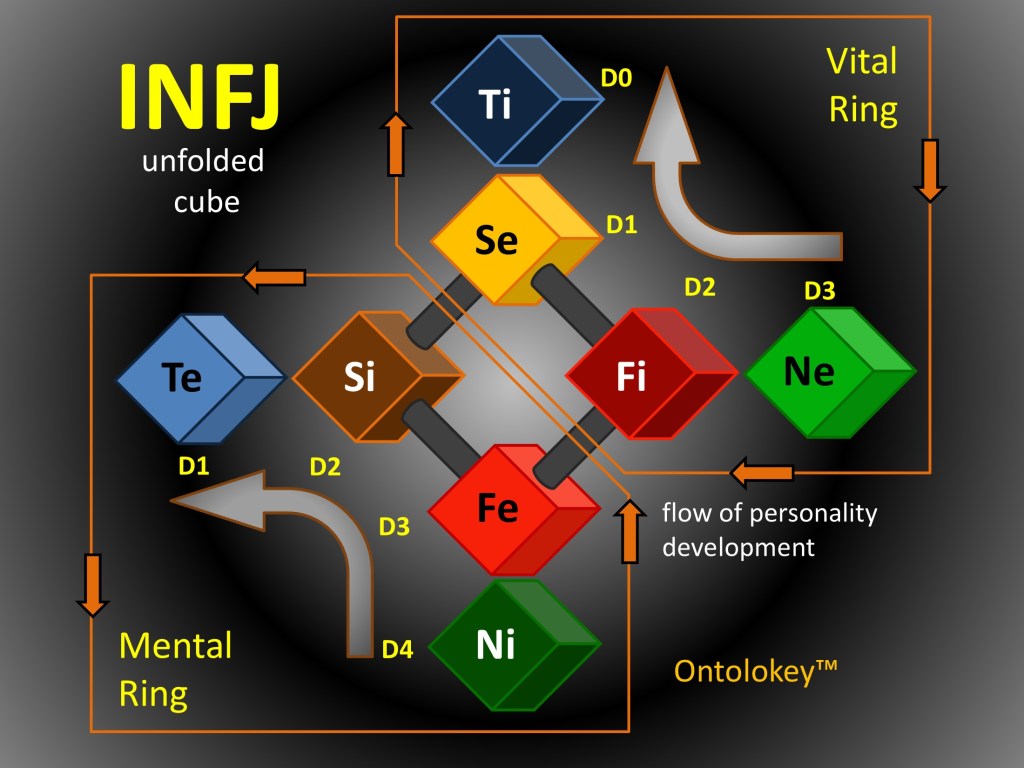
In the Ontolokey model, D0 to D4 describe the degree to which a psychological function has become consciously accessible, developed, and integrated within the personality. D4 represents the highest level of conscious development, while D0 indicates a function that remains largely unconscious and therefore tends to operate as a blindspot; D1, D2, and D3 represent successive stages of increasing awareness and integration between these two poles. Psychological development therefore means gradually bringing less conscious functions into awareness and allowing them to become more differentiated and usable, rather than trying to replace the dominant personality with something fundamentally different. The movement from D0 toward D4 is consequently a process of integration in which previously unconscious psychological capacities become increasingly available to consciousness and contribute to a more complete experience of the Self.
The Architecture of the INFJ Psyche: From Inner Vision to Psychological Wholeness
The INFJ personality is often associated with intuition, empathy, idealism, and an unusually deep interest in the inner lives of other people. Beneath these familiar characteristics, however, lies a more complex psychological structure in which insight coexists with vulnerability, compassion with hidden resentment, and the desire for harmony with an equally powerful need for personal authenticity. The INFJ may possess an extraordinary capacity to recognize emotional patterns, anticipate the consequences of human behavior, and perceive meanings that remain invisible to others, yet these abilities do not automatically translate into self-understanding. Indeed, the more convincingly a person understands the psychological realities of others, the easier it can become to overlook the unresolved conflicts within their own personality. The central challenge is not simply to cultivate the qualities that make the INFJ perceptive and compassionate, but to recognize how those same qualities can become entangled with unconscious defenses, idealized self-images, and unacknowledged emotional needs. Psychological maturity begins when the individual stops treating personal insight as proof of inner completion and starts examining the parts of the self that contradict the identity they have learned to cherish.
Within the Ontolokey framework, this developmental task can be understood as a gradual integration of eight psychological functions arranged across two interconnected structures, the Mental Ring and the Vital Ring. Each function represents a different way of perceiving experience, responding to the world, or organizing inner reality, and each occupies a particular developmental position that influences how consciously and reliably it can be expressed. For the INFJ, the dominant function, Introverted Intuition (Ni), provides the organizing vision of the personality, while Extraverted Feeling (Fe) supports its engagement with the emotional lives of others. Beneath these more accessible capacities lie functions associated with personal memory and groundedness, practical execution, exploratory possibility, individual values, direct sensory experience, and analytical consistency. The developmental journey described in this essay follows the principle that psychological integration proceeds incrementally rather than through isolated acts of will: more developed capacities must provide the foundation upon which less developed ones can gradually emerge. The objective is not to eliminate the INFJ’s characteristic sensitivity or transform the individual into a fundamentally different personality, but to make previously unconscious tendencies available to conscious understanding, responsible choice, and compassionate self-acceptance. In this sense, wholeness means becoming capable of inhabiting the full range of one’s psychological reality without allowing any single function, moral ideal, or defensive identity to define the entire self.
The Light and Shadow of Introverted Intuition (Ni): The Search for Meaning and the Danger of Certainty
Introverted Intuition is the dominant function of the INFJ and occupies developmental level D4 within the Mental Ring, representing the most developed and influential psychological capacity in this personality structure. Ni seeks the underlying meaning of experience by connecting observations, memories, emotional impressions, and abstract patterns into an internally coherent understanding of reality. Rather than approaching life as a sequence of unrelated events, the INFJ tends to perceive situations as parts of a larger psychological or existential pattern, often sensing where a relationship, personal conflict, or unfolding situation may eventually lead. This orientation can produce remarkable foresight, an ability to understand complex interpersonal dynamics, and a persistent desire to discover the deeper truth behind appearances. Yet the strength of Ni also creates a particular vulnerability: when an interpretation becomes internally convincing, the INFJ may begin to experience it as an established truth rather than as a hypothesis that remains open to revision. The mind can construct an intricate explanation of another person’s motives without adequately distinguishing direct evidence from intuition, emotional inference, or assumptions shaped by earlier experiences. Consequently, the very function that enables the INFJ to recognize hidden patterns can also reinforce confirmation bias, overinterpretation, and an attachment to an imagined future that reality may never fulfill.
The shadow of Ni becomes especially consequential when the INFJ’s inner vision is used to protect an idealized understanding of the self or the world. An individual who strongly identifies with being perceptive may find it difficult to acknowledge that a supposedly profound insight was mistaken, that a cherished relationship was understood inaccurately, or that another person’s behavior cannot be explained by a single coherent psychological narrative. Disappointment can then become more than a painful experience; it can threaten the INFJ’s sense of identity as someone who understands what others fail to see. In response, the mind may reinterpret contradictory evidence, withdraw into private conclusions, or construct increasingly elaborate explanations that preserve the original conviction. Under emotional pressure, this process can lead to suspicion, silent judgment, and a growing distance between the INFJ’s internal world and the people with whom they are attempting to connect. The necessary developmental task is therefore not to suppress intuition, but to distinguish intuition from certainty and meaning from projection, allowing the complexity of reality to challenge even the most compelling inner interpretation. When Ni becomes more flexible, its gift of foresight is no longer used primarily to anticipate disappointment or defend a private worldview, but to support a mature relationship with uncertainty, in which understanding remains a living process rather than a final verdict.
The Ontolokey model places the INFJ’s initial developmental emphasis on strengthening the auxiliary function, Fe, before attempting to integrate the less developed functions that follow within the two rings. This sequence matters because the dominant function cannot resolve every psychological difficulty simply by becoming more active; in fact, excessive reliance on Ni may deepen isolation if inner interpretation is not balanced by genuine interpersonal exchange. Developing Fe enables the INFJ to test private impressions against the emotional realities of other people, to communicate insights without treating them as unquestionable conclusions, and to remain receptive when others describe experiences that contradict the INFJ’s expectations. Such engagement does not require abandoning discernment or accepting every explanation offered by another person, but it does require recognizing that understanding is reciprocal and that no individual has unrestricted access to another person’s inner world. In practical terms, the INFJ can begin by asking clarifying questions before drawing conclusions, separating observed behavior from inferred motivation, and allowing important judgments to remain provisional until further experience provides context. These practices gradually transform intuition from a potentially closed interpretive system into an instrument of conscious reflection, while preserving its capacity to recognize patterns and imagine possibilities. The deeper achievement is an inner vision that can withstand correction without collapsing into self-doubt, because its value no longer depends on being infallible.
Extraverted Feeling (Fe): From Compassionate Attunement to Authentic Connection
Extraverted Feeling occupies developmental level D3 within the INFJ’s Mental Ring and serves as the auxiliary function through which inner insight becomes relational awareness, emotional communication, and participation in the shared human world. While Ni seeks coherence and meaning within the individual’s inner landscape, Fe directs attention toward interpersonal relationships, collective values, emotional atmospheres, and the needs of others. This combination can make the INFJ exceptionally attentive to subtle changes in tone, unspoken tensions, and the emotional consequences of words or actions, often creating a strong desire to facilitate understanding and restore harmony where conflict has emerged. In its mature expression, Fe allows empathy to become an active and responsible form of care, enabling the INFJ to recognize the humanity of others without losing sight of their own principles. Nevertheless, the same sensitivity can become a source of psychological entanglement when the INFJ begins to equate being needed with being worthy, being agreeable with being good, or preserving harmony with fulfilling a personal obligation. What initially appears to be generosity may then conceal a fear of rejection, an aversion to conflict, or an unconscious expectation that emotional investment will eventually be reciprocated. The developmental challenge is to transform interpersonal sensitivity into a conscious capacity for connection rather than allowing it to become a strategy for securing acceptance, avoiding abandonment, or maintaining an idealized image of oneself as the person who understands and supports everyone else.
The shadow of Fe often emerges through the discrepancy between the INFJ’s outward composure and the emotional burdens accumulating beneath it. Because the individual may be highly skilled at accommodating others, communicating diplomatically, and anticipating relational needs, dissatisfaction can remain unexpressed long after personal boundaries have been crossed. The INFJ may continue to offer understanding while privately recording disappointments, hoping that others will eventually recognize the extent of their sacrifice without requiring an explicit conversation about it. When this unspoken expectation is repeatedly frustrated, compassion can gradually turn into resentment, disappointment into moral judgment, and emotional withdrawal into a means of expressing displeasure without openly acknowledging anger. In more difficult circumstances, the individual may become subtly controlling, using silence, guilt, excessive accommodation, or the withdrawal of affection to influence another person’s behavior while maintaining a conscious self-image of kindness. Such patterns do not necessarily indicate deliberate manipulation; they may arise when legitimate needs have become difficult to recognize and communicate directly. Nevertheless, good intentions cannot eliminate the consequences of indirect behavior, and genuine psychological development requires the INFJ to acknowledge that suppressed anger remains anger, that excessive self-sacrifice can contain an unspoken demand, and that another person’s failure to intuitively recognize a need does not automatically constitute indifference or betrayal.
Within the Ontolokey developmental sequence, Fe is the first major function to be consciously strengthened after Ni, and its maturation creates the relational foundation for the subsequent integration of less developed functions. The practical objective is not to increase empathy indefinitely, since the INFJ may already possess considerable interpersonal sensitivity, but to make that sensitivity more balanced, transparent, and psychologically sustainable. This involves learning to express needs before they become grievances, establish boundaries without interpreting them as acts of selfishness, and tolerate disagreement without experiencing every relational rupture as evidence of personal failure. It also means allowing others to experience disappointment, frustration, or emotional discomfort without immediately assuming responsibility for correcting their feelings. Mature Fe recognizes that genuine harmony cannot be manufactured by one person’s continual accommodation, because relationships require mutual responsibility and the freedom to express incompatible perspectives. As the auxiliary function approaches the upper end of its developmental range, the INFJ becomes increasingly capable of engaging with the world without relying on approval as the principal measure of personal worth. This growing stability provides the necessary transition toward the deeper work of individuation, in which the individual must begin to encounter psychological experiences that cannot be resolved through intuition or interpersonal understanding alone.
The Transition to Individuation: When the Familiar Self Begins to Change
Within the Ontolokey model, the maturation of the auxiliary function marks a decisive transition in the INFJ’s psychological development, because it establishes the conditions under which previously less accessible aspects of the personality can begin to enter conscious awareness. The initial task is to develop Fe from its established D3 position toward a level approaching D4, allowing interpersonal sensitivity to become more stable, self-aware, and independent of external validation. During this period, which may unfold substantially between early adulthood and the middle years of life, the INFJ gradually learns that genuine compassion does not require self-abandonment and that emotional understanding is most effective when accompanied by personal responsibility and clear boundaries. Once this foundation becomes sufficiently reliable, the developmental emphasis can shift toward the Sibling function, Extraverted Intuition (Ne), which occupies D3 within the Vital Ring. This transition represents the beginning of individuation in the specific developmental sequence described here, because the individual starts moving beyond the familiar ways of understanding and managing experience toward psychological capacities that have not yet been integrated into the conscious identity. What previously appeared to be a stable personality may begin to feel incomplete, not because its established strengths have disappeared, but because those strengths can no longer adequately explain the full complexity of the individual’s inner life.
The process can be compared to an iceberg whose visible portion represents conscious awareness while its much larger submerged mass represents psychological material that remains outside immediate recognition. As the INFJ develops the familiar functions of Ni and Fe, the established personality becomes more capable of engaging with the world, yet this very development can create the conditions for deeper internal tensions to surface. Contradictory feelings, unexpected impulses, recurring relationship difficulties, and previously unexplored possibilities may begin to challenge the coherent self-image through which the individual has understood their life. Rather than treating these experiences as evidence that something has gone wrong, the INFJ can learn to recognize them as invitations to expand the boundaries of self-understanding. The iceberg metaphor describes this movement as a gradual rotation through which what was once submerged becomes visible, until the individual has encountered and integrated a much larger proportion of their psychological reality. This is not necessarily a comfortable process, because greater awareness may initially intensify uncertainty, grief, anger, or regret before it produces a more comprehensive sense of self. The purpose is not to discard the original personality, but to bring its conscious strengths into a more complete relationship with the needs, limitations, and possibilities that were previously concealed beneath them.
Individuation therefore requires a different attitude toward personal development from the one that often governs the INFJ’s earlier efforts at self-improvement. Instead of asking how to become more insightful, more compassionate, or more consistent with an ideal of personal goodness, the individual begins to ask what has been excluded from that ideal and what psychological function the exclusion has served. An INFJ who has always valued understanding may discover an unacknowledged need to be understood; someone who has built an identity around emotional generosity may encounter envy, competitiveness, or a desire for recognition; and someone who has sought to remain composed may begin to recognize the anger that has accumulated beneath years of accommodation. These discoveries can feel threatening because they challenge the assumption that psychological maturity consists of strengthening admirable qualities while eliminating undesirable ones. Yet integration does not mean endorsing every impulse or acting upon every newly recognized desire, but understanding its origin, function, and possible constructive expression. The Ontolokey sequence provides a framework for approaching this work without attempting to develop every neglected capacity simultaneously, allowing each emerging function to build upon the psychological stability established by the preceding one. Through this gradual process, self-knowledge becomes less concerned with preserving an idealized identity and more concerned with understanding the actual person who exists beneath it.
Extraverted Intuition (Ne): The Sibling Function and the Liberation from a Single Reality
Extraverted Intuition occupies developmental level D3 within the INFJ’s Vital Ring and represents the first function encountered in the model’s sequence of unconscious integration. Whereas Ni seeks to discover an underlying pattern and organize experience around an increasingly coherent inner vision, Ne opens the mind toward alternative interpretations, emerging possibilities, unexpected connections, and outcomes that cannot be predicted with certainty. Its developmental significance lies in its capacity to loosen the INFJ’s attachment to a single explanation of reality, particularly when that explanation has become emotionally important or central to personal identity. An INFJ may possess a profound ability to envision what a relationship could become, recognize the direction in which another person appears to be developing, or imagine a more meaningful future than present circumstances seem to permit. Yet this ability can become restrictive when the imagined possibility gradually replaces the actual person or situation, leaving the individual emotionally invested in a future that depends upon assumptions that have never been tested. Ne introduces a complementary movement of consciousness by inviting the INFJ to consider that several interpretations may be plausible, that unforeseen opportunities may emerge from disappointment, and that the future can remain open without becoming meaningless. As the Sibling function becomes more accessible, psychological flexibility begins to counterbalance intuitive certainty, enabling the INFJ to encounter life as a field of possibilities rather than as a predetermined narrative that must be preserved.
The shadow of insufficiently integrated Ne may appear in the INFJ’s difficulty tolerating uncertainty, revising expectations, or allowing an established interpretation to coexist with alternatives. When emotionally invested in a particular understanding, the individual may repeatedly revisit conversations, search for hidden meanings, or construct elaborate explanations intended to reconcile contradictory evidence with an existing belief. This tendency can be especially pronounced in intimate relationships, where hope and fear encourage the mind to alternate between idealized possibilities and imagined catastrophes. The INFJ may envision a person’s potential so vividly that present behavior becomes secondary, or interpret an ambiguous interaction as confirmation of a conclusion that has already taken shape internally. Conversely, when disappointment becomes overwhelming, the same imagination may generate increasingly negative scenarios that reinforce withdrawal and mistrust. Developing Ne means learning to recognize the difference between possibility and probability, imagination and observation, and openness and indiscriminate speculation. The practical exercise is to deliberately generate alternative explanations before reaching a conclusion, ask what evidence might contradict an emotionally compelling interpretation, and remain willing to revise expectations when reality provides new information. In this way, Ne does not weaken Ni’s capacity for insight but makes it more resilient, because an intuition that can accommodate competing possibilities is less likely to become imprisoned within its own internal coherence.
The designation of Ne as the Sibling function also offers a useful image for the emotional attitude required during this stage of individuation. A sibling introduces difference into the familiar psychological world, sometimes challenging established assumptions, exposing blind spots, or revealing possibilities that the dominant personality would not have discovered independently. For the INFJ, this encounter may involve accepting spontaneity, intellectual experimentation, humor, social exploration, or the freedom to change direction without first constructing a complete explanation of why the change is necessary. Rather than requiring every experience to contribute to a long-term purpose, the individual can begin to appreciate experiences whose value lies in discovery itself. This does not mean abandoning discernment or becoming scattered across endless alternatives; it means allowing exploration to correct the tendency to overdetermine reality through an internally compelling vision. Within the Ontolokey developmental sequence, strengthening Ne also establishes the foundation for approaching the next function, Introverted Feeling (Fi), which occupies D2 within the Vital Ring and brings the question of personal values into sharper focus. Once the INFJ becomes more capable of imagining realities beyond the familiar narrative, the next developmental challenge is to distinguish what genuinely matters to the individual from what has been adopted to maintain emotional harmony, fulfill expectations, or preserve a cherished image of being a good person.
Introverted Feeling (Fi): The Golden Shadow and the Recovery of the Authentic Self
Introverted Feeling occupies developmental level D2 within the INFJ’s Vital Ring and is described in the Ontolokey framework as the Golden Shadow, a designation that points toward psychological qualities that may be both deeply valuable and insufficiently acknowledged within the conscious personality. Whereas Fe directs attention toward interpersonal harmony, shared values, and the emotional experiences of others, Fi turns inward toward personal convictions, individual preferences, private emotional truths, and the question of whether one’s life genuinely reflects one’s own values. For an INFJ who has learned to understand themselves through their capacity to support others, anticipate emotional needs, and preserve meaningful relationships, this inward orientation can initially feel unfamiliar or even morally uncomfortable. The individual may have developed an elaborate understanding of what others need while remaining comparatively uncertain about what they themselves want, particularly when personal desires conflict with the expectations of people they care about. Consequently, the INFJ may mistake the absence of open conflict for inner peace, or interpret self-denial as evidence of maturity even when it produces a persistent sense of emptiness or resentment. Integrating Fi means discovering that authenticity is not the opposite of compassion, but one of its necessary foundations, because genuine care becomes distorted when the individual must continually suppress personal convictions to preserve acceptance. The Golden Shadow therefore represents not simply an undesirable tendency to be corrected, but a neglected capacity for self-respect, emotional honesty, and fidelity to an inner life that cannot be defined exclusively through relationships.
The difficulties associated with insufficiently integrated Fi often become visible through the discrepancy between the INFJ’s outwardly considerate behavior and the private emotional reality beneath it. An individual may repeatedly agree to commitments they do not genuinely wish to undertake, tolerate relationships that violate important boundaries, or adapt personal opinions to avoid disappointing someone whose approval has become emotionally significant. Because these choices can be justified through the language of empathy and responsibility, their underlying costs may remain difficult to recognize until accumulated exhaustion, bitterness, or a sense of having lost oneself becomes impossible to ignore. The INFJ may then experience guilt for wanting distance, shame for feeling anger, or confusion about desires that do not fit the identity of the understanding and selfless person they have tried to become. In some cases, suppressed preferences return indirectly through sudden emotional withdrawal, rigid moral judgments, or intense reactions to situations that appear insignificant to others but touch a long-standing wound involving autonomy or recognition. The developmental task is to understand these reactions without either condemning them or automatically treating them as reliable instructions for action. By identifying the need beneath the emotion, the INFJ can begin to distinguish a legitimate boundary from a defensive impulse, a personal conviction from an inherited expectation, and an authentic desire from a temporary attempt to escape discomfort. Such differentiation allows personal feeling to become a source of information and self-understanding rather than a force that remains hidden until it emerges through resentment or emotional crisis.
The integration of Fi becomes especially important when the INFJ confronts the possibility that being understood, appreciated, or loved cannot be guaranteed through perfect sensitivity to other people. Mature personal values must remain meaningful even when they are not universally shared, and an authentic decision must sometimes withstand disapproval without being interpreted as proof of selfishness or relational failure. The INFJ can begin this process by examining situations in which agreement was given despite an internal refusal, identifying the values that were compromised, and practicing direct communication about preferences before resentment develops. Equally important is learning to recognize personal needs without requiring them to be justified through their usefulness to others, since rest, privacy, creative expression, and the freedom to pursue individual interests are not legitimate only when they improve one’s capacity to serve. Within the Ontolokey sequence, Fi’s development also prepares the ground for Extraverted Sensing (Se), the inferior function at D1 within the Vital Ring, by restoring a more direct relationship between inner values and lived experience. Once the INFJ becomes more honest about what matters personally, it becomes easier to ask whether the life actually being lived corresponds to those values, rather than relying on an imagined future or an idealized self-concept to provide a sense of fulfilment. The recovery of the authentic self is therefore not a retreat from human connection, but a movement toward relationships in which care and individuality can coexist without either being sacrificed to the other.
Extraverted Sensing (Se): The Inferior Function and the Return to Embodied Life
Extraverted Sensing occupies developmental level D1 within the INFJ’s Vital Ring and represents the inferior function in the Ontolokey developmental sequence. While Ni naturally directs attention toward patterns, meanings, implications, and possible futures, Se draws awareness toward immediate sensory experience, observable circumstances, physical surroundings, and the concrete reality of the present moment. For the INFJ, whose consciousness is often absorbed in interpreting what experiences mean or anticipating what they may eventually become, direct engagement with the present can feel comparatively unfamiliar. The individual may be physically present while mentally preoccupied with an unresolved conversation, an anticipated difficulty, or a complex internal narrative about the direction of a relationship. This orientation can contribute to remarkable foresight and reflective depth, but it may also create distance from the body, from spontaneous enjoyment, and from the simple information supplied by immediate experience. Se becomes particularly important during individuation because it challenges the assumption that life must first be understood before it can be fully experienced. The developmental task is to recognize that reality is not merely material for interpretation, but an immediate encounter that possesses value independently of the meanings the mind assigns to it. By learning to attend to what is actually happening, the INFJ gradually develops a more balanced relationship between inner vision and the tangible world in which that vision must ultimately be lived.
The shadow of an insufficiently integrated Se may emerge through neglect of physical needs, discomfort with spontaneity, excessive anticipation, or difficulty responding flexibly when circumstances depart from an internal plan. An INFJ may spend considerable energy contemplating the emotional implications of a situation while overlooking straightforward evidence that would clarify it, or become so invested in a long-term objective that ordinary pleasures and immediate opportunities appear trivial by comparison. Under intense stress, the relationship with Se may become more complicated, as prolonged self-restraint and mental overactivity give way to impulsive consumption, excessive stimulation, abrupt decisions, or an unusually strong preoccupation with sensory experiences. Such reactions can be understood as possible expressions of a capacity that has received insufficient conscious attention and therefore becomes harder to regulate when psychological pressure increases. The objective is not to eliminate reflection or replace intuition with constant activity, but to develop a more dependable capacity for direct contact with the present. Walking without mentally rehearsing future conversations, preparing food with deliberate attention, engaging in physical exercise, noticing changes in the surrounding environment, and completing practical tasks can all help restore this connection. These activities may appear modest compared with the INFJ’s usual concern for psychological meaning, yet their developmental significance lies precisely in their simplicity: they teach the individual to encounter reality without continually transforming it into a problem that must be interpreted or a future that must be controlled.
As Se becomes more consciously accessible, the INFJ can begin to experience embodiment not as a distraction from inner development but as one of its essential conditions. Physical sensations provide information about fatigue, tension, hunger, excitement, and discomfort that abstract reflection may overlook, while direct engagement with the environment offers opportunities to correct assumptions through observable experience. This can be especially valuable in relationships, where the INFJ may otherwise give greater weight to imagined intentions than to repeated patterns of actual behavior. Rather than relying exclusively on an intuitive impression of what another person might become, the individual learns to attend to how that person behaves in the present and how the relationship affects everyday life. Within the Ontolokey sequence, the development of Se also establishes the necessary foundation for approaching Introverted Thinking (Ti), the tertiary function positioned at D0 within the Vital Ring and designated the Blindspot in this model. The progression is significant because analytical examination becomes more constructive when it is grounded in both authentic personal values and concrete experience, rather than functioning as an abstract instrument for defending pre-existing conclusions. By integrating Se, the INFJ moves toward a more immediate, flexible, and embodied relationship with life, preparing the personality for the final and particularly delicate stage of the Vital Ring: the conscious encounter with the analytical capacity that may have remained comparatively immature or insufficiently recognized.
Introverted Thinking (Ti): The Blindspot and the Integration of Inner Clarity
Introverted Thinking occupies developmental level D0 within the INFJ’s Vital Ring and represents the most developmentally vulnerable function in the Ontolokey model, where it is designated the Blindspot. Ti seeks internal logical consistency by examining concepts, distinguishing assumptions from evidence, identifying contradictions, and determining whether an explanation remains coherent when subjected to careful analysis. Although the INFJ may be capable of sophisticated reflection, this does not necessarily mean that analytical precision is consistently available when personal values, emotional attachments, or deeply held intuitive convictions are involved. Ni can produce a compelling interpretation, and Fe can make that interpretation emotionally meaningful, while insufficiently integrated Ti may struggle to examine the reasoning independently of its psychological appeal. The INFJ may therefore understand a situation intuitively without being able to explain precisely how the conclusion was reached, or may defend an interpretation because it feels profoundly meaningful rather than because its underlying assumptions have been adequately examined. In this sense, the Blindspot concerns not an absence of intelligence, but a potential difficulty in separating the validity of an argument from the emotional significance attached to it. Developing Ti means acquiring the capacity to examine one’s own reasoning with the same seriousness one might apply to the reasoning of others, allowing intellectual clarity to emerge without requiring every conclusion to confirm an established self-image.
The shadow expression of insufficiently integrated Ti can take several forms, particularly when the INFJ experiences criticism, uncertainty, or disagreement about a subject that carries substantial personal meaning. The individual may become defensive when asked to justify an intuitive conclusion, substitute moral conviction for logical explanation, or interpret disagreement as evidence that another person has failed to understand the deeper significance of the situation. Alternatively, the INFJ may become trapped in repetitive analysis, attempting to resolve emotional uncertainty through increasingly elaborate conceptual distinctions while remaining disconnected from the feelings that originally generated the conflict. These apparently opposite tendencies can arise from the same underlying difficulty: analysis has not yet become a sufficiently flexible instrument for examining experience without either serving a defensive purpose or attempting to eliminate all ambiguity. The developmental objective is to learn how to identify premises, distinguish observable facts from interpretations, recognize contradictions, and revise conclusions when the available evidence requires it. A useful practice is to write down a strongly held belief, identify the observations supporting it, consider evidence that challenges it, and articulate at least one alternative explanation that could also account for the situation. Such exercises do not diminish intuitive insight or emotional sensitivity; instead, they create a reflective space in which these capacities can be examined without automatically being accepted or rejected. As Ti becomes more accessible, the INFJ gains greater freedom to acknowledge uncertainty, admit mistakes, and distinguish intellectual disagreement from personal rejection.
The designation of Ti as a D0 function emphasizes the importance of approaching this stage with patience rather than demanding immediate analytical mastery. Within the Ontolokey developmental sequence, Ti follows Se and therefore becomes the final function to be integrated within the Vital Ring, after the individual has developed greater openness to possibilities, clarified personal values, and strengthened contact with immediate experience. This order provides a meaningful psychological foundation: logical analysis becomes more balanced when it can draw upon multiple interpretations, remain accountable to authentic values, and examine concrete circumstances rather than operating exclusively within an abstract inner narrative. The INFJ can then use Ti to investigate not only the behavior of others but also the internal reasoning through which personal expectations, judgments, and emotional responses have developed. This includes recognizing that an interpretation may be psychologically understandable without being factually accurate, that a feeling can be genuine without proving the conclusion associated with it, and that an explanation can be logically consistent while remaining incomplete. The mature expression of Ti is therefore not cold detachment, but intellectual honesty in the service of greater self-understanding. By learning to question personal conclusions without humiliating the self that formed them, the INFJ gradually integrates analytical discernment into a personality that may previously have relied more heavily on intuition and interpersonal feeling. The result is a more dependable capacity to hold complexity, tolerate contradiction, and make decisions that are simultaneously thoughtful, humane, and responsive to reality.
The Mental Ring: Integrating Si and Te Through Memory, Reality, and Responsibility
While the Vital Ring brings the INFJ into contact with possibilities, personal values, immediate experience, and analytical reasoning, the Mental Ring contains two additional functions that deepen the relationship between inner vision and practical life: Introverted Sensing (Si) at D2 and Extraverted Thinking (Te) at D1. Within the developmental sequence established for the INFJ, these functions follow the dominant Ni and auxiliary Fe, with Si occupying the position of the Anima/Animus and Te representing the Toddler function. Their integration addresses a different dimension of psychological development from that of the Vital Ring, because the central challenge is no longer simply to encounter unfamiliar aspects of the self, but to understand how vulnerability, personal history, and practical limitations shape the expression of the established personality. Si directs attention toward accumulated experience, familiar patterns, personal history, and the specific details through which life becomes tangible and continuous. Te, by contrast, emphasizes external organization, measurable outcomes, effective procedures, and the capacity to translate intentions into coordinated action. For an INFJ who naturally prioritizes meaning and interpersonal significance, these functions can expose difficulties that remain concealed behind insight and empathy, including an insufficient appreciation of concrete evidence, reluctance to impose structure, and frustration when a meaningful intention fails to produce a practical result. Their gradual development helps bridge the distance between understanding what matters and establishing the conditions necessary to live accordingly.
10. Introverted Sensing (Si): The Anima/Animus and the Healing of Personal Vulnerability
Introverted Sensing occupies developmental level D2 within the INFJ’s Mental Ring and is designated the Anima/Animus function in the Ontolokey framework. This position gives Si particular importance in the exploration of vulnerability, because it concerns the relationship between present experience and the accumulated impressions through which the individual has learned to interpret safety, familiarity, trust, and personal continuity. Whereas Ni seeks to discover overarching patterns and future implications, Si brings attention to the specific experiences that have shaped the individual over time, including emotional memories, established habits, bodily responses, and the personal significance of seemingly ordinary events. For the INFJ, whose intuitive orientation may rapidly transform an experience into a broader psychological interpretation, Si can provide an essential counterweight by restoring attention to what actually happened and how it was experienced at the time. A painful interaction, for example, may become embedded within a larger narrative about betrayal or rejection, even when the original event contained ambiguities that were never fully explored. By returning to the concrete details of such experiences, the INFJ can begin to distinguish the event itself from the meanings subsequently attached to it, allowing personal history to become more differentiated and less governed by generalized expectations. The developmental significance of Si lies not in encouraging the individual to remain attached to the past, but in helping them recognize how past experiences continue to influence present perceptions, emotional reactions, and relational choices.
The Anima/Animus designation emphasizes the particular sensitivity that this function may carry within the developmental model, especially when memories and embodied experiences have not been consciously integrated. The INFJ may appear emotionally composed and psychologically perceptive while remaining vulnerable to reminders of earlier rejection, humiliation, instability, or unmet emotional needs. A seemingly minor criticism may reactivate a familiar sense of inadequacy, while an ambiguous change in another person’s behavior may evoke an expectation of abandonment that originated in a different relationship or period of life. Because these reactions can arise before conscious reflection has begun, the individual may interpret them as accurate judgments about the present rather than as responses shaped partly by earlier experience. Such patterns can contribute to disproportionate emotional reactions, persistent rumination, reluctance to trust, or an attempt to control circumstances in order to prevent the recurrence of previous pain. Integrating Si involves developing the capacity to recognize these emotional echoes without dismissing them or allowing them to determine present decisions automatically. The INFJ can examine recurring triggers, identify the memories or learned expectations associated with them, and ask whether the current situation genuinely reproduces the earlier circumstances or merely resembles them in some emotionally significant respect. This process can support psychological healing through understanding, because the individual begins to see why a particular experience was painful and why its effects may have persisted beyond the original event.
The healing potential of Si becomes especially apparent when the INFJ learns to approach personal history with both accuracy and compassion. Rather than interpreting past difficulties as proof of personal weakness or another person’s inherent malice, the individual can examine the interaction between circumstances, emotional needs, available resources, and the limitations of everyone involved. Such understanding does not require excusing harmful behavior, minimizing genuine injury, or abandoning appropriate boundaries; it creates the possibility of responding to the past without remaining psychologically organized around it. The INFJ may discover that a previous failure occurred because a necessary skill had not yet developed, that a relationship became painful because important needs remained unspoken, or that an earlier judgment was shaped by information that was incomplete at the time. Recognizing these factors can reduce unnecessary self-blame and make forgiveness more accessible, while preserving the ability to acknowledge responsibility and learn from experience. Within the Ontolokey sequence, Si must be developed sufficiently before Te becomes the next major focus, because practical effectiveness is more sustainable when it grows from a grounded understanding of personal history rather than from the desire to compensate for old wounds. By integrating Si, the INFJ begins to experience the past not as an invisible force that repeatedly dictates the present, but as a source of information that can be consciously understood, emotionally processed, and incorporated into a more compassionate sense of self.
Extraverted Thinking (Te): The Toddler Function and the Courage to Act in Reality
Extraverted Thinking occupies developmental level D1 within the INFJ’s Mental Ring and represents the Toddler function in the Ontolokey framework. Its psychological domain includes external organization, objective criteria, systematic planning, measurable results, and the ability to coordinate resources toward a defined outcome. For the INFJ, whose dominant Ni seeks meaning and whose auxiliary Fe prioritizes interpersonal understanding, the challenge is often not a lack of vision or motivation, but the translation of insight and intention into consistent, practical execution. An individual may understand a problem with considerable depth, recognize the emotional needs of everyone involved, and imagine an ideal solution while struggling to establish priorities, make firm decisions, or implement the necessary steps. This discrepancy can create a painful sense of unrealized potential, particularly when the INFJ measures personal worth against an internal image of what life could become. Te introduces a different question into the developmental process: not simply whether an intention is meaningful or psychologically coherent, but whether it can be translated into action under actual conditions. Its integration allows the INFJ to recognize that a worthy purpose requires more than insight and goodwill, because meaningful change depends equally upon planning, accountability, resource management, and the willingness to confront practical limitations. Developing Te therefore means learning to give external form to inner understanding without requiring every action to feel intuitively perfect or emotionally comfortable before it begins.
The shadow of insufficiently integrated Te can appear through procrastination, disorganized commitments, difficulty prioritizing competing demands, or an excessive dependence on internal readiness before action is taken. The INFJ may continue refining a vision because implementation introduces the possibility of measurable failure, criticism, or evidence that the imagined outcome was unrealistic. In other circumstances, the individual may resist external standards because they appear impersonal, overlooking the possibility that clear procedures and objective feedback can protect both personal energy and interpersonal relationships. Under pressure, this vulnerability may produce abrupt attempts to impose control, excessive self-criticism, or frustration with people who appear more practically decisive but less attentive to psychological nuance. These reactions can be understood as difficulties in establishing a balanced relationship with external structure rather than as proof that the INFJ is inherently incapable of practical competence. The developmental task is to begin with manageable commitments, define realistic objectives, establish deadlines, and evaluate progress through observable results rather than through the subjective intensity of effort or intention. Breaking a large project into smaller steps can reduce the distance between an imagined outcome and the actions required to achieve it, while learning to tolerate imperfect beginnings prevents the pursuit of an ideal solution from becoming an excuse for indefinite delay. Through repeated practice, Te becomes less threatening because action no longer has to serve as a definitive judgment of personal worth; instead, it becomes a source of feedback through which understanding can be refined and competence gradually acquired.
The designation of Te as the Toddler function also suggests that development should proceed through experimentation, repetition, and proportionate expectations rather than through demands for immediate mastery. An INFJ who has spent years relying primarily on intuition and interpersonal sensitivity may initially experience practical organization as restrictive, impersonal, or emotionally unrewarding. Yet a well-developed capacity for external structure can protect the very qualities the individual values most, because reliable routines, realistic boundaries, and clearly defined responsibilities reduce the exhaustion produced by disorganization and overcommitment. In relationships, Te can help transform compassionate intentions into specific agreements, making it easier to distinguish between what one hopes to offer and what one can realistically sustain. In professional or creative pursuits, it allows the INFJ to evaluate whether a project is progressing, whether a method is effective, and whether adjustments are necessary without interpreting every setback as a personal failure. Within the Ontolokey developmental sequence, Te is approached after Si has been sufficiently integrated, allowing practical decisions to draw upon a more conscious understanding of past experience and recurring vulnerabilities. The deeper achievement is the reconciliation of inner meaning with external responsibility: the INFJ becomes increasingly capable of turning insight into action, ideals into workable commitments, and personal aspirations into outcomes that can be experienced and evaluated in the real world.
The Deepest Shadow of the INFJ: Idealization, Resentment, and the Fear of Being Seen
The deepest shadow of the INFJ emerges when the qualities that organize the conscious personality become entangled with unconscious needs that the individual finds difficult to acknowledge. The desire to understand others may conceal a need to feel indispensable, the commitment to harmony may conceal a fear of rejection, and the pursuit of an ideal future may function as protection against the disappointment of present reality. These contradictions are particularly difficult to recognize because they can develop around qualities that are genuinely admirable, allowing defensive patterns to appear indistinguishable from compassion, moral conviction, or psychological insight. An INFJ may sincerely wish to help another person while also hoping that the relationship will provide recognition, loyalty, or a sense of being uniquely understood. When these expectations remain unconscious, the individual may interpret disappointment as evidence of another person’s ingratitude rather than recognizing the unspoken agreement that had gradually formed within their own mind. Similarly, an INFJ who strongly identifies with being perceptive may unconsciously use psychological interpretations to maintain a position of superiority, particularly when another person’s behavior challenges the INFJ’s preferred understanding of the relationship. Such tendencies do not invalidate genuine empathy or idealism, but they reveal that human motives are rarely as pure or internally consistent as the conscious self would prefer to believe. Psychological integration begins when the INFJ can acknowledge mixed motives without collapsing into shame, recognizing that the presence of an unconscious need does not erase the sincerity of the accompanying care.
One of the most consequential expressions of this shadow is the transformation of disappointment into silent resentment. Because the INFJ may be reluctant to express anger directly, personal boundaries can remain unspoken while emotional expectations continue to accumulate beneath the surface of an apparently harmonious relationship. The individual may repeatedly offer support, accommodate another person’s preferences, or suppress disagreement while privately expecting a comparable degree of sensitivity in return. When that reciprocity fails to materialize, the resulting pain may become entangled with the conviction that the other person should have understood what was needed without being told. This expectation can be especially persistent when the INFJ regards intuitive understanding as a fundamental expression of love, making another person’s failure to anticipate an emotional need appear to demonstrate a lack of genuine concern. Yet even profound emotional attunement cannot eliminate the need for communication, and the expectation that others should intuitively recognize unexpressed needs can place an impossible burden on relationships. The resulting resentment may be expressed through withdrawal, emotional coldness, subtle criticism, or the gradual removal of support that was previously offered without explicit conditions. Integrating this shadow requires the INFJ to examine the difference between freely chosen generosity and generosity that carries an unspoken expectation of repayment, while learning to communicate needs and limits before disappointment becomes a moral judgment about another person’s character.
Another difficult aspect of the INFJ shadow concerns the relationship between idealization and control. The ability to perceive potential can lead the individual to recognize possibilities in people and relationships that are not yet reflected in their actual behavior, creating a powerful attachment to what might eventually become possible. When reality repeatedly contradicts this vision, the INFJ may alternate between defending the imagined potential and condemning the person who fails to fulfill it. In some circumstances, the individual may attempt to guide, interpret, or emotionally influence others toward an outcome that appears beneficial, while overlooking the fact that another person has the right to choose a different path. The wish to help can then become entangled with an unconscious need to preserve coherence between the INFJ’s inner vision and the external world. The corresponding developmental task is to distinguish loving someone from believing that one understands what that person ought to become, and to recognize that insight does not confer authority over another person’s choices. Genuine compassion requires the willingness to encounter people as they are, including their contradictions, limitations, and capacity to disappoint, without reducing them either to idealized potential or to the mistakes they have made. When the INFJ relinquishes the need to control the meaning or direction of another person’s life, relationships become less dependent on projection and more capable of supporting authentic difference, mutual responsibility, and emotional freedom.
The deepest movement toward healing occurs when the INFJ no longer treats the shadow as an enemy that must be eliminated to preserve a morally acceptable identity. Anger can reveal a violated boundary, envy can identify an unacknowledged desire, resentment can expose an imbalance between giving and receiving, and the need for recognition can reveal how strongly personal worth has become tied to being useful or uniquely understanding. None of these emotions automatically justifies a particular action, but each can become valuable psychological information when examined without denial or self-condemnation. The task is to accept responsibility for how these tendencies influence behavior while also recognizing the experiences and vulnerabilities from which they may have developed. This distinction makes genuine change possible because the individual no longer needs to defend against the mere existence of uncomfortable feelings and can instead decide how to respond to them. As the INFJ gradually integrates the functions of the Mental and Vital Rings, the capacity for self-observation becomes more comprehensive, allowing intuition, empathy, personal values, memory, action, and analysis to participate in a more balanced understanding of experience. The resulting maturity is not the perfection of the conscious personality, but a greater willingness to acknowledge its contradictions and remain accountable for their consequences. Wholeness begins when the INFJ can recognize both the light and the shadow as parts of one psychological reality without allowing either to become the sole definition of the self.
The Ontolokey Cube: Making the Unconscious Visible
The Ontolokey cube offers the INFJ a practical way to visualize the developmental relationships between the eight psychological functions and to translate an abstract understanding of individuation into a more tangible process of self-observation. Rather than treating personality as a fixed collection of characteristics, the cube presents the psychological structure as a multidimensional landscape in which familiar capacities occupy more accessible positions while less-developed functions represent potential directions for conscious growth. Within the developmental arrangement described in this essay, Ni and Fe provide the initial foundation of the Mental Ring, while the subsequent integration of Si and Te expands the individual’s capacity to acknowledge vulnerability, engage with personal history, and translate intentions into practical action. The Vital Ring follows its own sequence through Ne, Fi, Se, and Ti, progressively introducing alternative possibilities, authentic personal values, immediate experience, and analytical clarification. The sliders on the Ontolokey cube can serve as visual reminders of these relationships, helping the INFJ recognize which psychological capacities are habitually relied upon and which may require deliberate attention. Their purpose is not to prescribe a rigid transformation or suggest that every function must become equally developed, but to make the direction of possible growth easier to recognize. The cube becomes most useful when it encourages reflection on actual experience rather than merely reinforcing an intellectual understanding of personality.
To use the cube constructively, the INFJ can begin by examining a recurring difficulty and identifying which function tends to dominate the initial response. When a relationship becomes uncertain, Ni may immediately search for hidden meanings, while Fe attempts to restore harmony or anticipate the other person’s emotional needs. The individual can then consciously introduce another perspective by asking Ne to generate alternative explanations, Fi to identify personal needs and boundaries, Se to examine what is concretely observable, or Ti to assess the reasoning behind the original interpretation. Similarly, when an important project remains indefinitely unfinished, the INFJ can recognize the limits of continued reflection and invite Te to establish a realistic objective and a specific next step. These deliberate shifts do not require the individual to abandon the natural strengths of the dominant personality, but they prevent a familiar response from monopolizing consciousness when the situation demands a different psychological resource. The sliders can therefore function as prompts for experimentation, helping the INFJ recognize that development involves learning to respond differently rather than merely acquiring additional knowledge about the self. Over time, repeated encounters with unfamiliar functions can make previously awkward responses more accessible, allowing greater psychological flexibility to emerge through practice.
The deeper value of this visual approach lies in its capacity to transform shadow recognition from an abstract exercise into an ongoing dialogue with the self. When irritation, envy, resentment, or uncertainty arises, the INFJ can use the cube as a reminder to investigate what has been neglected rather than immediately suppressing the emotion or constructing an explanation that protects the established self-image. Resentment may point toward an unacknowledged boundary associated with Fi, while excessive interpretation may signal the need to return to the present through Se or consider alternatives through Ne. A recurring inability to implement an intention may reveal an opportunity to strengthen Te, whereas an emotionally charged reaction to a familiar situation may invite closer attention to the personal history represented by Si. Such interpretations should remain responsive to the circumstances rather than becoming another rigid system of labels, because the purpose of the model is to expand self-awareness, not replace one predetermined explanation with another. As the INFJ becomes more accustomed to examining these relationships, the cube can serve as a continuing visual companion to the process of individuation, encouraging the individual to move beyond the question of which function defines the personality toward the more constructive question of which psychological capacity is needed now. In this way, the Ontolokey cube becomes a map for conscious exploration, supporting the gradual integration of neglected aspects of the psyche and the development of a more complete, flexible, and self-directed personality.
Forgiveness and Psychological Healing: Understanding Without Excusing
One of the most profound consequences of psychological integration is the possibility of understanding past suffering without remaining permanently defined by it. For the INFJ, painful experiences can become embedded within complex internal narratives that connect particular events to broader conclusions about trust, loyalty, rejection, or personal worth. Because Ni naturally searches for meaning, the individual may continue revisiting an experience in the hope of discovering an explanation that finally resolves its emotional contradictions. Yet understanding does not always emerge from further interpretation alone; sometimes it requires recognizing how the individual’s own psychological vulnerabilities shaped the experience, the subsequent response, and the meaning assigned to what happened. The gradual integration of Si can help distinguish the original event from the accumulated memories and expectations surrounding it, while Fi can reveal the personal needs or values that were injured. Ne allows alternative interpretations to emerge, and Ti can examine whether the conclusions drawn from the experience remain justified by the available evidence. Through this process, the INFJ may begin to recognize that a painful encounter can have several contributing causes, including another person’s limitations, inadequate communication, incompatible expectations, and the individual’s own developmental vulnerabilities. Such recognition does not diminish the reality of the suffering, but it can reduce the psychological burden of treating every painful outcome as proof of personal inadequacy or deliberate betrayal.
Forgiveness becomes more accessible when the INFJ can distinguish understanding from approval and emotional release from the obligation to restore a relationship. Recognizing why another person acted hurtfully does not make the behavior acceptable, just as acknowledging one’s own contribution to a conflict does not mean accepting responsibility for everything that occurred. The purpose of psychological understanding is to replace undifferentiated blame with a more accurate perception of circumstances, motives, boundaries, and consequences. Sometimes this process leads to reconciliation, particularly when both people can acknowledge their actions and establish healthier patterns of communication; in other situations, it reveals that distance is necessary to protect emotional well-being. Forgiveness may also concern the self, especially when the INFJ recognizes that earlier decisions were made with limited awareness, under considerable emotional pressure, or without access to psychological capacities that have since developed. The individual can accept responsibility for mistakes without demanding that the person they once were should have possessed the understanding available only in retrospect. This distinction is essential because self-punishment can become another expression of perfectionism, allowing the individual to remain attached to the past through continuous moral evaluation rather than learning from it and moving forward. Genuine forgiveness therefore involves neither denying injury nor erasing accountability, but developing the capacity to remember without continually reproducing the same emotional judgment.
Within the Ontolokey developmental sequence, healing through cognition emerges from the growing ability to recognize the relationship between psychological function, emotional response, and lived experience. The vulnerable Anima/Animus function, Si, can help explain why certain experiences remain especially painful, while the Toddler function, Te, can support the practical changes needed to prevent similar difficulties from recurring. At the same time, integrating Fi allows the INFJ to acknowledge personal needs more honestly, and developing Ti helps distinguish justified conclusions from interpretations reinforced by fear, guilt, or idealization. This process does not imply that all emotional suffering can be resolved through intellectual understanding alone, since grief, trauma, and deeply established relational patterns may also require time, supportive relationships, or professional psychological assistance. Rather, cognitive integration creates conditions under which experience can be understood more accurately and responded to more consciously, reducing the tendency to repeat familiar patterns without recognizing their underlying causes. As the INFJ develops this capacity, the past becomes less exclusively a source of injury and more a source of knowledge about personal limits, needs, values, and possibilities for change. The resulting freedom lies not in becoming immune to disappointment, but in developing a more compassionate and differentiated relationship with the experiences that have shaped the self.
INFJ Growth in Practice: Turning Psychological Insight into Conscious Change
The practical development of the INFJ begins when self-observation becomes a regular part of everyday life rather than an activity reserved for moments of crisis. Insight alone does not guarantee transformation, because an individual may understand the origins of a recurring pattern while continuing to reproduce it whenever familiar emotional pressures arise. The essential task is to create a conscious interval between an internal reaction and the behavior that follows, allowing less-developed psychological capacities to participate before an established response takes control. When Ni produces a compelling interpretation, the INFJ can invite Ne to consider alternatives and Ti to examine the supporting evidence; when Fe encourages accommodation, Fi can clarify whether the decision respects personal values and boundaries. If reflection becomes detached from present reality, Se can restore attention to observable circumstances, while Si can help identify whether earlier experiences are influencing the current response. When an intention remains unrealized, Te can translate the desired outcome into manageable actions, deadlines, and practical commitments. These exercises are most effective when applied to recurring situations rather than treated as abstract intellectual exercises, because the purpose of development is to change how the individual responds to actual life. Gradually, the INFJ learns that psychological maturity depends less on eliminating uncomfortable reactions than on recognizing them early enough to choose a more constructive response.
A sustainable approach to individuation also requires the INFJ to abandon the expectation that personal growth should proceed without setbacks, contradictions, or periods of uncertainty. Development within the Ontolokey framework follows a specific sequence, moving from the more developed function toward the next less-developed function within each ring, rather than attempting to transform every psychological vulnerability simultaneously. In the Mental Ring, this means consolidating Fe before progressing toward Si and then Te; in the Vital Ring, it means developing Ne before proceeding to Fi, Se, and finally Ti. The two sequences can advance at different rates, with the Vital Ring following the Mental Ring with some delay, so that expanding awareness does not outpace the individual’s ability to establish emotional and practical stability. In everyday terms, this calls for concentrating on one recurring pattern at a time, observing its triggers, experimenting with an alternative response, and reviewing the consequences without turning every difficulty into a verdict on personal worth. The INFJ should also recognize the difference between genuine developmental resistance and the understandable discomfort of learning an unfamiliar skill, since unfamiliarity does not necessarily indicate that a direction is inappropriate. Patience, repetition, and honest evaluation allow growth to become a lived capacity rather than another ideal against which the individual measures an allegedly inadequate self.
The recommendations presented in Ontolokey’s INFJ Suggestions for Growth can be approached through this broader commitment to conscious, incremental development. The INFJ benefits from cultivating relationships in which honesty is more important than maintaining an appearance of perfect understanding, activities that reconnect attention with the physical world, and practical routines that support the completion of meaningful intentions. Equally important is the willingness to recognize when solitary reflection has become repetitive rumination, when empathy has become self-neglect, or when idealism has become an excuse for postponing difficult decisions. Keeping a reflective journal can help identify recurring patterns, provided that writing leads toward clearer understanding and constructive action rather than endless reinterpretation of the same events. Honest conversations can reveal discrepancies between the INFJ’s intentions and the effects of their behavior, while feedback from trusted people can challenge assumptions that remain difficult to recognize from within. Where emotional wounds are persistent or overwhelming, professional support may provide additional resources for working through experiences that cannot be adequately resolved through self-reflection alone. Ultimately, the most meaningful evidence of development is not a sophisticated vocabulary for describing psychological functions, but a growing ability to establish boundaries, tolerate uncertainty, accept correction, act responsibly, and remain compassionate without abandoning oneself.
The Rotation of the Iceberg: The Return to the Whole Self
The deeper movement of INFJ development can be understood through the image of an iceberg slowly rotating in the water. What we call consciousness is only the visible portion of a much larger psychological reality; beneath it lie functions, memories, impulses, vulnerabilities, and possibilities that have not yet found a stable place in our conscious identity. In the first half of life, an INFJ may identify strongly with the clarity of Introverted Intuition and the relational intelligence of Extraverted Feeling, experiencing these functions as the natural foundations of the self. The remaining functions can seem secondary, awkward, or even threatening because they challenge the familiar image of being perceptive, compassionate, and inwardly coherent. Yet psychological wholeness begins when these submerged dimensions are no longer treated as defects to be concealed but as parts of the personality waiting to be understood. The iceberg does not become whole by adding another layer to its visible surface; it becomes whole as its hidden mass gradually enters awareness and the relationship between its parts changes.
Within the Ontolokey model, this transformation is represented through two developmental rings whose functions have different levels of maturity and different tasks to fulfil. The Mental Ring moves from dominant Ni at D4 through auxiliary Fe at D3, Anima/Animus Si at D2, and Toddler Te at D1, while the Vital Ring moves from Sibling Ne at D3 through Golden Shadow Fi at D2 and inferior Se at D1 toward tertiary or Blindspot Ti at D0. These levels are not simply a ranking of personal worth; they represent differing degrees of development, accessibility, and conscious integration within the model. The developmental direction matters because growth in one area provides the foundation for approaching the next. Rather than trying to master every neglected function at once, the INFJ begins by strengthening Fe until it approaches the maturity of Ni, then gradually opens toward Ne and the further dimensions of the Vital Ring. The rings may develop almost in parallel, although the Vital Ring is understood to follow with some delay, allowing the personality to expand without demanding that every part of the psyche change at the same pace.
This process often gathers momentum in the second half of life, when the achievements that once defined the self no longer provide sufficient answers to the questions that have emerged. A person may have developed considerable insight, built meaningful relationships, and learned to navigate the expectations of the outer world, yet still feel that something essential remains unexpressed. Such dissatisfaction does not necessarily mean that the earlier life was false; it may mean that the earlier identity served a necessary purpose but cannot contain the whole person indefinitely. The INFJ is then invited to encounter the neglected dimensions of experience: the freedom to imagine alternatives without immediately interpreting them, the courage to honour personal values even when they disappoint others, the willingness to inhabit the body and the present moment, and the patience to develop practical clarity without demanding immediate mastery. Each encounter alters the meaning of the functions already familiar. Intuition becomes less isolated, empathy becomes less dependent on approval, and inner conviction becomes more capable of surviving contact with reality.
The final image of the rotating iceberg is therefore not a personality that abandons its dominant function, but one in which the dominant function returns to its former position within a fundamentally changed whole. Ni remains central, yet it no longer has to carry the impossible burden of explaining everything, anticipating every danger, or guaranteeing that life will unfold according to an inner vision. Fe can remain compassionate without sacrificing authenticity; Si can preserve personal history without imprisoning the present; and Te can support action without becoming a measure of human worth. The formerly submerged functions do not replace the conscious self but enter into a more conscious relationship with it, allowing qualities once experienced as weaknesses to become sources of balance. In the language of this model, the rotation culminates in a kind of psychological rebirth: not a return to innocence, but the emergence of a self that has encountered more of its own reality. Wholeness is not the disappearance of shadow; it is the ability to recognise the shadow as part of oneself without surrendering one’s life to it.
Wholeness Without Perfection: Becoming More Than the INFJ Ideal
One of the final obstacles on the path toward psychological wholeness is the belief that healing should eventually produce a flawless version of the self. For the INFJ, this expectation can be especially seductive because the desire for meaning often becomes intertwined with the desire to live according to an inner ideal. The person may imagine that sufficient insight will eliminate contradictions, that sufficient compassion will prevent resentment, or that sufficient self-awareness will make future mistakes unnecessary. Yet this ideal can become another form of psychological confinement, turning personal development into an endless examination of everything that remains inadequate. The shadow then survives beneath the language of growth, disguised as perfectionism, moral superiority, or disappointment with the ordinary limitations of human life. Genuine integration begins when the INFJ recognises that awareness does not abolish vulnerability and that maturity does not mean never becoming confused, defensive, selfish, or afraid. It means learning to notice these states without allowing them to define the entirety of one’s identity.
This shift also changes the way the INFJ relates to other people. When the self is organised around an ideal of being unusually understanding, perceptive, or emotionally generous, relationships can become quiet tests of whether others recognise and reciprocate these qualities. Disappointment then carries a double wound: the immediate pain of feeling misunderstood and the deeper fear that one’s identity as a caring, insightful person has not been confirmed. The integrated INFJ gradually releases the need to be the person who always understands, always forgives, or always sees the hidden truth beneath another person’s behaviour. Sometimes understanding requires distance; sometimes compassion means allowing another person to face the consequences of their choices; sometimes honesty means admitting that one’s interpretation may be incomplete. These are not betrayals of the INFJ’s deeper nature but expressions of a more grounded humanity. The person becomes less invested in performing goodness and more capable of practising it freely, without making personal worth dependent on the outcome.
Wholeness also requires a more forgiving relationship with one’s own history. The INFJ may look back on years of excessive accommodation, unspoken resentment, idealised relationships, or opportunities abandoned because action felt too uncertain. With greater awareness, these experiences can become painfully visible, inviting the temptation to condemn the earlier self for not knowing what seems obvious now. Yet the earlier self acted with the awareness, resources, and psychological maturity available at that time, often attempting to protect something deeply valued even when the chosen strategy caused suffering. Recognising this does not require denying responsibility or pretending that every decision was wise; it allows responsibility to emerge without being fused with shame. The person can acknowledge harm, make amends where possible, and learn new ways of responding while granting the past self the same human complexity that they would grant someone they love. In this sense, self-forgiveness is not an escape from growth but a condition that makes sustained growth possible.
The INFJ ideal therefore reaches its most mature expression when it becomes less concerned with appearing exceptional and more concerned with being present, honest, and whole. Insight remains valuable, but it must coexist with uncertainty; empathy remains powerful, but it must include the self; and vision remains meaningful, but it must be tested through the lived reality of relationships, decisions, and consequences. The functions that once seemed inferior or inconvenient can then contribute something the dominant functions alone could not provide: the capacity to remain grounded, to act imperfectly, to think carefully, to honour personal values, and to encounter the world without requiring it to confirm an inner picture. The result is not a person who has transcended ordinary human struggles, but one who is less divided against themselves when those struggles arise. Wholeness is not the achievement of an ideal personality; it is the growing freedom to inhabit one’s actual personality with awareness, responsibility, and compassion.
The Living Landscape: Using Ontolokey as a Map for Continued Growth
The value of the Ontolokey model lies not merely in naming the functions associated with the INFJ, but in offering a way to imagine their relationship as a living psychological landscape. A personality description can feel reassuring when it explains familiar experiences, yet recognition alone does not necessarily lead to change. The deeper question is what a person does with that recognition: whether it becomes another fixed identity to defend or an invitation to explore the capacities that remain underdeveloped. The Ontolokey cube makes this exploration more tangible by representing the functions and their developmental levels as dimensions of a larger structure rather than isolated traits. Its sliders can be understood as visual guides to the relative maturity of different functions, helping the individual recognise where a familiar strength may be overburdened and where an unfamiliar capacity may need attention. The purpose is not to turn personal growth into a competition between levels, but to make an otherwise abstract inner process easier to observe, reflect upon, and approach with intention.
For the INFJ, this visual approach can be especially useful because inner experience often feels more coherent than outward behaviour. A person may understand the motives behind a difficult relationship yet struggle to express a boundary, recognise the need for change yet hesitate to act, or possess a powerful vision while finding practical implementation exhausting. By distinguishing between the functions that are already relatively developed and those that remain more vulnerable, the model invites a more precise question than the familiar demand to become a better person: Which capacity is this situation asking me to develop? Sometimes the answer involves Fe and the courage to communicate honestly rather than accommodate automatically; at other times, it involves Ne and the willingness to consider possibilities that challenge an established interpretation. In still other situations, growth may require the grounded presence of Se, the personal discernment of Fi, or the practical organisation associated with Te. The cube becomes meaningful when its categories lead back to concrete experiences and choices rather than remaining abstract descriptions of identity.
The developmental sequence also encourages patience by acknowledging that lasting change rarely occurs through force of will alone. In the model, progress through the Mental and Vital Rings follows an ordered direction, with each stage providing a foundation for the next; this offers a reminder that neglected capacities may need to be approached gradually rather than demanded into maturity overnight. An INFJ who has spent years relying on intuition and interpersonal attunement may initially experience practical assertiveness, personal preference, or spontaneous engagement with the physical world as strangely uncomfortable. That discomfort does not automatically indicate failure, nor does every difficulty prove that a particular function is responsible. It can instead become a prompt for careful observation: What am I avoiding, what am I protecting, and what small action would allow me to encounter this experience differently? The model’s developmental language is most useful when it supports such questions, allowing the individual to translate insight into manageable experiments in everyday life. Over time, these experiments can expand the range of responses available without requiring the INFJ to reject the qualities that have served them well.
Ontolokey’s broader landscape can also help place the INFJ experience within a wider understanding of personality differences. Exploring the model’s descriptions of other types may reveal that people approach meaning, relationships, decisions, and uncertainty through different psychological priorities, rather than through variations of a single preferred style. This perspective can soften the INFJ’s tendency to interpret misunderstanding as evidence of emotional shallowness or a lack of insight in others. Someone who values direct evidence, rapid execution, personal independence, or immediate experience may be attending to dimensions of reality that the INFJ habitually overlooks. Such differences do not need to be romanticised or treated as automatically complementary; they can still produce genuine conflict, and understanding another person’s orientation does not remove the need for boundaries or accountability. Yet the possibility of recognising a different psychological landscape can replace some of the loneliness of feeling fundamentally misunderstood with curiosity about how different people organise their experience. For further exploration of the INFJ and other personality types, the Ontolokey homepage offers the natural starting point:
The Courage to Become Whole
Ultimately, the INFJ’s journey toward wholeness is a movement away from the need to make the self perfectly coherent and toward the courage to embrace its full complexity. The familiar gifts of intuition, empathy, and the search for meaning remain essential, but they are no longer asked to carry the entire weight of existence. Beneath the perceptive mind and the compassionate heart lie other dimensions of the person: the memories that still hurt, the desires that have been silenced, the practical abilities that have not yet matured, the spontaneous experiences that resist interpretation, and the truths that challenge an idealised self-image. These dimensions do not make the INFJ less authentic; they reveal how much larger authenticity is than the identity originally built around it. The shadow becomes less frightening when it is no longer treated as proof of personal failure, and vulnerability becomes less humiliating when it is recognised as part of being human. Healing begins when the individual stops asking how to eliminate every contradiction and starts learning how to remain conscious within contradiction.
In the Ontolokey perspective, this transformation unfolds through the gradual integration of the personality’s different functions, each approached according to its developmental place and potential. The movement from Ni and Fe toward the less familiar dimensions of the Mental and Vital Rings represents a widening of psychological participation: more of the self becomes available to consciousness, more responses become possible, and fewer experiences must be rejected simply because they do not fit the established identity. The cube and its sliders offer a way to visualise this movement, but the actual work takes place in ordinary life—in difficult conversations, in the acceptance of personal needs, in decisions made without certainty, in the willingness to act imperfectly, and in the reconsideration of old wounds. No diagram can perform this work on someone’s behalf. Its value lies in helping a person recognise where attention may be needed and approach that place with greater patience, honesty, and responsibility. The model thus serves not as a final verdict on personality but as a map for an unfolding process whose meaning emerges through lived experience.
The deepest possibility of this journey is not that the INFJ becomes invulnerable, endlessly wise, or permanently at peace. It is that the person becomes less afraid of being fully human, less compelled to hide behind competence or compassion, and less dependent on an idealised future self to justify the present one. Intuition can then become a way of exploring reality rather than controlling it; empathy can become a free expression of care rather than a strategy for securing belonging; and self-understanding can become the beginning of responsibility rather than an excuse for remaining unchanged. The submerged parts of the iceberg gradually enter awareness, not to destroy the familiar self, but to give it a wider foundation. What emerges is neither the abandonment of the INFJ’s distinctive nature nor the triumph of one function over the others, but a more spacious relationship among the different dimensions of the psyche. The journey toward wholeness is complete not when the shadow disappears, but when the whole self is finally allowed to belong.
In the Ontolokey model, D0 to D4 describe the degree to which a psychological function has become consciously accessible, developed, and integrated within the personality. D4 represents the highest level of conscious development, while D0 indicates a function that remains largely unconscious and therefore tends to operate as a blindspot; D1, D2, and D3 represent successive stages of increasing awareness and integration between these two poles. Psychological development therefore means gradually bringing less conscious functions into awareness and allowing them to become more differentiated and usable, rather than trying to replace the dominant personality with something fundamentally different. The movement from D0 toward D4 is consequently a process of integration in which previously unconscious psychological capacities become increasingly available to consciousness and contribute to a more complete experience of the Self.
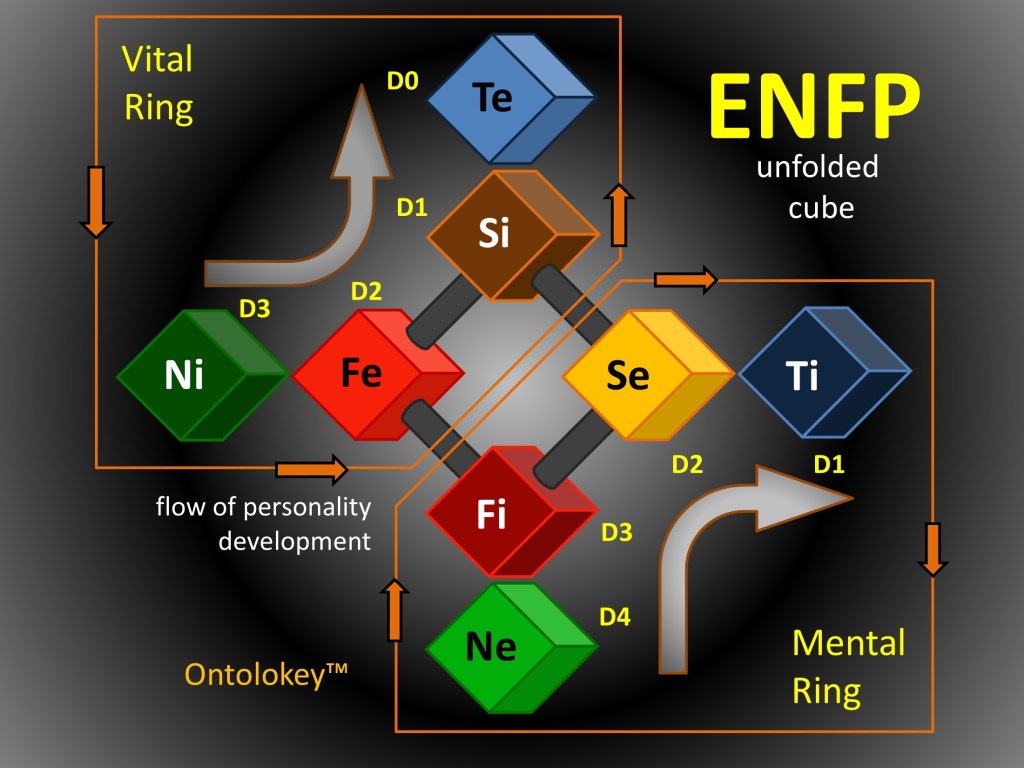
The Psychology of Possibility and the Search for Wholeness
The ENFP psyche begins with an extraordinary psychological movement toward possibility: an instinctive tendency to perceive what might exist beyond what is immediately visible, established, or already known. Within the Ontolokey model, Extraverted Intuition (Ne) occupies the Dominant position, functioning as the primary orientation through which the ENFP encounters reality, while Introverted Feeling (Fi) provides an inner axis of personal meaning, authenticity, and ethical coherence. This combination explains why the ENFP can appear simultaneously expansive and deeply selective: outwardly, almost every possibility may be worth exploring, yet inwardly, only those possibilities that resonate with a deeply personal sense of truth are ultimately allowed to matter. Creativity, enthusiasm, idealism, empathy, spontaneity, psychological curiosity, and the ability to recognize unrealized potential in people are therefore not isolated characteristics but expressions of a larger psychological architecture. The Ontolokey conception of the personality as an interconnected landscape of eight functions makes it possible to interpret these familiar qualities not merely as strengths, but as the conscious surface of a much larger inner structure containing less familiar, vulnerable, and potentially transformative dimensions.
The central developmental problem of the ENFP begins precisely where its greatest gift becomes capable of functioning as a defense. The capacity to perceive another possibility can make it extraordinarily easy to leave an unsatisfying reality before fully understanding it, to transform disappointment into evidence that something better must exist elsewhere, or to preserve freedom by avoiding the finality that accompanies commitment. Possibility can therefore become more psychologically attractive than actuality, and imagination can gradually become a refuge from the ordinary limitations through which an imagined life must eventually become a real one. This creates a subtle form of fragmentation: the individual may remain endlessly connected to potential versions of life while becoming increasingly disconnected from the concrete experience of completing, inhabiting, remembering, sustaining, and accepting one particular life. The shadow does not arise because the ENFP possesses excessive imagination, emotion, freedom, or idealism; it arises when these capacities cease to serve consciousness and begin instead to protect consciousness from experiences it does not yet know how to integrate. Individuation consequently requires not the destruction of the ENFP’s natural expansiveness, but its gradual transformation into a more complete psychological freedom in which possibility and reality can coexist without one being used to escape the other.
In this sense, the purpose of ENFP development is not to become less ENFP, but to become more completely oneself by allowing the neglected dimensions of the psyche to enter consciousness. The Ontolokey Cube provides a visual language for this process by representing the eight psychological functions as different positions within a three-dimensional psychological landscape, thereby making visible relationships that otherwise remain largely abstract. For the developmental pathway considered in this essay, the Mental Ring begins with Ne at D4 and proceeds through Fi at D3, Se at D2, and Ti at D1, while the Vital Ring develops through Ni at D3, Fe at D2, Si at D1, and finally Te at D0. The direction is therefore not arbitrary: development proceeds from the more established psychological capacity toward the next less-developed capacity, and genuine integration cannot be achieved by simply leaping toward the function that appears most deficient or uncomfortable. The deeper purpose of this gradual movement is to make the unconscious increasingly conscious until the personality no longer experiences its shadow as an alien force, a weakness, or an inexplicable source of suffering, but recognizes it as previously unintegrated psychological life that can finally be understood, assimilated, and brought into relationship with the whole.
The First Threshold: From Dominant Ne to Conscious Fi
The first decisive movement in ENFP development is not toward the shadow in its most alien or uncomfortable form, but toward the auxiliary function, Introverted Feeling (Fi), because the psyche can only descend into deeper unconscious material after it has established a sufficiently differentiated inner center. Ne gives the ENFP an almost instinctive capacity to move outward into alternatives, associations, interpretations, people, ideas, and emerging possibilities, yet Fi determines which of these possibilities possess genuine personal significance. Without sufficiently developed Fi, the ENFP can become psychologically dependent upon the stimulation generated by Ne, confusing intensity with meaning and novelty with truth, while simultaneously finding it difficult to distinguish an authentic inner desire from an idea that merely happens to be fascinating. The development of Fi therefore represents the first major act of psychological grounding: instead of asking only what could happen, the individual increasingly learns to ask what actually matters to me, what do I genuinely value, what am I unwilling to betray, and what remains meaningful when external stimulation disappears. In this transition, individuality ceases to mean simply being different from others and begins to mean becoming internally recognizable to oneself, which is essential because individuation cannot begin with an undefined self.
When Fi develops from its initial D3 position toward a state approaching D4, the ENFP begins to experience a profound change in the relationship between freedom and commitment. Earlier in life, freedom may be experienced primarily as the preservation of open possibilities, whereas psychological maturity gradually reveals that genuine freedom also requires the capacity to choose, remain, endure consequences, and take responsibility for what one has chosen. Fi introduces an inner criterion that Ne alone cannot provide, because Ne can endlessly multiply interpretations while Fi asks which interpretation is personally and existentially true. This can be uncomfortable because a more developed Fi exposes the difference between the life one imagines and the life one actually lives, between ideals that sound beautiful and values that survive disappointment, and between compassion that is genuinely grounded in another person’s humanity and compassion that unconsciously protects the ENFP from conflict, guilt, or rejection. The auxiliary function therefore does not merely make the ENFP more emotional or introspective; it makes the personality more internally accountable, because the individual increasingly becomes responsible for the meaning assigned to experience rather than allowing the surrounding world to determine that meaning. The movement toward wholeness begins here: the ENFP learns that authenticity is not the spontaneous expression of every inner impulse, but the gradual alignment of perception, feeling, choice, and action around an increasingly conscious inner truth.
This development also changes the way the ENFP encounters relationships, because other people can no longer function merely as mirrors, sources of stimulation, or carriers of unrealized potential. A less differentiated ENFP may instinctively perceive what another person could become and then relate partly to that imagined potential, sometimes loving the possibility of a person more intensely than the person who is actually present. Fi gradually interrupts this projection by requiring a more difficult form of recognition: the other person must be allowed to possess an independent reality that may not correspond to the ENFP’s hopes, interpretations, or emotional narrative. This can produce grief, because psychological maturation often involves relinquishing imagined futures that were emotionally invested with enormous significance, but the grief itself becomes developmental when it teaches the ENFP to distinguish love from projection and empathy from psychological fusion. At the same time, Fi gives the ENFP a stronger capacity to tolerate solitude, because inner meaning becomes less dependent upon continuous interpersonal confirmation; the individual can withdraw from stimulation without experiencing that withdrawal as psychological emptiness. The emerging self is consequently less scattered across possibilities and relationships, and this consolidation prepares the psyche for the next developmental movement, in which the increasingly grounded Fi can begin to open the door toward the much more vulnerable territory represented by Se.
The completion of this first developmental threshold should therefore not be understood as perfecting Fi in isolation, nor as replacing Ne with a quieter and more serious personality. Ne remains the dominant organizing intelligence of the ENFP, and its capacity for possibility remains indispensable; what changes is its psychological relationship with the inner value system. At greater maturity, Ne can generate possibilities without demanding that every possibility be pursued, while Fi can evaluate possibilities without prematurely reducing the world to a fixed set of personal preferences. This creates a more stable polarity between exploration and discernment, imagination and identity, openness and commitment, and it is precisely this polarity that makes deeper unconscious integration possible. Once Fi has acquired sufficient strength, the ENFP no longer needs to descend into the next developmental function through force or self-rejection, because the conscious personality has developed enough internal coherence to encounter aspects of experience that previously felt foreign, threatening, or psychologically disproportionate. The transition toward Se therefore represents something qualitatively different: the movement from the question of what is meaningful to me toward the difficult encounter with what is actually happening here and now, including the bodily, sensory, concrete, immediate, and often uncontrollable dimensions of existence that the ENFP’s natural orientation toward possibility may have habitually relegated to the background.
The Descent into the Immediate: Se as the Anima/Animus
Once Fi has become sufficiently differentiated, the ENFP reaches the threshold of the third Mental Ring function, Extraverted Sensing (Se), which in the developmental architecture described here occupies the Anima/Animus position at D2. This transition is psychologically significant because Se confronts the ENFP with a mode of consciousness that is far less concerned with what could become possible and far more concerned with what is concretely present. The ENFP naturally tends to move through reality by interpreting, associating, anticipating, imagining, and extending experience into alternative futures, whereas Se demands contact with the immediate world as it actually appears through the senses, the body, physical circumstances, timing, action, and environmental feedback. Because this function is positioned in the Anima/Animus role, its psychological appearance can be unusually compelling and unusually destabilizing: what has been neglected may simultaneously fascinate and threaten the conscious personality. The encounter can therefore occur through intense attraction to people who embody decisiveness, physical presence, spontaneity, sensuality, realism, or an effortless ability to act without first constructing an elaborate conceptual map, because the ENFP may unconsciously recognize in such qualities something that belongs to the larger personality but has not yet been fully possessed consciously. The shadow begins to become visible precisely where admiration, attraction, irritation, envy, fascination, and disproportionate emotional reactions reveal that another psychological mode has been carrying material that the conscious self has not yet integrated.
The vulnerable quality of Se is particularly important because the ENFP can experience concrete reality as psychologically constraining when reality refuses to behave like possibility. Ne can move effortlessly from one interpretation to another, but the body cannot live in several places simultaneously, time cannot be indefinitely postponed, and circumstances eventually demand an actual response rather than another conceptual possibility. The unintegrated Se therefore tends to become visible at precisely those moments when life becomes insistently physical and immediate: exhaustion, sensory overload, sexuality, confrontation, practical crisis, environmental disorder, bodily limits, sudden opportunity, or the necessity to make a decision before every variable has been intellectually explored. When this function remains largely unconscious, the ENFP may oscillate between neglecting the concrete world and becoming temporarily overwhelmed by it, sometimes reacting with impulsive intensity precisely because ordinary contact with the present has not been gradually cultivated. What appears externally as spontaneity can consequently have two very different psychological origins: mature spontaneity emerges from a person who is sufficiently present to respond freely to reality, whereas compensatory impulsiveness may represent an unconscious attempt to escape the burden of reflection, uncertainty, or emotional complexity through immediate action. The developmental task is therefore not to become permanently practical or sensory-oriented, but to discover that presence itself can be liberating when the present moment is no longer experienced as the enemy of possibility.
This is where the Anima/Animus quality of Se becomes particularly transformative, because integration requires the ENFP to stop treating embodiment as something secondary to psychological meaning. A person can understand their emotions beautifully and still remain disconnected from the body through which those emotions are actually experienced; they can imagine countless futures while failing to notice the fatigue, tension, desire, fear, pleasure, or physical resistance that is already communicating something important in the present. Se begins to restore this missing channel of information by teaching attention without immediate interpretation, observation without projection, and action without the demand that every action first be justified by an ideal future. The ENFP may gradually discover that reality contains information that cannot be obtained through intuition alone: the expression on another person’s face, the atmosphere of a room, the physical consequences of a decision, the rhythm of one’s own energy, the difference between genuine attraction and imagined potential, or the simple fact that something either works in lived experience or does not. Such awareness can be deeply humbling because it weakens the privileged position of imagination, but this is precisely why it is developmental rather than merely corrective. Se does not ask the ENFP to abandon the world of possibility; it teaches possibility to become embodied, tested, experienced, and therefore capable of becoming something more substantial than an attractive mental projection.
The psychological healing associated with this stage can become especially profound when the ENFP begins to reinterpret past failures, conflicts, and vulnerabilities through the newly conscious relationship with Se. Experiences that were once understood simply as personal inadequacy may reveal a more differentiated pattern: perhaps the individual was attempting to solve an immediate problem through abstraction, interpreting a concrete situation through an idealized narrative, overlooking bodily exhaustion, reacting too quickly when overwhelmed, or expecting reality to conform to an imagined emotional or relational possibility. This does not mean that every painful experience can be explained away by personality structure, nor that responsibility disappears once a function is identified; rather, cognition can create a more compassionate account of why a particular response became psychologically likely. The same insight can transform the ENFP’s relationship with other people, because behavior that once appeared incomprehensible or malicious may become more intelligible when one recognizes the different psychological pressures operating within another person and within oneself. In this sense, integration produces forgiveness not through denial but through understanding: the past remains real, consequences remain real, and boundaries remain necessary, yet the compulsion to condemn oneself or others can weaken when unconscious psychological dynamics become visible. The ENFP’s developing Se thus becomes more than an ability to live in the present; it becomes a bridge between psychological insight and lived reality, allowing understanding to descend from the realm of interpretation into actual experience.
Ti and the Recovery of Inner Coherence
After the ENFP has begun to establish a more conscious relationship with Fi and has learned to tolerate the immediacy represented by Se, the next developmental threshold within the Mental Ring is Introverted Thinking (Ti), the Toddler function at D1. Its position is significant because Ti is not simply a weaker version of the ENFP’s existing intelligence; it represents a qualitatively different relationship to thought, one in which ideas must increasingly be examined for their internal coherence rather than evaluated primarily through possibility, personal resonance, or emotional significance. The ENFP’s natural thinking process can be extraordinarily inventive, associative, and capable of making connections that a more linear mind might overlook, yet the same freedom can permit contradictions to coexist without being fully examined. Ti introduces the psychologically demanding question of whether an idea actually holds together when its assumptions are separated, tested, and followed to their logical consequences. Because this function is described as the Toddler, its first manifestations may feel playful, awkward, overly curious, or even frustratingly immature, but that very quality is developmentally important: the ENFP does not need to become a cold logician, but must learn to approach thought with the humility of someone willing to discover that a cherished interpretation may be incomplete. The task is not intellectual self-punishment but the gradual construction of an inner capacity for discrimination that allows intuition and feeling to become more precise rather than merely more intense.
The shadow difficulty surrounding Ti becomes especially apparent when the ENFP has become emotionally attached to an interpretation of reality. Fi may experience an idea as deeply meaningful because it expresses something authentic, while Ne may perceive numerous connections that appear to support it, and the combination can create a powerful subjective conviction that is nevertheless insufficiently examined. When challenged, the ENFP may respond by generating additional possibilities, changing the frame of reference, introducing another metaphor, or moving toward a different level of abstraction rather than remaining with the original proposition long enough to determine whether it is coherent. This does not indicate an absence of intelligence; indeed, the ENFP’s capacity for conceptual association can be formidable, particularly when a subject genuinely engages the imagination. The developmental problem is that intelligence without disciplined self-examination can become a sophisticated instrument of self-protection, capable of producing increasingly elaborate explanations for conclusions that have never been adequately tested. Ti therefore becomes a psychological antidote to rationalization: it teaches the ENFP to distinguish between an explanation that is beautiful and one that is structurally sound, between an intuition that is illuminating and one that has merely become emotionally persuasive through repetition. In this respect, developing Ti can become an important form of truthfulness, because the individual learns to say, with increasing comfort, “I may feel this deeply, I may intuit this strongly, and I may still be wrong.”
This capacity has direct consequences for psychological healing because unconscious suffering often survives through narratives that are emotionally compelling but insufficiently differentiated. An ENFP may, for example, interpret rejection as proof that they were fundamentally misunderstood, interpret another person’s withdrawal as evidence of betrayal, or reinterpret an abandoned project as evidence that the project was never truly meaningful in the first place. Such narratives may contain genuine truth, but they can also protect the psyche from more uncomfortable possibilities: perhaps the timing was wrong, perhaps expectations were unrealistic, perhaps responsibility was shared, perhaps fear influenced a decision, or perhaps something meaningful simply reached its natural end. Ti does not invalidate the emotional experience; instead, it creates enough distance to examine the architecture surrounding it. This distinction is crucial for forgiveness, because forgiveness becomes psychologically deeper when it no longer requires the past to be simplified into innocent victim and guilty perpetrator, nor does it require the ENFP to deny legitimate injury. Through increasingly conscious Ti, the person can reconstruct painful experiences with greater complexity and thereby discover that several truths can coexist: someone may have caused harm without being wholly malicious, the ENFP may have been genuinely wounded while also participating unconsciously in the pattern, and an experience may have been deeply meaningful even though its outcome was destructive. Such cognitive differentiation can loosen the grip of shame, resentment, idealization, and self-deception because experience no longer needs to be organized around a single emotionally satisfying explanation.
The completion of the Mental Ring’s developmental descent from Ne through Fi and Se toward Ti therefore represents an important form of psychological integration. Ne remains the ENFP’s source of expansive possibility, Fi preserves the inner sense of authenticity and personal value, Se restores contact with immediate reality, and Ti gradually teaches the personality to examine the structures through which all three are interpreted. None of these functions needs to conquer the others; their maturation instead allows them to correct one another. Ne prevents Ti from becoming rigid, Fi prevents Ti from becoming emotionally sterile, Se prevents Ne and Ti from drifting indefinitely into abstraction, while Ti protects Fi and Ne from confusing subjective conviction with objective coherence. Once this internal relationship becomes sufficiently established, the ENFP possesses something far more valuable than greater efficiency or intellectual sophistication: a more stable observing consciousness capable of witnessing its own psychological activity without immediately identifying with it. That expanded capacity for observation is what makes the next stage of individuation possible, because the psyche can now begin turning toward the Vital Ring, beginning with Ni at D3, where the central developmental question changes from “What possibilities can I perceive?” to the much quieter and more demanding question of “Which underlying direction is actually emerging from all these possibilities?”
Entering the Vital Ring: Ni and the Discovery of Inner Direction
The movement from the Mental Ring into the Vital Ring marks a deeper stage of individuation because the ENFP is no longer merely developing neglected capacities within the conscious personality; the individual is beginning to encounter psychological material that has operated farther from ordinary awareness. In the developmental sequence described by Ontolokey, Introverted Intuition (Ni) occupies the Sibling position at D3, and its development follows the substantial strengthening of Fi rather than occurring as an isolated exercise in intuition. This distinction matters because the ENFP already possesses an extraordinarily powerful intuitive orientation through Ne, yet Ne and Ni relate to possibility in fundamentally different ways: Ne expands the field, while Ni gradually condenses it toward an underlying pattern, trajectory, or singular significance. For the ENFP, whose consciousness may habitually experience vitality through multiplicity, Ni can initially feel strangely restrictive because it asks the psyche to remain with one emerging direction long enough for its deeper implications to become visible. The developmental challenge is therefore not to replace expansive intuition with convergent intuition, but to allow the mind that habitually asks “What else could this mean?” to eventually ask “What is this experience, across time, actually becoming?” In the language of individuation, this represents a shift from the abundance of possibilities toward the recognition of an underlying psychological direction that may have been present all along but obscured by the constant movement of conscious attention. (ontolokey.com)
Ni can become particularly important for the ENFP because an unconscious relationship with possibility may produce a peculiar form of existential dispersion. The individual can perceive so many plausible futures that choosing one begins to feel like the death of all the others, and consequently the psyche may remain attached to alternatives long after circumstances have already selected a direction. Ni introduces the opposite movement: instead of multiplying futures indefinitely, it allows meaning to accumulate across experiences until certain patterns become difficult to ignore. A mature relationship with Ni therefore does not necessarily produce certainty in the conventional sense; rather, it produces a tolerance for psychological depth, ambiguity, and gradual revelation, allowing the person to recognize that some truths cannot be discovered by generating more alternatives but only by remaining sufficiently still for an existing pattern to disclose itself. This can be transformative for the ENFP because the future no longer has to function exclusively as an imaginative escape from the present; it can become an unfolding trajectory that emerges from the interaction between past experience, present reality, unconscious tendencies, and consciously chosen values. The individual begins to recognize that life is not merely a collection of opportunities but also a developmental process, and that repeatedly encountering the same relational patterns, emotional conflicts, fears, or aspirations may indicate something deeper than coincidence. Ni consequently gives temporal depth to Ne, turning the ENFP’s remarkable capacity to perceive connections into a capacity to understand direction. (ontolokey.com)
The Sibling designation is psychologically revealing because Ni may initially be experienced less as a commanding inner authority than as a quieter psychological companion whose perspective becomes increasingly trustworthy with maturity. The ENFP may encounter it through sudden realizations that emerge after long periods of apparently unstructured reflection, through dreams or symbolic associations, through an unexpected recognition of a recurring life pattern, or through the intuitive sense that a particular path is becoming inevitable even though the rational mind cannot yet fully explain why. What matters developmentally is learning not to force such perceptions into immediate certainty, because premature certainty would simply turn one unconscious function into another form of dogmatism. Ni needs time, silence, observation, and distance from the constant stimulation of Ne; it becomes clearer when the psyche is no longer compelled to respond to every possibility as though it demands immediate engagement. This can make solitude unexpectedly valuable to an ENFP, not because withdrawal is inherently superior to social connection, but because psychological depth often requires periods in which external possibilities are temporarily quiet enough for internal patterns to emerge. The Sibling gradually becomes recognizable as a different kind of intelligence: less expansive but more penetrating, less concerned with generating alternatives and more concerned with discovering what remains after the alternatives have been allowed to settle.
At this stage, individuation begins to acquire a distinctly existential character because the ENFP is increasingly confronted with the difference between a life that contains many experiences and a life that possesses an underlying direction. Earlier developmental work has helped establish personal values, embodiment, and cognitive discrimination; Ni now asks what those developments mean when viewed across the whole arc of a human life. This question can expose an uncomfortable shadow in the ENFP: the possibility that constant movement has sometimes served to postpone a deeper confrontation with destiny, limitation, mortality, or the consequences of becoming one particular person rather than maintaining psychological access to countless potential selves. The integration of Ni does not demand that the ENFP abandon experimentation, curiosity, or openness; instead, it introduces a deeper form of commitment in which openness exists within an emerging trajectory rather than functioning as an escape from trajectory itself. As the unconscious becomes more visible, the individual may begin to understand why certain choices repeatedly failed, why certain relationships reproduced the same emotional structure, why particular ambitions remained strangely unsatisfying, or why certain apparently irrational longings persisted despite changing circumstances. This is one of the points at which the metaphor of the turning iceberg becomes especially meaningful: what was previously submerged does not suddenly appear as an entirely foreign personality, but gradually reveals itself as an aspect of the self that had been present beneath the conscious surface and was waiting for sufficient psychological maturity to be recognized.
Fe and the Golden Shadow: Learning to Belong Without Losing the Self
With Ni sufficiently integrated, the ENFP reaches Fe, Extraverted Feeling, which occupies the Golden-Shadow position at D2 within the Vital Ring. This is a particularly subtle stage because Fe may initially appear both strangely familiar and psychologically foreign: the ENFP is naturally capable of profound empathy and interpersonal sensitivity, yet Fe asks for something different from the deeply personal valuation of Fi. Fi tends to ask whether an experience is authentic to the individual, whereas Fe turns attention toward the emotional field shared among people and toward the question of what sustains connection, reciprocity, belonging, and collective emotional coherence. Because Fe is described as the Golden Shadow, its qualities can become projected onto people who seem exceptionally socially attuned, emotionally influential, gracious, diplomatic, or capable of creating harmony among groups, while the ENFP may simultaneously feel admiration and irritation toward such individuals. The unconscious message contained within this attraction can be psychologically significant: the personality may be recognizing a capacity that it possesses in latent form but has not yet learned to employ consciously without feeling that doing so compromises authenticity. Integration therefore requires discovering that sensitivity to the collective emotional environment does not necessarily mean abandoning individual truth, just as maintaining personal authenticity does not require remaining psychologically indifferent to the emotional reality shared with others.
The tension between Fi and Fe can become one of the most revealing conflicts in the ENFP’s individuation process because both functions are concerned with feeling, yet they organize feeling according to different psychological principles. A strongly identified Fi perspective can regard external expectations with suspicion, particularly when social conformity appears to demand the suppression of something personally important, and this resistance can be an essential protection against losing oneself in other people’s values. Yet when that resistance becomes unconscious and absolute, it can also prevent the ENFP from recognizing how profoundly every individual exists within relational systems whose emotional dynamics cannot simply be dismissed as external interference. Fe introduces the recognition that communication itself has consequences, that intentions do not exhaust the meaning of an action, and that the emotional atmosphere created between people is a psychological reality in its own right. The mature ENFP therefore becomes increasingly capable of holding two truths simultaneously: “This is authentic for me” and “This also affects the people around me.” Such integration is not a demand for people-pleasing, because unconscious Fe can itself become distorted into excessive accommodation or dependence upon collective approval; rather, the goal is a conscious ability to participate in shared emotional reality while retaining the differentiated inner center developed through Fi. The Golden Shadow is integrated when social consciousness becomes an extension of humanity rather than a replacement for individuality.
This development can profoundly transform the ENFP’s relationships because it weakens one of the more subtle forms of projection: the expectation that other people should intuitively understand the ENFP’s inner world simply because the ENFP is often highly capable of intuiting theirs. Ne and Fi can produce an impressive sensitivity to another person’s potential motives, emotions, and unspoken meaning, but this can paradoxically create unrealistic expectations when the ENFP assumes that emotional depth should automatically produce mutual comprehension. Fe introduces a more conscious understanding of interpersonal translation: what is obvious internally may remain invisible externally, and what feels authentic to one person may be experienced very differently by another. The ENFP begins to recognize that empathy is not merely the ability to perceive another person’s emotional state, but also the ability to communicate one’s own state in a form that another person can actually receive. This can reduce resentment because the individual becomes less likely to interpret misunderstanding as evidence of indifference or rejection and more willing to recognize the practical work required for genuine mutual understanding. In this sense, Fe becomes an instrument of relational healing, allowing the ENFP to transform emotional intelligence from an intuitive talent into a consciously reciprocal practice.
The Golden Shadow also becomes important in relation to the ENFP’s idealism, because the individual may gradually discover that a genuinely humane life cannot be built solely from personal authenticity and visionary possibility. Human beings exist in families, friendships, communities, cultures, institutions, and networks of mutual obligation, and psychological wholeness therefore includes the capacity to participate in something larger than the individual self without dissolving into it. Fe can teach the ENFP that harmony is not necessarily superficial, compromise is not necessarily betrayal, and social responsibility is not necessarily conformity, provided that these concepts are consciously differentiated rather than accepted as unquestioned demands. At the same time, the ENFP must learn to recognize the shadow version of Fe: the temptation to create harmony by suppressing difficult truths, to rescue others from emotions they need to experience themselves, or to derive self-worth from being emotionally indispensable. Such patterns can become especially seductive for a naturally empathic personality because helping another person can provide immediate confirmation of one’s goodness and significance. The mature integration of Fe therefore requires a more demanding form of compassion—one that can remain warm without becoming intrusive, supportive without becoming controlling, and socially conscious without turning approval into a substitute for inner worth.
As Fe becomes more conscious, the ENFP’s understanding of the Golden Shadow changes from fascination with an external quality into recognition of an internal capacity. The individual no longer needs to idealize people who appear effortlessly socially integrated, nor does the ENFP need to react against them as though collective emotional awareness were inherently superficial or compromising. Instead, the personality can borrow the strengths of Fe while allowing Fi to remain the guardian of personal integrity and Ni to maintain awareness of the deeper trajectory behind immediate social demands. This is another important stage in the turning of the psychological iceberg: an aspect that once appeared to belong to other people becomes recognizable as part of the self. The resulting personality is capable of greater relational maturity because it can move between inner authenticity and interpersonal responsibility without treating them as mutually exclusive. What was previously experienced as a conflict between “being true to myself” and “being there for others” can gradually become a more integrated question: how can my truth enter the shared human world in a way that remains truthful while also acknowledging the reality of everyone affected by it? That question prepares the ENFP for the next descent into the Vital Ring, where the psyche encounters the far less glamorous but equally necessary territory of Si—memory, continuity, routine, preservation, limitation, and the accumulated weight of lived experience.
Si and the Burden of What Has Been
The next developmental threshold is Introverted Sensing (Si), which occupies the inferior position at D1 within the Vital Ring and therefore confronts the ENFP with one of the most consequential forms of unconscious material: the accumulated reality of what has already happened. Where Ne naturally opens toward possibility and Ni seeks an underlying direction, Si turns consciousness toward continuity, memory, embodied history, familiarity, repetition, and the concrete traces that experience leaves behind. For an ENFP, this territory can initially feel restrictive because the psyche is naturally energized by emergence rather than preservation, by what is becoming rather than what has already become. Yet the very qualities that can seem limiting—routine, repetition, careful attention to detail, established rhythms, physical maintenance, memory, and respect for accumulated experience—can become psychologically restorative when they are no longer experienced as imprisonment. Si asks the ENFP to acknowledge that a human life is not composed solely of moments of inspiration or transformative possibility; it is also built from thousands of ordinary repetitions through which relationships, bodies, skills, identities, and commitments acquire continuity. The developmental movement toward Si therefore represents a confrontation with temporal reality itself: the recognition that what is neglected does not disappear, that the past remains active within the present, and that psychological integration requires making peace with the life that has actually been lived rather than remaining permanently oriented toward the life that might still be lived.
The inferior position makes this encounter especially sensitive because Si can carry memories that have never been adequately metabolized by consciousness. An ENFP may remember the emotional meaning of an experience more readily than its precise sequence of concrete circumstances, and Ne can subsequently reinterpret those circumstances through new narratives as life develops. This capacity for reframing can be psychologically liberating, but it can also become a mechanism through which painful details are repeatedly reorganized before they have been fully acknowledged. The emerging Si perspective asks the individual to slow down and recover what actually happened: what was said, what was done, what was promised, what was repeatedly tolerated, what physical or emotional warning signs were ignored, and what consequences accumulated over time. Such attention can be uncomfortable because memory is not always flattering to the self, and a more differentiated account may reveal not only injuries received but opportunities missed, boundaries not established, responsibilities avoided, or patterns unconsciously repeated. Yet this is precisely where cognition can contribute to healing without requiring self-condemnation. When experience is reconstructed with greater specificity, the ENFP can begin separating what truly belonged to another person from what belonged to the self, what was unavoidable from what was preventable, and what was once adaptive from what has subsequently become destructive. Si thus becomes a form of psychological historical consciousness: it allows the individual to remember without being imprisoned by memory and to learn from the past without continually recreating it.
The integration of Si also requires the ENFP to develop a new relationship with repetition, which may be one of the least intuitive aspects of maturation for a personality oriented toward novelty and possibility. Growth is often imagined as expansion, discovery, travel, experimentation, or transformation, yet much of genuine psychological development consists of doing the same meaningful things repeatedly until they become embodied rather than merely understood. Emotional regulation, healthy boundaries, physical care, creative practice, sustained relationships, professional competence, and self-knowledge all require continuity, and none can be permanently maintained through inspiration alone. The immature relationship with routine may interpret repetition as stagnation, whereas integrated Si recognizes that repetition can create depth by allowing experience to accumulate. This distinction is particularly important for the ENFP because the desire for a new beginning can become seductive whenever ordinary life becomes demanding; a new possibility may feel psychologically cleaner than remaining with the slow work of repairing, maintaining, practicing, or completing what already exists. Si introduces the insight that not every period of reduced excitement represents a wrong direction, just as not every recurrence of difficulty means that one must begin again somewhere else. Sometimes the developmental task is precisely to remain present long enough for familiarity to become mastery and for continuity to reveal meanings that novelty cannot provide.
At the level of shadow integration, Si can also transform the ENFP’s relationship with vulnerability and personal history. The individual may discover that certain apparently irrational reactions have roots in earlier experiences whose concrete details had been psychologically displaced by more general narratives about identity, relationships, or the future. A disproportionate response to criticism, abandonment, disorder, physical exhaustion, or loss of control may become more comprehensible when viewed against the accumulated history of similar experiences rather than treated as an isolated event. This recognition can produce a profound form of self-compassion because the person begins to understand that present reactions sometimes contain echoes of earlier psychological learning, even when the present situation is objectively different. Such understanding does not mean that every reaction is justified or that the past determines the future; it means that unconscious continuity becomes visible and therefore available for conscious choice. The ENFP can then begin distinguishing between an old emotional alarm and a present-day reality, between a remembered pattern and a current fact, and between genuine intuition and a nervous system responding to something familiar. In this way, Si becomes unexpectedly important for healing: it reconnects the ENFP with the temporal body of the personality, allowing the past to become information rather than destiny.
When Si develops, the ENFP does not become less spontaneous, imaginative, or future-oriented; instead, possibility acquires a memory. Ne can begin to draw upon lived experience rather than endlessly generating alternatives independent of what experience has already taught, while Ni can interpret long-term patterns with greater accuracy because those patterns are anchored in concrete history. Fi gains greater depth because personal values are no longer merely ideals but values tested against years of actual choices, and Fe becomes more grounded because empathy can include awareness of the accumulated history carried by other people. Even the previously developed Se benefits, because present-moment awareness becomes less impulsive when it is informed by memory and bodily knowledge. This is why the developmental sequence cannot simply be reversed or accelerated: Si becomes psychologically meaningful precisely because the preceding functions have created enough consciousness to receive what it reveals. The ENFP begins to understand that the past does not have to compete with the future, just as stability does not have to destroy freedom; when integrated, continuity becomes the ground from which genuine possibility can emerge. The personality is therefore approaching the final and most archaic position of the Vital Ring, Te at D0, where the developmental task becomes even more challenging because the ENFP must encounter the shadow of external effectiveness, measurable results, impersonal execution, hierarchy, and the hard boundary between what one intends and what one actually accomplishes.
Te at D0: The Blindspot of Execution and External Reality
The final position of the Vital Ring is Extraverted Thinking (Te), described here as the tertiary function at D0, the most archaic and least developed point of the ENFP’s developmental landscape, and therefore a genuine psychological blindspot. This position is especially revealing because Te represents an orientation toward measurable effectiveness, external organization, objective criteria, implementation, prioritization, systems, efficiency, and demonstrable results, all of which can feel strangely impersonal to an ENFP whose conscious life is more naturally organized around possibility, personal meaning, interpersonal significance, and emerging potential. The problem is not that ENFPs are incapable of achievement or practical intelligence; many can become remarkably productive when a goal genuinely engages their imagination and values. The deeper difficulty emerges when reality demands execution independently of inspiration, when an idea must be converted into a sequence of decisions, deadlines, structures, measurements, and completed outcomes, or when effectiveness requires temporarily setting aside the question of whether the process feels personally meaningful. Because Te exists at D0, these demands may evoke disproportionate psychological reactions precisely because they touch an underdeveloped part of the personality. What appears externally as procrastination, disorganization, resistance to bureaucracy, difficulty with prioritization, or frustration with rigid systems can therefore sometimes conceal a more intimate conflict between the ENFP’s need for meaningful possibility and the uncompromising external question of whether something has actually been made real. (ontolokey.com)
The shadow expression of Te can be particularly painful because the ENFP may oscillate between underidentification with external standards and sudden overcompensation through them. When effectiveness has been neglected for too long, accumulated obligations can eventually create pressure strong enough to produce an abrupt, rigid, or unusually controlling mode of functioning in which everything must suddenly be organized, optimized, measured, and brought under control. In such moments, Te may not feel like a mature psychological capacity but like an emergency mechanism that appears only when disorder has become intolerable. The individual may then judge both self and others according to harsh external standards, reducing complex human realities to productivity, competence, success, failure, or visible results, before eventually becoming exhausted and retreating back into the familiar psychological world of possibilities and meanings. This oscillation can create a destructive cycle: avoidance permits practical disorder to accumulate, accumulated disorder produces stress, stress triggers compensatory control, excessive control becomes psychologically alienating, and alienation drives the personality back toward avoidance or imaginative escape. Development therefore requires something subtler than simply “becoming more organized.” The task is to gradually establish a conscious relationship with effectiveness so that execution becomes a servant of values and possibilities rather than either an enemy of authenticity or a weapon against the self. (ontolokey.com)
At its deepest level, Te asks the ENFP to accept a difficult truth about manifestation: an intention does not become an accomplishment merely because the intention is sincere. An idea may be brilliant, a value may be deeply held, a vision may be emotionally compelling, and a potential may be genuinely recognized, yet none of these qualities guarantees that anything will exist in the external world as a consequence. This confrontation can be psychologically sobering because Ne is exceptionally skilled at experiencing the richness of what something could become, sometimes allowing the imagined potential itself to generate a feeling of partial completion. Te disrupts this illusion by introducing external feedback: the project either exists or it does not, the appointment was kept or it was missed, the promise was fulfilled or it was not, the system functions or it fails, and the intended result was achieved or it was not. Such distinctions are not intended to humiliate the ENFP’s idealism but to give it a body in reality. The integration of Te consequently becomes a form of respect for one’s own vision, because taking an idea seriously enough to structure its realization means refusing to leave it permanently in the protected realm of possibility. The ENFP gradually learns that disciplined execution does not necessarily betray spontaneity; when consciously chosen, structure can protect creativity from dissipation and transform inspiration into something capable of affecting the world beyond the private imagination.
Because Te is positioned at D0, its integration should not be understood as a demand to leap directly into highly developed strategic efficiency. The developmental logic described by the Ontolokey model explicitly prevents such a shortcut: the Vital Ring proceeds from Ni to Fe to Si and only then toward Te, meaning that the capacity for external effectiveness is approached after deeper work has already been done with direction, relationship, and continuity. This sequence is psychologically meaningful because effective action without direction can become pointless productivity, effectiveness without relational awareness can become coercive, and efficiency without respect for continuity can become unsustainable. The ENFP must therefore arrive at Te carrying the psychological gains of the preceding functions: Ni provides orientation, Fe provides awareness of the human field, and Si provides respect for reality, history, embodiment, and continuity. Only then can Te begin to function as a mature instrument rather than a compensatory reaction. The blindspot gradually becomes visible not because the ENFP forces it into consciousness, but because the rest of the psychological structure has become sufficiently developed to tolerate what Te reveals: that some dreams require administration, some values require boundaries, some relationships require agreements, some creative visions require repetition, and some forms of freedom can only exist when certain structures are deliberately maintained.
The healing potential of this final Vital Ring stage lies in the possibility of reconciling the ENFP with the very external reality that may previously have felt like a threat to individuality. Once effectiveness is no longer unconsciously associated with soulless conformity, the personality can discover a different relationship with responsibility: not “I must become someone else in order to succeed,” but “I can construct enough structure for the person I am to become effective.” This distinction is crucial because the deepest integration does not erase the original personality architecture; it reorganizes the relationship among its parts. Ne can generate the vision, Fi can determine why the vision matters, Ni can recognize its deeper direction, Fe can consider its human consequences, Se can bring it into immediate experience, Si can sustain it through continuity, Ti can test its conceptual coherence, and Te can finally help translate the whole constellation into observable reality. At that point, the function that once represented a D0 blindspot has begun to participate in consciousness, not as a replacement for the dominant personality but as one of its previously inaccessible instruments. The ENFP becomes less divided between inspiration and execution, authenticity and responsibility, imagination and fact, because the unconscious opposition between these dimensions has begun to dissolve through conscious understanding. This is the point at which the developmental process starts to reveal its larger purpose: not optimization of individual functions, but the gradual recovery of a personality capable of containing more of its own psychological reality without needing to exile uncomfortable aspects into the unconscious.
The Shadow Is Not the Enemy: From Projection to Integration
The developmental sequence becomes psychologically meaningful only when the shadow is understood not as an inferior or defective version of the personality, but as a repository of capacities and experiences that consciousness has not yet learned to hold. For the ENFP, this distinction is essential because the conscious identity can become strongly attached to being imaginative, emotionally authentic, open-minded, spontaneous, empathic, and capable of seeing potential where others see limitations. These qualities are genuine strengths, yet any strength can become defensive when the personality begins using it to avoid what feels psychologically foreign, painful, restrictive, or threatening. The shadow then appears indirectly through projection: the qualities one cannot comfortably recognize in oneself are experienced disproportionately in other people, in relationships, in recurring conflicts, or in circumstances that seem inexplicably provocative. A person who unconsciously struggles with decisiveness may idealize decisive people and simultaneously resent their apparent rigidity; someone uncomfortable with concrete limitation may admire grounded individuals while experiencing them as unimaginative; someone uncertain about personal effectiveness may alternate between dismissing achievement-oriented people as superficial and secretly envying their capacity to produce visible results. Shadow work begins when these reactions are no longer treated solely as judgments about external reality but become questions directed inward: what is this person or situation activating in me, why does this particular quality carry so much emotional charge, and what part of myself might I be encountering through the other?
This does not mean that every negative reaction is projection, nor that harmful behavior should be excused by turning every conflict into a psychological lesson. Such an interpretation would itself become another form of avoidance, because genuine individuation requires the ability to distinguish between what belongs to oneself and what genuinely belongs to another person. The developmental value of the shadow lies precisely in increasing this discrimination rather than dissolving all boundaries between inner and outer reality. When an ENFP encounters someone who is controlling, emotionally manipulative, chronically irresponsible, excessively rigid, or dismissive of individuality, the appropriate response may still include distance, confrontation, or firm boundaries; psychological integration does not require tolerating behavior that causes harm. What changes is the internal reaction to the encounter, because the ENFP can simultaneously recognize the external problem and investigate why it has produced a disproportionate psychological response. This dual awareness prevents the common trap of either blaming everything on oneself or blaming everything on others. Over time, the personality becomes capable of saying, in effect, “This behavior is genuinely unacceptable, and my reaction to it may also be teaching me something about myself,” thereby converting conflict into information without surrendering discernment. Such differentiation is one of the clearest signs that shadow integration has moved beyond intellectual fascination and has begun to affect actual consciousness.
The most vulnerable shadow material is often encountered not through abstract reflection but through emotional disproportion. The ENFP may encounter particular situations in which the intensity of the reaction seems greater than the immediate circumstances would logically explain, and these moments can function as psychological entry points into previously unconscious material. The Anima/Animus function Se and the Toddler function Ti are especially important in this respect because both may expose vulnerabilities that the conscious personality would prefer to reinterpret rather than directly experience. A failure to perform under pressure, an inability to respond effectively in a concrete situation, feeling physically overwhelmed, being criticized for inconsistency, discovering that an idealized interpretation was logically flawed, or realizing that another person’s perception differs radically from one’s own can trigger shame that appears to be about the present while actually touching older layers of psychological experience. When such reactions are met only with self-judgment, the unconscious material becomes more deeply defended; when they are approached cognitively and compassionately, the individual can begin asking what the reaction is protecting and what developmental capacity was missing at the time. The aim is not to excavate the past endlessly, but to understand enough of its structure that the present no longer has to carry the full emotional weight of what happened before.
This is where the idea of psychological healing through cognition becomes particularly significant within the developmental framework presented here. Understanding does not magically erase pain, and intellectual insight alone cannot substitute for emotional processing, embodied experience, or changed behavior, but conscious understanding can fundamentally alter the relationship a person has with previously incomprehensible parts of themselves. When the ENFP recognizes that a particular vulnerability arose from an underdeveloped function rather than from a global defect of character, shame can begin to lose its authority. The person can distinguish “I struggled because this psychological capacity was not yet accessible to me” from “I struggled because there is something fundamentally wrong with me,” and that distinction can profoundly change the possibilities available for future development. The same process can extend toward other people: understanding that another person’s behavior may have emerged from their own limitations, defenses, fears, or developmental structure can make forgiveness psychologically possible without requiring the denial of injury. Forgiveness in this context is not an obligation to reconcile, forget, or approve; it is the gradual release of the demand that the past remain psychologically active in the present through hatred, shame, compulsive explanation, or unresolved projection.
The shadow therefore becomes less threatening as consciousness becomes more capable of containing contradiction. The ENFP no longer needs to choose between being spontaneous and disciplined, authentic and socially responsible, imaginative and concrete, emotionally sensitive and logically rigorous, future-oriented and rooted in memory. These apparent oppositions can begin functioning as complementary dimensions of one personality rather than as competing identities. The developmental sequence through the Mental and Vital Rings provides a map for this integration, while the Ontolokey Cube can serve as a visual reminder that the less conscious functions are not outside the personality but occupy positions within its larger structure. The purpose of turning toward them is consequently not self-correction in the narrow sense, but expansion of the conscious self until fewer psychological experiences need to be rejected, projected, rationalized, or unconsciously acted out. Individuation becomes the gradual capacity to recognize oneself in what one previously rejected, to understand one’s vulnerabilities without becoming defined by them, and to transform unconscious reaction into conscious choice. For the ENFP, this is ultimately the movement from living primarily through the gifts of Ne and Fi toward becoming a person whose entire psychological landscape can participate in consciousness.
The Turning of the Iceberg: Individuation as a Second-Half-of-Life Process
The developmental model reaches its deepest meaning in the metaphor of the turning iceberg, because individuation is not simply the acquisition of new skills but a gradual reversal in the relationship between consciousness and the unconscious. At the beginning of life, only a relatively small portion of the psychological structure is ordinarily accessible to conscious awareness, while much of the personality operates beneath the surface through tendencies, defenses, projections, vulnerabilities, instincts, and capacities that have not yet been sufficiently differentiated. The development of the auxiliary function represents the first significant disturbance of this equilibrium: Fi strengthens the ENFP’s inner center to such an extent that the previously unquestioned dominance of Ne can no longer contain the entire psychological reality of the individual. As this conscious structure becomes more stable, the psyche can progressively encounter Se, Ti, Ni, Fe, Si, and finally Te, not as unrelated psychological traits but as increasingly unfamiliar aspects of the same self. The iceberg therefore does not become larger merely because more information is accumulated; it turns because the center of psychological gravity changes, allowing what was once submerged to become visible and what was once automatically conscious to be understood from a wider perspective. Individuation is consequently a process of psychological rotation in which the person gradually encounters the self from angles that were previously inaccessible.
This explains why the developmental process can become especially significant in the second half of life, when the accumulated consequences of earlier choices begin to confront the individual with questions that cannot be resolved through further expansion alone. During the first decades, Ne can be extraordinarily adaptive because life genuinely contains countless possibilities that need to be explored, while Fi gradually helps the ENFP determine which experiences correspond to an emerging personal identity. Career changes, relationships, experimentation, travel, intellectual exploration, creativity, and the discovery of values can all serve a legitimate developmental purpose during this period because the personality needs to discover what kind of life feels genuinely its own. Yet eventually the question changes from “What could I become?” to “What have I become, and what remains unrealized within me?” This shift can be unsettling because the individual may discover that certain strengths have been developed repeatedly while other capacities have remained psychologically young, vulnerable, or almost invisible. The apparent crisis of midlife can therefore be understood, within this model, not merely as dissatisfaction with external circumstances but as the psyche demanding a broader form of consciousness. What previously worked may cease to be sufficient, not because it was false, but because the personality has reached a developmental boundary beyond which the neglected dimensions of the self can no longer remain unconscious without producing psychological tension.
For the ENFP, this turning can initially feel like a loss of identity because the qualities that once provided certainty about who one was may no longer be sufficient to explain one’s experience. The person who has always understood themselves as the visionary, the idealist, the empath, the creative explorer, or the person who sees potential in everything may encounter periods in which these identities feel strangely incomplete. The temptation is then to interpret the discomfort as evidence that one has lost oneself, when the deeper possibility is that the previous self-concept is becoming too narrow to contain the emerging personality. This is why individuation can resemble a psychological death and rebirth: an earlier organization of identity must loosen before a larger organization can become conscious. The familiar personality does not disappear, however; Ne remains Ne, Fi remains Fi, and the ENFP’s fundamental orientation remains recognizable, but these functions cease to monopolize the definition of the self. The individual begins to understand that being authentic does not mean remaining identical to one’s younger self, because authenticity can also require allowing previously unconscious aspects of the personality to mature. Psychological rebirth therefore means returning to the original personality with greater consciousness rather than returning to the original level of awareness.
The metaphor also clarifies why development cannot be rushed by deliberately attacking the weakest function first. An ENFP might become fascinated by Te because external organization feels like the obvious missing ingredient, or by Si because greater stability appears to promise relief from chaos, yet forcing either function prematurely can produce compensation rather than integration. The developmental sequence assumes that each function prepares the psychological conditions necessary for the next: Fi creates inner differentiation, Se establishes contact with immediate reality, Ti strengthens reflective discrimination, Ni develops awareness of deeper direction, Fe expands relational consciousness, Si reconnects the individual with continuity and lived history, and only then can Te begin to emerge from its archaic D0 position with a more mature psychological foundation beneath it. Skipping stages would therefore resemble attempting to build the upper floors of a structure before the lower ones can support their weight. The point is not that psychological development follows a mechanical timetable, but that consciousness requires sufficient internal capacity to assimilate whatever it encounters. The Ontolokey developmental map gives the ENFP a way of visualizing this progression, allowing the Cube and its sliders to function as a symbolic representation of where attention might next be directed rather than as a demand to become something alien to one’s nature.
At the completion of the turning process, the image of the iceberg acquires its most important implication: what was unconscious has not been destroyed but brought into relationship with consciousness. The dominant Ne can once again occupy the visible summit, but it is no longer the same Ne that existed at the beginning of the journey because it has been transformed by contact with the functions that previously existed beneath the surface. It can now generate possibilities informed by memory, embodied reality, logical examination, relational awareness, deeper direction, and practical consequence, while Fi can provide the ethical and existential center around which these possibilities are organized. The ENFP’s return to the original dominant function is therefore not regression but completion—a return to the beginning after having traveled through the hidden dimensions of the personality. In psychological terms, the goal is not perfection but increasing wholeness: fewer parts of oneself need to remain unconscious, fewer vulnerabilities need to be defended through projection, and fewer contradictions need to be resolved by choosing one side and rejecting the other. The personality becomes capable of carrying more of its own complexity, and this expanded capacity is perhaps the most meaningful definition of healing available within the individuation process described by Ontolokey.
What Wholeness Changes: From Potential to Embodied Selfhood
When the developmental movement is understood as a process of integration rather than self-improvement, the meaning of ENFP maturity changes considerably. The mature ENFP is not simply a more productive, disciplined, calm, or socially agreeable version of the younger personality, because such a definition would measure development according to external adaptation rather than psychological wholeness. Instead, maturity becomes visible in the increasing ability to remain psychologically present when reality contradicts expectation, when another person does not fulfill an imagined potential, when an emotional truth cannot immediately be transformed into a new possibility, or when an important goal requires repetitive effort rather than inspiration. Ne remains the central source of openness and creative perception, but it is increasingly accompanied by functions capable of asking what should actually be chosen, embodied, remembered, examined, sustained, and completed. The ENFP’s freedom consequently becomes less dependent upon keeping every door open, because the individual has developed enough inner differentiation to close some doors consciously without experiencing the decision as the destruction of the self. This is a profound shift from possibility as psychological escape toward possibility as creative material that can be selected, shaped, and brought into reality.
One of the clearest signs of this integration is a changed relationship with failure. An immature or partially integrated ENFP may experience failure as disproportionately threatening because it can collide simultaneously with idealism, identity, imagined potential, and the desire to see meaning in one’s actions. Ne can rapidly generate alternative explanations or new futures, Fi can protect the sense of personal integrity by redefining what the experience meant, and the personality can move forward before the full psychological significance of the failure has been absorbed. At greater maturity, however, the ENFP can remain with failure long enough to extract its information without allowing it to become a verdict on personal worth. Se can ask what actually happened, Ti can examine the reasoning behind the choices, Si can identify what previous experience was overlooked, Ni can search for the larger pattern, Fe can consider the effects upon other people, Fi can determine what remains personally meaningful, and Te can eventually ask what must change in concrete behavior. Failure therefore becomes multidimensional rather than existentially absolute. The individual can experience disappointment without collapsing into shame, learn without constructing a defensive narrative, and begin again without pretending that nothing was lost or that the previous attempt had no value.
The same integration transforms the ENFP’s relationship with idealism. Idealism does not have to disappear in order to become mature; what changes is its relationship with limitation. The younger psyche may experience limitations as evidence that reality has failed to live up to its potential, while the integrated personality increasingly recognizes that limitation is one of the conditions through which potential becomes form. A relationship becomes meaningful partly because two people cannot simultaneously live every possible relationship; a vocation becomes meaningful partly because choosing one direction means relinquishing others; a creative work becomes real only when infinite possibilities are eventually reduced to particular words, images, sounds, structures, or actions. Limitation therefore ceases to represent the enemy of imagination and becomes the medium through which imagination acquires existence. This is perhaps one of the most important lessons for an ENFP because it reconciles the two psychological experiences that can otherwise remain opposed: the intoxicating openness of possibility and the sober necessity of choice. The integrated personality does not stop dreaming; it becomes more capable of giving dreams a body, a history, a structure, and consequences.
Wholeness also changes the ENFP’s relationship with other people’s judgments. As Fi becomes more differentiated, the individual becomes less dependent upon external approval for the determination of personal worth, while Fe gradually introduces the complementary understanding that other people’s perspectives nevertheless contain information that should not automatically be dismissed. This creates a more mature psychological boundary between self-definition and defensiveness. Criticism can be examined without being automatically internalized, just as praise can be appreciated without becoming indispensable. The ENFP becomes increasingly capable of asking whether criticism reveals a genuine blindspot, a difference in values, a misunderstanding, or simply another person’s projection, rather than reacting immediately according to emotional intensity. Such differentiation is particularly healing because it reduces the need to construct an identity that must constantly be defended against the world. The self becomes sufficiently secure to permit correction without humiliation and sufficiently autonomous to reject correction without contempt, creating a psychological flexibility that is neither submissive nor oppositional.
Ultimately, the integrated ENFP begins to experience the personality less as a collection of competing functions and more as a living psychological ecosystem. The functions that once appeared threatening, inferior, foreign, or even painfully vulnerable become sources of information that enrich rather than undermine the dominant consciousness. Se teaches presence, Ti teaches discrimination, Ni teaches depth and direction, Fe teaches participation in shared emotional reality, Si teaches continuity, and Te teaches manifestation; none of these capacities needs to become dominant for the ENFP to benefit from them. Their value lies precisely in their ability to correct the excesses and blindspots of the conscious personality while preserving the central gifts of Ne and Fi. This is the meaning of psychological wholeness in the developmental framework: not becoming equally strong in everything, but becoming sufficiently conscious of one’s entire psychological landscape that no major part of oneself must remain permanently exiled. The ENFP can then return to possibility without fleeing reality, return to feeling without losing discrimination, return to freedom without avoiding commitment, and return to the future while remaining reconciled with the past. The personality has not been replaced; it has become larger than its original conscious definition.
A Practical Inner Discipline: How the ENFP Can Consciously Continue the Process
The developmental map becomes most useful when it is translated into a disciplined practice of observation rather than treated merely as a description of personality. For the ENFP, this means learning to notice which psychological function is already operating naturally and which function is being avoided, projected, exaggerated, or experienced disproportionately in a given situation. The Ontolokey Cube can serve as a concrete visual aid for this process because the eight functions and their developmental positions make the direction of psychological attention easier to conceptualize. The essential principle is to resist the temptation to “fix” the weakest function immediately: development proceeds sequentially, from the more developed function toward the next less-developed function, and each stage prepares the psychological ground for the next. In practical terms, the ENFP can repeatedly ask not only “What am I feeling?” or “What do I want to do?” but also “What psychological operation am I using right now, what am I avoiding, and what information would become available if I allowed another function to participate?” Such questioning converts personality theory into metacognition, because the individual begins observing the architecture of their own responses rather than simply identifying with those responses as the self.
The first discipline is therefore the cultivation of conscious Fi after the natural activity of Ne: before pursuing another possibility, the ENFP can pause long enough to determine whether that possibility actually corresponds to a value, commitment, or authentic desire. Once Fi has become sufficiently differentiated, the next discipline is conscious Se, which means returning attention to what is concretely present rather than immediately interpreting it through possibility. The ENFP can ask what the body is communicating, what the environment is objectively showing, what another person actually said rather than what they might have meant, and what action the present situation genuinely requires. Ti then introduces another pause before conclusion, encouraging the individual to examine whether an interpretation is internally coherent and whether contradictory evidence has been unconsciously excluded. In the Vital Ring, Ni asks the ENFP to observe patterns across time rather than merely reacting to individual events, while Fe asks how one’s behavior participates in the emotional field between people. Si asks what previous experience has already taught, including lessons that enthusiasm or novelty may have obscured, and Te ultimately asks what concrete structure is required for an intention to become an observable result. These questions should not become a rigid checklist; their purpose is to create enough psychological distance for unconscious tendencies to become visible.
A particularly powerful practice is to examine moments of disproportionate emotional activation, because these often reveal where conscious identity and unconscious material are colliding. When an ENFP feels unusually fascinated, irritated, threatened, ashamed, envious, rejected, or compelled by a person or situation, the immediate reaction can be treated as information rather than unquestionable truth. The individual can reconstruct the event as concretely as possible, identify the interpretation that appeared automatically, distinguish the observable facts from the meaning assigned to them, and then ask which function might be dominating the response and which function might be missing from it. A conflict may reveal an unintegrated Fe issue, an inability to tolerate concrete limitation may point toward Se, recurring confusion about one’s own history may invite Si, intellectual defensiveness may expose Ti, and chronic difficulty translating vision into results may reveal the Te blindspot. The important point is that these observations should lead toward greater responsibility rather than greater self-labeling: the purpose is not to announce “this is my shadow function” and thereby explain the problem away, but to discover what new psychological response becomes possible once the pattern has been recognized. Consciousness becomes transformative only when insight changes the range of choices available in the next encounter.
The practice of integration also requires patience because unconscious material does not become conscious simply because the intellect has named it. The ENFP may understand perfectly well that routine is valuable and still resist it, know that another person’s perspective is legitimate and still become defensive, recognize a recurring relational pattern and still repeat it, or understand the importance of execution while continuing to postpone the practical step. Such discrepancies should not automatically be interpreted as hypocrisy or failure; they demonstrate the difference between cognitive recognition and psychological integration. The developmental process becomes deeper when the individual repeatedly brings the same insight into lived situations until the new response becomes increasingly natural. In this sense, healing through cognition is not a single moment of revelation but an iterative process in which understanding modifies perception, modified perception changes behavior, and changed behavior produces new experience that can then be understood at an even deeper level. The iceberg turns gradually, not because the individual forces it to rotate, but because consciousness repeatedly returns to what was previously beneath the surface until the unconscious material can be held without the same degree of fear, projection, or compulsion.
The final discipline is therefore one of compassionate honesty. The ENFP must become willing to recognize both the extraordinary gifts of the personality and the ways those same gifts can become defensive strategies when used unconsciously. Imagination can become avoidance, empathy can become emotional overextension, authenticity can become inflexibility, openness can become indecision, idealism can become projection, spontaneity can become impulsivity, and intellectual creativity can become rationalization. Conversely, the shadow functions can become exaggerated when compensation takes over: organization can become control, social awareness can become approval-seeking, memory can become fixation, intuition can become certainty, sensory engagement can become excess, or analytical thought can become detachment. The goal is neither to condemn the conscious personality nor to romanticize its shadow, but to establish an increasingly honest internal dialogue in which every psychological function is allowed to contribute information. This is the attitude that makes individuation sustainable: the ENFP does not have to become a different kind of person, but must become increasingly willing to know the person who is already there in greater completeness.
Healing Through Cognition: Re-reading the Past Without Rewriting It
One of the deepest consequences of integrating the unconscious functions is that the ENFP can eventually reinterpret parts of the past that were previously experienced only as failure, rejection, inadequacy, or personal defect. This does not mean inventing a more flattering version of one’s history, but acquiring enough psychological differentiation to understand why certain situations were difficult at particular stages of development. A vulnerable Toddler function may have made some forms of reasoning, organization, continuity, or practical execution feel disproportionately difficult, while an underdeveloped Anima/Animus function may have made direct engagement with immediate reality emotionally charged or unstable. When these limitations remain unconscious, the mind can easily construct a global conclusion such as “something is wrong with me,” because the individual experiences the consequence without understanding the psychological mechanism behind it. Once the mechanism becomes visible, the same event can acquire a different meaning: what appeared to be a character flaw may have been an undeveloped capacity, what appeared to be laziness may have contained avoidance of an overwhelming psychological demand, and what appeared to be personal weakness may have reflected a function that had not yet acquired sufficient conscious participation. This is where cognition becomes potentially healing, because understanding creates the possibility of separating the event from the identity that was unconsciously built around it.
The reconstruction of the past should therefore begin with facts rather than judgments. An ENFP can take a significant episode and distinguish three layers: what actually happened, what was felt at the time, and what conclusion was subsequently drawn about the self or about other people. These layers often become fused over the years, so that a painful interpretation acquires the status of objective history even though it was only one possible meaning assigned to the event. A more differentiated examination may reveal that the younger self was responding with the psychological resources available at that stage, while lacking access to functions that could have supplied perspective, structure, emotional differentiation, sensory grounding, or analytical distance. This does not eliminate responsibility for harmful behavior, nor does it require blaming parents, partners, colleagues, circumstances, or society; rather, it makes responsibility more precise because the individual can finally see what was known, what was not known, what could realistically have been done, and what was psychologically unavailable at the time. Such precision is fundamentally different from self-exoneration, because it does not erase consequences but places them within a comprehensible developmental context.
Forgiveness can emerge from this differentiation, but it is important to understand forgiveness as a consequence of consciousness rather than as a moral command imposed upon oneself. The ENFP may discover that resentment toward another person has been carrying an unconscious projection, or that shame toward the younger self has been based on expectations that person could not realistically have fulfilled. At the same time, greater consciousness may reveal genuine injuries that should not be minimized merely because the individual now understands the psychological dynamics involved. Integration does not require declaring that everything happened for a reason, that every relationship was secretly beneficial, or that harmful behavior should be excused; it requires becoming capable of holding complexity without collapsing into either total condemnation or idealized absolution. The person who caused pain can remain responsible for what they did, while the ENFP becomes responsible for deciding what psychological meaning that experience will have in the present. Likewise, the younger self can be understood with compassion without being transformed into an innocent abstraction who never made mistakes. This distinction is crucial because psychological healing becomes deeper when compassion and accountability can occupy the same inner space.
The most important change may occur when the ENFP stops demanding that the past prove the worth of the present self. Earlier experiences of not being understood, not performing adequately, losing opportunities, disappointing others, or failing to live up to one’s own ideals can become emotionally charged because Ne continually generates alternative versions of what life might have been. The mind can therefore remain trapped in counterfactual possibility: if only I had acted differently, chosen differently, recognized the pattern earlier, stayed longer, left sooner, been more disciplined, or understood myself before making that decision, everything might have become different. Mature integration does not abolish these possibilities, but it prevents them from becoming an endless tribunal against the present. Ni can recognize the larger pattern, Si can establish what actually occurred, Ti can separate inference from fact, Fi can determine what remains personally meaningful, and the remaining functions can contribute their own perspectives to the reconstruction. The past then ceases to be a collection of alternative lives and becomes something more useful: a source of differentiated knowledge about how this particular person became who they are.
This is also why the vulnerable functions can become gateways to self-healing rather than merely reminders of weakness. When the ENFP consciously recognizes the Toddler and the Anima/Animus, previously incomprehensible experiences may become intelligible without becoming insignificant. A person may finally understand why certain practical demands felt paralyzing, why particular forms of criticism penetrated so deeply, why immediate sensory reality was sometimes escaped through imagination, or why a seemingly minor failure triggered an unusually large emotional response. The discovery can be painful because it removes the protective simplicity of the old explanation; yet it can also be liberating because the individual no longer has to interpret every limitation as evidence of a defective Self. The psychological wound becomes information about development, and information can be integrated into a larger identity. In that movement, cognition does not replace emotion but gives emotion a structure within which it can finally be understood.
The deeper form of healing arrives when the ENFP can remember without needing to become the person who experienced the memory. This distinction is particularly important for a personality organized around possibility, because memory can easily be reopened through imagination until the past becomes psychologically present again. Si contributes factual continuity, Ni extracts the pattern, Ti examines the interpretation, Fi determines the personal meaning, Fe recognizes the relational dimension, Se returns awareness to the present body and environment, and Te eventually asks what can concretely be done now. The event remains part of the life story, but it no longer has to occupy the center of the identity. In this sense, integration does not destroy the past; it changes the relationship between the conscious Self and the material that the past has deposited in the unconscious. What was once experienced as an invisible force can gradually become something that is seen, named, understood, mourned where necessary, forgiven where possible, and incorporated into a larger sense of self.
The ENFP Shadow in Relationships
Relationships provide perhaps the clearest stage on which the ENFP’s conscious and unconscious functions become visible because intimacy removes many of the psychological protections available in more distant social contexts. Ne can perceive extraordinary potential in another person and may intuitively construct an entire field of possible futures around a relationship before the relationship itself has had time to become fully concrete. Fi then invests the connection with personal meaning, often making authenticity and emotional truth central to the bond. When these functions operate together consciously, they can produce remarkable depth, enthusiasm, loyalty, and capacity to recognize what another person might become. When they operate without sufficient integration, however, the ENFP may fall in love not only with the person but with the possibility represented by the person, and the eventual discrepancy between possibility and reality can feel like betrayal even when the other individual has simply remained human. The psychological task is therefore to learn to love reality without requiring reality to maintain the imaginative perfection with which the relationship began.
This is where Se becomes especially important, because it asks the ENFP to encounter the other person as they actually are in the present rather than continuously interpreting them through potential. The question is no longer only what this relationship could become, but what happens when two actual bodies, histories, habits, limitations, needs, and nervous systems meet in ordinary life. Se can reveal the mundane details that Ne tends to overlook: how someone behaves under stress, whether they keep agreements, how they treat service workers, whether affection is expressed consistently, how conflict actually unfolds, and whether the relationship functions outside moments of intensity. Such details may initially feel disappointingly ordinary to a personality drawn toward emotional and imaginative possibility, yet they are precisely what allows intimacy to become real rather than symbolic. The integration of Se therefore protects the ENFP from both idealization and unnecessary disillusionment, because reality no longer has to compete with fantasy. Love becomes less dependent on the preservation of an imagined future and more capable of surviving contact with the present.
Fe introduces another essential correction by making the emotional field between people visible. Fi asks whether something is true to the individual’s inner values, whereas Fe asks what is happening relationally and how one’s expression affects the shared atmosphere. An ENFP who has not integrated Fe may assume that sincere intention is sufficient, because authenticity can feel morally decisive from within the Fi perspective. Yet another person experiences not the intention alone but the entire relational impact of words, timing, tone, withdrawal, enthusiasm, criticism, and emotional intensity. Conscious Fe does not require the ENFP to abandon authenticity or become agreeable to everyone; it makes authenticity relationally intelligent. The mature ENFP learns that “I am only being honest” is not always the end of the ethical question, because truth can be delivered in ways that either preserve or destroy connection. Conversely, Fe must not become compulsive emotional caretaking, because then the ENFP begins managing everyone else’s feelings in order to maintain belonging and gradually loses contact with Fi. Integration means being able to care about the emotional field without becoming responsible for controlling it.
The shadow becomes particularly intense when the ENFP confuses being needed with being loved. The combination of idealistic Ne, emotionally committed Fi, and an unconscious Fe can create a powerful temptation to rescue, inspire, heal, or transform another person. The ENFP may sense possibilities in someone that the person cannot yet see in themselves and may then invest enormous energy in helping that possibility become real. When the other person resists, remains unchanged, or chooses a different direction, the ENFP can experience the outcome as rejection of the relationship rather than recognition of the other’s autonomy. Conscious Fe helps differentiate empathy from intervention, while Se forces contact with the person’s actual behavior and Si remembers the historical pattern rather than allowing each new promise to erase the previous evidence. Ni can then recognize whether the relationship is evolving or merely repeating itself under different circumstances. The healing movement is away from the fantasy that love proves itself by changing another person and toward the more difficult recognition that genuine love can coexist with boundaries, limits, disappointment, and the other’s freedom.
Conflict is another area in which integration becomes decisive. An immature ENFP may experience disagreement as evidence that the emotional or moral bond has been damaged, particularly when Fi interprets criticism as an attack on authenticity or identity. Ti can initially appear threatening because it may dissect the logic of an argument that the ENFP experiences intuitively or emotionally as meaningful, while Te can feel even more uncomfortable when it reduces an idealistic intention to questions of evidence, performance, consistency, or measurable consequence. Yet precisely these uncomfortable perspectives can prevent the ENFP from turning every conflict into a referendum on personal worth. A criticism can be examined for its factual content through Ti, its practical implications through Te, its relational impact through Fe, its historical context through Si, and its immediate reality through Se before Fi decides what, if anything, genuinely violates a core value. This creates a much larger psychological space between “someone disagrees with me” and “I have been invalidated.” Within that space, the ENFP becomes capable of remaining emotionally alive without becoming psychologically governed by every interpersonal reaction.
The integrated ENFP therefore becomes capable of a different kind of intimacy: intense without being consuming, empathic without being rescuing, authentic without being rigid, imaginative without being idealizing, and committed without losing freedom. Such intimacy requires the whole developmental sequence because no single function can solve the relational problem alone. Ne recognizes possibility, Fi establishes personal truth, Se encounters the person as they actually are, Ti examines interpretations, Ni recognizes the deeper pattern, Fe understands the shared emotional field, Si remembers what has consistently happened, and Te eventually determines what the relationship requires in concrete terms. The result is not a colder form of love but a more reality-based one, because affection no longer depends upon excluding inconvenient information. The ENFP can finally allow another person to be fully real without experiencing that reality as the death of possibility. That is one of the clearest signs that the shadow is becoming integrated: the other person no longer has to serve as a projection screen for the ENFP’s unconscious material and can instead become a genuinely separate human being.
From Insight to Practice: A Stepwise Path of Individuation
The developmental sequence becomes most powerful when it is lived as a disciplined movement rather than merely understood as an attractive psychological model. For the ENFP, the essential rule is that development cannot be accelerated by jumping directly to the functions that appear weakest or most uncomfortable. The Mental Ring begins with the conscious strength of Ne at D4, moves through Fi at D3, then gradually encounters Se at D2 and Ti at D1; only after this movement has sufficiently matured does the Vital Ring become the next field of development, beginning with Ni at D3 and proceeding through Fe at D2, Si at D1, and finally Te at D0. Each stage therefore has to be approached as a new form of psychological relationship rather than as a skill that can simply be acquired. The purpose is not to become equally strong in every function, because the personality retains its characteristic center, but to reduce the unconsciousness surrounding the less-developed functions so that they no longer have to operate through distortion, projection, avoidance, or compensatory behavior. Individuation begins when the ENFP stops asking how to become more impressive as an ENFP and begins asking what parts of the psyche have not yet been permitted to participate in the definition of the Self.
The first practical stage is the conscious strengthening of Fi, and this requires a form of inner honesty that is more demanding than simply knowing one’s preferences. The ENFP can begin by distinguishing between what is genuinely valued and what is merely exciting, between what feels meaningful and what produces temporary emotional intensity, and between an authentic commitment and an attractive possibility that has not yet earned commitment. Decisions should therefore increasingly be examined through the question of whether they remain meaningful after the initial enthusiasm has passed. Fi develops when the ENFP learns to say both “this matters to me” and “therefore I am responsible for what I do with it,” because personal values become psychologically mature only when they are embodied in choices. The practical danger at this stage is using authenticity as a justification for refusing every form of limitation, because genuine values often require precisely the discipline of choosing one path while relinquishing many others. When Fi approaches the strength of the dominant Ne, the ENFP does not lose freedom; rather, freedom becomes more conscious because it is no longer confused with keeping every possibility open.
The second stage begins when Se can be consciously invited into ordinary life. This means practicing attention to what is actually happening before generating interpretations about what it means or what it could become. Eating, walking, working, speaking with another person, noticing bodily tension, observing the physical environment, completing a concrete task, and responding to immediate circumstances without mentally escaping into alternatives all become psychologically meaningful acts. Se develops through contact, and contact is often uncomfortable for an ENFP precisely because reality has boundaries that imagination does not. A possibility can remain perfect in the mind, whereas an actual action produces consequences, an actual conversation contains misunderstandings, and an actual body becomes tired, hungry, ill, excited, attracted, or overstimulated. The integration of Se therefore teaches the ENFP that embodiment is not the enemy of imagination but its grounding condition: possibilities become trustworthy only when they can survive contact with reality.
The third stage, Ti, demands an even quieter form of discipline because it requires the ENFP to examine the internal architecture of ideas that may feel personally or emotionally significant. The question is not whether an argument is inspiring, morally attractive, or consistent with one’s identity, but whether its components actually fit together. An ENFP can practice this by writing down important assumptions, separating observations from interpretations, identifying contradictions, asking what evidence would change a conclusion, and deliberately formulating the strongest version of an opposing argument. This is particularly valuable when emotional investment is high, because the mind is most tempted to use intelligence defensively when it feels that something personally important is threatened. Ti at D1 should not be forced into the role of replacing Ne; its task is to become an internal instrument of clarification. When it develops, the ENFP’s creativity becomes less dependent on improvisational conviction because ideas can increasingly be tested, refined, and differentiated without losing their imaginative vitality.
Only after this Mental Ring has been sufficiently integrated does the Vital Ring become the central developmental horizon. Ni at D3 introduces a different relationship with time, because instead of multiplying possibilities it begins to perceive the underlying trajectory connecting them. The ENFP can practice Ni by periodically withdrawing from the constant generation of alternatives and asking what pattern has actually been unfolding across years. Which situations repeatedly return? Which kinds of relationships produce the same emotional sequence? Which ambitions survive periods of enthusiasm and disappointment? Which apparent detours have ultimately served the same deeper direction? These questions become especially significant in the second half of life, when the accumulation of experience provides enough material for patterns that were previously invisible to become discernible. Ni does not eliminate possibility; it selects the deeper trajectory within possibility, allowing the ENFP to experience direction without requiring certainty about every step.
Fe follows by teaching the ENFP to experience relationships not only through personal authenticity but through the shared emotional field. A practical exercise is to distinguish what one intended to communicate from what another person actually received, without immediately deciding that one interpretation must invalidate the other. This creates room for relational translation: Fi can remain faithful to inner values while Fe learns how those values are communicated and experienced by others. The danger here is swinging toward the opposite extreme and becoming responsible for everyone’s emotional state, so Fe must remain connected to Fi rather than replacing it. Healthy development means being able to say, in effect, “I care about how this affects you, and I will take that seriously, but I will not surrender my entire inner position simply to eliminate your discomfort.” Such a capacity is particularly important for an ENFP because emotional sensitivity can otherwise turn into invisible obligation, in which connection is preserved at the expense of psychological differentiation.
Si then asks the ENFP to build continuity with the life that has already been lived. This may initially feel less stimulating than Ne’s constant movement toward the new, yet it becomes increasingly valuable when the individual begins to understand that memory is not merely a record of what happened but a source of embodied knowledge. Reviewing old decisions, maintaining personal routines, preserving meaningful objects or records, revisiting important places, documenting recurring patterns, and noticing bodily responses to familiar circumstances can strengthen this relationship with continuity. Si also introduces an important corrective to the ENFP’s tendency to treat each new possibility as potentially capable of transforming everything: history matters because previous experience places constraints on what is likely to happen next. The past does not have to dictate the future, but neither does the future have to erase the past. As Si becomes more conscious, the ENFP can distinguish genuine renewal from the unconscious repetition of an old pattern dressed in new circumstances.
The final movement toward Te at D0 is deliberately last because execution cannot be fully integrated if it is used prematurely as a weapon against the rest of the personality. Te asks a simple but uncompromising question: what actually works? It examines resources, sequence, deadlines, measurable outcomes, systems, responsibilities, and the difference between intention and accomplishment. For an ENFP, this can initially feel reductive because an idea may possess enormous meaning before it possesses any practical structure. Yet mature Te does not diminish meaning; it provides the external architecture through which meaning can become effective in the world. The crucial developmental shift is from “I could do this” to “what would have to happen for this to exist?” Once the ENFP can tolerate that question without experiencing structure as imprisonment, Te becomes a final bridge between inner possibility and outer reality. The blindspot is no longer something that silently sabotages execution but a domain in which conscious participation becomes possible.
The sequence should therefore be understood less as a ladder of achievement than as a gradual expansion of psychological citizenship. At every stage, the ENFP is inviting another previously marginal part of the psyche into conscious participation. Fi teaches the self to choose, Se to inhabit reality, Ti to discriminate, Ni to recognize direction, Fe to participate in relationship, Si to preserve continuity, and Te to manifest intention. The dominant Ne remains the initiating intelligence, but it is no longer required to perform every psychological task by itself. This is why skipping stages tends to be counterproductive: attempting Te before Si, for example, may produce forced productivity without sufficient relationship to continuity, while attempting Ni before Fi has matured can turn the search for deeper meaning into another escape from personal commitment. Development becomes coherent when every function receives the support of the functions that precede it. The ENFP gradually moves from a personality that generates an extraordinary amount of psychological material toward a Self capable of containing, interpreting, selecting, embodying, remembering, relating, and realizing that material.
The Return to the Self: Rebirth, Wholeness, and Mature ENFP
The paradox of individuation is that the process of becoming whole ultimately brings the ENFP back toward the personality with which the journey began. At the beginning, Ne stands at the conscious summit and defines the characteristic movement toward possibility, novelty, connection, imagination, and expansion. During development, however, the conscious center is disturbed by the gradual emergence of material that had previously remained beneath the surface. The iceberg turns: what had been submerged becomes visible, while the familiar conscious identity temporarily loses its unquestioned authority. This can feel like a psychological death because old explanations of the self no longer organize experience adequately, and yet it is precisely this destabilization that makes a deeper Self possible. When the process has matured, Ne can return to the top without needing to exclude the functions that once lived in its shadow. The ENFP is therefore not reborn as someone else, but returns to the original personality with a much larger internal world.
At this point, the meaning of wholeness becomes clearer. Wholeness does not mean that the ENFP has eliminated contradiction, vulnerability, uncertainty, or inner conflict; it means that these experiences no longer have to be assigned to an alien part of the personality and rejected. The person can be imaginative without denying reality, principled without becoming rigid, spontaneous without becoming chaotic, analytical without becoming detached, intuitive without escaping into abstraction, relational without becoming self-sacrificing, grounded in memory without becoming trapped in the past, and effective without reducing life to productivity. Each capacity remains distinct, but none needs to overthrow the others in order to be heard. The Self becomes less like a single voice demanding obedience and more like an integrated psychological organism in which different forms of information can enter consciousness and contribute to judgment. For the ENFP, this represents a profound transformation of freedom: freedom is no longer the absence of limitation but the capacity to respond to reality without being unconsciously controlled by what has been excluded from awareness.
This is also where the deepest meaning of psychological healing appears. The wounds associated with the shadow do not necessarily disappear as historical facts, and some consequences may remain irreversible, but the individual can cease reproducing them as unconscious identity. The vulnerable Toddler is no longer mocked or despised for not having been capable of what was demanded; the Anima/Animus is no longer treated as an irrational disturbance simply because its needs or sensitivities were difficult to understand; the less-developed functions are no longer forced to express themselves through projection and compensation. The ENFP can look backward and recognize that some of the most painful aspects of the personality were also messages from parts of the psyche that had not yet found a conscious language. This recognition makes forgiveness possible in a more profound sense, because forgiveness is no longer based on forgetting the injury but on understanding the psychological structure through which the injury acquired its power. The past can be mourned without becoming a prison, and the future can be imagined without becoming an escape.
The mature ENFP consequently develops a different relationship with possibility itself. Earlier in development, possibility can function almost like an imperative: because another path exists, the present path may feel insufficient; because a better future can be imagined, the present may appear disappointing; because another interpretation is possible, commitment may seem premature. After individuation, Ne becomes less compulsive and more creative because it no longer needs endless alternatives to protect the self from reality. Fi gives possibility a value-based center, Se tests it against immediate experience, Ti clarifies it, Ni determines whether it belongs to a deeper trajectory, Fe considers its human consequences, Si compares it with accumulated experience, and Te asks whether it can actually be brought into existence. Possibility therefore becomes a servant of consciousness rather than an escape from it. The ENFP remains unmistakably expansive, but expansion now has a center from which it can expand and to which it can return.
The deepest transformation may be that the ENFP no longer experiences the shadow as something that must be defeated. The shadow becomes a territory that has gradually been explored and inhabited, containing capacities that were once frightening precisely because they were unfamiliar. What was previously projected onto others can increasingly be recognized internally; what was previously experienced as weakness can become a source of humility; what was previously avoided can become a source of competence; and what was previously judged can become understood. This does not make the personality perfectly balanced, nor does it remove the natural asymmetry created by the dominant Ne. Instead, it makes the asymmetry conscious. The ENFP knows where the personality naturally leads, knows where it tends to avoid, and increasingly knows how to bring the neglected dimensions into the conversation before they have to demand attention through crisis.
Wholeness is therefore not the end of development but the end of psychological exile. The functions that once stood at different distances from consciousness can increasingly be experienced as parts of one Self, each carrying information that the others cannot fully provide. Ne gives breadth and possibility; Fi gives personal meaning; Se gives presence; Ti gives internal precision; Ni gives depth and direction; Fe gives relational participation; Si gives continuity; Te gives manifestation in the external world. The mature ENFP does not have to choose between being visionary and being grounded, between being authentic and being connected, or between being free and being responsible. The developmental work has made those apparent oppositions more permeable because the psyche no longer depends upon one function carrying the entire burden of identity. In that sense, the return of Ne to the summit is not a return to the beginning but a return to the beginning after the whole landscape has been discovered.
The final image is therefore not an ENFP who has conquered the unconscious, but an ENFP who can finally stand inside it without being swallowed by it. The iceberg has turned, the submerged material has become visible, and the original personality can once again occupy the conscious surface while remaining connected to everything that has been discovered below. The journey through Fi, Se, Ti, Ni, Fe, Si, and Te has not diminished the imaginative core; it has given that core a deeper foundation from which to operate. Psychological healing through wholeness means that the Self no longer has to define itself through exclusion, projection, compensation, or perpetual escape into possibility. The ENFP becomes freer precisely because more of the psyche has become conscious. And that is the deepest form of individuation: not becoming somebody other than oneself, but becoming sufficiently whole that one can finally inhabit oneself without leaving essential parts behind.
In the Ontolokey model, D0 to D4 describe the degree to which a psychological function has become consciously accessible, developed, and integrated within the personality. D4 represents the highest level of conscious development, while D0 indicates a function that remains largely unconscious and therefore tends to operate as a blindspot; D1, D2, and D3 represent successive stages of increasing awareness and integration between these two poles. Psychological development therefore means gradually bringing less conscious functions into awareness and allowing them to become more differentiated and usable, rather than trying to replace the dominant personality with something fundamentally different. The movement from D0 toward D4 is consequently a process of integration in which previously unconscious psychological capacities become increasingly available to consciousness and contribute to a more complete experience of the Self.
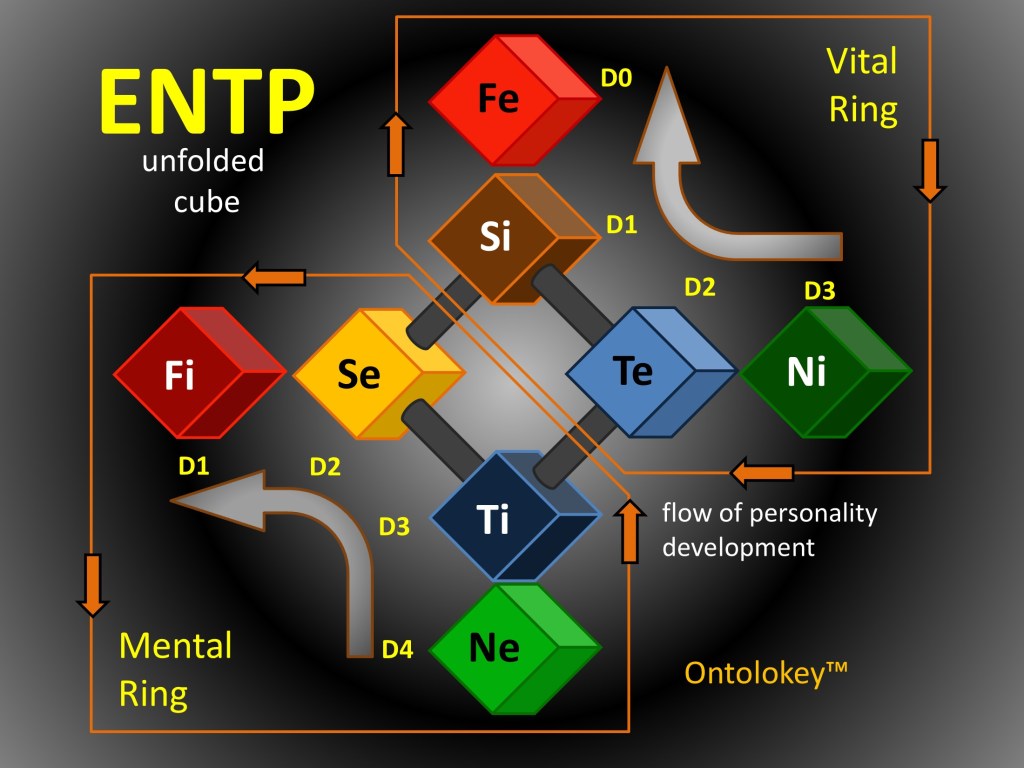
The Psychology of Possibility
The ENTP begins life psychologically close to possibility itself. Extraverted Intuition, Ne, is not merely a tendency to have many ideas; it is a characteristic way of experiencing reality in which the visible world continually appears incomplete, provisional and open to transformation. Where another person may encounter an established situation and perceive its structure, the ENTP instinctively notices alternatives, connections, contradictions, latent opportunities and possible futures, so that almost any circumstance can become the starting point for another line of thought. This gives the personality its familiar intellectual vitality: curiosity, improvisation, originality, humor, conceptual agility, appetite for complexity and a natural resistance to unquestioned assumptions. Yet the same psychological gift contains the seed of the ENTP’s deepest developmental conflict, because a consciousness that instinctively perceives what could be can eventually struggle with what is; every commitment closes possibilities, every completed project excludes alternative futures, and every stable reality imposes the very limits that the ENTP’s imagination instinctively wants to transcend. The central task of ENTP individuation therefore cannot be to become still, conventional or less imaginative, but to discover whether freedom can survive commitment and whether possibility can become more than an endless escape from the necessity of choosing.
At its healthiest, Ne gives the ENTP an extraordinary capacity to enlarge consciousness rather than merely accumulate information. The ENTP can look at an apparently closed situation and discover an opening, connect concepts that normally remain separated, question assumptions that have become invisible through familiarity, and imagine futures that have not yet acquired social legitimacy. This is why ENTPs often become natural innovators, strategists, entrepreneurs, inventors, intellectual provocateurs and catalysts for change: they are psychologically oriented toward emergence, toward the moment when something not yet visible begins to take form. Their mind can move laterally across disciplines and perspectives with unusual speed, and conversation itself can become a laboratory in which assumptions are tested, dismantled and reconstructed. Yet the psychological danger begins when the ability to perceive alternatives becomes an unconscious requirement to keep alternatives alive. Then exploration ceases to be an instrument of consciousness and becomes a defense against limitation, because selecting one possibility means grieving the others that will never be lived. The mature ENTP must therefore learn a difficult distinction: the existence of another possibility does not automatically make the present possibility wrong, and the disappearance of novelty does not necessarily mean the disappearance of meaning.
The first great movement toward wholeness consequently occurs through Ti, the Auxiliary function, because Ne without an inner architecture can become a perpetual multiplication of possibilities. Introverted Thinking gives the ENTP the capacity to ask whether an idea actually coheres, whether its premises are sound, whether contradictions have been overlooked and whether an apparently convincing explanation survives closer examination; it converts the ENTP from a mere generator of alternatives into an architect of conceptual structures. This is why debate can feel intrinsically pleasurable to the ENTP even when there is no personal hostility involved: argument becomes a cognitive workshop in which ideas can be stress-tested and reconstructed, and intellectual disagreement can generate energy rather than merely threaten identity. In the developmental language of the Mental Ring, Ti represents the necessary descent from the D4 freedom of possibility toward D3 coherence, because the ENTP must first learn to give form to the extraordinary material produced by Ne before attempting to integrate the deeper and more vulnerable layers of the psyche. The crucial danger, however, is that Ti can become so sophisticated that it begins to protect the personality from anything that cannot be solved intellectually; the ENTP may understand an emotion, relationship or failure with astonishing precision while remaining psychologically untouched by the experience itself.
This is where the deeper shadow begins to reveal itself: the ENTP can use the very faculty that makes self-understanding possible as a mechanism for avoiding self-experience. Instead of asking, “What am I feeling?” the mind asks why the feeling exists; instead of allowing grief to be felt, it constructs a theory of grief; instead of admitting personal hurt, it analyzes the other person’s motives, the relational dynamics and the logical structure of the conflict. Such cognition is not necessarily false—in fact, it may be remarkably accurate—but accuracy is not the same as integration. The unconscious is not transformed merely because the conscious intellect has found an elegant explanation for it, and emotional material that remains unexperienced does not disappear simply because it has been conceptualized. For the ENTP, psychological healing therefore requires a gradual shift in the function of intelligence: cognition must cease to serve primarily as a shield against vulnerability and become an instrument through which vulnerability can safely enter consciousness. The mature ENTP does not abandon analysis; rather, analysis becomes spacious enough to receive what it cannot control, allowing the question “What is true?” to stand beside the equally important questions “What hurts?”, “What matters to me?”, “What am I afraid of losing?”, and “What responsibility follows from what I now understand?”
Se D2 — The Anima/Animus and the Return to the Living Present
The transition from Ti D3 to Se D2 marks a fundamentally different kind of psychological development because the ENTP can no longer rely exclusively on the medium in which it feels most competent: thought. Se, as the Anima/Animus function in the Ontolokey configuration, confronts the ENTP with immediacy, embodiment, sensation, physical presence and the irreducible reality of the present moment. Ne naturally moves beyond what is immediately given, while Ti abstracts and organizes experience into internally coherent structures; Se reverses this movement by demanding contact with what actually exists here and now, before it has been transformed into an idea. This can be strangely intimate for the ENTP because presence cannot be solved conceptually: the body has its own rhythms, limits, appetites, fatigue and forms of knowledge, and reality frequently refuses to wait until the mind has finished interpreting it. The developmental movement toward Se therefore represents not a rejection of imagination but a grounding of imagination in lived experience, allowing the ENTP gradually to discover that reality itself contains a richness that does not need to be mentally reinvented in order to be meaningful.
The Anima/Animus quality of Se also explains why this function can possess an unusual psychological fascination for the ENTP while simultaneously feeling somewhat foreign or destabilizing. The ENTP may be attracted to people who embody decisiveness, physical confidence, sensuality, spontaneity, courage or an apparently effortless ability to inhabit the moment, because these qualities represent something that the ENTP psyche has not yet fully claimed for itself. What appears externally as admiration, fascination or even projection can therefore contain an unconscious message: the qualities being admired may be precisely those that consciousness has neglected. At the less integrated end, Se can emerge through compensatory behavior, such as impulsive stimulation, excessive novelty seeking, physical risk, overindulgence or attempts to escape mental saturation through intense sensory experience. The problem is not pleasure, adventure or spontaneity themselves; the problem arises when the body becomes an emergency exit from a mind that has become overextended, so that sensory intensity is used to silence psychological tension rather than to deepen contact with life. Development begins when the ENTP can experience sensation without needing either to intellectualize it or to flee into it.
This distinction is especially important because the ENTP’s characteristic relationship with novelty can easily disguise an avoidance of presence. An ENTP may constantly seek new environments, conversations, projects, relationships or experiences and interpret this movement as freedom, while a deeper psychological examination may reveal that movement itself has become a defense against staying long enough for an experience to become emotionally consequential. The new possibility is psychologically safe because it has not yet demanded commitment, while the present moment can become threatening precisely because it contains consequences, bodily signals, attachment, limitation and the possibility of disappointment. Se D2 therefore asks the ENTP to develop a different relationship with intensity: instead of pursuing stimulation because stillness feels empty, the individual learns to remain sufficiently present that even ordinary experience becomes perceptible in its full texture. Eating without distraction, listening without mentally preparing a response, noticing bodily tension before it becomes exhaustion, remaining with another person without converting the interaction into an intellectual game, or completing an activity simply because it deserves completion are psychologically modest acts, but they gradually establish an entirely different relationship between consciousness and reality.
The deeper significance of Se integration is that the ENTP begins to discover the body as a source of information rather than an obstacle to cognition. The body frequently registers what consciousness has not yet formulated: attraction before explanation, exhaustion before admission, anxiety before the rational mind has identified its cause, and resistance before the conscious personality has decided that something is wrong. Because the ENTP is naturally skilled at constructing explanations, there can be a tendency to override these signals whenever they interfere with an attractive theory, ambitious project or stimulating possibility. Developing Se means learning to pause before interpretation and to ask what is actually happening in the organism, because psychological truth is sometimes first encountered as sensation rather than as language. In this sense, Se becomes a bridge between cognition and existence: the ENTP does not become less intelligent by listening to the body, but more complete, because intelligence is no longer permitted to float above the conditions under which the person actually lives.
Once Se has been sufficiently developed, the movement toward Fi D1 becomes possible in a profoundly different way. Fi is the Toddler function in this developmental architecture, and therefore it should not be approached as though it were merely a weaker version of an already familiar mental capacity; it represents a young, vulnerable and easily wounded dimension of the personality concerned with personal values, emotional authenticity, inner attachment and the question of what matters independently of intellectual elegance or social approval. For an ENTP, this can be one of the most uncomfortable territories precisely because Fi does not primarily ask whether an argument is coherent or whether a possibility is interesting; it asks whether something is personally true, whether a boundary has been crossed, whether an attachment matters, whether an experience has caused pain, and what the individual genuinely loves or cannot accept. The ENTP may therefore experience strong Fi reactions without possessing an equally developed language for them, producing sudden moral intensity, defensiveness, guilt, shame or an almost childlike sensitivity when something touches a deeply personal value. The developmental sequence is crucial here: Fi is not reached by simply deciding to “be more emotional,” but through the prior grounding supplied by Ti and Se, which makes it increasingly possible to encounter personal feeling without either rationalizing it away or becoming overwhelmed by it.
Fi D1 — The Toddler Function and the Wound Beneath the Intellect
The descent from Se D2 into Fi D1 brings the ENTP into perhaps the most psychologically delicate territory of the Mental Ring, because Fi represents a form of inner experience that cannot be comfortably externalized, debated or solved through abstraction. As the Toddler function, Fi carries the symbolic quality of something young within the personality: spontaneous, personal, easily hurt, intensely attached to what feels authentic, yet not necessarily equipped to articulate its needs in an adult and differentiated manner. The ENTP can therefore possess powerful personal feelings while simultaneously experiencing uncertainty about what those feelings mean or whether they are legitimate, particularly when emotional experience conflicts with the personality’s habitual preference for intellectual autonomy. A common defense is to convert personal pain into analysis, irony, detachment or argument, thereby regaining the psychological distance in which the ENTP feels competent. Yet the very intensity with which an apparently minor interpersonal event can sometimes affect an ENTP may indicate that something deeper has been touched, because the reaction does not originate exclusively in the conscious situation but may activate an older layer of vulnerability that has never received adequate recognition. (ontolokey.com)
This helps explain a paradox that can otherwise be difficult for both the ENTP and the people around them to understand: a personality that can appear remarkably emotionally detached can nevertheless be profoundly sensitive to rejection, betrayal, humiliation, being misunderstood or having its intentions interpreted as malicious. The ENTP’s external flexibility can conceal an internal insistence that certain things must not be violated, even when those principles have never been consciously formulated. Because Fi is located at D1, these values may initially appear less as mature ethical convictions and more as immediate emotional reactions: “That was unfair,” “You do not understand me,” “You crossed a line,” or “This matters to me more than I can explain.” The danger is that the ENTP may either dismiss such reactions as irrational or, at the opposite extreme, become temporarily possessed by them and defend them with the same argumentative force normally applied to intellectual questions. Integration requires a third possibility: neither suppressing the feeling nor treating every feeling as unquestionable truth, but learning to listen to the emotion long enough to discover the value, wound, attachment or unmet need contained within it. In this sense, Fi development is not emotional indulgence; it is the gradual acquisition of an inner vocabulary through which the ENTP can distinguish between transient affect, genuine personal values, unresolved wounds and projections onto other people.
The Toddler metaphor becomes particularly meaningful when viewed through the history of psychological injury. A young psychological function does not necessarily mean that the individual is emotionally immature in every respect; rather, it identifies an area in which the person may have comparatively little conscious differentiation and therefore relatively few internal tools for regulation. When the ENTP is hurt in this region, the adult intellect can remain sophisticated while the wounded inner part reacts with disproportionate urgency, defensiveness or withdrawal. The resulting experience can be confusing because the conscious mind knows that the event “should not matter that much,” yet the emotional system insists that it does, creating a split between intellectual appraisal and subjective reality. Instead of condemning this discrepancy, individuation invites the ENTP to become curious about it: what exactly was threatened, what expectation was violated, what older experience might have been activated, and what does the intensity reveal about something personally significant? This is where cognitive self-healing becomes possible within the Ontolokey developmental model—not because cognition magically erases pain, but because conscious understanding can gradually connect an apparently irrational reaction to the psychological structure that produced it, transforming confusion into intelligibility and self-rejection into compassion. (ontolokey.com)
Fi integration also changes the ENTP’s relationship with conflict. The undeveloped ENTP can unconsciously treat interpersonal disagreement as an intellectual arena in which the strongest explanation should prevail, and because Ne-Ti can generate counterarguments almost indefinitely, the individual may continue debating long after the actual psychological issue has ceased to concern the proposition being debated. The hidden question may instead be whether the person feels respected, valued, trusted or emotionally safe, but admitting this can feel more exposing than continuing the argument because the admission places the ENTP in a position where intelligence offers less protection. Consequently, sarcasm, intellectual dominance, provocative questioning or strategic detachment can function not merely as personality traits but as defenses against the experience of being personally vulnerable. The development of Fi does not require the ENTP to stop questioning, challenging or debating; it requires learning when the argument is genuinely about truth and when truth has become a vehicle through which an injured part of the personality is trying to defend itself. That distinction can profoundly alter relationships because the ENTP begins to recognize that winning an argument can sometimes preserve the ego while simultaneously damaging the attachment that the ego was secretly trying to protect.
At the deepest level, Fi D1 introduces the possibility of self-forgiveness because it reveals that many of the ENTP’s apparently contradictory behaviors may have been attempts to protect an underdeveloped psychological territory. The person who repeatedly escaped into novelty may have been avoiding the grief associated with limitation; the person who intellectualized emotion may have been protecting a vulnerable inner life that did not yet possess adequate language; the person who appeared insensitive may have been unable to recognize the emotional significance of an interaction until the consequences had already become visible. None of this removes responsibility, and genuine individuation cannot become an excuse for harmful behavior, but understanding changes the psychological meaning of responsibility: one can acknowledge what one did without reducing oneself to what one did. The same principle can be extended toward other people, because recognizing the architecture of one’s own defenses makes it easier to imagine that another person’s destructive reaction may also have emerged from fear, immaturity, wounded attachment or an unconscious attempt at self-protection. Forgiveness in this sense is not the denial of injury or the cancellation of boundaries; it is the release of the compulsive need to remain psychologically imprisoned by an event that has finally become understandable. Through that process, the ENTP begins to approach the first real threshold of wholeness: the realization that the parts of the personality once experienced as weaknesses may contain precisely the information required to become psychologically complete.
Ni D3 — The Sibling Function and the Discovery of Direction
The transition from Fi D1 in the Mental Ring to Ni D3 in the Vital Ring represents a decisive change in the ENTP’s relationship with the unconscious because the developmental movement is no longer primarily inward toward personal vulnerability but downward into a deeper organizing principle beneath conscious possibility. Ni, as the Sibling function, does not compete with Ne by producing more possibilities; instead, it gradually asks which of the innumerable possibilities actually belongs to the deeper trajectory of the person. For an ENTP, this can initially feel restrictive because Ne is accustomed to preserving openness while Ni seeks convergence, pattern, direction and an underlying meaning that becomes visible only when competing alternatives are allowed to recede. Yet this is precisely why Ni becomes so important after Ti, Se and Fi have been sufficiently developed: the ENTP has first learned to generate possibilities, examine them, experience reality directly and recognize personal significance, and can now begin asking what all these experiences are pointing toward. In the language of individuation, Ni introduces the possibility that the unconscious is not merely a collection of rejected or undeveloped traits but also a source of orientation, and that beneath the ENTP’s conscious appetite for endless potential there may exist a quieter psychological movement toward a particular life, a particular meaning and a particular form of becoming. (ontolokey.com)
This is often where the ENTP encounters one of the most uncomfortable truths about freedom: unlimited possibility is not the same thing as unlimited life. Human existence is finite, and therefore every actual life requires selection, continuity and sacrifice; something must be chosen precisely because everything cannot be chosen. Ne can postpone this confrontation by continually discovering another road, another intellectual interest, another project or another interpretation, but Ni gradually makes postponement psychologically expensive because it begins to perceive the pattern created by all those choices and non-choices. The Sibling quality is important here because Ni is not experienced as a foreign enemy but as something strangely familiar, almost like an internal companion whose perspective has existed beside consciousness without being granted equal authority. At first, the ENTP may experience Ni as vague intuition, recurring themes, inexplicable certainty, symbolic associations or an increasing awareness that certain experiences keep returning in different forms; over time, these fragments can begin to form a coherent direction. Individuation therefore requires the ENTP to resist the temptation to immediately convert every intuitive impression into another hypothesis, because Ni becomes intelligible through sustained observation of patterns rather than through the rapid multiplication of explanations.
The psychological maturation of Ni also changes the meaning of the ENTP’s famous curiosity. At an earlier stage, curiosity primarily expands the field of consciousness, asking what else might be possible; at a later stage, curiosity becomes more selective and asks what deserves sustained attention. This distinction is crucial because the mature ENTP does not necessarily become less curious, but becomes capable of tolerating the psychological narrowing that depth requires. A person cannot deeply understand a subject, relationship, vocation or creative project while continually abandoning it whenever something newer appears, and Ni begins to expose the hidden cost of perpetual cognitive mobility. The ENTP may discover that many abandoned projects were not failures of ability but failures of psychological continuity, in which enthusiasm was mistaken for commitment and inspiration was mistaken for destiny. Ni offers another conception of creativity: not the constant production of alternatives, but the patient recognition of an underlying pattern and the willingness to remain with it long enough for its implications to unfold.
This is also where the ENTP can begin to experience the difference between intellectual identity and existential identity. Intellectual identity answers questions such as what one believes, what one knows, what one can explain and which problems one finds fascinating, whereas existential identity concerns the deeper question of what one is actually becoming through the way one lives. An ENTP can be extraordinarily successful at constructing a sophisticated intellectual self while remaining uncertain about the direction of the actual person underneath that construction. Ni gradually closes this gap by bringing long-term consequences, recurring psychological patterns and latent aspirations into the field of awareness, making it harder to hide indefinitely behind potential. The question therefore shifts from “What could I do?” to “Which possibility, if lived consistently, would make the rest of my life intelligible?” That question can be unsettling because it transforms possibility from an endless playground into a field of responsibility, but it is precisely this transformation that allows the ENTP’s intelligence to become existentially meaningful rather than merely impressive.
When Ni begins to develop, the ENTP may also recognize that some of the personality’s earlier conflicts were not random contradictions but expressions of an incomplete developmental sequence. The hunger for novelty, the resistance to closure, the attraction to unconventional people and experiences, the intellectualization of emotion and the occasional difficulty translating insight into sustained action can all be reconsidered as parts of a psychological system that was organized around maintaining possibility. This retrospective recognition can be deeply healing because it allows the individual to see continuity where previously there appeared to be inconsistency or personal failure. Yet Ni must not become another instrument of self-mythologizing, because an ENTP can just as easily turn individuation into an elaborate theory about being uniquely complex, misunderstood or destined for an exceptional future. Genuine Ni development moves in the opposite direction: it makes the personality quieter, more honest and more willing to accept what repeated experience actually reveals, even when that revelation is less glamorous than the identity the imagination preferred. The deeper unconscious does not necessarily tell the ENTP that they are destined for something extraordinary; it may simply reveal what they have been avoiding, what they genuinely value, what repeatedly gives their life meaning and which direction remains psychologically alive when novelty has exhausted itself.
Te D2 — The Golden Shadow and the Transformation of Insight into Reality
The movement from Ni D3 toward Te D2 introduces another essential confrontation for the ENTP: the difference between understanding what could be done and actually making something happen. As the Golden Shadow, Te represents a form of extraverted thinking that can appear both attractive and threatening because it embodies qualities the ENTP may admire intensely while resisting their demands for discipline, measurement, hierarchy, efficiency and externally verifiable results. Ne-Ti can produce an extraordinary abundance of conceptual material, and Ni can gradually identify which possibilities possess deeper significance, but Te asks the uncompromising practical question of what will actually be implemented. It evaluates resources, deadlines, consequences, procedures, priorities and outcomes, thereby bringing the ENTP into contact with a reality in which intellectual brilliance has no automatic authority. This can generate an ambivalent relationship with highly organized, decisive or operationally competent people: the ENTP may admire their ability to execute while simultaneously perceiving their methods as unnecessarily rigid, simplistic or unimaginative. The Golden Shadow becomes psychologically valuable precisely because it reveals that the qualities one instinctively critiques in others may contain capacities one has not yet learned to integrate consciously. (ontolokey.com)
The ENTP’s resistance to Te is often less about laziness than about autonomy. External systems can feel threatening when they appear to dictate how something must be done, because the ENTP instinctively sees alternative methods and may experience imposed procedures as unnecessary constraints on intelligence. Yet the mature development of Te requires distinguishing between meaningless bureaucracy and useful structure, between conformity and coordination, and between obedience and strategic execution. A structure is not inherently the enemy of creativity; in many circumstances it is what allows creativity to survive long enough to produce an enduring result. The ENTP therefore begins to develop Te when structure is no longer experienced primarily as an external authority but as a tool that serves a consciously chosen purpose. This is a major psychological shift because it allows the individual to say, in effect, “I do not have to love the system in order to use it,” and even more importantly, “I can construct systems of my own that protect my ideas from my own inconsistency.”
The Golden Shadow becomes especially revealing when the ENTP repeatedly experiences the frustration of having excellent ideas that remain incomplete. There can be a painful discrepancy between internal potential and external achievement: the person knows that they are capable of producing something significant, yet projects remain fragmented, abandoned or perpetually redesigned. Because Ne can always identify a more interesting possibility and Ti can always find another conceptual refinement, there are sophisticated ways to postpone the moment when an idea must submit itself to reality. Te breaks this psychological loop by establishing criteria of completion that do not depend upon whether the mind has exhausted every alternative. A finished imperfect project can possess more transformative power than an infinitely refined idea that never leaves consciousness, and the acceptance of this fact can be one of the most important developmental thresholds in an ENTP’s life. Te therefore does not diminish the ENTP’s imagination; it gives imagination consequences, allowing the individual to discover the particular satisfaction that comes from seeing an internally conceived possibility acquire independent existence in the world.
At a deeper level, Te also confronts the ENTP’s relationship with competence and failure. Intellectual environments can reward the ability to improvise, debate and expose flaws in other people’s reasoning, but external execution eventually creates situations in which the ENTP’s own performance becomes measurable and cannot be protected by verbal agility. A plan either works or it does not; a commitment is either honored or it is not; a project either reaches completion or it remains unfinished, regardless of how compelling the explanation for its incompletion may be. This can activate a shadow vulnerability because the ENTP may unconsciously prefer domains in which intelligence remains difficult to measure, thereby preserving the possibility of being capable without having to endure the definitive evidence of limitation. Te integration reverses this strategy by making feedback psychologically tolerable: failure becomes information about the system rather than a verdict on the self. Once the ENTP can tolerate measurable feedback without experiencing it as an assault on autonomy or intelligence, execution becomes less threatening and the personality gains an entirely new form of freedom—the freedom that comes from being able to rely upon oneself.
The integration of Te also transforms the ENTP’s relationship with other people because collaboration requires more than the exchange of ideas. A mature ENTP eventually discovers that constantly challenging every procedure, reopening every decision or proposing an alternative can exhaust the very people whose cooperation is necessary to realize a shared vision. Te introduces an appreciation for role clarity, delegation, sequencing and decision closure, while preserving the ENTP’s capacity to question whether a system remains useful. This creates a more sophisticated form of leadership in which the ENTP no longer needs to prove intelligence by destabilizing every structure, but can instead destabilize structures selectively when doing so serves a larger purpose. The Golden Shadow thus ceases to be a projection onto supposedly rigid or overly controlling people and becomes an internal capacity for turning insight into coordinated action. When Ni supplies direction and Te supplies implementation, the ENTP begins to move from the psychological experience of “I can see countless possibilities” toward the far more mature experience of “I can choose one, build it, learn from reality and remain psychologically free while doing so.”
The deepest lesson of Te D2 is therefore not productivity but incarnation. An idea that remains exclusively within the mind is psychologically incomplete because it has never entered the world where consequence, resistance and relationship can test it. By accepting these tests, the ENTP discovers that reality is not merely an obstacle to imagination but a partner in its refinement, and that external resistance can reveal dimensions of an idea that abstract reasoning could not anticipate. This prepares the next developmental movement toward Si D1, the inferior function, because once the ENTP has learned to direct energy toward meaningful objectives and to execute them in reality, the psyche must confront an even less familiar territory: continuity, repetition, memory, limitation, maintenance and the accumulated weight of lived experience. The developmental path therefore continues downward, from direction to implementation and from implementation toward the humble recognition that a life is not built only through breakthroughs, but also through everything that must be repeatedly maintained after the breakthrough has occurred.
Si D1 — The Inferior Function and the Psychology of Continuity
The movement from Te D2 into Si D1 brings the ENTP toward a psychological territory that can feel almost antithetical to its natural orientation, because Si asks the individual to remain with what already exists rather than continually seeking what might exist next. Introverted Sensation, as the Inferior function in this developmental architecture, concerns continuity, accumulated experience, bodily condition, memory, repetition, familiarity and the concrete consequences of how one has lived over time. For the ENTP, whose consciousness is naturally stimulated by change, novelty and conceptual expansion, repetition can easily be interpreted as stagnation and routine as an unnecessary limitation on freedom. Yet what appears psychologically mundane from the perspective of Ne can contain an enormous amount of neglected information, because the psyche does not live exclusively through exceptional experiences; it is also shaped by sleep, health, habits, environments, memories, recurring relationships, unfinished obligations and the gradual accumulation of small decisions. Si therefore confronts the ENTP with a reality that cannot continually be reinvented, because the body remembers what the mind has moved beyond and because consequences remain present even after attention has shifted elsewhere. (ontolokey.com)
The shadow side of Si can emerge when the ENTP repeatedly treats continuity as something beneath consideration. New projects are psychologically attractive because they contain potential, while maintenance contains little novelty and therefore produces comparatively little immediate stimulation. This can create a characteristic asymmetry in which the beginning of a project receives enormous intellectual energy while the repetitive middle and the necessary maintenance afterward gradually lose their appeal. The same pattern can appear in relationships, professional commitments and personal development: the ENTP may be highly engaged while discovery is occurring but become restless once familiarity replaces uncertainty. Si development requires recognizing that repetition is not necessarily the opposite of growth; in many areas of life, repetition is precisely the mechanism through which growth becomes embodied. A musical skill, a relationship of trust, physical health, professional mastery or a long-term creative undertaking cannot be sustained through inspiration alone, because eventually the extraordinary becomes ordinary and the psychological task changes from discovery to stewardship.
This is also why Si can become an important corrective to the ENTP’s relationship with the body. A personality that spends substantial psychological energy in abstraction can sometimes notice bodily needs only after they have become impossible to ignore, particularly when enthusiasm, intellectual stimulation or ambitious projects temporarily override signals of fatigue and depletion. The body does not negotiate with conceptual brilliance, however, and exhaustion eventually imposes a form of reality that cannot be debated away. Developing Si means learning to recognize patterns in one’s own physical and psychological functioning before they become crises: what conditions produce sustainable energy, which habits repeatedly lead to depletion, which environments support concentration, and which forms of stimulation gradually erode stability. Such awareness may initially appear boring to an ENTP precisely because it does not provide the dramatic cognitive reward of discovering something new, but its deeper function is liberating: when the individual learns to maintain the foundations of life, more energy becomes available for exploration without requiring repeated cycles of collapse and recovery.
Si also brings the ENTP into a different relationship with personal history. Ne can move rapidly toward alternative interpretations of the past, while Ti can analyze the causal structure of previous events, but Si preserves the felt continuity of experience and reminds the individual that the past is not merely an intellectual dataset from which conclusions can be extracted. Memories carry atmosphere, sensory detail, emotional association and accumulated meaning, and some psychological wounds remain active precisely because they have never been integrated into a coherent continuity of self. An ENTP who continually reinvents identity may unconsciously distance the present self from earlier versions of the personality, particularly from periods that feel embarrassing, painful, unsuccessful or emotionally dependent. Si development allows those earlier selves to be remembered without either romanticizing them or disowning them, creating a more continuous identity in which the person can say, psychologically, “That was also me, and what happened then still belongs to my story.” This continuity becomes particularly important during the individuation process because wholeness does not mean constructing a superior new self that replaces the old personality; it means gradually recognizing the previously fragmented experiences as belonging to one life.
The mature integration of Si consequently changes the ENTP’s conception of freedom. At a younger stage, freedom may mean having as few constraints as possible, maintaining open options and resisting circumstances that appear to limit future possibilities; with development, freedom increasingly means possessing enough internal and external stability to choose deliberately rather than react compulsively to novelty. A person who can maintain commitments, care for the body, preserve important relationships, learn from accumulated experience and tolerate periods of repetition is not less free than the constantly improvising individual; in many respects, that person has become more free because novelty is now a choice rather than a psychological necessity. Si also introduces humility into the ENTP’s self-understanding by revealing that some problems cannot be solved through another insight, because they require time, repetition, patience and acceptance of limits. This prepares the final movement of the Vital Ring toward Fe D0, the tertiary function and deepest blindspot in the developmental sequence, where the ENTP must encounter perhaps the most socially and emotionally disorienting question of all: how the self exists not only as an autonomous mind but as a participant in a shared emotional field.
Fe D0 — The Tertiary Function, Blindspot and the Shared Emotional Field
The final descent of the Vital Ring leads toward Fe D0, the tertiary function and, in the developmental model specified here, the most archaic and least differentiated layer of the ENTP’s functional architecture. Extraverted Feeling concerns the emotional atmosphere between people, interpersonal reciprocity, shared values, social cohesion and the ability to recognize that human beings are continually influencing one another through tone, expression, attention, affirmation and emotional presence. For the ENTP, this territory can be particularly difficult because the personality may be highly socially capable without necessarily being deeply emotionally attuned; wit, charisma, verbal agility and intellectual engagement can create the appearance of interpersonal fluency while leaving subtler emotional processes insufficiently recognized. The ENTP may therefore understand people conceptually and still fail to notice what another person is emotionally experiencing in the moment, particularly when the situation demands sustained sensitivity rather than stimulating conversation. Fe at D0 should consequently not be interpreted as an absence of feeling or humanity, but as an area in which conscious differentiation may initially be weak, inconsistent or developmentally immature. Its position at the end of the Vital Ring makes it the final frontier of the descent: after the ENTP has confronted direction, execution, continuity and embodiment, the personality must recognize that the self is never psychologically isolated but always exists within relationships and emotional fields. (ontolokey.com)
One of the ENTP’s characteristic blindspots can therefore involve confusing interpersonal stimulation with interpersonal intimacy. Conversation may be energetic, humorous, provocative and intellectually intimate while remaining emotionally evasive, because the exchange of ideas allows two people to reveal much about how they think without necessarily revealing what they fear, need, grieve or love. The ENTP can be exceptionally interested in another person and yet unconsciously redirect the interaction toward concepts whenever emotional exposure becomes uncomfortable. In conflict, this may appear as an attempt to clarify the facts while the other person is actually asking to have the emotional impact of those facts acknowledged; the ENTP may believe that an accurate explanation should resolve the problem, whereas the other person may experience the explanation as evidence that their emotional reality has not been heard. Fe development begins when the ENTP learns that emotional recognition is not equivalent to agreement, submission or loss of intellectual independence. To acknowledge another person’s emotional reality simply means recognizing that it exists and has psychological consequences, and this capacity can profoundly improve relationships because it allows truth and empathy to coexist rather than forcing one to defeat the other.
The D0 quality of Fe can also explain why social approval may sometimes be experienced in strangely polarized ways. The ENTP can appear highly independent and resistant to conventional expectations, yet may become surprisingly affected by interpersonal rejection, public misunderstanding or the withdrawal of affection when these experiences touch an insufficiently conscious need for belonging. This can produce a paradoxical relationship with the social environment: the individual may consciously insist that other people’s opinions do not matter while unconsciously reacting strongly when social connection is threatened. The shadow may then emerge through provocative behavior, performative contrarianism, excessive charm, withdrawal, emotional detachment or attempts to regain social control through humor and intellectual superiority. Development does not require the ENTP to become conventionally agreeable or dependent upon approval; rather, it requires enough Fe awareness to recognize when rebellion is genuinely principled and when it is partly a strategy for controlling vulnerability. Once this distinction becomes conscious, social freedom becomes more authentic because the individual no longer needs either conformity or opposition to regulate the deeper question of whether they feel accepted.
Fe integration also completes an important reversal in the ENTP’s understanding of responsibility. Earlier stages of development may emphasize intellectual independence, personal authenticity and freedom from arbitrary structures, but mature individuation reveals that every psychologically autonomous person remains embedded in networks of consequence. Words affect people, attention affects relationships, absence affects attachment, and even intellectually justified behavior can produce emotional consequences that cannot simply be dismissed because the underlying argument was correct. The integrated ENTP therefore begins to ask not only whether something is true or effective but also what its expression does to the human field in which it occurs. This does not mean suppressing uncomfortable truths to preserve harmony; in fact, mature Fe can make honesty more compassionate because the ENTP becomes increasingly capable of delivering difficult truths without using truth as an instrument of domination. The psychological achievement is not niceness but relational consciousness: the ability to remain intellectually independent while understanding that independence does not exempt one from reciprocity, responsibility or the emotional consequences of one’s presence.
When Fe finally becomes sufficiently conscious, the entire developmental architecture begins to reorganize itself retrospectively. Ne no longer has to generate endless alternatives merely to preserve freedom, because Ti has supplied discrimination and Ni has supplied direction; Se has taught the personality to inhabit reality, Fi has revealed personal vulnerability and values, Te has provided execution, and Si has introduced continuity and maintenance. Fe then adds the missing interpersonal dimension by showing that a complete self cannot be defined solely by what happens inside the individual. The ENTP begins to recognize that psychological wholeness includes the ability to remain present with another person without immediately converting the encounter into a problem to solve, a debate to win or an experience to escape. At this point the shadow functions cease to be enemies and become sources of psychological information: the vulnerable Fi reaction reveals what matters, Se reveals what the body knows, Ni reveals what the life is becoming, Te reveals what must be done, Si reveals what must be maintained, and Fe reveals whom the individual affects and depends upon. The unconscious has therefore become less frightening because it is no longer experienced as an alien territory; it has become an extension of the self that consciousness had previously failed to recognize.
The completion of this descent does not mean that the ENTP permanently operates all eight functions with equal strength, nor does individuation erase the original personality. Quite the opposite is implied by the image of the rotating iceberg: the purpose of the journey is eventually to return to the original conscious orientation with a radically expanded relationship to everything that once existed beneath its surface. Ne can return to the foreground without again becoming an escape from reality because the personality now possesses Ti’s discrimination, Se’s presence, Fi’s self-knowledge, Ni’s direction, Te’s implementation, Si’s continuity and Fe’s relational awareness. What returns is therefore not the psychologically younger ENTP but a more complete version of the same underlying personality, capable of preserving its characteristic curiosity while no longer being unconsciously governed by its need for endless possibility. In that sense, the culmination of individuation is not the destruction of the ENTP’s nature but its liberation from the defensive patterns that distorted its nature, allowing the original gift of possibility to become the conscious expression of a much larger and more integrated Self.
The Iceberg Turns — Individuation, Shadow Integration and Psychological Healing
The developmental sequence described by the Ontolokey model can ultimately be understood as a gradual rotation of consciousness around the hidden dimensions of the personality. The familiar ENTP begins with Ne D4 at the visible summit of the Mental Ring, where possibility, curiosity, conceptual exploration and freedom dominate psychological life, and then gradually encounters Ti D3, Se D2 and Fi D1 as increasingly intimate dimensions of cognition, embodiment and personal vulnerability become conscious. The Vital Ring then extends this descent through Ni D3, Te D2, Si D1 and finally Fe D0, moving from unconscious direction and implementation toward continuity, embodiment and the shared emotional reality of other people. The metaphor of the iceberg is particularly useful because it emphasizes that the unconscious is not necessarily something foreign that must be conquered; it is the much larger portion of the same psychological structure that has simply remained outside ordinary awareness. As the iceberg turns, what was previously beneath the surface becomes visible, and the individual gradually discovers that many traits experienced as weaknesses, contradictions or inexplicable reactions were actually expressions of functions that had never received sufficient conscious development. Individuation therefore becomes less a process of constructing a new personality than of becoming conscious of the personality that has always been present in incomplete form. (ontolokey.com)
The order of development is psychologically significant because premature confrontation with the deepest shadow can overwhelm rather than integrate the personality. The ENTP cannot simply decide to “fix” Fi D1 or Fe D0 while bypassing the capacities that provide the psychological structure necessary to hold those experiences, just as one cannot meaningfully cultivate stable execution while refusing to develop the discernment and direction that determine what deserves execution in the first place. Ti must first become sufficiently mature to distinguish insight from rationalization, Se must provide sufficient grounding in immediate reality to prevent cognition from becoming disembodied, and Fi must become sufficiently conscious to establish an authentic relationship with personal values and vulnerability. In parallel, Ni can gradually transform multiplicity into direction, Te can translate direction into action, and Si can establish the continuity required to sustain what has been created before Fe finally confronts the relational and emotional field in which the individual exists. The developmental principle is therefore not “develop everything at once,” but to allow each psychological layer to prepare the ground for the next, so that integration becomes an organic expansion of consciousness rather than an artificial attempt to manufacture traits that feel psychologically foreign. The Ontolokey Cube can serve as a practical visualization of this process because its arrangement of functions and developmental positions makes the movement from the familiar toward the neglected psychologically visible, turning an abstract map of personality into a landscape through which the individual can orient their own development. (medium.com)
For the ENTP, perhaps the most important psychological discipline is therefore to stop interpreting every uncomfortable inner experience as evidence that something has gone wrong. The impulse to escape discomfort through another idea, another project, another relationship, another intellectual explanation or another future possibility can be so deeply habitual that the individual may not recognize it as avoidance at all. Yet the very experiences that provoke the strongest desire to move forward can contain the material required for the next stage of development: restlessness may conceal an inability to tolerate limitation, anger may conceal violated values, physical exhaustion may reveal chronic disconnection from the body, indecision may conceal fear of closing possibilities, and interpersonal conflict may expose an emotional reality that argument alone cannot resolve. Shadow integration begins when these reactions become objects of compassionate investigation rather than immediate correction or self-condemnation. The question changes from “How do I get rid of this?” to “What is this trying to tell me about myself?” and that seemingly simple change can fundamentally alter the relationship between consciousness and the unconscious. The shadow then becomes less a repository of defective traits and more a messenger carrying information from psychological regions that consciousness previously refused or was unable to hear.
This process also offers a deeper explanation of psychological healing through cognition. Understanding does not automatically heal an injury, but conscious understanding can create the conditions under which an injury is no longer forced to govern behavior invisibly. When an ENTP recognizes that a disproportionate emotional reaction originates in a vulnerable Fi pattern, the experience can become intelligible rather than shameful; when Se reveals that chronic overstimulation has been masking exhaustion, the body no longer has to communicate exclusively through increasingly severe signals; when Ni identifies a recurring life pattern, apparently unrelated events can be understood as expressions of a consistent psychological trajectory. Such recognition creates psychological distance without creating emotional dissociation, allowing the person to observe a reaction while remaining connected to it. This is the crucial distinction between repression and integration: repression says, “This part of me must not exist,” whereas integration says, “This part of me exists, and I need to understand its place within the whole.” Through that process, the ENTP can reinterpret earlier failures and injuries with greater compassion, not by denying responsibility or pretending that painful experiences were beneficial, but by understanding why certain reactions once made sense within the psychological structure available at the time.
Self-forgiveness becomes particularly powerful at this stage because the ENTP can begin to distinguish intention, capacity and consequence. A person may have harmed someone without consciously intending to do so, may have failed to recognize an emotional need because Fe was insufficiently developed, may have abandoned something important because Si could not yet tolerate the required repetition, or may have defended against vulnerability through Ti because Fi did not yet possess an adequate conscious voice. Understanding these mechanisms does not absolve the individual from responsibility, but it makes responsibility more constructive because guilt no longer needs to remain a permanent identity. The same principle can gradually be extended toward others: once the ENTP has experienced how unconscious functions can shape behavior without conscious permission, it becomes easier to recognize that other people also act from psychological structures they do not fully understand. Forgiveness then becomes neither sentimental nor naïve; it becomes an informed decision to stop allowing unconscious causation to dictate the future. The past remains real, the consequences remain real and boundaries may remain necessary, but the psychological compulsion to repeat, resent or endlessly reconstruct the event can gradually weaken as consciousness takes ownership of what previously operated in darkness.
The mature ENTP therefore does not become the opposite of an ENTP through individuation. The goal is not to transform an explorer into a conformist, a provocateur into a passive harmonizer or an independent thinker into someone who seeks approval, because such a transformation would amount to abandoning the original personality rather than completing it. Instead, Ne returns to its rightful position with greater freedom because it no longer has to carry the entire burden of psychological life; it can generate possibilities while Ti determines coherence, Se grounds experience, Fi protects authenticity, Ni identifies direction, Te creates implementation, Si preserves continuity and Fe recognizes relational consequence. The original strengths remain, but they are no longer compelled to compensate for what consciousness has neglected. Curiosity can coexist with commitment, intellectual independence with emotional intimacy, spontaneity with discipline, individuality with belonging and imagination with embodiment. The ENTP becomes capable of choosing reality without experiencing choice as psychological death, because the mature personality has learned that closing one possibility does not destroy the capacity to imagine others.
Wholeness as the Return of the Self
The final rotation of the iceberg can therefore be understood as a symbolic return to the beginning, but it is not a return to the psychological state from which the journey started. When Ne once again occupies the conscious foreground, it does so after consciousness has expanded through the functions that previously existed beneath the surface, and this gives the original personality a qualitatively different depth. The ENTP can once again explore, question, invent, challenge and imagine without being unconsciously driven by the need to escape limitation, emotional vulnerability or existential uncertainty. The personality’s characteristic hunger for possibility becomes less compulsive because the individual has learned to remain present when possibility contracts into reality. What once appeared to be a conflict between freedom and commitment can become a creative tension in which commitment provides the stable ground from which freedom can operate. This is the psychological meaning of the “rebirth” of the original personality: not the restoration of the past, but the emergence of the same fundamental nature after it has become conscious of a much greater portion of itself.
For the ENTP, wholeness is consequently best understood not as perfection but as increasing internal cooperation. The functions no longer need to compete for control because each has acquired a legitimate psychological role within a larger system, and the formerly unconscious functions no longer have to express themselves primarily through projection, compensation or crisis. Fi can say what matters without having to erupt through defensiveness; Se can bring the person into the present without requiring reckless stimulation; Ni can provide direction without becoming fatalistic; Te can impose structure without becoming authoritarian; Si can preserve continuity without becoming imprisoned by the past; and Fe can acknowledge emotional reciprocity without dissolving individuality. The conscious personality remains recognizably ENTP, but its relationship to itself has changed because internal difference is no longer experienced as fragmentation. Psychological maturity is therefore not the elimination of contradiction but the capacity to hold apparently opposing truths without immediately reducing one of them: freedom and commitment, reason and feeling, novelty and continuity, individuality and relationship, possibility and limitation can all belong to the same Self.
The practical invitation of this developmental model is consequently one of patient attention rather than forced transformation. An ENTP does not need to manufacture an entirely different character, nor should development become another intellectual project in which the individual collects psychological concepts without allowing them to alter lived behavior. The more useful practice is to observe which function is currently asking for consciousness and to work with the developmental sequence rather than against it: strengthen Ti before demanding mastery of deeper emotional material, establish sufficient Se presence before interpreting every sensation psychologically, listen to Fi before attempting to regulate it, cultivate Ni before multiplying new possibilities, develop Te before judging oneself by unrealized potential, strengthen Si before expecting sustainable achievement, and approach Fe with humility rather than performance. The Ontolokey Cube can support this process by making the architecture visually concrete, allowing the individual to identify where conscious energy naturally resides and where development may be calling attention. In this way, the model becomes less a label and more a reflective instrument: a means of repeatedly asking what has become conscious, what remains projected, what is being avoided and which neglected function is now ready to enter the larger field of awareness.
The deepest form of ENTP healing therefore lies in no longer needing to be defended against oneself. When the mind can recognize its own defenses without contempt, the body can be heard without being treated as an inconvenience, personal values can be acknowledged without embarrassment, direction can emerge without destroying freedom, structure can serve rather than imprison, continuity can replace compulsive novelty, and relationships can become places of mutual recognition rather than arenas in which intellectual control must be maintained. The ENTP who reaches this point has not lost the restless intelligence that made exploration possible; that intelligence has finally acquired roots. The iceberg has turned far enough that the distinction between “conscious personality” and “shadow personality” becomes less absolute, because what was formerly unconscious has been brought into relationship with consciousness and can participate in the life of the whole. This is the movement from personality toward Self: not an escape from one’s nature, but the gradual realization that one’s nature was always larger than the portion one initially knew.
Continuing the Work of Individuation
Individuation does not conclude with the intellectual comprehension of the eight functions, because knowledge about a psychological structure and transformation through that structure are fundamentally different achievements. The ENTP may understand every stage described here and still repeat the same defensive patterns if insight remains detached from behavior, relationships and embodied experience. The real evidence of development appears in small but consequential changes: staying with an important project after novelty fades, listening to an uncomfortable emotion without immediately explaining it away, recognizing physical exhaustion before collapse, allowing another person’s emotional reality to exist without debating it, choosing a meaningful direction despite the existence of alternatives, and accepting that some aspects of life must be maintained rather than reinvented. These changes can appear ordinary from the outside, but psychologically they demonstrate that previously unconscious functions have begun participating in conscious choice. Development therefore becomes a lifelong practice of converting recognition into relationship with oneself, with other people and with reality.
Readers who wish to explore the ENTP architecture in greater detail, examine the shadow dimensions more deeply, or compare this developmental landscape with the configurations of other personality types can continue with the more extensive personality writings available through Ontolokey.com. The individual texts on the ENTP provide additional perspectives on its conscious strengths, hidden vulnerabilities, shadow dynamics and possibilities for growth, while the broader Ontolokey material offers a larger framework for understanding how different functional configurations can be visualized and contemplated. The purpose of returning to these materials should not be to find a final definition of oneself, because individuation is precisely the process through which a fixed self-description gradually becomes insufficient. Their greater value lies in providing language and imagery with which previously unconscious experiences can be recognized, examined and integrated.
Ultimately, the ENTP’s developmental journey can be summarized as a movement from possibility toward presence, from analysis toward experience, from vulnerability toward self-acceptance, from multiplicity toward direction, from insight toward realization, from novelty toward continuity, and from autonomy toward conscious relationship. The movement is not linear in ordinary life, and the individual will inevitably move backward, become defensive, rediscover old patterns and encounter new layers of the same functions at different stages of development. What changes is the capacity to recognize these movements without becoming completely identified with them. When consciousness can turn toward its own shadow with curiosity rather than fear, psychological healing becomes possible because the person no longer has to divide the self into acceptable and unacceptable territories. The ENTP’s deepest individuation is therefore not the achievement of a flawless personality but the gradual emergence of a Self sufficiently spacious to contain the whole psychological landscape: the explorer and the builder, the skeptic and the believer, the intellect and the body, the autonomous individual and the relational human being, the childlike vulnerability and the adult capacity to protect it. In that sense, wholeness is not becoming someone else; it is finally becoming conscious of everyone who has always been there.
In the Ontolokey model, D0 to D4 describe the degree to which a psychological function has become consciously accessible, developed, and integrated within the personality. D4 represents the highest level of conscious development, while D0 indicates a function that remains largely unconscious and therefore tends to operate as a blindspot; D1, D2, and D3 represent successive stages of increasing awareness and integration between these two poles. Psychological development therefore means gradually bringing less conscious functions into awareness and allowing them to become more differentiated and usable, rather than trying to replace the dominant personality with something fundamentally different. The movement from D0 toward D4 is consequently a process of integration in which previously unconscious psychological capacities become increasingly available to consciousness and contribute to a more complete experience of the Self.
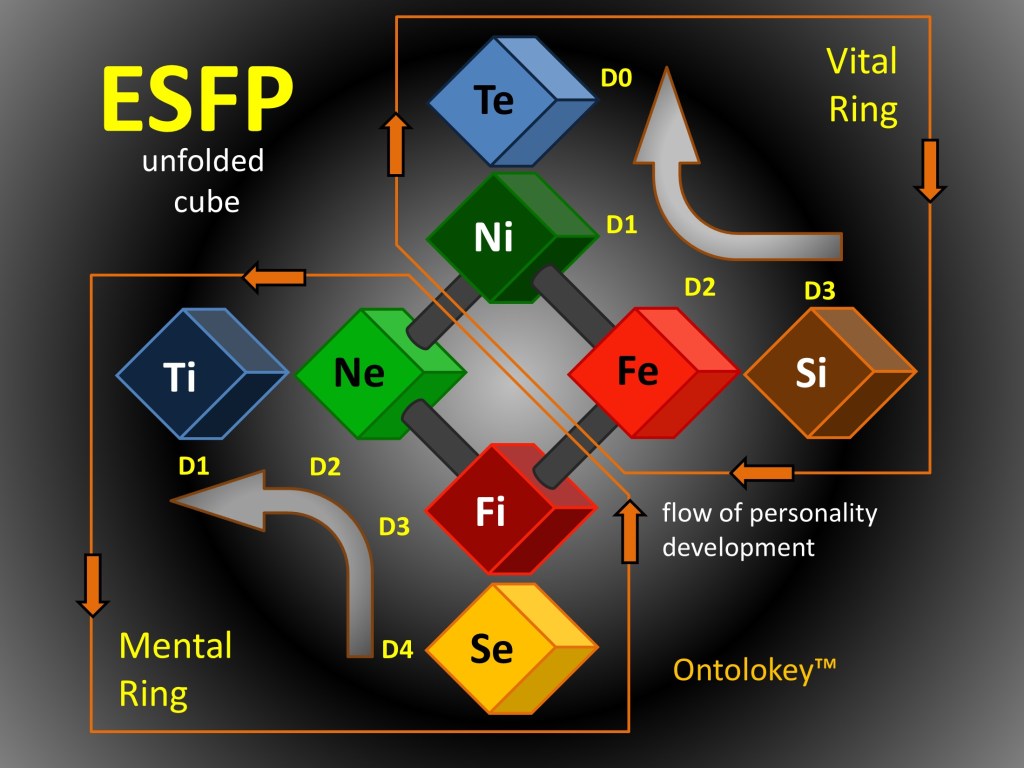
From Personality to Psychological Wholeness
The ESFP is often encountered first through what is most visible: vitality, spontaneity, sociability, emotional expressiveness, adaptability, sensual awareness, and an unusually direct participation in the present moment. Yet the visible personality is only the uppermost layer of a much larger psychological structure, because the same capacity that allows the ESFP to enter life wholeheartedly can also become a means of avoiding the quieter experiences that cannot be resolved through action, stimulation, pleasure, or immediate interpersonal engagement. In the Ontolokey perspective, the ESFP is therefore not adequately understood as a “performer,” an entertainer, or a pleasure-seeker, but as a personality organized around a powerful relationship with direct experience through Extraverted Sensing (Se), supported by an inner system of values through Introverted Feeling (Fi) and surrounded by increasingly less conscious psychological functions. The deeper question is consequently not simply what an ESFP does naturally, but what happens psychologically when the conscious identity becomes strongly attached to its natural strengths while the less developed functions remain outside awareness. From this perspective, individuation becomes a gradual movement from identification with the immediately accessible self toward a more complete Self in which conscious and unconscious dimensions can participate in one psychological whole.
Ontolokey provides a particularly useful symbolic landscape for this developmental journey because it transforms the eight-function architecture into a spatial and dynamic model in which psychological relationships can be visualized rather than merely described abstractly. Its underlying conception presents the personality as an interconnected system in which some functions are naturally strong and conscious while others remain vulnerable, less accessible, projected, or only partially integrated; the Ontolokey Cube and its functional sliders are intended to make these relationships visible and therefore easier to contemplate during personal development. For the ESFP, this makes the developmental sequence especially significant: Se begins as the dominant D4 function of the Mental Ring, Fi follows as the auxiliary D3 function, Ne occupies the Anima/Animus position at D2, and Ti forms the vulnerable Toddler function at D1, while the Vital Ring extends the process through Si, Fe, Ni, and finally Te at D0. The movement toward wholeness therefore cannot be understood as an attempt to leap directly into the most unconscious territory, because psychological integration proceeds progressively: what is already relatively developed must first become sufficiently conscious and differentiated before it can support the integration of what lies further beneath it. The purpose of this essay is to follow that movement as an inward developmental path, in which the ESFP gradually encounters its own shadow, understands the psychological reasons behind its vulnerabilities, and ultimately learns to experience the world without needing to use experience as an escape from itself.
From Se to Fi: When Experience Becomes Conscious Meaning
The first developmental task of the ESFP is not to weaken Se, suppress spontaneity, or become less engaged with the concrete world, but to transform an already powerful capacity for experience into a more conscious relationship with experience. Se at D4 is the psychological foundation of the ESFP’s Mental Ring: it gives the personality immediacy, responsiveness, courage, sensory intelligence, adaptability, and the ability to meet reality without excessive mediation through abstraction. The healthy ESFP therefore possesses something psychologically valuable that should not be sacrificed in the name of “depth”; the task is precisely to preserve this vitality while discovering what lies beneath it. The shadow begins when direct experience becomes an end in itself, because then activity can gradually become a substitute for reflection and stimulation can become a defense against inner tension. Ontolokey describes this danger as the transition from experience that expands consciousness toward experience that distracts consciousness, a distinction that is difficult to recognize precisely because the outward behavior can remain equally energetic, adventurous, and socially successful. Individuation therefore begins not by asking the ESFP to stop living intensely, but by asking a more demanding question: what psychological purpose is being served by the intensity?
This question leads directly from Se D4 toward Fi D3, the auxiliary function and first conscious developmental step beyond the dominant orientation. Fi represents the inner criterion of personal significance: what do I actually value, what do I genuinely feel, what is personally meaningful to me, and where does my authentic self begin and end in relation to the expectations of other people? For the developing ESFP, this is a crucial transition because experience alone cannot determine meaning; two people can participate in precisely the same event while experiencing completely different psychological realities. Fi gives the ESFP the capacity to stop for long enough to distinguish between what is exciting and what is valuable, between what is desired and what is actually needed, and between being wanted by others and being inwardly aligned with oneself. The development of Fi therefore introduces an internal axis into a personality naturally oriented toward the external world, without requiring the individual to abandon sociability, sensuality, sexuality, ambition, or pleasure. Instead, these dimensions become increasingly conscious expressions of an inner value system rather than automatic attempts to regulate psychological tension through external experience.
The decisive transformation occurs when the ESFP begins to recognize that not every impulse deserves immediate expression and that not every desire contains a command. In the less integrated state, desire can acquire an almost authoritarian quality: attraction demands pursuit, boredom demands stimulation, frustration demands discharge, and emotional discomfort demands immediate movement. The deeper shadow described in the Ontolokey material emerges when action ceases to be an expression of freedom and becomes a mechanism for escaping internal pressure; under those conditions, the individual may confuse intensity with depth, movement with growth, pleasure with fulfillment, and control with strength. Fi begins to interrupt this automatic sequence because it asks the ESFP to remain psychologically present long enough to discover what the impulse actually means. Anger may conceal hurt, possessiveness may conceal fear of loss, seduction may conceal a need for validation, and restlessness may conceal an inability to tolerate inner stillness; when these underlying meanings become conscious, the behavior no longer needs to carry the entire burden of psychological regulation. This is the beginning of self-mastery, because the individual does not become less passionate but becomes increasingly capable of deciding what deserves passion.
The movement from Se D4 toward Fi D3 can therefore be understood as a movement from immediate participation toward conscious authorship of experience. The ESFP does not become whole by turning away from the world but by developing an inner relationship with the person who enters that world, because without such an inner relationship external life can become an endlessly changing mirror in which identity is repeatedly confirmed and repeatedly lost. This is particularly important when recognition, attractiveness, social influence, romance, achievement, or excitement begin to carry the psychological burden of proving personal worth; the shadow can then become organized around the fear of insignificance, abandonment, humiliation, or emptiness rather than around genuine enjoyment of life. The deeper developmental achievement of Fi is consequently the discovery that personal worth does not have to be continuously demonstrated through external impact, and that vulnerability does not cancel strength. Once Se is supported by a sufficiently mature Fi, experience becomes capable of serving consciousness rather than replacing it, and the ESFP acquires the psychological foundation necessary for the next descent into the Mental Ring: the encounter with Ne D2, the Anima/Animus function, where possibilities, uncertainty, imagination, and unfamiliar perspectives begin to challenge the security of the immediately tangible world.
Ne D2: The Anima/Animus and the Encounter with Possibility
The movement from Fi D3 toward Ne D2 represents a qualitatively different psychological challenge because the ESFP is now asked to leave the territory of what is personally felt and enter the much less controllable territory of what might be. Extraverted Intuition does not primarily ask whether something is immediately real, personally authentic, or presently desirable; it opens the mind toward alternatives, potential meanings, hypothetical futures, unexpected connections, and possibilities that have not yet acquired concrete form. For an ESFP whose natural psychological confidence is rooted in Se, this can feel strangely destabilizing because Se trusts what can be encountered, perceived, tested, and acted upon, whereas Ne deliberately suspends certainty and allows several possible realities to coexist. In the Ontolokey developmental sequence, Ne therefore occupies the D2 Anima/Animus position, immediately following the auxiliary Fi, which makes its integration dependent upon an already established capacity for inner valuation and self-awareness. The Anima/Animus is particularly important because it introduces a psychological dimension that can feel both fascinating and foreign: it represents something the conscious personality needs, yet does not initially possess with the same ease as its preferred functions. Consequently, the encounter with Ne may evoke not merely intellectual curiosity but attraction, uncertainty, projection, fascination, anxiety, or an unusually strong sensitivity toward people who embody qualities that the ESFP has not yet consciously developed.
The psychological significance of the Anima/Animus becomes clearer when one considers what happens whenever an unfamiliar function enters consciousness through another person. An ESFP may encounter someone who appears extraordinarily imaginative, unpredictable, abstract, visionary, intellectually exploratory, or capable of seeing possibilities where the ESFP sees only the immediate situation, and this difference can produce an intense psychological response. The person may be idealized because they seem to possess an elusive quality that promises access to an unexplored part of the self, or they may instead be experienced as irritating, impractical, evasive, or disconnected from reality because their psychological orientation violates the ESFP’s preferred way of establishing certainty. In both cases, the intensity of the reaction can reveal something about the observer rather than simply something about the other person. Projection is psychologically significant precisely because the unconscious often communicates through exaggeration: what is excessively admired can contain an undeveloped potential of one’s own, while what is excessively rejected can contain a capacity that consciousness has not yet learned to tolerate. Ne integration therefore requires the ESFP to become curious about strong reactions to possibility, ambiguity, fantasy, unconventional thinking, and alternative interpretations rather than immediately reducing them to either attraction or rejection.
This process can be uncomfortable because Ne destabilizes one of Se’s most valuable psychological assumptions: that reality can be met directly and dealt with through immediate responsiveness. Possibility cannot always be acted upon, because the moment it is acted upon it becomes one concrete reality among many possibilities that have been abandoned. The developing ESFP must therefore learn to tolerate psychological openness without converting every possibility into an experience, decision, adventure, relationship, or dramatic change. This is one of the subtler forms of maturation because the unconscious temptation is to use Se to domesticate Ne: whenever uncertainty arises, the personality can simply do something, go somewhere, meet someone, change circumstances, or create a new stimulus, thereby transforming an inner question into an outer event. Yet individuation requires precisely the opposite movement at certain moments: allowing the question to remain unanswered long enough for the unconscious material behind it to become visible. Ne becomes healing when possibility is no longer experienced merely as a demand for novelty but as an enlargement of psychological reality, allowing the ESFP to recognize that several interpretations of a situation can coexist and that the future cannot always be controlled through immediate action.
At a deeper level, Ne D2 confronts the ESFP with the limits of identity itself. If Se says, in effect, “I know what is happening because I am here experiencing it,” and Fi adds, “I know what matters because I can feel its personal significance,” Ne introduces the unsettling possibility that both perceptions may be incomplete. The ESFP begins to discover that an experience can mean more than it initially appears to mean, that a person can be more complex than the role assigned to them, and that the self itself contains possibilities that have not yet been lived. This can produce a form of psychological humility that is fundamentally different from self-doubt: the individual does not become less confident but becomes less certain that the first interpretation is the final one. In this sense, Ne functions as a bridge between the conscious personality and deeper unconscious material, because it teaches the mind to remain receptive rather than immediately defensive when confronted with ambiguity. When this capacity has become sufficiently differentiated, the ESFP is prepared to approach the next and considerably more vulnerable stage of the Mental Ring: Ti D1, the Toddler function, where the question is no longer merely whether alternative possibilities can be tolerated, but whether the ESFP can remain psychologically intact when confronted with its own perceived inadequacy in the realm of detached analysis, precision, and internal logical structure.
Ti D1: The Toddler Function and the Wound of Inadequacy
The movement from Ne D2 toward Ti D1 brings the ESFP into the most vulnerable territory of the Mental Ring, because Introverted Thinking occupies the Toddler position and therefore represents not simply an underdeveloped ability but a psychologically sensitive point around which shame, defensiveness, helplessness, and compensatory behavior can accumulate. Ti seeks internal coherence: it wants to understand how something works, separate concepts precisely, identify contradictions, establish distinctions, and construct an internally consistent explanation rather than relying primarily on what is immediately useful, socially accepted, personally meaningful, or experientially convincing. For an ESFP, these operations can feel disproportionately effortful when they are demanded under pressure, particularly when the individual is expected to explain something abstractly, reason through an unfamiliar conceptual system, or remain detached from the emotional and sensory immediacy of a situation. The resulting difficulty should not be interpreted as a deficiency of intelligence, because the Toddler function concerns the developmental relationship to a particular mode of cognition rather than the overall intellectual capacity of the person. What becomes psychologically important is the emotional reaction to the perceived weakness: an ESFP may become impatient, dismissive, humorous, overly confident, evasive, or excessively action-oriented precisely when the situation touches the vulnerable area that Ti represents.
The Toddler metaphor becomes especially meaningful when understood psychologically rather than literally, because a toddler does not possess the mature cognitive resources required to regulate frustration when confronted with something it cannot yet master. The ESFP may therefore experience certain Ti-related demands with a disproportionate sense of exposure, as though being unable to formulate an elegant explanation or follow an intricate logical structure threatens something much deeper than the immediate task. This is where the shadow can become defensive: instead of acknowledging “I do not understand this yet,” the psyche may protect itself by deciding that the subject is pointless, the other person is pretentious, excessive analysis is unnecessary, or practical action is inherently superior to conceptual reflection. Such reactions can preserve self-esteem in the short term while preventing development in the long term, because the vulnerable function remains associated with humiliation rather than curiosity. The healing movement begins when the ESFP can experience cognitive limitation without translating it into personal inadequacy, allowing the statement “I cannot do this easily yet” to remain a factual observation rather than becoming “I am incapable.” Once shame is separated from cognition, Ti can gradually become an object of conscious learning rather than an unconscious trigger.
This is also where the integration of the Toddler function becomes connected to forgiveness, both toward oneself and toward other people. An ESFP who understands the structure of Ti D1 may reinterpret past failures that previously seemed inexplicable: perhaps a situation demanded prolonged abstraction when the personality naturally sought concrete engagement, perhaps a conflict required detached analysis when emotions were already intense, or perhaps another person communicated through conceptual precision that was experienced as criticism rather than as a different cognitive language. Such retrospective understanding does not erase responsibility, nor does it excuse harmful behavior, but it can transform the emotional meaning attached to the past. The person can begin to distinguish between deliberate refusal and genuine developmental vulnerability, between malicious criticism and an interaction that activated an old insecurity, and between personal failure and the ordinary limitations of a particular psychological configuration. This distinction is central to cognitive self-healing because unconscious shame tends to compress all these possibilities into a single conclusion: something is wrong with me. Conscious differentiation creates another possibility: something in me was underdeveloped, something was triggered, something was misunderstood, and therefore something can now be understood and integrated.
The mature relationship to Ti is consequently not an attempt to turn the ESFP into a detached analyst, but to establish a modest inner capacity for logical self-observation that can protect the personality from its own blind reactions. Ti D1 becomes increasingly useful when the ESFP learns to pause before acting, define the actual problem, distinguish facts from interpretations, examine contradictions, and tolerate the temporary discomfort of not knowing. These capacities are especially important because Se can produce extremely rapid engagement with reality, and rapid engagement is powerful precisely because it does not wait for exhaustive conceptual certainty; however, the same speed can become impulsivity when reflection is habitually bypassed. Ti introduces a small but consequential interval between stimulus and response, creating the possibility that action can emerge from understanding rather than merely from momentum. Once that capacity begins to develop, the first developmental cycle of the Mental Ring has been traversed from Se D4 through Fi D3 and Ne D2 toward Ti D1, and the ESFP is psychologically better prepared to turn toward the Vital Ring, where the unconscious encounter becomes less concerned with strengthening the conscious identity and more concerned with confronting the neglected dimensions of instinct, interpersonal emotionality, temporal depth, and the final blindspot of Te D0.
The Vital Ring: Entering the Deeper Unconscious
Once the Mental Ring has been sufficiently developed, the psychological movement turns toward the Vital Ring, beginning for the ESFP with Si D3, the Sibling function. This transition is significant because Si introduces a form of awareness that Se naturally tends to overlook: instead of emphasizing what is happening now, Si attends to what has already happened, how experiences have been retained within the organism, what has become familiar, and how continuity shapes present functioning. The ESFP can therefore begin to encounter its own history not merely as a sequence of events but as something psychologically embodied, with memories, habits, bodily impressions, accumulated experiences, and unresolved patterns exerting influence beneath conscious awareness. The Sibling designation is important because Si is not as alien to the ESFP as the deeper functions of the Vital Ring; it represents a relatively accessible neighboring perspective that can initially be approached without overwhelming the personality. Developing Si means learning to notice fatigue before exhaustion, bodily limits before collapse, repetition before compulsion, and the difference between genuine vitality and the nervous pursuit of stimulation. In this sense, Si becomes an important corrective to Se because it teaches the ESFP that being fully alive does not require continuously moving forward, and that psychological presence can sometimes mean remaining with what has already happened long enough for its significance to become conscious.
This confrontation with personal history can become particularly powerful because the ESFP’s natural orientation toward the present may have enabled it to recover quickly from experiences that would cause another personality to dwell upon them for much longer. That capacity is often a genuine strength, but psychological resilience and psychological avoidance can look remarkably similar from the outside. A person may appear to have “moved on” while an unresolved experience continues to influence reactions, relationships, expectations, and bodily states beneath awareness. Si makes the past psychologically retrievable, allowing the ESFP to ask not only what happened but what was retained from what happened, what meaning became attached to it, and what recurring situations still activate the original emotional pattern. This can reveal why certain forms of criticism feel disproportionately threatening, why particular kinds of rejection provoke unusually rapid defensive action, or why some environments create exhaustion despite appearing outwardly stimulating. The purpose is not nostalgic regression or endless examination of the past, but the restoration of continuity between past and present, because an unconscious past does not disappear simply because consciousness prefers the immediacy of the present. When memory becomes integrated rather than merely remembered, the past ceases to function as an invisible behavioral command and becomes part of the conscious narrative of the Self.
From Si D3, development proceeds toward Fe D2, the Golden-Shadow function, where the ESFP encounters a more complex interpersonal dimension of emotional life. Fe concerns the emotional field shared among people: atmosphere, collective feeling, interpersonal attunement, emotional expression, social harmony, and the implicit regulation of a group’s affective environment. An ESFP already possesses considerable social responsiveness through Se and can therefore appear highly emotionally attuned, but Fe asks a different question from Fi: not simply “What do I authentically feel?” but “What is happening emotionally between us, and what does this shared emotional field require?” The Golden Shadow can initially emerge through projection, particularly when the ESFP encounters people who seem excessively concerned with emotional consensus, group sentiment, social expectations, or the explicit management of interpersonal harmony. Such behavior may be admired as warmth and compassion in one context and condemned as artificiality or emotional manipulation in another, depending on the ESFP’s own psychological relationship to collective feeling. Integration requires recognizing that interpersonal emotional reality cannot always be reduced either to individual authenticity or to immediate action; sometimes the emotional truth of a situation exists precisely in the space between people.
The development of Fe also introduces an important distinction between authentic emotional expression and emotional impact. A highly expressive ESFP may be capable of changing the atmosphere of an entire room, but psychological maturity requires becoming conscious of what that influence is doing and why it is being used. When emotional energy becomes unconscious, charm can become seduction, humor can become deflection, enthusiasm can become pressure, and social responsiveness can become a way of controlling the emotional environment so that uncomfortable feelings never have enough space to emerge. Fe D2 asks the ESFP to tolerate the possibility that another person’s emotional reality cannot always be made pleasant, resolved immediately, or brought into alignment with one’s own preferred atmosphere. This is a subtle but profound development because genuine compassion sometimes requires remaining present with another person’s pain without converting it into entertainment, reassurance, advice, or action. In that sense, Fe deepens the ESFP’s natural relational gift: instead of merely knowing how to make people feel alive, the individual gradually learns how to remain emotionally present when life is painful, contradictory, unresolved, or collectively uncomfortable.
The progression from Si D3 to Fe D2 therefore marks a widening of consciousness from personal continuity toward relational consciousness, preparing the ESFP for the still deeper confrontation with Ni D1. At this stage, the developmental process becomes increasingly inward and less immediately gratifying, because Ni asks the ESFP to perceive underlying patterns, symbolic meaning, long-term direction, and the hidden trajectory connecting apparently separate experiences. The movement is no longer primarily toward more experience but toward the meaning beneath experience, and this distinction becomes crucial as the unconscious begins to expose material that Se alone cannot resolve. The ESFP gradually discovers that the present moment is not isolated from the past, that relationships contain emotional fields larger than individual intentions, and that recurring events may be expressions of an underlying psychological pattern. This creates the foundation for the next stage of individuation, where Ni D1, the inferior function, becomes a gateway into temporal depth, symbolic understanding, mortality, purpose, and the uncomfortable recognition that life cannot be mastered simply by responding effectively to whatever happens next.
Ni D1: The Inferior Function and the Discovery of Inner Direction
Ni D1 represents one of the most consequential thresholds in the ESFP’s individuation because Introverted Intuition asks the personality to relinquish its habitual reliance on immediate evidence and encounter a dimension of psychological reality that cannot be grasped through direct sensory confirmation. Ni seeks the underlying pattern, the trajectory behind events, the symbolic meaning beneath appearances, and the direction toward which an experience is gradually moving; it is therefore concerned less with the richness of what is happening now than with what the present may ultimately reveal. For an ESFP, this orientation can initially feel strangely distant from ordinary psychological confidence because Se can establish certainty through contact with reality while Ni often requires a period of uncertainty, silence, contemplation, and inward synthesis before anything becomes clear. The inferior position of Ni means that this capacity can remain relatively fragile and may emerge most strongly during periods when the usual strategies of activity and adaptation no longer provide sufficient answers. In such moments, the ESFP may suddenly become preoccupied with questions of destiny, purpose, mortality, irreversible choices, hidden motives, or the long-term consequences of a life that previously seemed perfectly manageable from one immediate situation to the next.
The shadow expression of inferior Ni can be particularly difficult because what is underdeveloped is often experienced not simply as unfamiliar but as threateningly absolute. Instead of calmly perceiving one possible trajectory among many, the ESFP under psychological strain may become captured by a single interpretation of what the future means, what another person’s behavior “really” signifies, or where an entire situation is inevitably heading. Possibilities collapse into certainty, and uncertainty becomes intolerable because the psyche is attempting to compensate for its lack of confidence in sustained intuitive synthesis. This can produce pessimistic forecasting, suspicion, fatalistic conclusions, or an abrupt conviction that an apparently temporary difficulty reveals a permanent truth about one’s life. The same function that, when integrated, can provide profound insight can therefore become distorted when consciousness encounters it prematurely or under pressure. The developmental task is not to trust every intuitive impression but to learn how to hold emerging patterns provisionally, allowing intuition to inform consciousness without becoming its unquestioned ruler.
The healing potential of Ni becomes visible when the ESFP begins to recognize that a meaningful life requires more than responsiveness to circumstances; it requires some relationship to direction. Se is extraordinarily capable of answering the question, “What can I do with what is happening right now?” Ni introduces the more difficult question, “What kind of person am I becoming through repeatedly doing this?” That question transforms isolated decisions into a developmental pattern and allows the ESFP to recognize that a life can gradually become organized around unconscious repetition even when every individual choice appears reasonable. Relationships, occupations, pleasures, conflicts, ambitions, and escapes can form a trajectory long before the conscious personality recognizes that it is moving somewhere. Ni D1 therefore contributes a capacity for psychological retrospection and prospective vision at the same time: the individual begins to see the pattern connecting yesterday, today, and tomorrow, and this can reveal why certain experiences repeatedly produce the same emotional outcomes. Such insight can be profoundly liberating because what once seemed like bad luck, personal weakness, or inexplicable fate may gradually become recognizable as a pattern that can be consciously interrupted.
This is also where the ESFP can encounter a deeper form of existential vulnerability. The present moment is endlessly renewable, but time itself is not, and the integration of Ni makes this fact psychologically harder to avoid. Awareness of mortality, irreversibility, aging, missed opportunities, and the finite nature of attention can initially feel like a restriction of freedom, particularly for a personality that instinctively experiences freedom through openness to immediate possibility. Yet mature Ni does not diminish freedom; it gives freedom direction by making consequences psychologically real. Pleasure can become more meaningful when it is understood within a finite life, relationships can become deeper when their impermanence is acknowledged, and spontaneous choices can become more authentic when they are connected to a consciously recognized trajectory. The ESFP does not need to become solemn or future-obsessed to integrate Ni; rather, the person learns that the present becomes richer when it is experienced as part of a larger story instead of as an isolated moment that must continually replace the previous one.
When Ni D1 has become sufficiently integrated, the ESFP can approach the final and most archaic territory of the Vital Ring: Te D0, the tertiary function and Blindspot. This is not merely another cognitive skill to acquire but the point at which the developmental descent reaches the function assigned the lowest original developmental state. Te concerns externalized effectiveness, objective measurement, operational structure, efficiency, prioritization, implementation, and the translation of intentions into measurable results. Because it occupies D0, the ESFP may encounter this dimension in an especially childlike or distorted form, oscillating between underestimating its importance and suddenly demanding external proof of competence when self-esteem is threatened. Yet precisely because Te lies at the deepest end of the developmental sequence, approaching it only after Si, Fe, and Ni have been sufficiently integrated allows the ESFP to encounter effectiveness without making effectiveness the foundation of identity. The final stage of the Vital Ring is therefore not about becoming more productive for productivity’s sake, but about learning to act in the external world with structure and accountability while no longer requiring performance to answer the deeper question of personal worth.
Te D0: The Blindspot and the Liberation from Performance
Te D0 occupies the most archaic position in the ESFP’s Vital Ring, and for precisely this reason it can carry an unusual psychological charge around competence, measurable achievement, organization, authority, and external standards of effectiveness. Te asks questions that can feel deceptively simple but psychologically demanding: What actually works, what are the facts, what is the measurable outcome, what resources are available, what must be prioritized, and what concrete structure will turn an intention into an effective result? The ESFP may readily perform many practical tasks through Se without consciously formulating these questions, but Te requires a more detached and systematic relationship to effectiveness itself, and that distinction becomes important when circumstances become complex or prolonged. At D0, the function can remain associated with a relatively primitive relationship to external standards, so criticism concerning competence may be experienced more personally than the situation warrants, while the ESFP may alternatively dismiss planning, metrics, procedures, or efficiency as lifeless constraints. The developmental purpose is not to replace spontaneity with bureaucracy but to integrate enough Te that external reality can provide useful feedback without becoming a tribunal before which the self must constantly prove its worth.
The shadow of Te becomes especially visible when effectiveness becomes confused with superiority. An ESFP under pressure may become unusually forceful about what should happen, impatient with people who appear inefficient, or defensive when confronted with evidence that enthusiasm and good intentions have not produced the desired result. Conversely, when Te is experienced as an intimidating territory, the person may avoid explicit standards altogether and retreat into the argument that authenticity, enjoyment, relationships, or personal freedom matter more than measurable outcomes. Both reactions protect the same vulnerability: the fear that objective reality might expose an inadequacy that the conscious personality cannot easily repair through charm, adaptability, or renewed activity. Integration begins when the ESFP can allow reality to say, without humiliation, “This did not work,” and can then ask what can be learned rather than immediately searching for someone or something to blame. This creates an important distinction between failure of a strategy and failure of the self, and that distinction is one of the final psychological achievements of the Vital Ring. Te becomes useful when it can provide correction without condemnation, structure without rigidity, and accountability without shame.
At this deepest level, the entire developmental sequence can be seen as preparing the ESFP to encounter Te without being possessed by it. Se has taught the individual how to engage reality, Fi how to remain internally authentic, Ne how to tolerate possibility, and Ti how to acknowledge the limits of one’s own conceptual certainty; Si then reconnects present experience with personal history, Fe expands awareness into the emotional field between people, and Ni reveals the patterns and direction underlying a life. Te can finally enter this structure as a servant of the whole rather than as a substitute for the whole. The mature ESFP does not need to become obsessed with productivity, optimization, status, measurable success, or external authority because these are no longer being unconsciously recruited to stabilize an insecure identity. Instead, Te can perform its legitimate function: clarifying priorities, establishing workable systems, measuring consequences, organizing resources, and translating values into sustainable action. The paradox is that the function becomes psychologically healthier precisely when the personality stops demanding that it provide existential validation.
This final point is essential to understanding why the development of the Vital Ring should not be mistaken for a rejection of the ESFP’s original personality. The goal is not to turn Se into Ni, Fi into Fe, or spontaneity into Te-driven control, but to allow each previously less conscious function to occupy an appropriate place within an increasingly differentiated Self. The Ontolokey developmental model describes this as a sequential movement rather than a random collection of self-improvement exercises: the individual progresses through the functions in their developmental order because each stage establishes psychological capacity for the next. The ESFP who tries to “fix” the deepest blindspot without developing the preceding functions is therefore likely to encounter frustration, artificiality, or compensatory behavior, whereas gradual integration allows unconscious material to become conscious without overwhelming the existing personality structure. In this sense, the Vital Ring does not represent a descent into weakness but a descent into previously unclaimed psychological territory, where vulnerability can eventually be converted into understanding.
The culmination of this descent is the recognition that the functions called “shadow,” “inferior,” “Toddler,” “Anima/Animus,” or “Blindspot” are not foreign enemies living inside the personality; they are neglected dimensions of the same psychological organism. Their emergence can initially feel like a loss of control because the familiar conscious identity no longer explains everything that is happening internally, but that destabilization is precisely what makes deeper individuation possible. The ESFP begins to discover that the traits it once admired, feared, rejected, projected, or experienced as inexplicable in other people may correspond to capacities that require integration within itself. The previously fragmented personality can then become more capable of holding opposing truths simultaneously: spontaneity and reflection, pleasure and restraint, authenticity and relational responsibility, action and contemplation, confidence and uncertainty, freedom and consequence. This is where the developmental process begins to reveal its ultimate purpose: not the construction of a better-performing ESFP, but the gradual recovery of a more complete human being.
The ESFP Shadow: What the Conscious Personality Cannot See
The ESFP’s shadow cannot be reduced to a list of negative traits because shadow psychology concerns precisely those aspects of the personality that consciousness does not experience as fully belonging to itself. The qualities most visible in the conscious ESFP—energy, spontaneity, sociability, sensuality, emotional warmth, adaptability, courage, humor, and an instinctive capacity to respond to circumstances—can become defensive when they are recruited to protect the personality from experiences that feel psychologically intolerable. In that state, the same Se that ordinarily creates vitality can become compulsive stimulation, the same Fi that ordinarily protects authenticity can become hypersensitive self-reference, and the same social ease that ordinarily creates connection can become a mechanism for avoiding loneliness, shame, grief, or uncertainty. The deepest shadow therefore emerges not when the ESFP becomes “bad,” but when a strength becomes overburdened with a psychological task it was never designed to carry. Ontolokey’s discussion of the ESFP’s less visible side emphasizes precisely this tension between the outwardly vibrant personality and the inner vulnerabilities that can remain concealed beneath that vitality. The task of individuation is consequently to identify what the conscious personality is doing not because it genuinely wants to do it, but because some unconscious anxiety has made the behavior feel necessary.
One of the most important shadow dynamics concerns the ESFP’s relationship with discomfort. A personality naturally oriented toward direct engagement has an extraordinary capacity to change its environment, and this capacity can become an unconscious escape route whenever an internal state cannot be changed so easily. Boredom, sadness, ambiguity, rejection, shame, existential anxiety, and unresolved grief cannot always be solved through movement, entertainment, social contact, achievement, sexuality, novelty, or sensory pleasure, yet the psyche may repeatedly attempt exactly that solution because it has worked before. The resulting cycle can be subtle: an uncomfortable feeling appears, Se searches for something immediate and absorbing, the external stimulation temporarily regulates the feeling, and the absence of genuine psychological processing eventually allows the original tension to return. Because the strategy produces short-term relief, it can become self-reinforcing without the individual consciously deciding to avoid anything. Development begins when the ESFP learns to remain present long enough to discover what the discomfort contains, using Fi to identify its personal meaning, Ne to consider alternative interpretations, and Ti to separate emotional conclusions from objective facts.
The relational shadow can become equally complex because the ESFP often possesses a natural ability to affect other people’s emotional states through presence, responsiveness, humor, warmth, enthusiasm, and sensory engagement. This capacity can create genuine generosity, but it can also produce an unconscious expectation that relationships should remain emotionally alive, responsive, affirming, and immediately reciprocal. When that expectation is frustrated, the ESFP may experience another person’s withdrawal or emotional complexity as rejection rather than as an independent psychological reality. The resulting reaction can involve intensified attention, emotional pressure, withdrawal disguised as indifference, provocative behavior, or an abrupt search for a new source of connection, depending on the individual’s particular history and degree of development. Here the integration of Fe becomes important because it allows the ESFP to perceive the emotional field between people without assuming ownership of it, while Ni makes it possible to recognize recurring relational patterns instead of treating every conflict as an isolated event. Mature Fi then adds an equally important boundary: another person’s inability or unwillingness to respond does not automatically invalidate the ESFP’s worth, just as one’s own emotional authenticity does not give unlimited authority over another person’s emotional life.
The deepest shadow may nevertheless appear when the ESFP’s identity becomes dependent upon being alive, desirable, successful, entertaining, socially relevant, or emotionally impactful. In such circumstances, stillness becomes threatening because stillness removes the external mirrors through which identity has been repeatedly confirmed. The person may then unconsciously construct a life that contains enough stimulation to prevent the emergence of the question beneath the question: Who am I when I am not actively experiencing, achieving, attracting, helping, entertaining, pursuing, or responding? That question is psychologically difficult because it cannot be answered through another experience; it requires the development of an observing consciousness capable of remaining present when nothing is immediately demanding attention. The Ontolokey model’s developmental sequence offers a way of conceptualizing precisely this movement, because each successive function introduces a capacity that weakens the monopoly of the dominant mode without destroying it. The ultimate goal is therefore not to deprive the ESFP of its extraordinary appetite for life, but to ensure that the appetite for life is no longer required to conceal an unexamined fear of inner emptiness.
Shadow integration becomes genuine when the ESFP can recognize these patterns without turning the recognition itself into another form of self-judgment. The purpose of seeing one’s shadow is not to discover evidence that one’s personality is defective, nor to construct a new identity around being “deep,” wounded, complex, or psychologically evolved. It is to reclaim energy that has previously been spent defending against parts of oneself that consciousness could not yet tolerate. When vulnerability can be acknowledged without shame, when uncertainty can exist without immediate action, when failure can be examined without humiliation, and when solitude no longer automatically signifies rejection, the shadow gradually loses its need to express itself indirectly. This is the psychological movement from compulsion toward choice, and it is perhaps the clearest sign that individuation is actually occurring: the ESFP still loves intensity, people, beauty, movement, pleasure, and experience, but increasingly chooses them because they express life rather than because they are needed to escape what lies beneath it.
The Vulnerable Functions: Ne and Ti as Pathways to Self-Healing
The deepest healing potential of the ESFP’s developmental process becomes particularly visible when attention turns toward the vulnerable functions, because psychological wounds often remain confusing precisely where the conscious personality lacks an adequate conceptual language for what has happened. Ne D2 and Ti D1 occupy different positions, yet together they can explain two recurring forms of vulnerability: uncertainty about possibilities and insecurity about one’s ability to understand, analyze, or intellectually structure experience. When these functions remain largely unconscious, the ESFP may interpret certain painful encounters as evidence of personal inadequacy, betrayal, rejection, foolishness, or bad judgment without recognizing that the situation activated a developmental boundary within the personality. Ne can become sensitive to the uncertainty of what might happen, while Ti can become sensitive to the possibility of not understanding what is happening at all. Because both experiences threaten the ESFP’s natural confidence in direct engagement, the psyche may compensate by moving more forcefully into Se, attempting to regain certainty through action. The healing process begins when cognition creates a bridge back toward the vulnerable experience and allows the individual to understand not merely that something hurt, but why that particular kind of situation had such psychological power.
Ne as the Anima/Animus function can be especially important in relationships because intimate relationships frequently activate precisely those qualities that remain less conscious within the individual. The ESFP may encounter a partner, friend, colleague, or rival whose imagination, unpredictability, abstraction, or capacity to question assumptions evokes fascination or irritation far beyond what the observable interaction would ordinarily justify. Instead of dismissing the reaction as simply interpersonal chemistry, the individual can begin asking what psychological quality has been encountered and why it carries such emotional charge. Perhaps the other person represents freedom from convention, the courage to imagine alternatives, the capacity to tolerate uncertainty, or the ability to perceive a future that is not yet visible; alternatively, perhaps the person evokes fears of instability, deception, irrelevance, or loss of control. Neither reaction needs to be taken literally, because the psychological value lies in discovering what the reaction reveals about the observer’s own unconscious landscape. As Ne becomes more conscious, projection can gradually return its contents to their source, allowing the ESFP to recognize that some of what was idealized or condemned in others represents an undeveloped potential within the self.
Ti D1 introduces a different but equally important healing process because its vulnerability often becomes visible through situations in which the ESFP feels intellectually cornered. Someone may challenge an assumption, demand a precise explanation, expose an inconsistency, or ask the ESFP to defend a conclusion in purely logical terms, and the resulting discomfort may exceed the objective importance of the disagreement. The unconscious reaction can then become defensive because the psyche experiences cognitive exposure as personal exposure, making it tempting to redirect the conversation toward practical outcomes, emotional authenticity, social dynamics, or the perceived personality of the person asking the question. Yet the healing opportunity lies precisely in separating cognition from self-worth: a flawed argument is not a flawed person, and not knowing is not humiliation. Once this separation becomes stable, Ti can develop gradually through simple acts of intellectual honesty—defining terms, checking assumptions, examining contradictions, distinguishing evidence from interpretation, and accepting that another person may be correct without that fact diminishing the self.
This process can radically change the ESFP’s relationship with past injuries. Instead of viewing every painful experience exclusively through the lens of what another person did, the individual begins to recognize the interaction between external events and internal developmental vulnerabilities. Someone may genuinely have behaved cruelly, manipulative circumstances may genuinely have existed, or a relationship may genuinely have been unhealthy, while the ESFP’s particular psychological configuration nevertheless influenced how the event was interpreted, endured, or subsequently repeated. This does not shift responsibility for another person’s behavior onto the ESFP; rather, it restores agency by identifying the part of the experience that belongs to the self and can therefore be consciously transformed. Cognitive understanding can then soften the rigid emotional conclusions that trauma, humiliation, or repeated disappointment sometimes produce, replacing “people always hurt me” with a more differentiated understanding of who did what, under which circumstances, what was actually known at the time, and what can now be recognized with greater maturity. Forgiveness can emerge from this differentiation not as an obligation to excuse harm, but as the gradual release of psychic energy that no longer needs to remain attached to an unresolved interpretation of the past.
The integration of vulnerable functions therefore produces a very different kind of strength from the ESFP’s original confidence. The earlier strength says, “I can handle what happens,” whereas the more mature strength says, “I can remain conscious even when I cannot immediately handle what happens.” That distinction is crucial because psychological wholeness does not eliminate vulnerability; it increases the capacity to experience vulnerability without being governed by it. Ne teaches the ESFP that uncertainty can be inhabited rather than immediately resolved, while Ti teaches that not knowing can become an invitation to investigate rather than a reason for defensiveness. Together they reduce the compulsion to convert every internal disturbance into external action, creating a psychological space in which pain can be understood before it is acted out. This is why the Ontolokey developmental model can be approached as a practical map of individuation: the less developed functions are not merely weaknesses to compensate for, but doors through which previously unconscious aspects of the personality can become available to consciousness and eventually participate in a more integrated Self.
Individuation: Turning the Psychological Iceberg
The developmental process can now be understood through the image of the iceberg, which provides a powerful metaphor for the relationship between conscious personality and unconscious psychological life. What is visible above the water represents only a fraction of the total structure, while the much larger submerged portion contains tendencies, sensitivities, memories, projections, fears, potentials, and cognitive capacities that have not yet been fully integrated into conscious identity. For the ESFP, the visible structure initially rests upon the extraordinary accessibility of Se D4 and the increasingly conscious development of Fi D3, while the deeper functions remain progressively less differentiated. The development of Fi begins to destabilize the original equilibrium because an inner value-consciousness makes the ESFP increasingly aware that external experience alone cannot explain the whole person. As the process continues through Ne, Ti, Si, Fe, Ni, and eventually Te, the psychological iceberg symbolically rotates, bringing previously submerged material into awareness and forcing the individual to encounter aspects of the self that may initially feel foreign, uncomfortable, or even contradictory. Individuation therefore does not mean adding a collection of new personality traits onto an existing identity; it means allowing the entire psychological structure to become increasingly conscious.
This process also explains why genuine psychological development can feel less comfortable before it feels liberating. The conscious personality is accustomed to interpreting reality through its strongest functions, and those functions provide a coherent sense of identity because they tell the individual what feels natural, effective, meaningful, and familiar. When less developed functions begin to emerge, the established self-image can no longer explain every reaction, attraction, fear, failure, or recurring conflict, and this temporary loss of psychological certainty can be mistaken for regression. The ESFP may discover, for example, that a supposedly spontaneous choice was partly driven by avoidance, that an intense attraction contained projection, that an apparently confident reaction concealed shame, or that a repeated relational conflict reflected an unconscious pattern rather than merely the shortcomings of other people. Such discoveries can initially threaten the ego because they complicate the flattering simplicity of the previous self-narrative. Yet complexity is not psychological deterioration; it is often the beginning of psychological truth, because the mature personality can hold contradictory information about itself without needing to immediately eliminate whatever does not fit the preferred identity.
The developmental sequence is therefore inherently gradual, and the order of the functions matters because consciousness needs sufficient stability before it can assimilate increasingly unfamiliar material. For the ESFP, Fi D3 must become substantially developed before Ne D2 can be approached constructively, because an individual without a sufficiently differentiated inner value system may use the openness of Ne merely to chase new possibilities rather than to explore consciousness. Likewise, Ti D1 cannot be integrated simply through intellectual effort if Ne has not first created enough tolerance for uncertainty and alternative perspectives; otherwise, logical analysis may become another defensive performance rather than an instrument of self-understanding. The same principle applies to the Vital Ring: Si D3 establishes continuity with experience and personal history before Fe D2 expands awareness into the shared emotional field, Ni D1 then deepens that awareness into pattern and direction, and only afterward can Te D0 be approached as the final blindspot. Development is therefore less like collecting psychological abilities and more like descending a staircase, where each step creates the psychological footing required for the next.
As the iceberg continues its symbolic rotation, the meaning of “self” changes. The ESFP begins with a relatively natural identification with the conscious personality—its preferences, talents, relationships, experiences, values, and characteristic ways of responding to life—and gradually discovers that none of these alone constitutes the complete Self. The unconscious functions are not simply defects waiting to be repaired but dimensions of psychological existence that have been operating without sufficient conscious participation. Their integration can therefore produce an unusual form of compassion, because understanding one’s own psychological architecture makes it easier to recognize that other people also act from structures they do not completely understand. A person who once seemed irrational may become comprehensible when one recognizes the function through which that person is perceiving reality; a former personal humiliation may acquire a different meaning once one’s own vulnerability is understood; and a painful conflict may become less psychologically imprisoning when both parties are seen as more complex than the conscious narratives assigned to them. This is where self-knowledge begins to become relational wisdom, because the purpose of individuation is ultimately not isolation within oneself but a greater capacity to encounter other human beings without requiring them to conform to one’s unconscious projections.
The completion of the symbolic rotation does not mean that the ESFP ceases to be an ESFP. Quite the opposite: when the developmental process has sufficiently integrated the unconscious functions, Se D4 can return to the surface with greater freedom because it no longer has to carry the entire burden of psychological adaptation. The spontaneous, sensual, energetic, relational, and life-affirming qualities of the ESFP can then be expressed from a larger psychological center that also contains reflection, personal depth, imaginative possibility, logical discrimination, historical continuity, collective emotional awareness, intuition, and practical structure. The “rebirth” of the original personality is therefore not a return to the beginning but a return with greater consciousness, in which the familiar personality becomes the visible expression of a much larger internal whole. This is the central promise of individuation in the Ontolokey framework: the shadow does not ultimately destroy the conscious personality, but completes it by returning to consciousness what had previously remained submerged.
From Insight to Practice: The ESFP Path of Conscious Development
Psychological insight becomes transformative only when it changes the way a person actually relates to experience, and for the ESFP this means translating the architecture of the functions into concrete acts of consciousness. The developmental sequence should therefore not be treated as an intellectual hierarchy in which some functions are “better” than others, but as a direction of attention: Se D4 remains the foundation, Fi D3 must become sufficiently mature to provide an inner center, Ne D2 then expands tolerance for possibility, and Ti D1 develops the capacity to examine experience with greater precision. Only after this Mental Ring has gained sufficient stability does the deeper movement through Si D3, Fe D2, Ni D1, and Te D0 become psychologically sustainable. The Ontolokey material emphasizes that its cube and sliders are intended to make these relationships visible, turning an abstract map of functions into a dynamic landscape in which movement between psychological orientations can be contemplated. For the ESFP, the practical implication is that growth should not begin by attempting to suppress the dominant personality but by repeatedly asking whether each familiar reaction is an expression of conscious choice or an automatic attempt to regulate discomfort.
The first practical discipline is therefore conscious pausing, particularly at moments when the impulse to act is unusually strong. The pause does not have to be long, dramatic, or meditative; its purpose is simply to create enough psychological distance to distinguish perception from impulse, emotion from interpretation, and interpretation from action. An ESFP might ask: What am I experiencing right now? What am I feeling about it? What do I actually value here? What else could this situation mean? What evidence supports my interpretation? These questions activate Fi, Ne, and Ti in sequence without requiring the individual to abandon Se, and they gradually teach the psyche that immediate action is one possible response rather than an unavoidable one. Over time, this small interval can become one of the most important developmental achievements because it transforms spontaneity from compulsion into freedom. The mature ESFP still acts quickly when quick action is appropriate, but the speed is now chosen rather than psychologically required.
A second discipline concerns remaining present when stimulation disappears. Because Se can make external engagement extraordinarily rewarding, silence, boredom, solitude, and inactivity can initially feel less like neutral states and more like psychological deprivation. Instead of immediately filling that space, the developing ESFP can use it as an observational laboratory: what feelings arise when nothing is happening, what memories return, what fantasies appear, what anxieties become noticeable, and what the mind begins trying to avoid? Here Si becomes the first bridge into the deeper unconscious because it allows bodily states and remembered experiences to become information rather than background noise. Ne can then observe the associations that emerge without forcing them into immediate action, while Ni gradually begins to recognize recurring patterns. This practice is particularly valuable because it reverses the usual defensive sequence: rather than using experience to silence inner material, the individual allows inner material to become visible before deciding what experience is needed.
The third discipline is learning to tolerate the difference between emotional truth and objective certainty. Fi deserves respect precisely because it can register personal meaning with remarkable depth, but an authentic feeling does not automatically constitute a complete explanation of external reality. The ESFP can therefore practice statements such as: I genuinely feel betrayed, but I do not yet know what the other person intended; I genuinely feel unsafe, but I need to distinguish present danger from remembered danger; I genuinely dislike this situation, but I should still determine whether my judgment is accurate. This does not weaken emotional authenticity; it protects authenticity from becoming fused with interpretation. Ti contributes differentiation, Ne introduces alternative explanations, and Si can reveal whether the present reaction resembles an earlier experience. In this way, emotional self-respect and cognitive humility cease to be opposites and become complementary aspects of psychological maturity.
The fourth discipline concerns the conscious integration of failure and limitation. The ESFP can be exceptionally resilient when resilience means getting back into life, but deeper individuation requires another kind of resilience: remaining psychologically intact when one cannot immediately fix, perform, persuade, charm, understand, or change the situation. Ti D1 and Te D0 are especially important here because they expose two different forms of vulnerability—internal intellectual coherence and external effectiveness. Instead of asking whether a failure proves something about personal worth, the developing ESFP can ask what specifically failed: perception, reasoning, timing, communication, preparation, strategy, emotional regulation, or execution. Such differentiation converts shame into information, and information can be used for development. The purpose is not ruthless self-optimization but the creation of an inner environment in which reality can provide correction without threatening the existence of the self.
Finally, the ESFP’s growth requires a conscious relationship with time. Se naturally encounters life through immediacy, but individuation gradually teaches that every present experience also becomes part of a personal history and contributes to a future trajectory. Si asks what has already been learned, Ni asks where the pattern is leading, and Te eventually asks what must be organized if the desired direction is to become real. The practical question therefore evolves from “What do I want to experience now?” toward “What kind of life does repeatedly choosing this create?” That question does not diminish spontaneity; it gives spontaneity context, because freedom becomes more meaningful when it is exercised by a person who understands consequences, patterns, values, and direction. Ontolokey’s ESFP material similarly presents development as a movement from sensory immediacy toward greater symbolic and psychological depth rather than as a rejection of the ESFP’s natural vitality.
The Mature ESFP: Integration Rather Than Transformation
The mature ESFP is not a personality that has escaped its original nature but one that has become sufficiently conscious to inhabit that nature without being imprisoned by it. Se remains the dominant D4 function, and this is important because individuation does not culminate in the destruction of the starting point; the developmental journey ultimately returns to it. What changes is the psychological position from which Se operates: experience is no longer required to manufacture identity, regulate every uncomfortable emotion, or prove vitality to the outside world. Fi D3 gives experience an inner ethical and emotional center, Ne D2 prevents the present moment from becoming the only conceivable reality, and Ti D1 provides a modest but increasingly reliable capacity to examine assumptions rather than reacting automatically to them. The Vital Ring adds further depth by reconnecting the ESFP with embodied history through Si, interpersonal emotional reality through Fe, long-term pattern and meaning through Ni, and objective effectiveness through Te. The result is not a diluted ESFP but a more internally spacious one, capable of remaining spontaneous while also possessing enough psychological distance to decide when spontaneity is serving life and when it is serving avoidance.
This distinction becomes particularly important in relationships, where the mature ESFP’s natural warmth can become one of its greatest instruments of psychological healing. A less integrated ESFP may unconsciously seek relationships that continually confirm aliveness, desirability, loyalty, or emotional significance, and may experience distance or disappointment as threats to identity rather than as ordinary features of human autonomy. A more integrated ESFP can still love intensely and form powerful bonds, but no longer needs another person’s emotional response to establish the legitimacy of the self. Fi permits genuine authenticity without demanding constant agreement, Fe permits sensitivity to the shared emotional field without requiring control of it, Ne allows another person to remain psychologically mysterious rather than being reduced to a fixed interpretation, and Ni recognizes recurring relational patterns before they become destructive repetitions. This creates a more mature form of intimacy in which presence is not confused with possession and emotional intensity is not confused with psychological depth. The ESFP can increasingly say, in effect, I can love you without needing to control what you feel, and I can remain myself without requiring you to continuously mirror me.
The mature relationship with pleasure is equally revealing. Pleasure itself is not the ESFP’s problem, and any developmental philosophy that treats sensual enjoyment as inferior would misunderstand the psychological gift of Se. The issue is whether pleasure is consciously chosen or unconsciously required, whether enjoyment enriches an already meaningful life or functions as medication for feelings that have not been processed. A mature ESFP can therefore enjoy beauty, food, sexuality, music, travel, movement, celebration, social contact, humor, luxury, adventure, and embodied experience without needing these experiences to silence the unconscious. Because Fi has established an inner value system, the individual can distinguish genuine nourishment from compulsive consumption; because Si has developed, bodily limits can be respected; because Ni has developed, immediate gratification can be considered within a longer trajectory; and because Te has begun to emerge, resources and consequences can be acknowledged without allowing practical concerns to extinguish vitality. Pleasure then becomes an expression of being alive rather than a defense against being alive.
The mature ESFP also develops a fundamentally different relationship with vulnerability. Earlier in life, vulnerability may appear to contradict strength because the conscious personality has learned that action, confidence, adaptability, and emotional resilience are effective ways of navigating the world. Yet the deeper functions reveal that some experiences cannot be overcome by force of personality: uncertainty cannot always be eliminated, grief cannot always be accelerated, another person’s feelings cannot always be changed, the future cannot always be known, and some problems cannot be solved immediately. The integration of Ne, Ti, Fe, Ni, and Te gradually teaches the ESFP to remain psychologically present in precisely those situations where its instinct would previously have been to move. Vulnerability then ceases to mean helplessness and begins to mean permeability—the capacity to allow reality to affect consciousness without immediately defending against what it reveals. This is a profound form of strength because it permits experience to become psychologically transformative rather than merely memorable.
At the deepest level, wholeness means that the ESFP no longer has to divide life into “me” and “everything that is not me.” The shadow functions become recognizable as aspects of the same psyche, projections become opportunities for self-recognition, failures become information, vulnerabilities become developmental thresholds, and conflicts become occasions to examine both external reality and internal participation. The personality becomes less polarized because it can contain seemingly opposite capacities without forcing one to annihilate the other: Se can coexist with Ni, Fi with Fe, Ne with Si, and Ti with Te. This does not mean that all functions become equally strong or equally conscious, because the developmental architecture remains asymmetrical; rather, each function acquires a more appropriate relationship to consciousness and can contribute something that was previously inaccessible. The ESFP’s ultimate development is therefore not perfection but integration, not the elimination of shadow but the increasing ability to recognize the shadow as part of the Self.
Wholeness and Healing: The Return to the Self
Psychological healing, in the sense suggested by the Ontolokey developmental model, begins when the individual no longer experiences the personality as a collection of isolated strengths and weaknesses but as a single living system whose conscious and unconscious dimensions are continuously influencing one another. For the ESFP, this means understanding that the visible vitality of Se was never the whole story; it was the conscious summit of a much larger psychological landscape containing Fi, Ne, Ti, Si, Fe, Ni, and Te in different degrees of accessibility and development. The movement toward wholeness makes it increasingly possible to recognize that what once appeared as inexplicable contradiction often represented an unconscious function attempting to enter consciousness without yet possessing a mature language. The overly intense reaction, the inexplicable attraction, the disproportionate shame, the recurring relational pattern, the fear of being misunderstood, or the sudden experience of inadequacy can therefore become psychologically intelligible when viewed within the larger functional structure. Healing occurs not because every wound disappears, but because the person develops enough consciousness to understand the internal conditions under which the wound was activated. What was previously lived blindly can then be lived consciously, and that transition from unconscious repetition to conscious understanding is one of the central meanings of individuation.
This expanded awareness also changes the ESFP’s relationship with forgiveness. Forgiveness does not require denying that someone caused harm, pretending that an unhealthy relationship was acceptable, or abandoning appropriate boundaries; such interpretations would confuse psychological integration with passivity. Rather, forgiveness becomes possible when the psyche no longer needs to maintain an absolute, emotionally frozen explanation of why something happened in order to preserve a coherent identity. Understanding one’s own vulnerabilities can reveal why certain words penetrated so deeply, why particular people acquired disproportionate psychological significance, why certain situations repeatedly produced the same defensive reaction, or why one’s own behavior sometimes contributed to an outcome that was nevertheless painful. At the same time, understanding another person’s psychological limitations can make it possible to distinguish deliberate cruelty from unconscious defensiveness, incompatibility from rejection, and developmental immaturity from intentional malice. This does not absolve anyone of responsibility, but it reduces the unconscious tendency to preserve old conflicts as permanent psychological realities. Forgiveness, in this sense, is the gradual release of the need to remain psychologically organized around what happened.
The same principle applies to self-forgiveness, which may be particularly important for an ESFP because the conscious personality can possess a strong instinct to remain effective, resilient, socially functional, and capable of moving forward. When that identity encounters a period of confusion, dependency, impulsivity, relational failure, or emotional collapse, the individual may judge the earlier self harshly because the behavior appears inconsistent with the person one believes oneself to be. Yet the developmental model offers another interpretation: the earlier self was operating with a particular distribution of conscious and unconscious resources, and some of the functions necessary to understand or regulate the situation had not yet developed sufficiently. This does not eliminate agency, because growth requires acknowledging one’s choices and their consequences, but it introduces developmental compassion into the judgment. The question becomes less “Why was I so foolish?” and more “What could I not yet see, and what can I see now?” Such a question transforms regret into knowledge, and knowledge can become the basis for a different future rather than a permanent punishment imposed upon the past.
The iceberg metaphor reaches its fullest meaning here because the process of turning the structure is not merely an intellectual exercise but an alteration in the relationship between consciousness and unconsciousness. At the beginning, the ESFP may identify strongly with what is above the surface: the ability to engage, respond, enjoy, connect, improvise, and create immediate vitality. As development proceeds, the submerged functions become increasingly visible, and the individual may temporarily feel less certain about who they are because the old self-definition no longer contains the whole psychological reality. Yet as the process matures, the apparent fragmentation begins to resolve into greater coherence, and the personality can eventually return to its original conscious orientation with the knowledge that it is only one expression of a much larger Self. Se can once again occupy the surface without needing to deny the depths beneath it. The return is therefore not regression but renewal: the ESFP becomes capable of being spontaneous without being impulsive, passionate without being consumed by passion, social without being dependent upon social validation, and present without being trapped exclusively in the present.
This is the deepest meaning of ESFP – Wholeness & Healing: the goal is not to become someone other than an ESFP, but to become an ESFP who is increasingly conscious of the whole psychological landscape from which that personality emerges. The developmental path begins with the natural strength of Se, deepens through Fi, opens into Ne and Ti, descends through Si and Fe, confronts Ni, and finally approaches the blindspot of Te, before consciousness can return to the original dominant function with a broader sense of Self. Each stage asks the individual to integrate something that was previously less accessible, and each integration reduces the amount of psychological energy required to defend the conscious identity against its own unconscious contents. The Ontolokey Cube can serve as a visual representation of this movement, giving the ESFP a symbolic map through which the developmental direction can be contemplated and the sliders of the functions can be used as reminders of where consciousness is currently being invited to expand. For readers who wish to explore these dimensions in greater detail, the extended ESFP texts and the broader personality-type material available through Ontolokey provide further descriptions of the individual functions, their relationships, their shadow manifestations, and possible avenues of growth.
The completed journey can therefore be understood as a movement from identification toward integration. At first, the ESFP experiences the world primarily through the functions that come naturally; later, life itself begins to expose the limitations of that one-sided consciousness, often through relationships, failures, crises, transitions, loss, dissatisfaction, or encounters with people who embody unfamiliar psychological qualities. These experiences can initially feel like disruptions of identity, but they can become invitations to discover what has remained unconscious, especially when the person learns to examine rather than immediately escape the discomfort they produce. The shadow then changes from an enemy into a teacher, vulnerability from a weakness into a doorway, and cognitive understanding from detached analysis into a form of compassion for the self and for others. In the final movement, the ESFP does not lose the immediacy that made life vivid in the first place; instead, that immediacy becomes rooted in a deeper consciousness capable of remembering, imagining, questioning, feeling, anticipating, organizing, and reflecting. Wholeness is reached not when the unconscious disappears, but when increasingly little of the Self needs to remain unconscious in order for the personality to function.
Living as a Whole ESFP
The completed developmental path of the ESFP can therefore be understood not as a movement away from Se, but as a gradual enlargement of what Se is capable of containing consciously. Se remains the dominant function at D4, because the purpose of individuation is not to dismantle the original personality but to allow its natural mode of being to become less vulnerable to unconscious compensation. The first essential movement is from Se toward Fi, where immediate experience begins to acquire an inner standard of meaning and personal truth. When Fi has developed sufficiently, the process can continue into the Sibling function Si, followed by the deeper stages of the Vital Ring, while the Mental Ring continues through Ne and Ti according to its own developmental sequence. The order matters because each function prepares consciousness for the next; skipping levels would mean attempting to use psychological capacities before the personality has developed the inner stability required to integrate them. Ontolokey’s growth model therefore presents development as gradual movement through a psychological landscape rather than as a demand to become someone fundamentally different.
This also explains why the second half of life can become especially important for ESFP individuation. Earlier in life, the natural strengths of Se and the developing Fi may be sufficient to create an effective and expressive personality, but eventually the limitations of remaining primarily within familiar consciousness become more difficult to ignore. Experiences that once seemed accidental begin to reveal patterns; relationships expose recurring vulnerabilities; achievements lose some of their power to provide permanent reassurance; and the future begins asking questions that cannot be answered by simply doing more. At this point, the unconscious functions become less like distant theoretical possibilities and more like psychological necessities. Si asks the individual to metabolize the past rather than continually moving beyond it, Ne opens alternative possibilities when the present seems psychologically closed, Ti introduces distance between perception and interpretation, Ni confronts the question of direction, Te gives durable form to intention, and Fe enlarges personal authenticity into relational responsibility. The result is not an equalization of all functions, but an expansion of freedom: more of the psyche becomes available before an impulse automatically becomes an action.
The iceberg metaphor makes this process especially understandable because psychological development is rarely experienced as the acquisition of something completely new. Much of what emerges was already present, but outside ordinary awareness. The conscious personality initially occupies only the visible portion of the psychological iceberg, while the greater mass remains submerged and therefore capable of influencing behavior without being recognized as part of the Self. The development of Fi begins to destabilize that arrangement because personal meaning forces the ESFP to look beneath immediate experience and ask what the experience means internally; from there, the gradual integration of Si, Ne, Ti, Fe, Ni, and Te exposes further layers of the personality. The iceberg does not simply become larger—it turns, slowly and sometimes painfully, so that previously hidden material becomes increasingly visible. What can initially feel like a loss of certainty is therefore also a recovery of psychological territory. The person discovers that many former weaknesses, irrational reactions, repeated conflicts, failures, and sensitivities were not meaningless defects, but signals from functions that had not yet been consciously understood.
This is where the idea of healing through cognition becomes especially important. When the ESFP begins to recognize the vulnerable Toddler function Ti and the sensitive Anima/Animus function Ne, experiences that once produced shame can be reconsidered with greater compassion and precision. A person who once thought, “Something is wrong with me because I cannot think this through,” may begin to understand that Ti D1 simply represents a mode of cognition that was never meant to operate with the effortless authority of dominant Se. Someone who repeatedly felt overwhelmed by possibilities, ambiguity, or psychological uncertainty may similarly recognize that Ne D2 can create a particular kind of vulnerability precisely because it operates outside the familiar center of consciousness. This does not excuse destructive behavior, nor does it eliminate responsibility, but it changes the emotional interpretation of one’s history. The individual can begin to distinguish between having been immature and having been psychologically organized around functions that were still unconscious. Through that distinction, self-forgiveness becomes possible without self-deception, and forgiveness of others can become more nuanced because their behavior can also be understood as an expression of partially unconscious psychological structures.
The deepest meaning of wholeness is therefore not perfection. It is the gradual disappearance of the need to remain divided against oneself. The mature ESFP can still be spontaneous, passionate, sensual, humorous, emotionally expressive, socially magnetic, adventurous, and intensely responsive to life, but these qualities no longer have to carry the entire burden of psychological existence. Stillness does not automatically mean emptiness, reflection does not automatically mean weakness, structure does not automatically mean imprisonment, uncertainty does not automatically demand action, and vulnerability does not automatically require defense. The person can experience a powerful desire without obeying it, an intense emotion without becoming identical with it, an ambiguous situation without forcing certainty, and a painful memory without immediately escaping into a new experience. This is the freedom that shadow integration ultimately creates: not freedom from feeling, but freedom within feeling; not freedom from personality, but freedom within personality. In this sense, the return to the original Se personality at greater consciousness can genuinely be understood as a rebirth of the Self rather than a return to the person one once was.
The Ontolokey Cube and its sliders can serve as a practical visual reminder of this entire process. They allow the ESFP to see personality not merely as a fixed description, but as a developmental landscape in which some functions are highly accessible while others require deliberate attention. When a recurring problem appears, the question can shift from “Why am I like this?” to “Which part of my psychological landscape is asking to become conscious?” When immediate stimulation becomes compulsive, Fi or Ni may provide the missing perspective; when the same relational pattern repeats, Si may reveal what experience has already taught; when an interpretation becomes absolute, Ti can separate observation from assumption; when only one future seems possible, Ne can widen the field; when intentions repeatedly fail to become reality, Te can supply structure; and when personal authenticity begins to dominate the relational field, Fe can restore awareness of other people’s psychological reality. The sliders thus become meaningful not because the ESFP must make every function equally strong, but because they provide a language for noticing where consciousness is expanding and where the shadow is still operating automatically.
Ultimately, the ESFP path of healing is a movement from unconscious immediacy toward conscious participation. The goal is not to become less alive, less emotional, less spontaneous, or less intensely engaged with the world, because those qualities belong to the very center of the personality and should remain alive. The goal is to allow more of the Self to participate in that aliveness: the memory of Si, the alternatives of Ne, the discrimination of Ti, the direction of Ni, the structure of Te, the relational awareness of Fe, and above all the inner truth established through Fi. When these dimensions are progressively integrated according to their developmental sequence, the ESFP no longer has to choose between being fully alive and being psychologically deep. Experience itself becomes the material of consciousness, consciousness becomes the instrument of integration, and integration gradually transforms the relationship with the shadow. The iceberg turns until what was once hidden can be recognized as belonging to the same Self that was visible all along. That is the deeper meaning of wholeness: not becoming someone else, but finally becoming fully present as oneself.
For readers who want to continue this exploration, the fuller psychological texts on Ontolokey provide more detailed descriptions of the ESFP and the other personality types, including their conscious functions, shadow dimensions, developmental possibilities, and the wider Ontolokey model. The most important invitation, however, is not simply to read more about personality, but to use psychological understanding as a means of looking differently at one’s own life. Every recurring reaction can become information, every uncomfortable contradiction can become an opening, every previously rejected part of the personality can become a potential source of consciousness. The movement toward wholeness is gradual and sometimes uncomfortable, but it is also deeply restorative because it replaces unconscious compulsion with increasing choice. For the ESFP, healing ultimately means learning that the richness of the immediate moment does not have to exclude the depths beneath it. When the visible personality and the once-hidden psychological functions can finally belong to one integrated Self, the journey of individuation has fulfilled its deepest purpose.
In the Ontolokey model, D0 to D4 describe the degree to which a psychological function has become consciously accessible, developed, and integrated within the personality. D4 represents the highest level of conscious development, while D0 indicates a function that remains largely unconscious and therefore tends to operate as a blindspot; D1, D2, and D3 represent successive stages of increasing awareness and integration between these two poles. Psychological development therefore means gradually bringing less conscious functions into awareness and allowing them to become more differentiated and usable, rather than trying to replace the dominant personality with something fundamentally different. The movement from D0 toward D4 is consequently a process of integration in which previously unconscious psychological capacities become increasingly available to consciousness and contribute to a more complete experience of the Self.
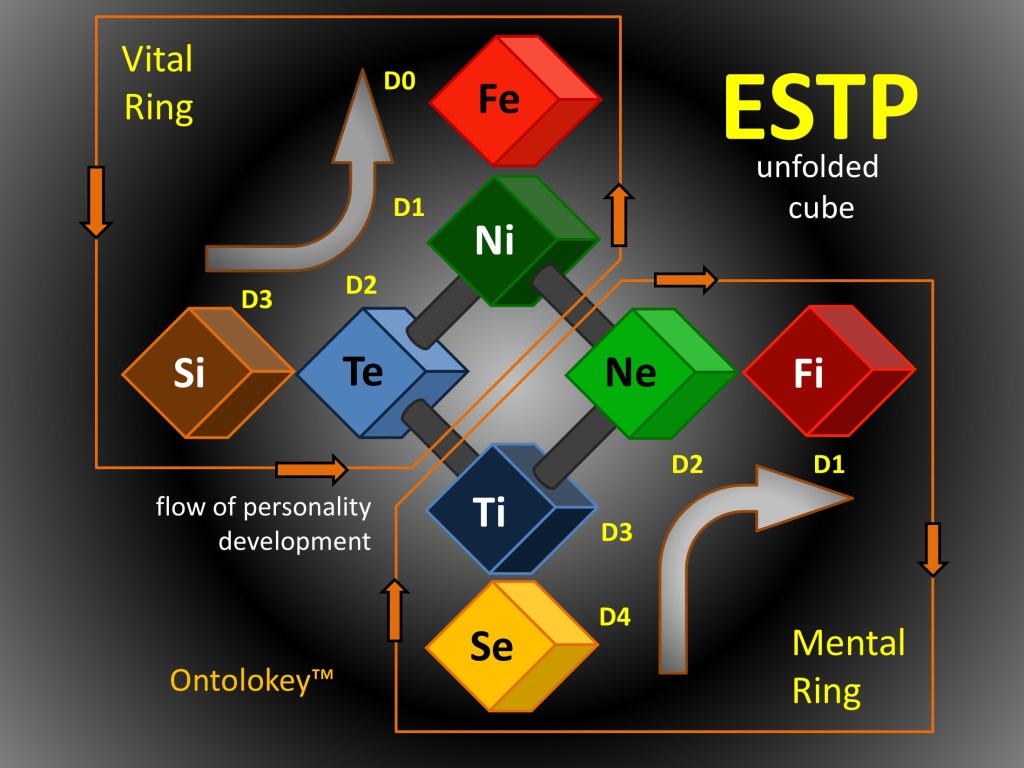
From Mastery of the Moment to Wholeness of the Self
The ESTP is often recognized by an unmistakable psychological immediacy: decisiveness, physical presence, adaptability, courage, pragmatism, competitiveness, social confidence, and an instinctive readiness to enter reality rather than merely contemplate it from a distance. This personality tends to discover what is possible through direct contact with circumstances, testing situations through experience and responding rapidly to whatever becomes concrete, relevant, or actionable. Yet beneath this highly visible competence lies a considerably more complex psychological landscape, because the ESTP is not simply a person who “lives in the moment”; it is a personality structure in which eight psychological functions participate in different degrees of consciousness, strength, vulnerability, and developmental potential. Ontolokey gives this architecture a spatial form, transforming the functional structure into a three-dimensional psychological landscape in which the familiar and unfamiliar aspects of the personality can be viewed in relation to one another. The deeper purpose of such a perspective is not merely to describe what an ESTP is like, but to illuminate what the personality may gradually become when its less conscious functions are brought into awareness and integrated into a larger sense of self.
The central paradox of ESTP development is that the personality usually does not need to learn how to become stronger, more decisive, more resourceful, more socially effective, or more capable of surviving difficult circumstances; many of these qualities are already close to the natural center of its psychological organization. The more difficult task begins when these strengths become so reliable that they are unconsciously recruited to protect the personality from experiences that cannot be mastered through action alone: helplessness, uncertainty, emotional exposure, dependence, inner conflict, ambiguity, regret, and the possibility of losing control. In such moments, the ESTP may instinctively move outward, because action restores a familiar relationship with reality, while stillness can expose psychological material for which no immediate solution exists. What appears externally as confidence may therefore sometimes conceal the refusal to feel uncertain; what appears as independence may conceal difficulty with vulnerability; what appears as fearlessness may occasionally function as an escape from experiences that feel psychologically threatening precisely because they cannot be conquered. The developmental question is consequently not whether the ESTP should abandon action, but whether action can cease to be the automatic answer to every form of psychological tension. Ontolokey’s deeper interpretation of the type points toward this distinction between strength as an authentic capacity and strength as a defensive identity, suggesting that the mature ESTP becomes more whole when power no longer has to function as protection against the parts of the self that feel less powerful.
Within the developmental architecture used in this essay, the ESTP’s psychological journey begins with the Mental Ring: Se as the dominant D4 function, Ti as the auxiliary D3 function, Ne as the Anima/Animus D2 function, and Fi as the Toddler D1 function. This sequence establishes a precise developmental direction, because consciousness does not leap from the most developed function directly into its most vulnerable territory; it must proceed through the psychological capacities that have already acquired sufficient stability to support the next stage. Se therefore remains the center of gravity rather than an obstacle to be overcome, while Ti becomes the first major developmental bridge through which immediate experience is transformed into conscious understanding. Once this auxiliary structure has become sufficiently mature, the personality can begin moving toward Ne and subsequently toward the extraordinarily vulnerable territory represented by Fi, where the question of personal meaning, inner value, emotional truth, and authentic selfhood becomes increasingly unavoidable. The Vital Ring develops alongside this process, though with a certain delay, moving from Si at D3 through Te at D2 and Ni at D1 toward Fe at D0, the latter representing an archaic or childlike blindspot in this developmental model. The movement through these rings can therefore be understood as a gradual turning of the psychological “iceberg”: what was once beneath awareness slowly becomes visible, until the personality eventually returns to its original dominant center with a consciousness enlarged by everything it has encountered along the way. This is the fundamental image of ESTP individuation: not becoming somebody else, but becoming sufficiently whole that the original self can finally contain what it once had to leave unconscious.
The ESTP’s First Psychological Task: Understanding the Difference Between Strength and Defense
The ESTP’s developmental journey begins with an uncomfortable recognition: the qualities that have made life manageable may also be the qualities that prevent deeper psychological integration. Dominant Se gives the ESTP an extraordinary capacity to register what is happening, enter the situation, identify opportunities and act before excessive deliberation becomes paralysis, while auxiliary Ti adds an internal mechanism for dissecting problems, identifying inconsistencies and determining what actually works. Together, these functions create an exceptionally effective psychological instrument, particularly in environments characterized by uncertainty, competition, pressure, rapid change and concrete consequences. The danger appears when this instrument becomes so successful that the personality begins to assume that every psychological difficulty should be approached in the same manner as an external problem: identify the obstacle, determine the leverage point, apply pressure and produce a result. In that moment, effectiveness ceases to be merely a strength and begins to function as a defense, because action can become a way of avoiding the experience of uncertainty, helplessness or emotional exposure rather than simply responding appropriately to reality. Ontolokey’s recent account of ESTP development describes precisely this tension, emphasizing that the problem is not the personality’s strength itself but the moment when strength becomes the preferred language for dealing with experiences that cannot actually be solved through force, speed, competence or control.
This distinction is particularly important because defensive strength rarely feels defensive from the inside. An ESTP who becomes increasingly active when uncertain may sincerely experience the activity as productivity; an ESTP who becomes indispensable when afraid of dependence may genuinely believe that responsibility is simply being taken seriously; an ESTP who becomes argumentative when emotionally wounded may experience the conflict primarily as a question of facts, fairness or principle. The shadow therefore does not normally announce itself by saying, “I am afraid,” “I feel rejected,” or “I need reassurance”; it may instead produce a convincing explanation for why immediate action, confrontation, control or withdrawal is objectively necessary. The deeper shadow analysis describes this mechanism as a movement in which an emotion is experienced unconsciously, converted into behavior and subsequently rationalized through a conscious narrative, leaving the individual aware of the explanation but disconnected from the original psychological cause. For the ESTP, this creates a particularly subtle form of self-deception because Ti can provide exceptionally coherent explanations for behavior that Se has already chosen for more instinctive reasons. The developmental breakthrough therefore begins not by distrusting one’s own intelligence, but by applying intelligence inward and asking whether the conscious reason is actually the complete reason.
The decisive question for the ESTP consequently becomes not simply, “What is happening, and what should I do?” but, “What is happening inside me before I decide what to do?” This introduces a psychological interval between perception and reaction, and that interval is extraordinarily important because it allows the unconscious to become observable without demanding that the personality immediately surrender its capacity for action. The ESTP does not have to become passive, hesitant or introspectively absorbed; rather, the person learns to recognize the emotional and motivational information that precedes behavior and to distinguish an authentic response from a defensive reflex. Jealousy, for example, may disguise itself as vigilance, possessiveness as protection, distrust as realism, wounded pride as insistence upon principle, or fear as an urgent need to regain control. Once these transformations become recognizable, the ESTP can begin to reclaim psychological freedom because the impulse no longer has to determine the interpretation of reality. The purpose of consciousness is not to suppress instinct but to place it inside a larger field of awareness in which several truths can exist simultaneously: the ESTP can be strong and afraid, generous and proud, courageous and insecure, loving and controlling, competent and wounded. Wholeness begins precisely when these apparent contradictions no longer have to be eliminated in order to preserve a coherent self-image.
This is also where the ESTP’s natural relationship with reality becomes an instrument of psychological healing rather than merely external achievement. Se is exceptionally suited to noticing what is actually present, and the mature use of Se can therefore be redirected from external surveillance toward inner observation without becoming detached from the concrete world. Instead of immediately asking who is responsible, what the solution is, or how control can be restored, the ESTP can learn to observe the physical and emotional facts of the moment: tension in the body, acceleration of speech, irritation, attraction, shame, defensiveness, the impulse to dominate, the desire to escape, or the sudden need to prove competence. These observations are not abstractions; they are present-moment data, and therefore they can be approached through the very realism that makes Se powerful. In this sense, psychological introspection need not be foreign to the ESTP: it can become a more refined form of empirical observation in which the personality turns its characteristic attention toward the processes occurring within itself. The movement is subtle but profound, because the ESTP gradually stops using awareness merely to control the environment and begins using awareness to understand the self that is attempting to control it.
The first developmental transition is therefore the maturation of Ti from D3 toward D4, because Ti must become sufficiently conscious and stable before the deeper layers of the Mental Ring can safely be approached. This does not mean accumulating more arguments, qualifications or intellectual knowledge, nor does it mean constructing an even more sophisticated justification for already existing behavior; it means developing the capacity to examine one’s own assumptions with the same precision normally applied to external systems. Mature Ti asks whether an explanation is internally coherent even when that explanation threatens the ego that produced it, and it is precisely here that the ESTP begins to acquire a form of intellectual honesty more demanding than ordinary cleverness. The question becomes: Can I investigate my own motive without deciding in advance that I am right? Once the answer becomes increasingly affirmative, Ti ceases to function merely as the analytical servant of Se and becomes a genuine bridge between instinct and consciousness. Only then can the ESTP proceed naturally toward the next developmental territory, Ne at D2, where alternative possibilities, ambiguity and psychological multiplicity begin to challenge the certainty of the immediately observable world.
Ne as Anima/Animus: Learning to Remain Open When Reality Has Not Yet Revealed Its Answer
Once Ti has developed sufficiently toward its mature form, the ESTP encounters a psychological threshold that is more demanding than the refinement of analytical competence. The next movement leads toward Ne, the Anima/Animus function at D2, which introduces a mode of perception that does not primarily ask what is presently observable, but what else might be possible beyond the immediately observable. For a personality organized around Se, this can feel strangely destabilizing because Se derives confidence from contact with what is actually there: the concrete situation, the available evidence, the behavior of people, the opportunities in front of the individual and the practical consequences of a decision. Ne opens a different psychological dimension in which reality is not exhausted by its current appearance, and where several interpretations, futures or meanings may coexist before any one of them has become demonstrably true. This is why the Anima/Animus position can be psychologically sensitive: it carries something the conscious personality needs but cannot command as effortlessly as its dominant functions. The developmental task is consequently not to replace Se with Ne, but to allow the ESTP to remain psychologically receptive to possibilities without demanding immediate proof, immediate certainty or immediate action.
The immature expression of this territory can be especially confusing because the ESTP may encounter possibility not as creative openness but as psychological disturbance. When the mind begins generating alternatives that cannot yet be verified, the individual may become suspicious, restless or mentally overstimulated, particularly when the possibilities concern relationships, motives or future outcomes that cannot be controlled through direct observation. A normally pragmatic ESTP can therefore become surprisingly preoccupied with what might happen, what somebody could be intending, or what hidden development may be unfolding behind an apparently ordinary situation. The problem is not imagination itself, but the absence of a mature relationship to uncertainty: possibility can either remain possibility or become unconsciously treated as evidence. The Anima/Animus is particularly important here because it confronts the ESTP with an experience of psychological dependence upon something that cannot simply be seized, tested and mastered. Development requires learning to say, in effect, “I do not know yet, and I can tolerate not knowing,” without interpreting uncertainty as weakness or immediately filling the empty space with an action, accusation, prediction or distraction. This capacity represents a major expansion of consciousness because it permits reality to remain unfinished while the personality remains internally stable.
Ne also challenges a deeply rooted assumption that practical intelligence is necessarily superior to speculative consciousness. An ESTP may instinctively respect ideas when they can be translated into action, but become impatient when reflection appears detached from immediate usefulness; yet psychological development often begins precisely where usefulness temporarily disappears. Dreams, intuitions, hypothetical scenarios, symbolic associations and apparently impractical questions can expose dimensions of the personality that ordinary problem-solving does not reach. The purpose is not to turn the ESTP into an abstract theorist, but to make the psyche sufficiently spacious that an experience can be explored before it is reduced to a decision. The Ontolokey perspective on the ESTP emphasizes that the less conscious functions contain developmental information rather than merely deficiencies, and this is especially significant for the Anima/Animus because its sensitivity often points toward psychological material that the dominant personality has not learned to approach directly. What initially feels vague, excessive or unnecessary may therefore contain precisely the information required for greater inner integration.
At a deeper level, Ne asks the ESTP to relinquish one of its most seductive psychological privileges: the ability to define reality through what can be immediately perceived and manipulated. This does not mean abandoning realism; rather, it means recognizing that realism itself becomes distorted when the limits of perception are mistaken for the limits of existence. An ESTP can be exceptionally perceptive about people and situations while still overlooking the possibility that the same observable behavior can emerge from radically different internal causes. Someone who becomes distant may be angry, ashamed, frightened, overwhelmed, disappointed or simply preoccupied, and Se alone cannot determine which explanation is correct merely by observing the external behavior. Ne creates the psychological space in which multiple hypotheses can be held simultaneously, while Ti evaluates them without prematurely converting one possibility into certainty. This combination is profoundly healing because it interrupts projection: instead of unconsciously attributing one’s own fears or expectations to another person, the ESTP learns to tolerate ambiguity long enough for additional information to emerge. The resulting flexibility is not indecisiveness but a more sophisticated form of discernment, because the individual becomes capable of acting decisively without confusing decisiveness with omniscience.
The Anima/Animus stage therefore represents an important preparation for the most vulnerable territory of the Mental Ring, Fi at D1, the Toddler function. Ne first teaches the ESTP that not everything meaningful is immediately visible, and that an internal experience can be real even when it cannot yet be converted into an external fact; this creates the psychological conditions under which Fi can eventually be encountered without being dismissed, ridiculed or overwhelmed. If Ne is bypassed, the ESTP may approach Fi with the same impatience used toward any unfamiliar internal state, attempting to rationalize feelings, solve them, suppress them or turn them into action before their meaning has been understood. If Ne develops sufficiently, however, the person becomes capable of approaching inner emotional material as something to be explored rather than conquered. The movement from D4 Se through D3 Ti toward D2 Ne therefore represents a gradual deceleration of psychological certainty: first the individual learns to analyze, then to entertain alternatives, and eventually to recognize that the psyche contains truths that cannot be forced into immediate practical clarity. Only from this position of increased psychological spaciousness can the ESTP safely descend toward Fi, where the question is no longer merely What is possible? but What does this experience mean to me, and what part of myself have I never learned to hear?
Fi as the Toddler Function: Entering the Territory of the Wounded Self
The movement from Ne at D2 toward Fi at D1, the Toddler function, represents one of the most psychologically delicate transitions in the ESTP individuation process because Fi concerns a dimension of experience that cannot be adequately measured by effectiveness, external evidence or logical consistency. Fi brings the individual into contact with personal value, emotional authenticity, inner preference, attachment, hurt, shame, loyalty, moral discomfort and the private experience of being personally affected by what happens. For the ESTP, these experiences may have been present throughout life without possessing an equally developed language of consciousness, because the personality’s stronger functions are naturally oriented toward what can be perceived, analyzed and acted upon. Consequently, the ESTP may know that something is wrong long before understanding why it hurts, and may be able to change a situation long before recognizing what the situation has emotionally touched. The Toddler designation is significant because this function does not necessarily lack importance; rather, it represents a psychologically young and vulnerable mode of processing that can react intensely when something touches the individual’s deepest sense of personal worth or belonging. Development therefore requires approaching Fi not as an embarrassing weakness to be overcome, but as a young part of the personality that has been waiting for conscious recognition.
The vulnerability of Fi can explain why an otherwise formidable ESTP may occasionally respond to apparently minor interpersonal events with disproportionate emotional intensity. A criticism that concerns competence may be manageable because it can be debated, corrected or disproved, whereas criticism that implicitly communicates you are not valued, you are not wanted, you are not good enough, or you do not matter to me can reach a much deeper psychological layer. The conscious personality may initially respond through Se or Ti by confronting the person, proving competence, withdrawing, mocking the accusation, reframing the situation or demonstrating that the other person is irrational, while the underlying Fi experience remains unacknowledged. This is one of the mechanisms through which the shadow can become self-reinforcing: the more vulnerable the inner wound, the more vigorously the conscious personality protects itself with its strongest capacities. Ontolokey’s discussion of the ESTP shadow specifically emphasizes that some apparently forceful reactions can originate in much more vulnerable psychological material than the external behavior suggests. The consequence is that the ESTP may win the external argument while remaining psychologically wounded by it, because the conflict was resolved at the level of circumstances while its actual cause existed at the level of personal meaning.
Fi development therefore requires a radically different form of courage from the courage usually associated with ESTP identity. Physical courage enters danger voluntarily; psychological courage allows oneself to discover that one has been hurt without immediately converting the hurt into anger, superiority, humor, indifference or retaliation. This can be particularly difficult because emotional exposure temporarily removes the protective advantage of competence, and the ESTP may experience this exposure as an unnecessary surrender of power. Yet acknowledging I cared, I was disappointed, I felt rejected, I was jealous, I wanted to be appreciated, or I was afraid of losing this person does not diminish the individual’s strength; it reveals the human meaning underneath it. The Toddler function becomes healthier when these experiences can be named without shame and held without demanding that somebody else immediately repair them. In this sense, Fi integration is not emotional indulgence but psychological differentiation: the ESTP learns to distinguish an authentic feeling from an impulse to act upon that feeling, and personal vulnerability from helplessness. The mature expression of Fi allows the person to possess an inner world without requiring the external world to validate every element of it.
This process can also transform the ESTP’s relationship with forgiveness. Before unconscious emotional material is understood, forgiveness may appear to require either excusing another person’s behavior or simply deciding to stop caring about it, both of which can leave the underlying injury psychologically intact. As Fi becomes conscious, however, the individual can reconstruct the internal sequence of an experience: what happened, what was perceived, what was interpreted, what was expected, what was lost, and which personal value was violated or threatened. Such reconstruction makes it possible to understand why a particular event became so painful even when the external event itself appears insignificant in retrospect. The same principle applies to understanding other people, because recognizing one’s own vulnerability makes it easier to imagine that another person’s destructive behavior may also have emerged from fear, insecurity, shame or an immature psychological defense. Understanding does not erase responsibility and does not require tolerating harmful behavior; it simply replaces the primitive psychological equation of harmful action = inherently bad person with a more differentiated understanding of human causality. Cognitive understanding can therefore support emotional healing because it allows the ESTP to separate the person from the defense, the wound from the reaction, and the past from the present.
At its most mature expression, Fi gives the ESTP something that neither Se nor Ti can provide independently: an internally grounded answer to the question of what is worth protecting. Se can identify opportunities, Ti can determine whether something makes sense, and Ne can illuminate what else might be possible, but Fi asks whether the resulting life is actually congruent with the person one has become. This changes the meaning of success because achievement can no longer be measured exclusively by winning, freedom, stimulation, recognition or practical effectiveness; it must also be measured by whether one’s actions remain faithful to an increasingly conscious inner value system. The ESTP does not have to become sentimental or withdraw from the intensity of life, because Fi integration does not negate Se but humanizes it: experience becomes richer when the person knows why something matters, and action becomes more authentic when it is guided by consciously recognized values rather than merely by opportunity or impulse. The progression from Se D4 → Ti D3 → Ne D2 → Fi D1 therefore completes the first major descent through the Mental Ring, moving from immediate engagement with reality toward analysis, possibility and finally personal meaning. The ESTP has not lost its original strength at the end of this descent; instead, that strength has acquired an inner reference point, making it possible to enter the Vital Ring with considerably greater psychological stability and begin the parallel integration of Si, Te, Ni and ultimately Fe.
The Vital Ring: From Personal Integration to the Wider Unconscious
The completion of the first descent through the Mental Ring does not mean that the ESTP has reached psychological wholeness, because the psyche contains another developmental movement that concerns not only personal consciousness but the broader, less familiar dimensions of life experience represented by the Vital Ring. In the developmental architecture used here, the Vital Ring begins with Si at D3, proceeds through Te at D2, continues toward Ni at D1, and culminates in Fe at D0, the most archaic and vulnerable position in this sequence. Whereas the Mental Ring can be understood primarily as the gradual integration of functions that become increasingly intimate to the conscious personality, the Vital Ring confronts the ESTP with modes of psychological existence that may initially feel less voluntary, less familiar and more deeply embedded in the organismic history of the person. Its development therefore tends to occur with a certain delay relative to the Mental Ring, because the personality first needs enough internal stability to encounter experiences that cannot be controlled through its established psychological strengths. This is why the movement into the Vital Ring should not be interpreted as a demand to activate every function indiscriminately, but as a gradual expansion of consciousness in which each newly accessible function becomes a foundation for approaching the next. The developmental sequence matters because psychological integration is not achieved by jumping directly toward the most unconscious material; the personality must build the capacity to tolerate it.
The first Vital-Ring stage, Si at D3, asks the ESTP to develop a conscious relationship with continuity, bodily history, repetition, memory and the accumulated consequences of previous experience. Se naturally emphasizes what is happening now, whereas Si introduces the significance of what has happened before and what the body has learned through repetition, habit and accumulated experience. This can become psychologically transformative because the ESTP may otherwise possess an extraordinary capacity to escape the psychological weight of the past by continuously generating new experiences in the present. Movement can create genuine freedom, but it can also become a mechanism for avoiding unresolved continuity: a new relationship can temporarily obscure the previous one, a new challenge can displace an old disappointment, and a new environment can create enough stimulation that the personality never has to remain still long enough to discover what the previous experience actually changed within it. Si development introduces a different form of strength, one based not upon rapid adaptation but upon the capacity to remember, consolidate and learn from what has already occurred. The question gradually changes from What can I do now? to What has repeatedly happened to me, what have I repeatedly done, and what does this pattern reveal about me? That shift is crucial for individuation because unconscious repetition can only become choice once it has been recognized as repetition.
A mature Si does not imprison the ESTP in nostalgia or excessive caution; rather, it creates psychological continuity between the present self and the selves that existed before it. This is particularly important for healing because many defensive patterns become invisible when each episode is experienced as an isolated event. An ESTP might regard repeated conflicts as the fault of changing circumstances, different partners, difficult colleagues or unfortunate timing, while a sufficiently developed Si begins to notice that the same psychological sequence may be recurring under different external conditions. Perhaps the individual repeatedly becomes attracted to situations that provide excitement but resist intimacy, repeatedly interprets dependence as weakness, repeatedly leaves once emotional complexity increases, or repeatedly becomes more aggressive when personal insecurity is touched. None of these patterns can be understood adequately by examining the latest event in isolation; they become visible through temporal comparison. Si therefore acts as a psychological memory that preserves evidence the present-oriented personality might otherwise discard. When integrated with the earlier development of Ti, this memory becomes especially powerful because the ESTP can examine recurring patterns without automatically judging them as failures, instead asking what function those patterns once served and why they are no longer sufficient.
From this foundation, the Vital Ring moves toward Te at D2, which introduces a more systematic relationship with external structures, measurable effectiveness, organization and objective implementation. This may appear superficially similar to the ESTP’s natural pragmatism, but its developmental function is different because Te asks the personality to build structures that continue functioning beyond the immediate intervention of the individual. The less mature ESTP can be extraordinarily effective in the moment while still struggling with processes that require sustained organization, delegation, documentation, repetition or long-term optimization. Se can improvise brilliantly when circumstances change, whereas Te seeks to construct an external system capable of handling change without requiring constant personal improvisation. Psychologically, this is more significant than mere productivity because it challenges the unconscious belief that I must personally remain at the center of the action for things to work. Developing Te means learning that control can be transferred into structures, processes and other people without becoming a loss of identity or autonomy. In this respect, Te begins transforming the ESTP’s relationship with power: rather than demonstrating competence through personal intervention, the mature individual increasingly demonstrates competence through the ability to create conditions in which effective action can occur without constant personal domination.
The next movement, toward Ni at D1, becomes considerably more existential because Ni confronts the ESTP with direction, consequence, symbolism, long-range development and the possibility that life is not merely a collection of situations but also a trajectory. Se is naturally fascinated by what is available now, while Ni asks what the accumulation of present choices is gradually becoming. This introduces the uncomfortable possibility that freedom itself has consequences: every repeated choice narrows some futures while making others increasingly probable. An ESTP who has lived primarily through immediate opportunities may discover that the avoidance of commitment is itself a commitment, that perpetual novelty eventually produces a pattern, and that the refusal to choose a direction does not preserve infinite possibilities indefinitely. Ni therefore asks the personality to tolerate the psychological discomfort of allowing a future to influence the present. The developmental question becomes less about maximizing today’s possibilities and more about discerning which possibilities deserve to survive the passage of time, which is a profoundly different relationship with freedom and one that can transform impulsive experience into intentional life direction.
The deepest Vital-Ring threshold is ultimately Fe at D0, the blindspot-like and archaic position in this developmental sequence, and therefore it should not be approached through force or through the expectation that it will suddenly become as natural as Se. Fe concerns interpersonal emotional atmosphere, collective feeling, relational reciprocity, visible emotional exchange and the conscious recognition of what is happening between people at the level of shared affect. For the ESTP, this can be an especially primitive psychological territory precisely because the individual may be socially confident while remaining comparatively less conscious of the emotional field generated by relationships. Social skill and emotional integration are not identical: one can read a room tactically without fully experiencing what the room means emotionally, charm people without revealing oneself, create excitement without creating intimacy, and understand social dynamics without understanding one’s own contribution to the emotional climate. At D0, Fe may therefore appear through crude or reactive forms before becoming consciously integrated, such as discomfort with overt emotional demands, impatience with emotional complexity, exaggerated attempts to control the mood of a situation, or a tendency to oscillate between emotional detachment and sudden emotional intensity. The developmental objective is not to make Fe sophisticated overnight, but to allow the personality gradually to recognize that relationships possess an emotional reality of their own, one that cannot always be managed through competence, humor, charisma or action. When the ESTP eventually becomes capable of remaining present in that emotional field without immediately controlling, escaping or dismissing it, the final barrier of the Vital Ring begins to soften, and the personality approaches the deeper possibility of wholeness: not merely knowing how to act in the world, but consciously participating in the human reality created between self and other.
The ESTP Shadow: When Strength Becomes a Psychological Mask
The ESTP shadow is most easily misunderstood when it is described merely as the opposite of the personality’s visible strengths, because the deepest shadow is rarely an obvious absence of competence. More often, it consists of precisely those qualities that the ESTP possesses in abundance becoming rigid, compulsive or defensive when they are recruited to protect a vulnerable psychological core. Se can become an escape from stillness, Ti can become rationalization, social confidence can become emotional concealment, independence can become an inability to receive, and courage can become a refusal to acknowledge fear. The resulting personality may remain highly functional, charismatic and successful while becoming progressively less aware of the psychological forces governing its behavior. This is why shadow integration cannot be reduced to “fixing weaknesses”; the real task is to recognize when an authentic capacity has been transformed into a defense against another part of the self. Ontolokey’s exploration of the ESTP’s deeper shadow places particular emphasis on this hidden dynamic, in which apparently strong behavior can originate in vulnerable unconscious material and subsequently be interpreted by the conscious personality as rational, justified or simply characteristic.
One of the most important shadow mechanisms for the ESTP is the transformation of vulnerability into action. When something threatens the individual’s emotional equilibrium, Se can immediately provide an exit through movement: change the circumstances, confront the person, find something else to do, pursue another opportunity, make a decision, introduce stimulation, create humor or simply refuse to remain psychologically exposed. Because these responses frequently work in the short term, the personality receives powerful reinforcement for using them, and a pattern can develop in which emotional discomfort automatically triggers external intervention. The individual may sincerely believe that the discomfort has been solved because the situation has changed, yet the psychological material that generated the reaction remains untouched. Over time, this can create a peculiar form of emotional displacement in which the ESTP becomes highly competent at changing circumstances while remaining comparatively inexperienced at remaining with an internal experience until it reveals its meaning. The developmental insight is not that action is wrong, but that action taken before an emotion has been understood may sometimes function as avoidance disguised as decisiveness. Psychological maturity begins when the ESTP can ask whether a situation genuinely requires immediate intervention or whether the urgency itself is being generated by an unconscious wish to stop feeling something.
A similar dynamic can emerge through Ti, particularly when analytical intelligence becomes an instrument of self-protection rather than self-examination. The ESTP may be exceptionally capable of identifying contradictions in another person’s argument, exposing hypocrisy, finding practical flaws or constructing a coherent explanation for why a particular response was justified. Yet intelligence can defend the ego as effectively as it can reveal truth, especially when the person being analyzed is oneself. A wounded ESTP can therefore construct an argument that is technically persuasive while remaining psychologically incomplete, because the argument explains why the other person was wrong without explaining why the encounter was so personally painful. The crucial distinction is between explanation and insight: explanation establishes a causal story that may be logically defensible, whereas insight reveals the emotional motive that made the story necessary in the first place. When Ti becomes mature, it does not merely become better at proving conclusions; it becomes willing to interrogate the premises from which those conclusions emerged. That is a much more demanding intellectual discipline because it requires the ESTP to tolerate the possibility that a reaction can be understandable without being entirely justified, and that another person can be wrong without the ESTP being completely right.
The shadow can become particularly intense when personal rejection, humiliation or loss of status touches the vulnerable Fi layer. Because Fi is located at D1 in the Mental Ring, its wounds may be experienced with a psychological intensity that is not proportional to the apparent importance of the external event. The individual may become angry because anger feels more compatible with strength than hurt, or become contemptuous because contempt creates distance from the person whose approval suddenly matters too much. Sometimes the defensive maneuver is even more subtle: the ESTP may decide that the relationship, opportunity or person was never important in the first place, thereby transforming grief into indifference after the fact. Such psychological maneuvers protect the self-image but can prevent mourning, and what cannot be consciously mourned often remains active in the unconscious. This is one reason why an ESTP may occasionally appear to have moved on long before the deeper emotional system has actually completed the process of letting go. Fi integration gradually reverses this mechanism by making it possible to acknowledge significance without experiencing significance as weakness: this mattered to me, therefore it could hurt me; it hurt me, therefore I need to understand it; understanding it does not make me powerless.
Another important shadow pattern concerns the ESTP’s relationship with dependence and control. The personality often values freedom, competence and the ability to handle circumstances independently, and these qualities can be genuinely healthy expressions of autonomy. But when autonomy becomes an absolute requirement, receiving help can unconsciously acquire the meaning of inadequacy, and emotional dependence can be interpreted as entrapment. The person may therefore prefer to be needed rather than to need, because being needed preserves agency while needing someone else exposes the possibility of rejection. This can create relationships in which generosity, protection and problem-solving substitute for mutual vulnerability: the ESTP gives intensely, solves problems, creates experiences and offers practical loyalty, but remains less comfortable revealing the internal places where reassurance, tenderness or acceptance are genuinely desired. Such a pattern can be particularly painful because the person may sincerely experience themselves as deeply caring while the other person experiences an emotional distance that practical generosity does not compensate for. The healing movement is not toward dependency but toward reciprocity, in which strength includes the ability to give and receive without either position becoming a threat to identity.
The deepest shadow work therefore requires the ESTP to stop treating psychological discomfort as an enemy that must be defeated. Fear, shame, grief, envy, loneliness, tenderness, regret and uncertainty are not necessarily evidence that something has gone wrong; they are forms of information through which the unconscious communicates with consciousness. Once these experiences are observed without immediate conversion into action, Ti can examine them, Ne can consider alternative meanings, Fi can identify the personal value or wound involved, and the Vital Ring can gradually reveal the historical, structural, future-oriented and relational dimensions surrounding the experience. This creates a fundamentally different relationship with the shadow: instead of asking how to eliminate the uncomfortable part of oneself, the ESTP asks what that part has been trying to accomplish and why it became necessary. The objective is not to become endlessly introspective, nor to excuse destructive behavior by attributing everything to psychological wounds, but to understand the causal chain sufficiently well that behavior becomes a conscious choice rather than an automatic defense. In this sense, healing through cognition means bringing the unconscious logic of the personality into consciousness so that what once controlled the person from beneath awareness can eventually become something the person can understand, negotiate and integrate.
Individuation as the Turning of the Psychological Iceberg
The developmental sequence becomes most intelligible when it is understood not as the acquisition of isolated psychological skills but as a gradual rotation of the entire personality structure. The image of the iceberg captures this process particularly well: ordinary consciousness occupies only a relatively small portion of psychological life, while much of what determines perception, motivation, emotional reaction and behavior remains beneath the surface. In the ESTP, the visible portion is initially dominated by Se, supported by Ti, and this configuration can create an impressive degree of competence in navigating external reality. Yet the very success of this configuration can conceal how much psychological material has been relegated to less conscious functions, particularly those involving personal vulnerability, temporal continuity, future direction and emotional reciprocity. As development proceeds, the iceberg does not simply become larger; it turns, allowing previously submerged material to emerge into conscious awareness while the formerly dominant perspective temporarily loses its monopoly over the definition of reality. The purpose of individuation is therefore not to dismantle the conscious personality but to enlarge it until the conscious self can contain dimensions of experience that were previously experienced only indirectly, defensively or unconsciously.
This explains why psychological development can sometimes feel less like improvement and more like disruption. When the auxiliary function Ti develops from D3 toward a level approaching D4, the ESTP’s existing equilibrium begins to move because the personality gains the capacity to observe its own assumptions rather than simply operate through them. The emergence of Ne then introduces ambiguity and alternative possibilities, while Fi exposes personal meanings and wounds that cannot be reduced to external facts; consequently, experiences that once appeared straightforward can become psychologically complex. A relationship may no longer be simply good or bad, a failure may no longer be simply an obstacle to overcome, and an interpersonal conflict may no longer be reducible to the question of who was objectively right. This expansion can initially produce frustration because greater consciousness means greater awareness of contradiction, and contradiction is precisely what a highly action-oriented personality may instinctively want to resolve. Yet individuation requires the opposite movement: the ability to hold incompatible experiences long enough for a deeper synthesis to emerge. The ESTP gradually discovers that psychological complexity is not the same thing as confusion, and that an expanded consciousness can actually produce more precise action because it is informed by more of the total situation.
The transition from the Mental Ring toward the Vital Ring is therefore the point at which individuation becomes increasingly historical and existential. Si asks the individual to remember rather than merely react, Te asks the individual to construct rather than merely improvise, and Ni asks the individual to recognize direction rather than merely possibility. These functions gradually introduce temporal depth into a personality whose natural orientation is toward immediate reality, and this can radically change the interpretation of one’s own biography. Past experiences cease to be disconnected episodes and become part of a pattern; present choices cease to be isolated opportunities and become contributions to a future trajectory. The ESTP begins to perceive that repeated behavior is not merely a collection of accidents but a psychological language, and that the situations one repeatedly creates or enters may reveal unconscious needs as clearly as dreams or explicit feelings. This recognition can be humbling because it removes some of the comfort associated with blaming circumstances for recurring outcomes. At the same time, it is profoundly liberating because once a pattern becomes conscious, it no longer possesses the same degree of invisible authority. The person can finally ask not only What happened to me? but also What part of me repeatedly participates in creating this kind of experience?
The most difficult stage of the rotation occurs when the personality approaches material associated with Fe at D0, because here the ESTP encounters the primitive edge of its relationship with shared emotional reality. The individual may discover that being socially capable is not identical to being emotionally transparent, that creating excitement is not identical to creating intimacy, and that knowing what people are likely to do is not necessarily the same as understanding what they feel. This realization can be particularly challenging for someone whose identity has been built around interpersonal confidence because it exposes a distinction between social mastery and emotional participation. The former allows a person to influence a situation; the latter requires the person to be affected by it as well. At the deepest level, Fe development therefore asks the ESTP to tolerate emotional reciprocity without immediately converting it into negotiation, entertainment, persuasion or control. The other person must be allowed to have an emotional reality that cannot be managed into the ESTP’s preferred shape, just as the ESTP must eventually permit others to witness emotional realities within themselves that cannot be disguised through competence.
The apparent paradox of the entire developmental process is that the further the ESTP travels into the unconscious, the more authentically ESTP the final personality can become. The goal is not to end with an individual who behaves like a different type, has abandoned Se, distrusts action or spends life analyzing every experience before participating in it. On the contrary, the mature endpoint is a return to Se, but Se now occupies a larger psychological organism because it has been informed by the functions encountered during the descent. The dominant function becomes less compulsive because it no longer has to carry the entire burden of psychological adaptation; action becomes freer because it is no longer constantly recruited to suppress what the person cannot tolerate internally. This is the meaning of the “rebirth” of the original personality: the individual returns to the familiar center, but does so with an expanded consciousness that recognizes what was previously hidden beneath it. The ESTP has not ceased to be an ESTP; the person has become less divided within the ESTP structure, and therefore more capable of using its natural strengths without being unconsciously possessed by them.
In this sense, individuation can be understood as a movement from identification toward integration. Early development often involves identification with Se: I am the person who acts, handles things, takes risks, adapts, wins, survives and remains free. Later development gradually introduces the realization that none of these descriptions is large enough to contain the whole person. Ti reveals the thinker beneath the actor, Ne reveals the explorer of possibilities beneath the pragmatist, Fi reveals the vulnerable individual beneath the self-sufficient exterior, Si reveals the historical self beneath the present-oriented self, Te reveals the builder beneath the improviser, Ni reveals the future beneath the immediate moment, and Fe reveals the relational self beneath the independent self. Each discovery removes a little of the necessity to defend a single identity. Wholeness is reached when the ESTP can inhabit all of these dimensions without requiring one of them to prove that the others are illegitimate. That is the psychological significance of the iceberg finally completing its rotation: consciousness no longer means merely seeing what has always been above the surface, but recognizing that the submerged parts were part of the self all along.
Healing Through Cognition: Understanding the Wound Without Becoming the Wound
For the ESTP, psychological healing can become particularly powerful when emotional experience is approached through the natural capacity for cognition rather than through an attempt to force emotional expression. The purpose of cognition in this context is not to intellectualize feelings until they disappear, but to make the unconscious structure surrounding those feelings understandable. A painful experience often consists of several layers that are initially fused together: an external event, the perception of that event, an interpretation of its meaning, an emotional response, an impulse to act and a subsequent justification for that action. When these layers remain unconscious, the person experiences the entire sequence as a single reality: this happened, therefore I felt this, therefore I acted correctly. Cognitive differentiation interrupts that fusion and allows each component to be examined independently. For an ESTP, this can be an exceptionally effective route toward healing because it respects the personality’s natural need to understand how things actually work while redirecting that investigative capacity toward the internal system itself. The result is not emotional detachment but emotional intelligibility, and intelligibility creates the possibility of choice.
Consider what happens when an ESTP experiences rejection. The first conscious reaction may be anger, contempt, withdrawal or a renewed determination to demonstrate independence, while the deeper experience may involve sadness, humiliation, fear of inadequacy or the feeling of being personally unwanted. If the first reaction is treated as the complete truth, the individual may conclude that the other person is simply foolish, disloyal, manipulative or unworthy of further attention. If cognition is used more deeply, however, the individual can reconstruct the sequence: What exactly happened? What did I immediately assume it meant? What did I feel before I became angry? What did I want from the other person? What did their behavior threaten within my sense of myself? Why did I need to regain control so quickly? These questions do not invalidate the anger, nor do they automatically absolve the other person of responsibility; they simply reveal that the external event and the internal meaning of the event are not identical. Once this distinction becomes conscious, the ESTP can respond to the actual situation rather than to the unconscious meaning attached to it. This is where cognition becomes therapeutic: it transforms an apparently objective reality into a psychologically differentiated experience in which several causal layers can be recognized.
The same process can be applied to repeated interpersonal conflict, which is often where shadow material becomes most visible. If an ESTP repeatedly finds themselves surrounded by people who are supposedly incompetent, dishonest, needy, controlling or emotionally difficult, it may be tempting to interpret each relationship independently and conclude that the problem lies consistently outside the self. Sometimes it genuinely does; people can behave badly, and psychological integration must never become an excuse for tolerating exploitation or abuse. But when similar conflicts recur across different environments and with different people, cognitive reflection can ask whether the individual is unconsciously selecting particular dynamics, communicating in ways that evoke predictable responses, or leaving certain needs unspoken until they emerge as resentment. The question is not Am I the problem? because such a formulation is too simplistic and often produces unnecessary self-blame; the more useful question is What is my participation in this pattern, and what psychological function does that participation serve? This preserves personal responsibility without collapsing into guilt, and it allows the individual to investigate behavior as a system rather than as a moral verdict.
The integration of Fi is particularly important because healing requires the ESTP to distinguish between understanding why something happened and deciding whether it was acceptable. An individual can recognize that another person’s cruelty originated in insecurity without concluding that the cruelty was justified, just as one can recognize one’s own defensive behavior without deciding that it defines one’s character. This distinction makes forgiveness psychologically more mature because forgiveness no longer requires denial of the injury. The ESTP can acknowledge that another person may have acted from their own unconscious wounds while simultaneously acknowledging that the consequences were real and boundaries remain necessary. Likewise, self-forgiveness becomes possible without self-exoneration: the person can recognize that a former reaction was immature, defensive or destructive while understanding the psychological conditions that produced it. Such understanding reduces the need to preserve an idealized self-image, because the individual no longer needs to choose between I was completely right and I am fundamentally flawed. Both positions are psychologically crude; integration allows the more difficult truth that a person can have acted badly while still possessing understandable reasons for having done so.
The deeper purpose of this cognitive process is therefore not to construct an explanation that closes the investigation, but to develop an observing consciousness capable of remaining present while contradictory truths emerge. The ESTP may discover that the desire for freedom sometimes contains fear of attachment, that generosity sometimes contains a desire to remain indispensable, that confidence sometimes protects shame, that humor sometimes conceals pain, and that independence sometimes protects against the terror of needing somebody who might leave. None of these discoveries means that the original strength was false; it means that the strength has acquired an unconscious secondary function. Once that function becomes visible, the personality gains an additional degree of freedom because the same behavior can now be chosen for its constructive value rather than automatically deployed as psychological armor. Se can remain bold without being compulsive, Ti analytical without becoming defensive, Ne open without becoming suspicious, and Fi sensitive without becoming overwhelmed. The psychological wound is not erased from history, but it ceases to dictate the future invisibly.
This is ultimately why the Ontolokey developmental sequence can be understood as an instruction for individuation rather than merely a description of personality. The Ontolokey Cube provides a visual representation of the functions and their relative developmental positions, allowing the individual to conceptualize the personality not as a static label but as a landscape containing regions of familiarity, strength, vulnerability and unrealized potential. The sliders symbolically make visible the direction of movement: development proceeds from the more established function toward the next less-developed function rather than attempting to leap directly into the deepest unconscious material. For the ESTP, this means consolidating Ti before approaching Ne, Ne before approaching Fi, and the corresponding Vital-Ring progression from Si through Te and Ni toward Fe. The value of such visualization lies in its capacity to turn an abstract psychological idea into a developmental orientation: instead of asking vaguely how to “become more balanced,” the ESTP can ask which function is currently ready to be brought more fully into consciousness and what psychological resistance appears when that transition is attempted. In this way, the model becomes less a classification system and more a map for the long psychological movement from competence toward consciousness, from defense toward choice, and ultimately from fragmentation toward wholeness.
The Mature ESTP: Strength Without Armor
The mature ESTP does not emerge from individuation as a softened or diminished version of the original personality, but as a person whose strength no longer needs to defend itself against every experience of vulnerability. Se remains central, yet its relationship with reality becomes more spacious because the individual no longer has to seize every opportunity simply to feel alive, nor control every situation simply to feel secure. The person can enter intensity deliberately rather than compulsively, distinguish genuine excitement from psychological escape, and recognize when action is appropriate and when remaining present is the more courageous response. Ti, having developed toward the upper end of its potential, provides a form of internal honesty that does not merely rationalize Se but questions it when necessary, while Ne allows the ESTP to tolerate possibilities without immediately converting them into certainty. Fi adds a private axis of personal meaning, making it possible to know what genuinely matters rather than deriving value exclusively from achievement, stimulation or external response. The result is not a rejection of the ESTP’s natural temperament but its maturation into something more internally coherent, because the individual can finally act from strength without unconsciously needing action to prove that strength exists.
This maturity also changes the ESTP’s relationship with other people. Earlier in development, interpersonal effectiveness may depend heavily upon reading circumstances, influencing outcomes, entertaining others, solving practical problems or maintaining independence, whereas greater integration allows relationships to become places of mutual revelation rather than arenas of performance. The mature ESTP can recognize that intimacy requires a certain loss of control because another person must be permitted to see aspects of the self that cannot be packaged as competence, charisma or confidence. The ability to say I do not know, I was hurt, I need you, I was wrong, or this matters more to me than I wanted to admit becomes a form of psychological strength precisely because these admissions are no longer experienced as threats to identity. Fe, despite its D0 position, can gradually become less alien as the person learns to perceive emotional reciprocity without attempting to manipulate it into a preferred outcome. The ESTP can then remain socially vivid without becoming performative, caring without becoming controlling, independent without becoming inaccessible, and emotionally honest without becoming emotionally dependent. Relationships cease to be primarily experiences that the individual manages and become experiences in which the individual genuinely participates.
The integration of Si, Te and Ni further changes the meaning of freedom. Freedom in an immature form can mean retaining the maximum number of immediate options, resisting constraints and preserving the ability to change direction whenever circumstances demand it. Mature freedom is more demanding because it includes the ability to choose a direction and remain conscious of its consequences. Si teaches the value of continuity and accumulated experience, Te teaches the value of structures that make intention sustainable, and Ni introduces an awareness of trajectory: the recognition that today’s behavior is gradually constructing tomorrow’s identity. This does not require the ESTP to become rigid or excessively future-oriented; rather, it allows spontaneity to coexist with responsibility. The individual can still improvise, take risks and respond dynamically to changing conditions, but now understands which risks are expressions of vitality and which are attempts to escape psychological stagnation. In this form, freedom becomes less about escaping commitment and more about consciously choosing what deserves commitment.
The mature ESTP also develops a different relationship with failure. When identity is strongly attached to competence, failure can carry an unconscious meaning far beyond the immediate event: If I could not handle this, perhaps I am not who I thought I was. This can provoke either renewed overcompensation or an abrupt rejection of whatever produced the failure, allowing the person to move rapidly toward another arena in which competence can be restored. With greater integration, however, failure can become information without becoming humiliation. Ti can analyze what went wrong, Si can place the experience into a larger history, Ne can consider alternative interpretations, Ni can evaluate its long-term significance, and Fi can ask what the experience means personally without turning it into a verdict upon the entire self. The person can therefore experience disappointment without needing to immediately restore superiority or control. This is an important psychological liberation because the ESTP no longer needs every encounter with reality to confirm the image of being capable; reality itself becomes something from which the individual is willing to learn.
At this stage, the distinction between authenticity and performance becomes increasingly clear. The ESTP’s charisma, humor, confidence, decisiveness and physical presence do not have to disappear; indeed, they may become more compelling because they are no longer being used to conceal an unacceptable inner self. A person who does not need to appear invulnerable can be genuinely courageous because courage no longer requires denying vulnerability. A person who does not need to appear independent at all times can experience independence as a freely chosen capacity rather than a defensive necessity. A person who can acknowledge tenderness without embarrassment can become more—not less—formidable because emotional awareness provides additional information rather than weakening judgment. The shadow loses its power when the personality no longer has to exile certain qualities in order to maintain its preferred identity. Wholeness is therefore not perfection but increased freedom from compulsive self-definition.
The final return to Se consequently represents a genuine psychological homecoming. After the long movement through Ti, Ne and Fi in the Mental Ring and Si, Te, Ni and Fe in the Vital Ring, the ESTP returns to the function that originally defined the conscious personality, but now Se can operate within a consciousness that has become substantially larger than before. The present moment is no longer merely an escape from the past or an alternative to the future; it contains memory, consequence, possibility, value and relationship. Action becomes informed by what has been learned beneath the surface, and the ESTP can once again enter life with speed and immediacy without confusing immediacy with superficiality. This is the deeper meaning of psychological rebirth in the developmental image: the original personality does not die and get replaced by another personality, but returns after having incorporated what it previously could not consciously contain. The mature ESTP therefore embodies a paradox that is central to individuation: the more completely the unconscious is integrated, the less the person needs to prove that they are strong, and the less they need to prove their strength, the more freely their natural strength can finally express itself.
A Practical Path of Individuation: From Recognition to Integration
The developmental model becomes most useful when it is translated into a disciplined practice of self-observation rather than left as an abstract description of psychological functions. For the ESTP, the first principle is to resist the temptation to attack the weakest function directly, because the deepest vulnerability is rarely transformed through force. The sequence begins with the strengthening of Ti from D3 toward D4, meaning that the ESTP learns to observe the logic behind personal reactions with increasing honesty and precision. Before confronting the more vulnerable functions, the individual can establish a simple habit of examining significant reactions after the event: what objectively occurred, what was immediately perceived, what interpretation followed, what emotion appeared, what action was taken, and what explanation was subsequently given for that action. This practice transforms Ti into an instrument of self-investigation rather than merely external analysis, while Se contributes its characteristic attention to concrete facts instead of allowing introspection to dissolve into speculation. The objective at this stage is not self-criticism but differentiation, because a person cannot integrate what they experience as one undivided psychological event. The more clearly the ESTP can separate observation, interpretation, emotion, impulse and behavior, the more freedom becomes available between stimulus and response.
Once Ti has become sufficiently stable, the developmental emphasis can gradually move toward Ne at D2, where the task is to develop tolerance for psychological possibility. In practical terms, this means deliberately resisting premature closure when a situation appears obvious, particularly in interpersonal circumstances. When another person’s behavior provokes a strong reaction, the ESTP can consciously generate several plausible explanations before deciding which interpretation deserves confidence, distinguishing observable facts from assumptions about motives. The same discipline can be applied internally: instead of immediately concluding I am angry, the individual can ask whether the anger might contain disappointment, fear, embarrassment, grief, jealousy or a threatened expectation. This does not mean endlessly analyzing every ordinary experience, because that would contradict the ESTP’s natural efficiency; it means recognizing those moments in which certainty arrives with unusual emotional force. Such moments deserve investigation precisely because disproportionate certainty can sometimes indicate that an unconscious psychological need is demanding protection. Ne becomes healthier when possibility is allowed to remain open long enough for a more complete reality to emerge.
The transition toward Fi at D1 requires a different form of practice because personal values and vulnerability cannot be integrated exclusively through detached observation. The ESTP must gradually learn a vocabulary for experiences that may previously have been converted almost immediately into behavior: I wanted to be appreciated; I felt excluded; I was afraid of losing this person; I felt ashamed; I wanted recognition; I was disappointed; I felt powerless; I needed reassurance. These statements are psychologically significant because they identify the personal meaning underneath the external event. It is especially important not to turn this process into a demand for emotional confession, because Fi develops through authenticity rather than performance. The question is not how dramatically one can express emotion, but whether one can privately acknowledge what is true without immediately judging that truth as weakness. A mature Fi does not demand that every feeling become an action or that every personal value become a rule for others; it establishes an inner reference point from which the ESTP can determine what matters and recognize when behavior has violated that inner standard.
The Vital Ring can then be approached through Si at D3, initially by developing a more conscious relationship with personal history. A useful practice is to examine recurring situations across several years rather than concentrating exclusively on the latest event, looking for repeated relational patterns, repeated forms of conflict, recurring attractions, recurring escapes and recurring circumstances in which the same emotional wound appears under different names. This temporal perspective can reveal that what felt like a sequence of unrelated events may actually represent a stable psychological pattern. The purpose is not to construct a deterministic story about oneself but to discover where freedom has been narrower than previously assumed. Once a recurring pattern becomes visible, Te at D2 can ask how that insight can be translated into sustainable external change: new boundaries, new routines, different decision criteria, clearer commitments or structures that prevent an old behavior from automatically reproducing itself. The progression is significant because insight without implementation can remain psychologically satisfying while changing very little in actual life.
The movement toward Ni at D1 requires the ESTP to introduce the future into decisions without sacrificing spontaneity. One practical question is to examine not only whether an action produces a desirable immediate result, but what kind of person repeated versions of that action are gradually creating. This changes the scale of psychological reflection from the moment to the trajectory: If I continue living this way for five years, where does this pattern lead? If I repeatedly avoid this type of commitment, what future am I creating? If I continue responding to conflict in this manner, what kind of relationships will remain available to me? Such questions allow Ni to emerge without requiring the ESTP to become excessively abstract or fatalistic. Finally, the approach to Fe at D0 should begin with modest interpersonal awareness rather than ambitious emotional transformation: noticing how one’s tone, timing, intensity, withdrawal, humor or confrontation affects the emotional atmosphere around other people. The essential practice is learning to remain present when another person’s emotional reality cannot be solved, and to recognize that sometimes the most mature response is not an intervention but a willingness to accompany another person through an experience that belongs to them.
The entire sequence can therefore be understood as a series of increasingly subtle questions: Se asks what is happening; Ti asks whether my interpretation makes sense; Ne asks what else could be true; Fi asks why this matters personally; Si asks what my history reveals; Te asks what can be built from what I have learned; Ni asks where this pattern is taking me; Fe asks what is happening between me and other people. None of these questions invalidates the preceding one, and development occurs precisely because each enlarges the field created by the previous function. The ESTP should therefore resist the fantasy of a final psychological state in which all functions operate with equal strength or equal familiarity; wholeness does not require symmetry, but conscious relationship. The goal is to know which function is speaking, what it contributes, where it becomes distorted and what other functions need to be heard before a decision is made. This is why the Ontolokey Cube can serve as a practical visual reminder of developmental direction: the functions and their positions provide a landscape through which the individual can observe where consciousness is already strong and where the next step of integration lies. Used in this manner, the model becomes less about asking Which type am I? and more about asking the far more consequential question: What part of myself is ready to become conscious next?
The Second Half of Life: From Adaptation to Individuation
The developmental logic of the ESTP becomes especially significant in the second half of life because the psychological demands of maturity gradually shift from adaptation toward integration. Earlier life naturally rewards Se: the capacity to enter situations, experiment, compete, take risks, build experience and discover one’s capabilities through direct engagement with the world. During this period, the ESTP can often progress remarkably far without having to confront the deeper unconscious structure because the external world continually supplies challenges that activate the personality’s strongest resources. Yet there comes a point when external achievement can no longer answer the questions that begin emerging internally, particularly when the person has already demonstrated that they can survive, succeed, adapt and recover. The developmental crisis is therefore not necessarily caused by failure; it can arise precisely because success has reached the limits of what it can psychologically provide. The person may begin asking why certain patterns continue despite changing circumstances, why some achievements feel strangely empty, why particular relationships repeatedly become difficult, or why experiences that once produced excitement no longer produce the same sense of vitality. Such questions indicate that the personality is beginning to demand a larger definition of itself.
This transition should not be interpreted as a rejection of everything that came before. The ESTP does not need to become ashamed of a youthful emphasis on experience, freedom, competition, pleasure, adventure or practical achievement, because these experiences constitute the raw material from which later consciousness develops. Si can now look backward and recognize that even apparently impulsive chapters contained information, while Ti can examine the decisions that produced them without reducing them to moral success or failure. Ne can reconsider alternative interpretations of the past, Fi can identify the needs and values that were present beneath the visible behavior, and Ni can begin discerning a developmental trajectory that could not have been seen earlier. The biography therefore becomes psychologically reinterpretable without becoming rewritten. This is one of the most healing dimensions of individuation because it allows the adult ESTP to stop fighting with former versions of the self. Instead of saying I should never have been that person, the individual can gradually arrive at I understand why I became that person, what that version of me was trying to achieve, what it could not yet see, and what it can now teach me. Psychological maturity does not require repudiating one’s history; it requires becoming conscious enough to understand it.
The second half of life can consequently bring encounters with limitations that earlier Se-oriented development could often outrun. Physical aging, changes in social status, altered family responsibilities, losses, failed ambitions, irreversible decisions and the recognition of mortality all confront the ESTP with realities that cannot simply be overcome through greater speed or intensity. These experiences can initially feel like a reduction of freedom because the body, circumstances and passage of time impose conditions that cannot be negotiated away. Yet psychologically they can become an initiation into a different conception of power. When external control becomes less absolute, internal flexibility becomes more valuable; when novelty becomes less available, depth becomes more important; when achievement becomes less capable of defining identity, meaning becomes increasingly necessary. Ni and Si acquire particular significance here because they allow the individual to perceive life as a whole rather than merely as a succession of immediate events. The past becomes something to integrate, the future becomes something to contemplate, and the present becomes valuable not simply because it is stimulating but because it is the only point at which the accumulated self can consciously participate in existence.
The emergence of previously unconscious emotional material may also intensify during this period. Relationships that were manageable through activity and shared experiences can demand deeper emotional reciprocity, and losses can expose the extent to which certain attachments were more important than the ESTP had consciously admitted. Fi may bring grief for unlived possibilities, while Fe can expose the emotional consequences of interpersonal patterns that once seemed merely practical or tactical. This can produce a period of unusual vulnerability in which the individual encounters feelings that seem disproportionate, unfamiliar or even incompatible with the established self-image. Such experiences should not automatically be interpreted as regression. They can represent the psyche’s attempt to complete developmental processes that earlier life circumstances did not require or permit. The formerly submerged functions are becoming visible precisely because the old identity is no longer sufficient to organize the whole of experience. The task is to meet this emergence with curiosity rather than shame, because the appearance of vulnerability is not evidence that the personality has become weaker; it may be evidence that previously excluded parts of the personality are finally demanding participation.
This is also where forgiveness acquires its deepest significance. As consciousness expands, the ESTP may gradually understand that many people—including parents, partners, friends, rivals and former versions of the self—acted from psychological limitations they themselves did not fully understand. Such insight can soften rigid judgments without requiring the denial of consequences. The person begins to see how fear produces control, insecurity produces arrogance, shame produces aggression, helplessness produces manipulation, and emotional deprivation can produce an inability to give what was never consciously received. The same recognition can be directed inward, allowing the ESTP to understand that some former behaviors were attempts to protect a vulnerable self with the only psychological tools available at the time. This does not erase responsibility; indeed, genuine forgiveness requires responsibility because there is nothing to forgive if every action is simply declared inevitable. But responsibility becomes more compassionate when it is accompanied by understanding, and understanding creates the possibility of ending a pattern rather than merely regretting it.
The second half of life therefore represents the stage in which the ESTP can increasingly transform experience into wisdom. Experience alone provides events; wisdom emerges when those events are remembered, interpreted, emotionally understood, placed into a larger pattern and translated into future-oriented judgment. This is the deeper significance of the developmental movement through the Mental and Vital Rings: each function contributes a different dimension of consciousness to experiences that were initially lived primarily through Se. The result is a personality that can still move rapidly when necessary but is no longer psychologically compelled to move simply because stillness is uncomfortable. The individual can enjoy intensity without requiring intensity, pursue freedom without fleeing commitment, exercise power without needing domination, and experience vulnerability without interpreting it as defeat. At that point, individuation ceases to be a project of self-improvement and becomes a process of becoming increasingly reconciled with the totality of one’s own psychological existence.
The ESTP in Love, Friendship, and Human Connection
The deepest relational development of the ESTP begins when interpersonal competence is no longer confused with emotional intimacy. ESTPs are often socially capable, responsive, humorous, direct and highly attentive to what is happening around them, and these qualities can make them exceptionally engaging companions. They may know how to create momentum in a relationship, solve practical problems, protect someone in difficulty, introduce excitement into ordinary life and respond decisively when circumstances become demanding. Yet relational intelligence at the level of Se does not automatically mean that the inner emotional world has been fully integrated. An ESTP can read a room while remaining uncertain about what is happening inside the self, understand another person’s behavior while avoiding the feelings that behavior evokes, or demonstrate loyalty through action while finding direct emotional disclosure strangely uncomfortable. This distinction becomes crucial because relationships eventually demand more than responsiveness to circumstances; they demand the capacity to remain psychologically present when nothing can be fixed, optimized or escaped through activity. Intimacy therefore becomes one of the places where the ESTP’s shadow can become most visible.
The vulnerable Fi function is particularly important here because intimate relationships inevitably touch personal meaning, attachment, hurt and self-worth. When Fi remains largely unconscious, an ESTP may experience emotional injury primarily as irritation, disappointment, anger or a desire to regain control of the situation. The original wound can therefore disappear beneath a more familiar psychological response: I am not angry because I am hurt; I am angry because the other person is unreasonable. Sometimes that interpretation will be correct, but sometimes the anger is protecting something considerably more fragile, such as fear of rejection, humiliation, abandonment or the feeling of not mattering enough. Developing Fi means becoming able to distinguish these layers without immediately turning vulnerability into accusation. The mature ESTP can eventually say, internally and externally, that something hurt without needing to construct a case proving that the other person was entirely wrong. This does not weaken boundaries; it makes boundaries more precise because they are based on conscious knowledge of what actually matters rather than on a defensive reaction whose deeper source remains hidden.
Ne as Anima or Animus introduces another decisive dimension into relationships because intimacy requires tolerance for ambiguity. An ESTP can become highly certain about another person’s intentions when emotionally activated, especially when the mind is attempting to protect against betrayal or loss of control. Yet human beings are rarely as transparent as immediate perception suggests, and the ability to entertain several possible explanations can prevent an emotionally charged interpretation from becoming an unquestioned fact. Ne offers the psychological space in which the ESTP can ask whether there might be another explanation, whether the other person is experiencing something invisible, whether the relationship has changed gradually rather than suddenly, or whether an old wound has influenced the present interpretation. This is not relativism and does not require endless indecision. It is the capacity to suspend premature certainty long enough for more information to emerge. In intimate life, that small interval between perception and conclusion can make the difference between repeating an old defensive pattern and creating a genuinely new relational response.
Fe, despite being the archaic and least-developed function in the proposed ESTP architecture, adds an even more challenging lesson: sometimes another person’s emotional reality cannot be solved by understanding it. Fe concerns participation in an emotional field, and that field is fundamentally relational rather than purely individual. The ESTP may instinctively demonstrate care by doing something useful, offering a solution, changing the circumstances or physically showing up, while the other person may actually need recognition, emotional resonance or simply the experience of not being alone in what they feel. Neither mode is inherently superior, but psychological wholeness requires the ESTP to become increasingly capable of recognizing when practical intervention is appropriate and when emotional presence itself is the intervention. This can feel unnatural because it offers no obvious objective outcome and may require remaining in a situation that cannot be controlled. Yet precisely because it cannot be controlled, it becomes an important developmental experience. The person learns that connection sometimes means entering another person’s emotional reality without immediately trying to reorganize it.
Friendship can provide a particularly accessible laboratory for this development because genuine friendship often combines the ESTP’s natural strengths with precisely the qualities that stretch the unconscious functions. Shared activities, humor, adventure, competition and practical loyalty may form the initial bond, but enduring friendship eventually introduces history, vulnerability, memory, disappointment and emotional reciprocity. Si allows the ESTP to recognize the significance of continuity: the friend is not merely the person standing in front of the ESTP today but someone with whom a whole history has accumulated. Fi asks what that relationship means personally, while Fe asks what is happening emotionally between the two people. Ni can eventually ask where the relationship is going and whether its current pattern is sustainable. Te can then help translate that understanding into concrete behavior, such as establishing healthier boundaries, changing habits or making time for relationships that genuinely matter. In this way, the Vital Ring does not replace the ESTP’s natural social energy; it gives that energy roots, memory, structure and emotional depth.
The mature relational ESTP therefore does not become less direct, adventurous or independent. Instead, those qualities become less defensive and more freely chosen. Independence no longer has to mean I need nobody, because dependence and interdependence can be distinguished; accepting support does not automatically mean losing autonomy. Directness no longer has to mean saying everything immediately, because Ti and Ne can determine whether immediate expression will clarify reality or merely discharge emotion. Strength no longer has to mean remaining unaffected, because Fi allows the individual to recognize that being affected is part of being human. And loyalty no longer needs to be demonstrated exclusively through action, because Fe gradually makes emotional presence itself available as a form of loyalty. The result is not a stereotypically softer ESTP but a more complete one: someone who can remain fully alive in the external world while also allowing an internal and relational world to exist with equal legitimacy. That is one of the clearest signs that the ESTP is moving from adaptation toward wholeness.
Power, Success, and the Shadow of Competence
One of the most important shadow questions for the ESTP concerns the relationship between competence and personal worth. Because Se is naturally oriented toward engagement with reality, the ESTP can become highly identified with being capable: knowing what to do, acting under pressure, handling difficult situations, taking responsibility, winning when necessary and recovering quickly when circumstances become unfavorable. Ti strengthens this identity by providing analysis, tactical intelligence and the ability to understand how things work, while the social confidence often associated with ESTPs can reinforce the impression that life is fundamentally manageable as long as one remains alert and effective. This combination can produce extraordinary practical competence, but it can also create a hidden psychological contract: I am valuable because I can handle things. The danger appears when circumstances arise that cannot be handled through competence alone. Failure, dependence, uncertainty, emotional pain, aging or helplessness can then threaten not merely an outcome but the individual’s sense of identity. The shadow begins to emerge when the person unconsciously tries to restore psychological security by becoming even more controlling, dismissive, competitive or action-oriented.
This is why the ESTP’s shadow cannot be understood simply as a collection of negative personality traits. The same qualities that make the person courageous can become recklessness when courage is used to avoid fear; decisiveness can become impatience when uncertainty is intolerable; skepticism can become cynicism when trust feels dangerous; independence can become emotional isolation when receiving help threatens the self-image; competitiveness can become domination when losing is experienced as humiliation; and pragmatism can become emotional reductionism when only what can be acted upon is considered real. Even charm can become defensive when social fluency is used to prevent others from seeing vulnerability. The psychological problem is therefore not that the ESTP possesses too much strength but that strength can become compulsory. A freely chosen strength serves the whole personality, whereas a defensive strength serves the protection of an unconscious wound. Individuation gradually reveals this distinction by asking not merely, Can I do this?, but also, Why do I feel that I must?
The distinction becomes particularly important in situations involving status, authority and competition. An ESTP may thrive where rapid judgment, courage and practical effectiveness are rewarded, and there is nothing psychologically unhealthy about enjoying achievement or wanting to win. The shadow appears when external victory becomes a substitute for internal security, because then every challenge can unconsciously become a referendum on personal worth. A disagreement becomes a contest, criticism becomes an attack, another person’s success becomes a threat, and backing down becomes psychologically equivalent to becoming insignificant. Ti can make such reactions especially convincing because it is capable of constructing sophisticated explanations for why the ESTP is objectively justified. The developmental use of Ti, however, requires turning that analytical capacity toward the self as well. Instead of using intelligence exclusively to prove the correctness of one’s position, the ESTP can use it to investigate the emotional investment behind the position: What would it mean about me if I were wrong? Why is this particular disagreement so difficult to tolerate? What am I protecting right now? Those questions convert intelligence from a defensive weapon into an instrument of consciousness.
Te, the Golden Shadow in this architecture, adds another dimension to the transformation of competence. As Te develops, the ESTP can become increasingly interested not simply in personally solving problems but in creating systems that allow problems to be solved sustainably. This is a profound shift from individual effectiveness toward organizational effectiveness. The immature form of competence says, I can handle it myself; the more integrated form recognizes that a system is stronger when responsibility, resources, processes and expertise are distributed intelligently. This can require the ESTP to relinquish the immediate satisfaction of being the person who saves the situation. Delegation, planning and institutional thinking may initially seem slower than direct intervention, but they create a different kind of power: power that continues to function without constant personal exertion. In psychological terms, this is another movement away from the heroic self-image toward wholeness, because the individual no longer needs to demonstrate worth through perpetual personal performance.
Ni then introduces an even more uncomfortable question: Where is all of this going? Se is exceptionally capable of responding to what exists now, but psychological maturity eventually requires attention to consequences that are not immediately visible. A successful decision can still create an unhealthy trajectory, and an exciting life can still become a repetitive life if the underlying pattern never changes. Ni allows the ESTP to perceive the direction generated by accumulated choices rather than judging each choice independently. This becomes especially valuable when examining career, relationships, health, money, reputation and personal development, because a life is not merely the sum of isolated moments; it is also the trajectory created by those moments. The question is no longer only whether something works today but whether the pattern remains meaningful tomorrow. When Ni becomes more conscious, the ESTP can retain the vitality of Se while developing something Se alone cannot provide: an increasingly coherent sense of where one’s life is actually leading.
Ultimately, mature power is the ability to remain effective without needing effectiveness to prove one’s existence. This is one of the deepest forms of healing available to the ESTP because it separates identity from performance without destroying the pleasure of performance. The person can still compete, lead, negotiate, build, explore, improvise and take decisive action, but failure no longer automatically becomes an existential humiliation. Ti can question the interpretation, Ne can introduce alternative possibilities, Fi can acknowledge the personal wound, Si can reveal whether the reaction belongs to an old pattern, Te can construct a better response, Ni can consider its long-term consequences, and Fe can recognize how the reaction affects other people. In that sequence, competence becomes integrated rather than compulsive. The ESTP does not have to surrender power in order to become whole; the person has to become conscious of what power has been protecting. When that happens, strength finally becomes what it was always capable of being: not armor against vulnerability, but an expression of a self that no longer needs armor to remain intact.
The Mature ESTP: Returning to Se Without Returning to the Past
The final movement of individuation is not a departure from the ESTP but a return to the dominant function after the other psychological functions have been progressively brought into consciousness. In the Ontolokey model, this is the meaning of the iceberg turning: what was once submerged has gradually become visible, and the dominant Se can eventually return to the top without carrying the same unconscious burden it carried at the beginning. This is important because psychological development is not a conversion into another personality type. The ESTP does not need to become contemplative, cautious, emotionally expressive or future-oriented in the style of another type simply because these capacities have become more conscious. Instead, the previously unconscious functions enrich the dominant function from within. Se can become more discerning because Ti has examined its assumptions, more flexible because Ne has expanded its possibilities, more humane because Fi has revealed personal vulnerability, more grounded because Si has connected present experience with history, more sustainable because Te has introduced structure, more purposeful because Ni has revealed trajectory, and more relational because Fe has made emotional reciprocity increasingly visible.
This transformed Se is fundamentally different from the defensive Se of earlier development. Earlier Se may have needed movement because stillness allowed uncomfortable material to surface; mature Se can move because movement is genuinely appropriate. Earlier Se may have pursued stimulation because intensity temporarily silenced inner conflict; mature Se can enjoy intensity without requiring it to escape itself. Earlier Se may have interpreted obstacles primarily as challenges to overcome; mature Se can recognize that some realities must be accepted rather than conquered. This distinction gives the mature ESTP an unusual psychological freedom because action is no longer compulsory. The person can act, wait, listen, reflect, change direction or remain still according to the situation rather than according to an unconscious need to preserve a particular self-image. In this sense, wholeness does not make Se weaker; it makes Se less reactive. The dominant function becomes an instrument of the whole personality instead of becoming the personality’s defense against everything it does not know how to feel.
The same transformation occurs in the relationship between Se and Ti. A developed Ti allows the ESTP to question not only external systems but the internal logic by which the self has been operating for decades. This means examining beliefs such as people cannot be trusted, showing weakness gives others power, I have to handle everything myself, if someone hurts me, they deserve to be confronted, or if I cannot solve a problem, I should simply move on. Some of these beliefs may contain truth in particular circumstances, but individuation asks whether they have become universal rules created from old experiences. Ti can expose contradictions that emotional defensiveness had previously hidden, while Ne can prevent the newly discovered insight from becoming another rigid doctrine. The mature ESTP therefore becomes capable of holding complexity without losing decisiveness. Reality does not have to be simplified before action becomes possible. One can recognize uncertainty and still act; recognize vulnerability and still lead; recognize competing perspectives and still make a decision.
The deepest integration, however, occurs when the ESTP no longer needs to divide the self into acceptable and unacceptable parts. The courageous self and the frightened self can belong to the same person. The competitive self and the grieving self can belong to the same person. The independent self and the self that needs others can belong to the same person. The rational self and the emotionally wounded self can belong to the same person. This is precisely why the vulnerable Fi and sensitive Ne are so important in the developmental process: they reveal experiences that the conscious personality may have preferred to regard as irrelevant, inefficient or inconvenient. Once these aspects are acknowledged, the ESTP can stop spending psychological energy defending against their existence. The energy previously required to suppress vulnerability becomes available for creativity, intimacy, leadership, curiosity and genuine self-direction. Wholeness is therefore not the accumulation of more traits; it is the reduction of internal conflict between the parts of oneself that have been allowed to exist and those that have been kept underwater.
From this perspective, the Ontolokey Cube can be understood as more than a classification device; it can function as a visual reminder of a developmental journey. The less-developed functions are not simply weaknesses to be corrected, nor are they decorative additions to the dominant personality. They represent territories through which consciousness gradually expands. The sliders symbolize direction: development moves from what is already relatively accessible toward what is less developed, and each stage prepares the psychological ground for the next. For the ESTP, this means beginning with Ti rather than trying to leap directly into emotional or existential transformation, then allowing Ti to open the way toward Si and the Vital Ring, while the Mental Ring’s Ne and Fi deepen the understanding of the inner world. The model’s central message is sequential: development cannot simply be demanded into existence. Each psychological function has to be encountered, experienced and integrated sufficiently before the next layer can be meaningfully assimilated.
The image of the iceberg captures why this process can feel so different from ordinary self-improvement. Conventional self-improvement often focuses on strengthening what is already visible: becoming more productive, more disciplined, more successful, more socially effective or more physically capable. Individuation moves in the opposite direction by asking what remains unseen beneath those strengths. The ESTP may discover that behind decisiveness there is fear, behind independence there is longing, behind anger there is hurt, behind skepticism there is uncertainty, behind achievement there is a need for recognition, or behind constant activity there is an avoidance of stillness. Such discoveries can temporarily destabilize the established identity because the person is encountering material that was previously excluded from the conscious self-concept. Yet destabilization is not necessarily destruction. It can be the psychological movement required for the iceberg to turn, allowing a much larger portion of the self to become visible.
When that turning has progressed far enough, the ESTP can experience what the Ontolokey framework describes as a kind of rebirth. The person remains recognizably ESTP—the immediacy, realism, courage, adaptability and appetite for lived experience remain—but these characteristics are now connected to a much broader psychological foundation. Se no longer has to carry the entire burden of consciousness because the other functions participate in interpreting experience. The past has been integrated rather than denied, vulnerability has become tolerable rather than shameful, relationships have become more emotionally conscious, and the future has acquired greater psychological significance. The individual can therefore return to the world with the same natural vitality but with less unconscious compulsion behind it. This is the paradox of individuation: after traveling inward through what initially feels foreign, the ESTP ultimately returns to the world not as someone different, but as someone far more completely present within the self.
Conclusion: Wholeness Is the Integration of What Was Left Behind
The deepest developmental invitation for the ESTP is therefore not to become less ESTP but to become less divided. Se provides the extraordinary capacity to encounter reality directly, while Ti provides the intelligence to understand it; Ne introduces possibilities that immediate perception cannot guarantee, and Fi reveals the personal meaning that action alone cannot explain. Si connects the present to the accumulated history of the body and the life, Te develops sustainable structures, Ni reveals trajectories that extend beyond the immediate moment, and Fe gradually opens the individual to emotional participation with others. Each function contributes something that the dominant personality cannot provide by itself. The journey through them is consequently a movement from one-sided competence toward psychological plurality, in which no single function has to perform every task or protect the person from every uncomfortable experience.
Healing through wholeness begins when the ESTP becomes willing to investigate what lies beneath the reaction. Instead of asking only What should I do?, the person learns to ask what was perceived, what was interpreted, what was felt, what was threatened, what old pattern may have been activated, what alternative explanations exist, what the experience means personally, what it reveals about the past, what structure needs to change, where the pattern is leading and what is happening emotionally between people. Cognition becomes the bridge between unconscious reaction and conscious choice. This is why psychological development in the Ontolokey framework is not merely about acquiring better behavior. It is about making the hidden architecture of behavior increasingly visible, so that the person can eventually choose rather than automatically repeat.
The shadow then becomes an ally rather than an enemy. It contains qualities that were neglected, denied, feared or insufficiently developed, but it also contains information about where the conscious personality has become incomplete. The angry reaction can point toward an unacknowledged wound; the compulsive need for independence can reveal a difficulty with trust; the constant pursuit of stimulation can indicate an avoidance of inner stillness; the need to win can expose a fragile relationship with failure; emotional detachment can conceal how deeply something actually matters. None of these discoveries requires self-condemnation. They require honesty. When the ESTP can look at such material without immediately defending against it, the shadow gradually loses its ability to control behavior from underneath consciousness.
That is why the final goal is not perfection. A psychologically whole ESTP will still become impatient, angry, competitive, restless, skeptical or impulsive at times because development does not erase temperament or human limitation. The difference is that these reactions become increasingly observable from within rather than invisible forces operating behind the personality. The individual can catch the defensive movement earlier, recognize what it is protecting, reconsider the interpretation and choose a response that serves the larger self. Healing therefore becomes cyclical rather than absolute: awareness, reaction, reflection, integration and renewed awareness. Every difficult experience can become another opportunity to bring something previously unconscious into consciousness.
The ESTP’s great gift is an instinctive relationship with reality. Individuation teaches that reality is larger than what can be immediately seen, measured or acted upon. There is also the reality of memory, emotion, possibility, meaning, trajectory, relationship and the hidden motives that shape behavior before the conscious mind has named them. To integrate these dimensions is not to abandon the present moment but to inhabit it more completely. The mature ESTP can finally experience the present with the accumulated wisdom of the past, awareness of the future, knowledge of personal vulnerability and sensitivity to the emotional reality of others. Se becomes not an escape from the unconscious but the conscious expression of an increasingly integrated Self.
In that sense, wholeness is not the end of the ESTP’s development; it is the point at which development and life become increasingly inseparable. The person continues to encounter situations, make decisions, form relationships, experience losses, take risks and discover new possibilities, but every experience can now participate in a larger psychological process. What once remained underwater can become visible; what once seemed like weakness can become information; what once produced shame can become compassion; what once triggered automatic defense can become conscious choice. The iceberg has turned, not because the old ESTP has disappeared, but because more of the person has finally entered the light. That is the deeper promise of individuation: not becoming someone else, but becoming sufficiently conscious to inhabit the whole of who one already is.
In the Ontolokey model, D0 to D4 describe the degree to which a psychological function has become consciously accessible, developed, and integrated within the personality. D4 represents the highest level of conscious development, while D0 indicates a function that remains largely unconscious and therefore tends to operate as a blindspot; D1, D2, and D3 represent successive stages of increasing awareness and integration between these two poles. Psychological development therefore means gradually bringing less conscious functions into awareness and allowing them to become more differentiated and usable, rather than trying to replace the dominant personality with something fundamentally different. The movement from D0 toward D4 is consequently a process of integration in which previously unconscious psychological capacities become increasingly available to consciousness and contribute to a more complete experience of the Self.
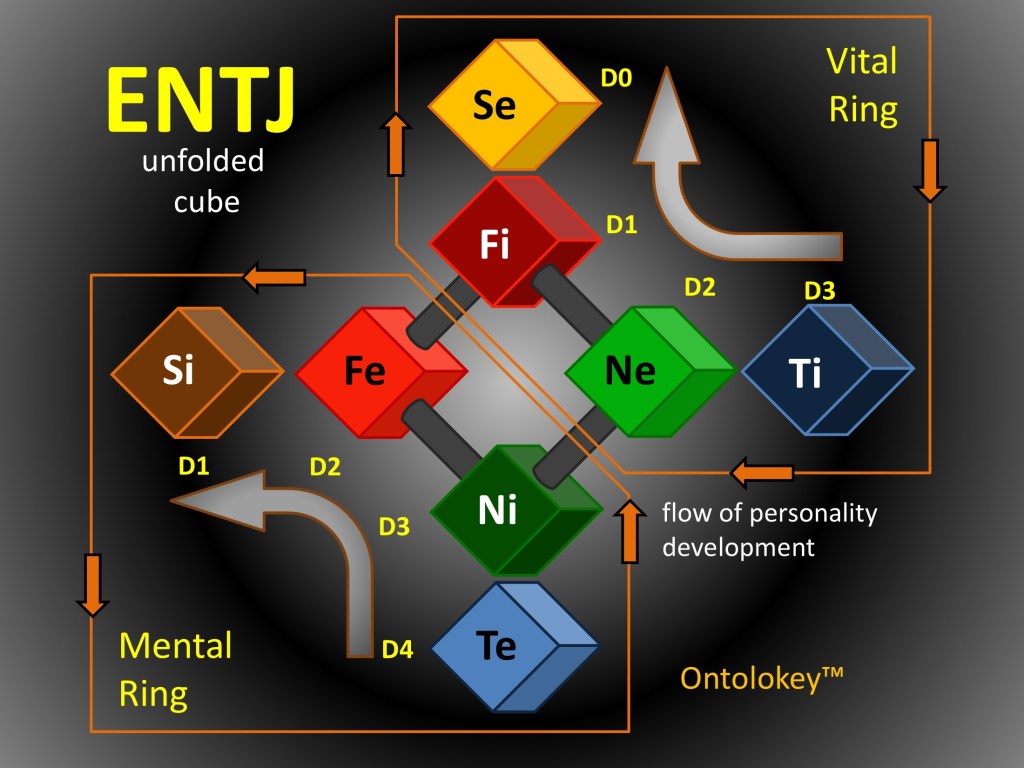
From Mastery of the Outer World to Mastery of the Self
The ENTJ is often recognized through the visible architecture of competence: strategic intelligence, decisiveness, ambition, leadership, organizational power, and an almost instinctive capacity to convert complexity into direction. Extraverted Thinking (Te) gives the personality a strong orientation toward external effectiveness, while Introverted Intuition (Ni) provides the inner trajectory that allows action to be guided by long-range patterns, consequences, and emerging possibilities. In its mature form, this combination can make the ENTJ an exceptional builder of systems, institutions, enterprises, strategies, and collective achievements, because the personality does not merely perceive problems but instinctively searches for the structure that could replace them. Yet the same psychological configuration that makes the ENTJ formidable in the outer world can become restrictive when it acquires authority over domains that cannot be mastered through strategy alone. The central developmental question is therefore not how the ENTJ can become even more efficient, powerful, decisive, or accomplished, but what happens when effectiveness itself becomes the organizing principle of the inner life.
From the perspective developed through Ontolokey, personality can be understood as a living psychological landscape rather than as a fixed collection of traits: different functions occupy different positions within consciousness, some highly developed and familiar, others less accessible, vulnerable, unconscious, or experienced indirectly through projection and compensation. The Ontolokey Cube gives this architecture a spatial form, transforming the abstract relationship among psychological functions into something that can be mentally navigated, while its developmental orientation invites the individual to ask not merely what comes naturally but what has remained unseen, distrusted, neglected, or psychologically difficult. For the ENTJ, this perspective is particularly consequential because the personality’s strongest functions can generate such a compelling sense of coherence that the individual may gradually mistake the effectiveness of a particular cognitive instrument for the completeness of consciousness itself. The shadow therefore does not begin where the ENTJ becomes weak; it begins where strength becomes exclusive, where Te becomes not merely a function but an identity, Ni becomes not merely intuition but certainty, and achievement begins to carry the psychological burden of self-worth, security, meaning, and emotional protection. Individuation consequently requires not the destruction of the commanding personality but its enlargement, so that what was previously unconscious can enter awareness without forcing the ENTJ to surrender the very capacities through which it has learned to shape reality.
The developmental path described in this essay follows the specific Ontolokey progression of the ENTJ through the Mental Ring and the Vital Ring, moving gradually from more developed toward less developed psychological functions rather than attempting to leap directly into the deepest shadow. Within the Mental Ring, Te occupies D4 as the dominant function, Ni occupies D3 as the auxiliary function, Fe occupies D2 as the Anima/Animus function, and Si occupies D1 as the vulnerable Toddler function; within the Vital Ring, Ti begins at D3 as the Sibling function, followed by Ne at D2 as the Golden Shadow, Fi at D1 as the inferior function, and finally Se at D0 as the archaic or childlike Blindspot. The essential principle is developmental sequence: the ENTJ first strengthens the auxiliary Ni until it approaches the maturity of Te, then begins the deeper individuation process by opening the Vital Ring through Ti, while the subsequent functions become progressively accessible as consciousness is capable of tolerating and integrating the information they contain. This movement may be imagined as an iceberg slowly turning upon itself: what was once submerged begins to rise into consciousness, and the personality gradually encounters its own forgotten emotional, bodily, relational, imaginative, and vulnerable dimensions until the original dominant function can return to the surface in a transformed relationship with the whole. In this sense, healing through wholeness does not mean becoming someone other than an ENTJ; it means becoming an ENTJ who is no longer unconsciously imprisoned by the psychological conditions that once made strength necessary.
The ENTJ Psychological Architecture: Strength as the Beginning of Development
The psychological architecture of the ENTJ begins with an unusual concentration of developmental energy in Extraverted Thinking (Te), the D4 dominant function of the Mental Ring. Te naturally turns attention toward the external world of structure, consequence, standards, organization, measurable effectiveness, and purposeful action, which is why the ENTJ often experiences reality as something that can and should be shaped rather than merely observed. This orientation produces the familiar ENTJ qualities of decisiveness, strategic leadership, directness, high expectations, intellectual confidence, and an instinctive willingness to assume responsibility when circumstances appear disorganized or directionless. At its healthiest, Te is not simply a hunger for control but a capacity to convert intention into reality, to distinguish what matters from what does not, and to create structures in which people and resources can move toward a meaningful objective. The difficulty begins only when this exceptionally developed function gradually ceases to be experienced as one psychological instrument among several and becomes the implicit judge of all experience, because whatever cannot be organized, measured, optimized, or rationally justified may then appear inferior, irrational, inefficient, or irrelevant. Ontolokey’s analysis of the ENTJ shadow identifies precisely this reversal: the strength that originally enables mastery of complexity can become the psychological framework through which complexity itself is prematurely reduced.
For this reason, the first developmental task of the ENTJ is not to weaken Te but to understand its proper psychological sovereignty. A mature Te can make decisions without needing every decision to confirm the superiority of the person making it; it can impose structure without requiring every human being within that structure to surrender autonomy; and it can pursue excellence without turning excellence into a moral measure of human worth. The crucial distinction is between using effectiveness and identifying with effectiveness, because the latter creates a subtle psychological equation in which competence becomes security, achievement becomes identity, and control becomes protection against uncertainty. Once this equation is established, failure can be tolerated as a technical problem because technical problems can be solved, whereas emotional helplessness becomes far more threatening because it exposes the limits of competence itself. The ENTJ may therefore become extraordinarily resilient in the face of external adversity while remaining unexpectedly vulnerable to situations involving rejection, dependence, emotional ambiguity, betrayal, or the possibility of being unable to repair what matters most. The shadow is consequently not an absence of emotion but a dissociation from the emotional information that cannot easily be incorporated into Te’s preferred language of action and resolution.
The first great movement toward wholeness therefore occurs through Ni, the D3 auxiliary function of the Mental Ring, because Ni teaches Te that not everything important is immediately visible at the level of external facts. Whereas Te asks how reality can be organized and acted upon, Ni searches beneath appearances for patterns, trajectories, symbolic meanings, and the deeper direction toward which events are moving; the ENTJ becomes significantly more mature when these two functions cease competing for authority and begin forming a conscious partnership. In Ontolokey’s formulation, Ni represents the inner visionary dimension that prevents the ENTJ from becoming merely a tactical executor, because strategy without an underlying vision can become an endless sequence of successful actions without a sufficiently examined reason for performing them. Developing Ni toward D4 therefore means learning to pause before acting, to distinguish urgency from importance, and to allow an emerging pattern to become visible before imposing a solution upon it. This is also the psychological beginning of the great iceberg movement: once the dominant personality discovers that its own conscious model of reality is incomplete, the unconscious is no longer merely an obstacle to be controlled but becomes a source of information that consciousness requires for its own completion.
The maturation of Ni changes the ENTJ’s relationship with certainty in a particularly important way, because genuine intuition does not merely reinforce an existing theory; it can reveal that the theory itself must change. A Te-dominant ENTJ can easily become attached to conclusions because conclusions permit action, while Ni introduces a different kind of intelligence in which ambiguity may need to remain open until a deeper pattern becomes discernible. When Ni is sufficiently developed, the ENTJ begins to recognize that being strategically intelligent does not mean being omniscient, and that a strong model remains a model rather than becoming reality itself. This distinction creates the psychological space necessary for the next developmental movement, because only a personality capable of questioning its own framework can safely encounter functions that do not speak the language of efficiency, control, or strategic certainty. The development from Te toward Ni therefore represents much more than an improvement in strategic sophistication: it is the transition from unconscious certainty to conscious perspective, from immediate mastery toward reflective intelligence, and ultimately from the conviction that reality must be organized according to one’s understanding toward the humility that one’s understanding itself must continue to evolve. Once Ni approaches the maturity of Te, the ENTJ has built the psychological platform from which individuation can genuinely begin.
The Threshold of Individuation: From Ni to the Unconscious
Once Ni has been sufficiently developed, the ENTJ reaches a psychological threshold at which further growth can no longer be achieved simply by becoming more capable within the familiar architecture of Te and Ni. The personality may already possess strategic vision, intellectual authority, organizational competence, and a coherent sense of direction, yet an uncomfortable realization can gradually emerge: the conscious personality is still only the visible portion of a much larger psychological reality. In the developmental model described by Ontolokey, this is the point at which the Vital Ring becomes increasingly significant, beginning with Ti as the D3 Sibling function, while the Mental Ring continues its gradual movement toward Fe and Si. Ti is particularly important because it introduces a form of internal logical examination that does not primarily ask whether an idea works in the external world, but whether the internal structure of the idea is coherent in its own right. For an ENTJ, this can be disconcerting because Te is accustomed to judging thought according to usefulness, applicability, results, and objective consequences, whereas Ti can insist upon distinctions that have no immediate practical payoff. Its developmental value lies precisely there: it teaches the ENTJ that not every truth needs to become an instrument, and that understanding can possess intrinsic value even before it produces an outcome. The emergence of Ti therefore begins to loosen the unconscious identification between knowing and controlling, opening a space in which the personality can observe its own mental machinery rather than continually using that machinery to transform the external world.
This transition also changes the meaning of the word “strength.” The young or psychologically one-sided ENTJ may understand strength primarily as the capacity to withstand pressure, make difficult decisions, remain composed, overcome obstacles, and continue moving when others hesitate, but individuation gradually reveals another form of strength that is initially much less comfortable: the capacity to remain psychologically present when there is nothing immediately useful to do. Ti contributes to this development by creating an internal laboratory in which assumptions can be examined without the pressure to defend them through achievement or external validation. The ENTJ begins to ask questions such as whether a conclusion is actually true or merely useful, whether a judgment is genuinely objective or contaminated by personal investment, and whether a preferred strategy reflects reality or simply reinforces an established identity. Such questioning can temporarily destabilize the personality because the individual is no longer operating exclusively from the psychological position in which competence provides reassurance. Yet this destabilization is not necessarily regression; within the Ontolokey developmental metaphor, it is evidence that the conscious structure is becoming permeable enough for previously excluded material to approach awareness. The Sibling function thus represents an important psychological companion on the road toward individuation, because it does not demand that the ENTJ abandon Te but teaches the dominant function to tolerate an internal perspective that cannot simply be subordinated to external effectiveness.
As this process deepens, the ENTJ may encounter an especially revealing contradiction: the person who is highly skilled at diagnosing the weaknesses of systems can be remarkably resistant to discovering the hidden weaknesses of the self. External problems are attractive because they have boundaries, variables, consequences, and potential solutions, whereas unconscious conflicts often possess none of these qualities at first encounter. A psychological wound may express itself as irritability, impatience, withdrawal, perfectionism, excessive work, contempt for dependency, or an obsessive need to restore order, and Te can interpret these responses as reasonable reactions to an unreasonable environment. The deeper question, however, is why a particular situation possesses such disproportionate emotional power, why certain forms of criticism penetrate more deeply than others, or why a seemingly minor failure can evoke an internal response that is vastly larger than the objective event warrants. This is where cognitive self-observation becomes transformative: instead of immediately correcting the environment or explaining away the reaction, the ENTJ begins to investigate the reaction itself as psychological evidence. The shadow then ceases to be understood merely as something negative or defective and becomes a repository of information about needs, fears, sensitivities, and developmental experiences that the conscious personality previously lacked the language or willingness to acknowledge.
The next movement within the Mental Ring leads toward Fe, the D2 Anima/Animus function, and here the developmental challenge becomes considerably more intimate because the ENTJ encounters the psychological dimension of interpersonal feeling that cannot be reduced to efficiency or strategic relationship management. Fe concerns the emotional atmosphere between people, the expression and modulation of collective feeling, the symbolic significance of emotional participation, and the ability to recognize that human beings do not always need solutions when they are suffering. An ENTJ can understand other people’s emotions intellectually and may even become highly skilled at managing teams, motivating groups, reading social dynamics, or generating enthusiasm, while still remaining partially disconnected from the vulnerable experience of feeling itself. This distinction is crucial because emotional intelligence used strategically is not identical to emotional participation, just as understanding another person’s emotional state is not the same as allowing that state to affect one’s own inner world. The Anima/Animus therefore becomes a particularly sensitive gateway into the unconscious: it can expose the ENTJ to tenderness, relational vulnerability, emotional reciprocity, and the frightening possibility that some of the most important human experiences cannot be optimized without being diminished. Development here does not mean becoming emotionally demonstrative for its own sake; it means becoming sufficiently receptive that feeling can be experienced as information rather than automatically converted into a problem requiring immediate resolution.
This is also why the ENTJ’s deeper shadow may remain invisible for many years even while the individual appears exceptionally successful. The more efficiently Te and Ni operate, the more convincingly they can construct a life in which the neglected functions are unnecessary on the surface, because accomplishment can provide structure, relationships can be organized around shared objectives, and emotional discomfort can be displaced into work, strategic activity, intellectualization, or future-oriented ambition. Yet what is excluded from consciousness does not cease to exist; it tends to return indirectly through disproportionate reactions, projections, compulsive behaviors, recurring interpersonal conflicts, or periods in which achievement suddenly loses its ability to provide meaning. Ontolokey’s developmental framework interprets these experiences not simply as obstacles but as invitations to turn the psychological iceberg: what has remained submerged begins demanding recognition precisely because the conscious personality has become sufficiently mature to encounter it. The goal is therefore not to wage war against the shadow, because fighting the shadow merely strengthens the division within the psyche, but to establish a conscious relationship with it in which every previously rejected function can gradually disclose what it has been attempting to communicate. In that sense, individuation becomes an act of psychological reconciliation: the ENTJ does not become less powerful by meeting the unconscious, but increasingly understands why certain forms of power were necessary, what they protected against, and what aspects of the self were sacrificed in order to obtain them.
The Anima/Animus and the Wound Beneath Competence
The development of Fe from D2 toward greater consciousness marks one of the most consequential transitions in the ENTJ’s individuation because it brings the personality into contact with a domain in which competence offers considerably less protection. Fe represents the capacity to participate consciously in emotional reality rather than merely to understand, regulate, influence, or organize it, and for the ENTJ this distinction can expose a deeply guarded psychological layer beneath the confident exterior. An ENTJ may be capable of commanding a room, motivating an organization, negotiating conflict, or identifying precisely what another person should do next, yet none of these abilities necessarily answers the more vulnerable question of what happens inside the ENTJ when another person’s pain cannot be fixed. The temptation is often to translate feeling into action: sadness becomes a problem to solve, uncertainty becomes a decision to make, interpersonal tension becomes a conflict to resolve, and vulnerability becomes something that should be overcome as quickly as possible. Fe begins to heal this pattern by introducing the possibility that emotional experience does not always require intervention; sometimes it requires recognition, shared presence, and permission to exist. In this developmental stage, the ENTJ discovers that emotional receptivity is not the opposite of strength but a different form of perceptual intelligence, one capable of detecting meanings that disappear when experience is reduced exclusively to what can be acted upon. (ontolokey.com)
The Anima/Animus is particularly sensitive because it touches precisely those psychological qualities that the conscious ENTJ may have learned to subordinate in the pursuit of effectiveness. The individual may have received implicit or explicit messages throughout life that being strong means not needing reassurance, not displaying uncertainty, not allowing emotions to interfere with decisions, and not permitting personal sensitivity to compromise performance. Over time, these adaptations can become so successful that the ENTJ genuinely believes emotional independence is simply an aspect of personality rather than a psychological strategy that once served a protective function. The unconscious, however, remembers what consciousness excludes, and the neglected emotional dimension may therefore emerge through unusually intense reactions to rejection, disrespect, abandonment, humiliation, disloyalty, emotional coldness, or the feeling of being misunderstood. What appears externally as anger may sometimes contain grief; what appears as contempt may conceal disappointment; what appears as impatience may protect against helplessness; and what appears as indifference may be an attempt to prevent attachment from creating vulnerability. The developmental task is not to reinterpret every strong reaction as hidden trauma, but to become curious about the disproportion between event and response, because disproportion can reveal where an old psychological wound has been activated by a present circumstance.
This is where the idea of cognitive self-healing becomes particularly meaningful within the Ontolokey framework. When an ENTJ learns to observe an emotional reaction rather than immediately obeying it or suppressing it, the reaction becomes psychologically legible, and what was previously experienced as an inexplicable weakness can become understandable as the expression of a less-developed function. The person may begin to recognize that a certain criticism hurts because it touches a deeply held fear of inadequacy, that an apparently irrational need for control intensifies when emotional security is threatened, or that an excessive attachment to achievement developed partly because accomplishment once provided an environment in which worth seemed undeniable. Such recognition does not magically erase the underlying vulnerability, but it changes the relationship to it: the ENTJ no longer has to despise the sensitive part of the self simply because that part cannot perform according to Te’s standards. Understanding also creates the possibility of forgiveness, both toward oneself and toward others, because behavior that once appeared inexplicable can be situated within a larger developmental history of unmet needs, defensive adaptations, misunderstandings, and limited psychological resources. In this sense, consciousness becomes therapeutic not because cognition replaces feeling, but because cognition creates enough understanding for feeling to be integrated rather than exiled.
The movement toward Fe also forces the ENTJ to confront one of its most subtle shadow tendencies: the transformation of relationships into systems of utility. This does not mean that ENTJs are incapable of genuine affection or loyalty; rather, their natural orientation toward goals can cause them to unconsciously evaluate relationships according to contribution, reliability, competence, shared direction, or future potential. When this tendency becomes rigid, people can begin to be experienced primarily according to what they enable, obstruct, represent, or require, while the irreducible mystery of the individual person becomes secondary to the function that person occupies within the ENTJ’s psychological and practical world. Mature Fe introduces a corrective by teaching that a relationship can possess value even when it produces no measurable advantage, that another person’s subjective reality does not become less legitimate because it is inefficient, and that love cannot be reduced to loyalty demonstrated through performance. This can be profoundly liberating because the ENTJ is eventually permitted to discover that intimacy does not have to be earned through usefulness. To be loved while failing, while uncertain, while emotionally exposed, or while temporarily unable to contribute according to one’s usual standards is to encounter a form of human acceptance that achievement alone can never provide.
As Fe becomes integrated, the ENTJ’s leadership itself can undergo a profound transformation because authority begins to emerge less from force of will and more from psychological presence. The immature expression of Te may assume that people improve when expectations become clearer, standards become higher, and consequences become more explicit, whereas an increasingly integrated ENTJ recognizes that human beings also develop through belonging, emotional safety, recognition, and the experience of being understood. This does not require abandoning standards or becoming permissive; rather, it allows firmness and humanity to coexist without one cancelling the other. The ENTJ can learn to distinguish compassion from weakness, emotional expression from emotional chaos, and receptivity from passivity, thereby escaping the false choice between being powerful and being sensitive. The result is a more complete form of authority in which the leader does not merely move people toward a destination but understands something of the inner worlds of the people making that journey possible. The same transformation occurs internally: instead of demanding that every part of the psyche justify itself through productivity, the ENTJ gradually learns to grant psychological legitimacy to those dimensions that simply need to be felt, witnessed, understood, and integrated.
Si and the Toddler Within: Vulnerability, Memory, and the Limits of Control
After the Anima/Animus function has begun to develop, the ENTJ’s movement through the Mental Ring eventually approaches Si, the D1 Toddler function, which represents an even more vulnerable layer of psychological experience. Si brings consciousness toward bodily sensation, personal continuity, familiarity, concrete memory, accumulated experience, and the subtle internal signals through which the organism communicates comfort, discomfort, exhaustion, safety, and threat. For an ENTJ accustomed to living through goals, possibilities, strategic decisions, and future-oriented movement, this domain can feel frustratingly slow because the body does not negotiate according to deadlines and the past cannot be reorganized simply because a different future would be more convenient. The Toddler quality of Si is significant because it symbolizes a part of the personality that does not want to conquer the world but wants to feel safe within it, and that need can be deeply embarrassing to a consciousness that has built its identity around self-command. The ENTJ may therefore discover that what has been interpreted as laziness, weakness, oversensitivity, or lack of discipline is sometimes the neglected language of an organism that has been pushed beyond its limits for too long. Developing Si does not mean becoming passive or retreating from ambition; it means learning that sustained power requires contact with the conditions under which the organism itself can remain whole.
This encounter can expose the hidden cost of the ENTJ’s relationship with endurance. Because Te naturally rewards visible accomplishment and Ni is oriented toward what lies ahead, the ENTJ can become extraordinarily skilled at postponing immediate discomfort in service of a larger objective, sometimes to the point at which postponement becomes a way of life. Fatigue can be rationalized as temporary, emotional pain as irrelevant, physical signals as inconvenient, and the need for rest as an obstacle to progress, particularly when the individual has repeatedly experienced success precisely because of an exceptional ability to push through resistance. Yet the body records what consciousness chooses not to register, and neglected signals may eventually return through exhaustion, irritability, loss of motivation, psychosomatic tension, or an increasingly mechanical relationship with one’s own life. Si offers a corrective because it asks the ENTJ to notice what is actually happening rather than what should be happening according to the plan. This introduces a form of temporal consciousness that is less concerned with the next milestone and more concerned with continuity: what has happened to me, what does my body remember, what environments restore me, what patterns repeatedly exhaust me, and which apparently insignificant experiences have accumulated into a major psychological burden? Through such questions, the ENTJ begins to recognize that the self is not merely the agent who executes a plan but also the organism that has been living through every consequence of that plan.
The Toddler function also has a profound relationship with early experience because the most vulnerable parts of personality often retain emotional associations that adult rationality cannot simply command into disappearance. A present-day situation may therefore awaken an old feeling of being powerless, overlooked, controlled, abandoned, or insufficient, even when the conscious adult knows intellectually that the present circumstances are entirely different. The ENTJ’s first instinct may be to reject such a response as irrational, but this rejection can perpetuate the division because the vulnerable part is not asking for an intellectual argument about why it should feel differently. It is asking to be recognized as part of the individual’s history. Through the gradual development of Si, the ENTJ can begin reconstructing personal continuity: not merely remembering events, but understanding how repeated experiences shaped expectations about safety, competence, dependence, trust, and self-reliance. This can explain why certain situations remain disproportionately activating and why certain forms of vulnerability may feel almost intolerable despite an otherwise formidable adult personality. The objective is not to become trapped in childhood or to endlessly reinterpret the past, but to retrieve the psychological information that was never fully integrated so that the adult self can finally respond to old emotional patterns with present-day awareness rather than unconsciously repeating them.
There is also a deeper existential lesson within the movement toward Si: reality cannot be mastered solely by moving beyond it. The ENTJ’s natural psychological orientation is toward transformation, improvement, expansion, and future possibility, which makes stagnation particularly uncomfortable and can produce an almost compulsive relationship with progress. Si introduces the opposite movement, asking the individual to inhabit what already exists long enough to perceive its meaning, to appreciate continuity without automatically trying to replace it, and to recognize that not every imperfect condition is a problem requiring redesign. This can be surprisingly difficult for a personality whose identity has been strengthened through overcoming obstacles, because acceptance may initially resemble surrender and preservation may resemble lack of ambition. With greater consciousness, however, the ENTJ can distinguish acceptance from resignation: accepting an experience means allowing reality to be known before deciding what should be done with it. That distinction is psychologically decisive because the ability to remain with an experience without immediately transforming it creates the inner space in which previously unconscious material can become conscious. The Toddler therefore becomes less a symbol of weakness than an invitation to develop a secure internal relationship with the vulnerable self that Te once believed it had to outgrow.
When Si is gradually integrated, the ENTJ’s relationship with achievement can become less compulsive because accomplishment no longer has to compensate for an unconscious inability to rest, receive, remember, or simply exist. The person may continue to pursue demanding goals, but the psychological meaning of those goals changes: success becomes an expression of capacity rather than proof of worth, and discipline becomes a conscious choice rather than an automatic defense against feelings of inadequacy or helplessness. This is an important stage in the turning of the psychological iceberg because the ENTJ begins to recover not only what was emotionally neglected but also what was concretely lived through and subsequently pushed aside in the relentless movement toward the future. The past can then become a source of information rather than a prison, the body can become an ally rather than an inconvenient limitation, and vulnerability can become something that deserves protection rather than contempt. In this way, the progression from Te through Ni and Fe toward Si gradually transforms the meaning of strength itself: strength no longer means that nothing can reach the ENTJ, but that whatever reaches the ENTJ can be consciously encountered, understood, and integrated without destroying the coherence of the whole.
Entering the Vital Ring: Ti and the Discovery of the Inner Witness
With the Mental Ring sufficiently developed, the ENTJ reaches the point at which individuation can extend more decisively into the Vital Ring, beginning with Ti at D3 as the Sibling function. This transition is important because the previous stages have primarily involved refining the conscious architecture through which the ENTJ already understands the world, whereas the Vital Ring begins to expose dimensions of psychological life that have been less available to deliberate control. Ti functions as an internalizing movement of thought, examining definitions, principles, distinctions, premises, and conceptual consistency from within rather than primarily evaluating their effectiveness in the external environment. The ENTJ may therefore experience Ti as both familiar and strangely alien: familiar because it is still a thinking function, yet alien because its purpose is not necessarily to produce a decision, construct a system, or achieve an externally visible result. As the Sibling function, Ti can be approached as a companion rather than an adversary, allowing the ENTJ to cultivate a private intellectual relationship with ideas in which usefulness temporarily becomes secondary to precision and truth. This creates an essential psychological separation between “what works” and “what is,” a distinction that can profoundly alter how the ENTJ understands personal motives, interpersonal judgments, strategic assumptions, and even the identity that has been constructed through years of achievement. (ontolokey.com)
The deeper significance of Ti is that it can become an inner witness to the operation of Te itself. Instead of allowing the dominant function to remain the unquestioned authority, the ENTJ begins examining how conclusions are produced, which premises are being accepted without inspection, and where personal investment may have entered what appears to be objective reasoning. This is especially valuable because the ENTJ can possess such formidable confidence in analytical judgment that disagreement is sometimes interpreted as evidence that the other person has failed to understand the situation rather than as an opportunity to examine the ENTJ’s own model. Ti introduces a quieter form of intellectual humility: not the humility of assuming oneself wrong, but the discipline of being willing to investigate precisely why one believes oneself right. The distinction is psychologically important because genuine self-examination cannot occur if introspection is merely another instrument for proving that the existing self-concept is correct. Ti can therefore expose hidden rationalizations behind behavior that Te would otherwise defend as necessary, including the possibility that an apparently strategic decision was partly motivated by wounded pride, fear of dependency, desire for recognition, avoidance of intimacy, or an unconscious need to maintain control. When thinking becomes capable of turning back upon its own motives, cognition ceases to be merely an instrument of the ego and becomes an instrument of individuation.
This stage can also produce a temporary identity crisis because the ENTJ may discover that some of the beliefs previously experienced as unquestionable principles were actually adaptations. A conviction such as “people must be competent,” “emotions should not interfere with decisions,” “I can always handle things myself,” or “if something is important enough, I should be able to force myself through it” can appear rational because it has repeatedly produced results. Yet psychological truth requires a more demanding question: what did this belief make possible, and what did it make impossible? Ti can hold the contradiction long enough to see that a principle can be simultaneously useful and defensive, adaptive and limiting, empowering and costly. The ENTJ may discover, for example, that extreme independence created genuine resilience while also preventing the development of reciprocal dependence, or that exceptionally high standards produced excellence while simultaneously making ordinary human imperfection emotionally intolerable. Such discoveries can be uncomfortable because they undermine the simple narrative in which strengths are purely strengths and weaknesses are purely defects. Individuation replaces that binary with a more mature understanding in which every psychological adaptation has a history, every defense has served a purpose, and every strength can become pathological when it is required to perform a function for which it was never designed.
The development of Ti also prepares the ENTJ for the Golden Shadow represented by Ne at D2, because once internal reasoning has become sufficiently flexible, consciousness becomes capable of entertaining possibilities that do not conform to its established strategic map. Ne introduces multiplicity, alternative interpretations, unexpected associations, divergent possibilities, and the recognition that reality may contain more potential than the current Ni vision has captured. For a personality strongly oriented toward strategic convergence, this can initially feel like unnecessary dispersion, because Ni tends to compress possibilities into an emerging trajectory while Te seeks to act upon that trajectory. Ne asks the opposite question: what if the conclusion is not yet complete, what else could this mean, and which possibility has been excluded merely because it did not fit the current model? Its Golden Shadow quality makes this particularly fascinating because ENTJs may sometimes recognize and even admire expansive possibility-generation in others while experiencing it internally as something less trustworthy or less disciplined. Yet when integrated consciously, Ne can prevent strategic vision from becoming strategic tunnel vision, allowing the ENTJ to retain direction without becoming imprisoned by the first compelling interpretation of the future. The movement from Ti toward Ne therefore expands the inner field of consciousness, transforming the individual’s relationship with uncertainty from something that must be eliminated into something that can sometimes be psychologically productive.
This expansion is essential for healing because many unconscious conflicts survive through rigid interpretations of the past and present. If the ENTJ believes that a painful event has only one meaning—“I was weak,” “I was betrayed because I trusted incorrectly,” “I failed because I was not good enough,” or “I must never allow that situation to happen again”—then the psychological system organizes itself around preventing a repetition of that interpretation. Ne introduces alternative narratives without necessarily denying the original experience: perhaps the failure revealed a developmental limitation rather than personal worthlessness, perhaps another person’s behavior reflected their own unresolved conflict rather than the ENTJ’s inadequacy, perhaps vulnerability was not the cause of the injury but the condition that made the relationship meaningful in the first place. These alternatives can loosen the unconscious identification with a single defensive story. In this way, the Vital Ring begins doing something the Mental Ring alone cannot accomplish: it changes not merely what the ENTJ knows, but the number of psychological realities the ENTJ is capable of holding simultaneously. That capacity for multiplicity becomes one of the foundations of genuine wholeness, because the integrated personality no longer needs to destroy contradictory information in order to preserve a coherent identity.
Ne as the Golden Shadow: Releasing the Prison of a Single Future
The movement from Ti toward Ne marks a further loosening of the ENTJ’s attachment to psychological certainty, because Ne at D2 as the Golden Shadow function introduces an intelligence of possibility that can exist alongside, rather than beneath, the dominant strategic orientation. The ENTJ’s natural combination of Te and Ni is exceptionally powerful when a situation requires a coherent direction, but precisely because it is so effective at identifying a trajectory and mobilizing resources toward it, it can become psychologically difficult to remain open once a convincing vision has been established. Ne interrupts this closure by multiplying perspectives, alternatives, associations, interpretations, and potential futures, thereby challenging the unconscious assumption that seeing a pattern necessarily means having exhausted the possible meanings of that pattern. The Golden Shadow is not simply a repository of weakness; it contains qualities that can be strangely attractive, even enviable, because they represent capacities the conscious personality recognizes as valuable without necessarily experiencing them as naturally available. An ENTJ may therefore admire people who effortlessly improvise, entertain contradictory possibilities, change direction without experiencing it as failure, or discover opportunities in situations that initially appear chaotic, while simultaneously judging such behavior as unfocused or inefficient. Conscious integration of Ne allows the ENTJ to appropriate the underlying psychological freedom without abandoning strategic discipline, transforming flexibility from something associated with indecision into a higher-order capacity to revise the strategy when reality demands it.
This becomes particularly important when the ENTJ encounters failure, because failure can threaten not only a particular objective but the coherence of the future-oriented identity constructed around that objective. Ni often invests deeply in an envisioned trajectory, and Te subsequently organizes reality around making that trajectory concrete; when the expected future collapses, the resulting psychological impact can therefore be considerably greater than the external event alone would suggest. An ENTJ may respond by intensifying effort, searching for the decisive error, restructuring the plan, assigning responsibility, or immediately constructing a replacement objective, all of which can be adaptive responses when circumstances genuinely require action. Yet if the psychological system cannot tolerate the possibility that the original vision itself was incomplete, the response becomes compulsive rather than strategic, because the individual is attempting to restore not merely the goal but the certainty that made the goal psychologically safe. Ne offers another path by allowing failure to generate possibilities rather than merely corrections. A collapsed plan can become information about an unexplored direction, a relationship that ended can reveal an aspect of the self previously neglected, and an unexpected limitation can expose capacities that would never have emerged under conditions of uninterrupted control. The future then becomes less a predetermined destination and more an evolving field of possibilities in which intelligence consists partly in remaining responsive to what reality reveals.
The Golden Shadow also has a significant relationship with creativity because creativity requires the mind to tolerate incomplete structures without immediately forcing them into a final form. For an ENTJ, the impulse to organize can arrive so quickly that an emerging idea is sometimes evaluated before it has had sufficient psychological space to develop, especially when the idea initially appears impractical, emotionally ambiguous, or unrelated to the established objective. Ne can teach the ENTJ to protect the incubation period in which apparently useless information may unexpectedly connect with something meaningful. This is not an argument for abandoning standards or allowing endless distraction; rather, it represents a more sophisticated understanding of intelligence in which divergent exploration and convergent execution are recognized as different phases of the same creative process. The ENTJ can remain decisive while deliberately creating spaces in which decisiveness is temporarily suspended, because the purpose of such suspension is not avoidance but information acquisition. Over time, this produces a more flexible form of strategic thinking in which the individual is able to generate alternatives before selecting among them, to recognize opportunities outside the original plan, and to distinguish genuine commitment from unconscious attachment to being right about the future. Such flexibility can make the ENTJ’s leadership more adaptive precisely because it preserves direction without requiring reality to conform perfectly to the initial vision.
Ne also contributes to interpersonal healing by weakening the tendency to reduce another person’s behavior to a single interpretation. When an ENTJ feels betrayed, disappointed, disrespected, or obstructed, the mind can rapidly construct a coherent explanation for what happened, particularly when Te and Ni cooperate in searching for motive, pattern, and consequence. The danger is that a coherent explanation can become psychologically indistinguishable from certainty, and once another person’s motives have been assigned, subsequent evidence may simply be interpreted through the existing narrative. Ne introduces alternative hypotheses and therefore creates a psychological interval between perception and judgment: perhaps the person was acting from fear rather than malice, perhaps the conflict arose from incompatible needs rather than deliberate disrespect, perhaps the ENTJ’s own behavior contributed to a dynamic that was invisible from inside the original perspective. None of these alternatives needs to excuse harmful behavior or invalidate legitimate boundaries; their function is to prevent consciousness from becoming trapped inside a single emotionally satisfying explanation. This capacity becomes especially valuable in forgiveness because genuine forgiveness does not require declaring an injury insignificant, but it does require freeing oneself from the psychological necessity of carrying one interpretation of that injury forever.
At its deepest level, the integration of Ne allows the ENTJ to relinquish one of the most seductive forms of control: control over meaning itself. The mature individual begins to understand that an experience may have several meanings across different stages of life, and that the significance assigned to an event at twenty may be radically different from the meaning understood at forty, sixty, or later. This does not make truth arbitrary; rather, it recognizes that consciousness develops and therefore acquires the capacity to perceive dimensions of experience that were previously inaccessible. The turning iceberg becomes particularly visible here because the ENTJ begins to see that what once appeared beneath the surface as failure, vulnerability, chaos, or wasted time may later reveal itself as an essential developmental passage. Ne thus prepares the way for Fi, the D1 inferior function, because once multiple interpretations are possible, the ENTJ can finally begin asking a question that strategic intelligence alone cannot answer: not merely “What could happen?” but “What does this mean to me, and what do I genuinely value?” The movement toward wholeness consequently becomes increasingly personal, moving from the architecture of reality toward the inner authority of subjective meaning.
Fi as the Inferior Function: The Discovery of Inner Value
The movement from Ne toward Fi represents one of the most intimate stages of ENTJ individuation because Fi at D1 brings consciousness toward the private interior world of personal values, emotional authenticity, moral boundaries, attachment, loyalty, and the subjective meaning of individual experience. The ENTJ can become exceptionally skilled at determining what is effective, what is strategically necessary, what produces the desired outcome, and what direction is most promising, yet none of these questions automatically reveals what the individual personally loves, cannot betray, or would choose even if no external reward followed. Fi therefore confronts the ENTJ with a domain in which there is no universally persuasive metric, because subjective value cannot always be demonstrated through evidence, efficiency, consensus, or measurable consequence. This can initially feel uncomfortable because the ENTJ’s psychological authority has traditionally been strengthened by reasons that can be articulated and defended, whereas Fi may communicate through an inward sense of resonance, aversion, loyalty, integrity, or violation that is difficult to explain to anyone else. The inferior position makes this encounter particularly sensitive: what is consciously underdeveloped can simultaneously possess enormous psychological importance, meaning that the ENTJ may either dismiss personal feeling altogether or become unexpectedly intense when deeply personal values are touched. The developmental task is therefore not to replace Te’s external judgment with subjective preference, but to allow Fi to establish an internal dimension of value alongside the external dimension of effectiveness.
One of the central discoveries within this process is that a person can succeed according to external criteria while simultaneously betraying something essential within the self. This possibility is often difficult for the ENTJ to recognize because achievement provides concrete evidence that a chosen path is working, while internal dissatisfaction can appear irrational when the objective indicators remain positive. Yet Fi asks a fundamentally different question from Te: even if this works, is it mine; even if this is successful, is it aligned with what I actually value; even if everyone respects the achievement, can I respect myself within it? Such questions can destabilize a highly accomplished identity because they remove external validation from the center of the psychological equation. The ENTJ may discover that certain ambitions were inherited from expectations, competition, status structures, parental messages, cultural ideals, or an unconscious need to prove something that was never consciously chosen. Conversely, the individual may discover that a seemingly impractical desire has profound personal significance and therefore deserves protection precisely because it cannot be justified through conventional measures of success. Fi development consequently introduces the distinction between achievement and fulfillment, reminding the ENTJ that a life can be objectively impressive while subjectively alienating if the person who achieved it has gradually disappeared behind the role of achiever.
The inferior function can also reveal why the ENTJ sometimes reacts disproportionately to questions of loyalty, betrayal, fairness, authenticity, or personal recognition. When Fi is insufficiently conscious, personal values may remain unarticulated until they are violated, at which point the reaction can arrive with unexpected intensity because the psychological system has few intermediate channels through which to communicate the importance of what has been touched. An ENTJ who normally appears emotionally controlled may therefore become remarkably uncompromising when a deeply held value is threatened, and the person may struggle to understand why the issue feels so much larger than the surrounding circumstances suggest. Rather than treating such reactions merely as irrational eruptions, individuation asks what value is attempting to become conscious through them. Anger may be protecting dignity, resentment may be revealing an unmet expectation of reciprocity, jealousy may expose attachment, and grief may demonstrate that something mattered far more deeply than the conscious personality had permitted itself to admit. Once these underlying values can be named, the emotional intensity often becomes more intelligible because the ENTJ is no longer fighting an undefined internal force but entering into a relationship with a previously neglected part of the self.
Fi development further transforms the ENTJ’s relationship with other people because it introduces the recognition that individuals possess an interior sovereignty that cannot legitimately be managed from the outside. Te naturally notices competence and consequence, Ni perceives patterns and trajectories, Fe learns to recognize shared emotional fields, and Ne opens alternative interpretations, but Fi asks the ENTJ to encounter the irreducible individuality of another human being. This means learning that another person’s values may differ fundamentally from one’s own without necessarily being inferior, irrational, or in need of correction, provided those values do not violate legitimate boundaries. Such recognition can be challenging for a personality that instinctively sees opportunities for improvement, because genuine respect sometimes requires allowing another person to make a choice that the ENTJ considers inefficient or misguided. The mature response is not indifference but differentiation: I can understand your decision, disagree with it, maintain my own boundary, and still recognize your right to possess an inner world that belongs to you. This same principle must eventually be applied inwardly, allowing the ENTJ to discover that the self is not a project whose every feature must be optimized according to an external standard.
The healing potential of Fi becomes especially powerful when combined with the previously developed functions, because the ENTJ can now bring strategic intelligence into the service of values rather than using values merely to justify strategy. Te can provide implementation, Ni can provide direction, Ti can examine coherence, Ne can preserve alternatives, Fe can recognize relational consequences, and Si can remain attentive to embodied and historical experience, while Fi answers the question of what deserves to be served by all of them. At this point, ambition can become more authentic because it is no longer driven exclusively by the need to prove capability, and leadership can become more principled because decisions are increasingly anchored in consciously examined values rather than only in effectiveness. This is also where self-forgiveness can deepen: the ENTJ may begin to understand that earlier versions of the self acted according to the psychological resources available at the time, sometimes choosing control because vulnerability was frightening, achievement because recognition felt necessary, or emotional distance because intimacy had become associated with danger. Understanding these adaptations does not absolve every harmful action, but it makes genuine responsibility possible because responsibility no longer requires self-contempt. Fi ultimately teaches the ENTJ that wholeness requires an inner answer to the question of why one’s power should exist at all, and that the most mature form of strength is not merely the ability to accomplish what one wants, but the ability to know what is worthy of one’s life.
Se as the D0 Blindspot: Embodiment, Instinct, and the Return to Reality
The final and most archaic point of the Vital Ring is Se at D0, the function described in the Ontolokey model as the Blindspot, where development reaches the deepest layer of the ENTJ’s unconscious psychological architecture. Se represents immediate sensory awareness, direct contact with physical reality, spontaneous engagement with the present moment, instinctive perception of one’s surroundings, bodily immediacy, and the capacity to respond to what is actually happening without first translating experience into a strategic model. For an ENTJ whose psychological life is naturally organized around Te’s external structuring and Ni’s orientation toward underlying patterns and future trajectories, this direct encounter with the present can feel almost primitive, because the mind habitually moves beyond immediate experience toward what should be done next or what the current situation means in a larger context. Yet the D0 designation is precisely why Se matters so profoundly: the deepest unconscious layer is often not merely a collection of sophisticated ideas waiting to be understood but a neglected relationship with existence at its most immediate level. The ENTJ may know where life is going while remaining insufficiently aware of how life feels right now, may understand the strategic significance of an environment without noticing its sensory reality, and may pursue the future so relentlessly that the present becomes merely an instrument for reaching it. Integration therefore requires a return to embodied existence, where reality is encountered before it is interpreted, categorized, optimized, or converted into a plan.
This can be especially challenging because Se asks the ENTJ to relinquish a particular kind of psychological distance. Strategic consciousness creates an observing position from which circumstances can be analyzed, anticipated, and manipulated, whereas Se draws awareness directly into the immediacy of sensation and action. The mature integration of this function does not mean becoming impulsive, hedonistic, aggressive, or permanently absorbed in sensory stimulation; rather, it means developing the capacity to perceive the concrete world without the automatic mediation of an abstract objective. A mature ENTJ can therefore notice that a conversation has changed before intellectually determining why, recognize physical exhaustion before it becomes incapacitating, perceive environmental details that previously disappeared beneath strategic thought, and respond to an emerging situation without requiring complete conceptual mastery beforehand. Such presence is psychologically important because unconscious material frequently communicates through the body and through immediate reactions before it becomes available to reflective thought. If the ENTJ has learned to distrust bodily impulses, suppress fatigue, override discomfort, or dismiss instinct whenever it conflicts with a plan, then the body can become the last remaining territory in which the unconscious attempts to make itself heard. Se integration allows consciousness to receive these signals without automatically obeying them, creating a mature dialogue between instinct and judgment rather than a war between impulse and control.
At the deepest level, Se also confronts the ENTJ with mortality and limitation, because physical existence refuses the fantasy of unlimited strategic control. Plans can be revised, systems can be redesigned, markets can be influenced, organizations can be rebuilt, and relationships can sometimes be repaired, but the body has its own rhythms and eventually imposes boundaries that ambition cannot negotiate away. This confrontation can become psychologically transformative when it is no longer interpreted as humiliation but as a condition of being human. The ENTJ may begin to understand that limitation does not invalidate strength and that vulnerability does not contradict dignity; indeed, recognizing limitation can make power more conscious because it separates deliberate agency from omnipotent fantasy. Se therefore completes an important movement that began with the development of Ni: the ENTJ first learned that the visible world contains deeper patterns, and eventually learns that those deeper patterns must still be encountered through a concrete, finite, embodied life. The abstract future and the immediate present are not enemies; they become psychologically complementary when vision is grounded in reality and action remains responsive to what reality actually provides.
The integration of Se can also soften the ENTJ’s relationship with pleasure, spontaneity, and ordinary experience. When life is organized primarily around meaningful objectives, experiences without obvious developmental or productive value may be unconsciously classified as distractions, and the individual can become so accustomed to instrumentalizing time that simply enjoying an experience feels strangely difficult. Yet psychological wholeness requires more than purposeful achievement because the psyche is not sustained exclusively by accomplishment; it also requires moments in which existence is not being evaluated according to future utility. Eating, walking, traveling, physical movement, music, sexuality, nature, craftsmanship, aesthetic perception, and ordinary sensory pleasures can all become ways of returning consciousness to the present rather than merely escaping from it. The significance is not the particular activity but the psychological attitude with which it is approached: the ENTJ learns to experience without immediately converting experience into a result. This can be surprisingly healing because the individual discovers that not every moment needs to contribute to a larger project in order to justify its existence. Presence itself can become valuable, and the self can begin to experience life as something to inhabit rather than merely something to shape.
When Se is finally approached as an integrated rather than feared dimension, the ENTJ’s entire developmental arc begins to converge. Te remains the powerful capacity to organize reality, Ni remains the capacity to perceive direction and meaning, Fe provides greater emotional participation, Si provides continuity and bodily sensitivity, Ti provides internal examination, Ne preserves openness to possibility, and Fi provides personal value and authenticity, while Se anchors all of these functions in the immediate world in which life actually occurs. The iceberg has now turned far enough that the previously submerged dimensions are no longer entirely alien, and the original dominant function can eventually return to the surface without recreating the original psychological imbalance. Te no longer has to defend itself against vulnerability because vulnerability has become conscious; it no longer has to dominate every other function because the other functions have become legitimate sources of information. This is why the final goal of individuation is not a permanent state of shadow activation but a return to the whole: the ENTJ remains recognizably ENTJ, yet the personality is no longer organized around the unconscious exclusion of everything that Te cannot easily control. The journey ends where it began, but the starting point has been transformed, because the dominant function now stands at the center of a much larger psychological field and can finally exercise power without having to carry the entire burden of the self.
The Shadow in Relationships: Projection, Conflict, and the Problem of Forgiveness
The deepest consequences of an incompletely integrated shadow often become visible not in solitary reflection but in relationships, because other people continuously activate precisely those psychological functions that the conscious personality has learned to minimize. The ENTJ may be highly capable of forming alliances, leading groups, maintaining professional networks, and sustaining relationships built around shared goals, yet intimate relationships inevitably introduce forms of uncertainty that cannot be governed by strategy alone. Another person’s emotional needs may be inconsistent, their priorities may differ, their behavior may resist rational explanation, and their attachment may expose vulnerabilities that the ENTJ would prefer to keep under conscious control. When the shadow remains largely unconscious, these encounters can produce projection: qualities rejected within the self are perceived with disproportionate intensity in others, so dependency may be condemned because one’s own dependency is unacceptable, emotionality may be dismissed because one’s own feelings are difficult to tolerate, indecision may provoke contempt because one’s own uncertainty has been suppressed, and perceived weakness may become especially irritating because it touches the vulnerable Toddler dimension within oneself. The psychological paradox is that what most irritates the ENTJ in another person can sometimes point toward a capacity or need that consciousness has not yet granted legitimate status within itself. Shadow integration therefore changes relationships not primarily by teaching the ENTJ how to manage other people more effectively, but by making the individual’s own projections increasingly visible.
This becomes particularly important in conflict because Te can move rapidly toward judgment, diagnosis, and corrective action, while Ni can construct a compelling explanation for why the conflict occurred and where it is likely to lead. Together, these functions can produce extraordinary clarity when the interpretation is accurate, but they can also create a closed explanatory system in which the ENTJ feels that the case has already been solved before the other person’s subjective reality has been fully heard. The development of Fe, Ti, Ne, and Fi gradually introduces friction into this process, and that friction is psychologically healthy because it prevents the first interpretation from becoming an unquestioned verdict. Fe asks what emotional reality exists between the people involved, Ti asks whether the reasoning is internally sound, Ne asks what alternative interpretations remain possible, and Fi asks what personal values have actually been violated or defended. Si and Se add another dimension by bringing attention back to the concrete history of the relationship and the immediate embodied reality of the encounter rather than allowing the conflict to exist solely as an abstract intellectual problem. When these perspectives become available, disagreement no longer needs to culminate automatically in a winner and a loser. The ENTJ can remain firm while becoming more psychologically permeable, recognizing that understanding another person’s perspective does not require surrendering one’s own judgment and that changing one’s interpretation is not equivalent to losing authority.
The question of forgiveness becomes especially significant at this stage because forgiveness is often misunderstood by highly self-reliant personalities as an act of weakness or as an invitation to permit further violation. Within the individuation process, however, forgiveness is better understood as the relinquishment of an unconscious psychological bond to the injury, not as the denial of what occurred or the abandonment of necessary boundaries. When the ENTJ begins understanding the functions involved in the original conflict, it becomes possible to distinguish the event itself from the psychological meanings subsequently attached to it. A betrayal may have been real, yet the conclusion that “I must never trust anyone again” may represent a defensive adaptation rather than an objective truth; a failure may have been painful, yet the conclusion that “I am only valuable when I succeed” may belong to a much older psychological structure. The same principle applies to forgiveness of others: understanding the limitations, fears, defenses, or developmental immaturity behind another person’s behavior does not make the behavior acceptable, but it can release the ENTJ from the necessity of interpreting that behavior as a permanent statement about one’s own worth. The result is a form of psychological freedom in which boundaries can remain intact without hatred needing to maintain them.
Self-forgiveness may be even more difficult because the ENTJ’s internal standards can be severe, especially when competence has become closely associated with identity. The individual may intellectually understand that people make mistakes while unconsciously granting this permission to everyone except the self, because personal failure can activate a deeply embedded fear that the entire structure of competence was fraudulent. Here the inferior Fi and vulnerable Si dimensions become essential: the ENTJ must learn to recognize that the person who made an earlier decision was operating with the awareness, emotional resources, information, and developmental capacity available at that particular point in life. This does not eliminate responsibility, and genuine individuation requires acknowledging where one’s behavior caused harm, but responsibility becomes constructive only when it leads to integration rather than endless self-punishment. The mature question shifts from “How could I have been so weak or foolish?” toward “What was I protecting, what did I not yet understand, and what can I now do differently because I understand it?” Such questioning allows shame to become information rather than identity, transforming the past from a courtroom in which the self is permanently condemned into a psychological archive from which wisdom can be consciously retrieved.
Ultimately, the ENTJ’s relational individuation involves moving from control toward differentiation. Control seeks to make the external environment conform to the internal model, whereas differentiation permits two psychologically distinct realities to coexist without requiring one to annihilate the other. The ENTJ can remain ambitious while accepting another person’s different priorities, remain direct while respecting emotional sensitivity, remain decisive while acknowledging uncertainty, and maintain boundaries while retaining compassion. This is not a softening of personality in the sense of losing structure; it is a strengthening of structure because the personality no longer requires uniformity in order to maintain psychological stability. The integrated ENTJ becomes increasingly capable of asking not only “What should happen?” but also “What is happening inside me as I decide what should happen?” That second question is the doorway through which projection becomes consciousness, conflict becomes information, forgiveness becomes freedom, and relationships become one of the most powerful mirrors through which the previously unconscious self can finally be encountered.
The Shadow of Achievement: When Power Becomes Compensation
One of the most difficult aspects of ENTJ individuation is recognizing that exceptional achievement can sometimes function simultaneously as genuine expression and psychological compensation. The ENTJ’s capacity to build, lead, compete, organize, decide, and overcome obstacles is real, and reducing these qualities to defensive behavior would itself misunderstand the personality; nevertheless, the unconscious can attach additional psychological functions to achievement until success begins carrying burdens it was never designed to carry. Work can become a means of avoiding emotional uncertainty, ambition can become a defense against feelings of inadequacy, leadership can become a way of ensuring that nobody else possesses enough power to threaten the self, and relentless forward movement can prevent the individual from encountering grief, dependency, loneliness, or unresolved fear. Because Te is so effective at producing tangible results, these compensations can remain invisible for a remarkably long time: the person receives external confirmation precisely where the psyche is using achievement to maintain internal equilibrium. This creates one of the central paradoxes of the ENTJ shadow, namely that the same behavior can be simultaneously healthy, productive, admirable, and psychologically defensive. Individuation therefore does not ask whether the ENTJ should stop achieving, but whether achievement remains a free expression of the self or has become an unconscious requirement for feeling worthy, safe, powerful, or alive. (ontolokey.com)
The distinction becomes visible when the ENTJ encounters the possibility of not achieving. A psychologically integrated person can experience disappointment without experiencing the collapse of identity, whereas a less integrated ENTJ may experience failure as evidence that something fundamental about the self has been invalidated. The external event may be small, but the internal meaning can become enormous because it touches an implicit equation: if I am competent, I am secure; if I am successful, I am valuable; if I remain in control, I cannot be humiliated; if I continue moving forward, I do not have to confront what lies behind me. This is where the development of Fi, Fe, Si, and Se becomes essential because these functions provide alternative foundations for identity that do not depend upon continuous performance. Fi teaches intrinsic value, Fe teaches relational belonging, Si teaches continuity and embodied existence, and Se teaches presence in the immediate world rather than perpetual investment in future outcomes. Once these dimensions become conscious, failure can remain painful without becoming existentially annihilating. The ENTJ can say, psychologically rather than merely intellectually, “I failed at something” without unconsciously converting the statement into “I am a failure,” because the self has become larger than the function through which it normally proves its competence.
This transformation also changes the ENTJ’s relationship with rest, because rest can become threatening when activity has been unconsciously serving as emotional regulation. For an individual accustomed to solving problems, a period without pressing objectives can initially expose an unexpected emptiness, agitation, or dissatisfaction that was previously masked by constant movement. The temptation is then to manufacture another challenge, another project, another strategic problem, or another future objective, not necessarily because it is genuinely meaningful but because psychological stillness feels intolerable. The development of Si and Se gradually teaches the opposite lesson: stillness is not necessarily stagnation, and the absence of productivity does not constitute the absence of value. The person begins to discover that psychological integration requires periods in which nothing is being conquered, repaired, optimized, or anticipated, because unconscious material often becomes perceptible only when the conscious mind stops generating enough activity to drown it out. This can be particularly humbling for an ENTJ because it removes the familiar evidence of competence and leaves the individual alone with the question of whether existence can be experienced as worthwhile without continuous proof of usefulness.
The shadow of achievement can also distort leadership when personal identity becomes fused with being the person who knows what to do. In such circumstances, delegation may become difficult not because others are objectively incapable but because allowing others to determine the outcome threatens the ENTJ’s psychological position as the central problem-solver. Te can then become controlling rather than organizing, standards can become weapons rather than instruments of excellence, and strategic clarity can become intolerance toward anyone whose process differs from the leader’s preferred method. The development of Ti and Ne helps loosen this rigidity by allowing the ENTJ to recognize that there may be multiple valid ways to reach a result, while Fe and Fi provide a deeper understanding of the human cost of treating every deviation as incompetence. The mature leader therefore becomes less invested in demonstrating personal superiority and more interested in creating conditions under which other people can develop their own competence. This is a major sign of individuation because power is no longer needed primarily to establish the self’s importance; instead, power becomes something that can be distributed, delegated, and used to increase the autonomy of others without producing an unconscious sense of diminishment.
The final liberation from achievement as compensation occurs when the ENTJ realizes that ambition itself can survive the death of the need to prove anything. This is perhaps one of the most important distinctions in the entire developmental process: psychological healing does not require the individual to become less ambitious, less competitive, less strategic, or less influential. It requires those qualities to become increasingly voluntary, so that they arise from conscious values and vision rather than from an unconscious demand to repair an old wound through perpetual accomplishment. Te can then return to its proper place as D4 without carrying the emotional burden of the entire personality, because Fi can affirm worth independently of achievement, Fe can provide belonging independently of usefulness, Si can provide continuity independently of progress, and Se can provide presence independently of future success. The ENTJ becomes capable of extraordinary achievement without needing achievement to answer every existential question. At that point, power ceases to function primarily as armor and becomes what it can be at its highest developmental level: a conscious capacity placed in service of a life whose meaning has already become larger than the victories it may contain.
The Developmental Sequence: Why the Shadow Cannot Be Forced
A central principle of the Ontolokey developmental model is that individuation must respect psychological sequence rather than becoming an attempt to forcibly activate whichever function appears most desirable. For the ENTJ, this means that Te at D4 cannot simply leap directly toward Si at D1 or Se at D0 because the deepest functions contain psychological material that consciousness may not yet possess the stability to integrate. The auxiliary Ni must first mature from D3 toward the level of Te, creating sufficient reflective depth to prevent the ENTJ from approaching the unconscious through impulsive self-analysis or premature identification with unfamiliar psychological states. Only then does the Vital Ring properly open through Ti at D3, followed progressively by Ne at D2, Fi at D1, and Se at D0, while the Mental Ring continues its own progression through Fe and Si. This sequential architecture is important because individuation is not merely an accumulation of desirable traits; it is a restructuring of the relationship between conscious and unconscious functions, and each newly integrated layer depends upon capacities established in the previous one. The ENTJ therefore does not heal by trying to “become more emotional,” “become more spontaneous,” or “become more sensitive” overnight, but by developing the psychological prerequisites that allow these dimensions to enter consciousness without overwhelming the existing personality structure. (ontolokey.com)
The practical implication is that development should begin where consciousness is already strongest and then move one step deeper rather than attempting to attack the deepest shadow directly. In the ENTJ’s case, this means deliberately strengthening Ni by learning to reflect upon patterns before acting, examining long-term consequences without becoming attached to a predetermined outcome, and distinguishing genuine intuition from conclusions that merely reinforce an existing strategic preference. When Ni approaches D4, the ENTJ has developed enough internal perspective to recognize that the first solution is not necessarily the deepest solution and that strategic intelligence becomes stronger when it is capable of revising itself. The transition toward Ti can then occur naturally because the individual has already developed the capacity to observe thought rather than simply deploy it. From there, Ne can widen the field of possibilities, Fe can deepen relational awareness, Si can restore contact with continuity and vulnerability, Fi can clarify intrinsic value, and Se can eventually reconnect consciousness with immediate embodied reality. The sequence resembles descending a staircase into an increasingly unfamiliar part of one’s own house: each step illuminates the next, and attempting to jump to the bottom leaves the person without the orientation required to understand what has been encountered. Development is therefore cumulative, not theatrical; the deepest shadow becomes accessible because consciousness has gradually acquired the strength to receive it.
This principle also explains why attempts at premature psychological transformation can sometimes produce the opposite of integration. An ENTJ who discovers the language of the shadow may become intellectually fascinated by the least-developed functions and attempt to imitate them consciously, perhaps forcing emotional expression, impulsive spontaneity, excessive introspection, or deliberate softness in an effort to become “whole.” But imitation is not integration, because the personality has not yet established an authentic relationship with the underlying function; instead, it has simply added another performance to its existing identity. The ENTJ can become performatively vulnerable just as easily as it can become performatively competent, using psychological language itself as another form of control. Genuine development is slower and more organic because it involves tolerating the discomfort of not yet being proficient in a psychological domain. The person must be willing to experience awkwardness, uncertainty, emotional exposure, and temporary incompetence without immediately converting those experiences into another achievement project. In this respect, the developmental path itself becomes a test of Te: can the dominant function accept a process whose outcome cannot be guaranteed, whose progress cannot always be measured, and whose most important discoveries may initially look like weakness?
The Ontolokey Cube can serve as a practical symbolic instrument within this process because it makes the developmental architecture visually accessible. By representing the functions and their developmental positions through a spatial configuration, the Cube allows the ENTJ to conceptualize personality not as a static label but as a landscape containing different degrees of psychological accessibility. The sliders become particularly useful as a visual reminder that development has direction: the objective is not simply to move everything toward an abstract ideal, but to recognize the next appropriate developmental step and understand why it follows the preceding one. For the ENTJ, the image of Te at D4, Ni at D3, Fe at D2, Si at D1, and the corresponding Vital Ring sequence from Ti through Ne and Fi to Se can therefore become a map of psychological maturation. The value of such a map lies not in turning inner life into a mechanical procedure but in giving the individual a concrete language for experiences that otherwise remain difficult to organize. When a particular conflict arises, the ENTJ can ask which function is being activated, which perspective is missing, whether the reaction belongs to the present or carries older material, and whether the next developmental movement lies in understanding rather than immediately acting.
Ultimately, the sequential principle protects individuation from becoming another form of perfectionism. The ENTJ may be tempted to approach psychological development exactly as it approaches every other demanding undertaking: establish the objective, identify the deficiencies, construct the system, measure progress, and eliminate weaknesses. Yet the unconscious does not respond well to coercion because its contents often emerge precisely when conscious control relaxes enough to receive them. The deepest developmental achievement is therefore paradoxical: Te must learn to become powerful enough to relinquish the demand that everything be mastered according to Te. The ENTJ must retain discipline while learning patience, retain ambition while learning receptivity, retain discernment while allowing ambiguity, and retain authority while acknowledging vulnerability. When development proceeds in the correct sequence, each function becomes less a rival to the dominant personality and more a missing perspective that enlarges it, until the distinction between “strength” and “shadow” gradually loses its former rigidity. The goal is not to flatten the personality into an undifferentiated balance, but to create a conscious hierarchy in which every function has a legitimate place and the dominant function can once again lead without having to suppress the rest of the psyche.
The Turning Iceberg: Individuation and the Second Half of Life
The iceberg metaphor gives the ENTJ a particularly powerful image for understanding why psychological development often becomes more intense after the first major phase of adult life. Consciousness initially appears to consist primarily of what the individual can readily access, control, name, and use, while much of the psychological structure remains submerged beneath awareness. In the first developmental movement, the auxiliary Ni begins to destabilize this arrangement because it introduces an inward-facing capacity that can no longer be satisfied merely by managing external circumstances. The iceberg begins to sway: material that was previously hidden becomes perceptible, sometimes first as dissatisfaction, contradiction, recurring emotional reactions, unexplained attraction or aversion, or the uncomfortable feeling that external success no longer answers an internal question. Over the course of development, the submerged part of the iceberg gradually rotates into visibility, allowing functions that once operated largely outside conscious identification to become increasingly available to reflection. What initially feels like psychological disruption can therefore be understood as movement within the structure of the personality rather than evidence that the former self has simply failed. Individuation begins when the ENTJ realizes that the appearance of unfamiliar inner material is not necessarily a threat to identity but may represent the psyche becoming larger than the identity that consciousness previously constructed.
This is particularly significant for an ENTJ because the first half of life can provide unusually strong reinforcement for the conscious personality. Te is highly effective in the external world: it can organize resources, establish priorities, make decisions, evaluate performance, create structures, solve problems, and mobilize people toward concrete objectives. Ni adds the capacity to recognize trajectories and formulate long-range strategic visions, so an ENTJ can spend decades becoming increasingly competent at transforming an anticipated future into an actual one. Such development is real and valuable, but it can also create an asymmetry in which the consciously preferred mode of functioning receives continuous confirmation while the submerged functions remain comparatively unknown. The individual may therefore reach a high level of worldly competence without having developed an equally sophisticated relationship with vulnerability, personal value, emotional reciprocity, bodily limitation, spontaneity, or the possibility that life cannot always be reduced to a problem requiring strategic resolution. The crisis that eventually emerges is not necessarily a rejection of achievement; it is often the discovery that achievement has been asked to perform a psychological task for which it was never designed. At that point, the question changes from “What can I accomplish?” to the much more unsettling question, “Who am I when accomplishment is no longer sufficient to define me?”
The turning of the iceberg also explains why individuation should not be confused with becoming less ENTJ. The objective is not to replace Te with Fe, Ni with Se, or decisiveness with passivity, because such a transformation would amount to abandoning the conscious personality rather than integrating its unconscious dimensions. The dominant function remains the dominant function, and the qualities that allowed the individual to build a life do not need to be destroyed in order for the deeper personality to emerge. Instead, those qualities become increasingly conscious of their own limitations and increasingly capable of cooperating with perspectives they previously excluded. Te can remain decisive while no longer treating every human problem as an organizational problem; Ni can remain visionary while accepting that another person’s inner reality cannot always be predicted; Fe can introduce emotional participation without turning the ENTJ into someone who lives primarily through other people’s feelings; Si can restore continuity and bodily awareness without abolishing ambition; Ti can challenge assumptions without producing sterile intellectualism; Ne can multiply possibilities without dissolving strategic direction; Fi can establish personal value without making every decision purely subjective; and Se can restore immediate contact with life without requiring the abandonment of long-term purpose. Wholeness therefore means expansion around the original center, not replacement of that center.
As the iceberg turns, some of the ENTJ’s most deeply held interpretations of the past can also change. Experiences that were previously understood only through Te and Ni may acquire new meanings when Fe, Si, Ti, Ne, Fi, and eventually Se become increasingly conscious. A childhood experience of being emotionally unsupported may have been interpreted as evidence that one simply needed to become stronger; later consciousness may recognize the vulnerable child who had no other available strategy. A relationship that was remembered merely as irrational, inefficient, or disappointing may reveal emotional dynamics that had never been consciously understood. A period of failure may cease to represent proof of inadequacy and instead become recognizable as a confrontation with limitation, dependence, or an identity constructed too narrowly around competence. This does not rewrite history or excuse harmful behavior, but it changes the psychological meaning attached to history. The person begins to see not only what happened but why particular reactions became necessary, why certain defenses were developed, and why some aspects of the self remained hidden for so long. In this sense, self-healing through cognition becomes possible: understanding does not erase pain, but it can remove the additional suffering created by condemning oneself for having responded to pain with the only psychological resources then available.
The deepest stage of this movement can consequently feel less like acquiring a new personality and more like recovering one that had been fragmented by the necessities of development. The Ontolokey image of the iceberg eventually returning to a position in which the dominant function is once again above the surface can be understood symbolically as the completion of a great internal rotation. Te returns to consciousness, but it is no longer required to carry the entire burden of identity because the submerged functions have become increasingly recognized as parts of the same Self. The leader who emerges from this process may still be formidable, ambitious, strategic, direct, and highly demanding, yet the psychological meaning of those qualities has changed because they are no longer automatically defensive. Power no longer has to prove worth; achievement no longer has to silence vulnerability; control no longer has to eliminate uncertainty; and decisiveness no longer has to prevent contact with grief, affection, fear, pleasure, or limitation. The original personality has not been lost in individuation—it has been returned to itself with a far larger inner world behind it. This is why the developmental journey can ultimately be experienced as a form of rebirth: not becoming someone else, but becoming sufficiently whole that the person who was always there can finally live without having to exile so much of itself.
The Ontolokey Cube as a Map of Conscious Development
The Ontolokey Cube becomes most useful for the ENTJ when it is understood not as a static portrait of personality but as a map of movement through psychological development. A personality description normally answers the question, “How does this person tend to function?” while the Cube adds a different question: “Where can this person develop next, and what psychological material becomes accessible through that movement?” For the ENTJ, the visible starting structure is organized around Te as the dominant D4 function, supported by Ni at D3, while the remaining functions occupy progressively less-developed positions across the Mental and Vital Rings. This arrangement explains why an ENTJ can experience extraordinary competence in certain domains while simultaneously encountering disproportionate difficulty in others that may appear deceptively simple from the outside. The Cube therefore provides a language for understanding asymmetry without reducing that asymmetry to personal deficiency. What appears externally as strength, weakness, sensitivity, blindness, or contradiction can instead be interpreted as the expression of functions occupying different developmental levels, each with its own relationship to consciousness. The psychological task is not to eliminate the asymmetry but to move through it consciously until the entire configuration becomes available as a richer structure of the Self.
The sliders are especially meaningful because they represent development as direction rather than as a fixed possession of traits. Te at D4 does not need to be “improved” in the same way that Si at D1 or Se at D0 needs to be developed; the developmental question changes according to the function and its position. For the ENTJ, the first essential movement is from Ni D3 toward D4, because Ni is the bridge between the highly developed conscious orientation and the deeper layers of the personality. The Mental Ring then proceeds through Fe at D2 and Si at D1, while the Vital Ring becomes accessible through Ti at D3 and progresses through Ne D2, Fi D1, and Se D0. This ordering prevents the developmental process from becoming a collection of disconnected self-improvement exercises. One does not simply choose whichever function seems attractive and practice it until it becomes a skill; rather, each developmental movement prepares the psychological ground for the next. The slider therefore symbolizes maturation of consciousness, not merely behavioral acquisition. A person may behave spontaneously without having integrated Se, express emotions without having integrated Fe, or talk about values without having integrated Fi, just as someone can imitate strategic thinking without possessing mature Ni. Integration occurs when the underlying psychological perspective becomes genuinely available and begins to participate in the person’s perception of reality.
This distinction is crucial for an ENTJ because Te can easily turn the Cube itself into another optimization system. Once the developmental structure is understood, the dominant function may immediately ask how quickly the sliders can be moved, which weaknesses should be corrected first, what exercises produce the greatest return, and how progress can be measured. Such questions are characteristic of Te, but they also reveal the very pattern that individuation is intended to transform. Psychological development cannot be reduced to maximizing function scores because the unconscious is not an inefficient version of consciousness waiting to be upgraded. The deeper functions often contain precisely those dimensions that conscious Te has learned to disregard because they did not appear immediately useful. Fe may slow a decision because another person’s emotional reality matters; Si may insist that the body has limits that ambition cannot negotiate; Fi may refuse an efficient solution because it violates an inner principle; Se may draw attention away from the distant objective toward what is actually happening in the present. From the perspective of pure efficiency, these interruptions can initially appear inconvenient, but from the perspective of wholeness they represent information that had previously been excluded. The Cube becomes transformative precisely when the ENTJ stops asking how to make every function serve Te and begins asking what Te itself has been unable to perceive without them.
The spatial nature of the model also makes visible a profound difference between knowing about a function and becoming conscious of it. An ENTJ may understand intellectually that people have emotions, that rest is necessary, that personal values matter, that alternative possibilities exist, or that bodily signals should be respected. None of these propositions necessarily indicates psychological integration. Conscious development begins when the information changes the person’s actual relationship to experience. Fe becomes meaningful when another person’s emotion is no longer merely data to be interpreted but something that can be encountered without immediately converting it into a problem; Si becomes meaningful when fatigue, memory, continuity, and vulnerability are allowed to influence decisions before the body forces the issue; Fi becomes meaningful when the ENTJ can recognize a personal value even when it produces no external advantage; Se becomes meaningful when reality is experienced directly rather than continuously subordinated to what reality is supposed to become. In this sense, the Cube functions as a map of perspective rather than a checklist of behaviors. The deeper one moves into the developmental structure, the more radically the question “What should I do?” is supplemented by “What am I actually perceiving?”
The ultimate value of the Cube is therefore that it can transform the ENTJ’s relationship with the shadow from judgment into curiosity. A shadow function is easy to condemn when it appears only through its distorted or immature expression, particularly when its qualities seem to interfere with the dominant personality’s preferred mode of operation. Yet when the ENTJ sees the functions as developmental positions within one integrated structure, the shadow becomes less like an enemy and more like an unexplored territory. The sensitive Anima/Animus, vulnerable Toddler, Sibling, Golden Shadow, inferior function, and Blindspot are no longer merely labels for psychological weaknesses; they become indications of where consciousness has historically had less authority and where life may therefore contain important lessons. The purpose of development is not to make every slider equal, because equality would erase the very architecture that gives the ENTJ its distinctive strength. The purpose is to make the entire Cube inhabitable—to allow the dominant function to lead, the auxiliary to deepen perception, and the increasingly unconscious functions to contribute their previously neglected truths. When that happens, the Cube ceases to represent a collection of separate functions and begins to represent what wholeness actually means: one personality capable of containing far more of itself than it once believed possible.
The ENTJ in Intimacy: From Instrumental Relationship to Reciprocal Presence
One of the most consequential arenas of individuation for the ENTJ is intimate relationship, because intimacy places precisely those psychological dimensions under pressure that achievement and professional competence can often leave untouched. In an instrumental environment, value is comparatively easy to establish: a problem exists, a goal is defined, resources are organized, and a result can be produced. Human intimacy does not operate according to the same logic because another person cannot be optimized, scheduled, strategically positioned, or completely understood through analysis. The other person possesses an interior world that remains partly inaccessible, changes over time, and cannot be controlled without destroying the very reciprocity that makes intimacy possible. For an ENTJ, this can create a profound developmental tension: the same Te qualities that make the person reliable, decisive, protective, and effective can become distancing when they are unconsciously used to manage emotional uncertainty. The partner may receive solutions when what is needed is presence, receive strategic advice when what is needed is recognition, or receive protection when what is actually being requested is emotional participation. The developmental movement is therefore not from competence toward incompetence, but from unilateral competence toward reciprocity, where the ENTJ discovers that being deeply present with another person requires tolerating the fact that not everything meaningful can be fixed.
Fe, occupying the Anima/Animus position at D2 in the Mental Ring, becomes particularly important here because it introduces a mode of psychological participation that cannot be reduced to strategic emotional management. The immature form of this function can make emotional situations feel confusing, excessive, or inefficient, especially when the ENTJ encounters feelings that have no immediate solution or whose purpose is not to produce a decision. Yet mature Fe does not mean becoming dependent upon emotional approval or surrendering one’s own judgment to the emotional atmosphere of a group. Its deeper contribution is the capacity to recognize that emotional reality is itself part of reality. A person’s sadness, fear, joy, resentment, affection, or longing does not become less real merely because Te cannot immediately convert it into an actionable objective. Once the ENTJ begins to allow this reality to exist without immediately controlling it, relationships can become less transactional and more reciprocal. The partner no longer has to demonstrate that a feeling is rational before it deserves attention, and the ENTJ no longer has to prove usefulness before deserving affection.
This transformation can be difficult because vulnerability often exposes an older psychological bargain: “If I am capable enough, I will not have to depend on anyone.” Such a bargain can be extraordinarily effective during demanding periods of life, particularly when circumstances reward self-reliance and punish hesitation. But intimacy eventually reveals its limitation because genuine closeness requires mutual influence, and mutual influence means accepting that another person can affect one’s inner state. The ENTJ may therefore discover that some of the strongest defenses against vulnerability have been disguised as admirable qualities: independence can conceal fear of dependence, decisiveness can conceal fear of uncertainty, emotional restraint can conceal fear of exposure, and relentless self-sufficiency can conceal the conviction that needing others is dangerous. Recognizing these dynamics does not invalidate independence or self-discipline; instead, it allows them to become choices rather than compulsory defenses. The mature ENTJ can remain autonomous while permitting attachment, remain decisive while listening, and remain strong while allowing another person to witness moments in which strength is temporarily unavailable.
The shadow also becomes especially visible when the ENTJ encounters qualities in a partner that challenge the dominant worldview. Emotional sensitivity may appear irrational, hesitation may appear incompetent, attachment may appear burdensome, and a strong need for reassurance may appear immature. Sometimes these judgments are accurate observations of genuine relational difficulties, and individuation does not require the ENTJ to romanticize dysfunction. But sometimes the intensity of the judgment exceeds the actual behavior because the other person’s qualities touch a disowned part of the ENTJ’s own psychological life. This is where projection becomes diagnostically valuable: not every irritation is projection, but recurring disproportionate irritation deserves investigation because it may reveal something that consciousness has learned to exclude. The question becomes less “Why is this person like this?” and more “Why does this particular quality disturb me so deeply?” Such questioning creates an opening for Ti to examine the internal logic of the reaction, Ne to consider alternative interpretations, Fe to encounter the relational reality, Fi to identify what personal value has been threatened, and Si to ask whether the present situation resembles an older emotional pattern. The relationship thereby becomes not merely a source of comfort or conflict but a living environment in which unconscious material can become visible.
At the deepest level, intimacy teaches the ENTJ a form of surrender that does not mean weakness: the surrender of total control over how one is perceived, understood, loved, or responded to. A relationship cannot be guaranteed by competence because another human being retains freedom, and that freedom means that love always contains an element of uncertainty. The ENTJ who integrates this truth no longer needs to convert affection into proof, commitment into control, or conflict into a contest that must be won. Instead, relationships can become encounters between two differentiated selves, each capable of maintaining boundaries while remaining open to transformation through the other. This is one of the clearest signs that individuation has begun to alter the meaning of power: the ENTJ no longer needs to dominate the emotional field in order to feel secure within it. Strength becomes the ability to remain psychologically present when the outcome is uncertain, when the other person cannot be controlled, and when one’s own vulnerability is visible. In that state, intimacy ceases to be another arena in which the ENTJ must perform competence and becomes one of the places where the whole person is finally allowed to exist.
The Practical Inner Work: How an ENTJ Can Begin Conscious Integration
Individuation becomes meaningful only when psychological insight begins to change the way a person actually encounters daily experience, yet for the ENTJ the practical approach must avoid becoming another productivity program imposed upon the psyche. The first discipline is therefore not to “fix” a weak function but to observe the dominant function in operation. Before making a decision, the ENTJ can ask what Te is already assuming: What outcome am I optimizing, what definition of success am I using, whose priorities are being served, and what information am I excluding because it appears inefficient? These questions do not weaken Te; they create enough distance for Te to become conscious of itself. Ni can then be invited to look beneath the immediate objective and ask what larger pattern is unfolding, whether the current strategy is genuinely aligned with the long-term trajectory, and whether the future being pursued is actually desired rather than merely familiar. This first movement is deceptively simple because it changes the relationship between action and awareness: instead of acting first and explaining afterward, the ENTJ begins to observe the psychological machinery producing the action while it is still operating. Over time, this creates the inner space necessary for the developmental sequence to proceed without requiring the person to abandon the strengths that have already made life functional.
A second discipline is to treat disproportionate reactions as information rather than immediately as evidence that another person is wrong. When irritation, contempt, impatience, defensiveness, attraction, or withdrawal appears with unusual intensity, the ENTJ can temporarily suspend the impulse to justify the reaction and investigate what psychological material may have been activated. Ti can examine the logic of the interpretation, asking whether the conclusion necessarily follows from the facts; Ne can generate alternative explanations that would otherwise be dismissed too quickly; Fe can ask what is happening emotionally between the people involved; Si can examine whether the present situation resembles an earlier experience; and Fi can ask what personal value has actually been touched. This does not mean assuming that every reaction is projection or that every conflict is secretly the ENTJ’s fault. Such an approach would merely replace Te’s tendency toward external blame with an equally rigid tendency toward internal blame. The purpose is differentiation: to separate what belongs to the present situation, what belongs to the other person, what belongs to one’s own history, and what may represent an unconscious pattern that has entered the interaction. Once these elements become distinguishable, emotional intensity often becomes more intelligible, and what previously felt like an irresistible reaction can become something that consciousness is capable of observing and choosing how to respond to.
A third discipline concerns the vulnerable functions themselves, particularly Fe and Si in the Mental Ring. The ENTJ can deliberately create periods in which there is no requirement to perform, produce, solve, or improve anything, not as an exercise in forced relaxation but as an experiment in discovering what emerges when usefulness is temporarily suspended. During such periods, the body may reveal fatigue that had been ignored, memories may surface that were previously kept at a distance, or emotions may become noticeable that were previously translated immediately into action. The important point is not to analyze every sensation but to develop tolerance for experience before assigning it a function or objective. Si begins to become conscious when continuity, memory, bodily signals, familiarity, and the accumulated effects of past experience are allowed to speak; Fe becomes more accessible when emotional reality can be acknowledged without being immediately corrected. For an ENTJ, this can initially feel strangely unproductive, and precisely that discomfort is psychologically informative because it exposes how strongly self-worth may have become associated with activity and control. The practice is therefore not “do nothing” as an abstract lifestyle prescription, but learn that an experience can have value even when it produces no measurable external result.
The deeper Vital Ring work requires an even more demanding practice: allowing internal contradiction to exist without immediately forcing a final decision. Ti at D3 and Ne at D2 make this possible by expanding the ENTJ’s capacity to hold competing interpretations without prematurely collapsing them into a single strategic conclusion. When two explanations appear plausible, the task is not necessarily to choose one immediately but to observe what each explanation reveals and what evidence would distinguish them. When a career decision produces both ambition and resistance, both can be investigated rather than allowing one to automatically dominate. When a relationship evokes both affection and anger, neither emotion needs to be declared the “real” one simply because the other is inconvenient. This capacity becomes increasingly important as Fi emerges because personal values are often discovered through precisely these internal tensions: the thing one wants may conflict with the thing one respects, the successful path may conflict with the meaningful path, and loyalty to others may conflict with loyalty to oneself. Psychological maturity does not eliminate such contradictions; it increases the capacity to contain them long enough for a deeper truth to emerge.
Eventually, this practical work leads toward the most difficult developmental question for the ENTJ: What remains when I no longer need to prove that I am capable? The question reaches beyond career, status, leadership, relationships, or any particular achievement because it addresses the psychological identity organized around competence itself. Fi can begin to answer by revealing what is personally meaningful rather than externally impressive; Fe can reveal what is emotionally alive between oneself and others; Si can reveal what has been carried through time; Ne can reveal possibilities that were excluded because they lacked immediate strategic value; Se can reveal the reality of the present moment before it is converted into a future objective. None of these functions needs to overthrow Te. Rather, they progressively relieve Te of the impossible task of being the sole guardian of identity, security, meaning, and worth. The ENTJ can then continue to build, lead, decide, and achieve, but the psychological center of gravity has shifted: action arises increasingly from an integrated Self rather than from an unconscious need to defend the Self. This is where practical development becomes healing, because the individual no longer has to fight against formerly rejected parts of the personality; those parts can finally contribute the information, sensitivity, values, memories, possibilities, and embodied awareness that consciousness previously lacked.
Wholeness: When Strength No Longer Has to Defend Itself
The culmination of ENTJ individuation is not the disappearance of the shadow but the transformation of the relationship between consciousness and everything that consciousness once excluded. At the beginning of the journey, Te can appear almost synonymous with the self because it provides such immediate evidence of identity: the ENTJ acts, decides, organizes, achieves, leads, and sees tangible consequences in the external world. As development proceeds, however, each additional function reveals an aspect of reality that cannot be adequately represented by effectiveness alone. Ni introduces the inner trajectory, Ti the demand for internal truth, Ne the multiplicity of possibility, Fe the reality of emotional participation, Si the continuity of embodied experience and vulnerability, Fi the irreducibility of personal value, and Se the immediacy of existence itself. The personality becomes psychologically larger without becoming less distinct. What changes is not the existence of the dominant function but its monopoly over consciousness. Te remains D4, yet it no longer has to function simultaneously as strategist, judge, protector, identity, moral authority, emotional regulator, and guarantor of worth. The dominant function can finally perform its genuine role precisely because it is no longer burdened with carrying the entire personality.
This transformation also changes the meaning of weakness. Earlier in development, weakness may have been interpreted as something to overcome, conceal, compensate for, or strategically manage, particularly when the ENTJ learned that competence reliably produced safety and recognition. Through individuation, however, vulnerability becomes intelligible rather than shameful because the functions associated with vulnerability are no longer experienced as foreign intrusions. The Toddler can reveal why certain experiences hurt more deeply than the conscious personality understood; the Anima/Animus can reveal why emotional rejection, relational tension, or the suffering of others can penetrate defenses that seemed impenetrable; Fi can reveal why certain betrayals or compromises violate something essential; Si can reveal the cumulative effects of experiences that the conscious mind believed it had already left behind. Understanding these layers does not remove responsibility. On the contrary, it can make responsibility more precise because the individual becomes capable of distinguishing an old wound from a present fact, an unconscious defense from a deliberate choice, and an inherited adaptation from an authentic value. Self-forgiveness therefore does not mean declaring everything one has done acceptable; it means understanding the psychological conditions from which one’s actions emerged well enough to stop confusing condemnation with accountability.
The same principle applies to other people, which is why psychological integration can fundamentally alter the ENTJ’s experience of forgiveness. When the motives behind one’s own reactions become more intelligible, the behavior of others can also become less psychologically mysterious. A person’s defensiveness may be recognized as fear without requiring the ENTJ to tolerate harmful behavior; another person’s withdrawal may be understood as protection without requiring pursuit; another person’s emotional intensity may be recognized as genuine experience without requiring agreement with its interpretation. This creates a more differentiated form of compassion in which understanding and boundaries coexist. Forgiveness no longer means that the past did not matter, that consequences should disappear, or that trust must automatically be restored. It means that unconscious attachment to the injury can begin to loosen because the event is no longer required to carry the entire burden of meaning. The ENTJ can say, in effect, “This happened, it affected me, it shaped me, and I am responsible for what I do with it now,” without needing either to deny the wound or to construct an identity around being wounded.
At this stage, leadership itself undergoes a profound transformation. The immature form of power seeks confirmation through control: the leader must know, decide, correct, direct, and remain indispensable because indispensability provides psychological security. The individuated ENTJ can tolerate something much more demanding—the existence of capable people who do not need to be controlled and who may sometimes perceive something the leader does not. Ti makes intellectual humility possible, Ne creates openness toward alternatives, Fe recognizes the psychological reality of those being led, Fi clarifies the values that leadership is meant to serve, and Si reminds the leader that systems contain histories and human consequences that cannot always be seen in the current metrics. Even Se contributes by returning attention to what is actually happening rather than what the strategic model predicts should be happening. Leadership therefore becomes less about imposing the leader’s will upon reality and more about creating conditions in which reality can reveal itself and other people can contribute their own capacities. The ENTJ does not become less authoritative through this process; authority becomes more legitimate because it no longer depends upon psychological domination.
The final paradox is that wholeness makes the ENTJ more, not less, capable of decisive action. Once Te is liberated from the task of defending the entire personality, it can become cleaner, calmer, and more precise because decisions no longer have to resolve every inner conflict. A strategic choice can be recognized as a strategic choice rather than a verdict on personal worth. Failure can become information rather than humiliation, uncertainty can become a condition of life rather than an enemy, and success can be enjoyed without demanding that it permanently prove the individual’s value. The ENTJ can still pursue extraordinary goals, but the source of that pursuit becomes increasingly conscious: not “I must achieve this so that I can finally be enough,” but “This is worth doing, and I choose to devote myself to it.” That distinction marks one of the deepest forms of psychological freedom available within the developmental journey. The person has not become weaker, softer, or less ambitious; strength has simply ceased to require constant defense.
Wholeness therefore represents the point at which the ENTJ can encounter the full psychological architecture without experiencing its diversity as fragmentation. The functions that once appeared as weaknesses, irritations, blind areas, inconvenient emotions, contradictory impulses, or unexplained vulnerabilities become recognizable as differentiated expressions of one larger Self. The turning iceberg has completed its movement: what was once submerged has entered consciousness, consciousness has been changed by what it encountered, and Te can return to the surface carrying an entirely different relationship to the depths beneath it. The final state is not perfect balance and not the elimination of inner conflict, because a living personality will always contain tension, development, limitation, and mystery. It is instead the capacity to live without continually exiling parts of oneself in order to maintain an image of strength. For the ENTJ, this is the deepest meaning of healing through wholeness: to remain powerful without needing power to protect the self from its own humanity.
Conclusion: ENTJ – Wholeness & Healing
The developmental journey of the ENTJ begins with a remarkable strength and eventually asks that strength to become conscious of everything it has been unable to carry alone. Te gives the personality its capacity to act upon the world, to organize complexity, establish direction, make difficult decisions, and transform intention into reality; Ni adds the ability to perceive trajectories and construct a meaningful strategic vision. These capacities can produce extraordinary effectiveness, but they can also create an unconscious bargain in which competence becomes synonymous with safety, achievement with worth, and control with freedom from vulnerability. Individuation gradually breaks that bargain open, not by destroying the strengths that built the conscious personality but by allowing the submerged functions to enter the field of awareness. Through the sequence represented by the Ontolokey Cube, the ENTJ encounters first the deepening of Ni, then the increasingly unfamiliar perspectives of the Mental and Vital Rings, until the psychological territory that once seemed alien becomes recognizable as part of the same Self. What was initially experienced as shadow can then become resource, and what was previously condemned as weakness can become information about the person who exists beneath the adaptation.
The significance of this process lies especially in its capacity to transform the ENTJ’s relationship with personal history. Much suffering is intensified when a person judges an earlier version of the self according to psychological capacities that were not yet available at that time. The adult ENTJ may look backward and wonder why a younger self tolerated something, trusted someone, failed at something, became emotionally defensive, remained silent, overworked, withdrew, or responded with excessive control. Yet the developmental model offers another way of seeing those moments: the earlier personality was operating with the resources it had developed, while other functions remained largely outside conscious access. As Fe, Si, Ti, Ne, Fi, and Se gradually become more conscious, experiences from the past can be revisited with a wider psychological vocabulary. The person can begin to understand not only what happened but why it had the power to produce a particular adaptation. This is the foundation of self-healing through cognition—not intellectualizing pain until it disappears, but understanding enough of its psychological structure that shame, projection, resentment, and self-condemnation no longer need to perpetuate it.
The Ontolokey Cube consequently offers the ENTJ a developmental orientation rather than another identity in which to become trapped. Its function is not to tell the individual what an ENTJ “should” be, but to illuminate the direction in which consciousness can expand. The sliders symbolize movement, and movement implies that personality is not exhausted by its initial configuration. Te can remain dominant without remaining psychologically isolated; Ni can mature without becoming detached from human reality; Ti can question without destroying conviction; Ne can open possibilities without dissolving direction; Fe can participate without sacrificing discernment; Si can honor vulnerability and continuity without imprisoning the person in the past; Fi can reveal intrinsic value without rejecting objective reality; and Se can restore contact with the present without requiring the abandonment of long-term vision. The resulting personality is therefore not a compromise between strength and weakness. It is a more complete expression of strength because strength now has access to more of reality.
For the ENTJ, the deepest lesson of individuation may therefore be that control and consciousness are not the same thing. Control seeks to determine what happens; consciousness seeks to perceive what is happening, including what does not fit the preferred interpretation. The first half of life may reward the ENTJ for increasing control, but the later developmental movement increasingly requires the capacity to remain conscious when control reaches its natural boundary. Other people remain free, bodies become tired, circumstances change, plans fail, emotions arise without permission, values sometimes conflict, and the future refuses to become completely predictable. None of these facts represents a defect in reality. They are conditions of being human, and the unconscious functions gradually introduce precisely these dimensions into the ENTJ’s field of awareness. The mature response is not surrendering agency but differentiating agency from omnipotence: doing what can be done, accepting what cannot be controlled, learning from what has happened, and remaining open to what has not yet been understood.
This is why the second half of life can become such a decisive period for the ENTJ. The outer personality may already have achieved much of what it once regarded as necessary, while the inner personality begins asking questions that cannot be answered by another achievement. Who am I without the role I perform? What do I value when nobody rewards it? What remains when I cannot solve the problem? What does my body know that my strategy ignores? Which emotions have I converted into action because I did not know how to experience them? Which people have I judged because they embodied qualities I had excluded from myself? Which ambitions are genuinely mine, and which were inherited from an identity built around proving that I could succeed? Such questions do not necessarily signal decline. They can indicate that the psychological center is shifting from identification with one highly developed portion of the personality toward a larger conception of Self. The iceberg is turning, and what was submerged is becoming visible.
The completed movement does not end in passivity but in a new form of agency. The individuated ENTJ can still enter difficult environments, take responsibility, make unpopular decisions, build organizations, pursue ambitious goals, and demand excellence, but these actions no longer need to function as unconscious defenses against inadequacy or vulnerability. The person can be ambitious without being enslaved to achievement, powerful without needing domination, independent without rejecting attachment, rational without denying feeling, strategic without abandoning the present, and demanding without losing compassion. This is the paradox at the heart of wholeness: the more of the self one can consciously contain, the less one needs to defend a narrow version of the self. Te becomes more genuinely powerful because it no longer has to suppress the psychological information supplied by the rest of the personality. What emerges is not a weaker ENTJ but an ENTJ whose strength has finally become spacious enough to include the whole human being.
ENTJ – Wholeness & Healing can therefore be understood as a journey from mastery of the external world toward conscious participation in the entire inner world. The movement begins with Te and Ni, proceeds through the sequential integration of increasingly unconscious functions, and culminates in the return of the dominant function to consciousness after the great internal rotation symbolized by the iceberg. The goal is not perfection, because perfection would merely provide another standard against which the self could be judged. The goal is integration: to know one’s strengths without worshipping them, to know one’s vulnerabilities without despising them, to recognize one’s projections without collapsing into guilt, to understand one’s history without becoming imprisoned by it, and to encounter other people without needing them to confirm a predetermined identity. In that sense, healing is not the removal of everything difficult within the ENTJ. It is the gradual realization that the difficult, vulnerable, contradictory, emotional, embodied, imaginative, and value-driven dimensions were never enemies of the personality. They were the submerged parts of the same Self, waiting to become conscious.
In the Ontolokey model, D0 to D4 describe the degree to which a psychological function has become consciously accessible, developed, and integrated within the personality. D4 represents the highest level of conscious development, while D0 indicates a function that remains largely unconscious and therefore tends to operate as a blindspot; D1, D2, and D3 represent successive stages of increasing awareness and integration between these two poles. Psychological development therefore means gradually bringing less conscious functions into awareness and allowing them to become more differentiated and usable, rather than trying to replace the dominant personality with something fundamentally different. The movement from D0 toward D4 is consequently a process of integration in which previously unconscious psychological capacities become increasingly available to consciousness and contribute to a more complete experience of the Self.
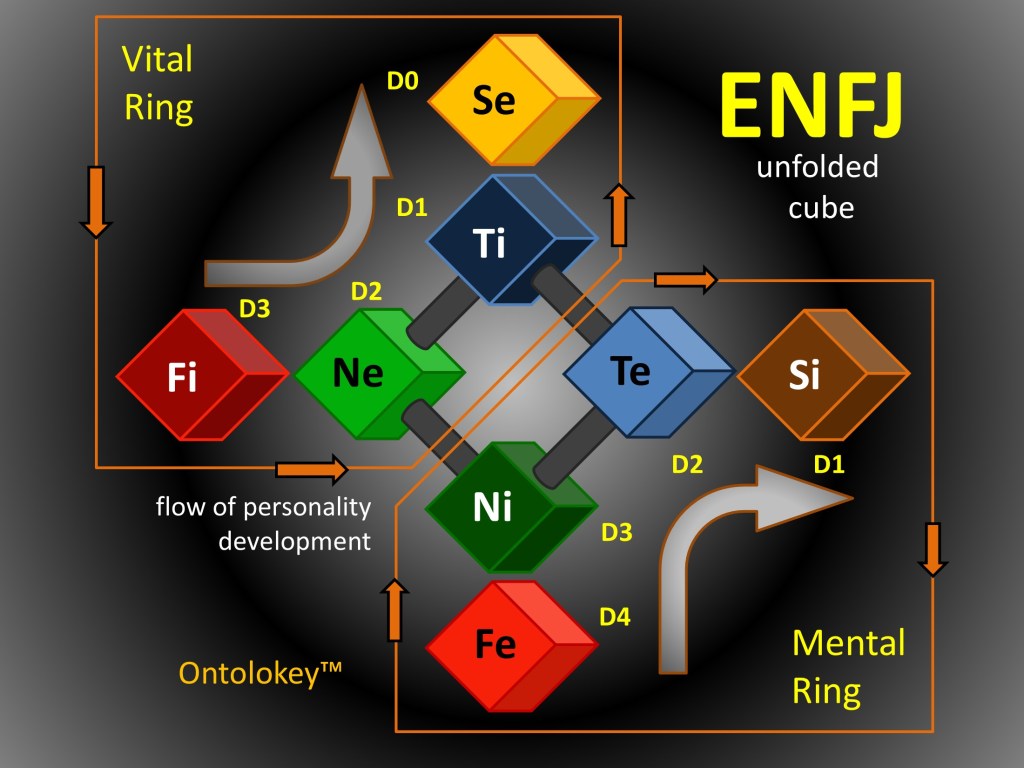
The ENFJ and the Long Movement Toward Wholeness
The ENFJ is often recognized through qualities that are immediately visible: warmth, charisma, emotional intelligence, idealism, persuasive ability, social awareness, and an unusual capacity to give people direction and meaning. Yet beneath this socially compelling surface lies a much more complex psychological architecture. In the Ontolokey perspective, the ENFJ consciousness is organized primarily around Extraverted Feeling (Fe) as its dominant function and Introverted Intuition (Ni) as its auxiliary function, producing the characteristic combination of relational sensitivity and visionary interpretation. Fe continuously registers the emotional and interpersonal field, sensing what is happening between people, what is valued, what is harmonious or discordant, and what might restore cohesion; Ni simultaneously searches beneath visible circumstances for patterns, trajectories, meanings, and possible futures. Together they can make the ENFJ exceptionally capable of understanding people, inspiring collective movement, teaching, guiding, mediating, and transforming an abstract ideal into something emotionally compelling. Ontolokey, however, treats these strengths not as the completed personality but as the conscious entrance into a much larger psychological landscape in which less-developed functions can remain partially unconscious, producing tensions, projections, compensations, vulnerabilities, and shadow reactions.
This distinction is essential because the ENFJ’s greatest psychological difficulty may arise precisely from the qualities that make the personality appear strongest. When Fe and Ni become deeply identified with the self, caring can gradually become entangled with being needed, leadership with being influential, emotional intelligence with having authority over the emotional interpretation of others, and idealism with resistance to realities that cannot easily be harmonized with the preferred vision. The ENFJ may genuinely want to help while simultaneously deriving a profound sense of identity from being the person who helps; genuine generosity can therefore coexist with unconscious expectations of recognition, loyalty, reciprocity, or emotional significance without either motive being consciously experienced as manipulative. The shadow does not invalidate the light, but reveals what happens when the light is required to illuminate everything while the darker regions of the psyche remain unexamined. The developmental task is consequently not to suppress Fe or Ni, nor to become less warm, less visionary, or less relational, but to gradually enlarge consciousness so that other psychological perspectives can participate in the construction of reality. Ontolokey presents its Cube precisely as a spatial representation of this larger functional landscape, turning an abstract arrangement of psychological functions into something that can be contemplated as relationships between different areas of the self.
The Ontolokey Landscape and the Logic of Development
Within the developmental model used for this essay, the eight functions form two interconnected rings through which psychological consciousness can gradually expand. The Mental Ring begins with Fe at D4, proceeds to Ni at D3, then to Te at D2, and finally to Si at D1; its developmental movement therefore follows the sequence D4 → D3 → D2 → D1. The Vital Ring begins with Fi at D3, continues through Ne at D2, Ti at D1, and reaches Se at D0, the latter representing an archaic or childlike level and therefore functioning as a psychological blindspot until sufficient consciousness has been developed. The significance of this sequence is that development is not conceived as an arbitrary attempt to strengthen whichever function appears weakest; rather, consciousness proceeds organically from a more developed function toward the next less-developed function, because the more mature capacity provides the psychological stability necessary to approach the territory that follows it. For the ENFJ, this means that Ni must first mature substantially from its D3 position before the developmental movement can meaningfully proceed toward Te, just as the Vital Ring begins with Fi and can move toward Ne, then Ti, and ultimately Se only through successive integration.
This gives the ENFJ’s individuation process a distinctly sequential character. The first major developmental task is the consolidation of the auxiliary Ni, normally becoming particularly significant during the period of early and middle adulthood, when the personality begins moving beyond the uncomplicated identification with its dominant Fe. Once Ni approaches the maturity of Fe rather than merely serving it, the psychological structure begins to destabilize in a productive sense: the familiar conscious identity can no longer contain everything that is emerging from below it. The metaphor of the iceberg captures this process because ordinary consciousness initially represents only a small visible portion of a vastly larger psychological structure, while the unconscious contains functions, needs, reactions, memories, impulses, and perspectives that have not yet acquired equal conscious representation. As development progresses, the psychological landscape begins to rotate: what was previously submerged becomes increasingly visible, while the person gradually learns to recognize that these unfamiliar dimensions are not foreign intrusions but neglected parts of the same self. The ultimate direction is therefore not away from the original ENFJ personality but toward its reintegration, until the dominant Fe can once again occupy its natural position without having to exclude everything that was previously hidden beneath the surface. This conception of Ontolokey as a spatial and developmental landscape follows its broader intention of making functional relationships visible rather than treating personality merely as a fixed label.
Fe — The Gift and the Psychological Trap of the Social Mirror
For the ENFJ, psychological life begins most naturally in relationship. Extraverted Feeling (Fe), occupying the highest developmental position at D4 within the Mental Ring, functions as an extraordinarily sensitive social and emotional orientation through which the individual perceives not merely isolated people but the atmosphere connecting them, the values they share, the tensions they avoid, and the emotional consequences produced by their behavior. This gives the ENFJ an unusual capacity to recognize what a group needs before that need has been explicitly formulated, to encourage a discouraged person, to mediate conflict, to make people feel seen, and to transform an abstract purpose into something emotionally meaningful. In its mature expression, Fe is not superficial friendliness but a sophisticated awareness of the interpersonal field, allowing the ENFJ to become a teacher, counselor, leader, advocate, mediator, mentor, or source of emotional orientation for others. Yet precisely because this capacity is so natural and so frequently rewarded by the surrounding world, it can become difficult for the ENFJ to distinguish between genuine care and the psychological identity of being the person who cares, creating the first major paradox of individuation: the function that makes the personality socially powerful can simultaneously become the mechanism through which the personality avoids confronting its own hidden needs.
The central danger is therefore not that the ENFJ cares too much, but that caring can gradually become fused with self-worth. When being needed begins to feel like evidence of being valuable, relationships acquire an unconscious psychological economy in which generosity may contain an expectation of recognition, loyalty, gratitude, emotional closeness, or continued dependence, even when the conscious mind experiences the giving as completely selfless. An ENFJ may anticipate another person’s needs, provide guidance before being asked, invest enormous energy in someone’s development, organize circumstances so that others can flourish, and genuinely experience all of this as love; nevertheless, a hidden part of the psyche may be asking whether the investment is being noticed and whether the relationship confirms the ENFJ’s importance. The problem becomes visible when the recipient becomes independent, fails to respond with the expected appreciation, chooses a path different from the one envisioned, or simply takes the ENFJ’s generosity for granted, because resentment can then emerge where the conscious personality believed there had been no expectation at all. This is one of the most important shadow mechanisms for the ENFJ: an unconscious contract can exist even when no conscious contract was ever intended, and the resulting disappointment can be experienced as moral injury rather than as information about an unmet psychological need. Individuation begins when the ENFJ becomes capable of asking not only “What am I doing for this person?” but also “What does doing this allow me to feel about myself?” because the second question exposes the psychological function hidden beneath the socially admirable behavior.
The same dynamic becomes more complex when Fe is joined by the ENFJ’s auxiliary Ni, because emotional perception can then become intertwined with an interpretation of what another person supposedly needs to become. The ENFJ may not merely perceive someone’s present emotional state but also perceive a potential future self, a latent capacity, a relationship that could be healed, a community that could become more harmonious, or a project that could fulfill a larger purpose, and this combination of interpersonal sensitivity with future-oriented vision can create extraordinary transformational power. Yet it can also produce one of the ENFJ’s most subtle forms of psychological control: the tendency to confuse understanding another person with possessing the authority to guide that person’s development. When the ENFJ believes it can see what another person could become, resistance may unconsciously appear not simply as disagreement but as evidence that the person has not yet understood their own potential, while an ending relationship may be interpreted as a relationship that still requires healing and an autonomous decision may be experienced as an unfortunate deviation from a meaningful trajectory. The shadow does not necessarily appear as cruelty or domination; it can appear as excessive help, repeated explanation, emotional persuasion, rescuing, or an inability to stop intervening when intervention no longer belongs to the ENFJ. Psychological maturity therefore requires a difficult distinction between seeing and owning: the ENFJ may perceive something profoundly true about another human being while still having no right to determine what that person should do with that truth.
This is why boundaries become an important form of shadow work rather than merely a practical interpersonal technique. The ENFJ must gradually discover that another person’s disappointment does not automatically indicate that something has gone wrong, that another person’s anger does not necessarily require immediate repair, and that relational harmony is not always synonymous with psychological health. Saying no can therefore become an unusually revealing developmental exercise because it forces the ENFJ to remain connected while another person experiences frustration, disagreement, or unmet expectations without rushing to compensate, explain, persuade, or reverse the decision. The deeper lesson is that love does not require omnipresence, support does not require indispensability, and empathy does not create ownership of another person’s emotional life. When Fe becomes more conscious, its generosity becomes freer because it no longer has to prove the ENFJ’s goodness, importance, or relational value, and the personality can tolerate the possibility of being misunderstood without immediately reconstructing the other person’s perception. In that sense, the social mirror loses its absolute authority: other people remain profoundly important, but their approval ceases to function as the final court in which the ENFJ’s identity is judged.
The decisive movement toward wholeness therefore does not require the ENFJ to become less compassionate, less charismatic, or less socially engaged; it requires the personality to become capable of remaining itself even when its characteristic social gifts are not being reflected back with approval. The mature ENFJ can give without secretly requiring gratitude, advise without requiring obedience, lead without requiring admiration, love without requiring dependence, and remain present without assuming responsibility for every emotional consequence occurring around them. This transformation is particularly important because the shadow often becomes visible precisely when the familiar strategy stops working: when appreciation disappears, when someone rejects the ENFJ’s guidance, when a relationship cannot be repaired, when a project fails despite enormous effort, or when another person’s autonomy contradicts the ENFJ’s vision. These experiences can initially feel like threats to identity, but they can instead become invitations to differentiate the authentic impulse from the compensatory one. The question is no longer whether the ENFJ is a caring person, but whether care can remain authentic when it produces no recognition, no influence, and no guarantee of a desired outcome. Once that capacity develops, Fe begins to move from social adaptation toward conscious relational freedom, establishing the psychological foundation from which the next developmental movement—from dominant Fe toward the increasingly mature Ni—can unfold.
Ni — From Vision to Inner Authority
Introverted Intuition (Ni) occupies the ENFJ’s auxiliary position at D3 within the Mental Ring, and its development represents the first decisive movement away from an identity organized almost entirely around the external emotional field. Whereas Fe naturally asks what is happening between people and how the relational environment can be brought toward greater harmony, Ni turns inward and asks what these events mean, where they are leading, what pattern connects them, and which underlying reality has not yet become visible. This gives the ENFJ an ability to perceive trajectories rather than merely circumstances, allowing individual conversations, conflicts, historical experiences, and seemingly unrelated observations to become parts of a larger psychological narrative. At its healthiest, Ni prevents Fe from becoming trapped in immediate social reactions because it introduces distance, reflection, symbolic understanding, and a longer temporal perspective into the personality’s decision-making process. The ENFJ consequently becomes capable not merely of responding to people but of understanding the deeper structures in which people are embedded, which explains much of the type’s reputation for vision, inspiration, strategic guidance, and an almost instinctive sense of what something might eventually become.
The developmental importance of Ni is that it gives the ENFJ an interior axis that does not depend entirely upon the emotional responses of other people. Before this capacity becomes sufficiently differentiated, the ENFJ may unconsciously derive orientation from the interpersonal field itself: the mood of the room, the expectations of important people, the needs of the group, or the perceived consequences of a particular decision for everyone involved. Ni introduces another source of authority, one based not on immediate consensus but on the ENFJ’s own gradually clarified understanding of meaning and direction. This can initially feel uncomfortable because genuine intuition often develops in solitude, ambiguity, and periods in which external confirmation is unavailable, precisely the conditions under which the socially oriented personality has fewer familiar signals to guide it. The ENFJ therefore has to learn that an insight does not become more truthful because other people agree with it, just as disagreement does not automatically invalidate an intuition that has emerged through prolonged observation and reflection. Psychological maturity occurs when the person can carry an inner conviction without immediately converting it into a social mission, allowing an insight to mature privately before deciding whether it should be communicated, defended, or acted upon.
Yet Ni itself possesses a shadow expression, particularly when its symbolic interpretations become fused with Fe’s desire to create coherence. The ENFJ can become so convinced that it understands the deeper meaning of a relationship, conflict, institution, or person’s behavior that alternative interpretations become psychologically difficult to entertain. What begins as pattern recognition can become narrative certainty, and narrative certainty can become a powerful form of confirmation bias in which subsequent events are unconsciously selected and interpreted according to an already established story. In interpersonal relationships this may produce an especially subtle difficulty: the ENFJ can construct an emotionally compelling explanation for why someone behaves as they do and then relate to that explanation rather than to the actual person standing before them. Because Ni seeks the hidden pattern and Fe seeks relational meaning, the resulting interpretation can feel profoundly insightful even when it contains projection, wish, fear, or an unrecognized desire for a particular outcome. The developmental task is therefore not to distrust intuition but to make intuition permeable to reality, preserving the capacity to perceive meaning while remaining willing to discover that the meaning initially perceived was incomplete.
The maturation of Ni also changes the ENFJ’s relationship with disappointment. A less differentiated personality may experience failed relationships, rejected ideas, professional setbacks, or the collapse of an anticipated future as evidence that something has gone fundamentally wrong, whereas mature Ni can begin to interpret such experiences as information about the trajectory itself. This does not mean romanticizing suffering or pretending that every painful event was secretly beneficial; rather, it means developing the capacity to allow experience to revise one’s internal model of reality. A person who leaves may genuinely be leaving, rather than secretly needing to be rescued; a project that fails may genuinely be unsuitable, rather than requiring greater emotional commitment; and an ideal that once seemed unquestionably meaningful may eventually prove to have been partly constructed from the ENFJ’s own unmet needs. In this way Ni becomes an instrument of psychological honesty because it asks the personality to tolerate the destruction of narratives that once provided identity and purpose. The ENFJ begins to discover that a meaningful life cannot be built solely by making reality conform to an inspiring vision; it must also be built by allowing reality to correct the vision.
This is the point at which the auxiliary function becomes a bridge toward individuation. Once Ni has developed sufficiently—approaching the functional maturity associated here with D4—it can carry the ENFJ beyond the unconscious assumption that the self must always be defined through interpersonal usefulness. The person begins to recognize recurring patterns in their own life: the same kinds of people they rescue, the same conflicts they repeatedly attempt to repair, the same forms of recognition they secretly crave, the same disappointments that provoke disproportionate pain, and the same situations in which their characteristic strengths unexpectedly fail. Such patterns are psychologically valuable because they reveal the limits of the conscious identity, and the emerging Ni perspective can connect these experiences without immediately moralizing them. Instead of asking whether the ENFJ has been “good” or “bad,” Ni asks what psychological structure keeps producing the same result, which defensive strategy is being repeated, and which neglected part of the personality is attempting to gain recognition through the symptom. When this reflective capacity becomes stable enough, the ENFJ is prepared to move toward the next stage of the Mental Ring, Te at D2, where inner vision must increasingly encounter impersonal structure, measurable reality, efficiency, boundaries, and the uncomfortable question of whether something can actually work rather than merely possess meaning. This transition marks a crucial threshold because the ENFJ’s journey toward wholeness now begins to challenge not only its social identity but also its preferred way of turning vision into reality.
Te — The Anima/Animus and the Wound of Competence
Extraverted Thinking (Te) occupies a particularly sensitive position in the ENFJ’s developmental landscape because it stands at D2 as the Anima/Animus function within the Mental Ring, immediately following the more established Fe and Ni. Te introduces a psychological orientation that differs fundamentally from the ENFJ’s natural preference for interpersonal meaning and intuitive vision: it asks what objectively works, what can be demonstrated, what resources are available, how efficiently something can be executed, which priorities are measurable, and what concrete structure is required to transform an intention into an effective result. For an ENFJ, these questions can feel simultaneously attractive and threatening because Te touches a vulnerable dimension of competence that is not automatically supported by the personality’s primary psychological habits. The ENFJ may be highly capable of inspiring ten people to accomplish something while feeling unexpectedly destabilized when confronted with a purely technical problem in which charisma, empathy, and vision provide no immediate advantage. The resulting sensitivity is important because the Anima/Animus function often carries an exaggerated psychological charge: what the conscious personality does not experience as naturally integrated may become the very domain in which criticism, failure, comparison, or humiliation is felt most personally.
This vulnerability can create a paradoxical relationship with competence. The ENFJ may appear extraordinarily confident when operating within familiar domains of communication, leadership, motivation, relationship-building, and intuitive understanding, yet become disproportionately defensive when competence is evaluated according to standards that cannot be negotiated through interpersonal intelligence. A simple factual correction, a demand for greater precision, a criticism of poor organization, or evidence that an admired plan is inefficient may therefore penetrate more deeply than the objective significance of the event would suggest. The psychological wound is not necessarily “I made a mistake,” but something closer to “Perhaps I am not as capable as I believed I was,” and because the ENFJ’s identity can be strongly invested in being effective for others, this perceived loss of competence may threaten the very image through which the personality experiences its usefulness. Compensation can then take several forms: excessive preparation, over-explaining, reliance on authority, attempts to persuade rather than verify, irritation with people who appear coldly factual, or an intensified effort to demonstrate value through interpersonal performance. The more threatening Te feels, the greater the temptation to retreat into the familiar strengths of Fe and Ni, where the ENFJ can once again feel psychologically fluent.
The deeper developmental challenge is learning to experience objective correction without converting it into an injury to identity. Te asks the ENFJ to distinguish intention from outcome, effort from effectiveness, and emotional conviction from empirical consequence, distinctions that can initially feel unnecessarily harsh to a personality oriented toward meaning and human context. An ENFJ may have invested enormous care in a project and still have produced an inefficient system; may have understood everyone’s emotional needs and nevertheless chosen the wrong strategy; may have communicated an inspiring vision while failing to establish the practical mechanisms required to realize it. Te integration does not demand that the ENFJ abandon compassion in favor of cold efficiency, but rather that compassion become more effective because it is supported by structure, prioritization, accountability, and realistic assessment. This is where cognitive self-healing becomes possible: instead of interpreting a failure as evidence of personal inadequacy, the ENFJ can learn to examine precisely which function was missing from the process and recognize that the failure may have resulted from an underdeveloped psychological instrument rather than from a defective self. The distinction is liberating because it transforms shame into information and allows the person to develop a capacity without condemning the personality that previously lacked it.
The Anima/Animus dimension also explains why Te may be projected onto other people before it is integrated internally. The ENFJ may admire individuals who are exceptionally organized, technically competent, decisive, analytical, pragmatic, financially disciplined, or capable of reducing complex problems to clear operational steps, while simultaneously feeling irritated by their apparent emotional detachment or lack of interpersonal sensitivity. Such figures can become psychologically fascinating because they embody qualities the ENFJ needs but does not yet comfortably own, producing a mixture of admiration, attraction, envy, intimidation, and criticism. Projection becomes especially revealing when the ENFJ repeatedly encounters people who seem “too cold,” “too rigid,” “too factual,” or “too obsessed with results,” because the intensity of the reaction may indicate not simply an objective disagreement but an encounter with a disowned psychological capacity. Integration does not mean becoming like these people; it means retrieving the useful element hidden within the projection and making it available to consciousness. The ENFJ can then retain warmth while learning to calculate, retain empathy while enforcing standards, retain idealism while measuring results, and retain relational sensitivity while making decisions that may temporarily disappoint others.
As Te develops from its D2 position toward greater maturity, the ENFJ’s relationship with authority and responsibility can undergo a significant transformation. Instead of needing to be the person who emotionally holds everything together, the individual begins to construct systems that allow responsibility to be distributed, expectations to be explicit, and results to be evaluated independently of personal charisma. This can be psychologically difficult because delegation and structure may initially feel less relational than personally guiding people through a process, yet mature Te reveals that genuine responsibility sometimes requires precisely this impersonal clarity. A leader who constantly rescues others may preserve dependence; a leader who establishes transparent standards can create autonomy. A mentor who continually explains may remain indispensable; a mentor who teaches people how to evaluate their own results eventually makes themselves less necessary. In this sense, Te quietly dismantles one of the ENFJ’s deepest unconscious temptations—the belief that effectiveness must pass through personal involvement—and replaces it with a more mature understanding in which systems, evidence, boundaries, and objective consequences can serve human purposes without diminishing humanity. Once this capacity is sufficiently integrated, the ENFJ becomes prepared to approach the next and even more vulnerable territory of the Mental Ring: Si at D1, the Toddler function, where psychological development encounters bodily reality, personal history, sensory limitation, routine, vulnerability, and the neglected needs of the childlike self.
Si — The Toddler in the Shadow
The movement toward Introverted Sensing (Si) at D1 brings the ENFJ into one of the most intimate and vulnerable regions of the Mental Ring, because Si represents precisely the kind of inward, concrete, bodily, historical awareness that can remain overshadowed by the personality’s natural orientation toward people, meaning, possibility, and purposeful action. Where Fe instinctively attends to the emotional needs of others, Ni interprets patterns and future trajectories, and Te increasingly asks how intentions can be implemented effectively, Si asks something quieter and more primitive: What is happening inside me right now, what has my body experienced, what has my personal history left behind, and what do I actually need in order to feel safe and regulated? At D1, this capacity may initially appear almost embarrassingly ordinary compared with the ENFJ’s more expansive psychological interests, yet precisely this ordinariness gives it its developmental importance. The ENFJ can become extraordinarily skilled at noticing another person’s exhaustion while remaining unaware of their own, capable of organizing an entire environment while neglecting sleep, nourishment, physical recovery, or emotional decompression, and able to endure prolonged strain because a meaningful external purpose temporarily overrides internal signals. The Toddler function therefore does not primarily ask the ENFJ to become more sophisticated; it asks the personality to become capable of stopping, receiving, remembering, sensing, and acknowledging vulnerability without immediately converting the experience into another problem that must be solved.
The metaphor of the Toddler is particularly revealing because the psychological material associated with Si can resemble an early developmental layer of the personality that has never received the same sophistication or authority as Fe and Ni. The ENFJ may have learned early that being emotionally perceptive, helpful, mature, encouraging, or responsible creates connection and recognition, while simpler needs such as rest, comfort, predictability, personal preference, physical security, or the freedom to depend upon someone else received less psychological attention. Consequently, the individual can become highly competent at functioning while remaining strangely inexperienced at being cared for. When this neglected layer is activated, the reaction can sometimes appear disproportionate to the external event: a minor physical discomfort becomes overwhelming, an unexpected change in plans produces unusual irritation, accumulated fatigue suddenly becomes emotional collapse, or a seemingly trivial sensory detail evokes a powerful memory or aversion. Such reactions can be misunderstood by the conscious personality as weakness because they contrast so sharply with the image of the capable and socially resilient ENFJ. Yet the very intensity of the reaction may indicate that something has been waiting for recognition for a long time, and what appears childish may actually be the return of a legitimate developmental need that was never integrated into the adult personality.
The psychological danger arises when the ENFJ responds to this vulnerability with the same strategy that has worked everywhere else: mobilization. Instead of listening to exhaustion, the person may become more productive; instead of acknowledging hurt, they may analyze the relationship; instead of admitting that they need reassurance, they may reassure someone else; instead of resting, they may search for another meaningful task; instead of allowing themselves to feel powerless, they may attempt to regain control by organizing the surrounding environment. This creates a subtle form of self-abandonment in which the personality becomes exceptionally compassionate toward everyone except the part of itself that cannot perform. The ENFJ may consciously believe that they are strong because they can continue functioning under pressure, while the unconscious body gradually records the cost of this strategy through fatigue, tension, irritability, emotional depletion, or loss of vitality. Integration of Si therefore requires a reversal of the usual direction of attention: the ENFJ must learn to perceive the self with the same sensitivity with which it perceives other people. Rather than asking exclusively what others require from the situation, the developing personality learns to ask what the organism itself is communicating, treating bodily signals and personal limits not as obstacles to purpose but as information belonging to the whole person.
Si also brings the ENFJ into a different relationship with the past. Ni naturally tends to extract meaning from experience and move toward an emerging future, whereas Si preserves the felt imprint of what has actually happened, including details, bodily memories, familiar environments, accumulated experiences, and the emotional significance attached to concrete moments. For the ENFJ, this can be uncomfortable because the past may contain experiences that were previously transformed into a coherent narrative before they were fully felt. A person may understand intellectually why a particular relationship was painful, why a parent behaved in a certain way, why a former partner could not provide what was needed, or why a professional failure occurred, while still carrying an unprocessed bodily memory of fear, shame, loneliness, humiliation, or abandonment. Cognitive understanding is therefore not necessarily identical with emotional integration, but cognitive understanding can create the conditions in which previously unconscious experience becomes bearable enough to be consciously acknowledged. The developmental movement toward Si allows the ENFJ to say, in effect, that what happened mattered not merely because it produced a lesson or contributed to a future identity, but because it happened to me, and because the vulnerable part of me that experienced it deserves to be remembered rather than overwritten by a more useful interpretation.
This is where the idea of psychological healing through cognition becomes especially meaningful within the Ontolokey developmental model. When the ENFJ recognizes that a disproportionate reaction may belong partly to an underdeveloped Si rather than entirely to the present situation, the person gains an additional layer of freedom between stimulus and response. A criticism may activate an old experience of inadequacy; rejection may awaken an earlier fear of being unwanted; physical exhaustion may lower the psychological threshold for interpersonal sensitivity; a loss of control may evoke the helplessness of a much younger part of the self. Understanding these connections does not erase the original experience, but it can transform its meaning because the adult personality is now capable of witnessing what the younger psychological layer could only experience. This is the beginning of compassion directed inward rather than exclusively outward: the ENFJ can forgive the self for having limits, for having misunderstood something, for having failed under conditions that exceeded its available capacities, and even for having developed defenses that once served a protective purpose. As Si gradually becomes integrated, the Toddler is no longer an embarrassing blindspot that periodically disrupts the adult personality; it becomes a quiet source of embodied reality, historical continuity, self-care, and tenderness, allowing the ENFJ to return to the world without abandoning the person who must actually live the life being built.
Fi — The Sibling and the Discovery of the Private Self
With the transition from the Mental Ring into the Vital Ring, the ENFJ enters a different psychological territory because Introverted Feeling (Fi) at D3 represents not simply another way of relating to emotions but a fundamentally more private relationship with value, authenticity, personal conscience, and individual emotional truth. Fe naturally experiences value through the relational field: it notices what people need, what a situation requires, what creates belonging, and what emotional atmosphere should be cultivated. Fi turns the question inward and asks whether something is genuinely right for me, whether an experience corresponds with my deepest values, whether a relationship respects my individuality, and whether my emotional response belongs authentically to me rather than being shaped by what others expect. As the Sibling function, Fi can initially feel familiar yet strangely inconvenient, because it resembles the ENFJ’s emotional sensitivity while refusing to make the collective emotional field its primary reference point. The developmental challenge is therefore subtle: the ENFJ must learn to recognize a private emotional reality that does not need to be justified by usefulness, consensus, social harmony, or another person’s needs. In this sense, Fi becomes the beginning of a more intimate form of individuation because it introduces the possibility that the self possesses intrinsic value even when it is not serving anyone else.
The Sibling designation also captures the ambivalence with which this function may be experienced. Fi is not an alien psychological force, because the ENFJ understands emotion deeply and can often recognize sincerity, moral conviction, pain, loyalty, love, and betrayal with remarkable sensitivity; nevertheless, the inward ownership of those experiences can feel less familiar than their interpersonal expression through Fe. The ENFJ may know exactly how to comfort someone who feels guilty while having difficulty admitting personal guilt, know how to validate another person’s boundaries while rationalizing the violation of their own, and passionately defend another person’s right to live authentically while quietly adjusting their own life to maintain relationships or expectations. This asymmetry is one of the clearest signs that the Sibling needs development: the psychological principle is already understood, but it has not yet been fully applied to the self. Fi therefore begins to expose a hidden question beneath much ENFJ behavior: “Would I still choose this if nobody needed me to choose it?” The question can be profoundly unsettling because it separates genuine love from obligation, authentic vocation from the desire to be admired, and personal commitment from the unconscious fear that disappointing others will result in rejection.
As Fi becomes more conscious, the ENFJ may encounter emotions that previously had little permission to exist. Anger can emerge where there was previously endless understanding, grief where there was previously purposeful optimism, jealousy where the conscious self believed it was entirely generous, resentment where the person had considered themselves freely giving, and loneliness where social connectedness had previously created the impression of intimacy. These emotions should not automatically be interpreted as moral truths, but neither should they be dismissed because they conflict with the ENFJ’s preferred self-image. The psychological function of shadow work is precisely to make room for information that consciousness has excluded because it was inconvenient, socially undesirable, or incompatible with an established identity. Fi teaches the ENFJ that compassion does not require the elimination of negative feelings and that being a good person does not mean experiencing only noble motives. The more honestly these emotions can be acknowledged, the less necessity there is for them to emerge indirectly through passive resentment, emotional withdrawal, sudden relational rupture, or disproportionate reactions to perceived betrayal. What was previously unconscious can become conscious material for reflection, and once consciousness has access to it, the ENFJ gains the possibility of responding deliberately rather than being unconsciously governed by what it refused to recognize.
The development of Fi also transforms the meaning of boundaries. For an ENFJ, boundaries can initially appear primarily as interpersonal instruments—ways of protecting relationships, preventing burnout, or making cooperation sustainable—but Fi reveals that boundaries are expressions of identity. A boundary is not merely a rule imposed upon another person; it communicates something about what the self values, what it cannot accept, what it needs, and where responsibility for another person’s emotional experience ends. This can be difficult for a personality accustomed to monitoring the emotional consequences of its decisions because authentic self-definition inevitably produces moments of disharmony. Someone may be disappointed by an ENFJ’s decision, a family member may disapprove, a colleague may consider the choice selfish, or a partner may no longer receive the degree of emotional availability they once took for granted. Fi teaches the ENFJ to tolerate this friction without immediately concluding that something morally wrong has occurred. The developing personality gradually learns that relational harmony achieved through self-betrayal is not genuine harmony, because it preserves connection at the cost of the person who is supposedly participating in the relationship.
This is why Fi represents the true beginning of the deeper individuation process within the developmental sequence described here. The ENFJ’s earlier movement through Ni, Te, and Si has progressively weakened the assumption that conscious identity alone contains the whole personality: Ni has introduced inner perspective, Te has challenged subjective effectiveness with objective consequence, and Si has brought neglected bodily and historical experience into awareness. Fi now asks an even more personal question: Who am I when I am not defined by the emotional needs of the surrounding world? The answer cannot be discovered through another person’s approval because Fi develops precisely by learning to experience values as internally owned rather than externally negotiated. As the Sibling becomes more mature, the ENFJ does not become colder or more individualistic in the superficial sense; instead, relationships become more authentic because the person entering them is no longer unconsciously asking others to confirm an identity constructed around usefulness. This creates the psychological foundation for the next movement toward Ne at D2, the Golden Shadow, where the ENFJ will encounter an unfamiliar freedom from its established vision and begin learning to entertain possibilities that do not originate from the dominant Fe–Ni structure.
Ne — The Golden Shadow and the Freedom of Possibility
Extraverted Intuition (Ne) occupies D2 within the Vital Ring and is therefore encountered only after the ENFJ has developed the more personal orientation of Fi at D3, yet its psychological character is strikingly different from the ENFJ’s familiar Ni. Whereas Ni tends to condense experience into an underlying pattern, trajectory, or emerging meaning, Ne opens experience outward again, multiplying possibilities rather than narrowing them into one coherent direction. This distinction becomes crucial for individuation because the ENFJ’s Fe–Ni structure can become exceptionally committed to a meaningful vision: it sees what people could become, what a relationship could become, what an institution could become, and what a future shaped by certain values might look like. Ne interrupts this certainty by asking what else could be true, what alternative interpretation might exist, which unexpected possibility has been overlooked, and whether the future needs to resemble the future that was previously imagined. As the Golden Shadow, Ne can therefore appear strangely attractive because it represents a psychological freedom the ENFJ may intuitively admire but not consistently inhabit: the freedom to remain undecided, to experiment without a predetermined purpose, to follow curiosity rather than duty, and to allow several contradictory possibilities to coexist without immediately selecting the one that appears most meaningful.
This freedom can initially be destabilizing because the ENFJ often possesses a strong instinct to transform possibility into purpose. Once a new possibility has been perceived, Fe may instinctively ask whom it could help, while Ni may immediately begin constructing the deeper narrative through which it could become meaningful; Ne, by contrast, is capable of remaining playful and unfinished. This difference matters because psychological development requires more than acquiring another productive skill: it requires tolerating forms of experience that do not immediately serve the established identity. An ENFJ who encounters Ne consciously may discover that many previously suppressed desires were not necessarily irrational or selfish but simply incompatible with the role the person had unconsciously assigned to themselves. There may be alternative careers that were never explored because they did not fit the image of a meaningful vocation, friendships that were avoided because they did not serve an existing social structure, creative interests that were postponed because they seemed impractical, or entirely different ways of living that were dismissed before they were genuinely experienced. Ne does not demand that every possibility be pursued; its developmental contribution is that the psyche is permitted to imagine alternatives without immediately forcing them into a hierarchy of usefulness, responsibility, or destiny.
The Golden Shadow can also become visible through projection. The ENFJ may feel unusually fascinated by people who are spontaneous, unconventional, intellectually restless, irreverent, exploratory, entrepreneurial, eccentric, or apparently unconcerned with maintaining a coherent identity. Such individuals may seem both liberating and frustrating because they embody the capacity to change direction without requiring a grand justification for every change. The ENFJ might admire someone who suddenly abandons a successful path to pursue an obscure interest, moves somewhere unfamiliar simply because curiosity calls, experiments with several identities, or treats failure as another piece of information rather than as a threat to a meaningful life narrative. Yet the same behavior can provoke judgments about irresponsibility, inconsistency, selfishness, or lack of commitment, revealing the psychological tension between the ENFJ’s need for meaningful continuity and Ne’s appetite for unexplored alternatives. When this pattern becomes conscious, the person can begin to recognize that the qualities provoking both admiration and irritation may represent disowned aspects of the self. Integration does not mean imitating the projected person; it means reclaiming the underlying psychological permission to explore, change, wonder, and remain uncertain without experiencing uncertainty as personal failure.
Ne also offers the ENFJ an antidote to one of the more subtle dangers of Ni: premature closure. A compelling intuitive narrative can become so internally coherent that contradictory information is unconsciously absorbed into the story rather than allowed to challenge it, particularly when the narrative is emotionally meaningful or connected to the ENFJ’s sense of purpose. Ne introduces cognitive plurality by deliberately generating alternatives: perhaps there is another explanation, perhaps the person is not who I thought they were, perhaps the relationship has a different future, perhaps the problem itself has been framed incorrectly, perhaps failure is redirecting rather than obstructing the intended path. This is not indecision for its own sake but psychological flexibility, and it can become an important form of humility. The ENFJ begins to understand that insight and certainty are not synonymous, that being perceptive does not make one infallible, and that a mature vision must remain capable of being revised by reality. Such flexibility also changes relationships because other people are no longer required to fulfill a predetermined psychological role in the ENFJ’s narrative; they can remain genuinely other, possessing motives, futures, and identities that cannot be completely anticipated or interpreted in advance.
The integration of Ne ultimately expands the ENFJ’s concept of freedom. Fe can give meaning to relationships, Ni can provide direction, and Fi can establish an inner sense of personal value, but Ne allows the self to encounter life without demanding that every experience immediately become part of a coherent mission. This can release enormous creative energy because the ENFJ is no longer compelled to convert every talent into service, every relationship into responsibility, every insight into leadership, or every possibility into a commitment. Play, curiosity, experimentation, intellectual wandering, and harmless contradiction become psychologically legitimate experiences rather than distractions from a supposedly more important purpose. The ENFJ consequently becomes less vulnerable to the fear that changing one’s mind means betraying one’s identity, because identity itself is recognized as something capable of development. Once Ne has matured sufficiently at D2, however, individuation must proceed further inward toward Ti at D1, where the ENFJ encounters an even more demanding psychological territory: the capacity to detach an idea from its emotional meaning, examine its internal structure, question one’s own conclusions, and discover whether something is logically coherent even when that examination produces no interpersonal harmony or inspirational outcome.
Ti — The Inferior Function and the Discipline of Radical Self-Examination
Introverted Thinking (Ti) occupies D1 within the Vital Ring and therefore represents a much more vulnerable form of psychological development for the ENFJ than the already established capacities of Fe, Ni, or the increasingly integrated Fi and Ne. Ti turns attention away from interpersonal meaning and toward the internal architecture of thought itself, asking whether an idea is coherent, whether its premises are sound, whether contradictions have been overlooked, and whether a conclusion remains valid independently of the emotional or social consequences attached to it. For a personality whose consciousness is naturally oriented toward people, values, purpose, and the meaningful interpretation of experience, this can feel strangely impersonal and even psychologically disorienting. The ENFJ may be exceptionally capable of explaining why something matters while becoming less comfortable when asked to demonstrate precisely how the underlying reasoning works, particularly if that reasoning has been constructed intuitively and relationally rather than through deliberate analytical decomposition. Ti therefore becomes an important instrument of individuation because it introduces an internal judge that cannot be persuaded merely by good intentions, emotional resonance, social consensus, or the beauty of a vision. Its developmental purpose is not to turn the ENFJ into a detached intellectual, but to give consciousness the ability to examine its own constructions without needing those constructions to remain psychologically comforting.
Because Ti is inferior and positioned at D1, its emergence can initially be accompanied by insecurity rather than mastery. The ENFJ may encounter highly analytical people and experience a mixture of admiration, intimidation, irritation, or even an instinctive desire to demonstrate competence in domains where the person does not yet feel entirely secure. Criticism can consequently penetrate more deeply when it exposes a contradiction, imprecision, unsupported assumption, or logical weakness, because the issue touches a function whose authority has not yet been established internally. The defensive response may be to explain the context, emphasize intentions, introduce additional interpersonal considerations, or demonstrate that the situation is more complex than the critic has recognized; all of these responses can contain legitimate truth, yet they can also function as ways of escaping the uncomfortable simplicity of the question itself. Ti asks the ENFJ to remain with the possibility that an argument may simply be wrong, that a conclusion may not follow from its premises, or that a cherished interpretation contains a contradiction that emotional intelligence alone cannot resolve. This is psychologically demanding because the ENFJ’s characteristic strengths can make it possible to construct extremely persuasive narratives, and persuasive narratives are not necessarily logically valid ones.
The integration of Ti therefore requires a new relationship with intellectual discomfort. The ENFJ must gradually learn to separate the statement “my reasoning contains an error” from the much more threatening statement “I am inadequate,” because without this distinction analytical correction will continue to feel like an attack upon the self. Once the distinction becomes stable, criticism can become developmental information rather than humiliation, and disagreement can become an opportunity for refinement rather than a rupture in relationship. This is especially valuable in leadership because an ENFJ who cannot tolerate being intellectually contradicted may unconsciously surround themselves with people who affirm the existing vision, thereby creating a social environment that reinforces intuition without adequately testing it. Mature Ti introduces an internal capacity to perform this testing before reality is forced to perform it externally and often more painfully. The ENFJ can begin asking what evidence would change my mind, which assumptions am I treating as facts, whether I am confusing correlation with causation, whether an emotionally compelling explanation is actually sufficient, and whether I am defending an idea because it is true or because it has become part of my identity. Such questions represent not a rejection of Fe but a safeguard against its unconscious tendency to equate emotional coherence with truth.
At a deeper level, Ti also challenges the ENFJ’s relationship with moral certainty. Fe can become deeply committed to values that appear self-evidently humane, and Ni can organize those values into a compelling interpretation of the world, creating a powerful sense of purpose that motivates action. Yet precisely because the ENFJ may care intensely about the human consequences of an idea, there can be a temptation to evaluate the validity of an argument according to whether its intentions appear benevolent or whether its consequences seem desirable. Ti interrupts this psychological shortcut by asking whether the reasoning itself survives examination. A compassionate intention does not automatically produce a coherent argument, and a socially attractive conclusion does not automatically follow from the evidence used to justify it. This does not mean that Ti should replace moral consciousness with sterile rationalism; rather, its integration allows the ENFJ’s moral sensitivity to become more intellectually disciplined, reducing the possibility that emotional conviction will unconsciously protect an idea from scrutiny. The resulting personality can remain profoundly humane while becoming more willing to admit uncertainty, revise beliefs, acknowledge contradictions, and say “I do not know” without experiencing that admission as a loss of authority.
The completion of Ti’s developmental movement prepares the ENFJ for the final and most archaic territory of the Vital Ring: Se at D0, the tertiary function and psychological blindspot. This transition is significant because Ti first teaches the ENFJ to loosen identification with its own interpretations, while Se will eventually demand something even more immediate—the surrender of excessive interpretation itself in favor of direct contact with the present moment. Before that can occur, however, the ENFJ must understand why Ti belongs to healing rather than merely intellectual development. Every time the person discovers that an old belief was incomplete, that a cherished explanation was partly projection, that a conflict contained personal responsibility as well as another person’s fault, or that an admired self-image depended upon assumptions that no longer survive examination, cognition becomes an instrument of liberation. The ENFJ is no longer forced to protect every part of the conscious identity because the self has become large enough to survive correction. In this sense, Ti represents a quiet form of psychological humility: the willingness to let truth become more important than being right, coherence more important than persuasion, and reality more important than the preservation of a beautiful story about oneself. Once this capacity has become sufficiently stable, the personality is finally prepared to approach the D0 blindspot, where the developmental process reaches its most primitive and embodied confrontation with Se.
Se — The D0 Blindspot and the Return to Embodied Reality
Extraverted Sensing (Se) occupies the final position of the ENFJ’s Vital Ring at D0, and within the developmental model presented here it represents the most archaic and least consciously accessible expression of the personality’s psychological functions. Se is concerned with immediate reality: what is physically present, what is happening now, what can be directly perceived, what action the situation demands, and how the individual can respond to concrete circumstances without first converting them into an abstract interpretation. For an ENFJ, whose consciousness naturally moves toward interpersonal meaning, future possibilities, symbolic patterns, and the emotional significance of events, such immediacy can be strangely difficult to inhabit. The mind may already be interpreting what an event means, what it will lead to, how another person feels about it, and how the situation could be improved before the body has fully registered what is actually happening. Se therefore represents more than sensory awareness; it symbolizes a radical encounter with reality before the psyche has organized that reality into a meaningful narrative. At D0, this capacity can appear childlike because it has not yet acquired the same conscious sophistication as the ENFJ’s preferred functions, but its very primitiveness contains something essential: the possibility of experiencing existence without needing to explain, improve, guide, or transform it first.
The shadow expression of Se can emerge when the ENFJ becomes overwhelmed by the distance between its vision and immediate reality. Under prolonged stress, frustration, emotional overload, or loss of control, the personality may suddenly become unusually reactive to concrete circumstances, physical sensations, interruptions, environmental disorder, or immediate stimulation. The person who normally operates through foresight and relational interpretation may then become impatient, impulsive, excessively focused on external details, or unusually concerned with controlling what is happening in the immediate environment. This can feel foreign because it does not resemble the ENFJ’s preferred psychological style, and consequently the reaction may be followed by embarrassment or an attempt to return quickly to the familiar world of meaning and interpersonal coherence. Yet the reaction itself contains information: the psyche has temporarily fallen into a function that has not yet been integrated consciously. Rather than treating these episodes simply as failures of self-control, the developmental approach asks what reality the ENFJ has been avoiding by living so extensively in interpretation, anticipation, responsibility, and psychological projection. Sometimes the neglected reality is simply that the body is exhausted, the environment is chaotic, a decision must be made immediately, or a situation cannot be solved through further reflection.
Se therefore teaches the ENFJ a form of presence that is fundamentally different from intuitive awareness. Intuition asks what lies beneath the surface and where events are moving; Se asks what is actually here. This distinction can be transformative because the ENFJ’s extraordinary capacity to perceive meaning can also become a mechanism for escaping immediacy. A difficult conversation can be analyzed endlessly instead of having the uncomfortable sentence spoken; an emotional problem can be interpreted rather than physically rested from; a future plan can be refined while the present opportunity passes; a relationship can be understood in extraordinary psychological detail while the actual person in front of the ENFJ is not fully encountered. Se interrupts this tendency by insisting upon contact with concrete experience. It encourages the ENFJ to notice the room, the body, the voice, the gesture, the physical environment, the actual sequence of events, and the simple fact that some situations require action rather than interpretation. When sufficiently integrated, this does not diminish the ENFJ’s intuitive depth but anchors it, allowing vision to become responsive to reality rather than functioning as a substitute for reality.
The body becomes particularly important at this stage because Se and the previously encountered Si reveal complementary dimensions of embodiment. Si brought attention to the personal history of the body, its accumulated experiences, needs, vulnerabilities, routines, and memories; Se now brings attention to the body’s immediate encounter with the external world. Together they challenge a potential ENFJ tendency to live predominantly through psychological and interpersonal consciousness. The individual may discover that fatigue is not a philosophical problem, that overstimulation is not a character flaw, that physical pleasure does not require moral justification, and that sometimes the healthiest response to a complex psychological situation is simply to eat, sleep, walk, breathe, move, or step outside the interpretive loop. Such practices may appear almost absurdly simple to a personality accustomed to complexity, yet their simplicity is precisely their developmental value. The ENFJ learns that consciousness does not become deeper by constantly moving away from the concrete; sometimes depth is achieved by remaining fully present within what is concrete.
At D0, however, Se should not be forced into artificial mastery. The goal is not to transform the ENFJ into an impulsive, sensation-seeking, relentlessly action-oriented personality, because that would merely replace one form of identification with another. Integration means allowing the function to participate in consciousness without demanding that it dominate consciousness. The ENFJ can learn to act decisively when the situation requires action, enjoy sensory experience without turning it into performance, recognize physical signals before they become crises, and tolerate moments in which nothing needs to be interpreted or improved. This creates an important psychological reversal: the ENFJ no longer has to live exclusively in the future it imagines or the relationships it manages because it has acquired enough capacity to inhabit the present itself. The blindspot becomes less blind when the personality stops judging immediacy as psychologically inferior and recognizes that reality is encountered first through presence, only afterward through interpretation.
With this integration, the entire Vital Ring begins to reveal its developmental logic. Fi taught the ENFJ to recognize a private inner value system; Ne opened possibilities beyond the established narrative; Ti introduced the discipline of questioning the internal coherence of one’s own interpretations; and Se finally brought consciousness into direct contact with the concrete present. The progression from D3 through D2 and D1 toward D0 therefore represents a gradual dismantling of unconscious dependence upon the familiar Fe–Ni identity, not its destruction. The ENFJ becomes capable of remaining emotionally connected without losing individuality, visionary without becoming trapped in a vision, rational without abandoning humanity, and intuitive without losing contact with immediate reality. At this point, the psychological iceberg has undergone a profound rotation: functions that once appeared beneath the surface have become increasingly visible, and the person can begin to recognize that many former weaknesses were actually undeveloped forms of consciousness waiting for integration. The final movement is therefore not toward becoming someone else, but toward returning to the original personality with a much larger interior world, which is the psychological meaning of wholeness in the developmental process described by Ontolokey.
The Shadow in Relationships — Love, Projection, Resentment, and Forgiveness
The ENFJ’s deepest psychological conflicts often become visible not in solitude but in relationships, because relationship is the natural arena in which Fe is most powerful and therefore the arena in which its unconscious compensations can become most convincing. The ENFJ may enter relationships with an extraordinary capacity for attentiveness, encouragement, loyalty, emotional availability, and future-oriented commitment, often seeing possibilities in another person that the person cannot yet see in themselves. This capacity can create profound intimacy, but it can also create projection when the ENFJ unconsciously begins relating to the potential it perceives rather than to the person as they actually are. Ni supplies the narrative of what the relationship could become, Fe supplies the emotional investment necessary to move it in that direction, and the developing personality may then interpret resistance as something to overcome rather than as information about another person’s autonomy. The resulting dynamic can be particularly painful because the ENFJ’s intentions may genuinely be loving while the unconscious structure of the relationship becomes controlling, rescuing, idealizing, or emotionally demanding. Shadow work therefore begins by recognizing that a person can act from love and still impose an unconscious psychological expectation upon another person, and that acknowledging this possibility does not make the love false but makes it more conscious.
One of the most important patterns to recognize is the transformation of generosity into resentment. The ENFJ can give enormous amounts of emotional energy without consciously keeping an account of what has been given, yet the unconscious psyche may nevertheless register an imbalance when care is not reciprocated in the expected form. Because the conscious identity often experiences itself as generous and supportive, admitting resentment can feel morally disturbing, and the emotion may therefore be displaced into disappointment, withdrawal, criticism, or the conviction that the other person has become ungrateful. Fi becomes crucial here because it allows the ENFJ to ask what was actually desired beneath the giving: Was affection wanted, recognition, loyalty, reassurance, commitment, respect, or simply the feeling of being important to someone? Once the underlying need is acknowledged, the psychological situation changes because an implicit expectation can become an explicit choice, and the ENFJ can decide whether to continue giving without demanding repayment or whether to establish a boundary around what it is willing to provide. This is a major step toward freedom because resentment often loses its power when the person recognizes that they were not merely “giving too much” but participating in an unconscious relational arrangement whose terms had never been consciously negotiated.
Projection becomes even more complex when the ENFJ encounters qualities represented by the less-developed functions. The competent and emotionally contained person may activate the ENFJ’s Te shadow, the unconventional and unpredictable person may carry the projected Ne freedom, the highly analytical person may evoke Ti insecurity, while the physically grounded or spontaneous individual may embody the Se capacity that the ENFJ has difficulty accessing directly. Similarly, a person who is fiercely private and guided by personal values may awaken both admiration and irritation by embodying Fi qualities that the ENFJ is still learning to claim. The emotional intensity of these reactions can therefore become diagnostically useful: fascination may indicate an undeveloped capacity that wants integration, while disproportionate irritation may reveal a quality that the conscious identity has excluded from its acceptable image of itself. The task is not to romanticize every person who triggers the ENFJ or to assume that every negative reaction is projection, because sometimes another person’s behavior is genuinely harmful or incompatible with one’s values. The task is to ask what belongs to the other person, what belongs to the present situation, and what additional psychological material is being activated within oneself, thereby separating external reality from the unconscious meanings imposed upon it.
This differentiation becomes especially important when the ENFJ has been genuinely wounded. The capacity to understand psychological causes can become both a gift and a trap because understanding why someone behaved destructively can create a temptation to excuse the behavior or remain in a relationship that has become psychologically damaging. Mature forgiveness does not require denial of harm, restoration of trust, or continued access to the self; it means that the ENFJ can gradually relinquish the need to remain psychologically bound to the person through anger, idealization, blame, or the fantasy that the past could have been different. The developing functions provide different pieces of this process: Ni can understand the larger pattern, Te can recognize objective consequences, Si can acknowledge what actually happened and how it was experienced, Fi can validate the personal injury and establish boundaries, Ne can imagine alternative futures, Ti can examine distorted interpretations, and Se can return attention to the present rather than repeatedly reconstructing the past. Through this multidimensional understanding, forgiveness becomes less about declaring someone innocent and more about refusing to allow an old relationship to continue governing one’s psychological life.
The same principle applies to self-forgiveness, which may be particularly important for an ENFJ because the personality can maintain demanding standards concerning the effect it has on others. When a relationship fails, when someone is disappointed, when a promise cannot be fulfilled, or when an attempt to help inadvertently causes harm, the ENFJ may revisit the event repeatedly in search of the moment at which everything could have been prevented. Ni can construct elaborate alternative histories, Fe can imagine the emotional suffering of everyone involved, Te can identify practical errors, Fi can experience personal guilt, and Si can preserve the emotional imprint of the event long after its external circumstances have disappeared. Without conscious integration, these functions can combine into an internal tribunal that continuously reconstructs the past while pretending to seek resolution. Psychological healing requires something different: the willingness to understand the limitations of the person who acted at that time, including the functions that had not yet developed, the information that was unavailable, the needs that were unconscious, and the defensive strategies that seemed necessary under the circumstances. The adult ENFJ who can look backward and recognize that the earlier self acted with incomplete consciousness does not have to approve every past decision, but can finally stop demanding that an earlier version of the personality possess the psychological knowledge that only later development could provide.
In this sense, relationships become one of the most powerful arenas for individuation because other people continually reveal the parts of the self that consciousness would prefer to leave undisturbed. The person who refuses the ENFJ’s help may reveal the hidden need to be needed; the person who challenges its reasoning may expose the vulnerability of Ti; the person who insists upon practical results may activate Te; the spontaneous person may awaken Ne; the emotionally private person may confront the neglected Fi; the demanding physical environment may expose the Se blindspot; and exhaustion may bring the forgotten Si directly into consciousness. None of these encounters automatically means that the other person is “teaching” the ENFJ a lesson, because that interpretation itself could become another form of projection, but each encounter can become material for self-observation. The fundamental question changes from “Why are people doing this to me?” to “What does my reaction reveal about the part of myself that is being touched?” That question does not remove responsibility from others, but it restores responsibility for one’s own psychological response, and this is precisely where the shadow ceases to be an enemy and becomes a pathway toward the larger self.
The ENFJ in the Second Half of Life — Individuation and the Turning of the Iceberg
The movement into the second half of life can become particularly significant for the ENFJ because the strategies that created success during the first developmental phase may eventually become insufficient for the psychological demands of a deeper existence. During earlier adulthood, the strengthening of Ni can make the ENFJ more capable of transforming the social gifts of Fe into vision, purpose, leadership, and long-range direction, often producing an impressive period of achievement in which the personality appears increasingly integrated. Yet the very success of this development can conceal the fact that the conscious identity remains concentrated around a relatively narrow portion of the total psychological structure. The ENFJ may have become exceptionally effective at being a leader, partner, parent, mentor, professional, organizer, advocate, or source of emotional stability while knowing comparatively little about the parts of the self that do not contribute directly to these roles. Eventually, circumstances arise that the established personality cannot solve through greater effort: relationships change, children become independent, professional identity loses its former significance, physical limitations become unavoidable, carefully constructed visions fail, or the recognition that once sustained motivation no longer produces the same psychological satisfaction begins to emerge. These experiences can feel like a loss of self, but within the developmental model they can instead represent the moment when the submerged portions of the psyche begin demanding consciousness.
The iceberg metaphor captures this transformation particularly well because it describes individuation not as the construction of an entirely new personality but as a gradual rotation of what is already present. At the beginning, consciousness sees only the upper portion of the structure, represented by the dominant Fe and increasingly mature Ni, while the remaining functions exist largely below the psychological waterline, influencing behavior without necessarily being recognized as aspects of the self. The development of the auxiliary function begins to destabilize this arrangement because Ni introduces an interior perspective capable of observing the conscious identity rather than simply serving it, and once that perspective becomes sufficiently mature, the personality can begin approaching the functions that have historically remained less developed. The process is sequential rather than arbitrary: Fe provides the original stability, Ni becomes sufficiently developed to support the movement toward Te, Te creates greater capacity for objective structure, Si brings bodily and historical vulnerability into awareness, and the Vital Ring then progressively introduces Fi, Ne, Ti, and finally Se. With each transition, the ENFJ encounters an aspect of existence that cannot be completely absorbed into the old identity, and the psyche becomes increasingly aware that what once appeared to be “not me” was actually part of the larger psychological organism all along.
This process can initially produce considerable inner turbulence because individuation threatens identities that were not necessarily false but had become incomplete. An ENFJ who has spent decades being the person others rely upon may suddenly discover an intense need for solitude; someone whose identity was built around emotional availability may begin recognizing anger and boundaries; someone who always saw a clear future may experience uncertainty; someone who prided themselves on understanding others may discover how little they understood their own motives; and someone accustomed to being competent may encounter situations that expose genuine dependency. These developments can be experienced as regression because the person temporarily encounters psychological material associated with earlier developmental stages, particularly the vulnerable Si Toddler or the archaic Se blindspot. Yet regression and integration are not necessarily the same phenomenon: when an unconscious function becomes visible, its first appearance may be crude, exaggerated, emotionally charged, or difficult to control precisely because consciousness has not yet learned how to use it deliberately. The appropriate response is therefore neither indulgence nor rejection but observation, naming, and gradual development. The person learns to recognize the function while it is active, identify what triggered it, distinguish its legitimate message from its primitive expression, and then give it an appropriate place within the larger personality.
The second half of life can consequently become less about acquiring achievements and more about recovering psychological dimensions that achievement previously concealed. The ENFJ may discover that some of the deepest questions are no longer “What can I accomplish?” or “Whom can I help?” but “What remains of me when I am not needed?” and “What do I value when nobody is watching?” These questions can initially feel frightening because they remove the external mirrors through which identity has traditionally been stabilized. Yet they also create an unprecedented opportunity for authenticity because the personality is no longer required to perform its familiar role continuously. Fi can allow private values to emerge without social justification, Ne can permit unexplored futures, Ti can question long-held convictions, Si can remember the body and the personal past, and Se can establish contact with immediate experience rather than constantly projecting consciousness toward the future. The ENFJ begins to discover that wholeness does not mean becoming equally strong in every psychological function; it means becoming sufficiently conscious of the entire inner system that no neglected function has to seize control merely to be noticed. Development therefore becomes an act of psychological redistribution, giving previously marginalized experiences enough recognition that they can contribute without having to rebel.
The final image of the iceberg completing its rotation expresses the paradox at the heart of individuation: the destination is not permanent immersion in the shadow but a return to the original orientation with a fundamentally transformed relationship to it. When the process has progressed sufficiently, Fe can once again occupy its natural position at the top, but it is no longer the Fe of psychological innocence that assumes relational harmony is always the highest good or that personal worth depends upon usefulness to others. It is Fe informed by Ni’s depth, Te’s realism, Si’s embodied memory, Fi’s private conscience, Ne’s openness, Ti’s intellectual humility, and Se’s capacity for presence. The dominant function has not been replaced; it has been liberated from the burden of representing the entire personality. This is why the result can be described as a psychological rebirth: the person may appear externally recognizably ENFJ, yet internally the meaning of being an ENFJ has changed because the personality is no longer organized around exclusion. The self that returns to the surface is therefore both familiar and new, possessing the original gifts but no longer needing to deny the psychological realities that once existed beneath them.
Such a transformation also changes the meaning of suffering. Experiences that once appeared inexplicable—why a particular criticism was devastating, why rejection produced disproportionate pain, why certain practical failures felt humiliating, why exhaustion led to emotional collapse, why another person’s independence could trigger resentment, or why a seemingly insignificant event awakened an unexpectedly intense reaction—can gradually become intelligible when viewed through the developmental architecture of the functions. Understanding does not retroactively make painful experiences desirable, but it can transform them from meaningless injuries into psychologically comprehensible events. The ENFJ can recognize that different parts of the personality possessed different degrees of developmental maturity at different times, and that behavior emerging from an underdeveloped function may have reflected limitation rather than malicious intent. This understanding creates space for forgiveness without erasing accountability, because responsibility becomes more precise when the psychological mechanism behind a behavior is visible. The deeper healing therefore comes not from constructing a flattering explanation of the past, but from developing enough consciousness to hold both truths simultaneously: something may have been genuinely harmful, and the person who caused or experienced that harm may also have been operating from a psychological capacity that had not yet matured.
Individuation ultimately asks the ENFJ to surrender the fantasy of becoming invulnerable. The mature personality does not reach a point at which criticism no longer hurts, relationships never fail, physical limits disappear, uncertainty becomes comfortable, or unconscious material ceases to emerge; instead, it develops the capacity to encounter these experiences without allowing them to determine the whole identity. The vulnerable function can be acknowledged without shame, the shadow can be examined without fascination, the dominant function can remain strong without becoming tyrannical, and the unconscious can be approached without demanding that every mystery be immediately solved. In this sense, the turning iceberg is not a journey toward perfection but toward participation: every previously submerged function becomes increasingly available to consciousness, and the ENFJ becomes capable of responding from a larger psychological repertoire rather than reflexively returning to Fe–Ni whenever reality becomes difficult. The result is a form of wholeness in which strength and vulnerability no longer need to oppose one another, because vulnerability itself has become part of the personality’s conscious strength.
Cognitive Healing — Turning Shadow Awareness into Self-Forgiveness
Within the Ontolokey developmental model, psychological healing begins when unconscious reactions become intelligible rather than remaining merely painful. This is particularly important for the ENFJ because a highly developed Fe can make the person exceptionally attentive to the emotional states of others while leaving the origins of their own reactions comparatively obscure. A strong emotional response may therefore be interpreted morally—“I should not feel this,” “I should be more understanding,” or “I have failed someone”—before it is understood psychologically. Individuation reverses this order by asking what function is speaking, what developmental level it occupies, what situation activated it, and what legitimate need may be hidden beneath its imperfect expression. The objective is not to rationalize every behavior, nor to transform every wound into an excuse, but to replace unconscious identification with conscious differentiation. Once the ENFJ can observe a reaction as something occurring within the psyche rather than equating it completely with the self, the possibility of choice begins to appear.
The sequence can be understood as a movement from injury to reaction, from reaction to projection, from projection to cognition, and from cognition to integration. An injury may activate an old vulnerability; the vulnerability produces an automatic response; the response is then attributed partly or entirely to another person or external circumstance; and only later does consciousness become capable of asking what was actually activated internally. For an ENFJ, this can be especially revealing in situations involving rejection, ingratitude, criticism, incompetence, emotional distance, or the failure of an idealized relationship. Fe may initially experience another person’s withdrawal as relational rupture, Ni may construct a larger meaning around it, and less-developed functions may add anger, insecurity, bodily exhaustion, or cognitive defensiveness to the experience. If the person stops at the first interpretation, the psychological process remains unconscious; if the person investigates the entire sequence, the event becomes a map of the inner world. The same situation that once produced only suffering can therefore become information about the personality’s developmental structure.
This is where the distinction between explanation and justification becomes essential. To understand that an ENFJ reacted from an underdeveloped function does not mean that the consequences of the reaction disappear, just as understanding another person’s psychological wound does not require accepting harmful behavior. Cognitive awareness instead makes responsibility more exact because it identifies the point at which consciousness could previously not intervene. The person can begin to recognize recurring sequences: the moment generosity turns into expectation, expectation into disappointment, disappointment into resentment, resentment into moral judgment, and moral judgment into emotional withdrawal; or the moment criticism touches an inferior function, activates shame, and is converted into defensiveness before its factual content can even be considered. Once the sequence is visible, responsibility moves away from vague self-condemnation and toward specific psychological work. The question changes from “Why am I like this?” to “What happened inside me, which function became activated, and what would a more developed response look like now?”
This form of cognition can become profoundly healing because it allows the ENFJ to reinterpret earlier versions of the self without either idealizing or despising them. The Si Toddler may reveal how exhaustion, insecurity, physical vulnerability, or earlier experiences shaped patterns that Fe later attempted to overcome through competence and usefulness. Te may show why certain failures or criticisms became disproportionately threatening, while Fi may reveal how often personal needs were sacrificed to preserve an image of relational harmony. Ti may expose inconsistencies in the explanations the conscious personality created to defend itself, while Ne may reveal possibilities that had been excluded because Ni had become too certain about what people, relationships, or the future were supposed to become. Even Se, despite its D0 position in this model, can reveal how far consciousness has moved away from immediate reality when it lives predominantly through interpretation and anticipation. The purpose of this examination is not to diagnose the past endlessly but to restore psychological ownership: every previously rejected part can gradually be recognized as belonging to the same person.
Self-forgiveness emerges naturally from this deeper differentiation because the ENFJ begins to see that many past failures occurred within a developmental context that can now be understood more clearly. This does not require saying that the younger self always did the best possible thing; sometimes the person genuinely acted selfishly, controlled others, avoided responsibility, or caused harm. What changes is the quality of judgment: instead of condemning the entire personality, consciousness can identify the precise function, vulnerability, fear, assumption, or unconscious pattern that contributed to the behavior. The same principle applies to forgiveness of others, because recognizing another person’s limitations can make their behavior comprehensible without requiring continued exposure to it. Forgiveness therefore becomes neither sentimental reconciliation nor denial of consequences; it becomes the release of an unconscious psychological bond in which the past must continually be reenacted before it can be understood. The ENFJ becomes freer when the past can be remembered accurately without remaining psychologically imprisoned by it.
The deepest healing occurs when awareness moves beyond retrospective interpretation and becomes a new way of living. A person who understands the Fe shadow but continues to measure their worth exclusively through usefulness has gained knowledge without completing integration; a person who recognizes Fi but never permits private values to influence decisions has understood the function intellectually without giving it psychological reality. Likewise, recognizing Ti does not mean becoming permanently analytical, and recognizing Se does not mean abandoning reflection for impulsive experience. Each function must gradually receive an appropriate place within consciousness so that it no longer needs to appear through crisis, projection, defensiveness, or disproportionate emotional reactions. This is why the Ontolokey developmental sequence matters: integration is not accomplished by simply deciding to “use all eight functions,” but by moving stepwise through the developmental levels, allowing each previously less-developed capacity to become sufficiently conscious before the next layer is approached. Healing is therefore developmental rather than merely inspirational.
Ultimately, the ENFJ’s psychological healing lies in the discovery that the shadow is not an enemy waiting to destroy the conscious personality but a collection of neglected dimensions waiting to become part of it. What was once experienced as weakness can become information; what appeared to be an intolerable contradiction can become complexity; what produced shame can become compassion; and what once seemed like evidence of personal failure can become an indication of where development stopped. The movement toward wholeness does not erase the distinction between healthy and unhealthy behavior, nor does it remove the need for boundaries, accountability, or discernment. Instead, it gives these qualities a deeper foundation because they are no longer driven primarily by unconscious compensation. The ENFJ can increasingly act from a self that includes both the visible strengths of Fe–Ni and the previously submerged dimensions of the personality, making healing less a matter of becoming someone different than of becoming conscious of the person who was present all along.
The Sequence of Development — Why Wholeness Cannot Be Forced
Within the Ontolokey model, individuation is governed by a developmental sequence rather than by the simple accumulation of psychological techniques. The distinction is important because an ENFJ can easily turn self-development itself into another achievement project, attempting to become more logical, more grounded, more authentic, more spontaneous, and more self-aware all at once. Such an approach may produce considerable intellectual knowledge while leaving the underlying psychological hierarchy largely unchanged. The model instead proposes that development proceeds from a function that is already relatively accessible toward the next less-developed function, with the Mental Ring moving from Fe D4 through Ni D3, Te D2, and Si D1, and the Vital Ring continuing from Fi D3 through Ne D2, Ti D1, and Se D0. The developmental levels therefore describe not simply preference but a direction of maturation. The psychological task is to strengthen the next function sufficiently that consciousness can safely approach what lies beneath it, rather than attempting to leap directly into the deepest and least familiar material.
For the ENFJ, this means that Ni is the first major developmental threshold after the dominant Fe. Because Fe already operates with considerable psychological authority, the temptation is to continue refining interpersonal effectiveness indefinitely: becoming a better communicator, leader, mediator, counselor, or source of emotional stability. Yet the Ontolokey sequence suggests that this does not constitute the next stage of individuation. Ni must become sufficiently developed to provide an inner orientation that is not dependent upon the immediate relational field. This is why the movement toward psychological maturity can initially feel less socially rewarding. The ENFJ begins to tolerate periods of withdrawal, reflection, ambiguity, and independent meaning-making because the psyche needs an internal reference point from which the social self can be observed. Only when this auxiliary foundation approaches the strength of the dominant can the developmental movement continue toward Te, where subjective conviction must encounter objective effectiveness and measurable reality. Development therefore proceeds through differentiation: each function must become conscious enough to contribute something that the dominant function cannot provide by itself.
The same principle becomes even more consequential when the movement reaches the Vital Ring. Once the Mental Ring has been sufficiently developed, Fi as the Sibling represents a qualitatively different encounter because it introduces the private value-bearing self that Fe can easily overlook. This transition marks the beginning of a deeper individuation in the model because the ENFJ is no longer merely refining the personality’s conscious operating system; consciousness is beginning to encounter dimensions that have historically existed outside the preferred identity. Fi cannot simply be commanded into existence through an affirmation such as “I should be more authentic.” Its development requires repeated experiences in which the person notices what they personally feel, want, reject, mourn, value, and refuse, even when these realities complicate relationships. Once Fi becomes sufficiently accessible, Ne can then broaden the psychological field by loosening the certainty of Ni and allowing alternative possibilities to emerge. Ti subsequently introduces rigorous internal examination, while Se finally confronts the person with immediate embodied reality. Each stage therefore prepares the psychological capacity required for the next.
This sequential character also explains why the unconscious may initially appear chaotic when it becomes visible. An undeveloped function does not necessarily present itself in its mature form; it may emerge through exaggeration, projection, defensiveness, compulsive behavior, or sudden emotional intensity. An ENFJ who has not developed a stable relationship with personal boundaries may encounter Fi first as resentment rather than as serene authenticity, while Te may initially appear as harsh self-criticism rather than objective competence. Ti can emerge as argumentative defensiveness, and Se may appear as impulsive reaction when the person is overwhelmed. These expressions should not be mistaken for the final form of the function. They are often indications that psychological material has entered consciousness without yet possessing an adequate developmental container. The appropriate response is therefore neither suppression nor premature identification, but patient differentiation: observe the function, recognize its legitimate contribution, develop its healthy capacity, and prevent its immature expression from taking over the personality.
The impossibility of forcing wholeness becomes especially clear in the relationship between the conscious and unconscious parts of the personality. Consciousness cannot simply decide that everything hidden should become conscious immediately, because some psychological material may become accessible only after the personality has developed enough stability to encounter it without fragmentation or defensive compensation. The iceberg therefore turns gradually rather than violently. Each new layer that becomes visible changes the meaning of what came before, and this recursive process requires time because psychological integration is not equivalent to intellectual comprehension. An ENFJ can understand the concept of Fi in an afternoon and still spend years learning to recognize when they have abandoned their own values; they can understand Ti perfectly while continuing to experience contradiction as personal criticism; they can know that Se concerns present-moment reality while remaining habitually absorbed in anticipated futures. Development occurs when conceptual knowledge becomes embodied capacity.
The sequence also protects the ENFJ from a subtler form of spiritual or psychological inflation: the belief that discovering the shadow automatically makes one whole. Shadow awareness can itself become another identity, particularly for a personality accustomed to growth, insight, and psychological interpretation. The person may begin collecting explanations for every reaction while remaining unwilling to change the behavior those explanations describe. In that situation, the unconscious has been named but not integrated. Genuine development requires the opposite movement: less fascination with having a sophisticated psychological vocabulary and greater willingness to let unconscious material modify everyday decisions, relationships, boundaries, habits, and self-understanding. The test of integration is therefore practical. Does greater awareness change how the ENFJ responds to criticism, rests when exhausted, expresses disagreement, tolerates uncertainty, evaluates evidence, respects another person’s autonomy, and remains present when no compelling future is available? If consciousness changes behavior without destroying the personality’s essential strengths, the developmental process has begun to become real.
The deeper wisdom of a sequential model is therefore that wholeness is not achieved by becoming everything at once. It is achieved by allowing each neglected dimension to develop enough that it can enter into relationship with the rest of the psyche. Fe does not have to surrender its relational intelligence; Ni does not have to abandon vision; Te does not have to become dominant; Si does not have to replace ambition with passivity; Fi does not have to reject relationship; Ne does not have to dissolve commitment; Ti does not have to eliminate compassion; and Se does not have to silence reflection. Each function becomes healthier when it no longer has to fight for recognition or compensate for the absence of another. The ENFJ consequently moves toward a psychological structure in which development is cumulative rather than competitive: every newly integrated capacity enlarges the freedom of the whole personality. In that sense, individuation is not the destruction of the original ENFJ but the gradual removal of the limitations that prevented the original personality from becoming fully conscious of itself.
The Complete Self — Returning to Fe Without Returning to the Old Self
The culmination of individuation is not a departure from the ENFJ identity but a return to its center under radically different conditions. Fe remains the dominant function, yet its authority is no longer based upon the unconscious assumption that relational harmony must be preserved at any cost. After passing through the developmental sequence, Fe can receive information from functions that were previously ignored, allowing social intelligence to become more discerning, less compulsive, and less dependent upon external confirmation. Ni contributes an inner orientation that can distinguish genuine vision from projection; Te introduces respect for consequences, standards, and objective effectiveness; Si reminds the personality that bodies, histories, limits, and accumulated experience cannot simply be overridden by purpose. The Vital Ring adds further depth: Fi gives Fe access to personal values, Ne introduces alternative possibilities, Ti tests the coherence of convictions, and Se reconnects consciousness with immediate reality. Fe therefore returns to the surface not weakened but relieved of the impossible task of carrying the entire psychological structure alone.
An integrated ENFJ consequently becomes capable of a form of relational presence that is fundamentally different from people-pleasing. The distinction is subtle but decisive: the immature expression of Fe may experience another person’s emotional state as something that must immediately be managed, while mature Fe can remain deeply responsive without assuming responsibility for every feeling in the environment. This allows compassion to coexist with boundaries, generosity with discrimination, and leadership with autonomy. The person can recognize that another individual’s disappointment does not automatically constitute evidence of personal wrongdoing, just as another person’s admiration does not automatically constitute evidence of personal worth. Because Fi has established a private center of value, Fe no longer needs universal approval to remain psychologically stable. Because Te and Ti have strengthened objective and internal evaluation, Fe can tolerate disagreement without immediately converting it into relational crisis. Because Se has become more consciously accessible, the ENFJ can remain present with what is actually happening instead of compulsively repairing an imagined future.
The integrated relationship between Fe and Ni is particularly important because it preserves what is distinctive about the ENFJ while transforming its potential shadow. Ni can continue to perceive patterns, trajectories, motives, and possibilities for human development, but it no longer needs to become certain that its interpretation is reality itself. Te can ask whether the vision produces viable consequences; Ti can examine whether the underlying reasoning is coherent; Fi can ask whether the proposed direction remains faithful to personal values; Ne can reveal alternatives that Ni overlooked; Si can compare the vision against lived experience; and Se can ask what is actually happening now. The result is not paralysis through endless analysis but a more sophisticated form of conviction. The ENFJ can still commit strongly to a vision while remaining capable of revising it. Such flexibility is one of the clearest signs that the dominant function has ceased to operate defensively: certainty becomes a choice rather than a psychological necessity.
Wholeness also transforms the ENFJ’s relationship with vulnerability. Earlier in development, vulnerability may have been experienced as an interruption of competence or usefulness, particularly when the person unconsciously identified strength with being the one who supports others. Through the integration of Si, however, exhaustion can become information rather than failure; through Fi, emotional pain can become personal truth rather than an inconvenience to be overcome; through Te, limits can become parameters for effective action; and through Se, bodily experience can become a source of immediate knowledge rather than something to be ignored until it forces attention. The person begins to understand that vulnerability does not contradict leadership because leadership itself becomes more realistic when it includes limitation. A psychologically whole ENFJ can therefore say “I cannot do this,” “I need help,” “I do not know,” or “I do not want this” without experiencing these statements as a collapse of identity. Such admissions are not evidence that the dominant personality has weakened; they demonstrate that the personality has finally become large enough to contain dependency, uncertainty, refusal, and limitation.
This transformation inevitably affects relationships because the integrated ENFJ no longer needs other people to occupy predetermined psychological roles. The partner does not have to become the person who confirms the ENFJ’s value, the friend does not have to receive endless guidance, the colleague does not have to recognize every contribution, and the person being helped does not have to fulfill the potential that the ENFJ perceives in them. The other person is permitted to remain separate. This is perhaps one of the deepest forms of relational maturity available to a personality whose greatest gift is its capacity to perceive and cultivate human potential. Love becomes less about shaping another person toward an imagined future and more about encountering who that person actually is. The integrated ENFJ can still inspire, encourage, teach, organize, protect, and lead, but these actions become invitations rather than covert demands. The freedom of the other becomes compatible with the ENFJ’s own sense of purpose.
The same principle applies inwardly. A psychologically whole ENFJ no longer needs to maintain an internal hierarchy in which some experiences are worthy and others are embarrassing, inconvenient, irrational, selfish, weak, or immature. Developmental hierarchy remains relevant within the Ontolokey model, because functions occupy different developmental levels and are not simply interchangeable, but psychological value is not identical with developmental strength. The D0 Se function, for example, may be deficient in the model while still representing an essential dimension of human experience; the vulnerable Si Toddler may be less developed while still carrying information that the dominant personality desperately needs; Fi may initially create discomfort precisely because it contradicts the established relational orientation. Wholeness therefore means respecting the message of every function without pretending that every function has the same developmental competence. The personality becomes an internal community in which different psychological voices can be heard, evaluated, and integrated rather than suppressed until they erupt.
At the deepest level, returning to Fe means returning to relationship itself, but now with a transformed understanding of what relationship requires. The ENFJ discovers that genuine connection does not demand sameness, constant emotional availability, or the elimination of conflict; it requires enough inner differentiation that two autonomous people can encounter one another without either person disappearing. Fe can then fulfill its highest potential as a function of connection rather than control, participation rather than absorption, and service rather than self-erasure. The ENFJ’s natural orientation toward humanity becomes broader because “humanity” now includes the previously rejected parts of the self as well as the people outside it. The outer social world and the inner psychological world cease to be opposing domains. In this sense, the completed movement of the iceberg brings the personality back to its original surface, but consciousness now knows that the visible summit has always depended upon an enormous submerged structure. The ENFJ becomes whole not by leaving its nature behind, but by finally inhabiting all of it.
Living Wholeness — The ENFJ as an Ongoing Practice of Integration
Wholeness ultimately becomes meaningful only when it leaves the realm of psychological insight and enters ordinary life. The integrated ENFJ does not spend every day consciously identifying whether Fe, Ni, Te, Si, Fi, Ne, Ti, or Se is operating; such constant monitoring would itself become another form of overcontrol. Instead, the developmental work gradually changes the quality of perception from which everyday decisions arise. Before acting, the person becomes more capable of noticing whether an impulse comes from genuine care or from the need to be needed, whether a vision reflects insight or projection, whether efficiency serves a meaningful purpose or merely protects against inadequacy, and whether exhaustion is being interpreted as weakness rather than recognized as a legitimate limit. The same awareness can operate in relationships, work, conflict, and solitude without becoming mechanical. Integration therefore means that psychological knowledge becomes increasingly implicit: the person no longer needs to explain every reaction because the psyche has acquired a broader repertoire of responses.
One of the most important everyday practices is learning to create a pause between perception and interpretation. The ENFJ is naturally capable of rapidly reading emotional and interpersonal situations, and Ni can then organize these impressions into a coherent understanding of what is happening and where events may be heading. This combination is powerful, but it can also make an interpretation feel complete before alternative explanations have been considered. The integrated personality therefore develops the capacity to ask, without immediately distrusting its own intuition: “What do I actually know, and what am I inferring?” Te and Ti can test the structure of the conclusion, Ne can generate alternative possibilities, Si can compare the present situation with relevant past experience, and Se can return attention to observable reality. This does not weaken intuition; it protects intuition from becoming certainty. The result is a form of psychological precision in which the ENFJ can remain perceptive without becoming captive to the stories that perception generates.
A second practice concerns the distinction between service and self-abandonment. Because helping others can be deeply meaningful to the ENFJ, the problem is rarely a simple lack of generosity; the more difficult question is whether generosity remains free when it is not reciprocated. The integrated person increasingly notices the hidden conditions that can accompany giving: the hope of appreciation, loyalty, emotional closeness, recognition, compliance, or eventual rescue in return. When such conditions become conscious, the ENFJ gains a choice that was previously obscured. They can give freely, negotiate openly, or decline altogether, rather than giving while unconsciously creating a debt that the other person is expected to repay. Fi makes this possible by strengthening awareness of personal values and limits, while Te contributes clearer agreements and expectations. The result is not less love but cleaner love, because generosity no longer needs to disguise a demand for recognition.
A third practice is the deliberate cultivation of embodied reality. The ENFJ’s psychological life can become heavily oriented toward people, meanings, relationships, possibilities, and anticipated futures, making the immediate body comparatively easy to overlook. Yet the body often communicates information before consciousness has formulated an explanation: fatigue, tension, restlessness, appetite, physical discomfort, attraction, aversion, and the simple need to stop can all function as signals that deserve attention. Within the Ontolokey sequence, this does not mean attempting to turn Se into a new dominant strength; rather, the D0 function is gradually allowed to participate without being forced into a role it was not designed to occupy. Walking without solving a problem, eating without multitasking, noticing the environment, resting before exhaustion becomes collapse, or remaining silently present with another person can all become forms of integration. The essential movement is away from living exclusively through interpretation and toward allowing direct experience to have psychological authority alongside meaning.
A fourth practice involves developing a more compassionate relationship with inner contradiction. An ENFJ may discover, for example, that they simultaneously love someone and need distance from them, believe in a cause and question its methods, want to help and feel resentful, understand another person’s pain and still be angry with them, or possess a powerful vision while recognizing that its realization may be unrealistic. Such contradictions do not necessarily indicate psychological failure. They can represent the emergence of different functions that are beginning to participate in consciousness at the same time. Fi may speak for personal values while Fe speaks for relational responsibility; Ni may perceive a long-term direction while Ne generates alternatives; Te may demand effectiveness while Ti questions the conceptual premises underneath it. Individuation does not require eliminating these tensions prematurely. It requires developing enough psychological capacity to hold them, examine them, and eventually allow a more differentiated decision to emerge.
The ENFJ can also use conflict as a particularly valuable instrument of self-knowledge. Conflict reveals what the conscious personality most wants to preserve, and therefore exposes the assumptions underneath its usual behavior. If disagreement produces an immediate urge to repair, the question may concern Fe’s relationship to harmony; if criticism produces shame or defensiveness, Te or Ti may be touching a competence wound; if another person’s independence creates disproportionate irritation, Fi or an unconscious relational expectation may be demanding recognition. The goal is not to interpret every conflict exclusively as an internal problem, because other people can genuinely behave unfairly, irresponsibly, or destructively. Rather, the integrated approach asks two questions simultaneously: “What is happening between us?” and “What is happening inside me because of it?” Holding both questions prevents the ENFJ from falling into either extreme—self-blame on one side or projection on the other.
Over time, these practices produce a subtler form of freedom. The ENFJ becomes less compelled to maintain a particular image of being compassionate, insightful, strong, competent, optimistic, or indispensable because identity is no longer dependent upon any single psychological function proving its value continuously. Failure becomes survivable because competence is only one part of the self. Rejection becomes survivable because relational belonging is no longer the sole source of worth. Uncertainty becomes survivable because a meaningful future does not have to be visible at every moment. Solitude becomes survivable because the absence of immediate relational feedback does not imply psychological emptiness. Even periods of confusion can become tolerable because the person understands that unconscious material may be reorganizing consciousness rather than destroying it. This is the practical meaning of a more integrated psyche: not perpetual confidence, but a growing capacity to remain present when confidence temporarily disappears.
The lifelong character of individuation is therefore essential. No developmental model can turn psychological integration into a finished possession, because new circumstances continually activate dimensions of the personality that have previously remained relatively quiet. A mature ENFJ may encounter a new relationship, loss, professional transition, illness, aging, failure, or unexpected opportunity and discover that an apparently integrated function still contains unexplored material. The appropriate response is not disappointment that “the work has failed,” but recognition that development proceeds through successive encounters with reality. The personality continues to rotate, revealing deeper aspects of what was previously submerged. In this sense, wholeness is better understood as a relationship with the whole self than as a permanent psychological state. The ENFJ becomes increasingly capable of listening to every part without allowing any single part to dictate the entire meaning of existence.
The mature orientation can finally be expressed as a quiet commitment: I do not need to reject any part of myself in order to become a better version of myself. The social self can remain caring without becoming self-sacrificing; the visionary self can remain idealistic without becoming dogmatic; the competent self can remain effective without becoming defensive; the vulnerable self can remain sensitive without becoming helpless; the private self can remain authentic without becoming isolated; the exploratory self can remain open without becoming directionless; the analytical self can remain rigorous without becoming cold; and the embodied self can remain present without abandoning reflection. This is the psychological meaning of healing through wholeness: the goal is not to eliminate the shadow but to deprive it of its necessity as a hidden compensatory force. What was once forced into unconsciousness can gradually participate in consciousness, and what once divided the personality can become part of its internal coherence.
Wholeness and Healing — The ENFJ’s Final Transformation
The deepest transformation of the ENFJ is not the acquisition of another skill, identity, or psychological ideal, but the gradual reconciliation of the parts of the self that consciousness once experienced as incompatible. The journey begins with Fe because Fe is the natural center of the personality: connection, participation, care, guidance, and the capacity to sense the human field are not obstacles to individuation but the original gifts from which individuation grows. Yet these gifts become limiting when they are unconsciously required to define the entire person. The developmental movement therefore asks Fe to relinquish its monopoly without relinquishing its leadership. Ni provides inner direction; Te introduces objective consequence; Si restores embodied history and vulnerability; Fi establishes personal value; Ne liberates possibility; Ti introduces rigorous self-examination; and Se returns consciousness to immediate reality. The personality becomes whole not because these functions become equal, but because none of them remains psychologically exiled.
The shadow consequently changes its meaning. At the beginning of the journey, the shadow may appear to contain everything the ENFJ does not want to identify with: selfishness, anger, weakness, uncertainty, incompetence, irrationality, impulsiveness, dependency, or emotional contradiction. Yet closer examination reveals that these categories often conceal legitimate psychological needs expressed through insufficiently developed functions. Anger may signal a violated boundary; exhaustion may reveal a neglected bodily limit; criticism may expose an unresolved relationship with competence; uncertainty may protect against premature certainty; private desire may correct excessive adaptation; analytical doubt may protect against seductive narratives; and direct sensory awareness may interrupt a life lived almost entirely through interpretation and anticipation. Integration does not therefore mean approving every expression of the shadow. It means learning to distinguish the message from the immature form in which the message first appears, so that the underlying psychological information can be preserved while the dysfunctional expression is transformed.
This is also why cognitive understanding can become a vehicle for healing. When the ENFJ recognizes the developmental origin of a reaction, the past can be reconstructed without being falsified. A former version of the self may have lacked the capacity to establish boundaries, tolerate disagreement, recognize bodily limits, question its own interpretations, or separate love from responsibility for another person’s life. Such limitations can explain behavior without excusing it, and this distinction allows responsibility and compassion to coexist. The person can acknowledge harm honestly while also recognizing the developmental conditions that contributed to it. Gradually, shame loses some of its absolute character because the question is no longer whether the entire self was good or bad, but which psychological capacity was available at that moment and what has become possible since then. Self-forgiveness thus becomes a consequence of understanding rather than an act of forced positivity, while forgiveness of others becomes possible without surrendering discernment or boundaries.
The turning of the iceberg provides the final image for this transformation. What was once submerged does not disappear when it becomes conscious; it changes its relationship with consciousness. The ENFJ who once reacted automatically can begin to recognize the reaction while it is happening, and recognition creates the possibility of choice. The person who once needed universal appreciation can give without demanding repayment; the person who once experienced disagreement as relational danger can tolerate separation; the person who once overrode exhaustion can respect the body; the person who once defended every interpretation can revise a conclusion; the person who once feared private desire can allow an authentic preference to exist even when nobody else approves. Slowly, what had operated as shadow becomes psychological capacity. When the iceberg completes its rotation within the model, the return of Fe to the top symbolizes a return to the original personality after a profound expansion of consciousness: the ENFJ is still recognizably ENFJ, but no longer confined to the version of ENFJ that existed before the journey.
The resulting wholeness is therefore not perfection and not permanent psychological harmony. A whole person can still become jealous, tired, defensive, confused, controlling, frightened, or mistaken. The difference lies in the speed and depth with which consciousness can recognize what is happening and recover a broader perspective. Integration reduces the need for unconscious compensation because neglected functions no longer have to force their way into awareness through crisis. The ENFJ becomes capable of saying, in effect, “This reaction is part of me, but it is not the whole of me.” That distinction is psychologically decisive. It creates an internal space in which opposing impulses can be examined rather than immediately enacted, and it permits the person to remain responsible without becoming self-condemning. Healing is therefore less about achieving a permanently positive emotional state than about increasing the freedom with which the whole personality can respond to reality.
At the level of relationships, this freedom produces perhaps the most visible transformation. The ENFJ no longer needs to rescue every person whose potential they can perceive, nor does love require controlling the direction in which another human being develops. The distinction between compassion and responsibility becomes clearer: one can care deeply without taking ownership of another person’s life. Likewise, one can disappoint someone without having betrayed them, establish a boundary without becoming selfish, leave a relationship without declaring the other person worthless, and accept help without feeling diminished. The ability to maintain connection without sacrificing differentiation represents a major achievement of individuation because the ENFJ’s greatest strength—relationship—can finally operate without becoming a mechanism for self-erasure. The other person is allowed to remain other, and the ENFJ is allowed to remain themselves.
The same transformation occurs in relation to purpose. A less integrated ENFJ may experience meaning as something that must constantly be produced through helping, leading, improving, organizing, inspiring, or building toward a desired future. A more integrated ENFJ can still pursue ambitious purposes, but purpose no longer functions as proof of worth. Ni can envision without enslaving the person to the vision; Te can structure without turning life into a performance; Fi can ask whether the goal is personally meaningful; Ne can keep alternative futures alive; Si can remember what previous experience has taught; Ti can test the assumptions beneath the mission; and Se can ask whether the person is actually inhabiting the present while pursuing the future. Purpose consequently becomes an expression of the whole personality rather than a compensation for an incomplete sense of self. The ENFJ can work passionately without needing the work to justify existence.
In this sense, the developmental journey can be understood as a movement from identification toward relationship. At first, the ENFJ may be identified with Fe: “I am the one who understands, helps, leads, connects, and holds things together.” Individuation introduces distance from that identity and allows the person to observe Fe as one part of a larger psychological structure. The same process eventually applies to Ni, Te, Si, Fi, Ne, Ti, and Se. None of these functions needs to become the new identity; each becomes a conscious participant in the personality. The self is therefore no longer equivalent to any individual function. It becomes the larger field in which all of them can exist, develop, conflict, cooperate, and contribute. This is the deepest sense in which the complete Self differs from the original conscious personality: it is not a stronger persona but a more inclusive center of psychological identity.
The final movement of the ENFJ is consequently not away from humanity but toward a deeper form of humanity. Having learned that other people cannot be saved by force, the ENFJ can accompany them without possessing their destiny. Having learned that personal needs cannot be sacrificed indefinitely, the ENFJ can give without disappearing. Having learned that intuition can be wrong, the ENFJ can remain visionary without becoming dogmatic. Having learned that competence is not identity, the ENFJ can fail without psychological collapse. Having learned that vulnerability carries information, the ENFJ can become stronger without becoming harder. And having encountered the neglected functions within, the ENFJ can meet the complexity of other people with greater humility because the psyche is no longer divided into acceptable and unacceptable human qualities. The outer world becomes easier to understand when the inner world is no longer artificially simplified.
Wholeness & Healing, then, is ultimately a lifelong invitation rather than a final achievement. The ENFJ begins with an extraordinary capacity to participate in the lives of others and gradually discovers that the same depth of attention must eventually be turned inward. The purpose is not narcissistic self-absorption, nor withdrawal from responsibility, nor rejection of the personality’s natural gifts. It is the opposite: by integrating what has been unconscious, the ENFJ becomes more capable of using those gifts freely, without the hidden compulsions that once accompanied them. The iceberg turns, the submerged becomes visible, the shadow becomes intelligible, wounded functions acquire development, and the dominant Fe returns to the surface carrying the experience of the entire journey. The original personality is reborn not as something new, but as something whole. In that sense, psychological healing is the discovery that nothing essential had to be destroyed—only brought into consciousness, understood, developed, forgiven, and finally given its rightful place within the Self.
Conclusion
The ENFJ’s path toward individuation can therefore be summarized as a gradual movement from connection without differentiation, toward connection through differentiation; from unconscious compensation toward conscious choice; from self-sacrifice toward reciprocal relationship; from certainty toward reflective conviction; from achievement toward meaning; and finally from a partial identity toward psychological wholeness. The Ontolokey developmental sequence gives this journey a particular architecture: Fe D4, Ni D3, Te D2, Si D1, followed by Fi D3, Ne D2, Ti D1, and Se D0, with development proceeding step by step rather than through arbitrary activation of functions. Its central image, the rotating iceberg, expresses the same principle symbolically: what consciousness initially sees is only a fraction of the total psychological structure, while the submerged functions continue to influence experience until development gradually brings them into awareness.
For an ENFJ, the invitation is therefore not to become less caring, less visionary, or less relational. It is to become large enough to contain the whole of what caring, vision, relationship, vulnerability, autonomy, reason, possibility, embodiment, and limitation actually mean. When that process matures, the shadow no longer needs to remain hidden, the past no longer needs to remain an unexplained source of shame, and the future no longer needs to carry the entire burden of meaning. The person can inhabit the present with greater freedom while still serving a future worth creating. That is the movement from personality toward wholeness, and from psychological knowledge toward healing.
For readers who want to continue exploring this developmental perspective in greater detail, Ontolokey.com offers further readings on the ENFJ and on the other personality types, including their conscious and less-developed psychological functions.
In the Ontolokey model, D0 to D4 describe the degree to which a psychological function has become consciously accessible, developed, and integrated within the personality. D4 represents the highest level of conscious development, while D0 indicates a function that remains largely unconscious and therefore tends to operate as a blindspot; D1, D2, and D3 represent successive stages of increasing awareness and integration between these two poles. Psychological development therefore means gradually bringing less conscious functions into awareness and allowing them to become more differentiated and usable, rather than trying to replace the dominant personality with something fundamentally different. The movement from D0 toward D4 is consequently a process of integration in which previously unconscious psychological capacities become increasingly available to consciousness and contribute to a more complete experience of the Self.
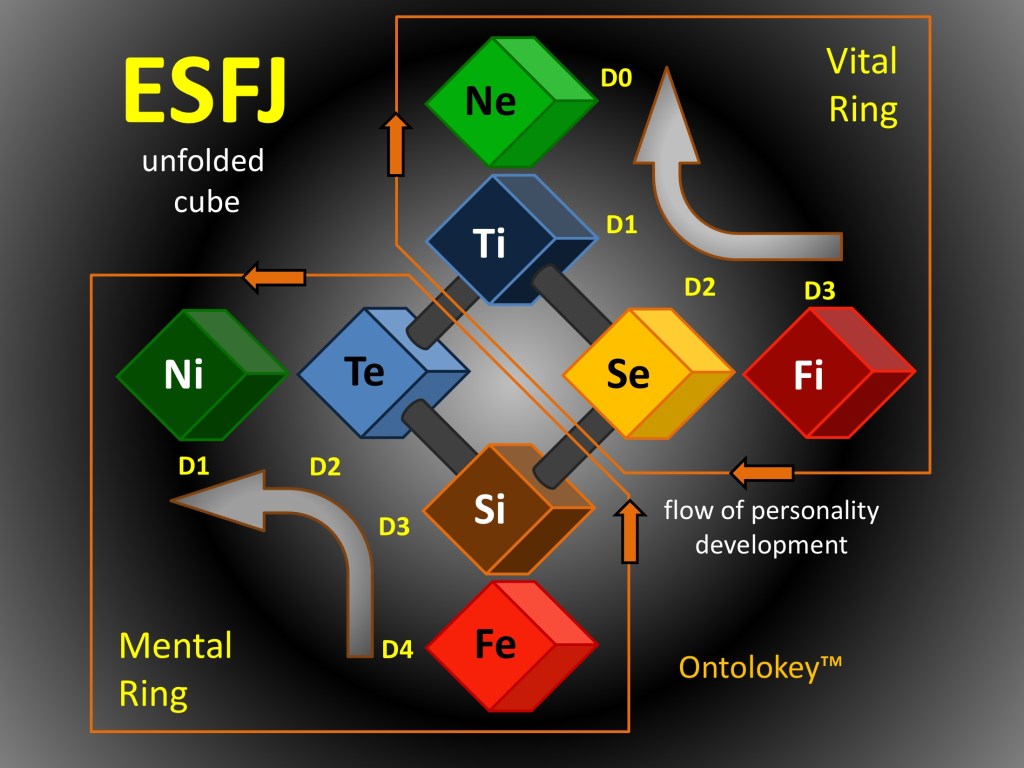
The ESFJ’s Central Psychological Conflict: Being Needed Versus Being Whole
The ESFJ personality is organized around an exceptional sensitivity to the emotional atmosphere of human relationships, a pronounced desire to create harmony, and an instinctive capacity to translate concern into tangible acts of care. Within the Ontolokey model, these qualities are rooted in Extraverted Feeling (Fe), the dominant psychological function, which directs attention toward the emotional needs, expectations, and interpersonal dynamics of the surrounding world. Supported by Introverted Sensing (Si), the auxiliary function, this orientation becomes grounded in continuity, reliability, shared traditions, and the preservation of experiences that give relationships their emotional meaning. The ESFJ often remembers what others need, notices when someone feels excluded, and takes responsibility for maintaining the invisible bonds that allow families, friendships, and communities to function. Yet the very abilities that make this personality so valuable can gradually become the foundation of an inner conflict when the maintenance of collective well-being takes precedence over the recognition of personal needs, private convictions, and unexpressed emotional truths. The central question of ESFJ individuation is therefore not how to become more caring, since care is already a defining strength, but how to remain caring without becoming psychologically dependent on the role of the person who holds everything together.
The deeper difficulty emerges when the ESFJ begins to confuse being loved with being needed, and being a good person with fulfilling the expectations of others. Because Fe is oriented toward relational feedback, appreciation, emotional reciprocity, and social belonging can become important sources of reassurance about personal worth, particularly when the ESFJ has learned that generosity and reliability are the most effective ways to secure affection. This adaptation may initially be entirely constructive, allowing the individual to develop empathy, social competence, and a strong sense of responsibility; however, it becomes restrictive when the ESFJ can no longer distinguish freely chosen generosity from an unconscious attempt to prevent rejection. A person may continue to help while feeling exhausted, agree to commitments while inwardly resisting them, or preserve a peaceful atmosphere while quietly accumulating resentment toward those whose needs have been placed first. The resulting contradiction is psychologically significant because the outward expression of love can coexist with an inward experience of deprivation, and the individual may find it difficult to acknowledge this discrepancy without feeling guilty or selfish. Genuine development begins when the ESFJ recognizes that the wish to protect relationships can itself become a defense against the uncertainty of discovering who they are when they are no longer required to please, rescue, organize, or emotionally reassure everyone around them.
The Shadow Behind the Caring Self
The shadow of the ESFJ does not necessarily appear as an obvious rejection of kindness or an openly hostile attitude toward other people; more often, it develops through the gradual distortion of admirable qualities whose original purpose has been forgotten. Fe can become an unconscious instrument of emotional regulation when the ESFJ attempts to manage not only personal feelings but also the feelings, reactions, and decisions of others, interpreting disagreement as a threat to connection rather than as an ordinary feature of human autonomy. In such circumstances, generosity may acquire an unspoken expectation of gratitude, loyalty may become a demand for reciprocity, and helpfulness may turn into a subtle claim to moral authority. When these expectations remain unacknowledged, disappointment can generate guilt-inducing remarks, indirect criticism, emotional withdrawal, or an insistence that others should recognize sacrifices without having to be told what those sacrifices mean. The individual may sincerely experience such behavior as an attempt to restore fairness, because the conscious intention is often to preserve the relationship, yet the unconscious motive may also include a desire to recover control over an emotional situation that feels unsafe. Recognizing this shadow requires the ESFJ to examine not only whether an action appears caring from the outside, but also whether it respects the other person’s freedom and remains generous when appreciation, agreement, or immediate emotional reassurance is absent.
A particularly difficult aspect of this process is that the ESFJ’s environment may reinforce the very patterns that eventually limit psychological growth. People who consistently organize gatherings, remember obligations, mediate conflicts, and offer practical assistance often become indispensable within their social circles, and the appreciation they receive can strengthen the belief that their value depends upon continued availability. Over time, the individual may become so identified with the dependable caretaker that ordinary human limitations begin to feel like personal failures, while the need for rest, solitude, disagreement, or independence is experienced as something that must be justified. The shadow becomes more pronounced when the ESFJ unconsciously expects others to respond according to the same standards of consideration and reciprocity, then interprets their failure to do so as evidence of ingratitude or disloyalty. Introverted Sensing (Si), which normally provides stability through memory, familiarity, and continuity, can intensify this pattern when past sacrifices become an internal ledger against which present relationships are evaluated. Individuation therefore requires more than setting occasional boundaries; it involves examining the emotional contract that may have developed beneath years of giving and asking whether care is still freely offered or has become an unconscious means of securing a permanent place in other people’s lives.
The Shadow Is Not the Enemy of the ESFJ
For the ESFJ, psychological shadow work begins with a difficult reversal of perspective: the qualities that create the greatest suffering are often not foreign qualities but exaggerated versions of the qualities that once made the personality successful. Fe does not become problematic because caring is inherently unhealthy; it becomes problematic when interpersonal sensitivity turns into an unconscious obligation to regulate the emotional lives of other people. Si does not become restrictive because memory, continuity, and tradition are inherently undesirable; it becomes restrictive when the known past acquires greater authority than the living present. Ontolokey’s recent ESFJ material describes precisely this developmental tension, emphasizing that a strength can become rigid when the individual unconsciously becomes dependent upon being needed, appreciated, or indispensable. The shadow therefore should not be approached as something that must be conquered, eliminated, or morally condemned, because such an approach would merely encourage the ESFJ to fight against another part of the self. The more fruitful approach is cognitive observation: whenever resentment, over-responsibility, excessive accommodation, resistance to change, or an urgent need to restore harmony appears, the ESFJ can ask what psychological function is speaking, what it is attempting to protect, and which other function has been excluded from consciousness.
This becomes particularly important because the ESFJ can unconsciously moralize its own psychological preferences. When harmony, loyalty, consideration, reliability, and continuity are experienced as moral virtues, their opposites can easily be interpreted not merely as different psychological orientations but as defects of character. Someone who refuses to accommodate may appear selfish, someone who questions tradition may appear disloyal, someone who demands efficiency over emotional consideration may appear cold, and someone who wants solitude may appear detached or ungrateful. Such interpretations can become defensive precisely because they protect the ESFJ from confronting the possibility that another person may possess a psychological capacity that the ESFJ has not yet integrated. Ontolokey’s functional architecture offers a different way of understanding these encounters: instead of immediately asking whether another person is right or wrong, the ESFJ can ask what kind of information that person is perceiving that the ESFJ is not naturally prioritizing. This shift is profound because it converts interpersonal irritation into psychological information and makes the other person, at least temporarily, a mirror for an underdeveloped part of oneself. The shadow then ceases to be a collection of undesirable characteristics and becomes a developmental boundary marking where conscious identity currently ends.
The Mental Ring: Development Must Proceed Through the Existing Structure
Within the developmental architecture specified for this ESFJ model, the Mental Ring consists of Fe at D4, Si at D3, Te at D2, and Ni at D1, with development proceeding sequentially from the dominant function toward the increasingly less-developed functions. This sequence is psychologically significant because it prevents individuation from being imagined as a dramatic leap into the deepest unconscious material before the personality has acquired sufficient internal stability to contain it. Fe at D4 provides the original psychological center: the capacity to perceive interpersonal reality, participate in collective emotional life, and actively contribute to social cohesion. Si at D3 then consolidates this strength by giving the ESFJ continuity, experiential memory, practical reliability, and a sense of what has already proven meaningful, which is why the development of the auxiliary function represents such an important transition from instinctive personality toward more differentiated maturity. Ontolokey likewise presents the broader functional architecture as something that can be explored developmentally rather than merely classified, with the cube providing a spatial representation through which relationships among conscious and less-conscious functions can be contemplated. In this developmental logic, the ESFJ should not attempt to bypass Si in order to reach Ni, because doing so would effectively ask the personality to abandon the very continuity and experiential grounding that allow deeper integration to occur.
The first decisive developmental movement is therefore from an unconscious Fe identity toward a more mature relationship with Si, in which experience becomes something to be understood rather than simply repeated. The ESFJ between early adulthood and midlife may increasingly discover that being socially competent is not sufficient for psychological maturity, particularly when familiar roles begin to change and the external environment no longer rewards the same forms of responsibility. At this stage, Si can either become a fortress or a foundation: it becomes a fortress when the individual attempts to preserve the past exactly as it was, but it becomes a foundation when accumulated experience is used as knowledge from which new possibilities can safely emerge. Once Si has become sufficiently differentiated, Te can begin to develop without threatening the emotional identity of the ESFJ, because external effectiveness no longer has to be interpreted as emotional coldness. Te can teach the individual to measure outcomes, establish limits, delegate, organize resources, distinguish intention from result, and recognize that good intentions do not automatically produce good consequences. In this sense, the progression from D4 to D3 to D2 is not a weakening of Fe but an expansion of the psychological vocabulary through which Fe can operate more intelligently and with less compulsion.
The transition toward Ni at D1 is more delicate because it confronts the ESFJ with a form of perception that cannot easily be anchored in established experience or externally observable evidence. Ni asks what something is becoming, what meaning may be developing beneath visible events, and where a trajectory might ultimately lead, whereas Si naturally asks what has happened, what is familiar, and what previous experience can teach about the present. For an ESFJ, this can create a genuine psychological tension because intuition may initially feel vague precisely where Si expects something concrete and trustworthy. The developmental task is therefore not to replace Si with Ni, but to allow uncertainty to exist without immediately forcing it back into familiar categories. When Ni begins to mature, the ESFJ can recognize that not every meaningful decision can be justified through precedent, that some life transitions require an inner sense of direction before external evidence becomes available, and that the future cannot always be secured by reproducing the past. The movement toward Ni is consequently a movement from certainty through experience toward meaning through psychological depth, and this becomes especially important when the ESFJ reaches the later stages of individuation.
Te — The Anima and the Discovery of Objective Effectiveness
The development of Te as the ESFJ’s Anima function represents a particularly important psychological threshold because it introduces a criterion that Fe cannot provide by itself: whether something actually works. An ESFJ may possess extraordinary motivation to help, reconcile, support, and maintain relationships, yet the desire to produce emotional good does not guarantee that a particular intervention is effective. Te interrupts this tendency by asking about measurable consequences, resources, efficiency, implementation, competence, and objective results, sometimes producing an uncomfortable confrontation with the difference between intention and outcome. Ontolokey places Te directly after Si in the ESFJ’s Mental Ring, at D2, meaning that it becomes accessible through development once the person has established a sufficiently mature relationship with their experiential foundation. The healthy integration of Te therefore does not turn the ESFJ into a detached strategist; instead, it gives the existing caring orientation greater precision by asking whether the help being offered actually helps, whether a commitment is sustainable, and whether responsibility has been distributed fairly.
The shadow difficulty arises when Te is first encountered not as an integrated capacity but as a psychological ideal or compensatory posture. An ESFJ who admires decisive, efficient, technically competent people may unconsciously believe that such people possess something fundamentally missing within themselves, creating a mixture of fascination, insecurity, admiration, and occasional defensiveness. Under pressure, this can produce a crude imitation of Te in which the ESFJ suddenly becomes blunt, controlling, excessively procedural, or preoccupied with productivity, as though objective efficiency could finally silence the emotional uncertainty that Fe normally manages. Genuine integration looks different because it does not require the personality to suppress emotional information; it teaches the ESFJ to include objective information alongside it. A mature decision can therefore contain both questions: “What will this do to the people involved?” and “Will this actually work?” The psychological healing occurs when neither question is allowed to invalidate the other.
Te also offers the ESFJ an important antidote to covert resentment because it exposes the consequences of giving without limits. If one person repeatedly accepts responsibilities that could reasonably be shared, the problem is not necessarily that other people are exploiting them; sometimes the individual has never established a workable structure in which responsibility can be negotiated explicitly. Te can transform vague frustration into practical differentiation: what belongs to me, what belongs to someone else, what is realistically possible, what must be postponed, and what should simply be declined. This is especially important because an ESFJ may unconsciously expect other people to infer needs from the amount of effort being given, while Te insists that expectations become explicit if they are to be managed effectively. The resulting boundaries are not emotional walls but structural clarity, and that distinction allows the ESFJ to remain deeply relational without requiring other people to possess the same intuitive sensitivity to obligation.
Ni — The Toddler Function and the Vulnerability of the Unknown
When development reaches Ni, the ESFJ encounters perhaps the most vulnerable dimension of the Mental Ring because Ni requires a tolerance for psychological uncertainty that the Fe–Si structure does not naturally prioritize. The Toddler designation expresses precisely this quality: the function is not simply absent but comparatively young, fragile, and difficult to trust consistently. Ni does not offer the reassuring evidence of Si or the interpersonal feedback of Fe; it may instead present an impression of direction, an emerging meaning, an intuitive sense that something is changing, or an awareness that a familiar situation is moving toward an outcome that cannot yet be demonstrated. For an ESFJ accustomed to creating stability through known relationships and accumulated experience, this can feel psychologically exposed. The temptation is to dismiss the intuition until it becomes externally undeniable, but by that point the individual may have spent years adapting to a trajectory that they sensed long before they consciously acknowledged it.
The healing function of Ni lies precisely in teaching the ESFJ that uncertainty does not necessarily mean danger and that not knowing does not imply incompetence. A mature relationship with Ni permits the person to hold an emerging intuition without immediately turning it into a conclusion, just as a seed can be recognized as significant before anyone knows exactly what plant it will become. This is particularly valuable during major transitions in identity, relationships, career, family structure, or personal meaning, when the old social role may no longer provide sufficient guidance. Instead of asking only, “What has always worked?” the ESFJ can begin asking, “What is this experience trying to become?” Such questions do not require abandoning practical judgment; they create an inner space in which the future can be psychologically perceived before it becomes socially obvious. In the language of individuation, Ni represents the ESFJ’s first serious encounter with an inner future that cannot be completely derived from the past.
The deepest integration of Ni occurs when the ESFJ stops demanding immediate certainty from the self. The personality that once required clear relational signals, familiar routines, and established precedents gradually becomes capable of remaining present while an internal transformation unfolds. This capacity can profoundly change the meaning of forgiveness, because the individual begins to see that people are not fixed representations of their previous behavior and that relationships cannot always be understood solely through historical evidence. It also changes self-forgiveness, because earlier failures can be interpreted as moments in which a particular function had not yet developed sufficiently rather than as proof of personal inadequacy. In that sense, the vulnerable function becomes therapeutic precisely because it allows the ESFJ to reinterpret the past from the perspective of developmental potential rather than moral condemnation. The person begins to understand not only what happened, but why certain psychological responses were available at one stage of life and unavailable at another.
The movement through Fe, Si, Te, and Ni therefore forms a coherent developmental arc: from relational identity, through experiential stability, into objective effectiveness, and finally toward inner direction and meaning. Each stage preserves something from the previous one while making it less absolute, which is why the developmental sequence cannot simply be reversed or accelerated through intellectual effort alone. Fe remains present after Si develops; Si remains present after Te develops; Te remains present when Ni begins to emerge, but none of them is permitted to monopolize consciousness as completely as before. The ESFJ becomes psychologically larger not by becoming a different type, but by acquiring enough internal differentiation to recognize when each function should and should not lead. This is the beginning of the “turning of the iceberg”: what once existed outside conscious identity gradually becomes recognizable as belonging to the self as well.
Fi — The Sibling Function and the Discovery of the Private Self
After the Mental Ring has been sufficiently developed, the ESFJ’s individuation enters a qualitatively different psychological territory through the Vital Ring, beginning with Introverted Feeling (Fi) at D3. This transition is crucial because Fi does not primarily ask how a person contributes to the emotional equilibrium of the surrounding group; it asks whether an experience is personally authentic, whether a value is genuinely one’s own, and whether an emotional response corresponds to an inner sense of truth. Ontolokey describes Fi as the ESFJ’s Sibling function, which makes it neither an alien enemy nor merely a weakness but a psychologically related capacity that has nevertheless occupied a less authoritative position than Fe. For an ESFJ, the encounter with Fi can therefore feel strangely familiar and strangely disruptive at the same time, because the individual possesses feelings and values but may have learned to interpret their significance primarily through their consequences for other people. The developmental task is not to become less relational but to establish an inner point of reference from which relational choices can be made consciously rather than automatically.
This distinction between having private feelings and granting them psychological authority is one of the most important aspects of ESFJ individuation. An ESFJ can be deeply emotional, possess strong convictions, know exactly when something feels wrong, and still habitually subordinate those perceptions to what appears necessary for the people around them. The unconscious question may therefore become, “What will this mean for everyone else?” before the more fundamental question, “What does this mean for me?” has even been allowed to arise. Over time, this imbalance can produce a subtle form of self-alienation in which the individual becomes exceptionally knowledgeable about the emotional landscape of other people while remaining comparatively uncertain about personal desires that have no obvious social justification. Fi begins to repair this division by legitimizing the private self as something that does not require collective approval in order to exist. The ESFJ gradually learns that a personal preference does not become selfish merely because somebody else is disappointed by it, and that an authentic boundary does not become cruel merely because another person would prefer that the boundary did not exist.
This is also where suppressed anger becomes psychologically informative rather than morally threatening. Anger is often difficult for an ESFJ to integrate because it can appear incompatible with the identity of the caring, considerate, emotionally responsible person, particularly when the individual has received positive reinforcement for patience and accommodation. Yet anger can contain information about violated boundaries, accumulated exhaustion, unequal reciprocity, or desires that have repeatedly been dismissed, and refusing to acknowledge it does not make the underlying conflict disappear. Fi allows the ESFJ to differentiate between destructive hostility and legitimate self-protection, thereby transforming an emotion that might previously have emerged indirectly into information that can be consciously interpreted. The mature ESFJ can eventually say, “I am angry because something matters to me,” without concluding that the anger itself makes them a bad person. In this way, Fi does not compete with Fe; it gives Fe a more authentic person from whom to originate.
The integration of Fi becomes especially transformative when the ESFJ begins to recognize how often guilt has functioned as an internal substitute for moral discernment. Guilt can mean that one has genuinely violated a value, but it can also mean that one has violated an expectation, disappointed someone, interrupted a familiar pattern, or simply prioritized oneself after a long period of self-neglect. Without differentiation, all of these experiences can feel morally identical. Fi introduces a more discriminating inner question: “Have I actually acted against what I believe is right, or am I merely experiencing the discomfort of no longer doing what others expect from me?” That distinction can liberate enormous psychological energy because it separates conscience from conditioning. The ESFJ can then begin to forgive themselves not only for mistakes but also for having needs, preferences, limits, ambitions, and forms of individuality that were previously interpreted as inconveniences to the collective.
Se — The Golden Shadow and the Recovery of the Present Moment
Once Fi has begun to establish a stronger relationship with personal authenticity, Extraverted Sensing (Se) can begin to emerge at D2 as the Golden Shadow. This position is particularly significant because Se does not primarily offer another system of moral evaluation or another method for preserving continuity; it introduces a different relationship to reality itself. Se attends to what is physically present, immediate, concrete, sensory, and actionable, and for an ESFJ strongly organized around Fe and Si this can represent an almost liberating simplification of experience. Instead of continuously interpreting the social meaning of an event or comparing it with previous experience, the person can learn to encounter what is actually happening now. Ontolokey explicitly presents Se as a hidden reservoir of potential for the ESFJ rather than simply as a deficiency, emphasizing its connection with spontaneity, direct engagement, embodied presence, and a freer participation in immediate experience. This is important because individuation is not solely an intellectual achievement; the personality must eventually become capable of inhabiting life rather than continually interpreting and managing it.
The shadow form of Se can initially appear through fascination with people who seem extraordinarily spontaneous, assertive, physically confident, adventurous, or unconcerned with social permission. The ESFJ may admire such people because they appear to possess an effortless freedom from the relational calculations that ordinarily occupy consciousness, while simultaneously judging them as reckless, insensitive, or insufficiently responsible. Both reactions can contain truth, but both can also indicate projection: what appears irresponsible may partly represent a capacity for directness that the ESFJ has not yet permitted themselves to develop. Healthy Se does not demand impulsiveness, nor does it require abandoning responsibility; it allows action to arise from the present rather than being endlessly delayed until every interpersonal consequence has been evaluated. The developmental question becomes, “What is actually happening right now, and what does this moment require?” rather than automatically asking what everyone might feel about the situation or what has traditionally been done. This can make the ESFJ more decisive, more embodied, and paradoxically more emotionally available because attention is no longer consumed by anticipating every possible reaction.
Se also provides an antidote to the ESFJ’s tendency to overinvest in psychological narratives about other people. When Fe and Si dominate consciousness, an ESFJ may remember what someone said previously, notice subtle changes in behavior, compare the current interaction with earlier events, and construct a coherent interpretation of the relationship. Such sensitivity can be extraordinarily accurate, but it can also become a form of psychological overprocessing when every present event is interpreted through accumulated relational history. Se interrupts this process by returning attention to observable reality: what did the person actually say, what are they actually doing, and what is actually happening between us at this moment? This does not invalidate intuition or memory; it prevents memory from becoming a prison and interpretation from becoming indistinguishable from fact. In this respect, Se can teach the ESFJ an unexpectedly powerful form of humility: reality does not always need to correspond to the story the mind has constructed around it.
The deeper integration of Se also restores pleasure without requiring usefulness. An ESFJ can become so accustomed to activities having a relational, practical, or responsible purpose that simple enjoyment may feel strangely difficult to justify, particularly when other responsibilities remain unfinished. Yet the capacity to experience beauty, food, movement, sexuality, nature, music, physical activity, travel, craftsmanship, play, or spontaneous conversation without converting the experience into productivity is psychologically restorative. Such experiences return the individual to the body, where existence precedes explanation and where the present moment does not require an argument for its legitimacy. The ESFJ begins to discover that not every valuable experience must improve someone, repair something, maintain something, or accomplish something. Se therefore contributes to healing by reconnecting the personality with a dimension of life that cannot be reduced to service.
Ti — The Inferior Function and the Courage to Question One’s Own Certainty
The development of Introverted Thinking (Ti) at D1 introduces another difficult but indispensable capacity: the ability to examine the internal consistency of one’s own reasoning independently of social consensus. For the ESFJ, this can be challenging because Fe naturally evaluates situations through interpersonal significance, while Ti asks whether the underlying concepts themselves are logically coherent. An ESFJ may know that a particular decision will affect people positively or negatively and may have extensive experiential evidence from Si, yet Ti asks a different question: “Does the reasoning actually follow?” This can initially feel emotionally cold because analytical examination may interrupt a conclusion that already feels morally or relationally obvious. But the mature development of Ti gives the ESFJ an extraordinary safeguard against self-deception, because it creates an internal capacity to question even conclusions that are socially reinforced.
This becomes particularly important in the shadow because an ESFJ can become extremely persuasive when emotionally convinced that something is right. The combination of Fe and Si can create a powerful internal case: people have behaved this way before, similar situations produced certain consequences, respected members of the group agree, and the current behavior violates established expectations. Ti asks the uncomfortable question of whether all those pieces actually establish the conclusion being drawn. It separates evidence from interpretation, intention from consequence, precedent from principle, and emotional conviction from logical necessity. The purpose is not to make the ESFJ skeptical of everything but to prevent interpersonal certainty from becoming intellectual certainty. When Ti develops, the ESFJ becomes capable of saying, “I strongly believe this, but I should still examine whether I have constructed the argument correctly.”
This function also changes the ESFJ’s relationship with disagreement. Before integration, disagreement can easily become psychologically personalized because conflicting views may appear to threaten shared understanding, loyalty, or relational stability. Ti introduces the possibility that disagreement can be intellectually useful even when it produces no immediate emotional harmony. Someone can challenge the ESFJ’s reasoning without rejecting the ESFJ as a person, just as the ESFJ can reject an argument without rejecting the person who expressed it. This distinction is fundamental to individuation because it separates attachment from agreement. The mature ESFJ becomes increasingly capable of allowing another person to remain psychologically autonomous without experiencing that autonomy as relational betrayal.
At its deepest level, Ti teaches the ESFJ that truth does not become more true because everyone feels better about it. This does not mean that emotional consequences are irrelevant; it means that emotional consequences and truth are different dimensions of reality and should not be unconsciously substituted for one another. The integration of Ti therefore strengthens rather than weakens the ESFJ’s ethical capacity because it makes compassion more discriminating. Instead of automatically defending the person who appears emotionally vulnerable, the ESFJ can investigate what actually occurred; instead of assuming that preserving peace is always beneficial, the individual can ask whether the peace is built upon denial. This is one of the final stages of psychological differentiation because it allows the ESFJ to tolerate the temporary discomfort of intellectual and interpersonal tension in service of a more coherent understanding of reality.
Ne — The Blindspot and the Liberation of Possibility
Extraverted Intuition (Ne), positioned at D0 as the Blindspot in the Vital Ring, represents the most developmentally remote function in the architecture described for the ESFJ. Ne opens attention toward alternatives, hypothetical possibilities, divergent interpretations, novelty, and what could emerge beyond the established frame of reference. For a personality whose psychological security is strongly supported by Fe and Si, this abundance of possibilities can initially feel less like freedom than instability, because every additional possibility potentially disrupts an existing plan, expectation, relationship structure, or interpretation of events. The designation D0 therefore captures more than low proficiency; it symbolizes a particularly archaic or childlike relationship with possibility, one that can appear either as naive excitement or as reflexive avoidance. Yet precisely because Ne occupies this blindspot, its integration can become one of the most transformative achievements of the entire individuation process.
The ESFJ may unconsciously react to Ne by reducing possibilities before they have been adequately explored. “That will never work,” “We have always done it this way,” “Why would anyone want that?” or “That is too risky” can function not merely as practical judgments but as psychological closures that restore familiarity before uncertainty becomes uncomfortable. The developmental task is not to accept every possibility as equally valid, which would contradict the ESFJ’s natural capacity for discernment, but to allow possibility to exist long enough to be examined. Ne teaches the mind to generate alternatives before selecting among them. This can profoundly affect relationships because the ESFJ becomes less likely to assume that another person’s behavior has only one possible explanation. Instead of concluding that someone is ungrateful, hostile, disloyal, or uncaring, the individual can entertain several hypotheses and wait for additional information. Such psychological flexibility can dissolve conflicts that previously became entrenched because the first interpretation was unconsciously treated as the only interpretation.
The integration of Ne is therefore closely connected to forgiveness. Forgiveness becomes easier when human behavior is understood as multidimensional rather than fixed, because a person who acted badly yesterday is not thereby reduced to yesterday’s behavior. Ne allows the ESFJ to imagine that people can change, that relationships can take unexpected forms, that an apparent ending can become a transition, and that a mistake can generate a future that could not have been predicted beforehand. This does not mean denying consequences or excusing harmful behavior; rather, it means refusing to confuse the present configuration of reality with its permanent form. The ESFJ begins to understand that even the self is an evolving system and that psychological development often depends upon the ability to imagine a version of oneself that does not yet have external evidence. In this sense, the Blindspot becomes the final invitation to intellectual and psychological openness.
The four stages of the Vital Ring therefore complete a developmental movement that began with the Mental Ring: Fi establishes the legitimacy of the private self, Se reconnects that self with immediate reality, Ti teaches it to examine its own reasoning, and Ne ultimately opens it toward possibilities beyond established psychological boundaries. The sequence matters because possibility without selfhood can become avoidance, immediacy without discernment can become impulsivity, and analysis without openness can become sterile rationalization. Each function must therefore be integrated through the preceding one, just as the Mental Ring develops progressively from Fe through Si, Te, and Ni. Ontolokey’s broader presentation of the eight-function landscape similarly emphasizes that the personality becomes more intelligible when the less conscious functions are viewed as part of a larger developmental structure rather than as isolated traits. The result is a progressively larger psychological field in which the ESFJ no longer has to choose between belonging and individuality, continuity and change, emotion and reason, or responsibility and freedom.
The completed movement can therefore be understood as an expansion of psychological permission. Fe gives permission to care, Si gives permission to remember, Te gives permission to evaluate effectiveness, Ni gives permission to trust emerging meaning, Fi gives permission to possess a private self, Se gives permission to inhabit the present, Ti gives permission to question, and Ne gives permission to imagine. None of these permissions invalidates the original ESFJ orientation; rather, each removes another unconscious restriction around it. The personality becomes whole when the functions no longer have to fight for legitimacy because consciousness can allow contradictory perspectives to coexist without immediately forcing one to disappear. At that point the ESFJ has moved considerably beyond the question of “Which function am I?” and toward the deeper question of “Which psychological capacity does this moment require from the whole of me?” That is the psychological foundation upon which genuine individuation and self-healing can proceed.
Individuation, Self-Healing, and the Return to Wholeness
From Functional Development to Individuation
The development of the ESFJ cannot ultimately be reduced to acquiring a collection of additional psychological skills, because individuation concerns a transformation in the relationship between consciousness and the total personality. In the developmental sequence described by Ontolokey, the conscious personality begins with a highly developed Fe at D4 and progressively encounters functions that have been less available to conscious identity, first through Si, then Te and Ni, while the Vital Ring subsequently opens toward Fi, Se, Ti, and finally Ne. The significance of this progression lies in the gradual destabilization of an identity that once appeared complete: the ESFJ discovers that the person who was competent, caring, reliable, socially perceptive, and responsible was real, but was never the entirety of the psyche. What initially feels like psychological disturbance can therefore become the beginning of a much larger consciousness, because the familiar self-image can no longer contain everything that experience is revealing. The image of the iceberg turning upon itself expresses this process particularly well: what was formerly submerged does not suddenly become something foreign, but gradually becomes visible as another aspect of the same personality. Individuation is thus not the destruction of the ESFJ but the recovery of the psychological territory that the original conscious identity could not yet perceive.
The practical consequence is that development should not be forced through willpower or pursued as an attempt to manufacture a completely different personality. If the ESFJ attempts to become immediately intuitive, radically independent, ruthlessly analytical, endlessly spontaneous, or emotionally detached, the result will usually be another form of identification rather than integration. The developmental sequence instead asks for patience with psychological maturation, because each function becomes more accessible when the preceding developmental layer has provided sufficient stability. This is why the auxiliary Si is so important: it establishes the experiential grounding from which the later encounter with Te and Ni can occur without destroying the person’s sense of continuity. Likewise, Fi must acquire sufficient legitimacy before Se, Ti, and Ne can be integrated without becoming compensatory extremes. The deeper principle is that unconscious material becomes psychologically useful only when consciousness has developed enough differentiation to recognize and contain it. The ESFJ therefore does not heal by attacking the shadow; the ESFJ heals by becoming conscious enough that the shadow no longer has to operate entirely outside awareness.
The Vulnerable Functions and the Meaning of Psychological Wounds
One of the most important implications of this model is that some of the ESFJ’s most painful life experiences may become intelligible when viewed through the functions that were least developed at the time those experiences occurred. A person may have been extraordinarily capable in relational situations yet struggled when circumstances demanded impersonal efficiency, radical uncertainty, private self-definition, abstract analysis, or spontaneous adaptation. Such experiences can become internalized as evidence of inadequacy: “Why could everyone else handle this when I could not?” or “Why did I react so strongly to something that seemed easy for other people?” The developmental model offers another interpretation, namely that different psychological functions have different degrees of accessibility and that a situation can demand precisely the capacity that has received the least conscious development. This does not erase the pain of failure, but it can change its meaning from personal defect to developmental information. What once appeared to be evidence that something was fundamentally wrong with the self can become evidence of where the self still required integration.
The Toddler function Ni is particularly relevant because vulnerability often emerges most intensely when the person is confronted with ambiguity about the future, hidden meanings, irreversible transitions, or situations in which established experience provides no reliable precedent. Similarly, the Anima function Te can become a sensitive psychological area whenever the ESFJ is judged according to standards of detached efficiency, impersonal competence, or purely objective performance. The individual may know how to care for people exceptionally well and still feel strangely exposed when asked to defend a decision exclusively through measurable results. Understanding these vulnerabilities can produce a form of self-compassion that is more substantial than simple reassurance because it is based upon psychological differentiation. The question changes from “Why am I weak here?” to “What developmental capacity is being activated here, and how can I gradually strengthen it without rejecting the parts of myself that already function well?” That change in interpretation is itself therapeutic because shame depends upon an undifferentiated identification with failure, whereas cognition creates distance between the person and the psychological process being observed.
This also creates the possibility of forgiving other people without prematurely excusing what they did. An ESFJ who understands their own functional vulnerabilities may begin to recognize that other people likewise act from different levels of psychological awareness, developmental capacity, fear, and unconscious compensation. Someone who appeared deliberately insensitive may have lacked access to the emotional information the ESFJ naturally perceives; someone who appeared impossibly rigid may have been protecting themselves through a psychological structure that offered them security; someone who seemed cold may have been attempting to solve a problem through a function that prioritizes effectiveness rather than interpersonal harmony. Such understanding does not require the ESFJ to tolerate abuse, abandon boundaries, or deny legitimate grievances. It means that judgment can become more differentiated, allowing the individual to distinguish between malicious intention, psychological limitation, unconscious defense, and simple difference. Forgiveness then becomes less about declaring that nothing happened and more about releasing the psyche from the necessity of endlessly repeating the event internally.
The ESFJ’s Healing Through Cognition
The phrase “healing through cognition” acquires its deepest meaning when cognition is understood not as intellectualization but as the conscious recognition of previously unconscious psychological patterns. An ESFJ who repeatedly feels disappointed by others may discover that the emotional injury contains several different layers: a genuine violation, an unspoken expectation, a tendency to overgive, an assumption that others should reciprocate spontaneously, and perhaps an inability to state a boundary before resentment develops. Once these layers become distinguishable, the experience ceases to be a single undifferentiated emotional wound. The individual can then ask which part belongs to the other person’s behavior, which part belongs to personal expectation, which part belongs to an old adaptation, and which part points toward an underdeveloped function. This does not make the original emotion disappear, but it transforms an apparently overwhelming psychological event into something that can be examined, understood, and integrated. In this sense, consciousness becomes healing because it interrupts the automatic repetition of unconscious patterns.
The same principle applies to the ESFJ’s relationship with guilt, resentment, disappointment, and the fear of rejection. Rather than immediately obeying these emotions, the individual can learn to treat them as communications from different layers of the personality. Resentment may signal that Fe has given beyond its sustainable limits; guilt may indicate either a genuine violation of values or merely the discomfort associated with developing Fi; anxiety about an uncertain future may reveal the vulnerability of Ni; frustration with inefficiency may point toward an emerging need for Te; impatience with ambiguity may reveal the developmental challenge presented by Ne. The emotion therefore becomes the beginning of an investigation rather than the final verdict. Over time, this produces a much more differentiated inner life because the ESFJ no longer has to choose between suppressing an emotion and acting it out. The third possibility is consciousness: to experience the emotion fully while simultaneously asking what psychological process generated it.
This is where the Ontolokey cube can function symbolically as a practical instrument for self-observation. Its value within this developmental framework lies in making an otherwise abstract psychological landscape visible: the functions can be contemplated not as isolated labels but as positions within a developmental structure, each indicating a possible direction of movement. When the ESFJ encounters a recurring difficulty, the relevant question becomes less “What is wrong with me?” and more “Which part of my psychological architecture is being activated, and where does this function stand in my developmental sequence?” The cube can consequently serve as a visual reminder that psychological development has direction and sequence rather than being an arbitrary demand to improve everything simultaneously. It externalizes the map sufficiently for the individual to observe the map without being completely identified with it, which is precisely what reflective consciousness requires.
The Turning Iceberg: The Second Half of Life as Psychological Expansion
The developmental metaphor of the iceberg becomes especially powerful when applied to the second half of life, because maturity often brings circumstances that weaken the external structures upon which the original ESFJ identity depended. Children become independent, parents age or die, careers change, social circles transform, relationships end or deepen, and responsibilities that once provided a clear sense of purpose may gradually disappear. The individual can then experience an unsettling question: if I am no longer required to perform the roles through which I have known myself, who am I? What initially appears to be loss can become the psychological opening through which the submerged personality begins to surface. The ESFJ is confronted with aspects of existence that cannot be solved merely by becoming more useful to other people, and this forces attention inward. The developmental movement becomes increasingly less about maintaining an established identity and increasingly about discovering the larger Self that has existed beneath it.
The metaphor also clarifies why individuation cannot be reduced to a linear improvement program. The iceberg does not simply rise upward until everything becomes conscious; it turns, exposing different surfaces while others temporarily disappear from view. Psychological development similarly involves periods in which a previously neglected function becomes prominent, sometimes destabilizing the equilibrium established by earlier strengths. An ESFJ may become intensely concerned with personal authenticity after decades of accommodation, then later discover the need for greater objectivity, solitude, spontaneity, intellectual skepticism, or openness to possibility. Such phases can appear contradictory if development is understood as a straight line, but they make sense if the personality is understood as a dynamic whole gradually revealing itself. The objective is not to remain permanently immersed in the shadow but to become capable of moving between psychological perspectives without losing the central continuity of the self.
Eventually, the developmental movement returns to Fe, but it returns to a different Fe. The original dominant function is no longer required to carry the entire psychological burden because the other functions have become increasingly available as conscious resources. Fe can therefore become less defensive, less dependent upon approval, and less compelled to maintain harmony at any cost. It can care without rescuing, give without keeping an unconscious ledger, organize without controlling, and preserve relationships without sacrificing the private self. Si can preserve what is meaningful without imprisoning the individual in what has already been known; Te can provide structure without becoming emotionally sterile; Ni can perceive emerging meaning without demanding certainty; Fi can preserve authenticity without isolating the person; Se can inhabit reality without impulsiveness; Ti can question without becoming detached; and Ne can imagine alternatives without dissolving practical judgment. The return to Fe is therefore not regression to the beginning but the return of the original center after the entire psychological landscape has been expanded.
Wholeness: The ESFJ Beyond the Persona
The mature ESFJ ultimately discovers that the persona of the caring, reliable, socially responsible person was never false; it was simply incomplete. The problem was not that the individual cared too much, remembered too much, valued relationships too highly, or desired harmony, but that these qualities could become the exclusive language through which existence was interpreted. Individuation allows the ESFJ to preserve the beauty of these qualities while removing the unconscious necessity behind them. A person can still be generous without needing gratitude, loyal without demanding permanence, socially attentive without monitoring everyone’s emotions, and responsible without assuming responsibility for everything. This is what distinguishes psychological integration from personality replacement: the original personality remains recognizable, but its motivations become progressively freer.
The deepest form of ESFJ healing therefore involves reconciliation between opposites that previously appeared incompatible. The person no longer has to choose between belonging and individuality because Fi teaches that authentic individuality can enrich relationships rather than threaten them. There is no longer a forced choice between tradition and change because Si can preserve what matters while Ne allows new possibilities to emerge. Feeling and thinking cease to represent competing identities because Fe and Te can jointly evaluate both human consequences and objective effectiveness, while Ti adds the capacity to examine the assumptions beneath both. Even the tension between certainty and uncertainty becomes more tolerable because Ni teaches the ESFJ to live with emerging meaning while Se anchors consciousness in what is actually present. Wholeness is therefore not the absence of inner conflict but the capacity to contain legitimate psychological opposites without forcing one side into unconsciousness.
The final transformation is a change in the meaning of self-worth. The immature or wounded ESFJ may unconsciously ask, “Am I valuable because people need me?” while the individuating ESFJ increasingly recognizes, “I am valuable even when I am not performing a function for anyone.” This does not diminish the desire to contribute; it liberates contribution from psychological necessity. Service becomes a choice rather than an unconscious bargain, relationships become encounters between autonomous persons rather than systems of mutual obligation, and boundaries become expressions of self-respect rather than punishments for insufficient gratitude. The person can finally give from fullness rather than from fear of becoming unnecessary. In that sense, the greatest gift of individuation is not becoming less ESFJ, but becoming sufficiently whole that being an ESFJ is no longer something that must be defended, performed, or continuously proven.
The Continuing Practice of Individuation
The developmental journey does not end when the ESFJ intellectually understands the eight functions, because insight becomes psychologically transformative only when it changes perception and behavior in ordinary life. Each recurring conflict can become an opportunity to identify which function is currently dominating and which function may be asking for recognition. Before automatically accommodating someone, Fe can be balanced by Fi; before relying exclusively upon precedent, Si can be balanced by Ne; before assuming that good intentions are enough, Te can be consulted; before rejecting an uncertain inner impression, Ni can be given space; before interpreting a situation through accumulated history, Se can return attention to observable reality; before treating disagreement as relational threat, Ti can examine the argument itself. These practices need not be performed mechanically, because the purpose is not to turn psychological development into another system of obligation. Their purpose is to make unconscious differentiation progressively more conscious until the personality can access these perspectives with increasing naturalness.
The deepest form of progress may therefore be measured not by how often the ESFJ behaves perfectly, but by how quickly unconscious patterns become recognizable after they have been activated. A person may still become resentful, overgive, become rigid, fear uncertainty, avoid conflict, or react defensively, but the mature personality begins to notice what is happening while it is happening. That moment of recognition creates psychological freedom because there is now a space between stimulus and response in which another function can participate. Over time, the ESFJ can begin to repair relationships without abandoning themselves, apologize without collapsing into shame, establish boundaries without hostility, reconsider beliefs without feeling disloyal, and tolerate another person’s disappointment without immediately interpreting it as evidence of personal failure. This is the practical expression of the iceberg turning: more of the psyche becomes visible, and therefore less of the psyche must act blindly from below the surface.
For readers who want to continue this exploration, the more extensive ESFJ material and the broader personality-type resources available at Ontolokey.com can be used as a continuing framework for examining individual functions, shadow dynamics, developmental stages, and the corresponding patterns of other personality types. The value of returning to those descriptions is not simply to accumulate more information about the ESFJ, but to use the descriptions as prompts for increasingly precise self-observation. The Ontolokey landscape becomes most meaningful when the reader recognizes concrete moments of life within it: the argument that activated Fe, the decision that required Te, the uncertainty that exposed Ni, the boundary that awakened Fi, the present moment that demanded Se, the disagreement that required Ti, or the unexpected possibility that challenged the Ne blindspot. In this way, psychological theory becomes a language through which lived experience can be interpreted rather than another identity to perform.
Becoming Whole Without Becoming Someone Else
The ESFJ’s path toward wholeness begins where its greatest strength becomes conscious of its own limits. Fe gives the personality an extraordinary capacity for connection, Si gives it continuity and reliability, and together they create a person who can become a stabilizing force within families, friendships, communities, and institutions. Yet the same structure can become imprisoning when being needed replaces being known, when harmony replaces truth, when tradition replaces possibility, and when responsibility becomes a substitute for self-discovery. The developmental journey described here does not ask the ESFJ to abandon these strengths but to release them from unconscious compulsion by progressively integrating the functions that have remained less conscious. Through Te and Ni in the Mental Ring, and through Fi, Se, Ti, and Ne in the Vital Ring, the personality gradually acquires access to forms of perception and judgment that were once peripheral, uncomfortable, or vulnerable.
The ultimate goal is therefore not perfection but psychological completeness. The ESFJ who reaches toward this completeness can continue to love people deeply while allowing them to be disappointed, continue to honor the past while permitting the future to change it, continue to value harmony while accepting necessary conflict, and continue to serve others without disappearing inside the role of servant. The submerged psychological functions cease to be enemies of the conscious personality and become partners in a larger Self. What was once experienced as weakness can become sensitivity, what appeared to be contradiction can become complementarity, and what once produced shame can become the precise location of future development. The iceberg has not become a different object after turning; it has simply revealed that it was always larger than the small portion visible above the water.
Wholeness finally means that the ESFJ no longer has to ask which part of the personality is the “real” one. Fe is real, but so are Fi and Ti; Si is real, but so are Se and Ne; Te is real, and so is Ni, even when these functions initially feel unfamiliar or vulnerable. The mature personality does not abolish its hierarchy but becomes increasingly conscious of the entire psychological landscape surrounding that hierarchy. This is where individuation becomes healing: not because cognition erases suffering, but because understanding transforms unconscious suffering into meaningful psychological experience. The person can look backward without being imprisoned by the past, inward without becoming isolated, outward without becoming dependent upon approval, and forward without demanding certainty. The return to the original personality is consequently a return to an ESFJ who is no longer merely functioning well, but who has gradually become capable of inhabiting the whole of the psychological self.
In the Ontolokey model, D0 to D4 describe the degree to which a psychological function has become consciously accessible, developed, and integrated within the personality. D4 represents the highest level of conscious development, while D0 indicates a function that remains largely unconscious and therefore tends to operate as a blindspot; D1, D2, and D3 represent successive stages of increasing awareness and integration between these two poles. Psychological development therefore means gradually bringing less conscious functions into awareness and allowing them to become more differentiated and usable, rather than trying to replace the dominant personality with something fundamentally different. The movement from D0 toward D4 is consequently a process of integration in which previously unconscious psychological capacities become increasingly available to consciousness and contribute to a more complete experience of the Self.
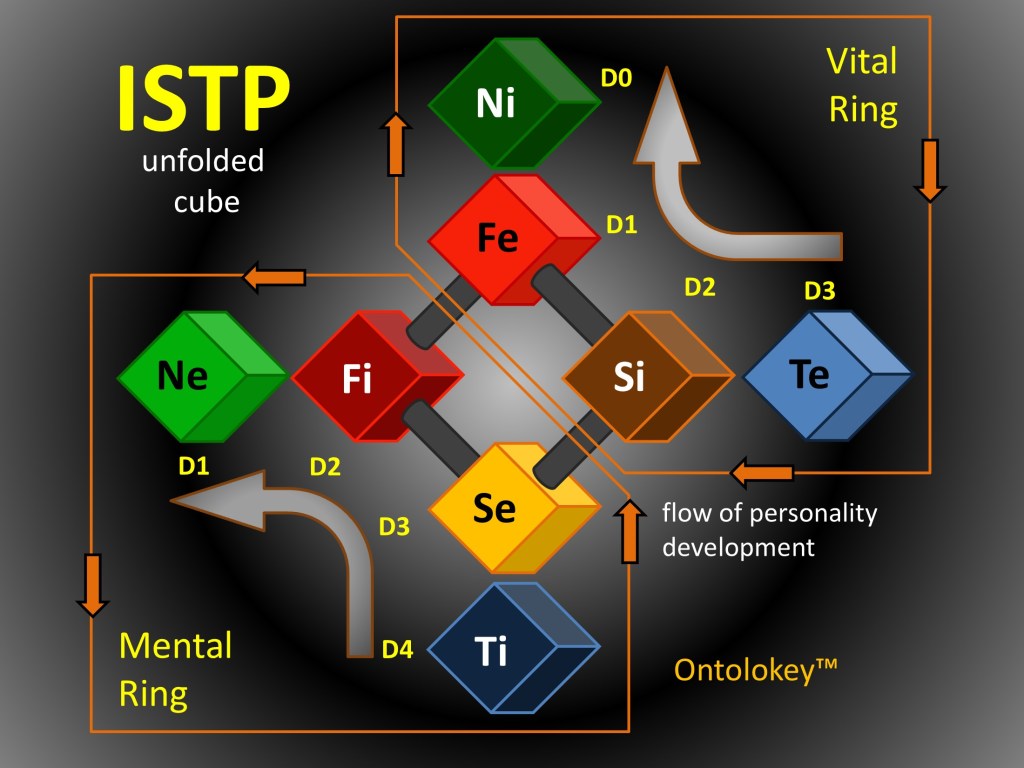
From Competence to Wholeness
The ISTP is often recognized through a distinctive combination of independence, practical intelligence, composure under pressure, technical competence, perceptiveness, and a preference for discovering how things actually work rather than accepting explanations merely because they are given. In the Ontolokey understanding, however, these visible qualities are only the conscious surface of a much larger psychological architecture, whose center is formed by Introverted Thinking (Ti) and Extraverted Sensing (Se). Ti seeks internal coherence, structural clarity, and an intelligible relationship between cause and effect, while Se brings this internal understanding into immediate contact with reality through observation, action, precision, force, timing, and practical experience. The resulting personality can become extraordinarily capable because the ISTP does not merely want to possess an idea; the idea must withstand contact with reality and prove itself through experience. Yet precisely this capacity for competence contains the seed of the deeper developmental problem: when the ability to understand, control, repair, and independently master reality becomes the principal means of psychological self-protection, those aspects of life that cannot be mastered in the same manner—vulnerability, emotional dependence, uncertainty, personal values, interpersonal reciprocity, and questions of meaning—may gradually be pushed into the unconscious.
Psychological individuation therefore begins for the ISTP at a paradoxical point: the very strengths that have enabled survival and competence must eventually become instruments for examining the defenses built around those strengths. The task is not to weaken Ti, suppress Se, or transform the ISTP into a fundamentally different kind of person, but to extend the same uncompromising capacity for observation and understanding toward the inner territories that have historically appeared less reliable, less controllable, or less intelligible. Ontolokey gives this process a spatial language by representing the eight psychological functions as an interconnected landscape rather than as an isolated hierarchy of traits, thereby making visible both the familiar conscious functions and the less-developed or shadow-like dimensions surrounding them. In this perspective, psychological growth is not a linear acquisition of abilities but a gradual widening of consciousness in which previously neglected functions become recognizable, nameable, and eventually available for deliberate integration. The Ontolokey Cube is particularly suited to this conception because its three-dimensional structure allows the psychological architecture to be mentally experienced as something that can be turned, inspected, and approached from different directions rather than merely memorized as a theoretical sequence. The map consequently becomes a landscape of individuation: the ISTP does not leave the original personality behind, but gradually learns to inhabit more of it.
Within the developmental framework used here, this expansion of consciousness follows a specific direction rather than occurring randomly, and that direction is essential if shadow integration is to become psychologically meaningful rather than merely aspirational. The ISTP’s Mental Ring begins with Ti at D4, followed by Se at D3, Fi at D2, and Ne at D1, so development proceeds from the already powerful capacity for internal logical organization toward increasingly vulnerable territories of personal feeling and possibility. The Vital Ring runs in parallel, though with a developmental delay, from Te at D3 through Si at D2 and Fe at D1 toward Ni at D0, the most archaic and childlike point of the structure, where the unknown future and deeper symbolic patterning can become a particularly pronounced blind spot. The essential principle is that development proceeds progressively rather than by psychological shortcuts: Se must become sufficiently differentiated before Fi can be integrated more fully, Fi must acquire sufficient conscious stability before Ne can be approached without overwhelming uncertainty, and the same principle governs the Vital Ring as consciousness gradually moves from Te toward Si, Fe, and finally Ni. This sequence turns individuation into a disciplined process of psychological maturation in which the conscious ego does not attempt to conquer its shadow all at once, but develops the capacity to approach each deeper layer from the stability created by the preceding one.
The central image for this process is therefore not the destruction of the old personality but the gradual turning of an iceberg: what has remained beneath the surface of ordinary consciousness slowly becomes visible, not because the unconscious is forcibly dragged upward, but because the personality acquires enough stability to tolerate what was previously too unfamiliar to integrate. For the ISTP, this is especially important because the most consequential developmental material lies precisely where the personality is least inclined to trust itself: in the vulnerable intimacy of Fi, the uncertainty of Ne, the emotional reciprocity of Fe, and eventually the temporal and symbolic depth associated here with Ni. The deeper shadow is not simply a collection of negative traits waiting to be eliminated; it contains capacities that have been insufficiently differentiated and therefore may emerge first in distorted, defensive, exaggerated, or emotionally charged forms. A person who understands this can begin to reinterpret past failures and injuries with greater psychological precision: what once appeared as personal weakness may reveal an underdeveloped function, what appeared as another person’s inexplicable behavior may become intelligible as an interaction between different psychological structures, and what once demanded resentment may become capable of forgiveness through understanding. In this sense, healing through cognition does not mean thinking away pain; it means making previously unconscious psychological relationships conscious enough that the individual is no longer compelled to repeat them blindly. The ultimate objective is wholeness: not perfection, emotional uniformity, or equal strength in every function, but the recovery of a more complete Self in which the ISTP’s formidable capacity for logic and action can coexist with feeling, uncertainty, relationship, memory, possibility, and meaning.
The Conscious Architecture: Ti and Se as the ISTP’s Psychological Foundation
The first stage of ISTP individuation must begin with an honest recognition of the extraordinary psychological strength represented by dominant Introverted Thinking (Ti). In the Ontolokey model, Ti occupies D4 within the Mental Ring and therefore represents the most developed and naturally accessible cognitive territory of the ISTP: the capacity to deconstruct complexity, identify underlying mechanisms, establish internal consistency, and distinguish what is structurally sound from what merely appears convincing. This is why the ISTP often experiences reality less as a collection of isolated events than as an interconnected system whose parts should make sense in relation to one another. The instinctive question is not simply whether something is socially accepted or emotionally appealing, but whether it actually works, whether its components are coherent, and whether its stated principles survive examination when confronted with concrete reality. This capacity can make the ISTP remarkably calm in situations that overwhelm others, because analysis creates psychological distance from confusion and transforms an apparently chaotic problem into something that can be understood, separated into components, and eventually solved. Yet Ti also establishes the psychological standard against which the later developmental journey must be measured: anything that cannot initially be made intelligible is in danger of being rejected before it has been sufficiently experienced.
Extraverted Sensing (Se), positioned at D3 directly beneath Ti in the Mental Ring, provides the essential bridge between internal understanding and external reality. Where Ti asks how something is structured, Se asks what is actually happening now and what can be done about it, giving the ISTP a pronounced sensitivity to physical circumstances, timing, movement, pressure, boundaries, practical consequences, and opportunities for immediate intervention. The mature expression of this combination is one of the ISTP’s greatest gifts: thought does not remain imprisoned in abstraction, because it is continually tested against experience, while experience does not remain a collection of impressions because Ti organizes it into a comprehensible model. This is the psychological basis for the familiar ISTP capacity to remain composed during crises, manipulate tools or systems with precision, recognize relevant details quickly, and act decisively when circumstances demand it. At the same time, Ti and Se can become so mutually reinforcing that the ISTP develops an exceptionally efficient closed circuit of analysis and action, in which whatever can be solved through understanding, observation, technique, or direct intervention receives attention while whatever requires emotional exposure or toleration of ambiguity remains outside the preferred field of consciousness. The very competence that once created freedom can therefore become a subtle psychological enclosure if it becomes the only trusted way of relating to life.
This distinction is crucial because individuation does not begin by attacking Ti or Se; it begins by recognizing their limits without diminishing their value. A psychologically mature ISTP does not need to become less logical, less independent, less practical, or less perceptive in order to become whole, because those capacities constitute the stable platform from which deeper development can safely occur. Indeed, the developmental sequence requires precisely this stability: the auxiliary Se must become sufficiently developed before the personality can move toward the more vulnerable Fi territory at D2, because emotional integration without sufficient grounding could feel like a loss of control rather than an expansion of consciousness. The ISTP therefore benefits from asking a different kind of question of the self: not merely “Is this thought logically correct?” or “What can I do about this situation?”, but also “What is happening inside me that cannot be reduced to the problem itself?” That question marks the beginning of a profound psychological transition, because it turns the investigative power of Ti inward without asking Ti to manufacture an emotional answer. The objective is not to make feeling logical, but to make the existence and meaning of feeling cognitively accessible enough that it no longer has to remain unconscious. In this sense, the mature ISTP becomes not less rational but more complete in the application of rational awareness.
The developmental movement from D4 toward D3 consequently represents the first great task of individuation: learning to use Se not merely as an instrument for controlling external circumstances, but as a disciplined faculty of conscious presence. The immature expression of Se may seek immediate correction when reality becomes disorderly, and under pressure it can become excessively forceful, punitive, territorial, or impatient with whatever refuses to respond to practical intervention. The mature expression is subtler: it observes before acting, recognizes the limits of force, distinguishes an actual threat from an internal irritation, and allows reality to reveal itself without immediately imposing a solution upon it. This distinction becomes psychologically decisive because the later shadow functions can only be approached by a person capable of remaining present when there is no immediate technical solution. The ISTP’s first developmental victory is therefore not the conquest of the unconscious but the cultivation of enough embodied stability to remain conscious in its presence. Once Se has developed toward the upper end of D3, the personality possesses a sufficiently reliable connection with reality to begin turning toward the next territory of the Mental Ring: Fi, the hidden realm of personal value, emotional significance, loyalty, vulnerability, and the private moral experience that the ISTP may have spent much of life understanding indirectly rather than inhabiting directly.
Fi — The Hidden Center of Personal Meaning
When the ISTP has developed the Ti–Se foundation sufficiently, the next developmental movement leads toward Introverted Feeling (Fi), which occupies D2 in the Mental Ring and is therefore considerably less familiar to consciousness than the dominant and auxiliary functions. This transition is psychologically important because Fi does not primarily ask whether an idea is coherent or whether an action is effective; it asks what something means personally, what is inwardly valued, what feels morally or emotionally true, whom one genuinely cares about, and where the boundaries of personal integrity actually lie. For an ISTP accustomed to evaluating reality through structure and direct experience, such questions can initially appear imprecise because their answers cannot be established in the same externally verifiable manner as technical facts or practical solutions. Yet the apparent imprecision of Fi conceals a highly differentiated inner world, and its relative unfamiliarity can cause the ISTP to mistake emotional depth for emotional instability or vulnerability for weakness. The developmental task is consequently not to become sentimental, but to discover that personal meaning is another form of information which has been present all along, even when it has not received the same conscious authority as logical analysis.
Fi becomes particularly significant because it represents the point at which the ISTP encounters the difference between understanding another person and allowing that person to matter inwardly. An ISTP may be extraordinarily perceptive about another person’s behavior, recognize their motives, identify inconsistencies in their reasoning, and even know exactly what practical assistance would solve their problem, while remaining comparatively uncertain about how deeply the relationship itself has affected the inner self. This can produce a peculiar form of emotional distance in which the individual is not necessarily uncaring, but expresses care primarily through competence, protection, practical assistance, shared activity, or the willingness to solve a concrete problem. Fi begins to reveal that these outward behaviors are only one possible translation of affection and that intimacy also requires conscious recognition of subjective significance. The difficult question becomes not merely “What can I do for this person?” but “Why does this person matter to me, and what happens inside me because they matter?” When that question is permitted to exist without immediately converting it into an action, the ISTP begins to encounter an interior dimension that cannot be mastered through technical efficiency.
This is also where some of the ISTP’s deepest wounds can become intelligible, because the Anima/Animus function is particularly sensitive to experiences of rejection, betrayal, humiliation, abandonment, emotional misunderstanding, or the feeling that one’s inner self was not recognized by others. What may appear externally as indifference can therefore sometimes conceal precisely the opposite: a highly sensitive internal evaluation of whether another person is trustworthy, loyal, authentic, or emotionally safe. When this sensitivity has not been consciously integrated, the ISTP may protect it through withdrawal, detachment, sarcasm, rationalization, or a refusal to acknowledge how deeply an experience has affected them. The defensive position then becomes psychologically circular: because vulnerability feels dangerous, the individual suppresses vulnerability; because it is suppressed, its influence remains unconscious; because its influence remains unconscious, the person may react more strongly than expected when the protected value is threatened. Fi integration interrupts this cycle by making the underlying value conscious, allowing the ISTP to say, internally and eventually interpersonally, not merely “This makes no sense,” but also “This hurt me because something important to me was violated.” That recognition transforms an apparently irrational reaction into psychologically comprehensible information.
The healing potential of Fi therefore lies in its ability to restore dignity to experiences that Ti might otherwise classify as inconvenient, inefficient, excessive, or insufficiently objective. An ISTP who develops this function does not lose analytical distance; rather, analysis acquires a more complete object of investigation because the observer finally includes the observer’s own emotional reality within the field of observation. This can profoundly change the interpretation of past experiences, since the question shifts from “Why did I allow this to happen?” toward “What did I need, value, trust, or fail to understand about myself at that time?” Such questions can uncover the reasons why certain injuries remained psychologically active long after their external circumstances had disappeared, because the unresolved issue was not the event itself but the meaning that had never been consciously integrated. Forgiveness can then become possible without requiring the ISTP to deny the reality of what happened, because understanding the psychological structure behind a wound can separate comprehension from approval. The goal is not to erase anger, grief, disappointment, or attachment, but to bring these experiences into consciousness so that they become part of the individual’s history rather than hidden forces governing the present.
The movement into Fi also marks an important shift in the meaning of strength. Earlier in life, strength may have been defined primarily as self-sufficiency, emotional composure, competence under pressure, resistance to dependence, and the ability to solve problems without requiring assistance. With increasing Fi consciousness, strength becomes the capacity to remain internally present when something matters deeply, even when no immediate solution exists and even when the experience exposes the individual to possible rejection or loss. This is a demanding transformation because it removes one of the ISTP’s most reliable defenses: the ability to step outside an emotional situation and analyze it from a safe distance. The mature expression of Ti does not disappear during this process; instead, it becomes the instrument that allows the ISTP to observe the emotional self without condemning it, while Fi gradually teaches Ti that not every meaningful truth can be reduced to an impersonal proposition. When these functions begin to cooperate, the personality becomes capable of something neither could accomplish alone: a form of inner honesty in which logic protects emotional truth from distortion while emotional truth prevents logic from becoming an escape from the self.
The transition from Se to Fi must therefore be understood as a gradual descent rather than a sudden psychological conversion. Se first teaches the ISTP to remain present in reality, to perceive what is actually happening rather than retreating into abstraction, and Fi then asks the individual to apply that same presence to the interior world of personal significance. The question becomes increasingly subtle: if Se can teach the ISTP to notice the external world without distortion, can the same discipline be applied to noticing one’s own feelings without immediately controlling, dismissing, explaining, or escaping them? This is where individuation begins to move from competence toward vulnerability, because the unconscious can only become conscious when the ego is willing to observe experiences that do not flatter its established self-image. Fi is therefore not merely another function to be “developed”; it is the psychological threshold at which the ISTP discovers that the self being protected by independence may itself contain unmet needs, loyalties, griefs, ideals, and capacities for attachment that deserve recognition. Once these elements can be consciously held rather than defensively rejected, the personality acquires the foundation required for the next descent into the Mental Ring: Ne at D1, where the challenge is no longer simply to know what one feels, but to tolerate what one cannot yet know.
Ne — The Toddler Function and the Fear of the Unknown
After Fi has been sufficiently developed, the ISTP reaches the most fragile territory of the Mental Ring: Extraverted Intuition (Ne), designated D1 and described in the Ontolokey framework as the Toddler function. The metaphor is psychologically revealing because Ne represents a mode of consciousness that is curious, exploratory, associative, and open to possibilities without demanding immediate certainty about where those possibilities will lead. For a personality organized around Ti and Se, this can feel almost developmentally backwards: Ti wants a coherent model, Se wants contact with what is actually present, while Ne introduces alternatives, hypothetical futures, unexpected interpretations, and possibilities that may never materialize. The ISTP can therefore experience unstructured possibility as noise rather than enrichment, particularly when the mind is accustomed to distinguishing what is useful from what is merely speculative. Yet precisely because Ne is so poorly developed in this model, its unconscious influence can become disproportionate to its conscious competence: what the ISTP cannot comfortably entertain deliberately may nevertheless appear indirectly through anxiety, impulsive rejection of possibilities, sudden fascination with improbable scenarios, or an almost reflexive insistence that something is unrealistic before it has been explored. The developmental task is consequently not to make Ne as powerful as Ti, but to transform an archaic and easily overwhelmed relationship with possibility into a consciously tolerable one.
The Toddler metaphor also captures something essential about the emotional character of this function: Ne does not initially behave like a mature strategic faculty but like a young psychological capacity that wants permission to explore without knowing the answer in advance. An ISTP who has spent years relying upon demonstrated competence may find this deeply uncomfortable because exploration without mastery temporarily reverses the usual relationship between the self and reality. Instead of entering a situation because one understands enough to act effectively, one must sometimes enter precisely because one does not yet understand what may emerge. This can expose a hidden fear of incompetence that is particularly difficult for a highly capable person to acknowledge, because the conscious identity may have been built around being the person who can figure things out. Ne integration therefore requires an unusual form of humility: not the humility of believing oneself incapable, but the willingness to remain psychologically alive in the presence of uncertainty without prematurely closing the field of possibilities. In practice, this means allowing alternative interpretations, imagining different futures, considering another person’s perspective before judging it, and recognizing that an initially implausible possibility can sometimes contain information that Ti and Se alone would not have discovered.
The deeper psychological significance of Ne becomes visible when uncertainty touches the previously integrated Fi material. Once the ISTP has learned to recognize personal values, attachment, vulnerability, and emotional significance, the next challenge is accepting that these things cannot always be protected through prediction or control. Relationships may change, identities may evolve, opportunities may appear unexpectedly, and the future may invalidate assumptions that once seemed secure. Ne therefore confronts the ISTP with a fundamental existential reality: consciousness cannot guarantee outcomes merely because it understands the present. This can be particularly difficult when the instinctive response to uncertainty is to retreat toward what is known, practical, measurable, and immediately controllable. The mature development of Ne instead creates psychological flexibility, enabling the ISTP to distinguish between genuine danger and the discomfort of not knowing. Such flexibility does not weaken Se; it makes Se less reactive because present-moment awareness is no longer forced to defend itself against every possible future. The individual becomes capable of saying, in effect, “I do not know what this will become, and I can remain present long enough to find out.”
This is one of the places where earlier psychological wounds can acquire a new interpretation. A person who has repeatedly experienced unpredictability, betrayal, failure, or emotional disappointment may unconsciously conclude that uncertainty itself is dangerous and that safety depends upon maintaining control over circumstances. Ti can then become an instrument of defensive prediction, while Se attempts to secure the immediate environment through action and practical mastery. Ne, however, asks the individual to recognize that control was never the same thing as safety and that avoiding possibility also eliminates opportunities for development, intimacy, creativity, and transformation. Once this distinction becomes conscious, the ISTP can begin to approach uncertainty without interpreting it automatically as a threat to autonomy. The healing process lies in discovering that an unknown outcome does not necessarily imply helplessness, because the mature self can respond intelligently to changing conditions even when it cannot predict them beforehand. What was once experienced as an intolerable lack of control can thus become an arena for psychological freedom.
Ne integration also changes the relationship between the ISTP and other people because it introduces the possibility that another person cannot be completely understood from observed behavior alone. Se notices what someone does, Ti constructs an explanation for why they do it, and the ISTP may then experience that explanation as sufficiently complete to guide action. Ne interrupts this closure by asking what else might be true, what information is missing, what alternative interpretation could explain the same behavior, and what future development might alter the relationship. This is not an invitation to become indecisive or endlessly suspicious; it is an invitation to keep the psychological field open long enough for complexity to reveal itself. Such openness becomes especially valuable after Fi has made personal attachment more conscious, because the ISTP can now recognize both the importance of a relationship and the uncertainty surrounding it without needing either to deny the relationship or possess it. The result is a more mature form of independence: one no longer needs certainty in order to remain internally grounded.
At the completion of the Mental Ring’s developmental sequence, the ISTP has therefore moved from Ti’s certainty of internal structure through Se’s contact with reality, Fi’s recognition of personal meaning, and Ne’s acceptance of possibility. The movement from D4 to D1 is not a descent into weakness but an expansion into dimensions of experience that the original conscious personality could not easily inhabit. Ti remains the organizing center, Se remains the practical bridge to reality, Fi gives personal significance a conscious voice, and Ne prevents the entire structure from becoming psychologically closed. This creates the internal conditions for the next phase of individuation: the Vital Ring, whose functions do not simply repeat the Mental Ring’s development but introduce a second developmental trajectory in which Te, Si, Fe, and finally Ni expose deeper and more difficult aspects of the ISTP’s unconscious relationship with effectiveness, embodied continuity, interpersonal feeling, and meaning. The Mental Ring has taught the ISTP to turn inward without losing contact with reality; the Vital Ring will now ask whether that expanded consciousness can also transform the way the individual lives, relates, remembers, and ultimately confronts the unknown depth of existence itself.
The Vital Ring: From Conscious Development to Individuation
The transition from the Mental Ring to the Vital Ring represents a decisive change in the character of ISTP development because the individual is no longer merely expanding the range of consciously available cognition, but beginning to encounter psychological structures that have historically operated with considerably less conscious supervision. In the developmental sequence described by Ontolokey, the Vital Ring begins with Extraverted Thinking (Te) at D3, followed by Introverted Sensing (Si) at D2, Extraverted Feeling (Fe) at D1, and finally Introverted Intuition (Ni) at D0. Its development runs broadly parallel to the Mental Ring but with a certain temporal delay, which means that the ISTP’s early adulthood is primarily concerned with consolidating the Ti–Se personality structure before the deeper process of individuation gradually opens the less familiar regions of the psyche. This distinction is important because the Vital Ring should not be interpreted as a collection of defects that must be corrected, but as a sequence of capacities whose unconscious or immature expression can distort behavior precisely because they have not yet been sufficiently differentiated. As consciousness expands, the ISTP does not simply acquire four new skills; rather, previously neglected psychological dimensions begin to participate in the construction of identity. Individuation therefore becomes less about becoming “better at being an ISTP” and more about discovering what the ISTP has unconsciously excluded from its definition of the self.
Te as the Sibling function at D3 constitutes the first major step into this Vital Ring because it introduces a form of thinking that is outwardly oriented toward measurable effectiveness, implementation, organization, productivity, and objective results. Ti and Te can both appear highly rational, but their psychological orientation differs significantly: Ti seeks internal precision and structural coherence, whereas Te is concerned with whether an approach produces demonstrable results in the external world. For an ISTP, Te can therefore feel simultaneously familiar and strangely intrusive, because the individual may be exceptionally competent while nevertheless resisting systems of efficiency imposed from outside when those systems conflict with internally established understanding. Development of Te requires the ISTP to recognize that external standards of effectiveness can contain information without automatically constituting an attack upon autonomy. This is especially important professionally and practically, because mature Te allows the individual to translate personal competence into structures that can be communicated, replicated, delegated, measured, or shared with others. The psychological maturation here involves a subtle separation between “I understand why this works” and “Can this knowledge function effectively in a larger system?” Once this distinction becomes conscious, Te ceases to represent an external demand for conformity and becomes another instrument through which the ISTP can make internal competence useful beyond the boundaries of individual mastery.
The developmental importance of Te becomes even clearer when viewed against one of the ISTP’s characteristic defenses: the belief that personal competence is safest when it remains personally controlled. Independence is one of the personality’s great strengths, but when independence becomes fused with identity, cooperation can unconsciously be interpreted as interference, organizational structures as unnecessary constraints, and reliance upon others as a potential loss of freedom. Te introduces a different principle: effectiveness can sometimes increase when knowledge is externalized, systems are established, responsibilities are distributed, and objective criteria are accepted even when they were not personally invented. This does not require the ISTP to surrender Ti’s independent judgment; it requires the individual to recognize that autonomy and cooperation are not opposites. The more mature ISTP can therefore distinguish between genuine external incompetence and merely different methods of achieving an outcome, a distinction that prevents unnecessary resistance and allows personal standards to coexist with collective structures. In the language of individuation, this is the first step toward realizing that the self is not complete simply because it can function independently. A whole personality must also be capable of participating in realities larger than the individual without experiencing participation itself as psychological submission.
Once Te has developed sufficiently, the developmental sequence moves toward Si at D2, where the ISTP encounters a dimension of experience that is much more embodied, continuous, and inwardly receptive than the action-oriented Se mode with which the personality is naturally familiar. Si is concerned with internal bodily states, continuity, comfort, rhythm, accumulated experience, subtle changes in physical and emotional condition, and the preservation of what sustains well-being over time. The distinction between Se and Si is especially significant for the ISTP because Se can be highly responsive to immediate physical reality while still overlooking the cumulative consequences of repeatedly overriding the body’s quieter signals. An individual may know exactly how to push through a demanding situation yet remain comparatively insensitive to the gradual depletion created by doing so repeatedly. Si asks a different question: not merely “Can I handle this now?” but “What is this pattern doing to me over time?” Its integration therefore introduces continuity into a personality that can be exceptionally oriented toward the present moment, helping the ISTP recognize that physical vitality, emotional regulation, rest, environment, routine, and sensory equilibrium are not trivial concerns but foundations upon which sustained freedom depends.
Si development can consequently become a form of reconciliation with the body itself. When the body is treated primarily as an instrument for action, endurance, performance, or experience, its signals may only receive conscious attention once they become impossible to ignore. The more integrated ISTP learns to notice fatigue before exhaustion, tension before pain, emotional overstimulation before withdrawal becomes necessary, and environmental disharmony before it produces chronic irritation. This represents more than lifestyle optimization because the body often carries information that cognition has temporarily excluded from conscious consideration. A person who has learned to distrust vulnerability may discover through Si that the body records the cost of constant self-control; a person who habitually dismisses emotional discomfort may notice that the body has been communicating the same conflict through sleep, tension, restlessness, or exhaustion. Such awareness can become an important bridge between cognition and self-care, allowing the ISTP to treat bodily experience neither as an obstacle nor as an unquestionable authority, but as another source of information requiring attentive interpretation. In this way, Te and Si establish the next developmental foundation: external effectiveness becomes integrated with sustainable internal functioning, preparing the personality for the far more vulnerable territory of Fe.
The significance of this sequence becomes apparent when the Vital Ring is understood as a delayed parallel to the Mental Ring rather than as a separate psychological project. Ti’s mastery of internal structure gradually gives way to Se’s conscious engagement with reality; only then can the ISTP safely approach Fi, Ne, Te, and Si without immediately returning to familiar defenses. The individual learns first to understand, then to act, then to feel, then to tolerate possibility, and subsequently to organize, sustain, and inhabit a larger relational and embodied reality. Each developmental stage therefore modifies the meaning of the previous one: Te prevents Ti from becoming isolated intellectual autonomy, Si prevents Se from becoming perpetual stimulation or forceful engagement, and the eventual development of Fe will prevent both competence and independence from becoming substitutes for emotional reciprocity. The Vital Ring thus takes individuation beyond self-understanding into the question of how the expanded self actually exists among other people and within the passage of time. Once the foundations of Te and Si have been established, the ISTP approaches perhaps one of its most psychologically revealing thresholds: Fe at D1, the inferior function, where the capacity to recognize, express, receive, and consciously participate in collective emotional experience becomes unavoidable.
Fe — The Inferior Function and the Recovery of Emotional Reciprocity
Extraverted Feeling (Fe), positioned at D1 in the Vital Ring, represents one of the most consequential thresholds in ISTP individuation because it confronts the personality with a form of psychological information that cannot be adequately processed through private analysis alone. Fe concerns the emotional atmosphere between people, the expression of feeling in a shared interpersonal space, the recognition of collective emotional states, and the capacity to participate consciously in emotional exchange rather than merely observing it from the outside. For an ISTP, whose natural psychological orientation favors internal evaluation and direct engagement with concrete reality, the emotional field created by a group or relationship can initially appear ambiguous, exaggerated, intrusive, or simply difficult to navigate. This does not imply an absence of feeling; indeed, the problem may be precisely that feelings are present but are not easily translated into a socially visible or reciprocal language. The inferior position of Fe can therefore produce an unusual tension in which the ISTP may deeply care about people while simultaneously feeling uncomfortable with the explicit emotional rituals through which other people communicate care. Individuation requires recognizing that emotional expression is not merely social decoration but a genuine mode of human communication, and that refusing to participate in it can unintentionally create the very distance from others that the individual may secretly find painful.
The defensive relationship with Fe often becomes most visible when emotional expectations are imposed from outside. An ISTP may tolerate considerable practical demands without feeling psychologically threatened, yet react strongly when another person insists that feelings must be verbalized, displayed, or immediately reciprocated. Because Ti naturally seeks clarity and Se naturally seeks concrete evidence, diffuse emotional expectations can feel like demands without instructions, and the instinctive response may be withdrawal, irritation, humor, silence, or an attempt to solve the emotional problem as though it were a technical problem. This is where the distinction between emotional intelligence and emotional compliance becomes essential. Developing Fe does not mean agreeing with every emotion expressed by another person, performing feelings one does not genuinely experience, or surrendering one’s boundaries to maintain harmony. It means becoming sufficiently conscious of the emotional field to recognize what is occurring, communicate one’s own internal position, and respond intentionally rather than automatically. The mature ISTP can therefore say, in psychological terms, “I recognize that this affects you, even if I experience the situation differently,” without having to abandon Ti’s independent judgment. Such recognition is not weakness; it is an expansion of perceptual range.
Fe becomes especially challenging when it exposes the interpersonal consequences of emotional avoidance. A person may believe that remaining calm, giving practical assistance, and refusing unnecessary drama constitutes responsible behavior, while another person experiences exactly the same behavior as indifference, rejection, or emotional abandonment. Neither interpretation necessarily describes the entire truth, because the psychological issue lies in the translation between different forms of relating. The ISTP may genuinely be communicating care through action while unconsciously assuming that the action should be self-explanatory, whereas the other person may require explicit emotional acknowledgment before the action can be experienced as care. Fe development teaches the ISTP to recognize this difference without concluding that one mode is inherently superior. This can radically improve intimate relationships because the individual begins to understand that people do not merely need solutions; sometimes they need to know that their inner experience has been witnessed. The practical expression of love can remain deeply ISTP, but it becomes more psychologically complete when accompanied by the capacity to make its emotional meaning visible.
The inferior nature of Fe also means that its immature expression can emerge disproportionately under stress, particularly when accumulated interpersonal tension exceeds the individual’s usual capacity for emotional containment. The normally composed ISTP may then become unusually reactive, emotionally blunt, sarcastic, defensive, or preoccupied with how others perceive them, while afterward struggling to understand why the reaction was so intense. From the perspective of individuation, such episodes are not merely failures of self-control; they can be interpreted as compensatory eruptions of an underdeveloped function demanding conscious recognition. What has not been given an ordinary channel of expression may eventually seek expression under pressure, and because the function has not been sufficiently differentiated, the resulting behavior may feel foreign to the conscious personality. The appropriate response is neither shame nor romanticization of the outburst, but investigation: What interpersonal need had been accumulating? What emotional information had been ignored? What boundary had not been communicated? What feeling had been treated as irrelevant until it became impossible to contain? These questions allow Ti to perform its most constructive function—not suppressing Fe, but analyzing the conditions under which Fe becomes distorted so that the underlying emotional information can finally be integrated.
The healing dimension of Fe becomes particularly important in relation to forgiveness. Once an ISTP begins to recognize that human behavior is often shaped by unconscious fears, emotional limitations, developmental immaturity, and different psychological functions, the individual may acquire a more nuanced interpretation of interpersonal injuries. Understanding why someone behaved destructively does not make the behavior acceptable, but it can reduce the compulsion to preserve an injury indefinitely as evidence that the other person must remain psychologically condemned. The same principle applies inwardly: the ISTP may begin to forgive earlier versions of the self for emotional limitations that were once experienced as personal defects, recognizing that a function cannot be consciously used at a level of maturity it has not yet reached. This can release considerable psychological energy because resentment often depends upon the belief that someone—including oneself—should have known better despite lacking the necessary consciousness at the time. Through Fe, the individual begins to see relationships as encounters between incomplete psychological systems, each carrying its own history and blind spots. Compassion then becomes compatible with discernment: one can understand another person’s limitations, maintain boundaries, and still refuse to reduce the person to the injury they caused.
The development of Fe therefore represents an important transformation in the ISTP’s understanding of independence. Earlier independence may have meant not needing others, not being emotionally controlled by others, and retaining the freedom to leave situations that became psychologically restrictive. Mature independence adds another dimension: the freedom to remain connected without losing oneself. This requires tolerating the vulnerability of being seen, expressing appreciation before it becomes necessary to prove it through action, acknowledging hurt without turning it into accusation, and accepting affection without immediately searching for the hidden obligation behind it. Fe does not replace Fi; rather, it provides an outward channel through which the inner values discovered through Fi can enter relationship. The ISTP can then preserve authenticity without emotional isolation, because personal feeling and interpersonal expression no longer have to be treated as contradictory demands. The person who once protected freedom through distance can gradually discover that genuine autonomy is compatible with attachment when attachment is entered consciously rather than defensively.
At this point the developmental journey approaches its most difficult territory, because after Fe comes Ni at D0—the function designated here as the archaic, childlike, and potentially blindspot dimension of the Vital Ring. The movement from Fe toward Ni is qualitatively different from the earlier transitions because Ni confronts the ISTP not simply with another interpersonal capacity but with questions concerning temporal depth, underlying meaning, symbolic pattern, destiny, inevitability, and the direction in which life appears to be moving. For a consciousness accustomed to understanding what is present and acting upon what can be observed, Ni can feel almost intolerably intangible because it asks the individual to perceive what cannot yet be directly verified. Yet precisely because it occupies D0, its integration cannot be rushed or forced; it must emerge from the stability created by Te, Si, and Fe, just as Ne could only be approached responsibly after Fi had become sufficiently conscious. The final movement of individuation will therefore require the ISTP to confront not an external problem that can be solved, but the deeper question of what the entire pattern of a life may mean when viewed from a perspective larger than immediate competence, personal preference, or observable circumstance.
Ni — The D0 Blindspot and the Encounter with Meaning
Introverted Intuition (Ni), placed at D0 at the end of the Vital Ring, represents the most archaic and least consciously developed territory in the ISTP developmental sequence described by Ontolokey. It is therefore important to approach Ni differently from the other functions: the task is not to turn it into another instrument of control, but to develop enough psychological receptivity to recognize patterns of meaning that cannot be reduced to immediate sensory evidence or explicit logical construction. Ni concerns temporal depth, emerging direction, underlying patterns, symbolic significance, and the possibility that events form a meaningful trajectory even when their significance cannot yet be demonstrated. This is precisely what makes it such a difficult territory for the ISTP: Se naturally trusts what is occurring now, while Ti trusts what can be internally understood, whereas Ni asks the individual to remain attentive to something that may only become comprehensible later. In its immature form, this can lead either to dismissal of intuition as irrelevant or, under compensatory pressure, to sudden and rigid interpretations that are treated as certain precisely because they have not been sufficiently examined. The developmental goal is neither credulity nor mystical certainty, but the capacity to allow an emerging pattern to exist as a possibility before demanding that it become a proven fact.
The psychological significance of Ni becomes clearer when considered as the final point of the Vital Ring, because it confronts the ISTP with the limits of the problem-solving identity itself. Much of the personality’s confidence is built upon the assumption that if something is understood accurately enough, an appropriate response can be found; Ni introduces experiences for which no immediate response is available and perhaps no response is required. Aging, loss, irreversible change, missed opportunities, the consequences of earlier decisions, and the awareness of mortality all contain dimensions that cannot simply be repaired through technical competence. At such moments, the individual is forced to distinguish between a problem and a process: a problem demands intervention, whereas a process may demand participation, patience, acceptance, and the willingness to discover what it becomes. This distinction can be profoundly unsettling for an ISTP because accepting a process means relinquishing the fantasy that every meaningful difficulty can be mastered through sufficient skill. Yet it is precisely here that psychological maturity deepens, because the self learns that surrendering control over an outcome does not necessarily mean surrendering agency over one’s response. Ni begins to provide an awareness of direction where Se previously provided awareness of circumstance.
The D0 designation also gives Ni a particularly important relationship to childhood and psychological regression. What is least developed can often appear in an emotionally primitive form, and the ISTP may encounter Ni initially not as serene wisdom but as an obscure sense that something is wrong, that an outcome is inevitable, or that a hidden pattern is operating without being consciously understood. Such experiences can become especially powerful during periods of exhaustion, crisis, grief, or major life transition, when the ordinary Ti–Se strategy of analyzing and acting becomes insufficient. If the person has no conscious relationship with Ni, these intuitions may either be dismissed entirely or become inflated into unexamined convictions. Individuation creates a third possibility: the individual learns to listen without immediately believing and to question without immediately rejecting. Ti can ask whether an intuitive impression is internally coherent, Se can investigate what evidence is actually present, Fi can determine what personal significance the impression carries, and Fe can consider its relational consequences. In this integrated form, Ni does not overthrow the existing personality; it becomes a quiet additional dimension of consciousness that can inform the personality without possessing it.
This becomes particularly relevant when examining the ISTP’s relationship with the future. An immature orientation toward the future may oscillate between excessive indifference and sudden attempts to control outcomes once uncertainty becomes threatening. The individual may prefer to keep options open, respond to circumstances as they arise, and avoid committing prematurely to a single narrative about what life should become. These are often adaptive expressions of Se, but they can become limiting when the refusal to predict becomes a refusal to imagine direction at all. Ni integration introduces the possibility of asking where one’s choices are converging rather than merely whether each individual choice makes sense in isolation. Over time, seemingly unrelated decisions, relationships, losses, interests, and recurring psychological themes may reveal a pattern that cannot be recognized from any single event. The ISTP does not need to construct a grand destiny narrative from these observations; the more mature task is simply to notice what repeatedly calls for attention. In this respect, Ni functions less as fortune-telling than as an awareness of psychological trajectory.
The healing potential of Ni lies partly in its capacity to reorganize the meaning of the past. Earlier developmental work through Fi and Fe can help the ISTP identify what was painful, what was valued, and how relationships contributed to wounds, while Ni can eventually ask what those experiences became within the larger trajectory of the personality. This does not mean assigning a predetermined purpose to suffering or claiming that every injury was somehow necessary. Rather, it means recognizing that an experience can acquire new meaning as consciousness develops, even when its original meaning was painful or incomprehensible. A failed relationship may reveal a previously unconscious pattern of attachment; a professional failure may expose an identity built too narrowly around competence; a period of isolation may reveal the difference between solitude and emotional withdrawal; a repeated conflict may indicate a psychological blindspot that practical intelligence alone could not correct. In this way, Ni can transform biography into psychological pattern without reducing the complexity of individual experience. The past is no longer merely a sequence of events but becomes material from which the evolving self can recognize its own structure.
When Ni begins to become consciously approachable, the entire developmental sequence of the Vital Ring can therefore be understood retrospectively as preparation for a different relationship with existence. Te taught the ISTP to distinguish personal understanding from objective effectiveness; Si taught attention to continuity, embodiment, and the cumulative consequences of living; Fe taught participation in emotional reality beyond the boundaries of private self-sufficiency; and Ni finally asks the individual to tolerate meaning that cannot be immediately possessed. The movement from D3 toward D0 is consequently not a descent into increasingly defective psychological territory but a journey toward increasingly unfamiliar forms of consciousness. At the end of this movement, the ISTP has encountered effectiveness, embodiment, relationship, and meaning as dimensions that cannot be fully subordinated to the original Ti–Se mode of functioning. The personality has become capable of observing itself from perspectives that were previously unavailable, which is precisely what makes a genuine transformation of the relationship to the unconscious possible.
Yet the completion of the Vital Ring does not mean that every function suddenly becomes equally strong or equally conscious. Individuation is not the manufacture of a perfectly balanced personality in which Ti, Se, Fi, Ne, Te, Si, Fe, and Ni operate with identical intensity. The purpose is rather to establish communication between previously separated psychological territories so that the dominant consciousness is no longer forced to defend itself against everything it does not naturally prefer. In the Ontolokey developmental image, the iceberg gradually turns until what was beneath the waterline becomes visible, while the original dominant function eventually returns to the upper position—not as the unchanged ego of early life, but as Ti within a much larger psychological whole. The ISTP therefore does not “outgrow” being an ISTP; the individual returns to the original center after having incorporated knowledge of the parts that were previously experienced as foreign. This is the deeper meaning of psychological wholeness: the personality becomes more itself precisely because it is no longer confined to the narrowest definition of itself.
The Deepest Shadow: What the ISTP Defends Against
The deepest shadow of the ISTP cannot be understood simply by listing undesirable traits such as emotional detachment, impulsiveness, stubbornness, isolation, or insensitivity, because these behaviors are often secondary manifestations of a much deeper psychological conflict. The central shadow dynamic emerges when the personality’s natural reliance upon Ti and Se becomes fused with the conviction that competence, autonomy, and control are the safest foundations of existence. If the individual can understand the mechanism, respond to the immediate reality, and remain sufficiently self-contained, there appears to be little reason to expose the more vulnerable layers of the psyche. The difficulty begins when life presents circumstances that cannot be solved through those means, because then the personality encounters not merely an external obstacle but an internal experience of inadequacy that may be profoundly threatening to its established identity. The ISTP may respond by withdrawing further into analysis, increasing practical control, minimizing emotional consequences, or convincing itself that the problem is insignificant because acknowledging its significance would create an obligation to feel it. Beneath the apparent coolness, therefore, the shadow may contain a much more vulnerable question: What happens to me when I cannot solve the situation and cannot remain unaffected by it?
This question becomes especially important in relation to the Anima/Animus function Fi, because personal values and emotional attachments can expose the ISTP to forms of vulnerability that competence cannot automatically protect. An ISTP may tolerate physical risk, professional pressure, uncertainty in action, or difficult circumstances with impressive composure while becoming unexpectedly defensive when something touches a deeply personal value or threatens an important bond. The discrepancy can confuse both the individual and those around them, because the external reaction may appear disproportionate to the event while the internal significance remains largely unspoken. The shadow becomes stronger when the person has learned that acknowledging emotional injury creates vulnerability to manipulation, rejection, or dependency, because the psyche then develops a protective equation in which detachment equals safety. Over time, this can produce an emotionally paradoxical existence in which the individual genuinely longs for authenticity and loyalty while simultaneously making authentic closeness difficult by withholding precisely the information that would allow another person to understand what matters. The problem is not that the ISTP lacks depth; it is that depth can become hidden behind an exceptionally effective defensive structure.
The same mechanism can affect the ISTP’s relationship with weakness. When personal identity has been built around being capable, self-reliant, and difficult to destabilize, ordinary human limitations can acquire an exaggerated psychological meaning. Fatigue may be interpreted as failure, emotional need as dependence, uncertainty as incompetence, and the need for reassurance as something that should be overcome privately rather than communicated. Such interpretations create an internal hierarchy in which only the competent self is granted legitimacy, while the frightened, grieving, confused, dependent, or emotionally wounded self is pushed outside conscious identification. This is one reason the less-developed functions can appear so threatening: they represent aspects of human existence in which the individual cannot immediately rely upon the familiar Ti–Se method of mastery. Psychological healing therefore requires a radical but precise redefinition of competence. The mature ISTP does not become competent by eliminating vulnerability; rather, competence expands to include the ability to recognize vulnerability accurately, regulate it without shame, communicate it without surrendering autonomy, and learn from it without allowing it to dictate behavior unconsciously.
The shadow can also emerge through an exaggerated form of Se when the psychological present becomes an escape from psychological depth. Immediate experience offers a powerful antidote to rumination: action, movement, stimulation, physical activity, technical engagement, novelty, and direct contact with reality can all restore a sense of vitality and agency. These qualities are not pathological in themselves and may be among the healthiest resources available to the ISTP. They become defensive when activity is used systematically to prevent inner experience from catching up with the individual. Constant doing can become a sophisticated form of avoidance because as long as something is being repaired, explored, optimized, experienced, or physically pursued, there is less psychological space in which grief, loneliness, attachment, uncertainty, or existential questions can become conscious. The individual may therefore appear highly alive while remaining partially disconnected from the emotional meaning of that life. The developmental solution is not withdrawal from experience but the ability to alternate consciously between engagement and reflection, allowing Se to remain a source of vitality while preventing it from becoming a mechanism for escaping the interior world.
Another dimension of the shadow emerges through Ti itself when its extraordinary analytical capacity becomes detached from emotional accountability. Because Ti can construct persuasive explanations for almost anything, it can sometimes be used not to discover truth but to defend the self against uncomfortable truth. The distinction is subtle because rationalization often feels identical to genuine reasoning from the inside: the argument may be coherent, technically accurate, and supported by observable facts while still omitting the psychologically decisive information. An ISTP may accurately explain why a relationship failed while avoiding the fact that intimacy was frightening, correctly identify another person’s mistakes while overlooking the emotional injury caused by their own behavior, or demonstrate that a conflict was objectively unnecessary while refusing to acknowledge that the conflict revealed an important unmet need. The shadow therefore does not necessarily speak irrationally; it can speak with exceptional intelligence. What makes it shadow is not the absence of logic but the selective application of logic in the service of avoiding what the psyche does not yet want to know.
The integration of Ne and Ni further reveals how the ISTP can defend against uncertainty by closing psychological possibilities prematurely. Ne at D1 may initially appear as the childlike capacity to imagine alternatives, while Ni at D0 can represent an even deeper difficulty with trusting an emerging sense of direction or meaning. When both remain insufficiently conscious, the ISTP may oscillate between refusing to speculate and becoming overly certain once an interpretation finally appears. This creates a psychological preference for the immediately demonstrable that can become restrictive when life requires imagination, patience, or faith in a developmental process whose outcome cannot yet be observed. The shadow response is often to convert uncertainty into a binary judgment: either something is real and therefore worth attention, or it is speculative and therefore irrelevant. Individuation introduces a third position in which uncertainty itself becomes tolerable. The ISTP can learn to hold hypotheses without becoming attached to them, intuitions without worshipping them, and possibilities without feeling obligated to pursue them, thereby allowing the unconscious to communicate without allowing it to dictate.
The most difficult shadow material often appears in moments when the usual personality structure stops working. A major loss, relational rupture, professional failure, prolonged uncertainty, aging, illness, isolation, or existential crisis can remove the external conditions that previously allowed Ti and Se to maintain psychological equilibrium. In such moments, the ISTP may discover that the self-image of being capable, independent, and emotionally self-sufficient was partly dependent upon having a world that could still be acted upon. When action becomes insufficient, the neglected functions begin to demand recognition, sometimes through emotional flooding, bodily exhaustion, relational conflict, obsessive analysis, sudden hopelessness, or a profound sense of meaninglessness. These experiences should not be treated merely as evidence that the personality has broken down; they can also represent the psyche’s attempt to expand beyond an identity that has become too narrow for the individual’s current stage of life. The unconscious does not necessarily destroy the established personality because it is hostile to it; it may destabilize it because the existing structure can no longer contain the totality of the developing person. The shadow thus becomes not an enemy to be defeated but an uncompromising messenger carrying information that the conscious personality has repeatedly declined to process.
This is why the deepest ISTP shadow cannot be integrated through force, self-criticism, or an attempt to manufacture emotionality. The very strategy of trying to “fix” the shadow through excessive control would simply reproduce the original problem in a more sophisticated form. Integration requires the gradual development of a relationship between consciousness and unconscious material, in which Ti provides discrimination, Se provides grounding, Fi provides personal meaning, Ne provides openness, Te provides implementation, Si provides embodied continuity, Fe provides relational expression, and Ni eventually provides a perspective on trajectory and meaning. Each function contributes something the others cannot supply, but none is asked to replace the dominant center. The ISTP becomes whole by allowing previously excluded information to enter consciousness while preserving the capacity to evaluate and act upon it intelligently. The deepest healing therefore occurs when the individual can finally experience vulnerability without interpreting it as defeat, uncertainty without interpreting it as incompetence, attachment without interpreting it as captivity, and emotional truth without interpreting it as irrationality. That is the point at which the shadow ceases to be an underground opposition to the conscious personality and begins to become part of the personality’s own recovered depth.
The Individuation Method: Turning Cognition Toward the Self
If the purpose of individuation is to integrate the unconscious rather than merely to accumulate psychological knowledge, the ISTP requires a method that respects the natural authority of cognition while gradually changing what cognition is directed toward. The decisive shift is from using Ti primarily to understand external systems toward using Ti to investigate the relationship between external events and internal reactions, without prematurely assuming that either the self or the other person is entirely responsible for what has occurred. The Ontolokey growth model describes this movement as a progression from defensive autonomy toward conscious interdependence, in which emotional and interpersonal information is treated as additional information about reality rather than as an intrusion upon rationality. This is especially important for the ISTP because the personality’s analytical strength can become self-sealing when it is used only to confirm an already established interpretation, whereas genuine cognition must remain capable of discovering something that contradicts the observer’s preferred explanation. Individuation therefore begins whenever the ISTP becomes willing to make the self itself an object of honest investigation, including the motives, fears, attachments, assumptions, and defensive conclusions that ordinarily remain outside the analytical field.
A practical discipline for this process is to treat emotional reactions initially as data rather than conclusions. When irritation, withdrawal, distrust, boredom, defensiveness, or sudden indifference appears, the first impulse may be to identify the external cause and establish what is wrong with the situation, but psychological integration requires a second investigation beneath that conclusion. The ISTP can ask what the reaction is protecting, what expectation has been violated, what personal value has been touched, what fear has been activated, and whether the intensity of the present response belongs entirely to the present or has been amplified by an older unresolved experience. This does not require believing every feeling or treating every internal impression as objective truth; feelings become useful precisely when they are examined with the same intellectual honesty that Ti applies to external information. A feeling may contain accurate information, distorted information, historical information, or several forms of information simultaneously, and the task of cognition is to differentiate them rather than suppress the entire signal. Through repeated practice, the ISTP gradually discovers that introspection need not mean surrendering rationality, because disciplined self-observation can be just as precise as technical analysis when the individual learns to distinguish sensation, emotion, interpretation, memory, and judgment.
The next discipline is to identify the difference between protection and preference, because an ISTP can sincerely believe that a behavior is simply part of personal character when it may actually be a defense that once served a necessary purpose. Preferring solitude is not necessarily avoidance, valuing privacy is not necessarily emotional repression, enjoying independence is not necessarily fear of attachment, and disliking unnecessary emotionality is not necessarily an inability to feel; the psychological question concerns function rather than appearance. Does solitude restore the individual and increase psychological freedom, or does it prevent intimacy from becoming possible? Does privacy protect something genuinely personal, or does it prevent another person from discovering what the ISTP actually needs? Does independence create choice, or has it become impossible to ask for help even when help would be beneficial? These distinctions allow the ISTP to preserve authentic characteristics while surrendering defensive rigidity, which is a far more sophisticated form of growth than attempting to imitate another personality style. The aim is not to eliminate the protective structure but to make it voluntary, so that the individual can choose distance when distance is appropriate and connection when connection is appropriate.
The Ontolokey Cube can be used symbolically within this process as a visual representation of that psychological movement. Because the model places the eight functions into a three-dimensional landscape, the less-developed functions can be viewed not as abstract labels but as directions toward which consciousness may gradually expand, while the sliders provide a practical metaphor for recognizing where psychological energy is concentrated and where development might occur. For the ISTP, the developmental path can therefore be visualized as a sequence rather than an indiscriminate attempt to strengthen everything simultaneously: Ti at D4 establishes the cognitive foundation, Se at D3 develops conscious contact with reality, Fi at D2 opens personal value and emotional significance, and Ne at D1 gradually increases tolerance for possibility and uncertainty. The Vital Ring then proceeds from Te at D3 through Si at D2 and Fe at D1 toward Ni at D0, with each stage requiring the preceding stage to have acquired sufficient stability before the deeper layer can be approached responsibly. The value of this visualization is psychological rather than mechanical: it reminds the individual that growth has direction and that trying to leap directly into the most unfamiliar function can simply produce confusion, compensation, or temporary imitation rather than genuine integration.
The most important practical principle is therefore progressive exposure to psychological unfamiliarity. The ISTP should begin with experiences only slightly outside the habitual Ti–Se mode, such as consciously naming a feeling, acknowledging a personal value, asking another person what they experienced rather than assuming it, or allowing an unresolved question to remain open for a period without forcing a conclusion. Once these practices become sufficiently stable, the individual can move toward more demanding forms of integration, such as communicating vulnerability, considering multiple interpretations of interpersonal events, examining long-term patterns, receiving emotional support, or deliberately reflecting upon the meaning of experiences that cannot be solved. This is analogous to the developmental sequence itself: the psyche builds capacity incrementally, and what initially feels unnatural can become increasingly accessible through repeated conscious practice. The goal is not to perform the function artificially but to establish enough familiarity that it no longer triggers an automatic defensive response. Over time, the formerly foreign territory becomes psychologically inhabitable, and what was once experienced as “not me” becomes recognized as another legitimate dimension of the self.
This process becomes especially powerful when the ISTP begins to reinterpret personal history through the newly developed functions. An earlier failure can be examined through Te as a question of external effectiveness, through Si as a question of accumulated conditions and bodily strain, through Fi as a question of personal values, through Fe as a question of relational dynamics, through Ne as a question of alternatives that were not recognized, and through Ni as a question of the larger trajectory that the event revealed only in retrospect. The purpose is not to endlessly analyze the past, because that could itself become another Ti-based avoidance strategy, but to discover information that was unavailable to the earlier version of the self. This is where the possibility of healing through cognition becomes most meaningful: the event may remain unchanged, but the psychological relationship to the event can change because consciousness has acquired additional perspectives from which to understand it. What once appeared as inexplicable personal failure can become a comprehensible consequence of developmental limitations, circumstances, unconscious defenses, or functions that had not yet become sufficiently accessible.
Eventually, this method changes the ISTP’s relationship with the unconscious itself. Instead of treating the shadow as an adversary that periodically disrupts rational control, the individual begins to recognize its recurring communications and to ask what psychological capacity is attempting to enter consciousness through them. Withdrawal may signal an unacknowledged wound; irritation may indicate a violated value; uncertainty may reveal an undeveloped tolerance for possibility; exhaustion may expose a neglected bodily limit; relational conflict may reveal an inability to communicate emotional significance; recurring life patterns may indicate a deeper trajectory that has remained invisible from the immediate perspective. None of these interpretations should be accepted automatically, because integration requires discrimination as much as openness, but they become hypotheses worthy of investigation rather than experiences that must be immediately suppressed. This is the essential transformation from self-protection to self-understanding: the psyche no longer has to communicate exclusively through symptoms of imbalance because consciousness has learned to listen before the unconscious has to become overwhelming. In that sense, individuation is not an escape from the original ISTP personality but the gradual development of an inner dialogue in which the whole psychological system can finally participate.
The Sequence of Healing: Why the ISTP Must Not Skip Developmental Stages
Individuation in the Ontolokey model is not a sudden awakening in which an ISTP simply discovers every neglected psychological function at once. It is a gradual reorganization of the personality in which development proceeds through ordered stages, because each newly integrated capacity creates the psychological conditions required for the next one. In the Mental Ring, the movement is Ti D4 → Se D3 → Fi D2 → Ne D1, while in the Vital Ring it proceeds Te D3 → Si D2 → Fe D1 → Ni D0. The sequence matters because a function that remains developmentally immature cannot reliably carry the psychological weight of a later stage; attempting to leap directly toward emotional openness, symbolic meaning, or radical uncertainty may therefore produce imitation rather than integration. For the ISTP, this is especially important because the conscious personality is already strongly organized around Ti and supported by Se, making competence and immediate reality-contact relatively accessible while leaving more vulnerable modes of experience less familiar. Growth consequently means not abandoning what already works, but allowing the existing structure to become sufficiently stable and flexible that deeper layers can emerge without threatening the personality’s coherence.
The first movement is therefore not away from Ti but through it. Ti must gradually become capable of examining not only external systems, problems, and inconsistencies, but also the internal logic of the ISTP’s own defensive patterns. Se then becomes more than an instrument of action, stimulation, or immediate problem-solving; it develops into a capacity for sustained presence with what is actually happening inside and outside the self, including experiences that cannot be immediately controlled. Only when this foundation has become sufficiently conscious can Fi begin to emerge from its more hidden position as Anima or Animus, bringing personal value, attachment, loyalty, hurt, and emotional significance into the field of awareness. Ne follows as the Toddler, opening a further developmental challenge: the capacity to remain psychologically alive when the future is uncertain and no single interpretation can yet be confirmed. In this sequence, each stage enlarges the meaning of the previous one rather than replacing it, so the ISTP gradually moves from internal coherence, through embodied reality, toward personal meaning and finally toward openness to possibility.
The same principle operates within the Vital Ring, although its development may become particularly visible later in life. Te at D3 extends the ISTP’s natural competence into the external world by developing a more explicit relationship with efficiency, organization, measurable effectiveness, and practical execution. Si at D2 then introduces a different relationship with continuity: the body, familiar environments, accumulated experience, stability, and the quiet forms of security that may previously have seemed secondary to autonomy. Fe at D1 represents an even more vulnerable developmental threshold because it asks the ISTP to recognize emotional reciprocity not merely as something other people demand, but as an actual dimension of human reality in which the self also participates. Ni at D0 remains the deepest and most archaic layer, concerned with temporal depth, trajectory, symbolic meaning, and the possibility that life cannot be reduced to what is immediately observable. The Vital Ring therefore does not ask the ISTP to become someone else; it gradually reveals dimensions of existence that were always present but had remained outside the dominant mode of consciousness.
This is also why the Ontolokey model describes development as movement between rings rather than as a simple accumulation of desirable traits. During the earlier adult period, the Mental Ring may become increasingly refined as Se develops alongside dominant Ti, often allowing the ISTP to become highly capable, independent, and effective in concrete reality. As Se approaches a level of development close to the dominant, the psychological center of gravity can begin to shift, and the Sibling function Te becomes increasingly relevant; according to the model, this transition can become especially significant in the second half of life. The metaphor of the iceberg captures the process well: consciousness initially occupies only the visible portion of the personality, while much larger psychological structures remain beneath the surface. As development destabilizes the old equilibrium, the iceberg seems to rotate, exposing material that had previously been submerged, until the original dominant orientation can return in a more complete form rather than merely repeating its earlier configuration.
The healing significance of this sequence lies precisely in the fact that nothing has to be destroyed. The ISTP does not heal by becoming less Ti, less independent, less precise, or less grounded in reality; healing occurs when these qualities cease to function as compulsory defenses against everything they cannot themselves contain. A mature Ti can recognize that an emotion may carry information without becoming irrational, a mature Se can remain present without immediately converting experience into action, and a mature autonomy can tolerate dependence without experiencing it as defeat. From there, Fi can reveal what has actually mattered, Ne can tolerate what remains unresolved, Fe can allow relationship to become reciprocal, and Ni can gradually place individual experiences within a larger temporal and existential pattern. The final movement is therefore not an escape from the original personality but a return to it after the previously unconscious parts have been given a place within the whole. In this sense, developmental sequence becomes a form of psychological forgiveness: the person no longer has to condemn the functions that once seemed weak, inconvenient, or incomprehensible, because their former absence can finally be understood as part of the history of the self.
The Vulnerable Core: Healing Through Fi and the Anima/Animus
For the ISTP, one of the most consequential stages of individuation begins when the personality discovers that competence is not the same thing as invulnerability. Fi occupies D2 in the Mental Ring and, in the Ontolokey model, represents the Anima or Animus: a psychologically intimate dimension concerned with personal values, loyalty, integrity, attachment, and the emotional meaning of individual experience. Because this function is less developed than Ti and Se, its contents may initially appear less structured and therefore more difficult to trust. The ISTP may know that something matters deeply without immediately knowing how to explain why it matters, and this can create an uncomfortable contrast between the clarity of analytical thought and the ambiguity of personal feeling. Yet precisely here lies an important healing opportunity, because the inability to formulate an experience does not make that experience meaningless; it may indicate that the personality has encountered material that requires a different form of attention.
The shadow of Fi becomes particularly visible when attachment is threatened. An ISTP may appear remarkably detached while everything is functioning normally, but an injury to loyalty, trust, dignity, or personal integrity can produce a much stronger reaction than an outside observer would expect. The reaction may not initially take the form of openly expressed sadness or vulnerability; it can instead appear as withdrawal, irritation, distrust, emotional distance, or a decisive severing of contact. What makes this psychologically important is that the visible reaction can conceal a more delicate internal event: something personally significant has been touched, and the personality does not yet possess an equally developed language for expressing its significance. The defensive conclusion may therefore become, “I do not need this,” when the deeper truth is closer to, “This mattered to me, and being hurt by it makes me vulnerable.” Ontolokey’s treatment of the ISTP shadow emphasizes precisely this paradox, in which independence can become a defense against emotional dependence, vulnerability, and attachment.
Healing begins when the ISTP learns to distinguish emotional dependence from emotional participation. Dependence means surrendering one’s psychological stability entirely to another person, whereas participation means allowing another person, relationship, memory, or value to have genuine significance without abandoning one’s own center. This distinction can transform the meaning of vulnerability: being affected is no longer automatically interpreted as losing control. Fi can then become a quiet internal compass rather than an emergency system that activates only after a boundary has been violated. The practical question changes from “How do I stop this feeling?” to “What does the existence of this feeling tell me about what I value, what I fear losing, or what has been wounded?” Such questions preserve the ISTP’s natural preference for inquiry while turning that inquiry inward, allowing Ti to become an instrument of self-understanding rather than a mechanism for explaining away the very experiences that most need to be understood.
This process also changes the ISTP’s relationship with personal history. Experiences that once seemed irrationally painful, embarrassing, or simply irrelevant can be reconsidered as evidence of an internal value system that had not yet been consciously recognized. A failed relationship may reveal a capacity for loyalty; an intense disappointment may reveal an unacknowledged expectation of trust; resentment may point toward a boundary that was crossed; persistent regret may indicate that an apparently minor event carried much greater personal meaning than the conscious personality admitted. None of this requires the ISTP to dramatize the past or turn every experience into an emotional narrative. Rather, the task is to become sufficiently precise about inner experience that the person can finally say, without defensiveness, what mattered and why it mattered. In that sense, Fi becomes part of psychological healing because it allows the individual to stop treating personal significance as an intrusion into rational life and instead recognize it as one of the dimensions through which a human life acquires meaning.
The deepest transformation occurs when the ISTP can forgive the earlier self for having protected itself in the only ways it knew. Withdrawal may once have been necessary because emotional complexity felt impossible to process; distrust may have provided temporary safety after betrayal; intellectualization may have prevented overwhelming affect from taking control; radical independence may have offered protection when dependence had become associated with disappointment. Individuation does not require condemning these strategies, because condemnation simply creates another internal conflict between the “strong” self and the “weak” self. Instead, the adult personality can recognize what each defense was trying to accomplish while gradually developing alternatives that no longer require such extreme protection. This is why healing through wholeness is different from self-correction: the goal is not to eliminate the shadow but to understand the conditions that created it, retrieve the psychological capacities hidden within it, and integrate them into a larger and more compassionate conception of the self.
The Ontolokey Cube offers a useful visual metaphor for this movement because the less-developed functions do not disappear simply because they are less accessible; they remain part of the three-dimensional structure of the personality. When the ISTP consciously moves the developmental sliders toward Fi, the purpose is not to manufacture an artificially emotional identity but to make previously unconscious territory increasingly navigable. The same principle applies to the other functions: development means gaining freedom of movement across the psychological landscape rather than changing one’s fundamental type. The ISTP remains recognizably ISTP while becoming capable of entering regions of experience that were previously avoided, misunderstood, or encountered only under stress. In this sense, the Cube becomes more than a classification image: it can be imagined as a map of psychological freedom, showing where consciousness is already strong, where it is still developing, and where individuation requires the person to become willing to travel.
Relationships, Forgiveness, and Conscious Interdependence
The ISTP’s individuation cannot remain an entirely private psychological project, because many of the functions that require integration become visible only in relationship. Autonomy is one of the ISTP’s greatest resources, yet autonomy can become defensive when it is unconsciously used to ensure that nobody can demand emotional participation, expose vulnerability, or create obligations that cannot be controlled. The result can be a peculiar contradiction: the individual may genuinely value loyalty and attachment while simultaneously constructing a life in which attachment has little opportunity to become consciously expressed. This is one reason the ISTP can sometimes experience loneliness without immediately interpreting it as a relational problem; withdrawal restores internal control, but it can also remove the very contact through which trust and reciprocity might develop. The Ontolokey perspective describes mature growth as a movement from defensive autonomy toward conscious interdependence, in which independence remains intact but no longer requires emotional isolation.
Conscious interdependence begins with a deceptively simple psychological permission: another person is allowed to affect me. For an ISTP who has learned to regulate experience through Ti and Se, this can initially feel like an unnecessary loss of control, particularly when another person’s emotions are intense, ambiguous, or difficult to solve. Yet relationships cannot be reduced to technical problems because the emotional field itself changes when one person becomes genuinely present to another. Fe at D1 therefore asks for something different from conventional competence: not immediate repair, not the perfect explanation, and not the removal of discomfort, but participation in a shared emotional reality. The mature ISTP can learn to remain present even when there is nothing useful to fix, because presence itself can communicate recognition and care. What initially appears inefficient can consequently become psychologically efficient at a deeper level, because it prevents emotional distance from accumulating into resentment, misunderstanding, and eventual rupture.
This is particularly significant in intimate relationships, where the ISTP’s preferred language of care may be practical action rather than explicit emotional disclosure. Repairing something, solving a problem, protecting someone, remembering a practical need, or quietly remaining available can all communicate genuine attachment, and these behaviors should not be dismissed simply because they are less verbal. The developmental challenge emerges when the ISTP assumes that the other person automatically understands this language and therefore does not need additional emotional communication. Fi may know exactly how important the relationship is, while Fe has not yet developed enough to make that importance relationally legible. The resulting gap can be painful for both people: the ISTP feels that care has already been demonstrated, while the other person may experience emotional absence despite receiving practical support. Individuation therefore does not require replacing action with words, but adding enough emotional communication that action and inner meaning can finally meet each other.
The same principle applies to conflict. Under pressure, the ISTP may be tempted to move rapidly from uncertainty to suspicion, from hurt to mistrust, or from emotional complexity to withdrawal, while Ti constructs an internally coherent explanation for why withdrawal is justified. Such explanations may contain genuine observations, but they can also become self-sealing when they remove every possibility that the relationship might contain information unavailable to the defensive mind. Healing requires a pause between the original injury and the final judgment, creating enough psychological space for several questions to coexist: What actually happened, what did I experience, what did I assume, what value was threatened, and what response would protect my integrity without unnecessarily closing the relationship? This does not mean tolerating mistreatment or abandoning boundaries, because mature interdependence still requires discrimination. It means refusing to confuse self-protection with the automatic elimination of every relationship that produces vulnerability.
Forgiveness becomes meaningful precisely at this point because forgiveness is not the denial of injury and not an obligation to restore trust where trust has been destroyed. For the developing ISTP, forgiveness can instead mean releasing the psychological energy required to maintain a permanent defensive interpretation of the past. When Ti understands the structure of an old reaction, Fi recognizes why the event mattered, Se accepts what actually occurred rather than repeatedly reconstructing it, and Fe considers the relational dimension, an experience can become integrated rather than continuously reactivated. The person can then acknowledge both sides of the event: “I was hurt” and “I do not have to organize my entire future around preventing that feeling from ever occurring again.” This is a profound form of autonomy because it no longer depends on emotional invulnerability. The self becomes stronger not because nothing can reach it, but because what reaches it can be processed, understood, and eventually incorporated into a larger psychological whole.
At its most mature, the ISTP’s relationship style can therefore preserve the qualities that make autonomy valuable while allowing genuine closeness to develop. The person remains capable of independent judgment, practical action, composure, and precise observation, but these capacities are no longer automatically mobilized against intimacy whenever intimacy becomes unpredictable. Loyalty can be spoken as well as demonstrated, boundaries can coexist with affection, and emotional complexity can be tolerated without immediately becoming a demand for retreat. The result is not a personality that suddenly becomes socially expansive or emotionally demonstrative in every situation, but one that has acquired greater freedom to choose how it participates in relationships. In Ontolokey’s language, this represents movement toward psychological wholeness: the ISTP does not become less itself by integrating Fe and Fi, but becomes less imprisoned by the defensive patterns that once appeared necessary to remain itself.
The Second Half of Life: When the Iceberg Turns
One of the most profound ideas in the Ontolokey model is that psychological development does not necessarily move toward becoming a fundamentally different person, but toward recovering a fuller relationship with the person one has always been. The first half of development can be understood as the consolidation of the conscious personality: Ti becomes increasingly capable, Se increasingly effective, and the ISTP learns how to operate independently within reality. This process can produce remarkable competence, but competence itself can conceal the psychological territory that has not yet been developed. As life becomes more complex, the strategies that once guaranteed autonomy may no longer be sufficient for relationships, loss, aging, responsibility, uncertainty, or questions of meaning. The resulting tension is not necessarily a failure of personality; it can be the beginning of individuation, because the limits of the conscious structure finally make the existence of the unconscious impossible to ignore.
The iceberg metaphor describes this transformation particularly well. In the beginning, only a relatively small portion of the personality is directly available to consciousness, while a much larger psychological structure remains beneath the surface and influences perception, reactions, attachments, fears, and choices without being fully recognized. The development of the auxiliary function can destabilize this arrangement because greater contact with reality exposes experiences that cannot always be organized by the dominant function alone. For the ISTP, Se can initially strengthen the existing identity by increasing engagement with the concrete world, but deeper development also reveals the limits of relying exclusively on immediate reality, internal analysis, and self-sufficiency. What had been submerged begins to rise into awareness, sometimes through relationships, failures, emotional conflicts, unexpected losses, or situations in which technical competence simply does not provide an adequate answer. The psychological task is then not to push the submerged material back beneath the surface, but to learn what it has been trying to communicate.
This helps explain why the second half of life can feel psychologically different even when external circumstances appear relatively stable. The personality may discover that achievements which once provided a convincing sense of identity no longer answer the questions that are beginning to emerge internally. A person can remain competent and independent while simultaneously experiencing an increasing awareness of attachment, mortality, continuity, unresolved emotional history, or the passage of time. Te, Si, Fe, and eventually Ni become relevant precisely because the world can no longer be understood only through the immediate relationship between Ti and Se. The individual begins to perceive that effectiveness has consequences, that experiences accumulate, that relationships require reciprocity, and that every present decision participates in a longer trajectory. Development therefore acquires an existential dimension: the question is no longer simply “Can I solve this?” but increasingly “What kind of life is being created by the way I solve things?” This shift can be uncomfortable because it asks the ISTP to evaluate not only performance, but meaning.
The Ontolokey sequence also gives this transition a developmental structure rather than treating it as an undefined midlife crisis. As Se approaches the level of the dominant Ti, development begins to move toward the Sibling function Te, after which Si, Fe, and Ni gradually become accessible through the Vital Ring. The progression is deliberately stepwise because each stage creates greater capacity for the next: external effectiveness can mature into awareness of continuity, continuity can deepen the capacity for emotional reciprocity, and reciprocity can prepare the personality to encounter temporal and symbolic dimensions that were previously remote. The process is therefore less like adding isolated abilities and more like rotating the entire psychological structure until formerly hidden functions become visible and usable. When this rotation is sufficiently advanced, the original dominant does not disappear; instead, Ti can return to the center with a much broader field of information available to it. The result is what the model describes as a rebirth of the original personality and, ultimately, movement toward the complete Self.
This return is essential because individuation is not complete when the shadow becomes dominant. A common misunderstanding of psychological growth is to assume that whatever has been neglected must eventually replace whatever was previously conscious, but genuine integration requires differentiation without displacement. The ISTP does not need to become a person who lives primarily through emotion, intuition, social harmony, or continuity, because that would merely invert the original imbalance rather than heal it. Instead, the formerly unconscious functions become increasingly available as perspectives that Ti can include without being ruled by them. Fi can tell the ISTP what is personally meaningful, Ne can reveal alternative possibilities, Fe can disclose relational consequences, Si can preserve continuity, Te can evaluate external effectiveness, and Ni can illuminate trajectory and meaning. Ti then becomes capable of synthesizing a far larger psychological reality without surrendering its characteristic need for internal coherence.
Seen this way, the second half of life can become a period of psychological liberation rather than decline. The individual no longer needs to defend the boundaries of the conscious personality with the same intensity because the previously excluded material has begun to acquire a legitimate place within consciousness. Vulnerability does not have to mean helplessness, attachment does not have to mean dependence, uncertainty does not have to mean danger, and emotional reciprocity does not have to mean loss of autonomy. Even the awareness of mortality can become psychologically productive when it shifts attention from endless problem-solving toward the question of what deserves to be lived, preserved, repaired, or passed on. The iceberg has not become a different object; it has turned, revealing its deeper structure. In the language of psychological healing, this is the moment when the ISTP begins to understand that wholeness was never the opposite of independence, but the condition under which independence no longer needs to protect itself from the rest of the self.
Wholeness: The Return of Ti and the Complete Self
The culmination of individuation in the Ontolokey model is not the replacement of the ISTP’s dominant Ti, but its return after the psychological landscape has become considerably larger. Ti begins the developmental journey as the most conscious and differentiated function, organizing experience through internal coherence, precision, and structural understanding. After the gradual integration of Se, Fi, Ne, Te, Si, Fe, and Ni, the same Ti can operate with access to information that was previously filtered out, dismissed, or experienced only as disturbance. Its task is no longer simply to determine whether something makes logical sense, but to understand how apparently contradictory dimensions of experience can belong to one coherent whole. This represents an important distinction between early competence and mature intelligence: early Ti seeks coherence by reducing contradiction, whereas integrated Ti can tolerate complexity long enough to discover a deeper coherence beneath it. The ISTP therefore does not lose the clarity that originally defined the personality; that clarity becomes more comprehensive because the mind has learned to include more of reality.
This is why wholeness should not be confused with balance in the simplistic sense that every function must become equally strong. The Ontolokey model preserves differentiation between the functions and their developmental positions, so the goal is not to flatten the psychological architecture into an eight-function personality in which everything is equally accessible. Such an outcome would actually obscure the individuality of the type. Wholeness means that the functions which once operated largely outside conscious awareness can participate in psychological life without having to overthrow the dominant structure. Fi does not need to become stronger than Ti in order for personal values to matter; Fe does not need to become socially dominant in order for emotional reciprocity to become possible; Ni does not need to become a primary mode of perception for the ISTP to recognize meaning and long-term direction. Integration therefore preserves hierarchy while increasing freedom, allowing the personality to choose among more dimensions of experience instead of being automatically governed by its strongest habits.
The healing dimension becomes especially clear when unconscious material is understood not as an enemy but as a messenger. The vulnerable Toddler and the Anima or Animus can carry experiences that the conscious personality once regarded as inconvenient, irrational, weak, or irrelevant, yet these same experiences often contain the information needed to understand recurring injuries and limitations. A person who repeatedly withdraws after disappointment may eventually discover that the real issue is not a preference for solitude but an old expectation that dependence will result in betrayal. Someone who habitually converts emotional discomfort into analysis may discover that the analysis was protecting a deeply personal value from being consciously acknowledged. When such patterns become visible, the individual can reinterpret past behavior without either glorifying it or condemning it. Psychological healing then becomes possible because understanding creates the conditions for forgiveness, and forgiveness makes it possible to stop repeating a defensive pattern simply because it once provided protection.
The integrated ISTP can consequently develop a different relationship with vulnerability. Vulnerability no longer has to be interpreted through the binary opposition of strength versus weakness, because the personality has learned that exposure to experience and helplessness are not identical. A person can be emotionally affected while retaining judgment, experience attachment while preserving autonomy, acknowledge uncertainty while continuing to act, and recognize dependence without surrendering personal responsibility. These capacities are particularly important because the ISTP’s natural strengths can otherwise become self-reinforcing: competence creates independence, independence reduces the need to ask for help, reduced dependence limits opportunities for reciprocity, and limited reciprocity can then reinforce the belief that solitude is safer. Wholeness interrupts this circuit by introducing additional psychological options at precisely the points where the old pattern used to become automatic. The person remains capable of standing alone, but no longer experiences standing alone as the only reliable form of psychological security.
At the same time, the integrated ISTP retains something essential from the original personality: contact with reality. The development of Fi, Ne, Fe, Si, Te, and Ni does not require abandoning the concrete world in favor of endless introspection or abstraction. Se remains an essential source of immediacy, embodiment, responsiveness, and direct engagement, while Ti continues to provide the internal structure through which experience can be understood. What changes is the range of information that these two functions are willing to recognize as relevant. A feeling can become data without being reduced to a calculation, a relationship can become significant without becoming a threat to autonomy, and a long-term possibility can be considered without requiring immediate certainty. This is the mature form of ISTP psychological precision: not merely seeing clearly what is in front of the eyes, but becoming increasingly capable of seeing what has been present all along but remained outside the field of conscious attention.
The Complete Self therefore represents not perfection but participation of the whole psychological system. The individual no longer needs to divide experience into acceptable and unacceptable parts so rigidly that the rejected material can survive only in the shadow. Instead, the conscious personality becomes capable of entering a continuing dialogue with its own unconscious dimensions, recognizing that every function has something to contribute and something that must be held within limits. The ISTP’s final strength is consequently not invulnerability but integration: the ability to remain internally coherent while allowing reality, relationship, memory, value, uncertainty, and meaning to enter consciousness. In this state, psychological healing and individuation become almost inseparable, because healing means no longer having to fight against parts of oneself that were previously experienced as threats. The personality returns to its original center, but it returns carrying the knowledge of the entire landscape.
Living the Process: Practical Forms of ISTP Individuation
Individuation becomes psychologically meaningful only when it moves beyond intellectual understanding and begins to influence the way an ISTP actually lives. The first practical discipline is therefore observation without immediate correction: noticing what happens internally before Ti turns the experience into an explanation or Se turns it into an action. When irritation appears, the question can be less “Is this reaction justified?” and more “What information is contained in this reaction?” When withdrawal feels necessary, the person can ask whether solitude is genuinely restorative or whether it is functioning as protection against disappointment, dependence, shame, or emotional uncertainty. When another person expresses a feeling that cannot be solved, the challenge is to remain present long enough to discover what the situation requires rather than automatically reaching for analysis or practical repair. These practices do not ask the ISTP to abandon natural preferences; they create a small interval of consciousness in which the personality can choose rather than simply repeat its established defensive sequence.
A second practice is to examine the difference between preference and defense. An ISTP may genuinely prefer privacy, autonomy, simplicity, direct communication, and a limited social environment, and psychological growth does not require treating these preferences as symptoms that must be overcome. The important question is what happens when those preferences are challenged: can the person remain flexible, or does the preference become an absolute rule that protects against unwanted psychological experience? The distinction becomes especially valuable in relationships, where “I prefer to handle things myself” can sometimes mean healthy independence and sometimes mean “I cannot tolerate the vulnerability of needing someone.” Similarly, “I do not want to talk about feelings” may indicate a legitimate preference for action-oriented communication, but it may also conceal an inability to remain psychologically present when personal significance becomes difficult to articulate. Individuation begins when the ISTP becomes curious about this distinction rather than automatically assuming that every impulse toward withdrawal represents authentic independence.
A third practice involves deliberately expanding the definition of relevant information. Ti naturally evaluates logical consistency, while Se is highly responsive to what is immediately present, but the developing personality can consciously ask what additional dimensions may be missing from the picture. What does another person’s reaction reveal about the relationship, even if the reaction seems disproportionate? What does a recurring emotional response reveal about an underlying value? What does memory reveal about continuity that the present moment does not show? What alternative possibilities become visible when certainty is temporarily suspended, and what longer trajectory might become apparent when immediate circumstances are placed within a broader temporal context? The purpose is not to give every perspective equal authority, but to prevent the dominant functions from prematurely deciding what counts as information. This corresponds closely with Ontolokey’s description of growth as broadening reality to include emotional information, values, uncertainty, relational consequences, long-term patterns, memory, and meaning.
The Ontolokey Cube can serve as a useful visualization for this ongoing self-observation because it makes developmental asymmetry visible. Instead of imagining psychological development as a vague aspiration to become “more balanced,” the ISTP can regard the sliders as representing degrees of accessibility and maturity across the eight functions. The relevant question is not whether every slider should eventually reach the same level, but whether the person has sufficient freedom to move toward functions that are needed by a particular life situation. In one situation, Te may need to become more conscious because an insight must be translated into effective external action; in another, Si may require attention because the body, accumulated experience, or need for continuity has been neglected. A relationship may call for Fe, an unresolved personal wound for Fi, an uncertain future for Ne, or a question of long-term meaning for Ni. The Cube therefore becomes a map for intentional movement: not a demand to change type, but a way of recognizing where psychological development is currently asking for attention.
Another essential practice is learning to revisit personal history without turning it into a prosecution of the former self. The developing ISTP can examine earlier choices and ask what function was operating, what function was unavailable, and what psychological protection was being maintained at the time. A period of extreme independence may reveal that dependence once felt unsafe; repeated intellectualization may reveal that emotional experience had not yet acquired a tolerable language; impulsive activity may have provided an escape from uncertainty; emotional withdrawal may have protected an undeveloped capacity for attachment. This kind of retrospective analysis is particularly compatible with the ISTP because it treats personal history as something that can be investigated rather than merely endured. Yet the investigation must eventually become compassionate, because an analysis that concludes only that the former self was mistaken simply creates another hierarchy in which the present self becomes judge and the past self becomes defendant. Healing occurs when understanding replaces condemnation and when the person can say, in effect, “This strategy made sense given what I could perceive then, but I now have more psychological options.”
The final practical discipline is to cultivate conscious exposure to what the personality normally avoids, but to do so gradually rather than through forced transformation. For the ISTP, this may mean remaining in a difficult emotional conversation a little longer, expressing appreciation before it becomes necessary, admitting uncertainty without immediately resolving it, asking for help when help is genuinely needed, allowing a trusted person to see disappointment or hurt, maintaining contact with meaningful routines, or reflecting on the longer consequences of an apparently immediate decision. Each action creates evidence that the feared loss of autonomy does not necessarily occur when another psychological function is allowed to participate. Over time, these experiences alter the internal assumptions that sustain the shadow, because the personality learns through lived experience that vulnerability can coexist with strength and connection can coexist with freedom. Individuation then ceases to be an abstract theory and becomes a repeated movement between consciousness and unconsciousness, competence and vulnerability, autonomy and relationship, until the whole psychological structure becomes increasingly available to itself.
The Healing of the ISTP Shadow: From Defense to Freedom
The deepest healing of the ISTP shadow begins when the person recognizes that the shadow is not simply a collection of undesirable traits, but a record of experiences and capacities that consciousness has learned to keep at a distance. The defensive ISTP often appears highly self-contained because internal coherence, practical competence, and autonomy have become reliable methods of maintaining psychological stability. Yet the same strengths can become restrictive when they are unconsciously recruited to prevent contact with vulnerability, uncertainty, dependence, emotional complexity, or the possibility of being changed by another person. The shadow therefore emerges precisely where competence reaches its psychological limit: when there is no technical solution to grief, no perfectly coherent explanation for attachment, no immediate action that resolves uncertainty, and no amount of independence that makes loss impossible. Ontolokey’s description of the ISTP shadow places particular emphasis on this transition from strength into defense, where rationality can cease to be an instrument of understanding and become a means of creating distance from what feels psychologically threatening.
One of the most important developments is therefore the transformation of withdrawal. Solitude itself is not pathological for an ISTP; it can be a genuine source of restoration, concentration, autonomy, and psychological clarity. The problem begins when withdrawal becomes the default answer to experiences that require engagement rather than distance. If uncertainty produces suspicion, hurt produces mistrust, emotional complexity produces disappearance, and Ti subsequently constructs a convincing justification for each retreat, the personality can gradually create a closed psychological circuit in which every new experience confirms the original defensive worldview. The individual may sincerely believe that other people are too demanding, too emotional, too unpredictable, or too intrusive, while remaining unaware that the strongest common factor in these experiences is the defensive strategy itself. Healing interrupts this circuit by introducing curiosity before judgment: What am I protecting, what am I afraid will happen if I remain present, and what part of myself becomes exposed if I do not leave? These questions transform withdrawal from an unquestioned reflex into information about the inner world.
The shadow also becomes visible through the ISTP’s relationship with control. Because Ti and Se can produce a powerful sense of competence in situations that can be understood and acted upon, experiences that cannot be controlled may feel disproportionately destabilizing. Emotional ambiguity, interpersonal expectations, uncertain futures, physical limitations, or situations requiring patience can expose this hidden dependence on mastery. The instinct may be to restore equilibrium by narrowing the field: reduce the problem, detach from the people involved, focus on what can be measured, or return to an activity in which competence is immediately available. But psychological development often begins precisely where this narrowing no longer works. The inability to control an experience can become an invitation to develop a different capacity: the ability to remain internally coherent while not knowing, not fixing, and not immediately acting. Ne and Ni become relevant here in different ways, because one opens the field of possible futures while the other gradually develops sensitivity to deeper trajectories and meanings. The ISTP learns that uncertainty does not necessarily threaten identity; sometimes it is the condition under which a larger identity can emerge.
Another shadow pattern concerns the relationship between emotional pain and personal significance. When an ISTP says, consciously or unconsciously, that something “should not matter,” the statement may contain an attempt to reduce the psychological importance of the event rather than an accurate description of its meaning. Fi provides the possibility of discovering what actually matters, but its relative developmental position means that personal values may first appear indirectly through disproportionate reactions, loyalty, disappointment, resentment, protectiveness, or persistent memories. The healing task is not to amplify these emotions artificially, but to decode them with the same seriousness that Ti would bring to any other complex system. What value was threatened? What attachment was exposed? What expectation was violated? What part of the self felt unseen, betrayed, dismissed, or replaceable? Once these questions can be asked without embarrassment, the shadow loses some of its power because the emotional material no longer has to force recognition through defensive behavior.
The same principle applies to failure, which can be particularly revealing for a personality accustomed to solving problems through competence. Failure can expose the difference between “I could not solve this” and “I am inadequate,” and an unconscious shadow may collapse these two statements into one. The resulting defense can be overcompensation, withdrawal, cynicism, refusal to depend on anyone, or an insistence that the failed goal was never important in the first place. Yet failure can become psychologically valuable when the ISTP uses it to discover which functions were missing from the original approach. Perhaps the problem required relational communication rather than technical precision, patience rather than immediate action, continuity rather than improvisation, openness to alternatives rather than premature certainty, or acceptance of an outcome that could not be controlled. The event then becomes more than a failure of performance; it becomes information about the architecture of the self.
Eventually, the shadow can be approached without the fear that integration means surrender. This is perhaps the most important psychological freedom available to the developing ISTP: the realization that allowing another function into consciousness does not give that function command. Fi can reveal vulnerability without dictating every decision, Fe can register another person’s emotional reality without overriding personal boundaries, Ne can entertain possibilities without demanding indecision, Si can value continuity without creating rigidity, Te can pursue effectiveness without reducing life to productivity, and Ni can perceive meaning without turning every event into a predetermined destiny. Ti remains capable of evaluating all of these perspectives, but it does so from a position of greater psychological generosity. The shadow has consequently changed from something that must be defended against into something that can be consulted. This is the movement from defense to freedom: the personality no longer needs to exclude parts of itself in order to remain coherent, because coherence has become spacious enough to contain them.
Psychological Wholeness in Everyday Life: What the Integrated ISTP Looks Like
Psychological wholeness does not necessarily make the ISTP appear dramatically different from the outside, because individuation is not primarily a transformation of style, temperament, or social presentation. The integrated person may remain quiet, independent, observant, technically capable, physically present, and selective about relationships, while the psychological meaning behind these qualities has changed. Independence is no longer automatically a wall; it becomes a genuine choice that can coexist with asking for help. Silence is no longer necessarily withdrawal; it can become a conscious form of reflection that does not prevent emotional communication when communication is needed. Practical action remains important, but it is no longer used automatically to avoid experiences that cannot be solved through action. The mature ISTP therefore does not become less distinctive through development; rather, the same visible personality begins to express a much larger and more flexible internal world.
In everyday decision-making, this greater wholeness becomes visible through the widening of the information field. The ISTP can still begin with the familiar questions of Ti and Se: Does this make sense, what is actually happening, what can be done, and what is the most direct response? But additional questions become available without feeling like foreign intrusions: What matters personally here, what might I be overlooking, how might this affect the relationship, what has happened repeatedly over time, and where might this situation be leading? These questions do not necessarily produce longer or more complicated decisions; paradoxically, they can make decisions cleaner because fewer unconscious factors remain hidden beneath the apparent simplicity of the problem. A decision that once looked purely practical may reveal a relational consequence, while a relationship decision may reveal a deeply personal value. The integrated ISTP becomes more precise not by reducing the number of dimensions considered, but by becoming capable of distinguishing which dimensions actually matter in the particular situation.
The same development can transform work and competence. The ISTP’s natural capacity for troubleshooting, improvisation, technical understanding, and independent judgment remains one of the central strengths of the personality, and the goal of individuation is not to dilute it with constant introspection. What changes is the relationship between competence and self-worth. When competence no longer has to prove psychological adequacy, the person can tolerate not knowing, delegate more freely, learn from others, and acknowledge limitations without experiencing them as threats to identity. Te can contribute to turning insight into effective external action, while Si can make the individual more attentive to accumulated experience, maintenance, physical sustainability, and continuity. The result is a form of competence that is less compulsive because it no longer has to compensate for everything that feels uncertain internally. Skill becomes an expression of the person rather than a defense against the possibility of inadequacy.
In relationships, the integrated ISTP can become especially recognizable through small changes rather than dramatic emotional expression. The person may say what something means instead of assuming that behavior alone communicates it, remain in a difficult conversation rather than disappearing, or admit that a relationship matters before a crisis forces the admission. Fe at D1 does not need to become highly expressive in order to be psychologically significant; even a modest increase in emotional presence can alter the entire relational field. Fi adds another dimension by allowing the ISTP to know internally what loyalty, integrity, affection, and personal commitment actually mean, rather than discovering their importance only after they have been violated. This makes attachment more conscious and therefore less vulnerable to sudden defensive reversals. The person can still establish firm boundaries, but the boundary is increasingly based on discernment rather than on the assumption that closeness itself is dangerous.
Wholeness also changes the experience of solitude. Earlier in development, solitude may sometimes function as the safest place from which to restore internal equilibrium after overstimulation, conflict, disappointment, or emotional ambiguity. In a more integrated personality, solitude can remain deeply valuable without becoming the automatic destination whenever vulnerability appears. The distinction is subtle but decisive: healthy solitude restores contact with the self, whereas defensive isolation reduces contact with whatever the self does not want to feel. The integrated ISTP can therefore leave a difficult situation temporarily, but return to it consciously rather than allowing temporary distance to become permanent disappearance. This creates a new relationship between autonomy and connection, because neither has to destroy the other. The individual can move toward people and away from people according to actual psychological need rather than according to a rigid defense against dependence.
Perhaps the most important everyday sign of wholeness is a reduced need to judge inner experience prematurely. Feelings no longer have to be classified immediately as useful or useless, weakness or strength, rational or irrational; uncertainty does not have to be eliminated before it can be explored; memories do not have to be dismissed simply because they belong to the past; and questions of meaning do not have to be converted into certainty before they are allowed to matter. This expanded tolerance allows the functions of the Ontolokey Cube to become increasingly available as complementary modes of perception rather than competing identities. The ISTP remains centered in Ti, grounded through Se, and recognizable in the characteristic qualities of the type, yet possesses greater freedom to move toward the less-developed regions of the psychological landscape when life requires it. That freedom is ultimately what psychological healing through wholeness means: not becoming everything, but becoming sufficiently whole that no essential part of oneself must remain permanently exiled.
The Final Integration: From ISTP Type to the Whole Person
The deepest purpose of individuation is ultimately to move beyond identification with the type itself without abandoning the type. An ISTP may spend much of life recognizing the familiar pattern of Ti and Se: the need to understand how things work, the preference for direct experience, the capacity to remain composed under pressure, and the desire to solve problems independently. These characteristics provide an important foundation, but they are not the entirety of the person. The Ontolokey framework becomes especially meaningful at this point because it treats personality as a structured psychological landscape containing both conscious strengths and less-developed dimensions that remain capable of influencing life. The type describes the architecture through which development begins, while individuation concerns what happens when consciousness gradually becomes capable of inhabiting more of that architecture. The mature question is therefore no longer simply “What kind of ISTP am I?” but “How much of my own psychological reality am I now able to recognize, understand, and consciously live?”
This distinction protects individuation from becoming another form of self-definition. A person can become so attached to the image of being independent, rational, practical, private, or emotionally self-sufficient that the type description itself becomes a psychological defense. Anything that contradicts the preferred identity is then dismissed as weakness or as evidence that the person is “not really” an ISTP. Yet the shadow precisely consists of what cannot comfortably fit into that conscious self-image. The discovery of Fi may reveal how deeply the person loves, Ne may expose an uncomfortable tolerance for uncertainty, Fe may reveal the need for reciprocity, Si may uncover attachment to continuity and familiar places, and Ni may open questions that cannot be answered through immediate evidence. None of these discoveries invalidates the ISTP identity; they reveal that the identity was always smaller than the person who carried it. Individuation therefore means allowing the type to become a starting point for self-understanding rather than a boundary around what the self is permitted to be.
The final integration also changes the meaning of strength. Early strength is often defined by what the individual can withstand without assistance: pressure, uncertainty, solitude, practical difficulty, and demanding circumstances can all become opportunities to demonstrate competence. Mature strength is more inclusive because it also measures what the person can acknowledge without needing to defend against it. Can I admit that I am hurt without becoming consumed by the hurt? Can I recognize that someone matters to me without becoming dependent on that person for my identity? Can I accept that I do not know without urgently manufacturing certainty? Can I acknowledge that my actions affect others without surrendering my own judgment? Can I recognize the limits of my body, knowledge, and control without interpreting those limits as humiliation? These questions represent the transition from defensive strength to integrated strength, in which resilience no longer depends upon excluding vulnerability from the definition of the self.
At this stage, the shadow becomes an unexpected source of psychological intelligence. The qualities that once appeared problematic often contain precisely the information that was missing from the conscious personality. Withdrawal can reveal the need for boundaries, but also the fear of dependence; irritation can reveal a violated value; restlessness can reveal an encounter with uncertainty; attachment to familiar environments can reveal the importance of continuity; discomfort with emotional demands can reveal an undeveloped capacity for reciprocity. The point is not to romanticize the shadow or assume that every defensive impulse contains a hidden truth that must be obeyed. Integration requires discrimination as much as acceptance. The unconscious becomes useful when it can be listened to without automatically being followed, interpreted without being dismissed, and brought into dialogue with the conscious personality. In this way, the shadow ceases to be a hidden authority and becomes a source of information that Ti can examine within a much wider psychological context.
This is also where the Ontolokey Cube becomes most powerful as a developmental image. The eight functions can be imagined not as eight competing personalities but as different directions available within one psychological landscape, with the sliders representing varying degrees of accessibility and development. The ISTP begins with a pronounced center of gravity around Ti and Se, while the other functions occupy increasingly developmental positions across the Mental and Vital Rings. Psychological maturity does not require pulling every slider upward indiscriminately; it means developing enough access to the less-developed regions that life does not repeatedly force the personality into defensive compensation. The Cube can therefore be read as a map of increasing psychological freedom, where development means becoming capable of moving toward the function demanded by the situation while eventually returning to the natural center of the personality. In that sense, the visual model expresses something essential about individuation: wholeness is spaciousness within structure, not the disappearance of structure.
The complete ISTP is consequently not an idealized personality who has conquered every weakness and mastered every function. Such an image would simply recreate the old compulsion toward competence in a more sophisticated form. The integrated person still experiences fear, disappointment, uncertainty, attachment, anger, grief, confusion, and limitation, but these experiences no longer have to be pushed immediately into the unconscious because they contradict the conscious identity. There is room for the vulnerable Toddler, the sensitive Anima or Animus, the relational Fe, the continuity of Si, the external effectiveness of Te, and the deeper temporal perspective of Ni, while Ti remains the function through which the whole can be examined and understood. This is why the final movement can be described as a return rather than an escape: after traveling through the psychological landscape, the ISTP comes back to the original center with greater knowledge of what surrounds it. The personality has not been replaced; it has become capable of recognizing itself in a fuller form.
XVIII. Psychological Healing Through Wholeness
Psychological healing through wholeness can therefore be understood as a gradual reconciliation between the conscious personality and the experiences it once had to exclude. For the ISTP, this reconciliation is especially concerned with the relationship between competence and vulnerability, autonomy and attachment, analysis and feeling, immediacy and continuity, certainty and possibility, action and meaning. None of these pairs needs to be resolved by choosing one side and rejecting the other. Healing occurs when the personality becomes sufficiently differentiated to recognize what each side contributes and sufficiently integrated to allow them to coexist without constant defensive conflict. The result is not emotional perfection or permanent inner peace, but a greater capacity to remain present to one’s own experience without immediately escaping into the familiar structures of competence and control. The self becomes less divided because fewer experiences need to be treated as threats to identity.
From this perspective, the wounds of the ISTP shadow can become developmental gateways. The experience that once produced withdrawal can become an invitation to understand attachment; the failure that once threatened self-confidence can become an opportunity to discover previously neglected capacities; the relationship that exposed emotional dependence can become a lesson in conscious interdependence; the period of uncertainty that once felt intolerable can become the beginning of a broader psychological imagination. This does not mean that suffering is inherently beneficial or that every painful experience contains a predetermined lesson. It means that once an experience has occurred, the developing personality has the possibility of changing its relationship to that experience through awareness. What was previously unconscious can be understood, what was misunderstood can be reinterpreted, and what was defended against can gradually become integrated. Healing is therefore not the erasure of psychological history but its transformation into conscious knowledge.
The deepest form of forgiveness follows naturally from this process. The ISTP can forgive the self that withdrew, the self that mistrusted, the self that refused help, the self that hid behind competence, and the self that did not yet possess the language necessary to explain what it felt. Such forgiveness does not require declaring every past decision correct, nor does it remove responsibility for harm caused to others. Instead, it places earlier behavior within the developmental conditions under which it occurred, making it possible to understand why a particular defense once seemed necessary while also recognizing why it is no longer sufficient. The unconscious vulnerable functions then cease to appear as embarrassing remnants of immaturity and become parts of a developmental history that deserve attention. In this sense, self-forgiveness is not indulgence; it is the psychological consequence of understanding the whole system rather than judging isolated behaviors without their underlying context.
The Ontolokey material repeatedly returns to the idea that the ISTP’s growth does not require changing type but increasing freedom of movement within the personality. This is perhaps the most concise expression of the entire developmental process. The ISTP remains an ISTP, with Ti and Se providing the characteristic center of gravity, but the person becomes progressively less restricted by the assumption that only those modes of consciousness are safe, useful, or legitimate. Feelings become information, relationships become part of reality, uncertainty becomes something that can be inhabited, memory becomes a source of continuity, and meaning becomes something that can be approached without demanding immediate proof. The more these dimensions become conscious, the less pressure there is for them to emerge through shadow reactions. Psychological freedom consequently grows not because the personality has acquired unlimited abilities, but because it has stopped needing to defend itself against so much of its own experience.
For readers who want to explore the developmental architecture in greater detail, the fuller ISTP texts on Ontolokey provide a broader landscape in which these individual functions, shadow dynamics, developmental movements, and the Cube can be examined in their original context. The articles on the ISTP’s general personality structure, deepest shadow, untold dimensions, and suggestions for growth complement one another particularly well because they move from description toward development rather than treating personality as a static label. The origin text also describes the underlying intention of Ontolokey as turning a functional personality architecture into a spatial and developmental landscape, making it possible to visualize not only where psychological attention is concentrated but also where development may lead. Read together, these materials support the central metaphor of the present essay: the personality is not merely a set of traits to be identified, but a landscape that can gradually become more inhabitable to the person who lives within it.
The final image is therefore not of an ISTP who has conquered the shadow, but of an ISTP who no longer needs to conquer it. Ti remains clear, Se remains alive to reality, and the personality retains its characteristic independence and practical intelligence, yet Fi can speak about what matters, Ne can tolerate what is not yet known, Te can translate insight into external effectiveness, Si can honor continuity and embodied experience, Fe can participate in emotional reciprocity, and Ni can quietly reveal the deeper trajectory of a life. The conscious and unconscious are no longer experienced as opposing territories, because the person has learned to move between them with increasing awareness. The iceberg has turned, the hidden structure has become visible, and the original personality can return without returning to its former limitations. This is the deeper meaning of ISTP – Wholeness & Healing: healing is not becoming less oneself, but becoming sufficiently whole that being oneself no longer requires leaving essential parts of oneself behind.

