An Interpretive Framework Through the Ontolokey Cube
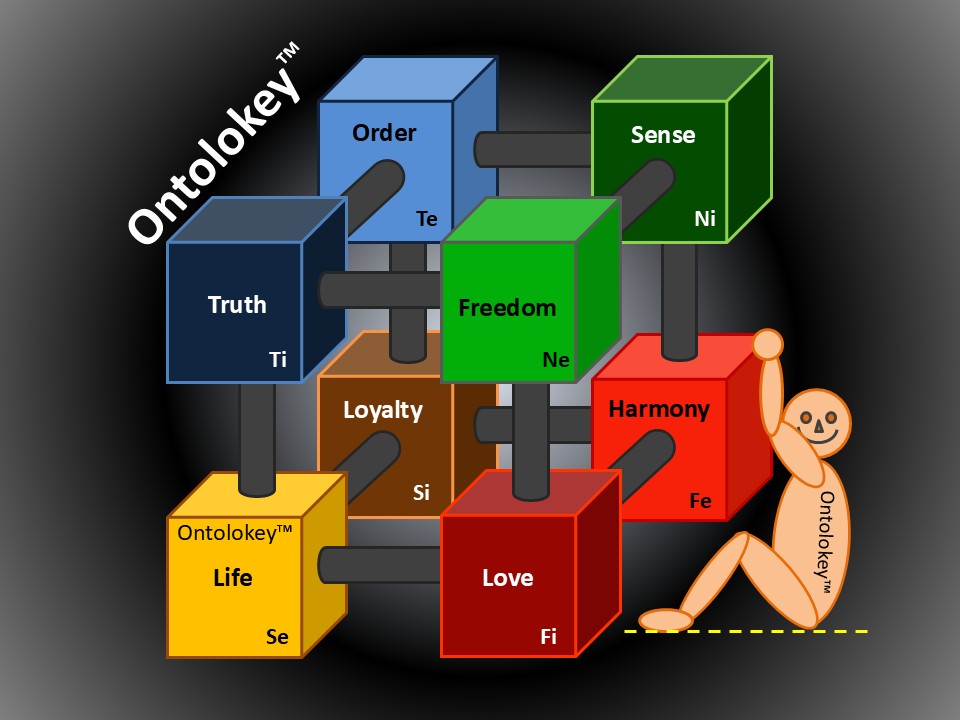
In contemporary personality psychology, visual metaphors increasingly serve as bridges between abstract cognitive processes and the intuitive language of symbols. Among these emerging tools, the Ontolokey Cube stands out as a multidimensional model that positions the eight cognitive functions at the eight corners of a color-coded geometric structure. Each corner is represented by a distinct hue—Dark Red, Orange, Light Blue, Dark Blue, Dark Green, Light Green, Yellow, and Brown—chosen to mirror the psychological tone, motivational energy, and experiential quality of the function it embodies.
At first glance, these colors appear merely aesthetic. Yet, as soon as one contemplates them as psychological signifiers, deeper patterns emerge. Each color does not only align with a cognitive function (Fi, Fe, Ti, Te, Ni, Ne, Se, Si) but also carries a symbolic value—Love, Harmony, Order, Truth, Meaning, Freedom, Life, and Loyalty—forming an elegant axis where cognition and emotional phenomenology meet.
The following analysis illustrates how the Ontolokey Cube weaves together color psychology, cognitive theory, and symbolic meaning into a coherent interpretive framework.
Dark Red — Fi (Introverted Feeling): The Inner Ethic of Love
Dark Red marks the corner of introverted feeling, a function rooted in personal values, emotional integrity, and internal moral resonance. Psychologically, Dark Red evokes depth, intensity, and devotion—all qualities that align with the symbolic value assigned to this color: Love.
This is not the exuberant love of social expression but the quiet flame that burns within—the love of what is right, authentic, and deeply felt. In the Ontolokey Cube, Dark Red shows that Fi is not simply “emotional”: it is guided by an inner compass of loyalty to one’s heartfelt truth.
Orange — Fe (Extraverted Feeling): The Social Movement Toward Harmony
Orange radiates warmth, openness, and emotional dynamism. As the color of Harmony, it represents the outward, connective quality of extraverted feeling. Fe tunes itself to interpersonal atmospheres, aiming to cultivate cohesion, emotional balance, and social resonance.
Orange is therefore a natural visual metaphor for Fe: vibrant, inviting, and inherently relational. It conveys that psychological harmony is not static but an active, warm exchange between individuals.
Light Blue — Te (Extraverted Thinking): The Structural Clarity of Order
Light Blue speaks to crispness, structure, and transparency—hallmarks of the Order attributed to extraverted thinking. Just as the sky’s clarity provides orientation, Te organizes information into actionable frameworks, transforms complexity into systems, and translates goals into results.
Its pale blue tone symbolizes rational distance and cognitive clarity, reminding us that constructive order is not rigidity but an intelligent arrangement of reality.
Dark Blue — Ti (Introverted Thinking): The Inner Pursuit of Truth
Dark Blue represents the depth and stillness of introspective reasoning. Associated with Truth, it illustrates the essence of introverted thinking: the disciplined search for internal coherence, conceptual purity, and analytical understanding.
The color’s quiet gravity mirrors Ti’s methodical descent into the structure of ideas, suggesting that truth is not merely found—it is painstakingly refined from within.
Dark Green — Ni (Introverted Intuition): The Silent Path Toward Meaning
Dark Green conjures images of deep forests, organic evolution, and the ancient wisdom of nature. As the hue representing Meaning, it captures the introspective, symbolic, and future-oriented quality of introverted intuition.
Ni looks beyond surface events to uncover the underlying trajectory of experience. Dark Green reminds us that meaning grows in silence and depth, unfolding slowly like the roots of a forest.
Light Green — Ne (Extraverted Intuition): The Expansive Breath of Freedom
Light Green symbolizes growth, creativity, and openness—all closely tied to the theme of Freedom. Representing extraverted intuition, it encapsulates the playful, exploratory, possibility-seeking energy of the function.
Ne expands the psychological field, illuminating potential paths and unconventional connections. Light Green expresses cognitive freedom: the space to imagine, innovate, and reinvent.
Yellow — Se (Extraverted Sensing): The Luminous Spark of Life
Yellow vibrates with immediacy, presence, and sensory vitality. As the color of Life, it corresponds with extraverted sensing’s grounded engagement with the physical world.
Se thrives on the here-and-now: movement, perception, intensity. Yellow’s radiant liveliness visually communicates this function’s energetic demand for direct experience and existential aliveness.
Brown — Si (Introverted Sensing): The Steadfast Memory of Loyalty
Brown embodies stability, tradition, and memory—ideals closely linked to Loyalty. As the color of introverted sensing, it aligns with Si’s orientation toward continuity, familiarity, and the internal preservation of lived experience.
Just as earth anchors and nourishes, Si safeguards personal history, rituals, and learned patterns. Brown signals reliability and groundedness, making it the perfect visual metaphor for this function’s steadying influence.
The Geometry of Psychological Meaning
Viewed as a complete system, the Ontolokey Cube reveals that each color-function pairing forms a meaningful psychological polarity. The Cube highlights the following dynamics:
- Dark Red (Love) contrasts with Light Blue (Order) — expressing the tension between deeply personal emotional conviction and structured, externally oriented organization.
- Brown (Loyalty) opposes Light Green (Freedom) — stability, tradition, and continuity meeting the drive toward openness, novelty, and expansive possibility.
- Orange (Harmony) balances Dark Blue (Truth) — the relational need for emotional cohesion standing opposite the internal search for conceptual precision and intellectual integrity.
- Dark Green (Meaning) opposes Yellow (Life) — depth, symbolism, and long-range vision juxtaposed with immediacy, sensory vitality, and the vibrancy of direct experience.
Together, these revised polarities reveal a dynamic psychological landscape in which emotional, cognitive, intuitive, and sensory dimensions interact in complementary tension—each enriching the others.
Conclusion: A Synesthetic Model of the Mind
By synthesizing cognitive psychology, color symbolism, and experiential phenomenology, the Ontolokey Cube offers a unique, multidimensional lens for understanding personality. The use of color transforms abstract cognitive functions into intuitive emotional landscapes—making love, harmony, truth, order, meaning, freedom, life, and loyalty perceptible at a glance. In doing so, the model does more than categorize the psyche:
It creates a bridge between cognition and lived experience, offering a visually grounded, emotionally resonant map of human nature.


Leave a Reply