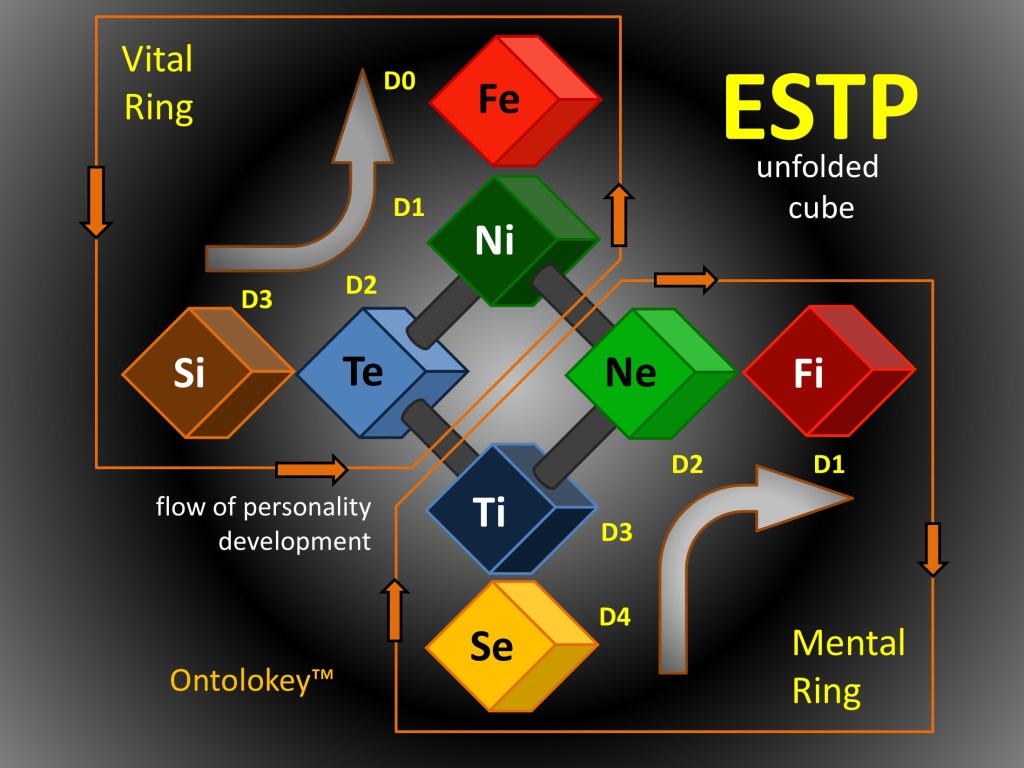
In the Ontolokey model, D0 to D4 describe the degree to which a psychological function has become consciously accessible, developed, and integrated within the personality. D4 represents the highest level of conscious development, while D0 indicates a function that remains largely unconscious and therefore tends to operate as a blindspot; D1, D2, and D3 represent successive stages of increasing awareness and integration between these two poles. Psychological development therefore means gradually bringing less conscious functions into awareness and allowing them to become more differentiated and usable, rather than trying to replace the dominant personality with something fundamentally different. The movement from D0 toward D4 is consequently a process of integration in which previously unconscious psychological capacities become increasingly available to consciousness and contribute to a more complete experience of the Self.
From Mastery of the Moment to Wholeness of the Self
The ESTP is often recognized by an unmistakable psychological immediacy: decisiveness, physical presence, adaptability, courage, pragmatism, competitiveness, social confidence, and an instinctive readiness to enter reality rather than merely contemplate it from a distance. This personality tends to discover what is possible through direct contact with circumstances, testing situations through experience and responding rapidly to whatever becomes concrete, relevant, or actionable. Yet beneath this highly visible competence lies a considerably more complex psychological landscape, because the ESTP is not simply a person who “lives in the moment”; it is a personality structure in which eight psychological functions participate in different degrees of consciousness, strength, vulnerability, and developmental potential. Ontolokey gives this architecture a spatial form, transforming the functional structure into a three-dimensional psychological landscape in which the familiar and unfamiliar aspects of the personality can be viewed in relation to one another. The deeper purpose of such a perspective is not merely to describe what an ESTP is like, but to illuminate what the personality may gradually become when its less conscious functions are brought into awareness and integrated into a larger sense of self.
The central paradox of ESTP development is that the personality usually does not need to learn how to become stronger, more decisive, more resourceful, more socially effective, or more capable of surviving difficult circumstances; many of these qualities are already close to the natural center of its psychological organization. The more difficult task begins when these strengths become so reliable that they are unconsciously recruited to protect the personality from experiences that cannot be mastered through action alone: helplessness, uncertainty, emotional exposure, dependence, inner conflict, ambiguity, regret, and the possibility of losing control. In such moments, the ESTP may instinctively move outward, because action restores a familiar relationship with reality, while stillness can expose psychological material for which no immediate solution exists. What appears externally as confidence may therefore sometimes conceal the refusal to feel uncertain; what appears as independence may conceal difficulty with vulnerability; what appears as fearlessness may occasionally function as an escape from experiences that feel psychologically threatening precisely because they cannot be conquered. The developmental question is consequently not whether the ESTP should abandon action, but whether action can cease to be the automatic answer to every form of psychological tension. Ontolokey’s deeper interpretation of the type points toward this distinction between strength as an authentic capacity and strength as a defensive identity, suggesting that the mature ESTP becomes more whole when power no longer has to function as protection against the parts of the self that feel less powerful.
Within the developmental architecture used in this essay, the ESTP’s psychological journey begins with the Mental Ring: Se as the dominant D4 function, Ti as the auxiliary D3 function, Ne as the Anima/Animus D2 function, and Fi as the Toddler D1 function. This sequence establishes a precise developmental direction, because consciousness does not leap from the most developed function directly into its most vulnerable territory; it must proceed through the psychological capacities that have already acquired sufficient stability to support the next stage. Se therefore remains the center of gravity rather than an obstacle to be overcome, while Ti becomes the first major developmental bridge through which immediate experience is transformed into conscious understanding. Once this auxiliary structure has become sufficiently mature, the personality can begin moving toward Ne and subsequently toward the extraordinarily vulnerable territory represented by Fi, where the question of personal meaning, inner value, emotional truth, and authentic selfhood becomes increasingly unavoidable. The Vital Ring develops alongside this process, though with a certain delay, moving from Si at D3 through Te at D2 and Ni at D1 toward Fe at D0, the latter representing an archaic or childlike blindspot in this developmental model. The movement through these rings can therefore be understood as a gradual turning of the psychological “iceberg”: what was once beneath awareness slowly becomes visible, until the personality eventually returns to its original dominant center with a consciousness enlarged by everything it has encountered along the way. This is the fundamental image of ESTP individuation: not becoming somebody else, but becoming sufficiently whole that the original self can finally contain what it once had to leave unconscious.
The ESTP’s First Psychological Task: Understanding the Difference Between Strength and Defense
The ESTP’s developmental journey begins with an uncomfortable recognition: the qualities that have made life manageable may also be the qualities that prevent deeper psychological integration. Dominant Se gives the ESTP an extraordinary capacity to register what is happening, enter the situation, identify opportunities and act before excessive deliberation becomes paralysis, while auxiliary Ti adds an internal mechanism for dissecting problems, identifying inconsistencies and determining what actually works. Together, these functions create an exceptionally effective psychological instrument, particularly in environments characterized by uncertainty, competition, pressure, rapid change and concrete consequences. The danger appears when this instrument becomes so successful that the personality begins to assume that every psychological difficulty should be approached in the same manner as an external problem: identify the obstacle, determine the leverage point, apply pressure and produce a result. In that moment, effectiveness ceases to be merely a strength and begins to function as a defense, because action can become a way of avoiding the experience of uncertainty, helplessness or emotional exposure rather than simply responding appropriately to reality. Ontolokey’s recent account of ESTP development describes precisely this tension, emphasizing that the problem is not the personality’s strength itself but the moment when strength becomes the preferred language for dealing with experiences that cannot actually be solved through force, speed, competence or control.
This distinction is particularly important because defensive strength rarely feels defensive from the inside. An ESTP who becomes increasingly active when uncertain may sincerely experience the activity as productivity; an ESTP who becomes indispensable when afraid of dependence may genuinely believe that responsibility is simply being taken seriously; an ESTP who becomes argumentative when emotionally wounded may experience the conflict primarily as a question of facts, fairness or principle. The shadow therefore does not normally announce itself by saying, “I am afraid,” “I feel rejected,” or “I need reassurance”; it may instead produce a convincing explanation for why immediate action, confrontation, control or withdrawal is objectively necessary. The deeper shadow analysis describes this mechanism as a movement in which an emotion is experienced unconsciously, converted into behavior and subsequently rationalized through a conscious narrative, leaving the individual aware of the explanation but disconnected from the original psychological cause. For the ESTP, this creates a particularly subtle form of self-deception because Ti can provide exceptionally coherent explanations for behavior that Se has already chosen for more instinctive reasons. The developmental breakthrough therefore begins not by distrusting one’s own intelligence, but by applying intelligence inward and asking whether the conscious reason is actually the complete reason.
The decisive question for the ESTP consequently becomes not simply, “What is happening, and what should I do?” but, “What is happening inside me before I decide what to do?” This introduces a psychological interval between perception and reaction, and that interval is extraordinarily important because it allows the unconscious to become observable without demanding that the personality immediately surrender its capacity for action. The ESTP does not have to become passive, hesitant or introspectively absorbed; rather, the person learns to recognize the emotional and motivational information that precedes behavior and to distinguish an authentic response from a defensive reflex. Jealousy, for example, may disguise itself as vigilance, possessiveness as protection, distrust as realism, wounded pride as insistence upon principle, or fear as an urgent need to regain control. Once these transformations become recognizable, the ESTP can begin to reclaim psychological freedom because the impulse no longer has to determine the interpretation of reality. The purpose of consciousness is not to suppress instinct but to place it inside a larger field of awareness in which several truths can exist simultaneously: the ESTP can be strong and afraid, generous and proud, courageous and insecure, loving and controlling, competent and wounded. Wholeness begins precisely when these apparent contradictions no longer have to be eliminated in order to preserve a coherent self-image.
This is also where the ESTP’s natural relationship with reality becomes an instrument of psychological healing rather than merely external achievement. Se is exceptionally suited to noticing what is actually present, and the mature use of Se can therefore be redirected from external surveillance toward inner observation without becoming detached from the concrete world. Instead of immediately asking who is responsible, what the solution is, or how control can be restored, the ESTP can learn to observe the physical and emotional facts of the moment: tension in the body, acceleration of speech, irritation, attraction, shame, defensiveness, the impulse to dominate, the desire to escape, or the sudden need to prove competence. These observations are not abstractions; they are present-moment data, and therefore they can be approached through the very realism that makes Se powerful. In this sense, psychological introspection need not be foreign to the ESTP: it can become a more refined form of empirical observation in which the personality turns its characteristic attention toward the processes occurring within itself. The movement is subtle but profound, because the ESTP gradually stops using awareness merely to control the environment and begins using awareness to understand the self that is attempting to control it.
The first developmental transition is therefore the maturation of Ti from D3 toward D4, because Ti must become sufficiently conscious and stable before the deeper layers of the Mental Ring can safely be approached. This does not mean accumulating more arguments, qualifications or intellectual knowledge, nor does it mean constructing an even more sophisticated justification for already existing behavior; it means developing the capacity to examine one’s own assumptions with the same precision normally applied to external systems. Mature Ti asks whether an explanation is internally coherent even when that explanation threatens the ego that produced it, and it is precisely here that the ESTP begins to acquire a form of intellectual honesty more demanding than ordinary cleverness. The question becomes: Can I investigate my own motive without deciding in advance that I am right? Once the answer becomes increasingly affirmative, Ti ceases to function merely as the analytical servant of Se and becomes a genuine bridge between instinct and consciousness. Only then can the ESTP proceed naturally toward the next developmental territory, Ne at D2, where alternative possibilities, ambiguity and psychological multiplicity begin to challenge the certainty of the immediately observable world.
Ne as Anima/Animus: Learning to Remain Open When Reality Has Not Yet Revealed Its Answer
Once Ti has developed sufficiently toward its mature form, the ESTP encounters a psychological threshold that is more demanding than the refinement of analytical competence. The next movement leads toward Ne, the Anima/Animus function at D2, which introduces a mode of perception that does not primarily ask what is presently observable, but what else might be possible beyond the immediately observable. For a personality organized around Se, this can feel strangely destabilizing because Se derives confidence from contact with what is actually there: the concrete situation, the available evidence, the behavior of people, the opportunities in front of the individual and the practical consequences of a decision. Ne opens a different psychological dimension in which reality is not exhausted by its current appearance, and where several interpretations, futures or meanings may coexist before any one of them has become demonstrably true. This is why the Anima/Animus position can be psychologically sensitive: it carries something the conscious personality needs but cannot command as effortlessly as its dominant functions. The developmental task is consequently not to replace Se with Ne, but to allow the ESTP to remain psychologically receptive to possibilities without demanding immediate proof, immediate certainty or immediate action.
The immature expression of this territory can be especially confusing because the ESTP may encounter possibility not as creative openness but as psychological disturbance. When the mind begins generating alternatives that cannot yet be verified, the individual may become suspicious, restless or mentally overstimulated, particularly when the possibilities concern relationships, motives or future outcomes that cannot be controlled through direct observation. A normally pragmatic ESTP can therefore become surprisingly preoccupied with what might happen, what somebody could be intending, or what hidden development may be unfolding behind an apparently ordinary situation. The problem is not imagination itself, but the absence of a mature relationship to uncertainty: possibility can either remain possibility or become unconsciously treated as evidence. The Anima/Animus is particularly important here because it confronts the ESTP with an experience of psychological dependence upon something that cannot simply be seized, tested and mastered. Development requires learning to say, in effect, “I do not know yet, and I can tolerate not knowing,” without interpreting uncertainty as weakness or immediately filling the empty space with an action, accusation, prediction or distraction. This capacity represents a major expansion of consciousness because it permits reality to remain unfinished while the personality remains internally stable.
Ne also challenges a deeply rooted assumption that practical intelligence is necessarily superior to speculative consciousness. An ESTP may instinctively respect ideas when they can be translated into action, but become impatient when reflection appears detached from immediate usefulness; yet psychological development often begins precisely where usefulness temporarily disappears. Dreams, intuitions, hypothetical scenarios, symbolic associations and apparently impractical questions can expose dimensions of the personality that ordinary problem-solving does not reach. The purpose is not to turn the ESTP into an abstract theorist, but to make the psyche sufficiently spacious that an experience can be explored before it is reduced to a decision. The Ontolokey perspective on the ESTP emphasizes that the less conscious functions contain developmental information rather than merely deficiencies, and this is especially significant for the Anima/Animus because its sensitivity often points toward psychological material that the dominant personality has not learned to approach directly. What initially feels vague, excessive or unnecessary may therefore contain precisely the information required for greater inner integration.
At a deeper level, Ne asks the ESTP to relinquish one of its most seductive psychological privileges: the ability to define reality through what can be immediately perceived and manipulated. This does not mean abandoning realism; rather, it means recognizing that realism itself becomes distorted when the limits of perception are mistaken for the limits of existence. An ESTP can be exceptionally perceptive about people and situations while still overlooking the possibility that the same observable behavior can emerge from radically different internal causes. Someone who becomes distant may be angry, ashamed, frightened, overwhelmed, disappointed or simply preoccupied, and Se alone cannot determine which explanation is correct merely by observing the external behavior. Ne creates the psychological space in which multiple hypotheses can be held simultaneously, while Ti evaluates them without prematurely converting one possibility into certainty. This combination is profoundly healing because it interrupts projection: instead of unconsciously attributing one’s own fears or expectations to another person, the ESTP learns to tolerate ambiguity long enough for additional information to emerge. The resulting flexibility is not indecisiveness but a more sophisticated form of discernment, because the individual becomes capable of acting decisively without confusing decisiveness with omniscience.
The Anima/Animus stage therefore represents an important preparation for the most vulnerable territory of the Mental Ring, Fi at D1, the Toddler function. Ne first teaches the ESTP that not everything meaningful is immediately visible, and that an internal experience can be real even when it cannot yet be converted into an external fact; this creates the psychological conditions under which Fi can eventually be encountered without being dismissed, ridiculed or overwhelmed. If Ne is bypassed, the ESTP may approach Fi with the same impatience used toward any unfamiliar internal state, attempting to rationalize feelings, solve them, suppress them or turn them into action before their meaning has been understood. If Ne develops sufficiently, however, the person becomes capable of approaching inner emotional material as something to be explored rather than conquered. The movement from D4 Se through D3 Ti toward D2 Ne therefore represents a gradual deceleration of psychological certainty: first the individual learns to analyze, then to entertain alternatives, and eventually to recognize that the psyche contains truths that cannot be forced into immediate practical clarity. Only from this position of increased psychological spaciousness can the ESTP safely descend toward Fi, where the question is no longer merely What is possible? but What does this experience mean to me, and what part of myself have I never learned to hear?
Fi as the Toddler Function: Entering the Territory of the Wounded Self
The movement from Ne at D2 toward Fi at D1, the Toddler function, represents one of the most psychologically delicate transitions in the ESTP individuation process because Fi concerns a dimension of experience that cannot be adequately measured by effectiveness, external evidence or logical consistency. Fi brings the individual into contact with personal value, emotional authenticity, inner preference, attachment, hurt, shame, loyalty, moral discomfort and the private experience of being personally affected by what happens. For the ESTP, these experiences may have been present throughout life without possessing an equally developed language of consciousness, because the personality’s stronger functions are naturally oriented toward what can be perceived, analyzed and acted upon. Consequently, the ESTP may know that something is wrong long before understanding why it hurts, and may be able to change a situation long before recognizing what the situation has emotionally touched. The Toddler designation is significant because this function does not necessarily lack importance; rather, it represents a psychologically young and vulnerable mode of processing that can react intensely when something touches the individual’s deepest sense of personal worth or belonging. Development therefore requires approaching Fi not as an embarrassing weakness to be overcome, but as a young part of the personality that has been waiting for conscious recognition.
The vulnerability of Fi can explain why an otherwise formidable ESTP may occasionally respond to apparently minor interpersonal events with disproportionate emotional intensity. A criticism that concerns competence may be manageable because it can be debated, corrected or disproved, whereas criticism that implicitly communicates you are not valued, you are not wanted, you are not good enough, or you do not matter to me can reach a much deeper psychological layer. The conscious personality may initially respond through Se or Ti by confronting the person, proving competence, withdrawing, mocking the accusation, reframing the situation or demonstrating that the other person is irrational, while the underlying Fi experience remains unacknowledged. This is one of the mechanisms through which the shadow can become self-reinforcing: the more vulnerable the inner wound, the more vigorously the conscious personality protects itself with its strongest capacities. Ontolokey’s discussion of the ESTP shadow specifically emphasizes that some apparently forceful reactions can originate in much more vulnerable psychological material than the external behavior suggests. The consequence is that the ESTP may win the external argument while remaining psychologically wounded by it, because the conflict was resolved at the level of circumstances while its actual cause existed at the level of personal meaning.
Fi development therefore requires a radically different form of courage from the courage usually associated with ESTP identity. Physical courage enters danger voluntarily; psychological courage allows oneself to discover that one has been hurt without immediately converting the hurt into anger, superiority, humor, indifference or retaliation. This can be particularly difficult because emotional exposure temporarily removes the protective advantage of competence, and the ESTP may experience this exposure as an unnecessary surrender of power. Yet acknowledging I cared, I was disappointed, I felt rejected, I was jealous, I wanted to be appreciated, or I was afraid of losing this person does not diminish the individual’s strength; it reveals the human meaning underneath it. The Toddler function becomes healthier when these experiences can be named without shame and held without demanding that somebody else immediately repair them. In this sense, Fi integration is not emotional indulgence but psychological differentiation: the ESTP learns to distinguish an authentic feeling from an impulse to act upon that feeling, and personal vulnerability from helplessness. The mature expression of Fi allows the person to possess an inner world without requiring the external world to validate every element of it.
This process can also transform the ESTP’s relationship with forgiveness. Before unconscious emotional material is understood, forgiveness may appear to require either excusing another person’s behavior or simply deciding to stop caring about it, both of which can leave the underlying injury psychologically intact. As Fi becomes conscious, however, the individual can reconstruct the internal sequence of an experience: what happened, what was perceived, what was interpreted, what was expected, what was lost, and which personal value was violated or threatened. Such reconstruction makes it possible to understand why a particular event became so painful even when the external event itself appears insignificant in retrospect. The same principle applies to understanding other people, because recognizing one’s own vulnerability makes it easier to imagine that another person’s destructive behavior may also have emerged from fear, insecurity, shame or an immature psychological defense. Understanding does not erase responsibility and does not require tolerating harmful behavior; it simply replaces the primitive psychological equation of harmful action = inherently bad person with a more differentiated understanding of human causality. Cognitive understanding can therefore support emotional healing because it allows the ESTP to separate the person from the defense, the wound from the reaction, and the past from the present.
At its most mature expression, Fi gives the ESTP something that neither Se nor Ti can provide independently: an internally grounded answer to the question of what is worth protecting. Se can identify opportunities, Ti can determine whether something makes sense, and Ne can illuminate what else might be possible, but Fi asks whether the resulting life is actually congruent with the person one has become. This changes the meaning of success because achievement can no longer be measured exclusively by winning, freedom, stimulation, recognition or practical effectiveness; it must also be measured by whether one’s actions remain faithful to an increasingly conscious inner value system. The ESTP does not have to become sentimental or withdraw from the intensity of life, because Fi integration does not negate Se but humanizes it: experience becomes richer when the person knows why something matters, and action becomes more authentic when it is guided by consciously recognized values rather than merely by opportunity or impulse. The progression from Se D4 → Ti D3 → Ne D2 → Fi D1 therefore completes the first major descent through the Mental Ring, moving from immediate engagement with reality toward analysis, possibility and finally personal meaning. The ESTP has not lost its original strength at the end of this descent; instead, that strength has acquired an inner reference point, making it possible to enter the Vital Ring with considerably greater psychological stability and begin the parallel integration of Si, Te, Ni and ultimately Fe.
The Vital Ring: From Personal Integration to the Wider Unconscious
The completion of the first descent through the Mental Ring does not mean that the ESTP has reached psychological wholeness, because the psyche contains another developmental movement that concerns not only personal consciousness but the broader, less familiar dimensions of life experience represented by the Vital Ring. In the developmental architecture used here, the Vital Ring begins with Si at D3, proceeds through Te at D2, continues toward Ni at D1, and culminates in Fe at D0, the most archaic and vulnerable position in this sequence. Whereas the Mental Ring can be understood primarily as the gradual integration of functions that become increasingly intimate to the conscious personality, the Vital Ring confronts the ESTP with modes of psychological existence that may initially feel less voluntary, less familiar and more deeply embedded in the organismic history of the person. Its development therefore tends to occur with a certain delay relative to the Mental Ring, because the personality first needs enough internal stability to encounter experiences that cannot be controlled through its established psychological strengths. This is why the movement into the Vital Ring should not be interpreted as a demand to activate every function indiscriminately, but as a gradual expansion of consciousness in which each newly accessible function becomes a foundation for approaching the next. The developmental sequence matters because psychological integration is not achieved by jumping directly toward the most unconscious material; the personality must build the capacity to tolerate it.
The first Vital-Ring stage, Si at D3, asks the ESTP to develop a conscious relationship with continuity, bodily history, repetition, memory and the accumulated consequences of previous experience. Se naturally emphasizes what is happening now, whereas Si introduces the significance of what has happened before and what the body has learned through repetition, habit and accumulated experience. This can become psychologically transformative because the ESTP may otherwise possess an extraordinary capacity to escape the psychological weight of the past by continuously generating new experiences in the present. Movement can create genuine freedom, but it can also become a mechanism for avoiding unresolved continuity: a new relationship can temporarily obscure the previous one, a new challenge can displace an old disappointment, and a new environment can create enough stimulation that the personality never has to remain still long enough to discover what the previous experience actually changed within it. Si development introduces a different form of strength, one based not upon rapid adaptation but upon the capacity to remember, consolidate and learn from what has already occurred. The question gradually changes from What can I do now? to What has repeatedly happened to me, what have I repeatedly done, and what does this pattern reveal about me? That shift is crucial for individuation because unconscious repetition can only become choice once it has been recognized as repetition.
A mature Si does not imprison the ESTP in nostalgia or excessive caution; rather, it creates psychological continuity between the present self and the selves that existed before it. This is particularly important for healing because many defensive patterns become invisible when each episode is experienced as an isolated event. An ESTP might regard repeated conflicts as the fault of changing circumstances, different partners, difficult colleagues or unfortunate timing, while a sufficiently developed Si begins to notice that the same psychological sequence may be recurring under different external conditions. Perhaps the individual repeatedly becomes attracted to situations that provide excitement but resist intimacy, repeatedly interprets dependence as weakness, repeatedly leaves once emotional complexity increases, or repeatedly becomes more aggressive when personal insecurity is touched. None of these patterns can be understood adequately by examining the latest event in isolation; they become visible through temporal comparison. Si therefore acts as a psychological memory that preserves evidence the present-oriented personality might otherwise discard. When integrated with the earlier development of Ti, this memory becomes especially powerful because the ESTP can examine recurring patterns without automatically judging them as failures, instead asking what function those patterns once served and why they are no longer sufficient.
From this foundation, the Vital Ring moves toward Te at D2, which introduces a more systematic relationship with external structures, measurable effectiveness, organization and objective implementation. This may appear superficially similar to the ESTP’s natural pragmatism, but its developmental function is different because Te asks the personality to build structures that continue functioning beyond the immediate intervention of the individual. The less mature ESTP can be extraordinarily effective in the moment while still struggling with processes that require sustained organization, delegation, documentation, repetition or long-term optimization. Se can improvise brilliantly when circumstances change, whereas Te seeks to construct an external system capable of handling change without requiring constant personal improvisation. Psychologically, this is more significant than mere productivity because it challenges the unconscious belief that I must personally remain at the center of the action for things to work. Developing Te means learning that control can be transferred into structures, processes and other people without becoming a loss of identity or autonomy. In this respect, Te begins transforming the ESTP’s relationship with power: rather than demonstrating competence through personal intervention, the mature individual increasingly demonstrates competence through the ability to create conditions in which effective action can occur without constant personal domination.
The next movement, toward Ni at D1, becomes considerably more existential because Ni confronts the ESTP with direction, consequence, symbolism, long-range development and the possibility that life is not merely a collection of situations but also a trajectory. Se is naturally fascinated by what is available now, while Ni asks what the accumulation of present choices is gradually becoming. This introduces the uncomfortable possibility that freedom itself has consequences: every repeated choice narrows some futures while making others increasingly probable. An ESTP who has lived primarily through immediate opportunities may discover that the avoidance of commitment is itself a commitment, that perpetual novelty eventually produces a pattern, and that the refusal to choose a direction does not preserve infinite possibilities indefinitely. Ni therefore asks the personality to tolerate the psychological discomfort of allowing a future to influence the present. The developmental question becomes less about maximizing today’s possibilities and more about discerning which possibilities deserve to survive the passage of time, which is a profoundly different relationship with freedom and one that can transform impulsive experience into intentional life direction.
The deepest Vital-Ring threshold is ultimately Fe at D0, the blindspot-like and archaic position in this developmental sequence, and therefore it should not be approached through force or through the expectation that it will suddenly become as natural as Se. Fe concerns interpersonal emotional atmosphere, collective feeling, relational reciprocity, visible emotional exchange and the conscious recognition of what is happening between people at the level of shared affect. For the ESTP, this can be an especially primitive psychological territory precisely because the individual may be socially confident while remaining comparatively less conscious of the emotional field generated by relationships. Social skill and emotional integration are not identical: one can read a room tactically without fully experiencing what the room means emotionally, charm people without revealing oneself, create excitement without creating intimacy, and understand social dynamics without understanding one’s own contribution to the emotional climate. At D0, Fe may therefore appear through crude or reactive forms before becoming consciously integrated, such as discomfort with overt emotional demands, impatience with emotional complexity, exaggerated attempts to control the mood of a situation, or a tendency to oscillate between emotional detachment and sudden emotional intensity. The developmental objective is not to make Fe sophisticated overnight, but to allow the personality gradually to recognize that relationships possess an emotional reality of their own, one that cannot always be managed through competence, humor, charisma or action. When the ESTP eventually becomes capable of remaining present in that emotional field without immediately controlling, escaping or dismissing it, the final barrier of the Vital Ring begins to soften, and the personality approaches the deeper possibility of wholeness: not merely knowing how to act in the world, but consciously participating in the human reality created between self and other.
The ESTP Shadow: When Strength Becomes a Psychological Mask
The ESTP shadow is most easily misunderstood when it is described merely as the opposite of the personality’s visible strengths, because the deepest shadow is rarely an obvious absence of competence. More often, it consists of precisely those qualities that the ESTP possesses in abundance becoming rigid, compulsive or defensive when they are recruited to protect a vulnerable psychological core. Se can become an escape from stillness, Ti can become rationalization, social confidence can become emotional concealment, independence can become an inability to receive, and courage can become a refusal to acknowledge fear. The resulting personality may remain highly functional, charismatic and successful while becoming progressively less aware of the psychological forces governing its behavior. This is why shadow integration cannot be reduced to “fixing weaknesses”; the real task is to recognize when an authentic capacity has been transformed into a defense against another part of the self. Ontolokey’s exploration of the ESTP’s deeper shadow places particular emphasis on this hidden dynamic, in which apparently strong behavior can originate in vulnerable unconscious material and subsequently be interpreted by the conscious personality as rational, justified or simply characteristic.
One of the most important shadow mechanisms for the ESTP is the transformation of vulnerability into action. When something threatens the individual’s emotional equilibrium, Se can immediately provide an exit through movement: change the circumstances, confront the person, find something else to do, pursue another opportunity, make a decision, introduce stimulation, create humor or simply refuse to remain psychologically exposed. Because these responses frequently work in the short term, the personality receives powerful reinforcement for using them, and a pattern can develop in which emotional discomfort automatically triggers external intervention. The individual may sincerely believe that the discomfort has been solved because the situation has changed, yet the psychological material that generated the reaction remains untouched. Over time, this can create a peculiar form of emotional displacement in which the ESTP becomes highly competent at changing circumstances while remaining comparatively inexperienced at remaining with an internal experience until it reveals its meaning. The developmental insight is not that action is wrong, but that action taken before an emotion has been understood may sometimes function as avoidance disguised as decisiveness. Psychological maturity begins when the ESTP can ask whether a situation genuinely requires immediate intervention or whether the urgency itself is being generated by an unconscious wish to stop feeling something.
A similar dynamic can emerge through Ti, particularly when analytical intelligence becomes an instrument of self-protection rather than self-examination. The ESTP may be exceptionally capable of identifying contradictions in another person’s argument, exposing hypocrisy, finding practical flaws or constructing a coherent explanation for why a particular response was justified. Yet intelligence can defend the ego as effectively as it can reveal truth, especially when the person being analyzed is oneself. A wounded ESTP can therefore construct an argument that is technically persuasive while remaining psychologically incomplete, because the argument explains why the other person was wrong without explaining why the encounter was so personally painful. The crucial distinction is between explanation and insight: explanation establishes a causal story that may be logically defensible, whereas insight reveals the emotional motive that made the story necessary in the first place. When Ti becomes mature, it does not merely become better at proving conclusions; it becomes willing to interrogate the premises from which those conclusions emerged. That is a much more demanding intellectual discipline because it requires the ESTP to tolerate the possibility that a reaction can be understandable without being entirely justified, and that another person can be wrong without the ESTP being completely right.
The shadow can become particularly intense when personal rejection, humiliation or loss of status touches the vulnerable Fi layer. Because Fi is located at D1 in the Mental Ring, its wounds may be experienced with a psychological intensity that is not proportional to the apparent importance of the external event. The individual may become angry because anger feels more compatible with strength than hurt, or become contemptuous because contempt creates distance from the person whose approval suddenly matters too much. Sometimes the defensive maneuver is even more subtle: the ESTP may decide that the relationship, opportunity or person was never important in the first place, thereby transforming grief into indifference after the fact. Such psychological maneuvers protect the self-image but can prevent mourning, and what cannot be consciously mourned often remains active in the unconscious. This is one reason why an ESTP may occasionally appear to have moved on long before the deeper emotional system has actually completed the process of letting go. Fi integration gradually reverses this mechanism by making it possible to acknowledge significance without experiencing significance as weakness: this mattered to me, therefore it could hurt me; it hurt me, therefore I need to understand it; understanding it does not make me powerless.
Another important shadow pattern concerns the ESTP’s relationship with dependence and control. The personality often values freedom, competence and the ability to handle circumstances independently, and these qualities can be genuinely healthy expressions of autonomy. But when autonomy becomes an absolute requirement, receiving help can unconsciously acquire the meaning of inadequacy, and emotional dependence can be interpreted as entrapment. The person may therefore prefer to be needed rather than to need, because being needed preserves agency while needing someone else exposes the possibility of rejection. This can create relationships in which generosity, protection and problem-solving substitute for mutual vulnerability: the ESTP gives intensely, solves problems, creates experiences and offers practical loyalty, but remains less comfortable revealing the internal places where reassurance, tenderness or acceptance are genuinely desired. Such a pattern can be particularly painful because the person may sincerely experience themselves as deeply caring while the other person experiences an emotional distance that practical generosity does not compensate for. The healing movement is not toward dependency but toward reciprocity, in which strength includes the ability to give and receive without either position becoming a threat to identity.
The deepest shadow work therefore requires the ESTP to stop treating psychological discomfort as an enemy that must be defeated. Fear, shame, grief, envy, loneliness, tenderness, regret and uncertainty are not necessarily evidence that something has gone wrong; they are forms of information through which the unconscious communicates with consciousness. Once these experiences are observed without immediate conversion into action, Ti can examine them, Ne can consider alternative meanings, Fi can identify the personal value or wound involved, and the Vital Ring can gradually reveal the historical, structural, future-oriented and relational dimensions surrounding the experience. This creates a fundamentally different relationship with the shadow: instead of asking how to eliminate the uncomfortable part of oneself, the ESTP asks what that part has been trying to accomplish and why it became necessary. The objective is not to become endlessly introspective, nor to excuse destructive behavior by attributing everything to psychological wounds, but to understand the causal chain sufficiently well that behavior becomes a conscious choice rather than an automatic defense. In this sense, healing through cognition means bringing the unconscious logic of the personality into consciousness so that what once controlled the person from beneath awareness can eventually become something the person can understand, negotiate and integrate.
Individuation as the Turning of the Psychological Iceberg
The developmental sequence becomes most intelligible when it is understood not as the acquisition of isolated psychological skills but as a gradual rotation of the entire personality structure. The image of the iceberg captures this process particularly well: ordinary consciousness occupies only a relatively small portion of psychological life, while much of what determines perception, motivation, emotional reaction and behavior remains beneath the surface. In the ESTP, the visible portion is initially dominated by Se, supported by Ti, and this configuration can create an impressive degree of competence in navigating external reality. Yet the very success of this configuration can conceal how much psychological material has been relegated to less conscious functions, particularly those involving personal vulnerability, temporal continuity, future direction and emotional reciprocity. As development proceeds, the iceberg does not simply become larger; it turns, allowing previously submerged material to emerge into conscious awareness while the formerly dominant perspective temporarily loses its monopoly over the definition of reality. The purpose of individuation is therefore not to dismantle the conscious personality but to enlarge it until the conscious self can contain dimensions of experience that were previously experienced only indirectly, defensively or unconsciously.
This explains why psychological development can sometimes feel less like improvement and more like disruption. When the auxiliary function Ti develops from D3 toward a level approaching D4, the ESTP’s existing equilibrium begins to move because the personality gains the capacity to observe its own assumptions rather than simply operate through them. The emergence of Ne then introduces ambiguity and alternative possibilities, while Fi exposes personal meanings and wounds that cannot be reduced to external facts; consequently, experiences that once appeared straightforward can become psychologically complex. A relationship may no longer be simply good or bad, a failure may no longer be simply an obstacle to overcome, and an interpersonal conflict may no longer be reducible to the question of who was objectively right. This expansion can initially produce frustration because greater consciousness means greater awareness of contradiction, and contradiction is precisely what a highly action-oriented personality may instinctively want to resolve. Yet individuation requires the opposite movement: the ability to hold incompatible experiences long enough for a deeper synthesis to emerge. The ESTP gradually discovers that psychological complexity is not the same thing as confusion, and that an expanded consciousness can actually produce more precise action because it is informed by more of the total situation.
The transition from the Mental Ring toward the Vital Ring is therefore the point at which individuation becomes increasingly historical and existential. Si asks the individual to remember rather than merely react, Te asks the individual to construct rather than merely improvise, and Ni asks the individual to recognize direction rather than merely possibility. These functions gradually introduce temporal depth into a personality whose natural orientation is toward immediate reality, and this can radically change the interpretation of one’s own biography. Past experiences cease to be disconnected episodes and become part of a pattern; present choices cease to be isolated opportunities and become contributions to a future trajectory. The ESTP begins to perceive that repeated behavior is not merely a collection of accidents but a psychological language, and that the situations one repeatedly creates or enters may reveal unconscious needs as clearly as dreams or explicit feelings. This recognition can be humbling because it removes some of the comfort associated with blaming circumstances for recurring outcomes. At the same time, it is profoundly liberating because once a pattern becomes conscious, it no longer possesses the same degree of invisible authority. The person can finally ask not only What happened to me? but also What part of me repeatedly participates in creating this kind of experience?
The most difficult stage of the rotation occurs when the personality approaches material associated with Fe at D0, because here the ESTP encounters the primitive edge of its relationship with shared emotional reality. The individual may discover that being socially capable is not identical to being emotionally transparent, that creating excitement is not identical to creating intimacy, and that knowing what people are likely to do is not necessarily the same as understanding what they feel. This realization can be particularly challenging for someone whose identity has been built around interpersonal confidence because it exposes a distinction between social mastery and emotional participation. The former allows a person to influence a situation; the latter requires the person to be affected by it as well. At the deepest level, Fe development therefore asks the ESTP to tolerate emotional reciprocity without immediately converting it into negotiation, entertainment, persuasion or control. The other person must be allowed to have an emotional reality that cannot be managed into the ESTP’s preferred shape, just as the ESTP must eventually permit others to witness emotional realities within themselves that cannot be disguised through competence.
The apparent paradox of the entire developmental process is that the further the ESTP travels into the unconscious, the more authentically ESTP the final personality can become. The goal is not to end with an individual who behaves like a different type, has abandoned Se, distrusts action or spends life analyzing every experience before participating in it. On the contrary, the mature endpoint is a return to Se, but Se now occupies a larger psychological organism because it has been informed by the functions encountered during the descent. The dominant function becomes less compulsive because it no longer has to carry the entire burden of psychological adaptation; action becomes freer because it is no longer constantly recruited to suppress what the person cannot tolerate internally. This is the meaning of the “rebirth” of the original personality: the individual returns to the familiar center, but does so with an expanded consciousness that recognizes what was previously hidden beneath it. The ESTP has not ceased to be an ESTP; the person has become less divided within the ESTP structure, and therefore more capable of using its natural strengths without being unconsciously possessed by them.
In this sense, individuation can be understood as a movement from identification toward integration. Early development often involves identification with Se: I am the person who acts, handles things, takes risks, adapts, wins, survives and remains free. Later development gradually introduces the realization that none of these descriptions is large enough to contain the whole person. Ti reveals the thinker beneath the actor, Ne reveals the explorer of possibilities beneath the pragmatist, Fi reveals the vulnerable individual beneath the self-sufficient exterior, Si reveals the historical self beneath the present-oriented self, Te reveals the builder beneath the improviser, Ni reveals the future beneath the immediate moment, and Fe reveals the relational self beneath the independent self. Each discovery removes a little of the necessity to defend a single identity. Wholeness is reached when the ESTP can inhabit all of these dimensions without requiring one of them to prove that the others are illegitimate. That is the psychological significance of the iceberg finally completing its rotation: consciousness no longer means merely seeing what has always been above the surface, but recognizing that the submerged parts were part of the self all along.
Healing Through Cognition: Understanding the Wound Without Becoming the Wound
For the ESTP, psychological healing can become particularly powerful when emotional experience is approached through the natural capacity for cognition rather than through an attempt to force emotional expression. The purpose of cognition in this context is not to intellectualize feelings until they disappear, but to make the unconscious structure surrounding those feelings understandable. A painful experience often consists of several layers that are initially fused together: an external event, the perception of that event, an interpretation of its meaning, an emotional response, an impulse to act and a subsequent justification for that action. When these layers remain unconscious, the person experiences the entire sequence as a single reality: this happened, therefore I felt this, therefore I acted correctly. Cognitive differentiation interrupts that fusion and allows each component to be examined independently. For an ESTP, this can be an exceptionally effective route toward healing because it respects the personality’s natural need to understand how things actually work while redirecting that investigative capacity toward the internal system itself. The result is not emotional detachment but emotional intelligibility, and intelligibility creates the possibility of choice.
Consider what happens when an ESTP experiences rejection. The first conscious reaction may be anger, contempt, withdrawal or a renewed determination to demonstrate independence, while the deeper experience may involve sadness, humiliation, fear of inadequacy or the feeling of being personally unwanted. If the first reaction is treated as the complete truth, the individual may conclude that the other person is simply foolish, disloyal, manipulative or unworthy of further attention. If cognition is used more deeply, however, the individual can reconstruct the sequence: What exactly happened? What did I immediately assume it meant? What did I feel before I became angry? What did I want from the other person? What did their behavior threaten within my sense of myself? Why did I need to regain control so quickly? These questions do not invalidate the anger, nor do they automatically absolve the other person of responsibility; they simply reveal that the external event and the internal meaning of the event are not identical. Once this distinction becomes conscious, the ESTP can respond to the actual situation rather than to the unconscious meaning attached to it. This is where cognition becomes therapeutic: it transforms an apparently objective reality into a psychologically differentiated experience in which several causal layers can be recognized.
The same process can be applied to repeated interpersonal conflict, which is often where shadow material becomes most visible. If an ESTP repeatedly finds themselves surrounded by people who are supposedly incompetent, dishonest, needy, controlling or emotionally difficult, it may be tempting to interpret each relationship independently and conclude that the problem lies consistently outside the self. Sometimes it genuinely does; people can behave badly, and psychological integration must never become an excuse for tolerating exploitation or abuse. But when similar conflicts recur across different environments and with different people, cognitive reflection can ask whether the individual is unconsciously selecting particular dynamics, communicating in ways that evoke predictable responses, or leaving certain needs unspoken until they emerge as resentment. The question is not Am I the problem? because such a formulation is too simplistic and often produces unnecessary self-blame; the more useful question is What is my participation in this pattern, and what psychological function does that participation serve? This preserves personal responsibility without collapsing into guilt, and it allows the individual to investigate behavior as a system rather than as a moral verdict.
The integration of Fi is particularly important because healing requires the ESTP to distinguish between understanding why something happened and deciding whether it was acceptable. An individual can recognize that another person’s cruelty originated in insecurity without concluding that the cruelty was justified, just as one can recognize one’s own defensive behavior without deciding that it defines one’s character. This distinction makes forgiveness psychologically more mature because forgiveness no longer requires denial of the injury. The ESTP can acknowledge that another person may have acted from their own unconscious wounds while simultaneously acknowledging that the consequences were real and boundaries remain necessary. Likewise, self-forgiveness becomes possible without self-exoneration: the person can recognize that a former reaction was immature, defensive or destructive while understanding the psychological conditions that produced it. Such understanding reduces the need to preserve an idealized self-image, because the individual no longer needs to choose between I was completely right and I am fundamentally flawed. Both positions are psychologically crude; integration allows the more difficult truth that a person can have acted badly while still possessing understandable reasons for having done so.
The deeper purpose of this cognitive process is therefore not to construct an explanation that closes the investigation, but to develop an observing consciousness capable of remaining present while contradictory truths emerge. The ESTP may discover that the desire for freedom sometimes contains fear of attachment, that generosity sometimes contains a desire to remain indispensable, that confidence sometimes protects shame, that humor sometimes conceals pain, and that independence sometimes protects against the terror of needing somebody who might leave. None of these discoveries means that the original strength was false; it means that the strength has acquired an unconscious secondary function. Once that function becomes visible, the personality gains an additional degree of freedom because the same behavior can now be chosen for its constructive value rather than automatically deployed as psychological armor. Se can remain bold without being compulsive, Ti analytical without becoming defensive, Ne open without becoming suspicious, and Fi sensitive without becoming overwhelmed. The psychological wound is not erased from history, but it ceases to dictate the future invisibly.
This is ultimately why the Ontolokey developmental sequence can be understood as an instruction for individuation rather than merely a description of personality. The Ontolokey Cube provides a visual representation of the functions and their relative developmental positions, allowing the individual to conceptualize the personality not as a static label but as a landscape containing regions of familiarity, strength, vulnerability and unrealized potential. The sliders symbolically make visible the direction of movement: development proceeds from the more established function toward the next less-developed function rather than attempting to leap directly into the deepest unconscious material. For the ESTP, this means consolidating Ti before approaching Ne, Ne before approaching Fi, and the corresponding Vital-Ring progression from Si through Te and Ni toward Fe. The value of such visualization lies in its capacity to turn an abstract psychological idea into a developmental orientation: instead of asking vaguely how to “become more balanced,” the ESTP can ask which function is currently ready to be brought more fully into consciousness and what psychological resistance appears when that transition is attempted. In this way, the model becomes less a classification system and more a map for the long psychological movement from competence toward consciousness, from defense toward choice, and ultimately from fragmentation toward wholeness.
The Mature ESTP: Strength Without Armor
The mature ESTP does not emerge from individuation as a softened or diminished version of the original personality, but as a person whose strength no longer needs to defend itself against every experience of vulnerability. Se remains central, yet its relationship with reality becomes more spacious because the individual no longer has to seize every opportunity simply to feel alive, nor control every situation simply to feel secure. The person can enter intensity deliberately rather than compulsively, distinguish genuine excitement from psychological escape, and recognize when action is appropriate and when remaining present is the more courageous response. Ti, having developed toward the upper end of its potential, provides a form of internal honesty that does not merely rationalize Se but questions it when necessary, while Ne allows the ESTP to tolerate possibilities without immediately converting them into certainty. Fi adds a private axis of personal meaning, making it possible to know what genuinely matters rather than deriving value exclusively from achievement, stimulation or external response. The result is not a rejection of the ESTP’s natural temperament but its maturation into something more internally coherent, because the individual can finally act from strength without unconsciously needing action to prove that strength exists.
This maturity also changes the ESTP’s relationship with other people. Earlier in development, interpersonal effectiveness may depend heavily upon reading circumstances, influencing outcomes, entertaining others, solving practical problems or maintaining independence, whereas greater integration allows relationships to become places of mutual revelation rather than arenas of performance. The mature ESTP can recognize that intimacy requires a certain loss of control because another person must be permitted to see aspects of the self that cannot be packaged as competence, charisma or confidence. The ability to say I do not know, I was hurt, I need you, I was wrong, or this matters more to me than I wanted to admit becomes a form of psychological strength precisely because these admissions are no longer experienced as threats to identity. Fe, despite its D0 position, can gradually become less alien as the person learns to perceive emotional reciprocity without attempting to manipulate it into a preferred outcome. The ESTP can then remain socially vivid without becoming performative, caring without becoming controlling, independent without becoming inaccessible, and emotionally honest without becoming emotionally dependent. Relationships cease to be primarily experiences that the individual manages and become experiences in which the individual genuinely participates.
The integration of Si, Te and Ni further changes the meaning of freedom. Freedom in an immature form can mean retaining the maximum number of immediate options, resisting constraints and preserving the ability to change direction whenever circumstances demand it. Mature freedom is more demanding because it includes the ability to choose a direction and remain conscious of its consequences. Si teaches the value of continuity and accumulated experience, Te teaches the value of structures that make intention sustainable, and Ni introduces an awareness of trajectory: the recognition that today’s behavior is gradually constructing tomorrow’s identity. This does not require the ESTP to become rigid or excessively future-oriented; rather, it allows spontaneity to coexist with responsibility. The individual can still improvise, take risks and respond dynamically to changing conditions, but now understands which risks are expressions of vitality and which are attempts to escape psychological stagnation. In this form, freedom becomes less about escaping commitment and more about consciously choosing what deserves commitment.
The mature ESTP also develops a different relationship with failure. When identity is strongly attached to competence, failure can carry an unconscious meaning far beyond the immediate event: If I could not handle this, perhaps I am not who I thought I was. This can provoke either renewed overcompensation or an abrupt rejection of whatever produced the failure, allowing the person to move rapidly toward another arena in which competence can be restored. With greater integration, however, failure can become information without becoming humiliation. Ti can analyze what went wrong, Si can place the experience into a larger history, Ne can consider alternative interpretations, Ni can evaluate its long-term significance, and Fi can ask what the experience means personally without turning it into a verdict upon the entire self. The person can therefore experience disappointment without needing to immediately restore superiority or control. This is an important psychological liberation because the ESTP no longer needs every encounter with reality to confirm the image of being capable; reality itself becomes something from which the individual is willing to learn.
At this stage, the distinction between authenticity and performance becomes increasingly clear. The ESTP’s charisma, humor, confidence, decisiveness and physical presence do not have to disappear; indeed, they may become more compelling because they are no longer being used to conceal an unacceptable inner self. A person who does not need to appear invulnerable can be genuinely courageous because courage no longer requires denying vulnerability. A person who does not need to appear independent at all times can experience independence as a freely chosen capacity rather than a defensive necessity. A person who can acknowledge tenderness without embarrassment can become more—not less—formidable because emotional awareness provides additional information rather than weakening judgment. The shadow loses its power when the personality no longer has to exile certain qualities in order to maintain its preferred identity. Wholeness is therefore not perfection but increased freedom from compulsive self-definition.
The final return to Se consequently represents a genuine psychological homecoming. After the long movement through Ti, Ne and Fi in the Mental Ring and Si, Te, Ni and Fe in the Vital Ring, the ESTP returns to the function that originally defined the conscious personality, but now Se can operate within a consciousness that has become substantially larger than before. The present moment is no longer merely an escape from the past or an alternative to the future; it contains memory, consequence, possibility, value and relationship. Action becomes informed by what has been learned beneath the surface, and the ESTP can once again enter life with speed and immediacy without confusing immediacy with superficiality. This is the deeper meaning of psychological rebirth in the developmental image: the original personality does not die and get replaced by another personality, but returns after having incorporated what it previously could not consciously contain. The mature ESTP therefore embodies a paradox that is central to individuation: the more completely the unconscious is integrated, the less the person needs to prove that they are strong, and the less they need to prove their strength, the more freely their natural strength can finally express itself.
A Practical Path of Individuation: From Recognition to Integration
The developmental model becomes most useful when it is translated into a disciplined practice of self-observation rather than left as an abstract description of psychological functions. For the ESTP, the first principle is to resist the temptation to attack the weakest function directly, because the deepest vulnerability is rarely transformed through force. The sequence begins with the strengthening of Ti from D3 toward D4, meaning that the ESTP learns to observe the logic behind personal reactions with increasing honesty and precision. Before confronting the more vulnerable functions, the individual can establish a simple habit of examining significant reactions after the event: what objectively occurred, what was immediately perceived, what interpretation followed, what emotion appeared, what action was taken, and what explanation was subsequently given for that action. This practice transforms Ti into an instrument of self-investigation rather than merely external analysis, while Se contributes its characteristic attention to concrete facts instead of allowing introspection to dissolve into speculation. The objective at this stage is not self-criticism but differentiation, because a person cannot integrate what they experience as one undivided psychological event. The more clearly the ESTP can separate observation, interpretation, emotion, impulse and behavior, the more freedom becomes available between stimulus and response.
Once Ti has become sufficiently stable, the developmental emphasis can gradually move toward Ne at D2, where the task is to develop tolerance for psychological possibility. In practical terms, this means deliberately resisting premature closure when a situation appears obvious, particularly in interpersonal circumstances. When another person’s behavior provokes a strong reaction, the ESTP can consciously generate several plausible explanations before deciding which interpretation deserves confidence, distinguishing observable facts from assumptions about motives. The same discipline can be applied internally: instead of immediately concluding I am angry, the individual can ask whether the anger might contain disappointment, fear, embarrassment, grief, jealousy or a threatened expectation. This does not mean endlessly analyzing every ordinary experience, because that would contradict the ESTP’s natural efficiency; it means recognizing those moments in which certainty arrives with unusual emotional force. Such moments deserve investigation precisely because disproportionate certainty can sometimes indicate that an unconscious psychological need is demanding protection. Ne becomes healthier when possibility is allowed to remain open long enough for a more complete reality to emerge.
The transition toward Fi at D1 requires a different form of practice because personal values and vulnerability cannot be integrated exclusively through detached observation. The ESTP must gradually learn a vocabulary for experiences that may previously have been converted almost immediately into behavior: I wanted to be appreciated; I felt excluded; I was afraid of losing this person; I felt ashamed; I wanted recognition; I was disappointed; I felt powerless; I needed reassurance. These statements are psychologically significant because they identify the personal meaning underneath the external event. It is especially important not to turn this process into a demand for emotional confession, because Fi develops through authenticity rather than performance. The question is not how dramatically one can express emotion, but whether one can privately acknowledge what is true without immediately judging that truth as weakness. A mature Fi does not demand that every feeling become an action or that every personal value become a rule for others; it establishes an inner reference point from which the ESTP can determine what matters and recognize when behavior has violated that inner standard.
The Vital Ring can then be approached through Si at D3, initially by developing a more conscious relationship with personal history. A useful practice is to examine recurring situations across several years rather than concentrating exclusively on the latest event, looking for repeated relational patterns, repeated forms of conflict, recurring attractions, recurring escapes and recurring circumstances in which the same emotional wound appears under different names. This temporal perspective can reveal that what felt like a sequence of unrelated events may actually represent a stable psychological pattern. The purpose is not to construct a deterministic story about oneself but to discover where freedom has been narrower than previously assumed. Once a recurring pattern becomes visible, Te at D2 can ask how that insight can be translated into sustainable external change: new boundaries, new routines, different decision criteria, clearer commitments or structures that prevent an old behavior from automatically reproducing itself. The progression is significant because insight without implementation can remain psychologically satisfying while changing very little in actual life.
The movement toward Ni at D1 requires the ESTP to introduce the future into decisions without sacrificing spontaneity. One practical question is to examine not only whether an action produces a desirable immediate result, but what kind of person repeated versions of that action are gradually creating. This changes the scale of psychological reflection from the moment to the trajectory: If I continue living this way for five years, where does this pattern lead? If I repeatedly avoid this type of commitment, what future am I creating? If I continue responding to conflict in this manner, what kind of relationships will remain available to me? Such questions allow Ni to emerge without requiring the ESTP to become excessively abstract or fatalistic. Finally, the approach to Fe at D0 should begin with modest interpersonal awareness rather than ambitious emotional transformation: noticing how one’s tone, timing, intensity, withdrawal, humor or confrontation affects the emotional atmosphere around other people. The essential practice is learning to remain present when another person’s emotional reality cannot be solved, and to recognize that sometimes the most mature response is not an intervention but a willingness to accompany another person through an experience that belongs to them.
The entire sequence can therefore be understood as a series of increasingly subtle questions: Se asks what is happening; Ti asks whether my interpretation makes sense; Ne asks what else could be true; Fi asks why this matters personally; Si asks what my history reveals; Te asks what can be built from what I have learned; Ni asks where this pattern is taking me; Fe asks what is happening between me and other people. None of these questions invalidates the preceding one, and development occurs precisely because each enlarges the field created by the previous function. The ESTP should therefore resist the fantasy of a final psychological state in which all functions operate with equal strength or equal familiarity; wholeness does not require symmetry, but conscious relationship. The goal is to know which function is speaking, what it contributes, where it becomes distorted and what other functions need to be heard before a decision is made. This is why the Ontolokey Cube can serve as a practical visual reminder of developmental direction: the functions and their positions provide a landscape through which the individual can observe where consciousness is already strong and where the next step of integration lies. Used in this manner, the model becomes less about asking Which type am I? and more about asking the far more consequential question: What part of myself is ready to become conscious next?
The Second Half of Life: From Adaptation to Individuation
The developmental logic of the ESTP becomes especially significant in the second half of life because the psychological demands of maturity gradually shift from adaptation toward integration. Earlier life naturally rewards Se: the capacity to enter situations, experiment, compete, take risks, build experience and discover one’s capabilities through direct engagement with the world. During this period, the ESTP can often progress remarkably far without having to confront the deeper unconscious structure because the external world continually supplies challenges that activate the personality’s strongest resources. Yet there comes a point when external achievement can no longer answer the questions that begin emerging internally, particularly when the person has already demonstrated that they can survive, succeed, adapt and recover. The developmental crisis is therefore not necessarily caused by failure; it can arise precisely because success has reached the limits of what it can psychologically provide. The person may begin asking why certain patterns continue despite changing circumstances, why some achievements feel strangely empty, why particular relationships repeatedly become difficult, or why experiences that once produced excitement no longer produce the same sense of vitality. Such questions indicate that the personality is beginning to demand a larger definition of itself.
This transition should not be interpreted as a rejection of everything that came before. The ESTP does not need to become ashamed of a youthful emphasis on experience, freedom, competition, pleasure, adventure or practical achievement, because these experiences constitute the raw material from which later consciousness develops. Si can now look backward and recognize that even apparently impulsive chapters contained information, while Ti can examine the decisions that produced them without reducing them to moral success or failure. Ne can reconsider alternative interpretations of the past, Fi can identify the needs and values that were present beneath the visible behavior, and Ni can begin discerning a developmental trajectory that could not have been seen earlier. The biography therefore becomes psychologically reinterpretable without becoming rewritten. This is one of the most healing dimensions of individuation because it allows the adult ESTP to stop fighting with former versions of the self. Instead of saying I should never have been that person, the individual can gradually arrive at I understand why I became that person, what that version of me was trying to achieve, what it could not yet see, and what it can now teach me. Psychological maturity does not require repudiating one’s history; it requires becoming conscious enough to understand it.
The second half of life can consequently bring encounters with limitations that earlier Se-oriented development could often outrun. Physical aging, changes in social status, altered family responsibilities, losses, failed ambitions, irreversible decisions and the recognition of mortality all confront the ESTP with realities that cannot simply be overcome through greater speed or intensity. These experiences can initially feel like a reduction of freedom because the body, circumstances and passage of time impose conditions that cannot be negotiated away. Yet psychologically they can become an initiation into a different conception of power. When external control becomes less absolute, internal flexibility becomes more valuable; when novelty becomes less available, depth becomes more important; when achievement becomes less capable of defining identity, meaning becomes increasingly necessary. Ni and Si acquire particular significance here because they allow the individual to perceive life as a whole rather than merely as a succession of immediate events. The past becomes something to integrate, the future becomes something to contemplate, and the present becomes valuable not simply because it is stimulating but because it is the only point at which the accumulated self can consciously participate in existence.
The emergence of previously unconscious emotional material may also intensify during this period. Relationships that were manageable through activity and shared experiences can demand deeper emotional reciprocity, and losses can expose the extent to which certain attachments were more important than the ESTP had consciously admitted. Fi may bring grief for unlived possibilities, while Fe can expose the emotional consequences of interpersonal patterns that once seemed merely practical or tactical. This can produce a period of unusual vulnerability in which the individual encounters feelings that seem disproportionate, unfamiliar or even incompatible with the established self-image. Such experiences should not automatically be interpreted as regression. They can represent the psyche’s attempt to complete developmental processes that earlier life circumstances did not require or permit. The formerly submerged functions are becoming visible precisely because the old identity is no longer sufficient to organize the whole of experience. The task is to meet this emergence with curiosity rather than shame, because the appearance of vulnerability is not evidence that the personality has become weaker; it may be evidence that previously excluded parts of the personality are finally demanding participation.
This is also where forgiveness acquires its deepest significance. As consciousness expands, the ESTP may gradually understand that many people—including parents, partners, friends, rivals and former versions of the self—acted from psychological limitations they themselves did not fully understand. Such insight can soften rigid judgments without requiring the denial of consequences. The person begins to see how fear produces control, insecurity produces arrogance, shame produces aggression, helplessness produces manipulation, and emotional deprivation can produce an inability to give what was never consciously received. The same recognition can be directed inward, allowing the ESTP to understand that some former behaviors were attempts to protect a vulnerable self with the only psychological tools available at the time. This does not erase responsibility; indeed, genuine forgiveness requires responsibility because there is nothing to forgive if every action is simply declared inevitable. But responsibility becomes more compassionate when it is accompanied by understanding, and understanding creates the possibility of ending a pattern rather than merely regretting it.
The second half of life therefore represents the stage in which the ESTP can increasingly transform experience into wisdom. Experience alone provides events; wisdom emerges when those events are remembered, interpreted, emotionally understood, placed into a larger pattern and translated into future-oriented judgment. This is the deeper significance of the developmental movement through the Mental and Vital Rings: each function contributes a different dimension of consciousness to experiences that were initially lived primarily through Se. The result is a personality that can still move rapidly when necessary but is no longer psychologically compelled to move simply because stillness is uncomfortable. The individual can enjoy intensity without requiring intensity, pursue freedom without fleeing commitment, exercise power without needing domination, and experience vulnerability without interpreting it as defeat. At that point, individuation ceases to be a project of self-improvement and becomes a process of becoming increasingly reconciled with the totality of one’s own psychological existence.
The ESTP in Love, Friendship, and Human Connection
The deepest relational development of the ESTP begins when interpersonal competence is no longer confused with emotional intimacy. ESTPs are often socially capable, responsive, humorous, direct and highly attentive to what is happening around them, and these qualities can make them exceptionally engaging companions. They may know how to create momentum in a relationship, solve practical problems, protect someone in difficulty, introduce excitement into ordinary life and respond decisively when circumstances become demanding. Yet relational intelligence at the level of Se does not automatically mean that the inner emotional world has been fully integrated. An ESTP can read a room while remaining uncertain about what is happening inside the self, understand another person’s behavior while avoiding the feelings that behavior evokes, or demonstrate loyalty through action while finding direct emotional disclosure strangely uncomfortable. This distinction becomes crucial because relationships eventually demand more than responsiveness to circumstances; they demand the capacity to remain psychologically present when nothing can be fixed, optimized or escaped through activity. Intimacy therefore becomes one of the places where the ESTP’s shadow can become most visible.
The vulnerable Fi function is particularly important here because intimate relationships inevitably touch personal meaning, attachment, hurt and self-worth. When Fi remains largely unconscious, an ESTP may experience emotional injury primarily as irritation, disappointment, anger or a desire to regain control of the situation. The original wound can therefore disappear beneath a more familiar psychological response: I am not angry because I am hurt; I am angry because the other person is unreasonable. Sometimes that interpretation will be correct, but sometimes the anger is protecting something considerably more fragile, such as fear of rejection, humiliation, abandonment or the feeling of not mattering enough. Developing Fi means becoming able to distinguish these layers without immediately turning vulnerability into accusation. The mature ESTP can eventually say, internally and externally, that something hurt without needing to construct a case proving that the other person was entirely wrong. This does not weaken boundaries; it makes boundaries more precise because they are based on conscious knowledge of what actually matters rather than on a defensive reaction whose deeper source remains hidden.
Ne as Anima or Animus introduces another decisive dimension into relationships because intimacy requires tolerance for ambiguity. An ESTP can become highly certain about another person’s intentions when emotionally activated, especially when the mind is attempting to protect against betrayal or loss of control. Yet human beings are rarely as transparent as immediate perception suggests, and the ability to entertain several possible explanations can prevent an emotionally charged interpretation from becoming an unquestioned fact. Ne offers the psychological space in which the ESTP can ask whether there might be another explanation, whether the other person is experiencing something invisible, whether the relationship has changed gradually rather than suddenly, or whether an old wound has influenced the present interpretation. This is not relativism and does not require endless indecision. It is the capacity to suspend premature certainty long enough for more information to emerge. In intimate life, that small interval between perception and conclusion can make the difference between repeating an old defensive pattern and creating a genuinely new relational response.
Fe, despite being the archaic and least-developed function in the proposed ESTP architecture, adds an even more challenging lesson: sometimes another person’s emotional reality cannot be solved by understanding it. Fe concerns participation in an emotional field, and that field is fundamentally relational rather than purely individual. The ESTP may instinctively demonstrate care by doing something useful, offering a solution, changing the circumstances or physically showing up, while the other person may actually need recognition, emotional resonance or simply the experience of not being alone in what they feel. Neither mode is inherently superior, but psychological wholeness requires the ESTP to become increasingly capable of recognizing when practical intervention is appropriate and when emotional presence itself is the intervention. This can feel unnatural because it offers no obvious objective outcome and may require remaining in a situation that cannot be controlled. Yet precisely because it cannot be controlled, it becomes an important developmental experience. The person learns that connection sometimes means entering another person’s emotional reality without immediately trying to reorganize it.
Friendship can provide a particularly accessible laboratory for this development because genuine friendship often combines the ESTP’s natural strengths with precisely the qualities that stretch the unconscious functions. Shared activities, humor, adventure, competition and practical loyalty may form the initial bond, but enduring friendship eventually introduces history, vulnerability, memory, disappointment and emotional reciprocity. Si allows the ESTP to recognize the significance of continuity: the friend is not merely the person standing in front of the ESTP today but someone with whom a whole history has accumulated. Fi asks what that relationship means personally, while Fe asks what is happening emotionally between the two people. Ni can eventually ask where the relationship is going and whether its current pattern is sustainable. Te can then help translate that understanding into concrete behavior, such as establishing healthier boundaries, changing habits or making time for relationships that genuinely matter. In this way, the Vital Ring does not replace the ESTP’s natural social energy; it gives that energy roots, memory, structure and emotional depth.
The mature relational ESTP therefore does not become less direct, adventurous or independent. Instead, those qualities become less defensive and more freely chosen. Independence no longer has to mean I need nobody, because dependence and interdependence can be distinguished; accepting support does not automatically mean losing autonomy. Directness no longer has to mean saying everything immediately, because Ti and Ne can determine whether immediate expression will clarify reality or merely discharge emotion. Strength no longer has to mean remaining unaffected, because Fi allows the individual to recognize that being affected is part of being human. And loyalty no longer needs to be demonstrated exclusively through action, because Fe gradually makes emotional presence itself available as a form of loyalty. The result is not a stereotypically softer ESTP but a more complete one: someone who can remain fully alive in the external world while also allowing an internal and relational world to exist with equal legitimacy. That is one of the clearest signs that the ESTP is moving from adaptation toward wholeness.
Power, Success, and the Shadow of Competence
One of the most important shadow questions for the ESTP concerns the relationship between competence and personal worth. Because Se is naturally oriented toward engagement with reality, the ESTP can become highly identified with being capable: knowing what to do, acting under pressure, handling difficult situations, taking responsibility, winning when necessary and recovering quickly when circumstances become unfavorable. Ti strengthens this identity by providing analysis, tactical intelligence and the ability to understand how things work, while the social confidence often associated with ESTPs can reinforce the impression that life is fundamentally manageable as long as one remains alert and effective. This combination can produce extraordinary practical competence, but it can also create a hidden psychological contract: I am valuable because I can handle things. The danger appears when circumstances arise that cannot be handled through competence alone. Failure, dependence, uncertainty, emotional pain, aging or helplessness can then threaten not merely an outcome but the individual’s sense of identity. The shadow begins to emerge when the person unconsciously tries to restore psychological security by becoming even more controlling, dismissive, competitive or action-oriented.
This is why the ESTP’s shadow cannot be understood simply as a collection of negative personality traits. The same qualities that make the person courageous can become recklessness when courage is used to avoid fear; decisiveness can become impatience when uncertainty is intolerable; skepticism can become cynicism when trust feels dangerous; independence can become emotional isolation when receiving help threatens the self-image; competitiveness can become domination when losing is experienced as humiliation; and pragmatism can become emotional reductionism when only what can be acted upon is considered real. Even charm can become defensive when social fluency is used to prevent others from seeing vulnerability. The psychological problem is therefore not that the ESTP possesses too much strength but that strength can become compulsory. A freely chosen strength serves the whole personality, whereas a defensive strength serves the protection of an unconscious wound. Individuation gradually reveals this distinction by asking not merely, Can I do this?, but also, Why do I feel that I must?
The distinction becomes particularly important in situations involving status, authority and competition. An ESTP may thrive where rapid judgment, courage and practical effectiveness are rewarded, and there is nothing psychologically unhealthy about enjoying achievement or wanting to win. The shadow appears when external victory becomes a substitute for internal security, because then every challenge can unconsciously become a referendum on personal worth. A disagreement becomes a contest, criticism becomes an attack, another person’s success becomes a threat, and backing down becomes psychologically equivalent to becoming insignificant. Ti can make such reactions especially convincing because it is capable of constructing sophisticated explanations for why the ESTP is objectively justified. The developmental use of Ti, however, requires turning that analytical capacity toward the self as well. Instead of using intelligence exclusively to prove the correctness of one’s position, the ESTP can use it to investigate the emotional investment behind the position: What would it mean about me if I were wrong? Why is this particular disagreement so difficult to tolerate? What am I protecting right now? Those questions convert intelligence from a defensive weapon into an instrument of consciousness.
Te, the Golden Shadow in this architecture, adds another dimension to the transformation of competence. As Te develops, the ESTP can become increasingly interested not simply in personally solving problems but in creating systems that allow problems to be solved sustainably. This is a profound shift from individual effectiveness toward organizational effectiveness. The immature form of competence says, I can handle it myself; the more integrated form recognizes that a system is stronger when responsibility, resources, processes and expertise are distributed intelligently. This can require the ESTP to relinquish the immediate satisfaction of being the person who saves the situation. Delegation, planning and institutional thinking may initially seem slower than direct intervention, but they create a different kind of power: power that continues to function without constant personal exertion. In psychological terms, this is another movement away from the heroic self-image toward wholeness, because the individual no longer needs to demonstrate worth through perpetual personal performance.
Ni then introduces an even more uncomfortable question: Where is all of this going? Se is exceptionally capable of responding to what exists now, but psychological maturity eventually requires attention to consequences that are not immediately visible. A successful decision can still create an unhealthy trajectory, and an exciting life can still become a repetitive life if the underlying pattern never changes. Ni allows the ESTP to perceive the direction generated by accumulated choices rather than judging each choice independently. This becomes especially valuable when examining career, relationships, health, money, reputation and personal development, because a life is not merely the sum of isolated moments; it is also the trajectory created by those moments. The question is no longer only whether something works today but whether the pattern remains meaningful tomorrow. When Ni becomes more conscious, the ESTP can retain the vitality of Se while developing something Se alone cannot provide: an increasingly coherent sense of where one’s life is actually leading.
Ultimately, mature power is the ability to remain effective without needing effectiveness to prove one’s existence. This is one of the deepest forms of healing available to the ESTP because it separates identity from performance without destroying the pleasure of performance. The person can still compete, lead, negotiate, build, explore, improvise and take decisive action, but failure no longer automatically becomes an existential humiliation. Ti can question the interpretation, Ne can introduce alternative possibilities, Fi can acknowledge the personal wound, Si can reveal whether the reaction belongs to an old pattern, Te can construct a better response, Ni can consider its long-term consequences, and Fe can recognize how the reaction affects other people. In that sequence, competence becomes integrated rather than compulsive. The ESTP does not have to surrender power in order to become whole; the person has to become conscious of what power has been protecting. When that happens, strength finally becomes what it was always capable of being: not armor against vulnerability, but an expression of a self that no longer needs armor to remain intact.
The Mature ESTP: Returning to Se Without Returning to the Past
The final movement of individuation is not a departure from the ESTP but a return to the dominant function after the other psychological functions have been progressively brought into consciousness. In the Ontolokey model, this is the meaning of the iceberg turning: what was once submerged has gradually become visible, and the dominant Se can eventually return to the top without carrying the same unconscious burden it carried at the beginning. This is important because psychological development is not a conversion into another personality type. The ESTP does not need to become contemplative, cautious, emotionally expressive or future-oriented in the style of another type simply because these capacities have become more conscious. Instead, the previously unconscious functions enrich the dominant function from within. Se can become more discerning because Ti has examined its assumptions, more flexible because Ne has expanded its possibilities, more humane because Fi has revealed personal vulnerability, more grounded because Si has connected present experience with history, more sustainable because Te has introduced structure, more purposeful because Ni has revealed trajectory, and more relational because Fe has made emotional reciprocity increasingly visible.
This transformed Se is fundamentally different from the defensive Se of earlier development. Earlier Se may have needed movement because stillness allowed uncomfortable material to surface; mature Se can move because movement is genuinely appropriate. Earlier Se may have pursued stimulation because intensity temporarily silenced inner conflict; mature Se can enjoy intensity without requiring it to escape itself. Earlier Se may have interpreted obstacles primarily as challenges to overcome; mature Se can recognize that some realities must be accepted rather than conquered. This distinction gives the mature ESTP an unusual psychological freedom because action is no longer compulsory. The person can act, wait, listen, reflect, change direction or remain still according to the situation rather than according to an unconscious need to preserve a particular self-image. In this sense, wholeness does not make Se weaker; it makes Se less reactive. The dominant function becomes an instrument of the whole personality instead of becoming the personality’s defense against everything it does not know how to feel.
The same transformation occurs in the relationship between Se and Ti. A developed Ti allows the ESTP to question not only external systems but the internal logic by which the self has been operating for decades. This means examining beliefs such as people cannot be trusted, showing weakness gives others power, I have to handle everything myself, if someone hurts me, they deserve to be confronted, or if I cannot solve a problem, I should simply move on. Some of these beliefs may contain truth in particular circumstances, but individuation asks whether they have become universal rules created from old experiences. Ti can expose contradictions that emotional defensiveness had previously hidden, while Ne can prevent the newly discovered insight from becoming another rigid doctrine. The mature ESTP therefore becomes capable of holding complexity without losing decisiveness. Reality does not have to be simplified before action becomes possible. One can recognize uncertainty and still act; recognize vulnerability and still lead; recognize competing perspectives and still make a decision.
The deepest integration, however, occurs when the ESTP no longer needs to divide the self into acceptable and unacceptable parts. The courageous self and the frightened self can belong to the same person. The competitive self and the grieving self can belong to the same person. The independent self and the self that needs others can belong to the same person. The rational self and the emotionally wounded self can belong to the same person. This is precisely why the vulnerable Fi and sensitive Ne are so important in the developmental process: they reveal experiences that the conscious personality may have preferred to regard as irrelevant, inefficient or inconvenient. Once these aspects are acknowledged, the ESTP can stop spending psychological energy defending against their existence. The energy previously required to suppress vulnerability becomes available for creativity, intimacy, leadership, curiosity and genuine self-direction. Wholeness is therefore not the accumulation of more traits; it is the reduction of internal conflict between the parts of oneself that have been allowed to exist and those that have been kept underwater.
From this perspective, the Ontolokey Cube can be understood as more than a classification device; it can function as a visual reminder of a developmental journey. The less-developed functions are not simply weaknesses to be corrected, nor are they decorative additions to the dominant personality. They represent territories through which consciousness gradually expands. The sliders symbolize direction: development moves from what is already relatively accessible toward what is less developed, and each stage prepares the psychological ground for the next. For the ESTP, this means beginning with Ti rather than trying to leap directly into emotional or existential transformation, then allowing Ti to open the way toward Si and the Vital Ring, while the Mental Ring’s Ne and Fi deepen the understanding of the inner world. The model’s central message is sequential: development cannot simply be demanded into existence. Each psychological function has to be encountered, experienced and integrated sufficiently before the next layer can be meaningfully assimilated.
The image of the iceberg captures why this process can feel so different from ordinary self-improvement. Conventional self-improvement often focuses on strengthening what is already visible: becoming more productive, more disciplined, more successful, more socially effective or more physically capable. Individuation moves in the opposite direction by asking what remains unseen beneath those strengths. The ESTP may discover that behind decisiveness there is fear, behind independence there is longing, behind anger there is hurt, behind skepticism there is uncertainty, behind achievement there is a need for recognition, or behind constant activity there is an avoidance of stillness. Such discoveries can temporarily destabilize the established identity because the person is encountering material that was previously excluded from the conscious self-concept. Yet destabilization is not necessarily destruction. It can be the psychological movement required for the iceberg to turn, allowing a much larger portion of the self to become visible.
When that turning has progressed far enough, the ESTP can experience what the Ontolokey framework describes as a kind of rebirth. The person remains recognizably ESTP—the immediacy, realism, courage, adaptability and appetite for lived experience remain—but these characteristics are now connected to a much broader psychological foundation. Se no longer has to carry the entire burden of consciousness because the other functions participate in interpreting experience. The past has been integrated rather than denied, vulnerability has become tolerable rather than shameful, relationships have become more emotionally conscious, and the future has acquired greater psychological significance. The individual can therefore return to the world with the same natural vitality but with less unconscious compulsion behind it. This is the paradox of individuation: after traveling inward through what initially feels foreign, the ESTP ultimately returns to the world not as someone different, but as someone far more completely present within the self.
Conclusion: Wholeness Is the Integration of What Was Left Behind
The deepest developmental invitation for the ESTP is therefore not to become less ESTP but to become less divided. Se provides the extraordinary capacity to encounter reality directly, while Ti provides the intelligence to understand it; Ne introduces possibilities that immediate perception cannot guarantee, and Fi reveals the personal meaning that action alone cannot explain. Si connects the present to the accumulated history of the body and the life, Te develops sustainable structures, Ni reveals trajectories that extend beyond the immediate moment, and Fe gradually opens the individual to emotional participation with others. Each function contributes something that the dominant personality cannot provide by itself. The journey through them is consequently a movement from one-sided competence toward psychological plurality, in which no single function has to perform every task or protect the person from every uncomfortable experience.
Healing through wholeness begins when the ESTP becomes willing to investigate what lies beneath the reaction. Instead of asking only What should I do?, the person learns to ask what was perceived, what was interpreted, what was felt, what was threatened, what old pattern may have been activated, what alternative explanations exist, what the experience means personally, what it reveals about the past, what structure needs to change, where the pattern is leading and what is happening emotionally between people. Cognition becomes the bridge between unconscious reaction and conscious choice. This is why psychological development in the Ontolokey framework is not merely about acquiring better behavior. It is about making the hidden architecture of behavior increasingly visible, so that the person can eventually choose rather than automatically repeat.
The shadow then becomes an ally rather than an enemy. It contains qualities that were neglected, denied, feared or insufficiently developed, but it also contains information about where the conscious personality has become incomplete. The angry reaction can point toward an unacknowledged wound; the compulsive need for independence can reveal a difficulty with trust; the constant pursuit of stimulation can indicate an avoidance of inner stillness; the need to win can expose a fragile relationship with failure; emotional detachment can conceal how deeply something actually matters. None of these discoveries requires self-condemnation. They require honesty. When the ESTP can look at such material without immediately defending against it, the shadow gradually loses its ability to control behavior from underneath consciousness.
That is why the final goal is not perfection. A psychologically whole ESTP will still become impatient, angry, competitive, restless, skeptical or impulsive at times because development does not erase temperament or human limitation. The difference is that these reactions become increasingly observable from within rather than invisible forces operating behind the personality. The individual can catch the defensive movement earlier, recognize what it is protecting, reconsider the interpretation and choose a response that serves the larger self. Healing therefore becomes cyclical rather than absolute: awareness, reaction, reflection, integration and renewed awareness. Every difficult experience can become another opportunity to bring something previously unconscious into consciousness.
The ESTP’s great gift is an instinctive relationship with reality. Individuation teaches that reality is larger than what can be immediately seen, measured or acted upon. There is also the reality of memory, emotion, possibility, meaning, trajectory, relationship and the hidden motives that shape behavior before the conscious mind has named them. To integrate these dimensions is not to abandon the present moment but to inhabit it more completely. The mature ESTP can finally experience the present with the accumulated wisdom of the past, awareness of the future, knowledge of personal vulnerability and sensitivity to the emotional reality of others. Se becomes not an escape from the unconscious but the conscious expression of an increasingly integrated Self.
In that sense, wholeness is not the end of the ESTP’s development; it is the point at which development and life become increasingly inseparable. The person continues to encounter situations, make decisions, form relationships, experience losses, take risks and discover new possibilities, but every experience can now participate in a larger psychological process. What once remained underwater can become visible; what once seemed like weakness can become information; what once produced shame can become compassion; what once triggered automatic defense can become conscious choice. The iceberg has turned, not because the old ESTP has disappeared, but because more of the person has finally entered the light. That is the deeper promise of individuation: not becoming someone else, but becoming sufficiently conscious to inhabit the whole of who one already is.


Leave a comment