From Mastery of the Outer World to Mastery of the Self
The ENTJ is often recognized through the visible architecture of competence: strategic intelligence, decisiveness, ambition, leadership, organizational power, and an almost instinctive capacity to convert complexity into direction. Extraverted Thinking (Te) gives the personality a strong orientation toward external effectiveness, while Introverted Intuition (Ni) provides the inner trajectory that allows action to be guided by long-range patterns, consequences, and emerging possibilities. In its mature form, this combination can make the ENTJ an exceptional builder of systems, institutions, enterprises, strategies, and collective achievements, because the personality does not merely perceive problems but instinctively searches for the structure that could replace them. Yet the same psychological configuration that makes the ENTJ formidable in the outer world can become restrictive when it acquires authority over domains that cannot be mastered through strategy alone. The central developmental question is therefore not how the ENTJ can become even more efficient, powerful, decisive, or accomplished, but what happens when effectiveness itself becomes the organizing principle of the inner life.
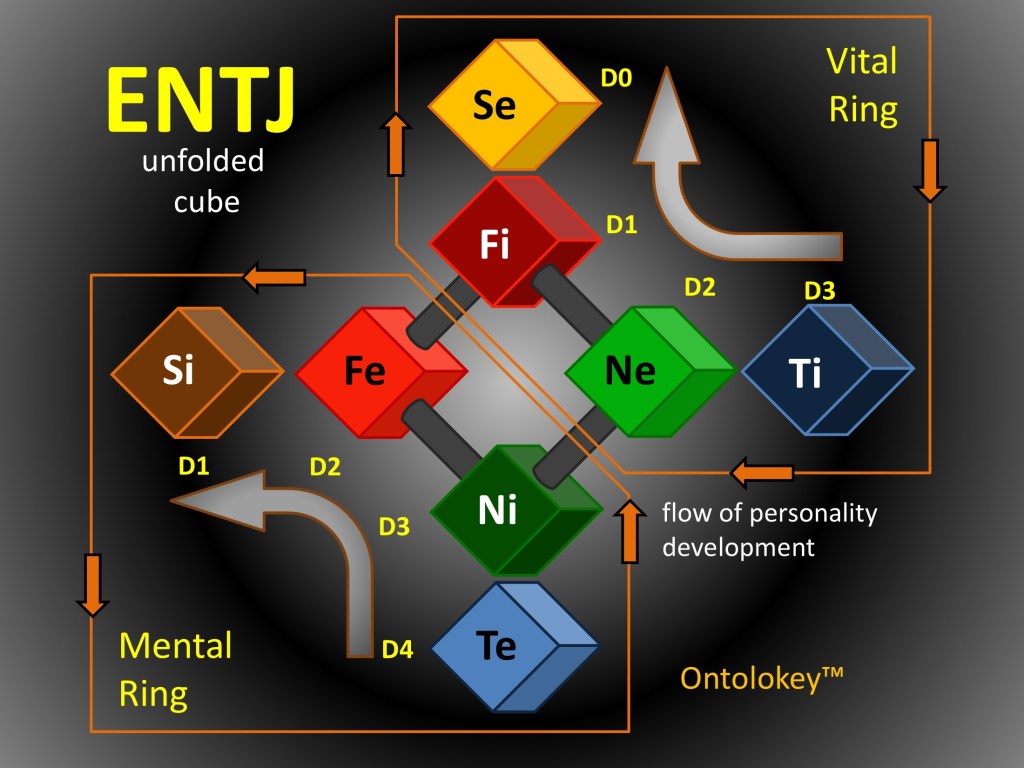
From the perspective developed through Ontolokey, personality can be understood as a living psychological landscape rather than as a fixed collection of traits: different functions occupy different positions within consciousness, some highly developed and familiar, others less accessible, vulnerable, unconscious, or experienced indirectly through projection and compensation. The Ontolokey Cube gives this architecture a spatial form, transforming the abstract relationship among psychological functions into something that can be mentally navigated, while its developmental orientation invites the individual to ask not merely what comes naturally but what has remained unseen, distrusted, neglected, or psychologically difficult. For the ENTJ, this perspective is particularly consequential because the personality’s strongest functions can generate such a compelling sense of coherence that the individual may gradually mistake the effectiveness of a particular cognitive instrument for the completeness of consciousness itself. The shadow therefore does not begin where the ENTJ becomes weak; it begins where strength becomes exclusive, where Te becomes not merely a function but an identity, Ni becomes not merely intuition but certainty, and achievement begins to carry the psychological burden of self-worth, security, meaning, and emotional protection. Individuation consequently requires not the destruction of the commanding personality but its enlargement, so that what was previously unconscious can enter awareness without forcing the ENTJ to surrender the very capacities through which it has learned to shape reality.
The developmental path described in this essay follows the specific Ontolokey progression of the ENTJ through the Mental Ring and the Vital Ring, moving gradually from more developed toward less developed psychological functions rather than attempting to leap directly into the deepest shadow. Within the Mental Ring, Te occupies D4 as the dominant function, Ni occupies D3 as the auxiliary function, Fe occupies D2 as the Anima/Animus function, and Si occupies D1 as the vulnerable Toddler function; within the Vital Ring, Ti begins at D3 as the Sibling function, followed by Ne at D2 as the Golden Shadow, Fi at D1 as the inferior function, and finally Se at D0 as the archaic or childlike Blindspot. The essential principle is developmental sequence: the ENTJ first strengthens the auxiliary Ni until it approaches the maturity of Te, then begins the deeper individuation process by opening the Vital Ring through Ti, while the subsequent functions become progressively accessible as consciousness is capable of tolerating and integrating the information they contain. This movement may be imagined as an iceberg slowly turning upon itself: what was once submerged begins to rise into consciousness, and the personality gradually encounters its own forgotten emotional, bodily, relational, imaginative, and vulnerable dimensions until the original dominant function can return to the surface in a transformed relationship with the whole. In this sense, healing through wholeness does not mean becoming someone other than an ENTJ; it means becoming an ENTJ who is no longer unconsciously imprisoned by the psychological conditions that once made strength necessary.
The ENTJ Psychological Architecture: Strength as the Beginning of Development
The psychological architecture of the ENTJ begins with an unusual concentration of developmental energy in Extraverted Thinking (Te), the D4 dominant function of the Mental Ring. Te naturally turns attention toward the external world of structure, consequence, standards, organization, measurable effectiveness, and purposeful action, which is why the ENTJ often experiences reality as something that can and should be shaped rather than merely observed. This orientation produces the familiar ENTJ qualities of decisiveness, strategic leadership, directness, high expectations, intellectual confidence, and an instinctive willingness to assume responsibility when circumstances appear disorganized or directionless. At its healthiest, Te is not simply a hunger for control but a capacity to convert intention into reality, to distinguish what matters from what does not, and to create structures in which people and resources can move toward a meaningful objective. The difficulty begins only when this exceptionally developed function gradually ceases to be experienced as one psychological instrument among several and becomes the implicit judge of all experience, because whatever cannot be organized, measured, optimized, or rationally justified may then appear inferior, irrational, inefficient, or irrelevant. Ontolokey’s analysis of the ENTJ shadow identifies precisely this reversal: the strength that originally enables mastery of complexity can become the psychological framework through which complexity itself is prematurely reduced.
For this reason, the first developmental task of the ENTJ is not to weaken Te but to understand its proper psychological sovereignty. A mature Te can make decisions without needing every decision to confirm the superiority of the person making it; it can impose structure without requiring every human being within that structure to surrender autonomy; and it can pursue excellence without turning excellence into a moral measure of human worth. The crucial distinction is between using effectiveness and identifying with effectiveness, because the latter creates a subtle psychological equation in which competence becomes security, achievement becomes identity, and control becomes protection against uncertainty. Once this equation is established, failure can be tolerated as a technical problem because technical problems can be solved, whereas emotional helplessness becomes far more threatening because it exposes the limits of competence itself. The ENTJ may therefore become extraordinarily resilient in the face of external adversity while remaining unexpectedly vulnerable to situations involving rejection, dependence, emotional ambiguity, betrayal, or the possibility of being unable to repair what matters most. The shadow is consequently not an absence of emotion but a dissociation from the emotional information that cannot easily be incorporated into Te’s preferred language of action and resolution.
The first great movement toward wholeness therefore occurs through Ni, the D3 auxiliary function of the Mental Ring, because Ni teaches Te that not everything important is immediately visible at the level of external facts. Whereas Te asks how reality can be organized and acted upon, Ni searches beneath appearances for patterns, trajectories, symbolic meanings, and the deeper direction toward which events are moving; the ENTJ becomes significantly more mature when these two functions cease competing for authority and begin forming a conscious partnership. In Ontolokey’s formulation, Ni represents the inner visionary dimension that prevents the ENTJ from becoming merely a tactical executor, because strategy without an underlying vision can become an endless sequence of successful actions without a sufficiently examined reason for performing them. Developing Ni toward D4 therefore means learning to pause before acting, to distinguish urgency from importance, and to allow an emerging pattern to become visible before imposing a solution upon it. This is also the psychological beginning of the great iceberg movement: once the dominant personality discovers that its own conscious model of reality is incomplete, the unconscious is no longer merely an obstacle to be controlled but becomes a source of information that consciousness requires for its own completion.
The maturation of Ni changes the ENTJ’s relationship with certainty in a particularly important way, because genuine intuition does not merely reinforce an existing theory; it can reveal that the theory itself must change. A Te-dominant ENTJ can easily become attached to conclusions because conclusions permit action, while Ni introduces a different kind of intelligence in which ambiguity may need to remain open until a deeper pattern becomes discernible. When Ni is sufficiently developed, the ENTJ begins to recognize that being strategically intelligent does not mean being omniscient, and that a strong model remains a model rather than becoming reality itself. This distinction creates the psychological space necessary for the next developmental movement, because only a personality capable of questioning its own framework can safely encounter functions that do not speak the language of efficiency, control, or strategic certainty. The development from Te toward Ni therefore represents much more than an improvement in strategic sophistication: it is the transition from unconscious certainty to conscious perspective, from immediate mastery toward reflective intelligence, and ultimately from the conviction that reality must be organized according to one’s understanding toward the humility that one’s understanding itself must continue to evolve. Once Ni approaches the maturity of Te, the ENTJ has built the psychological platform from which individuation can genuinely begin.
The Threshold of Individuation: From Ni to the Unconscious
Once Ni has been sufficiently developed, the ENTJ reaches a psychological threshold at which further growth can no longer be achieved simply by becoming more capable within the familiar architecture of Te and Ni. The personality may already possess strategic vision, intellectual authority, organizational competence, and a coherent sense of direction, yet an uncomfortable realization can gradually emerge: the conscious personality is still only the visible portion of a much larger psychological reality. In the developmental model described by Ontolokey, this is the point at which the Vital Ring becomes increasingly significant, beginning with Ti as the D3 Sibling function, while the Mental Ring continues its gradual movement toward Fe and Si. Ti is particularly important because it introduces a form of internal logical examination that does not primarily ask whether an idea works in the external world, but whether the internal structure of the idea is coherent in its own right. For an ENTJ, this can be disconcerting because Te is accustomed to judging thought according to usefulness, applicability, results, and objective consequences, whereas Ti can insist upon distinctions that have no immediate practical payoff. Its developmental value lies precisely there: it teaches the ENTJ that not every truth needs to become an instrument, and that understanding can possess intrinsic value even before it produces an outcome. The emergence of Ti therefore begins to loosen the unconscious identification between knowing and controlling, opening a space in which the personality can observe its own mental machinery rather than continually using that machinery to transform the external world.
This transition also changes the meaning of the word “strength.” The young or psychologically one-sided ENTJ may understand strength primarily as the capacity to withstand pressure, make difficult decisions, remain composed, overcome obstacles, and continue moving when others hesitate, but individuation gradually reveals another form of strength that is initially much less comfortable: the capacity to remain psychologically present when there is nothing immediately useful to do. Ti contributes to this development by creating an internal laboratory in which assumptions can be examined without the pressure to defend them through achievement or external validation. The ENTJ begins to ask questions such as whether a conclusion is actually true or merely useful, whether a judgment is genuinely objective or contaminated by personal investment, and whether a preferred strategy reflects reality or simply reinforces an established identity. Such questioning can temporarily destabilize the personality because the individual is no longer operating exclusively from the psychological position in which competence provides reassurance. Yet this destabilization is not necessarily regression; within the Ontolokey developmental metaphor, it is evidence that the conscious structure is becoming permeable enough for previously excluded material to approach awareness. The Sibling function thus represents an important psychological companion on the road toward individuation, because it does not demand that the ENTJ abandon Te but teaches the dominant function to tolerate an internal perspective that cannot simply be subordinated to external effectiveness.
As this process deepens, the ENTJ may encounter an especially revealing contradiction: the person who is highly skilled at diagnosing the weaknesses of systems can be remarkably resistant to discovering the hidden weaknesses of the self. External problems are attractive because they have boundaries, variables, consequences, and potential solutions, whereas unconscious conflicts often possess none of these qualities at first encounter. A psychological wound may express itself as irritability, impatience, withdrawal, perfectionism, excessive work, contempt for dependency, or an obsessive need to restore order, and Te can interpret these responses as reasonable reactions to an unreasonable environment. The deeper question, however, is why a particular situation possesses such disproportionate emotional power, why certain forms of criticism penetrate more deeply than others, or why a seemingly minor failure can evoke an internal response that is vastly larger than the objective event warrants. This is where cognitive self-observation becomes transformative: instead of immediately correcting the environment or explaining away the reaction, the ENTJ begins to investigate the reaction itself as psychological evidence. The shadow then ceases to be understood merely as something negative or defective and becomes a repository of information about needs, fears, sensitivities, and developmental experiences that the conscious personality previously lacked the language or willingness to acknowledge.
The next movement within the Mental Ring leads toward Fe, the D2 Anima/Animus function, and here the developmental challenge becomes considerably more intimate because the ENTJ encounters the psychological dimension of interpersonal feeling that cannot be reduced to efficiency or strategic relationship management. Fe concerns the emotional atmosphere between people, the expression and modulation of collective feeling, the symbolic significance of emotional participation, and the ability to recognize that human beings do not always need solutions when they are suffering. An ENTJ can understand other people’s emotions intellectually and may even become highly skilled at managing teams, motivating groups, reading social dynamics, or generating enthusiasm, while still remaining partially disconnected from the vulnerable experience of feeling itself. This distinction is crucial because emotional intelligence used strategically is not identical to emotional participation, just as understanding another person’s emotional state is not the same as allowing that state to affect one’s own inner world. The Anima/Animus therefore becomes a particularly sensitive gateway into the unconscious: it can expose the ENTJ to tenderness, relational vulnerability, emotional reciprocity, and the frightening possibility that some of the most important human experiences cannot be optimized without being diminished. Development here does not mean becoming emotionally demonstrative for its own sake; it means becoming sufficiently receptive that feeling can be experienced as information rather than automatically converted into a problem requiring immediate resolution.
This is also why the ENTJ’s deeper shadow may remain invisible for many years even while the individual appears exceptionally successful. The more efficiently Te and Ni operate, the more convincingly they can construct a life in which the neglected functions are unnecessary on the surface, because accomplishment can provide structure, relationships can be organized around shared objectives, and emotional discomfort can be displaced into work, strategic activity, intellectualization, or future-oriented ambition. Yet what is excluded from consciousness does not cease to exist; it tends to return indirectly through disproportionate reactions, projections, compulsive behaviors, recurring interpersonal conflicts, or periods in which achievement suddenly loses its ability to provide meaning. Ontolokey’s developmental framework interprets these experiences not simply as obstacles but as invitations to turn the psychological iceberg: what has remained submerged begins demanding recognition precisely because the conscious personality has become sufficiently mature to encounter it. The goal is therefore not to wage war against the shadow, because fighting the shadow merely strengthens the division within the psyche, but to establish a conscious relationship with it in which every previously rejected function can gradually disclose what it has been attempting to communicate. In that sense, individuation becomes an act of psychological reconciliation: the ENTJ does not become less powerful by meeting the unconscious, but increasingly understands why certain forms of power were necessary, what they protected against, and what aspects of the self were sacrificed in order to obtain them.
The Anima/Animus and the Wound Beneath Competence
The development of Fe from D2 toward greater consciousness marks one of the most consequential transitions in the ENTJ’s individuation because it brings the personality into contact with a domain in which competence offers considerably less protection. Fe represents the capacity to participate consciously in emotional reality rather than merely to understand, regulate, influence, or organize it, and for the ENTJ this distinction can expose a deeply guarded psychological layer beneath the confident exterior. An ENTJ may be capable of commanding a room, motivating an organization, negotiating conflict, or identifying precisely what another person should do next, yet none of these abilities necessarily answers the more vulnerable question of what happens inside the ENTJ when another person’s pain cannot be fixed. The temptation is often to translate feeling into action: sadness becomes a problem to solve, uncertainty becomes a decision to make, interpersonal tension becomes a conflict to resolve, and vulnerability becomes something that should be overcome as quickly as possible. Fe begins to heal this pattern by introducing the possibility that emotional experience does not always require intervention; sometimes it requires recognition, shared presence, and permission to exist. In this developmental stage, the ENTJ discovers that emotional receptivity is not the opposite of strength but a different form of perceptual intelligence, one capable of detecting meanings that disappear when experience is reduced exclusively to what can be acted upon. (ontolokey.com)
The Anima/Animus is particularly sensitive because it touches precisely those psychological qualities that the conscious ENTJ may have learned to subordinate in the pursuit of effectiveness. The individual may have received implicit or explicit messages throughout life that being strong means not needing reassurance, not displaying uncertainty, not allowing emotions to interfere with decisions, and not permitting personal sensitivity to compromise performance. Over time, these adaptations can become so successful that the ENTJ genuinely believes emotional independence is simply an aspect of personality rather than a psychological strategy that once served a protective function. The unconscious, however, remembers what consciousness excludes, and the neglected emotional dimension may therefore emerge through unusually intense reactions to rejection, disrespect, abandonment, humiliation, disloyalty, emotional coldness, or the feeling of being misunderstood. What appears externally as anger may sometimes contain grief; what appears as contempt may conceal disappointment; what appears as impatience may protect against helplessness; and what appears as indifference may be an attempt to prevent attachment from creating vulnerability. The developmental task is not to reinterpret every strong reaction as hidden trauma, but to become curious about the disproportion between event and response, because disproportion can reveal where an old psychological wound has been activated by a present circumstance.
This is where the idea of cognitive self-healing becomes particularly meaningful within the Ontolokey framework. When an ENTJ learns to observe an emotional reaction rather than immediately obeying it or suppressing it, the reaction becomes psychologically legible, and what was previously experienced as an inexplicable weakness can become understandable as the expression of a less-developed function. The person may begin to recognize that a certain criticism hurts because it touches a deeply held fear of inadequacy, that an apparently irrational need for control intensifies when emotional security is threatened, or that an excessive attachment to achievement developed partly because accomplishment once provided an environment in which worth seemed undeniable. Such recognition does not magically erase the underlying vulnerability, but it changes the relationship to it: the ENTJ no longer has to despise the sensitive part of the self simply because that part cannot perform according to Te’s standards. Understanding also creates the possibility of forgiveness, both toward oneself and toward others, because behavior that once appeared inexplicable can be situated within a larger developmental history of unmet needs, defensive adaptations, misunderstandings, and limited psychological resources. In this sense, consciousness becomes therapeutic not because cognition replaces feeling, but because cognition creates enough understanding for feeling to be integrated rather than exiled.
The movement toward Fe also forces the ENTJ to confront one of its most subtle shadow tendencies: the transformation of relationships into systems of utility. This does not mean that ENTJs are incapable of genuine affection or loyalty; rather, their natural orientation toward goals can cause them to unconsciously evaluate relationships according to contribution, reliability, competence, shared direction, or future potential. When this tendency becomes rigid, people can begin to be experienced primarily according to what they enable, obstruct, represent, or require, while the irreducible mystery of the individual person becomes secondary to the function that person occupies within the ENTJ’s psychological and practical world. Mature Fe introduces a corrective by teaching that a relationship can possess value even when it produces no measurable advantage, that another person’s subjective reality does not become less legitimate because it is inefficient, and that love cannot be reduced to loyalty demonstrated through performance. This can be profoundly liberating because the ENTJ is eventually permitted to discover that intimacy does not have to be earned through usefulness. To be loved while failing, while uncertain, while emotionally exposed, or while temporarily unable to contribute according to one’s usual standards is to encounter a form of human acceptance that achievement alone can never provide.
As Fe becomes integrated, the ENTJ’s leadership itself can undergo a profound transformation because authority begins to emerge less from force of will and more from psychological presence. The immature expression of Te may assume that people improve when expectations become clearer, standards become higher, and consequences become more explicit, whereas an increasingly integrated ENTJ recognizes that human beings also develop through belonging, emotional safety, recognition, and the experience of being understood. This does not require abandoning standards or becoming permissive; rather, it allows firmness and humanity to coexist without one cancelling the other. The ENTJ can learn to distinguish compassion from weakness, emotional expression from emotional chaos, and receptivity from passivity, thereby escaping the false choice between being powerful and being sensitive. The result is a more complete form of authority in which the leader does not merely move people toward a destination but understands something of the inner worlds of the people making that journey possible. The same transformation occurs internally: instead of demanding that every part of the psyche justify itself through productivity, the ENTJ gradually learns to grant psychological legitimacy to those dimensions that simply need to be felt, witnessed, understood, and integrated.
Si and the Toddler Within: Vulnerability, Memory, and the Limits of Control
After the Anima/Animus function has begun to develop, the ENTJ’s movement through the Mental Ring eventually approaches Si, the D1 Toddler function, which represents an even more vulnerable layer of psychological experience. Si brings consciousness toward bodily sensation, personal continuity, familiarity, concrete memory, accumulated experience, and the subtle internal signals through which the organism communicates comfort, discomfort, exhaustion, safety, and threat. For an ENTJ accustomed to living through goals, possibilities, strategic decisions, and future-oriented movement, this domain can feel frustratingly slow because the body does not negotiate according to deadlines and the past cannot be reorganized simply because a different future would be more convenient. The Toddler quality of Si is significant because it symbolizes a part of the personality that does not want to conquer the world but wants to feel safe within it, and that need can be deeply embarrassing to a consciousness that has built its identity around self-command. The ENTJ may therefore discover that what has been interpreted as laziness, weakness, oversensitivity, or lack of discipline is sometimes the neglected language of an organism that has been pushed beyond its limits for too long. Developing Si does not mean becoming passive or retreating from ambition; it means learning that sustained power requires contact with the conditions under which the organism itself can remain whole.
This encounter can expose the hidden cost of the ENTJ’s relationship with endurance. Because Te naturally rewards visible accomplishment and Ni is oriented toward what lies ahead, the ENTJ can become extraordinarily skilled at postponing immediate discomfort in service of a larger objective, sometimes to the point at which postponement becomes a way of life. Fatigue can be rationalized as temporary, emotional pain as irrelevant, physical signals as inconvenient, and the need for rest as an obstacle to progress, particularly when the individual has repeatedly experienced success precisely because of an exceptional ability to push through resistance. Yet the body records what consciousness chooses not to register, and neglected signals may eventually return through exhaustion, irritability, loss of motivation, psychosomatic tension, or an increasingly mechanical relationship with one’s own life. Si offers a corrective because it asks the ENTJ to notice what is actually happening rather than what should be happening according to the plan. This introduces a form of temporal consciousness that is less concerned with the next milestone and more concerned with continuity: what has happened to me, what does my body remember, what environments restore me, what patterns repeatedly exhaust me, and which apparently insignificant experiences have accumulated into a major psychological burden? Through such questions, the ENTJ begins to recognize that the self is not merely the agent who executes a plan but also the organism that has been living through every consequence of that plan.
The Toddler function also has a profound relationship with early experience because the most vulnerable parts of personality often retain emotional associations that adult rationality cannot simply command into disappearance. A present-day situation may therefore awaken an old feeling of being powerless, overlooked, controlled, abandoned, or insufficient, even when the conscious adult knows intellectually that the present circumstances are entirely different. The ENTJ’s first instinct may be to reject such a response as irrational, but this rejection can perpetuate the division because the vulnerable part is not asking for an intellectual argument about why it should feel differently. It is asking to be recognized as part of the individual’s history. Through the gradual development of Si, the ENTJ can begin reconstructing personal continuity: not merely remembering events, but understanding how repeated experiences shaped expectations about safety, competence, dependence, trust, and self-reliance. This can explain why certain situations remain disproportionately activating and why certain forms of vulnerability may feel almost intolerable despite an otherwise formidable adult personality. The objective is not to become trapped in childhood or to endlessly reinterpret the past, but to retrieve the psychological information that was never fully integrated so that the adult self can finally respond to old emotional patterns with present-day awareness rather than unconsciously repeating them.
There is also a deeper existential lesson within the movement toward Si: reality cannot be mastered solely by moving beyond it. The ENTJ’s natural psychological orientation is toward transformation, improvement, expansion, and future possibility, which makes stagnation particularly uncomfortable and can produce an almost compulsive relationship with progress. Si introduces the opposite movement, asking the individual to inhabit what already exists long enough to perceive its meaning, to appreciate continuity without automatically trying to replace it, and to recognize that not every imperfect condition is a problem requiring redesign. This can be surprisingly difficult for a personality whose identity has been strengthened through overcoming obstacles, because acceptance may initially resemble surrender and preservation may resemble lack of ambition. With greater consciousness, however, the ENTJ can distinguish acceptance from resignation: accepting an experience means allowing reality to be known before deciding what should be done with it. That distinction is psychologically decisive because the ability to remain with an experience without immediately transforming it creates the inner space in which previously unconscious material can become conscious. The Toddler therefore becomes less a symbol of weakness than an invitation to develop a secure internal relationship with the vulnerable self that Te once believed it had to outgrow.
When Si is gradually integrated, the ENTJ’s relationship with achievement can become less compulsive because accomplishment no longer has to compensate for an unconscious inability to rest, receive, remember, or simply exist. The person may continue to pursue demanding goals, but the psychological meaning of those goals changes: success becomes an expression of capacity rather than proof of worth, and discipline becomes a conscious choice rather than an automatic defense against feelings of inadequacy or helplessness. This is an important stage in the turning of the psychological iceberg because the ENTJ begins to recover not only what was emotionally neglected but also what was concretely lived through and subsequently pushed aside in the relentless movement toward the future. The past can then become a source of information rather than a prison, the body can become an ally rather than an inconvenient limitation, and vulnerability can become something that deserves protection rather than contempt. In this way, the progression from Te through Ni and Fe toward Si gradually transforms the meaning of strength itself: strength no longer means that nothing can reach the ENTJ, but that whatever reaches the ENTJ can be consciously encountered, understood, and integrated without destroying the coherence of the whole.
Entering the Vital Ring: Ti and the Discovery of the Inner Witness
With the Mental Ring sufficiently developed, the ENTJ reaches the point at which individuation can extend more decisively into the Vital Ring, beginning with Ti at D3 as the Sibling function. This transition is important because the previous stages have primarily involved refining the conscious architecture through which the ENTJ already understands the world, whereas the Vital Ring begins to expose dimensions of psychological life that have been less available to deliberate control. Ti functions as an internalizing movement of thought, examining definitions, principles, distinctions, premises, and conceptual consistency from within rather than primarily evaluating their effectiveness in the external environment. The ENTJ may therefore experience Ti as both familiar and strangely alien: familiar because it is still a thinking function, yet alien because its purpose is not necessarily to produce a decision, construct a system, or achieve an externally visible result. As the Sibling function, Ti can be approached as a companion rather than an adversary, allowing the ENTJ to cultivate a private intellectual relationship with ideas in which usefulness temporarily becomes secondary to precision and truth. This creates an essential psychological separation between “what works” and “what is,” a distinction that can profoundly alter how the ENTJ understands personal motives, interpersonal judgments, strategic assumptions, and even the identity that has been constructed through years of achievement. (ontolokey.com)
The deeper significance of Ti is that it can become an inner witness to the operation of Te itself. Instead of allowing the dominant function to remain the unquestioned authority, the ENTJ begins examining how conclusions are produced, which premises are being accepted without inspection, and where personal investment may have entered what appears to be objective reasoning. This is especially valuable because the ENTJ can possess such formidable confidence in analytical judgment that disagreement is sometimes interpreted as evidence that the other person has failed to understand the situation rather than as an opportunity to examine the ENTJ’s own model. Ti introduces a quieter form of intellectual humility: not the humility of assuming oneself wrong, but the discipline of being willing to investigate precisely why one believes oneself right. The distinction is psychologically important because genuine self-examination cannot occur if introspection is merely another instrument for proving that the existing self-concept is correct. Ti can therefore expose hidden rationalizations behind behavior that Te would otherwise defend as necessary, including the possibility that an apparently strategic decision was partly motivated by wounded pride, fear of dependency, desire for recognition, avoidance of intimacy, or an unconscious need to maintain control. When thinking becomes capable of turning back upon its own motives, cognition ceases to be merely an instrument of the ego and becomes an instrument of individuation.
This stage can also produce a temporary identity crisis because the ENTJ may discover that some of the beliefs previously experienced as unquestionable principles were actually adaptations. A conviction such as “people must be competent,” “emotions should not interfere with decisions,” “I can always handle things myself,” or “if something is important enough, I should be able to force myself through it” can appear rational because it has repeatedly produced results. Yet psychological truth requires a more demanding question: what did this belief make possible, and what did it make impossible? Ti can hold the contradiction long enough to see that a principle can be simultaneously useful and defensive, adaptive and limiting, empowering and costly. The ENTJ may discover, for example, that extreme independence created genuine resilience while also preventing the development of reciprocal dependence, or that exceptionally high standards produced excellence while simultaneously making ordinary human imperfection emotionally intolerable. Such discoveries can be uncomfortable because they undermine the simple narrative in which strengths are purely strengths and weaknesses are purely defects. Individuation replaces that binary with a more mature understanding in which every psychological adaptation has a history, every defense has served a purpose, and every strength can become pathological when it is required to perform a function for which it was never designed.
The development of Ti also prepares the ENTJ for the Golden Shadow represented by Ne at D2, because once internal reasoning has become sufficiently flexible, consciousness becomes capable of entertaining possibilities that do not conform to its established strategic map. Ne introduces multiplicity, alternative interpretations, unexpected associations, divergent possibilities, and the recognition that reality may contain more potential than the current Ni vision has captured. For a personality strongly oriented toward strategic convergence, this can initially feel like unnecessary dispersion, because Ni tends to compress possibilities into an emerging trajectory while Te seeks to act upon that trajectory. Ne asks the opposite question: what if the conclusion is not yet complete, what else could this mean, and which possibility has been excluded merely because it did not fit the current model? Its Golden Shadow quality makes this particularly fascinating because ENTJs may sometimes recognize and even admire expansive possibility-generation in others while experiencing it internally as something less trustworthy or less disciplined. Yet when integrated consciously, Ne can prevent strategic vision from becoming strategic tunnel vision, allowing the ENTJ to retain direction without becoming imprisoned by the first compelling interpretation of the future. The movement from Ti toward Ne therefore expands the inner field of consciousness, transforming the individual’s relationship with uncertainty from something that must be eliminated into something that can sometimes be psychologically productive.
This expansion is essential for healing because many unconscious conflicts survive through rigid interpretations of the past and present. If the ENTJ believes that a painful event has only one meaning—“I was weak,” “I was betrayed because I trusted incorrectly,” “I failed because I was not good enough,” or “I must never allow that situation to happen again”—then the psychological system organizes itself around preventing a repetition of that interpretation. Ne introduces alternative narratives without necessarily denying the original experience: perhaps the failure revealed a developmental limitation rather than personal worthlessness, perhaps another person’s behavior reflected their own unresolved conflict rather than the ENTJ’s inadequacy, perhaps vulnerability was not the cause of the injury but the condition that made the relationship meaningful in the first place. These alternatives can loosen the unconscious identification with a single defensive story. In this way, the Vital Ring begins doing something the Mental Ring alone cannot accomplish: it changes not merely what the ENTJ knows, but the number of psychological realities the ENTJ is capable of holding simultaneously. That capacity for multiplicity becomes one of the foundations of genuine wholeness, because the integrated personality no longer needs to destroy contradictory information in order to preserve a coherent identity.
Ne as the Golden Shadow: Releasing the Prison of a Single Future
The movement from Ti toward Ne marks a further loosening of the ENTJ’s attachment to psychological certainty, because Ne at D2 as the Golden Shadow function introduces an intelligence of possibility that can exist alongside, rather than beneath, the dominant strategic orientation. The ENTJ’s natural combination of Te and Ni is exceptionally powerful when a situation requires a coherent direction, but precisely because it is so effective at identifying a trajectory and mobilizing resources toward it, it can become psychologically difficult to remain open once a convincing vision has been established. Ne interrupts this closure by multiplying perspectives, alternatives, associations, interpretations, and potential futures, thereby challenging the unconscious assumption that seeing a pattern necessarily means having exhausted the possible meanings of that pattern. The Golden Shadow is not simply a repository of weakness; it contains qualities that can be strangely attractive, even enviable, because they represent capacities the conscious personality recognizes as valuable without necessarily experiencing them as naturally available. An ENTJ may therefore admire people who effortlessly improvise, entertain contradictory possibilities, change direction without experiencing it as failure, or discover opportunities in situations that initially appear chaotic, while simultaneously judging such behavior as unfocused or inefficient. Conscious integration of Ne allows the ENTJ to appropriate the underlying psychological freedom without abandoning strategic discipline, transforming flexibility from something associated with indecision into a higher-order capacity to revise the strategy when reality demands it.
This becomes particularly important when the ENTJ encounters failure, because failure can threaten not only a particular objective but the coherence of the future-oriented identity constructed around that objective. Ni often invests deeply in an envisioned trajectory, and Te subsequently organizes reality around making that trajectory concrete; when the expected future collapses, the resulting psychological impact can therefore be considerably greater than the external event alone would suggest. An ENTJ may respond by intensifying effort, searching for the decisive error, restructuring the plan, assigning responsibility, or immediately constructing a replacement objective, all of which can be adaptive responses when circumstances genuinely require action. Yet if the psychological system cannot tolerate the possibility that the original vision itself was incomplete, the response becomes compulsive rather than strategic, because the individual is attempting to restore not merely the goal but the certainty that made the goal psychologically safe. Ne offers another path by allowing failure to generate possibilities rather than merely corrections. A collapsed plan can become information about an unexplored direction, a relationship that ended can reveal an aspect of the self previously neglected, and an unexpected limitation can expose capacities that would never have emerged under conditions of uninterrupted control. The future then becomes less a predetermined destination and more an evolving field of possibilities in which intelligence consists partly in remaining responsive to what reality reveals.
The Golden Shadow also has a significant relationship with creativity because creativity requires the mind to tolerate incomplete structures without immediately forcing them into a final form. For an ENTJ, the impulse to organize can arrive so quickly that an emerging idea is sometimes evaluated before it has had sufficient psychological space to develop, especially when the idea initially appears impractical, emotionally ambiguous, or unrelated to the established objective. Ne can teach the ENTJ to protect the incubation period in which apparently useless information may unexpectedly connect with something meaningful. This is not an argument for abandoning standards or allowing endless distraction; rather, it represents a more sophisticated understanding of intelligence in which divergent exploration and convergent execution are recognized as different phases of the same creative process. The ENTJ can remain decisive while deliberately creating spaces in which decisiveness is temporarily suspended, because the purpose of such suspension is not avoidance but information acquisition. Over time, this produces a more flexible form of strategic thinking in which the individual is able to generate alternatives before selecting among them, to recognize opportunities outside the original plan, and to distinguish genuine commitment from unconscious attachment to being right about the future. Such flexibility can make the ENTJ’s leadership more adaptive precisely because it preserves direction without requiring reality to conform perfectly to the initial vision.
Ne also contributes to interpersonal healing by weakening the tendency to reduce another person’s behavior to a single interpretation. When an ENTJ feels betrayed, disappointed, disrespected, or obstructed, the mind can rapidly construct a coherent explanation for what happened, particularly when Te and Ni cooperate in searching for motive, pattern, and consequence. The danger is that a coherent explanation can become psychologically indistinguishable from certainty, and once another person’s motives have been assigned, subsequent evidence may simply be interpreted through the existing narrative. Ne introduces alternative hypotheses and therefore creates a psychological interval between perception and judgment: perhaps the person was acting from fear rather than malice, perhaps the conflict arose from incompatible needs rather than deliberate disrespect, perhaps the ENTJ’s own behavior contributed to a dynamic that was invisible from inside the original perspective. None of these alternatives needs to excuse harmful behavior or invalidate legitimate boundaries; their function is to prevent consciousness from becoming trapped inside a single emotionally satisfying explanation. This capacity becomes especially valuable in forgiveness because genuine forgiveness does not require declaring an injury insignificant, but it does require freeing oneself from the psychological necessity of carrying one interpretation of that injury forever.
At its deepest level, the integration of Ne allows the ENTJ to relinquish one of the most seductive forms of control: control over meaning itself. The mature individual begins to understand that an experience may have several meanings across different stages of life, and that the significance assigned to an event at twenty may be radically different from the meaning understood at forty, sixty, or later. This does not make truth arbitrary; rather, it recognizes that consciousness develops and therefore acquires the capacity to perceive dimensions of experience that were previously inaccessible. The turning iceberg becomes particularly visible here because the ENTJ begins to see that what once appeared beneath the surface as failure, vulnerability, chaos, or wasted time may later reveal itself as an essential developmental passage. Ne thus prepares the way for Fi, the D1 inferior function, because once multiple interpretations are possible, the ENTJ can finally begin asking a question that strategic intelligence alone cannot answer: not merely “What could happen?” but “What does this mean to me, and what do I genuinely value?” The movement toward wholeness consequently becomes increasingly personal, moving from the architecture of reality toward the inner authority of subjective meaning.
Fi as the Inferior Function: The Discovery of Inner Value
The movement from Ne toward Fi represents one of the most intimate stages of ENTJ individuation because Fi at D1 brings consciousness toward the private interior world of personal values, emotional authenticity, moral boundaries, attachment, loyalty, and the subjective meaning of individual experience. The ENTJ can become exceptionally skilled at determining what is effective, what is strategically necessary, what produces the desired outcome, and what direction is most promising, yet none of these questions automatically reveals what the individual personally loves, cannot betray, or would choose even if no external reward followed. Fi therefore confronts the ENTJ with a domain in which there is no universally persuasive metric, because subjective value cannot always be demonstrated through evidence, efficiency, consensus, or measurable consequence. This can initially feel uncomfortable because the ENTJ’s psychological authority has traditionally been strengthened by reasons that can be articulated and defended, whereas Fi may communicate through an inward sense of resonance, aversion, loyalty, integrity, or violation that is difficult to explain to anyone else. The inferior position makes this encounter particularly sensitive: what is consciously underdeveloped can simultaneously possess enormous psychological importance, meaning that the ENTJ may either dismiss personal feeling altogether or become unexpectedly intense when deeply personal values are touched. The developmental task is therefore not to replace Te’s external judgment with subjective preference, but to allow Fi to establish an internal dimension of value alongside the external dimension of effectiveness.
One of the central discoveries within this process is that a person can succeed according to external criteria while simultaneously betraying something essential within the self. This possibility is often difficult for the ENTJ to recognize because achievement provides concrete evidence that a chosen path is working, while internal dissatisfaction can appear irrational when the objective indicators remain positive. Yet Fi asks a fundamentally different question from Te: even if this works, is it mine; even if this is successful, is it aligned with what I actually value; even if everyone respects the achievement, can I respect myself within it? Such questions can destabilize a highly accomplished identity because they remove external validation from the center of the psychological equation. The ENTJ may discover that certain ambitions were inherited from expectations, competition, status structures, parental messages, cultural ideals, or an unconscious need to prove something that was never consciously chosen. Conversely, the individual may discover that a seemingly impractical desire has profound personal significance and therefore deserves protection precisely because it cannot be justified through conventional measures of success. Fi development consequently introduces the distinction between achievement and fulfillment, reminding the ENTJ that a life can be objectively impressive while subjectively alienating if the person who achieved it has gradually disappeared behind the role of achiever.
The inferior function can also reveal why the ENTJ sometimes reacts disproportionately to questions of loyalty, betrayal, fairness, authenticity, or personal recognition. When Fi is insufficiently conscious, personal values may remain unarticulated until they are violated, at which point the reaction can arrive with unexpected intensity because the psychological system has few intermediate channels through which to communicate the importance of what has been touched. An ENTJ who normally appears emotionally controlled may therefore become remarkably uncompromising when a deeply held value is threatened, and the person may struggle to understand why the issue feels so much larger than the surrounding circumstances suggest. Rather than treating such reactions merely as irrational eruptions, individuation asks what value is attempting to become conscious through them. Anger may be protecting dignity, resentment may be revealing an unmet expectation of reciprocity, jealousy may expose attachment, and grief may demonstrate that something mattered far more deeply than the conscious personality had permitted itself to admit. Once these underlying values can be named, the emotional intensity often becomes more intelligible because the ENTJ is no longer fighting an undefined internal force but entering into a relationship with a previously neglected part of the self.
Fi development further transforms the ENTJ’s relationship with other people because it introduces the recognition that individuals possess an interior sovereignty that cannot legitimately be managed from the outside. Te naturally notices competence and consequence, Ni perceives patterns and trajectories, Fe learns to recognize shared emotional fields, and Ne opens alternative interpretations, but Fi asks the ENTJ to encounter the irreducible individuality of another human being. This means learning that another person’s values may differ fundamentally from one’s own without necessarily being inferior, irrational, or in need of correction, provided those values do not violate legitimate boundaries. Such recognition can be challenging for a personality that instinctively sees opportunities for improvement, because genuine respect sometimes requires allowing another person to make a choice that the ENTJ considers inefficient or misguided. The mature response is not indifference but differentiation: I can understand your decision, disagree with it, maintain my own boundary, and still recognize your right to possess an inner world that belongs to you. This same principle must eventually be applied inwardly, allowing the ENTJ to discover that the self is not a project whose every feature must be optimized according to an external standard.
The healing potential of Fi becomes especially powerful when combined with the previously developed functions, because the ENTJ can now bring strategic intelligence into the service of values rather than using values merely to justify strategy. Te can provide implementation, Ni can provide direction, Ti can examine coherence, Ne can preserve alternatives, Fe can recognize relational consequences, and Si can remain attentive to embodied and historical experience, while Fi answers the question of what deserves to be served by all of them. At this point, ambition can become more authentic because it is no longer driven exclusively by the need to prove capability, and leadership can become more principled because decisions are increasingly anchored in consciously examined values rather than only in effectiveness. This is also where self-forgiveness can deepen: the ENTJ may begin to understand that earlier versions of the self acted according to the psychological resources available at the time, sometimes choosing control because vulnerability was frightening, achievement because recognition felt necessary, or emotional distance because intimacy had become associated with danger. Understanding these adaptations does not absolve every harmful action, but it makes genuine responsibility possible because responsibility no longer requires self-contempt. Fi ultimately teaches the ENTJ that wholeness requires an inner answer to the question of why one’s power should exist at all, and that the most mature form of strength is not merely the ability to accomplish what one wants, but the ability to know what is worthy of one’s life.
Se as the D0 Blindspot: Embodiment, Instinct, and the Return to Reality
The final and most archaic point of the Vital Ring is Se at D0, the function described in the Ontolokey model as the Blindspot, where development reaches the deepest layer of the ENTJ’s unconscious psychological architecture. Se represents immediate sensory awareness, direct contact with physical reality, spontaneous engagement with the present moment, instinctive perception of one’s surroundings, bodily immediacy, and the capacity to respond to what is actually happening without first translating experience into a strategic model. For an ENTJ whose psychological life is naturally organized around Te’s external structuring and Ni’s orientation toward underlying patterns and future trajectories, this direct encounter with the present can feel almost primitive, because the mind habitually moves beyond immediate experience toward what should be done next or what the current situation means in a larger context. Yet the D0 designation is precisely why Se matters so profoundly: the deepest unconscious layer is often not merely a collection of sophisticated ideas waiting to be understood but a neglected relationship with existence at its most immediate level. The ENTJ may know where life is going while remaining insufficiently aware of how life feels right now, may understand the strategic significance of an environment without noticing its sensory reality, and may pursue the future so relentlessly that the present becomes merely an instrument for reaching it. Integration therefore requires a return to embodied existence, where reality is encountered before it is interpreted, categorized, optimized, or converted into a plan.
This can be especially challenging because Se asks the ENTJ to relinquish a particular kind of psychological distance. Strategic consciousness creates an observing position from which circumstances can be analyzed, anticipated, and manipulated, whereas Se draws awareness directly into the immediacy of sensation and action. The mature integration of this function does not mean becoming impulsive, hedonistic, aggressive, or permanently absorbed in sensory stimulation; rather, it means developing the capacity to perceive the concrete world without the automatic mediation of an abstract objective. A mature ENTJ can therefore notice that a conversation has changed before intellectually determining why, recognize physical exhaustion before it becomes incapacitating, perceive environmental details that previously disappeared beneath strategic thought, and respond to an emerging situation without requiring complete conceptual mastery beforehand. Such presence is psychologically important because unconscious material frequently communicates through the body and through immediate reactions before it becomes available to reflective thought. If the ENTJ has learned to distrust bodily impulses, suppress fatigue, override discomfort, or dismiss instinct whenever it conflicts with a plan, then the body can become the last remaining territory in which the unconscious attempts to make itself heard. Se integration allows consciousness to receive these signals without automatically obeying them, creating a mature dialogue between instinct and judgment rather than a war between impulse and control.
At the deepest level, Se also confronts the ENTJ with mortality and limitation, because physical existence refuses the fantasy of unlimited strategic control. Plans can be revised, systems can be redesigned, markets can be influenced, organizations can be rebuilt, and relationships can sometimes be repaired, but the body has its own rhythms and eventually imposes boundaries that ambition cannot negotiate away. This confrontation can become psychologically transformative when it is no longer interpreted as humiliation but as a condition of being human. The ENTJ may begin to understand that limitation does not invalidate strength and that vulnerability does not contradict dignity; indeed, recognizing limitation can make power more conscious because it separates deliberate agency from omnipotent fantasy. Se therefore completes an important movement that began with the development of Ni: the ENTJ first learned that the visible world contains deeper patterns, and eventually learns that those deeper patterns must still be encountered through a concrete, finite, embodied life. The abstract future and the immediate present are not enemies; they become psychologically complementary when vision is grounded in reality and action remains responsive to what reality actually provides.
The integration of Se can also soften the ENTJ’s relationship with pleasure, spontaneity, and ordinary experience. When life is organized primarily around meaningful objectives, experiences without obvious developmental or productive value may be unconsciously classified as distractions, and the individual can become so accustomed to instrumentalizing time that simply enjoying an experience feels strangely difficult. Yet psychological wholeness requires more than purposeful achievement because the psyche is not sustained exclusively by accomplishment; it also requires moments in which existence is not being evaluated according to future utility. Eating, walking, traveling, physical movement, music, sexuality, nature, craftsmanship, aesthetic perception, and ordinary sensory pleasures can all become ways of returning consciousness to the present rather than merely escaping from it. The significance is not the particular activity but the psychological attitude with which it is approached: the ENTJ learns to experience without immediately converting experience into a result. This can be surprisingly healing because the individual discovers that not every moment needs to contribute to a larger project in order to justify its existence. Presence itself can become valuable, and the self can begin to experience life as something to inhabit rather than merely something to shape.
When Se is finally approached as an integrated rather than feared dimension, the ENTJ’s entire developmental arc begins to converge. Te remains the powerful capacity to organize reality, Ni remains the capacity to perceive direction and meaning, Fe provides greater emotional participation, Si provides continuity and bodily sensitivity, Ti provides internal examination, Ne preserves openness to possibility, and Fi provides personal value and authenticity, while Se anchors all of these functions in the immediate world in which life actually occurs. The iceberg has now turned far enough that the previously submerged dimensions are no longer entirely alien, and the original dominant function can eventually return to the surface without recreating the original psychological imbalance. Te no longer has to defend itself against vulnerability because vulnerability has become conscious; it no longer has to dominate every other function because the other functions have become legitimate sources of information. This is why the final goal of individuation is not a permanent state of shadow activation but a return to the whole: the ENTJ remains recognizably ENTJ, yet the personality is no longer organized around the unconscious exclusion of everything that Te cannot easily control. The journey ends where it began, but the starting point has been transformed, because the dominant function now stands at the center of a much larger psychological field and can finally exercise power without having to carry the entire burden of the self.
The Shadow in Relationships: Projection, Conflict, and the Problem of Forgiveness
The deepest consequences of an incompletely integrated shadow often become visible not in solitary reflection but in relationships, because other people continuously activate precisely those psychological functions that the conscious personality has learned to minimize. The ENTJ may be highly capable of forming alliances, leading groups, maintaining professional networks, and sustaining relationships built around shared goals, yet intimate relationships inevitably introduce forms of uncertainty that cannot be governed by strategy alone. Another person’s emotional needs may be inconsistent, their priorities may differ, their behavior may resist rational explanation, and their attachment may expose vulnerabilities that the ENTJ would prefer to keep under conscious control. When the shadow remains largely unconscious, these encounters can produce projection: qualities rejected within the self are perceived with disproportionate intensity in others, so dependency may be condemned because one’s own dependency is unacceptable, emotionality may be dismissed because one’s own feelings are difficult to tolerate, indecision may provoke contempt because one’s own uncertainty has been suppressed, and perceived weakness may become especially irritating because it touches the vulnerable Toddler dimension within oneself. The psychological paradox is that what most irritates the ENTJ in another person can sometimes point toward a capacity or need that consciousness has not yet granted legitimate status within itself. Shadow integration therefore changes relationships not primarily by teaching the ENTJ how to manage other people more effectively, but by making the individual’s own projections increasingly visible.
This becomes particularly important in conflict because Te can move rapidly toward judgment, diagnosis, and corrective action, while Ni can construct a compelling explanation for why the conflict occurred and where it is likely to lead. Together, these functions can produce extraordinary clarity when the interpretation is accurate, but they can also create a closed explanatory system in which the ENTJ feels that the case has already been solved before the other person’s subjective reality has been fully heard. The development of Fe, Ti, Ne, and Fi gradually introduces friction into this process, and that friction is psychologically healthy because it prevents the first interpretation from becoming an unquestioned verdict. Fe asks what emotional reality exists between the people involved, Ti asks whether the reasoning is internally sound, Ne asks what alternative interpretations remain possible, and Fi asks what personal values have actually been violated or defended. Si and Se add another dimension by bringing attention back to the concrete history of the relationship and the immediate embodied reality of the encounter rather than allowing the conflict to exist solely as an abstract intellectual problem. When these perspectives become available, disagreement no longer needs to culminate automatically in a winner and a loser. The ENTJ can remain firm while becoming more psychologically permeable, recognizing that understanding another person’s perspective does not require surrendering one’s own judgment and that changing one’s interpretation is not equivalent to losing authority.
The question of forgiveness becomes especially significant at this stage because forgiveness is often misunderstood by highly self-reliant personalities as an act of weakness or as an invitation to permit further violation. Within the individuation process, however, forgiveness is better understood as the relinquishment of an unconscious psychological bond to the injury, not as the denial of what occurred or the abandonment of necessary boundaries. When the ENTJ begins understanding the functions involved in the original conflict, it becomes possible to distinguish the event itself from the psychological meanings subsequently attached to it. A betrayal may have been real, yet the conclusion that “I must never trust anyone again” may represent a defensive adaptation rather than an objective truth; a failure may have been painful, yet the conclusion that “I am only valuable when I succeed” may belong to a much older psychological structure. The same principle applies to forgiveness of others: understanding the limitations, fears, defenses, or developmental immaturity behind another person’s behavior does not make the behavior acceptable, but it can release the ENTJ from the necessity of interpreting that behavior as a permanent statement about one’s own worth. The result is a form of psychological freedom in which boundaries can remain intact without hatred needing to maintain them.
Self-forgiveness may be even more difficult because the ENTJ’s internal standards can be severe, especially when competence has become closely associated with identity. The individual may intellectually understand that people make mistakes while unconsciously granting this permission to everyone except the self, because personal failure can activate a deeply embedded fear that the entire structure of competence was fraudulent. Here the inferior Fi and vulnerable Si dimensions become essential: the ENTJ must learn to recognize that the person who made an earlier decision was operating with the awareness, emotional resources, information, and developmental capacity available at that particular point in life. This does not eliminate responsibility, and genuine individuation requires acknowledging where one’s behavior caused harm, but responsibility becomes constructive only when it leads to integration rather than endless self-punishment. The mature question shifts from “How could I have been so weak or foolish?” toward “What was I protecting, what did I not yet understand, and what can I now do differently because I understand it?” Such questioning allows shame to become information rather than identity, transforming the past from a courtroom in which the self is permanently condemned into a psychological archive from which wisdom can be consciously retrieved.
Ultimately, the ENTJ’s relational individuation involves moving from control toward differentiation. Control seeks to make the external environment conform to the internal model, whereas differentiation permits two psychologically distinct realities to coexist without requiring one to annihilate the other. The ENTJ can remain ambitious while accepting another person’s different priorities, remain direct while respecting emotional sensitivity, remain decisive while acknowledging uncertainty, and maintain boundaries while retaining compassion. This is not a softening of personality in the sense of losing structure; it is a strengthening of structure because the personality no longer requires uniformity in order to maintain psychological stability. The integrated ENTJ becomes increasingly capable of asking not only “What should happen?” but also “What is happening inside me as I decide what should happen?” That second question is the doorway through which projection becomes consciousness, conflict becomes information, forgiveness becomes freedom, and relationships become one of the most powerful mirrors through which the previously unconscious self can finally be encountered.
The Shadow of Achievement: When Power Becomes Compensation
One of the most difficult aspects of ENTJ individuation is recognizing that exceptional achievement can sometimes function simultaneously as genuine expression and psychological compensation. The ENTJ’s capacity to build, lead, compete, organize, decide, and overcome obstacles is real, and reducing these qualities to defensive behavior would itself misunderstand the personality; nevertheless, the unconscious can attach additional psychological functions to achievement until success begins carrying burdens it was never designed to carry. Work can become a means of avoiding emotional uncertainty, ambition can become a defense against feelings of inadequacy, leadership can become a way of ensuring that nobody else possesses enough power to threaten the self, and relentless forward movement can prevent the individual from encountering grief, dependency, loneliness, or unresolved fear. Because Te is so effective at producing tangible results, these compensations can remain invisible for a remarkably long time: the person receives external confirmation precisely where the psyche is using achievement to maintain internal equilibrium. This creates one of the central paradoxes of the ENTJ shadow, namely that the same behavior can be simultaneously healthy, productive, admirable, and psychologically defensive. Individuation therefore does not ask whether the ENTJ should stop achieving, but whether achievement remains a free expression of the self or has become an unconscious requirement for feeling worthy, safe, powerful, or alive. (ontolokey.com)
The distinction becomes visible when the ENTJ encounters the possibility of not achieving. A psychologically integrated person can experience disappointment without experiencing the collapse of identity, whereas a less integrated ENTJ may experience failure as evidence that something fundamental about the self has been invalidated. The external event may be small, but the internal meaning can become enormous because it touches an implicit equation: if I am competent, I am secure; if I am successful, I am valuable; if I remain in control, I cannot be humiliated; if I continue moving forward, I do not have to confront what lies behind me. This is where the development of Fi, Fe, Si, and Se becomes essential because these functions provide alternative foundations for identity that do not depend upon continuous performance. Fi teaches intrinsic value, Fe teaches relational belonging, Si teaches continuity and embodied existence, and Se teaches presence in the immediate world rather than perpetual investment in future outcomes. Once these dimensions become conscious, failure can remain painful without becoming existentially annihilating. The ENTJ can say, psychologically rather than merely intellectually, “I failed at something” without unconsciously converting the statement into “I am a failure,” because the self has become larger than the function through which it normally proves its competence.
This transformation also changes the ENTJ’s relationship with rest, because rest can become threatening when activity has been unconsciously serving as emotional regulation. For an individual accustomed to solving problems, a period without pressing objectives can initially expose an unexpected emptiness, agitation, or dissatisfaction that was previously masked by constant movement. The temptation is then to manufacture another challenge, another project, another strategic problem, or another future objective, not necessarily because it is genuinely meaningful but because psychological stillness feels intolerable. The development of Si and Se gradually teaches the opposite lesson: stillness is not necessarily stagnation, and the absence of productivity does not constitute the absence of value. The person begins to discover that psychological integration requires periods in which nothing is being conquered, repaired, optimized, or anticipated, because unconscious material often becomes perceptible only when the conscious mind stops generating enough activity to drown it out. This can be particularly humbling for an ENTJ because it removes the familiar evidence of competence and leaves the individual alone with the question of whether existence can be experienced as worthwhile without continuous proof of usefulness.
The shadow of achievement can also distort leadership when personal identity becomes fused with being the person who knows what to do. In such circumstances, delegation may become difficult not because others are objectively incapable but because allowing others to determine the outcome threatens the ENTJ’s psychological position as the central problem-solver. Te can then become controlling rather than organizing, standards can become weapons rather than instruments of excellence, and strategic clarity can become intolerance toward anyone whose process differs from the leader’s preferred method. The development of Ti and Ne helps loosen this rigidity by allowing the ENTJ to recognize that there may be multiple valid ways to reach a result, while Fe and Fi provide a deeper understanding of the human cost of treating every deviation as incompetence. The mature leader therefore becomes less invested in demonstrating personal superiority and more interested in creating conditions under which other people can develop their own competence. This is a major sign of individuation because power is no longer needed primarily to establish the self’s importance; instead, power becomes something that can be distributed, delegated, and used to increase the autonomy of others without producing an unconscious sense of diminishment.
The final liberation from achievement as compensation occurs when the ENTJ realizes that ambition itself can survive the death of the need to prove anything. This is perhaps one of the most important distinctions in the entire developmental process: psychological healing does not require the individual to become less ambitious, less competitive, less strategic, or less influential. It requires those qualities to become increasingly voluntary, so that they arise from conscious values and vision rather than from an unconscious demand to repair an old wound through perpetual accomplishment. Te can then return to its proper place as D4 without carrying the emotional burden of the entire personality, because Fi can affirm worth independently of achievement, Fe can provide belonging independently of usefulness, Si can provide continuity independently of progress, and Se can provide presence independently of future success. The ENTJ becomes capable of extraordinary achievement without needing achievement to answer every existential question. At that point, power ceases to function primarily as armor and becomes what it can be at its highest developmental level: a conscious capacity placed in service of a life whose meaning has already become larger than the victories it may contain.
The Developmental Sequence: Why the Shadow Cannot Be Forced
A central principle of the Ontolokey developmental model is that individuation must respect psychological sequence rather than becoming an attempt to forcibly activate whichever function appears most desirable. For the ENTJ, this means that Te at D4 cannot simply leap directly toward Si at D1 or Se at D0 because the deepest functions contain psychological material that consciousness may not yet possess the stability to integrate. The auxiliary Ni must first mature from D3 toward the level of Te, creating sufficient reflective depth to prevent the ENTJ from approaching the unconscious through impulsive self-analysis or premature identification with unfamiliar psychological states. Only then does the Vital Ring properly open through Ti at D3, followed progressively by Ne at D2, Fi at D1, and Se at D0, while the Mental Ring continues its own progression through Fe and Si. This sequential architecture is important because individuation is not merely an accumulation of desirable traits; it is a restructuring of the relationship between conscious and unconscious functions, and each newly integrated layer depends upon capacities established in the previous one. The ENTJ therefore does not heal by trying to “become more emotional,” “become more spontaneous,” or “become more sensitive” overnight, but by developing the psychological prerequisites that allow these dimensions to enter consciousness without overwhelming the existing personality structure. (ontolokey.com)
The practical implication is that development should begin where consciousness is already strongest and then move one step deeper rather than attempting to attack the deepest shadow directly. In the ENTJ’s case, this means deliberately strengthening Ni by learning to reflect upon patterns before acting, examining long-term consequences without becoming attached to a predetermined outcome, and distinguishing genuine intuition from conclusions that merely reinforce an existing strategic preference. When Ni approaches D4, the ENTJ has developed enough internal perspective to recognize that the first solution is not necessarily the deepest solution and that strategic intelligence becomes stronger when it is capable of revising itself. The transition toward Ti can then occur naturally because the individual has already developed the capacity to observe thought rather than simply deploy it. From there, Ne can widen the field of possibilities, Fe can deepen relational awareness, Si can restore contact with continuity and vulnerability, Fi can clarify intrinsic value, and Se can eventually reconnect consciousness with immediate embodied reality. The sequence resembles descending a staircase into an increasingly unfamiliar part of one’s own house: each step illuminates the next, and attempting to jump to the bottom leaves the person without the orientation required to understand what has been encountered. Development is therefore cumulative, not theatrical; the deepest shadow becomes accessible because consciousness has gradually acquired the strength to receive it.
This principle also explains why attempts at premature psychological transformation can sometimes produce the opposite of integration. An ENTJ who discovers the language of the shadow may become intellectually fascinated by the least-developed functions and attempt to imitate them consciously, perhaps forcing emotional expression, impulsive spontaneity, excessive introspection, or deliberate softness in an effort to become “whole.” But imitation is not integration, because the personality has not yet established an authentic relationship with the underlying function; instead, it has simply added another performance to its existing identity. The ENTJ can become performatively vulnerable just as easily as it can become performatively competent, using psychological language itself as another form of control. Genuine development is slower and more organic because it involves tolerating the discomfort of not yet being proficient in a psychological domain. The person must be willing to experience awkwardness, uncertainty, emotional exposure, and temporary incompetence without immediately converting those experiences into another achievement project. In this respect, the developmental path itself becomes a test of Te: can the dominant function accept a process whose outcome cannot be guaranteed, whose progress cannot always be measured, and whose most important discoveries may initially look like weakness?
The Ontolokey Cube can serve as a practical symbolic instrument within this process because it makes the developmental architecture visually accessible. By representing the functions and their developmental positions through a spatial configuration, the Cube allows the ENTJ to conceptualize personality not as a static label but as a landscape containing different degrees of psychological accessibility. The sliders become particularly useful as a visual reminder that development has direction: the objective is not simply to move everything toward an abstract ideal, but to recognize the next appropriate developmental step and understand why it follows the preceding one. For the ENTJ, the image of Te at D4, Ni at D3, Fe at D2, Si at D1, and the corresponding Vital Ring sequence from Ti through Ne and Fi to Se can therefore become a map of psychological maturation. The value of such a map lies not in turning inner life into a mechanical procedure but in giving the individual a concrete language for experiences that otherwise remain difficult to organize. When a particular conflict arises, the ENTJ can ask which function is being activated, which perspective is missing, whether the reaction belongs to the present or carries older material, and whether the next developmental movement lies in understanding rather than immediately acting.
Ultimately, the sequential principle protects individuation from becoming another form of perfectionism. The ENTJ may be tempted to approach psychological development exactly as it approaches every other demanding undertaking: establish the objective, identify the deficiencies, construct the system, measure progress, and eliminate weaknesses. Yet the unconscious does not respond well to coercion because its contents often emerge precisely when conscious control relaxes enough to receive them. The deepest developmental achievement is therefore paradoxical: Te must learn to become powerful enough to relinquish the demand that everything be mastered according to Te. The ENTJ must retain discipline while learning patience, retain ambition while learning receptivity, retain discernment while allowing ambiguity, and retain authority while acknowledging vulnerability. When development proceeds in the correct sequence, each function becomes less a rival to the dominant personality and more a missing perspective that enlarges it, until the distinction between “strength” and “shadow” gradually loses its former rigidity. The goal is not to flatten the personality into an undifferentiated balance, but to create a conscious hierarchy in which every function has a legitimate place and the dominant function can once again lead without having to suppress the rest of the psyche.
The Turning Iceberg: Individuation and the Second Half of Life
The iceberg metaphor gives the ENTJ a particularly powerful image for understanding why psychological development often becomes more intense after the first major phase of adult life. Consciousness initially appears to consist primarily of what the individual can readily access, control, name, and use, while much of the psychological structure remains submerged beneath awareness. In the first developmental movement, the auxiliary Ni begins to destabilize this arrangement because it introduces an inward-facing capacity that can no longer be satisfied merely by managing external circumstances. The iceberg begins to sway: material that was previously hidden becomes perceptible, sometimes first as dissatisfaction, contradiction, recurring emotional reactions, unexplained attraction or aversion, or the uncomfortable feeling that external success no longer answers an internal question. Over the course of development, the submerged part of the iceberg gradually rotates into visibility, allowing functions that once operated largely outside conscious identification to become increasingly available to reflection. What initially feels like psychological disruption can therefore be understood as movement within the structure of the personality rather than evidence that the former self has simply failed. Individuation begins when the ENTJ realizes that the appearance of unfamiliar inner material is not necessarily a threat to identity but may represent the psyche becoming larger than the identity that consciousness previously constructed.
This is particularly significant for an ENTJ because the first half of life can provide unusually strong reinforcement for the conscious personality. Te is highly effective in the external world: it can organize resources, establish priorities, make decisions, evaluate performance, create structures, solve problems, and mobilize people toward concrete objectives. Ni adds the capacity to recognize trajectories and formulate long-range strategic visions, so an ENTJ can spend decades becoming increasingly competent at transforming an anticipated future into an actual one. Such development is real and valuable, but it can also create an asymmetry in which the consciously preferred mode of functioning receives continuous confirmation while the submerged functions remain comparatively unknown. The individual may therefore reach a high level of worldly competence without having developed an equally sophisticated relationship with vulnerability, personal value, emotional reciprocity, bodily limitation, spontaneity, or the possibility that life cannot always be reduced to a problem requiring strategic resolution. The crisis that eventually emerges is not necessarily a rejection of achievement; it is often the discovery that achievement has been asked to perform a psychological task for which it was never designed. At that point, the question changes from “What can I accomplish?” to the much more unsettling question, “Who am I when accomplishment is no longer sufficient to define me?”
The turning of the iceberg also explains why individuation should not be confused with becoming less ENTJ. The objective is not to replace Te with Fe, Ni with Se, or decisiveness with passivity, because such a transformation would amount to abandoning the conscious personality rather than integrating its unconscious dimensions. The dominant function remains the dominant function, and the qualities that allowed the individual to build a life do not need to be destroyed in order for the deeper personality to emerge. Instead, those qualities become increasingly conscious of their own limitations and increasingly capable of cooperating with perspectives they previously excluded. Te can remain decisive while no longer treating every human problem as an organizational problem; Ni can remain visionary while accepting that another person’s inner reality cannot always be predicted; Fe can introduce emotional participation without turning the ENTJ into someone who lives primarily through other people’s feelings; Si can restore continuity and bodily awareness without abolishing ambition; Ti can challenge assumptions without producing sterile intellectualism; Ne can multiply possibilities without dissolving strategic direction; Fi can establish personal value without making every decision purely subjective; and Se can restore immediate contact with life without requiring the abandonment of long-term purpose. Wholeness therefore means expansion around the original center, not replacement of that center.
As the iceberg turns, some of the ENTJ’s most deeply held interpretations of the past can also change. Experiences that were previously understood only through Te and Ni may acquire new meanings when Fe, Si, Ti, Ne, Fi, and eventually Se become increasingly conscious. A childhood experience of being emotionally unsupported may have been interpreted as evidence that one simply needed to become stronger; later consciousness may recognize the vulnerable child who had no other available strategy. A relationship that was remembered merely as irrational, inefficient, or disappointing may reveal emotional dynamics that had never been consciously understood. A period of failure may cease to represent proof of inadequacy and instead become recognizable as a confrontation with limitation, dependence, or an identity constructed too narrowly around competence. This does not rewrite history or excuse harmful behavior, but it changes the psychological meaning attached to history. The person begins to see not only what happened but why particular reactions became necessary, why certain defenses were developed, and why some aspects of the self remained hidden for so long. In this sense, self-healing through cognition becomes possible: understanding does not erase pain, but it can remove the additional suffering created by condemning oneself for having responded to pain with the only psychological resources then available.
The deepest stage of this movement can consequently feel less like acquiring a new personality and more like recovering one that had been fragmented by the necessities of development. The Ontolokey image of the iceberg eventually returning to a position in which the dominant function is once again above the surface can be understood symbolically as the completion of a great internal rotation. Te returns to consciousness, but it is no longer required to carry the entire burden of identity because the submerged functions have become increasingly recognized as parts of the same Self. The leader who emerges from this process may still be formidable, ambitious, strategic, direct, and highly demanding, yet the psychological meaning of those qualities has changed because they are no longer automatically defensive. Power no longer has to prove worth; achievement no longer has to silence vulnerability; control no longer has to eliminate uncertainty; and decisiveness no longer has to prevent contact with grief, affection, fear, pleasure, or limitation. The original personality has not been lost in individuation—it has been returned to itself with a far larger inner world behind it. This is why the developmental journey can ultimately be experienced as a form of rebirth: not becoming someone else, but becoming sufficiently whole that the person who was always there can finally live without having to exile so much of itself.
The Ontolokey Cube as a Map of Conscious Development
The Ontolokey Cube becomes most useful for the ENTJ when it is understood not as a static portrait of personality but as a map of movement through psychological development. A personality description normally answers the question, “How does this person tend to function?” while the Cube adds a different question: “Where can this person develop next, and what psychological material becomes accessible through that movement?” For the ENTJ, the visible starting structure is organized around Te as the dominant D4 function, supported by Ni at D3, while the remaining functions occupy progressively less-developed positions across the Mental and Vital Rings. This arrangement explains why an ENTJ can experience extraordinary competence in certain domains while simultaneously encountering disproportionate difficulty in others that may appear deceptively simple from the outside. The Cube therefore provides a language for understanding asymmetry without reducing that asymmetry to personal deficiency. What appears externally as strength, weakness, sensitivity, blindness, or contradiction can instead be interpreted as the expression of functions occupying different developmental levels, each with its own relationship to consciousness. The psychological task is not to eliminate the asymmetry but to move through it consciously until the entire configuration becomes available as a richer structure of the Self.
The sliders are especially meaningful because they represent development as direction rather than as a fixed possession of traits. Te at D4 does not need to be “improved” in the same way that Si at D1 or Se at D0 needs to be developed; the developmental question changes according to the function and its position. For the ENTJ, the first essential movement is from Ni D3 toward D4, because Ni is the bridge between the highly developed conscious orientation and the deeper layers of the personality. The Mental Ring then proceeds through Fe at D2 and Si at D1, while the Vital Ring becomes accessible through Ti at D3 and progresses through Ne D2, Fi D1, and Se D0. This ordering prevents the developmental process from becoming a collection of disconnected self-improvement exercises. One does not simply choose whichever function seems attractive and practice it until it becomes a skill; rather, each developmental movement prepares the psychological ground for the next. The slider therefore symbolizes maturation of consciousness, not merely behavioral acquisition. A person may behave spontaneously without having integrated Se, express emotions without having integrated Fe, or talk about values without having integrated Fi, just as someone can imitate strategic thinking without possessing mature Ni. Integration occurs when the underlying psychological perspective becomes genuinely available and begins to participate in the person’s perception of reality.
This distinction is crucial for an ENTJ because Te can easily turn the Cube itself into another optimization system. Once the developmental structure is understood, the dominant function may immediately ask how quickly the sliders can be moved, which weaknesses should be corrected first, what exercises produce the greatest return, and how progress can be measured. Such questions are characteristic of Te, but they also reveal the very pattern that individuation is intended to transform. Psychological development cannot be reduced to maximizing function scores because the unconscious is not an inefficient version of consciousness waiting to be upgraded. The deeper functions often contain precisely those dimensions that conscious Te has learned to disregard because they did not appear immediately useful. Fe may slow a decision because another person’s emotional reality matters; Si may insist that the body has limits that ambition cannot negotiate; Fi may refuse an efficient solution because it violates an inner principle; Se may draw attention away from the distant objective toward what is actually happening in the present. From the perspective of pure efficiency, these interruptions can initially appear inconvenient, but from the perspective of wholeness they represent information that had previously been excluded. The Cube becomes transformative precisely when the ENTJ stops asking how to make every function serve Te and begins asking what Te itself has been unable to perceive without them.
The spatial nature of the model also makes visible a profound difference between knowing about a function and becoming conscious of it. An ENTJ may understand intellectually that people have emotions, that rest is necessary, that personal values matter, that alternative possibilities exist, or that bodily signals should be respected. None of these propositions necessarily indicates psychological integration. Conscious development begins when the information changes the person’s actual relationship to experience. Fe becomes meaningful when another person’s emotion is no longer merely data to be interpreted but something that can be encountered without immediately converting it into a problem; Si becomes meaningful when fatigue, memory, continuity, and vulnerability are allowed to influence decisions before the body forces the issue; Fi becomes meaningful when the ENTJ can recognize a personal value even when it produces no external advantage; Se becomes meaningful when reality is experienced directly rather than continuously subordinated to what reality is supposed to become. In this sense, the Cube functions as a map of perspective rather than a checklist of behaviors. The deeper one moves into the developmental structure, the more radically the question “What should I do?” is supplemented by “What am I actually perceiving?”
The ultimate value of the Cube is therefore that it can transform the ENTJ’s relationship with the shadow from judgment into curiosity. A shadow function is easy to condemn when it appears only through its distorted or immature expression, particularly when its qualities seem to interfere with the dominant personality’s preferred mode of operation. Yet when the ENTJ sees the functions as developmental positions within one integrated structure, the shadow becomes less like an enemy and more like an unexplored territory. The sensitive Anima/Animus, vulnerable Toddler, Sibling, Golden Shadow, inferior function, and Blindspot are no longer merely labels for psychological weaknesses; they become indications of where consciousness has historically had less authority and where life may therefore contain important lessons. The purpose of development is not to make every slider equal, because equality would erase the very architecture that gives the ENTJ its distinctive strength. The purpose is to make the entire Cube inhabitable—to allow the dominant function to lead, the auxiliary to deepen perception, and the increasingly unconscious functions to contribute their previously neglected truths. When that happens, the Cube ceases to represent a collection of separate functions and begins to represent what wholeness actually means: one personality capable of containing far more of itself than it once believed possible.
The ENTJ in Intimacy: From Instrumental Relationship to Reciprocal Presence
One of the most consequential arenas of individuation for the ENTJ is intimate relationship, because intimacy places precisely those psychological dimensions under pressure that achievement and professional competence can often leave untouched. In an instrumental environment, value is comparatively easy to establish: a problem exists, a goal is defined, resources are organized, and a result can be produced. Human intimacy does not operate according to the same logic because another person cannot be optimized, scheduled, strategically positioned, or completely understood through analysis. The other person possesses an interior world that remains partly inaccessible, changes over time, and cannot be controlled without destroying the very reciprocity that makes intimacy possible. For an ENTJ, this can create a profound developmental tension: the same Te qualities that make the person reliable, decisive, protective, and effective can become distancing when they are unconsciously used to manage emotional uncertainty. The partner may receive solutions when what is needed is presence, receive strategic advice when what is needed is recognition, or receive protection when what is actually being requested is emotional participation. The developmental movement is therefore not from competence toward incompetence, but from unilateral competence toward reciprocity, where the ENTJ discovers that being deeply present with another person requires tolerating the fact that not everything meaningful can be fixed.
Fe, occupying the Anima/Animus position at D2 in the Mental Ring, becomes particularly important here because it introduces a mode of psychological participation that cannot be reduced to strategic emotional management. The immature form of this function can make emotional situations feel confusing, excessive, or inefficient, especially when the ENTJ encounters feelings that have no immediate solution or whose purpose is not to produce a decision. Yet mature Fe does not mean becoming dependent upon emotional approval or surrendering one’s own judgment to the emotional atmosphere of a group. Its deeper contribution is the capacity to recognize that emotional reality is itself part of reality. A person’s sadness, fear, joy, resentment, affection, or longing does not become less real merely because Te cannot immediately convert it into an actionable objective. Once the ENTJ begins to allow this reality to exist without immediately controlling it, relationships can become less transactional and more reciprocal. The partner no longer has to demonstrate that a feeling is rational before it deserves attention, and the ENTJ no longer has to prove usefulness before deserving affection.
This transformation can be difficult because vulnerability often exposes an older psychological bargain: “If I am capable enough, I will not have to depend on anyone.” Such a bargain can be extraordinarily effective during demanding periods of life, particularly when circumstances reward self-reliance and punish hesitation. But intimacy eventually reveals its limitation because genuine closeness requires mutual influence, and mutual influence means accepting that another person can affect one’s inner state. The ENTJ may therefore discover that some of the strongest defenses against vulnerability have been disguised as admirable qualities: independence can conceal fear of dependence, decisiveness can conceal fear of uncertainty, emotional restraint can conceal fear of exposure, and relentless self-sufficiency can conceal the conviction that needing others is dangerous. Recognizing these dynamics does not invalidate independence or self-discipline; instead, it allows them to become choices rather than compulsory defenses. The mature ENTJ can remain autonomous while permitting attachment, remain decisive while listening, and remain strong while allowing another person to witness moments in which strength is temporarily unavailable.
The shadow also becomes especially visible when the ENTJ encounters qualities in a partner that challenge the dominant worldview. Emotional sensitivity may appear irrational, hesitation may appear incompetent, attachment may appear burdensome, and a strong need for reassurance may appear immature. Sometimes these judgments are accurate observations of genuine relational difficulties, and individuation does not require the ENTJ to romanticize dysfunction. But sometimes the intensity of the judgment exceeds the actual behavior because the other person’s qualities touch a disowned part of the ENTJ’s own psychological life. This is where projection becomes diagnostically valuable: not every irritation is projection, but recurring disproportionate irritation deserves investigation because it may reveal something that consciousness has learned to exclude. The question becomes less “Why is this person like this?” and more “Why does this particular quality disturb me so deeply?” Such questioning creates an opening for Ti to examine the internal logic of the reaction, Ne to consider alternative interpretations, Fe to encounter the relational reality, Fi to identify what personal value has been threatened, and Si to ask whether the present situation resembles an older emotional pattern. The relationship thereby becomes not merely a source of comfort or conflict but a living environment in which unconscious material can become visible.
At the deepest level, intimacy teaches the ENTJ a form of surrender that does not mean weakness: the surrender of total control over how one is perceived, understood, loved, or responded to. A relationship cannot be guaranteed by competence because another human being retains freedom, and that freedom means that love always contains an element of uncertainty. The ENTJ who integrates this truth no longer needs to convert affection into proof, commitment into control, or conflict into a contest that must be won. Instead, relationships can become encounters between two differentiated selves, each capable of maintaining boundaries while remaining open to transformation through the other. This is one of the clearest signs that individuation has begun to alter the meaning of power: the ENTJ no longer needs to dominate the emotional field in order to feel secure within it. Strength becomes the ability to remain psychologically present when the outcome is uncertain, when the other person cannot be controlled, and when one’s own vulnerability is visible. In that state, intimacy ceases to be another arena in which the ENTJ must perform competence and becomes one of the places where the whole person is finally allowed to exist.
The Practical Inner Work: How an ENTJ Can Begin Conscious Integration
Individuation becomes meaningful only when psychological insight begins to change the way a person actually encounters daily experience, yet for the ENTJ the practical approach must avoid becoming another productivity program imposed upon the psyche. The first discipline is therefore not to “fix” a weak function but to observe the dominant function in operation. Before making a decision, the ENTJ can ask what Te is already assuming: What outcome am I optimizing, what definition of success am I using, whose priorities are being served, and what information am I excluding because it appears inefficient? These questions do not weaken Te; they create enough distance for Te to become conscious of itself. Ni can then be invited to look beneath the immediate objective and ask what larger pattern is unfolding, whether the current strategy is genuinely aligned with the long-term trajectory, and whether the future being pursued is actually desired rather than merely familiar. This first movement is deceptively simple because it changes the relationship between action and awareness: instead of acting first and explaining afterward, the ENTJ begins to observe the psychological machinery producing the action while it is still operating. Over time, this creates the inner space necessary for the developmental sequence to proceed without requiring the person to abandon the strengths that have already made life functional.
A second discipline is to treat disproportionate reactions as information rather than immediately as evidence that another person is wrong. When irritation, contempt, impatience, defensiveness, attraction, or withdrawal appears with unusual intensity, the ENTJ can temporarily suspend the impulse to justify the reaction and investigate what psychological material may have been activated. Ti can examine the logic of the interpretation, asking whether the conclusion necessarily follows from the facts; Ne can generate alternative explanations that would otherwise be dismissed too quickly; Fe can ask what is happening emotionally between the people involved; Si can examine whether the present situation resembles an earlier experience; and Fi can ask what personal value has actually been touched. This does not mean assuming that every reaction is projection or that every conflict is secretly the ENTJ’s fault. Such an approach would merely replace Te’s tendency toward external blame with an equally rigid tendency toward internal blame. The purpose is differentiation: to separate what belongs to the present situation, what belongs to the other person, what belongs to one’s own history, and what may represent an unconscious pattern that has entered the interaction. Once these elements become distinguishable, emotional intensity often becomes more intelligible, and what previously felt like an irresistible reaction can become something that consciousness is capable of observing and choosing how to respond to.
A third discipline concerns the vulnerable functions themselves, particularly Fe and Si in the Mental Ring. The ENTJ can deliberately create periods in which there is no requirement to perform, produce, solve, or improve anything, not as an exercise in forced relaxation but as an experiment in discovering what emerges when usefulness is temporarily suspended. During such periods, the body may reveal fatigue that had been ignored, memories may surface that were previously kept at a distance, or emotions may become noticeable that were previously translated immediately into action. The important point is not to analyze every sensation but to develop tolerance for experience before assigning it a function or objective. Si begins to become conscious when continuity, memory, bodily signals, familiarity, and the accumulated effects of past experience are allowed to speak; Fe becomes more accessible when emotional reality can be acknowledged without being immediately corrected. For an ENTJ, this can initially feel strangely unproductive, and precisely that discomfort is psychologically informative because it exposes how strongly self-worth may have become associated with activity and control. The practice is therefore not “do nothing” as an abstract lifestyle prescription, but learn that an experience can have value even when it produces no measurable external result.
The deeper Vital Ring work requires an even more demanding practice: allowing internal contradiction to exist without immediately forcing a final decision. Ti at D3 and Ne at D2 make this possible by expanding the ENTJ’s capacity to hold competing interpretations without prematurely collapsing them into a single strategic conclusion. When two explanations appear plausible, the task is not necessarily to choose one immediately but to observe what each explanation reveals and what evidence would distinguish them. When a career decision produces both ambition and resistance, both can be investigated rather than allowing one to automatically dominate. When a relationship evokes both affection and anger, neither emotion needs to be declared the “real” one simply because the other is inconvenient. This capacity becomes increasingly important as Fi emerges because personal values are often discovered through precisely these internal tensions: the thing one wants may conflict with the thing one respects, the successful path may conflict with the meaningful path, and loyalty to others may conflict with loyalty to oneself. Psychological maturity does not eliminate such contradictions; it increases the capacity to contain them long enough for a deeper truth to emerge.
Eventually, this practical work leads toward the most difficult developmental question for the ENTJ: What remains when I no longer need to prove that I am capable? The question reaches beyond career, status, leadership, relationships, or any particular achievement because it addresses the psychological identity organized around competence itself. Fi can begin to answer by revealing what is personally meaningful rather than externally impressive; Fe can reveal what is emotionally alive between oneself and others; Si can reveal what has been carried through time; Ne can reveal possibilities that were excluded because they lacked immediate strategic value; Se can reveal the reality of the present moment before it is converted into a future objective. None of these functions needs to overthrow Te. Rather, they progressively relieve Te of the impossible task of being the sole guardian of identity, security, meaning, and worth. The ENTJ can then continue to build, lead, decide, and achieve, but the psychological center of gravity has shifted: action arises increasingly from an integrated Self rather than from an unconscious need to defend the Self. This is where practical development becomes healing, because the individual no longer has to fight against formerly rejected parts of the personality; those parts can finally contribute the information, sensitivity, values, memories, possibilities, and embodied awareness that consciousness previously lacked.
Wholeness: When Strength No Longer Has to Defend Itself
The culmination of ENTJ individuation is not the disappearance of the shadow but the transformation of the relationship between consciousness and everything that consciousness once excluded. At the beginning of the journey, Te can appear almost synonymous with the self because it provides such immediate evidence of identity: the ENTJ acts, decides, organizes, achieves, leads, and sees tangible consequences in the external world. As development proceeds, however, each additional function reveals an aspect of reality that cannot be adequately represented by effectiveness alone. Ni introduces the inner trajectory, Ti the demand for internal truth, Ne the multiplicity of possibility, Fe the reality of emotional participation, Si the continuity of embodied experience and vulnerability, Fi the irreducibility of personal value, and Se the immediacy of existence itself. The personality becomes psychologically larger without becoming less distinct. What changes is not the existence of the dominant function but its monopoly over consciousness. Te remains D4, yet it no longer has to function simultaneously as strategist, judge, protector, identity, moral authority, emotional regulator, and guarantor of worth. The dominant function can finally perform its genuine role precisely because it is no longer burdened with carrying the entire personality.
This transformation also changes the meaning of weakness. Earlier in development, weakness may have been interpreted as something to overcome, conceal, compensate for, or strategically manage, particularly when the ENTJ learned that competence reliably produced safety and recognition. Through individuation, however, vulnerability becomes intelligible rather than shameful because the functions associated with vulnerability are no longer experienced as foreign intrusions. The Toddler can reveal why certain experiences hurt more deeply than the conscious personality understood; the Anima/Animus can reveal why emotional rejection, relational tension, or the suffering of others can penetrate defenses that seemed impenetrable; Fi can reveal why certain betrayals or compromises violate something essential; Si can reveal the cumulative effects of experiences that the conscious mind believed it had already left behind. Understanding these layers does not remove responsibility. On the contrary, it can make responsibility more precise because the individual becomes capable of distinguishing an old wound from a present fact, an unconscious defense from a deliberate choice, and an inherited adaptation from an authentic value. Self-forgiveness therefore does not mean declaring everything one has done acceptable; it means understanding the psychological conditions from which one’s actions emerged well enough to stop confusing condemnation with accountability.
The same principle applies to other people, which is why psychological integration can fundamentally alter the ENTJ’s experience of forgiveness. When the motives behind one’s own reactions become more intelligible, the behavior of others can also become less psychologically mysterious. A person’s defensiveness may be recognized as fear without requiring the ENTJ to tolerate harmful behavior; another person’s withdrawal may be understood as protection without requiring pursuit; another person’s emotional intensity may be recognized as genuine experience without requiring agreement with its interpretation. This creates a more differentiated form of compassion in which understanding and boundaries coexist. Forgiveness no longer means that the past did not matter, that consequences should disappear, or that trust must automatically be restored. It means that unconscious attachment to the injury can begin to loosen because the event is no longer required to carry the entire burden of meaning. The ENTJ can say, in effect, “This happened, it affected me, it shaped me, and I am responsible for what I do with it now,” without needing either to deny the wound or to construct an identity around being wounded.
At this stage, leadership itself undergoes a profound transformation. The immature form of power seeks confirmation through control: the leader must know, decide, correct, direct, and remain indispensable because indispensability provides psychological security. The individuated ENTJ can tolerate something much more demanding—the existence of capable people who do not need to be controlled and who may sometimes perceive something the leader does not. Ti makes intellectual humility possible, Ne creates openness toward alternatives, Fe recognizes the psychological reality of those being led, Fi clarifies the values that leadership is meant to serve, and Si reminds the leader that systems contain histories and human consequences that cannot always be seen in the current metrics. Even Se contributes by returning attention to what is actually happening rather than what the strategic model predicts should be happening. Leadership therefore becomes less about imposing the leader’s will upon reality and more about creating conditions in which reality can reveal itself and other people can contribute their own capacities. The ENTJ does not become less authoritative through this process; authority becomes more legitimate because it no longer depends upon psychological domination.
The final paradox is that wholeness makes the ENTJ more, not less, capable of decisive action. Once Te is liberated from the task of defending the entire personality, it can become cleaner, calmer, and more precise because decisions no longer have to resolve every inner conflict. A strategic choice can be recognized as a strategic choice rather than a verdict on personal worth. Failure can become information rather than humiliation, uncertainty can become a condition of life rather than an enemy, and success can be enjoyed without demanding that it permanently prove the individual’s value. The ENTJ can still pursue extraordinary goals, but the source of that pursuit becomes increasingly conscious: not “I must achieve this so that I can finally be enough,” but “This is worth doing, and I choose to devote myself to it.” That distinction marks one of the deepest forms of psychological freedom available within the developmental journey. The person has not become weaker, softer, or less ambitious; strength has simply ceased to require constant defense.
Wholeness therefore represents the point at which the ENTJ can encounter the full psychological architecture without experiencing its diversity as fragmentation. The functions that once appeared as weaknesses, irritations, blind areas, inconvenient emotions, contradictory impulses, or unexplained vulnerabilities become recognizable as differentiated expressions of one larger Self. The turning iceberg has completed its movement: what was once submerged has entered consciousness, consciousness has been changed by what it encountered, and Te can return to the surface carrying an entirely different relationship to the depths beneath it. The final state is not perfect balance and not the elimination of inner conflict, because a living personality will always contain tension, development, limitation, and mystery. It is instead the capacity to live without continually exiling parts of oneself in order to maintain an image of strength. For the ENTJ, this is the deepest meaning of healing through wholeness: to remain powerful without needing power to protect the self from its own humanity.
Conclusion: ENTJ – Wholeness & Healing
The developmental journey of the ENTJ begins with a remarkable strength and eventually asks that strength to become conscious of everything it has been unable to carry alone. Te gives the personality its capacity to act upon the world, to organize complexity, establish direction, make difficult decisions, and transform intention into reality; Ni adds the ability to perceive trajectories and construct a meaningful strategic vision. These capacities can produce extraordinary effectiveness, but they can also create an unconscious bargain in which competence becomes synonymous with safety, achievement with worth, and control with freedom from vulnerability. Individuation gradually breaks that bargain open, not by destroying the strengths that built the conscious personality but by allowing the submerged functions to enter the field of awareness. Through the sequence represented by the Ontolokey Cube, the ENTJ encounters first the deepening of Ni, then the increasingly unfamiliar perspectives of the Mental and Vital Rings, until the psychological territory that once seemed alien becomes recognizable as part of the same Self. What was initially experienced as shadow can then become resource, and what was previously condemned as weakness can become information about the person who exists beneath the adaptation.
The significance of this process lies especially in its capacity to transform the ENTJ’s relationship with personal history. Much suffering is intensified when a person judges an earlier version of the self according to psychological capacities that were not yet available at that time. The adult ENTJ may look backward and wonder why a younger self tolerated something, trusted someone, failed at something, became emotionally defensive, remained silent, overworked, withdrew, or responded with excessive control. Yet the developmental model offers another way of seeing those moments: the earlier personality was operating with the resources it had developed, while other functions remained largely outside conscious access. As Fe, Si, Ti, Ne, Fi, and Se gradually become more conscious, experiences from the past can be revisited with a wider psychological vocabulary. The person can begin to understand not only what happened but why it had the power to produce a particular adaptation. This is the foundation of self-healing through cognition—not intellectualizing pain until it disappears, but understanding enough of its psychological structure that shame, projection, resentment, and self-condemnation no longer need to perpetuate it.
The Ontolokey Cube consequently offers the ENTJ a developmental orientation rather than another identity in which to become trapped. Its function is not to tell the individual what an ENTJ “should” be, but to illuminate the direction in which consciousness can expand. The sliders symbolize movement, and movement implies that personality is not exhausted by its initial configuration. Te can remain dominant without remaining psychologically isolated; Ni can mature without becoming detached from human reality; Ti can question without destroying conviction; Ne can open possibilities without dissolving direction; Fe can participate without sacrificing discernment; Si can honor vulnerability and continuity without imprisoning the person in the past; Fi can reveal intrinsic value without rejecting objective reality; and Se can restore contact with the present without requiring the abandonment of long-term vision. The resulting personality is therefore not a compromise between strength and weakness. It is a more complete expression of strength because strength now has access to more of reality.
For the ENTJ, the deepest lesson of individuation may therefore be that control and consciousness are not the same thing. Control seeks to determine what happens; consciousness seeks to perceive what is happening, including what does not fit the preferred interpretation. The first half of life may reward the ENTJ for increasing control, but the later developmental movement increasingly requires the capacity to remain conscious when control reaches its natural boundary. Other people remain free, bodies become tired, circumstances change, plans fail, emotions arise without permission, values sometimes conflict, and the future refuses to become completely predictable. None of these facts represents a defect in reality. They are conditions of being human, and the unconscious functions gradually introduce precisely these dimensions into the ENTJ’s field of awareness. The mature response is not surrendering agency but differentiating agency from omnipotence: doing what can be done, accepting what cannot be controlled, learning from what has happened, and remaining open to what has not yet been understood.
This is why the second half of life can become such a decisive period for the ENTJ. The outer personality may already have achieved much of what it once regarded as necessary, while the inner personality begins asking questions that cannot be answered by another achievement. Who am I without the role I perform? What do I value when nobody rewards it? What remains when I cannot solve the problem? What does my body know that my strategy ignores? Which emotions have I converted into action because I did not know how to experience them? Which people have I judged because they embodied qualities I had excluded from myself? Which ambitions are genuinely mine, and which were inherited from an identity built around proving that I could succeed? Such questions do not necessarily signal decline. They can indicate that the psychological center is shifting from identification with one highly developed portion of the personality toward a larger conception of Self. The iceberg is turning, and what was submerged is becoming visible.
The completed movement does not end in passivity but in a new form of agency. The individuated ENTJ can still enter difficult environments, take responsibility, make unpopular decisions, build organizations, pursue ambitious goals, and demand excellence, but these actions no longer need to function as unconscious defenses against inadequacy or vulnerability. The person can be ambitious without being enslaved to achievement, powerful without needing domination, independent without rejecting attachment, rational without denying feeling, strategic without abandoning the present, and demanding without losing compassion. This is the paradox at the heart of wholeness: the more of the self one can consciously contain, the less one needs to defend a narrow version of the self. Te becomes more genuinely powerful because it no longer has to suppress the psychological information supplied by the rest of the personality. What emerges is not a weaker ENTJ but an ENTJ whose strength has finally become spacious enough to include the whole human being.
ENTJ – Wholeness & Healing can therefore be understood as a journey from mastery of the external world toward conscious participation in the entire inner world. The movement begins with Te and Ni, proceeds through the sequential integration of increasingly unconscious functions, and culminates in the return of the dominant function to consciousness after the great internal rotation symbolized by the iceberg. The goal is not perfection, because perfection would merely provide another standard against which the self could be judged. The goal is integration: to know one’s strengths without worshipping them, to know one’s vulnerabilities without despising them, to recognize one’s projections without collapsing into guilt, to understand one’s history without becoming imprisoned by it, and to encounter other people without needing them to confirm a predetermined identity. In that sense, healing is not the removal of everything difficult within the ENTJ. It is the gradual realization that the difficult, vulnerable, contradictory, emotional, embodied, imaginative, and value-driven dimensions were never enemies of the personality. They were the submerged parts of the same Self, waiting to become conscious.


Leave a comment