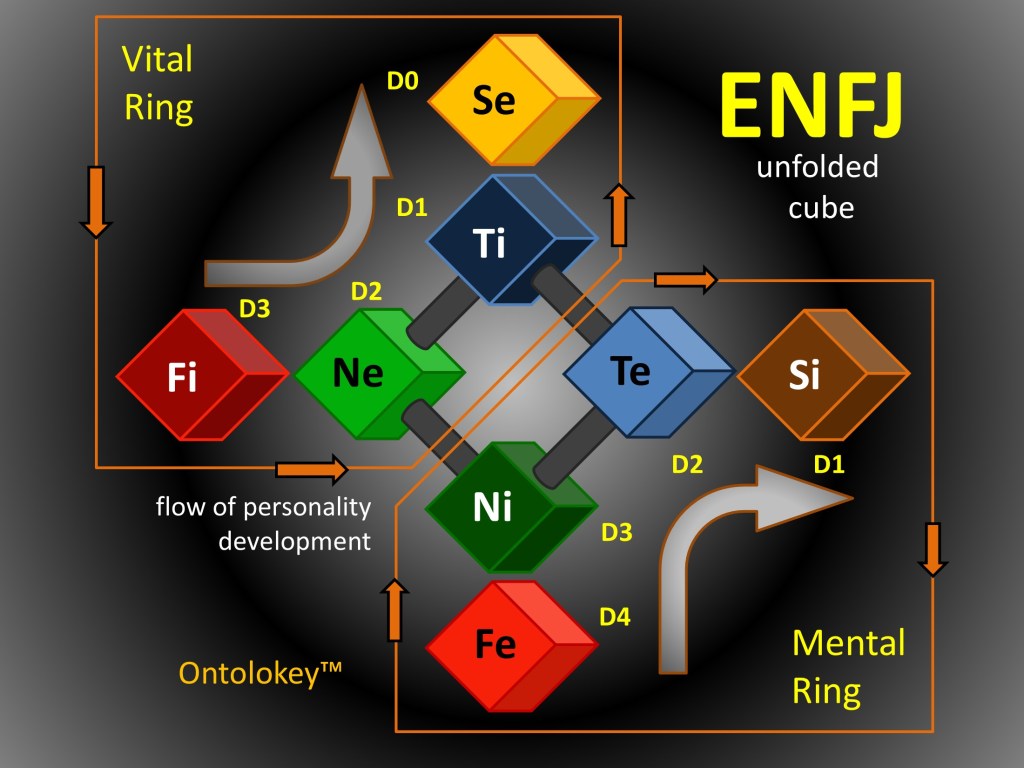
The ENFJ and the Long Movement Toward Wholeness
The ENFJ is often recognized through qualities that are immediately visible: warmth, charisma, emotional intelligence, idealism, persuasive ability, social awareness, and an unusual capacity to give people direction and meaning. Yet beneath this socially compelling surface lies a much more complex psychological architecture. In the Ontolokey perspective, the ENFJ consciousness is organized primarily around Extraverted Feeling (Fe) as its dominant function and Introverted Intuition (Ni) as its auxiliary function, producing the characteristic combination of relational sensitivity and visionary interpretation. Fe continuously registers the emotional and interpersonal field, sensing what is happening between people, what is valued, what is harmonious or discordant, and what might restore cohesion; Ni simultaneously searches beneath visible circumstances for patterns, trajectories, meanings, and possible futures. Together they can make the ENFJ exceptionally capable of understanding people, inspiring collective movement, teaching, guiding, mediating, and transforming an abstract ideal into something emotionally compelling. Ontolokey, however, treats these strengths not as the completed personality but as the conscious entrance into a much larger psychological landscape in which less-developed functions can remain partially unconscious, producing tensions, projections, compensations, vulnerabilities, and shadow reactions.
This distinction is essential because the ENFJ’s greatest psychological difficulty may arise precisely from the qualities that make the personality appear strongest. When Fe and Ni become deeply identified with the self, caring can gradually become entangled with being needed, leadership with being influential, emotional intelligence with having authority over the emotional interpretation of others, and idealism with resistance to realities that cannot easily be harmonized with the preferred vision. The ENFJ may genuinely want to help while simultaneously deriving a profound sense of identity from being the person who helps; genuine generosity can therefore coexist with unconscious expectations of recognition, loyalty, reciprocity, or emotional significance without either motive being consciously experienced as manipulative. The shadow does not invalidate the light, but reveals what happens when the light is required to illuminate everything while the darker regions of the psyche remain unexamined. The developmental task is consequently not to suppress Fe or Ni, nor to become less warm, less visionary, or less relational, but to gradually enlarge consciousness so that other psychological perspectives can participate in the construction of reality. Ontolokey presents its Cube precisely as a spatial representation of this larger functional landscape, turning an abstract arrangement of psychological functions into something that can be contemplated as relationships between different areas of the self.
The Ontolokey Landscape and the Logic of Development
Within the developmental model used for this essay, the eight functions form two interconnected rings through which psychological consciousness can gradually expand. The Mental Ring begins with Fe at D4, proceeds to Ni at D3, then to Te at D2, and finally to Si at D1; its developmental movement therefore follows the sequence D4 → D3 → D2 → D1. The Vital Ring begins with Fi at D3, continues through Ne at D2, Ti at D1, and reaches Se at D0, the latter representing an archaic or childlike level and therefore functioning as a psychological blindspot until sufficient consciousness has been developed. The significance of this sequence is that development is not conceived as an arbitrary attempt to strengthen whichever function appears weakest; rather, consciousness proceeds organically from a more developed function toward the next less-developed function, because the more mature capacity provides the psychological stability necessary to approach the territory that follows it. For the ENFJ, this means that Ni must first mature substantially from its D3 position before the developmental movement can meaningfully proceed toward Te, just as the Vital Ring begins with Fi and can move toward Ne, then Ti, and ultimately Se only through successive integration.
This gives the ENFJ’s individuation process a distinctly sequential character. The first major developmental task is the consolidation of the auxiliary Ni, normally becoming particularly significant during the period of early and middle adulthood, when the personality begins moving beyond the uncomplicated identification with its dominant Fe. Once Ni approaches the maturity of Fe rather than merely serving it, the psychological structure begins to destabilize in a productive sense: the familiar conscious identity can no longer contain everything that is emerging from below it. The metaphor of the iceberg captures this process because ordinary consciousness initially represents only a small visible portion of a vastly larger psychological structure, while the unconscious contains functions, needs, reactions, memories, impulses, and perspectives that have not yet acquired equal conscious representation. As development progresses, the psychological landscape begins to rotate: what was previously submerged becomes increasingly visible, while the person gradually learns to recognize that these unfamiliar dimensions are not foreign intrusions but neglected parts of the same self. The ultimate direction is therefore not away from the original ENFJ personality but toward its reintegration, until the dominant Fe can once again occupy its natural position without having to exclude everything that was previously hidden beneath the surface. This conception of Ontolokey as a spatial and developmental landscape follows its broader intention of making functional relationships visible rather than treating personality merely as a fixed label.
Fe — The Gift and the Psychological Trap of the Social Mirror
For the ENFJ, psychological life begins most naturally in relationship. Extraverted Feeling (Fe), occupying the highest developmental position at D4 within the Mental Ring, functions as an extraordinarily sensitive social and emotional orientation through which the individual perceives not merely isolated people but the atmosphere connecting them, the values they share, the tensions they avoid, and the emotional consequences produced by their behavior. This gives the ENFJ an unusual capacity to recognize what a group needs before that need has been explicitly formulated, to encourage a discouraged person, to mediate conflict, to make people feel seen, and to transform an abstract purpose into something emotionally meaningful. In its mature expression, Fe is not superficial friendliness but a sophisticated awareness of the interpersonal field, allowing the ENFJ to become a teacher, counselor, leader, advocate, mediator, mentor, or source of emotional orientation for others. Yet precisely because this capacity is so natural and so frequently rewarded by the surrounding world, it can become difficult for the ENFJ to distinguish between genuine care and the psychological identity of being the person who cares, creating the first major paradox of individuation: the function that makes the personality socially powerful can simultaneously become the mechanism through which the personality avoids confronting its own hidden needs.
The central danger is therefore not that the ENFJ cares too much, but that caring can gradually become fused with self-worth. When being needed begins to feel like evidence of being valuable, relationships acquire an unconscious psychological economy in which generosity may contain an expectation of recognition, loyalty, gratitude, emotional closeness, or continued dependence, even when the conscious mind experiences the giving as completely selfless. An ENFJ may anticipate another person’s needs, provide guidance before being asked, invest enormous energy in someone’s development, organize circumstances so that others can flourish, and genuinely experience all of this as love; nevertheless, a hidden part of the psyche may be asking whether the investment is being noticed and whether the relationship confirms the ENFJ’s importance. The problem becomes visible when the recipient becomes independent, fails to respond with the expected appreciation, chooses a path different from the one envisioned, or simply takes the ENFJ’s generosity for granted, because resentment can then emerge where the conscious personality believed there had been no expectation at all. This is one of the most important shadow mechanisms for the ENFJ: an unconscious contract can exist even when no conscious contract was ever intended, and the resulting disappointment can be experienced as moral injury rather than as information about an unmet psychological need. Individuation begins when the ENFJ becomes capable of asking not only “What am I doing for this person?” but also “What does doing this allow me to feel about myself?” because the second question exposes the psychological function hidden beneath the socially admirable behavior.
The same dynamic becomes more complex when Fe is joined by the ENFJ’s auxiliary Ni, because emotional perception can then become intertwined with an interpretation of what another person supposedly needs to become. The ENFJ may not merely perceive someone’s present emotional state but also perceive a potential future self, a latent capacity, a relationship that could be healed, a community that could become more harmonious, or a project that could fulfill a larger purpose, and this combination of interpersonal sensitivity with future-oriented vision can create extraordinary transformational power. Yet it can also produce one of the ENFJ’s most subtle forms of psychological control: the tendency to confuse understanding another person with possessing the authority to guide that person’s development. When the ENFJ believes it can see what another person could become, resistance may unconsciously appear not simply as disagreement but as evidence that the person has not yet understood their own potential, while an ending relationship may be interpreted as a relationship that still requires healing and an autonomous decision may be experienced as an unfortunate deviation from a meaningful trajectory. The shadow does not necessarily appear as cruelty or domination; it can appear as excessive help, repeated explanation, emotional persuasion, rescuing, or an inability to stop intervening when intervention no longer belongs to the ENFJ. Psychological maturity therefore requires a difficult distinction between seeing and owning: the ENFJ may perceive something profoundly true about another human being while still having no right to determine what that person should do with that truth.
This is why boundaries become an important form of shadow work rather than merely a practical interpersonal technique. The ENFJ must gradually discover that another person’s disappointment does not automatically indicate that something has gone wrong, that another person’s anger does not necessarily require immediate repair, and that relational harmony is not always synonymous with psychological health. Saying no can therefore become an unusually revealing developmental exercise because it forces the ENFJ to remain connected while another person experiences frustration, disagreement, or unmet expectations without rushing to compensate, explain, persuade, or reverse the decision. The deeper lesson is that love does not require omnipresence, support does not require indispensability, and empathy does not create ownership of another person’s emotional life. When Fe becomes more conscious, its generosity becomes freer because it no longer has to prove the ENFJ’s goodness, importance, or relational value, and the personality can tolerate the possibility of being misunderstood without immediately reconstructing the other person’s perception. In that sense, the social mirror loses its absolute authority: other people remain profoundly important, but their approval ceases to function as the final court in which the ENFJ’s identity is judged.
The decisive movement toward wholeness therefore does not require the ENFJ to become less compassionate, less charismatic, or less socially engaged; it requires the personality to become capable of remaining itself even when its characteristic social gifts are not being reflected back with approval. The mature ENFJ can give without secretly requiring gratitude, advise without requiring obedience, lead without requiring admiration, love without requiring dependence, and remain present without assuming responsibility for every emotional consequence occurring around them. This transformation is particularly important because the shadow often becomes visible precisely when the familiar strategy stops working: when appreciation disappears, when someone rejects the ENFJ’s guidance, when a relationship cannot be repaired, when a project fails despite enormous effort, or when another person’s autonomy contradicts the ENFJ’s vision. These experiences can initially feel like threats to identity, but they can instead become invitations to differentiate the authentic impulse from the compensatory one. The question is no longer whether the ENFJ is a caring person, but whether care can remain authentic when it produces no recognition, no influence, and no guarantee of a desired outcome. Once that capacity develops, Fe begins to move from social adaptation toward conscious relational freedom, establishing the psychological foundation from which the next developmental movement—from dominant Fe toward the increasingly mature Ni—can unfold.
Ni — From Vision to Inner Authority
Introverted Intuition (Ni) occupies the ENFJ’s auxiliary position at D3 within the Mental Ring, and its development represents the first decisive movement away from an identity organized almost entirely around the external emotional field. Whereas Fe naturally asks what is happening between people and how the relational environment can be brought toward greater harmony, Ni turns inward and asks what these events mean, where they are leading, what pattern connects them, and which underlying reality has not yet become visible. This gives the ENFJ an ability to perceive trajectories rather than merely circumstances, allowing individual conversations, conflicts, historical experiences, and seemingly unrelated observations to become parts of a larger psychological narrative. At its healthiest, Ni prevents Fe from becoming trapped in immediate social reactions because it introduces distance, reflection, symbolic understanding, and a longer temporal perspective into the personality’s decision-making process. The ENFJ consequently becomes capable not merely of responding to people but of understanding the deeper structures in which people are embedded, which explains much of the type’s reputation for vision, inspiration, strategic guidance, and an almost instinctive sense of what something might eventually become.
The developmental importance of Ni is that it gives the ENFJ an interior axis that does not depend entirely upon the emotional responses of other people. Before this capacity becomes sufficiently differentiated, the ENFJ may unconsciously derive orientation from the interpersonal field itself: the mood of the room, the expectations of important people, the needs of the group, or the perceived consequences of a particular decision for everyone involved. Ni introduces another source of authority, one based not on immediate consensus but on the ENFJ’s own gradually clarified understanding of meaning and direction. This can initially feel uncomfortable because genuine intuition often develops in solitude, ambiguity, and periods in which external confirmation is unavailable, precisely the conditions under which the socially oriented personality has fewer familiar signals to guide it. The ENFJ therefore has to learn that an insight does not become more truthful because other people agree with it, just as disagreement does not automatically invalidate an intuition that has emerged through prolonged observation and reflection. Psychological maturity occurs when the person can carry an inner conviction without immediately converting it into a social mission, allowing an insight to mature privately before deciding whether it should be communicated, defended, or acted upon.
Yet Ni itself possesses a shadow expression, particularly when its symbolic interpretations become fused with Fe’s desire to create coherence. The ENFJ can become so convinced that it understands the deeper meaning of a relationship, conflict, institution, or person’s behavior that alternative interpretations become psychologically difficult to entertain. What begins as pattern recognition can become narrative certainty, and narrative certainty can become a powerful form of confirmation bias in which subsequent events are unconsciously selected and interpreted according to an already established story. In interpersonal relationships this may produce an especially subtle difficulty: the ENFJ can construct an emotionally compelling explanation for why someone behaves as they do and then relate to that explanation rather than to the actual person standing before them. Because Ni seeks the hidden pattern and Fe seeks relational meaning, the resulting interpretation can feel profoundly insightful even when it contains projection, wish, fear, or an unrecognized desire for a particular outcome. The developmental task is therefore not to distrust intuition but to make intuition permeable to reality, preserving the capacity to perceive meaning while remaining willing to discover that the meaning initially perceived was incomplete.
The maturation of Ni also changes the ENFJ’s relationship with disappointment. A less differentiated personality may experience failed relationships, rejected ideas, professional setbacks, or the collapse of an anticipated future as evidence that something has gone fundamentally wrong, whereas mature Ni can begin to interpret such experiences as information about the trajectory itself. This does not mean romanticizing suffering or pretending that every painful event was secretly beneficial; rather, it means developing the capacity to allow experience to revise one’s internal model of reality. A person who leaves may genuinely be leaving, rather than secretly needing to be rescued; a project that fails may genuinely be unsuitable, rather than requiring greater emotional commitment; and an ideal that once seemed unquestionably meaningful may eventually prove to have been partly constructed from the ENFJ’s own unmet needs. In this way Ni becomes an instrument of psychological honesty because it asks the personality to tolerate the destruction of narratives that once provided identity and purpose. The ENFJ begins to discover that a meaningful life cannot be built solely by making reality conform to an inspiring vision; it must also be built by allowing reality to correct the vision.
This is the point at which the auxiliary function becomes a bridge toward individuation. Once Ni has developed sufficiently—approaching the functional maturity associated here with D4—it can carry the ENFJ beyond the unconscious assumption that the self must always be defined through interpersonal usefulness. The person begins to recognize recurring patterns in their own life: the same kinds of people they rescue, the same conflicts they repeatedly attempt to repair, the same forms of recognition they secretly crave, the same disappointments that provoke disproportionate pain, and the same situations in which their characteristic strengths unexpectedly fail. Such patterns are psychologically valuable because they reveal the limits of the conscious identity, and the emerging Ni perspective can connect these experiences without immediately moralizing them. Instead of asking whether the ENFJ has been “good” or “bad,” Ni asks what psychological structure keeps producing the same result, which defensive strategy is being repeated, and which neglected part of the personality is attempting to gain recognition through the symptom. When this reflective capacity becomes stable enough, the ENFJ is prepared to move toward the next stage of the Mental Ring, Te at D2, where inner vision must increasingly encounter impersonal structure, measurable reality, efficiency, boundaries, and the uncomfortable question of whether something can actually work rather than merely possess meaning. This transition marks a crucial threshold because the ENFJ’s journey toward wholeness now begins to challenge not only its social identity but also its preferred way of turning vision into reality.
Te — The Anima/Animus and the Wound of Competence
Extraverted Thinking (Te) occupies a particularly sensitive position in the ENFJ’s developmental landscape because it stands at D2 as the Anima/Animus function within the Mental Ring, immediately following the more established Fe and Ni. Te introduces a psychological orientation that differs fundamentally from the ENFJ’s natural preference for interpersonal meaning and intuitive vision: it asks what objectively works, what can be demonstrated, what resources are available, how efficiently something can be executed, which priorities are measurable, and what concrete structure is required to transform an intention into an effective result. For an ENFJ, these questions can feel simultaneously attractive and threatening because Te touches a vulnerable dimension of competence that is not automatically supported by the personality’s primary psychological habits. The ENFJ may be highly capable of inspiring ten people to accomplish something while feeling unexpectedly destabilized when confronted with a purely technical problem in which charisma, empathy, and vision provide no immediate advantage. The resulting sensitivity is important because the Anima/Animus function often carries an exaggerated psychological charge: what the conscious personality does not experience as naturally integrated may become the very domain in which criticism, failure, comparison, or humiliation is felt most personally.
This vulnerability can create a paradoxical relationship with competence. The ENFJ may appear extraordinarily confident when operating within familiar domains of communication, leadership, motivation, relationship-building, and intuitive understanding, yet become disproportionately defensive when competence is evaluated according to standards that cannot be negotiated through interpersonal intelligence. A simple factual correction, a demand for greater precision, a criticism of poor organization, or evidence that an admired plan is inefficient may therefore penetrate more deeply than the objective significance of the event would suggest. The psychological wound is not necessarily “I made a mistake,” but something closer to “Perhaps I am not as capable as I believed I was,” and because the ENFJ’s identity can be strongly invested in being effective for others, this perceived loss of competence may threaten the very image through which the personality experiences its usefulness. Compensation can then take several forms: excessive preparation, over-explaining, reliance on authority, attempts to persuade rather than verify, irritation with people who appear coldly factual, or an intensified effort to demonstrate value through interpersonal performance. The more threatening Te feels, the greater the temptation to retreat into the familiar strengths of Fe and Ni, where the ENFJ can once again feel psychologically fluent.
The deeper developmental challenge is learning to experience objective correction without converting it into an injury to identity. Te asks the ENFJ to distinguish intention from outcome, effort from effectiveness, and emotional conviction from empirical consequence, distinctions that can initially feel unnecessarily harsh to a personality oriented toward meaning and human context. An ENFJ may have invested enormous care in a project and still have produced an inefficient system; may have understood everyone’s emotional needs and nevertheless chosen the wrong strategy; may have communicated an inspiring vision while failing to establish the practical mechanisms required to realize it. Te integration does not demand that the ENFJ abandon compassion in favor of cold efficiency, but rather that compassion become more effective because it is supported by structure, prioritization, accountability, and realistic assessment. This is where cognitive self-healing becomes possible: instead of interpreting a failure as evidence of personal inadequacy, the ENFJ can learn to examine precisely which function was missing from the process and recognize that the failure may have resulted from an underdeveloped psychological instrument rather than from a defective self. The distinction is liberating because it transforms shame into information and allows the person to develop a capacity without condemning the personality that previously lacked it.
The Anima/Animus dimension also explains why Te may be projected onto other people before it is integrated internally. The ENFJ may admire individuals who are exceptionally organized, technically competent, decisive, analytical, pragmatic, financially disciplined, or capable of reducing complex problems to clear operational steps, while simultaneously feeling irritated by their apparent emotional detachment or lack of interpersonal sensitivity. Such figures can become psychologically fascinating because they embody qualities the ENFJ needs but does not yet comfortably own, producing a mixture of admiration, attraction, envy, intimidation, and criticism. Projection becomes especially revealing when the ENFJ repeatedly encounters people who seem “too cold,” “too rigid,” “too factual,” or “too obsessed with results,” because the intensity of the reaction may indicate not simply an objective disagreement but an encounter with a disowned psychological capacity. Integration does not mean becoming like these people; it means retrieving the useful element hidden within the projection and making it available to consciousness. The ENFJ can then retain warmth while learning to calculate, retain empathy while enforcing standards, retain idealism while measuring results, and retain relational sensitivity while making decisions that may temporarily disappoint others.
As Te develops from its D2 position toward greater maturity, the ENFJ’s relationship with authority and responsibility can undergo a significant transformation. Instead of needing to be the person who emotionally holds everything together, the individual begins to construct systems that allow responsibility to be distributed, expectations to be explicit, and results to be evaluated independently of personal charisma. This can be psychologically difficult because delegation and structure may initially feel less relational than personally guiding people through a process, yet mature Te reveals that genuine responsibility sometimes requires precisely this impersonal clarity. A leader who constantly rescues others may preserve dependence; a leader who establishes transparent standards can create autonomy. A mentor who continually explains may remain indispensable; a mentor who teaches people how to evaluate their own results eventually makes themselves less necessary. In this sense, Te quietly dismantles one of the ENFJ’s deepest unconscious temptations—the belief that effectiveness must pass through personal involvement—and replaces it with a more mature understanding in which systems, evidence, boundaries, and objective consequences can serve human purposes without diminishing humanity. Once this capacity is sufficiently integrated, the ENFJ becomes prepared to approach the next and even more vulnerable territory of the Mental Ring: Si at D1, the Toddler function, where psychological development encounters bodily reality, personal history, sensory limitation, routine, vulnerability, and the neglected needs of the childlike self.
Si — The Toddler in the Shadow
The movement toward Introverted Sensing (Si) at D1 brings the ENFJ into one of the most intimate and vulnerable regions of the Mental Ring, because Si represents precisely the kind of inward, concrete, bodily, historical awareness that can remain overshadowed by the personality’s natural orientation toward people, meaning, possibility, and purposeful action. Where Fe instinctively attends to the emotional needs of others, Ni interprets patterns and future trajectories, and Te increasingly asks how intentions can be implemented effectively, Si asks something quieter and more primitive: What is happening inside me right now, what has my body experienced, what has my personal history left behind, and what do I actually need in order to feel safe and regulated? At D1, this capacity may initially appear almost embarrassingly ordinary compared with the ENFJ’s more expansive psychological interests, yet precisely this ordinariness gives it its developmental importance. The ENFJ can become extraordinarily skilled at noticing another person’s exhaustion while remaining unaware of their own, capable of organizing an entire environment while neglecting sleep, nourishment, physical recovery, or emotional decompression, and able to endure prolonged strain because a meaningful external purpose temporarily overrides internal signals. The Toddler function therefore does not primarily ask the ENFJ to become more sophisticated; it asks the personality to become capable of stopping, receiving, remembering, sensing, and acknowledging vulnerability without immediately converting the experience into another problem that must be solved.
The metaphor of the Toddler is particularly revealing because the psychological material associated with Si can resemble an early developmental layer of the personality that has never received the same sophistication or authority as Fe and Ni. The ENFJ may have learned early that being emotionally perceptive, helpful, mature, encouraging, or responsible creates connection and recognition, while simpler needs such as rest, comfort, predictability, personal preference, physical security, or the freedom to depend upon someone else received less psychological attention. Consequently, the individual can become highly competent at functioning while remaining strangely inexperienced at being cared for. When this neglected layer is activated, the reaction can sometimes appear disproportionate to the external event: a minor physical discomfort becomes overwhelming, an unexpected change in plans produces unusual irritation, accumulated fatigue suddenly becomes emotional collapse, or a seemingly trivial sensory detail evokes a powerful memory or aversion. Such reactions can be misunderstood by the conscious personality as weakness because they contrast so sharply with the image of the capable and socially resilient ENFJ. Yet the very intensity of the reaction may indicate that something has been waiting for recognition for a long time, and what appears childish may actually be the return of a legitimate developmental need that was never integrated into the adult personality.
The psychological danger arises when the ENFJ responds to this vulnerability with the same strategy that has worked everywhere else: mobilization. Instead of listening to exhaustion, the person may become more productive; instead of acknowledging hurt, they may analyze the relationship; instead of admitting that they need reassurance, they may reassure someone else; instead of resting, they may search for another meaningful task; instead of allowing themselves to feel powerless, they may attempt to regain control by organizing the surrounding environment. This creates a subtle form of self-abandonment in which the personality becomes exceptionally compassionate toward everyone except the part of itself that cannot perform. The ENFJ may consciously believe that they are strong because they can continue functioning under pressure, while the unconscious body gradually records the cost of this strategy through fatigue, tension, irritability, emotional depletion, or loss of vitality. Integration of Si therefore requires a reversal of the usual direction of attention: the ENFJ must learn to perceive the self with the same sensitivity with which it perceives other people. Rather than asking exclusively what others require from the situation, the developing personality learns to ask what the organism itself is communicating, treating bodily signals and personal limits not as obstacles to purpose but as information belonging to the whole person.
Si also brings the ENFJ into a different relationship with the past. Ni naturally tends to extract meaning from experience and move toward an emerging future, whereas Si preserves the felt imprint of what has actually happened, including details, bodily memories, familiar environments, accumulated experiences, and the emotional significance attached to concrete moments. For the ENFJ, this can be uncomfortable because the past may contain experiences that were previously transformed into a coherent narrative before they were fully felt. A person may understand intellectually why a particular relationship was painful, why a parent behaved in a certain way, why a former partner could not provide what was needed, or why a professional failure occurred, while still carrying an unprocessed bodily memory of fear, shame, loneliness, humiliation, or abandonment. Cognitive understanding is therefore not necessarily identical with emotional integration, but cognitive understanding can create the conditions in which previously unconscious experience becomes bearable enough to be consciously acknowledged. The developmental movement toward Si allows the ENFJ to say, in effect, that what happened mattered not merely because it produced a lesson or contributed to a future identity, but because it happened to me, and because the vulnerable part of me that experienced it deserves to be remembered rather than overwritten by a more useful interpretation.
This is where the idea of psychological healing through cognition becomes especially meaningful within the Ontolokey developmental model. When the ENFJ recognizes that a disproportionate reaction may belong partly to an underdeveloped Si rather than entirely to the present situation, the person gains an additional layer of freedom between stimulus and response. A criticism may activate an old experience of inadequacy; rejection may awaken an earlier fear of being unwanted; physical exhaustion may lower the psychological threshold for interpersonal sensitivity; a loss of control may evoke the helplessness of a much younger part of the self. Understanding these connections does not erase the original experience, but it can transform its meaning because the adult personality is now capable of witnessing what the younger psychological layer could only experience. This is the beginning of compassion directed inward rather than exclusively outward: the ENFJ can forgive the self for having limits, for having misunderstood something, for having failed under conditions that exceeded its available capacities, and even for having developed defenses that once served a protective purpose. As Si gradually becomes integrated, the Toddler is no longer an embarrassing blindspot that periodically disrupts the adult personality; it becomes a quiet source of embodied reality, historical continuity, self-care, and tenderness, allowing the ENFJ to return to the world without abandoning the person who must actually live the life being built.
Fi — The Sibling and the Discovery of the Private Self
With the transition from the Mental Ring into the Vital Ring, the ENFJ enters a different psychological territory because Introverted Feeling (Fi) at D3 represents not simply another way of relating to emotions but a fundamentally more private relationship with value, authenticity, personal conscience, and individual emotional truth. Fe naturally experiences value through the relational field: it notices what people need, what a situation requires, what creates belonging, and what emotional atmosphere should be cultivated. Fi turns the question inward and asks whether something is genuinely right for me, whether an experience corresponds with my deepest values, whether a relationship respects my individuality, and whether my emotional response belongs authentically to me rather than being shaped by what others expect. As the Sibling function, Fi can initially feel familiar yet strangely inconvenient, because it resembles the ENFJ’s emotional sensitivity while refusing to make the collective emotional field its primary reference point. The developmental challenge is therefore subtle: the ENFJ must learn to recognize a private emotional reality that does not need to be justified by usefulness, consensus, social harmony, or another person’s needs. In this sense, Fi becomes the beginning of a more intimate form of individuation because it introduces the possibility that the self possesses intrinsic value even when it is not serving anyone else.
The Sibling designation also captures the ambivalence with which this function may be experienced. Fi is not an alien psychological force, because the ENFJ understands emotion deeply and can often recognize sincerity, moral conviction, pain, loyalty, love, and betrayal with remarkable sensitivity; nevertheless, the inward ownership of those experiences can feel less familiar than their interpersonal expression through Fe. The ENFJ may know exactly how to comfort someone who feels guilty while having difficulty admitting personal guilt, know how to validate another person’s boundaries while rationalizing the violation of their own, and passionately defend another person’s right to live authentically while quietly adjusting their own life to maintain relationships or expectations. This asymmetry is one of the clearest signs that the Sibling needs development: the psychological principle is already understood, but it has not yet been fully applied to the self. Fi therefore begins to expose a hidden question beneath much ENFJ behavior: “Would I still choose this if nobody needed me to choose it?” The question can be profoundly unsettling because it separates genuine love from obligation, authentic vocation from the desire to be admired, and personal commitment from the unconscious fear that disappointing others will result in rejection.
As Fi becomes more conscious, the ENFJ may encounter emotions that previously had little permission to exist. Anger can emerge where there was previously endless understanding, grief where there was previously purposeful optimism, jealousy where the conscious self believed it was entirely generous, resentment where the person had considered themselves freely giving, and loneliness where social connectedness had previously created the impression of intimacy. These emotions should not automatically be interpreted as moral truths, but neither should they be dismissed because they conflict with the ENFJ’s preferred self-image. The psychological function of shadow work is precisely to make room for information that consciousness has excluded because it was inconvenient, socially undesirable, or incompatible with an established identity. Fi teaches the ENFJ that compassion does not require the elimination of negative feelings and that being a good person does not mean experiencing only noble motives. The more honestly these emotions can be acknowledged, the less necessity there is for them to emerge indirectly through passive resentment, emotional withdrawal, sudden relational rupture, or disproportionate reactions to perceived betrayal. What was previously unconscious can become conscious material for reflection, and once consciousness has access to it, the ENFJ gains the possibility of responding deliberately rather than being unconsciously governed by what it refused to recognize.
The development of Fi also transforms the meaning of boundaries. For an ENFJ, boundaries can initially appear primarily as interpersonal instruments—ways of protecting relationships, preventing burnout, or making cooperation sustainable—but Fi reveals that boundaries are expressions of identity. A boundary is not merely a rule imposed upon another person; it communicates something about what the self values, what it cannot accept, what it needs, and where responsibility for another person’s emotional experience ends. This can be difficult for a personality accustomed to monitoring the emotional consequences of its decisions because authentic self-definition inevitably produces moments of disharmony. Someone may be disappointed by an ENFJ’s decision, a family member may disapprove, a colleague may consider the choice selfish, or a partner may no longer receive the degree of emotional availability they once took for granted. Fi teaches the ENFJ to tolerate this friction without immediately concluding that something morally wrong has occurred. The developing personality gradually learns that relational harmony achieved through self-betrayal is not genuine harmony, because it preserves connection at the cost of the person who is supposedly participating in the relationship.
This is why Fi represents the true beginning of the deeper individuation process within the developmental sequence described here. The ENFJ’s earlier movement through Ni, Te, and Si has progressively weakened the assumption that conscious identity alone contains the whole personality: Ni has introduced inner perspective, Te has challenged subjective effectiveness with objective consequence, and Si has brought neglected bodily and historical experience into awareness. Fi now asks an even more personal question: Who am I when I am not defined by the emotional needs of the surrounding world? The answer cannot be discovered through another person’s approval because Fi develops precisely by learning to experience values as internally owned rather than externally negotiated. As the Sibling becomes more mature, the ENFJ does not become colder or more individualistic in the superficial sense; instead, relationships become more authentic because the person entering them is no longer unconsciously asking others to confirm an identity constructed around usefulness. This creates the psychological foundation for the next movement toward Ne at D2, the Golden Shadow, where the ENFJ will encounter an unfamiliar freedom from its established vision and begin learning to entertain possibilities that do not originate from the dominant Fe–Ni structure.
Ne — The Golden Shadow and the Freedom of Possibility
Extraverted Intuition (Ne) occupies D2 within the Vital Ring and is therefore encountered only after the ENFJ has developed the more personal orientation of Fi at D3, yet its psychological character is strikingly different from the ENFJ’s familiar Ni. Whereas Ni tends to condense experience into an underlying pattern, trajectory, or emerging meaning, Ne opens experience outward again, multiplying possibilities rather than narrowing them into one coherent direction. This distinction becomes crucial for individuation because the ENFJ’s Fe–Ni structure can become exceptionally committed to a meaningful vision: it sees what people could become, what a relationship could become, what an institution could become, and what a future shaped by certain values might look like. Ne interrupts this certainty by asking what else could be true, what alternative interpretation might exist, which unexpected possibility has been overlooked, and whether the future needs to resemble the future that was previously imagined. As the Golden Shadow, Ne can therefore appear strangely attractive because it represents a psychological freedom the ENFJ may intuitively admire but not consistently inhabit: the freedom to remain undecided, to experiment without a predetermined purpose, to follow curiosity rather than duty, and to allow several contradictory possibilities to coexist without immediately selecting the one that appears most meaningful.
This freedom can initially be destabilizing because the ENFJ often possesses a strong instinct to transform possibility into purpose. Once a new possibility has been perceived, Fe may instinctively ask whom it could help, while Ni may immediately begin constructing the deeper narrative through which it could become meaningful; Ne, by contrast, is capable of remaining playful and unfinished. This difference matters because psychological development requires more than acquiring another productive skill: it requires tolerating forms of experience that do not immediately serve the established identity. An ENFJ who encounters Ne consciously may discover that many previously suppressed desires were not necessarily irrational or selfish but simply incompatible with the role the person had unconsciously assigned to themselves. There may be alternative careers that were never explored because they did not fit the image of a meaningful vocation, friendships that were avoided because they did not serve an existing social structure, creative interests that were postponed because they seemed impractical, or entirely different ways of living that were dismissed before they were genuinely experienced. Ne does not demand that every possibility be pursued; its developmental contribution is that the psyche is permitted to imagine alternatives without immediately forcing them into a hierarchy of usefulness, responsibility, or destiny.
The Golden Shadow can also become visible through projection. The ENFJ may feel unusually fascinated by people who are spontaneous, unconventional, intellectually restless, irreverent, exploratory, entrepreneurial, eccentric, or apparently unconcerned with maintaining a coherent identity. Such individuals may seem both liberating and frustrating because they embody the capacity to change direction without requiring a grand justification for every change. The ENFJ might admire someone who suddenly abandons a successful path to pursue an obscure interest, moves somewhere unfamiliar simply because curiosity calls, experiments with several identities, or treats failure as another piece of information rather than as a threat to a meaningful life narrative. Yet the same behavior can provoke judgments about irresponsibility, inconsistency, selfishness, or lack of commitment, revealing the psychological tension between the ENFJ’s need for meaningful continuity and Ne’s appetite for unexplored alternatives. When this pattern becomes conscious, the person can begin to recognize that the qualities provoking both admiration and irritation may represent disowned aspects of the self. Integration does not mean imitating the projected person; it means reclaiming the underlying psychological permission to explore, change, wonder, and remain uncertain without experiencing uncertainty as personal failure.
Ne also offers the ENFJ an antidote to one of the more subtle dangers of Ni: premature closure. A compelling intuitive narrative can become so internally coherent that contradictory information is unconsciously absorbed into the story rather than allowed to challenge it, particularly when the narrative is emotionally meaningful or connected to the ENFJ’s sense of purpose. Ne introduces cognitive plurality by deliberately generating alternatives: perhaps there is another explanation, perhaps the person is not who I thought they were, perhaps the relationship has a different future, perhaps the problem itself has been framed incorrectly, perhaps failure is redirecting rather than obstructing the intended path. This is not indecision for its own sake but psychological flexibility, and it can become an important form of humility. The ENFJ begins to understand that insight and certainty are not synonymous, that being perceptive does not make one infallible, and that a mature vision must remain capable of being revised by reality. Such flexibility also changes relationships because other people are no longer required to fulfill a predetermined psychological role in the ENFJ’s narrative; they can remain genuinely other, possessing motives, futures, and identities that cannot be completely anticipated or interpreted in advance.
The integration of Ne ultimately expands the ENFJ’s concept of freedom. Fe can give meaning to relationships, Ni can provide direction, and Fi can establish an inner sense of personal value, but Ne allows the self to encounter life without demanding that every experience immediately become part of a coherent mission. This can release enormous creative energy because the ENFJ is no longer compelled to convert every talent into service, every relationship into responsibility, every insight into leadership, or every possibility into a commitment. Play, curiosity, experimentation, intellectual wandering, and harmless contradiction become psychologically legitimate experiences rather than distractions from a supposedly more important purpose. The ENFJ consequently becomes less vulnerable to the fear that changing one’s mind means betraying one’s identity, because identity itself is recognized as something capable of development. Once Ne has matured sufficiently at D2, however, individuation must proceed further inward toward Ti at D1, where the ENFJ encounters an even more demanding psychological territory: the capacity to detach an idea from its emotional meaning, examine its internal structure, question one’s own conclusions, and discover whether something is logically coherent even when that examination produces no interpersonal harmony or inspirational outcome.
Ti — The Inferior Function and the Discipline of Radical Self-Examination
Introverted Thinking (Ti) occupies D1 within the Vital Ring and therefore represents a much more vulnerable form of psychological development for the ENFJ than the already established capacities of Fe, Ni, or the increasingly integrated Fi and Ne. Ti turns attention away from interpersonal meaning and toward the internal architecture of thought itself, asking whether an idea is coherent, whether its premises are sound, whether contradictions have been overlooked, and whether a conclusion remains valid independently of the emotional or social consequences attached to it. For a personality whose consciousness is naturally oriented toward people, values, purpose, and the meaningful interpretation of experience, this can feel strangely impersonal and even psychologically disorienting. The ENFJ may be exceptionally capable of explaining why something matters while becoming less comfortable when asked to demonstrate precisely how the underlying reasoning works, particularly if that reasoning has been constructed intuitively and relationally rather than through deliberate analytical decomposition. Ti therefore becomes an important instrument of individuation because it introduces an internal judge that cannot be persuaded merely by good intentions, emotional resonance, social consensus, or the beauty of a vision. Its developmental purpose is not to turn the ENFJ into a detached intellectual, but to give consciousness the ability to examine its own constructions without needing those constructions to remain psychologically comforting.
Because Ti is inferior and positioned at D1, its emergence can initially be accompanied by insecurity rather than mastery. The ENFJ may encounter highly analytical people and experience a mixture of admiration, intimidation, irritation, or even an instinctive desire to demonstrate competence in domains where the person does not yet feel entirely secure. Criticism can consequently penetrate more deeply when it exposes a contradiction, imprecision, unsupported assumption, or logical weakness, because the issue touches a function whose authority has not yet been established internally. The defensive response may be to explain the context, emphasize intentions, introduce additional interpersonal considerations, or demonstrate that the situation is more complex than the critic has recognized; all of these responses can contain legitimate truth, yet they can also function as ways of escaping the uncomfortable simplicity of the question itself. Ti asks the ENFJ to remain with the possibility that an argument may simply be wrong, that a conclusion may not follow from its premises, or that a cherished interpretation contains a contradiction that emotional intelligence alone cannot resolve. This is psychologically demanding because the ENFJ’s characteristic strengths can make it possible to construct extremely persuasive narratives, and persuasive narratives are not necessarily logically valid ones.
The integration of Ti therefore requires a new relationship with intellectual discomfort. The ENFJ must gradually learn to separate the statement “my reasoning contains an error” from the much more threatening statement “I am inadequate,” because without this distinction analytical correction will continue to feel like an attack upon the self. Once the distinction becomes stable, criticism can become developmental information rather than humiliation, and disagreement can become an opportunity for refinement rather than a rupture in relationship. This is especially valuable in leadership because an ENFJ who cannot tolerate being intellectually contradicted may unconsciously surround themselves with people who affirm the existing vision, thereby creating a social environment that reinforces intuition without adequately testing it. Mature Ti introduces an internal capacity to perform this testing before reality is forced to perform it externally and often more painfully. The ENFJ can begin asking what evidence would change my mind, which assumptions am I treating as facts, whether I am confusing correlation with causation, whether an emotionally compelling explanation is actually sufficient, and whether I am defending an idea because it is true or because it has become part of my identity. Such questions represent not a rejection of Fe but a safeguard against its unconscious tendency to equate emotional coherence with truth.
At a deeper level, Ti also challenges the ENFJ’s relationship with moral certainty. Fe can become deeply committed to values that appear self-evidently humane, and Ni can organize those values into a compelling interpretation of the world, creating a powerful sense of purpose that motivates action. Yet precisely because the ENFJ may care intensely about the human consequences of an idea, there can be a temptation to evaluate the validity of an argument according to whether its intentions appear benevolent or whether its consequences seem desirable. Ti interrupts this psychological shortcut by asking whether the reasoning itself survives examination. A compassionate intention does not automatically produce a coherent argument, and a socially attractive conclusion does not automatically follow from the evidence used to justify it. This does not mean that Ti should replace moral consciousness with sterile rationalism; rather, its integration allows the ENFJ’s moral sensitivity to become more intellectually disciplined, reducing the possibility that emotional conviction will unconsciously protect an idea from scrutiny. The resulting personality can remain profoundly humane while becoming more willing to admit uncertainty, revise beliefs, acknowledge contradictions, and say “I do not know” without experiencing that admission as a loss of authority.
The completion of Ti’s developmental movement prepares the ENFJ for the final and most archaic territory of the Vital Ring: Se at D0, the tertiary function and psychological blindspot. This transition is significant because Ti first teaches the ENFJ to loosen identification with its own interpretations, while Se will eventually demand something even more immediate—the surrender of excessive interpretation itself in favor of direct contact with the present moment. Before that can occur, however, the ENFJ must understand why Ti belongs to healing rather than merely intellectual development. Every time the person discovers that an old belief was incomplete, that a cherished explanation was partly projection, that a conflict contained personal responsibility as well as another person’s fault, or that an admired self-image depended upon assumptions that no longer survive examination, cognition becomes an instrument of liberation. The ENFJ is no longer forced to protect every part of the conscious identity because the self has become large enough to survive correction. In this sense, Ti represents a quiet form of psychological humility: the willingness to let truth become more important than being right, coherence more important than persuasion, and reality more important than the preservation of a beautiful story about oneself. Once this capacity has become sufficiently stable, the personality is finally prepared to approach the D0 blindspot, where the developmental process reaches its most primitive and embodied confrontation with Se.
Se — The D0 Blindspot and the Return to Embodied Reality
Extraverted Sensing (Se) occupies the final position of the ENFJ’s Vital Ring at D0, and within the developmental model presented here it represents the most archaic and least consciously accessible expression of the personality’s psychological functions. Se is concerned with immediate reality: what is physically present, what is happening now, what can be directly perceived, what action the situation demands, and how the individual can respond to concrete circumstances without first converting them into an abstract interpretation. For an ENFJ, whose consciousness naturally moves toward interpersonal meaning, future possibilities, symbolic patterns, and the emotional significance of events, such immediacy can be strangely difficult to inhabit. The mind may already be interpreting what an event means, what it will lead to, how another person feels about it, and how the situation could be improved before the body has fully registered what is actually happening. Se therefore represents more than sensory awareness; it symbolizes a radical encounter with reality before the psyche has organized that reality into a meaningful narrative. At D0, this capacity can appear childlike because it has not yet acquired the same conscious sophistication as the ENFJ’s preferred functions, but its very primitiveness contains something essential: the possibility of experiencing existence without needing to explain, improve, guide, or transform it first.
The shadow expression of Se can emerge when the ENFJ becomes overwhelmed by the distance between its vision and immediate reality. Under prolonged stress, frustration, emotional overload, or loss of control, the personality may suddenly become unusually reactive to concrete circumstances, physical sensations, interruptions, environmental disorder, or immediate stimulation. The person who normally operates through foresight and relational interpretation may then become impatient, impulsive, excessively focused on external details, or unusually concerned with controlling what is happening in the immediate environment. This can feel foreign because it does not resemble the ENFJ’s preferred psychological style, and consequently the reaction may be followed by embarrassment or an attempt to return quickly to the familiar world of meaning and interpersonal coherence. Yet the reaction itself contains information: the psyche has temporarily fallen into a function that has not yet been integrated consciously. Rather than treating these episodes simply as failures of self-control, the developmental approach asks what reality the ENFJ has been avoiding by living so extensively in interpretation, anticipation, responsibility, and psychological projection. Sometimes the neglected reality is simply that the body is exhausted, the environment is chaotic, a decision must be made immediately, or a situation cannot be solved through further reflection.
Se therefore teaches the ENFJ a form of presence that is fundamentally different from intuitive awareness. Intuition asks what lies beneath the surface and where events are moving; Se asks what is actually here. This distinction can be transformative because the ENFJ’s extraordinary capacity to perceive meaning can also become a mechanism for escaping immediacy. A difficult conversation can be analyzed endlessly instead of having the uncomfortable sentence spoken; an emotional problem can be interpreted rather than physically rested from; a future plan can be refined while the present opportunity passes; a relationship can be understood in extraordinary psychological detail while the actual person in front of the ENFJ is not fully encountered. Se interrupts this tendency by insisting upon contact with concrete experience. It encourages the ENFJ to notice the room, the body, the voice, the gesture, the physical environment, the actual sequence of events, and the simple fact that some situations require action rather than interpretation. When sufficiently integrated, this does not diminish the ENFJ’s intuitive depth but anchors it, allowing vision to become responsive to reality rather than functioning as a substitute for reality.
The body becomes particularly important at this stage because Se and the previously encountered Si reveal complementary dimensions of embodiment. Si brought attention to the personal history of the body, its accumulated experiences, needs, vulnerabilities, routines, and memories; Se now brings attention to the body’s immediate encounter with the external world. Together they challenge a potential ENFJ tendency to live predominantly through psychological and interpersonal consciousness. The individual may discover that fatigue is not a philosophical problem, that overstimulation is not a character flaw, that physical pleasure does not require moral justification, and that sometimes the healthiest response to a complex psychological situation is simply to eat, sleep, walk, breathe, move, or step outside the interpretive loop. Such practices may appear almost absurdly simple to a personality accustomed to complexity, yet their simplicity is precisely their developmental value. The ENFJ learns that consciousness does not become deeper by constantly moving away from the concrete; sometimes depth is achieved by remaining fully present within what is concrete.
At D0, however, Se should not be forced into artificial mastery. The goal is not to transform the ENFJ into an impulsive, sensation-seeking, relentlessly action-oriented personality, because that would merely replace one form of identification with another. Integration means allowing the function to participate in consciousness without demanding that it dominate consciousness. The ENFJ can learn to act decisively when the situation requires action, enjoy sensory experience without turning it into performance, recognize physical signals before they become crises, and tolerate moments in which nothing needs to be interpreted or improved. This creates an important psychological reversal: the ENFJ no longer has to live exclusively in the future it imagines or the relationships it manages because it has acquired enough capacity to inhabit the present itself. The blindspot becomes less blind when the personality stops judging immediacy as psychologically inferior and recognizes that reality is encountered first through presence, only afterward through interpretation.
With this integration, the entire Vital Ring begins to reveal its developmental logic. Fi taught the ENFJ to recognize a private inner value system; Ne opened possibilities beyond the established narrative; Ti introduced the discipline of questioning the internal coherence of one’s own interpretations; and Se finally brought consciousness into direct contact with the concrete present. The progression from D3 through D2 and D1 toward D0 therefore represents a gradual dismantling of unconscious dependence upon the familiar Fe–Ni identity, not its destruction. The ENFJ becomes capable of remaining emotionally connected without losing individuality, visionary without becoming trapped in a vision, rational without abandoning humanity, and intuitive without losing contact with immediate reality. At this point, the psychological iceberg has undergone a profound rotation: functions that once appeared beneath the surface have become increasingly visible, and the person can begin to recognize that many former weaknesses were actually undeveloped forms of consciousness waiting for integration. The final movement is therefore not toward becoming someone else, but toward returning to the original personality with a much larger interior world, which is the psychological meaning of wholeness in the developmental process described by Ontolokey.
The Shadow in Relationships — Love, Projection, Resentment, and Forgiveness
The ENFJ’s deepest psychological conflicts often become visible not in solitude but in relationships, because relationship is the natural arena in which Fe is most powerful and therefore the arena in which its unconscious compensations can become most convincing. The ENFJ may enter relationships with an extraordinary capacity for attentiveness, encouragement, loyalty, emotional availability, and future-oriented commitment, often seeing possibilities in another person that the person cannot yet see in themselves. This capacity can create profound intimacy, but it can also create projection when the ENFJ unconsciously begins relating to the potential it perceives rather than to the person as they actually are. Ni supplies the narrative of what the relationship could become, Fe supplies the emotional investment necessary to move it in that direction, and the developing personality may then interpret resistance as something to overcome rather than as information about another person’s autonomy. The resulting dynamic can be particularly painful because the ENFJ’s intentions may genuinely be loving while the unconscious structure of the relationship becomes controlling, rescuing, idealizing, or emotionally demanding. Shadow work therefore begins by recognizing that a person can act from love and still impose an unconscious psychological expectation upon another person, and that acknowledging this possibility does not make the love false but makes it more conscious.
One of the most important patterns to recognize is the transformation of generosity into resentment. The ENFJ can give enormous amounts of emotional energy without consciously keeping an account of what has been given, yet the unconscious psyche may nevertheless register an imbalance when care is not reciprocated in the expected form. Because the conscious identity often experiences itself as generous and supportive, admitting resentment can feel morally disturbing, and the emotion may therefore be displaced into disappointment, withdrawal, criticism, or the conviction that the other person has become ungrateful. Fi becomes crucial here because it allows the ENFJ to ask what was actually desired beneath the giving: Was affection wanted, recognition, loyalty, reassurance, commitment, respect, or simply the feeling of being important to someone? Once the underlying need is acknowledged, the psychological situation changes because an implicit expectation can become an explicit choice, and the ENFJ can decide whether to continue giving without demanding repayment or whether to establish a boundary around what it is willing to provide. This is a major step toward freedom because resentment often loses its power when the person recognizes that they were not merely “giving too much” but participating in an unconscious relational arrangement whose terms had never been consciously negotiated.
Projection becomes even more complex when the ENFJ encounters qualities represented by the less-developed functions. The competent and emotionally contained person may activate the ENFJ’s Te shadow, the unconventional and unpredictable person may carry the projected Ne freedom, the highly analytical person may evoke Ti insecurity, while the physically grounded or spontaneous individual may embody the Se capacity that the ENFJ has difficulty accessing directly. Similarly, a person who is fiercely private and guided by personal values may awaken both admiration and irritation by embodying Fi qualities that the ENFJ is still learning to claim. The emotional intensity of these reactions can therefore become diagnostically useful: fascination may indicate an undeveloped capacity that wants integration, while disproportionate irritation may reveal a quality that the conscious identity has excluded from its acceptable image of itself. The task is not to romanticize every person who triggers the ENFJ or to assume that every negative reaction is projection, because sometimes another person’s behavior is genuinely harmful or incompatible with one’s values. The task is to ask what belongs to the other person, what belongs to the present situation, and what additional psychological material is being activated within oneself, thereby separating external reality from the unconscious meanings imposed upon it.
This differentiation becomes especially important when the ENFJ has been genuinely wounded. The capacity to understand psychological causes can become both a gift and a trap because understanding why someone behaved destructively can create a temptation to excuse the behavior or remain in a relationship that has become psychologically damaging. Mature forgiveness does not require denial of harm, restoration of trust, or continued access to the self; it means that the ENFJ can gradually relinquish the need to remain psychologically bound to the person through anger, idealization, blame, or the fantasy that the past could have been different. The developing functions provide different pieces of this process: Ni can understand the larger pattern, Te can recognize objective consequences, Si can acknowledge what actually happened and how it was experienced, Fi can validate the personal injury and establish boundaries, Ne can imagine alternative futures, Ti can examine distorted interpretations, and Se can return attention to the present rather than repeatedly reconstructing the past. Through this multidimensional understanding, forgiveness becomes less about declaring someone innocent and more about refusing to allow an old relationship to continue governing one’s psychological life.
The same principle applies to self-forgiveness, which may be particularly important for an ENFJ because the personality can maintain demanding standards concerning the effect it has on others. When a relationship fails, when someone is disappointed, when a promise cannot be fulfilled, or when an attempt to help inadvertently causes harm, the ENFJ may revisit the event repeatedly in search of the moment at which everything could have been prevented. Ni can construct elaborate alternative histories, Fe can imagine the emotional suffering of everyone involved, Te can identify practical errors, Fi can experience personal guilt, and Si can preserve the emotional imprint of the event long after its external circumstances have disappeared. Without conscious integration, these functions can combine into an internal tribunal that continuously reconstructs the past while pretending to seek resolution. Psychological healing requires something different: the willingness to understand the limitations of the person who acted at that time, including the functions that had not yet developed, the information that was unavailable, the needs that were unconscious, and the defensive strategies that seemed necessary under the circumstances. The adult ENFJ who can look backward and recognize that the earlier self acted with incomplete consciousness does not have to approve every past decision, but can finally stop demanding that an earlier version of the personality possess the psychological knowledge that only later development could provide.
In this sense, relationships become one of the most powerful arenas for individuation because other people continually reveal the parts of the self that consciousness would prefer to leave undisturbed. The person who refuses the ENFJ’s help may reveal the hidden need to be needed; the person who challenges its reasoning may expose the vulnerability of Ti; the person who insists upon practical results may activate Te; the spontaneous person may awaken Ne; the emotionally private person may confront the neglected Fi; the demanding physical environment may expose the Se blindspot; and exhaustion may bring the forgotten Si directly into consciousness. None of these encounters automatically means that the other person is “teaching” the ENFJ a lesson, because that interpretation itself could become another form of projection, but each encounter can become material for self-observation. The fundamental question changes from “Why are people doing this to me?” to “What does my reaction reveal about the part of myself that is being touched?” That question does not remove responsibility from others, but it restores responsibility for one’s own psychological response, and this is precisely where the shadow ceases to be an enemy and becomes a pathway toward the larger self.
The ENFJ in the Second Half of Life — Individuation and the Turning of the Iceberg
The movement into the second half of life can become particularly significant for the ENFJ because the strategies that created success during the first developmental phase may eventually become insufficient for the psychological demands of a deeper existence. During earlier adulthood, the strengthening of Ni can make the ENFJ more capable of transforming the social gifts of Fe into vision, purpose, leadership, and long-range direction, often producing an impressive period of achievement in which the personality appears increasingly integrated. Yet the very success of this development can conceal the fact that the conscious identity remains concentrated around a relatively narrow portion of the total psychological structure. The ENFJ may have become exceptionally effective at being a leader, partner, parent, mentor, professional, organizer, advocate, or source of emotional stability while knowing comparatively little about the parts of the self that do not contribute directly to these roles. Eventually, circumstances arise that the established personality cannot solve through greater effort: relationships change, children become independent, professional identity loses its former significance, physical limitations become unavoidable, carefully constructed visions fail, or the recognition that once sustained motivation no longer produces the same psychological satisfaction begins to emerge. These experiences can feel like a loss of self, but within the developmental model they can instead represent the moment when the submerged portions of the psyche begin demanding consciousness.
The iceberg metaphor captures this transformation particularly well because it describes individuation not as the construction of an entirely new personality but as a gradual rotation of what is already present. At the beginning, consciousness sees only the upper portion of the structure, represented by the dominant Fe and increasingly mature Ni, while the remaining functions exist largely below the psychological waterline, influencing behavior without necessarily being recognized as aspects of the self. The development of the auxiliary function begins to destabilize this arrangement because Ni introduces an interior perspective capable of observing the conscious identity rather than simply serving it, and once that perspective becomes sufficiently mature, the personality can begin approaching the functions that have historically remained less developed. The process is sequential rather than arbitrary: Fe provides the original stability, Ni becomes sufficiently developed to support the movement toward Te, Te creates greater capacity for objective structure, Si brings bodily and historical vulnerability into awareness, and the Vital Ring then progressively introduces Fi, Ne, Ti, and finally Se. With each transition, the ENFJ encounters an aspect of existence that cannot be completely absorbed into the old identity, and the psyche becomes increasingly aware that what once appeared to be “not me” was actually part of the larger psychological organism all along.
This process can initially produce considerable inner turbulence because individuation threatens identities that were not necessarily false but had become incomplete. An ENFJ who has spent decades being the person others rely upon may suddenly discover an intense need for solitude; someone whose identity was built around emotional availability may begin recognizing anger and boundaries; someone who always saw a clear future may experience uncertainty; someone who prided themselves on understanding others may discover how little they understood their own motives; and someone accustomed to being competent may encounter situations that expose genuine dependency. These developments can be experienced as regression because the person temporarily encounters psychological material associated with earlier developmental stages, particularly the vulnerable Si Toddler or the archaic Se blindspot. Yet regression and integration are not necessarily the same phenomenon: when an unconscious function becomes visible, its first appearance may be crude, exaggerated, emotionally charged, or difficult to control precisely because consciousness has not yet learned how to use it deliberately. The appropriate response is therefore neither indulgence nor rejection but observation, naming, and gradual development. The person learns to recognize the function while it is active, identify what triggered it, distinguish its legitimate message from its primitive expression, and then give it an appropriate place within the larger personality.
The second half of life can consequently become less about acquiring achievements and more about recovering psychological dimensions that achievement previously concealed. The ENFJ may discover that some of the deepest questions are no longer “What can I accomplish?” or “Whom can I help?” but “What remains of me when I am not needed?” and “What do I value when nobody is watching?” These questions can initially feel frightening because they remove the external mirrors through which identity has traditionally been stabilized. Yet they also create an unprecedented opportunity for authenticity because the personality is no longer required to perform its familiar role continuously. Fi can allow private values to emerge without social justification, Ne can permit unexplored futures, Ti can question long-held convictions, Si can remember the body and the personal past, and Se can establish contact with immediate experience rather than constantly projecting consciousness toward the future. The ENFJ begins to discover that wholeness does not mean becoming equally strong in every psychological function; it means becoming sufficiently conscious of the entire inner system that no neglected function has to seize control merely to be noticed. Development therefore becomes an act of psychological redistribution, giving previously marginalized experiences enough recognition that they can contribute without having to rebel.
The final image of the iceberg completing its rotation expresses the paradox at the heart of individuation: the destination is not permanent immersion in the shadow but a return to the original orientation with a fundamentally transformed relationship to it. When the process has progressed sufficiently, Fe can once again occupy its natural position at the top, but it is no longer the Fe of psychological innocence that assumes relational harmony is always the highest good or that personal worth depends upon usefulness to others. It is Fe informed by Ni’s depth, Te’s realism, Si’s embodied memory, Fi’s private conscience, Ne’s openness, Ti’s intellectual humility, and Se’s capacity for presence. The dominant function has not been replaced; it has been liberated from the burden of representing the entire personality. This is why the result can be described as a psychological rebirth: the person may appear externally recognizably ENFJ, yet internally the meaning of being an ENFJ has changed because the personality is no longer organized around exclusion. The self that returns to the surface is therefore both familiar and new, possessing the original gifts but no longer needing to deny the psychological realities that once existed beneath them.
Such a transformation also changes the meaning of suffering. Experiences that once appeared inexplicable—why a particular criticism was devastating, why rejection produced disproportionate pain, why certain practical failures felt humiliating, why exhaustion led to emotional collapse, why another person’s independence could trigger resentment, or why a seemingly insignificant event awakened an unexpectedly intense reaction—can gradually become intelligible when viewed through the developmental architecture of the functions. Understanding does not retroactively make painful experiences desirable, but it can transform them from meaningless injuries into psychologically comprehensible events. The ENFJ can recognize that different parts of the personality possessed different degrees of developmental maturity at different times, and that behavior emerging from an underdeveloped function may have reflected limitation rather than malicious intent. This understanding creates space for forgiveness without erasing accountability, because responsibility becomes more precise when the psychological mechanism behind a behavior is visible. The deeper healing therefore comes not from constructing a flattering explanation of the past, but from developing enough consciousness to hold both truths simultaneously: something may have been genuinely harmful, and the person who caused or experienced that harm may also have been operating from a psychological capacity that had not yet matured.
Individuation ultimately asks the ENFJ to surrender the fantasy of becoming invulnerable. The mature personality does not reach a point at which criticism no longer hurts, relationships never fail, physical limits disappear, uncertainty becomes comfortable, or unconscious material ceases to emerge; instead, it develops the capacity to encounter these experiences without allowing them to determine the whole identity. The vulnerable function can be acknowledged without shame, the shadow can be examined without fascination, the dominant function can remain strong without becoming tyrannical, and the unconscious can be approached without demanding that every mystery be immediately solved. In this sense, the turning iceberg is not a journey toward perfection but toward participation: every previously submerged function becomes increasingly available to consciousness, and the ENFJ becomes capable of responding from a larger psychological repertoire rather than reflexively returning to Fe–Ni whenever reality becomes difficult. The result is a form of wholeness in which strength and vulnerability no longer need to oppose one another, because vulnerability itself has become part of the personality’s conscious strength.
Cognitive Healing — Turning Shadow Awareness into Self-Forgiveness
Within the Ontolokey developmental model, psychological healing begins when unconscious reactions become intelligible rather than remaining merely painful. This is particularly important for the ENFJ because a highly developed Fe can make the person exceptionally attentive to the emotional states of others while leaving the origins of their own reactions comparatively obscure. A strong emotional response may therefore be interpreted morally—“I should not feel this,” “I should be more understanding,” or “I have failed someone”—before it is understood psychologically. Individuation reverses this order by asking what function is speaking, what developmental level it occupies, what situation activated it, and what legitimate need may be hidden beneath its imperfect expression. The objective is not to rationalize every behavior, nor to transform every wound into an excuse, but to replace unconscious identification with conscious differentiation. Once the ENFJ can observe a reaction as something occurring within the psyche rather than equating it completely with the self, the possibility of choice begins to appear.
The sequence can be understood as a movement from injury to reaction, from reaction to projection, from projection to cognition, and from cognition to integration. An injury may activate an old vulnerability; the vulnerability produces an automatic response; the response is then attributed partly or entirely to another person or external circumstance; and only later does consciousness become capable of asking what was actually activated internally. For an ENFJ, this can be especially revealing in situations involving rejection, ingratitude, criticism, incompetence, emotional distance, or the failure of an idealized relationship. Fe may initially experience another person’s withdrawal as relational rupture, Ni may construct a larger meaning around it, and less-developed functions may add anger, insecurity, bodily exhaustion, or cognitive defensiveness to the experience. If the person stops at the first interpretation, the psychological process remains unconscious; if the person investigates the entire sequence, the event becomes a map of the inner world. The same situation that once produced only suffering can therefore become information about the personality’s developmental structure.
This is where the distinction between explanation and justification becomes essential. To understand that an ENFJ reacted from an underdeveloped function does not mean that the consequences of the reaction disappear, just as understanding another person’s psychological wound does not require accepting harmful behavior. Cognitive awareness instead makes responsibility more exact because it identifies the point at which consciousness could previously not intervene. The person can begin to recognize recurring sequences: the moment generosity turns into expectation, expectation into disappointment, disappointment into resentment, resentment into moral judgment, and moral judgment into emotional withdrawal; or the moment criticism touches an inferior function, activates shame, and is converted into defensiveness before its factual content can even be considered. Once the sequence is visible, responsibility moves away from vague self-condemnation and toward specific psychological work. The question changes from “Why am I like this?” to “What happened inside me, which function became activated, and what would a more developed response look like now?”
This form of cognition can become profoundly healing because it allows the ENFJ to reinterpret earlier versions of the self without either idealizing or despising them. The Si Toddler may reveal how exhaustion, insecurity, physical vulnerability, or earlier experiences shaped patterns that Fe later attempted to overcome through competence and usefulness. Te may show why certain failures or criticisms became disproportionately threatening, while Fi may reveal how often personal needs were sacrificed to preserve an image of relational harmony. Ti may expose inconsistencies in the explanations the conscious personality created to defend itself, while Ne may reveal possibilities that had been excluded because Ni had become too certain about what people, relationships, or the future were supposed to become. Even Se, despite its D0 position in this model, can reveal how far consciousness has moved away from immediate reality when it lives predominantly through interpretation and anticipation. The purpose of this examination is not to diagnose the past endlessly but to restore psychological ownership: every previously rejected part can gradually be recognized as belonging to the same person.
Self-forgiveness emerges naturally from this deeper differentiation because the ENFJ begins to see that many past failures occurred within a developmental context that can now be understood more clearly. This does not require saying that the younger self always did the best possible thing; sometimes the person genuinely acted selfishly, controlled others, avoided responsibility, or caused harm. What changes is the quality of judgment: instead of condemning the entire personality, consciousness can identify the precise function, vulnerability, fear, assumption, or unconscious pattern that contributed to the behavior. The same principle applies to forgiveness of others, because recognizing another person’s limitations can make their behavior comprehensible without requiring continued exposure to it. Forgiveness therefore becomes neither sentimental reconciliation nor denial of consequences; it becomes the release of an unconscious psychological bond in which the past must continually be reenacted before it can be understood. The ENFJ becomes freer when the past can be remembered accurately without remaining psychologically imprisoned by it.
The deepest healing occurs when awareness moves beyond retrospective interpretation and becomes a new way of living. A person who understands the Fe shadow but continues to measure their worth exclusively through usefulness has gained knowledge without completing integration; a person who recognizes Fi but never permits private values to influence decisions has understood the function intellectually without giving it psychological reality. Likewise, recognizing Ti does not mean becoming permanently analytical, and recognizing Se does not mean abandoning reflection for impulsive experience. Each function must gradually receive an appropriate place within consciousness so that it no longer needs to appear through crisis, projection, defensiveness, or disproportionate emotional reactions. This is why the Ontolokey developmental sequence matters: integration is not accomplished by simply deciding to “use all eight functions,” but by moving stepwise through the developmental levels, allowing each previously less-developed capacity to become sufficiently conscious before the next layer is approached. Healing is therefore developmental rather than merely inspirational.
Ultimately, the ENFJ’s psychological healing lies in the discovery that the shadow is not an enemy waiting to destroy the conscious personality but a collection of neglected dimensions waiting to become part of it. What was once experienced as weakness can become information; what appeared to be an intolerable contradiction can become complexity; what produced shame can become compassion; and what once seemed like evidence of personal failure can become an indication of where development stopped. The movement toward wholeness does not erase the distinction between healthy and unhealthy behavior, nor does it remove the need for boundaries, accountability, or discernment. Instead, it gives these qualities a deeper foundation because they are no longer driven primarily by unconscious compensation. The ENFJ can increasingly act from a self that includes both the visible strengths of Fe–Ni and the previously submerged dimensions of the personality, making healing less a matter of becoming someone different than of becoming conscious of the person who was present all along.
The Sequence of Development — Why Wholeness Cannot Be Forced
Within the Ontolokey model, individuation is governed by a developmental sequence rather than by the simple accumulation of psychological techniques. The distinction is important because an ENFJ can easily turn self-development itself into another achievement project, attempting to become more logical, more grounded, more authentic, more spontaneous, and more self-aware all at once. Such an approach may produce considerable intellectual knowledge while leaving the underlying psychological hierarchy largely unchanged. The model instead proposes that development proceeds from a function that is already relatively accessible toward the next less-developed function, with the Mental Ring moving from Fe D4 through Ni D3, Te D2, and Si D1, and the Vital Ring continuing from Fi D3 through Ne D2, Ti D1, and Se D0. The developmental levels therefore describe not simply preference but a direction of maturation. The psychological task is to strengthen the next function sufficiently that consciousness can safely approach what lies beneath it, rather than attempting to leap directly into the deepest and least familiar material.
For the ENFJ, this means that Ni is the first major developmental threshold after the dominant Fe. Because Fe already operates with considerable psychological authority, the temptation is to continue refining interpersonal effectiveness indefinitely: becoming a better communicator, leader, mediator, counselor, or source of emotional stability. Yet the Ontolokey sequence suggests that this does not constitute the next stage of individuation. Ni must become sufficiently developed to provide an inner orientation that is not dependent upon the immediate relational field. This is why the movement toward psychological maturity can initially feel less socially rewarding. The ENFJ begins to tolerate periods of withdrawal, reflection, ambiguity, and independent meaning-making because the psyche needs an internal reference point from which the social self can be observed. Only when this auxiliary foundation approaches the strength of the dominant can the developmental movement continue toward Te, where subjective conviction must encounter objective effectiveness and measurable reality. Development therefore proceeds through differentiation: each function must become conscious enough to contribute something that the dominant function cannot provide by itself.
The same principle becomes even more consequential when the movement reaches the Vital Ring. Once the Mental Ring has been sufficiently developed, Fi as the Sibling represents a qualitatively different encounter because it introduces the private value-bearing self that Fe can easily overlook. This transition marks the beginning of a deeper individuation in the model because the ENFJ is no longer merely refining the personality’s conscious operating system; consciousness is beginning to encounter dimensions that have historically existed outside the preferred identity. Fi cannot simply be commanded into existence through an affirmation such as “I should be more authentic.” Its development requires repeated experiences in which the person notices what they personally feel, want, reject, mourn, value, and refuse, even when these realities complicate relationships. Once Fi becomes sufficiently accessible, Ne can then broaden the psychological field by loosening the certainty of Ni and allowing alternative possibilities to emerge. Ti subsequently introduces rigorous internal examination, while Se finally confronts the person with immediate embodied reality. Each stage therefore prepares the psychological capacity required for the next.
This sequential character also explains why the unconscious may initially appear chaotic when it becomes visible. An undeveloped function does not necessarily present itself in its mature form; it may emerge through exaggeration, projection, defensiveness, compulsive behavior, or sudden emotional intensity. An ENFJ who has not developed a stable relationship with personal boundaries may encounter Fi first as resentment rather than as serene authenticity, while Te may initially appear as harsh self-criticism rather than objective competence. Ti can emerge as argumentative defensiveness, and Se may appear as impulsive reaction when the person is overwhelmed. These expressions should not be mistaken for the final form of the function. They are often indications that psychological material has entered consciousness without yet possessing an adequate developmental container. The appropriate response is therefore neither suppression nor premature identification, but patient differentiation: observe the function, recognize its legitimate contribution, develop its healthy capacity, and prevent its immature expression from taking over the personality.
The impossibility of forcing wholeness becomes especially clear in the relationship between the conscious and unconscious parts of the personality. Consciousness cannot simply decide that everything hidden should become conscious immediately, because some psychological material may become accessible only after the personality has developed enough stability to encounter it without fragmentation or defensive compensation. The iceberg therefore turns gradually rather than violently. Each new layer that becomes visible changes the meaning of what came before, and this recursive process requires time because psychological integration is not equivalent to intellectual comprehension. An ENFJ can understand the concept of Fi in an afternoon and still spend years learning to recognize when they have abandoned their own values; they can understand Ti perfectly while continuing to experience contradiction as personal criticism; they can know that Se concerns present-moment reality while remaining habitually absorbed in anticipated futures. Development occurs when conceptual knowledge becomes embodied capacity.
The sequence also protects the ENFJ from a subtler form of spiritual or psychological inflation: the belief that discovering the shadow automatically makes one whole. Shadow awareness can itself become another identity, particularly for a personality accustomed to growth, insight, and psychological interpretation. The person may begin collecting explanations for every reaction while remaining unwilling to change the behavior those explanations describe. In that situation, the unconscious has been named but not integrated. Genuine development requires the opposite movement: less fascination with having a sophisticated psychological vocabulary and greater willingness to let unconscious material modify everyday decisions, relationships, boundaries, habits, and self-understanding. The test of integration is therefore practical. Does greater awareness change how the ENFJ responds to criticism, rests when exhausted, expresses disagreement, tolerates uncertainty, evaluates evidence, respects another person’s autonomy, and remains present when no compelling future is available? If consciousness changes behavior without destroying the personality’s essential strengths, the developmental process has begun to become real.
The deeper wisdom of a sequential model is therefore that wholeness is not achieved by becoming everything at once. It is achieved by allowing each neglected dimension to develop enough that it can enter into relationship with the rest of the psyche. Fe does not have to surrender its relational intelligence; Ni does not have to abandon vision; Te does not have to become dominant; Si does not have to replace ambition with passivity; Fi does not have to reject relationship; Ne does not have to dissolve commitment; Ti does not have to eliminate compassion; and Se does not have to silence reflection. Each function becomes healthier when it no longer has to fight for recognition or compensate for the absence of another. The ENFJ consequently moves toward a psychological structure in which development is cumulative rather than competitive: every newly integrated capacity enlarges the freedom of the whole personality. In that sense, individuation is not the destruction of the original ENFJ but the gradual removal of the limitations that prevented the original personality from becoming fully conscious of itself.
The Complete Self — Returning to Fe Without Returning to the Old Self
The culmination of individuation is not a departure from the ENFJ identity but a return to its center under radically different conditions. Fe remains the dominant function, yet its authority is no longer based upon the unconscious assumption that relational harmony must be preserved at any cost. After passing through the developmental sequence, Fe can receive information from functions that were previously ignored, allowing social intelligence to become more discerning, less compulsive, and less dependent upon external confirmation. Ni contributes an inner orientation that can distinguish genuine vision from projection; Te introduces respect for consequences, standards, and objective effectiveness; Si reminds the personality that bodies, histories, limits, and accumulated experience cannot simply be overridden by purpose. The Vital Ring adds further depth: Fi gives Fe access to personal values, Ne introduces alternative possibilities, Ti tests the coherence of convictions, and Se reconnects consciousness with immediate reality. Fe therefore returns to the surface not weakened but relieved of the impossible task of carrying the entire psychological structure alone.
An integrated ENFJ consequently becomes capable of a form of relational presence that is fundamentally different from people-pleasing. The distinction is subtle but decisive: the immature expression of Fe may experience another person’s emotional state as something that must immediately be managed, while mature Fe can remain deeply responsive without assuming responsibility for every feeling in the environment. This allows compassion to coexist with boundaries, generosity with discrimination, and leadership with autonomy. The person can recognize that another individual’s disappointment does not automatically constitute evidence of personal wrongdoing, just as another person’s admiration does not automatically constitute evidence of personal worth. Because Fi has established a private center of value, Fe no longer needs universal approval to remain psychologically stable. Because Te and Ti have strengthened objective and internal evaluation, Fe can tolerate disagreement without immediately converting it into relational crisis. Because Se has become more consciously accessible, the ENFJ can remain present with what is actually happening instead of compulsively repairing an imagined future.
The integrated relationship between Fe and Ni is particularly important because it preserves what is distinctive about the ENFJ while transforming its potential shadow. Ni can continue to perceive patterns, trajectories, motives, and possibilities for human development, but it no longer needs to become certain that its interpretation is reality itself. Te can ask whether the vision produces viable consequences; Ti can examine whether the underlying reasoning is coherent; Fi can ask whether the proposed direction remains faithful to personal values; Ne can reveal alternatives that Ni overlooked; Si can compare the vision against lived experience; and Se can ask what is actually happening now. The result is not paralysis through endless analysis but a more sophisticated form of conviction. The ENFJ can still commit strongly to a vision while remaining capable of revising it. Such flexibility is one of the clearest signs that the dominant function has ceased to operate defensively: certainty becomes a choice rather than a psychological necessity.
Wholeness also transforms the ENFJ’s relationship with vulnerability. Earlier in development, vulnerability may have been experienced as an interruption of competence or usefulness, particularly when the person unconsciously identified strength with being the one who supports others. Through the integration of Si, however, exhaustion can become information rather than failure; through Fi, emotional pain can become personal truth rather than an inconvenience to be overcome; through Te, limits can become parameters for effective action; and through Se, bodily experience can become a source of immediate knowledge rather than something to be ignored until it forces attention. The person begins to understand that vulnerability does not contradict leadership because leadership itself becomes more realistic when it includes limitation. A psychologically whole ENFJ can therefore say “I cannot do this,” “I need help,” “I do not know,” or “I do not want this” without experiencing these statements as a collapse of identity. Such admissions are not evidence that the dominant personality has weakened; they demonstrate that the personality has finally become large enough to contain dependency, uncertainty, refusal, and limitation.
This transformation inevitably affects relationships because the integrated ENFJ no longer needs other people to occupy predetermined psychological roles. The partner does not have to become the person who confirms the ENFJ’s value, the friend does not have to receive endless guidance, the colleague does not have to recognize every contribution, and the person being helped does not have to fulfill the potential that the ENFJ perceives in them. The other person is permitted to remain separate. This is perhaps one of the deepest forms of relational maturity available to a personality whose greatest gift is its capacity to perceive and cultivate human potential. Love becomes less about shaping another person toward an imagined future and more about encountering who that person actually is. The integrated ENFJ can still inspire, encourage, teach, organize, protect, and lead, but these actions become invitations rather than covert demands. The freedom of the other becomes compatible with the ENFJ’s own sense of purpose.
The same principle applies inwardly. A psychologically whole ENFJ no longer needs to maintain an internal hierarchy in which some experiences are worthy and others are embarrassing, inconvenient, irrational, selfish, weak, or immature. Developmental hierarchy remains relevant within the Ontolokey model, because functions occupy different developmental levels and are not simply interchangeable, but psychological value is not identical with developmental strength. The D0 Se function, for example, may be deficient in the model while still representing an essential dimension of human experience; the vulnerable Si Toddler may be less developed while still carrying information that the dominant personality desperately needs; Fi may initially create discomfort precisely because it contradicts the established relational orientation. Wholeness therefore means respecting the message of every function without pretending that every function has the same developmental competence. The personality becomes an internal community in which different psychological voices can be heard, evaluated, and integrated rather than suppressed until they erupt.
At the deepest level, returning to Fe means returning to relationship itself, but now with a transformed understanding of what relationship requires. The ENFJ discovers that genuine connection does not demand sameness, constant emotional availability, or the elimination of conflict; it requires enough inner differentiation that two autonomous people can encounter one another without either person disappearing. Fe can then fulfill its highest potential as a function of connection rather than control, participation rather than absorption, and service rather than self-erasure. The ENFJ’s natural orientation toward humanity becomes broader because “humanity” now includes the previously rejected parts of the self as well as the people outside it. The outer social world and the inner psychological world cease to be opposing domains. In this sense, the completed movement of the iceberg brings the personality back to its original surface, but consciousness now knows that the visible summit has always depended upon an enormous submerged structure. The ENFJ becomes whole not by leaving its nature behind, but by finally inhabiting all of it.
Living Wholeness — The ENFJ as an Ongoing Practice of Integration
Wholeness ultimately becomes meaningful only when it leaves the realm of psychological insight and enters ordinary life. The integrated ENFJ does not spend every day consciously identifying whether Fe, Ni, Te, Si, Fi, Ne, Ti, or Se is operating; such constant monitoring would itself become another form of overcontrol. Instead, the developmental work gradually changes the quality of perception from which everyday decisions arise. Before acting, the person becomes more capable of noticing whether an impulse comes from genuine care or from the need to be needed, whether a vision reflects insight or projection, whether efficiency serves a meaningful purpose or merely protects against inadequacy, and whether exhaustion is being interpreted as weakness rather than recognized as a legitimate limit. The same awareness can operate in relationships, work, conflict, and solitude without becoming mechanical. Integration therefore means that psychological knowledge becomes increasingly implicit: the person no longer needs to explain every reaction because the psyche has acquired a broader repertoire of responses.
One of the most important everyday practices is learning to create a pause between perception and interpretation. The ENFJ is naturally capable of rapidly reading emotional and interpersonal situations, and Ni can then organize these impressions into a coherent understanding of what is happening and where events may be heading. This combination is powerful, but it can also make an interpretation feel complete before alternative explanations have been considered. The integrated personality therefore develops the capacity to ask, without immediately distrusting its own intuition: “What do I actually know, and what am I inferring?” Te and Ti can test the structure of the conclusion, Ne can generate alternative possibilities, Si can compare the present situation with relevant past experience, and Se can return attention to observable reality. This does not weaken intuition; it protects intuition from becoming certainty. The result is a form of psychological precision in which the ENFJ can remain perceptive without becoming captive to the stories that perception generates.
A second practice concerns the distinction between service and self-abandonment. Because helping others can be deeply meaningful to the ENFJ, the problem is rarely a simple lack of generosity; the more difficult question is whether generosity remains free when it is not reciprocated. The integrated person increasingly notices the hidden conditions that can accompany giving: the hope of appreciation, loyalty, emotional closeness, recognition, compliance, or eventual rescue in return. When such conditions become conscious, the ENFJ gains a choice that was previously obscured. They can give freely, negotiate openly, or decline altogether, rather than giving while unconsciously creating a debt that the other person is expected to repay. Fi makes this possible by strengthening awareness of personal values and limits, while Te contributes clearer agreements and expectations. The result is not less love but cleaner love, because generosity no longer needs to disguise a demand for recognition.
A third practice is the deliberate cultivation of embodied reality. The ENFJ’s psychological life can become heavily oriented toward people, meanings, relationships, possibilities, and anticipated futures, making the immediate body comparatively easy to overlook. Yet the body often communicates information before consciousness has formulated an explanation: fatigue, tension, restlessness, appetite, physical discomfort, attraction, aversion, and the simple need to stop can all function as signals that deserve attention. Within the Ontolokey sequence, this does not mean attempting to turn Se into a new dominant strength; rather, the D0 function is gradually allowed to participate without being forced into a role it was not designed to occupy. Walking without solving a problem, eating without multitasking, noticing the environment, resting before exhaustion becomes collapse, or remaining silently present with another person can all become forms of integration. The essential movement is away from living exclusively through interpretation and toward allowing direct experience to have psychological authority alongside meaning.
A fourth practice involves developing a more compassionate relationship with inner contradiction. An ENFJ may discover, for example, that they simultaneously love someone and need distance from them, believe in a cause and question its methods, want to help and feel resentful, understand another person’s pain and still be angry with them, or possess a powerful vision while recognizing that its realization may be unrealistic. Such contradictions do not necessarily indicate psychological failure. They can represent the emergence of different functions that are beginning to participate in consciousness at the same time. Fi may speak for personal values while Fe speaks for relational responsibility; Ni may perceive a long-term direction while Ne generates alternatives; Te may demand effectiveness while Ti questions the conceptual premises underneath it. Individuation does not require eliminating these tensions prematurely. It requires developing enough psychological capacity to hold them, examine them, and eventually allow a more differentiated decision to emerge.
The ENFJ can also use conflict as a particularly valuable instrument of self-knowledge. Conflict reveals what the conscious personality most wants to preserve, and therefore exposes the assumptions underneath its usual behavior. If disagreement produces an immediate urge to repair, the question may concern Fe’s relationship to harmony; if criticism produces shame or defensiveness, Te or Ti may be touching a competence wound; if another person’s independence creates disproportionate irritation, Fi or an unconscious relational expectation may be demanding recognition. The goal is not to interpret every conflict exclusively as an internal problem, because other people can genuinely behave unfairly, irresponsibly, or destructively. Rather, the integrated approach asks two questions simultaneously: “What is happening between us?” and “What is happening inside me because of it?” Holding both questions prevents the ENFJ from falling into either extreme—self-blame on one side or projection on the other.
Over time, these practices produce a subtler form of freedom. The ENFJ becomes less compelled to maintain a particular image of being compassionate, insightful, strong, competent, optimistic, or indispensable because identity is no longer dependent upon any single psychological function proving its value continuously. Failure becomes survivable because competence is only one part of the self. Rejection becomes survivable because relational belonging is no longer the sole source of worth. Uncertainty becomes survivable because a meaningful future does not have to be visible at every moment. Solitude becomes survivable because the absence of immediate relational feedback does not imply psychological emptiness. Even periods of confusion can become tolerable because the person understands that unconscious material may be reorganizing consciousness rather than destroying it. This is the practical meaning of a more integrated psyche: not perpetual confidence, but a growing capacity to remain present when confidence temporarily disappears.
The lifelong character of individuation is therefore essential. No developmental model can turn psychological integration into a finished possession, because new circumstances continually activate dimensions of the personality that have previously remained relatively quiet. A mature ENFJ may encounter a new relationship, loss, professional transition, illness, aging, failure, or unexpected opportunity and discover that an apparently integrated function still contains unexplored material. The appropriate response is not disappointment that “the work has failed,” but recognition that development proceeds through successive encounters with reality. The personality continues to rotate, revealing deeper aspects of what was previously submerged. In this sense, wholeness is better understood as a relationship with the whole self than as a permanent psychological state. The ENFJ becomes increasingly capable of listening to every part without allowing any single part to dictate the entire meaning of existence.
The mature orientation can finally be expressed as a quiet commitment: I do not need to reject any part of myself in order to become a better version of myself. The social self can remain caring without becoming self-sacrificing; the visionary self can remain idealistic without becoming dogmatic; the competent self can remain effective without becoming defensive; the vulnerable self can remain sensitive without becoming helpless; the private self can remain authentic without becoming isolated; the exploratory self can remain open without becoming directionless; the analytical self can remain rigorous without becoming cold; and the embodied self can remain present without abandoning reflection. This is the psychological meaning of healing through wholeness: the goal is not to eliminate the shadow but to deprive it of its necessity as a hidden compensatory force. What was once forced into unconsciousness can gradually participate in consciousness, and what once divided the personality can become part of its internal coherence.
Wholeness and Healing — The ENFJ’s Final Transformation
The deepest transformation of the ENFJ is not the acquisition of another skill, identity, or psychological ideal, but the gradual reconciliation of the parts of the self that consciousness once experienced as incompatible. The journey begins with Fe because Fe is the natural center of the personality: connection, participation, care, guidance, and the capacity to sense the human field are not obstacles to individuation but the original gifts from which individuation grows. Yet these gifts become limiting when they are unconsciously required to define the entire person. The developmental movement therefore asks Fe to relinquish its monopoly without relinquishing its leadership. Ni provides inner direction; Te introduces objective consequence; Si restores embodied history and vulnerability; Fi establishes personal value; Ne liberates possibility; Ti introduces rigorous self-examination; and Se returns consciousness to immediate reality. The personality becomes whole not because these functions become equal, but because none of them remains psychologically exiled.
The shadow consequently changes its meaning. At the beginning of the journey, the shadow may appear to contain everything the ENFJ does not want to identify with: selfishness, anger, weakness, uncertainty, incompetence, irrationality, impulsiveness, dependency, or emotional contradiction. Yet closer examination reveals that these categories often conceal legitimate psychological needs expressed through insufficiently developed functions. Anger may signal a violated boundary; exhaustion may reveal a neglected bodily limit; criticism may expose an unresolved relationship with competence; uncertainty may protect against premature certainty; private desire may correct excessive adaptation; analytical doubt may protect against seductive narratives; and direct sensory awareness may interrupt a life lived almost entirely through interpretation and anticipation. Integration does not therefore mean approving every expression of the shadow. It means learning to distinguish the message from the immature form in which the message first appears, so that the underlying psychological information can be preserved while the dysfunctional expression is transformed.
This is also why cognitive understanding can become a vehicle for healing. When the ENFJ recognizes the developmental origin of a reaction, the past can be reconstructed without being falsified. A former version of the self may have lacked the capacity to establish boundaries, tolerate disagreement, recognize bodily limits, question its own interpretations, or separate love from responsibility for another person’s life. Such limitations can explain behavior without excusing it, and this distinction allows responsibility and compassion to coexist. The person can acknowledge harm honestly while also recognizing the developmental conditions that contributed to it. Gradually, shame loses some of its absolute character because the question is no longer whether the entire self was good or bad, but which psychological capacity was available at that moment and what has become possible since then. Self-forgiveness thus becomes a consequence of understanding rather than an act of forced positivity, while forgiveness of others becomes possible without surrendering discernment or boundaries.
The turning of the iceberg provides the final image for this transformation. What was once submerged does not disappear when it becomes conscious; it changes its relationship with consciousness. The ENFJ who once reacted automatically can begin to recognize the reaction while it is happening, and recognition creates the possibility of choice. The person who once needed universal appreciation can give without demanding repayment; the person who once experienced disagreement as relational danger can tolerate separation; the person who once overrode exhaustion can respect the body; the person who once defended every interpretation can revise a conclusion; the person who once feared private desire can allow an authentic preference to exist even when nobody else approves. Slowly, what had operated as shadow becomes psychological capacity. When the iceberg completes its rotation within the model, the return of Fe to the top symbolizes a return to the original personality after a profound expansion of consciousness: the ENFJ is still recognizably ENFJ, but no longer confined to the version of ENFJ that existed before the journey.
The resulting wholeness is therefore not perfection and not permanent psychological harmony. A whole person can still become jealous, tired, defensive, confused, controlling, frightened, or mistaken. The difference lies in the speed and depth with which consciousness can recognize what is happening and recover a broader perspective. Integration reduces the need for unconscious compensation because neglected functions no longer have to force their way into awareness through crisis. The ENFJ becomes capable of saying, in effect, “This reaction is part of me, but it is not the whole of me.” That distinction is psychologically decisive. It creates an internal space in which opposing impulses can be examined rather than immediately enacted, and it permits the person to remain responsible without becoming self-condemning. Healing is therefore less about achieving a permanently positive emotional state than about increasing the freedom with which the whole personality can respond to reality.
At the level of relationships, this freedom produces perhaps the most visible transformation. The ENFJ no longer needs to rescue every person whose potential they can perceive, nor does love require controlling the direction in which another human being develops. The distinction between compassion and responsibility becomes clearer: one can care deeply without taking ownership of another person’s life. Likewise, one can disappoint someone without having betrayed them, establish a boundary without becoming selfish, leave a relationship without declaring the other person worthless, and accept help without feeling diminished. The ability to maintain connection without sacrificing differentiation represents a major achievement of individuation because the ENFJ’s greatest strength—relationship—can finally operate without becoming a mechanism for self-erasure. The other person is allowed to remain other, and the ENFJ is allowed to remain themselves.
The same transformation occurs in relation to purpose. A less integrated ENFJ may experience meaning as something that must constantly be produced through helping, leading, improving, organizing, inspiring, or building toward a desired future. A more integrated ENFJ can still pursue ambitious purposes, but purpose no longer functions as proof of worth. Ni can envision without enslaving the person to the vision; Te can structure without turning life into a performance; Fi can ask whether the goal is personally meaningful; Ne can keep alternative futures alive; Si can remember what previous experience has taught; Ti can test the assumptions beneath the mission; and Se can ask whether the person is actually inhabiting the present while pursuing the future. Purpose consequently becomes an expression of the whole personality rather than a compensation for an incomplete sense of self. The ENFJ can work passionately without needing the work to justify existence.
In this sense, the developmental journey can be understood as a movement from identification toward relationship. At first, the ENFJ may be identified with Fe: “I am the one who understands, helps, leads, connects, and holds things together.” Individuation introduces distance from that identity and allows the person to observe Fe as one part of a larger psychological structure. The same process eventually applies to Ni, Te, Si, Fi, Ne, Ti, and Se. None of these functions needs to become the new identity; each becomes a conscious participant in the personality. The self is therefore no longer equivalent to any individual function. It becomes the larger field in which all of them can exist, develop, conflict, cooperate, and contribute. This is the deepest sense in which the complete Self differs from the original conscious personality: it is not a stronger persona but a more inclusive center of psychological identity.
The final movement of the ENFJ is consequently not away from humanity but toward a deeper form of humanity. Having learned that other people cannot be saved by force, the ENFJ can accompany them without possessing their destiny. Having learned that personal needs cannot be sacrificed indefinitely, the ENFJ can give without disappearing. Having learned that intuition can be wrong, the ENFJ can remain visionary without becoming dogmatic. Having learned that competence is not identity, the ENFJ can fail without psychological collapse. Having learned that vulnerability carries information, the ENFJ can become stronger without becoming harder. And having encountered the neglected functions within, the ENFJ can meet the complexity of other people with greater humility because the psyche is no longer divided into acceptable and unacceptable human qualities. The outer world becomes easier to understand when the inner world is no longer artificially simplified.
Wholeness & Healing, then, is ultimately a lifelong invitation rather than a final achievement. The ENFJ begins with an extraordinary capacity to participate in the lives of others and gradually discovers that the same depth of attention must eventually be turned inward. The purpose is not narcissistic self-absorption, nor withdrawal from responsibility, nor rejection of the personality’s natural gifts. It is the opposite: by integrating what has been unconscious, the ENFJ becomes more capable of using those gifts freely, without the hidden compulsions that once accompanied them. The iceberg turns, the submerged becomes visible, the shadow becomes intelligible, wounded functions acquire development, and the dominant Fe returns to the surface carrying the experience of the entire journey. The original personality is reborn not as something new, but as something whole. In that sense, psychological healing is the discovery that nothing essential had to be destroyed—only brought into consciousness, understood, developed, forgiven, and finally given its rightful place within the Self.
Conclusion
The ENFJ’s path toward individuation can therefore be summarized as a gradual movement from connection without differentiation, toward connection through differentiation; from unconscious compensation toward conscious choice; from self-sacrifice toward reciprocal relationship; from certainty toward reflective conviction; from achievement toward meaning; and finally from a partial identity toward psychological wholeness. The Ontolokey developmental sequence gives this journey a particular architecture: Fe D4, Ni D3, Te D2, Si D1, followed by Fi D3, Ne D2, Ti D1, and Se D0, with development proceeding step by step rather than through arbitrary activation of functions. Its central image, the rotating iceberg, expresses the same principle symbolically: what consciousness initially sees is only a fraction of the total psychological structure, while the submerged functions continue to influence experience until development gradually brings them into awareness.
For an ENFJ, the invitation is therefore not to become less caring, less visionary, or less relational. It is to become large enough to contain the whole of what caring, vision, relationship, vulnerability, autonomy, reason, possibility, embodiment, and limitation actually mean. When that process matures, the shadow no longer needs to remain hidden, the past no longer needs to remain an unexplained source of shame, and the future no longer needs to carry the entire burden of meaning. The person can inhabit the present with greater freedom while still serving a future worth creating. That is the movement from personality toward wholeness, and from psychological knowledge toward healing.
For readers who want to continue exploring this developmental perspective in greater detail, Ontolokey.com offers further readings on the ENFJ and on the other personality types, including their conscious and less-developed psychological functions.


Leave a comment