The ESFJ’s Central Psychological Conflict: Being Needed Versus Being Whole
The ESFJ personality is organized around an exceptional sensitivity to the emotional atmosphere of human relationships, a pronounced desire to create harmony, and an instinctive capacity to translate concern into tangible acts of care. Within the Ontolokey model, these qualities are rooted in Extraverted Feeling (Fe), the dominant psychological function, which directs attention toward the emotional needs, expectations, and interpersonal dynamics of the surrounding world. Supported by Introverted Sensing (Si), the auxiliary function, this orientation becomes grounded in continuity, reliability, shared traditions, and the preservation of experiences that give relationships their emotional meaning. The ESFJ often remembers what others need, notices when someone feels excluded, and takes responsibility for maintaining the invisible bonds that allow families, friendships, and communities to function. Yet the very abilities that make this personality so valuable can gradually become the foundation of an inner conflict when the maintenance of collective well-being takes precedence over the recognition of personal needs, private convictions, and unexpressed emotional truths. The central question of ESFJ individuation is therefore not how to become more caring, since care is already a defining strength, but how to remain caring without becoming psychologically dependent on the role of the person who holds everything together.
The deeper difficulty emerges when the ESFJ begins to confuse being loved with being needed, and being a good person with fulfilling the expectations of others. Because Fe is oriented toward relational feedback, appreciation, emotional reciprocity, and social belonging can become important sources of reassurance about personal worth, particularly when the ESFJ has learned that generosity and reliability are the most effective ways to secure affection. This adaptation may initially be entirely constructive, allowing the individual to develop empathy, social competence, and a strong sense of responsibility; however, it becomes restrictive when the ESFJ can no longer distinguish freely chosen generosity from an unconscious attempt to prevent rejection. A person may continue to help while feeling exhausted, agree to commitments while inwardly resisting them, or preserve a peaceful atmosphere while quietly accumulating resentment toward those whose needs have been placed first. The resulting contradiction is psychologically significant because the outward expression of love can coexist with an inward experience of deprivation, and the individual may find it difficult to acknowledge this discrepancy without feeling guilty or selfish. Genuine development begins when the ESFJ recognizes that the wish to protect relationships can itself become a defense against the uncertainty of discovering who they are when they are no longer required to please, rescue, organize, or emotionally reassure everyone around them.
The Shadow Behind the Caring Self
The shadow of the ESFJ does not necessarily appear as an obvious rejection of kindness or an openly hostile attitude toward other people; more often, it develops through the gradual distortion of admirable qualities whose original purpose has been forgotten. Fe can become an unconscious instrument of emotional regulation when the ESFJ attempts to manage not only personal feelings but also the feelings, reactions, and decisions of others, interpreting disagreement as a threat to connection rather than as an ordinary feature of human autonomy. In such circumstances, generosity may acquire an unspoken expectation of gratitude, loyalty may become a demand for reciprocity, and helpfulness may turn into a subtle claim to moral authority. When these expectations remain unacknowledged, disappointment can generate guilt-inducing remarks, indirect criticism, emotional withdrawal, or an insistence that others should recognize sacrifices without having to be told what those sacrifices mean. The individual may sincerely experience such behavior as an attempt to restore fairness, because the conscious intention is often to preserve the relationship, yet the unconscious motive may also include a desire to recover control over an emotional situation that feels unsafe. Recognizing this shadow requires the ESFJ to examine not only whether an action appears caring from the outside, but also whether it respects the other person’s freedom and remains generous when appreciation, agreement, or immediate emotional reassurance is absent.
A particularly difficult aspect of this process is that the ESFJ’s environment may reinforce the very patterns that eventually limit psychological growth. People who consistently organize gatherings, remember obligations, mediate conflicts, and offer practical assistance often become indispensable within their social circles, and the appreciation they receive can strengthen the belief that their value depends upon continued availability. Over time, the individual may become so identified with the dependable caretaker that ordinary human limitations begin to feel like personal failures, while the need for rest, solitude, disagreement, or independence is experienced as something that must be justified. The shadow becomes more pronounced when the ESFJ unconsciously expects others to respond according to the same standards of consideration and reciprocity, then interprets their failure to do so as evidence of ingratitude or disloyalty. Introverted Sensing (Si), which normally provides stability through memory, familiarity, and continuity, can intensify this pattern when past sacrifices become an internal ledger against which present relationships are evaluated. Individuation therefore requires more than setting occasional boundaries; it involves examining the emotional contract that may have developed beneath years of giving and asking whether care is still freely offered or has become an unconscious means of securing a permanent place in other people’s lives.
The Shadow Is Not the Enemy of the ESFJ
For the ESFJ, psychological shadow work begins with a difficult reversal of perspective: the qualities that create the greatest suffering are often not foreign qualities but exaggerated versions of the qualities that once made the personality successful. Fe does not become problematic because caring is inherently unhealthy; it becomes problematic when interpersonal sensitivity turns into an unconscious obligation to regulate the emotional lives of other people. Si does not become restrictive because memory, continuity, and tradition are inherently undesirable; it becomes restrictive when the known past acquires greater authority than the living present. Ontolokey’s recent ESFJ material describes precisely this developmental tension, emphasizing that a strength can become rigid when the individual unconsciously becomes dependent upon being needed, appreciated, or indispensable. The shadow therefore should not be approached as something that must be conquered, eliminated, or morally condemned, because such an approach would merely encourage the ESFJ to fight against another part of the self. The more fruitful approach is cognitive observation: whenever resentment, over-responsibility, excessive accommodation, resistance to change, or an urgent need to restore harmony appears, the ESFJ can ask what psychological function is speaking, what it is attempting to protect, and which other function has been excluded from consciousness.
This becomes particularly important because the ESFJ can unconsciously moralize its own psychological preferences. When harmony, loyalty, consideration, reliability, and continuity are experienced as moral virtues, their opposites can easily be interpreted not merely as different psychological orientations but as defects of character. Someone who refuses to accommodate may appear selfish, someone who questions tradition may appear disloyal, someone who demands efficiency over emotional consideration may appear cold, and someone who wants solitude may appear detached or ungrateful. Such interpretations can become defensive precisely because they protect the ESFJ from confronting the possibility that another person may possess a psychological capacity that the ESFJ has not yet integrated. Ontolokey’s functional architecture offers a different way of understanding these encounters: instead of immediately asking whether another person is right or wrong, the ESFJ can ask what kind of information that person is perceiving that the ESFJ is not naturally prioritizing. This shift is profound because it converts interpersonal irritation into psychological information and makes the other person, at least temporarily, a mirror for an underdeveloped part of oneself. The shadow then ceases to be a collection of undesirable characteristics and becomes a developmental boundary marking where conscious identity currently ends.
The Mental Ring: Development Must Proceed Through the Existing Structure
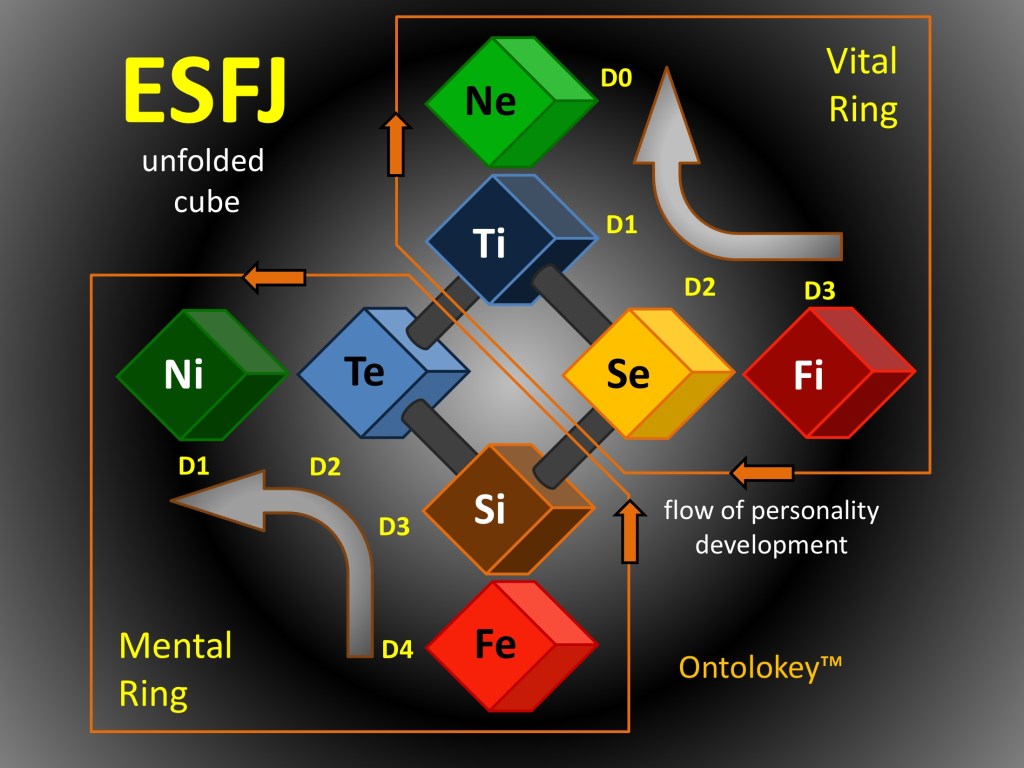
Within the developmental architecture specified for this ESFJ model, the Mental Ring consists of Fe at D4, Si at D3, Te at D2, and Ni at D1, with development proceeding sequentially from the dominant function toward the increasingly less-developed functions. This sequence is psychologically significant because it prevents individuation from being imagined as a dramatic leap into the deepest unconscious material before the personality has acquired sufficient internal stability to contain it. Fe at D4 provides the original psychological center: the capacity to perceive interpersonal reality, participate in collective emotional life, and actively contribute to social cohesion. Si at D3 then consolidates this strength by giving the ESFJ continuity, experiential memory, practical reliability, and a sense of what has already proven meaningful, which is why the development of the auxiliary function represents such an important transition from instinctive personality toward more differentiated maturity. Ontolokey likewise presents the broader functional architecture as something that can be explored developmentally rather than merely classified, with the cube providing a spatial representation through which relationships among conscious and less-conscious functions can be contemplated. In this developmental logic, the ESFJ should not attempt to bypass Si in order to reach Ni, because doing so would effectively ask the personality to abandon the very continuity and experiential grounding that allow deeper integration to occur.
The first decisive developmental movement is therefore from an unconscious Fe identity toward a more mature relationship with Si, in which experience becomes something to be understood rather than simply repeated. The ESFJ between early adulthood and midlife may increasingly discover that being socially competent is not sufficient for psychological maturity, particularly when familiar roles begin to change and the external environment no longer rewards the same forms of responsibility. At this stage, Si can either become a fortress or a foundation: it becomes a fortress when the individual attempts to preserve the past exactly as it was, but it becomes a foundation when accumulated experience is used as knowledge from which new possibilities can safely emerge. Once Si has become sufficiently differentiated, Te can begin to develop without threatening the emotional identity of the ESFJ, because external effectiveness no longer has to be interpreted as emotional coldness. Te can teach the individual to measure outcomes, establish limits, delegate, organize resources, distinguish intention from result, and recognize that good intentions do not automatically produce good consequences. In this sense, the progression from D4 to D3 to D2 is not a weakening of Fe but an expansion of the psychological vocabulary through which Fe can operate more intelligently and with less compulsion.
The transition toward Ni at D1 is more delicate because it confronts the ESFJ with a form of perception that cannot easily be anchored in established experience or externally observable evidence. Ni asks what something is becoming, what meaning may be developing beneath visible events, and where a trajectory might ultimately lead, whereas Si naturally asks what has happened, what is familiar, and what previous experience can teach about the present. For an ESFJ, this can create a genuine psychological tension because intuition may initially feel vague precisely where Si expects something concrete and trustworthy. The developmental task is therefore not to replace Si with Ni, but to allow uncertainty to exist without immediately forcing it back into familiar categories. When Ni begins to mature, the ESFJ can recognize that not every meaningful decision can be justified through precedent, that some life transitions require an inner sense of direction before external evidence becomes available, and that the future cannot always be secured by reproducing the past. The movement toward Ni is consequently a movement from certainty through experience toward meaning through psychological depth, and this becomes especially important when the ESFJ reaches the later stages of individuation.
Te — The Anima and the Discovery of Objective Effectiveness
The development of Te as the ESFJ’s Anima function represents a particularly important psychological threshold because it introduces a criterion that Fe cannot provide by itself: whether something actually works. An ESFJ may possess extraordinary motivation to help, reconcile, support, and maintain relationships, yet the desire to produce emotional good does not guarantee that a particular intervention is effective. Te interrupts this tendency by asking about measurable consequences, resources, efficiency, implementation, competence, and objective results, sometimes producing an uncomfortable confrontation with the difference between intention and outcome. Ontolokey places Te directly after Si in the ESFJ’s Mental Ring, at D2, meaning that it becomes accessible through development once the person has established a sufficiently mature relationship with their experiential foundation. The healthy integration of Te therefore does not turn the ESFJ into a detached strategist; instead, it gives the existing caring orientation greater precision by asking whether the help being offered actually helps, whether a commitment is sustainable, and whether responsibility has been distributed fairly.
The shadow difficulty arises when Te is first encountered not as an integrated capacity but as a psychological ideal or compensatory posture. An ESFJ who admires decisive, efficient, technically competent people may unconsciously believe that such people possess something fundamentally missing within themselves, creating a mixture of fascination, insecurity, admiration, and occasional defensiveness. Under pressure, this can produce a crude imitation of Te in which the ESFJ suddenly becomes blunt, controlling, excessively procedural, or preoccupied with productivity, as though objective efficiency could finally silence the emotional uncertainty that Fe normally manages. Genuine integration looks different because it does not require the personality to suppress emotional information; it teaches the ESFJ to include objective information alongside it. A mature decision can therefore contain both questions: “What will this do to the people involved?” and “Will this actually work?” The psychological healing occurs when neither question is allowed to invalidate the other.
Te also offers the ESFJ an important antidote to covert resentment because it exposes the consequences of giving without limits. If one person repeatedly accepts responsibilities that could reasonably be shared, the problem is not necessarily that other people are exploiting them; sometimes the individual has never established a workable structure in which responsibility can be negotiated explicitly. Te can transform vague frustration into practical differentiation: what belongs to me, what belongs to someone else, what is realistically possible, what must be postponed, and what should simply be declined. This is especially important because an ESFJ may unconsciously expect other people to infer needs from the amount of effort being given, while Te insists that expectations become explicit if they are to be managed effectively. The resulting boundaries are not emotional walls but structural clarity, and that distinction allows the ESFJ to remain deeply relational without requiring other people to possess the same intuitive sensitivity to obligation.
Ni — The Toddler Function and the Vulnerability of the Unknown
When development reaches Ni, the ESFJ encounters perhaps the most vulnerable dimension of the Mental Ring because Ni requires a tolerance for psychological uncertainty that the Fe–Si structure does not naturally prioritize. The Toddler designation expresses precisely this quality: the function is not simply absent but comparatively young, fragile, and difficult to trust consistently. Ni does not offer the reassuring evidence of Si or the interpersonal feedback of Fe; it may instead present an impression of direction, an emerging meaning, an intuitive sense that something is changing, or an awareness that a familiar situation is moving toward an outcome that cannot yet be demonstrated. For an ESFJ accustomed to creating stability through known relationships and accumulated experience, this can feel psychologically exposed. The temptation is to dismiss the intuition until it becomes externally undeniable, but by that point the individual may have spent years adapting to a trajectory that they sensed long before they consciously acknowledged it.
The healing function of Ni lies precisely in teaching the ESFJ that uncertainty does not necessarily mean danger and that not knowing does not imply incompetence. A mature relationship with Ni permits the person to hold an emerging intuition without immediately turning it into a conclusion, just as a seed can be recognized as significant before anyone knows exactly what plant it will become. This is particularly valuable during major transitions in identity, relationships, career, family structure, or personal meaning, when the old social role may no longer provide sufficient guidance. Instead of asking only, “What has always worked?” the ESFJ can begin asking, “What is this experience trying to become?” Such questions do not require abandoning practical judgment; they create an inner space in which the future can be psychologically perceived before it becomes socially obvious. In the language of individuation, Ni represents the ESFJ’s first serious encounter with an inner future that cannot be completely derived from the past.
The deepest integration of Ni occurs when the ESFJ stops demanding immediate certainty from the self. The personality that once required clear relational signals, familiar routines, and established precedents gradually becomes capable of remaining present while an internal transformation unfolds. This capacity can profoundly change the meaning of forgiveness, because the individual begins to see that people are not fixed representations of their previous behavior and that relationships cannot always be understood solely through historical evidence. It also changes self-forgiveness, because earlier failures can be interpreted as moments in which a particular function had not yet developed sufficiently rather than as proof of personal inadequacy. In that sense, the vulnerable function becomes therapeutic precisely because it allows the ESFJ to reinterpret the past from the perspective of developmental potential rather than moral condemnation. The person begins to understand not only what happened, but why certain psychological responses were available at one stage of life and unavailable at another.
The movement through Fe, Si, Te, and Ni therefore forms a coherent developmental arc: from relational identity, through experiential stability, into objective effectiveness, and finally toward inner direction and meaning. Each stage preserves something from the previous one while making it less absolute, which is why the developmental sequence cannot simply be reversed or accelerated through intellectual effort alone. Fe remains present after Si develops; Si remains present after Te develops; Te remains present when Ni begins to emerge, but none of them is permitted to monopolize consciousness as completely as before. The ESFJ becomes psychologically larger not by becoming a different type, but by acquiring enough internal differentiation to recognize when each function should and should not lead. This is the beginning of the “turning of the iceberg”: what once existed outside conscious identity gradually becomes recognizable as belonging to the self as well.
Fi — The Sibling Function and the Discovery of the Private Self
After the Mental Ring has been sufficiently developed, the ESFJ’s individuation enters a qualitatively different psychological territory through the Vital Ring, beginning with Introverted Feeling (Fi) at D3. This transition is crucial because Fi does not primarily ask how a person contributes to the emotional equilibrium of the surrounding group; it asks whether an experience is personally authentic, whether a value is genuinely one’s own, and whether an emotional response corresponds to an inner sense of truth. Ontolokey describes Fi as the ESFJ’s Sibling function, which makes it neither an alien enemy nor merely a weakness but a psychologically related capacity that has nevertheless occupied a less authoritative position than Fe. For an ESFJ, the encounter with Fi can therefore feel strangely familiar and strangely disruptive at the same time, because the individual possesses feelings and values but may have learned to interpret their significance primarily through their consequences for other people. The developmental task is not to become less relational but to establish an inner point of reference from which relational choices can be made consciously rather than automatically.
This distinction between having private feelings and granting them psychological authority is one of the most important aspects of ESFJ individuation. An ESFJ can be deeply emotional, possess strong convictions, know exactly when something feels wrong, and still habitually subordinate those perceptions to what appears necessary for the people around them. The unconscious question may therefore become, “What will this mean for everyone else?” before the more fundamental question, “What does this mean for me?” has even been allowed to arise. Over time, this imbalance can produce a subtle form of self-alienation in which the individual becomes exceptionally knowledgeable about the emotional landscape of other people while remaining comparatively uncertain about personal desires that have no obvious social justification. Fi begins to repair this division by legitimizing the private self as something that does not require collective approval in order to exist. The ESFJ gradually learns that a personal preference does not become selfish merely because somebody else is disappointed by it, and that an authentic boundary does not become cruel merely because another person would prefer that the boundary did not exist.
This is also where suppressed anger becomes psychologically informative rather than morally threatening. Anger is often difficult for an ESFJ to integrate because it can appear incompatible with the identity of the caring, considerate, emotionally responsible person, particularly when the individual has received positive reinforcement for patience and accommodation. Yet anger can contain information about violated boundaries, accumulated exhaustion, unequal reciprocity, or desires that have repeatedly been dismissed, and refusing to acknowledge it does not make the underlying conflict disappear. Fi allows the ESFJ to differentiate between destructive hostility and legitimate self-protection, thereby transforming an emotion that might previously have emerged indirectly into information that can be consciously interpreted. The mature ESFJ can eventually say, “I am angry because something matters to me,” without concluding that the anger itself makes them a bad person. In this way, Fi does not compete with Fe; it gives Fe a more authentic person from whom to originate.
The integration of Fi becomes especially transformative when the ESFJ begins to recognize how often guilt has functioned as an internal substitute for moral discernment. Guilt can mean that one has genuinely violated a value, but it can also mean that one has violated an expectation, disappointed someone, interrupted a familiar pattern, or simply prioritized oneself after a long period of self-neglect. Without differentiation, all of these experiences can feel morally identical. Fi introduces a more discriminating inner question: “Have I actually acted against what I believe is right, or am I merely experiencing the discomfort of no longer doing what others expect from me?” That distinction can liberate enormous psychological energy because it separates conscience from conditioning. The ESFJ can then begin to forgive themselves not only for mistakes but also for having needs, preferences, limits, ambitions, and forms of individuality that were previously interpreted as inconveniences to the collective.
Se — The Golden Shadow and the Recovery of the Present Moment
Once Fi has begun to establish a stronger relationship with personal authenticity, Extraverted Sensing (Se) can begin to emerge at D2 as the Golden Shadow. This position is particularly significant because Se does not primarily offer another system of moral evaluation or another method for preserving continuity; it introduces a different relationship to reality itself. Se attends to what is physically present, immediate, concrete, sensory, and actionable, and for an ESFJ strongly organized around Fe and Si this can represent an almost liberating simplification of experience. Instead of continuously interpreting the social meaning of an event or comparing it with previous experience, the person can learn to encounter what is actually happening now. Ontolokey explicitly presents Se as a hidden reservoir of potential for the ESFJ rather than simply as a deficiency, emphasizing its connection with spontaneity, direct engagement, embodied presence, and a freer participation in immediate experience. This is important because individuation is not solely an intellectual achievement; the personality must eventually become capable of inhabiting life rather than continually interpreting and managing it.
The shadow form of Se can initially appear through fascination with people who seem extraordinarily spontaneous, assertive, physically confident, adventurous, or unconcerned with social permission. The ESFJ may admire such people because they appear to possess an effortless freedom from the relational calculations that ordinarily occupy consciousness, while simultaneously judging them as reckless, insensitive, or insufficiently responsible. Both reactions can contain truth, but both can also indicate projection: what appears irresponsible may partly represent a capacity for directness that the ESFJ has not yet permitted themselves to develop. Healthy Se does not demand impulsiveness, nor does it require abandoning responsibility; it allows action to arise from the present rather than being endlessly delayed until every interpersonal consequence has been evaluated. The developmental question becomes, “What is actually happening right now, and what does this moment require?” rather than automatically asking what everyone might feel about the situation or what has traditionally been done. This can make the ESFJ more decisive, more embodied, and paradoxically more emotionally available because attention is no longer consumed by anticipating every possible reaction.
Se also provides an antidote to the ESFJ’s tendency to overinvest in psychological narratives about other people. When Fe and Si dominate consciousness, an ESFJ may remember what someone said previously, notice subtle changes in behavior, compare the current interaction with earlier events, and construct a coherent interpretation of the relationship. Such sensitivity can be extraordinarily accurate, but it can also become a form of psychological overprocessing when every present event is interpreted through accumulated relational history. Se interrupts this process by returning attention to observable reality: what did the person actually say, what are they actually doing, and what is actually happening between us at this moment? This does not invalidate intuition or memory; it prevents memory from becoming a prison and interpretation from becoming indistinguishable from fact. In this respect, Se can teach the ESFJ an unexpectedly powerful form of humility: reality does not always need to correspond to the story the mind has constructed around it.
The deeper integration of Se also restores pleasure without requiring usefulness. An ESFJ can become so accustomed to activities having a relational, practical, or responsible purpose that simple enjoyment may feel strangely difficult to justify, particularly when other responsibilities remain unfinished. Yet the capacity to experience beauty, food, movement, sexuality, nature, music, physical activity, travel, craftsmanship, play, or spontaneous conversation without converting the experience into productivity is psychologically restorative. Such experiences return the individual to the body, where existence precedes explanation and where the present moment does not require an argument for its legitimacy. The ESFJ begins to discover that not every valuable experience must improve someone, repair something, maintain something, or accomplish something. Se therefore contributes to healing by reconnecting the personality with a dimension of life that cannot be reduced to service.
Ti — The Inferior Function and the Courage to Question One’s Own Certainty
The development of Introverted Thinking (Ti) at D1 introduces another difficult but indispensable capacity: the ability to examine the internal consistency of one’s own reasoning independently of social consensus. For the ESFJ, this can be challenging because Fe naturally evaluates situations through interpersonal significance, while Ti asks whether the underlying concepts themselves are logically coherent. An ESFJ may know that a particular decision will affect people positively or negatively and may have extensive experiential evidence from Si, yet Ti asks a different question: “Does the reasoning actually follow?” This can initially feel emotionally cold because analytical examination may interrupt a conclusion that already feels morally or relationally obvious. But the mature development of Ti gives the ESFJ an extraordinary safeguard against self-deception, because it creates an internal capacity to question even conclusions that are socially reinforced.
This becomes particularly important in the shadow because an ESFJ can become extremely persuasive when emotionally convinced that something is right. The combination of Fe and Si can create a powerful internal case: people have behaved this way before, similar situations produced certain consequences, respected members of the group agree, and the current behavior violates established expectations. Ti asks the uncomfortable question of whether all those pieces actually establish the conclusion being drawn. It separates evidence from interpretation, intention from consequence, precedent from principle, and emotional conviction from logical necessity. The purpose is not to make the ESFJ skeptical of everything but to prevent interpersonal certainty from becoming intellectual certainty. When Ti develops, the ESFJ becomes capable of saying, “I strongly believe this, but I should still examine whether I have constructed the argument correctly.”
This function also changes the ESFJ’s relationship with disagreement. Before integration, disagreement can easily become psychologically personalized because conflicting views may appear to threaten shared understanding, loyalty, or relational stability. Ti introduces the possibility that disagreement can be intellectually useful even when it produces no immediate emotional harmony. Someone can challenge the ESFJ’s reasoning without rejecting the ESFJ as a person, just as the ESFJ can reject an argument without rejecting the person who expressed it. This distinction is fundamental to individuation because it separates attachment from agreement. The mature ESFJ becomes increasingly capable of allowing another person to remain psychologically autonomous without experiencing that autonomy as relational betrayal.
At its deepest level, Ti teaches the ESFJ that truth does not become more true because everyone feels better about it. This does not mean that emotional consequences are irrelevant; it means that emotional consequences and truth are different dimensions of reality and should not be unconsciously substituted for one another. The integration of Ti therefore strengthens rather than weakens the ESFJ’s ethical capacity because it makes compassion more discriminating. Instead of automatically defending the person who appears emotionally vulnerable, the ESFJ can investigate what actually occurred; instead of assuming that preserving peace is always beneficial, the individual can ask whether the peace is built upon denial. This is one of the final stages of psychological differentiation because it allows the ESFJ to tolerate the temporary discomfort of intellectual and interpersonal tension in service of a more coherent understanding of reality.
Ne — The Blindspot and the Liberation of Possibility
Extraverted Intuition (Ne), positioned at D0 as the Blindspot in the Vital Ring, represents the most developmentally remote function in the architecture described for the ESFJ. Ne opens attention toward alternatives, hypothetical possibilities, divergent interpretations, novelty, and what could emerge beyond the established frame of reference. For a personality whose psychological security is strongly supported by Fe and Si, this abundance of possibilities can initially feel less like freedom than instability, because every additional possibility potentially disrupts an existing plan, expectation, relationship structure, or interpretation of events. The designation D0 therefore captures more than low proficiency; it symbolizes a particularly archaic or childlike relationship with possibility, one that can appear either as naive excitement or as reflexive avoidance. Yet precisely because Ne occupies this blindspot, its integration can become one of the most transformative achievements of the entire individuation process.
The ESFJ may unconsciously react to Ne by reducing possibilities before they have been adequately explored. “That will never work,” “We have always done it this way,” “Why would anyone want that?” or “That is too risky” can function not merely as practical judgments but as psychological closures that restore familiarity before uncertainty becomes uncomfortable. The developmental task is not to accept every possibility as equally valid, which would contradict the ESFJ’s natural capacity for discernment, but to allow possibility to exist long enough to be examined. Ne teaches the mind to generate alternatives before selecting among them. This can profoundly affect relationships because the ESFJ becomes less likely to assume that another person’s behavior has only one possible explanation. Instead of concluding that someone is ungrateful, hostile, disloyal, or uncaring, the individual can entertain several hypotheses and wait for additional information. Such psychological flexibility can dissolve conflicts that previously became entrenched because the first interpretation was unconsciously treated as the only interpretation.
The integration of Ne is therefore closely connected to forgiveness. Forgiveness becomes easier when human behavior is understood as multidimensional rather than fixed, because a person who acted badly yesterday is not thereby reduced to yesterday’s behavior. Ne allows the ESFJ to imagine that people can change, that relationships can take unexpected forms, that an apparent ending can become a transition, and that a mistake can generate a future that could not have been predicted beforehand. This does not mean denying consequences or excusing harmful behavior; rather, it means refusing to confuse the present configuration of reality with its permanent form. The ESFJ begins to understand that even the self is an evolving system and that psychological development often depends upon the ability to imagine a version of oneself that does not yet have external evidence. In this sense, the Blindspot becomes the final invitation to intellectual and psychological openness.
The four stages of the Vital Ring therefore complete a developmental movement that began with the Mental Ring: Fi establishes the legitimacy of the private self, Se reconnects that self with immediate reality, Ti teaches it to examine its own reasoning, and Ne ultimately opens it toward possibilities beyond established psychological boundaries. The sequence matters because possibility without selfhood can become avoidance, immediacy without discernment can become impulsivity, and analysis without openness can become sterile rationalization. Each function must therefore be integrated through the preceding one, just as the Mental Ring develops progressively from Fe through Si, Te, and Ni. Ontolokey’s broader presentation of the eight-function landscape similarly emphasizes that the personality becomes more intelligible when the less conscious functions are viewed as part of a larger developmental structure rather than as isolated traits. The result is a progressively larger psychological field in which the ESFJ no longer has to choose between belonging and individuality, continuity and change, emotion and reason, or responsibility and freedom.
The completed movement can therefore be understood as an expansion of psychological permission. Fe gives permission to care, Si gives permission to remember, Te gives permission to evaluate effectiveness, Ni gives permission to trust emerging meaning, Fi gives permission to possess a private self, Se gives permission to inhabit the present, Ti gives permission to question, and Ne gives permission to imagine. None of these permissions invalidates the original ESFJ orientation; rather, each removes another unconscious restriction around it. The personality becomes whole when the functions no longer have to fight for legitimacy because consciousness can allow contradictory perspectives to coexist without immediately forcing one to disappear. At that point the ESFJ has moved considerably beyond the question of “Which function am I?” and toward the deeper question of “Which psychological capacity does this moment require from the whole of me?” That is the psychological foundation upon which genuine individuation and self-healing can proceed.
Individuation, Self-Healing, and the Return to Wholeness
From Functional Development to Individuation
The development of the ESFJ cannot ultimately be reduced to acquiring a collection of additional psychological skills, because individuation concerns a transformation in the relationship between consciousness and the total personality. In the developmental sequence described by Ontolokey, the conscious personality begins with a highly developed Fe at D4 and progressively encounters functions that have been less available to conscious identity, first through Si, then Te and Ni, while the Vital Ring subsequently opens toward Fi, Se, Ti, and finally Ne. The significance of this progression lies in the gradual destabilization of an identity that once appeared complete: the ESFJ discovers that the person who was competent, caring, reliable, socially perceptive, and responsible was real, but was never the entirety of the psyche. What initially feels like psychological disturbance can therefore become the beginning of a much larger consciousness, because the familiar self-image can no longer contain everything that experience is revealing. The image of the iceberg turning upon itself expresses this process particularly well: what was formerly submerged does not suddenly become something foreign, but gradually becomes visible as another aspect of the same personality. Individuation is thus not the destruction of the ESFJ but the recovery of the psychological territory that the original conscious identity could not yet perceive.
The practical consequence is that development should not be forced through willpower or pursued as an attempt to manufacture a completely different personality. If the ESFJ attempts to become immediately intuitive, radically independent, ruthlessly analytical, endlessly spontaneous, or emotionally detached, the result will usually be another form of identification rather than integration. The developmental sequence instead asks for patience with psychological maturation, because each function becomes more accessible when the preceding developmental layer has provided sufficient stability. This is why the auxiliary Si is so important: it establishes the experiential grounding from which the later encounter with Te and Ni can occur without destroying the person’s sense of continuity. Likewise, Fi must acquire sufficient legitimacy before Se, Ti, and Ne can be integrated without becoming compensatory extremes. The deeper principle is that unconscious material becomes psychologically useful only when consciousness has developed enough differentiation to recognize and contain it. The ESFJ therefore does not heal by attacking the shadow; the ESFJ heals by becoming conscious enough that the shadow no longer has to operate entirely outside awareness.
The Vulnerable Functions and the Meaning of Psychological Wounds
One of the most important implications of this model is that some of the ESFJ’s most painful life experiences may become intelligible when viewed through the functions that were least developed at the time those experiences occurred. A person may have been extraordinarily capable in relational situations yet struggled when circumstances demanded impersonal efficiency, radical uncertainty, private self-definition, abstract analysis, or spontaneous adaptation. Such experiences can become internalized as evidence of inadequacy: “Why could everyone else handle this when I could not?” or “Why did I react so strongly to something that seemed easy for other people?” The developmental model offers another interpretation, namely that different psychological functions have different degrees of accessibility and that a situation can demand precisely the capacity that has received the least conscious development. This does not erase the pain of failure, but it can change its meaning from personal defect to developmental information. What once appeared to be evidence that something was fundamentally wrong with the self can become evidence of where the self still required integration.
The Toddler function Ni is particularly relevant because vulnerability often emerges most intensely when the person is confronted with ambiguity about the future, hidden meanings, irreversible transitions, or situations in which established experience provides no reliable precedent. Similarly, the Anima function Te can become a sensitive psychological area whenever the ESFJ is judged according to standards of detached efficiency, impersonal competence, or purely objective performance. The individual may know how to care for people exceptionally well and still feel strangely exposed when asked to defend a decision exclusively through measurable results. Understanding these vulnerabilities can produce a form of self-compassion that is more substantial than simple reassurance because it is based upon psychological differentiation. The question changes from “Why am I weak here?” to “What developmental capacity is being activated here, and how can I gradually strengthen it without rejecting the parts of myself that already function well?” That change in interpretation is itself therapeutic because shame depends upon an undifferentiated identification with failure, whereas cognition creates distance between the person and the psychological process being observed.
This also creates the possibility of forgiving other people without prematurely excusing what they did. An ESFJ who understands their own functional vulnerabilities may begin to recognize that other people likewise act from different levels of psychological awareness, developmental capacity, fear, and unconscious compensation. Someone who appeared deliberately insensitive may have lacked access to the emotional information the ESFJ naturally perceives; someone who appeared impossibly rigid may have been protecting themselves through a psychological structure that offered them security; someone who seemed cold may have been attempting to solve a problem through a function that prioritizes effectiveness rather than interpersonal harmony. Such understanding does not require the ESFJ to tolerate abuse, abandon boundaries, or deny legitimate grievances. It means that judgment can become more differentiated, allowing the individual to distinguish between malicious intention, psychological limitation, unconscious defense, and simple difference. Forgiveness then becomes less about declaring that nothing happened and more about releasing the psyche from the necessity of endlessly repeating the event internally.
The ESFJ’s Healing Through Cognition
The phrase “healing through cognition” acquires its deepest meaning when cognition is understood not as intellectualization but as the conscious recognition of previously unconscious psychological patterns. An ESFJ who repeatedly feels disappointed by others may discover that the emotional injury contains several different layers: a genuine violation, an unspoken expectation, a tendency to overgive, an assumption that others should reciprocate spontaneously, and perhaps an inability to state a boundary before resentment develops. Once these layers become distinguishable, the experience ceases to be a single undifferentiated emotional wound. The individual can then ask which part belongs to the other person’s behavior, which part belongs to personal expectation, which part belongs to an old adaptation, and which part points toward an underdeveloped function. This does not make the original emotion disappear, but it transforms an apparently overwhelming psychological event into something that can be examined, understood, and integrated. In this sense, consciousness becomes healing because it interrupts the automatic repetition of unconscious patterns.
The same principle applies to the ESFJ’s relationship with guilt, resentment, disappointment, and the fear of rejection. Rather than immediately obeying these emotions, the individual can learn to treat them as communications from different layers of the personality. Resentment may signal that Fe has given beyond its sustainable limits; guilt may indicate either a genuine violation of values or merely the discomfort associated with developing Fi; anxiety about an uncertain future may reveal the vulnerability of Ni; frustration with inefficiency may point toward an emerging need for Te; impatience with ambiguity may reveal the developmental challenge presented by Ne. The emotion therefore becomes the beginning of an investigation rather than the final verdict. Over time, this produces a much more differentiated inner life because the ESFJ no longer has to choose between suppressing an emotion and acting it out. The third possibility is consciousness: to experience the emotion fully while simultaneously asking what psychological process generated it.
This is where the Ontolokey cube can function symbolically as a practical instrument for self-observation. Its value within this developmental framework lies in making an otherwise abstract psychological landscape visible: the functions can be contemplated not as isolated labels but as positions within a developmental structure, each indicating a possible direction of movement. When the ESFJ encounters a recurring difficulty, the relevant question becomes less “What is wrong with me?” and more “Which part of my psychological architecture is being activated, and where does this function stand in my developmental sequence?” The cube can consequently serve as a visual reminder that psychological development has direction and sequence rather than being an arbitrary demand to improve everything simultaneously. It externalizes the map sufficiently for the individual to observe the map without being completely identified with it, which is precisely what reflective consciousness requires.
The Turning Iceberg: The Second Half of Life as Psychological Expansion
The developmental metaphor of the iceberg becomes especially powerful when applied to the second half of life, because maturity often brings circumstances that weaken the external structures upon which the original ESFJ identity depended. Children become independent, parents age or die, careers change, social circles transform, relationships end or deepen, and responsibilities that once provided a clear sense of purpose may gradually disappear. The individual can then experience an unsettling question: if I am no longer required to perform the roles through which I have known myself, who am I? What initially appears to be loss can become the psychological opening through which the submerged personality begins to surface. The ESFJ is confronted with aspects of existence that cannot be solved merely by becoming more useful to other people, and this forces attention inward. The developmental movement becomes increasingly less about maintaining an established identity and increasingly about discovering the larger Self that has existed beneath it.
The metaphor also clarifies why individuation cannot be reduced to a linear improvement program. The iceberg does not simply rise upward until everything becomes conscious; it turns, exposing different surfaces while others temporarily disappear from view. Psychological development similarly involves periods in which a previously neglected function becomes prominent, sometimes destabilizing the equilibrium established by earlier strengths. An ESFJ may become intensely concerned with personal authenticity after decades of accommodation, then later discover the need for greater objectivity, solitude, spontaneity, intellectual skepticism, or openness to possibility. Such phases can appear contradictory if development is understood as a straight line, but they make sense if the personality is understood as a dynamic whole gradually revealing itself. The objective is not to remain permanently immersed in the shadow but to become capable of moving between psychological perspectives without losing the central continuity of the self.
Eventually, the developmental movement returns to Fe, but it returns to a different Fe. The original dominant function is no longer required to carry the entire psychological burden because the other functions have become increasingly available as conscious resources. Fe can therefore become less defensive, less dependent upon approval, and less compelled to maintain harmony at any cost. It can care without rescuing, give without keeping an unconscious ledger, organize without controlling, and preserve relationships without sacrificing the private self. Si can preserve what is meaningful without imprisoning the individual in what has already been known; Te can provide structure without becoming emotionally sterile; Ni can perceive emerging meaning without demanding certainty; Fi can preserve authenticity without isolating the person; Se can inhabit reality without impulsiveness; Ti can question without becoming detached; and Ne can imagine alternatives without dissolving practical judgment. The return to Fe is therefore not regression to the beginning but the return of the original center after the entire psychological landscape has been expanded.
Wholeness: The ESFJ Beyond the Persona
The mature ESFJ ultimately discovers that the persona of the caring, reliable, socially responsible person was never false; it was simply incomplete. The problem was not that the individual cared too much, remembered too much, valued relationships too highly, or desired harmony, but that these qualities could become the exclusive language through which existence was interpreted. Individuation allows the ESFJ to preserve the beauty of these qualities while removing the unconscious necessity behind them. A person can still be generous without needing gratitude, loyal without demanding permanence, socially attentive without monitoring everyone’s emotions, and responsible without assuming responsibility for everything. This is what distinguishes psychological integration from personality replacement: the original personality remains recognizable, but its motivations become progressively freer.
The deepest form of ESFJ healing therefore involves reconciliation between opposites that previously appeared incompatible. The person no longer has to choose between belonging and individuality because Fi teaches that authentic individuality can enrich relationships rather than threaten them. There is no longer a forced choice between tradition and change because Si can preserve what matters while Ne allows new possibilities to emerge. Feeling and thinking cease to represent competing identities because Fe and Te can jointly evaluate both human consequences and objective effectiveness, while Ti adds the capacity to examine the assumptions beneath both. Even the tension between certainty and uncertainty becomes more tolerable because Ni teaches the ESFJ to live with emerging meaning while Se anchors consciousness in what is actually present. Wholeness is therefore not the absence of inner conflict but the capacity to contain legitimate psychological opposites without forcing one side into unconsciousness.
The final transformation is a change in the meaning of self-worth. The immature or wounded ESFJ may unconsciously ask, “Am I valuable because people need me?” while the individuating ESFJ increasingly recognizes, “I am valuable even when I am not performing a function for anyone.” This does not diminish the desire to contribute; it liberates contribution from psychological necessity. Service becomes a choice rather than an unconscious bargain, relationships become encounters between autonomous persons rather than systems of mutual obligation, and boundaries become expressions of self-respect rather than punishments for insufficient gratitude. The person can finally give from fullness rather than from fear of becoming unnecessary. In that sense, the greatest gift of individuation is not becoming less ESFJ, but becoming sufficiently whole that being an ESFJ is no longer something that must be defended, performed, or continuously proven.
The Continuing Practice of Individuation
The developmental journey does not end when the ESFJ intellectually understands the eight functions, because insight becomes psychologically transformative only when it changes perception and behavior in ordinary life. Each recurring conflict can become an opportunity to identify which function is currently dominating and which function may be asking for recognition. Before automatically accommodating someone, Fe can be balanced by Fi; before relying exclusively upon precedent, Si can be balanced by Ne; before assuming that good intentions are enough, Te can be consulted; before rejecting an uncertain inner impression, Ni can be given space; before interpreting a situation through accumulated history, Se can return attention to observable reality; before treating disagreement as relational threat, Ti can examine the argument itself. These practices need not be performed mechanically, because the purpose is not to turn psychological development into another system of obligation. Their purpose is to make unconscious differentiation progressively more conscious until the personality can access these perspectives with increasing naturalness.
The deepest form of progress may therefore be measured not by how often the ESFJ behaves perfectly, but by how quickly unconscious patterns become recognizable after they have been activated. A person may still become resentful, overgive, become rigid, fear uncertainty, avoid conflict, or react defensively, but the mature personality begins to notice what is happening while it is happening. That moment of recognition creates psychological freedom because there is now a space between stimulus and response in which another function can participate. Over time, the ESFJ can begin to repair relationships without abandoning themselves, apologize without collapsing into shame, establish boundaries without hostility, reconsider beliefs without feeling disloyal, and tolerate another person’s disappointment without immediately interpreting it as evidence of personal failure. This is the practical expression of the iceberg turning: more of the psyche becomes visible, and therefore less of the psyche must act blindly from below the surface.
For readers who want to continue this exploration, the more extensive ESFJ material and the broader personality-type resources available at Ontolokey.com can be used as a continuing framework for examining individual functions, shadow dynamics, developmental stages, and the corresponding patterns of other personality types. The value of returning to those descriptions is not simply to accumulate more information about the ESFJ, but to use the descriptions as prompts for increasingly precise self-observation. The Ontolokey landscape becomes most meaningful when the reader recognizes concrete moments of life within it: the argument that activated Fe, the decision that required Te, the uncertainty that exposed Ni, the boundary that awakened Fi, the present moment that demanded Se, the disagreement that required Ti, or the unexpected possibility that challenged the Ne blindspot. In this way, psychological theory becomes a language through which lived experience can be interpreted rather than another identity to perform.
Becoming Whole Without Becoming Someone Else
The ESFJ’s path toward wholeness begins where its greatest strength becomes conscious of its own limits. Fe gives the personality an extraordinary capacity for connection, Si gives it continuity and reliability, and together they create a person who can become a stabilizing force within families, friendships, communities, and institutions. Yet the same structure can become imprisoning when being needed replaces being known, when harmony replaces truth, when tradition replaces possibility, and when responsibility becomes a substitute for self-discovery. The developmental journey described here does not ask the ESFJ to abandon these strengths but to release them from unconscious compulsion by progressively integrating the functions that have remained less conscious. Through Te and Ni in the Mental Ring, and through Fi, Se, Ti, and Ne in the Vital Ring, the personality gradually acquires access to forms of perception and judgment that were once peripheral, uncomfortable, or vulnerable.
The ultimate goal is therefore not perfection but psychological completeness. The ESFJ who reaches toward this completeness can continue to love people deeply while allowing them to be disappointed, continue to honor the past while permitting the future to change it, continue to value harmony while accepting necessary conflict, and continue to serve others without disappearing inside the role of servant. The submerged psychological functions cease to be enemies of the conscious personality and become partners in a larger Self. What was once experienced as weakness can become sensitivity, what appeared to be contradiction can become complementarity, and what once produced shame can become the precise location of future development. The iceberg has not become a different object after turning; it has simply revealed that it was always larger than the small portion visible above the water.
Wholeness finally means that the ESFJ no longer has to ask which part of the personality is the “real” one. Fe is real, but so are Fi and Ti; Si is real, but so are Se and Ne; Te is real, and so is Ni, even when these functions initially feel unfamiliar or vulnerable. The mature personality does not abolish its hierarchy but becomes increasingly conscious of the entire psychological landscape surrounding that hierarchy. This is where individuation becomes healing: not because cognition erases suffering, but because understanding transforms unconscious suffering into meaningful psychological experience. The person can look backward without being imprisoned by the past, inward without becoming isolated, outward without becoming dependent upon approval, and forward without demanding certainty. The return to the original personality is consequently a return to an ESFJ who is no longer merely functioning well, but who has gradually become capable of inhabiting the whole of the psychological self.


Leave a comment