From Competence to Wholeness
The ISTP is often recognized through a distinctive combination of independence, practical intelligence, composure under pressure, technical competence, perceptiveness, and a preference for discovering how things actually work rather than accepting explanations merely because they are given. In the Ontolokey understanding, however, these visible qualities are only the conscious surface of a much larger psychological architecture, whose center is formed by Introverted Thinking (Ti) and Extraverted Sensing (Se). Ti seeks internal coherence, structural clarity, and an intelligible relationship between cause and effect, while Se brings this internal understanding into immediate contact with reality through observation, action, precision, force, timing, and practical experience. The resulting personality can become extraordinarily capable because the ISTP does not merely want to possess an idea; the idea must withstand contact with reality and prove itself through experience. Yet precisely this capacity for competence contains the seed of the deeper developmental problem: when the ability to understand, control, repair, and independently master reality becomes the principal means of psychological self-protection, those aspects of life that cannot be mastered in the same manner—vulnerability, emotional dependence, uncertainty, personal values, interpersonal reciprocity, and questions of meaning—may gradually be pushed into the unconscious.
Psychological individuation therefore begins for the ISTP at a paradoxical point: the very strengths that have enabled survival and competence must eventually become instruments for examining the defenses built around those strengths. The task is not to weaken Ti, suppress Se, or transform the ISTP into a fundamentally different kind of person, but to extend the same uncompromising capacity for observation and understanding toward the inner territories that have historically appeared less reliable, less controllable, or less intelligible. Ontolokey gives this process a spatial language by representing the eight psychological functions as an interconnected landscape rather than as an isolated hierarchy of traits, thereby making visible both the familiar conscious functions and the less-developed or shadow-like dimensions surrounding them. In this perspective, psychological growth is not a linear acquisition of abilities but a gradual widening of consciousness in which previously neglected functions become recognizable, nameable, and eventually available for deliberate integration. The Ontolokey Cube is particularly suited to this conception because its three-dimensional structure allows the psychological architecture to be mentally experienced as something that can be turned, inspected, and approached from different directions rather than merely memorized as a theoretical sequence. The map consequently becomes a landscape of individuation: the ISTP does not leave the original personality behind, but gradually learns to inhabit more of it.
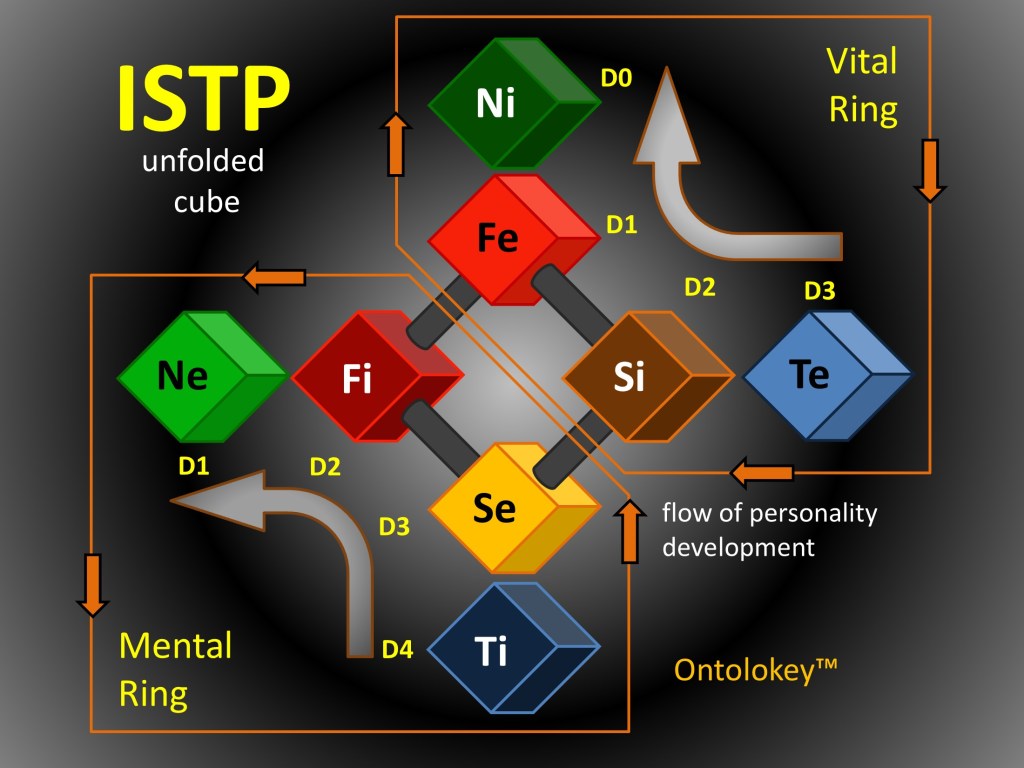
Within the developmental framework used here, this expansion of consciousness follows a specific direction rather than occurring randomly, and that direction is essential if shadow integration is to become psychologically meaningful rather than merely aspirational. The ISTP’s Mental Ring begins with Ti at D4, followed by Se at D3, Fi at D2, and Ne at D1, so development proceeds from the already powerful capacity for internal logical organization toward increasingly vulnerable territories of personal feeling and possibility. The Vital Ring runs in parallel, though with a developmental delay, from Te at D3 through Si at D2 and Fe at D1 toward Ni at D0, the most archaic and childlike point of the structure, where the unknown future and deeper symbolic patterning can become a particularly pronounced blind spot. The essential principle is that development proceeds progressively rather than by psychological shortcuts: Se must become sufficiently differentiated before Fi can be integrated more fully, Fi must acquire sufficient conscious stability before Ne can be approached without overwhelming uncertainty, and the same principle governs the Vital Ring as consciousness gradually moves from Te toward Si, Fe, and finally Ni. This sequence turns individuation into a disciplined process of psychological maturation in which the conscious ego does not attempt to conquer its shadow all at once, but develops the capacity to approach each deeper layer from the stability created by the preceding one.
The central image for this process is therefore not the destruction of the old personality but the gradual turning of an iceberg: what has remained beneath the surface of ordinary consciousness slowly becomes visible, not because the unconscious is forcibly dragged upward, but because the personality acquires enough stability to tolerate what was previously too unfamiliar to integrate. For the ISTP, this is especially important because the most consequential developmental material lies precisely where the personality is least inclined to trust itself: in the vulnerable intimacy of Fi, the uncertainty of Ne, the emotional reciprocity of Fe, and eventually the temporal and symbolic depth associated here with Ni. The deeper shadow is not simply a collection of negative traits waiting to be eliminated; it contains capacities that have been insufficiently differentiated and therefore may emerge first in distorted, defensive, exaggerated, or emotionally charged forms. A person who understands this can begin to reinterpret past failures and injuries with greater psychological precision: what once appeared as personal weakness may reveal an underdeveloped function, what appeared as another person’s inexplicable behavior may become intelligible as an interaction between different psychological structures, and what once demanded resentment may become capable of forgiveness through understanding. In this sense, healing through cognition does not mean thinking away pain; it means making previously unconscious psychological relationships conscious enough that the individual is no longer compelled to repeat them blindly. The ultimate objective is wholeness: not perfection, emotional uniformity, or equal strength in every function, but the recovery of a more complete Self in which the ISTP’s formidable capacity for logic and action can coexist with feeling, uncertainty, relationship, memory, possibility, and meaning.
The Conscious Architecture: Ti and Se as the ISTP’s Psychological Foundation
The first stage of ISTP individuation must begin with an honest recognition of the extraordinary psychological strength represented by dominant Introverted Thinking (Ti). In the Ontolokey model, Ti occupies D4 within the Mental Ring and therefore represents the most developed and naturally accessible cognitive territory of the ISTP: the capacity to deconstruct complexity, identify underlying mechanisms, establish internal consistency, and distinguish what is structurally sound from what merely appears convincing. This is why the ISTP often experiences reality less as a collection of isolated events than as an interconnected system whose parts should make sense in relation to one another. The instinctive question is not simply whether something is socially accepted or emotionally appealing, but whether it actually works, whether its components are coherent, and whether its stated principles survive examination when confronted with concrete reality. This capacity can make the ISTP remarkably calm in situations that overwhelm others, because analysis creates psychological distance from confusion and transforms an apparently chaotic problem into something that can be understood, separated into components, and eventually solved. Yet Ti also establishes the psychological standard against which the later developmental journey must be measured: anything that cannot initially be made intelligible is in danger of being rejected before it has been sufficiently experienced.
Extraverted Sensing (Se), positioned at D3 directly beneath Ti in the Mental Ring, provides the essential bridge between internal understanding and external reality. Where Ti asks how something is structured, Se asks what is actually happening now and what can be done about it, giving the ISTP a pronounced sensitivity to physical circumstances, timing, movement, pressure, boundaries, practical consequences, and opportunities for immediate intervention. The mature expression of this combination is one of the ISTP’s greatest gifts: thought does not remain imprisoned in abstraction, because it is continually tested against experience, while experience does not remain a collection of impressions because Ti organizes it into a comprehensible model. This is the psychological basis for the familiar ISTP capacity to remain composed during crises, manipulate tools or systems with precision, recognize relevant details quickly, and act decisively when circumstances demand it. At the same time, Ti and Se can become so mutually reinforcing that the ISTP develops an exceptionally efficient closed circuit of analysis and action, in which whatever can be solved through understanding, observation, technique, or direct intervention receives attention while whatever requires emotional exposure or toleration of ambiguity remains outside the preferred field of consciousness. The very competence that once created freedom can therefore become a subtle psychological enclosure if it becomes the only trusted way of relating to life.
This distinction is crucial because individuation does not begin by attacking Ti or Se; it begins by recognizing their limits without diminishing their value. A psychologically mature ISTP does not need to become less logical, less independent, less practical, or less perceptive in order to become whole, because those capacities constitute the stable platform from which deeper development can safely occur. Indeed, the developmental sequence requires precisely this stability: the auxiliary Se must become sufficiently developed before the personality can move toward the more vulnerable Fi territory at D2, because emotional integration without sufficient grounding could feel like a loss of control rather than an expansion of consciousness. The ISTP therefore benefits from asking a different kind of question of the self: not merely “Is this thought logically correct?” or “What can I do about this situation?”, but also “What is happening inside me that cannot be reduced to the problem itself?” That question marks the beginning of a profound psychological transition, because it turns the investigative power of Ti inward without asking Ti to manufacture an emotional answer. The objective is not to make feeling logical, but to make the existence and meaning of feeling cognitively accessible enough that it no longer has to remain unconscious. In this sense, the mature ISTP becomes not less rational but more complete in the application of rational awareness.
The developmental movement from D4 toward D3 consequently represents the first great task of individuation: learning to use Se not merely as an instrument for controlling external circumstances, but as a disciplined faculty of conscious presence. The immature expression of Se may seek immediate correction when reality becomes disorderly, and under pressure it can become excessively forceful, punitive, territorial, or impatient with whatever refuses to respond to practical intervention. The mature expression is subtler: it observes before acting, recognizes the limits of force, distinguishes an actual threat from an internal irritation, and allows reality to reveal itself without immediately imposing a solution upon it. This distinction becomes psychologically decisive because the later shadow functions can only be approached by a person capable of remaining present when there is no immediate technical solution. The ISTP’s first developmental victory is therefore not the conquest of the unconscious but the cultivation of enough embodied stability to remain conscious in its presence. Once Se has developed toward the upper end of D3, the personality possesses a sufficiently reliable connection with reality to begin turning toward the next territory of the Mental Ring: Fi, the hidden realm of personal value, emotional significance, loyalty, vulnerability, and the private moral experience that the ISTP may have spent much of life understanding indirectly rather than inhabiting directly.
Fi — The Hidden Center of Personal Meaning
When the ISTP has developed the Ti–Se foundation sufficiently, the next developmental movement leads toward Introverted Feeling (Fi), which occupies D2 in the Mental Ring and is therefore considerably less familiar to consciousness than the dominant and auxiliary functions. This transition is psychologically important because Fi does not primarily ask whether an idea is coherent or whether an action is effective; it asks what something means personally, what is inwardly valued, what feels morally or emotionally true, whom one genuinely cares about, and where the boundaries of personal integrity actually lie. For an ISTP accustomed to evaluating reality through structure and direct experience, such questions can initially appear imprecise because their answers cannot be established in the same externally verifiable manner as technical facts or practical solutions. Yet the apparent imprecision of Fi conceals a highly differentiated inner world, and its relative unfamiliarity can cause the ISTP to mistake emotional depth for emotional instability or vulnerability for weakness. The developmental task is consequently not to become sentimental, but to discover that personal meaning is another form of information which has been present all along, even when it has not received the same conscious authority as logical analysis.
Fi becomes particularly significant because it represents the point at which the ISTP encounters the difference between understanding another person and allowing that person to matter inwardly. An ISTP may be extraordinarily perceptive about another person’s behavior, recognize their motives, identify inconsistencies in their reasoning, and even know exactly what practical assistance would solve their problem, while remaining comparatively uncertain about how deeply the relationship itself has affected the inner self. This can produce a peculiar form of emotional distance in which the individual is not necessarily uncaring, but expresses care primarily through competence, protection, practical assistance, shared activity, or the willingness to solve a concrete problem. Fi begins to reveal that these outward behaviors are only one possible translation of affection and that intimacy also requires conscious recognition of subjective significance. The difficult question becomes not merely “What can I do for this person?” but “Why does this person matter to me, and what happens inside me because they matter?” When that question is permitted to exist without immediately converting it into an action, the ISTP begins to encounter an interior dimension that cannot be mastered through technical efficiency.
This is also where some of the ISTP’s deepest wounds can become intelligible, because the Anima/Animus function is particularly sensitive to experiences of rejection, betrayal, humiliation, abandonment, emotional misunderstanding, or the feeling that one’s inner self was not recognized by others. What may appear externally as indifference can therefore sometimes conceal precisely the opposite: a highly sensitive internal evaluation of whether another person is trustworthy, loyal, authentic, or emotionally safe. When this sensitivity has not been consciously integrated, the ISTP may protect it through withdrawal, detachment, sarcasm, rationalization, or a refusal to acknowledge how deeply an experience has affected them. The defensive position then becomes psychologically circular: because vulnerability feels dangerous, the individual suppresses vulnerability; because it is suppressed, its influence remains unconscious; because its influence remains unconscious, the person may react more strongly than expected when the protected value is threatened. Fi integration interrupts this cycle by making the underlying value conscious, allowing the ISTP to say, internally and eventually interpersonally, not merely “This makes no sense,” but also “This hurt me because something important to me was violated.” That recognition transforms an apparently irrational reaction into psychologically comprehensible information.
The healing potential of Fi therefore lies in its ability to restore dignity to experiences that Ti might otherwise classify as inconvenient, inefficient, excessive, or insufficiently objective. An ISTP who develops this function does not lose analytical distance; rather, analysis acquires a more complete object of investigation because the observer finally includes the observer’s own emotional reality within the field of observation. This can profoundly change the interpretation of past experiences, since the question shifts from “Why did I allow this to happen?” toward “What did I need, value, trust, or fail to understand about myself at that time?” Such questions can uncover the reasons why certain injuries remained psychologically active long after their external circumstances had disappeared, because the unresolved issue was not the event itself but the meaning that had never been consciously integrated. Forgiveness can then become possible without requiring the ISTP to deny the reality of what happened, because understanding the psychological structure behind a wound can separate comprehension from approval. The goal is not to erase anger, grief, disappointment, or attachment, but to bring these experiences into consciousness so that they become part of the individual’s history rather than hidden forces governing the present.
The movement into Fi also marks an important shift in the meaning of strength. Earlier in life, strength may have been defined primarily as self-sufficiency, emotional composure, competence under pressure, resistance to dependence, and the ability to solve problems without requiring assistance. With increasing Fi consciousness, strength becomes the capacity to remain internally present when something matters deeply, even when no immediate solution exists and even when the experience exposes the individual to possible rejection or loss. This is a demanding transformation because it removes one of the ISTP’s most reliable defenses: the ability to step outside an emotional situation and analyze it from a safe distance. The mature expression of Ti does not disappear during this process; instead, it becomes the instrument that allows the ISTP to observe the emotional self without condemning it, while Fi gradually teaches Ti that not every meaningful truth can be reduced to an impersonal proposition. When these functions begin to cooperate, the personality becomes capable of something neither could accomplish alone: a form of inner honesty in which logic protects emotional truth from distortion while emotional truth prevents logic from becoming an escape from the self.
The transition from Se to Fi must therefore be understood as a gradual descent rather than a sudden psychological conversion. Se first teaches the ISTP to remain present in reality, to perceive what is actually happening rather than retreating into abstraction, and Fi then asks the individual to apply that same presence to the interior world of personal significance. The question becomes increasingly subtle: if Se can teach the ISTP to notice the external world without distortion, can the same discipline be applied to noticing one’s own feelings without immediately controlling, dismissing, explaining, or escaping them? This is where individuation begins to move from competence toward vulnerability, because the unconscious can only become conscious when the ego is willing to observe experiences that do not flatter its established self-image. Fi is therefore not merely another function to be “developed”; it is the psychological threshold at which the ISTP discovers that the self being protected by independence may itself contain unmet needs, loyalties, griefs, ideals, and capacities for attachment that deserve recognition. Once these elements can be consciously held rather than defensively rejected, the personality acquires the foundation required for the next descent into the Mental Ring: Ne at D1, where the challenge is no longer simply to know what one feels, but to tolerate what one cannot yet know.
Ne — The Toddler Function and the Fear of the Unknown
After Fi has been sufficiently developed, the ISTP reaches the most fragile territory of the Mental Ring: Extraverted Intuition (Ne), designated D1 and described in the Ontolokey framework as the Toddler function. The metaphor is psychologically revealing because Ne represents a mode of consciousness that is curious, exploratory, associative, and open to possibilities without demanding immediate certainty about where those possibilities will lead. For a personality organized around Ti and Se, this can feel almost developmentally backwards: Ti wants a coherent model, Se wants contact with what is actually present, while Ne introduces alternatives, hypothetical futures, unexpected interpretations, and possibilities that may never materialize. The ISTP can therefore experience unstructured possibility as noise rather than enrichment, particularly when the mind is accustomed to distinguishing what is useful from what is merely speculative. Yet precisely because Ne is so poorly developed in this model, its unconscious influence can become disproportionate to its conscious competence: what the ISTP cannot comfortably entertain deliberately may nevertheless appear indirectly through anxiety, impulsive rejection of possibilities, sudden fascination with improbable scenarios, or an almost reflexive insistence that something is unrealistic before it has been explored. The developmental task is consequently not to make Ne as powerful as Ti, but to transform an archaic and easily overwhelmed relationship with possibility into a consciously tolerable one.
The Toddler metaphor also captures something essential about the emotional character of this function: Ne does not initially behave like a mature strategic faculty but like a young psychological capacity that wants permission to explore without knowing the answer in advance. An ISTP who has spent years relying upon demonstrated competence may find this deeply uncomfortable because exploration without mastery temporarily reverses the usual relationship between the self and reality. Instead of entering a situation because one understands enough to act effectively, one must sometimes enter precisely because one does not yet understand what may emerge. This can expose a hidden fear of incompetence that is particularly difficult for a highly capable person to acknowledge, because the conscious identity may have been built around being the person who can figure things out. Ne integration therefore requires an unusual form of humility: not the humility of believing oneself incapable, but the willingness to remain psychologically alive in the presence of uncertainty without prematurely closing the field of possibilities. In practice, this means allowing alternative interpretations, imagining different futures, considering another person’s perspective before judging it, and recognizing that an initially implausible possibility can sometimes contain information that Ti and Se alone would not have discovered.
The deeper psychological significance of Ne becomes visible when uncertainty touches the previously integrated Fi material. Once the ISTP has learned to recognize personal values, attachment, vulnerability, and emotional significance, the next challenge is accepting that these things cannot always be protected through prediction or control. Relationships may change, identities may evolve, opportunities may appear unexpectedly, and the future may invalidate assumptions that once seemed secure. Ne therefore confronts the ISTP with a fundamental existential reality: consciousness cannot guarantee outcomes merely because it understands the present. This can be particularly difficult when the instinctive response to uncertainty is to retreat toward what is known, practical, measurable, and immediately controllable. The mature development of Ne instead creates psychological flexibility, enabling the ISTP to distinguish between genuine danger and the discomfort of not knowing. Such flexibility does not weaken Se; it makes Se less reactive because present-moment awareness is no longer forced to defend itself against every possible future. The individual becomes capable of saying, in effect, “I do not know what this will become, and I can remain present long enough to find out.”
This is one of the places where earlier psychological wounds can acquire a new interpretation. A person who has repeatedly experienced unpredictability, betrayal, failure, or emotional disappointment may unconsciously conclude that uncertainty itself is dangerous and that safety depends upon maintaining control over circumstances. Ti can then become an instrument of defensive prediction, while Se attempts to secure the immediate environment through action and practical mastery. Ne, however, asks the individual to recognize that control was never the same thing as safety and that avoiding possibility also eliminates opportunities for development, intimacy, creativity, and transformation. Once this distinction becomes conscious, the ISTP can begin to approach uncertainty without interpreting it automatically as a threat to autonomy. The healing process lies in discovering that an unknown outcome does not necessarily imply helplessness, because the mature self can respond intelligently to changing conditions even when it cannot predict them beforehand. What was once experienced as an intolerable lack of control can thus become an arena for psychological freedom.
Ne integration also changes the relationship between the ISTP and other people because it introduces the possibility that another person cannot be completely understood from observed behavior alone. Se notices what someone does, Ti constructs an explanation for why they do it, and the ISTP may then experience that explanation as sufficiently complete to guide action. Ne interrupts this closure by asking what else might be true, what information is missing, what alternative interpretation could explain the same behavior, and what future development might alter the relationship. This is not an invitation to become indecisive or endlessly suspicious; it is an invitation to keep the psychological field open long enough for complexity to reveal itself. Such openness becomes especially valuable after Fi has made personal attachment more conscious, because the ISTP can now recognize both the importance of a relationship and the uncertainty surrounding it without needing either to deny the relationship or possess it. The result is a more mature form of independence: one no longer needs certainty in order to remain internally grounded.
At the completion of the Mental Ring’s developmental sequence, the ISTP has therefore moved from Ti’s certainty of internal structure through Se’s contact with reality, Fi’s recognition of personal meaning, and Ne’s acceptance of possibility. The movement from D4 to D1 is not a descent into weakness but an expansion into dimensions of experience that the original conscious personality could not easily inhabit. Ti remains the organizing center, Se remains the practical bridge to reality, Fi gives personal significance a conscious voice, and Ne prevents the entire structure from becoming psychologically closed. This creates the internal conditions for the next phase of individuation: the Vital Ring, whose functions do not simply repeat the Mental Ring’s development but introduce a second developmental trajectory in which Te, Si, Fe, and finally Ni expose deeper and more difficult aspects of the ISTP’s unconscious relationship with effectiveness, embodied continuity, interpersonal feeling, and meaning. The Mental Ring has taught the ISTP to turn inward without losing contact with reality; the Vital Ring will now ask whether that expanded consciousness can also transform the way the individual lives, relates, remembers, and ultimately confronts the unknown depth of existence itself.
The Vital Ring: From Conscious Development to Individuation
The transition from the Mental Ring to the Vital Ring represents a decisive change in the character of ISTP development because the individual is no longer merely expanding the range of consciously available cognition, but beginning to encounter psychological structures that have historically operated with considerably less conscious supervision. In the developmental sequence described by Ontolokey, the Vital Ring begins with Extraverted Thinking (Te) at D3, followed by Introverted Sensing (Si) at D2, Extraverted Feeling (Fe) at D1, and finally Introverted Intuition (Ni) at D0. Its development runs broadly parallel to the Mental Ring but with a certain temporal delay, which means that the ISTP’s early adulthood is primarily concerned with consolidating the Ti–Se personality structure before the deeper process of individuation gradually opens the less familiar regions of the psyche. This distinction is important because the Vital Ring should not be interpreted as a collection of defects that must be corrected, but as a sequence of capacities whose unconscious or immature expression can distort behavior precisely because they have not yet been sufficiently differentiated. As consciousness expands, the ISTP does not simply acquire four new skills; rather, previously neglected psychological dimensions begin to participate in the construction of identity. Individuation therefore becomes less about becoming “better at being an ISTP” and more about discovering what the ISTP has unconsciously excluded from its definition of the self.
Te as the Sibling function at D3 constitutes the first major step into this Vital Ring because it introduces a form of thinking that is outwardly oriented toward measurable effectiveness, implementation, organization, productivity, and objective results. Ti and Te can both appear highly rational, but their psychological orientation differs significantly: Ti seeks internal precision and structural coherence, whereas Te is concerned with whether an approach produces demonstrable results in the external world. For an ISTP, Te can therefore feel simultaneously familiar and strangely intrusive, because the individual may be exceptionally competent while nevertheless resisting systems of efficiency imposed from outside when those systems conflict with internally established understanding. Development of Te requires the ISTP to recognize that external standards of effectiveness can contain information without automatically constituting an attack upon autonomy. This is especially important professionally and practically, because mature Te allows the individual to translate personal competence into structures that can be communicated, replicated, delegated, measured, or shared with others. The psychological maturation here involves a subtle separation between “I understand why this works” and “Can this knowledge function effectively in a larger system?” Once this distinction becomes conscious, Te ceases to represent an external demand for conformity and becomes another instrument through which the ISTP can make internal competence useful beyond the boundaries of individual mastery.
The developmental importance of Te becomes even clearer when viewed against one of the ISTP’s characteristic defenses: the belief that personal competence is safest when it remains personally controlled. Independence is one of the personality’s great strengths, but when independence becomes fused with identity, cooperation can unconsciously be interpreted as interference, organizational structures as unnecessary constraints, and reliance upon others as a potential loss of freedom. Te introduces a different principle: effectiveness can sometimes increase when knowledge is externalized, systems are established, responsibilities are distributed, and objective criteria are accepted even when they were not personally invented. This does not require the ISTP to surrender Ti’s independent judgment; it requires the individual to recognize that autonomy and cooperation are not opposites. The more mature ISTP can therefore distinguish between genuine external incompetence and merely different methods of achieving an outcome, a distinction that prevents unnecessary resistance and allows personal standards to coexist with collective structures. In the language of individuation, this is the first step toward realizing that the self is not complete simply because it can function independently. A whole personality must also be capable of participating in realities larger than the individual without experiencing participation itself as psychological submission.
Once Te has developed sufficiently, the developmental sequence moves toward Si at D2, where the ISTP encounters a dimension of experience that is much more embodied, continuous, and inwardly receptive than the action-oriented Se mode with which the personality is naturally familiar. Si is concerned with internal bodily states, continuity, comfort, rhythm, accumulated experience, subtle changes in physical and emotional condition, and the preservation of what sustains well-being over time. The distinction between Se and Si is especially significant for the ISTP because Se can be highly responsive to immediate physical reality while still overlooking the cumulative consequences of repeatedly overriding the body’s quieter signals. An individual may know exactly how to push through a demanding situation yet remain comparatively insensitive to the gradual depletion created by doing so repeatedly. Si asks a different question: not merely “Can I handle this now?” but “What is this pattern doing to me over time?” Its integration therefore introduces continuity into a personality that can be exceptionally oriented toward the present moment, helping the ISTP recognize that physical vitality, emotional regulation, rest, environment, routine, and sensory equilibrium are not trivial concerns but foundations upon which sustained freedom depends.
Si development can consequently become a form of reconciliation with the body itself. When the body is treated primarily as an instrument for action, endurance, performance, or experience, its signals may only receive conscious attention once they become impossible to ignore. The more integrated ISTP learns to notice fatigue before exhaustion, tension before pain, emotional overstimulation before withdrawal becomes necessary, and environmental disharmony before it produces chronic irritation. This represents more than lifestyle optimization because the body often carries information that cognition has temporarily excluded from conscious consideration. A person who has learned to distrust vulnerability may discover through Si that the body records the cost of constant self-control; a person who habitually dismisses emotional discomfort may notice that the body has been communicating the same conflict through sleep, tension, restlessness, or exhaustion. Such awareness can become an important bridge between cognition and self-care, allowing the ISTP to treat bodily experience neither as an obstacle nor as an unquestionable authority, but as another source of information requiring attentive interpretation. In this way, Te and Si establish the next developmental foundation: external effectiveness becomes integrated with sustainable internal functioning, preparing the personality for the far more vulnerable territory of Fe.
The significance of this sequence becomes apparent when the Vital Ring is understood as a delayed parallel to the Mental Ring rather than as a separate psychological project. Ti’s mastery of internal structure gradually gives way to Se’s conscious engagement with reality; only then can the ISTP safely approach Fi, Ne, Te, and Si without immediately returning to familiar defenses. The individual learns first to understand, then to act, then to feel, then to tolerate possibility, and subsequently to organize, sustain, and inhabit a larger relational and embodied reality. Each developmental stage therefore modifies the meaning of the previous one: Te prevents Ti from becoming isolated intellectual autonomy, Si prevents Se from becoming perpetual stimulation or forceful engagement, and the eventual development of Fe will prevent both competence and independence from becoming substitutes for emotional reciprocity. The Vital Ring thus takes individuation beyond self-understanding into the question of how the expanded self actually exists among other people and within the passage of time. Once the foundations of Te and Si have been established, the ISTP approaches perhaps one of its most psychologically revealing thresholds: Fe at D1, the inferior function, where the capacity to recognize, express, receive, and consciously participate in collective emotional experience becomes unavoidable.
Fe — The Inferior Function and the Recovery of Emotional Reciprocity
Extraverted Feeling (Fe), positioned at D1 in the Vital Ring, represents one of the most consequential thresholds in ISTP individuation because it confronts the personality with a form of psychological information that cannot be adequately processed through private analysis alone. Fe concerns the emotional atmosphere between people, the expression of feeling in a shared interpersonal space, the recognition of collective emotional states, and the capacity to participate consciously in emotional exchange rather than merely observing it from the outside. For an ISTP, whose natural psychological orientation favors internal evaluation and direct engagement with concrete reality, the emotional field created by a group or relationship can initially appear ambiguous, exaggerated, intrusive, or simply difficult to navigate. This does not imply an absence of feeling; indeed, the problem may be precisely that feelings are present but are not easily translated into a socially visible or reciprocal language. The inferior position of Fe can therefore produce an unusual tension in which the ISTP may deeply care about people while simultaneously feeling uncomfortable with the explicit emotional rituals through which other people communicate care. Individuation requires recognizing that emotional expression is not merely social decoration but a genuine mode of human communication, and that refusing to participate in it can unintentionally create the very distance from others that the individual may secretly find painful.
The defensive relationship with Fe often becomes most visible when emotional expectations are imposed from outside. An ISTP may tolerate considerable practical demands without feeling psychologically threatened, yet react strongly when another person insists that feelings must be verbalized, displayed, or immediately reciprocated. Because Ti naturally seeks clarity and Se naturally seeks concrete evidence, diffuse emotional expectations can feel like demands without instructions, and the instinctive response may be withdrawal, irritation, humor, silence, or an attempt to solve the emotional problem as though it were a technical problem. This is where the distinction between emotional intelligence and emotional compliance becomes essential. Developing Fe does not mean agreeing with every emotion expressed by another person, performing feelings one does not genuinely experience, or surrendering one’s boundaries to maintain harmony. It means becoming sufficiently conscious of the emotional field to recognize what is occurring, communicate one’s own internal position, and respond intentionally rather than automatically. The mature ISTP can therefore say, in psychological terms, “I recognize that this affects you, even if I experience the situation differently,” without having to abandon Ti’s independent judgment. Such recognition is not weakness; it is an expansion of perceptual range.
Fe becomes especially challenging when it exposes the interpersonal consequences of emotional avoidance. A person may believe that remaining calm, giving practical assistance, and refusing unnecessary drama constitutes responsible behavior, while another person experiences exactly the same behavior as indifference, rejection, or emotional abandonment. Neither interpretation necessarily describes the entire truth, because the psychological issue lies in the translation between different forms of relating. The ISTP may genuinely be communicating care through action while unconsciously assuming that the action should be self-explanatory, whereas the other person may require explicit emotional acknowledgment before the action can be experienced as care. Fe development teaches the ISTP to recognize this difference without concluding that one mode is inherently superior. This can radically improve intimate relationships because the individual begins to understand that people do not merely need solutions; sometimes they need to know that their inner experience has been witnessed. The practical expression of love can remain deeply ISTP, but it becomes more psychologically complete when accompanied by the capacity to make its emotional meaning visible.
The inferior nature of Fe also means that its immature expression can emerge disproportionately under stress, particularly when accumulated interpersonal tension exceeds the individual’s usual capacity for emotional containment. The normally composed ISTP may then become unusually reactive, emotionally blunt, sarcastic, defensive, or preoccupied with how others perceive them, while afterward struggling to understand why the reaction was so intense. From the perspective of individuation, such episodes are not merely failures of self-control; they can be interpreted as compensatory eruptions of an underdeveloped function demanding conscious recognition. What has not been given an ordinary channel of expression may eventually seek expression under pressure, and because the function has not been sufficiently differentiated, the resulting behavior may feel foreign to the conscious personality. The appropriate response is neither shame nor romanticization of the outburst, but investigation: What interpersonal need had been accumulating? What emotional information had been ignored? What boundary had not been communicated? What feeling had been treated as irrelevant until it became impossible to contain? These questions allow Ti to perform its most constructive function—not suppressing Fe, but analyzing the conditions under which Fe becomes distorted so that the underlying emotional information can finally be integrated.
The healing dimension of Fe becomes particularly important in relation to forgiveness. Once an ISTP begins to recognize that human behavior is often shaped by unconscious fears, emotional limitations, developmental immaturity, and different psychological functions, the individual may acquire a more nuanced interpretation of interpersonal injuries. Understanding why someone behaved destructively does not make the behavior acceptable, but it can reduce the compulsion to preserve an injury indefinitely as evidence that the other person must remain psychologically condemned. The same principle applies inwardly: the ISTP may begin to forgive earlier versions of the self for emotional limitations that were once experienced as personal defects, recognizing that a function cannot be consciously used at a level of maturity it has not yet reached. This can release considerable psychological energy because resentment often depends upon the belief that someone—including oneself—should have known better despite lacking the necessary consciousness at the time. Through Fe, the individual begins to see relationships as encounters between incomplete psychological systems, each carrying its own history and blind spots. Compassion then becomes compatible with discernment: one can understand another person’s limitations, maintain boundaries, and still refuse to reduce the person to the injury they caused.
The development of Fe therefore represents an important transformation in the ISTP’s understanding of independence. Earlier independence may have meant not needing others, not being emotionally controlled by others, and retaining the freedom to leave situations that became psychologically restrictive. Mature independence adds another dimension: the freedom to remain connected without losing oneself. This requires tolerating the vulnerability of being seen, expressing appreciation before it becomes necessary to prove it through action, acknowledging hurt without turning it into accusation, and accepting affection without immediately searching for the hidden obligation behind it. Fe does not replace Fi; rather, it provides an outward channel through which the inner values discovered through Fi can enter relationship. The ISTP can then preserve authenticity without emotional isolation, because personal feeling and interpersonal expression no longer have to be treated as contradictory demands. The person who once protected freedom through distance can gradually discover that genuine autonomy is compatible with attachment when attachment is entered consciously rather than defensively.
At this point the developmental journey approaches its most difficult territory, because after Fe comes Ni at D0—the function designated here as the archaic, childlike, and potentially blindspot dimension of the Vital Ring. The movement from Fe toward Ni is qualitatively different from the earlier transitions because Ni confronts the ISTP not simply with another interpersonal capacity but with questions concerning temporal depth, underlying meaning, symbolic pattern, destiny, inevitability, and the direction in which life appears to be moving. For a consciousness accustomed to understanding what is present and acting upon what can be observed, Ni can feel almost intolerably intangible because it asks the individual to perceive what cannot yet be directly verified. Yet precisely because it occupies D0, its integration cannot be rushed or forced; it must emerge from the stability created by Te, Si, and Fe, just as Ne could only be approached responsibly after Fi had become sufficiently conscious. The final movement of individuation will therefore require the ISTP to confront not an external problem that can be solved, but the deeper question of what the entire pattern of a life may mean when viewed from a perspective larger than immediate competence, personal preference, or observable circumstance.
Ni — The D0 Blindspot and the Encounter with Meaning
Introverted Intuition (Ni), placed at D0 at the end of the Vital Ring, represents the most archaic and least consciously developed territory in the ISTP developmental sequence described by Ontolokey. It is therefore important to approach Ni differently from the other functions: the task is not to turn it into another instrument of control, but to develop enough psychological receptivity to recognize patterns of meaning that cannot be reduced to immediate sensory evidence or explicit logical construction. Ni concerns temporal depth, emerging direction, underlying patterns, symbolic significance, and the possibility that events form a meaningful trajectory even when their significance cannot yet be demonstrated. This is precisely what makes it such a difficult territory for the ISTP: Se naturally trusts what is occurring now, while Ti trusts what can be internally understood, whereas Ni asks the individual to remain attentive to something that may only become comprehensible later. In its immature form, this can lead either to dismissal of intuition as irrelevant or, under compensatory pressure, to sudden and rigid interpretations that are treated as certain precisely because they have not been sufficiently examined. The developmental goal is neither credulity nor mystical certainty, but the capacity to allow an emerging pattern to exist as a possibility before demanding that it become a proven fact.
The psychological significance of Ni becomes clearer when considered as the final point of the Vital Ring, because it confronts the ISTP with the limits of the problem-solving identity itself. Much of the personality’s confidence is built upon the assumption that if something is understood accurately enough, an appropriate response can be found; Ni introduces experiences for which no immediate response is available and perhaps no response is required. Aging, loss, irreversible change, missed opportunities, the consequences of earlier decisions, and the awareness of mortality all contain dimensions that cannot simply be repaired through technical competence. At such moments, the individual is forced to distinguish between a problem and a process: a problem demands intervention, whereas a process may demand participation, patience, acceptance, and the willingness to discover what it becomes. This distinction can be profoundly unsettling for an ISTP because accepting a process means relinquishing the fantasy that every meaningful difficulty can be mastered through sufficient skill. Yet it is precisely here that psychological maturity deepens, because the self learns that surrendering control over an outcome does not necessarily mean surrendering agency over one’s response. Ni begins to provide an awareness of direction where Se previously provided awareness of circumstance.
The D0 designation also gives Ni a particularly important relationship to childhood and psychological regression. What is least developed can often appear in an emotionally primitive form, and the ISTP may encounter Ni initially not as serene wisdom but as an obscure sense that something is wrong, that an outcome is inevitable, or that a hidden pattern is operating without being consciously understood. Such experiences can become especially powerful during periods of exhaustion, crisis, grief, or major life transition, when the ordinary Ti–Se strategy of analyzing and acting becomes insufficient. If the person has no conscious relationship with Ni, these intuitions may either be dismissed entirely or become inflated into unexamined convictions. Individuation creates a third possibility: the individual learns to listen without immediately believing and to question without immediately rejecting. Ti can ask whether an intuitive impression is internally coherent, Se can investigate what evidence is actually present, Fi can determine what personal significance the impression carries, and Fe can consider its relational consequences. In this integrated form, Ni does not overthrow the existing personality; it becomes a quiet additional dimension of consciousness that can inform the personality without possessing it.
This becomes particularly relevant when examining the ISTP’s relationship with the future. An immature orientation toward the future may oscillate between excessive indifference and sudden attempts to control outcomes once uncertainty becomes threatening. The individual may prefer to keep options open, respond to circumstances as they arise, and avoid committing prematurely to a single narrative about what life should become. These are often adaptive expressions of Se, but they can become limiting when the refusal to predict becomes a refusal to imagine direction at all. Ni integration introduces the possibility of asking where one’s choices are converging rather than merely whether each individual choice makes sense in isolation. Over time, seemingly unrelated decisions, relationships, losses, interests, and recurring psychological themes may reveal a pattern that cannot be recognized from any single event. The ISTP does not need to construct a grand destiny narrative from these observations; the more mature task is simply to notice what repeatedly calls for attention. In this respect, Ni functions less as fortune-telling than as an awareness of psychological trajectory.
The healing potential of Ni lies partly in its capacity to reorganize the meaning of the past. Earlier developmental work through Fi and Fe can help the ISTP identify what was painful, what was valued, and how relationships contributed to wounds, while Ni can eventually ask what those experiences became within the larger trajectory of the personality. This does not mean assigning a predetermined purpose to suffering or claiming that every injury was somehow necessary. Rather, it means recognizing that an experience can acquire new meaning as consciousness develops, even when its original meaning was painful or incomprehensible. A failed relationship may reveal a previously unconscious pattern of attachment; a professional failure may expose an identity built too narrowly around competence; a period of isolation may reveal the difference between solitude and emotional withdrawal; a repeated conflict may indicate a psychological blindspot that practical intelligence alone could not correct. In this way, Ni can transform biography into psychological pattern without reducing the complexity of individual experience. The past is no longer merely a sequence of events but becomes material from which the evolving self can recognize its own structure.
When Ni begins to become consciously approachable, the entire developmental sequence of the Vital Ring can therefore be understood retrospectively as preparation for a different relationship with existence. Te taught the ISTP to distinguish personal understanding from objective effectiveness; Si taught attention to continuity, embodiment, and the cumulative consequences of living; Fe taught participation in emotional reality beyond the boundaries of private self-sufficiency; and Ni finally asks the individual to tolerate meaning that cannot be immediately possessed. The movement from D3 toward D0 is consequently not a descent into increasingly defective psychological territory but a journey toward increasingly unfamiliar forms of consciousness. At the end of this movement, the ISTP has encountered effectiveness, embodiment, relationship, and meaning as dimensions that cannot be fully subordinated to the original Ti–Se mode of functioning. The personality has become capable of observing itself from perspectives that were previously unavailable, which is precisely what makes a genuine transformation of the relationship to the unconscious possible.
Yet the completion of the Vital Ring does not mean that every function suddenly becomes equally strong or equally conscious. Individuation is not the manufacture of a perfectly balanced personality in which Ti, Se, Fi, Ne, Te, Si, Fe, and Ni operate with identical intensity. The purpose is rather to establish communication between previously separated psychological territories so that the dominant consciousness is no longer forced to defend itself against everything it does not naturally prefer. In the Ontolokey developmental image, the iceberg gradually turns until what was beneath the waterline becomes visible, while the original dominant function eventually returns to the upper position—not as the unchanged ego of early life, but as Ti within a much larger psychological whole. The ISTP therefore does not “outgrow” being an ISTP; the individual returns to the original center after having incorporated knowledge of the parts that were previously experienced as foreign. This is the deeper meaning of psychological wholeness: the personality becomes more itself precisely because it is no longer confined to the narrowest definition of itself.
The Deepest Shadow: What the ISTP Defends Against
The deepest shadow of the ISTP cannot be understood simply by listing undesirable traits such as emotional detachment, impulsiveness, stubbornness, isolation, or insensitivity, because these behaviors are often secondary manifestations of a much deeper psychological conflict. The central shadow dynamic emerges when the personality’s natural reliance upon Ti and Se becomes fused with the conviction that competence, autonomy, and control are the safest foundations of existence. If the individual can understand the mechanism, respond to the immediate reality, and remain sufficiently self-contained, there appears to be little reason to expose the more vulnerable layers of the psyche. The difficulty begins when life presents circumstances that cannot be solved through those means, because then the personality encounters not merely an external obstacle but an internal experience of inadequacy that may be profoundly threatening to its established identity. The ISTP may respond by withdrawing further into analysis, increasing practical control, minimizing emotional consequences, or convincing itself that the problem is insignificant because acknowledging its significance would create an obligation to feel it. Beneath the apparent coolness, therefore, the shadow may contain a much more vulnerable question: What happens to me when I cannot solve the situation and cannot remain unaffected by it?
This question becomes especially important in relation to the Anima/Animus function Fi, because personal values and emotional attachments can expose the ISTP to forms of vulnerability that competence cannot automatically protect. An ISTP may tolerate physical risk, professional pressure, uncertainty in action, or difficult circumstances with impressive composure while becoming unexpectedly defensive when something touches a deeply personal value or threatens an important bond. The discrepancy can confuse both the individual and those around them, because the external reaction may appear disproportionate to the event while the internal significance remains largely unspoken. The shadow becomes stronger when the person has learned that acknowledging emotional injury creates vulnerability to manipulation, rejection, or dependency, because the psyche then develops a protective equation in which detachment equals safety. Over time, this can produce an emotionally paradoxical existence in which the individual genuinely longs for authenticity and loyalty while simultaneously making authentic closeness difficult by withholding precisely the information that would allow another person to understand what matters. The problem is not that the ISTP lacks depth; it is that depth can become hidden behind an exceptionally effective defensive structure.
The same mechanism can affect the ISTP’s relationship with weakness. When personal identity has been built around being capable, self-reliant, and difficult to destabilize, ordinary human limitations can acquire an exaggerated psychological meaning. Fatigue may be interpreted as failure, emotional need as dependence, uncertainty as incompetence, and the need for reassurance as something that should be overcome privately rather than communicated. Such interpretations create an internal hierarchy in which only the competent self is granted legitimacy, while the frightened, grieving, confused, dependent, or emotionally wounded self is pushed outside conscious identification. This is one reason the less-developed functions can appear so threatening: they represent aspects of human existence in which the individual cannot immediately rely upon the familiar Ti–Se method of mastery. Psychological healing therefore requires a radical but precise redefinition of competence. The mature ISTP does not become competent by eliminating vulnerability; rather, competence expands to include the ability to recognize vulnerability accurately, regulate it without shame, communicate it without surrendering autonomy, and learn from it without allowing it to dictate behavior unconsciously.
The shadow can also emerge through an exaggerated form of Se when the psychological present becomes an escape from psychological depth. Immediate experience offers a powerful antidote to rumination: action, movement, stimulation, physical activity, technical engagement, novelty, and direct contact with reality can all restore a sense of vitality and agency. These qualities are not pathological in themselves and may be among the healthiest resources available to the ISTP. They become defensive when activity is used systematically to prevent inner experience from catching up with the individual. Constant doing can become a sophisticated form of avoidance because as long as something is being repaired, explored, optimized, experienced, or physically pursued, there is less psychological space in which grief, loneliness, attachment, uncertainty, or existential questions can become conscious. The individual may therefore appear highly alive while remaining partially disconnected from the emotional meaning of that life. The developmental solution is not withdrawal from experience but the ability to alternate consciously between engagement and reflection, allowing Se to remain a source of vitality while preventing it from becoming a mechanism for escaping the interior world.
Another dimension of the shadow emerges through Ti itself when its extraordinary analytical capacity becomes detached from emotional accountability. Because Ti can construct persuasive explanations for almost anything, it can sometimes be used not to discover truth but to defend the self against uncomfortable truth. The distinction is subtle because rationalization often feels identical to genuine reasoning from the inside: the argument may be coherent, technically accurate, and supported by observable facts while still omitting the psychologically decisive information. An ISTP may accurately explain why a relationship failed while avoiding the fact that intimacy was frightening, correctly identify another person’s mistakes while overlooking the emotional injury caused by their own behavior, or demonstrate that a conflict was objectively unnecessary while refusing to acknowledge that the conflict revealed an important unmet need. The shadow therefore does not necessarily speak irrationally; it can speak with exceptional intelligence. What makes it shadow is not the absence of logic but the selective application of logic in the service of avoiding what the psyche does not yet want to know.
The integration of Ne and Ni further reveals how the ISTP can defend against uncertainty by closing psychological possibilities prematurely. Ne at D1 may initially appear as the childlike capacity to imagine alternatives, while Ni at D0 can represent an even deeper difficulty with trusting an emerging sense of direction or meaning. When both remain insufficiently conscious, the ISTP may oscillate between refusing to speculate and becoming overly certain once an interpretation finally appears. This creates a psychological preference for the immediately demonstrable that can become restrictive when life requires imagination, patience, or faith in a developmental process whose outcome cannot yet be observed. The shadow response is often to convert uncertainty into a binary judgment: either something is real and therefore worth attention, or it is speculative and therefore irrelevant. Individuation introduces a third position in which uncertainty itself becomes tolerable. The ISTP can learn to hold hypotheses without becoming attached to them, intuitions without worshipping them, and possibilities without feeling obligated to pursue them, thereby allowing the unconscious to communicate without allowing it to dictate.
The most difficult shadow material often appears in moments when the usual personality structure stops working. A major loss, relational rupture, professional failure, prolonged uncertainty, aging, illness, isolation, or existential crisis can remove the external conditions that previously allowed Ti and Se to maintain psychological equilibrium. In such moments, the ISTP may discover that the self-image of being capable, independent, and emotionally self-sufficient was partly dependent upon having a world that could still be acted upon. When action becomes insufficient, the neglected functions begin to demand recognition, sometimes through emotional flooding, bodily exhaustion, relational conflict, obsessive analysis, sudden hopelessness, or a profound sense of meaninglessness. These experiences should not be treated merely as evidence that the personality has broken down; they can also represent the psyche’s attempt to expand beyond an identity that has become too narrow for the individual’s current stage of life. The unconscious does not necessarily destroy the established personality because it is hostile to it; it may destabilize it because the existing structure can no longer contain the totality of the developing person. The shadow thus becomes not an enemy to be defeated but an uncompromising messenger carrying information that the conscious personality has repeatedly declined to process.
This is why the deepest ISTP shadow cannot be integrated through force, self-criticism, or an attempt to manufacture emotionality. The very strategy of trying to “fix” the shadow through excessive control would simply reproduce the original problem in a more sophisticated form. Integration requires the gradual development of a relationship between consciousness and unconscious material, in which Ti provides discrimination, Se provides grounding, Fi provides personal meaning, Ne provides openness, Te provides implementation, Si provides embodied continuity, Fe provides relational expression, and Ni eventually provides a perspective on trajectory and meaning. Each function contributes something the others cannot supply, but none is asked to replace the dominant center. The ISTP becomes whole by allowing previously excluded information to enter consciousness while preserving the capacity to evaluate and act upon it intelligently. The deepest healing therefore occurs when the individual can finally experience vulnerability without interpreting it as defeat, uncertainty without interpreting it as incompetence, attachment without interpreting it as captivity, and emotional truth without interpreting it as irrationality. That is the point at which the shadow ceases to be an underground opposition to the conscious personality and begins to become part of the personality’s own recovered depth.
The Individuation Method: Turning Cognition Toward the Self
If the purpose of individuation is to integrate the unconscious rather than merely to accumulate psychological knowledge, the ISTP requires a method that respects the natural authority of cognition while gradually changing what cognition is directed toward. The decisive shift is from using Ti primarily to understand external systems toward using Ti to investigate the relationship between external events and internal reactions, without prematurely assuming that either the self or the other person is entirely responsible for what has occurred. The Ontolokey growth model describes this movement as a progression from defensive autonomy toward conscious interdependence, in which emotional and interpersonal information is treated as additional information about reality rather than as an intrusion upon rationality. This is especially important for the ISTP because the personality’s analytical strength can become self-sealing when it is used only to confirm an already established interpretation, whereas genuine cognition must remain capable of discovering something that contradicts the observer’s preferred explanation. Individuation therefore begins whenever the ISTP becomes willing to make the self itself an object of honest investigation, including the motives, fears, attachments, assumptions, and defensive conclusions that ordinarily remain outside the analytical field.
A practical discipline for this process is to treat emotional reactions initially as data rather than conclusions. When irritation, withdrawal, distrust, boredom, defensiveness, or sudden indifference appears, the first impulse may be to identify the external cause and establish what is wrong with the situation, but psychological integration requires a second investigation beneath that conclusion. The ISTP can ask what the reaction is protecting, what expectation has been violated, what personal value has been touched, what fear has been activated, and whether the intensity of the present response belongs entirely to the present or has been amplified by an older unresolved experience. This does not require believing every feeling or treating every internal impression as objective truth; feelings become useful precisely when they are examined with the same intellectual honesty that Ti applies to external information. A feeling may contain accurate information, distorted information, historical information, or several forms of information simultaneously, and the task of cognition is to differentiate them rather than suppress the entire signal. Through repeated practice, the ISTP gradually discovers that introspection need not mean surrendering rationality, because disciplined self-observation can be just as precise as technical analysis when the individual learns to distinguish sensation, emotion, interpretation, memory, and judgment.
The next discipline is to identify the difference between protection and preference, because an ISTP can sincerely believe that a behavior is simply part of personal character when it may actually be a defense that once served a necessary purpose. Preferring solitude is not necessarily avoidance, valuing privacy is not necessarily emotional repression, enjoying independence is not necessarily fear of attachment, and disliking unnecessary emotionality is not necessarily an inability to feel; the psychological question concerns function rather than appearance. Does solitude restore the individual and increase psychological freedom, or does it prevent intimacy from becoming possible? Does privacy protect something genuinely personal, or does it prevent another person from discovering what the ISTP actually needs? Does independence create choice, or has it become impossible to ask for help even when help would be beneficial? These distinctions allow the ISTP to preserve authentic characteristics while surrendering defensive rigidity, which is a far more sophisticated form of growth than attempting to imitate another personality style. The aim is not to eliminate the protective structure but to make it voluntary, so that the individual can choose distance when distance is appropriate and connection when connection is appropriate.
The Ontolokey Cube can be used symbolically within this process as a visual representation of that psychological movement. Because the model places the eight functions into a three-dimensional landscape, the less-developed functions can be viewed not as abstract labels but as directions toward which consciousness may gradually expand, while the sliders provide a practical metaphor for recognizing where psychological energy is concentrated and where development might occur. For the ISTP, the developmental path can therefore be visualized as a sequence rather than an indiscriminate attempt to strengthen everything simultaneously: Ti at D4 establishes the cognitive foundation, Se at D3 develops conscious contact with reality, Fi at D2 opens personal value and emotional significance, and Ne at D1 gradually increases tolerance for possibility and uncertainty. The Vital Ring then proceeds from Te at D3 through Si at D2 and Fe at D1 toward Ni at D0, with each stage requiring the preceding stage to have acquired sufficient stability before the deeper layer can be approached responsibly. The value of this visualization is psychological rather than mechanical: it reminds the individual that growth has direction and that trying to leap directly into the most unfamiliar function can simply produce confusion, compensation, or temporary imitation rather than genuine integration.
The most important practical principle is therefore progressive exposure to psychological unfamiliarity. The ISTP should begin with experiences only slightly outside the habitual Ti–Se mode, such as consciously naming a feeling, acknowledging a personal value, asking another person what they experienced rather than assuming it, or allowing an unresolved question to remain open for a period without forcing a conclusion. Once these practices become sufficiently stable, the individual can move toward more demanding forms of integration, such as communicating vulnerability, considering multiple interpretations of interpersonal events, examining long-term patterns, receiving emotional support, or deliberately reflecting upon the meaning of experiences that cannot be solved. This is analogous to the developmental sequence itself: the psyche builds capacity incrementally, and what initially feels unnatural can become increasingly accessible through repeated conscious practice. The goal is not to perform the function artificially but to establish enough familiarity that it no longer triggers an automatic defensive response. Over time, the formerly foreign territory becomes psychologically inhabitable, and what was once experienced as “not me” becomes recognized as another legitimate dimension of the self.
This process becomes especially powerful when the ISTP begins to reinterpret personal history through the newly developed functions. An earlier failure can be examined through Te as a question of external effectiveness, through Si as a question of accumulated conditions and bodily strain, through Fi as a question of personal values, through Fe as a question of relational dynamics, through Ne as a question of alternatives that were not recognized, and through Ni as a question of the larger trajectory that the event revealed only in retrospect. The purpose is not to endlessly analyze the past, because that could itself become another Ti-based avoidance strategy, but to discover information that was unavailable to the earlier version of the self. This is where the possibility of healing through cognition becomes most meaningful: the event may remain unchanged, but the psychological relationship to the event can change because consciousness has acquired additional perspectives from which to understand it. What once appeared as inexplicable personal failure can become a comprehensible consequence of developmental limitations, circumstances, unconscious defenses, or functions that had not yet become sufficiently accessible.
Eventually, this method changes the ISTP’s relationship with the unconscious itself. Instead of treating the shadow as an adversary that periodically disrupts rational control, the individual begins to recognize its recurring communications and to ask what psychological capacity is attempting to enter consciousness through them. Withdrawal may signal an unacknowledged wound; irritation may indicate a violated value; uncertainty may reveal an undeveloped tolerance for possibility; exhaustion may expose a neglected bodily limit; relational conflict may reveal an inability to communicate emotional significance; recurring life patterns may indicate a deeper trajectory that has remained invisible from the immediate perspective. None of these interpretations should be accepted automatically, because integration requires discrimination as much as openness, but they become hypotheses worthy of investigation rather than experiences that must be immediately suppressed. This is the essential transformation from self-protection to self-understanding: the psyche no longer has to communicate exclusively through symptoms of imbalance because consciousness has learned to listen before the unconscious has to become overwhelming. In that sense, individuation is not an escape from the original ISTP personality but the gradual development of an inner dialogue in which the whole psychological system can finally participate.
The Sequence of Healing: Why the ISTP Must Not Skip Developmental Stages
Individuation in the Ontolokey model is not a sudden awakening in which an ISTP simply discovers every neglected psychological function at once. It is a gradual reorganization of the personality in which development proceeds through ordered stages, because each newly integrated capacity creates the psychological conditions required for the next one. In the Mental Ring, the movement is Ti D4 → Se D3 → Fi D2 → Ne D1, while in the Vital Ring it proceeds Te D3 → Si D2 → Fe D1 → Ni D0. The sequence matters because a function that remains developmentally immature cannot reliably carry the psychological weight of a later stage; attempting to leap directly toward emotional openness, symbolic meaning, or radical uncertainty may therefore produce imitation rather than integration. For the ISTP, this is especially important because the conscious personality is already strongly organized around Ti and supported by Se, making competence and immediate reality-contact relatively accessible while leaving more vulnerable modes of experience less familiar. Growth consequently means not abandoning what already works, but allowing the existing structure to become sufficiently stable and flexible that deeper layers can emerge without threatening the personality’s coherence.
The first movement is therefore not away from Ti but through it. Ti must gradually become capable of examining not only external systems, problems, and inconsistencies, but also the internal logic of the ISTP’s own defensive patterns. Se then becomes more than an instrument of action, stimulation, or immediate problem-solving; it develops into a capacity for sustained presence with what is actually happening inside and outside the self, including experiences that cannot be immediately controlled. Only when this foundation has become sufficiently conscious can Fi begin to emerge from its more hidden position as Anima or Animus, bringing personal value, attachment, loyalty, hurt, and emotional significance into the field of awareness. Ne follows as the Toddler, opening a further developmental challenge: the capacity to remain psychologically alive when the future is uncertain and no single interpretation can yet be confirmed. In this sequence, each stage enlarges the meaning of the previous one rather than replacing it, so the ISTP gradually moves from internal coherence, through embodied reality, toward personal meaning and finally toward openness to possibility.
The same principle operates within the Vital Ring, although its development may become particularly visible later in life. Te at D3 extends the ISTP’s natural competence into the external world by developing a more explicit relationship with efficiency, organization, measurable effectiveness, and practical execution. Si at D2 then introduces a different relationship with continuity: the body, familiar environments, accumulated experience, stability, and the quiet forms of security that may previously have seemed secondary to autonomy. Fe at D1 represents an even more vulnerable developmental threshold because it asks the ISTP to recognize emotional reciprocity not merely as something other people demand, but as an actual dimension of human reality in which the self also participates. Ni at D0 remains the deepest and most archaic layer, concerned with temporal depth, trajectory, symbolic meaning, and the possibility that life cannot be reduced to what is immediately observable. The Vital Ring therefore does not ask the ISTP to become someone else; it gradually reveals dimensions of existence that were always present but had remained outside the dominant mode of consciousness.
This is also why the Ontolokey model describes development as movement between rings rather than as a simple accumulation of desirable traits. During the earlier adult period, the Mental Ring may become increasingly refined as Se develops alongside dominant Ti, often allowing the ISTP to become highly capable, independent, and effective in concrete reality. As Se approaches a level of development close to the dominant, the psychological center of gravity can begin to shift, and the Sibling function Te becomes increasingly relevant; according to the model, this transition can become especially significant in the second half of life. The metaphor of the iceberg captures the process well: consciousness initially occupies only the visible portion of the personality, while much larger psychological structures remain beneath the surface. As development destabilizes the old equilibrium, the iceberg seems to rotate, exposing material that had previously been submerged, until the original dominant orientation can return in a more complete form rather than merely repeating its earlier configuration.
The healing significance of this sequence lies precisely in the fact that nothing has to be destroyed. The ISTP does not heal by becoming less Ti, less independent, less precise, or less grounded in reality; healing occurs when these qualities cease to function as compulsory defenses against everything they cannot themselves contain. A mature Ti can recognize that an emotion may carry information without becoming irrational, a mature Se can remain present without immediately converting experience into action, and a mature autonomy can tolerate dependence without experiencing it as defeat. From there, Fi can reveal what has actually mattered, Ne can tolerate what remains unresolved, Fe can allow relationship to become reciprocal, and Ni can gradually place individual experiences within a larger temporal and existential pattern. The final movement is therefore not an escape from the original personality but a return to it after the previously unconscious parts have been given a place within the whole. In this sense, developmental sequence becomes a form of psychological forgiveness: the person no longer has to condemn the functions that once seemed weak, inconvenient, or incomprehensible, because their former absence can finally be understood as part of the history of the self.
The Vulnerable Core: Healing Through Fi and the Anima/Animus
For the ISTP, one of the most consequential stages of individuation begins when the personality discovers that competence is not the same thing as invulnerability. Fi occupies D2 in the Mental Ring and, in the Ontolokey model, represents the Anima or Animus: a psychologically intimate dimension concerned with personal values, loyalty, integrity, attachment, and the emotional meaning of individual experience. Because this function is less developed than Ti and Se, its contents may initially appear less structured and therefore more difficult to trust. The ISTP may know that something matters deeply without immediately knowing how to explain why it matters, and this can create an uncomfortable contrast between the clarity of analytical thought and the ambiguity of personal feeling. Yet precisely here lies an important healing opportunity, because the inability to formulate an experience does not make that experience meaningless; it may indicate that the personality has encountered material that requires a different form of attention.
The shadow of Fi becomes particularly visible when attachment is threatened. An ISTP may appear remarkably detached while everything is functioning normally, but an injury to loyalty, trust, dignity, or personal integrity can produce a much stronger reaction than an outside observer would expect. The reaction may not initially take the form of openly expressed sadness or vulnerability; it can instead appear as withdrawal, irritation, distrust, emotional distance, or a decisive severing of contact. What makes this psychologically important is that the visible reaction can conceal a more delicate internal event: something personally significant has been touched, and the personality does not yet possess an equally developed language for expressing its significance. The defensive conclusion may therefore become, “I do not need this,” when the deeper truth is closer to, “This mattered to me, and being hurt by it makes me vulnerable.” Ontolokey’s treatment of the ISTP shadow emphasizes precisely this paradox, in which independence can become a defense against emotional dependence, vulnerability, and attachment.
Healing begins when the ISTP learns to distinguish emotional dependence from emotional participation. Dependence means surrendering one’s psychological stability entirely to another person, whereas participation means allowing another person, relationship, memory, or value to have genuine significance without abandoning one’s own center. This distinction can transform the meaning of vulnerability: being affected is no longer automatically interpreted as losing control. Fi can then become a quiet internal compass rather than an emergency system that activates only after a boundary has been violated. The practical question changes from “How do I stop this feeling?” to “What does the existence of this feeling tell me about what I value, what I fear losing, or what has been wounded?” Such questions preserve the ISTP’s natural preference for inquiry while turning that inquiry inward, allowing Ti to become an instrument of self-understanding rather than a mechanism for explaining away the very experiences that most need to be understood.
This process also changes the ISTP’s relationship with personal history. Experiences that once seemed irrationally painful, embarrassing, or simply irrelevant can be reconsidered as evidence of an internal value system that had not yet been consciously recognized. A failed relationship may reveal a capacity for loyalty; an intense disappointment may reveal an unacknowledged expectation of trust; resentment may point toward a boundary that was crossed; persistent regret may indicate that an apparently minor event carried much greater personal meaning than the conscious personality admitted. None of this requires the ISTP to dramatize the past or turn every experience into an emotional narrative. Rather, the task is to become sufficiently precise about inner experience that the person can finally say, without defensiveness, what mattered and why it mattered. In that sense, Fi becomes part of psychological healing because it allows the individual to stop treating personal significance as an intrusion into rational life and instead recognize it as one of the dimensions through which a human life acquires meaning.
The deepest transformation occurs when the ISTP can forgive the earlier self for having protected itself in the only ways it knew. Withdrawal may once have been necessary because emotional complexity felt impossible to process; distrust may have provided temporary safety after betrayal; intellectualization may have prevented overwhelming affect from taking control; radical independence may have offered protection when dependence had become associated with disappointment. Individuation does not require condemning these strategies, because condemnation simply creates another internal conflict between the “strong” self and the “weak” self. Instead, the adult personality can recognize what each defense was trying to accomplish while gradually developing alternatives that no longer require such extreme protection. This is why healing through wholeness is different from self-correction: the goal is not to eliminate the shadow but to understand the conditions that created it, retrieve the psychological capacities hidden within it, and integrate them into a larger and more compassionate conception of the self.
The Ontolokey Cube offers a useful visual metaphor for this movement because the less-developed functions do not disappear simply because they are less accessible; they remain part of the three-dimensional structure of the personality. When the ISTP consciously moves the developmental sliders toward Fi, the purpose is not to manufacture an artificially emotional identity but to make previously unconscious territory increasingly navigable. The same principle applies to the other functions: development means gaining freedom of movement across the psychological landscape rather than changing one’s fundamental type. The ISTP remains recognizably ISTP while becoming capable of entering regions of experience that were previously avoided, misunderstood, or encountered only under stress. In this sense, the Cube becomes more than a classification image: it can be imagined as a map of psychological freedom, showing where consciousness is already strong, where it is still developing, and where individuation requires the person to become willing to travel.
Relationships, Forgiveness, and Conscious Interdependence
The ISTP’s individuation cannot remain an entirely private psychological project, because many of the functions that require integration become visible only in relationship. Autonomy is one of the ISTP’s greatest resources, yet autonomy can become defensive when it is unconsciously used to ensure that nobody can demand emotional participation, expose vulnerability, or create obligations that cannot be controlled. The result can be a peculiar contradiction: the individual may genuinely value loyalty and attachment while simultaneously constructing a life in which attachment has little opportunity to become consciously expressed. This is one reason the ISTP can sometimes experience loneliness without immediately interpreting it as a relational problem; withdrawal restores internal control, but it can also remove the very contact through which trust and reciprocity might develop. The Ontolokey perspective describes mature growth as a movement from defensive autonomy toward conscious interdependence, in which independence remains intact but no longer requires emotional isolation.
Conscious interdependence begins with a deceptively simple psychological permission: another person is allowed to affect me. For an ISTP who has learned to regulate experience through Ti and Se, this can initially feel like an unnecessary loss of control, particularly when another person’s emotions are intense, ambiguous, or difficult to solve. Yet relationships cannot be reduced to technical problems because the emotional field itself changes when one person becomes genuinely present to another. Fe at D1 therefore asks for something different from conventional competence: not immediate repair, not the perfect explanation, and not the removal of discomfort, but participation in a shared emotional reality. The mature ISTP can learn to remain present even when there is nothing useful to fix, because presence itself can communicate recognition and care. What initially appears inefficient can consequently become psychologically efficient at a deeper level, because it prevents emotional distance from accumulating into resentment, misunderstanding, and eventual rupture.
This is particularly significant in intimate relationships, where the ISTP’s preferred language of care may be practical action rather than explicit emotional disclosure. Repairing something, solving a problem, protecting someone, remembering a practical need, or quietly remaining available can all communicate genuine attachment, and these behaviors should not be dismissed simply because they are less verbal. The developmental challenge emerges when the ISTP assumes that the other person automatically understands this language and therefore does not need additional emotional communication. Fi may know exactly how important the relationship is, while Fe has not yet developed enough to make that importance relationally legible. The resulting gap can be painful for both people: the ISTP feels that care has already been demonstrated, while the other person may experience emotional absence despite receiving practical support. Individuation therefore does not require replacing action with words, but adding enough emotional communication that action and inner meaning can finally meet each other.
The same principle applies to conflict. Under pressure, the ISTP may be tempted to move rapidly from uncertainty to suspicion, from hurt to mistrust, or from emotional complexity to withdrawal, while Ti constructs an internally coherent explanation for why withdrawal is justified. Such explanations may contain genuine observations, but they can also become self-sealing when they remove every possibility that the relationship might contain information unavailable to the defensive mind. Healing requires a pause between the original injury and the final judgment, creating enough psychological space for several questions to coexist: What actually happened, what did I experience, what did I assume, what value was threatened, and what response would protect my integrity without unnecessarily closing the relationship? This does not mean tolerating mistreatment or abandoning boundaries, because mature interdependence still requires discrimination. It means refusing to confuse self-protection with the automatic elimination of every relationship that produces vulnerability.
Forgiveness becomes meaningful precisely at this point because forgiveness is not the denial of injury and not an obligation to restore trust where trust has been destroyed. For the developing ISTP, forgiveness can instead mean releasing the psychological energy required to maintain a permanent defensive interpretation of the past. When Ti understands the structure of an old reaction, Fi recognizes why the event mattered, Se accepts what actually occurred rather than repeatedly reconstructing it, and Fe considers the relational dimension, an experience can become integrated rather than continuously reactivated. The person can then acknowledge both sides of the event: “I was hurt” and “I do not have to organize my entire future around preventing that feeling from ever occurring again.” This is a profound form of autonomy because it no longer depends on emotional invulnerability. The self becomes stronger not because nothing can reach it, but because what reaches it can be processed, understood, and eventually incorporated into a larger psychological whole.
At its most mature, the ISTP’s relationship style can therefore preserve the qualities that make autonomy valuable while allowing genuine closeness to develop. The person remains capable of independent judgment, practical action, composure, and precise observation, but these capacities are no longer automatically mobilized against intimacy whenever intimacy becomes unpredictable. Loyalty can be spoken as well as demonstrated, boundaries can coexist with affection, and emotional complexity can be tolerated without immediately becoming a demand for retreat. The result is not a personality that suddenly becomes socially expansive or emotionally demonstrative in every situation, but one that has acquired greater freedom to choose how it participates in relationships. In Ontolokey’s language, this represents movement toward psychological wholeness: the ISTP does not become less itself by integrating Fe and Fi, but becomes less imprisoned by the defensive patterns that once appeared necessary to remain itself.
The Second Half of Life: When the Iceberg Turns
One of the most profound ideas in the Ontolokey model is that psychological development does not necessarily move toward becoming a fundamentally different person, but toward recovering a fuller relationship with the person one has always been. The first half of development can be understood as the consolidation of the conscious personality: Ti becomes increasingly capable, Se increasingly effective, and the ISTP learns how to operate independently within reality. This process can produce remarkable competence, but competence itself can conceal the psychological territory that has not yet been developed. As life becomes more complex, the strategies that once guaranteed autonomy may no longer be sufficient for relationships, loss, aging, responsibility, uncertainty, or questions of meaning. The resulting tension is not necessarily a failure of personality; it can be the beginning of individuation, because the limits of the conscious structure finally make the existence of the unconscious impossible to ignore.
The iceberg metaphor describes this transformation particularly well. In the beginning, only a relatively small portion of the personality is directly available to consciousness, while a much larger psychological structure remains beneath the surface and influences perception, reactions, attachments, fears, and choices without being fully recognized. The development of the auxiliary function can destabilize this arrangement because greater contact with reality exposes experiences that cannot always be organized by the dominant function alone. For the ISTP, Se can initially strengthen the existing identity by increasing engagement with the concrete world, but deeper development also reveals the limits of relying exclusively on immediate reality, internal analysis, and self-sufficiency. What had been submerged begins to rise into awareness, sometimes through relationships, failures, emotional conflicts, unexpected losses, or situations in which technical competence simply does not provide an adequate answer. The psychological task is then not to push the submerged material back beneath the surface, but to learn what it has been trying to communicate.
This helps explain why the second half of life can feel psychologically different even when external circumstances appear relatively stable. The personality may discover that achievements which once provided a convincing sense of identity no longer answer the questions that are beginning to emerge internally. A person can remain competent and independent while simultaneously experiencing an increasing awareness of attachment, mortality, continuity, unresolved emotional history, or the passage of time. Te, Si, Fe, and eventually Ni become relevant precisely because the world can no longer be understood only through the immediate relationship between Ti and Se. The individual begins to perceive that effectiveness has consequences, that experiences accumulate, that relationships require reciprocity, and that every present decision participates in a longer trajectory. Development therefore acquires an existential dimension: the question is no longer simply “Can I solve this?” but increasingly “What kind of life is being created by the way I solve things?” This shift can be uncomfortable because it asks the ISTP to evaluate not only performance, but meaning.
The Ontolokey sequence also gives this transition a developmental structure rather than treating it as an undefined midlife crisis. As Se approaches the level of the dominant Ti, development begins to move toward the Sibling function Te, after which Si, Fe, and Ni gradually become accessible through the Vital Ring. The progression is deliberately stepwise because each stage creates greater capacity for the next: external effectiveness can mature into awareness of continuity, continuity can deepen the capacity for emotional reciprocity, and reciprocity can prepare the personality to encounter temporal and symbolic dimensions that were previously remote. The process is therefore less like adding isolated abilities and more like rotating the entire psychological structure until formerly hidden functions become visible and usable. When this rotation is sufficiently advanced, the original dominant does not disappear; instead, Ti can return to the center with a much broader field of information available to it. The result is what the model describes as a rebirth of the original personality and, ultimately, movement toward the complete Self.
This return is essential because individuation is not complete when the shadow becomes dominant. A common misunderstanding of psychological growth is to assume that whatever has been neglected must eventually replace whatever was previously conscious, but genuine integration requires differentiation without displacement. The ISTP does not need to become a person who lives primarily through emotion, intuition, social harmony, or continuity, because that would merely invert the original imbalance rather than heal it. Instead, the formerly unconscious functions become increasingly available as perspectives that Ti can include without being ruled by them. Fi can tell the ISTP what is personally meaningful, Ne can reveal alternative possibilities, Fe can disclose relational consequences, Si can preserve continuity, Te can evaluate external effectiveness, and Ni can illuminate trajectory and meaning. Ti then becomes capable of synthesizing a far larger psychological reality without surrendering its characteristic need for internal coherence.
Seen this way, the second half of life can become a period of psychological liberation rather than decline. The individual no longer needs to defend the boundaries of the conscious personality with the same intensity because the previously excluded material has begun to acquire a legitimate place within consciousness. Vulnerability does not have to mean helplessness, attachment does not have to mean dependence, uncertainty does not have to mean danger, and emotional reciprocity does not have to mean loss of autonomy. Even the awareness of mortality can become psychologically productive when it shifts attention from endless problem-solving toward the question of what deserves to be lived, preserved, repaired, or passed on. The iceberg has not become a different object; it has turned, revealing its deeper structure. In the language of psychological healing, this is the moment when the ISTP begins to understand that wholeness was never the opposite of independence, but the condition under which independence no longer needs to protect itself from the rest of the self.
Wholeness: The Return of Ti and the Complete Self
The culmination of individuation in the Ontolokey model is not the replacement of the ISTP’s dominant Ti, but its return after the psychological landscape has become considerably larger. Ti begins the developmental journey as the most conscious and differentiated function, organizing experience through internal coherence, precision, and structural understanding. After the gradual integration of Se, Fi, Ne, Te, Si, Fe, and Ni, the same Ti can operate with access to information that was previously filtered out, dismissed, or experienced only as disturbance. Its task is no longer simply to determine whether something makes logical sense, but to understand how apparently contradictory dimensions of experience can belong to one coherent whole. This represents an important distinction between early competence and mature intelligence: early Ti seeks coherence by reducing contradiction, whereas integrated Ti can tolerate complexity long enough to discover a deeper coherence beneath it. The ISTP therefore does not lose the clarity that originally defined the personality; that clarity becomes more comprehensive because the mind has learned to include more of reality.
This is why wholeness should not be confused with balance in the simplistic sense that every function must become equally strong. The Ontolokey model preserves differentiation between the functions and their developmental positions, so the goal is not to flatten the psychological architecture into an eight-function personality in which everything is equally accessible. Such an outcome would actually obscure the individuality of the type. Wholeness means that the functions which once operated largely outside conscious awareness can participate in psychological life without having to overthrow the dominant structure. Fi does not need to become stronger than Ti in order for personal values to matter; Fe does not need to become socially dominant in order for emotional reciprocity to become possible; Ni does not need to become a primary mode of perception for the ISTP to recognize meaning and long-term direction. Integration therefore preserves hierarchy while increasing freedom, allowing the personality to choose among more dimensions of experience instead of being automatically governed by its strongest habits.
The healing dimension becomes especially clear when unconscious material is understood not as an enemy but as a messenger. The vulnerable Toddler and the Anima or Animus can carry experiences that the conscious personality once regarded as inconvenient, irrational, weak, or irrelevant, yet these same experiences often contain the information needed to understand recurring injuries and limitations. A person who repeatedly withdraws after disappointment may eventually discover that the real issue is not a preference for solitude but an old expectation that dependence will result in betrayal. Someone who habitually converts emotional discomfort into analysis may discover that the analysis was protecting a deeply personal value from being consciously acknowledged. When such patterns become visible, the individual can reinterpret past behavior without either glorifying it or condemning it. Psychological healing then becomes possible because understanding creates the conditions for forgiveness, and forgiveness makes it possible to stop repeating a defensive pattern simply because it once provided protection.
The integrated ISTP can consequently develop a different relationship with vulnerability. Vulnerability no longer has to be interpreted through the binary opposition of strength versus weakness, because the personality has learned that exposure to experience and helplessness are not identical. A person can be emotionally affected while retaining judgment, experience attachment while preserving autonomy, acknowledge uncertainty while continuing to act, and recognize dependence without surrendering personal responsibility. These capacities are particularly important because the ISTP’s natural strengths can otherwise become self-reinforcing: competence creates independence, independence reduces the need to ask for help, reduced dependence limits opportunities for reciprocity, and limited reciprocity can then reinforce the belief that solitude is safer. Wholeness interrupts this circuit by introducing additional psychological options at precisely the points where the old pattern used to become automatic. The person remains capable of standing alone, but no longer experiences standing alone as the only reliable form of psychological security.
At the same time, the integrated ISTP retains something essential from the original personality: contact with reality. The development of Fi, Ne, Fe, Si, Te, and Ni does not require abandoning the concrete world in favor of endless introspection or abstraction. Se remains an essential source of immediacy, embodiment, responsiveness, and direct engagement, while Ti continues to provide the internal structure through which experience can be understood. What changes is the range of information that these two functions are willing to recognize as relevant. A feeling can become data without being reduced to a calculation, a relationship can become significant without becoming a threat to autonomy, and a long-term possibility can be considered without requiring immediate certainty. This is the mature form of ISTP psychological precision: not merely seeing clearly what is in front of the eyes, but becoming increasingly capable of seeing what has been present all along but remained outside the field of conscious attention.
The Complete Self therefore represents not perfection but participation of the whole psychological system. The individual no longer needs to divide experience into acceptable and unacceptable parts so rigidly that the rejected material can survive only in the shadow. Instead, the conscious personality becomes capable of entering a continuing dialogue with its own unconscious dimensions, recognizing that every function has something to contribute and something that must be held within limits. The ISTP’s final strength is consequently not invulnerability but integration: the ability to remain internally coherent while allowing reality, relationship, memory, value, uncertainty, and meaning to enter consciousness. In this state, psychological healing and individuation become almost inseparable, because healing means no longer having to fight against parts of oneself that were previously experienced as threats. The personality returns to its original center, but it returns carrying the knowledge of the entire landscape.
Living the Process: Practical Forms of ISTP Individuation
Individuation becomes psychologically meaningful only when it moves beyond intellectual understanding and begins to influence the way an ISTP actually lives. The first practical discipline is therefore observation without immediate correction: noticing what happens internally before Ti turns the experience into an explanation or Se turns it into an action. When irritation appears, the question can be less “Is this reaction justified?” and more “What information is contained in this reaction?” When withdrawal feels necessary, the person can ask whether solitude is genuinely restorative or whether it is functioning as protection against disappointment, dependence, shame, or emotional uncertainty. When another person expresses a feeling that cannot be solved, the challenge is to remain present long enough to discover what the situation requires rather than automatically reaching for analysis or practical repair. These practices do not ask the ISTP to abandon natural preferences; they create a small interval of consciousness in which the personality can choose rather than simply repeat its established defensive sequence.
A second practice is to examine the difference between preference and defense. An ISTP may genuinely prefer privacy, autonomy, simplicity, direct communication, and a limited social environment, and psychological growth does not require treating these preferences as symptoms that must be overcome. The important question is what happens when those preferences are challenged: can the person remain flexible, or does the preference become an absolute rule that protects against unwanted psychological experience? The distinction becomes especially valuable in relationships, where “I prefer to handle things myself” can sometimes mean healthy independence and sometimes mean “I cannot tolerate the vulnerability of needing someone.” Similarly, “I do not want to talk about feelings” may indicate a legitimate preference for action-oriented communication, but it may also conceal an inability to remain psychologically present when personal significance becomes difficult to articulate. Individuation begins when the ISTP becomes curious about this distinction rather than automatically assuming that every impulse toward withdrawal represents authentic independence.
A third practice involves deliberately expanding the definition of relevant information. Ti naturally evaluates logical consistency, while Se is highly responsive to what is immediately present, but the developing personality can consciously ask what additional dimensions may be missing from the picture. What does another person’s reaction reveal about the relationship, even if the reaction seems disproportionate? What does a recurring emotional response reveal about an underlying value? What does memory reveal about continuity that the present moment does not show? What alternative possibilities become visible when certainty is temporarily suspended, and what longer trajectory might become apparent when immediate circumstances are placed within a broader temporal context? The purpose is not to give every perspective equal authority, but to prevent the dominant functions from prematurely deciding what counts as information. This corresponds closely with Ontolokey’s description of growth as broadening reality to include emotional information, values, uncertainty, relational consequences, long-term patterns, memory, and meaning.
The Ontolokey Cube can serve as a useful visualization for this ongoing self-observation because it makes developmental asymmetry visible. Instead of imagining psychological development as a vague aspiration to become “more balanced,” the ISTP can regard the sliders as representing degrees of accessibility and maturity across the eight functions. The relevant question is not whether every slider should eventually reach the same level, but whether the person has sufficient freedom to move toward functions that are needed by a particular life situation. In one situation, Te may need to become more conscious because an insight must be translated into effective external action; in another, Si may require attention because the body, accumulated experience, or need for continuity has been neglected. A relationship may call for Fe, an unresolved personal wound for Fi, an uncertain future for Ne, or a question of long-term meaning for Ni. The Cube therefore becomes a map for intentional movement: not a demand to change type, but a way of recognizing where psychological development is currently asking for attention.
Another essential practice is learning to revisit personal history without turning it into a prosecution of the former self. The developing ISTP can examine earlier choices and ask what function was operating, what function was unavailable, and what psychological protection was being maintained at the time. A period of extreme independence may reveal that dependence once felt unsafe; repeated intellectualization may reveal that emotional experience had not yet acquired a tolerable language; impulsive activity may have provided an escape from uncertainty; emotional withdrawal may have protected an undeveloped capacity for attachment. This kind of retrospective analysis is particularly compatible with the ISTP because it treats personal history as something that can be investigated rather than merely endured. Yet the investigation must eventually become compassionate, because an analysis that concludes only that the former self was mistaken simply creates another hierarchy in which the present self becomes judge and the past self becomes defendant. Healing occurs when understanding replaces condemnation and when the person can say, in effect, “This strategy made sense given what I could perceive then, but I now have more psychological options.”
The final practical discipline is to cultivate conscious exposure to what the personality normally avoids, but to do so gradually rather than through forced transformation. For the ISTP, this may mean remaining in a difficult emotional conversation a little longer, expressing appreciation before it becomes necessary, admitting uncertainty without immediately resolving it, asking for help when help is genuinely needed, allowing a trusted person to see disappointment or hurt, maintaining contact with meaningful routines, or reflecting on the longer consequences of an apparently immediate decision. Each action creates evidence that the feared loss of autonomy does not necessarily occur when another psychological function is allowed to participate. Over time, these experiences alter the internal assumptions that sustain the shadow, because the personality learns through lived experience that vulnerability can coexist with strength and connection can coexist with freedom. Individuation then ceases to be an abstract theory and becomes a repeated movement between consciousness and unconsciousness, competence and vulnerability, autonomy and relationship, until the whole psychological structure becomes increasingly available to itself.
The Healing of the ISTP Shadow: From Defense to Freedom
The deepest healing of the ISTP shadow begins when the person recognizes that the shadow is not simply a collection of undesirable traits, but a record of experiences and capacities that consciousness has learned to keep at a distance. The defensive ISTP often appears highly self-contained because internal coherence, practical competence, and autonomy have become reliable methods of maintaining psychological stability. Yet the same strengths can become restrictive when they are unconsciously recruited to prevent contact with vulnerability, uncertainty, dependence, emotional complexity, or the possibility of being changed by another person. The shadow therefore emerges precisely where competence reaches its psychological limit: when there is no technical solution to grief, no perfectly coherent explanation for attachment, no immediate action that resolves uncertainty, and no amount of independence that makes loss impossible. Ontolokey’s description of the ISTP shadow places particular emphasis on this transition from strength into defense, where rationality can cease to be an instrument of understanding and become a means of creating distance from what feels psychologically threatening.
One of the most important developments is therefore the transformation of withdrawal. Solitude itself is not pathological for an ISTP; it can be a genuine source of restoration, concentration, autonomy, and psychological clarity. The problem begins when withdrawal becomes the default answer to experiences that require engagement rather than distance. If uncertainty produces suspicion, hurt produces mistrust, emotional complexity produces disappearance, and Ti subsequently constructs a convincing justification for each retreat, the personality can gradually create a closed psychological circuit in which every new experience confirms the original defensive worldview. The individual may sincerely believe that other people are too demanding, too emotional, too unpredictable, or too intrusive, while remaining unaware that the strongest common factor in these experiences is the defensive strategy itself. Healing interrupts this circuit by introducing curiosity before judgment: What am I protecting, what am I afraid will happen if I remain present, and what part of myself becomes exposed if I do not leave? These questions transform withdrawal from an unquestioned reflex into information about the inner world.
The shadow also becomes visible through the ISTP’s relationship with control. Because Ti and Se can produce a powerful sense of competence in situations that can be understood and acted upon, experiences that cannot be controlled may feel disproportionately destabilizing. Emotional ambiguity, interpersonal expectations, uncertain futures, physical limitations, or situations requiring patience can expose this hidden dependence on mastery. The instinct may be to restore equilibrium by narrowing the field: reduce the problem, detach from the people involved, focus on what can be measured, or return to an activity in which competence is immediately available. But psychological development often begins precisely where this narrowing no longer works. The inability to control an experience can become an invitation to develop a different capacity: the ability to remain internally coherent while not knowing, not fixing, and not immediately acting. Ne and Ni become relevant here in different ways, because one opens the field of possible futures while the other gradually develops sensitivity to deeper trajectories and meanings. The ISTP learns that uncertainty does not necessarily threaten identity; sometimes it is the condition under which a larger identity can emerge.
Another shadow pattern concerns the relationship between emotional pain and personal significance. When an ISTP says, consciously or unconsciously, that something “should not matter,” the statement may contain an attempt to reduce the psychological importance of the event rather than an accurate description of its meaning. Fi provides the possibility of discovering what actually matters, but its relative developmental position means that personal values may first appear indirectly through disproportionate reactions, loyalty, disappointment, resentment, protectiveness, or persistent memories. The healing task is not to amplify these emotions artificially, but to decode them with the same seriousness that Ti would bring to any other complex system. What value was threatened? What attachment was exposed? What expectation was violated? What part of the self felt unseen, betrayed, dismissed, or replaceable? Once these questions can be asked without embarrassment, the shadow loses some of its power because the emotional material no longer has to force recognition through defensive behavior.
The same principle applies to failure, which can be particularly revealing for a personality accustomed to solving problems through competence. Failure can expose the difference between “I could not solve this” and “I am inadequate,” and an unconscious shadow may collapse these two statements into one. The resulting defense can be overcompensation, withdrawal, cynicism, refusal to depend on anyone, or an insistence that the failed goal was never important in the first place. Yet failure can become psychologically valuable when the ISTP uses it to discover which functions were missing from the original approach. Perhaps the problem required relational communication rather than technical precision, patience rather than immediate action, continuity rather than improvisation, openness to alternatives rather than premature certainty, or acceptance of an outcome that could not be controlled. The event then becomes more than a failure of performance; it becomes information about the architecture of the self.
Eventually, the shadow can be approached without the fear that integration means surrender. This is perhaps the most important psychological freedom available to the developing ISTP: the realization that allowing another function into consciousness does not give that function command. Fi can reveal vulnerability without dictating every decision, Fe can register another person’s emotional reality without overriding personal boundaries, Ne can entertain possibilities without demanding indecision, Si can value continuity without creating rigidity, Te can pursue effectiveness without reducing life to productivity, and Ni can perceive meaning without turning every event into a predetermined destiny. Ti remains capable of evaluating all of these perspectives, but it does so from a position of greater psychological generosity. The shadow has consequently changed from something that must be defended against into something that can be consulted. This is the movement from defense to freedom: the personality no longer needs to exclude parts of itself in order to remain coherent, because coherence has become spacious enough to contain them.
Psychological Wholeness in Everyday Life: What the Integrated ISTP Looks Like
Psychological wholeness does not necessarily make the ISTP appear dramatically different from the outside, because individuation is not primarily a transformation of style, temperament, or social presentation. The integrated person may remain quiet, independent, observant, technically capable, physically present, and selective about relationships, while the psychological meaning behind these qualities has changed. Independence is no longer automatically a wall; it becomes a genuine choice that can coexist with asking for help. Silence is no longer necessarily withdrawal; it can become a conscious form of reflection that does not prevent emotional communication when communication is needed. Practical action remains important, but it is no longer used automatically to avoid experiences that cannot be solved through action. The mature ISTP therefore does not become less distinctive through development; rather, the same visible personality begins to express a much larger and more flexible internal world.
In everyday decision-making, this greater wholeness becomes visible through the widening of the information field. The ISTP can still begin with the familiar questions of Ti and Se: Does this make sense, what is actually happening, what can be done, and what is the most direct response? But additional questions become available without feeling like foreign intrusions: What matters personally here, what might I be overlooking, how might this affect the relationship, what has happened repeatedly over time, and where might this situation be leading? These questions do not necessarily produce longer or more complicated decisions; paradoxically, they can make decisions cleaner because fewer unconscious factors remain hidden beneath the apparent simplicity of the problem. A decision that once looked purely practical may reveal a relational consequence, while a relationship decision may reveal a deeply personal value. The integrated ISTP becomes more precise not by reducing the number of dimensions considered, but by becoming capable of distinguishing which dimensions actually matter in the particular situation.
The same development can transform work and competence. The ISTP’s natural capacity for troubleshooting, improvisation, technical understanding, and independent judgment remains one of the central strengths of the personality, and the goal of individuation is not to dilute it with constant introspection. What changes is the relationship between competence and self-worth. When competence no longer has to prove psychological adequacy, the person can tolerate not knowing, delegate more freely, learn from others, and acknowledge limitations without experiencing them as threats to identity. Te can contribute to turning insight into effective external action, while Si can make the individual more attentive to accumulated experience, maintenance, physical sustainability, and continuity. The result is a form of competence that is less compulsive because it no longer has to compensate for everything that feels uncertain internally. Skill becomes an expression of the person rather than a defense against the possibility of inadequacy.
In relationships, the integrated ISTP can become especially recognizable through small changes rather than dramatic emotional expression. The person may say what something means instead of assuming that behavior alone communicates it, remain in a difficult conversation rather than disappearing, or admit that a relationship matters before a crisis forces the admission. Fe at D1 does not need to become highly expressive in order to be psychologically significant; even a modest increase in emotional presence can alter the entire relational field. Fi adds another dimension by allowing the ISTP to know internally what loyalty, integrity, affection, and personal commitment actually mean, rather than discovering their importance only after they have been violated. This makes attachment more conscious and therefore less vulnerable to sudden defensive reversals. The person can still establish firm boundaries, but the boundary is increasingly based on discernment rather than on the assumption that closeness itself is dangerous.
Wholeness also changes the experience of solitude. Earlier in development, solitude may sometimes function as the safest place from which to restore internal equilibrium after overstimulation, conflict, disappointment, or emotional ambiguity. In a more integrated personality, solitude can remain deeply valuable without becoming the automatic destination whenever vulnerability appears. The distinction is subtle but decisive: healthy solitude restores contact with the self, whereas defensive isolation reduces contact with whatever the self does not want to feel. The integrated ISTP can therefore leave a difficult situation temporarily, but return to it consciously rather than allowing temporary distance to become permanent disappearance. This creates a new relationship between autonomy and connection, because neither has to destroy the other. The individual can move toward people and away from people according to actual psychological need rather than according to a rigid defense against dependence.
Perhaps the most important everyday sign of wholeness is a reduced need to judge inner experience prematurely. Feelings no longer have to be classified immediately as useful or useless, weakness or strength, rational or irrational; uncertainty does not have to be eliminated before it can be explored; memories do not have to be dismissed simply because they belong to the past; and questions of meaning do not have to be converted into certainty before they are allowed to matter. This expanded tolerance allows the functions of the Ontolokey Cube to become increasingly available as complementary modes of perception rather than competing identities. The ISTP remains centered in Ti, grounded through Se, and recognizable in the characteristic qualities of the type, yet possesses greater freedom to move toward the less-developed regions of the psychological landscape when life requires it. That freedom is ultimately what psychological healing through wholeness means: not becoming everything, but becoming sufficiently whole that no essential part of oneself must remain permanently exiled.
The Final Integration: From ISTP Type to the Whole Person
The deepest purpose of individuation is ultimately to move beyond identification with the type itself without abandoning the type. An ISTP may spend much of life recognizing the familiar pattern of Ti and Se: the need to understand how things work, the preference for direct experience, the capacity to remain composed under pressure, and the desire to solve problems independently. These characteristics provide an important foundation, but they are not the entirety of the person. The Ontolokey framework becomes especially meaningful at this point because it treats personality as a structured psychological landscape containing both conscious strengths and less-developed dimensions that remain capable of influencing life. The type describes the architecture through which development begins, while individuation concerns what happens when consciousness gradually becomes capable of inhabiting more of that architecture. The mature question is therefore no longer simply “What kind of ISTP am I?” but “How much of my own psychological reality am I now able to recognize, understand, and consciously live?”
This distinction protects individuation from becoming another form of self-definition. A person can become so attached to the image of being independent, rational, practical, private, or emotionally self-sufficient that the type description itself becomes a psychological defense. Anything that contradicts the preferred identity is then dismissed as weakness or as evidence that the person is “not really” an ISTP. Yet the shadow precisely consists of what cannot comfortably fit into that conscious self-image. The discovery of Fi may reveal how deeply the person loves, Ne may expose an uncomfortable tolerance for uncertainty, Fe may reveal the need for reciprocity, Si may uncover attachment to continuity and familiar places, and Ni may open questions that cannot be answered through immediate evidence. None of these discoveries invalidates the ISTP identity; they reveal that the identity was always smaller than the person who carried it. Individuation therefore means allowing the type to become a starting point for self-understanding rather than a boundary around what the self is permitted to be.
The final integration also changes the meaning of strength. Early strength is often defined by what the individual can withstand without assistance: pressure, uncertainty, solitude, practical difficulty, and demanding circumstances can all become opportunities to demonstrate competence. Mature strength is more inclusive because it also measures what the person can acknowledge without needing to defend against it. Can I admit that I am hurt without becoming consumed by the hurt? Can I recognize that someone matters to me without becoming dependent on that person for my identity? Can I accept that I do not know without urgently manufacturing certainty? Can I acknowledge that my actions affect others without surrendering my own judgment? Can I recognize the limits of my body, knowledge, and control without interpreting those limits as humiliation? These questions represent the transition from defensive strength to integrated strength, in which resilience no longer depends upon excluding vulnerability from the definition of the self.
At this stage, the shadow becomes an unexpected source of psychological intelligence. The qualities that once appeared problematic often contain precisely the information that was missing from the conscious personality. Withdrawal can reveal the need for boundaries, but also the fear of dependence; irritation can reveal a violated value; restlessness can reveal an encounter with uncertainty; attachment to familiar environments can reveal the importance of continuity; discomfort with emotional demands can reveal an undeveloped capacity for reciprocity. The point is not to romanticize the shadow or assume that every defensive impulse contains a hidden truth that must be obeyed. Integration requires discrimination as much as acceptance. The unconscious becomes useful when it can be listened to without automatically being followed, interpreted without being dismissed, and brought into dialogue with the conscious personality. In this way, the shadow ceases to be a hidden authority and becomes a source of information that Ti can examine within a much wider psychological context.
This is also where the Ontolokey Cube becomes most powerful as a developmental image. The eight functions can be imagined not as eight competing personalities but as different directions available within one psychological landscape, with the sliders representing varying degrees of accessibility and development. The ISTP begins with a pronounced center of gravity around Ti and Se, while the other functions occupy increasingly developmental positions across the Mental and Vital Rings. Psychological maturity does not require pulling every slider upward indiscriminately; it means developing enough access to the less-developed regions that life does not repeatedly force the personality into defensive compensation. The Cube can therefore be read as a map of increasing psychological freedom, where development means becoming capable of moving toward the function demanded by the situation while eventually returning to the natural center of the personality. In that sense, the visual model expresses something essential about individuation: wholeness is spaciousness within structure, not the disappearance of structure.
The complete ISTP is consequently not an idealized personality who has conquered every weakness and mastered every function. Such an image would simply recreate the old compulsion toward competence in a more sophisticated form. The integrated person still experiences fear, disappointment, uncertainty, attachment, anger, grief, confusion, and limitation, but these experiences no longer have to be pushed immediately into the unconscious because they contradict the conscious identity. There is room for the vulnerable Toddler, the sensitive Anima or Animus, the relational Fe, the continuity of Si, the external effectiveness of Te, and the deeper temporal perspective of Ni, while Ti remains the function through which the whole can be examined and understood. This is why the final movement can be described as a return rather than an escape: after traveling through the psychological landscape, the ISTP comes back to the original center with greater knowledge of what surrounds it. The personality has not been replaced; it has become capable of recognizing itself in a fuller form.
XVIII. Psychological Healing Through Wholeness
Psychological healing through wholeness can therefore be understood as a gradual reconciliation between the conscious personality and the experiences it once had to exclude. For the ISTP, this reconciliation is especially concerned with the relationship between competence and vulnerability, autonomy and attachment, analysis and feeling, immediacy and continuity, certainty and possibility, action and meaning. None of these pairs needs to be resolved by choosing one side and rejecting the other. Healing occurs when the personality becomes sufficiently differentiated to recognize what each side contributes and sufficiently integrated to allow them to coexist without constant defensive conflict. The result is not emotional perfection or permanent inner peace, but a greater capacity to remain present to one’s own experience without immediately escaping into the familiar structures of competence and control. The self becomes less divided because fewer experiences need to be treated as threats to identity.
From this perspective, the wounds of the ISTP shadow can become developmental gateways. The experience that once produced withdrawal can become an invitation to understand attachment; the failure that once threatened self-confidence can become an opportunity to discover previously neglected capacities; the relationship that exposed emotional dependence can become a lesson in conscious interdependence; the period of uncertainty that once felt intolerable can become the beginning of a broader psychological imagination. This does not mean that suffering is inherently beneficial or that every painful experience contains a predetermined lesson. It means that once an experience has occurred, the developing personality has the possibility of changing its relationship to that experience through awareness. What was previously unconscious can be understood, what was misunderstood can be reinterpreted, and what was defended against can gradually become integrated. Healing is therefore not the erasure of psychological history but its transformation into conscious knowledge.
The deepest form of forgiveness follows naturally from this process. The ISTP can forgive the self that withdrew, the self that mistrusted, the self that refused help, the self that hid behind competence, and the self that did not yet possess the language necessary to explain what it felt. Such forgiveness does not require declaring every past decision correct, nor does it remove responsibility for harm caused to others. Instead, it places earlier behavior within the developmental conditions under which it occurred, making it possible to understand why a particular defense once seemed necessary while also recognizing why it is no longer sufficient. The unconscious vulnerable functions then cease to appear as embarrassing remnants of immaturity and become parts of a developmental history that deserve attention. In this sense, self-forgiveness is not indulgence; it is the psychological consequence of understanding the whole system rather than judging isolated behaviors without their underlying context.
The Ontolokey material repeatedly returns to the idea that the ISTP’s growth does not require changing type but increasing freedom of movement within the personality. This is perhaps the most concise expression of the entire developmental process. The ISTP remains an ISTP, with Ti and Se providing the characteristic center of gravity, but the person becomes progressively less restricted by the assumption that only those modes of consciousness are safe, useful, or legitimate. Feelings become information, relationships become part of reality, uncertainty becomes something that can be inhabited, memory becomes a source of continuity, and meaning becomes something that can be approached without demanding immediate proof. The more these dimensions become conscious, the less pressure there is for them to emerge through shadow reactions. Psychological freedom consequently grows not because the personality has acquired unlimited abilities, but because it has stopped needing to defend itself against so much of its own experience.
For readers who want to explore the developmental architecture in greater detail, the fuller ISTP texts on Ontolokey provide a broader landscape in which these individual functions, shadow dynamics, developmental movements, and the Cube can be examined in their original context. The articles on the ISTP’s general personality structure, deepest shadow, untold dimensions, and suggestions for growth complement one another particularly well because they move from description toward development rather than treating personality as a static label. The origin text also describes the underlying intention of Ontolokey as turning a functional personality architecture into a spatial and developmental landscape, making it possible to visualize not only where psychological attention is concentrated but also where development may lead. Read together, these materials support the central metaphor of the present essay: the personality is not merely a set of traits to be identified, but a landscape that can gradually become more inhabitable to the person who lives within it.
The final image is therefore not of an ISTP who has conquered the shadow, but of an ISTP who no longer needs to conquer it. Ti remains clear, Se remains alive to reality, and the personality retains its characteristic independence and practical intelligence, yet Fi can speak about what matters, Ne can tolerate what is not yet known, Te can translate insight into external effectiveness, Si can honor continuity and embodied experience, Fe can participate in emotional reciprocity, and Ni can quietly reveal the deeper trajectory of a life. The conscious and unconscious are no longer experienced as opposing territories, because the person has learned to move between them with increasing awareness. The iceberg has turned, the hidden structure has become visible, and the original personality can return without returning to its former limitations. This is the deeper meaning of ISTP – Wholeness & Healing: healing is not becoming less oneself, but becoming sufficiently whole that being oneself no longer requires leaving essential parts of oneself behind.


Leave a comment