From Intellectual Mastery to Psychological Wholeness
The INTP’s psychological journey begins with an apparent paradox: the very faculty that gives this personality its extraordinary capacity for independent thought can also become the principal barrier to deeper psychological integration. Introverted Thinking (Ti) seeks internal coherence, precision, conceptual clarity, and freedom from contradiction, while Extraverted Intuition (Ne) continually expands the field of inquiry by generating alternatives, connections, hypotheses, and possibilities. Together, these functions create a mind that is naturally drawn toward abstraction, systems, philosophy, science, theoretical problems, and the discovery of principles beneath appearances. The INTP does not merely want to know what something is; there is a persistent impulse to understand why it is so, how its parts relate, what assumptions sustain it, and whether another explanation might account for the same phenomenon more completely. This intellectual independence is one of the personality’s greatest strengths, but Ontolokey’s recent INTP material identifies the developmental danger hidden within it: the internal model of reality can gradually become more psychologically compelling than reality itself.
This is where a depth-psychological reading of the INTP becomes more revealing than a simple catalogue of personality characteristics. The central developmental problem is not that the INTP thinks excessively, nor that intellect somehow needs to be weakened in favor of emotion, sociability, or conventional practicality. Rather, the problem arises when cognition becomes the preferred distance from which life is experienced, because thought offers something that direct participation cannot guarantee: control over ambiguity. An experience can be examined, categorized, reconstructed, criticized, and placed within a conceptual framework, whereas lived reality remains resistant to complete explanation; relationships contain another autonomous consciousness, decisions must sometimes be made before sufficient information exists, emotions can arise before their causes are understood, and the body imposes limits that no intellectual model can negotiate away. Consequently, the INTP can become remarkably sophisticated at understanding experiences while remaining partially protected from undergoing them. Ontolokey describes this shadow dynamic as the point at which rationality itself can become defensive, allowing the mind to remain intensely active precisely where direct psychological exposure would otherwise occur.
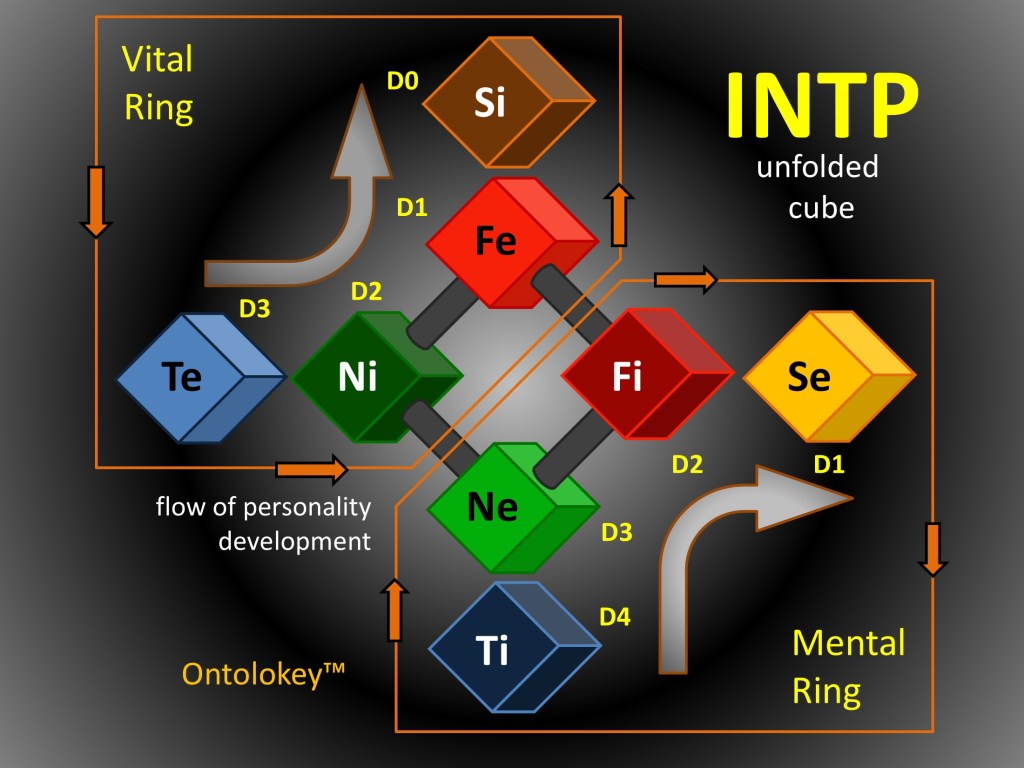
The purpose of individuation, therefore, is not to dismantle the INTP’s intellectual identity but to place it within a larger psychological whole. In the developmental architecture used here, Ti occupies the highest level of the Mental Ring at D4, while Ne follows at D3, making the first movement of development a movement from dominant internal understanding toward increasingly conscious use of the auxiliary function. Only when Ne has matured sufficiently does the path lead toward Fi at D2 and subsequently toward Se at D1; development is therefore conceived as an ordered descent from the most developed conscious function toward progressively less familiar territories rather than as an attempt to leap directly into the deepest shadow. The Vital Ring unfolds in parallel, though with a developmental delay, beginning with Te at D3 and proceeding through Ni at D2, Fe at D1, and finally Si at D0, the archaic or childlike blindspot. Within this model, psychological healing becomes possible because what was formerly experienced as weakness, vulnerability, irrationality, inadequacy, or inexplicable pain can gradually be recognized as information belonging to neglected parts of the same psyche. Ontolokey’s broader conception similarly presents its three-dimensional Cube as a way of making the relationships among the eight functions visible, turning an abstract functional architecture into something that can be psychologically navigated.
The deeper implication is that the INTP does not become whole by becoming someone other than an INTP, but by becoming conscious of everything that the familiar INTP identity has historically left outside its center of gravity. The mature personality can still question assumptions, retreat into solitude, pursue complex ideas, resist superficial explanations, and maintain a fiercely independent relationship with truth, yet these qualities no longer have to serve as psychological walls against experience. Te can teach Ti that implementation is itself a form of inquiry; Ni can introduce the possibility that not every meaningful insight requires endless alternatives; Fi can reveal that personal values cannot always be reduced to universal principles; Se can restore direct contact with the immediate world; Fe can expose the human need for recognition and emotional reciprocity; and Si can eventually reconnect consciousness with continuity, memory, embodiment, and the concrete texture of lived existence. The developmental movement is consequently not from intelligence toward feeling, nor from introversion toward extraversion, but from psychological specialization toward integration. The ultimate aim is a condition in which the INTP’s intellect becomes not a fortress protecting the self from life, but an instrument capable of illuminating the unconscious material that must be encountered if the self is to become whole.
The INTP as a Consciousness Organized Around Understanding
To understand why this process can be so difficult, it is necessary to begin with what the INTP does exceptionally well. Ti gives the personality a powerful internal criterion for coherence: ideas are not accepted merely because they are popular, emotionally reassuring, institutionally established, or socially convenient. The INTP instinctively examines structures from within, searching for inconsistencies and hidden assumptions, and often experiences intellectual independence not as a deliberate rebellion but as an almost natural requirement for authentic thought. Ne then prevents this internal system from becoming completely closed, continuously introducing alternative interpretations and unexpected connections that force Ti to reconsider its conclusions. This produces a distinctive combination of depth and openness: the INTP can simultaneously dismantle an existing explanation and imagine several possible replacements. Yet precisely because this cognitive world is so fertile, the individual may experience the interior realm as more predictable, controllable, and rewarding than the external one, creating the subtle possibility that thinking ceases to be merely a means of understanding reality and gradually becomes a substitute for participating in it.
The first movement toward healing therefore begins with an unusually honest question: What does my thinking help me understand, and what does it help me avoid? This question should not be interpreted as an accusation against rationality, because the INTP’s reasoning is precisely the instrument through which the hidden function of reasoning can become conscious. When disappointment becomes an analysis of interpersonal dynamics, loneliness becomes a theory of attachment, fear becomes an investigation into optimal conditions for action, or emotional uncertainty becomes a demand for more information, cognition may be functioning simultaneously as knowledge and defense. The distinction is subtle because the resulting thought can be genuinely intelligent; intellectualization is not necessarily false thinking, but true thinking employed in the service of avoiding another truth that is psychologically harder to encounter. This is why the INTP shadow can be particularly difficult to recognize from within: the defense often looks indistinguishable from the personality’s greatest virtue. The task of individuation is consequently not to distrust the mind, but to become sufficiently conscious of the mind that one can recognize when the search for understanding has reached the boundary beyond which only experience, relationship, action, feeling, or embodied presence can provide the missing knowledge.
The next sections will therefore follow the developmental direction specified in the Ontolokey framework rather than simply describing the eight functions independently. We will begin with the INTP’s familiar conscious world of Ti and Ne, then examine why the maturation of Ne represents the necessary threshold before the personality can approach the more vulnerable Fi and Se territories of the Mental Ring. From there, the essay will move into the Vital Ring and its more challenging developmental sequence of Te → Ni → Fe → Si, examining how effectiveness, singular insight, interpersonal feeling, and finally the archaic sensory-memory layer can become progressively integrated rather than remaining projected into other people or experienced as unexplained weakness. The central question throughout will be how cognition can transform unconscious psychological material into conscious understanding without turning that understanding itself into another refuge from life. In that sense, the Ontolokey Cube serves as a symbolic landscape for individuation: it does not merely tell the INTP what the personality contains, but provides a way of imagining the gradual movement from the most familiar center of consciousness toward those regions that have remained psychologically underdeveloped.
Ti–Ne — The Architecture of the INTP Mind and the Hidden Cost of Intellectual Mastery
The INTP’s conscious psychological center is formed by the relationship between Introverted Thinking (Ti) and Extraverted Intuition (Ne). Ti occupies D4 in the Mental Ring and represents the most highly developed and trusted mode of consciousness: the impulse to penetrate beneath appearances, separate concepts into their essential components, identify contradictions, and reconstruct reality according to an internally coherent logic. Ne follows at D3 and prevents this internal architecture from becoming static by continually opening it toward alternatives, associations, hypotheses, and unforeseen possibilities. The combination is unusually powerful because Ti supplies discrimination while Ne supplies expansion; one asks whether something makes sense, while the other asks what else might be possible. Ontolokey’s description of the INTP similarly emphasizes that this configuration produces intellectual independence, curiosity, originality, skepticism toward convention, and an almost instinctive attraction to complex systems and underlying principles.
Yet the same configuration can create a psychological enclosure precisely because it is so effective. Ti can transform almost any experience into an object of analysis, while Ne can continually produce another interpretation, another possibility, another explanation, or another perspective from which the original problem can be reconsidered. This creates an extraordinary capacity for intellectual flexibility, but it can also make closure psychologically difficult, because every conclusion seems provisional once another possibility has appeared. The INTP may therefore remain in a state of cognitive suspension long after sufficient information has already been gathered for action, not because the person lacks intelligence or courage, but because continued analysis preserves an environment in which nothing has yet become irrevocable. The danger is particularly subtle because further thinking usually produces something genuinely valuable: a refinement, a distinction, an additional connection, or a more elegant formulation. Consequently, the INTP may not experience avoidance as avoidance at all, but as intellectual honesty, when in reality the mind has begun using its legitimate search for truth to postpone the psychological consequences of choosing.
This distinction becomes crucial when examining the INTP’s relationship with perfectionism and unfinished potential. An idea in the imagination remains infinitely revisable, whereas an idea implemented in the world immediately acquires limitations, imperfections, consequences, and the possibility of failure. For a Ti–Ne personality, the conceptual version can therefore feel more satisfying than the embodied version because the conceptual version has not yet been contaminated by reality’s resistance. A project can remain fascinating precisely because it has not been completed; a decision can remain intellectually rich because it has not yet excluded alternatives; and a relationship can remain psychologically manageable while it exists primarily as something to understand rather than something that demands vulnerability. The result is not simply procrastination in the ordinary sense, but a deeper tension between possibility and actuality. Ontolokey’s growth material identifies this boundary explicitly: the INTP must gradually discover that understanding an experience and actually participating in it are different forms of knowledge, and that intellectual mastery can become defensive when it protects the person from whatever cannot be completely explained or controlled.
The developmental importance of Ne at D3 therefore lies in learning to use possibility without becoming imprisoned by it. Because Ne is the auxiliary function, it is not an enemy of Ti but its necessary expansion, and the first major developmental task is to strengthen this function until it approaches the maturity of the dominant one. A mature Ne does not merely generate more options; it teaches Ti to remain permeable, curious, and responsive to information that does not initially fit its existing model. This is psychologically significant because the INTP’s internal system can otherwise become so elegant that contradictory evidence is unconsciously treated as an inconvenience rather than as an invitation to enlarge the system itself. The development from Ti toward Ne can consequently be understood as the movement from certainty through coherence toward openness through possibility. Only when the INTP has learned to tolerate that openness without losing its intellectual center can the developmental movement continue toward the considerably more vulnerable D2 territory of Fi.
At this stage, however, the INTP should resist the temptation to rush toward the supposedly “deeper” shadow functions. The developmental sequence described by the Ontolokey framework is intentionally gradual: D4 Ti → D3 Ne → D2 Fi → D1 Se within the Mental Ring, while the Vital Ring develops in its own delayed progression. This means that psychological integration cannot be achieved by intellectually recognizing that Fi or Se exists and then attempting to behave as though those functions were already mature. Such an approach would merely turn individuation into another Ti project, with the personality attempting to leap over the developmental work required to reach the unfamiliar territory organically. The first transformation must occur within the existing Ti–Ne consciousness itself: the INTP must become capable of recognizing when thinking illuminates reality and when it creates distance from reality. Once that distinction becomes sufficiently conscious, the mind is no longer merely analyzing its own structure; it is beginning to loosen the psychological defenses that have made the next developmental stage possible.
The deeper purpose of this first stage is therefore not intellectual improvement but epistemological humility. Ti must eventually recognize that internal coherence, however sophisticated, cannot answer every human question, while Ne must learn that endless possibility is not equivalent to freedom if it prevents experience from becoming definite. There are questions that cannot be solved by additional analysis because their answers emerge only through commitment, relationship, value, embodiment, and lived consequence. The INTP begins to mature psychologically when this limitation is no longer experienced as an insult to intelligence but as an expansion of what intelligence itself is capable of recognizing. Thought becomes more powerful when it can acknowledge the existence of knowledge that does not originate in thought, and the conscious personality becomes more spacious when it no longer demands that every dimension of existence first pass through the narrow gate of intellectual explanation. This is the psychological threshold at which the familiar INTP identity begins to open toward the less familiar parts of the self, preparing the way for the next stage: Fi at D2, the Anima/Animus function and the first truly vulnerable descent into the unconscious.
Fi D2 — The Anima/Animus, Vulnerability, Personal Meaning, and the INTP’s Hidden Emotional Life
The movement from Ne at D3 toward Introverted Feeling (Fi) at D2 represents a fundamentally different kind of development because the INTP is now approaching a psychological territory in which objective coherence can no longer provide complete protection. Fi is concerned with inwardly experienced value, authenticity, personal significance, moral resonance, and the question of what something means to me, rather than merely whether it is logically consistent or universally defensible. Within the Ontolokey developmental sequence, Fi occupies the Anima/Animus position, making it especially sensitive and psychologically consequential: it represents a dimension of the personality that may have been present all along but has not received the same conscious authority as Ti and Ne. The INTP may therefore possess considerable emotional depth while simultaneously having difficulty identifying, naming, trusting, or communicating what is happening internally, particularly when the experience cannot immediately be translated into an intellectually coherent explanation. The apparent emotional detachment often associated with the type can consequently conceal not an absence of feeling but a complicated relationship with feeling, in which intense subjective reactions are held privately because exposing them would mean surrendering the psychological distance that Ti ordinarily provides.
The shadow of Fi can become particularly painful when the INTP discovers that personal wounds cannot always be neutralized through understanding. A person may know exactly why a rejection occurred, why another person behaved defensively, why a relationship became dysfunctional, or why a particular failure was objectively understandable, and yet still experience grief, humiliation, longing, resentment, shame, or a profound sense of being unseen. Ti can explain the event without necessarily metabolizing its emotional meaning, and this distinction becomes central to the INTP’s healing process because explanation and reconciliation are not identical psychological acts. When Fi remains insufficiently integrated, the individual may unconsciously judge personal emotional needs as irrational, inconvenient, excessively subjective, or somehow beneath the standards of rigorous thought, thereby creating an internal split between the competent thinker and the vulnerable person who is quietly carrying the consequences of life. The Anima/Animus function becomes developmental precisely because it challenges this split: it asks the INTP to acknowledge that subjective value is not an error in an otherwise objective system, but an irreducible dimension of human existence that must eventually be included in any genuinely comprehensive understanding of the self.
This is also where previously unexplained interpersonal injuries can begin to acquire a new meaning. An INTP who has spent years assuming that being misunderstood should simply be tolerated may eventually recognize that the pain of being misunderstood was not weakness but evidence that recognition and authenticity mattered more deeply than conscious identity had admitted. Likewise, an individual who has habitually responded to criticism by examining whether the criticism was logically justified may discover that the deeper injury concerned dignity, loyalty, trust, belonging, or the feeling that one’s inner reality had been dismissed. Fi does not ask the INTP to abandon analytical judgment; rather, it introduces another criterion of psychological truth alongside logical validity, namely the truth of subjective experience. Once this distinction becomes conscious, forgiveness can also become more psychologically sophisticated, because understanding another person’s motives does not require denying the reality of one’s own wound. The INTP can begin to say, internally and without contradiction, that another person may have had understandable reasons for causing harm and that the harm nevertheless mattered, thereby replacing the false choice between intellectual understanding and emotional self-respect with a more integrated conception of both.
The developmental task at D2 is therefore not emotional expressiveness for its own sake but the legitimization of inner value. Fi becomes mature when the INTP can recognize personal preferences, loyalties, boundaries, ideals, disappointments, and attachments without immediately placing them on trial before the tribunal of Ti. This does not mean that every feeling must be obeyed, because mature Fi is not emotional impulsivity; it is the capacity to recognize an inner response as psychologically meaningful before deciding what to do with it. Such recognition can be profoundly liberating for an INTP because it reduces the need to defend vulnerability through abstraction, irony, withdrawal, or endless analysis. The person begins to understand that emotional information can be observed with the same curiosity previously reserved for intellectual phenomena, allowing feeling to become an object of consciousness without becoming an overwhelming authority over consciousness. In this sense, Fi is not the opposite of Ti but its neglected complement: Ti asks whether an interpretation is internally coherent, while Fi asks whether the resulting life remains faithful to what the person inwardly experiences as meaningful and true.
The danger of approaching Fi prematurely is nevertheless worth emphasizing because the INTP can easily turn individuation itself into another intellectual performance. Reading extensively about emotional intelligence, analyzing attachment patterns, constructing elaborate theories about one’s wounds, or identifying every possible psychological mechanism can create the appearance of profound self-awareness while leaving the underlying vulnerability untouched. The decisive movement occurs when the INTP allows an experience to remain personally meaningful even when it cannot yet be fully explained, and when the individual can tolerate the temporary loss of conceptual mastery that accompanies genuine emotional contact. At this stage, the question changes from “Why do I feel this?” to the more intimate question “What is this feeling telling me about what matters to me?”, without abandoning the first question altogether. When Fi has been sufficiently developed, the INTP does not become less rational; rather, rationality becomes less defensive because the self no longer needs to eliminate subjective experience in order to preserve intellectual coherence.
This maturation also prepares the transition toward Se at D1, the Toddler function and the next, even more vulnerable layer of the Mental Ring. Fi turns the INTP inward toward personal meaning, but Se will eventually demand contact with what is occurring right now, before it has been interpreted, theorized, categorized, or transformed into an abstract possibility. That transition can be unsettling because the INTP’s habitual refuge in mental space becomes less available when the psyche is asked to inhabit the body and immediate environment with greater directness. The individual may discover that some forms of exhaustion, pleasure, fear, attraction, sensory discomfort, and spontaneous reaction have been noticed only after they have already become psychologically significant, because attention was habitually directed toward the conceptual rather than the immediate. Se therefore represents not a rejection of the INTP’s inner world but its grounding in actuality, and the developmental path from Fi to Se begins to reveal why psychological wholeness ultimately requires the thinker to become not merely an observer of life but a participant in it.
Se D1 — The Toddler Function, Embodiment, Immediate Reality, and the Fear of Losing Cognitive Control
The movement from Fi at D2 toward Extraverted Sensing (Se) at D1 takes the INTP into the most immediate and vulnerable territory of the Mental Ring, because Se does not primarily ask the mind to interpret experience but to encounter it directly. Se attends to what is actually present: the body, the environment, sensory information, timing, movement, physical consequences, and the concrete reality unfolding in the present moment. For an INTP, whose psychological center of gravity naturally resides in abstraction, this immediacy can feel strangely primitive or even intrusive because it interrupts the comfortable interval between perception and interpretation. The mind would often prefer to understand an experience before fully entering it, whereas Se insists that some knowledge begins precisely by allowing reality to make an impression before the intellect has decided what that impression means. Within the Ontolokey model, Se as the D1 Toddler function is therefore not simply a weaker skill but a particularly sensitive developmental point, one through which the INTP encounters aspects of vulnerability that have historically remained outside the preferred cognitive mode.
The metaphor of the Toddler is psychologically useful because the function can resemble a young part of the personality that wants direct contact with life but has limited confidence in its ability to manage what it encounters. The INTP may consequently oscillate between under-engagement with the immediate world and sudden, compensatory immersion in sensory experience, particularly under stress or when cognitive control has become exhausted. What has been neglected may then appear in exaggerated form: impulsive stimulation, compulsive activity, sensory indulgence, irritation with physical constraints, or an almost desperate desire to escape the abstract world and feel something real. Such experiences should not automatically be interpreted as pathological; they can represent the psyche attempting to compensate for a chronic imbalance between cognition and embodiment. The developmental challenge is to transform this sporadic and sometimes immature contact with Se into a stable capacity to remain present without needing either to intellectualize every sensation or to be overwhelmed by it.
This becomes especially important in relation to the INTP’s experience of competence and failure. Ti creates an internal standard based on understanding, and Ne supplies possibilities through which problems can be reframed and solved, but neither function guarantees practical fluency in situations where success depends upon timing, physical coordination, rapid response, sensory awareness, or decisive engagement with circumstances that cannot be paused for analysis. The INTP can therefore experience certain failures with disproportionate psychological confusion because the usual source of confidence—being able to understand the problem—does not automatically translate into being able to perform within it. A person may know precisely what should happen and still struggle to make it happen at the required moment, producing an uncomfortable confrontation with the difference between conceptual competence and embodied competence. When this distinction is understood through Se, such failures become less humiliating because they no longer need to be interpreted as evidence that the whole self is inadequate; instead, they reveal an underdeveloped psychological function that can be cultivated gradually through repeated contact with concrete experience.
The healing potential of Se lies precisely in this restoration of contact with reality before judgment takes over. Walking without mentally converting the walk into an abstract problem, cooking while attending to smell and texture, exercising while noticing muscular sensation and breathing, listening to another person without simultaneously constructing an explanatory model, or simply allowing an environment to be experienced without mentally categorizing it can all become forms of psychological development when performed consciously. These activities may appear trivial to a highly conceptual mind, yet their psychological significance lies in the fact that they train consciousness to tolerate immediacy. The INTP gradually learns that not every moment needs to produce an insight, and that an experience does not lose value merely because it cannot be converted into a theory. This creates an important counterweight to the tendency toward perpetual abstraction: reality becomes something encountered rather than merely something represented.
Se also changes the INTP’s relationship with time. Ti and Ne can easily move consciousness away from the present into reconstruction, comparison, anticipation, hypothetical alternatives, or elaborate internal simulations, whereas Se repeatedly returns attention to what is happening now. This does not eliminate reflection or imagination; instead, it introduces a temporal discipline in which thought must periodically return to the conditions under which thought itself is occurring. Such grounding can be particularly valuable when anxiety manifests as endless prediction, when uncertainty generates increasingly elaborate scenarios, or when perfectionism postpones action until every variable appears sufficiently understood. The Se-oriented question is disarmingly concrete: What is actually happening right now, and what does this moment require from me? For the INTP, that question can interrupt enormous amounts of unnecessary cognitive activity without attacking cognition itself, because it establishes reality as the immediate reference point against which thought can be tested.
The transition through Se completes the first developmental circuit of the Mental Ring: Ti → Ne → Fi → Se. What began as the dominance of internal logic has now moved through openness to possibilities, recognition of personal value, and finally direct contact with embodied reality. The significance of this sequence is that each stage corrects a limitation inherent in the previous one: Ne prevents Ti from becoming closed, Fi prevents Ne from becoming endlessly impersonal, and Se prevents Fi from remaining purely internal by reconnecting subjective meaning with actual experience. When these functions become increasingly conscious, the INTP’s original personality is not erased; instead, its center becomes more spacious and capable of containing experiences that previously had to remain peripheral or unconscious. Yet this is only half of the developmental landscape, because the Vital Ring contains another sequence whose functions may feel even more foreign to the INTP’s conscious identity: Te → Ni → Fe → Si. Its integration will gradually confront the individual with effectiveness, singular direction, interpersonal emotional reciprocity, and finally the archaic sensory-memory layer represented by the D0 blindspot.
Te D3 — The Sibling Function, External Effectiveness, and the INTP’s Relationship with Action
With the Mental Ring sufficiently integrated to establish a broader psychological foundation, the developmental process enters the Vital Ring, beginning for the INTP with Extraverted Thinking (Te) at D3, the Sibling function. Te is concerned with external organization, measurable effectiveness, implementation, standards, procedures, resources, and the transformation of ideas into results that can function in the shared world. This makes Te an especially significant developmental counterpart to Ti because both functions value thinking, yet they answer fundamentally different psychological questions: Ti asks whether something is internally coherent, whereas Te asks whether it works effectively in external reality. The distinction is easy to underestimate because an INTP may be intellectually capable of designing an extraordinarily sophisticated solution while remaining comparatively indifferent to whether the solution is implemented efficiently, communicated clearly, maintained consistently, or translated into an outcome that others can actually use. In the Ontolokey developmental sequence, Te therefore represents an important bridge between the INTP’s internal architecture and the demands of the external world, transforming knowledge from something possessed internally into something capable of producing tangible consequences.
The Sibling designation is psychologically meaningful because Te may initially feel neither completely foreign nor completely natural. Unlike Fe or Si, it belongs to the thinking side of the personality and can therefore be recognized by the INTP as a legitimate relative of Ti, yet its external orientation introduces demands that the dominant function does not necessarily prioritize. An INTP may instinctively improve a system because its underlying logic is elegant, but Te asks whether the improvement is actually deliverable, scalable, timely, comprehensible, and useful to someone beyond the individual who conceived it. This can expose a characteristic vulnerability: the INTP may unconsciously confuse having understood the problem with having solved the problem. The distinction becomes increasingly important with age because the world does not reward potential indefinitely; ideas acquire psychological reality through execution, and insight becomes consequential only when it survives contact with practical limitations, deadlines, resources, competing interests, and imperfect human cooperation. Te therefore develops not by suppressing Ti but by forcing Ti to answer to a second criterion of truth: Can this understanding become effective in the world?
This confrontation can initially evoke resistance because external effectiveness often appears crude compared with the complexity of the internal model. The INTP may perceive systems of measurement, productivity, hierarchy, scheduling, standardized procedures, or institutional expectations as intellectually reductive, particularly when these mechanisms reward visible output rather than conceptual depth. Yet the shadow danger lies in using that criticism as an excuse to remain permanently outside the domain of implementation. There is a profound psychological difference between recognizing the limitations of external systems and refusing to develop the ability to operate within them. Mature Te allows the INTP to retain critical independence while acquiring the practical competence to convert ideas into structures that function despite imperfection. The developmental goal is therefore not conformity to external efficiency but instrumental mastery: learning how to make the external world carry part of the weight that the INTP previously attempted to carry entirely within the mind.
Te also introduces a more demanding relationship with personal responsibility. Ti can remain relatively private; a flawed internal theory can be revised without necessarily affecting anyone else, whereas Te makes consequences visible because decisions produce outcomes that can be measured and evaluated. This visibility can be uncomfortable for an INTP who has developed a strong identity around intellectual potential, because implementation creates the possibility that one’s actual performance will contradict one’s self-concept. An unfinished project can preserve the fantasy of what it might become, while a completed project reveals exactly what one was able—or unable—to accomplish under real conditions. In this sense, Te can become psychologically healing because it punctures the protective distinction between the person I could be if circumstances were optimal and the person I am when I actually commit myself to something. External action does not merely produce results; it produces information about the self that cannot be obtained through introspection alone.
The mature development of Te consequently requires the INTP to tolerate a form of imperfection that is different from intellectual uncertainty. An idea can always be refined, but a functioning result must eventually be released while still incomplete, because the external world operates through iteration rather than theoretical finality. This creates an important developmental correction to Ne’s endless possibilities: instead of asking indefinitely what the best solution could be, Te asks which sufficiently good solution can be implemented now, evaluated through feedback, and improved through subsequent cycles. Such an approach does not diminish intellectual standards; it relocates perfection from the initial conception to the developmental process itself. The INTP begins to discover that reality can become an experimental laboratory rather than a hostile judge, and that action provides data just as valuable as abstract research.
As Te approaches a more mature D3 expression, the INTP becomes increasingly capable of externalizing thought without feeling that externalization betrays intellectual independence. The individual can formulate plans, establish priorities, define measurable objectives, delegate when appropriate, communicate conclusions efficiently, and accept practical constraints without surrendering the right to question the system itself. This creates the foundation for the next Vital Ring transition toward Ni at D2, where the issue changes from external effectiveness to the capacity to recognize direction, convergence, and underlying trajectory. Te teaches the INTP to make ideas effective; Ni will challenge the individual to determine which possibilities actually deserve commitment in the first place. The movement therefore continues from Ti → Ne → Fi → Se in the Mental Ring and, with its characteristic delay, Te → Ni → Fe → Si in the Vital Ring, gradually transforming an exceptionally capable observer of systems into a person capable of inhabiting, shaping, and accepting responsibility for the larger system of life itself.
Ni D2 — The Golden Shadow, the Problem of Direction, and the INTP’s Hidden Capacity for Vision
The transition from Te D3 to Introverted Intuition (Ni D2) introduces one of the most psychologically subtle movements in the INTP’s individuation because Ni represents a form of knowing that can appear strangely familiar and simultaneously difficult to trust. Te teaches the INTP to translate thought into external effectiveness, but Ni asks a different question: beneath all the available possibilities and observable developments, where is reality actually going? Whereas Ne expands the field by multiplying possible interpretations, Ni gradually compresses that field toward an underlying trajectory, symbolic pattern, or singular direction that may not yet be fully demonstrable. This makes Ni a particularly important counterbalance to the INTP’s natural tendency to preserve alternatives, because a mature psyche cannot remain indefinitely in a state of open possibility without eventually asking which possibility expresses the deeper movement of one’s life. Ontolokey places Ni in the Golden Shadow, a position that captures this paradox well: the function may represent an admired or strangely compelling psychological capacity that remains less accessible precisely because it operates according to a mode of perception different from the INTP’s preferred analytical expansion.
For the INTP, the difficulty with Ni is not simply that it is less familiar than Ne; it challenges an important assumption underlying the Ti–Ne worldview, namely that maintaining multiple possibilities is inherently safer and intellectually superior to committing to one interpretation. Ne is extraordinarily valuable because it protects the mind from premature closure, but its shadow appears when openness becomes an end in itself and every conclusion remains provisional indefinitely. Ni introduces the opposite movement: the willingness to allow many observations to converge upon a deeper pattern without requiring every alternative to remain equally alive. This can initially feel uncomfortable because the INTP may distrust conclusions that cannot be exhaustively demonstrated, especially when they emerge from an intuitive synthesis rather than from a transparent chain of logical steps. Yet the developmental task is not to replace evidence with intuition, but to recognize that consciousness sometimes detects direction before it possesses a complete explanation of that direction. Ni therefore asks the INTP to tolerate a different kind of uncertainty: not the uncertainty of having too few possibilities, but the uncertainty of sensing a meaningful trajectory before being able to prove exactly why it exists.
This capacity becomes particularly important in the existential dimension of individuation. An INTP can spend years acquiring knowledge, exploring interests, mastering intellectual disciplines, changing professional directions, or pursuing one fascinating possibility after another without ever feeling that a single underlying vocation has emerged. Such a life can be rich and genuinely exploratory, yet it may also conceal an avoidance of commitment because every new possibility renews the pleasurable experience of beginning without imposing the consequences of choosing. Ni gradually asks the individual to look backward across this apparently fragmented history and identify the deeper pattern connecting experiences that once seemed unrelated. Perhaps the same question has appeared in different forms across several fields; perhaps certain problems repeatedly attract attention; perhaps particular forms of injustice, beauty, complexity, or discovery consistently awaken the deepest energy. The developmental insight is that a life may possess coherence even when its individual episodes appeared disconnected at the time, and Ni gives the INTP a psychological language for recognizing that coherence.
The Golden Shadow quality of Ni also means that the INTP may unconsciously project this capacity onto people who seem unusually focused, visionary, mysterious, strategic, or internally directed. Such individuals may appear to possess something the INTP lacks: an almost unsettling ability to ignore peripheral possibilities and move toward one central interpretation or destination. The projection can produce both admiration and irritation because the INTP may simultaneously recognize the power of convergence and resist what appears to be premature certainty. Yet the developmental value lies precisely in recovering the projected capacity rather than either idealizing or dismissing it. The INTP does not need to become someone who trusts every intuition or follows a single vision blindly; rather, Ni becomes integrated when the person can allow an emerging pattern to influence attention and direction while still subjecting it to Ti’s critical examination and Te’s practical testing. In this way, intuition becomes neither an irrational substitute for evidence nor another object of endless analysis, but a source of orientation that can be tested through lived experience.
Ni also changes the psychological meaning of knowledge. Ti seeks to understand the architecture of things, Ne explores what else could follow from that architecture, and Te tests whether the resulting ideas can function externally; Ni asks what all of this means in the larger pattern. This is a movement from accumulation toward synthesis, from the expansion of the map toward the recognition of the landscape. The Ontolokey conception of its Cube is particularly relevant here because it presents personality not merely as a static typological classification but as a spatially intelligible psychological landscape in which different functions become accessible as different directions of movement. The metaphor is useful for individuation because the INTP eventually needs to discover that possessing more possibilities is not necessarily the same as possessing more freedom; sometimes freedom emerges when consciousness becomes capable of recognizing which possibilities are psychologically central and allowing less important alternatives to recede.
At the deepest level, Ni asks the INTP to relinquish a subtle form of omnipotence: the fantasy that sufficient analysis can keep every future open until the correct decision becomes intellectually undeniable. Life rarely provides that certainty. Careers develop through choices that cannot be reversed without cost, relationships acquire histories that cannot be reset, creative work becomes real only when possibilities are excluded, and personal identity itself develops through commitments that could always have been different. Ni helps the INTP perceive that direction does not necessarily emerge after certainty; often, certainty emerges only through direction, because committing to a path generates experiences that reveal whether the path was meaningful. This is psychologically different from impulsive decision-making, since Ni does not demand action without reflection; it asks the individual to recognize when continued reflection has ceased to deepen understanding and has begun to prevent destiny from acquiring concrete form. When Te and Ni become sufficiently integrated, the INTP can therefore move from “What could I do?” toward “What is life asking me to develop?”, a question that prepares the psyche for the next and considerably more vulnerable territory of the Vital Ring: Fe D1, where the abstract problem of human connection becomes an immediate encounter with emotional reciprocity, belonging, recognition, and the need to be understood.
Fe D1 — The Inferior Function, Belonging, Emotional Reciprocity, and the INTP’s Hidden Need to Be Seen
The movement from Ni D2 toward Extraverted Feeling (Fe D1) brings the INTP into perhaps the most psychologically charged territory of the Vital Ring, because Fe concerns a dimension of existence that cannot be controlled entirely from within the individual. It concerns emotional reciprocity, interpersonal atmosphere, belonging, recognition, shared feeling, and the subtle communication through which human beings continually confirm or deny one another’s psychological existence. For the INTP, whose habitual mode is to retreat into an internally coherent mental world, this dependency upon interpersonal resonance can feel uncomfortable precisely because it exposes a need that cannot be satisfied through self-sufficiency alone. The INTP may consciously value independence so strongly that the need to be appreciated, understood, welcomed, or emotionally connected is pushed into the background, yet its absence can still produce loneliness, disappointment, or a painful sense of invisibility. In this sense, inferior Fe is not evidence that the INTP lacks human feeling; it is evidence that the interpersonal dimension of feeling occupies a comparatively vulnerable developmental position and therefore may become disproportionately significant when the psyche is under pressure.
The shadow expression of inferior Fe often emerges through a contradiction between wanting connection and protecting oneself from the conditions necessary for connection. The INTP may desire people who understand the complexity of the inner world but become frustrated when others require emotional communication that feels imprecise, repetitive, or difficult to formulate. There can be a tendency to offer solutions when another person is seeking empathy, to explain motives when another person wants acknowledgment, or to retreat into silence when the emotional intensity of an interaction exceeds the individual’s available vocabulary. From the INTP’s perspective, these responses can appear reasonable because they are attempts to reduce confusion and restore coherence; from the perspective of another person, however, they may feel like emotional absence or rejection. The painful irony is that the INTP can then interpret the resulting relational distance as confirmation that other people are difficult to understand, when the deeper issue may be that interpersonal understanding requires a form of participation that cannot be substituted by analysis alone.
Fe development therefore requires the INTP to learn a radically different form of listening. Listening in the Ti–Ne mode often means identifying the structure of what another person is saying, locating inconsistencies, discovering underlying causes, and generating possible interpretations; Fe requires an additional capacity to register what the interaction itself is doing emotionally. The question becomes not merely “Is this person’s argument valid?” or “Why are they behaving this way?”, but “What is happening between us right now?” That question directs consciousness toward relational reality, where tone, timing, warmth, withdrawal, embarrassment, enthusiasm, disappointment, and mutual recognition carry information that cannot be reduced to propositions. Developing Fe does not mean becoming socially performative or sacrificing authenticity in order to please everyone; it means becoming capable of recognizing that communication has consequences beyond the literal content of words, and that emotional reciprocity is itself a form of information about the relationship.
This is where some of the INTP’s deepest wounds may become visible. A person who has spent years being valued primarily for intelligence, originality, problem-solving, or independence may unconsciously conclude that being useful is the safest way to deserve connection. If emotional needs feel difficult to articulate, competence can become a substitute for intimacy: I may not know how to express what I feel, but I can solve your problem; I may not know how to comfort you, but I can explain what happened; I may not know how to ask for affection, but I can provide something valuable. Such patterns can function effectively for years while leaving the underlying relational need untouched. When the INTP eventually encounters situations in which usefulness no longer guarantees closeness, the resulting loneliness may seem inexplicable unless Fe has become conscious. The developmental realization is that human beings do not only need to be understood or helped; they also need to feel met, and being met requires the willingness to reveal something that cannot be defended entirely through competence.
The inferiority of Fe can also produce an exaggerated sensitivity to social evaluation, particularly when the INTP has already invested heavily in intellectual independence. Criticism may be dismissed rationally while still causing a deeper wound that remains unacknowledged; social rejection may be explained away as evidence of incompatibility while the psyche continues to experience grief; praise may be distrusted while simultaneously becoming intensely gratifying. These apparent contradictions make sense when Fe is understood as a vulnerable function rather than simply an absent one. What consciousness rejects can sometimes be precisely what the unconscious continues to seek, and the result may be oscillation between detachment and an unexpectedly intense desire for approval or belonging. Integration requires neither dependence upon external validation nor rejection of it, but the capacity to recognize the legitimate human need for relational confirmation without allowing that need to determine one’s entire identity.
Mature Fe ultimately teaches the INTP that emotional intelligence is not the opposite of truth. The individual can maintain intellectual independence while learning to communicate warmth, acknowledge another person’s experience before analyzing it, apologize without constructing a philosophical defense, express appreciation without embarrassment, and state personal needs without first proving that those needs are objectively justified. Such acts may initially feel inefficient or strangely exposed, but they gradually reveal that relationships contain a form of knowledge inaccessible to solitary cognition. The INTP discovers that another consciousness cannot be completely modeled from the outside because genuine relationship changes both participants; the interaction itself becomes part of the information being studied. When Fe develops toward greater stability, the INTP becomes less likely to experience emotional dependence as a threat to autonomy and more capable of understanding connection as an expansion of the self rather than its dissolution.
This prepares the final descent of the Vital Ring toward Si D0, the tertiary function and deepest blindspot in the developmental sequence described here. Si is associated with continuity, embodied memory, familiarity, accumulated experience, routine, preservation, and the psychological imprint of what has already happened, and at D0 it represents material that can remain extraordinarily difficult for the INTP to approach consciously. If Fe asks the INTP to recognize the emotional reality between people, Si asks the individual to confront the personal history carried within the body and memory itself. The developmental movement therefore becomes increasingly intimate: from external effectiveness through inner direction toward relational reciprocity and finally toward the archaic layers of experience that may have been present long before the adult intellect developed its sophisticated defenses. Reaching this final territory is not a matter of becoming nostalgic or conventional; it is a confrontation with continuity itself, and with the possibility that some wounds cannot be fully understood until the person recognizes how the past continues to live inside the present.
Si D0 — The Blindspot, Childhood Imprints, Memory, Embodiment, and the Final Descent into the Unconscious
The movement from Fe D1 toward Introverted Sensing (Si D0) represents the deepest descent of the Vital Ring because Si occupies the developmental position of the INTP’s blindspot, the archaic or childlike layer designated D0. Si is concerned with continuity, accumulated experience, familiarity, bodily memory, personal history, repetition, preservation, and the internal record of what has already been lived, yet these dimensions may be difficult for an INTP to approach deliberately because consciousness is naturally pulled toward conceptual novelty rather than toward continuity with the past. The INTP may remember facts with remarkable precision while remaining comparatively detached from the experiential texture surrounding those memories, or may understand an earlier event intellectually without recognizing how its emotional and bodily residue continues to influence present behavior. At D0, therefore, Si should not be understood merely as poor memory or dislike of routine; it represents a deeper difficulty in recognizing the past as a living psychological presence rather than simply as information that has already been processed. Its integration becomes the final and most archaic stage of the Vital Ring because the individual is asked to encounter aspects of experience that existed before the sophisticated Ti–Ne identity could organize them into concepts.
This makes Si particularly relevant to the question of psychological wounds and self-healing. Human experience is not stored exclusively as explicit intellectual knowledge; events can leave traces in expectations, bodily reactions, habits, emotional associations, avoidance patterns, and seemingly disproportionate responses to situations that resemble something from the past. An INTP may therefore discover that an apparently irrational reaction has an intelligible history once the forgotten or minimized context becomes conscious. The crucial movement is not to reconstruct childhood as an endless archaeological project, but to recognize that present reactions sometimes contain information about earlier experiences that the conscious intellect has classified as irrelevant, finished, or insufficiently rational. When these connections become visible, self-judgment can begin to soften because the individual no longer interprets every vulnerability as a current failure of competence. What previously appeared as inexplicable weakness can instead be understood as an old adaptation that once served a protective purpose but no longer needs to govern the adult personality.
The D0 designation also explains why the integration of Si cannot simply be accomplished through intellectual insight. The INTP may understand the theory of memory, trauma, conditioning, habit formation, or developmental psychology in considerable detail and still remain disconnected from the particular experiences encoded within the self. This is another point at which cognition must change its function: instead of using knowledge to maintain distance, it becomes a tool for approaching what has previously been too diffuse, uncomfortable, or insignificant to notice. The individual may begin by observing recurring patterns in ordinary life—what kinds of environments produce tension, what forms of criticism evoke disproportionate reactions, what situations trigger withdrawal, what bodily sensations accompany emotional discomfort, and which apparently minor experiences repeatedly carry unusual psychological weight. Such observation allows the past to become legible without forcing it into a predetermined narrative, and it creates the possibility of distinguishing between what belongs to the present and what belongs to an earlier psychological world.
There is also a profound developmental lesson concerning repetition. The INTP’s attraction to novelty through Ne can produce an understandable desire to move toward what is intellectually new, while Si quietly preserves the unfinished material of what has already occurred. When neglected, this can create a strange psychological asymmetry in which the individual understands many possibilities for the future but remains insufficiently reconciled with the experiences that formed the present self. The past may then return indirectly through recurring relational patterns, familiar forms of disappointment, chronic avoidance, or repeated attempts to solve an old psychological problem using increasingly sophisticated intellectual strategies. Integrating Si means recognizing that development is not exclusively forward movement; sometimes progress requires returning consciously to something that was previously passed over too quickly. The purpose is not regression, but completion: an experience that was never fully assimilated can finally become part of the person’s history rather than continuing to operate as an invisible instruction.
At this deepest level, the metaphor of the turning iceberg becomes particularly powerful. The conscious personality is initially experienced as the visible portion of the self, while enormous psychological material remains below the surface, inaccessible or insufficiently differentiated; as development progresses, the familiar orientation is gradually destabilized and previously submerged functions begin to emerge into awareness. The movement through the Mental Ring and Vital Ring can thus be imagined as a progressive rotation of the psychological whole, in which each function that once occupied the unconscious periphery becomes increasingly available to consciousness. What matters is not replacing Ti with another function, because the developmental process ultimately returns toward the dominant function, but transforming the relationship between Ti and everything it previously excluded. The INTP eventually discovers that the intellect does not become weaker when it encounters its unconscious foundations; it becomes more humane, more flexible, and more complete because it can finally distinguish between the truth of an idea and the truth of the person who is living it.
The integration of Si also provides a final key to forgiveness. When an INTP can recognize that present behavior is partly shaped by accumulated experience, it becomes easier to understand both personal limitations and the limitations of other people without reducing either to simple moral failure. This does not mean excusing harmful behavior or denying responsibility, because genuine understanding can coexist with boundaries and accountability; rather, it means seeing behavior within the psychological history that produced it. A person who was emotionally unavailable may have been protecting an old wound, someone who repeatedly misunderstood the INTP may have been operating from their own assumptions and limitations, and the INTP’s own withdrawal may have been an adaptation that once preserved safety but later became an obstacle to intimacy. Such recognition can transform resentment into discernment because the psyche no longer needs to preserve the wound in order to preserve the lesson. In this sense, cognition becomes an instrument of forgiveness: not forgiveness as passive acquiescence, but forgiveness as the release of unnecessary psychological identification with what happened.
The completion of the Vital Ring—Te → Ni → Fe → Si—therefore does not mean that the INTP has become an entirely different kind of person. It means that the individual has gradually acquired access to forms of consciousness that were previously experienced as secondary, uncomfortable, excessive, impractical, mysterious, or simply irrelevant. Te gives thought external consequence, Ni gives possibility direction, Fe gives intelligence relational participation, and Si gives the present a conscious relationship with its own history. Together with the Mental Ring’s Ti → Ne → Fi → Se, these functions create a much larger psychological field than the original Ti-centered identity could contain. The deepest shadow is no longer merely a collection of undesirable traits; it becomes the unexplored remainder of the self, containing precisely those capacities and vulnerabilities that must be integrated if the personality is to move from specialization toward wholeness.
The Shadow as a Wound and a Resource — Why the INTP’s Weakest Functions Can Become the Path to Healing and Individuation
The central psychological insight of individuation is that the shadow is not simply the collection of characteristics an individual dislikes about themselves; it is also the territory in which unrealized capacities, disowned needs, forgotten experiences, and vulnerable forms of consciousness remain alive. For the INTP, this distinction is essential because the personality’s greatest conscious strength can make its shadow unusually easy to rationalize away. Ti can explain why vulnerability exists, Ne can generate multiple interpretations of it, Te can propose strategies for overcoming it, and Ni can construct an overarching narrative that gives it meaning, yet none of these processes necessarily guarantees that the underlying experience has actually been integrated. The shadow becomes psychologically significant when something repeatedly exceeds the explanatory model: an emotional reaction that seems disproportionate, a relationship that cannot be solved through reason, an inexplicable sensitivity to rejection, a recurring failure despite intellectual competence, or a persistent inability to translate intention into action. These contradictions are not necessarily defects in the personality; within the developmental framework used here, they can function as signals pointing toward a part of the psyche that consciousness has not yet learned to include.
This is why the progression through the functions must remain sequential rather than becoming an attempt to activate the deepest function immediately. If the INTP tries to develop Se before Fi has become sufficiently conscious, immediate experience can feel overwhelming because the person has not yet developed an adequate relationship with the values and vulnerabilities that give experience psychological meaning. Likewise, attempting to force Fe before Ni and the preceding developmental work have matured can produce artificial social behavior rather than genuine relational integration, while trying to confront Si directly can cause the individual to construct elaborate explanations of the past without actually becoming more reconciled with it. The sequence matters because each developed function becomes a psychological bridge to the next: Ti makes Ne possible, Ne opens the way toward Fi, Fi prepares Se; Te creates the foundation for Ni, Ni prepares Fe, and Fe creates the relational threshold through which Si can eventually become conscious. Individuation is consequently not a dramatic descent into the unconscious but a disciplined expansion of consciousness in which every developmental step increases the psyche’s capacity to tolerate the next one.
The Anima/Animus and Toddler functions deserve particular attention because they can expose the INTP to wounds that the dominant intellect has historically protected against. Fi may carry the experience of being personally hurt, misunderstood, rejected, morally violated, or emotionally unseen, while Se may carry the more immediate vulnerability of bodily exposure, helplessness, sensory overwhelm, or the inability to retreat into abstraction. When these functions remain unconscious, the INTP can unconsciously compensate by becoming even more cerebral, more independent, more skeptical, or more detached, thereby reinforcing the very pattern that keeps the vulnerable material hidden. Once they become conscious, however, the same sensitivities can become sources of information: Fi reveals what truly matters, while Se reveals what is actually happening. The person can then begin to understand why certain situations were painful and why certain challenges produced disproportionate difficulty, not as evidence that the personality was fundamentally defective, but as evidence that particular psychological capacities had not yet received sufficient development.
This reframing has an important consequence for self-forgiveness. Many INTPs can be remarkably demanding toward themselves because Ti establishes a powerful internal standard of competence, while Ne makes it possible to imagine how much more intelligently, efficiently, or elegantly something could have been done. The result can be retrospective self-criticism in which the adult mind judges earlier versions of the self using capacities that those earlier versions had not yet developed. An individual may look back and think, I should have recognized this, I should have handled that relationship differently, I should have acted sooner, I should have understood what was happening, without recognizing that the ability to understand the situation now may itself be the product of years of psychological development. Genuine individuation replaces this impossible standard with a more compassionate form of causality: the past self acted with the consciousness available at the time, and the present self can now use newly developed awareness to respond differently. Healing does not require approving of every past decision; it requires understanding the psychological conditions under which those decisions became possible.
The same principle applies to forgiveness of others. Once the INTP begins to perceive behavior through the entire functional landscape rather than exclusively through Ti, human beings become less reducible to the single explanation that their behavior was simply rational or irrational, good or bad, intelligent or foolish. A person can simultaneously have acted from fear, attachment, insecurity, habit, misunderstanding, personal values, bodily stress, and limited emotional awareness, just as the INTP can simultaneously have been intellectually correct and psychologically defended. Such complexity does not abolish moral responsibility, but it makes simplistic resentment increasingly difficult to sustain. Understanding becomes a form of liberation because the mind no longer has to spend enormous energy preserving an internally coherent case against another person in order to justify its own pain. The INTP can eventually distinguish between what happened, why it may have happened, what it did to me, and what I choose to do with it now, thereby separating comprehension from reconciliation while allowing both to develop.
The Ontolokey Cube can serve this process as a concrete psychological visualization because the functions cease to appear as an abstract list and instead become positions within a developmental landscape. The sliders can be understood symbolically as a way of asking where attention is currently concentrated and which direction development is inviting next, particularly when the conscious personality has become stuck in a familiar mode of functioning. For the INTP, the value of such visualization lies in making the asymmetry of development psychologically visible: Ti does not require the same developmental intervention as Se, just as Ne should not be treated as though it were at the same developmental level as Si. The model can therefore function as a reflective map through which the individual observes not only strengths but also the psychological territories that have historically been avoided, projected, misunderstood, or experienced as weaknesses. The important point is that the map is not the destination; its purpose is to help consciousness recognize where the next bridge can be built.
Ultimately, the shadow becomes a resource when the INTP stops asking how to eliminate weakness and begins asking what neglected function is trying to become conscious through that weakness. Persistent indecision may contain a lesson about direction; relational isolation may contain a lesson about emotional reciprocity; discomfort with embodiment may contain an invitation into presence; disproportionate sensitivity may reveal a neglected value; compulsive analysis may signal an attempt to avoid an experience that needs to be felt rather than solved. This does not mean every difficulty has a single hidden function behind it, but it establishes a productive attitude toward psychological conflict: contradiction becomes information rather than merely an obstacle. Through this attitude, the INTP gradually learns that the shadow does not exist to destroy the conscious personality but to complete it. The deepest healing occurs when the formerly rejected parts of the self can finally say, in psychological terms, “I belong here too,” and the dominant Ti consciousness is sufficiently mature to answer not by defending itself, but by making room.
The Individuation Path — From D4 to D0 Without Bypassing Development
The developmental architecture of the INTP can now be understood as a disciplined movement from what is already strong toward what remains progressively less conscious, rather than as a demand to become equally proficient in every psychological function. In the Mental Ring, the sequence is Ti D4 → Ne D3 → Fi D2 → Se D1, while the Vital Ring follows Te D3 → Ni D2 → Fe D1 → Si D0, developing with a relative delay behind the Mental Ring. This distinction is important because individuation cannot be reduced to collecting behaviors associated with all eight functions; the deeper process is one of expanding consciousness in an ordered manner. The dominant function provides the psychological foundation, the auxiliary function broadens and stabilizes that foundation, and only then can increasingly vulnerable functions be approached without overwhelming the personality’s existing structure. In the Ontolokey conception, development therefore resembles a controlled descent into one’s own psychological landscape: consciousness does not abandon its familiar center, but progressively establishes enough inner stability to explore territories that previously belonged largely to the unconscious.
The first major developmental threshold is consequently the movement from Ti D4 toward Ne D3, and this is especially relevant during early adulthood and the period in which the auxiliary function normally becomes increasingly differentiated. The INTP must learn to use Ne not simply as an engine for producing more ideas but as a corrective to the closed perfection of internal logic. This means deliberately exposing one’s models to novelty, contradiction, unfamiliar perspectives, interdisciplinary information, and experiences that cannot immediately be reduced to an existing conceptual framework. The developmental question is not whether the INTP can generate possibilities—the type generally does this naturally—but whether those possibilities are genuinely allowed to challenge the conclusions of Ti. A mature D3 Ne therefore represents intellectual permeability rather than intellectual abundance alone, and when it approaches the strength of the dominant function, the personality acquires sufficient flexibility to proceed toward Fi without experiencing subjectivity itself as a threat to reason.
The transition from Ne D3 to Fi D2 marks the first unmistakably inward encounter with material that cannot be made psychologically neutral through abstraction. Here the INTP must begin differentiating between understanding what is objectively defensible and recognizing what is personally meaningful, hurtful, valuable, or unacceptable. Practical exercises in this phase are deceptively simple: noticing emotional reactions before explaining them, identifying personal boundaries, articulating preferences without universalizing them, distinguishing shame from responsibility, and asking what a recurring emotional response reveals about one’s values. The essential discipline is to postpone judgment long enough for subjective information to become conscious. Once Fi becomes more mature, the INTP can approach Se D1 with greater stability because immediate experience is no longer merely raw sensory input; it can be recognized as an experience occurring to a particular person whose needs, values, vulnerabilities, and history matter.
The transition toward Se D1 then requires a deliberate cultivation of presence. The INTP benefits from activities in which the body and environment cannot be replaced by conceptual simulation: physical movement, craftsmanship, cooking, nature, music, manual work, direct conversation, and any situation requiring sustained attention to what is actually occurring rather than what might occur. The purpose is not to turn sensory experience into another optimization project, because that would simply reproduce Ti’s dominance under a different name. Instead, Se becomes developed when the INTP can tolerate the ordinary incompleteness of immediate life: sensations that do not need interpretation, environments that do not need categorization, moments that do not need to become productive, and actions that must occur before every uncertainty has been resolved. This is one of the places where psychological healing can become unexpectedly concrete, because embodiment provides evidence that the self is not merely a thinking entity but a living organism whose state continuously influences cognition, emotion, attention, and behavior.
Meanwhile, the Vital Ring begins its own delayed progression with Te D3, and its development should not be confused with the more vulnerable stages that follow. Te first requires the INTP to become externally effective without surrendering intellectual autonomy: setting deadlines, finishing projects, communicating conclusions, organizing resources, establishing priorities, measuring outcomes, and accepting useful external feedback. Once Te becomes sufficiently mature, Ni D2 can develop through the recognition of convergence and direction, asking which possibilities repeatedly appear meaningful across apparently unrelated experiences. At this stage, journaling can be particularly useful if it is used not merely to record thoughts but to identify recurring themes across years: what problems continually attract attention, what kinds of work repeatedly generate vitality, what choices repeatedly feel significant, and what patterns appear despite changes in circumstances. The movement is from possibility toward trajectory, allowing the INTP to discover that commitment does not necessarily destroy freedom but can give freedom a direction in which it becomes psychologically consequential.
The subsequent transition from Ni D2 to Fe D1 is more demanding because the INTP must increasingly allow other people to become participants in psychological reality rather than objects of analysis. Development here involves learning to communicate emotional information directly, to ask for what one needs without first proving that the need is rational, to acknowledge another person’s experience before correcting its interpretation, and to remain present during emotionally uncomfortable conversations rather than automatically retreating into analysis. The mature form of Fe does not require social conformity or indiscriminate agreeableness; it permits the INTP to remain authentic while recognizing that relationships have their own reality and that another person’s emotional experience cannot be solved merely by explaining it. As Fe becomes sufficiently differentiated, the final Vital Ring transition toward Si D0 becomes possible, because relational safety creates a stronger foundation from which the individual can encounter personal history, bodily memory, continuity, and the childhood layers of experience that may previously have remained psychologically inaccessible.
The movement into Si D0 should therefore be approached with particular patience. Because D0 represents the archaic or childlike developmental level in this model, the goal is not to force the blindspot into immediate conscious mastery but to develop a compassionate relationship with what emerges from it. Repeated memories, bodily sensations, old fears, habitual responses, unexplained sensitivities, and recurring relational patterns can be observed without immediately constructing a definitive explanation for them. The INTP’s greatest discipline here is to resist turning the unconscious into a puzzle that must be solved at once, because the demand for total explanation can itself become another defense against vulnerability. Instead, cognition functions as a gentle organizing principle that allows experience to become increasingly intelligible over time. In this final stage, the past is neither glorified nor rejected; it becomes integrated as part of the present self.
The complete sequence can therefore be viewed as a gradual widening of the INTP’s definition of what constitutes valid psychological knowledge. Ti establishes coherence, Ne establishes openness, Fi establishes personal value, and Se establishes presence; Te establishes effectiveness, Ni establishes direction, Fe establishes relationship, and Si establishes continuity with lived history. None of these functions needs to replace another, and none becomes psychologically valuable by imitating the dominant function. The aim is precisely the opposite: each function must be allowed to contribute the kind of information for which it is naturally suited, until consciousness becomes capable of holding forms of truth that previously appeared incompatible. This is why the sequence cannot be bypassed: each developmental level increases the capacity necessary to tolerate the next, and every successful integration reduces the need to defend the old psychological hierarchy through avoidance, projection, intellectualization, or self-criticism.
The resulting individuation process resembles the rotation of the iceberg described in the developmental metaphor: what was originally visible becomes gradually displaced while submerged material rises toward awareness, and the familiar conscious personality may temporarily feel destabilized as its psychological center of gravity changes. This can produce periods of uncertainty because the person no longer identifies exclusively with the functions that once supplied a stable sense of competence, yet the unfamiliar functions have not fully matured enough to provide equivalent confidence. Such instability should not automatically be interpreted as regression; it can represent the necessary psychological disorientation that occurs when an old identity is becoming too small for the consciousness developing within it. Over time, however, the process returns toward Ti, not as a return to the old personality but as a renewed Ti capable of containing the knowledge acquired through the entire journey. The dominant function remains the dominant function, but it is no longer alone at the center.
The Turning Iceberg — Crisis, Transformation, Self-Compassion, and the Emergence of the Complete Self
The turning of the iceberg is perhaps the most psychologically important image for understanding what individuation feels like from the inside, because genuine development rarely resembles a smooth upward progression. When the auxiliary function has become sufficiently developed, the previously stable structure of consciousness begins to lose its exclusive authority, and material that had remained below the surface can become increasingly difficult to ignore. For an INTP, this may initially appear as confusion, emotional turbulence, loss of certainty, dissatisfaction with intellectual achievements, bodily unease, relational sensitivity, or an unfamiliar awareness of personal needs and limitations. The temptation is to interpret such experiences as evidence that something has gone wrong, especially for a personality whose identity has often been organized around understanding, autonomy, and cognitive competence. Yet within the Ontolokey developmental image, this destabilization has a different meaning: the iceberg is rotating. What was once hidden is becoming visible, while what once seemed sufficient is being relativized by a larger psychological reality. The crisis therefore does not necessarily indicate the destruction of the personality; it can indicate that the personality has become too small for the consciousness that is beginning to emerge.
This distinction is essential because the unconscious does not usually enter consciousness in a form that feels convenient, elegant, or intellectually satisfying. The INTP may discover that beneath apparently rational decisions there were fears of rejection, beneath indifference there was disappointment, beneath criticism there was hurt, beneath withdrawal there was a longing for recognition, and beneath endless analysis there was sometimes an inability to tolerate uncertainty in lived experience. Such discoveries can produce a painful reinterpretation of one’s own biography because previous behavior may suddenly acquire meanings that were invisible at the time. A person may look backward and realize that certain opportunities were avoided not because they were objectively wrong but because they threatened vulnerability, that certain relationships were analyzed instead of inhabited, or that certain ambitions remained hypothetical because actual commitment would have exposed the limits of competence. This retrospective awareness should not become another instrument of self-attack. The purpose of consciousness is not to prosecute the earlier self with information that the earlier self did not possess, but to understand why that self developed the strategies it did and what those strategies were attempting to protect.
Self-compassion therefore becomes more than an emotional virtue during individuation; it becomes a psychological necessity. An INTP who approaches the shadow exclusively through Ti can easily transform development into another perfectionistic project in which every weakness becomes a defect to be corrected and every unconscious reaction becomes evidence of insufficient self-mastery. That approach reproduces the very fragmentation that individuation is meant to overcome, because the conscious personality remains positioned as an external judge examining inferior or defective psychological parts. The deeper movement is different: the observing mind gradually becomes capable of saying that the vulnerable part, the impulsive part, the socially uncertain part, the emotionally sensitive part, and even the historically conditioned part belong to the same person. Fi contributes the recognition that subjective suffering has meaning; Se allows that suffering to be experienced rather than endlessly interpreted; Fe recognizes that the self exists in relationship; and Si eventually places present reactions into the continuity of an individual life. The result is not indulgence and certainly not the denial of responsibility. It is the replacement of hostile self-correction with understanding, responsibility, and integration.
This is also where forgiveness acquires its deepest psychological significance. Forgiveness does not require declaring that everything that happened was acceptable, nor does it erase responsibility for one’s own behavior or the behavior of others. Rather, it becomes possible to distinguish between understanding a cause and approving its consequence. When an INTP recognizes the developmental limitations that shaped an earlier version of the self, the past can gradually be released from the impossible demand that it should have been lived with today’s consciousness. The same principle can apply to other people: understanding their psychological limitations may reveal why they acted as they did without requiring reconciliation, trust, or continued contact. In this sense, cognition can genuinely participate in healing, but only when cognition becomes compassionate enough to include the person who experienced the event rather than merely constructing an explanation of it. The mind moves from asking, “Who was right?” toward the more transformative question, “What happened inside the people involved, what remained unconscious, and what can now become conscious?” Such questions do not weaken moral discernment; they make it more nuanced, less reactive, and more capable of ending psychological repetition.
The final image of the turning iceberg is therefore not the disappearance of the original INTP personality but its return in a transformed condition. Ti remains Ti, and the return of the dominant function to the visible position symbolizes that individuation does not require abandoning one’s essential cognitive nature. What changes is what Ti now contains: Ne has learned openness rather than merely proliferation, Fi has given subjectivity and personal meaning a legitimate place, Se has restored contact with immediate embodied reality, Te has strengthened implementation, Ni has introduced direction, Fe has opened reciprocal human participation, and Si has brought history, memory, continuity, and the residues of earlier life into consciousness. The dominant function is no longer the ruler of an isolated psychological kingdom; it becomes the center of a more complete internal ecology. In the language of wholeness, the Self emerges not because every function has become equally strong, but because fewer parts of the person remain exiled from awareness. The INTP can then return to thought without using thought to escape life, return to solitude without confusing solitude with isolation, and return to intellectual freedom without needing freedom from vulnerability. That is the deeper meaning of rebirth within the Ontolokey model: not becoming someone else, but becoming capable of inhabiting oneself more completely.
The Practical Discipline of Integration — How the INTP Can Translate Shadow Awareness into Everyday Development
Psychological integration becomes meaningful only when it begins to alter the way life is actually lived, because insight that never reaches behavior can become another sophisticated form of avoidance. For the INTP, this distinction is particularly important because understanding a psychological pattern can create the satisfying impression that the pattern has already been transformed. One may recognize the mechanism, formulate its causes, compare alternative interpretations, and construct an elegant conceptual model while continuing to behave exactly as before. The developmental task is therefore not to accumulate increasingly refined descriptions of the self, but to allow consciousness to modify the relationship with experience one small action at a time. In the Ontolokey framework, this means respecting the developmental sequence rather than attempting to force an artificial balance among all eight functions. Ti remains the cognitive foundation, while Ne becomes the first major instrument of expansion; from there, Fi and Se gradually bring the person closer to subjective value and immediate experience. On the Vital Ring, Te, Ni, Fe, and eventually Si are approached in their own sequence, with each stage preparing the psychological ground for the next.
The first practical discipline is therefore observation before correction. When an INTP notices withdrawal, procrastination, emotional irritation, compulsive analysis, social avoidance, overplanning, or a sudden need to prove intellectual competence, the immediate impulse may be to explain or eliminate the reaction. A more developmental response is to pause and ask which function is currently attempting to enter consciousness and what reality it is carrying. If Fi is involved, the relevant question may concern personal hurt, value, dignity, resentment, attachment, or an unacknowledged preference that Ti would rather classify as subjective noise. If Se is involved, the problem may be that the person has become disconnected from bodily signals, environmental demands, fatigue, pleasure, or the concrete moment in which life is actually occurring. If Fe is activated, an apparently irrational social reaction may contain information about belonging, reciprocity, recognition, or the emotional consequences of one’s behavior on other people. Observation does not mean passivity; it means refusing to interfere before understanding what the reaction is communicating. In this way, the shadow becomes a source of information rather than an enemy that must be defeated.
The second discipline is small, repeated embodiment, because psychological development cannot remain entirely conceptual. Se at D1 does not need to be transformed into an exaggerated fascination with sensation, nor does the INTP need to become permanently action-oriented in order to integrate the Toddler function. What is required is a growing ability to remain present when reality cannot be solved intellectually. Eating without simultaneously consuming information, walking while actually noticing the environment, recognizing tension in the body before it becomes exhaustion, completing a practical task without redesigning the entire system, or allowing oneself to experience an emotion without immediately translating it into theory are all deceptively simple exercises in integration. Their significance lies in the fact that they challenge the unconscious assumption that reality becomes safe only after it has been cognitively mastered. The body introduces another kind of knowledge: immediate, contextual, nonverbal knowledge that does not necessarily arrive as a proposition. Over time, repeated contact with this form of information can make the INTP less dependent on abstraction as the exclusive mediator between the self and the world.
The third discipline is turning understanding into external consequence, which is where Te becomes especially important. An INTP can possess extraordinary internal clarity while leaving projects unfinished, decisions indefinitely open, responsibilities inconsistently handled, or ideas permanently suspended in the realm of potential. Te does not ask whether an internal model is beautiful; it asks whether something works in the world and what must happen next. Its development therefore involves deadlines, measurable outcomes, prioritization, iteration, delegation, practical organization, and the willingness to expose one’s ideas to reality before they feel perfect. This can initially feel almost offensive to a highly Ti-oriented mind because external execution introduces constraints that internal reasoning does not have to tolerate. Yet those constraints are precisely what transform possibility into experience. The mature movement is not from Ti toward anti-intellectual pragmatism, but toward a partnership in which Ti determines conceptual integrity while Te tests whether that integrity can survive contact with implementation. Every completed project, difficult conversation, practical decision, or imperfect first attempt becomes evidence that understanding and action do not have to compete.
The fourth discipline is direction without premature certainty, which gives Ni a particular role in the later stages of development. Ne can generate alternatives almost indefinitely, and for an INTP this capacity can become both a gift and a defense: as long as several futures remain possible, no single future has the power to expose one’s limitations. Ni introduces a different question by asking what underlying trajectory is actually emerging across the possibilities. Instead of asking only what could be done, the individual begins to ask which themes repeatedly return, which commitments survive changing circumstances, what kind of life gradually becomes more coherent, and what must be relinquished in order for something more essential to develop. This is not a demand to discover a predetermined destiny or to suppress Ne’s openness. It is a movement from possibility toward meaningful direction, allowing experience to reveal patterns that pure ideation cannot establish. When Ni is integrated with Ti and Te, vision becomes neither fantasy nor rigid certainty; it becomes a hypothesis about the direction of one’s life that can be examined, tested, revised, and progressively embodied.
The final discipline is relational participation without surrendering individuality. Fe is especially important here because the INTP may unconsciously equate interpersonal adaptation with loss of authenticity, emotional dependency, or intellectual compromise. Mature Fe demonstrates that none of these equations is necessary: one can remain internally independent while becoming more responsive to the emotional reality shared with other people. This requires learning to say what one feels before it has been perfectly analyzed, to acknowledge another person’s emotional experience without immediately correcting its logic, to express appreciation directly, to repair misunderstandings instead of retreating into silence, and to tolerate the discomfort of being emotionally visible. The goal is not social performance and not universal approval. It is reciprocity—the recognition that psychological wholeness cannot be achieved entirely in isolation because some dimensions of the self become visible only through relationship. When the INTP begins to participate rather than merely observe, the shadow becomes less threatening because the person discovers that vulnerability does not automatically result in loss of autonomy. Instead, vulnerability can become another form of contact with reality, and relationship another environment in which the emerging Self can become conscious.
The Daily Path of Individuation — A Step-by-Step Practice for Integrating the Eight Functions Without Forcing Development
Individuation becomes sustainable when it is translated from an abstract developmental theory into a rhythm that can be practiced repeatedly without turning psychological growth into another performance standard. The INTP therefore benefits less from attempting to “activate” every function and more from learning to notice which aspect of experience is currently being excluded by the dominant mode of consciousness. The first step is to establish a daily period of deliberate observation in which Ti is used not to judge experience but to investigate it. At the end of a day, for example, one can reconstruct moments of unusual irritation, avoidance, attraction, shame, enthusiasm, fatigue, social discomfort, or compulsive analysis and ask what was happening immediately before the reaction. Ne then expands the inquiry by considering alternative interpretations rather than immediately selecting one explanation, while Fi asks what personally mattered in the situation and Se asks what was concretely happening in the body and environment. This simple sequence already changes the quality of self-observation because it prevents Ti from becoming the sole interpreter of the person. Instead of reducing experience to a conclusion, consciousness begins to become a meeting place in which several forms of psychological information can be heard.
The next stage is to practice the Mental Ring in its actual developmental order: Ti → Ne → Fi → Se. Ti begins with differentiation and clarification, but Ne prevents the resulting structure from becoming rigid by opening additional possibilities and perspectives. Fi then asks the question that pure analysis cannot answer: “What does this mean to me, and what do I actually value here?” This is especially important when the INTP is making decisions that appear objectively rational but repeatedly produce dissatisfaction, resentment, or a sense of inner falseness. Se finally brings the entire sequence into the present by asking what can actually be perceived, experienced, or done now rather than in an imagined future. A useful practical exercise is to take one unresolved life question and move through these four stages deliberately: clarify the problem, generate several interpretations or options, identify the personal value at stake, and then choose one concrete action that can be performed in the immediate environment. The objective is not to make every decision through a mechanical four-step algorithm, but to train the psyche to recognize that a complete response requires more than intellectual coherence.
The Vital Ring can be approached in a similar way, but with greater patience because its functions are further removed from the INTP’s habitual center of consciousness. Te → Ni → Fe → Si can be practiced as a gradual movement from external effectiveness toward direction, relationship, and finally continuity with the past. Te asks whether an intention has been translated into an observable result, which makes it useful for confronting procrastination and the endless refinement of plans. Ni asks which of the many possible results actually belongs to the longer trajectory of the individual’s life, preventing productivity from becoming meaningless busyness. Fe then asks what happens between the self and other people as these decisions are enacted, including what others may need, feel, misunderstand, or expect. Si, approached last, asks what previous experiences, memories, habits, bodily patterns, and accumulated history may still be shaping the present response. Practiced gently, this sequence can reveal that apparently separate problems often belong to one developmental chain: ineffective action may conceal uncertainty about direction, uncertainty about direction may conceal fear of relational consequences, and relational fear may be connected to older experiences that have never been consciously integrated.
An important safeguard throughout this process is the distinction between integration and imitation. The INTP does not become psychologically healthier by behaving like a stereotypically efficient Te-user, visionary Ni-user, socially expressive Fe-user, or tradition-oriented Si-user. Shadow integration is not the construction of a personality costume; it is the gradual recognition of capacities that already belong to the individual but have not received equal conscious participation. This distinction becomes particularly important when development feels uncomfortable, because the first encounters with an underdeveloped function can appear exaggerated or clumsy. An INTP learning Fe may become temporarily preoccupied with whether others approve of them; someone developing Te may swing toward excessive productivity; someone discovering Fi may become unusually sensitive to questions of authenticity; and someone approaching Se may initially seek intense stimulation simply because ordinary embodiment feels unfamiliar. These phases should be understood as learning processes rather than final identities. The developmental direction remains sequential precisely because each function needs to be integrated through consciousness rather than seized as a new psychological persona.
The deepest daily practice is therefore not a particular exercise but a change in the relationship to incompleteness. The INTP’s mind may naturally seek the elegant explanation that makes the whole system intelligible, yet psychological life repeatedly presents situations that cannot be closed in that way. Some emotions remain ambiguous, some relationships cannot be repaired, some decisions must be made without sufficient information, some bodily states resist conceptual explanation, and some memories retain emotional significance even after their causes are understood. Instead of treating these unresolved elements as failures of cognition, individuation asks the person to remain present with them long enough for additional layers of consciousness to emerge. This is where the iceberg metaphor becomes practical: every time the individual stays with an experience that would previously have been dismissed, rationalized, avoided, or prematurely explained, another portion of the submerged personality becomes available to awareness. Gradually, the objective changes from “I must understand myself completely” to “I must become capable of encountering more of myself without rejecting what I find.” That shift is subtle but profound, because it transforms psychological development from an intellectual project into a lived relationship with the whole person.
The Shadow in Relationships — Intimacy, Conflict, Projection, Boundaries, and the INTP’s Path Beyond Emotional Isolation
Relationships are one of the places where the INTP’s shadow becomes impossible to keep entirely theoretical, because other people continuously introduce information that the solitary mind cannot generate by itself. In intellectual solitude, Ti can establish its own premises, Ne can explore alternatives, and contradictions can remain objects of thought rather than sources of emotional disturbance. Intimate relationships are different because another person has needs, expectations, moods, boundaries, perceptions, and interpretations that cannot simply be reduced to the INTP’s internal model of the situation. This can activate the less developed functions with unusual intensity, particularly Fi and Fe, because personal vulnerability and interpersonal reciprocity both undermine the illusion that understanding automatically provides control. The INTP may therefore respond to relational discomfort by retreating into analysis, becoming silent, explaining the situation instead of participating in it, or deciding that distance is preferable to the uncertainty of emotional exposure. Yet this withdrawal can become self-confirming: the less one participates emotionally, the less one learns about emotional reciprocity, and the less familiar that reciprocity becomes. The very isolation that initially protects the person from relational confusion can consequently preserve the developmental immaturity that makes relationships feel confusing in the first place.
Projection becomes especially significant at this stage because qualities that have not been consciously integrated can appear unusually powerful when encountered in another person. An INTP may admire someone who possesses decisive direction, emotional warmth, practical effectiveness, physical presence, or unusual confidence and experience that quality as almost foreign, sometimes idealizing it and sometimes reacting against it. Within the Ontolokey framework, the Golden Shadow represented by Ni can be particularly relevant when the focused vision of another person evokes both fascination and resistance: the other seems to possess something the INTP has somehow misplaced. Similar dynamics can occur with Te, Fe, or Se, depending on which developmental territory is currently being activated. The crucial question is not whether the other person truly possesses the admired quality—they may—but why the encounter produces such disproportionate psychological energy. Projection can transform another human being into a symbolic carrier of one’s own unrealized potential, creating idealization, envy, dependency, contempt, or fascination. Integration begins when admiration becomes information: instead of merely asking, “Why are they like this?” the INTP can ask, “What capacity in me is being revealed by my reaction to them?”
Conflict offers another powerful developmental opportunity because it exposes the difference between being internally correct and being relationally effective. Ti naturally wants to identify contradictions, clarify definitions, and determine what is logically defensible, but an interpersonal conflict rarely consists only of propositions whose truth can be established independently of context. A technically correct explanation can still fail to address the injury, fear, humiliation, loneliness, or unmet need that generated the conflict. This does not mean that the INTP should abandon accuracy or agree with statements that are false simply to preserve harmony; mature Fe is not submission. Rather, integration requires the ability to hold two realities simultaneously: the content of a disagreement and the emotional relationship in which that disagreement occurs. Saying, in effect, “I understand why this hurt you even though I see the facts differently” represents a major developmental achievement because it allows another person’s subjective reality to exist without requiring the INTP to surrender their own. Here Fi and Fe can work together: Fi protects inner authenticity, while Fe creates enough relational awareness for authenticity to become communicable rather than merely private.
Boundaries are equally important because psychological wholeness should never be confused with unlimited openness. A person integrating Fe may initially discover the intensity of other people’s emotional needs and conclude that becoming relationally mature requires constant availability, accommodation, or emotional labor. That would merely replace one form of imbalance with another. Healthy integration means developing the capacity to participate in relationship while preserving differentiation: one can care without taking responsibility for every feeling, listen without agreeing, apologize without accepting false blame, and remain connected without abandoning personal values. Fi provides the internal reference point necessary for this differentiation, while Fe provides awareness of the relational field in which those boundaries operate. For the INTP, this can be particularly liberating because it dissolves the false choice between complete independence and complete emotional surrender. Intimacy does not require psychological fusion, just as autonomy does not require emotional isolation. The mature position is neither “I need nobody” nor “I must satisfy everyone,” but the much more demanding recognition that two distinct people can remain fully themselves while genuinely affecting one another.
The deepest relational transformation occurs when the INTP stops treating vulnerability as evidence of weakness and begins to understand it as access to information that cannot otherwise be obtained. To disclose uncertainty, admit hurt, express affection, acknowledge dependence, or say “I do not know what I feel yet” can initially feel dangerously imprecise to a mind accustomed to conceptual clarity. Yet these statements often create more psychological truth than a perfectly constructed explanation delivered after emotional contact has already been avoided. The vulnerable Toddler and the Anima/Animus cease to be embarrassing liabilities when the conscious personality learns to protect rather than suppress them. Over time, relationships can become one of the places where the turning iceberg accelerates: another person’s response reveals hidden expectations, unresolved wounds, neglected needs, defensive habits, and capacities for connection that solitary reflection might never uncover. The aim is not to become socially conventional or constantly expressive, but to become capable of remaining present when another person touches something unfinished inside. At that point, relationship ceases to be merely a threat to independence and becomes one of the environments in which the fragmented parts of the personality can finally meet one another.
Work, Creativity, and Purpose — From Infinite Possibility to Meaningful Contribution and a Life That Is Actually Lived
Work and creativity reveal another central tension in the INTP developmental path: the difference between possessing extraordinary potential and converting that potential into a concrete life. The Ti–Ne combination can generate conceptual richness almost without limit, allowing the INTP to see connections, question assumptions, develop alternative models, and imagine solutions that other people may not initially perceive. Yet precisely because possibilities multiply so easily, commitment can become psychologically expensive. Every decision closes other doors, every completed project exposes imperfections, and every public expression of an idea allows reality and other people to evaluate something that previously existed safely inside the mind. This is where the movement toward Te becomes essential. Te does not invalidate Ti’s internal architecture; it asks the uncomfortable but productive question of what that architecture can actually accomplish outside the mind. Development therefore requires accepting that an unfinished masterpiece has less existential significance than an imperfect contribution that enters reality and begins to affect it. The transition from potential to actuality is one of the most important forms of psychological maturation available to the INTP.
This does not mean that the INTP should simply become more productive, because productivity without direction can become another form of avoidance. The integration of Ni introduces a deeper question: what is worth building? Ne can keep the field of possibility open, while Ni gradually recognizes patterns within that field and begins to distinguish what is merely interesting from what is meaningful. A mature sense of purpose may therefore emerge less as a single revelation than as a recurring pattern across years of experience. Certain questions continue to return, certain problems repeatedly attract attention, certain forms of creation feel strangely inevitable, and certain kinds of contribution continue to matter even when external rewards fluctuate. The INTP does not necessarily need to discover a grand mission; the more important achievement is developing enough continuity to recognize where intellectual energy wants to become embodied. Ni transforms possibility into trajectory, while Te transforms trajectory into results. Together they create a developmental bridge between the inner world of conceptual exploration and the outer world of consequence.
Creativity itself can become a form of psychological integration when it is allowed to include more than Ti and Ne. An INTP may naturally create through abstraction, systems, theories, technology, writing, research, problem-solving, or conceptual invention, but the deeper creative process becomes richer when Fi contributes personal significance, Se contributes sensory contact with the material world, and Fe contributes awareness of the people who will encounter the creation. A purely intellectual artifact can be elegant while remaining emotionally distant from the life it is intended to serve. Conversely, creativity that includes personal experience, embodiment, human consequence, and historical continuity can become a form of self-revelation rather than merely intellectual production. This is why some INTPs may experience a strange resistance when their work becomes personally meaningful: once an idea expresses something about the creator rather than merely something about reality, it becomes vulnerable. Criticism can then feel less like disagreement with an argument and more like rejection of the self. Fi must gradually learn that personal meaning does not make an idea immune to criticism, just as criticism does not invalidate personal meaning.
The shadow also appears through the recurring temptation to remain permanently in preparation. Preparation can be extraordinarily seductive for a Ti–Ne personality because it creates measurable intellectual progress without requiring the existential exposure of completion. One can read another book, refine another framework, acquire another skill, investigate another possibility, or wait for better circumstances, and each activity can be genuinely useful while simultaneously postponing the decisive act. Te interrupts this pattern by imposing a relationship with consequence: something must eventually be delivered, tested, published, built, repaired, attempted, or abandoned. The developmental challenge is not to eliminate preparation but to establish a healthy threshold at which preparation becomes action. “Good enough to test” can become more psychologically transformative than “perfect enough to admire.” Each encounter with reality provides feedback that thought alone cannot generate, and each iteration reduces the fear surrounding imperfection because imperfection becomes ordinary rather than catastrophic.
Ultimately, vocation within individuation is less about finding a job that perfectly matches the INTP personality than about discovering a mode of contribution in which the whole person can participate. The most integrated work allows Ti to understand, Ne to explore, Fi to care, Se to engage, Te to execute, Ni to orient, Fe to connect, and Si to preserve what has been learned. Such work does not necessarily look extraordinary from the outside; it may be scholarship, engineering, entrepreneurship, art, teaching, research, design, medicine, writing, craftsmanship, organizational problem-solving, or any other field in which complexity can be transformed into something useful and meaningful. What matters psychologically is that the person is no longer divided between an intellectually alive inner world and a comparatively neglected outer existence. Purpose becomes less about proving that one’s potential is exceptional and more about allowing one’s capacities to become consequences in the world. In that movement, the INTP begins to discover a crucial paradox: life does not become smaller when possibilities are chosen; it becomes more real.
The Healing of the Inner Divisions — Self-Acceptance, Responsibility, Grief, and the Integration of the Formerly Rejected Self
Psychological healing begins to deepen when development is no longer understood merely as acquiring capacities but as ending the internal war between the parts of the personality that have been permitted to exist and those that have been rejected. For the INTP, the rejected parts may include precisely those qualities that seem least compatible with the conscious identity: emotional sensitivity, bodily vulnerability, dependence on others, uncertainty, need for recognition, attachment to personal values, practical limitations, or the inability to explain why something hurts. If these experiences have repeatedly been interpreted as irrational, inefficient, childish, embarrassing, or intellectually inferior, the personality learns to push them beneath the surface and construct a self-image around what remains. Ti and Ne can then become not only genuine strengths but also guardians of a psychological boundary: everything that can be understood is allowed inside, while everything that threatens the image of cognitive autonomy is kept outside. Healing reverses this arrangement gradually. It does not demote the conscious strengths; it expands the definition of what counts as an acceptable part of the self.
Self-acceptance in this context should not be confused with passive approval of every tendency. There is a crucial difference between saying, “This is part of me, therefore it is justified,” and saying, “This is part of me, therefore I must become conscious of it.” The first position can become self-indulgence, while the second creates responsibility. If the INTP recognizes a pattern of withdrawal, emotional avoidance, procrastination, intellectual arrogance, social defensiveness, or relational insensitivity, integration does not require condemning the person who developed that pattern. At the same time, understanding its origin does not remove the consequences it may have caused. A mature psychological stance can hold compassion and accountability simultaneously: the behavior may have emerged for understandable reasons, and it may still need to change. This is one of the most important achievements of individuation because it frees the person from the primitive alternatives of self-hatred and self-exoneration. The integrated personality becomes capable of saying, “I understand why I became this way, I accept that this is part of my history, and I am still responsible for what I do with it now.”
Grief is another dimension of healing that an intellectually oriented personality can easily underestimate. When previously unconscious material becomes conscious, the person may not only discover hidden strengths but also encounter what was lost through years of psychological adaptation. There may be grief for relationships that could not be inhabited more fully, opportunities avoided because vulnerability was too threatening, creative work postponed until circumstances changed, emotional experiences dismissed because they could not be explained, or earlier versions of the self that spent years believing they were defective when they were actually overwhelmed or underdeveloped. Such grief cannot always be solved by finding the correct interpretation. It has to be experienced as an acknowledgment that some forms of life cannot be recovered exactly as they might have been lived. Se becomes important here because grief is embodied and temporal; Fi gives it personal meaning, while Si eventually places it within the continuity of one’s history. The purpose is not to remain imprisoned by regret but to allow mourning to complete experiences that were previously frozen or intellectually bypassed.
This also changes the meaning of the “inner child” or vulnerable Toddler represented by Se. The vulnerable part does not necessarily need to be analyzed until it disappears; it needs to be recognized as a part of the person whose developmental needs were not always adequately represented in consciousness. Sometimes what appears today as disproportionate sensitivity may be an accumulation of experiences in which the individual learned that being overwhelmed was dangerous, that direct needs were inconvenient, that mistakes exposed inadequacy, or that retreat into thought was safer than remaining exposed to immediate reality. Recognizing this does not require constructing an elaborate story around every reaction. It requires developing enough compassion to ask what the vulnerable part needs now rather than demanding that it justify its existence. The same principle applies to Fi: personal feelings do not have to win every argument to deserve attention. When the conscious personality becomes capable of listening without immediately obeying or suppressing, vulnerability gradually loses its status as an intruder and becomes part of the internal community.
The culmination of this healing is a different relationship with identity itself. The INTP no longer needs to defend a narrow definition of what an INTP “should” be because personality becomes understood as a starting structure rather than a prison. Ti can remain rigorous without becoming emotionally dismissive; Ne can remain exploratory without becoming evasive; Fi can remain personal without becoming self-absorbed; Se can remain immediate without becoming impulsive; Te can remain effective without becoming mechanical; Ni can provide direction without becoming dogmatic; Fe can create connection without demanding conformity; and Si can preserve continuity without imprisoning the present in the past. The former divisions are not erased but reorganized into a more conscious whole. Healing, then, is not the disappearance of the shadow but the end of the belief that the shadow must remain exiled. The person begins to recognize that the qualities once experienced as contradictions were often fragments of a larger Self waiting to be related to consciously, and that wholeness is achieved not by becoming flawless but by becoming increasingly unwilling to abandon any essential part of oneself.
Beyond the INTP Identity — Why Wholeness Requires Moving Past the Personality Label Without Losing Its Map
There comes a point in individuation at which the personality description that once provided orientation can itself become another boundary that consciousness must outgrow. The designation INTP is useful because it provides a language for recurring patterns of perception, cognition, development, and vulnerability, but psychological wholeness cannot consist in becoming an increasingly perfect example of a type. If the label becomes an identity that must constantly be defended, it can reproduce the same fragmentation that individuation is attempting to resolve: Ti becomes “who I am,” emotional sensitivity becomes “not me,” social needs become something embarrassing, bodily impulses become irrelevant, and practical or relational capacities are treated as foreign characteristics rather than dimensions of the same person. The Ontolokey framework offers a more developmental use of the type because the functions are not presented simply as a static collection of traits; they form a landscape of relative development through which consciousness can move. The type becomes a map of tendencies rather than a verdict about identity. The map is valuable precisely because eventually the traveler must be able to inhabit the landscape rather than continuously stare at the map.
This distinction becomes especially important when shadow integration begins to produce behaviors that seem unlike the familiar INTP image. A person may become more emotionally expressive, more decisive, more practical, more socially engaged, more physically present, or more connected to personal history and wonder whether they are somehow becoming “less INTP.” Such anxiety reveals how easily personality language can become another form of psychological loyalty to an earlier self. Development naturally produces unfamiliarity because the conscious personality is encountering capacities that were previously peripheral, immature, or unconscious. If growth always looked like the original personality, there would be no genuine transformation. The developmental sequence therefore should not be interpreted as an instruction to preserve the original configuration at all costs, but as a way of understanding how neglected psychological territories can gradually become accessible without destroying the center from which development began. The mature INTP does not need to perform Ti less in order to prove wholeness; rather, Ti becomes less defensive because it no longer has to carry the entire burden of being the self.
The Ontolokey Cube is useful precisely at this stage because it makes visible something that ordinary self-description tends to conceal: psychological development is uneven. A person can be exceptionally developed in one function while remaining remarkably inexperienced in another, and the resulting asymmetry can produce both extraordinary strengths and recurring vulnerabilities. The sliders therefore symbolize direction rather than achievement; they invite the individual to see where consciousness can move next rather than declaring that a function has been permanently mastered. This is particularly valuable for the INTP because intellectual sophistication can create the illusion of global maturity. Someone may understand highly complex systems while remaining inexperienced in emotional reciprocity, embodied presence, practical execution, or the integration of personal history. The Cube challenges that illusion without devaluing intellectual achievement. It simply places that achievement within a larger landscape and asks what remains outside the field of awareness. In that sense, the developmental map becomes most useful when it stops flattering the conscious personality and begins revealing what the conscious personality has been unable or unwilling to see.
Moving beyond the label also means moving beyond the fantasy of a final psychological state in which every conflict has disappeared. Wholeness is not permanent equilibrium, because life continually activates different aspects of the psyche according to changing circumstances. A person who has integrated Fe may still become socially overwhelmed; someone who has developed Te may still procrastinate; someone who has developed Fi may still struggle to name feelings; someone who has approached Si may still encounter memories that destabilize the present. The difference is that these experiences no longer have to trigger the same degree of fragmentation. The individual increasingly recognizes what is happening and can respond with a larger repertoire of consciousness rather than being automatically captured by one habitual mode. This is why the developmental sequence matters more than the fantasy of completion. The aim is not to eliminate tension between functions but to become capable of holding tension without immediately collapsing into one side of it. Psychological maturity is therefore not the absence of inner contradiction; it is the ability to remain whole while contradiction is present.
Eventually, the most profound shift is from asking “What type am I?” to asking “What is trying to become conscious through me?” The first question establishes orientation, while the second opens development. The INTP label can remain meaningful throughout that process, but it no longer defines the limits of what the person is permitted to experience, value, or become. Ti can continue to provide the clarity through which the individual understands reality, while the other functions increasingly participate in what that reality means, feels like, demands, remembers, and makes possible. The personality then becomes less like a fixed structure and more like a living center of integration. The original strengths remain recognizable, but they are no longer isolated from the capacities that once appeared foreign. This is the point at which the journey toward wholeness becomes genuinely human: the goal is not to become an ideal INTP, nor to escape being an INTP, but to become a person whose consciousness is large enough to include the whole developmental landscape.
The Mature INTP — What Psychological Wholeness Looks Like When the Eight Functions Begin to Cooperate
Psychological wholeness does not suddenly appear when the final shadow function has been consciously encountered, because integration is not a graduation ceremony but an increasingly stable relationship among different dimensions of the psyche. The mature INTP still thinks intensely, questions assumptions, seeks internal coherence, and values intellectual independence, but these qualities no longer have to exclude other forms of knowing. Ti remains the central instrument of discernment, yet it has learned that logical precision is not threatened by emotional truth, embodied reality, interpersonal complexity, or historical continuity. Ne continues to generate possibilities, but it is less compelled to preserve every possibility indefinitely because the personality has developed greater tolerance for commitment. Fi can identify what matters personally without demanding that every subjective reaction become an absolute truth, while Se can return attention to what is actually happening rather than what might happen. The result is not a personality that has become uniformly balanced; it is a personality that has become internally cooperative. The functions increasingly behave less like competing authorities and more like different forms of intelligence contributing information to a shared center of consciousness.
One sign of this maturity is a profound change in the relationship to uncertainty. The less integrated INTP may attempt to resolve uncertainty by increasing analysis, expanding possibilities, postponing decisions, or retreating from situations in which the available information is insufficient. The more integrated personality recognizes that uncertainty is not always a cognitive problem waiting for enough data. Sometimes it is an inherent condition of life that must be inhabited rather than eliminated. Ne can remain open without becoming evasive, Ni can identify a direction without pretending to possess certainty, Te can act despite incomplete information, and Se can return the person to the immediate situation when speculation becomes excessive. This creates a new form of confidence: not confidence that one knows what will happen, but confidence that one can respond when reality reveals what happens. Such confidence is psychologically different from intellectual certainty because it does not depend upon controlling the future. The person becomes less afraid of being wrong because being wrong no longer threatens the entire structure of identity; it becomes information within an ongoing developmental process.
Another sign is a more compassionate relationship with competence itself. The INTP may remain highly capable, but capability is no longer required to justify existence. This distinction is crucial because an identity organized around intelligence can quietly create a conditional form of self-worth: “I am valuable when I understand, solve, explain, or produce something exceptional.” Once the shadow becomes conscious, the individual can begin to recognize the hidden exhaustion contained in that bargain. Fi introduces intrinsic worth, Fe introduces belonging that is not dependent upon utility, Se permits simple presence without achievement, and Si recognizes the continuity of a life whose value cannot be reduced to its intellectual outputs. Te then becomes healthier because productivity no longer has to prove personal worth; it can simply be a means through which values become tangible. This changes the experience of failure as well. Failure may still hurt, and genuine mistakes still require correction, but they no longer automatically become verdicts on the self. Competence becomes something the person possesses and develops rather than something the person must continuously perform in order to deserve respect.
The mature INTP also develops a different relationship with other people because psychological independence is no longer confused with emotional distance. Fe does not need to become the dominant mode of relating, and the individual does not need to transform into an endlessly expressive or socially accommodating personality. Instead, there is a greater willingness to acknowledge that other people possess legitimate inner realities that cannot be reduced to the INTP’s interpretation of them. Listening becomes more than collecting information; conversation becomes participation. Conflict becomes less threatening because disagreement does not automatically imply rejection, and emotional expression becomes less dangerous because being seen no longer requires perfect self-explanation. Fi simultaneously protects the integrity of personal boundaries, preventing relational development from becoming self-erasure. This combination allows a mature form of intimacy in which the person can say what they think, what they feel, what they need, and what they cannot offer without making any of those statements into weapons. Relationship becomes neither a prison nor an interruption of individuality but one of the environments in which individuality becomes more fully conscious.
Perhaps the clearest sign of maturity, however, is that the INTP no longer needs to wage war against the parts of themselves that remain imperfect. The Toddler may still become frightened, the Anima/Animus may still become hurt, the inferior function may still become clumsy under stress, and the blindspot may still contain material that has not yet been understood. The difference lies in the response: instead of immediately constructing distance, contempt, rationalization, or self-criticism, the conscious personality can increasingly turn toward the disturbance with curiosity and compassion. This is where the idea of wholeness reaches its deepest meaning. The goal was never to create eight perfectly developed functions or to eliminate every shadow reaction; it was to make the psyche spacious enough that previously rejected experiences could participate in consciousness without overthrowing it. The INTP who reaches this condition does not cease to be intellectually distinctive. Rather, intellectual distinction becomes one expression of a much larger Self that can think, feel, perceive, act, relate, remember, choose, and remain present. The final achievement is therefore not mastery over the psyche, but relationship with it.
The Long Arc of Individuation — Why the Second Half of Life Can Become the INTP’s Deepest Developmental Opportunity
The developmental sequence described by Ontolokey becomes especially significant when viewed across the entire arc of a human life rather than as a short-term program of self-improvement. The first part of life naturally tends to favor adaptation, competence, education, independence, achievement, and the establishment of a stable identity, which makes it understandable that an INTP would invest heavily in Ti and Ne and gradually strengthen the auxiliary function as the conscious personality becomes more capable. During these years, intellectual development can be genuinely transformative because it provides the individual with tools for understanding a complicated world and separating personal judgment from inherited assumptions. Yet the very success of this adaptation can eventually create a new developmental problem: the capacities that were sufficient for building a life are not necessarily sufficient for understanding the deeper meaning of the life that has been built. What once felt like freedom can begin to resemble distance, what once felt like independence can become isolation, and what once felt like intellectual curiosity can become an endless postponement of commitment. This is one reason the second half of life can represent a profound turning point for the INTP: the psychological question gradually changes from “How can I understand and master the world?” toward “How can I inhabit my life completely?”
In the Ontolokey model, this transition corresponds to the increasing activation of the Vital Ring after sufficient development of the Mental Ring, beginning with Te as the Sibling function. The shift can be experienced as a confrontation with actuality. Earlier development may have been centered on acquiring knowledge, refining thought, exploring possibilities, and establishing intellectual independence, whereas later development increasingly asks what has actually been built, what remains unfinished, what direction has emerged, what relationships have been formed, and what history has accumulated. This can be unsettling because the standards that worked during earlier development may no longer provide satisfying answers. A person may have achieved considerable intellectual competence and still experience a strange emptiness that cannot be solved by acquiring another explanation. The emerging Ni perspective asks what all those years have been moving toward, while Fe asks who has actually shared that journey and what has happened between the self and other people. Si eventually introduces the unavoidable fact that a human life is not an infinite field of possibilities but a finite continuity of experiences, choices, relationships, losses, and memories.
This confrontation with finitude can initially produce regret, but regret can become developmentally useful when it is distinguished from self-condemnation. The INTP may look backward and see abandoned projects, relationships that were not fully inhabited, opportunities rejected because they seemed insufficiently rational, emotions postponed until they became difficult to access, or years spent preparing for a life that was perpetually about to begin. The danger is to use newly acquired consciousness as a weapon against the earlier self. Yet the earlier self made decisions from within a different developmental position, with different information, defenses, capacities, fears, and resources. The task of later development is therefore not to rewrite history but to integrate its meaning. Si becomes important precisely because the past is no longer merely something remembered intellectually; it becomes part of the living structure from which the present has emerged. Some things can be repaired, some can be mourned, some can be forgiven, and some simply have to be accepted as part of the irreversible shape of a life. The psychological achievement is not recovering every lost possibility but discovering what can still be consciously lived now.
The second half of life can therefore bring an unusual liberation because the pressure to construct an identity through external differentiation gradually loses some of its force. The person may become less interested in proving intelligence, winning arguments, accumulating credentials, preserving limitless options, or maintaining the image of complete independence. This does not mean that ambition disappears or that intellectual life becomes unimportant. Rather, the center of gravity shifts from proving what the self can do toward discovering what the self is willing to serve. Ni can transform accumulated experience into direction, Fe can transform independence into meaningful participation, and Si can transform memory into continuity rather than nostalgia. The individual may begin to value depth over novelty, significance over quantity, and completion over endless potential. For an INTP, this can be particularly powerful because the acceptance of limitation paradoxically creates freedom: when every possibility no longer needs to remain open, energy becomes available for the possibilities that actually matter.
The mature stage of individuation is therefore not a withdrawal from the world but a deeper participation in it. The turning iceberg eventually brings the previously submerged material toward consciousness, and after the rotation the original dominant function can once again occupy the visible position, but it does so with an entirely different psychological context. Ti returns not as the isolated sovereign of the personality but as a consciousness enriched by everything that the descent has revealed. It can think about emotion without reducing it, about relationships without standing outside them, about the body without treating it as an inconvenient machine, about history without becoming trapped in it, and about the future without needing certainty before acting. The individual becomes capable of recognizing both the uniqueness of the INTP configuration and its incompleteness as an identity. In this sense, later life does not merely complete earlier development; it can reinterpret it. What once looked like a collection of strengths and weaknesses becomes a developmental story, and what once seemed like personal contradiction becomes evidence that the psyche was always larger than the conscious personality knew.
The Complete Self — Wholeness as an Ongoing Practice Rather Than a Final State
The complete Self, in the deepest sense of this developmental journey, is not a perfected psychological object that can finally be possessed, measured, and placed at the end of a checklist. It is the gradually emerging capacity to remain in relationship with the whole range of one’s own psychological reality without needing to exile whatever is uncomfortable, contradictory, vulnerable, or insufficiently developed. For the INTP, this means that Ti no longer has to carry the impossible responsibility of making the entire person coherent by itself. Ne can remain open without keeping life permanently undecided, Fi can give personal experience dignity without turning every feeling into an absolute, and Se can return consciousness to the immediate reality of the body and the present moment. Te can transform ideas into consequences, Ni can reveal direction within complexity, Fe can create genuine reciprocity, and Si can allow the past to become integrated continuity rather than an unconscious force repeatedly invading the present. Wholeness therefore means that more of the person can participate in consciousness at the same time, even when those parts disagree. The Self becomes larger than any single function, and psychological freedom increases precisely because fewer parts of the psyche need to remain hidden in order for the conscious identity to feel stable.
The developmental sequence remains important all the way through this process because integration cannot be manufactured through intellectual ambition alone. The Mental Ring moves from Ti D4 through Ne D3, Fi D2, and Se D1, while the Vital Ring moves from Te D3 through Ni D2, Fe D1, and finally Si D0, with each stage establishing a foundation for what follows. This order protects the individual from the temptation to leap toward an idealized version of wholeness while neglecting the developmental work immediately in front of them. An INTP who has not sufficiently developed Ne may need greater openness before attempting to resolve deeply personal questions through Fi; someone who has begun opening Fi may need embodied Se before emotional insight becomes fully lived; someone entering the Vital Ring may need Te before Ni can become a realistic direction rather than an attractive abstraction. The sequence is therefore not a rigid timetable but a discipline of psychological patience. Development becomes less about asking, “How can I become whole as quickly as possible?” and more about asking, “What is the next part of myself that reality is asking me to learn how to include?”
This perspective also changes the meaning of psychological healing. Healing does not necessarily mean that old wounds disappear, that difficult emotions cease, or that the personality becomes permanently calm and integrated. It means that previously unconscious material increasingly becomes available to consciousness without automatically controlling behavior. The person can notice the vulnerable Toddler without being ashamed of vulnerability, encounter the Anima/Animus without dismissing subjective feeling, recognize the inferior Fe without surrendering personal boundaries, and approach the Si blindspot without becoming imprisoned by the past. Through this process, understanding becomes a form of self-compassion because the individual can finally perceive the conditions under which earlier adaptations developed. The question changes from “Why was I so weak, irrational, avoidant, insensitive, or incapable?” to “What was happening within me that made this response necessary or understandable at that time, and what can I do differently now?” That question contains both mercy and responsibility. It allows the past to be understood without being worshipped, condemned, or endlessly repeated.
The iceberg metaphor ultimately brings the entire developmental journey together. At the beginning, consciousness identifies strongly with what is above the water, while much of the psychological structure remains outside awareness and therefore outside deliberate choice. The development of the auxiliary function destabilizes this arrangement, the iceberg begins to rotate, and material that once seemed unrelated to the conscious identity gradually becomes visible. The rotation can feel like crisis because the old equilibrium is being disturbed, yet what appears to be disintegration can also be the enlargement of the field of consciousness. As more of the submerged material becomes accessible, the person begins to recognize that many former weaknesses contained unrealized capacities, many apparently irrational reactions contained meaningful information, and many rejected aspects of the self were simply parts of the personality that had never been given sufficient conscious development. When the iceberg eventually returns to its original orientation, the dominant function can again occupy the visible position, but the meaning of that position has changed completely. Ti is still at the center, but it now stands within a psyche that has become considerably larger than the Ti-centered identity with which the journey began.
The final task, then, is not to stop developing but to continue living from this expanded consciousness. Every new relationship, loss, responsibility, creative project, bodily limitation, success, failure, aging process, or unexpected encounter can activate another part of the psyche and reveal another edge of the unconscious. The complete Self is therefore not a finished state but a living practice of inclusion: noticing what has been rejected, understanding why it was rejected, allowing it to become conscious, developing its legitimate capacity, and integrating it without allowing it to dominate the whole. For the INTP, this may ultimately be the deepest form of intellectual maturity: realizing that the most complex system one will ever encounter is not an external theory but the living human being one inhabits. The purpose of individuation is not to escape contradiction but to become spacious enough to contain it; not to become invulnerable but to understand vulnerability; not to eliminate the shadow but to reclaim the life contained within it. Wholeness arrives again and again in small acts of consciousness—in choosing presence over avoidance, contact over isolation, action over endless preparation, compassion over self-contempt, direction over perpetual possibility, and responsibility over unconscious repetition. The journey from Ti D4 toward the full developmental landscape therefore ends where it began, but not at the same place: the INTP returns to the center of the self carrying more of the self with them.


Leave a comment