The Path from Inner Truth to Psychological Wholeness
The INFP personality can be understood as a life organized around an unusually intimate relationship with inner truth. At its center stands Introverted Feeling, Fi, which does not merely register emotion but continually evaluates experience according to an internal sense of authenticity, meaning, conscience, and personal value. This gives the INFP a remarkable capacity for empathy, imagination, moral sensitivity, loyalty, and creative expression, but the same inward orientation can become burdensome when the individual begins to confuse authenticity with infallibility, sensitivity with vulnerability, or idealism with a complete understanding of reality. The deeper developmental task is therefore not to abandon Fi, nor to become less sensitive, rational, practical, or emotionally invested, but to enlarge the personality until the functions that normally remain less conscious can participate in the construction of the Self. Within the Ontolokey model, this movement can be represented as a gradual turning of the psychological structure toward functions that initially appear foreign, uncomfortable, immature, or even threatening to the conscious identity.
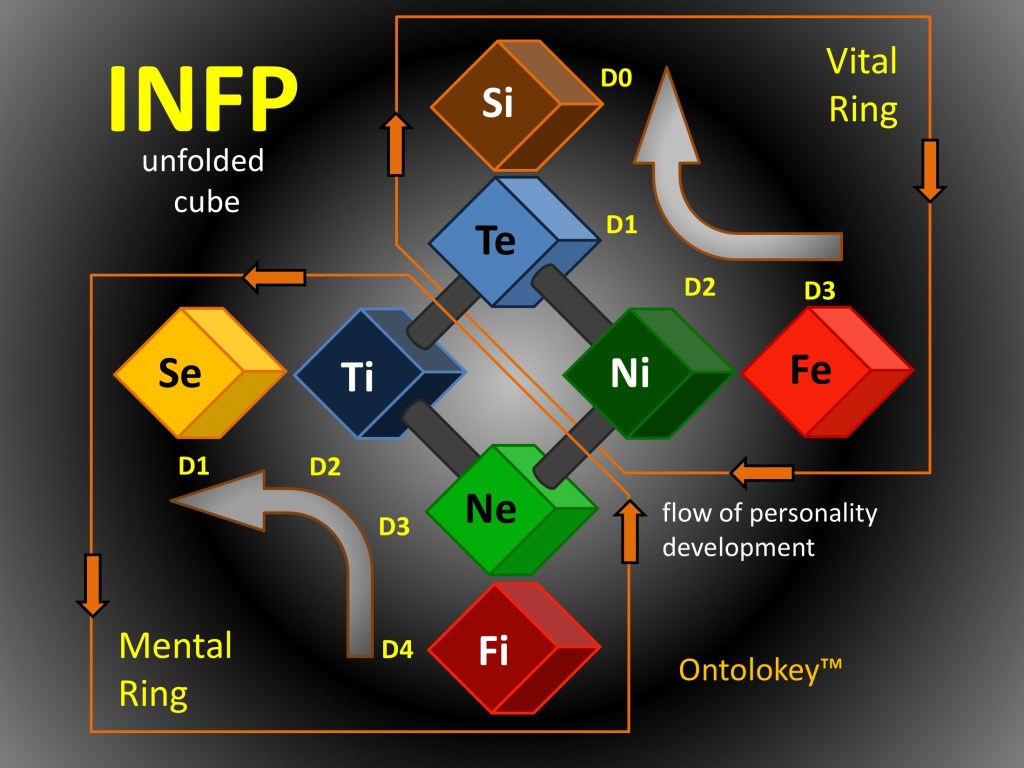
For the INFP, this process begins with the recognition that the personality is larger than the conscious self-image with which one has learned to navigate life. The Ontolokey conception of the Mental Ring places Fi at D4, Ne at D3, Ti at D2, and Se at D1, creating a developmental sequence in which the already powerful inner value system gradually opens toward possibility, internal analysis, and embodied presence. The Vital Ring then extends the process into Fe at D3, Ni at D2, Te at D1, and Si at D0, with the latter representing an especially archaic or childlike layer of psychological functioning. Development therefore does not mean jumping directly toward the weakest function simply because it appears to be the greatest weakness; rather, the personality moves progressively from what is already relatively conscious and capable toward what is less differentiated, allowing each newly developed capacity to provide the psychological foundation required for the next. In this sense, individuation becomes less a project of self-improvement than a gradual expansion of consciousness, in which the person learns to recognize previously disowned aspects of the psyche without surrendering the integrity of the original personality.
This perspective is particularly important for understanding why psychological healing may require more than reassurance, positive thinking, or the strengthening of existing talents. An INFP can become exceptionally articulate about feelings and values while remaining surprisingly unprepared to examine the internal logic of those values, to tolerate the immediacy of sensory reality, to impose practical structure upon ideals, or to recognize how memories and old emotional impressions continue to shape present perception. The shadow is therefore not simply a collection of negative traits; it contains capacities that consciousness has not yet learned to use deliberately, and because these capacities remain underdeveloped they may initially appear through confusion, defensiveness, avoidance, overcompensation, or emotional pain. The developmental journey described here treats such experiences as invitations to cognition: when an unconscious reaction becomes understandable, its psychological power can change, because what was previously experienced as an inexplicable wound can become part of a comprehensible personal history. In that gradual movement from unconscious reaction toward conscious understanding lies the possibility of forgiveness—not as the denial of injury, but as the capacity to understand oneself and others within the larger complexity of the human psyche.
The First Threshold of Individuation: From Fi to Ne
For the INFP, individuation begins not by dismantling the dominant Fi but by allowing it to become sufficiently secure that it no longer has to defend itself against every form of difference. Fi at D4 represents the psychological center of gravity: the capacity to experience personal meaning, conscience, authenticity, loyalty, beauty, and moral significance from within rather than deriving them primarily from external consensus. This gives the INFP an important resistance to conformity, yet it can also create an unconscious equation between inner conviction and ultimate truth, particularly when a deeply felt judgment is experienced as self-evident simply because it is personally profound. The first developmental movement therefore leads from Fi toward Ne at D3, from the certainty of “this is what feels true to me” toward the more spacious question of “what else might be true, possible, or meaningful here?” In this transition, the INFP does not become less authentic; rather, authenticity becomes less defensive because the self discovers that remaining faithful to one’s values does not require closing the door to alternative interpretations.
Ne is consequently much more than a source of creativity or imagination; it is the first major instrument through which the INFP learns psychological flexibility. It allows the mind to move beyond the immediate conclusions of Fi and to entertain possibilities that may initially feel contradictory, uncomfortable, or even personally threatening, thereby preventing the inner moral world from becoming a closed system. At its healthiest, Ne transforms sensitivity into curiosity: instead of asking only whether an experience confirms one’s values, the individual begins to ask what the experience might reveal, what other perspectives could illuminate it, and which possibilities have not yet been considered. Yet this same function can become an escape route when possibility replaces commitment, because generating alternatives is psychologically safer than choosing one and exposing it to reality. The developmental achievement at D3 is therefore not unlimited openness but the ability to preserve openness while gradually learning that possibilities acquire psychological value only when some of them are eventually selected, embodied, tested, and lived.
This is why the period in which the auxiliary function develops can be psychologically decisive for the INFP, particularly during the transition from early adulthood toward greater maturity. A person who has previously lived almost entirely through Fi may suddenly discover that the inner world is no longer sufficient by itself, because life begins presenting situations that cannot be solved merely by knowing what one believes: relationships require negotiation, ideas require expression, ideals require implementation, and possibilities require choices. Ne becomes the bridge between the private sanctuary of Fi and the complexity of external existence, allowing the INFP to explore reality without immediately surrendering the internal standards that give life meaning. When Ne approaches the maturity of Fi, the personality becomes less enclosed within a single interpretation of itself and more capable of experiencing identity as something that can develop without becoming false to its origins. This is the first important destabilization of the psychological iceberg: what had remained beneath conscious awareness begins to exert pressure upon the established identity, preparing the individual for the much deeper encounter with the functions that follow.
The danger at this stage is that the INFP may mistake psychological expansion for endless introspection and therefore remain inside the same inner world while merely making that world more elaborate. Ne can generate an almost inexhaustible supply of interpretations, hypothetical futures, symbolic connections, explanations, and alternative identities, while Fi evaluates each possibility according to an increasingly subtle set of personal meanings; the result can be profound creativity, but it can also produce paralysis because every decision appears to eliminate countless other lives that might have been lived. The mature developmental question is therefore not “How can I discover the perfect possibility?” but “Which possibility is sufficiently meaningful to deserve embodiment despite its imperfections?” This distinction marks a fundamental psychological shift, because it transforms idealism from a standard by which reality is condemned into a direction by which reality can gradually be shaped. Once the INFP can tolerate the grief inherent in choosing one imperfect path over an infinite number of imagined alternatives, Ne has begun to perform its deeper developmental function and the psyche becomes ready to move toward D2, where the more vulnerable encounter with Ti begins.
From Possibility to Understanding: The Emergence of Ti
Ti as the Anima/Animus function represents a qualitatively different developmental threshold because it introduces an internal mode of cognition that does not naturally ask whether something is personally meaningful, emotionally authentic, or morally congruent. Instead, Ti asks whether the structure of an idea is coherent, whether distinctions are precise, whether assumptions follow logically from evidence, and whether an explanation remains valid independently of the emotional investment attached to it. For the INFP, this can be deeply attractive precisely because it offers something Fi and Ne cannot provide on their own: temporary relief from the endless question of personal meaning by shifting attention toward conceptual clarity. Yet because Ti is positioned at D2, this attraction must be approached gradually, after the development of Ne has created enough psychological openness to tolerate a mode of thought that may challenge cherished interpretations. The aim is not to replace feeling with analysis, but to make analysis sufficiently safe that the INFP can examine inner truth without experiencing examination itself as a form of betrayal.
The vulnerable nature of the Anima/Animus function becomes especially important because this is where psychological development can touch some of the INFP’s deepest wounds. An INFP may have spent years knowing intuitively that something is meaningful or wrong without possessing an equally developed language for determining precisely why, and this discrepancy can become painful when circumstances demand intellectual discrimination rather than emotional conviction. Ti can initially appear as an almost idealized psychological other: the part of the psyche that seems capable of cutting through confusion, organizing complexity, identifying contradictions, and producing a form of certainty that does not depend upon the emotional state of the individual. Because of this, the INFP may be drawn toward philosophy, psychology, metaphysics, systems of thought, conceptual frameworks, or analytical explanations with unusual intensity, sometimes hoping that the right intellectual structure will finally explain experiences that have remained emotionally unresolved. The healing potential begins when Ti ceases to function as an escape from vulnerability and instead becomes a quiet instrument through which the INFP can distinguish genuine insight from projection, intuition from assumption, and meaningful interpretation from a story that merely feels true.
The Vulnerable Intelligence of Ti: When Understanding Becomes Healing
The development of Ti at D2 asks the INFP to perform one of the most difficult forms of psychological honesty: to examine the architecture of one’s own convictions without automatically protecting them. Fi naturally knows what matters, while Ne can generate an abundance of possible interpretations, but Ti introduces the capacity to ask whether those interpretations actually hold together. This can be unsettling because the INFP’s identity may have become intertwined with certain beliefs, ideals, memories, or narratives about injustice, rejection, love, betrayal, or personal difference, so questioning the structure of such narratives can initially feel like questioning the legitimacy of the experiences themselves. Yet the experience and the interpretation of an experience are not identical, and psychological healing becomes possible when this distinction can be tolerated without diminishing the emotional truth of what happened. Ti therefore becomes therapeutic in the deepest sense when it teaches the INFP to say, “My experience was real, but my explanation of that experience may still be incomplete,” thereby opening a space in which pain can be understood without becoming the permanent author of identity.
This is particularly significant because INFP idealism can conceal a subtle psychological absolutism beneath its apparent gentleness. The individual may reject rigid external judgments while unconsciously constructing an equally rigid internal standard, measuring people, relationships, institutions, and even the self against an ideal that reality can rarely satisfy. When reality repeatedly fails this standard, disappointment may become alienation, alienation may become withdrawal, and withdrawal may reinforce the conviction that the surrounding world fundamentally cannot understand what the INFP knows inwardly. Ti can interrupt this circular process by separating categories that have previously been fused together: disappointment is not necessarily betrayal, disagreement is not necessarily invalidation, imperfection is not necessarily corruption, and emotional distance is not necessarily evidence of lovelessness. Such distinctions do not make the INFP colder; they make the inner world more differentiated, allowing compassion to coexist with discernment rather than forcing the psyche to choose between total acceptance and total rejection. In this way, Ti gradually converts the painful sensitivity of the INFP from a defensive boundary into a form of psychological intelligence capable of holding contradictory truths simultaneously.
The same developmental movement also changes the INFP’s relationship with forgiveness. Forgiveness becomes difficult when the psyche can perceive an injury with extraordinary emotional precision but cannot yet adequately model the psychological mechanisms that produced the behavior of the person who caused it. An immature interpretation can therefore become morally absolute: “They hurt me because they did not care,” “They rejected me because something was wrong with me,” or “They acted against my values because they were fundamentally bad,” and such conclusions can preserve the emotional reality of the injury while freezing its meaning in place. As Ti develops, the INFP becomes increasingly capable of reconstructing causality, distinguishing intention from consequence, weakness from malice, incapacity from indifference, and another person’s psychological limitations from one’s own worth. This does not require excusing destructive behavior, abandoning boundaries, or denying injustice; rather, it allows the psyche to understand how human beings can cause harm while themselves being shaped by fear, immaturity, unconscious defenses, competing needs, or unresolved wounds. The result is a form of forgiveness grounded not in sentimental absolution but in cognition, because what is understood no longer has to remain mysterious enough to dominate the inner world.
Ti also has the potential to transform the INFP’s relationship with self-criticism, which can become severe when personal ideals are experienced as obligations that must be perfectly embodied. Because Fi is highly sensitive to incongruence between the person one believes oneself to be and the person one actually experiences oneself as being, failure may not remain a simple practical event; it can become an existential accusation against the self. The individual may then retreat into reflection, generate increasingly sophisticated explanations for the failure, and unconsciously attempt to restore inner coherence without confronting the concrete limitations that contributed to the outcome. A developed Ti introduces a more neutral internal observer that can investigate the event without immediately turning it into a verdict on personal worth, asking instead what factors were present, which assumptions were mistaken, which abilities were genuinely underdeveloped, and what could realistically be changed. This creates a crucial distinction between guilt that teaches and shame that imprisons, allowing the INFP to retain moral seriousness while relinquishing the fantasy that psychological integrity requires perfection.
Se at D1: Returning from the Inner World to Reality
Once Ti has become sufficiently differentiated, the developmental sequence moves toward Se at D1, the Toddler function within the Mental Ring, and this represents one of the most vulnerable thresholds in the entire INFP individuation process. Se is concerned with immediate reality, direct sensory perception, physical presence, concrete circumstances, action, timing, and what is actually occurring rather than what an experience symbolizes or might eventually become. For an INFP whose consciousness is naturally drawn toward values, meanings, possibilities, and inner interpretations, this immediacy can feel almost brutally simple because it refuses to wait for psychological significance before demanding attention. Yet precisely because Se is initially weak, its neglected contents may appear indirectly through overwhelm, impulsivity, sensory excess, avoidance of practical reality, difficulty inhabiting the body, or sudden compensatory attempts to seize control of the immediate environment. The developmental task is therefore not to become an aggressively sensation-oriented person, but to learn the quiet discipline of being present enough to encounter reality before interpreting it.
The Toddler metaphor is psychologically useful because it captures the peculiar vulnerability of a function that has not yet acquired adult differentiation. A toddler does not possess the conceptual distance required to regulate every immediate impulse, and similarly the underdeveloped Se of the INFP can remain primitive in its relationship to physical circumstances: the body may become an afterthought, practical details may be postponed until they become urgent, and sensory reality may be either neglected or suddenly experienced with disproportionate intensity. What begins as apparently mundane development—sleep, movement, physical environment, attention to immediate details, timely action, contact with nature, craftsmanship, and direct participation in life—can therefore have a surprisingly profound psychological effect. Each deliberate encounter with the present moment teaches the psyche that reality does not have to be interpreted before it can be inhabited, and that a meaningful inner life requires a body capable of carrying it. Se becomes healing when the INFP stops treating embodiment as an interruption of psychological depth and discovers that physical presence is itself a form of consciousness.
This stage also exposes a central paradox of INFP development: the person may spend years trying to understand why life has been difficult while unconsciously remaining insufficiently engaged with the immediate conditions that could change it. Reflection can explain exhaustion without producing rest, imagination can envision a better life without establishing the routines required to create it, and moral conviction can identify what is wrong without necessarily providing the practical sequence through which something better can be built. Se introduces an uncompromising corrective because it asks what is happening now, what is physically present, what action is possible today, and what information the senses are providing before the mind turns it into a larger narrative. The purpose is not to suppress imagination but to anchor imagination in contact with reality, so that ideals become embodied rather than remaining permanently suspended in an internal realm of possibility. At this point, the INFP begins to discover that wholeness is not achieved by escaping the world that repeatedly disappoints the inner ideal, but by becoming sufficiently present to participate in transforming the world as it actually exists.
The Vital Ring: Fe, Ni, Te and the Descent into the Deeper Self
Once the Mental Ring has been sufficiently developed, the INFP’s individuation can begin to turn toward the Vital Ring, where the psychological encounter becomes increasingly less voluntary and more existential. Fe at D3 occupies the Sibling position and therefore represents the first major movement from an exclusively inwardly referenced value system toward the recognition that human meaning is also created between people. For the INFP, Fe can initially feel strangely external because Fi asks whether something is personally and morally authentic, whereas Fe asks how emotional reality is shared, communicated, received, and regulated within a relational field. The developmental challenge is not to exchange Fi for Fe, but to discover that personal truth becomes more complete when it can enter reciprocal relationship without losing its identity. In this sense, Fe begins to loosen the private fortress: the INFP gradually discovers that being understood does not mean finding someone who perfectly enters the inner world, but becoming capable of making that inner world accessible enough that another person can genuinely encounter it.
The Sibling quality of Fe is important because it suggests neither an enemy nor an idealized opposite, but a psychological capacity that can become familiar through relationship and experience. The INFP may possess considerable empathy naturally, yet empathy and Fe are not identical: one can understand another person’s suffering intensely while still remaining primarily inside one’s own subjective interpretation of that suffering. Developing Fe requires the additional movement of asking what the other person actually experiences, what the relationship requires from both sides, and how one’s own behavior contributes to the emotional atmosphere between people. This can be uncomfortable because Fi can regard excessive adaptation to others as inauthentic, particularly when the INFP has previously experienced people-pleasing or emotional self-abandonment. Mature Fe therefore does not mean becoming socially compliant; it means acquiring the capacity for emotional reciprocity without surrendering personal boundaries, allowing the INFP to discover that consideration for others and loyalty to oneself are not necessarily contradictory. The psychological gain is substantial because relationships cease to be judged exclusively according to whether they feel sufficiently deep and instead become living systems in which mutual responsibility, communication, repair, and differentiation matter.
Fe also begins to heal one of the INFP’s most subtle vulnerabilities: the belief that being deeply understood should occur almost spontaneously. Because Fi experiences the inner world with such specificity, the INFP can unconsciously expect significant others to recognize meanings that have never actually been communicated, and disappointment then becomes evidence that the relationship lacks depth. Fe introduces a more mature principle of relational reality: intimacy requires translation. Feelings have to be expressed, needs have to be articulated, boundaries have to be negotiated, misunderstandings have to be corrected, and affection has to be demonstrated in forms the other person can actually receive. This is not a reduction of love into technique; it is the recognition that even the most sincere inner experience remains inaccessible to another person unless some bridge is built between subjective worlds. As Fe develops, the INFP can therefore become less preoccupied with whether another person has intuitively discovered the hidden self and more interested in participating actively in the creation of mutual understanding. Such a shift can be profoundly healing because it transforms loneliness from a verdict about one’s fundamental untranslatability into a practical relational problem that can sometimes be addressed through communication, patience, and reciprocal effort.
Ni at D2: From Possibilities to Meaningful Direction
After Fe, the Vital Ring moves toward Ni at D2, the Golden-Shadow function, and this represents a particularly intriguing stage because Ni can appear both alien and strangely familiar to the INFP. Ne naturally expands consciousness horizontally, opening multiple possibilities, associations, interpretations, and potential futures, whereas Ni tends to compress experience toward an underlying pattern, direction, or singular significance. For an INFP, this can be experienced as the gradual discovery that not every possibility deserves equal psychological investment and that a life cannot be lived indefinitely as an open field of alternatives. Ni begins to ask what all these experiences are converging toward, what recurring pattern lies beneath apparently unrelated events, and which possibilities belong to a deeper trajectory rather than merely representing another interesting branch of thought. In developmental terms, this is an important movement from expansion toward integration, because the psyche begins learning that wholeness requires not only the ability to imagine what could be but also the ability to recognize what is becoming.
The Golden-Shadow quality of Ni makes this development especially subtle because the function may initially appear almost idealized. The INFP can be fascinated by people who seem able to see through complexity, identify the essential pattern, anticipate consequences, or possess an almost uncanny sense of direction, while simultaneously feeling that such certainty is inaccessible to the ordinary self. The danger is that Ni can become romanticized as a mysterious source of ultimate insight rather than gradually cultivated as a disciplined capacity for synthesis. Its healthier development occurs when the INFP learns to let patterns emerge without forcing them, allowing accumulated experience, intuition, reflection, and observation to converge into a coherent understanding. This can reduce the endless proliferation of Ne-generated possibilities because the individual becomes increasingly capable of recognizing which possibilities belong to the same underlying pattern and which are simply attractive distractions. The result is not less imagination but greater psychological economy: the mind begins to distinguish between everything that could happen and what appears, after sustained reflection, to matter most.
Ni also changes the INFP’s relationship with time. Fi can become intensely concerned with the authenticity of the present inner state, while Ne continuously opens alternative futures, but Ni introduces a sense that present choices participate in a longer developmental arc. A painful experience can become part of a pattern rather than an isolated injustice; a recurring relationship problem can reveal an unconscious theme rather than simply another disappointing encounter; and an apparently failed project can become evidence about the direction in which one’s life is actually moving. This temporal integration can be deeply healing because it allows the INFP to reinterpret the past without pretending that it should have been different. The question gradually changes from “Why did this happen to me?” toward “What has this experience been teaching me about the person I am becoming?” That does not erase suffering, but it can prevent suffering from remaining psychologically static, because the meaning of an experience is allowed to evolve as consciousness itself develops.
Te at D1: The Necessary Encounter with Reality
Te at D1, the inferior function, represents perhaps the most concrete confrontation with the external world in the entire INFP developmental sequence. Te is concerned with effectiveness, organization, measurable outcomes, prioritization, implementation, and the objective consequences of decisions, all of which can feel secondary or even spiritually irrelevant when compared with the INFP’s concern for authenticity and meaning. Yet the absence of sufficient Te creates a painful contradiction: the individual may possess extraordinary values and ideas while lacking the structures necessary to give those values reliable external form. In this sense, Te is not the enemy of idealism but its instrument of embodiment, because an ideal that cannot survive scheduling, limitations, accountability, repetition, and imperfect execution remains psychologically beautiful but practically powerless. Development therefore means learning to tolerate the temporary discomfort of reducing an enormous inner vision into concrete steps without interpreting that reduction as a betrayal of the vision itself.
The inferior position explains why Te can become particularly sensitive when activated under pressure. The INFP may oscillate between avoiding practical demands and suddenly confronting them with disproportionate urgency, creating cycles of procrastination followed by intense attempts to regain control. In such states, objective measures can become emotionally loaded: unfinished tasks appear to confirm personal inadequacy, criticism feels like rejection of the self, and ordinary inefficiency can acquire moral significance. A mature Te must therefore be developed gradually, just as the Mental Ring functions are developed sequentially, so that external structure becomes a support rather than an emergency weapon. The INFP can begin with modest acts of concretization—defining what “finished” means, establishing realistic deadlines, maintaining routines, organizing obligations, and allowing objective feedback to correct subjective assumptions. Over time, these practices teach an important lesson: structure does not necessarily imprison freedom; properly chosen structure can protect the freedom to pursue what genuinely matters.
The deepest integration of Te occurs when effectiveness becomes subordinate to meaning without becoming opposed to it. An INFP does not need to become competitive, status-driven, aggressively pragmatic, or obsessed with productivity; those would be caricatures of development rather than genuine integration. Instead, Te can ask Fi a simple but demanding question: if this value is truly important to you, what would it look like in observable behavior? If compassion matters, what sustainable action expresses it; if creativity matters, what practice gives it time; if independence matters, what financial and practical structures support it; if a relationship matters, what consistent behavior demonstrates that importance? These questions bring the inner world into contact with consequences and therefore make authenticity testable rather than merely declarative. The resulting shift is one of the decisive moments of individuation, because the INFP begins to understand that a value repeatedly contradicted by behavior is not yet an integrated value, regardless of how sincerely it is felt internally.
Si at D0: The Child Beneath the Personality
At the deepest end of the Vital Ring stands Si at D0, the tertiary function and psychological Blindspot in the developmental sequence described here. Its D0 status gives it an especially archaic quality, suggesting a relationship to experience that may remain childlike, instinctive, or insufficiently differentiated for much of the personality’s development. Si concerns continuity, accumulated experience, familiarity, bodily memory, repetition, concrete recollection, and the ability to recognize how the past continues to shape present perception. For an INFP, whose consciousness is naturally drawn toward values and possibilities, this orientation can feel strangely constraining because it asks attention to remain with what has already happened rather than immediately moving toward what could happen next. Yet precisely here lies an important healing potential: what has not been integrated from the past does not necessarily disappear merely because consciousness prefers possibility. Memories, bodily associations, habitual emotional responses, and earlier experiences can remain active beneath deliberate thought, influencing present reactions without being recognized as historical material.
The development of Si therefore requires a compassionate encounter with psychological continuity rather than an attempt to escape the past through reinterpretation. An INFP may be exceptionally capable of giving an old experience new meaning, but new meaning is not always the same as integration; sometimes the psyche also needs to acknowledge that something happened, that it left an imprint, and that the present self still carries traces of the earlier self. The Blindspot quality can make this difficult because attention may move so quickly toward interpretation, possibility, or significance that the plain factual continuity of experience is overlooked. Developing Si means learning to notice recurring patterns in one’s own history without becoming imprisoned by them, recognizing which situations repeatedly trigger the same response, which environments restore stability, and which neglected physical or emotional needs have been asking for attention for years. In this sense, Si can provide a form of psychological compassion that says the present self did not emerge from nowhere; it is the continuation of many earlier selves, each of whom acted with the awareness, resources, and limitations available at the time.
This is also where the INFP’s capacity for self-forgiveness can become profoundly more concrete. Once the developmental sequence has reached the deeper layers of the Vital Ring, earlier failures can be understood not simply as isolated mistakes but as expressions of a personality that had not yet developed the capacities it now possesses. A person may recognize that a former inability to establish boundaries was connected to undeveloped Fe, that avoidance of practical commitments reflected weak Te, that confusion about recurring emotional reactions was related to unintegrated Si, or that certain intellectual wounds were intensified by the vulnerability of Ti. Such recognition does not remove responsibility, but it changes its psychological quality: responsibility becomes an invitation to integrate what was missing rather than an endless demand to condemn what cannot be changed. This is the point at which cognition can genuinely participate in healing, because understanding creates enough distance from the former self to permit compassion without requiring denial. The past becomes neither an excuse nor a prison, but material from which a more complete personality can be consciously constructed.
The Iceberg Turns: Individuation as the Expansion of Consciousness
The developmental sequence becomes most meaningful when it is understood not as a collection of isolated techniques but as a gradual rotation of the entire psychological center of gravity. The image of the iceberg captures this process with particular clarity: only a small portion of the personality is ordinarily available to conscious awareness, while much of its psychological activity remains beneath the surface, influencing perception, reaction, attachment, avoidance, and interpretation without being fully recognized. The development of Ne first destabilizes the established position of Fi by introducing possibilities that the dominant function cannot completely control; Ti then begins to examine the internal structures through which those possibilities and values are interpreted, while Se gradually forces consciousness into direct contact with embodied reality. In the Vital Ring, Fe, Ni, Te, and finally Si expose progressively deeper layers of relational, intuitive, practical, and historical experience, so that the individual encounters not simply weaknesses but forgotten dimensions of the self. The metaphorical rotation of the iceberg therefore describes an expansion of consciousness in which what was previously “below” gradually becomes psychologically visible, until the original dominant function can return to the surface no longer as an isolated ruler of the personality but as the conscious center of an enlarged whole.
This also explains why individuation can become more demanding precisely when a person has already achieved considerable self-awareness. An INFP can become exceptionally sophisticated at describing feelings, values, wounds, ideals, relationships, and existential questions while still remaining organized around the same psychological center that generated the original difficulties. Self-knowledge is not automatically the same thing as self-integration, because one can understand one’s patterns intellectually without granting the neglected functions enough authority to alter one’s behavior. The decisive movement occurs when knowledge becomes corrective: when Ti is allowed to challenge a cherished interpretation, when Se interrupts an elaborate narrative with immediate facts, when Te requires a meaningful intention to become an actual commitment, when Si reminds the person of what repeated experience has already demonstrated, and when Fe reveals what one’s behavior does to another human being. At that point cognition ceases to be merely descriptive and becomes developmental, because consciousness begins to include information that the personality previously filtered out. The Ontolokey cube can serve as a visual representation of this process precisely because it portrays the eight functions as different psychological directions rather than merely as labels attached to a fixed identity.
For the INFP, the deepest transformation therefore involves learning to distinguish between preserving the integrity of Fi and protecting Fi from correction. These are not the same thing, even though they can feel identical from inside the personality. Preserving integrity means remaining faithful to genuinely important values while permitting those values to encounter evidence, consequences, relationships, limitations, history, and the unpredictability of lived experience; protecting Fi means allowing the inner conviction to become immune from anything that could challenge its interpretation. The first produces maturity, whereas the second can produce a particularly sophisticated form of psychological isolation in which every disagreement becomes evidence that others do not understand, every practical limitation becomes evidence that the world is inadequate, and every painful contradiction becomes another reason to retreat into the inner realm. Individuation asks the INFP to risk something far more difficult than abandoning ideals: it asks the person to allow ideals themselves to develop. A value that survives contact with reality, learns from failure, becomes more precise through contradiction, and remains meaningful after its original assumptions have been revised is psychologically stronger than a value that has remained pure only because it has never been fully tested.
The Shadow as a Teacher Rather Than an Enemy
The shadow becomes most useful when the INFP stops interpreting its contents as evidence of personal deficiency. A weak or uncomfortable function can easily become a source of shame because it exposes precisely the capacities in which the individual feels least competent, while the more attractive functions of another person can provoke envy, admiration, irritation, or an inexplicable fascination because they represent qualities that have not yet been consciously claimed. Yet such reactions can become developmental information if they are examined rather than merely acted upon. The decisive question is no longer simply why another person is irritating, why a particular situation repeatedly overwhelms the self, or why certain qualities appear enviable, but what psychological capacity is being activated by the encounter and why that capacity has such emotional charge. This does not mean that every difficult person is a projection or that every conflict should be romanticized as a lesson; it means that recurring disproportionate reactions can be treated as clues pointing toward regions of the psyche that remain insufficiently integrated.
For an INFP, this approach can radically change the meaning of interpersonal conflict. The highly organized person may provoke resentment while simultaneously revealing an undeveloped relationship with Te; the emotionally expressive person may feel overwhelming while exposing unfamiliar territory within Fe; the decisive person may seem both admirable and threatening because decisiveness challenges the security of endless possibility; and the analytically detached person may appear cold while embodying the very cognitive distance that Ti is asking the INFP to develop. The mature response is neither imitation nor rejection, but differentiation: what is the useful capacity beneath the form in which I encounter it? A person can learn decisiveness without becoming domineering, structure without becoming mechanical, emotional reciprocity without becoming dependent upon approval, intellectual rigor without becoming emotionally detached, and sensory presence without abandoning imagination. Shadow integration therefore does not ask the INFP to become like the people who possess these qualities naturally; it asks the INFP to reclaim the underlying psychological function in a form that remains compatible with the personality’s own center.
This distinction becomes particularly important with the Golden Shadow, because what is least conscious is not necessarily what is least valuable. Ni can appear as an almost mysterious capacity for synthesis and direction, and the INFP may project this quality onto individuals who seem unusually certain about where life is going or what lies beneath its surface complexity. Such projection can create an unconscious hierarchy in which the other person appears to possess something essential that the INFP lacks, when in fact the fascination may be revealing a dormant potential within the self. The same phenomenon can occur with decisiveness, intellectual precision, physical confidence, emotional directness, or practical competence: the INFP may simultaneously admire and distrust the quality because accepting it would require modifying an established self-image. Integration begins when the individual can tolerate this ambivalence long enough to ask what the admired quality would look like if it were expressed through the INFP’s own values and temperament. The Golden Shadow then ceases to be an idealized figure outside the self and becomes a psychological possibility waiting to be consciously incorporated.
From Purity to Participation
The central developmental movement can ultimately be described as a passage from purity toward participation. Purity seeks to protect the inner truth from contamination by compromise, uncertainty, failure, misunderstanding, obligation, and the ordinary imperfections of life, whereas participation accepts that anything genuinely valuable must eventually encounter precisely those conditions. For the INFP, this distinction is crucial because the fantasy of perfect authenticity can become an unconscious defense against the vulnerability of actually living according to one’s values. A relationship becomes meaningful only when another person is allowed to misunderstand and disappoint; creative work becomes real only when it can be judged and found imperfect; a moral conviction becomes mature only when it survives situations in which competing values collide; and a life direction becomes genuine only when choosing it means allowing other possibilities to disappear. The psychological task is therefore not to protect the ideal from reality but to allow reality to educate the ideal, so that the inner world becomes more accurate, more flexible, and more capable of producing something tangible.
This is where the various functions begin to operate as a genuine psychological ecology rather than as separate developmental stations. Fi can determine what deserves devotion, while Ne explores possibilities without turning possibility into permanent postponement; Ti can examine whether the reasoning is coherent, while Se checks what is actually occurring in the present; Fe can reveal the interpersonal consequences of one’s behavior, while Ni searches for the deeper pattern emerging over time; Te can ask what must concretely be done, while Si remembers what experience has already taught. None of these perspectives needs to replace Fi, because the objective is not to redistribute the personality’s identity but to distribute its psychological labor more intelligently. The burden carried by the dominant function gradually becomes lighter because it no longer has to determine meaning, possibility, truth, relational significance, practical action, and historical interpretation by itself. This is one of the clearest signs of integration: the INFP remains recognizably INFP, yet the personality no longer has to retreat into its strongest functions whenever life becomes complex.
The practical disciplines described in the growth material are therefore best understood as small acts of individuation rather than productivity exercises. Distinguishing feeling from interpretation, separating evidence from inference, deliberately questioning a cherished conclusion, completing something before perfection arrives, recording recurring patterns, attending to bodily reality, communicating boundaries directly, and translating values into concrete behavior all create repeated encounters with previously neglected psychological information. None of these acts is impressive in isolation, and that is precisely why they are useful: individuation is not normally accomplished through one dramatic insight but through the accumulation of experiences in which the psyche learns that unfamiliar capacities can be tolerated and eventually trusted. The individual gradually discovers that choosing does not annihilate possibility, structure does not destroy freedom, intellectual correction does not destroy authenticity, embodiment does not diminish depth, and relational differentiation does not destroy love. What initially feels like a loss of the familiar self can therefore become the gradual acquisition of a larger self.
Healing Through Cognition: From Explanation to Integration
The deepest promise of this developmental process lies in the possibility that cognition can gradually transform experiences that once appeared psychologically incomprehensible. When an INFP encounters a painful event, the immediate experience may be registered primarily through Fi: something violated a value, wounded a bond, contradicted an expectation, or exposed an intolerable discrepancy between what should have been and what actually occurred. Ne may then generate numerous interpretations, while Ti, if insufficiently developed, may remain unable to determine which interpretation is structurally sound, and the result can be a powerful emotional narrative that feels complete precisely because it organizes the pain into a meaningful story. As the less developed functions become conscious, however, the story can acquire additional dimensions: Fe asks what happened relationally, Ni searches for the larger pattern, Te examines the practical consequences, Si recognizes the continuity with earlier experience, and Se returns attention to what is actually happening rather than what the mind has constructed around it. The wound is not thereby erased, but its psychological meaning becomes more differentiated, and differentiation is one of the fundamental conditions under which suffering can cease to dominate consciousness.
This process also explains why understanding another person’s psychological limitations can sometimes produce forgiveness without requiring reconciliation. The INFP’s natural moral sensitivity can make injury especially difficult to metabolize because the psyche does not merely register that something painful happened; it can continue asking why someone would violate something that seemed so obviously human, meaningful, or sacred. Without sufficient differentiation, that question can remain permanently unanswered and therefore emotionally active, causing the past to retain an authority over the present that it no longer deserves. Through progressive integration, the INFP can begin reconstructing the situation from several psychological perspectives simultaneously, recognizing that another person’s action may have emerged from fear, immaturity, distorted perception, conflicting values, unconscious defense, limited capacity, or simple human weakness. Such understanding does not transform harmful behavior into acceptable behavior, nor does it abolish the necessity of boundaries, but it can separate the fact of being harmed from the endless psychological task of making the offender’s behavior conform to an internally coherent moral universe. Forgiveness then becomes less a sentimental decision than the consequence of no longer needing the past to provide an explanation that satisfies every demand of the present self.
The same principle applies to self-forgiveness, perhaps even more powerfully. An INFP can judge earlier versions of the self with extraordinary severity because the present consciousness can see possibilities that the earlier personality could not yet perceive, and this creates the illusion that the former self should have possessed capacities that had not actually developed. Yet the developmental sequence itself provides a different interpretation: the person who lacked mature Ti could not have analyzed certain situations with the precision available later; the person whose Te remained weak could not have organized life with capacities that had not yet been integrated; the person whose Si remained largely unconscious could not easily recognize how historical patterns were influencing present reactions. Looking backward through the completed psychological architecture therefore changes the moral meaning of the past, because former failures can be understood as encounters with developmental limitations rather than proof of permanent inadequacy. The mature INFP does not have to declare that every past decision was correct; instead, the individual can acknowledge that growth often consists precisely in becoming capable of seeing what could not previously be seen.
The Discipline of Conscious Integration
If individuation is to become more than an attractive psychological idea, it must eventually become a disciplined practice of observation. The INFP benefits from learning to notice the moment at which an internal reaction becomes disproportionately intense, because intensity can indicate that more than the immediate situation is being activated. Instead of immediately deciding who is right, who is wrong, or what the experience means, the individual can temporarily suspend judgment and ask which function is currently operating, which kind of information is being ignored, and what alternative perspective might alter the emotional configuration of the event. The purpose is not to turn everyday life into an endless analytical exercise, but to create enough psychological distance that unconscious patterns can become visible before they automatically become behavior. In this sense, the Ontolokey Cube can function as a practical landscape for self-observation: its spatial representation of the eight functions makes it possible to visualize not merely one’s familiar strengths but the direction in which consciousness may need to move next.
The developmental sequence should therefore be respected rather than treated as a collection of shortcuts. The movement from Fi to Ne establishes openness before Ti demands deeper analysis; Ti provides conceptual differentiation before Se asks the personality to tolerate direct contact with reality; Fe expands the relational field before Ni seeks deeper synthesis; Ni creates direction before Te demands implementation; and only after these capacities have become sufficiently differentiated can the archaic material associated with Si at D0 be approached with greater stability. Trying to force the weakest function into immediate maturity can produce exactly the opposite of integration because the psyche may experience the unfamiliar capacity as an attack upon its existing organization. Development is more sustainable when each function becomes a bridge toward the next, allowing psychological complexity to increase without destroying the continuity of the self. The goal is consequently not to “fix” the INFP by making the personality resemble another type, but to allow the INFP’s original configuration to become increasingly conscious, differentiated, embodied, and internally cooperative.
This sequential understanding also protects the INFP from a common misunderstanding of personal development: the belief that maturity requires the elimination of one’s most characteristic qualities. Sensitivity does not need to become indifference, idealism does not need to become cynicism, imagination does not need to become pragmatism, and introspection does not need to become superficial sociability. What changes is the relationship between these qualities and the functions that previously remained outside conscious control. Fi becomes more secure because it no longer has to defend itself against every challenge; Ne becomes more selective because not every possibility must be pursued; Ti becomes more trustworthy because analysis is no longer experienced as emotional betrayal; Se becomes more available because embodiment is no longer treated as secondary; Fe becomes more reciprocal because connection no longer requires self-abandonment; Ni becomes more grounded because intuition is informed by accumulated experience; Te becomes more humane because effectiveness serves values rather than replacing them; and Si becomes less threatening because the past can finally be remembered without being obeyed. Integration thus preserves differentiation while reducing inner conflict.
Wholeness Is Not Perfection
The final aim of this journey should not be confused with psychological perfection. A completely integrated personality would not be a person who performs every function equally well, experiences no conflict, never becomes overwhelmed, or has permanently solved the contradictions of human existence. Wholeness means something more subtle: the individual becomes increasingly capable of recognizing the different psychological movements occurring within the self without allowing one of them to monopolize consciousness. The INFP remains an INFP, with Fi as the central organizing function, but the conscious self becomes large enough to contain perspectives that once seemed foreign, threatening, unnecessary, or incomprehensible. The shadow no longer has to operate entirely from behind the scenes because more of its information has been brought into awareness, and what was once experienced as weakness can increasingly become a source of discernment.
This is why the completion of the developmental cycle can be understood as a return rather than an escape. The iceberg eventually turns far enough that the original dominant function once again occupies the visible summit, but it is no longer the same Fi that began the journey, because it has been transformed by everything consciousness has encountered beneath the surface. Fi has learned from Ne that truth can contain possibilities, from Ti that conviction can withstand examination, from Se that meaning must eventually inhabit reality, from Fe that the self exists within relationships, from Ni that experiences form larger patterns, from Te that values require implementation, and from Si that the present self carries a history that deserves recognition rather than rejection. The dominant function therefore returns to the top not as an isolated sovereign but as the conscious expression of a much larger psychological organism. In this sense, what appears externally as a return to the original personality can internally be experienced as a rebirth, because the person has recovered the center without losing the territory discovered during the descent.
The mature INFP can consequently arrive at a paradox that is easy to miss at the beginning of the journey: becoming whole does not mean becoming someone other than oneself; it means becoming sufficiently conscious that one no longer has to defend oneself from one’s own unexplored dimensions. The qualities that once seemed incompatible can begin to coexist—idealism with practicality, sensitivity with boundaries, imagination with embodiment, compassion with discernment, individuality with reciprocity, reflection with action, and reverence for the inner world with participation in the outer one. This is the psychological meaning of integration: not uniformity, but relationship among differences. The self becomes less fragile because it no longer depends upon one narrow definition of what it is allowed to be.
A Practical Invitation to the INFP
The most useful question for an INFP approaching individuation is therefore not “How can I become better?” but “What part of myself am I currently unable to see?” That question redirects development away from self-correction and toward self-discovery, because the next developmental step often lies precisely where the personality feels least comfortable, least competent, or most defensive. When Ne has matured sufficiently, the individual can consciously approach Ti rather than merely admiring analytical clarity from a distance; when Ti has become more stable, Se can be approached without the demand that immediate reality first become meaningful; when the Mental Ring has sufficiently prepared the personality, Fe can open the relational dimension of the Vital Ring, followed progressively by Ni, Te, and Si. The Ontolokey Cube can support this process as a visual reminder that development is directional and relational rather than random, turning an abstract psychological structure into something that can be contemplated as a landscape of possible growth.
The practical work is therefore deceptively ordinary: notice what repeatedly triggers you, question the interpretation you automatically attach to it, identify the information you tend to overlook, communicate rather than assume, complete rather than endlessly refine, act upon values rather than merely affirm them, listen to what experience has repeatedly demonstrated, and remain present when the mind wants to escape into abstraction. Each of these acts represents a small movement of consciousness toward a function that has previously been less accessible, and over time those movements can alter the structure of the personality itself. The objective is not to force every shadow aspect into immediate visibility but to develop enough curiosity that the unconscious no longer has to remain completely unconscious. Gradually, what once appeared as contradiction becomes complementary information, what once appeared as weakness becomes developmental potential, and what once appeared as inexplicable suffering becomes something that can be understood within a larger psychological pattern. This is how cognition can become an instrument of healing: not by thinking pain away, but by bringing enough consciousness to pain that it no longer has to remain psychologically anonymous.
For the INFP, perhaps the most important commitment is therefore to remain loyal to inner truth while becoming increasingly willing to discover that the truth is larger than the original interpretation of it. The purpose of individuation is not to extinguish the idealist, the dreamer, the empath, the artist, or the moral individual, but to give those qualities a stronger psychological foundation from which they can participate in the world without being consumed by it. The inner world becomes healthier when it can open outward, and the outer world becomes more meaningful when the inner world can enter it without demanding that reality first become perfect. The movement through D4, D3, D2, D1 and finally D0 can thus be understood as a long education in psychological humility: the recognition that every strength contains a limitation, every weakness contains a potential, every wound contains information, and every part of the personality becomes more human when it is brought into relationship with the others. Wholeness is reached not when nothing remains unconscious, but when the self has become willing and capable enough to meet what emerges.
The Return to the Self
The completed journey ultimately leads back to Fi, but it is a return transformed by consciousness. The INFP who has moved through the developmental landscape no longer needs to choose between authenticity and adaptation, depth and action, imagination and reality, individuality and relationship, because these oppositions have been recognized as incomplete descriptions of a larger psychological system. Fi can once again stand at the center, but it now receives information from functions that were previously marginalized, allowing personal values to become more nuanced, embodied, relationally aware, historically informed, and practically effective. What was initially experienced as a threat to identity becomes part of identity, and what once belonged to the shadow gradually becomes available as conscious psychological choice.
In this sense, healing through wholeness is not a return to an untouched original self but a return to the self after the self has encountered its own hidden dimensions. The INFP does not become less idealistic by becoming more complete; idealism becomes less fragile because it is no longer required to deny imperfection. The person does not become less sensitive; sensitivity becomes more discerning because it is supported by cognition, embodiment, boundaries, and perspective. The individual does not lose the private inner world that made life meaningful in the first place; that world becomes spacious enough to include reality rather than functioning as a refuge from it. The iceberg has turned, the hidden functions have become increasingly visible, and the original center can finally be inhabited with greater freedom.
For readers who want to explore the INFP configuration, its shadow dimensions, developmental possibilities, and the corresponding structures of other personality types in greater depth, the longer psychological essays and the broader Ontolokey material at Ontolokey.com provide the larger landscape within which this developmental interpretation can be explored. The value of the cube is ultimately not that it tells an INFP who they must become, but that it offers a way of seeing the psychological territory that may otherwise remain difficult to conceptualize: the strong and the vulnerable, the conscious and the less conscious, the familiar and the foreign, the developed and the archaic. Used in that spirit, the model becomes an invitation to observation rather than a prison of identity, and individuation becomes a lifelong process of turning toward whatever part of the self has not yet been sufficiently understood.


Leave a comment