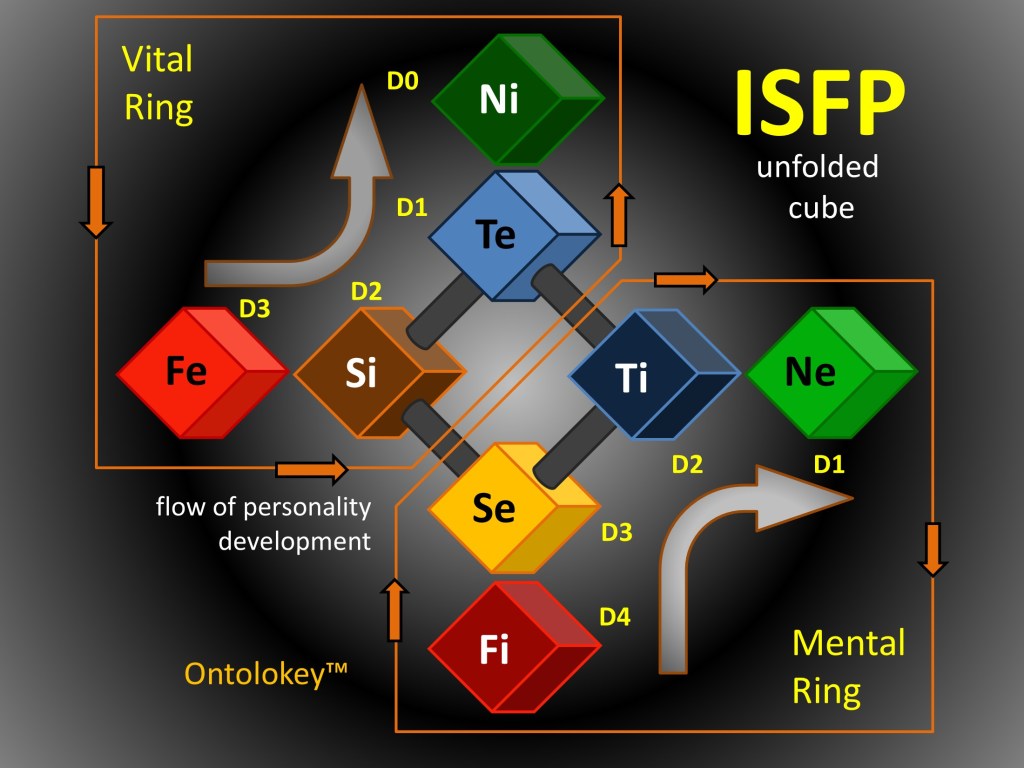
The Psychological Landscape of the ISFP
The ISFP begins its psychological journey from a centre of unusually intimate inwardness: Introverted Feeling (Fi), understood here as the dominant function and the highest developmental position, D4, within the Mental Ring. Fi is not merely “having feelings,” nor is it simply emotional sensitivity; it represents an internally organized sense of value, authenticity, personal meaning, loyalty, dignity, and moral congruence through which experience is evaluated from within. The ISFP therefore tends to ask, often without consciously formulating the question, whether something feels genuine, whether a person can be trusted, whether an action violates something personally sacred, and whether the outer world permits the inner self to remain intact. This inward centre is accompanied by Extraverted Sensing (Se) at D3, which gives the ISFP an immediate relationship with concrete reality through perception, physical presence, atmosphere, beauty, craftsmanship, movement, and responsive action; the inner value system is consequently not condemned to remain abstract but can be embodied in what the person creates, protects, chooses, touches, experiences, and does. Ontolokey’s portrait of the ISFP repeatedly emphasizes precisely this union of inner authenticity and embodied perception, presenting the personality not simply as a quiet or artistic temperament but as a psychological configuration in which private meaning seeks tangible expression.
This combination also explains why the ISFP can be both remarkably open to immediate experience and remarkably private about what that experience means. Se allows the individual to register details that others may overlook—the emotional atmosphere of a room, a change in someone’s behaviour, the quality of an object, a gesture, a sound, a physical environment—while Fi silently determines which of these perceptions matter and why. The result can be an outward personality that appears relaxed, spontaneous, gentle, independent, or absorbed in the present, while beneath that surface there is an elaborate process of emotional valuation and personal interpretation that may be almost completely invisible to other people. Yet the same architecture that creates sensitivity can also create vulnerability: when an experience violates the ISFP’s values, the event may not remain merely an unpleasant occurrence but can become incorporated into the individual’s private moral and emotional history. The shadow therefore does not arise as an alien personality suddenly appearing from nowhere; it develops when an originally healthy psychological function becomes burdened by experiences it has not been able to integrate. Ontolokey’s treatment of the ISFP’s shadow particularly emphasizes how rejection, humiliation, betrayal, disrespect, and moral disappointment can remain psychologically active long after their external circumstances have disappeared, allowing an old wound gradually to become a lens through which new reality is interpreted.
The purpose of individuation is consequently not to weaken Fi or to make the ISFP less sensitive, less loyal, less perceptive, or less authentic, because those qualities constitute the psychological foundation from which development must proceed. Instead, the task is to enlarge the consciousness surrounding Fi in a precise developmental sequence, so that what is initially experienced as an unquestionable inner truth can gradually enter into dialogue with other modes of psychological information. In the developmental architecture specified for this essay, that movement begins with the transition from Fi D4 toward Se D3, continues through Ti D2 and Ne D1 within the Mental Ring, and then progressively opens the Vital Ring through Fe D3, Si D2, Te D1, and finally Ni D0. The significance of this sequence is that the ISFP cannot simply leap from its highly developed centre into its most vulnerable or archaic psychological territory; the psyche must first acquire sufficient stability in the nearer function before it can safely approach the next layer of unconscious material. Development is therefore conceived not as replacing the ISFP with another personality, but as gradually rotating the psychological “iceberg” so that previously submerged capacities become visible, understandable, and eventually usable without destroying the original centre. The Ontolokey Cube becomes valuable within this process precisely because it turns the abstract architecture of eight functions into a spatial landscape in which movement, distance, shadow, vulnerability, and integration can be contemplated rather than merely memorized.
From Inner Authenticity to Embodied Consciousness: Fi D4 → Se D3
The first developmental task of the ISFP is not to escape the inward world of Fi, but to learn how to allow its inner values to become increasingly conscious through Se, the auxiliary function at D3. Fi at D4 gives the ISFP a highly developed capacity to distinguish what feels personally true, meaningful, beautiful, loyal, dignified, or unacceptable, but precisely because this function is so naturally available, its operations can remain largely unconscious in their familiarity. The person may know that something is “wrong” without being able to articulate the entire psychological structure behind that judgment, or may know that someone feels safe, false, intrusive, sincere, or emotionally compatible without being able to explain how the conclusion was reached. Se introduces a corrective movement toward what is actually present rather than what the inner world anticipates or remembers: it asks the ISFP to observe the person in front of them, the situation as it currently exists, the body’s response, the concrete facts of an encounter, and the possibilities contained within immediate reality. Development therefore begins when the ISFP stops treating inner valuation as the complete account of reality and instead allows direct perception to test, refine, and sometimes correct it. In this sense, Se does not diminish Fi; it protects Fi from becoming enclosed within its own interpretations, because values become psychologically mature when they remain responsive to what is actually happening rather than becoming rigid conclusions about what must be happening.
This transition can be particularly important because the ISFP’s greatest strength can quietly become its first psychological limitation. When Fi is operating almost entirely on its own, the distinction between “this violates my values” and “this makes me uncomfortable” may become blurred, just as the distinction between an authentic intuition about another person and a projection based upon previous emotional experience can become difficult to recognize. Se offers the possibility of returning repeatedly to the present moment and asking a deceptively simple question: What is actually here? Such a question requires the ISFP to suspend, at least temporarily, the impulse to interpret experience according to an established inner narrative and instead gather new information through observation and participation. A person who has experienced betrayal may therefore learn to distinguish the current individual from the person who caused the original wound; someone who has been criticized may learn to distinguish constructive feedback from humiliation; someone who has learned to protect themselves through withdrawal may discover that not every demand for engagement constitutes an invasion of personal boundaries. This is where the first movement toward healing becomes possible, because consciousness acquires the ability to separate present reality from accumulated emotional meaning. The ISFP does not become less discerning through this process; rather, discernment becomes more precise because Fi evaluates values while Se supplies continually renewed evidence about the world to which those values are being applied.
The developmental importance of Se also explains why the ISFP’s relationship with sensory experience can become psychologically deeper than the popular image of the “adventurous” or “artistic” ISFP suggests. When developed consciously, Se is not merely the pursuit of pleasure, novelty, aesthetics, or physical stimulation; it can become a disciplined willingness to inhabit reality without demanding that reality first conform to the inner self. The ISFP may discover that the body often knows something before the conscious mind can formulate it, that physical tension can reveal an unacknowledged boundary, that fatigue can expose an attempt to live against one’s own limits, and that genuine pleasure can restore contact with a self that has become psychologically defended. Art, craftsmanship, nature, music, movement, clothing, architecture, food, touch, and other sensory experiences can consequently become not escapes from psychological work but instruments through which psychological material becomes perceptible. The crucial distinction is whether Se is being used to experience reality more fully or to avoid experiencing the inner world altogether. In its immature form, sensory immediacy can become distraction, impulsivity, excessive stimulation, or an attempt to outrun painful reflection; integrated Se instead enables the ISFP to remain present long enough for experience itself to become informative. The developmental movement from Fi toward Se therefore establishes an essential principle for the later individuation process: healing does not require abandoning sensitivity, but learning to remain present with what sensitivity reveals.
When Se approaches the maturity of Fi, the ISFP reaches a psychological threshold: the original personality has become sufficiently grounded in the present that it can begin turning toward functions that are less familiar and considerably more vulnerable. This is why the developmental sequence cannot simply jump from Fi D4 directly to Ne D1 or Ni D0 in an attempt to “conquer the shadow”; unconscious material that has not yet been psychologically prepared for consciousness can overwhelm rather than integrate the personality. Se creates the experiential stability necessary for the next movement, because it teaches the individual to remain connected to concrete reality while encountering increasingly unfamiliar forms of cognition. The ISFP begins to understand that inner truth and external reality are not enemies, but two sources of information that become more useful when held together. At this stage, the person may also begin recognizing a subtle psychological freedom: I can experience a feeling without becoming identical with it, perceive an event without immediately assigning it a final meaning, and hold a value without assuming that every person must share its internal logic. This emerging differentiation is the first major sign that individuation has begun, because the ISFP is no longer merely protecting an authentic self but developing the capacity to observe that self from a wider field of consciousness. Once Se has been sufficiently strengthened, the psyche can begin approaching the next layer—Ti D2, the Anima/Animus function—where the question changes from “What do I personally value?” and “What is happening here?” to the much more unsettling question of “How does this actually make sense?”
Ti D2 — The Anima/Animus and the Discovery of Inner Structure
Once Se has been sufficiently developed, the ISFP can begin approaching Introverted Thinking (Ti) at D2, designated here as the Anima/Animus function within the Mental Ring. This is a qualitatively different psychological encounter because Ti does not primarily ask whether something is personally meaningful, morally congruent, aesthetically compelling, or emotionally authentic; it asks how something is structured, whether its elements are internally coherent, and whether the conclusion actually follows from the premises. For an Fi-dominant personality, this can initially feel strangely impersonal, even alien, because Ti temporarily removes the individual from the intimate centre of subjective valuation and invites them to examine the architecture of their own thinking. The psychological difficulty is not that the ISFP lacks intelligence or rationality, but that detached internal analysis may touch a developmental territory that is not naturally trusted as the primary means of navigating life. As the Anima/Animus, Ti can therefore carry a peculiar emotional charge: it may simultaneously fascinate and unsettle the ISFP, because it represents a psychological capacity that can potentially liberate the individual from unquestioned personal interpretations while also threatening cherished conclusions that have become intertwined with identity. Its integration begins when the ISFP learns that examining the logic of a belief is not equivalent to betraying the values behind that belief.
This distinction becomes particularly important in the realm of psychological wounds. Fi tends to preserve the subjective meaning of an experience with extraordinary intensity: this person betrayed me, I was not respected, I was misunderstood, I should have been protected, or something precious in me was violated. These conclusions may be entirely understandable, yet their psychological meaning can become progressively more complicated as they are carried across years and unconsciously generalized to new situations. Ti introduces differentiation into this emotional history by separating event, interpretation, inference, and conclusion. What precisely happened? What did the other person actually say or do? Which part of the experience is observable, which part is interpretation, and which part is a conclusion constructed afterward? What alternative explanations exist, and which explanation best accounts for all the available evidence? Such questions can initially feel almost cruel to an ISFP who has survived by trusting the authenticity of inner experience, because intellectual examination can be mistaken for emotional invalidation. In reality, properly integrated Ti performs the opposite function: it protects subjective truth from distortion by helping the person distinguish what was felt from what was inferred about why it happened. The ISFP can then preserve the legitimacy of the wound without remaining imprisoned by the original interpretation of it.
The Anima/Animus quality of Ti becomes especially visible when the ISFP encounters criticism, disagreement, or intellectual challenge. A mature Fi does not necessarily require universal agreement, but when Ti is underdeveloped, disagreement may unconsciously acquire a personal dimension because ideas and identity can become closely associated. Someone questioning an ISFP’s reasoning can therefore be experienced as questioning the person’s integrity, sensitivity, intelligence, or authenticity, even when no such attack was intended. The developmental task is to create an internal psychological space in which the proposition can be examined independently of the self who holds it. The ISFP can begin saying, in effect, “This thought may be mistaken without that meaning that I am false,” or “Another person may understand this differently without their perspective invalidating mine.” This is a profound step toward psychological freedom because it reduces the need to defend every internal conviction as though it were part of the self’s survival structure. Ti consequently introduces an intellectual form of humility that does not demand self-erasure; instead, it permits the individual to revise beliefs without experiencing revision as humiliation. Through this process, the ISFP gradually discovers that being authentic does not mean being permanently correct about oneself, other people, or reality.
There is also a deeper healing potential in Ti because it can transform forgiveness from a purely emotional act into an act of understanding. To understand why another person behaved destructively does not make the behaviour acceptable, nor does it erase responsibility or require reconciliation, but it can reveal the psychological mechanisms that previously appeared incomprehensible. The ISFP may recognize that another person’s cruelty emerged from fear, immaturity, envy, dependency, shame, defensive habits, or an inability to perceive consequences, just as the ISFP can begin recognizing that their own reactions sometimes emerged from equally unconscious protective mechanisms. This does not mean reducing human behaviour to mechanical causation; rather, it means replacing the primitive psychological equation of “I was hurt, therefore the other person must have consciously intended everything that followed” with a more differentiated understanding of motive, limitation, circumstance, and consequence. Such understanding can loosen resentment because the psyche no longer needs to preserve an absolute villain in order to preserve the reality of its own suffering. The same process can be directed inward: self-forgiveness becomes possible when the adult ISFP can understand the younger self not as weak or defective, but as a person operating with the psychological resources available at that developmental moment. This is one of the most important bridges between cognition and healing in the Ontolokey model, because consciousness begins to convert previously inexplicable suffering into intelligible psychological history.
Yet Ti must not become a new form of defence against feeling. The danger at this stage is that the ISFP, discovering the power of detached analysis, may temporarily overcorrect and begin intellectualizing emotions that still need to be experienced. A person can construct an elegant explanation for grief without actually grieving, identify the mechanism of rejection without allowing themselves to feel rejected, or understand the origin of anger while remaining disconnected from the boundary violation that produced it. Integration therefore means allowing Ti to clarify Fi rather than replace it: thought examines the structure of experience, while Fi continues to determine what that experience means personally and ethically. When these functions enter a genuine dialogue, the ISFP becomes increasingly capable of holding apparently contradictory truths at the same time: “What happened to me mattered, and I may have misunderstood parts of it”; “My boundary was legitimate, and the other person may not have intended the harm”; “My feelings are real, and they do not automatically constitute objective evidence”; “I can forgive someone internally without permitting them continued access to me.” This capacity to tolerate complexity marks a significant expansion of consciousness, because the psyche no longer needs simple psychological categories to remain secure. With Ti sufficiently integrated at D2, the ISFP becomes prepared for the next and considerably more vulnerable movement within the Mental Ring: Ne D1, the Toddler function, where the psyche encounters possibility, uncertainty, multiplicity, and the frightening freedom of not yet knowing what something means.
Ne D1 — The Toddler Function and the Courage to Enter Possibility
The next movement, from Ti D2 to Extraverted Intuition (Ne) D1, brings the ISFP into contact with the most vulnerable developmental layer of the Mental Ring: the Toddler function. If Ti asks the ISFP to examine the internal structure of what is already believed or experienced, Ne asks something far less comfortable: What else could be true? Ne opens consciousness toward alternatives, emerging possibilities, hypothetical futures, unexpected connections, and interpretations that have not yet acquired emotional certainty. For an Fi-dominant personality, this can initially feel destabilizing because Fi naturally seeks a sense of personal congruence, while Ne deliberately keeps the field open and refuses premature closure. The Toddler designation captures the psychological quality of this function: it is curious, exploratory, easily fascinated, capable of discovering connections spontaneously, but also vulnerable to becoming overwhelmed by too many possibilities at once. Consequently, the ISFP may have a paradoxical relationship with Ne, simultaneously possessing flashes of creative possibility and experiencing uncertainty as psychologically threatening when those possibilities challenge an established inner understanding. Development does not mean turning the ISFP into an endlessly speculative personality; it means giving the psyche permission to remain uncertain long enough for a larger reality to reveal itself.
The vulnerability of Ne becomes particularly significant when psychological wounds have produced rigid expectations about what people or situations will inevitably become. A person who has repeatedly experienced betrayal may unconsciously anticipate betrayal before sufficient evidence exists; someone who has experienced rejection may interpret ambiguity as the beginning of another rejection; someone who has been misunderstood may assume that further explanation will be useless. Such anticipatory conclusions provide psychological protection because they reduce uncertainty, but they also imprison perception inside the past. Ne introduces alternative futures into this closed system by asking whether the expected outcome is genuinely inevitable. Perhaps this person is different; perhaps this situation contains an opportunity that was not previously visible; perhaps the ambiguous behaviour has several explanations; perhaps a failed attempt does not predict the next attempt; perhaps the self that was incapable of something at twenty-five will possess very different capacities at forty-five. This is not naïve optimism, because mature Ne does not demand that positive possibilities be believed—it demands that possibility itself remain psychologically available. For the ISFP, that distinction can be healing because it creates space between the memory of what happened and the prediction of what must happen next.
The Toddler function also reveals why the ISFP may sometimes struggle with environments that demand extensive abstraction, hypothetical planning, or continual reinterpretation. When Ne is underdeveloped, possibilities can arrive not as liberating alternatives but as cognitive noise, especially when they threaten the emotional coherence established by Fi. The mind may suddenly generate numerous interpretations—perhaps this means this, or perhaps that person intended something else, or perhaps I should have acted differently, or perhaps everything will change—without possessing a stable method for organizing them. The result can be oscillation between premature certainty and excessive possibility, with the person either closing the question immediately or becoming mentally scattered by it. This is precisely why the developmental sequence requires Ti before Ne: Ti provides the discriminating structure through which Ne can explore without becoming lost. Once the ISFP has learned to distinguish evidence from interpretation and logical possibility from emotional certainty, Ne can become playful rather than threatening. Curiosity then becomes a psychological resource rather than a destabilizing force, allowing the ISFP to approach unfamiliar perspectives without immediately having to decide whether they belong to the self.
The deepest integration of Ne occurs when the ISFP learns to extend the same compassion toward future possibilities that Fi naturally extends toward personal authenticity. Instead of asking only, “Does this feel like me?” the individual begins asking, “Who might I become if I allowed this experience to change me?” That question represents a major psychological shift because it loosens the identification with a fixed self-image without destroying authenticity. The ISFP may discover that authenticity is not a static substance that must be defended from change, but a living relationship with the evolving self. A previously quiet person may discover an ability to lead; an individual who avoided intellectual confrontation may learn to articulate complex arguments; someone who considered themselves incapable of certain forms of achievement may discover capacities that had never been tested because fear had defined the limits of possibility. Ne therefore expands the meaning of individuation beyond healing the past: it introduces the possibility of becoming someone whom the former self could not yet imagine. The Toddler becomes psychologically mature when curiosity can coexist with vulnerability, allowing the ISFP to approach the unknown without demanding immediate certainty or abandoning the inner values that provide continuity.
At the completion of the Mental Ring’s developmental movement, the ISFP has therefore travelled a considerable psychological distance: Fi has provided the inner centre, Se has grounded that centre in present reality, Ti has introduced differentiation and logical examination, and Ne has opened the closed system toward possibility. The metaphor of the rotating iceberg becomes particularly useful here because the individual has not discarded the visible part of the original personality; rather, previously submerged capacities have begun to emerge into conscious recognition. What once seemed threatening can now be observed, named, questioned, and gradually integrated without necessarily becoming dominant. Yet the process is not complete, because the Vital Ring contains another set of functions whose developmental sequence introduces a different kind of challenge: these functions are less immediately available to the conscious personality and are therefore more likely to appear through relationships, conflict, compensatory behaviour, vulnerability, and experiences that expose limitations the individual cannot easily control. The next stage begins with Fe D3, the Sibling function, and this is where the ISFP must confront a particularly important question: How can a person whose psychological centre is defined by private authenticity participate consciously in the emotional field of other people without either losing themselves or retreating from collective emotional reality?
Fe D3 — The Sibling Function and the Discovery of Shared Emotional Reality
With the Mental Ring sufficiently developed, the individuation process moves into the Vital Ring, beginning with Extraverted Feeling (Fe) at D3, designated here as the Sibling function. This transition is important because the ISFP now encounters a psychological mode that does not begin with the question of personal authenticity but with the emotional atmosphere shared among people. Fe notices what is happening between individuals: collective mood, emotional expression, interpersonal harmony, social tension, enthusiasm, grief, celebration, discomfort, and the often-unspoken emotional expectations that organize a group. For an ISFP whose dominant Fi instinctively protects the privacy and individuality of inner feeling, this can initially appear intrusive or superficial, particularly when external emotional expression seems disconnected from what a person genuinely experiences internally. Yet Fe offers something Fi alone cannot provide: an understanding that emotions do not exist exclusively inside individuals but also circulate through relationships and communities, shaping behaviour even when nobody explicitly names them. The Sibling designation is therefore psychologically appropriate within this model because Fe represents a capacity that can become an increasingly natural companion to the ISFP’s private value system once it is consciously recognized rather than judged as inherently inauthentic.
The developmental challenge is learning to distinguish emotional expression from emotional falseness. The ISFP may possess a strong internal radar for authenticity and can therefore become suspicious of exaggerated enthusiasm, social conventions, performative friendliness, or collective emotional displays that appear disconnected from genuine feeling. That sensitivity can be valuable, but when it becomes rigid it may lead to the assumption that whatever is socially expressed is somehow less authentic than whatever is privately experienced. Fe broadens this understanding by revealing that external emotional expression serves functions beyond the communication of private truth: it can reassure another person, create belonging, regulate group anxiety, acknowledge a shared event, encourage cooperation, or simply make an interpersonal environment psychologically safer. A person may smile while grieving, celebrate despite private reservations, or express enthusiasm partly because another person needs encouragement, and none of these behaviours necessarily constitutes deception. The developing ISFP therefore learns that authenticity and social adaptation are not mutually exclusive categories. Emotional maturity involves recognizing when adaptation is a healthy expression of consideration and when it becomes self-betrayal, rather than treating all adaptation as compromise.
Fe also provides an important corrective to one of the potential shadow patterns associated with strong Fi: the belief that because one’s internal motives are complex and private, other people should intuitively understand them without explicit communication. An ISFP may experience profound loyalty, affection, hurt, disappointment, or concern yet communicate relatively little of the internal process through which these feelings have developed. When others fail to recognize what seems internally obvious, the individual may experience this as evidence of indifference or lack of understanding, even though the other person may simply lack the necessary information. Fe development encourages the ISFP to externalize enough of the emotional reality to make genuine relationship possible. This does not mean explaining every private feeling to everyone; rather, it means accepting responsibility for making important emotional information accessible when another person reasonably needs it. The movement is subtle but consequential: instead of expecting relationships to be sustained by intuitive recognition alone, the ISFP begins to participate actively in creating the emotional conditions under which mutual understanding can occur. In this way, Fe transforms interpersonal sensitivity from a primarily receptive capacity into a reciprocal one, allowing the ISFP not merely to perceive the emotional environment but to consciously influence it.
At a deeper level, Fe challenges the psychological isolation that can develop when personal values become the sole criterion of relational truth. Fi naturally asks, “What is true for me?” whereas Fe introduces another legitimate question: “What is happening between us?” These questions can produce different answers without one invalidating the other. The ISFP may be entirely justified in feeling hurt while simultaneously recognizing that the other person feels frightened; may maintain a legitimate boundary while understanding why the boundary causes sadness; or may disagree with another person’s values while recognizing their emotional need for dignity and belonging. Such recognition does not require moral relativism or surrender of personal principles. Instead, it develops the capacity to hold one’s own values firmly while acknowledging that other people possess equally real subjective worlds, emotional histories, and needs for connection. This is a significant stage of individuation because the self ceases to be defined solely by differentiation from others and begins to understand itself through relationship without dissolution of individuality. The mature ISFP can therefore become exceptionally compassionate, not because personal boundaries disappear, but because boundaries and empathy no longer need to be enemies.
Once Fe becomes sufficiently integrated, the ISFP is prepared to move deeper into the Vital Ring toward Si D2, the Golden Shadow function. Here the developmental challenge becomes more intimate and embodied: the individual must learn to attend not merely to immediate sensory reality through Se, but to the quieter processes of preservation, continuity, bodily regulation, accumulated experience, comfort, restoration, and the psychological significance of what has been repeatedly lived. This movement is especially relevant to an ISFP because Se can encourage immersion in the present while Fi gives powerful meaning to particular experiences, yet neither automatically guarantees a sustained relationship with the body’s long-term needs or with the accumulated patterns of daily life. Si asks the ISFP to discover that healing is not only a matter of understanding what happened psychologically; it is also a matter of recognizing what the organism has been carrying over time. The next stage therefore turns toward the Golden Shadow not as an enemy to be conquered, but as a neglected source of continuity, restoration, and embodied memory that can deepen the ISFP’s capacity for wholeness.
Si D2 — The Golden Shadow and the Recovery of Continuity
The movement into Introverted Sensing (Si) at D2, designated here as the Golden Shadow function, brings the ISFP into a quieter and more intimate dimension of psychological life: continuity. While Se is oriented toward the immediacy of what is happening now, Si turns attention toward how experience has been accumulated, registered, embodied, and incorporated over time. It notices recurring patterns in the body, familiar environments, subtle changes in physical and emotional condition, habits that either nourish or exhaust, and the difference between temporary stimulation and genuine restoration. For an ISFP, this distinction can be especially significant because a powerful orientation toward immediate experience may make it possible to live intensely in the present while postponing attention to what the present is doing to the self over months or years. Si introduces a form of psychological patience in which the person begins to recognize that the self is not constituted solely by memorable events or decisive emotional experiences, but also by thousands of seemingly insignificant repetitions. Sleep, nourishment, physical rhythm, familiar places, accumulated memories, bodily tension, rituals, craftsmanship, and quiet recovery can all become part of the psychological architecture through which a person either maintains or gradually loses inner stability. In this sense, Si asks the ISFP to discover that preservation is not stagnation and repetition is not necessarily imprisonment; sometimes continuity is what allows the psyche to heal.
The Golden Shadow becomes particularly relevant when the ISFP has spent years interpreting suffering primarily through its emotional or interpersonal meaning while overlooking the way experience has become embedded in the body. A painful relationship may be consciously understood, forgiven, and intellectually processed while the organism continues to respond with tension, vigilance, exhaustion, avoidance, or an automatic contraction around similar situations. Si can make these accumulated traces perceptible without requiring the individual to reconstruct every event intellectually. The question becomes not merely “What happened to me?” but also “What has repeated itself inside me since it happened?” This shift can reveal patterns that are difficult to detect when consciousness focuses exclusively on individual episodes: perhaps the person repeatedly sacrifices rest for others, repeatedly remains in overstimulating environments, repeatedly ignores early signs of exhaustion, or repeatedly returns to familiar forms of emotional deprivation because they have become psychologically recognizable. Si offers the capacity to notice the cumulative effect of such patterns and therefore creates another route toward self-knowledge. Healing becomes less dependent upon dramatic insight and more connected with the gradual realization that the psyche is also shaped by what it repeatedly permits, repeats, remembers, and physically carries.
There is also an important relationship between Si and the ISFP’s personal history. Fi may preserve the meaning of memories with great intensity, but Si can introduce a different relationship to memory by drawing attention to the sensory and contextual texture surrounding those experiences. The smell of a room, a particular season, a familiar object, a bodily sensation, a place associated with safety or danger, or a repeated domestic ritual can suddenly reconnect the present with layers of experience that were never fully verbalized. Such memories do not necessarily need to be interpreted immediately; sometimes their psychological significance emerges precisely because the person learns to observe them without forcing them into a predetermined narrative. This can be particularly healing when the ISFP has developed a tendency to judge former versions of the self according to present capabilities. Si reminds the individual that the younger self inhabited a different physical, emotional, relational, and developmental environment and therefore cannot fairly be evaluated solely through the knowledge of the present. Compassion begins to replace retrospective condemnation. The past remains part of the self, but it ceases to function as a courtroom in which every former decision is judged by standards that the person could only acquire later.
The integration of Si also modifies the ISFP’s relationship with pleasure. Se can seek vivid experience, while Fi asks whether that experience resonates with the self; Si adds the question of whether the experience actually leaves the person more whole afterward. This introduces an important distinction between stimulation and nourishment. Something can be exciting without being restorative, beautiful without being sustainable, emotionally intense without being healthy, or immediately satisfying while gradually depleting the organism. As Si develops, the ISFP becomes increasingly capable of recognizing what genuinely replenishes rather than merely distracts. Quietness may become more valuable than constant novelty, familiar relationships may acquire a new depth, and routines that once seemed restrictive may become voluntary structures supporting creativity rather than suppressing it. The person does not need to abandon Se’s spontaneity; instead, spontaneity gains a stable foundation from which it can operate without continually exhausting the self. This is another expression of individuation: the goal is not to become less alive, but to become capable of sustaining aliveness.
Si at D2 therefore establishes a deeper form of self-compassion because it teaches the ISFP to regard the self as an organism with a history rather than merely as a personality with preferences. That perspective becomes essential before the next developmental movement toward Te D1, the inferior function, because Te introduces external organization, measurable effectiveness, prioritization, structure, and the uncomfortable question of whether inner intentions are actually being translated into effective action. An ISFP may possess deeply held values, considerable sensitivity, creative ability, and genuine concern for others while nevertheless struggling to convert those qualities into consistent systems, measurable goals, or efficient execution. Without the grounding supplied by Si, such a confrontation with Te could easily become another form of self-criticism: Why am I not more productive? Why can’t I organize myself like other people? Why does something that seems so simple to others require so much effort from me? With Si integrated, however, Te can be approached more compassionately, as a developmental capacity rather than a verdict on personal worth. The next stage consequently asks the ISFP to develop effectiveness without allowing productivity to become a substitute for identity, bringing the individual closer to the most demanding territory of the Vital Ring.
Te D1 — The Inferior Function and the Problem of Effectiveness
The movement from Si D2 to Extraverted Thinking (Te) D1 confronts the ISFP with one of the most practically consequential tensions in the entire developmental process: the difference between knowing what matters and making something happen in the external world. Te is concerned with organization, measurable results, efficiency, prioritization, execution, resources, standards, and the transformation of intentions into observable outcomes. Because it occupies D1 within the Vital Ring, this capacity is comparatively underdeveloped and may therefore carry a disproportionate emotional charge, particularly when circumstances demand performance according to external criteria rather than according to the ISFP’s internal sense of meaning. The ISFP can know with considerable certainty what is personally important and can possess substantial practical sensitivity through Se, yet still experience difficulty translating that inner conviction into sustained systems of action. This does not imply laziness or incapacity; it reflects the psychological distinction between being deeply connected to why something matters and being consistently equipped to determine how it should be organized, measured, scheduled, and completed. Individuation requires the ISFP to enter this territory without converting every failure of execution into evidence of personal inadequacy, because the purpose of Te development is not to replace Fi with productivity but to give Fi a stronger instrument through which its values can become effective in the world.
The inferior position of Te can make external evaluation unusually complicated. When the ISFP encounters someone who appears highly organized, decisive, competitive, efficient, or results-oriented, the reaction may range from admiration to irritation, intimidation, defensiveness, or even an unconscious sense of inferiority. The person may appear to possess precisely the competence that the ISFP experiences as intermittently inaccessible within themselves. Under pressure, this can produce compensatory behaviour in which Te is suddenly expressed in an exaggerated manner: harsh self-judgment, excessive insistence on measurable results, blunt criticism of others, compulsive organization, or an urgent attempt to prove competence. The psychological problem is not Te itself but its lack of integration; because the function has not yet become a stable conscious instrument, it may emerge primarily when the personality feels threatened. The ISFP can then swing between two extremes—avoiding structure altogether or becoming temporarily dominated by it—without discovering the middle position of using structure voluntarily. Development means transforming Te from an emergency defence into an ordinary tool. Once that happens, planning no longer signifies conformity, efficiency no longer signifies emotional coldness, and measurable accomplishment no longer needs to be interpreted as a judgment upon the intrinsic value of the self.
The healing potential of Te becomes clearer when the ISFP examines the relationship between intention and consequence. Fi may possess admirable intentions, yet good intentions do not automatically produce good outcomes, just as genuine care does not guarantee that another person will experience one’s actions as helpful. Te introduces the difficult but liberating discipline of asking what actually works. If a project repeatedly fails because there is no schedule, then creating a schedule is not a betrayal of creativity; if an important relationship deteriorates because difficult conversations are continually postponed, then establishing a concrete time to speak may be an act of care; if a personal goal remains indefinitely unrealized because it is never divided into actionable steps, then converting the aspiration into measurable tasks can protect the value underlying it. In each case, Te gives Fi a bridge from meaning to manifestation. The ISFP learns that structure can serve authenticity rather than suppress it, because a value that remains entirely internal may eventually become a source of frustration when reality repeatedly fails to reflect it. Mature Te therefore does not ask the ISFP to become obsessed with achievement; it asks the more fundamental question of whether the life being lived actually expresses the values the person claims to hold.
This stage can also transform the ISFP’s relationship with criticism and failure. When Te is underdeveloped, an unsuccessful outcome can easily become entangled with Fi’s evaluation of the self: I failed at this, therefore perhaps I am not capable, not good enough, or somehow fundamentally deficient. Integrated Te introduces a much more impersonal interpretation: a method failed, a resource was insufficient, the sequence was poorly designed, the deadline was unrealistic, a skill was missing, or the chosen strategy simply did not produce the desired result. Such analysis creates an essential psychological separation between the worth of the person and the effectiveness of the method. The individual can therefore revise the method without humiliating the self, which is especially important for a personality whose identity can be closely connected to personal integrity. Failure becomes information rather than condemnation. This is one of the most concrete forms of cognitive self-healing available in the developmental sequence: instead of asking “What is wrong with me?” the ISFP increasingly asks “What part of the system did not work, and what can I change?” That question restores agency because it transforms an apparently global judgment about the self into a specific problem that can potentially be addressed.
Te D1 also prepares the final and most archaic movement of the Vital Ring: Ni D0, the tertiary function and designated Blindspot. If Te concerns what can be organized and accomplished in external reality, Ni introduces an entirely different temporal orientation, focusing on underlying trajectories, symbolic meaning, long-range consequences, convergence toward a particular outcome, and the gradual emergence of a singular pattern from apparently unrelated events. For the ISFP, this may be the most difficult territory precisely because it asks the psyche to tolerate extended periods during which reality cannot yet be directly experienced or decisively interpreted. The present-oriented strength of Se and the personal meaning-making of Fi can make distant abstraction feel less trustworthy than what can be immediately perceived and personally evaluated. Yet the developmental sequence now reaches the point at which the ISFP has acquired enough grounding, relational awareness, embodied continuity, and practical structure to approach this final shadow function without being swallowed by it. Ni D0 is not simply another skill to acquire; it represents the deepest confrontation with what the conscious personality cannot easily see, predict, or control, and therefore becomes the final threshold before the metaphorical rotation of the iceberg can be understood as complete.
Ni D0 — The Blindspot and the Descent into the Deepest Unconscious
The final developmental movement of the Vital Ring leads from Te D1 to Introverted Intuition (Ni) D0, designated here as the tertiary function in its most archaic, childlike, and vulnerable form, and therefore as the ISFP’s Blindspot. Ni operates in a psychological territory that is fundamentally different from Se’s immediate perception: instead of remaining primarily with what is present, it seeks the trajectory beneath appearances, the underlying pattern connecting events, the symbolic significance of experience, and the direction toward which circumstances may gradually converge. At D0, however, this capacity is not initially experienced as a reliable instrument of consciousness, and attempts to use it prematurely can produce uncertainty, ominous interpretations, fixation on a particular future, or an uneasy feeling that something important is happening beneath the surface without knowing precisely what it is. This is why the final stage cannot be understood as simply “learning intuition” through intellectual effort; it represents the gradual toleration of a mode of perception that has previously remained largely outside the ISFP’s conscious command. The person must learn to distinguish genuine pattern recognition from projection, meaningful anticipation from anxiety, and emerging insight from the human tendency to impose coherence upon uncertainty. Only after the preceding functions have been sufficiently integrated can Ni begin to emerge as a quiet form of psychological depth rather than as an uncontrolled source of apprehension.
The Blindspot is particularly revealing because it exposes the limits of the ISFP’s natural confidence in immediate experience. Se can tell the ISFP what is happening now with extraordinary richness, while Fi can tell the individual what the present experience means personally, but neither necessarily reveals where a complex situation is heading over a long period of time. This becomes psychologically significant in relationships, careers, identity development, and major life transitions, where consequences may remain invisible for years. A decision can feel right today while gradually leading toward an unwanted future; a relationship can appear tolerable in the present while accumulating patterns that eventually become destructive; conversely, an initially uncomfortable decision can create possibilities whose value cannot yet be experienced. Ni introduces the capacity to perceive the direction of a process rather than merely the quality of its present moment. For an ISFP, this can be both illuminating and frightening because it requires accepting that immediate authenticity is not always sufficient guidance for long-term individuation. The mature question therefore becomes not merely “Does this feel right now?” but also “What is this pattern becoming if it continues?” This is a profoundly developmental question because it asks the individual to take responsibility for temporal consequences without abandoning the present-centred sensitivity that constitutes the personality’s natural strength.
At the deepest level, Ni D0 confronts the ISFP with uncertainty about identity itself. Fi can provide a powerful sense of who I am, but individuation gradually reveals that the self is not exhausted by the identity one has consciously constructed. The person who has always understood themselves as sensitive may discover unexpected strength; the person who has always rejected ambition may discover a legitimate desire to build something enduring; someone who has identified exclusively with artistic or relational values may encounter a vocation involving leadership, analysis, organization, or long-term vision. Such developments can initially feel like violations of identity because the unconscious is presenting possibilities that the established self-image did not contain. Ni allows these emerging patterns to be contemplated without immediately forcing them into an old category. The ISFP begins to understand that the unconscious does not necessarily communicate through explicit propositions; it can reveal itself through recurring themes, persistent images, repeated life situations, inexplicable attractions, and the gradual recognition that apparently unrelated experiences have been moving toward a common psychological centre. In this sense, Ni becomes the final capacity through which the ISFP can recognize that the self has a future as well as a history, and that individuation involves discovering a direction that cannot always be known in advance.
The integration of Ni also changes the meaning of suffering. Earlier developmental stages have enabled the ISFP to separate emotional experience from interpretation, reconnect with the body, understand relational dynamics, develop practical agency, and remain open to alternative possibilities. Ni adds another layer by asking whether apparently isolated wounds and limitations form part of a larger developmental pattern. A repeated failure may reveal not that the person is defective, but that an old identity is no longer adequate; a recurring conflict may expose the same unconscious boundary problem appearing in different relationships; an enduring sense of dissatisfaction may indicate that a life organized entirely around safety or authenticity has become too narrow for the person who is emerging. This perspective does not justify suffering as though every painful event were deliberately “meant to happen,” nor does it require mystical certainty about destiny. Its psychological value lies in the possibility of transforming fragmented experience into a developmental narrative without denying the reality of pain. The question becomes less “Why did this happen to me?” and increasingly “What has this experience been revealing about the person I am becoming?” That shift can be profoundly healing because it converts the past from an accumulation of injuries into a source of psychological information.
When Ni finally becomes conscious enough to participate in the ISFP’s psychological life, the entire Vital Ring can be understood retrospectively as a movement from relational participation through embodied continuity and practical effectiveness toward long-range meaning. Fe D3 taught the self to participate in shared emotional reality; Si D2 restored awareness of continuity, bodily history, and sustainable nourishment; Te D1 introduced effectiveness, structure, and the separation of personal worth from measurable performance; Ni D0 finally opened the question of trajectory, synthesis, and future identity. At this point, the iceberg metaphor reaches its most important meaning: the objective was never to destroy the original conscious personality or to replace Fi with its shadow functions, but to rotate the entire psychological structure until what had been submerged could become conscious enough to participate in the life of the whole. The culmination is therefore not the disappearance of the ISFP but a return to Fi at the centre with a radically expanded field of awareness around it. The person remains recognizably ISFP, yet Fi is no longer isolated from the other functions; authenticity has acquired perception, logic, possibility, social consciousness, continuity, effectiveness, and depth of temporal perspective. This is the point at which individuation begins to resemble what can legitimately be called psychological wholeness: not perfection, not permanent harmony, and not freedom from vulnerability, but the increasing ability to recognize previously unconscious parts of oneself without needing to reject, fear, or project them.
The Shadow as a Wound — From Psychological Vulnerability to Conscious Integration
The ISFP’s shadow is most easily misunderstood when it is imagined as a collection of “bad traits” that must be eliminated. Within the developmental architecture used here, the shadow is better understood as psychological material that has remained insufficiently conscious, especially where a function is developmentally young, emotionally vulnerable, or difficult for the conscious personality to access voluntarily. This distinction matters because the ISFP’s shadow does not consist of qualities fundamentally opposed to the person’s nature; it consists of capacities belonging to the same psychological whole but lacking the maturity and conscious integration of Fi and Se. The deepest vulnerabilities emerge when these functions are activated under stress, humiliation, rejection, betrayal, helplessness, or circumstances in which the individual cannot rely upon the familiar strengths of personal valuation and immediate perception. What then appears to be an irrational reaction may actually represent an encounter with a developmental layer that has never received sufficient conscious attention. The task of individuation is consequently not to suppress these reactions but to become curious about them, because the intensity of a reaction can indicate that unconscious psychological material has reached the threshold of consciousness.
For the ISFP, this is especially important in relation to Ti D2 and Ne D1, because the Anima/Animus and Toddler functions can become emotionally charged precisely when the individual feels misunderstood, intellectually challenged, uncertain, or deprived of control over the meaning of an experience. A criticism may therefore penetrate much more deeply than its objective content would appear to justify, not necessarily because the criticism is correct, but because it touches an internal question concerning competence, coherence, or the legitimacy of the self’s interpretation. Likewise, uncertainty can become disproportionately threatening when Ne is activated without the stabilizing influence of sufficiently developed Ti: possibilities multiply, motives become difficult to determine, and the mind may attempt to restore security by prematurely deciding what everything means. The unconscious then begins filling informational gaps with interpretations, and those interpretations can acquire the emotional force of facts. This is one of the central mechanisms through which psychological suffering perpetuates itself: an original experience creates an interpretation, the interpretation becomes a protective expectation, and the expectation subsequently influences the perception of new experiences. The person may then encounter the present through the emotional architecture of the past without realizing that the past is participating in the perception.
Cognitive integration interrupts this process by creating a deliberate separation between experience, interpretation, and identity. The ISFP can learn to ask what was objectively observed, what was felt, what meaning was assigned to it, what assumptions were made about another person’s motives, and which elements of the conclusion remain uncertain. This does not require emotional detachment; indeed, the purpose is precisely to preserve the emotional truth while removing unnecessary psychological additions that accumulated around it. If someone genuinely behaved cruelly, recognizing alternative explanations does not require denying the cruelty; if the ISFP genuinely experienced rejection, questioning the other person’s motive does not erase the rejection; if a boundary was violated, understanding the offender’s psychological limitations does not make the violation acceptable. What changes is the relationship between the event and the self. The adult consciousness becomes capable of saying, in effect, “This happened, it affected me, and it matters, but I do not have to carry every conclusion I formed about myself and humanity at the moment it happened.” Such differentiation is the beginning of psychological healing because it allows the person to retain the wisdom of experience while releasing interpretations that have become unnecessarily restrictive.
This process also explains why the vulnerable functions should not be attacked directly. An ISFP who discovers that Ne is underdeveloped may be tempted to force constant brainstorming, speculative thinking, or radical openness upon themselves; someone confronting Ti may attempt to become relentlessly analytical; another person encountering Ni may try to predict the future or construct an elaborate theory explaining every event in their life. Such approaches misunderstand integration because they turn development into performance. A child does not become mature because an adult orders the child to behave like an adult, and similarly a vulnerable psychological function cannot be integrated through contempt for its immaturity. The Toddler requires safe experimentation, the Anima/Animus requires respectful encounter, and the Blindspot requires patient observation. The ISFP therefore develops by approaching each function through the preceding developmental layer: Se creates present-moment grounding for Ti, Ti creates cognitive differentiation for Ne, Fe creates relational awareness before Si deepens embodied continuity, Si establishes stability before Te introduces external structure, and Te provides practical grounding before Ni is approached as a capacity for long-range synthesis. The sequence protects the personality from confusing psychological integration with psychological self-overriding.
The same principle transforms the way the ISFP can understand the people who have hurt them. As consciousness expands, the individual increasingly recognizes that human beings often act from developmental limitations rather than from fully conscious intentions, and that people can cause profound damage without possessing a coherent understanding of what they are doing. This recognition can make forgiveness possible, but forgiveness here should not be confused with reconciliation, permission, forgetting, or the removal of boundaries. Psychological forgiveness means that the mind no longer needs to continually reconstruct the offender as an absolute psychological monster in order to justify the reality of the injury. Once motives, limitations, circumstances, projections, and unconscious defences become intelligible, the event can gradually be returned to its proper place in the individual’s history. The same compassion must eventually be extended inward, because the ISFP may discover that some of its own supposedly “bad” reactions were attempts by immature functions to protect the personality with the limited tools available to them. Healing through cognition therefore means understanding without excusing, remembering without remaining imprisoned, protecting oneself without hatred, and accepting one’s former limitations without allowing them to define one’s future. The shadow becomes psychologically valuable precisely when it ceases to be an enemy and becomes information about what the conscious personality has not yet learned to contain.
This is also where the Ontolokey Cube can function as a practical symbolic instrument within the individuation process. By representing the eight functions spatially and displaying their developmental relationships through the Mental and Vital Rings, the Cube provides a visual language for something that can otherwise remain abstract: the ISFP can see that the functions are not simply a list of labels but a developmental landscape with different degrees of accessibility, vulnerability, and psychological maturity. The sliders can be understood as prompts for asking where attention should move next rather than as mechanisms for manufacturing a different personality. The value of such visualization lies in its capacity to externalize an internal process: instead of experiencing a confusing shadow reaction as an inexplicable defect, the individual can locate it within a broader developmental sequence and ask what psychological capacity is attempting to emerge. The model consequently becomes most useful when it encourages observation rather than self-condemnation, gradual practice rather than forced transformation, and integration rather than replacement. The ultimate objective remains the rotation of the psychological iceberg—bringing progressively more of the unconscious into conscious awareness until the original centre, Fi, can be experienced not as a defensive fortress but as the integrated centre of an expanded self.
The ISFP’s Characteristic Shadow Patterns — When Strength Becomes Defence
The ISFP’s shadow becomes most recognizable not in abstract descriptions of functions but in recurring patterns of behaviour that emerge when the personality’s natural strengths are placed under psychological pressure. The same Fi that ordinarily provides integrity, empathy, loyalty, and a deeply personal sense of meaning can become defensive when the individual feels that the self has been misunderstood, violated, controlled, or morally judged. Se, ordinarily a source of presence and responsiveness, can then become a means of escaping uncomfortable reflection through stimulation, activity, sensory gratification, or constant immersion in the immediate moment. The person may withdraw rather than explain, detach rather than negotiate, or silently remove themselves from a relationship after concluding that the other person has crossed an invisible but decisive boundary. From the outside, this can look like indifference or emotional unpredictability, while internally it may represent an elaborate process of protecting something experienced as deeply vulnerable. The psychological danger begins when self-protection becomes indistinguishable from self-isolation, because the strategy that once prevented further injury can eventually prevent corrective experiences from reaching the personality.
One of the most consequential patterns can therefore be a form of silent accumulation. Because Fi tends to process personal experience inwardly, the ISFP may tolerate a considerable amount before communicating that something is wrong, especially when the individual hopes that another person will recognize the problem intuitively. Small disappointments can consequently remain unspoken, boundaries may be adjusted internally rather than negotiated externally, and resentment can accumulate beneath an apparently calm surface. By the time the issue becomes consciously expressible, the emotional conclusion may already have become much larger than the original event. The other person then encounters what appears to be a sudden withdrawal or decisive rejection without having witnessed the internal sequence that preceded it. This pattern is particularly painful because it can confirm the ISFP’s own suspicion that others do not truly understand them, while simultaneously depriving those others of the information necessary to understand them. Fe development begins to interrupt this cycle by encouraging the external communication of significant emotional realities, while Ti introduces the discipline of examining whether the accumulated conclusion corresponds proportionately to the available evidence. The goal is not to make the ISFP endlessly explain itself, but to replace silent emotional bookkeeping with conscious relational participation.
Another shadow pattern concerns idealization and its inevitable confrontation with human imperfection. The ISFP can possess a powerful capacity to perceive beauty, sincerity, potential, and emotional depth, particularly when Fi and Se work together to recognize qualities that others may overlook. Yet precisely because personal meaning can become vivid, a person, relationship, creative project, or ideal may acquire symbolic importance far beyond its observable characteristics. When reality eventually contradicts the idealized image, the psychological reversal can be severe: what was once cherished may become rejected, and what was once perceived as uniquely meaningful may suddenly appear false or disappointing. The underlying problem is not that the original appreciation was necessarily wrong, but that the psyche may have unconsciously transformed a partial perception into a total definition. Ti and Ne provide an antidote by allowing the ISFP to hold multiple truths simultaneously: someone can possess genuine goodness and serious limitations; a relationship can contain real love and still be unhealthy; an experience can be beautiful without becoming permanent; a person can disappoint without becoming wholly worthless. This capacity for psychological ambivalence is a hallmark of maturity because it allows the ISFP to remain connected to reality when reality refuses to conform to an idealized emotional narrative.
The shadow can also appear through an intense aversion to external control. Because Fi experiences autonomy and personal congruence as central psychological needs, demands imposed from outside may sometimes be experienced as threats to identity rather than merely as practical requirements. The ISFP may resist rules that seem meaningless, reject authority that appears morally inconsistent, or disengage when an environment demands conformity without allowing room for personal judgment. At its healthiest, this independence protects authenticity and prevents the individual from becoming psychologically colonized by other people’s expectations. In its defensive form, however, the same independence can make necessary compromise feel like betrayal and can cause the person to reject useful structures simply because they originate externally. Here Te development becomes essential: it teaches that structure is not inherently domination, just as efficiency is not inherently dehumanization. A mature ISFP can choose to adopt an external system because it serves an internally chosen value, thereby transforming compliance into agency. The question changes from “Who is forcing me to do this?” to “Have I consciously chosen this structure because it helps me create the life I actually value?”
A related difficulty can emerge around self-worth and competence. Because the ISFP’s deepest identity is not ordinarily constructed around measurable achievement, external performance can become strangely threatening when circumstances make competence the central criterion. The individual may compare themselves unfavourably with people who appear more organized, articulate, strategically minded, or professionally assertive, while simultaneously feeling little genuine desire to imitate them. This creates a psychological contradiction: the ISFP may reject the external standard intellectually while still feeling wounded by the possibility of failing according to it. Te integration gradually resolves this contradiction by separating competence from identity. The individual can acknowledge, without humiliation, that there are skills they have not developed and systems they have not mastered, and then approach those deficiencies as practical developmental tasks rather than existential verdicts. In this way, the inferior function ceases to function as a source of shame and becomes an area of legitimate growth. The ISFP does not need to become a Te-dominant personality; it needs enough Te to ensure that its values can survive contact with deadlines, responsibilities, resources, consequences, and the demands of reality.
At the deepest level, however, the ISFP’s shadow may involve the fear that opening oneself to development will mean losing the very identity that one has spent a lifetime protecting. This fear is understandable because individuation repeatedly asks the individual to enter psychological territories that initially feel foreign: social emotionality through Fe, continuity through Si, external effectiveness through Te, and finally long-range pattern recognition through Ni, while the Mental Ring itself progressively opens Ti and Ne. Yet integration does not require the ISFP to become less authentic; it requires authenticity to become sufficiently spacious to contain contradiction, development, uncertainty, and change. The mature personality can retain its sensitivity while becoming more structured, preserve its individuality while becoming more relational, remain present while considering the future, and maintain its values while examining them critically. Wholeness is therefore not the victory of one function over another but the reconciliation of functions that previously appeared incompatible. Once the ISFP understands this, the shadow ceases to be the place where unwanted qualities are hidden and becomes the developmental frontier where the next expansion of consciousness is waiting.
The Complete Individuation Path — From the Conscious Personality to the Whole Self
The complete developmental path of the ISFP can now be understood as a single movement rather than as a collection of isolated function descriptions. The process begins with Fi D4, the highly developed centre of personal meaning, authenticity, values, and inner moral orientation, and initially moves toward Se D3, where subjective truth is brought into direct contact with concrete reality. Once Se approaches the maturity necessary to support the personality, consciousness can proceed toward Ti D2, where experience is differentiated into observation, interpretation, inference, and conclusion, and then toward Ne D1, where the psyche learns to tolerate possibilities that cannot yet be reduced to certainty. The Vital Ring develops with a corresponding temporal delay, beginning with Fe D3, through which the individual discovers shared emotional reality, continuing to Si D2, where continuity and embodied memory become conscious, moving into Te D1, where values acquire practical structure and effectiveness, and finally approaching Ni D0, where the personality confronts long-range patterns and meanings previously outside conscious control. The order is fundamental because each stage creates psychological conditions necessary for the next: the psyche does not heal by jumping over its developmental history but by becoming capable of containing progressively deeper layers of itself.
The Mental Ring and Vital Ring can therefore be understood as two movements of one psychological rotation. The Mental Ring develops the individual’s capacity to understand, interpret, differentiate, and expand consciousness, while the Vital Ring gradually brings relational, embodied, practical, and temporal dimensions into the same field. Their development is not perfectly simultaneous, and the Vital Ring may remain somewhat behind the Mental Ring, but neither should be regarded as an independent project. The ISFP first learns through Se that reality must be encountered rather than merely interpreted; through Ti, that subjective conviction can be examined without being invalidated; through Ne, that uncertainty can contain possibility rather than only danger. The Vital Ring then deepens that expansion by teaching that the self exists within emotional systems, within a body with a history, within practical circumstances requiring action, and within a temporal process whose consequences may extend far beyond the present moment. The resulting consciousness is qualitatively different from the original state, not because the ISFP has abandoned its identity, but because the identity has acquired additional dimensions through which it can understand itself. The psychological centre remains Fi, yet Fi is no longer the entire psychological universe; it becomes the centre of a much larger universe.
This explains why the developmental process can become particularly significant during the second half of life. The first decades may be dominated by the establishment and refinement of the conscious personality: discovering personal values, developing competence, experiencing relationships, finding one’s aesthetic and creative language, establishing independence, and learning how to navigate the concrete world. Eventually, however, the strengths that once made adaptation possible can become insufficient for the next developmental task. The ISFP may begin asking questions that cannot be answered by immediate experience alone: Why do the same relational patterns keep returning? Why do certain wounds remain active despite understanding them? Why does external success fail to resolve an internal dissatisfaction? Why do familiar forms of life no longer feel sufficient? Why do previously rejected capacities begin appearing as possibilities? These questions can be understood as signs that the submerged portions of the psychological iceberg are beginning to press toward consciousness. The resulting disorientation should not automatically be interpreted as psychological deterioration; within this model, it can signify that the old equilibrium is being disturbed because a larger equilibrium is attempting to emerge.
The iceberg metaphor becomes particularly powerful at this stage because consciousness initially occupies only a small portion of the total psychological structure. What lies beneath the surface is not necessarily pathological; it consists of capacities, memories, fears, possibilities, perceptions, and developmental potentials that have not yet been incorporated into ordinary awareness. As the iceberg rotates, previously submerged material becomes increasingly visible, and the individual may experience periods of confusion, vulnerability, contradiction, or even temporary regression as unfamiliar functions enter conscious experience. The process can therefore feel less like linear improvement than like an alternating movement between recognition and destabilization. The ISFP may temporarily feel less certain about who they are precisely because the previous certainty depended upon psychological material remaining unconscious. Yet if the process continues, the apparent loss of identity can eventually become a more comprehensive identity. What returns to the surface at the end is not the naïve personality of the beginning but the original self transformed by everything it has learned from the unconscious.
This is why the final image of the dominant function returning to the top should not be interpreted as a return to the psychological condition of youth. Fi remains dominant, but its meaning has changed because consciousness now knows something of what previously surrounded and opposed it. The ISFP can still value authenticity while understanding social emotional dynamics, remain spontaneous while respecting continuity and structure, preserve personal convictions while questioning their assumptions, enjoy the present while considering long-term consequences, and protect boundaries while understanding the psychological humanity of those who cross them. The mature self is therefore not divided between a “good” conscious personality and a “bad” unconscious shadow; it becomes increasingly capable of recognizing both as expressions of one larger psychological organism. In this sense, individuation culminates not in the conquest of the shadow but in the restoration of relationship between the conscious self and the parts of the psyche that consciousness once excluded.
Wholeness and Healing — Understanding the Wound Without Becoming the Wound
Psychological healing begins when the ISFP can look backward without being forced to relive everything emotionally as though it were still happening. The development of Ti D2 and Ne D1 becomes especially important here because they provide a cognitive distance from experiences that Fi may have experienced as deeply personal and definitive. An event can be painful without proving that the self is unworthy; another person’s rejection can be real without proving that one was fundamentally wrong; betrayal can reveal something about another person’s limitations without becoming evidence that intimacy itself is unsafe. This differentiation does not diminish the emotional truth of what happened, because Fi does not need to surrender its sensitivity in order to become more objective. Instead, cognition gives feeling a larger container in which it can exist without controlling the entire interpretation of reality. Healing therefore does not require the ISFP to become less feeling-oriented; it requires the feeling-oriented self to become capable of knowing what belongs to the present, what belongs to the past, and what belongs to an interpretation formed in response to pain.
The same process changes the meaning of self-forgiveness. Many ISFPs can carry an unusually intimate relationship with their own past decisions because choices are often connected to personal values, loyalty, identity, and the desire to remain true to oneself. When a decision later proves harmful, immature, or ineffective, the individual may unconsciously interpret the mistake not simply as something they did but as something that reveals who they were. The developing Ti function offers another possibility: perhaps the person acted according to the understanding available to them at that developmental stage, under emotional conditions they did not yet know how to interpret, using psychological capacities that were not yet sufficiently developed. This does not remove responsibility, but it places responsibility inside a developmental context rather than turning it into permanent self-condemnation. The question gradually changes from “How could I have been so blind?” to “What could I not yet see, and what has this experience taught me that I can now see?” In that movement, regret becomes information, shame can become understanding, and the past becomes part of development rather than a courtroom in which the self is endlessly judged.
Forgiveness of other people follows a related but more demanding path because genuine forgiveness requires neither denial nor sentimental reconciliation. The ISFP’s Fi may preserve a precise memory of what was violated, and that memory can be psychologically valuable because it protects the individual’s sense of dignity and personal boundaries. Yet when the emotional meaning of an injury becomes permanently fused with the image of the person who caused it, the past can continue to occupy psychological space long after the external situation has ended. Ti can help separate behavior from motive, motive from limitation, limitation from identity, and identity from destiny, while Ne introduces the possibility that the person who caused harm may be understood through more than one explanatory frame. Such understanding does not require excusing cruelty, returning to an unsafe relationship, or declaring that the injury was insignificant. It means recognizing that human behavior emerges from developmental histories, fears, blindspots, needs, and capacities, just as the ISFP’s own behavior does. Forgiveness, in this sense, is not the erasure of moral judgment but the release of the psyche from having to remain organized around the injury.
The deeper healing occurs when the previously vulnerable functions themselves become objects of compassion rather than sources of embarrassment. The Toddler Ne D1 may have once been overwhelmed by uncertainty, alternatives, or unfamiliar possibilities, while the Anima/Animus Ti D2 may have felt painfully exposed whenever personal convictions were questioned or demanded to justify themselves logically. Later, the Vital Ring may reveal equally vulnerable dimensions: Fe may expose the difficulty of navigating shared emotional realities, Si may reveal neglected bodily and historical needs, Te may confront inadequacy around effectiveness, and Ni may expose an unfamiliar relationship with long-term direction and meaning. When these functions first appear, the individual may experience them as deficiencies because they do not possess the effortless competence of Fi and Se. But development gradually reveals another interpretation: these are not defective versions of the dominant personality but younger psychological capacities that have been waiting for relationship with consciousness. To care for them is therefore not to weaken the mature self; it is to become the kind of inner parent, sibling, mentor, and witness that the developing psyche previously lacked.
This perspective also clarifies why healing cannot be reduced to positive thinking, behavioral discipline, or simply deciding to “let go.” Such approaches may become useful once the underlying psychological material has been understood, but they cannot substitute for the developmental encounter itself. If the ISFP tries to force Te before the preceding functions have been sufficiently integrated, structure can become self-punishment; if the individual tries to force Ni before the Vital sequence has matured, speculation can become anxiety; if Fe is adopted merely to appear agreeable, relational awareness becomes another form of self-abandonment. Genuine integration is slower because it respects the order in which consciousness becomes capable of containing increasingly complex material. The healing process therefore resembles learning to hold more of one’s own psyche without fear: first the immediate reality of experience, then the structure of interpretation, then the multiplicity of possibility, followed by the emotional, historical, practical, and temporal dimensions that make a human life whole. Wholeness is achieved when nothing essential within the psyche needs to remain permanently exiled in order for the conscious personality to function.
The Practice of Integration — Bringing the Unconscious Into Ordinary Life
Integration becomes psychologically meaningful only when it begins to change the way the ISFP actually lives, relates, decides, and responds under pressure. The developmental sequence should therefore not be treated as an intellectual classification exercise in which the individual identifies functions and then attempts to imitate their supposed characteristics. The more useful question is what happens when a previously unconscious capacity is deliberately allowed to participate in an ordinary situation: when Se pauses long enough to distinguish present reality from an old emotional expectation, when Ti examines an interpretation before turning it into a personal truth, when Ne considers an alternative rather than assuming that the familiar outcome is inevitable, or when Fe asks what another person may actually be experiencing instead of relying exclusively on private inference. In the Vital Ring, the same principle becomes increasingly concrete: Si notices the cumulative effect of habits, Te converts intentions into workable structures, and Ni begins to observe where repeated choices are taking the life as a whole. Integration is therefore not the acquisition of a new personality but the gradual inclusion of neglected perspectives in the decisions of the existing personality.
One of the most important practices for the ISFP is learning to remain present with an experience long enough to distinguish what is actually occurring from what the experience awakens internally. This is where the relationship between Fi and Se becomes a foundation for nearly every later developmental movement. A person may feel disrespected, abandoned, manipulated, misunderstood, or controlled, and the feeling may be completely genuine, yet the interpretation attached to that feeling can still contain assumptions originating in previous experiences. Se creates a small but decisive psychological opening by asking what can be directly observed now: what was said, what was done, what has not been said, what evidence exists, and what remains unknown. Ti can then examine the interpretation without attacking the feeling itself, while Ne can generate alternative explanations without demanding that all of them be accepted as equally true. This sequence protects the ISFP from two opposite errors: suppressing genuine intuition in the name of objectivity, or treating every emotionally compelling interpretation as objective reality. The aim is not emotional distance but emotional precision, because a feeling becomes more trustworthy when it no longer has to carry the entire burden of explaining the world.
The same discipline can be applied to recurring relational patterns. When an ISFP repeatedly withdraws after disappointment, for example, the withdrawal may initially feel like a simple expression of self-respect, but closer examination can reveal several different psychological processes operating simultaneously. Fi may be protecting an authentic boundary, Se may be responding to an immediately uncomfortable atmosphere, Ti may be constructing an explanation for the other person’s behavior, Ne may be anticipating how the relationship will eventually fail, while Fe may remain undeveloped enough that the other person never receives a clear account of what has actually happened internally. The practical task is not to decide which function is “right,” but to allow each relevant perspective to contribute before action is taken. The individual can preserve the boundary while communicating it, acknowledge the feeling while examining the interpretation, and remain open to information that could modify the original conclusion. In this way, integration turns what was once an automatic defensive sequence into a conscious choice. The mature response is often not to feel less strongly, but to act after the feeling has been joined by more of the psyche.
A similar process applies to work, creativity, responsibility, and personal goals. The ISFP can possess a powerful sense of what feels meaningful while struggling when meaning must be translated into schedules, systems, deadlines, measurements, or repeated execution. This is precisely where Te D1 becomes valuable, not as a replacement for Fi but as a practical servant of it. Instead of asking whether a structure feels naturally expressive, the individual can ask whether the structure protects something that matters: whether a routine preserves creative energy, whether a budget protects independence, whether a deadline makes a valued project possible, or whether a boundary prevents emotional resources from being continually depleted. Si strengthens this process by revealing what happens over time when daily patterns are repeated, while Ni eventually asks what direction those accumulated choices are producing. The result is a different relationship to discipline: structure is no longer experienced automatically as external control but can become an instrument chosen by the self in service of what the self considers meaningful. This is one of the clearest signs that the inferior function is beginning to mature rather than merely appearing during stress.
Ultimately, the practice of integration is a practice of psychological hospitality. The ISFP does not have to force every unconscious function into equal strength, nor must every inner contradiction be resolved immediately; instead, the individual learns to make room for perspectives that previously seemed threatening, irrelevant, or strangely unfamiliar. The sensitive parts of the psyche can be approached with patience, the defensive parts with curiosity, and the competent parts with enough humility to recognize their limitations. Over time, this changes the meaning of shadow work itself: the shadow becomes less an enemy that periodically takes possession of the personality and more a territory that consciousness is gradually learning to inhabit. The deeper purpose is not permanent self-monitoring, because an individual who analyzes every thought and feeling would simply replace one form of rigidity with another. The purpose is freedom—the freedom to respond rather than merely react, to preserve authenticity without becoming imprisoned by it, and to allow more of the whole psychological organism to participate in the life of the person who is living it.
The Ontolokey Cube — Making the Developmental Landscape Visible
The Ontolokey Cube can be understood as a visual representation of the psychological landscape through which the ISFP develops, particularly because it makes visible something that ordinary descriptions of personality tend to leave abstract: not simply which functions belong to a personality type, but how differently developed those functions may be within the same person. The functions can therefore be viewed as occupying different developmental positions rather than existing as a flat list of equally available psychological abilities. For the ISFP, Fi stands at the highest developmental level in the Mental Ring, while Se follows as the auxiliary function, with Ti and Ne progressively farther from ordinary conscious competence; the Vital Ring similarly extends through Fe, Si, Te, and Ni, with the latter occupying the deepest and least developed position. The sliders of the Cube can consequently be imagined as indicators of psychological movement, showing where development has already taken place and where further integration remains possible. Used in this way, the Cube is not a scorecard that tells the individual whether they are a “good” or “bad” ISFP. It is a map of developmental potential, showing that psychological maturity involves movement through a structured landscape rather than the accumulation of isolated personality traits.
This distinction matters because people naturally tend to identify with their strongest functions and evaluate unfamiliar functions through the standards of those strengths. An ISFP may therefore look at Te and see coldness, at Fe and see artificial emotional performance, at Ni and see vague abstraction, or at Ti and see an uncomfortable detachment from personal values. Such judgments are understandable because an undeveloped function often appears in distorted or defensive forms before its constructive potential can be recognized. The Cube offers another way of seeing the same phenomenon: what initially appears alien may simply be a capacity located farther away from the individual’s established centre of consciousness. Development does not mean moving every slider upward indiscriminately, because the developmental sequence itself establishes an order in which psychological capacities become accessible and usable. The significance of D4, D3, D2, D1, and D0 is therefore not merely quantitative; the levels describe different degrees of psychological maturity and availability, from the highly developed through progressively less conscious capacities to the archaic Blindspot. The map becomes useful precisely because it allows the ISFP to ask not “Why am I not naturally good at this?” but “What developmental step would make this capacity more accessible without violating the structure of my personality?”
The Cube also protects the individual from a common misunderstanding of personal growth: the belief that development means correcting whatever does not resemble the dominant personality. If an ISFP attempts to become relentlessly efficient, socially expansive, emotionally detached, or strategically future-oriented simply because those qualities appear desirable, the result can be an artificial personality organized around compensation rather than integration. Such compensation often produces exhaustion because the individual is trying to operate permanently from psychological territory that has not yet been developed organically. The Ontolokey sequence provides a more gradual alternative. Fi first becomes sufficiently established as the inner centre, Se strengthens the relationship with reality, Ti introduces cognitive differentiation, and Ne gradually permits a wider field of possibility; only then can the Vital Ring unfold its deeper relational, historical, practical, and visionary dimensions. The sequence is therefore a protection against premature identification with an undeveloped function, allowing growth to proceed through capacities that have been prepared by those that came before them.
The visual metaphor of the Cube becomes even more meaningful when combined with the iceberg. The Cube represents the developmental architecture, while the iceberg represents the changing relationship between consciousness and what lies beneath it. At any particular moment, the individual may have relatively easy access to certain functions while other capacities remain largely outside conscious awareness, and life circumstances can disturb that arrangement by forcing unfamiliar psychological material toward the surface. The resulting encounter can be uncomfortable because the emerging function does not initially feel like “me”; it may feel awkward, emotionally charged, inefficient, overly complicated, or strangely vulnerable. Yet repeated encounters gradually transform unfamiliarity into recognition, and recognition can eventually become competence. The iceberg rotates not by conscious force but through the long process of living, experiencing, suffering, relating, reflecting, and integrating, while the Cube provides a conceptual framework for understanding what that movement may represent. Together, the two images describe both the structure of development and the lived experience of moving through it.
The most constructive way to use such a map is therefore neither to worship it nor to fear it, but to use it as a language for self-observation. When a difficult experience occurs, the ISFP can ask which developmental capacity is being activated, what remains unconscious within the reaction, and whether the next step is to deepen an already developing function rather than leap toward a distant one. When a strength repeatedly produces the same problem, the question can become what neglected function might complement it: whether Fi needs Se to test reality, whether Se needs Ti to organize interpretation, whether Ti needs Ne to remain open, or whether the later Vital functions need to become more conscious as life grows more complex. The value of the Cube lies precisely in this shift from judgment to orientation. Instead of experiencing psychological limitations as proof that something is fundamentally wrong with the self, the individual can see them as coordinates on a developmental landscape, indicating where consciousness has become strong, where it remains vulnerable, and where the next movement toward wholeness may begin.
The Return to the Centre — Wholeness as the Rebirth of the ISFP Self
The final movement of development does not require the ISFP to become someone other than the person they originally were. On the contrary, the deepest transformation occurs when the original centre of personality can finally return to its rightful place without having to exclude everything that once seemed foreign. Fi D4 remains the centre because authenticity, personal meaning, inner values, and the intimate experience of what is true remain fundamental to the ISFP’s identity. What changes is the psychological territory surrounding that centre: Se has taught Fi to encounter reality more directly, Ti has taught it to examine its own interpretations, Ne has taught it to tolerate possibility, Fe has widened its awareness of shared emotional life, Si has restored continuity and embodied history, Te has given values practical form, and Ni has opened an awareness of direction and deeper patterns. Fi therefore returns not as the isolated ruler of the psyche but as the conscious centre of a much larger whole. The personality that emerges may look recognizably ISFP, yet its inner relationship to itself is fundamentally different because the self no longer has to defend its identity against the very psychological capacities that once seemed threatening to it.
This is why the word “rebirth” is appropriate within the Ontolokey developmental image, provided it is understood psychologically rather than literally. The first version of the ISFP self is organized primarily around what is immediately conscious and naturally accessible, while the later version has been shaped by sustained encounters with what was initially unconscious, vulnerable, or difficult to understand. The person may retain the same sensitivity to beauty, authenticity, personal freedom, loyalty, and meaningful experience, but those qualities are no longer necessarily accompanied by the same defensive structures. A mature ISFP can recognize that protecting personal values does not always require withdrawal, that emotional sensitivity does not require silent accumulation, that independence does not require rejecting every structure, and that spontaneity does not require avoiding long-term consequences. Even vulnerability itself changes meaning because the individual gradually discovers that unfamiliar psychological functions are not enemies of authenticity. The reborn personality is therefore not a replacement of the original self but the original self after a much greater portion of its own psychological reality has become conscious.
At this stage, the relationship between strength and vulnerability also becomes more compassionate. The ISFP no longer needs to despise the Toddler because it becomes overwhelmed by possibilities, nor the Anima/Animus because questioning can feel threatening, nor the Sibling because shared emotional dynamics can be difficult to navigate. The Golden Shadow no longer represents merely an unfamiliar relationship with continuity and memory; it can become a source of stability. The inferior Te no longer has to appear only through pressure, crisis, or harsh self-criticism; it can become a modest but reliable capacity for implementation. Even the Blindspot of Ni can be approached with humility rather than forced certainty, allowing the individual to recognize that some dimensions of life cannot be controlled or immediately understood. This is one of the deepest consequences of individuation: the psyche becomes less polarized. Instead of dividing experience into “this is who I am” and “this is what I am not,” the individual becomes increasingly able to say, “This too belongs to me, even if it is not yet effortless for me.”
Wholeness does not mean that conflict disappears, because a complete human being remains capable of contradiction, uncertainty, grief, anger, attachment, fear, desire, and error. Nor does integration mean that every function reaches the same developmental level or that every psychological weakness is permanently overcome. The developmental architecture itself preserves differences between functions, and those differences are part of what makes the personality distinctive rather than defective. What changes is the relationship between the parts: they become less likely to sabotage one another unconsciously and more capable of contributing to a common direction. Fi can listen to Se without losing its values, Ti can question Fi without humiliating it, Ne can expand the future without dissolving coherence, Fe can connect without demanding self-abandonment, Si can preserve without imprisoning the individual in the past, Te can organize without becoming tyrannical, and Ni can point toward a future without pretending to possess absolute certainty. Wholeness is thus not sameness among the functions but relationship among differences.
The deepest healing of the ISFP therefore lies in becoming fully inhabitable to oneself. The parts of the personality that once appeared weak, embarrassing, irrational, excessive, distant, or incomprehensible can gradually be recognized as developmental territories rather than personal failures. Past wounds can be remembered without allowing them to dictate every present perception; mistakes can be acknowledged without becoming permanent indictments of character; boundaries can remain firm without requiring emotional exile; and authenticity can become more expansive rather than more defensive. The individual discovers that psychological freedom does not come from eliminating everything uncomfortable but from increasing the capacity to remain conscious in the presence of discomfort. At the end of the developmental rotation, Fi is again at the centre, but now it carries the memory of the entire journey through the Mental and Vital Rings. The ISFP has not lost the self in order to become whole; the self has become whole enough to contain what it once had to leave outside consciousness.
Living as a Whole ISFP
The developmental journey described here ultimately leads back to the question with which every authentic ISFP is concerned: How can I remain true to myself while becoming more than I have previously known myself to be? Within the Ontolokey framework, the answer is not found in abandoning Fi, correcting the personality, or attempting to become equally proficient in every psychological function. It is found in allowing consciousness to expand gradually from the centre outward, following the developmental sequence rather than resisting it. Fi provides the original sense of inner truth, Se brings that truth into contact with lived reality, Ti teaches discernment, and Ne opens the possibility of transformation; the Vital Ring then extends this consciousness into relationship, memory, practical effectiveness, and the deeper direction of life. Each development adds something that the previous level could not provide on its own, while preserving what came before. The result is a personality that can remain deeply individual without becoming isolated, sensitive without becoming fragile, spontaneous without becoming avoidant, and principled without becoming psychologically imprisoned by its own convictions.
The shadow, from this perspective, is not something that must be defeated before a person is allowed to call themselves whole. It is the natural consequence of development occurring unevenly, with some capacities becoming highly conscious while others remain immature, vulnerable, or outside awareness. The characteristic difficulties of the ISFP—withdrawal, silent resentment, idealization, resistance to control, sensitivity to criticism, uncertainty about competence, or retreat into immediate experience—can therefore be understood more compassionately without being romanticized. A defense may once have protected something valuable and still become limiting when circumstances change. Psychological maturity consists partly in discovering what the defense was originally protecting, recognizing the developmental capacity that was missing, and gradually developing that capacity so that the old defense no longer has to perform its former function. Healing occurs when protection can finally give way to participation in life. The person no longer needs to organize the present around what once happened because the psyche has acquired more resources with which to meet what is happening now.
The most profound consequence of this process is an altered relationship with one’s own history. Experiences that once appeared disconnected may begin to reveal developmental meaning: relationships that exposed the limits of silent communication, failures that revealed the need for structure, periods of instability that revealed neglected bodily or emotional needs, or moments of disorientation that forced a deeper examination of identity. This does not mean that every painful experience was somehow necessary or beneficial, and it does not require turning suffering into a philosophy of destiny. It means that the mature psyche can refuse to let pain remain psychologically meaningless. The past becomes something that can be understood rather than merely carried, and understanding creates the possibility of forgiveness—not necessarily forgiveness that restores relationships, but forgiveness that releases the self from perpetual identification with injury, error, or limitation. In this sense, the movement through the Ontolokey architecture is ultimately a movement toward greater freedom from unconscious repetition.
The completed ISFP is therefore not a person who has mastered every function, eliminated every shadow, or reached a permanent psychological state in which nothing remains difficult. Completion means something subtler and more human: the individual has developed a sufficiently conscious relationship with the different regions of the psyche that previously operated without recognition. The Mental Ring has expanded the ability to perceive, question, and imagine; the Vital Ring has deepened the capacity to relate, remember, organize, and recognize direction; and Fi can once again occupy the centre while benefiting from everything consciousness has encountered along the way. The iceberg has rotated, the submerged landscape has become increasingly visible, and what once seemed foreign has gradually acquired a place within the whole. The ISFP can then return to authenticity with a deeper understanding of what authenticity actually means: not merely being faithful to the person one has always been, but becoming sufficiently conscious to choose who that person can become.
For the ISFP, wholeness is ultimately an act of reconciliation: reconciliation between feeling and reality, individuality and relationship, spontaneity and continuity, meaning and effectiveness, present experience and future direction, conscious identity and unconscious potential. It is the gradual realization that psychological development does not ask the individual to betray the self but to rescue the self from becoming unnecessarily narrow. The functions that once seemed contradictory can become complementary, and the wounds that once fragmented experience can become points through which greater understanding enters consciousness. This is why the deepest form of healing is not the removal of vulnerability but the development of enough inner capacity to hold vulnerability without being governed by it. Wholeness is the moment in which the ISFP no longer has to choose between being authentic and being complete, because authenticity itself has become spacious enough to contain the whole person.
For readers who want to explore the Ontolokey model in greater depth, including its treatment of the ISFP and its developmental approach to other personality types, Ontolokey.com provides the broader body of material from which this psychological landscape can be explored further.


Leave a comment