The ISFJ and the Question of Psychological Wholeness
The ISFJ is often recognized through qualities that make human life feel safer: loyalty, conscientiousness, patience, attentiveness, practical care, emotional sensitivity, and a remarkable ability to remember what matters to other people. Yet these qualities describe only the visible surface of a much larger psychological structure, because the same inner organization that enables the ISFJ to preserve continuity and protect the emotional well-being of others can also create a subtle dependence upon familiarity, usefulness, harmony, and being needed. Within the Ontolokey perspective, the ISFJ is not therefore understood merely as a collection of agreeable traits, but as a psyche organized around eight psychological functions whose different degrees of consciousness, strength, vulnerability, and developmental maturity create a living internal landscape. The dominant Introverted Sensing (Si) gives the personality its profound relationship with lived experience, memory, bodily and environmental impressions, continuity, ritual, and the preservation of what has proven meaningful, while Extraverted Feeling (Fe) extends this inwardly grounded sensitivity into the interpersonal world through emotional attunement, care, mediation, and the creation of harmony. The psychological problem begins not with these strengths themselves, but when identification with them becomes so complete that the ISFJ unconsciously mistakes the familiar self for the whole self and therefore experiences neglected aspects of the psyche as foreign, threatening, selfish, irrational, or simply “not me.” The purpose of individuation is consequently not to destroy the protector, caretaker, loyalist, or keeper of continuity, but to bring the less conscious dimensions of the personality into a relationship with consciousness so that the original personality can become more freely itself rather than remaining imprisoned by its own strengths.
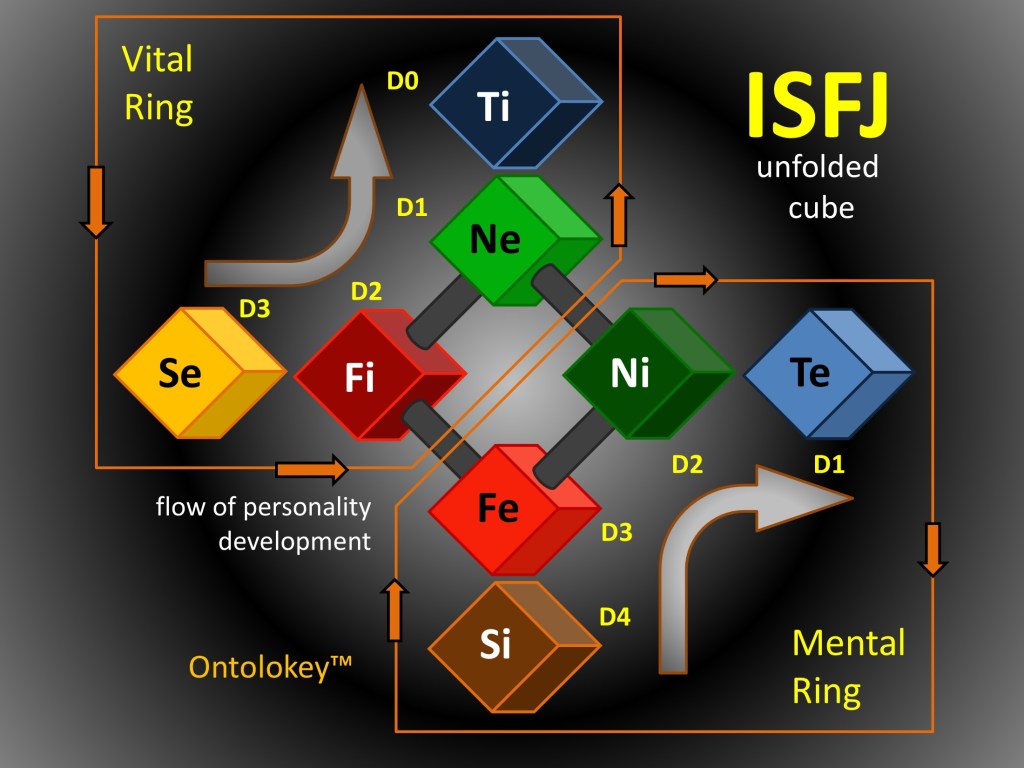
In the developmental interpretation used here, this movement toward wholeness proceeds through a precise psychological sequence rather than through an indiscriminate attempt to develop every function simultaneously. The ISFJ’s Mental Ring consists of Si at D4, Fe at D3, Ni at D2, and Te at D1, while the Vital Ring consists of Se at D3, Fi at D2, Ne at D1, and Ti at D0, with D0 representing the most archaic, childlike, and vulnerable expression of a function. The direction of development is therefore from the already established toward the progressively less developed: in the Mental Ring, Si → Fe → Ni → Te, and in the Vital Ring, Se → Fi → Ne → Ti, so that each developmental threshold prepares the psyche for the next rather than allowing the individual to leap directly toward the most difficult unconscious material. This sequence gives a particular meaning to the idea of healing through cognition: psychological wounds, recurring relational patterns, exaggerated fears, suppressed needs, and apparently inexplicable limitations can gradually become understandable when the functions through which those experiences have been filtered are themselves made conscious. Ontolokey’s central contribution to this process is its spatial representation of the eight functions, transforming an abstract functional arrangement into a landscape that can be contemplated, rotated, and consciously explored; the cube therefore becomes a symbolic instrument for asking not only “Who am I?” but also “What part of myself have I not yet learned to see?” The developmental task of the ISFJ is ultimately to allow the psychological iceberg to turn: what has traditionally remained beneath the surface must gradually enter consciousness, not so that the familiar personality disappears, but so that consciousness becomes large enough to contain the whole configuration. In this sense, wholeness is not the achievement of a perfected personality but the progressive reconciliation of the known self with the unknown self, until the shadow ceases to govern life from behind the curtain and becomes a source of insight, differentiation, compassion, and freedom.
Si at D4 — The Conscious Foundation and the Hidden Cost of Stability
At D4, Introverted Sensing (Si) represents the most established and differentiated psychological capacity of the ISFJ, and it is therefore the natural point from which the entire developmental process must begin. Si gives the ISFJ an unusually intimate relationship with accumulated experience: events are not simply registered and forgotten, but become woven into an internal landscape of impressions, bodily sensations, emotional associations, familiar patterns, remembered details, and personally meaningful precedents. The ISFJ can therefore recognize subtle changes in people and environments that others overlook, preserve traditions that provide continuity, remember what has mattered to someone years earlier, and transform repeated experience into a form of practical wisdom. In this sense, Si is far more profound than a simple “good memory”; it is a way of establishing psychological orientation by asking how the present relates to what has already been experienced, trusted, learned, loved, endured, and incorporated into the self. The D4 position means that the ISFJ does not normally need to be taught how to inhabit this function, because much of its psychological authority is already present in ordinary consciousness and forms the stable foundation from which the remaining developmental journey can proceed.
Yet precisely because Si is so reliable, its strengths can become invisible to the person who possesses them, and what begins as stability can gradually become identification with stability itself. When familiarity becomes unconsciously associated with safety, and continuity becomes associated with correctness, experiences that contradict established internal references may feel threatening before they are consciously evaluated. The ISFJ can consequently become attached not merely to people, places, routines, traditions, or responsibilities, but to the psychological certainty produced by their continued existence. This is where the positive qualities of Si can become rigid: conscientiousness may turn into perfectionism, loyalty into attachment, carefulness into excessive caution, memory into rumination, and preservation into resistance to necessary change. The deeper issue is not that the ISFJ remembers too much, but that remembered experience can acquire such authority that the present is unconsciously required to justify itself against the past before it is allowed to become something new. Individuation therefore does not ask the ISFJ to abandon memory, tradition, or continuity; it asks the person to recognize that experience is a foundation rather than a prison, and that what once protected the psyche cannot automatically remain the correct response to every future situation.
This distinction becomes particularly important when Si is combined with the ISFJ’s auxiliary Fe, because the preservation of personal continuity can become intertwined with the preservation of relational continuity. The ISFJ may remember not only what happened, but what others needed, what was promised, what was sacrificed, what someone once suffered, and what circumstances apparently require now, creating an extraordinary capacity for dependable care. The danger appears when responsibility becomes psychologically inseparable from identity: the individual may begin to experience disruption in another person’s life as something that must be repaired personally, or may feel guilty when circumstances cannot be stabilized through sufficient effort. In this state, the ISFJ can become the custodian of everyone’s emotional equilibrium while remaining comparatively unaware of the internal cost of occupying that position. Ontolokey’s analysis of the ISFJ emphasizes precisely this paradox: the same psychological architecture that produces exceptional attentiveness can also produce over-responsibility, emotional enmeshment, suppressed needs, and eventually resentment when the self has been repeatedly placed beneath the needs of others. The developmental significance of Si at D4 is therefore not to strengthen the ISFJ’s already formidable ability to preserve, but to establish enough conscious security that preservation no longer has to be used defensively against change.
This is also why the first stage of individuation cannot consist in attacking the ISFJ’s familiar identity as though its stability were itself pathological. Such an approach would merely create internal resistance, because Si is not an obstacle to development but the psychological ground from which development becomes possible. The mature movement is subtler: the ISFJ learns to distinguish between what deserves preservation and what is being preserved merely because it is familiar, between loyalty that arises from freely chosen commitment and loyalty maintained through fear, guilt, or historical obligation, and between genuine responsibility and the unconscious belief that everything must remain intact because the individual feels responsible for holding it together. This distinction creates the psychological space necessary for Fe to mature from adaptation into conscious relationship, and eventually for the more vulnerable functions to emerge without being experienced as enemies of the self. The fundamental achievement of the D4 position is therefore not permanence but secure rootedness: the ISFJ becomes sufficiently grounded in its own experience that it can eventually afford to encounter what experience cannot yet explain.
The mature Si personality consequently possesses a quality that is easily misunderstood: the ability to remain deeply connected to the past without being psychologically owned by it. Memory can become wisdom when it informs the present without dictating it; tradition can become meaning when it is consciously chosen rather than mechanically repeated; conscientiousness can become integrity when it includes the courage to recognize changing circumstances; and stability can become an inner resource rather than a demand imposed upon the external world. This is the foundation for the next developmental movement, because only when the ISFJ’s dominant function is sufficiently secure can Fe be developed from a highly capable adaptive function into an increasingly conscious instrument of relationship. The direction of individuation is therefore not away from Si but through it: the ISFJ must first understand what its deepest strength is protecting before it can discover what that strength has unconsciously excluded. In the language of the Ontolokey developmental model, the journey begins at D4 precisely because the psyche must learn to stand firmly upon its strongest ground before it can safely descend toward the less developed regions of consciousness.
Fe at D3 — From Caretaking to Authentic Relationship
Extraverted Feeling (Fe) occupies D3 as the ISFJ’s auxiliary function, and its developmental importance is therefore second only to Si within the Mental Ring. Fe extends the ISFJ beyond the private world of remembered experience into the living field of human relationship, where emotional atmosphere, interpersonal needs, social expectations, and the well-being of others become psychologically salient. This is the source of many of the qualities traditionally associated with the ISFJ: kindness, consideration, loyalty, tact, hospitality, emotional attentiveness, reliability, and an almost instinctive awareness of what would make another person feel cared for. The ISFJ often notices what has not been said as readily as what has been said, and may respond to subtle changes in mood before the other person has consciously formulated them. In its healthy expression, Fe does not merely make the ISFJ agreeable; it gives the personality an ethical orientation toward relationship, allowing care to become an active form of participation in the lives of others. Because Fe is already relatively developed, however, the central developmental task is not simply to become “more caring,” but to differentiate authentic compassion from unconscious emotional responsibility and to discover where interpersonal harmony ends and self-abandonment begins.
The shadow of Fe emerges when the ISFJ becomes dependent upon relational harmony as evidence that everything is psychologically safe. Because the ISFJ can be highly sensitive to discord, disappointment, criticism, rejection, or emotional withdrawal, there may be a temptation to modify personal behavior before asking whether the relationship itself is healthy, reciprocal, or truthful. The person may apologize too quickly, accommodate too readily, suppress disagreement, or continue fulfilling obligations long after the original commitment has ceased to be psychologically sustainable. What appears externally as generosity can therefore conceal an internal transaction: “If I remain useful, considerate, dependable, and emotionally available, I will remain worthy of belonging.” The resulting pattern can become particularly painful because the ISFJ may not initially experience it as self-betrayal; it may feel like love, decency, maturity, or simply doing what one ought to do. Yet when personal needs remain chronically unrepresented, the psyche eventually records the discrepancy, and suppressed frustration can transform into exhaustion, quiet resentment, withdrawal, or the painful realization that others have become accustomed to receiving care without necessarily knowing the person who provides it. Ontolokey’s treatment of the ISFJ’s less visible psychological dynamics is particularly concerned with this tension between the socially recognizable caretaker and the private individual whose own emotional reality may have been repeatedly postponed.
The developmental movement from D3 toward D4 in Fe therefore requires a profound change in the meaning of care. Mature Fe does not ask, “What must I do so that everyone remains pleased with me?” but rather, “What is genuinely true and constructive within this relationship, including for me?” This distinction may initially feel uncomfortable because authenticity can temporarily produce precisely the disharmony the ISFJ has learned to prevent. Saying no, expressing anger appropriately, acknowledging disappointment, asking for reciprocity, or refusing an unreasonable demand can feel selfish when the psyche has equated goodness with accommodation. Yet genuine relational maturity requires the capacity to tolerate another person’s temporary displeasure without immediately interpreting it as evidence of personal failure. The ISFJ gradually discovers that harmony created through suppression is fragile, whereas harmony that survives honesty is structurally stronger. In this sense, Fe becomes more conscious when the ISFJ stops using other people’s emotional states as a measurement of personal worth and instead regards relationship as a meeting between distinct selves, each possessing legitimate needs, limits, perceptions, and responsibilities.
This is also the developmental stage in which forgiveness acquires a deeper psychological meaning. The ISFJ can remember injuries with exceptional emotional and contextual detail, and because Si preserves the circumstances surrounding an experience while Fe remains attuned to its interpersonal meaning, an old wound may remain psychologically alive long after the external situation has ended. Forgiveness, however, does not require the ISFJ to deny what happened or declare harmful behavior acceptable; it requires differentiation between understanding, excusing, trusting, reconciling, and releasing emotional possession of the past. As unconscious functions gradually become visible, the person may also recognize that some painful encounters were intensified by personal vulnerabilities that were not understood at the time, including an inability to articulate needs, excessive responsibility, fear of conflict, or an unconscious expectation that others should intuit what the ISFJ itself had never clearly expressed. Such recognition can soften the rigid division between victim and perpetrator without erasing moral responsibility, because understanding psychological mechanisms allows a person to see how both oneself and others can act from limitations they do not yet consciously understand. In this way, cognition becomes potentially reparative: what was once experienced only as “Why did this happen to me?” can gradually become “What psychological pattern was operating here, and what can I now understand that I could not understand then?”
Once Fe approaches the maturity associated with the upper end of its D3 developmental range, the ISFJ reaches the threshold at which the unconscious begins to become substantially more accessible. The movement toward Ni at D2 is particularly significant because Ni introduces a mode of psychological perception that is less dependent upon accumulated external evidence and more concerned with underlying meaning, symbolic patterns, trajectories, implications, and the direction in which a situation is moving. The ISFJ therefore begins to encounter a dimension of reality that cannot simply be preserved, organized, or harmonized: the dimension of what something means beneath what has already happened. This transition can feel destabilizing because the familiar authority of experience is gradually complemented by an intuition that asks what has not yet happened, what lies beneath appearances, and what a pattern may be becoming. Yet this is precisely the kind of destabilization required by the Ontolokey model: once the auxiliary function has become sufficiently conscious, the psychological iceberg begins to rotate, and the ISFJ is no longer merely becoming better at being the person it already knows itself to be. It is beginning to encounter the person that has always existed within it but has not yet been fully recognized.
Ni at D2 — The Anima/Animus and the Descent Beneath Experience
Introverted Intuition (Ni) occupies D2 in the ISFJ’s Mental Ring and represents the first major psychological movement away from the security of what has already been experienced toward the mystery of what experience has not yet revealed. Whereas Si naturally asks what has happened, what has been learned, and what remains consistent with the accumulated pattern of life, Ni turns inward toward underlying meaning, symbolic coherence, psychological trajectories, and the possibility that visible events are expressions of deeper processes. In the Ontolokey model, this function is identified as the ISFJ’s Anima/Animus, and its development therefore represents more than acquiring another cognitive skill: it is an encounter with an inner dimension that can initially feel strangely intimate and strangely foreign at the same time. The ISFJ may experience intuitions, dreams, impressions, anticipations, symbolic associations, or sudden understandings that do not emerge through deliberate recollection or interpersonal feedback, and this can challenge the implicit assumption that knowledge must be grounded in something already known. The developmental task is not to replace Si with Ni, but to allow intuition to converse with memory so that the past becomes a source of orientation rather than the final authority over what the future is permitted to become.
The Anima/Animus position is particularly important because it can expose a dimension of the ISFJ that has remained psychologically underrepresented: the capacity to exist without immediately knowing what practical role one should play. The ISFJ’s conscious identity is often strengthened through usefulness, reliability, care, and concrete contribution, whereas Ni introduces an interiority in which meaning may matter more than usefulness and contemplation may matter more than immediate action. This can produce an unfamiliar psychological vulnerability because intuition does not always provide evidence that can be shared, verified, or defended in the conventional manner, and the ISFJ may initially distrust its own perceptions precisely because they cannot be justified through established experience. At the same time, the neglected Ni can become disproportionately attractive when the conscious personality becomes exhausted by responsibility, producing periods of withdrawal, idealization, romanticized visions of another life, or a longing for some profound transformation that will finally make the existing burdens meaningful. The shadow does not lie in intuition itself, but in the oscillation between distrusting it completely and unconsciously investing it with absolute authority. Healthy development requires the ISFJ to learn a third position: intuition can be listened to without being worshipped, and it can be questioned without being silenced.
The deeper psychological significance of Ni becomes apparent when the ISFJ begins examining why certain situations repeatedly evoke disproportionate emotional reactions. A person may discover, for example, that an apparently minor act of neglect awakens an ancient feeling of invisibility, that criticism triggers a fear of being fundamentally inadequate, or that another person’s unpredictability evokes an almost bodily need to restore order. Si can preserve the details of such experiences with extraordinary fidelity, while Fe can preserve their interpersonal meaning, but Ni asks a different question: what deeper psychological pattern connects them? This question begins to transform biography into psychological narrative, because isolated experiences become manifestations of recurring themes rather than merely unfortunate events. Such recognition can be healing precisely because it allows the ISFJ to stop experiencing every painful event as a unique personal verdict and instead understand how perception, memory, expectation, attachment, and unconscious vulnerability interact to produce recurring interpretations. The individual can then begin to distinguish the event itself from the meaning unconsciously assigned to it, which is one of the most important movements in cognitive self-healing: the past remains real, but its interpretation is no longer permanently frozen.
Ni also confronts the ISFJ with mortality, change, impermanence, and the impossibility of preserving everything that has been loved. This confrontation can be difficult for a personality whose deepest psychological strength lies in continuity, because continuity is most painful precisely where life refuses to remain continuous. People age, relationships change, homes disappear, traditions lose their original context, responsibilities end, and identities that once provided certainty become inadequate. The ISFJ may therefore need to grieve not only actual losses but also the fantasy that sufficient care can prevent loss from occurring. Ni offers a different form of continuity: instead of preserving the external form of what has been lost, the psyche begins to preserve its meaning, allowing an experience to become part of an evolving inner narrative rather than an object that must remain externally unchanged. In this sense, Ni can teach the ISFJ that letting go is not equivalent to forgetting, and transformation is not equivalent to betrayal. What is truly integrated does not need to remain externally identical in order to remain psychologically meaningful.
As Ni becomes increasingly conscious, the ISFJ may also begin to perceive a previously hidden tension between duty and destiny, between the life that has been responsibly constructed and the life that the deeper psyche is asking to explore. This does not necessarily mean abandoning family, career, tradition, or responsibility; rather, it means discovering whether these commitments remain expressions of the authentic self or have gradually become substitutes for discovering that self. The question becomes especially important in the second half of life, when the developmental emphasis shifts from constructing a secure external identity toward integrating dimensions of the personality that were previously subordinated to that identity. The Ontolokey conception of the rotating iceberg provides a useful image here: as the unconscious begins to rise, the ISFJ may temporarily feel less certain about who they are precisely because previously invisible material is entering consciousness. This apparent destabilization should not automatically be interpreted as regression; it can represent the psyche becoming larger than the identity that previously contained it. The developing ISFJ learns to tolerate ambiguity long enough for deeper meaning to emerge, and through that tolerance begins preparing for the next stage of the Mental Ring: Te at D1, where inner insight must eventually confront the demanding question of objective effectiveness, structure, measurement, and independent judgment.
Te at D1 — The Toddler Function and the Wound Around Competence
Extraverted Thinking (Te) occupies D1 in the ISFJ’s Mental Ring and therefore represents one of the most vulnerable stages of conscious development within the personality’s primary psychological pathway. Te concerns external structure, measurable effectiveness, objective organization, efficiency, implementation, prioritization, resource management, and the ability to determine whether an idea actually works in the world rather than merely feeling responsible for it. For an ISFJ whose strongest psychological orientation is toward preserving experience and whose auxiliary orientation is toward maintaining human harmony, this mode of functioning can feel comparatively impersonal, blunt, or even morally uncomfortable. The ISFJ may be extraordinarily competent in practical life while nevertheless feeling psychologically uncertain when competence has to be demonstrated through impersonal standards, decisive confrontation, strategic prioritization, or explicit evaluation of results. This distinction is essential: D1 does not mean that the ISFJ is incapable of practical achievement, but that the underlying psychological function of detached external evaluation may remain comparatively immature even when the person performs many practical tasks extremely well. The developmental challenge is therefore to build a conscious relationship with Te without turning it into a weapon against the self or allowing its immature expression to dictate the person’s worth.
The designation of Te as a Toddler function captures an especially sensitive psychological dynamic because immature Te may behave less like a calm adult capacity and more like a young child whose sense of competence is easily wounded. When the ISFJ encounters situations demanding rapid decisions, assertive negotiation, competitive performance, direct confrontation, or visible proof of effectiveness, the emotional reaction can become disproportionate to the objective circumstances. A relatively ordinary failure may be experienced not simply as “this approach did not work,” but as “perhaps I am incapable,” while criticism of performance can penetrate much deeper than the critic intended because it touches a poorly defended area of identity. The ISFJ may consequently compensate by overpreparing, avoiding situations in which competence could be publicly tested, becoming excessively conscientious about details, or retreating into domains where accumulated experience provides greater psychological security. Alternatively, under sufficient pressure, the neglected Te can erupt in an unusually rigid, controlling, impatient, or efficiency-driven manner, particularly when the individual has reached the limits of emotional accommodation. The apparent contradiction between extreme helpfulness and sudden hardness is therefore not necessarily accidental; it can reflect an immature function that has been suppressed for so long that it emerges only under stress, without the gradual refinement that ordinary conscious development would have provided.
The healing of this Toddler function begins when the ISFJ learns to separate competence from identity. Failure, inefficiency, poor judgment, indecision, or lack of knowledge are events within a learning process, not final statements about the value of the person who experiences them. This sounds simple, yet for a personality accustomed to demonstrating love through reliability, the distinction can be psychologically profound because usefulness may have become intertwined with belonging. The individual may have learned early that being dependable produces appreciation and that mistakes threaten not merely achievement but relational security, making external evaluation unusually emotionally charged. Te development therefore requires repeated experiences in which the ISFJ can act, assess the result, correct the method, and continue without converting the outcome into a verdict upon the self. This is where the earlier development of Fe and Ni becomes indispensable: Fe provides the capacity to remain relationally connected without surrendering autonomy, while Ni provides the ability to understand failure as part of a larger developmental trajectory rather than as an isolated catastrophe. Te can then gradually mature from the question “Am I competent enough?” into the much healthier question “What does this situation require, what is currently effective, and what can I learn from the result?”
There is also an important relationship between immature Te and the ISFJ’s tendency toward self-sacrifice. When a person becomes accustomed to meeting the needs of others, it is possible to become extremely productive while remaining surprisingly unclear about personal priorities. The ISFJ may complete countless responsibilities yet struggle to determine which responsibilities are genuinely important, which were voluntarily assumed, which belong to other people, and which are maintained merely because abandoning them would provoke guilt. Developing Te means learning to externalize priorities rather than carrying them as an undifferentiated mass of obligations. Lists, schedules, budgets, boundaries, measurable objectives, explicit agreements, delegation, and clear decisions can become psychologically liberating because they transform vague responsibility into observable structure. The purpose is not to turn the ISFJ into a cold efficiency machine, but to prevent emotional conscientiousness from becoming the only mechanism through which life is organized. When Te develops, practical structure begins to protect the ISFJ’s emotional life instead of consuming it, because the person can finally say, with greater objectivity, what can be done, what cannot be done, what matters most, and what no longer belongs to them.
The completion of the Mental Ring therefore represents a significant stage in the movement toward psychological wholeness. Si has provided the foundation of experience, Fe has expanded consciousness into authentic relationship, Ni has opened perception toward underlying meaning and future possibility, and Te has begun to translate insight into objective action. The sequence matters because the ISFJ is not being asked to leap from its familiar strengths into an alien personality; rather, each function develops out of the psychological security established by the preceding one. Once Te becomes sufficiently integrated, the person is better prepared to encounter the Vital Ring, where the developmental process becomes more intimate, instinctive, and potentially destabilizing because it reaches functions that are less directly represented in the conscious identity. The first of these is Extraverted Sensing (Se) at D3, the Sibling function, and its emergence introduces a fundamentally different relationship with immediacy, embodiment, spontaneity, sensory reality, risk, assertion, and the present moment. At this threshold, individuation ceases to be primarily an expansion of conscious cognition and becomes an encounter with dimensions of life that the ISFJ may have experienced all along but has not yet fully claimed as legitimate expressions of the self.
Se at D3 — The Sibling and the Return to the Living Present
Extraverted Sensing (Se) begins the ISFJ’s passage through the Vital Ring and occupies D3 as the Sibling function, creating a developmental threshold fundamentally different from the preceding stages of the Mental Ring. Se directs consciousness toward immediate sensory reality: what is happening now, what is physically present, what can be directly perceived, touched, changed, experienced, or acted upon without first being filtered through accumulated memory or anticipated meaning. For the ISFJ, whose dominant Si naturally compares present experience with an extensive internal archive of previous experience, this immediacy can initially feel less safe because the present contains uncertainty and cannot be completely rehearsed beforehand. Yet Se is precisely the capacity that can rescue the ISFJ from becoming psychologically trapped in what has already happened or what might happen later. Its healthy development brings embodiment, spontaneity, decisiveness, environmental awareness, physical vitality, and a greater willingness to participate directly in life rather than merely preserving, analyzing, or preparing for it. As the Sibling function, Se can be approached as a companion consciousness: not an enemy of Si, but a complementary perspective that teaches the ISFJ that reality is not only something remembered accurately but something continuously occurring.
The shadow of undeveloped Se becomes particularly visible when the ISFJ experiences the present primarily through the expectations created by the past. A familiar environment may feel safe even when it has become psychologically restrictive, while an unfamiliar opportunity may feel dangerous simply because there is no established internal template for it. The individual can become excessively cautious, overprepared, hesitant to improvise, or reluctant to take action until sufficient certainty has been achieved, even though life rarely provides the degree of certainty the ISFJ would prefer. In the opposite direction, when suppressed Se finally breaks through under pressure, it can emerge in compensatory forms such as impulsive consumption, sensory excess, sudden risk-taking, aggressive assertion, or an urgent need to escape an overly controlled life. Neither extreme represents mature Se because both remain reactions to imbalance: one avoids immediate reality, while the other attempts to overwhelm it. Development occurs when the ISFJ learns to remain present without requiring the present to resemble the past, allowing sensory information to correct assumptions rather than merely confirm them. This capacity is psychologically important because it introduces a new source of trust: not only “I have experienced this before,” but also “I can meet what is happening now and respond adequately.”
Se development can therefore become a form of embodied healing. The ISFJ may have spent considerable psychological energy attending to other people’s emotional states, remembering obligations, anticipating consequences, and maintaining continuity, while remaining comparatively disconnected from immediate bodily signals. Fatigue, tension, overstimulation, pleasure, anger, hunger, physical desire, or the simple need to stop can be overridden because the person has learned to prioritize what should be done over what the body is actually communicating. Mature Se restores the body as a legitimate source of information rather than treating it as an inconvenient instrument for carrying out responsibilities. This can involve something as ordinary as noticing when one is tired before exhaustion becomes collapse, experiencing an environment without immediately categorizing it through memory, allowing pleasure without having to justify its usefulness, or taking action before every possible outcome has been mentally secured. Such experiences gradually teach the psyche that presence itself has value. The ISFJ begins to discover that being alive is not identical with being responsible, and that an existence organized entirely around preserving what matters can paradoxically miss the immediate experience of being here.
The Sibling position also carries an important interpersonal meaning because Se can strengthen the ISFJ’s ability to respond directly rather than indirectly. Instead of hoping that another person will recognize an unmet need, the developing ISFJ becomes more capable of naming the problem, addressing it, and acting within the concrete situation. Instead of endlessly interpreting why someone behaved badly, the person can recognize the observable behavior and establish an appropriate boundary. Instead of preserving a relationship because of its history, the ISFJ can evaluate what is actually happening in the relationship now. This creates an important corrective to the potentially retrospective bias of Si and the accommodating tendencies of Fe, because present reality becomes evidence in its own right. The psychological achievement is not bluntness but immediacy: the ISFJ can remain caring while becoming more direct, can remain loyal while recognizing change, and can remain considerate without surrendering the capacity to act. As Se develops, the person becomes increasingly able to inhabit the present without experiencing every departure from precedent as a threat to identity.
When Se approaches the maturity appropriate to its D3 position, the ISFJ has acquired an important new psychological resource for the next descent into the Vital Ring. The next function, Introverted Feeling (Fi) at D2, moves even deeper into the question of individuality, because Fi asks not primarily what maintains interpersonal harmony but what is personally and inwardly true. This transition can be especially challenging for the ISFJ because Fe has often provided a well-developed relational compass, while Fi introduces a private moral and emotional center that cannot simply be negotiated collectively. The development of Se therefore prepares the ground by teaching the person to tolerate immediate reality without immediately adapting it to established expectations; Fi then asks whether the person can tolerate an even more unsettling reality—the possibility that their deepest values, attachments, boundaries, and emotional truths may not always coincide with what other people need or approve of. The Vital Ring thus moves progressively closer to the psychological core of individuation, where the question is no longer merely how the ISFJ functions effectively within life, but who the ISFJ is when external harmony can no longer serve as the definitive measure of inner truth.
Fi at D2 — The Golden Shadow and the Discovery of the Private Self
Introverted Feeling (Fi) occupies D2 in the ISFJ’s Vital Ring as the Golden Shadow, and this position introduces one of the most psychologically revealing contradictions in the entire developmental structure. Fi represents an inwardly referenced experience of personal value, emotional authenticity, conscience, attachment, boundaries, and the private significance of what one loves or rejects, yet the ISFJ’s conscious Fe orientation naturally asks how feelings function within relationship and shared emotional reality. Because Fe is relatively familiar, the ISFJ may unconsciously assume that being a good person means being responsive to others, maintaining consideration, fulfilling obligations, and preventing unnecessary interpersonal suffering, while Fi quietly carries another truth: a person can care deeply about others and still possess an inner life that does not require external permission to be legitimate. The Golden Shadow is therefore “golden” because it contains qualities that may appear deeply attractive, morally compelling, or even idealized when encountered in other people, while simultaneously being difficult to recognize as one’s own. Ontolokey’s treatment of this dimension points toward an important developmental realization for the ISFJ: the qualities admired in people who seem uncompromisingly authentic, emotionally self-defined, or fiercely loyal to their personal values may represent not merely an external ideal but a neglected psychological possibility within the ISFJ itself. Individuation therefore requires the ISFJ to reclaim a private center of value without interpreting that center as selfishness.
The difficulty is that Fi development can initially provoke guilt because it threatens a long-established psychological equation between goodness and accommodation. An ISFJ who has spent years asking what others need may suddenly discover that some decisions cannot be resolved by considering everyone else first, because there are situations in which personal integrity requires saying no even when another person is disappointed. This can expose a hidden fear: if I stop adapting myself to other people’s expectations, will I still be loved, respected, or considered a good person? The question is deeper than ordinary assertiveness because it touches the architecture of identity itself, particularly when being needed has become one of the principal ways through which the individual experiences significance. Fi does not answer this dilemma by encouraging emotional isolation; rather, it teaches that authentic relationship requires two distinct persons, not one person continuously adjusting itself until conflict disappears. The developing ISFJ therefore begins to distinguish compassion from compliance, forgiveness from reconciliation, loyalty from self-erasure, and kindness from the inability to tolerate another person’s disappointment. In doing so, the individual discovers that boundaries are not walls against love but structures that allow love to remain voluntary rather than compulsory.
The Golden Shadow can also explain why certain people may exert an unusually strong fascination over the ISFJ. Individuals who openly express personal convictions, refuse social expectations, prioritize inner authenticity, or appear unwilling to betray themselves can seem simultaneously admirable and irritating, inspiring and threatening. Psychologically, such reactions can signal projection: qualities that have not yet been consciously integrated may be encountered externally before they can be recognized internally. The ISFJ might idealize someone’s apparent authenticity and then unconsciously judge them as selfish, difficult, overly emotional, or insensitive when their autonomy interferes with relational expectations. The integration of Fi requires the person to hold both perceptions at once: another individual may genuinely possess admirable self-definition, while also having flaws, blind spots, or unhealthy expressions of individuality. More importantly, the ISFJ must gradually recognize that the capacity being admired does not belong exclusively to the other person. The question becomes not “Why can they live according to themselves while I cannot?” but “What part of myself have I delegated to them because I was afraid to claim it?” This is one of the most transformative questions in shadow work because it converts envy, admiration, irritation, or idealization into information about the psyche.
Fi also changes the ISFJ’s relationship with emotional pain. Fe naturally gives interpersonal emotions a relational context, which can make the suffering of others highly salient, while Fi brings attention to the irreducibly personal character of one’s own experience. The ISFJ may discover that some wounds cannot be healed merely by understanding everyone involved or restoring interpersonal harmony, because something within the self was violated and needs to be acknowledged on its own terms. This can include grief, anger, disappointment, longing, resentment, or a sense of having lived too long according to expectations that were never consciously chosen. Such feelings may initially seem incompatible with the image of the dependable and considerate ISFJ, but their emergence is not evidence that the personality has become worse; it can indicate that previously excluded psychological material has finally acquired a voice. The healing process consists in listening without immediately acting upon every feeling, because Fi integration is not emotional absolutism but the capacity to recognize subjective experience as meaningful information. When the ISFJ can say, “This matters to me even if nobody else understands why,” a new form of psychological dignity begins to develop.
The movement from Fi D2 toward Ne D1 consequently requires the ISFJ to become increasingly tolerant of possibilities that have no established precedent and no guaranteed interpersonal approval. Fi establishes an inner reference point, while Extraverted Intuition will later challenge the person to explore what might exist beyond the known boundaries of that reference point. This is why the development of the Golden Shadow cannot be reduced to simply becoming more assertive: it is about establishing an authentic interior center from which exploration becomes possible. Once the ISFJ knows that personal identity does not disappear merely because circumstances change or another person disapproves, uncertainty becomes less threatening. The psyche can then move toward Ne, where unfamiliar possibilities, alternative interpretations, experimentation, and divergent futures become psychologically tolerable. In the larger process of individuation, Fi is therefore a crucial bridge between relationship and individuality: Fe teaches the ISFJ to participate in the emotional world of others, while Fi teaches that participation must not require the disappearance of the self. The result is not a less caring ISFJ but a more complete one, capable of caring without abandoning inner truth and capable of belonging without making belonging the price of authenticity.
Ne at D1 — The Inferior Function and the Fear of the Unknown
Extraverted Intuition (Ne) occupies D1 in the ISFJ’s Vital Ring and therefore represents another particularly vulnerable developmental threshold, although its vulnerability differs fundamentally from that of Te. Ne opens consciousness toward possibilities, alternatives, novelty, experimentation, divergent interpretations, unexpected connections, and futures that cannot yet be reduced to established experience. For the ISFJ, this can be both liberating and frightening because Si has provided psychological security through continuity, precedent, and familiarity, whereas Ne introduces a field in which multiple outcomes remain simultaneously possible. The mind may suddenly have to tolerate the fact that there is not one known path but many possible paths, that a situation can develop in unforeseen directions, and that the absence of precedent does not necessarily indicate danger. When immature, Ne can therefore appear through anxiety, catastrophic speculation, excessive “what if” thinking, or an instinctive tendency to imagine everything that could go wrong. Yet the same function, once gradually integrated, becomes one of the ISFJ’s greatest sources of renewal because it allows the person to discover that uncertainty is not merely the absence of safety; it is also the space in which new life becomes possible. The developmental movement from Fi toward Ne is thus a movement from knowing what is inwardly true to becoming willing to explore what that truth might make possible.
The inferior position can create a peculiar relationship with imagination because the ISFJ may possess a rich inner life while remaining distrustful of possibilities that cannot immediately be anchored in experience. An unfamiliar career direction, unconventional relationship, spontaneous journey, new intellectual interest, or radically different way of organizing life can initially appear irresponsible simply because it lacks sufficient precedent. The individual may unconsciously ask, “What evidence do I have that this will work?” before asking the equally important question, “What evidence do I have that my current way of living is the only viable one?” Under stress, immature Ne can turn possibility into threat, generating chains of hypothetical negative outcomes that make inaction feel prudent. This is one reason why ISFJs can sometimes remain in unsatisfying situations longer than necessary: the known discomfort of the present may feel psychologically safer than the unknown consequences of change. Developing Ne does not mean becoming reckless or abandoning practical judgment; it means learning that imagination can serve adaptation rather than merely anxiety, and that considering alternatives is not equivalent to committing oneself to them.
The integration of Ne becomes especially powerful after Fi has established a stronger sense of personal authenticity. Without Fi, novelty can feel like pressure from the outside, another demand to become someone else; with Fi, novelty can instead become an exploration of what the self genuinely wants to discover. The ISFJ can begin experimenting without demanding certainty from every experiment, trying something without needing to know in advance whether it will become permanent, and changing direction without interpreting the change as proof that previous decisions were mistakes. This represents a profound shift in the relationship with the past. Si no longer has to defend every previous choice because the person understands that a decision can have been appropriate for the self that made it and still become inappropriate for the self that has developed since. Ne introduces psychological permission to evolve. The past remains a source of knowledge, but it becomes one perspective among several possible perspectives rather than an inflexible constitutional law governing the future.
Ne also has an important function in healing relational wounds because it allows the ISFJ to generate alternative interpretations of painful experiences. A deeply hurt person may unconsciously construct a single explanation—“I was rejected because I was not good enough,” “People always take advantage of my kindness,” “I cannot trust anyone,” or “If I stop being useful, I will be abandoned”—and then use subsequent experiences to confirm it. Such conclusions can become deeply embedded because Si preserves confirming memories while Fe remains emotionally invested in their interpersonal meaning. Ne introduces psychological plurality by asking what else might be true: perhaps the other person acted from their own limitations, perhaps the relationship was incompatible rather than the self defective, perhaps a boundary was missing, perhaps the timing was wrong, or perhaps the event revealed a pattern that can now be changed. This does not mean replacing reality with comforting fantasies; rather, it means refusing to confuse one interpretation with reality itself. In combination with Ni and Fi, Ne can therefore become an instrument of cognitive liberation, allowing the ISFJ to revise inherited narratives without erasing the experiences from which those narratives originally arose.
As Ne develops toward greater maturity, the ISFJ becomes increasingly capable of experiencing change as an extension of life rather than as an interruption of life. Creativity becomes less threatening because it no longer requires abandoning structure; exploration becomes possible because experience remains available as a stabilizing resource; and spontaneity can coexist with conscientiousness rather than replacing it. The person begins to see that tradition itself was once innovation, that every familiar structure originated as an experiment, and that continuity remains alive only when it can adapt to changing circumstances. Ne therefore completes an important psychological reversal: the ISFJ learns to preserve what is meaningful while allowing its form to change. Yet one final and particularly difficult function remains beyond Ne—the Ti function at D0, the Blindspot, representing the most archaic and least developed territory of the Vital Ring. There the individual encounters detached internal analysis, conceptual precision, impersonal consistency, and the frightening possibility of examining one’s own beliefs without relying upon precedent, emotional consensus, or practical usefulness. Reaching that territory requires the preceding functions to have become sufficiently stable, because the psyche must first learn to tolerate personal truth and uncertainty before it can safely question the conceptual structures through which it has understood reality.
Ti at D0 — The Blindspot
Introverted Thinking (Ti) occupies D0, the Blindspot of the ISFJ’s Vital Ring, and therefore represents the most archaic and psychologically vulnerable territory in the developmental sequence described by Ontolokey. Ti turns consciousness toward internal logical consistency, conceptual precision, categorization, definitions, principles, and the question of whether something makes sense within its own structure independently of interpersonal agreement or practical usefulness. For an ISFJ whose psychological orientation is strongly informed by lived experience and relational meaning, this can feel strangely detached because Ti does not primarily ask whether something has worked before or whether it preserves harmony; it asks whether the underlying idea is internally coherent. In its immature form, this capacity can appear childlike precisely because the person may have difficulty trusting abstract reasoning when it conflicts with experience, relationship, or established expectations, while criticism directed at the person’s reasoning can evoke a disproportionately vulnerable reaction. The Blindspot is therefore not simply an absence of intelligence or analytical ability, but a region of cognition that may lack the emotional security and developmental practice possessed by the dominant functions. Its integration requires extraordinary patience because the ISFJ is learning to examine ideas without immediately defending the person, relationship, tradition, or experience associated with those ideas.
One of the most important lessons of Ti development is that disagreement does not automatically constitute rejection. An ISFJ can be deeply invested in maintaining relational harmony, and consequently an analytical challenge may unconsciously be experienced as interpersonal hostility even when no such hostility exists. Someone who questions a conclusion, points out an inconsistency, or proposes a different conceptual framework may therefore trigger an unexpectedly personal response, particularly if the ISFJ has invested substantial emotional meaning in the position being questioned. The immature reaction may take several forms: withdrawing from the discussion, appealing to precedent or authority, emphasizing the emotional consequences of the argument, becoming defensive about being misunderstood, or conversely attempting to end the disagreement by over-accommodating the other person. None of these responses is inherently malicious; they reflect the difficulty of maintaining psychological differentiation when detached analysis enters an area that has historically been protected by relational and experiential forms of knowing. Developing Ti means gradually discovering that an idea can be wrong without the self becoming wrong, that a belief can be revised without betraying its origin, and that intellectual disagreement can sometimes deepen intimacy precisely because it permits two people to remain separate while thinking together.
At D0, Ti can also reveal the childlike fear of not understanding. The ISFJ may be comfortable mastering systems through repetition and practical familiarity yet feel exposed when confronted with an abstract conceptual environment in which there is no obvious experiential anchor. This can generate an unconscious temptation to dismiss what cannot immediately be applied, or to assume that an idea is unnecessarily complicated because its value is not emotionally or practically apparent. Yet the development of Ti asks the ISFJ to remain with a question even when it has no immediate utility. That capacity can become transformative because it strengthens the individual’s ability to distinguish facts from interpretations, principles from habits, explanations from justifications, and genuine understanding from familiarity. The psychological significance extends beyond intellectual development: once the ISFJ can examine personal narratives with greater conceptual distance, deeply held assumptions about responsibility, love, loyalty, morality, and identity can become objects of reflection rather than invisible laws. The person may begin asking not only “What happened?” but “What definition of myself did I construct from what happened, and does that definition still logically describe who I am?”
This process can be uncomfortable because some cherished beliefs may have served important protective functions. An ISFJ might have developed the conviction that good people should always help, that reliable people should never disappoint others, that conflict should be minimized, that family obligations must take precedence over personal desires, or that forgiveness requires continued availability. Such beliefs may once have created order and belonging, even if they later became restrictive. Ti does not destroy them through rebellion; it disassembles them carefully, examining their assumptions and consequences until the individual can decide which principles remain valid and which were inherited unconsciously. This is why the Blindspot can eventually become an unexpected source of liberation: what initially feels like cold analysis can become a compassionate form of intellectual honesty. Instead of asking whether a belief is emotionally comfortable, Ti asks whether it is coherent, and once coherence becomes more important than psychological habit, the ISFJ becomes less vulnerable to manipulation through guilt, tradition, emotional pressure, or appeals to obligation. The capacity to think independently becomes another form of self-respect.
The complete integration of Ti should not be understood as the final transformation of the ISFJ into a fundamentally analytical personality, because individuation does not mean replacing the dominant configuration with its opposite. Rather, Ti becomes a quiet internal instrument that can challenge the other functions when necessary, helping Si recognize when precedent has become rigidity, Fe recognize when empathy has become self-erasure, Ni recognize when meaning has become projection, Te recognize when efficiency has become control, Se recognize when immediacy has become impulsiveness, Fi recognize when authenticity has become emotional absolutism, and Ne recognize when possibility has become anxiety or fantasy. In this sense, the Blindspot becomes integrated precisely when it no longer needs to shout. The child within the psyche does not need to become an adult by becoming dominant; it needs to become safe enough to think, question, make mistakes, and learn without shame. When this occurs, the eight functions cease to appear as competing identities and begin to operate as differentiated perspectives within one psychological whole.
The completion of the Vital Ring therefore brings the developmental sequence to its deepest point, but it does not terminate the process of individuation. The ISFJ has moved from the conscious foundation of Si through Fe, Ni, and Te, then into the progressively less familiar territories of Se, Fi, Ne, and finally Ti, with each stage depending upon sufficient development of the preceding one. The metaphor of the rotating iceberg becomes particularly meaningful here: as previously submerged functions enter awareness, the person may temporarily feel less like the familiar ISFJ and more like an unfamiliar version of the self, yet this unfamiliarity is precisely what makes integration possible. Eventually, the movement turns toward the restoration of the original center—not a return to unconscious habitual functioning, but a return to Si as a consciously enriched D4 foundation that now contains knowledge gained from the entire psychological landscape. The mature ISFJ therefore does not become less ISFJ through individuation; paradoxically, the personality can become more authentically itself because it no longer needs to exclude everything that does not resemble its original conscious identity.
The ISFJ Shadow — When Strength Becomes a Defense
The shadow side of the ISFJ cannot be understood simply by listing undesirable traits, because many of its most difficult patterns originate precisely in qualities that are ordinarily admirable. The capacity to remember, care, anticipate, preserve, serve, endure, and remain loyal can become psychologically defensive when these functions are recruited to prevent contact with vulnerability, uncertainty, anger, autonomy, or personal desire. A person may therefore appear exceptionally generous while secretly feeling indispensable, exceptionally patient while accumulating resentment, exceptionally loyal while remaining attached to relationships that have ceased to be reciprocal, or exceptionally responsible while unconsciously expecting others to recognize and appreciate sacrifices that were never openly negotiated. The shadow emerges when a strength ceases to remain a freely chosen capacity and becomes a requirement for maintaining psychological security. In that condition, the ISFJ does not merely perform care; the person may need to be the caretaker in order to know who they are. Ontolokey’s deeper treatment of the ISFJ emphasizes this less comfortable reality: beneath the socially reassuring image of the dependable protector can exist exhaustion, suppressed anger, fear of being unnecessary, difficulty receiving care, sensitivity to betrayal, and a profound longing to be understood without having to earn understanding through service.
One of the most consequential shadow patterns is the accumulation of unspoken expectations. Because the ISFJ often notices what other people need without requiring explicit instructions, there can be an unconscious assumption that emotionally attentive people should be able to perceive one another in the same way. The individual may therefore provide help without asking whether it is wanted, remember obligations that others have forgotten, anticipate difficulties before they arise, and quietly absorb burdens that were never formally assigned, only to experience profound disappointment when others fail to reciprocate spontaneously. The resulting resentment can be confusing because the ISFJ may sincerely believe, “I never asked them to do anything for me,” while another part of the psyche is nevertheless keeping an invisible ledger of sacrifices, omissions, and disappointments. This is where Fe and Fi become especially important to shadow work: Fe must learn to communicate relational needs directly, while Fi must recognize that personal needs remain legitimate even when they have not been translated into socially acceptable requests. The healing movement is therefore from implicit obligation toward explicit reciprocity, because relationships become healthier when care is offered freely rather than silently converted into a debt that the other person is expected to discover.
Another shadow pattern concerns the ISFJ’s relationship with anger. Anger can be particularly difficult when a person’s identity has been organized around kindness, patience, and emotional consideration, because anger appears to threaten the image of oneself as a good and caring human being. Yet suppressed anger does not disappear; it often changes form, becoming irritability, withdrawal, passive resistance, emotional coldness, excessive criticism, somatic tension, or a sudden rupture after an apparently minor incident. The problem is not that anger exists but that it has been denied a legitimate place within consciousness. A mature ISFJ must therefore learn that anger can contain information without automatically constituting a command to attack someone. It can indicate that a boundary has been crossed, that an obligation has become unreasonable, that grief has not been acknowledged, or that personal values have been violated. When Fe is integrated with Fi and supported by Te, anger can become communicable rather than destructive: “This is not acceptable to me” becomes possible without requiring “You are a terrible person.” Such differentiation is psychologically liberating because it allows the ISFJ to protect the self before resentment becomes so concentrated that protection requires emotional withdrawal or explosive confrontation.
The deepest shadow may nevertheless emerge around the fear of becoming unnecessary. If usefulness has been one of the primary currencies through which affection, belonging, and self-esteem have been experienced, then the increasing independence of loved ones can unconsciously feel like rejection. Children grow up, partners develop their own lives, friends become less dependent, workplaces change, and family structures evolve, while the ISFJ may find that the role through which identity was organized is gradually disappearing. The conscious mind may understand that this is healthy, yet the deeper psyche can interpret it as loss of purpose. Here Ni becomes essential because it can help the individual perceive a developmental trajectory rather than merely an ending: the disappearance of one role may be the beginning of another form of existence. The ISFJ who no longer needs to prove love through constant usefulness can begin exploring meaning, creativity, intellectual curiosity, personal values, embodiment, and forms of contribution that are chosen rather than demanded. The movement is from “I matter because I am needed” toward “I matter, and therefore I can choose how I give.”
The ISFJ shadow can also become most visible when the person has been wounded repeatedly without integrating the psychological meaning of those wounds. Memory can preserve not only love but injury, and when painful experiences accumulate without conscious reinterpretation, the past can become a silent authority that predicts the future. A betrayal may therefore become evidence that people cannot be trusted, a failed relationship evidence that intimacy is dangerous, criticism evidence that competence is fragile, or abandonment evidence that usefulness is the only secure basis for attachment. The shadow then protects the person through anticipation, but the protection itself begins reproducing the original wound by making spontaneity, vulnerability, and direct communication increasingly difficult. Shadow work reverses this process by transforming memory from a courtroom into a source of knowledge. The question is no longer merely who was right or wrong, who hurt whom, or what should have happened differently, but what psychological pattern was created, what unconscious vulnerability participated in maintaining it, and what new response is now possible. Understanding does not erase responsibility, nor does it require reconciliation with harmful people; it creates freedom from having to relive the same psychological structure simply because the original experience remains memorable.
This is ultimately why the ISFJ’s shadow should not be regarded as an enemy to defeat. Every shadow tendency contains a distorted form of something valuable: resentment may contain an unspoken need, rigidity may contain a longing for safety, withdrawal may contain an exhausted boundary, overresponsibility may contain genuine devotion, anxiety may contain sensitivity to potential danger, and the fear of being unnecessary may contain a profound capacity for attachment and contribution. The task of individuation is to separate the original value from the defensive strategy that grew around it. When this distinction becomes conscious, the ISFJ no longer has to reject the shadow in order to remain good; instead, the person can integrate its information and transform it into choice. This is the point at which psychological healing through cognition becomes more than intellectual understanding: cognition becomes a bridge between previously incompatible parts of the personality, allowing the ISFJ to recognize that even the most uncomfortable reactions have something to teach when they are examined without shame.
The Wounded Caregiver — Guilt, Resentment, Boundaries, and Self-Forgiveness
The wounded ISFJ often suffers from a paradox that is difficult to recognize from the outside: the very qualities that make the person dependable can become the mechanism through which suffering is concealed. Because the ISFJ is usually capable of functioning even while emotionally depleted, other people may continue to perceive strength long after the individual has internally reached exhaustion. The person may continue attending to practical necessities, remembering important details, supporting family or colleagues, and reassuring others while privately feeling unseen, taken for granted, or emotionally abandoned. This creates a particularly subtle form of psychological isolation because the ISFJ can become the person whom everyone trusts precisely because nobody realizes how much support that person needs in return. The resulting exhaustion should not automatically be interpreted as evidence that caring itself was a mistake; rather, it may indicate that care has become detached from reciprocity and from awareness of personal limits. Individuation begins when the ISFJ can acknowledge this reality without immediately judging the self for having needs, because the inability to receive care is often as psychologically significant as the willingness to provide it.
Guilt is one of the central mechanisms maintaining this pattern. For the ISFJ, guilt may arise not only after objectively harmful behavior but whenever another person experiences disappointment, inconvenience, sadness, or dissatisfaction as a consequence of the ISFJ’s boundaries. This can produce an unconscious moral confusion in which another person’s emotional discomfort is interpreted as evidence that one has done something wrong. The developing personality must therefore learn to distinguish responsibility from emotional causation: one can cause disappointment without committing an injustice, and another person can be upset without being entitled to have that emotion prevented. This distinction becomes particularly important when the ISFJ begins using Fi to recognize personal values and Te to establish practical limits, because both functions may initially feel disloyal to the relational orientation of Fe. Saying “I cannot do this” can feel harsher than silently doing it while suffering, even though the former may ultimately be more honest and respectful. Psychological maturity requires the ISFJ to tolerate the temporary discomfort created by truthful boundaries rather than purchasing harmony through self-betrayal.
Resentment often appears when this distinction has been ignored for too long. The ISFJ may initially experience resentment as an unpleasant and morally suspect emotion, particularly if the person has internalized an image of themselves as forgiving, patient, and generous. Yet resentment frequently contains compressed information about needs that were repeatedly denied or boundaries that were repeatedly crossed. When examined rather than suppressed, it can reveal where the individual has been giving without genuine consent, accepting obligations without negotiation, expecting others to infer needs rather than communicating them, or remaining in relationships whose reciprocity has quietly disappeared. The important developmental question is therefore not “How do I stop feeling resentful?” but “What truth is my resentment trying to communicate that I have been unwilling or unable to state directly?” Once that question is asked, resentment can become a transitional emotion rather than a permanent psychological condition. The ISFJ can convert accumulated grievance into clearer boundaries, explicit requests, realistic expectations, and more selective generosity, thereby preserving the capacity for care while removing the unconscious demand that care must always be rewarded.
Self-forgiveness becomes possible when the ISFJ applies the same contextual understanding to the self that it so readily extends to other people. The person may look backward and condemn themselves for having stayed too long, trusted the wrong person, failed to speak up, tolerated inappropriate behavior, neglected personal ambitions, or misinterpreted someone’s intentions. Yet the adult self possesses information that the earlier self did not possess, and judging the earlier self entirely from the standpoint of later knowledge creates an impossible moral standard. The more psychologically productive approach is to ask what the earlier behavior was attempting to protect, preserve, or achieve, and what resources were unavailable at that time. Perhaps loyalty preserved an important relationship, accommodation prevented conflict during a vulnerable period, silence maintained stability when confrontation felt impossible, or excessive responsibility provided a sense of worth when the person did not yet know how to generate worth internally. Understanding these mechanisms does not mean approving every past decision; it means placing the decision inside the psychological conditions that produced it. This is where the developing shadow perspective becomes genuinely compassionate, because the ISFJ learns to see the former self not as foolish or weak but as a person attempting to survive and belong with the tools then available.
The same principle can transform the ISFJ’s relationship with people who have caused pain. Forgiveness, in its psychologically mature form, does not require forgetting, excusing, reopening a relationship, or denying the reality of harm. It means that the injured person gradually refuses to allow the offender, the event, or the memory of the event to determine the structure of the present indefinitely. Si can preserve the memory without allowing the memory to become an identity; Ni can search for its deeper meaning; Fe can understand the relational dynamics; Fi can affirm the personal significance of the wound; Te can establish concrete boundaries; Se can return attention to present reality; Ne can generate alternative futures; and Ti can examine the assumptions formed from the experience. Through this coordinated process, the ISFJ can eventually move from “I must protect myself because this happened” toward “I have learned how to protect myself because this happened.” The difference is profound: the first statement organizes the future around the wound, while the second allows the wound to become part of wisdom without becoming the author of the future.
Boundaries consequently become one of the clearest external expressions of internal integration. A healthy boundary does not communicate rejection of relationship; it communicates the conditions under which relationship can remain authentic. The ISFJ who has developed sufficient Fe can communicate needs without unnecessary hostility, sufficient Fi can recognize when those needs are genuinely personal and legitimate, sufficient Te can translate them into concrete limits, and sufficient Se can respond to what is actually happening rather than what was hoped or remembered. This integrated approach prevents boundaries from becoming either total accommodation or defensive isolation. The person can remain generous without being perpetually available, forgiving without becoming accessible to repeated harm, loyal without becoming captive to history, and considerate without becoming responsible for every emotional response produced by another person. At this stage, the wounded caregiver begins to transform into the conscious caregiver: someone who gives because giving is meaningful, not because giving is required to justify existence. That distinction marks a major step toward wholeness because the ISFJ no longer has to choose between being loving and being free.
The Individuation Path — From the Mental Ring into the Vital Ring
The developmental sequence of the ISFJ becomes most meaningful when understood not as a collection of isolated functions but as a gradual movement of consciousness through increasingly unfamiliar regions of the psyche. The Mental Ring begins with Si at D4, proceeds through Fe at D3, Ni at D2, and Te at D1, while the Vital Ring begins with Se at D3 and proceeds through Fi at D2, Ne at D1, and finally Ti at D0. This arrangement describes a developmental principle in which psychological integration must proceed from relative strength toward relative vulnerability rather than through an arbitrary attempt to “activate” the weakest function first. The ISFJ cannot meaningfully integrate Te by simply deciding to become more objective, any more than it can integrate Ti by forcing itself to become detached and analytical; each function must be approached through the psychological maturity established by the functions immediately preceding it. In this sense, individuation resembles descending a staircase whose steps become progressively narrower: the further consciousness travels from the familiar territory of Si, the more patience, self-awareness, and tolerance for psychological discomfort are required. The developmental sequence is therefore not a demand to become someone else but a disciplined process of becoming capable of containing more of oneself.
The transition from Si to Fe is the first major expansion because the individual moves from inner continuity toward conscious participation in relationship. When Fe becomes sufficiently mature, the psyche can begin approaching Ni without interpreting uncertainty as a threat to relational or personal stability; Ni then opens a perspective in which experience can be understood as part of a larger pattern rather than merely repeated or preserved. Te follows as the capacity to translate insight into objective structure and effective action, completing the Mental Ring by giving the ISFJ a stronger ability to act independently of emotional pressure. Only after this sequence has sufficiently consolidated does the movement into the Vital Ring become psychologically fruitful, beginning with Se’s return to immediate embodied reality. Se then provides the grounding necessary for Fi, because the individual learns to remain present enough to encounter personal feeling without immediately escaping into obligation or habitual adaptation. Fi establishes an inward moral center, Ne expands that center into possibilities, and Ti finally challenges the conceptual assumptions that have organized the entire psychological structure. The sequence consequently resembles a widening circle of self-awareness: first the ISFJ understands how experience shapes the self, then how relationship shapes the self, then how meaning, action, embodiment, values, possibility, and thought each reveal dimensions of the self that were previously incomplete.
The notion that the Vital Ring develops with some temporal delay is particularly important because the ISFJ should not interpret the emergence of uncomfortable unconscious material as proof that something has gone wrong. During the earlier stages of life, much of the personality’s energy may appropriately be devoted to establishing competence, relationships, family structures, professional responsibilities, and a stable identity. The auxiliary Fe commonly becomes increasingly differentiated during adulthood, often between the approximate ages of twenty and forty in the developmental framework described here, and its strengthening begins to destabilize the previously self-contained dominance of Si. This destabilization can feel like dissatisfaction, restlessness, unexplained emotional reactions, attraction to unfamiliar ideas, renewed confrontation with old wounds, or a growing sense that the life one has built does not completely represent the person one has become. Rather than immediately suppressing these experiences, the individuating ISFJ can treat them as signals that consciousness is expanding beyond its former boundaries. The iceberg metaphor captures this transformation: consciousness initially represents only a small visible portion of the total psychological structure, but as development proceeds, the submerged functions begin to rotate into awareness. What initially feels like a loss of certainty can therefore become the beginning of a much larger psychological identity.
The rotation of the iceberg also explains why individuation is rarely experienced as a smooth upward progression. When a previously unconscious function enters awareness, the person may temporarily identify with it too strongly, reject it, or swing between opposing extremes before finding a stable integration. An ISFJ discovering Fi may initially become unusually preoccupied with personal needs; discovering Ne may produce excessive fascination with possibilities; encountering Te may provoke rigid efficiency; and approaching Ti may create an uncomfortable attraction to intellectual detachment. These temporary distortions are understandable because consciousness is encountering psychological material that has not previously received sufficient developmental practice. The goal is not to allow each emerging function to take control but to establish a conscious relationship with it. Integration means being able to use a function deliberately without needing to become identified with it, and to hear its message without surrendering judgment to its most primitive expression. The psychological journey therefore resembles learning a new language: at first the person speaks awkwardly, then overuses newly learned expressions, and only later becomes capable of moving naturally between different modes of perception.
The final purpose of this process is not functional perfection but psychological freedom. A fully individuating ISFJ does not stop being careful, loyal, relational, traditional, compassionate, or attentive; instead, these qualities become increasingly voluntary because they are no longer required to suppress everything that contradicts them. Si can preserve without clinging, Fe can care without self-erasure, Ni can intuit without escaping reality, Te can organize without controlling, Se can act without impulsiveness, Fi can value without becoming self-absorbed, Ne can explore without becoming chaotic, and Ti can analyze without becoming emotionally disconnected. The personality becomes internally plural without becoming fragmented because each function has a legitimate psychological task and a conscious place within the whole. This is the central meaning of individuation in the Ontolokey framework: the unconscious is not conquered but incorporated, and the shadow is not destroyed but understood sufficiently that its energy can return to the conscious personality in a more constructive form. The mature ISFJ therefore arrives not at a new personality but at a more complete version of the original one, with the dominant Si once again visible at the summit, now enriched by everything the journey through the submerged landscape has revealed.
Healing Through Cognition — Turning Psychological Wounds into Conscious Understanding
For the ISFJ, psychological healing begins when painful experience is no longer interpreted only through the emotional meaning it originally acquired. A wound can remain powerful for years because the person remembers not merely what happened but the bodily atmosphere, relational context, disappointment, humiliation, abandonment, or sense of failure associated with it. Si preserves these layers with extraordinary continuity, while Fe can preserve the interpersonal significance of the event, sometimes making the ISFJ repeatedly return to the question of what should have been done differently or what another person might have needed. The difficulty is that memory without interpretation can become a closed psychological circuit: the event remains vivid, the emotional conclusion remains unquestioned, and the present continues to be organized around an old adaptation. Ontolokey’s developmental perspective introduces another possibility because the less-conscious functions can be approached as parts of the personality that were not yet sufficiently understood when the original experience occurred. The aim is therefore not to erase the memory but to change the relationship to it by bringing previously unconscious psychological causes into awareness.
This is where cognition becomes an instrument of healing rather than a method of avoiding feeling. The ISFJ sometimes fears that analyzing an emotional wound will make the experience cold, artificial, or somehow less authentic, yet genuine understanding can have the opposite effect: it can finally separate the original pain from the exaggerated conclusions that accumulated around it. Consider an ISFJ who learned early that disappointing another person meant being selfish, irresponsible, or unlovable. Later in life, the same psychological equation may operate automatically whenever a boundary is required, even when the adult situation bears little resemblance to the original one. Conscious cognition can interrupt the equation by asking what actually happened, what the person believed at the time, which function was overwhelmed, which need remained unrecognized, and whether the conclusion still corresponds to present reality. In this process, Ni can search for the deeper pattern, Te can distinguish facts from assumptions, Fi can identify the personal value that was violated, and Ti can eventually examine whether the underlying belief is logically coherent. The wound remains part of the biography, but it no longer possesses unquestioned authority over the present.
This is also why the development of the less-conscious functions can radically change the ISFJ’s interpretation of earlier failures. A person may look backward and think, “I was weak,” “I was too sensitive,” “I should have known better,” or “I simply was not capable enough,” without recognizing that the psychological task demanded by the situation belonged to a function that was still relatively undeveloped. The Toddler Te may have struggled with assertive execution; the Anima/Animus Ni may have lacked confidence in interpreting hidden motives; the Golden Shadow Fi may have been unable to defend an individual value against relational pressure; the inferior Ne may have transformed uncertainty into catastrophic anticipation; and the Blindspot Ti may have made independent conceptual disagreement feel far more threatening than it objectively was. Once these patterns become conscious, the past can be reinterpreted without being rewritten. What previously appeared to be a defect in character can become evidence of developmental limitation, and that distinction is profoundly healing because it allows the adult self to stop punishing an earlier version of the personality for not possessing capacities that had not yet matured.
Understanding oneself in this way also changes the psychology of forgiveness. The ISFJ often possesses a strong capacity to remember what others have done, but mature individuation gradually introduces a second question alongside memory: what psychological forces were operating in everyone involved? This does not mean excusing harmful behavior or pretending that suffering was insignificant; rather, it means recognizing that people act through their own developmental limitations, fears, blindspots, defenses, and unmet needs. The same principle applies inwardly, perhaps even more importantly, because self-forgiveness becomes possible when the earlier self is viewed in context rather than judged from the psychological position of the present. The adult who now possesses greater awareness can easily condemn the younger self for tolerating too much, trusting the wrong person, failing to speak, becoming resentful, avoiding confrontation, or remaining trapped in an unsuitable situation, yet such judgment often overlooks the fact that the younger personality was working with a much narrower psychological field. Cognition becomes healing when it transforms condemnation into comprehension without dissolving responsibility.
The deepest form of this process is the realization that many recurring emotional reactions are not enemies to be defeated but messengers from undeveloped regions of the personality. Anger may indicate that Fi has been excluded from decisions for too long; anxiety about change may reveal the vulnerability of Ne; disproportionate sensitivity to criticism may expose the wound around Te; intellectual defensiveness may signal the fragile emergence of Ti; and the persistent need to preserve a familiar relational arrangement may reveal Si and Fe functioning together as protection against uncertainty. Once the ISFJ learns to ask what psychological function is speaking through an uncomfortable reaction, the inner world becomes less mysterious and less persecutory. This is consistent with the broader Ontolokey idea that development involves making less-conscious psychological processes increasingly visible rather than merely identifying with conscious strengths. The shadow then changes its meaning: it is no longer simply the place where everything undesirable has been hidden, but the psychological territory from which previously unrecognized capacities can gradually return to consciousness.
The Rotating Iceberg — The Second Half of Life and the Return of the Hidden Self
The iceberg metaphor becomes especially powerful when applied to the transition from ordinary personality development into individuation. In the first part of life, the visible portion of the ISFJ personality can become remarkably coherent: Si provides continuity, Fe establishes relational competence, responsibilities accumulate, memories become organized into practical knowledge, and the individual gradually constructs a recognizable place within family, work, and community. This stability is not an illusion; it represents genuine psychological achievement. Yet precisely because it works so well, the conscious personality can begin to mistake its visible structure for the whole self. The submerged functions remain active even when they are not consciously preferred, influencing reactions, attractions, anxieties, projections, dreams, conflicts, and unexplained dissatisfaction. As development proceeds, the psychological iceberg begins to rotate, bringing previously hidden material toward the surface. What once seemed peripheral can therefore become increasingly difficult to ignore, especially in the second half of life, when external achievement alone often becomes less capable of answering the question of who one is beneath one’s established roles.
For the ISFJ, this rotation can initially feel like an interruption of everything that previously provided security. The person may discover that being dependable no longer produces the same sense of fulfillment, that relationships maintained through constant accommodation feel increasingly exhausting, or that familiar routines have become psychologically restrictive rather than comforting. There may be a strange attraction toward solitude, creativity, philosophical questions, unfamiliar experiences, personal values, or forms of expression that once seemed unnecessary or even self-indulgent. These impulses should not automatically be interpreted as instructions to abandon one’s life; their deeper meaning is often that the psyche is demanding greater representation of what has previously remained outside conscious identity. Ni begins asking what the accumulated life means, while Se asks whether the person is actually inhabiting the present rather than merely preserving the past. Fi asks what remains true when social expectations are removed, and Ne asks what else might still be possible. The rotation therefore does not simply destabilize the old personality; it reveals that the old personality was never the whole personality.
The most difficult aspect of this stage is that the emerging material may contradict the image the ISFJ has spent decades constructing. A person who has always considered themselves patient may discover considerable anger; someone who has been proud of selflessness may encounter powerful unmet desires; someone known for stability may suddenly feel restless; someone who has built an identity around being needed may confront the terrifying possibility of becoming unnecessary. Such discoveries can provoke shame because the emerging material seems to threaten the moral coherence of the established self. Yet the psychological problem is often not the existence of these impulses but the fact that they have had no legitimate place within consciousness. What is denied does not disappear; it tends to return in distorted forms, through resentment, projection, passive resistance, emotional exhaustion, compulsive caretaking, sudden withdrawal, or idealization of people who appear to possess qualities the ISFJ has disowned. Individuation begins when the person can say, in effect, “This exists in me too,” without immediately converting that recognition into either self-condemnation or impulsive action.
The rotation of the iceberg can also explain why certain people or experiences become disproportionately psychologically significant later in life. An individual may encounter someone who appears unusually spontaneous, authentic, assertive, imaginative, emotionally independent, intellectually rigorous, or physically present, and experience an attraction or irritation that seems larger than the actual relationship warrants. The encounter may represent a projection of a less-developed function: the ISFJ is responding not only to another person but also to something within the self that has not yet been consciously claimed. This is particularly relevant to the Golden Shadow, because qualities that have remained psychologically unavailable can first appear as qualities belonging exclusively to other people. The task is not to possess the other person or reproduce their personality, but to ask why their way of being affects the self so strongly. What appears outside may be announcing something unfinished inside, and recognizing this can transform envy, admiration, fascination, or resentment into material for development.
Eventually, the purpose of the rotation is not permanent immersion in the unconscious but renewed wholeness. The iceberg does not remain upside down; the developmental movement ultimately brings the dominant Si back into a conscious position, but it is no longer the same Si that began the journey. It has been informed by Fe’s relational awareness, Ni’s depth, Te’s effectiveness, Se’s immediacy, Fi’s authenticity, Ne’s openness, and Ti’s discrimination. The return to the original personality is therefore not regression but rebirth: the familiar self becomes capable of containing experiences that once would have threatened its identity. Stability can then become flexible rather than defensive, care can become voluntary rather than compulsory, memory can become wisdom rather than a courtroom, and tradition can coexist with psychological renewal. This is the deeper promise of individuation for the ISFJ: not escape from the personality that one has always been, but the gradual recovery of the parts of oneself that had to remain submerged until consciousness became strong enough to receive them.
The Eight Functions in Practice — A Conscious Path of Integration
The movement toward wholeness becomes practical when the ISFJ stops treating psychological development as an abstract ideal and begins observing the functions in ordinary experience. The purpose is not to force every function to operate equally, because that would misunderstand the developmental structure of the personality; instead, each function must gradually acquire enough conscious recognition that its message can be heard without being allowed to dominate prematurely. Si at D4 remains the psychological foundation, but its maturity is demonstrated by flexibility rather than by perfect preservation of the familiar. Fe at D3 develops through relationships in which care is reciprocal and honesty is permitted, while Ni at D2 grows whenever the ISFJ allows experience to carry symbolic or long-term meaning instead of immediately reducing it to practical consequences. Te at D1 becomes healthier when decisions are evaluated through effectiveness as well as kindness, making it possible to say what needs to happen without experiencing directness as cruelty. These developments are not separate self-improvement projects; each prepares the psychological ground for the next, creating a chain in which consciousness gradually becomes capable of tolerating perspectives that once felt foreign.
When the Vital Ring begins to emerge, the same principle applies but the psychological experience often becomes more intimate. Se at D3 asks the ISFJ to encounter reality directly rather than living primarily through anticipation, memory, or responsibility, which can mean noticing the body, acting in the present, allowing spontaneity, and permitting sensory experience to exist without having to justify it through usefulness. Fi at D2 then asks a more difficult question: “What do I actually feel and value when nobody else’s needs are being considered?” The answer may initially produce guilt because personal preference has been so closely associated with selfishness that even ordinary self-reference can feel morally suspect. Ne at D1 adds another layer by challenging the assumption that the future must resemble the past, while Ti at D0 eventually asks whether some deeply held conclusions are true because they have been examined or merely because they have been repeated. Each of these encounters can activate resistance precisely because they undermine familiar forms of psychological security. Development therefore requires curiosity toward discomfort rather than immediate correction of it.
One useful way for the ISFJ to work with this process is to observe disproportionate reactions rather than searching only for obvious weaknesses. A mild disagreement that produces intense defensiveness may point toward the vulnerable Te or Ti; an ordinary request for personal space that generates excessive guilt may reveal the conflict between Fe and Fi; an unexpected change that produces catastrophic anticipation may expose the insecurity of Ne; and an unusually strong fascination with someone spontaneous, assertive, imaginative, or uncompromising may indicate projection onto an emerging shadow function. The question is not whether the reaction is “wrong,” because the reaction may contain legitimate information, but whether its intensity belongs entirely to the present situation. This distinction is crucial because shadow material often enters consciousness indirectly, through emotional disproportion. By studying these moments without immediately judging them, the ISFJ can begin separating present reality from historical conditioning, personal values from inherited obligations, and genuine responsibility from compulsive responsibility. The result is a form of self-observation that gradually turns unconscious reaction into conscious choice.
The functions can also be integrated through deliberate changes in behavior, provided that behavior follows understanding rather than replacing it. A person developing Te might begin making decisions according to explicit priorities instead of allowing every competing request to receive equal weight, while still retaining Fe’s awareness of human consequences. Someone developing Fi might practice expressing a genuine preference before automatically asking what everyone else wants, discovering that disagreement does not necessarily destroy intimacy. Someone developing Ne might deliberately entertain several possible interpretations of an uncertain event before selecting the most threatening one, while someone approaching Ti might examine the internal logic of a belief without assuming that questioning it means rejecting the people or values associated with it. Se can be cultivated through direct engagement with the physical environment, not as reckless stimulation but as a willingness to inhabit what is actually happening. Ni can be strengthened through reflection on recurring patterns, symbols, and long-term trajectories rather than through premature certainty about hidden meanings. In every case, integration means expanding the range of available responses while preserving the conscious strengths that already work.
The most important discipline is to respect the developmental order itself. The ISFJ should not become frustrated because Ti remains difficult when the psychological foundations that precede it have not yet been sufficiently developed, nor should an attraction toward Ne be mistaken for a requirement to become endlessly spontaneous. The model proposes that development proceeds from the more-developed function toward the next less-developed one, so the psychological task at any given stage is to deepen the capacity that stands immediately before the emerging function. This prevents individuation from becoming another performance standard through which the ISFJ criticizes itself for not being “whole enough.” Psychological wholeness cannot be achieved by force because the unconscious does not respond well to coercion; it becomes accessible through sustained attention, lived experience, honest reflection, and the gradual reduction of defensive identification. The mature question is therefore not, “How can I become good at all eight functions?” but rather, “What part of myself is asking to be understood now, and what capacity do I need to develop in order to understand it?” In that question, the entire developmental path becomes psychologically alive.
The Ontolokey Cube — Making the Inner Landscape Visible
The Ontolokey Cube becomes especially valuable at the stage where psychological development can otherwise remain too abstract to guide actual self-observation. Rather than treating the eight functions merely as a list of labels, the three-dimensional model presents personality as a landscape in which different capacities occupy different degrees of psychological accessibility. The official Ontolokey growth text describes the cube as a visual representation in which the eight functions can be distinguished according to their relative strength, consciousness, and integration, while adjustable sliders allow the relationships between them to be explored. For the ISFJ, this visual quality matters because the central psychological difficulty is often not a lack of awareness in general but an imbalance in what consciousness naturally notices and what it habitually leaves outside the field of attention. Si and Fe can feel so psychologically obvious that they become mistaken for reality itself, while Ni, Te, Se, Fi, Ne, and Ti may initially appear to belong to other kinds of people. The Cube gives the ISFJ a symbolic picture of something that is otherwise difficult to see: the personality is larger than the part of it that has become familiar.
This makes the Cube particularly suitable for shadow work because it turns the question of development from “What is wrong with me?” into “What part of my psychological landscape have I not yet learned to inhabit?” A function positioned lower in the developmental structure is not simply an inferior version of a stronger function; it represents another way of encountering reality that may currently feel less reliable, less accessible, or more emotionally threatening. The ISFJ who discovers that Te is psychologically vulnerable may therefore recognize why direct confrontation has sometimes produced disproportionate discomfort, while the discovery of Fi may illuminate why personal desire has been difficult to separate from selfishness. The same visualization can reveal why Ne may feel destabilizing or why Ti can appear excessively detached when first encountered. Ontolokey’s growth text explicitly presents the Cube as a companion to this process, suggesting that its adjustable relationships can be used to observe which psychological directions are habitual, neglected, or worthy of deliberate cultivation. The value of the model lies precisely in making these movements imaginable before they become fully natural.
The sliders can therefore be understood psychologically as instruments of attention rather than mechanical controls that literally alter personality. When the ISFJ imagines moving attention away from an overextended Si–Fe pattern, the purpose is not to suppress memory, loyalty, or care but to ask what becomes visible when another function is permitted greater participation. If Si has become overly attached to precedent, the developing intuitive perspective can introduce the possibility that the present situation is genuinely different from the past; if Fe has become responsible for everyone’s emotional equilibrium, Fi can ask what the individual personally needs and values; if emotional impressions have hardened into certainty, Ti can examine whether the conclusion actually follows from the evidence. Se can interrupt excessive anticipation by returning consciousness to immediate reality, while Te can translate an emotionally complicated situation into explicit priorities and practical action. Each movement provides a corrective without requiring the original strength to disappear. The Cube thus represents psychological differentiation as an expansion of available perspectives, not as a war between “good” and “bad” functions.
There is also something psychologically important about being able to see the entire configuration at once. The ISFJ can recognize that the shadow is not an isolated dark corner but part of the same structure that produces the personality’s admired qualities. Excessive responsibility can arise from the same Fe that makes the person caring; rigidity can arise from the same Si that makes the person dependable; covert control can arise from the same protective orientation that makes the person attentive; suspicion can emerge from the same sensitivity to relational patterns that makes the person perceptive. The Ontolokey growth text emphasizes this transformation from protection toward integration, describing how strengths can become distorted when they are unconsciously compelled by the need for security, usefulness, or recognition. Seeing the functions together makes this paradox easier to understand because the ISFJ no longer has to divide the personality into a virtuous conscious self and an alien shadow. The shadow belongs to the same psychological organism; it is what happens when parts of that organism have not yet been granted conscious participation.
Used in this way, the Cube can accompany the ISFJ throughout the entire individuation process as a visual reminder that development is directional but not linear in experience. The person may understand Fi intellectually and still become flooded with guilt when expressing a personal need; may recognize Ne as valuable and still experience uncertainty as threatening; may understand Ti conceptually and still become defensive when an important belief is questioned. Such discrepancies are not evidence that development has failed. They show the difference between knowing about a function and having psychologically integrated it, a distinction that becomes crucial when working with shadow material. The Cube gives the ISFJ a language for noticing these discrepancies without immediately turning them into self-criticism: the question becomes which developmental capacity has not yet become sufficiently embodied in consciousness. In that sense, the map becomes a landscape, and the landscape becomes something one can gradually explore rather than merely describe. The ultimate aim remains exactly the same as the broader individuation process: to return to the familiar center with a larger awareness surrounding it, so that the ISFJ can preserve what is valuable without remaining imprisoned by what was once necessary.
From Protector to Whole Self — The Mature ISFJ
The mature ISFJ does not emerge by abandoning the familiar personality but by releasing it from the burden of defending itself. The protective version of the ISFJ often believes that stability must be maintained, relationships must be cared for, promises must be honored, memories must be respected, and disruptions must be contained because something important will otherwise fall apart. These convictions can produce extraordinary reliability, compassion, practical wisdom, and devotion, but when they become unconscious defenses they also create an invisible prison in which the ISFJ feels responsible for preserving everyone and everything except the self. Individuation gradually changes the psychological source of these behaviors. The person can still care deeply without needing to be indispensable, preserve traditions without needing to preserve every tradition, remember the past without being governed by it, and protect others without assuming responsibility for experiences that belong to them. This is perhaps the clearest distinction between the merely functional ISFJ and the psychologically mature one: the mature person does not become less caring, but becomes increasingly free to decide when, how, and why to care.
This freedom transforms Fe in particular. When Fe operates defensively, relational harmony can become a measurement of personal worth, and another person’s disappointment can therefore feel like evidence of personal failure. The mature ISFJ gradually discovers that authentic relationship requires two complete people rather than one person constantly regulating the emotional environment for both. This means that disagreement can be tolerated, boundaries can be stated before resentment accumulates, and another person can be allowed to experience frustration without the ISFJ immediately rushing to remove it. Such behavior may initially feel strangely uncomfortable because the old identity was reinforced by being the person who could be counted upon to repair, accommodate, remember, anticipate, and endure. Yet Fe becomes healthier precisely when it is no longer compelled to earn belonging through service. Care becomes an expression of affection rather than an unconscious contract: “I give because I choose to give,” rather than “I give because otherwise I may no longer be worthy of love.”
Si undergoes an equally profound transformation. At its healthiest, Si does not merely remember what has happened; it understands accumulated experience and turns continuity into wisdom. The mature ISFJ can therefore distinguish between honoring the past and obeying the past, between familiarity and truth, and between loyalty and psychological captivity. Memories remain important, but they become contextualized rather than repeatedly placed on trial. The person can recognize that an earlier choice made sense under earlier circumstances even if it would not be chosen today, and that an old relationship can have been meaningful without needing to remain part of the present. This capacity is especially important for healing because self-condemnation frequently depends upon judging the past with capacities acquired only later. Once the developmental perspective becomes conscious, the ISFJ can look backward with greater compassion: not romanticizing previous mistakes, but recognizing the psychological resources that were available at the time. Si then becomes the keeper of experience rather than the guardian of fear.
The emerging shadow functions further deepen this maturity because they give the ISFJ access to qualities that previously seemed psychologically foreign. Ni allows the person to perceive the meaning beneath accumulated experience and to recognize that life cannot be reduced to what has already been known. Te provides the courage to make decisions according to objective priorities even when someone may dislike the outcome. Se restores direct contact with the physical present, making life something to inhabit rather than something merely to manage. Fi establishes an interior sense of value that does not require external confirmation, while Ne keeps the future open enough that change can become possibility rather than catastrophe. Ti finally gives the ISFJ permission to examine assumptions independently, even when doing so produces conclusions that differ from those of important people. None of these functions needs to replace Si or Fe. Their integration simply means that the ISFJ becomes capable of responding to life from a broader psychological repertoire instead of automatically returning to the same protective strategy.
At this point, the concept of wholeness acquires a more precise meaning. Wholeness does not mean that the ISFJ becomes internally harmonious at every moment, nor does it mean that every shadow impulse becomes pleasant or socially acceptable. It means that fewer parts of the personality need to remain unconscious in order for the conscious identity to remain intact. Anger can exist without destroying compassion, personal desire can exist without destroying loyalty, uncertainty can exist without destroying stability, assertiveness can exist without destroying kindness, and intellectual disagreement can exist without destroying belonging. The personality becomes strong enough to tolerate its own complexity. That is why individuation can ultimately become healing: the ISFJ no longer has to divide the self into the person it believes it is allowed to be and the psychological material it must continually suppress. The caregiver discovers the individual beneath the role, the loyal person discovers freedom beneath obligation, and the stable person discovers that genuine stability does not require remaining unchanged.
The deepest maturity therefore returns the ISFJ to its original center while fundamentally altering the meaning of that center. Si at D4 remains the foundation, but it is no longer surrounded by an unconscious territory experienced as threatening or alien. Fe remains the great relational capacity, but it no longer has to sacrifice authenticity to maintain connection. The previously less-developed functions have become companions rather than intruders, each contributing something that the conscious personality once lacked. In the language of the iceberg, the submerged landscape has been brought into consciousness sufficiently that the visible self can once again stand upright without denying what exists beneath it. This is the “rebirth” implicit in the developmental model: not the creation of a different person, but the return of the original personality after a long encounter with its own hidden dimensions. The ISFJ becomes whole not by becoming less itself, but by finally becoming more completely itself.
Wholeness and Healing — The Return of the Complete Self
Psychological wholeness is ultimately reached when the ISFJ no longer experiences the shadow as an enemy that must be defeated or a secret that must be hidden. The journey through the eight functions reveals that every rejected or underdeveloped capacity contains information that the conscious personality needed but could not yet tolerate. The protective ISFJ learned to survive through continuity, responsibility, relational sensitivity, and dependable care, but individuation gradually reveals the costs of living exclusively through those strengths. Ni introduces depth beneath experience, Te introduces independent effectiveness, Se restores immediacy, Fi establishes personal truth, Ne opens the future, and Ti questions the assumptions through which reality has been organized. Each encounter initially threatens something familiar, yet each ultimately returns a missing dimension of psychological freedom. Healing therefore does not mean removing the shadow; it means becoming conscious enough that shadow material can participate in life without having to erupt through resentment, anxiety, projection, withdrawal, or compulsive behavior. The personality becomes larger than its defenses.
The deepest healing occurs when the ISFJ learns to reinterpret personal history through the developmental structure of the psyche. Earlier suffering can then be understood not only as something that happened to the person but also as an encounter between circumstances and a particular psychological configuration. The young ISFJ may have lacked the capacity to assert a boundary, interpret an ambiguous situation, tolerate uncertainty, defend an individual value, or challenge a prevailing assumption, and therefore adapted in the ways that were psychologically available. Recognizing this does not remove responsibility for later growth, but it removes the unnecessary cruelty of condemning the earlier self for not possessing capacities that had not yet developed. The same understanding can be extended toward others: people become more comprehensible when their behavior is seen in relation to their fears, limitations, developmental history, and unconscious defenses. Forgiveness then becomes an act of understanding rather than denial. One does not need to declare that everything was acceptable; one needs to become free from the demand that the past must remain psychologically alive in order to prove that it mattered.
This freedom changes the meaning of the ISFJ’s most familiar virtues. Loyalty becomes a conscious choice rather than an unconscious obligation, generosity becomes an expression of abundance rather than a strategy for securing belonging, and reliability becomes a capacity that can be offered without becoming a permanent contract. Memory becomes a source of knowledge rather than evidence in an internal courtroom, while tradition becomes something that can be honored selectively rather than obeyed automatically. Even stability acquires a new character because the mature ISFJ understands that genuine stability can include change. The person can enter unfamiliar territory without experiencing every departure from precedent as a threat to identity. This is where the integration of the Vital Ring becomes especially significant: Se teaches the person to inhabit what is happening now, Fi teaches that personal existence has value independent of usefulness, Ne teaches that the future cannot be completely predicted, and Ti teaches that deeply held interpretations remain open to examination. The result is not instability but a more resilient form of stability, one capable of absorbing experience without immediately converting it into defense.
The mature ISFJ also becomes less dependent upon being understood by everyone. This may be one of the most liberating consequences of individuation because the defensive caregiver often needs external confirmation that their intentions were good, their sacrifices were noticed, or their loyalty was reciprocated. Once the internal self becomes more differentiated, such confirmation becomes desirable but no longer essential. Fi provides an inward reference point, Te strengthens the ability to act according to considered priorities, and Ti makes it possible to examine oneself without requiring unanimous agreement from others. Fe can then return to its healthiest form because it no longer has to carry the entire burden of validating the self. The ISFJ can listen to another person’s feelings without automatically accepting their interpretation, disagree without becoming hostile, apologize without collapsing into shame, and leave a relationship without needing to turn either person into a villain. The psychological center has moved inward without becoming narcissistic: the individual remains deeply relational while no longer disappearing inside relationship.
The Ontolokey model ultimately portrays this process as a movement toward the complete Self through progressive development of consciousness and integration of unconscious functions. The Mental Ring establishes the first developmental ascent from Si through Fe, Ni, and Te, while the Vital Ring carries consciousness through Se, Fi, Ne, and Ti, with the two developmental movements running in parallel but with the Vital Ring following with some delay. The eventual return to Si symbolizes more than returning to what was familiar; it represents the reintegration of the original personality after consciousness has encountered the dimensions it previously excluded. The iceberg has rotated, the submerged landscape has become increasingly visible, and the personality can once again stand on its original foundation without mistaking that foundation for the entire psychological world. In this sense, wholeness is not the absence of inner tension but the capacity to contain tension consciously. The ISFJ becomes capable of being both caring and boundaried, both loyal and free, both rooted and exploratory, both emotionally responsive and internally autonomous.
The final lesson of this developmental journey is therefore deeply practical: the ISFJ does not need to become someone fundamentally different in order to heal. What is required is a willingness to become conscious of the parts of the self that have been excluded from the familiar identity and to approach them gradually, in the developmental order in which they can actually be integrated. The process may unfold over many years, and particularly in the second half of life it may become increasingly difficult to ignore the psychological material that once remained submerged. Yet the discomfort of this confrontation can ultimately become evidence of expansion rather than evidence of failure. The person who once survived by being needed can learn to exist without constant usefulness; the person who survived through familiarity can learn to remain rooted while changing; and the person who feared the shadow can discover that much of what was hidden was not destructive at all, but simply undeveloped. For the ISFJ, wholeness is therefore the return of the Self with nothing essential left outside the circle of consciousness: not a rejection of the personality, but its completion through awareness, integration, compassion, and the courage to inhabit the whole psychological landscape.
For readers who want to continue this exploration, the more detailed ISFJ material and the broader psychological descriptions of the Ontolokey model can be found directly on Ontolokey.com, including the dedicated essays on the ISFJ’s personality, shadow, soul, untold psychological dynamics, and suggestions for growth. The present essay has followed the developmental path from the conscious strength of Si through the increasingly unfamiliar functions of the Mental and Vital Rings, with the central aim of showing why the shadow can become a source of healing once it is approached consciously rather than defensively. The final movement is therefore not toward perfection but toward greater psychological freedom: remembering without being imprisoned by memory, caring without abandoning oneself, acting without compulsive responsibility, feeling without shame, imagining without fear, and thinking without defensiveness. When these capacities can coexist within the same person, the ISFJ no longer has to choose between being the dependable self that others know and the hidden self that has been waiting beneath the surface. The two finally become one larger personality.


Leave a comment