From Personality Type to Psychological Wholeness
The ISTJ is often recognized through qualities such as reliability, conscientiousness, discipline, precision, loyalty, realism, and a strong respect for what has been tested by experience. These characteristics describe something deeper than a collection of behavioral preferences: within the Ontolokey perspective, they arise from a psychological organization in which Introverted Sensing (Si) provides an inwardly accumulated reference system of experience, familiarity, precedent, and established reality, while Extraverted Thinking (Te) translates that inner knowledge into practical order, standards, decisions, structures, and results. The result is a personality that often experiences responsibility not merely as an external obligation but as an internal orientation toward maintaining continuity and making reality dependable. Yet precisely because these capacities are so effective, they can become psychologically invisible to the person who possesses them; what comes naturally is rarely experienced as a special psychological function, but simply as “the way things are.” Ontolokey approaches the ISTJ therefore not as a static description of a dependable personality, but as a dynamic psychological landscape in which conscious strengths coexist with less-developed, shadow-like, vulnerable, and potentially transformative functions.
The deeper question of ISTJ development consequently begins where conventional descriptions usually end. It is relatively easy to describe an ISTJ as organized, dutiful, pragmatic, reserved, methodical, and resistant to unnecessary change; it is considerably more revealing to ask what psychological price may sometimes be paid for becoming exceptionally good at these things. Competence can become an identity, responsibility can become a defense against vulnerability, familiarity can become a substitute for psychological security, and rational efficiency can gradually displace questions that cannot be answered through practical reasoning alone. Ontolokey’s more recent interpretation of the ISTJ explicitly turns toward this hidden dimension, emphasizing that competence itself can become a sophisticated defense precisely because society rewards it and therefore makes the defense difficult to recognize. The individual may become so accustomed to being the person who knows, remembers, organizes, endures, fixes, and fulfills that uncertainty begins to feel like personal failure rather than an ordinary condition of human existence. Psychological development therefore does not require the ISTJ to become less disciplined or less reliable; it requires the personality to become sufficiently conscious that these strengths remain instruments of the self rather than unconscious structures imprisoning it.
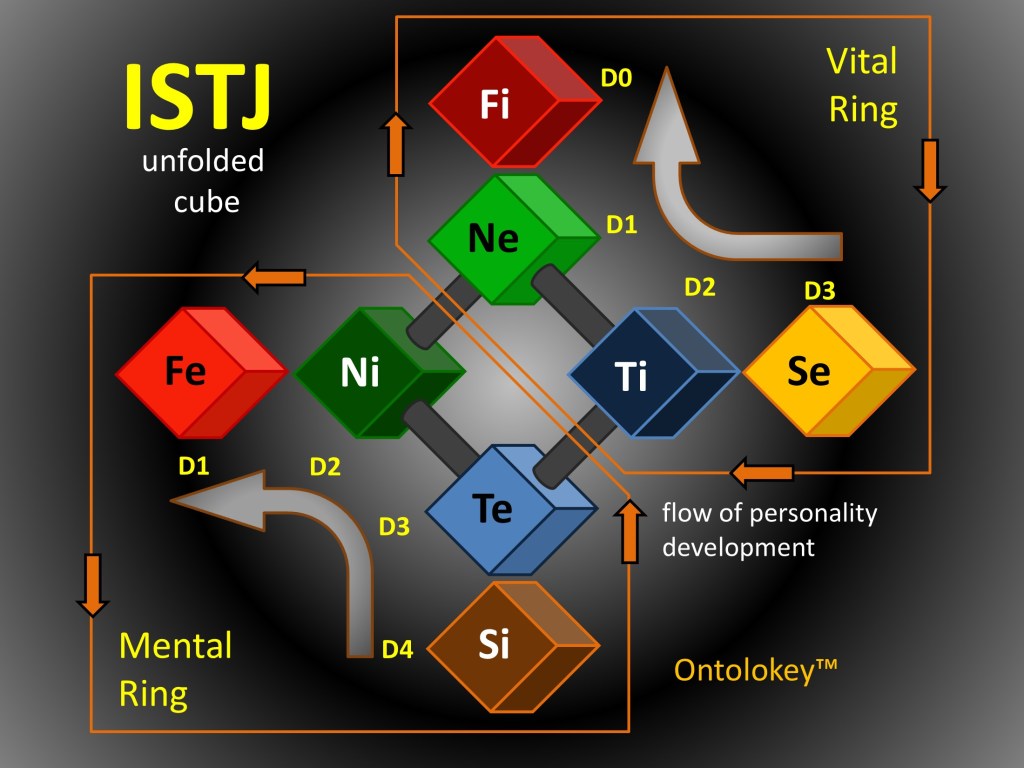
This essay follows that developmental movement toward wholeness through the functional architecture specified for the Ontolokey model: the Mental Ring develops progressively from Si D4 → Te D3 → Ni D2 → Fe D1, while the Vital Ring develops from Se D3 → Ti D2 → Ne D1 → Fi D0. The crucial principle is that consciousness cannot simply leap toward the most vulnerable or archaic psychological territory; development proceeds organically from what is already sufficiently established toward what is less developed, with each newly integrated capacity preparing the ground for the next. In this sense, the process resembles the gradual turning of an iceberg: what has remained beneath the surface of ordinary consciousness does not suddenly appear as a completely foreign personality, but becomes progressively visible as the established conscious structure changes its relationship to itself. The purpose is therefore not to destroy the ISTJ personality but to complete it—to allow the original Si–Te identity to encounter Ni, Fe, Se, Ti, Ne, and ultimately Fi as legitimate dimensions of its own psychological existence. Ontolokey’s three-dimensional cube provides a visual language for this process by representing the eight functions as interconnected regions of one psychological landscape, making development conceivable not as a rejection of type but as an expansion of the territory in which the type can consciously live.
The Conscious Architecture of the ISTJ: Si and Te as Psychological Identity
The conscious personality of the ISTJ is built first around an unusually intimate relationship with experience, continuity, and what can be trusted because it has already demonstrated its reality. Si, as the dominant function at D4, does not merely “remember facts”; it organizes lived experience into an internal archive of impressions, standards, comparisons, bodily sensations, familiar patterns, and accumulated knowledge from which the present moment is interpreted. The past therefore remains psychologically alive in the present, not necessarily as nostalgia, but as an embodied reference system that tells the ISTJ what feels coherent, safe, appropriate, proven, or out of place. This explains why seemingly insignificant sensory or environmental details can possess disproportionate psychological importance: a particular atmosphere, sound, smell, object, routine, or physical arrangement may carry an entire network of remembered associations and contribute to the feeling that reality is internally ordered. The ISTJ’s preference for stability consequently should not be reduced to simple conservatism, because beneath it lies a deeper need to preserve continuity between experience and identity; what has been lived, learned, and integrated becomes part of the psychological architecture through which the individual knows where they stand. Ontolokey’s description of Si consequently portrays the ISTJ as someone whose inner world can function like a rich sensory archive, with familiar environments providing not merely comfort but a form of psychological equilibrium.
From this foundation, Te develops as the ISTJ’s auxiliary function at D3, transforming accumulated knowledge into external order, practical judgment, procedures, standards, and demonstrable results. If Si asks, implicitly, “What have I learned from reality?”, Te asks, “What should be done with that knowledge so that reality functions properly?” This combination produces one of the ISTJ’s most recognizable strengths: the capacity to take complexity, divide it into manageable components, establish a sequence of actions, and persist until the intended result has been achieved. Reliability therefore becomes more than a social reputation; it becomes a psychological source of self-respect, because competence confirms the individual’s ability to remain effective in the face of reality. Yet this very effectiveness can gradually become fused with identity, so that being useful, correct, prepared, responsible, or dependable ceases to be something the ISTJ does and becomes something the ISTJ feels compelled to be. At that point Te no longer merely serves Si by organizing reality; together they can create a protective psychological structure in which uncertainty, inefficiency, emotional ambiguity, and uncontrolled change are experienced as threats to internal stability. The shadow begins precisely where this successful structure becomes so familiar that the person can no longer distinguish between genuine responsibility and the unconscious need to remain in control.
This distinction is essential for individuation because the mature ISTJ does not need to abandon Si or weaken Te; the task is to de-identify from them sufficiently to allow the rest of the psyche to become conscious. A person who has spent decades being the one who remembers, plans, repairs, fulfills obligations, anticipates practical consequences, and keeps life functioning may discover that competence has protected them from something much more difficult than external disorder: direct contact with vulnerability, dependency, uncertainty, desire, grief, and emotional ambiguity. The unconscious can therefore accumulate precisely those experiences that do not fit the conscious self-image, producing what Ontolokey describes as a hidden counterworld beneath the dependable exterior. The danger is not that the ISTJ possesses these disowned tendencies, but that they remain unrecognized until exhaustion, disappointment, betrayal, emotional deprivation, or existential crisis weakens the usual mechanisms of control and allows them to emerge in distorted form. What appears externally as stubbornness, excessive criticism, withdrawal, disproportionate anger, pessimistic anticipation, or an inability to adapt may consequently be understood as the compensatory expression of psychological material that has not yet found a conscious place within the personality. Individuation begins when the ISTJ can look at these reactions without immediately judging them as failures and instead ask what neglected part of the psyche is attempting, however clumsily, to become visible.
The First Threshold of Individuation: From Te to Se
The first decisive movement beyond the familiar ISTJ structure begins when Te D3 has become sufficiently mature that effectiveness no longer needs to function as the primary proof of personal worth. Within the developmental sequence defined by Ontolokey, this maturation is crucial because the personality cannot meaningfully descend into its less-developed psychological regions simply through intellectual curiosity; the conscious structure must first become stable enough to tolerate what contradicts it. Once Te approaches the strength of the dominant Si, the ISTJ can begin to loosen the assumption that every situation must be understood through precedent, controlled through procedure, or resolved through demonstrable usefulness. This creates the psychological space in which Se, the Sibling function at D3 within the Vital Ring, can begin to emerge as a living counterweight to the inwardly referenced Si orientation. Se brings attention toward what is occurring immediately, concretely, sensually, and spontaneously rather than toward what has already been experienced and internally organized. Its developmental significance is therefore profound: the ISTJ begins learning that reality does not always need to be compared with the past before it can be encountered, and that presence itself can contain information that no prior experience could have supplied. The movement from Te toward Se represents the first major expansion of the ISTJ’s psychological field because the individual begins to participate more directly in the present instead of merely managing the present according to an established internal map.
This transition can initially feel destabilizing because Se challenges one of the deepest assumptions underlying the mature ISTJ: that preparation creates security. The conscious personality tends to trust what can be anticipated, classified, remembered, verified, and organized, whereas Se encounters reality before it has been cognitively domesticated and therefore asks the individual to tolerate immediacy without immediately converting it into a familiar category. In its immature form, this confrontation can produce the opposite of genuine integration: impulsive overcorrection, sensory excess, sudden risk-taking, or fascination with experiences that appear to compensate for years of restraint. The developmental task is not to replace disciplined Si with uncontrolled Se, however, but to allow the latter to become a conscious capacity for direct perception, embodied presence, flexibility, and responsiveness. An ISTJ who integrates Se does not cease planning; rather, planning becomes subordinate to reality instead of reality being forced to conform to the plan. This is psychologically important because life inevitably contains situations in which preparation fails, information is incomplete, circumstances change without permission, and the only adequate response is to perceive what is actually happening now. Through Se, the ISTJ gradually discovers that spontaneity is not necessarily irresponsibility and that adaptability does not necessarily mean abandoning standards.
The deeper purpose of this stage is to weaken the unconscious equation between control and safety without destroying the legitimate need for structure that Si and Te provide. When Se becomes consciously available, the ISTJ can begin to experience the present as something more than a deviation from expectation, and this has consequences far beyond behavior because perception itself becomes less defensive. The person can notice subtle changes in another human being without immediately deciding what those changes mean, can enter an unfamiliar environment without instantly comparing it with known standards, and can allow an event to unfold before determining whether it is useful or efficient. Such experiences begin to reveal how much psychological energy had previously been invested in maintaining predictability, and they can expose an important shadow truth: sometimes the effort to prevent disorder becomes so extensive that it prevents life from being fully experienced. Se therefore constitutes the first opening of the Vital Ring, not because it makes the ISTJ more adventurous for its own sake, but because it restores contact with a dimension of existence that cannot be reconstructed retrospectively. The individual starts to inhabit the world rather than merely evaluate it, and this embodied participation becomes the foundation from which the next, more intellectually subtle stage—Ti D2—can eventually develop.
Ti and the Liberation of the Inner Judge
Once Se D3 has been sufficiently integrated, the next developmental movement within the Vital Ring leads toward Ti D2, the Golden-Shadow function. This transition is psychologically significant because Ti introduces a form of inward analytical discrimination that differs fundamentally from the ISTJ’s familiar Te orientation toward external effectiveness, measurable standards, and practical conclusions. Te tends to ask whether something works, whether it is logically organized, and whether an appropriate result can be produced, whereas Ti is concerned with the internal coherence of the conceptual structure itself: whether the reasoning is precise, whether the categories are truly valid, and whether the conclusion follows from the underlying principles rather than merely from established procedure. For an ISTJ, this can be liberating because it creates the possibility of examining inherited rules without automatically rejecting them or obeying them. The mature use of Ti allows the individual to distinguish between “this has always been done this way” and “this is intrinsically coherent,” thereby separating genuine principles from conventions that have merely acquired psychological authority through repetition. In this sense, Ti begins to loosen the unconscious bond between truth and precedent, allowing the ISTJ to discover that loyalty to reality sometimes requires questioning even the structures that once provided security.
The Golden-Shadow character of Ti also explains why its emergence can initially feel strangely unfamiliar despite the ISTJ’s obvious intellectual abilities. An ISTJ may already be highly analytical, but much of that analysis is naturally organized through Te: facts are evaluated according to applicability, reliability, consequences, standards, and objective utility, while Ti asks a quieter and more unsettling question about the architecture underneath those judgments. When developed consciously, Ti can therefore help the ISTJ recognize that being factually correct is not always equivalent to understanding the structure of a problem, just as following an established procedure does not necessarily mean that the underlying assumption remains valid. This capacity becomes particularly valuable when the individual’s trusted external frameworks conflict with new evidence, contradictory perspectives, or circumstances that cannot be resolved by applying an existing rule. Rather than responding by becoming more rigid, more argumentative, or more withdrawn, the ISTJ can learn to return to first principles and reconstruct the problem internally. The psychological gain is not merely greater intellectual flexibility; it is a reduction in defensiveness, because the individual no longer needs every established conclusion to remain correct in order to preserve a coherent sense of self.
Ti also begins to transform the ISTJ’s relationship with the shadow itself because it supplies an instrument for examining unconscious reactions without immediately moralizing them. When irritation, distrust, judgment, resistance, or withdrawal appears, the instinct may be to justify the reaction through external facts and thereby establish that the response was reasonable; Ti introduces the possibility of suspending that justification long enough to investigate the internal structure of the reaction. The question becomes not simply whether the other person was objectively wrong, but what assumptions made their behavior feel intolerable, what contradiction was activated, and which hidden premise within the ISTJ demanded that reality conform to a particular interpretation. This creates a bridge between cognition and psychological healing: an unconscious reaction can gradually become conscious material when it is examined with sufficient precision rather than suppressed or rationalized. The ISTJ thereby begins to discover that self-knowledge is not achieved by collecting more facts about oneself, but by becoming capable of observing the mental mechanisms through which facts are selected, interpreted, organized, and defended. Ti is therefore an important stage of individuation because it gives the ISTJ an internal laboratory in which previously unquestioned psychological assumptions can be examined without destroying the stable identity constructed by Si and Te.
At its deepest level, the integration of Ti allows the ISTJ to become less dependent upon being right and more interested in being true to the structure of reality as it is continually revealed. This distinction can have a profound effect on relationships because the need to establish correctness can otherwise conceal a much more vulnerable psychological need: the desire to prevent uncertainty from becoming threatening. Once Ti has developed, contradiction does not necessarily have to be experienced as disorder, disrespect, or incompetence; it can become information indicating that the existing model requires refinement. The personality consequently becomes capable of maintaining standards while simultaneously questioning its own premises, which is a much more mature form of strength than rigid certainty. This stage prepares the way for Ne D1, because once the ISTJ can tolerate the dismantling and reconstruction of internal conceptual structures, genuinely unfamiliar possibilities no longer have to be rejected merely because they lack precedent. The movement from Si through Te, Se, and Ti has therefore accomplished something essential: the individual has begun to shift from preserving reality as already known toward becoming psychologically capable of encountering reality as something that can still surprise them.
Ne and the Psychology of Possibility
With Ti D2 sufficiently developed, the ISTJ reaches the next stage of the Vital Ring: Ne D1, the inferior function. Ne introduces an entirely different relationship to reality because it perceives possibilities, alternatives, connections, hypothetical futures, and meanings that are not yet established by direct experience. For a personality whose dominant Si naturally asks what has happened before and whose auxiliary Te seeks to organize what is known into reliable action, Ne can initially appear almost like psychological noise: too many possibilities, too many interpretations, too many variables, and too little certainty about which direction is actually correct. Yet precisely this unfamiliarity makes Ne indispensable for wholeness, because the unconscious often compensates for an overly narrow conscious orientation by preserving everything that consciousness excludes. When Ne begins to emerge consciously, the ISTJ can discover that uncertainty does not necessarily signify danger or incompetence, but may simply indicate that reality contains more potential than the existing internal model can presently describe. The developmental movement is therefore not toward abandoning realism, but toward allowing realism to include the possibility that the future cannot always be calculated from the past.
The immature expression of Ne can nevertheless be particularly uncomfortable for the ISTJ because the inferior function often appears first in exaggerated or distorted form. Instead of calmly entertaining alternatives, the person may become flooded by catastrophic possibilities, suspicious interpretations, or an overwhelming awareness of everything that could potentially go wrong. What had previously been experienced as healthy caution can then expand into anticipatory anxiety, because the mind begins generating possibilities faster than Te can organize them and faster than Si can verify them through precedent. This explains why the development of Ne cannot simply be forced through deliberate novelty-seeking or constant exposure to change; without the preceding development of Te, Se, and Ti, possibility remains psychologically uncontained and can become another source of insecurity. The mature task is to learn how to entertain possibilities without granting every possibility equal probability, and to imagine alternatives without confusing imagination with fact. In this form, Ne becomes an instrument of psychological freedom: it allows the ISTJ to say, in effect, that the future may be different without concluding that the future must therefore be dangerous.
Ne also changes the meaning of failure, because an individual who possesses only a narrow repertoire of acceptable outcomes can experience deviation from the expected path as evidence that something has gone fundamentally wrong. The conscious integration of possibility introduces a more forgiving psychological framework in which an unexpected outcome can become a branch in the developmental process rather than a verdict on personal competence. This is especially important for the ISTJ because responsibility and self-discipline can sometimes produce an unconscious expectation that sufficient preparation should make failure preventable. Ne exposes the impossibility of that expectation and gradually teaches a more mature relationship with uncertainty: preparation remains valuable, but preparation cannot eliminate contingency. Once this insight becomes emotionally integrated rather than merely intellectually understood, the ISTJ becomes less likely to interpret unpredictability as personal defeat. The personality gains a capacity that is essential for individuation, namely the ability to remain internally organized while allowing external reality to remain partly unresolved.
At this point the development of the Vital Ring reaches its most vulnerable territory, because the integration of Ne D1 prepares the way toward Fi D0, the tertiary function and the deepest blind spot in the sequence described here. Ne opens the possibility that life can contain alternatives, but Fi raises the much more intimate question of what those alternatives mean personally: what do I value, what do I feel, what is genuinely mine, and what remains important when usefulness, correctness, duty, precedent, and social expectations have been stripped away? The ISTJ may have spent much of life answering questions of obligation with remarkable clarity while rarely being required to articulate the private emotional truth beneath those obligations. Ne therefore creates the psychological space in which the previously excluded inner world can become conceivable, while Fi represents the archaic and childlike territory in which that inner world is experienced most directly. The transition is consequently not a simple movement from “thinking” toward “feeling,” but a descent from impersonal competence into personal subjectivity, where the individual can no longer hide exclusively behind what is correct, necessary, expected, or useful. This is where the developmental journey becomes genuinely intimate, because the psyche begins asking not merely how reality works, but who the ISTJ is within it.
Fi D0: The Blindspot, and the Wound Beneath Competence
Fi D0 represents the most archaic and least developed point in the ISTJ’s Vital Ring, and for precisely that reason it can contain some of the most psychologically consequential material in the entire individuation process. Fi concerns personal value, inner emotional truth, authenticity, subjective attachment, conscience, and the experience of what matters to the individual independently of external standards or collective expectations. For an ISTJ who has developed exceptional Si–Te competence, these questions can remain surprisingly inaccessible because life can be organized around what is reliable, necessary, correct, responsible, and objectively defensible without requiring sustained attention to the private emotional meaning of those choices. Fi at D0 therefore should not be imagined simply as a hidden reservoir of mature emotional wisdom waiting to be switched on; it is initially more comparable to an injured or neglected inner child whose psychological language has never received sufficient conscious development. When this part of the personality is activated, the ISTJ may encounter feelings that seem disproportionate, confusing, embarrassingly subjective, or impossible to justify rationally, precisely because they originate in a territory where justification is not the primary criterion of truth. The shadow task is consequently not to become emotionally expressive for its own sake, but to recognize that subjective experience possesses psychological reality even when it cannot be converted into an objective argument.
This vulnerability helps explain why the ISTJ can sometimes appear emotionally detached while simultaneously being much more sensitive than others realize. The absence of easily accessible Fi does not mean an absence of feeling; it can mean that feeling has been relegated to a poorly developed psychological compartment that lacks the vocabulary, confidence, and legitimacy necessary for conscious expression. An ISTJ may therefore endure disappointment, rejection, humiliation, loneliness, grief, or emotional neglect by becoming more functional, more controlled, more productive, or more self-sufficient, unconsciously attempting to solve an emotional wound through the very capacities that produced external competence. Such a strategy can work temporarily because action creates a sense of agency, whereas sitting with helplessness can feel intolerable, but unresolved feeling does not disappear simply because it has been subordinated to duty. Instead, it may return indirectly through resentment, emotional withdrawal, unusually severe self-criticism, stubborn attachment to perceived injustices, or an intense reaction to situations in which the person feels unseen or unappreciated. The deeper psychological realization is that some wounds cannot be repaired by proving oneself competent, because the wound originated precisely in the experience of one’s subjective self not being sufficiently recognized.
The integration of Fi therefore begins with an act that can be extraordinarily difficult for the ISTJ: allowing an experience to be valid before deciding whether it is reasonable. This does not mean believing every feeling literally or treating subjective emotion as infallible evidence about other people’s intentions; rather, it means recognizing that an emotion is information about the inner state of the person experiencing it. Anger may reveal a violated boundary, sadness may reveal attachment, envy may reveal an unacknowledged desire, shame may reveal an internalized judgment, and resentment may expose a pattern of giving that has exceeded the individual’s genuine willingness. When these signals are immediately subjected to Te’s demand for rational justification, the emotional material can be invalidated before it has even been understood, causing the person to remain outwardly composed while the unconscious continues carrying the unresolved conflict. Fi development makes it possible to ask a different sequence of questions: What am I actually feeling, what does this feeling protect, what value has been threatened, and what part of me has been asking for recognition? This process is especially important for psychological healing because cognition becomes therapeutic not by explaining emotion away, but by creating enough conscious understanding for previously fragmented experience to become integrated into a coherent sense of self.
The deepest shadow of the ISTJ can consequently emerge when the neglected Fi begins demanding recognition through indirect means. The person may become unexpectedly possessive of personal values, hypersensitive to perceived betrayal, privately wounded by criticism that appears objectively justified, or intensely attached to moral conclusions that cannot easily be explained through Te’s external logic. What looks from the outside like irrational stubbornness may sometimes represent the archaic defense of an emotional self that has never learned how to speak in a mature language. The danger is that, without conscious development, this vulnerable inner material may be projected outward, causing the ISTJ to perceive others as unreasonable, disloyal, selfish, irresponsible, or morally deficient when part of the underlying conflict actually concerns disowned personal needs. Individuation reverses this projection by bringing the emotional content back into consciousness and asking what belongs to the other person and what belongs to oneself. In this sense, Fi does not weaken the ISTJ’s integrity; it deepens it, because genuine integrity eventually requires knowing not only what one ought to do but also what one inwardly stands for, what one cannot honestly give, what one has suffered, and what one needs in order to remain psychologically whole.
The Mental Ring Turns Inward: From Te Toward Ni
The development of the Vital Ring does not replace the Mental Ring; rather, the two developmental movements gradually illuminate one another. Once Te D3 has approached a mature level, the next conscious movement in the Mental Ring proceeds toward Ni D2, the ISTJ’s Anima/Animus function, and this is where individuation becomes increasingly concerned with meaning rather than merely competence. Ni represents a mode of perception oriented toward underlying patterns, symbolic connections, emerging trajectories, and the deeper direction in which apparently separate events are moving. For the ISTJ, this can be profoundly unfamiliar because Si naturally trusts what has been concretely experienced, while Te prefers conclusions that can be operationalized and demonstrated; Ni asks what the accumulated material is pointing toward before the destination is fully visible. The developmental challenge is therefore to tolerate an insight that cannot yet be completely proven, without either dismissing it as impractical or elevating it into unquestionable certainty. When Ni begins to develop, the ISTJ can gradually recognize that accumulated experience is not valuable only because it preserves the past; it can also become raw material from which a deeper understanding of the future emerges.
The Anima/Animus quality of Ni makes this stage particularly intimate because it introduces an image of psychological life that cannot be reduced to efficiency or factual accuracy. The ISTJ may begin experiencing recurring intuitions, symbolic associations, sudden understandings about the direction of a relationship or life phase, or a persistent sense that a familiar pattern is approaching its natural conclusion. These experiences can initially be uncomfortable because they lack the explicit evidentiary chain that Te normally prefers, and the temptation may therefore be either to suppress them or to overcompensate by treating every intuition as prophetic truth. Neither response constitutes integration. Mature Ni requires a third position in which intuition is taken seriously enough to be examined but not so literally that it becomes immune to correction; the ISTJ learns to let an emerging perception develop quietly until it can be compared with reality. This creates a new psychological relationship between Si and Ni: Si supplies the accumulated texture of experience, while Ni begins extracting from that experience an overarching pattern that cannot be found by examining individual memories in isolation.
The significance of Ni becomes particularly clear when the ISTJ encounters a life transition for which precedent provides no satisfactory answer. Career changes, aging, relationship transformations, loss, existential uncertainty, or the realization that a previously successful identity no longer corresponds to the inner person can expose the limits of a purely precedent-based orientation. The instinct may initially be to ask what has worked before, what responsible people normally do, or what practical solution can restore stability, but some developmental situations are not problems to be solved; they are transformations that must be understood. Ni allows the ISTJ to perceive that an old structure may have fulfilled its purpose without therefore having been a mistake, and that letting something end can sometimes be an act of psychological fidelity rather than failure. This is one of the more important forms of maturity available to the type because it loosens the unconscious association between continuity and correctness. The past remains honored, but it is no longer granted automatic authority over the future.
Ni also provides an important bridge toward the emotional dimensions represented by Fi and Fe because meaning is inherently relational to the whole person. When the ISTJ begins asking what an experience means rather than merely what happened, previously disconnected emotional material can acquire a place within a larger narrative of identity. A painful failure may reveal not incompetence but an identity that had become too narrow; a recurring conflict may reveal not merely difficult people but a pattern in one’s own expectations; an apparently irrational attraction or aversion may point toward a neglected psychological need. This is where cognition can become a vehicle for healing in the precise sense intended by the individuation model: understanding does not erase what happened, but it can transform the meaning assigned to what happened. The ISTJ gradually ceases to see every wound as evidence of personal inadequacy or external injustice and begins to perceive it as information about the unfinished architecture of the self. Ni thus deepens the developmental process by allowing experience, intuition, emotion, and identity to converge into an emerging sense of personal meaning rather than remaining isolated psychological compartments.
Fe D1: The Toddler Function and the Recovery of Relational Feeling
After Ni D2 has been sufficiently developed within the Mental Ring, the next stage leads toward Fe D1, the Toddler function, and this is one of the most delicate transitions in the ISTJ’s psychological development. Fe concerns the emotional atmosphere between people, interpersonal attunement, shared feeling, social reciprocity, and the capacity to recognize that emotional reality exists not only inside the individual but also within the relational field connecting people. For an ISTJ accustomed to expressing care through reliability, practical assistance, responsibility, and concrete acts of service, Fe can initially seem almost redundant because love and loyalty may already be experienced very deeply through what the person does for others. Yet Fe asks for something different: not simply to do what is necessary for someone, but to become consciously receptive to how the relationship itself feels and to communicate emotional recognition in a form that the other person can actually receive. This can expose a developmental vulnerability because the ISTJ may possess substantial loyalty without possessing equally developed fluency in expressing that loyalty emotionally. Fe at D1 is therefore not an absence of care but a relatively immature language for care, and its development requires the ISTJ to learn that emotional connection cannot always be inferred from behavior; sometimes it must be consciously perceived, articulated, and shared.
The Toddler designation is particularly revealing because the function can carry a childlike quality when it is activated without sufficient development. The ISTJ may suddenly become unusually sensitive to rejection, social disapproval, interpersonal tension, or the emotional reactions of others, while simultaneously lacking confidence in interpreting and regulating these experiences. A person who is ordinarily composed and rational can therefore become unexpectedly hurt by a seemingly minor interpersonal event, only to retreat afterward and attempt to explain the reaction through objective reasoning. This creates a characteristic shadow dynamic: the vulnerable emotional function is activated, the individual feels exposed, and Te then rushes in to regain control by explaining why the emotional response is unjustified or why the other person is objectively at fault. The resulting cycle can prevent the actual emotional experience from being understood, because the psyche returns too quickly to the familiar language of judgment and competence. Fe development interrupts this cycle by allowing interpersonal feeling to remain conscious long enough to be examined, communicated, and metabolized rather than immediately converted into a problem requiring a rational solution.
The mature integration of Fe does not require the ISTJ to become socially expansive, emotionally demonstrative, or permanently concerned with pleasing everyone. That interpretation would misunderstand individuation because the goal is not to replace one personality with its opposite but to expand the range of psychological responses available to the existing personality. A developed Fe allows the ISTJ to recognize that relationships have their own emotional dynamics and that sometimes preserving a relationship requires responsiveness rather than correctness. The individual becomes better able to say what is felt, to recognize another person’s emotional reality without automatically accepting their interpretation, and to repair relational injuries without experiencing every disagreement as a contest over who is objectively right. This creates a subtle but profound shift from functional responsibility to emotional responsibility: the question is no longer only whether one fulfilled one’s obligations, but whether the human being on the other side of those obligations actually felt seen, respected, and emotionally understood. Such development can make the ISTJ’s existing loyalty considerably more powerful because practical dependability becomes accompanied by relational presence.
Fe also brings the ISTJ into direct confrontation with one of the deepest tensions between autonomy and connection. The highly self-sufficient individual may unconsciously believe that needing emotional support represents weakness, while simultaneously expecting others to recognize care that has been communicated primarily through actions rather than words. This can produce painful misunderstandings in which the ISTJ thinks, “I have shown you that I care,” while the other person experiences emotional distance because the expected form of recognition was never expressed. Developing Fe does not invalidate the ISTJ’s preferred language of practical love; instead, it adds another dialect to it. The person learns that vulnerability can be communicated without surrendering dignity, that empathy does not require agreement, and that emotional openness does not eliminate boundaries or standards. As Fe becomes more conscious, the previously vulnerable Toddler begins to mature, and the ISTJ can finally use relational feeling deliberately rather than encountering it only when circumstances penetrate the protective structure of competence. This represents one of the most important steps toward wholeness because the personality begins to experience connection not as a threat to autonomy but as another legitimate dimension of human reality.
The Deepest Shadow: When the Strengths Become Defenses
The deepest shadow of the ISTJ does not arise from the absence of virtue but from the unconscious overextension of virtue. The same Si that gives the personality continuity can become fixation upon precedent; the same Te that produces competence can become excessive control; the same loyalty that sustains relationships can become endurance long after something has become psychologically unhealthy. Because these qualities are socially rewarded, their defensive character can remain invisible even to the ISTJ themselves. A person may sincerely believe that they are simply being responsible when they are actually avoiding uncertainty, simply being rational when they are protecting themselves from emotional exposure, or simply maintaining standards when they are defending against the anxiety produced by imperfection. This is why the shadow cannot be integrated merely by identifying undesirable behaviors and trying to eliminate them. The deeper work consists in discovering the psychological function of the strength itself: what fear does reliability protect against, what vulnerability does self-sufficiency conceal, what uncertainty does rigidity attempt to prevent, and what emotional need is being displaced into achievement? Ontolokey’s treatment of the ISTJ’s deeper shadow is particularly concerned with this paradox, namely that the personality’s greatest competence can simultaneously become the structure through which unconscious material is kept out of awareness.
One of the most consequential manifestations of this shadow is the tendency to make competence into a substitute for vulnerability. The ISTJ may become the person who can always cope, who rarely asks for help, who remembers what everyone else forgets, who fulfills obligations even when exhausted, and who continues functioning when other people would stop. Such resilience is genuinely valuable, but when it becomes compulsory it can create an internal prohibition against being dependent, confused, emotionally overwhelmed, or simply unable to perform. The unconscious message then becomes severe: “If I cannot handle this, something is wrong with me.” Yet human psychological development inevitably produces situations in which handling everything is impossible, and these moments can activate the neglected Fi and Fe territories with unusual intensity. The resulting pain may be experienced as anger, withdrawal, disappointment, resentment, or shame because the person has never developed a sufficiently conscious language for saying, “I am hurt,” “I need something,” or “I do not know what to do.” Healing begins when the ISTJ recognizes that vulnerability is not the opposite of strength but the condition that allows strength to remain voluntary rather than compulsory.
Another shadow pattern concerns the relationship between memory and forgiveness. Si can preserve experience with remarkable fidelity, including the emotional and sensory traces associated with betrayal, disappointment, injustice, or failure. This capacity is enormously useful for learning because it prevents the individual from repeatedly making the same mistake, but it can become psychologically burdensome when remembered experience is treated as permanently binding evidence about a person or situation. Te can then provide the rational justification for maintaining the conclusion: the other person really did behave badly, the evidence really does support distrust, and the original decision really was justified. All of this may be factually correct while still leaving one question unanswered: what happens when an accurate memory becomes an unconscious prison? Integration does not require forgetting, excusing, or permitting harmful behavior; it means separating the fact that something happened from the assumption that the psyche must remain organized around it forever. Ni can help place the event within a larger developmental narrative, Fe can restore the possibility of relational understanding, and Fi can distinguish legitimate boundaries from unresolved emotional attachment to the wound itself. In this way, forgiveness becomes not a denial of reality but a gradual release of the psychological energy that has remained bound to it.
The shadow becomes particularly intense when the ISTJ is under prolonged stress because the ordinary hierarchy of functions can become distorted and less-developed functions may intrude without the gradual integration that individuation provides. What normally appears as measured caution can become catastrophic anticipation, what is ordinarily disciplined judgment can become harsh condemnation, and what is normally emotional reserve can become complete relational withdrawal. The individual may then experience the world as increasingly unreasonable while simultaneously becoming less capable of recognizing how much of the distress originates in an internal struggle between incompatible psychological needs. One part demands predictability, another demands freedom; one part demands correctness, another longs to be understood; one part preserves the past, another senses that life is moving elsewhere. The purpose of integrating the shadow is therefore not to make these tensions disappear but to establish an internal relationship among them. Wholeness begins when the ISTJ no longer needs one psychological function to silence another, because each function has acquired enough consciousness to contribute its information without taking possession of the entire personality.
From Shadow Integration to Individuation: The Gradual Reversal of the Inner Landscape
The integration of the shadow becomes meaningful only when it is understood as a developmental sequence rather than a collection of isolated psychological exercises. Within the model established for the ISTJ, the Mental Ring moves from Si D4 to Te D3, then to Ni D2 and Fe D1, while the Vital Ring develops from Se D3 to Ti D2, then Ne D1 and finally Fi D0. The significance of this sequence is that the psyche should not be forced to confront its most vulnerable material before it possesses the cognitive stability required to contain it; the movement toward wholeness proceeds from established competence toward progressively less familiar modes of consciousness. Thus, an ISTJ who attempts to “heal” by immediately immersing themselves in emotional vulnerability while bypassing the intermediate development of Te, Se, Ti, Ne, Ni, and Fe may simply become overwhelmed or retreat into the familiar Si–Te structure with greater defensiveness. Development is more sustainable when each stage becomes a foundation for the next, because every newly integrated function expands the individual’s capacity to tolerate psychological complexity. Ontolokey’s developmental perspective consequently treats the functions not merely as descriptions of personality but as a landscape through which consciousness can gradually travel.
The iceberg metaphor captures the subjective experience of this process particularly well. Ordinary ISTJ consciousness may initially feel dominated by the visible portion of the personality: memory, responsibility, competence, realism, order, loyalty, and the practical management of life, while a much larger psychological territory remains beneath the surface. As Te develops sufficiently alongside dominant Si, the established personality becomes strong enough to begin encountering what previously remained unconscious, and the psychological “iceberg” can metaphorically begin to turn. Se introduces direct contact with the present, Ti questions the assumptions beneath established reasoning, Ne opens the possibility of alternatives, Fi exposes personal value and vulnerability, Ni reveals meaning and direction, and Fe brings the emotional field of relationships into consciousness. Each movement makes the next one more psychologically tolerable because the individual is no longer relying exclusively on the original defensive structure. The eventual goal is not to leave the original ISTJ identity behind but to arrive at a state in which the dominant Si can once again stand consciously at the center, now enriched by everything that had previously remained beneath the surface. This is why the endpoint can be understood as a return to the original personality as a more complete Self, rather than as a conversion into another type.
This also clarifies why psychological healing through cognition should not be understood as intellectualizing pain away. Cognition becomes healing when it allows previously fragmented experiences to become intelligible without reducing them to mere abstractions. An ISTJ may eventually recognize that a lifelong sensitivity to criticism was connected to an undeveloped emotional vulnerability, that excessive responsibility concealed a fear of being unnecessary, that resentment resulted partly from unspoken boundaries, or that resistance to change was protecting an identity built around predictability. Such realizations do not erase the original experiences, but they alter the relationship to them because the person can finally distinguish between what happened, what was felt, what was interpreted, and what was subsequently defended. This differentiation is psychologically liberating because the past no longer has to dictate the present through unconscious repetition. Understanding can create the internal distance necessary for compassion: toward oneself for having used the only defenses available at the time, and toward others whose own undeveloped functions may have contributed to experiences that were experienced as hurtful or threatening.
Forgiveness consequently becomes one of the possible fruits of individuation, but it should not be confused with excusing harmful behavior or abandoning necessary boundaries. The more differentiated ISTJ can recognize that another person’s actions emerged from their own psychological limitations, fears, blind spots, or undeveloped capacities without concluding that those actions were therefore acceptable. The same principle applies inwardly: the ISTJ can understand why they became rigid, emotionally distant, excessively dutiful, suspicious, controlling, or self-critical without using that understanding as another weapon against themselves. This is particularly important because self-judgment can itself become an extension of the Te–Si structure, transforming psychological development into yet another performance standard that must be achieved correctly. Individuation requires something subtler: the capacity to observe one’s own history with sufficient honesty that responsibility remains intact while shame gradually loses its authority. In that sense, wholeness is not perfection but reconciliation—the ability to hold one’s strengths and limitations, conscious motives and unconscious compensations, memories and possibilities, independence and need for connection within one psychological identity.
A Practical Path Toward Wholeness
For the ISTJ, the practical beginning of individuation is therefore deceptively simple: observe before correcting. When a familiar reaction appears—irritation at disorder, resistance to an unexpected change, resentment toward someone who failed to fulfill an obligation, withdrawal after emotional disappointment, or anxiety about an uncertain future—the first task is not to decide whether the reaction is justified. Instead, the person can identify which function appears to be demanding authority and which less-developed function might be trying to contribute information: Si may be protecting continuity, Te may be demanding effectiveness, Se may be asking for attention to the immediate situation, Ti may be questioning an assumption, Ne may be presenting an alternative, Ni may be sensing a larger pattern, Fe may be registering relational tension, or Fi may be signaling a personally violated value. This functional observation transforms an apparently unified reaction into a differentiated psychological event. The Ontolokey Cube can serve as a visual aid for precisely this kind of reflection, because its spatial representation and sliders make the movement between familiar and less familiar functions easier to conceptualize. The objective is not to manipulate the sliders toward an artificial ideal, but to use them as reminders that consciousness can move across a larger psychological landscape than the one habitually occupied.
The developmental sequence should then be respected rather than accelerated. Te D3 must become sufficiently mature before the deeper descent begins, because practical self-organization provides the stability from which exploration can safely occur; then Se D3 can teach the ISTJ to encounter immediate reality without excessive mediation by precedent. From there, Ti D2 develops the capacity to question one’s own conceptual assumptions, while Ne D1 gradually expands tolerance for uncertainty and alternative possibilities. In the Mental Ring, Ni D2 can then deepen the interpretation of experience by asking what patterns, meanings, and trajectories lie beneath events, while Fe D1 develops the ability to remain emotionally present within relationships rather than relying exclusively on practical care. Finally, Fi D0, the deepest and most archaic territory, can be approached with considerably greater psychological containment, allowing personal values, emotional needs, authenticity, and the vulnerable inner child to acquire a conscious voice. The sequence matters because the goal is not exposure to the shadow for its own sake; the goal is to develop enough consciousness that the shadow can be encountered without being possessed by it.
A useful discipline for the ISTJ is therefore to translate each developmental step into an ordinary question rather than a grand psychological project. Se asks, “What is actually happening right now, before I compare it with what should be happening?” Ti asks, “What assumption am I treating as self-evidently true?” Ne asks, “What else could be possible if I do not close the question prematurely?” Ni asks, “What larger pattern or direction might this experience be revealing?” Fe asks, “What is happening emotionally between us, and have I made my own position emotionally understandable?” Fi asks, “What do I genuinely value and need, independent of what is expected of me?” These questions do not require the ISTJ to abandon practical judgment; they make practical judgment more complete by preventing one cognitive mode from monopolizing consciousness. Over time, the individual develops the ability to move between functions intentionally rather than being driven unconsciously by whichever function has become habitual or defensive. This is the point at which psychological development begins to feel less like self-correction and more like an expansion of freedom.
The most important measure of progress is therefore not whether the ISTJ becomes more expressive, spontaneous, adventurous, intuitive, or emotionally sensitive according to some external ideal. A much more meaningful measure is whether the individual possesses more choice at the moment of psychological tension. Can the person remain organized without becoming rigid, responsible without becoming self-erasing, skeptical without becoming closed, emotionally receptive without becoming overwhelmed, loyal without becoming resentful, and open to possibility without becoming directionless? Can they recognize a feeling without immediately obeying it, recognize an intuition without automatically believing it, recognize a rule without automatically submitting to it, and recognize an impulse without automatically suppressing it? When the answer increasingly becomes yes, the functions have begun to move from unconscious compensation toward conscious participation. The ISTJ has not become less itself; it has become less imprisoned by the narrowest interpretation of itself.
The Return to the Self: What Wholeness Ultimately Means for the ISTJ
The final purpose of individuation is therefore not to produce a personality that has perfectly balanced eight functions, because psychological wholeness does not mean equalizing everything that was originally unequal. The mature ISTJ remains an ISTJ: Si remains the dominant organizing center, Te remains a powerful auxiliary instrument, and the distinctive appreciation for reliability, continuity, competence, realism, responsibility, and order remains intact. What changes is the relationship between these qualities and the rest of the psyche. Si no longer has to defend the past against every possibility, because Ne has taught the personality that the unknown can contain information; Te no longer has to convert every emotional or existential difficulty into a practical problem, because Fe, Fi, and Ni have demonstrated that some experiences require presence, meaning, or personal recognition rather than immediate resolution. The original strengths are therefore not diminished by individuation but released from defensive duties they were never meant to perform. This is the deeper meaning of returning to the dominant function at the completion of the metaphorical rotation: one returns home, but one returns home carrying knowledge of the entire landscape.
Wholeness also changes the ISTJ’s relationship with vulnerability. The emotionally defended ISTJ may once have interpreted vulnerability as exposure, dependence, inefficiency, or loss of control, whereas the individuating ISTJ begins to understand vulnerability as information about where the personality has limits, needs, attachments, and values. The person can say, “I do not know,” without experiencing the admission as incompetence; “I am hurt,” without needing to prove that the other person was objectively wrong; “I need help,” without interpreting dependence as weakness; and “I want this,” without requiring an external justification before granting the desire psychological legitimacy. These are not signs that Si and Te have weakened. They are signs that the personality has become sufficiently secure that it no longer needs its strongest functions to protect every vulnerable part of the self. The result is a quieter form of strength in which self-control becomes a choice rather than a compulsion and responsibility becomes an expression of consciously selected values rather than an automatic strategy for securing worth.
The fully individuating ISTJ can therefore hold an unusual psychological paradox: continuity without stagnation, discipline without rigidity, realism without cynicism, loyalty without self-abandonment, independence without emotional isolation, and responsibility without the disappearance of personal desire. Such a person does not need to reject the past in order to move forward because the past has become integrated rather than tyrannical. Nor do they need to fear the shadow because the shadow has ceased to represent an alien enemy and has become a source of information about the dimensions of the personality that once lacked conscious recognition. The unconscious is no longer merely the place where unwanted material is stored; it becomes a reservoir from which previously unavailable forms of perception, relationship, imagination, meaning, and personal value can emerge. Psychological healing then becomes less about repairing a defective personality and more about completing an incomplete relationship with oneself. This is perhaps the most important shift in perspective for the ISTJ: the goal is not to become someone else, but to become sufficiently conscious to inhabit the whole of who one already is.
From the Reliable Self to the Whole Self
The developmental journey of the ISTJ can ultimately be understood as a movement from identification toward integration. At the beginning, the individual may experience the self primarily through Si and Te: I remember, I understand what has worked, I know what must be done, I fulfill my obligations, I maintain standards, I remain dependable. As the developmental process unfolds, increasingly unfamiliar questions enter consciousness: What is happening now? What assumptions am I making? What else is possible? What does this mean? What is happening emotionally between us? What do I personally value? Each question introduces a previously underrepresented dimension of psychological reality, and each demands a degree of tolerance for uncertainty that the original personality structure may not have needed in its earlier development. The process can therefore be uncomfortable precisely because it undermines the illusion that the established conscious identity is the whole person. Yet that discomfort is not necessarily evidence that development is going wrong; it can be evidence that the psychological field is becoming larger.
The deepest healing occurs when the ISTJ can finally look backward without being imprisoned by what was, look forward without demanding certainty about what will be, and look inward without needing every experience to justify itself through usefulness or correctness. The vulnerable Toddler, the sensitive Anima/Animus, the inferior and sometimes anxious Ne, the neglected personal values of Fi, and the less familiar capacities of Se and Ti no longer need to communicate exclusively through defensive reactions because consciousness has begun to recognize their language. At the same time, Si and Te remain where they belong: not dethroned, but liberated from the burden of being the entire personality. The metaphorical iceberg has turned, bringing what was beneath the surface into awareness, while the original structure has gradually reappeared in a transformed relationship with the whole. What returns is not the old personality unchanged, but the personality recognized more completely as Self.
For the ISTJ who wishes to pursue this path, the central instruction is therefore neither “change yourself” nor “accept yourself exactly as you are,” because both formulations are incomplete. The more demanding task is to know yourself sufficiently deeply that acceptance and development become parts of the same movement. Notice where a strength has become a defense, where duty has replaced desire, where memory has become resentment, where certainty has become fear, where emotional silence has become isolation, and where the unknown has been rejected before it was allowed to speak. Then move gradually, respecting the developmental order of the functions rather than attempting to force psychological maturity through willpower alone. The Ontolokey framework and its three-dimensional representation can serve as a visual companion for this process, while the more detailed ISTJ material on Ontolokey.com can be consulted for further exploration of the type, its shadow, developmental possibilities, and the corresponding landscapes of the other personality types.
Ultimately, wholeness is not the disappearance of the ISTJ’s defining character but its fulfillment. The person who once survived by being reliable can become reliable without being imprisoned by reliability; the person who once protected themselves through competence can remain competent while permitting themselves to be human; the person who once carried everything alone can learn which burdens are genuinely theirs and which were unconsciously assumed. In this sense, individuation becomes a return—not a return to the limitations of the past, but a return to the Self after the forgotten territories of the psyche have been reclaimed. The conscious personality and its shadow are no longer enemies competing for control, but differentiated aspects of one developing whole. The final achievement is not to become a different type, but to become an ISTJ whose consciousness is large enough to contain the entire psychological landscape.


Leave a comment