From Competence to Consciousness
The ESTJ is often encountered first through what is visible: decisiveness, practical intelligence, discipline, reliability, organizational ability, and an almost instinctive willingness to assume responsibility when circumstances demand action. In the Ontolokey framework, however, these qualities are not the whole personality but the conscious summit of a much larger psychological architecture, with Extraverted Thinking (Te) functioning as the dominant organizing principle and Introverted Sensing (Si) providing continuity, memory, precedent, and stability. The deeper psychological question is therefore not simply why the ESTJ is capable of organizing reality so effectively, but what happens when the ability to organize reality becomes intertwined with the need to feel secure, valuable, and psychologically intact. The central developmental tension emerges precisely here: competence can be both an authentic strength and a defense against experiences that cannot be mastered through competence alone. The Ontolokey writings repeatedly describe this paradox as the movement by which responsibility may become control, discipline may become rigidity, and confidence may become an increasingly defensive attachment to being right.
The deeper ESTJ psyche can therefore be understood as a movement between two fundamentally different experiences of strength. In its conscious form, strength means agency: something needs to be done, responsibility must be assumed, disorder can be transformed into structure, and difficult circumstances can be met through effort, endurance, and practical judgment. Yet when this orientation becomes the principal means through which the individual regulates inner uncertainty, strength acquires a defensive function, because maintaining control begins to feel necessary not merely for accomplishing an objective but for preserving the self. Failure then threatens more than an outcome; it can touch an identity organized around being capable, dependable, useful, and correct. The shadow does not emerge because these qualities are intrinsically destructive, but because an otherwise adaptive psychological strategy can become overextended until it begins to govern domains that cannot be solved through structure, efficiency, precedent, or force of will. Grief cannot always be optimized, intimacy cannot be administered, another person’s inner world cannot be commanded, and existential uncertainty cannot ultimately be defeated by preparing more thoroughly.
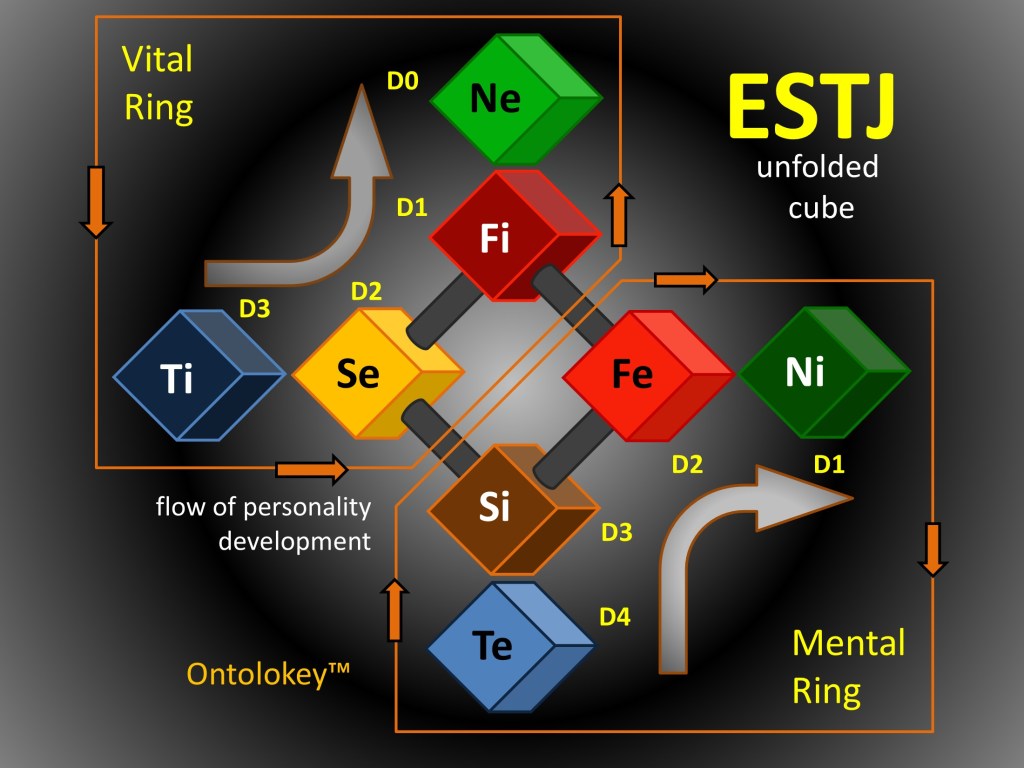
For this reason, the developmental path described here is not a project of replacing the ESTJ with another kind of personality, nor of weakening Te until decisiveness disappears. It is a process of differentiation and integration in which the conscious center gradually becomes capable of hearing psychological information that was previously less accessible to it. In the developmental sequence specified for this essay, the Mental Ring begins with Te at D4 and proceeds through Si at D3, Fe at D2, and Ni at D1, while the Vital Ring develops from Ti at D3 through Se at D2, Fi at D1, and finally Ne at D0; crucially, each stage is approached through the preceding stage rather than by psychologically leaping over undeveloped functions. This makes individuation a gradual enlargement of consciousness rather than an attempt to force premature access to the deepest shadow material. The image of the iceberg turning slowly through its own hidden dimensions captures the essential movement: what was once beneath awareness gradually becomes visible, is understood cognitively, and can eventually be reintegrated without destroying the original personality structure. In this sense, psychological healing through wholeness means neither erasing the shadow nor surrendering the ESTJ’s defining strengths, but bringing enough of the unconscious into consciousness that strength no longer has to function as armor.
The Architecture of Individuation
Within this perspective, the Ontolokey Cube serves as a visual language for a psychological landscape that would otherwise remain abstract. Its underlying intellectual lineage is described as moving from Jungian psychological functions through the functional architecture of Socionics toward a three-dimensional representation in which the relationships between functions can be experienced spatially rather than merely memorized as a sequence. The distinctive value of this representation for the ESTJ is that development can be conceived as movement within an existing psychological structure: the less-conscious functions are not foreign personalities that must be acquired, but dimensions of the psyche that have received less conscious authority and therefore require gradual recognition. The Cube and its sliders can consequently function as a developmental compass, making it easier to observe where the personality is heavily concentrated and where neglected forms of perception might need greater participation. The purpose is not to create an artificial equilibrium in which every function becomes equally strong, but to establish a more conscious relationship among them, so that Te remains powerful without becoming sovereign over every dimension of human experience.
The decisive implication is that the ESTJ’s shadow should not be approached primarily as an enemy to be conquered, because such an approach would reproduce the very psychology that created the problem: identify a difficulty, impose control upon it, defeat it, and move on. Shadow integration requires something more difficult for this personality structure, namely the willingness to remain present with an experience before converting it into a task. Anger may contain legitimate information about injustice, yet it may also conceal hurt; resentment may arise from genuine betrayal, yet it may simultaneously reveal an expectation of reciprocity that has become psychologically absolute; the urge to control may respond to a real external problem, while also protecting the individual from an internal encounter with helplessness. The task of consciousness is therefore to separate fact from psychological charge without invalidating either, asking not only what happened but what the event awakened, what meaning was immediately assigned to it, and what part of the reaction belongs to the present rather than to accumulated wounds. This is where the movement toward wholeness begins: not by becoming less ESTJ, but by becoming conscious enough to distinguish responsibility from compulsion, authority from domination, and strength from the fear of being powerless.
The Conscious Foundation: Te and Si
For the ESTJ, psychological development begins from a position of considerable conscious strength, because Te is not merely a preferred way of thinking but the function through which the individual experiences the external world as something that can be understood, organized, directed, and improved. Te naturally searches for objective criteria, functional relationships, measurable consequences, effective procedures, and structures capable of producing reliable results, which explains the ESTJ’s familiar orientation toward responsibility, standards, administration, leadership, and practical execution. There is a profound psychological dignity in this orientation when it is healthy: the ESTJ does not merely complain about disorder but tends to feel compelled to do something about it, translating intention into action and accepting responsibility for consequences. Yet the same strength can gradually become defensive when external effectiveness begins to serve an internal need for certainty, because the individual may unconsciously learn that being competent is the safest way to remain worthy, respected, and in control. Ontolokey consequently describes the central developmental problem not as Te itself, but as the possibility that competence becomes fused with identity until disagreement feels like a challenge to the self rather than simply a difference of perception.
Si provides the essential counterweight to this outwardly organizing intelligence by giving Te continuity, memory, accumulated experience, and confidence in what has already proved dependable. The ESTJ therefore tends naturally to compare present circumstances with established standards and previous experience, asking what has worked, what can be relied upon, what procedure is appropriate, and what obligations have already been demonstrated to matter. This combination makes the personality exceptionally capable of maintaining institutions, routines, responsibilities, and practical systems over time, because Te supplies direction while Si supplies a stable reference frame from which that direction can be executed. Psychologically, however, the very reliability of this system can make unfamiliarity feel more threatening than it objectively is, since a known structure offers not only practical efficiency but also a sense of psychological orientation. The developmental challenge is consequently not to reject tradition, experience, or established methods, but to recognize the moment when continuity ceases to be a resource and becomes a defense against information that does not fit the existing internal model.
This is the first major distinction the developing ESTJ must learn: there is a difference between maintaining order because order genuinely serves life and maintaining order because disorder has become psychologically intolerable. In the first case, Te and Si are instruments of conscious agency; in the second, they begin to function as protective mechanisms through which uncertainty, vulnerability, contradiction, and dependence are kept at a psychologically manageable distance. The mature ESTJ can therefore preserve standards without assuming that every deviation is incompetence, preserve tradition without treating precedent as absolute truth, and exercise authority without requiring obedience as confirmation of personal legitimacy. Such differentiation is especially important because the later integration of the shadow cannot be achieved by attacking the conscious functions that built the personality in the first place. Te and Si must first become sufficiently secure in their own legitimate strengths that they can tolerate the emergence of unfamiliar psychological information without immediately attempting to dominate, categorize, or eliminate it; only then can the developmental movement toward the deeper functions genuinely begin.
The First Descent: From Si into Fe
Once Te has become sufficiently differentiated and Si has developed toward the level at which it can support rather than merely reinforce the dominant function, the ESTJ reaches the threshold of a qualitatively different kind of development. In the developmental architecture described here, Fe occupies D2 within the Mental Ring as the Anima/Animus function, and therefore represents a particularly sensitive psychological territory: it concerns not primarily what works or what has proven reliable, but the emotional field existing between human beings. Fe asks the ESTJ to perceive atmosphere, collective feeling, emotional reciprocity, interpersonal resonance, and the often invisible ways in which a person’s presence affects the psychological environment around them. This is challenging precisely because the ESTJ can be extraordinarily attentive to people as participants in systems while remaining less practiced at experiencing them as emotional worlds in themselves. The movement into Fe therefore does not ask the ESTJ to become sentimental or to abandon objective judgment; it asks for the development of a second form of perception capable of recognizing that human reality contains information which cannot be adequately represented by performance, efficiency, responsibility, or observable results. In this sense, Fe begins to expose the emotional dimension that Te can inadvertently leave outside the frame of conscious attention.
The Anima/Animus quality of Fe is especially important because what is psychologically less developed is not necessarily what is psychologically unimportant; indeed, it can be precisely what becomes most emotionally charged when it remains unconscious. An ESTJ may know how to solve another person’s problem, organize assistance, provide practical protection, or tell someone what needs to be done, yet discover that none of these responses necessarily communicates emotional understanding. The unconscious expectation may be that care should be recognizable through action, while another person may experience care primarily through emotional attunement, listening, affirmation, or the simple willingness to remain present without immediately correcting the situation. When this discrepancy remains unconscious, the ESTJ can sincerely believe that they are demonstrating love while the other person experiences pressure, criticism, or emotional distance. The resulting conflict is particularly painful because both sides may be acting from genuine intentions, but they are speaking different psychological languages. Fe development begins when the ESTJ becomes capable of asking not only, “What would solve this?” but also, “What is happening emotionally between us right now, and what does this person need to feel understood?”
This is also where the deeper meaning of the ESTJ shadow begins to become visible, because emotional blindness is often not an absence of feeling but a lack of conscious differentiation of feeling. Hurt may therefore emerge as irritation, fear as an intensified demand for control, humiliation as anger, and uncertainty as an insistence upon rules or standards; the individual can remain convinced that the reaction is purely rational because its emotional origin has never entered conscious awareness. The psychological task of Fe is to reverse this direction of causality by making the emotional layer itself an object of cognition rather than treating emotion as an interference with cognition. Instead of asking whether an emotion is justified before allowing oneself to acknowledge it, the developing ESTJ learns first to recognize its existence, identify its source, distinguish present circumstances from accumulated history, and only then determine what action is appropriate. This distinction is fundamental because emotional acknowledgment does not require emotional obedience: one can recognize anger without acting aggressively, recognize fear without surrendering judgment, and recognize hurt without converting it into accusation. Through that differentiation, the ESTJ begins to discover that emotional consciousness can actually strengthen rationality because previously unconscious motives cease to manipulate rational decisions from below the threshold of awareness.
The most difficult part of Fe development may therefore be the relinquishment of the assumption that understanding another person requires agreeing with them or fixing their circumstances. Mature emotional consciousness permits the ESTJ to recognize another person’s subjective reality without automatically accepting that person’s interpretation as objectively correct, just as it permits the ESTJ to maintain a legitimate standard without assuming that emotional disagreement constitutes disloyalty. This creates a new form of authority within the personality: authority over oneself rather than authority over others. The ESTJ begins to notice when the impulse to correct is actually an impulse to escape discomfort, when the desire to help contains an unspoken demand for compliance, and when responsibility has quietly become a means of controlling the emotional environment. Such awareness can initially feel destabilizing because it removes the simplicity of the old equation in which a problem generated an action and an action generated a solution. Yet this ambiguity is developmentally productive, because the psyche is learning that some human situations become healthier not when they are controlled more effectively, but when they are understood more completely. The movement from Si into Fe therefore represents a decisive expansion of consciousness: from knowing what has worked before toward perceiving what is emotionally alive now.
The practical consequence is a profound redefinition of strength. Earlier in life, the ESTJ may have learned that strength means carrying responsibility when others hesitate, making difficult decisions, remaining composed under pressure, and refusing to collapse when circumstances become demanding. Fe does not invalidate any of these capacities, but introduces another dimension: strength also means remaining emotionally open when there is nothing immediately to fix. It means tolerating another person’s disappointment without becoming defensive, hearing criticism without immediately constructing a counterargument, admitting that one has caused pain even when the original intention was good, and allowing another human being to remain psychologically autonomous rather than unconsciously demanding that they become easier to manage. This is where the iceberg begins to turn in a meaningful sense, because the conscious ESTJ encounters aspects of the self that were previously submerged and discovers that vulnerability is not the negation of strength but one of the conditions through which strength becomes humane. As Fe develops from D2 toward greater maturity, the ESTJ does not lose the capacity to lead, organize, decide, or enforce standards; instead, those capacities become increasingly informed by an awareness of the emotional consequences they produce. That is the beginning of a form of leadership in which power no longer needs to prove itself through control because it has acquired the capacity to understand.
The Toddler Within: Ni and the Psychology of Uncertainty
After Fe has begun to develop toward greater maturity, the ESTJ can approach the next threshold of the Mental Ring: Introverted Intuition (Ni), positioned as the Toddler function at D1. Ni is particularly vulnerable because it operates in a psychological territory where the ESTJ has comparatively little habitual authority: it does not begin with established evidence, external standards, precedent, or immediately observable results, but with an emerging perception of meaning, trajectory, symbolic connection, and future possibility. Ontolokey describes Ni for the ESTJ as a latent capacity that can appear immature, awkward, or easily dismissed precisely because its conclusions often arrive before they can be demonstrated in the language of Te and Si. The developmental task is therefore not to replace evidence with intuition, but to permit intuition to exist long enough for its information to be examined rather than rejected merely because it cannot yet be proven. This becomes particularly important in later life, when accumulated experience can create an extraordinarily efficient predictive system while simultaneously making the individual vulnerable to assuming that what has happened repeatedly must also determine what will happen next.
Ni can initially appear to the ESTJ almost like an unreliable child speaking in an adult meeting: it offers impressions, patterns, premonitions, possibilities, and a sense that something is changing beneath the visible surface, yet it cannot necessarily explain itself according to the standards demanded by Te. Because the ESTJ has learned to respect competence and demonstrable reality, such impressions may be dismissed as impractical, speculative, excessively subjective, or simply irrelevant until circumstances eventually provide confirmation. The difficulty is that by the time confirmation arrives, the opportunity for early adaptation may already have disappeared, because intuition frequently functions precisely by detecting developmental trajectories before they become measurable facts. This creates an important psychological distinction between evidence-based skepticism and defensive dismissal: skepticism asks whether an intuition survives examination, whereas dismissal refuses to examine it because the very mode of perception feels unfamiliar. Ni development therefore requires the ESTJ to cultivate a temporary psychological suspension of judgment, allowing an emerging perception to remain in consciousness without either immediately believing it or immediately destroying it. In this intermediate state, intuition becomes something that can be investigated rather than something that must either be obeyed or ridiculed.
The Toddler designation also reveals why Ni can become especially vulnerable under psychological pressure. When a function is insufficiently developed, its appearance may be disproportionate to its actual maturity, meaning that what is ordinarily subtle and exploratory can become exaggerated when the conscious personality is overwhelmed. For the ESTJ, this may manifest as sudden negative forecasting, an intense preoccupation with where things are heading, catastrophic interpretations of ambiguous developments, or an unusual fixation on a single anticipated outcome. The paradox is psychologically revealing: a person accustomed to dealing effectively with concrete problems may become considerably more unsettled when confronted with a future that cannot yet be acted upon. Te can solve a problem once the problem has become sufficiently defined, while Ni asks the individual to tolerate a period in which definition itself remains incomplete. The developmental goal is consequently to transform fearful or immature anticipation into reflective foresight, so that the ESTJ can distinguish between an intuitive perception of trajectory and a projection generated by anxiety, accumulated disappointment, or the unconscious need to regain certainty. Ontolokey’s model places particular emphasis on this gradual integration rather than treating the shadow function as something that should simply be activated at will.
The deeper healing potential of Ni emerges when the ESTJ learns to perceive that not every important truth arrives in the form of an immediately actionable fact. Human development itself is largely invisible while it is occurring: relationships change before they break, institutions decay before they fail, identities evolve before a person consciously recognizes that they have become someone different, and dissatisfaction can accumulate beneath outward success long before it becomes an explicit crisis. A highly developed Te-Si personality can continue functioning remarkably well during such transitions because external competence may remain intact even while the internal trajectory has changed substantially. Ni introduces the uncomfortable but liberating question of direction: not merely whether life is functioning, but where that functioning is taking the individual. This can become a crucial turning point in individuation because the ESTJ begins to understand that a successful continuation of the existing pattern is not automatically equivalent to psychological development. Sometimes the most rational response to reality is not to optimize the current system but to recognize that the system itself has entered a new phase.
At this stage, the earlier development of Fe becomes indispensable, because Ni without emotional awareness can easily become another instrument of control, while Fe without Ni can remain focused primarily upon immediate interpersonal equilibrium. Together they allow the ESTJ to perceive both the emotional field of the present and the deeper trajectory developing beneath it. The person begins to recognize that a recurring conflict may not be merely a behavioral problem requiring correction, but a signal that a relationship has entered a different developmental phase; that dissatisfaction with work may not simply indicate a need for better organization, but an emerging conflict between achievement and meaning; or that persistent irritation toward another person may contain information about an unacknowledged psychological quality within oneself. Ni thus deepens the question from “What should I do?” into “What is this experience becoming?” and “What is it revealing about the direction of my life?” When these questions can be tolerated without demanding immediate answers, the ESTJ begins to move from mastery of circumstances toward interpretation of experience, and this is one of the clearest signs that the iceberg has begun to rotate far enough for the deeper layers of the personality to become conscious.
Crossing into the Vital Ring: Ti as the Sibling Function
Once the Mental Ring has been sufficiently developed, the developmental movement can proceed toward the Vital Ring, beginning with Introverted Thinking (Ti) at D3 as the Sibling function. This transition is psychologically significant because Ti does not simply add another intellectual capacity to the ESTJ; it changes the relationship the ESTJ has with thinking itself. Te naturally evaluates ideas through their external applicability, consequences, efficiency, and ability to organize reality, whereas Ti turns attention inward toward conceptual consistency, definitions, underlying assumptions, and the internal architecture of reasoning. The developing ESTJ therefore begins to discover that a method can work repeatedly and still rest upon assumptions that deserve examination, and that an externally successful conclusion is not necessarily identical with a logically complete one. In this sense, Ti provides a form of intellectual self-questioning that does not require the ESTJ to become indecisive or distrust personal competence, but instead makes competence more precise by teaching the mind to inspect the machinery through which its conclusions are produced. Ontolokey explicitly presents this movement as part of the gradual enlargement of the ESTJ’s psychological field, in which neglected functions become sources of additional information rather than threats to the established personality structure.
The psychological importance of Ti becomes clearest when the ESTJ encounters a situation in which an established procedure produces the expected result but something about the reasoning behind it remains incomplete. A strongly Te-oriented mind can understandably be satisfied when reality confirms that a decision works, because practical effectiveness is itself meaningful evidence; Ti introduces the additional question of why it works, under which conditions it works, and when those conditions might cease to apply. This distinction is subtle but transformative because it protects the ESTJ from turning accumulated success into an unconscious doctrine of universal validity. A procedure that was effective in one institutional environment may become dysfunctional when circumstances change, just as a principle that works under one set of assumptions may produce distorted conclusions when those assumptions are no longer present. Ti therefore creates an internal laboratory in which the ESTJ can examine the logic beneath familiar judgments without immediately needing to translate that examination into action. The psychological gain is a new kind of humility: not the humiliation of discovering that one is wrong, but the intellectual freedom of realizing that being experienced and being infallible were never the same thing.
This development also changes the ESTJ’s relationship with disagreement, because disagreement can become an opportunity for examining structures of thought rather than a contest over authority. When another person reaches a different conclusion, the habitual Te response may be to compare the conclusions according to evidence, consequences, practical experience, or established standards and then determine which position is more useful. Ti encourages an additional movement backward into the architecture of the argument: What definitions are being used? Which assumptions are shared, and which are different? Are two people actually disagreeing about the conclusion, or are they operating from different premises that were never made explicit? This can be profoundly liberating because it allows the ESTJ to encounter intellectual opposition without automatically experiencing it as an obstacle that must be overcome. The other person may still be mistaken, and Te remains entirely capable of recognizing that possibility, but Ti creates enough internal distance to investigate before judging. In psychological terms, this is another refinement of the interval between perception and reaction: the ESTJ begins to discover that the strongest position is not necessarily the one defended most forcefully, but the one that has survived the most honest examination.
At a deeper level, Ti helps dismantle one of the more subtle forms of the ESTJ shadow: the tendency to confuse practical correctness with total correctness. When a person has repeatedly been rewarded for making things work, efficiency can become so closely associated with truth that an argument’s successful implementation begins to function as proof of its underlying validity. Yet human systems are capable of producing functional outcomes for contradictory reasons, and institutions can remain operational while carrying assumptions that gradually become obsolete. Ti makes this discrepancy visible by introducing an internal criterion that does not ask merely whether a system produces results, but whether the conceptual relationships within that system remain coherent. This can also soften the ESTJ’s relationship with personal authority, because the individual no longer has to protect every established conclusion in order to remain competent; instead, competence increasingly includes the ability to revise the model without experiencing revision as personal defeat. The result is a more flexible form of intelligence in which the mind can preserve decisiveness while remaining capable of dismantling and rebuilding its own reasoning when reality demands it.
The transition from Mental Ring to Vital Ring therefore marks an important stage in the larger process of individuation described through the Ontolokey model. The earlier development of Si, Fe, and Ni has gradually taught the ESTJ to recognize continuity, emotional reality, and emerging psychological patterns, while Ti now provides a disciplined internal space in which these newly perceived forms of information can be examined without immediately subordinating them to external efficiency. This is particularly important because shadow integration can otherwise become sentimental or purely introspective: recognizing feelings, intuitions, and alternative perspectives is not sufficient if the individual cannot also evaluate them with clarity. Ti allows the ESTJ to retain its characteristic seriousness about truth while expanding the definition of what truth-seeking requires. The personality is therefore not moving away from cognition but deeper into cognition, learning that genuine rationality includes the capacity to investigate one’s own premises, tolerate unresolved questions, and distinguish between what is demonstrably effective, what is logically coherent, and what is psychologically meaningful. In that sense, Ti becomes a sibling rather than an adversary: a parallel intelligence capable of challenging Te without attempting to overthrow it.
Se and the Return to Immediate Reality
With Ti sufficiently developed, the next movement within the Vital Ring proceeds toward Extraverted Sensing (Se) at D2, described in the Ontolokey framework as the Golden Shadow function. This stage introduces a different kind of contact with reality because Se does not primarily ask whether an idea is logically coherent or whether an established method has proved reliable; it asks what is actually happening here, now, in the immediate environment, and what possibilities for action are present within the concrete situation. For the ESTJ, this capacity is particularly important because the personality already possesses a powerful orientation toward action, yet action itself can become overly predetermined by Te and Si when the individual believes that effective action must follow an established plan, standard, or expectation. Se introduces a more receptive form of decisiveness in which perception precedes intervention: the person learns to notice changes in circumstances, physical signals, opportunities, resistance, timing, and spontaneous developments without immediately forcing them into a pre-existing structure. In this sense, the Golden Shadow does not simply make the ESTJ more active, because activity is already a natural strength; it makes action more responsive to the reality actually encountered rather than to the reality one expected to encounter. (ontolokey.com)
This distinction becomes psychologically important because control can sometimes create an illusion of perception: when a person has become highly skilled at planning, organizing, and anticipating practical consequences, it becomes easy to see primarily what the existing model permits one to see. Se interrupts this tendency by demanding direct contact with the present moment, including those aspects of reality that are inconvenient, unexpected, aesthetically compelling, physically uncomfortable, or simply outside the original plan. The mature development of Se therefore does not mean impulsiveness, thrill-seeking, or abandoning long-term responsibility; rather, it means becoming sufficiently grounded in immediate experience that reality can correct the plan before the plan begins correcting reality. An ESTJ who has developed this capacity can recognize that circumstances have changed without experiencing the change as an accusation against previous decisions, and can alter course without interpreting adaptation as weakness or inconsistency. The psychological freedom here is considerable because it releases the individual from the burden of having to make every previous decision remain valid merely because it was once reasonable. Reality is allowed to be current, and the personality becomes capable of responding to what is present rather than defending what was previously decided.
Se also has a deeper relationship to embodiment, and this dimension can become especially valuable during individuation because psychological development can otherwise remain excessively cognitive. The ESTJ may be extraordinarily skilled at thinking about obligations, consequences, systems, and other people while remaining comparatively disconnected from what the body is communicating through tension, fatigue, agitation, attraction, pleasure, or exhaustion. When immediate sensory information is habitually subordinated to duty, the body can become something that is expected to continue functioning rather than something that participates in psychological intelligence. Developing Se means learning to recognize that the physical environment and the body provide information before the conscious mind has converted that information into a conceptual conclusion. A tightening in the chest, an instinctive withdrawal, a sudden sense of vitality in a particular environment, or persistent physical resistance to an ostensibly rational course of action may not automatically constitute truth, but they are experiences worth noticing rather than suppressing. The integration of Se therefore helps the ESTJ inhabit life more completely, because consciousness begins to include direct experience rather than remaining predominantly organized around what must be accomplished.
At its healthiest, this development also changes the ESTJ’s relationship with power. Te naturally knows how to direct resources and establish standards, while Se recognizes the force of circumstances themselves: physical presence, timing, momentum, boundaries, spatial realities, and the fact that some situations cannot be negotiated indefinitely through abstract reasoning. The combination can produce a form of grounded authority that is less dependent upon verbal insistence because it is capable of reading what the situation actually permits. Yet the shadow aspect of Se must also be understood, because when an insufficiently integrated function erupts under pressure it can become exaggerated: the need to act immediately, dominate a situation physically or socially, pursue stimulation, or force an outcome simply because waiting has become intolerable. The developmental task is consequently to distinguish presence from impulsivity and assertiveness from coercion. Integrated Se says, in effect, “I am fully here, I see what is happening, and I can respond,” whereas its less conscious expression may say, “Something must happen now because I cannot tolerate not being in control.” That distinction marks the difference between embodied awareness and another form of defensive compulsion.
The deeper significance of Se within the individuation process is that it reconnects the developing ESTJ with reality as an unfolding event rather than merely as a problem to be managed. Te can formulate a strategy, Si can compare it with experience, Fe can perceive its interpersonal consequences, Ni can sense its trajectory, and Ti can examine its conceptual structure; Se now asks the individual to return to the living situation itself and see what remains after all those interpretations have been made. This return to direct experience is essential for wholeness because consciousness can become just as defensive through excessive interpretation as through excessive control. The ESTJ gradually learns that not every moment needs to be turned into a lesson, every difficulty into a project, or every uncertainty into a forecast, because sometimes psychological development consists simply in remaining sufficiently present to reality for it to reveal what the mind could not have predicted. In that sense, Se becomes a bridge between cognition and life itself: the personality does not cease to think, plan, remember, or evaluate, but becomes increasingly capable of allowing the world in front of it to participate in the process. The iceberg has now rotated further, and another submerged dimension of the personality is beginning to surface—not as a replacement for the conscious ESTJ, but as an additional way of being fully present within it.
Fi: The Vulnerable Core and the Recovery of the Inner Self
The next stage of the Vital Ring leads from Se into Introverted Feeling (Fi), positioned at D1 as the inferior function, and this is arguably the most personally intimate stage of the ESTJ’s development. Fi turns consciousness away from the external question of what is effective, appropriate, or socially consequential and toward the private question of what is personally true, what one genuinely values, what one can and cannot accept within oneself, and what remains meaningful when external recognition is removed. For an ESTJ whose identity may have been constructed through achievement, reliability, responsibility, and demonstrable usefulness, this encounter can be unexpectedly disorienting because Fi cannot be validated simply by producing a measurable result. It asks the individual to encounter a dimension of selfhood that exists before performance and persists even when performance fails, thereby confronting one of the deepest unconscious assumptions that can develop around Te: that personal worth must somehow be demonstrated through what one contributes. In the Ontolokey developmental sequence, Fi is reached only after the preceding functions have been substantially integrated, which is psychologically significant because a direct confrontation with this vulnerable layer before sufficient development of the preceding stages could easily be experienced as destabilization rather than integration.
Fi can therefore expose a particularly sensitive contradiction within the ESTJ personality: the individual may be extremely capable of defending principles while remaining less familiar with the intimate experience of having personal values that do not need external justification. An ESTJ can readily articulate what should be done, what is responsible, what is fair according to an established standard, and what consequences a particular decision will produce, yet Fi asks a more private question: “What does this mean to me?” That question cannot always be answered through precedent, consensus, efficiency, or objective necessity because personal meaning is not reducible to external criteria. Consequently, an ESTJ may discover that certain experiences previously interpreted as irrational stubbornness, disproportionate anger, disappointment, or resentment were actually distorted expressions of violated personal values or unacknowledged emotional needs. The recognition can be painful because it reveals that the individual has not merely been responding to external circumstances but has often been protecting an inner territory that was insufficiently conscious. What previously appeared to be a dispute about facts may therefore turn out to contain a dispute about dignity, loyalty, trust, belonging, authenticity, or the right to remain oneself without having to earn that right through performance.
This is where the earlier development of Fe becomes essential, because Fe and Fi together teach the ESTJ that emotional reality has both interpersonal and personal dimensions. Fe makes it possible to perceive the emotional field between people, while Fi gradually reveals the private interior from which an individual experiences value, violation, attachment, conscience, and identity. Without this distinction, the ESTJ can unconsciously assume that if something is objectively reasonable, emotionally justified, or beneficial to the larger system, it should also be acceptable at the individual level. Fi complicates that equation by revealing that a person can understand a decision intellectually and still experience it as personally painful, that forgiveness does not necessarily erase a boundary, and that compassion for another person does not require betrayal of oneself. This is particularly important for psychological healing because understanding why someone behaved destructively does not obligate the injured person to deny that an injury occurred. Mature Fi allows the ESTJ to hold both realities simultaneously: another person may have had understandable psychological reasons for their behavior, and the behavior may nevertheless have crossed a boundary that mattered deeply.
The emergence of Fi also changes the meaning of forgiveness, one of the central possibilities of the developmental model described in the source material. Cognitive understanding can reduce the tendency to interpret past injuries as evidence that another person was simply malicious or that oneself was simply inadequate, because greater awareness of psychological functions makes it possible to recognize how different people can react from their own limitations, fears, developmental histories, and unconscious defenses. Yet forgiveness becomes psychologically healthy only when it is distinguished from self-erasure. The developing ESTJ can learn to say, in effect, “I understand why this happened, I can recognize your limitations, and I no longer need to carry hatred toward you, but I also recognize what happened to me and I will not pretend that it did not matter.” This is a radically different position from either revenge or denial because it restores agency without requiring continued emotional warfare. Fi therefore becomes an instrument of self-respect: it permits the individual to recognize subjective pain as psychologically real even when that pain cannot be converted into an objective argument that another person must accept.
At its deepest level, Fi asks the ESTJ to discover that the self cannot be reduced to the role it performs for the world. This can be one of the most difficult realizations for a personality whose conscious identity is naturally strengthened by competence, responsibility, and visible contribution, because achievement provides concrete evidence of value while inner worth is much harder to measure. The psychological danger is that the individual may unconsciously continue working, organizing, providing, correcting, and succeeding in order to avoid the terrifying possibility of asking who they are when none of those activities are required. Fi begins to answer that question not with another performance standard but with an encounter with personal conscience, preference, emotional truth, boundaries, and intrinsic worth. As this capacity develops, the ESTJ can become less dependent upon external confirmation without becoming less responsible, because responsibility is increasingly chosen from a conscious value system rather than compulsively maintained as proof of worth. This is a crucial moment in the rotation of the psychological iceberg: what was once experienced primarily as vulnerability can gradually become the foundation of inner integrity, allowing the ESTJ to stand firmly in the world without needing the world to continually certify that standing.
Ne: The Final Expansion of Possibility
The final developmental movement of the Vital Ring leads toward Extraverted Intuition (Ne), positioned at D0 in the Ontolokey model and described as the ESTJ’s tertiary or Blindspot function. At this stage, the developmental task becomes especially subtle because Ne asks the ESTJ to reopen the field of possibility after much of the preceding individuation process has taught the personality to differentiate, evaluate, and ground itself more consciously. Ne perceives alternatives, hypothetical interpretations, unconventional connections, emerging opportunities, and multiple possible futures, and its psychological contribution is therefore not primarily to produce another system of certainty but to prevent certainty from becoming prematurely final. Ontolokey describes this capacity as a corrective to the tendency to close possibilities once a workable explanation or procedure has been established, which is particularly relevant to an ESTJ whose natural satisfaction often comes from converting ambiguity into a clear direction. The mature integration of Ne consequently does not require the ESTJ to become permanently exploratory or indecisive; rather, it teaches the mind to preserve a living margin of possibility even after a decision has been made, so that the chosen path remains responsive to new information rather than becoming a psychological commitment that reality is subsequently forced to obey.
This final expansion is important because the ESTJ’s relationship with the past can otherwise become so psychologically authoritative that alternative futures are unconsciously judged according to whether they resemble what has already worked. Si gives continuity and accumulated experience, while Te converts that experience into effective organization, and together they can create an extraordinarily powerful mechanism for reproducing successful structures. Yet every new situation contains variables that did not exist in the original situation, and every living system eventually changes sufficiently that its previous solution becomes only one possibility among several. Ne introduces the capacity to ask what else might be true before the established interpretation becomes absolute: What if the apparent problem has another cause? What if a person who appears resistant is responding to something the ESTJ has not perceived? What if a method that has worked for years is now producing diminishing returns? What if the future contains an opportunity that cannot be recognized because it does not resemble anything in the past? These questions do not undermine experience; they protect experience from becoming dogma. The psychological freedom produced by Ne is therefore the freedom to remain intellectually alive after one has become highly competent.
At the deepest level, Ne completes a movement that began much earlier with the development of Ni, because the two forms of intuition expand consciousness in complementary directions. Ni teaches the ESTJ to perceive an emerging trajectory beneath visible events, while Ne prevents that trajectory from becoming the only imaginable future by continually generating alternative interpretations and possibilities. Without Ni, Ne can become scattered possibility without depth; without Ne, Ni can become a singular interpretation that acquires too much psychological authority. The integrated ESTJ can therefore hold a paradox that would previously have been uncomfortable: one can have a strong intuition about where something is going while remaining open to the possibility that another interpretation is equally or more revealing. This is a sophisticated form of uncertainty tolerance because it does not require the individual to abandon judgment, only to postpone premature closure. In practical life, that capacity can profoundly alter leadership, relationships, and self-understanding, because the person becomes less likely to interpret the first coherent explanation as the final explanation and more capable of allowing reality to surprise them.
Ne also has an important psychological relationship with creativity and play, dimensions that may have been subordinated to usefulness during earlier developmental stages. When existence has become strongly organized around responsibility, productivity, reliability, and measurable accomplishment, activities without an immediately identifiable purpose can appear frivolous or difficult to justify, even though they may be psychologically restorative and generative. The integration of Ne allows the ESTJ to experiment without first knowing what the experiment will produce, to entertain an idea without having to defend it, and to encounter novelty without immediately asking how it can be optimized. This is not an abandonment of discipline but a liberation from the unconscious belief that every worthwhile experience must demonstrate its usefulness. Such openness can restore something that excessive responsibility gradually suppresses: the capacity to encounter life as a field of discovery rather than exclusively as a field of obligations. Ontolokey explicitly connects this developmental movement with allowing leisure, travel, nature, art, physical activity, spontaneous interaction, and other experiences to exist without having to justify themselves through productivity.
When Ne finally becomes psychologically available, the Vital Ring has completed its essential movement from internal examination through immediate presence, personal value, and openness to possibility. Ti has taught the ESTJ to question the architecture of its reasoning; Se has restored contact with the present and the body; Fi has revealed the private value system beneath performance; and Ne now opens the future beyond the boundaries established by experience. None of these functions needs to replace Te or Si, because the purpose of individuation is precisely integration rather than substitution. The ESTJ can remain decisive while considering alternatives, remain practical while recognizing possibilities, remain committed while allowing circumstances to change, and remain authoritative without requiring certainty to be psychologically absolute. In this sense, the completion of the Vital Ring does not produce a personality with no preferences or unconscious tendencies; it produces a consciousness capable of recognizing that its preferred way of seeing is only one perspective within a larger psychological landscape. The iceberg has now rotated far enough that much of what once existed beneath the surface can participate consciously, and the original personality can begin to re-emerge not as it was at the beginning, but as a more spacious version of itself.
Wholeness as the Return of the Whole Self
The developmental journey described by the Ontolokey model can ultimately be understood as a gradual return of psychological information to consciousness. Te begins at the summit because it is the ESTJ’s most developed instrument of conscious engagement with the world, while Si provides the continuity that allows this consciousness to build upon experience rather than constantly starting again. From there, the movement through Fe and Ni introduces emotional reciprocity and deeper perception, while the transition into the Vital Ring opens increasingly private and less familiar dimensions through Ti, Se, Fi, and Ne. The sequence matters because the psyche cannot simply jump from conscious competence into its deepest vulnerability without first developing enough internal structure to contain what it encounters. Each function therefore prepares the psychological ground for the next, and the apparently distant shadow becomes progressively less threatening as consciousness expands toward it. In this sense, individuation is not the destruction of the original personality but the gradual recovery of psychological capacities that were always present but had remained outside the center of conscious identity.
The image of the rotating iceberg captures the essence of this process because it illustrates why genuine wholeness cannot be achieved through a single intellectual insight. At the beginning, consciousness occupies only a small visible portion of the total psychological structure, while much of the personality’s motivational life remains beneath the surface and expresses itself indirectly through reactions, projections, conflicts, anxieties, rigidities, and recurring interpersonal patterns. As development proceeds, the iceberg gradually turns, allowing submerged functions to enter awareness one after another; what was previously experienced merely as an inexplicable weakness, emotional reaction, intuitive disturbance, interpersonal difficulty, or resistance to change can increasingly be recognized as information originating from a neglected part of the self. The person can then reinterpret the past without necessarily rewriting it, because understanding introduces distinctions that were previously unavailable: why one reacted as one did, why another person may have behaved according to their own limitations, why a particular situation exceeded one’s available psychological resources, and why certain wounds remained powerful for so long. Cognitive understanding does not erase pain, but it can transform the relationship to pain by replacing unconscious identification with conscious comprehension. This is the sense in which the model describes a possible movement toward psychological healing through cognition: the wound becomes part of the story of the whole person rather than remaining an autonomous force controlling the present from beneath awareness.
For the ESTJ, this transformation may be particularly profound because the personality’s natural strength can make its own vulnerability unusually difficult to recognize. A person who has learned to solve problems, carry responsibility, enforce standards, and continue functioning under pressure can become highly practiced at moving forward without fully processing what has happened internally. Such endurance can be admirable and necessary, but when it becomes the only permitted response to difficulty, unresolved experiences do not simply disappear; they may return through resentment, emotional withdrawal, excessive control, harsh judgment, exhaustion, or an increasingly rigid insistence that others meet the same standards of self-management. The developmental process interrupts this cycle by allowing the ESTJ to ask what lies beneath the demand for control, what value lies beneath the anger, what vulnerability lies beneath the refusal to depend upon others, and what unmet need lies beneath the insistence that everything must be done correctly. When these questions can be answered without shame, the personality no longer needs to protect itself by denying the existence of its more sensitive dimensions. Strength becomes compatible with vulnerability because vulnerability has ceased to mean helplessness.
Wholeness therefore does not mean that the ESTJ becomes permanently calm, endlessly empathic, infinitely flexible, or immune to shadow reactions. There will still be moments when Te becomes impatient, Si becomes rigid, Fe becomes overwhelmed, Ni becomes uncertain, Ti becomes overly critical, Se becomes impulsive, Fi becomes wounded, or Ne becomes scattered; psychological integration does not eliminate the natural tensions between these functions. What changes is the speed and depth with which consciousness can recognize what is happening and recover a broader perspective. The integrated person can catch themselves in the act of becoming defensive, recognize that the reaction contains information, and choose whether to follow it rather than being compelled to do so. This capacity for recovery is more psychologically meaningful than the fantasy of permanent balance, because individuation is not a state of perfection but an increasingly conscious relationship with the whole internal system.
The final return of Te to the top of the psychological structure therefore carries a meaning very different from the starting point. At the beginning, Te stands at the summit because the ESTJ naturally experiences reality through effectiveness, organization, responsibility, and decisive engagement with the external world. At the end of the developmental cycle, Te can return to that same position, but it no longer stands alone: it has been transformed by everything consciousness has encountered beneath it. Its decisions can now be informed by Si without being imprisoned by precedent, by Fe without becoming governed by emotional pressure, by Ni without confusing intuition with certainty, by Ti without losing decisiveness, by Se without becoming impulsive, by Fi without surrendering objective judgment, and by Ne without becoming directionless. The dominant function remains dominant, but its psychological authority has changed because it no longer needs to silence the rest of the personality in order to remain strong. The return is therefore not a return to the beginning but a return with memory, depth, humility, and expanded consciousness.
This is why the ultimate developmental task of the ESTJ can be described as moving from competence toward consciousness and from consciousness toward wholeness. Competence asks whether one can successfully manage the demands of life; consciousness asks what is happening while one is doing so; wholeness asks whether the person managing life has also remained connected to the complete human being within them. The deepest answer is not to abandon achievement, authority, responsibility, discipline, or practical intelligence, because these are genuine expressions of the ESTJ’s psychological nature. It is to free those strengths from the unconscious burden of having to prove that the self is worthy, safe, indispensable, or invulnerable. When the shadow becomes conscious, the ESTJ no longer has to spend so much energy defending against the parts of life that cannot be controlled, because those parts have become recognized components of the self.
The Ontolokey Cube can serve throughout this process as a reminder of that larger landscape: every visible strength has an unseen counterpart, every conscious preference casts a shadow, and every less-developed function represents not simply a weakness but a possible expansion of consciousness. The sliders provide a visual language for the direction of development, while the actual work takes place through reflection, relationships, decisions, failures, forgiveness, embodied experience, and the repeated choice to remain curious about what one does not yet understand. For an ESTJ, the deepest form of growth may therefore be neither becoming softer nor becoming stronger, but becoming sufficiently whole that softness and strength are no longer experienced as opposites. The person who once needed competence to protect the self can gradually discover that competence is most powerful when it no longer has to function as protection, and that the mature self can remain firmly rooted in reality while allowing reality to change it.
The developmental journey described in this essay is therefore complete not when every shadow function has been mastered, but when the individual can recognize the entire psychological landscape as belonging to one self. Te, Si, Fe, Ni, Ti, Se, Fi, and Ne cease to represent isolated categories and become different avenues through which the same person encounters reality, meaning, relationship, experience, and possibility. The iceberg has turned, the submerged material has entered consciousness, and the dominant personality returns to the surface carrying the depth it previously could not see. What emerges is not a different type but a more complete expression of the same type: an ESTJ capable of action without compulsion, authority without armor, responsibility without self-erasure, rationality without emotional blindness, tradition without imprisonment, and strength without the need to deny vulnerability. That is the movement from personality toward wholeness, and from wholeness toward healing.


Leave a comment