From Inner Truth to Lived Reality
The INFP personality is often recognized through its most visible qualities: idealism, sensitivity, imagination, compassion, creativity, and a profound concern for authenticity. Yet these qualities only become psychologically meaningful when understood as parts of a larger inner architecture. At the center of the INFP stands Introverted Feeling (Fi), which functions as an intensely personal criterion of meaning, integrity, and moral congruence, while Extraverted Intuition (Ne) continually opens that inner world toward possibilities, alternative interpretations, symbolic connections, and imagined futures. This combination gives the INFP an unusual capacity to perceive depth and potential, but it also creates a fundamental psychological tension: the more vividly a person can imagine what life could become, the more painfully inadequate ordinary reality may appear by comparison. The INFP can therefore become caught between an inner life that feels authentic and richly developed and an outer life that seems unable to express what exists within. The central developmental question is consequently not how to preserve the purity of the inner world, but how to allow that inner world to become embodied without destroying its depth.
This is the point at which the shadow becomes more important than the flattering portrait of the type. The INFP’s difficulties do not necessarily arise because something essential is missing, but because certain capacities remain less consciously integrated and therefore appear indirectly, defensively, or under pressure. Sensitivity can become excessive self-monitoring; idealism can become dissatisfaction with reality; empathy can become self-abandonment; imagination can become an escape from participation; and an uncompromising search for authenticity can turn inward and become a private tribunal before which the self is perpetually judged. The resulting experience may be one of quiet alienation: the person senses that a fuller life exists somewhere within reach, yet repeatedly hesitates to translate possibility into commitment, expression, structure, or action. In this sense, the deepest INFP shadow is not simply darkness but unrealized life—the accumulation of possibilities, identities, relationships, creative works, and acts of courage that remain psychologically alive without ever becoming fully lived. Ontolokey’s particular value for this process lies in giving the eight-function architecture a spatial form, allowing these less-developed dimensions to be viewed not merely as abstract functions but as different psychological directions available for conscious development.
The Ontolokey cube can therefore be approached as a developmental landscape rather than as a static description of who an INFP is. Its adjustable positions make visible a principle that is easy to understand intellectually but difficult to perceive within oneself: psychological growth does not require abandoning one’s dominant nature, but gradually establishing a more conscious relationship with what that nature tends to overlook. For the INFP, this means learning to preserve Fi’s integrity while allowing other capacities to correct its excesses; allowing Ne to generate possibilities without permitting possibility itself to become an excuse for non-commitment; developing the grounding of sensory presence; cultivating intellectual discrimination; and learning to give ideals enough structure that they can enter the world as actual forms. The purpose is not to turn the INFP into another personality, nor to suppress the sensitivity and imagination that give the type its characteristic depth. It is to transform a predominantly inwardly experienced potential into a more complete psychological life in which feeling, intuition, thought, embodiment, memory, interpersonal awareness, and effective action can participate in the same process of individuation.
From Shadow Recognition to Conscious Development
If the INFP is to work consciously with its shadow, the first step is to stop treating the less-developed functions as defects that must be conquered. The shadow is psychologically more useful when understood as a set of capacities that have not yet been granted a stable place within conscious identity, and Ontolokey’s “Shadow Tripod” gives this idea a particularly concrete form by distinguishing the Inferior, Tertiary/Blindspot, Anima or Animus, and Golden Shadow functions. For the INFP, this means that development should not begin with an attempt to suppress Fi or to become outwardly efficient at the expense of authenticity, but with the recognition that Fi becomes more mature when it is able to enter into dialogue with functions that perceive aspects of reality it does not naturally prioritize. The question changes from “How can I become less like an INFP?” to “What information, experience, and psychological capacity does my habitual perspective leave outside my field of awareness?” That shift is decisive because genuine individuation does not erase the center of personality; it makes the center sufficiently spacious that previously excluded dimensions of experience can enter consciousness without immediately being rejected as foreign.
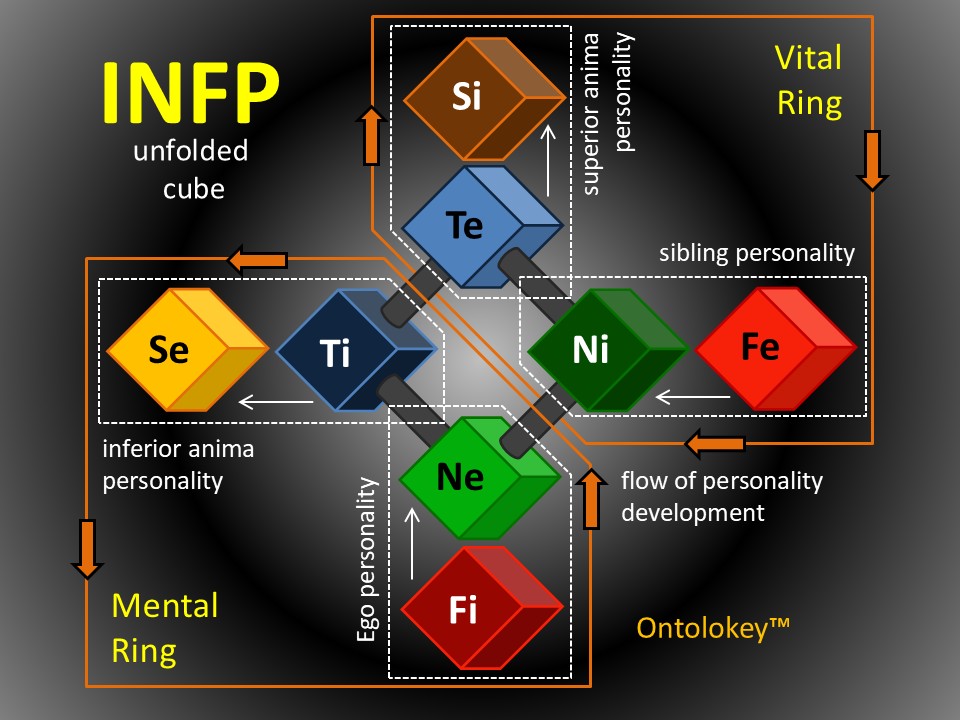
The Ontolokey Cube is useful precisely because this developmental process can be visualized rather than merely conceptualized. Its eight-function arrangement places Fi as Dominant and Ne as Auxiliary while also making visible Fe as Sibling, Se as Toddler, Ti as Anima, Ni as Golden Shadow, Si as Tertiary/Blindspot, and Te as Inferior, thereby presenting the INFP with a psychological landscape rather than a simple list of preferred traits. The sliders and changing positions of the cube can consequently be used as a practical metaphor for development: movement toward a less familiar function does not mean abandoning the functions that come naturally, but temporarily shifting attention toward what has been neglected. For an INFP, this may mean deliberately moving from interpretation toward observation, from possibility toward commitment, from subjective conviction toward external evidence, or from inward reflection toward direct interpersonal engagement. The important point is that such movement should be gradual, because a function that has remained relatively unconscious cannot simply be switched on at full intensity without creating resistance, defensiveness, or compensatory behavior. Development occurs through repeated encounters with the unfamiliar until what initially feels alien becomes increasingly recognizable as another legitimate dimension of the self.
The first practical discipline is therefore cognitive differentiation: learning to notice the difference between an authentic value, an emotional reaction, an interpretation, an idealized possibility, and an observable fact. This is especially important for Fi–Ne because these functions can cooperate so naturally that the INFP may experience an interpretation as though it were already an established reality: a feeling becomes a meaning, the meaning becomes a narrative, and the narrative becomes a conclusion about oneself, another person, or the future. Shadow integration requires interrupting this automatic chain without invalidating the original feeling, because the feeling may contain important information even when the interpretation built around it is incomplete. A useful inner practice is therefore to ask several questions in sequence: What am I feeling? What value does this feeling point toward? What am I assuming? What evidence do I actually have? What alternative explanation is possible? What would change if I acted on reality rather than on the story I have constructed around it? This kind of cognitive separation allows the INFP to preserve the depth of Fi while giving Ne the freedom to explore rather than merely confirm the first emotionally compelling interpretation, and it gradually establishes a more flexible relationship between inner truth and external reality.
The second discipline is embodiment through action, because the INFP’s shadow cannot be integrated exclusively through further introspection. A person can understand their avoidance for years and still avoid; they can recognize perfectionism and continue postponing; they can know that a relationship requires vulnerability and remain emotionally protected; they can understand their creative potential while leaving the work unfinished. The movement from psychological possibility into concrete existence therefore becomes one of the central developmental tasks, particularly in relation to the less comfortable Se and Te dimensions of the INFP structure. The practical exercise is deliberately modest: finish something before it feels perfect, make a decision before every possibility has been exhausted, state a boundary before resentment accumulates, enter an experience without first constructing its complete meaning, or establish a simple external structure that obliges an intention to become behavior. Such actions may initially feel strangely prosaic to a personality accustomed to deriving significance from inner experience, yet precisely this friction is developmental because it teaches the psyche that reality is not merely the place where ideals fail but also the medium through which ideals acquire form.
The third discipline concerns relationship, because the shadow often becomes visible most clearly through other people. Someone who appears insensitive may confront the INFP with a need to communicate more explicitly; someone highly organized may expose the consequences of the INFP’s avoidance of structure; someone emotionally expressive may reveal an unfamiliar relationship to shared interpersonal atmosphere; someone decisive may provoke both admiration and irritation by embodying a capacity the INFP has difficulty claiming for itself. Ontolokey’s broader approach treats such encounters as potentially informative because different psychological structures prioritize different kinds of information, and the shadow may therefore appear externally before it is recognized internally. Instead of asking only why another person is difficult, the more developmental question becomes: What capacity does this person activate in me, and why does that capacity feel simultaneously attractive, threatening, or irritating? This does not mean assuming that every difficult person is a projection or that every conflict is secretly beneficial, but it does create a disciplined way of examining recurring reactions for clues about psychological territory that has not yet been integrated.
The deepest developmental movement for the INFP is consequently from purity toward participation. Purity demands that the inner truth remain uncontaminated by compromise, uncertainty, failure, conflicting obligations, and the imperfections of ordinary life; participation accepts that anything genuinely valuable must eventually encounter those conditions. The mature INFP does not surrender ideals to reality, but allows reality to educate the ideals, testing them against consequences, relationships, limitations, embodiment, and time. This is where the shadow functions become developmental partners rather than enemies: Te can ask what must actually be done, Si can ask what experience has already taught, Se can ask what is happening now, Ti can ask whether the reasoning is coherent, Fe can ask what is occurring between people, and Ni can ask what larger direction the accumulated experience is revealing. The purpose is not to give these functions equal authority, because the INFP remains an INFP, but to allow them enough conscious participation that Fi no longer has to carry the entire burden of determining what is meaningful, true, possible, and worth doing.
The Inferior Function: From Inner Conviction to External Effectiveness
For the INFP, the Inferior Te represents one of the most consequential areas of growth because it confronts the personality with a domain that can feel almost antithetical to its natural mode of being: measurable results, external organization, prioritization, decisiveness, efficiency, and the translation of intention into concrete structure. Because Fi evaluates experience according to deeply personal values, the INFP can instinctively resist situations in which those values appear to be reduced to performance, productivity, or externally imposed standards. Yet the shadow danger lies in confusing the rejection of superficial efficiency with the rejection of structure itself. Without some capacity to organize the outer world, even the most sincere ideals remain vulnerable to procrastination, diffuse attention, unfinished projects, financial disorder, neglected responsibilities, and the quiet accumulation of circumstances that eventually restrict freedom. The developmental task is therefore not to become relentlessly productive, but to discover that structure can serve authenticity rather than oppose it. Te becomes psychologically constructive when it is placed in the service of what Fi considers meaningful, allowing the INFP to ask not merely what matters deeply, but what must be organized, decided, measured, communicated, or completed so that what matters can actually exist in the world.
This is also where the INFP may encounter one of its more uncomfortable shadow dynamics: the sudden emergence of an exaggerated Te under stress. The normally reflective and nuanced personality can become unexpectedly categorical, controlling, critical, or preoccupied with efficiency when accumulated pressure overwhelms its preferred psychological equilibrium. In such moments, external facts and measurable outcomes may be wielded less as neutral tools than as weapons against uncertainty, both toward oneself and toward other people. The paradox is that the INFP can temporarily become rigid precisely because it has avoided structure for too long; what could have been a gentle, continuous discipline then appears in a compressed and distorted form. Development therefore requires introducing Te voluntarily and in small doses before circumstances force it into consciousness. A written plan, a realistic deadline, a defined priority, a completed administrative task, a direct request, or a clear decision can function as a modest psychological exercise in externalization, teaching the INFP that decisiveness does not automatically betray complexity and that organization does not necessarily corrupt authenticity. Over time, Te can cease to represent the frightening demand to “be practical” and instead become the capacity to give practical protection to what the inner self values.
The Tertiary Blindspot: Learning to Respect What Experience Already Knows
Si presents a subtler challenge because it concerns a mode of psychological attention that the INFP may undervalue precisely because it seems too ordinary. Si is concerned with continuity, accumulated experience, familiarity, precedent, bodily rhythms, remembered detail, and the concrete knowledge acquired through repetition, whereas the INFP’s Ne naturally searches for what might be different, possible, symbolic, or emerging. Consequently, the INFP may be much more fascinated by the meaning of an experience than by the practical information contained within the experience itself. This can create a peculiar developmental imbalance in which the person repeatedly rediscovers the same lesson because previous experience has not been sufficiently consolidated into usable knowledge. The shadow question becomes therefore not “What else could happen?” but “What has already happened, and what does that history tell me?” Such a question introduces a form of psychological humility, because it requires the imagination to acknowledge that novelty is not always insight and that patterns accumulated over time may contain information that immediate inspiration cannot provide.
The integration of Si is particularly important for breaking cycles of self-sabotage that otherwise appear mysterious to the INFP. A person may repeatedly enter relationships with the same emotional dynamics, repeatedly overcommit and withdraw, repeatedly postpone important work until pressure becomes unbearable, or repeatedly ignore bodily signals until exhaustion makes them impossible to dismiss. Ne can generate an almost unlimited number of explanations for these experiences, but explanation alone does not necessarily produce learning. Si contributes a different cognitive movement: it records, compares, remembers, and recognizes recurrence, allowing the individual to see that a present situation may not be entirely new simply because it feels emotionally new. The practical exercise is to develop a personal archive of experience without turning it into rigid self-definition: What situations repeatedly drain me? What conditions help me function? Which warning signs precede withdrawal? Which promises to myself do I repeatedly break? Which decisions have produced consequences I already understand? This kind of self-observation transforms memory from passive nostalgia into developmental data, giving the INFP a more reliable relationship with its own history.
Se: Returning From Interpretation to Immediate Reality
The INFP’s relationship with Se introduces another essential corrective because Se directs attention toward what is immediately present: sensory information, physical surroundings, movement, action, timing, and direct contact with the environment. An INFP can become so absorbed in internal meaning and imagined alternatives that the immediate world becomes psychologically secondary, even while it continues to determine what is actually possible. This tendency can produce a subtle form of dissociation from ordinary life in which the person is physically present but psychologically elsewhere, interpreting the experience through memory, symbolism, anticipation, or emotional association rather than simply encountering it. Development through Se therefore begins with something deceptively simple: noticing what is actually happening before deciding what it means. The sound of a room, the expression on another person’s face, the tension in one’s shoulders, the weather, the physical condition of one’s home, the pace of one’s breathing, and the concrete sequence of events all become information that need not immediately be converted into an inner narrative.
This capacity becomes especially valuable when the INFP is emotionally overwhelmed. Under intense Fi–Ne activity, an emotional experience can expand through associations until it appears to describe one’s entire identity, relationship, or future, whereas Se introduces a limiting but stabilizing fact: this is what is happening now, in this body, in this room, under these particular circumstances. Such grounding does not invalidate the emotional meaning of an experience; it prevents meaning from becoming infinitely self-amplifying. A useful developmental practice is therefore to deliberately engage the physical world without requiring it to produce psychological significance: walk without analyzing, cook while attending to texture and smell, work with one’s hands, exercise, maintain one’s physical environment, or consciously observe another person while resisting the impulse to interpret every signal. These activities can appear insignificant beside the INFP’s internal complexity, yet their psychological function is profound because they establish contact with a reality that exists independently of imagination. Through repeated exposure, the INFP learns that presence is not the enemy of depth; often it is the condition that allows depth to become accurate.
Ti and the Discipline of Intellectual Self-Correction
Ti introduces a different form of shadow development because it challenges the INFP to examine whether an idea is internally coherent independently of whether it resonates emotionally or morally. Fi asks whether something is personally authentic and congruent with deeply held values, while Ti seeks conceptual precision, consistency, distinctions, and logical structure. The INFP may naturally experience a compelling inner conviction as psychologically significant, but significance does not guarantee logical completeness. The developmental encounter with Ti therefore asks the individual to tolerate a particularly uncomfortable possibility: I can sincerely believe something and still be mistaken about it. This is not an attack on intuition or personal truth; it is an invitation to distinguish sincerity from certainty and emotional depth from conceptual validity. When developed gradually, Ti gives the INFP an internal instrument for examining its own narratives before those narratives become fixed identities or moral conclusions.
This is particularly important because the INFP’s self-concept can become protected by the language of authenticity. If every internal reaction is interpreted as evidence of an essential truth about the self, then questioning that reaction can feel like self-betrayal. Ti creates psychological distance by asking what the terms actually mean, whether two apparently contradictory beliefs can both be maintained, whether the conclusion follows from the premises, and whether a cherished interpretation survives when its emotional charge is temporarily removed. The aim is not sterile intellectualization but cognitive honesty: the willingness to revise an idea without experiencing revision as humiliation. In practical terms, an INFP can strengthen this function by deliberately arguing against a strongly held interpretation, defining ambiguous concepts before using them, separating evidence from inference, and asking what observation would genuinely falsify a preferred conclusion. Such exercises gradually reduce the need for inner certainty and replace it with something psychologically stronger: the confidence that one’s identity can survive being wrong, learning, changing, and thinking again.
The Golden Shadow: Encountering the Self You Could Become
Beyond the functions that feel merely difficult lies a more mysterious dimension of development: the Golden Shadow. In the Ontolokey framework, the shadow is not limited to what is weak, unpleasant, or repressed; it can also contain psychological qualities that the individual experiences as strangely attractive, almost enviable, because they represent forms of being that have not yet been fully claimed as one’s own. The Ontolokey model places particular emphasis on this distinction between shadow and Golden Shadow, treating the eight functions as a larger psychological landscape in which some capacities are strong and familiar while others remain less conscious, vulnerable, desired, or difficult to access. For the INFP, this means that certain people may evoke an unusually powerful mixture of admiration and irritation precisely because they embody something the INFP senses but cannot yet easily produce: decisiveness, social ease, intellectual detachment, physical immediacy, disciplined execution, emotional directness, or an apparently effortless ability to move through the world. The developmental opportunity begins when admiration is no longer interpreted merely as evidence of another person’s superiority, but becomes a question directed inward: What quality am I encountering outside myself because I have not yet learned to recognize its legitimate place within me?
This question is particularly important because the INFP can idealize not only people but psychological states. The person who appears completely self-assured may seem to possess freedom; the person who acts decisively may seem to possess power; the person who remains calm amid conflict may seem to possess emotional independence; the person who effortlessly organizes reality may seem to possess a form of adulthood that the INFP secretly doubts in itself. Yet the projection often works in both directions: what is admired externally may also be feared internally. The INFP may simultaneously long for greater decisiveness and distrust decisive people, admire rational clarity and experience it as emotionally cold, desire social confidence and regard it as superficial, or want stronger boundaries while fearing that boundaries will make the self unkind. This ambivalence is psychologically valuable because it reveals where development has become entangled with identity. The goal is not to imitate the admired person, since imitation merely creates another persona, but to reclaim the underlying capacity in a form compatible with one’s own structure. A mature INFP does not need to become emotionally detached in order to develop discernment, nor socially dominant in order to become assertive, nor relentlessly efficient in order to become effective; the shadow function becomes integrated when its information can be used without requiring the personality to abandon its center.
The Golden Shadow therefore offers a corrective to one of the most subtle traps of idealistic personalities: the belief that psychological development means becoming a more perfected version of the existing self. If development is understood only as strengthening one’s natural gifts, the INFP can become increasingly articulate about values, increasingly sophisticated in self-reflection, increasingly imaginative, and increasingly capable of explaining its own inner life while remaining surprisingly unchanged in the areas where life actually demands movement. The shadow interrupts this self-confirming process because it introduces qualities that cannot be absorbed into the existing self-image without transformation. Ontolokey’s spatial metaphor is especially useful here because the cube makes the psychological structure something that can be mentally navigated: one can turn toward another function rather than merely read about it, observe its relationship to the familiar functions, and use the sliders as an image of shifting psychological emphasis. For the INFP, the developmental question is therefore not “Which function should I develop next?” as though growth were a mechanical sequence, but “Where has my psychological attention become too concentrated, and what information becomes available when I deliberately move it elsewhere?” This turns the cube from a classification device into a contemplative instrument for observing one’s habitual center of gravity.
The Burden of Inner Truth
At the heart of the INFP shadow lies a particularly difficult problem: the possibility that inner truth can become an emotional burden rather than a source of freedom. Fi gives the individual an unusually strong need to distinguish what feels genuine from what feels false, imposed, artificial, or morally compromised, and this capacity can protect the INFP from conformity and self-betrayal. Yet the same mechanism can gradually create an internal standard so exacting that ordinary human compromise begins to feel like corruption. The person may repeatedly compare actual relationships with an imagined form of intimacy, actual work with an imagined expression of vocation, actual character with an imagined ideal of integrity, and actual life with a version of life that seems somehow more authentic, beautiful, or meaningful. Ontolokey’s recent INFP material describes this dynamic as a movement in which idealism ceases to function merely as direction and becomes an implicit standard by which ordinary existence is continually judged inadequate. The danger is not that the ideal itself is false, but that the comparison becomes structurally unwinnable because reality is always concrete, imperfect, limited, and unfinished, whereas imagination can continuously revise the ideal until it contains none of reality’s unavoidable imperfections.
This is where alienation can become self-reinforcing. If the outer world repeatedly disappoints the inner standard, withdrawal provides immediate psychological relief because imagination offers a realm in which relationships can be perfectly understood, creative projects can remain complete in potential, and the self can remain faithful to its ideals without encountering contradiction. Ne then becomes not simply a source of creativity but a mechanism for preserving possibility against the painful finality of actual choice. The imagined future remains flawless precisely because it has never been subjected to time, resistance, misunderstanding, fatigue, limitation, or the consequences of commitment. Meanwhile, the individual can experience the resulting lack of fulfillment as evidence that the world is incapable of meeting the depth of the inner life, when part of the problem may be that the inner life has been protected from the conditions under which anything real must develop. The developmental response is not to destroy idealism, but to allow the ideal to become vulnerable to incarnation: to let another person misunderstand you, let a creative work be imperfectly received, let a value become difficult to practice, let a decision close other possibilities, and let reality modify what you thought you knew. In that process, inner truth ceases to be a private standard against which life is condemned and becomes something capable of entering life, being tested by life, and becoming more mature through contact with it.
The Shadow of Idealism: When Possibility Becomes Avoidance
The INFP’s idealism is one of its greatest psychological resources, but it can become a defense when possibility is used to postpone the vulnerability of actuality. Ne can keep generating alternatives long after a decision is required, while Fi can continue evaluating whether any available option is sufficiently congruent with the self, producing a subtle loop in which no external choice ever feels quite legitimate. The person may call this discernment, yet sometimes it is fear of foreclosure: choosing one path means allowing countless other imagined selves to disappear. In this state, indecision acquires an almost existential justification because every decision appears to betray something that might have been. The shadow integration therefore requires learning that choice is not the destruction of possibility but the transformation of possibility into experience. A life cannot be lived in the conditional tense indefinitely, and the INFP’s development begins when the individual accepts that an imperfectly chosen reality may teach more than a perfectly imagined future ever can.
Perfectionism is often the emotional companion of this avoidance. Because the INFP can possess a vivid internal representation of what something should feel like, the distance between conception and execution may become painfully visible, whether the subject is creative work, a relationship, career, personal morality, or self-development itself. The result can be a strange psychological reversal in which high ideals produce low output: the more meaningful the project, the greater the fear of producing something that fails to embody its meaning. The unfinished manuscript, the unsent message, the unmade decision, or the perpetually revised plan then remains protected from definitive judgment because potential cannot disappoint in the same way that completed reality can. Growth requires tolerating the grief inherent in making something finite, because every completed act necessarily sacrifices innumerable alternatives. The INFP must gradually discover that authenticity does not mean reproducing an internal vision without distortion; it means remaining genuinely present while allowing the imperfect process of embodiment to change both the work and the person who created it.
Sensitivity Without Self-Abandonment
Sensitivity is another characteristic that requires integration rather than elimination. The INFP may register emotional nuances that others overlook and may possess a strong intuitive awareness of the inner states of people, stories, environments, and symbolic situations, but heightened receptivity can become problematic when every external emotional signal is absorbed as personally significant. The distinction between empathy and emotional fusion is therefore crucial: understanding another person’s pain does not require taking responsibility for resolving it, and perceiving another person’s disappointment does not automatically establish an obligation to surrender one’s own boundaries. When Fi and interpersonal sensitivity become entangled, the INFP may suppress legitimate needs because maintaining inner or relational harmony seems morally preferable to creating discomfort. Yet the suppressed boundary does not disappear; it often returns later as withdrawal, resentment, guilt, passive resistance, or the sudden realization that the relationship has become emotionally one-sided. Development involves learning to remain compassionate while retaining psychological separateness, allowing another person’s feelings to exist without automatically converting them into commands directed at the self.
This becomes particularly important in intimate relationships, where the INFP’s capacity for depth can create a strong desire for profound mutual recognition. The individual may long to be understood beneath the visible personality, and because this longing is genuine, there can be a tendency to interpret emotional resonance as evidence of exceptional compatibility. Yet relationships are not sustained by psychological recognition alone; they also require communication, negotiation, reliability, practical reciprocity, tolerance of difference, and the ability to remain connected when neither person is experiencing the idealized emotional state. The shadow functions become relevant here because they introduce forms of relating that are less dependent upon intuitive or emotional resonance: direct clarification, concrete observation, explicit agreements, memory of behavioral patterns, and attention to what is actually happening rather than what the relationship might mean. The mature INFP therefore learns to ask not only “Do I feel deeply connected to this person?” but also “How do we treat one another when connection is difficult, what patterns have actually emerged over time, and can our values coexist in concrete daily life?” This shift protects sensitivity from becoming idealization and transforms emotional depth into relational discernment.
The Problem of Self-Image
There is also a shadow concealed within the INFP’s attachment to authenticity itself: authenticity can become an identity that must constantly be defended. Once “being true to myself” becomes central to the self-concept, any behavior that feels socially adaptive, practical, strategic, or conventional may be experienced as suspicious, even when it serves a legitimate purpose. The individual can then divide the world into what feels authentic and what feels artificial, without recognizing that every psychologically mature person occupies multiple roles and that adaptation is not necessarily falsification. A person can behave professionally without betraying personal values, compromise without abandoning integrity, follow a structure without becoming mechanical, and communicate in a socially effective manner without becoming insincere. The deeper form of authenticity is therefore not the unrestricted expression of every internal state but the ability to choose one’s behavior consciously while remaining aware of the values that give the behavior meaning. This distinction frees the INFP from the exhausting task of proving authenticity through constant resistance to external expectations.
The same principle applies inwardly, because the INFP can become attached not only to an idealized world but also to an idealized image of the self. The sensitive outsider, the misunderstood individual, the uncompromising idealist, the hidden creative person, or the person who simply cannot live according to ordinary conventions can each become a compelling identity narrative. Such narratives may contain genuine experience, but they can also become psychologically conservative because they explain why certain forms of growth are supposedly incompatible with the self. If I am “the person who cannot be understood,” then being understood may become strangely threatening; if I am “the person who values freedom above everything,” commitment can feel like loss of identity; if I am “the person who refuses superficiality,” ordinary social participation may appear beneath me. Shadow work requires examining these identities with the same honesty that Fi applies to everything else: Which parts describe me, and which parts have become stories that protect me from becoming someone new? Development begins when the self is treated as something capable of transformation rather than as a sacred object that must remain consistent with every previous description.
Integration Rather Than Self-Rejection
The purpose of this work is not to make the INFP harder, less emotional, more productive, more social, or more conventional. Such a transformation would merely replace one form of imbalance with another, because rejecting one’s natural psychological orientation creates a false self rather than a developed self. Integration means that Fi remains capable of distinguishing what is personally meaningful while becoming less isolated from external information; Ne remains imaginative while becoming less capable of using possibility as escape; and the less-developed functions become increasingly available as corrective perspectives when circumstances demand them. The INFP can still be contemplative, idealistic, creative, private, compassionate, and deeply concerned with authenticity while simultaneously becoming more decisive, embodied, structured, intellectually self-correcting, relationally explicit, and attentive to accumulated experience. The movement is therefore not from “INFP” to “something else,” but from a narrower expression of the INFP toward a wider psychological range in which more of the available human capacities can participate. The cube becomes meaningful precisely at this point: its value lies in making the movement itself visible, allowing the individual to observe where attention habitually rests and where conscious experimentation might create greater psychological balance.
A Practical Path of Individuation
The INFP’s development becomes most effective when approached not as a project of self-improvement in the conventional sense, but as a gradual process of individuation through conscious cognitive expansion. The essential principle is simple: whenever the personality encounters a recurring difficulty, the task is to identify not only the emotion it produces but also the psychological capacity that the situation is demanding. If disorder repeatedly creates stress, the answer may involve cultivating Te rather than merely criticizing oneself for being disorganized; if repeated relational patterns are ignored, Si may need greater attention; if emotional narratives become detached from observable circumstances, Se can provide grounding; if cherished beliefs become resistant to examination, Ti can introduce corrective distance. The Ontolokey cube offers a useful visual language for this process because it allows the INFP to regard these capacities spatially and dynamically, rather than treating the personality as a fixed collection of traits. The sliders can consequently be understood as prompts for experimentation: move attention toward the neglected area, observe what changes, and then return to the center with information that was previously unavailable.
A useful developmental rhythm is therefore notice, differentiate, experiment, integrate. First, notice the recurring situation without immediately explaining it away: where do I become defensive, avoidant, overwhelmed, judgmental, passive, controlling, or strangely fascinated by another person’s way of functioning? Second, differentiate the layers of the experience by separating feeling, value, interpretation, memory, sensory evidence, and anticipated possibility. Third, experiment with the corresponding neglected capacity in a deliberately limited way, because shadow integration is more reliable when it is practiced behaviorally rather than merely contemplated intellectually. Finally, integrate the resulting information into the existing personality rather than replacing one extreme with another; the objective is not to live permanently from a shadow function but to become capable of consulting it. This process can be repeated indefinitely, and its effectiveness depends less upon dramatic breakthroughs than upon the accumulation of small corrections to habitual perception. The INFP gradually becomes someone who can remain faithful to inner values without being imprisoned by them, imaginative without disappearing into imagination, sensitive without becoming porous to every demand, and private without becoming isolated.
The most important practical rule is to work with the shadow at the point where it becomes emotionally charged. If a particular kind of person repeatedly provokes disproportionate irritation, curiosity, admiration, envy, or insecurity, that reaction deserves examination because it may indicate contact with a psychological capacity that the conscious identity has not comfortably assimilated. The same principle applies to situations that produce disproportionate avoidance: the task that seems unbearably mundane may contain a lesson about embodiment or structure, the conversation that feels dangerously confrontational may require directness, and the decision that feels impossible may expose an attachment to infinite possibility. This does not mean that every negative reaction should be overcome or that every external demand deserves compliance; discernment remains essential. Shadow work becomes psychologically useful when it reveals choice where there previously seemed to be compulsion, enabling the individual to decide consciously whether a particular capacity should be strengthened, limited, or integrated.
The INFP’s Developmental Sequence
Although development cannot be reduced to a rigid formula, the INFP can benefit from moving through several recurring developmental tensions. The first is the movement from Fi certainty toward Fi discernment, learning that personal conviction becomes stronger rather than weaker when it can tolerate examination and ambiguity. The second is the movement from Ne possibility toward Ne selection, recognizing that generating alternatives is only half of creativity and that choosing among them is what permits creativity to become reality. The third is the movement from inner experience toward embodied presence, in which Se and Si gradually teach the personality to attend to the immediate environment and to learn from accumulated experience rather than continually beginning again in imagination. The fourth is the movement from meaning toward structure, in which Te provides enough external organization for values and intentions to become sustainable actions. These movements should not be understood as stages that are completed once and then abandoned; they are recurring developmental cycles that become increasingly conscious as the person learns to recognize imbalance earlier.
A particularly powerful exercise is to take one persistent life problem and deliberately examine it through all eight functions represented on the Ontolokey cube. Fi can ask what value is being protected; Ne can generate alternative interpretations and possible responses; Se can identify what is concretely happening in the present moment; Si can examine comparable experiences and recurring patterns; Te can determine what practical action is required; Ti can test whether the reasoning is coherent; Fe can consider the interpersonal field and the effect upon others; and Ni can consider the deeper direction toward which the entire pattern may be moving. The purpose is not to produce eight equally persuasive answers, because that would only create another form of paralysis. Rather, the exercise prevents the dominant perspective from monopolizing the interpretation of reality and gives the psyche an opportunity to encounter information that its habitual mode may have excluded. With repetition, this becomes an internal dialogue in which the functions cease to appear as competing personalities and begin to operate as differentiated instruments within a larger psychological whole.
The INFP should also resist the temptation to turn the Ontolokey cube itself into another object of perfectionism. A sophisticated psychological map can become another form of avoidance if the person spends more time locating the self on the map than changing anything in actual life. The decisive question is always whether greater self-understanding produces greater freedom of action, greater responsibility, greater relational honesty, and greater capacity to remain present when reality does not conform to expectation. If understanding becomes increasingly elaborate while behavior remains unchanged, the map has become a substitute for the territory it was intended to illuminate. Conversely, if even small insights lead to different choices, better boundaries, completed commitments, more accurate interpretations, and greater tolerance for uncertainty, then cognition is doing its developmental work. The purpose of psychological knowledge is ultimately not to explain the self perfectly, but to make the self less automatic.
Toward a More Complete INFP
The mature expression of the INFP is therefore not found in the elimination of its contradictions but in the capacity to contain them without fragmentation. The idealist can become pragmatic without becoming cynical, the sensitive person can become boundaried without becoming cold, the imaginative person can become decisive without becoming rigid, and the introspective person can become socially engaged without becoming performative. Such integration permits the INFP’s strongest qualities to operate with greater precision because they are no longer forced to compensate for neglected capacities. Compassion becomes more discerning when it is supported by boundaries; creativity becomes more powerful when supported by execution; idealism becomes more durable when tested against reality; authenticity becomes more flexible when separated from self-image; and intuition becomes more trustworthy when it remains in dialogue with evidence, memory, embodiment, and reason. The result is not a personality stripped of its sensitivity, but one whose sensitivity has acquired greater range, resilience, and responsibility.
Ultimately, the deepest movement is from protecting the inner world to participating fully in the outer one. The INFP does not need to choose between authenticity and reality, between imagination and action, between solitude and relationship, or between ideals and practical life; these apparent oppositions become developmental problems only when one pole is treated as inherently more legitimate than the other. The inner world provides meaning, but the outer world provides resistance, consequence, feedback, relationship, and form, and the psyche requires both if potential is to become lived experience. Shadow integration therefore means allowing reality to speak back to the self, even when its message is inconvenient, disappointing, or initially painful, while retaining enough inner integrity to decide what deserves acceptance and what deserves resistance. In this sense, psychological growth is not the abandonment of the INFP’s inner truth but its maturation through encounter: the truth becomes less fragile because it no longer depends upon being protected from reality.
Becoming Larger Than the Self-Image
The developmental task of the INFP can ultimately be understood as a movement from psychological identification toward psychological integration. At the beginning of this journey, the personality may experience its dominant qualities as synonymous with the self: inner values feel like identity, imagination feels like freedom, sensitivity feels like moral responsibility, and authenticity feels like the final criterion by which life must be judged. As consciousness expands, however, the individual discovers that none of these qualities needs to carry the entire burden of being a person. Inner values become one source of orientation among several forms of psychological information; imagination becomes a generator of possibilities that still require selection; sensitivity becomes a capacity that requires boundaries; and authenticity becomes compatible with adaptation, discipline, uncertainty, and change. The less-developed functions cease to appear as hostile forces threatening the integrity of the personality and gradually become additional perspectives through which reality can be encountered. This is the deeper promise of shadow integration: not that the INFP will become less distinctly INFP, but that the personality will no longer have to live inside the narrowest interpretation of what being an INFP means.
The Ontolokey cube can accompany this process as a visual representation of that expanding psychological field. Its significance lies less in providing a final answer about where an individual “belongs” than in encouraging the individual to observe movement: where is attention concentrated, what remains psychologically neglected, which functions appear under stress, which capacities are admired in others, and which forms of experience repeatedly trigger resistance? By adjusting the sliders and consciously considering different functional perspectives, the INFP can turn an abstract personality model into a practical exercise in self-observation. The cube can become a kind of psychological compass, not because it dictates a single destination, but because it makes possible directions of development easier to see. Used in this way, the model invites a recurring question that is more valuable than any fixed personality description: What part of myself am I not yet allowing to participate in my life? The answer will change with circumstances, age, relationships, responsibilities, and experience, which is precisely why development should be understood as an ongoing dialogue rather than a task that can be permanently completed.
There is also a final paradox that the INFP must learn to tolerate: the self becomes more authentic not by protecting itself from contradiction, but by becoming capable of containing contradiction consciously. The person who can hold both idealism and realism, both sensitivity and firmness, both imagination and discipline, both solitude and participation, becomes less dependent upon psychological defenses that once seemed necessary for survival. This does not mean that every shadow quality should be developed to the same degree or that every external expectation should be accepted; differentiation remains essential, and the integrity of Fi continues to provide the personality with its distinctive center. What changes is the relationship between the center and everything surrounding it. Instead of asking reality to conform to the inner world, the INFP gradually allows the inner world to encounter reality, learn from it, revise itself where necessary, and then return to action with greater clarity.
The deepest form of growth may therefore be described as the courage to make the invisible visible. The values that exist privately must eventually influence choices; the imagination must eventually produce something; the insight must eventually alter behavior; the compassion must eventually become a boundary or an act; the truth must eventually survive contact with another human being; and the potential must eventually accept the limitations that make actual existence possible. This is where the shadow becomes integrated—not when every unfamiliar function feels natural, but when the individual can deliberately access a wider range of psychological responses without experiencing them as betrayals of identity. The INFP’s inner richness then becomes less of a refuge from life and more of a source from which life can be created, inhabited, and shared. The movement is from potential to embodiment, from idealization to participation, and from self-protection to conscious authorship of one’s life.
For readers who want to explore these dimensions in greater detail, the extended INFP analyses on the Ontolokey homepage provide a broader psychological context for the themes developed here, including idealism, alienation, inner truth, shadow dynamics, and the less-conscious functions of the type. The same body of material can also be used to explore other personality types, making it possible to compare different psychological landscapes and to examine why particular interpersonal encounters evoke admiration, conflict, attraction, or misunderstanding. The value of returning to these longer texts is not simply to acquire more terminology about personality, but to deepen the process of self-observation that makes the terminology meaningful. Ultimately, the map matters only insofar as it encourages movement within the landscape of one’s own psyche.
The INFP’s task, then, is not to escape its shadow but to become sufficiently conscious to walk toward it without surrendering the center of the self. Each encounter with an unfamiliar psychological function can be treated as an invitation to widen perception, test assumptions, develop a neglected capacity, and return with something newly understood. Progress will rarely be linear, and periods of withdrawal, uncertainty, idealization, or imbalance will inevitably recur; development does not abolish these tendencies but makes them increasingly recognizable and therefore increasingly available to conscious choice. The Ontolokey cube provides a symbolic structure through which that movement can be observed, while cognition provides the actual mechanism of integration: noticing, questioning, differentiating, experimenting, and incorporating. The mature INFP is therefore not the person who has finally eliminated the shadow, but the person who has learned that the shadow contains parts of life that the conscious personality still has the possibility of becoming.
Final Perspective
Perhaps the most important question for the INFP is not whether the world is worthy of the ideals carried within, but whether those ideals are willing to enter the imperfect world where they can be tested, embodied, contradicted, refined, and made real. Inner truth becomes mature when it can survive uncertainty; idealism becomes mature when it can tolerate imperfection; sensitivity becomes mature when it can coexist with boundaries; imagination becomes mature when it can accept limitation; and authenticity becomes mature when it no longer requires the self to remain unchanged. This is the direction suggested by shadow integration: not away from the personality, but deeper into its possibilities. The INFP does not need to become someone else. It needs to become more fully capable of being itself, and that paradoxically requires becoming capable of much more than its habitual self has previously allowed.


Leave a comment