From Possibility to Psychological Integration
The ENFP is often recognized through movement: the rapid generation of ideas, the instinctive attraction to novelty, the ability to perceive connections where others see separation, and a striking sensitivity to the unrealized potential within people and situations. In the Ontolokey perspective, this outwardly expansive quality is rooted in Extraverted Intuition (Ne), while Introverted Feeling (Fi) provides an inward axis of personal meaning, authenticity, and ethical coherence. The apparent contradiction between these two functions is central to the ENFP personality: the mind wants to keep the world open, while the inner self wants to determine which possibilities actually matter. This combination can produce extraordinary creativity, empathy, idealism, spontaneity, and the ability to inspire others, but it can also create a life in which possibility becomes more emotionally compelling than reality itself. The deeper psychological question is therefore not how an ENFP can become even more imaginative, expressive, or adventurous, but how imagination can become integrated with embodiment, commitment, discernment, structure, and responsibility.
This is where the idea of the psychological shadow becomes particularly important. The shadow is not simply a collection of unpleasant traits that should be eliminated, nor is it an opposite personality hidden somewhere behind the conscious self; it consists of psychological capacities, impulses, attitudes, and tendencies that have not been sufficiently integrated into conscious life. For the ENFP, the central difficulty emerges precisely because the personality’s greatest gift can become its greatest defense: the ability to imagine another possibility can make it extraordinarily easy to leave an unsatisfying reality before fully understanding it, to reinterpret disappointment as evidence that something better must exist elsewhere, or to preserve freedom by avoiding the finality inherent in commitment. The result may be chronic restlessness, unfinished projects, idealized relationships, emotional overinvestment, inconsistent follow-through, or an almost compulsive need for renewed stimulation. The deepest problem is therefore not that the ENFP has too many possibilities, but that possibility can become a psychological refuge from the demands of actuality. The developmental task is to retain the capacity to see what could be while acquiring the strength to remain psychologically present with what is.
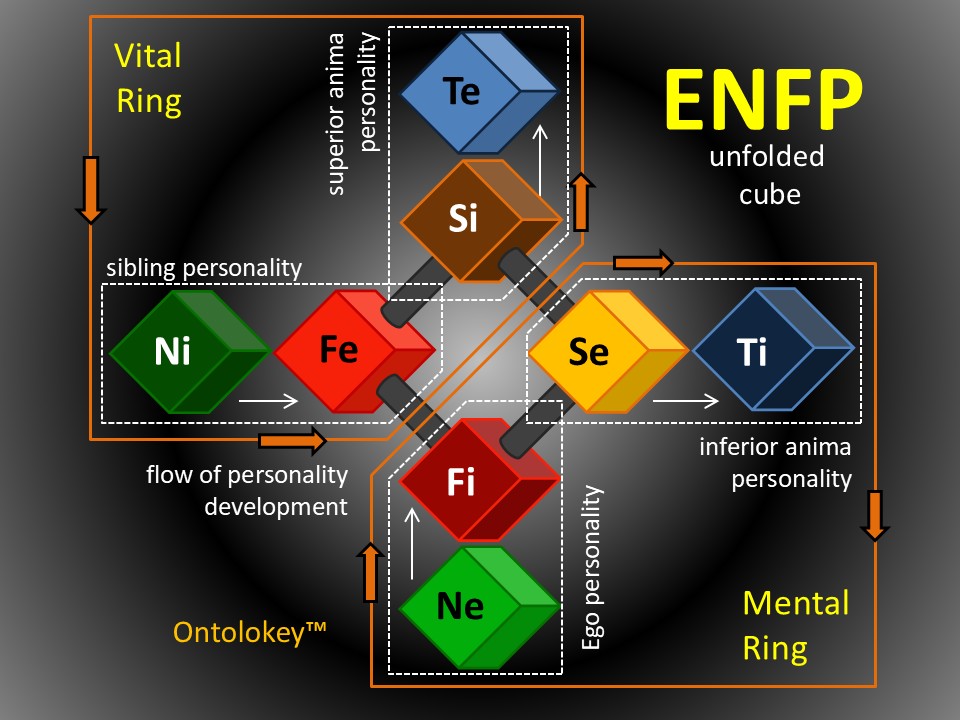
The Ontolokey Cube provides a particularly useful image for this developmental process because it presents the ENFP not as a fixed label but as a landscape of interacting psychological functions, including those that are naturally preferred and those that tend to remain less developed or unconscious. Its sliders can be understood as visual representations of tensions that otherwise remain difficult to observe internally: possibility and depth, intuition and analysis, personal values and social resonance, immediate experience and continuity, inspiration and execution. In this sense, growth does not mean suppressing Ne or weakening Fi in order to become a more conventional, orderly person; it means gradually allowing the less familiar regions of the psychological landscape to participate in conscious life. Introverted Intuition (Ni) can teach the ENFP to narrow the field of possibilities into deeper direction, Introverted Thinking (Ti) can introduce greater conceptual precision, Extraverted Sensing (Se) can restore direct contact with the present moment, Introverted Sensing (Si) can cultivate continuity and groundedness, Extraverted Thinking (Te) can translate inspiration into sustained action, and Extraverted Feeling (Fe) can expand personal authenticity into genuine emotional leadership. The purpose of this development is not to replace the ENFP’s natural orientation, but to make it sufficiently whole that imagination no longer has to function as an escape from reality.
The Central Paradox: Possibility as Gift and Defense
The most characteristic ENFP movement begins with possibility. Extraverted Intuition (Ne), occupying the Dominant position in the Ontolokey model, naturally scans experience for connections, alternatives, emerging patterns, hidden meanings, and unrealized potential, which gives the ENFP an unusual capacity to perceive more than what is immediately present. This is the psychological source of much of the type’s familiar appeal: curiosity, originality, enthusiasm, spontaneity, creativity, emotional openness, entrepreneurial imagination, and an almost instinctive ability to notice what a person or situation could become. Introverted Feeling (Fi), occupying the Auxiliary position, then gives these possibilities an intimate personal significance by asking whether they correspond to what feels authentic, meaningful, and internally true. The combination creates an important paradox: the ENFP can appear extraordinarily open to the external world while simultaneously being highly selective about what is permitted into the inner world, because not every possibility deserves emotional investment.
The difficulty begins when this extraordinary orientation toward potential ceases to be merely perceptual and becomes defensive. The ability to imagine an alternative can provide genuine psychological freedom, but it can also make almost any limitation appear negotiable, temporary, or unnecessary, because another possibility is always available somewhere beyond the present one. An ENFP who is dissatisfied with a relationship may imagine another relationship, an unsatisfying career may generate visions of another vocation, and an uncomfortable psychological state may stimulate an entirely new identity through which the discomfort can be escaped rather than understood. The problem is not that these alternatives are imaginary in the trivial sense; many of them may be entirely realistic, and some may indeed represent healthier directions. The deeper problem is that the continuous generation of alternatives can protect the personality from the grief, frustration, boredom, uncertainty, and responsibility that arise when one remains long enough inside an imperfect reality to discover what it actually demands. In this sense, possibility can become both the ENFP’s greatest instrument of freedom and one of its most sophisticated forms of avoidance.
This distinction becomes particularly important in relationships because the ENFP may perceive not only the person who exists but also the person who could exist. Ne is exceptionally capable of constructing developmental narratives: scattered observations, emotional impressions, isolated talents, and moments of vulnerability can become evidence for a coherent future in which another human being eventually unfolds into the potential the ENFP has perceived. Fi can intensify this process because once the imagined possibility becomes personally meaningful, the ENFP may experience loyalty toward the potential itself rather than toward the observable relationship as it actually exists. This can produce extraordinary patience and compassion, but it can also lead to idealization, overinvestment, disappointment, and difficulty accepting that another person has the right to remain exactly as they are. The shadow therefore emerges when empathy becomes projection: the ENFP no longer merely sees possibility in another person but unconsciously begins relating to the imagined future person as though that future were already a psychological fact. Growth requires learning to distinguish between recognizing someone’s potential and assuming responsibility for realizing it.
The same pattern can occur within the ENFP’s relationship to the self. Because the personality is naturally oriented toward development, transformation, and unrealized potential, the imagined future self can become extraordinarily compelling: more creative, more authentic, more successful, more courageous, more loving, more influential, or simply more fully alive. There is nothing inherently unhealthy in such aspiration, yet it becomes problematic when the future version of the self receives more emotional attention than the person who must actually live through the present. The individual can become psychologically attached to “becoming,” continually preparing for a life that is supposed to begin after the next breakthrough, the next project, the next relationship, the next move, or the next transformation. In that state, unfinishedness itself becomes strangely protective, because an unrealized future cannot disappoint in the same concrete way that an embodied life can. The developmental task is therefore not to extinguish the ENFP’s vision of what might become possible, but to bring that vision into sufficient contact with reality that aspiration becomes action, action becomes repetition, and repetition eventually becomes character.
When Inspiration Becomes Avoidance
The ENFP’s shadow becomes especially visible when its natural appetite for stimulation begins to substitute for psychological digestion. Because Ne is continually capable of producing a new interpretation, a new project, a new intellectual connection, or a new emotional possibility, the ENFP can move away from discomfort with remarkable sophistication while experiencing the movement as growth. A difficult situation does not necessarily have to be confronted if it can be reframed; an unresolved conflict does not necessarily have to be endured if a new direction can be imagined; an abandoned commitment does not necessarily have to be mourned if another possibility immediately restores a sense of expansion. This is why the ENFP’s shadow cannot be reduced to simple impulsiveness or lack of discipline: the avoidance may be intellectually brilliant and emotionally convincing, because the mind can generate genuine meaning around almost any departure. The individual may therefore believe that they are following intuition when, at a deeper level, they are protecting themselves from the psychological weight of limitation, repetition, disappointment, or irreversible choice.
This dynamic can produce a characteristic oscillation between intense engagement and sudden withdrawal. The ENFP may enter an experience with extraordinary enthusiasm because its potential is immediately visible, investing imagination, emotion, time, and identity before the ordinary demands of maintenance have become psychologically real. Once novelty diminishes and the situation begins requiring repetition, patience, administration, or acceptance of constraints, the original emotional energy can collapse, and the psyche begins searching for another source of possibility. From the outside, this can look inconsistent, unreliable, or scattered, while from the inside it may feel like the painful discovery that something which once seemed alive has somehow become dead. Yet one of the central developmental realizations for the ENFP is that meaningful things inevitably pass through phases in which they no longer provide continuous stimulation. A relationship, vocation, creative discipline, intellectual pursuit, or personal commitment cannot remain permanently at the psychological temperature of discovery, and maturity requires learning that diminished novelty does not automatically mean diminished meaning.
The shadow can become still more complicated when Fi becomes involved in protecting the individual’s sense of authenticity. Fi gives the ENFP a powerful internal compass, but when insufficiently integrated with the rest of the personality it can turn subjective feeling into an unquestioned criterion of truth: “If this no longer feels like me, it must no longer be right for me.” Such an interpretation can be deeply misleading because identity itself develops through sustained encounters with circumstances that initially feel alien, frustrating, boring, or even contrary to one’s preferred self-image. A mature personality must eventually distinguish between violating one’s deepest values and simply experiencing resistance, inconvenience, delayed gratification, or wounded pride. Without that distinction, authenticity can become a defense against accountability, because every uncomfortable demand can be interpreted as evidence that the environment is incompatible with the “real self.” The psychological integration of Fi therefore does not mean distrusting feelings, but learning to examine them closely enough to determine whether they express a genuine value conflict, an old wound, fear of limitation, or the temporary frustration of not being able to live according to one’s preferred impulse.
The opposite danger is equally important: an ENFP may become so identified with being spontaneous, unconventional, emotionally perceptive, and endlessly open to possibilities that ordinary forms of structure begin to feel psychologically threatening. Routine may be interpreted as stagnation, commitment as confinement, consistency as loss of freedom, and planning as premature closure. Yet structure is not necessarily the enemy of freedom; without structure, many possibilities remain permanently hypothetical because nothing carries them from imagination into material existence. This is where the less developed functions represented on the Ontolokey Cube become valuable psychologically: they can be approached not as foreign identities that the ENFP must adopt, but as capacities that compensate for predictable blind spots in the dominant orientation. The purpose of moving the sliders toward these less familiar territories is consequently not self-correction through self-rejection, but conscious expansion of the personality’s available repertoire.
The Shadow of Scattered Potential
One of the most painful aspects of the ENFP shadow is the possibility of becoming attached to potential itself rather than to its realization. The personality can accumulate ideas, projects, interests, relationships, intellectual frameworks, creative directions, and possible futures with extraordinary speed, because Ne experiences the world as an interconnected field in which almost everything can lead somewhere else. This abundance is a genuine psychological resource, but it creates a particular danger: when every possibility carries some emotional or intellectual attraction, choosing one path necessarily means allowing countless others to remain unexplored. For a personality that experiences possibility so vividly, this can feel less like ordinary prioritization and more like a form of psychological loss. Consequently, the ENFP may preserve freedom by keeping many doors partially open, but the price of preserving all those doors is that comparatively little energy becomes concentrated enough to produce mastery, continuity, or completion.
This is where the shadow associated with the ENFP’s less developed relationship to continuity and concrete experience becomes significant. The personality may be exceptionally good at initiating, imagining, connecting, and inspiring while finding the repetitive middle of a process psychologically less rewarding than its beginning or its imagined conclusion. Yet almost every substantial achievement is created precisely in that middle: the period after enthusiasm has diminished but before the result has become visible. The ENFP therefore has to learn a psychologically counterintuitive lesson, namely that boredom is not always evidence of misalignment and repetition is not always evidence of stagnation. Sometimes boredom is simply the nervous system adjusting to the absence of novelty, while repetition is the mechanism through which an intention becomes embodied competence. Developing a stronger relationship with continuity does not make the ENFP less creative; it gives creativity a container in which it can accumulate rather than continually dispersing itself into new beginnings.
The Ontolokey Cube can make this developmental problem especially tangible because it allows the ENFP to visualize psychological movement rather than merely describe personality characteristics in abstract language. The sliders can be regarded as a map of emphasis: the familiar territory represents functions that the ENFP can access relatively spontaneously, whereas the less familiar territories indicate capacities that may require deliberate attention before they become psychologically comfortable. For an ENFP, this visualization can therefore transform growth from the vague instruction to “be more disciplined” into a more precise process of consciously strengthening neglected modes of perception and judgment. The point is not to push every slider toward an imagined ideal position, because development is not the elimination of individuality; rather, the visual model can help reveal where the personality habitually over-relies on its preferred mode and where another function could provide the missing counterweight. Growth becomes a movement from unconscious compensation toward conscious choice, in which the ENFP increasingly decides how to respond instead of automatically following the first psychological pathway that feels alive.
This distinction between automaticity and choice is crucial because the mature ENFP does not need to become less ENFP-like. In fact, trying to suppress Ne in order to become consistently conventional, predictable, or controlled would misunderstand the nature of psychological integration, because the expansive perception of possibility is one of the personality’s central sources of vitality and insight. The objective is instead to create a larger psychological container around that vitality, so that imagination can coexist with commitment, intuition with evidence, emotional authenticity with accountability, and freedom with responsibility. When this happens, the ENFP’s energy becomes less dependent on constant novelty because the personality develops the capacity to generate meaning from depth as well as breadth. The person no longer has to abandon an experience simply because its first layer has been exhausted; they can remain long enough to discover the second, third, and fourth layers that only become visible through sustained attention.
The Developmental Turn: From Possibility to Direction
The next stage of ENFP development is therefore not primarily about acquiring more possibilities, but about learning how to discriminate among them without experiencing discrimination as psychological impoverishment. Ne naturally multiplies perspectives, whereas development requires selection, and selection inevitably introduces the experience of exclusion: choosing one project means not pursuing another, choosing one relationship means accepting the limits of that particular relationship, and choosing one direction means allowing other imagined lives to remain unrealized. For the ENFP, this can be experienced almost existentially because possibilities are not merely abstract alternatives; they can become emotionally inhabited futures, each carrying its own atmosphere, identity, and promise. The mature response is not to suppress this imaginative abundance but to introduce a second movement into consciousness: after asking what could be possible, the ENFP must learn to ask what is actually worth making real. This is the transition from possibility as perception to possibility as direction, and it represents one of the most important psychological shifts in the movement toward integration.
Here the development of Introverted Intuition (Ni) becomes particularly meaningful within the Ontolokey framework. Whereas Ne expands the field by discovering connections and alternatives, Ni can be experienced as a movement toward convergence, asking what lies beneath the multiplicity and which underlying direction gives the many impressions their deepest coherence. For the ENFP, cultivating this capacity means learning to tolerate the temporary loss of alternatives in exchange for greater depth, because a meaningful direction often becomes visible only after competing possibilities have been allowed to settle. This can feel uncomfortable precisely because the ENFP is accustomed to psychological expansion, while Ni asks for sustained inward concentration and a willingness to let one interpretation mature instead of immediately generating another. The developmental exercise is therefore simple in principle but demanding in practice: when many possibilities appear, do not immediately follow the most stimulating one; remain with the field long enough to discover which possibility continues to matter after the excitement has subsided. In this way, intuition becomes less like perpetual movement and more like a capacity for orientation.
A similar transformation is required in the ENFP’s relationship with Thinking. Introverted Thinking (Ti), as a less familiar mode of cognition in this developmental picture, can help separate what feels personally meaningful from what is structurally coherent, allowing the ENFP to examine assumptions without immediately converting analysis into a judgment about identity or values. This capacity is particularly valuable when the personality has become emotionally attached to an interpretation, because Fi can make a cherished idea feel inseparable from personal authenticity, while Ne can continually produce arguments capable of supporting it. Ti introduces a different question: does the idea actually hold together when examined from within its own logic? Developing this faculty does not require the ENFP to become emotionally detached or excessively analytical; it means becoming capable of thinking against one’s own preferred narrative when reality requires it. The psychological gain is considerable, because once the ENFP can tolerate discovering that a beloved interpretation is incomplete or mistaken, imagination becomes freer rather than weaker, no longer needing to defend every possibility simply because it has become personally significant.
The same principle applies to Extraverted Thinking (Te), whose developmental significance lies in translating inner conviction and imaginative potential into observable structure, sequence, priorities, and results. An ENFP may possess an extraordinary vision of what should exist while still struggling with the mundane architecture required to bring that vision into existence, and this discrepancy can become a source of chronic frustration because the internal experience of potential remains far ahead of external accomplishment. Te provides a corrective by asking what can be done now, what resources are required, what sequence is realistic, what must be measured, and what concrete evidence would demonstrate progress. Properly integrated, this does not turn the ENFP into a bureaucrat of the self; it gives imagination a mechanism through which it can become consequential. The deeper developmental lesson is that execution is not a betrayal of inspiration but its test, because an idea that remains perpetually protected inside imagination can remain perfect precisely because reality has never been allowed to challenge it.
Feeling, Relationship, and the Discipline of Reality
The development of the ENFP cannot be understood solely as a movement toward greater structure, because the shadow also appears in the emotional domain where Fi can become both sanctuary and defense. Introverted Feeling gives the personality an intimate relationship with values, sincerity, identity, and the felt quality of human experience, allowing the ENFP to recognize emotional nuances that may remain invisible to more externally oriented forms of judgment. At its healthiest, this produces compassion without conformity: the ability to respect individuality, defend what matters, and remain internally guided even when social expectations point elsewhere. Yet precisely because these inner convictions can feel so deeply personal, questioning them may sometimes be experienced as questioning the self itself. Development therefore requires an important differentiation between authenticity and emotional immediacy, because what feels intensely true in one psychological moment is not necessarily identical with one’s deepest and most enduring values. The integrated ENFP learns to protect the integrity of Fi without allowing every powerful feeling to become an unquestionable command.
This becomes particularly significant in interpersonal situations because the ENFP’s capacity for emotional imagination can make other people’s inner worlds unusually vivid. The personality may intuitively perceive unspoken possibilities in a relationship, sense emotional contradictions, recognize latent wounds, and imagine forms of connection that have not yet been articulated. Such sensitivity can make the ENFP deeply encouraging and psychologically generous, but it can also produce over-identification, rescuing behavior, or an unconscious assumption that understanding another person creates an obligation to help transform them. The shadow appears when empathy crosses the boundary between witnessing another person’s experience and taking psychological responsibility for it. An ENFP may then invest enormous energy in explaining, supporting, inspiring, forgiving, or waiting for another person to become capable of the relationship that has been imagined. Growth requires learning that compassion does not require possession of another person’s future, and that respecting someone’s autonomy sometimes means allowing reality to contradict one’s perception of their potential.
The development of Extraverted Feeling (Fe) offers another useful dimension to this process because it can teach the ENFP to move beyond the private question of whether something feels authentic toward the interpersonal question of how emotional reality is being shared and received. Fi asks whether an experience is congruent with one’s inner values, whereas Fe can bring greater awareness of the emotional field created between people, including reciprocity, social atmosphere, mutual regulation, and the needs of the relationship as a whole. For an ENFP, developing this capacity can soften a potential tendency to interpret every interpersonal problem exclusively through personal authenticity: sometimes the issue is not that one person is being inauthentic, but that two authentic individuals have incompatible needs, expectations, or emotional rhythms. The psychological maturation lies in holding both realities simultaneously rather than making one person’s inner truth the automatic center of the situation. In this form, emotional intelligence becomes less about intensity and more about relational differentiation, where closeness does not require the dissolution of boundaries and empathy does not require self-abandonment.
The development of Extraverted Sensing (Se) and Introverted Sensing (Si) introduces an equally important corrective by returning the ENFP from imagined futures and interpretive possibilities to the concrete continuity of lived experience. Se can strengthen direct contact with what is actually occurring in the present, reducing the tendency to become absorbed in what an experience might signify or eventually become, while Si can cultivate an appreciation for memory, repetition, established patterns, bodily signals, accumulated experience, and the quiet continuity that makes a life recognizable to itself over time. Together, these capacities challenge the ENFP’s instinct to treat the new as inherently more psychologically alive than the familiar. The deeper lesson is that reality does not become less meaningful merely because it has become familiar, and presence does not require constant stimulation. When the ENFP learns to inhabit concrete experience rather than continually interpreting it toward the next possibility, ordinary life itself becomes a source of psychological information, and the present ceases to function merely as a waiting room for the future.
The Deeper Shadow: When the Self Becomes Its Own Possibility
At a deeper level, the ENFP shadow concerns not simply scattered attention or unfinished projects, but the relationship between identity and possibility itself. A personality organized around potential can unconsciously begin to experience the present self as provisional, as though the person one currently is were merely an early draft of someone who has not yet fully arrived. This can create a subtle dissatisfaction that is difficult to identify because it does not necessarily manifest as low self-esteem; the ENFP may instead possess an intense belief in what life could become while remaining strangely unable to rest inside what life already is. The individual may repeatedly reconstruct the self through new interests, environments, relationships, ambitions, philosophies, or personal narratives, each reconstruction providing a temporary sense of expansion. Yet if every new identity is treated as a possible doorway to the “real” self, development can become circular, because the personality remains permanently oriented toward becoming rather than inhabiting. The deepest integration therefore requires accepting that psychological growth does not culminate in discovering a final version of oneself, but in becoming sufficiently grounded that changing and remaining can coexist without either becoming an escape from the other.
This is also why the ENFP can be particularly vulnerable to the seduction of intensity. Intense emotion, intellectual discovery, romantic connection, creative inspiration, and existential insight can all produce the unmistakable sensation that something important is happening, and for a personality attuned to possibility this sensation can become a powerful indicator of significance. But intensity and depth are not synonymous, and the psychological shadow emerges when emotional magnitude is unconsciously used as evidence that an experience must be meaningful. The quieter processes of integration rarely provide the same immediate reward: changing a habit, keeping a promise, listening without generating a new interpretation, returning to the same practice tomorrow, repairing a relationship after the emotional excitement has disappeared, or patiently examining an uncomfortable fact may feel almost anticlimactic. Yet these are precisely the experiences through which psychological potential becomes stable character. The mature ENFP gradually learns to recognize a form of meaning that does not announce itself through excitement, because some of the most consequential changes occur beneath the threshold of stimulation.
The same principle applies to suffering. An ENFP’s capacity to reframe experience can be psychologically restorative because it prevents painful events from becoming meaningless, but excessive reframing can interfere with mourning by transforming pain into possibility before the pain has actually been experienced. Loss may immediately become a lesson, rejection a redirection, failure an invitation to reinvent oneself, and disappointment evidence that something better is waiting elsewhere. Such interpretations may eventually prove valuable, but when they arrive too quickly they can function as defenses against grief, anger, helplessness, or the recognition that something genuinely cannot be recovered. Psychological integration requires the ENFP to develop the capacity to remain with an experience before converting it into a narrative about the future. This is a demanding form of presence because it temporarily suspends the personality’s most familiar solution—finding another meaning—and permits the reality of limitation to register without immediately being transformed into another possibility.
From this perspective, the ENFP’s shadow is not an enemy standing opposite the conscious personality; it is the consequence of a strength that has become one-sided. Ne becomes restless expansion when it cannot tolerate closure, Fi becomes self-protection when feeling becomes indistinguishable from truth, and the underdeveloped functions remain distant precisely because the conscious personality has learned to solve so many problems through its preferred modes. Integration consequently means allowing the psyche to acquire additional ways of responding before a crisis makes them unavoidable. The Ontolokey Cube becomes useful here as a practical image of this process: rather than asking which function should replace another, the ENFP can observe where its habitual sliders are concentrated and experiment with consciously moving toward capacities that ordinarily receive less attention. The objective is not symmetry for its own sake, but greater psychological freedom—the freedom to expand when expansion is needed, to narrow when direction is needed, to analyze when feeling is insufficient, to structure when inspiration is insufficient, and to remain present when the impulse to escape into possibility becomes strongest.
A Practical Path of Integration
Psychological integration becomes meaningful only when it leaves the level of insight and enters behavior, because an ENFP can understand a pattern intellectually while continuing to reproduce it automatically. The first step is therefore observation without immediate correction: notice when the impulse to begin something new appears, when dissatisfaction suddenly generates a radically different future, when another person’s potential becomes more compelling than their actual behavior, or when a difficult emotion is rapidly transformed into a new interpretation. The important question is not whether the impulse is right or wrong, but what psychological function it is serving at that particular moment. Is the new possibility genuinely emerging from clarity, or is it relieving the discomfort of staying with something unfinished, uncertain, repetitive, or painful? This distinction gradually creates a space between impulse and action, and that space is where cognition can begin to participate consciously in development rather than merely rationalizing whatever the personality already wants to do.
A useful discipline for the ENFP is therefore to introduce deliberate intervals between recognition and commitment. When a new opportunity appears, the immediate enthusiasm can be honored without automatically becoming a decision, allowing time to determine whether the attraction survives after the initial stimulation has diminished. When frustration arises within an existing commitment, the individual can similarly postpone the conclusion that something must be abandoned and instead investigate what the frustration is communicating. Sometimes it will reveal a genuine incompatibility, but sometimes it will reveal boredom, fear of inadequacy, resistance to repetition, wounded expectations, or the discovery that the imagined version of an experience was more attractive than its concrete reality. The purpose of such pauses is not to imprison the ENFP in indecision, but to ensure that decisions emerge from a broader psychological field than the first emotionally compelling interpretation. In this sense, patience becomes a cognitive practice: it allows less dominant functions to enter the decision before Ne and Fi have already determined the direction.
The Ontolokey Cube can serve as a practical companion to this process because its visual representation makes psychological imbalance easier to recognize than abstract terminology alone. The ENFP can use the sliders as prompts for experimentation rather than as measurements of psychological worth, asking which less familiar function might provide the missing perspective in a particular situation. When overwhelmed by possibilities, movement toward a more convergent and internally synthesized mode can help clarify direction; when emotionally convinced of a personal interpretation, a more detached analytical perspective can test its coherence; when lost in future scenarios, attention to immediate sensory reality can restore contact with what is actually happening; when constantly starting anew, greater attention to continuity, memory, repetition, and accumulated experience can reveal what has already been learned. When an idea remains permanently hypothetical, a more execution-oriented mode can translate it into concrete steps, deadlines, evidence, and consequences, while greater interpersonal awareness can reveal how one’s supposedly authentic choices affect the emotional system surrounding them. The sliders thus become most useful when they are treated as invitations to broaden cognition rather than as commands to become someone else.
The long-term objective is to make these compensatory movements increasingly voluntary. At first, the ENFP may need deliberate exercises, written reflection, routines, external structures, or conscious reminders because the less familiar functions do not yet feel as natural as intuitive exploration and personal valuation. Over time, however, repeated cognitive engagement can create new psychological pathways, so that the individual no longer has to be consciously forced into every unfamiliar mode of perception or judgment. The person begins to notice that discipline can protect freedom, that limitation can clarify meaning, that ordinary experience can contain depth, that disagreement does not necessarily threaten authenticity, and that commitment can actually create possibilities that perpetual openness never allows to materialize. Integration therefore does not culminate in a personality that has abandoned its characteristic expansiveness; it culminates in an ENFP whose expansiveness has acquired enough depth, structure, presence, and discernment to become sustainable.
From Self-Discovery to Self-Formation
There is a decisive difference between discovering one’s personality and deliberately forming it. Personality descriptions can be illuminating because they give language to patterns that previously appeared unrelated, allowing the ENFP to recognize recurring tendencies in relationships, work, creativity, decision-making, and emotional life. Yet recognition can itself become another form of consumption when the individual continually searches for a more precise description of who they are without allowing that knowledge to alter how they live. The ENFP is particularly susceptible to this possibility because personality knowledge can generate an almost endless field of interpretations, subtypes, developmental narratives, and hypothetical versions of the self. The psychologically productive question therefore changes from “Which description explains me most completely?” to “What does this recognition require me to practice?” The purpose of understanding the shadow is ultimately not to construct a more elaborate identity but to make previously unconscious choices increasingly available to consciousness.
This also changes the meaning of authenticity. Authenticity is sometimes imagined as the freedom to follow whatever feels most spontaneous, emotionally compelling, or personally meaningful, but a deeper form of authenticity involves becoming capable of acting according to one’s values even when the immediate psychological impulse points elsewhere. An ENFP who values creativity may therefore need to accept discipline, an ENFP who values freedom may need to honor commitments, an ENFP who values compassion may need to establish boundaries, and an ENFP who values truth may need to tolerate discovering that a cherished interpretation was mistaken. None of these developments represents a betrayal of the personality; they demonstrate that values become more substantial when they survive contact with conditions that do not automatically support them. The mature self is not simply the self that expresses its preferences most freely, but the self that can consciously determine which preferences deserve obedience and which impulses deserve examination. In this sense, integration transforms authenticity from spontaneous self-expression into deliberate self-formation.
The deepest developmental challenge for the ENFP may therefore be learning to remain psychologically present when possibility loses its protective function. When there is no new project to absorb attention, no imagined future to anticipate, no idealized person to understand, no intellectual discovery to pursue, and no alternative identity waiting to be explored, the individual encounters the comparatively unglamorous substance of existence itself. This is where the shadow can become most instructive, because the absence of stimulation exposes what has previously been avoided through movement. The ENFP may discover grief that has not been fully felt, commitments that have not been honored, talents that have remained undeveloped because they were never practiced consistently, relationships that require reciprocity rather than idealization, or aspects of the self that cannot be reinvented away. Remaining with these realities is not psychological stagnation; it is the process through which the personality acquires weight. What was previously experienced as limitation can become the ground from which a more coherent form of freedom emerges.
The final movement of development is consequently a paradox: the ENFP becomes freer by becoming more capable of staying. Staying does not mean remaining indefinitely in situations that violate one’s values, nor does integration require surrendering the personality’s instinct for exploration, change, and renewal. It means developing enough psychological differentiation to know the difference between leaving because something has genuinely reached its end and leaving because novelty has temporarily become more attractive than depth. It means being able to explore without scattering oneself, to feel without being governed by every feeling, to imagine without confusing potential with reality, and to commit without experiencing commitment as the death of possibility. When these capacities begin to cooperate, the ENFP’s characteristic openness acquires a different quality: it is no longer driven primarily by the fear that something better might be elsewhere, but by the confidence that one can remain fully present wherever one has consciously chosen to be.
Becoming Whole Without Becoming Someone Else
The developmental path of the ENFP can ultimately be understood as a movement from psychological breadth toward psychological wholeness. The personality begins with an extraordinary capacity to perceive possibility, connect disparate ideas, recognize human potential, and experience life as an open field rather than a predetermined structure. Its inner Feeling function gives this expansiveness a deeply personal center, ensuring that possibilities are not merely interesting but capable of becoming meaningful, ethical, intimate, and transformative. Yet precisely because these capacities are so powerful, they can become defensive when consciousness relies on them too exclusively: possibility can replace decision, idealization can replace acceptance, intensity can replace depth, authenticity can become indistinguishable from immediate feeling, and reinvention can become a way of avoiding the grief involved in accepting what cannot be changed. The shadow is therefore not something foreign that must be defeated; it is the accumulated consequence of capacities that have not yet been balanced by the rest of the psychological system.
The work of integration begins when the ENFP stops treating its less developed functions as inconvenient opposites and starts recognizing them as dormant dimensions of its own psychological potential. The movement toward Introverted Intuition can deepen breadth into direction; Introverted Thinking can introduce precision where personal conviction has become too persuasive; Extraverted Thinking can give form and execution to visions that would otherwise remain hypothetical; Extraverted Sensing can return attention from imagined futures to the concrete immediacy of lived experience; Introverted Sensing can teach continuity, memory, repetition, and respect for what has already been built; and Extraverted Feeling can broaden private authenticity into conscious participation in the emotional reality shared with others. These movements do not ask the ENFP to abandon its natural center, because development is not a conversion into another type. They enlarge the range of responses available to consciousness so that the individual can choose among psychological possibilities instead of being unconsciously governed by the most familiar one.
The Ontolokey Cube offers a practical visual metaphor for this process because it turns the abstract architecture of personality into a landscape through which development can be consciously navigated. Its sliders can remind the ENFP that psychological growth is not necessarily a straight line toward a predetermined ideal, but an ongoing process of adjusting emphasis according to what life and circumstance require. The important question is not whether every slider should occupy some supposedly optimal position, but whether the individual can recognize when one habitual mode has become insufficient and consciously move toward another. In this sense, the Cube can become a mirror for cognition: it helps externalize tensions that otherwise remain implicit and invites the ENFP to experiment with perspectives that may initially feel less natural. The developmental direction is consequently not prescribed once and for all; it emerges through increasing awareness of where the personality is overextended, where it is avoiding something necessary, and which neglected cognitive capacity could restore balance.
The mature ENFP does not cease to be restless, curious, imaginative, idealistic, or emotionally alive, but these qualities cease to operate as compulsory patterns and become conscious resources. The person can still discover ten possibilities in a single conversation, but does not have to pursue all ten; can still perceive the potential within another person, but does not have to rescue that potential; can still imagine an entirely different future, but does not need to flee the present merely because another future is imaginable. Such development creates a form of freedom that is deeper than unrestricted choice, because genuine psychological freedom includes the capacity to remain when remaining is meaningful, to leave when leaving is necessary, to endure uncertainty without immediately resolving it, and to tolerate limitation without interpreting limitation as the end of possibility. The ENFP’s greatest maturation therefore lies not in becoming less expansive but in developing an inner structure strong enough to contain its expansiveness.
Ultimately, the question for the ENFP is not how to eliminate the shadow, because a personality without a shadow would be psychologically impossible and development does not consist of purifying oneself of contradiction. The more meaningful question is whether the shadow can become conscious enough that its energy is no longer expressed primarily through avoidance, projection, restlessness, idealization, or perpetual reinvention. When the neglected functions are gradually brought into cognition, the personality gains additional ways of understanding experience, and what once appeared to be an external limitation can become material for inner development. Possibility can then coexist with commitment, feeling with examination, imagination with embodiment, freedom with responsibility, and authenticity with relationship. The ENFP does not become someone else through this process; rather, the personality becomes large enough to contain more of itself.
For readers who wish to explore these dynamics in greater depth, the more extensive ENFP analyses on Ontolokey.com provide further perspectives on the type, its cognitive landscape, its characteristic strengths, and its shadow dimensions. The same body of material can also be used to explore the other personality types and to examine how their psychological landscapes differ in emphasis and developmental tension. The value of such exploration lies not merely in finding a description that feels familiar, but in using the description as a starting point for conscious observation. The most productive interpretation of personality is ultimately the one that leads back into lived experience: noticing the habitual pattern, recognizing the shadow behind it, identifying the neglected cognitive capacity, and then practicing a different response until that response becomes increasingly available. For the ENFP, this is the passage from endlessly discovering what might be possible to consciously becoming capable of making something real.


Leave a comment