From Intellectual Mastery to Psychological Integration
The INTP’s greatest psychological strength is also the point from which its deepest developmental problem can emerge: the extraordinary capacity to construct, examine, dismantle, and reconstruct an internal model of reality. The INTP does not merely use thought to solve problems; thought can become the inner environment in which experience is organized, tested, questioned, and given meaning. Introverted Thinking provides the impulse toward internal coherence, while Extraverted Intuition continually opens that structure toward alternative explanations, new possibilities, unexpected connections, and intellectual discovery. This combination can produce a mind that is remarkably independent of convention, resistant to superficial explanations, and capable of seeing relationships between ideas that remain invisible to others. Yet psychological development begins precisely where this strength reaches its limit, because a coherent internal model is not the same thing as a lived reality, and understanding an experience is not equivalent to participating in it. The central task of the mature INTP is therefore not to weaken the intellect, nor to become less analytical, but to gradually release the unconscious belief that everything important must first become intellectually comprehensible before it can safely be experienced.
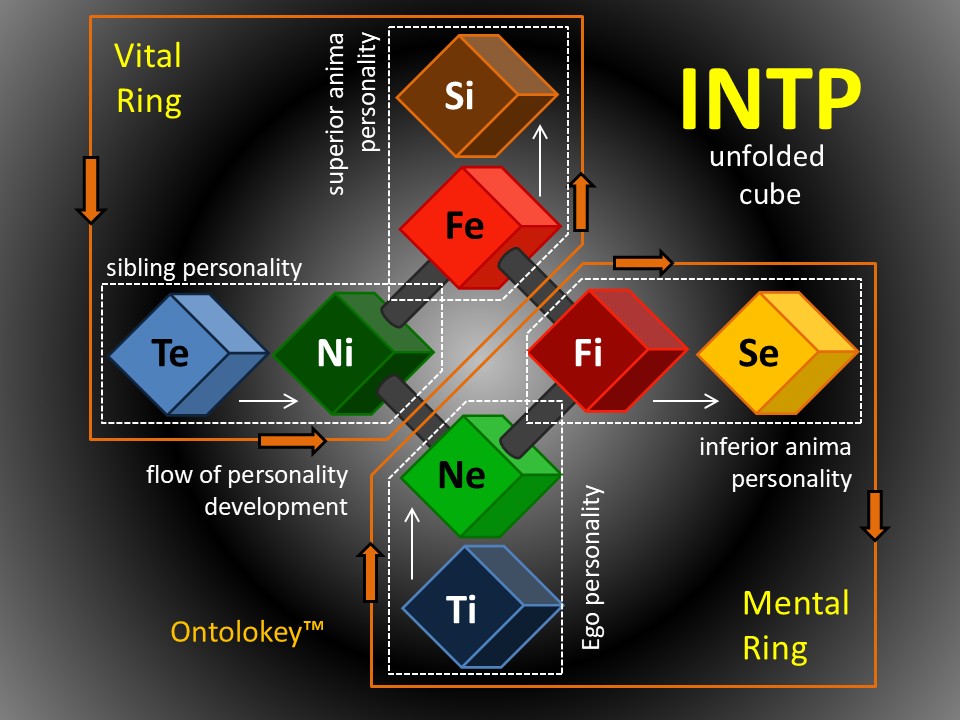
This distinction becomes particularly important when the INTP encounters uncertainty, emotional vulnerability, commitment, practical responsibility, or interpersonal complexity. The same mind that can patiently investigate an abstract question may become caught in an apparently endless process of analysis when the question concerns the self, another person, or an irreversible decision. In such situations, analysis can quietly change its psychological function: it ceases to be an instrument for discovering what is true and becomes a means of postponing exposure to what cannot be controlled. Possibility then becomes more attractive than commitment, preparation more comfortable than action, and intellectual distance safer than emotional participation. The shadow is not therefore simply “thinking too much”; it is the gradual substitution of cognitive mastery for direct contact with life. Ontolokey’s conception of the INTP is particularly useful here because it presents the psychological functions spatially, allowing the less familiar or less developed functions to be viewed not merely as deficiencies but as territories toward which development can move. The cube becomes, in this sense, less a portrait of a finished personality than a map of potential psychological movement: it makes visible the fact that the INTP’s psychological world contains more than the functions that come most naturally.
Growth therefore begins with a deceptively simple but psychologically demanding reversal: instead of asking how the INTP can make the mind more powerful, one begins asking what the mind has been protecting the person from experiencing. This question leads directly into the shadow, because many of the INTP’s difficulties are not caused by an absence of ability but by the overdevelopment of one mode of relating to existence at the expense of others. The tendency to remain inside conceptual possibility can protect against the vulnerability of choosing; emotional intellectualization can protect against dependence; skepticism can protect against disappointment; and perpetual self-analysis can protect against the humiliation of discovering that one’s actual abilities are more limited, inconsistent, or ordinary than one’s imagined potential. None of these mechanisms needs to be consciously chosen for them to become psychologically influential. Indeed, their power often derives from the fact that they appear rational while serving an emotional purpose beneath the surface. The developmental challenge is consequently not to attack these patterns but to recognize them while they are occurring, to identify what psychological function they are serving, and then to introduce another function capable of completing what the dominant pattern leaves unfinished. This is where cognition becomes integration: thinking no longer exists to defend the personality from experience, but becomes the means through which experience can gradually be understood, tolerated, and incorporated.
The Ontolokey Cube offers a concrete image for this developmental movement because its eight interconnected functions can be understood as a psychological landscape rather than as a fixed hierarchy of desirable and undesirable traits. In the INTP configuration, Introverted Thinking occupies the central position of internal analysis, while Extraverted Intuition expands the field of possibilities and Extraverted Thinking represents the capacity to structure, execute, and bring an internally coherent idea into external form; Extraverted Sensing, meanwhile, reconnects the abstract thinker with immediacy, embodiment, sensory reality, and the physical present. Ontolokey further places Extraverted Feeling in an important position of emotional and interpersonal development, describing the function as connected with belonging, harmony, empathy, and the longing to be understood without having to perform socially. Seen from this perspective, development does not require the INTP to abandon its intellectual center; it requires the center to establish relationships with the psychological capacities that have remained less familiar, less trusted, or more difficult to control. The sliders of the cube can therefore be understood symbolically as invitations to experiment with psychological movement: not as commands to become someone else, but as visual reminders that a personality becomes more spacious when consciousness learns to move beyond its habitual center.
The purpose of the following suggestions is therefore not self-correction in the narrow sense, and certainly not the replacement of the INTP personality with a supposedly more balanced character. The deeper objective is individuation: the gradual capacity to remain intellectually rigorous while becoming more embodied, emotionally accessible, decisive, relational, and capable of tolerating the irreducible uncertainty of existence. The INTP does not need to stop questioning; it needs to learn when questioning has already accomplished its purpose. It does not need to abandon solitude; it needs to recognize when solitude has become avoidance rather than restoration. It does not need to become conventionally sociable or emotionally demonstrative; it needs to become capable of allowing other people, concrete experience, feeling, limitation, and action to provide forms of knowledge that solitary cognition cannot generate by itself. The movement toward psychological wholeness is consequently not away from the INTP’s deepest nature but through it: the intellect becomes the instrument by which the personality can recognize its own defenses, approach its shadow without contempt, and gradually transform previously unconscious functions into conscious possibilities. The aim is not to become less of an INTP, but to become an INTP whose identity is no longer confined to the narrowest expression of its greatest strength
The INTP’s Familiar Strengths and Their Hidden Cost
The familiar portrait of the INTP begins with the mind: intellectually independent, curious, skeptical, abstract, inventive, and resistant to accepting an explanation merely because it is conventional or socially approved. Ontolokey’s description emphasizes that this personality is driven less by the accumulation of facts than by an internal need to understand how things fit together, with Introverted Thinking (Ti) continually examining assumptions, contradictions, structures, and principles beneath the visible surface of a problem. This creates a personality that often experiences the world as something to be decoded rather than simply accepted, and it explains the INTP’s characteristic attraction to complex systems, philosophy, science, technology, theoretical questions, and problems that reward independent investigation. The INTP may appear detached because attention is frequently directed inward toward an active process of conceptual reconstruction, while the external environment becomes temporarily secondary to whatever intellectual structure is currently being examined. At its best, this produces unusual intellectual autonomy: the INTP can question premises that others take for granted, tolerate ambiguity without immediately demanding closure, and continue investigating a subject even after the surrounding social environment has lost interest in it.
The second major strength is the interaction between Ti and Extraverted Intuition (Ne), through which the INTP combines analytical depth with an expansive capacity for possibilities. Ti wants to understand the internal architecture of an idea, whereas Ne continually asks what else might be true, what alternative explanation could account for the same evidence, and what unexpected connection might emerge if apparently unrelated concepts were placed beside one another. This is why the INTP can be simultaneously precise and speculative: one moment the mind is reducing a complex problem to its underlying principles, and the next it is generating several entirely different hypotheses about where those principles might lead. The resulting creativity is rarely creativity for its own sake; it tends to emerge from the pleasure of discovering relationships that were not previously visible. Yet the very openness that makes this cognitive combination fertile also creates one of the INTP’s central developmental tensions, because a mind that can always generate another interpretation can also generate another reason not to decide. Possibility is psychologically liberating as long as it expands perception, but it becomes restrictive when the preservation of possibility is unconsciously valued more highly than the experience of choosing.
This tension explains why the INTP’s apparent procrastination is sometimes more complicated than simple unwillingness to work. A task may remain unfinished because the person continues to discover ways in which the underlying model could be improved, because an imperfect solution feels intellectually dishonest, or because beginning the concrete implementation would eliminate a large field of possibilities that still feels psychologically alive. The unfinished project can therefore retain a kind of perfection in imagination that it would inevitably lose through contact with reality. This is one of the places where the INTP’s intellectual strength can quietly become defensive: the mind remains in a domain where everything can still be revised, clarified, or reconsidered, while concrete action introduces constraints that cannot be negotiated through thought alone. The problem is not that the INTP has too many ideas, but that ideas can become a protected psychological space in which the person is spared the exposure involved in testing those ideas against circumstances, other people, time, failure, and limitation. Growth begins when the INTP recognizes that an imperfectly realized idea can generate more knowledge than a perfectly analyzed possibility, because reality supplies information that contemplation cannot manufacture.
There is also a subtler interpersonal dimension to the INTP’s independence. The desire to think freely can make conformity feel psychologically suffocating, particularly when social expectations appear arbitrary or when emotional pressure is used in place of reasoned argument. The INTP may consequently develop a strong internal boundary between what is genuinely believed and what is merely expected, and this can protect intellectual integrity when the surrounding environment is intellectually careless or coercive. Yet independence can gradually become an identity that must be defended even when nobody is actually trying to take it away. At that point, disagreement may be experienced less as an opportunity for exchange and more as an intrusion into the sovereignty of the inner world, while ordinary requests for cooperation can feel unnecessarily demanding because they require adaptation to perspectives that do not originate within the INTP’s own reasoning process. The shadow therefore does not begin with arrogance or coldness; it begins much earlier, when psychological autonomy becomes so valuable that dependence, compromise, emotional reciprocity, or ordinary participation are unconsciously interpreted as threats to the self.
The developmental question is consequently not whether the INTP should become more conventional, more socially expressive, or less skeptical, because none of these changes would address the underlying psychological issue. The deeper task is to preserve intellectual independence while becoming less dependent upon intellectual distance as a form of self-protection. This means learning to distinguish between a situation that genuinely requires analysis and one in which analysis merely delays an encounter with uncertainty, vulnerability, or responsibility. It means allowing another person’s emotional reality to exist without immediately translating it into a problem that needs to be solved, and allowing a practical limitation to be experienced without treating it as an argument against reality itself. In the Ontolokey perspective, the eight-function structure becomes useful precisely because it widens the field beyond the functions through which the INTP most readily recognizes itself: the personality is not exhausted by Ti and Ne, but contains additional modes of relating to action, sensory experience, effectiveness, memory, value, meaning, and interpersonal feeling. The mature INTP therefore does not abandon the familiar intellectual identity; instead, that identity becomes a foundation from which the less familiar parts of the psyche can gradually be explored.
When the Mind Becomes a Refuge from Experience
The deepest shadow of the INTP begins where the distinction between understanding and living becomes psychologically blurred. An INTP can become exceptionally skilled at observing an experience, conceptualizing it, explaining its mechanisms, and placing it within an increasingly sophisticated theoretical framework, while remaining strangely distant from the experience itself. This is particularly significant when the subject is emotionally threatening, socially ambiguous, or personally consequential, because intellectualization then offers an elegant form of psychological distance: the mind continues to work intensely, but the person does not have to expose the vulnerable part of the self to the uncertainty of direct participation. Loneliness can become a theory of human attachment, disappointment can become an analysis of interpersonal behavior, fear of failure can become an investigation into optimal conditions for performance, and uncertainty can become an endless search for additional information. From the outside, such activity may look like insight, and often it genuinely contains insight, but its psychological function may nevertheless be avoidance. Ontolokey’s recent treatment of the INTP shadow describes this problem particularly clearly: the danger is not irrationality but the possibility that rationality itself becomes a defense against experiences that cannot be controlled through reasoning.
This defensive use of cognition can be difficult for the INTP to recognize because it does not feel like avoidance in the ordinary sense. The person is not necessarily running away, suppressing thought, or refusing to confront a problem; on the contrary, the mind may be working harder than ever, producing distinctions, hypotheses, counterarguments, psychological interpretations, and increasingly refined explanations. The difficulty is that the intellectual activity has subtly changed its purpose: instead of helping the individual approach reality, it begins to regulate how close reality is allowed to come. The INTP can therefore become extraordinarily knowledgeable about a subject while remaining personally untouched by what that knowledge implies, especially when the implications involve dependency, rejection, commitment, grief, inadequacy, desire, or the possibility of being misunderstood. This creates a peculiar psychological asymmetry in which the person may be able to explain themselves more convincingly than they are able to reveal themselves. The resulting self-knowledge can become paradoxical, because one can know an enormous amount about one’s own mechanisms while still avoiding the immediate emotional truth that those mechanisms are protecting. The shadow becomes strongest precisely where cognition ceases to be a bridge toward experience and becomes instead a sophisticated wall between the self and experience.
One of the clearest manifestations of this pattern is the INTP’s relationship with possibility. Extraverted Intuition can generate alternatives almost indefinitely, and under healthy conditions this is a remarkable capacity because it prevents premature closure and keeps the mind receptive to unexpected solutions. Under shadow conditions, however, the same capacity can make commitment psychologically expensive, because every choice necessarily destroys or postpones other possibilities. A relationship becomes more complicated once it requires a decision about the future; a project becomes less enjoyable once it requires completion; a career becomes more constraining once it demands specialization; even a personal belief can become uncomfortable once the individual recognizes that maintaining it means giving up certain alternatives. The INTP may consequently preserve freedom by keeping possibilities alive long after a decision has become necessary, sometimes mistaking the preservation of options for genuine openness. Ontolokey describes this as one of the deeper developmental tensions of the type: possibility can gradually cease to create freedom and instead become a means of avoiding the consequences of choosing. Psychological maturity therefore requires a difficult realization: every meaningful act of creation involves exclusion, because to give one possibility actual existence is to allow countless other possibilities to remain unrealized. The mature INTP does not eliminate alternatives but becomes capable of choosing without requiring certainty that no better alternative exists.
The same mechanism can appear in the INTP’s relationship with perfection. Because Ti seeks internal coherence, an idea may remain psychologically compelling as long as it exists in a conceptual state where contradictions can still be corrected and possibilities remain open. Reality is less forgiving: implementation introduces deadlines, imperfect materials, other people’s limitations, unforeseen consequences, and results that cannot simply be revised through thought. This is why an unfinished project can sometimes protect the INTP’s idealized image of their own potential more effectively than a completed project ever could. A finished work can be judged, criticized, measured, misunderstood, or discovered to be less brilliant than it seemed internally, whereas the unrealized work retains infinite potential. The unconscious bargain is therefore subtle: as long as the idea remains unfinished, the person never has to discover exactly what happens when their intelligence meets resistance in the external world. Development requires breaking that bargain deliberately, not by abandoning standards but by accepting that implementation itself is a form of cognition. As Ontolokey’s discussion of Te suggests, external execution can become a developmental counterpart to Ti because reality supplies information that internal reasoning alone cannot provide; practical failure is not merely failure, but evidence about the model.
The same principle applies to interpersonal life, where the INTP encounters perhaps the most difficult form of reality because another person cannot be reduced to a stable conceptual system. Human beings contradict themselves, change their minds, communicate indirectly, respond emotionally, misunderstand intentions, and sometimes behave according to motives they themselves cannot articulate. For an individual whose psychological security is strongly associated with understanding structure, this unpredictability can become exhausting, and solitude can therefore acquire a protective function far beyond its legitimate value as rest or reflection. The INTP may begin by preferring solitude because it provides concentration, but gradually discover that solitude also removes the need to negotiate emotional ambiguity, compromise, spontaneous responsiveness, and the possibility of being personally affected by another person. If this becomes habitual, the person can construct increasingly sophisticated explanations for why ordinary social interaction is superficial, inefficient, irrational, or unrewarding, and some of those observations may contain considerable truth. The shadow emerges when accurate observations become psychological justifications for avoiding participation, because the person no longer asks whether the criticism is correct but whether the criticism is also serving a defensive purpose. Ontolokey describes this cycle as one in which limited interpersonal exposure increases unfamiliarity, unfamiliarity increases analytical distance, and analytical distance can further reduce spontaneous connection. The developmental movement is therefore not toward constant sociability, but toward enough relational exposure that other people can become sources of experience rather than merely objects of analysis.
This is where Extraverted Feeling, in its less developed position within the INTP structure, becomes especially important. The problem is not that the INTP lacks emotion or possesses no need for connection; rather, emotional reciprocity may feel less controllable and less cognitively predictable than the internal world of ideas. Ontolokey describes inferior Fe as carrying a desire for social harmony and emotional expression that can remain buried and underdeveloped, which helps explain the apparent contradiction between the INTP’s independence and a surprisingly deep longing to be understood. The INTP can spend enormous intellectual energy trying to understand other people while simultaneously making it difficult for others to understand the vulnerable layers of the INTP’s own personality. Analysis becomes easier than disclosure because analysis preserves the observer’s position, whereas disclosure places something valuable in another person’s hands. Development therefore requires learning that emotional communication is not an abandonment of intellectual authenticity and that interpersonal dependence, in moderate and conscious forms, does not invalidate autonomy. The goal is not to transform the INTP into a socially demonstrative personality, but to allow cognition to become sufficiently integrated that the individual can say what is felt without first constructing a complete theory explaining why it is felt.
This integration also changes the meaning of vulnerability. For an INTP, vulnerability can initially appear intellectually irrational because it necessarily involves incomplete control: one cannot guarantee how another person will respond, whether an emotional disclosure will be understood, whether a commitment will endure, or whether an attempt at connection will succeed. Yet precisely because these outcomes cannot be guaranteed, vulnerability becomes a domain in which the personality must learn a form of knowledge that cannot be produced by Ti alone. The question is no longer whether the situation can be made safe through sufficient analysis, but whether the self can remain psychologically intact while allowing uncertainty to exist. This is a fundamental shift from control to tolerance, and it may be one of the most important developmental movements available to the INTP. The mind does not become weaker when it acknowledges that some experiences must precede their explanation; rather, cognition becomes more mature because it learns to distinguish between what can be understood before it is lived and what can only be understood after one has had the courage to live it. In that sense, shadow work is not an attack upon the INTP’s intellect but an expansion of what the intellect is permitted to serve.
From Shadow Recognition to Conscious Development
Recognizing the shadow is only the beginning, because insight by itself can become another form of intellectual consumption for the INTP. The personality that can understand a psychological mechanism with remarkable precision may nevertheless remain unchanged if the insight never alters behavior, attention, or the way experience is actually approached. For this reason, development has to proceed through a repeated movement between cognition and lived experience: first noticing a habitual pattern, then understanding what function it serves, then deliberately introducing a less familiar psychological response, and finally observing what happens without demanding immediate mastery. The essential principle is that an undeveloped function should not be treated as an enemy of the dominant function, because the shadow contains information that the conscious personality has learned to overlook or distrust. The Ontolokey model is particularly suited to this kind of observation because it presents the eight functions spatially and allows their relationships to be perceived as a landscape rather than merely memorized as an abstract sequence. The cube can therefore become a practical instrument of self-observation: instead of asking which function is “best,” the INTP can ask which psychological territory is currently being avoided, overused, idealized, or unconsciously delegated to other people.
The first developmental movement concerns Extraverted Thinking, or Te, because the INTP’s internal understanding becomes psychologically incomplete when it cannot reliably cross the boundary into implementation. Ti asks whether something makes sense within an internally coherent system, while Te is concerned with what can actually be organized, measured, executed, tested, and brought into effective contact with the external world. The developmental exercise is therefore not to become aggressively productive or permanently task-oriented, but to cultivate a disciplined willingness to let reality answer questions that thought alone cannot settle. A useful rule is to distinguish between the point at which additional analysis genuinely improves the solution and the point at which analysis merely protects the solution from being tested. Once that distinction becomes visible, the INTP can deliberately shorten the distance between conception and execution by producing imperfect prototypes, making decisions with incomplete information, establishing external deadlines, or allowing another person to evaluate an idea before it feels completely finished. In the language of the Ontolokey framework, this is a movement from an exclusively internal mode of verification toward a complementary external mode in which results themselves become information.
A second movement leads toward Extraverted Sensing, Se, and is more existential than it initially appears. The INTP can become so accustomed to living in abstraction that the immediate physical world is experienced primarily as an interruption of thought rather than as an independent source of information, even though perception, bodily sensation, timing, movement, environment, and concrete circumstances continuously influence psychological life. Development therefore involves deliberately returning attention to what is actually present before interpreting it, which means noticing the body, the room, the pace of an interaction, the practical condition of a project, and the sensory qualities of an experience without immediately converting them into concepts. This is difficult precisely because the INTP’s mind is highly practiced at moving away from the given toward what could explain the given. Yet the present moment contains forms of information that abstraction can distort when it becomes detached from direct observation, and learning to remain with immediate reality can therefore correct a characteristic imbalance. The Ontolokey Cube’s spatial representation is useful here because development can be imagined literally as a movement toward a psychological corner that the habitual personality may rarely inhabit consciously, transforming sensory immediacy from something merely tolerated into another channel through which reality can speak.
The movement toward Introverted Feeling, Fi, presents a different challenge because it concerns the private recognition of personal meaning, values, boundaries, loyalty, authenticity, and the quality of individual relationships. The INTP can be highly capable of discussing ethical systems while remaining uncertain about what personally matters when no universal principle can settle the question, and this distinction becomes increasingly important as intellectual development progresses. Not every meaningful decision can be resolved by discovering the logically optimal answer, because human beings sometimes choose according to commitments that are deeply personal and cannot be reduced to impersonal consistency without losing something essential about them. For the INTP, developing this dimension means learning to ask not only “Is this logically defensible?” but also “What does this mean to me, what do I genuinely value, and what would I betray by acting otherwise?” Such questions may initially feel less precise because personal values are not always transparent even to the person who holds them, but precisely this ambiguity makes them an important counterweight to the tendency to universalize everything into a conceptual system. Psychological integration occurs when the INTP can tolerate the existence of a personal truth without needing to transform it immediately into an objective theory that would make it easier to control.
The movement toward Extraverted Feeling, Fe, reaches even further into the interpersonal shadow because it requires the INTP to recognize emotional atmosphere and relational reciprocity as forms of information in their own right. This does not mean becoming performatively expressive, pleasing everyone, or sacrificing intellectual honesty for harmony; such a transformation would merely replace one form of inauthenticity with another. It means developing enough sensitivity to recognize that an interaction has an emotional field, that people communicate through tone and timing as well as propositions, and that relationships are partly sustained by experiences of recognition that cannot be substituted for by being technically correct. The INTP can practice this by allowing another person to finish expressing an emotion before analyzing it, by reflecting what was emotionally heard rather than immediately offering a solution, and by stating personal feelings before explaining their causes. These are small behavioral experiments, but they are psychologically significant because they weaken the assumption that cognition must remain in the position of detached observer. The broader Ontolokey conception supports precisely this developmental interpretation: the less conscious functions are not simply defects to eliminate but parts of a larger functional structure that can become increasingly available to conscious awareness.
The most important principle, therefore, is graduality. The INTP does not become integrated by forcing every shadow function into equal strength, because psychological development is not an exercise in constructing a perfectly symmetrical personality. Instead, integration means increasing freedom of movement so that the individual is no longer compelled to respond to every situation from the same cognitive position. The Ontolokey Cube can serve as a visual reminder of this freedom: the sliders can be used symbolically to identify where attention, practice, and conscious experimentation might be expanded, while the familiar functions remain available as the psychological home base from which exploration begins. A mature INTP can therefore remain deeply analytical while becoming more decisive, more embodied, more personally grounded, more practically effective, and more emotionally reciprocal, because these capacities no longer have to compete with intelligence. The real developmental achievement is not balance as an abstract ideal but flexibility: being able to recognize which mode of consciousness a situation requires and to move toward it without experiencing the movement as a betrayal of the self.
The Less Familiar Functions as Pathways of Integration
Once the INTP recognizes that the shadow is not an alien force but an extension of capacities already contained within the personality, development becomes less a struggle against unwanted traits and more a process of widening consciousness. The Ontolokey model makes this especially concrete by placing eight functions into a spatial relationship in which the less conscious functions remain connected to the dominant Ti rather than existing outside the personality altogether. In this configuration, Si, Fi, Ni, and Fe represent very different developmental directions, and each challenges a characteristic limitation of the INTP in a different way: Si interrupts endless novelty by reconnecting the person with continuity and lived experience; Fi brings personal values and subjective significance into consciousness; Ni introduces a more convergent form of intuition capable of allowing meaning to emerge without endlessly multiplying alternatives; and Fe opens the individual toward interpersonal reciprocity, emotional expression, and belonging. The point is not to activate these functions mechanically or to attempt to distribute attention equally among them, but to recognize what psychological information becomes available when the habitual Ti–Ne orientation is no longer permitted to monopolize consciousness. Development begins when the INTP becomes curious about precisely those experiences that initially seem less natural, less controllable, or less intellectually satisfying.
Introverted Sensing, Si, can be understood as an antidote to the INTP’s tendency toward perpetual conceptual expansion because it introduces continuity, memory, familiarity, accumulated experience, and the concrete imprint of what has already been lived. An INTP strongly oriented toward Ne may instinctively move toward what is new, unusual, theoretically interesting, or potentially transformative, sometimes overlooking the fact that psychological stability is also created through repetition and the recognition of patterns across time. Si asks a quieter question: what has actually happened before, what has the body already learned, what experiences have left a durable imprint, and what can be trusted because it has been repeatedly encountered rather than merely logically inferred? This does not mean becoming conservative or resistant to change, but developing a relationship with personal history that prevents every new possibility from erasing the significance of accumulated experience. For the INTP, such integration can be surprisingly grounding because it transforms memory from something that merely stores information into something that establishes continuity of self. Instead of continually asking what might be possible next, the person begins to recognize that identity also emerges from what has already been experienced, practiced, endured, enjoyed, and incorporated.
Introverted Feeling, Fi, presents an even more intimate developmental challenge because it brings the INTP into contact with subjective value rather than objective coherence. A highly analytical person can become extremely skilled at determining whether a proposition is logically defensible while remaining less practiced at identifying whether a choice is personally meaningful, emotionally congruent, or faithful to an inner value that cannot be universally justified. Fi introduces precisely this private dimension of evaluation, asking what the individual genuinely cares about when no external authority and no purely logical system can provide the answer. The developmental danger here is that the INTP may initially try to analyze values as though they were propositions, searching for a rational proof of why one should care about one thing rather than another. Yet personal values often become visible through attention rather than deduction: what repeatedly moves the person, what feels like a violation even when nobody else recognizes it, what one would protect despite inconvenience, and what kinds of compromise gradually produce inner emptiness. In this sense, Fi teaches the INTP that subjectivity is not necessarily a defect in reasoning; it is another dimension of human information, and psychological maturity requires knowing when an internally coherent explanation is less important than fidelity to what one actually experiences as meaningful.
Introverted Intuition, Ni, offers a different correction to the expansive movement of Ne. Whereas Ne continually opens possibilities and multiplies interpretive pathways, Ni can be understood as a movement toward convergence, synthesis, depth, and the emergence of an underlying direction from many seemingly separate observations. For an INTP, this can be particularly valuable because endless possibility can eventually obscure the larger pattern that the possibilities themselves are pointing toward. The developmental task is therefore not to reduce curiosity but to allow curiosity to mature into discernment, asking which possibilities possess psychological or existential gravity rather than merely intellectual novelty. This can involve periods of deliberate stillness in which the individual does not immediately generate another hypothesis, but allows apparently unrelated experiences to settle until a deeper pattern becomes visible. Such a movement may initially feel less productive than active analysis because nothing appears to be happening, yet psychologically it represents a shift from constructing possibilities to receiving meaning. Within the Ontolokey architecture, Ni is described as the INTP’s “golden shadow,” which gives it a particular developmental significance: it can represent a form of intuition that feels strangely compelling precisely because it is less familiar, potentially revealing a dimension of understanding that cannot be reached simply by producing more alternatives.
Extraverted Feeling, Fe, may ultimately provide the most demanding integration because relationships expose the INTP to forms of uncertainty that cannot be solved through private cognition. The other person has an independent inner world, and therefore no amount of analysis can guarantee that an interaction will produce the intended emotional result; empathy, trust, affection, conflict, reconciliation, and belonging all require participation rather than detached comprehension. Ontolokey places Fe in the inferior position of the INTP and emphasizes the apparent contradiction that can arise between outward emotional reserve and an underlying need for acceptance, harmony, and genuine interpersonal recognition. Development here means learning to treat emotional presence as a legitimate form of intelligence: listening without immediately correcting, acknowledging another person’s experience without first determining whether it is logically justified, expressing affection without constructing a theory of why it is appropriate, and admitting one’s own emotional state before it has been perfectly understood. These practices do not require the INTP to become socially performative or to surrender critical thinking; they require the person to accept that another human being cannot always be helped by an explanation. Sometimes the psychologically mature response is not to solve the emotional problem but to remain sufficiently present that the other person no longer has to carry the experience alone.
The same principle applies to the INTP’s relationship with the self, because integration requires the ability to notice when a familiar cognitive response is being activated before it becomes automatic. When an uncomfortable emotion appears, the developmental question becomes whether the mind is investigating it or escaping into investigation; when another possibility emerges, whether it genuinely expands understanding or merely postpones commitment; when solitude becomes attractive, whether it is restoring the personality or protecting it from relational exposure; and when a practical demand feels irritating, whether the demand is genuinely unreasonable or simply forcing contact with an area of development. These distinctions are subtle precisely because the defensive behavior often resembles the healthy behavior from the outside. Analysis is still analysis, independence is still independence, skepticism is still skepticism, and curiosity is still curiosity; what changes is their psychological function. The Ontolokey Cube can therefore be used as a visual prompt for this self-observation, with its sliders representing not a prescription for an ideal personality but a way of making developmental direction tangible: when a particular area repeatedly generates avoidance, disproportionate discomfort, or unconscious overreaction, that very friction may indicate where conscious experimentation could be most fruitful.
The ultimate purpose of integrating the shadow is consequently not to make the INTP symmetrical, socially conventional, emotionally demonstrative, or endlessly productive. It is to make the personality less captive to its own preferred mode of consciousness. A psychologically mature INTP can continue to question assumptions without questioning everything indefinitely, preserve independence without turning self-sufficiency into isolation, explore possibilities without becoming addicted to alternatives, and value precision without demanding certainty before acting. The person can move from thought into action, from abstraction into embodiment, from possibility into commitment, from analysis into emotional presence, and from private coherence into relationship without experiencing these movements as betrayals of intellectual identity. What emerges is not a different personality but a larger one: the same analytical center surrounded by a progressively more accessible range of psychological capacities, each capable of supplying information that the center alone cannot generate. This is the deeper meaning of shadow integration in the INTP: not the conquest of darkness by reason, but the gradual discovery that reason becomes more complete when it is willing to illuminate parts of the self that it cannot control.
The Practice of Conscious Integration
The decisive step in psychological development is the transition from recognizing a pattern to practicing a different response while the old pattern is still active. For the INTP, this distinction matters because insight can become an end in itself: the person may understand precisely why they withdraw, why they postpone decisions, why they intellectualize emotion, or why they resist externally imposed structures, yet the same understanding can remain safely inside the conceptual world and therefore produce little transformation. Real development begins when cognition is used prospectively rather than retrospectively, when the INTP notices the familiar reaction and deliberately creates a small interval in which another response becomes possible. That interval may consist of staying in an uncomfortable conversation rather than retreating into analysis, completing an imperfect piece of work rather than continuing to refine it, making a decision before every variable has been resolved, or allowing a feeling to exist without immediately explaining it away. The psychological significance lies not in the size of the action but in the fact that consciousness has interrupted an automatic sequence. Through repetition, what was initially experienced as an artificial exercise can become an increasingly natural part of the personality, because the psyche discovers through experience that the unfamiliar response does not destroy the established self.
A useful developmental discipline for the INTP is therefore to treat discomfort as information rather than as an automatic instruction to withdraw. This does not mean assuming that every uncomfortable situation is beneficial, nor does it mean ignoring legitimate boundaries, exhaustion, or circumstances that genuinely require distance; the point is to become curious about the specific kind of discomfort being experienced. If a practical task produces disproportionate irritation, the underlying issue may be the loss of intellectual freedom, the fear of incompetence, or resistance to external evaluation rather than the task itself. If emotional intimacy produces an urge to analyze the relationship, the analysis may contain valuable observations while simultaneously protecting the person from being personally affected by the relationship. If a decision repeatedly generates new questions just as action becomes possible, the additional questions may represent genuine complexity, but they may also be functioning as an elegant postponement of commitment. The INTP can gradually learn to ask a second question after every analytical question: “What is this thought helping me understand, and what is it helping me avoid?” That distinction turns self-analysis into a genuinely developmental instrument because it makes the function of cognition visible rather than merely its content.
The Ontolokey Cube can support this process by providing a visual language for recognizing the direction in which development might move at a particular moment. Rather than regarding the sliders as measurements of psychological worth, the INTP can use them as prompts for experimentation: when Ti and Ne dominate attention, which complementary function might supply information that is currently missing; when analysis has reached diminishing returns, which movement toward Te might bring the idea into reality; when abstraction has become detached from lived experience, what might Se or Si reveal; when objective coherence cannot answer a personal question, what might Fi contribute; and when an interpersonal situation cannot be solved through explanation, what might Fe require? The value of such visualization lies in its simplicity because the INTP can otherwise become lost in increasingly elaborate psychological descriptions of the very problem that needs to be addressed. A physical or visual representation makes development more concrete: instead of asking vaguely whether one should “become more balanced,” the individual can identify a specific direction of movement and test it in ordinary life. The cube consequently becomes most useful not as a label-producing device but as a reminder that psychological development is multidirectional and that a familiar cognitive center does not have to remain the only place from which experience is approached.
This process should also be protected from another characteristic INTP danger: turning personal development into an optimization project. Once the INTP becomes interested in psychological growth, there is a temptation to construct a new internal system that explains the personality, identifies every weakness, assigns developmental priorities, and establishes an ideal future version of the self that must eventually be achieved. Such an approach can reproduce the very problem it is attempting to solve, because the individual remains in the position of the analyst observing the self from a distance rather than allowing development to alter the relationship with immediate experience. Psychological growth is less orderly than an intellectual model suggests; functions do not develop according to a perfectly linear schedule, old defenses return under stress, and progress in one area can expose difficulties in another. The appropriate attitude is therefore experimental rather than perfectionistic: observe, act, experience the consequence, reflect, and try again without demanding that every experiment confirm the theory. The INTP does not need a flawless developmental architecture, but a willingness to remain psychologically present while the architecture changes.
There is also an important difference between integration and self-correction. Self-correction often begins from the assumption that some part of the personality is defective and must be eliminated, whereas integration begins from the recognition that even problematic patterns once served an adaptive psychological purpose. Withdrawal may have protected intellectual autonomy, skepticism may have protected against manipulation, emotional distance may have protected against overwhelming interpersonal demands, and endless analysis may have protected against premature commitment or humiliation. To attack these mechanisms aggressively can therefore provoke resistance because the unconscious system experiences the proposed change as a threat rather than as liberation. A more productive approach is to acknowledge what the old strategy accomplished while gradually demonstrating that it is no longer required in every situation. The INTP can retain skepticism without distrusting intimacy, retain independence without refusing cooperation, retain analysis without postponing action, and retain privacy without becoming inaccessible. Integration becomes possible when the personality learns that it does not have to choose between its old strength and its new capacity.
The deepest measure of progress is consequently not how often the INTP uses a particular function, nor whether the personality begins to resemble an imagined ideal of psychological balance. It is the increasing freedom to respond differently when circumstances demand it. A person who once had to understand everything before acting may eventually act while continuing to think; someone who previously needed solitude whenever emotions became intense may learn to remain present with another person while still needing private reflection afterward; someone who habitually preserved every possibility may become capable of choosing one path while consciously accepting the alternatives that choice closes. These changes may appear modest externally, but internally they represent a major transformation because the personality is no longer being governed by a single preferred mode of psychological regulation. The INTP remains analytical, but analysis has ceased to be a fortress; it has become a flexible faculty that can cooperate with action, sensation, memory, personal value, intuition, and relationship. This is the point at which the shadow begins to lose its threatening quality, because what once appeared to be an opposing psychological force is gradually recognized as a collection of capacities waiting to become conscious.
The Discipline of Remaining Open to Reality
For the INTP, genuine growth ultimately requires a different relationship with uncertainty. The habitual response to uncertainty is often to increase the resolution of the internal model: gather more information, examine additional variables, generate alternative explanations, and postpone commitment until the remaining ambiguity has been reduced to a tolerable level. Yet there are forms of uncertainty that cannot be eliminated by better thinking because they belong intrinsically to lived existence, particularly uncertainty about other people, the future, one’s own development, and the consequences of meaningful choices. The psychological task is therefore not to achieve a state in which uncertainty disappears, but to develop the capacity to remain internally stable while uncertainty remains unresolved. This represents a profound shift for the INTP because it transforms uncertainty from an intellectual problem into a condition that can be experienced without immediate defensive action. The person gradually discovers that not knowing is not necessarily evidence of inadequate preparation, and that an incomplete model does not have to be repaired before life can continue. In this sense, psychological maturity involves becoming comfortable enough with ambiguity that cognition can serve reality without demanding that reality first become cognitively controllable.
This also changes the meaning of intelligence. The immature expression of intelligence tends to equate understanding with mastery, whereas a more integrated intelligence recognizes the boundaries of what can be known, predicted, controlled, or explained. For the INTP, this distinction can be particularly transformative because the capacity to detect complexity can itself become a source of paralysis: every additional layer of complexity appears to justify another round of analysis. Eventually, however, the recognition of complexity must become wisdom rather than hesitation, and wisdom includes knowing when a problem has reached the point at which further intellectual refinement will contribute less than direct engagement. The question changes from “What else do I need to understand?” to “What can I responsibly do with what I understand now?” That question introduces action without requiring certainty and allows experience to become part of the cognitive process rather than something that cognition must precede and control. The Ontolokey conception of the personality structure is especially compatible with this movement because it presents the functional architecture as something that can be explored dynamically, with less conscious functions becoming available as additional ways of processing information rather than as replacements for the dominant mode.
The same principle can be applied to relationships, where the INTP’s need for psychological autonomy can coexist with a deep but sometimes insufficiently acknowledged need for recognition and belonging. The challenge is not to surrender independence but to stop treating dependence and autonomy as mutually exclusive psychological states. Mature relationships require a degree of mutual influence, and allowing oneself to be influenced is not necessarily a loss of identity; it can instead reveal dimensions of oneself that solitary reflection could never have generated. Another person may notice a contradiction, desire, fear, or capacity that the INTP has rationalized away precisely because it did not fit the existing self-concept. This makes intimacy psychologically significant beyond companionship: it becomes a form of external feedback through which unconscious aspects of the personality can enter awareness. The INTP who learns to remain present when another person challenges the internal model gains access to a kind of information that cannot be acquired through solitary analysis. Instead of immediately defending the coherence of the inner system, the person can ask what the disturbance is revealing about the system itself.
The development of this openness also requires a more mature relationship with failure. An INTP may unconsciously protect a powerful self-image by remaining in domains where potential is still theoretically unlimited, because unrealized ability cannot yet be disproved by concrete results. But development requires exposure to the ordinary humiliations of embodiment: producing something mediocre, misunderstanding someone, making an inefficient decision, discovering that an elegant theory does not work in practice, or learning that another person possesses knowledge that one lacks. These experiences can feel disproportionately threatening when intellectual competence has become closely associated with personal identity, because an external failure may then be interpreted as evidence against the self rather than as information about a particular attempt. The corrective is to separate identity from performance without abandoning standards of excellence. Once this separation becomes possible, failure becomes psychologically productive because it no longer has to be defended against through perfectionism, withdrawal, or endless preparation. The INTP can then allow reality to become an active participant in development, providing resistance, correction, and information that the internal world cannot supply by itself.
This is also where the apparently contradictory capacities of humility and intellectual confidence can begin to coexist. Genuine humility does not require the INTP to pretend not to know what they know, nor does it require the suppression of analytical competence in order to make others comfortable. It requires only the recognition that every perspective is situated within a finite field of information and that another person may possess access to dimensions of reality that one’s own preferred mode of perception does not capture. The Ontolokey framework describes personality as an organized system in which different functions prioritize different forms of information, making this idea especially relevant to psychological integration: what appears irrelevant from one functional perspective may become central from another. The mature INTP therefore does not need to distrust the intellect; instead, the intellect becomes humble enough to ask what it cannot see. That question is perhaps one of the most powerful developmental questions available to an analytical personality because it turns the recognition of limitation into curiosity rather than shame.
Ultimately, the movement out of the INTP shadow is a movement from psychological self-protection toward psychological participation. The person remains capable of retreating into thought, but no longer needs thought to retreat from life; remains capable of solitude, but does not require isolation to preserve autonomy; remains capable of skepticism, but does not use skepticism to invalidate every commitment; and remains capable of imagining countless possibilities, but can allow one possibility to become real through choice and action. This is the point at which the functions represented within the Ontolokey Cube cease to appear merely as categories and become possible directions of lived development, because the individual begins to experience the value of information that previously seemed secondary or uncomfortable. The Cube’s spatial character reinforces this idea: personality is not merely a fixed position on a map but a landscape through which consciousness can learn to move, and the less familiar regions of that landscape become increasingly accessible through deliberate attention and practice. The INTP’s developmental task is therefore not to escape its own nature but to inhabit it more completely, until intelligence is no longer used primarily to protect the self from experience and instead becomes the faculty through which the self can encounter experience in all its complexity.
A Developmental Method: Turning the Cube into Practice
The most useful way for an INTP to work with the Ontolokey Cube is to treat it as a mirror for movement rather than as a prescription for a final psychological state. Ontolokey develops the idea of personality as a structured system of psychological functions and transforms that functional architecture into a three-dimensional landscape in which the relationships between functions can be seen spatially. Its stated roots lead from Jungian psychological functions through the functional architecture of Socionics toward a more visual and developmental representation in the Ontolokey Cube. For the INTP, this visualization can make an otherwise abstract developmental problem unusually concrete, because the question is no longer simply which functions are familiar, but which directions of movement feel natural, neglected, threatening, or strangely compelling. The sliders can consequently be used as prompts for conscious experimentation: when one notices a persistent imbalance, one can deliberately move attention toward the corresponding function and observe what becomes possible. Development then becomes a process of exploration rather than self-judgment, in which the personality gradually discovers that unfamiliar psychological territory is not necessarily hostile territory.
A practical exercise is to begin with situations in which the habitual INTP response repeatedly produces the same unsatisfying result. When analysis leads to further analysis without action, the developmental movement can be toward Te: define the next concrete step, execute it before the model feels complete, and allow the outcome to provide new information. When abstract thinking causes disconnection from the body or immediate circumstances, the movement can be toward Se: attend deliberately to physical surroundings, sensory impressions, bodily signals, timing, and concrete facts before interpreting them. When endless alternatives prevent commitment, the individual can explore the complementary discipline of narrowing possibilities and asking which option deserves actual embodiment rather than continued theoretical consideration. When interpersonal tension produces an immediate impulse to explain, correct, or withdraw, the developmental experiment can instead be to remain present long enough to perceive the emotional dimension of the encounter. Each exercise is deliberately small because the objective is not to overpower the dominant personality structure but to establish repeated experiences in which another function proves capable of contributing useful information.
The same method can be applied inwardly by observing the moment at which a psychological defense begins to operate. The INTP should pay particular attention to transitions: the moment curiosity becomes compulsive research, the moment skepticism becomes dismissal, the moment independence becomes isolation, the moment perfectionism becomes postponement, and the moment emotional discomfort becomes intellectual analysis. These transitions are more revealing than the behaviors themselves because the behavior may remain outwardly identical while its psychological purpose has changed. Research can be genuine curiosity or avoidance; solitude can be healthy restoration or defensive withdrawal; skepticism can protect intellectual integrity or prevent trust; and careful preparation can improve performance or indefinitely postpone exposure to evaluation. The question is therefore not whether a particular INTP characteristic is good or bad, but what it is doing at a particular moment. This form of observation is consistent with the Ontolokey approach to the shadow, which emphasizes that the darker aspects of the personality frequently emerge directly from strengths that have become disconnected from reality, embodiment, emotion, or human relatedness.
There is an additional discipline that becomes essential once this process begins: resisting the temptation to turn development itself into another intellectual identity. The INTP can easily become fascinated by the architecture of personality, memorize function descriptions, identify patterns in other people, and construct increasingly sophisticated explanations of personal development while remaining relatively unchanged in everyday life. This is particularly ironic because the personality may then be studying its own defenses while simultaneously using the study of those defenses as a new defense. The corrective is behavioral humility: after an insight has been obtained, something in lived experience should eventually change, even if the change is small. A conversation should be approached differently, an unfinished task should be completed, a feeling should be expressed before it has been completely analyzed, or an unfamiliar experience should be allowed to occur without immediately being translated into theory. Cognition becomes transformative only when it changes the relationship between consciousness and experience; otherwise, even exceptionally sophisticated self-knowledge can remain another private conceptual structure.
Over time, this approach creates a different form of intellectual maturity. The INTP no longer needs to choose between the internal world and the external world, between rigorous thought and emotional presence, or between independence and connection, because these apparent oppositions become dimensions that can cooperate. Ti can continue to protect conceptual integrity while Te helps bring ideas into existence; Ne can continue opening possibilities while Ni can help them converge into deeper meaning; Se can reconnect abstraction with immediate reality while Si can provide continuity through accumulated experience; Fi can clarify personal significance while Fe can make that inner reality communicable within relationships. The objective is not to make all of these functions equally prominent, but to make more of them consciously available when circumstances require them. In that sense, the Ontolokey Cube becomes a developmental map: its value lies not in telling the INTP who to become, but in making visible where psychological movement may still be possible. The personality becomes more integrated as consciousness gains freedom to move across that landscape without abandoning the intellectual center from which the journey began.
Becoming Larger Than the Type
The deepest developmental possibility for the INTP is not the acquisition of a new personality but the gradual expansion of the existing one. The type becomes psychologically limiting only when identification with its most familiar functions becomes so strong that everything outside them is experienced as foreign, inefficient, irrational, or threatening. Ontolokey’s underlying idea of turning a functional map into a three-dimensional landscape is valuable precisely at this point, because the landscape implies movement: there are regions of the psyche that may be familiar and inhabited, and others that remain distant, neglected, or only dimly recognized. The INTP can therefore approach development without declaring war on Ti, Ne, independence, skepticism, abstraction, or solitude; these qualities remain essential sources of identity and strength. What changes is their exclusivity, because a function that once had to perform every psychological task can gradually learn to cooperate with other functions that perceive dimensions of reality it cannot perceive alone. Integration is thus not the destruction of the familiar self but the enlargement of the field in which that self can operate.
The practical meaning of this enlargement is found in the smallest moments of everyday life. When the mind begins another endless analysis, the INTP can ask whether further thought is genuinely producing knowledge or merely postponing exposure to action; when a decision remains permanently open, the person can ask whether preserving alternatives has become more important than creating an actual future; when emotional discomfort appears, the person can remain with the feeling long enough to discover what it contains before translating it into theory; when another human being behaves irrationally, the INTP can become curious about the information contained in the emotional interaction rather than immediately reducing it to an error of reasoning. The same principle applies to the body, to practical obligations, to personal values, to memory, and to interpersonal attachment: each represents a domain in which reality can teach something that the isolated analytical intellect cannot generate by itself. The sliders of the Ontolokey Cube can serve as a simple visual reminder of these possible movements, making it easier to identify which direction deserves conscious experimentation at a particular stage of development. The objective is not to push every slider toward some imagined ideal position, but to discover where a small movement might produce a new kind of psychological freedom.
Ultimately, the INTP’s shadow does not have to be understood as an enemy hidden inside the personality. It can be understood as the consequence of living too exclusively through the capacities that feel safest, clearest, and most naturally available, while the rest of the psychological landscape remains insufficiently inhabited. The deepest shadow therefore contains a paradox: what appears to threaten the INTP’s autonomy may be precisely what could make that autonomy more complete. Action can strengthen thought by testing it, emotion can deepen understanding by revealing what pure analysis leaves out, relationships can expose unconscious assumptions, sensory experience can reconnect abstraction with reality, personal values can give direction to intellectual possibility, and commitment can transform potential into existence. In this broader sense, the developmental journey is not from weakness toward strength but from specialization toward integration, from a consciousness organized around one privileged mode of knowing toward a consciousness capable of allowing several modes to participate. The INTP does not become less intelligent by making room for these experiences; intelligence becomes more comprehensive because it is no longer required to carry the entire psychological burden alone.
This is also why the most important question at the end of an exploration of the INTP is not whether the description feels accurate, but what the recognition of the pattern makes possible. A personality type becomes psychologically useful when it stops functioning as an explanation of why one cannot change and begins functioning as a language for noticing where change might begin. Ontolokey explicitly frames the functional structure as something that can be visualized and explored, with the Cube turning an abstract architecture into a spatial landscape in which conscious and less-conscious aspects can be considered in relation to one another. For the INTP, that landscape offers a particularly appropriate metaphor because the central developmental movement is itself a movement from the known toward the unknown: from analysis toward participation, from possibility toward realization, from distance toward contact, and from intellectual self-sufficiency toward a more complex form of psychological autonomy that can include dependence, reciprocity, and uncertainty. The question is no longer simply “What kind of person am I?” but “What parts of myself have I not yet learned to inhabit?”
The work is consequently lifelong and necessarily incomplete, because no final configuration of the personality can eliminate contradiction, uncertainty, or shadow. There will always be situations in which the INTP retreats into familiar cognition, becomes overly analytical, postpones action, intellectualizes emotion, or seeks refuge in the private world of ideas, especially under pressure. Development does not mean reaching a state in which these tendencies disappear; it means becoming conscious enough to recognize them earlier and free enough to choose differently when circumstances require it. Each such choice slightly enlarges the psychological territory available to the individual, and repeated choices gradually alter the relationship between the conscious personality and its less developed functions. The mature INTP therefore remains unmistakably INTP: curious, analytical, independent, inventive, skeptical, and fascinated by complexity, but those qualities are no longer a psychological enclosure. They become the center of a larger personality capable of action, embodiment, emotional depth, personal conviction, meaningful relationship, and commitment to reality even when reality refuses to become fully intelligible.
For readers who want to continue this exploration, the more detailed psychological examinations of the INTP and the other personality types on www.Ontolokey.com can be approached as further landscapes rather than as final definitions. The individual articles provide more detailed perspectives on the characteristic strengths, tensions, shadow dynamics, and functional relationships associated with particular types, while the broader Ontolokey framework provides the Cube as a way of visualizing how these functions relate to one another. Used in this way, the material becomes an invitation to continued self-observation: to turn the Cube, notice what lies on the other side of the familiar configuration, and ask which psychological movement feels simultaneously difficult and necessary. For the INTP, perhaps the most consequential development begins exactly there, at the point where the mind recognizes that there are dimensions of human existence it cannot solve from a distance and decides, instead, to enter them. The purpose of growth is ultimately not to escape the architecture of one’s personality but to inhabit that architecture so completely that previously unconscious capacities can become conscious instruments of a fuller life.


Leave a comment