From the Gift of Possibility to the Work of Integration
The ENTP is often recognized through a striking combination of intellectual agility, curiosity, spontaneity, independence, humor, and an almost instinctive attraction to possibilities that other people have overlooked. At the center of this configuration stands Extraverted Intuition, or Ne: the tendency to perceive reality not merely as what it is, but as a field of alternatives, connections, transformations, and unrealized potential. Supported by Introverted Thinking, Ti, this orientation can produce an unusually inventive mind, capable of challenging assumptions, reconstructing conceptual systems, discovering hidden contradictions, and generating solutions outside conventional pathways. Yet the same psychological structure that makes the ENTP exceptionally capable of opening doors can make it difficult to remain in one room long enough to build something lasting there. The central developmental question is therefore not how the ENTP can become even more inventive, but how possibility can be transformed into presence, commitment, embodiment, and psychological depth without destroying the freedom that gives the personality its vitality.
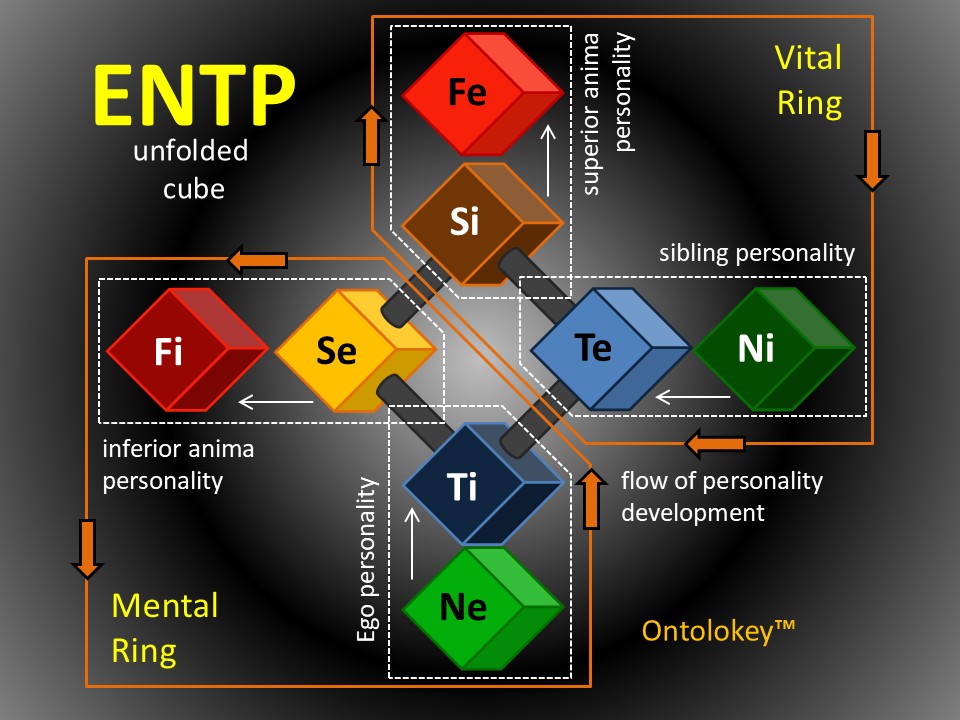
From the perspective developed throughout the Ontolokey texts, this question becomes particularly meaningful when the ENTP is viewed not simply as a collection of recognizable traits, but as a dynamic arrangement of eight psychological functions whose degrees of accessibility and consciousness differ. The familiar Ne–Ti core represents only the most visible part of the psychological landscape; surrounding it are Se, Fi, Ni, Te, Si, and Fe, each representing a different mode through which reality can be encountered, interpreted, valued, embodied, organized, or shared. Ontolokey’s cube gives these relationships a spatial form, making it possible to regard the less-developed functions not as defects to be eliminated but as psychological territories that may contain precisely the capacities required for further individuation. The developmental task of the ENTP can therefore be understood as a gradual movement from identification with the strongest functions toward a more conscious relationship with the whole structure. Growth does not require the ENTP to suppress curiosity, abandon intellectual freedom, or become conventionally disciplined; it requires learning when those strengths are serving reality and when they are being used to avoid it. The Ontolokey Cube becomes useful in this context because its sliders and spatial relationships can be treated as a visual language for asking where psychological energy is concentrated, where it is neglected, and which direction might lead toward greater integration.
The ENTP’s Central Paradox: Freedom and Reality
The deepest ENTP difficulty begins precisely where the personality’s greatest gift becomes excessive. Possibility is liberating when it expands consciousness, reveals alternatives, and prevents premature acceptance of limitations; it becomes imprisoning when the individual becomes dependent upon having alternatives available at all times. The Ontolokey account of the ENTP shadow describes this transition as a movement from genuine curiosity toward a psychological dependence on novelty, in which beginnings can feel more alive than continuations and potential can become more attractive than actuality. The distinction is subtle because the behavior may continue to look creative, ambitious, spontaneous, and intellectually alive even while unfinished projects, abandoned directions, unstable commitments, or chronic dissatisfaction accumulate beneath the surface. At the deepest level, the problem is not that the ENTP has too many possibilities, but that choosing one possibility necessarily means allowing others to remain unrealized. Psychological development therefore begins with the uncomfortable recognition that limitation is not automatically the enemy of freedom: without limitation, there is no necessity to choose, and without choice, possibility never becomes a lived existence.
This is also why the ENTP’s shadow cannot be reduced to procrastination, inconsistency, or a dislike of routine. Beneath those visible patterns may lie a much more existential conflict concerning finality, attachment, and the irreversible nature of lived experience. During the early stages of an idea, relationship, career, or project, the ENTP can experience an expansive psychological field in which countless futures remain available; as that field narrows through commitment and practical reality, the same situation may begin to feel constricting. The temptation is then to interpret the loss of excitement as evidence that the chosen path was wrong, when sometimes the deeper issue is that the psychological charge came from anticipation itself. Growth begins when the ENTP learns to distinguish loss of novelty from loss of meaning, because the two experiences can feel deceptively similar. What initially feels like freedom may actually be avoidance of the vulnerability involved in allowing one possibility to become real. The developmental movement is therefore not from freedom toward restriction, but from an abstract freedom of infinite options toward the more demanding freedom of consciously choosing, remaining, and allowing reality to transform the original idea.
The Shadow as a Developmental Map
The ENTP’s shadow becomes psychologically useful only when it ceases to be regarded as an enemy and begins to be understood as a source of information. The less-developed functions are not simply inferior versions of the dominant cognitive style; they represent modes of experiencing reality that the ENTP may habitually leave underused, particularly when intellectual exploration becomes a defense against emotional, practical, or existential demands. In this sense, the shadow is not something that must be defeated through force of will, because repression would merely strengthen the division between the conscious personality and what remains outside its preferred mode of functioning. The more productive approach is cognitive integration: noticing the moment in which a familiar ENTP strategy becomes automatic, identifying what experience that strategy is protecting the individual from, and then deliberately allowing another psychological function to participate in the response. The Ontolokey Cube offers a concrete visual metaphor for this process because the sliders make development appear not as a binary transformation from “immature” to “mature,” but as a gradual redistribution of psychological emphasis in which neglected capacities can become increasingly available to consciousness.
For the ENTP, this process begins with a particularly important distinction between Ne as conscious exploration and Ne as psychological escape. Extraverted Intuition is not the problem; indeed, the ability to generate alternatives, perceive emerging patterns, question assumptions, and recognize possibilities is one of the defining sources of the ENTP’s vitality. The developmental question arises when every experience is immediately converted into another possibility before the present experience has been sufficiently inhabited, because then cognition remains permanently one step ahead of life itself. The corrective is not to suppress imagination but to introduce a conscious counter-movement: when Ne opens ten doors, another function must sometimes ask which door deserves to be entered, what it demands, and what would happen if the individual remained there long enough for consequences to emerge. This is where the ENTP begins moving from possibility consciousness toward integrated consciousness, in which alternatives remain visible without automatically receiving equal psychological authority. The Ontolokey model can make this shift tangible by allowing the individual to observe which functions are habitually pushed forward and which remain comparatively distant, thereby turning an abstract developmental intention into something that can be repeatedly contemplated and adjusted.
The first major developmental counterweight is therefore Si, because Si confronts the ENTP with precisely those dimensions of experience that the novelty-seeking mind can be tempted to overlook: continuity, accumulated experience, concrete detail, repetition, memory, bodily signals, and the consequences of what has already happened. In its shadow expression, the ENTP may experience these qualities as tedious restrictions, yet their conscious integration can provide something the restless mind cannot generate through novelty alone: continuity of self. Instead of constantly asking what might happen next, the individual begins asking what has already been learned, what patterns have repeatedly produced the same consequences, and what deserves to be preserved rather than reinvented. This does not require becoming rigid, conventional, or excessively attached to the past; it means recognizing that memory can function as intelligence rather than as an obstacle to freedom. The mature ENTP learns that not every old structure is obsolete and not every new possibility is an improvement, because experience itself contains information that cannot be obtained by generating another hypothetical future.
A second developmental movement concerns Fi, particularly the capacity to encounter personal values and emotional experience without immediately translating them into detached analysis. The ENTP may possess considerable intellectual sophistication about people and emotions while remaining less practiced at simply asking what matters personally, what hurts, what feels unacceptable, what evokes genuine affection, or what kind of life would remain meaningful even if nobody else were impressed by it. Here the challenge is especially subtle because Ti can produce extraordinarily convincing explanations for emotional experiences, allowing the individual to understand an emotion conceptually while remaining partially protected from its subjective force. Growth therefore requires learning to distinguish explaining an emotion from allowing the emotion to become conscious information about the self. A feeling does not have to become an unquestionable command, but neither does it need to be cross-examined until it loses its immediacy; Fi becomes developmental when the ENTP can acknowledge an internal value without needing to defend it through an intellectual argument before granting it legitimacy. In this movement, vulnerability ceases to be evidence of irrationality and becomes another form of psychological data that cognition can receive rather than immediately dominate.
From Intellectual Mastery to Inner Contact
The integration of Fi ultimately asks the ENTP to encounter a dimension of selfhood that cannot be solved through conceptual superiority. An ENTP can often understand why another person behaves as they do, identify the structure of a conflict, expose contradictory assumptions, and even formulate an elegant explanation for an emotional reaction while remaining strangely distant from the personal significance of the experience itself. This creates a particular form of psychological asymmetry: the mind can become highly articulate precisely where the inner person remains comparatively inarticulate. The Ontolokey description of Fi as a quiet, private value system is important here because it suggests that the ENTP’s emotional life is not absent but insufficiently differentiated, and that experiences of rejection, betrayal, injustice, loyalty, or personal authenticity may therefore appear with disproportionate intensity when they finally break through the intellectual defenses. Development means learning to remain conscious during that moment instead of immediately converting vulnerability into irony, argument, withdrawal, or counterattack. The question changes from “Can I explain why I feel this?” to “What does this experience reveal about what I value, what I fear losing, and what kind of person I want to become?”
A comparable transformation occurs with Fe, although the psychological movement points outward rather than inward. ENTPs frequently possess considerable social energy and can use humor, provocation, storytelling, intellectual play, and emotional responsiveness to animate an entire group, yet social intelligence and emotional maturity are not identical capacities. The same instinct that allows an ENTP to energize a room can also turn another person into an audience, a conversation into a performance, or vulnerability into material for experimentation. Ontolokey describes Fe as a social catalyst whose less-integrated expression can produce attention-seeking, boundary violations, manipulation, or an inability to recognize when provocation has ceased to be playful. The developmental task is therefore not to become less charismatic, but to develop enough sensitivity to recognize that every reaction is not an invitation and every silence does not need to be broken. Mature Fe allows the ENTP to ask whether an interaction is generating genuine mutuality or merely supplying stimulation, validation, and the gratifying sensation of psychological influence.
This distinction becomes particularly important because the ENTP may unconsciously confuse being understood with being admired, and being influential with being connected. A person can be fascinated by an ENTP’s intelligence, humor, originality, or intensity without actually feeling emotionally safe with them, and an ENTP can be surrounded by people while remaining insufficiently known at the level of personal vulnerability. The Ontolokey mirror perspective emphasizes precisely this tension between the visible creative architect and the less visible psychological matrix underneath that performance, framing development as a movement toward integration rather than a refinement of the public persona alone. Consequently, one of the most valuable practices for an ENTP is to become interested in the effect of their communication rather than only in its intention: not merely whether a statement was clever, accurate, provocative, or logically defensible, but whether the other person experienced it as respectful, invasive, dismissive, inspiring, or destabilizing. This introduces a form of relational cognition that does not require surrendering intellectual independence; instead, it expands the field of information available to the mind.
The next developmental frontier is Se, the function associated in the Ontolokey framework with immediate sensory engagement, physical presence, intensity, and direct interaction with the environment. For an ENTP accustomed to living primarily through conceptual anticipation, the present moment can become strangely secondary to what the moment signifies, could become, or might lead toward, which means that the body may receive attention only after it has become impossible to ignore. The Ontolokey account describes this tension through patterns such as neglect of bodily needs, sudden sensory intensity, provocative behavior, physical impulsiveness, and a tendency for Se to emerge dramatically when ordinary psychological regulation is strained. Integration therefore requires a surprisingly concrete discipline: eating before hunger becomes extreme, sleeping before exhaustion becomes collapse, noticing physical tension, paying attention to surroundings, and allowing sensory experience to exist without immediately turning it into an idea. Such practices may appear almost trivial beside the ENTP’s intellectual ambitions, yet psychologically they represent something much larger: the recovery of an embodied present from which cognition no longer needs to escape.
Si, however, may be the more fundamental challenge because it confronts the ENTP with continuity itself. The Ontolokey description portrays Si as the forgotten body and as an inferior function through which routine, accumulated experience, physical maintenance, familiarity, and sensory memory can become both neglected and unexpectedly important. When Si is integrated, repetition no longer automatically means stagnation; it can become the mechanism through which something acquires depth, skill, reliability, intimacy, and form. The ENTP does not need to turn life into a rigid schedule, because that would misunderstand the developmental task, but must discover that freedom without continuity can become another form of dependence—the dependence on novelty to generate psychological vitality. Keeping promises, maintaining a physical environment, returning to difficult work, preserving meaningful relationships, and allowing familiar practices to become stabilizing rather than suffocating are therefore not merely organizational improvements. They represent the gradual construction of an inner and outer world in which the ENTP no longer needs to constantly generate stimulation in order to feel alive.
From Possibility to Direction
If Ne teaches the ENTP to see what could exist, then Ni teaches the ENTP to recognize what is becoming significant. This distinction is central to development because the ENTP’s problem is rarely a shortage of possibilities; it is the difficulty of allowing possibilities to acquire hierarchy, trajectory, and existential weight. Ontolokey places Ni in the Sibling position, presenting it as a quieter form of intuition that does not multiply alternatives but gradually condenses them into an underlying direction, meaning, or emerging pattern. For the ENTP, developing this capacity means learning to tolerate the psychological narrowing that occurs when certain possibilities begin to matter more than others, without immediately interpreting that narrowing as a loss of freedom. A mature relationship with Ni allows the individual to ask not only what is possible but what repeatedly returns, what remains meaningful after the excitement has faded, and which patterns across years rather than days appear to be pointing toward the same life direction. In this sense, Ni becomes an antidote to the tyranny of the perpetually unlived life: instead of preserving every imaginable future, the ENTP begins to recognize that a meaningful future is created precisely by allowing one trajectory to become more real than the others.
This movement toward direction naturally leads to Te, the Golden Shadow, because recognizing a meaningful trajectory is still insufficient if nothing is built to support it. Te introduces a psychological question that Ne and Ti can postpone almost indefinitely: What actually works in the external world, and what must be done to make this idea function? Ontolokey associates Te with effectiveness, measurable results, organization, implementation, and the practical deployment of resources, making it a particularly significant developmental counterweight to the ENTP’s tendency to remain in conceptual space. The ENTP does not need to become bureaucratic, rigid, or obsessed with productivity; rather, Te asks the individual to respect reality enough to test an idea against consequences instead of protecting it within imagination. A project that exists only in the mind remains indefinitely perfect because reality has never had the opportunity to contradict it, whereas execution inevitably exposes weaknesses, demands revisions, creates constraints, and produces results that can be measured. The integration of Te therefore represents a profound psychological shift from “I can see how this could work” toward “I am willing to discover what it takes for this to work.”
This is where the ENTP encounters one of the most important forms of humility available to the personality. Intellectual possibility allows the mind to remain sovereign because every problem can theoretically be reframed, but execution subjects the mind to feedback from something that cannot simply be argued away: reality itself. A functioning system, a completed body of work, a maintained relationship, a financial obligation, a physical limitation, or a concrete deadline does not care whether the ENTP has discovered an elegant alternative explanation. Te therefore confronts the personality with consequences, and consequences are psychologically valuable precisely because they prevent cognition from becoming a closed circuit in which every failure can be reinterpreted as merely another interesting possibility. The mature ENTP learns to regard external resistance not as an insult to intelligence but as information that intelligence requires. This produces a different kind of confidence: not the confidence that one can always find another argument, but the quieter confidence that one can encounter reality, modify one’s approach, and continue.
The integration of Ni and Te together is especially powerful because it gives the ENTP something that neither Ne nor Ti can provide alone: a path from vision to consequence. Ne can generate the landscape, Ti can analyze its internal structures, Ni can identify which direction possesses enduring significance, and Te can begin constructing the external conditions through which that direction becomes real. This sequence does not diminish the ENTP’s originality; it protects originality from evaporating into perpetual experimentation. The individual can still change direction when circumstances genuinely change, but change becomes an intentional response rather than an automatic reaction to the disappearance of novelty. The distinction is psychologically decisive because development does not mean forcing oneself to remain forever in something that has become meaningless; it means becoming capable of determining whether the impulse to leave comes from genuine insight or from discomfort with the ordinary developmental phase in which mastery, responsibility, and repetition begin. Ontolokey’s broader ENTP portrait repeatedly returns to this tension between possibility and realization, suggesting that the personality becomes more integrated when its extraordinary capacity to imagine alternatives is joined by an equally conscious capacity to select, implement, sustain, and complete.
The Discipline of Staying
One of the most important exercises for an ENTP is therefore deceptively simple: stay long enough to find out what happens after the excitement ends. The beginning of an endeavor often rewards Ne immediately because the psychological environment is rich with unanswered questions, new information, experimentation, and imagined futures; the middle is different because possibilities gradually become tasks, and tasks eventually become repetition. Yet this middle phase is precisely where competence begins to differentiate itself from potential, because the individual must continue acting when the emotional reward of novelty is no longer providing the energy. Ontolokey’s discussion of the ENTP’s “addiction to novelty” describes this pattern as a risk in which the person repeatedly approaches meaningful achievement and then leaves when exploration turns into maintenance. Development therefore requires learning to recognize boredom without automatically obeying it, because boredom is sometimes a message that something is wrong, but sometimes it is simply the subjective sensation of moving from discovery into mastery. The ENTP’s task is to become capable of investigating that distinction before making the next move.
This principle becomes even more significant in relationships, where novelty can conceal a deficit of continuity for much longer than it can in a project. Intellectual chemistry, humor, sexual attraction, shared experimentation, adventure, and emotional intensity can create a powerful sense of connection, but intimacy eventually asks for something different: remembering, returning, repairing, maintaining, tolerating misunderstanding, and remaining present when neither person is particularly fascinating. Ontolokey connects this dimension to inferior Si, emphasizing continuity, familiarity, bodily presence, accumulated experience, and the quiet maintenance through which something becomes stable over time. For the ENTP, this can initially feel like a reduction in psychological freedom, because continuity creates expectations and expectations create responsibility. Yet precisely here lies an important developmental discovery: intimacy is not sustained by perpetual stimulation but by the accumulation of experiences that gradually create trust. What may initially appear to the ENTP as repetition can therefore become, at a deeper level, history—and history is what allows a relationship, vocation, craft, or identity to become something more substantial than an ongoing sequence of interesting beginnings.
The same principle applies to the ENTP’s relationship with the self. A person who repeatedly reinvents their interests, identity, environment, ambitions, and relationships may remain extraordinarily adaptable while simultaneously finding it difficult to answer the quieter question of what has remained constant beneath all those transformations. This is where Si and Ni can work together: Si preserves the evidence of what has actually been lived, while Ni begins to recognize the deeper pattern connecting those experiences. Instead of asking only, “What do I want next?”, the ENTP can begin asking, “What has repeatedly mattered to me across different contexts, even when I did not consciously recognize it?” Such questions convert biography into psychological material, allowing past experience to become something more than a collection of discarded experiments. The ENTP gradually discovers that freedom does not require perpetual reinvention; a sufficiently integrated personality can change without needing to abandon continuity, because the self becomes a stable observer capable of incorporating new possibilities without being dissolved by them.
The Shadow of Intelligence
The ENTP’s most difficult developmental problems often appear precisely where the personality is most impressive, because intelligence itself can become a defense against experiences that cannot be mastered intellectually. Ti gives the ENTP an extraordinary capacity to dissect concepts, identify contradictions, question assumptions, and reconstruct explanations, but this strength can become defensive when analysis is used to remain one step removed from emotional participation. The mind can take an uncomfortable experience apart so efficiently that the person never has to remain inside the experience long enough to discover what it actually means personally. In this state, rationality does not cease to be genuine, but it becomes selectively employed: whatever threatens autonomy, exposes dependency, demands accountability, or touches an unresolved vulnerability is rapidly converted into an intellectual problem. The deeper shadow therefore does not consist simply in irrationality; paradoxically, it can consist in using rationality so effectively that nothing is allowed to penetrate the protective architecture of the self.
This defensive pattern can be especially difficult to recognize because the ENTP may sincerely believe that understanding something has already constituted psychological processing. Yet intellectual comprehension and emotional integration operate on different levels, and the difference becomes visible when the same conflict repeatedly produces the same reaction despite having been analyzed countless times. The ENTP may know exactly why a relationship failed, why a particular criticism was unfair, why another person behaved defensively, or why a personal disappointment should not matter, while still carrying an unresolved emotional charge that the explanation has not touched. The shadow appears when cognition becomes circular: every objection can be answered, every criticism can be reframed, and every vulnerability can be placed inside a larger conceptual system until the original feeling has disappeared from view. The developmental alternative is not to abandon analysis but to make analysis serve consciousness rather than replace it, allowing the question “What is true?” to be accompanied by equally serious questions such as “What am I feeling?”, “What am I avoiding?”, “What did this reveal about me?”, and “What responsibility remains after I have explained everything?”
The same dynamic can transform the ENTP’s natural love of argument into a subtle struggle for psychological superiority. Debate is intrinsically attractive to a mind that experiences contradiction as stimulation, and the ENTP may genuinely enjoy being challenged because opposition creates movement, complexity, and intellectual energy. Yet the shadow emerges when another person’s disagreement becomes valuable primarily because it provides an opportunity to demonstrate superiority, expose inconsistency, provoke a reaction, or regain control of the interaction. The Ontolokey treatment of the ENTP’s shadow is particularly relevant here because it connects the personality’s social and intellectual strengths with the possibility that provocation can become detached from genuine inquiry, turning communication into a form of psychological experimentation. Development requires the ENTP to become increasingly sensitive to the difference between challenging an idea and challenging another person’s dignity. This distinction does not make the ENTP less direct or intellectually demanding; it makes directness more conscious, because the purpose of disagreement becomes the pursuit of truth and mutual understanding rather than the gratification of winning, destabilizing, or demonstrating that one can control the intellectual field.
A related shadow pattern concerns the ENTP’s relationship with certainty. The conscious personality often takes pride in questioning established conclusions, yet the refusal to accept premature certainty can itself become a rigid identity position when the individual unconsciously needs to remain the person who sees what others have missed. In such circumstances, skepticism stops functioning as an instrument of inquiry and becomes a means of preserving psychological distance from commitment. Every conclusion can be reopened, every principle can be qualified, and every decision can be postponed until another piece of information appears, creating the illusion that remaining undecided is equivalent to remaining intellectually free. The deeper developmental task is to tolerate provisional commitment: to recognize that a conclusion can be sufficiently true for action without becoming metaphysically absolute. This is where Ni and Te become especially important, because they teach the ENTP that a meaningful direction does not require the disappearance of uncertainty and that effective action can coexist with an awareness of alternatives.
Ultimately, the shadow asks the ENTP to relinquish a particularly seductive fantasy: the idea that sufficient intelligence can eliminate the vulnerability inherent in being human. No amount of conceptual flexibility can prevent loss, disappointment, dependency, bodily limitation, emotional ambiguity, or the consequences of one’s choices, and attempts to think one’s way beyond these conditions can produce a life that is intellectually expansive but psychologically underinhabited. The Ontolokey perspective on the ENTP’s “untold truth” points toward this deeper developmental tension between the personality’s extraordinary capacity to move beyond conventional boundaries and the necessity of developing roots, continuity, values, embodiment, and direction. The mature ENTP does not become less intelligent by accepting these limits; intelligence becomes more complete because it is no longer required to protect the individual from experience. Cognitive development reaches its deeper purpose when the mind becomes capable not merely of escaping limitations, but of understanding which limitations are unavoidable, which are self-created, and which can be transformed through conscious choice.
The Ontolokey Cube as a Practice of Conscious Development
The value of the Ontolokey Cube for the ENTP lies less in providing another description of familiar personality characteristics than in giving psychological development a visible geometry. The ENTP can readily recognize Ne and Ti because these functions often constitute the most natural language of the personality: exploring, connecting, questioning, analyzing, and reconstructing. The difficulty is that development cannot be achieved simply by becoming more proficient at what already comes naturally, because additional strength in an already dominant mode can sometimes reinforce the very imbalance that produced the difficulty. The Cube offers a way of looking at the personality as a dynamic configuration in which the less-developed functions remain psychologically significant even when they are less accessible or less preferred. The sliders consequently become a practical metaphor for developmental movement: rather than imagining that one must suddenly “become” a different kind of person, the ENTP can observe where attention and cognitive energy are concentrated and experiment with gradually giving neglected functions more conscious participation. In this sense, the Cube becomes a landscape for self-observation, allowing development to be approached as an incremental process rather than as a demand for wholesale personality transformation.
The most productive way to use such a model is therefore not to ask which function is “good” or “bad,” but which function is missing from the current response to reality. When an ENTP encounters a difficult decision, for example, Ne may immediately produce alternatives and Ti may evaluate their internal logic, yet the situation might additionally require Fi to clarify what personally matters, Si to remember previous consequences, Fe to consider the relational field, Ni to identify the deeper direction, Se to recognize immediate physical facts, or Te to determine what can actually be implemented. The developmental exercise is to pause before allowing the strongest cognitive reflex to complete the entire process. One can deliberately move around the psychological Cube and ask what each neglected perspective might contribute, not because every function must be given equal authority in every situation, but because the conscious personality becomes richer when it is capable of consulting more than its habitual instruments. This transforms cognitive integration from an abstract aspiration into a repeatable method: identify the automatic response, locate the neglected perspective, invite it into awareness, evaluate its information, and then return to conscious choice. Over time, what initially feels artificial can become increasingly available without requiring the ENTP to abandon the cognitive style that constitutes the core of the personality.
This process is particularly important when the ENTP is under stress, because stress tends to narrow rather than expand consciousness. The familiar strengths can become exaggerated, while shadow material may emerge in less differentiated and more compulsive forms, producing impulsive sensory behavior, emotional volatility, interpersonal provocation, excessive control, withdrawal into abstraction, or an obsessive fixation on details and past failures. The point of recognizing such patterns is not to label the ENTP as dysfunctional whenever these experiences occur, but to treat them as signals that the ordinary balance of cognition has become disrupted. Instead of responding to the shadow with self-condemnation, the individual can learn to ask what neglected psychological function is attempting, however clumsily, to bring something important into consciousness. A sudden fixation on physical stimulation may indicate a need for embodiment rather than merely “bad behavior”; disproportionate sensitivity around personal values may reveal an unacknowledged Fi concern; compulsive revisiting of past details may indicate that Si material has become impossible to ignore. The shadow thus becomes a messenger whose language may initially be exaggerated, but whose underlying information can still be valuable when translated consciously.
The sliders on the Cube can consequently be understood as invitations to experiment rather than instructions prescribing a fixed destination. If Si is conspicuously underdeveloped, the ENTP might temporarily place greater emphasis on continuity, bodily maintenance, routines, and learning from accumulated experience; if Fi is neglected, the experiment might involve identifying personal values without immediately debating their validity; if Fe requires attention, the individual might observe how communication affects others rather than concentrating exclusively on whether the message was logically correct. Likewise, developing Ni can involve tracking recurring themes across years of experience, while developing Te can mean taking an idea through measurable execution rather than endlessly refining it conceptually. The purpose is not to force the slider to an imagined “optimal” position, because psychological growth is contextual and the same person may require different functions at different moments. The Cube is most useful when it encourages an ongoing dialogue between conscious preference and neglected capacity, making the question of development concrete enough to practice while leaving the individual responsible for determining what the situation actually demands.
Integration Rather Than Self-Correction
The ENTP should therefore resist the temptation to turn psychological development into another optimization project. An individual who approaches shadow integration with the same competitive intensity used to master intellectual subjects can easily transform self-knowledge into another arena for performance, measuring progress, categorizing weaknesses, and attempting to engineer a perfectly balanced personality. Such an approach would paradoxically reproduce the original problem: cognition would once again stand outside experience, observing and managing the self instead of participating in it. Integration is slower and less glamorous because it involves repeated encounters with the same unresolved material, often without the immediate reward of novelty or intellectual discovery. The ENTP may need to practice something that initially feels almost embarrassingly ordinary—listening without formulating a counterargument, completing something after the excitement has disappeared, admitting uncertainty without turning it into a philosophical position, noticing bodily fatigue, maintaining a promise, expressing affection directly, or allowing a personal value to exist without justification. These actions may appear small, but their psychological significance lies in the fact that they gradually establish new pathways through which previously neglected aspects of the personality can participate in conscious life.
The deepest form of ENTP development is consequently not the acquisition of a more balanced personality but the loosening of identification with the personality’s habitual mode of consciousness. Ne can remain expansive without determining every decision, Ti can remain incisive without becoming a defense, Fe can remain socially energetic without turning interaction into performance, and Si can become a source of continuity without becoming rigidity. Fi can give private values a legitimate voice, Ni can provide direction without prematurely closing possibilities, Te can convert insight into structure, and Se can reconnect thought with immediate embodied reality. None of these functions needs to overthrow the ENTP’s dominant configuration; their developmental purpose is to prevent the dominant configuration from becoming psychologically sovereign. The result is not a personality that behaves like eight different people, but a person who has increasingly more than one way of meeting reality. That expansion of psychological choice is the real meaning of integration: the stimulus no longer dictates the cognitive response because consciousness has acquired alternatives.
A Gradual Method of Integration
For the ENTP, meaningful development is most likely to occur when psychological integration is translated into small, repeated acts of cognition rather than treated as a grand project of self-reinvention. The first step is observation without immediate correction: before attempting to change a recurring reaction, the individual learns to notice what happens internally when novelty disappears, when another person becomes emotionally demanding, when criticism threatens self-image, when routine becomes unavoidable, or when a decision begins to close alternative futures. This observational stage is important because the ENTP’s speed of cognition can make awareness itself surprisingly difficult; the mind can produce an explanation before the original psychological movement has even become fully conscious. A useful practice is therefore to create a brief interval between stimulus and interpretation, allowing the first emotional, bodily, or relational response to exist before Ne and Ti begin constructing an explanation around it. The purpose is not introspective paralysis but increased resolution, because a person cannot integrate material that is continually transformed into something more intellectually comfortable before it has been consciously experienced.
The second step is functional dialogue: once a recurring pattern has been recognized, the ENTP can deliberately ask what the neglected functions might contribute to the situation. A difficult decision, for example, can be examined through Ne by identifying alternatives, through Ti by testing coherence, through Si by consulting accumulated experience, through Fi by identifying personal values, through Fe by considering relational consequences, through Ni by asking what larger direction the decision participates in, through Te by examining practical effectiveness, and through Se by attending to immediate circumstances and embodied facts. This does not mean treating every perspective as equally authoritative, because the point of integration is not mechanical symmetry but conscious flexibility. The exercise instead prevents the dominant functions from automatically monopolizing interpretation, giving the ENTP an opportunity to discover information that would otherwise be filtered out. The Ontolokey Cube can support this process by making the movement between these psychological perspectives visually accessible, while the sliders can serve as reminders that development is gradual and contextual rather than an irreversible conversion from one personality configuration into another.
The third step is deliberate endurance, which may be one of the most transformative disciplines available to the ENTP. When an undertaking reaches the point at which novelty has diminished, the individual can consciously postpone the impulse to abandon it and investigate what lies beyond the initial loss of stimulation. This does not mean remaining indefinitely in unsuitable circumstances; rather, it means refusing to make the emotional experience of boredom, frustration, or constraint the sole criterion for determining whether something remains valuable. A practical rule might be to complete a defined developmental cycle before deciding whether a project, habit, or commitment should be abandoned, thereby giving Si and Te an opportunity to contribute information that Ne would otherwise bypass. The same principle can be applied to relationships by staying present during periods in which conversation is less exciting, conflict requires repair, or familiarity replaces discovery. Through such repetition, the ENTP learns something that abstract cognition cannot fully teach: depth is often what remains after novelty has stopped providing the experience of depth.
The fourth step is emotional specificity. Rather than asking merely whether something feels good or bad, the ENTP can learn to distinguish disappointment from humiliation, anger from hurt, boredom from exhaustion, loneliness from a desire for stimulation, and genuine loss of meaning from frustration with limitation. This differentiation matters because undifferentiated emotional discomfort is easily handed over to Ne, which can generate an impressive number of explanations and escape routes without necessarily identifying the underlying need. Fi becomes more accessible when the ENTP can say, with increasing precision, what personally matters and what has been violated, while Fe becomes more mature when the individual can recognize what another person may be experiencing without immediately assuming responsibility for that person’s emotional state. Emotional maturity therefore does not require abandoning analytical clarity; it requires making the emotional field sufficiently precise that analysis has accurate material to work with. The more precisely the ENTP can identify the experience, the less necessary it becomes to defend against it through humor, intellectualization, provocation, withdrawal, or the immediate search for something new.
The fifth step is embodied continuity, because psychological development that remains entirely conceptual can become another form of avoidance. Regular sleep, physical movement, consistent nourishment, an orderly enough environment, attention to sensory experience, and awareness of bodily tension may appear unrelated to the ENTP’s intellectual development, yet they establish a continuous physical context in which cognition can operate without constantly compensating for neglected biological signals. This is particularly relevant to the Si and Se dimensions described in the Ontolokey framework, where the relationship between immediate sensory reality and accumulated bodily experience becomes part of the broader developmental landscape. The ENTP does not need to romanticize routine or turn embodiment into another performance standard; the essential movement is simply toward recognizing that the body is not an inconvenient container for the mind but one of the places through which reality becomes available to consciousness. When bodily and sensory information receives regular attention, the ENTP gains a grounding reference point that can interrupt the tendency to live predominantly in anticipated futures.
The Transformation of the ENTP’s Strengths
Integration ultimately changes the meaning of the ENTP’s familiar strengths rather than requiring their removal. Curiosity becomes deeper when it is no longer driven exclusively by the need to escape what has become familiar; skepticism becomes more powerful when the individual can also question the assumptions hidden inside their own skepticism; humor becomes more humane when it does not need another person’s vulnerability as its material; debate becomes more valuable when the objective is discovery rather than dominance; and independence becomes more mature when it includes the capacity to remain connected without experiencing connection as captivity. The same cognitive architecture that once produced fragmentation can consequently become a vehicle for synthesis, because Ne can begin connecting not only external ideas but previously separated aspects of the self. Ti can provide structure to those discoveries, while the shadow functions gradually supply values, continuity, embodiment, direction, relational awareness, and practical consequence. What emerges is not a domesticated ENTP but a less divided one, capable of preserving intellectual freedom while becoming increasingly willing to inhabit the consequences of being a particular person in a particular life.
This is why the ENTP’s shadow should ultimately be approached with curiosity rather than shame. The behaviors that cause difficulty—restlessness, provocation, inconsistency, excessive intellectualization, avoidance of routine, emotional detachment, impulsiveness, or the endless generation of alternatives—can often be understood as distorted expressions of capacities that have not yet found a sufficiently integrated form. Novelty can become exploration rather than escape; skepticism can become discernment rather than perpetual negation; independence can become autonomy rather than avoidance; social intensity can become genuine connection rather than performance; and intellectual analysis can become self-understanding rather than self-protection. The developmental process is therefore not about becoming less ENTP, but about becoming less captive to the automatic expression of ENTP strengths. The deeper objective is freedom of consciousness: the ability to choose among different cognitive responses instead of reflexively returning to the one that feels most natural.
When the Shadow Becomes an Ally
At a certain point, development changes from the deliberate practice of isolated functions into a more fundamental transformation in the ENTP’s relationship with the self. The individual begins to recognize that the shadow does not disappear simply because one has understood it, and that every newly integrated capacity can itself become distorted when turned into an identity or an obligation. Si can become rigidity, Fi can become self-absorption, Fe can become approval-seeking, Ni can become premature certainty, Te can become compulsive control, and Se can become impulsive escape into sensation. The objective is therefore not to construct a perfectly balanced psychological machine in which every function occupies an ideal position, but to cultivate enough consciousness to recognize when a particular mode of cognition has become excessive or insufficient for the situation at hand. The ENTP’s development becomes mature when psychological flexibility replaces psychological reflex, allowing the individual to move toward a neglected function without declaring war on the dominant one. In that sense, the Ontolokey Cube is most valuable as a developmental map: it can help reveal where the personality habitually concentrates its energy while reminding the individual that unexplored territory is still part of the same psychological landscape.
The deepest integration may therefore occur when the ENTP stops asking which function should become stronger and begins asking what reality is asking for now. Sometimes reality genuinely requires Ne: an old assumption needs to be questioned and a new possibility needs to be imagined. Sometimes Ti must take precedence because an idea contains an internal contradiction that needs to be resolved. At other moments, however, the psychologically appropriate response may be Si’s patience, Fi’s fidelity to an inner value, Fe’s consideration of another person, Ni’s sense of direction, Te’s demand for execution, or Se’s insistence upon what is concretely happening in the present. This is a significant shift because it relocates authority from the personality’s habitual preference to conscious engagement with circumstances. The ENTP remains an ENTP, but personality preference ceases to function as destiny. Cognitive integration becomes the capacity to recognize that the most natural response is not necessarily the most complete response, and that maturity often begins precisely where automatic preference stops being sufficient.
The ENTP and the Courage to Become Concrete
The movement toward greater psychological integration ultimately requires the ENTP to make peace with concreteness. Ideas are inherently reversible: they can be modified, recombined, abandoned, resurrected, or replaced, whereas lived decisions gradually become facts that shape the future and cannot simply be intellectually undone. This difference explains why commitment can carry such psychological weight for a personality organized around possibility, because commitment converts an open field into a specific history. Yet without that conversion, life remains permanently hypothetical, and the person can become extraordinarily knowledgeable about what might be possible while possessing comparatively little experience of what sustained realization actually feels like. The developmental challenge is therefore to allow selected possibilities to become concrete without demanding certainty beforehand. A relationship must be lived before its depth can be known, a vocation must be practiced before its significance becomes clear, and a creative work must be completed before its weaknesses can teach the creator what imagination alone could not reveal.
This concreteness also changes the ENTP’s relationship with failure. Within a purely conceptual environment, failure can often be avoided by changing the model, introducing another interpretation, or moving toward a more interesting problem, but concrete action removes that protection and exposes the individual to results that cannot be endlessly reframed. Such exposure can initially feel restrictive, yet it is precisely what allows Ti and Ne to become more sophisticated, because ideas receive corrective information from reality rather than remaining internally coherent abstractions. Te contributes the willingness to measure results, Si preserves the lessons acquired through repetition, Ni identifies the larger pattern emerging from those experiences, and Fi determines whether the resulting direction remains personally meaningful. The ENTP thereby develops a form of intelligence that is not merely conceptual but experiential: knowledge becomes embodied through consequences. What was previously an intellectual possibility becomes a lived experiment, and lived experiments generate a kind of psychological knowledge that cannot be obtained through speculation alone.
The mature ENTP consequently does not lose the capacity to reinvent themselves, but becomes more selective about when reinvention is necessary. Change can remain a source of vitality without becoming a reflexive escape from the developmental demands of continuity, and curiosity can remain expansive without constantly undermining commitment. The person becomes capable of saying, in effect, that a possibility can remain interesting without needing to be pursued, that an argument can remain unresolved without becoming intolerable, that a routine can remain repetitive without being meaningless, and that an emotion can remain uncomfortable without requiring immediate explanation or action. These are modest psychological freedoms, but together they produce a profound reduction in inner compulsion. The ENTP is no longer required to chase every open door simply because it exists; instead, consciousness becomes capable of deciding which doors deserve attention and which can remain closed without being experienced as personal losses.
A Lifelong Dialogue with the Cube
The Ontolokey Cube can therefore be approached as a recurring instrument of self-reflection rather than something to be consulted only when a crisis occurs. At different stages of life, different functions may become more necessary because circumstances themselves change: professional responsibilities can increase the demand for Te and Si, intimate relationships can expose the neglected dimensions of Fi and Fe, physical or environmental changes can bring Se and Si into sharper awareness, while periods of transition may make Ni increasingly important for discerning direction amid competing possibilities. The sliders provide a way to visualize these changing developmental pressures and to ask whether the psychological configuration currently being relied upon is sufficient for the life actually being lived. This makes the Cube particularly relevant to the idea of lifelong individuation, because integration is not a destination at which one eventually arrives and remains permanently balanced. It is an ongoing adjustment between established strengths, emerging capacities, external circumstances, and the parts of oneself that have not yet been given adequate conscious expression.
The most useful attitude toward that process is therefore experimental but sincere. The ENTP can periodically return to the Cube and ask where the sliders appear psychologically concentrated, which functions are being avoided, and whether current frustrations correspond to a neglected mode of cognition. The answer need not produce an immediate transformation; a single consciously practiced behavior may be sufficient to begin changing the relationship with a function. Listening more carefully, finishing one neglected project, remembering what previous experience has already taught, identifying a personal value, spending time without stimulation, tolerating a difficult emotion, following through on a practical obligation, or simply noticing what the body is communicating can each constitute a small act of integration. Repeated over time, such acts alter the psychological landscape because they demonstrate to consciousness that another response is possible. The Cube then becomes not merely a picture of personality but a reminder that development occurs through movement, and that even a deeply habitual cognitive pattern can acquire greater flexibility when it is repeatedly brought into awareness.
Becoming More Than One’s Dominant Pattern
The ultimate developmental task of the ENTP is not to become calmer, more disciplined, more emotional, more practical, or more conventional, because each of those goals would reduce psychological growth to the imitation of another personality configuration. The deeper task is to become sufficiently conscious of one’s own dominant pattern that it can be used deliberately rather than obeyed automatically. Ne can continue to open possibilities, Ti can continue to question and dissect, and the ENTP can remain inventive, irreverent, intellectually independent, socially stimulating, and resistant to intellectual stagnation; what changes is the degree to which these qualities govern every encounter with reality. The shadow functions gradually become partners rather than intrusions, supplying continuity where there was fragmentation, values where there was abstraction, direction where there was dispersion, embodiment where there was distance, relational awareness where there was provocation, and practical realization where there was endless possibility. The developmental movement is therefore not away from the ENTP but deeper into the full psychological landscape represented by the ENTP configuration.
This is also the point at which the Ontolokey Cube acquires its greatest practical meaning. Its spatial representation of the eight functions turns an otherwise abstract functional architecture into something that can be observed as a landscape, while the possibility of moving the sliders provides an intuitive image for the gradual redistribution of psychological attention and development. The underlying idea described in the Ontolokey origin text is particularly relevant here: a map becomes more useful when it can be experienced as a landscape, because relationships that are difficult to grasp sequentially can become visible spatially and therefore easier to explore consciously. For the ENTP, the Cube can consequently serve as a recurring mirror: not a mechanism for proving what one is, but a prompt for asking what one is currently neglecting. The most important question is never whether every slider has reached some imagined ideal position, but whether the person has become capable of consciously moving toward a psychological capacity when life demands something that the habitual ENTP mode cannot adequately provide.
Growth can therefore be approached as a series of increasingly conscious choices. When Ne wants to escape into another possibility, the ENTP can ask whether something unfinished deserves to be completed; when Ti wants to explain an emotion away, the individual can ask what the emotion itself is communicating; when Fe turns interaction into stimulation, the person can ask whether genuine connection is being created; when Si feels restrictive, the ENTP can investigate what continuity might make possible; when Fi appears uncomfortable or inconvenient, its values can nevertheless be heard; when Ni begins to identify a recurring direction, that pattern can be taken seriously without prematurely closing every alternative; when Te demands implementation, an idea can be allowed to encounter measurable reality; and when Se calls attention to the immediate world, the present moment can be experienced without immediately converting it into a future possibility. None of these movements requires abandoning the personality’s natural preferences, because the objective is not equal distribution but greater freedom of response. The integrated ENTP becomes increasingly capable of choosing the function that the moment requires rather than automatically choosing the function that feels most familiar.
The deepest transformation is consequently a movement from potentiality toward actuality. The ENTP begins life, psychologically speaking, with an extraordinary sensitivity to what could be: alternative interpretations, unexplored ideas, possible futures, hidden connections, unconventional solutions, and paths that have not yet been taken. Development adds another dimension to this orientation by asking what happens when one possibility is selected, embodied, maintained, tested, emotionally inhabited, and allowed to acquire history. The resulting life may contain fewer simultaneous possibilities, but it can contain greater depth, because a possibility that has entered reality can generate consequences, relationships, memories, competence, meaning, and further insight that could never have existed in imagination alone. The ENTP does not lose freedom through this process; freedom becomes more substantial because it is exercised through conscious choice rather than preserved through perpetual non-commitment.
The final lesson of the ENTP shadow is therefore neither “be more disciplined” nor “be more emotional,” but something more demanding: become capable of remaining conscious when your preferred way of thinking is no longer sufficient. That is where cognitive integration begins, because the neglected function is no longer experienced merely as an obstacle but as information coming from another region of the psyche. The Ontolokey framework gives this developmental process a visual language, and the Cube can be revisited whenever a recurring difficulty suggests that some psychological territory has again fallen outside conscious attention. For readers who want to explore the ENTP configuration in greater depth, or who wish to examine the corresponding landscapes of other personality types, the more extensive personality and psychological essays are available through Ontolokey.com. The aim is not to arrive at a final, perfected version of oneself, but to become increasingly capable of recognizing the whole landscape within oneself and choosing, with greater awareness, which part of that landscape needs to be inhabited next.


Leave a comment