From Inner Authenticity to Psychological Integration
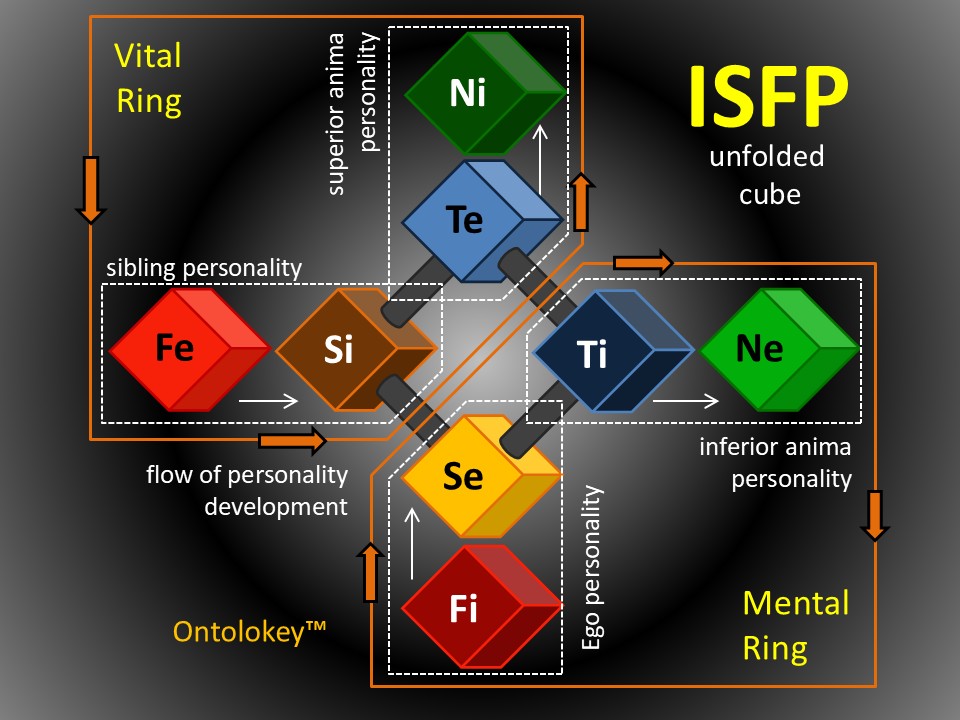
The mature development of the ISFP begins with a paradox: the very qualities that make this personality deeply authentic can also become the psychological structures that keep it confined. At the centre stands Introverted Feeling (Fi), the inwardly experienced sense of personal value, sincerity, emotional truth, and moral integrity. Supported by Extraverted Sensing (Se), this inner world is brought into immediate contact with life through perception, craftsmanship, beauty, physical presence, and responsive action. The ISFP therefore tends naturally to experience life not primarily as an abstract system to be explained, but as something to be felt, perceived, inhabited, and made meaningful through direct experience. This combination can produce unusual sensitivity to atmosphere, interpersonal authenticity, aesthetic detail, and the subtle difference between what something appears to be and what it actually feels like. Ontolokey’s description of the ISFP places precisely this relationship between inner valuation and embodied perception at the centre of the personality structure.
Yet psychological growth begins when the ISFP recognizes that authenticity alone is not the same as integration. A person can be profoundly sincere and still become imprisoned by their own interpretations of sincerity; they can be deeply loyal and nevertheless remain attached to relationships that have become psychologically destructive; they can possess exquisite sensitivity while becoming excessively reactive to whatever violates their internal sense of harmony. The shadow does not necessarily emerge as an opposite personality, but often as an exaggeration of something originally valuable: conviction can harden into judgment, sensitivity into hypervigilance, loyalty into self-sacrifice, self-protection into withdrawal, and emotional depth into attachment to old wounds. The deeper Ontolokey portrait therefore points beyond the familiar image of the gentle, artistic, private ISFP toward a more demanding developmental question: what happens when the less-developed functions are no longer experienced merely as weaknesses, but are consciously approached as neglected dimensions of the self? The cube becomes useful here precisely because it turns personality from a static description into a landscape in which different psychological capacities can be brought into relationship with one another.
The ISFP’s Gift and Its Hidden Price
The ISFP’s emotional life is often characterized by an unusually intimate relationship with personal meaning. Fi does not simply produce feelings; within the Ontolokey model, it establishes an internal criterion by which experiences, relationships, motives, and choices acquire significance. This gives the ISFP an important resistance to conformity because external approval does not automatically determine what feels right or worthwhile. Se then gives this inward conviction a tangible language: the ISFP can communicate through action, aesthetic form, physical presence, practical assistance, craftsmanship, or the careful creation of an atmosphere rather than through elaborate theoretical explanation. This is one reason the type is commonly associated with artistic sensitivity, quiet generosity, independence, and a capacity to notice details that other people pass over. At its healthiest, the ISFP does not merely possess values internally but embodies them, allowing something private and deeply personal to become visible in the way life is lived.
The difficulty begins when the inner criterion becomes so authoritative that experiences which contradict it are interpreted too quickly as threats to the self. The ISFP may then protect authenticity by withdrawing rather than investigating, protect loyalty by enduring too much, or protect emotional integrity by treating a first impression as a final truth. The deeper shadow material describes how this can extend into jealousy, possessiveness, resentment, martyrdom, victimhood, and an unconscious attachment to suffering, particularly when old injuries become organizing principles for present relationships. Suffering can gradually acquire symbolic value: endurance becomes evidence of love, sacrifice becomes evidence of moral worth, and remembered betrayal becomes a framework through which new experiences are interpreted. The crucial developmental task is therefore not to suppress feeling or become emotionally detached, but to introduce consciousness into the processes by which feeling becomes interpretation, interpretation becomes identity, and identity begins to govern behaviour. In that sense, the ISFP’s growth is not a movement away from Fi, but an expansion of the psyche around it.
The First Movement of Growth: From Emotional Certainty to Psychological Differentiation
The first developmental movement for the ISFP is not to become less sensitive, less loyal, or less deeply committed to what feels authentic, but to learn how to distinguish an inner experience from the interpretation that is built around it. This distinction is deceptively simple and psychologically transformative: I feel betrayed is not identical to I know that I have been betrayed, just as something feels wrong is not automatically equivalent to I understand what is wrong. The ISFP’s natural strength lies in the immediacy and integrity of Fi, yet precisely because inner experience can carry such enormous subjective authority, there is a danger that emotional truth becomes confused with factual certainty. Ontolokey’s description of the ISFP’s Fi–Ti tension identifies this problem particularly clearly: personal conviction may gradually acquire the appearance of objective logical necessity, so that questioning an interpretation feels like questioning the legitimacy of the feeling itself. The developmental task is therefore one of differentiation rather than suppression, because a mature ISFP does not distrust feeling but learns to hold feeling, observation, interpretation, memory, and conclusion as distinct psychological events that can inform one another without becoming indistinguishable.
This is where the less-developed cognitive functions become practically important, because they can interrupt the closed circuit that forms when Fi and Se reinforce one another without sufficient reflection. Se gives the ISFP an impressive sensitivity to what is actually happening in the immediate environment, but perception alone does not explain meaning; it registers the changed tone of a voice, the hesitation in a gesture, the expression on a face, or the atmosphere of a room, while Fi immediately evaluates what those details mean personally. When the two processes become fused under emotional pressure, the ISFP can experience an inference with the force of direct perception, and the resulting certainty may become difficult to challenge because it feels internally coherent and experientially confirmed. The development of Ti, in the Ontolokey sense, introduces a disciplined interruption: What exactly do I know, what am I interpreting, and what would have to be true for my interpretation to be wrong? This does not ask the ISFP to become coldly analytical or to subordinate values to logic; it asks for enough cognitive distance that truth is allowed to become larger than the first emotionally compelling explanation. In practical terms, this can mean postponing irreversible judgments, checking assumptions against observable facts, asking another person for their actual intention instead of inferring it, and deliberately considering an explanation that contradicts the preferred interpretation.
The same principle applies to the ISFP’s relationship with Ne, although the developmental movement is different. Se naturally anchors consciousness in the concrete present, whereas Ne opens a field of alternatives, possibilities, hypothetical explanations, and unforeseen developments; this can initially feel less secure because possibility removes the reassuring solidity of what is immediately perceptible. Yet precisely this uncertainty can become psychologically liberating when the ISFP learns to use it consciously rather than allowing it to emerge only under stress. Instead of using imagination to construct increasingly elaborate explanations for why someone behaved suspiciously, the ISFP can use Ne to generate several plausible interpretations and then resist the impulse to select the one that most strongly confirms an existing emotional conclusion. In this form, imagination becomes an antidote to rigidity rather than a generator of anxiety, because it creates enough psychological space for reality to remain unfinished. The developmental question becomes not Which explanation confirms what I already feel? but What other possibilities exist, and what evidence would distinguish them? Ontolokey’s spatial conception is particularly useful here because the cube allows these less familiar functions to be seen not as foreign intrusions but as neighbouring regions of the same psychological landscape, capacities that can gradually be approached without requiring the ISFP to abandon the centre of their personality.
The Shadow Is Not the Enemy of the Self
The ISFP’s shadow becomes most consequential when the personality begins to confuse psychological protection with psychological truth. Because Fi places such high value on authenticity, the ISFP can become fiercely protective of the boundaries surrounding the inner self, particularly after experiences of betrayal, humiliation, manipulation, rejection, or emotional neglect. What begins as healthy discernment can then become a defensive system in which the psyche continuously searches for evidence that its caution is justified, while Se supplies an abundance of immediate sensory details that appear to confirm the suspicion. A glance, a pause, an altered tone, a forgotten promise, or an apparently insignificant inconsistency can acquire disproportionate symbolic weight because it is absorbed into an already emotionally meaningful narrative. The shadow therefore does not necessarily look dramatic from the outside; it may appear as withdrawal, silence, guardedness, private resentment, difficulty forgiving, or an increasingly selective willingness to trust. Ontolokey’s treatment of the ISFP’s deeper shadow emphasizes precisely this movement from legitimate self-protection toward a state in which pain itself can become incorporated into identity, making the person unconsciously reluctant to release the very wounds from which they consciously wish to be free. (ontolokey.com)
The psychologically difficult realization is that a wound can remain meaningful even after the situation that created it has disappeared, and that preserving the meaning of the wound is not always the same thing as preserving oneself. An ISFP may remember exactly how someone made them feel and therefore regard the memory as incontrovertible evidence of that person’s character, yet memory itself is not a neutral recording device; it is continuously reconstructed through the emotional significance assigned to it. When this distinction is neglected, the past can begin to govern the present through a chain of associations that feels morally justified at every stage. The person who once betrayed the ISFP becomes a template for other people who merely resemble that person in some small respect, while caution gradually turns into anticipatory rejection, and anticipatory rejection then becomes proof that intimacy is unsafe. The result can be an unconscious psychological economy in which suffering provides certainty: I know what people are capable of because I have already been hurt by them. Growth requires the courage to preserve the lesson without preserving the prison, meaning that the ISFP must eventually ask which part of the defensive structure still protects something valuable and which part merely keeps an old emotional verdict alive. This is one of the deepest forms of shadow integration because it does not demand forgiveness as a moral performance; it demands conscious ownership of the psychological consequences of what has happened. (ontolokey.com)
The same process becomes visible in the ISFP’s relationship with loyalty and sacrifice, two qualities that can be among the most beautiful expressions of Fi but can also become psychologically costly when they cease to be freely chosen. A deeply feeling ISFP may give extraordinary amounts of time, attention, money, protection, patience, or emotional labour to people they love because helping another person can feel inseparable from being true to oneself. Yet when giving becomes a condition for maintaining one’s identity as a good, loyal, or loving person, the boundary between generosity and self-abandonment becomes increasingly difficult to perceive. Resentment then enters indirectly: the ISFP may continue giving while internally recording every sacrifice, waiting for the other person to recognize what has been given without needing to ask for recognition explicitly. When that recognition does not arrive, the resulting pain can be experienced not simply as disappointment but as evidence that the relationship was fundamentally unjust, which may produce the abrupt emotional severing for which an unhealthy expression of Fi can become known. The developmental alternative is not selfishness but conscious reciprocity: learning to give because one genuinely chooses to give, learning to say no before resentment accumulates, and accepting that love does not require the permanent surrender of one’s own psychological centre.
From Protection to Integration
The next stage of development is therefore not simply cognitive but relational, because the ISFP must learn to remain psychologically present when another person’s reality does not immediately correspond with the inner interpretation. This is especially important for a personality whose sense of authenticity can make compromise feel morally dangerous: if yielding is unconsciously equated with betraying oneself, even ordinary negotiation can become charged with disproportionate emotional significance. Mature differentiation means discovering that boundaries and openness are not opposites, just as self-respect and receptivity do not cancel one another out. The ISFP can remain faithful to an internal value while simultaneously allowing another person to possess a different perspective, intention, memory, or emotional truth, and this capacity gradually transforms interpersonal conflict from a referendum on personal identity into an encounter between two subjective worlds. The movement is subtle but profound, because it allows Fi to become less defensive without becoming less principled, while Fe can develop as a genuine capacity for interpersonal resonance rather than as a social adaptation used to preserve peace. Ontolokey’s functional landscape is helpful in making this developmental possibility visible: the familiar conscious configuration does not need to be discarded, but the psychological distance between the more familiar and less familiar functions can gradually be reduced through conscious practice.
This same principle applies to Te, perhaps the most practically important shadow capacity for the ISFP because it confronts the individual with everything that inner conviction alone cannot accomplish. Te represents organization, external criteria, measurable results, prioritization, efficiency, planning, and the ability to transform an intention into an operational structure; consequently, it can initially feel impersonal or even hostile to a person whose natural orientation begins with subjective meaning. Yet the mature development of Te does not require the ISFP to replace values with productivity, because structure becomes psychologically valuable precisely when it serves something the person considers meaningful. A creative vision that remains permanently inside the imagination cannot fully express the value from which it originated, just as a deeply held principle that never becomes behaviour remains psychologically incomplete. Learning to budget, plan, document, schedule, prioritize, finish projects, establish measurable objectives, and make decisions according to practical consequences can therefore become an act of self-expression rather than conformity. The important shift is from structure versus authenticity to structure in service of authenticity, allowing the ISFP’s inner values to acquire durability, independence, and tangible influence in the external world. Ontolokey explicitly presents the development of Te as a means by which the ISFP can bring creative visions, values, and personal ideals into concrete realization, rather than leaving them vulnerable to changing circumstances or emotional momentum.
The Ontolokey cube can be understood within this process as a practical psychological map because its sliders make the relative accessibility of these functions visually tangible. Instead of treating personality as a fixed label, the model invites the ISFP to observe where psychological energy habitually settles and where it rarely travels, making development something that can be contemplated spatially rather than only described conceptually. The point is not to force every slider toward an imagined maximum or to manufacture a personality that resembles another type, but to notice which capacities remain psychologically distant and therefore deserve deliberate cultivation. In the ISFP’s case, Te may initially represent the greatest developmental challenge because it demands external organization, while Ni, Si, and the other less familiar functions may offer quieter forms of depth through symbolic insight, embodied memory, continuity, reflection, and temporal perspective. The cube consequently becomes most useful when it is treated as an invitation to experiment: move one slider psychologically, observe what changes in behaviour, examine the resistance that appears, and then return to the centre without abandoning what already works. In this sense, individuation is not a dramatic transformation into another personality but a gradual expansion of the original personality’s range, until the shadow becomes less an unknown territory and more a set of capabilities that can be consciously called upon when life requires them.
Learning to Remain Open Without Losing the Self
For the ISFP, one of the most important developmental achievements is learning that openness does not require surrendering discernment. The personality’s instinctive caution often contains genuine wisdom: experience has taught the ISFP that appearances can deceive, that words can contradict behaviour, and that people sometimes conceal motives behind socially acceptable expressions. Yet when this protective intelligence becomes permanently activated, perception begins serving defence rather than understanding, and the individual may unconsciously search the present for repetitions of the past. This is particularly significant because the ISFP can be extraordinarily attentive to subtle sensory and interpersonal signals, making it possible to notice real discrepancies that others overlook; the difficulty arises when accurate perception is followed by an interpretation that is treated as conclusive before alternative explanations have been considered. Ontolokey’s deeper account of the ISFP’s shadow describes this as a movement in which genuine perception, emotional experience, and intuitive pattern recognition can become fused into an internally coherent but increasingly rigid narrative. (ontolokey.com)
The developmental use of Ne is therefore not to make the ISFP permanently optimistic or endlessly adventurous, but to preserve the psychological possibility that reality may still contain something the individual has not yet understood. A mature ISFP can say, in effect, I have noticed something, I have been affected by it, and I have an interpretation of it—but I do not yet possess the whole truth. This small internal qualification creates a remarkable amount of freedom because it prevents a momentary experience from becoming an absolute statement about another person, a relationship, or the future. Ne can then become a source of creative curiosity rather than catastrophic imagination, while Ni can deepen this process by asking what a recurring experience actually means over time rather than immediately converting it into a fatalistic conclusion. The distinction is important because the goal is not to distrust intuition, but to prevent intuition from becoming indistinguishable from inevitability. When the ISFP can tolerate uncertainty without immediately filling it with either hope or fear, the psychological world becomes considerably larger, and relationships gain room for surprise, repair, development, and genuine discovery. (ontolokey.com)
This openness also changes the meaning of solitude, which is naturally important to the ISFP but can become ambiguous when the shadow is active. Healthy solitude restores the inner centre: it allows experience to settle, values to become clear again, sensory overstimulation to diminish, and the individual to reconnect with what genuinely matters. Shadow withdrawal performs a different function because it attempts to eliminate vulnerability itself, and therefore gradually eliminates the conditions under which intimacy, correction, and emotional renewal can occur. The ISFP may believe that silence is simply a boundary, while another person experiences it as unexplained disappearance; the ISFP may experience emotional distance as necessary self-preservation, while the relationship slowly becomes incapable of repair because no new information is permitted to enter. Development consequently requires learning to communicate before the internal verdict becomes final, even when that communication feels imperfect, exposing, or emotionally inconvenient. The mature boundary says, I need distance because something has happened that I need to process; the shadow boundary says, I have already decided what this means, and therefore there is nothing left to discuss. Recognizing that difference can become one of the most consequential forms of self-observation available to the ISFP.
From Shadow Awareness to Conscious Practice
Once the ISFP begins to recognize the shadow as an unfinished part of the personality rather than as an enemy, development becomes much more concrete. The essential movement is from unconscious reaction to conscious observation, because a function cannot become integrated merely by being intellectually understood; it must be encountered repeatedly in actual situations where the habitual response would previously have taken control. When hurt, the ISFP can learn to notice the precise sequence by which perception becomes feeling, feeling becomes interpretation, and interpretation becomes a judgment about another person or about the self. When confronted with practical demands, the individual can notice the resistance that arises around Te without immediately concluding that structure is incompatible with authenticity. When uncertainty appears, Ne can be deliberately invited to generate alternatives, while Ni can be asked what larger pattern the present experience might reveal. In this sense, cognitive integration is less like acquiring a collection of new personality traits and more like learning to interrupt automatic psychological sequences before they become behaviour. Ontolokey’s cube is particularly suited to this process because its spatial representation makes the relationship between the more familiar and less-developed functions visible, allowing the ISFP to identify not only what comes naturally but also which psychological direction may offer the greatest expansion.
A useful discipline for the ISFP is therefore to treat difficult situations as opportunities to identify which function is currently missing from the psychological conversation. If Fi says, “This violates something important to me,” the next question can come from Ti: “What exactly is the principle involved, and am I reasoning consistently?” If Se says, “This is what I can see happening right now,” Ne can ask, “What other explanations are possible?” If Ni says, “I sense where this is going,” Se can return attention to the evidence of the present rather than allowing an anticipated future to determine current behaviour. If Te says, “This needs to be organized and completed,” Fi can ask whether the objective remains aligned with what actually matters. These internal dialogues gradually transform the shadow from a collection of threatening psychological territories into a set of complementary perspectives. The aim is not to make every function equally strong or to create an artificial symmetry, because the ISFP’s natural centre should remain recognizable; rather, the aim is to prevent any single function from becoming so isolated that it can operate without correction from the others. The cube’s sliders can therefore be understood as a visual metaphor for psychological flexibility: development means becoming capable of moving attention toward a neglected capacity when circumstances require it, then returning to the centre with a larger range of conscious options.
The deepest practical consequence is that the ISFP no longer needs to choose between authenticity and development. The two become mutually reinforcing once authenticity is understood as a commitment to truth rather than merely fidelity to one’s first internal reaction. A person who genuinely values honesty must eventually become honest about their own distortions, defensive habits, projections, attachments, and contradictions; otherwise the concept of authenticity becomes selective, protecting the preferred self-image from examination. Likewise, a person who values freedom must become capable of recognizing the unconscious patterns that repeatedly produce the same choices, because behaviour governed by unexamined wounds is not necessarily free simply because it feels spontaneous. This is where the integration of the shadow becomes an ethical project as much as a cognitive one: the ISFP gradually assumes responsibility not only for what has happened to them, but for what they do with what has happened to them. The past remains part of the psyche, but it no longer receives unlimited authority over the present. Growth begins when the ISFP can say, in substance, “This experience shaped me, but it does not have to decide for me,” and then develops enough cognitive flexibility to make that statement real in behaviour rather than merely admirable in theory.
The Discipline of Self-Confrontation
There comes a point in development at which understanding one’s shadow is no longer sufficient, because insight can itself become another form of avoidance. The ISFP can become remarkably sophisticated at understanding why they feel what they feel, yet still repeat the same relational patterns if reflection never becomes behavioural change. It is therefore necessary to introduce a more demanding form of self-observation in which the question is not merely Why did this hurt me? but also What did I do with the hurt afterward?, not merely Was the other person wrong? but What did my response reveal about my own psychological structure? This distinction is particularly important because Fi can construct an internally coherent moral narrative in which the self occupies the position of the one who was sincere, loyal, misunderstood, or injured, while the unconscious contribution of the self remains comparatively invisible. The purpose of shadow work is not to reverse this narrative and blame the ISFP for everything, but to restore psychological symmetry: the other person remains responsible for their actions, while the ISFP becomes responsible for the meaning, defence, repetition, and behavioural consequences that follow within their own psyche.
This is where genuine psychological courage begins, because self-confrontation requires the ISFP to tolerate the possibility that a cherished self-understanding may be incomplete. The person who believes, for example, that they are simply “too loyal” may discover that loyalty sometimes protects them from having to confront abandonment, because remaining indispensable can feel safer than risking genuine reciprocity. The person who believes they are merely “sensitive to dishonesty” may discover that vigilance occasionally protects an older expectation of betrayal, causing ambiguous behaviour to be interpreted according to an established emotional template. The person who insists that they “just need to be left alone” may indeed require solitude, while simultaneously using solitude to avoid the vulnerability of explaining what they actually need from another human being. None of these possibilities invalidates the original experience; rather, they add another layer to it, and psychological maturity consists precisely in becoming capable of holding several layers of truth simultaneously. Ontolokey’s conception of personality as a three-dimensional landscape is valuable in this respect because the less-developed functions can be approached as perspectives that reveal what the dominant configuration cannot easily see from its habitual position.
The practical discipline that follows is therefore one of deliberate cognitive friction. When a strong emotional reaction appears, the ISFP can resist the immediate temptation either to act upon it or to suppress it and instead allow the experience to become an object of investigation. Fi can identify the value that feels threatened, Se can establish what is concretely observable, Ti can examine whether the interpretation is internally coherent, Ne can generate alternative explanations, Ni can ask what larger pattern is developing, and Te can determine what practical action would actually serve the underlying value. This sequence transforms cognition into an internal council rather than allowing one psychological voice to become sovereign. Over time, the result is not emotional dilution but greater precision: feelings become more trustworthy because they are no longer required to perform the work of perception, interpretation, judgment, prediction, and action simultaneously. The ISFP begins to discover that emotional depth becomes stronger, not weaker, when it can coexist with uncertainty, evidence, alternative perspectives, temporal distance, and practical consequences. That is the beginning of integration, because the personality is no longer defending itself against its own neglected capacities but learning to use them.
A Practical Path of Cognitive Integration
The most useful way for an ISFP to work with the Ontolokey cube is not to treat its sliders as a prescription for becoming a different kind of person, but as a way of asking better questions about moments in which the habitual personality reaches its limits. When Fi reacts strongly, the developmental question is whether the reaction expresses a present value or carries the emotional residue of an older wound; when Se registers an immediate reality with great clarity, the question is whether that perception has already been converted into an interpretation; when Te feels uncomfortable, the question is whether structure is genuinely incompatible with the self or whether the resistance protects the individual from evaluation, accountability, or the possibility of failure. The same principle applies to the less accessible functions generally: they should be approached as corrective perspectives rather than as replacements for the ISFP’s natural centre. Ontolokey’s cube is particularly suited to this because it represents personality as a landscape in which movement between functions can be visualized, making development easier to conceive as a gradual shift in psychological attention rather than as an abstract demand to “change personality.” The objective is therefore not to maximize every function but to develop sufficient freedom to move toward the function that a particular situation requires.
A practical sequence can begin with four questions whenever an unusually intense reaction occurs: What am I feeling? What do I actually know? What else could be true? And what action would serve my deeper value rather than merely relieve my immediate discomfort? The first question gives Fi legitimate space instead of suppressing it; the second introduces the discriminating distance associated with Ti; the third activates the possibility-oriented perspective of Ne; and the fourth begins translating insight into deliberate action, where Te becomes relevant. With repetition, this sequence can become a form of psychological braking system, particularly in situations involving jealousy, rejection, perceived disrespect, betrayal, or fear of losing someone important. The ISFP does not have to deny the original emotion, because the emotion often contains valuable information, but neither does the emotion have to become the judge, prosecutor, and executioner of the situation. This is especially important because the deeper ISFP shadow described by Ontolokey can involve precisely the accumulation of observations, disappointments, and interpretations that remain unspoken until a final event appears to justify a disproportionately decisive response.
The same method can be applied to everyday development outside relationships. An ISFP who repeatedly postpones practical tasks can deliberately move toward Te by choosing one meaningful objective, defining its completion concretely, establishing a sequence of actions, and finishing it even when the activity itself does not provide immediate emotional gratification. Someone who becomes trapped in a single interpretation of another person’s motives can deliberately move toward Ne by writing down several plausible explanations without deciding immediately which one is correct. Someone who repeatedly reacts to present situations through the emotional atmosphere of previous experiences can use Ni to step back and ask what larger psychological pattern is unfolding across time, rather than allowing one emotionally charged moment to define the entire narrative. Someone who feels overwhelmed by abstraction can return to Se and ask what is actually happening now, in the observable environment, rather than continuing to live inside an anticipated future or reconstructed past. These exercises may appear modest, but their psychological significance lies in repetition: every time a neglected cognitive pathway is consciously activated, the personality learns that the unfamiliar function does not have to be experienced as an intrusion. Gradually, what once required deliberate effort can become available when circumstances demand it.
The Transformation of the ISFP’s Relationship with Action
Cognitive integration ultimately has to become visible in action, because a personality does not develop simply by acquiring better explanations of itself. For the ISFP, this means learning to translate inner conviction into deliberate behaviour without requiring the emotional state to be perfect before action begins. Se already provides a natural capacity for engagement with the immediate world, but development asks for a more conscious relationship with action: not merely responding to what is happening, but deciding what deserves to happen next. This distinction becomes especially important when the ISFP is confronted with uncertainty, disappointment, or competing responsibilities, because the instinctive preference may be to wait until an internally coherent feeling emerges before committing to a direction. Te introduces another possibility by asking what can be organized now, what concrete step would reduce unnecessary complexity, and what outcome would demonstrate that an intention has actually been realized. In this way, action becomes a bridge between inner authenticity and external reality rather than an alternative to emotional depth.
This development can be especially powerful in creative life, where the ISFP’s sensitivity may produce abundant perception, inspiration, and aesthetic discernment while simultaneously making completion difficult when the external structure begins to constrain the original impulse. The mature use of Te does not require abandoning spontaneity; it creates a container in which spontaneity can survive long enough to become something finished. A painting, piece of music, craft, business, relationship, or personal project eventually requires decisions about time, resources, sequence, standards, boundaries, and completion, and these decisions can feel disproportionately uncomfortable when the individual is accustomed to judging experience primarily according to its immediate authenticity. Yet precisely here the shadow can become an ally: structure protects what matters from being continually postponed by changing moods, competing impressions, or the seductive possibility of doing something else. The ISFP therefore grows when discipline ceases to mean obedience to an external system and begins to mean loyalty to a chosen purpose. The question is no longer whether structure feels natural, but whether the absence of structure is preventing something deeply valued from taking form.
The same principle applies to emotional decisions, where action must sometimes follow before complete certainty is available. An ISFP who waits for absolute internal clarity may unintentionally allow ambiguous situations to persist until emotional pressure forces an abrupt decision, whereas a more integrated personality can make provisional, revisable decisions based on the information currently available. This is one of the places where the Ontolokey cube can function as a particularly useful developmental metaphor: the slider does not need to be pushed permanently toward another function, because psychological flexibility is different from psychological replacement. The ISFP can move toward Te when organization is required, toward Ti when conceptual discrimination is needed, toward Ne when several possibilities must remain open, toward Ni when a long-term pattern needs to be understood, and toward Se when abstraction has carried attention too far away from present reality. Growth therefore becomes an increasing freedom of movement within one’s own psychological landscape. The final aim is not to become less ISFP, but to become an ISFP whose natural gifts are no longer forced to compensate for capacities that have remained unconscious, allowing authenticity, perception, reflection, structure, possibility, and action to participate in a more integrated whole.
The Final Direction of Growth: From Self-Protection to Self-Integration
The developmental journey of the ISFP ultimately leads toward a more demanding definition of authenticity. At the beginning, authenticity can mean remaining faithful to what feels personally true, refusing to betray one’s values, and protecting the inner world from forces that appear intrusive or false; at a deeper level, however, authenticity also requires the courage to examine the mechanisms by which the self decides what is true. This is where psychological integration becomes more than self-acceptance, because accepting every reaction simply because it originates within oneself can preserve precisely the unconscious patterns that limit development. The mature ISFP gradually learns to distinguish between an authentic value and a defensive reflex, between a genuine boundary and an emotionally motivated withdrawal, between intuitive perception and an interpretation reinforced by old wounds. This distinction does not weaken Fi; it purifies it, because the inner compass becomes more trustworthy when it is capable of correcting itself. Ontolokey’s description of Fi as the central psychological orientation of the ISFP, together with its emphasis on the less-conscious functions surrounding that centre, provides a useful framework for understanding this movement from instinctive authenticity toward reflective authenticity.
The practical consequence is that the ISFP does not need to ask whether a particular shadow function should become “stronger” in the abstract, but when that function is needed to complete an incomplete psychological process. If Fi says that something violates a deeply held value, Ti can examine the reasoning without invalidating the value; if Se notices a disturbing change in another person’s behaviour, Ne can preserve alternative explanations before suspicion becomes certainty; if Ni produces a powerful sense of where a situation is heading, Se can return attention to what is actually observable in the present; if Te demands structure, Fi can determine whether that structure serves something genuinely meaningful. The same principle applies to Si and Fe: memory can provide continuity without becoming a prison built from old injuries, while awareness of another person’s emotional reality can deepen connection without requiring the ISFP to surrender personal boundaries. The Ontolokey cube can therefore be used as a practical reminder that psychological development is directional rather than uniform: the relevant slider is the one that opens a neglected perspective at the moment when the habitual perspective is no longer sufficient. This makes growth concrete because the individual can observe not merely what they “are,” but what they habitually omit when interpreting experience.
The deepest integration occurs when these additional perspectives cease to be experienced as threats to identity. Te no longer means becoming impersonal, Ti no longer means suppressing feeling, Ne no longer means abandoning reality for fantasy, Ni no longer means escaping into abstraction, Fe no longer means performing emotions for others, and Si no longer means becoming trapped in the past. Each function can instead become a temporary instrument placed in service of the same central human task: understanding reality with enough breadth that one’s values can be lived without unconsciously distorting the world around them. This is particularly important for the ISFP because the personality’s greatest vulnerability lies not in having strong feelings, but in allowing those feelings to become the only admissible interpreter of experience. Once that exclusivity is relinquished, emotional depth becomes compatible with intellectual flexibility, personal boundaries become compatible with intimacy, spontaneity becomes compatible with discipline, and independence becomes compatible with interdependence. The personality does not lose its distinctive character through this process; it acquires more room in which that character can exist. In Ontolokey’s spatial language, the psychological landscape becomes larger not because the centre has moved, but because more of the surrounding terrain has become accessible to consciousness.
Becoming Larger Than the Original Pattern
The deepest conclusion of this psychological portrait is that the ISFP’s task is not to overcome its own nature but to become conscious enough to inhabit that nature without being imprisoned by it. Fi should remain the source of personal meaning and integrity, while Se should continue to provide contact with the immediacy and richness of lived experience; these are not obstacles to development but the foundation from which development becomes possible. What must change is the degree to which these strengths are allowed to operate without the corrective participation of the less-developed functions. When Fi becomes absolute, authenticity can become certainty; when Se becomes defensive, presence can become vigilance; when memory becomes emotionally selective, the past can become a hidden authority; when intuition becomes fused with injury, patterns can become predictions. The mature ISFP therefore does not ask how to eliminate the shadow, because the shadow is part of the psychological landscape, but how to make enough of it conscious that its energy can be transformed into discrimination, perspective, structure, imagination, compassion, and deliberate action. This is the central movement from personality as an inherited configuration toward personality as a consciously lived psychological reality.
The Ontolokey cube offers a particularly concrete way of keeping this developmental process visible because it allows the ISFP to see that psychological growth involves movement rather than replacement. The sliders can be understood as reminders that different circumstances require different psychological resources: sometimes the task is to strengthen external organization, sometimes to widen the field of possibilities, sometimes to step back and recognize a long-term pattern, sometimes to distinguish memory from present reality, and sometimes simply to recognize the emotional reality of another person without abandoning one’s own. The useful question is therefore not whether one has “enough” of a particular function, but whether one can consciously reach toward it when the habitual mode of functioning becomes insufficient. In practice, the ISFP can use the cube almost as a daily diagnostic instrument by asking which part of the psychological landscape is currently overused, which part is being avoided, and which neglected capacity might introduce a more complete response. Development then becomes incremental and observable: one conversation handled differently, one assumption questioned before becoming a judgment, one boundary communicated before resentment accumulates, one meaningful project organized sufficiently to reach completion, one painful memory understood without allowing it to dictate the future. Such changes may appear small individually, but together they alter the architecture through which experience is interpreted.
The ultimate goal is a form of authenticity that is deeper than simply remaining faithful to one’s immediate feelings. It is the authenticity of a person who can feel intensely without being ruled by intensity, perceive accurately without assuming that perception explains everything, protect boundaries without constructing walls, remain loyal without abandoning the self, forgive without denying what happened, and act decisively without becoming dominated by external measures of worth. Such an ISFP does not become less emotional, less artistic, less private, or less individualistic; rather, those qualities become less defensive because they no longer have to carry the entire burden of psychological functioning. Fi can become wiser because Ti has taught it to distinguish conviction from conclusion; Se can become calmer because Ne has introduced alternatives; Ni can give suffering meaning without turning suffering into destiny; Si can preserve the past without allowing it to colonize the present; Fe can deepen relational awareness without demanding self-betrayal; and Te can give inner values enough structure to become realities in the external world. In this integrated form, the ISFP’s sensitivity ceases to be merely something that must be protected and becomes something that can be consciously used.
The final step is therefore a willingness to remain unfinished. The ISFP does not need to arrive at a perfected psychological configuration, because individuation is not the achievement of permanent equilibrium but the increasing capacity to recognize what the present situation is asking from the whole personality. There will still be moments of withdrawal, emotional certainty, defensiveness, impulsive reaction, nostalgia, suspicion, or resistance to structure, but awareness changes their meaning because the person can increasingly recognize these reactions while they are occurring rather than only reconstructing them afterward. The shadow becomes less threatening when it is no longer treated as evidence of being a different or defective person and is instead understood as information about a neglected psychological capacity. The Ontolokey landscape can serve as a continuing visual reminder of this process: the centre remains one’s own, but the territory surrounding that centre becomes increasingly accessible. For the ISFP, psychological growth ultimately means learning that protecting the self and expanding the self are not contradictory aims, because the strongest form of inner integrity is not a fortress that excludes everything unfamiliar but a sufficiently grounded centre from which the unfamiliar can finally be explored.
For readers who want to pursue this exploration further, the more detailed ISFP analyses on Ontolokey.com provide an extended treatment of the personality’s conscious functions, shadow dynamics, cognitive tensions, and developmental possibilities, while the site’s broader collection allows the same landscape-oriented approach to be explored across the other personality types. The value of returning to those longer texts is that the ISFP cannot be reduced to either its attractive qualities or its shadow patterns; the psychological picture emerges from the relationship between them. The more clearly that relationship is understood, the easier it becomes to recognize personal patterns without turning them into fixed identities, and to approach development as a process of conscious integration rather than self-rejection. In that sense, the most constructive use of the ISFP model is ultimately practical: to look at one’s own cube, notice where the psychological sliders habitually rest, identify the direction in which greater flexibility is needed, and then make that movement gradually enough that it becomes lived experience rather than merely an intellectual ideal.


Leave a comment