From Vitality to Consciousness
The ESFP is often recognized through qualities that are immediately visible: spontaneity, charisma, emotional expressiveness, physical presence, sociability, adaptability, pleasure in experience, and an unusually direct participation in the world. These characteristics are not superficial inventions; within the Ontolokey model, they arise primarily from Extraverted Sensing (Se), which places immediate perception, concrete reality, action, and lived experience at the center of consciousness. The ESFP does not merely want to understand what life is about from a distance; life becomes meaningful through entering it, touching it, testing it, responding to it, and allowing experience itself to become a source of knowledge. This orientation can produce courage, practical intelligence, creativity, emotional warmth, resilience, and the remarkable ability to make a static environment feel alive. Yet the same psychological energy that makes the ESFP so responsive to life can become defensive when experience is unconsciously used to avoid stillness, uncertainty, vulnerability, inner conflict, or the difficult questions of meaning. The developmental problem, therefore, is not that the ESFP is too spontaneous, too emotional, too social, or too passionate, but that these strengths can become compulsive when they are required to protect the personality from what lies beyond its habitual field of awareness.
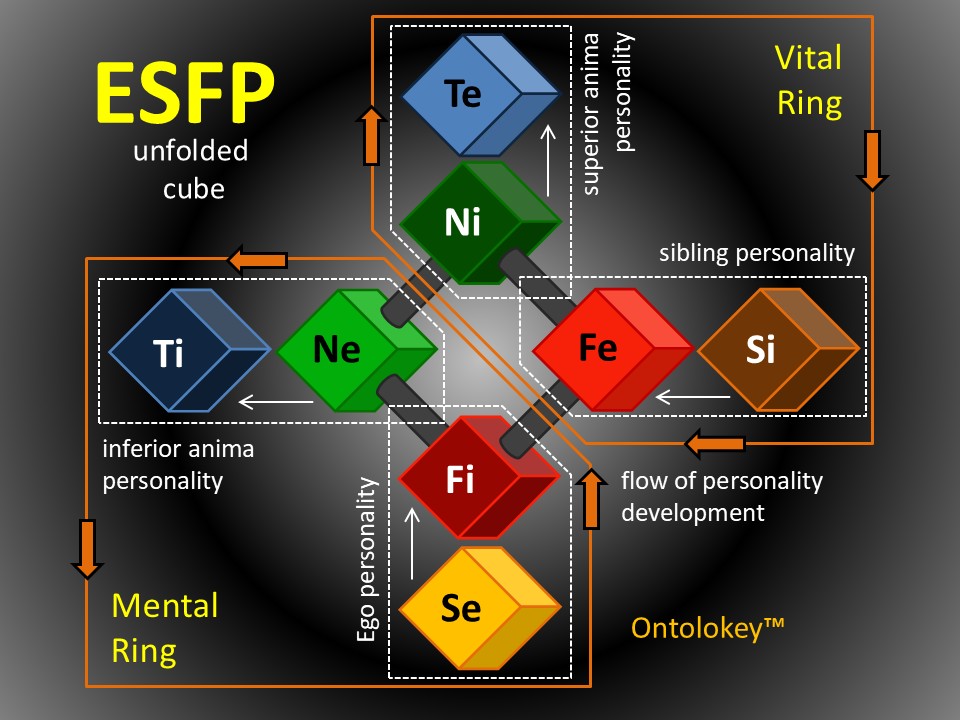
From a depth-psychological perspective, this is where the idea of the shadow becomes particularly important. The shadow is not simply a collection of negative traits that should be eliminated; it consists of psychological possibilities that have not yet been adequately integrated into consciousness, and therefore may emerge indirectly, defensively, or in exaggerated form. For the ESFP, the central developmental movement is consequently not away from Se but deeper into it: immediate experience must gradually become connected with inner values through Fi, with continuity and embodied memory through Si, with analytical discrimination through Ti, with long-term meaning through Ni, with alternative possibilities through Ne, with practical structure through Te, and ultimately with the wider emotional field represented by Fe. Ontolokey makes this developmental architecture visible through its three-dimensional cube and its functional sliders, allowing the individual to regard personality not as a fixed label but as a landscape in which some psychological capacities are naturally accessible while others remain less developed or more unconscious. The purpose of development is therefore not to become a different type, but to become a more complete version of the existing one. For the ESFP, that means preserving the extraordinary gift of being alive to reality while learning that reality also includes what cannot immediately be seen, acted upon, controlled, or resolved.
The ESFP Shadow: When Experience Becomes Escape
The developmental task of the ESFP begins precisely where its greatest gift can become its greatest defense: in the relationship with immediate experience. Extraverted Sensing gives the personality an unusually vivid contact with the external world, but this same immediacy can become psychologically defensive when movement, stimulation, pleasure, social engagement, or constant activity are unconsciously used to prevent contact with inner conflict. The crucial distinction is therefore not between activity and inactivity, nor between pleasure and restraint, but between experience that expands consciousness and experience that anesthetizes it. An ESFP can be extraordinarily alive and yet insufficiently acquainted with the person who is doing the living; external vitality can continue to flourish while unresolved grief, insecurity, shame, dependency, fear of insignificance, or existential uncertainty remain outside conscious reflection. In this sense, the deepest shadow is not simply impulsiveness or hedonism, but the gradual assumption that whatever cannot be solved through action does not need to be confronted psychologically. The shadow begins when movement becomes compulsory rather than freely chosen, when intensity is confused with depth, and when stimulation is required merely to prevent stillness from revealing what has been postponed.
This dynamic also explains why the ESFP shadow can appear paradoxical: the same person who seems confident, spontaneous, socially perceptive, generous, and capable of handling reality may become surprisingly controlling, possessive, reactive, or obsessive when confronted with uncertainty and emotional helplessness. Direct engagement with reality normally gives the ESFP a powerful sense of agency, but situations that cannot be immediately influenced—ambiguous relationships, rejection, loss, waiting, dependence, or the recognition of personal limitation—can threaten that sense of psychological sovereignty. Under pressure, desire may cease to function as information and begin to function as authority; frustration becomes difficult to tolerate, and action becomes a means of discharging tension rather than a conscious response to circumstances. What appears externally as dominance, jealousy, dramatic emotionality, or excessive pursuit can therefore conceal a much more vulnerable psychological movement: the attempt to secure externally what cannot yet be made secure internally. Ontolokey’s account of the shadow emphasizes that such manifestations should be understood as unconscious compensations rather than as the entirety of the person, because the same perceptiveness that can become manipulation can also become empathy, the same decisiveness that can become control can become leadership, and the same appetite for intensity can become a profound capacity for wholehearted participation in life.
The developmental answer is consequently not to suppress Se, but to surround it with consciousness. In the Ontolokey structure, the ESFP’s dominant Se is supported by Fi, Si, and Ti, while the less conscious functions—Ni, Ne, Te, and Fe—open progressively different directions of psychological development. Fi asks the ESFP to discover what remains true when nobody is watching and when immediate gratification is removed; Si asks the person to remember, consolidate, preserve, and learn from lived experience rather than continually replacing it with the next stimulus; Ti introduces the discipline of asking whether something actually makes sense rather than merely feeling compelling; and Ni asks perhaps the most uncomfortable question of all: where is this life actually going? These functions do not have to replace the ESFP’s natural orientation toward action, because their purpose is to deepen and regulate it. The Ontolokey cube and its sliders can therefore be understood as a practical image of individuation: instead of identifying exclusively with the most developed psychological position, the ESFP can gradually become conscious of the neighboring capacities that have remained quieter, awkward, neglected, or projected onto others
The Inner Counterweight: From Fi to Conscious Selfhood
The first step in ESFP development is not to retreat from the world, but to establish a stronger inner relationship with oneself while remaining fully engaged with it. Introverted Feeling (Fi) is particularly important here because it provides a private axis of meaning beneath the ESFP’s visible vitality: the question is no longer simply what is happening, what feels exciting, or what can be done, but what is personally true and worth standing for when external recognition disappears. This distinction matters because the ESFP can be highly sensitive to being appreciated, respected, desired, or recognized, while simultaneously possessing a deep need to know that the person receiving that recognition is authentic. The shadow emerges when these two needs become confused and external affirmation is unconsciously treated as evidence of inner worth, making rejection, indifference, criticism, or loss of influence feel disproportionately personal. Mature Fi interrupts this cycle by creating an internal reference point that does not have to be continuously confirmed by the environment. Instead of asking, “Do they see my value?”, the developing ESFP gradually learns to ask, “Do I know what I value, and am I living according to it?”
This movement toward inner authenticity also changes the ESFP’s relationship with emotional intensity. Strong feeling is not itself a psychological problem; indeed, emotional immediacy can be one of the ESFP’s greatest capacities for connection, loyalty, compassion, and creative expression. The difficulty arises when every feeling becomes an imperative to act, communicate, confront, withdraw, pursue, or resolve something immediately, because the personality then loses the psychological space in which an emotion can simply be experienced and understood. Developing Fi means learning to tolerate the interval between feeling and action, allowing an emotion to reveal its meaning before turning it into behavior. That interval can be surprisingly demanding for a personality whose natural intelligence is so strongly experiential, because waiting may initially feel like passivity while reflection may feel like losing momentum. Yet psychologically, this pause represents an expansion of freedom: the ESFP discovers that an emotion can be intense without being authoritative, that hurt does not automatically require retaliation, and that desire does not automatically justify pursuit. What begins as restraint therefore becomes a deeper form of self-possession, in which spontaneity remains available but is no longer compulsory.
There is also a more difficult dimension to this development: the ESFP must become capable of remaining present when there is nothing immediately rewarding to experience. The familiar attraction to movement, people, projects, sensory pleasure, achievement, and novelty can be profoundly life-affirming, but it can also conceal an intolerance of psychological emptiness when these experiences are unconsciously required to regulate self-esteem or emotional equilibrium. The developmental exercise is consequently not ascetic withdrawal but deliberate exposure to psychological stillness: moments in which nothing needs to be performed, repaired, stimulated, won, or made interesting. In such moments, previously muted material can surface—disappointment, loneliness, grief, envy, fear of irrelevance, uncertainty about direction, or the recognition that a particular ambition was partly motivated by the need to be seen. Rather than immediately escaping into another experience, the ESFP can begin treating these states as information about the self. This is where the shadow becomes useful, because what initially appears as an unwanted interruption of vitality can reveal precisely the psychological material that vitality has been protecting from consciousness.
Ni and the Psychology of Stillness
For the ESFP, the encounter with Introverted Intuition (Ni) represents one of the most consequential stages of psychological development because it confronts the personality with a mode of consciousness that cannot be mastered through immediate action. Se asks what is happening now and what can be done with the reality that is present, whereas Ni gradually turns attention toward trajectory, implication, pattern, symbolic meaning, and the invisible direction in which present choices are carrying the individual. This can initially feel strangely alien because the future cannot be grasped in the same concrete manner as an object, a task, a relationship, or an immediate opportunity. The Ontolokey description of Ni therefore portrays it as an inferior function whose questions can become uncomfortable precisely because they interrupt the ESFP’s natural confidence in movement: Where is this going? What happens if I continue living this way? Will what I am doing still matter later? The temptation is to answer such questions through another action rather than through reflection, but psychological growth begins when uncertainty is allowed to exist without immediately being converted into activity.
This is particularly important because action can function as an emotional regulator for the ESFP. When the future becomes ambiguous, movement restores a feeling of agency: a new project can be started, a relationship can be intensified, a decision can be made, a problem can be attacked, or an entirely different environment can be entered. None of these actions is inherently unhealthy, and many are precisely what makes the ESFP effective, but they become psychologically limiting when they prevent the person from discovering what the anxiety itself is communicating. The deeper challenge is therefore to tolerate the experience of not knowing without assuming that not knowing means something must immediately be done. Ni develops through precisely this capacity for sustained inward attention, where impressions are allowed to accumulate until a larger pattern begins to emerge rather than being dispersed through successive experiences. In this process, the ESFP does not lose spontaneity; rather, spontaneity becomes increasingly selective because it is informed by a developing sense of direction. The movement changes from I need something to happen toward I understand more clearly what I am moving toward.
The Ontolokey cube offers a useful symbolic representation of this transition because the less-developed function does not have to be imagined as an enemy of the dominant one. The movement of the slider toward Ni can instead be understood as an invitation to introduce small doses of psychological distance into a naturally immediate consciousness: periodically asking what a present decision will create six months from now, identifying recurring patterns in relationships, observing which ambitions repeatedly collapse after their initial excitement, or examining whether a desire represents a genuine direction or merely the need for stimulation. These practices transform intuition from something vague and threatening into something that can gradually participate in conscious cognition. With sufficient repetition, the ESFP may discover that foresight does not imprison spontaneity but protects it from becoming self-defeating. The future then ceases to be an abstract realm that competes with the present and becomes the temporal dimension through which present experience acquires coherence.
The Forgotten Past: Si and the Integration of Experience
If Ni asks the ESFP where life is going, Introverted Sensing (Si) asks what life has already taught. This distinction is psychologically significant because the ESFP’s natural orientation toward the present can make experience extraordinarily rich while simultaneously making it easy to move past experiences before they have been fully assimilated. Si introduces another relationship to time: instead of seeking novelty or responding to the immediate situation, consciousness turns backward and asks what has actually happened, what patterns have repeated, what consequences followed previous choices, and which memories still carry emotional information. For the ESFP, this can be uncomfortable because the past may contain precisely those experiences that the forward-moving personality would rather transform into something new. Yet psychological maturity requires more than accumulating experiences; it requires metabolizing them, allowing them to become knowledge rather than merely memories. The Ontolokey model therefore gives Si an important developmental role in helping the ESFP convert a rich history of lived experience into an increasingly coherent inner archive.
This becomes particularly important when the ESFP repeatedly encounters the same interpersonal or emotional difficulty but interprets every new occurrence as an entirely new situation. Without sufficient Si, painful patterns can remain psychologically disconnected: one relationship ends, another begins, another conflict appears, another disappointment is absorbed, and the personality continues forward while failing to recognize the common structure underneath the events. Developing Si means deliberately examining recurrence rather than merely remembering chronology. The question changes from “What happened?” to “What keeps happening, and what part of me participates in creating or sustaining this pattern?” Such reflection can reveal tendencies that immediate perception alone cannot easily expose, including repeatedly choosing intensity over stability, confusing familiarity with genuine compatibility, disregarding early warning signs because the present chemistry feels compelling, or abandoning something valuable because the initial excitement has diminished. The shadow is not defeated by accumulating more experiences of the same kind; it is integrated when experience begins to produce self-knowledge.
There is also a quieter form of Si development that concerns gratitude, continuity, and preservation. An ESFP can become so oriented toward what is alive and possible in the present that ordinary continuity may seem less psychologically rewarding than novelty, yet a stable identity requires some relationship with what has endured. Returning consciously to meaningful places, traditions, friendships, creative practices, photographs, personal records, or memories can establish an inner continuity that does not depend upon perpetual stimulation. This does not mean becoming nostalgic or resistant to change; rather, it means learning that psychological movement becomes deeper when it has roots. The ESFP who integrates Si begins to recognize that not everything valuable must remain exciting in order to remain valuable, and that repetition can sometimes reveal dimensions of reality that novelty conceals. In this sense, Si provides an important counterweight to the shadow tendency toward perpetual escape: instead of asking only what experience comes next, the developing ESFP learns to ask what the experiences already lived have made possible within the self.
Ti: Learning to Think Without Losing the Self
The development of Introverted Thinking (Ti) introduces another form of psychological differentiation that can be particularly valuable for the ESFP: the capacity to step back from personal involvement and examine reality according to its internal structure. Because the ESFP is naturally responsive to people, circumstances, values, and immediate consequences, a situation can acquire meaning through how it is experienced long before it has been subjected to detached analysis. Ti creates a deliberate separation between what I feel about something and what is actually the case, without requiring the ESFP to invalidate the feeling. This distinction becomes especially important in the shadow, where emotional intensity can sometimes compress perception and interpretation into a single psychological event: because something feels wrong, it must be wrong; because someone feels distant, they must be rejecting; because an opportunity feels exciting, it must therefore be worthwhile. Developing Ti creates an internal laboratory in which impressions can be examined rather than immediately obeyed, allowing the ESFP to preserve emotional authenticity while becoming more precise about causality, evidence, contradiction, and logical consistency.
This capacity becomes especially powerful in interpersonal situations, because many of the ESFP’s greatest strengths can also make projection difficult to recognize. High social and perceptual sensitivity allows the ESFP to notice subtle changes in tone, expression, behavior, atmosphere, and relational energy, but noticing something accurately is not identical to understanding what it means. A mature Ti function can introduce the necessary distinction between observation and interpretation: What did I actually perceive? What did I infer from it? What alternative explanations exist? What evidence would confirm or contradict my interpretation? These questions are not intended to turn the ESFP into a detached analyst who distrusts instinct; rather, they prevent instinct from becoming indistinguishable from certainty. The psychological gain is considerable because many shadow reactions intensify precisely when an interpretation is treated as an established fact before consciousness has examined it. Through Ti, the ESFP can discover that intellectual distance is not emotional coldness, but another form of self-protection against being unconsciously governed by the first interpretation that arises.
There is an even deeper developmental consequence because Ti gradually changes the ESFP’s relationship with contradiction. The personality may naturally prefer directness and experiential coherence, yet mature consciousness must tolerate the possibility that two apparently opposing truths can coexist: someone can love and disappoint us, an exciting opportunity can also be destructive, an unpleasant experience can contain something valuable, and a person who behaves badly may nevertheless have legitimate motives that deserve understanding without being excused. Ti strengthens the ability to remain psychologically present in such complexity without forcing an immediate resolution. When combined with Fi, this becomes particularly valuable: Fi can establish what is personally meaningful and morally significant, while Ti can examine whether the reasoning surrounding that value is internally coherent. The result is not the suppression of feeling but its refinement, because the ESFP becomes increasingly capable of distinguishing conviction from impulse, intuition from assumption, and authentic desire from emotional reaction. In this way, cognitive development begins to transform the shadow from something that acts through the personality into something that can be observed, questioned, and gradually integrated.
Ne and Te: Expanding Possibility and Structure
The development of Extraverted Intuition (Ne) asks the ESFP to loosen the exclusive attachment to what is immediately concrete and discover the psychological value of what could be. Although Se and Ne are both oriented toward the external world, they engage it differently: Se encounters what is present with immediacy, whereas Ne multiplies possibilities, associations, interpretations, and alternative trajectories. For an ESFP, developing Ne can therefore be liberating because it creates alternatives at precisely the moment when the personality might otherwise become psychologically locked into the strongest available impulse or the most obvious course of action. When disappointment occurs, Ne can ask what else the situation might mean; when a plan fails, it can generate several new pathways rather than interpreting failure as the collapse of the entire direction; when another person behaves unexpectedly, it can entertain multiple explanations before settling upon one. This capacity becomes particularly useful in shadow work because psychological rigidity often hides beneath apparent spontaneity: a person may look flexible externally while remaining internally convinced that only one particular outcome, relationship, recognition, or experience can provide satisfaction. Ne introduces the possibility that reality contains more paths than the emotionally dominant present moment makes visible.
Extraverted Thinking (Te), by contrast, develops the ESFP’s ability to turn intention into sustained external organization without depending exclusively on enthusiasm. The ESFP can often act decisively when motivation is immediate and tangible, but long-term development requires the capacity to continue when an activity becomes repetitive, inconvenient, bureaucratic, or temporarily unrewarding. Te contributes measurement, prioritization, sequencing, efficiency, accountability, and objective assessment, thereby giving the ESFP’s considerable energy a durable container. Its developmental purpose is not to impose rigid order upon an inherently spontaneous personality, but to ensure that spontaneity serves rather than sabotages larger intentions. A useful Te question is therefore not simply “What do I want right now?” but “What structure would allow what I value to become real over time?” This shift is especially important when shadow patterns involve impulsive commitments, unfinished projects, financial or practical inconsistency, or the tendency to pursue whatever is emotionally compelling while postponing what is necessary but less stimulating.
Ne and Te become considerably more powerful when developed together because possibility without structure can remain fantasy, while structure without possibility can become sterile constraint. The ESFP can use Ne to widen the field of options and Te to determine which options deserve concrete investment, thereby creating a conscious bridge between imagination and execution. The Ontolokey cube provides a visual language for this process: rather than demanding that every psychological slider be moved toward an abstract ideal of balance, the individual can observe which less-developed capacities require deliberate attention in a particular phase of life. A period characterized by impulsive choices may call for more Te; a period of psychological fixation may benefit from Ne; a period dominated by relentless activity may require Ni or Fi instead. Development thus becomes dynamic rather than mechanical, because the objective is not symmetrical function strength but greater freedom of movement between different modes of cognition. The ESFP gradually learns that genuine spontaneity is not the absence of structure or reflection; it is the ability to choose among many possible responses without being unconsciously compelled by only one.
Fe and the Expansion of the Relational Self
The development of Extraverted Feeling (Fe) brings the ESFP into a particularly subtle area of shadow integration because it expands emotional awareness beyond the boundaries of personal authenticity and immediate interpersonal experience. The ESFP’s Fi naturally asks whether something is personally meaningful, sincere, and congruent with inner values, while Fe directs attention toward the emotional field shared by a group: what is happening between people, what atmosphere is being created, what others need from one another, and how an individual’s behavior affects collective cohesion. For an ESFP, whose natural social presence can already be considerable, this distinction may initially be difficult to perceive because being socially engaging is not identical to consciously regulating a relational system. A person can be charming, generous, entertaining, and highly responsive while still unconsciously organizing relationships around personal emotional needs or around the intensity of the immediate interaction. Developing Fe means becoming increasingly capable of asking not only whether one is authentic, but whether one’s authenticity is being expressed in a way that leaves psychological space for other people to remain fully themselves.
This becomes especially relevant when the ESFP encounters interpersonal disappointment or conflict. Fi can provide a powerful sense of personal loyalty and moral conviction, but when wounded it may become intensely private, making the individual increasingly certain that the other person has violated something fundamental while reducing curiosity about the larger relational process. Fe introduces another perspective without requiring the ESFP to abandon personal boundaries: how does the situation look from outside my own emotional position, what emotional consequences is my behavior producing, and what does the relationship require if it is to remain psychologically viable? These questions can be uncomfortable because they prevent authenticity from becoming an absolute justification for every expression of feeling. Mature relational consciousness recognizes that sincerity does not automatically make a reaction constructive, and that being emotionally honest does not eliminate responsibility for how one’s emotions are communicated. The developing ESFP therefore learns to distinguish between expressing what is true inside oneself and demanding that others carry, repair, validate, or organize themselves around that truth.
At its deepest level, Fe development can help transform the ESFP’s considerable personal magnetism into a more conscious form of relational responsibility. The goal is not to become universally agreeable or to suppress individuality for the sake of harmony, because such a transformation would contradict the very authenticity that gives the ESFP its psychological vitality. Rather, the individual learns to perceive relationships as living systems in which every participant contributes to the emotional climate, including through silence, withdrawal, pursuit, humor, intensity, generosity, and confrontation. This becomes an important antidote to shadow dynamics in which attention, affection, or emotional intensity can unconsciously become currencies through which security is negotiated. When Fe becomes more conscious, connection can be offered without covertly demanding a particular response, and generosity can become genuinely generous because it is no longer dependent upon recognition. The ESFP’s social gift thereby moves toward maturity: from being someone who naturally affects the atmosphere to someone who consciously understands the atmosphere and accepts responsibility for the psychological impact of their presence within it.
The Ontolokey Cube as a Practice of Individuation
The value of the Ontolokey cube becomes clearest when personality is no longer treated as a description of who one already is, but as a visual representation of where consciousness habitually stands and where it can gradually expand. The ESFP does not need to regard the less-developed functions as defects that must be corrected, because their psychological importance lies precisely in the fact that they represent alternative ways of processing reality that are not ordinarily given equal conscious authority. The cube makes this asymmetry visible: instead of thinking abstractly about eight cognitive functions, the individual can observe a landscape of relative development and use the sliders as a practical reminder that psychological growth involves movement. For the ESFP, this can be particularly useful because the dominant Se orientation is so closely connected with direct experience that development itself can benefit from becoming experiential rather than merely intellectual. The question is therefore not whether one can intellectually understand Ni, Ti, Ne, Te, or Fe, but whether one can consciously introduce their perspectives into actual situations and observe what changes when they are allowed to participate. In this sense, the cube becomes less a classification device than a mirror for individuation, turning an otherwise abstract psychological architecture into something that can be repeatedly consulted while life itself supplies the material for development.
A practical ESFP growth process can consequently begin with observation rather than correction. When the urge for stimulation appears, the individual can first ask what internal state the stimulation is regulating; when a powerful emotional reaction arises, the distinction between feeling and interpretation can be examined through Fi and Ti; when a decision feels compelling, Ni can ask what longer trajectory that decision is contributing to; when the same relational difficulty repeatedly occurs, Si can examine what previous experience has already revealed; when only one interpretation seems possible, Ne can deliberately generate alternatives; when a valued intention repeatedly fails to become sustainable, Te can investigate what structure is missing; and when interpersonal intensity begins to dominate a relationship, Fe can widen attention toward the emotional needs and autonomy of everyone involved. None of these questions requires the ESFP to suppress the original impulse, because suppression merely drives psychological material underground and often strengthens its eventual return. The objective is differentiation: the impulse remains visible, but it is no longer the only voice participating in the decision. Over time, this creates precisely the kind of cognitive flexibility that shadow integration requires, because the personality develops the capacity to experience an internal reaction without immediately becoming identical with it.
The deeper significance of this practice is that individuation does not mean constructing a perfectly balanced personality in which every function operates with equal strength. Such an ideal would contradict the very individuality that makes a personality recognizable in the first place. For the ESFP, development means allowing the extraordinary immediacy of Se to become increasingly conscious of its consequences, its values, its history, its alternatives, its structures, its relationships, and its future direction. The Ontolokey cube can therefore be used as a recurring developmental map: when life becomes chaotic, examine which function has become overextended; when the same shadow reaction repeats, identify which neglected perspective might provide a missing corrective; and when a new psychological capacity begins to emerge, give it enough room to develop without demanding immediate mastery. The sliders become meaningful precisely because development is gradual, uneven, and responsive to circumstances rather than a single act of self-improvement. The ESFP does not have to become less spontaneous in order to become deeper; the developmental movement is toward a spontaneity that has acquired memory, reflection, discernment, direction, and conscious responsibility.
From Shadow Awareness to Conscious Practice
The decisive step in ESFP development is the transition from recognizing the shadow to deliberately creating conditions in which it can be integrated. Insight by itself is insufficient if it remains an interesting description of one’s personality; the psychological material has to be encountered in ordinary situations where the old reaction would normally take over. This is why growth should be understood as a repeated cognitive practice rather than as a single moment of self-understanding. When the impulse to act immediately appears, the ESFP can introduce a conscious interval; when admiration becomes psychologically necessary, the individual can examine what self-evaluation is being outsourced to others; when uncertainty produces obsession, the distinction between what is known and what is imagined can be restored; when anger accumulates, it can be recognized before it reaches the point at which emotional intensity collapses nuance. The purpose of these interventions is not self-surveillance or repression, but increasing the number of psychological possibilities available between stimulus and response. In the language of the Ontolokey model, the shadow becomes progressively less autonomous as the less-developed functions are invited into conscious participation.
A useful discipline for the ESFP is therefore to treat recurring emotional reactions as invitations to identify the cognitive function that is currently missing from the situation. If an experience feels irresistible, Fi can ask whether the desire corresponds to a genuine value or merely to immediate gratification; if the future feels threatening, Ni can examine the longer pattern rather than demanding instant certainty; if an old relational wound is repeatedly recreated, Si can look for the historical pattern; if an interpretation feels absolutely certain, Ti can separate observation from inference; if one desired outcome appears to be the only possible future, Ne can deliberately generate alternatives; if an intention repeatedly remains unfinished, Te can convert it into a concrete structure; and if interpersonal intensity begins to dominate the field, Fe can consider the emotional reality of everyone involved. This creates a form of cognitive triangulation in which no single psychological function is permitted to monopolize consciousness. The ESFP remains fundamentally an experiential personality, but experience itself becomes the raw material through which cognition gradually differentiates and expands.
The deepest practice may nevertheless be the simplest: learning to remain present without immediately changing the experience. This means allowing boredom without instantly escaping it, allowing disappointment without immediately replacing what has been lost, allowing uncertainty without manufacturing certainty, allowing attraction without automatically pursuing it, allowing anger without turning it into domination, and allowing vulnerability without interpreting it as weakness. Such moments are psychologically significant because they expose the difference between freedom and compulsion: the free person can experience a powerful impulse and still choose what to do with it, whereas the shadow-driven person experiences the impulse as something that must be discharged. Ontolokey’s emphasis on the less-developed functions provides a way of making this distinction visible, because the slider can serve as a concrete reminder that another cognitive perspective is available even when it does not arise spontaneously. Growth therefore occurs through small acts of conscious differentiation repeated often enough that what was initially foreign gradually becomes part of the personality’s available repertoire.
Becoming More Than the Immediate Moment
The mature ESFP does not abandon the immediacy, sensual intelligence, emotional vitality, courage, and openness that make this personality distinctive; instead, these qualities become increasingly conscious through the integration of what once remained outside the preferred field of awareness. Growth begins when the ESFP recognizes that the shadow is not an enemy standing against the personality, but a repository of psychological capacities that have not yet learned to participate constructively in consciousness. Fi gives experience an inner ethical center, Si allows experience to become wisdom, Ti introduces discrimination, Ni provides direction and meaning, Ne opens alternatives, Te gives intentions structure, and Fe expands personal authenticity into relational responsibility. The Ontolokey cube can support this process precisely because it turns these possibilities into something visually tangible: the sliders provide a continual reminder that psychological development is a movement, not a verdict, and that different phases of life may require different forms of cognitive expansion. The ultimate objective is therefore not balance for its own sake, nor the transformation of an ESFP into another personality type, but greater freedom—the freedom to experience intensely without being ruled by intensity, to act spontaneously without acting compulsively, to love without possessing, to pursue pleasure without using it as escape, to tolerate uncertainty without fleeing into stimulation, and to remain fully alive while becoming increasingly capable of inhabiting the deeper dimensions of one’s own psyche.
For readers who wish to explore these dimensions further, the more extensive ESFP analyses and the corresponding explorations of other personality types are available through the Ontolokey homepage and its accompanying articles. The broader value of this material lies in approaching personality as a living psychological landscape rather than as a fixed description: the familiar functions reveal where consciousness naturally moves, while the less-developed functions indicate directions in which greater psychological freedom may become possible. The ESFP’s developmental journey can therefore be understood as a gradual movement from immediate experience toward integrated experience, in which the world is still encountered directly but is no longer required to provide every answer. What was once experienced only as restlessness may become a need for meaning; what appeared as emotional intensity may become emotional depth; what looked like impulsiveness may become courageous spontaneity guided by discernment; and what once belonged to the shadow may eventually become part of conscious character. In that sense, the deepest growth of the ESFP is not a retreat from life but a fuller participation in it, because the personality becomes capable of meeting not only what is immediately visible, but also the inner realities that give experience its lasting significance.


Leave a comment