From Competence to Psychological Wholeness
The ISTP is often recognized through a familiar constellation of qualities: independence, practical intelligence, composure under pressure, technical competence, perceptiveness, and an instinctive preference for direct experience over abstract speculation. In the Ontolokey perspective, however, these characteristics are not merely a collection of behavioral traits; they arise from a dynamic psychological configuration in which Introverted Thinking (Ti) seeks internal coherence while Extraverted Sensing (Se) continually tests that internal model against concrete reality. The result is a personality capable of understanding mechanisms, detecting inconsistencies, responding rapidly to changing circumstances, and solving problems without requiring much external guidance. This combination can create an impressive form of self-possession, because the ISTP tends to trust what can be examined, tested, experienced, and independently understood rather than what must simply be accepted from others. Yet precisely here begins the deeper psychological task: the strengths that make the ISTP autonomous can also become defenses against everything that cannot be controlled through autonomy, including emotional dependence, ambiguity, vulnerability, attachment, and the uncertainty inherent in intimate human relationships. Ontolokey’s description of the ISTP therefore points beyond the conventional image of the detached problem-solver toward a more difficult question: what happens when the ability to remain independent becomes so successful that independence itself becomes a psychological enclosure?
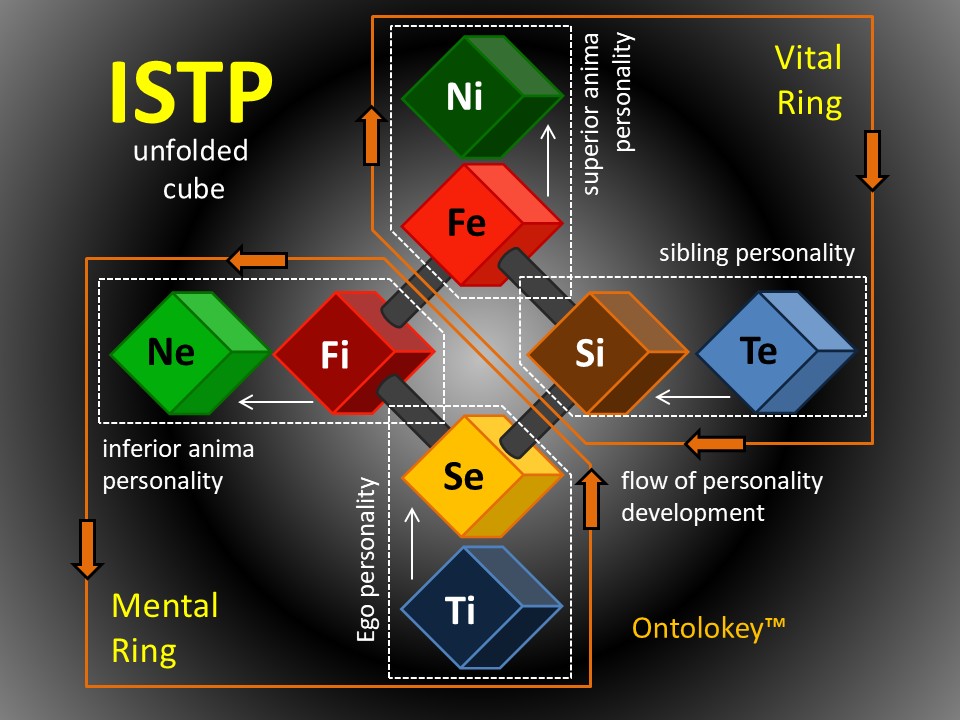
The developmental challenge is consequently not to weaken the ISTP’s rationality, practical ability, or need for freedom, but to prevent these qualities from becoming substitutes for dimensions of experience that cannot be reduced to technical mastery. The Ontolokey model is particularly useful here because it presents the eight psychological functions as a three-dimensional landscape rather than as a simple hierarchy of preferred and inferior abilities. In this landscape, Ti and Se form the familiar center of gravity, while Fi, Ne, Fe, Te, Ni, and Si represent increasingly different psychological territories that may remain less conscious, uncomfortable, or insufficiently developed. The cube and its sliders can therefore be approached not merely as a description of “what an ISTP is,” but as a visual representation of where psychological energy is concentrated and where developmental movement may be possible. Growth does not mean abandoning the familiar position and becoming a fundamentally different person; it means gradually acquiring greater freedom of movement within one’s own psychological landscape. For the ISTP, this movement begins when cognition is no longer used exclusively to master reality but also to examine the defenses through which reality is selectively perceived, especially when emotional facts, relational needs, uncertainty, or questions of meaning cannot be solved by logic alone. The purpose of development is therefore not to dismantle the inner architect, but to allow that architect to build a larger house—one in which thought, action, feeling, intuition, memory, relationship, and meaning can coexist without one domain having to eliminate the others.
The Shadow Begins Where Competence Stops Being Enough
The ordinary ISTP strength is also the point from which its shadow can most easily develop. Ti gives the personality an unusually strong capacity to dissect problems, separate relevant from irrelevant information, identify contradictions, and construct an internally coherent explanation, while Se provides the ability to test that explanation against immediate reality and act upon what is actually happening. This combination can produce a person who remains remarkably functional when circumstances become chaotic, because thinking and perception cooperate in a direct feedback loop: observe, understand, act, adjust. The difficulty begins when this highly effective mechanism is generalized beyond the situations for which it is naturally suited, particularly when the problem is no longer mechanical, tactical, or objectively verifiable but emotional, relational, existential, or ambiguous. In such circumstances, the ISTP can continue to analyze with great precision while unconsciously excluding precisely the information that would make the analysis psychologically complete. The danger is therefore not irrationality in the conventional sense, but the opposite: rationality becoming so dominant that it starts serving the preservation of distance rather than the discovery of truth.
This is particularly visible in the relationship between Fi, Ne, and Fe, because these functions confront the ISTP with forms of information that cannot easily be controlled through the familiar Ti–Se method. Fi represents a private dimension of value, loyalty, personal meaning, and emotional significance that may remain largely unspoken; when it is insufficiently conscious, hurt or disappointment can be converted into silent judgments rather than openly examined feelings. Ne introduces possibility and uncertainty, and therefore challenges the ISTP’s preference for concrete evidence by asking whether another interpretation, another motive, or another future might exist beyond what is immediately observable. Fe goes still further because it demands participation in an emotional reality shared with other people, where the correct response cannot always be a solution and where vulnerability cannot be eliminated by remaining competent. Under pressure, these unfamiliar territories can combine into a defensive circuit: uncertainty produces suspicion, private hurt becomes mistrust, emotional complexity becomes withdrawal, and Ti is then recruited to construct a convincing explanation for why withdrawal is justified. Ontolokey’s deeper shadow analysis describes precisely this possibility: the ISTP may remain externally composed and intellectually coherent while the cognitive system gradually becomes an instrument of self-protection.
The most consequential shadow, therefore, may not be aggression, coldness, or isolation in themselves, but the gradual transformation of protective independence into an unquestioned philosophy of life. An ISTP who has learned that dependence can create disappointment may decide, consciously or unconsciously, that needing other people is inherently dangerous; an ISTP who has experienced emotional ambiguity may conclude that emotions are inherently unreliable; an ISTP who has been betrayed may begin treating suspicion as realism rather than as a reaction to injury. The resulting worldview can become remarkably self-sealing because every attempt at closeness creates vulnerability, every vulnerability creates the possibility of disappointment, and every disappointment appears to confirm the original decision to remain distant. Ontolokey identifies this as one of the darkest developmental trajectories of the type: isolation reduces opportunities for intimacy, diminished intimacy produces misunderstanding, misunderstanding generates disappointment, and disappointment then becomes evidence that isolation was justified from the beginning. What makes this pattern particularly difficult to recognize is that it can coexist with considerable external success, because the individual may remain capable, independent, productive, physically present, and reliable while becoming progressively less emotionally participatory in his own life.
The essential developmental question is consequently not whether the ISTP should become more emotional, more sociable, or more dependent, because such a goal would misunderstand the nature of psychological integration. The deeper task is to expand the definition of reality itself so that emotional information, private values, uncertainty, relational consequences, long-term patterns, memory, and meaning are admitted into consciousness alongside facts and immediate sensory evidence. This is where the Ontolokey Cube can function as more than a static description of personality: its spatial arrangement of the eight functions makes unfamiliar psychological territory visible and allows development to be imagined as movement rather than conversion into another type. The sliders can be understood as a practical metaphor for this movement, because they invite the ISTP to notice where a function has become rigidly minimized, where another has become excessively dominant, and where a previously uncomfortable capacity might be strengthened without overthrowing the existing personality structure. The objective is not to make Ti weaker or Se less precise, but to prevent those strengths from monopolizing consciousness whenever life presents a problem that cannot be solved by analysis and action alone.
The First Movement of Growth: From Defensive Autonomy to Conscious Interdependence
The first developmental movement for the ISTP is therefore not toward greater dependence, but toward a more conscious distinction between autonomy and isolation. Genuine autonomy means possessing the internal freedom to choose connection without experiencing connection as surrender, whereas defensive self-sufficiency means needing no one because needing someone has become psychologically unacceptable. This distinction is subtle because both states can look identical from the outside: the person lives independently, makes decisions for himself, solves his own problems, and may even take pride in requiring very little from others. Internally, however, their structures are fundamentally different, because mature autonomy remains capable of receiving, trusting, asking, giving, and depending when circumstances genuinely call for it, while defensive autonomy treats such movements as threats to psychological sovereignty. The Ontolokey perspective suggests that development occurs when the less-developed functions are gradually brought into conscious relationship with the dominant ones, allowing the ISTP to recognize that emotional and interpersonal information is not an intrusion upon rationality but additional information about reality. The objective is therefore not to become less independent, but to become independent enough that intimacy no longer has to be experienced as a loss of freedom.
This requires the ISTP to begin treating feelings as data before turning them into conclusions, which may be one of the most important practical disciplines available to this personality. If irritation appears, the immediate temptation may be to identify the external cause and determine what is wrong with the situation, yet psychological integration asks a prior question: what is the irritation protecting, concealing, or communicating within me? Perhaps beneath it lies disappointment, shame, grief, affection, fear of rejection, or an unmet expectation that has never been consciously acknowledged. Such an approach does not require abandoning Ti; on the contrary, it uses Ti for a more demanding form of investigation in which the object of analysis is no longer merely the external problem but the observer’s own participation in the problem. The distinction between “this person is unreasonable” and “I am experiencing this person as unreasonable because something in this interaction is threatening my autonomy” can open an entirely different psychological field without requiring either interpretation to be accepted prematurely. Development begins when the ISTP becomes willing to investigate the emotional meaning of an experience before converting that experience into a stable theory about other people.
A similar discipline is required in relationships, where the ISTP’s practical competence can easily become a substitute for emotional accessibility. Helping, fixing, protecting, providing solutions, remembering practical details, and remaining loyal are genuine forms of care, but they do not automatically communicate that another person’s inner world has been received and emotionally registered. A partner, friend, or family member may therefore experience a strange contradiction: the ISTP is reliably present when something needs to be done, yet psychologically absent when something needs to be felt together. This does not necessarily indicate a lack of affection; rather, it may reveal that the ISTP has learned to express care through the channels that feel most natural and controllable while remaining hesitant around forms of intimacy that require emotional exposure. Growth consequently involves learning to remain present when there is nothing to fix, allowing another person’s experience to exist without immediately correcting it, interpreting it, or searching for an efficient solution. In that sense, emotional presence becomes a new form of competence, one that cannot be acquired through mastery of a system but only through repeated participation in the unpredictable reality of another human being.
The same principle applies to the ISTP’s relationship with vulnerability. Vulnerability is often misunderstood as weakness because it temporarily removes the protective advantage of complete self-containment, yet psychologically it can represent the conscious willingness to remain open while uncertainty is still present. For an ISTP, this may mean saying “I was hurt,” “I care about this,” “I do not know what I feel yet,” or “I need your help” without immediately defending the statement through explanation or irony. These moments can initially feel inefficient, exposed, or even irrational precisely because they cannot be guaranteed to produce a predictable outcome, but their developmental value lies in teaching the psyche that uncertainty does not automatically equal danger. The Ontolokey Cube can serve as a visual reminder of this process: the familiar position of Ti and Se need not be abandoned, while the sliders associated with less-developed functions can be consciously explored as directions of psychological expansion. The aim is not to force every function into equal strength, but to create enough flexibility that the ISTP can choose among different modes of perception and response instead of automatically retreating into the one mode that has historically provided the greatest sense of control.
The Cognitive Practice of Shadow Integration
For the ISTP, psychological development becomes most effective when it is approached as a practice of cognition rather than as an attempt to manufacture a different emotional personality. The central question is not whether the individual can suddenly become more expressive, more socially involved, or more intuitive, but whether the mind can learn to recognize when its habitual mode of processing has become too narrow for the situation at hand. Ti can remain the instrument of precision, while Se continues to anchor consciousness in immediate reality; the developmental step is to allow other forms of information to enter the field before a final interpretation is made. Ontolokey’s conception of the Cube is particularly relevant here because it treats the psychological functions as positions within an interconnected landscape, including less-developed and shadow dimensions rather than presenting personality as exhausted by its most familiar functions. The sliders consequently offer a concrete image for gradual movement: development can be understood as becoming capable of shifting attention toward another cognitive position when the circumstances require something that the habitual position cannot provide.
One practical consequence is that the ISTP can begin using moments of disproportionate reaction as invitations to investigate rather than immediately as evidence that the external situation is wrong. If another person’s emotional demand produces an unusually strong impulse to withdraw, the relevant question is not simply whether that demand is reasonable, but what psychological territory the interaction has activated. If uncertainty produces an elaborate search for hidden motives, the mind can distinguish between an actual observation and a possibility generated by anxiety; if personal disappointment produces silent detachment, the individual can ask what value, expectation, or attachment has been touched. This process preserves the ISTP’s characteristic skepticism because every interpretation remains open to examination, but it extends skepticism inward toward the assumptions and defenses of the observer. Ontolokey’s shadow framework explicitly treats recurring conflicts, emotional triggers, and idealized perceptions as possible signals of unexplored psychological dimensions, making self-observation the bridge between unconscious reaction and conscious cognition.
The most important discipline is therefore to create a deliberate interval between perception and conclusion. The ISTP is naturally equipped to move rapidly from what is observed to what is understood and then to what can be done, but shadow integration asks the person to insert another question into that sequence: What else might be psychologically true here? This does not mean endlessly doubting one’s perceptions or replacing evidence with subjective interpretation; it means recognizing that observable facts and psychological meaning are not identical categories. A person may objectively behave in a certain way, while the ISTP’s interpretation of that behavior may still be influenced by previous experiences, private values, fears, expectations, or relational defenses. The capacity to hold these layers simultaneously is a form of cognitive sophistication because it allows the ISTP to remain precise without prematurely reducing a complex human situation to a single explanatory model.
Over time, this practice can transform the relationship with the shadow itself. What initially appears as an uncomfortable function or an alien psychological impulse becomes something that can be observed, named, tested, and gradually incorporated into conscious choice. Fi can help the ISTP discover what genuinely matters beneath the language of efficiency; Ne can widen the field of possible interpretations without demanding that every possibility be believed; Fe can reveal the emotional atmosphere shared between people without requiring the ISTP to surrender individuality; and Ni can encourage attention to trajectories, patterns, and consequences that are not immediately visible. These capacities need not become dominant in order to become useful, and their developmental value lies precisely in their ability to modify the habitual response without destroying the personality’s existing center. The mature ISTP therefore does not stop being analytical, independent, pragmatic, or self-directed; rather, those qualities become less defensive because the psyche has acquired more than one way of understanding what is happening.
The Ontolokey Cube can serve as a continual visual reminder of this process because it turns an abstract psychological architecture into something that can be mentally navigated. The point is not to force every slider toward an imagined midpoint, nor to assume that development means equalizing all functions; psychological growth is better understood as gaining conscious freedom to move when a particular situation calls for a different mode of cognition. The ISTP can therefore use the Cube as a reflective question: Which position am I operating from right now, which position am I avoiding, and what information might become visible if I allowed that neglected position a temporary voice? Asked repeatedly and honestly, this question changes the purpose of typology from self-description into self-observation. The personality type becomes less a verdict about who one is and more a map for identifying where consciousness habitually goes—and where it might learn to go next.
From Cynicism to a More Complete Perception of Reality
One of the decisive developmental tasks for the ISTP is therefore to preserve skepticism without allowing skepticism to become a closed metaphysics of human life. Healthy skepticism asks whether an assumption is justified; shadow skepticism begins with the assumption that disappointment, inconsistency, hidden motives, or failure are the most reliable truths available. The distinction matters because the ISTP’s perceptiveness can make cynical conclusions particularly persuasive: people really are contradictory, institutions really can be hypocritical, relationships really can fail, and apparent altruism can sometimes conceal self-interest. The problem begins when accurate observations about particular realities are gradually elevated into universal conclusions about reality itself, so that every counterexample is treated as an exception and every disappointment as confirmation. The Ontolokey analysis describes this progression as a movement from observation toward cynicism and, at its most extreme, toward contempt, in which the ability to detect flaws remains intact while the capacity to recognize sincerity, devotion, compassion, or genuine goodness progressively weakens. Growth therefore does not require the ISTP to become naïve or trusting indiscriminately; it requires the much harder capacity to hold contradictory truths simultaneously, recognizing human corruption without denying human dignity and recognizing vulnerability without interpreting it automatically as weakness.
This is where Fi becomes especially important as a developmental counterweight, because personal values cannot be reduced entirely to logical consistency or practical utility. The ISTP may be perfectly capable of defending a principle intellectually while remaining insufficiently conscious of why that principle matters personally, what emotional investment sustains it, or what kind of person he wants to become through acting upon it. A more integrated Fi does not demand sentimentalism; it introduces the question of inward authenticity: What do I actually value when nobody is watching, and am I living in accordance with it? That question can become uncomfortable precisely because it cannot always be answered through external evidence, and because the answer may expose attachments or vulnerabilities that the more detached personality would prefer to keep outside conscious examination. Yet this is also where the ISTP can discover that values provide something different from rules: they give direction when no technical solution exists and allow personal meaning to survive situations in which efficiency, control, or certainty are unavailable. The movement toward Fi is therefore not a retreat from rationality but an expansion of what rational self-understanding is capable of including.
Ne provides another necessary correction by interrupting the tendency to let experience harden prematurely into certainty. When the ISTP has suffered betrayal, disappointment, or repeated interpersonal frustration, the mind can become exceptionally efficient at recognizing patterns, but pattern recognition has a shadow when it stops generating hypotheses and begins generating verdicts. Ne introduces alternative possibilities without requiring immediate commitment to any of them: perhaps the person’s behavior has another explanation, perhaps this relationship can develop differently, perhaps a previous conclusion belonged to a particular period of life rather than to human nature as such. This function is psychologically valuable because it restores openness without demanding credulity; it permits the mind to say, “I have evidence for this interpretation, but I do not yet possess the whole reality.” Such cognitive flexibility can be particularly transformative for the ISTP because it preserves the personality’s investigative spirit while preventing previous experience from becoming an invisible prison. The mature form of skepticism is therefore not the refusal to believe, but the willingness to keep examining.
Fe introduces an even more demanding dimension because it asks the ISTP to recognize that reality is not only what happens inside the individual or what can be objectively observed from outside, but also what exists between people. Emotional atmosphere, reciprocity, reassurance, social belonging, and the unspoken consequences of one’s behavior are forms of relational information that cannot be fully captured by analyzing isolated facts. Developing sensitivity to Fe does not mean conforming to collective expectations or becoming socially performative; rather, it means recognizing that other people’s subjective experiences are part of the reality in which one’s actions occur. The question shifts from “Was I logically justified?” to the broader inquiry, “What actually happened between us, and what did my behavior make possible or impossible?” This distinction can profoundly alter conflict, because the ISTP may discover that being factually correct and being relationally responsive are not mutually exclusive, but neither are they identical. Psychological maturity lies in becoming capable of holding both dimensions at once.
The Hidden Cost of Living Only in the Present
The ISTP’s relationship with Se is one of its greatest psychological assets because it brings attention back to what is actually happening rather than what might theoretically happen, and this capacity can produce exceptional adaptability in situations requiring immediate perception and action. Yet the same orientation can become restrictive when the present moment is used as a refuge from dimensions of experience that require temporal continuity, especially when the past carries unresolved emotional material or the future demands commitment before certainty has been achieved. The ISTP may be exceptionally comfortable responding to circumstances while remaining less comfortable constructing a deliberate relationship with what those circumstances mean over time. This can create a peculiar form of freedom in which every moment remains open, but important developmental decisions are repeatedly postponed because committing to a direction necessarily closes alternative possibilities. Psychological integration therefore requires learning that freedom is not merely the absence of constraints; it can also mean consciously choosing a direction and accepting the consequences of that choice. The ability to remain adaptable becomes more mature when it is complemented by the capacity to recognize that some realities cannot be lived adequately through improvisation alone.
Ni is particularly significant in this regard because it introduces a form of cognition concerned with underlying trajectories, symbolic meaning, long-range consequences, and the gradual convergence of seemingly unrelated experiences. For an ISTP, developing this capacity does not mean becoming abstract for its own sake or abandoning the concrete world that provides such reliable information; it means occasionally stepping away from immediate data in order to ask what the data are collectively pointing toward. A recurring relational conflict, for example, may not be merely a series of separate incidents but an indication of an underlying pattern in how the individual approaches intimacy, trust, or responsibility. Likewise, repeated professional dissatisfaction may reveal something deeper than a sequence of unsuitable circumstances, perhaps a conflict between autonomy and commitment that has never been consciously formulated. Ni can help transform isolated experiences into a coherent developmental narrative, allowing the ISTP to recognize that life has direction even when it does not present itself as an obvious problem to be solved. The shadow danger is that such intuition can become suspicious or fatalistic when detached from evidence, but its integrated form works differently: it generates hypotheses about meaning and trajectory that can subsequently be tested against reality.
Si contributes another dimension that can be easily underestimated because the ISTP’s natural orientation toward novelty, immediate perception, and practical adaptation may make extended reflection on previous experience feel less productive than responding to what is currently in front of him. Yet memory is not merely an archive of facts; psychologically, it contains patterns of bodily experience, emotional associations, learned expectations, and accumulated knowledge about what repeatedly happens under particular conditions. When the ISTP consciously revisits significant experiences, he may discover that certain present reactions are carrying the emotional residue of much older situations, even when the current circumstances appear objectively different. Such recognition can interrupt the automatic repetition of defensive patterns because the individual can distinguish what is happening now from what this situation reminds me of. In this sense, Si can support psychological differentiation: the past becomes something to understand rather than something that silently determines the present. Development does not require living backward, but it does require allowing the past to become conscious enough that it no longer has to operate invisibly.
Te presents a different developmental challenge because it concerns the translation of internal understanding into deliberate external organization, measurable execution, and structured implementation. The ISTP may already be highly effective at solving concrete problems, but this does not necessarily mean that every long-term objective is supported by consistent systems, explicit priorities, or sustained external structure. There can be a tendency to trust competence in the moment so strongly that preparation, delegation, planning, or formalized processes are regarded as unnecessary until circumstances make them unavoidable. Developing Te can therefore provide a useful complement to Ti: instead of asking only whether something makes internal sense, the individual also asks how that understanding can be translated into an organized process that remains effective beyond the immediate situation. The integrated ISTP does not become bureaucratic or rigid through this development; rather, external structure becomes a tool that protects freedom by reducing avoidable chaos and making long-term intentions less dependent upon momentary motivation. Through Ni, Si, and Te, the ISTP gradually acquires a broader temporal and organizational field in which immediate competence can serve a consciously chosen direction rather than continually defining the direction by itself.
The Shadow of Detachment and the Return of Human Connection
The ISTP’s detachment is often one of the qualities most easily admired from the outside, because it can appear as emotional stability, independence, objectivity, and freedom from unnecessary social pressure. Psychologically, however, detachment exists on a continuum, and its meaning changes according to whether it is chosen consciously or employed defensively. Conscious distance allows the ISTP to observe without becoming overwhelmed, while defensive distance prevents emotional experience from becoming sufficiently close to consciousness in the first place. The distinction becomes especially important in intimate relationships, where withdrawal can initially reduce tension but eventually deprive both people of the opportunity to repair what has been damaged. When the ISTP repeatedly retreats instead of articulating what has happened internally, silence becomes a substitute for communication and the other person is left to reconstruct the missing psychological information independently. The resulting misunderstandings can then reinforce the original belief that closeness is exhausting, unpredictable, or ultimately disappointing, creating precisely the self-confirming cycle that shadow work is intended to interrupt.
A more integrated form of Fe begins by recognizing that communication is not merely the transmission of information but also the creation of a shared psychological space. The ISTP does not need to become highly expressive in order to participate in that space; even relatively simple acts of explicit emotional acknowledgment can radically change the relational dynamic because they make internal states accessible to another person. Saying what one feels before explaining why one feels it can be especially valuable, because explanation often comes naturally to Ti while emotional disclosure exposes the more vulnerable territory that Ti cannot control in the same way. The developmental exercise is therefore not endless self-expression but accurate expression: identifying the feeling, acknowledging its significance, and allowing another person to respond without immediately retreating into analysis. Over time, this can teach the ISTP that relational transparency does not necessarily produce loss of autonomy, and that allowing another person to understand one’s inner world can actually create a more stable form of independence because fewer defensive barriers are required to maintain it.
The shadow side of Fe can also appear in a less obvious form: the ISTP may suppress interpersonal needs for so long that they eventually return indirectly through irritation, contempt, withdrawal, or sudden emotional intensity. What was never consciously requested may later be experienced as an obvious failure by others, even though those others were never given sufficient information to respond differently. This is one reason why psychological integration requires learning to recognize needs while they are still small and communicable rather than waiting until deprivation turns into resentment. The mature question is not whether other people should have known, but whether the ISTP has made his own inner reality sufficiently visible for genuine reciprocity to become possible. Such responsibility should not be confused with taking blame for every relational problem; rather, it restores agency to the individual by identifying the part of the interaction that actually belongs to him. In this way, Fe becomes less a demand to please others and more a capacity to participate consciously in the emotional consequences of one’s presence.
The same principle extends beyond intimate relationships to friendship, family, professional cooperation, and ordinary social life. The ISTP’s tendency to judge relationships according to reliability, authenticity, usefulness, or shared interests can overlook the fact that human bonds are also sustained through repetition, ritual, emotional recognition, and apparently unnecessary forms of presence. A relationship may contain no immediate practical problem and yet require attention simply because connection itself is something that must be maintained over time. Learning this does not require the ISTP to imitate highly social personalities or participate in interactions that feel meaningless; it requires recognizing that social connection is not merely an external demand imposed upon the individual but one of the environments in which psychological development occurs. When the ISTP begins to remain present even when there is nothing to fix, the experience of connection can cease to be an interruption of personal freedom and become another arena in which freedom is exercised consciously. The shadow is integrated not by eliminating solitude, but by making solitude a choice rather than the automatic consequence of emotional avoidance.
A Practical Path of Integration
The movement toward integration becomes most useful when it is translated into small, repeatable acts rather than treated as a grand psychological transformation. For the ISTP, development can begin with a simple discipline of observation: whenever a reaction feels disproportionately strong, pause long enough to separate the external event from the internal response and then examine both without immediately deciding which one is “right.” The first question can remain characteristically Ti-oriented—What are the facts?—but it should be followed by equally deliberate questions arising from the less familiar functions: What am I feeling? What personal value has been touched? What other explanations are possible? What pattern might be developing? What happened in similar situations before? What will this probably create if I continue responding in the same way? This sequence turns the ISTP’s natural analytical ability inward without making self-analysis an exercise in self-criticism. The purpose is not to distrust one’s own judgment but to make that judgment more comprehensive by allowing information from several psychological perspectives to enter consciousness before action is taken.
The Ontolokey Cube can make this practice unusually concrete because it provides a visual language for recognizing the movement between psychological functions. Rather than regarding the less-developed functions as deficiencies that must be corrected, the ISTP can approach them as territories that become available through deliberate exploration, with the sliders representing degrees of accessibility, emphasis, or development within the individual’s psychological landscape. When confronted with a recurring problem, the Cube can therefore become a diagnostic prompt: is Ti dominating because analysis genuinely serves the situation, or because analysis is protecting me from feeling; is Se keeping me grounded in observable reality, or preventing me from considering long-term consequences; is Fi being ignored because personal values feel inconvenient; is Ne being rejected because uncertainty feels uncomfortable; is Fe being avoided because emotional reciprocity creates vulnerability; is Ni neglected because the future cannot be known with certainty; is Si avoided because revisiting the past threatens the freedom of the present; is Te underused because external structure feels unnecessarily restrictive? These questions transform typology into a developmental practice in which the individual learns to recognize not only where he is, but also why he remains there.
The most effective development will usually be gradual because the psychological functions do not become integrated simply through intellectual understanding. Knowing that Fe exists, for example, does not automatically make emotional communication easier, just as knowing that Fi concerns personal values does not automatically reveal what one genuinely values. Integration requires repeated behavioral experiments in which the unfamiliar function is allowed to participate without being given total authority. An ISTP might therefore deliberately express a feeling before explaining it, remain in a difficult conversation for ten minutes longer than the instinct to withdraw would normally allow, write down several possible interpretations of an ambiguous event before choosing one, revisit an old experience to distinguish its original meaning from its present significance, or formulate a long-term intention and construct a practical system for maintaining it. Each exercise is small, but together they gradually teach the nervous and cognitive system that alternative modes of engagement are survivable and sometimes more informative than the habitual response. In this sense, development is not a declaration of a new identity but an accumulation of experiences in which the shadow ceases to be perceived as foreign.
There is also an important difference between integration and overcorrection. An ISTP who discovers the limitations of excessive detachment may temporarily swing toward excessive emotional involvement; someone who recognizes a tendency to improvise may suddenly impose rigid structures; someone who has distrusted intuition may begin treating every internal impression as profound insight. Such movements do not necessarily represent integration because they simply replace one form of one-sidedness with another. The purpose of the Ontolokey model is better understood as increasing psychological mobility: the individual becomes capable of moving a slider when circumstances require it while retaining the ability to return to the familiar center when that center is appropriate. Mature cognition therefore involves discrimination rather than equalization, and integration means knowing when a function should contribute, how much authority it should receive, and when its perspective needs to be balanced by another. The ISTP’s development is complete not when every psychological function becomes equally strong, but when fewer aspects of experience have to be rejected merely because they are unfamiliar.
The ISTP’s Relationship with Vulnerability, Trust, and Intimacy
At the deepest level, the ISTP’s developmental journey often concerns the relationship between vulnerability and control. A person who is accustomed to relying primarily upon his own perception, judgment, and ability to act can experience vulnerability as a temporary loss of the very capacities that normally provide psychological security. Yet vulnerability does not necessarily mean helplessness; it means allowing something important to remain uncertain while still choosing to participate in it. Trust operates in the same way, because genuine trust cannot be produced through complete verification, prediction, or control, and therefore requires a limited willingness to accept that another person’s actions cannot be guaranteed in advance. For the ISTP, this can become a profound cognitive exercise rather than merely an emotional one: instead of asking whether another person is absolutely trustworthy, the more realistic question becomes what degree of trust is appropriate to the evidence, what boundaries are necessary, and whether previous experiences are influencing the present judgment. Such differentiation allows the ISTP to avoid both naïve openness and defensive isolation, replacing the impossible demand for certainty with a more mature capacity to act intelligently under conditions of incomplete information.
This becomes particularly important because the shadow can reinterpret self-protection as wisdom. If withdrawal has repeatedly prevented disappointment, the mind receives behavioral confirmation that withdrawal works, even though the same strategy may simultaneously prevent intimacy, reconciliation, and emotional development. A defense can therefore be successful in its immediate purpose while damaging the larger life it was originally designed to protect. The ISTP may become increasingly skilled at detecting the first signs of interpersonal danger and increasingly reluctant to remain present long enough to discover whether the danger can be addressed through communication rather than escape. Psychological integration requires distinguishing a genuine boundary from an automatic defensive wall: a boundary communicates what one will and will not participate in, whereas a wall prevents meaningful information from reaching the person in the first place. This distinction preserves the ISTP’s legitimate need for autonomy while making room for the possibility that some relationships deserve sustained engagement precisely because they cannot be reduced to predictable transactions.
Trust can consequently be approached as a graduated cognitive process rather than as an all-or-nothing emotional decision. The ISTP does not have to surrender judgment in order to become more open; instead, he can observe whether another person behaves consistently, whether disagreements can be repaired, whether boundaries are respected, whether vulnerability is reciprocated, and whether words correspond sufficiently with actions over time. At the same time, the ISTP must accept that no amount of observation can remove all risk from human attachment, because the very nature of intimacy involves exposure to another autonomous consciousness. This is where the developmental movement becomes deeper than merely improving relationship skills: the individual begins to recognize that a life organized entirely around avoiding betrayal also avoids some of the experiences that make trust meaningful. The shadow loses its authority when the person can say, in effect, I understand the possibility of being hurt, but I will not allow that possibility to make every form of closeness psychologically impossible. Such a position does not abandon realism; it places realism in service of a larger conception of life.
The Ontolokey Cube can again function as a useful representation of this transition because it makes visible the difference between remaining anchored in one’s natural psychological strengths and developing the capacity to move beyond them when circumstances demand it. For the ISTP, the movement toward Fi and Fe can make inner values and interpersonal reciprocity more conscious, while Ne and Ni can prevent immediate impressions from becoming premature conclusions and can broaden awareness of possible futures and deeper patterns. Si can help distinguish present reality from unresolved residues of previous experience, while Te can help translate insight into sustained external behavior rather than leaving development at the level of reflection. None of these movements requires the abandonment of Ti or Se; instead, they allow the ISTP’s natural strengths to become instruments of integration rather than instruments of exclusion. The psychological goal is ultimately a wider form of freedom: not merely freedom from dependence, obligation, or emotional uncertainty, but freedom from the unconscious necessity to avoid whatever cannot be mastered immediately.
From Self-Protection to Self-Knowledge
The deepest form of ISTP growth begins when the individual stops asking only how to protect the self and starts asking what kind of self is actually being protected. This question reaches beneath observable behavior and into the psychological history of autonomy, because independence can have many origins: it can arise from genuine confidence, from a preference for freedom, from repeated experiences of having to rely on oneself, or from an unconscious conviction that dependence inevitably leads to disappointment. These origins may produce similar outward behavior while creating very different inner structures, and the distinction becomes visible only when the person examines what happens internally when autonomy is challenged. Does another person’s need create irritation because it genuinely violates a boundary, or because it awakens an old fear of being controlled? Does emotional closeness feel unnecessary because the individual truly prefers solitude, or because intimacy creates exposure to feelings that have never acquired a comfortable place in consciousness? Does skepticism arise from careful observation, or does careful observation increasingly serve a conclusion that was emotionally established long before the evidence was examined? Such questions move the ISTP from personality description toward depth psychology, because they investigate not simply what the person does but the unconscious function that the behavior performs.
This distinction also changes the meaning of the shadow. The shadow is not merely a collection of negative traits waiting to be eliminated; it consists of psychological possibilities that have remained insufficiently conscious and therefore tend to appear indirectly, disproportionately, or under conditions of stress. What is rejected consciously does not necessarily disappear psychologically, and the ISTP’s less-developed functions may therefore emerge through reactions that seem strangely unlike the person’s ordinary self-image. A normally composed individual may become unexpectedly possessive, emotionally reactive, suspicious, rigid, or withdrawn when an underlying psychological need is activated, and the temptation is then to dismiss the reaction as an anomaly rather than investigate what it reveals. Yet precisely because the reaction feels foreign, it can provide valuable information about what consciousness has excluded. Integration means bringing that material into a form that can be examined deliberately, so that what previously appeared as an involuntary shadow reaction becomes a capacity available to conscious choice.
The role of cognition is crucial because the ISTP is particularly well positioned to approach this process through investigation rather than self-condemnation. Instead of declaring a reaction “bad,” the individual can examine its sequence: what happened, what was perceived, what interpretation appeared, what emotion followed, what impulse emerged, what action was taken, and what consequence resulted. This creates a psychological chain that can be studied in the same spirit with which an ISTP might investigate a malfunctioning mechanism, except that the object of investigation is now the individual’s own internal process. The analogy should not be taken too literally, because human psychology cannot be reduced to machinery, but the investigative attitude itself can be extraordinarily productive when it remains open rather than seeking merely to confirm an existing theory. Over time, the person may begin to recognize recurring sequences that were previously experienced only as isolated incidents, and these patterns can reveal where a neglected function repeatedly attempts to enter consciousness.
Self-knowledge consequently becomes less about discovering a final explanation of oneself and more about increasing the accuracy with which one notices one’s own psychological movements. The ISTP does not need to abandon skepticism, because skepticism can protect against romanticized self-understanding just as effectively as it protects against naïve interpretations of other people. What changes is the direction of skepticism: it is applied not only to external claims but also to one’s own assumptions, defenses, and preferred explanations. This creates a form of intellectual humility that does not diminish confidence but makes confidence more flexible, because the individual knows that even a well-tested interpretation may be incomplete when it concerns a complex human situation. The result is a personality that can retain its characteristic independence and precision while becoming increasingly capable of recognizing the emotional, relational, symbolic, and temporal dimensions that previously remained outside its preferred field of attention.
The Integrated ISTP: Freedom Without Flight
The mature direction of ISTP development is not toward conformity, constant sociability, emotional transparency, or a permanent orientation toward other people, but toward a form of freedom that no longer requires psychological escape. The integrated ISTP can remain alone without becoming isolated, remain skeptical without becoming cynical, remain rational without becoming emotionally inaccessible, and remain spontaneous without becoming directionless. Such a person does not lose the ability to act decisively in the present; rather, present-moment action becomes informed by a larger internal field that includes personal values, relational consequences, alternative possibilities, long-term patterns, memory, and deliberate external structure. This broader awareness changes the meaning of the familiar ISTP strengths because competence is no longer used primarily to avoid vulnerability or preserve independence at all costs. Ti becomes capable of examining the self as rigorously as it examines the external world, while Se becomes a source of grounded presence rather than an automatic escape from reflection. The personality remains recognizably ISTP, but its freedom becomes less defensive and more conscious.
The integrated relationship with Fi allows the ISTP to know what matters personally rather than merely what makes sense logically or works practically. Ne permits uncertainty to remain open long enough for new interpretations to emerge, while Ni allows experience to accumulate into a sense of direction rather than remaining a sequence of disconnected situations. Si gives the past a legitimate place in consciousness without requiring the individual to live inside it, and Te provides the organizational discipline necessary to transform insight into sustained action. Fe, perhaps the most challenging territory for many ISTPs, allows the individual to recognize that emotional reciprocity is not an obligation to surrender individuality but a dimension of reality that becomes visible only through participation. These functions do not need to compete with Ti and Se; they can become complementary perspectives that prevent the dominant functions from carrying psychological responsibilities for which they were never designed. Integration therefore resembles the development of an internal council rather than the replacement of one ruler by another, with different cognitive perspectives contributing according to the demands of the situation.
This broader psychological mobility also changes how the ISTP relates to failure. A less integrated personality may interpret failure primarily as evidence that something was poorly designed, insufficiently understood, or inadequately executed, and this interpretation can be useful when the problem genuinely has a technical solution. But some failures cannot be repaired simply by improving the method, because they concern grief, attachment, timing, human limitation, conflicting values, or the irreversible consequences of choice. The integrated ISTP becomes capable of recognizing these distinctions without experiencing them as defeats of rationality. Sometimes the correct response is to repair; sometimes it is to accept; sometimes it is to mourn; sometimes it is to change direction; and sometimes it is to remain with an unresolved reality until its meaning becomes clearer. This capacity to distinguish different kinds of problems represents a major expansion of psychological intelligence because it prevents the habitual strategy of “fixing” from being imposed upon experiences whose purpose is not to be fixed.
Ultimately, the ISTP’s development can be understood as a movement from narrow mastery toward conscious participation in the whole of experience. The central strength of the type—the ability to perceive what is real, understand how things work, and respond effectively—does not have to disappear; it becomes more profound when the definition of “what is real” expands beyond the immediately observable. The shadow loses power when the ISTP learns to recognize that emotional facts are still facts, personal values are still information, uncertainty can contain possibilities, the past can contain unresolved meaning, the future can contain direction, and relationships generate realities that exist between individuals rather than inside either one alone. The Ontolokey Cube provides a practical image for this development because it allows the individual to see personality not as a fixed identity but as a landscape through which consciousness can learn to move, with the sliders representing possible directions of psychological expansion. The ultimate goal is not to become someone other than an ISTP, but to become an ISTP who has fewer reasons to flee from the parts of human experience that cannot be mastered through Ti and Se alone.
Turning the Map into a Landscape of Growth
The developmental task of the ISTP can ultimately be understood as a movement from unconscious specialization toward conscious psychological freedom. The natural strengths of Ti and Se give the personality a powerful center: the ability to understand how things work, perceive what is actually happening, remain independent of unnecessary external direction, and respond effectively when circumstances demand action. Those strengths should not be dismantled, because they are part of the ISTP’s psychological identity and constitute the foundation from which development becomes possible. The deeper task is to recognize where this foundation has become a psychological fortress, particularly when analysis is used to avoid feeling, autonomy becomes isolation, skepticism becomes cynicism, or present-moment adaptability becomes an escape from long-term meaning and commitment. The Ontolokey conception is especially useful here because it transforms the eight-function structure into a spatial landscape in which conscious strengths and less-conscious territories can be perceived as related parts of one psychological system rather than as disconnected characteristics. In that sense, the Cube can become a developmental instrument: not a device for deciding what the ISTP must become, but a visual invitation to discover where consciousness is concentrated and where greater psychological movement might be possible.
The practical principle that follows is simple but demanding: do not fight the shadow; learn to think with it. When a neglected function appears through discomfort, irritation, attraction, confusion, withdrawal, or disproportionate emotional reaction, the appropriate response is neither immediate identification with it nor immediate rejection of it, but investigation. The ISTP can ask what information has entered consciousness that the habitual Ti–Se perspective cannot adequately process, and then deliberately allow another function to contribute without surrendering judgment. Fi can ask what personally matters; Ne can ask what else might be possible; Fe can ask what is happening emotionally between people; Ni can ask where a pattern is leading; Si can ask what the past is still carrying into the present; and Te can ask how an insight can become an effective, sustained reality. The sliders of the Ontolokey Cube can symbolize this process of adjustment: not an obligation to move everything toward the same position, but an invitation to experiment with different psychological perspectives until the individual discovers a greater range of conscious choice. The point of integration is therefore not symmetry but flexibility, because a psychologically mature person is not someone who uses every function equally but someone who is increasingly capable of recognizing which perspective is missing when the familiar one no longer provides the whole answer.
This also means that the ISTP should resist turning the type itself into another form of confinement. A personality label becomes psychologically useful only when it generates questions rather than excuses: not “I am an ISTP, therefore I am this way,” but “If this description reveals something about my habitual psychological organization, what does it allow me to notice about myself that I previously overlooked?” The Ontolokey approach explicitly frames the functional structure as something that can be explored spatially and developmentally, moving from a static classification toward a landscape of relationships between psychological functions. That perspective makes the personality type a starting point for individuation rather than a final definition of identity. The ISTP can consequently retain the freedom, practicality, analytical precision, and experiential intelligence that characterize the type while becoming increasingly conscious of the psychological costs that arise when these strengths are used defensively. The real achievement is not becoming less ISTP, but becoming less imprisoned by the automatic expression of being ISTP.
The most important shift, then, is from asking How can I remain untouched? to asking How can I remain myself while becoming more fully capable of experiencing reality? That question reaches directly into the deepest developmental tension of the type, because it preserves autonomy while refusing to confuse autonomy with emotional invulnerability. It allows the ISTP to remain skeptical without becoming closed, independent without becoming unreachable, rational without becoming reductive, spontaneous without becoming directionless, and private without becoming psychologically inaccessible. What once appeared to be incompatible opposites can gradually become complementary capacities: solitude and intimacy, analysis and feeling, evidence and possibility, immediacy and foresight, independence and connection. The shadow then ceases to be an enemy that must be defeated and becomes a source of information about the dimensions of life that the conscious personality has not yet learned to inhabit comfortably.
The Ontolokey Cube can serve as a practical companion throughout this process precisely because it makes that movement visible. Its three-dimensional representation turns an abstract functional architecture into something that can be mentally navigated, while the possibility of shifting the sliders provides an intuitive language for considering where one’s development might move next. The most productive use of the Cube is therefore not to search for a permanently “correct” configuration, but to return to it whenever life reveals a recurring limitation and ask which psychological territory might need greater conscious participation. In this sense, the Cube becomes less a map that tells the ISTP where to go than a landscape in which the individual learns to recognize paths that were previously neglected. Ontolokey describes this broader purpose as a movement from classification toward self-observation, mutual understanding, and personal development, and this is precisely where its relevance to the ISTP becomes most apparent.
For readers who want to continue this exploration, the more detailed ISTP material on Ontolokey.com provides a broader examination of the type, its functional architecture, its shadow dynamics, and the Ontolokey Cube itself; the individual articles used as the basis for this concluding essay can likewise be explored there for a more extensive treatment of the psychological themes touched upon here. The wider Ontolokey framework describes itself as an attempt to make the functional relationships of personality more intuitive, spatial, and developmentally accessible, drawing its architecture from the eight-function structure associated with Socionics and transforming that architecture into a three-dimensional psychological landscape. For the ISTP, the essential invitation is therefore not to escape the personality one has been given, nor to force oneself into an unfamiliar psychological mold, but to turn the cube, move the sliders, observe what appears, and gradually learn to inhabit more of one’s own psychological landscape with awareness. When this happens, personality ceases to be merely a description of habitual behavior and becomes a field of conscious development: the ISTP remains independent, perceptive, analytical, and capable, but those qualities are no longer required to defend the person from the full complexity of being human.


Leave a comment