From Mastery of the Moment to Integration of the Self
The ESTP is often recognized through qualities that are immediately visible: decisiveness, physical presence, adaptability, social confidence, pragmatism, competitiveness, and an instinctive ability to respond to circumstances as they unfold. This personality tends to encounter reality directly rather than approaching it through prolonged abstraction, discovering what is possible by entering the situation, testing its limits, and acting upon whatever becomes tangible and actionable. In the Ontolokey perspective, however, this outward effectiveness is only the visible surface of a much larger psychological structure, because the ESTP is not defined by Extraverted Sensing alone but by the relationship between eight psychological functions occupying different positions within the psyche. The central developmental question therefore cannot simply be how the ESTP can become more effective, more disciplined, or more successful, since these qualities are already closely connected to the personality’s natural mode of engaging with life. The deeper question is what happens when the same capacities that make the ESTP powerful in the external world begin to function defensively, protecting the personality from uncertainty, dependence, vulnerability, emotional exposure, or the experience of not being in control.
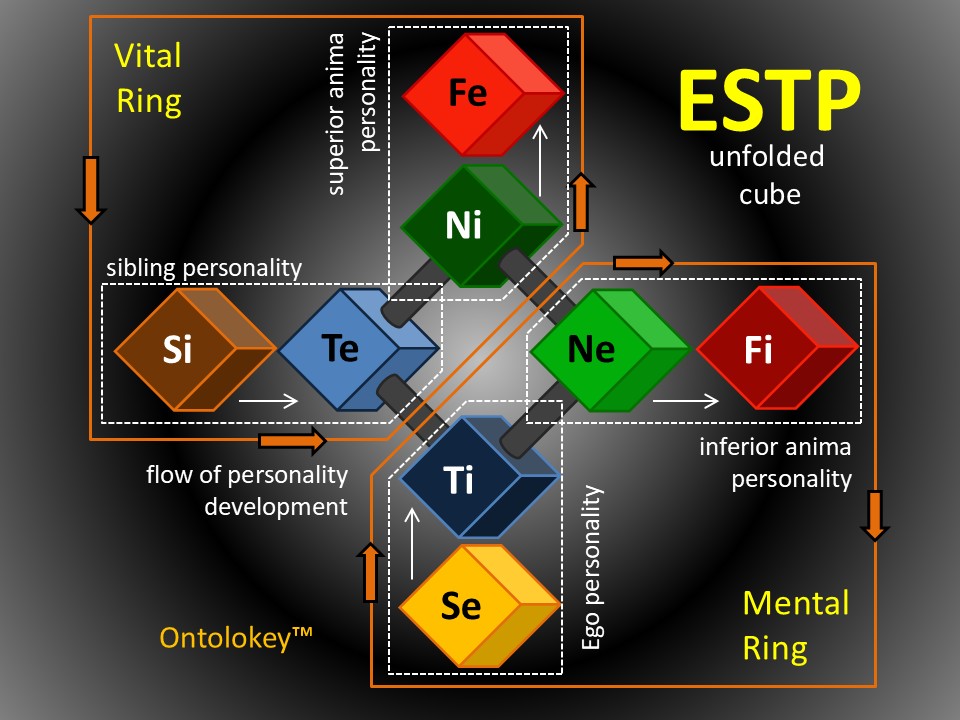
From this perspective, psychological growth does not require the ESTP to abandon the present moment, spontaneity, courage, humor, sensuality, competitiveness, or the ability to act decisively under pressure. On the contrary, the developmental task is to preserve these qualities while gradually allowing less familiar forms of cognition to participate in consciousness, so that action is no longer required to carry the entire burden of psychological adaptation. Ontolokey’s central contribution to this process is its spatial representation of the eight-function structure: rather than treating psychological functions as an abstract sequence, the Cube presents them as an interconnected landscape in which different functions can support, oppose, compensate for, or illuminate one another. The movable sliders consequently provide a useful metaphor for development, because growth is not imagined as replacing one function with another but as changing the relationship between them and increasing the degree of conscious integration. For the ESTP, this means learning to move gradually from immediate reaction toward reflection, from control toward trust, from influence toward reciprocity, and from competence as self-protection toward competence as one expression of a much larger and more internally grounded self. The purpose of this conclusion is therefore not to prescribe a new personality, but to describe a possible path by which the ESTP can become less divided against the parts of the psyche that have remained outside the familiar territory of action.
The ESTP’s Shadow: When Strength Becomes Defense
The shadow of the ESTP begins precisely where the personality’s greatest strengths become psychologically indispensable. The capacity to act quickly, read the environment, take command, solve concrete problems, and maintain independence can gradually cease to be merely natural preferences and become defensive strategies against experiences that feel less manageable: uncertainty, helplessness, emotional exposure, dependence, ambiguity, and the possibility of being wrong. Ontolokey’s description of the ESTP therefore becomes particularly revealing when it moves beyond the familiar image of the energetic realist and examines the less conscious functions that surround the dominant Se–Ti configuration. The difficulty is not that an ESTP possesses too much strength, but that strength can become the preferred language through which almost every psychological problem is handled, including problems that cannot actually be solved by force, speed, competence, persuasion, or immediate action. When this happens, action ceases to be an expression of freedom and becomes a means of avoiding inner experience, while control begins to substitute for trust and effectiveness begins to substitute for emotional self-knowledge. The developmental task is consequently not to weaken the ESTP’s natural assertiveness, but to recognize the moment at which assertiveness is no longer serving reality and has begun serving psychological defense.
This defensive pattern can be especially difficult to recognize because it often produces externally convincing results. An ESTP who feels uncertain may become more active; one who feels emotionally exposed may become more competent; one who fears dependence may become indispensable; and one who senses an unresolved inner conflict may redirect attention toward a concrete problem that can be attacked and solved. Such responses can be highly adaptive in the short term, which is precisely why they become difficult to relinquish. Yet the psychological cost emerges when every disturbance is translated into the same vocabulary: What can I do about this? How can I fix it? How can I regain control? Who is responsible? What is the fastest solution? The Ontolokey portrayal of the ESTP repeatedly returns to this relationship between action, control, and vulnerability, particularly in its discussion of Fi, Ni, Fe, and the shadow functions. The unanswered question beneath the activity is sometimes not whether something can be done, but whether the ESTP can remain psychologically present when nothing can yet be done. This is where development begins, because the capacity to tolerate an unresolved inner state without immediately converting it into external action represents a new form of strength: not the strength to dominate circumstances, but the strength to remain conscious within them.
The most vulnerable point is often the relationship with Introverted Feeling (Fi), because Fi introduces a dimension of experience that cannot easily be reduced to performance, efficiency, status, or observable achievement. It asks what something means personally, what one genuinely values, what hurts, what feels morally unacceptable, what one desires independently of external recognition, and who one is when there is nothing to prove. For an ESTP accustomed to demonstrating worth through competence, loyalty, protection, problem-solving, generosity, or decisive action, these questions can feel strangely exposed because they cannot be answered by doing something impressive. Ontolokey describes this function as a comparatively fragile territory in which the ESTP may struggle to identify deeper feelings while simultaneously caring intensely about being perceived as good, worthy, loyal, or deserving of love. This creates a subtle psychological paradox: the person may be exceptionally capable of showing care while remaining uncertain about how to receive care, exceptionally willing to protect others while finding it difficult to reveal the places where they themselves need protection. Growth therefore begins when usefulness is no longer required as the price of emotional worth, allowing the ESTP to discover that an inner value does not become less real simply because it cannot be converted into an action or defended through competence.
Introverted Intuition (Ni) presents a different but equally important developmental challenge because it confronts the ESTP with the future as something that cannot always be controlled through immediate perception and tactical response. The dominant Se orientation excels at what is present, observable, changing, and actionable; Ni instead asks the personality to withdraw from immediate stimulation and perceive the deeper trajectory of events. This means asking not merely whether an action works now, but what pattern it participates in, where repeated choices are leading, what consequences are accumulating, and whether the current victory may contain the seeds of a future problem. Ontolokey describes this inferior function as particularly uncomfortable territory for the ESTP, especially when uncertainty produces doubt, impatience, pessimism, or a compulsion to act simply to escape the experience of being suspended in ambiguity. The crucial developmental movement is therefore from reaction to reflection: before acting, the ESTP can learn to allow a situation to remain unresolved long enough for its underlying pattern to reveal itself. On the Ontolokey Cube, this can be understood as deliberately moving the slider toward a less familiar cognitive territory, not abandoning Se but creating enough psychological space for Ni to contribute what immediate perception cannot provide.
The same principle applies to Extraverted Feeling (Fe), although here the developmental issue concerns the difference between influencing an emotional field and genuinely participating in it. ESTPs can often read social atmosphere with considerable acuity and may possess a natural ability to energize, entertain, motivate, organize, or mobilize other people; however, social awareness does not automatically constitute emotional intimacy. When Fe remains primarily instrumental, other people can unconsciously become an audience, a team, an alliance, a source of validation, or a field whose emotional temperature must be managed. Ontolokey emphasizes precisely this tension, describing the ESTP as socially perceptive and capable of strong emotional influence while also suggesting that emotional pressure can accumulate until it emerges through disproportionate reactions or sudden outbursts. Development requires a subtle reversal: instead of asking only How do I affect this room?, the ESTP gradually learns to ask What is actually happening between us, and what am I experiencing within it? This transforms Fe from a mechanism of social control into a capacity for genuine reciprocity, where emotional connection is no longer something the ESTP has to orchestrate but something they can participate in without controlling its outcome.
From Reaction to Conscious Choice: The First Movement of Growth
For the ESTP, psychological development begins most effectively not with the suppression of instinct but with the creation of a small interval between instinct and action. The natural orientation toward immediate reality is one of the personality’s great adaptive capacities: it allows the ESTP to perceive opportunities, respond rapidly, improvise under pressure, and remain engaged when circumstances become unpredictable. The difficulty begins when this responsiveness becomes so automatic that every internal disturbance is translated into an external response before the underlying experience has become conscious. Ontolokey’s deeper analysis of the ESTP shadow describes precisely this progression, in which movement can become a form of emotional regulation and stimulation can function as an escape from inner stillness; what appears to be spontaneity may therefore sometimes conceal an inability to remain with an unresolved psychological tension. The first developmental exercise is consequently deceptively simple: when a strong impulse appears, the ESTP learns to notice it before obeying it, not because the impulse is necessarily wrong, but because consciousness must become large enough to contain both the impulse and the possibility of choosing differently.
This interval between stimulus and response is particularly important because the ESTP may otherwise confuse psychological immediacy with psychological truth. Anger can feel truthful because it produces clarity; desire can feel truthful because it produces energy; confidence can feel truthful because it produces certainty, and confrontation can feel truthful because it restores a sense of agency. Yet an emotion can be authentic without being complete, and an impulse can be genuine without expressing the whole meaning of a situation. Ontolokey’s discussion of the ESTP shadow emphasizes that accumulated tension may remain outside awareness until it is discharged through behavior, with the conscious mind subsequently constructing an explanation for what has already occurred. The developmental question therefore changes from “Is my reaction justified?” to the more demanding question “What else is present in me alongside this reaction?” Fear may exist beneath anger, grief beneath irritability, shame beneath defiance, or longing beneath the desire to regain control, and recognizing these layers does not invalidate the original emotion but places it within a more complete psychological context.
The practical value of this approach becomes particularly clear when the ESTP encounters conflict, criticism, humiliation, rejection, or a challenge to personal competence. Such situations can activate the shadow because they threaten not merely an opinion or a position but the deeper identification with being capable, independent, effective, and difficult to overpower. Ontolokey describes how this identification with strength can turn power from a useful instrument into an element of identity, making any threat to control feel disproportionately significant because the threatened object is no longer simply a circumstance but the person’s psychological self-definition. Growth therefore requires learning to distinguish between loss of control and loss of self: another person’s disagreement does not necessarily diminish one’s competence, admitting uncertainty does not erase authority, and acknowledging emotional pain does not constitute defeat. The ESTP begins to mature psychologically when these distinctions become experiential rather than merely intellectual, because the nervous system gradually learns that not every challenge to the external self requires an immediate defense of the entire personality.
This is also where the Ontolokey Cube can become more than a conceptual representation and function as a practical developmental map. Its value for the ESTP lies in making visible the asymmetry between the psychological functions that are naturally accessible and those that tend to remain less consciously developed, allowing the person to observe development not as an abstract demand to “become more balanced” but as a movement toward neglected territories of cognition. The sliders can be understood as a visual prompt for asking which function is currently dominating a situation and which neglected function might introduce information that the dominant perspective cannot perceive on its own. The aim is not to force every function into equal strength, because psychological individuality depends precisely upon different functions having different degrees of natural accessibility; rather, the aim is to increase freedom by making previously unconscious alternatives available to consciousness. In this sense, the Cube represents development as a change in psychological range: the mature ESTP remains recognizably ESTP, but increasingly possesses the ability to pause, interpret, anticipate, evaluate inner values, and relate to others without having to abandon the instinctive decisiveness that constitutes a central part of their personality.
The deepest transformation therefore begins when the ESTP stops treating the less developed functions as obstacles to efficiency and starts regarding them as sources of information. Fi can tell the person what matters when there is no audience to impress and no practical advantage to gain; Ni can reveal the trajectory hidden behind the immediate event; Fe can deepen social intelligence into mutual emotional participation; and the more remote shadow functions can expose assumptions that normally remain invisible precisely because they are so uncomfortable to consciousness. The developmental movement is consequently not from “ESTP” toward some supposedly superior personality, but from unconscious one-sidedness toward conscious complexity. The person does not become less spontaneous by developing reflection, less strong by developing vulnerability, or less practical by developing intuition; instead, these capacities become increasingly available before action, within action, and after action, allowing experience to be metabolized rather than merely accumulated. This is the beginning of individuation for the ESTP: not the abandonment of the self that has learned how to survive and succeed, but the gradual integration of everything that self had to leave behind in order to become strong.
Integrating Fi: Discovering the Self Beneath Competence
Among the less familiar territories of the ESTP psyche, Introverted Feeling (Fi) deserves particular attention because it introduces a question that practical intelligence cannot answer on its own: What is true for me when there is nothing to accomplish, defend, win, or demonstrate? The ESTP may possess strong personal loyalties and a pronounced sense of fairness, yet these values can remain expressed primarily through action rather than introspective language, so that care is demonstrated through protection, reliability, generosity, problem-solving, or physical presence rather than through prolonged examination of subjective experience. Ontolokey’s portrayal of the ESTP suggests that this can create a peculiar distance from one’s own interiority: the person may know very clearly what they will do for someone while having considerably less clarity about what they themselves feel, need, fear, or value at a deeper level. The developmental danger appears when personal worth becomes unconsciously conditional upon usefulness, strength, desirability, competence, or the ability to provide something to others. Fi integration begins when the ESTP allows the self to possess value independently of performance and becomes willing to encounter subjective experience without immediately converting it into a problem that needs to be solved.
This requires a different relationship with vulnerability because vulnerability is frequently misunderstood as weakness when the personality has learned to rely heavily upon self-sufficiency. Yet psychological vulnerability is not equivalent to helplessness; it is the capacity to remain open to an experience that cannot be completely controlled. For the ESTP, this may mean admitting “I am hurt” before constructing a case for why the other person is wrong, recognizing “I need you” without immediately compensating through an act of usefulness, or acknowledging “this matters deeply to me” without turning the admission into a demand that others validate it. Such moments can feel disproportionately intimate precisely because they expose the person beneath the behavioral competence that normally mediates relationships. Fi development therefore asks the ESTP to cultivate an internal vocabulary for subjective states and to resist the reflex of externalizing every emotional tension into interpersonal action. Over time, this creates an important psychological distinction between having an emotion and being controlled by it, because an emotion can be consciously experienced, interpreted, and integrated without either suppressing it or immediately acting it out.
The integration of Fi also changes the ESTP’s relationship with morality and judgment. When personal values remain insufficiently differentiated from social expectations, loyalty, group norms, or immediate interpersonal dynamics, the person can unconsciously determine what is right by observing what produces approval, respect, belonging, or tangible results. Developing Fi introduces a quieter criterion: Would this still be meaningful to me if nobody rewarded me for it? That question can be uncomfortable because it removes the social mirror and leaves the individual alone with an internal standard that cannot be negotiated through charisma or performance. The purpose is not to make the ESTP more subjective in the sense of becoming less rational, but to allow reason and action to serve values that have actually been consciously examined rather than values inherited from competition, environment, relationships, or the demands of the moment. In this sense, Fi becomes an internal anchor, enabling the ESTP to remain flexible externally without becoming internally undefined.
A particularly important consequence is that Fi can soften the ESTP’s tendency to interpret interpersonal problems exclusively through behavior. If someone withdraws, criticizes, disappoints, or behaves unpredictably, the instinctive response may be to identify the concrete cause and determine what should be done about it; Fi asks an additional question about the subjective meaning of the encounter and the emotional significance it carries. This can reveal that some conflicts are not really about the observable event at all, but about accumulated experiences of disrespect, abandonment, inadequacy, betrayal, or the fear of not mattering. Once these deeper layers become conscious, the ESTP gains a choice that was previously unavailable: instead of escalating the external conflict in order to obtain an internal reassurance, the person can recognize the wound directly and communicate from it. This is one of the clearest signs of psychological maturation because it replaces indirect emotional action with direct emotional ownership, allowing the ESTP to say what is personally true without requiring another person to become responsible for repairing the entire internal state.
The final goal of Fi integration is therefore not introspection for its own sake but self-possession. The ESTP does not need to become permanently contemplative, emotionally demonstrative, or detached from action; rather, action becomes healthier when it originates from a self that knows what it is protecting and why. The person who knows their own values can say no without aggression, remain loyal without self-betrayal, leave without needing revenge, apologize without humiliation, and love without turning affection into a transaction. The Ontolokey Cube can make this developmental direction visible by allowing the ESTP to recognize Fi not simply as a distant or uncomfortable function but as a territory toward which the psychological slider can gradually be moved through repeated conscious practice. The movement is incremental: noticing a feeling, naming it, allowing it to exist, identifying the value beneath it, and eventually acting in accordance with that value even when immediate external reinforcement is absent. What emerges is a form of strength that no longer depends entirely upon being invulnerable, because the ESTP begins to understand that the most secure center of the personality is not the ability to withstand everything but the ability to remain connected with oneself while experiencing anything.
Integrating Ni: Learning to See Beyond the Immediate Moment
If Fi asks the ESTP to turn inward and discover what is personally meaningful, Introverted Intuition (Ni) asks the personality to move backward from the immediate event and perceive the larger pattern in which that event exists. This is difficult precisely because the ESTP’s natural intelligence is exceptionally responsive to what is concrete, present, changing, and available for direct interaction, whereas Ni operates through withdrawal from immediate stimulation and through an increasing sensitivity to trajectories, implications, symbolic patterns, and long-term consequences. Ontolokey’s descriptions of the ESTP repeatedly identify this future-oriented perspective as a comparatively vulnerable territory, particularly when the personality is confronted with uncertainty that cannot be mastered through immediate action. When Ni remains poorly integrated, the future may appear either too abstract to deserve attention or so threatening that it generates sudden pessimistic conclusions, catastrophic projections, or an urgent need to regain control through action. Mature Ni does something different: it allows the ESTP to remain grounded in reality while asking what the present reality is gradually becoming.
This distinction is crucial because immediate effectiveness can sometimes conceal long-term ineffectiveness. An ESTP may be extraordinarily capable of resolving today’s crisis while unknowingly creating the conditions for tomorrow’s crisis, particularly when repeated short-term solutions postpone rather than transform an underlying problem. The same principle applies to relationships, career decisions, finances, health, personal habits, and identity: a strategy can work repeatedly and still become destructive through cumulative consequences. Ni introduces the capacity to recognize these trajectories before they become unavoidable, which means that the ESTP does not have to wait for reality to become an emergency before taking it seriously. Development therefore begins with a deceptively simple habit of periodically asking, “If I continue doing exactly what I am doing now, where does this lead?” The question shifts attention from isolated events to patterns and from immediate consequences to direction, allowing the ESTP’s practical intelligence to operate on a larger temporal scale.
The challenge is that Ni integration requires tolerating a period in which there is no immediate evidence that a conclusion is correct. Se wants contact with reality; Ni often works by allowing disparate impressions to accumulate until an underlying configuration becomes apparent. For an action-oriented personality, this can feel frustratingly passive, and the temptation may be to substitute premature certainty for genuine insight. The ESTP may suddenly decide that a person will inevitably betray them, that a situation can only end badly, or that a particular interpretation explains everything, when what has actually occurred is an unconscious attempt to escape ambiguity. Ontolokey’s treatment of the ESTP’s shadow side is valuable here because it distinguishes the constructive development of less conscious functions from their uncontrolled eruption under psychological pressure. The developmental discipline is therefore not to believe every intuitive impression, but to give intuition enough space to form while simultaneously allowing reality to test it, creating a dialogue between immediate perception and emerging pattern rather than allowing either one to dominate.
Ni also has an existential dimension because it confronts the ESTP with the possibility that not every meaningful human experience can be reduced to what is immediately observable. There are periods in life when external achievement loses its capacity to provide direction, when the next challenge no longer answers the deeper question of why, or when a previously successful identity begins to feel strangely empty despite continued performance. At such moments, the instinct to increase activity can temporarily restore stimulation but cannot necessarily restore meaning. Ni offers a different movement by encouraging the person to examine the narrative trajectory of their life: which experiences keep recurring, which ambitions have actually fulfilled them, which conflicts follow the same psychological pattern, and what kind of person their accumulated choices are gradually producing. This does not require abandoning the ESTP’s realism; rather, it extends realism into the domain of personal meaning by treating one’s own life as a pattern that can be observed rather than merely a sequence of situations that must be managed.
The mature integration of Ni ultimately gives the ESTP something that immediate responsiveness alone cannot provide: direction without rigidity. The person remains capable of changing course when reality changes, but no longer needs every new stimulus to determine the next move. Instead of asking only what is possible now, the ESTP becomes increasingly capable of asking what is meaningful, sustainable, and likely to remain coherent over time. The Ontolokey Cube can serve here as a concrete visual reminder that the developmental slider does not have to be pushed permanently toward Ni; even a modest movement toward this function can create a meaningful counterweight to an exclusively present-centered mode of living. The objective is not to predict the future with certainty but to become psychologically capable of inhabiting the future before it arrives, allowing foresight to inform action without replacing the spontaneity and realism that make the ESTP distinctive. Through this integration, the present moment ceases to be something that must constantly be consumed and becomes something that can also be understood as a beginning.
Integrating Fe: From Social Influence to Genuine Reciprocity
The development of Extraverted Feeling (Fe) takes the ESTP into another territory that is already partially familiar, because social awareness is often one of the personality’s visible strengths. ESTPs can be perceptive about interpersonal dynamics, sensitive to shifts in atmosphere, quick to recognize what will energize a group, and naturally capable of using humor, confidence, directness, and emotional presence to influence other people. Yet there is an important psychological distinction between understanding an emotional environment and allowing oneself to become genuinely affected by it. When Fe is primarily used as an instrument of influence, social intelligence can remain external: the ESTP knows how to create an atmosphere, gain cooperation, relieve tension, challenge someone, or bring a group together, but may not always pause to ask what the relationship itself requires beyond immediate effectiveness. Ontolokey’s account of the ESTP highlights this complex relationship with Fe, including both the capacity for strong interpersonal engagement and the possibility that accumulated emotional pressure may eventually emerge in less controlled ways. Development therefore consists not simply in becoming more socially skilled, but in transforming social perception into reciprocal emotional participation.
This distinction becomes especially important in intimate relationships, where charisma and responsiveness cannot substitute indefinitely for emotional transparency. In a social environment, the ESTP can often regulate the interaction by changing the subject, introducing humor, taking action, confronting the issue directly, or moving the group toward a concrete solution. Intimacy is more demanding because another person may not want the situation managed; they may want it witnessed, understood, and emotionally shared. For an ESTP, remaining present while another person experiences something that cannot be immediately repaired can initially feel frustrating or even strangely passive, because the natural impulse is to restore movement where there is distress. Fe development asks for a different form of presence in which emotional connection is not measured by how effectively the situation is improved, but by whether both people are permitted to experience the situation together. This can be particularly transformative when combined with Fi, because Fi provides awareness of one’s own emotional truth while Fe provides sensitivity to the emotional reality existing between people.
The shadow side of underdeveloped Fe can also appear through the subtle use of interpersonal pressure. Because the ESTP may intuitively understand what motivates other people, this knowledge can become a powerful tool for persuasion, seduction, confrontation, negotiation, or social positioning. There is nothing inherently unhealthy about influence, but the psychological problem arises when influence becomes the default substitute for vulnerability: rather than revealing what one genuinely needs, the person may attempt to produce the desired response in someone else. The distinction is subtle but profound, because direct communication leaves the other person free to respond while manipulation attempts to engineer the response in advance. Ontolokey’s deeper treatment of the ESTP’s shadow is particularly relevant here because it portrays the darker potential of interpersonal strength when the need for control becomes psychologically fused with identity. Fe becomes more integrated when the ESTP can influence without needing to control, persuade without needing submission, and communicate honestly while accepting that another person’s emotional response ultimately belongs to that person.
This development also changes how the ESTP experiences conflict. The instinctive response may be to determine who is responsible, identify the contradiction, expose the weakness in an argument, and move toward resolution; however, some conflicts persist precisely because factual resolution and emotional resolution are different processes. A person can be objectively wrong and still need to feel understood, just as an ESTP can be objectively justified and still contribute emotionally to the deterioration of a relationship. Mature Fe allows the ESTP to hold these two dimensions simultaneously without collapsing one into the other. The goal is not to surrender accuracy for harmony, but to recognize that relationships possess their own psychological reality and that winning an argument can sometimes produce a relational loss that was not visible within the argument itself. This capacity becomes especially powerful when paired with the ESTP’s existing Ti, because analytical clarity can then be used to understand emotional complexity rather than to defend against it.
Ultimately, Fe integration allows the ESTP to discover that connection becomes deeper when it is no longer entirely dependent upon performance. The person does not have to be the funniest person in the room, the strongest person in the conflict, the one who knows what to do, or the one who rescues everyone from discomfort in order to remain valuable within a relationship. Sometimes the most mature interpersonal action is to remain available while another person struggles, to acknowledge an emotional reality without correcting it, or to reveal one’s own uncertainty without immediately converting it into confidence. The Ontolokey Cube can represent this developmental movement as a gradual increase in the accessibility of Fe, creating a wider psychological range between social control and social participation. As Fe becomes more conscious, the ESTP’s natural interpersonal force does not disappear; it becomes less defensive, less transactional, and more capable of creating relationships in which both people remain psychologically free.
The Deeper Shadow: When the Unconscious Takes the Wheel
The less developed functions of the ESTP do not simply remain quietly absent from consciousness; under sufficient psychological pressure, they can emerge in exaggerated and distorted forms. This is one of the most important principles for understanding the ESTP shadow because the personality does not become most psychologically vulnerable when it is simply using Se, Ti, Fe, or another familiar function strongly, but when the conscious personality becomes rigid enough that neglected material can no longer remain outside awareness. Ontolokey’s discussion of the ESTP’s deepest shadow explores this possibility through the less conscious functions that can become activated when ordinary strategies of control cease to work. The resulting behavior may appear strangely unlike the person’s ordinary self: an ordinarily pragmatic person can become consumed by interpretations, an ordinarily confident person can become unusually defensive, or an ordinarily socially capable person can suddenly become withdrawn, suspicious, emotionally reactive, or preoccupied with meanings that cannot be verified. Such states should not be understood as the appearance of a completely different personality, however, but as indications that psychological material normally kept outside the preferred mode of consciousness is demanding recognition.
One of the central dangers in this condition is psychological projection, particularly when an internal conflict is experienced as though it were entirely located in the external world. The ESTP may become convinced that another person is deliberately undermining them, that hidden motives explain a confusing situation, or that an apparently minor event confirms a much larger pattern of betrayal or threat. Because the personality is naturally oriented toward reading real-world signals rapidly, these impressions can feel compelling, especially when emotional arousal is high. Yet the developmental response is not to distrust perception altogether; it is to distinguish perception from interpretation and interpretation from certainty. An observable fact may be accurate while the psychological meaning assigned to it remains incomplete, and the mature ESTP learns to hold both possibilities simultaneously rather than allowing an emotionally charged interpretation to become indistinguishable from reality. This capacity to suspend certainty without surrendering discernment is one of the most valuable forms of shadow integration because it prevents intuition, fear, wounded pride, and immediate perception from forming an unquestioned alliance.
The shadow can become particularly intense when the ESTP experiences a prolonged loss of agency. Situations involving illness, emotional dependence, professional failure, betrayal, financial instability, relational uncertainty, or circumstances that simply cannot be solved through direct action can remove the usual outlets through which psychological tension is discharged. The person may then experience a profound internal contradiction: the identity says I can handle this, while the actual circumstances say this cannot currently be handled in the usual way. Ontolokey’s treatment of the ESTP shadow is significant precisely because it examines what can happen when the normal relationship between action and control breaks down. Under such conditions, the temptation may be to intensify control, provoke conflict, seek stimulation, dominate conversations, make abrupt decisions, or construct a compelling explanation that restores psychological certainty. The more mature response is paradoxically less dramatic: acknowledge the loss of control, observe the emotions it produces, and allow the psyche to develop capacities that cannot be built while everything is being immediately neutralized.
This is where the ESTP must become particularly careful about confusing intensity with truth. A psychological experience can become extremely vivid when familiar coping mechanisms are overwhelmed, and the intensity itself can create the impression that whatever one is thinking or feeling must therefore be deeply significant and objectively correct. But intensity is information, not proof. Fear tells the person that something important has been activated; anger tells them that a boundary, value, expectation, or wound may be involved; fascination may indicate psychological significance; and the sudden conviction that everything “makes sense” may indicate genuine insight or may represent the mind’s attempt to restore coherence under pressure. The developmental practice is therefore to become curious about the intensity instead of automatically obeying it. The ESTP can ask what the experience reveals about the self, what part of the personality has been threatened, which neglected function may be emerging, and what evidence exists independently of the emotional state.
Shadow integration ultimately means allowing unconscious material to become conscious before it has to become destructive. The goal is not to eliminate anger, competitiveness, sexuality, ambition, suspicion, pride, or the desire for autonomy, because these energies can contain legitimate psychological functions when consciously directed. The task is to understand what happens when these energies are denied, inflated, or recruited to protect a threatened identity. The Ontolokey Cube offers a useful visualization because it makes development spatial: the ESTP can observe which psychological regions feel familiar, which feel resistant, and which movements toward the less developed functions create discomfort precisely because they challenge established patterns of self-regulation. (ontolokey.com) In this sense, the shadow is not an enemy waiting to be defeated but a territory waiting to be integrated, and the psychological maturity of the ESTP can be measured less by the absence of inner conflict than by the increasing ability to encounter that conflict consciously without allowing it to dictate behavior.
The Developmental Use of the Ontolokey Cube
The Ontolokey Cube becomes most useful when the ESTP stops treating psychological development as a demand to become someone else and instead understands it as an expansion of available consciousness. The familiar functions represent psychological territory in which the person can move with relative spontaneity, while the less developed functions represent regions that may require greater intention, patience, and tolerance of discomfort. The Cube makes this asymmetry visible, and its sliders provide a practical metaphor for the fact that psychological development is not an irreversible conversion from one mode of consciousness to another but a gradual redistribution of attention and accessibility. The underlying question is therefore not “Which function should I become?” but “Which function is currently missing from the way I am understanding this situation?” That question is particularly valuable for the ESTP because the personality already possesses a highly effective mechanism for engaging reality, and development becomes necessary precisely when that mechanism begins to exclude information that does not arrive through immediate perception, analytical problem-solving, social influence, or direct action.
The sliders can consequently be understood as instruments of psychological self-observation rather than measurements of personal worth. When an ESTP notices an impulse to act immediately, the relevant movement might be toward Ni: pause, observe the trajectory, and consider what the current pattern may become. When the person experiences emotional confusion, the movement might be toward Fi: identify the private value, wound, desire, or boundary that gives the emotion its meaning. When interpersonal tension arises, Fe may provide the corrective perspective by asking what is happening within the relationship rather than only determining who is correct. The important point is that the slider does not need to be pushed to an extreme; a small movement toward a neglected function may be enough to introduce information that changes the entire interpretation of a situation. Development therefore becomes a repeated micro-adjustment of consciousness, performed in real situations rather than as an abstract intellectual exercise.
This also means that the ESTP should not interpret discomfort as evidence that a developmental direction is inappropriate. Psychological growth frequently feels unnatural precisely because it temporarily removes the protection offered by familiar competence. An ESTP who is accustomed to acting may feel strangely exposed while waiting, an ESTP accustomed to solving may feel powerless while listening, and an ESTP accustomed to independence may feel vulnerable while admitting a genuine need. These reactions can be informative because they identify the precise point at which the personality’s habitual strategy has reached its psychological boundary. The Ontolokey model provides a visual language for recognizing these boundaries without requiring the person to condemn them; the slider can move gradually, allowing the unfamiliar function to become increasingly accessible through repeated encounters with situations that previously triggered automatic behavior. In this way, development becomes less like forcing a locked door open and more like repeatedly entering a room that was always part of the psychological house but rarely inhabited.
The most productive use of the Cube therefore involves applying it retrospectively as well as prospectively. After a conflict, the ESTP can examine which function dominated the response, which information was ignored, and what might have happened if another function had been consciously introduced before acting. Before an important decision, the same process can be reversed: rather than asking only what is immediately advantageous, the person can deliberately consult present reality, logical consistency, personal values, relational consequences, and long-term trajectory. Over time, this repeated process builds a form of metacognition in which the ESTP becomes capable of observing not only what they think but how they are thinking and which psychological perspective is currently controlling the interpretation. That distinction is fundamental because unconscious development occurs through repetition without awareness, whereas conscious development requires the individual to recognize the pattern while it is occurring and deliberately introduce an alternative.
The final purpose of the Cube is therefore not balance in the simplistic sense of making all functions equally strong. Psychological individuality would be diminished if development meant flattening the distinctive architecture of the personality. For the ESTP, Se can remain the center of gravity: direct experience, responsiveness, realism, courage, spontaneity, and engagement with the world can remain essential strengths. What changes is that these qualities no longer have to operate alone. Ni can give Se direction, Fi can give action inner meaning, Fe can give social intelligence emotional reciprocity, and the deeper shadow functions can gradually become sources of self-knowledge rather than forces that erupt only under extreme pressure. The Cube then becomes a map of increasing psychological freedom: the ESTP remains capable of returning to the familiar center, but is no longer imprisoned there. That distinction marks the difference between a personality that merely functions effectively and a personality that has begun to integrate itself.
A Practical Path of Integration: Turning Insight into Habit
Psychological insight becomes transformative only when it changes behavior at the moment when the old pattern would normally take over. For the ESTP, this means translating the abstract idea of function integration into small, repeatable interventions that can occur within ordinary life rather than waiting for a dramatic crisis to force development. The first practice is to identify the moments in which action becomes automatic: the urge to answer immediately, confront immediately, leave immediately, buy something, pursue stimulation, solve someone else’s problem, prove competence, or regain control of an uncertain situation. Instead of treating these impulses as defects, the ESTP can regard them as signals that the dominant mode of consciousness has become activated and then deliberately introduce one neglected perspective before acting. A few seconds of genuine observation can sometimes be sufficient to create psychological choice, while repeated practice gradually extends that interval from seconds into minutes, conversations, decisions, and eventually entire patterns of behavior.
A second practice is the deliberate cultivation of emotional vocabulary, particularly for experiences that the ESTP normally expresses behaviorally. Rather than saying only that someone is “annoying,” “disrespectful,” “weak,” “dramatic,” or “difficult,” the person can ask what is happening internally with greater precision: Am I disappointed? Embarrassed? Jealous? Afraid of rejection? Feeling controlled? Feeling unimportant? Experiencing grief? Protecting a value? The purpose is not to intellectualize emotion but to prevent the emotion from remaining trapped inside an undifferentiated state of activation that automatically demands external action. This practice strengthens the bridge toward Fi because subjective experience becomes something that can be observed and named rather than something that must be discharged. It also improves Fe, because the person who can identify their own emotional state becomes better equipped to communicate it directly rather than expecting other people to infer it from behavior.
A third practice concerns delayed certainty, which may be especially important for the ESTP’s relationship with Ni. When a situation produces a strong intuition about another person’s motives or about the future direction of events, the person can consciously distinguish three levels: what has actually been observed, what has been inferred, and what remains unknown. This simple separation protects intuition from becoming premature certainty while still respecting the information that intuition may contain. The ESTP can then ask what additional evidence would confirm or disconfirm the interpretation and whether waiting would reveal something that immediate intervention would obscure. Such a practice does not make the personality passive; it makes action more discriminating because the decision emerges from a larger information field. Over time, this creates a healthier relationship between Se and Ni in which immediate perception supplies concrete data while intuition contributes an understanding of direction and consequence.
A fourth practice is learning to remain present when nothing can be fixed. This may be one of the most difficult exercises because it directly challenges the assumption that usefulness is always the appropriate response to suffering. When someone is grieving, emotionally overwhelmed, confused, or simply unwilling to change, the ESTP can experiment with listening without immediately proposing a solution, defending a position, making a joke, changing the subject, or taking control of the situation. The same practice applies inwardly: when experiencing sadness, loneliness, uncertainty, or disappointment, the person can remain with the feeling long enough to discover what it is communicating instead of immediately replacing it with activity. This is not resignation but psychological containment, and it creates the internal capacity required for both Fi and Fe to become more conscious. The ESTP gradually discovers that an emotion can be allowed to exist without becoming an instruction and that another person’s distress can be accompanied without becoming a problem that must be solved.
A fifth practice is post-action reflection without self-condemnation. After a significant conflict, decision, relationship event, or impulsive action, the ESTP can reconstruct the psychological sequence: what happened externally, what was perceived, what was felt, what interpretation arose, what action followed, and what consequence resulted. The objective is not to create guilt but to make previously unconscious links visible, because awareness of a pattern is the prerequisite for interrupting it the next time. The Ontolokey Cube can serve as a compact visual framework for this review: which function was leading, which function was ignored, which shadow territory became activated, and which alternative perspective might have altered the response? With repetition, this process turns experience into psychological learning rather than simply another event that is absorbed into the personality’s history. The ESTP’s natural capacity to learn through direct experience is thereby redirected inward, making the personality’s greatest strength—learning from reality—an instrument of self-development as well as external mastery.
The final practice is graduality. The ESTP does not need to transform every psychological habit simultaneously, and attempting to do so can itself become another form of performance in which development is approached as a challenge to conquer. The more sustainable path is to choose one recurring pattern, identify the neglected function associated with it, and practice introducing that function in increasingly demanding situations. The slider on the Ontolokey Cube can symbolize this movement: not a demand to push oneself immediately into an unfamiliar extreme, but a conscious experiment with a slightly different position than the one habitually occupied. Development becomes durable when the new response is repeated enough times that it eventually becomes available without extraordinary effort. At that point, the shadow has begun to lose its status as something foreign, because what was once experienced only as discomfort has become another legitimate instrument of consciousness.
The Mature ESTP: Strength Without Defensiveness
The mature ESTP does not become less forceful, less adventurous, less competitive, or less responsive to the world; instead, these qualities become increasingly separated from the need to defend a particular image of the self. This distinction is fundamental because the personality’s natural strengths are not themselves the problem. Decisiveness becomes psychologically healthier when it no longer exists primarily to eliminate anxiety, confidence becomes more stable when it does not depend upon being admired, and independence becomes more authentic when accepting help does not feel like a threat to identity. The mature ESTP can still enter a difficult situation and take command, but increasingly recognizes when command is appropriate and when it is simply a familiar response to discomfort. The result is not diminished power but greater freedom, because the person can act forcefully without being compelled to act forcefully.
This maturation also transforms the ESTP’s relationship with other people. Instead of unconsciously dividing relationships into allies, opponents, admirers, competitors, dependents, or obstacles, the person becomes increasingly capable of encountering others as psychologically autonomous individuals whose reactions cannot and need not be controlled. Such an ESTP can tolerate disagreement without immediately interpreting it as disrespect, affection without requiring constant reassurance, and distance without automatically experiencing it as rejection. The social confidence remains, but it becomes less performative because the person no longer needs every interaction to confirm personal value or status. Fe can then operate as genuine reciprocity while Fi provides the internal boundary that prevents connection from becoming self-abandonment. The combination produces a form of interpersonal strength that is neither submissive nor dominating: the ESTP can remain fully themselves while allowing other people to remain fully themselves.
The mature ESTP also develops a more sophisticated relationship with failure. When competence is central to identity, failure can initially feel like more than an unfortunate outcome; it can feel like an exposure of the self. This can produce defensiveness, rationalization, blame, excessive risk-taking, or an immediate attempt to compensate through another achievement. With greater integration, failure becomes information rather than humiliation, and the person becomes capable of asking what the experience reveals about strategy, judgment, values, relationships, or psychological blind spots. Ni contributes the ability to understand failure within a longer trajectory, Fi reveals what the experience means personally, and Fe helps identify the relational consequences that may not be visible from an individualistic perspective. The ESTP’s characteristic realism can then become genuinely self-reflective: reality is not only something outside the self that must be mastered, but also a mirror in which the self can be observed without distortion.
There is also a profound shift in the meaning of risk. The immature form of risk can sometimes function as an escape from psychological stagnation, boredom, vulnerability, or the fear of confronting an internal problem that cannot be solved through stimulation. The mature form is different because risk becomes consciously chosen rather than compulsively required. The ESTP can distinguish between an adventure that expands life and an impulse that merely interrupts an uncomfortable feeling, between courage and recklessness, between freedom and avoidance. This distinction becomes possible because the person has developed enough interior awareness to recognize what motivates the desire for intensity. The world can still be experienced vividly, perhaps even more vividly, because stimulation no longer has to carry the burden of making the person feel alive.
Ultimately, the mature ESTP becomes capable of combining immediacy with depth. Se remains the capacity to encounter reality directly; Ti continues to analyze it; Fe connects the individual to the emotional field of other people; Fi establishes an internal relationship with personal meaning; and Ni begins to reveal where present choices are leading. These functions need not become equally prominent for the personality to become psychologically richer. What changes is the degree to which the ESTP can move consciously between them rather than remaining trapped inside whichever mode feels safest. The Ontolokey Cube provides a useful image for this maturity because the psychological landscape becomes navigable: the person can recognize the familiar center while also deliberately exploring the less developed regions. The goal is not perfection but increasing range, so that the ESTP’s extraordinary capacity to engage life directly is supported by an equally growing capacity to understand what life is doing within them.
From Unconscious Strength to Conscious Integration
The developmental journey of the ESTP can ultimately be understood as a movement from unconscious effectiveness toward conscious freedom. The natural ESTP orientation toward direct experience, rapid perception, practical reasoning, social influence, and decisive action is not something that needs to be overcome; it is the foundation upon which further psychological development can be built. The deeper challenge appears when these strengths become so closely identified with the self that stillness feels like weakness, uncertainty feels like danger, dependence feels like loss of power, and emotional exposure feels like a threat to personal dignity. The four Ontolokey perspectives considered here converge on the same developmental possibility: the ESTP becomes psychologically larger when the less familiar dimensions of the personality are no longer treated as intrusions but are consciously brought into relationship with the dominant mode of being. Growth therefore does not mean becoming slower, softer, less ambitious, or less assertive; it means becoming capable of choosing when those qualities are appropriate rather than being unconsciously compelled to use them whenever psychological tension arises.
The central movement can be expressed through a series of increasingly conscious questions: What am I doing? Why am I doing it? What am I feeling beneath the action? Where is this leading? What does this mean to me? What is happening between me and the other person? What part of myself am I protecting? Each question introduces a cognitive dimension that immediate action alone cannot fully provide, and together they transform the ESTP’s relationship with the shadow. Fi gives personal experience an inner value structure; Ni introduces continuity, trajectory, and meaning; Fe transforms social perception into reciprocal participation; Si can reconnect the person with memory, bodily limits, continuity, and restoration; while the deeper shadow functions can increasingly become sources of perspective rather than psychological disturbances. The Ontolokey model presents these relationships spatially, allowing the ESTP to visualize that development is not a linear march away from the dominant function but a gradual expansion of the territory from which consciousness can operate. The sliders on the Cube can consequently be used as a practical reminder that psychological development is adjustable and situational: sometimes the appropriate movement is toward reflection, sometimes toward feeling, sometimes toward foresight, and sometimes simply toward allowing reality to remain unresolved long enough for a more complete perception to emerge.
The deepest achievement is therefore not the elimination of the shadow but the establishment of a conscious relationship with it. An ESTP who can recognize the impulse to dominate without automatically dominating, the impulse to escape without automatically escaping, the impulse to retaliate without automatically retaliating, or the impulse to act without automatically acting has acquired something more valuable than control over other people: control over the relationship between impulse and choice. This is where the personality’s characteristic force can become genuinely mature, because strength no longer has to prove itself through constant external impact. The individual can remain powerful while admitting uncertainty, remain independent while accepting intimacy, remain competitive while respecting another person’s autonomy, and remain action-oriented while recognizing that some psychological problems must first be understood before they can be acted upon. In that sense, the shadow becomes an unexpected teacher: every recurring overreaction, blind spot, defensive maneuver, or uncomfortable emotional state points toward a region of consciousness that has not yet been sufficiently integrated.
The Ontolokey Cube can accompany this process precisely because it turns an otherwise abstract psychological landscape into something that can be observed and manipulated. Its value lies in giving the ESTP a visual language for asking where the personality is currently positioned and where a small movement might create greater psychological range, rather than demanding that the person abandon the structure that makes them distinctive. The practical objective is therefore simple but demanding: move the slider consciously before life forces it to move unconsciously. When the ESTP learns to pause before reacting, feel before defending, reflect before concluding, anticipate before committing, listen before solving, and examine personal values before seeking external confirmation, the shadow gradually becomes less alien because its contents have entered ordinary consciousness. The result is not a different personality but a more complete expression of the same one: an ESTP who can still seize the moment, but who increasingly understands the moment within the larger landscape of the self.
For readers who want to continue this process, the more extensive ESTP analyses on Ontolokey.com provide additional material on the eight-function structure, the conscious and shadow tripods, the deeper ESTP shadow, and the possibilities of individuation; the site also contains corresponding explorations of other personality types. The most useful way to approach these texts is not as descriptions to identify with passively, but as mirrors against which recurring patterns can be examined: the moments in which strength becomes defensiveness, action becomes avoidance, logic becomes rationalization, social intelligence becomes control, or independence becomes isolation. The Ontolokey landscape can then be revisited repeatedly, using the Cube and its sliders as a visual aid for determining which psychological direction deserves conscious attention in a particular phase of life. Development is rarely accomplished through one decisive insight; it emerges through hundreds of small moments in which a previously automatic response becomes observable and an alternative becomes possible. For the ESTP, that gradual expansion of choice may be the most meaningful form of growth available: not conquering the shadow, but learning to inhabit the whole psychological landscape without needing to conquer anything within it.


Leave a comment