The Task of Becoming Whole
The INFJ is often recognized by a particular combination of qualities: inwardness, intuition, psychological sensitivity, idealism, empathy, imagination, and an unusually strong concern with meaning. In the Ontolokey perspective, these qualities are organized around Introverted Intuition (Ni) as the dominant function and Extraverted Feeling (Fe) as its principal conscious partner, while the remaining psychological functions occupy positions that range from supportive and developmental to deeply unconscious and potentially shadow-forming. This arrangement helps explain why the INFJ can appear simultaneously perceptive and elusive, compassionate and private, visionary and strangely vulnerable to the very psychological mechanisms they are capable of recognizing in others. The central paradox is that psychological insight does not automatically produce psychological integration: an individual may become exceptionally skilled at interpreting motives, emotions, patterns, and relationships while still avoiding the uncomfortable material within their own psyche. The developmental question, therefore, is not how the INFJ can become more intuitive, empathic, idealistic, or psychologically perceptive, but how these existing strengths can become sufficiently conscious that they no longer exclude their opposites.
This distinction becomes particularly important when the INFJ begins to encounter the shadow. The shadow is not simply a collection of negative traits that ought to be eliminated, nor is it a secret second personality waiting to take control; it consists of psychological possibilities that have remained insufficiently conscious because the ego has developed a strong preference for certain ways of perceiving, feeling, and understanding. For the INFJ, this can produce a particularly subtle form of self-deception because the conscious identity may be built around virtues such as compassion, understanding, moral seriousness, emotional maturity, and helpfulness. When those virtues become part of the ego’s preferred self-image, their rejected opposites—resentment, envy, anger, possessiveness, superiority, the wish to control, or the desire to be recognized as uniquely insightful—do not necessarily disappear; they can instead operate indirectly, disguised as concern, withdrawal, wisdom, sacrifice, or moral conviction. The deeper Ontolokey texts repeatedly return to this problem: the INFJ’s greatest psychological danger is not lack of awareness, but the possibility that awareness itself becomes a sophisticated defense against genuine self-confrontation. The first requirement for growth is therefore an unusual kind of honesty: the willingness to examine not only whether one’s perceptions are intelligent or one’s intentions are benevolent, but whether the psychological function of those perceptions and intentions is sometimes to protect a cherished image of oneself.
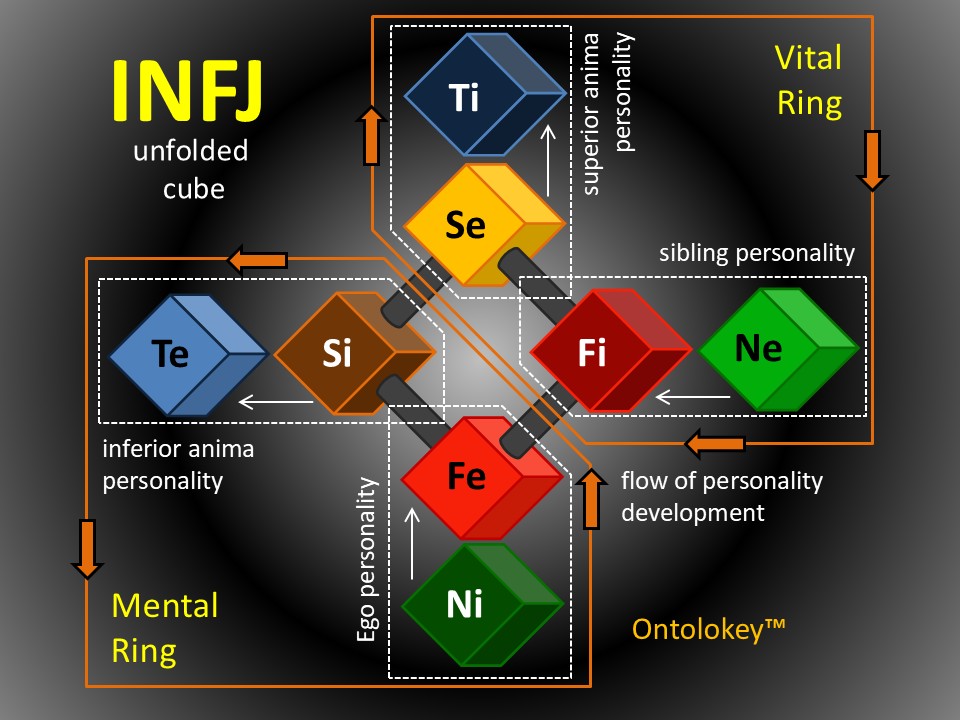
Growth consequently cannot mean abandoning Ni or Fe, because these functions constitute the natural center of the INFJ’s psychological orientation. Rather, development means progressively widening the field of consciousness so that intuition is brought into dialogue with reality, empathy is separated from emotional over-responsibility, idealism is separated from perfectionism, and moral conviction is separated from moral superiority. The Ontolokey cube provides a concrete image for this process because it presents the INFJ not merely as a fixed arrangement of familiar characteristics but as a multidimensional psychological landscape in which less-developed functions can be recognized and consciously approached. Ni may provide vision, Fe relational attunement, Ti internal clarification, and the less familiar functions increasingly expose what the preferred conscious personality tends to leave outside its immediate field of attention. In this sense, the cube can be understood as a developmental map: the sliders do not tell the INFJ what they must become, but make visible the directions in which psychological energy can be consciously redistributed. The aim is not to destroy the familiar self, but to make it less one-sided, so that what was previously experienced as contradiction can gradually become psychological complementarity.
From Shadow Recognition to Deliberate Integration
Once the INFJ recognizes that the shadow is not an enemy but a collection of neglected psychological possibilities, the question changes from What is wrong with me? to What part of myself have I not yet learned to use consciously? This is the point at which self-knowledge must become practice, because insight alone can easily become another form of retreat into the inner world. The INFJ is particularly vulnerable to this because understanding comes naturally: a pattern can be recognized, named, interpreted, and placed within a larger psychological narrative, creating the satisfying sensation that something has already been resolved simply because it has been understood. Genuine integration begins later, when the person deliberately behaves differently in situations that activate the old pattern and remains present long enough to experience the discomfort of doing so. The developmental movement is therefore cognitive before it becomes behavioral: first the INFJ notices the automatic interpretation, then questions it, then allows another function to contribute information, and finally acts from a broader field of consciousness rather than from the original reflex. Ontolokey’s conception of the personality as a landscape is particularly compatible with this process because its eight-function architecture and movable relationships provide a visual language for psychological movement rather than portraying personality as an immovable identity.
The first practical exercise is therefore cognitive deceleration: whenever Ni produces a powerful impression about another person, a relationship, or the future, the INFJ can consciously separate the perception from the conclusion drawn from it. “I noticed this” is not identical to “I know what this means,” and “I sense where this is going” is not identical to “this is what will happen.” Ne can be invited into the process by generating alternative explanations, Ti by examining whether the interpretation is internally coherent, and Se by asking what is concretely observable in the present moment rather than what the event symbolically represents. This does not require the INFJ to distrust intuition; it requires intuition to become more sophisticated by tolerating uncertainty around its own conclusions. Such a practice gradually weakens one of the deepest shadow mechanisms described in the Ontolokey material: the transformation of an initially subtle perception into a psychologically complete narrative that becomes increasingly difficult to challenge because it feels internally meaningful. The mature INFJ does not have to abandon the sentence “I have a strong feeling about this,” but learns to add another sentence immediately afterward: “What else could be true?” That small cognitive opening creates the space in which intuition becomes a source of inquiry rather than an unconscious verdict.
A second developmental movement concerns Fe and Fi, and here the INFJ encounters one of the most intimate tensions in the entire psychological structure. Fe naturally directs attention toward the emotional field between people: what others need, what creates harmony, what might repair a rupture, and how one’s own behavior affects the surrounding atmosphere. Fi, described by Ontolokey as the INFJ’s Golden Shadow, introduces a different question: What is true for me, regardless of whether it creates harmony or receives external confirmation? When Fi remains insufficiently conscious, the INFJ may give extensively and then experience disappointment when others do not spontaneously recognize the sacrifice, because the need itself was never clearly stated. Integration requires making the hidden personal position explicit before resentment accumulates: saying no before exhaustion, stating a preference before accommodation becomes self-erasure, and acknowledging anger before it has to emerge through withdrawal or coldness. In this sense, Fi does not make the INFJ less compassionate; it gives compassion an internal boundary, allowing care to become a conscious act rather than an unconscious obligation.
The same principle applies to Se, perhaps the most immediate developmental challenge for an INFJ whose consciousness naturally gravitates toward abstraction, interpretation, and future-oriented meaning. Se asks the INFJ to enter the present without first transforming it into a psychological symbol, to experience the body without treating bodily experience as secondary, and to act before every uncertainty has been resolved internally. This can be surprisingly difficult because the INFJ may experience immediate reality as noisy, intrusive, unpredictable, or insufficiently meaningful compared with the richness of the inner world. Yet precisely for that reason, deliberate sensory engagement can become a form of cognitive integration: walking without headphones, cooking while attending to texture and smell, exercising, working with the hands, noticing the physical environment, or making a concrete decision without endlessly rehearsing its possible consequences are not trivial activities in this developmental context. They train the psyche to remain present when there is no deeper interpretation to hide inside. Se integration does not mean becoming impulsive or sensation-seeking; it means discovering that reality does not always need to be interpreted before it can be experienced.
The Te function, positioned as the Toddler in the Ontolokey framework, presents a different developmental invitation: translating insight into structure, intention into execution, and ideals into observable results. INFJs can possess considerable clarity about what matters while remaining comparatively uncertain about systems, deadlines, measurable objectives, or efficient implementation, particularly when an external structure feels disconnected from personal meaning. Development therefore involves learning to ask practical questions that intuition alone does not answer: What exactly needs to happen? What is the next concrete step? What evidence would show that this is working? What can be completed rather than endlessly refined? These questions are not a rejection of the INFJ’s depth; they are the bridge through which depth acquires worldly form. Ontolokey’s description of Te as a less-developed function is useful here because it suggests that the INFJ does not need to wait until efficiency feels completely natural before beginning to practice it; competence can emerge gradually through repeated, conscious use.
The Shadow of the Ideal Self
The most difficult shadow work for the INFJ begins when the person discovers that even apparently noble motives can contain unconscious compensations. An INFJ may genuinely want to help, understand, protect, reconcile, or improve the lives of others, yet beneath these intentions there can sometimes be an unacknowledged need to be indispensable, morally coherent, psychologically superior, or protected from the vulnerability of simply needing something for oneself. This is where the distinction between care and control becomes psychologically decisive: care allows another person to remain autonomous, whereas unconscious control attempts to shape the emotional or moral environment so that it conforms to an internal vision of how things ought to be. Because Ni can construct an intricate interpretation of motives and Fe can perceive subtle interpersonal tensions, the INFJ may become extraordinarily persuasive in explaining why a particular intervention is necessary, while remaining unaware that the intervention also serves an unconscious personal need. The shadow therefore does not necessarily announce itself through obviously destructive behavior; it can hide inside virtues that have become rigidly identified with the self. The Ontolokey material’s emphasis on the INFJ’s deepest shadow is valuable precisely because it directs attention toward this uncomfortable territory, where the question is no longer whether one’s intention appears good but whether the entire psychological system surrounding that intention remains open to self-correction.
This becomes especially important when the INFJ experiences disappointment. A person who habitually anticipates the needs of others may unconsciously expect others to reciprocate through the same degree of attentiveness, even though that expectation has never been explicitly communicated. When the expected recognition fails to arrive, the resulting hurt can become disproportionately intense because it touches several layers simultaneously: the immediate disappointment, the accumulated fatigue of giving, the feeling of being misunderstood, and perhaps the deeper conviction that one’s inner world is rarely seen with comparable depth. At this point, Fe can become entangled with an idealized self-image, while the neglected personal perspective begins to emerge indirectly as resentment, withdrawal, silent judgment, or the conviction that others are emotionally immature. The INFJ may then retreat into Ni and construct an increasingly elaborate explanation of the relationship, often finding enough evidence to confirm the original interpretation while overlooking evidence that would complicate it. Integration requires interrupting this cycle much earlier by acknowledging the personal need without moralizing it: I wanted recognition; I wanted reciprocity; I wanted to matter; I am angry; I feel overlooked. Such admissions are psychologically significant because they allow the INFJ to possess ordinary human needs without having to disguise them as principles.
The shadow can become even more difficult when the INFJ’s idealism encounters the ordinary imperfection of reality. Ni often perceives what something could become, while Fe can invest emotionally in the possibility that people, relationships, institutions, or communities might move toward that better state. This capacity can inspire extraordinary commitment, but it can also generate chronic dissatisfaction when reality repeatedly refuses to conform to the internal image. The danger is not idealism itself but the unconscious conversion of an ideal into a standard by which actual people are silently judged, including the INFJ themselves. Perfectionism may then become morally disguised: instead of saying “I cannot tolerate that this is imperfect,” the psyche says “This matters too much to accept mediocrity,” and instead of saying “I am disappointed that this person cannot meet my expectations,” it says “I simply see what they are not yet capable of seeing.” Development requires the difficult realization that insight into potential does not create entitlement to its realization. The mature INFJ can continue to perceive possibilities while relinquishing the unconscious demand that reality validate the vision.
Another shadow movement occurs when the INFJ becomes convinced that being misunderstood is evidence of being fundamentally alone. There is some truth in the experience: an inward psychological life organized around complex associations, symbolic meanings, subtle emotional distinctions, and long-range intuitions can be difficult to communicate completely, and repeated experiences of being misunderstood may encourage withdrawal into an increasingly private interior world. Yet the resulting solitude can become self-reinforcing when the INFJ stops testing whether others might understand and begins assuming beforehand that they cannot. The psyche then receives exactly the evidence it expected: distance produces less mutual understanding, which confirms the belief that genuine understanding is rare, which justifies greater distance. Breaking this pattern requires the INFJ to risk imperfect communication—to explain rather than merely hint, to ask rather than infer, to disclose rather than wait to be intuitively discovered, and to tolerate the possibility that another person may understand only part of the inner experience without therefore making the relationship meaningless. Psychological integration is often less dramatic than the INFJ imagines; sometimes it consists simply in allowing another person to be different, limited, and still genuinely connected to oneself.
The deepest developmental movement, therefore, is not toward a purified INFJ who has eliminated contradiction, but toward an INFJ who can tolerate contradiction without immediately resolving it into a familiar identity. The person can be compassionate and angry, idealistic and pragmatic, intuitive and uncertain, private and relational, generous and self-protective, spiritually oriented and attached to ordinary material life. These oppositions become psychologically dangerous only when one pole is permitted to belong to the conscious self while the other is expelled into the shadow. The Ontolokey Cube offers a practical visualization for precisely this problem because the functions can be contemplated as a connected three-dimensional structure rather than as isolated labels: the developmental task is to notice which psychological positions are habitually occupied and which remain psychologically distant, then use the sliders as a visual reminder of where greater consciousness might be cultivated. In that sense, the cube becomes less a device for declaring who the INFJ is than a means of asking which parts of the INFJ are currently allowed to participate in consciousness. The ultimate objective is not balance in the mechanical sense, but greater freedom: the freedom to choose among psychological possibilities instead of being unconsciously governed by the few that have always felt most natural.
The Ontolokey Cube as a Practice of Conscious Development
The psychological value of the Ontolokey Cube lies in its ability to turn an otherwise abstract developmental problem into something that can be observed spatially and therefore contemplated repeatedly. The INFJ can easily understand the idea that some functions are highly familiar while others feel remote, awkward, excessive, or strangely compelling, but understanding this intellectually does not necessarily reveal how development should proceed in everyday life. The cube offers a visual representation in which the psychological functions can be regarded as positions within a larger structure, allowing the INFJ to notice not only the functions that dominate consciousness but also those that remain comparatively undeveloped or shadowed. The sliders become particularly useful when they are treated as prompts for experimentation rather than as instructions for constructing a new personality: moving attention toward a neglected function means asking what happens when that mode of perception or judgment is deliberately given more room. The resulting process is fundamentally exploratory, because psychological development cannot be reduced to replacing one fixed configuration with another; it consists of learning how different modes of consciousness alter perception, interpretation, emotion, and action. In this sense, the cube can accompany the INFJ through an ongoing process of differentiation, integration, and conscious choice.
For the INFJ, this developmental experiment can begin with the functions that feel least comfortable rather than those that already provide competence. When Ni becomes excessively dominant, the first corrective movement may be toward Se and the concrete present; when Fe becomes excessive, Fi can remind the person that personal values and needs exist independently of interpersonal harmony; when Ti becomes overly detached, Fe can restore awareness of the human consequences of abstract reasoning; and when the INFJ remains trapped in contemplation, Te can force a translation from insight into measurable action. The purpose is not to push every function to an equal level, because psychological individuality would be lost if development simply meant flattening the natural hierarchy. Instead, the INFJ can gradually strengthen the psychological muscles that are weak enough to become sources of distortion when they are required under pressure. A neglected function often first appears in an immature or exaggerated form, which means that early encounters with it may feel unpleasant rather than liberating. That discomfort should not automatically be interpreted as evidence that the function does not belong to the INFJ; it may indicate precisely why conscious practice is needed.
One particularly productive way to use the cube is to examine recurring life situations and ask which function automatically takes command before conscious reflection begins. Consider conflict: does the INFJ immediately search for the hidden meaning of the disagreement, attempt to restore harmony, construct an internal explanation of the other person’s motives, or withdraw until the entire situation can be understood? Each response may contain legitimate psychological intelligence, but each can also become defensive when it excludes alternative modes of engagement. The developmental exercise is to introduce one additional function deliberately into the sequence: observe the concrete facts, identify one’s own values, examine the logical structure of the disagreement, state the practical objective, or simply remain present without immediately interpreting the event. Repetition matters because integration is not achieved through one profound realization; it develops through accumulated experiences in which the psyche discovers that previously unfamiliar responses do not destroy the self. Over time, what initially felt artificial can become available spontaneously, expanding the INFJ’s repertoire without requiring the abandonment of the intuitive and empathic qualities that originally defined the personality.
This approach also changes the meaning of the shadow itself. If the shadow is understood only as a collection of undesirable characteristics, the natural response is suppression, shame, or defensive rejection, which paradoxically gives unconscious material greater power. If, however, shadow material is understood as containing functions and psychological possibilities that consciousness has not sufficiently developed, then uncomfortable reactions become information. Irritation can reveal a disowned value; envy can reveal an unrealized desire; excessive judgment can expose a quality one has difficulty permitting in oneself; sudden impulsivity can signal neglected embodiment; resentment can indicate a boundary that was never consciously established. None of these reactions should be romanticized or automatically obeyed, but each can be investigated before being judged. The essential movement is from identification to observation: instead of saying “This is who I am when I am angry,” the INFJ learns to say “Something in me is angry, and I want to understand what this anger is protecting or demanding.” This small distinction creates psychological distance without creating repression, allowing cognition to mediate between impulse and action.
The most mature use of the Ontolokey model therefore involves a paradox: the cube becomes most useful when the INFJ stops treating it as a definitive description of identity and begins using it as an instrument of self-observation. Its sliders can serve as reminders that psychological development is dynamic, contextual, and capable of movement, while the three-dimensional structure can help the individual visualize relationships between functions that are otherwise difficult to hold simultaneously in consciousness. The important question is not whether the INFJ has “moved” far enough toward one function or another, but whether consciousness has become sufficiently flexible to recognize when the habitual response is no longer adequate. Development is successful when the person gains the freedom to choose a different psychological instrument without experiencing that choice as a betrayal of the self. The INFJ does not become less INFJ by becoming more psychologically complete; rather, the familiar INFJ qualities become less defensive, less compulsive, and more freely chosen because they are no longer required to carry the entire burden of the personality.
From Insight to Practice
The decisive stage of INFJ development begins when psychological understanding is translated into deliberate behavior. The INFJ can spend years studying personality, relationships, motives, archetypes, and inner dynamics, yet remain caught in the same emotional patterns if insight never becomes an intervention into daily life. The first practical discipline is therefore to observe the moment at which interpretation becomes identification: the moment when an intuitive impression stops being something one has *and becomes something one believes one is. A useful internal practice is to distinguish among three levels of experience—what is directly observable, what is intuitively inferred, and what is subsequently concluded—and to resist collapsing them into one another. This creates a small but important interval in which Ti can examine the interpretation, Se can return attention to observable reality, and the less familiar functions can contribute information before Ni constructs the final meaning. With repetition, this does not weaken intuition; it makes intuition less vulnerable to projection, emotional investment, and confirmation of an already established inner narrative.
A second discipline concerns the INFJ’s relationship with emotional responsibility. Because Fe is naturally attentive to the psychological atmosphere between people, the INFJ may unconsciously experience another person’s discomfort as something that must be solved, softened, interpreted, or absorbed. This can create an invisible contract in which the INFJ takes responsibility for maintaining harmony while simultaneously expecting others to recognize the effort involved, eventually producing exhaustion and resentment. Growth requires a more differentiated understanding of responsibility: one can care about another person’s feelings without assuming responsibility for regulating them, and one can contribute to harmony without making harmony the condition for one’s own psychological stability. This distinction becomes particularly important in intimate relationships, where the INFJ may be tempted to anticipate needs rather than communicate openly about them. Instead of silently adjusting, the developmental task is to state preferences, boundaries, disappointments, and needs while allowing the other person the freedom to respond differently. In this way, Fe becomes relational openness rather than emotional self-abandonment, while the emerging Fi perspective gives the INFJ permission to recognize that personal authenticity is not selfish simply because it introduces tension.
A third discipline involves learning to tolerate the ordinary incompleteness of action. Ni naturally seeks coherence, and the INFJ can become reluctant to act until the internal picture feels sufficiently integrated, meaningful, and correct. Yet many important decisions cannot be resolved through further contemplation because the missing information becomes available only after action has begun. Te and Se therefore provide a necessary corrective by introducing experimentation: formulate a reasonable hypothesis, take a concrete step, observe the result, and revise accordingly. This method may initially feel crude compared with the richness of internal reflection, but it teaches the INFJ an important psychological truth—that clarity is sometimes produced by action rather than achieved beforehand. The person who waits until every consequence has been mentally integrated can remain psychologically sophisticated while practically immobilized. The person who accepts provisional action discovers that reality itself can become a source of cognition, providing information that imagination alone cannot generate.
The same principle applies to interpersonal perception. INFJs are often capable of noticing subtle inconsistencies in speech, affect, behavior, and motivation, and this sensitivity can become one of their greatest strengths. Yet the more convincing an interpretation feels, the more important it becomes to distinguish perception from certainty, because a sophisticated psychological explanation can still be wrong. Development therefore requires the humility to test interpretations directly rather than quietly accumulating evidence for them. Instead of deciding that someone is distant because they are threatened, manipulative because they seek control, or indifferent because they fail to respond as expected, the INFJ can ask a question and tolerate an answer that disrupts the preferred narrative. This practice is psychologically demanding because it sacrifices the security of knowing for the possibility of discovering something genuinely new. It also protects the INFJ from one of the subtler forms of shadow functioning: using psychological insight not to understand another person more freely, but to make the person predictable enough to feel emotionally safe.
Ultimately, these practices lead toward a different relationship with uncertainty. The developing INFJ gradually discovers that psychological maturity does not consist in possessing increasingly accurate explanations for everything that happens, but in becoming capable of remaining conscious when no satisfactory explanation is immediately available. This is particularly significant for a personality organized around meaning, because uncertainty can feel like an unfinished psychological task rather than a normal condition of existence. Yet allowing something to remain unresolved can itself become an act of integration: intuition may remain open without forcing a conclusion, feeling may remain present without demanding immediate reconciliation, thinking may examine without reducing, and sensation may simply register without being transformed into symbolism. The INFJ thereby moves from the need to understand everything toward the capacity to remain present with what is not yet understood. That movement represents one of the deepest forms of cognitive freedom available to this personality, because it allows consciousness to become larger than the narratives it creates.
The Integration of Contradiction
As the INFJ becomes more conscious of the shadow, a further transformation becomes possible: contradiction no longer has to be resolved by choosing one side and rejecting the other. The mature personality can contain qualities that appear incompatible without immediately turning one into the virtue and the other into the defect. An INFJ can be deeply caring while also refusing to rescue people, highly intuitive while acknowledging uncertainty, idealistic while accepting imperfect outcomes, private while allowing genuine intimacy, and morally serious while recognizing that personal convictions are not automatically universal truths. This capacity matters because psychological one-sidedness often develops precisely through the belief that certain qualities are inherently “me” while their opposites belong to other people. The shadow then becomes the repository of everything that threatens the preferred self-definition, and encounters with those qualities evoke disproportionate reactions because they challenge identity rather than merely behavior. Integration begins when the INFJ can recognize these opposites as human capacities that may need conscious regulation rather than permanent exclusion.
This is particularly relevant to anger, aggression, competitiveness, and the desire for personal power, all of which can be difficult for an INFJ to integrate when the conscious identity is strongly associated with empathy and benevolence. Suppressed anger does not necessarily disappear; it may become indirect criticism, emotional withdrawal, moral disappointment, passive resistance, or an intense internal judgment of those who appear less considerate. Likewise, competitiveness can be rejected consciously while still operating unconsciously through comparison, achievement, or the desire to be recognized for one’s uniqueness. The developmental task is not to become aggressive or competitive for their own sake, but to recognize that assertiveness, self-protection, ambition, and the capacity to confront opposition are legitimate psychological resources. When these energies become conscious, they can be directed toward boundaries, disciplined work, honest disagreement, and protection of what genuinely matters. The INFJ becomes less dependent on being perceived as kind because kindness is no longer being used to deny the existence of anger, power, or self-interest.
The same integration must occur around the INFJ’s relationship to recognition. A person who invests deeply in understanding others may secretly long to be understood with equal depth, and a person who gives meaning to other people’s lives may understandably wish for their own inner world to be recognized as meaningful. The shadow emerges when this legitimate desire becomes disguised as detachment: “I do not need recognition,” “I do not care whether anyone understands me,” or “I would rather remain unseen.” Such statements can sometimes represent genuine independence, but they can also function as defenses against the vulnerability of wanting something that another person may refuse to provide. The more honest position is psychologically stronger because it allows the INFJ to acknowledge the desire without making it another person’s obligation. One can want appreciation without demanding it, want reciprocity without manipulating it, and want intimacy without assuming that another person should possess the same psychological depth or sensitivity.
Integration also requires the INFJ to reconsider the meaning of failure. When identity is strongly connected to insight, integrity, and the ability to perceive what others overlook, being wrong can threaten more than a particular conclusion; it can challenge the person’s sense of psychological authority. This is why deliberate encounters with error can become unusually productive. The INFJ can practice saying, without qualification or elaborate explanation, “I interpreted that incorrectly,” “I projected something onto this person,” or “My intuition was compelling, but it was not accurate.” Such statements are not humiliations; they are exercises in separating the self from the correctness of the self’s interpretations. Ti becomes more rigorous when it is allowed to falsify cherished conclusions, while Se and Ne provide alternative information that the original intuitive construction may have excluded. The result is a more resilient form of intuition—one that does not need to be infallible in order to remain valuable.
At the deepest level, this integration changes the INFJ’s understanding of identity itself. The question gradually shifts from “Which of these qualities defines me?” toward “Which psychological response serves reality most adequately in this situation?” This is a profound shift because it loosens the ego’s attachment to a fixed portrait of the self and allows personality to become more flexible without becoming formless. The Ontolokey Cube can function here as a continual visual reminder that the psyche contains more possibilities than the dominant conscious configuration ordinarily expresses, and that development can involve consciously giving neglected functions opportunities to participate. The sliders can therefore be used as instruments of reflection: when a familiar response repeatedly produces the same difficulty, the INFJ can ask which less-developed function might introduce information that is currently missing. Over time, the goal is not to create an artificial balance between all functions, but to establish enough cognitive access to the wider psychological landscape that the INFJ is no longer imprisoned by the strengths that once defined them.
A Conscious Relationship with the Self
The final stage of this developmental process is not the construction of a perfected personality, but the establishment of a more honest relationship with oneself. The INFJ’s greatest strengths—intuition, empathy, idealism, psychological depth, imagination, and the ability to perceive patterns beneath appearances—do not need to be corrected simply because they can have shadow expressions. What needs to change is the degree to which these strengths are unconsciously used to maintain psychological security. Intuition becomes healthier when it can tolerate being wrong, empathy becomes healthier when it does not require self-sacrifice, idealism becomes healthier when it can coexist with imperfection, and introspection becomes healthier when it ultimately returns the person to lived reality. The INFJ does not need to become less deep, less sensitive, or less idealistic; rather, these qualities need to become less compulsory and more consciously chosen. Psychological maturity begins when the personality can use its natural gifts without needing those gifts to confirm a particular image of who it is.
This also means accepting that development is cyclical rather than linear. Even after considerable integration, stress, exhaustion, rejection, intimacy, failure, or major life transitions can reactivate familiar defensive patterns, and the INFJ may temporarily return to overanalysis, withdrawal, emotional over-responsibility, perfectionism, or an excessive reliance on internal certainty. Such regression should not automatically be interpreted as failure, because previously unconscious material often becomes visible precisely when ordinary psychological defenses are weakened. The important question is whether the INFJ can recognize the pattern sooner and recover with greater consciousness than before. The Ontolokey Cube can support this kind of longitudinal self-observation because the psychological landscape can be revisited at different stages of life, allowing the individual to ask not simply which functions are theoretically strong or weak, but which ones are actually being used under particular circumstances. Development therefore becomes an iterative dialogue between the personality one naturally inhabits and the psychological possibilities one is learning to access.
The practical discipline can remain remarkably simple even when the underlying psychology is complex. When intuition produces certainty, introduce alternatives; when empathy produces obligation, introduce boundaries; when idealism produces disappointment, introduce acceptance; when analysis produces distance, introduce human contact; when contemplation produces paralysis, introduce action; when emotional harmony becomes more important than personal truth, introduce honest self-expression; and when immediate reality feels uncomfortable or meaningless, introduce sensory presence. These are not commandments and they are not meant to transform the INFJ into another personality type. They are cognitive counterweights that allow neglected perspectives to enter consciousness before the habitual function has already determined the response. The Ontolokey sliders can make these counterweights tangible: rather than asking abstractly whether one should “develop the shadow,” the INFJ can identify a concrete area of life in which a particular function needs more conscious participation and then observe what happens when that capacity is deliberately strengthened. Small, repeated adjustments are more psychologically consequential than dramatic declarations of self-transformation because they gradually alter the relationship between perception, cognition, emotion, and action.
There is also a deeper ethical dimension to this work. The more psychologically perceptive an INFJ becomes, the greater the responsibility to use that perception without turning it into an instrument of control. Seeing another person’s vulnerability does not grant permission to define that person, knowing a relational pattern does not entitle one to manipulate its outcome, and sensing what someone may need does not eliminate their right to express what they actually want. The integrated INFJ therefore learns to replace psychological possession with psychological curiosity: I may perceive something, but I can still be wrong; I may understand something, but I do not own the meaning of another person’s experience. This humility protects both relationships and the INFJ’s own inner life, because it prevents insight from becoming another form of ego identification. Psychological depth reaches its mature form not when the INFJ can see through everyone, but when the INFJ can see deeply without needing to stand above what is being seen.
The developmental destination can therefore be described as freedom from psychological one-sidedness. The INFJ’s task is not to eliminate the shadow, because doing so would simply recreate repression under a different name, nor is it to indulge every shadow impulse in the name of authenticity. The task is to bring unconscious tendencies into cognition, examine them without premature judgment, understand the legitimate need or function concealed within them, and then decide consciously how that energy should be expressed. This is the essential movement from unconscious identification toward integration: I am not required to obey every part of myself, but neither must I exile any part of myself from awareness. When the INFJ reaches this position, the shadow becomes less an adversary and more a source of previously unavailable information, while the conscious personality becomes increasingly capable of responding to reality rather than merely reproducing its habitual interpretation of reality. The result is not a different INFJ, but a more spacious one—one whose intuition can remain profound because it is no longer afraid of uncertainty, whose empathy can remain generous because it possesses boundaries, and whose inner vision can become action because the wider psychological landscape has finally been invited to participate.
The Way Toward Psychological Wholeness
The INFJ’s developmental journey can ultimately be understood as a movement from psychological specialization toward psychological wholeness. The very qualities that make this personality distinctive—Ni’s capacity to perceive underlying patterns and future possibilities, Fe’s sensitivity to the emotional field between people, Ti’s search for internal coherence, and the less familiar functions that challenge the established order—form a psychological system in which strength and vulnerability are inseparably connected. The shadow emerges wherever consciousness becomes too identified with one side of that system and begins to treat the excluded side as foreign, inferior, or dangerous. For the INFJ, this may mean becoming identified with being insightful rather than allowing oneself to be uncertain, with being understanding rather than admitting anger, with being generous rather than acknowledging personal needs, or with being idealistic rather than accepting the limitations of reality. Growth begins when these oppositions are brought into cognition without shame and without romanticizing them, so that what was previously unconscious can become available for deliberate choice. The purpose of development is therefore not self-correction in the narrow sense, but an expansion of the psychological territory from which the self can act.
The Ontolokey Cube provides a practical image for this expansion because it allows the INFJ to see the personality as a dynamic landscape rather than as a closed definition. Its functions and sliders can be used as a continuing exercise in self-observation: when a familiar response repeatedly appears, the INFJ can ask what information is missing and which less-developed function might provide it. The cube can thus become a visual companion to cognitive integration, helping transform the abstract intention to “work on oneself” into a more concrete process of shifting attention, experimenting with unfamiliar perspectives, and observing the consequences. No single position on the cube needs to become an absolute destination, because development is contextual and life continually presents new circumstances in which different psychological capacities become relevant. What matters is increasing freedom of movement within one’s own psychological landscape. The more functions become consciously accessible, the less the INFJ has to rely automatically on the same interpretive, emotional, or defensive strategies whenever uncertainty or conflict arises.
The deepest form of INFJ growth is consequently not the disappearance of the shadow but the end of the need to keep the shadow unconscious. The INFJ can learn to recognize the wish for recognition without being ruled by it, anger without becoming destructive, self-interest without becoming indifferent, ambition without becoming dominated by status, intuition without confusing it with certainty, and empathy without assuming responsibility for every emotional state encountered. Such integration does not make the personality less sensitive; it makes sensitivity more discerning. It does not make the INFJ less idealistic; it makes idealism more capable of surviving contact with reality. It does not make the individual less inward; it makes the inner world more permeable to information from outside itself. The ultimate achievement is a personality that can contain opposing psychological movements without immediately converting one into virtue and the other into defect, because consciousness has become sufficiently broad to recognize both as parts of the human psyche.
For the INFJ, this may be the most important lesson of shadow work: you do not become whole by becoming more perfectly yourself; you become whole by becoming conscious of what your preferred self has left outside the frame. Every time the INFJ questions an apparently certain interpretation, states a need instead of silently sacrificing it, accepts an imperfect outcome instead of correcting it, takes concrete action instead of remaining in contemplation, or allows another person’s experience to remain genuinely separate from their own, another fragment of the shadow enters consciousness. These movements may initially feel unnatural precisely because they challenge the established organization of the personality, but repeated cognitive engagement gradually converts unfamiliar possibilities into available resources. The process is neither quick nor linear, and it does not require the abandonment of the qualities that have always felt most authentic. It requires only the courage to discover that authenticity can become larger than the identity one originally built around it.
The INFJ therefore has no need to regard development as a departure from the self. It is better understood as a return to a more complete self—one in which intuition can meet sensation, empathy can meet individuality, analysis can meet relationship, vision can meet execution, and the conscious personality can encounter its own shadow without turning away. The Ontolokey Cube can serve as a practical reminder of this ongoing movement, while the more detailed INFJ explorations on Ontolokey.com provide a broader psychological landscape for readers who want to examine the type’s conscious and shadow dynamics in greater depth. The same material can also be explored across the other personality types, making it possible to use the framework not only for self-understanding but for developing a richer appreciation of the different cognitive architectures through which people experience the world. The final task is therefore neither to escape one’s personality nor to perfect it, but to become increasingly capable of choosing how that personality is expressed. The INFJ grows when insight becomes consciousness, consciousness becomes choice, and choice gradually becomes a more integrated way of living.


Leave a comment