From the Social Mirror to Psychological Wholeness
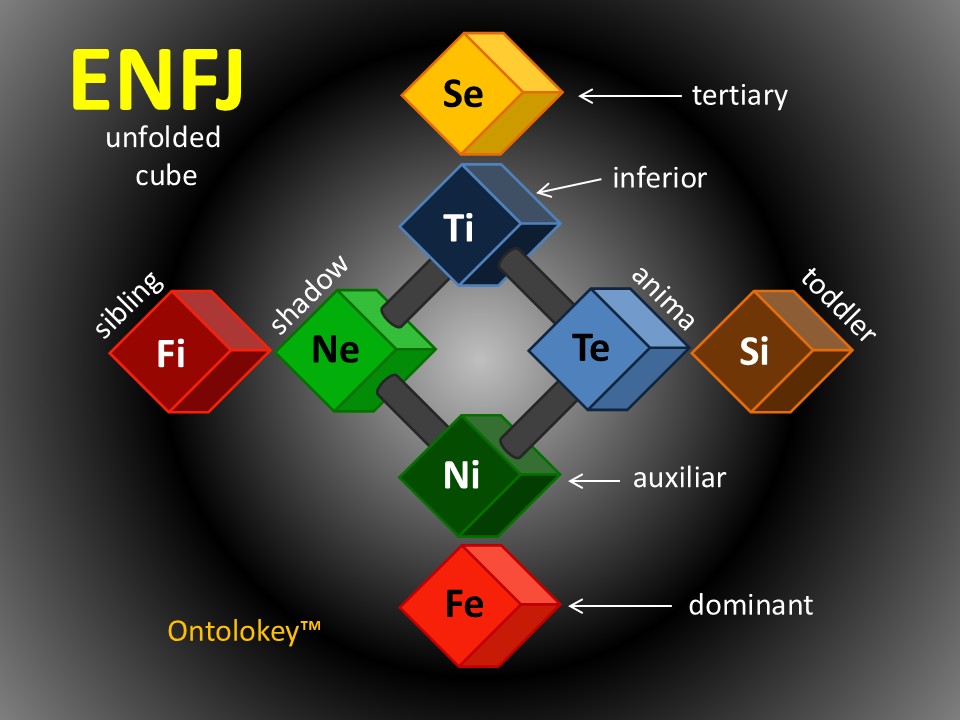
The ENFJ is often recognized through qualities that are immediately visible to other people: warmth, charisma, emotional intelligence, idealism, persuasion, and a remarkable capacity to give direction to a group or relationship. In the Ontolokey perspective, however, these recognizable qualities are not the whole personality but the conscious surface of a much larger psychological landscape, centered primarily on Extraverted Feeling (Fe) and supported by Introverted Intuition (Ni), while other functions remain less consciously developed and therefore more likely to appear as tensions, projections, compensations, or shadows. Fe gives the ENFJ an extraordinary sensitivity to interpersonal atmosphere, collective values, emotional congruence, and the needs of the surrounding social field, while Ni provides the capacity to perceive patterns, anticipate developments, and organize present experience around an emerging sense of meaning and direction. Together, these functions can produce the familiar ENFJ combination of empathic presence and visionary purpose, making the individual particularly capable of motivating, educating, coordinating, advocating, and emotionally mobilizing other people. Yet precisely because these abilities are so powerful and socially rewarded, they can gradually become fused with identity, creating the central developmental problem of the ENFJ: learning to distinguish genuine care from the unconscious need to be needed, genuine leadership from the need for influence, and authentic identity from the reflection received through other people.
This is why the developmental task of the ENFJ cannot simply consist of becoming more empathetic, more inspiring, more socially capable, or more effective, because these are usually already among the personality’s most accessible resources. Growth begins when the individual becomes willing to examine what happens when these strengths are no longer sufficient to maintain psychological equilibrium, particularly when appreciation disappears, relationships become uncertain, others become independent, or one’s carefully formed vision is challenged by reality. The darker possibility is that compassion can become a defense against confronting one’s own needs, that generosity can conceal resentment when it is not reciprocated, that emotional sensitivity can become a means of controlling an atmosphere, and that idealism can protect the psyche from accepting aspects of reality that cannot be emotionally harmonized or transformed. None of this means that the ENFJ’s care is insincere; rather, the same behavior can contain both authentic love and unconscious compensation, and psychological maturity requires becoming capable of seeing both simultaneously. The shadow therefore should not be treated as an enemy that must be defeated, but as a neglected dimension of the personality whose emergence reveals precisely what the conscious identity has been unable or unwilling to contain.
The Eightfold Landscape of the ENFJ
Ontolokey makes this developmental tension visible by representing the eight psychological functions spatially through the three-dimensional cube, transforming what might otherwise remain an abstract sequence of functions into a landscape of proximity, opposition, tension, and potential integration. In the ENFJ configuration, Fe and Ni form the most recognizable conscious center, while Fi and Si belong to more accessible but less dominant dimensions, and Ti, Te, Se, and Ne progressively represent psychological territories that may initially feel less familiar, less trustworthy, or more difficult to inhabit consciously. The importance of this arrangement is developmental rather than merely descriptive: an ENFJ does not become psychologically whole by intensifying Fe and Ni indefinitely, because excessive identification with one’s preferred functions can actually strengthen the very one-sidedness from which the shadow emerges. The cube instead suggests a different movement, in which neglected functions are gradually brought into consciousness and allowed to contribute information that the dominant personality orientation would otherwise dismiss, thereby expanding the range of possible responses without requiring the individual to abandon their essential character. In this sense, the Ontolokey Cube can function as a practical psychological mirror, because the adjustable sliders provide a visual way of contemplating where a person habitually places psychological weight and which neighboring or opposing capacities may require greater conscious attention.
The Gift and the Trap of Emotional Intelligence
The ENFJ’s most visible strength is the capacity to perceive people not merely as isolated individuals but as participants in an emotional system. Within the Ontolokey description, Extraverted Feeling (Fe) functions as the primary lens through which the ENFJ notices interpersonal atmosphere, shared values, emotional congruence, and the effects that individual behavior has upon the surrounding social field. This can produce remarkable abilities in teaching, mediation, leadership, encouragement, counseling, and collective motivation, because the ENFJ often senses what a group needs before that need has been clearly articulated. Yet precisely because this sensitivity is so natural, it can become difficult for the ENFJ to recognize when perception has turned into identification, and when caring for others has become a means of maintaining a stable sense of personal worth. The psychological danger is not that the ENFJ cares too much, but that the personality can gradually learn to experience being needed as evidence of being valuable, thereby making other people’s dependence, appreciation, or emotional responsiveness unconsciously relevant to its own identity.
This creates a subtle psychological transaction that can remain invisible even to the person involved. An ENFJ may give generously, anticipate needs, offer guidance, mediate conflicts, remember emotional details, and invest enormous energy in another person’s development while consciously experiencing all of this as freely chosen care; nevertheless, an unconscious expectation of recognition can accumulate beneath the surface, particularly when the relationship becomes one-sided or the recipient eventually becomes independent. The resulting resentment can be confusing because the ENFJ may genuinely insist that nothing was demanded in return, while simultaneously feeling wounded that the other person did not recognize the magnitude of what had been given. This is one reason why psychological integration requires the ENFJ to examine not only what they do for people but also what psychological function that behavior performs within themselves. The crucial question becomes whether generosity remains generous when gratitude does not arrive, whether support remains loving when the other person chooses a different path, and whether the ENFJ can tolerate being emotionally important without needing to be indispensable. The movement toward maturity therefore begins when giving ceases to function as an unconscious contract and becomes an expression of freely chosen values rather than a strategy for securing identity.
A related difficulty emerges when emotional insight becomes confused with psychological authority. Because the ENFJ can often recognize motives, tensions, and unspoken needs with considerable immediacy, there is a temptation to assume that understanding another person’s inner state also grants the right to interpret, guide, or correct that person. The shadow appears when empathy becomes subtly directive: the ENFJ may believe they are merely helping someone discover what is best for them while unconsciously becoming invested in the outcome corresponding to their own vision. Here the combination of Fe and Ni can become particularly powerful, because Fe supplies sensitivity to the human field while Ni constructs a meaningful narrative about where that field ought to move; when these processes become fused with personal identity, disagreement can feel less like ordinary difference and more like resistance to something the ENFJ believes they can already see. Development therefore requires a difficult but liberating distinction between understanding and ownership: the ENFJ may perceive something important about another person without possessing the authority to determine what that person should do with it.
This distinction becomes especially important in intimate relationships, where the ENFJ’s natural inclination to invest deeply can make another person’s autonomy psychologically challenging. Genuine intimacy requires allowing another person to remain partly unknowable, internally sovereign, and capable of making decisions that the ENFJ considers mistaken. The mature ENFJ learns to remain emotionally connected without converting closeness into access, and to offer insight without turning insight into obligation. In Ontolokey terms, this is one of the places where the less dominant functions become developmentally important, because the ENFJ needs psychological resources that can interrupt the automatic authority of Fe and Ni. Fi introduces respect for the individual’s private value system, Ti questions whether one’s interpretation is actually justified, and Se returns attention to what is concretely happening rather than what the relationship is supposed to become. The result is not emotional withdrawal but a more differentiated form of love in which the ENFJ can say, in psychological terms, I may see something in you, I may care deeply about what happens to you, and I may still allow your life to belong entirely to you.
When Idealism Becomes Control
The ENFJ’s idealism is inseparable from its capacity to perceive human potential. Through the interaction of Fe and Ni, the personality can construct an unusually coherent image of what a relationship, community, project, or individual could become, and this future-oriented perception often provides the emotional energy required to turn abstract possibilities into concrete change. The difficulty begins when the imagined future becomes psychologically more compelling than the reality presently available, because the ENFJ may then experience ordinary human limitations as obstacles to be overcome rather than facts to be accepted. A person who is tired, ambivalent, inconsistent, or simply different from the ENFJ’s expectation can become unconsciously interpreted as someone who has not yet discovered their own potential, while a relationship that has naturally reached its limits can be experienced as something that still requires healing, improvement, or rescue. What begins as hope can therefore become insistence, and what appears externally as encouragement can internally become an inability to relinquish a preferred narrative. The developmental task is not to abandon idealism, but to acquire the capacity to hold an ideal without demanding that reality immediately conform to it.
This is particularly relevant to the ENFJ’s relationship with disappointment. When the personality invests emotionally in people and projects, disappointment can strike at several psychological levels simultaneously: the external plan has failed, the anticipated emotional harmony has disappeared, and the ENFJ may also be forced to confront the possibility that its perception of another person was incomplete. Because Ni tends to organize experience into patterns and meanings, a contradiction between expectation and reality can generate a powerful impulse to reinterpret the situation until coherence has been restored. In its healthier form, this capacity produces reflection and learning; in its shadow form, it can produce rationalization, selective perception, or an increasingly elaborate explanation for why reality should still lead toward the originally imagined outcome. The ENFJ’s growth therefore depends partly upon learning to distinguish meaning from certainty: a situation can have deep meaning without confirming the ENFJ’s interpretation of it, and another person can possess enormous potential without developing according to the path the ENFJ envisioned. Psychological maturity becomes possible when the ENFJ can experience the loss of an ideal without experiencing the loss of self.
The shadow becomes more pronounced when the ENFJ’s vision is combined with a strong emotional investment in being the person who makes transformation possible. The rescuer, mentor, organizer, advocate, or emotional architect can become an attractive identity because it provides both purpose and interpersonal significance, yet the same identity can make helplessness unusually difficult to tolerate. There are situations in which nothing can be fixed, nobody can be persuaded, and no amount of emotional labor can produce the desired reconciliation; these situations confront the ENFJ with an experience that cannot be solved through greater effort. If the personality responds by increasing its interventions, explaining more intensely, giving more, persuading more forcefully, or attempting to manage the emotional environment, the underlying issue may no longer be the welfare of the other person but the ENFJ’s inability to tolerate powerlessness. The deeper integration therefore involves learning that presence does not always require intervention, that love does not always require rescue, and that accepting another person’s consequences can sometimes be more psychologically respectful than continually attempting to prevent them.
This is also where the ENFJ must confront a less flattering possibility: sometimes the desire to help contains a desire to matter. Such a motive does not invalidate the help, because human motivations are rarely psychologically pure and care can coexist with the wish for recognition, intimacy, influence, or significance. What becomes problematic is the refusal to acknowledge the mixture, since unrecognized motives tend to operate indirectly and may emerge as irritation, moral judgment, disappointment, or withdrawal when the expected relational return does not materialize. A more integrated ENFJ can therefore examine the internal question beneath the external impulse: Would I still choose this action if nobody knew that I had done it, if the person never thanked me, and if the eventual outcome contradicted my hopes? The purpose of such questioning is not self-accusation but differentiation, because once the need for significance becomes conscious it no longer has to disguise itself as unconditional generosity. The shadow loses much of its power when the ENFJ can recognize both the noble and the self-serving components of an impulse without needing either side to define the whole personality.
The Hidden Problem of Selfhood
One of the deepest developmental tensions for the ENFJ concerns the boundary between who I am and what I mean to other people. When interpersonal perception is highly developed, the personality can become exceptionally responsive to the emotional expectations of its environment, adapting its expression in order to preserve connection, encourage cooperation, or create a sense of belonging. This flexibility is one of the ENFJ’s gifts, but without sufficient differentiation it can gradually produce an identity that is experienced more through relational feedback than through an internally articulated value system. The individual may know instinctively what others need, what a group expects, what will inspire someone, or what emotional response would restore harmony, while being considerably less certain about what they themselves want when no one else is present to respond. The resulting emptiness is not necessarily dramatic; it can appear as chronic overcommitment, difficulty saying no, discomfort with disappointing people, or the peculiar feeling of being surrounded by meaningful relationships while remaining strangely disconnected from one’s own private interior. The developmental movement toward psychological wholeness therefore requires the ENFJ to cultivate an inner center that does not depend upon continuous interpersonal confirmation.
Here the role of Introverted Feeling (Fi) becomes particularly significant within the Ontolokey framework. Fi represents a psychological orientation toward personal values, subjective authenticity, and the intimate experience of what is personally meaningful, and for an ENFJ this territory may initially feel less obvious than the shared emotional field of Fe. The developmental challenge is not to replace Fe with Fi or to become detached from other people, but to permit the private self to exist before it has been socially validated. This means discovering that an internal preference does not need a persuasive explanation, that a boundary does not become legitimate only after another person agrees with it, and that an emotion does not have to be socially useful in order to deserve attention. For the ENFJ, this can be surprisingly demanding because the instinct to contextualize experience relationally may immediately transform the question What do I feel? into What does this mean for everyone involved? Growth begins when the first question is allowed to remain unanswered by the second, giving the private psyche enough space to differentiate its own values from the expectations of the surrounding emotional world.
This differentiation also changes the meaning of authenticity. An immature understanding of authenticity can lead the ENFJ to believe that being authentic means expressing every feeling or refusing social adaptation, yet psychological authenticity is more subtle: it involves knowing which parts of one’s behavior are freely chosen and which are performed primarily to preserve an identity or relationship. The ENFJ therefore benefits from observing moments in which an apparently spontaneous act of kindness is accompanied by anxiety about how it will be received, or moments in which agreement arrives before personal reflection has had an opportunity to occur. Such observations can reveal the difference between I want to do this and I want to be the kind of person who does this, a distinction that becomes crucial when the latter identity has become morally charged. Once the ENFJ can tolerate being perceived as disappointing, selfish, distant, or imperfect without immediately correcting that perception, a previously hidden dimension of autonomy begins to emerge. This does not make the person less caring; it makes their care more voluntary because it is no longer required to prove that they are good.
The same process applies to boundaries, which for the ENFJ can become a form of shadow work rather than merely a practical interpersonal skill. A boundary forces the personality to accept that harmony sometimes depends upon allowing another person to experience frustration, disappointment, or disagreement, and this can challenge the ENFJ’s deeply ingrained impulse to regulate emotional discomfort within the surrounding environment. Saying no may therefore produce disproportionate internal tension even when the refusal is objectively reasonable, because the psyche interprets another person’s negative reaction as evidence that something relational has gone wrong. The corrective experience is to remain present while the other person is disappointed, resisting the reflex to explain excessively, compensate immediately, or reverse the decision simply to restore emotional equilibrium. In this way, boundaries become a laboratory for individuation: the ENFJ discovers that connection can survive disagreement, that love does not require constant accommodation, and that another person’s emotional response can be respected without becoming the ENFJ’s responsibility to eliminate it.
The Discipline of Inner Examination
The ENFJ’s developmental path ultimately requires a capacity that may initially feel less natural than emotional attunement: the willingness to suspend the impulse to interpret experience immediately through people, purpose, and meaning, and instead examine whether one’s own conclusions are logically sound. Within the Ontolokey configuration, Introverted Thinking (Ti) offers precisely this corrective movement, because Ti asks the individual to separate emotional significance from conceptual validity and to investigate whether an explanation actually holds together independently of its interpersonal appeal. For an ENFJ, this can be uncomfortable because Fe tends to register the human consequences of an idea almost simultaneously with the idea itself, making it tempting to judge an argument partly according to whether it promotes cohesion, understanding, or constructive movement. Yet reality does not become more coherent merely because an interpretation is compassionate, and another person’s pain does not by itself establish the truth of the explanation attached to that pain. Developing Ti therefore means learning to ask uncomfortable but clarifying questions: What exactly do I know? What am I inferring? What evidence would contradict my interpretation? Am I protecting a meaningful narrative because it is true, or because abandoning it would be emotionally difficult?
This intellectual differentiation is especially important because the ENFJ can become persuasive not only toward others but also toward itself. A highly developed ability to construct emotionally compelling narratives can make almost any experience intelligible after the fact, and the danger lies in confusing narrative coherence with psychological truth. When Ni supplies a powerful interpretation and Fe supplies the emotional language capable of communicating it, the resulting story can feel profoundly convincing even when important alternative explanations have never been examined. Ti introduces friction into this process by demanding definitions, distinctions, consistency, and a willingness to tolerate unresolved contradictions rather than resolving them prematurely. The ENFJ may discover that some interpersonal conflicts are not misunderstandings waiting to be clarified, that some people cannot be motivated by the reasons that would motivate the ENFJ, and that some situations contain incompatible values rather than a hidden synthesis waiting to be discovered. This realization can initially feel like a loss of optimism, but psychologically it represents a more mature form of realism in which complexity is allowed to remain complex without being converted immediately into a meaningful developmental narrative.
The integration of Ti also changes how the ENFJ handles criticism. When identity is strongly connected with being helpful, perceptive, ethical, or emotionally intelligent, criticism can threaten more than a particular behavior; it can appear to challenge the moral image through which the person understands themselves. The unconscious response may therefore be to explain intentions, provide context, demonstrate good motives, or redirect attention toward the positive purpose behind the criticized action. Such responses are understandable, but they can prevent the more valuable question from being asked: What if the other person’s interpretation contains information about me that my own self-image does not contain? Psychological growth requires the ability to let criticism enter the mind before deciding whether it is fair, unfair, complete, incomplete, malicious, insightful, or simply incompatible with another person’s perspective. Ti contributes precisely this interval of examination, creating a psychological space between accusation and defense in which the ENFJ can evaluate information without either automatically accepting it or reflexively rejecting it.
There is an important distinction here between self-criticism and self-examination. Self-criticism attacks the person in an attempt to force improvement, whereas self-examination investigates the person with enough neutrality to discover what actually happened, why it happened, and what alternative response might have been possible. The ENFJ does not need to become colder or more skeptical; rather, the goal is to make emotional intelligence accountable to discernment. When Ti is integrated, the individual can recognize that a compassionate intention can produce an intrusive behavior, that a correct observation can still be communicated destructively, and that being emotionally perceptive does not guarantee being objectively correct. The mature position is therefore neither I know what is best for everyone nor I cannot trust my perception, but something more psychologically demanding: My perception contains valuable information, and it remains open to examination. That attitude transforms intelligence from a tool of influence into a tool of individuation, allowing the ENFJ to become increasingly capable of seeing both other people and itself without immediately needing to alter what it sees.
Returning from the Future to the Present
The ENFJ’s intuition is often experienced through a powerful orientation toward what could become possible. Introverted Intuition (Ni) enables the personality to perceive patterns beneath visible events, connect apparently separate experiences, and form an internal image of where a person, relationship, or situation may be heading. This capacity can give the ENFJ unusual foresight, but it also creates a developmental risk: the imagined future can become so psychologically vivid that the present is unconsciously treated as an unfinished version of that future. When this happens, people are evaluated according to potential rather than actuality, relationships according to trajectory rather than present quality, and decisions according to their symbolic meaning rather than their immediate consequences. The shadow of Ni is therefore not simply pessimism or withdrawal but overinvestment in an interpretation of where reality is going. Growth requires the ENFJ to preserve its capacity for vision while developing the discipline to repeatedly return to what is actually observable, because the future can only be responsibly shaped when the present is perceived without excessive distortion.
This is where Extraverted Sensing (Se) becomes psychologically important within the Ontolokey landscape. Se directs attention toward immediate experience, concrete circumstances, sensory information, observable behavior, and the actual conditions existing here and now, which can counterbalance the ENFJ’s tendency to move rapidly from observation toward interpretation and projection. The developmental exercise is deceptively simple but psychologically profound: before asking what something means, notice what is happening; before deciding where a person is headed, observe what they are consistently doing; before constructing a theory about a relationship, attend to the quality of the relationship as it presently exists. This can be difficult for an ENFJ because interpretation often feels more valuable than raw observation, particularly when the individual has become accustomed to anticipating needs and outcomes. Yet the capacity to remain with facts without immediately turning them into a narrative can protect the personality from idealization, premature conclusions, and the emotional exhaustion created by continually attempting to bring reality into alignment with an anticipated future.
The integration of Se also offers a corrective to the ENFJ’s tendency toward psychological overextension. When the mind is continually occupied with what other people need, what a project might become, or how a situation should develop, the body can become merely the vehicle carrying the psychological mission forward. Fatigue, sensory overload, physical tension, environmental disorder, and simple pleasure may receive attention only after more important interpersonal or idealistic obligations have supposedly been satisfied. Yet embodied awareness introduces an entirely different form of information: sometimes the psyche is not asking for another interpretation, another conversation, or another plan, but for rest, movement, food, silence, nature, physical activity, or direct contact with the immediate environment. Such experiences can appear mundane compared with the ENFJ’s attraction to meaning and human transformation, but they can be profoundly grounding because they interrupt the tendency to live primarily in relational and anticipatory consciousness. Psychological integration therefore includes learning to inhabit life rather than constantly interpreting or improving it.
There is also a shadow lesson concerning spontaneity. The ENFJ may possess a strong internal image of how an experience should unfold, especially when social expectations, emotional atmosphere, and future intentions have already been mentally coordinated. Se introduces tolerance for what cannot be planned: an unexpected change, an unanticipated opportunity, an imperfect but enjoyable experience, or a moment that has no larger developmental purpose. Instead of asking whether an event contributes to the larger narrative, the integrated ENFJ can sometimes allow the event to exist simply because it is happening. This does not diminish the personality’s visionary nature; it prevents vision from becoming a prison. The psychological movement is from I know what this moment is leading toward to I can remain sufficiently present to discover what this moment actually contains, and that shift creates a form of freedom that cannot be achieved through greater planning, greater empathy, or greater certainty.
The Shadow of Efficiency and Expansion
The ENFJ’s shadow is not limited to emotional dependency or interpersonal control; it also includes the neglected relationship with thinking that is directed toward external systems, measurable outcomes, efficiency, and objective execution. In the Ontolokey landscape, Extraverted Thinking (Te) represents a different mode of engagement from Fe because it is less concerned with whether people feel aligned and more concerned with whether a process works, whether resources are being used effectively, and whether an objective can be achieved through a clear external structure. An ENFJ can therefore encounter Te as psychologically uncomfortable when efficiency requires decisions that create interpersonal friction, or when a desirable outcome must be pursued without extensive emotional negotiation. The shadow risk is consequently twofold: the ENFJ may either neglect practical structure because relational considerations continually take precedence, or abruptly adopt an excessively instrumental mode when frustrated, becoming unusually impatient with inefficiency and judging people according to their usefulness to a larger objective. Integration means learning to distinguish compassion from operational effectiveness rather than forcing one to replace the other. The question becomes not whether people matter or whether results matter, but how both forms of information can be consciously incorporated into a decision.
This becomes particularly important in leadership, because the ENFJ’s natural ability to motivate can obscure the practical architecture required to sustain what has been inspired. Vision can mobilize people initially, but projects eventually require priorities, timelines, resource allocation, delegation, measurement, accountability, and the willingness to discontinue approaches that no longer work. An ENFJ who relies predominantly upon interpersonal energy may compensate for structural weaknesses by personally supplying more effort, more encouragement, and more coordination, thereby becoming indispensable to a system that has never been properly organized. This can produce the paradox of the overfunctioning leader: the person who is exceptionally capable of inspiring others gradually becomes exhausted because the organization has unconsciously been designed around the leader’s ability to compensate for its deficiencies. Developing Te means learning to build structures that do not require constant emotional maintenance, to delegate without repeatedly rescuing delegated tasks, and to evaluate outcomes without interpreting every shortfall as a personal or relational failure. In this sense, efficiency can become an expression of care because a well-designed system reduces unnecessary dependence upon any single individual’s emotional labor.
Extraverted Intuition (Ne) introduces a different corrective by loosening the ENFJ’s tendency to organize experience around a coherent, singular direction. Ni typically seeks underlying convergence, looking beneath many observations for the pattern that connects them and the trajectory that appears most meaningful; Ne instead proliferates possibilities, associations, alternatives, and interpretations, allowing several potential futures to remain open simultaneously. For the ENFJ, this can be both liberating and destabilizing because an internally compelling vision may lose some of its authority when confronted with multiple equally plausible possibilities. Yet precisely this disruption can be psychologically valuable, especially when the personality has become attached to a particular interpretation of another person or situation. Ne encourages intellectual playfulness and makes room for the possibility that the future may contain opportunities that were not included in the original vision. Integration therefore involves occasionally asking not What is this ultimately becoming? but What else could this become?, not because every alternative deserves equal pursuit, but because psychological flexibility depends upon maintaining the ability to revise a preferred narrative.
The combination of Te and Ne can therefore broaden the ENFJ’s developmental repertoire in complementary ways. Te introduces external structure and consequence, while Ne introduces multiplicity and experimentation; together they challenge the assumption that a meaningful vision must be pursued through one emotionally coherent path. The mature ENFJ can retain its capacity to inspire while becoming more comfortable with systems, metrics, alternatives, competition between hypotheses, and outcomes that contradict initial expectations. This can also reduce the burden of perfectionism, because a project becomes an iterative process rather than a moral statement about the worth of the person leading it. The psychological gain is considerable: when results no longer function as proof of personal value and possibilities no longer threaten the original vision, the ENFJ becomes freer to experiment, revise, delegate, and learn. What was previously experienced as a threat to identity can then become information, and information is precisely what the shadow becomes capable of providing once it is consciously invited into the personality rather than unconsciously acting against it.
The Forgotten Ground of the Self
The remaining developmental territory becomes particularly important when the ENFJ encounters psychological material that cannot be organized through interpersonal meaning, future vision, personal values, or conceptual explanation. Introverted Sensing (Si) offers attention to continuity, memory, established experience, bodily signals, detail, and the accumulated evidence of what has actually happened over time, making it a useful counterweight to the ENFJ’s tendency to orient toward people and possibilities. When Si is insufficiently integrated, the individual may undervalue repetition, routine, precedent, and the quiet information contained in past experience because these can seem less significant than the next meaningful development. Yet psychological maturity requires more than discovering what might become possible; it also requires remembering what repeatedly occurs when the same patterns are enacted. The ENFJ can therefore use Si as a kind of historical conscience, asking which relational dynamics have appeared before, which promises have repeatedly failed to materialize, which forms of overextension have produced the same exhaustion, and which apparently exceptional situations are actually variations of an established pattern. In this sense, memory becomes more than recollection: it becomes evidence that protects intuition from turning every new situation into a new story.
Si also has an important relationship with the ENFJ’s physical and emotional limits. A personality oriented strongly toward interpersonal responsiveness can become accustomed to overriding subtle signals of fatigue because there is always another person to help, another problem to solve, or another possibility to develop. Over time, the psyche may learn to recognize exhaustion only when it becomes impossible to ignore, producing a cycle in which enthusiasm and commitment are followed by depletion, withdrawal, and eventual recovery before the process begins again. An integrated Si perspective encourages the ENFJ to take recurring bodily and emotional patterns seriously before they become crises, treating previous experience as practical knowledge rather than as an inconvenience to be overcome by renewed motivation. This is especially relevant to the shadow side of self-sacrifice because the ENFJ may unconsciously regard endurance as evidence of devotion, when in reality continually exceeding one’s limits can undermine the very relationships and purposes that initially inspired the effort. Development therefore includes learning that sustainability is not selfishness and that respecting one’s own history is part of respecting one’s future.
The same principle applies to the ENFJ’s relationship with personal history. There can be a tendency to reinterpret the past primarily according to its present meaning, extracting lessons, constructing developmental narratives, or integrating painful experiences into a larger story of transformation. This capacity can be deeply healing, but it can also become a subtle way of moving too quickly beyond experiences that have not actually been emotionally assimilated. Si encourages the individual to remember the concrete texture of what happened rather than only the meaning subsequently assigned to it: what was said, what was repeatedly done, what changed, what did not change, and what the body already knew before the conscious mind formulated an explanation. Such attention can expose discrepancies between the story one prefers and the history one actually lived. For an ENFJ, this may be particularly valuable when idealization has preserved an image of a person or relationship despite a long record of contradictory behavior, because historical continuity can challenge the tendency to privilege potential over evidence.
The deeper developmental movement is therefore toward a self that can hold both possibility and precedent. Ni asks where experience may be leading, while Si asks what experience has already demonstrated; Fe attends to the emotional field, while Fi asks what remains personally true within it; Ti examines whether one’s interpretation is coherent, while Te examines whether one’s external method produces results; Se grounds awareness in what is immediately present, while Ne keeps alternative possibilities alive. The purpose of integrating these perspectives is not to make the ENFJ internally fragmented or to turn every decision into an exhausting analytical exercise, but to create greater freedom of choice before habitual preferences automatically determine the response. The Ontolokey Cube can be used here as a practical visualization of this process: rather than treating the less-developed functions as defects, the ENFJ can use the sliders to identify which psychological direction currently feels least accessible and deliberately experiment with bringing that perspective into consciousness. Development becomes gradual and observable, because the question is no longer whether one has somehow become a different personality but whether one has acquired additional ways of perceiving and responding when the familiar approach reaches its limits.
Shadow Integration as a Cognitive Practice
The most useful way for an ENFJ to approach the shadow is therefore not as a collection of undesirable traits but as a collection of psychological functions that have not yet been given sufficient conscious participation. A shadow quality becomes destructive most easily when it remains unconscious, because what cannot be recognized internally is often experienced as something imposed from outside, appearing in other people as coldness, stubbornness, selfishness, incompetence, irrationality, excessive criticism, narrow-mindedness, or emotional insensitivity. The ENFJ may then react strongly against precisely those qualities because they contradict the conscious self-image organized around empathy, vision, connection, and constructive influence. Cognitive integration changes the relationship completely: instead of asking why another person is behaving in a way that feels intolerable, the ENFJ can ask what information that reaction contains about a neglected psychological perspective within themselves. The purpose is not to conclude that the other person is correct or that every disliked quality secretly belongs to the ENFJ, but to recognize that intense psychological reactions can sometimes indicate an internal function that has been insufficiently developed or consciously differentiated.
This makes shadow work an active cognitive discipline rather than a passive process of self-reflection. The ENFJ can deliberately introduce a second or third psychological perspective before acting, especially in situations that generate strong emotional certainty. When Fe immediately identifies what everyone needs, Ti can ask whether that interpretation is logically justified; when Ni identifies the likely trajectory, Se can ask what the present facts actually show; when Fe seeks harmony, Fi can ask whether the proposed solution violates someone’s authentic values; when Ni sees one meaningful future, Ne can generate alternative possibilities; when idealism demands transformation, Si can examine the historical evidence; and when interpersonal commitment threatens to overwhelm practical reality, Te can ask what structure or measurable action is actually required. These questions do not need to become a rigid checklist, because their purpose is precisely to create enough psychological distance for cognition to become more differentiated. Over time, what initially feels like an external corrective can become an internal habit, allowing the ENFJ to access previously neglected information without abandoning its natural strengths.
The Ontolokey Cube is particularly suited to this gradual approach because development can be visualized as movement rather than imagined as an all-or-nothing transformation. The sliders provide a concrete representation through which an ENFJ can experiment with different distributions of psychological attention and observe which direction appears to create greater internal balance for a particular situation. A person might consciously emphasize Fi when struggling with excessive accommodation, Ti when emotionally certain about another person’s motives, Se when lost in future projections, Si when repeating an old relational pattern, Te when inspiration has outgrown practical structure, or Ne when a single vision has become psychologically rigid. The point is not to find one permanently correct slider position, because different circumstances naturally call for different forms of cognition and development is not a mechanical optimization problem. Rather, the cube can serve as a visual reminder that the preferred way of processing reality is only one part of a larger psychological landscape, and that maturity involves becoming increasingly capable of moving through that landscape deliberately instead of remaining confined to the territory that feels most familiar.
This gradual process is important because attempting to integrate every neglected function simultaneously can itself become another form of ENFJ overextension. The personality may approach self-development with the same intensity with which it approaches relationships and projects, turning psychological growth into another idealized mission and creating yet another standard against which the self can supposedly fail. A more sustainable approach is to select one recurring difficulty, identify the cognitive perspective that might counterbalance it, and practice that perspective in concrete situations until it becomes more accessible. If the recurring problem is overgiving, begin with Fi and examine personal limits; if it is rescuing, practice Se and observe what the other person actually does without intervening; if it is defensiveness, practice Ti and investigate criticism before explaining it away; if it is disorganization, practice Te and create external structures; if it is attachment to a future image, practice Si and compare the image with the historical evidence. Development then becomes less about constructing a superior version of oneself and more about increasing the number of psychological options available when life becomes difficult.
The Courage to Become Less Indispensable
The deepest practical consequence of shadow integration is that the ENFJ must gradually become capable of existing without continuously proving its value through usefulness, influence, harmony, or emotional availability. This does not mean becoming indifferent to others; it means separating care from self-definition. Ontolokey’s shadow analysis repeatedly returns to the possibility that an ENFJ can become so identified with being needed that independence in others begins to feel like personal diminishment, even though genuine love ultimately requires the flourishing of another person beyond one’s control. The mature ENFJ therefore learns to tolerate a particularly difficult psychological experience: another person can be disappointed, autonomous, unconvinced, or completely capable of living without them, and none of these facts diminishes the ENFJ’s intrinsic worth. This is where the movement from reflected self toward integrated self becomes concrete, because the personality no longer has to manufacture evidence of its importance through constant emotional participation. The question changes from How much do I matter to them? to Can I remain connected without needing my importance to be continuously confirmed?
This shift also transforms the ENFJ’s understanding of leadership. The immature form of leadership can become dependent upon emotional centrality: the leader must inspire, resolve, interpret, motivate, mediate, and personally maintain the cohesion of the group, while the mature form increasingly creates conditions in which other people can function autonomously. Ontolokey’s treatment of Te is particularly relevant here, because external structure and effectiveness can relieve the ENFJ from compensating for organizational weaknesses through personal charisma and emotional labor. The psychologically integrated leader does not need every decision to pass through their own emotional field, does not interpret disagreement as disloyalty, and does not experience succession as disappearance. Instead, they build systems, relationships, and communities that can continue to develop when their personal influence recedes. Paradoxically, relinquishing indispensability can make leadership more substantial, because influence becomes something consciously offered rather than something unconsciously required for identity.
The same principle applies to intimate love, friendship, mentoring, and family relationships. A psychologically mature ENFJ can increasingly allow other people to possess experiences that have nothing to do with them, to make decisions they would not make, and even to outgrow roles that once gave the ENFJ a strong sense of purpose. This requires a form of emotional restraint that should not be confused with emotional suppression: restraint means recognizing the boundary between I care about what happens and I must determine what happens. When the ENFJ notices the impulse to intervene, the developmental exercise is to pause long enough to ask whether intervention is actually necessary or whether it merely relieves the ENFJ’s own discomfort with uncertainty, helplessness, or emotional distance. Sometimes the most integrated response is action; sometimes it is a clear boundary; sometimes it is honest confrontation; and sometimes it is allowing another person to encounter reality without being rescued from it. The criterion is no longer whether the ENFJ can influence the situation, but whether the chosen response respects both the relationship and the autonomy of everyone involved.
This is also why the ENFJ must learn to experience solitude as something other than relational deprivation. If the self has been constructed largely through feedback, activity, usefulness, and interpersonal significance, silence can initially feel strangely empty because the familiar mirrors have disappeared. Yet that emptiness can become psychologically productive when it is not immediately filled with another project, relationship, mission, or self-improvement program. In solitude, the ENFJ encounters preferences that have not yet been negotiated, emotions that do not need to be useful, thoughts that do not need to persuade anyone, and desires that may initially have no socially admirable justification. The resulting uncertainty should not be interpreted as failure; it is often the transitional space in which a reflected identity begins giving way to a more internally grounded one. Ontolokey’s broader conception of the cube is useful precisely here, because it frames personality as an interconnected landscape rather than a single fixed identity, inviting the individual to notice what has been developed, what has been neglected, and what becomes possible when previously unconscious capacities are consciously explored.
From Self-Improvement to Individuation
At a certain point, the ENFJ’s development must move beyond the ambition to become a better version of the familiar self and toward the more demanding process of becoming a more complete self. These are not the same undertaking, because self-improvement can easily reinforce the existing personality structure: the ENFJ may simply become more persuasive, more disciplined, more emotionally intelligent, more productive, or more effective at achieving the ideals already embedded in its identity. Individuation requires something different, because it asks the personality to make room for psychological material that does not naturally support its preferred self-image. Ontolokey’s conception of the Cube is valuable in this respect because it presents the eight functions as a spatially interconnected psychological landscape rather than merely as a hierarchy of strengths, inviting the individual to explore relationships between conscious preferences, less-developed capacities, and shadow-like regions of experience. The objective is consequently not to weaken Fe or Ni, nor to become equally proficient in every function, but to ensure that the dominant functions no longer have to carry the entire burden of perception, judgment, identity, and adaptation.
This distinction is crucial because the ENFJ can turn personal growth itself into another performance of idealism. The same personality that wants to help other people reach their potential can become fascinated by the possibility of reaching its own, creating an endless project of refinement in which every weakness becomes another problem to solve and every psychological insight becomes another standard to embody. Such an approach contains a hidden paradox: the individual may become increasingly sophisticated at analyzing the self while remaining unwilling to accept the ordinary imperfections of being human. Genuine integration therefore includes the ability to encounter one’s own contradictions without immediately attempting to eliminate them, recognizing that generosity can coexist with the wish for recognition, that empathy can coexist with control, that idealism can coexist with resentment, and that a sincere desire to help can coexist with the need to feel significant. The shadow becomes psychologically useful precisely when these contradictions can be held consciously rather than divided into a virtuous self and an unacceptable other. In this sense, maturity is less about becoming morally pure than about becoming psychologically honest.
The practical consequence is a gradual change in the ENFJ’s internal language. Instead of I should be more understanding, the question becomes What am I failing to perceive because I am already convinced that I understand? Instead of I need to stop caring so much, it becomes What part of my caring is freely chosen, and what part is driven by fear, guilt, or the need to remain important? Instead of I must become more logical, the question becomes Where would clearer distinctions improve my judgment, and where would excessive analysis merely distance me from what I already know emotionally? These questions preserve the personality’s natural gifts while introducing cognitive friction exactly where it is needed. The Ontolokey perspective itself describes the broader purpose of such functional awareness as moving from simply identifying strengths toward noticing what one automatically perceives, what one overlooks, what requires disproportionate effort, and which psychological capacities remain less consciously integrated. For the ENFJ, this turns the type from an identity into an instrument of self-observation.
The final measure of growth is therefore not whether the ENFJ becomes less ENFJ-like, but whether the personality gains freedom from compulsive identification with its most familiar qualities. A mature ENFJ can still be warm without needing universal approval, visionary without demanding that reality follow the vision, generous without secretly requiring reciprocity, perceptive without assuming omniscience, influential without needing control, and emotionally available without abandoning personal boundaries. The strongest development occurs when the less familiar functions cease to appear only during stress or conflict and become voluntarily accessible sources of information, allowing the ENFJ to respond rather than merely react. The Cube can serve as a continuing visual reminder of this possibility: its value lies not in telling the individual what they must become, but in making visible the directions in which psychological attention can be consciously expanded. In that sense, the developmental journey is not a departure from the ENFJ’s nature but an enlargement of it, from a personality organized predominantly around its gifts toward a person capable of consciously inhabiting a much greater portion of their psychological landscape.
Becoming Whole Without Becoming Someone Else
The developmental path of the ENFJ can ultimately be understood as a movement from identification toward integration. The personality does not need to become less empathic, less idealistic, less relational, or less visionary; it needs to become less dependent upon those qualities as the sole foundations of identity. The central challenge is to preserve the extraordinary strengths of Fe and Ni while allowing the quieter voices of Fi, Ti, Se, Si, Te, and Ne to participate consciously whenever the preferred perspective reaches its limits. The Ontolokey Cube offers a practical image for this process because it makes the psychological landscape visible: the sliders can be used not as a prescription for a fixed “ideal” configuration, but as a way of noticing where attention is habitually concentrated and where another cognitive perspective might provide a necessary correction. The goal is not symmetry for its own sake, nor mastery of every function, but increasing psychological freedom—the capacity to choose among different ways of perceiving and judging rather than being unconsciously governed by the strongest habitual response.
For the ENFJ, this freedom ultimately requires a willingness to encounter the shadow without turning it into another enemy. Anger may reveal an ignored boundary, resentment may reveal an unspoken expectation, envy may reveal an unacknowledged desire, the wish to withdraw may reveal exhaustion, and the desire to influence may reveal how deeply significance has become connected with usefulness. None of these discoveries requires the ENFJ to condemn the person they have been; they require the opposite, namely enough honesty to recognize that a psychologically complete human being cannot consist exclusively of the qualities that receive approval from others. The deepest transformation occurs when the ENFJ can care without needing to rescue, lead without needing to dominate, inspire without needing admiration, give without creating invisible debts, understand without assuming certainty, and love without confusing intimacy with indispensability. The shadow then ceases to be merely the place where unwanted qualities are hidden and becomes a source of information about capacities that were previously excluded from conscious life. This is the point at which self-knowledge becomes more than self-description and begins to function as genuine individuation.
The final question for the ENFJ is therefore not whether they are good enough, influential enough, insightful enough, or emotionally developed enough, but whether they are free enough to remain themselves when nobody is confirming the identity they have constructed. Can they tolerate being misunderstood without immediately correcting the perception? Can they allow another person to choose differently without experiencing that autonomy as rejection? Can they remain present when there is nothing to fix, nothing to teach, nothing to organize, and nobody who needs them? Can they discover what remains when the social mirror becomes quiet? These questions point toward the deepest form of ENFJ growth: not the abandonment of relationship, but the discovery of a self that can enter relationship without disappearing into it. Readers who wish to explore the ENFJ personality, its conscious and shadow dynamics, the Ontolokey Cube, or the corresponding landscapes of other personality types can continue with the more extensive psychological essays and resources available on Ontolokey.com. The Cube can then be used as an ongoing developmental companion—a visual reminder that personality is not merely a label describing where one stands, but a landscape containing directions in which consciousness can continue to expand.


Leave a comment