From Psychological Strength to Psychological Wholeness
The INTJ is commonly recognized through a constellation of qualities that are both conspicuous and genuinely powerful: strategic intelligence, independence, long-range vision, intellectual rigor, self-discipline, and a pronounced resistance to superficial social influence. At the center of this personality stands Introverted Intuition (Ni), the capacity to perceive underlying patterns, trajectories, symbolic relationships, and future implications beneath the apparent surface of events. Extraverted Thinking (Te) then gives this inner vision an external architecture by translating insight into plans, systems, priorities, procedures, and measurable results. This combination explains much of the INTJ’s characteristic effectiveness: the mind tends to anticipate where reality is moving and then asks how that anticipated direction can be made concrete. Yet the very coherence that makes this structure powerful can also become its central psychological danger. When prediction becomes hypervigilance, efficiency becomes compulsion, independence becomes isolation, and rational self-command becomes hostility toward everything that cannot be controlled, the INTJ begins to live increasingly inside the architecture of the mind rather than inside the full reality of human experience. Ontolokey’s deeper portrait therefore suggests that the decisive developmental question is not how the INTJ can become even more strategic, disciplined, or intellectually formidable, but whether these strengths can remain connected to the dimensions of life they naturally tend to exclude.
This is where the idea of the shadow becomes psychologically decisive. The shadow is not simply a collection of negative traits that should be corrected, nor is it the opposite of the conscious personality; rather, it consists of psychological possibilities that have been neglected, rejected, or insufficiently integrated into conscious life. For the INTJ, this can create a particularly subtle form of inner division because the rejected qualities often appear to contradict the identity upon which the person has built a sense of security: emotion seems to threaten rationality, vulnerability seems to threaten autonomy, uncertainty seems to threaten competence, spontaneity seems to threaten control, and sensory immediacy can appear less significant than abstract understanding. The result can be a paradoxical form of strength in which the individual becomes highly capable of governing external circumstances while becoming increasingly severe toward his or her own inner life. The deepest shadow described in the Ontolokey material is therefore not simple coldness, arrogance, perfectionism, or withdrawal, but the gradual transformation of self-mastery into self-domination. The person may begin to trust the intellect while distrusting feeling, trust planning while distrusting spontaneity, trust independence while distrusting dependence, and trust internal certainty while becoming less receptive to corrective experience. Psychological development consequently requires a different objective: not the conquest of these neglected dimensions, but their gradual admission into consciousness, where they can become differentiated, understood, and integrated rather than remaining unconscious forces that periodically disrupt the carefully ordered personality.
The First Task of Growth: Questioning the Certainty of the Inner Vision
For the INTJ, psychological development begins with a paradox: the very cognitive process that provides orientation, coherence, and foresight can also become the mechanism through which reality is prematurely closed. Introverted Intuition does not merely collect information; it condenses experience into patterns, trajectories, and underlying meanings, often producing a strong internal impression that something has already been understood before every piece of evidence has consciously been examined. This capacity is one of the reasons INTJs can anticipate developments, recognize structural problems, and formulate long-range strategies with unusual consistency, but it also creates a particular vulnerability to overconfidence in an internally coherent interpretation. When the pattern feels sufficiently complete, contradictory information may be experienced less as information than as noise, incompetence, or unnecessary complication. The developmental task is therefore not to weaken Ni, but to introduce a deliberate interval between insight and certainty, allowing the mind to distinguish between “I perceive a pattern” and “I have established the truth of that pattern.” Ontolokey’s treatment of the Ni–Ne relationship is particularly relevant here because it frames Extraverted Intuition as the psychological capacity that opens the INTJ toward alternatives, ambiguity, multiplicity, and possibilities that do not immediately fit the dominant vision.
This distinction becomes even more important when Ni is reinforced by Extraverted Thinking, because Te gives the internal vision a powerful means of externalization and execution. The INTJ can move rapidly from an intuition about what is happening to a system for what should be done, and from that system to standards by which the resulting action can be judged. This produces the familiar INTJ qualities of decisiveness, organization, efficiency, strategic planning, and intellectual autonomy, but it can also create a closed loop in which the individual first constructs an interpretation, then constructs a plan based upon it, and finally evaluates reality according to whether reality conforms to the plan. The danger is subtle because much of the resulting behavior remains objectively competent; the problem is not necessarily that the plan fails, but that the person becomes progressively less psychologically available to information that cannot be incorporated into the plan without disturbing its underlying assumptions. Ontolokey therefore places particular emphasis on the Ni–Te relationship as a developmental axis: mature functioning does not require choosing between vision and execution, but maintaining enough flexibility that execution remains subordinate to an evolving understanding of reality rather than becoming an instrument for defending an already established internal model.
The practical implication is that INTJ growth begins with a form of intellectual humility that is considerably more demanding than simply admitting occasional mistakes. The deeper discipline is learning to remain cognitively open while still possessing a strong point of view, to examine alternative interpretations without immediately treating them as threats to coherence, and to tolerate periods in which several possibilities remain unresolved. This is where the Ontolokey cube becomes useful as a developmental image rather than merely a typological description: the psychological objective is not to push every function to an imagined maximum, but to become conscious of the tensions between them and gradually regulate the sliders that connect them. The Ni–Ne slider can symbolize the movement between convergence and exploration; the Ni–Te relationship can reveal whether vision is being translated into reality or used to impose reality; and the later Ti–Te tension can expose whether the desire for internal logical precision is genuinely serving practical judgment or quietly competing with it. Seen in this way, the cube offers the INTJ a language for asking a more productive question than “Which function am I strongest in?”—namely, “Which neglected perspective could correct the distortion produced by the strength I already possess?”
The next step follows naturally from this question, because the INTJ’s most consequential shadow does not usually emerge where the personality is weak, but where a strength has become so dominant that its opposite psychological needs have been pushed out of conscious awareness. What begins as independence can become isolation; discernment can become distrust; high standards can become perfectionistic self-judgment; emotional privacy can become emotional exclusion; strategic foresight can become compulsive control. These developments should not be understood as defects that suddenly appear from nowhere, because they are often distorted continuations of qualities that originally served the person extremely well. The deeper work therefore consists in learning to recognize the moment when a strength changes function—when protection becomes avoidance, when rationality becomes defense, when autonomy becomes refusal of connection, or when insight becomes certainty. Only at that point does the INTJ begin to encounter the shadow not as an abstract collection of “bad traits,” but as a living psychological territory that can be approached through conscious cognition rather than acted out unconsciously.
The Shadow Must Be Felt Before It Can Be Integrated
The INTJ’s relationship with emotion is therefore one of the central battlegrounds of individuation, because feeling represents precisely what the controlling intellect cannot completely command. The problem is not that the INTJ lacks emotion, but that emotion may be subjected to such intense observation, classification, and regulation that it never receives the opportunity to become conscious experience in its own right. A feeling arises, and almost immediately the mind asks whether it is justified, useful, rational, strategically relevant, or compatible with the person’s principles; consequently, the emotion is judged before it is understood. Over time, this can produce a strange psychological asymmetry in which the INTJ knows what he thinks about almost everything while becoming progressively uncertain about what he actually feels, wants, values, or finds meaningful. Ontolokey’s shadow analysis describes the consequence in particularly stark terms: when emotional life is repeatedly suppressed, the individual can lose contact with the inner sources from which authentic preferences and values emerge, allowing abstract obligations and internal commandments to take their place. Growth therefore requires learning to regard feeling not as an instruction that must automatically be obeyed, but as psychological information that deserves to be consciously received before reason decides what to do with it.
This is also where the INTJ must distinguish emotional integration from emotional indulgence, because the fear of losing rational control can otherwise make genuine development seem equivalent to surrendering judgment. Integration means neither becoming impulsive nor allowing every emotional reaction to determine behavior; it means developing the capacity to experience an emotion without immediately suppressing it, defending against it, or converting it into an abstract theory. Anger may reveal that a boundary has been violated, sadness may reveal that something mattered more deeply than expected, envy may expose an unacknowledged desire, anxiety may indicate that an internal assumption has become unstable, and affection may reveal a value that no strategic calculation could have generated by itself. The mature INTJ does not have to obey these signals literally, but neither does he dismiss them merely because they are inconvenient. In this sense, feeling becomes a form of data from within, and the cognitive task is to investigate its meaning rather than to prosecute it for appearing. Such an approach gradually transforms the emotional function from a perceived threat to consciousness into a source of differentiated information that can participate in judgment without replacing judgment.
The same principle applies to the INTJ’s relationship with other people, where the shadow can transform legitimate discernment into psychological distance. An INTJ may possess an exceptional ability to perceive inconsistencies, hidden motives, structural weaknesses, and contradictions in social behavior, yet this perceptiveness can become defensive when observation substitutes for participation. It is psychologically safer to understand another person than to allow oneself to be understood, because understanding preserves a position of cognitive distance while being understood introduces vulnerability, reciprocity, and the possibility of rejection. When this pattern becomes habitual, independence can gradually acquire a hidden emotional function: solitude is no longer simply preferred because it provides concentration and freedom, but because it protects the person from the unpredictability of intimacy. Ontolokey’s analysis of the INTJ shadow connects this dynamic with the development of intellectual superiority, cynicism, and isolation, particularly when feelings of exclusion or vulnerability are unconsciously transformed into judgments about the inadequacy or superficiality of other people. The developmental movement is consequently not toward indiscriminate sociability, but toward the ability to remain intellectually discerning while relinquishing the defensive need to stand psychologically above what one fears or cannot control.
A particularly important form of this development concerns the relationship between self-criticism and perfectionism. The INTJ often possesses standards that are genuinely useful: precision matters, competence matters, integrity matters, and commitments should mean something, but these virtues become destructive when the standard ceases to describe an aspiration and begins to function as an internal tribunal. At that point, mistakes are no longer experiences from which information can be extracted; they become evidence in a case against the self, while vulnerability is interpreted as deficiency and ordinary human inconsistency as failure of discipline. The resulting personality may look exceptionally composed from the outside because the individual is capable of continuing to perform despite considerable internal pressure, yet the very capacity to function under such pressure can conceal the fact that self-mastery has become self-aggression. Ontolokey’s description of the INTJ as both ruler and prisoner captures this paradox: the person attempts to achieve freedom by controlling himself so completely that he gradually loses the freedom to experience himself spontaneously. Psychological growth begins when the INTJ can replace the question “How do I eliminate this weakness?” with the more demanding question “What is this weakness trying to tell me about the part of myself I have excluded?”
From this perspective, the shadow is not an enemy waiting to be defeated but a neglected region of the personality waiting to be brought into relationship with consciousness. The more fiercely the INTJ attempts to eliminate everything that appears irrational, dependent, emotional, spontaneous, or imperfect, the more likely these qualities are to return indirectly through resentment, compulsive behavior, emotional eruptions, withdrawal, cynicism, or an unexplained sense of inner emptiness. What has been denied does not cease to exist simply because the conscious personality refuses to grant it legitimacy; it becomes unconscious, and unconscious material can exert influence without being available for rational examination. The crucial developmental shift is therefore from suppression to cognition: the INTJ learns to observe the shadow without immediately identifying with it or condemning it, asking what function it performs, what need it expresses, what fear protects it, and what conscious value might eventually contain it. In this process, the less-developed psychological functions represented on the Ontolokey cube can be understood as directions of potential development rather than deficiencies to be repaired, because their purpose is to broaden the personality until the dominant cognitive structure no longer has to carry the entire burden of being human. The cube thus becomes particularly meaningful when its sliders are regarded as indicators of psychological tension and possible movement: development is not achieved by abandoning the INTJ’s natural center, but by gradually increasing its capacity to communicate with what lies beyond that center.
From Control to Contact: The Development of Fi and Se
The next stage of INTJ development is not simply becoming more comfortable with emotion, but allowing Introverted Feeling (Fi) to participate consciously in the construction of a meaningful life. Fi introduces a question that Te cannot answer by itself: not merely whether something works, but whether it is personally true, ethically congruent, and worth dedicating oneself to. This distinction is crucial because an INTJ can become extraordinarily effective at pursuing an objective whose underlying value has never been examined deeply enough, especially when competence itself becomes a substitute for meaning. In Ontolokey’s formulation, Fi represents a quieter ethical dimension of the INTJ, one associated with authenticity, personal integrity, loyalty, and an internally experienced sense of what matters. When this function remains insufficiently developed, the individual may unconsciously outsource meaning to productivity, standards, intellectual achievement, or long-range goals, only to discover that accomplishing what was supposed to matter does not necessarily produce fulfillment. Development therefore requires the INTJ to ask, with increasing honesty, which ambitions arise from genuine inner values and which are merely sophisticated expressions of fear, compensation, comparison, or the need to prove self-sufficiency.
Fi development also changes the INTJ’s relationship with vulnerability because personal values cannot remain entirely theoretical if they are to become psychologically transformative. It is relatively easy to defend justice, authenticity, loyalty, or integrity as abstract principles; it is much harder to admit that one personally needs affection, recognition, belonging, tenderness, reassurance, or forgiveness. These needs can appear embarrassingly subjective to a personality accustomed to evaluating situations through principles and structures, and consequently the INTJ may prefer to provide value rather than reveal need, to solve another person’s problem rather than disclose his own, or to demonstrate loyalty through action rather than risk expressing attachment directly. Yet precisely here lies an important developmental threshold: a person cannot fully integrate an emotional function while remaining ashamed of having emotional needs. The mature position is not sentimental self-exposure, but an increasing ability to say internally, “This matters to me,” without immediately demanding an external justification for why it should matter. As Fi becomes more conscious, the INTJ can retain intellectual independence while developing a more intimate relationship with personal meaning, allowing strategy to become an instrument of values rather than a substitute for them.
Extraverted Sensing (Se) introduces a different but equally important corrective because it brings the INTJ out of conceptual time and back into immediate experience. The INTJ’s natural orientation toward patterns, consequences, systems, and future states can make the present feel primarily like an intermediate stage between the current situation and the situation that ought eventually to exist. Yet life is not experienced only through its future implications; it is also encountered through the body, environment, sensory detail, movement, physical presence, aesthetic perception, and spontaneous contact with what is actually happening now. Ontolokey portrays Se as an inferior function that can initially appear threatening because it represents precisely what the INTJ cannot completely predict or organize, but it also contains a neglected source of vitality: the capacity to experience rather than continually interpret. Development therefore does not require abandoning foresight or becoming impulsive, but practicing periods in which the present is allowed to exist without being immediately converted into a problem, strategy, prediction, or lesson. A walk can simply be a walk, food can be experienced before it is evaluated, music can be heard without analysis, and conversation can unfold without the need to determine its destination.
This relationship with Se becomes particularly important under stress, because what is chronically excluded from consciousness can return in exaggerated form. An INTJ who ordinarily maintains considerable self-control may experience periods of impulsive consumption, sensory overindulgence, restless activity, sudden risk-taking, or an unusually intense fixation upon physical threats and worst-case scenarios. The contradiction is psychologically revealing: the personality attempts to maintain absolute control over the sensory world and can therefore become temporarily overwhelmed by precisely what it has tried to keep subordinate. A healthier development consists in establishing a conscious relationship with physical reality before the unconscious has to force the issue, whether through regular movement, attention to bodily signals, aesthetic experience, time outdoors, deliberate sensory pleasure, or simply learning to notice the immediate environment without needing to extract a conclusion from it. The purpose is not hedonism and certainly not the rejection of discipline; it is the restoration of contact between the abstract mind and the concrete organism that carries it. When Se becomes more integrated, the INTJ does not become less intellectual but more embodied, and this embodiment can provide something that analysis alone cannot provide: a direct sense of reality against which the internal model can continually be corrected.
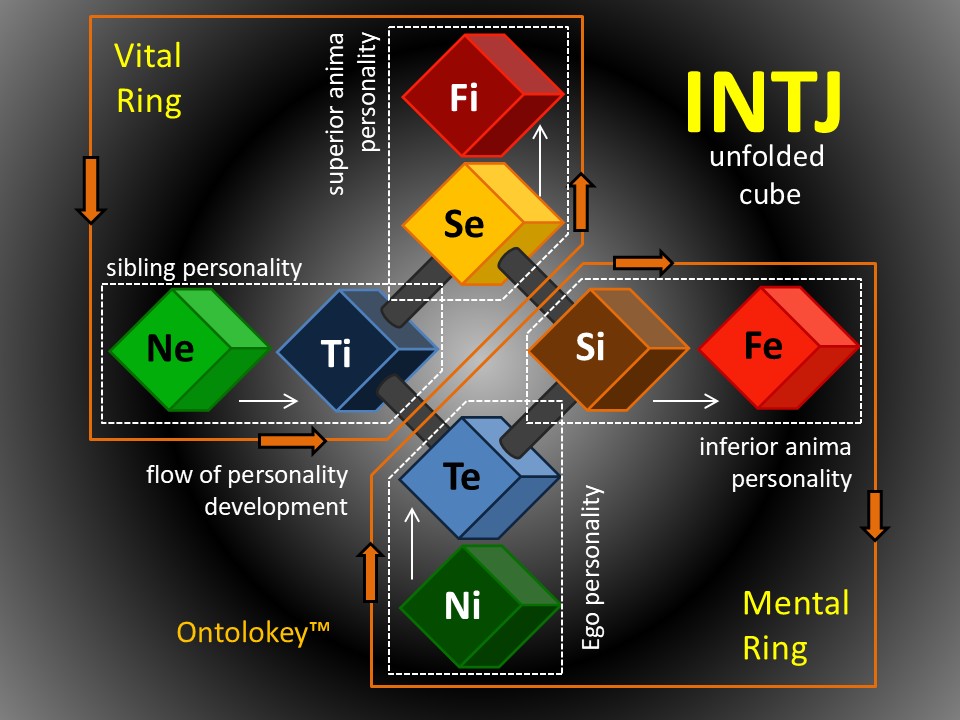
The developmental movement can therefore be understood as a gradual expansion of what the INTJ permits to count as psychologically real. Ni says, in effect, “What pattern is emerging?”; Te asks, “How can it be implemented?”; Fi asks, “Why does it matter to me?”; and Se asks, “What is actually happening here, now?” None of these questions invalidates the others, and psychological maturity emerges when they can coexist without one function attempting to silence the rest. The Ontolokey cube makes this multidimensionality particularly tangible because its three-dimensional configuration is intended to display the eight psychological functions and the tensions between conscious and less-developed aspects rather than reducing personality to a single linear hierarchy. Its sliders can consequently be used as a practical metaphor for development: when one side of the psychological structure has become excessively dominant, the task is not to destroy that strength but to create enough movement toward its neglected counterpart that perception becomes broader and self-regulation becomes more flexible. In that sense, the cube can serve as a visual reminder that growth is not a journey away from being an INTJ; it is a journey toward becoming a less fragmented INTJ.
The Social Shadow: Learning to Participate Rather Than Merely Observe
Another developmental frontier appears in the INTJ’s relationship with Extraverted Feeling (Fe), because interpersonal life cannot be reduced to the accurate exchange of information. Fe concerns the emotional field between people: atmosphere, timing, mutual responsiveness, shared feeling, and the subtle adjustments through which human beings communicate that they recognize one another as participants rather than objects of analysis. For an INTJ, this territory can feel unusually imprecise because there is rarely a stable system for determining what another person needs emotionally, how much should be expressed, or when an apparently minor interpersonal detail has become significant. The instinctive response may therefore be observation from a distance: first understand the emotional situation, then determine the appropriate intervention, preferably in a way that minimizes exposure and unpredictability. Ontolokey places Fe among the less mature functions of the INTJ and associates its development with emotional awareness, diplomacy, interpersonal nuance, and the ability to communicate understanding rather than merely possess it internally.
The distinction between caring and communicating care is particularly important here, because many INTJs genuinely experience themselves as deeply loyal while others may nevertheless experience them as emotionally unavailable. An INTJ may respond to distress by identifying the underlying problem, proposing a solution, preventing a future recurrence, or quietly taking responsibility for something practical, and from the INTJ’s perspective these actions can represent considerable affection. Yet another person may be asking for something fundamentally different: recognition of the feeling itself, emotional presence, reassurance, or the simple experience of not having to carry an inner state alone. The resulting misunderstanding can become self-reinforcing, because the INTJ interprets the other person’s continued emotional response as evidence that the practical solution was not appreciated, while the other person interprets the INTJ’s solution as evidence that the feeling was not understood. Development begins when the INTJ learns that emotional attunement does not require agreement with another person’s interpretation and that acknowledging a feeling does not constitute surrendering rational judgment. This creates an important new possibility in relationships: the INTJ can remain precise about facts while becoming less defensive about the subjective reality of the person standing in front of them.
There is an even deeper issue beneath this interpersonal difficulty, namely the INTJ’s tendency to use cognitive distance as protection against vulnerability. Observation provides safety because the observer retains a degree of control, whereas participation requires the individual to become part of the emotional situation being observed. This is why the INTJ may sometimes prefer to understand intimacy intellectually rather than inhabit it directly, constructing sophisticated models of attachment, personality, communication, or human behavior while remaining reluctant to reveal the simple fact that another person matters deeply. The shadow emerges when emotional distance is retrospectively justified as superiority, independence, or discernment, because the personality no longer has to acknowledge that avoidance may be protecting something fragile. The more integrated INTJ does not abandon discernment; instead, discernment becomes compatible with participation, allowing the person to say what is felt, ask what is needed, apologize without constructing a philosophical defense, and remain present when no efficient solution exists. In this sense, interpersonal maturity is not the acquisition of a more polished social performance but the gradual disappearance of the need to remain psychologically invulnerable.
The Ontolokey model also makes room for an important developmental counterweight in Introverted Sensing (Si), which can be understood as a movement toward rootedness, continuity, and the preservation of meaningful experience. The INTJ is conventionally associated with the future, yet a purely future-oriented existence can quietly become detached from the accumulated sensory and emotional history through which a person actually becomes himself. Familiar places, personal rituals, treasured objects, remembered experiences, established routines, and the atmosphere of a private environment can provide a form of psychological continuity that strategic thinking alone cannot create. Rather than regarding such attachments as irrational sentimentality, the INTJ can begin to recognize them as evidence that identity is not constructed exclusively through goals and ideas but also through repetition, memory, embodiment, and lived history. This is especially significant for an individual who tends to move quickly toward the next problem once the present problem has been solved, because Si introduces the possibility of remaining with what has already been lived instead of continually converting experience into preparation for what comes next. Ontolokey associates this dimension with an inner sanctuary and a form of rootedness that can temper the INTJ’s constant forward momentum.
The same principle applies to Extraverted Intuition (Ne), although its corrective function is almost opposite: where Si can reconnect the INTJ with what has already been lived, Ne can reopen the future after Ni has apparently closed it. A mature INTJ does not need to abandon conviction in order to entertain alternatives; rather, the capacity to generate alternatives protects conviction from becoming dogma. The internal sentence “I know where this is going” can therefore be followed deliberately by another sentence: “What else could this mean?” This small cognitive intervention has considerable psychological significance because it interrupts the tendency of a powerful Ni–Te structure to convert interpretation into strategy before ambiguity has been adequately explored. Ontolokey explicitly describes the Ni–Ne axis as a tension between certainty and curiosity, singularity and pluralism, and identifies the slider between them as important for developmental flexibility. The practical goal is not to make the INTJ permanently indecisive, but to cultivate the freedom to widen perception before narrowing it again, so that the final conclusion represents conscious choice rather than an unconscious reflex toward closure
The Golden Shadow: When the INTJ Encounters a Different Kind of Intelligence
The deepest stage of INTJ development may begin when the personality encounters Introverted Thinking (Ti), which Ontolokey places in the position of the “Golden Shadow.” Unlike the more obviously vulnerable functions, Ti can be especially difficult to recognize because it may appear in the form of something the INTJ already values intensely: intelligence, precision, autonomy, conceptual rigor, and the desire to understand how things work beneath their surface. Yet Ti differs fundamentally from Te in its psychological orientation, because Te is concerned with organizing reality into effective external structures, whereas Ti seeks internal logical coherence for its own sake. The INTJ can therefore become fascinated by people who appear to possess an almost effortless capacity for theoretical dissection, intellectual independence, or conceptual purity, sometimes attributing to them a quality that is difficult to recognize as an unrealized possibility within the self. Ontolokey’s concept of the Golden Shadow becomes significant precisely here: what is projected outward as extraordinary intellectual autonomy may represent a part of the INTJ’s own cognitive potential that has not yet been fully claimed consciously. The developmental task is consequently not to replace Te with Ti, but to allow the mind to discover that understanding does not always need to produce an immediate application, and that a thought can have value before it becomes useful.
This distinction can fundamentally alter the INTJ’s relationship with knowledge. Te naturally asks whether an idea can be implemented, whether a system functions, whether a method produces results, and whether an objective can be reached with greater efficiency; Ti asks whether the internal structure of the idea is coherent, whether its categories are precise, and whether its assumptions withstand examination even when no practical application follows. When the two become differentiated rather than confused, the INTJ acquires a more sophisticated form of reasoning in which usefulness and truth are no longer treated as interchangeable concepts. This matters because an INTJ can otherwise become trapped in a subtle utilitarianism in which knowledge is valued primarily for what it enables, and people are unconsciously evaluated according to competence, reliability, or strategic relevance. The integration of Ti introduces intellectual contemplation without immediate instrumental demand, creating room for philosophy, conceptual refinement, theoretical curiosity, and the pleasure of understanding itself. In psychological terms, this can loosen the identification with being “the one who gets things done” and make room for the equally important experience of being “the one who understands,” even when understanding produces no immediate advantage. Such a shift does not weaken the INTJ’s strategic nature; it gives that nature a deeper cognitive foundation and protects it from becoming entirely subordinated to external performance.
The Golden Shadow also reveals why INTJ development cannot be reduced to the cultivation of socially desirable behavior. A person may learn to communicate more warmly, become more attentive to the body, or tolerate greater ambiguity while still remaining fundamentally identified with intellectual control. The deeper process requires confronting the identity itself: the assumption that worth depends upon being competent, prepared, insightful, self-sufficient, and difficult to deceive. This identity can become so deeply invested in cognition that any experience which exposes confusion, dependency, emotional need, or ignorance threatens not merely a behavior but the person’s conception of who they are. The shadow then protects the ego by converting vulnerability into analysis, uncertainty into research, hurt into distance, and dependence into contempt for dependency. Psychological integration becomes possible only when the INTJ can tolerate the temporary collapse of this idealized self-image without experiencing it as personal annihilation. The person must gradually discover that not knowing does not make intelligence disappear, that needing another person does not erase autonomy, and that being emotionally affected does not invalidate rationality; these are not concessions to weakness but conditions under which the personality becomes larger than the defensive structure it originally built to protect itself.
This is also why the Ontolokey cube is most useful when approached as a landscape of movement rather than a static portrait of identity. Its eight-function architecture places Ni, Te, Ne, Fe, Se, Si, Fi, and Ti into different psychological relationships, while its sliders make the tensions between those functions visually accessible. The purpose of such visualization is not to instruct the INTJ to “activate” every function equally, because psychological development does not mean turning the personality into a perfectly symmetrical machine. Instead, the cube can be used as a reflective instrument: when Ni is excessively certain, move toward the questioning possibilities represented by Ne; when Te becomes detached from personal meaning, examine the relationship with Fi; when emotional communication becomes impoverished, consciously explore the Ni–Fe relationship; when the future absorbs the present, restore contact with Se; when intellectual execution becomes overly instrumental, allow Ti to reopen the question of understanding itself. The sliders consequently become psychologically meaningful precisely because they imply movement rather than perfection, giving the INTJ a concrete image of the principle that development is a gradual redistribution of attention and consciousness. The question is never simply which function is “strongest,” but where the current configuration has become too rigid and which neglected psychological capacity could restore movement to it.
At this point, the INTJ can begin to reinterpret the entire notion of weakness. What appears to be weakness is frequently the location where consciousness has not yet learned how to cooperate with a different form of psychological information, and therefore the unfamiliar function initially feels inefficient, confusing, excessive, or even threatening. The INTJ may experience emotional immediacy as irrational, sensory presence as distracting, social attunement as exhausting, alternative possibilities as unnecessary, personal values as subjective, or purely theoretical thought as impractical; yet precisely these reactions reveal where development can occur. The shadow is most informative where the conscious personality becomes disproportionately judgmental, because strong rejection often indicates that something has been excluded rather than simply disproved. Ontolokey’s broader conception of personality as a structured system of information processing reinforces this developmental perspective: psychological abilities differ not only in strength but in accessibility, awareness, and role within the total configuration, meaning that an undeveloped capacity should not automatically be interpreted as an absence of capacity.
From Insight to Practice: Using the Cube as a Developmental Instrument
Psychological insight becomes transformative only when it changes the way a person observes himself in ordinary situations, because otherwise even a sophisticated understanding of the shadow can become another intellectual possession of the INTJ mind. This is a particular danger for a personality whose preferred mode of development is cognition: the individual can understand the mechanism of avoidance with remarkable precision while continuing to avoid the underlying experience. The Ontolokey cube can interrupt this tendency by turning psychological development into something visually concrete, allowing the INTJ to observe not only which functions are familiar but also where tensions between functions suggest possible directions of growth. The sliders are especially useful when treated as questions rather than measurements: Is my Ni becoming so certain that I no longer investigate alternatives? Has Te become so dominant that usefulness has replaced meaning? Am I allowing Fi to influence decisions, or only permitting it to appear after everything practical has already been decided? Am I sufficiently connected with Se to notice what my body and immediate environment are communicating? The value of the cube therefore lies in creating a visible reminder that psychological development is directional and dynamic, encouraging the INTJ to experiment with neglected modes of awareness rather than merely accumulating descriptions about them.
A useful practice is to begin with the function that is easiest to recognize in moments of psychological tension rather than attempting to develop everything simultaneously. When the INTJ notices excessive certainty, the first intervention can be to deliberately activate Ne by generating several alternative explanations before deciding which interpretation is most plausible. When excessive efficiency, productivity, or problem-solving begins to dominate, Fi can be brought into the process by asking what the situation means personally and whether the chosen solution remains consistent with deeply held values. When interpersonal friction repeatedly appears, Fe can become the object of conscious observation: not “Who is logically correct?” but “What emotional reality exists between the people involved, and have I actually communicated that I recognize it?” When the individual notices compulsive planning, physical tension, sensory overstimulation, or an inability to remain present, Se may be the appropriate direction of development, requiring attention to the body and immediate surroundings rather than another conceptual solution. The purpose is not to force a foreign personality onto oneself but to create a temporary shift in the balance of consciousness, much like adjusting a slider on the cube until another dimension becomes sufficiently available to correct the dominant one. Over time, repeated experiences of this kind can make the previously unfamiliar function less threatening because consciousness begins to discover that the neglected perspective contains information rather than merely disruption.
The most effective developmental practice for the INTJ is therefore observational before it is behavioral. Instead of immediately trying to eliminate a shadow characteristic, the individual can observe precisely when it appears, what precedes it, what emotion accompanies it, and what interpretation the mind produces to justify it. If irritation toward another person appears, for example, the first question need not be whether the other person deserves the irritation; it can be whether the reaction contains information about an unmet value, threatened boundary, concealed insecurity, or expectation that has not been consciously acknowledged. If the impulse to withdraw appears, the INTJ can distinguish between genuine need for solitude and withdrawal motivated by the fear of being misunderstood, emotionally exposed, or disappointed. If perfectionistic self-criticism becomes intense, the person can examine whether the standard is genuinely necessary or whether maintaining an impossible standard protects an identity built around exceptional competence. This kind of observation transforms shadow material from something acted out automatically into something that can be cognitively represented, and representation creates the possibility of choice. The essential movement is from “This is who I am” toward “This is something happening within me that I can investigate,” because that small linguistic and psychological distinction creates the distance necessary for integration without creating the emotional distance that originally produced the shadow.
The same method can be extended into relationships, where the INTJ often encounters the clearest evidence that cognition alone is insufficient. After a conflict, the natural tendency may be to reconstruct the sequence of events, identify the causal error, establish responsibility, and determine the most efficient solution; developmental work asks the INTJ to add another layer before completing that analysis. What did the other person experience, what did I experience but fail to express, what was emotionally communicated through tone or withdrawal, and what part of my response was designed to protect me rather than solve the problem? This does not require accepting another person’s interpretation as objectively correct, because psychological integration is not the same as surrendering judgment. It means recognizing that factual accuracy and interpersonal reality are different dimensions of an encounter, and that a relationship can deteriorate even when one person’s factual analysis is entirely defensible. The INTJ who learns this distinction acquires a form of relational intelligence that does not compete with Te but complements it: instead of merely solving interpersonal problems, the person becomes increasingly capable of understanding the psychological field in which those problems arise. Fe, Fi, and Se consequently cease to be abstract “shadow functions” and become practical sources of information about human reality.
There is also a more demanding practice at the center of individuation: deliberately allowing experiences that cannot be optimized. The INTJ is naturally inclined to improve systems, eliminate inefficiencies, anticipate difficulties, and transform uncertainty into structure, but some of the most important human experiences resist this approach because their value depends precisely upon their irreducibility to a procedure. Grief cannot be optimized, intimacy cannot be engineered completely, creativity cannot always be scheduled into existence, and meaning cannot be produced simply by increasing productivity. The developmental challenge is therefore to create protected spaces in which the individual does not have to achieve, explain, predict, or solve anything, allowing attention to move toward sensation, memory, emotion, aesthetic experience, play, conversation, or simple presence. In the beginning this may feel strangely unproductive, and that discomfort itself is valuable because it reveals how strongly self-worth may have become associated with usefulness. Gradually, however, the INTJ can discover that periods without measurable output are not necessarily periods without psychological development; sometimes they are precisely the periods in which the psyche restores dimensions that continuous strategic activity has suppressed. In this sense, learning to experience without extracting an immediate purpose becomes one of the most concrete forms of shadow integration.
The developmental direction should ultimately remain individualized, because the cube is most useful when it reveals a current imbalance rather than prescribing a universal sequence for every INTJ. One person may need to move toward Fi because competence has eclipsed personal meaning; another may need Se because life has become almost entirely future-oriented; another may require Ne because certainty has hardened into dogma; another may need Fe because intellectual independence has gradually become interpersonal isolation. The sliders can therefore be revisited at different stages of life, because the function that requires attention at twenty may not be the one that requires attention at forty, and periods of stress may temporarily shift the entire configuration. The central principle remains constant: do not strengthen the already dominant function merely because it is comfortable, and do not attack the shadow merely because it is uncomfortable. Instead, identify where the personality has become rigid and consciously introduce the neglected perspective that could restore movement. Ontolokey’s model describes development precisely in these terms, presenting the eight functions and their dynamic relationships as a psychological architecture in which integration, rather than simple maximization, is the ultimate objective.
A Step-by-Step Path of Integration
The INTJ’s developmental path can therefore be understood as a gradual movement through several forms of disidentification: first from certainty, then from control, then from emotional avoidance, and finally from the belief that competence is the primary measure of personal worth. The first step is to preserve Ni while questioning its conclusions, allowing Ne to introduce alternatives before intuition becomes conviction; the second is to preserve Te while reconnecting it with Fi, so that effectiveness remains accountable to meaning and personal integrity. The third is to cultivate a conscious relationship with Se by returning repeatedly to bodily and sensory reality, particularly when the mind has become trapped in prediction, abstraction, or preparation. The fourth is to develop interpersonal awareness through Fe and relational openness, learning that emotional attunement does not require surrendering independence or accepting every emotional interpretation as fact. Finally, Si and Ti can provide two complementary forms of grounding: Si reconnects the individual with memory, continuity, and the concrete texture of lived experience, while Ti permits intellectual exploration that is not immediately subordinated to utility. This sequence should not be treated as a rigid program, because the Ontolokey cube is specifically useful as a representation of relationships and tensions among the eight functions rather than as a simple ladder of psychological advancement.
The first practical discipline, therefore, is to learn to recognize the moment at which a cognitive strength becomes a defensive mechanism. When Ni begins saying that the future is already obvious, introduce Ne and deliberately search for interpretations that would invalidate the preferred prediction; when Te begins converting every problem into a performance requirement, introduce Fi and ask whether the desired outcome remains worth achieving on personal and ethical grounds. When Fe is activated through interpersonal tension, resist the immediate impulse to retreat into analysis and instead identify the emotional atmosphere that exists before attempting to determine who is correct. When Se is uncomfortable, do not automatically retreat into abstraction; notice the body, the physical environment, sensory signals, and immediate facts that the mind may be overlooking. These interventions are small, but their psychological significance is considerable because they interrupt automaticity before the dominant function has completely organized perception around itself. The purpose is not to distrust Ni or Te, but to prevent them from becoming sovereign, because the Ontolokey model explicitly portrays the INTJ as a configuration in which conscious and less-developed functions remain dynamically related.
The second discipline is to practice cognitive integration without turning integration itself into another performance project. This distinction matters enormously for the INTJ, because even psychological growth can be transformed into an optimization problem: identify the weakness, construct a system, measure progress, eliminate the deficiency, and move on to the next developmental objective. Such an approach may produce impressive self-observation while reproducing the very fragmentation it is supposed to heal, because the shadow becomes yet another object that the conscious ego attempts to master from a safe distance. A deeper approach permits development to remain partly uncertain and experiential, allowing the personality to encounter unfamiliar psychological territory without immediately demanding mastery of it. The Ontolokey cube can support this attitude precisely because its sliders suggest movement and relationship rather than a final state in which every function has been perfected. The mature question is therefore not “How quickly can I develop my weakest functions?” but “Can I remain consciously present when a different function begins to challenge the psychological habits that have kept me safe?”
The third discipline is to examine the shadow whenever the emotional intensity of a reaction appears disproportionate to the immediate event. If another person’s incompetence produces contempt rather than ordinary irritation, the INTJ can ask what personal vulnerability is being protected by that contempt; if emotional dependence appears intolerable, the question can become what form of exposure is feared; if spontaneity feels irresponsible, one can investigate whether unpredictability itself has become psychologically associated with danger. Likewise, when criticism produces an unusually severe internal response, it may be useful to distinguish the factual content of the criticism from the threat it poses to an identity organized around competence. Shadow work becomes most productive at precisely these points because the conscious personality is no longer dealing with an abstract theory of itself but with an actual psychological disturbance. Rather than immediately suppressing the disturbance or constructing a rational explanation for it, the INTJ can remain with the experience long enough to ask what it contains. This is the essential transition from intellectual knowledge about personality to self-knowledge, because the latter requires the individual to encounter the parts of himself that cannot be fully understood from a detached observational position.
The fourth discipline is to build relationships in which the INTJ does not have to remain permanently impressive, useful, composed, or correct. Such relationships provide a direct counterexperience to the defensive structure of the shadow because they make vulnerability survivable rather than catastrophic. Instead of expressing affection only through practical assistance, the INTJ can practice stating directly that someone matters; instead of solving another person’s emotional problem immediately, the person can remain present long enough to understand what is actually being experienced; instead of disappearing after conflict, the INTJ can tolerate the discomfort of repair. None of these practices requires theatrical emotionality, and none requires abandoning the preference for privacy or intellectual depth. Their purpose is much more precise: to establish that intimacy can coexist with autonomy, that emotional communication can coexist with rationality, and that being known does not necessarily mean losing control. In this way, Fe and Fi cease to represent an alien emotional territory and become complementary dimensions of the same person whose Ni and Te have always provided the structural core.
The fifth discipline is to make room for the present without requiring it to justify itself through the future. The INTJ’s extraordinary capacity for anticipation can become psychologically expensive when every current experience is evaluated according to what it will produce later, because existence then becomes an endless preparation for a future that is always more important than the moment actually being lived. Se offers a corrective by returning attention to immediate reality, while Si provides another form of grounding by preserving continuity with experiences that have already acquired personal significance. Together, these functions can help the INTJ rediscover something that strategic consciousness easily overlooks: a meaningful life is not composed exclusively of successful outcomes but also of textures, rituals, memories, physical sensations, places, relationships, and moments whose value cannot be reduced to measurable progress. The familiar chair, the carefully chosen object, the walk without an objective, the meal eaten attentively, the remembered song, or the quiet presence of another person may appear insignificant from the perspective of long-range strategy, yet these experiences constitute the actual material from which a life is lived. The developmental task is therefore not to abandon the future, but to stop sacrificing the present to it.
The final discipline is perhaps the most difficult: to allow the self to become larger than the identity of the “competent INTJ.” The strategic, independent, perceptive, disciplined personality is real, and there is no reason to diminish its strengths; the problem begins only when the person believes that these strengths must remain permanently in command. Psychological integration means that intelligence can coexist with uncertainty, autonomy with attachment, rationality with feeling, foresight with spontaneity, and high standards with compassion toward human limitation. The INTJ does not become less itself through this process; rather, the personality becomes less dependent upon defending a narrow definition of itself. The cube can then be viewed as a map of this widening psychological territory: its value lies not in telling the individual what he must become, but in making visible the directions in which consciousness can expand. The deepest developmental movement is consequently from identification to relationship—from “this is what I am” toward “these are the different capacities within me, and I can learn to let them speak to one another.”
From the INTJ Type to the Integrated Self
The mature INTJ does not emerge by becoming a less intense version of the personality he or she already is, but by allowing the personality to become internally more spacious. The strategic vision of Ni, the structuring power of Te, the ethical depth of Fi, and the grounding presence of Se do not need to compete for ownership of the self; they need to enter into a conscious relationship in which no single mode of cognition is forced to perform every psychological task. The same applies to Ne, Fe, Si, and Ti: their developmental significance lies not in replacing the INTJ’s natural configuration, but in making the whole configuration more accessible to consciousness. Ontolokey presents precisely this movement from a static type toward a dynamic psychological landscape, using the three-dimensional cube to make visible relationships that can otherwise remain abstract and difficult to apprehend. The deeper implication is that personality development is not a project of self-correction in which the “wrong” parts are eliminated, but an individuation process in which previously separated aspects of the psyche gradually become capable of communicating with one another.
For the INTJ, this process ultimately requires a different definition of strength. Strength is not the ability to remain unaffected, to anticipate every consequence, to solve every problem independently, or to maintain control when everything around oneself becomes uncertain; these capacities can be valuable, but they become psychologically expensive when they are used to prevent experience rather than to engage with it. A deeper strength is the ability to remain rational without becoming emotionally inaccessible, visionary without becoming rigid, independent without becoming isolated, disciplined without becoming punitive toward oneself, and discerning without becoming contemptuous of what one does not understand. The shadow becomes integrated when the INTJ no longer needs to exile vulnerability in order to preserve competence, because competence has ceased to be the foundation upon which the entire identity depends. At that point, the person can admit uncertainty without losing direction, acknowledge emotion without losing judgment, accept dependence without losing autonomy, and encounter the present without experiencing it as an interruption of the future. The result is not a softer INTJ in the superficial sense, but a more complete one whose intelligence has become capable of including realities that intelligence alone cannot manufacture.
The Ontolokey cube can serve as a continuing reminder of this process because it transforms an abstract psychological architecture into something that can be observed spatially and revisited over time. Its sliders can be used as prompts for self-inquiry whenever the personality begins to feel unusually rigid: perhaps Ni needs more openness toward Ne, Te needs a stronger dialogue with Fi, vision needs contact with Se, or intellectual independence needs greater awareness of Fe and the interpersonal field. The appropriate movement will not always be the same, because development occurs within changing circumstances, relationships, responsibilities, crises, and stages of life. What matters is the willingness to notice where one’s psychological center has become excessively narrow and to explore the function or perspective that has been pushed toward the margins. In this sense, the cube becomes less a description of “what an INTJ is” than a visual invitation to discover what an INTJ might become when the shadow is no longer treated as an enemy.
The final movement is therefore from identification toward integration. An INTJ may recognize himself in the familiar descriptions of the strategist, architect, analyst, visionary, independent thinker, or problem solver, but none of these identities is sufficient to contain the whole psychological person. Beneath the recognizable strengths are needs for meaning, attachment, embodiment, continuity, emotional recognition, intellectual exploration, and direct contact with reality, and these needs do not disappear simply because the conscious personality has learned to function without acknowledging them. The shadow becomes progressively less threatening when it is approached through curiosity rather than judgment, because every neglected function can then be asked what information it carries and what dimension of life it protects. The developmental question changes from “How can I become a better INTJ?” to “How can I become more fully conscious of the person who happens to have this INTJ configuration?” That question marks the transition from typological self-description to genuine psychological work.
The most useful way to continue that work is not to stop with this conclusion, but to return to the more detailed psychological portraits and use them as material for sustained self-observation. The INTJ articles on Ontolokey.com provide a broader exploration of the type, its eight-function architecture, its shadow dynamics, and the different relationships represented within the Ontolokey model; the same body of material can also be used to explore the other personality configurations and to compare how different psychological structures encounter their own developmental challenges. Ontolokey’s originating perspective describes the cube as a way of turning an abstract functional map into a landscape that can be psychologically navigated, and that metaphor captures the essential purpose of the model particularly well: a map tells us where structures are located, whereas a landscape invites us to move through them. For the INTJ, that movement begins when the familiar territory of Ni and Te is no longer mistaken for the entire world of the psyche. Growth then becomes a lifelong process of widening the landscape without losing the depth, precision, independence, and vision that made the original territory worth exploring in the first place.


Leave a comment