From Mastery of the World to Mastery of the Self
The ENTJ begins life with a remarkable psychological advantage: the ability to convert complexity into direction, uncertainty into strategy, and intention into action. Extraverted Thinking gives this personality an instinctive orientation toward structure, effectiveness, measurable consequences, and the organization of the external world, while Introverted Intuition supplies the longer trajectory—the capacity to recognize where present circumstances may lead and to organize action around a future that has not yet fully materialized. This combination can produce the familiar ENTJ qualities of decisiveness, ambition, strategic intelligence, leadership, persistence, and an unusually strong willingness to assume responsibility when others hesitate. Yet precisely because these capacities work so effectively, they can become more than psychological tools: they can become the foundation of identity itself, until the ENTJ no longer merely uses competence but begins to experience competence as evidence of personal worth, certainty as protection against vulnerability, and control as a condition for psychological safety. The central developmental question therefore is not how the ENTJ can become even more efficient, powerful, decisive, or accomplished, but what happens when the very mechanisms that created external mastery begin to dominate the inner life.
The deepest shadow of the ENTJ does not consequently begin with weakness, nor does it require the presence of some obvious moral defect; it begins when a genuine psychological strength becomes so dominant that everything which cannot be organized through that strength is gradually pushed outside conscious identification. The strategic mind can then begin to confuse its model of reality with reality itself, treating ambiguity as something to eliminate, emotional complexity as something to decode, relationships as systems to manage, and personal development as another problem requiring optimization. What originally served life becomes a defense against life: achievement protects against inadequacy, rationalization protects against uncomfortable feelings, independence protects against dependence, and certainty protects against the anxiety of not knowing. The paradox is that the ENTJ can become increasingly powerful in the external world while simultaneously becoming narrower internally, because the neglected functions do not disappear when they are ignored; they remain psychologically active, often returning through projection, emotional overreaction, compulsive striving, mistrust, exhaustion, or a disturbing sense of emptiness beneath continued achievement. Growth therefore requires a reversal of direction: the mature ENTJ must learn to turn the same observational intelligence that once mastered the external environment inward, not to conquer the psyche, but to become conscious of what the commanding part of the personality has excluded.
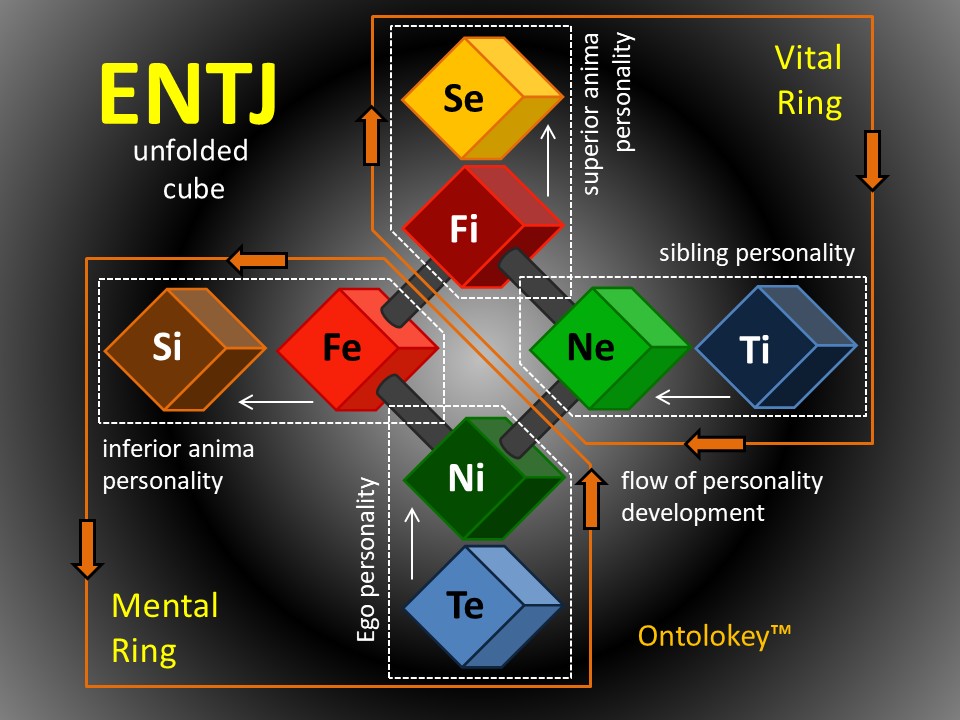
This is where the Ontolokey perspective becomes particularly useful as a developmental language, because it presents the eight psychological functions not simply as a hierarchy of abilities but as a spatially related psychological landscape in which conscious strengths, less-developed functions, shadow dynamics, and the Golden Shadow can be perceived in relation to one another. The cube transforms an abstract functional architecture into something that can be mentally navigated: the question is no longer merely which functions characterize the ENTJ, but which psychological territories are habitually occupied, which remain peripheral, which provoke resistance, and which are unconsciously admired or rejected in other people. The sliders offer a particularly intuitive metaphor for development because they imply movement rather than imprisonment in a fixed type: psychological maturation can be understood as a gradual redistribution of attention and consciousness, in which neglected functions are brought into awareness without destroying the central capacities that make the ENTJ distinctive. In this sense, the cube can serve as a practical instrument for self-observation, allowing the ENTJ to ask not only “What am I naturally good at?” but also “What do I consistently overlook, what do I distrust, what do I overcontrol, and what qualities in others provoke an unusually strong reaction in me?” The goal is not to flatten the personality into an artificial balance in which every function must become equally strong, but to make the previously unconscious dimensions sufficiently conscious that they can participate in the life of the whole person.
The developmental path that follows from this is therefore one of integration rather than self-rejection. The ENTJ does not need to become less ambitious, less intelligent, less strategic, less decisive, or less capable of leadership; these qualities are valuable precisely because they allow the personality to transform vision into reality. What must change is their psychological jurisdiction: Te must cease being the unquestioned ruler of every domain of existence, Ni must remain a source of vision without becoming an infallible prophecy, and the less familiar functions must be permitted to introduce information that cannot be reduced to efficiency or strategic utility. Introverted Feeling can remind the ENTJ that something may matter because it is personally meaningful rather than objectively productive; Introverted Sensing can restore awareness of the body, limits, continuity, memory, and ordinary forms of care; Extraverted Feeling can deepen the ability to participate emotionally rather than merely manage interpersonal atmosphere; and the Golden Shadow of Extraverted Intuition can reopen possibilities that have not yet been subordinated to a predetermined plan. The movement toward maturity is therefore not a retreat from strength but an expansion of what strength is capable of containing: the ENTJ becomes more psychologically complete when cognition no longer functions as a fortress against the unknown, but as the instrument through which the unknown can gradually be encountered, understood, and integrated.
The First Movement of Growth: Learning to Observe the Controller
The first practical step in ENTJ development is deceptively simple: before attempting to change a behavior, the individual must learn to recognize the psychological function that produces it. An ENTJ under pressure will often experience control not as control but as responsibility, criticism not as criticism but as clarification, impatience not as impatience but as realism, and emotional distance not as avoidance but as composure. This is why conventional self-improvement can easily become another expression of the same dominant pattern: the ENTJ identifies a weakness, defines an objective, constructs a corrective strategy, measures progress, and then attempts to execute the transformation with the same Te-driven force that created the problem. Such an approach may improve behavior while leaving the underlying psychological structure untouched, because the observing consciousness remains identified with the executive part of the personality. Genuine development begins when the ENTJ becomes capable of watching this mechanism operate in real time, noticing the moment when a situation changes from something to be understood into something that must be controlled. The Ontolokey cube can function as a visual reminder of this distinction, because the sliders encourage the individual to perceive psychological development as movement between functions rather than as a binary opposition between being “good” or “bad” at a particular trait.
This observational stance is especially important because the ENTJ’s shadow rarely announces itself in a form that the conscious personality immediately recognizes as alien. The shadow can appear as an intensified version of the ordinary self: greater certainty, sharper judgment, stronger insistence on standards, more relentless productivity, more aggressive problem-solving, or an increasingly uncompromising demand that circumstances conform to the strategic picture already formed internally. In this state, the ENTJ may sincerely believe that the surrounding environment is simply failing to meet reasonable standards, while the deeper psychological reality is that the individual has lost the capacity to distinguish between a genuine external problem and an internal intolerance of uncertainty. The crucial question is therefore not whether the ENTJ is objectively correct in a particular disagreement, because sometimes the ENTJ will indeed be correct, but whether the emotional intensity of being correct has become disproportionate to the actual issue. When being contradicted produces an impulse to dominate rather than investigate, when another person’s hesitation feels like incompetence rather than information, or when an unexpected development immediately generates the need to regain control, the psychological material is no longer purely strategic. These moments provide access to the shadow because they reveal where the personality’s preferred cognitive mode encounters something it cannot effortlessly assimilate.
The next developmental movement is consequently the cultivation of an inner pause, not as passivity but as a deliberate interruption of automatic cognition. For the ENTJ, pausing can initially feel inefficient because the psyche has learned to equate rapid clarification with competence and decisive movement with progress; yet psychologically, the pause creates the space in which another function can speak before Te has already determined the meaning of the situation. In practical terms, this means learning to distinguish observation from interpretation, interpretation from evaluation, and evaluation from action: “This person disagreed with me” is not identical to “this person is obstructing the objective,” just as “I feel uncomfortable” does not automatically mean “something is wrong with the situation.” Such distinctions are particularly important because Ni can rapidly synthesize scattered information into a coherent trajectory, and once that trajectory feels internally convincing, Te can immediately begin constructing the external machinery required to realize it. The resulting speed is one of the ENTJ’s greatest strengths, but it can also make alternative interpretations psychologically expensive because they arrive after the mind has already invested itself in a conclusion. Development therefore requires deliberately allowing Ti, Fi, Fe, Si, Se, and Ne to introduce information before the executive system closes the case, not because every alternative deserves equal weight, but because mature judgment depends upon knowing what kind of information has been excluded before a decision is made.
The deepest practical transformation occurs when this observational discipline extends into relationships, because relationships expose precisely those aspects of the ENTJ that can remain hidden behind professional competence. The individual who can negotiate difficult contracts, restructure organizations, solve crises, and make unpopular decisions may discover that none of these abilities automatically teaches how to remain emotionally present when another person is hurt, confused, frightened, or simply unwilling to be “fixed.” Here the inferior Fi and the less familiar Fe become particularly significant: one points inward toward personal feeling, authenticity, and values, while the other draws attention toward the emotional field between people and the shared atmosphere within which human cooperation actually occurs. An ENTJ may therefore need to practice a form of listening that deliberately postpones the solution, asking what the other person is experiencing before asking what should be done about it, and asking what matters to the other person before explaining what would be most efficient. This can initially feel strangely unproductive precisely because its value cannot be measured immediately, yet it gradually teaches the psyche that relationship itself can be an outcome rather than merely the vehicle through which an objective is accomplished. The shift is subtle but profound: other people cease to appear primarily as variables within a system and begin to become independent centers of consciousness whose perspectives can alter the ENTJ’s understanding of reality rather than merely provide resistance to it.
In this sense, the first stage of ENTJ growth is not “becoming softer,” and it is certainly not suppressing the personality’s natural capacity for command. It is learning to recognize when command has become a reflex, when competence has become a defense, and when certainty has become emotionally necessary rather than intellectually justified. The Ontolokey cube can make this process concrete by allowing the ENTJ to observe which psychological position is currently dominating the field and which alternative position might supply the missing information, using the sliders as a symbolic prompt for conscious movement rather than as a demand for permanent equilibrium. Over time, the individual can begin to recognize recurring patterns: the situations that activate control, the people who provoke disproportionate irritation, the forms of behavior that are instinctively dismissed, and the qualities in others that simultaneously attract and disturb. Those reactions are valuable because the shadow often announces itself through precisely what the conscious personality would rather not need. Once these signals are observed without immediate judgment, the ENTJ gains something more important than another technique for becoming effective: the ability to witness the architecture of its own mind before that architecture automatically determines what reality is allowed to mean.
From Competence to Consciousness
One of the more difficult developmental tasks for the ENTJ is to recognize that competence can become psychologically intoxicating precisely because it is so often rewarded by reality. When a person repeatedly discovers that clear thinking, decisive intervention, high standards, and personal responsibility produce tangible results, competence gradually acquires emotional significance beyond its practical usefulness. It can become a source of identity, security, and even moral orientation: what works begins to feel not merely effective but right, while what appears inefficient, hesitant, inconsistent, or emotionally complicated can unconsciously acquire the status of something inferior. Ontolokey’s account of the ENTJ shadow describes this development as a movement in which a genuine strength becomes increasingly identified with certainty, until the framework that once helped interpret reality begins to determine what reality is permitted to mean. The danger is not simply arrogance, because the ENTJ may remain capable of revising technical judgments when presented with compelling evidence; the deeper danger is that the need to remain cognitively sovereign can make certain kinds of experience psychologically unacceptable before they are even examined. Growth therefore requires the ENTJ to separate competence from identity and effectiveness from worth, so that being capable remains a function of the personality rather than becoming the condition under which the personality feels entitled to exist.
This distinction becomes particularly important in the encounter with other people’s limitations. An ENTJ naturally notices inefficiency, structural weakness, contradictions, unrealized potential, and unnecessary obstacles, and this perceptual orientation can make the personality extraordinarily valuable wherever systems genuinely require improvement. Yet the same perception can create an unconscious habit of seeing people primarily through the consequences of their behavior: the reliable person becomes an asset, the indecisive person a liability, the resistant person an obstacle, and the highly competent person a valuable ally. When this becomes habitual, the human being behind the behavior gradually disappears from perception, and interpersonal reality becomes organized according to usefulness rather than presence. The developmental correction is not to abandon standards or pretend that performance does not matter, but to introduce a second question alongside “Does this work?”—namely, “What is happening within the person who is doing this?” That second question opens a psychological territory in which motives, fears, histories, values, attachment, vulnerability, and contradiction become relevant forms of information, and it is precisely this broader field that prevents Te from becoming an all-encompassing interpretive authority. The ENTJ becomes more discerning, not less, when the capacity to evaluate performance is complemented by the capacity to perceive the person who cannot be reduced to performance.
The same movement must eventually occur in the ENTJ’s relationship with failure. Failure is often comparatively tolerable because it can be converted into information: something did not work, therefore the method can be revised, the variables recalculated, the strategy improved, and another attempt made. Emotional helplessness is fundamentally different because it places the individual in a situation where analysis may clarify the circumstances without giving the individual power over the outcome. Grief cannot be optimized away, another person’s feelings cannot be commanded into resolution, rejection cannot be negotiated into acceptance, and uncertainty cannot always be transformed into a sufficiently reliable prediction. The shadow therefore becomes visible when the ENTJ responds to emotional helplessness by increasing cognitive activity—explaining more, planning more, controlling more, criticizing more, or becoming increasingly certain about what everyone else should do. The developmental task is to remain conscious precisely when no strategic intervention is available, because the inability to control an outcome can expose the difference between genuine strength and defensive control. In such moments, the ENTJ practices a form of psychological endurance that is radically different from conventional resilience: instead of defeating the problem, the individual learns to remain present with an experience that cannot be defeated.
This is also where the less-developed feeling functions become indispensable to the maturation of the ENTJ. Introverted Feeling can gradually teach the individual to recognize that personal values do not need to be justified by external utility before they are legitimate, while Extraverted Feeling can develop sensitivity to the emotional field created between people rather than merely to the explicit content of their interaction. Introverted Sensing can restore contact with continuity, bodily signals, memory, limits, routine, and the accumulated significance of lived experience, while Extraverted Intuition can loosen the psychological grip of a single strategic trajectory by allowing multiple possibilities to remain alive before one is selected. None of these movements requires the ENTJ to abandon the centrality of Te and Ni; rather, they enlarge the informational environment within which those functions operate. The Ontolokey cube is useful here precisely because it makes this developmental relationship visible: the less-developed psychological positions are not conceptual enemies of the dominant functions but neighboring territories that can progressively become accessible to consciousness. The sliders can therefore be treated as a practical metaphor for a lifelong question: which part of my psychological landscape is currently carrying too much authority, and which neglected part needs enough attention to participate in the next decision?
The mature ENTJ consequently does not seek to eliminate the shadow but to establish a conscious relationship with it. A shadow impulse may still arise as impatience, superiority, suspicion, emotional withdrawal, compulsive control, or an immediate urge to impose order, but consciousness creates a small interval between the appearance of the impulse and its enactment. Within that interval, the ENTJ can ask whether the situation actually requires authority or whether authority is being used to regulate an internal discomfort; whether a disagreement concerns the substance of an idea or threatens the individual’s sense of competence; whether another person’s behavior genuinely obstructs the shared objective or merely violates the ENTJ’s preferred way of achieving it; and whether the impulse to solve is arising from genuine usefulness or from an inability to tolerate another person’s pain. These questions do not weaken decision-making because they are not substitutes for decision-making; they improve the quality of the psychological information from which decisions emerge. The ultimate movement is from unconscious compensation toward conscious choice, from automatic control toward deliberate influence, and from identification with the strongest function toward a personality in which several functions can contribute without requiring the dominant one to surrender its legitimate authority. In that sense, the ENTJ’s real developmental achievement is not becoming less formidable, but becoming formidable without needing the world to remain under control in order to feel internally secure.
The Shadow of Feeling and the Problem of Inner Authority
The most consequential shadow movement for the ENTJ often appears where objective judgment encounters subjective value. Because Te naturally asks what is effective, coherent, workable, and externally verifiable, the quieter language of personal feeling can initially appear imprecise or even suspicious, particularly when feelings seem to interfere with an otherwise rational course of action. Yet the neglected emotional dimension does not become irrelevant merely because the conscious personality has learned to operate without consulting it; instead, it tends to accumulate psychological pressure until it emerges indirectly through disproportionate reactions, private resentment, unexpected sensitivity, rigid moral judgments, or an intense need to prove that one’s decisions were justified. The ENTJ may then experience these reactions as coming from nowhere, although psychologically they often represent material that has been excluded from ordinary conscious processing for too long. This is why the development of Fi cannot be reduced to becoming “more emotional,” since its deeper function is the discovery of an inner criterion of meaning that does not depend upon external achievement or collective recognition. The mature question becomes not simply whether a decision works, but whether the person making it can inwardly inhabit that decision without becoming estranged from himself or herself.
This development can be uncomfortable because genuine inner values cannot always be translated into the language of optimization. A person may remain in a relationship because loyalty matters even when leaving would be strategically easier, refuse an opportunity because it violates something deeply personal even though it promises status, or choose compassion in a situation where efficiency would produce a cleaner result. For an ENTJ, such decisions can initially feel difficult to defend because they do not necessarily produce an immediately measurable advantage, and the mind may therefore attempt to reconstruct them as strategic choices after the fact. The deeper developmental movement is to tolerate the possibility that some decisions are meaningful precisely because they express who one is rather than what one can accomplish. This does not mean abandoning reason or surrendering judgment to emotion; it means allowing subjective value to become legitimate information within the decision-making process rather than treating it as an obstacle that must be overcome. When this happens, Fi ceases to exist primarily as a source of vulnerability and begins to function as an internal compass, giving the ENTJ a stable sense of integrity that cannot be supplied by achievement alone.
A related transformation occurs through the development of Extraverted Feeling, because the ENTJ may understand people exceptionally well at the level of motives, incentives, capabilities, and strategic relationships while still remaining insufficiently attuned to the emotional atmosphere created by an interaction. There is an important difference between knowing what another person is likely to do and genuinely allowing that person’s emotional reality to affect one’s own presence. An ENTJ can therefore become highly sophisticated socially while still using social intelligence primarily instrumentally, reading a room in order to influence it rather than entering it with the willingness to be influenced in return. The shadow becomes visible when relationships are evaluated primarily according to loyalty, competence, usefulness, honesty, or shared objectives, while the subtler dimensions of belonging, reassurance, emotional reciprocity, and communal meaning remain underdeveloped. Developing Fe does not require emotional performance or artificial agreeableness; it requires learning that the emotional field between people is itself a form of reality and that maintaining psychological connection can sometimes be more important than immediately correcting the content of an interaction. The ENTJ who develops this capacity does not lose authority but gains relational depth, because influence becomes less dependent upon force of personality and more capable of emerging through trust.
The same principle applies to Introverted Sensing, which can initially appear especially remote from the ENTJ’s future-oriented and strategically adaptive consciousness. Ni naturally looks toward what could become, while Te wants to organize present circumstances in service of that anticipated future, and this can produce a persistent psychological acceleration in which the current moment is valued primarily according to its contribution to something that has not yet arrived. Si introduces a different temporal consciousness: the awareness that what has already happened remains psychologically and bodily present, that repetition can have value, that limits contain information, and that not every meaningful human experience needs to become a new project. For an ENTJ, this can mean learning to notice fatigue before it becomes collapse, recognizing the accumulated emotional consequences of past decisions, respecting routines that sustain rather than merely constrain, and allowing ordinary experiences to possess value without requiring them to advance a larger objective. The shadow of Si may otherwise appear through an abrupt and unpleasant return of precisely those things the personality has ignored: exhaustion, bodily signals, unresolved memories, attachment to familiar structures, or an obsessive preoccupation with what went wrong in the past. Conscious integration transforms this material from an interruption into feedback.
Finally, Extraverted Intuition offers a particularly important corrective to the ENTJ’s tendency to commit strongly to a coherent strategic trajectory. Ni can produce powerful insight by synthesizing information into an underlying pattern, and when joined with Te this insight can become extraordinarily effective because the personality is able to convert a perceived future into a concrete plan. Yet the same strength can narrow perception when a compelling interpretation becomes psychologically privileged before alternative possibilities have been sufficiently explored. Ne reintroduces multiplicity: another explanation, another route, another interpretation, another future that has not yet been incorporated into the existing model. Its developmental value lies not in making the ENTJ indecisive, but in teaching the mind to remain generative before it becomes conclusive. The Ontolokey framework’s visual landscape is useful here because it makes such development imaginable as an expansion of psychological territory rather than a replacement of identity: the ENTJ does not have to stop being strategic in order to become receptive, but can learn to widen the field before strategy selects the path. When the shadow is integrated in this way, uncertainty ceases to be merely an enemy of execution and becomes an informational space in which consciousness can discover possibilities that the original plan could not have anticipated.
Integration Rather Than Compensation
At this point, the purpose of development becomes clearer: the ENTJ does not need to construct an alternative personality on top of the existing one, but to allow previously subordinate psychological functions to participate in consciousness without immediately forcing them to justify themselves in the language of the dominant functions. This distinction is crucial because an ENTJ can turn even shadow work into an achievement project, setting targets for emotional awareness, designing routines for vulnerability, measuring interpersonal improvement, and eventually judging the quality of inner development according to the same standards previously applied to external performance. Such an approach may create impressive behavioral discipline while preserving the deeper defense, because the psyche remains organized around the principle that everything must ultimately be mastered. Integration begins when the individual recognizes that some psychological material becomes accessible only when it is not being commanded, measured, or immediately converted into an outcome. The task is therefore to create conditions in which unfamiliar functions can be experienced long enough to reveal their own logic, rather than forcing them to become efficient versions of Te or Ni. In this respect, psychological maturity represents a change in the relationship to cognition itself: the ENTJ learns not only to think powerfully, but also to notice the limits of the particular way in which thinking has become accustomed to operating.
The Ontolokey cube provides a particularly concrete way of maintaining this awareness because it externalizes the internal landscape and makes the asymmetry of psychological development easier to contemplate. The sliders can be understood as symbolic indicators of habitual psychological investment: some positions are immediately accessible and repeatedly used, while others may require deliberate attention before their information becomes psychologically available. The important point is not to manipulate the sliders toward an abstract idea of perfect equilibrium, because such equilibrium would itself become another externally imposed standard, but to use the cube as a diagnostic metaphor for asking what the current configuration of one’s life demands. During periods of intense leadership, for example, Te and Ni may legitimately need to dominate; during periods of relational conflict, however, the neglected feeling functions may require greater conscious participation, while prolonged stress or exhaustion may signal the need to reconnect with bodily and experiential information associated with Si and Se. The cube consequently becomes most useful when it is treated dynamically: the question is not “What should an ENTJ become?” but “What psychological function is currently missing from my perception of this particular situation?” That question transforms type awareness from a static description into a practical method of self-observation, because every recurring imbalance becomes an invitation to enlarge the range of consciousness rather than merely to strengthen the already dominant mode.
The gradual nature of this process is essential because shadow integration cannot be accomplished through intellectual agreement alone. An ENTJ may understand perfectly well that emotions contain information, that other people have legitimate perspectives, that control has limits, and that vulnerability is unavoidable, yet still revert automatically to the familiar cognitive hierarchy when confronted with pressure. Knowledge becomes psychologically transformative only when it is repeatedly enacted at moments when the old response would be easier, faster, and more familiar. This may involve remaining silent long enough to discover what one actually feels, asking a colleague for an interpretation before presenting one’s own conclusion, allowing another person to solve a problem differently without intervening, acknowledging uncertainty without immediately compensating for it, or admitting that a decision was technically rational but personally misaligned. Each such act is small in isolation, but together they establish a new relationship between consciousness and the shadow. The ENTJ gradually learns that allowing another function to contribute does not weaken the executive center; instead, it supplies the executive center with information that would otherwise remain inaccessible until it emerged in distorted or compensatory form.
There is also an important distinction between integration and identification with the shadow. The objective is not for the ENTJ to become governed by Fi, Fe, Si, Se, Ti, or Ne in reaction to having previously neglected them, because replacing one form of one-sidedness with another would simply reverse the imbalance. Integration means being able to access a psychological function consciously while retaining the capacity to return to the dominant perspective when circumstances genuinely require it. A mature ENTJ can therefore experience strong emotion without allowing emotion to dictate every decision, consider numerous possibilities without becoming trapped in endless alternatives, respect precedent without becoming imprisoned by it, and acknowledge another person’s feelings without surrendering legitimate boundaries or standards. This flexibility represents a deeper form of authority than rigid control because it allows the personality to choose its response according to the situation rather than according to a fixed psychological reflex. The individual is no longer compelled to defend one particular mode of cognition as proof of identity, because identity itself has become spacious enough to contain contradiction, uncertainty, sensitivity, ambition, discipline, imagination, and doubt.
Ultimately, this is the movement from personality as defense toward personality as instrument. The strongest ENTJ qualities—vision, decisiveness, strategic perception, organizational power, ambition, and the willingness to assume responsibility—do not need to be dismantled; they need to become conscious enough that they can serve a person who is larger than those qualities. The shadow ceases to be an enemy precisely when the individual recognizes that it contains not simply what has been rejected, but information about what the conscious personality has been unable or unwilling to perceive. The developmental journey therefore consists of repeatedly approaching the less-developed functions, allowing their information to enter awareness, examining the emotional or cognitive resistance they evoke, and then consciously deciding how much authority that information deserves in the particular circumstances. The Ontolokey cube can accompany this process as a visual map of that movement, with its sliders representing not a rigid prescription but the possibility of psychological expansion from familiar territory toward neglected dimensions of the self. In the final analysis, ENTJ growth is not the abandonment of mastery but its transformation: mastery of the external world gradually becomes secondary to the more difficult achievement of remaining internally free enough that one’s greatest strengths no longer have to function as defenses against the parts of oneself that have yet to be understood.
The Mature ENTJ: Power Without Psychological Compulsion
The final stage of this developmental movement is reached when the ENTJ no longer experiences the integration of the shadow as a correction to an allegedly defective personality, but as the natural completion of its own potential. The decisive insight is that power itself is not the problem, just as ambition, competitiveness, authority, confidence, or high standards are not inherently problematic; the psychological question is whether these qualities remain instruments of conscious purpose or become unconscious mechanisms for regulating insecurity. A mature ENTJ can therefore retain an exceptionally strong capacity for command while becoming less dependent upon being obeyed, can pursue excellence without requiring others to be inferior, and can make difficult decisions without converting disagreement into a threat to identity. This transformation becomes possible when Te is experienced as a function rather than as the self, when Ni is treated as a powerful interpretation rather than an unquestionable prophecy, and when the other functions are allowed to introduce information before the dominant system closes around a conclusion. Ontolokey’s central developmental metaphor is especially valuable here because the cube makes this expansion visible: the ENTJ does not need to abandon its familiar position but can gradually widen the psychological territory from which consciousness receives information. The result is not a weaker commander but a person whose authority has become increasingly independent of compulsion, defensiveness, and the need to control.
This maturation can be recognized in the changing meaning of several familiar ENTJ behaviors. Decisiveness becomes the ability to act despite uncertainty rather than the need to eliminate uncertainty before acting; leadership becomes the capacity to coordinate autonomous people rather than the need to control them; competence becomes something to contribute rather than something through which superiority is established; and ambition becomes a means of expressing purpose rather than a permanent demand for proof of worth. Even the ENTJ’s relationship with mistakes changes because intellectual humility no longer threatens the underlying identity: being wrong becomes information rather than humiliation, and revising a strategy becomes evidence of consciousness rather than defeat. The same transformation occurs emotionally when the individual can say, without embarrassment, “I do not know what I feel yet,” or “This matters to me even though I cannot justify it strategically,” or “I cannot solve this for you, but I can remain here with you.” Such statements represent more than emotional softness; they demonstrate that the psyche has developed enough internal differentiation to allow contradictory forms of information to coexist without one immediately conquering the others. The ENTJ begins to discover that psychological freedom does not come from having an answer for everything, but from no longer needing every experience to confirm the identity of the person who has the answers.
The practical discipline of this maturity is therefore fundamentally cognitive. Each time the ENTJ encounters a strong reaction, the task is to investigate it before translating it into judgment: What exactly happened, what interpretation did my mind immediately construct, what emotion accompanied that interpretation, what personal value might have been touched, what alternative explanation remains possible, and what information am I currently excluding because it complicates my preferred conclusion? The same method can be applied to the Ontolokey cube by observing which slider seems psychologically relevant to the situation rather than assuming that the entire personality must be shifted at once. A conflict may require the Te–Ti relationship to distinguish effectiveness from conceptual correctness; another situation may require Te–Fi to distinguish objective judgment from personal value; exhaustion may reveal the neglected relationship with Si; impulsive or excessively intense behavior may indicate the need to become more conscious of Se; interpersonal tension may call for greater Fe; and a rigid strategic conclusion may benefit from deliberately activating Ne and asking what else could be true. This makes development incremental and concrete, because the ENTJ is not being asked to “become balanced” in the abstract but to identify, situation by situation, which psychological perspective is missing from consciousness. Over time, these repeated cognitive corrections alter the personality’s internal ecology, because what was once experienced as foreign gradually becomes available as a legitimate source of information.
There is also a deeper existential dimension to this process, because the ENTJ eventually has to confront the question that achievement alone cannot answer: what is all this power for? Te can determine how to build, organize, optimize, protect, expand, and accomplish, while Ni can provide an extraordinary sense of direction, but neither function by itself determines what is ultimately worth loving, sacrificing for, preserving, or becoming. Fi introduces the private dimension of meaning; Fe reminds the individual that human beings live within relationships rather than merely within systems; Si recalls that life consists not only of future objectives but also of accumulated experience and embodied existence; Se restores contact with what is actually happening now; Ti asks whether the conceptual foundations are genuinely coherent; and Ne opens the possibility that the future may contain paths that the current strategy cannot yet imagine. When these perspectives become accessible, ambition is liberated from the burden of having to create meaning by itself. The ENTJ can then pursue extraordinary objectives while simultaneously possessing the freedom to recognize that an objective is no longer meaningful, that another person’s needs matter independently of efficiency, or that a previously rejected possibility deserves exploration. This is the point at which external mastery and inner development cease to be opposing movements and become expressions of a larger psychological wholeness.
The Cube as a Practice of Individuation
The Ontolokey cube can consequently be used as a continuing instrument of self-reflection rather than as a final explanation of the self. Its greatest practical value for the ENTJ lies in making an invisible developmental problem visible: the personality tends naturally to inhabit certain psychological positions and to interpret experience from them, while other positions remain less consciously accessible even though they continue to influence perception and behavior. By turning the cube conceptually toward a particular conflict, decision, relationship, or period of stress, the ENTJ can ask which function is speaking most loudly and which function has not yet been invited into the conversation. The sliders then provide a simple visual language for gradual movement, allowing development to be imagined not as a dramatic personality transformation but as a series of increasingly conscious adjustments in perspective. This is particularly compatible with the ENTJ’s natural preference for clarity and structure because it provides an architecture within which introspection can become concrete without reducing inner life to a mechanical formula. The important psychological shift is that the cube ceases to answer the question “Which function am I?” and begins to support the more developmental question “Which function do I need to hear now?”
The most useful way for an ENTJ to work with this model is therefore through repeated observation over time rather than through a single attempt at self-classification. When a strong reaction occurs, the individual can mentally return to the cube and examine the configuration behind the reaction: perhaps Te has become excessive and is attempting to regain control, perhaps Ni has become overly certain about an interpretation, perhaps Fi has been touched but cannot yet be named, perhaps Fe is registering a relational disturbance that the conscious mind would prefer to dismiss, perhaps Si is signaling accumulated exhaustion, perhaps Se is demanding attention to immediate reality, perhaps Ti is questioning the internal coherence of a strategy, or perhaps Ne is opening possibilities that the existing plan has prematurely excluded. None of these observations needs to become a verdict about the personality. Their purpose is to make unconscious information available before it becomes behavior, which is the central movement from automaticity toward individuation. In this sense, the cube can become a psychological mirror: not a device for telling the ENTJ who they are, but a structured invitation to discover which parts of themselves they have habitually allowed to speak and which they have habitually silenced.
The ultimate aim is not perfect balance, permanent introspection, or the elimination of the shadow. Such a goal would itself contradict the developmental logic of the model, because a living psyche is always moving between circumstances, demands, functions, tensions, and possibilities. The mature ENTJ will still become impatient, still prefer decisive action, still notice incompetence, still pursue ambitious goals, still experience the attraction of control, and still occasionally retreat into familiar cognitive defenses under sufficient pressure. What changes is the relationship to these tendencies: they become recognizable patterns rather than unquestioned commands, and recognition creates choice. The shadow no longer needs to remain unconscious in order to influence behavior, because its underlying information can increasingly enter consciousness in a form that the individual can examine and integrate. Psychological growth therefore becomes less about eradicating unwanted aspects of the self and more about developing the capacity to hold them consciously, understand their origins and functions, and decide how they should participate in the larger personality.
For the ENTJ, this may ultimately be the most demanding form of leadership imaginable: learning to lead a psyche that cannot be governed through force alone. External leadership can establish objectives, allocate resources, enforce standards, and move systems toward a chosen future, but inner leadership requires something more complex because the different parts of the personality cannot simply be commanded into submission without creating further division. The mature individual becomes capable of listening without immediately obeying, questioning without immediately rejecting, feeling without becoming overwhelmed, imagining without immediately implementing, resting without interpreting rest as failure, and surrendering control without experiencing surrender as defeat. This is where the deepest shadow becomes developmental material: certainty teaches humility, vulnerability teaches trust, power teaches relinquishment, competence teaches respect for forms of intelligence one does not possess, and ambition eventually leads back to meaning. The ENTJ does not cease to be the architect of the outer world; rather, the architect finally becomes capable of inhabiting the inner world that made the architecture possible.
Conclusion: From Command to Consciousness
The ENTJ’s developmental journey can therefore be understood as a movement from unilateral mastery toward multidimensional consciousness. At the beginning, the personality naturally trusts what it can organize, execute, predict, improve, and control, and this orientation can produce extraordinary accomplishments precisely because it transforms intention into reality with unusual force. But the same strength becomes restrictive when it begins defining the boundaries of what counts as real, valuable, rational, or worthy of attention. The deepest shadow emerges when certainty replaces curiosity, control replaces trust, competence replaces self-worth, and effectiveness replaces meaning; yet each of these distortions contains the outline of its own cure. The ENTJ does not need less power but a broader consciousness capable of deciding when power should act, when it should listen, when it should wait, and when it should relinquish control. The final developmental movement is therefore not away from the commander archetype but inward through it, until command itself becomes conscious enough to serve rather than dominate the person who carries it.
The Ontolokey model offers the ENTJ a practical visual language for continuing this work, particularly through its representation of the eight functions and the dynamic relationships between them. The cube can be revisited whenever life exposes an imbalance: when strategic certainty becomes rigid, when relationships become overly instrumental, when achievement loses its meaning, when the body is ignored, when immediate reality is subordinated to a plan, or when unexplored possibilities are prematurely dismissed. The sliders can then be understood as developmental prompts, directing attention toward the psychological territory that is currently underrepresented rather than prescribing a permanent configuration. In this way, growth becomes cumulative: one learns to recognize the dominant response, identify the neglected perspective, allow its information into consciousness, and then return to action with a wider field of awareness. The ENTJ’s greatest evolution consequently occurs not when the personality stops being decisive, but when decisiveness is no longer compelled by fear of uncertainty; not when leadership disappears, but when leadership no longer requires domination; and not when vulnerability vanishes, but when vulnerability can coexist with strength.
For readers who want to explore this process in greater detail, the more extensive ENTJ analyses and the broader personality framework are available directly on Ontolokey.com, including the detailed examinations of the ENTJ’s cognitive architecture, shadow dynamics, and developmental possibilities, as well as corresponding material for the other personality types. The particular value of continuing this exploration is that the ENTJ becomes easier to understand when viewed not as a collection of fixed traits but as a living configuration of interacting psychological tendencies whose relative accessibility can change through conscious development. The individual can return to the model repeatedly, especially at moments of conflict, transition, failure, success, intimacy, or exhaustion, and ask which part of the psychological landscape is demanding recognition. Over time, the purpose of the cube becomes less about locating the ENTJ within a typology and more about cultivating the capacity to move consciously through one’s own psychological landscape. That is ultimately the direction of individuation: not becoming someone other than the person one is, but becoming sufficiently conscious of the whole internal system that no single part of the personality has to rule by keeping the others unconscious.
The mature ENTJ therefore arrives at a paradox that the younger personality may initially find difficult to accept: the highest form of strength is not the elimination of dependence, uncertainty, emotion, limitation, or contradiction, but the capacity to remain psychologically intact in their presence. A person who can tolerate uncertainty does not need to manufacture certainty; a person who can acknowledge vulnerability does not need to disguise it as superiority; a person whose self-worth is not dependent upon indispensability can delegate freely; and a person who knows what matters inwardly can pursue achievement without expecting achievement to tell them who they are. At that point, Te can build without imprisoning, Ni can envision without dictating, Ti can question without paralyzing, Si can ground without restricting, Se can awaken without destabilizing, Fi can humanize without overwhelming, Fe can connect without controlling, and Ne can liberate without scattering direction. The ENTJ’s final task is therefore not to become less formidable, but to become whole enough that formidable strength and profound humanity no longer need to be separated.


Leave a comment