From Protection to Integration
The ISFJ is often recognized through qualities that make human relationships feel safe: loyalty, conscientiousness, patience, attentiveness, practical care, emotional sensitivity, and an almost instinctive willingness to carry responsibility when others are overwhelmed. The familiar image of the ISFJ is therefore that of the protector, the keeper of continuity, the person who remembers what others forget and notices what others overlook. Yet this outer portrait becomes psychologically incomplete when it is mistaken for the whole person, because the same inner structure that makes the ISFJ so attentive to others can also create a powerful tendency to subordinate personal needs, preserve familiar realities, and derive identity from being dependable. In the Ontolokey interpretation, the ISFJ is organized around Introverted Sensing (Si) and Extraverted Feeling (Fe), a combination that binds an inwardly accumulated world of experience to an outward sensitivity toward interpersonal needs and emotional expectations. Si provides continuity, memory, familiarity, and an instinctive awareness of what has proven reliable, while Fe translates this accumulated sensitivity into care, accommodation, social responsibility, and the preservation of relational harmony.
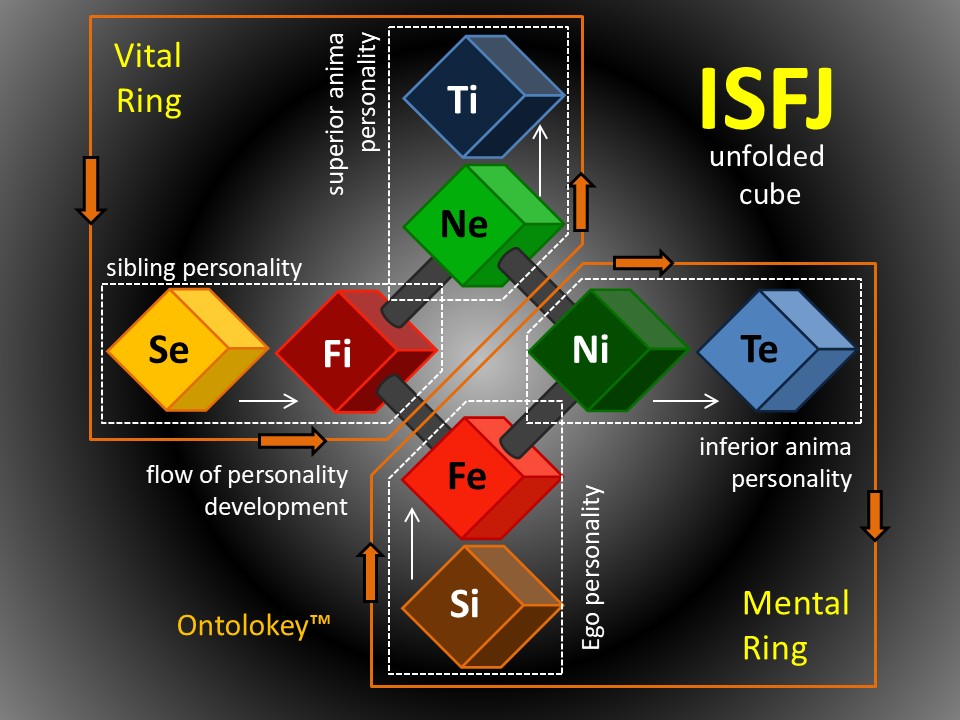
This combination can produce a remarkably humane personality, but psychological development begins precisely where admiration for these qualities ends. The central developmental question is not how the ISFJ can become even more caring, reliable, or self-sacrificing, because these capacities are usually already highly accessible; the deeper question is what happens when those virtues become so central to identity that their unconscious opposites are denied. Loyalty can quietly become attachment, responsibility can become over-responsibility, empathy can become emotional entanglement, stability can become resistance to change, and generosity can become an unspoken expectation of recognition or reciprocity. The shadow therefore does not necessarily appear as an obvious opposite of kindness, but often as a distortion of kindness itself: resentment hidden inside sacrifice, control hidden inside protection, dependency hidden inside devotion, or suspicion hidden inside concern. The deepest task is consequently not to destroy the familiar ISFJ personality but to make it conscious enough that its strengths are no longer compelled by unconscious needs. Ontolokey’s three-dimensional representation is useful within this developmental perspective because it presents the eight functions not merely as labels but as a psychological landscape in which stronger, weaker, conscious, and less-integrated capacities can be visually distinguished and gradually explored.
The purpose of growth, then, is not to turn the ISFJ into a different personality, nor to weaken the qualities that make the type distinctive. It is to widen the personality from within so that what has previously been difficult, threatening, or psychologically foreign can become increasingly available to consciousness. In this sense, the shadow should not be regarded merely as something dark that must be eliminated, but as a collection of neglected psychological capacities that continue to influence life precisely because they have not yet been integrated. The ISFJ’s development therefore involves learning to tolerate uncertainty without immediately retreating into familiarity, to distinguish emotional impressions from objective conclusions, to recognize personal desires without experiencing them as selfishness, and to examine one’s own motives with the same sensitivity that is normally directed toward the motives of others. This movement requires a gradual shift from unconscious preservation toward conscious choice: caring because one freely chooses to care rather than because one must remain indispensable, maintaining harmony because the relationship is genuinely valuable rather than because conflict threatens one’s self-image, and trusting memory without allowing memory to become the unquestioned judge of present reality. The Ontolokey cube can serve as a concrete visual companion to this process, because its adjustable relationships between functions invite the ISFJ to observe not only where psychological energy naturally settles, but also which neglected directions might offer the greatest possibilities for development.
The First Work of Growth: Learning to Distrust Certainty Without Distrusting Yourself
For the ISFJ, psychological growth begins with a particularly delicate form of self-observation: learning to distinguish what is experienced internally from what can actually be known externally. Introverted Sensing gives personal experience extraordinary psychological weight, and this is one of the reasons the ISFJ can remember situations, atmospheres, gestures, injuries, acts of kindness, and subtle changes in people with such remarkable vividness. Yet precisely because these impressions are deeply felt and richly connected to memory, they can acquire an authority that exceeds their evidential value; an emotional impression can become a conclusion, a remembered pattern can become a prediction, and an intuition about another person can become a conviction about that person’s motives. The shadow becomes active when the psyche ceases to distinguish between “this is what I perceive” and “this is what is objectively happening,” because subjective certainty then becomes insulated from correction. Ontolokey’s description of the ISFJ shadow emphasizes this danger particularly strongly: the conscious personality seeks benevolence and stability while unconscious material may compensate through suspicion, catastrophic anticipation, resentment, or projections of hidden motives onto other people.
The developmental discipline required here is therefore not self-doubt in the destructive sense, but epistemic humility: the capacity to remain faithful to one’s experience while refusing to make that experience the final authority over reality. An ISFJ who feels hurt should be able to say, “I am genuinely hurt,” without automatically adding, “therefore the other person intended to hurt me”; an ISFJ who senses distance should be able to recognize the perception without immediately constructing a narrative of rejection, betrayal, or impending abandonment. This distinction may appear intellectually simple, yet psychologically it can be demanding because the ISFJ’s impressions are rarely isolated thoughts; they are embedded in networks of memory, bodily sensation, emotional association, and relational meaning. The healthier use of Ti and the developing intuitive functions therefore becomes crucial, because they introduce a capacity to examine experience rather than merely inhabit it: What evidence supports this interpretation, what evidence contradicts it, what alternative explanation is possible, and what remains genuinely unknown? In this way cognition becomes an instrument of integration rather than a weapon against feeling, allowing the ISFJ to preserve sensitivity while gradually becoming less captive to the interpretations that sensitivity produces.
This same movement must eventually reach the ISFJ’s relationship with goodness, responsibility, and being needed, because some of the most difficult shadow material is concealed precisely inside virtues that have become central to identity. The tendency to care for others can be so deeply reinforced that the ISFJ may unconsciously confuse love with usefulness and devotion with indispensability, while sacrifices that are consciously experienced as freely given can gradually accumulate an unspoken expectation of appreciation, loyalty, or reciprocity. When that expectation is disappointed, anger may have difficulty finding a legitimate place in consciousness because the self-image says, in effect, “I am the person who gives; I am not the person who demands.” The resulting resentment can then appear indirectly through withdrawal, excessive politeness, emotional distance, guilt-inducing behavior, or a private conviction that nobody understands how much has been endured for them. The difficult but liberating cognitive question is therefore not merely “Why are other people ungrateful?” but “What did I silently expect when I gave, and did I ever communicate that expectation?” Such questioning transforms the shadow from an accusation against other people into material for self-knowledge, and it makes genuine generosity possible because giving can gradually become a conscious choice rather than an unconscious contract.
This is also where the Ontolokey cube can become psychologically meaningful as a developmental instrument rather than merely a representation of a type. The familiar ISFJ configuration naturally privileges certain functions and leaves others less consciously accessible, but the less-developed positions need not remain abstract descriptions of what the ISFJ supposedly lacks; by adjusting the sliders and observing the changing relationships between functions, the individual can use the model as a visual prompt for asking which psychological direction is currently overused, which is neglected, and which capacity might need deliberate cultivation. Developing Ne, for example, means learning to tolerate possibilities without immediately converting uncertainty into danger, while developing Ti means learning to examine assumptions and construct an internally coherent understanding rather than relying exclusively on interpersonal consensus. Developing Fi introduces the more personal question of what one actually values when nobody else is approving, needing, praising, or depending upon the self, whereas Se invites greater contact with the immediate present instead of continually filtering present experience through accumulated memory. The point is not to abandon Si or Fe, but to allow these dominant capacities to enter a larger psychological system in which the neglected functions gradually acquire a conscious voice.
The Shadow of Self-Sacrifice: When Care Becomes Control
One of the most consequential developmental tasks for the ISFJ concerns the unconscious transformation of care into control, particularly when the person’s sense of security has become dependent upon knowing what others need and upon being able to provide it. The conscious intention is usually protective rather than domineering: the ISFJ notices practical details, anticipates difficulties, remembers what has worked before, and tries to prevent unnecessary suffering by creating an environment in which people can rely upon one another. Yet psychological shadow formation begins when this protective orientation becomes attached to an implicit belief that responsibility grants authority, so that caring for someone gradually becomes a reason to influence how that person should live, feel, decide, or behave. Because the impulse originates in concern, the resulting control can remain invisible to the person exercising it, especially when resistance from others is interpreted as ingratitude, irresponsibility, or a failure to recognize what has been done for them. The deeper psychological conflict is consequently between two forms of love: one that supports another person’s existence as it actually is, and another that unconsciously attempts to preserve the relationship by shaping the other person into someone whose choices remain emotionally safe and predictable.
This distinction becomes especially important because the ISFJ’s attachment to continuity can make change psychologically more threatening than it appears from the outside. What another person experiences as an ordinary transition may be experienced internally as the disturbance of an entire network of established expectations, memories, obligations, and emotional associations, which means that the ISFJ may resist change not because novelty is inherently unacceptable but because novelty threatens the continuity through which the personality organizes meaning. The shadow response can then take the form of excessive caution, catastrophizing, moralizing, or repeatedly returning to the past as evidence for why the present course is dangerous. Such reactions often feel justified because they are supported by real experience: the ISFJ genuinely remembers previous mistakes, recognizes patterns others have forgotten, and may possess a more detailed awareness of practical consequences than those around them. Growth requires the more difficult recognition that accurate memory does not automatically produce accurate prediction, and that a previous failure can illuminate the present without possessing the authority to determine it. The mature ISFJ therefore learns to preserve the wisdom of experience while releasing its unconscious demand that the future reproduce the emotional security of the past.
The same developmental movement applies to relationships, where Fe can make the ISFJ exceptionally responsive to emotional atmospheres while simultaneously making differentiation more difficult. A person who instinctively registers disappointment, tension, discomfort, or approval in others may begin to regulate the emotional environment before asking whether such regulation is actually necessary or whether the emotion belongs to someone else and should simply be allowed to exist. Over time, this can create a subtle form of psychological over-functioning in which the ISFJ assumes responsibility not only for what they themselves do but also for the emotional consequences of everyone around them, and this burden can eventually produce exhaustion followed by resentment. Integration requires learning that emotional harmony is not synonymous with psychological health, because genuine relationships must be capable of containing disagreement, disappointment, frustration, and unmet expectations without immediately treating them as failures that somebody must repair. When the ISFJ can remain emotionally present without automatically intervening, Fe becomes less a mechanism of self-protection and more an expression of mature relational intelligence: compassion remains, but compulsion diminishes.
The practical exercise is therefore deceptively simple but psychologically profound: before helping, correcting, anticipating, remembering for someone, or attempting to prevent a perceived problem, the ISFJ can pause and ask what exactly is being protected. Sometimes the answer will genuinely be another person’s wellbeing, but at other times the answer may reveal a need to avoid uncertainty, preserve a familiar relationship, remain indispensable, prevent rejection, or escape the discomfort of watching another person make a mistake. That moment of differentiation is where shadow integration begins, because the unconscious motive becomes observable without requiring the ISFJ to condemn it; one can recognize the wish to control without becoming ashamed of having it, just as one can recognize resentment without concluding that generosity itself was false. The purpose of cognition here is not to replace feeling but to enter into dialogue with it, allowing Ti to investigate assumptions, Ne to entertain alternative possibilities, and the less familiar functions to challenge the automatic authority of Si–Fe without attempting to overthrow it. In the language of the Ontolokey cube, development can therefore be understood as a gradual redistribution of psychological space: the familiar functions remain central, but the sliders are consciously moved enough to permit neglected perspectives to participate in the construction of reality.
Integrating the Shadow Through Cognition
The decisive step in ISFJ development is therefore not to become less sensitive, less loyal, or less caring, but to introduce a conscious cognitive interval between perception and reaction. This interval is where shadow material can become visible before it becomes behavior: the moment in which the ISFJ notices fear without immediately treating it as evidence, resentment without immediately converting it into moral judgment, or an impulse to protect without automatically assuming that protection is required. The Ontolokey material describes the shadow precisely in terms of this confusion between subjective certainty and external reality, where feelings and impressions can gradually acquire the status of unquestionable facts. Cognitive development therefore means cultivating the capacity to ask what is actually known, what is remembered, what is inferred, and what is merely feared, while remaining fully respectful of the emotional information contained in the original experience. This is not emotional suppression; it is the creation of a second level of consciousness in which the ISFJ can observe the mind producing meaning and thereby gain freedom from automatically believing every meaning it produces.
One of the most important functions of this cognitive discipline is the gradual integration of the ISFJ’s less conscious relationship with possibility. A personality strongly oriented toward familiarity and continuity naturally asks what has happened before, what can be relied upon, and what has proven safe, whereas the less-developed intuitive dimension asks a different question: What else could be true? This question can initially feel destabilizing because it opens rather than closes the field of interpretation, and an ISFJ under psychological pressure may experience such openness as unnecessary uncertainty when a familiar explanation appears sufficient. Yet precisely this tolerance of multiple possibilities can weaken the shadow mechanisms of catastrophizing, suspicion, and premature closure described in the Ontolokey analysis. If a friend behaves differently, there may be rejection, but there may also be fatigue, distraction, personal difficulty, or circumstances entirely unrelated to the relationship; if a familiar routine stops working, it may represent loss, but it may equally represent an opportunity to discover a more appropriate way of living. The developing ISFJ learns not to replace one certainty with another, but to remain psychologically alive long enough for reality to reveal which possibility is actually occurring.
A parallel transformation takes place through the development of analytical differentiation. The ISFJ can possess excellent practical judgment while nevertheless finding detached examination uncomfortable when it threatens a relational or emotional conclusion that already feels meaningful. The purpose of developing Ti is therefore not to turn the personality cold, argumentative, or excessively abstract, but to establish an internal capacity for examining the structure of one’s own thinking: Does this conclusion follow from the evidence? Am I judging an intention that I cannot actually observe? Have I considered information that contradicts my preferred interpretation? Would I apply the same standard if the roles were reversed? Such questions are particularly powerful because they turn cognition toward the self rather than using intelligence merely to defend an established emotional position. The Ontolokey account of the ISFJ repeatedly returns to the danger of rationalizing motives after the emotional conclusion has already been reached, and cognitive integration directly interrupts that sequence by making the reasoning process itself an object of awareness. In psychological terms, the goal is not to think instead of feeling but to think about feeling, so that emotion can provide information without becoming the unquestioned author of the story.
This process eventually reaches an even more intimate question: What do I want when nobody needs anything from me? For a personality whose identity can become deeply connected with service, responsibility, and relational usefulness, personal desire may remain surprisingly underdeveloped or may emerge only after prolonged deprivation, frustration, or exhaustion. The shadow can then express itself through the very behaviors that seem least compatible with the conscious self-image: possessiveness, guilt-inducing behavior, withdrawal, martyrdom, covert demands for recognition, or the conviction that one has given more than everyone else. The Ontolokey discussion of self-deception describes this dynamic as particularly important because caregiving can unconsciously become connected to the need to be needed, while unacknowledged expectations of appreciation or reciprocity can later become resentment. Integration requires the ISFJ to develop a more differentiated relationship with personal values and desire, one in which saying “I want this,” “I do not want this,” “I cannot do this,” or “I need something from you” does not automatically register as selfishness. The mature form of care emerges when the individual can give without secretly requiring the gift to establish moral superiority, relational security, or indispensability, because personal boundaries and personal desire have finally been granted legitimate psychological existence.
The Ontolokey cube can make this developmental movement unusually concrete because it allows the ISFJ to visualize personality not as a fixed identity but as a configuration containing both habitual strengths and less-developed possibilities. Its sliders can be used as a reflective exercise: rather than asking which function is “better,” the ISFJ can observe which psychological attitude is currently dominating a situation and which neglected attitude might provide a corrective perspective. When Si becomes excessively closed around precedent, intuition can introduce possibility; when Fe becomes excessively responsible for everyone’s emotional state, a more differentiated personal standpoint can restore boundaries; when emotional impressions become indistinguishable from facts, analytical cognition can introduce examination; when anticipation of future problems becomes compulsive, direct engagement with present reality can interrupt the imagined chain of consequences. The cube consequently becomes most useful when it is treated as a map for experimentation rather than a prescription for replacing one identity with another. In this sense, psychological growth consists in learning to move the sliders consciously: not abandoning the ISFJ’s natural center, but increasing the range of movement available around that center until previously neglected functions can participate in perception, judgment, and action.
From Shadow Recognition to Deliberate Practice
Shadow integration becomes meaningful only when psychological insight is translated into repeated acts of conscious behavior, because understanding one’s patterns intellectually does not automatically dissolve the emotional habits through which those patterns have been built. For the ISFJ, this means turning the recognition of familiar shadow movements into small experiments in behaving differently while remaining psychologically present during the resulting discomfort. If the habitual response to uncertainty is to seek reassurance, the developmental exercise may be to tolerate not knowing for a little longer; if the habitual response to another person’s distress is immediate intervention, the experiment may be to remain available without taking over; if resentment appears after repeated giving, the task may be to articulate a boundary before the sacrifice becomes an accusation. These practices are significant because the shadow is not merely a collection of abstract traits but a living pattern of perception, emotion, interpretation, and action that becomes reinforced whenever the same sequence is repeated. Ontolokey’s broader conception of the personality as a landscape rather than merely a static map lends itself particularly well to this understanding, because the value of the model lies not only in identifying where one naturally stands but in making visible the directions in which psychological movement can occur. (medium.com)
A particularly important exercise is learning to experience conflict without immediately interpreting conflict as relational failure. Because harmony and interpersonal responsibility are so closely associated with the ISFJ’s conscious identity, disagreement can activate a disproportionate amount of internal material: fear of disappointing others, fear of being misunderstood, fear of appearing selfish, or the conviction that a good relationship should not require difficult confrontation. Yet relationships that cannot tolerate honest differentiation eventually become relationships in which one person disappears behind accommodation, and the resulting harmony is purchased at the cost of authenticity. The ISFJ therefore needs to discover that saying no, expressing anger appropriately, disagreeing openly, or allowing another person to experience disappointment does not necessarily constitute a withdrawal of love. On the contrary, the capacity to remain connected while permitting difference represents a deeper form of relational security because it no longer depends upon continuous emotional agreement. In this developmental stage, Fe becomes less about managing the emotional field and more about participating honestly within it, while the emerging personal and analytical functions provide the internal permission necessary to remain psychologically separate without becoming emotionally detached.
Another essential practice concerns the relationship with the past, which is one of the ISFJ’s greatest psychological resources and one of its potential prisons. Memory gives continuity to identity and allows the ISFJ to learn from experience with exceptional richness, but memory can become shadow material when old emotional conclusions are repeatedly imported into situations that only superficially resemble the past. Someone who has once been betrayed may become excessively vigilant for betrayal; someone who has repeatedly been taken for granted may begin to interpret ordinary requests as exploitation; someone who has experienced instability may attempt to organize the present so thoroughly that spontaneity itself begins to feel irresponsible. Growth does not require forgetting any of these experiences, because forgetting would discard precisely the wisdom that Si contributes, but it does require separating the event from the permanent psychological rule created from it. The mature question becomes not “Has this happened before?” but “What does the present situation actually contain, and which part of my response belongs to the present rather than to memory?” This distinction allows the ISFJ to retain historical consciousness without becoming psychologically governed by history.
The same principle applies to the future, where the less-developed intuitive dimension can become an important counterweight to the instinctive preservation of what is familiar. Healthy imagination does not require the ISFJ to become impulsive or constantly pursue novelty; it means becoming capable of holding several possible futures in consciousness without prematurely deciding which one is safe, dangerous, realistic, or impossible. This capacity is especially valuable when life enters a period in which old structures no longer provide adequate guidance, because the shadow often becomes strongest precisely when established methods cease to work. Rather than responding by tightening control, repeatedly consulting precedent, or attempting to restore an earlier equilibrium, the developing ISFJ can deliberately ask what the disruption is revealing that the previous structure concealed. This is where uncertainty becomes developmental rather than merely threatening, because the absence of an established answer creates psychological space for functions that have previously remained peripheral. The Ontolokey cube can support this process by making such movement tangible: the ISFJ can consciously experiment with shifting the balance toward less familiar functions and then observe what new perceptions, questions, or possibilities become psychologically available.
Ultimately, the deepest form of growth is the transition from an identity based primarily on being the person others can depend upon to an identity based on being a person who can consciously choose how to relate, give, protect, refuse, remember, question, and change. Dependability remains valuable, but it ceases to be the condition upon which self-worth depends; sensitivity remains powerful, but it no longer requires constant emotional vigilance; memory remains central, but it becomes a source of wisdom rather than an authority over the future. The ISFJ does not need to become detached from relationships, indifferent to tradition, suspicious of kindness, or excessively analytical in order to integrate the shadow, because such compensatory extremes would merely create a new imbalance. What is required is a larger personality in which the familiar strengths remain intact while previously neglected perspectives are allowed to participate consciously. The movement represented by the Ontolokey cube can therefore be understood as a gradual expansion of psychological freedom: the sliders do not tell the ISFJ what the final personality must look like, but provide a visual language for recognizing where habitual energy is concentrated and where deliberate development might open another path.
The Quiet Strength of Differentiation
At the center of the ISFJ’s development lies a paradox that can be difficult to accept: the personality becomes more genuinely caring when it becomes less willing to disappear into caring. Differentiation means discovering that closeness does not require psychological fusion and that loyalty does not require permanent agreement, while responsibility must eventually be separated from the unconscious need to make oneself necessary. The ISFJ may have learned early, through family dynamics, social expectations, or repeated relational reinforcement, that being attentive, useful, agreeable, and dependable creates belonging, and this learning can become so deeply internalized that personal boundaries feel strangely threatening. The shadow then protects the old equation—if I am needed, I am secure; if I am good, I will be valued; if everyone is well, the relationship is safe—even when adult life repeatedly demonstrates that these equations are unreliable. Growth requires replacing them with a more mature form of attachment in which love is not earned through permanent usefulness and belonging does not depend upon suppressing legitimate differences.
This makes the integration of anger particularly important. Anger is often psychologically misunderstood by highly accommodating personalities because its destructive forms are confused with the emotion itself, yet mature anger can function as a signal that a boundary has been crossed, a need has been ignored, or an important value has been violated. When an ISFJ habitually suppresses this signal in order to remain patient and understanding, the anger does not necessarily disappear; it can move underground and return as bitterness, passive resistance, emotional withdrawal, hypercriticism, or an accumulating sense that others continually take advantage of one’s goodness. The task is therefore not to become aggressive but to become capable of recognizing anger early enough that it can be translated into conscious information and appropriate action. “I am angry because something matters to me” is psychologically very different from “I am angry because you are a bad person,” and this distinction transforms aggression from an unconscious weapon into a boundary-setting function. In this respect, shadow integration gives the ISFJ permission to become more direct without becoming less compassionate, because the mature personality can express displeasure before resentment has accumulated enough force to distort perception.
Personal values require a similar differentiation from interpersonal expectations. The ISFJ can be so attuned to what relationships, families, communities, and traditions require that the question of what is personally meaningful may become secondary, particularly when personal preference appears to conflict with collective needs. Yet a personality cannot become psychologically whole by continuously borrowing its values from the surrounding emotional environment, because eventually the individual must know what is worth protecting even when nobody else understands or approves of the choice. This does not mean rejecting social responsibility or becoming radically individualistic; it means developing an internal criterion by which inherited obligations, social expectations, and personal convictions can be consciously distinguished. The less-developed Fi dimension can therefore become relevant as an inner laboratory in which the ISFJ asks what feels personally true, what violates an authentic value, and which commitments are freely chosen rather than maintained solely because abandoning them would disappoint someone. When this capacity develops, Fe no longer has to carry the entire burden of determining what is good, because interpersonal consideration is complemented by an increasingly conscious relationship with the self.
The movement toward present-moment awareness is equally significant because the ISFJ can sometimes live psychologically between remembered experience and anticipated consequence rather than fully inhabiting what is happening now. The past explains the present, and the imagined future is often evaluated through the lessons of the past, leaving immediate experience filtered through a sophisticated but potentially restrictive interpretive system. Developing greater contact with direct sensory reality can interrupt this process by returning attention to what is actually occurring before memory and prediction transform it into something more familiar. This may involve noticing the physical environment, acting spontaneously within reasonable limits, trying an unfamiliar activity without first constructing an elaborate risk analysis, or simply allowing an experience to exist without immediately categorizing it according to previous experience. Such practices are not an argument against Si but a way of preventing Si from becoming the only lens through which reality is encountered. The result is a more flexible consciousness in which the ISFJ can say, in effect, this resembles something I know, but it is not necessarily the same thing, thereby preserving experience while remaining open to the uniqueness of the present.
The mature ISFJ consequently becomes less predictable not because the personality has lost its stability but because stability is no longer confused with repetition. A person who has integrated more of the shadow can still be loyal, conscientious, warm, practical, and deeply attentive, yet these qualities now emerge from choice rather than psychological compulsion. Such a person can help without rescuing, remember without remaining imprisoned by memory, anticipate without catastrophizing, accommodate without self-erasure, and preserve tradition without treating change as betrayal. The Ontolokey cube can function as a continuing visual reminder of this expanded psychological field: the sliders symbolize not a demand to equalize every function but the possibility of consciously moving attention toward those capacities that habitual personality leaves comparatively quiet. Development therefore becomes less a project of correcting a defective personality and more an act of completing an unfinished one, in which the shadow gradually ceases to be an adversary and becomes another source of consciousness, information, and choice.
The ISFJ and the Courage to Become Unknown to Others
A particularly subtle stage of development occurs when the ISFJ begins to recognize that some relationships are maintained not because they remain mutually alive, but because the ISFJ has become attached to the role that he or she occupies within them. Being the reliable one, the understanding one, the person who remembers, forgives, organizes, supports, and remains available can become a powerful identity structure, and relinquishing any part of that role may initially feel like a threat to the relationship itself. The deeper problem is not that these roles are false, but that they can become so successful that nobody—including the ISFJ—remembers to ask who exists underneath them. The Ontolokey perspective on the ISFJ repeatedly points toward this tension between the conscious identity of the caring protector and the less acknowledged material that accumulates when personal needs, anger, uncertainty, and individuality are subordinated for too long. Development therefore demands a peculiar kind of courage: the willingness to allow other people to discover that the ISFJ is more complex, more changeable, more opinionated, and sometimes less available than the familiar role has suggested.
This can produce an uncomfortable period in which the ISFJ experiences guilt simply for behaving more authentically. A boundary may feel like rejection, a disagreement may feel like disloyalty, and a spontaneous personal choice may feel irresponsible because the psyche has learned to measure goodness through its effect upon other people. Yet guilt is not always evidence of wrongdoing; sometimes it is evidence that an old psychological contract is being violated. If the contract was “I will suppress my needs so that everyone remains comfortable,” then refusing to suppress those needs will naturally produce internal resistance even when the new behavior is healthier. Recognizing this distinction is essential because otherwise the ISFJ may interpret the discomfort of growth as proof that growth itself is wrong and retreat into the familiar role. The developmental task is to tolerate that temporary guilt long enough to discover whether the relationship can survive the emergence of a more differentiated self, because only then can loyalty become reciprocal rather than dependent upon self-abandonment.
The same principle applies to change in identity itself. ISFJs can possess a strong continuity of self because autobiographical memory, established routines, familiar relationships, and accumulated responsibilities provide a coherent narrative through which life is understood, but psychological continuity does not require psychological sameness. There are moments when an individual must consciously outgrow a version of the self that was once adaptive, and this can be particularly difficult when other people have become accustomed to that earlier identity. The shadow may attempt to restore the old equilibrium by producing nostalgia, guilt, fear of disappointing others, or the belief that changing one’s priorities constitutes a betrayal of one’s character. The corrective is to recognize that authenticity is not equivalent to remaining consistent with everything one has previously been, because mature identity includes the ability to revise commitments in response to new knowledge and experience. In that sense, the ISFJ’s loyalty must eventually extend inward as well: loyalty not only to people, duties, and traditions, but to the psychological truth that the self is allowed to develop.
This is where the less-developed functions acquire their deepest significance, because they represent more than technical cognitive alternatives; they symbolize unfamiliar ways of existing. Ne challenges the assumption that the future must be understood primarily through precedent by introducing possibility, ambiguity, experimentation, and alternative interpretations. Ti challenges the assumption that relational consensus or established practical wisdom is sufficient by asking whether an internally consistent explanation actually withstands examination. Fi challenges the tendency to define goodness through interpersonal responsibility by asking what the individual personally values when external expectations are temporarily removed, while Se challenges excessive mediation through memory by bringing consciousness directly into immediate experience. The Ontolokey model’s visual arrangement of these functions can therefore become a practical developmental mirror: when a slider is consciously moved toward a less familiar function, the purpose is not to manufacture a different personality but to practice a psychological attitude that the habitual personality may have neglected.
Eventually, this process changes the meaning of security itself. The immature form of security seeks stable circumstances, predictable relationships, familiar roles, and reassurance that nothing essential will change, whereas the more integrated form of security is the knowledge that one can remain psychologically intact even when circumstances change. For the ISFJ, this is perhaps the most important transition of all, because it transforms stability from something that must be externally preserved into something that can be internally carried. One can then encounter conflict without immediately repairing it, uncertainty without immediately resolving it, rejection without concluding that one is unworthy, and change without experiencing it as the destruction of identity. The personality’s original strengths become more resilient precisely because they are no longer dependent upon controlling the conditions under which those strengths can operate. What emerges is not a less caring ISFJ, but a person whose care has become freer, whose loyalty has become more conscious, and whose inner life is no longer required to remain invisible in order to keep the outer world peaceful.
When the Shadow Becomes an Ally
The final stage of this developmental movement is reached when the ISFJ no longer experiences the shadow merely as a collection of undesirable tendencies but begins to recognize it as a source of information about what the conscious personality has excluded. Resentment can reveal an unspoken need, anger can reveal a violated boundary, anxiety can reveal an excessive demand for certainty, and the urge to control can reveal how deeply security has become associated with predictability. Even withdrawal can contain information, because the impulse to disappear may indicate that the conscious personality has tolerated too much for too long and has only one remaining method of recovering psychological space. The aim is not to obey these impulses, since unconscious material can distort perception just as easily as conscious habits can, but to listen to them before deciding what they mean. In this sense, shadow integration becomes an ongoing conversation between the familiar ISFJ structure and the parts of the psyche that have previously been given little authority, allowing the individual to discover that what initially appeared threatening may contain precisely the psychological capacity required for greater wholeness.
This is particularly important because the ISFJ can otherwise fall into a subtler form of self-improvement in which development itself becomes another duty to perform correctly. A conscientious personality may approach shadow work with the same seriousness with which it approaches every other responsibility, creating a new internal standard according to which one must become sufficiently integrated, sufficiently self-aware, sufficiently balanced, and sufficiently emotionally mature. Such an approach can paradoxically strengthen the very perfectionistic and self-monitoring tendencies that make genuine psychological change difficult, because the individual begins judging every reaction instead of becoming curious about it. The deeper task is therefore not to produce a flawless ISFJ but to develop a more tolerant relationship with contradiction, recognizing that dependency and independence, loyalty and anger, stability and curiosity, sensitivity and critical distance can coexist within one person. Psychological maturity is not the elimination of inner conflict; it is the increasing ability to remain conscious while contradictory tendencies are present and to choose one’s response rather than being unconsciously compelled by one side of the conflict.
The ISFJ’s greatest strengths can then undergo a corresponding transformation in quality. Care becomes more selective because the individual recognizes that not every problem belongs to them, and loyalty becomes more discerning because commitment is no longer confused with endurance at any cost. Memory becomes wisdom rather than evidence for permanent suspicion, responsibility becomes chosen service rather than a measure of personal worth, and emotional sensitivity becomes an instrument of understanding rather than a demand to regulate every atmosphere encountered. The less-developed functions contribute precisely by disrupting automaticity: intuition prevents experience from becoming destiny, analysis prevents feeling from becoming unquestioned fact, personal valuation prevents social harmony from becoming self-erasure, and direct engagement with the present prevents memory from becoming the only mediator between the individual and reality. The result is not a personality stripped of its characteristic ISFJ qualities, but one whose qualities have acquired greater freedom because they are supported by a wider cognitive repertoire.
The Ontolokey cube can accompany this process as a continuing developmental image, particularly because its sliders make psychological asymmetry visible rather than treating personality as a sealed category. When the ISFJ recognizes that one function is habitually relied upon while another remains comparatively inaccessible, the practical question is not whether the weaker function should suddenly become dominant, but what happens when it is deliberately given a small amount of additional psychological space. A slider moved gradually is therefore an appropriate metaphor for development itself: meaningful change does not require the destruction of the established configuration, but a conscious adjustment that can be observed, tested, reflected upon, and revised. The cube becomes most valuable when it encourages experimentation with perspectives that initially feel unfamiliar, because the purpose of development is precisely to expand what the individual can consciously access. The landscape becomes larger without requiring the original center to disappear.
For the ISFJ, then, the deepest invitation of growth is to move from unconscious goodness toward conscious goodness, from protective attachment toward freely chosen connection, and from security through predictability toward security through psychological resilience. The person who reaches this stage can still be the one others trust, the one who remembers, the one who notices, the one who protects, and the one who remains when others leave, but these actions no longer have to conceal an unspoken demand to be indispensable or universally appreciated. The individual can care and still say no, forgive and still remember, remain loyal and still change, tolerate disappointment without immediately repairing it, and accept uncertainty without interpreting it as danger. In that movement, the shadow has not been conquered; it has been given a place within consciousness, where its energy can contribute to discernment rather than secretly directing behavior.
Becoming Whole Without Becoming Someone Else
The developmental path of the ISFJ can ultimately be understood as a movement from identification toward integration: from believing that one is the protector, the caretaker, the loyal one, the responsible one, toward recognizing that these are capacities that can be consciously chosen rather than identities that must be continuously defended. The familiar ISFJ qualities—steadfastness, practical intelligence, attentiveness, loyalty, emotional consideration, memory, and devotion to people and responsibilities—do not need to be overcome, because they constitute an essential part of the personality’s psychological architecture. What must change is the unconscious necessity behind them, particularly when care becomes a strategy for securing love, responsibility becomes a substitute for self-worth, stability becomes a defense against uncertainty, and harmony becomes a means of avoiding differentiation. The shadow reveals these distortions not in order to condemn the conscious personality but to expose what has been excluded from it, and therefore the shadow becomes most valuable when its messages can be examined without either obeying them blindly or rejecting them with shame. Growth begins when the ISFJ can hold two truths simultaneously: I am naturally this way, and I do not have to remain limited to the way I have always been.
The practical consequence is that development should proceed gradually, deliberately, and cognitively, rather than through an attempt to force oneself into an opposite personality. The ISFJ can begin by observing recurring situations in which emotional impressions become conclusions, where giving becomes resentment, where responsibility becomes control, where memory becomes suspicion, or where disagreement produces disproportionate guilt, and then use these moments as entry points into the shadow. The relevant question is not simply “What is wrong with me?” but “What psychological function is missing from my current interpretation of this situation?” Perhaps the situation requires greater openness to alternative possibilities, greater analytical distance, greater awareness of personal values, or greater contact with what is actually happening in the present rather than what previous experience predicts. The Ontolokey cube provides a useful visual language for this process: its sliders can help make the relative accessibility of different psychological functions tangible and can serve as a reminder that development is directional and dynamic rather than an abstract demand to become “more balanced.” The individual can experiment with moving attention toward less-developed functions, observe the resulting changes in perception and behavior, and gradually discover which forms of cognition provide a necessary counterweight to habitual patterns.
The deepest transformation occurs when the ISFJ no longer experiences psychological security as something that must be created by controlling circumstances or maintaining everyone’s emotional equilibrium. Security gradually becomes an inner capacity: the ability to remain oneself when someone is disappointed, when a relationship changes, when an established routine fails, when the future cannot be predicted, or when one’s own needs conflict with the expectations of others. This kind of security makes genuine generosity possible because the individual no longer has to use generosity to guarantee belonging; it makes genuine loyalty possible because loyalty is no longer confused with self-abandonment; and it makes genuine compassion possible because compassion no longer requires taking responsibility for every emotion or problem encountered. The integrated ISFJ can therefore become more—not less—of what the personality is capable of being, because conscious differentiation releases energy that was previously consumed by suppression, anticipation, accommodation, and self-protection. What appears externally as greater firmness may internally be experienced as greater freedom, because the person has finally discovered that caring for others and remaining faithful to oneself are not mutually exclusive psychological obligations.
The journey does not end with the disappearance of the shadow, because no mature personality becomes permanently free of projection, fear, resentment, defensiveness, or the temptation to retreat into familiar psychological territory. Integration is instead an ongoing practice of noticing when the old configuration has taken over and deliberately creating enough inner space for another perspective to enter. The Ontolokey cube can remain valuable precisely in this continuing process, because it transforms the abstract idea of psychological development into something that can be contemplated as a landscape of possible movement: the familiar functions provide the ground on which the personality stands, while the less-developed functions indicate directions that may broaden consciousness when approached consciously. The goal is not symmetry for its own sake, nor an equal distribution of all functions, but greater freedom of movement between psychological attitudes so that no single habitual mode of perception has to govern every circumstance. The ISFJ becomes psychologically stronger not by abandoning its center, but by becoming capable of leaving that center when reality requires another way of seeing.
In the end, the most important question for the developing ISFJ may therefore be deceptively simple: Can I remain caring without needing to be needed, loyal without needing certainty, responsible without carrying everything, sensitive without believing every feeling, and stable without refusing change? If the answer gradually becomes yes, the personality has moved beyond the defensive version of its strengths and toward their mature expression. The protector no longer protects only the external world but also protects the integrity of the self; the caretaker learns that receiving is as human as giving; the keeper of memory learns that the future deserves to be encountered on its own terms; and the person who has spent much of life understanding others begins to apply that same depth of understanding inwardly. This is the real promise of shadow integration: not transformation into someone else, but the emergence of a larger ISFJ in whom conscious choice increasingly replaces psychological compulsion.
For readers who want to explore these themes in greater depth, the preceding Ontolokey essays on the ISFJ offer more detailed examinations of its conscious structure, inner life, shadow dynamics, and less frequently discussed psychological patterns. The wider Ontolokey homepage also provides corresponding explorations of other personality types, allowing the same developmental perspective to be followed beyond the ISFJ configuration. The most productive way to approach these texts is not as a final verdict about who one is, but as material for self-observation: the descriptions become psychologically useful when they provoke recognition, resistance, questioning, and ultimately a more differentiated awareness of one’s own patterns. The Ontolokey cube can accompany that process as a practical visual instrument, helping the individual identify where psychological attention habitually settles and where another direction might consciously be explored. In that sense, the conclusion of understanding one’s type is not the discovery of a permanent identity but the beginning of a more deliberate relationship with the whole personality.


Leave a comment