From Social Identity to Psychological Integration
The ESFJ is often encountered first through what is visible: warmth, sociability, practical helpfulness, loyalty, hospitality, conscientiousness, and an almost instinctive awareness of what is happening between people. Yet beneath these recognizable qualities lies a more complex psychological organization in which the individual does not merely enjoy human connection but actively perceives, evaluates, and maintains the emotional architecture of the surrounding social world. In the Ontolokey framework, Extraverted Feeling (Fe) is the Dominant function and Introverted Sensing (Si) the Auxiliary, creating a personality structure oriented toward interpersonal harmony, continuity, memory, responsibility, and the preservation of meaningful relationships. The strength of this configuration is obvious, but its psychological cost becomes visible when the capacity to care gradually becomes an obligation to regulate everyone else’s emotional reality. Ontolokey’s broader conception of the Cube is particularly relevant here because it treats the eight functions not as an isolated list of traits but as an interconnected psychological landscape in which conscious strengths, less-developed capacities, and shadow dimensions can influence one another.
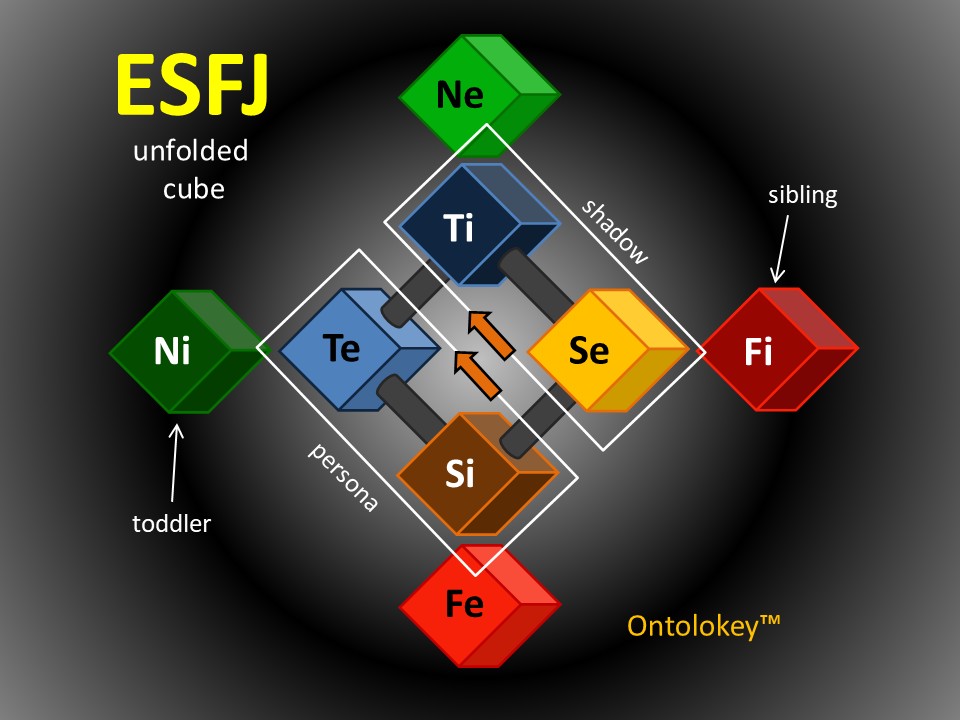
The purpose of development is therefore not to make the ESFJ less caring, less loyal, or less socially engaged, because those qualities belong to the genuine psychological strength of the type. The deeper task is to free those qualities from unconscious compulsion so that caring becomes a choice rather than a requirement, loyalty remains compatible with change, and harmony no longer depends upon suppressing everything that might disturb it. This requires the ESFJ to encounter the less familiar dimensions of the psyche without interpreting them as threats to the established self: Fi as Sibling, Ni as Toddler, Te as Anima, Se as Golden Shadow, Ne as Tertiary, and Ti as Inferior, alongside the conscious foundation of Fe and Si. Each of these positions represents a different developmental invitation, and each becomes especially significant when the dominant Fe–Si orientation reaches its limits. The Ontolokey Cube is valuable within this process because its spatial representation makes the psychological relationships between the functions easier to visualize, turning abstract positions into a landscape through which the individual can consciously explore possible directions of growth.
The Central Problem of the ESFJ: When a Strength Becomes an Identity
The fundamental ESFJ shadow does not begin with an obviously negative quality; it begins with an admirable one that becomes psychologically overextended. Fe gives the ESFJ an exceptional sensitivity to interpersonal atmosphere, allowing them to notice exclusion, tension, emotional withdrawal, unspoken expectations, and the subtle signals through which people communicate belonging. Si then provides continuity, memory, familiarity, and a practical sense of what has previously worked, enabling the ESFJ to transform concern into dependable behavior and to preserve relationships through accumulated acts of attention. The problem arises when these functions cease to be instruments of the self and gradually become the conditions through which the self is experienced: I am the one who helps, remembers, organizes, reconciles, provides, protects, and keeps everything together. Ontolokey’s recent ESFJ treatment identifies precisely this danger, describing the shadow as emerging when genuine generosity becomes entangled with an unconscious requirement to remain needed, appreciated, or socially indispensable.
Once this identification becomes sufficiently strong, the ESFJ can lose contact with a crucial psychological distinction: the difference between being responsible for a relationship and being responsible within a relationship. The first position quietly assumes ownership of another person’s emotional state, while the second recognizes that every relationship consists of two or more autonomous inner worlds whose feelings cannot ultimately be controlled by one participant. This distinction becomes the foundation for the developmental work that follows, because nearly every major ESFJ shadow pattern can be understood as a distortion of this boundary: caretaking becomes control, loyalty becomes rigidity, generosity becomes an unspoken contract, harmony becomes avoidance of truth, and responsibility becomes a substitute for personal identity. The movement toward psychological integration therefore begins when the ESFJ can observe these patterns without immediately defending them or condemning themselves for having them. The objective is not to destroy the familiar Fe–Si personality but to expand it until the other functions can participate in consciousness, allowing the person to remain deeply relational while becoming increasingly differentiated, internally grounded, and psychologically free.
Fe – The Dominant Function and the Shadow of Emotional Responsibility
For the ESFJ, Fe as the Dominant function is not simply a preference for being friendly, helpful, or socially competent; it is the central psychological orientation through which the surrounding human world becomes meaningful. The ESFJ naturally registers the emotional atmosphere of a group, notices what people need from one another, and often feels an almost immediate impulse to restore connection when tension appears. This capacity can make the ESFJ a powerful source of cohesion because relationships are not treated as passive circumstances but as living structures that require attention, care, and participation. Yet precisely because Fe is so developed and so readily available, its shadow does not usually appear as a complete absence of empathy. Instead, the difficulty begins when responsibility for the emotional condition of others becomes confused with responsibility for their emotional experience, so that maintaining harmony gradually becomes an obligation from which the ESFJ feels unable to withdraw. Ontolokey describes this movement as one of the central developmental tensions of the type: a genuine strength can become rigid when the person unconsciously begins to depend upon being needed, appreciated, or indispensable.
The first step in integrating this shadow is therefore not to suppress Fe, become emotionally detached, or stop caring what happens between people. Such a reaction would merely create a different form of imbalance, because the ESFJ’s capacity to participate actively in human relationships is one of the foundations of the personality. The deeper task is to distinguish care from control, and participation from emotional ownership. An ESFJ can listen without immediately repairing, support without taking over, and remain loving even when another person is disappointed, angry, confused, or simply unwilling to accept help. This requires tolerating an experience that can initially feel almost like personal failure: sometimes another person’s emotional state cannot and should not be fixed by you. When Fe becomes more conscious, the ESFJ gradually learns that harmony has greater psychological value when it emerges from freely relating individuals rather than from one person unconsciously regulating everyone around them. In this sense, growth does not weaken the Dominant function; it gives Fe greater freedom by removing the hidden demand that every relationship must confirm the ESFJ’s usefulness.
The practical developmental question is consequently whether the ESFJ can remain connected when connection no longer guarantees appreciation, agreement, or recognition. This is where the distinction between being responsible for a relationship and being responsible within a relationship becomes important. The first position can quietly produce vigilance, resentment, and eventually control, because the ESFJ begins to experience every disturbance as something that must be corrected personally. The second position allows participation without ownership: one contributes honesty, affection, attention, boundaries, and effort, while accepting that other people possess their own emotional lives and their own responsibility for what they do with the relationship. This shift may initially expose uncomfortable feelings that Fe has been organizing away, including anger, disappointment, selfish wishes, or the desire to be left alone. Rather than treating these experiences as evidence that something is wrong with the self, the ESFJ can begin to regard them as signals that another part of the personality is asking for recognition, preparing the way for the Fi Sibling to become more conscious.
Si – The Auxiliary Function and the Seduction of the Familiar
Si as the Auxiliary function gives the ESFJ a strong relationship with continuity, experience, memory, and the accumulated knowledge of what has worked before. It supports Fe by giving emotional care a concrete form: traditions can be maintained, practical needs anticipated, familiar routines preserved, and the details that make people feel secure can be remembered with remarkable precision. The ESFJ often knows not only that something matters to someone, but also how it has mattered in the past and what small actions have previously created stability. This combination of Fe and Si can produce a personality that is exceptionally attentive to the continuity of relationships and communities, because social belonging is supported by tangible forms of reliability. Yet the same strength can become restrictive when familiarity begins to acquire the status of truth. What has worked before may gradually become what must work now, and what has been considered proper may become difficult to question even when circumstances have changed. Ontolokey therefore treats the development of the ESFJ not as a rejection of tradition or experience, but as learning to distinguish genuine continuity from psychological attachment to the familiar.
The shadow of Si becomes particularly visible when change is experienced not merely as uncertainty but as a threat to the emotional order that the ESFJ has worked to maintain. Because Si remembers consequences, patterns, obligations, and established procedures, it can easily provide Fe with convincing reasons why the old arrangement should remain intact: people are accustomed to it, it has always been done this way, everyone knows what to expect, or changing it might create unnecessary discomfort. These arguments can be perfectly reasonable in individual situations, but psychological rigidity develops when the ESFJ no longer asks whether the inherited structure still serves the living people within it. The past then stops functioning as information and begins functioning as authority. Growth requires a more flexible relationship with experience in which memory remains valuable without becoming sovereign. The mature ESFJ can preserve what deserves preservation while simultaneously recognizing that loyalty to the past is not identical with loyalty to the people of the present.
This is also where the ESFJ’s shadow work becomes more personal, because Si can preserve not only external traditions but also an internal identity constructed from previous roles and expectations. A person may become deeply attached to being the reliable one, the considerate one, the person who knows how things should be done, or the one who keeps everyone connected because that identity has repeatedly produced recognition and belonging. Eventually, however, the accumulated history of being that person can make alternative possibilities difficult even to imagine. The developmental task is therefore to allow experience to inform identity without allowing experience to imprison it. This opens the psychological space in which Fi as the Sibling can begin to ask a different question: not only what has always been important to the people around me, but what is genuinely important to me now? In that transition, the ESFJ does not abandon loyalty or reliability; instead, these qualities become choices rather than unconscious obligations.
Fi – The Sibling and the Birth of Personal Authenticity
Fi as the Sibling introduces one of the most important developmental challenges for the ESFJ because it brings attention to a dimension of experience that Fe can easily place in the background: the individual’s own private values, preferences, emotional boundaries, and sense of what is personally meaningful. The ESFJ may be highly skilled at recognizing what matters to other people while remaining surprisingly uncertain about what matters independently of those relationships. This does not mean that the ESFJ lacks personal convictions; rather, personal convictions can become entangled with the expectations, needs, and emotional realities of the surrounding social environment. The Sibling position makes this tension particularly significant because Fi is close enough to consciousness to be experienced, yet different enough from the dominant Fe orientation to create inner friction. Psychological development therefore begins when the ESFJ stops treating personal preference as something that needs external justification and starts observing it as legitimate information about the self. Ontolokey presents this integration as a movement toward greater authenticity: the capacity to acknowledge both what matters to others and what matters personally without automatically sacrificing one side to preserve the other.
The shadow problem appears when the ESFJ has become so accustomed to maintaining interpersonal equilibrium that saying “no,” expressing disagreement, or choosing something purely for personal reasons feels unnecessarily disruptive. In such circumstances, Fi may first appear indirectly, through irritation, resentment, withdrawal, or the sudden realization that one has been giving more than one genuinely wanted to give. The danger is then to interpret these feelings as evidence that other people are ungrateful or demanding, when they may instead be revealing an unrecognized failure to communicate one’s own limits. Cognitive integration means learning to examine these reactions before turning them into accusations: What did I actually want? What did I agree to, and why? Was my generosity freely chosen, or was I hoping that being generous would secure appreciation or belonging? Such questions transform an initially uncomfortable shadow experience into usable psychological information. Fi becomes integrated not when the ESFJ becomes self-centered, but when care for others and fidelity to oneself can coexist without one being used to invalidate the other.
The practical development of Fi therefore begins with very small acts of internal recognition rather than dramatic declarations of independence. The ESFJ can deliberately pause before answering a request, notice an authentic preference before considering everyone else’s preference, and distinguish genuine willingness from the fear of disappointing someone. Over time, this creates an important cognitive separation between “I understand why this matters to you” and “therefore it must also be right for me.” The first statement preserves Fe’s empathy; the second no longer follows automatically. This distinction gradually reduces the unconscious pressure to derive personal identity from usefulness, approval, or relational harmony. In the language of development, the Sibling is not defeated by the Dominant function but brought into dialogue with it, allowing the ESFJ to become someone who can care deeply without disappearing into the needs of the people being cared for.
Ni – The Toddler and the Development of Inner Direction
Ni as the Toddler represents a very different developmental movement for the ESFJ because it asks the personality to tolerate what cannot immediately be confirmed through experience, social feedback, or practical evidence. The ESFJ’s established orientation naturally gives considerable weight to what is observable in relationships, what has worked before, and what can be done concretely in the present, whereas Ni turns attention toward underlying meaning, long-term direction, symbolic patterns, and the question of where a situation may ultimately lead. Because this mode of perception is less familiar, it can initially feel vague, impractical, or difficult to trust, particularly when there is no immediate consensus from other people to support an emerging intuition. Yet precisely this uncertainty makes Ni an important developmental field: the ESFJ must learn that not every meaningful perception arrives with a clear precedent or immediate social confirmation. Ontolokey describes the Toddler position as potentially awkward or immature, but also as a genuine source of development when the person learns to tolerate not-knowing rather than immediately replacing uncertainty with familiar explanations.
The shadow of Ni can therefore appear in two apparently opposite ways. On one side, the ESFJ may dismiss an emerging intuition because it cannot yet be demonstrated, preferring the security of established facts, familiar routines, and visible interpersonal realities. On the other side, when uncertainty becomes emotionally overwhelming, Ni may emerge in a distorted form as anxious forecasting, in which a single possibility is unconsciously treated as though it were an inevitable future. Both reactions arise from difficulty remaining psychologically open while the meaning of a situation is still developing. Cognitive integration requires a third position between dismissal and certainty: the ability to say, in effect, I do not yet know what this means, but I am willing to observe where it leads. This is a subtle but powerful developmental step because it allows the ESFJ to remain grounded in reality without demanding that reality reveal its complete direction immediately.
The practical exercise is to give inner perception enough time to mature before converting it into either action or rejection. An ESFJ can begin by recording recurring impressions, questions, images, concerns, or intuitions and then returning to them later to see whether a deeper pattern becomes visible. The purpose is not to turn every feeling into a prediction, nor to cultivate mysterious certainty, but to strengthen the cognitive capacity to hold an unresolved possibility without prematurely closing it. In this way Ni gradually becomes less like an intrusive uncertainty and more like an additional dimension of perception. The developmental movement is from “I trust only what I already understand” toward “I can remain attentive while understanding is still emerging.” That shift prepares the ESFJ for a broader psychological orientation in which personal meaning and future direction can complement the security provided by Si rather than being automatically subordinated to the familiar.
Te – The Anima and the Development of Objective Effectiveness
Te as the Anima introduces another developmental dimension because it asks the ESFJ to step outside the primarily interpersonal measure of whether something is working and to consider effectiveness, structure, measurable results, and objective organization in their own right. The ESFJ is often highly capable of organizing people and practical situations, but the motivation behind that organization may remain closely connected to interpersonal needs: keeping people comfortable, fulfilling responsibilities, preserving stability, or making sure that everyone feels cared for. Te introduces a somewhat different question: What actually produces the intended result, regardless of whether the method is familiar or emotionally comfortable? In this sense, Te does not oppose Fe; it can become a corrective to it. When integrated consciously, it helps the ESFJ distinguish between an action that feels supportive and an action that demonstrably solves the problem. The Ontolokey description of Te in the ESFJ architecture associates this function with organization, goal orientation, structure, and clarity, making it an important developmental resource when the ESFJ’s natural relational orientation alone is insufficient.
The shadow difficulty appears when effectiveness becomes psychologically entangled with worth. An ESFJ may already carry a strong sense of responsibility and therefore respond to pressure by doing more, organizing more, fixing more, and assuming more responsibility for outcomes. If Te is approached unconsciously, this can intensify the existing tendency toward over-functioning: instead of asking whether something genuinely belongs to the ESFJ, the mind may immediately search for the most efficient way to take care of it. The developmental task is therefore not simply to become more productive but to learn the difference between effectiveness and over-responsibility. Cognitive integration means evaluating a situation with enough distance to ask what the actual objective is, which resources are available, what belongs to whom, and whether intervention is necessary at all. This creates a valuable separation between compassion and compulsion: the ESFJ can recognize a problem without automatically assuming that personal effort is the solution.
Te can consequently be developed through deliberate acts of objective clarification. Before becoming involved in a complex situation, the ESFJ can define the desired outcome, identify the facts that are actually known, distinguish responsibilities, and examine whether the chosen method is producing measurable progress. Such thinking may initially feel colder than the natural Fe approach, particularly when emotional considerations are strong, but integration does not require abandoning those considerations. Instead, Te adds a second cognitive lens through which the ESFJ can test whether good intentions are being translated into useful action. Over time, this creates a healthier relationship with competence: I do not need to prove that I am useful by taking responsibility for everything; I can choose where my effort has a legitimate purpose and where another person’s responsibility must remain with them. In that form, the Anima becomes a source of psychological strength rather than another reason to carry an excessive burden.
Se – The Golden Shadow and the Return to Immediate Life
Se as the Golden Shadow represents one of the most liberating developmental possibilities for the ESFJ because it opens a relationship with the immediate, physical, and spontaneous dimension of experience that can remain secondary to social responsibility and established patterns. Se directs attention toward what is happening now: the body, the environment, movement, sensory detail, direct action, and the possibility of responding to reality without first filtering it through expectations or accumulated experience. For an ESFJ whose attention is often occupied with people, obligations, memories, routines, and the emotional consequences of decisions, this direct contact with the present can feel unusually freeing. The Golden Shadow is not simply an undeveloped weakness; it can represent a quality that is admired, occasionally projected onto others, or experienced as strangely attractive precisely because it contains something missing from the ordinary conscious identity. Ontolokey associates Se with immediacy, embodied awareness, directness, playfulness, and expressive engagement with the present moment, making its integration particularly relevant to an ESFJ who has become overly identified with responsibility and social expectation.
The shadow difficulty emerges when immediate experience has been subordinated for too long to what should be done, what others require, or what has already been planned. The ESFJ may know exactly what everyone needs for the occasion while remaining surprisingly disconnected from what the own body is communicating in that moment. Fatigue can be ignored because someone else still needs help, spontaneous pleasure can be postponed because there is always another responsibility, and direct impulses may be evaluated according to their social usefulness before they are even consciously experienced. When Se remains outside awareness, the neglected need for immediacy may eventually erupt through sudden impulsiveness, impatience, excessive stimulation, or an almost desperate desire to escape routine. Cognitive integration offers a more constructive path: instead of waiting for the body or the need for freedom to become impossible to ignore, the ESFJ can deliberately give immediate experience a place in everyday consciousness. This means noticing sensations, movement, surroundings, pleasure, energy, and spontaneous impulses without immediately asking whether they serve someone else’s needs.
The developmental direction of Se is therefore toward presence rather than escape. An ESFJ can practice activities that require direct engagement with the environment, allow occasional unplanned experiences, move the body simply because movement feels good, and notice sensory impressions without turning them into another performance or obligation. Even small moments of consciously experiencing what is happening now can weaken the assumption that life must always be organized around anticipated needs and responsibilities. The deeper integration occurs when the ESFJ discovers that being present does not mean becoming irresponsible, just as spontaneity does not mean becoming chaotic. It means allowing reality to be encountered before it is organized, interpreted, remembered, or socially managed. In this sense, the Golden Shadow offers an important corrective to an identity built around caring for life: the ESFJ gradually learns that life is also something to experience directly, not merely something to maintain for oneself and others.
Ne – The Tertiary Function and the Expansion of Possibility
Ne as the Tertiary function gives the ESFJ another route out of psychological over-identification with the familiar. Whereas Si naturally gathers experience into continuity and Fe gives that continuity a social and relational purpose, Ne introduces movement in the opposite direction: toward alternatives, possibilities, associations, experiments, and interpretations that have not yet become established. For the ESFJ, this can be an important developmental resource because a strong attachment to what is known and reliable can gradually narrow the range of imaginable choices. Ne asks a different kind of question: What else could this become? What other explanation might exist? What possibility have I not considered? Its value lies not in abandoning experience or tradition, but in preventing them from becoming closed systems. The Ontolokey approach emphasizes that psychological development involves bringing less-developed functions into greater awareness, and Ne can therefore help the ESFJ develop flexibility precisely where established patterns have become too restrictive.
The shadow of this function can appear when possibilities are either rejected too quickly or embraced without sufficient grounding. If Si has become psychologically dominant, unfamiliar alternatives may initially seem unnecessary, impractical, or disruptive simply because they lack a proven history. Yet the opposite reaction can also occur under pressure: Ne may generate so many possibilities that the ESFJ loses the stabilizing orientation provided by experience and becomes uncertain about which direction to follow. Cognitive integration requires learning to hold possibilities without immediately turning them into commitments. A useful mental exercise is to deliberately generate several interpretations of a situation before deciding which one deserves attention, especially when the first interpretation appears emotionally obvious. This creates a small but significant distance between what has happened before and what must happen next. Ne becomes constructive when possibility expands perception without destroying discernment.
The practical development of Ne can therefore be remarkably simple: introduce deliberate variation into areas of life that have become automatic. Try a different method, listen to an unfamiliar perspective, imagine an alternative explanation, change an established routine, or ask what might become possible if an apparently fixed assumption were temporarily suspended. The purpose is not novelty for its own sake but cognitive flexibility. With repeated practice, the ESFJ learns that changing a familiar pattern does not necessarily threaten stability; sometimes it reveals a better way of preserving what is genuinely valuable. In the larger developmental movement of the personality, Ne helps loosen the grip of unconscious certainty and prepares the ground for deeper inner judgment. Once several possibilities can be held simultaneously, Ti as the Inferior function can begin to examine them more independently, rather than simply accepting the interpretation that feels most familiar or socially coherent.
Ti – The Inferior Function and the Development of Inner Judgment
Ti as the Inferior function brings the developmental process to one of its most demanding psychological thresholds because it asks the ESFJ to examine reality through an internally consistent framework rather than primarily through interpersonal meaning, practical continuity, or established experience. Ti seeks precision in concepts, distinctions between categories, coherence between premises and conclusions, and an understanding of why something is the way it is. For an ESFJ, this mode of cognition can initially feel unnecessarily detached from the human context that normally gives a problem its significance. Yet precisely because Fe is so attentive to the relational field, Ti can become an essential corrective: it allows the ESFJ to step back from the emotional consensus of a situation and examine whether an argument actually makes sense. Development does not require replacing empathy with analysis; it requires learning that emotional truth and logical structure can be examined separately without one invalidating the other. Ti therefore becomes a path toward a more independent inner judgment, especially when the ESFJ has become accustomed to knowing what is appropriate before asking whether it is internally coherent.
The shadow expression of inferior Ti can become visible when disagreement is experienced primarily as a relational problem rather than as an opportunity to examine reasoning. An ESFJ may know that something feels wrong within a relationship but struggle to articulate precisely which assumption, contradiction, definition, or causal connection is responsible. Conversely, when Ti emerges defensively, the person may suddenly become excessively exacting, argumentative, or focused on technical distinctions because analytical distance provides temporary protection from emotional complexity. Neither extreme represents integration. The developmental movement lies in learning to use analysis deliberately and proportionately: define the problem, separate facts from interpretations, identify assumptions, follow the logic of an argument, and remain willing to revise a conclusion when the reasoning does not hold. This is particularly important after Ne has opened several possible interpretations, because Ti can help determine which possibilities are coherent rather than merely interesting.
The integration of Ti is therefore not an attempt to turn the ESFJ into an abstract theorist, but to strengthen the ability to think independently when social agreement is unavailable. A useful practice is to occasionally formulate one’s own position in writing and then examine it as though it had been presented by someone else: What exactly am I claiming? What evidence supports it? Which assumptions am I making? What would have to be true for my conclusion to be wrong? Such questions create a cognitive space in which the ESFJ can disagree without immediately experiencing disagreement as rejection. Over time, this develops an important form of psychological autonomy: the capacity to remain connected to other people while retaining the right to reach an independent conclusion. In the completed personality, Ti does not overthrow Fe; it quietly strengthens it by ensuring that compassion does not require intellectual surrender, that harmony does not require agreement, and that belonging does not require abandoning one’s capacity to think.
The Ontolokey Cube as a Map for Psychological Development
The eight functions become most useful for personal development when they are no longer understood merely as abstract labels but as a visual psychological landscape. The Ontolokey Cube provides precisely such a landscape by placing the functions into a spatial structure in which their relationships, contrasts, and degrees of development can be contemplated together. Instead of asking only which functions describe an ESFJ, the Cube encourages a different question: Where is my psychological attention naturally concentrated, and which perspectives remain comparatively underdeveloped? This makes the model particularly suitable for shadow work because development can be imagined spatially rather than only conceptually. The consciously familiar functions occupy the territory in which the personality moves most naturally, while less-developed functions point toward areas that may initially feel uncomfortable, unfamiliar, or psychologically distant. The Cube therefore becomes a visual aid for recognizing that personality development is not a matter of replacing one’s established nature, but of gradually expanding the territory from which one can perceive, judge, and respond to life.
The sliders of the Cube can then be understood as a practical way of representing possible developmental directions. They do not have to be interpreted as a demand to move every function toward an imagined ideal level, because such an approach would turn development itself into another form of perfectionism. Their value lies in making the question of direction psychologically tangible. If an ESFJ recognizes that Fe has become excessive responsibility, the developmental movement may be toward greater Fi differentiation and clearer personal boundaries; if Si has become excessive attachment to familiarity, Ne can provide alternative possibilities; if uncertainty about the future produces premature certainty, Ni can be approached through patient observation; if emotional involvement makes objective assessment difficult, Te can introduce structure and measurable criteria. Likewise, Se can restore contact with immediate experience, while Ti can strengthen independent examination and conceptual clarity. The visual movement suggested by the sliders therefore represents a process of cognitive compensation: when one familiar mode dominates too strongly, another function can be consciously invited into the field of attention.
This is where the Cube can become more than a descriptive model and function as an everyday instrument for self-observation. When a recurring psychological problem appears, the ESFJ can first identify the familiar response rather than immediately trying to suppress it. The next question is which function might provide information that the habitual response is missing: Am I over-managing the emotional field through Fe? Am I defending familiarity through Si? Am I ignoring a personal value through Fi? Am I demanding certainty where Ni requires patience? Am I solving a problem simply because Te makes me capable of solving it? Am I neglecting immediate experience that Se could restore? Am I rejecting alternatives that Ne could reveal? Am I avoiding independent analysis that Ti could clarify? The point is not to diagnose oneself mechanically, but to use the Cube as a structured prompt for cognition. In that sense, the sliders symbolize possibilities rather than prescriptions: they help the individual see which direction development could take, while the actual movement has to occur through conscious observation, repeated practice, and increasingly deliberate choices.
The most important principle is that shadow integration should proceed gradually. A function that has remained relatively undeveloped cannot simply be switched on by intellectual decision, because psychological development involves repeated experiences in which the new perspective proves tolerable and useful. The ESFJ might therefore begin with one small correction: pause before automatically helping, express one genuine preference, tolerate an unresolved intuition, define an objective before taking responsibility, experience something without organizing it, consider an alternative possibility, or examine an argument independently of whether others agree. Each of these actions is cognitively modest, but together they create a new psychological habit. The purpose of the Cube is to make these possibilities visible enough that the person can recognize them in everyday life. Shadow integration then becomes an ongoing dialogue between the functions rather than a battle in which one side must defeat another, allowing the ESFJ to retain the considerable strengths of Fe and Si while gradually giving the less-developed functions a more conscious and constructive place within the whole personality.
From Shadow Integration to Individuation
The deeper purpose of this developmental work is not to produce a more balanced-looking personality, but to move toward individuation: the gradual formation of a self that is no longer completely defined by the role it has learned to perform for others. For the ESFJ, this is especially significant because Fe and Si can create a powerful identity around being reliable, caring, socially responsible, and capable of preserving what gives people stability. Those qualities may be genuine and deeply valuable, yet they become psychologically limiting when the person can no longer distinguish between who I am and what I habitually do for other people. Shadow integration begins to loosen that identification. Fi asks what belongs personally to me, Ni asks where my life is going beyond immediate expectations, Te asks what is objectively effective, Se asks whether I am actually present in my own life, Ne opens possibilities beyond established patterns, and Ti asks whether I can arrive at an understanding that does not depend upon collective agreement. Together, these movements gradually transform the question from “How can I fulfill my role?” into “What kind of person am I becoming?”
This process also changes the meaning of the shadow itself. A shadow aspect is not necessarily something negative that must be eliminated, and it should not be treated as evidence of a defective personality. It often represents a psychological capacity that has remained outside the person’s preferred mode of functioning and therefore appears first in distorted, uncomfortable, or exaggerated forms. The ESFJ may encounter Fi through resentment, Ni through anxiety about an uncertain future, Te through excessive control, Se through impulsive escape, Ne through restless possibility, or Ti through defensive argumentation. These manifestations can become opportunities for cognition when they are examined rather than simply acted out. Instead of asking, How do I get rid of this uncomfortable part of myself?, the more productive question becomes, What legitimate psychological need or capacity is trying to enter consciousness through this reaction? That question changes shadow work from self-correction into self-understanding.
The practical path is therefore cumulative rather than dramatic. First comes recognition: noticing the recurring situation in which the familiar response takes over. Then comes differentiation: separating the immediate reaction from the assumptions hidden inside it. After that comes cognitive compensation: consciously considering the perspective represented by another function. Finally comes practice, in which the new perspective is expressed through a small, concrete behavior and repeated until it becomes less foreign. The Ontolokey Cube can support this sequence because it gives the person a visible map of the functions and a way to consider developmental direction through its sliders. The objective is not to push every slider toward some theoretically perfect midpoint, but to recognize where one’s habitual psychological movement has become too narrow and which neighboring or shadow perspective could widen it. Development becomes therefore a process of repeated micro-adjustments rather than a demand for sudden personality transformation.
The central question for the ESFJ eventually becomes remarkably simple, although living it can require considerable courage: Who am I when nobody needs me? The question does not ask the ESFJ to stop loving, helping, organizing, remembering, protecting, or connecting people; it asks whether those qualities remain freely chosen when they are no longer required to establish personal worth. If the answer gradually becomes yes, Fe is liberated from the burden of proving its value, while Si can preserve what matters without becoming imprisoned by the past. Fi can establish personal boundaries without destroying connection, Ni can provide inner direction without demanding certainty, Te can create effectiveness without compulsive responsibility, Se can restore direct experience, Ne can keep possibilities open, and Ti can strengthen independent judgment. Individuation therefore does not mean becoming less of an ESFJ. It means becoming an ESFJ whose identity is large enough to contain the parts of the psyche that were previously experienced mainly as shadow.
Suggestions for Growth – A Practical Path Toward Integration
The most useful way to approach personal development is to stop treating the shadow as an enemy and begin treating it as a source of information. Whenever the ESFJ notices a recurring reaction—resentment after giving too much, discomfort when someone disagrees, anxiety about an uncertain future, an urge to control a situation, resistance to change, or difficulty knowing what is personally wanted—the first step is to pause before acting. The purpose of that pause is cognitive rather than passive: Which part of my usual personality is operating right now, and what might it be leaving out? Fe may be telling me that a relationship needs attention, while Fi is asking whether I am respecting myself; Si may remember what worked before, while Ne asks what else might be possible; Ni may sense a direction that cannot yet be explained, while Ti asks whether my interpretation actually makes sense. This is the beginning of shadow integration because the automatic response becomes an object of consciousness rather than an unquestioned command.
The second step is to choose one developmental direction at a time. Trying to develop every less-familiar function simultaneously can easily become another form of self-imposed obligation, particularly for a personality that already tends to take responsibility seriously. The Ontolokey Cube can make this process easier because the functions are presented spatially, allowing the ESFJ to recognize which areas feel natural and which require conscious attention. The sliders can then be used as a visual metaphor for possible movement: not a measurement of personal worth and not a fixed prescription, but an indication of where greater psychological flexibility might be explored. If Fe is becoming controlling, move cognitively toward Fi and ask what belongs to you; if Si has become rigid, explore Ne and ask what alternatives exist; if the future produces uncertainty, allow Ni to remain open rather than forcing premature conclusions. The same principle applies to Te, Se, and Ti: identify what the habitual response excludes, then deliberately give that neglected perspective a small amount of psychological space.
The third step is practice through concrete situations. Psychological integration does not occur simply because a person understands a description of a function intellectually; the new perspective has to enter ordinary life. Before automatically accepting a request, pause and consult Fi; before insisting that an established method is necessary, generate an alternative through Ne; before trying to solve another person’s problem, examine whether Te is actually needed or whether responsibility belongs elsewhere; before planning the next task, notice through Se what the body and immediate environment are communicating. When a strong disagreement arises, allow Ti to examine the reasoning without interpreting the difference as a threat to the relationship. When a future possibility feels unclear, let Ni remain uncertain long enough for a deeper pattern to emerge. These practices are deliberately small because integration grows through repetition: the aim is not to perform another function perfectly, but to make its perspective increasingly available when the dominant response alone is insufficient.
Finally, the ESFJ can periodically return to the Cube and ask a broader developmental question: What has become more conscious in me, and what still controls me automatically? This shifts the focus away from perfection and toward increasing freedom of choice. A psychologically integrated ESFJ does not abandon Fe, Si, or the identity that has provided continuity and belonging; instead, those strengths become less compulsive because other perspectives are now available. The ultimate goal is not to move every slider to the same position, but to become capable of moving one’s attention consciously when life demands a different response. The Cube thus becomes a practical reminder that growth is directional and individual: it helps reveal possible paths, while the person must discover through experience which movement creates greater inner freedom. For readers who want to explore the ESFJ architecture, its shadow aspects, and the other personality types in greater depth, the more detailed psychological texts available on Ontolokey.com provide a broader framework for continuing this work.


Leave a comment