From Personality Type to Psychological Development
The ISTJ is often recognized through a familiar constellation of qualities: reliability, conscientiousness, discipline, realism, loyalty, precision, and a strong respect for what has been proven to work. These characteristics are not superficial stereotypes when they genuinely arise from the underlying psychological organization of the type; they describe a person who tends to orient inwardly toward accumulated experience and established reference points, while using externally directed thinking to translate that knowledge into practical decisions, structures, standards, and results. Within the Ontolokey framework, however, the ISTJ cannot be adequately understood through these visible qualities alone. The personality becomes psychologically interesting precisely at the point where its strengths cease to be merely strengths and begin to reveal the compensations, tensions, desires, and neglected capacities hidden behind them. Introverted Sensing (Si) and Extraverted Thinking (Te) form the recognizable backbone of the ISTJ, but the psyche is larger than the functions with which the individual most readily identifies.
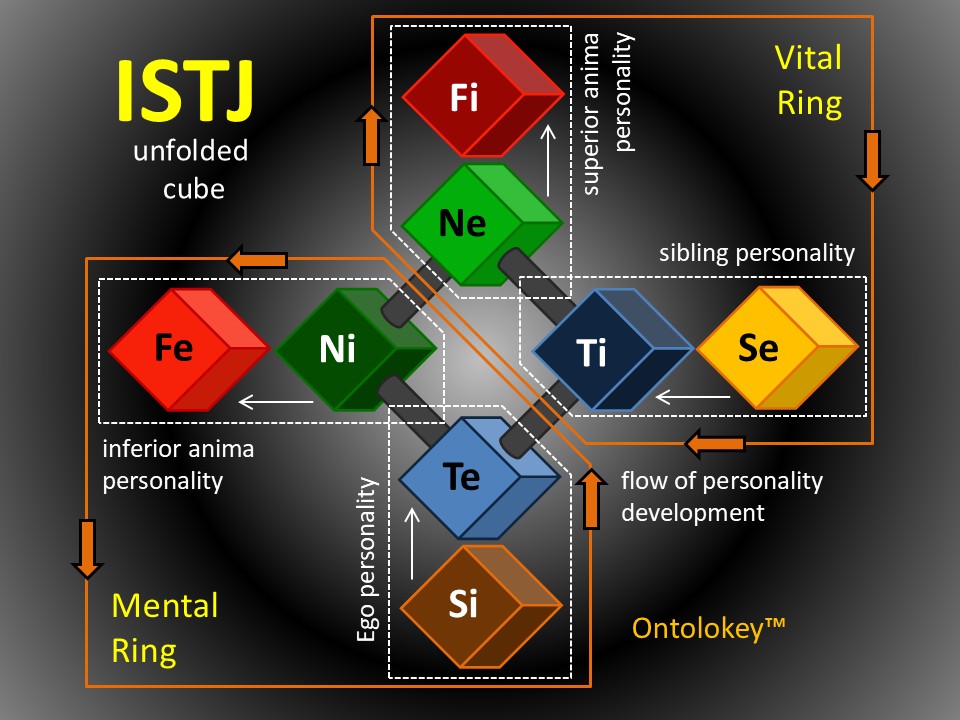
The purpose of psychological development, therefore, is not to weaken the ISTJ’s characteristic reliability or to turn a structured person into an artificially spontaneous one. It is to prevent a successful psychological adaptation from becoming a prison. A person can become so identified with being dependable that personal desire begins to feel irresponsible, so committed to proven experience that novelty appears inherently dangerous, so focused on practical effectiveness that questions of meaning are postponed indefinitely, or so accustomed to emotional self-containment that vulnerability becomes almost indistinguishable from weakness. Ontolokey’s central contribution to this developmental perspective is its transformation of the eight-function architecture into a spatial landscape: the cube makes visible not only what is consciously familiar, but also the less-developed, shadow-like, attractive, vulnerable, or potentially transformative regions of the psyche. The twelve sliders can consequently be understood as developmental thresholds rather than merely mechanical features, inviting the ISTJ to ask not, “How can I become a better ISTJ?” but, more fundamentally, “Which parts of myself have I not yet learned to inhabit?”
The ISTJ as a Personality of Continuity
At the psychological center of the ISTJ stands a powerful relationship with continuity. Introverted Sensing does not simply mean remembering facts or preferring familiar routines; in the Ontolokey interpretation, it represents an inwardly organized relationship with lived experience, accumulated impressions, precedent, bodily familiarity, and the internal sense of what has already been tested by reality. This gives the ISTJ a particular kind of psychological solidity: experience is not merely something that happened in the past but something that remains available as an internal reference system for interpreting the present. Extraverted Thinking then provides the complementary movement outward, transforming this accumulated knowledge into procedures, decisions, standards, organization, and practical effectiveness. The result can be an exceptionally grounded personality, capable of taking responsibility precisely because reality is not approached as an endless field of abstraction but as something that has consequences, histories, constraints, and lessons.
Yet the same structure contains the first developmental paradox. What protects the individual from chaos can eventually protect the individual from change, and what makes experience such a valuable source of knowledge can become an unconscious argument against experiences that have not yet occurred. The ISTJ may therefore encounter a subtle psychological confusion between what is familiar and what is true, between what has worked before and what is required now, or between what is responsible and what is genuinely desired. None of these tendencies is inevitable, and they should not be interpreted as defects; they are possibilities that become increasingly relevant when the conscious identity becomes too narrowly organized around stability, competence, duty, and predictability. The shadow begins precisely where the personality stops questioning its own assumptions, because whatever is excluded from consciousness does not simply disappear—it continues to influence perception, emotional reactions, relationships, fantasies, and moments of disproportionate psychological pressure. The developmental task of the ISTJ is consequently not to abandon continuity, but to learn how to carry continuity without allowing the past to dictate the entire future.
The deeper Ontolokey perspective begins from the premise that the eight functions belong to one psychological system, even though they occupy very different positions within consciousness and development. For the ISTJ, Si, Te, Fi, and Ne constitute the most recognizable functional constellation, while Se, Fe, Ni, and Ti open less familiar dimensions of psychological experience that can become increasingly important as development proceeds. This means that growth should not be imagined as replacing the ISTJ’s natural orientation with an opposite personality; it is better understood as a gradual expansion of psychological citizenship, in which previously neglected functions are allowed to participate without being permitted to overthrow the existing structure. The mature ISTJ therefore does not become less disciplined, less discerning, or less realistic simply because other functions become more conscious. Instead, discipline becomes more flexible, discernment becomes more nuanced, realism becomes capable of tolerating uncertainty, and responsibility becomes increasingly guided by consciously chosen values rather than by an automatic obligation to maintain whatever already exists. In this sense, the shadow is not an enemy waiting to destroy the personality but a territory within the personality that has not yet been fully explored.
The following sections will therefore move from the ISTJ’s familiar strengths into the psychological tensions concealed beneath them, with particular attention to the shadow and to the gradual integration of the less-developed functions. The central question will not be how the ISTJ can escape being an ISTJ, but how an ISTJ can become sufficiently psychologically differentiated that type no longer determines the limits of experience. The Ontolokey Cube offers a concrete visual language for this process: the familiar functions can be seen as the psychological territory already inhabited, while the less-developed positions indicate directions in which consciousness may expand. The sliders become especially meaningful when viewed in this way because development is rarely an abrupt conversion from one mode of consciousness into another; it is usually a gradual redistribution of attention, tolerance, and psychological authority. Growth therefore begins when the ISTJ becomes willing to observe the moment at which a strength turns into a defense, a principle turns into rigidity, responsibility turns into self-erasure, or stability turns into avoidance—and then consciously asks what the neglected part of the psyche is trying to contribute.
The Shadow Beneath Competence
The ISTJ’s greatest psychological difficulty may arise precisely from the qualities that make the personality dependable: self-control, endurance, responsibility, consistency, and the ability to continue functioning when circumstances become difficult. These qualities allow the ISTJ to carry burdens that others might avoid, to preserve stability when others become distracted, and to transform experience into practical competence. Yet when these capacities become fused with identity, competence can cease to be something the person does and become something the person feels they must be in order to deserve respect, security, or even self-respect. The resulting shadow is not simply the opposite of discipline, nor does it necessarily appear as obvious irresponsibility or chaos; it can instead emerge as the gradual substitution of functional living for authentic living, in which obligations remain intact while desire, vulnerability, spontaneity, and emotional immediacy become increasingly inaccessible. The Ontolokey analysis describes this tension as a hidden conflict between structure and aliveness, duty and desire, reliability and authenticity, suggesting that the deepest developmental problem occurs when order is maintained at the expense of inner humanity.
This is why the ISTJ’s shadow should not be approached as a collection of undesirable traits that must simply be suppressed more effectively. Suppression is often already the mechanism through which the shadow has been created. When disappointment is repeatedly postponed because there is work to do, when exhaustion is interpreted as something to endure rather than information to understand, when emotional needs are subordinated to practical obligations, or when personal wishes are dismissed because they appear less important than what “has to be done,” the excluded material does not vanish. It begins to accumulate outside conscious identification, sometimes emerging later as irritability, withdrawal, cynicism, disproportionate anger, compulsive work, fantasies of escape, or an unexplained attraction to precisely those experiences that contradict the established self-image. The apparent irrationality of such reactions can be misleading because the unconscious compensation has its own logic: what consciousness has consistently denied eventually seeks some form of recognition. In this sense, shadow integration does not mean permitting every impulse to govern behavior; it means learning to recognize the psychological message contained within an impulse before it has to become disruptive in order to be noticed.
A particularly important shadow dynamic concerns resentment. The ISTJ can become the person who remembers the forgotten obligation, repairs the neglected problem, keeps the promise, maintains the standard, and quietly assumes responsibility when others fail to do so, often without consciously negotiating what they are willing to carry. This can create an invisible psychological ledger in which every sacrifice is remembered even when it was never explicitly acknowledged as a sacrifice, and every disappointment becomes another entry in an archive of accumulated inequity. Because the ISTJ’s relationship with experience can make memory unusually authoritative, emotional injuries may remain psychologically active long after the external event has disappeared, especially when the underlying feeling was never directly expressed or metabolized. Anger can then become crystallized into judgment: instead of saying “I am hurt, overwhelmed, or disappointed,” the person may find it easier to conclude that someone is irresponsible, inefficient, ungrateful, unreliable, or simply not worth trusting. The factual basis of such judgments may sometimes be real, but psychological integration requires an additional question: what part of my reaction belongs to the present situation, and what part is the accumulated weight of everything I never allowed myself to say?
The same pattern can appear in intimacy, where the ISTJ’s genuine capacity for loyalty and practical care may become both a strength and a source of misunderstanding. Love is often expressed through reliability, service, protection, consistency, remembering details, solving problems, and remaining present when circumstances become difficult; these are not lesser forms of affection, but they can become psychologically incomplete when they replace rather than accompany explicit communication of emotional needs. The person may give extensively while expecting that the meaning of those actions will be intuitively understood, and when that recognition does not arrive, disappointment can accumulate without a clear interpersonal negotiation ever having taken place. The result is a particularly painful form of isolation in which the individual remains highly involved in the practical life of a relationship while becoming increasingly absent from its emotional life. Development therefore requires the ISTJ to recognize that asking for affection, expressing hurt, admitting uncertainty, setting limits, or saying “I need you” does not cancel competence; it introduces another form of competence—the capacity to remain psychologically present when there is nothing to fix.
The deeper issue is consequently not whether the ISTJ should become less orderly, less responsible, or less rational, but whether these qualities can become conscious choices rather than unconscious defenses. Structure is psychologically healthy when it serves life; it becomes restrictive when life is forced to serve structure. The distinction may be subtle because both conditions can look identical from the outside: the same organized desk, the same punctuality, the same completed responsibilities, the same controlled expression can belong either to a psychologically integrated person or to someone who has learned to survive by never allowing inner disorder to become visible. The developmental movement begins when the ISTJ can tolerate the possibility that uncertainty does not automatically mean danger, that an emotion does not necessarily require immediate resolution, that a new possibility does not invalidate accumulated experience, and that a boundary can be communicated before resentment becomes necessary to enforce it. This is the point at which the shadow ceases to be merely something “dark” and becomes what it can ultimately be: a repository of neglected information about what the conscious personality has needed, feared, desired, and excluded in order to remain consistently itself.
From Shadow Recognition to Cognitive Integration
If the ISTJ’s shadow is understood as the accumulation of what conscious identity has repeatedly excluded, then growth cannot consist merely of “being more open” or “becoming less rigid.” Such advice is too vague because it does not identify the psychological mechanism by which development actually occurs. The more useful question is which neglected mode of cognition is being avoided in a particular situation, what anxiety is activated by allowing it into consciousness, and what constructive information becomes available once that anxiety is tolerated rather than immediately neutralized. Ontolokey’s cube is valuable within this process because it gives the ISTJ a visual representation of the entire functional landscape instead of presenting personality as a fixed hierarchy of preferred traits. Its sliders can be used as a metaphorical and practical instrument for noticing where psychological energy is concentrated and where development might require a gradual shift toward less familiar forms of perception, evaluation, and response. The goal is not to push every slider toward an imagined ideal position, but to develop enough cognitive flexibility that the less familiar functions can participate consciously when the situation demands them.
For the ISTJ, this process begins with the relationship between Si and Te, because these functions constitute much of the personality’s natural psychological authority. Si provides continuity through internalized experience, comparison, memory, familiarity, and the preservation of what has proved reliable, while Te converts that internal reference system into external organization, standards, procedures, decisions, and measurable results. Their cooperation creates the ISTJ’s characteristic ability to make reality manageable, but their over-identification can also produce a closed psychological circuit: experience confirms the existing model, and the existing model determines what counts as a useful response. Growth therefore begins not by distrusting experience or abandoning practical thinking, but by introducing a deliberate pause between “this is how it has been” and “this is how it must be,” and between “this is efficient” and “this is meaningful.” In Ontolokey’s terms, the slider between functions becomes a reminder that cognition is relational rather than isolated: increasing psychological flexibility means learning to move attention across the landscape instead of allowing one familiar pathway to monopolize interpretation.
The first major developmental direction is Se, the capacity to encounter the present without immediately filtering it through accumulated precedent. For an ISTJ, this can be surprisingly liberating because the present moment contains information that memory cannot provide: the actual atmosphere of a room, the changing expression on another person’s face, the physical sensation of being tired or energized, the unexpected opportunity that exists only because circumstances have changed. Se does not ask the ISTJ to become reckless or impulsive; its deeper lesson is that reality is continuously occurring and therefore cannot always be understood adequately through comparison with what has already happened. A practical exercise in integration is to occasionally enter situations without optimizing them in advance, deliberately observing what is happening before deciding what should happen next, and allowing sensory information to modify the original plan rather than merely judging the deviation from it. The psychological movement is subtle but important: instead of using the present merely as material to be organized according to an established internal map, the ISTJ begins allowing the present itself to revise the map. Ontolokey describes Se as a developmental challenge toward immediacy, flexibility, creativity, and embodied presence, making it one of the clearest routes out of excessive attachment to the known.
The second developmental direction concerns Fe, and here the task is not simply “express your emotions more openly.” Fe represents an orientation toward shared emotional space, interpersonal atmosphere, mutual responsiveness, and the ways feelings circulate between people. The ISTJ may already care profoundly about others, yet care can remain translated into action: preparing something, solving something, remembering something, protecting someone, or fulfilling an obligation. These behaviors can be deeply loving, but psychological integration requires learning that emotional communication has its own information value and cannot always be replaced by practical assistance. The developmental question becomes whether the ISTJ can remain present when another person’s emotion cannot be solved, and whether they can communicate their own inner state without first converting it into a rational explanation or a practical request. In this sense, Fe development is not about becoming emotionally theatrical; it is about learning to participate consciously in emotional reciprocity, allowing another person’s feelings to exist without immediately managing them and allowing one’s own feelings to become relationally visible without experiencing that visibility as a loss of control.
A related but more intimate developmental movement takes place through Fi, because Fi introduces the question of personal meaning and inner value into a personality that can otherwise become heavily organized around objective effectiveness and external responsibility. The ISTJ may know what is correct according to a rule, what is efficient according to a system, or what is expected according to an obligation while remaining less practiced at asking whether a choice is personally authentic. Fi integration therefore requires the individual to distinguish duty from value: not every obligation is meaningless, but not everything meaningful will initially appear as an obligation. This distinction becomes especially important when resentment has begun to accumulate, because resentment frequently indicates that something has been given without conscious consent or that a personal boundary has been repeatedly violated in the name of being dependable. The mature movement is not toward selfishness but toward voluntary responsibility—choosing what one stands for rather than unconsciously allowing responsibility itself to determine one’s identity. In this development, integrity becomes more deeply personal because the ISTJ learns not only to keep promises made to others but also to recognize promises made silently to the self.
The Inferior Function: Extraverted Intuition and the Anxiety of Possibility
For the ISTJ, Extraverted Intuition (Ne) represents one of the most important developmental thresholds because it introduces precisely what the dominant personality most instinctively tries to contain: multiplicity, uncertainty, alternatives, experimentation, and the possibility that reality could unfold differently from what experience has led one to expect. Si naturally asks what has been learned, what is reliable, what patterns have already been established, and what can therefore be trusted; Ne asks what else might be possible, what has not yet been considered, and what could emerge if the established framework were temporarily suspended. When Ne remains poorly integrated, possibility can feel less like freedom than like destabilization, because every alternative potentially weakens the certainty provided by precedent. The ISTJ may then respond to unfamiliar possibilities with premature criticism, excessive caution, or an instinctive return to whatever has already been validated, not because every new idea is actually bad but because uncertainty itself creates psychological pressure. Ontolokey’s treatment of Ne as the inferior function makes this especially significant: the inferior function is not merely a deficiency but a psychologically charged territory whose neglect can eventually produce both anxiety and fascination, meaning that the very possibilities an ISTJ consciously distrusts may become strangely attractive when they have been excluded for too long.
The developmental challenge is therefore to learn how to entertain possibilities without being compelled to believe them, and to tolerate uncertainty without immediately converting it into a problem that must be eliminated. This distinction is crucial because Ne integration does not require the ISTJ to become impulsive, constantly change plans, or abandon standards simply for the sake of novelty. A psychologically integrated ISTJ can remain highly selective while becoming more capable of asking exploratory questions before reaching conclusions: What if the opposite were true? What have I assumed without examining it? What might become possible if I changed one element of the system? What information would I need before deciding that this new direction is unrealistic? Such questions do not undermine Si; they prevent Si from becoming closed. In the same way, Te becomes more intelligent when it can evaluate several possible courses of action rather than automatically optimizing the first familiar one. The movement from Si–Te certainty toward conscious Ne participation is therefore a movement from premature closure toward cognitive spaciousness, in which possibility is allowed to exist long enough to reveal whether it deserves rejection, adaptation, or pursuit.
There is also a deeper psychological reason why Ne can become disproportionately important during periods of transition. When the established structure of an ISTJ’s life begins to fail—through a career change, relationship crisis, relocation, loss, aging, or an internal realization that an old identity no longer fits—the usual methods of stabilization may no longer be sufficient. At such moments, the person may experience an unsettling flood of alternatives that had previously remained outside awareness, sometimes accompanied by fantasies of completely changing one’s life or escaping every existing obligation. This does not necessarily mean that the fantasies represent authentic direction; they may instead be the psyche’s compensatory attempt to restore psychological balance after prolonged restriction. The mature response is neither to obey these impulses blindly nor to suppress them immediately, but to investigate what they symbolize: perhaps a need for freedom, creativity, movement, risk, experimentation, or simply permission to discover that another way of living exists. Ne becomes constructive when possibility is treated as information rather than command.
The Ontolokey Cube can make this developmental tension unusually concrete because the slider associated with the inferior position can be understood as a reminder that psychological development is not an all-or-nothing transformation. The ISTJ does not need to move from “I trust what I know” to “nothing can be trusted,” nor from “I plan carefully” to “I will simply see what happens.” The more useful movement is incremental: slightly more curiosity before judgment, slightly more tolerance for unfinished information, slightly more willingness to experiment without guaranteeing the outcome, and slightly more capacity to distinguish genuine danger from the discomfort of unfamiliarity. Over time, these small cognitive movements change the relationship with uncertainty itself. What was previously experienced as a threat to stability can become a source of information, and what was previously interpreted as disorder can sometimes reveal the beginning of a new structure that could never have been discovered through repetition alone. In that sense, Ne does not ask the ISTJ to abandon the past; it asks the ISTJ to stop demanding that the future resemble it.
The deepest integration of Ne occurs when the ISTJ realizes that uncertainty is not necessarily the absence of knowledge but the condition under which new knowledge becomes possible. This insight can radically alter the relationship with mistakes, because an experimental approach permits the individual to encounter error as information rather than as evidence of irresponsibility. It also changes relationships, work, and self-development: instead of asking only whether something is proven, the ISTJ can ask whether it is worth investigating. The psychological movement is from preservation toward exploration, but preservation remains present as a regulating force that prevents exploration from becoming indiscriminate. When this balance is achieved, the ISTJ does not become less grounded; the ground becomes larger. The person retains the ability to distinguish what is solid from what is speculative while becoming increasingly comfortable standing at the boundary between the two. This is one of the first decisive steps toward shadow integration because the ISTJ begins to discover that not everything unknown is dangerous and not everything familiar is necessarily alive.
The Shadow Functions as Developmental Neighbors
Once Ne has been approached consciously, the ISTJ can begin to explore the remaining functions not as foreign personalities but as neighboring territories of the same psyche. This distinction matters because the shadow is often misunderstood as something that belongs entirely outside the conscious self, whereas the Ontolokey model presents the eight functions as an interconnected psychological landscape whose different positions carry different degrees of familiarity, maturity, and unconscious pressure. The ISTJ therefore does not need to “acquire” Se, Fe, Ni, or Ti as though these were missing abilities; the developmental task is to establish a more conscious relationship with capacities that may already appear intermittently, often under particular circumstances. Some may initially emerge awkwardly, defensively, or disproportionately, especially when the preferred Si–Te structure is under strain. The aim of integration is consequently not uniformity but differentiation: the ISTJ learns to recognize which cognitive mode is operating, what it contributes, and when it should or should not be given authority.
Se can deepen the ISTJ’s relationship with immediate reality by teaching attention without comparison. The mature expression of Se is not reckless sensation-seeking but an increased ability to notice what is actually happening before interpreting it through memory, precedent, or expectation. This can be practiced through deliberately embodied activities, unfamiliar environments, craftsmanship, movement, travel, nature, cooking, music, visual art, or simply periods in which the individual observes the present without attempting to organize it immediately into a plan. Psychologically, such practices challenge the assumption that attention must always be instrumental; sometimes seeing, hearing, touching, moving, and experiencing are valuable precisely because they are not serving a predefined objective. For the ISTJ, this can also soften perfectionism because direct engagement inevitably contains imperfection, contingency, and improvisation. Se thus teaches a quiet but important lesson: reality does not always need to be controlled in order to be trusted. When Si learns to coexist with Se, the past becomes a source of orientation rather than a filter through which every present experience must pass.
Fe introduces another form of development by bringing the ISTJ into conscious contact with the emotional field between people. This does not mean abandoning the private value system of Fi or replacing authenticity with social conformity; rather, Fe develops sensitivity to how one’s words, silence, decisions, and emotional availability affect the shared atmosphere. An ISTJ who has relied primarily on practical assistance may discover that people sometimes need recognition more than solutions, presence more than advice, and emotional acknowledgment before any practical intervention can be useful. This can initially feel inefficient because emotions do not obey the same rules as technical problems: they often require time, repetition, listening, and tolerance for ambiguity. Yet precisely because the ISTJ is accustomed to taking responsibility for what can be organized, learning to remain with what cannot immediately be organized becomes an important form of psychological maturity. The integration of Fe therefore allows interpersonal responsibility to evolve from doing things for people toward being psychologically present with people, which can make loyalty more reciprocal and relationships less dependent upon silent expectations.
Ni offers yet another corrective because it shifts attention from accumulated experience toward underlying meaning, trajectory, and symbolic pattern. Where Si asks what has been experienced and Ne multiplies possibilities, Ni tends to condense experience into a deeper sense of where things are moving and what they may signify. For an ISTJ, this can become especially important when practical competence has reached its limits: a person may know exactly how to maintain a system while remaining uncertain about whether the system still serves the life it was originally meant to support. Ni encourages periods of withdrawal from immediate problem-solving so that a larger pattern can emerge, and this can be cultivated through reflection, writing, contemplation, dream exploration, philosophy, biography, or simply allowing unresolved questions to remain unresolved for a while. Its value is not that every intuition should be treated as profound truth, but that not every important truth arrives as a measurable fact or a clearly documented precedent. The ISTJ who develops this capacity begins to ask not only “What happened?” and “What works?” but also “What does this mean?” and “Where is this leading?”
Ti, finally, can deepen the ISTJ’s already considerable analytical ability by introducing a more internally differentiated form of conceptual examination. Te is naturally concerned with effectiveness, external criteria, organization, and the question of what produces a workable result; Ti is more concerned with internal coherence, definitions, distinctions, and whether an idea makes sense within its own conceptual structure. The developmental value of Ti is therefore not simply becoming “more logical,” because the ISTJ is already highly capable of logical organization, but learning to examine the assumptions beneath practical logic itself. Why do I believe this rule is necessary? What definition am I using? Does this principle remain coherent when applied consistently? Am I defending a standard because it is valid, or because it is familiar? Such questions can liberate the ISTJ from inherited systems without requiring rebellion against them. Ti becomes a quiet instrument of intellectual individuation: it teaches the individual to distinguish between respecting a structure and being psychologically governed by it.
Taken together, these developmental movements suggest that the ISTJ’s shadow contains no single hidden personality waiting to emerge. It contains several forms of consciousness that become useful at different stages of life and under different conditions. Se reconnects the person with immediacy, Fe with relational reciprocity, Ni with meaning and direction, Ti with conceptual independence, Fi with personal values, and Ne with possibility; none of these needs to replace Si or Te. The Ontolokey Cube can therefore function as a practical reminder that psychological growth is multidirectional: the sliders need not be interpreted as instructions to maximize every neglected function, but as invitations to notice where the psyche has become excessively one-sided. The most productive movement may be only a small adjustment—a little more curiosity here, a little more emotional honesty there, a little less reflexive certainty, a little greater tolerance for the unfamiliar. Over time, however, these small adjustments can fundamentally change the relationship between the conscious personality and its shadow, because what was previously experienced as alien begins to become available as choice.
When Strength Becomes Defense
The central developmental danger for the ISTJ is not weakness but the unconscious conversion of strength into defense. Reliability can become a defense against dependence, rationality a defense against emotional uncertainty, discipline a defense against spontaneity, and knowledge a defense against the vulnerability of not knowing. Because these defenses are built from socially valued qualities, they can remain invisible for a long time; the person is praised for precisely the behavior that may simultaneously be narrowing psychological freedom. This is why conventional advice to “improve weaknesses” often misses the deeper issue, because what needs examination is frequently not an obvious weakness but an overdeveloped strength that has begun performing psychological work for which it was never intended. The ISTJ may therefore need to ask not merely where they fail, but where they are too successful in the same direction: where efficiency has displaced reflection, where self-control has displaced emotional contact, where loyalty has displaced self-determination, or where responsibility has become a way of avoiding the frightening question of what one actually wants.
This becomes particularly visible in the ISTJ’s relationship with rules. Rules provide clarity, reduce ambiguity, preserve standards, and make cooperation possible, so a healthy respect for rules can be one of the personality’s most constructive characteristics. Yet rules can also acquire an emotional function that exceeds their practical purpose: they can become containers for anxiety, allowing the individual to feel secure because reality has been divided into what is correct and incorrect, acceptable and unacceptable, responsible and irresponsible. When this happens, breaking a rule can provoke an emotional reaction disproportionate to the actual consequences because the violation threatens psychological order rather than merely practical order. Development therefore requires learning to distinguish between principles that genuinely protect something valuable and conventions that merely protect familiarity. The mature ISTJ does not abandon standards; instead, standards become consciously chosen, proportionate to circumstances, and capable of revision when reality demonstrates that their original purpose is no longer being served.
A related difficulty concerns the ISTJ’s relationship with mistakes. When identity is strongly connected to competence and reliability, mistakes can become psychologically heavier than their objective significance warrants, because the error appears to contradict the self-image of being the person who can be counted upon. The individual may respond by becoming even more meticulous, controlling, or self-critical, thereby attempting to restore certainty through increased performance. This can produce an exhausting cycle in which every mistake becomes evidence that greater vigilance is required, while the underlying fear of inadequacy remains untouched. Cognitive integration changes the meaning of error by allowing the ISTJ to see that an imperfect outcome can contain information without constituting a verdict on personal worth. The integration of Ne is especially valuable here because experimentation necessarily includes unsuccessful outcomes, while Fi contributes the recognition that personal dignity does not depend upon flawless execution and Ti permits the individual to examine what actually went wrong without turning the analysis into self-condemnation.
The same principle applies to control. An ISTJ may be exceptionally capable of anticipating practical problems, organizing resources, creating contingencies, and reducing avoidable uncertainty, and these abilities can produce genuine security for both the individual and those around them. Yet there is a point at which preparation stops serving reality and begins protecting the person from having to encounter reality directly. Excessive preparation can become a subtle form of avoidance: if every variable can be anticipated, perhaps no emotionally uncomfortable surprise needs to be tolerated. Se and Ne together provide a corrective because they teach two complementary forms of openness—Se toward what is happening now and Ne toward what might happen next. Their integration does not eliminate planning; it places planning within a larger psychological framework in which plans remain provisional responses to reality rather than substitutes for reality itself.
The deepest shift occurs when the ISTJ begins to recognize that psychological security and psychological certainty are not identical. Security can survive uncertainty when the individual trusts their capacity to respond to what happens, whereas certainty attempts to prevent uncertainty from occurring in the first place. This distinction changes the meaning of development because the objective is no longer to construct a life in which everything is predictable, but to become a person who can remain internally organized even when predictability fails. The Ontolokey Cube can serve as a visual representation of this movement: the sliders are not simply indicators of preferred functions but reminders that consciousness can redistribute attention when circumstances require it. The developmental question is therefore not “How do I become less ISTJ?” but “How can I remain fundamentally myself while becoming capable of responses that my habitual personality would not spontaneously produce?” That question transforms shadow work from self-correction into psychological expansion.
From Duty to Chosen Responsibility
One of the most important developmental movements for the ISTJ is the transition from duty that is automatically assumed to responsibility that is consciously chosen. The distinction may appear semantic, but psychologically it is profound: automatic duty says, “This is mine because it needs to be done,” whereas chosen responsibility says, “I have considered what matters, what is mine to carry, and what I am willing to give.” The first orientation can produce extraordinary reliability, but it can also make the ISTJ vulnerable to overcommitment because the existence of a problem itself becomes sufficient justification for assuming responsibility. Over time, this can create a peculiar imbalance in which other people experience the ISTJ as exceptionally dependable while the ISTJ increasingly experiences life as an endless succession of obligations. The shadow then emerges through exhaustion and resentment, not because responsibility is inherently harmful, but because responsibility has ceased to be an expression of freely endorsed values and has become an automatic response to disorder.
This is where Fi becomes indispensable. Fi does not ask the ISTJ to disregard obligations in favor of personal gratification; it asks the more difficult question of whether the obligation is genuinely consistent with what the individual values. The mature form of responsibility therefore requires an internal act of consent, even when the eventual decision is still to serve others or fulfill an unpleasant duty. Such consent changes the psychological quality of sacrifice because the person can recognize, “I am choosing this,” rather than silently constructing a narrative in which others are perpetually taking something from them. The distinction also makes boundaries psychologically cleaner: saying no becomes less an act of rejection and more an acknowledgment that one’s finite time, energy, attention, and emotional resources have value. When Fi is sufficiently integrated, the ISTJ can remain loyal without becoming self-erasing, generous without becoming resentful, and principled without confusing personal sacrifice with moral superiority.
This development is particularly important because the ISTJ’s practical competence can unintentionally train other people to depend upon them. The more efficiently a person solves problems, the more likely others are to bring problems to them, and the more readily the ISTJ may accept them because solving problems provides a familiar sense of usefulness and control. A hidden psychological bargain can then develop: I will carry what others neglect, and in return I will be needed, respected, and protected from uncertainty about my own value. Such a bargain is rarely conscious, yet it can become deeply entrenched because it rewards the very behavior that eventually produces exhaustion. Breaking the pattern does not require withdrawing from others; it requires allowing other people to experience the consequences of their own responsibilities and tolerating the discomfort that follows when the ISTJ does not immediately intervene. This is one of the harder forms of shadow integration because it requires relinquishing not only control but also the reassuring identity of being indispensable.
The integration of Fe adds another dimension to this process because chosen responsibility must eventually become relationally explicit. Instead of silently assuming what should be done and later expecting others to recognize the sacrifice, the ISTJ can communicate needs, limits, expectations, and emotional consequences while there is still enough psychological flexibility to negotiate them. This is more difficult than simply withdrawing because communication exposes the person to disagreement, misunderstanding, and the possibility that others will not respond as hoped. Yet that vulnerability is precisely what transforms relationships from implicit contracts into conscious relationships between separate individuals. The ISTJ learns that caring for another person does not mean anticipating every need, and that genuine loyalty sometimes means allowing another person to make mistakes, struggle, or disappoint without immediately taking over the situation. Responsibility then becomes relational rather than unilateral, and care becomes something shared rather than something silently accumulated by the most competent person in the room.
The final stage of this development is a different relationship with the word should. The mature ISTJ does not have to eliminate “should” from their vocabulary because standards, obligations, and commitments remain necessary parts of adult life; instead, “should” becomes something that can be examined rather than automatically obeyed. When the inner command appears—I should do this, I should endure this, I should remain, I should fix this, I should not need anything—the developmental pause is to ask whose value is being served, what consequence is actually at stake, and what would happen if the command were not obeyed. Sometimes the answer will confirm the obligation, but sometimes it will reveal an inherited expectation, an outdated promise, or a fear disguised as responsibility. The psychological achievement lies not in rejecting duty but in transforming duty into conscious commitment, because once responsibility becomes chosen, the ISTJ is no longer merely maintaining a structure inherited from the past but actively deciding what kind of life that structure should serve.
The Developmental Discipline of Uncertainty
The mature form of ISTJ development is therefore not the abandonment of control but the cultivation of a different relationship with control. Control is useful when it organizes reality around a meaningful purpose; it becomes psychologically restrictive when its primary function is to prevent the individual from feeling uncertainty. This distinction can be tested in ordinary situations by observing what happens when a plan changes, a person behaves unexpectedly, a familiar method stops working, or an important decision cannot yet be justified by sufficient evidence. The first reaction is often revealing: does the psyche become curious, or does it immediately begin reconstructing the old certainty? Ontolokey’s shadow analysis places particular emphasis on this dynamic, describing how the ISTJ’s attachment to structure can become increasingly rigid when order is unconsciously used to regulate anxiety, while its developmental perspective points toward a broader psychological equilibrium in which the less familiar functions are allowed to participate.
The practical exercise is therefore not to deliberately create chaos, but to practice small, conscious encounters with uncertainty. An ISTJ might leave a minor part of a day unplanned, permit another person to solve a problem differently, experiment with an unfamiliar method before judging it, postpone a conclusion when the available information is incomplete, or allow a conversation to unfold without preparing the correct response in advance. Such exercises are psychologically useful because they separate actual danger from the internal discomfort produced by loss of predictability. At first, the experience may simply feel inefficient or unnecessarily exposed, and that reaction itself becomes information: the psyche is revealing how strongly it has associated preparation with safety. With repetition, however, a more resilient form of confidence can develop, one based not on the conviction that everything will remain orderly but on the knowledge that one can remain psychologically intact when order temporarily disappears.
This is where the Ontolokey Cube can become more than an illustration of personality structure and instead function as a developmental map. The sliders provide a way of visualizing the distribution of psychological attention and of asking where the conscious personality may be excessively concentrated, rather than assuming that the preferred functions should always dominate every situation. For the ISTJ, movement toward Se can mean greater immediacy and embodied awareness, toward Fe greater emotional reciprocity, toward Ni greater sensitivity to meaning and direction, toward Ti greater independence of internal reasoning, toward Fi greater awareness of personal values, and toward Ne greater tolerance for possibility and uncertainty. These movements should not be understood as instructions to maximize weaker functions indiscriminately; their value lies in discovering which neglected capacity is currently needed to restore balance. The cube’s spatial quality makes an otherwise abstract developmental process tangible because the ISTJ can literally see that psychological growth involves movement through a landscape rather than replacement of one identity by another.
The most important criterion for using the sliders is therefore psychological necessity rather than numerical symmetry. A person may not need to become equally expressive, spontaneous, intuitive, analytical, and exploratory in every area of life; such an objective would itself become another form of rigid self-improvement. The more fruitful question is what the present imbalance is costing: if excessive Si is preventing adaptation, Ne may need greater access; if Te is overriding emotional reality, Fe or Fi may need a stronger voice; if preparation has become postponement, Se may need to reclaim the present; if practical competence has become directionless routine, Ni may need space to ask what the entire pattern means. Development then becomes situational and conscious rather than competitive, with each function serving as a potential corrective to the blind spots created by over-identification with another. This is consistent with the broader Ontolokey idea of personality as a dynamic three-dimensional system in which conscious and shadow functions remain in interaction rather than existing as isolated traits.
Ultimately, uncertainty becomes one of the ISTJ’s greatest teachers because it reveals whether structure is genuinely serving life or merely protecting identity. The person who can remain responsible while admitting “I do not know,” remain loyal while saying “this no longer works for me,” remain competent while asking for help, and remain principled while reconsidering an inherited rule has developed a deeper form of strength than simple self-control can provide. This is not a rejection of the ISTJ’s natural architecture; it is its maturation. Si can preserve without imprisoning, Te can organize without dominating, Fi can value without isolating, Ne can imagine without catastrophizing, Se can experience without becoming impulsive, Fe can connect without becoming performative, Ni can interpret without becoming detached from reality, and Ti can question without destroying practical commitment. The objective of shadow integration is thus not to make the ISTJ less recognizable, but to make the personality sufficiently spacious that what was once experienced as a threat to the self can become another instrument through which the self understands reality.
The Psychological Meaning of Integration
The purpose of shadow integration is ultimately not to become a different person but to become less divided within oneself. For the ISTJ, this means bringing together capacities that may initially appear contradictory: stability with flexibility, rational judgment with personal feeling, responsibility with desire, experience with imagination, and self-containment with emotional participation. Psychological maturity emerges when these opposites no longer have to compete for control because each has been given a legitimate place within consciousness. The ISTJ can then retain the qualities that have always provided strength while becoming less dependent upon them as defenses against everything unfamiliar. In practical terms, this means that the person can remain structured without becoming rigid, skeptical without becoming closed, reserved without becoming inaccessible, and dutiful without allowing duty to consume the entire field of personal existence.
The process is necessarily gradual because unconscious patterns rarely disappear simply because they have been intellectually understood. A person may recognize that they suppress emotion and still suppress it when confronted with an emotionally charged situation; they may understand the value of uncertainty and still experience an immediate impulse to restore control when circumstances become unpredictable. This is why cognitive integration must occur through repeated lived experiences rather than through insight alone. Every time the ISTJ notices an old reaction, pauses before automatically following it, identifies the neglected perspective, and consciously allows another function to participate, the psychological relationship between the conscious personality and the shadow changes slightly. Development therefore resembles the strengthening of a new neural or psychological pathway: initially unfamiliar and effortful, eventually more accessible, and ultimately capable of becoming part of ordinary functioning without requiring constant deliberate effort.
The Ontolokey Cube can support precisely this kind of reflective practice because it externalizes something that is otherwise difficult to observe from inside one’s own consciousness. When the ISTJ sees the familiar functions represented alongside the less-developed ones, the visual structure can encourage a shift from identification to observation: instead of saying “this is simply who I am,” the person can begin asking “this is the position from which I am currently perceiving.” That difference is psychologically significant because identity tends to become rigid when every habitual cognitive response is interpreted as an essential truth about the self. The sliders can consequently be used as prompts for experimentation rather than as measurements of personal worth, inviting the individual to explore what changes when a different function receives temporary psychological authority. A slider moved toward greater Ne, for example, can symbolize permission to explore before concluding, while movement toward Fi can symbolize permission to examine personal values before accepting an obligation; the purpose is not to reach a prescribed configuration but to discover greater freedom of response.
This freedom becomes particularly important because the shadow often appears most strongly when the preferred personality strategy is no longer sufficient. Under ordinary conditions, the ISTJ may be able to rely on experience, organization, preparation, and practical reasoning to navigate most difficulties successfully. But situations involving profound loss, emotional ambiguity, rapid change, existential questions, intimate vulnerability, or circumstances without reliable precedent can expose the limitations of that strategy. The instinct may then be to intensify the familiar response—to plan harder, control more carefully, withdraw further, gather more information, or insist more strongly upon established standards. Yet psychological growth often begins at precisely this point of insufficiency, because the failure of the habitual strategy creates an opening through which neglected functions can enter consciousness. What initially feels like disorientation can therefore become developmental material if the ISTJ resists the temptation to interpret every loss of control as evidence that something has gone wrong.
The deepest integration occurs when the individual no longer experiences the shadow as an intruder but begins to recognize it as another expression of the self. Ne is no longer merely the source of distracting possibilities but a capacity for discovering futures that experience could not predict; Fi is no longer an inconvenient subjectivity but a source of personal integrity; Fe is no longer emotional pressure from other people but an awareness of the relational field; Se is no longer impulsiveness but contact with the living present; Ni is no longer vague abstraction but an ability to recognize direction and meaning; and Ti is no longer unnecessary intellectual complication but a means of examining the assumptions beneath practical conclusions. At that stage, the ISTJ’s characteristic strengths acquire greater depth because they are no longer isolated from the rest of the psychological system. The person does not lose the internal archive of experience or the capacity to organize reality effectively; instead, those abilities become parts of a larger consciousness capable of asking not only what must be done, but why, for whom, toward what future, and at what personal cost.
A Practical Path Toward Individuation
For the ISTJ, psychological growth can therefore be understood as a disciplined practice of conscious differentiation. The first step is observation: noticing the situations in which the familiar Si–Te pattern becomes disproportionately strong, particularly when uncertainty, emotional exposure, change, or loss of control is involved. The second step is interpretation: asking which psychological need lies beneath the reaction and which less-developed function might provide information that the habitual response cannot access. The third step is experimentation: introducing a small, deliberate movement toward the neglected function without abandoning the stabilizing strengths of the personality. If uncertainty produces an immediate need to control, the experiment may be to remain with uncertainty for a little longer; if another person’s emotion provokes an impulse to solve the problem, the experiment may be to listen without fixing; if duty has become automatic, the experiment may be to identify what is genuinely chosen. Through repetition, these small interventions gradually transform shadow material from something reactive into something cognitively available.
The Ontolokey Cube can serve as a practical companion throughout this process because it gives the ISTJ a way to visualize development rather than treating it as an abstract psychological ideal. The important question when working with the sliders is not whether they should all occupy some supposedly balanced position, but which direction would currently enlarge consciousness. A person who has become excessively anchored in precedent may consciously explore Ne and Se; someone whose practical competence has eclipsed personal meaning may explore Fi and Ni; someone whose self-containment has weakened intimacy may experiment with Fe; someone who follows established reasoning without sufficiently examining its assumptions may benefit from Ti. The cube can thus become a kind of psychological orientation device, with each adjustment representing a hypothesis about what the personality needs to encounter next. Used in this way, it does not prescribe a finished personality but encourages an ongoing dialogue between the conscious self and the regions of the psyche that have remained less familiar.
The ISTJ Beyond Its Own Self-Image
The deepest transformation occurs when the ISTJ stops defining maturity exclusively in terms of becoming more competent at being the person they have always been. Competence remains valuable, but it is no longer the final measure of psychological development; a person can be extraordinarily capable and still be estranged from desire, meaning, emotional vulnerability, spontaneity, or imagination. The more differentiated ISTJ begins to understand that reliability is not the same as self-sacrifice, rationality is not the same as emotional distance, tradition is not the same as truth, and independence is not the same as never needing anyone. These distinctions create an internal freedom that cannot be produced merely by acquiring more knowledge or imposing stricter discipline upon oneself. The personality becomes less defensive because it no longer needs one preferred mode of cognition to protect it from every experience that feels unfamiliar.
This also changes the ISTJ’s relationship with the past. The past no longer has to be rejected in order for the future to become possible, because the individual can preserve what was valuable while consciously releasing what has become restrictive. Memory becomes wisdom rather than authority; rules become tools rather than absolute psychological commands; responsibility becomes commitment rather than compulsion; and caution becomes discernment rather than fear. The person can acknowledge that an old pattern once served an essential purpose without assuming that it must continue serving the same purpose forever. This is a particularly important form of maturation because psychological development often requires gratitude toward former defenses before those defenses can be relinquished. What once protected the individual should not be despised simply because it has become too small for the person they are becoming.
The mature ISTJ therefore does not need to become spontaneous, emotional, intuitive, or unconventional in any stereotypical sense. Integration is subtler and more demanding than adopting behaviors associated with another personality type. It means being able to access a wider range of cognitive responses without experiencing those responses as threats to one’s identity. The ISTJ can remain reserved while becoming emotionally transparent with trusted people, remain structured while tolerating improvisation, remain skeptical while entertaining possibilities, remain responsible while protecting personal boundaries, and remain practical while allowing questions of meaning to influence decisions. The personality becomes more internally complex without becoming externally incoherent. What changes is not the existence of the original temperament but the degree of freedom with which it can be expressed.
The Ongoing Work of the Shadow
Shadow integration should consequently be understood as an ongoing practice rather than a psychological project that can eventually be declared complete. Every developmental gain can create a new imbalance: greater openness can become indiscriminate receptivity, emotional awareness can become over-identification with feelings, intuition can become projection, experimentation can become avoidance of commitment, and questioning can become endless analysis. The answer is not to find a final configuration in which every function remains permanently balanced, because human consciousness is situational and constantly changing. The more mature objective is to become capable of recognizing imbalance earlier and responding consciously rather than being unconsciously driven by it. In this sense, the Ontolokey Cube is most useful not as a destination map but as a continuing instrument of self-observation, helping the ISTJ notice where psychological energy has become concentrated and where another perspective might restore movement.
The practical discipline can therefore be reduced to a recurring sequence: notice, question, expand, integrate, return. Notice the automatic reaction before judging it; question the assumption beneath it; expand perception by deliberately consulting a less familiar cognitive function; integrate whatever useful information emerges; then return to action with the full personality rather than with one function acting alone. This process preserves the ISTJ’s natural strengths while preventing those strengths from becoming unconscious limitations. Over time, the individual may discover that the shadow was never simply the collection of undesirable characteristics hidden behind the respectable personality. It was also the repository of capacities that had been waiting for permission to participate.
Conclusion: Becoming Larger Without Becoming Someone Else
The ultimate developmental invitation to the ISTJ is therefore not to escape structure but to outgrow the psychological necessity for structure to provide all of life’s security. Experience can remain a foundation without becoming a boundary; thinking can remain precise without becoming defensive; responsibility can remain central without becoming self-erasure; and stability can remain deeply valued without turning change into an enemy. The shadow then loses much of its threatening quality because the individual has learned to recognize its contents before they are forced into consciousness through resentment, rigidity, crisis, or compensatory behavior. What begins as deliberate cognitive practice gradually becomes a more spacious way of inhabiting one’s own personality. The ISTJ remains recognizably ISTJ, but the personality is no longer confined to the narrowest expression of its preferred functions.
The Ontolokey Cube offers a particularly useful image for this final stage because a landscape implies movement, perspective, distance, and multiple directions rather than a single fixed point. The sliders can remind the ISTJ that development is not about correcting a defective personality but about gaining greater freedom over where attention and cognition are directed. Sometimes the appropriate movement will be toward the immediacy of Se, sometimes toward the personal truth of Fi, the relational awareness of Fe, the conceptual independence of Ti, the symbolic depth of Ni, or the possibility-oriented openness of Ne; at other times, the mature decision will be to return deliberately to Si or Te because their stability and practical judgment are precisely what the situation requires. Psychological maturity lies in increasingly knowing the difference.
For readers who wish to continue this work, the more extensive ISTJ analyses on www.Ontolokey.com provide a broader context for the themes explored here, including the ordinary structure of the type, its less visible psychological dynamics, and the deeper shadow material that can emerge when its preferred modes of cognition become overly dominant. The same framework can also be explored through the other personality types, which makes it possible to examine the Ontolokey landscape beyond the ISTJ and compare how different psychological configurations encounter their own strengths, tensions, and developmental possibilities. The most useful way to approach those texts is not as a collection of labels to identify with, but as material for self-observation: a vocabulary for recognizing patterns that may previously have remained invisible. In that spirit, the work of growth does not end with understanding one’s type; understanding the type is where the more demanding work begins.
The ISTJ’s deepest development ultimately consists in learning that reliability does not require rigidity, responsibility does not require self-denial, and self-control does not require self-suppression. The individual can preserve what is solid while allowing what is unexplored to become conscious, and can honor the lessons of experience without making experience the sole authority over what comes next. When the shadow is approached in this manner, it ceases to represent everything the ISTJ must overcome and begins to represent everything the personality has not yet fully learned to use. The final goal is therefore not perfection, balance, or a permanently optimized configuration of cognitive functions, but increasing psychological freedom: the ability to meet reality with enough continuity to remain grounded and enough openness to allow reality to change you. That is the point at which personality becomes less a fixed identity and more a living instrument of consciousness.


Leave a comment