From Competence to Consciousness
The ESTJ is often recognized through qualities that are immediately visible: decisiveness, practical intelligence, discipline, reliability, organizational ability, and a willingness to assume responsibility when circumstances demand action. Extraverted Thinking (Te) gives this personality a pronounced orientation toward effectiveness, measurable results, structure, standards, and the practical organization of the external world, while Introverted Sensing (Si) provides continuity through experience, established procedures, memory, tradition, and what has already proved dependable. Together, these functions create a personality that is naturally inclined to turn uncertainty into order and intention into concrete action. This is one of the ESTJ’s greatest strengths, because where others may remain caught in possibilities, hesitation, or abstract discussion, the ESTJ is often prepared to decide, organize, implement, and take responsibility for the consequences. Yet the same architecture that produces reliability can gradually become restrictive when competence ceases to be something the ESTJ uses and becomes the primary answer to the question of who they are. The developmental problem therefore does not begin with strength itself; it begins when strength becomes an identity that the individual feels compelled to defend.
From a depth-psychological perspective, this distinction is crucial because the shadow rarely appears as the simple opposite of the conscious personality. It more often develops from qualities that were originally adaptive but have been carried beyond their natural psychological purpose. Responsibility can become control, discipline can harden into rigidity, confidence can become an inability to tolerate being wrong, and commitment to justice can gradually transform into resentment when the world fails to reward effort according to the ESTJ’s internal sense of fairness. What makes this shadow particularly difficult to recognize is that its outward behavior may remain rational and socially defensible: the person may still be demanding excellence, enforcing standards, protecting an organization, or insisting upon accountability, while the deeper psychological motive has quietly shifted from constructive effectiveness toward the protection of self-esteem and authority. Ontolokey’s deeper treatment of the ESTJ describes precisely this movement, in which competence becomes fused with worth, power becomes a defense against helplessness, and accumulated disappointments can become an internal ledger of grievances. The resulting danger is not simply excessive control but a narrowing of consciousness in which disagreement begins to resemble disrespect, vulnerability begins to resemble weakness, and other people increasingly become evaluated according to their usefulness, loyalty, reliability, or opposition.
The Developmental Task: Expanding the Inner Range
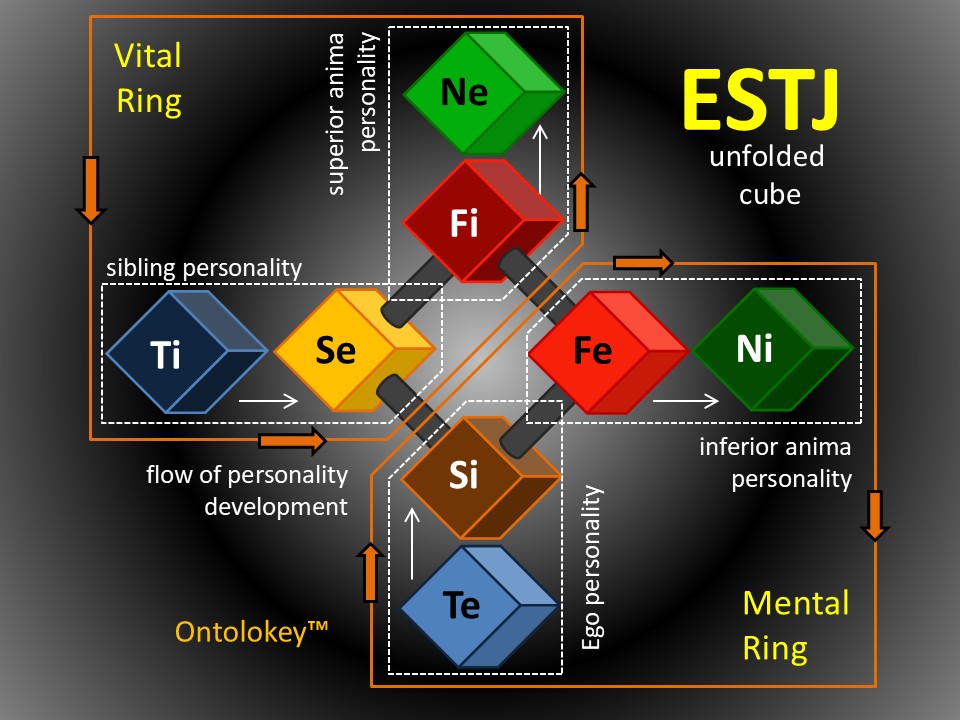
The purpose of ESTJ development is therefore not to suppress Te or to transform a naturally decisive personality into something passive, indecisive, or perpetually accommodating. Such an approach would misunderstand the developmental task entirely, because the conscious strengths of the ESTJ are not obstacles to individuation; they are the foundation from which individuation can proceed. The deeper task is to allow other psychological functions to enter the field of consciousness without immediately being subordinated to the demands of efficiency, certainty, or external control. Within the Ontolokey framework, this means gradually becoming aware of the less-developed dimensions represented by Ti, Ni, Fi, Fe, Ne, and Se, each of which introduces information that the dominant Te–Si orientation can easily neglect: internal logical coherence, symbolic and long-range perception, personal values, emotional reciprocity, alternative possibilities, and direct presence in the immediate world. The Ontolokey Cube gives these relationships a spatial form, allowing the ESTJ to see personality not merely as a hierarchy of preferred functions but as an interconnected psychological landscape in which neglected functions can become sources of development rather than threats to identity.
The central principle of this process is integration rather than replacement. An ESTJ does not need to abandon order in order to develop flexibility, nor abandon authority in order to develop empathy, nor abandon decisiveness in order to become capable of reflection. Instead, Te can learn to listen to Ti before assuming that external effectiveness is sufficient; Si can learn from Ne that the past is a resource rather than an absolute authority; Ni can be given enough psychological space to formulate possibilities that cannot yet be demonstrated; and Fi can gradually articulate the private values that give achievement a reason to exist beyond achievement itself. Fe can further teach the ESTJ that relationships contain information that cannot be reduced to compliance or performance, while Se can reconnect the personality with immediacy, vitality, physical presence, and the possibility of experiencing life without first organizing it. In this sense, the sliders of the Ontolokey Cube can be understood as developmental invitations: they do not require the ESTJ to become evenly balanced across every function, but encourage a conscious movement away from automatic extremes and toward a broader capacity to perceive, evaluate, and respond.
The Shadow of Competence: When Strength Becomes Defense
For the ESTJ, psychological shadow work begins at precisely the point where ordinary competence stops being experienced as a capacity and starts functioning as a defense. The conscious personality is naturally drawn toward what can be organized, clarified, measured, corrected, and brought into effective relationship with reality, and this orientation can produce a formidable ability to create stability where there is confusion. Yet the more deeply the ESTJ identifies with being the person who knows what must be done, the more threatening it can become to encounter situations in which there is no immediately correct procedure, no dependable precedent, no controllable outcome, or no external standard by which a decision can be justified. The shadow then develops not because the ESTJ lacks psychological depth, but because depth itself contains regions that cannot initially be managed through the familiar instruments of competence. What cannot be organized may be dismissed; what cannot be proven may be distrusted; what cannot be controlled may provoke impatience; and what cannot be expressed through practical action may remain psychologically unacknowledged. The Ontolokey approach is particularly useful here because it treats the less-conscious functions not as foreign additions to the personality but as already-existing dimensions of the psychological structure that become visible when the conscious center begins to encounter its own limitations.
This is where the ESTJ shadow can become considerably more complex than the familiar stereotype of the merely “controlling” or “bossy” personality. Control is often only the visible surface of a deeper psychological equation: if I remain competent, useful, prepared, responsible, and effective, then I remain secure in my place within the world. When that equation is threatened, the ESTJ may respond by intensifying precisely the qualities that normally make the personality strong, producing a paradox in which strength itself becomes the vehicle through which vulnerability is concealed. The person may become increasingly exacting with others, increasingly intolerant of inefficiency, increasingly attached to established methods, or increasingly preoccupied with whether other people are carrying their share of responsibility. Beneath this behavior there can be an unacknowledged fear of being rendered powerless, irrelevant, dependent, mistaken, or unable to repair what has gone wrong. The deepest shadow therefore does not necessarily say, “I want to dominate”; it may say something much more vulnerable: “I cannot afford to lose control, because I do not know who I am when competence is no longer enough to protect me.” This distinction matters because genuine development cannot begin while the defensive behavior is treated merely as a character defect; it begins when the psychological function of that behavior becomes conscious.
The resulting shadow can also distort the ESTJ’s relationship with other people, particularly when personal worth becomes unconsciously measured through contribution, reliability, obedience, or performance. An ESTJ who has become overly identified with responsibility may begin to experience other people’s autonomy as resistance, their emotional complexity as unnecessary complication, or their different priorities as evidence that they do not understand what reality requires. In its more extreme form, this can create a moralized interpersonal world divided between those who “do what needs to be done” and those who appear to evade responsibility, with the ESTJ unconsciously assigning psychological value according to practical usefulness. Such a pattern can be especially painful in intimate relationships, because emotional closeness requires precisely the kind of psychological receptivity that cannot always be converted into an efficient solution. Someone may need to be understood without being corrected, accompanied without being managed, or allowed to arrive at a different conclusion without being persuaded toward the supposedly rational one. The developmental challenge is therefore not simply learning to be “nicer,” but recognizing that another person’s inner reality constitutes information in its own right, even when it does not immediately contribute to a practical objective.
The shadow becomes most transformative when the ESTJ stops asking only whether a response is effective and begins asking what psychological need is driving the response. Before correcting someone, there may be a need to ask whether correction is actually necessary or whether uncertainty has merely become uncomfortable; before imposing a familiar procedure, it may be useful to ask whether the situation genuinely resembles the past or whether an old solution is being used because it provides psychological security; before demanding accountability from another person, the ESTJ can examine whether the demand arises from legitimate responsibility or from resentment accumulated through repeatedly carrying more than others. These questions do not weaken Te; they introduce consciousness into Te. They create a small but decisive interval between perception and reaction in which the ESTJ can discover that the impulse to control often contains valuable information about an unacknowledged fear, expectation, value, or wound. In this interval, the shadow ceases to be an enemy waiting to sabotage the personality and becomes a messenger revealing where the conscious personality has become too narrow for the complexity of the life it is attempting to manage.
The First Movement of Integration: From Reaction to Reflection
The first practical step in ESTJ development is deceptively simple: learning to observe the impulse to act before automatically obeying it. Because Te is naturally oriented toward intervention, the ESTJ often experiences recognition and response as almost simultaneous processes; something is inefficient, inconsistent, irresponsible, or structurally unsound, and the psyche immediately begins searching for the appropriate correction. This rapid movement from perception to action is one of the personality’s greatest practical advantages, but it becomes psychologically limiting when every uncomfortable perception is interpreted as a problem requiring immediate external intervention. The developmental pause is therefore not passivity but differentiation: What exactly am I seeing, what am I feeling, what am I assuming, and what actually needs to be done? Ontolokey’s broader conception of the Cube is especially relevant here because it presents the functional architecture as a landscape that can be consciously explored rather than merely a fixed sequence of preferred functions; the point is to make less-recognized psychological processes visible enough that they can participate in consciousness.
This reflective pause becomes particularly important when the ESTJ notices an unusually strong emotional reaction to another person’s behavior. If irritation appears disproportionate to the practical problem, the individual can investigate whether the visible issue is carrying an older psychological meaning: perhaps irresponsibility evokes a fear of having to carry everything alone, disagreement activates a wound around respect, incompetence awakens contempt because dependency has been unconsciously rejected within oneself, or lack of recognition touches the expectation that effort should always produce acknowledgment. The ESTJ’s shadow material describes precisely this possibility, noting that hurt can appear as anger, fear as control, humiliation as aggression, anxiety as micromanagement, and resentment as moral judgment. The important developmental discovery is that the presence of an emotion does not invalidate the factual observation that triggered it; someone may genuinely be irresponsible, unfair, disloyal, or incompetent, while the ESTJ’s reaction to that fact may nevertheless contain additional psychological material. Mature cognition therefore does not ask the ESTJ to deny reality in favor of emotion, but to distinguish the external fact from the internal charge attached to it.
The same principle can be applied to the ESTJ’s relationship with being right. Confidence based on experience is indispensable, and an ESTJ who has repeatedly solved difficult problems has legitimate reasons to trust their judgment; psychological maturity does not require artificial self-doubt. The shadow emerges when confidence becomes so closely connected with identity that correction begins to feel like diminishment, because then the question is no longer “Is my conclusion accurate?” but unconsciously “What happens to me if my conclusion is wrong?” The difference is profound: the first question belongs to cognition, while the second belongs to identity and emotional security. Once the ESTJ can tolerate the possibility of being mistaken without experiencing it as a collapse of personal authority, disagreement becomes information again rather than an implicit challenge to status, and criticism can be examined for what it contains instead of being automatically sorted into agreement or opposition. In the language of the Ontolokey framework, this is an early movement away from identifying exclusively with the most conscious functions and toward allowing the less-conscious parts of the psychological structure to contribute information that the dominant orientation might otherwise overlook.
The practical exercise, then, is not to weaken decisiveness but to insert consciousness between stimulus and command. When confronted with a conflict, an ESTJ can deliberately separate four questions: What happened? What meaning did I immediately assign to it? What emotion arose in me? And what action would still make sense if I were not emotionally threatened by the situation? This method gradually exposes the difference between objective responsibility and psychological compulsion, between leadership and the need to control, between standards and perfectionistic self-protection, and between legitimate boundaries and retaliatory withdrawal. It also begins to loosen resentment, because resentment depends upon the accumulation of emotionally charged memories into a coherent internal ledger of debts and betrayals; once each event can be examined separately rather than automatically added to an existing narrative, the past loses some of its unconscious authority over the present. The goal is not to forget what happened or to excuse harmful behavior, but to regain freedom of interpretation so that memory can serve judgment rather than dictate it. In that sense, the first developmental movement of the ESTJ is a movement from automatic certainty toward conscious authority: the ability to act firmly while remaining psychologically capable of asking whether the impulse to act is coming from reality, from values, from fear, from accumulated resentment, or from an old need to prove that one remains in control.
The Eightfold Development of the ESTJ
Once the ESTJ has learned to recognize the difference between an external problem and an internally charged reaction, the next stage is to work deliberately with the less-developed functions rather than waiting for them to emerge through crisis. The Ontolokey Cube offers a practical image for this process because it makes the psychological architecture spatial: the dominant and supporting functions are not isolated traits but positions within a larger landscape, and the sliders can be understood as a visual representation of developmental emphasis. The purpose of such movement is not to equalize all functions or to construct an artificial personality, but to give neglected forms of perception enough conscious participation that Te no longer has to carry every psychological responsibility. For the ESTJ, this means learning to ask not only what can be done, but what can be understood; not only what has worked, but what may be emerging; not only what is objectively required, but what is personally meaningful; and not only what people are doing, but what is happening emotionally between them. Development therefore becomes a gradual enlargement of the field from which decisions are made, allowing the ESTJ to remain decisively ESTJ while becoming considerably less predictable in the narrow sense of being governed by one habitual mode of consciousness.
Ti: Learning to Question One’s Own Logic
Introverted Thinking, positioned as the ESTJ’s Sibling within the Ontolokey model, provides an especially accessible developmental bridge because it belongs to the same broad territory of cognition as Te while approaching thought from a different direction. Te naturally asks whether something works in the external world, whether responsibilities are clearly distributed, and whether a practical result can be achieved; Ti presses further into the internal architecture of an idea and asks whether its assumptions are coherent, whether its categories are precise, and under what conditions its conclusions might cease to apply. For an ESTJ, deliberately strengthening this function can therefore mean learning to interrogate successful procedures rather than merely repeating them, examining definitions before arguing about conclusions, and becoming genuinely interested in the structure of an opposing argument even when its practical usefulness is not immediately apparent. This development is especially valuable because it introduces an intellectual form of humility without demanding emotional self-denigration: the ESTJ does not have to assume that their judgment is poor, only that every judgment contains assumptions worth examining. Over time, Ti can transform the internal statement “This works, therefore this is correct” into the more sophisticated position “This works under these conditions, and I understand why”; that difference can protect the ESTJ from the shadow tendency to confuse repeated success with universal validity.
Ni: Allowing the Future to Become Visible
Introverted Intuition represents a different challenge because it asks the ESTJ to remain receptive to meanings and trajectories that cannot yet be demonstrated through accumulated evidence. In the Ontolokey architecture, Ni occupies the Toddler position, associated with a comparatively immature but potentially transformative capacity for abstraction, symbolic perception, long-range synthesis, and recognition of patterns beneath immediately visible events. The ESTJ can cultivate this capacity by periodically suspending the demand for immediate proof and asking what a series of apparently unrelated developments might signify when considered as one emerging pattern, particularly in situations where the established system continues to function while its underlying environment is quietly changing. This is not an invitation to become vague or speculative for its own sake; rather, it is an exercise in tolerating ambiguity long enough for a deeper pattern to form before imposing an established interpretation upon it. A mature relationship with Ni allows the ESTJ to move from excellent reaction to genuine foresight, because the individual begins to perceive not merely what the system is but what it is becoming, and can therefore recognize developmental necessities before they become operational crises.
Fi: Discovering What Achievement Cannot Answer
Introverted Feeling is the most intimate developmental territory because it confronts the ESTJ with questions that cannot be settled through efficiency, precedent, external standards, or measurable accomplishment. Within Ontolokey, Fi occupies the Inferior position and represents a vulnerable but deeply important domain involving personal values, authenticity, conscience, emotional meaning, and the question of what remains important when no external observer is evaluating the result. This is precisely where the ESTJ may discover that a life can be objectively successful while subjectively becoming strangely empty, because the ability to accomplish goals does not automatically reveal whether those goals express the person’s deepest convictions. Developing Fi therefore requires periods of solitude, honest examination of personal values, attention to emotional reactions that cannot be immediately justified, and the willingness to ask which commitments are genuinely chosen rather than inherited from expectations about responsibility, status, duty, or usefulness. The decisive developmental movement occurs when the ESTJ can recognize that vulnerability, grief, affection, moral discomfort, and personal meaning are not interruptions of rational life but dimensions of reality that rational organization alone cannot exhaust; at that point, Te receives something it has always lacked when operating alone: an internal answer to the question of why its considerable power should be used.
Fe: Understanding the Human Field of Leadership
Extraverted Feeling introduces another dimension that can be easily underestimated by an ESTJ who has learned to equate fairness primarily with consistency and responsibility. In the Ontolokey model, Fe occupies the Anima or Animus position and concerns emotional reciprocity, interpersonal atmosphere, belonging, social harmony, and the emotional consequences that arise within groups. Developing Fe does not require the ESTJ to abandon standards or to make every decision according to whoever expresses the strongest emotion; it requires learning that people do not experience fairness solely through identical treatment, because dignity, recognition, timing, communication, and the feeling of being understood also influence whether a standard is experienced as legitimate. This is particularly important for leadership, where the technical correctness of a decision does not guarantee that the decision will generate trust, commitment, or psychological stability among the people who must live with it. The ESTJ can therefore practice asking not only “What decision is objectively defensible?” but also “What emotional reality will this decision create, and have I understood how the people affected by it are likely to experience it?” Such questions do not replace Te; they prevent Te from becoming socially blind, allowing authority to become increasingly capable of carrying both structural and human consequences.
Ne and Se: Possibility, Presence, and the Release of Excessive Control
Extraverted Intuition, identified by Ontolokey as the ESTJ’s Blindspot, challenges the tendency to close possibilities too quickly once a workable explanation or procedure has been found. Ne generates alternatives, hypothetical interpretations, unconventional connections, and possible futures, which can initially feel inefficient to a personality whose psychological satisfaction often comes from narrowing uncertainty into an actionable direction. Yet deliberately entertaining several explanations before selecting one can become a powerful corrective to premature certainty, especially when the first interpretation happens to confirm an established expectation. Extraverted Sensing, meanwhile, occupies the Golden Shadow and represents immediate sensory engagement, physical presence, spontaneity, adaptability, and a direct encounter with what is happening now rather than what happened before or what should happen next. Together, Ne and Se invite the ESTJ to loosen the grip of psychological pre-structuring: Ne opens the field of what could be, while Se deepens contact with what is; one prevents the past from becoming the only source of possibility, while the other prevents the future from becoming another project that distracts from actual experience. Their development can be as simple and concrete as deliberately considering an unconventional alternative, changing a familiar procedure when circumstances genuinely demand it, entering an experience without optimizing it, or allowing leisure, physical activity, travel, art, nature, and spontaneous interaction to exist without being justified by productivity. The deeper purpose is to discover that not every valuable moment must become useful before it is allowed to exist.
Integration in Practice: Turning Insight into Psychological Habit
The integration of the shadow cannot remain an intellectual exercise, because an ESTJ can understand a psychological model with considerable precision and still behave exactly as before when confronted with pressure, disappointment, disrespect, or uncertainty. The decisive change occurs when insight is converted into repeated acts of conscious differentiation, particularly in the moments when the familiar reaction feels most justified. Instead of attempting to “fix” every weakness at once, the ESTJ can use the Ontolokey Cube as a developmental map and identify one slider whose movement would most meaningfully compensate for a current imbalance: perhaps Ti when judgments have become too externally oriented, Ni when immediate demands have obscured a larger trajectory, Fi when achievement has become disconnected from personal meaning, or Fe when leadership has become technically effective but relationally costly. The developmental process is therefore cumulative rather than revolutionary, because psychological integration becomes stable through repeated experiences in which a previously neglected function is allowed to participate without taking over the personality. The objective is not to become a different type, but to become a less one-dimensional expression of the same type, capable of retaining decisiveness while gaining greater interior freedom.
One particularly effective practice is to treat recurring interpersonal conflicts as developmental signals rather than merely as evidence that other people are difficult. If the same kind of behavior repeatedly provokes disproportionate anger, disappointment, or contempt, the ESTJ can examine what psychological expectation is being violated and why that expectation has acquired such authority. A person who repeatedly feels exploited, for example, may discover not only that others have failed to contribute adequately but also that they have unconsciously made themselves indispensable and then experienced the resulting burden as proof that nobody else can be trusted. Someone who repeatedly becomes frustrated by emotional conversations may discover that the discomfort is not caused by irrationality in the other person but by the absence of a familiar problem-solving structure. Someone who repeatedly feels betrayed by people who do not show the same level of commitment may discover that loyalty has been defined so exclusively through behavior and performance that differences in emotional expression are interpreted as deficiencies of character. Such discoveries do not erase legitimate grievances; rather, they allow the ESTJ to separate the portion of the conflict that belongs to another person from the portion that belongs to the individual’s own psychological pattern.
The most important discipline is consequently the ability to remain curious precisely where the ego would prefer to become certain. Curiosity is psychologically powerful for the ESTJ because it creates room for the functions that are normally less visible without demanding that the dominant personality surrender its authority. When confronted with resistance, curiosity asks what information might be contained in the resistance; when confronted with an unexpected outcome, it asks which assumption was incomplete; when confronted with strong emotion, it asks what value or need the emotion is protecting; and when confronted with a radically different perspective, it asks what the other person may be perceiving that the ESTJ cannot currently see. This does not mean accepting every perspective as equally valid, because integration is not the abandonment of discernment. It means allowing perception to become broader before judgment becomes final, which is precisely the psychological movement through which shadow material can become conscious rather than being projected outward onto people who embody qualities the ESTJ has difficulty recognizing within themselves.
There is also a more personal dimension to this work that concerns the ESTJ’s relationship with rest, pleasure, dependency, and imperfection. A personality organized strongly around responsibility can unconsciously develop the belief that existence must continually justify itself through usefulness, and this can make unstructured time strangely uncomfortable because there is no obvious achievement through which the self can be confirmed. The development of Se and Fi becomes particularly important here: the individual learns gradually that direct experience has value even when it produces no measurable result, and that personal desire does not need to be defended before it is legitimate. Likewise, accepting help without immediately repaying it can become a profound psychological exercise, because it exposes the possibility that worth does not depend upon perpetual usefulness and that relationships can contain reciprocity without being reduced to accounting. These experiences may initially feel inefficient, vulnerable, or even irresponsible precisely because they challenge an established psychological economy, but that discomfort is itself useful information. The ESTJ begins to discover that control is not the same as security, productivity is not the same as meaning, and independence is not necessarily the same as strength; sometimes psychological strength consists in remaining present when none of these familiar supports is immediately available.
The Mature ESTJ: Authority Without Armor
The mature expression of the ESTJ is not defined by the disappearance of the shadow, because psychological development does not produce a state in which the less-conscious functions remain permanently integrated or difficult emotions cease to arise. Maturity is better understood as an increasing ability to recognize what is happening internally before the unconscious pattern has completely taken control of behavior. The ESTJ can remain forceful, organized, demanding, practical, and highly responsible while simultaneously becoming less defensive about uncertainty, disagreement, emotional complexity, and personal limitation. Authority then changes its psychological character: instead of being maintained through the constant demonstration of competence, it becomes increasingly grounded in self-knowledge and the ability to tolerate situations that cannot be controlled. The individual no longer needs every disagreement to end in submission, every problem to produce an immediate solution, or every contribution to receive recognition in order to remain internally stable. What emerges is a form of authority that does not depend upon armor, because the person has gradually discovered that being wrong, vulnerable, dependent, emotionally affected, or uncertain does not erase the underlying capacity to act.
This transformation also changes the meaning of responsibility. At an earlier developmental stage, responsibility can become almost synonymous with carrying everything personally, anticipating every failure, correcting every weakness, and ensuring that standards are maintained through individual effort. At a more integrated stage, responsibility includes recognizing what does not belong to oneself: another adult’s choices, another person’s emotional process, the limits of one’s knowledge, the consequences of decisions that genuinely could not have been predicted, and the fact that systems sometimes need to change rather than simply be maintained more efficiently. The ESTJ therefore learns that leadership is not identical with intervention, just as protection is not identical with control. Sometimes the most responsible action is to establish a clear boundary and then allow another person to experience the consequences of their own decision; sometimes it is to admit that an established method no longer serves its original purpose; and sometimes it is to remain present with a problem whose solution has not yet become visible. These moments require the very psychological capacities that the shadow tends to avoid, because they place the ESTJ in contact with uncertainty without allowing immediate action to dissolve it.
The integration of Fi and Fe is particularly decisive because it humanizes the ESTJ’s considerable capacity for structure without undermining its strength. Fi asks the individual to discover what is personally meaningful beneath the architecture of duty, achievement, reputation, and external expectations, while Fe expands awareness toward the emotional field shared with other people. Together, these functions make it increasingly possible to distinguish between enforcing a rule and serving the value that the rule was originally intended to protect. An integrated ESTJ can therefore become more flexible without becoming arbitrary, more compassionate without becoming permissive, and more emotionally receptive without surrendering judgment. The personality’s natural concern with fairness can deepen from “everyone must meet the standard” toward the more complex understanding that justice sometimes requires context, proportion, restoration, and recognition of human differences. This is not a rejection of the ESTJ’s instinct for order; it is the development of a richer conception of what order is for.
The same maturation occurs cognitively through the integration of Ti, Ni, and Ne. Ti teaches the ESTJ to examine the architecture of its own reasoning rather than assuming that practical success automatically proves conceptual correctness; Ni allows the individual to perceive trajectories and underlying patterns before they become operationally obvious; and Ne preserves openness to alternatives that challenge the first workable interpretation. The result is a mind that can still make decisions quickly but no longer needs to make them prematurely. Such an ESTJ becomes capable of holding two seemingly contradictory positions at once: “I have enough information to act” and “I may still be missing something.” That combination is psychologically powerful because it removes the false choice between decisiveness and humility. The individual can act under uncertainty without pretending that uncertainty does not exist, revise a position without experiencing revision as humiliation, and change direction without interpreting change as evidence that the previous self was incompetent. In this form, cognition becomes less a weapon for establishing certainty and more an instrument for maintaining contact with reality as reality changes.
The deepest developmental shift may therefore be described as a change in the ESTJ’s relationship with control. Early control says, in effect, that safety depends upon making the world sufficiently orderly; mature consciousness recognizes that genuine stability also depends upon being psychologically capable of surviving disorder. This distinction allows the ESTJ to retain standards without becoming imprisoned by them, to respect tradition without confusing tradition with truth, to value efficiency without reducing life to productivity, and to exercise authority without making obedience the measure of personal worth. The shadow is no longer something that must be defeated because it has become something that can be listened to: anger can reveal violated values, resentment can expose unspoken expectations, rigidity can signal fear of uncertainty, and the need to control can reveal an area where trust has not yet developed. In this sense, the shadow becomes an unexpected teacher, showing the ESTJ where the conscious personality has reached its current boundary and where the next stage of psychological growth is waiting.
Using the Ontolokey Cube as a Developmental Compass
The Ontolokey Cube can be understood most fruitfully, within the framework developed in the preceding texts, as a practical instrument for making an otherwise abstract developmental process psychologically tangible. Rather than asking the ESTJ to memorize a hierarchy of functions, the Cube provides a landscape in which the relative position of the different functions can be contemplated and, through its sliders, consciously adjusted as developmental emphases. This is particularly useful because psychological growth often remains vague when described only in conceptual language: an individual may understand that they should become “more intuitive,” “more emotionally aware,” or “more flexible,” yet have little sense of what such changes would actually mean in daily life. The visual movement of a slider creates a different kind of awareness, because it turns development into a question of direction and proportion rather than perfection. The point is not to push every less-developed function to an imagined maximum, but to recognize where habitual consciousness has become disproportionately concentrated and where another function might provide precisely the corrective information that is currently missing. In this respect, the Cube becomes less a classification device than a developmental compass, helping the ESTJ ask which psychological movement would enlarge consciousness at the present stage of life.
The most useful way to work with the sliders is therefore not to regard them as prescriptions but as hypotheses for self-observation. If an ESTJ notices increasing rigidity, repeated frustration with people, or an inability to imagine alternatives, the developmental direction may involve deliberately strengthening Ne, Ni, or Ti rather than simply trying to “be more patient.” If the central problem is emotional disconnection, chronic resentment, or the sense that life has become a sequence of obligations without personal meaning, Fi and Fe may deserve greater conscious attention. If excessive planning and anticipation have produced a persistent distance from immediate experience, Se can offer a corrective through direct engagement with the present rather than continual management of what comes next. The significance of the Cube lies precisely in this possibility of individualized movement: the same ESTJ structure can require very different developmental emphases at different moments because psychological imbalance is not static. One person may need to learn how to loosen control, while another may need to establish firmer boundaries; one may need greater receptivity to emotion, while another may need to develop enough Ti to distinguish genuine responsibility from unnecessary intervention. The sliders can therefore serve as a visual reminder that development is directional and contextual rather than a universal recipe applied identically to every person of the same type.
A particularly productive practice would be to revisit the Cube after significant experiences rather than treating one’s position as permanent. A major conflict, professional transition, relationship change, failure, success, loss, or period of unusual uncertainty can expose a previously invisible imbalance, and the functions that become most psychologically relevant may change accordingly. After such an experience, the ESTJ can ask which function was operating automatically, which function was missing from the decision, and which neglected perspective might have produced a broader response. This creates a developmental cycle in which lived experience becomes feedback: the conscious personality encounters reality, recognizes the limits of its habitual approach, experiments with another function, observes the consequences, and then adjusts again. The process resembles psychological calibration more than self-correction, because there is no final configuration in which development stops. The deeper aim is to become sufficiently conscious of one’s own configuration that the personality can respond deliberately rather than being unconsciously driven by whichever function happens to dominate under pressure.
There is also an important safeguard against turning the Cube itself into another ESTJ project of optimization. An ESTJ may naturally approach personal development with the same mentality used to organize a business, solve a logistical problem, or improve a system: identify the weakness, establish a target, measure progress, eliminate the defect, and move toward an improved state. Yet this approach can reproduce the very shadow pattern that psychological development is intended to transform, because the self becomes another system that must be controlled and perfected. Some dimensions of psychological life cannot be forced into existence through discipline alone; intuition requires receptivity, emotional awareness requires vulnerability, creativity requires tolerance of uncertainty, and intimacy requires the willingness to encounter another person without immediately converting the encounter into a problem to solve. The Cube is most valuable when it therefore becomes an invitation to exploration rather than another performance standard. Its sliders can indicate a direction, but the actual developmental movement must occur through lived experience, reflection, relationship, and the gradual willingness to remain conscious in situations where the old response would have provided immediate certainty.
The Final Integration: From Managing Life to Participating in It
At the deepest level, the developmental journey of the ESTJ concerns a subtle transformation in the relationship between the self and the world. The younger or less-integrated expression of the type may experience life primarily as something that must be organized correctly: responsibilities must be fulfilled, structures must function, people must contribute, standards must be maintained, and problems must be solved before they become larger problems. This orientation can produce extraordinary reliability, but it can also create an unconscious distance from life itself, because experience is continually filtered through the question of what should be done about it. Psychological integration gradually introduces another possibility: sometimes the task is not immediately to organize the experience but first to inhabit it, understand it, and allow it to reveal something that cannot yet be translated into an action plan. The ESTJ who develops this capacity does not become less practical; rather, practical action begins to emerge from a larger field of perception in which facts, patterns, values, emotions, possibilities, relationships, and immediate experience can all participate. The movement is therefore from managing reality toward participating consciously in reality, which represents a profound expansion of the personality without requiring the abandonment of its natural strengths.
This transformation is especially significant because the ESTJ’s greatest gifts can otherwise conceal its greatest developmental needs. A person who is consistently capable may receive so much external confirmation for competence that nobody, including the individual, notices how much psychological energy is being invested in remaining capable at all times. Responsibility can become a socially rewarded defense against vulnerability, productivity can become a substitute for self-examination, and decisiveness can prevent the individual from discovering what uncertainty might teach. The shadow becomes visible when these strategies stop working: when an achievement no longer satisfies, when authority no longer guarantees respect, when familiar structures collapse, when relationships demand emotional presence rather than practical solutions, or when life presents a situation in which there is genuinely no correct procedure. Such experiences can initially feel like disruptions, but they can become developmental thresholds because they force the ESTJ into contact with functions that ordinary competence has allowed it to neglect. The crisis is then not valuable because suffering is inherently beneficial, but because it can reveal the limits of an identity that has become too dependent upon control, certainty, usefulness, or external validation.
The integrated ESTJ eventually discovers that personal authority does not have to be defended against every form of difference. Another person’s intuition does not automatically threaten practical reality; another person’s emotion does not automatically invalidate objective facts; an unfamiliar possibility does not automatically undermine established experience; and a change of mind does not automatically diminish the person who changes it. The more fully the shadow functions participate in consciousness, the more nuanced the personality’s relationship with power becomes, because power is no longer primarily used to prevent uncertainty from being felt. It can instead become a means of creating conditions in which other people can think, develop, contribute, disagree, and assume responsibility themselves. Leadership becomes less about being the indispensable person at the center of every process and more about creating structures strong enough that they do not require constant personal control. This is perhaps one of the clearest signs of maturation: the ESTJ no longer needs to prove that everything depends upon them, because their sense of worth has become sufficiently internalized to allow other people to possess competence, autonomy, and authority without experiencing their independence as a loss.
Ultimately, the developmental invitation represented by the Ontolokey Cube is therefore not to become “less ESTJ,” but to become conscious of the entire psychological landscape that the ESTJ contains. Te can remain decisive while learning from Ti; Si can preserve continuity while listening to Ne; Ni can introduce deeper patterns without demanding immediate proof; Fi can establish an inner center of meaning beneath external achievement; Fe can humanize authority through emotional reciprocity; and Se can return the individual to the immediacy of embodied life. Each movement enlarges the range within which the conscious personality can operate, making it less dependent upon automatic defenses and more capable of choosing its response. The sliders of the Cube can serve as a reminder that development has direction, but the direction must ultimately be discovered through honest observation of one’s own life rather than through an abstract ideal of psychological perfection. Growth occurs when the ESTJ repeatedly notices where it has become rigid, curious about what lies beyond that rigidity, and willing to allow another psychological function to participate before returning to action.
The mature goal, then, is not equilibrium in the mechanical sense and certainly not the elimination of the shadow, but an increasingly conscious relationship with the whole personality. The ESTJ can remain ambitious without being enslaved by achievement, authoritative without needing domination, principled without becoming rigid, responsible without carrying what belongs to others, emotionally contained without becoming emotionally inaccessible, and decisive without becoming closed to revision. The deepest freedom comes when the individual no longer has to choose between competence and vulnerability, structure and imagination, reason and feeling, responsibility and spontaneity, because these dimensions have ceased to be perceived as mutually exclusive identities. For the ESTJ, psychological growth ultimately means discovering that strength becomes more durable when it no longer has to conceal weakness, and that authority becomes more human when it no longer has to defend itself against uncertainty. The shadow does not disappear; it becomes conscious enough to contribute to the person who once feared it.
A Continuing Practice of Growth
The work does not end with understanding the ESTJ structure, identifying the shadow, or locating the less-developed functions on the Cube. Those are maps, and a map becomes psychologically meaningful only when it changes how one walks through actual life. The practical discipline is to return repeatedly to the moments in which one’s reaction feels most automatic and justified, because these are often the moments in which the unconscious structure is speaking most loudly. Ask what happened, what interpretation arose, what emotion followed, which function took command, which function was absent, and what a slightly broader response might have looked like without betraying the legitimate reality of the situation. Over time, these questions transform development from an abstract ambition into a way of living, because every conflict, decision, disappointment, relationship, and unexpected opportunity becomes material through which consciousness can expand. The objective is not to become endlessly self-analytical, but to become sufficiently self-aware that action increasingly emerges from choice rather than compulsion.
For readers who want to explore this process further, the more extensive psychological analyses of the ESTJ and the other personality types are available through the Ontolokey framework at Ontolokey.com, where the individual type descriptions, shadow explorations, functional relationships, and Cube-based perspectives provide a broader context for continuing this work. The ESTJ material is best approached not as a final description of who one is, but as a set of mirrors through which different aspects of one’s psychological life can become recognizable. The same Cube can also be explored in relation to other personality types, making it possible to understand differences not merely as labels but as different configurations of conscious preference and less-developed psychological potential. The most valuable use of such a framework is ultimately personal: to recognize the patterns that repeatedly govern one’s reactions, to identify where one’s habitual strengths have become defensive, and to experiment consciously with the functions that can restore breadth to perception. Development begins when the individual stops asking only, “How can I become more effective?” and gradually learns to ask the larger question: “What kind of person am I becoming through the way I use my effectiveness?”
With that question, the ESTJ’s development moves beyond self-improvement and toward psychological integration. The purpose is no longer simply to perform better, lead better, organize better, or achieve more, although all of these capacities may remain important. It is to become sufficiently internally spacious that effectiveness serves consciousness rather than replacing it, and that responsibility expresses values rather than compensating for an inability to tolerate uncertainty. The Ontolokey Cube can accompany this process as a visual reminder that every strength has a corresponding developmental edge and that every neglected function contains information that the dominant personality may need. The direction of growth is therefore not away from the ESTJ but deeper into it, until the personality’s considerable capacity for action is supported by an equally developed capacity for reflection, meaning, imagination, emotional understanding, openness, and presence. In that sense, the mature ESTJ does not cease to be the person who can take charge when necessary; rather, they become the person who knows when taking charge is necessary, when it is not, and what is happening within themselves while they make that distinction.


Leave a comment