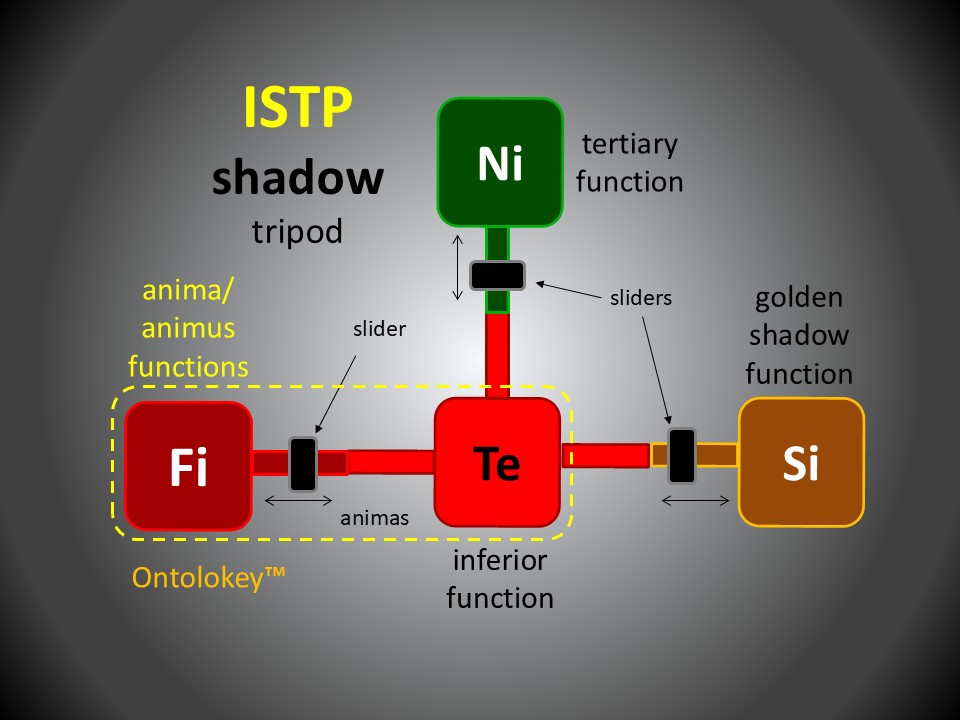
At the surface level, the ISTP is defined by an unusually deep commitment to internal coherence. Such individuals experience the world as a network of systems, patterns, and cause-and-effect relationships that must eventually make sense, and they are constantly testing whatever crosses their path against that private standard of logical consistency. This is not a search for control over other people so much as a search for clarity in itself; the ISTP wants to understand how something actually functions before they are willing to trust it, whether that something is a machine, a social hierarchy, or a set of moral expectations. Supporting this internal logic is an equally strong connection to the physical, present-tense world, which gives the type its practical edge — the tendency to test ideas through direct action rather than through endless theorizing, and a marked preference for what can be touched, measured, and verified over what can only be argued. Together these two orientations produce a personality that appears calm under pressure, technically gifted, and instinctively drawn toward roles that reward precision: engineering, crisis response, tactical work, or any domain where a clean solution genuinely matters more than a persuasive one.
Beneath this logical and hands-on exterior lies a considerably more private layer, one built around a personal, largely unspoken code of values, loyalty, and fairness. This inner register does not announce itself the way the ISTP’s logic does; it operates quietly, forming judgments about people almost invisibly and only occasionally surfacing as sudden, disproportionate reactions when someone has crossed a line the ISTP never stated out loud. Trust, in this framework, functions almost like a private contract — loyalty is expected to be reciprocated, responsibilities are expected to be honored, and once that unspoken agreement is broken, the withdrawal of trust tends to be quiet, total, and very difficult to reverse. This helps explain a pattern many people close to an ISTP eventually notice: the sense that they are constantly, if subtly, being tested for reliability and honesty, often without ever being told that a test was underway. What looks from the outside like emotional coolness is frequently something closer to emotional privacy — a genuine and often intense inner life that the type has simply never learned to make legible to others, partly because vulnerability itself tends to register to them as a kind of risk rather than a form of connection.
Considerably more uncomfortable for this type is anything resembling open-ended possibility, ambiguity, or speculative thinking untethered from concrete application. Where the ISTP’s dominant orientation wants definitive answers and testable outcomes, this exploratory dimension traffics in “what if” questions that rarely resolve into anything actionable, and the type tends to experience this kind of unresolved uncertainty as something closer to static interference than as a source of creative energy. Under stress, this discomfort with open possibility can curdle into a genuinely paranoid undertow, in which the ISTP begins silently interrogating other people’s motives, suspecting hidden agendas, or fixating on the fear that some crucial piece of information is being withheld from them. This is not typically described as a stable trait so much as a symptom of imbalance — a sign that the type’s need for grounded certainty has outpaced its tolerance for the ordinary uncertainty that governs most human relationships and long-term decisions.
Emotional expression forms another area of real difficulty, not because the ISTP lacks feeling, but because feeling itself resists the kind of clean, structured processing this type generally prefers. Vulnerability is experienced as invasive and unclear rather than natural, and the type often defaults to demonstrating care through action — fixing something, solving a problem, quietly showing up — rather than through words or overt displays of warmth. When emotional pressure accumulates faster than it can be discharged through this indirect channel, it tends to surface later as sudden irritability, sharp sarcasm, or an outburst that surprises the ISTP nearly as much as it surprises the people around them. Afterward there is often genuine confusion and even shame about what just happened, because the type generally prides itself on composure and struggles to recognize how much pressure had actually been building beneath that composed surface. There is, underneath all of this, a real and often underestimated longing to belong and to be emotionally understood — a longing the type rarely voices directly, in part because voicing it would require exactly the kind of open vulnerability this personality has spent years learning to avoid.
What Ontolokey frames as the type’s greatest area of untapped potential involves a slower, more future-oriented and symbolically attuned way of perceiving reality — flashes of insight that arrive quietly, almost like a hunch, and that are easy for a logic-driven mind to dismiss simply because they cannot yet be proven. When the ISTP learns to trust these quieter, less immediately verifiable forms of knowing rather than discounting them outright, their thinking becomes noticeably more strategic rather than merely tactical, and they develop a capacity for foresight that pure logic and pure sensory data cannot provide on their own. This same underdeveloped territory is also where a more relational, emotionally fluent version of the self is described as waiting to be integrated — the capacity to lead not only through competence but through genuine emotional presence, to become, in Ontolokey’s own framing, more socially engaged and emotionally mature than the type’s default operating mode typically allows. Reaching that fuller integration is described less as a personality overhaul than as a widening — an addition of registers the ISTP already possesses in latent form, rather than the abandonment of the logical precision that makes the type so effective to begin with.
The shadow essay published separately by Ontolokey goes considerably further into this territory, and its tone shifts noticeably from the more descriptive material summarized above — it explicitly states that it was written in a spirit of psychological honesty rather than comfort, meant for self-reflection rather than as ammunition to be used against anyone. Its central argument is that the ISTP’s greatest apparent strength — autonomy — is also the psychological terrain in which its deepest wound tends to develop, because what begins as a genuinely healthy form of independence can, left unexamined, slowly transform into something closer to isolation. The essay describes this shift as more like erosion than explosion: nothing dramatic marks the transition, the person remains outwardly functional and often highly competent, and yet a widening gap gradually opens between the internal world the ISTP inhabits and the living reality of the relationships around them. What makes this especially difficult to notice is that the process rarely begins with arrogance; more often it begins with a genuine uncertainty about how to navigate emotional expectations, so that distance starts out as a kind of safety rather than as a judgment on other people.
One of the sharper observations in this material concerns the way an unusually capable intellect can become an instrument of self-deception precisely because it is so capable. The ISTP is often gifted at detecting flaws, inconsistencies, and inefficiencies in external systems, and this same analytical talent, when turned inward without sufficient emotional awareness, can start treating people the way it treats machines — as objects to be understood, categorized, and optimized rather than as subjects to be met. Understanding a person, the essay stresses, is simply not the same thing as connecting with them, and a personality that becomes extremely skilled at the former while remaining underdeveloped in the latter can end up feeling competent and capable while still being quietly, persistently lonely. Because society tends to reward exactly the traits that accompany this pattern — competence, restraint, self-sufficiency, skepticism — the ISTP often receives continuous external validation for behaviors that are simultaneously deepening an inner isolation that nobody, including the individual themselves, has any particular incentive to question.
This dynamic is described as feeding directly into a slow, largely invisible development of cynicism, which the essay treats as one of the most consequential and least obviously pathological expressions of the ISTP shadow. Unlike anger, cynicism rarely announces itself as a problem; it tends to feel instead like maturity, like hard-earned realism, like the simple correction of youthful naivety. The difficulty is that this apparent wisdom is often disappointment that has quietly hardened into a worldview, built up through years of observing human inconsistency from a comfortable analytical distance rather than through equal participation in the more redeeming, harder-to-observe sides of human relationships. As this asymmetry deepens, trustworthy behavior starts to look like the exception rather than the norm, sincerity starts to look suspicious, and the individual becomes accurate about specific details while increasingly distorted in the larger picture — sharp in observation, narrow in conclusion. In its more advanced form, the essay notes, this cynicism can calcify further into something closer to contempt, a state in which the original sadness underneath disappointment disappears entirely and is replaced by something that feels like invulnerability but is, underneath, a much deeper and more fragile form of self-protection.
Running alongside this is what the essay calls the tyranny of self-sufficiency, describing how a genuinely healthy capacity for independence can gradually expand until it excludes essential and entirely normal human needs for recognition, belonging, and emotional connection. Because psychological adaptation tends to be selective in what it remembers, moments of disappointment or betrayal become far more memorable to this pattern than moments of genuine support, which means the ISTP’s picture of the world can quietly tilt toward the conclusion that autonomy is reliable and connection is not — even when the underlying evidence, taken as a whole, would not actually support such a stark contrast. Needs that go unacknowledged in this framework do not simply vanish; they tend to resurface in disguised form, as irritation with others’ emotional demands, as unexplained disappointment in relationships, or as a subtle pride taken in appearing to need very little from anyone. The essay is careful to point out that this pattern often produces real external rewards — admiration for resilience, respect for self-control — which is precisely what makes it so difficult to interrupt, since the world keeps applauding a strength whose cost remains largely invisible to everyone involved, including the person paying it.
A particularly striking section of the material addresses what it calls the frozen heart, focusing specifically on the ISTP’s complicated relationship with romantic intimacy. The essay is careful to note that emotional distance in this type does not usually reflect an absence of feeling but rather the opposite — feelings that are often quite intense and correspondingly difficult to manage within an internal framework built around control and self-containment. Love, unlike most challenges the ISTP faces, cannot be solved through competence; it introduces genuine uncertainty, dependency, and exposure that resist the type’s usual methods of mastery, and this can generate a real internal conflict between a sincere desire for closeness and an equally sincere fear of what closeness demands. The resulting pattern often looks, to a partner, like inconsistency — periods of real depth followed by unexplained withdrawal — and the essay frames this less as a lack of commitment than as an oscillation between attraction and self-protection that the ISTP themselves may not fully understand while it is happening. What ultimately makes this dynamic so painful is that the very defenses built to prevent heartbreak often end up producing a milder, more chronic version of it: not sudden loss, but a slow, ongoing withholding of exactly the depth the person secretly wants.
Closely related is what the essay describes as a shadow of control, which reframes the ISTP’s discomfort with dependency in more relational terms. Because vulnerability places emotional wellbeing partly outside the individual’s control, the type can develop subtle strategies — emotional withholding, strategic silence, unpredictable accessibility — that function as a kind of quiet power within relationships, even though this power is rarely sought consciously and often contradicts the ISTP’s own genuine dislike of coercion and manipulation in other people. The essay’s point here is not that the ISTP is secretly controlling in any deliberate sense, but that the effort to avoid being controlled by others can itself, almost by accident, produce a controlling dynamic — an uneven relationship in which the person best able to detach ends up shaping the emotional climate simply by virtue of that detachment. Genuine strength, the essay argues in response to this pattern, is not the capacity to remain unaffected; it is the capacity to remain open without being destroyed by that openness, and this reframing runs directly against decades of accumulated instinct for a personality built so thoroughly around self-containment.
Perhaps the darkest territory the essay covers concerns what it calls a descent into existential emptiness, describing a state in which meaning itself begins to feel increasingly out of reach, not because life has become harder, but because the very defenses that once provided stability have gradually crowded out the conditions under which meaning tends to arise. Emotional withdrawal reduces participation, cynicism reduces belief, self-sufficiency reduces connection, and each of these adaptations may offer short-term psychological safety while collectively making it harder to access the kind of engagement that gives life its depth. This condition, the essay stresses, is easy to mistake for realism or sophistication, since the individual is often simply identifying real contradictions and real disappointments — the danger lies not in the accuracy of these observations but in their eventual totality, in a skepticism that expands until it has quietly dismantled every source of meaning rather than leaving some standing. Even here, though, the material insists that the very capacity to notice this emptiness is itself evidence that the capacity for meaning has not actually been destroyed, only obscured — a psychological ember that longing keeps faintly alive even under a great deal of accumulated defense.
The essay’s concluding movement is explicitly framed around integration rather than elimination, making clear that the goal of naming these shadow dynamics was never to suggest the ISTP should abandon logic, independence, or self-reliance, all of which remain genuine strengths worth protecting. Instead, the invitation is to let vulnerability, emotional attunement, and interdependence sit alongside those strengths rather than being pushed out by them — to discover, in the essay’s own words, that strength and vulnerability were never actually opposites, and that the walls originally built to keep pain out have, over time, also kept out much of what makes connection and meaning possible in the first place. According to Ontolokey’s framing, this kind of integration does not require the ISTP to become someone fundamentally different; it requires only that the qualities already present — precision, loyalty, independence, quiet depth of feeling — be allowed to operate in relationship with others rather than exclusively in defense against them.
Readers who want to explore any part of this in far greater depth — the complete eight-function architecture behind this model, the parallel shadow essays written for other personality types, or the broader theoretical framework connecting this approach to established psychological traditions — are encouraged to visit the original material directly at www.Ontolokey.com, where the full essays and the interactive model referenced throughout this summary are published in their entirety. This overview draws entirely on content originally created by Ontolokey and is intended as a condensed entry point into that larger body of work, not as a replacement for it.


Leave a comment