The Personality Behind the Competence
The ISTP is often recognized through a deceptively simple image: the independent problem-solver, the practical thinker, the calm individual who understands how things work and prefers direct experience to abstract speculation. Yet this familiar portrait captures only the visible surface of a much more complex psychological structure. In the Ontolokey interpretation, the ISTP is organized around a powerful tension between internal logical autonomy and direct engagement with reality: Introverted Thinking provides the internal architecture, while Extraverted Sensing gives that architecture physical expression through action, observation, precision, and control. This combination can produce remarkable competence because the ISTP is not satisfied merely with understanding an idea; the idea must survive contact with reality, where it can be tested, dismantled, improved, or discarded.
The strength of this configuration is also the beginning of its psychological difficulty. An ISTP can become exceptionally good at remaining composed when others become overwhelmed, solving practical problems without unnecessary emotional drama, and preserving independence when social pressure becomes intrusive. These qualities can make the person resourceful, courageous, technically gifted, perceptive, and unusually difficult to manipulate. But the same psychological economy can gradually turn against itself when independence becomes isolation, objectivity becomes emotional distance, and analytical intelligence becomes a mechanism for explaining away experiences that would otherwise require vulnerability. Ontolokey’s deeper shadow analysis describes this development not as a sudden collapse but as a gradual erosion in which the individual can remain outwardly competent while becoming increasingly separated from intimate human experience.
The “untold truth” of the ISTP therefore lies less in the stereotype of being cold, rebellious, or unemotional than in the possibility that the very qualities that make the ISTP strong can become sophisticated defenses against dependence, uncertainty, emotional exposure, and loss of control. The person may genuinely value freedom, rationality, privacy, and self-sufficiency, while simultaneously using those values to avoid situations in which no amount of intelligence can guarantee safety. This creates a particularly subtle psychological paradox: the ISTP may sincerely believe that withdrawal is simply rational when withdrawal has itself become part of the mechanism producing loneliness, mistrust, and emotional impoverishment. Ontolokey’s cube makes this paradox especially visible by placing the eight functions into a dynamic structure in which conscious strengths, less-conscious capacities, blind spots, vulnerable functions, and the so-called Golden Shadow can be examined as interconnected parts of one psychological landscape rather than as isolated traits.
The Ontolokey Cube: Eight Functions as a Psychological Landscape
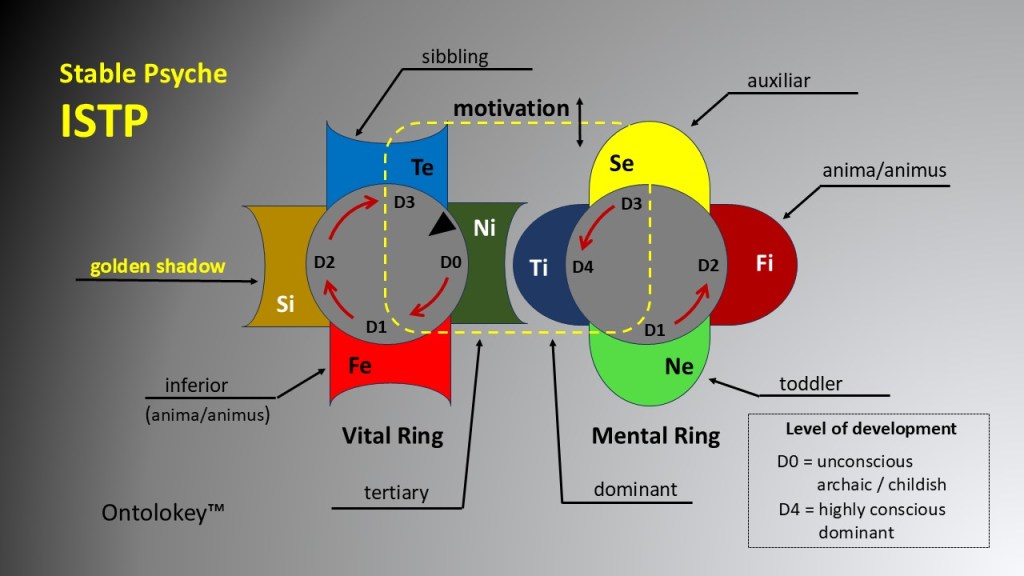
The distinctive value of the Ontolokey perspective on the ISTP lies in its attempt to make the entire eight-function structure visible rather than treating personality as a simple hierarchy of four preferred functions. In this framework, the ISTP is not merely “Ti–Se–Ni–Fe,” but a three-dimensional psychological configuration in which the conscious functions and their less-conscious counterparts form a complete landscape. The central conscious axis is Introverted Thinking (Ti) and Extraverted Sensing (Se): Ti seeks internal coherence, structural accuracy, and an understanding of how things actually work, while Se brings that understanding into immediate contact with physical reality, observation, action, timing, and consequence. The resulting personality is therefore simultaneously analytical and embodied; the ISTP wants to understand the mechanism and then discover whether the mechanism survives contact with the real world. Ontolokey describes this combination as an “inner architect” working together with a function that gives logic practical force, which helps explain why the stereotypical ISTP often appears most intelligent when dealing with something concrete, difficult, urgent, or technically demanding rather than when merely discussing abstractions.
The third position, Introverted Feeling (Fi), occupies a very different psychological territory. Within the Ontolokey interpretation, Fi represents a comparatively hidden inner moral and emotional layer: personal loyalty, private values, integrity, and the subjective sense that something is acceptable or unacceptable even when the judgment cannot easily be reduced to Ti-style logic. This is important because the emotionally restrained ISTP can otherwise be misunderstood as someone without particularly strong values; the deeper picture is almost the opposite, because the values may be intensely held precisely because they are private and therefore not routinely verbalized. The ISTP may consequently express attachment through behavior rather than declarations, judge loyalty through what people actually do under pressure, and respond strongly when a personal boundary or principle has been violated. Because this emotional architecture is less consciously accessible, however, the person may have difficulty identifying vulnerable feelings before they have become transformed into distrust, withdrawal, irritation, or a definitive judgment about another person’s character. Ontolokey therefore presents Fi not as the obvious emotional center of the ISTP, but as a concealed inner source of conviction that can become especially visible when questions of betrayal, respect, loyalty, and personal integrity arise.
The fourth position, Extraverted Intuition (Ne), represents the ISTP’s difficult relationship with open-ended possibility. Ne generates alternatives, hypothetical explanations, divergent interpretations, and potential futures, whereas the ISTP’s preferred Ti–Se configuration generally wants something more concrete: a problem that can be defined, evidence that can be inspected, and an action that can be tested. This makes ambiguity psychologically uncomfortable when it cannot be resolved through observation or logical analysis, and under strain the same imaginative capacity that could generate creative alternatives may instead produce an uncontrolled proliferation of possibilities: What if something has been missed? What if someone is concealing an intention? What if the apparently obvious explanation is wrong? The crucial distinction is that this is not simply a lack of imagination; it is a difficulty with maintaining psychological stability when imagination is no longer constrained by reliable evidence. When Ne becomes integrated rather than threatening, however, it can become extremely useful to the ISTP because it introduces alternative hypotheses before reality forces them upon the individual, allowing the normally decisive Ti–Se system to become more flexible without surrendering its demand for evidence.
Extraverted Feeling (Fe) occupies the inferior position and consequently touches one of the ISTP’s most intimate contradictions: the simultaneous discomfort with overt emotional dependence and the desire to experience genuine human connection. Fe concerns interpersonal atmosphere, emotional reciprocity, shared feeling, social belonging, and the ability to communicate care in a form that another person can readily recognize. The ISTP may therefore care deeply while communicating that care through competence, protection, practical assistance, problem-solving, physical presence, or simply remaining available when circumstances become difficult. Problems arise when another person requires explicit emotional participation rather than practical intervention, because the ISTP may experience the demand as intrusive, confusing, or impossible to satisfy correctly and consequently retreat behind silence or rational explanation. In the more mature expression of the type, Fe does not require the ISTP to become emotionally demonstrative; instead, it allows the individual to recognize that emotions are also part of reality, that relationships cannot be maintained exclusively through functional exchanges, and that sometimes the most rational response to another person’s suffering is not to repair the problem but to remain emotionally present with them.
The remaining positions become particularly significant when the ISTP enters a state in which the ordinary Ti–Se equilibrium no longer provides sufficient psychological stability. Extraverted Thinking (Te) can represent an attraction to externally measurable efficiency, explicit performance standards, productivity, and organizational control, while Introverted Intuition (Ni) introduces the capacity to perceive deeper trajectories, symbolic meanings, and patterns unfolding beyond the immediate sensory field. In the Ontolokey conception, these functions are not simply “bad” or defective opposites; they represent psychological territories that can emerge under pressure, development, aspiration, or unconscious compensation. Te may appear when the ISTP becomes preoccupied with making everything externally efficient and controllable, while Ni can pull the person toward an increasingly concentrated interpretation of what events ultimately mean or where they are leading. Their more extreme expressions can become problematic precisely because they lack the effortless balance that Ti and Se normally provide, yet their mature integration can substantially enlarge the ISTP’s range by adding strategic perspective and a stronger capacity to translate internal understanding into sustained external organization.
At the far end of this landscape are Extraverted Feeling’s opposite, Introverted Feeling’s relational counterpart in the shadow structure, and particularly Introverted Sensing (Si) as a deeper form of psychological retreat toward familiarity, continuity, memory, and security. Here the cube becomes more than a diagram of preferred mental operations: it becomes a representation of tensions between what the ISTP consciously trusts and what the psyche may nevertheless seek when ordinary independence becomes exhausting. The ISTP’s attraction to freedom can coexist with a profound need for a reliable inner and external environment, just as their appetite for immediate experience can coexist with an unconscious longing for something stable enough to return to. This is one reason the ISTP can appear paradoxical across different periods of life: the same individual who fiercely resists being controlled may also become deeply attached to familiar places, trusted people, established routines, proven equipment, or personal rituals once those things have earned their confidence. Ontolokey’s spatial metaphor makes this paradox psychologically intelligible because the less-visible functions are not treated as irrelevant—they remain part of the same personality landscape, waiting to emerge when the conscious center is stretched beyond its normal range.
The resulting picture is considerably richer than the conventional portrait of the ISTP as merely the detached mechanic, adventurer, skeptic, or “lone wolf.” At its healthiest, the configuration produces a person capable of extraordinary composure, practical intelligence, perceptual precision, independent judgment, and decisive action, while the deeper functions provide capacities for loyalty, emotional attachment, alternative thinking, social connection, foresight, and continuity. At its most defensive, the same structure can become a closed circuit in which Ti justifies withdrawal, Se reacts to immediate threats, private values become rigid judgments, weak tolerance for ambiguity becomes suspicion, and inferior Fe leaves emotional needs unacknowledged until they emerge indirectly. The psychological challenge is therefore not to replace the ISTP’s natural strengths with a different personality, but to prevent those strengths from becoming defensive absolutes. The deeper journey suggested by the Ontolokey model is one in which the ISTP retains the freedom, precision, realism, and self-reliance that define the type while gradually becoming capable of tolerating what cannot be immediately measured, explained, repaired, or controlled.
The Fortress of Autonomy: When the ISTP’s Greatest Strength Turns Inward
The deepest shadow described for the ISTP begins not with emotional chaos but with an apparently admirable psychological adaptation: autonomy. The capacity to stand apart from collective pressure, trust one’s own judgment, solve problems independently, and remain composed when others become overwhelmed can be one of the type’s most genuine strengths. In Ontolokey’s formulation, however, every psychological strength contains the possibility of becoming defensive when it is used beyond its natural function, and autonomy can gradually change into isolation without the person consciously recognizing the transition. The crucial distinction is that healthy independence creates freedom of movement, whereas defensive independence creates freedom from involvement; the former allows a person to choose connection without losing himself, while the latter begins treating connection itself as a threat to self-possession. What makes this shadow particularly difficult to detect is that the ISTP can remain outwardly competent throughout the entire process, continuing to master skills, solve practical problems, maintain intellectual independence, and function effectively while an increasingly separate inner life develops beneath the surface. Ontolokey characterizes this movement as a progression from independence to isolation, from objectivity toward alienation, and eventually from psychological self-possession toward an invisible fortress whose walls are experienced by the individual not as confinement but as protection.
This fortress rarely begins with the conscious conviction that other people are inferior or unnecessary; more often, it begins with the discovery that distance feels safer than exposure. Emotional expectations are difficult to predict, social dynamics contain contradictions, and intimate relationships require the individual to reveal aspects of himself that cannot be controlled in the same manner as a technical problem or external system. For an ISTP whose preferred psychological mode is based upon internal clarity and direct contact with observable reality, emotional ambiguity can therefore feel disproportionately demanding because there is no definitive mechanism by which vulnerability can guarantee a particular outcome. Withdrawal offers immediate relief: interpersonal tension decreases, expectations become quieter, and the individual returns to an environment in which his own reasoning once again feels sovereign. The danger is that short-term relief can masquerade as psychological truth, allowing the person to conclude that solitude proves independence, emotional restraint proves maturity, and skepticism proves intelligence, when these qualities may simultaneously be functioning as defenses against uncertainty and emotional exposure. Ontolokey’s shadow analysis emphasizes precisely this subtle transformation, in which the intellect can become an advocate for defenses that originally developed because participation in human relationships felt less predictable and therefore less safe than remaining an observer.
The resulting emotional blind spot is especially significant because the ISTP may not actually be less emotional than other people; rather, emotional experience can remain insufficiently conscious because thoughts, observations, and internal logical consistency are habitually granted priority as sources of reliable information. Feelings may consequently influence perception long before they are consciously recognized as feelings, producing the paradox of an individual who experiences himself as exceptionally objective while unconscious emotional material is quietly shaping his conclusions. Disappointment can become a theory about human nature, rejection can become a principle of self-sufficiency, and vulnerability can become an argument against dependency, with the original emotional experience disappearing behind the intellectual explanation constructed around it. Once this happens repeatedly, rational analysis ceases to be used exclusively for discovering what is true and begins to serve the additional function of rationalizing what the individual needs to avoid feeling. This is why the shadow can become so resistant to ordinary self-reflection: the defensive conclusion does not feel like a defense, because it has been translated into the language in which the ISTP naturally places its greatest trust—logic, observation, consistency, and evidence.
The problem becomes particularly acute in intimate relationships because human beings cannot be optimized in the same way as machines, procedures, or technical systems. A system improves through identifying errors and correcting them, whereas intimacy often deepens through tolerating imperfection, communicating vulnerability, forgiving misunderstandings, and remaining psychologically present when no immediate solution exists. The ISTP can therefore understand another person’s behavior with remarkable precision while still failing to establish the emotional contact that the relationship actually requires. This creates a painful distinction between understanding someone and allowing oneself to be affected by them: one can identify motives, predict reactions, recognize contradictions, and analyze interpersonal dynamics while remaining internally protected from the vulnerability inherent in genuine participation. Over time, a partner may experience this not as overt rejection but as a form of psychological inaccessibility, because loyalty, practical support, responsibility, and physical presence may all be present while the deeper emotional self remains behind the wall. Ontolokey’s analysis consequently identifies a central relational danger for the shadow ISTP: competence cannot substitute indefinitely for emotional accessibility, because human beings require not only evidence that someone will perform their responsibilities but also evidence that their inner experience matters within the other’s emotional world.
Once this distance becomes chronic, another transformation can occur: curiosity gradually gives way to cynicism. The skeptical ISTP may possess genuine perceptiveness about hypocrisy, manipulation, inconsistency, selfishness, institutional dysfunction, and the contradictions of human behavior, and these observations should not simply be dismissed because they are uncomfortable. The shadow emerges when accurate observations become total explanations, so that individual disappointments are converted into universal conclusions and the flaws of humanity become easier to perceive than its capacity for loyalty, sacrifice, compassion, courage, or sincere attachment. Cynicism is psychologically seductive because it often feels like knowledge acquired through experience rather than a defensive worldview, and because it protects the individual from disappointment by reducing expectations before disappointment can occur. Yet this protection has a substantial cost: when betrayal is expected, trust becomes unnecessary; when affection is regarded as dependency, intimacy becomes suspect; when altruism is presumed to conceal self-interest, genuine generosity becomes increasingly difficult to recognize. The person may remain highly perceptive in detail while becoming progressively distorted in the overall picture, seeing what is wrong with extraordinary clarity while losing access to the possibility that human beings can simultaneously be flawed and worthy of profound trust.
At its most severe, this process can move beyond cynicism toward contempt, which is psychologically different because contempt no longer merely expects disappointment but begins to position the self above the emotional world from which it has withdrawn. Vulnerability can appear pathetic, social rituals can appear absurd, emotional needs can be interpreted as weakness, and dependence can become something to be escaped rather than understood. Yet this apparent invulnerability conceals a fundamental contradiction: rejecting dependence does not eliminate the human need for connection, just as dismissing emotion does not eliminate the capacity to experience it. The person may become extraordinarily difficult to manipulate precisely because he expects very little from others, but the same psychological armor that protects against manipulation can also prevent trustworthy people from getting close enough to provide corrective experiences. Isolation then becomes self-confirming: distance reduces opportunities for intimacy, reduced intimacy produces misunderstanding, misunderstanding produces disappointment, and disappointment becomes further evidence that distance was justified from the beginning. In this sense, the darkest ISTP shadow is not simply being alone; it is reaching a point at which the protective strategy has become so convincing that the individual mistakes the absence of emotional risk for proof that emotional risk was never worth taking.
The Shadow Architecture: The Functions the ISTP Does Not Easily Own
The Ontolokey cube becomes especially revealing when the ISTP is viewed not only through the familiar Ti–Se core, but through the complete eight-function architecture surrounding it. In the model, the ISTP’s psychological landscape contains Ti, Se, Fi, Ne, Fe, Te, Ni, and Si, with each position representing a different relationship to consciousness, competence, vulnerability, aspiration, or psychological compensation. The first four positions form the most immediately recognizable hierarchy: Ti as the dominant function, Se as the auxiliary, Fi as the Anima/Animus, and Ne as the Toddler, while the remaining functions occupy progressively more shadowed or developmental territories. This arrangement matters because a person does not simply “have” eight equally accessible mental tools; some functions feel like native territory, others like an uncomfortable foreign language, and still others can become strangely attractive precisely because they represent capacities missing from the conscious center. Ontolokey therefore treats the cube as a landscape rather than a flat list: the ISTP’s personality emerges from the continual interaction between what feels natural, what feels difficult, what remains unconscious, and what may appear unexpectedly under pressure or psychological development.
Fi as the Anima/Animus is particularly important because it complicates the stereotype of the ISTP as someone who simply operates according to detached logic. In the Ontolokey account, Introverted Feeling represents a hidden personal morality composed of loyalty, private convictions, authenticity, respect, and an internally experienced sense of what is acceptable or unacceptable. Because this function does not normally lead the ISTP’s conscious reasoning, these values may be expressed behaviorally rather than verbally: loyalty is demonstrated, trust is earned through experience, and betrayal can produce a decisive withdrawal of emotional investment rather than an extended discussion about feelings. The paradox is that a person who rarely explains his emotional world may nevertheless possess extremely strong private judgments about character and integrity, making the apparent emotional neutrality of the ISTP misleading. When this function becomes defensive, however, private values can harden into silent tests of other people, and uncertainty about one’s own emotional needs can be displaced onto judgments about another person’s loyalty or motives. In its healthier expression, Fi gives the ISTP something indispensable: an inner answer to the question that Ti alone cannot settle—not merely whether something makes sense, but whether it matters personally and whether it is worth remaining loyal to.
Ne as the Toddler function introduces a different vulnerability because it confronts the ISTP with the psychologically uncomfortable realm of unverified possibility. Extraverted Intuition expands reality into alternatives, hypotheses, interpretations, and potential futures, whereas the ISTP’s preferred Ti–Se combination seeks internal coherence supported by what can actually be observed, tested, or acted upon. Consequently, uncertainty may be tolerated when it is temporary and practically resolvable, but become destabilizing when there is no immediate way to establish which possibility is true. Under stress, this can produce a peculiar reversal of the ISTP’s normal confidence: instead of calmly investigating what is happening, the mind begins generating increasingly elaborate possibilities about what might be happening, including hidden motives, overlooked information, or future complications that cannot yet be verified. The same function that can eventually expand creativity and foresight can therefore initially appear as mental noise, because the ISTP has not yet developed an instinctive way of holding multiple possibilities without demanding immediate closure. Psychological growth does not require the ISTP to become a perpetual brainstormer; it requires learning that uncertainty itself is information and that several hypotheses can temporarily coexist without threatening the integrity of one’s reasoning.
The inferior Fe position brings the shadow structure into the most recognizably human territory: the need to connect, to be understood, to communicate affection, and to participate in a shared emotional reality. The ISTP can be extraordinarily caring while communicating care through action—repairing something, solving a practical problem, protecting someone, showing up when circumstances become difficult, or quietly removing an obstacle from another person’s path. Yet these behaviors can become insufficient when another person needs emotional recognition rather than practical intervention, because Fe asks the ISTP to make inner experience visible and to participate consciously in the emotional atmosphere between people. This creates one of the type’s central contradictions: the ISTP may genuinely desire closeness while simultaneously experiencing emotional demands as invasive, unpredictable, or difficult to control. The resulting withdrawal is easily mistaken for indifference, although the Ontolokey description portrays it more accurately as a problem of emotional fluency and vulnerability; the person may care intensely but lack confidence that he can express that care without losing autonomy or making the situation worse.
The remaining shadow positions deepen this contradiction rather than simply adding more “weak functions.” Te, in the Ontolokey landscape, represents externally oriented efficiency, measurable organization, explicit standards, and the ability to impose a practical structure upon the outside world; Ni represents concentrated inward pattern recognition, long-range meaning, and a sense of where events are ultimately leading. For an ISTP, both can become compensatory attractions: Te may emerge when the person attempts to make the external environment as controllable and efficient as the internal Ti system, while Ni may become compelling when immediate sensory information no longer seems sufficient to explain the trajectory of events. Si, positioned farther into the shadow landscape, introduces continuity, accumulated experience, familiarity, bodily memory, and attachment to established patterns, while Fe and the other shadow functions can confront the ISTP with forms of psychological information that are difficult to control through the usual Ti–Se method. The significance of these functions is therefore not that they are inherently defective, but that they represent psychological territories the ISTP may encounter unevenly: sometimes as weakness, sometimes as fascination, sometimes as stress reactions, and sometimes as precisely the capacities that allow the personality to become broader than its habitual mode of operation.
This is where the Ontolokey conception of the cube becomes psychologically more interesting than a simple four-function description. The ISTP is not portrayed as a finished machine whose dominant function determines everything else; instead, the personality contains tensions between complementary and opposing modes of consciousness, and these tensions can become developmental pathways. Ti can provide extraordinary precision but needs Se to encounter reality rather than becoming a self-contained intellectual system; Se can produce remarkable tactical competence but benefits from Ni’s capacity to consider longer trajectories; Fi can protect integrity but needs enough conscious awareness to prevent private hurt from becoming silent mistrust; and Fe can initially feel vulnerable while ultimately providing access to a form of connection that neither logic nor practical competence can replace. The shadow functions consequently should not be understood merely as weaknesses waiting to be eliminated, because some of the ISTP’s greatest psychological development can occur precisely when these unfamiliar modes are allowed to contribute something without taking over the personality. The cube’s underlying message is therefore one of integration rather than replacement: the mature ISTP remains unmistakably ISTP, but becomes less imprisoned by the functions that once defined the boundaries of what felt safe, rational, and controllable.
When Competence Becomes Armor
The positive qualities of the ISTP should not be treated as merely the opposite of its shadow, because the shadow develops precisely from qualities that are valuable when they remain flexible. Ti gives the ISTP intellectual independence, allowing the person to question assumptions, separate appearance from mechanism, and reconstruct a problem from first principles rather than accepting explanations merely because they are socially established. Se adds an unusual immediacy to that intelligence, creating a capacity to notice what is actually happening, respond rapidly to changing circumstances, and translate thought into action without excessive hesitation. Ontolokey emphasizes this combination as a practical form of intelligence in which the internal model is continually tested against physical and observable reality; the ISTP therefore often becomes most effective when circumstances demand composure, precision, technical understanding, improvisation, and decisive intervention. This can make the type exceptionally valuable in situations where excessive discussion is less useful than accurately identifying the decisive variable and doing something about it. The shadow does not invalidate these qualities; rather, it begins when the ISTP unconsciously concludes that because action has repeatedly solved problems, action must also be the answer to problems that actually require emotional presence, patience, or surrender of control.
This distinction explains why ISTPs can develop an impressive form of quiet competence that other people sometimes underestimate until circumstances become difficult. They may not seek attention, advertise their abilities, or require constant external validation, yet their competence becomes visible when something breaks, when a decision must be made quickly, or when conventional procedures stop working. Their preference for evidence and direct experience can protect them from being swept away by collective enthusiasm, ideological pressure, or emotionally contagious reactions, while their Se allows them to remain attentive to details that disappear from the awareness of people who become absorbed in abstract interpretations. There is also a form of psychological courage in this orientation: the ISTP is often willing to approach the actual problem rather than merely discuss the problem, even when doing so involves physical risk, social friction, or the admission that an established method simply does not work. Ontolokey’s description of Se as the function that grounds Ti in the physical world captures this relationship particularly well, because the ISTP’s intelligence reaches its characteristic intensity when thought becomes something that can be handled, tested, repaired, constructed, dismantled, or experienced directly.
Yet the same competence can gradually become an identity, and this is where psychological rigidity can begin. If a person repeatedly receives confirmation that he is the one who stays calm, fixes things, understands mechanisms, and does not need much from others, dependence itself can begin to feel incompatible with the self-image he has constructed. Asking for help may therefore carry a meaning far beyond the practical question of whether help would be useful; unconsciously, it can feel like admitting that the autonomous self is less autonomous than previously believed. Emotional disclosure can create a similar tension because it places the person in a situation where competence cannot guarantee the outcome, and where another person’s response becomes psychologically consequential. The ISTP may consequently become highly skilled at solving external problems while becoming increasingly reluctant to expose internal uncertainty, creating an asymmetry in which other people know what the ISTP can do but have little access to what the ISTP actually needs. This is one of the most consequential forms of the shadow because it can remain socially functional for years: the individual is admired for reliability while simultaneously becoming increasingly difficult to reach.
The difficulty becomes even more pronounced when Ti and Se enter a closed feedback loop in which every problem is translated into something that must be analyzed and acted upon. Ontolokey explicitly describes this possibility as a state in which the ISTP becomes highly efficient but can also become emotionally disconnected, relying on facts and consequences while neglecting emotional reflection and longer-term implications. In ordinary circumstances, this mode is extraordinarily adaptive because it prevents unnecessary rumination and allows the individual to concentrate on what can actually be changed. But human relationships contain problems that cannot be solved by increasing technical accuracy: grief cannot be repaired like a machine, trust cannot be reconstructed merely by presenting evidence, and emotional pain does not necessarily disappear when its causal mechanism has been correctly identified. When the ISTP responds to these situations by becoming even more analytical, the result can be an extraordinary paradox in which the person is intellectually correct about the situation but psychologically absent from it. The capacity that ordinarily produces clarity then becomes a means of maintaining distance from precisely the experiences that require participation rather than analysis.
This is why the development of Fe is so consequential for the ISTP. Extraverted Feeling does not require the person to become sentimental, socially performative, or constantly expressive; its deeper psychological contribution is the recognition that other people’s emotional realities are not irrational interruptions to reality but part of reality itself. The Ontolokey description portrays Fe as simultaneously attractive and threatening because it represents belonging, emotional resonance, social reciprocity, and the desire to matter to other people, while also confronting the ISTP with vulnerability and the possibility of rejection. A mature relationship with Fe therefore means learning to communicate care in forms that the other person can actually receive, rather than assuming that practical assistance automatically communicates emotional significance. It also means learning that saying “I am hurt,” “I need you,” or “I care about you” is not necessarily a surrender of autonomy; sometimes it is the most direct form of accurate communication available. In that sense, Fe does not weaken the ISTP’s independence—it gives independence a more humane foundation by making connection a conscious choice rather than something the person either unconsciously avoids or experiences only after emotional pressure has accumulated beyond control.
The same principle applies to Ni and Si, which the Ontolokey cube places in less familiar but potentially valuable positions for the ISTP. Ni can introduce a quieter relationship with time, meaning, trajectory, and pattern, allowing the person to pause before acting and ask not only what is happening now but what the present sequence may ultimately produce. Si, described by Ontolokey as the Golden Shadow, adds another dimension by reconnecting experience with memory, bodily awareness, continuity, ritual, and the accumulated wisdom of what has already been lived. These functions can appear foreign to the stereotypical ISTP because they do not necessarily produce the immediate, tangible feedback that Ti–Se prefers, yet they can soften the compulsive need to remain permanently oriented toward the next problem. An ISTP who learns to remember rather than merely react, to anticipate rather than merely respond, and to inhabit experience rather than continually manipulate it becomes capable of a quieter form of strength in which not every uncertainty has to be conquered. Ontolokey’s broader developmental image therefore suggests that psychological maturity does not consist of abandoning the ISTP’s natural precision and independence, but of allowing previously neglected dimensions of consciousness to participate without threatening the integrity of the original personality.
The Psychology of Withdrawal: From Self-Protection to Self-Isolation
The ISTP’s withdrawal deserves a more precise interpretation than the familiar description of being “private” or “independent.” Privacy is fundamentally compatible with psychological health because it allows an individual to preserve an inner space that does not have to be continuously exposed to others; isolation becomes problematic when privacy is transformed into a defensive system that prevents corrective emotional experience. The Ontolokey description of the ISTP repeatedly returns to this tension: the individual may protect himself through silence, distance, factual reasoning, and practical action, particularly when emotional demands become difficult to interpret or control. The resulting behavior can be remarkably rational on the surface because every individual withdrawal can be justified by a concrete reason—an argument was unnecessary, the other person was being unreasonable, the situation was too emotionally charged, or solitude was simply more productive. Yet a pattern can emerge in which every interpersonal difficulty produces another apparently reasonable reason to retreat, until the accumulation of reasonable withdrawals has created an unreasonable degree of emotional distance. The danger is therefore not solitude itself, but the possibility that the ISTP gradually constructs a life in which nothing can deeply wound him because increasingly little is permitted to come sufficiently close to matter.
This process can be particularly difficult to recognize because the ISTP is often capable of functioning exceptionally well while becoming emotionally isolated. The person can work, learn, build, travel, pursue technical interests, maintain physical competence, and solve increasingly difficult problems without anyone necessarily noticing that something important has disappeared from the inner landscape. Indeed, external competence may reinforce the defensive pattern because successful independence provides tangible evidence that withdrawal “works”: problems are solved without asking for help, difficult emotions eventually subside without discussion, and disappointing relationships can be abandoned rather than repaired. But emotional development operates according to a different logic from technical mastery, because certain capacities emerge only through repeated exposure to vulnerability, mutual dependence, misunderstanding, repair, and forgiveness. An ISTP who always exits before the relationship reaches that stage may therefore acquire extensive knowledge about how to protect himself without acquiring comparable knowledge about what happens when protection is temporarily lowered. The result can be a person who knows precisely how to maintain autonomy but has comparatively little experiential evidence about how to remain autonomous while simultaneously allowing another human being genuine psychological access.
The shadow becomes especially powerful when mistrust is converted into a general philosophy. Ontolokey describes the ISTP’s hidden Fi as strongly concerned with loyalty, integrity, fairness, and personal ethical boundaries, while its discussion of Ne points toward a tendency under stress to generate possible hidden explanations, overlooked information, or concealed motives. These two processes can reinforce each other in a particularly difficult way: Fi becomes highly sensitive to violations of trust, while immature Ne supplies an expanding range of explanations for why trust might be unsafe. A delayed message can become evidence of indifference, an inconsistency can become evidence of dishonesty, emotional warmth can be interpreted as manipulation, and an unexplained change in behavior can invite increasingly elaborate hypotheses about what is happening outside the ISTP’s awareness. The individual may then investigate, cross-check, observe, and mentally reconstruct events in an attempt to restore certainty, but the search for certainty can paradoxically generate more material for suspicion. Ontolokey explicitly describes this possibility as a stress-related movement toward hyper-vigilance and distrust, in which the normally reality-oriented ISTP begins using imagination not to explore possibilities creatively but to protect himself from possibilities that have not actually been established as real.
This is one of the most subtle aspects of the ISTP shadow because suspicion can feel identical to intelligence from the inside. The person may correctly remember previous betrayals, correctly notice inconsistencies, and correctly understand that people sometimes conceal motives; none of those observations is inherently irrational. The problem begins when the mind ceases to distinguish between possible, plausible, and demonstrated, allowing a hypothesis to acquire the emotional force of evidence merely because it protects the individual from being surprised. Once this occurs, verification no longer serves truth alone; it serves emotional security, and facts that contradict the defensive interpretation can become harder to assimilate because accepting them would require reopening a relationship that has already been psychologically closed. The ISTP’s characteristic insistence on factual integrity can then become strangely self-defeating: the person demands evidence from others while unconsciously treating his own interpretation of ambiguous evidence as sufficiently established. The shadow therefore does not necessarily destroy logical ability; rather, it can recruit logical ability into the service of emotional self-protection, producing conclusions that are internally coherent without necessarily being proportionate to the available evidence.
The same mechanism can appear in romantic attachment, where the ISTP’s preference for action over verbal emotionality can initially be an enormous strength. A partner may experience the ISTP as dependable precisely because affection is demonstrated concretely: the person repairs what is broken, appears when needed, protects what matters, remembers practical details, and remains composed during crises. Such behavior can communicate a depth of commitment that is far more substantial than verbal declarations unsupported by action. Yet relationships eventually reach experiences that cannot be adequately expressed through competence alone, particularly when the other person needs reassurance, emotional disclosure, explicit appreciation, or confirmation that the relationship matters internally rather than merely functioning externally. If the ISTP responds to these demands by doing more rather than revealing more, the partner may paradoxically feel increasingly lonely despite receiving substantial practical support. Ontolokey’s discussion of inferior Fe captures this contradiction by describing the ISTP as someone who may genuinely long for connection while simultaneously experiencing emotional expression as invasive, risky, embarrassing, or difficult to manage, making the very intimacy desired feel like the mechanism through which autonomy is threatened.
The mature alternative is not emotional overexposure, nor does it require the ISTP to abandon skepticism, privacy, independence, or analytical rigor. It is a more demanding psychological position in which distance becomes a choice rather than a reflex, and where trust is allowed to develop without requiring absolute certainty in advance. That means recognizing the difference between a boundary and a wall: a boundary communicates where the self begins and ends while still permitting relationship, whereas a wall prevents sufficient contact for mutual understanding to develop. It also means allowing another person to remain imperfect without immediately converting imperfection into evidence of untrustworthiness, while retaining the ability to leave relationships that genuinely violate essential values. The deeper developmental movement described by the Ontolokey model is therefore not toward becoming “more emotional” in a stereotypical sense, but toward increasing the range of information the ISTP permits into conscious decision-making—facts, physical reality, private values, possibilities, emotional signals, long-term patterns, and relational consequences. In that expanded psychological landscape, independence ceases to mean needing nobody and becomes something more mature: being capable of needing someone without experiencing that need as the destruction of the self.
The Golden Shadow: What the ISTP May Secretly Seek in Others and in Himself
The most intriguing dimension of the Ontolokey cube is the idea that the least conscious functions are not merely repositories of weakness but can also contain qualities the personality deeply needs and may therefore admire, seek, or even project onto other people. In this sense, the ISTP’s Golden Shadow represents an encounter with psychological qualities that do not feel naturally owned, yet can exert a powerful attraction because they compensate for limitations in the conscious personality structure. The person who is exceptionally comfortable with Ti and Se may be fascinated by individuals who possess emotional warmth, visionary depth, stability, social connectedness, or a capacity to articulate meanings that cannot be reduced to immediate evidence. Such attraction can be constructive because it reveals possibilities that the ISTP has not fully developed internally, but it can also become psychologically complicated when another person is unconsciously expected to supply functions the ISTP has not learned to access for himself. Ontolokey’s landscape metaphor is useful here because the “shadow” is not simply a dark region; it is also unexplored territory, and some of the most valuable resources of psychological development may be found precisely in regions that initially appear unfamiliar.
The Golden Shadow associated with Si is especially interesting because it introduces qualities that can initially seem almost contrary to the ISTP’s instinctive orientation toward immediate experience. Introverted Sensing emphasizes continuity, familiarity, accumulated experience, bodily memory, preservation, and the subtle recognition of what has remained consistent over time, whereas Se naturally gravitates toward what is occurring now and what can be directly engaged in the present environment. The ISTP may therefore initially experience Si-oriented people as excessively attached to routines, memories, traditions, or established ways of doing things, yet may simultaneously feel an unexpected sense of safety around precisely those qualities when life becomes chaotic. The deeper attraction is understandable: a personality organized around autonomy and real-time adaptation can become exhausted by the constant demand to respond, improvise, and remain self-sufficient, and there can be profound psychological relief in discovering that not everything has to be reinvented every day. Integrated Si can consequently teach the ISTP that continuity is not necessarily stagnation, that familiarity can be nourishing rather than restrictive, and that preserving something valuable can sometimes be just as intelligent as changing it. This does not require the ISTP to abandon spontaneity; it means recognizing that a life composed exclusively of immediate experience can become strangely disconnected from its own history.
Ni presents a different kind of attraction because it asks the ISTP to step beyond the immediate mechanism and consider the trajectory behind it. The ISTP’s Se can identify what is happening with impressive precision, while Ti can determine how the present system operates, but Ni asks a different question: what larger pattern is emerging from these events, and where might that pattern eventually lead? This perspective can be uncomfortable because it cannot always be demonstrated through immediate sensory evidence, yet it can become indispensable when the consequences of present choices unfold over months or years rather than minutes or hours. An ISTP who develops this capacity becomes less dependent upon reacting correctly to each individual situation and more capable of recognizing the direction in which situations are collectively moving. The shadow expression, however, can become excessively concentrated interpretation, particularly when uncertainty and stress cause the individual to construct a single compelling explanation and then treat that explanation as the hidden truth behind everything else. Mature Ni therefore does not mean becoming prophetic; it means developing patience with trajectories, accepting that some truths emerge only through time, and learning to distinguish a meaningful pattern from an attractive story imposed upon incomplete information. The result is a form of foresight that complements rather than replaces the ISTP’s natural realism.
Fe is perhaps the most personally significant Golden Shadow territory because it touches the ISTP’s deepest relational contradiction. The person who values autonomy, privacy, and self-containment may secretly long for precisely the kind of emotional reciprocity that he finds difficult to initiate, and may therefore be drawn toward people who seem effortlessly warm, socially perceptive, emotionally expressive, or capable of creating belonging wherever they go. Such people can appear almost magical because they seem to possess an intuitive understanding of a dimension of reality that the ISTP has often approached cautiously: the invisible emotional field between individuals. But when this attraction remains unconscious, the other person can become idealized and subsequently blamed for failing to fulfill an impossible emotional role, because no partner can permanently compensate for another person’s undeveloped capacity for vulnerability. The healthier movement is to recognize what the admired person represents without turning that person into a psychological prosthesis: perhaps the ISTP is not merely attracted to “emotional people,” but to the possibility of being emotionally known without having to surrender autonomy. This is a crucial distinction because it transforms the shadow from something projected outward into something that can gradually be integrated inward.
In this sense, the Golden Shadow can reveal a truth that the ordinary ISTP stereotype rarely acknowledges: the independent person may have an unusually deep need for a relationship in which independence and intimacy do not cancel one another out. The difficulty is that such a relationship requires precisely the capacities that the defensive ISTP has spent years minimizing—expressing needs before they become grievances, communicating affection before silence is misinterpreted, tolerating ambiguity without immediately withdrawing, and allowing another person to influence the inner world without experiencing influence as control. Psychological development therefore involves a subtle reversal of the usual defensive logic: instead of asking how to remain unaffected by other people, the ISTP begins asking how to remain internally autonomous while still allowing another person’s reality to matter. This is not weakness because influence and dependence are not synonymous; one can be deeply affected by someone while retaining the capacity to make independent judgments. The Golden Shadow becomes valuable at precisely this point because it stops representing everything the ISTP is not and begins representing capacities the ISTP can consciously choose to cultivate.
The fullest expression of this integration does not transform the ISTP into another personality type; it makes the existing personality less defensive and more complete. Ti remains analytical, Se remains practical, Fi continues to protect personal integrity, and the ISTP can remain private, skeptical, technically capable, spontaneous, and fiercely independent without needing those qualities to function as armor. At the same time, Fe can make emotional reality more consciously accessible, Ni can provide greater temporal depth, Si can establish continuity, and the remaining functions can broaden the range of possible responses when familiar strategies no longer suffice. The person no longer has to choose between competence and vulnerability, autonomy and attachment, realism and imagination, or freedom and continuity as though these were mutually exclusive psychological identities. Instead, the central task becomes knowing when each mode of consciousness is appropriate and recognizing when a familiar strength has begun serving a defensive purpose. In Ontolokey’s landscape, that is perhaps the most important developmental movement available to the ISTP: not becoming less himself, but becoming sufficiently psychologically spacious that he no longer has to defend himself against parts of himself.
The ISTP in Love: Loyalty, Distance, and the Fear of Emotional Exposure
The ISTP’s approach to intimacy is perhaps where the contrast between visible personality and hidden psychological life becomes most pronounced. Ontolokey portrays the type as someone whose emotional world can be considerably deeper than its outward expression suggests: affection is frequently communicated through reliability, practical assistance, protection, shared activity, physical presence, and the willingness to solve problems when circumstances become difficult. This form of love is concrete rather than theatrical, and for the ISTP it can feel more authentic to do something meaningful than to repeatedly verbalize an emotion whose intensity may already be obvious to the person experiencing it. The difficulty arises when the other person does not automatically translate practical devotion into emotional intimacy, because what feels self-evident to the ISTP may remain invisible to someone who needs explicit reassurance, verbal affection, or emotional disclosure. The relationship can consequently develop a strange asymmetry in which the ISTP sincerely believes he is demonstrating commitment while the partner sincerely experiences emotional distance, with both interpretations containing genuine information about what is happening. The resulting misunderstanding is not necessarily caused by a lack of love but by two different languages of attachment colliding without an adequate translation mechanism.
At the center of this difficulty lies the ISTP’s relationship with inferior Fe, which Ontolokey describes as a simultaneous longing for connection and discomfort with the vulnerability required to obtain it. The ISTP may deeply desire to be understood, valued, and emotionally significant to another person, yet the act of explicitly revealing that desire can itself feel dangerous because it creates something that another person can potentially reject. This produces an important psychological paradox: the individual may want emotional certainty while avoiding the conversations through which emotional certainty could actually be established. Instead of saying what is needed, the ISTP may observe whether the other person notices; instead of directly requesting reassurance, the person may wait to see whether reassurance is offered spontaneously; instead of explaining hurt, the ISTP may become quieter and watch what the other person does next. Such behavior can function as an unconscious test of loyalty, particularly when hidden Fi has become activated by uncertainty, but it places an impossible burden upon the other person because the relationship is being evaluated according to needs that have never been explicitly communicated. The more mature alternative is not to abandon the ISTP’s preference for action, but to supplement action with enough verbal transparency that affection does not have to be inferred from evidence after the fact.
The ISTP’s concept of loyalty can also become unusually consequential because personal trust tends to be treated as something earned through observable behavior rather than granted automatically. Ontolokey’s account of Fi describes an internal moral framework in which loyalty, respect, reciprocity, and integrity can become deeply important, even though the ISTP may rarely discuss these values explicitly. This explains why apparently small acts of dishonesty, inconsistency, disrespect, or unreliability can sometimes have disproportionate consequences: the visible event may be interpreted as evidence concerning the invisible character of the person involved. Once that interpretation has been established internally, the ISTP may withdraw trust without feeling the need for prolonged emotional negotiation, because from his perspective the relevant information has already been obtained. This can produce one of the type’s greatest relational strengths—extraordinary loyalty toward those who have genuinely earned it—but also one of its greatest liabilities, because a private verdict can become extremely difficult to revise. The psychological challenge is therefore not simply learning to trust more, but learning to distinguish between a genuine violation of character and an imperfect human behavior that deserves clarification before judgment becomes final.
The darker version of this pattern appears when emotional uncertainty activates suspicion rather than communication. Ontolokey describes the ISTP’s weaker Ne as capable, particularly under stress, of generating hypothetical explanations concerning hidden motives, missing information, betrayal, or potential future problems, while Fi supplies the emotional significance of loyalty and personal integrity. The combination can create an internal investigative process in which the ISTP begins collecting evidence not primarily to understand the relationship but to determine whether the relationship is safe enough to remain emotionally invested in. Because the person is often genuinely skilled at noticing inconsistencies, this process can feel highly rational even when the interpretation has moved beyond what the evidence actually establishes. A delayed response, an unexplained mood change, an ambiguous statement, or an inconsistency in someone’s story can become a piece of a larger internal pattern, and once the pattern appears coherent, contradictory information may be given less psychological weight than information confirming the emerging suspicion. The result can be a self-protective but self-defeating cycle: fear produces observation, observation produces interpretation, interpretation produces distance, distance produces relational deterioration, and that deterioration then appears to confirm the original fear.
This is why the ISTP’s capacity for emotional restraint should not automatically be confused with emotional maturity. Restraint can be a profound strength when it prevents impulsive reactions and allows a person to respond proportionately to difficult circumstances, but it becomes defensive when the person uses composure to avoid acknowledging that something matters. An ISTP may tolerate disappointment, insult, loneliness, or emotional frustration for an unusually long time because the immediate strategy is simply to continue functioning, but suppressed emotional material does not disappear merely because it is not discussed. Ontolokey describes the possibility of eventual eruptions—sharp criticism, anger, sarcasm, withdrawal, or sudden emotional intensity—when accumulated feeling exceeds the person’s capacity to contain it through silence and rationalization. Such moments can appear disproportionate to outsiders because they witness the final reaction without seeing the long period during which the ISTP was privately registering and storing the underlying grievances. The healthier pattern is not constant emotional expression but earlier recognition: identifying disappointment while it is still manageable, naming a boundary before resentment accumulates, and communicating vulnerability before the only remaining language is withdrawal.
A psychologically mature ISTP can therefore become an unusually stable and trustworthy partner, precisely because the type’s natural strengths are valuable when they are no longer required to serve as emotional defenses. Such a person can offer independence without emotional neglect, loyalty without possessiveness, protection without control, skepticism without cynicism, and practical competence without reducing every human difficulty to a technical problem. The ability to remain calm in crisis becomes especially valuable when combined with the ability to recognize that not every crisis needs to be solved immediately, and that sometimes another person’s distress requires presence before solutions. In the same way, the ISTP’s preference for authenticity can become a profound relational virtue when it encourages directness rather than manipulation, while Ti’s insistence upon consistency can help expose contradictions that would otherwise remain hidden. The decisive developmental movement is therefore from emotional self-containment toward emotional self-possession: the former requires feelings to remain outside conscious relational exchange, whereas the latter allows feelings to be known, communicated, and experienced without allowing them to dictate the person’s identity or destroy his autonomy.
The deepest form of ISTP intimacy may consequently be quieter than conventional romantic imagery suggests, but it need not be shallower. It can consist of two people who are permitted to remain distinct while gradually becoming psychologically significant to one another, with neither person required to surrender individuality in exchange for closeness. For the ISTP, this means discovering that being known does not necessarily mean being controlled, that expressing a need does not automatically create dependence, and that allowing another person access to one’s inner world does not erase the right to remain private in other areas. The crucial transformation occurs when the ISTP no longer treats vulnerability as an admission of weakness but as another form of accurate information: this matters to me, therefore I am affected by it, and therefore the other person deserves to know. At that point, the characteristic ISTP qualities—precision, independence, loyalty, courage, realism, and practical intelligence—can cease functioning primarily as protective armor and become what they are capable of being at their best: the foundations of a relationship in which freedom and attachment reinforce rather than destroy one another.
The ISTP at Work and in the World: Precision, Freedom, and the Refusal to Pretend
The ISTP’s relationship with the external world is often defined by a strong preference for functional truth over symbolic status. According to Ontolokey, Ti does not merely encourage abstract reasoning; it seeks systems that are coherent, internally consistent, and demonstrably useful, while Se continually tests those systems against what actually happens in the physical and social environment. This combination can produce a person who has little patience for explanations that sound impressive but fail under practical examination, particularly when vague language, unnecessary bureaucracy, or ideological commitments interfere with observable reality. The ISTP tends to ask what a system actually does, where it fails, who is responsible for its failures, and what can be changed to make it work more effectively. This orientation explains the attraction to engineering, mechanics, craftsmanship, emergency situations, tactical environments, sport, technical work, and other domains in which competence can be demonstrated rather than merely claimed.
There is also an important relationship between the ISTP’s independence and its attitude toward authority. The type is not necessarily rebellious for the sake of rebellion, and the stereotype of the permanently anti-authoritarian loner is therefore incomplete; an ISTP can respect hierarchy when the hierarchy has a recognizable function and when those occupying positions of authority demonstrate competence. What tends to provoke resistance is authority that appears arbitrary, hypocritical, inefficient, or disconnected from actual responsibility, because Ti evaluates structures according to whether their internal logic can be defended while Se notices immediately when the claimed structure does not correspond to observable reality. An institution can therefore lose an ISTP’s respect not because it is traditional or hierarchical, but because its rules appear to have become detached from their practical purpose. This helps explain why an ISTP can simultaneously be extremely disciplined in one environment and openly resistant in another: the determining factor is often not whether rules exist, but whether the person can understand why those rules deserve to exist.
At its best, this orientation produces an unusually valuable form of anti-theatrical intelligence. The ISTP is often less interested in appearing competent than in actually being competent, and may therefore prefer the quiet mastery of a difficult skill to public recognition for possessing that skill. This can make the person highly effective in situations where status games, emotional pressure, or social expectations would distract others from the actual problem, because the ISTP instinctively strips the situation down to what appears operationally relevant. Yet the same quality can become socially abrasive when the individual assumes that everything lacking immediate practical utility is inherently meaningless. Human institutions contain symbolic, emotional, historical, and relational dimensions that cannot always be justified in the language of efficiency, and dismissing these dimensions can cause the ISTP to underestimate why people sometimes defend traditions, rituals, relationships, or principles that cannot be reduced to measurable performance. The mature form of Ti therefore does not merely ask whether something works; it also learns to ask what the system is intended to preserve, for whom it matters, and what may be lost when efficiency becomes the only criterion of value.
The ISTP’s natural relationship with risk is similarly more nuanced than the popular image of the thrill-seeker suggests. Se gives the person heightened awareness of immediate circumstances and a willingness to engage directly with situations that others may find intimidating, while Ti provides an internal assessment of mechanics, constraints, and consequences. This combination can make the ISTP unusually composed when something goes wrong because attention moves toward the immediate variables that can still be influenced rather than toward hypothetical catastrophe. In dangerous or high-pressure circumstances, this can become a genuine advantage: the person may remain sufficiently detached to notice what others overlook and sufficiently action-oriented to intervene before excessive deliberation becomes paralysis. But Se can also become overextended, particularly when frustration or emotional tension is converted into a need for physical control, stimulation, confrontation, or increasingly intense experiences. Ontolokey specifically notes that an overdriven Se can manifest as harshness, excessive discipline, volatility, or a tendency to test physical and emotional limits, revealing that the same sensory confidence that produces courage can become impulsivity when it is no longer regulated by reflective judgment.
The ISTP’s work ethic is therefore often strongest when autonomy and competence are connected. Micromanagement can be particularly frustrating because it interferes with the individual’s natural process of observing a problem, understanding its mechanics, experimenting with possible solutions, and determining independently which method is most effective. An environment that grants responsibility without demanding constant performative conformity can allow the ISTP to become exceptionally productive, particularly when the work presents genuine technical or tactical challenges. Conversely, environments dominated by unnecessary meetings, repetitive social rituals, unclear expectations, or authority without demonstrable competence can gradually produce disengagement even when the ISTP possesses the ability to perform well. The danger is that withdrawal from an unsuitable environment may be so psychologically satisfying that the individual does not always distinguish between this system is genuinely dysfunctional and this system requires forms of patience and interpersonal negotiation that I find uncomfortable. That distinction becomes increasingly important as the ISTP develops, because not every inefficient situation can simply be abandoned; sometimes the deeper challenge is learning to influence a system without needing to control every variable within it.
A particularly important strength of the ISTP is its capacity for crisis competence. When circumstances become chaotic, the person can often become more focused rather than less, because the abundance of immediate sensory information provides Se with something concrete to process while Ti searches for the most coherent response. This can create a striking contrast with people who function extremely well under stable conditions but become cognitively overloaded when the environment suddenly changes. The ISTP may instead experience a crisis as an unusually clear situation: something is broken, something must be done, and the relevant variables can be identified one by one. The limitation appears when the crisis is primarily emotional rather than physical, because interpersonal distress cannot necessarily be reduced to a sequence of mechanical interventions. An ISTP who learns to retain the same calm observational capacity during emotional crises—without automatically converting the emotions of others into problems that must be fixed—can extend one of the type’s greatest natural strengths into a domain that initially feels far less controllable.
This distinction between control and competence ultimately becomes central to the ISTP’s development. Competence means possessing the ability to respond effectively to reality; control means attempting to determine the conditions under which reality is allowed to affect you. The first is one of the ISTP’s greatest assets, while the second can gradually become part of the shadow architecture described by Ontolokey, particularly when emotional uncertainty, interpersonal dependence, or ambiguous motives are involved. The healthiest ISTP therefore does not become less independent, less skeptical, or less practical; instead, independence becomes flexible enough to coexist with cooperation, skepticism becomes capable of distinguishing uncertainty from deception, and practicality becomes broad enough to recognize that human beings themselves are part of the reality that must be understood. In this mature form, the ISTP does not abandon the instinct to ask “How does this actually work?” but extends the question into a deeper one: “What is actually happening here—including inside me?” That is the point at which the ISTP’s characteristic realism becomes not merely technical intelligence, but genuine psychological insight.
The Eight Positions: A Map of What the ISTP Knows, Avoids, and Longs For
The most revealing feature of the Ontolokey cube is that it refuses to reduce the ISTP to the two functions that are easiest to recognize from the outside. Ti and Se explain much of the visible architecture: the instinct to understand how something works, the need for direct evidence, the ability to respond to circumstances without unnecessary drama, and the preference for competence over performance. But the cube becomes psychologically interesting precisely because the remaining functions do not disappear when they are less conscious. They occupy different positions in the inner landscape, and each position describes a different relationship to awareness, identity, tension, or development. In this sense, the ISTP is not simply “a Ti-Se person.” The personality contains eight functions, and the psychological drama comes partly from the uneven way those functions are experienced. Ontolokey presents this as a three-dimensional structure rather than a flat hierarchy, allowing the functions to be understood as different regions of one psyche.
Ti occupies the center of gravity because it is the ISTP’s primary way of establishing internal coherence. It wants to know what is actually happening beneath appearances, how the pieces fit together, and whether the explanation survives contact with reality. Se then gives Ti a world in which those explanations can be tested immediately: the machine either works, the technique either succeeds, the physical situation either responds or it does not. This combination explains why the ISTP can become extraordinarily calm when circumstances become concrete and demanding; abstraction is stripped away and the world becomes a problem that can be engaged directly. Yet this same arrangement creates a temptation to believe that whatever can be made intelligible and manageable has thereby been mastered. Emotional life does not always obey that rule, and neither do relationships, identity, grief, attachment, or questions of meaning. The very strength of Ti-Se can therefore become the mechanism through which the ISTP avoids the territories where mastery is impossible.
Fi occupies a very different psychological position. In the Ontolokey description, it is not simply “weak feeling,” but a hidden moral interior: private convictions, personal loyalty, judgments about respect, betrayal, fairness, and what someone is permitted to mean to the ISTP. This explains a paradox that can otherwise be difficult to understand: the person who appears emotionally detached may possess extremely definite feelings about loyalty and disrespect. The ISTP may not explain those values extensively because they are experienced as personal rather than communal truths, but once violated they can have enormous consequences. Trust can disappear without a dramatic confrontation; the relationship simply loses its former status. Here the shadow is particularly subtle, because Fi can remain invisible even to the ISTP until something touches the private moral contract underneath the practical exterior.
Ne, described by Ontolokey as the “Toddler Function,” introduces an entirely different atmosphere. Ti wants a coherent explanation, Se wants observable reality, while Ne produces possibilities: what if this is not what it appears to be, what else could happen, what information is missing, what alternative interpretation has not been considered? For a healthy ISTP, this can eventually become an important source of creativity and flexibility, allowing the mind to entertain alternatives without immediately committing to them. Under insecurity, however, the same function can become a generator of suspicion, hypothetical danger, and endless verification. The ISTP may begin constructing scenarios precisely because certainty has become psychologically necessary. What appears externally as skepticism may therefore sometimes be an attempt to silence an internal flood of possibilities. The irony is that the more desperately the ISTP demands certainty, the more possibilities the mind may generate.
Fe represents perhaps the most emotionally exposed position in the structure. It concerns interpersonal warmth, emotional reciprocity, social belonging, and the ability to communicate feelings in a way another person can readily receive. For the ISTP, these capacities can feel strangely intimate because they bypass the protective mechanisms of competence and analysis. Helping someone fix a problem is safe; telling that person “I need you” is not. Taking responsibility during a crisis is safe; admitting fear of losing someone is much harder. Consequently, Fe may be both desired and resisted: the ISTP can long to be understood, appreciated, and emotionally connected while simultaneously distrusting the very forms of expression that would make such connection possible. Ontolokey’s account of the inferior function captures this tension particularly well: emotional connection is not necessarily absent, but it can feel risky because it exposes the person beneath the competence.
The remaining positions—Te, Ni, and Si—complete the deeper geometry of the cube. They represent modes of psychological functioning that may appear less naturally available yet become significant through stress, aspiration, experience, or integration. Te confronts the ISTP with external systems of organization, measurable effectiveness, execution, and imposed structure; it can therefore feel both useful and irritating, particularly when external efficiency begins to compete with internal logic. Ni pulls in the opposite direction from Se by asking what lies beneath immediate experience, where a pattern is leading, and what meaning may be emerging across time. Si introduces continuity, accumulated experience, familiarity, and the stabilizing recognition of what has already been lived. These functions are important not because the ISTP must suddenly become proficient at all of them, but because each reveals something the dominant Ti-Se orientation cannot fully provide on its own. The cube becomes, therefore, less a ranking of abilities than a map of psychological possibilities.
This is where the cube acquires its deepest psychological meaning. The positions do not describe eight separate personalities living inside one person; they describe eight different ways the same person can encounter reality, with very different degrees of familiarity and psychological ownership. The conscious functions feel like home, the less conscious functions may feel foreign or irritating, and the shadow positions can become especially powerful when the ordinary strategy of the personality stops working. Growth therefore does not mean abandoning Ti and Se in favor of the functions that seem more emotionally sophisticated. It means becoming less defensive about the territories outside the familiar center: allowing Fi to acknowledge what actually matters, Ne to tolerate uncertainty without manufacturing threats, Fe to permit genuine emotional reciprocity, and the deeper functions to contribute perspective rather than becoming sources of disturbance. The mature ISTP does not cease to be an ISTP; the personality simply becomes less like a fortress with guarded borders and more like a structure whose rooms can finally communicate with one another.
The Dark Side of Intelligence: When Ti Stops Seeking Truth
The ISTP’s most dangerous shadow is not ignorance but the misuse of intelligence. Introverted Thinking can become so effective at constructing explanations that the explanation itself begins to function as psychological shelter. This is a subtle corruption because the resulting reasoning may contain genuine observations, accurate deductions, and defensible conclusions; the problem is not necessarily that the thinking is false, but that it has begun serving a defensive purpose. A painful experience can be converted into a theory, a betrayal into a model of human unreliability, loneliness into a preference for independence, and fear into a rational argument about why attachment is impractical. In this state, the ISTP does not have to lie to himself in any obvious sense. He can remain intellectually sincere while using truth selectively, allowing certain truths to become overwhelmingly important because they protect an established conception of reality. Ontolokey describes precisely this danger: intelligence can cease functioning primarily as an instrument for discovering reality and begin functioning as a mechanism for preserving the existing structure of the self.
The distinction between understanding and integration becomes crucial here. An ISTP may be able to explain why a relationship failed, identify the behavioral pattern that preceded the betrayal, reconstruct the psychological motives involved, and even predict how a similar situation might unfold in the future. None of that necessarily means the experience has been emotionally processed. Grief can be understood without being mourned; rejection can be analyzed without being accepted; love can be reduced to attachment mechanisms without the person ever confronting what it meant to lose someone who mattered. The intellect creates distance by translating experience into something observable, and distance creates the reassuring impression of control. Yet some experiences are not problems awaiting a sufficiently precise solution. They are realities that must be inhabited before they can be integrated. The shadow therefore emerges when thinking becomes not a companion to feeling but a substitute for it.
This is also where the ISTP’s relationship with certainty can become psychologically complicated. Ti naturally wants internal coherence, while Se provides concrete evidence against which that coherence can be tested, and together they can produce an unusually strong preference for what is demonstrable. That preference is often valuable, but human relationships continually introduce information that cannot be reduced to the same kind of evidence: hesitation, ambivalence, symbolic meaning, emotional memory, unconscious motives, conflicting desires, and the changing significance of events over time. When these dimensions are treated as inferior merely because they are difficult to measure, the ISTP may become convinced that he is being objective when he is actually narrowing the definition of reality. Ontolokey’s shadow analysis makes this distinction especially important: logical consistency is not identical to psychological truth, because human experience contains dimensions that resist purely analytical representation.
From there, cynicism can begin to look like wisdom. The ISTP notices hypocrisy, manipulation, status games, irrationality, and self-interest, and many of these observations may be entirely correct. The danger begins when repeated observations are silently transformed into universal laws: people are fundamentally unreliable, affection always conceals dependency, morality is merely social performance, altruism is disguised self-interest, and intimacy inevitably produces disappointment. The mind has not necessarily abandoned truth; it has begun selecting one category of truth while excluding its counterweights. This produces an especially convincing form of pessimism because it is built from real evidence. The cynical worldview does not need to invent human weakness. It only needs to forget that weakness exists alongside loyalty, courage, generosity, sacrifice, tenderness, and genuine commitment. Ontolokey describes this as a movement in which skepticism gradually becomes a closed interpretive system, making the person increasingly capable of recognizing corruption while progressively less capable of recognizing sincerity.
The deepest stage of this process is not cynicism but contempt. Cynicism still contains disappointment because somewhere beneath it remains the expectation that reality could have been different. Contempt begins when that expectation has largely died. Other people’s emotional needs appear childish, vulnerability appears embarrassing, social rituals appear ridiculous, and attachment appears like an unnecessary weakness from which the supposedly rational person has liberated himself. There is a seductive sense of superiority in this position because nothing seems capable of surprising or hurting the person anymore. But the apparent invulnerability is purchased at a severe psychological price. The need for connection does not disappear because it has been intellectually dismissed, just as fear does not disappear because it has been renamed irrational. The rejected dimensions of the personality remain active, only now they operate without conscious participation, often emerging as irritability, withdrawal, suspicion, or a persistent sense that other people are fundamentally disappointing.
This is why the ISTP’s shadow cannot be reduced to being “emotionally cold.” Coldness is often the visible surface of something more complicated: an attempt to preserve autonomy in the face of experiences that cannot be controlled. The person may genuinely value freedom and genuinely dislike emotional dependency, yet beneath those preferences there may be a deeper fear of what attachment makes possible. To love someone is to become vulnerable to their choices, their suffering, their absence, and eventually their mortality. To be emotionally known is to surrender a degree of control over how one is perceived. To need someone is to admit that another person’s presence has acquired psychological significance. For a personality organized strongly around self-possession, these realities can feel threatening precisely because they are real. The shadow therefore does not ask the ISTP to become less independent; it asks whether independence has quietly become a defense against being affected by anything outside the self.
The most difficult truth is that this defensive intelligence can become self-confirming. If the ISTP expects betrayal, he may test people; if he tests people aggressively, they may become defensive; their defensiveness then appears to confirm his suspicion. If he expects emotional demands to become burdensome, he may maintain distance; the resulting lack of intimacy then appears to prove that deep relationships are impossible. If he assumes that people eventually disappoint, he may reveal little of himself, preventing others from developing the trust necessary for genuine reciprocity. The original belief therefore acquires apparent empirical support through the behavior it generates. This is the psychological paradox of the fortress: the walls protect the person from certain forms of injury while simultaneously preventing the experiences that could prove the world larger than his defenses. Ontolokey describes this feedback loop explicitly in its account of the shadow, where emotional disconnection can produce poorer relational understanding, poorer understanding can make relationships appear more disappointing, and disappointment can then justify still greater withdrawal.
The way out is not naïveté. An integrated ISTP does not have to stop noticing manipulation, hypocrisy, incompetence, or betrayal, nor should discernment be sacrificed for the sake of appearing emotionally open. The transformation is more demanding than that because it requires holding contradictory truths simultaneously. People can be selfish and generous; relationships can contain betrayal and devotion; institutions can be corrupt and still contain individuals of integrity; vulnerability can expose a person to pain while also making intimacy possible. The mature position is therefore not to replace skepticism with trust, but to prevent skepticism from becoming a total theory of existence. When Ti remains genuinely committed to truth, it must eventually be willing to examine the assumptions that its own reasoning protects. That is the point at which intelligence ceases to be armor and becomes what it was meant to be: a means of seeing more of reality, rather than a means of seeing only what allows the self to remain untouched.
The Paradox of Freedom: When Independence Becomes a Prison
Freedom is one of the ISTP’s most sacred psychological values, but it is also one of the places where the personality can become most difficult to understand. Genuine independence allows the ISTP to resist manipulation, think without permission, and remain capable when others become dependent on collective reassurance. Yet independence has a shadow boundary: beyond a certain point, refusing to depend on anyone can become another form of dependence, because the person becomes dependent on never needing anyone. Ontolokey describes this progression with unusual clarity, tracing a movement from autonomy to isolation, from self-possession to emotional distance, and eventually from a protective refuge to an invisible fortress. The paradox is therefore not that independence is false, but that independence becomes psychologically distorted when the preservation of freedom becomes more important than participation in life.
The mature ISTP does not surrender autonomy in order to become connected. That would merely replace one extreme with another, and it would misunderstand the underlying purpose of development. The deeper task is to discover that autonomy and intimacy are not necessarily opposites. A person can remain internally sovereign while allowing another person to matter deeply; he can maintain boundaries without turning them into walls, accept assistance without becoming helpless, and disclose vulnerability without surrendering judgment. This requires a different definition of strength from the one that competence alone provides. Strength is no longer measured only by the ability to stand alone, but also by the ability to remain oneself while standing in genuine relationship with another person. Ontolokey’s account of the ISTP’s hidden Fe points toward precisely this unresolved tension between self-containment and the desire for belonging.
There is an important difference between solitude and isolation. Solitude is chosen space in which the personality returns to itself, restores attention, explores interests, and regains contact with its own internal structure. Isolation, by contrast, becomes a worldview: other people are experienced primarily as sources of complication, obligation, intrusion, disappointment, or loss of control. The two may look identical from the outside because both involve distance, but psychologically they move in opposite directions. Solitude leaves the door available; isolation gradually convinces the person that there is no reason to open it. This distinction matters especially for the ISTP because withdrawal can initially produce such immediate relief that it becomes difficult to recognize its long-term cost. Ontolokey describes this feedback loop directly: distance reduces discomfort in the present, but repeated withdrawal can reduce intimacy and understanding until the resulting loneliness appears to justify still more distance.
The problem becomes especially profound when the ISTP begins confusing emotional noninterference with emotional health. It can feel mature to avoid demanding reassurance, to suppress jealousy, to refrain from asking difficult questions, or to simply walk away when a relationship becomes complicated. Sometimes those responses genuinely are mature; there are situations in which distance, boundaries, and refusal to participate in destructive dynamics are exactly what is required. But there is another possibility that looks remarkably similar from the outside: the person withdraws because remaining present would require him to acknowledge something painful. He may call it rationality when it is fear, standards when it is defensiveness, or independence when it is an unwillingness to risk attachment. The critical question is not whether the withdrawal can be logically justified, because almost any defensive pattern can eventually be justified. The question is what the withdrawal is protecting the person from feeling.
This is where Fi and Fe become indispensable to understanding the ISTP’s deeper development. Fi, in Ontolokey’s formulation, carries the private moral and emotional reality that may remain largely unspoken: personal loyalty, authenticity, inner values, and the difference between what merely functions and what actually matters. Fe introduces the interpersonal dimension: emotional resonance, belonging, recognition, and the ability to let one’s inner state become accessible to another person. Without these dimensions, the ISTP can become exceptionally good at deciding what works while becoming progressively less certain about what is worth doing. A life can be efficient, independent, technically impressive, and internally coherent while still remaining emotionally underinhabited.
The same principle applies beyond romance. Friendship, family, community, mentorship, and even meaningful collaboration all require some degree of psychological accessibility. The ISTP may be perfectly willing to show up when something needs fixing, to protect someone in a crisis, to provide practical assistance, or to remain loyal when circumstances become difficult. These are real forms of care, and they should not be dismissed simply because they are not verbally expressive. Yet relationships also contain another language, one that asks not only “What can I do?” but “What is happening inside you?” and “What is happening inside me?” Ontolokey’s account of inferior Fe suggests why this territory can feel so exposed: emotional connection is simultaneously something the ISTP may deeply need and something that can feel intrusive, uncertain, or difficult to control.
The deeper integration therefore begins with a deceptively simple realization: being affected is not the same as being controlled. Another person can matter without possessing you. Love can create vulnerability without eliminating freedom. Dependence in a specific moment does not necessarily mean permanent dependency. Even admitting “this hurt me” does not surrender the authority to decide what happens next. These distinctions are psychologically important because the shadow often operates through false binaries: either I remain completely independent or I become trapped; either I stay emotionally detached or I become overwhelmed; either I trust completely or I become a fool. Mature development introduces a third possibility—the capacity to remain discerning while participating, to remain autonomous while attached, and to experience emotion without allowing emotion to dictate every decision. That is not a rejection of the ISTP’s nature but an expansion of what that nature is capable of containing.
The final irony is that the ISTP may spend years defending freedom from precisely the things that could make freedom meaningful. If nothing is allowed to matter deeply, then nothing can seriously constrain the self—but neither can much profoundly enlarge it. The person becomes difficult to manipulate because he has made himself difficult to reach. He remains difficult to hurt because he has also become difficult to know. Ontolokey’s deeper message is that the fortress does not need to be demolished; its gates need to become conscious. The untold truth of the ISTP is therefore not that independence is an illusion, but that the highest form of independence may eventually be the freedom to choose connection without experiencing connection as captivity.
The Hidden Need to Be Understood
There is another dimension to the ISTP’s shadow that becomes visible only after the defenses of autonomy, competence, and emotional distance have been examined: the desire to be understood without having to explain everything. This may be one of the personality’s most painful contradictions. The ISTP often wants recognition for what lies beneath the surface, yet may simultaneously provide very little access to that interior world. He may hope that someone perceptive will notice the difference between indifference and restraint, between coldness and caution, between withdrawal and hurt, without requiring him to translate those distinctions into words. This creates an almost impossible relational test: the other person is expected to understand what has not been communicated. When that understanding does not arrive, the ISTP can experience the failure as evidence that people simply do not see deeply enough. The hidden longing is therefore not merely to be accepted, but to be accurately perceived without surrendering the protective privacy that makes perception difficult.
This tension connects directly with the Ontolokey conception of Fe as an inferior but significant function. Emotional connection is not absent from the ISTP; rather, it can exist in a form that is awkward to expose and difficult to regulate. The person may communicate affection through practical attention, physical presence, loyalty, problem-solving, or remembering details that seem insignificant to everyone else. These actions can carry enormous emotional meaning precisely because they are safer than direct declarations. Yet the recipient may not automatically interpret them in the intended way. A partner may need reassurance rather than solutions, a friend may need empathy rather than analysis, and a loved one may want to hear what the ISTP feels rather than receive another demonstration of competence. The resulting misunderstanding can hurt both sides. The ISTP thinks, “I have shown you that you matter,” while the other person thinks, “You have never actually told me that I matter.” The difference is not necessarily a lack of feeling; it is a difference in emotional language.
Fi deepens this paradox because it can make the ISTP’s emotional world more private than outsiders realize. Personal values, loyalties, disappointments, and judgments about integrity may be intensely felt while remaining largely unspoken. The person can therefore appear flexible or detached until something violates a principle that he has never explicitly announced. At that point the reaction may seem disproportionate to others because they did not know the boundary existed. The ISTP, however, may experience the event differently: the boundary was real long before it was verbalized. This is where the hidden moral contract becomes important. Trust is not merely a collection of individual behaviors but a cumulative understanding of what two people owe one another. Once that contract has been violated, the ISTP may not argue endlessly about it; he may simply revise his internal classification of the person and reduce access. What looks like sudden emotional detachment can therefore be the final stage of a long internal process that nobody else was allowed to witness.
The danger appears when this private system becomes too private even for the ISTP himself. If feelings are continually translated into judgments, the person may know that something is wrong without knowing exactly what he is experiencing. Anger may conceal grief, irritation may conceal disappointment, suspicion may conceal fear of betrayal, and contempt may conceal the painful realization that someone mattered more than expected. Because Ti prefers distinctions that can be clearly articulated, emotions that arrive in mixed or contradictory forms can become especially uncomfortable. The easiest solution is often to simplify them: “This person is unreliable,” “This relationship is too complicated,” “I don’t need this,” or “It isn’t worth the trouble.” Such conclusions may sometimes be correct, but they can also prematurely close an emotional investigation. The deeper work is to ask what the reaction means before deciding what should be done about it.
This is one reason the ISTP can be surprisingly vulnerable to the experience of being misread. Someone may interpret silence as lack of interest when it actually means uncertainty; interpret calmness as lack of concern when it means emotional restraint; interpret practical assistance as mere functionality when it is an expression of loyalty. Conversely, the ISTP may misread another person’s emotional intensity as manipulation when it is actually fear, or interpret a need for reassurance as dependency when it is an attempt to establish security. Ontolokey’s description of Fi, Fe, and Ne together helps illuminate this problem: private values create strong internal reactions, inferior Fe makes emotional communication uncomfortable, and Ne can introduce multiple possible interpretations when the available information is incomplete. Under stress, those three conditions can produce a particularly destructive combination—feeling deeply, expressing little, and imagining many explanations for what the other person is doing.
The mature response is not to become endlessly expressive. The ISTP does not need to narrate every internal movement, disclose every vulnerability, or transform every relationship into an emotional discussion. That would misunderstand the value of privacy, which remains an important part of psychological autonomy. What changes is the willingness to communicate before the internal conclusion becomes irreversible. A simple explanation can prevent an elaborate misunderstanding; a direct statement of hurt can prevent months of silent resentment; an admission of uncertainty can prevent suspicion from becoming a theory. The important movement is from involuntary opacity to chosen privacy. Privacy says, “There are parts of me I do not need to expose to everyone.” Emotional isolation says, “There are parts of me nobody is allowed to reach.” The first preserves individuality. The second eventually makes genuine intimacy almost impossible.
At its deepest level, the ISTP may not actually fear emotion as much as he fears losing authorship of himself within emotion. This distinction matters because it changes the meaning of development. The goal is not to surrender to feeling, but to become capable of feeling without immediately converting the experience into either action or withdrawal. There is a psychological space between “I feel this” and “therefore I must do something about it,” and learning to inhabit that space can be transformative. In that pause, Fi can clarify what matters, Fe can consider what another person may be experiencing, Ne can entertain interpretations without treating them as facts, and Ti can return to its proper role of examining rather than defending. The result is not a softer version of the ISTP, but a more transparent one: still private, still independent, still analytical, yet no longer requiring other people to solve the mystery of a person who refuses to provide the clues.
The Mature ISTP: Integration Without Self-Betrayal
The ultimate question is not whether the ISTP can become more emotional, more social, or more intuitive. Those formulations miss the point because they treat development as a replacement of one personality with another. The deeper challenge is integration: can the ISTP remain unmistakably himself while gaining access to parts of his psychological life that he previously treated as unnecessary, unreliable, or dangerous? Ontolokey’s architecture makes this distinction particularly important because the functions are not presented as competing identities but as different positions within one three-dimensional psychological structure. Ti remains the inner architect, Se remains the connection to immediate reality, and neither needs to be weakened for the other functions to become more available. Growth begins when the ISTP stops interpreting unfamiliar psychological territory as a threat to his identity and starts treating it as additional information about reality.
This is especially important because the ISTP’s strengths should not be pathologized simply because they have shadows. Precision is not emotional avoidance. Independence is not necessarily isolation. Skepticism is not cynicism. Practicality is not superficiality. Emotional restraint is not proof of emotional emptiness. The problem emerges only when a strength becomes the exclusive instrument through which every problem must be solved. Ti can analyze almost anything, but analysis cannot substitute for every form of understanding; Se can respond magnificently to the present, but immediate action cannot answer every question about the future; autonomy can protect the self, but it cannot by itself create belonging. The mature personality therefore does not abandon its original tools. It learns when another tool is required.
Fi may be one of the most important places where this integration begins because it forces the ISTP to confront the difference between functioning and caring. A person can be perfectly capable of determining what is efficient while remaining uncertain about what he personally values. Fi introduces a quieter question: “What matters to me when nobody is watching?” That question cannot be answered entirely through systems, duties, or external consequences. It requires attention to loyalty, affection, disgust, longing, integrity, and the private boundaries that give a life its personal meaning. Ontolokey describes Fi as a hidden moral compass precisely because these convictions can influence the ISTP long before they become consciously articulated. Integration means making those values more conscious, not turning them into a public ideology.
Ne presents a different challenge because it asks the ISTP to tolerate what he normally wants to eliminate: uncertainty. The mature use of Ne is not endless speculation for its own sake, nor is it an invitation to abandon evidence. It is the ability to recognize that incomplete information can contain multiple legitimate possibilities and that an unanswered question does not automatically represent danger. Ontolokey describes the less developed Ne position as capable of generating suspicion, hypothetical scenarios, and fear of hidden information, but also as potentially useful for brainstorming, identifying blind spots, and testing alternative explanations. This distinction is psychologically decisive. The immature response to uncertainty is to eliminate it prematurely; the mature response is to remain sufficiently grounded that uncertainty can be investigated without becoming overwhelming.
Fe may demand the greatest courage because it asks the ISTP to become visible in a language that does not come naturally. The task is not to become emotionally demonstrative or to perform warmth for social approval. It is much simpler and much harder: to allow important people to know what they mean. Saying “I appreciate you,” “that hurt me,” “I was afraid,” “I need some time,” or “I don’t know how to handle this” can feel disproportionately exposing to someone whose identity has been built around competence and self-containment. Yet these statements provide information that practical actions cannot always communicate. Ontolokey explicitly describes Fe as a conflicted desire for connection and recognition, accompanied by discomfort with emotional exposure. Development therefore means learning that emotional transparency is not the opposite of strength; sometimes it is the only way another person can accurately understand the strength that already exists.
Ni, Si, and Te contribute another layer to this process because they challenge the ISTP’s instinctive preference for immediate reality and internally coherent analysis. Ni asks the person to notice trajectory rather than merely circumstance: where is this pattern going, what is developing beneath the visible events, and what larger meaning may eventually emerge? Si asks what experience has accumulated over time and what continuity deserves to be preserved rather than discarded. Te asks how an external system actually performs, forcing the distinction between an internally elegant explanation and an arrangement that works consistently in the world. These perspectives do not need to dominate the personality to be valuable. Their importance lies in preventing Ti-Se from becoming a closed circuit in which the ISTP continually understands the present according to his existing model and then confirms the model through immediate action.
The integrated ISTP therefore becomes harder to manipulate without becoming harder to love. He remains capable of detecting inconsistencies, but no longer assumes that every inconsistency signals betrayal. He remains independent, but does not interpret receiving help as humiliation. He remains private, but knows the difference between privacy and emotional disappearance. He remains skeptical, but allows evidence to include human behavior that cannot be reduced to mechanical proof. He remains action-oriented, but recognizes that sometimes the appropriate action is to wait, listen, grieve, or admit uncertainty. Most importantly, he becomes capable of revising his own internal model when reality contradicts it—not only technical reality, but emotional reality as well. That may be the purest expression of Ti at its best: not defending a conclusion, but remaining loyal to what is actually true.
This also changes the meaning of competence. The young or defensive ISTP may define competence as needing very little from anyone, knowing what to do when others do not, remaining calm when others become emotional, and solving problems without asking for assistance. The mature ISTP can define it more broadly: knowing when to act and when not to act, knowing when a problem requires a solution and when it requires presence, knowing when silence is respectful and when silence becomes abandonment. This is a more demanding form of competence because it cannot be demonstrated merely by performance. It requires self-knowledge, relational awareness, tolerance of ambiguity, and the humility to recognize that some of life’s most consequential situations cannot be mastered through technical skill.
The final stage of development is therefore not softness but permeability. The ISTP does not need to dissolve the boundaries that made him resilient; he needs to decide which boundaries are protecting something valuable and which ones are merely preventing life from reaching him. The cube, understood as a psychological landscape, becomes meaningful precisely here: every position represents a possible mode of encountering reality, and maturity comes from being able to move between those regions without mistaking unfamiliarity for danger. The untold truth is that the ISTP’s greatest evolution does not require him to become someone else. It requires him to become sufficiently secure in who he is that he no longer has to reject the parts of himself that he once could not control.
Beyond the Shadow: What the ISTP Must Learn to Protect
The deepest stage of the ISTP’s development begins when self-protection is no longer automatically regarded as wisdom. The personality has legitimate reasons to value distance, competence, privacy, and autonomy, but every protective mechanism has a cost when it becomes absolute. Ontolokey describes the extreme form of this process as a gradual movement toward alienation, where relationships become functional, emotional exchanges become exhausting, and the person increasingly experiences himself as an observer rather than a participant in his own life. This is not presented as an inevitable destiny for ISTPs, but as a possible trajectory when strengths become rigid defenses and remain unexamined. The important distinction is therefore between protecting the self and protecting the defenses themselves. The first preserves something valuable; the second eventually prevents anything new from reaching it.
The shadow becomes especially difficult to recognize because it can look successful for a remarkably long time. The ISTP may remain competent, independent, productive, composed, and capable of handling situations that overwhelm others, while something more fundamental is gradually disappearing underneath that functionality. Ontolokey emphasizes that psychological deterioration does not always announce itself through visible failure; sometimes it appears through diminishing curiosity, declining emotional investment, superficial relationships, and a gradual loss of participation in life. This is an important distinction because external functionality can conceal internal impoverishment. A person can continue meeting obligations while becoming increasingly detached from the reasons those obligations once mattered. The danger is not incompetence but a life that works while no longer feeling inhabited.
At this point, the question of meaning becomes unavoidable. Ti can explain systems, Se can engage reality directly, and Te can organize external processes toward concrete results, but none of these functions can independently answer why a particular life deserves investment. Meaning requires some degree of attachment to outcomes that cannot be completely controlled. It requires caring about people who can disappoint you, projects that may fail, principles that may cost you something, and futures that cannot be guaranteed. Ontolokey’s shadow analysis makes this connection explicit: when vulnerability, participation, and investment are systematically withdrawn, existence may remain comprehensible while becoming increasingly empty. For the ISTP, this may be especially difficult because the withdrawal can initially feel like liberation. Nothing matters enough to destabilize you when you have trained yourself not to need anything deeply.
The corrective is not to abandon skepticism or surrender judgment. The mature ISTP still needs the ability to recognize manipulation, incompetence, dishonesty, and dysfunctional systems, and the capacity to walk away from them can remain one of his greatest strengths. What changes is the scope of his skepticism. He learns to question not only other people’s claims but also the conclusions produced by his own defensive patterns. If every relationship eventually becomes evidence of human unreliability, perhaps the question is no longer simply whether people are unreliable, but whether the method of relating has made reliability difficult to establish. If every commitment eventually feels restrictive, perhaps the issue is not only the nature of commitment but the definition of freedom being used. If every emotional demand feels intrusive, perhaps some demands are genuinely excessive while others are simply invitations to become more visible. Mature Ti turns its analytical power inward without turning it against the self.
This is where the shadow functions become potential sources of renewal rather than merely sources of disturbance. Ne can teach the ISTP that uncertainty does not automatically equal danger, and that alternative possibilities can expand rather than destabilize understanding. Ni can teach him to recognize trajectories that cannot yet be proven and to consider what present decisions are creating over time; Ontolokey describes this as a movement from tactical responsiveness toward foresight and deeper pattern recognition. Fe can teach that emotional presence sometimes matters more than solving the problem, while Fi can force a confrontation with the private values that determine what is worth protecting in the first place. Te, meanwhile, can contribute practical organization when it serves a meaningful purpose rather than becoming another mechanism of control. None of these functions needs to take command. Their value lies in enlarging the field of perception available to the dominant personality.
There is also a quieter form of maturity that rarely receives enough attention: learning to remain present when there is nothing to fix. The ISTP’s natural instinct is often to engage reality through action. If something breaks, repair it. If something threatens the system, identify the cause. If someone has a problem, find a practical solution. This orientation becomes less reliable when confronted with grief, uncertainty, emotional conflict, or existential questions, because these experiences cannot always be repaired by applying the correct technique. Sometimes another person does not need a solution; they need someone willing to remain beside them while the situation remains unresolved. Sometimes the ISTP himself does not need a conclusion; he needs time to discover what an experience means. The ability to tolerate unresolved reality without immediately escaping into analysis or action is therefore not passivity. It is another form of strength.
The deepest transformation occurs when the ISTP realizes that vulnerability is not the opposite of autonomy. Vulnerability simply means that something matters enough to affect you. That fact cannot be eliminated without also eliminating a substantial portion of what makes life meaningful. Love makes loss possible, but without love there is no intimacy to lose. Commitment creates the possibility of disappointment, but without commitment there is little opportunity to build anything enduring. Trust exposes the person to betrayal, but without trust relationships remain permanently provisional. Ontolokey’s account of the shadow reaches this same conclusion from the opposite direction: the attempt to remain completely untouched by existence eventually produces emptiness because meaning arises through participation and willingness to be affected.
The mature ISTP therefore does not destroy the fortress. He learns which rooms it was built to protect and which doors should remain open. He keeps his discernment, but releases the need to suspect everything. He keeps his autonomy, but permits chosen dependence. He keeps his privacy, but communicates enough for intimacy to become possible. He keeps his logic, but allows emotion to provide information rather than treating it as interference. He keeps his practical realism, but makes room for intuition, possibility, memory, values, and meaning. The final movement is not from strength to softness, nor from independence to dependence, but from defensive self-sufficiency toward conscious participation. The ISTP becomes most fully himself not when nothing can reach him, but when he can allow reality to reach him without losing himself in it.
The Untold Truth
The ISTP is often understood through what can be seen: composure, independence, technical ability, realism, physical awareness, skepticism, and a remarkable capacity to act when circumstances become difficult. Those qualities are real, but they describe only the visible architecture of the personality. The deeper truth is that beneath the controlled exterior exists a much more complicated psychological landscape, one containing private values, uncertain possibilities, a desire for connection, questions of meaning, and a vulnerability that the ISTP may spend considerable effort keeping out of sight. Ontolokey’s cube becomes useful here because it presents the personality not as a list of traits but as a structure in which different functions occupy different psychological positions. The familiar ISTP is therefore only one region of the map. The rest of the personality does not disappear simply because it is less conscious; it waits at the edges, sometimes quietly, sometimes painfully, and sometimes becoming impossible to ignore.
The central paradox of the ISTP is that the qualities that make him capable of surviving reality can also prevent him from fully participating in it. Ti teaches him to question, dissect, understand, and establish internal coherence. Se gives him contact with what is actually happening, allowing him to respond directly rather than becoming paralyzed by abstraction. Together they produce a person who can often remain functional when others become overwhelmed. But psychological life cannot always be reduced to a problem, and not everything important can be demonstrated before it must be lived. Love cannot be completely verified. Trust cannot be guaranteed in advance. Meaning cannot always be derived from evidence. Grief cannot be repaired like a machine. At some point, the ISTP encounters realities in which competence is no longer sufficient, and that encounter can become either a crisis or an initiation into a larger version of himself.
This is where the shadow becomes more than a collection of weaknesses. The shadow contains precisely those dimensions of experience that the conscious personality has not learned to inhabit comfortably. Fi carries the private answer to the question of what matters personally, beyond what is merely logical or useful. Ne introduces possibilities that cannot immediately be reduced to facts, sometimes creating anxiety but also opening creativity and alternative perspectives. Fe carries the difficult possibility of emotional reciprocity—the recognition that being understood, appreciated, needed, and emotionally present may matter just as much as being competent. Ni, Si, and Te introduce further perspectives concerning trajectory, continuity, external organization, and practical effectiveness. The purpose of integration is not to make these functions equally strong or equally conscious. It is to prevent the ISTP from becoming imprisoned inside the functions that feel safest.
The most important development may therefore be learning to distinguish truth from defense. An ISTP can be completely correct about another person’s inconsistency and still be defending himself against intimacy. He can correctly identify manipulation and still use that insight to avoid vulnerability altogether. He can accurately recognize that relationships involve obligations and still exaggerate those obligations because dependence frightens him. He can genuinely prefer solitude and still be lonely. This is what makes the shadow so difficult: it does not necessarily speak in obvious falsehoods. It often speaks through partial truths that have become absolute. The mature ISTP does not stop questioning other people or reality; he becomes willing to question the psychological function of his own conclusions as well.
There is a corresponding transformation in the meaning of strength. At first, strength may mean being difficult to destabilize. Later, it can mean remaining present while something does destabilize you. At first, freedom may mean requiring almost nothing from anyone. Later, it can mean having enough inner security to choose dependence without experiencing it as captivity. At first, competence may mean knowing how to solve the problem. Later, it can include knowing when the problem cannot be solved and what must nevertheless be done. At first, emotional control may mean revealing little. Later, it can mean feeling intensely without becoming governed by what is felt. These are not contradictions of the ISTP identity. They are more mature interpretations of the same underlying values: autonomy becomes conscious choice, competence becomes discernment, realism becomes psychological honesty, and independence becomes freedom rather than isolation.
Perhaps the most misunderstood aspect of the ISTP is therefore not his emotional life but the seriousness of it. The stereotypical image suggests someone who simply does not care very much, who moves from one experience to another without becoming deeply attached. Yet the Ontolokey model points toward a more complicated picture in which personal loyalty, respect, betrayal, connection, and emotional significance can exist beneath an exterior that communicates very little. The apparent absence of emotional display should not automatically be mistaken for absence of emotional consequence. Sometimes the person who says the least has already made the deepest internal judgment. Sometimes withdrawal is not indifference but the final expression of disappointment after an internal contract has been broken. And sometimes the person who appears least dependent is precisely the person who has become most afraid of discovering how much another human being matters.
The untold truth, then, is not that the ISTP secretly wants to become someone else. He does not need to exchange realism for idealism, independence for sociability, or logic for emotion. His development lies somewhere more difficult: becoming capable of holding opposites without immediately choosing one and rejecting the other. He can be independent and attached, skeptical and trusting, private and emotionally honest, analytical and compassionate, practical and reflective. He can recognize that feelings contain information without allowing feelings to dictate every action. He can acknowledge that people are imperfect without concluding that intimacy is therefore irrational. He can remain suspicious of appearances while also allowing himself to be surprised by genuine goodness. The psychological task is not to dismantle the ISTP’s defenses but to make sure that the person behind them remains free to choose when they are necessary.
In the end, the deepest image of the ISTP is not the solitary technician, the detached problem-solver, or the fearless realist. It is the person standing at the boundary between control and participation, gradually discovering that reality is larger than the portion of it that can be mastered. The cube symbolizes that larger reality: eight positions, different forms of consciousness, different degrees of familiarity, and a continuous possibility of integration. The goal is not perfection, and it is not the disappearance of the shadow. The goal is greater psychological freedom—the freedom to use logic without hiding behind it, action without fleeing into it, solitude without turning it into exile, and connection without experiencing it as surrender. The ISTP becomes whole not when he finally learns how to control everything, but when he no longer needs control in order to remain himself.


Leave a comment