Beyond the Surface of the ESTP
The ESTP is often recognized through a remarkably visible psychological signature: immediacy, physical awareness, decisiveness, social confidence, adaptability, and an almost instinctive readiness to enter situations that others might approach with hesitation. This is the personality that tends to discover what is possible by engaging with reality rather than contemplating it from a distance, learning through contact, pressure, experimentation, competition, and direct experience. In the Ontolokey perspective, however, the ESTP cannot be adequately understood merely as an energetic extrovert or a sensation-seeking personality, because the visible behavior represents only the uppermost layer of a much larger functional structure. Ontolokey presents the personality as an eight-point psychological cube in which Se, Si, Ne, Ni, Te, Ti, Fe, and Fi occupy different positions and therefore perform different psychological roles, including conscious strengths, supporting functions, vulnerable areas, unconscious potentials, and shadow dynamics. The resulting picture is considerably more complex than the familiar stereotype of the fearless adventurer: beneath the ESTP’s confidence lies a particular relationship with control, competence, vulnerability, emotional experience, uncertainty, and the passage of time.
The central paradox of the ESTP is that precisely those qualities that make the personality exceptionally effective in the external world can become the mechanisms through which inner difficulties remain concealed. The capacity to act decisively can become an avoidance of reflection; realism can become a rejection of possibilities that cannot immediately be verified; independence can become resistance to emotional dependence; confidence can become an elaborate defense against shame or vulnerability; and stimulation can become a means of escaping psychological stillness. Ontolokey’s deeper analysis therefore treats the ESTP shadow not simply as a collection of undesirable behaviors, but as the psychological consequence of an identity that may become excessively organized around strength, effectiveness, action, and control. The important point is not that every ESTP will display these darker tendencies, nor that the type determines a person’s behavior, but that the same psychological architecture that produces extraordinary adaptability can also create characteristic developmental tensions when parts of the personality remain insufficiently integrated. The ESTP’s story is consequently not one of strength versus weakness, but of whether strength can eventually become broad enough to include vulnerability, reflection, emotional truth, and long-term meaning.
The Ontolokey Cube: Personality as a Living Psychological Landscape
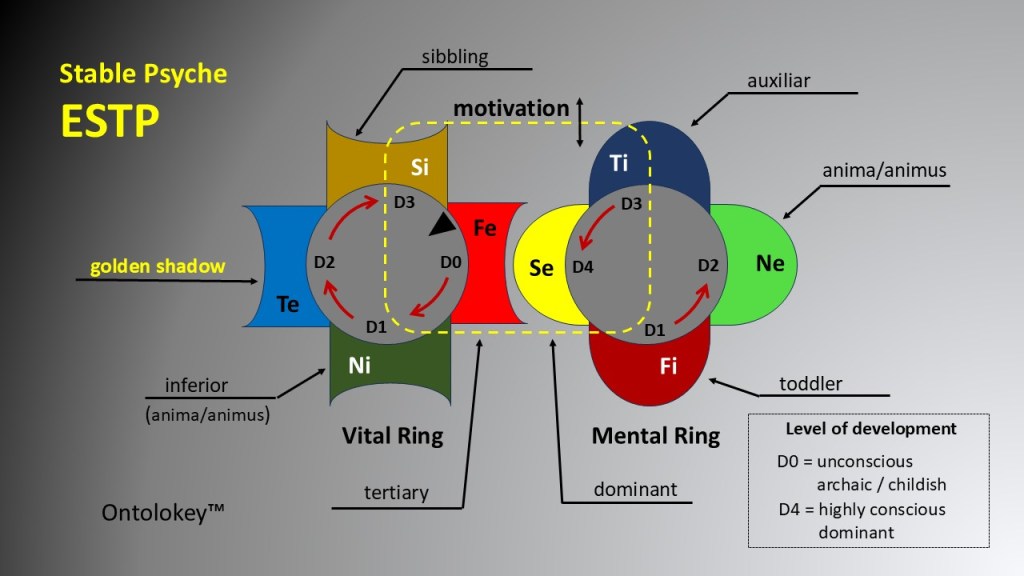
Ontolokey approaches the ESTP through a three-dimensional model in which the eight Jungian functions occupy the vertices of a cube rather than existing merely as a linear hierarchy of four preferred functions. In the ESTP configuration, Extraverted Sensing (Se) occupies the dominant position, Introverted Thinking (Ti) functions as the auxiliary structure, while Introverted Sensing (Si) and Introverted Feeling (Fi) form important parts of the conscious developmental tripod; beneath and around this conscious configuration are Introverted Intuition (Ni), Extraverted Intuition (Ne), Extraverted Feeling (Fe), and Extraverted Thinking (Te), each representing a different form of latent, vulnerable, unconscious, or potentially integrative psychological activity. The cube’s movable relationships, or sliders, are intended to portray personality not as a frozen category but as a dynamic distribution of psychological energy in which functions can become more or less accessible through development and circumstance. This is particularly significant for the ESTP because the personality’s apparent simplicity—act, react, solve, move forward—conceals an internal architecture in which action is continuously interacting with logic, memory, values, intuition, interpersonal feeling, and strategic organization.
Within this landscape, the familiar ESTP strengths and the less visible difficulties should therefore be understood as expressions of the same system rather than as unrelated characteristics. Se provides the immediacy that allows the ESTP to read an environment rapidly and respond before excessive deliberation becomes paralysis, while Ti gives this responsiveness an internal mechanism for analyzing systems, identifying inconsistencies, and determining what actually works. Si introduces the possibility of learning from accumulated experience rather than endlessly pursuing novelty, whereas Fi confronts the ESTP with the more private question of what is personally meaningful beyond success, stimulation, influence, or practical effectiveness. Ni introduces temporal depth and the ability to perceive where present circumstances may be leading, while Ne opens alternative possibilities and imaginative connections; Fe concerns interpersonal atmosphere and emotional reciprocity, while Te represents a more explicit orientation toward external organization, measurable execution, and long-range control. The psychological development of the ESTP can therefore be understood as a gradual movement from an extremely powerful relationship with immediate reality toward a broader capacity to include the realities that cannot be mastered through immediate action alone.
The ESTP’s Psychological Core: Presence, Competence, and Control
At the center of the ESTP structure stands Extraverted Sensing (Se), and this is more profound than the familiar description of someone who simply enjoys action, excitement, or sensory stimulation. Se represents a particular mode of encountering reality in which the external world is perceived as immediately available for engagement: circumstances are scanned, opportunities detected, forces assessed, and responses generated with very little psychological distance between perception and action. The ESTP therefore tends to experience reality as something that can be entered, tested, influenced, negotiated, and transformed rather than merely contemplated, which explains the characteristic combination of alertness, physical presence, adaptability, and confidence under pressure described in the Ontolokey model. This orientation can make the ESTP exceptionally effective in environments where circumstances change rapidly because attention remains anchored to what is actually happening rather than becoming trapped in hypothetical scenarios or excessive anticipation. The psychological danger appears when this extraordinary present-moment orientation becomes an identity: if being capable means being able to act, then situations in which action is impossible, inappropriate, or insufficient can become disproportionately uncomfortable.
This is where the Ontolokey conception of the Se–Ti relationship becomes particularly revealing, because the ESTP is not simply an impulsive sensor but an individual whose dominant engagement with reality is continuously filtered through Introverted Thinking (Ti). Ti asks whether something makes internal sense, whether a mechanism actually works, where the structural weakness lies, and which intervention will produce the desired result, giving the ESTP’s spontaneity an analytical backbone that is often invisible from the outside. Consequently, the mature ESTP can possess a striking combination of speed and precision: they may make decisions rapidly because they have already reduced a complicated situation to its operative principles, rather than because they have failed to think. Ontolokey describes Ti as a private logical filter and also as a persona that can allow the ESTP to present a more detached, intellectual, or analytical exterior than their underlying Se orientation might suggest. Yet this strength contains a subtle vulnerability: because Ti serves Se so effectively, reasoning can become an instrument of the will rather than an impartial examination of it, allowing an ESTP to construct highly convincing explanations for decisions that were initially driven by instinct, competition, pride, desire, or the need to maintain control. The shadow problem is therefore not an absence of intelligence but the possibility that intelligence becomes exceptionally effective at defending an already chosen direction.
The deeper shadow emerges when competence ceases to be something the ESTP possesses and becomes something the ESTP must continuously prove. Ontolokey’s shadow analysis describes a psychological pattern in which action, strength, independence, and effectiveness can gradually become associated with personal security, while uncertainty, dependence, emotional exposure, or visible weakness become experiences that threaten the established self-image. In such a configuration, the ESTP may instinctively solve problems that actually require emotional processing, increase activity when psychological stillness would be more useful, or transform vulnerability into anger because anger permits action whereas grief, fear, shame, and helplessness demand a surrender of control. This does not mean that ESTPs are inherently aggressive, manipulative, emotionally shallow, or incapable of intimacy; rather, it identifies a possible direction in which their strongest adaptations become defensive mechanisms when they are used to prevent contact with less comfortable parts of the self. The irony is that the defense can remain invisible precisely because it works so well: the person continues to function, perform, lead, negotiate, and overcome obstacles, while the unresolved emotional material is displaced into increasingly intense action. The question eventually becomes not whether the ESTP can control reality, but whether they can remain psychologically present when reality cannot be controlled.
Si and Fi: The Quiet Functions Beneath the ESTP’s Strength
The less visible portion of the ESTP’s conscious architecture becomes particularly important when examining what happens beneath the familiar image of confidence and spontaneity. In Ontolokey, Introverted Sensing (Si) is described as the ESTP’s “sibling” function, positioned in direct tension with Se because it relates present experience to accumulated experience, familiarity, precedent, and internalized impressions. This creates a subtle developmental contradiction: Se wants to encounter the world freshly and respond to what is happening now, whereas Si asks what has happened before, what has already been learned, and what can be retained rather than continually reinvented. A psychologically mature ESTP therefore does not simply become more spontaneous but learns when spontaneity is unnecessary, because genuine mastery includes knowing which patterns have already been tested and which risks merely repeat an old mistake. Ontolokey consequently associates the Se–Si axis with a movement from raw immediacy toward experience-based wisdom, while also describing an unhealthy regression toward Si under overload, where the normally flexible ESTP can become unusually rigid, repetitive, preoccupied with previous failures, or attached to familiar routines. The paradox is psychologically important because it suggests that the ESTP’s opposite is not simply passivity: under sufficient strain, the person who normally refuses to be constrained by yesterday can become psychologically constrained by it.
Introverted Feeling (Fi) reaches even deeper because it concerns a territory in which the ESTP’s usual methods of competence become considerably less reliable: subjective value, emotional authenticity, personal conscience, and the question of what matters when no external problem needs to be solved. Ontolokey places Fi in the ESTP’s conscious tripod as the “toddler” function, describing it as comparatively immature and difficult to integrate, which helps explain why an ESTP can sometimes appear remarkably comfortable confronting external danger while becoming strangely uncomfortable confronting an intimate emotional truth within themselves. Feelings that cannot be converted into action may be dismissed as inefficient, excessive, or irrelevant until they accumulate enough pressure to emerge suddenly through indignation, fierce loyalty, emotional withdrawal, or an unexpectedly intense reaction to something that has touched a deeply personal value. This can create one of the ESTP’s most misunderstood psychological contradictions: the person may be capable of extraordinary courage in the external world while possessing a much more fragile relationship with their own interior vulnerability. Fi development therefore does not require the ESTP to become sentimental or abandon rationality; rather, it means acquiring the capacity to recognize that subjective experience is itself information, and that a decision can be logically effective while still being profoundly wrong for the person who has to live with it. In this sense, Fi becomes a psychological corrective to a life organized exclusively around what works, replacing the question “Can I do this?” with the more difficult question “Is this actually consistent with who I am?”
The interaction between Se, Si, and Fi reveals why the ESTP’s development cannot be reduced to simply becoming calmer, more disciplined, or more introspective. These functions represent three fundamentally different relationships with experience: Se encounters reality directly, Si consolidates what reality has previously taught, and Fi asks what the experience means personally and ethically. When they remain poorly integrated, the ESTP can oscillate between stimulation, repetition, and emotional eruption without developing a stable internal narrative that connects experience with identity. When they become more balanced, however, the same person can retain the extraordinary responsiveness of Se while gaining the patience of Si and the moral interiority of Fi, allowing action to become more deliberate without becoming hesitant. This is particularly relevant to the shadow side because psychological avoidance often disguises itself as productivity: the ESTP can remain perpetually busy, socially engaged, competitive, adventurous, and outwardly successful while never asking whether constant movement is protecting them from something they do not want to feel. Ontolokey’s cube is useful within its own conceptual framework precisely because it portrays these tensions as relationships rather than isolated traits, suggesting that psychological growth occurs through redistributing attention across the structure rather than suppressing the dominant personality altogether. The mature ESTP is therefore not someone who has ceased being intense, spontaneous, competitive, or action-oriented, but someone whose capacity for action is no longer required to protect them from their own inner life.
Ni, Ne, Fe and Te: The Shadow Architecture of the ESTP
The four less conscious positions of the Ontolokey cube reveal why the ESTP’s psychological life becomes particularly complex when immediate action no longer provides a sufficient answer. Introverted Intuition (Ni) occupies the inferior position and therefore represents perhaps the most uncomfortable psychological territory: the future cannot be directly touched, verified, negotiated, or controlled in the same manner as the present, yet eventually every significant life demands an encounter with precisely this uncertainty. Ontolokey describes Ni as the ESTP’s “shadow nemesis,” capable under stress of appearing through catastrophic anticipation, existential unease, second-guessing, or an uncomfortable preoccupation with what might happen rather than what is happening now. This explains a paradox that can otherwise be difficult to understand: a person who appears extraordinarily courageous in situations of immediate physical or social uncertainty may become unexpectedly restless when confronted with an ambiguous future that cannot be solved through decisive intervention. The ESTP can confront danger more easily than uncertainty because danger can often be acted upon, whereas uncertainty requires waiting, interpreting, tolerating incomplete information, and accepting that control has limits. In its integrated form, however, Ni ceases to be an enemy and becomes the capacity to perceive trajectories, consequences, underlying meaning, and long-range direction, transforming the ESTP from someone who is exceptionally effective at winning the present moment into someone capable of understanding where present actions are ultimately leading.
Extraverted Intuition (Ne) occupies another unconscious position that Ontolokey calls the ESTP’s anima, and its significance lies in introducing precisely the kind of psychological openness that Se can sometimes neglect. Whereas Se perceives what is actually present and immediately available, Ne proliferates alternatives, associations, hypothetical possibilities, unusual connections, and entirely different ways reality might be interpreted. Ontolokey therefore associates Ne with playfulness, curiosity, imaginative experimentation, philosophical speculation, and a capacity for renewal that can temporarily liberate the ESTP from the demand that everything must have an immediate practical application. In an undeveloped state, this function can appear as scattered attention or ungrounded ideation, particularly because the ESTP’s natural preference is to convert perception into concrete engagement rather than allow possibilities to remain open indefinitely. Yet its mature integration can be remarkably creative because the ESTP already possesses the ability to test ideas against reality; Ne supplies the alternatives, while Se supplies the laboratory in which those alternatives can be tested. This creates an important developmental possibility: imagination does not have to replace realism, and realism does not have to suppress imagination, because the ESTP can learn to move repeatedly between the two. The deeper psychological value of Ne is therefore not escapism into fantasy but the realization that reality contains more possibilities than the first immediately actionable interpretation reveals.
Extraverted Feeling (Fe) introduces a different tension because it concerns the emotional field between people rather than the ESTP’s private evaluation of personal values. Ontolokey describes Fe as tertiary and comparatively unstable, giving the ESTP a pronounced sensitivity to social atmosphere, interpersonal reactions, approval, status, and the emotional energy of groups, while also creating a tendency to use social influence instrumentally—to motivate, organize, persuade, energize, or stabilize a situation. This helps explain why ESTPs can be exceptionally charismatic without necessarily being emotionally transparent: they may know precisely how to raise the energy of a room while remaining reluctant to reveal what is happening inside themselves. In its shadow expression, this social intelligence can become performance, with likability, confidence, humor, authority, or emotional intensity functioning as protective mechanisms against the possibility of being judged, rejected, or exposed. Ontolokey’s deeper shadow analysis connects this dynamic with the ESTP’s difficulty in distinguishing genuine intimacy from successful interpersonal influence, because influence preserves a degree of control whereas intimacy requires the disclosure of something that cannot be strategically managed. The developmental movement of Fe is therefore from managing the emotional atmosphere toward genuinely participating in it, allowing the ESTP to recognize that emotional intelligence is not merely the ability to read other people but also the willingness to let other people accurately read oneself.
Finally, Extraverted Thinking (Te) is described by Ontolokey as the ESTP’s golden shadow, representing a form of power that is admired, projected onto others, and potentially available for conscious integration without necessarily being part of the ESTP’s ordinary identity. Te emphasizes organization, measurable execution, resource management, strategic planning, and the deliberate structuring of external circumstances toward long-term outcomes, which differs from Se’s instinctive ability to respond to the environment in real time. This distinction matters because an ESTP can be extraordinarily effective while remaining fundamentally reactive: they can improvise brilliantly without necessarily building the structures that would make their effectiveness sustainable over years rather than hours or days. Ontolokey consequently portrays Te as a potential bridge from tactical competence toward durable execution, enabling the ESTP to turn opportunities into systems, impulses into projects, and victories into lasting structures. Yet the golden shadow also carries a warning, because an excessive fascination with control, hierarchy, achievement, or organizational power can reinforce precisely the defensive identification with competence that lies at the heart of the darker ESTP pattern. The integrated ESTP therefore does not simply acquire more control; rather, they learn to use structure without becoming psychologically dependent upon domination, allowing Te to serve purpose instead of becoming another instrument through which vulnerability is avoided.
When Strength Becomes a Defense
The most difficult ESTP pattern begins when the personality’s natural relationship with strength gradually changes from a capacity into a requirement. An ESTP who has learned that problems can be solved through speed, competence, confidence, humor, negotiation, physical presence, or strategic intervention may unconsciously begin to treat helplessness itself as unacceptable, because helplessness removes the very tools through which identity has been maintained. Ontolokey’s description of the ESTP repeatedly returns to independence, control, influence, and the refusal to occupy a position of dependence, portraying the tendency to engineer circumstances in which others need the ESTP as an especially revealing expression of this dynamic. What looks externally like exceptional self-sufficiency can therefore conceal an internal equation in which needing someone else becomes psychologically associated with losing status, exposing weakness, or surrendering control. The problem is not independence itself, which can be one of the ESTP’s greatest strengths, but the point at which independence becomes compulsory and therefore prevents authentic reciprocity. A person who must always be the capable one eventually finds that relationships become organized around usefulness, protection, leadership, or problem-solving rather than the mutual exposure through which genuine intimacy develops.
This dynamic becomes particularly visible in the ESTP’s relationship with vulnerability because Fi and Fe introduce emotional realities that cannot always be managed through performance. The Ontolokey account describes Fi as a comparatively fragile function concerned with inner worth, authenticity, personal values, and emotional identity, while Fe gives the ESTP considerable sensitivity to the emotional atmosphere of other people and the ability to influence that atmosphere. Together, these functions can create an unusual psychological contradiction: the ESTP may be highly skilled at detecting what other people feel while remaining uncertain about what they themselves feel, and highly capable of making another person feel better while having difficulty simply admitting that they themselves are hurt. Consequently, emotional pain may be translated into behavior rather than language; disappointment becomes withdrawal, insecurity becomes control, shame becomes anger, affection becomes practical assistance, and fear becomes a demand for certainty. The resulting behavior can look cold or domineering when its underlying psychological movement is actually an attempt to avoid exposure, although the external effect does not disappear merely because the underlying vulnerability is understandable. The more mature alternative is not emotional overexpression but emotional differentiation: learning to recognize that saying “I am hurt,” “I am afraid,” or “I need reassurance” does not automatically surrender power, because psychological honesty can itself become a form of strength.
The same defensive structure can affect the ESTP’s treatment of conflict, particularly when conflict threatens not merely an immediate objective but the person’s self-concept. The ordinary ESTP tendency toward direct confrontation can be highly constructive when a concrete problem requires courage, rapid intervention, negotiation, or decisive leadership, and the type’s willingness to address difficulties rather than endlessly discuss them can be an enormous practical advantage. Ontolokey emphasizes precisely this capacity, portraying the ESTP as someone who performs particularly well when circumstances demand rapid assessment, action, pressure tolerance, and tangible results. Yet the shadow emerges when every disagreement is unconsciously interpreted through the categories of winning and losing, because then compromise can begin to resemble defeat and reconsideration can feel like an admission of incompetence. Under those conditions, Ti can become a sophisticated advocate for Se: instead of asking whether one’s position should change, the mind becomes increasingly occupied with demonstrating why the existing position is defensible. Ontolokey explicitly identifies this possibility in its discussion of Ti, noting that the ESTP’s reasoning can sometimes selectively support a direction already established by will and action rather than functioning as completely impartial inquiry. The deepest form of intellectual maturity for the ESTP is consequently not learning to argue more effectively, but developing enough internal security to discover that being wrong does not diminish the person who discovers it.
A related danger appears in the ESTP’s relationship with stimulation, because activity can serve two entirely different psychological purposes: it can express genuine vitality, curiosity, courage, and engagement with life, or it can function as a highly effective avoidance mechanism. Ontolokey describes the ESTP as someone who often feels most alive under pressure and who may even create tension in order to recover the intensity that activates their abilities, while also emphasizing the difficulty of remaining still when circumstances become ambiguous or uncontrollable. This distinction becomes crucial because a life filled with action can conceal an extraordinary amount of psychological avoidance; there is always another project, confrontation, journey, opportunity, social environment, physical challenge, or problem to solve, and each new stimulus postpones the quieter question of what remains when there is nothing left to conquer. The ESTP can therefore become externally successful while internally remaining dependent upon intensity for a sense of aliveness, repeatedly recreating situations that produce adrenaline, urgency, or interpersonal friction because stillness brings unwanted material closer to consciousness. The shadow is not that the ESTP enjoys excitement, but that excitement can become necessary for emotional regulation. When that happens, the challenge is no longer learning how to act decisively, but discovering whether one can tolerate silence without interpreting it as emptiness, inactivity without interpreting it as weakness, and peace without unconsciously creating a new battle.
The Positive ESTP: The Psychology of Decisive Presence
The shadow should not obscure what makes the ESTP psychologically distinctive in the first place, because many of the same mechanisms that can become defensive are also responsible for an unusually powerful capacity for engagement with life. The healthy ESTP is often difficult to intimidate because they possess a practical confidence grounded less in abstract self-belief than in repeated evidence that they can enter difficult situations and find a way through them. Their Se allows them to notice details that other people overlook, respond to changing circumstances without excessive hesitation, and remain connected to the concrete reality of what is actually happening, while Ti enables them to dissect mechanisms and identify the simplest effective intervention. Ontolokey repeatedly portrays this combination as one of the ESTP’s central strengths: the personality does not merely observe opportunities but tends to recognize their practical potential and move toward them with unusual speed. In difficult circumstances this can produce genuine courage, not because the ESTP never experiences fear, but because fear does not necessarily interrupt the capacity to act. The mature expression of this temperament is therefore not recklessness but presence under pressure: the ability to remain sufficiently connected to reality that action becomes possible precisely when other people are becoming overwhelmed by the complexity of the situation.
This practical courage is accompanied by a form of social intelligence that is often underestimated because it does not necessarily resemble conventional emotional sensitivity. ESTPs can be remarkably perceptive about body language, hierarchy, interpersonal tension, timing, status, humor, and the subtle changes occurring within a group, with Se supplying immediate environmental information and Fe contributing an awareness of how people respond to one another. Their charisma is therefore often experiential rather than carefully constructed: they create momentum, bring energy into stagnant situations, reduce unnecessary formality, and make other people feel that something is happening rather than merely being discussed. Ontolokey’s portrayal of Fe is especially relevant here because it frames the function as an instrument through which the ESTP can influence emotional atmosphere, motivate others, and create interpersonal connection, even though the function may not always be fully stable or deeply integrated. At their best, ESTPs therefore possess an unusually useful combination of realism and social activation: they can sense what a situation needs and then mobilize people toward it. Their humor, directness, spontaneity, and willingness to engage can also make them powerful antidotes to excessive inhibition, particularly in environments where fear of judgment has caused everyone else to become cautious, formal, or passive.
Another important strength is the ESTP’s relationship with failure and experimentation, because their Se orientation naturally encourages learning through contact with reality rather than through endless theoretical preparation. An ESTP may be willing to try something, observe the consequences, modify the approach, and try again without experiencing every unsuccessful attempt as a fundamental verdict on personal worth. When Ti participates constructively, failure becomes diagnostic information: something did not work, therefore the mechanism must be understood and adjusted rather than defended. This makes the ESTP particularly suited to environments in which conditions cannot be predicted perfectly and where practical intelligence develops through repeated interaction with reality. The same quality can produce entrepreneurial energy, crisis competence, competitive drive, improvisational skill, and a willingness to enter situations in which there is no guaranteed outcome. Ontolokey’s broader account of the Se-dominant orientation similarly emphasizes direct experience, experimentation, and action as routes toward awareness, illustrating why an ESTP often understands something more completely after doing it than after merely discussing it. At its healthiest, this is not an inability to plan but a refusal to confuse planning with reality: the ESTP wants the world to provide feedback, because feedback allows intelligence to become embodied rather than remaining theoretical.
The positive ESTP also possesses a capacity for loyalty expressed through action, which can be easy to miss when loyalty is expected to appear primarily through verbal reassurance or prolonged emotional disclosure. An ESTP may demonstrate attachment by showing up, solving the practical problem, defending someone when necessary, creating an opportunity, sharing an experience, or remaining physically present when circumstances become difficult. Their affection can therefore have a distinctly concrete quality: rather than continually explaining what someone means to them, they may demonstrate it through what they are willing to do. This does not make their emotional life less real; it reflects the fact that Se naturally translates psychological significance into observable engagement with the world, while Ti prefers solutions that have tangible consequences. The developmental challenge is to supplement this action-based loyalty with enough Fi and Fe awareness that other people can also understand the emotional meaning behind the action rather than having to infer it. When that integration occurs, the ESTP’s relationships can become unusually vital because practical devotion, humor, spontaneity, sensual presence, and emotional responsiveness reinforce one another rather than competing for psychological space. The result is an individual who does not merely tell people that life should be lived fully, but who can make the people around them experience that principle in concrete ways.
The ESTP in Relationships: Intimacy Beyond Performance
In intimate relationships, the ESTP’s greatest strength and greatest challenge often arise from the same source: a powerful instinct to remain engaged with what is happening between two people rather than retreating into abstraction. They can bring excitement, physical affection, humor, spontaneity, protectiveness, and an unusually strong sense of shared experience into a relationship, making ordinary life feel more immediate and alive. They often respond quickly to a partner’s practical needs and may be especially effective when a relationship encounters an external crisis because their instinct is to mobilize rather than freeze. Yet intimacy eventually reaches territory where action cannot substitute for disclosure, and this is where the ESTP’s deeper development becomes essential. The Ontolokey framework’s emphasis on Fi, Fe, and the inferior intuitive functions suggests that the central relational task is not becoming less independent but becoming sufficiently secure to allow another person access to the parts of the self that cannot be demonstrated through competence. The ESTP’s most intimate evolution therefore occurs when “I will handle it” can coexist with “I need you,” because the latter requires a form of trust that no amount of external capability can manufacture.
The Deepest Shadow: When Control Replaces Intimacy
The deepest ESTP shadow is not simply impulsiveness, aggression, superficiality, or an appetite for risk; those are comparatively visible behaviors and can even represent healthy expressions of Se when they remain connected to judgment and responsibility. The more consequential shadow appears when control becomes a substitute for trust, because then the ESTP’s formidable ability to influence circumstances begins to extend into areas where influence cannot create genuine security. Ontolokey describes this pattern through the ESTP’s tendency to construct situations in which others depend upon them, thereby preserving independence while simultaneously maintaining leverage within relationships and social systems. At its most psychologically sophisticated, this defense does not necessarily look domineering: it can appear as generosity, competence, reliability, protection, problem-solving, or an almost compulsive willingness to take responsibility for everything. The hidden equation can nevertheless become remarkably simple: if I am indispensable, I cannot easily be abandoned; if I remain in control, I cannot be exposed; if I solve the problem, I do not have to reveal what the problem is doing to me. This is where the ESTP’s greatest strength can quietly become its greatest prison, because the very competence that earns respect can prevent the person from discovering whether they would still be loved without constantly demonstrating their usefulness.
The Ontolokey description of Fi makes this especially significant because the function is associated with inner worth and the deeply personal question of whether one is valued for who one is rather than for what one accomplishes. The ESTP may therefore unconsciously translate affection into usefulness, expressing care through resources, solutions, protection, opportunities, or practical intervention while finding direct emotional self-disclosure considerably more threatening. This creates a painful relational paradox: the ESTP may genuinely give a great deal while simultaneously feeling that nobody truly sees them, because the parts that receive the most attention from others are precisely the parts they have made visible—the capable, entertaining, resilient, resourceful, socially effective exterior. If someone then fails to appreciate those efforts, the disappointment can penetrate far deeper than the surface reaction suggests, because what has been rejected may feel like evidence that the person’s entire method of earning love has failed. The resulting reaction can take the form of anger, withdrawal, contempt, intensified self-sufficiency, or an even stronger attempt to become indispensable, thereby reinforcing the original defense. Emotional development requires breaking this circular mechanism by allowing care to be received without immediately converting it into a transaction of usefulness, and by learning that intimacy becomes deeper, rather than weaker, when another person is permitted to contribute something the ESTP cannot control.
The same issue explains why uncertainty in relationships can be particularly destabilizing for this personality structure. An external problem generally offers the ESTP something to do, whereas an ambiguous emotional situation may provide no equivalent lever: another person’s feelings cannot be forced into clarity, trust cannot be accelerated by pressure, and the future of a relationship cannot be guaranteed through competence. Ontolokey’s treatment of inferior Ni is therefore psychologically relevant because the inability to control future outcomes can generate second-guessing, suspicion, restlessness, and a heightened search for signs that reveal where events are heading. The ESTP who ordinarily trusts direct perception can suddenly become preoccupied with hidden motives, possible betrayal, imagined consequences, or scenarios that have not yet occurred, while simultaneously feeling an urgent need to do something that will end the uncertainty. This is one reason why apparently irrational relational decisions can sometimes emerge from an otherwise highly practical person: action restores the sensation of agency even when the action itself makes the underlying situation worse. Psychological maturity therefore requires tolerating a peculiar form of powerlessness—the capacity to remain present while not knowing, to allow another person freedom without interpreting freedom as rejection, and to accept that some of the most important outcomes in life cannot be secured through tactical superiority.
The shadow can become particularly severe when the ESTP’s self-image has become organized around never being the weaker person in the room. Ontolokey repeatedly connects the ESTP with strength, pressure, competition, independence, and the tendency to respect those who demonstrate endurance and competence, while also portraying dependence as something the type may instinctively experience as weakness. If this orientation becomes rigid, compassion itself can become psychologically complicated: the ESTP may extend extraordinary protection toward someone perceived as genuinely vulnerable while having little tolerance for their own vulnerability, or may offer forgiveness to others while privately regarding their own mistakes as unacceptable failures of competence. Such asymmetry creates an internal double standard in which the self is permitted to be powerful but not fragile, useful but not needy, decisive but not confused, sexually or socially confident but not emotionally exposed. Eventually, however, the disowned characteristics do not disappear; they return through exhaustion, resentment, emotional eruptions, suspiciousness, compulsive stimulation, or periods of inexplicable emptiness. The deeper developmental task is therefore not to destroy the strong ESTP identity but to enlarge it until strength includes the capacity to admit uncertainty, receive help, acknowledge hurt, revise one’s position, and remain worthy in one’s own eyes even when nothing is being won.
Integration: From Immediate Power to Psychological Depth
The psychological development of the ESTP ultimately depends on whether the personality can preserve its extraordinary connection with reality while expanding the definition of what reality includes. In the least integrated form, reality is primarily what can be seen, tested, influenced, measured, experienced, or acted upon, which naturally privileges Se and Ti while leaving less tangible dimensions of existence comparatively underdeveloped. In the more integrated form, however, reality also includes memory, subjective value, emotional reciprocity, unconscious motives, future consequences, ambiguity, and the meanings that cannot be reduced to immediate evidence. This is where the Ontolokey cube becomes particularly significant as a developmental landscape: its eight positions can be understood as different psychological perspectives that the ESTP gradually learns to tolerate rather than as competing identities that must replace one another. The objective is not to weaken Se, because doing so would deprive the ESTP of one of its most extraordinary capacities, but to prevent Se from becoming the exclusive authority over what deserves attention. Psychological maturity begins when the ESTP discovers that slowing down does not necessarily mean losing momentum, that reflection does not necessarily mean indecision, and that emotional awareness does not necessarily mean surrendering rational control.
The integration of Ni may be especially transformative because it introduces the dimension of consequence into a personality naturally oriented toward opportunity and immediate response. Se asks what is happening and what can be done about it, whereas Ni asks where the accumulated pattern is leading and what may eventually emerge from the present configuration. For the ESTP, this can initially feel unnecessarily abstract because the future cannot provide the same immediate feedback as the present, yet precisely this lack of certainty makes Ni psychologically valuable. It can teach the ESTP to recognize that not every problem should be solved at the moment it appears and that some consequences become visible only after repeated choices have established a direction. The development of Si contributes a complementary form of temporal intelligence by allowing experience to become accumulated wisdom rather than merely a collection of past events, while Ne prevents this accumulated experience from becoming rigidity by continually opening alternative interpretations and possibilities. Together, these functions can transform the ESTP’s relationship with time: the past becomes information rather than baggage, the present becomes experience rather than stimulation, and the future becomes a field of possibilities rather than an intolerable zone of uncertainty.
The emotional functions demand an equally important transformation because Fi and Fe challenge the ESTP to distinguish between managing emotions and actually inhabiting them. Fe can make the ESTP socially perceptive, persuasive, entertaining, and capable of understanding the emotional dynamics of a group, but genuine emotional maturity requires more than knowing how people respond to a particular stimulus. It requires recognizing that another person’s feelings cannot always be optimized, redirected, or solved, just as one’s own feelings cannot always be converted into useful information or immediate action. Fi adds an even more private challenge by requiring the ESTP to develop an internal sense of value that does not depend entirely upon external achievement, admiration, usefulness, excitement, or social recognition. When these dimensions become more integrated, the ESTP can retain charisma without depending upon approval, independence without fearing dependence, and confidence without requiring superiority. The person becomes increasingly capable of saying what they actually feel without turning the disclosure into a negotiation, and increasingly capable of hearing another person’s emotional truth without immediately searching for a tactical response.
Te, as the golden-shadow dimension in the Ontolokey framework, completes another part of this development by introducing the question of what happens when spontaneous competence is transformed into deliberate structure. The ESTP is often exceptionally good at winning the immediate encounter, improvising under pressure, and exploiting opportunities as they appear, but long-term achievement sometimes requires something less exciting: systems, repetition, delegation, strategic sequencing, delayed gratification, and sustained execution after the initial excitement has disappeared. Te can provide this architecture without requiring the ESTP to abandon spontaneity; instead, it can create a structure strong enough to preserve spontaneity where spontaneity is useful. The mature ESTP therefore becomes capable not only of reacting brilliantly to reality but of shaping the conditions under which future reality will unfold, which represents a significant shift from tactical intelligence toward strategic intelligence. The danger, once again, is that structure can become another form of control, so integration requires remembering that systems exist to serve values and purposes rather than becoming substitutes for them. In this sense, Te reaches its healthiest expression when the ESTP learns to build something that continues to function even when they are no longer personally controlling every part of it.
The final measure of integration is consequently not whether the ESTP becomes quieter, more contemplative, more emotional, or more conventional, but whether the personality gains freedom from its own defenses. A healthy ESTP can still be competitive, provocative, sensual, spontaneous, humorous, adventurous, direct, ambitious, and intensely engaged with the physical world; none of these qualities needs to be sacrificed in the name of psychological depth. What changes is the psychological necessity behind them: action becomes an expression of vitality rather than an escape from inner experience, confidence becomes grounded rather than compensatory, independence becomes a choice rather than a prohibition against needing others, and confrontation becomes a tool rather than a proof of strength. The deepest form of ESTP maturity is therefore paradoxical: the person becomes more powerful precisely by becoming less dependent upon the continuous demonstration of power. Once the ESTP no longer needs to win every psychological battle in order to remain secure, the enormous energy of Se–Ti can be redirected toward exploration, creation, leadership, intimacy, and meaningful experience rather than being consumed by the defense of identity.
The Untold Truth: What the ESTP Is Really Being Asked to Become
The deepest interpretation of the ESTP is therefore not the familiar image of the fearless adventurer, nor the darker caricature of the reckless, manipulative, emotionally detached provocateur. Both images capture something observable while missing the psychological structure underneath it. The ESTP is fundamentally organized around an unusually direct relationship with reality: Se wants contact with what is happening, Ti wants to understand how it works, and the remaining functions represent increasingly difficult encounters with memory, values, emotion, possibility, consequence, and internal meaning. Within the Ontolokey framework, the cube makes these relationships visible by treating the eight functions as different positions within one psychological landscape rather than as a simple list of preferences. The “untold truth” is consequently that the ESTP’s greatest developmental challenge is not learning how to become stronger, more confident, more productive, or more capable of winning, because those qualities are already close to the center of the personality; it is learning that a person can remain powerful without needing power to protect the self from vulnerability.
This is why the shadow should not be interpreted merely as the ESTP’s “bad side.” The shadow contains psychological material that becomes dangerous precisely when it is denied, and valuable precisely when it becomes conscious. Inferior Ni can become catastrophic anticipation, but integrated Ni can provide foresight; Fi can become hypersensitivity around personal worth, but integrated Fi can provide authenticity; Fe can become social performance or manipulation, but integrated Fe can create genuine emotional reciprocity; Si can become fixation upon previous experience, but integrated Si can transform experience into wisdom; Ne can appear scattered, yet it can also open the imagination beyond the immediately visible; and Te can become an obsession with external control, while its mature expression can turn spontaneous competence into sustainable structure. Ontolokey’s broader cube model explicitly describes these functions as occupying different archetypal roles, including Dominant, Auxiliary, Anima, Toddler, Sibling, Golden Shadow, Inferior, and related positions, thereby presenting development as a movement across the whole structure rather than a simple strengthening of the dominant function. The psychological objective is therefore integration rather than replacement: the ESTP does not need to become someone else, but must gradually become capable of being more than the identity that originally made them successful.
The mature ESTP eventually discovers a form of strength that is almost the opposite of the strength they may have been trying to prove. It is the strength to remain present when there is nothing to fix, to admit uncertainty when certainty cannot be manufactured, to receive love without earning it through usefulness, to accept correction without experiencing it as humiliation, and to acknowledge emotional pain before it has to become anger or action. It is the strength to allow another person to matter without turning the relationship into a contest of independence, and to recognize that being needed is not the same thing as being loved. Most importantly, it is the strength to stop confusing intensity with meaning: excitement can be valuable without being necessary, competition can be enjoyable without defining worth, and freedom can exist without perpetual escape from commitment. When this transformation occurs, the ESTP’s natural gifts become considerably more powerful because they are no longer being consumed by psychological defense.
The result is an ESTP who remains recognizably ESTP: perceptive, direct, energetic, humorous, pragmatic, adaptable, courageous, socially alive, physically present, and capable of making things happen. But beneath these qualities there is now greater psychological depth, because action is accompanied by reflection, confidence by humility, independence by reciprocity, realism by imagination, and decisiveness by an awareness of consequences. The person who once needed to control every variable can tolerate uncertainty; the person who once needed to appear invulnerable can reveal vulnerability without collapsing; the person who once defined success through external impact can ask what that impact is ultimately serving. In the language of the Ontolokey perspective, the cube becomes most meaningful when its different positions cease to function as isolated compartments and begin to operate as a living psychological whole. The ESTP’s final development is therefore not a retreat from the world but a deeper entry into it, because genuine presence requires being able to encounter not only what can be acted upon, but also what must be felt, remembered, imagined, understood, accepted, and ultimately lived.
Further Reading and the Ontolokey Perspective
Readers who want to explore this model beyond the ESTP can find the more extensive personality analyses and the underlying Ontolokey framework on the Ontolokey website, including discussions of the cube, its eight functional positions, its relationship to Jungian functions and Socionics, and detailed type descriptions. The Ontolokey presentation of the cube emphasizes that its purpose is to transform a flat typological map into a multidimensional psychological landscape in which each function has a particular relationship to the others. Its broader writings also explore how the cube can be applied across personality types and how different psychological perspectives can be understood through the relationships between functional positions. For readers specifically interested in the ESTP, the three principal Ontolokey texts used as the foundation for this essay provide the most direct route into the model’s interpretation of the type, while the wider Ontolokey material allows the ESTP’s shadow and developmental dynamics to be understood in relation to the other personality configurations.


Leave a comment