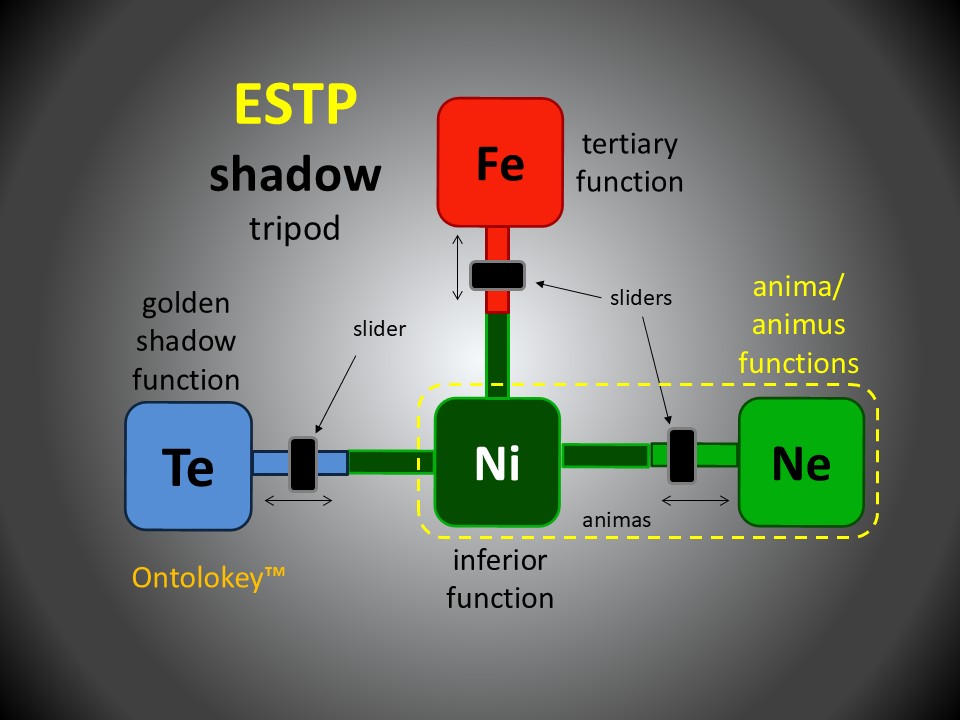
The ESTP is, on the surface, one of the most immediately legible personalities in the entire typological landscape. Such individuals are grounded in the present moment in a way that few other configurations manage, experiencing the world through direct sensory contact rather than through abstraction or anticipation. Life, for them, is not a slow unfolding toward some distant conclusion; it is a fast-paced arena in which presence, physicality, and timing determine who comes out ahead. They read rooms with unusual speed, sensing who holds authority, where the friction points lie, and how a situation can be turned to advantage before most people have even finished orienting themselves. This is not merely a social skill but something closer to an instinct, a kind of embodied intelligence that operates faster than conscious deliberation. Whether entering a new group, a new city, or an unfamiliar negotiation, they tend to claim space almost automatically, not out of arrogance but because asserting presence is how they establish that a situation is under control. Beneath the confident exterior operates a sharp internal logic that quietly tests every action against the question of whether it actually works, giving their apparent spontaneity a hidden structural coherence. This combination of instinct and internal calculation is what makes the type appear so capable in moments that overwhelm other people — they do not merely react, they orient, calculate, and move, often within the same breath.
Underneath this dominant orientation toward action lies a quieter, more exploratory current that occasionally surfaces as curiosity about possibility, trends, and the potential hidden in people or situations. This undercurrent does not drive the ESTP the way their engagement with concrete reality does, but it nudges them toward novelty and toward sensing where influence or opportunity might be building before it becomes obvious to everyone else. It also introduces a degree of instability, because open-ended possibility can feel less like freedom and more like disorientation to a personality that generally prefers outcomes it can measure and control. When this exploratory function turns inward under pressure, it has a tendency to curdle into suspicion, so that the same capacity that once generated creative options begins instead to manufacture doubts about other people’s motives or hidden agendas. This is one of the earliest hints, even at the level of ordinary personality description, that the ESTP’s confidence rests on a foundation that is more fragile than it appears from the outside — a foundation that depends on the world continuing to reward decisiveness and continuing to make sense in terms the type can act upon directly.
Considerably more fragile still is the terrain of inner values and personal emotional identity, an area in which the ESTP is often underdeveloped despite genuinely caring, more than most people would assume, about being seen as good, fair, and worthy of being loved. This is described as something close to a “toddler” register within the personality — intensely personal, emotionally raw, and poorly understood even by the individual experiencing it. Vulnerability does not come naturally to this type, and moral ambiguity tends to unsettle them, which is part of why they often prefer to sidestep conversations that require sustained introspective or ethical reflection. Yet the underlying need for emotional recognition does not disappear simply because it goes unexpressed; it resurfaces instead as an indirect strategy in which love is translated into usefulness, so that helping, solving, and providing become substitutes for the more difficult work of naming what they actually feel. When this substitution is misunderstood or rejected by others, the sting is disproportionate to what was outwardly at stake, because what was actually denied was not a favor but an unspoken bid for worth. This dynamic explains a recurring pattern in which the ESTP appears entirely self-sufficient on the surface while quietly longing for someone capable of recognizing the more complex emotional world hidden beneath their competence.
Even further from conscious reach lies the ESTP’s relationship to long-term meaning, symbolic depth, and the unknown future — territory this type instinctively resists because it cannot be acted upon directly. Where they thrive on tangible feedback and immediate results, this deeper dimension asks uncomfortable questions about where things are really heading and what a given choice will cost in the long run, questions that rarely produce the kind of clean, actionable answer the ESTP prefers. When this dimension does intrude, it tends to arrive as restlessness, doubt, or an unfamiliar kind of superstition, rather than as calm reflection, and the type often responds by generating more activity rather than sitting with the discomfort. This avoidance is understandable, since ambiguity and prolonged uncertainty are among the few conditions capable of making an otherwise fearless personality feel genuinely destabilized. The deeper irony is that the more influence and responsibility such an individual accumulates, the more this neglected capacity for foresight and inner reflection actually matters, precisely because large-scale decisions cannot be made safely through instinct and immediate feedback alone. Learning to tolerate this discomfort rather than out-running it through further activity represents one of the more demanding developmental tasks this type eventually faces, whether they choose to acknowledge it or not.
Socially, the ESTP tends to carry a strong, almost theatrical awareness of the emotional atmosphere around them, using this awareness strategically to energize a room, rally people around a goal, or protect themselves from appearing vulnerable. Their emotional expression in groups is rarely accidental; it is closer to a calculated performance aimed at mobilization, discipline, and momentum, delivered with a charisma that can feel magnetic in the right setting. The complication is that this social fluency does not extend easily to the regulation of their own inner emotional state, so that discomfort and frustration are frequently suppressed until they burst out over something that, on its own, seems disproportionately minor. These outbursts tend to embarrass the ESTP afterward, not because they lack self-awareness in general, but because the eruption reveals an internal pressure they had not consciously tracked as it accumulated. There is, running quietly beneath all of this, a private thread connected to memory, routine, and physical comfort — a need for familiar rituals and personal stability that rarely matches the type’s outwardly bold and novelty-seeking reputation, and that tends to surface, almost apologetically, whenever stress or overextension finally catches up with them.
What Ontolokey frames as the type’s greatest untapped potential is a more disciplined, systemic form of organizing power — the capacity to move from personal dominance in a single encounter toward building structures, systems, or ventures that continue producing results long after the individual has stopped personally driving them. This capacity does not come naturally and is experienced instead as a kind of admired ideal, embodied by the organizers and strategic leaders the ESTP tends to respect from a slight distance. Claiming this capacity requires something that runs against the type’s instincts: patience with process, tolerance for delegation, and a willingness to measure outcomes rather than simply feel the satisfaction of having won. When this integration does occur, the qualities that once expressed themselves as personal conquest begin instead to express themselves as durable influence, and the individual shifts from being merely impressive in the moment to being genuinely transformational over time.
The shadow essay published separately by Ontolokey pushes considerably further into this territory, and its tone is notably different from the more descriptive type profile summarized above — it is written, in the author’s own framing, in a spirit of psychological honesty rather than comfort, intended for self-reflection rather than judgment of others. Its central claim is that the very qualities that make the ESTP appear so formidable — decisiveness, composure under pressure, an almost frictionless relationship with action — are also the qualities most likely to conceal what has never been allowed into conscious awareness. Competence, the essay argues, is often learned early as the safest route to respect and security, while anything that looks uncertain, dependent, or emotionally unresolved gets quietly pushed underground because it does not fit the self-image the personality has organized itself around. This is not framed as a flaw unique to this type so much as a universal psychological principle applied with unusual precision to this particular configuration: whatever a personality successfully avoids feeling does not vanish, it simply continues operating from beneath conscious awareness, shaping behavior indirectly rather than being addressed directly.
Anger receives particular attention in this material as the shadow’s preferred emotional language, precisely because it is more usable than the alternatives sitting underneath it. Grief demands surrender, fear demands the admission of vulnerability, and shame demands unwelcome self-examination, whereas anger allows the individual to remain active, to confront, and to feel a sense of continued control even in the middle of genuine emotional injury. Over time this preference creates something closer to a distortion than an emotion, because the individual begins to mistake their most armored response for their most authentic one, while the deeper feelings underneath continue operating without ever being consciously acknowledged. The essay is careful to note that this pattern describes a directional tendency rather than an inevitable outcome — not every ESTP becomes explosive or aggressive — but it insists that when psychological imbalance does intensify, immediate impulse gradually gains ground over reflective judgment, and consequences that once carried real emotional weight begin to matter less than whatever feels most urgent in the moment.
A closely related theme concerns the difference between healthy assertiveness and what the essay calls shadow aggression, a distinction that turns out to be more consequential than it first appears. Healthy assertiveness remains anchored to the actual situation in front of the person and seeks some kind of resolution, while shadow aggression is oriented instead toward discharge, releasing pressure that has nothing to do with the immediate trigger and everything to do with a long accumulation of unprocessed experience. Because this accumulation happens gradually and largely outside conscious notice, the individual typically experiences only the final eruption, and interprets it as an entirely reasonable response to whatever provoked it in the moment, rather than recognizing the much older material actually driving the intensity. This is compounded by an unusually well-developed capacity for after-the-fact rationalization: wounded pride gets reframed as strategic necessity, envy gets reframed as fairness, and a reaction rooted in humiliation gets reframed as principled strength. The essay’s sharpest observation here is that the real danger is not the impulsiveness itself but the certainty that accompanies it — once someone becomes fully convinced their motives are transparent to themselves, the internal inquiry that might otherwise catch the distortion simply stops happening.
Power occupies an equally central position in this shadow material, functioning less as an external goal than as a defense against an intolerable sense of exposure. Strength becomes, for many people fitting this pattern, not merely useful but morally elevated, while weakness is regarded with a discomfort that rarely traces back to cruelty and almost always traces back to some earlier experience in which vulnerability was judged unsafe or humiliating. Once this lesson becomes embedded, the individual begins organizing their life around preventing its return, and control gradually stops being a tool and starts being treated as an identity, so that any challenge to that control begins to feel like a threat to the self rather than to a specific position or outcome. This dynamic is described as becoming especially visible around experiences of humiliation, which strike differently than ordinary adversity because they expose vulnerability publicly and threaten the very image of competence the personality has been built to protect — which is why the reaction to being humiliated is so often disproportionate to whatever triggered it, revealing far more insecurity than the confident exterior would suggest.
This same defensive structure complicates intimacy in ways that are easy to overlook from the outside, because influence and intimacy actually run on opposite logics. Influence depends on managing impressions and retaining control, while intimacy depends on relinquishing exactly that control and revealing realities that are not necessarily impressive at all. The ESTP, according to this material, often becomes remarkably skilled at attracting people while remaining considerably less skilled at truly being known by them, revealing accomplishments more easily than fears and competence more easily than longing. Partners frequently sense this asymmetry long before the individual recognizes it themselves, experiencing closeness in terms of shared activity alongside a persistent emotional distance that never quite resolves. What makes this especially poignant is that being needed and being known are not the same experience, and a person can spend years surrounded by people who rely on them heavily while still feeling, privately, almost entirely unseen.
Autonomy forms another major axis of the shadow, operating as one of the type’s most celebrated strengths right up until the point where it quietly turns into isolation. Independence is genuinely valuable when it enhances freedom, but it becomes something closer to a psychological fortress when it exists mainly to prevent the discomfort of ever needing anyone. The essay draws a careful distinction between autonomy and isolation here: a genuinely autonomous person can accept support without feeling diminished by it, while an isolated person experiences every act of dependency as evidence of inadequacy, which is a considerably heavier burden to carry through an entire life. Needs that go unacknowledged in this way do not simply disappear; they resurface in disguised form, so that the need for connection becomes possessiveness, the need for reassurance becomes control, and the need for belonging becomes an unconscious drive toward dominance instead. Recognizing this pattern, the material argues, is less about becoming less independent and more about understanding that unconscious dependence is the actual opposite of freedom, whereas consciously chosen interdependence is something else entirely — a capacity, not a compromise.
The essay also devotes considerable attention to what it calls an addiction to intensity, describing a state in which ordinary peace begins to feel more unsettling than conflict or chaos ever did. This happens because a nervous system that has spent years adapting to pressure, competition, and unpredictability gradually starts treating that pressure as its baseline, so that its actual absence feels strange rather than restful. What begins as a genuine strength — the ability to stay sharp and energized under difficult circumstances — can slowly transform into something closer to dependency, in which ordinary life starts to feel insufficiently stimulating and new challenges are pursued less for their own value than for the temporary relief they provide from an underlying discomfort the individual has never directly examined. The essay is careful here to distinguish between aliveness, which is a form of genuine presence, and stimulation, which is simply heightened arousal that can just as easily leave a person feeling busy and disconnected from themselves at the same time. This confusion, left unexamined, can quietly steer a person toward relationships and situations organized around drama rather than depth, since conflict and pursuit generate more immediate activation than stability and commitment ever will.
Running underneath much of this is a broader existential thread concerning meaning, mortality, and the eventual limits of what sheer competence and physical vitality can accomplish. Because so much of the ESTP’s early identity is built around action, engagement, and direct participation in life, the gradual arrival of aging, illness, loss, or simple diminishing returns on stimulation can provoke a genuinely disorienting crisis, one that outward success does very little to soften. The essay frames this not as a flaw but as an inevitable confrontation that every strongly action-oriented personality eventually faces: the discovery that some forms of suffering cannot be solved through effort, negotiated through strategy, or outrun through further activity, and that only conscious acceptance — rather than renewed conquest — offers any real way through. What emerges on the other side of that confrontation, when it is faced rather than avoided, is not weakness but a different and more durable kind of strength, one built on presence rather than performance and on honest self-knowledge rather than the maintenance of an image.
Taken together, the type profile and the shadow essay describe two halves of the same person rather than two different people. The confident, quick-moving, and commanding presence described in the lighter material is entirely real, and it accounts for much of what makes this type effective, magnetic, and genuinely valuable in moments of crisis or high stakes. The shadow material does not contradict this picture so much as complete it, showing what tends to happen when that same effectiveness becomes the entire foundation of someone’s identity rather than one part of a fuller psychological life. According to Ontolokey’s own framing, the goal of naming these unconscious patterns is never to pathologize the individual or hand out a label to be used against them or anyone else, but to offer a mirror precise enough that genuine self-recognition, and eventually genuine integration, becomes possible.
Readers who want to explore any part of this in far greater depth — the full architecture of the eight-function model, the shadow essays written for other personality types, or the broader theoretical framework connecting this approach to established psychological traditions — are encouraged to visit the original material directly at www.Ontolokey.com, where the complete essays and the interactive model referenced throughout this summary are published in full. This overview draws entirely on content originally created by Ontolokey and is intended as a condensed entry point into that larger body of work, not as a replacement for it.


Leave a comment