The Personality Behind the Image
The INFJ is often encountered through an attractive paradox: inwardly private yet deeply attuned to other people, apparently gentle yet capable of formidable psychological intensity, idealistic yet unusually perceptive of human weakness, and concerned with harmony while carrying an inner world that may remain inaccessible even to those closest to them. In the Ontolokey framework, this complexity is not treated as a collection of disconnected traits but as a dynamic architecture of psychological functions, in which conscious strengths, less-conscious processes, vulnerabilities, and shadow potentials interact continuously rather than operating as isolated characteristics. The INFJ’s central orientation is described through Introverted Intuition (Ni), which seeks underlying patterns, symbolic meaning, psychological trajectories, and the deeper structure beneath observable events, while Extraverted Feeling (Fe) provides the relational capacity through which those inner perceptions are translated into emotional understanding and interpersonal influence. Yet the same capacities that can make the INFJ compassionate, visionary, insightful, and unusually sensitive to the inner lives of others can also become mechanisms of self-deception when intuition is mistaken for certainty, empathy becomes self-erasure, morality becomes identification with being “the good person,” or psychological insight into others substitutes for honest confrontation with the self. This essay therefore approaches the INFJ not as an idealized archetype of wisdom or empathy, but as a psychologically complex configuration whose strengths and shadows arise from the same underlying structure, following the Ontolokey Cube through its eight functional positions and examining what happens when the personality moves from unconscious identification toward greater integration.
The Eightfold Architecture of the INFJ
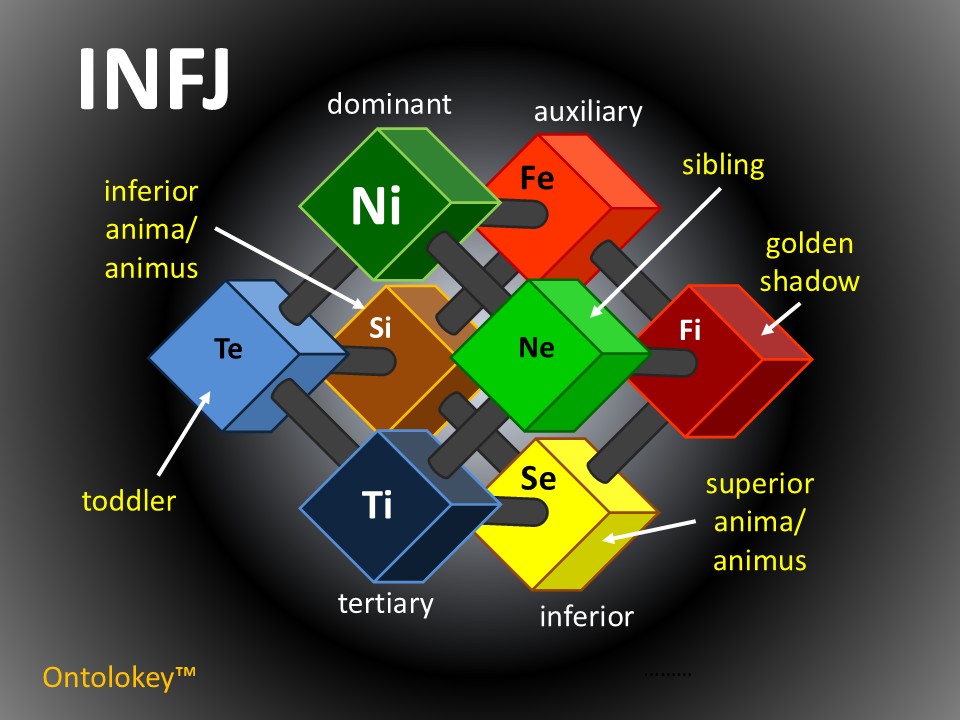
To understand the INFJ through the Ontolokey Cube, it is necessary to move beyond the familiar four-letter description and enter the full eight-function architecture that Ontolokey places around the cube’s vertices. The INFJ is organized around Introverted Intuition (Ni) as its dominant function and Extraverted Feeling (Fe) as its auxiliary function, while Extraverted Intuition (Ne) operates as the sibling function, Extraverted Thinking (Te) as the toddler function, Introverted Thinking (Ti) as the tertiary or blindspot function, Extraverted Sensing (Se) as the inferior function, Introverted Sensing (Si) as the anima, and Introverted Feeling (Fi) as the golden shadow. The significance of this arrangement is that the INFJ is not simply “an intuitive person who cares about others”; rather, the personality becomes a dynamic system in which different forms of perception, judgment, consciousness, vulnerability, aspiration, and unconscious compensation continually interact. Ontolokey’s spatial metaphor is particularly useful here because the eight positions are not presented as a flat list but as relationships within a three-dimensional structure, allowing the dominant function to be understood in relation to the functions that support it, challenge it, compensate for it, or remain psychologically less accessible. In this sense, the INFJ’s psychology begins with a profound asymmetry: Ni and Fe are comparatively natural and consciously available, whereas several other functions may emerge indirectly, defensively, reactively, or as something the INFJ admires in others without fully recognizing it as part of the self.
Ni — The Dominant Function: The Inner Vision
At the centre of the INFJ architecture stands Introverted Intuition (Ni), which Ontolokey describes as the INFJ’s primary lens for perceiving reality through depth, pattern, trajectory, symbolism, and underlying meaning. Ni does not primarily ask what is happening at the surface level; it attempts to understand what the events signify, where they are leading, what hidden pattern connects them, and what psychological or existential process may be unfolding underneath them. This gives the INFJ a characteristic capacity for convergence: rather than multiplying possibilities indefinitely, the mind gradually compresses disparate impressions into an integrated internal image, sometimes producing an unusually strong sense that something is true before the person can consciously explain how that conclusion was reached. Such perception can become a genuine strength in situations requiring long-range understanding, psychological interpretation, symbolic thinking, or recognition of developmental patterns, because the INFJ is often less interested in isolated facts than in the invisible thread connecting them. Yet precisely because Ni constructs coherence from fragments, its greatest danger is that coherence can become indistinguishable from certainty, allowing an interpretation that feels profoundly meaningful to acquire the psychological status of reality before sufficient external evidence has been considered.
Fe — The Auxiliary Function: The Social Bridge
Where Ni retreats inward to discover meaning, Extraverted Feeling (Fe) turns outward and asks what is happening between people, what emotional atmosphere exists within a group, and what might restore connection, understanding, or harmony. Ontolokey therefore presents Fe as the INFJ’s social bridge: it translates private intuition into language, behaviour, care, guidance, and interpersonal responsiveness, allowing an otherwise highly internal personality to participate actively in the emotional world of others. This combination explains an important feature of the INFJ: empathy is not merely passive sensitivity but can become an interpretive activity in which the individual continuously monitors emotional states, unspoken expectations, relational tensions, and the effects that words or actions may have on the surrounding psychological environment. At its healthiest, Fe gives the INFJ diplomacy, compassion, emotional intelligence, and the ability to make abstract insight useful to real human beings, but the same mechanism can become self-abandonment when maintaining harmony becomes more important than acknowledging personal limits. The INFJ may then become extraordinarily skilled at understanding what everyone else needs while becoming progressively less certain about what they themselves actually want, producing the paradox of a person who appears deeply connected to humanity while privately experiencing an increasing distance from their own emotional centre.
Ne — The Sibling Function: The Necessary Expansion of Vision
The Extraverted Intuition (Ne) position introduces an important corrective to Ni because it represents breadth where Ni naturally seeks depth and convergence. Rather than reducing many impressions into one underlying interpretation, Ne proliferates possibilities, associations, alternatives, hypothetical explanations, and unexpected connections; within the Ontolokey architecture it therefore functions as the INFJ’s sibling, a counterpoint capable of preventing the dominant intuition from becoming excessively narrow or self-confirming. A psychologically mature INFJ can use this function to challenge their own conclusions, entertain competing interpretations, experiment intellectually, and preserve curiosity even when an internally coherent explanation has already emerged. This matters because the shadow risk of a powerful Ni is not simply pessimism or introversion but premature closure: once the INFJ believes they have understood the deeper pattern, further evidence may be unconsciously recruited to confirm rather than question that interpretation. Ne creates psychological breathing room by reopening the field and asking what else could be true, which can introduce humour, creativity, flexibility, and intellectual resilience into a personality otherwise inclined toward singular meaning. In that sense, the sibling is not an enemy of the dominant function but its natural counterweight, allowing vision to remain visionary without becoming dogmatic.
Te — The Toddler Function: The Problem of Execution
Extraverted Thinking (Te) occupies the Ontolokey position described as the INFJ’s toddler function, representing an underdeveloped relationship with external efficiency, measurable results, systems, procedures, and objective implementation. The INFJ may possess an exceptionally elaborate internal understanding of what ought to happen yet become surprisingly frustrated when confronted with the practical demands of turning that understanding into schedules, metrics, procedures, priorities, or demonstrable outcomes. This can produce a peculiar form of perfectionism in which the individual sees the ideal structure clearly but becomes impatient, awkward, or overly forceful when attempting to impose that structure upon external reality. Under pressure, Te may therefore emerge abruptly as bluntness, managerial rigidity, excessive correction, or an almost alien insistence on efficiency, particularly when the INFJ feels that other people are obstructing something they regard as important. Yet Te also represents an indispensable developmental bridge: it teaches the INFJ that insight is not identical with impact and that a meaningful vision requires mechanisms through which it can actually enter the world. Mature Te does not require the INFJ to become a fundamentally different person; it allows the visionary to acquire enough external structure to transform conviction into sustained action rather than leaving important ideals suspended indefinitely in the realm of possibility.
Ti — The Tertiary Function: The Inner Examiner
Introverted Thinking (Ti) occupies another psychologically revealing position because it introduces the demand for internal logical consistency into a personality otherwise strongly oriented toward intuition and interpersonal meaning. Ontolokey describes Ti as the INFJ’s hidden analyst: a function capable of questioning assumptions, refining conceptual distinctions, examining ethical systems, and asking whether an insight is not merely meaningful but structurally coherent. This capacity can become especially important because Fe naturally absorbs information from the interpersonal environment, including social values and expectations, whereas Ti asks whether those values actually withstand independent examination. When developed constructively, Ti protects the INFJ from confusing social consensus with truth and gives their intuitive convictions greater intellectual precision, allowing them to distinguish between what they genuinely believe and what they have simply learned to regard as morally desirable. When immature or defensive, however, Ti can become pedantic, hypercritical, or detached from the human context that Fe normally keeps in view, producing an internal debate in which every emotional or ethical question is dissected until its original human significance disappears. The mature relationship between Fe and Ti is therefore not a choice between heart and intellect but an ongoing negotiation in which empathy supplies context while analysis supplies discrimination.
Se — The Inferior Function: Reality, the Body, and the Present Moment
The Extraverted Sensing (Se) position exposes one of the INFJ’s most important developmental tensions because Se demands immediate contact with the concrete world rather than symbolic interpretation of it. Ontolokey associates Se with sensory presence, spontaneity, physical engagement, aesthetic experience, and the capacity to respond directly to what is happening now, qualities that may feel less natural to a personality accustomed to living inside meanings, implications, memories, and anticipated futures. Consequently, the INFJ may sometimes neglect the body, overlook immediate environmental information, or remain so absorbed in an internal interpretation that the concrete reality in front of them becomes secondary. Under sufficient stress, the neglected function may appear in exaggerated forms, including impulsive sensory gratification, compulsive consumption, abrupt risk-taking, or an unusual fixation on material details that normally receive little attention. Integration, however, does not mean replacing intuition with sensation; it means allowing the present moment to correct the inner narrative, so that the INFJ can experience the body, environment, beauty, physical action, and immediate reality as sources of information rather than distractions from meaning. Se ultimately teaches the INFJ a difficult but liberating lesson: reality does not exist merely as something to interpret, because some dimensions of life must first be encountered before they can be understood.
Si — The Anima: Memory, Continuity, and the Inner Sanctuary
The Introverted Sensing (Si) position occupies a particularly subtle place in the INFJ’s psychological architecture because Ontolokey identifies it as the anima, the inwardly oriented archetypal function associated with personal memory, bodily experience, continuity, tradition, and the preservation of emotionally significant states. Unlike Ni, which continually abstracts experience into patterns and future-oriented meaning, Si turns toward what has already been lived and asks what remains internally from it: the atmosphere of a place, the emotional imprint of a relationship, a familiar ritual, a bodily sensation, or a remembered sense of safety. For an INFJ, this can create an unexpectedly strong attachment to symbols, objects, locations, routines, or relationships that have acquired psychological significance, even when the person consciously believes they are oriented toward transformation and the future. The anima therefore represents more than nostalgia; it is a hidden longing for continuity in a personality whose dominant intuition is constantly dissolving the present into a larger narrative of what it might become. When integrated, Si provides an inner sanctuary in which experience can settle rather than always being interpreted, improved, or transcended, allowing the INFJ to recognize that psychological wholeness requires not only vision but also remembrance, embodiment, and the capacity to preserve what has genuinely nourished the self.
Fi — The Golden Shadow: The Self the INFJ May Have Difficulty Claiming
The most psychologically provocative position in the Ontolokey model is arguably Introverted Feeling (Fi), described as the INFJ’s golden shadow: a function that is not simply weak or dark, but represents a form of psychological potential that may initially be projected onto other people before it can be consciously integrated. Fe asks how people are affected by one another and how emotional equilibrium can be maintained within a relational field, whereas Fi turns inward and asks whether an experience is personally authentic, whether a boundary has been crossed, and whether an action remains faithful to one’s own deepest values even when nobody else agrees. This distinction exposes one of the INFJ’s most difficult developmental problems: a person can become exceptionally skilled at understanding everyone else’s emotional reality while remaining surprisingly uncertain about the legitimacy of their own. Fi therefore appears as the voice that says an individual does not need collective approval before an inner truth becomes valid, and this can feel profoundly threatening to an INFJ who has learned to define goodness through responsiveness, usefulness, empathy, or moral responsibility toward others. Its integration consequently involves more than becoming “more emotional”; it means developing psychological sovereignty, learning to establish boundaries without excessive guilt, tolerating disapproval, and discovering that compassion for others does not require permanent self-abandonment.
The INFJ’s Shadow: When a Gift Becomes a Weapon Against the Self
The shadow side of the INFJ does not emerge because the personality suddenly becomes the opposite of what it ordinarily is; rather, the shadow develops when the same psychological capacities that ordinarily create insight, empathy, idealism, and moral seriousness become excessively identified with and therefore lose their corrective mechanisms. The INFJ can become so convinced that they understand what is happening beneath the surface that interpretation begins to replace observation, while Fe can become so invested in maintaining relational equilibrium that authentic disagreement is experienced as a moral failure. The combination is potentially powerful because Ni can construct an elaborate psychological explanation for another person’s behaviour while Fe supplies an emotional justification for acting upon that interpretation, creating a closed loop in which intuition validates emotion and emotion validates intuition. Ontolokey’s shadow-oriented perspective is particularly concerned with this movement from integration toward distortion: the danger is not that the INFJ possesses too much empathy or too much intuition, but that these capacities can become detached from humility, evidence, boundaries, and self-questioning. At its most unhealthy, the INFJ may therefore become less interested in discovering what is true than in protecting an internally coherent story about what is true, and because that story may be psychologically sophisticated, the resulting self-deception can be considerably more difficult to recognize than ordinary impulsivity or emotional reactivity.
The Darker Side of Empathy: When Understanding Becomes Control
One of the uncomfortable truths about intense interpersonal sensitivity is that understanding another person does not automatically make the relationship healthier. An INFJ who accurately detects insecurity, contradiction, shame, fear, attachment, or unspoken motives in another person possesses information that can be used either compassionately or defensively, and the difference depends upon the individual’s level of self-awareness. The shadow emerges when psychological insight becomes a substitute for direct communication, because the INFJ may begin interpreting another person rather than asking them, deciding what they “really mean” beneath their words instead of allowing them the autonomy to define their own experience. In this state, empathy can become intrusive without appearing aggressive, because the INFJ may genuinely believe that they are helping someone reach a truth that the other person has not yet recognized. The deeper danger is that the INFJ can become attached to the role of the person who sees what others cannot see, and once that identity is established, being corrected becomes psychologically threatening because it challenges not merely an opinion but an entire self-concept built around exceptional perceptiveness. The mature alternative is epistemic humility: intuition may reveal a possibility, but another human being retains the right to contradict the INFJ’s interpretation of their own inner life.
The Idealist’s Trap: Moral Purity and the Hidden Ego
INFJ idealism can become equally complicated when moral conviction begins to merge with personal identity. A strong ethical orientation can motivate extraordinary compassion, loyalty, service, creativity, and commitment to causes larger than the self, yet it can also produce an unconscious division between the person one believes oneself to be and the imperfect person one actually is. The more strongly an INFJ identifies with being understanding, ethical, compassionate, insightful, or emotionally mature, the more difficult it may become to acknowledge envy, resentment, possessiveness, anger, competitiveness, or the desire for recognition when those emotions arise. The shadow does not disappear merely because the conscious personality considers those qualities undesirable; instead, they may be displaced into other people, where they can be judged with surprising intensity. This creates one of the deepest psychological paradoxes of idealism: the individual may become highly tolerant of human imperfection in principle while becoming internally intolerant of their own imperfection in practice. Genuine integration therefore requires something more demanding than preserving a positive self-image; it requires the capacity to recognize morally uncomfortable impulses without immediately converting them into evidence of personal corruption or projecting them onto someone else.
The Ni–Fe Trap: When Vision and Empathy Reinforce Each Other
The relationship between Ni and Fe is central to the INFJ because it forms the conscious core through which private interpretation becomes interpersonal meaning. Ontolokey explicitly presents their relationship as a dynamic slider between vision and empathy, emphasizing that neither function exists in isolation and that imbalance can distort the personality in opposite directions. When Ni dominates without sufficient Fe, the INFJ may retreat into an increasingly private symbolic universe in which other people become characters within an internally constructed narrative rather than independent subjects capable of contradicting it. When Fe dominates without sufficient Ni, the individual may become excessively adaptive, absorbing the emotional expectations of the surrounding environment until personal direction becomes blurred and psychological exhaustion follows. The more dangerous configuration, however, can occur when both functions reinforce one another without adequate contact with the remaining functions: Ni produces a compelling interpretation, Fe confirms that interpretation through interpersonal resonance, and the resulting certainty becomes emotionally self-sealing. The developmental task is therefore not to choose between intuition and empathy but to allow each to challenge the other, so that intuition remains open to correction and empathy remains anchored in an authentic inner orientation rather than becoming a sophisticated form of emotional compliance.
The Ontolokey Sliders: Personality as a Moving Psychological Landscape
The eight positions of the INFJ cube become even more meaningful when they are understood not as fixed compartments but as dynamic relationships between psychological tendencies. Ontolokey expresses these relationships through twelve sliders, emphasizing that personality is not adequately represented by declaring one function “strong” and another “weak”; instead, the psyche continually moves between opposing or complementary modes depending on development, circumstances, stress, and conscious integration. For the INFJ, several of these axes are particularly revealing: Ni–Fe describes the tension between inner vision and interpersonal attunement, Ni–Ne between convergence and expansion, Ni–Te between insight and implementation, Fe–Fi between adaptation to the relational field and fidelity to the individual self, and Fe–Si between interpersonal harmony and continuity with personal experience. The importance of this model lies in the fact that psychological development is not portrayed as the elimination of one pole in favour of another, but as an increasing ability to move consciously across the landscape rather than becoming trapped at one extreme. An INFJ who remains permanently at the Ni end may become visionary but detached from concrete reality, while an INFJ who continuously sacrifices Ni to Fe may become socially responsive yet internally directionless; maturity therefore consists less in changing the personality than in acquiring enough psychological freedom to use the less familiar dimensions of the personality without experiencing them as threats to identity.
From Vision to Reality: Ni–Ne and Ni–Te
The Ni–Ne relationship illustrates one of the INFJ’s fundamental cognitive tensions: the difference between finding the underlying pattern and remaining open to alternative patterns. Ni naturally moves toward synthesis, seeking the central meaning that connects apparently unrelated observations, whereas Ne keeps possibilities multiplying and prevents the mind from settling too quickly upon one explanatory structure. Ontolokey describes Ne as a sibling function that gives the INFJ greater breadth, creativity, experimentation, humour, and cognitive flexibility, thereby protecting Ni from becoming excessively rigid or trapped in a self-reinforcing interpretation. The Ni–Te relationship introduces another developmental challenge because insight must eventually confront implementation: an INFJ can know precisely what a situation means and still struggle to determine the practical sequence through which that understanding should become action. Te supplies the external structure, measurable criteria, organization, and efficiency required to convert an internal vision into something observable, and Ontolokey consequently describes its development as a movement from philosophical or visionary understanding toward executable strategy. Together these two axes reveal why the INFJ can experience a frustrating gap between seeing and doing: the internal picture may be extraordinarily sophisticated while the practical machinery necessary to realize it remains comparatively underdeveloped, making disciplined execution not a betrayal of intuition but one of the conditions through which intuition acquires real-world significance.
Fe–Fi: The Struggle Between Being Needed and Being Real
Perhaps no developmental axis is more emotionally consequential for the INFJ than Fe–Fi, because it confronts the difference between being responsive to other people and remaining faithful to oneself. Fe is naturally oriented toward interpersonal harmony, shared emotional realities, and the needs of the surrounding relational environment, whereas Fi represents a more private form of value judgment in which authenticity, personal boundaries, and inner moral conviction do not require collective agreement. Ontolokey’s characterization of Fi as the INFJ’s golden shadow is therefore particularly significant: the function is described not as a purely negative or deficient capacity but as a form of psychological potential that the INFJ may admire, project onto others, or struggle to consciously claim. This creates a distinctive vulnerability because the INFJ can become exceptionally skilled at detecting what other people feel and need while unconsciously treating their own needs as negotiable, inconvenient, selfish, or morally suspect. Psychological maturity requires the realization that compassion and self-abandonment are not synonyms, and that refusing something, disappointing someone, leaving an unhealthy relationship, or protecting private values does not automatically constitute cruelty. When Fi becomes integrated, Fe does not disappear; instead, empathy becomes less submissive and more authentic because the INFJ can finally offer care from a position of inner choice rather than from an unconscious fear that being needed is the same thing as being worthy.
The INFJ and the Seduction of Being Understood
There is another subtle dimension to the INFJ experience that follows from this architecture: the intense desire to be understood can coexist with an equally intense reluctance to become completely visible. Ni generates an inner world that may be difficult to translate into ordinary language, while Fe creates a remarkable ability to understand others through nuances that those others may never consciously articulate, and this asymmetry can leave the INFJ feeling that they routinely see further into people than people see into them. The resulting longing for recognition can become psychologically dangerous when the person begins searching for someone who will intuitively penetrate every layer of their personality without requiring the INFJ to communicate those layers directly. Yet intimacy cannot be built solely upon being accurately perceived; it also requires the willingness to disclose, clarify, tolerate misunderstanding, and allow another person to encounter aspects of oneself that are less coherent or flattering than the carefully interpreted inner narrative. The shadow therefore appears when the INFJ unconsciously turns relationships into tests of whether another person is perceptive enough, sensitive enough, or devoted enough to discover what has deliberately been left unspoken. A healthier form of intimacy emerges when the INFJ relinquishes the fantasy of being perfectly deciphered and instead participates actively in the ordinary, imperfect, sometimes frustrating process of making oneself known.
The Positive INFJ: Vision, Compassion, and Psychological Depth
The darker dimensions of the INFJ should not obscure the extraordinary constructive potential contained within the same architecture. When Ni and Fe operate in healthy cooperation, the INFJ can combine long-range perception with an unusually strong awareness of human consequences, allowing abstract understanding to become compassionate guidance rather than detached analysis. The individual may notice patterns in relationships, organizations, cultural developments, or personal behaviour before those patterns become obvious to others, while Fe provides the motivation to translate those observations into something useful for human beings rather than merely collecting insights for private satisfaction. Ontolokey’s description of Ni emphasizes precisely this capacity for depth, trajectory, symbolic understanding, and anticipation, while its treatment of Fe emphasizes interpersonal attunement, communication, service, and the transformation of inner vision into relational form. At their best, INFJs can therefore become interpreters between worlds: between abstract and concrete, individual and collective, present experience and future possibility, emotional reality and conceptual understanding. Their greatest contribution is not simply that they “care,” but that they can potentially perceive why people suffer, how systems create recurring patterns, and what kind of transformation might allow a person or community to move beyond those patterns.
The Positive INFJ: Compassion Without Self-Erasure
Healthy Fe also gives the INFJ a form of social intelligence that can be profoundly constructive when it is separated from the need for approval. Such an INFJ does not merely absorb the emotions of a room; they can recognize tensions without becoming consumed by them, mediate disagreement without denying genuine differences, and communicate difficult truths without deliberately humiliating the people who need to hear them. The difference between mature and immature Fe is therefore not simply a difference in kindness but a difference in psychological boundaries: mature empathy can remain present with another person’s pain without assuming responsibility for eliminating it. This becomes particularly important because the INFJ’s natural inclination toward service can otherwise transform compassion into overfunctioning, in which the individual continually repairs situations that other people must ultimately learn to manage themselves. When Fe is supported by Ti, the INFJ can examine whether a social expectation is actually reasonable rather than automatically obeying it; when supported by Fi, they can remain connected to their own values while still respecting the values of others. The resulting personality is neither coldly detached nor endlessly accommodating, but capable of a more demanding form of compassion in which understanding another person does not require surrendering the self.
The Positive INFJ: Integration Rather Than Perfection
The deepest promise of the Ontolokey model lies in its refusal to make the INFJ’s less-conscious functions meaningless simply because they are less familiar. The cube presents Ni, Fe, Ne, Te, Ti, Se, Si, and Fi as different dimensions of one psychological landscape, and its developmental conclusion is that none of these functions is disposable: each can contain both a vulnerability and a gift, depending on how consciously it is approached. For the INFJ, this makes psychological growth fundamentally different from becoming a more exaggerated version of the familiar stereotype of the empathic visionary. Growth means learning to question intuition without destroying it, to use logic without becoming emotionally sterile, to experience the present without abandoning inner meaning, to preserve memories without becoming imprisoned by them, to act efficiently without reducing life to productivity, and to establish personal boundaries without abandoning compassion. The integrated INFJ consequently becomes less dependent upon the approval of their own self-image as a “good,” “deep,” or “insightful” person, because identity itself becomes less rigid and more spacious. In that sense, individuation is not the perfection of the INFJ archetype but the gradual liberation of the human being from having to perform the archetype at all.
The Untold Truth: What the INFJ Must Eventually Confront
The most difficult truth for the INFJ is that psychological depth can become a form of psychological avoidance. A person who is exceptionally skilled at interpreting motives, patterns, emotional undercurrents, and symbolic meaning can become so accustomed to looking beneath the surface that the surface itself is no longer allowed to speak for itself. Ni can transform ambiguity into a compelling narrative, Fe can make that narrative emotionally persuasive, and the resulting interpretation can feel so internally complete that questioning it becomes psychologically uncomfortable. This is where the INFJ’s greatest gift can quietly become its most sophisticated defence: insight can be used not only to understand reality but also to protect the self from realities that are painful, ordinary, contradictory, or uncontrollable. The deeper shadow therefore does not necessarily look cruel, selfish, or emotionally chaotic; it may look remarkably thoughtful, compassionate, principled, and psychologically sophisticated while still being organized around avoidance. Ontolokey’s emphasis on the shadow and on dynamic integration is particularly relevant here because the unconscious material is not simply something “bad” that must be defeated, but a neglected part of the personality that must eventually enter conscious relationship with the dominant functions.
One of the INFJ’s most important developmental confrontations is therefore the distinction between knowing something about oneself and actually living differently. An INFJ may understand their attachment patterns, recognize their tendency toward overgiving, identify their fear of rejection, articulate the origins of their perfectionism, and even explain the psychological mechanisms through which these patterns developed, yet insight alone does not necessarily transform behaviour. Indeed, excessive self-analysis can become another form of avoidance when every emotional difficulty is converted into an intellectual problem that can be endlessly interpreted rather than directly experienced and changed. The same principle applies to relationships: understanding why another person behaves destructively does not obligate the INFJ to tolerate that behaviour, just as understanding someone’s wounds does not erase the consequences of their actions. The mature INFJ gradually learns that compassion does not require exemption from boundaries and that forgiveness does not necessarily require continued access. Psychological depth reaches its highest form not when the individual can explain everything, but when explanation becomes subordinate to reality, responsibility, choice, and action.
The Boundary Between Empathy and Enmeshment
The INFJ’s empathy becomes healthiest when it preserves a distinction between understanding another person and becoming responsible for another person. Fe naturally draws attention toward the emotional field surrounding the individual, while Ni attempts to identify the hidden causes and future consequences of what it perceives; together, these functions can make the INFJ unusually sensitive to subtle changes in relationships. Yet this sensitivity can easily become hyper-responsibility, particularly when the INFJ assumes that because they can perceive another person’s pain, they should somehow resolve it. The resulting pattern may involve anticipating needs before they are expressed, suppressing personal irritation, explaining away unacceptable behaviour, or remaining in relationships long after reciprocity has disappeared because leaving would create emotional consequences for someone else. Fi, as the golden shadow, becomes crucial precisely here because it introduces the psychologically corrective principle that one’s own subjective experience possesses legitimacy independent of another person’s needs. Ontolokey explicitly characterizes Fi for the INFJ as a source of authenticity, boundary-setting, emotional truth, and inner sovereignty, making its integration one of the central movements through which the INFJ becomes not merely more compassionate but more internally autonomous.
The INFJ Under Pressure: When the Unintegrated Functions Take Over
Stress can expose the functions that ordinary consciousness tends to keep at a distance, and this is particularly revealing in the INFJ because the neglected functions can emerge in forms that feel strangely unlike the person’s usual identity. The inferior Se may produce an exaggerated fixation on immediate sensory experience, physical details, consumption, stimulation, or impulsive action, especially when prolonged abstraction and emotional processing have exhausted the individual’s capacity for internal control. Te, occupying the toddler position in the Ontolokey architecture, can similarly emerge in an awkwardly forceful form: the normally nuanced INFJ may suddenly become blunt, excessively efficiency-oriented, impatient with incompetence, or preoccupied with proving that something can be objectively demonstrated and executed. These reactions should not be interpreted simply as evidence that the “real” personality has finally revealed itself; they are better understood within the Ontolokey framework as signs that less-developed psychological functions are attempting to participate without having acquired the same degree of conscious flexibility as Ni and Fe. The developmental task is therefore not to suppress these eruptions but to learn their language before they need to become extreme: Te can teach execution before frustration becomes harshness, Se can teach presence before stress becomes impulsivity, and Ti can introduce analytical distance before intuition hardens into certainty.
The Cube as a Map of Individuation
Ontolokey’s cube becomes most psychologically interesting when its eight positions are understood as stages or dimensions of a larger process of individuation rather than as labels attached permanently to behaviour. Ontolokey describes the cube as a spatial representation in which the dominant, auxiliary, anima or animus, toddler, sibling, golden shadow, inferior, and tertiary functions form an interconnected structure, while its sliders express tensions between opposing or complementary psychological tendencies. For the INFJ, this means that development is not a linear journey from Ni toward some final state in which every other function becomes equally strong; instead, it is a gradual increase in psychological mobility, allowing the person to move between vision and possibility, empathy and authenticity, insight and execution, memory and presence, analysis and feeling without being psychologically possessed by any one of these poles. The value of the cube is therefore metaphorical as much as typological: it turns personality from a static portrait into a landscape containing familiar territories, neglected regions, difficult terrain, and unexplored possibilities. In that landscape, the shadow is no longer something to fear because its existence is itself evidence that the personality is larger than its conscious identity.
From the Ideal Self to the Real Self
The INFJ’s deepest maturation may consequently involve relinquishing an idealized image of who they believe they ought to be. The archetype of the compassionate visionary can become a psychological prison if the individual believes they must always be understanding, emotionally perceptive, morally consistent, available, insightful, and unusually mature, because every ordinary human reaction then becomes evidence of personal failure. Anger becomes unacceptable because the INFJ is supposed to understand; selfishness becomes shameful because the INFJ is supposed to care; uncertainty becomes threatening because the INFJ is supposed to see deeply; and the desire to withdraw becomes guilt-producing because the INFJ is supposed to be emotionally present for others. Fi offers a crucial antidote because it permits the individual to recognize that authenticity sometimes includes contradictory feelings, private preferences, limits, ambivalence, and desires that cannot be justified by their usefulness to other people. The mature INFJ does not become less caring by accepting these realities; rather, care becomes less contaminated by the unconscious need to remain morally impeccable, psychologically special, or indispensable.
The Integrated INFJ: From Understanding to Embodiment
The final developmental movement can therefore be described as a transition from psychological interpretation to psychological embodiment. Ni gives the INFJ the ability to perceive meaning, Fe gives that meaning interpersonal relevance, Ne prevents premature closure, Te brings vision into execution, Ti tests internal coherence, Se reconnects the person with immediate reality, Si preserves continuity and lived experience, and Fi establishes the boundary of personal truth. None of these functions needs to overthrow the others; their purpose is to prevent any single mode of consciousness from becoming absolute. The INFJ who develops in this direction does not lose the mysterious, intuitive, compassionate quality that makes the type distinctive, but becomes less dependent upon those qualities as an identity that must constantly be performed. Ontolokey’s broader conception of the cube supports precisely this understanding of personality as a multidimensional landscape whose purpose is awareness, growth, and adaptation rather than confinement within a fixed label. The ultimate achievement is therefore not becoming a “perfect INFJ,” but becoming sufficiently integrated that the INFJ can remain deeply intuitive without becoming dogmatic, deeply empathic without becoming enmeshed, deeply idealistic without becoming self-righteous, and deeply private without becoming inaccessible.
The Untold Truth: Becoming More Than the INFJ Archetype
The origin of Ontolokey helps illuminate why the cube is particularly suited to this way of understanding the INFJ. Ontolokey emerges from the functional architecture associated with Socionics and seeks to transform that architecture into a three-dimensional psychological landscape, placing eight psychological functions at the vertices of a cube so that their relationships can be experienced spatially rather than merely memorized sequentially. In this conception, the model is not simply asking which functions an INFJ possesses, but how different modes of perception and judgment relate to one another, which processes are naturally accessible, which are less conscious, which are vulnerable, and which may be psychologically attractive precisely because they are not fully integrated. This is particularly revealing for the INFJ because the personality can so easily become identified with its most visible virtues—intuition, empathy, idealism, psychological insight—while overlooking the quieter psychological work represented by Se, Si, Te, Ti, and Fi. The cube therefore offers a more demanding portrait: the INFJ is not merely the sensitive visionary who understands other people, but a multidimensional psychological system in which vision must encounter reality, empathy must encounter individuality, intuition must encounter uncertainty, and idealism must eventually encounter the ordinary imperfections of the self.
The INFJ’s Real Strength Is Not Perfection but Integration
Seen in its entirety, the eight-function architecture reveals that the INFJ’s positive and negative qualities are not separate psychological worlds but different expressions of the same underlying capacities. Ni can produce profound insight or rigid certainty; Fe can create compassion or self-erasure; Ne can provide creativity or endless reinterpretation; Te can create implementation or harsh control; Ti can produce conceptual clarity or sterile overanalysis; Se can restore presence or erupt into impulsive excess; Si can provide continuity or imprison the individual in emotionally charged memories; and Fi can become either a source of profound authenticity or a painful confrontation with needs the INFJ has spent years placing beneath the needs of others. The psychological challenge is therefore not to eliminate the shadow but to establish a conscious relationship with it, because every neglected function contains information that the dominant personality structure cannot generate by itself. This corresponds closely with the broader Ontolokey idea that personality becomes more useful when it is understood as a structured system of different information-processing tendencies rather than merely as a fixed category. The integrated INFJ consequently does not become less INFJ-like; rather, the person becomes less imprisoned by the narrowest interpretation of what being an INFJ is supposed to mean.
The Final Paradox of the INFJ
The deepest paradox is that the INFJ may spend much of life learning how to understand other people while the decisive developmental task is learning how to remain present with oneself without immediately turning the experience into an interpretation. The INFJ can become the confidant, the mediator, the observer, the counsellor, the visionary, or the person who recognizes the hidden pattern behind everyone else’s behaviour, yet none of these roles answers the more private question of who the person is when nobody needs anything from them. This is where Fi, Se, Si, Ti, and Te become more than secondary elements in a typological diagram: they represent encounters with dimensions of existence that cannot simply be absorbed into the familiar Ni–Fe identity. The INFJ must eventually discover that not every feeling needs an explanation, not every relationship needs to be rescued, not every conflict needs to be harmonized, not every intuition needs to become a prophecy, and not every meaningful experience needs to serve a larger purpose. The untold truth is therefore not that the INFJ secretly possesses a darker personality hidden behind a benevolent exterior, but that beneath the archetype lies a much more complicated human being who must eventually be allowed to exist without constantly being interpreted, improved, morally justified, or made useful.
Beyond the Label: The INFJ as an Ongoing Psychological Landscape
This is ultimately where the Ontolokey Cube becomes more than a classification device: it provides a language for imagining personality as a landscape that can be explored rather than a box in which a person must remain. Ontolokey describes the underlying idea explicitly as a movement from a functional architecture toward a spatial representation in which relationships between functions become geometrical relationships and the psychological structure becomes something that can be mentally navigated. For the INFJ, that landscape contains the familiar territory of Ni and Fe, but it also contains the less familiar regions that may initially feel uncomfortable, contradictory, or strangely foreign. Development begins when the individual becomes willing to enter those regions without demanding that they immediately conform to the existing self-image. The result is not a personality without contradictions but a person who can tolerate contradiction without needing to resolve it prematurely, and this capacity may be one of the clearest signs that psychological depth has matured into psychological freedom.
Conclusion: The Truth Behind the Visionary
The INFJ is often described through qualities that are undeniably compelling: intuitive depth, empathy, idealism, imagination, loyalty, emotional sensitivity, and an unusual interest in the hidden dimensions of human experience. Yet the fuller portrait is considerably more demanding because every one of these qualities carries a corresponding psychological responsibility: intuition must remain open to correction, empathy must preserve boundaries, idealism must tolerate imperfection, insight must become action, and sensitivity must remain connected to concrete reality. The Ontolokey framework makes this tension visible by placing the eight functions into a relational architecture in which conscious strengths coexist with less-conscious, vulnerable, aspirational, and shadow dimensions rather than disappearing from the personality altogether. The mature INFJ therefore does not seek to become the most insightful, empathic, or morally admirable version of the type, because that pursuit can itself become another form of identification with an idealized self; instead, maturity lies in becoming sufficiently whole that intuition, feeling, thinking, sensing, memory, possibility, execution, and personal value can all participate in consciousness without one of them needing to dominate the entire identity. The untold truth of the INFJ is consequently both simpler and deeper than the stereotype suggests: the journey is not toward becoming a perfect INFJ, but toward becoming a complete human being who happens to experience the world through the distinctive landscape of the INFJ.
For Further Exploration
Readers who want to explore this psychological landscape in greater detail can continue with the more extensive personality analyses published by Ontolokey, where the functional architecture, the individual personality types, the shadow dimensions, and the relationships between the different positions of the Ontolokey Cube are developed in considerably greater depth. The broader Ontolokey project presents the Cube as a three-dimensional way of exploring the eight-function architecture and its relationships, while its more recent work extends this perspective into questions of shadow, integration, interpersonal dynamics, and psychological development. The INFJ should therefore not be treated as the conclusion of the investigation but as its starting point: once the familiar four letters have been understood, the more interesting question is what lies behind them, beneath them, and beyond them. The personality type gives the landscape a name; the work of understanding oneself begins when one starts walking through it.


Leave a comment