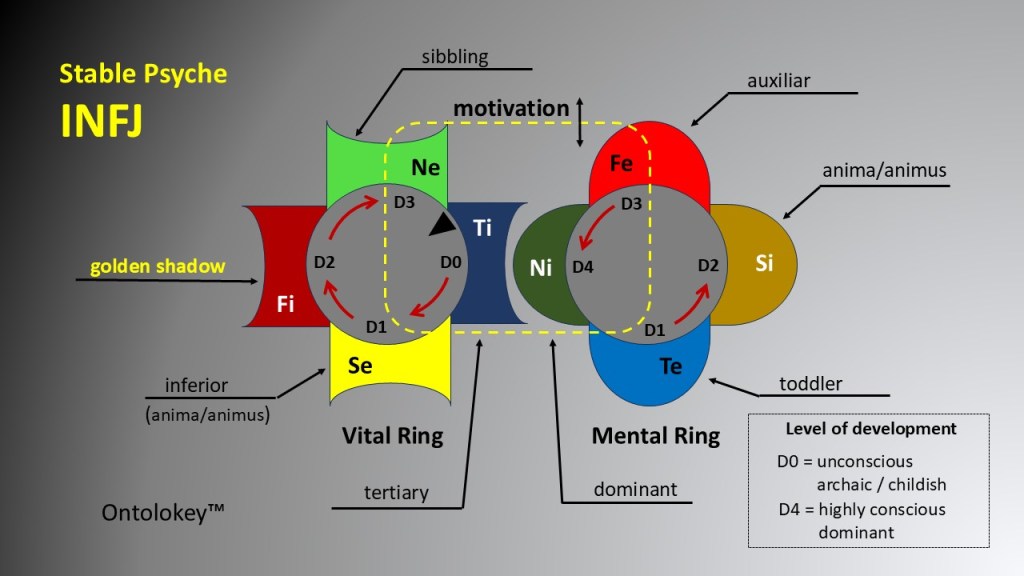
Beneath the Beautiful Surface
The INFJ is often described through a vocabulary of depth: intuitive, empathetic, idealistic, insightful, private, compassionate, visionary, and unusually sensitive to the psychological realities surrounding other people. This portrait captures something essential, because the INFJ tends to experience life less as a sequence of isolated events than as an interconnected field of meanings, motives, emotional undercurrents, and possible futures. In the Ontolokey perspective, this inner orientation is organized around Introverted Intuition (Ni), supported by Extraverted Feeling (Fe), while other psychological functions operate in less familiar, less conscious, or potentially developmental positions. The result is a personality that can appear remarkably composed and perceptive externally while simultaneously carrying an intricate inner world that is difficult for others to access.
Yet the qualities that make the INFJ appear unusually perceptive can also become the foundations of its most difficult psychological patterns. The capacity to recognize hidden motives can turn into the assumption that every behavior conceals a hidden motive; empathy can become emotional over-responsibility; idealism can become disappointment with ordinary human imperfection; and a strong moral orientation can gradually become identification with the role of the good, understanding, or selfless person. Ontolokey’s exploration of the INFJ shadow places particular emphasis on this paradox: psychological insight does not automatically produce psychological integration, and the person who understands other people exceptionally well can still remain remarkably blind to their own resentment, dependency, projections, or need for recognition. The shadow therefore does not represent an alien personality hiding beneath the INFJ; it represents aspects of the same psychological structure that become distorted when consciously valued qualities are defended so strongly that their opposites are denied.
This is why an honest examination of the INFJ cannot remain at the level of flattering descriptions. The interesting question is not simply why INFJs can be compassionate, visionary, creative, loyal, psychologically perceptive, or deeply concerned with meaning, but what happens when these strengths become excessive, defensive, or detached from reality. Ontolokey’s three-dimensional approach is useful here because it does not restrict attention to the familiar conscious functions but places eight functions into a dynamic structure: Ni as Dominant, Fe as Auxiliary, Ne as Sibling, Te as Toddler, Ti as Tertiary, Se as Inferior, Si as Anima/Animus, and Fi as Golden Shadow. Rather than treating these positions as a list of disconnected characteristics, the cube presents them as interacting dimensions of one psychological landscape, in which strength, vulnerability, attraction, conflict, and development are continually related to one another.
The INFJ’s deeper story therefore concerns a tension between inner vision and external reality, compassion and selfhood, meaning and evidence, service and personal boundaries, idealism and human limitation. At its healthiest, this tension can produce a person capable of combining profound intuition with genuine empathy, moral seriousness with humility, and imagination with an increasingly grounded relationship to reality. At its darkest, the same architecture can produce withdrawal, projection, covert resentment, martyrdom, moral superiority, emotional control, and an almost seductive attachment to an inner narrative that has become more convincing than the world itself. The purpose of this essay is to move through that entire psychological landscape, function by function and shadow by shadow, while preserving the central insight of the Ontolokey model: the INFJ does not become whole by destroying the darker parts of the personality, but by becoming conscious of what those parts are trying to reveal.
The INFJ’s Central Paradox: Insight as Gift and Vulnerability
The INFJ’s psychological landscape begins with Introverted Intuition (Ni), which in the Ontolokey model occupies the dominant position and functions as the primary organizing lens through which experience is interpreted. Ni is described not simply as imagination but as a movement beneath appearances: it searches for patterns, trajectories, symbolic relationships, and the deeper structure that may connect apparently unrelated events. This gives the INFJ a characteristic tendency to experience reality in terms of meaning rather than isolated facts, so that a conversation may be remembered less for its literal content than for what it seemed to reveal about a person, a relationship, or a developing situation. At its healthiest, this orientation can produce remarkable foresight, creativity, psychological sensitivity, and the ability to synthesize large amounts of apparently disconnected information into a coherent understanding. The same process, however, can become self-sealing when the internally generated interpretation is treated as more authoritative than the evidence that originally gave rise to it. Ontolokey therefore presents Ni as both the INFJ’s principal source of vision and one of its most important psychological vulnerabilities: the movement from perception into interpretation can happen so seamlessly that the individual may eventually forget where observation ends and personal meaning begins.
This distinction becomes particularly important because intuitive certainty can feel fundamentally different from ordinary reasoning. An INFJ may not experience a conclusion as something consciously constructed through a chain of premises, but as something that gradually crystallizes until the entire pattern suddenly appears internally coherent. Such experiences can be extraordinarily useful, especially when the person has accumulated substantial experience with people, relationships, or complex systems, because unconscious pattern recognition can integrate information faster than deliberate analysis. Yet the subjective force of an insight says nothing by itself about whether the interpretation is correct, and this is where the shadow of Ni begins to emerge. The Ontolokey discussion describes the danger as a gradual transformation of intuition into certainty, in which the INFJ becomes increasingly attached not only to a conclusion but to the explanatory narrative surrounding it, sometimes minimizing information that contradicts the established pattern. The problem is therefore not intuition itself, nor even the INFJ’s confidence in intuition, but the disappearance of epistemological humility—the capacity to recognize that a compelling interpretation remains an interpretation and therefore remains open to correction.
The consequences are particularly pronounced in intimate relationships because the INFJ’s second major function, Extraverted Feeling (Fe), directs attention toward the emotional field between people. Fe allows the INFJ to notice changes in atmosphere, unspoken expectations, emotional discomfort, and the needs of individuals within a social environment, while also encouraging an instinctive desire to restore understanding and interpersonal harmony. This combination of Ni and Fe can make the INFJ exceptionally sensitive to what other people are experiencing, because Ni searches for the underlying pattern while Fe remains attentive to its human and relational implications. Yet precisely because the INFJ is accustomed to reading beneath the surface, there is a danger in assuming that every surface event necessarily contains the deeper meaning the intuition proposes. A delayed message, a change in tone, a moment of emotional distance, or an apparently contradictory statement can become material for an elaborate psychological interpretation, and once Ni supplies a coherent explanation, Fe may emotionally respond to that explanation as though it were already established fact. Ontolokey consequently describes the mature task not as choosing between intuition and empathy, but as maintaining a dynamic balance between inner vision and interpersonal reality, allowing sensitivity to remain compassionate without permitting interpretation to become unquestionable certainty.
The deeper paradox is that an INFJ can therefore be simultaneously highly perceptive and profoundly mistaken, and these two conditions do not contradict one another. A person may accurately detect that something in a relationship has changed while inaccurately identifying the reason for the change; they may perceive genuine discomfort while attributing an intention that the other person never possessed. Because the initial perception contains something real, the subsequent interpretation acquires an additional credibility that makes it difficult to challenge, particularly when the INFJ has a long history of being correct about subtle interpersonal dynamics. Over time, this can create a private psychological world in which the person is responding not only to what others actually do but to the meanings assigned to those actions, sometimes producing misunderstandings that become self-reinforcing. The shadow is therefore not simply excessive sensitivity, but the possibility that sensitivity becomes insulated from correction by the very confidence that previous accurate insights have earned. Genuine psychological maturity for the INFJ requires the difficult discipline of holding two propositions simultaneously: “I may be seeing something others do not see” and “I may still be wrong about what I am seeing.” That tension between extraordinary perception and radical humility is one of the central developmental themes of the INFJ personality
The Second Movement: Fe and the Hidden Cost of Being Attuned to Others
If Ni gives the INFJ its private architecture of meaning, Extraverted Feeling (Fe) is the function that carries that inner world into human relationships. In the Ontolokey cube, Fe occupies the auxiliary position, functioning as the social bridge through which the INFJ translates private insight into empathy, communication, cooperation, and care. Fe is highly responsive to interpersonal atmosphere: it notices shifts in emotional tone, unspoken expectations, tensions within groups, and the needs that people may not articulate directly. This helps explain why INFJs are frequently experienced as unusually attentive listeners and why they may instinctively adapt their communication to the psychological condition of another person. Their concern for others can be expressed through counselling, teaching, advocacy, creative work, leadership, or simply through the quiet effort to make another person feel understood. Yet the very permeability that makes Fe compassionate also creates one of the INFJ’s central psychological problems: when the emotional field of other people becomes too important, the boundary between understanding another person and taking responsibility for another person can become blurred. Ontolokey consequently describes the mature task of Fe as a movement away from automatic compliance and toward authentic diplomacy, where harmony is pursued without sacrificing the self.
The darker form of this dynamic is considerably more complicated than ordinary people-pleasing. An INFJ may sincerely believe that they are simply being considerate when they suppress disagreement, anticipate another person’s needs, forgive repeatedly, or remain available long after a relationship has become psychologically exhausting. Because these actions can be morally meaningful, the individual may have difficulty recognizing the hidden transaction that can develop underneath them: I understand you, therefore you should understand me; I accommodate you, therefore you should recognize what I need without my having to ask; I have given so much, therefore your failure to reciprocate means something about your character. When such expectations remain unspoken, disappointment can accumulate without ever being openly negotiated. The INFJ may continue behaving generously while simultaneously developing an increasingly detailed internal record of everything that has not been returned, and this discrepancy between external kindness and internal resentment is one of the more painful expressions of the shadow. The problem is not that the care was false, but that authentic generosity can become contaminated by an unconscious need for recognition, reciprocity, moral validation, or emotional indebtedness. In that state, Fe no longer merely connects the INFJ to others; it can become a subtle instrument through which the INFJ attempts to regulate the relationship and preserve an image of mutual understanding that the other person may never have consciously agreed to.
This is where the INFJ’s characteristic sensitivity can become psychologically dangerous to the INFJ themselves. Because Fe is oriented toward relational harmony while Ni searches for underlying meaning, an INFJ may become exceptionally skilled at detecting what another person needs while becoming comparatively poor at identifying what they themselves need in direct, uncomplicated language. The person may know that a partner is anxious, that a colleague feels insecure, that a friend is withdrawing, or that a family member is emotionally overwhelmed, yet struggle to say something as simple as, “I am angry,” “I do not want this,” or “I need you to give something back to me.” Over time, this asymmetry can produce a peculiar form of loneliness in which the INFJ is surrounded by people who feel deeply understood but may not actually know the INFJ with comparable depth. Ontolokey’s description of the Fe position points directly toward this developmental issue: Fe becomes healthier when it moves beyond adaptation and approval-seeking into genuine diplomacy, because diplomacy includes the capacity to remain connected without abandoning personal boundaries. The paradox is therefore that the INFJ does not become more loving by endlessly absorbing other people’s emotional realities; they become more relationally mature when they can remain empathetic while allowing other people to experience disappointment, disagreement, frustration, and responsibility without immediately rushing in to resolve those experiences.
The most difficult consequence appears when the INFJ begins to derive part of their identity from being the person who understands what others cannot understand about themselves. At first this may be an authentic strength: the INFJ notices patterns, gives language to vague experiences, sees connections between past events and present behavior, and offers interpretations that help others make sense of their lives. But psychological insight can quietly become an identity position, and once being “the one who sees deeply” becomes central to self-esteem, being wrong becomes much harder to tolerate. The INFJ may then unconsciously prefer relationships in which their interpretive role remains indispensable, because equality is more psychologically threatening than being needed. In its more shadowed form, compassion can therefore become a subtle hierarchy: I understand you more deeply than you understand yourself, even when the INFJ would never consciously formulate the relationship in such terms. The corrective is not emotional detachment but reciprocity, uncertainty, and the willingness to encounter other people as autonomous subjects whose inner lives cannot be completely known, even by someone with extraordinary interpersonal sensitivity. When Fe is integrated with Ni rather than subordinated to it, empathy ceases to be a method of confirming an interpretation and becomes a genuine openness to discovering that another human being may always contain something that the INFJ’s intuition has not yet understood.
The Inner Architecture of the Cube: Ne, Te, Ti, and the Problem of Integration
Beyond the familiar Ni–Fe core, the Ontolokey cube becomes more revealing because it places the INFJ’s less conscious functions into distinct psychological positions rather than treating them simply as secondary strengths or weaknesses. Extraverted Intuition (Ne) is designated as the Sibling function, providing breadth to Ni’s depth and introducing alternative possibilities into a personality that naturally tends toward convergence. Where Ni attempts to distill experience into an underlying pattern, Ne keeps the field open by asking what else might be possible, what other interpretation could fit, and which unexpected connection has not yet been considered. This is particularly important for the INFJ because an overdeveloped Ni can become increasingly attached to a single explanatory framework, whereas Ne supplies the psychological friction necessary to loosen that certainty without destroying the original insight. Ontolokey therefore treats Ne not merely as a source of creativity but as a counterweight to premature closure, allowing the INFJ to move from “This is what is happening” toward the more flexible question “What other realities could also explain what I am seeing?”
The significance of Ne becomes clearest when examining the INFJ’s shadow tendencies. A person who habitually synthesizes information into a singular narrative can become psychologically comfortable with coherence itself, even when reality remains ambiguous, contradictory, or unfinished. Ne disrupts that comfort by multiplying interpretations, and although this can initially feel destabilizing, it can ultimately protect the INFJ from the more dangerous form of intuition in which symbolic associations become indistinguishable from facts. A mature INFJ does not need to abandon Ni in order to become flexible; rather, Ne teaches Ni that depth does not require exclusivity. This can produce a more sophisticated form of intuition in which the individual remains capable of recognizing patterns while simultaneously entertaining competing explanations and revising conclusions when new information appears. In interpersonal life, this means becoming capable of saying, in effect, “I sense something here, but I do not yet know what it means,” which may be one of the most psychologically liberating sentences available to an intuitive personality. The Sibling therefore represents not an enemy of conviction but a companion to intellectual humility, expanding the INFJ’s psychological field precisely where its dominant intuition tends to narrow it.
Extraverted Thinking (Te) occupies the Ontolokey position described as the Toddler, and this placement introduces a very different tension into the INFJ psyche. Te is concerned with external organization, measurable effectiveness, objective structure, implementation, and the conversion of intention into observable results, all of which can feel less natural to a personality primarily organized around meaning, interpretation, and human significance. The INFJ may possess extraordinary clarity about why something matters while experiencing considerably more difficulty with the impersonal question of how, by when, according to which measurable criteria, and with what concrete resources. Because Te is associated with a comparatively immature position, attempts to access it under pressure can become abrupt, overly categorical, impatient, or strangely authoritarian, particularly when the INFJ has tolerated disorder for too long and suddenly reaches a threshold of frustration. Ontolokey’s characterization of Te as the Toddler therefore captures an important psychological phenomenon: the function is not absent, but its expression may become disproportionately forceful when it has not been developed through ordinary, gradual practice.
This helps explain a less frequently discussed contradiction in the INFJ personality: the person who may spend months contemplating a situation can sometimes become startlingly decisive once an internal threshold has been crossed. The transition can appear abrupt to other people because the INFJ’s deliberation has largely occurred privately, within Ni, while the eventual external decision suddenly emerges through Te as an imperative to organize, terminate, structure, or act. If integrated poorly, this can produce a cycle in which the INFJ initially avoids practical confrontation, accumulates frustration, and then attempts to resolve everything through an excessively rigid burst of external control. If integrated well, however, Te becomes one of the most valuable developmental resources available to the type because it forces intuition to encounter consequence. Vision must eventually become a plan, compassion must sometimes become a boundary, ideals must become practices, and insight must produce something that exists outside the mind. The mature relationship between Ni and Te is therefore not a transformation of the INFJ into a coldly efficient person, but an increasing ability to translate profound internal understanding into concrete decisions without sacrificing the human meaning that generated those decisions in the first place.
Introverted Thinking (Ti) occupies another revealing position in the Ontolokey architecture, described in the INFJ framework as the Tertiary or Blindspot function, and it represents the demand for internal logical precision that can remain partially overshadowed by Fe’s relational orientation. Ti asks whether an idea is internally coherent, whether concepts have been properly differentiated, and whether a conclusion actually follows from its premises rather than merely feeling meaningful or socially appropriate. This function can become particularly important when the INFJ begins questioning beliefs that were originally adopted through relationships, culture, moral expectations, or the desire to preserve harmony, because Ti introduces a more detached form of self-examination. At its healthiest, it allows the INFJ to dissect their own interpretations, distinguish evidence from inference, and discover contradictions within beliefs they once considered self-evident. In its less mature expression, however, Ti can become a private courtroom in which the INFJ endlessly analyzes conversations, arguments, motives, and conceptual inconsistencies, sometimes producing intellectual sophistication without corresponding emotional resolution. The developmental task is consequently not to replace Fe with Ti, but to allow analytical clarity to become a servant of psychological truth rather than another mechanism for defending an already established inner narrative.
The Uncomfortable Ground: Se, Si, and Fi in the INFJ Shadow
The remaining positions of the Ontolokey cube lead progressively further away from the INFJ’s familiar psychological territory and therefore illuminate aspects of the personality that can be particularly difficult to recognize consciously. Extraverted Sensing (Se) occupies the Inferior position, representing immediate sensory reality, direct experience, physical presence, spontaneity, and attention to what is happening here and now rather than what it may signify in the future. For an INFJ whose consciousness naturally moves toward patterns, implications, symbolic meanings, and anticipated developments, Se can feel almost radically uncomplicated: it does not ask what an experience represents but demands that the person actually encounter the experience itself. This creates an important developmental tension because Ni can pull the INFJ toward abstraction precisely when reality requires concrete engagement, whether that means noticing the body, dealing with practical circumstances, enjoying sensory experience, or responding to facts without immediately converting them into psychological meaning. Ontolokey’s placement of Se as Inferior therefore points toward more than a simple weakness; it identifies a neglected dimension of existence that can become both a source of anxiety and a potential corrective to excessive interiority. (ontolokey.com)
The shadow expression of inferior Se becomes particularly significant when the INFJ has spent too long living inside interpretation rather than direct experience. Physical exhaustion, overstimulation, environmental disorder, sudden demands, or an accumulation of unresolved practical problems can eventually overwhelm the personality’s preferred internal processing, producing what may feel like a sudden eruption of sensory urgency. The individual who normally plans carefully may become impulsive, compulsively seek stimulation, obsess over details, overindulge in food or entertainment, or become unusually preoccupied with appearance, possessions, sexuality, or immediate gratification, not because these things are inherently pathological but because neglected aspects of the personality are demanding recognition. Conversely, the INFJ may react to sensory reality by attempting to control it excessively, becoming irritated by noise, disorder, interruptions, or bodily limitations that interfere with the inner world. The healthier developmental movement is considerably less dramatic: Se becomes integrated when the INFJ learns to inhabit reality without constantly translating it into a story, allowing a walk to remain a walk, a conversation to remain a conversation, and a bodily sensation to exist without immediately becoming evidence for a larger psychological theory. In this sense, inferior Se quietly teaches one of the most difficult lessons for a highly intuitive person: reality does not always need to mean something before it can be experienced fully.
Introverted Sensing (Si) occupies an even more unusual position in the Ontolokey architecture, designated as the Anima/Animus function, and consequently represents a dimension of psychological life that can exert a powerful attraction precisely because it differs from the INFJ’s dominant orientation. Si turns attention toward continuity, personal history, accumulated experience, familiar structures, bodily memory, precedent, and the concrete details through which the past remains psychologically present. For the INFJ, whose natural movement is toward synthesis and future possibility, this orientation can initially appear restrictive, yet it also offers something Ni cannot provide on its own: a stable relationship with what has actually been lived rather than what is anticipated or symbolically inferred. The Anima/Animus designation suggests that this function may carry a particular emotional fascination, appearing through an attraction to people or qualities that embody groundedness, continuity, tradition, sensory familiarity, or careful attention to established reality. In psychological development, Si can therefore help the INFJ discover that not every meaningful truth lies ahead in a pattern waiting to be deciphered; some truths are already contained in accumulated experience, recurring bodily signals, remembered consequences, and the ordinary facts of personal history. (ontolokey.com)
The most profound shadow dynamic, however, emerges with Introverted Feeling (Fi) in the Ontolokey position described as the Golden Shadow, because Fi confronts the INFJ with a form of inner authority that can be difficult for a personality strongly oriented toward interpersonal emotional fields. Fi is concerned with subjective values, personal authenticity, individual emotional truth, and the integrity of the private self, whereas Fe naturally asks what is happening between people and what will preserve or restore relational coherence. This difference can produce a hidden tension within the INFJ: the person may become exceptionally skilled at understanding the emotional needs of others while remaining strangely uncertain about which desires, values, and feelings are genuinely their own. The Golden Shadow can therefore contain qualities the INFJ admires intensely but does not easily claim as part of the conscious self, including uncompromising authenticity, personal sovereignty, emotional individuality, and the right to say no without constructing a moral justification for doing so. When projected outward, these qualities may be idealized in other people, especially individuals who appear emotionally self-defined, independent, unapologetically authentic, or resistant to social expectations. Yet when consciously integrated, Fi can help the INFJ discover that caring about other people does not require perpetual psychological availability and that a value is not necessarily selfish merely because it belongs to the self rather than to the relationship.
This is where the INFJ’s shadow can become most uncomfortable, because the development of Fi requires confronting motives that are easy to conceal beneath the language of compassion. An INFJ may genuinely want to help others and simultaneously want to be appreciated for helping; they may genuinely seek harmony and simultaneously want to control the emotional environment; they may genuinely sacrifice for people and simultaneously resent the fact that their sacrifice has not been recognized. These contradictions do not make the person hypocritical in any simplistic sense, because human motives are rarely pure, and the presence of a sincere motive does not eliminate competing unconscious motives. The psychological danger begins when the INFJ identifies exclusively with the benevolent part of the self and therefore has no acceptable internal language for acknowledging anger, envy, possessiveness, competitiveness, vanity, dependency, or the desire to be special. The Golden Shadow then becomes valuable precisely because it forces the personality to encounter the private self that exists beneath the socially meaningful self: the part that has preferences without explanations, boundaries without apologies, desires without altruistic packaging, and feelings that do not become morally legitimate merely because they can be intellectually justified. Ontolokey’s broader shadow perspective consequently makes the INFJ’s development less a matter of becoming “better” and more a matter of becoming less divided against itself, because psychological integration requires making room for precisely those aspects of experience that the conscious identity has found difficult to admit.
The Deepest Shadow: When Virtue Becomes Identity
The INFJ’s shadow becomes most psychologically significant when admirable qualities cease to function merely as qualities and become fused with identity. If the person comes to experience themselves primarily as compassionate, insightful, self-sacrificing, morally serious, or uniquely capable of understanding others, then experiences that contradict this self-image become unusually difficult to assimilate. Anger may be reinterpreted as justified concern, control as responsibility, withdrawal as discernment, resentment as evidence of having been mistreated, and superiority as simply the recognition of truths that others are unwilling to see. This does not mean that the INFJ’s perceptions are necessarily false, nor that compassion or moral conviction are masks for darker motives; rather, the psychological danger lies in losing the ability to examine the motives accompanying one’s virtues. Ontolokey’s shadow framework is particularly relevant here because it treats the less conscious functions not as defects to be eliminated but as parts of the personality that can become distorted, projected, or compulsively expressed when excluded from conscious self-understanding. The deepest shadow therefore begins where the INFJ can no longer ask, without defensiveness, whether the person they believe themselves to be and the person they actually become under emotional pressure are completely identical.
One of the most consequential manifestations of this shadow is moralization. Because Fe is naturally attentive to interpersonal harmony and collective values while Ni searches for the deeper significance behind behavior, the INFJ can construct an elaborate ethical interpretation of relationships in which intentions, loyalties, betrayals, and emotional responsibilities acquire considerable importance. This can be a genuine strength when it produces compassion, conscientiousness, and principled action, but it can become destructive when disagreement is unconsciously transformed into evidence of another person’s moral deficiency. The INFJ may then find it difficult to distinguish between “this person behaved in a way that hurt me” and “this behavior reveals what kind of person they fundamentally are,” particularly when Ni has already incorporated the event into a larger narrative about the relationship. Such a narrative can become extremely resistant to revision because every subsequent event is interpreted through the meaning already assigned to the relationship. The shadow is therefore not simply judgmentalness in an ordinary sense; it is the possibility that psychological insight becomes fused with moral interpretation until understanding another person subtly becomes a justification for condemning, controlling, rescuing, or withdrawing from them.
A related pattern can be found in the INFJ’s relationship with martyrdom. The willingness to carry burdens for other people can arise from authentic generosity, and many INFJs may genuinely derive meaning from service, counselling, teaching, advocacy, or supporting people during periods of difficulty. Yet sacrifice becomes psychologically dangerous when it is performed without explicit boundaries and then retrospectively converted into evidence of how much the individual has given. The person may repeatedly say yes while internally wishing they had said no, offer understanding while secretly demanding recognition, or remain in emotionally difficult situations because leaving would conflict with their conception of loyalty or compassion. Eventually resentment can emerge, but because resentment conflicts with the conscious identity of the caring INFJ, it may be displaced onto the people who supposedly “forced” the sacrifice, even when no explicit agreement ever required it. This creates a particularly subtle interpersonal trap: the INFJ can become both the giver and the victim of an arrangement that was never consciously negotiated, while the other person remains unaware that an invisible debt has been accumulating. Psychological integration requires replacing silent sacrifice with explicit choice, because a freely chosen boundary is ultimately more compassionate than generosity that secretly expects another person to discover and repay an obligation they were never told existed.
The shadow can become even more intricate when Ni and Fe reinforce one another without sufficient corrective influence from Ne, Ti, Se, and Fi. Ni supplies the interpretation, Fe supplies the emotional significance, and together they can produce an extraordinarily convincing internal narrative about what is happening between people. Without Ne, alternative explanations may not receive enough attention; without Ti, the interpretation may not be examined rigorously; without Se, immediate observable facts may be subordinated to symbolic meaning; and without Fi, the INFJ may struggle to separate authentic personal desire from the expectations generated by the relationship itself. This is one reason the Ontolokey cube is psychologically interesting as a dynamic structure rather than merely a list of functions: its various positions describe counterforces that can interrupt the self-reinforcing tendencies of the dominant configuration. The INFJ becomes more psychologically stable not when Ni and Fe become stronger without limit, but when the other dimensions are sufficiently developed to challenge, ground, refine, and personalize what Ni and Fe produce. The shadow, in this sense, is not located in one particular function; it emerges from imbalance among functions that have not yet learned to correct one another.
At the deepest level, this leads to an uncomfortable possibility that the INFJ may need to confront: being deeply understanding does not automatically make a person deeply understood, and being morally sensitive does not automatically make a person morally innocent. The capacity to perceive psychological complexity can itself become a source of self-deception when it is used primarily to explain other people rather than to investigate the self with equal severity. The INFJ may know precisely why someone else behaves defensively while remaining unaware of the fear underlying their own withdrawal; they may recognize another person’s need for validation while overlooking their own need to be regarded as insightful or indispensable. Genuine individuation therefore requires turning the famous INFJ capacity for psychological observation inward without allowing self-analysis to become another exercise in constructing an impressive identity. The objective is not to discover that the compassionate INFJ was secretly manipulative, or that the idealistic INFJ was secretly selfish, but to recognize that compassion can coexist with resentment, idealism with vanity, insight with projection, generosity with dependency, and moral conviction with the desire to be right. When these contradictions can be acknowledged without destroying the conscious self-image, the shadow ceases to be an enemy hidden in the personality and becomes what it can most productively be: information about the parts of the self that the preferred identity has not yet learned to contain.
The INFJ and the Paradox of Withdrawal
The INFJ’s tendency toward withdrawal is often misunderstood because it can look externally like calmness, indifference, or even emotional detachment when internally it may represent an intense period of psychological processing. Ni naturally requires solitude because its preferred mode of operation is reflective rather than immediately interactive, while Fe can make sustained social exposure unusually demanding because the INFJ remains sensitive to the emotional states and expectations of people around them. Solitude therefore serves a legitimate regulatory function: it allows accumulated impressions to settle, emotional material to be differentiated, and an increasingly coherent understanding to emerge from experiences that initially felt contradictory. The difficulty begins when withdrawal ceases to be restorative and becomes a substitute for communication, confrontation, or vulnerability. In that state, the INFJ may retreat without explaining what has happened, process the relationship privately, reach conclusions independently, and eventually return with an internal verdict that the other person has never had an opportunity to influence. What appears to be “needing space” can consequently become a sophisticated form of avoidance when the person uses introspection to escape the uncertainty and interpersonal exposure involved in actually discussing what they feel.
This pattern is particularly significant because the INFJ can often construct an internally complete explanation long before the external relationship has reached any comparable level of clarity. A disagreement may therefore continue to evolve in the INFJ’s mind after the visible interaction has ended, with memories, interpretations, emotional impressions, and previous incidents gradually being assembled into a larger pattern. Ni is exceptionally capable of this kind of synthesis, but synthesis can also transform isolated events into a narrative of cumulative meaning, particularly when Fe has already experienced the events as emotionally significant. The INFJ may consequently arrive at a point where the relationship seems psychologically “obvious” to them while the other person remains unaware that a major internal process has taken place. This asymmetry can make reconciliation difficult because the INFJ is responding to the whole accumulated narrative, whereas the other person may still be responding to the individual event that initiated the conflict. The healthier alternative is not to suppress internal processing but to introduce reality checks throughout it: ask questions before conclusions become convictions, communicate discomfort before resentment becomes evidence, and allow the other person’s explanation to remain genuinely capable of changing the interpretation.
There is also a more private form of withdrawal in which the INFJ retreats not from people but from their own immediate emotional experience. Because Ni instinctively searches for meaning and Fe instinctively considers interpersonal implications, feelings may be processed cognitively before they are actually felt in their simplest form. Anger becomes a question about injustice, grief becomes a reflection on attachment, disappointment becomes an analysis of expectations, and jealousy becomes an investigation into the dynamics of the relationship. This capacity for reflection can be psychologically sophisticated, but it can also create distance from the raw experience that initiated the reflection. The person may understand the architecture of their emotion while remaining strangely disconnected from the emotion itself, which can delay recognition of basic needs such as rest, reassurance, autonomy, affection, or physical safety. Here the inferior Se and the Golden Shadow of Fi become especially relevant within the Ontolokey model, because both challenge the INFJ to encounter experience more directly: Se brings attention back to the immediate reality of the body and environment, while Fi raises the uncomfortable question of what the individual actually feels and values independent of relational expectations. Integration therefore involves learning that an emotion does not always need to be interpreted before it is allowed to exist.
The INFJ’s withdrawal can also acquire a more final character when repeated disappointment collides with idealism. Because Ni tends to imagine the deeper potential of people and relationships, the INFJ may initially invest not only in who someone is but in who that person could become under different circumstances. Fe then reinforces this orientation by making the development and wellbeing of the relationship emotionally significant. When reality repeatedly fails to match the internal potential, disappointment can become disproportionately profound because the INFJ is grieving not merely an actual relationship but an anticipated one. The resulting withdrawal may seem sudden to outsiders because much of the deterioration has occurred privately, through a long sequence of internal revisions that were never fully communicated. In extreme cases, the INFJ can move from intense engagement to complete emotional disengagement, not because the relationship suddenly became meaningless but because the internal image of its possible future has finally collapsed. This is one of the more painful expressions of INFJ idealism: the same imagination that allows the personality to perceive extraordinary potential can also make ordinary limitations feel like profound failures when the distinction between what is and what could be has not been kept sufficiently clear.
Healthy development therefore does not require the INFJ to become less deep, less private, or less discerning. It requires the person to become increasingly capable of distinguishing reflection from avoidance, intuition from certainty, compassion from responsibility, and acceptance from resignation. The ability to withdraw can remain a valuable psychological resource when it creates space for genuine integration, but withdrawal becomes destructive when it prevents the reciprocal reality-testing on which mature relationships depend. The deepest form of INFJ maturity is consequently not perpetual openness to everyone, nor perpetual suspicion of everyone, but selective openness grounded in explicit boundaries and intellectual humility. An INFJ who can say what they need before expecting another person to intuit it, who can question an interpretation without abandoning their perception, and who can leave a relationship without converting the departure into a moral indictment has integrated something essential within the Ontolokey landscape. Such a person retains the characteristic depth of Ni and the compassion of Fe while becoming increasingly capable of allowing reality, rather than an internally perfected narrative, to have the final word.
The Positive INFJ: Vision, Compassion, and the Search for Meaning
The shadow cannot be understood properly without recognizing the extraordinary constructive potential of the same psychological architecture. The INFJ’s dominant Ni can create a powerful orientation toward meaning, allowing the individual to perceive relationships between ideas, experiences, and future possibilities that are not immediately obvious to others. Rather than being satisfied with isolated information, the INFJ tends to ask what events signify, where developments are leading, and what deeper principle might connect seemingly unrelated observations. When combined with Fe, this abstract orientation acquires a distinctly human direction: insight is not merely collected for intellectual satisfaction but often becomes meaningful insofar as it can help people understand themselves, improve relationships, alleviate suffering, or contribute to something regarded as worthwhile. This combination can produce a person who is simultaneously reflective and purposeful, capable of holding an abstract vision while remaining deeply concerned with its consequences for real human beings. The INFJ’s idealism is therefore not simply optimism about people; at its strongest, it is the conviction that human behavior, relationships, institutions, and personal lives can be made more coherent and humane when their underlying patterns are understood.
This capacity for meaningful synthesis can make the INFJ particularly effective in roles requiring interpretation rather than mere accumulation of information. Writing, counselling, teaching, psychology, research, creative work, leadership, mediation, advocacy, and other activities involving human complexity can appeal strongly to the type because they allow intuition and interpersonal awareness to operate simultaneously. The INFJ may be particularly drawn toward questions that do not have purely technical answers, such as why people behave against their own interests, how relationships deteriorate, what makes an ethical life possible, or how personal experience can be transformed into something useful to others. Fe contributes an ability to communicate with sensitivity, while Ni provides the conceptual depth necessary to organize complicated emotional and social material into a coherent framework. At its best, this creates an unusual combination of psychological depth and relational purpose: the INFJ does not merely perceive complexity but attempts to translate it into understanding. The same capacity can also make the INFJ a powerful mentor or confidant, particularly when insight is offered without imposing an interpretation and empathy remains compatible with the other person’s autonomy.
Another important strength is the INFJ’s capacity for long-term commitment to an internal vision. Because Ni is future-oriented and concerned with underlying trajectories, the INFJ may tolerate considerable periods of uncertainty when they believe an emerging possibility has genuine significance. This can manifest as persistence in creative projects, devotion to a personal vocation, loyalty to a cause, or sustained investment in relationships that appear meaningful. Unlike an orientation that requires immediate external confirmation, Ni can remain psychologically engaged with something that has not yet become visible to others, which can be an important source of originality and perseverance. Fe adds a further dimension by encouraging the INFJ to consider how that vision can exist within a human context rather than as an isolated private achievement. The danger, as the preceding sections have shown, is that persistence can become attachment and vision can become projection, but the integrated form is different: the INFJ can remain committed while still allowing reality to revise the details. This capacity to preserve meaning without becoming imprisoned by a particular interpretation of meaning represents one of the most mature expressions of the type.
The positive potential of the INFJ is also visible in its relationship with empathy. Genuine empathy is more than accurately reading another person’s emotions; it involves allowing the other person to remain psychologically separate rather than turning their experience into material for one’s own narrative. When Ni and Fe operate maturely together, the INFJ can therefore develop a nuanced form of interpersonal understanding that neither reduces people to categories nor assumes that every emotional reaction has an immediately discoverable explanation. The INFJ may notice what remains unsaid while still respecting the possibility that the other person has reasons they have not disclosed, or perhaps does not yet understand themselves. This distinction separates psychological curiosity from psychological intrusion. The mature INFJ does not need to solve everyone, rescue everyone, or demonstrate that they have seen beneath everyone’s surface; their strength lies precisely in creating enough psychological space for another person to discover their own truth.
This mature orientation also transforms the INFJ’s idealism. Instead of demanding that reality conform to an internal image of how people or relationships ought to be, idealism becomes a direction rather than a verdict. The INFJ can recognize cruelty without becoming consumed by moral condemnation, acknowledge human limitations without abandoning compassion, and pursue meaningful change without assuming that every imperfect outcome represents failure. In this form, the personality’s characteristic sensitivity becomes a source of resilience rather than fragility because sensitivity is no longer dependent upon the world behaving according to an idealized script. The INFJ can remain deeply affected by injustice, beauty, intimacy, loss, and human possibility while accepting that ambiguity and imperfection are permanent features of human existence. That acceptance does not diminish the INFJ’s vision; it gives the vision a more realistic foundation, allowing compassion to become less paternalistic, intuition less dogmatic, and idealism less vulnerable to the disappointment that occurs when imagined potential encounters actual human beings.
The INFJ in Relationships: Intimacy, Projection, and Boundaries
The INFJ’s approach to intimate relationships is shaped by the same combination of depth and sensitivity that characterizes the personality more generally, but intimacy intensifies both its strengths and its vulnerabilities. Because Ni tends to search for underlying significance while Fe is highly responsive to emotional reciprocity, the INFJ may experience a close relationship as a psychologically meaningful environment rather than simply a social bond. They often want to know not merely what another person says but what they mean, what they fear, what they are becoming, and what remains hidden beneath their conscious presentation. This can create extraordinary intimacy when both people are willing to communicate openly, because the INFJ may remember subtle details, recognize emotional changes, and invest considerable energy in understanding the relationship as a whole. Yet the same tendency can produce projection when the INFJ unconsciously fills gaps in knowledge with intuitive interpretations and then begins relating to the interpretation rather than the person. The distinction is crucial: intimacy requires increasingly accurate knowledge of another human being, whereas projection creates the feeling of profound knowledge while leaving the actual other person partially obscured behind an internally constructed image.
Romantic idealism can make this process particularly intense. The INFJ may be attracted not only to a person’s present characteristics but to the potential they perceive within that person, and Ni can construct a powerful image of what the relationship might become if both individuals develop in certain directions. This capacity can inspire extraordinary loyalty and patience, particularly when the other person genuinely shares the underlying values and is actively growing alongside the INFJ. But it can also encourage the INFJ to remain attached to potential after observable reality has repeatedly contradicted it, because abandoning the relationship can feel like abandoning a meaningful future that was psychologically experienced long before it became externally possible. Fe may further encourage accommodation because the INFJ does not want to cause unnecessary pain, while the shadow can reinterpret continued sacrifice as proof of love or moral commitment. Healthy intimacy therefore requires a continuous return to the present: not “Who could this person become?” but “Who is this person consistently demonstrating themselves to be, and how does this relationship actually affect both of us?” That movement from potential toward evidence does not destroy romantic depth; it protects depth from becoming a substitute for reality.
The INFJ can also struggle with the paradox of wanting extraordinary emotional intimacy while simultaneously protecting a remarkably private interior. Fe may make the person highly available to others emotionally, yet Ni can create an inner world that feels too complex, vulnerable, or difficult to translate into ordinary language. As a result, an INFJ may disclose selectively, sometimes revealing profound personal material while still withholding the simpler, more immediate needs that would actually allow a relationship to function effectively. They may explain the philosophy behind their distress rather than saying that they are hurt, lonely, angry, or afraid; they may analyze the relationship rather than directly asking the other person for reassurance or change. This can leave partners with the strange impression that they know the INFJ deeply and yet cannot reliably determine what the INFJ wants from them. The corrective lies partly in developing the neglected dimensions represented by Fi and Se: Fi encourages direct recognition of personal preference and emotional truth, while Se brings attention back to what is happening concretely rather than what the relationship symbolizes. The INFJ becomes easier to love when they permit themselves to be known not only through their interpretations but through straightforward statements of need, preference, discomfort, desire, and boundary.
Boundaries are consequently not a minor interpersonal skill for the INFJ but a central developmental achievement. Because Fe naturally considers the needs of others, the INFJ can initially experience boundaries as rejection, selfishness, or unnecessary conflict, particularly when another person responds negatively to them. Yet a boundary does not determine what another person is permitted to feel; it determines what the INFJ is willing to participate in. This distinction is psychologically transformative because it releases the INFJ from the impossible task of maintaining everyone’s emotional equilibrium. Other people can be disappointed, angry, confused, or dissatisfied without those reactions automatically becoming evidence that the INFJ has acted wrongly. Indeed, the ability to tolerate another person’s negative emotional response may be one of the clearest signs that Fe has become mature rather than compulsive. The INFJ does not need to abandon empathy in order to establish limits; instead, empathy becomes more authentic when it is no longer confused with obedience, rescue, emotional management, or perpetual availability.
The healthiest INFJ relationships therefore contain a paradoxical combination of depth and separateness. The INFJ needs meaningful connection, but meaningful connection cannot be sustained if one person continually interprets, anticipates, rescues, adapts, and silently sacrifices while the other person remains largely unaware of the psychological labor involved. A mature relationship allows both individuals to remain opaque in certain respects, autonomous in their decisions, responsible for their own emotions, and capable of disagreeing without threatening the existence of the bond. Within such a relationship, the INFJ’s intuition becomes an instrument of curiosity rather than surveillance, empathy becomes connection rather than management, and idealism becomes an invitation toward growth rather than a standard against which the other person is perpetually measured. This is perhaps one of the most important lessons contained in the INFJ shadow: true intimacy does not require complete psychological access to another person. It requires enough trust to tolerate what cannot be known, enough honesty to ask what needs to be asked, and enough individuality that love remains a meeting between two selves rather than the disappearance of one self into the emotional world of the other.
When Intuition Becomes a Closed World
The INFJ’s most consequential shadow may emerge when the inner world becomes so coherent that external reality begins to feel like an inferior source of knowledge. Ni is extraordinarily capable of transforming scattered impressions into a unified interpretation, and this can create the subjective experience of seeing through situations that others experience only superficially. When this capacity remains flexible, it is a profound strength; when it becomes defensive, the INFJ may gradually privilege internal coherence over external contradiction. A troubling event is then not simply something that happened but another piece of evidence confirming an already developing theory about a person, relationship, institution, or social environment. Because each new observation can be incorporated into the existing pattern, the resulting worldview may become increasingly difficult to falsify, particularly when contradictory evidence is reinterpreted as further proof that the underlying reality is hidden. The psychological problem is therefore deeper than ordinary overthinking: it is the possibility of constructing a closed interpretive system in which almost everything can be explained but almost nothing can genuinely disprove the explanation.
This dynamic can be especially seductive because it often begins with genuine perception. INFJs may indeed notice inconsistencies in people’s behavior, detect tensions that others overlook, or recognize developmental patterns before those patterns become obvious. Their intuitive conclusions may therefore have a real foundation, which makes it difficult to determine when useful inference has quietly become projection. The distinction lies partly in how the individual responds to contradiction: healthy intuition remains curious when reality disagrees, whereas defensive intuition tends to become more elaborate. If an INFJ believes that someone is emotionally distancing themselves, for example, an unexpected explanation from that person can either modify the hypothesis or be absorbed into it—perhaps the explanation itself becomes evidence of avoidance, defensiveness, shame, manipulation, or some deeper unconscious process. At that point, the interpretation becomes structurally protected from correction because the other person’s attempt to explain themselves is itself interpreted through the original assumption. The ability to perceive hidden layers has then paradoxically made genuine dialogue more difficult, because no possible response from the other person is allowed to stand outside the INFJ’s interpretive framework.
This is where the Ne Sibling function becomes especially important in the Ontolokey architecture. Ne introduces plurality into a psyche that naturally seeks convergence, encouraging the INFJ to consider multiple possible meanings rather than immediately consolidating experience into one dominant interpretation. It asks whether apparently contradictory evidence might genuinely contradict the preferred theory rather than merely represent another layer of it, and whether an unfamiliar explanation deserves examination precisely because it disrupts an established pattern. Ti can provide a second corrective by asking whether the interpretation is logically defensible, while Se contributes an entirely different form of reality testing by returning attention to what is concretely observable in the present. Together, these functions create a psychological discipline that could be described as structured doubt: not the rejection of intuition, but the deliberate refusal to confuse intuitive coherence with certainty. The INFJ does not become less intuitive through this process; paradoxically, intuition becomes more reliable when it is permitted to encounter resistance.
The danger of a closed inner world extends beyond relationships into identity itself. An INFJ can become deeply attached to an understanding of who they are, why they are different, what they are meant to accomplish, or what psychological role they occupy in the lives of others. Because Ni naturally constructs narratives across time, isolated experiences can become chapters in a larger story about the self, and Fe can give that story an ethical dimension by connecting identity with helping, understanding, protecting, healing, or contributing. Such narratives can provide extraordinary meaning, but they can also become restrictive when the individual feels obligated to remain consistent with the character they have unconsciously written for themselves. The person who has always been the understanding one may find anger threatening; the idealist may find cynicism threatening; the wise adviser may find ignorance humiliating; the self-sacrificing person may experience ordinary self-interest as morally suspect. In this sense, the INFJ can become imprisoned not only by negative beliefs but by positive identities that leave insufficient room for contradiction.
Psychological freedom therefore requires a willingness to become less certain about one’s own narrative without becoming less serious about one’s values. The INFJ does not need to abandon the belief that life has meaning, that people possess potential, or that relationships deserve depth; instead, these convictions can become more mature when they are separated from the demand that every experience confirm them. Reality can disappoint the INFJ without invalidating their idealism, another person’s disagreement can exist without proving a lack of understanding, and an intuitive insight can be valuable without becoming unquestionable. This is the point at which the Ontolokey cube becomes most useful as a developmental metaphor: the INFJ’s psychological task is not simply to inhabit the dominant Ni–Fe axis more skillfully, but to allow the other positions to interrupt its excesses and enlarge its range. The deepest maturity lies not in seeing more deeply than everyone else, but in remaining open to what one’s own depth has failed to see.
The INFJ Under Pressure: Loops, Extremes, and the Loss of Balance
Under prolonged psychological pressure, the INFJ can become increasingly absorbed in the very processes that normally make the personality perceptive and constructive. A useful way of understanding this state is through the interaction of Ni and Fe, sometimes described in personality literature as an Ni–Fe loop: intuition continuously generates interpretations while Extraverted Feeling evaluates those interpretations through their interpersonal and emotional implications, without sufficient interruption from the more grounding functions. The individual may think repeatedly about what a situation means, what another person intended, what should have happened, what the relationship reveals, and what consequences might emerge, while simultaneously monitoring emotional responses and trying to anticipate how everyone involved will react. Because both functions are internally reinforcing, the process can feel productive even when it has stopped producing genuinely new information. The INFJ may therefore spend enormous amounts of psychological energy processing a situation while remaining physically inactive, behaviorally undecided, or increasingly isolated from direct evidence. What begins as reflection becomes rumination when interpretation continues without meaningful contact with new information, alternative explanations, concrete action, or interpersonal clarification.
The opposite extreme can occur when prolonged internal processing suddenly gives way to an inferior-function reaction involving Se. After extended abstraction, emotional strain, and accumulated practical pressure, the INFJ may become unusually focused on immediate sensory experience and concrete circumstances, sometimes in ways that feel foreign to their usual temperament. This can manifest as impulsive decisions, compulsive stimulation, excessive attention to physical details, frustration with environmental disorder, or an urgent desire to escape the complexity of the inner world through immediate experience. Such reactions should not automatically be interpreted as pathological, because ordinary sensory enjoyment, spontaneity, and attention to the present are perfectly healthy human capacities. The distinctive issue is one of proportion and integration: when Se has been chronically neglected, it may appear most forcefully precisely when the person is already depleted and therefore least capable of using it flexibly. The developmental solution is consequently not to suppress sensory impulses but to incorporate ordinary contact with the present into everyday life before psychological pressure reaches the point where neglected needs demand attention in exaggerated ways.
Stress can also activate a more brittle expression of Te, the Ontolokey Toddler position, especially when the INFJ feels that reflection, empathy, and patience have failed to produce movement. The person may abruptly become preoccupied with efficiency, rules, measurable results, or proving that a particular course of action is objectively correct, sometimes displaying a rigidity that contrasts sharply with their normal interpersonal sensitivity. Because this mode may emerge after prolonged frustration, it can carry an emotional charge: the INFJ has perhaps tolerated ambiguity for too long and now wants the situation resolved immediately through structure and decisive external action. The resulting behavior may surprise other people, particularly when someone ordinarily perceived as gentle suddenly becomes blunt, controlling, or uncompromising. Yet the underlying developmental lesson is constructive because Te forces the INFJ to confront a reality that intuition and empathy cannot permanently replace: some problems require deadlines, decisions, procedures, evidence, priorities, and execution. When consciously cultivated rather than explosively activated, Te can become a practical instrument through which the INFJ’s ideals acquire durable form.
The most important distinction is therefore between stress expression and psychological development. A function that appears chaotically under pressure is not necessarily integrated simply because it has become more visible, and an INFJ does not become psychologically balanced by alternating between excessive introspection and occasional bursts of external control. Integration requires repeated, ordinary practice in using neglected capacities while the personality is relatively regulated: considering alternative explanations before certainty develops, examining assumptions logically, attending to concrete facts, recognizing personal preferences, communicating boundaries, and converting meaningful intentions into manageable action. The Ontolokey positions provide a language for understanding these tensions because each function can be regarded as contributing something the dominant configuration cannot fully provide by itself. The INFJ’s development consequently resembles an expansion of psychological repertoire rather than a replacement of personality, with the familiar Ni–Fe core remaining central while the less comfortable functions increasingly become available as corrective resources.
This broader perspective also changes how the INFJ can understand personal failure. A period of withdrawal, excessive analysis, resentment, impulsivity, rigidity, or emotional exhaustion need not be interpreted as evidence that the person’s fundamental identity has somehow been exposed as false. These states can instead reveal which psychological capacities have been overused and which have been neglected, making the shadow diagnostically valuable in the ordinary sense of revealing imbalance. If Ni has become detached from evidence, Ne can reopen possibilities; if Fe has become over-responsible for others, Fi can restore personal boundaries; if reflection has replaced action, Se can return attention to immediate reality; if ideals remain permanently abstract, Te can translate them into concrete structures. The mature INFJ therefore does not seek a permanent state in which no shadow appears, because psychological life inevitably contains conflict, contradiction, and limitation. Maturity consists rather in recognizing these movements early enough that the shadow becomes a signal for adjustment rather than a force that takes over the personality’s direction.
The INFJ at Its Best: From Idealism to Integration
The healthiest expression of the INFJ is not the stereotypical image of an endlessly compassionate sage who effortlessly understands everyone, but a psychologically integrated person who can hold depth and limitation at the same time. Ni remains central because the INFJ continues to seek patterns, meaning, direction, and underlying significance, while Fe continues to provide sensitivity toward people and the relational consequences of action. What changes is the degree to which these functions are allowed to operate without becoming absolute authorities. The mature INFJ can recognize a pattern without assuming it explains everything, care for another person without taking ownership of their emotional life, pursue an ideal without demanding that reality immediately conform to it, and retreat into solitude without using solitude to avoid necessary communication. Such integration produces a quieter form of strength than the idealized INFJ image often suggests, because it is less dependent upon being exceptional, insightful, needed, or morally exemplary. The individual remains deeply perceptive, but no longer needs every perception to establish their identity.
This maturation also transforms the INFJ’s relationship with uncertainty. An immature or stressed Ni orientation may experience ambiguity as an invitation to discover the hidden answer, whereas an integrated Ni can recognize that some situations genuinely contain insufficient information for a definitive conclusion. This distinction has profound psychological consequences because it allows the INFJ to remain intuitive without becoming compulsively interpretive. Instead of filling every silence with meaning, the person can sometimes permit silence to remain silence; instead of treating every contradiction as evidence of hidden motives, they can acknowledge that human beings are inconsistent; instead of assuming that an emotionally powerful intuition must be acted upon, they can allow the intuition to remain a hypothesis until reality provides further information. Ne, Ti, and Se each contribute to this humility in different ways, but the result is unified: intuition becomes more flexible because it is no longer required to provide certainty where certainty is unavailable. The INFJ’s depth is preserved, yet it becomes a depth capable of saying “I don’t know” without experiencing that admission as a failure of perception.
The integration of Fi introduces another major transformation because it allows the INFJ to recognize that personal authenticity is not the opposite of compassion. An INFJ who has relied heavily upon Fe may unconsciously evaluate choices according to their effects on other people and therefore experience self-directed decisions as morally complicated even when those decisions are entirely legitimate. Fi provides an internal reference point that asks a different question: What is true for me, what do I value, and what am I unwilling to betray within myself? This does not require the INFJ to become self-absorbed or indifferent to collective needs; rather, it establishes a psychological boundary within which generosity becomes a choice rather than an obligation. The result can be a remarkably different form of compassion, because the INFJ no longer needs to sacrifice themselves in order to prove that they care. They can help without rescuing, understand without excusing, forgive without reconciling, and love without surrendering autonomy.
The integration of Se and Te similarly changes the relationship between vision and reality. Se teaches the INFJ to notice what actually exists in the present, including bodily needs, practical circumstances, sensory information, and observable behavior, while Te demands that intentions eventually become decisions, systems, schedules, priorities, and results. Neither function needs to dominate the personality for this development to occur; their value lies precisely in their capacity to interrupt the INFJ’s tendency to remain in conceptual or emotional territory indefinitely. An INFJ may have an extraordinarily sophisticated understanding of a problem, but if nothing changes outside the mind, the insight remains incomplete. The movement from understanding to implementation can therefore become a major developmental threshold, allowing the person to construct tangible expressions of their ideals rather than continually refining an internal vision of what should exist. In this sense, practical action does not diminish the INFJ’s idealism; it becomes the mechanism through which idealism is tested against reality and made accountable to consequences.
Ultimately, the integrated INFJ is distinguished less by extraordinary sensitivity than by the capacity to remain psychologically open while possessing strong convictions. This person can care deeply without becoming consumed, perceive patterns without becoming imprisoned by them, maintain ideals without despising imperfection, and protect personal boundaries without abandoning empathy. The shadow is not eliminated because such elimination would itself be another fantasy of psychological perfection; instead, its contents become increasingly recognizable, discussable, and manageable. Anger can provide information without becoming an identity, resentment can reveal an unspoken boundary, envy can identify an unacknowledged desire, and the need for recognition can be admitted without invalidating genuine generosity. The INFJ’s deepest potential therefore lies not in becoming the flawless embodiment of its positive stereotype but in becoming sufficiently whole that positive and negative qualities no longer need to exist as opposing identities. This is where the Ontolokey landscape ultimately leads: toward a personality capable of retaining its characteristic depth while becoming increasingly grounded, self-aware, reciprocal, and free from the necessity of being the person who understands everything.
The Untold Truth About INFJ Idealism
Idealism is perhaps the most recognizable INFJ characteristic, but it is also one of the most psychologically misunderstood. It is tempting to describe the INFJ simply as someone who believes in the goodness or potential of humanity, yet the deeper structure is more demanding: the INFJ often carries an internal image of how people, relationships, communities, and even the self could become if their deeper possibilities were realized. Ni supplies the vision of that potential, while Fe makes its realization emotionally consequential because the INFJ is not merely contemplating an abstract future but imagining how human beings might experience it. This can generate extraordinary dedication, creativity, loyalty, and moral courage, particularly when the ideal becomes connected to meaningful action. However, the same mechanism can create chronic dissatisfaction because ordinary reality almost inevitably falls short of an internally coherent vision. The INFJ can therefore experience disappointment with unusual intensity, not necessarily because reality is objectively terrible, but because the distance between what exists and what could exist remains psychologically vivid.
This discrepancy can affect the INFJ’s perception of people in particularly complex ways. A person may be recognized simultaneously as they are and as the person the INFJ believes they could become, and these two representations can coexist for a surprisingly long time. Such perception can be generous because it allows the INFJ to see possibilities that others have abandoned, but it can also become unfair when potential is treated as evidence of character. Someone may possess the capacity for extraordinary kindness without consistently behaving kindly, or demonstrate profound insight while remaining unreliable in practical matters, and the INFJ may struggle to accept that potential does not constitute actuality. The resulting relationship can become organized around development: the INFJ encourages, understands, waits, explains, forgives, and hopes, sometimes long after behavioral evidence suggests that the desired transformation is not occurring. This is one of the hidden costs of idealism because the INFJ may believe they are being loyal to the person’s deeper self when they are actually becoming attached to a possibility. Mature idealism therefore requires a difficult distinction between seeing potential and granting potential the status of fact.
The same issue can turn inward and create an unstable relationship with self-worth. INFJs may develop an internal image of the person they ought to become—more insightful, more compassionate, more disciplined, more authentic, more useful, or more spiritually and psychologically developed—and then evaluate their present selves against that imagined standard. Because Ni can construct highly detailed future identities, the gap between present limitations and idealized potential may become a persistent source of self-criticism. Fe can intensify the process by making the INFJ sensitive to whether they are contributing positively to the lives of others, so that personal worth can become entangled with usefulness, emotional availability, or moral consistency. The shadow appears when self-development ceases to be an exploration and becomes a demand to live up to an internal character ideal that no ordinary human being could maintain continuously. In such circumstances, even genuine achievements may provide only temporary relief because the mind immediately moves toward the next discrepancy between the person who exists and the person who should exist.
There is, however, a profound constructive form of INFJ idealism that emerges when this tension is accepted rather than eliminated. The mature INFJ does not abandon the vision simply because reality is imperfect; instead, the vision becomes a direction of movement rather than a standard of condemnation. Human beings can be inconsistent without being worthless, relationships can contain conflict without being failures, institutions can be flawed without making meaningful change impossible, and the self can remain unfinished without becoming inadequate. This shift allows idealism to become patient rather than perfectionistic. The INFJ can continue to believe in transformation while accepting that transformation is usually gradual, nonlinear, and dependent upon factors beyond personal control. Such idealism is more durable precisely because it no longer requires the world to validate the INFJ’s expectations before hope can survive.
The deepest truth about INFJ idealism may therefore be that its greatest danger and its greatest gift originate from exactly the same psychological source. The capacity to perceive what could be can inspire people to create, heal, teach, protect, reform, and imagine possibilities that would otherwise remain invisible. Yet whenever possibility is confused with reality, idealism can produce projection, disappointment, self-sacrifice, resentment, and withdrawal, especially when the INFJ assumes that seeing another person’s potential creates an obligation to help realize it. Integration requires the INFJ to maintain the vision while relinquishing ownership of its outcome, allowing other people to choose who they become and allowing reality to retain its right to contradict expectation. In that form, idealism becomes neither naïve optimism nor bitter disillusionment but a disciplined willingness to recognize imperfection without surrendering the belief that something better remains possible. The INFJ’s gift is therefore not simply that they can imagine a better world; it is the possibility of learning how to serve that vision without needing to control the people or reality through which the vision must ultimately become real.
The Cube as a Psychological Landscape
The eight positions of the Ontolokey cube become most meaningful when they are understood not as a simple hierarchy of functions but as a landscape through which the INFJ’s consciousness develops. Ni at the Dominant position represents the center of gravity: the function most naturally trusted to organize experience into patterns, meanings, and trajectories. Fe at the Auxiliary position extends that inner vision toward the interpersonal world, giving the INFJ a strong orientation toward emotional understanding, social coherence, and the human consequences of ideas. Ne as Sibling introduces a fundamentally different relationship to intuition by opening possibilities rather than converging toward one underlying pattern, while Te as Toddler represents a more immature but potentially valuable relationship with external effectiveness, structure, measurable outcomes, and implementation. Ti, positioned in the Tertiary sphere, brings an inward demand for conceptual precision and logical coherence, whereas Se in the Inferior position confronts the INFJ with the immediate sensory world that cannot be completely absorbed into interpretation. Si, as Anima/Animus, represents a complementary relationship with continuity, familiarity, accumulated experience, and embodied memory, while Fi, as the Golden Shadow, carries the particularly intimate challenge of subjective value, personal authenticity, and the private self. The significance of the cube lies precisely here: the INFJ is not psychologically exhausted by the two functions that feel most natural, because the less conscious positions contain experiences that the dominant orientation cannot provide by itself.
This also explains why the shadow cannot simply be identified with whatever is negative, irrational, or undesirable. Within the Ontolokey architecture, shadow functions can contain capacities that are neglected rather than inherently destructive, and their psychological importance often becomes visible precisely when the INFJ’s preferred mode of functioning reaches its limits. Ni can understand meaning, but it cannot substitute indefinitely for direct experience; Fe can understand interpersonal needs, but it cannot determine a person’s private values for them; idealism can provide direction, but Te is needed when a vision must become an executable reality. Similarly, the INFJ can spend enormous amounts of time interpreting what an experience means while Se quietly asks what is actually happening in the present moment, or devote great energy to understanding another person’s emotional world while Fi raises the uncomfortable question of what the INFJ personally wants. These tensions should not be understood as defects that must be conquered by strengthening one function at the expense of another. They are better understood as developmental invitations, because each less familiar position exposes a dimension of reality that becomes increasingly difficult to ignore when the dominant perspective has been relied upon too exclusively.
The Anima/Animus position of Si is especially interesting in this respect because it introduces a relationship to life that can feel almost foreign to an INFJ whose attention is habitually drawn toward meaning, possibility, and psychological trajectory. Si is concerned with continuity: what has happened before, what the body remembers, what is familiar, what has proven reliable through experience, and how present circumstances relate to an accumulated personal history. For an INFJ, this can become psychologically attractive because it offers something that Ni’s forward-oriented abstraction does not automatically provide—a sense of rootedness. Yet attraction to an unfamiliar function can also produce idealization, just as attraction to another person can involve projection. The INFJ may romanticize stability, tradition, routine, or embodied simplicity without actually developing a sustainable relationship with them, imagining that such qualities would somehow resolve the restlessness produced by an intensely interpretive inner life. Integration requires something subtler: not becoming an Si-oriented person, but allowing continuity and experience to inform intuition instead of treating every new insight as more important than what has already been learned.
Fi in the Golden Shadow reaches even deeper because it confronts the INFJ with the distinction between being there for others and being someone in one’s own right. Fe naturally asks what is happening between people, what another person needs, and what emotional response will preserve or restore relational coherence, whereas Fi turns inward toward personal valuation and authenticity: What matters to me, regardless of whether anyone else understands it? What do I want when nobody needs anything from me? Which feelings belong to me rather than to the emotional atmosphere around me? These questions can be unexpectedly destabilizing for an INFJ who has built a coherent identity around understanding, helping, mediating, or caring. The difficulty is not that the INFJ lacks personal values, but that personal desire can become difficult to distinguish from relational responsibility when Fe has been given authority for so long. Fi therefore appears as a shadow not because individuality is somehow foreign to the INFJ, but because fully acknowledging individuality can challenge an identity organized around being responsive to others.
Seen from this perspective, the cube describes a psychological movement from identification toward differentiation. The INFJ begins with an extraordinary confidence in certain ways of knowing—particularly Ni’s interpretation and Fe’s interpersonal attunement—and may initially experience these capacities as simply synonymous with who they are. Development begins when the person discovers that a favored perspective, however powerful, is still a perspective. Ne teaches the possibility that another interpretation may exist; Ti asks whether the interpretation is internally coherent; Te asks whether it can actually produce something in the external world; Se asks what the present facts and sensory circumstances are saying; Si asks what accumulated experience has already taught; and Fi asks what remains true when the needs and expectations of other people are temporarily removed. None of these positions needs to overthrow Ni or Fe. Their deeper purpose is to prevent the INFJ from mistaking one highly developed mode of consciousness for the whole of reality. The fully developed landscape is therefore not one in which every function becomes equally strong or equally conscious, but one in which the INFJ can move beyond the prison of psychological preference and allow unfamiliar forms of perception to correct, deepen, and humanize the vision that originally gave their personality its distinctive coherence.
The INFJ’s Most Difficult Lesson: Being Understood Is Not the Same as Being Known
One of the more hidden tensions in the INFJ personality is the relationship between being deeply understood and remaining fundamentally private. The INFJ may long for another person who can recognize the layers beneath ordinary behavior, perceive the motives behind the words, and understand emotional experiences that are difficult to articulate directly. At the same time, the INFJ can become remarkably selective about what is actually revealed, because being genuinely known means surrendering some control over how one is interpreted. Ni can construct an elaborate private interior world, while Fe becomes highly sensitive to how that interior world will affect another person once it is exposed. The result can be a paradoxical pattern in which the INFJ reveals something profound while concealing something simple: they may discuss their deepest philosophical concerns yet struggle to say that they are angry, disappointed, lonely, jealous, exhausted, or simply in need of reassurance. This distinction matters because psychological intimacy does not consist merely of exchanging depth; it requires allowing another person access to the ordinary, contradictory, and sometimes unflattering parts of the self that cannot be organized into an elegant narrative.
The danger emerges when the desire to be understood becomes quietly transformed into the expectation that another person should understand without being explicitly told. Because Ni is oriented toward inference and Fe toward interpersonal attunement, the INFJ may unconsciously assume that genuine closeness should make explanation increasingly unnecessary. If someone truly cares, the reasoning may go, they should notice the change in tone, recognize the withdrawal, understand the significance of a small gesture, or infer the emotional meaning behind silence. When this expectation remains unspoken, however, the relationship can become an invisible test that the other person does not know they are taking. Failure to pass the test may then be interpreted not simply as ordinary misunderstanding but as evidence that the person does not truly see, value, or care for the INFJ. This is one of the more subtle ways in which Fe can become entangled with resentment: the INFJ may give others considerable emotional understanding while simultaneously expecting a comparable level of intuitive understanding in return. Yet relationships become more stable when needs are communicated as needs rather than presented as mysteries that another person must solve.
There is another dimension to this problem that concerns the INFJ’s relationship with uniqueness. Feeling different is not necessarily the same as believing oneself superior, and the distinction should not be blurred, but an intense experience of psychological difference can nevertheless become part of identity. An INFJ who repeatedly experiences themselves as someone who notices what others overlook, senses emotional undercurrents, thinks about questions others rarely consider, or requires substantial solitude to process experience may eventually organize a self-concept around being unusually perceptive. Such an identity can be comforting because it gives coherence to experiences of alienation, but it also creates a hidden psychological cost: evidence that contradicts the identity becomes harder to assimilate. If one is accustomed to being the person who understands, being misunderstood can feel unusually threatening; if one is accustomed to seeing beneath appearances, discovering that one’s own interpretation was mistaken can feel like more than an ordinary error. The shadow begins when uniqueness changes from an observation about one’s experience into a requirement about one’s identity, because the person then has something to protect rather than merely something to understand.
This is why humility is particularly important for an INFJ, but humility here should not mean self-deprecation or distrust of intuition. It means maintaining the ability to distinguish between depth of experience and accuracy of interpretation. An INFJ can genuinely experience an intuition with extraordinary clarity and still be mistaken about its cause, just as a profound emotional perception can be correct in one respect while incomplete in another. The capacity to revise an interpretation does not diminish intuition; it protects intuition from becoming ideology. Ne, Ti, and Se become especially valuable at this point because they introduce different forms of correction: alternative possibilities, logical examination, and contact with observable reality. Fi contributes another form of correction by asking whether the INFJ’s interpretation also serves to protect a personal emotional investment or preserve a preferred image of the relationship. The mature INFJ therefore does not need to abandon the conviction that they perceive deeply; they need only become capable of saying, with equal seriousness, that depth does not grant immunity from error.
The most liberating consequence of this development is that the INFJ no longer has to choose between being mysterious and being authentic. Authenticity can include ordinary statements, explicit boundaries, direct requests, imperfect emotions, uncertainty, and admissions of need; it does not require the self to be communicated exclusively through subtlety. Once this becomes possible, intimacy becomes less dependent upon another person’s ability to decode the INFJ’s internal world and more dependent upon the willingness of both people to participate in its creation together. The INFJ can still treasure privacy without turning privacy into distance, and can still value profound understanding without demanding telepathy from those they love. Perhaps most importantly, the INFJ can discover that being truly known does not mean finding someone who perfectly penetrates every hidden layer of the personality. It means becoming sufficiently honest that another person is allowed to encounter the real human being beneath the interpretation: a person capable of extraordinary insight and ordinary mistakes, of compassion and self-interest, of idealism and disappointment, of generosity and limits, without requiring any of these contradictions to be edited out before intimacy is permitted.
From Shadow to Individuation
The ultimate task of the INFJ is not to become less intuitive, less sensitive, less idealistic, or less concerned with meaning, because these qualities form the central architecture through which the personality encounters life. The deeper task is to become less exclusively identified with them. As long as Ni remains synonymous with truth, Fe with goodness, and the INFJ’s preferred self-image with the identity of the insightful and compassionate person, the shadow will continue to contain whatever contradicts those definitions. Individuation begins when the INFJ can acknowledge that the psyche contains motives that do not fit its preferred moral narrative: the wish to be admired, the desire to withdraw rather than help, the pleasure of being needed, anger toward people who do not reciprocate, possessiveness disguised as concern, ambition hidden beneath service, or the simple wish to have one’s own needs met without having to justify them. None of these experiences automatically defines the person, and acknowledging them does not require acting upon them. Their significance lies in the fact that they become less dangerous once they are conscious, because a motive that can be recognized can also be examined rather than unconsciously expressed through supposedly virtuous behavior.
This is where the distinction between compassion and self-sacrifice becomes particularly important. The INFJ can be profoundly generous, but generosity loses its psychological freedom when it is unconsciously used to secure belonging, appreciation, moral legitimacy, or emotional reciprocity. A person may give because they genuinely want to give, but they may also give because refusing would threaten their identity as a caring person, and the two motivations can look almost identical from the outside. The difference becomes visible later, when the recipient does not respond as expected. Genuine generosity can tolerate another person’s freedom to receive differently, decline, forget, disagree, or fail to reciprocate; unconscious sacrifice often cannot, because an invisible contract has been created. The INFJ’s developmental challenge is therefore not simply learning to say no, but learning to recognize the psychological meaning of a yes. A freely chosen yes strengthens relationship because it comes from abundance and agency, whereas a yes produced by fear, guilt, or the need to remain indispensable eventually creates the resentment that the original kindness was meant to prevent.
The same principle applies to the INFJ’s moral life. Fe can make interpersonal consequences highly salient, while Ni can connect individual events to broader patterns of meaning, and together they can produce a powerful moral imagination. Yet moral imagination can become moral absolutism when the INFJ loses the ability to separate a person’s harmful action from a total interpretation of that person’s character or future. Once a pattern has been perceived, every subsequent event may appear to confirm it, and the INFJ can become increasingly certain that withdrawal, condemnation, or emotional distance is justified by the larger story they have constructed. This is where the less preferred functions acquire genuine ethical significance within the Ontolokey landscape: Ne can reopen possibilities, Ti can interrogate conceptual consistency, Se can return attention to what actually occurred, and Fi can force the uncomfortable recognition that the INFJ’s own values and emotional investments are part of the equation. Such correction does not invalidate moral judgment; it makes judgment more conscious. The mature INFJ can therefore hold a boundary or make a difficult moral decision without requiring the other person to become a psychologically complete villain in order for that decision to feel legitimate.
Individuation also changes the INFJ’s relationship with solitude. Solitude is likely to remain important because an internally rich psychological life requires periods in which impressions, emotions, memories, and possibilities can be integrated without constant interpersonal stimulation. The danger lies not in solitude itself but in using it to achieve absolute interpretive closure. When the INFJ withdraws, the internal narrative can become exceptionally coherent because competing perspectives have disappeared from the immediate environment; what initially began as reflection can therefore evolve into a private world in which every detail has acquired meaning and every unanswered question has an inferred explanation. Re-entering the relationship then becomes difficult because the other person is confronted not merely with the original event but with the entire psychological structure that has developed around it. Individuation asks for a different use of solitude: withdrawal should create enough distance to think, but not so much distance that thinking becomes a substitute for dialogue. The INFJ becomes freer when solitude is used to discover what they actually feel and want rather than to construct a final verdict about what everyone else must have meant.
In its deepest sense, individuation means allowing the INFJ to become a person rather than an archetype. The archetype is attractive: the wise counsellor, the compassionate visionary, the quiet observer, the idealist who understands what lies beneath appearances, the person who sees possibilities where others see limitations. But no human being can inhabit such an image continuously without eventually excluding large portions of ordinary humanity from consciousness. A person must sometimes be petty, uncertain, selfish, confused, impatient, practical, sensual, competitive, dependent, angry, or simply tired, and psychological maturity does not consist in eliminating these states. It consists in recognizing them without allowing them to become either secret masters or forbidden identities. The Ontolokey cube can be read precisely as a map of this widening: the INFJ does not cease to be Ni-led and Fe-oriented, but becomes capable of allowing the other positions to participate in consciousness without experiencing their presence as a betrayal of the core self. The result is not a less distinctive INFJ but a less imprisoned one—someone who can preserve the extraordinary depth of the dominant personality while finally accepting that a complete human being must contain more than the parts of the self that are easiest to admire.
The Untold Truth: What the INFJ Must Eventually Surrender
There comes a point in the INFJ’s development where the central question is no longer how to understand other people, but what happens when understanding itself becomes a form of attachment. The INFJ can become so accustomed to searching for motives, patterns, histories, wounds, and hidden meanings that explanation begins to feel like a form of control over uncertainty. If a person’s behavior can be understood, then perhaps it can be contextualized; if it can be contextualized, perhaps it can be forgiven; if it can be forgiven, perhaps the relationship can remain intact. This sequence can become especially powerful when Ni and Fe cooperate, because meaning and compassion reinforce one another and make almost every human contradiction psychologically intelligible. Yet not everything that can be understood should be preserved, and not every explanation creates an obligation to remain emotionally available. One of the hardest things for the INFJ to surrender is therefore the belief that sufficient understanding can reconcile every contradiction, heal every relationship, or transform every person who matters into the version of themselves that the INFJ can already perceive as possible.
What must also be surrendered is the need to be indispensable. The INFJ may derive genuine meaning from helping others, but there is a profound difference between being valuable to someone and being necessary to them. The first allows freedom; the second can quietly create dependency, both for the other person and for the INFJ’s own identity. If one’s deepest sense of purpose comes from being the person who understands, rescues, guides, mediates, or remains when everyone else has left, then another person’s increasing independence can paradoxically feel like a form of loss. This is where the Golden Shadow of Fi becomes especially important, because the question eventually arises: Who am I when nobody needs my emotional labor? The answer cannot simply be another role. The INFJ has to discover that personal existence possesses value even in the absence of usefulness, recognition, or moral service. That realization can initially feel strangely empty because it removes an external justification for being good, but it ultimately makes goodness freer: care can then arise from choice rather than from an unconscious requirement to earn one’s place in another person’s life.
The INFJ must likewise surrender the fantasy that being misunderstood can always be resolved by finding the right person. The longing to be completely recognized is understandable, particularly for a personality that may experience its internal world as unusually layered and difficult to communicate. Yet every human relationship contains an irreducible remainder of privacy. No other person will ever possess exactly the same history, associations, bodily experience, memories, intuitions, or internal language, and demanding complete recognition therefore creates an impossible standard for intimacy. The healthier possibility is not perfect understanding but mutual willingness to keep discovering one another. This changes the INFJ’s relationship to vulnerability because vulnerability is no longer a test of whether another person is perceptive enough to decode what remains hidden; it becomes an act of voluntarily making the hidden more accessible. The INFJ can say what hurts before resentment has become a theory, express affection without waiting for the other person to infer it, and acknowledge uncertainty without fearing that uncertainty will diminish the depth of the relationship.
Perhaps the most difficult surrender concerns certainty itself. Ni’s extraordinary capacity to synthesize experience can make an interpretation feel internally complete long before all relevant information has become available. Once the pattern has crystallized, contradictory details may appear secondary because the larger meaning seems obvious. Yet the deeper maturity of intuition lies not in producing increasingly elaborate certainty but in becoming increasingly capable of holding an insight provisionally. This is where the entire cube becomes psychologically relevant: Ne preserves alternative possibilities, Ti examines the structure of reasoning, Se interrupts abstraction with immediate reality, Si remembers what experience has actually established, and Fi reveals the personal stake that may be hidden inside an apparently objective interpretation. Together they prevent Ni from becoming an unquestioned authority. The INFJ does not become weaker by admitting, “This is what I perceive, but I may not yet understand it completely”; on the contrary, such a statement marks the point at which intuition ceases to demand obedience and becomes what it can be at its best—a profound instrument of orientation that remains open to correction.
What ultimately has to be surrendered, then, is not depth but the mythology surrounding depth. The INFJ does not have to stop being unusual, private, perceptive, compassionate, idealistic, or intensely concerned with meaning; these qualities can remain central and can become the source of remarkable creative and human contributions. What has to disappear is the assumption that these qualities make the person exempt from ordinary psychological contradictions. The INFJ can misunderstand someone, want recognition, become jealous, make selfish choices, misread a situation, cling to an idealized image, or withdraw because direct confrontation feels too difficult, without becoming a hypocrite or a failure of the personality type. The shadow becomes less threatening when the INFJ no longer needs to maintain an immaculate self-concept in order to feel worthy. At that point, the personality becomes capable of something more valuable than being exceptionally insightful: it becomes capable of being honest about the limits of its insight, and that honesty allows intuition, compassion, individuality, embodiment, logic, experience, and action to coexist without one having to disguise itself as another.
Beyond the Image of the INFJ
The INFJ is often described through qualities that are immediately attractive: depth, empathy, intuition, idealism, creativity, loyalty, sensitivity, and an unusual capacity to perceive meaning beneath the surface of events. Within the Ontolokey framework, these qualities become more intelligible when seen as expressions of an architecture centered on Ni and Fe, surrounded by functions that challenge, complement, or compensate for that central orientation. Yet the untold truth is that the same architecture that produces extraordinary psychological depth can also produce projection, overinterpretation, emotional over-responsibility, idealization, withdrawal, hidden expectations, and attachment to an identity built around being insightful or morally sensitive. None of these possibilities cancels the positive qualities, just as acknowledging a shadow does not expose some secret evil concealed beneath an otherwise admirable personality. The shadow is better understood as the territory created whenever certain parts of the self become so strongly identified with the conscious personality that their opposites are pushed into less visible positions. The INFJ’s real development therefore begins not with the destruction of the beautiful surface, but with the courage to discover what that surface has been protecting.
The Ontolokey cube provides a particularly useful language for describing this process because its positions reveal different relationships to psychological experience rather than merely presenting a list of preferred and non-preferred functions. Ni remains the Dominant center of gravity, Fe remains the Auxiliary bridge toward the human world, and the other positions create developmental tensions that prevent the personality from becoming completely enclosed within its preferred mode of perception. Ne as Sibling can interrupt certainty with alternatives; Te as Toddler can force vision toward execution; Ti can demand precision from interpretation; Se can return abstraction to immediate reality; Si as Anima/Animus can reconnect the present with continuity and lived experience; and Fi as Golden Shadow can insist that the person exists independently of relational usefulness. The significance of this architecture is not that the INFJ must somehow become equally proficient in all eight functions. Rather, it suggests that psychological maturity requires a relationship with the whole landscape, so that the dominant personality does not become a closed world in which everything unfamiliar is dismissed simply because it does not feel natural.
Perhaps the deepest lesson is that the INFJ does not have to earn the right to exist through exceptional perception, exceptional compassion, or exceptional usefulness. There is a subtle temptation for highly self-reflective people to turn psychological development itself into another achievement, constructing an increasingly sophisticated identity around being self-aware, integrated, evolved, or unusually conscious. That can become another form of perfectionism, merely expressed in more psychologically sophisticated language. Integration is less glamorous than that: it involves noticing one’s own motives without immediately defending them, tolerating uncertainty without manufacturing explanations, admitting personal needs without disguising them as moral necessities, and accepting that other people possess an autonomy that even profound empathy cannot override. It also means allowing the self to remain unfinished. The INFJ does not need to become the ideal person imagined by Ni in order to be worthy of love, and does not need to become indispensable to Fe in order to have meaningful relationships.
The most mature expression of the INFJ is therefore not the person who has eliminated contradiction but the person who can contain it consciously. Such an INFJ can perceive patterns without treating every pattern as destiny, care for others without taking responsibility for their inner lives, maintain ideals without condemning reality for failing to embody them, withdraw without turning withdrawal into punishment, communicate depth without demanding telepathic understanding, and establish boundaries without converting them into moral judgments. They can use Se to inhabit the present rather than constantly interpreting it, Ti to question their own reasoning rather than merely dissect someone else’s, Te to turn vision into concrete work, Ne to preserve openness, Si to respect accumulated experience, and Fi to recognize a private self that deserves attention even when nobody else is asking for anything. In this form, the functions cease to represent competing fragments and become dimensions of a larger psychological whole. The INFJ remains recognizably INFJ, but the personality becomes less defensive because it no longer depends upon a single image of what an INFJ is supposed to be.
And this may be the final untold truth: the goal is not to become more perfectly INFJ, but more completely human. The extraordinary intuition, empathy, idealism, privacy, and search for meaning can remain, but they no longer need to function as proof of specialness or as defenses against the ordinary vulnerability of being a person. The INFJ can be insightful and mistaken, compassionate and selfish, generous and needy, idealistic and disappointed, private and longing for intimacy, strong in some areas and awkward in others. Such contradictions do not destroy the personality; they make it psychologically real. The journey described by the Ontolokey landscape ultimately leads away from identification with a beautiful archetype and toward a broader acceptance of the whole self, including the parts that do not fit the preferred story. For readers who want to explore the INFJ and the other personality types in greater detail, the wider type material and Ontolokey’s underlying framework can be found on the Ontolokey homepage. The INFJ’s deepest strength, in the end, may not be the ability to see what others cannot see, but the willingness to keep looking when the person they thought they understood most clearly turns out to be themselves.


Leave a comment