Beyond the Commander Archetype
The ENTJ is often described as the strategist, executive, commander, or architect of systems: a personality oriented toward action, competence, leadership, and the transformation of abstract intentions into concrete results. Such descriptions capture something important, but they also risk reducing a psychologically complex person to an external performance style, as though decisiveness, ambition, and organizational ability were the whole story. The Ontolokey framework offers a different perspective by treating personality as a dynamic architecture in which conscious preferences coexist with less developed, unconscious, and potentially transformative functions. In this model, the ENTJ is not simply someone who wants to control the external world, but someone whose dominant orientation toward external effectiveness can become both a remarkable strength and a psychological defense. The deeper question therefore becomes not merely why ENTJs are capable of taking command, but what happens when the need for effectiveness becomes so central that vulnerability, uncertainty, bodily limitation, emotional subjectivity, or unexplored possibilities are pushed into the background. Ontolokey’s three-dimensional model is particularly useful for examining this tension because it places the ENTJ’s eight psychological functions into relationships rather than treating them as an isolated list of personality characteristics.
Before going further, however, it is important to distinguish the psychological value of this framework from the status of established scientific personality assessment. The ENTJ designation belongs to the Jungian/MBTI tradition of typological personality theory, while Ontolokey extends that tradition through its own spatial interpretation of the eight psychological functions; these ideas can provide a useful language for introspection, but they should not be confused with a clinical diagnosis or with experimentally established laws of individual psychology. Ontolokey itself presents the cube as a model of interacting conscious and unconscious tendencies, drawing on Jung while also incorporating elements associated with MBTI, Socionics, HEXACO, the NEO model, and the Enneagram. Its central innovation is to represent the eight functions spatially, with the cube’s corners corresponding to the eight Jungian function orientations and its sliders representing degrees of functional balance rather than an absolute possession or absence of a function. This is particularly significant for the ENTJ because it moves the discussion away from the simplistic idea that an ENTJ “is” Te, Ni, Fi, or Se, and toward the more psychologically interesting question of how these different modes of consciousness cooperate, compete, compensate for one another, or remain insufficiently developed. The resulting portrait is therefore best understood as an interpretive psychological map: a framework for examining recurring tendencies, developmental tensions, and possibilities for greater integration rather than a deterministic description of every individual who receives the ENTJ label.
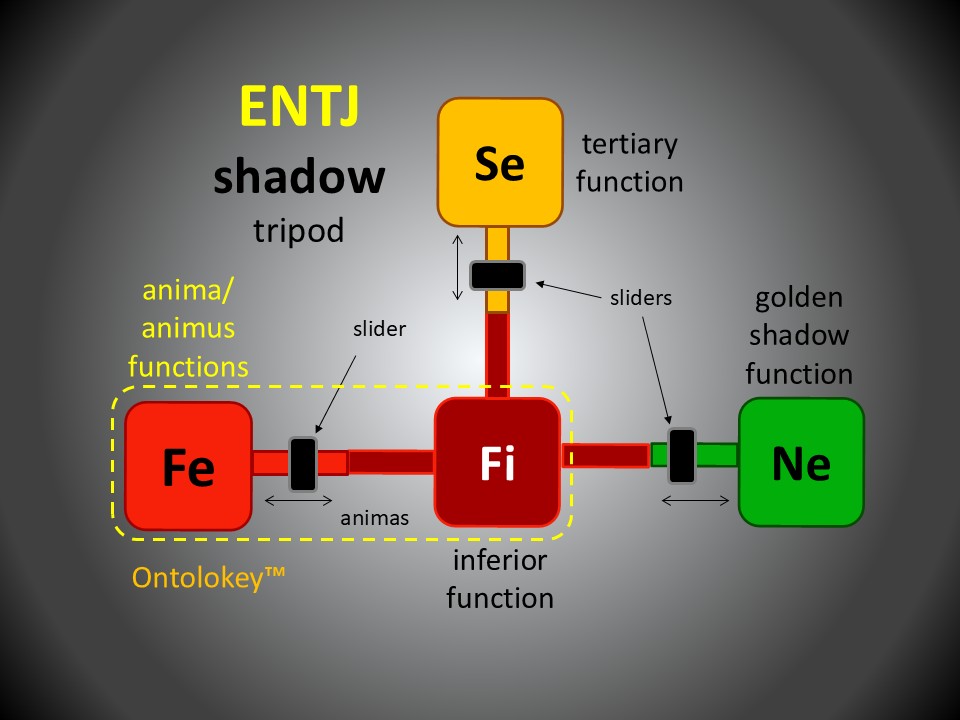
In the Ontolokey interpretation, the central structure of the ENTJ begins with Extraverted Thinking (Te) as the dominant function and Introverted Intuition (Ni) as the auxiliary function, creating a psychological combination of external execution and internal strategic direction. Te asks what works, what produces results, how resources can be organized, and how a system can be made more effective, while Ni supplies an underlying orientation toward patterns, consequences, trajectories, and the future. This combination explains why the mature ENTJ can appear unusually decisive without necessarily being merely impulsive: the visible action is often supported by an internal model of where events are heading and what should be done before others recognize the same trajectory. Yet the same structure contains an inherent danger, because a mind highly adapted to transforming complexity into strategy may begin to experience everything through the categories of utility, optimization, control, and progress. The Ontolokey analysis consequently treats the remaining functions not as decorative additions but as necessary counterweights to the dominant configuration, including Ti as the sibling function, Si as the toddler function, Se as the tertiary or blindspot function, Fi as the inferior function, Fe as the Anima, and Ne as the Golden Shadow. The psychological story of the ENTJ therefore begins with extraordinary effectiveness, but it does not end there: the deeper developmental task is to discover whether power can coexist with receptivity, whether leadership can coexist with vulnerability, and whether achievement can eventually become an expression of an integrated self rather than a substitute for one.
The ENTJ Cognitive Architecture: Te–Ni and the Logic of Direction
At the center of the ENTJ configuration stands Extraverted Thinking (Te), the dominant function through which the individual habitually encounters the external world as something that can be structured, evaluated, organized, and improved. Te is not simply “being logical,” because its defining concern is not abstract correctness but objective effectiveness: what works, what produces an outcome, what resources are available, which sequence of actions is most efficient, and where unnecessary friction can be removed. This gives the ENTJ a characteristic psychological movement from perception toward intervention; rather than merely observing that a system is dysfunctional, the ENTJ is inclined to ask what must be changed to make the system function. In healthy development this can produce extraordinary competence in leadership, strategic organization, crisis management, entrepreneurship, institutional reform, and any environment in which ambiguous circumstances must eventually become coordinated action. Ontolokey places Te at the head of the ENTJ’s primary tripod, and this is psychologically important because it suggests that the ENTJ’s identity is constructed around agency through external organization: the world becomes intelligible to the degree that it can be acted upon, measured, directed, and transformed.
Yet Te alone does not explain the characteristic depth of the ENTJ, because its effectiveness is accompanied by Introverted Intuition (Ni) as its auxiliary function. Ni supplies the internal trajectory behind Te’s external movement: it searches beneath immediate events for patterns, implications, converging tendencies, and possible long-term outcomes, allowing the ENTJ to operate not merely as an administrator of existing structures but as someone capable of envisioning where those structures should go next. The psychological sequence can therefore be understood as vision becoming strategy and strategy becoming execution: Ni distills an emerging direction, while Te translates that direction into objectives, systems, priorities, and decisions. This combination explains why ENTJs can become impatient with activity that lacks a discernible purpose; action for its own sake is not enough when the mind is simultaneously asking where the action leads and whether the resources invested in it are justified. The strength of this pairing is considerable, because it combines abstraction with implementation, but it also contains the seed of rigidity: once Ni has formed a compelling interpretation and Te has constructed an efficient method for realizing it, contradictory information can become psychologically inconvenient rather than intellectually interesting. The ENTJ can then confuse clarity with certainty, and certainty with authority, particularly when success has repeatedly reinforced the belief that decisive intervention is preferable to prolonged ambiguity. Ontolokey’s model is valuable precisely because it prevents Te–Ni from becoming the entire definition of the personality; the remaining six functions reveal what this powerful executive structure tends to overlook, repress, require, or eventually need to integrate.
The first of these counterweights is Introverted Thinking (Ti), the Sibling function, which represents an internal form of logical analysis that is related to Te but governed by a different psychological question. Te asks whether a method works effectively in the external world, whereas Ti is more concerned with whether an internal conceptual structure is coherent, precise, and logically consistent. For an ENTJ, Ti can therefore function as an intellectual corrective to the natural tendency to privilege implementation: it forces the strategist to examine whether the model itself is sound rather than merely whether it produces acceptable results. Ontolokey describes the Sibling as a natural counterpoint to the dominant function, and within the Te-centered architecture this makes Ti particularly significant because it can challenge external efficiency with internal rigor. When insufficiently integrated, the ENTJ may regard such analysis as unnecessary hair-splitting, especially when a practical decision is urgently required; when mature, however, Ti can produce a more sophisticated leader who understands that an efficient system built upon a flawed premise remains fundamentally flawed. This is one of the first developmental movements away from “I know how to make this work” toward the more demanding question “Do I actually understand what this is?”, and that distinction can mark a major transition from forceful competence to genuine intellectual maturity.
The opposite side of the architecture contains Extraverted Feeling (Fe), the Anima, a function that introduces an entirely different form of intelligence into the ENTJ psyche: the capacity to register, shape, and participate in the emotional and relational field shared by other people. Ontolokey associates the ENTJ’s Fe with relational success and approval, which creates an intriguing paradox because the ENTJ may appear highly independent while still possessing a deep and sometimes poorly understood need to be recognized as valuable, respected, effective, or socially significant. Fe is not equivalent to kindness or emotional softness; psychologically, it concerns the interpersonal atmosphere, collective values, social expectations, and emotional synchronization through which human groups maintain cohesion. Consequently, an ENTJ who develops Fe does not become less decisive but becomes more capable of understanding that people cannot always be mobilized through efficiency alone, because commitment, trust, belonging, dignity, and shared meaning are themselves forms of psychological infrastructure. The immature expression of this function can create an uncomfortable dependence on external approval, social status, admiration, or the perception of being influential, whereas its mature expression allows leadership to become relational rather than merely directive. In that sense, Fe challenges one of the ENTJ’s deepest assumptions: that if the objective is sufficiently rational and the strategy sufficiently effective, people will naturally understand and follow it; human beings, however, do not function exclusively as resources within a system, and psychological leadership begins precisely where instrumental logic reaches its limits.
Introverted Sensing (Si), the Toddler function, introduces another form of resistance to the ENTJ’s forward-driving psychology because Si represents continuity, accumulated experience, familiarity, embodied memory, and the stabilizing information contained in what has already happened. An ENTJ naturally oriented toward future possibilities and external transformation can experience established procedures, historical precedent, routine, and repeated patterns as obstacles when they appear to slow progress, yet Si asks whether the past contains information that the future-oriented mind is overlooking. Ontolokey characterizes the ENTJ Toddler as potentially resistant to new methods, an apparently paradoxical description for a type commonly associated with innovation and strategic change; the deeper point is that every personality contains blind spots even within its apparent strengths, and the ENTJ may be highly innovative at the strategic level while simultaneously becoming attached to familiar operational habits once those habits have proven effective. Si can therefore emerge in a somewhat childlike or defensive form when the individual is tired, threatened, or confronted with uncertainty, producing a sudden desire for established procedures, known environments, familiar standards, or “the way we know works.” Integrated consciously, however, Si gives the ENTJ something indispensable: respect for institutional memory, attention to accumulated evidence, bodily limits, maintenance, repetition, and the quiet reality that not every problem requires reinvention. Without this corrective, the ENTJ risks becoming addicted to transformation itself, changing systems not because change is necessary but because remaining still feels psychologically intolerable.
The Inferior Heart: Fi, Vulnerability, and the Problem of Inner Value
The most psychologically consequential counterweight to the ENTJ’s Te–Ni structure is Introverted Feeling (Fi), which Ontolokey places in the inferior position of the ENTJ configuration. Fi represents a radically different criterion of psychological truth: instead of asking whether something is objectively effective, strategically coherent, or externally justifiable, it asks whether an experience, decision, or action is personally authentic and congruent with deeply held values. For an ENTJ, this territory can feel unusually private because it cannot easily be converted into the familiar language of measurable outcomes or universally applicable principles. The ENTJ may be perfectly capable of knowing what ought to be done in a strategic sense while having considerably less conscious clarity about what they themselves genuinely feel, desire, need, or value independent of achievement and external recognition. This is why the inferior position should not be interpreted simply as “weak emotion”; it is better understood as an underdeveloped but psychologically powerful dimension of selfhood that can become increasingly important precisely because it has been neglected. The official MBTI description likewise associates Fi with personal values and inner congruence, while noting that dominant-function overuse can produce imbalance when other processes are neglected.
The vulnerability surrounding Fi becomes clearer when the ENTJ’s relationship with achievement is examined psychologically rather than behaviorally. If competence repeatedly produces respect, autonomy, security, and influence, it can gradually become more than a capacity; it can become the unconscious basis upon which self-worth is organized. The ENTJ may consequently learn to experience failure as a technical problem rather than an existential wound, because technical problems can be solved through greater effort, better information, or a revised strategy. Emotional exposure is fundamentally different because it places the individual in a situation where competence cannot guarantee the desired outcome, and another person’s feelings cannot be controlled through superior reasoning. Ontolokey’s shadow analysis identifies precisely this tension, arguing that the ENTJ can become highly capable of confronting external defeat while finding emotional helplessness much more threatening because vulnerability challenges the identity built around strength and effectiveness. The resulting defense can be remarkably sophisticated: pain becomes analysis, disappointment becomes criticism, fear becomes strategic vigilance, and the admission of needing another person is replaced by an offer to solve that person’s problems. Such behavior may look emotionally controlled from the outside while concealing a considerable amount of emotional intensity underneath.
This is where the distinction between emotional suppression and emotional integration becomes essential. An ENTJ who suppresses Fi may conclude that emotions are unreliable because emotions cannot always be justified according to objective standards, but this conclusion does not eliminate the underlying emotional processes; it merely removes them from conscious dialogue with the rest of the personality. The shadow material describes the resulting paradox with unusual clarity: the more strongly the individual identifies with rational objectivity, the easier it becomes for unconscious emotional motives to disguise themselves as purely rational conclusions. A person may therefore believe that they are defending a principle when they are defending their pride, believe they are correcting an error when they are reacting to humiliation, or believe they are demanding excellence when they are protecting themselves against the fear of inadequacy. This does not mean that ENTJ reasoning is secretly irrational, nor that every strong conviction conceals an emotional wound; rather, the psychological danger arises when the individual loses the capacity to distinguish objective judgment from personal investment. Mature Fi restores that distinction by allowing the ENTJ to say, in effect, “This is what I believe is objectively sound, and this is what I personally feel,” without requiring one category to invalidate the other.
The developmental importance of Fi therefore lies not in transforming the ENTJ into a softer or less ambitious personality, but in giving ambition an internal ethical and emotional foundation. Without sufficient access to personal values, achievement can become self-referential: goals are pursued because they demonstrate capability, success creates further expectations of success, and the individual gradually discovers that attaining objectives does not necessarily answer the question of what the objectives were ultimately for. This is one reason the ENTJ can experience an unsettling form of emptiness despite considerable external accomplishment, particularly when an externally successful life has been constructed without enough attention to private meaning, intimacy, affection, or personal desire. The problem is not ambition itself; ambition becomes psychologically dangerous only when it is asked to perform the work of identity, belonging, emotional security, and self-worth simultaneously. Fi introduces a different measure of a life, one that cannot be reduced to productivity because it concerns what the individual considers worth protecting, loving, refusing, sacrificing for, or remaining faithful to even when no measurable advantage results. In this sense, the development of Fi does not weaken the ENTJ’s power but answers a deeper question that Te alone cannot answer: what is all this power ultimately in service of?
The Shadow Reversal: When the Strength Becomes the Trap
The deepest shadow of the ENTJ does not emerge simply because the person becomes ambitious, controlling, arrogant, or emotionally distant; those are possible manifestations, but they are not the underlying mechanism. Ontolokey’s analysis identifies a more fundamental process in which a successful cognitive strategy gradually becomes an unquestioned philosophy of reality. Te is extraordinarily effective when used as an instrument, because external systems genuinely benefit from organization, standards, accountability, measurable objectives, and decisive action. The danger begins when the ENTJ unconsciously assumes that whatever cannot be organized according to those principles is either inferior, irrational, inefficient, or irrelevant. At that point, the psychological instrument has become a worldview, and the person no longer merely uses strategic thinking but increasingly identifies with being the person who knows how reality should be organized. The shadow is therefore not the opposite of the ENTJ’s strength; it is the strength becoming so dominant that it begins to exclude the psychological information supplied by everything else.
This process can produce what Ontolokey calls the “tyranny of certainty,” in which an internally coherent model becomes increasingly difficult to distinguish from reality itself. The ENTJ can be particularly vulnerable to this because genuine success provides reinforcing evidence: decisions work, organizations improve, predictions prove accurate, and other people begin to defer to the individual’s judgment. Each successful outcome strengthens confidence in the underlying cognitive framework, while disagreement may increasingly be interpreted as evidence that others simply do not understand the situation as clearly. The crucial distinction is between confidence in a conclusion and identification with certainty; the former remains open to correction, while the latter experiences correction as a threat to psychological stability. Once this happens, intellectual disagreement can acquire an emotional intensity disproportionate to the actual subject under discussion, because what is being defended is no longer merely an idea but the individual’s relationship with competence, authority, and reality itself. The mature ENTJ must therefore cultivate an unusual form of strength: the ability to remain decisive while retaining the psychological freedom to discover that the decisive interpretation was wrong.
This becomes especially consequential in intimate relationships, where the principles that produce excellence in organizations can become destructive when applied without modification to human beings. Projects can be optimized, processes can be redesigned, deadlines can be imposed, and organizational weaknesses can be diagnosed, but another person’s inner world cannot legitimately be treated as a malfunctioning system awaiting correction. Ontolokey’s shadow analysis emphasizes that what the ENTJ experiences as guidance may be experienced by a partner or family member as control, while what feels like necessary honesty to the ENTJ may feel like judgment to someone who needs understanding before solutions. This creates one of the central interpersonal paradoxes of the type: the person may possess extraordinary capacity to solve other people’s practical problems while remaining comparatively inexperienced at simply accompanying another human being through an experience that cannot be solved. Emotional intimacy requires a temporary suspension of optimization, because the purpose of listening is not always to produce an improved outcome. The ENTJ’s developmental challenge is therefore not to abandon leadership, standards, or directness, but to learn that not every human difficulty is an operational problem and not every form of help should take the form of intervention.
The Shadow Functions of the Cube: Se, Ne, and the Expansion of the ENTJ Psyche
The Ontolokey cube becomes particularly revealing when the ENTJ is examined beyond the familiar Te–Ni–Fi axis and the less conscious functions are understood as psychologically meaningful positions rather than as mere deficiencies. In the Ontolokey model, Extraverted Sensing (Se) occupies the ENTJ’s tertiary or “blindspot” position, while Extraverted Intuition (Ne) appears as the Golden Shadow, and these positions illuminate two very different forms of possibility that the ENTJ may have difficulty integrating into the dominant strategic architecture. Se is concerned with immediate reality, direct sensory information, physical presence, environmental responsiveness, and what is actually happening in the present rather than what should happen according to an internal strategic projection. Ne, by contrast, proliferates possibilities, alternative interpretations, unexpected connections, and divergent futures rather than converging toward one preferred trajectory. Their positions therefore create an important psychological tension with Ni and Te: the ENTJ naturally tends to narrow complexity into a strategically meaningful direction, whereas Se and Ne can reopen complexity and force the mind to encounter information that does not fit the established plan. In this sense, the shadow functions are not simply weaknesses to be corrected but alternative modes of consciousness capable of disrupting the ENTJ’s habitual certainty and thereby expanding psychological flexibility. The Ontolokey conception of the cube is especially useful here because it presents these functions spatially, making visible the fact that a personality is not exhausted by its most accessible processes but contains a broader psychological field in which neglected functions remain potentially available for development.
Se as the blindspot is particularly interesting because the ENTJ can be extraordinarily action-oriented while nevertheless having a complicated relationship with immediate experience. At first this seems contradictory: how can someone who is so decisive and externally active be insufficiently attuned to the present moment? The distinction lies between acting upon reality and perceiving reality without immediately converting it into strategy. The ENTJ may enter an environment already carrying an interpretation of what matters, what needs to happen, and what outcome should be produced, which means that concrete sensory information can be filtered according to strategic relevance rather than appreciated on its own terms. In a healthy state, Se can provide valuable grounding by forcing attention toward observable facts, physical circumstances, timing, environmental feedback, and the actual behavior of people rather than the anticipated behavior of people. In an unbalanced state, however, the ENTJ can become so committed to an anticipated trajectory that immediate evidence is unconsciously subordinated to the plan, especially when accepting that evidence would require abandoning a hard-won strategic conclusion. This is one reason the integration of Se is psychologically important: it teaches the ENTJ that reality is not merely the material upon which a strategy operates; reality is also the source of information that must continuously correct the strategy.
The Golden Shadow of Ne introduces an even more disruptive possibility because Ne challenges the ENTJ’s tendency toward convergence. Ni typically seeks the underlying pattern that unifies disparate information and eventually arrives at a relatively singular interpretation of where circumstances are leading, whereas Ne continually asks what else might be possible, what alternative explanation could account for the evidence, and what unexpected direction might emerge from apparently unrelated factors. For an ENTJ, this can initially feel inefficient because generating possibilities without immediately selecting one can resemble indecision or intellectual wandering. Yet the very quality that can make Ne uncomfortable is also what makes it psychologically valuable: it prevents the strategic mind from becoming imprisoned by its first coherent model. The Golden Shadow can therefore function as a kind of intellectual liberation, encouraging the ENTJ to entertain possibilities without immediately demanding that they justify themselves through utility or implementation. This does not require abandoning decisiveness; rather, it introduces a more sophisticated sequence in which possibilities are allowed to multiply before strategy reduces them. The mature ENTJ can thus move from “I have identified the trajectory” toward “I have identified several plausible trajectories, and I will now test which one reality supports,” thereby combining strategic decisiveness with epistemic humility.
This is also where the Ontolokey cube reveals an important developmental principle: psychological maturity does not mean making every function equally strong or turning the personality into a perfectly balanced collection of eight competing processes. Such a state would probably be neither psychologically realistic nor particularly functional. The more meaningful objective is integration without dissolution of identity, whereby the dominant configuration remains recognizable while previously neglected perspectives become accessible enough to correct its excesses. For the ENTJ, that means Te can remain Te without becoming authoritarian, Ni can remain Ni without becoming dogmatic, Fi can become more conscious without overwhelming strategic judgment, and the shadow functions can contribute information without displacing the personality’s fundamental orientation. This interpretation also prevents a common misunderstanding of shadow psychology: the shadow is not necessarily an evil personality hidden underneath the conscious personality, nor is every uncomfortable behavior evidence of a repressed function. Rather, shadow material represents aspects of psychological life that are less consciously integrated and therefore more likely to emerge defensively, disproportionately, or indirectly. The ENTJ’s developmental task is consequently not to “defeat” the shadow but to make its information conscious before the unconscious has to make itself heard through distortion.
The eight-function structure therefore describes a psychological dialogue between competing definitions of what counts as valid information. Te privileges external effectiveness, Ni seeks underlying direction, Ti examines conceptual coherence, Si preserves accumulated experience, Se attends to immediate reality, Fi protects personal value and authenticity, Fe registers interpersonal and collective emotional dynamics, and Ne opens alternative possibilities. None of these perspectives is inherently sufficient on its own, because each answers a different psychological question and becomes distorted when treated as the only legitimate question. The ENTJ’s distinctive challenge arises because Te and Ni are naturally capable of producing a remarkably compelling sense of coherence: the world can appear understandable, the future can appear strategically readable, and action can appear both justified and necessary. The shadow functions interrupt that coherence by asking inconvenient questions: What if the immediate facts contradict the plan? What if another interpretation is possible? What if the people involved do not experience the situation as you do? What if the objective you are pursuing is successful but personally meaningless? These questions are not obstacles to ENTJ development; they are precisely the questions that prevent strength from becoming psychological confinement.
The deepest implication of the cube is therefore that the ENTJ’s potential cannot be measured exclusively by how effectively the individual commands the functions they naturally trust. A person can become exceptionally powerful at strategy while remaining psychologically narrow, just as another person can become highly reflective without acquiring the ability to act decisively upon what they understand. The integrated ENTJ represents something more demanding: the preservation of executive power while becoming increasingly capable of receiving information from outside the executive worldview. This is particularly relevant to the shadow analysis because Ontolokey describes the ENTJ’s danger not primarily as a lack of strength but as the concentration of too much psychological authority in one mode of functioning. When certainty becomes more important than curiosity, control more important than connection, and effectiveness more important than meaning, the very qualities that produced success begin to imprison the individual. But when Te becomes an instrument rather than an identity, Ni becomes a hypothesis rather than an absolute truth, and Fi, Se, Ne, Fe, Si, and Ti are allowed to contribute their respective forms of information, the ENTJ can retain its extraordinary capacity for direction while becoming substantially more psychologically spacious.
Leadership, Excellence, and the Shadow of Superiority
The positive side of the ENTJ should not be treated merely as the polite counterpart to its shadow, because the shadow itself grows out of qualities that are often genuinely valuable. The ENTJ’s capacity to impose structure on complexity, assume responsibility, establish standards, and convert abstract intentions into coordinated action can make this personality exceptionally effective in environments where indecision carries real costs. Ontolokey’s shadow analysis explicitly acknowledges the ENTJ as a builder of systems, reformer of institutions, and person often willing to make difficult decisions when others hesitate, while simultaneously warning that every psychological strength can become distorted when it acquires excessive authority over the personality. This distinction is essential because it prevents the analysis from collapsing into the simplistic claim that ambition, authority, or confidence are inherently pathological. A mature ENTJ may possess substantial authority without being psychologically dependent upon authority, may demand excellence without needing to feel superior, and may act decisively without believing that disagreement constitutes disloyalty. The central psychological question is therefore not whether the ENTJ has power, but whether power remains an instrument of conscious purpose or gradually becomes a defense against insecurity, uncertainty, and vulnerability.
The same distinction applies to the ENTJ’s relationship with competence, which can become one of the most constructive and most dangerous elements of the personality. Genuine competence produces real-world consequences: it allows an individual to solve difficult problems, protect other people from avoidable chaos, improve dysfunctional systems, and create opportunities that would otherwise remain unrealized. An ENTJ who develops these capacities responsibly can become an unusually effective steward of collective resources because Te naturally notices inefficiencies and inconsistencies that other people may tolerate for much longer. Yet repeated success can generate a subtle psychological asymmetry in which the individual begins to assume that the ability to solve problems also grants superior authority over the people who cannot solve them as quickly. Ontolokey describes this as a potential “hidden narcissism of competence,” emphasizing that the difficulty lies precisely in the fact that the underlying competence may be real rather than imagined. The danger begins when the legitimate observation “I can do this better” quietly transforms into the much broader conclusion “therefore my way of seeing people, values, relationships, and reality is superior,” because technical superiority in one domain provides no automatic evidence of psychological superiority in another.
This is where contempt becomes more psychologically significant than ordinary arrogance. Arrogance can be superficial and even performative, whereas contempt changes the fundamental way another human being is perceived: the other person is no longer simply different, slower, less experienced, or less capable in a particular area, but begins to be interpreted as intrinsically deficient. For the ENTJ, this can be especially seductive because environments really do contain inefficiency, incompetence, irrational decision-making, and avoidable weakness, meaning that the initial observations can be entirely accurate. The problem is the psychological leap from identifying a limitation to reducing the person to that limitation, particularly when the ENTJ begins evaluating human worth through performance, productivity, intelligence, reliability, or usefulness. Ontolokey’s analysis warns that the shadow can gradually transform people into functions within a strategic equation, where those who contribute to objectives are valued and those who obstruct them are dismissed. Such a worldview may function efficiently inside a narrowly defined organizational context, but when transferred into friendship, love, family, or ordinary human interaction, it impoverishes the personality because human beings possess value that cannot be calculated through utility.
The corrective is not sentimentalism but psychological differentiation. An integrated ENTJ can recognize that a person may be incompetent at one task and nevertheless possess profound emotional intelligence, loyalty, creativity, courage, wisdom, or moral insight in another domain. More importantly, the mature individual can tolerate the possibility that someone else may possess forms of knowledge that cannot be converted into the ENTJ’s preferred language of measurable competence. This is where the previously discussed Fi, Fe, Se, and Ne functions become more than abstract components of a typological model: they represent alternative sources of information that can interrupt the automatic equation between effectiveness and value. Fi asks whether an action remains internally authentic and ethically meaningful; Fe asks what is happening within the relational field; Se forces attention back toward observable present reality; Ne introduces alternative interpretations that challenge premature closure. When these perspectives are permitted to influence Te–Ni rather than being dismissed as distractions, leadership becomes less dependent upon superiority and more capable of incorporating information that executive intelligence alone cannot generate.
The healthiest expression of ENTJ leadership therefore contains an important paradox: the more secure the leader becomes internally, the less psychologically necessary it becomes to dominate externally. A person who knows that their worth does not disappear when someone else disagrees can tolerate dissent without interpreting it as rebellion; a person who does not need to be indispensable can delegate without experiencing another person’s competence as a threat; and a person who can acknowledge uncertainty does not need to manufacture certainty merely to preserve authority. Ontolokey’s analysis draws precisely this distinction between leadership and domination, describing mature leadership as something capable of relinquishing control when circumstances require it, whereas domination becomes increasingly dependent upon maintaining influence. This provides a useful psychological criterion that is more subtle than simply asking whether an ENTJ is “controlling”: the decisive question is what happens internally when control is lost. If relinquishing control produces curiosity, trust, and adaptation, authority remains instrumental; if it produces disproportionate anger, contempt, anxiety, or an urgent need to reassert dominance, power may have become emotionally compensatory.
There is consequently a profound positive potential hidden within the ENTJ shadow: the very capacities that can produce domination can, when integrated, produce stewardship. The strategist can become a builder rather than merely a conqueror; the executive can become a custodian rather than an owner; the person who sees inefficiency can reform systems without humiliating the people trapped inside them. Such an ENTJ does not need to abandon high standards, because standards are not the problem; the transformation lies in separating standards from personal superiority and accountability from contempt. Nor does emotional integration require endless introspection at the expense of action, because Fi and Fe become most useful when they inform action rather than replace it. The mature ENTJ can still say, “This needs to change,” while also asking, “What am I failing to perceive?” and “What will this change mean for the human beings who must live with it?” That second layer of questioning is not weakness added to strength; it is strength becoming sufficiently sophisticated to recognize that effectiveness without psychological awareness can solve the wrong problem extremely efficiently.
Love, Intimacy, and the Fear of Being Needed
The ENTJ’s interpersonal world reveals perhaps more clearly than any professional environment why psychological integration matters. In work and leadership, the ENTJ can rely heavily upon explicit objectives, competence, standards, and measurable outcomes, whereas intimacy introduces conditions that cannot be controlled through superior organization. Love requires exposure to another person’s subjectivity, and subjectivity cannot be optimized without destroying the very thing one is trying to understand. The ENTJ may therefore be highly generous in practical ways while remaining less comfortable with forms of intimacy that require emotional transparency rather than problem-solving. Ontolokey’s discussion of the ENTJ shadow describes a pattern in which vulnerability may be experienced as threatening because the personality has learned to derive security from capability and control. (ontolokey.com) This can produce a peculiar relational contradiction: the ENTJ may desperately want loyalty, admiration, emotional depth, and genuine connection while simultaneously resisting the surrender of control required to receive those things. The result is not necessarily emotional coldness, but a tendency to protect emotional vulnerability behind competence, humor, intellectualization, activity, or the continual assumption of responsibility.
One of the most revealing manifestations of this pattern is the ENTJ’s tendency to solve what should first be witnessed. When someone they love expresses distress, the instinctive response may be to identify the problem, locate its cause, and formulate a solution, because this is how Te naturally expresses care. The intention can be deeply benevolent: if someone is suffering, why allow the suffering to continue when something can be done about it? Yet emotional experience does not always seek intervention, and a person who says “I am hurting” may be communicating a need for recognition rather than requesting a strategy. When the ENTJ immediately converts emotion into a practical problem, the other person can experience the response as invalidating even when the underlying intention is protective. This creates an important developmental distinction between helping someone change their situation and helping someone feel less alone within their situation. The former is a natural strength of Te, while the latter requires greater access to Fi and Fe, because it demands tolerance for an experience that cannot immediately be made more efficient.
The inferior Fi position can also influence the ENTJ’s romantic psychology through the tension between independence and emotional significance. An individual accustomed to functioning autonomously may genuinely value freedom and self-sufficiency, yet simultaneously possess a deep desire to be understood at a level that cannot be achieved through competence alone. This can make intimacy unusually consequential because it creates the possibility of being known without the protective structure of performance. Someone who sees only the ENTJ’s competence may reinforce the existing identity, while someone who sees the vulnerable person beneath that competence may activate both longing and defensiveness. Ontolokey’s shadow account suggests that the ENTJ can experience a strong need for recognition and approval while disliking the psychological dependence implied by needing another person’s recognition. (ontolokey.com) The mature resolution is not to eliminate the need for others, which would be psychologically unrealistic, but to recognize dependence and interdependence as ordinary dimensions of human life rather than as evidence of weakness.
This becomes particularly important when conflict occurs. The ENTJ may enter an argument believing that the objective is to determine what is true, identify what went wrong, and establish what should happen next, while the other person may experience the same conversation primarily as a question of respect, emotional safety, loyalty, or recognition. Both participants can therefore believe they are addressing the central issue while actually operating according to different psychological criteria. Te tends to seek resolution through clarity and decision, whereas Fi and Fe may require emotional acknowledgment before resolution is possible. If the ENTJ insists on resolving the factual issue while ignoring the relational issue, the disagreement can paradoxically become longer and more intense precisely because the ENTJ is trying to make it end. An integrated ENTJ learns to distinguish resolution from closure: a conflict may be factually settled while emotionally unresolved, and emotional resolution may sometimes require listening, acknowledgment, or apology rather than another argument establishing who was objectively correct. This does not mean abandoning truth for harmony; it means recognizing that interpersonal reality contains more than one legitimate dimension.
The deepest relational lesson for the ENTJ is therefore that being loved is not the same as being useful. If self-worth has become strongly associated with competence, it is tempting to express affection primarily through protection, provision, advice, problem-solving, or taking responsibility for burdens that others cannot carry. These behaviors can be profoundly loving, but they become psychologically restrictive when the individual begins to believe that their place in another person’s life must continually be earned through usefulness. Fi offers a different possibility: the right to exist within a relationship not because one is currently solving something, but because one’s inner life itself has value. This can initially feel unfamiliar to a personality organized around achievement because it removes the reassuring metric of performance. Yet precisely here lies the developmental opportunity: the ENTJ can discover that intimacy does not require surrendering competence, but it does require allowing another person to encounter the parts of the self that competence cannot protect.
Once this integration begins, the ENTJ’s natural loyalty and protective instincts can become considerably more profound. Instead of controlling circumstances to prevent loved ones from experiencing difficulty, the individual can learn to trust their capacity to face difficulty themselves; instead of immediately correcting another person’s emotional response, the ENTJ can become curious about what the emotion reveals; and instead of interpreting vulnerability as dependence, the person can understand reciprocal vulnerability as a form of relational strength. Fe contributes awareness of the emotional atmosphere, Fi contributes personal authenticity, and Te continues to provide the capacity to act when action is genuinely needed. The result is not an ENTJ who becomes indistinguishable from a feeling-dominant personality, but an ENTJ whose executive intelligence is no longer required to perform every psychological function. That distinction is crucial because genuine maturity does not consist of becoming someone else; it consists of becoming less defended against the parts of oneself that were never allowed an equal voice.
The ENTJ Under Pressure: When the System Turns Against Itself
Stress exposes the architecture of personality because it reduces the psychological freedom available for reflection, making familiar strategies increasingly automatic. For the ENTJ, this can mean an intensified reliance on Te: more planning, more intervention, more demands, more insistence upon standards, and a progressively narrower tolerance for ambiguity or resistance. What normally functions as leadership can then become compulsive control, because the mind attempts to restore internal security by making the external environment more orderly. The difficulty is that stress frequently produces precisely the opposite of the certainty the ENTJ seeks, since complex human systems become less predictable when people feel pressured, misunderstood, or dominated. The individual may therefore respond to uncertainty by increasing the very behavior that contributes to instability, creating a self-reinforcing loop in which greater control produces greater resistance, which then appears to justify still greater control. Ontolokey’s shadow analysis describes this movement as part of the ENTJ’s darker developmental territory, particularly when effectiveness becomes fused with personal identity and the inability to control an outcome becomes experienced as a threat to the self. (ontolokey.com)
A second stress pattern can arise when the ENTJ’s normally strategic Ni becomes excessively rigid, causing the person to interpret new information primarily according to an established internal trajectory. Ni is powerful precisely because it can reduce enormous amounts of information into an intelligible pattern, but this compression also creates the possibility of premature closure. Once the mind has decided what a situation “really means,” subsequent information may be assimilated into the existing interpretation rather than genuinely reconsidered. Under pressure, this can create an increasingly closed psychological system in which contradictory evidence is treated as noise, resistance is interpreted as incompetence, and alternative explanations are experienced as distractions from what seems obvious. The antidote is not perpetual indecision but deliberate disconfirmation, the disciplined willingness to ask which evidence would demonstrate that the current interpretation is wrong. This is where Ti and Ne become particularly valuable to the ENTJ, because Ti can challenge the internal coherence of the model while Ne can generate alternative hypotheses that prevent Ni from becoming indistinguishable from certainty.
There is another, less obvious form of stress in which the ENTJ may lose contact with the very functions that ordinarily compensate for the limitations of Te–Ni. If Se is insufficiently integrated, immediate bodily and environmental information may be ignored until it becomes impossible to ignore, while neglected Fi may remain outside conscious awareness until accumulated emotional pressure erupts in ways that appear disproportionate to the triggering event. The individual may have spent months functioning at a high level, dismissing fatigue, frustration, disappointment, loneliness, or resentment as secondary concerns because the objective still needed to be completed. Eventually, however, psychological material that has been excluded from conscious processing does not simply disappear; it may return through exhaustion, emotional volatility, impulsive behavior, withdrawal, or an unusually intense reaction to criticism or personal rejection. Such episodes should not be interpreted as inevitable features of ENTJ personality, and typology cannot establish a clinical mechanism for any particular person’s symptoms, but the broader psychological principle is well established: sustained suppression of relevant emotional or bodily information can impair self-regulation. The developmental lesson is therefore surprisingly practical—the ability to notice one’s limits before they become emergencies is itself a form of strategic intelligence.
The ENTJ may also encounter a particularly painful form of pressure when external achievement stops providing the psychological reinforcement it once supplied. A career milestone, financial success, organizational victory, intellectual accomplishment, or position of authority can temporarily confirm the identity of the competent strategist, but achievement inevitably becomes normalized, and the psychological system then requires a new objective to reproduce the same sense of vitality. If this cycle continues without deeper reflection, life can become an endless sequence of solved problems in which every accomplishment immediately generates another demand. The individual may be highly productive while becoming progressively less certain about what would constitute “enough,” because the mechanism of achievement has become detached from a clearly articulated personal value system. This is where inferior Fi becomes existentially important: it asks not merely what can be achieved, but what is worth achieving when achievement itself no longer answers the question of meaning. The question can be uncomfortable precisely because it cannot be solved by greater efficiency.
Pressure can also reveal whether the ENTJ’s relationships are built upon mutuality or upon functional dependency. If the individual has unconsciously constructed an identity around being the one who knows, decides, protects, organizes, finances, fixes, or leads, then situations in which another person becomes more competent, more knowledgeable, or simply unwilling to be directed can provoke disproportionate internal resistance. The mature response is to recognize that another person’s autonomy does not diminish one’s own significance, whereas the shadow response is to restore psychological equilibrium by reclaiming authority. Ontolokey’s broader account of the ENTJ shadow emphasizes the importance of relinquishing control and developing humility toward perspectives that cannot be subordinated to the executive worldview. (ontolokey.com) This distinction becomes especially important in leadership because organizations eventually punish leaders who require personal control over every important decision: delegation becomes impossible, dissent becomes dangerous, and talented people gradually withdraw from environments in which competence is perceived as competition. Psychological security therefore has a structural consequence—the more secure an ENTJ becomes about their own worth, the more freely they can permit capable people to operate independently.
The healthiest response to pressure is consequently not to suppress the ENTJ’s natural intensity but to broaden the information entering the decision-making system. Te should still organize, but it should receive information from Fi about values, from Fe about relationships, from Se about present reality, from Ne about alternatives, from Si about precedent and accumulated experience, and from Ti about conceptual consistency. The cube can be understood here as a psychological reminder that no single function possesses a monopoly on truth; every function sees something that another function cannot see in exactly the same way. When stress narrows consciousness, integration restores dimensionality by reopening channels that the dominant process has closed. For the ENTJ, this may ultimately be one of the most important forms of self-mastery: not learning how to control more effectively, but learning when control has ceased to be the appropriate response to reality. That transition marks the difference between a personality that merely excels under favorable conditions and one capable of remaining psychologically coherent when circumstances refuse to cooperate.
The Mature ENTJ: From Control to Integration
Psychological maturity does not require the ENTJ to become less ambitious, less decisive, or less demanding, because these qualities can represent genuine capacities rather than psychological defects. What changes is the source and flexibility of those qualities: the mature ENTJ can pursue difficult objectives without requiring achievement to prove personal worth, exercise authority without needing submission, and impose structure without assuming that every alternative structure is inferior. This is the point at which Te begins to function as an instrument of conscious intention rather than as an automatic defense against uncertainty. Ni likewise becomes more sophisticated when the individual treats its insights as highly informed hypotheses rather than infallible revelations about the future. The result is not diminished confidence but a more resilient form of confidence, because the individual no longer needs to preserve every prediction, decision, or strategy in order to preserve a coherent identity. In psychological terms, maturity increasingly means being able to change one’s mind without experiencing the change as a loss of self.
The development of the ENTJ can therefore be understood as a movement from external mastery toward internal differentiation. Early or less integrated Te may define success primarily through visible results, while increasingly mature Te understands that results are only meaningful within a larger system of human values and consequences. Ni develops from strategic foresight into a capacity for recognizing complexity without prematurely reducing it, while Ti provides the discipline to distinguish elegant explanations from genuinely valid ones. Si can teach respect for continuity and accumulated experience, Se can reconnect the strategist with the concrete present, and Ne can keep possibility alive when the preferred future becomes too rigidly defined. Fi and Fe perhaps make the greatest difference to the emotional maturation of the personality because they force the ENTJ to recognize that human beings cannot be understood exclusively through external performance or strategic behavior. Together, these functions enlarge the definition of intelligence itself: intelligence becomes not merely the capacity to determine what should happen, but the capacity to understand what is happening, why it matters, whom it affects, and what cannot legitimately be reduced to a calculation.
One of the most important developments is the transformation of the ENTJ’s relationship with uncertainty. The immature strategist often experiences uncertainty as a problem requiring immediate reduction, because ambiguity creates friction between the mind’s need for direction and the environment’s refusal to provide sufficient information. The mature strategist can tolerate a temporary absence of certainty without abandoning agency, understanding that action sometimes has to proceed under conditions in which the available model is incomplete. This creates a more sophisticated form of decisiveness because decisions are no longer confused with absolute knowledge; the individual can say, in effect, “This is the best decision available given what we currently know,” while remaining prepared to revise it when reality changes. Ne and Se become crucial here because one expands the field of possibilities while the other grounds attention in immediate evidence, creating a continual feedback loop around Ni’s strategic vision. The result is adaptive certainty rather than rigid certainty: enough conviction to act, enough humility to observe, and enough psychological flexibility to change course without humiliation.
The integration of Fi changes the ENTJ’s relationship with ambition in an equally profound way. When personal values remain largely unconscious, goals can acquire an addictive quality because each accomplishment temporarily substitutes for the deeper question of meaning. Once Fi becomes more accessible, ambition can become selective rather than compulsive, because the individual begins to distinguish between what is merely impressive and what is personally significant. This can lead to choices that appear less spectacular from the outside but are psychologically more authentic: refusing an opportunity that conflicts with one’s principles, protecting time for relationships that cannot be measured in productivity, acknowledging emotional needs without immediately converting them into problems, or walking away from an achievement that no longer represents anything meaningful. Such decisions may initially feel strangely inefficient to a Te-dominant mind because they are not justified primarily through external optimization. Yet they can represent a higher-order form of self-governance in which the question is no longer simply “Can I achieve this?” but “Should I give my life to achieving this?”
The development of Fe introduces a complementary transformation in leadership. An ENTJ who relies predominantly upon Te may attempt to create compliance through clarity, competence, incentives, standards, and consequences, all of which can be legitimate organizational tools. An integrated ENTJ increasingly recognizes that durable cooperation also depends upon whether people feel respected, understood, psychologically safe enough to disagree, and connected to a meaningful collective purpose. This does not mean that every decision should be made democratically or that leadership requires universal approval, because effective leadership sometimes demands decisions that will not please everyone. Rather, Fe allows the leader to understand the human consequences of authority without becoming enslaved to them. The leader can maintain a difficult standard while communicating why it exists, hear dissent without automatically treating dissent as resistance, and distinguish disagreement from disloyalty. Authority consequently becomes less about proving who is in charge and more about creating conditions in which other people can contribute their own competence.
This is perhaps the most important distinction between the powerful ENTJ and the integrated ENTJ. The powerful ENTJ can make things happen; the integrated ENTJ increasingly understands what should happen, what should not happen, and what consequences accompany both choices. The powerful ENTJ can build organizations; the integrated ENTJ understands that organizations eventually shape the psychology of the people inside them. The powerful ENTJ can win arguments, negotiate aggressively, and overcome resistance; the integrated ENTJ knows that winning an argument can sometimes destroy the relationship required to make the resulting decision work. These are not arguments against strength but arguments for greater dimensionality, because strength without self-awareness can become compulsive while strength integrated with self-awareness becomes increasingly deliberate. Ontolokey’s eight-function architecture provides a useful symbolic map for this transition precisely because it refuses to define the ENTJ solely through the functions that come most naturally and instead directs attention toward the psychological territory that remains less consciously accessible. (ontolokey.com)
The final stage of development is therefore not perfection but psychological sovereignty. Sovereignty means that the ENTJ can use Te without being possessed by Te, pursue Ni’s vision without worshipping certainty, access Fi without drowning in subjectivity, employ Fe without becoming dependent upon approval, and permit the shadow functions to challenge habitual conclusions without interpreting their presence as weakness. The personality remains recognizably ENTJ, but its relationship to itself becomes less adversarial because previously excluded dimensions no longer have to fight for recognition through unconscious compensation. This is ultimately what makes the Ontolokey cube more psychologically interesting than a simple hierarchy of strengths and weaknesses: it suggests that development occurs through dialogue among different forms of consciousness rather than through the elimination of unwanted traits. The ENTJ’s highest potential is therefore not to become invulnerable, omniscient, or universally dominant, but to become sufficiently integrated that power no longer has to defend itself against vulnerability, intelligence no longer has to defend itself against uncertainty, and achievement no longer has to defend itself against the question of meaning.
Conclusion: The Untold Truth of the ENTJ
The untold truth of the ENTJ is therefore not that beneath competence lies weakness, nor that beneath leadership lies some secretly defective personality waiting to be exposed. The more psychologically meaningful truth is that the ENTJ possesses an unusually powerful capacity for directing reality, and precisely because that capacity works so well, it can become difficult to recognize when direction has ceased to be necessary. The shadow emerges when the instrument becomes an identity: when strategic intelligence becomes certainty, responsibility becomes control, competence becomes superiority, independence becomes isolation, and emotional restraint becomes a defense against vulnerability. Ontolokey’s analysis describes this progression in particularly direct terms, emphasizing that the ENTJ’s deepest difficulty is not a lack of strength but the possibility that one form of strength acquires too much authority over the rest of the psyche. The developmental task is consequently not to dismantle the executive personality but to make it sufficiently conscious that power can coexist with receptivity, ambition with meaning, authority with humility, and decisiveness with the willingness to be wrong. What must ultimately be overcome is not strength itself, but the unconscious belief that strength must always be maintained.
Seen through the Ontolokey cube, the ENTJ becomes a study in psychological tension rather than a collection of personality labels. Te provides the capacity to organize and execute; Ni supplies strategic depth and directional vision; Ti can interrogate the internal logic of conclusions; Si can reconnect the strategist with accumulated experience and continuity; Se can return attention to immediate reality; Fi can reveal personal values that cannot be derived from efficiency; Fe can disclose the emotional and relational consequences of action; and Ne can reopen possibilities when certainty has become too narrow. The significance of these positions lies not in producing an artificially balanced personality, but in showing that every dominant strength exists within a larger psychological ecology. The ENTJ becomes more complete not when every function becomes equally powerful, but when the dominant functions can listen to information they would otherwise dismiss. In that sense, development is an expansion of consciousness rather than a replacement of personality, because the individual remains strategically oriented while becoming progressively less imprisoned by strategy.
The most mature ENTJ eventually discovers a distinction that can be difficult to grasp earlier in development: control and agency are not the same thing. Agency means possessing the capacity to choose, act, influence, create, refuse, negotiate, and take responsibility; control means attempting to determine outcomes that may ultimately belong to other people, circumstances, or reality itself. The first creates freedom, while the second can eventually create captivity, because the person who believes everything depends upon their control must remain perpetually vigilant. This is why relinquishing control can paradoxically make the ENTJ more powerful rather than less powerful: once the individual no longer needs to control every variable, attention can be directed toward the variables that genuinely matter. The mature strategist learns that delegation is not surrender, uncertainty is not incompetence, vulnerability is not helplessness, and another person’s autonomy is not a threat to one’s authority. Leadership then becomes less about making oneself indispensable and more about creating conditions in which reality can function effectively even when one is not personally directing every movement.
There is also a deeper existential transformation involved. If achievement has been the principal language through which the ENTJ has measured progress, then psychological development eventually forces a confrontation with questions that achievement cannot answer: What do I actually value? Who am I when I am not performing? What remains meaningful when nobody is impressed? Whom do I love when there is nothing to gain? What am I unwilling to sacrifice even for success? These are Fi questions, but they are ultimately human questions, and their importance does not depend upon whether one accepts the MBTI or Ontolokey as a scientific model. The ENTJ may discover that the life they were exceptionally capable of building is not automatically the life they most deeply wanted, and this realization can initially feel like a crisis because it cannot be solved through another strategic achievement. Yet it can also become the beginning of genuine freedom, because ambition becomes something chosen rather than something compulsively pursued. Achievement can then return to its proper place: not as proof that the self deserves to exist, but as one possible expression of what the self considers meaningful.
The deepest integration therefore occurs when the ENTJ can remain formidable without needing to appear invulnerable. There is nothing psychologically immature about being ambitious, competitive, demanding, strategic, direct, or intensely goal-oriented; these qualities become problematic only when they are recruited to protect an identity that cannot tolerate uncertainty, dependence, imperfection, or emotional exposure. Ontolokey’s shadow essay ultimately arrives at a similar distinction, portraying the mature movement as one in which certainty can give way to trust, control to connection, and achievement to a broader conception of fulfillment. The ENTJ who reaches this stage does not become less of a commander; rather, the commander is no longer required to govern every territory of the psyche. There can finally be room for the strategist and the human being to exist simultaneously, without one having to silence the other.
For readers who want to explore this architecture in greater depth, the Ontolokey material provides an extended framework for examining the ENTJ through its three-dimensional cube and for comparing the same functional architecture across other personality types. The ENTJ-specific analysis, “ENTJ Through the Lens of Ontolokey,” focuses on the individual functional positions within the cube, while “A Deep Dive into the ENTJ Personality” develops the broader personality portrait, and “The ENTJ’s Deepest Shadow Side” explores the darker developmental territory in considerably greater detail. These texts can be found on Ontolokey.com, where the framework is also applied to the other Jungian personality types. The most productive way to approach such material is not as a verdict about who a person “really is,” but as an invitation to examine recurring psychological patterns with enough honesty to recognize both one’s strengths and the defenses hidden inside those strengths.
Ultimately, the untold truth of the ENTJ is that the personality does not need to become less powerful in order to become more human. Its deepest development lies in discovering that power does not have to protect the self from feeling, that intelligence does not require certainty, that leadership does not require domination, and that independence does not require emotional isolation. The extraordinary capacity to transform the external world becomes most valuable when it is accompanied by an equal willingness to allow the external world—and the people within it—to transform the individual in return. The mature ENTJ can still build, lead, challenge, organize, compete, reform, and achieve, but these activities no longer function primarily as defenses against helplessness or insignificance. They become conscious expressions of a self that knows its values, accepts its limitations, tolerates uncertainty, and does not need to win every psychological battle in order to remain whole. That is the point at which the ENTJ stops merely mastering systems and begins mastering the relationship between power, consciousness, and humanity.


Leave a comment