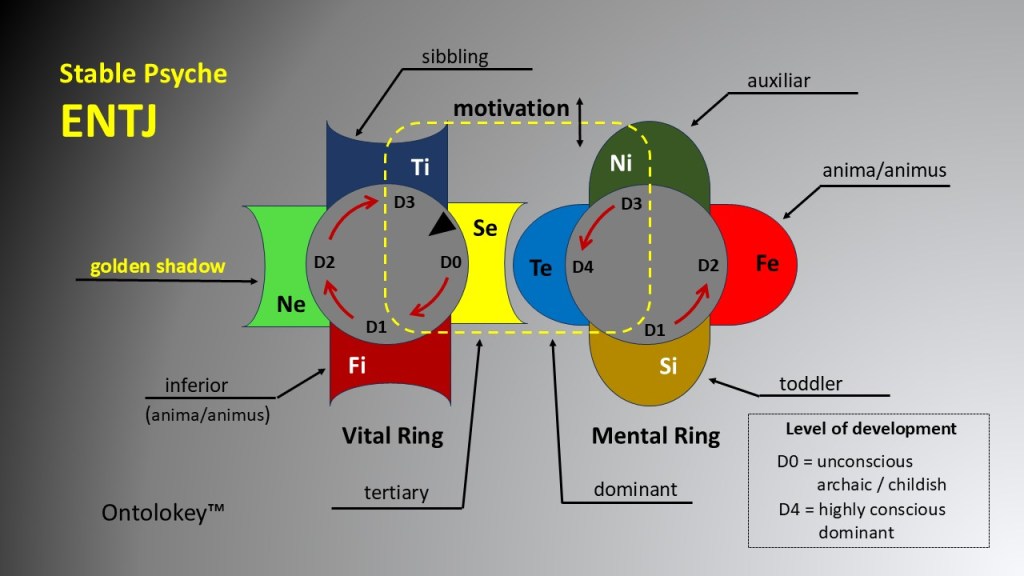
The ENTJ personality occupies a curious position in the popular imagination, admired almost universally for its competence and yet rarely understood in any depth beyond the surface impression it creates. People describe this type as decisive, ambitious, commanding, and relentlessly effective, and none of these descriptions are wrong, but taken together they still fail to capture the psychological complexity underneath. According to the Ontolokey framework, which understands personality not through four traits but through eight interacting functions arranged in a dynamic three-dimensional structure, the ENTJ’s famous competence is only one visible face of a much larger and more conflicted inner architecture. To understand this type properly requires looking first at the functions that generate the recognizable “commander” persona, and then, more importantly, at the unconscious dynamics that quietly determine what that persona costs the person living inside it.
The Familiar Portrait: The Engine, the Compass, and the Mask
At the foundation of the ENTJ’s conscious personality sits an outward-facing thinking function that Ontolokey describes as an engine of effectiveness, a relentless internal drive to organize, structure, and improve whatever system it encounters. This is the function responsible for the type’s famous impatience with inefficiency and its instinct to build rather than merely discuss. According to the material, ENTJs feel an early urge to apply their abilities directly to the world rather than simply theorize about it, and they gravitate naturally toward environments where they can take initiative and design their own roadmap instead of following someone else’s schedule. This is not impulsiveness dressed up as leadership; the sources are clear that ENTJs think several steps ahead, weighing cause and effect continuously in the background of nearly every decision, which is precisely what allows their action-oriented drive to remain strategic rather than reckless.
Supporting this outward drive is a second, quieter function oriented toward long-range internal vision, which Ontolokey compares to a compass that operates mostly out of view even from the ENTJ’s own conscious awareness. This function is what gives the type its uncanny sense of timing, its ability to sense not just what should be done but when it should be done, often without being able to fully explain why a certain direction feels right. It is also, according to the material, the source of a specific and underappreciated vulnerability: because this inner compass is future-oriented and restless, periods of stagnation or enforced waiting tend to produce disproportionate frustration in the ENTJ, a kind of quiet anxiety that builds whenever forward movement stalls. When these two functions work well together, the outward engine and the inward compass, the result is what people usually mean when they call someone a natural leader — a person who can both see where things are going and build the machinery to get there.
Layered on top of this practical core is a more complicated relationship with emotional and social life, which Ontolokey frames as something closer to a mask the ENTJ has learned to wear skillfully rather than a language they speak fluently. On the surface, many ENTJs come across as witty, sociable, and easy to be around, and this social capability is genuine rather than performative in any cynical sense — but the material notes that it often serves a strategic purpose, smoothing interactions and maintaining morale in service of a larger goal rather than arising purely from spontaneous emotional connection. Underneath this sociable exterior, feelings of doubt, frustration, or vulnerability are frequently bottled up rather than expressed, not because the ENTJ doesn’t have them but because showing them can feel inefficient or unsafe. This creates a recognizable pattern in close relationships, where partners or friends sometimes have to learn to gently draw out the warmth that exists underneath a surface that can otherwise read as distant or overly composed.
Beneath these functions lies a domain the material describes almost affectionately as a kind of underdeveloped territory: the world of physical comfort, routine, and everyday self-care, which the ENTJ tends to treat as a minor inconvenience standing between them and more important pursuits. This shows up in small but telling ways — skipped meals, ignored fatigue, cluttered spaces, a general tendency to push through discomfort like it doesn’t exist until it eventually forces itself into attention. And at the very core of the personality, quiet and easily overlooked, sits an inferior function tied to personal values and inner emotional truth, described in the material as a hidden heart the ENTJ often struggles to name even when it is clearly shaping their loyalties, their sense of justice, and the things that wound them most deeply when violated. This is the part of the ENTJ that explains why betrayal, once it happens, tends to be remembered permanently even by someone who otherwise seems unshakeable — because the wound lands somewhere far more tender than the confident exterior suggests.
Where the Portrait Breaks Down: The Shadow Beneath the Commander
It is at this point, according to Ontolokey’s more recent material devoted specifically to shadow analysis, that the conventional description of the ENTJ starts to become not just incomplete but actively misleading if taken as the whole story. The material is direct about this: the shadow does not emerge from weakness in this type, it emerges from an excess of strength concentrated in one particular direction, and the deeper question worth asking is not what the ENTJ can accomplish when everything is working, but what gets sacrificed in order to make that accomplishment possible in the first place. Every psychological gift, the sources argue, is purchased at a price, and the specific price paid by the ENTJ begins with something the material calls the tyranny of certainty — a slow, largely invisible process by which a genuinely useful strategic framework for understanding the world hardens into something closer to an unquestioned worldview, until disagreement no longer feels like a difference of perspective but like an attack on reality itself.
This transformation is described as particularly dangerous precisely because it develops alongside real competence rather than in spite of it. The ENTJ’s framework keeps producing results, keeps being validated by outcomes, and each success makes it that much harder to recognize where the framework’s limitations actually lie. The material draws a sharp distinction here: the problem is not arrogance in the ordinary sense, since many ENTJs remain genuinely open to revising technical opinions when better evidence appears, but rather an unconscious identification with certainty itself as a psychological refuge from anxiety. Reality inevitably contains dimensions that resist being fully mapped or operationalized — love, grief, faith, mortality, meaning — and the more the ENTJ leans on strategic cognition as the primary tool for navigating existence, the stronger the temptation becomes to compress these irreducible dimensions of life into structures they were never built to fit inside.
Running parallel to this is a second and even more intimate shadow theme the material calls the repressed heart, built around the observation that the ENTJ’s deepest fear is usually not failure but emotional helplessness. Failure, after all, can be analyzed and corrected, and many ENTJs even draw a strange vitality from adversity because obstacles activate their problem-solving instincts. What proves far harder to tolerate is standing in front of another person without strategic advantage, without a framework, without the ability to organize the situation into something manageable — because somewhere along the way, competence and self-worth became fused into a single psychological unit. The material explains that this fusion doesn’t erase emotional life, it simply denies it conscious development, so that feelings continue operating with real intensity but in an immature, reactive form that the ENTJ often fails to recognize as feeling at all, mistaking hurt for analysis, fear for vigilance, and vulnerability for an argument to be won rather than an experience to be had.
A third and closely related pattern concerns what happens when leadership, one of the ENTJ’s most celebrated natural gifts, gradually curdles into something the material terms psychological compensation rather than genuine service. The distinction drawn here matters considerably: true leadership remains loyal to the objective and can relinquish control when circumstances call for it, while its shadow counterpart becomes increasingly unable to let go of control because authority has quietly become necessary for psychological stability rather than merely useful for accomplishing goals. This shift tends to happen gradually and almost invisibly, reinforced at every step by real success — the ENTJ intervenes, situations improve, others come to rely on them, and eventually they occupy a position where nearly every important decision passes through their hands, a state of affairs that looks impressive from the outside while quietly manufacturing a dependency on being needed that the individual rarely names honestly, even to themselves.
Closely tied to this dynamic is what the material calls the hidden narcissism of competence, a shadow pattern distinguished from ordinary vanity by the fact that it rests on genuinely real ability rather than fantasy. The danger begins the moment competence stops being something the ENTJ merely possesses and becomes something they are, because at that point failure ceases to be a survivable event and becomes an existential threat to identity itself. This shift produces a particular kind of contempt, described in the material as categorically different from ordinary anger — anger still acknowledges its object as significant, while contempt dismisses it entirely, and the ENTJ shadow’s growing impatience with hesitation, emotionality, or inconsistency in others frequently traces back to an inability to tolerate those same qualities within themselves. The material makes an important observation here: the traits most harshly judged in other people often correspond precisely to the traits the ENTJ has most thoroughly repressed in their own psyche, so that the outward judgment functions, whether the individual realizes it or not, as a disguised form of self-judgment.
The material extends this analysis into a broader pattern it calls the strategic mind against reality, describing how the ENTJ’s genuine talent for pattern recognition can gradually shade into hypervigilance and even a mild, everyday form of paranoia when uncertainty becomes too uncomfortable to simply tolerate. Because the strategic mind has learned throughout life that understanding a system grants power over it, there develops a quiet but persistent temptation to assume that every ambiguity conceals a hidden pattern, every contradiction has a hidden explanation, and every uncertain social situation is better resolved through more analysis than through simply accepting that other people remain, to some real degree, unknowable. Trust, the material argues, requires a willingness to coexist with exactly this kind of unresolved ambiguity, and the ENTJ shadow’s discomfort with that requirement often produces an escalating and ultimately self-defeating cycle: more control breeds less trust, less trust breeds more isolation, and more isolation reinforces the felt need for still more control.
Beneath many of these patterns lies a deeper existential vulnerability the material calls the exile of the soul, centered on the difference between building a successful life and building a meaningful one. Because modern culture rewards precisely the qualities that come most naturally to this type — productivity, ambition, visible leadership — the ENTJ can spend decades perfecting the machinery of achievement while remaining quietly disconnected from the psychological questions that ultimately determine whether that achievement feels like anything at all. The material describes how identity, once built primarily around performance and competence, becomes fragile in a specific and predictable way: it depends on conditions that cannot be permanently controlled, and when those conditions eventually shift, through burnout, loss, illness, or simple aging, the person discovers a vacuum where a stable sense of self should have been, having spent so much energy on what they do that the deeper question of who they are was left largely unexamined.
This existential thread connects directly to a further shadow dynamic the material addresses with unusual candor, describing how the ENTJ’s relationship to power can, without any conscious intention toward harm, drift toward something resembling manipulation. The material is careful to separate this tendency clearly from actual malice or cruelty; what it describes instead is a slow instrumentalization of other people that happens through rationalization rather than deliberate exploitation, where relationships gradually reorganize themselves around influence and usefulness rather than mutual encounter. Strategic thinking, so effective in organizational contexts, can quietly migrate into personal relationships until other people start to register less as autonomous subjects and more as variables within a larger plan, a shift the ENTJ themselves may never consciously register precisely because their intentions, from the inside, continue to feel entirely reasonable and even caring.
Perhaps the most tender of all the shadow themes the material explores is what it calls the wounded child beneath the commander, an image meant to capture the striking gap between the ENTJ’s external competence and a comparatively underdeveloped emotional core hidden just beneath it. Because so much conscious development gets invested in strategic clarity and executive control, the emotional dimension of the personality often remains relatively immature, not absent but simply less differentiated, which is why seemingly composed and capable individuals can sometimes react to rejection, humiliation, or emotional disappointment with an intensity that surprises even themselves. The material links this directly to a particular sensitivity around personal worth and acceptance that most ENTJs would never admit to openly, precisely because acknowledging it would require exposing a vulnerability that the entire commander persona was constructed to protect.
Finally, the material draws all of these threads together under what it calls the tyranny of self-mastery, arguing that the ENTJ’s remarkable capacity for discipline can gradually turn against the very life it was meant to serve. Discipline exists to support living; it becomes destructive, the material insists, at exactly the moment life is instead forced to serve discipline, and the ENTJ stands unusually close to this line because their natural strengths receive so much external reinforcement from a culture that rewards productivity almost unconditionally. Success, once achievement becomes fused with self-worth, stops producing lasting satisfaction and instead becomes merely the new baseline from which the next demand is measured, trapping the individual in a cycle where rest feels like laziness, reflection feels inefficient, and the internal judge never quite grants permission to simply be a limited, ordinary human being rather than a perpetually optimizing machine.
Taken as a whole, the picture that emerges from Ontolokey’s material is considerably richer and more difficult than the confident, capable commander of popular stereotype. The ENTJ described here is genuinely gifted with vision, structure, and the rare willingness to take responsibility when others hesitate, but those same gifts, left unexamined, tend to generate a very particular and often invisible form of suffering — one built from control mistaken for security, competence mistaken for identity, and influence mistaken for intimacy. The material’s consistent suggestion is that the way through this shadow is not less discipline or less ambition but a shift from domination to integration, learning to let emotion, vulnerability, and uncertainty sit alongside strategic strength rather than beneath it. Readers who recognize themselves, even partly, in this description are encouraged to treat that recognition as an invitation rather than a verdict, and to explore the considerably longer and more detailed essays available directly on www.Ontolokey.com, where each of these themes, along with the model’s broader system of functions, tripods, and developmental sliders, is examined in far greater depth than a summary of this length can properly convey.


Leave a comment