The Personality Beneath the Reputation
The ISFJ is perhaps one of the easiest personality types to misunderstand precisely because its most visible qualities are so socially reassuring. The familiar portrait is that of the loyal protector: conscientious, considerate, dependable, emotionally attentive, devoted to family and community, and instinctively inclined to preserve whatever gives human life continuity and security. Yet this description, although not necessarily false, describes the ISFJ primarily from the outside, through the behaviors that other people experience and appreciate, rather than through the psychological architecture that produces them. Ontolokey approaches the type differently by placing the ISFJ within a three-dimensional system of eight Jungian psychological functions, thereby treating personality not as a list of traits but as a dynamic arrangement of conscious strengths, underdeveloped capacities, unconscious tensions, and latent possibilities. In this model, the ISFJ is organized around Introverted Sensing (Si) as its dominant function and Extraverted Feeling (Fe) as its auxiliary function, a combination that creates an unusual psychological synthesis of inwardly anchored experience and outwardly oriented emotional responsibility.
The significance of this combination becomes clearer when one stops thinking of Si as simply “good memory” and Fe as simply “being nice.” Si, in the Ontolokey interpretation, represents an inwardly organized relationship with experience in which sensory impressions, memories, familiar patterns, emotional associations, and accumulated personal knowledge become part of an internal psychological landscape. The past is therefore not merely something that happened to the ISFJ; it becomes a reference system against which present experience is evaluated, allowing the individual to recognize subtle deviations, preserve continuity, and remember what has mattered before. Fe then carries this internally grounded sensitivity outward into the interpersonal world, where the ISFJ becomes highly responsive to emotional atmosphere, social expectations, the needs of others, and the implicit rules governing relationships. The result can be extraordinary attentiveness: the ISFJ may remember what another person prefers, notice changes in mood that others overlook, preserve traditions that give a family its identity, or quietly perform countless practical acts that make other people feel protected. Yet the same psychological architecture that makes such care possible can also create vulnerability, because the preservation of harmony can gradually become more important than the preservation of the self.
This is where the deeper psychological paradox of the ISFJ begins. The personality’s greatest virtues are not separate from its potential difficulties; they are structurally connected to them. Loyalty can become attachment, responsibility can become over-responsibility, empathy can become emotional enmeshment, stability can become resistance to change, and self-sacrifice can eventually become resentment when needs that were never openly acknowledged remain unmet. The ISFJ may sincerely experience itself as giving freely while simultaneously developing unconscious expectations that others will recognize, reciprocate, or at least appreciate that giving. When those expectations remain unspoken, disappointment can accumulate without a clear psychological explanation, because consciously the individual may continue to identify with being generous, patient, and undemanding. This is one reason the darker dimensions of the type cannot simply be dismissed as “negative traits”: they are often the shadow consequences of strengths that have become too central to identity. Ontolokey’s shadow-oriented analysis makes precisely this point, arguing that the ISFJ’s deepest difficulties can arise when the identity of being good, caring, dependable, and self-sacrificing becomes so psychologically important that contradictory emotions are pushed outside conscious awareness.
The central question, therefore, is not whether the ISFJ is genuinely kind, loyal, or caring, because these qualities can be profoundly authentic. The more difficult question is what happens when a person becomes psychologically dependent upon being perceived — by themselves and by others — as the good, reliable, indispensable one. At that point, personality becomes identity, identity becomes defense, and defense begins filtering reality. Anger may become difficult to acknowledge because it conflicts with the self-image of kindness; personal desires may be minimized because they interfere with the role of caretaker; uncertainty may become intolerable because it threatens the internal order built through experience; and change may feel dangerous because it requires abandoning familiar psychological coordinates. The shadow is therefore not the opposite of the ISFJ’s personality but its hidden complement, containing precisely those dimensions that conscious identification has left insufficiently developed. The deeper truth of the ISFJ is consequently neither the flattering stereotype of the gentle protector nor the sensationalized image of a secretly manipulative person, but a far more human psychological tension: the lifelong movement between preserving what is loved and becoming someone capable of living beyond what is familiar.
The Ontolokey Cube: Eight Functions, One Psychological Architecture
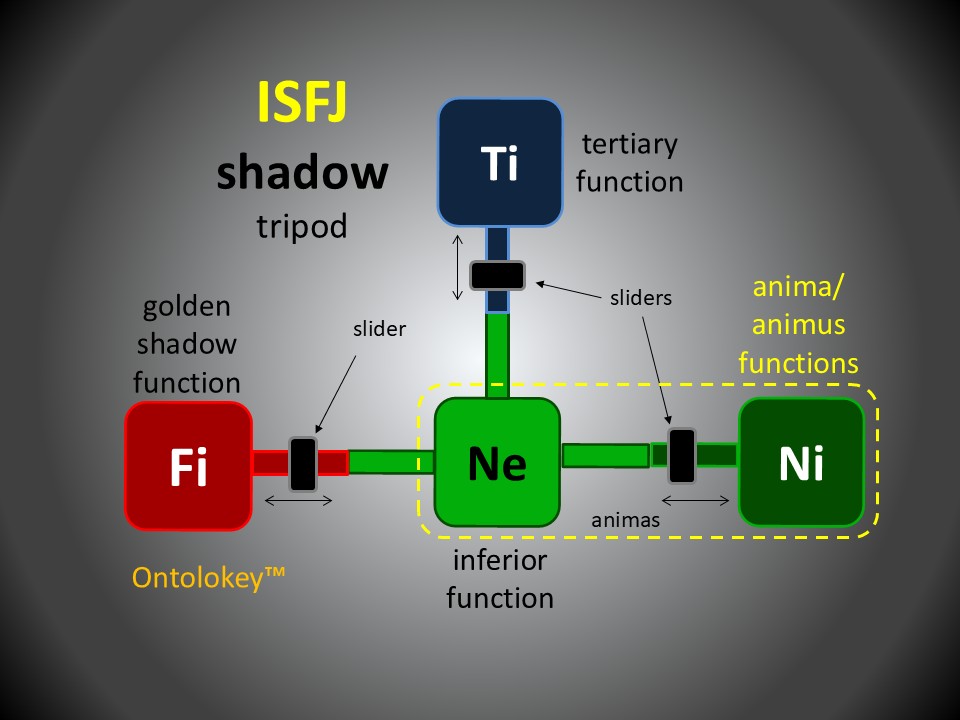
The most useful way to enter the Ontolokey model is to stop imagining the ISFJ as a four-function personality and instead regard it as a psyche containing eight potential modes of consciousness, each occupying a different psychological position. Ontolokey places the eight Jungian functions on the eight vertices of a cube and uses the spatial relationships between them to express differences between conscious preference, developmental immaturity, unconscious attraction, vulnerability, and shadow potential. The ISFJ therefore does not simply “have” Si, Fe, Ti, and Ne while lacking the remaining functions; rather, all eight belong to the psychological landscape, although they do not possess equal accessibility or authority. In the Ontolokey formulation, Si is the Dominant, Fe the Auxiliary and Persona, Se the Sibling, Te the Toddler, Ne the Inferior, Ni the Anima, Ti the Tertiary, and Fi the Golden Shadow. This distinction is psychologically important because it changes the meaning of “weakness”: a less conscious function is not necessarily absent, but may instead represent a capacity that appears awkwardly, defensively, aspirationally, or symbolically until it becomes more integrated. The cube thus becomes a map of psychological tension rather than a hierarchy in which four functions are valuable and four are defective, allowing the ISFJ to be understood as a developing whole whose apparently contradictory impulses are actually expressions of different regions of the same psyche.
At the center of that architecture stands Introverted Sensing (Si), the Dominant function, and its position explains why continuity is such a profound psychological principle for the ISFJ. According to Ontolokey, Si does not merely remember factual details but internalizes impressions, bodily sensations, emotional associations, familiar patterns, and contextual nuances, creating an individualized archive against which present experience is continuously compared. The psychological question of Si is therefore not simply “What happened before?” but something closer to “What does this present experience mean in relation to everything I already know, remember, trust, and have emotionally encoded?” This gives the ISFJ an unusual capacity for consistency, careful observation, preservation, conscientiousness, and loyalty, because what has once become meaningful is rarely experienced as disposable. Yet the same mechanism can become restrictive when familiarity is unconsciously equated with safety or truth, making novelty feel less like opportunity and more like a disturbance of psychological order. Ontolokey consequently presents Si as both the ISFJ’s great stabilizing power and one of the places where rigidity, rumination, perfectionism, and resistance to unpredictability can develop.
Extraverted Feeling (Fe), the Auxiliary function, transforms this inwardly preserved world into interpersonal responsibility. Fe directs attention away from the isolated individual toward the emotional field surrounding them: what another person needs, what the group expects, what is appropriate in a particular context, and what might restore harmony when relationships become strained. This is why the ISFJ can appear considerably more socially expressive than the stereotype of the quiet introvert would suggest, because social fluency and social energy are not the same psychological phenomenon. Ontolokey specifically describes Fe as a kind of Persona function for the ISFJ, meaning that the individual can become exceptionally skilled at presenting a socially appropriate, reassuring, attentive, and emotionally responsive self while still requiring substantial solitude to recover internally. The danger emerges when this adaptive capacity becomes so successful that the social role begins to replace the private person underneath it, producing compliance, emotional overextension, difficulty saying no, or the unconscious belief that love must be earned through usefulness. Thus the ISFJ’s kindness can be profoundly authentic while simultaneously functioning as a psychological defense: caring for everyone else may become a way of avoiding the frightening question of what the ISFJ itself wants.
The remaining positions reveal why the ISFJ’s inner life becomes substantially more complicated than its public reputation suggests. Extraverted Sensing (Se), the Sibling function, represents an alternative relationship to sensory reality: instead of interpreting the present through accumulated experience, it permits the present to be encountered directly, spontaneously, and without excessive reference to the past. Extraverted Thinking (Te), the Toddler, introduces external efficiency, measurable results, organization, and assertive control, but because it is comparatively immature, it can appear abruptly under pressure as rigidity, command-giving, checklist mentality, or an urgent attempt to impose order when the familiar psychological structure has been disrupted. Extraverted Intuition (Ne), the Inferior function, stands opposite Si’s need for continuity by opening consciousness toward alternatives, uncertainty, hypothetical futures, experimentation, and possibilities that cannot yet be verified; consequently, it may initially feel liberating and frightening at the same time. Introverted Intuition (Ni), the Anima, introduces an entirely different form of knowing, one concerned with symbolic meaning, underlying patterns, existential significance, and the possibility that life possesses a deeper coherence than observable facts alone can establish. Finally, Introverted Thinking (Ti), the Tertiary, and Introverted Feeling (Fi), the Golden Shadow, challenge the ISFJ to develop two forms of inward authority that can be uncomfortable precisely because they reduce dependence upon external agreement: Ti asks whether the individual’s understanding is internally coherent, while Fi asks whether the individual’s life is personally and morally authentic regardless of what others expect. The mature ISFJ therefore does not abandon Si and Fe; psychological development consists in allowing these less familiar functions to correct their excesses, so that preservation becomes wisdom rather than inertia, care becomes love rather than self-erasure, and loyalty becomes a conscious choice rather than an unconscious obligation.
When Care Becomes Identity: The Psychology of Self-Sacrifice
The ISFJ’s capacity for care becomes psychologically complicated when caring ceases to be something the person does and becomes the principal evidence for who the person is. At first, this distinction seems semantic, but psychologically it is profound: a person who helps others because they freely choose to can also choose not to help, whereas a person whose identity depends upon being helpful experiences refusal as a threat to self-worth. Ontolokey’s shadow analysis places considerable emphasis on this transition, describing how caregiving can gradually become intertwined with an unconscious need to be needed, appreciated, trusted, or morally recognized. The ISFJ may therefore insist, quite sincerely, that they expect nothing in return while simultaneously experiencing deep hurt when their sacrifices go unnoticed, unreciprocated, or treated as ordinary. This does not mean that the kindness was fraudulent, nor does it reduce genuine generosity to manipulation; rather, it suggests that several motives can coexist beneath the same behavior, with conscious altruism existing alongside unconscious needs for attachment, security, recognition, or control. Psychological maturity begins when the ISFJ can tolerate that complexity without needing to convert the self into either a saint or a victim.
This becomes particularly important in relationships because the ISFJ often expresses affection through practical investment rather than abstract declarations. Remembering details, anticipating needs, maintaining routines, providing assistance, protecting traditions, absorbing responsibilities, and remaining present during difficult periods can become the individual’s natural language of love. Such behavior can create extraordinarily stable relationships because the ISFJ frequently notices the small forms of maintenance upon which intimacy actually depends, while other people may focus primarily on dramatic expressions of affection. Yet the very subtlety of this contribution can create an invisible emotional accounting system in which sacrifices accumulate without ever being explicitly negotiated. The ISFJ may remember what was done for another person, what was endured, what was postponed, and what was given up, while simultaneously believing that keeping such an account contradicts the purity of their generosity. When reciprocity fails to appear, resentment can therefore emerge indirectly rather than through clear confrontation. Ontolokey describes the resulting pattern in terms of suppressed anger, passive resistance, guilt-inducing behavior, emotional withdrawal, and a developing narrative of being unappreciated, illustrating how the refusal to acknowledge legitimate needs can paradoxically make those needs more controlling.
The most uncomfortable truth is that self-sacrifice can contain an element of power without the person consciously intending to exercise power. A caregiver who does everything for another person acquires influence over that person’s emotional environment, practical functioning, and sometimes even sense of obligation. If the ISFJ repeatedly solves problems before others can solve them themselves, protection can gradually become interference; if they repeatedly anticipate what others need, attentiveness can become surveillance; if they repeatedly sacrifice themselves without communicating their limits, generosity can become an unspoken contract. The recipient may eventually feel guilty for not reciprocating adequately, while the ISFJ feels exploited for having given so much, producing a relational system in which neither person understands why affection has begun to feel like debt. The psychological irony is that the ISFJ may genuinely resent dependence in others while simultaneously creating circumstances in which others become dependent upon them. This is not an indictment of the type but an illustration of why unconscious motives matter: a behavior can be loving in intention and controlling in effect, and mature self-awareness requires the ability to hold both truths simultaneously.
The shadow becomes especially powerful when anger is treated as morally unacceptable. Because the ISFJ often identifies strongly with patience, reliability, and emotional consideration, ordinary aggression can appear incompatible with the person’s preferred self-concept, causing frustration to be suppressed rather than metabolized. But anger is not synonymous with cruelty; in psychologically healthy functioning, anger can communicate violated boundaries, accumulated exhaustion, injustice, or the need for change. When that information is repeatedly rejected, the emotion does not simply disappear, and it may instead return through irritability, withdrawal, coldness, passive resistance, excessive criticism, or an intensified memory of everything the person has previously endured. Ontolokey’s shadow account describes precisely this movement from unacknowledged resentment toward covert forms of retaliation and victimhood, emphasizing that the problem is not the existence of anger but the inability to recognize it consciously. The mature ISFJ therefore does not need to become harder, colder, or less caring; rather, the task is to become sufficiently psychologically honest to say “I do not want to do this,” “I am angry,” “I need something,” or “I feel taken for granted” before the unspoken emotion has accumulated enough pressure to distort the relationship.
There is consequently a profound difference between selflessness and self-abandonment, and the ISFJ can spend years confusing the two because society often rewards the latter when it is performed gracefully. Genuine selflessness involves choosing to contribute while retaining awareness of one’s own boundaries, motives, limitations, and desires; self-abandonment involves repeatedly suppressing those elements until the individual no longer knows where generosity ends and obligation begins. The first creates freely chosen intimacy, while the second can produce an increasingly fragile identity dependent upon being indispensable. Once the ISFJ recognizes this distinction, care becomes psychologically cleaner because it no longer needs to function as proof of moral worth. The person can help without secretly demanding recognition, refuse without experiencing unbearable guilt, receive without feeling indebted, and allow others to struggle without interpreting their struggle as evidence of personal failure. That transformation represents one of the most important developmental movements available to the type: from being needed toward being freely chosen, from sacrifice toward reciprocity, and from the performance of goodness toward the more difficult reality of authentic goodness.
The Inferior Function: Ne and the Fear of the Unknown
If Si provides the ISFJ with psychological continuity, then Extraverted Intuition (Ne) represents the force that continuously threatens to dissolve that continuity by opening consciousness toward alternatives, ambiguity, novelty, and futures that cannot yet be verified. Ontolokey therefore places Ne in the ISFJ’s Inferior position, not because imagination is absent, but because unrestricted possibility can initially feel psychologically destabilizing to someone whose dominant mode of orientation depends upon accumulated experience and familiarity. Ne asks questions that Si cannot answer through precedent: What if something completely different is possible? What if the old solution no longer applies? What if the future cannot be controlled by preparing correctly for it? In a healthy ISFJ, these questions gradually become liberating because they introduce flexibility into a consciousness naturally inclined toward preservation, allowing the individual to experiment without immediately demanding certainty. In an overwhelmed ISFJ, however, the same function can become distorted into catastrophic possibility-generation, where every uncertainty becomes a potential problem and every unfamiliar development becomes evidence that something may go wrong. Ontolokey explicitly describes this duality, presenting Ne both as a source of anxiety and as a developmental gateway through which the ISFJ can acquire creativity, playfulness, reinvention, and a greater tolerance for uncertainty.
This explains a paradox that can otherwise appear contradictory: an ISFJ may be extraordinarily imaginative while simultaneously appearing highly conservative. Imagination itself is not the issue; the psychological question is whether imagination is experienced as an open field of possibilities or as an uncontrollable multiplication of risks. When Ne is poorly integrated, the mind can begin generating scenarios faster than Si can verify them, creating a peculiar form of anticipatory anxiety in which the person mentally rehearses possible failures, betrayals, illnesses, accidents, conflicts, disappointments, or irreversible mistakes. The individual may believe that this mental preparation is responsible because it appears to serve the same protective purpose as careful planning, yet psychologically it can become an attempt to achieve certainty where certainty is impossible. The more the ISFJ attempts to eliminate every possible negative outcome, the more possibilities the mind produces, and the resulting anxiety becomes self-reinforcing. Ontolokey’s shadow analysis adds another dimension to this process by describing how subjective impressions can become increasingly detached from external verification, so that an emotionally convincing possibility may gradually acquire the status of an established fact. The developmental challenge is therefore not to suppress imagination but to distinguish possibility from probability, intuition from evidence, and preparation from compulsive control.
At its healthiest, Ne gives the ISFJ something that cannot be obtained from Si alone: the permission to become someone who has not yet been fully defined by the past. This is psychologically significant because a strong attachment to continuity can quietly transform into a belief that the person must remain consistent with everything they have previously been. Family expectations, established roles, old promises, familiar relationships, professional identities, and earlier versions of the self can all acquire a moral weight that makes transformation feel like betrayal. Ne introduces a different proposition: continuity does not require repetition, and loyalty to one’s history does not require permanent obedience to it. An ISFJ who develops this capacity may discover that changing a tradition does not necessarily dishonor it, leaving a dysfunctional relationship does not invalidate previous loyalty, and choosing a new career or lifestyle does not mean that the earlier self was mistaken. Instead, the past becomes a foundation rather than a prison. In this sense, the inferior function can become one of the most important instruments of individuation because it forces the personality to confront the fact that life cannot be preserved by refusing to let it change.
The confrontation with Ne also exposes one of the ISFJ’s deepest fears: the fear that a single wrong decision could destroy an entire structure of security. Because the ISFJ often evaluates the present through accumulated experience, decisions can carry more emotional history than outsiders realize; choosing something new may appear to involve not merely a new option but the possible abandonment of everything that previously provided stability. This can create hesitation, excessive consultation, waiting for the perfect moment, or an unconscious preference for familiar dissatisfaction over unfamiliar possibility. Yet the tragedy of excessive caution is that it can produce precisely the instability the person hoped to avoid, because relationships deteriorate while one waits, opportunities disappear while one prepares, and identities become constricted while one attempts to remain faithful to an earlier version of oneself. The Ontolokey model therefore treats the inferior Ne not merely as a weakness to be overcome but as a developmental initiation into uncertainty, creativity, and psychological expansion. The mature ISFJ eventually learns that security does not mean knowing what will happen; it means developing enough inner resilience to remain psychologically intact even when the future refuses to resemble the past.
This is one of the places where the ISFJ’s shadow and its potential for growth become indistinguishable from one another. The same imagination that can produce catastrophic scenarios can also generate solutions; the same sensitivity to what might go wrong can become sensitivity to what might become possible; the same caution that prevents reckless decisions can become thoughtful experimentation when balanced by curiosity. Psychological development therefore does not demand that the ISFJ become spontaneous in the manner of a natural Se or Ne dominant, because such a transformation would amount to abandoning the personality’s genuine structure rather than integrating it. What matters is learning to let possibility enter the psychological room without immediately giving it either absolute authority or absolute rejection. The ISFJ can say, in effect, “I do not know what will happen, and I do not need to know yet; I can remain grounded while allowing reality to surprise me.” That capacity represents a profound movement away from fear-based preservation and toward mature trust, because the person no longer requires the future to be predictable before allowing themselves to participate fully in it.
The Golden Shadow: Fi and the Self the ISFJ Does Not Easily Permit
Among the most psychologically intriguing positions in the Ontolokey cube is Introverted Feeling (Fi), designated as the ISFJ’s Golden Shadow. The term “Golden Shadow” is important because it suggests not simply an inferior or destructive capacity, but a neglected quality that can appear strangely compelling, admirable, threatening, or even idealized when encountered in other people. Fi represents an inwardly anchored relationship with personal values, subjective emotional truth, conscience, authenticity, and the question of what something means to the individual independently of collective expectations. For an ISFJ whose auxiliary Fe is naturally attentive to interpersonal harmony and whose identity can become deeply invested in fulfilling relational obligations, Fi can therefore feel simultaneously attractive and disruptive. It asks a question that Fe can easily postpone: “What do I actually feel and value when nobody else’s needs, expectations, approval, or disappointment are being considered?” Ontolokey’s treatment of Fi as the Golden Shadow consequently points toward one of the deepest developmental tensions in the ISFJ psyche: the possibility that the person can become exceptionally skilled at understanding what other people need while remaining surprisingly uncertain about what they themselves authentically want. (ontolokey.com)
This does not mean that ISFJs lack personal values or possess no individual emotional life; such an interpretation would be both simplistic and psychologically inaccurate. The issue is one of psychological authority rather than emotional capacity. Fe naturally evaluates experience through the interpersonal field, asking how feelings affect relationships and how behavior contributes to social equilibrium, whereas Fi evaluates experience through an inward sense of personal congruence, asking whether something feels morally or emotionally true to the self. An ISFJ may therefore know perfectly well that something is wrong while still struggling to articulate whether it is wrong for them personally, because years of adaptation may have trained them to evaluate their choices through consequences for other people. This can produce an extraordinary ability to accommodate, but accommodation becomes dangerous when it silently replaces preference. The person may say, “It is fine,” not because it is genuinely fine but because acknowledging that it is not fine would create conflict, disappointment, or guilt. In this sense, the Golden Shadow can contain a buried psychological voice that has been saying, perhaps very quietly for years, “Your inner experience matters even when nobody else needs you to have it.”
The shadow quality of Fi becomes particularly visible when the ISFJ encounters someone who appears unapologetically authentic, emotionally self-defined, or unwilling to sacrifice personal conviction for social harmony. Such people may provoke admiration because they embody something the ISFJ secretly longs to possess, but they can also provoke irritation because their independence violates assumptions that the ISFJ has internalized about responsibility and consideration. The unconscious reaction may therefore oscillate between idealization and moral criticism: the other person seems wonderfully free, yet also selfish; wonderfully authentic, yet insufficiently considerate; courageous, yet difficult; deeply principled, yet unnecessarily individualistic. Ontolokey’s Golden Shadow concept is valuable precisely because it recognizes this ambivalence as psychologically informative rather than merely interpersonal. (ontolokey.com) What irritates us can sometimes reveal what our conscious identity has excluded, and the ISFJ may discover that some of the freedom they condemn in others is actually a developmental capacity they have never given themselves permission to exercise. The integration of Fi does not require abandoning compassion or becoming self-centered; it requires recognizing that consideration for others and loyalty to oneself are not mutually exclusive psychological principles.
The absence of this integration can create a particularly subtle form of resentment because the ISFJ may continue to give while privately feeling that nobody truly understands the cost of what is being given. If personal desires are repeatedly sacrificed without being consciously acknowledged, the individual may eventually experience an existential loneliness that practical affection cannot repair. Other people may love the ISFJ deeply and still fail to know the person underneath the role because the ISFJ has become exceptionally good at presenting what others need while withholding what they themselves need. This creates a paradoxical interpersonal situation in which the person is surrounded by relationships yet feels unseen, because being appreciated for usefulness is not equivalent to being known as a complete individual. Fi offers a route out of this paradox by encouraging the ISFJ to reveal subjective preferences, private convictions, emotional boundaries, and values that do not require external justification. The psychological risk is that this process initially feels selfish, especially for someone accustomed to measuring goodness by the degree to which other people are cared for, but the deeper reality is that authentic relationships require two subjects, not one caretaker and a collection of recipients.
Integration of the Golden Shadow ultimately means that the ISFJ learns to care without disappearing. This is not a rejection of Fe but its maturation, because interpersonal love becomes healthier when it is offered by a differentiated individual rather than by someone whose boundaries have dissolved into the emotional requirements of the surrounding environment. The ISFJ can learn to distinguish guilt from responsibility, disappointment from wrongdoing, and another person’s emotional reaction from evidence that the ISFJ has behaved immorally. This distinction is psychologically liberating because it permits the person to tolerate being misunderstood without immediately correcting the misunderstanding through further self-sacrifice. In the deepest sense, Fi teaches the ISFJ that an inner life does not need democratic approval: a preference can be legitimate without being useful, a boundary can be legitimate without being convenient, and an emotion can be real without needing to be justified by everyone affected by it. When this hidden function is integrated rather than projected, the ISFJ does not become less loving; instead, love becomes less compulsive, less transactional, and less dependent upon the preservation of a morally impeccable self-image.
The Tertiary Mind: Ti and the Need to Understand
If Fi confronts the ISFJ with the question of personal authenticity, Introverted Thinking (Ti), the Tertiary function in the Ontolokey model, confronts the person with the question of internal coherence. Ti is concerned with conceptual precision, logical consistency, categorization, definitions, and the internal architecture of an explanation, and its presence means that the ISFJ is not psychologically reducible to sentiment, tradition, or interpersonal concern. Beneath the practical attentiveness and emotional responsibility there can exist a quiet analytical mind that wants to understand why things work, whether a conclusion actually follows from its premises, and whether the explanations being offered are internally consistent. Because Ti is tertiary rather than dominant, this analytical tendency may not always be displayed continuously or confidently, but it can become increasingly important as the individual matures. Ontolokey’s placement of Ti in this position therefore adds an essential corrective to the popular stereotype of the ISFJ as simply “the caring one,” revealing a capacity for detached analysis that can remain underestimated by both the individual and the people around them. (ontolokey.com) When developed consciously, Ti enables the ISFJ to step outside emotional atmosphere and inherited assumptions long enough to ask whether the system itself actually makes sense.
This capacity can become especially important because the ISFJ’s strong Si–Fe orientation can sometimes make familiarity and social consensus feel more persuasive than they objectively deserve to be. Si may say, “This is how it has always worked,” while Fe may add, “This is what everyone expects,” and together these forces can create a powerful psychological presumption in favor of continuity. Ti interrupts that presumption by asking whether tradition is necessarily justified merely because it is established and whether harmony is necessarily healthy merely because conflict is uncomfortable. This does not make Ti superior to Si or Fe; rather, it introduces a different criterion for evaluating reality. A mature ISFJ can therefore preserve traditions because they understand their meaning rather than because they are afraid to abandon them, and they can maintain relationships because the relationships are genuinely valuable rather than because separation would violate an internalized duty. Ti can also help the ISFJ recognize manipulative dynamics that Fe might otherwise excuse and cognitive distortions that Si might reinforce through repeated recollection. The function thus provides an internal intellectual filter through which compassion can become more discerning, allowing the ISFJ to distinguish between what is familiar, what is socially approved, and what is actually coherent.
Yet the tertiary position also explains why Ti can become defensive rather than genuinely analytical. When threatened, an ISFJ may suddenly retreat from emotional complexity into an insistence upon facts, rules, technicalities, or categorical distinctions, using analysis as a way of creating psychological distance from feelings that have become overwhelming. In such moments, the person may appear unusually rigid or argumentative, particularly if they believe that another individual has violated an established principle or behaved inconsistently. The irony is that tertiary Ti can sometimes be recruited in the service of the very emotional position it appears to transcend: instead of asking an open-ended question, the ISFJ may construct a highly logical case for why their accumulated interpretation is correct. Because Si preserves detailed memories and Fe preserves interpersonal impressions, Ti can potentially become the lawyer defending the emotional archive rather than the impartial investigator examining it. This distinction is crucial because intellectual sophistication does not automatically equal psychological objectivity. The healthier expression of Ti is not “I can prove that I am right,” but rather “I am willing to discover that my interpretation may be incomplete.”
Developing Ti also gives the ISFJ greater protection against one of the darker consequences of excessive Fe: the tendency to absorb other people’s interpretations of reality. A highly relational person can become so attentive to emotional context that the boundary between empathy and identification becomes porous, particularly when the surrounding environment is intense or when significant relationships carry strong expectations. Ti creates a psychological room in which the ISFJ can temporarily step back and examine the situation without immediately deciding whose feelings need to be protected. This capacity is particularly valuable in conflict, where the instinctive desire to restore harmony can otherwise lead to premature concessions, unexplored assumptions, or acceptance of responsibility for problems that do not belong entirely to the ISFJ. Analytical distance does not have to destroy compassion; indeed, it can make compassion more accurate by preventing the person from confusing emotional intensity with objective truth. In this sense, Ti becomes a quiet form of self-protection because it allows the ISFJ to say, “I understand why you feel this way, but your feeling does not automatically establish that your interpretation is correct.”
At a deeper developmental level, Ti contributes to the ISFJ’s movement from inherited certainty toward consciously examined conviction. The young or psychologically less differentiated ISFJ may trust what has been proven by experience, endorsed by significant people, or preserved through tradition, while the mature ISFJ gradually becomes capable of questioning even cherished assumptions without experiencing that questioning as disloyalty. This is an important psychological achievement because genuine maturity requires the capacity to revise one’s internal model of reality while retaining continuity of identity. Ti makes such revision possible by transforming knowledge from a collection of trusted conclusions into an evolving system that can tolerate contradiction, evidence, ambiguity, and correction. The ISFJ does not need to become emotionally detached to achieve this; instead, the analytical function can serve the deeper goal of making the person’s care more intelligent, their loyalty more discerning, and their boundaries more defensible. Ultimately, Ti teaches a lesson that complements the lessons of Ne and Fi: the truth does not become less true because examining it might disturb the harmony around it, and understanding oneself requires the courage to question even the beliefs that once made life feel safe.
The Sibling Function: Se and the Forgotten Present
Extraverted Sensing (Se), which Ontolokey places in the Sibling position, represents one of the most understated resources in the ISFJ psyche because it offers a radically different relationship to sensory reality from dominant Si. Si experiences the present through the accumulated meaning of previous experience, whereas Se encounters what is actually happening now with comparatively little need to interpret it through memory first. Ontolokey describes Se as an underutilized but potentially refined capacity in the ISFJ, particularly in areas involving tactile experience, aesthetics, craftsmanship, food, physical surroundings, and direct sensory awareness. This distinction matters because the ISFJ can become so occupied with remembering how things have been, anticipating what others require, or maintaining familiar standards that the immediate moment itself becomes secondary. Se offers a corrective by asking the person to notice the world before evaluating it, to experience the body before analyzing its meaning, and to permit reality to exist without immediately comparing it with an internal template.
The healthy development of Se can therefore be understood as a movement from preservation toward presence. An ISFJ who is excessively identified with Si may experience the present as something that must be interpreted, managed, or fitted into an established framework, whereas Se invites direct participation: seeing the color of the room, hearing the precise tone of a voice, noticing bodily tension, enjoying a meal without mentally evaluating it, or allowing an unplanned experience to remain valuable simply because it is happening. This does not require the ISFJ to become reckless or impulsive, because Se at its healthiest is not synonymous with sensation-seeking; it is fundamentally an attentional capacity that permits reality to make an impression before the mind decides what that impression means. Ontolokey connects this development with mindfulness and body awareness, suggesting that greater contact with immediate experience can interrupt the tendency toward rumination and perfectionistic repetition. Psychologically, this is significant because an individual cannot remain permanently anchored in remembered experience without gradually losing contact with the changing reality that memory is supposed to help navigate.
The shadow of underdeveloped Se appears when the ISFJ becomes trapped in comparison with an idealized past. The person remembers how something should have been, how a relationship once felt, how a family tradition was originally practiced, how a workplace previously functioned, or how another person behaved years earlier, and the present is then judged against that internal reference point. Such comparisons can be useful when they reveal genuine deterioration, but they become problematic when memory acquires more authority than current evidence. The ISFJ may then continue responding to a person who no longer exists psychologically, defending a tradition whose original purpose has disappeared, or maintaining standards that have become disconnected from present circumstances. Se interrupts this temporal bias by forcing attention back toward observable reality: What is actually here now? Who is this person now? What does this situation require now? This can be uncomfortable because the answer may reveal that something once worth preserving has already changed, but it can also be liberating because it prevents loyalty to memory from becoming disloyalty to reality.
There is also a quieter, more positive dimension to Se that deserves attention because it reveals why the ISFJ can possess an unexpectedly rich aesthetic and sensory intelligence. The same person who carefully preserves objects, recipes, rituals, family spaces, clothing, crafts, photographs, or physical environments may possess a sophisticated appreciation for texture, atmosphere, craftsmanship, and material detail that outsiders interpret merely as sentimentality. When Si and Se cooperate, memory and presence become mutually enriching: the individual does not merely preserve the past but knows how to embody meaning in the physical world. A familiar meal can become a living expression of belonging, a carefully maintained home can become an environment of psychological safety, and an inherited craft can become something creatively renewed rather than mechanically repeated. The developmental goal is therefore not to weaken Si in favor of Se but to allow the two to enter dialogue, so that the past informs perception without dictating it and the present becomes something to inhabit rather than merely something to compare.
In its mature form, Se teaches the ISFJ a deceptively simple psychological lesson: not everything valuable has to be remembered, anticipated, or preserved; some things are valuable precisely because they are happening only once. This is particularly important for a personality that can carry emotional history with unusual intensity, because an excessive attachment to what has been can make the present feel like an inferior copy of something that can never return. Se offers another possibility in which the individual does not need to make every moment permanent in order for the moment to matter. The ISFJ can allow an experience to arrive, affect them, and disappear without turning its disappearance into a loss that must be mentally reconstructed. This capacity becomes especially powerful when combined with Ne, because both functions loosen the grip of psychological certainty in different ways: Ne opens the future to possibilities, while Se opens the present to immediacy. Together they help the ISFJ discover that life does not become meaningful only when it is preserved; sometimes its deepest meaning lies in the willingness to be fully present while it is still alive.
The Toddler and the Anima: Te, Ni, and the Crisis of Control
The two remaining positions that deserve particular attention are Extraverted Thinking (Te), the Toddler, and Introverted Intuition (Ni), the Anima, because together they reveal what can happen when the ISFJ’s ordinary methods of maintaining stability stop working. Te is concerned with external efficiency, measurable outcomes, organization, decisive execution, and the practical restructuring of circumstances, whereas Ni seeks underlying patterns, symbolic meaning, long-range implications, and a unifying interpretation beneath observable events. In the Ontolokey model, neither occupies a position of ordinary conscious authority for the ISFJ, and both can therefore emerge in psychologically uneven ways. (ontolokey.com) Te may appear when familiar methods have failed and the individual suddenly feels compelled to impose order upon an external situation, while Ni may emerge through powerful intuitions about what an experience “really means,” where a relationship is heading, or what hidden pattern connects seemingly unrelated events. Their developmental importance lies precisely in their unfamiliarity: they force the ISFJ beyond the territory in which accumulated experience and interpersonal accommodation normally provide sufficient guidance.
The Te Toddler can be understood as the ISFJ’s immature relationship with externalized efficiency and direct instrumental control. Under ordinary conditions, an ISFJ often prefers to work carefully within established structures, maintaining reliability through attention to detail and interpersonal cooperation rather than through overt domination. When overwhelmed, however, the individual may abruptly move toward the opposite strategy, attempting to make everything efficient, orderly, measurable, and immediately executable. Ontolokey associates this less-developed Te with the possibility of becoming unusually controlling or blunt when the person feels that circumstances have become chaotic or unmanageable. (ontolokey.com) The psychological mechanism is understandable: when Si can no longer rely upon precedent and Fe can no longer restore harmony, the psyche searches for another instrument capable of producing certainty. Te offers the seductive promise that if the problem can simply be organized, measured, prioritized, and executed correctly, emotional ambiguity will disappear. Yet because this function is not naturally central, its stressed expression may lack nuance, producing rigidity, impatience, excessive correction, or an almost bureaucratic insistence that everyone follow the “right” procedure.
This is one reason the ISFJ under severe stress can sometimes surprise people who know them as gentle and accommodating. The person who ordinarily avoids confrontation may suddenly become authoritarian about details, standards, responsibilities, schedules, or procedures, particularly when they believe that others are being careless or incompetent. The danger is not simply anger but the transformation of emotional overwhelm into external control. Instead of consciously acknowledging fear, exhaustion, disappointment, or helplessness, the ISFJ may attempt to solve the psychological problem as though it were a logistical problem. More rules are created, more responsibilities are assigned, more errors are catalogued, and more insistence is placed upon doing things correctly. Yet no amount of external efficiency can permanently resolve an internal conflict that has never been acknowledged. The healthier development of Te therefore involves learning to use structure without weaponizing it, to make decisions without confusing decisiveness with certainty, and to recognize that not every human problem can be solved through better administration.
Ni, the Anima, operates in a very different psychological register. Rather than asking how to organize observable reality, Ni seeks to penetrate beneath it and perceive a deeper trajectory, symbolic pattern, or hidden meaning, and this can be deeply attractive to an ISFJ precisely because it offers access to a form of understanding that Si does not naturally prioritize. Ontolokey describes Ni as an important but less conscious dimension of the ISFJ psyche, capable of bringing depth, intuition, symbolism, and long-range insight into an otherwise strongly experience-based orientation. (ontolokey.com) When integrated, Ni can help the ISFJ recognize that individual events belong to larger developmental patterns, making it easier to understand why a relationship has evolved, why a particular life structure has become unsustainable, or what direction a period of transition may be taking. When poorly integrated, however, intuition can become fused with emotional certainty, producing conclusions that feel profoundly meaningful but have not been sufficiently tested against reality. The person may begin to believe that they “know” what another person secretly intends, that an ambiguous event carries an inevitable significance, or that several unrelated experiences constitute evidence of a single hidden narrative.
This distinction between intuition and projection becomes especially important in the shadow psychology of the ISFJ. A strong intuitive impression can be psychologically real without being factually reliable, and an emotionally compelling interpretation can reveal something about the individual’s internal state without necessarily revealing the hidden intentions of another person. When Ni is integrated, the ISFJ can hold intuitive insights provisionally, allowing them to guide inquiry rather than prematurely conclude it. When Ni is captured by fear, however, the mind can construct an increasingly coherent story around incomplete information, particularly when Ne is simultaneously generating possible negative scenarios and Si is supplying emotionally charged memories that appear to confirm them. This creates a potentially powerful feedback loop in which the past provides evidence, intuition supplies meaning, and imagination supplies possible consequences, while Fe then searches the interpersonal environment for confirmation. The result can feel like extraordinary psychological insight while actually representing an internally consistent but insufficiently tested interpretation.
The mature integration of Te and Ni therefore gives the ISFJ something remarkably valuable: the ability to act decisively without abandoning reflection and to perceive meaning without surrendering critical judgment. Te can teach the person that boundaries sometimes require action rather than endless accommodation, while Ni can teach that life occasionally demands a vision of what lies beyond established patterns. Neither function needs to replace Si or Fe; instead, each expands the range within which those dominant capacities can operate. The ISFJ can preserve what deserves preservation while recognizing when a system has reached the end of its usefulness, and can care deeply about people while accepting that some relationships have developmental trajectories that cannot be reversed through greater effort. In this sense, the Anima and the Toddler are not merely exotic corners of the Ontolokey cube but psychological invitations to become more complete: to stop believing that everything can be stabilized through care, and to discover that some forms of maturity require interpretation, decision, endings, and change.
The Shadow Beneath the Protector
The darker side of the ISFJ becomes most intelligible when it is understood not as a hidden personality that suddenly replaces the “good” ISFJ, but as the accumulated consequence of unconscious psychological compromises. The person who spends years suppressing anger may eventually become resentful; the person who continually anticipates the needs of others may become controlling; the person who equates loyalty with endurance may remain in destructive situations long after loyalty has ceased to be virtuous; and the person who defines goodness through usefulness may experience another person’s independence as rejection. Ontolokey’s discussion of the ISFJ shadow emphasizes these possibilities, including resentment, passive-aggressive tendencies, martyrdom, rigidity, fear-driven interpretations, and the temptation to use one’s history of sacrifice as moral leverage. (ontolokey.com) None of these tendencies should be treated as inevitable characteristics of ISFJs, and they certainly should not be used to pathologize ordinary conscientiousness or emotional sensitivity. Their significance lies instead in showing how a virtue becomes distorted when it is repeatedly used to avoid an underlying psychological truth.
One of the most consequential distortions is martyr consciousness, the state in which suffering gradually becomes evidence of moral superiority. The ISFJ may never consciously decide to become a martyr; indeed, the person may actively reject the label while continuing to behave in ways that make martyrdom increasingly central to identity. The pattern develops when sacrifice is repeatedly chosen without boundaries, resentment is repeatedly denied, and reciprocity is repeatedly assumed rather than negotiated. Over time, the individual can acquire a powerful internal narrative: I am the one who always shows up; I am the one who remembers; I am the one who forgives; I am the one who carries everyone else. Such a narrative may contain considerable truth, but its psychological danger emerges when suffering becomes the basis for entitlement. The individual may begin to feel that because they have endured more, their interpretation of events should carry greater moral authority, making disagreement appear not merely different but ungrateful. Ontolokey identifies this shadow dynamic as one of the ways suppressed needs can become indirect forms of control, particularly when the person expects others to recognize sacrifices that were never explicitly negotiated. (ontolokey.com)
A related danger is the transformation of memory into evidence for prosecution. Si’s extraordinary capacity to preserve details can be one of the ISFJ’s greatest strengths, particularly when those details concern people, commitments, promises, and emotionally significant experiences. Yet memory is not a neutral recording device, and psychologically charged memories can become organized around themes of betrayal, injustice, abandonment, or disrespect. When resentment has accumulated, the mind may repeatedly retrieve confirming examples while overlooking contradictory evidence, allowing the past to become a courtroom in which the present is continually judged. The ISFJ may remember precisely what was said, when it happened, who failed to help, what promise was broken, or how often they themselves sacrificed, and this factual specificity can make the resulting interpretation feel indisputable. But factual memories can be assembled into inaccurate psychological conclusions, particularly when the emotional meaning attached to them has remained unexamined. The shadow challenge is therefore not to distrust memory but to ask whether memory is being used to understand experience or to preserve a verdict.
This becomes particularly dangerous when Fe and Si combine to create a sophisticated form of silent relational bookkeeping. The ISFJ may notice every small act of care, every omission, every change in tone, every forgotten promise, and every instance in which another person failed to behave according to the standards of loyalty that the ISFJ considers self-evident. Because many of these expectations remain implicit, the other person may not even know that a psychological debt is accumulating. The ISFJ then experiences the other person’s behavior as proof that they do not care, while the other person experiences the ISFJ’s growing withdrawal or disappointment as confusing and disproportionate. What began as sensitivity has become surveillance; what began as responsibility has become accounting; what began as loyalty has become an expectation that the relationship should reproduce the ISFJ’s own standards of devotion. The way out is not to become indifferent but to replace implicit contracts with explicit communication, because another person cannot reliably honor boundaries, expectations, or needs that have never been made visible.
There is an even deeper shadow beneath this pattern: the possibility that being needed can become safer than being loved. To be loved as a complete person requires vulnerability because love can be withdrawn, misunderstood, or changed, whereas being useful provides a more concrete psychological role. If I solve the problem, remember the detail, protect the person, maintain the household, absorb the crisis, or remain loyal when everyone else leaves, then my place appears secure. This can create a subtle dependence upon indispensability, in which the ISFJ unconsciously maintains situations where others require their intervention because being unnecessary feels dangerously close to being irrelevant. Such a pattern can prevent genuine reciprocity because equal relationships require allowing other people to contribute, make decisions, solve problems, and sometimes even fail. The deepest liberation for the ISFJ is therefore not learning how to give more effectively but learning that their worth does not disappear when nobody needs rescuing.
The shadow, finally, becomes psychologically constructive when it is brought into consciousness without shame. An ISFJ does not become healthier by convincing themselves that they are never resentful, never controlling, never rigid, never afraid, and never self-interested, because such perfection would merely reproduce the original problem at a higher level of denial. Integration requires the more difficult admission that compassion can coexist with anger, generosity with self-interest, loyalty with the desire to leave, and tenderness with the capacity for aggression. Once these opposites can coexist consciously, they no longer need to fight for expression through distorted behavior. The person can say no before resentment forms, confront a problem before withdrawal becomes punishment, leave before loyalty becomes self-destruction, and ask for reciprocity without disguising the request as sacrifice. In that sense, the ISFJ shadow is not the enemy of the personality but the psychological price of everything the conscious personality has refused to admit about itself.
From Devotion to Individuation
The central developmental task of the ISFJ can therefore be understood as a movement from externalized responsibility toward differentiated selfhood, without sacrificing the capacity for devotion that gives the personality much of its strength. In Jungian terms, individuation does not mean becoming detached from other people or abandoning the social world; it means gradually becoming more conscious of the parts of oneself that have previously remained unconscious, allowing contradictory tendencies to coexist without one part having to dominate the others. The Ontolokey cube provides a particularly useful symbolic framework for this process because it portrays the ISFJ not as a fixed collection of four preferred functions but as a psychological structure containing multiple possible modes of consciousness. Si can preserve experience without imprisoning the person inside it, Fe can create connection without demanding self-erasure, Ti can introduce intellectual discrimination without becoming defensive rationalization, and Ne can open possibilities without overwhelming the psyche with catastrophe. Meanwhile, Se, Te, Ni, and Fi can increasingly move from unconscious or awkward territories into conscious capacities that enlarge the personality rather than compete with its original nature. (ontolokey.com) The goal is therefore not to become a different type, but to become a more psychologically complete version of the type one already is.
This process inevitably challenges the ISFJ’s relationship with duty. Duty can be one of the noblest psychological forces because it allows people to act according to commitments even when immediate gratification points elsewhere, and ISFJs can possess an unusually strong capacity to sustain responsibility over time. But duty becomes psychologically dangerous when every obligation is treated as equally sacred, because life contains competing responsibilities and some commitments become obsolete as circumstances change. The mature question is not simply, “What am I supposed to do?” but “Which responsibility is genuinely mine, which belongs to someone else, and which am I continuing only because abandoning it would threaten my identity?” This distinction becomes particularly important in families, long-term relationships, and professional environments where the ISFJ may have gradually become the person everyone expects to manage, mediate, remember, or repair. Individuation requires the courage to disappoint people who have benefited from an older version of the self. Sometimes the healthiest psychological act available to an ISFJ is not another sacrifice but the refusal to continue performing a role that has become incompatible with the person they are becoming.
This is also why boundaries are not fundamentally an interpersonal technique for the ISFJ; they are an ontological declaration of selfhood. A boundary says that there is a distinction between my emotional world and yours, between my responsibilities and yours, between what I can offer freely and what you have come to expect from me. For a person strongly oriented toward Fe, this differentiation can initially feel strangely cold because the nervous system has learned to interpret relational equilibrium as evidence of safety. Yet healthy differentiation does not reduce empathy; it makes empathy less engulfing. The ISFJ can understand another person’s disappointment without assuming responsibility for eliminating it, can witness another person’s pain without automatically turning it into a personal assignment, and can allow conflict to exist without interpreting conflict itself as proof that the relationship has failed. This is where Fi, Ti, and Ne become especially important: Fi establishes personal legitimacy, Ti clarifies responsibility, and Ne creates alternatives when the old relational pattern appears to offer only compliance or rupture. The result is a more mature form of Fe in which connection becomes chosen participation rather than psychological obligation.
The integration of the shadow also changes the ISFJ’s relationship with anger and aggression. Rather than treating these experiences as evidence of moral failure, the individual can begin to regard them as information about boundaries, values, exhaustion, and violated expectations. Anger can reveal that a promise has been broken, that an unequal relationship has developed, or that the person has repeatedly consented to something they never genuinely wanted. Properly integrated, this awareness allows the ISFJ to intervene early, before resentment becomes a historical archive of grievances. The person can confront rather than accumulate, negotiate rather than silently endure, and leave when necessary without first requiring the other party to become unquestionably evil. This is psychologically more mature than either passive endurance or explosive retaliation because it accepts aggression as part of the human emotional repertoire while refusing to let aggression become destructive. The ISFJ does not need to become ruthless to become strong; they need to become sufficiently conscious that strength no longer has to arrive disguised as resentment.
Perhaps the most profound developmental transformation occurs when the ISFJ learns to distinguish continuity from repetition. Si’s loyalty to what has been valuable does not require permanent loyalty to every circumstance inherited from the past, and honoring history does not mean allowing history to dictate the future. A tradition can be preserved by changing it, a relationship can be honored by ending it, a family role can be respected without being continued, and an earlier version of oneself can be loved without being obeyed. Ne provides the imagination necessary to envision alternatives, Ni provides the capacity to recognize deeper trajectories, Se returns attention to what is actually happening in the present, and Fi asks whether the resulting life remains personally authentic. The ISFJ gradually discovers that stability is not the absence of change but the presence of an inner center capable of surviving change. Once that realization becomes embodied rather than merely intellectual, the personality’s relationship with uncertainty changes fundamentally: the future no longer has to resemble the past in order for the individual to trust themselves within it.
This is ultimately where the positive and shadow dimensions of the ISFJ converge. The same person who once feared becoming selfish can discover that self-respect makes generosity more sustainable, while the person who feared disappointing others can discover that honest disagreement often produces more authentic relationships than perpetual accommodation. The person who once preserved everything can learn what deserves preservation and what has simply become familiar, while the person who once carried everyone can learn that allowing others to carry themselves is not abandonment. In psychological terms, the ISFJ becomes less dependent upon a singular identity — the reliable one, the good one, the caring one, the protector — and develops the freedom to occupy multiple psychological positions without experiencing any one of them as a threat to worth. The protector remains, but the protector is no longer required to stand permanently at the door.
The Untold Truth: Becoming More Than the Role
The untold truth about the ISFJ is ultimately neither flattering nor condemning: the person who appears to be the most stable may carry an extraordinary amount of psychological complexity beneath that stability. The protector, caretaker, loyal friend, responsible family member, conscientious colleague, and keeper of continuity are not false identities, but they become psychologically dangerous when they are treated as the entirety of the self. The Ontolokey model makes this tension visible by placing Si, Fe, Ti, and Ne alongside Se, Te, Ni, and Fi, suggesting that the ISFJ’s psychological development cannot be reduced to becoming better at the functions that already come naturally. (ontolokey.com) The deeper task is to develop a relationship with everything that the conscious personality has historically found inconvenient: uncertainty, anger, autonomy, spontaneity, intellectual disagreement, personal desire, symbolic meaning, and the possibility that one’s own interpretation of reality may be incomplete. In this sense, the ISFJ’s greatest developmental achievement is not becoming less caring but becoming conscious enough to care without unconsciously controlling, sacrificing, rescuing, or disappearing.
The darkest insight of the Ontolokey shadow analysis is therefore also its most constructive one: the fundamental problem is not that the ISFJ possesses a dark side, because every psychologically complete human being possesses impulses that contradict their preferred self-image. The danger begins when goodness becomes an identity that must be defended rather than an ethical orientation that can survive honest self-examination. Ontolokey’s shadow essay repeatedly returns to the possibility that subjective certainty, suppressed resentment, dependency upon being needed, and protective self-narratives can gradually distort perception while allowing the individual to remain completely sincere about their own motives. (ontolokey.com) The answer is not self-condemnation, because shame merely creates another reason to hide unwanted aspects of the personality, but radical psychological honesty: I can love people and still want control; I can be generous and still want recognition; I can be loyal and still be angry; I can feel something intensely and still be wrong about what it means. Once these contradictions become conscious, they cease to require covert expression, and the personality becomes substantially freer because it no longer needs to maintain innocence in order to maintain self-worth.
The ISFJ at psychological maturity is therefore not the endlessly patient person who never complains, never changes their mind, never leaves, and never places themselves first. It is the person who can preserve without clinging, remember without living backward, care without rescuing, forgive without forgetting boundaries, and remain loyal without becoming imprisoned by loyalty. It is the person who can tolerate another person’s disappointment without immediately assuming guilt, experience anger without turning it into punishment, and acknowledge personal desire without interpreting desire as selfishness. The mature ISFJ can allow reality to contradict memory, allow evidence to contradict intuition, and allow the needs of the self to exist beside the needs of others. This is the point at which the Ontolokey cube ceases to function merely as a classification system and becomes, at least symbolically, a map of psychological integration: every neglected corner of the psyche represents not an enemy to defeat but a capacity to understand. (ontolokey.com)
There is also an important intellectual qualification to the entire discussion. The ISFJ, Jungian functions, and the Ontolokey cube should be approached as interpretive frameworks for personality and self-reflection rather than clinical diagnoses or literal measurements of an individual’s unconscious structure. Research on the MBTI has produced evidence for aspects of reliability and associations with broader personality dimensions, while other research has questioned the categorical interpretation of personality types and argued that continuous trait models such as the Big Five provide a stronger empirical framework for understanding personality. Consequently, the value of the present analysis does not depend upon treating every function or shadow position as an experimentally established psychological mechanism; its value lies in whether the model generates useful questions that lead to greater self-observation, behavioral flexibility, and psychological responsibility. The most constructive way to read the ISFJ archetype is therefore not to ask, “Is this what I am?” but rather, “Where does this description illuminate something I have previously failed to see?” That shift from identification to investigation is itself an expression of maturity.
For readers who recognize themselves strongly in this portrait, the most productive next step is not to collect more flattering descriptions of the ISFJ but to examine the uncomfortable places where the personality resists its own development. Ontolokey’s more extensive writings on the ISFJ, including The Soul of the ISFJ and The ISFJ’s Deepest Shadow Side, provide a deeper exploration of the function architecture, conscious and shadow dynamics, and the psychological tensions represented by the cube. The Soul of the ISFJ: A Deep Psychological Essay Based on the Ontolokey Model The ISFJ’s Deepest Shadow Side The wider Ontolokey project also offers analyses of other personality types for readers who want to compare psychological architectures rather than treating one type in isolation. The greatest benefit of such material, however, comes when typology is used as a mirror rather than a cage, because no model should be permitted to explain away personal responsibility or reduce a living human being to four letters. The ISFJ is not ultimately defined by Si, Fe, duty, kindness, memory, shadow, or sacrifice; the deeper possibility is that the ISFJ can become the person who consciously chooses what to preserve, what to release, whom to care for, when to speak, when to leave, and who to become when nobody else is telling them who they should be.
Conclusion
The deepest truth of the ISFJ is therefore not that beneath kindness lies darkness, but that beneath every stable identity lies a larger psychological potential waiting to become conscious. The protector must eventually discover the individual being protected; the caretaker must discover the self capable of receiving care; the loyal person must discover that loyalty without freedom becomes captivity; and the keeper of memory must discover that the past can be honored without being obeyed. The ISFJ’s shadow is not a secret evil personality hiding behind a gentle exterior, but the accumulation of everything that could not safely be admitted into the conscious self. When those rejected dimensions are integrated, the ISFJ does not lose the qualities that make the personality remarkable; those qualities become less defensive, less compulsory, and more freely chosen. The final movement is therefore from being good toward being whole, because wholeness does not require the absence of darkness but the courage to know what lives within it.


Leave a comment