The Quiet Keeper of the World
The ISFJ is often the person nobody thinks to worry about, precisely because they spend so much of their energy making sure everyone else is taken care of first. They remember the small details that others forget — a friend’s difficult anniversary, the way someone likes their coffee, the particular arrangement of a room that makes a guest feel instantly at home. This is not a superficial talent for hospitality but the visible expression of a much deeper psychological orientation, one built around memory, sensory impression, and an almost sacred respect for what has already proven itself trustworthy. Where other personalities chase novelty or abstraction, the ISFJ trusts what has been personally lived, felt, and verified through experience, and this trust becomes the quiet architecture beneath their entire way of engaging with reality. It would be easy to reduce this type to a simple caretaker archetype, the reliable helper who exists mainly in service of others, but such a reduction misses almost everything that makes this personality psychologically interesting. Beneath the surface warmth lies a complex inner world of memory, emotional interpretation, hidden intuition, and unconscious material that shapes behavior far more than the calm exterior would suggest, and it is precisely this hidden layer that gives the type both its remarkable depth and its most serious vulnerabilities.
To understand the ISFJ properly, one has to hold two pictures in mind simultaneously: the conscious personality that the world sees and rewards, and the unconscious material that develops in the shadow of that very same public image. The strengths of this type — loyalty, emotional attunement, devotion to tradition, an instinct for making life feel safe and beautiful — are entirely real and should not be dismissed as mere performance. Yet every one of these strengths, left unexamined, tends to generate its own corresponding distortion, a kind of shadow twin that grows precisely because the conscious personality has become so identified with being good, gentle, and dependable. This summary attempts to walk through both halves of the picture, beginning with the familiar functional description that Ontolokey’s longer essays lay out in detail, before descending into the considerably darker territory their more recent shadow essay explores at length.
The Conscious Architecture: Memory, Harmony, and the Persona of Warmth
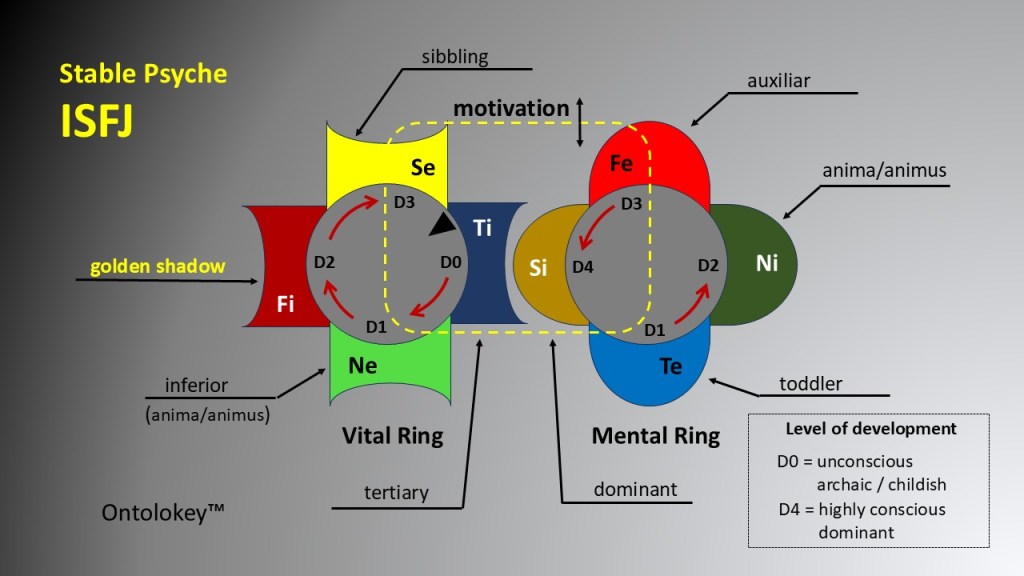
At the very center of the ISFJ’s psychology sits a dominant orientation toward internalized sensory experience — a faculty that does not simply record events the way a camera might, but absorbs them into a richly textured inner archive of feeling, atmosphere, and personal meaning. This is why ISFJs do not merely remember a particular dinner or a particular afternoon; they seem to relive it, recalling the specific quality of light in the room or the exact tone of a remembered voice with a vividness that outsiders often find remarkable. This deep grounding in lived experience gives the ISFJ an extraordinary sensitivity to physical and emotional comfort, both their own and that of the people around them, so that they notice a stranger’s cold hands or a friend’s quiet distress almost before either has been mentioned. It also explains their strong pull toward ritual, tradition, and carefully tended routine, not because they fear spontaneity as such, but because consistency represents something closer to earned wisdom than to rigid resistance. The cost of this orientation is a natural wariness toward sudden change or untested innovation, since anything new must first prove itself against an internal standard built entirely from what has already worked, and this can make the ISFJ appear more cautious or set in their ways than their genuine open-heartedness would suggest.
Working alongside this inward-facing foundation is an outward-facing current concerned with the emotional atmosphere of every room the ISFJ enters. This is the faculty that allows them to sense almost instantly when someone is hurting, tense, or feeling excluded, and to respond not with performative sympathy but with a genuinely practical form of care — a comforting word, a quiet gesture, a subtle redirection of conversation away from conflict and toward reconnection. It is this same current that makes the ISFJ such an effective emotional anchor in families, friendships, and small teams, someone who prioritizes the well-being of the group over personal recognition and who often ends up holding a social fabric together without ever being asked to do so explicitly. The vulnerability built into this gift is considerable, however, because an ISFJ who works so hard to create warmth and belonging takes any sign of social rejection or indifference profoundly to heart, sometimes withdrawing quietly for long stretches when they sense that their efforts to connect have gone unnoticed or unreciprocated. This outward-facing warmth also functions, whether the individual realizes it or not, as something like a social mask, a persona that can make a fundamentally introverted person appear far more socially fluent and expressive than their private energy levels would predict, and this mask, however sincere, can eventually obscure the individual’s own emotional needs from both others and themselves.
Beneath these two dominant currents lies a quieter, more private undercurrent concerned not with tradition or social harmony but with an internal sense of what simply feels true. This is where the ISFJ’s real moral seriousness lives — not in loud declarations of principle, but in a private conviction about fairness, kindness, and human dignity that rarely gets spoken aloud yet shapes behavior with real force when it is violated. Because this layer sits somewhat outside the ISFJ’s everyday vocabulary, it often remains underdeveloped for long periods, surfacing only when a boundary has been crossed or a value quietly betrayed, at which point the individual may withdraw support or distance themselves without ever staging an open confrontation. There is also a subtler undercurrent concerned with long-term meaning and the unfolding of fate, a faculty that produces persistent, often mood-driven speculation about what the future holds — a good day at work sparking daydreams of success, a single critical comment sparking a private spiral of dread about failure. This tendency toward emotional forecasting rarely operates through clean logical steps; instead it functions through impressions and hunches that the ISFJ often distrusts even as they cannot quite shake them, which is one reason this type frequently seeks out partners or mentors who seem able to interpret the big picture and offer reassurance that their instincts, whatever they might mean, are not something to fear.
Rounding out the more conscious portrait are two further currents that tend to feel less native to the ISFJ but still exert real influence on daily functioning. One is a somewhat reluctant relationship with efficiency, structure, and external logic — the ISFJ genuinely wants to do things well and dislikes needless bureaucracy or arbitrary rules, but rigid schedules and abstract productivity systems tend to drain rather than energize them, and they generally do best when allowed to work at their own natural rhythm rather than someone else’s imposed structure. The other is a cautious, sometimes anxious relationship with open-ended possibility and the unknown, a tendency to feel simultaneously intrigued and unsettled by new opportunities, quick to imagine what could go wrong before fully weighing what could go right. Together, these currents round out a personality whose greatest conscious strength is the creation of comfort, continuity, and emotional safety for the people around them — and whose greatest conscious challenge is trusting that life beyond the familiar can be navigated without catastrophe. It is precisely at the boundary between this comforting conscious personality and the material it has pushed into the unconscious that the ISFJ’s genuine psychological complexity — and its real danger — begins to emerge.
Where the Shadow Begins: The Gentle Mask and the Unseen Abyss
Most descriptions of the ISFJ stop at exactly the point where the real psychological story becomes interesting, because they focus almost entirely on warmth, loyalty, patience, and dependability, painting a portrait that is not wrong so much as radically incomplete. Every personality develops both a visible character and an invisible compensation, a public face maintained by forces that remain unconscious even to the person embodying them, and this dynamic is especially difficult to see in the ISFJ precisely because the visible face is so consistently associated with goodness that observers rarely think to look any further. The individual often builds an entire identity around being the stabilizer of human life — the keeper of continuity, the guardian of emotional comfort, the person who ensures that a family, a friendship group, or a workplace keeps functioning smoothly even under strain. This is not simply a preference for order; for many ISFJs, stability functions as a genuine psychological necessity, something closer to oxygen than to taste, and this need creates a subtle but important consequence: events are rarely experienced neutrally but are instead filtered through dense layers of personal meaning, emotional memory, and unconscious interpretation, so that the individual gradually begins living somewhat less in objective reality and somewhat more inside an internally constructed version of it.
This is where the shadow truly begins, and it is worth being precise about its nature, because it is not primarily aggression, domination, or overt hostility. It is something far subtler: a growing tendency to trust personal impressions more than detached observation, until subjective emotional certainty starts to feel more convincing than any external evidence that might contradict it. The ISFJ feels something deeply and, almost without noticing the leap, assumes the feeling must correspond to reality, when in fact feelings are interpretations of reality rather than reality itself. Once this distinction blurs, sensitivity can slide into projection, empathy can slide into assumption, and an intuitive read on someone’s motives can slide into something closer to a private mythology about who that person is and what they intend — one that may bear only a loose relationship to what is actually happening. Because the resulting judgment arrives as a felt certainty rather than a reasoned argument, it becomes remarkably resistant to correction; the individual does not experience themselves as making an assumption, but as simply knowing, and by the time this process has taken hold, the shadow is no longer a hidden potential but an active, invisible force shaping perception, decision, and relationship.
A closely related dynamic concerns what happens to everything the conscious personality has excluded in the name of harmony. Every strong conscious commitment creates an unconscious counterweight, and the stronger the ISFJ’s dedication to kindness and goodwill becomes, the more forcefully suspicion, resentment, and darker imaginative material get pushed out of awareness — not eliminated, simply relocated to a region with far less conscious supervision. This produces one of the type’s deepest paradoxes: the more consciously good-natured a person becomes, the more disturbing their unconscious compensations can grow. The individual who appears endlessly trusting may privately rehearse betrayal. The one who advocates peace so consistently may be carrying reservoirs of resentment they have never once consciously named. Because these contents rarely reach conscious integration, they surface indirectly, through anxieties, compulsive worries, passive resistance, quiet emotional withdrawal, or sudden reactions that seem wildly disproportionate to whatever triggered them, and the individual typically experiences these eruptions as something happening to them rather than as something rising from within, which keeps genuine self-understanding permanently just out of reach.
The Architecture of Self-Deception
If a single dynamic deserves to be named the central psychological danger of this personality, it is not cruelty or overt manipulation but a far quieter process: self-deception, the gradual disappearance of uncomfortable truths from conscious awareness and their replacement by emotionally acceptable narratives. This matters because the ISFJ is rarely driven by malicious intent; the tragedy is not that they wish to deceive others, but that they slowly lose the ability to see where legitimate self-protection ends and honest truth begins. A gap opens between subjective experience and objective reality, and that gap can widen for decades without ever being consciously noticed, precisely because it hides beneath admirable qualities like loyalty, compassion, and sacrifice — virtues so central to the ISFJ’s sense of self that anything contradicting them becomes almost unthinkable to examine. Resentment quietly rebrands itself as concern. Possessiveness rebrands itself as loyalty. Control rebrands itself as protection. Dependency rebrands itself as love. None of these substitutions are consciously invented; they emerge automatically because the psyche is constantly working to keep self-image and lived experience feeling coherent with one another, and the result is a person who remains entirely sincere while simultaneously misunderstanding their own motives at a fairly fundamental level.
This capacity for self-deception connects directly to the ISFJ’s unusual relationship with emotional certainty, since personal experience often carries more psychological authority for this type than any amount of detached analysis could. When a feeling of hurt forms, the ISFJ tends to assume they have genuinely been wronged; when a feeling of mistrust arises, they tend to assume some real reason for that mistrust must exist somewhere. Yet emotions are not objective measurements — they are subjective responses shaped by both conscious and unconscious forces working together — and the shadow deepens whenever emotional conviction becomes indistinguishable from established fact. At that point the individual stops examining their interpretations and starts defending them instead, and the psyche becomes more interested in preserving what feels true than in discovering what actually is true. This shift is almost invisible from the inside, yet it fundamentally reorganizes the relationship between consciousness and reality, and it explains why an ISFJ can be utterly sincere in a disagreement while also being substantially mistaken about what is actually driving their own position.
Nowhere does this pattern show up more clearly than in the ISFJ’s relationship to caregiving itself. From early in life, many people of this type learn that their value comes from being helpful, supportive, and needed, a lesson reinforced repeatedly by families, communities, and social institutions that reward exactly these behaviors. Over time the individual can become so accustomed to being needed that their entire identity depends on it, and what began as genuine generosity can quietly transform into a hidden psychological dependency — a need for others to need them, which functions almost like a validation of their own existence. Acknowledging this dependency openly would threaten the self-image of pure altruism, so it typically stays unconscious, and the person continues experiencing themselves as entirely selfless while remaining genuinely unaware of how much their sense of self relies on being useful to someone. When the inevitable disappointment comes — when sacrifice is not met with the recognition or reciprocity the individual unconsciously expected — resentment begins accumulating quietly beneath a surface that continues to look helpful and unbothered, and because that resentment conflicts so directly with the preferred self-image, it rarely gets acknowledged directly. Instead it emerges as withdrawal, as guilt-inducing remarks, as a private and growing sense of being an unappreciated saint surrounded by people who simply do not understand how much has been given on their behalf.
The Dark Intuition Beneath the Surface
Alongside this pattern of self-deception runs a second, seemingly contradictory current: a form of hidden vigilance that scans constantly for danger, betrayal, and hidden threat even while the conscious personality is actively seeking peace and connection. The ISFJ may consciously want to trust the people around them while unconsciously searching for the reasons that trust will eventually be violated, producing a personality that looks calm on the surface while managing, underneath, a continuous stream of imagined disasters involving loss, humiliation, abandonment, or illness. This tension has its roots in the very structure of the ISFJ’s perception, since reality for this type is never observed in a purely detached way but is instead filtered through a dense inner network of memory, association, and symbolic meaning. The boundary between observation and interpretation gradually weakens under this weight, and the individual stops merely seeing what is happening and starts sensing what might be happening, what could be hidden behind appearances, or what deeper significance an ordinary event might secretly carry. Because so much of this material originates unconsciously, it tends to be experienced as intuition rather than hypothesis — not “perhaps this is true” but simply “something is wrong” — with certainty arriving well before, or sometimes entirely without, any supporting evidence.
This tendency shows up most vividly in the ISFJ’s often vivid, and often distressing, capacity for imagining worst-case outcomes. A delayed reply becomes evidence of rejection. A shift in someone’s tone becomes evidence of hidden resentment. A minor physical symptom becomes evidence of serious illness. What distinguishes this pattern from ordinary caution is the emotional realism attached to the imagined scenario — the possibility does not stay a mere possibility but begins to feel like an approaching certainty, and the body often responds to these imagined disasters as though they were already unfolding in real time. This kind of catastrophizing frequently disguises itself as responsibility, since the ISFJ genuinely believes that considering every possible problem in advance demonstrates maturity and conscientiousness, and there is a kernel of truth in this belief. Yet there is a crucial difference between preparation, which ends once sufficient action has been taken, and psychological preoccupation, which continues indefinitely because its real purpose is not practical problem-solving but an attempt at emotional control — an unconscious hope that imagining every disaster in advance might somehow prevent it from occurring.
This dynamic becomes especially painful once it attaches itself to close relationships, which are naturally the places where the ISFJ has invested the most emotional energy and therefore has the most to lose. Neutral behaviors start acquiring symbolic weight; ambiguous comments become clues; ordinary mood fluctuations become evidence of a deeper, hidden problem. Because these interpretations arise from unconscious intuition rather than deliberate reasoning, they feel indisputably true to the person experiencing them, and the resulting defensive behaviors — becoming subtly possessive, seeking excessive reassurance, testing loyalty indirectly, or withdrawing preemptively before someone else can withdraw first — can end up creating exactly the relational strain the individual was so afraid of in the first place. What makes all of this genuinely tragic is how quietly it tends to unfold. Unlike personalities who externalize their anxiety through visible drama, the ISFJ typically internalizes it almost entirely, continuing to fulfill every responsibility and appear composed while friends and family remain completely unaware of the psychological storms running beneath the calm surface they see every day.
The Martyr Complex and the Hidden Economy of Sacrifice
Among the ISFJ’s shadow patterns, few are as socially invisible or as personally corrosive as what might be called the martyr complex, a dynamic built almost entirely out of genuinely admirable material — generosity, responsibility, loyalty, devotion — that has quietly fused with unconscious emotional needs the individual has never fully examined. The foundation of this pattern lies in the ISFJ’s characteristic relationship to responsibility, which for many people of this type is not merely a practical obligation but a core piece of their identity. Being needed becomes synonymous with being loved. Being reliable becomes synonymous with being worthy. Over years, this creates a psychological structure in which self-esteem grows increasingly dependent on service to others, and a dangerous equation forms almost invisibly beneath the surface: I matter because I sacrifice. Once personal worth becomes tied this closely to sacrifice, suffering itself begins to acquire psychological value, and the individual starts unconsciously organizing their life around situations that demand endurance and self-denial, because saying no, prioritizing personal needs, or asking for reciprocity all start to feel dangerously close to selfishness.
What follows this equation is a slow, largely unconscious form of accounting. The ISFJ frequently gives without ever explicitly requesting anything in return, and yet an unspoken expectation of reciprocity often persists nonetheless, quietly recorded somewhere beneath conscious awareness even as the individual sincerely insists they expect nothing. When that expectation goes unmet — and because it was never voiced, it very often does go unmet — the resulting hurt feels deeply unfair from the inside, even though its true source remains genuinely obscure to the person experiencing it. Over time this can produce a gradual drift toward what might be called victim consciousness, a pattern distinct from genuine victimization in which personal suffering becomes central to identity and moral self-understanding. Every sacrifice becomes evidence of virtue; every disappointment becomes evidence of someone else’s selfishness; the world quietly divides into those who give and those who take, with the self reliably occupying the role of the giver, a worldview that offers real emotional comfort while simultaneously blocking any deeper examination of the individual’s own role in creating the imbalance.
From here it is a short step to forms of emotional influence that operate not through open demand but through implication. Because direct expressions of frustration feel uncomfortable to this personality, dissatisfaction tends to travel sideways — through reminders of past generosity, through visible sighs and subtle signals of disappointment, through continued giving accompanied by an unmistakable emotional undertone that says, without ever saying it outright, look at everything I have done for you. This is rarely calculated manipulation in any deliberate sense; the hurt beneath it is entirely real, and the exhaustion is entirely real, but what stays unconscious is the role the individual’s own unspoken self-sacrifice played in generating the very disappointment they now feel. There is, buried within this whole pattern, an uncomfortable and rarely acknowledged form of moral authority: because the martyr has sacrificed more, they can feel entitled to judge more; because they have suffered more, their perspective starts to feel like it deserves greater legitimacy than anyone else’s. Most ISFJs would be genuinely startled by the suggestion that they feel superior to anyone, and yet this quiet sense of elevated moral standing frequently operates just beneath conscious recognition, generating a subtle contempt for people who set firmer boundaries or simply decline to carry as much as the ISFJ has chosen, consciously or not, to carry.
Possessive Love, Repressed Aggression, and the Fear of Change
Love is the domain where the ISFJ’s gifts shine most brightly and, at the very same time, where their shadow material becomes most consequential. Relationships for this type rarely stay casual; they become woven into the architecture of identity itself, accumulating memories, routines, and emotional investments until the bond feels indistinguishable from a piece of the self. This capacity produces extraordinary loyalty, but it also creates a hidden vulnerability, because the loss of a significant relationship is experienced not merely as separation from another person but as a disruption of the internal order that emotional security depends on. When a partner grows more independent, or a friend’s priorities shift, or a family member starts asserting boundaries — all entirely normal developments in any healthy relationship — the ISFJ’s attachment system can register these ordinary changes as signs of instability, triggering a quiet, largely unconscious pull toward preservation rather than growth. Genuine love allows movement; possessiveness seeks to freeze things in place, and because preservation feels so much like care to this personality, the distinction between the two is often extremely difficult for the ISFJ to see clearly from the inside.
A closely related and equally underrecognized shadow concerns aggression, an emotion the ISFJ typically learns very early to distrust and disown. Because harmony so consistently generates approval while anger risks disapproval, many ISFJs construct an identity almost entirely around being pleasant, patient, and emotionally safe, pushing anything that threatens this image out of conscious awareness. The trouble is that repressed emotion never actually disappears; it simply changes form, most often surfacing as passive resistance, subtle criticism, guilt-inducing remarks, or a quiet emotional withdrawal that everyone in the relationship can feel but nobody quite names. The individual frequently experiences their own anger indirectly, as disappointment or fatigue or hurt rather than as anger itself, since these secondary emotions feel far more compatible with a self-image built around sensitivity and care. This gap between how composed the person appears and how much frustration they are actually carrying tends to widen steadily over time, producing a chronic, quiet exhaustion whose true source — the enormous psychological effort required to keep unintegrated emotion contained — the individual often cannot fully identify even in themselves.
Underlying both of these patterns is a still deeper attachment: not to any particular person or feeling, but to familiarity itself. The ISFJ’s whole psychological orientation is built around what has already been proven, already been lived, already been safely integrated into memory, and this makes genuine transformation feel less like growth and more like a kind of quiet threat to survival. Endings, in particular, become disproportionately difficult, because releasing a relationship, a role, or a long-held belief means relinquishing not just an external circumstance but the entire internal structure of meaning that had been built around it. Many ISFJs unconsciously defend against this discomfort by continuing to identify with roles they have long since outgrown, or by maintaining emotional commitments well past the point where those commitments still serve them, mistaking fear of uncertainty for loyalty and mistaking stagnation for stability. The deepest version of this shadow is the unconscious belief that safety can only be found within what is already familiar — a belief that, once genuinely examined, tends to loosen its grip, allowing the individual to discover that real continuity comes not from resisting change but from learning to grow through it.
Toward Integration: From Innocence to Wholeness
Underneath every one of these patterns — the self-deception, the hidden suspicion, the martyrdom, the possessiveness, the repressed anger, the fear of transformation — lies a single, more fundamental dynamic that Ontolokey’s longer essay identifies as the deepest shadow of all: an unconscious attachment to the identity of being a good person, an attachment so strong that it can quietly prevent the very self-examination that real goodness requires. Human beings are not made dangerous by having a shadow; they are made dangerous by denying one. The person who can acknowledge their own capacity for resentment, control, or quiet self-interest can regulate it consciously, while the person who insists such capacities simply do not apply to them becomes far more likely to act on them without ever noticing. For the ISFJ, whose sense of self is so often organized around kindness, loyalty, and sacrifice, this confrontation is unusually difficult, because it requires dismantling not a flaw but a cherished and largely accurate self-image, admitting that generosity can carry hidden expectations, that devotion can shade into control, and that suffering has, at times, been chosen rather than simply endured.
The path toward genuine psychological maturity, as this material frames it, does not run through becoming even more consistently good, since perfection of that kind is really only an ego fantasy dressed up as virtue. It runs instead through wholeness — the willingness to recognize light and shadow together rather than identifying exclusively with the more flattering half. The mature ISFJ gradually learns to distrust emotional certainty just enough to examine it, to ask whether an interpretation is actually true or merely familiar, to notice whether their generosity is freely given or quietly transactional, and to accept that sincerity alone has never been proof of self-knowledge. This is a genuinely difficult undertaking for a personality built so thoroughly around comfort, harmony, and the preservation of what already works, and it rarely happens quickly or without real discomfort along the way. Yet it is precisely this willingness to look honestly at the difference between the self one has learned to present and the self one actually is that allows the ISFJ’s very real gifts — their loyalty, their attentiveness, their capacity to make the people around them feel safe and seen — to become something grounded in genuine self-knowledge rather than in an identity that quietly requires everyone else’s continued approval to survive.
This summary has drawn together only the essential outline of a psychological portrait that Ontolokey explores across several much longer, independent essays — each examining a different function or a different facet of the ISFJ’s shadow in considerably greater depth than could be covered here. Readers who recognize themselves, a partner, or a family member in these pages, and who want to understand the fuller architecture behind this brief overview — or who are curious how the other fifteen personality types are mapped within the same three-dimensional framework — are warmly encouraged to visit www.Ontolokey.com, where the complete essays and the broader theoretical model behind them are freely available for further reading.


Leave a comment