Beyond the Social Stereotype: The Psychological Architecture of the ESFJ
The ESFJ is often described through familiar social images: the caregiver, the host, the organizer, the loyal friend, the person who remembers birthdays, notices discomfort in a room, and instinctively tries to restore warmth when relationships become strained. These descriptions contain an important truth, but they also risk reducing a complex psychological structure to a collection of pleasant behaviors. Within the Ontolokey framework, the ESFJ is not simply “friendly” or “people-oriented,” but an extraverted rational personality whose primary psychological orientation is directed toward evaluating and organizing the interpersonal world through Extraverted Feeling, or Fe. This means that social harmony is not merely something the ESFJ happens to enjoy; it can become an active psychological task through which the individual interprets situations, regulates relationships, and determines what ought to be done. The Ontolokey model attempts to make this structure visible by treating the ESFJ as a dynamic configuration of eight psychological functions rather than as a fixed four-letter label, distinguishing the conscious functions from less conscious positions such as the Anima/Animus, Toddler, Sibling, and Golden Shadow. This perspective is particularly useful because the very qualities that make the ESFJ socially effective can, under psychological pressure, become sources of rigidity, dependency, resentment, or control; the shadow is therefore not an alien personality hiding underneath the “nice” ESFJ, but a distorted extension of mechanisms that are already present in the ordinary personality.
The central paradox of the ESFJ begins here: the capacity to care for other people can gradually become inseparable from the need to be valued by them. In its mature form, Fe allows the ESFJ to perceive emotional atmospheres rapidly, recognize exclusion or tension, coordinate people around shared values, and translate empathy into concrete action, while Introverted Sensing, or Si, provides continuity through memory, routine, familiarity, tradition, and accumulated experience. This combination can produce an exceptionally reliable human presence because the ESFJ does not merely notice that somebody is struggling; they often remember what has helped that person before and attempt to recreate the conditions under which emotional stability can return. Yet precisely because interpersonal awareness can become so highly developed, the ESFJ may begin to experience the emotional condition of others as a personal responsibility, carrying burdens that cannot actually be controlled and gradually linking personal worth to usefulness. The deeper shadow described by Ontolokey emerges when genuine generosity becomes psychologically entangled with the unconscious requirement to remain needed, appreciated, or socially indispensable. The crucial developmental question therefore reaches beyond whether the ESFJ is caring or controlling, generous or approval-seeking, traditional or adaptable; it concerns whether connection remains an expression of an autonomous self, or whether connection has quietly become the condition upon which that self depends.
The Ontolokey Cube: Eight Positions of the ESFJ Psyche
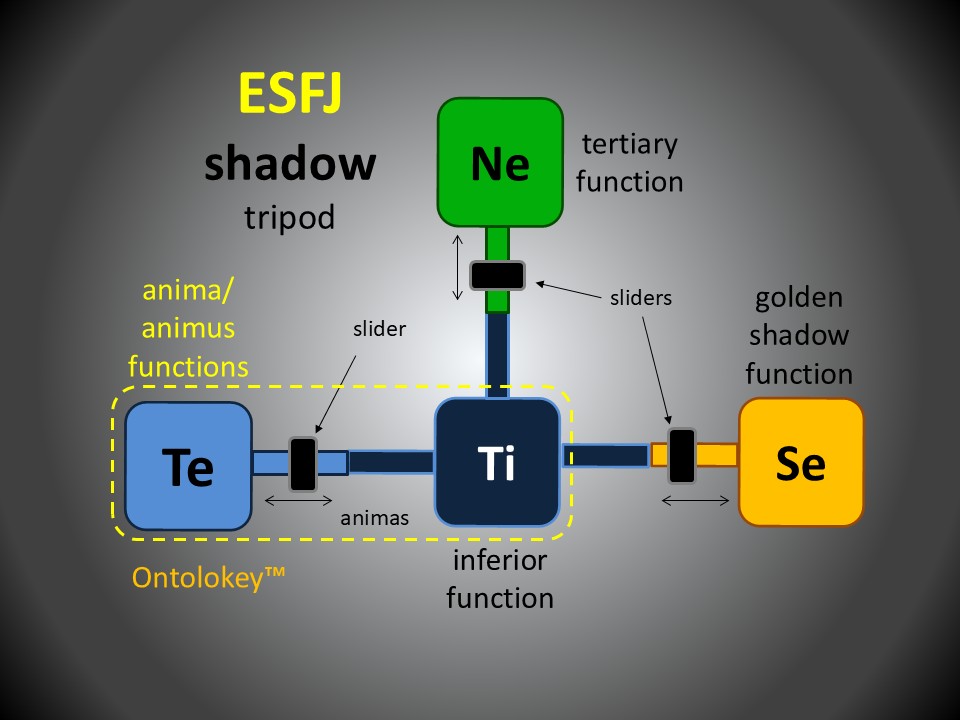
The distinctive contribution of the Ontolokey model is that it refuses to treat the ESFJ as a simple hierarchy of four functions and instead presents the personality as an eight-function psychological architecture. In this model, the ESFJ is organized around Extraverted Feeling (Fe) as the Dominant, Introverted Sensing (Si) as the Auxiliary, Extraverted Thinking (Te) as the Anima, Introverted Intuition (Ni) as the Toddler, Introverted Feeling (Fi) as the Sibling, Extraverted Sensing (Se) as the Golden Shadow, Extraverted Intuition (Ne) as the Blindspot, and Introverted Thinking (Ti) as the Tertiary/Royal Archetype. This arrangement is important because the positions do not merely indicate whether a function is “strong” or “weak”; they describe different psychological relationships to consciousness, development, motivation, vulnerability, and projection. Ontolokey’s cube gives these relationships a spatial form, with the eight functions occupying the vertices and with the architecture unfolding into interconnected functional groupings rather than appearing as a flat sequence. In this sense, the cube can be read psychologically as a map of what the ESFJ naturally inhabits, what they can access with effort, what they tend to avoid, what they unconsciously desire, and what may emerge in distorted form when the ordinary personality structure becomes overloaded.
At the center of the ESFJ configuration stands Fe, the Dominant function, which represents the personality’s most conscious and authoritative mode of psychological orientation. Fe evaluates reality primarily through the interpersonal field: what people feel, what relationships require, what a group considers meaningful, which emotional tensions need attention, and what can be done to restore cooperation or belonging. This is why the ESFJ’s social sensitivity is more profound than simple sociability; their attention is repeatedly drawn toward the emotional organization of the environment, allowing them to detect changes in atmosphere and translate those perceptions into practical relational behavior. Ontolokey’s description of the ESFJ emphasizes precisely this capacity to maintain social cohesion, while the shadow analysis demonstrates the danger of allowing that capacity to become an unconscious obligation to regulate everyone else’s emotional state. The mature expression of Fe therefore resembles emotional stewardship rather than emotional ownership: the ESFJ contributes to the psychological climate without assuming that they are responsible for controlling it. The immature expression reverses this distinction, turning interpersonal sensitivity into hypervigilance, approval-seeking, conflict avoidance, or subtle pressure on others to restore the emotional equilibrium that the ESFJ requires.
The Auxiliary function, Si, gives this outwardly relational personality its remarkable continuity, concreteness, and attachment to lived experience. Introverted Sensing does not merely mean having a good memory or preferring routine; within the Ontolokey interpretation it provides an internal reference system through which present experience is compared with what has previously been known, experienced, trusted, and emotionally established. For the ESFJ, this creates a powerful combination with Fe: the person not only notices what another human being needs in the present but often remembers what has mattered to that person before, what traditions hold the family together, which routines create stability, and which familiar forms of care communicate belonging. This explains why ESFJs can become exceptionally dependable custodians of relationships, institutions, rituals, celebrations, family histories, and communal expectations. Yet Si also creates one of the central tensions of the type, because continuity can gradually become conservatism, familiarity can become resistance to change, and accumulated experience can be mistaken for universal truth. The psychologically mature ESFJ therefore uses Si as a source of grounded knowledge without allowing the past to become an unquestionable authority over the future.
The Anima position, represented by Extraverted Thinking (Te), introduces a particularly revealing dimension because it concerns a function that can appear both attractive and psychologically complicated to the ESFJ. Te represents measurable effectiveness, external organization, objective standards, efficiency, implementation, and the capacity to ask whether something actually works rather than merely whether it feels socially appropriate. Ontolokey places Te in the ESFJ’s Anima position, meaning that this mode of functioning can possess a certain psychological fascination or aspirational quality while remaining less naturally integrated than Fe and Si. This helps explain why an ESFJ may admire people who appear highly decisive, technically competent, strategically organized, or capable of reducing complicated situations to clear objectives, while simultaneously feeling uncomfortable when those qualities require emotionally detached judgments. In healthy development, Te can become an invaluable corrective to excessive accommodation because it teaches the ESFJ to establish standards, measure outcomes, say no, delegate responsibility, and distinguish between genuinely helping someone and merely making them temporarily comfortable. When poorly integrated, however, Te can emerge defensively as sudden bluntness, managerial rigidity, excessive emphasis on productivity, or an attempt to solve relational problems through external control rather than emotional understanding.
The Toddler position, Introverted Intuition (Ni), represents another vulnerability, but its psychological character is different from the Anima. Ni is concerned with underlying trajectories, symbolic meaning, long-range implications, converging possibilities, and the question of where events are ultimately leading rather than simply what has happened before. Ontolokey identifies Ni as the ESFJ’s Toddler function, suggesting an area that can appear psychologically young, uncertain, or inconsistently developed, particularly when the individual is required to trust an internal vision that cannot yet be validated through familiar experience. This creates an important counterforce to Si because Si asks, in effect, “What do I know from experience?” whereas Ni asks, “What does this mean, and where might it lead?” The ESFJ may therefore possess strong practical knowledge while feeling less secure when confronted with ambiguous futures that demand symbolic interpretation rather than established precedent. Under pressure, this can produce either dismissal of intuition as impractical or an exaggerated, anxious form of forecasting in which uncertain possibilities are treated as impending certainties; development requires learning to tolerate not-knowing without abandoning either experience or imagination.
The Sibling function, Introverted Feeling (Fi), is particularly significant because it introduces the question of personal values into a personality that naturally orients toward collective emotional reality. Fe asks what is happening between people and what emotional atmosphere or shared value system should be cultivated, whereas Fi asks what is personally and internally authentic, regardless of whether the surrounding group approves. Ontolokey identifies Fi as the ESFJ’s Sibling function, placing it in a relationship of psychological kinship rather than simple opposition with the dominant Fe. This position can become an important developmental resource because it allows the ESFJ to recognize that caring for others does not eliminate the legitimacy of private preferences, individual boundaries, and personal moral convictions. The shadow problem appears when Fi remains insufficiently differentiated, because the ESFJ may then confuse collective approval with personal goodness and experience independent preferences as selfishness or betrayal. Integrating Fi does not require becoming detached from relationships; it means developing the capacity to say, with equal psychological legitimacy, “This matters to other people” and “This matters to me,” without automatically sacrificing one statement to preserve the other.
The Golden Shadow, Extraverted Sensing (Se), occupies a particularly fascinating position because Ontolokey treats the Golden Shadow not simply as a weakness but as a hidden reservoir of psychological potential. Se is immediate, embodied, direct, responsive to the physical environment, and willing to engage reality as it exists in the present rather than continually interpreting it through past experience or social expectation. For the ESFJ, whose consciousness is strongly organized around Fe and Si, Se can represent a freer relationship with spontaneity, physical presence, assertive action, pleasure, risk, and direct engagement with the world. Ontolokey explicitly identifies Se as the ESFJ’s Golden Shadow and associates it with an underused playful or expressive dimension of the personality. This is psychologically important because the ESFJ’s growth does not consist merely in correcting weaknesses; it can also involve discovering capacities that have remained outside ordinary identity. A developed Se allows the ESFJ to stop overinterpreting every social situation, inhabit the present more directly, enjoy experience without needing it to serve a relational purpose, and act decisively when circumstances require immediate engagement.
The Blindspot, Extraverted Intuition (Ne), represents perhaps the clearest cognitive vulnerability in the ESFJ architecture. Ne opens reality outward into alternatives, hypothetical possibilities, unusual interpretations, speculative connections, and futures that have no established precedent, whereas the ESFJ’s Si naturally seeks continuity and reliable reference points. Ontolokey explicitly places Ne in the ESFJ Blindspot position, indicating that the problem is not necessarily an inability to generate ideas but a relative difficulty recognizing the value of radically divergent possibilities when they destabilize established assumptions. This helps illuminate why an ESFJ can sometimes respond defensively to unconventional ideas, not because the person lacks intelligence or creativity, but because novelty may initially appear to threaten the coherence of the relational and experiential world that gives them psychological security. The developmental task is therefore not to become an Ne-dominant personality but to learn that unfamiliar possibilities do not automatically invalidate established values, traditions, or relationships. Without this flexibility, Si can become a closed epistemology in which “what has worked before” gradually becomes indistinguishable from “what is true.”
Finally, Introverted Thinking (Ti) occupies the Tertiary/Royal Archetype position in the Ontolokey ESFJ configuration, corresponding to the model’s association of the ESFJ with the INTP as its Royal Archetype. Ti represents internal logical coherence, conceptual precision, analytical differentiation, and the capacity to examine whether a belief is structurally sound independently of its social usefulness. Its position is psychologically intriguing because it provides the ESFJ with access to an internal world that is less dependent upon interpersonal consensus and more concerned with whether things make sense on their own terms. Developing Ti can therefore become one of the most important safeguards against the shadow of emotional consensus described by Ontolokey: it gives the ESFJ the ability to ask not merely whether an idea maintains harmony, but whether the idea itself is logically defensible. When integrated, Ti does not make the ESFJ cold; rather, it gives their warmth intellectual independence and prevents compassion from becoming an excuse for avoiding difficult truths. The complete cube consequently reveals a developmental trajectory in which the ESFJ’s psychological maturity depends not on abandoning Fe and Si, but on allowing Te, Ni, Fi, Se, Ne, and Ti to complicate and refine the dominant social orientation until care becomes compatible with autonomy, tradition with openness, and harmony with truth.
The Gift of Fe — Why the ESFJ Becomes the Emotional Architecture of a Community
The greatest strength of the ESFJ is not simply that they care about people, but that they possess an unusual capacity to organize human relationships into a functioning emotional environment. Extraverted Feeling, as the dominant function, directs attention toward the interpersonal field and asks what is happening between people, which values are being expressed, where tension is accumulating, and what can be done to restore cooperation. Ontolokey describes the Fe-centered configuration as the “diplomat” of the cube, emphasizing its ability to create unity while simultaneously identifying the danger of self-neglect when interpersonal responsibility becomes excessive. The mature ESFJ therefore often becomes the person who remembers what others need, recognizes when someone has been excluded, translates unspoken discomfort into words, and turns abstract goodwill into concrete acts of support. Their social intelligence is consequently less superficial than the stereotype of the outgoing “people person” suggests, because it involves continuous monitoring of emotional relationships and an intuitive understanding of the rituals through which belonging is communicated. When psychologically integrated, this capacity produces a person who can make other people feel not merely welcomed but located within a human structure in which they matter.
This ability becomes particularly powerful when Fe is stabilized by the ESFJ’s auxiliary Si, because emotional responsiveness is then combined with continuity and experiential memory. Si does not simply preserve factual memories; in the Ontolokey interpretation, it processes perception through an internal framework of subjective experience, memory, and affective resonance. Consequently, an ESFJ may remember not only that a person was present at a particular event but also how that person felt, what circumstances surrounded the experience, what traditions gave the event meaning, and what previously helped when something similar occurred. This combination explains the ESFJ’s potential as a custodian of family, community, institutional, and interpersonal continuity, because they can transform memory into practical care. A celebration, a family ritual, a workplace tradition, or a longstanding friendship can become more than repetition: it can function as a psychological container that reassures people that their shared history has not disappeared. The shadow of this gift appears when continuity becomes compulsory, but at its healthiest, Si gives Fe something extremely valuable—the ability to care with memory rather than merely react to the present.
The positive ESFJ is therefore not psychologically weak because they are relational, nor are they necessarily dependent simply because appreciation matters to them. There is a profound difference between needing admiration and possessing a naturally relational conception of human existence. A mature Fe orientation understands that individuals are formed through networks of reciprocity, obligation, affection, recognition, and shared meaning, and it can therefore take responsibility for relationships without reducing every relationship to personal validation. Ontolokey’s broader model is useful here because it explicitly treats personality as a dynamic balance among functions rather than as a rigid categorical identity, allowing the same Fe capacity to become either constructive or destructive depending upon how the other functions participate in the psychological system. The healthy ESFJ can consequently be extraordinarily generous without being psychologically enslaved by generosity, because the underlying motivation gradually shifts from “I must be needed” toward “I choose to contribute.” That distinction may appear subtle from the outside, yet internally it marks one of the most important transitions from personality-driven behavior to psychological maturity.
The ESFJ’s strength becomes even more apparent in environments where human beings must cooperate rather than merely coexist. In families, communities, educational settings, organizations, healthcare environments, and social institutions, there are countless forms of invisible labor that cannot be reduced to formal responsibilities: noticing who is struggling, maintaining traditions, remembering important personal details, smoothing unnecessary conflicts, making newcomers feel included, preserving morale, and ensuring that practical arrangements do not destroy the human meaning behind them. The ESFJ often performs precisely this connective labor, and because successful connective labor frequently leaves no visible trace, the contribution can be underestimated by cultures that reward only measurable individual achievement. Yet without such work, institutions can become technically efficient while psychologically impoverished, populated by people who accomplish tasks but no longer experience genuine belonging. The mature ESFJ instinctively understands that social cohesion is itself a form of infrastructure, and this insight represents one of the most constructive expressions of the Fe–Si combination. The challenge is not to abandon this role, but to recognize that a community is healthiest when its caretaker does not become its prisoner.
This distinction leads directly toward the central psychological danger of the type: the same person who can create belonging may eventually begin to believe that maintaining belonging is their responsibility, and the same sensitivity that allows them to recognize another person’s needs can become hyper-attunement to approval and rejection. When Fe is no longer simply an instrument of authentic connection but becomes the primary regulator of self-worth, generosity begins to acquire an unconscious transaction beneath its surface. The ESFJ may give, organize, remember, accommodate, mediate, and protect, while quietly expecting recognition, loyalty, gratitude, or compliance in return, even if they consciously reject the idea that their kindness should be transactional. This is precisely where the positive architecture begins to turn toward the shadow: the psychological problem is not that the ESFJ cares too much, but that care can become fused with identity, obligation, and the fear of becoming unnecessary. The deeper truth of the ESFJ therefore cannot be understood by celebrating their warmth alone; it requires examining what happens when the person who has spent years creating emotional security discovers that other people are free to reject, disappoint, misunderstand, or leave them despite everything they have done.
When Care Becomes Control — The Shadow of Fe and Si
The darker side of the ESFJ begins not with cruelty, but with a psychological confusion between care and responsibility. Because dominant Fe naturally monitors the emotional condition of the interpersonal environment, the ESFJ can gradually develop the assumption that if something is wrong between people, something must be done about it, and that doing something about it is somehow their responsibility. This tendency becomes particularly intense when Si reinforces it with memories of previous relational experiences, allowing the ESFJ to accumulate an internal catalogue of what people have done, failed to do, promised, forgotten, and repeated. Ontolokey’s analysis of the ESFJ shadow emphasizes precisely this potential transformation of care into control, in which the desire to maintain harmony can become an attempt to manage the behavior and emotional responses of other people. (ontolokey.com) The resulting behavior can remain superficially benevolent because it is frequently expressed through advice, assistance, reminders, concern, hospitality, or appeals to what is “best” for everyone. Psychologically, however, the crucial question is whether the other person’s autonomy remains intact, because care becomes controlling when the ESFJ can tolerate another person’s freedom only as long as that freedom does not disrupt the emotional order they have constructed.
This dynamic becomes particularly complicated because ESFJs may genuinely perceive themselves as acting from good intentions. A person who has spent years anticipating needs can find it difficult to understand why someone would reject assistance, ignore advice, decline a tradition, or choose a path that appears unnecessarily painful or irresponsible. The ESFJ’s internal logic may be coherent: “I know you, I remember what happened last time, I can see where this is going, and I am trying to prevent you from suffering.” Yet this apparently compassionate logic contains a hidden psychological assumption—that the ESFJ’s interpretation of another person’s needs should carry greater authority than that person’s own interpretation. Once this occurs, empathy subtly changes from understanding another person’s experience to defining it for them. The ESFJ can then experience resistance not merely as disagreement but as evidence of ingratitude, irrationality, immaturity, or lack of appreciation, particularly when substantial emotional or practical effort has already been invested. What began as sensitivity becomes a form of interpersonal management, and the person being “helped” may eventually experience the ESFJ’s care as pressure rather than freedom.
The role of Si makes this shadow particularly persistent because memory can become a moral archive. Healthy Si allows the ESFJ to learn from experience and reproduce what has previously created stability, but an unhealthy expression can preserve grievances with extraordinary emotional precision, especially when those grievances concern broken trust, violated expectations, forgotten sacrifices, or departures from established relational norms. The ESFJ may not consciously think, “I am keeping score,” yet internally there can develop a sophisticated accounting system in which favors, sacrifices, disappointments, anniversaries, promises, and emotional injuries remain psychologically available long after the immediate event has passed. This can produce what might be called implicit emotional bookkeeping, where generosity creates an expectation of reciprocal loyalty even when no explicit contract was ever established. When reciprocity fails, resentment can become disproportionate because the ESFJ is not reacting solely to the current event; they are reacting to the accumulated meaning of many previous events that the other person may not even realize are still psychologically active. The danger is therefore not simply remembering too much, but interpreting memory as evidence of what other people owe the self.
This is where the ESFJ’s avoidance of interpersonal rupture can paradoxically become a source of greater relational damage. A person deeply invested in harmony may suppress irritation, disappointment, or anger because openly expressing these emotions appears threatening to the relationship, particularly when the ESFJ has internalized the belief that a good person should be accommodating and emotionally supportive. Suppression does not eliminate the underlying emotion, however; it merely deprives the relationship of an honest opportunity to process it. Over time, the ESFJ can become increasingly exhausted while simultaneously becoming increasingly convinced that nobody recognizes how much they have sacrificed, producing the painful psychological sequence of overgiving, under-communicating, resentment, and eventual emotional withdrawal or explosion. The resulting conflict can be bewildering to others because the ESFJ may appear to have tolerated everything willingly until suddenly revealing a large reservoir of accumulated grievances. From the ESFJ’s perspective, the anger may feel completely justified because the evidence has been accumulating for years; from the other person’s perspective, it may seem as though a previously invisible contract has suddenly been presented for enforcement.
The deepest problem therefore concerns boundaries, because the ESFJ can confuse emotional closeness with emotional obligation. Genuine intimacy requires the ability to remain connected while accepting that another person has thoughts, preferences, priorities, and decisions that cannot be controlled, whereas the shadow-oriented ESFJ may unconsciously interpret separation, disagreement, or independence as evidence that the relationship itself is weakening. Ontolokey’s shadow analysis points toward this darker possibility by emphasizing how the ESFJ’s desire for harmony and recognition can become distorted when the person is emotionally overextended or insufficiently differentiated from the needs of others. (ontolokey.com) The mature alternative is psychologically demanding because it requires the ESFJ to tolerate something their dominant function instinctively dislikes: another person’s negative feelings without immediately attempting to repair them. It requires recognizing that someone can be disappointed without having been betrayed, disagree without being disrespectful, reject help without being ungrateful, and choose differently without invalidating everything the ESFJ has previously given. In that transformation, care becomes cleaner because it is no longer secretly asking, “Will you behave in a way that proves that my care was worthwhile?”
The ESFJ’s shadow becomes most dangerous when social morality is unconsciously recruited to legitimize personal emotional needs. Because Fe naturally perceives collective values and interpersonal expectations, an ESFJ under strain may frame personal preferences as objective standards of decency: what a “good friend” should do, what a “proper family member” should understand, how a “respectful” person ought to behave, or what people who genuinely care about one another would supposedly never do. This does not mean ESFJs are inherently manipulative or morally authoritarian; rather, it describes a potential mechanism through which the legitimate language of shared values can conceal an illegitimate demand for personal compliance. The person may sincerely believe they are defending respect, loyalty, family, tradition, or consideration when, psychologically, they are also defending themselves against rejection and uncertainty. The resulting pressure can be subtle precisely because it rarely sounds like naked domination; it may arrive as disappointment, emotional distance, reminders of past sacrifices, appeals to family expectations, or carefully communicated hurt. The shadow is therefore most difficult to recognize when the ESFJ is technically telling the truth about their feelings while unconsciously using those feelings to restrict another person’s freedom.
There is, finally, a painful irony in this pattern: the ESFJ may become the architect of precisely the loneliness they fear. The more intensely they attempt to secure relationships through usefulness, emotional regulation, obligation, or moral expectation, the more difficult it becomes for other people to know whether they are loved freely or required to reciprocate correctly. Relationships can then become psychologically crowded, because gratitude is expected, independence becomes suspicious, disagreement feels threatening, and spontaneous affection is gradually replaced by the maintenance of an invisible emotional contract. Yet this pattern is not an inevitable destiny of the type; it is what occurs when Fe loses contact with an independent sense of self and Si turns experience into unquestionable precedent. The way out is consequently not to become less caring, less loyal, or less relational, but to develop the neglected functions that allow the ESFJ to discover that love does not require management and harmony does not require uniformity.
The Untold Wound — Approval, Rejection, and the Fear of Becoming Unnecessary
The deepest wound of the ESFJ is not necessarily a fear of being alone, nor even a simple desire to be liked; it is the possibility that their value might disappear when they are no longer useful to the people around them. Because dominant Fe naturally experiences identity through relationship and social participation, appreciation can become psychologically intertwined with existence itself, particularly when the ESFJ has learned early in life that being helpful, agreeable, responsible, or emotionally attentive reliably produces acceptance. Ontolokey’s analysis of the ESFJ shadow describes this darker dimension of the type by examining how the desire to care for others can become entangled with recognition, approval, and the need to feel significant within relationships. (ontolokey.com) The resulting vulnerability is subtle because it can hide beneath genuinely admirable behavior: the ESFJ may be generous, attentive, loyal, and extraordinarily responsive to other people’s needs, while simultaneously deriving an increasing proportion of their self-esteem from evidence that these efforts are noticed and reciprocated. What begins as healthy relational sensitivity can therefore become a psychological economy in which usefulness functions as currency and appreciation becomes the confirmation that the self still has a secure place within the social world.
This explains why rejection can affect an ESFJ with an intensity that appears disproportionate to the immediate event. A disagreement may not remain a disagreement; it can become evidence that the relationship has changed, that one’s efforts have been misunderstood, or that one’s place in another person’s life is no longer secure. The ESFJ may consequently replay conversations, remember previous acts of generosity, examine changes in tone, and search for the point at which relational security supposedly began to deteriorate, with Si supplying an unusually rich archive of interpersonal evidence. What makes this psychologically painful is that the ESFJ’s memory is not merely informational: experiences may remain connected to the emotional significance they originally possessed, allowing old disappointments to become active again when a present event resembles them. The person may therefore experience rejection on several temporal levels simultaneously, reacting not only to what happened today but also to everything today appears to confirm about previous experiences of being overlooked or insufficiently valued. The healthier psychological response is not to suppress this sensitivity, but to differentiate present rejection from global worth, because another person’s withdrawal can describe the state of a relationship without constituting a verdict on the value of the person who is being rejected.
The most consequential distinction is consequently between attachment and validation dependency. Attachment says, “I want to be connected to you because you matter to me,” whereas validation dependency quietly says, “I need your positive response in order to know that I matter.” These statements can look almost identical from the outside because both may produce loyalty, affection, attentiveness, and an intense investment in relationships, yet their internal structures are radically different. In the first case, generosity remains voluntary because the individual’s identity survives another person’s disagreement, distance, or refusal; in the second, generosity becomes increasingly compulsive because giving is unconsciously recruited as a strategy for preserving relational security. This distinction also explains why an ESFJ can experience profound exhaustion while continuing to overextend themselves: stopping the behavior may feel psychologically dangerous because it raises the question of whether people will remain connected when the ESFJ is no longer performing the role of caretaker, organizer, mediator, or dependable supporter. The developmental achievement is therefore not emotional independence in the sense of becoming detached, but relational autonomy, meaning the ability to remain deeply connected without requiring other people to continuously confirm one’s legitimacy.
This is also where the ESFJ’s relationship with boundaries becomes psychologically decisive. A boundary can initially feel to an approval-oriented ESFJ like a withdrawal of love because saying “no,” refusing responsibility, declining an invitation, disappointing someone, or allowing another person to struggle without intervening may activate the fear that connection will be withdrawn in retaliation. Yet psychologically mature relationships cannot depend upon perpetual accommodation, because a relationship in which one individual must constantly suppress personal limits is not genuinely reciprocal even when it appears harmonious. The ESFJ must therefore learn that disappointing someone is not the same as harming them, just as refusing to rescue someone is not necessarily an act of abandonment. This realization can be especially difficult because Fe naturally experiences the emotional consequences of one’s behavior as highly salient, but maturity requires tolerating the fact that other people are allowed to experience disappointment without the ESFJ immediately taking responsibility for eliminating it. The ability to withstand another person’s temporary dissatisfaction without collapsing into guilt is therefore one of the clearest psychological markers that care has become differentiated from approval-seeking.
The same developmental process applies to praise, gratitude, and recognition. An ESFJ does not need to become indifferent to appreciation; appreciation is a legitimate human need, and relational acknowledgment can strengthen bonds and communicate reciprocity. The danger begins when praise becomes evidence of identity rather than simply a pleasant confirmation of contribution, because then the absence of praise becomes psychologically threatening and the person begins unconsciously increasing their efforts in order to recreate the emotional reward. This can produce an exhausting cycle in which the ESFJ gives more, anticipates more, remembers more, organizes more, and increasingly expects others to recognize the magnitude of what has been given, while those around them may become accustomed to the assistance and consequently offer less explicit acknowledgment. Resentment then emerges not because the original generosity was false, but because the generosity was carrying an unspoken psychological need that was never directly communicated. Breaking the cycle requires the ESFJ to become capable of asking for appreciation openly, receiving it without needing it constantly, and—most importantly—continuing to experience personal worth during periods in which nobody is applauding the contribution.
At the deepest level, the ESFJ’s developmental task is therefore an encounter with existential non-necessity. The person who has built an identity around being reliable eventually has to discover that they can step back and allow other people to solve their own problems, maintain their own relationships, make their own mistakes, and even live without the ESFJ’s constant intervention. This can initially feel like irrelevance, but psychologically it is the beginning of freedom because it separates being loved from being indispensable. The mature ESFJ can eventually reach a paradoxical position in which they become even more generous precisely because they no longer need generosity to secure their place in the world. Their care becomes less anxious, their boundaries become less defensive, their relationships become less transactional, and their presence becomes lighter because other people are permitted to remain autonomous. The untold truth is therefore not that the ESFJ secretly wants everyone to need them; it is that the healthiest ESFJ must learn that being needed is profoundly different from being loved, and being loved is profoundly different from being necessary.
The Functions in Conflict — Fe, Fi, Ti and Te
The ESFJ’s inner development becomes particularly visible when the four judging functions—Fe, Fi, Te, and Ti—are understood not as competing intellectual abilities but as different criteria for deciding what is valid, valuable, and worth doing. Fe asks what preserves or creates a viable human relationship and what shared emotional values are operating within a social environment, while Fi turns inward and asks what is personally authentic, morally congruent, and emotionally true to the individual. Te shifts the criterion toward external effectiveness, measurable results, organization, and practical execution, whereas Ti asks whether an idea or conclusion possesses internal logical consistency independent of social approval or immediate usefulness. Ontolokey’s ESFJ configuration places Fe in the Dominant position, Te in the Anima, Fi in the Sibling, and Ti in the Tertiary/Royal Archetype position, creating a particularly interesting developmental tension between relational intelligence and forms of judgment that are less naturally authoritative for the type. (ontolokey.com) The ESFJ does not need to choose one of these criteria permanently, because psychological maturity consists precisely in becoming capable of moving among them without allowing the dominant function to silence the others. The central developmental question is therefore not whether Fe is superior to Ti, Fi, or Te, but whether the ESFJ can allow truth, effectiveness, authenticity, and harmony to correct one another.
The conflict between Fe and Fi is perhaps the most intimate because it concerns the difference between relational values and personal values. Fe naturally asks what the emotional field requires, which values are shared, and how individual behavior affects collective cohesion, while Fi protects the individual’s private evaluation of what feels morally or emotionally authentic. When Fi is insufficiently developed, the ESFJ can become extraordinarily skilled at knowing what everyone else needs while remaining surprisingly uncertain about what they themselves genuinely want when nobody else is present to provide a relational reference point. This can produce a peculiar form of self-neglect in which personal preferences are continually translated into the language of what is convenient, appropriate, kind, or expected, until the person eventually discovers that they have been living according to a social identity that is only partially their own. Ontolokey’s placement of Fi as the ESFJ’s Sibling suggests that this function is neither simply hostile nor irrelevant; it represents a related but differently oriented psychological perspective that can assist the dominant Fe when consciously integrated. (ontolokey.com) The mature ESFJ therefore learns to preserve the capacity to say “we” without losing the capacity to say “I,” recognizing that authentic relationships require two differentiated people rather than one person continuously adapting to the other.
The relationship between Fe and Ti is equally consequential because Ti introduces a criterion of judgment that does not require interpersonal consensus. An ESFJ may instinctively evaluate an idea by asking whether it will hurt someone, create unnecessary tension, damage trust, or undermine cooperation, while Ti asks a colder but indispensable question: whether the proposition itself is coherent. This difference can create discomfort because logical analysis sometimes produces conclusions that are socially inconvenient, emotionally disappointing, or incompatible with established expectations, and the ESFJ may initially experience such conclusions as unnecessarily disruptive. Yet an inability to separate emotional consequences from logical validity can make a person vulnerable to accepting weak arguments simply because those arguments preserve harmony, particularly when the person is surrounded by people they care about. Ti provides an antidote by teaching the ESFJ to examine assumptions, define concepts precisely, identify contradictions, and tolerate the temporary discomfort of discovering that something socially accepted may nevertheless be wrong. The goal is not to turn the ESFJ into an emotionally detached analyst, but to give their interpersonal intelligence a reality-testing mechanism strong enough to prevent compassion from becoming intellectual surrender.
Te, occupying the Anima position, introduces a different form of corrective pressure because it evaluates the world according to external efficiency and demonstrable effectiveness. An ESFJ can become deeply invested in whether people feel supported and whether social expectations are being respected, yet still struggle to ask whether the structure through which everyone is being supported is actually efficient, sustainable, or producing the intended result. Te can therefore be uncomfortable precisely because it sometimes demands the abandonment of emotionally meaningful practices that no longer work. An ESFJ may preserve an arrangement because it represents history, loyalty, or somebody’s expectations, while Te asks whether continuing it makes practical sense; conversely, the ESFJ may try to become excessively Te-like under pressure, suddenly imposing rigid systems, productivity standards, or organizational rules in an attempt to regain control. Ontolokey’s identification of Te with the Anima captures this ambivalence: the function can represent something the ESFJ admires and wants access to while remaining less naturally integrated than Fe and Si. (ontolokey.com) Healthy integration means learning from Te without performing Te, allowing efficiency to serve human values rather than allowing efficiency itself to become another source of control.
The four judging functions become most psychologically powerful when they are allowed to form a sequence rather than a hierarchy. Fe can identify the human consequences of a situation, Fi can ask whether the proposed response violates personal integrity, Te can examine whether the response will actually work in practice, and Ti can test whether the reasoning behind it is internally coherent. Such a process protects the ESFJ from four different distortions: Fe without Fi can become excessive conformity, Fi without Fe can become isolated subjectivity, Te without emotional awareness can become instrumental control, and Ti without relational awareness can become sterile intellectualism. The Ontolokey cube is valuable precisely because it encourages the personality to be understood as a system of interacting psychological positions rather than a single dominant trait, making development a matter of integration rather than replacement. (ontolokey.com) For the ESFJ, this integration creates a particularly sophisticated form of judgment: the ability to care about people without automatically agreeing with them, to maintain personal integrity without abandoning relationships, to pursue efficiency without dehumanizing others, and to pursue logical truth without forgetting that truth always enters a human world. Psychological maturity is reached when these criteria no longer compete for dominance but become complementary instruments of discernment.
This integration also changes the ESFJ’s relationship with disagreement. An immature Fe orientation can interpret disagreement primarily as a relational event, meaning that the fact that someone opposes an idea becomes more psychologically significant than the reasons behind the opposition. Once Ti and Fi become more differentiated, however, disagreement can be separated into several independent questions: Is the argument logically sound, is it personally authentic, is it practically effective, and what will it do to the relationship? This decomposition is psychologically liberating because it prevents one dimension from contaminating all the others; someone can be wrong without being bad, disagreeable without being disloyal, inefficient without being worthless, and emotionally distant without necessarily being hostile. The ESFJ thereby becomes less vulnerable to the hidden coercion of harmony because disagreement no longer automatically threatens identity or belonging. What initially feels like emotional risk becomes intellectual and moral freedom, allowing the ESFJ to remain connected to people whose conclusions, values, or lifestyles may differ profoundly from their own.
The ultimate achievement is a form of integrated discernment in which the ESFJ retains the extraordinary relational sensitivity of Fe while becoming increasingly capable of standing outside the emotional field they are observing. This distance does not diminish empathy; it makes empathy more accurate because the ESFJ no longer needs another person’s emotional state to be different before they can tolerate it. Fi teaches them that personal authenticity has legitimacy, Te teaches them that good intentions require effective implementation, and Ti teaches them that social consensus does not determine logical truth. These functions therefore gradually dismantle the unconscious belief that being a good person means keeping everyone comfortable, meeting every expectation, or preserving every relationship at any cost. The result is not a colder ESFJ but a more formidable one: someone capable of warmth without submission, loyalty without self-erasure, leadership without coercion, and compassion without the need to be indispensable. In that sense, the shadow functions do not destroy the ESFJ’s natural gift; they complete its psychological architecture.
Si, Tradition and the Prison of the Past
If Fe gives the ESFJ its extraordinary sensitivity to the social present, Introverted Sensing gives that sensitivity a memory. Si continually relates present experience to what has already been lived, remembered, tested, and emotionally established, which helps explain why ESFJs can become such powerful custodians of family traditions, institutional customs, interpersonal rituals, and collective history. Ontolokey’s account of the ESFJ emphasizes this relationship between Si and the preservation of what has proven meaningful over time, while its broader explanation of Introverted Sensing describes a function concerned with internalized experience, familiarity, and the subjective impressions accumulated through life. (ontolokey.com) This gives the ESFJ a psychological capacity that is frequently underestimated in contemporary cultures obsessed with novelty: they understand that stability itself has value, and that human beings often require continuity in order to feel secure enough to grow. A family meal repeated every year, a remembered birthday, an established ritual of hospitality, or a familiar way of caring for someone may appear trivial to an outsider while carrying enormous emotional significance for the ESFJ. Through Si, the past is not dead information but a living repository of meaning, and the ESFJ often experiences the preservation of meaningful continuity as an act of love.
The strength of this orientation becomes particularly apparent during periods of instability. When circumstances change rapidly, people often seek something that remains recognizable, and the ESFJ can instinctively provide precisely that psychological continuity. They remember how things were done, which relationships have survived previous crises, what rituals previously restored a sense of normality, and which practical details must be maintained even when circumstances are chaotic. This makes the ESFJ potentially indispensable in families and communities because they preserve the connective tissue that allows people to experience themselves as part of an ongoing story rather than as isolated individuals reacting to disconnected events. Yet the very quality that makes continuity psychologically nourishing can become restrictive when the ESFJ unconsciously equates familiarity with correctness. Something can feel safe because it is familiar without being healthy, and something can feel wrong simply because it is new without actually being harmful. The mature use of Si therefore requires an important distinction between preserving what carries genuine value and preserving something merely because changing it would create emotional discomfort.
This becomes particularly complicated in relation to family systems, because tradition often contains both wisdom and unresolved psychological material. An ESFJ may inherit patterns of loyalty, hospitality, responsibility, respect, and mutual care that genuinely strengthen relationships, but the same inheritance may also contain expectations concerning gender, status, obedience, reputation, emotional expression, career choices, marriage, family roles, or acceptable lifestyles. Because Fe experiences belonging as psychologically meaningful and Si gives inherited patterns continuity, questioning such expectations can feel like questioning the people who transmitted them. Ontolokey’s shadow analysis identifies precisely this danger when it describes the ESFJ’s potential tendency to preserve collective harmony and established expectations even when those expectations conflict with individual authenticity. The psychological difficulty is therefore not simply conservatism in the political or cultural sense; it is the possibility that inherited relational scripts become so deeply internalized that the ESFJ experiences deviation from them as disloyalty rather than development. A tradition then ceases to be something the individual participates in freely and becomes something the individual feels morally obligated to defend.
The distinction between memory and truth becomes essential at this point. Si can tell the ESFJ what has happened repeatedly, what has previously worked, what a community has traditionally believed, and how a familiar situation usually unfolds, but repetition does not by itself establish universal validity. The shadow emerges when accumulated experience becomes epistemological authority, because the individual begins to reason that something must be correct because it has survived for a long time, or that a new alternative must be dangerous because nobody in their trusted environment has attempted it before. Ontolokey’s discussion of the ESFJ’s cognitive vulnerabilities similarly warns of the possibility that emotional and social consensus can substitute for independent examination, particularly when unfamiliar perspectives threaten established assumptions. This is where the ESFJ’s Ne Blindspot becomes psychologically relevant: radically different possibilities may initially appear unnecessarily destabilizing because they do not yet possess the credibility that accumulated experience provides. Development therefore requires learning to hold two propositions simultaneously—that the past deserves respect because it contains knowledge, and that the future deserves openness because it contains possibilities the past could never have experienced.
There is also a more personal dimension to Si that concerns nostalgia. Nostalgia can be profoundly healthy when it reconnects a person with meaningful memories, relationships, places, and experiences, but it becomes psychologically restrictive when the remembered past becomes an implicit standard against which every present experience is judged. The ESFJ may then compare current relationships with how they once felt, contemporary social behavior with how people “used to” behave, or present family life with an idealized version of an earlier period. Because memory selectively preserves emotionally significant experiences, however, the remembered past is not necessarily an objective reconstruction of what actually occurred. The danger is that the ESFJ can become loyal not to history itself but to an emotionally edited version of history, defending an image of how things were because that image provides continuity, identity, and belonging. When this happens, nostalgia stops functioning as remembrance and begins functioning as resistance to psychological change.
The mature ESFJ eventually discovers that honoring the past does not require obeying it. A tradition is strongest when its underlying value can survive transformation, because this demonstrates that the meaning has been understood rather than merely repeated. If a family ritual exists to communicate belonging, for example, its form can change without destroying its purpose; if loyalty exists to protect relationships, loyalty cannot logically require tolerating abuse or suppressing truth; if respect is genuinely valuable, respect must also include the right of another person to become someone their predecessors never anticipated. This is where Si must enter into dialogue with the more exploratory functions of the cube, particularly Ne and Ni, because continuity without possibility becomes stagnation while possibility without continuity can become fragmentation. The psychologically mature ESFJ therefore becomes neither a guardian of everything old nor an enthusiast of everything new, but a curator of meaning who asks which parts of the past deserve to be carried forward and which belong to a previous psychological world.
The deepest liberation occurs when the ESFJ realizes that abandoning an inherited pattern is not necessarily an abandonment of the people who created it. Psychological individuation requires the capacity to love one’s origins without allowing those origins to dictate the limits of one’s future, and this can be extraordinarily difficult for a personality whose identity is strongly intertwined with relational continuity. The shadow fears that change will sever belonging; maturity discovers that authentic belonging can survive differentiation. The ESFJ can preserve the emotional essence of a family, community, or relationship while changing the behaviors through which that essence is expressed, thereby transforming tradition from a command into a conscious choice. In this form, Si becomes one of the ESFJ’s greatest gifts: not a prison constructed from yesterday, but a living memory capable of informing tomorrow without possessing it.
The Hidden Functions — Ni, Ne and Se
The less conscious functions reveal a different dimension of the ESFJ because they represent psychological possibilities that are not usually experienced with the same effortless authority as Fe and Si. Introverted Intuition (Ni), Extraverted Intuition (Ne), and Extraverted Sensing (Se) relate to the ESFJ’s capacity to interpret emerging possibilities, tolerate uncertainty, inhabit the present directly, and perceive reality without immediately filtering it through established social or experiential frameworks. In the Ontolokey configuration, Ni occupies the Toddler position, Ne the Blindspot, and Se the Golden Shadow, meaning that these functions have very different psychological relationships to consciousness and development. This distinction matters because calling a function “weak” can be misleading: a less conscious function can be inexperienced, defensive, fascinating, underestimated, or even psychologically idealized without being permanently inaccessible. For the ESFJ, these three functions collectively represent an invitation beyond the familiar world of interpersonal expectations and accumulated experience, toward a reality that is less predictable, less controllable, and therefore potentially more psychologically liberating. The shadow is not simply what the ESFJ cannot do; it also contains capacities that the conscious personality may need precisely because its normal strengths have become too dominant.
Ni as the Toddler represents the ESFJ’s developing relationship with inner vision, long-range trajectory, symbolic meaning, and the possibility that events may possess implications that cannot yet be verified through experience. The ESFJ’s Si orientation naturally trusts what has been lived, remembered, and established, whereas Ni asks the individual to remain receptive to what is emerging before there is sufficient evidence to make that emerging reality feel secure. Ontolokey’s positioning of Ni as the Toddler therefore suggests a psychological function that may initially feel less mature or dependable, particularly when the ESFJ is confronted with situations that require trust in an internally perceived direction rather than confidence derived from precedent. This can produce an interesting tension: the ESFJ may be extraordinarily perceptive about people while still feeling uncertain about the deeper trajectory of a situation, especially when there is no established pattern against which to compare it. At its immature extreme, this can manifest as premature certainty about what something “must mean,” anxious forecasting, or alternatively a refusal to take intuition seriously because intuition cannot yet be justified through familiar evidence. Development means learning to hold an intuitive impression as a hypothesis rather than a verdict, allowing it to inform perception without demanding immediate certainty.
The Ne Blindspot is different because it concerns the ESFJ’s relative difficulty with unrestricted possibility generation. Ne looks outward across the field of potential: what else could this mean, what alternatives have not been considered, what unexpected opportunity might emerge, and what assumptions might be overturned by introducing a new variable? For a personality organized around Fe and Si, such openness can be psychologically disruptive because every new possibility potentially alters an established social arrangement or invalidates a previously trusted interpretation of experience. Ontolokey’s shadow analysis makes this broader vulnerability intelligible by emphasizing the danger of accepting familiar beliefs, collective assumptions, and emotionally reassuring interpretations without sufficiently independent examination. The ESFJ may therefore react to radical novelty not because they are incapable of understanding it, but because the psychological cost of entertaining it can feel unnecessarily destabilizing. The mature response is not to abandon tradition or become perpetually experimental, but to develop the capacity to say, “This is unfamiliar, but unfamiliar does not mean wrong.”
This is particularly important because Ne can function as an antidote to the ESFJ’s tendency to turn experience into expectation. If a relationship has behaved in a particular way for ten years, Si can reasonably conclude that the pattern has significance, but Ne asks whether the pattern could change; if a family has always followed a particular tradition, Ne asks whether the tradition might be expressed differently; if a person has always been perceived according to one role, Ne asks whether that individual might have capacities nobody has yet seen. Such questions can initially feel destabilizing because they loosen the psychological certainty provided by established categories. Yet they also protect the ESFJ from a subtle form of determinism in which people become permanently identified with their past behavior. This is especially important for relationships, because an ESFJ who remembers everything can inadvertently remember people into fixed identities: the reliable one, the irresponsible one, the difficult one, the sensitive one, the person who always disappoints, or the person who can always be counted upon. Ne introduces psychological mercy by reminding the ESFJ that human beings are not merely repetitions of their previous behavior.
The Golden Shadow of Se introduces an entirely different possibility because Se represents immediate engagement with concrete reality, sensory presence, direct action, spontaneity, physical awareness, and responsiveness to what is happening now. Ontolokey’s treatment of the ESFJ places Se in this unusually positive shadow position, suggesting a latent capacity that can become psychologically attractive precisely because it offers something the ordinary Fe–Si orientation does not naturally prioritize. The ESFJ can spend enormous amounts of psychological energy interpreting social situations, remembering histories, anticipating reactions, and maintaining continuity, whereas Se asks a simpler question: what is actually happening right now? This can be liberating because it interrupts excessive mental and interpersonal processing, allowing the individual to experience the body, environment, pleasure, movement, action, and sensory reality without immediately converting them into relational obligations or symbolic meaning. In this sense, Se is not merely an alternative cognitive skill; it can become an escape from the ESFJ’s tendency to live excessively through other people’s emotional realities.
The Golden Shadow can nevertheless be psychologically double-edged because what fascinates us can also become something we imitate without fully integrating. An ESFJ under prolonged pressure may suddenly become unusually impulsive, assertive, indulgent, confrontational, or sensation-seeking, particularly after an extended period of suppressing personal needs in order to maintain social expectations. The problem is not spontaneity itself; the problem is that suppressed spontaneity can emerge in compensatory rather than integrated form. Instead of consciously choosing immediate experience, the person may seek it reactively, almost as if attempting to escape the identity that has become too restrictive. A mature Se integration looks different: it means being able to experience pleasure without guilt, act without excessive anticipation of social consequences, respond decisively when circumstances demand it, and recognize one’s own physical needs before exhaustion forces them into awareness. The ESFJ does not need to become reckless or sensation-driven; they need to discover that being present is not the same as being irresponsible.
The interaction between Ni, Ne, and Se therefore reveals a developmental triangle that can substantially expand the ESFJ’s psychological world. Ni teaches depth and trajectory, helping the individual tolerate uncertainty about where life is going; Ne teaches openness to alternatives, preventing established experience from becoming an unquestioned boundary; and Se teaches immediacy, allowing the person to inhabit reality before interpreting or organizing it. Together they challenge three characteristic forms of psychological overcontrol: the assumption that the future must resemble the past, the assumption that the established interpretation is the only plausible interpretation, and the assumption that every present experience must be managed according to social meaning. These functions do not replace Fe and Si; they loosen the rigidity that can arise when Fe and Si become overidentified with the self. The result is an ESFJ who can preserve what matters without becoming imprisoned by it, anticipate what may come without becoming anxious about it, and experience what exists now without needing to make it socially significant.
At the deepest level, the hidden functions confront the ESFJ with a reality that can initially be unsettling: life cannot be completely organized around responsibility, continuity, and interpersonal security. Some experiences cannot be predicted, some relationships cannot be preserved, some futures cannot be known, and some moments have value precisely because they serve no larger social purpose. Ni asks the ESFJ to trust that meaning can emerge before certainty arrives; Ne asks them to remain open when reality refuses to conform to precedent; Se asks them to stop occasionally and experience the world before attempting to improve it. When these capacities become integrated, the ESFJ does not lose the qualities that make them dependable, warm, and socially intelligent. Instead, those qualities become less defensive because they are no longer required to provide the entirety of the individual’s psychological identity. The ESFJ begins to discover that a life can contain tradition without stagnation, intuition without fantasy, spontaneity without chaos, and belonging without surrendering freedom.
The Social Power of the ESFJ — Influence, Morality and the Dark Side of Belonging
The ESFJ possesses a form of social power that is easy to underestimate precisely because it rarely looks like power in its stereotypical form. It does not necessarily depend upon formal authority, intellectual dominance, physical intimidation, or overt ambition; instead, it operates through relationship, recognition, emotional coordination, reputation, and the ability to establish what feels normal within a group. Contemporary descriptions of ESFJs repeatedly emphasize their sensitivity to interpersonal dynamics, their tendency to maintain social harmony, and their ability to notice when people are uncomfortable or excluded. This means that an ESFJ can influence a social environment simply by determining which behaviors receive warmth, which receive concern, which are interpreted as respectable, and which are subtly treated as disruptive. At its healthiest, this influence is constructive leadership: the ESFJ creates conditions in which people cooperate, participate, and feel recognized rather than invisible. At its darkest, however, the same psychological sensitivity can become an informal system of social enforcement in which belonging is implicitly conditioned upon conformity.
The crucial issue is that social influence does not require conscious manipulation. An ESFJ may never deliberately attempt to control another person’s behavior, yet their emotional reactions can carry considerable interpersonal weight because other people understand how strongly the ESFJ values cooperation, loyalty, consideration, and relational reciprocity. A disappointed expression, withdrawal of warmth, repeated reminder of an obligation, or appeal to what “people normally do” can therefore communicate a standard without ever becoming an explicit command. Research-oriented personality descriptions likewise associate ESFJs with high agreeableness, conscientiousness, cooperation, and a strong concern for social approval, while noting that excessive approval-seeking can become dependence upon others’ agreement. The shadow appears when the ESFJ becomes unaware of the difference between communicating a value and making another person responsible for validating that value. A person may genuinely believe that they are simply defending respect, family, loyalty, or good manners while simultaneously creating an emotional environment in which disagreement becomes costly. This is one of the reasons the ESFJ’s shadow cannot be reduced to overt aggression: its most sophisticated form operates through the social consequences of approval and disapproval.
The relationship between Fe and morality makes this especially complex. Fe is naturally interested in shared emotional values, and therefore an ESFJ can become highly skilled at articulating the unwritten rules that make a community function: how people should treat one another, what constitutes consideration, which obligations accompany friendship or family membership, and what behavior communicates respect. Such moral sensitivity can be profoundly beneficial because societies depend upon norms of reciprocity, responsibility, and mutual recognition; without them, individual freedom can easily become indifference toward everyone else. The problem begins when a particular social norm is unconsciously mistaken for a universal moral law, because the ESFJ may then experience deviation not merely as difference but as evidence of defective character. Contemporary accounts of ESFJ relationships similarly note a potential tendency toward social conformity and strict expectations concerning how partners should behave in shared social environments. The psychologically mature ESFJ must therefore learn to distinguish between “this behavior violates my values” and “this behavior is objectively wrong,” because that distinction protects both moral integrity and other people’s autonomy.
This becomes particularly visible in close relationships, where the ESFJ’s investment can create legitimate expectations of reciprocity but also unconscious demands for conformity. An ESFJ may reasonably want a partner or friend to demonstrate reliability, affection, loyalty, and consideration, yet the shadow begins when these preferences become comprehensive standards governing how the other person should dress, socialize, communicate, spend time, manage friendships, or publicly represent the relationship. Contemporary relationship research and personality literature describe this risk in terms of social conformity, external validation, jealousy, and expectations surrounding reciprocity, while also emphasizing that these tendencies vary considerably between individuals. The distinction is psychologically important because reciprocity is not symmetry: loving someone does not mean behaving identically to them, and commitment does not require surrendering independent preferences. A mature ESFJ can ask for loyalty without demanding sameness, express hurt without weaponizing it, and establish relational standards without converting personal expectations into universal rules. In doing so, social influence becomes negotiated rather than imposed.
The ESFJ can also become extraordinarily powerful in organizational environments because their natural concern with roles, responsibilities, morale, and interpersonal cooperation allows them to shape the informal culture of a group. They may know who trusts whom, where tensions exist, who needs encouragement, which traditions hold the team together, and which apparently small social problems could eventually become larger ones. Current descriptions of ESFJs in workplace settings emphasize their preference for social order and harmony and their ability to use warmth and social intelligence to help people understand responsibilities and cooperate effectively. This makes the healthy ESFJ a potentially exceptional community leader, because they understand that organizational effectiveness depends partly upon the emotional infrastructure connecting individuals. Yet precisely because they are sensitive to that infrastructure, they can also become overly invested in maintaining hierarchy, reputation, consensus, or established roles, particularly when ambiguity feels threatening. The mature leader therefore uses social influence to increase participation rather than manufacture compliance, creating an environment in which people cooperate because they understand the purpose of the structure rather than because they fear exclusion from it.
There is another dimension to ESFJ influence that deserves particular attention: the ability to define the emotional interpretation of events. When something happens within a group, people do not merely need information; they also need to understand what the event means, whether it should be regarded as serious, whether someone deserves sympathy, whether a conflict is repairable, and whether trust has been damaged. The ESFJ’s sensitivity to emotional context can make them exceptionally influential in these interpretive moments because they often have both the social access and the emotional vocabulary required to frame what has happened. This can be beneficial when the interpretation is balanced and compassionate, but dangerous when personal hurt becomes confused with objective assessment. An ESFJ who feels betrayed may unintentionally recruit the surrounding community into their interpretation of the event, especially when their account is emotionally persuasive and supported by a history of loyalty and perceived sacrifice. The resulting social polarization may occur without conscious malicious intent, because the ESFJ may genuinely believe they are simply explaining what happened; nevertheless, the psychological consequence can be that one person’s emotional narrative becomes the group’s moral narrative.
This is why the healthiest form of ESFJ leadership requires an unusual degree of self-suspicion. The person must occasionally ask whether their desire for harmony is actually producing harmony, whether their moral language is defending a principle or a preference, whether their concern is helping another person or managing them, and whether the group agrees because it genuinely agrees or because disagreement feels socially expensive. Such questions do not undermine Fe; they refine it. They introduce the Ti capacity for analytical distance, the Fi capacity for personal differentiation, the Te capacity for objective effectiveness, and the Ne capacity to consider interpretations outside the established social narrative. In the Ontolokey framework, this is precisely why the ESFJ’s less conscious functions matter: they provide psychological counterweights to the extraordinary persuasive and coordinating power of dominant Fe. The mature ESFJ ultimately understands that belonging is most valuable when it remains voluntary, and that a community is strongest when people can disagree with its emotional center without being expelled from its moral universe.
The deepest form of ESFJ maturity therefore transforms social influence into social stewardship. Stewardship does not require the absence of standards, nor does it mean tolerating every behavior in the name of acceptance; rather, it means exercising influence while remaining conscious of the freedom of those being influenced. The mature ESFJ can establish traditions without demanding worship of tradition, articulate values without claiming ownership of morality, express disappointment without creating shame, and lead a group without needing everyone within it to reflect the leader’s preferences. Their greatest social gift then becomes something more profound than being liked: they become capable of creating environments in which people can belong without having to disappear into belonging. That is perhaps the most important correction to the ESFJ shadow, because the ultimate purpose of relational intelligence is not to make everyone emotionally identical but to make genuine coexistence possible between people who remain fully themselves.
Love, Family and Intimacy — The ESFJ Without the Social Mask
The intimate ESFJ reveals perhaps the clearest difference between ordinary social competence and genuine psychological vulnerability, because close relationships remove many of the protective structures that allow the ESFJ to function confidently in public. In a social environment, the ESFJ can rely on recognizable roles—host, friend, organizer, mediator, colleague, parent, caretaker—but intimacy eventually asks a more difficult question: Who are you when there is nobody left to manage, impress, reassure, or rescue? The Ontolokey model is particularly useful here because it places Fe at the center of the ESFJ’s conscious orientation while identifying Fi as a crucial counterweight concerned with private authenticity and Ti as an unconscious opposite concerned with internal logical consistency. This means that intimacy confronts the ESFJ with precisely those dimensions of selfhood that social competence can sometimes postpone: personal boundaries, private desires, irrational fears, unresolved resentment, and the need to be loved without performing a useful function. The deepest romantic or familial development therefore occurs when the ESFJ stops treating intimacy primarily as an environment to maintain and begins experiencing it as a place in which two autonomous inner worlds are allowed to meet without either being absorbed by the other.
In love, the ESFJ’s generosity can be extraordinary because affection is frequently translated into concrete acts rather than remaining an abstract sentiment. They may remember details that their partner mentioned months earlier, organize meaningful occasions, anticipate practical needs, create sensory comfort, maintain family rituals, and intuitively notice changes in mood long before those changes are verbally articulated. Ontolokey’s description of Fe emphasizes the ESFJ’s ability to monitor emotional cues and actively cultivate connection, while its discussion of Si explains why memories, familiar rituals, and accumulated experiences become powerful carriers of emotional meaning. Consequently, an ESFJ may experience love partly through continuity: remembering what happened, preserving what mattered, repeating meaningful rituals, and demonstrating through behavior that the relationship has a history worth protecting. This can make the ESFJ deeply reassuring to people who value consistency and visible affection, because their love is often tangible rather than merely verbal. The danger emerges only when the same investment creates an unconscious expectation that the other person must demonstrate love through equivalent forms of attention, because genuine reciprocity does not necessarily mean reciprocal style.
This distinction becomes crucial when an ESFJ loves someone whose emotional language is fundamentally different. A partner may feel profound affection but express it through privacy, problem-solving, intellectual companionship, independence, physical presence, or simply the freedom to share silence, while the ESFJ may interpret these behaviors as emotionally ambiguous because they do not provide the same visible signals of relational engagement. The result can be a painful interpretive gap: the ESFJ increases emotional expression in an attempt to obtain reassurance, while the more private partner experiences that increase as pressure and retreats further, which then intensifies the ESFJ’s fear that something is wrong. Neither person necessarily intends to harm the other; they are simply using different psychological languages to establish security. The ESFJ’s developmental task is to learn that absence of visible emotional performance is not necessarily absence of love, just as visible affection is not automatically evidence of relational health. Intimacy becomes mature when the ESFJ can recognize affection in forms that do not naturally resemble their own.
The family dimension can be even more psychologically complex because the ESFJ often experiences family not merely as a group of individuals but as an ongoing emotional ecosystem whose history, rituals, obligations, and loyalties deserve preservation. This can make them exceptionally devoted parents, siblings, adult children, and extended-family members, particularly because Si gives them an unusually strong relationship with shared history and Fe motivates them to keep relationships emotionally connected. Yet family devotion can become problematic when loyalty is unconsciously equated with agreement, availability, or obedience. The ESFJ may feel that family members should remain involved in one another’s lives, celebrate together, help one another, and honor established traditions, and these expectations can be deeply meaningful when freely shared. They become restrictive when an adult family member’s independence is interpreted as rejection or when leaving an inherited role is treated as betrayal. The mature ESFJ must therefore discover that family continuity does not require psychological sameness, and that allowing another person to become different can itself be an expression of love.
One of the most difficult challenges in intimate relationships is the ESFJ’s tendency to detect emotional problems before the other person is ready to discuss them. This sensitivity can be a gift when it creates space for communication, but it can become intrusive when every change in tone, expression, or behavior is treated as a problem requiring immediate resolution. Ontolokey’s description of Fe explicitly warns of over-identification with social roles, people-pleasing, and emotional enmeshment when the function becomes unbalanced. In practical terms, the ESFJ may sometimes need to learn that an intimate partner is entitled to moods that do not require interpretation, periods of silence that do not require intervention, and internal experiences that they may not yet understand themselves. This can be particularly difficult because the ESFJ’s instinct is often benevolent: they want to restore closeness before distance becomes permanent. Yet genuine intimacy cannot be built upon constant emotional surveillance, because a relationship becomes secure not when every emotional fluctuation is prevented but when both people trust that temporary emotional distance will not destroy the bond.
The shadow becomes especially visible when the ESFJ feels that their devotion is not being recognized. The person may begin by giving more—more attention, more practical help, more emotional labor, more gifts, more organization, more accommodation—in the hope that increased generosity will restore the relationship’s emotional balance. If recognition still does not arrive, the accumulated investment can become a source of resentment, particularly because Si preserves the memory of what has been given and Fe remains acutely aware of the absence of reciprocal acknowledgment. Ontolokey’s discussion of the ESFJ’s Te Anima describes precisely the possibility that perceived unfairness can activate a more strategic, forceful mode in which resources, influence, or practical leverage become instruments for restoring what the ESFJ perceives as balance. This is the point at which affection can become entangled with power: “I have done so much for you” ceases to be merely an expression of hurt and begins functioning as evidence that the other person has incurred an obligation. The psychologically honest solution is not to deny the ESFJ’s need for reciprocity, but to communicate that need before generosity becomes an invisible contract.
Intimacy also forces the ESFJ to confront Fi, the quieter question of personal truth that can become obscured by the constant question of what everyone else needs. Ontolokey describes Fi as the ESFJ’s Sibling function and emphasizes its role in internal emotional integrity, particularly when external expectations conflict with private values. In a romantic or family context, this means that the ESFJ eventually has to ask questions that cannot be answered by observing other people’s reactions: What do I actually want? What am I unwilling to tolerate? Which sacrifices are freely chosen and which ones are motivated by fear? Which parts of my identity exist because they are genuinely mine, and which exist because they make me lovable to others? These questions can initially produce discomfort because there is no external social answer that can guarantee correctness. Yet without them, the ESFJ risks constructing relationships around an expertly performed version of themselves and then becoming resentful when nobody recognizes how much of their authentic self has been sacrificed behind the performance.
The most mature ESFJ in love is therefore not the person who gives the most, anticipates everything, or keeps the relationship perpetually harmonious. It is the person who can remain loving when they cannot control the outcome. Such an ESFJ can communicate disappointment without turning it into punishment, offer care without creating debt, maintain traditions without enforcing them, and remain emotionally available without treating another person’s emotional state as a personal responsibility. They can also receive care without immediately reciprocating, accept help without proving usefulness, and allow another person to love them when they are tired, uncertain, imperfect, or unable to perform the familiar role of caretaker. At this level, the ESFJ’s deepest relational gift becomes visible: not the ability to make everyone feel good, but the ability to create a relationship in which people can be fully human without having to earn their place in it. That is the point at which the social mask finally becomes unnecessary, because the ESFJ discovers that the most enduring form of belonging is not created by perfect emotional management but by the freedom to be known without performance.
The ESFJ Under Stress — Persona, Regression and the Collapse of Emotional Control
The ESFJ under ordinary conditions often appears psychologically available, socially responsive, and unusually capable of maintaining continuity between people, obligations, and practical realities. Yet the very system that makes this possible can become unstable when emotional demands exceed the person’s capacity to regulate them, particularly when the ESFJ feels rejected, unappreciated, betrayed, or unable to restore harmony. Ontolokey’s model is useful here because it does not treat stress as the sudden appearance of an unrelated personality; instead, it shows how less-developed or shadow functions can become disproportionately influential when the dominant structure loses flexibility. The ESFJ may then retreat from relational responsiveness into procedure, correctness, duty, and controlled execution, corresponding to the ISTJ-like Persona described in Ontolokey’s account of the type. This defensive movement can look impressive from the outside because it produces competence and order, while internally it may represent a withdrawal from emotional uncertainty that has become temporarily intolerable.
The Persona is particularly revealing because it demonstrates that psychological defense does not always look weak, chaotic, or obviously distressed. An ESFJ who has become overwhelmed may become more formal, more rule-conscious, more exacting, and less willing to negotiate the emotional ambiguity that normally characterizes interpersonal life. Instead of asking what someone feels, the stressed person may concentrate on what was agreed, what was promised, what the rules require, or what has traditionally been done. The psychological logic is understandable: concrete procedure provides a sense of certainty when interpersonal reality has become unpredictable, while Si supplies familiar structures through which experience can be organized and controlled. Ontolokey describes the ESFJ Persona as resembling an ISTJ, particularly through an intensified reliance on Si and Te, creating a more procedural and emotionally distant presentation. The danger is not organization itself, but the possibility that organization becomes a substitute for emotional processing.
This is where the ESFJ’s relationship with Si becomes psychologically complicated under pressure. Si normally gives the personality continuity, practical memory, loyalty to established patterns, and an ability to preserve what has proven valuable over time, but stress can transform continuity into rigidity. The person may begin comparing the present obsessively with the past, measuring current behavior against previous agreements, previous sacrifices, previous standards, or previous versions of the relationship. Because memory in the ESFJ is often emotionally textured, these comparisons are rarely neutral inventories of facts; they can carry the accumulated emotional meaning of disappointments, obligations, and perceived injustices. Ontolokey emphasizes that Si preserves experiential frameworks and continuity, while the ESFJ shadow material also highlights the tendency to remember slights and unresolved interpersonal injuries. Under stress, therefore, memory can cease to be a source of wisdom and become a courtroom in which the present is continually judged according to everything that happened before.
The defensive attraction toward Te creates another layer of complexity because Te represents a form of decisiveness that the ESFJ may normally experience as less natural than Fe. When relational persuasion fails, the stressed ESFJ may become unusually concerned with efficiency, consequences, resources, authority, fairness, or measurable results. This can produce a striking transformation: the person who previously explained, accommodated, encouraged, and emotionally negotiated may suddenly begin issuing conclusions, setting conditions, calculating costs, or demanding practical accountability. Ontolokey places Te in the ESFJ’s Anima position and describes its unhealthy expression as potentially controlling when emotional investments are not respected, while its integrated form can translate emotional intentions into concrete results. The psychological problem begins when strategic competence is recruited not to clarify reality but to force reality to compensate for an emotional injury that has not been consciously acknowledged.
Stress can also produce an unusual paradox in which the ESFJ becomes simultaneously more controlling and less emotionally articulate. The person may know exactly what others should do while having difficulty admitting what they themselves actually need. This is one of the most important distinctions between emotional influence and emotional self-awareness: being highly sensitive to interpersonal conditions does not automatically mean being equally capable of recognizing one’s own psychological motives. The stressed ESFJ may therefore communicate through expectations, corrections, withdrawal of warmth, practical consequences, or intensified responsibility rather than through a direct statement of vulnerability. Ontolokey’s discussion of the shadow warns that care can become coercive when belonging, approval, or emotional warmth becomes conditional, especially when the caregiver begins using influence to secure significance or compliance. In this state, the person may genuinely believe they are simply restoring fairness while simultaneously attempting to repair an injured sense of personal worth.
The deepest regression occurs when the ESFJ can no longer tolerate the possibility that harmony may not be recoverable. Ordinarily, Fe searches for a relational adjustment, Si looks for precedents and stabilizing patterns, and the practical personality attempts to preserve the functioning of the group. Under severe pressure, however, these mechanisms can reinforce one another until the individual becomes trapped inside a closed psychological system: something feels wrong, the past is consulted for evidence, rules are intensified, others are evaluated according to those rules, and their failure to comply becomes further evidence that the relationship or community is unsafe. The result can be an increasingly rigid interpretation of interpersonal reality in which disagreement is experienced not merely as difference but as evidence of disloyalty, ingratitude, irresponsibility, or moral failure. Ontolokey’s account of the ESFJ shadow specifically identifies this danger in the transformation of harmony into a form of emotional consensus that can become coercive when difference is no longer psychologically permitted. The stressed personality therefore does not simply lose kindness; it can lose the capacity to distinguish relational discomfort from genuine relational danger.
At the same time, the shadow functions can become psychologically provocative because they represent capacities the ESFJ needs but does not always trust. Ti, in particular, challenges the personality to separate emotional certainty from logical certainty and to ask whether an interpretation remains valid even when no one emotionally confirms it. Ni introduces another challenge by asking what the current pattern may become over time rather than merely what has happened before, while Ne can force the mind to consider alternatives that disrupt the comforting certainty of established explanations. Se, as the Golden Shadow, presents perhaps the most radical contrast because it represents immediacy, embodied presence, spontaneity, and participation in life without first organizing the emotional field around other people. Ontolokey treats these less-conscious functions not as enemies but as developmental possibilities that become increasingly important as the personality seeks greater integration. Stress becomes psychologically transformative when the ESFJ begins to recognize these capacities not as threats to identity, but as missing dimensions of identity.
The recovery from stress therefore cannot consist merely of becoming pleasant again. If the ESFJ simply returns to smiling, helping, organizing, forgiving, and restoring social equilibrium without examining what produced the breakdown, the original psychological structure remains unchanged and the same crisis will eventually return. Genuine recovery requires the person to investigate the emotional contract beneath the behavior: what did I expect others to understand without being told, what did I give in order to secure belonging, what resentment did I disguise as generosity, and what part of myself became unacceptable when others disappointed me? These questions move the personality away from external correction and toward internal differentiation, particularly through the development of Fi and Ti as counterweights to Fe. Ontolokey’s shadow psychology repeatedly returns to the idea that mature individuation requires the ESFJ to recover private values, independent judgment, and desires that do not depend upon social approval. The purpose is not to become detached from people, but to become capable of loving them without requiring their behavior to stabilize one’s identity.
Ultimately, the ESFJ under stress reveals something important about the personality as a whole: its greatest psychological vulnerability is not excessive caring but the possibility of confusing care with responsibility for everyone else’s emotional reality. When that confusion becomes unbearable, the personality may retreat into the Persona, where rules replace dialogue, procedure replaces vulnerability, memory replaces curiosity, and strategic control replaces trust. Yet the Persona also contains a developmental message because it shows what the ESFJ is trying to acquire through defense: boundaries, structure, decisiveness, independence, and protection from emotional chaos. The task of maturity is therefore not to destroy these qualities but to integrate them without allowing them to become substitutes for emotional truth. A psychologically mature ESFJ can remain warm without becoming porous, responsible without becoming controlling, loyal without becoming imprisoned by the past, and structured without becoming emotionally bureaucratic. The final movement is from “I must restore harmony” toward the deeper realization that sometimes psychological health requires tolerating temporary disharmony while remaining truthful to oneself and respectful toward others.
The ESFJ and Individuation — Becoming a Person Beyond the Role
Individuation is perhaps the most important word for understanding the mature ESFJ because it describes the movement from living primarily through a social identity toward becoming a psychologically differentiated individual. In the early development of the personality, the ESFJ can derive considerable meaning from being a daughter or son, partner, parent, friend, colleague, organizer, helper, host, or dependable member of a community. These roles are not false; they can express genuine affection, responsibility, and moral commitment, and the ESFJ’s Fe–Si structure gives particular strength to maintaining continuity between people and obligations. The psychological difficulty begins when the role becomes indistinguishable from the self, so that losing the role feels like losing the person who occupied it. Ontolokey’s account of the ESFJ shadow identifies precisely this danger, describing life transitions such as retirement, separation, children leaving home, or loss of community as potential moments of profound identity disruption. The central developmental question therefore becomes increasingly difficult and increasingly necessary: Who am I when nobody needs me?
The question is more radical than it initially appears because the ESFJ may have spent years receiving genuine psychological reinforcement from usefulness. Being needed provides evidence that one belongs, that one matters, and that one has a meaningful place within the emotional structure of other people’s lives. This can become so deeply integrated into identity that helping is no longer experienced simply as an act of generosity; it becomes a way of confirming existence itself. The shadow emerges when the individual unconsciously begins creating circumstances in which usefulness must remain permanent, because psychological security has become attached to being indispensable. In that state, another person’s independence can feel strangely painful even when the ESFJ consciously celebrates it. A child becoming autonomous, a partner becoming emotionally self-sufficient, a colleague no longer requiring assistance, or a community changing beyond recognition may therefore evoke feelings that seem disproportionate to the external event. The deeper wound is not necessarily “I am losing you,” but “If you no longer need me, what confirms my value?”
This is why individuation can initially feel like selfishness to an ESFJ who has built a moral identity around care. The personality may have learned, through family, culture, relationships, or repeated social reinforcement, that good people anticipate needs, maintain harmony, fulfill obligations, remember important details, and place the well-being of others before themselves. Such qualities can become virtues, but virtues become psychologically dangerous when they are permitted no opposite. A person who is always giving may eventually become unable to receive without guilt, unable to disappoint without shame, and unable to pursue private desires without questioning their moral legitimacy. Ontolokey’s discussion of the ESFJ shadow repeatedly returns to the tension between authentic care and self-abandonment, particularly when belonging becomes dependent upon compliance or usefulness. Individuation therefore requires a difficult realization: self-care is not a betrayal of care, and personal desire is not automatically selfish simply because another person might be disappointed by it.
The development of Fi is especially important at this stage because Fi represents an internal criterion of value that does not require collective agreement. For an ESFJ, whose dominant Fe naturally evaluates situations through interpersonal and shared emotional realities, the question “What does everyone need?” may arise more automatically than “What do I actually want?” or “What feels morally true to me when nobody else approves?” Fi introduces the possibility that an inner conviction can remain legitimate even when it produces temporary social friction. This does not mean abandoning Fe or becoming indifferent to others, because such a transformation would merely replace one imbalance with another. Rather, Fi allows the ESFJ to discover that compassion without self-reference can become enmeshment, while authenticity without compassion can become isolation. The psychological achievement is the ability to hold both truths simultaneously: other people matter, and I exist independently of their expectations. That internal distinction is one of the foundations of genuine individuation.
Ti contributes a different form of liberation because it gives the ESFJ permission to examine beliefs without immediately evaluating their interpersonal consequences. An ESFJ may know that a particular tradition is important to the family, that a certain behavior is considered appropriate by the community, or that an established interpretation keeps everyone comfortable, yet Ti asks a more uncomfortable question: does this actually make sense? This question can initially feel cold because it interrupts the emotional continuity through which the personality normally organizes experience. Yet psychological maturity requires precisely this capacity for intellectual separation. A belief does not become true because everyone agrees with it, and a relationship does not become healthy merely because open disagreement has been avoided. The Ontolokey model places analytical differentiation among the less-developed capacities that can strengthen the ESFJ when consciously integrated, particularly by helping the individual establish boundaries and distinguish emotional certainty from objective reasoning. The mature ESFJ therefore learns to tolerate the temporary discomfort of thinking independently without interpreting independence as disloyalty.
Individuation also changes the meaning of loyalty. Immature loyalty often means remaining psychologically attached to an established identity even when reality has changed, because abandoning the old pattern feels like abandoning the people or values associated with it. Mature loyalty is more demanding because it distinguishes love from repetition. One can honor a family without reproducing every family expectation, respect a tradition without obeying every tradition, and remain grateful for a relationship without allowing gratitude to become permanent indebtedness. This is particularly important for the ESFJ because Si can preserve not only useful knowledge but emotionally significant histories, and the emotional weight of those histories can make change feel morally suspicious. The past deserves respect, but respect does not require permanent obedience. Individuation asks the ESFJ to become capable of saying, with genuine gratitude, “This shaped me, but it does not have to define me.”
The same transformation occurs in relationships when the ESFJ learns to distinguish intimacy from psychological fusion. Genuine intimacy does not require two people to think alike, feel alike, spend every important moment together, or continually confirm one another’s emotional significance. In fact, intimacy becomes deeper when two differentiated individuals voluntarily choose connection rather than requiring connection for psychological stability. The ESFJ who has individuated can tolerate a partner’s private world, a friend’s independent choices, a child’s different values, and even another person’s temporary emotional distance without immediately interpreting these realities as rejection. This is not emotional indifference; it is emotional security. The person can remain available without intruding, supportive without directing, and loving without attempting to manage every emotional variable within the relationship. Care becomes an offering rather than a claim.
The transformation becomes particularly visible when the ESFJ discovers private desires that were never socially necessary. These desires may involve a career change, artistic expression, solitude, intellectual interests, unconventional relationships, personal aesthetics, travel, spirituality, sexuality, or simply a different way of living. The important point is not what the desire contains but why it was previously excluded. Sometimes it was suppressed because it genuinely conflicted with deeply held values, but sometimes it was suppressed merely because it might have disappointed someone. Individuation requires learning the difference. The ESFJ must become capable of asking whether a desire is actually wrong or merely unfamiliar, whether a boundary is cruel or simply inconvenient to another person, and whether a life choice is irresponsible or simply different from what the surrounding culture expects. This is where the shadow becomes a source of psychological information rather than a source of shame: the qualities projected onto independent, unconventional, or emotionally autonomous people may reveal dimensions of the self waiting to be reclaimed.
There is also a profound reversal in the meaning of generosity. Before individuation, giving can contain an unconscious hope that the relationship will remain secure because the ESFJ has made themselves valuable to it. After individuation, giving becomes freer because it no longer needs to purchase significance. The mature person can help without keeping an invisible record, love without calculating repayment, and sacrifice without secretly demanding recognition for the sacrifice. If appreciation comes, it can be received with pleasure; if appreciation does not come, the act does not suddenly become meaningless. This is one of the clearest signs that the emotional economy has changed. Generosity is no longer an investment made against abandonment. It becomes an expression of choice. The person gives because giving is consistent with who they are, not because giving is the price of belonging.
The deepest form of individuation therefore requires the ESFJ to tolerate being misunderstood. This may be one of the most difficult psychological developments because a person accustomed to reading others can become unusually sensitive to how others interpret them. When someone disapproves, the ESFJ may instinctively search for what should be repaired, explained, softened, or corrected. Yet there are moments when misunderstanding cannot be solved without betraying oneself. Some people will interpret boundaries as rejection, independence as selfishness, disagreement as hostility, and authenticity as disloyalty. The mature ESFJ learns that another person’s interpretation is psychologically meaningful but not automatically authoritative. This does not justify arrogance or insensitivity; it establishes a boundary between responsibility and omnipotence. One can be responsible for communicating oneself honestly without becoming responsible for controlling every reaction that communication produces.
Eventually, individuation changes the ESFJ’s relationship with the very idea of belonging. Belonging no longer means fitting perfectly into a predetermined emotional environment. It becomes the experience of remaining oneself while participating in something larger than oneself. This is a profound distinction because it allows community without conformity and loyalty without self-erasure. The ESFJ can become a particularly powerful force for such communities precisely because the individual understands both sides of the equation: the importance of connection and the necessity of differentiation. Instead of demanding that everyone harmonize, the mature ESFJ can create environments in which disagreement remains survivable. Instead of defining love as agreement, the person can define love as continued recognition of another person’s humanity even when agreement disappears.
At the deepest level, individuation answers the question that has appeared beneath almost every shadow explored in this essay: What remains when the role disappears? The answer cannot be another role, because replacing one identity with another simply postpones the same crisis. The answer must be a more fundamental sense of self that can survive usefulness, praise, family position, professional identity, social relevance, and even the temporary withdrawal of belonging. The mature ESFJ does not stop caring when this realization arrives; the opposite is often true, because care becomes less contaminated by fear. The person no longer has to control others in order to remain significant, accumulate sacrifices in order to justify resentment, or maintain harmony in order to feel psychologically safe. They can love because they choose to love, serve because they choose to serve, and remain connected without making connection the condition of existence.
This is the point at which the ESFJ’s shadow begins to reveal its final purpose. The shadow was never simply trying to destroy the personality’s goodness. It was forcing the personality to discover that goodness without individuality is incomplete. Care without boundaries becomes control, loyalty without selfhood becomes submission, generosity without limits becomes resentment, harmony without truth becomes conformity, and belonging without differentiation becomes psychological dependence. Individuation does not ask the ESFJ to become less humanly connected; it asks the ESFJ to become connected without disappearing. The person finally becomes capable of saying, with neither guilt nor defiance, “I am here, I love you, I care about what happens to you, and I am still allowed to be myself.” That is not the abandonment of the ESFJ’s deepest gift. It is the moment when that gift becomes fully conscious.


Leave a comment