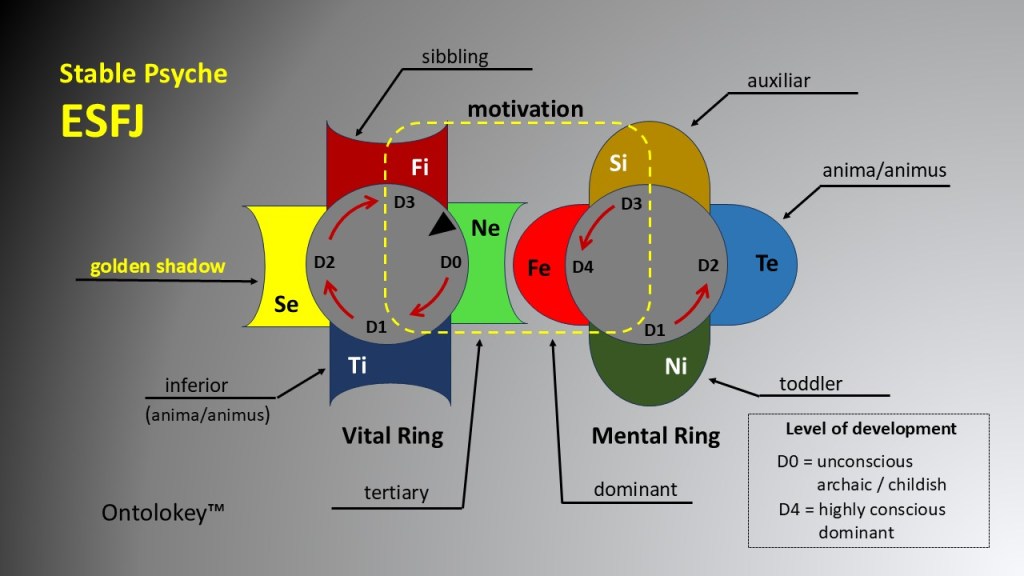
Few personality patterns are as easy to recognize on the surface and as difficult to understand at depth as the one commonly known as the ESFJ. The popular image is familiar to almost everyone who has ever met one: a warm, expressive, socially attuned person who seems to know instinctively what a room needs before anyone else has noticed the need. They are frequently found at the emotional center of families, friendship circles, workplaces, and communities, not because they crave power or status, but because they possess an unusual sensitivity to the invisible emotional forces that either hold people together or quietly drive them apart. They notice who feels excluded before that person says a word. They remember birthdays, preferences, old wounds, and small kindnesses that others have long forgotten. They often feel a near-physical compulsion to repair tension before it hardens into conflict, and to maintain bonds that other, less relationally oriented people would simply let dissolve. Viewed only from the outside, their behavior looks refreshingly simple: they care about people, and they act on that care constantly and visibly.
Yet this description, while accurate as far as it goes, barely scratches the surface of what is actually happening underneath. It tells us what this personality looks like in action, but not what actually drives it, and it says almost nothing about the existential tension that quietly organizes its entire inner life. Understanding the ESFJ properly requires looking past the stereotype of the tireless helper and into the psychological architecture that produces both the helping and, eventually, the exhaustion that so often follows it. This summary attempts exactly that. It sketches the everyday personality first, in the terms most people already recognize, and then moves into the far less comfortable territory of what lies beneath it — the shadow side that rarely appears in casual descriptions of this type but that, once understood, explains almost everything about how this personality succeeds, suffers, and eventually grows.
The Everyday Personality: Warmth as an Organizing Principle
At the core of this personality sits an outward-facing emotional function that continuously scans the social environment for signs of disharmony, need, or opportunity for connection. This is not simple sociability, and it is not merely being nice. It is a highly sophisticated regulatory mechanism whose task is to align the emotional atmosphere of a group with an internalized sense of what is right, fair, and appropriate. It monitors facial expressions, tone of voice, seating arrangements, silences, and a hundred other micro-signals that most people never consciously register, and it does this continuously, almost involuntarily, wherever this person happens to be. Because emotions are experienced not as private events locked inside individuals but as a shared, almost tangible field that exists between people, this type becomes extraordinarily skilled at reading and shaping that shared field. Every family develops a particular emotional climate, every friendship group generates its own atmosphere, and every organization carries a collective mood that shapes how its members behave; the ESFJ is the person who instinctively navigates, and often quietly manages, exactly that invisible territory.
Beneath this outward emotional orientation lies a second, steadier layer that gives the personality its practical ballast: a strong attachment to what has already been tested, proven, and lived through. This inward-facing sensory function stores not just facts but felt experience — the smell of a childhood kitchen, the specific comfort of a familiar ritual, the emotional weight of a recipe passed down through a family. It is what makes this type so naturally drawn to tradition, routine, and hospitality, and why hosting a dinner, decorating for a holiday, or preserving a family custom feels to them less like a chore and more like an act of care. This same function also explains their discomfort with sudden change; unfamiliar situations register almost as a low-grade threat, because the internal reference point for “safe” is built entirely out of accumulated, remembered experience. When life proceeds along recognizable lines, this type feels grounded and capable. When it doesn’t, an unease creeps in that can look, to outside observers, disproportionate to the actual disruption involved.
Further back in the personality, mostly out of conscious view, sit several less-developed capacities that nonetheless color everyday behavior in subtle ways. There is a talent for practical assertiveness and fair dealing that surfaces mainly under pressure — when this person feels their generosity has gone unreciprocated, or that fairness has been violated, a surprisingly direct, almost businesslike side can emerge, negotiating, budgeting, or defending their interests with more shrewdness than their warm exterior would suggest. There is also a flicker of forward-looking intuition, usually experienced not as strategic foresight but as sudden hunches, a nagging sense that something is about to change, or an unshakable, almost superstitious optimism that things will work out if one simply wants them enough. There is a playful, spontaneous streak that shows up as an urge to throw an impromptu party, rearrange a room, or surprise someone with an unexpected gift, injecting bursts of creativity and lightness into an otherwise structured life. And there is, buried deeper still, an admiration for people who move through the world with physical confidence and sensory boldness — those who dress daringly, act decisively, and seem entirely comfortable simply occupying space — a quality the ESFJ envies more than they usually admit, because it represents a kind of freedom their own personality rarely grants them access to.
What makes all of this cohere into a recognizable, likeable personality is the sheer consistency of the caretaking impulse. This type genuinely wants the people around them to be not just superficially content but emotionally fulfilled, and they will go to considerable lengths — sometimes exaggerating, sometimes overcommitting, sometimes making promises they cannot quite keep — in pursuit of that fulfillment, not out of dishonesty but out of an earnest, almost urgent hope of spreading a little more joy into a world they perceive as needing it. Communities depend on people like this far more than modern culture typically acknowledges. Someone has to remember, organize, encourage, and reconcile, and someone has to notice when a family, a friendship, or an organization is quietly drifting apart, before it becomes obvious to everyone else. That someone is very often this personality type, and the visible strengths that result from this orientation — warmth, reliability, generosity, social intelligence — are entirely real. But, as with every deeply ingrained pattern of behavior, these strengths are inseparable from a corresponding vulnerability, and it is that vulnerability, largely invisible from the outside, that constitutes the real psychological story of this type.
Where the Surface Description Breaks Down
The conventional portrait suggests that this personality possesses an uncomplicated sense of identity, precisely because they appear so socially confident and emotionally fluent. In reality, a great many people of this type spend a substantial portion of their lives quietly adapting themselves to whatever their environment seems to require. This adaptation rarely feels dishonest from the inside; it does not usually emerge from calculation or manipulation, but from genuine care that gradually, almost imperceptibly, hardens into habit. Bit by bit, the person learns to become whatever a given situation calls for — the responsible child, the supportive partner, the reliable friend, the devoted parent, the colleague everyone can always count on. There is something genuinely admirable in this capacity, and it deserves to be named as such before anything else is said, because human communities depend on exactly these people to hold things together in ways that are rarely thanked and even more rarely noticed.
The trouble is that a role performed long enough eventually becomes almost indistinguishable from identity itself. What begins as an act of service slowly turns into a definition of the self, and the transition happens so gradually that most people never notice it occurring until much later in life. Somewhere along the way, being indispensable becomes fused with feeling valuable, and self-worth becomes entangled with usefulness — with the ability to help, comfort, organize, or sustain the people around them. Because society rewards this pattern so generously, praising sacrifice and dependability without ever questioning what it costs the person providing it, the equation develops almost invisibly. Few people stop to ask what happens to someone whose identity has become rooted primarily in being needed once, inevitably, they are no longer needed in the same way. Children grow up. Careers end. Relationships change. Loved ones die. Communities evolve, and the social roles that once supplied a ready-made sense of purpose gradually thin out or vanish altogether, leaving behind a question that had remained comfortably hidden for decades: who am I apart from what I do for other people?
The Shadow: When Strengths Turn Against the Self
It is precisely here, at that unanswered question, that the shadow side of this personality begins to reveal itself. Popular descriptions tend to treat the outward emotional orientation of this type as more or less synonymous with kindness or emotional intelligence, but this equation is misleading. The function itself is not inherently moral or inherently benevolent; like any psychological capacity, it carries both a creative and a destructive potential, and its greatest strength — influence over the emotional atmosphere of a group — becomes dangerous the moment it separates from genuine self-awareness. A person who understands emotions this deeply can heal, encourage, and unite others, but the very same sensitivity that lets them recognize suffering also lets them identify vulnerability, and the same gift for creating harmony can curdle into an intolerance of disagreement. Some of history’s most destructive collective behaviors have arisen not from individual selfishness but from an excessive devotion to shared values and social conformity, and this is one of the more uncomfortable truths this personality eventually has to face: that their gift for consensus-building is also, potentially, a gift for enforcing conformity.
One of the clearest expressions of this shadow is what might be called an addiction to approval. It would be too simple to describe every person of this type as a straightforward people-pleaser, since many are perfectly capable of firm convictions and considerable determination. But underneath that variation lies a shared dynamic: because their attention is so continuously fixed on interpersonal reality, positive social feedback becomes fused with their sense of emotional security in a way that goes far beyond ordinary social validation. Approval stops being merely pleasant and becomes reassuring in a deeper, almost structural sense — proof that relationships remain intact and that one’s place in the group is secure. Once approval shifts from preference to necessity, the personality quietly reorganizes itself around maintaining it. Unpopular opinions get softened before they’re spoken. Frustrations get suppressed rather than voiced. Decisions get filtered through the anticipated reactions of others long before they are filtered through the person’s own convictions. None of this typically feels like dishonesty from the inside; it feels like consideration, cooperation, and kindness, and in many respects it genuinely is those things. But beneath the visible behavior, an authentic self and a socially acceptable self begin drifting apart, and the greater that distance grows, the more exhausting ordinary life becomes, because maintaining approval requires constant, unrelenting emotional labor.
A closely related shadow pattern is the tendency to elevate harmony above truth. This does not emerge from dishonesty but from genuine discomfort with conflict, tension, and disruption, all of which register almost as physical unpleasantness to a personality this attuned to emotional atmosphere. In its healthy form, this instinct resolves real conflicts through empathy and communication. In its shadow form, harmony itself becomes the highest value, and disagreement gets treated as inherently negative regardless of its cause. Difficult conversations get postponed indefinitely. Uncomfortable truths go unspoken for years. Dysfunctional patterns within families or organizations get tolerated because naming them threatens the fragile emotional equilibrium everyone has grown used to. The tragedy is that reality does not disappear simply because it goes unacknowledged; suppressed tensions accumulate beneath the surface, unspoken frustrations quietly convert into resentment, and what initially looked like harmony eventually reveals itself as collective avoidance. The person who has spent years maintaining the peace often ends up both the guardian and the victim of exactly this dynamic, because the truth they excluded from conscious awareness does not vanish — it simply resurfaces later, usually in a more destructive form than it would have taken had it been addressed honestly from the start.
This same capacity for reading and shaping group emotion also carries a less obvious form of power, one that rarely gets acknowledged because it doesn’t look like power in any conventional sense. A person who understands how approval and disapproval function within a group can, without ever issuing a direct command, shape what an entire community considers acceptable. Encouragement and gentle disappointment become tools of influence just as effective as any formal authority, and this influence is almost always exercised with sincerely good intentions — the desire for people to cooperate, support one another, and maintain healthy relationships. The shadow version of this dynamic emerges when social cohesion becomes more important than individual truth, when warmth is quietly withdrawn from those who don’t conform and just as quietly extended to those who do, and when guilt becomes an unspoken method of correction. What results is a subtle form of social coercion that neither the person exercising it nor the people experiencing it usually recognize as coercion at all, because it never relies on threats or force — only on the slow, cumulative pressure of conditional warmth. Independent thinkers and people who refuse to organize their lives around social approval tend to provoke an outsized reaction from the shadow version of this type, not because those people are especially difficult, but because their very existence quietly challenges the assumption that belonging must always come before authenticity.
The same forces that produce this social influence also produce one of the more painful shadow patterns: the collapse of caregiving into something closer to control. Healthy caregiving respects boundaries and allows people to make their own choices, even risky or uncomfortable ones. The shadow version becomes entangled with an unconscious need to be needed, so that helping quietly stops being a pure act of generosity and starts carrying an unspoken expectation of appreciation, loyalty, or continued dependence. Advice gets offered that was never requested. Intervention happens in situations that didn’t call for it. A loved one’s growing independence, rather than being celebrated, triggers a subtle discomfort, because if people no longer require support, the caregiver is left facing a question they have spent years avoiding: what role remains for someone who has built their identity around being indispensable? The underlying fear here is rarely malicious; it is almost always rooted in anxiety about abandonment and irrelevance, and it can quietly organize an entire relationship around dependency long before either partner consciously realizes what has happened.
Closely connected to this pattern is a dynamic that could fairly be called an unspoken ledger. Because sacrifice this consistent and this socially praised is difficult to name as a burden, resentment rarely gets expressed directly. Instead, it accumulates in the form of an internal accounting system — every favor given, every need anticipated, every sacrifice made, quietly tallied and quietly expected to be repaid in appreciation or reciprocity, even though the terms of this exchange were never actually communicated to anyone else. The eventual result is disappointment on both sides: the caregiver cannot understand why their enormous, ongoing generosity goes unacknowledged, while the people around them cannot understand why someone who seemed to be giving freely has suddenly become resentful. Neither side sees clearly that what looked like generosity was, in part, an unspoken transaction, and that this particular form of self-sacrifice — one that produces resentment rather than fulfillment — was never actually as selfless as it appeared.
Underneath all of these patterns runs a single, deeper conflict: a profound fear of individuality itself. From an early age, this personality tends to discover that connection provides safety and that shared values create stability, and family expectations, cultural norms, and collective traditions become deeply woven into their emerging sense of self. This serves them extraordinarily well for a long time. The difficulty arises later, when genuine psychological maturity requires a degree of separation from those very expectations — the willingness, at some point, to disappoint people they love in order to remain faithful to themselves. For many people of this type, that possibility feels almost unbearably threatening, because their entire psychological foundation has been built on connection and reciprocity. As a result, they may remain loyal to identities they have long outgrown, keep participating in systems they privately no longer believe in, and quietly suppress desires that conflict with what others expect of them. The tragedy is not that this prevents rebellion — rebellion by itself proves nothing — but that it prevents the deeper, quieter process of becoming fully oneself, leaving behind a vague, persistent sense that something important has gone unlived.
This same imbalance produces a specific blind spot around impersonal, purely logical reasoning. Because attention is so consistently drawn toward human impact and emotional consequence, questions of abstract consistency or objective evaluation can start to feel secondary, even irrelevant, compared to questions of who will be hurt and what will disrupt the group. This is not a matter of intelligence; it is a matter of how intelligence gets selectively applied. Facts that support existing emotional commitments get welcomed, while facts that threaten important relationships or shared identities generate quiet tension and, often, unconscious rationalization. This vulnerability becomes especially pronounced in group settings, where consensus can start functioning as a substitute for independent thought, and disagreement begins to feel not merely mistaken but socially inappropriate. History offers no shortage of examples in which entire communities sustained false beliefs or unjust systems precisely because large numbers of people agreed with one another; the presence of harmony has never been proof of the presence of truth, and learning to tolerate that discomfort is one of the harder developmental tasks this personality eventually faces.
Nowhere does this shadow reveal itself more painfully than in intimate relationships. The healthy version of this type approaches love with real generosity, deriving genuine satisfaction from acts of service and shared experience. But because so much of their identity is invested in the relationship itself, a partner’s need for independence can unconsciously register as distance, and a loved one’s desire for privacy can feel dangerously close to rejection. The shadow rarely responds to this fear through open confrontation; instead, it tends to intensify caretaking, offer unsolicited help, or become quietly more involved in a partner’s life, all of it experienced as concern rather than control, precisely because it does emerge from real concern — just concern that has become entangled with fear rather than trust. One of the central illusions at work here is the belief that closeness and constant involvement are the same thing, when in fact the healthiest relationships typically require real psychological distance and room for each person to remain, in some sense, a separate individual. When affection quietly becomes conditional on reciprocity — when giving comes with an unspoken expectation of an equivalent return — love and obligation start to blur together, and both partners usually suffer the consequences without fully understanding why.
Perhaps the most destabilizing shadow experience of all is what happens when the carefully built social identity eventually begins to break down. This rarely happens all at once; more often it unfolds gradually, through a divorce, an empty nest, a retirement, or simply a slow-dawning recognition that a life built on being needed no longer feels as meaningful as it once did. Whatever the trigger, the underlying experience is remarkably consistent: the caretaker discovers that not everyone wants to be cared for, the organizer discovers they are no longer indispensable, and a genuinely disorienting question rises to the surface — who am I beyond the roles I have performed for so long? This confrontation can produce real shame at first, since it exposes how much of one’s generosity contained unconscious expectations and how much of one’s identity depended on being useful to others. But it also opens a door. What looks at first like collapse is very often, on closer inspection, the actual beginning of a more authentic identity — one no longer dependent on constant contribution in order to feel real.
A quieter but equally telling shadow pattern shows up in the realm of loyalty. Few personalities remain as steadfastly committed as this one once a bond has formed, and this endurance is often a genuine strength, especially in a culture that tends to encourage premature abandonment of difficult relationships. But loyalty curdles into something else entirely once it stops being a conscious choice and becomes an unquestioned obligation — once the mere existence of a long-standing commitment becomes sufficient reason to preserve it, regardless of whether the relationship, institution, or belief in question still deserves that investment. The individual may remain loyal to people who consistently take advantage of their generosity, or stay emotionally attached to a relationship that has long since stopped offering anything resembling mutual growth, telling themselves all the while that leaving would be selfish or disloyal, when in reality what keeps them there is often fear of loss rather than love. Learning to distinguish those two motivations — commitment as an expression of love versus loyalty as a defense against uncertainty — is one of the harder and more necessary lessons this personality eventually has to learn.
Toward Integration
Beneath every one of these patterns lies a single, unifying fear that rarely gets named directly because it is woven into the very structure of the personality: the fear of becoming unnecessary. Not rejection exactly, and not simple loneliness, but something more specific and more corrosive — the possibility that one’s value depends entirely on being useful to other people, and that once usefulness disappears, nothing stable remains underneath it. This fear quietly shapes decisions, relationships, and entire life trajectories, pushing the individual toward earning their place through service and reliability rather than simply trusting that their place was never actually in question. The genuine work of maturity for this personality involves discovering, often quite late in life and often through real crisis, that their worth was never actually contingent on their contribution in the first place — that they can be loved rather than merely needed, and that relationships built on mutual freedom are ultimately far more durable than relationships sustained through obligation.
When this shift genuinely occurs, nothing about the personality’s fundamental warmth disappears. The mature version of this type remains just as caring, generous, and socially attuned as ever; what changes is the motivation underneath the behavior. They continue helping, but no longer because they are afraid of becoming irrelevant if they stop. They continue loving, but no longer as a strategy for securing a place within a group. The compulsive, anxious quality that once drove their generosity gradually gives way to something calmer and freer — care offered because it is chosen, not because it is required. This transformation does not happen automatically or easily, and for many people it only begins in the second half of life, often triggered by exactly the kind of loss or disruption the shadow spent decades trying to avoid. But it represents the clearest path this personality has toward genuine individuality: not the abandonment of connection, but the discovery that connection becomes most meaningful precisely when it is no longer required to answer the question of who one is.
A Closing Note
This summary has intentionally spent more time on the shadow than on the familiar, agreeable surface of this personality, because the surface description is already well known and widely available, while the deeper psychological patterns underlying it are far less commonly discussed. None of what has been written here is meant as a diagnosis, a criticism, or a verdict on anyone’s character. It is meant as an honest psychological mirror, offered in the understanding that self-knowledge, even the uncomfortable kind, is generally more useful than flattering simplification. Readers who recognize themselves in these pages, whether partially or fully, might take that recognition as an invitation toward reflection rather than as a source of shame; the same is true for readers who recognize a parent, partner, colleague, or friend in these descriptions.
This overview was compiled in English from material published on Ontolokey, a site devoted to mapping the psychological structure of personality in far greater depth than any short summary can capture. Readers who wish to explore this particular type — or any of the other fifteen personality structures described within the same framework — in significantly more detail, including the fuller architecture of conscious and unconscious functions discussed only briefly here, are encouraged to visit www.ontolokey.com, where the original, more extensive essays this summary draws upon can be found in full.


Leave a comment