Introduction: Beyond the Stereotype of the Reliable One
The ISTJ is one of the personality configurations most easily misunderstood precisely because its visible strengths are so socially recognizable. Reliability, discipline, conscientiousness, realism, loyalty, precision, and an almost instinctive respect for responsibility make the ISTJ appear psychologically straightforward: the person who remembers what others forget, finishes what others abandon, maintains what others neglect, and quietly carries obligations without demanding applause. Yet this surface description captures only the architecture of the conscious personality and says considerably less about the psychological tensions that sustain it. The deeper ISTJ is not simply a “responsible person,” but a psyche organized around a continuous negotiation between experience and action, stability and possibility, private values and external standards, control and uncertainty. Ontolokey’s distinctive contribution is to interpret this personality not as a static four-letter category but as a dynamic three-dimensional system in which conscious functions, shadow functions, developmental vulnerabilities, and opposing psychological tendencies remain in constant interaction. In that sense, the ISTJ is not merely the guardian of what already exists; it is a personality whose central developmental question concerns what happens when the structures that have made life safe begin to compete with the parts of the self that want life to become larger.
Traditional Jungian and MBTI-derived descriptions generally place Introverted Sensing (Si), Extraverted Thinking (Te), Introverted Feeling (Fi), and Extraverted Intuition (Ne) at the center of the ISTJ configuration, although the cognitive-function model should be understood as a typological framework rather than as a scientifically established map of discrete brain mechanisms. Within that framework, Si gives the ISTJ its profound relationship with accumulated experience, internal reference points, sensory memory, continuity, and familiarity; Te transforms those internal reference points into externally effective procedures, standards, decisions, and results; Fi supplies a quieter and more private moral center; and Ne introduces precisely the kind of uncertainty, multiplicity, and possibility that the conscious personality finds hardest to control. Ontolokey expands this conventional picture by explicitly examining additional positions—Extraverted Sensing (Se), Extraverted Feeling (Fe), Introverted Intuition (Ni), and Introverted Thinking (Ti)—and by treating them as meaningful dimensions of psychological development rather than irrelevant “extra” functions. Its cube therefore presents the ISTJ as an organism of tensions rather than a collection of adjectives, with the twelve possible functional relationships represented through dynamic sliders between opposing or complementary tendencies. This approach is particularly valuable for understanding the shadow, because the psychological material most likely to cause difficulty is often not what the individual consciously identifies with, but what the conscious identity has learned to distrust, suppress, postpone, or regard as unnecessary.
The central paradox of the ISTJ is therefore that the very qualities that make this personality extraordinarily dependable can, when absolutized, become mechanisms of psychological imprisonment. Discipline can become self-denial, responsibility can become compulsive burden-carrying, standards can become rigidity, competence can become an inability to admit weakness, and emotional restraint can gradually become estrangement from one’s own emotional life. Ontolokey’s deeper shadow analysis argues that the most serious danger is not obvious irresponsibility or chaos but something considerably more subtle: the replacement of authentic life with functional life, in which a person becomes exceptionally good at fulfilling obligations while becoming progressively less able to identify what they themselves actually want. The shadow may then emerge through resentment, fantasies of escape, disproportionate reactions to spontaneity, attraction toward people who embody disowned freedom, excessive control, moral rigidity, or sudden behavior that appears radically inconsistent with the established identity. None of this means that every ISTJ will display these patterns, nor does typology diagnose psychological dysfunction; rather, these themes provide hypotheses for self-examination. The “untold truth” of the ISTJ is thus not that the responsible exterior is false, but that it is incomplete: behind the person who can always be counted upon may exist another person who is quietly asking whether being needed has gradually become a substitute for being fully alive.
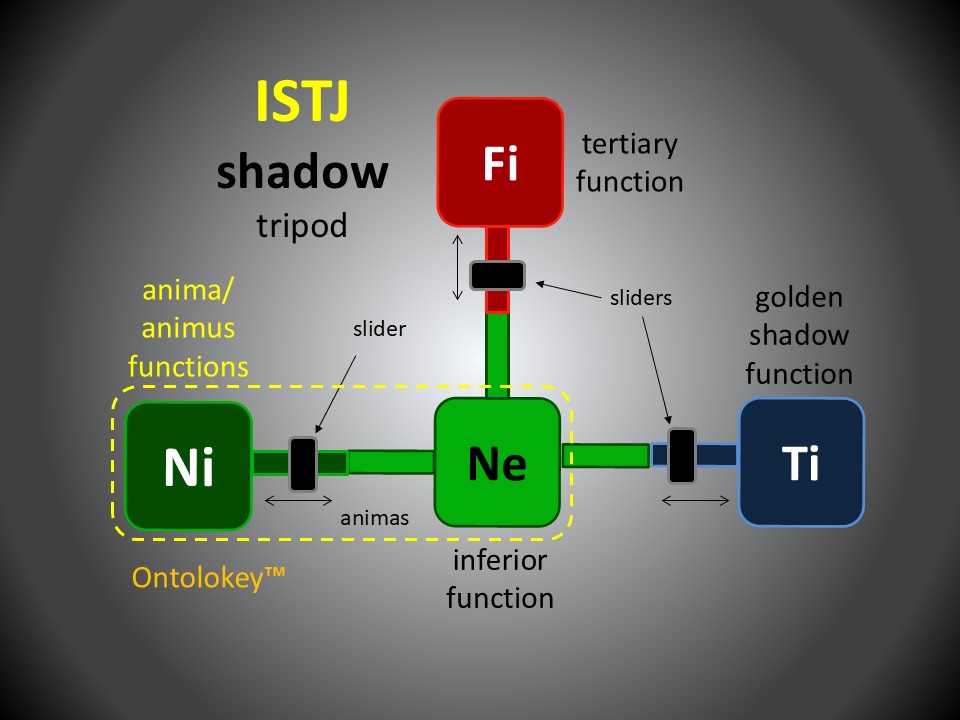
This essay will therefore examine the ISTJ through the full Ontolokey architecture, beginning with the conscious psychological orientation and moving through the principal functions and their corresponding developmental positions before entering the deeper territory of the shadow. Particular attention will be given to the meaning of each position—Dominant Si, Auxiliary Te, Sibling Se, Toddler Fe, Inferior Ne, Anima/Animus Ni, Tertiary Fi, and Golden Shadow Ti—because these positions reveal different psychological relationships to memory, action, sensation, emotion, possibility, meaning, morality, and internal logic. The purpose is not to glorify the ISTJ as the dependable guardian nor to expose it as secretly pathological, but to show why both interpretations are inadequate when taken alone. A mature ISTJ does not have to abandon structure, become emotionally demonstrative, or transform into an improvisational personality in order to grow; the deeper task is to make structure serve life rather than replace it, to allow responsibility to coexist with desire, and to develop the capacity to tolerate uncertainty without experiencing it as a threat to identity. In that movement, the ISTJ’s greatest strength and deepest vulnerability turn out to be two expressions of the same psychological principle: the extraordinary human need to create order in a world that can never be completely controlled.
I. The Psychological Foundation: Introversion, Perception, and the Need for Continuity
Before examining the individual functions of the Ontolokey cube, it is necessary to understand the psychological orientation from which the ISTJ experiences reality. In the Ontolokey interpretation, the ISTJ is described as introverted and irrational, with both terms carrying their specifically Jungian meanings rather than their everyday connotations. Introversion does not mean shyness, social incompetence, or an aversion to people; it describes the direction in which psychic energy is preferentially organized, namely toward an internal world of impressions, memories, subjective reference points, and personally processed experience. Likewise, “irrational” does not mean unreasonable or unintelligent, but refers to a perceptual orientation in which the individual initially seeks to apprehend what is present rather than immediately imposing a judgment upon it. This distinction is fundamental because it explains why the ISTJ can appear extraordinarily decisive and structured while nevertheless possessing a deeply observational psychological core: the external decisiveness is largely the consequence of what happens after perception has already been internally organized. Ontolokey therefore presents the ISTJ not as someone who instinctively rushes toward conclusions, but as someone who first establishes an internal sense of what is real, familiar, verifiable, and consistent before converting that perception into an externally organized course of action.
This orientation produces a distinctive relationship with uncertainty. An ISTJ does not necessarily fear change itself; what tends to create psychological friction is change that arrives without sufficient information, precedent, preparation, or intelligible structure. The difference is subtle but extremely important, because it means that what outsiders sometimes interpret as stubbornness may actually be an attempt to protect the integrity of an internally coherent map of reality. When an established procedure has repeatedly demonstrated its reliability, abandoning it merely because something newer is fashionable can feel irrational from the ISTJ’s perspective, while preserving it can represent intellectual honesty rather than blind conservatism. This is also why experience carries such unusual psychological authority for this type: experience is not merely a collection of memories but a database against which present circumstances can be compared, tested, and interpreted. Contemporary descriptions of the conventional ISTJ function stack similarly emphasize that Introverted Sensing compares present conditions with remembered experience, while Extraverted Thinking translates that information into externally effective organization and measurable results. The resulting personality is consequently grounded not simply in “the past,” but in accumulated evidence about what reality has previously demonstrated itself to be.
The psychological strength of this orientation becomes particularly visible when circumstances demand reliability rather than improvisational brilliance. The ISTJ can preserve institutional memory, recognize discrepancies that others overlook, remember precisely how a system is supposed to operate, and distinguish between an actual improvement and a superficial alteration that merely looks innovative. Dominant Introverted Sensing provides the internal archive, while Extraverted Thinking gives that archive practical force by asking how information can be organized into procedures, priorities, standards, responsibilities, and outcomes. In this sense, the ISTJ’s competence is often cumulative rather than spectacular: it grows through repetition, refinement, observation, correction, and an increasingly sophisticated understanding of what works under real conditions. The danger begins when this strength becomes fused with identity, because the person can gradually stop asking whether an established structure remains appropriate and begin treating its preservation as an obligation in itself. Ontolokey’s model is valuable precisely here because it does not portray the ISTJ’s preference for continuity as either inherently healthy or inherently pathological; instead, it places that preference within a dynamic system in which stability must eventually encounter immediacy, possibility, emotion, intuition, and alternative forms of reasoning.
At the center of this system stands Dominant Introverted Sensing (Si), the Archivist of Experience, which is arguably the most consequential psychological position for understanding the ISTJ. Si does not simply “remember facts,” nor is it equivalent to photographic memory; within the Jungian framework it represents an inwardly referenced perception of sensory impressions and their relationship to previous experience. The present is therefore continuously compared with an internal record of what has already been encountered, allowing the ISTJ to notice deviations, inconsistencies, recurring patterns, familiar sequences, and subtle differences that may be invisible to a person who primarily seeks novelty. Ontolokey describes this function as a psychological anchor because it provides continuity in a world that otherwise presents an endless stream of changing stimuli, and this anchoring quality can have a profoundly regulating effect on the personality. What appears externally as caution, conservatism, meticulousness, or resistance to spontaneous disruption can therefore serve an internally coherent purpose: Si reduces psychological noise by connecting the unfamiliar present to something already understood. When healthy, this produces one of the ISTJ’s greatest gifts—the ability to transform experience into dependable judgment without needing constant external reassurance.
Yet the same function can become defensive when continuity is unconsciously confused with safety. The more an ISTJ has learned that careful preparation prevents mistakes, the more tempting it becomes to expand that principle into a general philosophy in which unpredictability itself is treated as evidence of danger. At that point, Si no longer merely consults the past; it begins policing the present according to the past, and experiences that cannot be assimilated into established categories may be dismissed before they have been genuinely understood. This is one of the central psychological tensions of the type because the ISTJ’s extraordinary sensitivity to precedent can either produce wisdom or produce overidentification with precedent. The mature form of Si says, in effect, “I know what has happened before, so I can use that knowledge intelligently”; the defensive form says, “I know what has happened before, therefore I already know what this must be.” The difference between these two positions is the difference between experience functioning as wisdom and experience functioning as a prison, and it will become increasingly important as the essay moves from the conscious architecture of the ISTJ into its shadow dynamics.
II. Auxiliary Extraverted Thinking: The Architecture of Competence
If Introverted Sensing provides the ISTJ with an internal archive of experience, Auxiliary Extraverted Thinking (Te) is the mechanism through which that accumulated knowledge becomes action in the external world. This is the position that gives the ISTJ its characteristic ability to transform complexity into procedure, ambiguity into priorities, and intention into measurable execution. Ontolokey portrays this side of the personality as the practical, efficient, systems-oriented dimension that asks not merely whether something is true or meaningful, but whether it can actually be made to work. The ISTJ therefore tends to approach a problem by decomposing it into manageable elements, establishing an order of operations, identifying the relevant standards, and then pursuing completion with sustained consistency. This can produce an unusually high degree of dependability because the ISTJ does not generally rely upon temporary enthusiasm to accomplish something; once the task has been accepted as legitimate and necessary, the individual can continue working long after the emotional excitement surrounding it has disappeared. Ontolokey emphasizes that this productivity is not necessarily motivated by a desire for recognition, because the satisfaction frequently comes from the internal experience of competence itself—the quiet knowledge that something has been done correctly, thoroughly, and in a manner that will continue to function after the ISTJ has walked away from it.
The psychological importance of Te becomes clearer when it is understood as a complement to Si rather than as an independent trait. Si asks, in effect, what experience has already taught me about reality, while Te asks how that knowledge can be organized into an effective response to reality. The combination is extraordinarily powerful in environments where precision, accountability, continuity, and long-term execution matter, because the ISTJ can draw upon precedent without becoming immobilized by it. A complex project can be broken down into sequential tasks, an inefficient system can be examined for weaknesses, and a vague objective can be translated into concrete responsibilities, deadlines, standards, and procedures. This is one reason ISTJs often become the people others trust when something genuinely has to be completed rather than merely discussed. Their competence is frequently understated because they do not necessarily advertise the amount of cognitive labor involved in maintaining a system, yet their absence can reveal how much invisible structure they had been providing all along. In psychological terms, Te converts the ISTJ’s private relationship with reality into an externally testable form, which gives the personality a strong orientation toward accountability and results.
There is, however, a shadow hidden inside this admirable competence: the possibility that usefulness becomes the primary criterion by which the ISTJ evaluates both the world and the self. When Te is healthy, efficiency is a tool serving a meaningful objective; when it becomes defensive, efficiency can quietly become the objective itself. The person may begin measuring situations according to productivity, measurable outcomes, correctness, or practical value while becoming increasingly impatient with experiences whose value cannot be immediately quantified. Conversations that exist primarily for emotional connection can appear inefficient, artistic exploration can appear indulgent, and periods of rest can generate an uncomfortable sense that time is being wasted. The danger is not that the ISTJ becomes incapable of feeling or imagination, but that these dimensions of experience receive legitimacy only after they have been translated into something useful. This creates a subtle psychological hierarchy in which action outranks reflection, competence outranks vulnerability, and demonstrable contribution outranks subjective need. The resulting person can become extraordinarily capable while simultaneously becoming strangely uncertain about what they are allowed to want when no external task requires them to want it.
This tension also explains why an ISTJ may respond to interpersonal problems by attempting to solve them rather than by entering fully into the emotional experience behind them. If someone is distressed, the instinctive response may be to identify the practical cause, determine what can be changed, and initiate corrective action, because this is the language in which Te naturally expresses care. Ontolokey explicitly describes the ISTJ as someone who may show concern through practical assistance—repairing something, organizing something, providing food, creating order, or helping another person become capable—rather than through elaborate emotional declarations. This should not be mistaken for an absence of affection; indeed, for many ISTJs, practical reliability is one of the most sincere forms of affection they know how to offer. Yet the limitation becomes significant when the other person does not need a solution and instead needs emotional witnessing, ambiguity, patience, or permission to experience something that cannot yet be fixed. In those moments, Te can unintentionally communicate a message it never consciously intended: your problem matters to me, therefore I must solve it. The deeper developmental task is learning that some human experiences are not defective systems awaiting correction, and that sometimes remaining present with another person is more psychologically intelligent than making the situation efficient.
The mature expression of Te consequently involves a crucial distinction between control and stewardship. Control attempts to make reality conform to an internally preferred structure, whereas stewardship recognizes reality as something that must be managed responsibly without pretending that every variable can be mastered. An integrated ISTJ can retain extraordinary organizational ability while accepting that human beings are not machines, relationships cannot be optimized like workflows, and uncertainty is not automatically evidence of poor preparation. This is where the apparently rigid ISTJ can become surprisingly wise: the same person who once needed every variable accounted for can gradually learn which variables actually matter and which merely represent an understandable desire for certainty. Te then becomes less about proving competence and more about creating conditions in which competence serves something larger—responsibility, fairness, craftsmanship, protection, contribution, or loyalty. The deepest version of ISTJ practicality is therefore not sterile efficiency but respect for reality, including the inconvenient reality that people, including the ISTJ themselves, sometimes need time, emotional space, forgiveness, and meaning rather than another perfectly executed solution.
III. Sibling Extraverted Sensing: The Encounter with the Immediate World
Within the Ontolokey cube, Sibling Extraverted Sensing (Se) occupies a particularly revealing position because it represents a form of perception that is simultaneously close to the ISTJ and fundamentally different from its dominant mode of experiencing reality. Si looks at the present through the accumulated imprint of previous experience, whereas Se seeks to encounter the present with minimal mediation, attending directly to what is physically happening here and now. For the ISTJ, this creates an intriguing psychological tension: the individual may be exceptionally observant of concrete reality while still being uncomfortable with the psychological demand to respond spontaneously to it. The distinction matters because observation and immediacy are not identical capacities; an ISTJ can notice an enormous amount of detail and nevertheless prefer to process that detail through an established internal framework before acting. Ontolokey therefore describes Se as a sibling rather than simply an inferior opposite, suggesting that it is accessible to the ISTJ but operates according to a different energetic logic. It is the part of the personality that quietly asks the question Si is least inclined to ask: not “What does this remind me of?” but “What is actually happening right now?”
This distinction becomes psychologically important whenever circumstances cannot be adequately handled through preparation or precedent. In ordinary life, the ISTJ may prefer to anticipate requirements, establish procedures, understand expectations, and create a reliable sequence through which events can unfold, but reality inevitably produces situations that refuse to cooperate with such preparation. A sudden change of plan, an unexpected opportunity, a physical challenge, a rapidly evolving social environment, or a situation requiring immediate improvisation can temporarily deprive the ISTJ of the familiar advantage provided by Si. Se then becomes both challenge and resource because it directs attention away from accumulated interpretations and toward the concrete information arriving through the senses at this exact moment. Ontolokey notes that this capacity can emerge particularly strongly during experimentation or crisis, sometimes producing brief episodes of striking boldness or spontaneity. The paradox is that the ISTJ may occasionally discover, under pressure, that they are far more capable of improvisation than their normal self-image suggests, precisely because circumstances temporarily force them to stop consulting the internal archive and start trusting direct perception.
The shadow side of this relationship appears when suppressed immediacy returns without sufficient integration. An ISTJ who spends prolonged periods controlling impulses, postponing pleasure, suppressing physical needs, or treating spontaneity as irresponsible may eventually experience Se not as a refined capacity for presence but as a compensatory hunger for sensory intensity. The resulting behavior can seem strangely uncharacteristic: impulsive spending, excessive physical stimulation, sudden risk-taking, compulsive environmental rearrangement, or an almost desperate need to escape the repetitive structure of ordinary obligations. Ontolokey specifically associates Se with bursts of boldness and with hands-on attempts to impose order upon the physical environment, which illustrates the ambiguity of this function in the ISTJ psyche. What appears to be an irrational impulse may therefore contain a legitimate psychological message: the organism has been living too exclusively through abstraction, memory, duty, or planning and is demanding contact with embodied existence. The healthier alternative is not to suppress Se but to give it a legitimate place in ordinary life, allowing pleasure, physical movement, aesthetic experience, travel, experimentation, and spontaneous engagement to exist without requiring them to become acts of rebellion.
There is also a deeper existential significance to Se because it confronts the ISTJ with the irreversibility of time. Si is intimately connected with what has already been experienced, while Se insists that reality is continuously occurring and cannot be preserved indefinitely in advance. Every moment that the ISTJ spends attempting to prepare for life is simultaneously a moment of life itself, and this creates a subtle danger for a personality that derives security from readiness. Excessive preparation can become a sophisticated form of postponement in which the person continually believes that genuine participation will begin once everything has been organized sufficiently well. Yet the world never becomes sufficiently predictable to satisfy that condition, and the resulting pattern can lead to a life that is technically well managed but insufficiently inhabited. Integration of Se therefore means learning to distinguish preparedness from postponement and responsibility from avoidance. The mature ISTJ does not discard planning; instead, planning becomes a foundation from which presence is possible, rather than a wall behind which experience is permanently deferred.
At its healthiest, Se can consequently become one of the ISTJ’s most underrated developmental assets because it teaches the personality that reality does not always need to be interpreted before it can be experienced. An integrated ISTJ can enter a room and simply perceive it, engage with another person without immediately categorizing the interaction, respond to an unexpected development without assuming that unpredictability equals danger, and allow an experience to remain valuable even when it produces no measurable result. This does not transform the ISTJ into an impulsive personality, nor should psychological development be confused with becoming the opposite type. Instead, Se adds a dimension of immediacy to the existing Si architecture, allowing experience to become something more than stored information: it becomes lived presence. Ontolokey’s broader principle is that personality development occurs through dynamic equilibrium rather than replacement, and the Si–Se tension illustrates this particularly well. The ISTJ does not become psychologically whole by abandoning the archive, but by learning that an archive is ultimately meaningful only because there is a living present in which its accumulated knowledge can be used.
IV. Toddler Extraverted Feeling: The Difficult Education of Emotional Reciprocity
Toddler Extraverted Feeling (Fe) occupies one of the most psychologically revealing positions in the Ontolokey architecture because it concerns an area in which the ISTJ may possess considerable goodwill while lacking equal confidence in the language through which that goodwill is communicated. Fe is concerned with the emotional field between people: shared atmosphere, interpersonal harmony, social responsiveness, emotional reciprocity, and the capacity to recognize what a situation requires emotionally rather than merely procedurally. Ontolokey places Fe in the Toddler position, describing it as comparatively immature, vulnerable, and prone to misunderstanding, while explicitly cautioning that this does not mean the ISTJ lacks empathy or human feeling. (ontolokey.com) The distinction is crucial because the ISTJ may care profoundly while remaining uncertain about how much emotional expression is appropriate, how directly feelings should be communicated, or how much emotional dependency can safely be tolerated. Consequently, the ISTJ can sometimes be perceived as cold by people who equate emotional warmth with verbal expressiveness, even though the individual may be demonstrating attachment through reliability, protection, practical assistance, and an extraordinary willingness to carry burdens for the people they consider their own. The psychological problem therefore is not necessarily insufficient feeling but insufficient translation: the internal experience of caring may be considerably richer than the interpersonal language available for communicating it.
This helps explain a recurring relational paradox in the ISTJ. The person may believe that their actions should communicate what their words do not, because from their perspective actions are more substantial evidence than emotional declarations. If someone remembers every practical detail, keeps promises, solves problems, protects another person’s interests, remains present during difficult circumstances, and reliably fulfills commitments, the ISTJ may reasonably regard these behaviors as an unmistakable demonstration of affection. Yet interpersonal relationships operate through multiple symbolic systems, and another person may need explicit reassurance, emotional validation, tenderness, enthusiasm, or verbal recognition in addition to practical reliability. Ontolokey’s description of Fe as an underdeveloped social compass captures this gap without reducing it to emotional deficiency: the ISTJ may know what is objectively responsible while being less certain about what will make another person subjectively feel understood. (ontolokey.com) This becomes especially complicated when emotional situations are ambiguous, because there may be no established procedure that tells the ISTJ exactly what to say or do. In such moments, the individual can become uncomfortable not because the other person’s emotions are unimportant, but because the normal instruments of competence—precedent, analysis, structure, and practical correction—do not provide an obvious solution.
The shadow dimension of this difficulty can become considerably more painful when emotional needs remain unspoken on both sides. The ISTJ may give extensively while assuming that the other person recognizes the significance of those sacrifices, while the recipient may appreciate the practical support but still experience an emotional absence because certain feelings have never been articulated. Ontolokey’s shadow analysis describes precisely this potential accumulation of unacknowledged needs: the dependable ISTJ can become the person upon whom everyone relies, while simultaneously finding it difficult to admit that they themselves require support, recognition, tenderness, or reassurance. Over time, this asymmetry can produce an internal ledger of disappointments in which the person remembers everything they have done for others but has never clearly communicated what they hoped to receive in return. Because the grievance has not been openly negotiated, it may emerge indirectly through withdrawal, criticism, stubbornness, emotional distance, or disproportionate anger rather than through a vulnerable statement such as “I need you to recognize what this has cost me.” The tragedy is that the ISTJ may experience this as evidence that other people are ungrateful, while the other person experiences it as an unexpected change in behavior, without either side fully recognizing that the underlying problem was an emotional contract that was never consciously articulated.
This is where Fe development becomes an important part of psychological maturity rather than merely a matter of becoming “more emotional.” A mature ISTJ does not need to become socially performative, excessively expressive, or dependent upon constant interpersonal affirmation; instead, the developmental task is to become more accurate in recognizing that other people do not necessarily receive care in the same form in which the ISTJ naturally gives it. Emotional intelligence in this context means learning to ask what another person is actually experiencing before deciding what should be done about it, and learning to distinguish emotional validation from agreement. It also means becoming capable of communicating one’s own needs before they harden into resentment, because responsibility without reciprocity eventually becomes a form of self-abandonment. Ontolokey describes development along the Si–Fe axis as increasing emotional literacy and a deeper interpersonal ethic, in which the ISTJ learns not merely to do what is correct but to express that correctness in a form another human being can genuinely receive. (ontolokey.com) This is a profound distinction: moral behavior is not only about having good intentions or fulfilling one’s obligations, but also about understanding the psychological reality of the person standing on the other side of one’s actions.
There is consequently something deceptively tender about the Fe Toddler in the ISTJ. The very awkwardness surrounding emotional expression can conceal an intense desire to belong, to be appreciated, and to know that one’s loyalty is reciprocated rather than merely exploited. The person who appears least likely to ask for reassurance may sometimes need it deeply, precisely because asking would expose a part of the self that has been trained to remain competent and self-sufficient. Ontolokey’s broader conception of individuation suggests that this vulnerable function should not be conquered or forced into the dominant personality, but gradually integrated into a larger psychological equilibrium in which duty and feeling can coexist. (ontolokey.com) The mature ISTJ therefore does not abandon practical love but learns to supplement it with emotional presence, just as they do not abandon self-sufficiency but learn that accepting support does not invalidate competence. When this development occurs, the ISTJ’s loyalty becomes warmer without becoming sentimental, their honesty becomes more compassionate without becoming dishonest, and their reliability becomes relational rather than merely functional. What once appeared to be emotional awkwardness can then become something more valuable: a quiet, deliberate capacity to treat another person’s inner world as seriously as the ISTJ has always treated external reality.
V. Inferior Extraverted Intuition: The Fear of Possibility and the Liberation Hidden Within It
Inferior Extraverted Intuition (Ne) is perhaps the most psychologically decisive function in the ISTJ configuration because it represents both the personality’s deepest source of uncertainty and one of its most important developmental opportunities. Ne turns attention toward alternatives, possibilities, hypothetical outcomes, emerging patterns, and futures that have not yet been verified through experience. For a dominant Si personality, this orientation can initially feel destabilizing because Ne refuses to guarantee which possibility will become reality; it multiplies rather than reduces the number of potential interpretations. Ontolokey therefore describes Ne as the ISTJ’s “Shadow of Chaos and Creativity,” emphasizing that the same function capable of generating anxiety and worst-case scenarios can, when consciously integrated, become a source of innovation and psychological freedom. This duality is essential because the inferior function is not simply a weakness that should be eliminated, but a neglected psychological capacity that can eventually compensate for the limitations of the dominant orientation. The ISTJ does not suffer because possibilities exist; the deeper difficulty arises when the psyche feels compelled to eliminate possibilities before it can feel safe enough to act.
In everyday life, this can create a peculiar relationship with uncertainty in which the ISTJ may be simultaneously highly imaginative and highly distrustful of imagination. A healthy Ne allows a person to ask, “What else could be true?” or “What might happen if I approached this differently?”, but an insecure Ne can transform the same cognitive openness into an uncontrolled proliferation of potential problems. Instead of generating creative alternatives, the mind begins generating contingencies: What if this goes wrong? What if I overlooked something? What if the apparently harmless change produces consequences I cannot predict? What if the person I trust behaves differently than expected? Ontolokey explicitly associates inferior Ne under stress with irrational fears, worst-case scenarios, and mental chaos, which explains why an ISTJ who normally appears calm and grounded can occasionally become consumed by possibilities that are statistically remote but psychologically vivid. The irony is that the ISTJ’s normal strategy for reducing uncertainty—gathering information and establishing order—can actually intensify the problem when applied compulsively, because every additional possibility generates another variable that appears to require control. At its extreme, preparation ceases to be preparation and becomes an attempt to create certainty in a reality that cannot provide it.
This is one of the places where the ISTJ’s shadow can be profoundly misunderstood from the outside. People may see someone who is ordinarily practical and methodical suddenly become suspicious, catastrophizing, indecisive, or unusually preoccupied with unlikely scenarios, and conclude that the person has simply become irrational. Psychologically, however, the phenomenon can be understood as an inversion of the normal hierarchy: the function that ordinarily remains subordinate begins demanding attention because the dominant strategy is no longer sufficient to regulate the situation. The ISTJ’s mind may then move from the familiar logic of “I know what has worked before” toward the destabilizing realization that the current situation contains variables for which there is no reliable precedent. This can produce either paralysis or compulsive preparation, depending on the individual and circumstances. The deeper developmental challenge is to recognize that uncertainty cannot always be defeated by more information, because some decisions require action before certainty becomes available. Ne becomes healthier when the ISTJ learns to regard possibility not automatically as danger but as information about the range of reality.
The positive potential hidden inside inferior Ne is therefore much greater than the stereotype of the cautious ISTJ suggests. Once sufficiently developed, Ne gives the personality permission to experiment intellectually, revise assumptions, entertain unconventional solutions, and imagine futures that are not simply repetitions of the past. Ontolokey describes this capacity as an engine of innovation because it enables the ISTJ to break established patterns rather than merely perfect them. This can produce a particularly formidable form of creativity: instead of generating novelty for novelty’s sake, the ISTJ can combine the exploratory breadth of Ne with the empirical discrimination of Si and the executional strength of Te. Such a person is capable not merely of imagining ten alternatives but of determining which one has enough structural integrity to survive contact with reality. The resulting creativity is often quieter than the stereotypical image of the visionary, because it may appear as incremental invention, system redesign, strategic contingency planning, technical refinement, or the discovery of an unconventional solution to a practical problem.
The deepest transformation occurs when the ISTJ stops demanding that every new possibility prove itself safe before it is allowed psychological space. This does not mean becoming reckless, abandoning standards, or treating every idea as equally valid; rather, it means learning to distinguish uncertainty from danger. A possibility can be unverified without being threatening, and an unfamiliar path can be approached experimentally without requiring a lifelong commitment. In this sense, Ne can teach the ISTJ an emotional lesson as much as a cognitive one: reality does not have to be completely known before it can be trusted enough to be explored. The person who once used experience primarily to protect against uncertainty can gradually begin using experience as a launching point from which new experience becomes possible. This is why Ontolokey treats the inferior function as a potential gateway to individuation rather than merely a defect in the personality architecture. The mature ISTJ eventually discovers that the opposite of chaos is not absolute control but flexible order, an order strong enough to absorb surprise without collapsing, and this may be one of the most important psychological freedoms available to the type.
VI. Anima Introverted Intuition: The Hidden Vision Beneath the Practical Mind
Anima Introverted Intuition (Ni) occupies a very different psychological territory from the ISTJ’s dominant Si, even though both functions are introverted forms of perception and therefore can appear superficially similar. Si gathers and organizes lived impressions through continuity, comparison, familiarity, and accumulated experience, whereas Ni seeks an underlying trajectory, symbolic meaning, singular pattern, or future direction that may not yet be consciously demonstrable. Ontolokey places Ni in the Anima position for the ISTJ, describing it as a hidden capacity for long-term vision, insight, and deeper interpretation rather than as an ordinary conscious operating mode. This position is psychologically significant because it suggests that beneath the ISTJ’s concrete orientation toward what has been established there can exist a surprisingly abstract capacity to perceive where things are heading. The ISTJ may therefore occasionally produce an insight that seems disproportionate to the person’s otherwise empirical style, not because the individual has suddenly abandoned reality, but because Ni has momentarily condensed numerous observations into a single internal conclusion. What makes this function difficult is that the insight may arrive without the kind of sequential evidence that Te and Si normally prefer, leaving the ISTJ uncertain whether to trust it.
The distinction between Si and Ni can be understood as the difference between recognizing continuity and perceiving direction. Si may notice that a particular situation resembles previous situations and therefore activate a repository of relevant experience, while Ni may notice that apparently unrelated developments are converging toward one underlying outcome. The former asks, “Where have I encountered something like this before?” whereas the latter is more concerned with “Where is this ultimately going?” Neither is inherently superior, and neither should be reduced to simplistic stereotypes about memory versus prophecy, but they organize perception according to fundamentally different principles. Ontolokey’s designation of Ni as the ISTJ’s Anima is therefore useful because it identifies an internal capacity that can feel both attractive and unfamiliar: the ability to step outside immediate procedures and contemplate the deeper trajectory of a system, relationship, institution, or personal life. When developed, this can transform the ISTJ from an excellent maintainer into an unusually perceptive strategist, because accumulated evidence is no longer used only to preserve what works but also to infer what may need to change before the consequences become obvious.
The difficulty is that Ni can become psychologically distorted when it is activated without sufficient grounding in the ISTJ’s normal empirical discipline. Under pressure, the mind may leap from a handful of observations toward an apparently inevitable conclusion and then treat that conclusion as though it were already established fact. This can produce a particularly subtle form of rigidity because the person may believe they are being intuitive when they are actually constructing a closed narrative about what is going to happen. The same psychological capacity that produces strategic foresight can therefore produce fatalism, suspicion, excessive interpretation, or an unwarranted conviction that a particular future is already determined. The broader Ontolokey framework explicitly treats the Anima as a shadowed but meaningful function rather than simply a defect, which means that Ni should neither be suppressed nor granted unquestioned authority. For the ISTJ, the healthiest relationship with Ni is consequently one of dialogue: experience supplies evidence, intuition proposes a trajectory, and thinking tests whether that trajectory deserves to guide action.
There is also a deeper developmental implication in the fact that Ni occupies an Anima position. The ISTJ may spend much of life concentrating on what must be done next, what has worked previously, what responsibilities currently exist, and what practical problem requires attention, while the question of ultimate direction remains strangely underdeveloped. Such a person can build an exceptionally stable life without ever asking whether the life being stabilized is actually the life they want to continue living. Ni introduces precisely this uncomfortable question because it shifts psychological attention from maintenance toward destiny, from individual tasks toward the meaning of the larger trajectory. This does not necessarily produce dramatic existential crises; it can appear much more quietly as a growing realization that professional competence, financial security, family obligations, or social respect are not identical to personal fulfillment. The ISTJ may eventually recognize that a perfectly maintained structure can still be built around an outdated purpose, and that preserving something indefinitely does not automatically make it worth preserving. Ni therefore becomes psychologically valuable when it enables the individual to distinguish continuity from direction: the fact that something has always been done does not tell us whether it is leading toward the future we actually intend.
At its most mature level, Ni gives the ISTJ a form of strategic depth that can be remarkably powerful because it is supported by the accumulated realism of Si and the executional discipline of Te. The result is not a visionary personality in the stereotypical sense, but a person capable of seeing long-term consequences without becoming detached from practical reality. Such an ISTJ can recognize when an institution is slowly becoming obsolete, when a relationship is developing toward a predictable rupture, when a recurring pattern is pointing toward a larger systemic problem, or when an apparently minor decision will have significant consequences years later. Ontolokey’s broader model places Ni alongside the other functions as part of a dynamic architecture in which hidden capacities can become sources of integration rather than permanent weaknesses. The deepest lesson of the ISTJ’s Anima is therefore that practicality does not have to mean confinement to the immediately verifiable; sometimes the most practical thing a person can do is to perceive where the current trajectory leads before reality makes the destination unavoidable. In that sense, Ni does not ask the ISTJ to abandon evidence for intuition, but to allow evidence to become the foundation from which deeper vision can emerge.
VII. Tertiary Introverted Feeling: The Private Moral Core
Tertiary Introverted Feeling (Fi) introduces one of the most important contradictions within the ISTJ because it reveals that the personality’s commitment to rules, standards, responsibility, and objective correctness does not necessarily mean that the individual lacks a deeply personal system of values. On the contrary, Fi represents a private evaluative dimension in which experiences are measured against an internal sense of authenticity, personal loyalty, moral significance, and what feels fundamentally right or wrong to the individual. In the conventional ISTJ function model, Fi is positioned as tertiary, meaning that it is considerably more accessible than the inferior or shadow functions but generally less developed and consciously confident than Si and Te. This helps explain why an ISTJ can appear highly objective in public while holding intensely personal convictions that are not easily negotiable. The person may follow established rules for years without complaint, yet if a rule eventually violates a deeply held principle of fairness, loyalty, integrity, or personal conscience, the response can be surprisingly absolute. What outsiders sometimes interpret as inconsistency is therefore better understood as the interaction between two different forms of judgment: Te asks whether something is objectively effective or procedurally correct, while Fi quietly asks whether it is morally acceptable to the individual who must live with the consequences.
The tertiary position also explains why Fi may remain largely invisible until something important crosses an internal boundary. The ISTJ is often willing to tolerate inconvenience, follow procedures, fulfill obligations, and subordinate personal preference when a responsibility is considered legitimate, but this should not be mistaken for the absence of personal preference or emotional depth. In many cases, the individual has simply learned to keep these things private because openly foregrounding subjective feelings can appear less reliable than presenting objective reasons. This creates a psychological economy in which the ISTJ may be much more emotionally invested in an issue than their language suggests, yet communicate their position through principles, facts, responsibilities, or consequences rather than explicitly saying, “This matters deeply to me.” Ontolokey’s model is especially useful here because it prevents the common stereotype of the ISTJ as someone governed exclusively by external rules; the tertiary Fi position indicates that beneath the visible structure exists an increasingly important private moral landscape. When that landscape is respected, the ISTJ can possess exceptional integrity because external responsibility is reinforced by an internal conviction that certain things simply should or should not be done. When it is chronically suppressed, however, the same person can become resentful because other people may repeatedly benefit from sacrifices whose personal emotional cost was never acknowledged.
This suppression can become particularly dangerous when the ISTJ confuses self-control with self-erasure. Because Te and Si are naturally comfortable with duty, consistency, and delayed gratification, an ISTJ can become extremely skilled at placing personal needs at the bottom of the priority list, especially when other people or institutions depend upon them. The problem is that Fi does not disappear merely because it is ignored; it continues recording subjective experiences of violation, disappointment, loyalty, betrayal, appreciation, and meaning. Over time, these experiences can accumulate into a private emotional history that may be invisible even to the people closest to the ISTJ. The person may continue functioning normally while internally reaching a point at which a previously tolerated situation suddenly becomes morally intolerable, producing a decisive withdrawal that seems abrupt to everyone else. Ontolokey’s shadow-oriented treatment of the ISTJ emphasizes the danger of accumulated resentment and the consequences of a life in which personal needs remain subordinated to responsibility for too long. (ontolokey.com) The psychological lesson is therefore not that the ISTJ should become more self-centered, but that genuine responsibility must include responsibility toward one’s own inner life, because a person who continually violates their own values in order to satisfy external obligations eventually ceases to act from integrity and begins acting from exhaustion.
A healthy tertiary Fi can instead become the source of the ISTJ’s quietest and most powerful form of loyalty. When an ISTJ decides that a person, principle, institution, or commitment genuinely matters, the resulting devotion may be extraordinarily durable because it is supported by both practical responsibility and personal conviction. This helps explain why the type can be deeply loyal even when its emotional expression is understated; the absence of theatrical affection should not be confused with the absence of attachment. Fi gives the ISTJ the ability to distinguish between what is merely expected and what is personally meaningful, and this distinction becomes increasingly important as the individual matures beyond simply fulfilling externally defined roles. It can also provide an ethical counterweight to Te, preventing efficiency from becoming the sole criterion for decision-making. A highly developed ISTJ can therefore ask not only whether a decision works, but whether it is fair, honorable, loyal, humane, and consistent with the kind of person they want to be. In this form, Fi does not undermine the ISTJ’s objectivity; it gives that objectivity a conscience.
The deepest developmental movement of tertiary Fi is consequently the transition from being responsible because responsibility is expected to being responsible because it expresses a consciously chosen value system. This distinction may appear subtle, but psychologically it represents a major shift from externally structured identity toward internal authorship. The immature ISTJ can define the self through roles: employee, parent, partner, provider, expert, organizer, protector, or reliable friend, while the mature ISTJ increasingly asks which of these roles genuinely correspond to personal convictions and which have merely been inherited from expectation. That question can be uncomfortable because it may reveal that some forms of loyalty have become habits rather than choices, or that some responsibilities are maintained primarily because abandoning them would produce guilt. Fi introduces the possibility that saying “no” can sometimes be more ethical than continuing to perform a role that has become destructive, and that personal authenticity is not the opposite of responsibility but one of its foundations. When Si supplies wisdom from experience, Te supplies execution, and Fi supplies inner value, the ISTJ becomes capable of something far more sophisticated than simple rule-following: the ability to decide which rules deserve loyalty in the first place. In that integration, the ISTJ’s characteristic integrity becomes genuinely personal rather than merely procedural, because the individual is no longer simply preserving what is right according to an external structure but consciously choosing what is worth preserving according to an internal moral core.
VIII. Golden Shadow Introverted Thinking: The Hidden Architect
The final major functional position in the Ontolokey architecture is Golden Shadow Introverted Thinking (Ti), and it may represent the most intellectually liberating dimension of the mature ISTJ. Whereas Extraverted Thinking is concerned with applying objective standards, organizing external systems, and producing demonstrably effective outcomes, Ti turns inward and asks whether the underlying structure of an idea is internally coherent in its own right. Ontolokey therefore describes Ti as the ISTJ’s “Hidden Architect”: an unconscious reserve of analytical depth, independent logic, theoretical refinement, and intellectual creativity that can remain largely invisible during ordinary functioning. (ontolokey.com) The distinction between Te and Ti is subtle but psychologically transformative, because Te is comfortable asking whether an established method works while Ti asks why the underlying principle should be considered valid at all. An ISTJ dominated by Te can become exceptionally competent within an existing system, whereas an ISTJ who develops Ti can eventually become capable of examining the architecture of the system itself. This is one of the points at which the personality can move beyond being merely a guardian of established knowledge and become an independent thinker who possesses the confidence to construct, critique, and revise principles from the inside.
The Golden Shadow designation is particularly important because it differs psychologically from the more threatening forms of shadow material. In Ontolokey’s formulation, the Golden Shadow contains qualities that the conscious personality may admire, project onto others, or initially experience as belonging more naturally to someone else. (ontolokey.com) The ISTJ may therefore be fascinated by people who appear intellectually autonomous, theoretically sophisticated, philosophically independent, or capable of questioning assumptions that everyone else takes for granted, without immediately recognizing that these qualities represent an unrealized dimension of their own psyche. This can produce an interesting form of admiration in which the ISTJ sees another person as possessing a kind of intellectual freedom that they themselves have not yet consciously claimed. Yet the psychological potential is already latent: the ISTJ’s meticulousness, attention to consistency, and refusal to accept unsupported claims can provide an excellent foundation for Ti once the person becomes willing to detach analytical validity from external authority. The hidden architect does not destroy the existing structure; it asks whether the structure is internally sound.
This is also where the ISTJ’s relationship with authority can undergo one of its most significant transformations. In its less developed form, Te can become overly dependent upon established standards, recognized procedures, institutional rules, measurable evidence, or socially validated methods, particularly when those structures have proven reliable over time. There is nothing inherently problematic about this orientation, and in many professional contexts it is precisely what makes the ISTJ trustworthy, but it can become restrictive when external validity is unconsciously equated with truth itself. Ti introduces a more radical question: does this make sense independently of who says it should make sense? That question can be uncomfortable because it potentially destabilizes systems that have previously provided certainty and identity. Ontolokey notes that shadow Ti can also manifest negatively as rigid skepticism, compulsive analysis, or the devaluation of intuition, which demonstrates that the function becomes problematic when it is used defensively rather than integratively. (ontolokey.com) Mature Ti is therefore not contrarianism for its own sake; it is the ability to distinguish genuine logical necessity from mere procedural convention.
The relationship between Ti and Ne is particularly important because Ontolokey explicitly identifies the Ti–Ne axis as a bridge between scattered possibility and refined insight. (ontolokey.com) Ne generates alternatives, questions assumptions, and expands the range of conceivable explanations, while Ti evaluates those possibilities according to internal coherence and conceptual precision. For the ISTJ, this combination can initially feel destabilizing because it temporarily suspends the normal Si–Te process of recognizing precedent and implementing an established solution. Yet it also creates an entirely new intellectual mode: instead of asking only which solution has worked before, the individual can ask which solution makes the most sense given the principles involved. This can lead to theoretical innovation, sophisticated problem-solving, philosophical inquiry, technical mastery, and an ability to recognize flaws in systems that function adequately on the surface. The danger is that the same capacity can become obsessive when the ISTJ refuses to act until every conceptual inconsistency has been resolved, effectively replacing Te’s practical rigidity with Ti’s analytical rigidity. Integration therefore requires knowing when internal coherence has been established sufficiently for action and accepting that reality will always contain variables that no conceptual system can completely eliminate.
At its deepest level, Golden Shadow Ti represents the possibility of self-authorized thought. This is psychologically different from merely becoming more intelligent, because intelligence can operate perfectly well within inherited frameworks while still depending upon external permission to determine what counts as valid. Self-authorized thought means that the ISTJ gradually becomes capable of saying, “I understand the established system, I respect the evidence that supports it, but I am also capable of examining its foundations and deciding whether they remain intellectually defensible.” This can be liberating because it reduces the need to derive identity from being correct according to an external standard and replaces it with a more mature confidence in one’s own capacity for discernment. Ontolokey describes this developmental movement as a transition from rule-bound cognition toward independent reflection, ultimately connecting the ISTJ’s practical competence with intellectual autonomy. (ontolokey.com) The mature ISTJ can therefore retain the extraordinary discipline of Te while gaining the conceptual independence of Ti, producing a person who does not merely know how systems work but understands why they work, where they fail, and under what conditions they should be redesigned.
The Golden Shadow consequently completes an important psychological movement that began with Dominant Si. Si initially asks the world to demonstrate continuity, Te asks that continuity to become effective structure, Fi asks whether that structure remains morally meaningful, Ne challenges it with alternative possibilities, Ni asks where the larger trajectory is leading, and Ti ultimately asks whether the underlying architecture makes sense on its own terms. None of these functions invalidates the others, and the Ontolokey model explicitly presents the personality as a dynamic system of tensions rather than a fixed hierarchy in which some functions are permanently “good” and others permanently “bad.” (ontolokey.com) For the ISTJ, Ti therefore represents something close to intellectual individuation: the movement from preserving reliable knowledge toward becoming an author of knowledge. The person who once derived security from knowing the correct procedure can eventually derive something deeper from understanding the principle beneath the procedure, and that shift changes the meaning of competence itself. Competence is no longer simply the ability to perform correctly within a system; it becomes the capacity to understand, evaluate, and—when necessary—rebuild the system without losing one’s grounding in reality.
IX. The Shadow Beneath Competence: When Responsibility Becomes Identity
The most difficult question raised by the ISTJ is not whether this personality can be responsible, disciplined, loyal, or competent, but what happens when these qualities become so central to identity that the person no longer knows who they are without them. Ontolokey’s deeper shadow analysis argues that every personality develops a private psychological territory containing impulses, emotions, desires, fears, resentments, fantasies, and vulnerabilities that do not fit comfortably with the public identity, and that the ISTJ is particularly susceptible to concealing this territory because its conscious identity is strongly associated with stability, reliability, predictability, duty, and control. The paradox is severe: the better the ISTJ becomes at functioning, the easier it can become for both the individual and the surrounding environment to overlook the possibility that something inside is no longer functioning well. A person can continue arriving on time, fulfilling obligations, solving problems, maintaining standards, supporting others, and performing competently while becoming progressively less connected to desire, vulnerability, spontaneity, and emotional need. The external evidence says that everything is working, while the internal evidence may quietly be saying something entirely different.
The shadow begins to acquire particular force when the ISTJ learns that competence receives more reliable social reinforcement than vulnerability. Ontolokey describes the pattern in stark terms: reliability is rewarded, self-control earns respect, and the ability to endure discomfort without complaint can gradually become part of the person’s identity. There is nothing inherently unhealthy about resilience, and indeed the capacity to continue functioning under pressure is one of the ISTJ’s genuine strengths, but psychological resilience becomes dangerous when it is confused with the obligation never to need anything. The individual can become exceptionally practiced at swallowing disappointment, postponing exhaustion, rationalizing loneliness, suppressing anger, and continuing to perform the role that everyone expects. Eventually the personality may no longer distinguish between “I can handle this” and “I am not allowed to admit that this hurts.” That distinction matters enormously because the first statement expresses strength while the second expresses psychological imprisonment, and an ISTJ can move from one to the other so gradually that the transition remains invisible even to the person experiencing it.
One of the most consequential consequences is emotional alienation. The shadow analysis describes an ISTJ who may understand responsibilities in extraordinary detail while becoming increasingly uncertain about personal desires and emotional needs, because feelings have repeatedly been evaluated through practicality, usefulness, legitimacy, or relevance before they have been fully experienced. This creates an unusual psychological split in which the individual may possess excellent cognitive self-understanding while having surprisingly limited emotional self-understanding. They can explain why they made a decision, identify what went wrong in a situation, reconstruct an argument from years ago, or describe precisely what another person should do next, yet struggle with the deceptively simple question, “What do you actually want?” The difficulty is not necessarily that the answer does not exist, but that desire has received insufficient practice compared with duty. When a person has spent years organizing life around what is necessary, appropriate, useful, or expected, spontaneous preference can begin to feel almost illegitimate unless it can be justified by a rational purpose.
This is where the shadow becomes particularly dangerous because society can inadvertently reinforce the very pattern that produces the internal problem. The dependable employee is praised for always being available, the responsible family member is admired for carrying burdens, the loyal partner is valued for enduring difficulties, and the conscientious person receives recognition for never becoming “a problem.” Ontolokey points out that the deepest shadow may therefore develop under conditions of social success rather than obvious failure: the individual receives external validation precisely while internal dissatisfaction is expanding. The person may consequently have little incentive to examine the psychological cost of their lifestyle because the lifestyle appears objectively successful. This is one reason burnout can become so disorienting for an ISTJ: exhaustion does not necessarily arrive after obvious recklessness or failure, but after years of doing almost everything “right.” The crisis then feels inexplicable because the conscious personality has followed its own rules faithfully, yet the psyche is demanding something those rules never accounted for.
The deepest shadow, according to Ontolokey, is therefore not simple irresponsibility, laziness, emotional instability, or a secret desire to destroy everything that has been built. Those can occur as compensatory expressions, but they are not the underlying issue. The deeper danger is the replacement of authentic life with functional life—the gradual transformation of existence into duty and the unconscious equation of usefulness with worth. This distinction cuts directly into the moral identity of the ISTJ because usefulness often feels virtuous, while desire can feel selfish and spontaneity can feel irresponsible. Yet a human being cannot remain psychologically nourished by function alone, because meaning requires some relationship to subjective experience, pleasure, curiosity, attachment, creativity, and personal choice. If these dimensions are continuously sacrificed to preserve external order, the result may be a person who is admired by almost everyone and deeply estranged from themselves. The uncomfortable truth is therefore not that the ISTJ’s responsibility is false, but that responsibility becomes destructive when it is used to avoid the more frightening work of discovering what life means when no one is asking anything from you.
This also provides a deeper explanation for the resentment described in Ontolokey’s shadow analysis. The ISTJ can become the person upon whom others rely precisely because they are exceptionally capable of carrying responsibility, but the ability to carry responsibility can gradually invite more responsibility than any human being should reasonably be expected to bear. If the ISTJ simultaneously struggles to communicate personal needs, the relationship becomes asymmetrical: others receive reliability while the ISTJ receives the implicit expectation to remain reliable. Over time, the individual may begin keeping what Ontolokey effectively describes as an internal ledger of disappointments, inequities, betrayals, and sacrifices that have never been openly discussed. Because the resentment is not consciously negotiated, it can emerge through criticism, withdrawal, stubborn resistance, passive refusal, or sudden disproportionate anger rather than through direct vulnerability. The person may sincerely believe that others should have noticed what was never explicitly communicated, while others may sincerely believe that everything was fine because the ISTJ continued to perform exactly as expected.
The psychological task at this point is not to condemn the ISTJ for having needs, nor to romanticize the shadow as though every suppressed impulse were inherently authentic. Some impulses genuinely require restraint, and not every desire deserves to become behavior merely because it has been suppressed for a long time. Integration requires something more demanding: the capacity to acknowledge an impulse without automatically obeying it and to acknowledge a responsibility without automatically submitting to it. This is where the Ontolokey cube becomes more than a typological classification system, because its twelve bidirectional relationships can be interpreted as invitations toward psychological flexibility rather than as fixed prescriptions. The ISTJ does not need to abandon Si for Ne, Te for Ti, or responsibility for spontaneity; instead, the mature psyche learns to let these apparently opposing forces communicate with one another. Stability can ask possibility what it is protecting against, possibility can ask stability what it has learned, external logic can consult private values, and private values can learn to express themselves without destroying external responsibility.
Ultimately, the healthiest ISTJ is not the person who has eliminated their shadow but the person who no longer needs to hide it from themselves. Such an individual can say, without shame, that they sometimes want to escape, sometimes need reassurance, sometimes dislike being responsible, sometimes feel anger toward people they love, sometimes desire experiences that have no practical purpose, and sometimes question structures they once defended. None of these admissions automatically constitutes a moral failure; they constitute psychological information. The crucial difference is that the mature ISTJ can process that information consciously rather than allowing it to accumulate underground until the shadow has to force recognition through crisis. Ontolokey’s central insight is therefore particularly relevant here: psychological development is not the destruction of the personality that made a person successful, but the expansion of that personality so that success no longer requires the exclusion of everything that does not fit its original identity. The ISTJ’s ultimate challenge is not learning how to become less responsible, but learning that responsibility toward the world and responsibility toward the self are not opposing duties; they are two halves of psychological integrity.
X. The ISTJ in Relationships: Loyalty, Reciprocity, and the Problem of Unspoken Contracts
The relational life of the ISTJ reveals perhaps more clearly than any other domain how the conscious functions and shadow functions interact. The stereotypical image of the ISTJ as emotionally reserved can obscure the remarkable depth of loyalty that often accompanies the type, because loyalty is frequently expressed through continuity rather than intensity. An ISTJ may remember details that another person has forgotten, keep promises long after the excitement surrounding them has disappeared, remain physically or practically present during difficult periods, and assume responsibilities that nobody explicitly asked them to assume. These behaviors can constitute a profound language of attachment, particularly because the person often understands commitment as something demonstrated through repeated action rather than dramatic declaration. The problem begins when the ISTJ assumes that this language is universally understood and reciprocated in the same form, because other people may experience love primarily through emotional availability, verbal affirmation, spontaneity, or shared experience. The resulting mismatch can create one of the most painful patterns in the ISTJ personality: the individual gives what they themselves regard as substantial evidence of devotion while quietly waiting for another person to recognize its meaning without being told what recognition is actually needed.
This is where the combination of Si, Te, Fi, and Fe becomes especially important. Si remembers the history of the relationship in extraordinary detail, Te notices whether commitments are being honored, Fi privately evaluates whether loyalty and integrity remain intact, while the relatively vulnerable Fe monitors the emotional atmosphere without always feeling confident about how to influence it. The ISTJ may therefore possess a highly developed internal record of relational reciprocity, remembering who appeared when things became difficult, who kept promises, who betrayed confidence, who showed gratitude, and who repeatedly relied upon them without offering comparable reliability in return. This memory can be an enormous relational strength because it allows the ISTJ to recognize patterns that others might overlook, but it can also become an internal courtroom in which past disappointments are continuously entered as evidence. When this occurs, the relationship is no longer being experienced exclusively in the present; it is being evaluated against an accumulated historical record. The psychological maturity of the ISTJ lies not in forgetting that history, but in learning when history represents legitimate pattern recognition and when it has become an emotional ledger that makes genuine renewal almost impossible.
The shadow becomes particularly visible when the ISTJ has difficulty expressing dissatisfaction before it becomes resentment. Because Te is comfortable with responsibility and Fi tends to keep personal evaluations private, the person may initially respond to relational disappointment by simply doing more, tolerating more, or correcting problems independently. This can create a deceptive period of apparent stability in which the relationship looks functional even though one participant is becoming increasingly depleted. Eventually, however, the accumulated imbalance may become intolerable, and the ISTJ can make a decision that appears sudden to the other person but is actually the culmination of months or years of internal processing. Ontolokey’s discussion of the ISTJ shadow emphasizes precisely this danger: the individual may suppress personal needs for so long that resentment becomes the only remaining mechanism through which those needs can demand recognition. (ontolokey.com) This is why direct communication is not merely a social skill for the ISTJ but a form of psychological prevention. Saying “I cannot continue doing this,” “I need more reciprocity,” or “This hurt me” while the problem is still manageable is far healthier than waiting until the internal verdict has already been reached.
At the same time, relationships can provide an unusually powerful developmental environment for the ISTJ because intimacy repeatedly confronts the personality with experiences that cannot be reduced to procedure. Another human being does not remain predictable simply because one understands them well, and emotional closeness frequently requires responses that have no established precedent. This activates the very functions that the conscious personality tends to control most carefully: Fe asks for emotional reciprocity, Ne introduces uncertainty and alternative interpretations, Se demands presence rather than preparation, and Fi requires the individual to reveal personal values and vulnerabilities rather than merely perform responsibilities. The partner or friend who can tolerate the ISTJ’s slower emotional processing without interpreting it automatically as indifference can therefore become an important developmental catalyst. Equally, the ISTJ can offer something many relationships desperately need: stability that does not disappear when circumstances become difficult. The mature relationship is consequently not one in which the ISTJ becomes emotionally expressive at all times, but one in which practical loyalty and emotional communication learn to reinforce rather than invalidate one another.
There is also a profound lesson for the ISTJ in learning that being needed is not identical to being loved. These two experiences can overlap, but they are psychologically different, and a personality organized around usefulness can unconsciously gravitate toward relationships in which its competence is constantly required. Such relationships can feel secure because they provide an unmistakable role: there is always something to fix, organize, protect, finance, manage, or endure. Yet if the relationship depends primarily upon what the ISTJ does rather than who the ISTJ is, the person may eventually discover that their usefulness has become a substitute for intimacy. The deeper developmental challenge is to tolerate being valued even when nothing needs to be repaired, and to allow another person to care for them without immediately attempting to restore the balance by becoming useful again. This is where tertiary Fi and vulnerable Fe can mature together: Fi permits the ISTJ to recognize personal needs as legitimate, while Fe teaches the individual to communicate those needs within a reciprocal human relationship. The result is not dependence but a more sophisticated form of mutuality in which love is no longer measured exclusively by sacrifice, endurance, or practical service.
For the ISTJ, therefore, healthy intimacy ultimately requires a movement from silent reliability toward conscious reciprocity. Reliability remains one of the type’s greatest gifts, but it becomes psychologically richer when the individual can explain what that reliability means, what it costs, what they need in return, and where their limits actually lie. The partner, friend, or family member does not have to decode years of behavior in order to understand the ISTJ’s emotional world; the ISTJ gradually learns to make that world more accessible through language. This does not require theatrical confession or constant emotional disclosure, but it does require enough vulnerability to prevent the relationship from becoming an arrangement of unspoken obligations. In the fully developed ISTJ, loyalty ceases to mean “I will endure anything because I gave my word” and becomes something more mature: “I will honor my commitments, but I will also remain honest about whether those commitments continue to reflect what is right, reciprocal, and meaningful.” That distinction transforms loyalty from endurance into conscious choice, and conscious choice is ultimately a much stronger foundation for intimacy than obligation alone.
XI. Work, Responsibility, and the Ethics of Competence
The professional environment often brings out the ISTJ’s strengths with unusual clarity because many institutions reward exactly the qualities this personality naturally develops. Attention to detail, procedural consistency, reliability, punctuality, documentation, long-term memory, accountability, and the ability to work without constant supervision can make the ISTJ indispensable in environments where mistakes have consequences and systems need to remain stable. Ontolokey’s Si-centered architecture explains why the ISTJ often excels at preserving institutional knowledge while Te provides the capacity to convert that knowledge into repeatable processes and measurable outcomes. (ontolokey.com) The individual may not always seek the most visible leadership position, but can become the person whose judgment quietly determines whether a system actually functions. This is one reason ISTJs can be profoundly influential without appearing particularly charismatic: their authority often emerges from demonstrated competence rather than social performance. Over time, colleagues learn that when the ISTJ says something has been checked, it has probably been checked carefully, and when the ISTJ commits to a responsibility, the probability of follow-through is unusually high.
The danger is that competence can become an addictive form of identity reinforcement. When an organization repeatedly rewards the ISTJ for solving problems, absorbing additional responsibility, and remaining calm under pressure, it may inadvertently create a situation in which saying “no” feels like a betrayal of both the organization and the self. The person becomes the reliable exception to ordinary human limitations, and eventually others begin planning around that reliability without recognizing its cost. Ontolokey’s shadow analysis is relevant here because it identifies the possibility that the ISTJ can become trapped in a cycle of responsibility in which personal needs are continuously subordinated to what must be done. (ontolokey.com) This is particularly dangerous because the ISTJ may not immediately experience the pattern as exploitation; they may initially experience it as pride in being capable. Only later does the psychological equation become visible: because I can carry it, I must carry it. The mature correction is not to become unreliable but to recognize that capability creates an opportunity for contribution, not an obligation to accept every burden that happens to be transferable.
The ISTJ also has a distinctive relationship with organizational change. Change is not inherently threatening to this personality when it is justified, well structured, and demonstrably superior, but change for its own sake can trigger skepticism because Si asks whether the proposed innovation actually improves upon what already exists. This skepticism can be enormously valuable in environments dominated by fashionable management language, technological enthusiasm, or poorly tested reforms. The ISTJ is often willing to ask the inconvenient question that others avoid: what concrete problem does this solve, what evidence supports it, and what happens if the new system fails? Yet the same strength can become an obstacle when familiarity acquires more authority than evidence, particularly if an old system has become intertwined with professional identity. Here again, Ne and Ti offer necessary counterweights. Ne allows the ISTJ to consider possibilities before dismissing them, while Ti permits an examination of whether the logic of the existing system remains sound independent of its age or institutional prestige.
The highest professional expression of the type therefore combines conservatism of standards with flexibility of methods. An immature ISTJ may preserve both the objective and the procedure because the procedure has become psychologically associated with correctness, whereas a mature ISTJ distinguishes between what must remain stable and what can be redesigned. The standard may be non-negotiable while the method remains experimental; accuracy can remain sacred while the workflow changes; ethical responsibility can remain constant while technology transforms the means through which it is expressed. This distinction allows the ISTJ to become an unusually effective reformer because the person does not confuse innovation with virtue or tradition with virtue. Instead, both are evaluated according to consequences, evidence, integrity, and long-term sustainability. In this form, the ISTJ’s apparent conservatism becomes something more sophisticated: a resistance not to change itself, but to unearned change.
Ultimately, the professional maturation of the ISTJ requires learning that an organization is not entitled to every ounce of competence an individual possesses. A person can be indispensable and still require rest, boundaries, recognition, autonomy, and a life outside the system they maintain. Indeed, remaining psychologically independent may make the ISTJ more valuable in the long term because judgment deteriorates when responsibility becomes chronic exhaustion. The strongest ISTJ professional is therefore not the person who can work indefinitely without complaint, but the person who understands where their contribution creates genuine value and where their continued sacrifice merely allows dysfunctional systems to avoid changing. Te becomes healthier when it serves purposeful execution rather than compulsive productivity, while Fi provides the internal boundary that says a successful outcome is not automatically worth every personal cost. The mature ISTJ can consequently leave a dysfunctional structure, reject an inefficient tradition, delegate a task, or refuse an unreasonable demand without experiencing these actions as evidence of personal failure. Competence then becomes a form of freedom rather than a sentence to permanent responsibility.
XII. The Deepest Shadow: Control, Rigidity, and the Fear Beneath It
The ISTJ’s relationship with control is one of the most psychologically revealing aspects of the type, because control is rarely about domination for its own sake. In the Ontolokey model, the conscious ISTJ is built around continuity, reliability, proven experience, practical order, and the ability to make reality manageable through structure. This makes control an extraordinarily effective adaptive instrument: schedules reduce uncertainty, procedures reduce error, standards protect quality, and preparation creates a buffer against the unpredictable. The problem begins when a useful instrument quietly becomes an emotional necessity. At that point, the ISTJ is no longer simply organizing life; organization is organizing the ISTJ. The distinction is subtle because the resulting behavior can remain outwardly rational, responsible, and even admirable. Yet psychologically, the person may have crossed from using structure into needing structure in order to feel internally safe. Ontolokey describes precisely this transition when it argues that control can move from being a tool to becoming an unconscious necessity, so that disruption of familiar structures begins to feel like a threat to the self rather than merely an inconvenience.
This is where rigidity becomes psychologically more interesting than the stereotype of “the stubborn ISTJ” suggests. Stubbornness is the surface behavior; underneath it may be an attempt to preserve continuity in the face of uncertainty. If a method has worked repeatedly, abandoning it does not merely introduce a new technique; it introduces the possibility that one’s accumulated knowledge may no longer be sufficient. The deeper threat is therefore epistemic as well as emotional: What if what I know cannot protect me here? The ISTJ’s dominant Si, understood within the Ontolokey framework as the “Archivist of Experience,” naturally looks backward for patterns that have already demonstrated reliability, while Te seeks to convert those patterns into effective external systems. Together they can create extraordinary competence, but they can also create a closed loop in which experience validates structure and structure determines which new experiences are permitted. The person may become increasingly difficult to surprise, but also increasingly difficult to change. What looks like confidence in established knowledge can therefore become an unconscious refusal to enter situations in which knowledge has not yet been established.
The most important point is that the fear beneath rigidity is not necessarily fear of disorder in the ordinary sense. It can be a fear of psychological disintegration: the suspicion that if the standards are relaxed, responsibilities are abandoned, routines are disrupted, or emotions are allowed to become less controlled, something essential will fall apart. This is why highly controlled ISTJs can sometimes appear disproportionately disturbed by changes that other people regard as minor. The external event may be objectively small, but it symbolically represents the loss of predictability. A changed plan can become evidence that the environment can no longer be trusted; an unreliable person can become evidence that dependence itself is dangerous; an emotional conversation can become a situation in which there is no clear procedure for achieving a correct outcome. In such circumstances, Te may attempt to solve what is fundamentally an emotional problem by increasing organization, while Si searches for precedent and Ne, in its inferior position, generates possible negative outcomes. The resulting behavior can look like excessive planning or criticism when, at a deeper level, the psyche is attempting to restore a feeling of internal ground beneath its feet. Ontolokey explicitly interprets this pattern as control functioning as protection against uncertainty and describes the underlying rigidity as defensive rather than merely temperamental.
The paradox is that the strategy works extremely well until life presents a problem that cannot be solved by more structure. Human beings eventually encounter experiences that refuse to become orderly: grief, love, aging, betrayal, illness, creativity, sexuality, existential uncertainty, and the contradictory emotions that accompany intimate relationships. These experiences cannot be mastered simply by collecting more information or constructing a better procedure. One can prepare for a conversation, but not completely control what another person will feel; one can plan a career, but not guarantee that the resulting life will remain meaningful; one can establish financial security, but not eliminate mortality. At precisely these points the ISTJ’s greatest strength can become its greatest temptation: the instinct to respond to uncertainty by increasing control. Yet there are circumstances in which increasing control does not solve the problem but instead prevents the person from psychologically entering the experience. Ontolokey captures this distinction in unusually stark terms when it contrasts structure that supports life with rigidity that protects against life. The mature question is therefore not whether the ISTJ should become less organized, but whether organization remains subordinate to reality or has begun replacing reality.
This distinction also explains why an ISTJ can sometimes become extraordinarily competent at maintaining a life while becoming less capable of inhabiting it. Maintenance rewards predictability. It asks whether bills are paid, commitments are honored, tasks are completed, systems remain functional, and foreseeable problems are prevented. Living, however, includes dimensions that cannot be reduced to maintenance: curiosity, desire, play, emotional risk, discovery, aesthetic experience, intimacy, and the willingness to be changed by something that was not planned. When the maintenance principle expands too far, life becomes a perpetual management problem. The person does not necessarily suffer dramatically; in fact, they may look successful from almost every external perspective. The danger is subtler: the individual may gradually lose the ability to distinguish safety from aliveness. Ontolokey calls the deeper version of this process the replacement of “authentic life with functional life,” in which usefulness becomes more important than being fully alive.
This is also where the ISTJ’s shadow becomes paradoxical. The conscious personality may increasingly identify with responsibility, restraint, and reliability, while the unconscious begins carrying everything that consciousness has excluded: spontaneity, excess, freedom, pleasure, irresponsibility, experimentation, and the desire to stop being responsible for everyone and everything. The more completely these impulses are rejected, the more psychologically charged they can become. This does not mean that every ISTJ secretly wants to destroy their life or abandon their responsibilities; such a conclusion would be both simplistic and psychologically irresponsible. It means instead that the psyche tends toward compensation, and a personality that gives very little legitimate space to freedom may eventually experience freedom with unusual intensity. Ontolokey describes this dynamic through fantasies of escape, sudden attraction toward radically different experiences, or impulses that seem strangely out of character after prolonged periods of excessive self-regulation. The apparent contradiction is therefore meaningful: the disciplined self and the escaping self are not necessarily two unrelated personalities, but two sides of an unresolved psychological economy.
The deepest development of the ISTJ therefore does not consist in destroying control but in making control voluntary again. A psychologically mature ISTJ can still love routines, standards, preparation, historical knowledge, responsibility, and practical competence without requiring those things to guarantee emotional safety. They can recognize that a changed plan is not necessarily a collapse, that uncertainty is not synonymous with danger, and that another person’s different method is not automatically evidence of incompetence. More importantly, they can learn to tolerate the internal experience that arises when no immediately correct action exists. This is where the shadow becomes a teacher rather than an enemy. The purpose of integration is not to turn the ISTJ into a spontaneous, chaotic, emotionally demonstrative person, because that would simply replace one form of adaptation with another. The purpose is to create enough psychological flexibility that order becomes a chosen expression of the self rather than a defense against the parts of life that cannot be controlled.
In that sense, the deepest fear beneath the ISTJ’s control is not really chaos outside the self but chaos within the self. The person may fear what could happen if anger were fully acknowledged, if desire were taken seriously, if vulnerability were admitted, if old assumptions were questioned, or if the future were approached without a complete plan. Yet these experiences do not become dangerous merely because they exist; they become dangerous when they are denied until they can only emerge indirectly. The shadow does not disappear when it is disciplined into silence. It becomes more autonomous. Integration therefore requires a different kind of strength: not the strength to suppress every disruptive impulse, but the strength to remain psychologically intact while experiencing uncertainty, contradiction, desire, grief, dependence, and change. The truly stable ISTJ is not the person who has eliminated inner disorder. It is the person who no longer needs to eliminate every part of themselves in order to feel stable. That is a much deeper form of control, because it is no longer control over the self but a developing capacity to remain present with the whole self.
XIII. The Rejected Self: Projection, Envy, and the Roads Not Taken
One of the most uncomfortable truths about psychological development is that the traits we condemn most intensely in other people can sometimes point toward qualities we have excluded from ourselves. This is the classical psychological mechanism of projection, although it is important not to reduce every dislike to projection; sometimes another person really is irresponsible, manipulative, chaotic, or inconsiderate. The more useful question is not whether the judgment is factually justified, but why the emotional reaction is so disproportionately powerful. Ontolokey’s shadow analysis places particular emphasis on this mechanism in the ISTJ, because a strong conscious identity built around responsibility, discipline, competence, consistency, and self-control can leave relatively little room for their opposites. The person may therefore encounter spontaneity, emotional expressiveness, unconventionality, or apparent carelessness not merely as behaviors belonging to someone else, but as encounters with a psychologically disowned possibility within themselves. What makes the experience uncomfortable is precisely that the rejected quality may be both threatening and strangely attractive at the same time.
This is why an ISTJ can sometimes react with surprising intensity to people who appear carefree. The obvious interpretation is that the ISTJ simply values responsibility more highly, and there may be considerable truth in that interpretation. Yet another layer can coexist beneath it: the carefree person may embody a freedom that the ISTJ has rarely permitted themselves to experience. The person who can change plans without anxiety, spend an afternoon without producing anything, travel without exhaustive preparation, pursue an unconventional interest, express emotions spontaneously, or simply say “I want this” without first constructing a rational justification may represent something psychologically foreign to the disciplined self. That foreignness can produce criticism precisely because it touches a boundary within the personality. The reaction may become stronger when the carefree person appears happy despite violating standards that the ISTJ has spent years respecting. Ontolokey interprets this contradiction as an important shadow signal: the irritation can contain not only rejection but fascination, because the other person is living out a possibility that the ISTJ has kept outside the boundaries of acceptable identity.
Envy becomes especially complicated here because the conscious ISTJ may have difficulty recognizing it as envy. A person who has built their identity around self-sufficiency may not consciously think, “I want what that person has.” Instead, the mind may immediately begin producing an analysis of why that person’s lifestyle is impractical, unstable, irresponsible, inefficient, or morally questionable. Those observations may be entirely accurate, but accuracy does not invalidate the psychological meaning of the reaction. Someone can genuinely recognize the destructive aspects of another person’s lifestyle while simultaneously longing for the freedom represented by it. The distinction is between wanting the behavior and wanting the psychological permission underlying the behavior. The ISTJ does not necessarily want irresponsibility; they may want relief from responsibility. They may not want chaos; they may want freedom from having to keep everything under control. They may not want to abandon commitment; they may simply want to experience the possibility of choosing themselves without immediately feeling guilty for doing so. Ontolokey’s discussion of the shadow makes precisely this distinction, suggesting that beneath exaggerated forms of irresponsibility, pleasure-seeking, or avoidance can exist legitimate human needs for freedom, enjoyment, relief, and spontaneity.
This creates an important reinterpretation of the so-called “roads not taken.” Every personality structure is also a structure of exclusion. To become highly reliable means learning to say no to many impulses; to become disciplined means repeatedly choosing long-term consequences over immediate gratification; to become dependable means accepting obligations even when one would rather do something else. These choices can create a remarkable life, but they also create alternative lives that were never lived. The shadow sometimes appears when those unlived possibilities become psychologically active. An ISTJ who spent decades being responsible may suddenly become fascinated by art, travel, entrepreneurship, spirituality, unconventional relationships, physical adventure, or radically different forms of self-expression. This does not necessarily mean that the previous life was a mistake. Nor does it mean that the person must suddenly become the opposite of who they were. It may instead mean that a previously neglected dimension of the personality has reached a developmental threshold and is demanding recognition. Ontolokey describes this process especially in connection with periods of transition, including midlife, when accomplishments that once provided sufficient meaning may begin to feel strangely incomplete.
The psychological danger lies in interpreting this awakening too literally. When a neglected part of the personality suddenly becomes conscious, it can initially appear in exaggerated form because it has accumulated psychological energy while excluded from ordinary life. The disciplined person may fantasize about abandoning everything; the restrained person may imagine radical freedom; the dutiful person may dream about disappearing from every obligation; the practical person may become fascinated with experiences that seem completely impractical. Such fantasies can be alarming precisely because they feel disproportionate to the conscious identity. But a fantasy of escape does not necessarily mean that escape is the appropriate solution. It may be the psyche’s crude way of communicating that something essential has been missing. The question therefore becomes less “Should I destroy my current life?” and more “What legitimate need is this fantasy expressing?” That distinction is psychologically crucial, because shadow integration means translating the symbolic message of an impulse into a mature form rather than obeying its most extreme expression.
The same principle applies to emotionality. An ISTJ who has spent years identifying with composure may encounter highly expressive people with a mixture of admiration, embarrassment, irritation, and fascination. Again, this does not mean that emotional restraint is pathological or that dramatic expression is healthier. It means that emotional intensity itself may have become psychologically foreign. Ontolokey describes the ISTJ’s Fe position as an underdeveloped social-emotional function: the person can perceive atmosphere and may sincerely want harmony, but can struggle with the direct language of emotional exchange. Practical care therefore becomes easier than emotional exposure. An ISTJ may cook for someone, repair something, solve a practical problem, remain loyal for twenty years, or quietly remember every important detail about another person while still finding it extraordinarily difficult to say, “I am hurt,” “I need you,” or “I am afraid of losing you.” The danger is that the person eventually begins judging emotional openness as weakness simply because it is a language they have not developed fluency in.
Projection can therefore operate in both directions. The ISTJ may project rejected weakness onto emotional people, but may also project rejected vitality onto spontaneous or creative people. The first projection says, “They are unstable because they allow themselves to feel too much.” The second says, “They are irresponsible because they allow themselves to want too much.” In both cases, the external person becomes a screen onto which the ISTJ’s own unintegrated possibilities are projected. This is why some people can provoke an almost inexplicable psychological charge: they represent something that the conscious personality has defined itself against. The healthiest response is not to eliminate the reaction through forced tolerance, because superficial tolerance can simply become another form of control. The deeper task is to become curious about the reaction itself. What exactly is intolerable about this person? What quality do they possess that I would never permit myself to possess? What would happen if I allowed a small, responsible version of that quality into my own life? Such questions transform projection from an accusation against another person into information about the self.
This is also where the ISTJ’s tertiary Fi and shadow Ti become psychologically significant within the Ontolokey system. Fi can gradually force the individual to distinguish between values that were genuinely chosen and values that were simply inherited from duty, family, institution, culture, or personal history. Ti can then question the internal logic of those inherited structures with greater independence, asking whether the rules that once made perfect sense still describe the person’s present reality. Together, these developments can destabilize a previously coherent identity, but that destabilization may be developmental rather than destructive. The person begins discovering that being responsible and being free are not necessarily opposites, that discipline and pleasure can coexist, and that commitment becomes more meaningful when it is chosen rather than psychologically compulsory. The rejected self does not need to overthrow the responsible self. It needs representation within it. A mature ISTJ therefore does not become less principled by integrating shadow material; paradoxically, they may become more authentically principled because their principles are no longer built around denying everything that contradicts their preferred self-image.
The ultimate lesson of projection is therefore deeply humbling: the people who irritate us can sometimes reveal not what we should become, but what we have forbidden ourselves to be. For the ISTJ, the forbidden qualities may include play, experimentation, dependence, sensuality, emotional vulnerability, purposeless enjoyment, creative uncertainty, and the simple right to want something without first proving that it is useful. None of these qualities automatically deserves expression, and integration does not mean acting out every impulse. It means recognizing that these capacities belong to the human personality and therefore deserve conscious evaluation rather than unconscious exile. Once the ISTJ can say, without shame, “A part of me wants freedom,” the shadow loses some of its need to dramatize freedom through resentment, fantasy, projection, or sudden rebellion. The person can then build freedom into responsibility rather than waiting for responsibility to become unbearable. This may be one of the most important transitions in the entire ISTJ developmental journey: moving from a life in which the self is protected from unwanted possibilities to a life in which the self is large enough to contain them.
XIV. Escape, Burnout, and the Return of Vitality
There is a point at which responsibility can stop functioning as a virtue and start functioning as a psychological enclosure. This usually does not happen suddenly. The ISTJ may spend years becoming increasingly capable, increasingly dependable, increasingly difficult to replace, while simultaneously becoming less aware of what they themselves require from life. Because competence produces tangible rewards, the process can remain almost invisible: people trust them, institutions depend on them, family members rely on them, and the person receives confirmation that their way of living is working. Yet external functionality is not identical with psychological vitality. Ontolokey’s shadow analysis describes a particularly important sequence in which prolonged responsibility can move toward exhaustion, exhaustion toward resentment, and resentment toward fantasies of escape. The fantasy is not necessarily evidence that the person wants to destroy their commitments; it may instead be the psyche’s increasingly desperate attempt to communicate that a life organized entirely around obligation has become too narrow to contain the person living it.
Burnout is therefore especially significant when examining the ISTJ because the personality’s strengths can conceal the early stages of depletion. A person who is accustomed to functioning under pressure may interpret exhaustion as something to be managed rather than something to be listened to. They may optimize their schedule, improve their routines, take fewer unnecessary breaks, become more efficient, and attempt to eliminate whatever is producing friction. In ordinary circumstances this approach is highly effective, but burnout is often not an efficiency problem. It can be the consequence of a deeper mismatch between what a person continuously gives and what their psychological life receives in return. When every problem is interpreted as another task to solve, the individual can become extraordinarily skilled at maintaining the conditions that are exhausting them. The result is a disturbing paradox: the more competent they become at coping, the longer they may postpone recognizing that the way they are living has become unsustainable.
This is where resentment becomes psychologically important. The dependable person often becomes the person whom everyone assumes will cope, because they have repeatedly demonstrated that they can. Once this role becomes established, other people may unconsciously stop noticing the cost of the reliability. The ISTJ may also participate in this process by failing to communicate needs until those needs have accumulated into frustration. Practical service can then become a hidden relational currency: “I do this for you, therefore you should understand what I need from you without my having to ask.” When the expected reciprocity does not appear, disappointment can become resentment, and resentment can become moral judgment. The person may begin thinking that others are selfish, incompetent, immature, or ungrateful, when part of the underlying problem is that an implicit contract was never consciously negotiated. Ontolokey’s shadow account is particularly perceptive here because it connects the ISTJ’s capacity for loyalty and service with the danger of silently accumulating grievances when personal needs remain unspoken.
The resulting fantasy of escape can therefore have a very specific psychological meaning. The ISTJ may imagine quitting the job, moving somewhere completely different, disappearing from social obligations, traveling alone, changing careers, breaking routines, refusing to answer messages, or simply living for a period without being responsible for anyone else. Sometimes the fantasy is extreme precisely because the underlying need has been suppressed for so long. If ordinary freedom has never been granted legitimate space, the unconscious may represent freedom as total abandonment of the existing structure. This is why shadow material should not be interpreted literally. The appropriate response to an intense escape fantasy is not necessarily to burn down the life one has built; it is to ask what the fantasy is trying to restore. It may be autonomy, rest, play, novelty, recognition, emotional intimacy, creative expression, or the feeling that one’s existence belongs to oneself rather than permanently serving external demands.
The role of inferior Ne becomes especially interesting at this stage. Within the Ontolokey framework, Extraverted Intuition occupies the ISTJ’s inferior position and is associated with possibilities, alternatives, uncertainty, and “what if” thinking. In a relatively secure ISTJ, this function can broaden the world by introducing experimentation and alternative futures, but under stress it can become catastrophic, producing an endless stream of possible failures and negative outcomes. The irony is that the same function that can make an ISTJ afraid of uncertainty can also become the psychological doorway through which a different future becomes imaginable. This creates a developmental tension: possibility initially feels like danger because it destabilizes certainty, yet without possibility the person may become trapped inside a life that is technically stable but psychologically exhausted. Ontolokey’s broader model treats the eight functions not as isolated traits but as interacting positions within a dynamic system, which makes this tension especially important rather than incidental.
A mature relationship with Ne therefore does not require the ISTJ to become adventurous in the stereotypical sense. It can begin with something much quieter: allowing the possibility that there is more than one correct way to live. That realization can be surprisingly disruptive to a personality built around proven methods. If the person has spent decades believing that responsibility means doing what is necessary, they may eventually have to ask whether necessity itself has been defined too narrowly. Perhaps not every free evening needs to be productive. Perhaps not every purchase needs to be justified by utility. Perhaps a career can be changed before it becomes intolerable rather than after. Perhaps a relationship can include explicit requests instead of silent expectations. Perhaps an unfamiliar experience can be approached without first determining exactly how it will end. These are small permissions, but psychologically they represent a major shift from life as something to be managed toward life as something that can also be explored.
This transition is closely connected to the ISTJ’s relationship with Se, the Sibling function in Ontolokey’s model. Extraverted Sensing represents immediate sensory contact with reality: the physical body, the environment, movement, direct experience, aesthetics, pleasure, and responsiveness to what is happening now. For someone heavily oriented toward memory, precedent, and future consequences, the present moment can become strangely instrumentalized. Food becomes fuel, exercise becomes maintenance, travel becomes logistics, nature becomes scenery, and physical pleasure becomes something earned after responsibilities have been completed. The neglected Se dimension asks a more primitive question: What does it feel like to actually be here? This is not an invitation to impulsivity, but an invitation to embodiment. A person can know exactly what they are supposed to do while remaining surprisingly disconnected from the physical experience of doing it.
The danger of ignoring this dimension is that the body eventually becomes the messenger for needs the conscious personality has refused to hear. Fatigue, irritability, tension, restlessness, sensory deprivation, and the craving for novelty may appear long before the person consciously acknowledges that life has become too repetitive. Again, this should not be turned into a simplistic claim that every physical symptom in an ISTJ has psychological meaning; human physiology is more complicated than any personality model. The psychological point is narrower: when a person consistently suppresses rest, pleasure, movement, sensory enjoyment, and spontaneous engagement, the neglected need does not become nonexistent simply because it has been excluded from the official schedule. It continues to exist as part of the human organism. Ontolokey’s interpretation of Se as a sibling or balancing force to Si captures this developmental possibility well: stability becomes healthier when it can coexist with responsiveness, and continuity becomes richer when it remains open to immediate experience.
There is also a deeper existential dimension to burnout that cannot be solved by vacation alone. An ISTJ may achieve the stability they spent years pursuing and then encounter an unsettling question: What now? When security has been achieved, when the career is established, when the finances are under control, when responsibilities have been fulfilled, and when the house, family, routines, and systems are functioning, the absence of immediate problems can expose a problem that efficiency cannot solve. The person may discover that they were extraordinarily good at answering the question “What needs to be done?” but have spent much less time answering “What do I actually want?” This is where Fi, Ni, Ne, and Se begin to matter as developmental counterweights to the Si–Te identity. Personal values, long-term meaning, alternative possibilities, and immediate experience all ask questions that cannot be answered by duty alone.
The resulting crisis can therefore be mistaken for ingratitude. The ISTJ may possess a life that objectively contains many things worth appreciating and nevertheless feel restless, empty, or strangely disconnected from it. That does not automatically mean that the life is wrong. It may mean that the person has reached the limits of a developmental strategy that once served them extremely well. A strategy designed to establish safety cannot necessarily provide meaning once safety has been established. A strategy designed to prevent failure cannot automatically tell a person what success is supposed to mean. A strategy designed around usefulness cannot answer whether usefulness is the highest human value. This is one of the most important “untold truths” of the ISTJ shadow: the personality may become exceptionally successful at constructing a life that is difficult to criticize from the outside while privately wondering why that life does not feel as alive from the inside.
This is where the Ontolokey concept of individuation becomes particularly valuable as a metaphor. Its model does not describe maturity as abandoning the dominant Si and auxiliary Te, but as developing a broader relationship with the entire functional system, including Ni, Fe, Ne, Fi, Se, and Ti. In the Ontolokey interpretation, the mature ISTJ gradually moves beyond pure execution toward foresight, personal morality, relational reciprocity, creativity, embodiment, and independent conceptual thought. The point is not to weaken the original strengths but to prevent them from becoming monopolistic. A person who remains responsible while becoming more emotionally articulate is not becoming less ISTJ; they are becoming less psychologically one-dimensional. A person who maintains standards while tolerating alternative methods is not betraying their nature; they are gaining flexibility. A person who continues to value stability while consciously choosing moments of novelty is not abandoning order; they are making order serve life rather than allowing life to serve order.
The return of vitality therefore begins with a deceptively simple psychological reversal: instead of asking only what life requires from the ISTJ, the ISTJ begins asking what life is asking for from within the ISTJ. That distinction creates room for desire, curiosity, imagination, pleasure, and meaning without requiring a rejection of responsibility. The mature person does not need to escape their life because they have learned to inhabit it differently. They can take a day off without needing to justify it, express a need before it becomes resentment, experiment without demanding certainty, and allow themselves experiences that have no obvious productive purpose. They can preserve what deserves preservation while letting outdated structures die. Most importantly, they can discover that freedom does not have to mean the absence of responsibility. Sometimes freedom means being responsible for one’s own life rather than merely being responsible to everything and everyone outside oneself. That is the beginning of vitality returning not as rebellion, but as integration.
XV. Moral Certainty and the Prison of Principles
One of the most sophisticated forms of ISTJ shadow material is not obvious rigidity but moral certainty. A person who has spent years learning that reliability matters, that promises should be kept, that standards exist for a reason, and that consequences follow actions can gradually develop an extraordinarily coherent internal philosophy of responsibility. This coherence is one of the type’s greatest strengths, because it allows the ISTJ to remain dependable even when circumstances are difficult or emotionally inconvenient. Yet coherence can harden into certainty, and certainty can eventually become a psychological prison. The danger begins when principles cease to function as instruments for navigating reality and instead become substitutes for examining reality. At that point, the individual no longer asks whether a rule is appropriate to the present situation; they ask whether the present situation conforms to the rule. The distinction appears small, but psychologically it marks a movement from wisdom toward ideology, because the map has begun to acquire greater authority than the territory it was created to describe.
This is particularly relevant to the Ontolokey model because its ISTJ architecture gives enormous psychological significance to Si and Te. Si looks toward accumulated experience, precedent, continuity, and what has previously proved trustworthy, while Te translates that accumulated knowledge into externally effective systems. Together they can create a remarkably stable ethical and practical orientation. The problem emerges when “what has worked” becomes confused with “what must always be right.” Experience is evidence, but it is not infallible evidence; consistency is valuable, but consistency can also preserve outdated assumptions; efficiency is useful, but efficiency does not determine meaning. Ontolokey’s wider cube model is valuable precisely because it refuses to treat any single function as sufficient for the whole psyche: the eight functions are represented as interacting positions, with tensions between them rather than a simple hierarchy of superior and inferior human qualities. In this symbolic architecture, development requires the ISTJ to encounter perspectives that Si–Te alone cannot generate, including personal values, alternative possibilities, intuition, embodiment, relational awareness, and independent conceptual questioning.
The prison of principles becomes particularly visible when moral judgments become substitutes for curiosity. Suppose an ISTJ encounters a person who repeatedly changes careers, relationships, locations, or life plans. The immediate evaluation may be that the person lacks commitment, discipline, or maturity. Sometimes that judgment will be correct. But a psychologically mature response does not end with the judgment; it asks what the judgment cannot see. Perhaps the person is genuinely unstable, but perhaps they are also capable of adapting to realities that the ISTJ would find difficult to tolerate. Perhaps their inconsistency is avoidance, but perhaps their willingness to abandon a bad situation represents a form of courage that the disciplined person has underdeveloped. The point is not to romanticize instability or declare every opposing behavior secretly healthy. The point is that moral certainty can become a defense against ambiguity, and ambiguity is precisely where the psyche encounters information that cannot be absorbed into an existing framework. When curiosity disappears, principles stop guiding perception and begin controlling it.
This is where Fi becomes indispensable in the Ontolokey interpretation of the ISTJ. Fi, described there as the tertiary or “Moral Kernel,” does not simply add more morality to an already principled personality; it introduces a different source of moral authority. Te can ask whether a system works, Si can ask whether it is consistent with established experience, but Fi asks whether the action is personally congruent with what the individual actually values. That distinction becomes crucial when inherited duty and authentic conviction begin to diverge. An ISTJ may discover that some of the principles they defend most strongly were never consciously chosen at all. They may have been absorbed from parents, institutions, religion, professional culture, family expectations, or years of being rewarded for being the responsible one. Fi therefore introduces an uncomfortable question: Is this genuinely my value, or is this simply the rule I became good at obeying? The answer can destabilize the personality temporarily, but it also creates the possibility of integrity that is deeper than compliance.
The same developmental movement can occur through Ti, which Ontolokey identifies as the ISTJ’s Golden Shadow. Ti is concerned with internal coherence, conceptual precision, and the independent examination of logical structures rather than simply their practical usefulness. Its psychological contribution is therefore potentially subversive in the best sense. Ti can ask why a system works, what assumptions it contains, whether two apparently obvious concepts have been confused, and whether the authority supporting a principle actually deserves that authority. This is different from Te’s question of whether something produces the desired result. A mature ISTJ who develops this capacity can become much harder to manipulate by institutional logic, because they no longer equate official procedure with truth. They can respect expertise without surrendering independent thought, and they can respect tradition without assuming that tradition has completed the work of justification. Ontolokey explicitly describes the Golden Shadow as a source of hidden intellectual depth and independent conceptual clarity, making its integration an important counterweight to excessive reliance on externally validated systems.
Ni introduces another challenge to moral certainty because it changes the question from “What happened before?” to “Where is this going?” This difference can be profound. Si can provide an enormous archive of relevant precedent, but precedent does not always predict transformation. A situation can resemble something from the past while moving toward an entirely different outcome. Ni, in Ontolokey’s framework, occupies the Anima position for the ISTJ and represents hidden long-range vision, symbolic understanding, and an emerging capacity to perceive underlying trajectories. Its contribution is not to invalidate experience but to place experience inside a larger pattern. A mature ISTJ may therefore begin recognizing that fidelity to a principle sometimes requires changing the way that principle is expressed. The deeper value may remain stable while its practical form evolves. This is how wisdom differs from rigidity: wisdom preserves what matters while remaining willing to revise the form through which it is preserved.
Ne creates an even more uncomfortable challenge because it asks the ISTJ to entertain possibilities that have not yet earned the dignity of evidence. In its inferior position within the conventional ISTJ model and in Ontolokey’s broader symbolic system, Ne can initially feel destabilizing because it expands rather than narrows the field of interpretation. It asks what else could be true, what alternative explanation might exist, what unexpected opportunity could emerge, and what would happen if the established path were not the only path. An ISTJ operating under stress may experience this openness as dangerous because every possibility can become another potential failure. But healthy development requires learning that possibility and uncertainty are not synonymous with irresponsibility. The ability to imagine alternatives can actually make principles more robust, because a principle that survives contact with multiple possibilities is stronger than one that survives only because alternatives were never considered.
Fe, meanwhile, introduces perhaps the most relational challenge to moral certainty. A principle can appear perfectly rational when viewed from inside an individual’s ethical framework and still produce consequences that another person experiences as cold, humiliating, or unnecessarily harsh. Fe asks the ISTJ to become conscious of the emotional field created by their decisions. This does not mean that other people’s feelings should automatically override standards. It means that consequences are not exhausted by measurable outcomes. A policy can be technically fair while being experienced as dehumanizing; an honest statement can be factually correct while being delivered in a way that unnecessarily wounds; a boundary can be justified while still requiring emotional sensitivity. Ontolokey places Fe in the ISTJ’s Toddler position, emphasizing its awkwardness and relative underdevelopment, but precisely because of that position, learning its language can become an important developmental achievement. The mature ISTJ does not abandon standards for harmony; they learn that humane implementation is part of competent implementation.
Se contributes yet another corrective by returning the personality to immediate reality. Moral certainty tends to operate in abstractions: responsibility, fairness, loyalty, discipline, proper conduct, acceptable behavior. Se asks what is actually happening here, in this body, in this room, between these particular people, under these particular circumstances. It interrupts the tendency to apply a general rule without noticing the concrete reality that makes this situation different. This can be especially important for someone whose dominant orientation is toward internalized experience and established patterns. A mature ISTJ can therefore learn to distinguish between honoring a principle and mechanically reproducing its previous form. Sometimes the most responsible action is not the most conventional one. Sometimes preserving the deeper purpose of a rule requires temporarily violating its usual procedure. The psychological achievement lies in knowing the difference rather than automatically choosing either conformity or rebellion.
This is why the phrase “principles as guides, not masters” captures something essential about mature ISTJ development. Principles are necessary because a life without standards becomes vulnerable to impulse, manipulation, and inconsistency. But principles become dangerous when they are used to avoid perception, reflection, or responsibility for consequences. A person can become so committed to being correct that they lose contact with what correctness was supposed to protect. They can defend fairness while becoming unfair in practice, defend honesty while using honesty as a weapon, defend loyalty while remaining loyal to something that should have been left behind, or defend responsibility while assuming responsibility for things that were never theirs to carry. The shadow is therefore not simply “being too strict.” It is the transformation of a value into an identity, followed by the unconscious belief that protecting the identity is more important than serving the value.
The final stage of this development is not moral relativism. The ISTJ does not need to abandon standards, become endlessly permissive, or treat every perspective as equally valid. In fact, such a reaction would merely constitute another form of rigidity, this time rigidly rejecting rigidity. The deeper achievement is discriminating flexibility: the ability to know when a principle should be defended, when it should be adapted, when it should be questioned, and when it should finally be discarded. That requires the whole psychological system to participate. Si contributes memory, Te contributes execution, Fi contributes authenticity, Ti contributes conceptual independence, Fe contributes relational awareness, Se contributes contact with immediate reality, Ne contributes alternatives, and Ni contributes direction and meaning. Within Ontolokey’s cube, this is precisely the movement away from a static type identity toward a dynamic system in which the functions can enter into dialogue.
The untold truth is therefore that the ISTJ’s greatest danger may not be excessive morality but insufficiently examined morality. The person can become so accustomed to being the one who knows what should be done that they gradually forget how to remain curious about why it should be done. They can become so good at preserving standards that they fail to notice when the standards have outlived the reality that created them. They can become so identified with being right that admitting uncertainty feels like weakness rather than intelligence. Yet uncertainty, when consciously tolerated, can become one of the most powerful forms of intellectual honesty available to them. The mature ISTJ does not lose their principles; they gain enough inner freedom to examine them. They do not become less reliable; they become more discerning about what deserves their reliability. And they do not abandon structure; they finally understand that the highest purpose of structure is not to imprison life inside a system, but to create conditions in which life can be lived with greater integrity, freedom, and depth.
XVI. Integration: From Guardian to Whole Person
The central developmental question for the ISTJ is not how to become less structured, less responsible, or less serious, because those qualities are not defects that need to be corrected. The deeper question is whether the person can remain profoundly responsible without allowing responsibility to become the entire definition of the self. Ontolokey’s most distinctive contribution is its insistence that the psyche should not be understood only through the four functions traditionally emphasized in type descriptions, but through a three-dimensional configuration of eight functions, each occupying a different psychological role and each carrying both potential and limitation. In its cube, the ISTJ is anchored by dominant Introverted Sensing and auxiliary Extraverted Thinking, while Ni appears as Anima, Fe as Toddler, Ti as Golden Shadow, Fi as Tertiary, Ne as Inferior, and Se as Sibling. The model therefore changes the psychological question from “What kind of person is an ISTJ?” to something considerably more interesting: “What happens when all these different tendencies have to coexist within one person?”
Integration begins when the dominant function no longer has to defend its supremacy. Si does not need to stop valuing history, memory, familiarity, continuity, and accumulated experience. In fact, these remain some of the ISTJ’s deepest resources, allowing the individual to recognize patterns over time, preserve what is valuable, notice details that others overlook, and build a stable relationship with reality. But Si becomes healthier when it recognizes that the past is a source of information rather than a permanent authority. Te likewise does not need to become softer or less decisive; its capacity to organize, implement, evaluate, and make systems work is one of the personality’s greatest practical strengths. What changes is the psychological status of these functions: they become instruments consciously chosen by the person rather than mechanisms through which the person unconsciously proves their worth. The mature ISTJ can therefore say, in effect, “I value order, but I am more than my order; I value competence, but I am more than what I can accomplish.” This is the beginning of differentiation between identity and function.
Ni then becomes less of a mysterious interruption and more of a source of depth. Ontolokey places Introverted Intuition in the ISTJ’s Anima position, associating it with long-range vision, hidden patterns, meaning, and forms of insight that cannot be derived simply by repeating what has worked before. This creates a profound developmental tension with Si. Si asks what has been experienced and retained; Ni asks what those experiences might mean when viewed as part of a larger trajectory. Si preserves the map of the territory already traveled, while Ni becomes interested in the direction toward which the territory is changing. An ISTJ who develops this capacity may become much less dependent on precedent because they begin to recognize that the future cannot always be solved by extrapolating the past. The resulting personality is not less practical; it is more strategically intelligent, because practicality now includes the ability to recognize transformation before it becomes obvious. Ontolokey explicitly describes mature development in terms of this movement toward intuitive planning and broader systemic awareness.
Fi changes the ISTJ in an equally important but more intimate way. If Si asks what has proven true and Te asks what works, Fi asks what is personally worth standing for. This distinction becomes increasingly important as the individual matures because adulthood eventually requires choices that cannot be justified entirely by external usefulness. A person may have a successful career and still discover that the work violates something essential in their values; they may have fulfilled family expectations and still realize that the resulting life does not feel authentically theirs. Fi, as Ontolokey’s “Moral Kernel,” gives the ISTJ a way to encounter these questions without reducing them to efficiency or obligation. Its development does not make the person selfish or sentimental. It gives them access to an internal source of meaning that allows duty to become chosen commitment rather than automatic compliance. The mature ISTJ therefore becomes capable of saying not merely “This is what should be done,” but also “This is what I believe is worth doing, and I choose it.”
Fe creates another form of maturation by forcing the individual to acknowledge that relationships cannot be managed exclusively through practical service. The ISTJ may naturally express affection through reliability, protection, problem-solving, remembering details, keeping promises, and making another person’s life easier. These are genuine forms of love, but relationships also require emotional communication that cannot always be inferred from behavior. Ontolokey’s placement of Fe as the Toddler function captures the awkwardness that may accompany this developmental task, because emotional reciprocity can initially feel less concrete and less controllable than practical assistance. Yet the solution is not to become theatrically expressive. It is to become emotionally legible. A mature ISTJ learns to tell another person what they feel before resentment has translated the feeling into criticism, to ask for support before exhaustion becomes withdrawal, and to recognize that someone can need reassurance even when nothing practical needs fixing. This is not a rejection of the ISTJ’s natural language of care; it is an expansion of that language.
Ne then teaches perhaps the most difficult lesson: that uncertainty does not automatically represent danger. In the shadow system of the ISTJ, possibility can initially appear as destabilization because possibilities multiply rather than resolve. Yet psychological maturity requires the capacity to hold more than one possible future without immediately demanding certainty. This can manifest in surprisingly ordinary ways: considering a different career path without committing to it, listening to an unfamiliar opinion without immediately evaluating it, changing a routine simply to discover what happens, or allowing a plan to remain partially undefined. These behaviors may seem trivial from the outside, but psychologically they represent a major shift. The person is learning that the absence of a predetermined answer does not mean the absence of competence. Instead, competence begins to include the capacity to navigate situations in which no established procedure exists. Ontolokey’s cube is useful here precisely because its eight-function architecture conceptualizes personality as a dynamic balance rather than a single linear stack.
Se brings the integration process back into the body and the present. The ISTJ can become extraordinarily skilled at living through memory and anticipation: remembering what happened, preparing for what might happen, preventing mistakes, and ensuring that the next step is taken correctly. Se interrupts this temporal orientation by demanding contact with what is happening now. It asks the person to notice the environment without immediately interpreting it through precedent, to experience physical reality without turning every experience into a task, and to allow sensory pleasure to exist without requiring a productive justification. This can be as simple as walking without an objective, cooking because the process is enjoyable, appreciating music without analyzing its usefulness, traveling without trying to optimize every minute, or participating in physical activity because the body enjoys movement. The significance is not the particular activity but the psychological permission behind it: existence does not have to justify itself through productivity. When Se is integrated, the ISTJ does not become reckless; they become more embodied.
Ti completes another part of the transformation by giving the ISTJ greater intellectual independence. Te is exceptionally powerful when it comes to implementing systems and determining what works in the external world, but Ti asks a different question: Does the underlying structure actually make sense to me? This can liberate the ISTJ from excessive dependence on institutions, procedures, experts, traditions, and conventional definitions of competence. It allows them to question the architecture behind the system rather than merely optimizing their performance inside it. Ontolokey describes Ti as the Golden Shadow, suggesting that what initially feels foreign or hidden may contain an important source of psychological development. The mature ISTJ therefore does not merely become better at following or improving systems; they become capable of examining whether the system itself deserves to exist in its present form. That is a profound transition from competent executor to independent thinker.
The integration of all eight functions also changes the meaning of the word “strength.” In an immature personality, strength is often defined as the ability to remain unaffected by what one cannot easily control. The mature personality defines strength differently: as the capacity to remain coherent while encountering experiences that challenge one’s preferred mode of functioning. The ISTJ who can tolerate uncertainty without becoming paralyzed, emotion without becoming overwhelmed, novelty without becoming defensive, ambiguity without becoming cynical, and vulnerability without becoming ashamed has not become weaker. They have become harder to destabilize precisely because fewer parts of their psyche need to remain hidden. Ontolokey’s image of the cube unfolding into a cross is psychologically appropriate as a symbolic representation: what was previously contained within a compact structure becomes visible as a larger arrangement of relationships and oppositions. Individuation, in this interpretation, is not the destruction of the original structure but its opening.
This also explains why integration should not be confused with balance in the simplistic sense of giving every function equal weight. A human personality does not become psychologically mature by turning every tendency into an equally strong tendency. The ISTJ will probably remain more naturally oriented toward Si and Te than toward Ne or Fe, and there is nothing inherently wrong with that. The developmental achievement lies in increasing access, not necessarily equalizing strength. The person should be able to reach for the less familiar functions when circumstances require them. They should be capable of saying, “My first instinct is to rely on precedent, but perhaps this situation requires imagination,” or “My first instinct is to solve the problem, but perhaps this person needs emotional understanding before a solution.” That flexibility is more psychologically meaningful than any numerical symmetry. It represents freedom from automaticity.
The result is a very different conception of the mature ISTJ. The mature person is still the guardian of continuity, but no longer its prisoner. They still care about competence, but no longer need competence to prove their right to exist. They still respect rules, but can distinguish rules from values and procedures from purposes. They still love stability, but can tolerate periods of uncertainty when stability would require sacrificing authenticity. They remain loyal, but their loyalty becomes conscious rather than compulsive. They remain private, but privacy no longer requires emotional isolation. They remain practical, but practicality expands to include the psychological, relational, symbolic, and existential dimensions of human life.
This is why Ontolokey’s broader claim—that the psyche becomes more whole when its different functions are brought into dialogue—is more psychologically interesting than simply ranking functions as strong or weak. Its cube gives the ISTJ a symbolic language for understanding why certain capacities feel natural, why others feel awkward, why some appear under stress, and why seemingly foreign qualities can become sources of development. The model itself remains a typological interpretation rather than an established scientific map of discrete mental mechanisms, but as a reflective framework it can be useful precisely because it encourages the individual to look beyond the familiar identity of “the reliable one.” The cube does not have to be treated as a literal neurological diagram to have psychological value. Its usefulness lies in making inner tensions visible enough to examine.
Ultimately, integration means that the ISTJ no longer has to choose between being reliable and being alive. The person can preserve the past without worshipping it, build systems without becoming imprisoned by them, uphold principles without confusing them with absolute truth, love others without silently keeping score, pursue excellence without making usefulness the measure of worth, and plan for the future without sacrificing the present. They can allow imagination to challenge memory, values to challenge duty, intuition to challenge precedent, emotion to challenge efficiency, and embodiment to challenge abstraction. None of these forces needs to defeat Si or Te. They simply need to be heard. The guardian becomes a whole person when the gates of the inner fortress open from the inside. What once existed as shadow can then become resource, and what once felt like weakness can become another form of strength. That is the deeper promise of individuation within the Ontolokey vision: not becoming someone else, but finally becoming large enough to contain everything that was already there.
XVII. The Untold Truth: What the ISTJ Must Learn About Being Alive
The deepest truth about the ISTJ is not that they are rigid, unemotional, conservative, dutiful, or overly serious, although each of those descriptions can capture a distorted version of something real. The deeper truth is that the ISTJ often possesses an extraordinary capacity to build continuity in a world that constantly threatens to fragment it. They remember what happened, recognize what matters, preserve what has proven valuable, organize what is disordered, and assume responsibility when other people hesitate. In Ontolokey’s formulation, Si and Te form the central structure of the ISTJ: Introverted Sensing provides continuity and accumulated experience, while Extraverted Thinking turns that knowledge into systems, standards, and practical execution. Yet precisely because these capacities are so effective, they can become psychologically dangerous when the individual begins to confuse maintaining life with living it. The untold truth is therefore not that the ISTJ needs to become someone else, but that they eventually have to discover whether the life they have so carefully maintained actually belongs to them.
This question becomes unavoidable because responsibility can produce a peculiar kind of identity fusion. At first, being responsible is simply something the person does. Over time, however, other people begin to rely on it, praise it, expect it, and organize their own lives around it. The ISTJ receives confirmation that reliability is not merely useful but morally valuable, and eventually the distinction between “I am responsible” and “I am the responsible one” begins to disappear. Once that happens, saying no can feel selfish, changing direction can feel like failure, making a mistake can feel like a threat to identity, and needing other people can feel humiliating. The person may become extraordinarily good at carrying burdens while becoming increasingly uncertain about what they themselves would choose if no one needed them to carry anything. That is the psychological trap hidden inside competence: the ability that once gave the person freedom can eventually become the mechanism through which they lose it.
The Ontolokey cube makes this dilemma particularly visible because it refuses to describe the ISTJ solely through Si and Te. Its broader architecture places Ni in the Anima position, Fe in the Toddler position, Fi as a tertiary or moral dimension, Ti as Golden Shadow, Ne as Inferior, and Se as Sibling, creating a symbolic map of capacities that are simultaneously available and differently developed. This means that the reliable exterior is only one layer of the personality. Beneath it exists an intuitive self that wants meaning, a feeling self that wants authenticity, an emotional self that wants reciprocity, a conceptual self that wants independent understanding, an imaginative self that wants possibility, and a sensory self that wants direct contact with life. The problem is not that these dimensions are absent when the ISTJ appears highly conventional. They may simply be less consciously authorized. The shadow, in this sense, is not a collection of defective traits waiting to be corrected; it is partly the psychological territory that the conscious personality has not yet learned how to inhabit.
One of the hardest lessons is therefore that being needed is not the same as being loved. The distinction can remain invisible for years because practical devotion feels profoundly meaningful. The ISTJ may show love by remembering, providing, fixing, protecting, organizing, staying, and doing what was promised. These actions can communicate an enormous amount of affection without a single dramatic emotional declaration. But if the person becomes dependent on being useful as proof of their value, relationships can quietly become transactional without anyone consciously intending them to be. “I do everything for you” can eventually carry an unspoken second sentence: “Therefore you should understand me without my having to tell you what I need.” When that understanding fails to appear, disappointment becomes resentment, and resentment can gradually poison precisely the relationships the person was trying so hard to protect. The mature ISTJ therefore has to learn a difficult relational truth: genuine intimacy requires allowing another person to know what cannot be inferred from competence.
The same principle applies inwardly. An ISTJ can know exactly what needs to be done while having surprisingly little clarity about what they actually feel. They can identify an obligation, a practical problem, a logistical constraint, and a rational solution within seconds, yet remain unable to answer a much simpler question: What do I want? This is not necessarily emotional emptiness. It may instead reflect years of prioritizing what is necessary over what is personally desired. Ontolokey’s treatment of Fi as a private moral core is particularly useful here because it reframes the question of personal desire as one of inner congruence rather than selfishness. The mature ISTJ does not need to become constantly expressive or emotionally demonstrative; they need to become capable of recognizing their own internal signals before those signals have to become symptoms, resentment, withdrawal, or rebellion.
There is also a profound lesson about uncertainty. The ISTJ’s relationship with uncertainty can become adversarial because experience and preparation are so central to their sense of competence. If something can be researched, prepared for, systematized, or anticipated, the psychological world becomes more manageable. But the most important human experiences cannot be made completely predictable. Love cannot be guaranteed, grief cannot be scheduled, creativity cannot be forced into a procedure, and the future cannot be reduced to an extension of the past. Ne therefore represents more than “creativity” in the simplistic personality-test sense. It symbolizes the capacity to remain psychologically open when the available evidence does not justify certainty. Within the Ontolokey model, this is one of the reasons the inferior position is developmental rather than merely deficient: what initially feels like instability can eventually become flexibility, imagination, and resilience.
The same applies to spontaneity. An ISTJ may spend years believing that spontaneity means irresponsibility because they have repeatedly observed the consequences of people acting without thinking. Sometimes that conclusion is justified. But spontaneity itself is not the enemy of responsibility. There is a profound difference between impulsiveness and responsiveness. Impulsiveness acts without considering consequences; responsiveness allows reality to influence action instead of forcing reality to conform to a predetermined plan. This is where Ontolokey’s Se Sibling becomes psychologically significant: Extraverted Sensing can provide the immediate contact with reality that prevents Si from becoming trapped inside its own archive. The mature ISTJ can therefore preserve structure while remaining responsive to what is actually happening, which is a much more sophisticated form of stability than simply insisting that the original plan be followed.
Another untold truth concerns anger. The ISTJ’s anger is often imagined as the anger of someone who has been inconvenienced, contradicted, or exposed to incompetence. Sometimes that is exactly what it is. But deeper anger can arise when the individual has violated their own boundaries for too long. The person who constantly says yes may eventually become furious that nobody respects their limits, even though those limits were never clearly communicated. The person who continually solves everyone else’s problems may eventually become contemptuous of people for depending on them, even though they have trained those people to expect their assistance. The person who never asks for recognition may eventually become bitter that recognition does not spontaneously arrive. Anger in these cases is not merely an emotional failure; it is information about a system that has become unsustainable. The mature ISTJ learns to listen to anger earlier, before it needs to become destructive enough to force change.
This is also why the ISTJ’s shadow can contain a powerful desire for escape. The fantasy of leaving everything behind may seem completely incompatible with the reliable identity, but psychologically it can be the exact opposite: an exaggerated expression of the need for autonomy that the conscious personality has denied. The person may fantasize about moving away, changing careers, disappearing socially, traveling alone, abandoning routines, or living without obligations. The literal fantasy may be unrealistic, but its symbolic meaning can be highly accurate. Something inside the person is saying that the existing arrangement contains too little room for self-directed existence. The answer is not necessarily to destroy the structure; it may be to introduce freedom before the psyche demands it in destructive form. A life that contains legitimate rest, pleasure, experimentation, privacy, creativity, and self-chosen commitments has less reason to generate rebellion through crisis.
Perhaps the most painful discovery comes when the ISTJ realizes that some of their most cherished principles may not actually be their own. A person can inherit an enormous amount of moral architecture without consciously choosing it. Family expectations, cultural standards, professional norms, religious teachings, social definitions of success, and early experiences of reward and punishment can all become internalized as apparently self-evident truths. Si remembers the framework, Te knows how to operate it, and the personality eventually experiences the framework as simply “reality.” Fi and Ti introduce the possibility of questioning this inheritance from two different directions: Does this actually align with what I value? and Does this actually make sense? The resulting uncertainty can feel destabilizing because the person is not merely changing an opinion; they may be revising the internal architecture around which their identity has been organized. But this is not necessarily a loss of integrity. It may be the first time integrity becomes genuinely personal.
The deepest development therefore involves replacing inherited certainty with conscious commitment. There is an enormous psychological difference between “I have to do this because this is what responsible people do” and “I choose to do this because this responsibility expresses something I genuinely value.” The outward behavior may be identical, but the internal experience is completely different. The first creates psychological compulsion; the second creates agency. A person can make enormous sacrifices voluntarily and remain psychologically free if those sacrifices are consciously chosen. Conversely, a person can live an externally comfortable life and remain psychologically trapped if they believe they are not permitted to choose differently. The mature ISTJ therefore does not necessarily reduce their obligations. They become more selective about which obligations deserve the authority they have been given.
This leads to a broader definition of strength. The immature version of strength says: I can handle it. The mature version asks: Should I have to handle it? The first statement is about capacity; the second is about boundaries, meaning, and choice. The immature ISTJ may pride themselves on requiring little from others, while the mature ISTJ recognizes that interdependence is not incompetence. They may still be exceptionally self-sufficient, but they no longer treat dependence as humiliation. They can receive care without immediately calculating how to repay it. They can admit uncertainty without experiencing it as intellectual defeat. They can allow another person to help without feeling that they have surrendered authority over their life. In this sense, vulnerability becomes not the opposite of strength but one of its most advanced forms.
The final lesson concerns time. Si naturally creates a deep relationship with what has already happened, and this can give the ISTJ an unusually rich sense of continuity. But continuity can become nostalgia, and nostalgia can quietly turn into captivity. The person may remain loyal to a career because they have already invested so much in it, loyal to a relationship because of its history, loyal to a routine because it once represented safety, or loyal to an identity because abandoning it would make past sacrifices feel meaningless. Yet the fact that something once mattered does not automatically mean that it must remain central forever. The past deserves respect, but it does not possess ownership rights over the future. Sometimes honoring what something once gave you means allowing yourself to outgrow it. That is one of the most difficult freedoms for the ISTJ because it requires acknowledging that continuity is not always preserved by keeping things unchanged; sometimes continuity is preserved by allowing the self to evolve.
The “untold truth,” then, is not that the ISTJ is secretly chaotic, emotional, irresponsible, or desperate to escape. That interpretation would merely reverse the stereotype and create another caricature. The deeper truth is that the ISTJ contains far more psychological complexity than the identity of “the reliable one” allows them to display. Beneath the competence is vulnerability; beneath the discipline is desire; beneath the loyalty is a need for reciprocity; beneath the certainty is uncertainty; beneath the attachment to precedent is a capacity for vision; beneath the practical mind is a private moral world; beneath the controlled exterior is a human being who occasionally wants to stop being responsible and simply exist. Ontolokey’s eight-function model gives symbolic names to these tensions, but the underlying psychological question is broader than typology: how does a person become whole without destroying the structure that helped them survive?
The answer is neither rebellion nor obedience. It is integration. The ISTJ does not need to become spontaneous at the expense of reliability, emotional at the expense of reason, imaginative at the expense of realism, or flexible at the expense of principle. They need to develop the ability to move between these capacities consciously. Structure should protect life, not replace it. Responsibility should express values, not erase them. Loyalty should be reciprocal, not silently contractual. Principles should guide perception, not prevent it. Competence should increase freedom, not become the price of admission for self-worth. When these distinctions become conscious, the ISTJ can finally possess the qualities that once possessed them.
And perhaps that is the most honest definition of maturity for this personality: to become reliable enough to trust yourself without needing to control everything, principled enough to question your own principles, independent enough to receive love, disciplined enough to permit pleasure, and stable enough to survive uncertainty. The ultimate achievement is not becoming less of an ISTJ. It is becoming less imprisoned by the narrowest interpretation of what an ISTJ is allowed to be.
XVIII. Beyond Type: From Psychological Map to Human Being
At this point, the ISTJ cannot be understood adequately as a collection of strengths, weaknesses, functions, and shadows. The more interesting conclusion is that the type itself eventually becomes something that must be transcended without being rejected. Ontolokey’s central image of the cube is useful here because it represents personality as a structure containing eight psychological functions rather than as a single linear stack, and because its movement from cube toward an unfolded cross is explicitly connected with the Jungian idea of individuation. The dominant function is no longer allowed to define the entire person; instead, the conscious and unconscious dimensions of the psyche are gradually brought into relationship. This is important because every typology has a built-in danger: the description that initially gives someone language for understanding themselves can eventually become another cage. The ISTJ who says “That is just how I am” may be using a psychological model not for self-understanding, but for self-exemption.
A mature reading of type therefore requires a paradoxical attitude toward the type itself. The ISTJ should take the description seriously enough to recognize recurring patterns, but not so literally that the description becomes destiny. Si can explain why continuity and accumulated experience may feel psychologically compelling, but it cannot determine what an individual will choose. Te can illuminate a natural attraction toward organization and effectiveness, but it cannot establish whether a particular person will become compassionate, authoritarian, generous, perfectionistic, humble, or controlling. Fi can provide a language for personal values, but it does not automatically make someone morally good. Ne can be associated with possibility and uncertainty, but its presence does not guarantee creativity. This distinction matters because personality typology describes tendencies within a theoretical framework; it does not provide a complete account of character. The Ontolokey model itself presents its cube as a symbolic architecture for exploring psychological functions and individuation, which makes it most valuable when used as a map for reflection rather than as a verdict about identity.
The most psychologically mature ISTJ therefore becomes increasingly difficult to stereotype. They may still be punctual, methodical, private, realistic, loyal, and deeply uncomfortable with unnecessary disorder. But none of these characteristics necessarily tells us whether they are psychologically integrated. An extremely organized person can be profoundly lost, while an apparently unconventional person can possess extraordinary inner structure. The real question is whether the individual has freedom of movement within their own personality. Can they rely on precedent when precedent is useful, but abandon it when reality demands something new? Can they impose structure when structure protects something valuable, but tolerate ambiguity when structure would become avoidance? Can they express loyalty without remaining trapped by history, and can they change without treating everything they once believed as meaningless? These questions move the analysis away from personality aesthetics and toward psychological maturity.
This is also where the distinction between function and character becomes essential. A person can possess a strong preference for organization and still choose to use that capacity ethically or unethically. They can be exceptionally competent and still use competence to dominate others. They can value tradition and use tradition to preserve wisdom, or use it to justify prejudice and stagnation. They can be skeptical of novelty because they recognize genuine risks, or because novelty threatens their identity. The psychological function does not make the ethical decision. Human character emerges through the relationship between temperament, development, experience, values, circumstances, and conscious choice. The Ontolokey framework becomes most interesting when it helps illuminate those choices rather than pretending to replace them. Its eight-function architecture can reveal where a person tends to be comfortable, where they may become defensive, and where development may feel psychologically expensive, but the final responsibility remains with the person.
The same principle changes how we should understand the shadow. The shadow is not simply the “bad ISTJ” hiding underneath the respectable one. It is not a secret personality that will eventually emerge and reveal the person’s true nature. The shadow is better understood as a symbolic name for aspects of psychological life that the conscious identity has not adequately incorporated. Ontolokey explicitly emphasizes the interaction of conscious and unconscious functions and describes integration as a process through which previously hidden psychological potentials can become consciously encountered. For the ISTJ, this can mean learning to recognize emotional needs before they become resentment, possibilities before they become panic, personal values before they become moral rigidity, intuition before it becomes unexplained anxiety, and spontaneity before it becomes desperate escape. The shadow becomes less threatening when it no longer needs to communicate exclusively through extremes.
This is why the deepest form of ISTJ development may look surprisingly quiet from the outside. There may be no dramatic personality transformation. The person simply begins saying what they need instead of waiting to be understood. They take a vacation before exhaustion forces them to. They question a rule without immediately replacing it with another. They allow themselves to enjoy something that has no measurable utility. They change their mind without experiencing the change as humiliation. They recognize that someone else can do something differently without doing it incorrectly. They apologize without constructing a defense. They ask for help without first proving that they have exhausted every alternative. These behaviors may seem ordinary, but psychologically they represent a profound movement from automatic self-protection toward conscious choice.
The mature ISTJ also learns that not every problem is asking to be solved. This may be one of the hardest lessons because problem-solving is such a deeply reinforced competence. When another person is suffering, the instinct may be to identify the cause, propose a solution, remove the obstacle, or provide practical assistance. Sometimes that is exactly what love requires. At other times, the deeper need is presence. There are experiences in which the most useful response is not an answer but accompaniment. Grief cannot always be repaired. Ambivalence cannot always be eliminated. Another person’s emotional pain cannot always be converted into an actionable plan. The development of Fe therefore does not require the ISTJ to become sentimental; it requires them to tolerate the frightening possibility that being present with another human being can itself be a meaningful form of action.
Ni introduces a similar lesson concerning meaning. A life can be extremely well organized and still lack a coherent sense of significance. The ISTJ may become excellent at answering practical questions while postponing existential ones because existential questions do not produce immediate results. What kind of person am I becoming? What does all this effort serve? What do I want my life to mean when efficiency is no longer enough? Which responsibilities are genuinely mine, and which have simply accumulated around me because I was capable of carrying them? What remains when the identity of “the competent one” is temporarily removed? These are not questions that Si can answer by looking backward or that Te can answer by measuring outcomes. They require a different kind of psychological attention, one that allows meaning to emerge rather than demanding that it first prove its usefulness.
This is where the concept of individuation becomes more than a decorative Jungian term. In the Ontolokey framework, the movement from the compact cube toward the unfolded structure symbolizes a movement from a limited conscious orientation toward a wider encounter with the psyche. For the ISTJ, that movement can be understood as an expansion of what counts as legitimate psychological experience. Memory becomes one source of truth rather than the only one. Efficiency becomes one criterion among several. Duty becomes one expression of value rather than a substitute for value. Rationality learns to coexist with emotion. Stability learns to coexist with change. Practicality learns to coexist with imagination. The person does not abandon their original architecture; they become capable of seeing the rooms that architecture had previously hidden.
There is also an important ethical consequence to this development. A psychologically integrated ISTJ becomes less likely to confuse personal preference with objective necessity. This can make them not weaker but fairer. They can distinguish “I dislike this” from “this is wrong,” “I would not do this” from “nobody should do this,” and “this method works for me” from “this is the only competent method.” Such distinctions are signs of sophisticated judgment because they preserve standards without turning standards into weapons. They also make relationships easier, because other people no longer have to defend their autonomy against the ISTJ’s internal model of how things should be done. The mature person can remain highly discerning while becoming less compelled to make the entire environment conform to their preferred structure.
The same maturity transforms leadership. An immature version of ISTJ leadership often depends on being the person who knows how things should work and making sure that they do. A mature version creates conditions in which other people can become competent themselves. The leader no longer needs to be indispensable because their success is measured by whether the system can function without constant personal intervention. Te becomes stewardship rather than control. Si becomes institutional memory rather than institutional inertia. Ti allows the leader to question the architecture of the system. Ni helps anticipate where the system is going. Fe makes the human consequences visible. Fi protects integrity. Ne keeps alternative futures imaginable. Se keeps attention grounded in what is actually happening. The result is not simply a more effective ISTJ; it is a more psychologically differentiated human being.
Perhaps the most profound transformation concerns failure. The identity organized around competence can experience failure as disproportionately threatening because failure seems to contradict the self-definition: If I am the reliable one, how could I have failed? But once identity becomes less dependent on flawless functioning, failure can return to its proper psychological scale. It becomes information, experience, sometimes grief, sometimes consequence, but not necessarily condemnation. The person can admit that they misjudged something without concluding that their entire way of understanding the world is invalid. They can change course without rewriting history. They can make an imperfect decision while remaining a responsible person. This is a crucial freedom because the ability to fail consciously is what allows experimentation, and experimentation is impossible when every deviation from competence is experienced as an existential threat.
The final movement is therefore from self-control toward self-possession. These concepts sound similar, but psychologically they are very different. Self-control asks the person to regulate impulses so that behavior remains within chosen boundaries. Self-possession means that the person can encounter impulses, emotions, uncertainty, desire, contradiction, and vulnerability without being either ruled by them or terrified of them. The former is discipline; the latter is psychological freedom. An ISTJ who possesses themselves can still be extraordinarily disciplined, but discipline is no longer required to suppress everything unpredictable inside them. Their inner life has become a place they can inhabit rather than a territory that must constantly be policed.
This is ultimately why the “untold truth” of the ISTJ cannot be reduced to a darker list of flaws. The shadow is not the final revelation. The final revelation is that the person was always larger than the role they learned to perform. The reliable one contains the uncertain one. The practical one contains the visionary. The disciplined one contains the playful one. The moralist contains the questioning skeptic. The private person contains someone who longs to be deeply understood. The guardian contains someone who wants, at times, to put down the shield. Integration does not destroy the guardian; it allows the guardian to discover that the purpose of protection was never to keep life outside the gates forever.
In the end, the healthiest ISTJ is not the person who becomes perfectly balanced, perfectly flexible, or perfectly self-aware. No human being reaches such a state. The healthier person is simply one who has become less afraid of their own complexity. They can recognize their strengths without worshipping them, recognize their shadows without fearing them, and recognize their type without becoming imprisoned by it. The cube becomes useful precisely at this point: it ceases to be an answer to the question “Who am I?” and becomes a more valuable question, “What else in me needs to become conscious?” Ontolokey’s own language of individuation points toward this larger task of becoming whole through the encounter with previously hidden parts of the psyche. And that, ultimately, is where the psychological journey of the ISTJ stops being about personality type and becomes about something much more universal: the difficult, lifelong work of becoming a person rather than merely becoming very good at being a role.
XIX. Conclusion: The Untold Truth Is Not About Being an ISTJ
The deepest conclusion of this exploration is that the ISTJ’s central psychological task is not to become less structured, less responsible, or less disciplined, but to discover whether these qualities are expressions of a free personality or defenses against uncertainty, vulnerability, and the unknown. The reliable exterior can be genuine, but genuineness alone does not make a psychological pattern healthy. A person can be extraordinarily competent while remaining emotionally estranged from themselves; they can be loyal while secretly keeping score, principled while becoming rigid, independent while being terrified of dependence, and productive while having gradually forgotten what they actually want. This is why the most important distinction is not between the “good ISTJ” and the “bad ISTJ,” but between conscious structure and defensive structure. Conscious structure serves life. Defensive structure protects the person from experiences they have not yet learned to tolerate. The difference may be invisible from the outside, because both can look equally responsible, composed, organized, and dependable.
Ontolokey’s eight-function cube provides a useful symbolic language for describing this tension because it refuses to reduce the personality to only its preferred functions. Its model places Si, Te, Se, Fe, Ne, Ni, Fi, and Ti into a dynamic system of relationships, including the positions it calls Dominant, Auxiliary, Sibling, Toddler, Inferior, Anima/Animus, Tertiary, and Golden Shadow. Within that framework, development means more than strengthening the familiar functions; it involves gradually establishing a more conscious relationship with what initially feels foreign, inconvenient, irrational, emotional, chaotic, or unnecessary. Ontolokey’s “The ISTJ Through the Lens of Ontolokey” This is psychologically valuable as a metaphor even when one does not accept the typological architecture literally. It gives language to a familiar phenomenon in personality development: human beings tend to overidentify with capacities that have been rewarded and underdevelop capacities that have not. For the ISTJ, that can mean becoming exceptionally good at preserving continuity, executing obligations, and maintaining order while becoming progressively less practiced at improvisation, emotional disclosure, existential reflection, and openly confronting personal desire.
The untold truth, then, is that competence can become a remarkably sophisticated defense. Because competence receives social approval, the defensive function can remain hidden for decades. People praise the person who never forgets, never complains, always delivers, remains calm in emergencies, takes responsibility, and does what needs to be done. Yet those same qualities can gradually become compulsory when the individual begins to experience rest as guilt, uncertainty as danger, emotional need as weakness, and dependence as humiliation. The problem is not responsibility itself; the problem begins when responsibility becomes the primary justification for existence. At that point, the person may no longer ask whether an obligation is meaningful, whether a relationship is reciprocal, whether a rule is still necessary, or whether the life being maintained is actually the life they want. Ontolokey’s description of the ISTJ shadow captures this danger particularly sharply in its distinction between a functional life and an authentic one: the shadow emerges when suppressed desires, emotions, spontaneity, and uncertainty accumulate beneath an identity organized around control and reliability. Ontolokey’s “The ISTJ’s Deepest Shadow Side”
Psychological maturity therefore does not require the ISTJ to abandon structure but to stop confusing structure with safety. A mature person can plan without believing that everything must be predictable, preserve tradition without treating precedent as proof, work hard without deriving their entire worth from usefulness, and maintain high standards without turning every deviation into a moral failure. They can say, “I do not know,” without experiencing the statement as incompetence. They can say, “I need you,” without experiencing dependence as defeat. They can say, “I changed my mind,” without interpreting revision as weakness. They can also encounter their own emotions before those emotions have accumulated into resentment, withdrawal, exhaustion, or anger. This is perhaps the most important developmental movement of all: from unconscious self-control toward conscious self-possession. The former says, “I must remain in control because otherwise something will go wrong”; the latter says, “I can experience uncertainty, emotion, desire, and imperfection without losing myself.”
In that sense, the mature ISTJ is not the stereotype perfected but the stereotype transcended. The disciplined person remains disciplined, but discipline becomes a chosen instrument rather than an identity prison. The loyal person remains loyal, but loyalty is no longer confused with enduring everything indefinitely. The practical person remains practical, but practicality is widened to include psychological reality, relationships, meaning, pleasure, and long-term inner health. The responsible person remains responsible, but responsibility finally includes responsibility toward the self. And the person who once believed that life was safest when properly organized begins to discover something more demanding: life is not a system that can ever be completely secured, and its value cannot be measured by how efficiently it is maintained.
That is ultimately why the “untold truth” of the ISTJ is not that there is a secret chaotic personality hiding underneath the responsible exterior. The deeper truth is more human than that. Beneath the need for order is often a profound desire for trust; beneath independence, a need for dependable connection; beneath criticism, a sensitivity to things that matter; beneath rigidity, fear of consequences; beneath relentless competence, the wish to finally be allowed to stop proving oneself. The psychological task is not to destroy these defenses but to understand what they have been protecting. Once they become conscious, they no longer have to govern the entire personality. The ISTJ can then become what every psychologically integrated human being ultimately has to become: not merely someone who knows how to function, but someone who knows why they are living.


Leave a comment