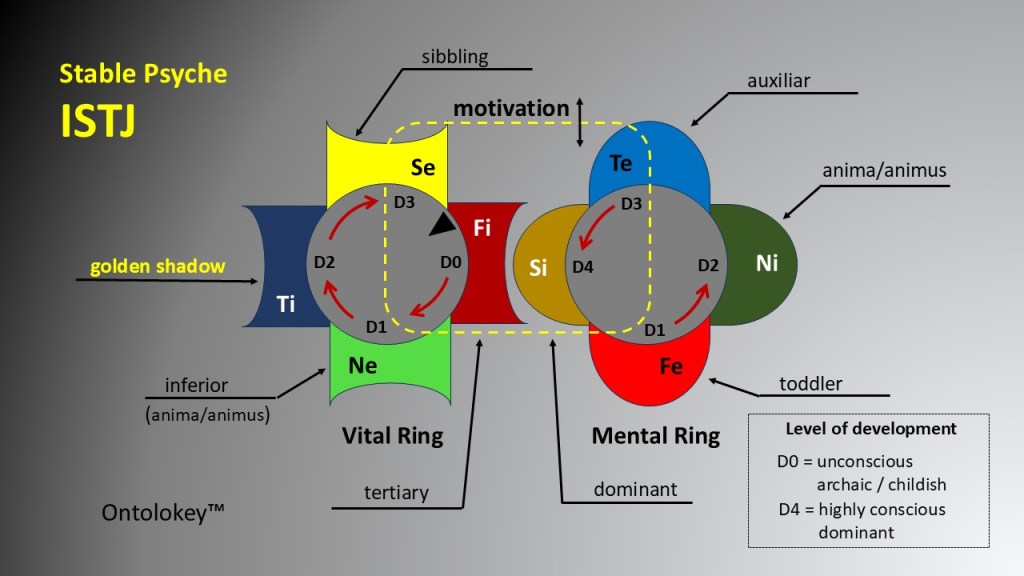
The ISTJ is usually recognized first through the outer qualities that make this personality so reliably useful to the people and institutions around it. This is the person who remembers what happened three years ago with startling clarity, who notices when a room feels wrong before anyone can say why, and who quietly restores order to a chaotic situation without asking for credit. Their inner world functions as a kind of sensory archive, one that does not merely store facts but relives impressions with an almost physical vividness, so that a smell, a texture, or a particular quality of light can pull them back into a memory as though no time had passed at all. This deep attunement to lived experience is not nostalgia in the sentimental sense; it is closer to an inner filing system that provides continuity and safety in a world that would otherwise feel arbitrary and unpredictable. Because of this, ISTJs are drawn to environments that feel harmonious, uncluttered, and intentional, and they often notice discomfort in others before the people themselves have registered it, quietly stepping in to fix what is wrong rather than making a scene about it.
Alongside this inward orientation toward remembered experience sits a second, outward-facing strength: an unusually practical and methodical approach to getting things done. When an ISTJ takes on a task, the first instinct is to break it into manageable pieces, establish a clear sequence, and move through that sequence with discipline rather than improvisation. This is not mere obsessiveness about procedure; it reflects a genuine respect for the idea that things done properly tend to stay done, and that shortcuts taken today often become larger problems tomorrow. Colleagues and family members learn to trust ISTJs with complicated, long-term responsibilities precisely because they do not lose interest halfway through, and because their sense of personal worth is quietly tied to the satisfaction of seeing a job completed well. This practical orientation can make them appear emotionally distant in moments that call for warmth rather than efficiency, since their instinct is to solve the problem rather than sit with the feeling attached to it. Yet underneath this apparent coolness lies a genuine, if understated, care about the people they are helping — care expressed through reliability and competence rather than through words.
Beneath these two dominant qualities, the type carries subtler and less visible currents that shape it in quieter ways. There is an intuitive dimension that occasionally surfaces as a sudden hunch about how a situation will unfold, or a delayed realization about what was really happening in a past conflict, arriving not as a clear vision but as a kind of mental whisper that the ISTJ often cannot fully explain. There is also an emotional dimension oriented toward the atmosphere of a room or a relationship, one that tries clumsily but sincerely to keep things calm and pleasant, more often expressed through practical gestures — making tea, tidying a kitchen, quietly picking up the slack — than through direct verbal reassurance. And there is a private, almost fiercely guarded moral compass, one that rarely announces itself but that will not bend once a genuine value has been crossed. Taken together, these layers describe a personality built for continuity: dependable, quietly perceptive, deeply committed to doing things properly, and generally uncomfortable with anything that threatens the predictability on which its sense of safety depends.
Where the Surface Description Stops Being Enough
It is tempting to stop the description here, because everything said so far paints a genuinely admirable picture, and much of it is accurate as far as it goes. The problem is that this kind of surface portrait, however flattering, tends to obscure exactly the material that matters most for anyone trying to actually understand themselves or someone close to them. Every personality develops both a public face that receives approval and earns trust, and a private underworld that contains everything that does not fit comfortably inside that public identity — the impulses, resentments, fears, and unmet longings that contradict the self-image a person has spent years building. This is not a flaw specific to the ISTJ; it is simply how the human psyche organizes itself under any consistent set of social rewards. What makes the ISTJ’s version of this process worth examining closely is that the very qualities which make this personality so trustworthy — stability, self-control, a strong identification with duty — create unusually favorable conditions for a large, concealed shadow to accumulate almost invisibly over the course of a lifetime.
The core of the issue lies in how the ISTJ typically relates to reality itself. Where some personalities orient primarily around possibility, atmosphere, or abstract ideals, the ISTJ orients around what has already proven itself through direct experience. Repetition becomes evidence. Consistency becomes something close to truth. This gives the ISTJ a genuinely valuable role as a guardian of continuity within families, workplaces, and communities, since they remember what actually worked and resist getting swept along by whatever collective enthusiasm happens to be fashionable at the moment. But this same orientation carries a hidden cost, because when experience becomes the ultimate authority, anything unfamiliar risks being experienced not merely as unknown but as a kind of quiet threat. Over time, and usually without any single dramatic moment marking the transition, the ISTJ can come to organize an increasing share of their inner life around avoiding precisely the kinds of uncertainty that most human growth actually requires.
The Slow Disappearance of the Inner Life
One of the most consequential parts of the ISTJ shadow concerns what happens to their emotional world once discipline becomes the organizing principle of the entire personality. Many ISTJs learn early, often without anyone explicitly teaching them, that competence is rewarded while emotional turbulence tends to create complications. Reliability earns respect. Vulnerability, by contrast, feels risky. As a result, many ISTJs become extraordinarily skilled at regulating themselves, enduring discomfort without complaint, and continuing to function even when they are exhausted, lonely, or quietly furious. Seen from the outside this looks like admirable self-mastery, and in many respects it genuinely is. But psychological material that is consistently pushed out of conscious awareness does not simply disappear; it moves underground and continues operating as an autonomous force, shaping perception and behavior in ways the person themselves often cannot recognize or name. Over years, this produces a peculiar and quietly tragic condition in which the individual can explain their obligations in exquisite detail while remaining strangely uncertain about what they actually want or feel, having gradually lost the fluent, immediate access to their own inner signals that most people take for granted.
This emotional distancing rarely announces itself as crisis. Instead it tends to express itself indirectly, through channels that appear rational on the surface even though they are being driven by something unprocessed underneath. Chronic irritation can be a disguised form of unexpressed anger. A flat, business-like relationship to daily life can conceal something closer to grief or numbness. Excessive caution can be fear wearing the mask of prudence. Because these expressions look reasonable and defensible when examined individually, the ISTJ — and the people around them — often fail to trace them back to their emotional origin, interpreting them instead as simply how this person is. Among the feelings most reliably pushed into this hidden territory are vulnerability and dependency, since the ISTJ’s self-image is so often built around being the capable one, the person others lean on rather than the person who leans. Needing help can feel like exposure. Expressing an emotional need can feel uncomfortably close to being a burden. And so the ISTJ frequently becomes the one who listens rather than the one who speaks, the helper rather than the helped, quietly accumulating an emotional debt that nobody, including themselves, is keeping track of.
Resentment, Duty, and the Anger That Never Raises Its Voice
Because responsibility becomes so tightly fused with self-worth for many ISTJs, a particular and easily overlooked danger develops around the imbalance between what they give and what they allow themselves to ask for in return. Being useful becomes intertwined with being valuable; being dependable becomes intertwined with being good. This fusion generates real strengths, but it also creates a hidden vulnerability, because responsible people naturally attract more and more responsibility from those around them, and the ISTJ rarely experiences themselves as a victim of this pattern since they usually take on each additional burden voluntarily, out of a genuine sense that it is the practical or moral thing to do. The trouble begins when this sacrifice stops being noticed or reciprocated and instead becomes quietly expected, at which point something begins accumulating beneath the composed surface that the ISTJ shows to the world. Because direct confrontation feels inefficient and uncomfortable to this personality, dissatisfaction is rarely voiced in the moment. Instead it is minimized, postponed, and privately filed away, joining what gradually becomes an extraordinarily detailed internal ledger of disappointments, broken promises, and moments of ingratitude that the remarkable ISTJ memory preserves with unsettling precision.
This accumulated material does not usually erupt as sudden rage, at least not for a long time. More often it hardens into something closer to permanent judgment, a rigidity of opinion about particular people or entire categories of people that others experience as stubbornness but that is, underneath, a defensive structure protecting against the possibility of being hurt again in the same way. Because the underlying grievances are often factually grounded — someone really was unreliable, someone really did fail to contribute their share — the resulting anger acquires a moral authority that makes it feel less like an emotional reaction and more like an objective conclusion, which in turn makes it considerably harder for the ISTJ to recognize how much of their perception has actually been shaped by unresolved hurt rather than dispassionate observation. Just as often, this hidden anger shows up not as criticism but as quiet withdrawal: responsibilities continue being fulfilled, promises continue being kept, but something essential in the emotional connection has already left the room. Family members frequently notice this shift long before the ISTJ consciously acknowledges it themselves, sensing a kind of functional loyalty that has replaced genuine warmth, and often not understanding why, because from the outside nothing appears to have changed at all.
Control as Protection Against an Unpredictable World
The ISTJ’s well-known love of order is frequently misread as a simple preference for tidiness or efficiency, when in fact it usually performs a much deeper psychological function: it manages anxiety. For a personality that relies so heavily on proven patterns and reliable expectations, genuine uncertainty can feel destabilizing in a way that is difficult for other types to fully appreciate, because when the future becomes unclear, the internal rules that normally provide guidance lose some of their power to reassure. The typical response is to increase structure further — gather more information, build tighter systems, tighten existing routines — and while this often looks entirely rational, and frequently is useful, it can also become a way of managing internal discomfort rather than genuinely addressing external circumstances. Over time, control can shift from being a tool the ISTJ uses to being a psychological necessity they cannot easily do without, at which point flexibility itself starts to feel dangerous, and even minor disruptions to routine can trigger reactions that seem disproportionate to whoever is on the receiving end of them.
This is where rigidity becomes visible, though rigidity itself is only the symptom rather than the underlying cause. Beneath it typically sits a quiet, largely unspoken fear that if control is relaxed even slightly, something essential might collapse — that the carefully maintained structure of responsibilities and routines is not simply useful but is, in some deeper sense, holding the person themselves together. This produces a costly form of avoidance, because so much of what makes life meaningful — love, creativity, grief, parenthood, genuine intimacy — cannot actually be controlled or fully planned for, no matter how carefully one prepares. The ISTJ who insists on managing every variable can therefore begin, without ever intending to, avoiding precisely the experiences that would lead to the deepest kind of psychological growth, settling instead into roles and routines that feel safe precisely because they are already understood. And in a pattern that appears again and again throughout this shadow material, the more tightly life becomes organized around predictability, the more attractive complete, unstructured freedom can start to feel in fantasy, even for — especially for — the person who would never actually choose to act on it.
The Fantasy of Walking Away
Perhaps the most unsettling experience many ISTJs report, and the one they are often most reluctant to admit even to themselves, is a sudden and seemingly inexplicable urge to abandon the entire structure of the life they have spent years building. Not a wish for a vacation or a brief rest, but something closer to a fantasy of disappearing altogether — the reliable partner who imagines walking away without explanation, the diligent employee who pictures simply never returning, the devoted caretaker who longs, just for a moment, to stop caring about anyone at all. Because these images feel so radically inconsistent with the conscious identity the ISTJ has built, they are usually dismissed quickly, treated as evidence of some private failure or moral weakness rather than examined as meaningful psychological communication. Yet these fantasies deserve to be taken seriously, because they are rarely, in the end, actually about wanting a different life. More often they represent a demand for internal liberation rather than external escape, a signal that psychological reserves have been depleted for far longer than the person has consciously allowed themselves to notice, since the ISTJ characteristically continues functioning at a high level long after their internal resources have quietly run dry.
This becomes especially significant in midlife, when the original sense of purpose that once made responsibility feel meaningful begins to soften, and a subtler, more unsettling question starts to surface: now that stability has been achieved, what was it actually for? Many ISTJs discover in these years that they have become extraordinarily skilled at maintaining structures while losing touch with the capacity to imagine anything meaningfully different, and it is precisely here that fantasies of radical change — a different career, a different city, a different life entirely — tend to appear with the greatest intensity. It would be a mistake to treat these fantasies as literal blueprints for action, since the underlying need is almost never for a different set of circumstances but for the return of something that has been quietly sacrificed along the way: curiosity pursued without needing to justify itself, pleasure permitted without demanding it first prove its usefulness, rest granted without being earned through exhaustion. When this longing is ignored for too long, it does not simply fade; it tends to concentrate, eventually finding expression through behavior that genuinely does look out of character — sudden impulsive decisions, uncharacteristic risk-taking, or an abrupt and dramatic rupture that shocks everyone who thought they knew this person well.
Losing Contact with Meaning: A Slower, Quieter Danger
There is a form of decline within the ISTJ that is considerably harder to notice than burnout or open crisis, precisely because it produces no dramatic symptoms at all. This can be described as a kind of emotional desertification, a gradual erosion of vitality that unfolds so slowly and so quietly that it is often only recognized in hindsight, if it is recognized at all. It begins innocently enough, with the ordinary and often admirable practice of prioritizing what is necessary over what is merely desired, a habit that every functioning adult needs to some degree. The difficulty is that for the ISTJ this pattern can easily become not an occasional discipline but a governing principle applied indiscriminately across the entire span of a life, so that duty consistently wins out over curiosity, efficiency consistently wins out over exploration, and obligation consistently wins out over spontaneity, until desire itself begins to speak more and more faintly, simply because it has learned that it will almost never be granted priority. What looked at first like healthy self-discipline gradually shades into something closer to self-abandonment, and the crucial difference between the two is that the disciplined person still knows what they want even while choosing not to pursue it, whereas the person undergoing this slower erosion eventually forgets the question altogether.
The most reliable symptom of this condition is a particular kind of chronic, low-grade boredom that coexists uneasily with genuine external success. Achievements no longer generate the satisfaction they once did. Activities that used to feel exciting start to feel routine. The future begins to resemble simply more of the present rather than an open horizon of possibility, and because nothing about this feels acutely painful, it rarely prompts the kind of alarm that would lead someone to seek help or even to name what is happening. Others, meanwhile, tend to interpret the resulting composure as maturity, stability, or contentment, which only deepens the isolation of the person experiencing it, since their outward life offers no visible justification for the quiet emptiness they sense underneath. What this condition ultimately reveals is that meaning cannot be manufactured through effort or competence alone; it requires genuine openness to experience, a willingness to encounter life without fully controlling the outcome, and it is exactly this openness that becomes hardest to access the more thoroughly a person has organized their identity around order, reliability, and the avoidance of risk.
When Principles Stop Serving Life
A further and particularly difficult layer of the ISTJ shadow concerns what happens when moral conviction, one of this personality’s genuine strengths, hardens into something closer to a psychological defense rather than a living ethical compass. At first, principles are followed because they are believed to be right, but over time they can quietly begin serving a second function as well, providing a sense of certainty and safety in situations that would otherwise feel ambiguous or threatening. Once this shift has taken place, questioning a principle no longer feels like an intellectual exercise; it starts to feel like a genuine threat to the self, because the person is no longer simply defending an idea but an entire psychological structure that has come to depend on that idea for its stability. This can produce a subtle but consequential form of moral rigidity, in which fairness gradually narrows into judgment, compassion becomes conditional on whether someone has met the ISTJ’s own exacting standards of effort and accountability, and other people’s failures are interpreted primarily through the lens of character rather than circumstance. The irony, often invisible to the person experiencing it, is that the more extensively someone has sacrificed their own desires in service of duty, the harder it becomes to extend genuine understanding to people who have made different choices, since those choices can feel like an unspoken accusation against everything the ISTJ has personally given up.
This same dynamic frequently produces a form of projection worth naming directly, because it explains some of the most emotionally charged reactions ISTJs have toward other people. Traits that have been pushed out of conscious identity — impulsivity, self-indulgence, emotional volatility, a carefree disregard for consequence — do not simply vanish; they tend to resurface as intense, sometimes disproportionate reactions to people who visibly embody those same traits. The disciplined ISTJ who becomes unaccountably irritated by someone who seems careless or spontaneous is often, without realizing it, responding to a disowned part of their own psyche rather than to an objective failing in the other person. The same mechanism can work in reverse, producing an equally intense, if more admiring, fascination with people who seem unusually free, creative, or unconstrained by obligation, since these individuals often embody exactly the possibilities the ISTJ quietly sacrificed long ago in the name of stability. Recognizing this pattern is not an invitation to abandon standards or become indiscriminately permissive; it is simply an invitation to notice that the emotional intensity attached to these reactions usually says as much about the ISTJ’s own unlived life as it does about the person standing in front of them.
Collapse and the Possibility of Something More Honest
Every psychological structure, no matter how well built, eventually reaches a limit, and the ISTJ’s considerable capacity for endurance can paradoxically make this moment more dangerous rather than less, since it allows warning signs to be ignored for far longer than would be possible for someone with less discipline. Burnout, when it finally arrives, rarely announces itself dramatically; it accumulates gradually through a slow reduction in emotional responsiveness, an increasing dependence on obligation rather than genuine interest to sustain motivation, and a growing irritability that seems to appear from nowhere but is in fact the accumulated pressure of years of unprocessed strain finally beginning to surface. Because so many of the ISTJ’s core strengths — conscientiousness, reliability, discipline — actively prevent them from stepping back or asking for help, these same strengths end up being recruited into sustaining an increasingly unsustainable situation, and the person continues functioning simply because functioning is what they know how to do. What eventually breaks through this exhausted composure is not necessarily catastrophe but a set of genuinely existential questions that had been postponed for years: what has all of this actually been for, and who am I when I am no longer defined by what I carry for other people?
This collapse, painful as it is, is not the failure of the ISTJ personality; it is frequently the beginning of something considerably more honest than what came before it. The task facing the ISTJ is never to become someone fundamentally different, to trade discipline for chaos or responsibility for recklessness. It is instead to develop a more generous, more truthful relationship with the parts of themselves that discipline has spent a lifetime suppressing — the capacity for pleasure that does not need to justify itself through usefulness, the vulnerability that does not need to be hidden to remain worthy of respect, the desires that do not need to be postponed indefinitely in service of some future that never quite arrives. Order, at its best, is meant to support a life, not replace it, and the deepest work available to this personality is learning to distinguish between the two — to keep the genuine strength of structure while finally allowing themselves the same care, attention, and permission to simply exist that they have spent so many years offering everyone else.
This overview has been compiled from content published on Ontolokey, an online resource dedicated to making the architecture of personality visible through a three-dimensional model of the psychological functions first described by Carl Gustav Jung. What follows draws together the descriptive material on the ISTJ personality with the considerably more extensive shadow analysis Ontolokey has published, condensing both into a single psychological portrait that tries to honor the complexity of the type without flattening it into a caricature of either competence or dysfunction. Readers who want the full depth of this material, or who are curious about how the other fifteen personality types are constructed within the same model, are encouraged to visit www.Ontolokey.com directly, since the essays there go into far greater structural and clinical detail than a summary of this length can responsibly attempt.


Leave a comment