To understand the ESTJ psychologically, one has to move beyond the familiar caricature of the efficient manager, the strict administrator, the person who naturally takes charge when everybody else is still discussing what should be done. That stereotype contains a fragment of truth, but it mistakes the visible surface of the personality for its entire psychological architecture. The ESTJ is not simply a person who likes rules, productivity, hierarchy, or responsibility; more fundamentally, the type can be understood as a psyche that attempts to make reality dependable by transforming uncertainty into structure, responsibility into action, and collective expectations into concrete standards. In the Ontolokey framework, this organizing impulse is represented by Extraverted Thinking, or Te, as the dominant function, supported by Introverted Sensing, Si, while the remaining six functions reveal a much more complicated psychological landscape than the conventional image of the decisive executive suggests. The deeper truth is therefore paradoxical: the same psychological mechanism that can make an ESTJ extraordinarily reliable, courageous, productive, and capable of protecting people from disorder can, when defended too rigidly, become controlling, intolerant, emotionally avoidant, or excessively identified with performance. This tension between competence and vulnerability is essential to understanding the ESTJ, because what looks like confidence from the outside may sometimes be the psychological compensation for an inner difficulty with uncertainty, ambiguity, helplessness, or the possibility that life cannot always be made orderly through effort.
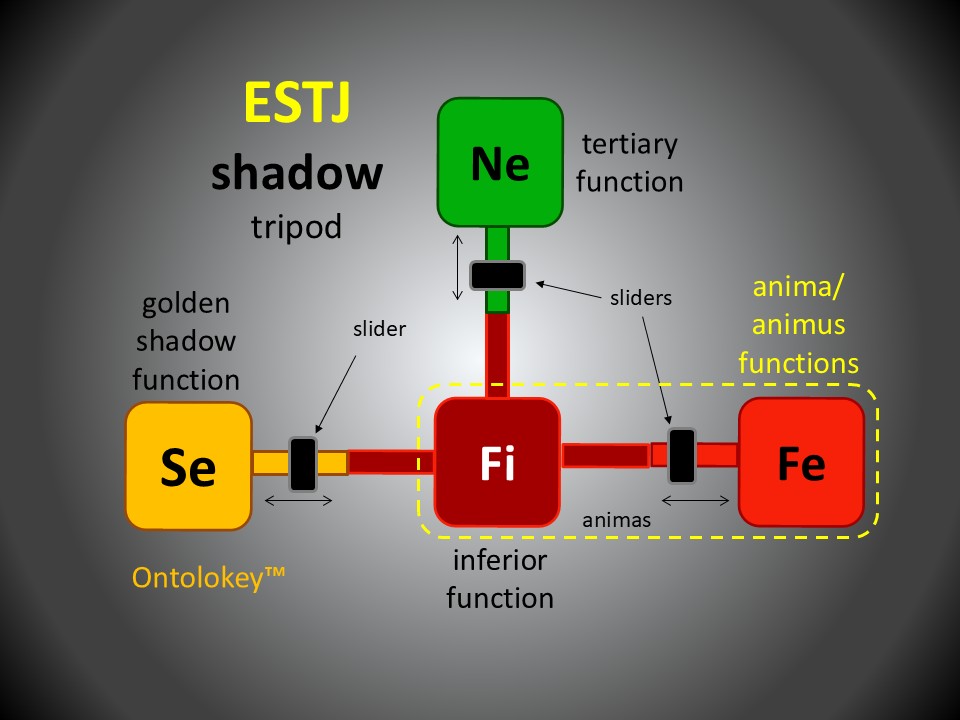
The Ontolokey cube becomes particularly useful when the ESTJ is viewed not as a collection of fixed traits but as a dynamic field of psychological tensions. According to the Ontolokey model, the ESTJ’s dominant Extraverted Thinking occupies the central position of conscious executive organization, while Introverted Sensing provides the stabilizing auxiliary structure through memory, precedent, experience, and established patterns. Introverted Thinking occupies the Sibling position, offering an internal logical counterweight to Te; Introverted Intuition appears as the Toddler function, representing a less mature but potentially transformative capacity for abstraction, symbolic perception, and long-range synthesis; Introverted Feeling occupies the Inferior position and therefore represents one of the most psychologically vulnerable yet developmentally important regions of the personality. Extraverted Feeling functions as the Anima or Animus, introducing an unconscious longing for emotional reciprocity and social harmony, while Extraverted Intuition is identified as the Blindspot or neglected possibility-oriented function and Extraverted Sensing constitutes the Golden Shadow, the hidden capacity for immediacy, physical presence, spontaneity, and direct engagement with life. This arrangement matters because it changes the central question from “What is an ESTJ like?” to the far more psychologically revealing question, “What happens inside an ESTJ when these different modes of experiencing reality come into conflict?” A mature ESTJ is therefore not simply someone who becomes better at Te, but someone who gradually learns that effectiveness is only one dimension of psychological health and that a life organized entirely around effectiveness can eventually become strangely ineffective at answering the question of what the life is actually for.
At the heart of this architecture lies a particular relationship with reality: the ESTJ tends to trust what can be acted upon, organized, measured, remembered, verified, or made dependable. This orientation gives the type an unusual capacity to convert abstract responsibility into visible behavior, which helps explain why ESTJs can become formidable organizers, administrators, leaders, commanders, business operators, institutional builders, and protectors of systems that other people depend upon. The deeper Ontolokey interpretation of Te emphasizes that the ESTJ does not merely enjoy getting things done; action itself can become a psychological language through which commitment, integrity, competence, and even affection are expressed. In the extended ESTJ material associated with Ontolokey, this tendency is portrayed as a powerful devotion to follow-through, standards, responsibility, and the belief that effort should have consequences, with the healthy ESTJ often measuring integrity less by what someone says than by whether that person actually does what they promised. Yet this strength contains its own psychological trap, because once effectiveness becomes synonymous with worth, failure ceases to be merely an undesirable outcome and begins to feel like a threat to identity. An ESTJ can then unconsciously move from “I need this system to function” toward “I need this system to function because my competence proves that I am competent, responsible, and worthy,” creating a feedback loop in which control is no longer merely practical but emotionally protective.
This is where the untold dimension of the ESTJ begins to emerge, because the personality’s greatest strength can become its preferred defense mechanism. When uncertainty appears, the instinct may be to organize; when another person behaves irresponsibly, the instinct may be to correct; when emotions become confusing, the instinct may be to search for an actionable solution; when the future becomes ambiguous, the instinct may be to rely more heavily on what has already worked. None of these responses is inherently pathological, and in ordinary circumstances they can be precisely what makes an ESTJ invaluable. The difficulty begins when the psyche applies the same solution to problems that cannot actually be solved through structure, discipline, precedent, or increased effort. Grief cannot always be optimized, intimacy cannot be administered like a department, human motivation cannot be reduced entirely to compliance, and personal identity cannot ultimately be established through an endless accumulation of achievements. The psychological development of the ESTJ therefore begins at the point where competence encounters something it cannot command, because that encounter exposes the functions and emotional capacities that the dominant personality structure has historically kept at a greater distance.
The central paradox can be stated without romanticizing either the strengths or the shadow: the ESTJ may spend much of life learning how to control circumstances before learning how to remain psychologically intact when circumstances cannot be controlled. This is why the inferior Introverted Feeling function, Fi, is so significant in the Ontolokey architecture. Fi represents the inner question that Te cannot answer for the ESTJ: not “What works?” or “What is objectively required?” but “What matters to me when nobody is measuring the result?” and “Who am I when my usefulness is no longer the basis on which I evaluate myself?” Ontolokey places Fi at the farthest and most vulnerable point of the ESTJ’s psychological structure, while simultaneously describing it as a potential gateway toward authenticity, moral depth, compassion, inner dignity, and a life no longer defined exclusively by output or status. This makes the ESTJ’s deepest development less about becoming softer in some superficial sense and more about discovering that personal values are not an obstacle to strength; rather, they provide the internal meaning that prevents strength from degenerating into mere control.
The ESTJ, at its healthiest, is therefore not the authoritarian stereotype sometimes associated with the type, but the person who can carry responsibility without needing responsibility to define the entire self. Such an individual can use Te to build functioning systems while allowing Ti to question whether those systems are logically coherent, Si to preserve what genuinely deserves preservation without worshipping precedent, Ni to imagine what has not yet become obvious, Fi to determine what is personally and ethically meaningful, Fe to recognize the emotional field created by leadership, Ne to remain open to alternatives that contradict established assumptions, and Se to experience reality directly rather than always approaching the present as another task to be managed. The Ontolokey cube is compelling precisely because it presents these functions as a developmental architecture rather than as a list of flattering strengths and embarrassing weaknesses. The mature ESTJ does not cease being demanding, organized, decisive, or practical; instead, those qualities become less defensive because they are no longer required to carry the entire psychological burden of identity. What emerges is a fundamentally different kind of authority: authority that does not need constant enforcement because it is increasingly rooted in self-knowledge, ethical conviction, emotional awareness, intellectual flexibility, and the ability to distinguish between a problem that genuinely needs to be solved and a human experience that simply needs to be understood.
The most important distinction in the ESTJ psyche is therefore not between “strong” and “weak,” but between strength that remains psychologically flexible and strength that has become defensive. Ontolokey’s shadow analysis makes this distinction particularly stark by describing how responsibility can harden into control, discipline into rigidity, authority into domination, and confidence into an increasingly unquestionable conviction of being right. The mechanism is psychologically plausible even when the typological framework itself should be regarded as interpretive rather than diagnostic: a person who repeatedly experiences competence as the most reliable route to security can gradually begin to depend upon competence for emotional stability. Under favorable conditions, this produces resilience, decisiveness, and a remarkable willingness to carry burdens that others avoid; under prolonged frustration, however, the same pattern can create an intolerance of uncertainty and a growing need to make the external world conform to an internal expectation of order. What makes the shadow particularly difficult to recognize is that it rarely feels like corruption from inside the person experiencing it. The ESTJ who is becoming excessively controlling may sincerely believe that they are simply being responsible, just as the resentful ESTJ may genuinely have been treated unfairly and the rigid ESTJ may genuinely have identified a real problem that requires correction. The danger begins when a legitimate perception becomes an all-encompassing interpretation of reality, so that every disagreement confirms incompetence, every challenge resembles disrespect, and every failure becomes evidence that somebody else has failed to do what they should have done.
Resentment consequently deserves a much deeper psychological examination than the simple observation that ESTJs can “hold grudges.” According to the Ontolokey shadow analysis, resentment develops when repeated experiences of perceived injustice, betrayal, insufficient recognition, or violated expectations accumulate without genuine emotional processing, gradually transforming memory into an internal ledger of debts and offenses. This is particularly significant for the ESTJ because the type’s orientation toward responsibility can generate a powerful expectation of reciprocity: if I have done my part, you should do yours; if I have remained loyal, you should remain loyal; if I have sacrificed for the group, the group should recognize that sacrifice; if I have demonstrated competence, competence should matter. There is nothing inherently irrational about such expectations, and in a functional social environment they are often necessary for cooperation, but human beings and institutions routinely violate them because life is not an objective meritocracy in which effort and reward maintain a perfect correspondence. When the ESTJ encounters that discrepancy repeatedly, the psychological wound may be deeper than disappointment because it challenges an implicit philosophy of reality: that responsible action should produce responsible outcomes. The shadow begins when the person cannot metabolize this contradiction and instead constructs an increasingly comprehensive narrative in which other people become debtors, obstacles, opportunists, or enemies, while the self assumes the role of the person who has consistently carried more than everyone else.
This process explains why the ESTJ can sometimes become psychologically attached to being right in a way that exceeds ordinary confidence. The healthy form of Te is fundamentally pragmatic: it asks what works, what produces the desired result, what resources are available, and what decision will move reality forward. Yet when competence becomes fused with identity, the question subtly changes from “What is effective?” to “How can I preserve the belief that my judgment is reliable?” Ontolokey describes this transition as a movement toward psychological infallibility, in which the recognition that one is often right gradually becomes the assumption that one is entitled to be right. At that point criticism becomes unusually threatening because it does not merely challenge an opinion; it potentially challenges the person’s entire self-concept as the competent one who sees what others fail to see. The resulting defensiveness can paradoxically make an otherwise highly rational person less rational, because evidence is no longer processed solely according to its informational value but according to whether it strengthens or threatens the established identity. A colleague who disagrees may therefore be experienced not as someone contributing another perspective but as someone obstructing the correct course of action, while an emotional objection may be dismissed as irrelevant precisely because acknowledging its significance would require entering psychological territory in which objective efficiency no longer provides sufficient guidance.
This brings us directly to one of the most misunderstood aspects of ESTJ psychology: emotional blindness does not necessarily mean emotional emptiness. In fact, the shadow analysis argues almost the opposite, suggesting that the ESTJ can possess powerful emotions while having a comparatively underdeveloped conscious relationship with those emotions, particularly when the personality has learned throughout life that action, competence, reliability, and self-control receive greater social reinforcement than vulnerability or introspection. The consequence is that emotion may enter consciousness disguised as something else: fear may become control, humiliation may become aggression, anxiety may become micromanagement, hurt may become anger, and accumulated disappointment may emerge as moral judgment. This distinction is crucial because the ESTJ can then experience themselves as acting from principle while being driven partly by an emotional injury they have not consciously acknowledged. They may genuinely believe that they are “just enforcing standards” when the intensity of enforcement is actually disproportionate because something personal has been touched. The psychological task is therefore not to suppress emotion in favor of reason, but to make emotion conscious enough that reason is no longer secretly being recruited to defend an unexamined wound.
The inferior position of Introverted Feeling, Fi, becomes especially important within this developmental problem because it confronts the ESTJ with precisely the dimension of experience that cannot be reduced to efficiency or external validation. Fi asks the individual to develop an internally grounded relationship with personal values, authenticity, emotional meaning, conscience, and the subjective significance of experience, even when those things cannot be quantified or translated into an operational plan. In an immature state, this territory can feel strangely inaccessible or even irritating because it offers no immediate procedure for resolution; someone who is suffering does not necessarily need a solution, a relationship conflict cannot always be repaired through a better system, and a moral decision cannot always be settled by determining which option is most efficient. Yet the very absence of an immediately actionable answer is what makes this function psychologically transformative for the ESTJ. If Te teaches the individual how to make reality function, Fi gradually asks why that functioning matters, whose values it serves, what sacrifices are ethically acceptable, and whether success obtained at the expense of inner integrity is actually success at all. The development of Fi therefore does not weaken the ESTJ’s authority; it gives that authority a conscience capable of existing independently from performance.
There is consequently a profound difference between an ESTJ who has developed emotional depth and one who has merely learned socially acceptable emotional behavior. The first can recognize that compassion is not the abandonment of standards, that forgiveness is not the denial of wrongdoing, and that vulnerability does not automatically imply incompetence. The second may still use emotional language strategically while remaining internally governed by the same rigid equation between worth and performance. Genuine development requires something more uncomfortable: the willingness to discover that one’s own standards can sometimes become defenses against experiences that feel uncontrollable, including dependency, grief, uncertainty, failure, rejection, and the realization that other people possess autonomous inner worlds that cannot be managed into compliance. Ontolokey’s discussion of the ESTJ shadow identifies precisely this danger when it describes how fear of weakness can gradually turn into contempt for weakness, causing compassion to be interpreted as indulgence and human limitation to be experienced as a character defect. The mature ESTJ does not have to abandon the admiration of strength; rather, strength becomes more sophisticated when it includes the capacity to tolerate weakness without contempt, including one’s own. That is the beginning of a psychologically integrated form of authority, because a person who no longer needs to despise vulnerability in order to feel strong has far less reason to control other people whenever vulnerability appears.
The next layer of the ESTJ’s psychological architecture becomes clearer when the eight Ontolokey positions are examined not merely as labels, but as different relationships to reality that can either cooperate or compete within the same individual. Dominant Extraverted Thinking, Te, occupies the position of the primary conscious instrument through which the ESTJ evaluates situations according to effectiveness, organization, measurable consequences, competence, and external logic. This is the part of the personality that instinctively asks what needs to be done, who is responsible, which procedure is functional, what standard has been violated, and how available resources can be coordinated toward a concrete result. The important psychological distinction is that Te is not synonymous with intelligence, rationality, or authoritarianism; it is a particular orientation toward thinking in which thought naturally seeks implementation in the external world. For the healthy ESTJ, this can produce extraordinary executive capacity because thinking does not remain indefinitely in abstraction but becomes decision, coordination, accountability, and action. The danger arises when the dominant position becomes so trusted that whatever cannot be translated into practical terms is unconsciously downgraded in importance, causing subjective meaning, ambiguity, imagination, and emotional complexity to be treated as secondary simply because they resist immediate operationalization.
The auxiliary position, Introverted Sensing, Si, provides the ESTJ with something that pure Te would lack: continuity with what has already been learned through direct experience. Si does not simply mean “having a good memory,” nor does it mean that every ESTJ is nostalgic or conservative in the ordinary sense; within this framework it represents a psychological tendency to compare present circumstances against accumulated experience, established knowledge, precedent, familiar standards, and previously demonstrated ways of functioning. This creates a powerful stabilizing mechanism because the ESTJ is rarely forced to reinvent reality from scratch when a comparable situation has already been encountered. A mature Si can therefore protect institutions, traditions, procedures, and relationships from the destructive impulse to change something merely because a new idea happens to be fashionable or intellectually interesting. Yet the same mechanism can become restrictive when previous success is mistaken for universal validity, because what worked yesterday can acquire the psychological status of what must work tomorrow. The mature ESTJ learns to distinguish between experience as evidence and experience as dogma, preserving what deserves preservation while remaining capable of recognizing that circumstances change and that loyalty to a method is not the same thing as loyalty to the underlying purpose.
The third position, Introverted Thinking, Ti, described within the Ontolokey cube as the Sibling, introduces an especially interesting internal relationship because it resembles the ESTJ’s own thinking process while operating according to a different criterion. Te asks whether an external system works effectively, whereas Ti is concerned more deeply with whether an internal conceptual structure is logically precise, coherent, and free of contradiction. The Sibling metaphor is psychologically useful because Ti can feel both familiar and irritating to the ESTJ: it belongs to the same broad intellectual family as Te, yet it refuses to accept practicality as sufficient proof of logical validity. This creates the possibility of a productive internal argument in which Te says, “This works,” while Ti responds, “But do you actually understand why it works, and under what conditions would it stop working?” In an integrated ESTJ, that internal friction becomes a major source of intellectual sophistication because decisions are no longer based solely upon established procedures or observable outcomes but can be examined for hidden assumptions and structural weaknesses. In an immature or stressed ESTJ, however, Ti may instead become an argumentative instrument used to rationalize an already predetermined conclusion, producing the illusion of rigorous analysis while the underlying motivation remains the preservation of control or certainty.
Introverted Intuition, Ni, occupies the Toddler position in the Ontolokey model, and this designation captures something psychologically subtle about the ESTJ’s relationship with abstraction and future-oriented synthesis. Ni is concerned with patterns beneath the immediately visible surface, with convergence, implications, symbolic meaning, long-range trajectories, and the possibility that apparently separate events are expressions of a deeper underlying process. Because the ESTJ’s habitual orientation is toward concrete organization and established reality, Ni can initially feel less trustworthy than direct evidence or accumulated experience. Yet this apparently less mature function can become extraordinarily important when developed, because no complex organization can remain successful indefinitely by responding only to what has already happened. The ESTJ eventually needs to perceive where a system is heading before its consequences become obvious, and this requires tolerating uncertainty long enough to recognize an emerging pattern rather than immediately forcing the situation into an existing framework. The “Toddler” quality is therefore not a judgment that intuition is useless; it suggests that this mode of consciousness may initially be less differentiated, more tentative, and more difficult for the ESTJ to trust, yet precisely for that reason it can become a developmental frontier through which the personality acquires foresight rather than merely excellent reaction.
The Inferior position, Introverted Feeling, Fi, is perhaps the most psychologically consequential position in the entire ESTJ structure because it represents the domain in which external effectiveness meets the irreducibly personal question of value. Fi does not primarily ask whether a policy is efficient, whether an organization is functioning, or whether a person is fulfilling an assigned responsibility; it asks whether something is internally meaningful, morally congruent, authentic, and consistent with one’s deepest personal convictions. For an ESTJ who has built identity around being useful, reliable, competent, and responsible, these questions can be unsettling because they cannot be answered by accumulating more evidence or increasing productivity. Fi may therefore remain relatively quiet for long periods and then emerge with disproportionate intensity when the individual encounters betrayal, moral violation, personal humiliation, profound attachment, grief, or a situation in which external success conflicts with internal conscience. The developmental challenge is not to replace Te with Fi, but to prevent Te from becoming the sole authority over the self, because without Fi the ESTJ can become exceptionally effective at accomplishing goals without ever examining whether those goals genuinely deserve to be accomplished.
Extraverted Feeling, Fe, occupies the Anima or Animus position in Ontolokey’s formulation, and this gives the ESTJ’s social psychology a dimension that is often missed by simplistic descriptions of the type as emotionally insensitive. Fe is oriented toward interpersonal atmosphere, collective emotional needs, social reciprocity, harmony, belonging, and the emotional signals circulating between people. When this function is less consciously differentiated, the ESTJ may nevertheless possess a strong unconscious sensitivity to whether people respect them, whether the group is functioning cohesively, whether loyalty is being reciprocated, and whether social relationships are becoming unstable. This can produce an intriguing contradiction in which the ESTJ appears to care primarily about performance while being deeply affected by interpersonal recognition and rejection beneath the surface. Development of Fe allows the person to recognize that leadership is not only the distribution of tasks but also the management of human meaning, morale, dignity, trust, and emotional consequence. Without that development, the ESTJ may assume that treating everyone according to the same objective standard is inherently fair, overlooking the fact that people experience fairness not only through consistency but also through being understood as individual human beings.
Extraverted Intuition, Ne, is identified as the Blindspot, and this position illuminates why an ESTJ can sometimes react skeptically to possibilities that have not yet demonstrated practical credibility. Ne continually generates alternatives, hypothetical scenarios, unconventional connections, divergent interpretations, and potential futures; its psychological movement is therefore expansive rather than convergent, and exploratory rather than immediately decisive. For a personality organized around Te and supported by Si, this proliferation of possibilities can feel inefficient because every additional possibility potentially delays commitment and destabilizes the established frame of reference. Yet the blindspot is not simply a deficiency; it identifies an area in which the ESTJ may underestimate how much valuable information is contained in what initially appears impractical, speculative, or unconventional. Psychological maturity requires learning to distinguish between useless novelty and genuinely informative novelty, because rejecting every unproven alternative protects stability in the short term but can make a person remarkably vulnerable to gradual environmental change. An ESTJ who develops Ne does not become indecisive; rather, the person becomes better at entertaining several possible explanations before committing to the one that deserves implementation.
Finally, Extraverted Sensing, Se, occupies the Golden Shadow, representing a particularly fascinating hidden potential. Se is concerned with immediate sensory reality, direct engagement, physical presence, responsiveness to what is happening now, and the willingness to encounter experience without filtering everything through past precedent or future consequence. For the ESTJ, this can appear both natural and strangely liberating because Te normally approaches the present with an implicit question about what should be done, while Se can simply register what is actually happening and respond to it with immediacy. The Golden Shadow therefore represents a capacity that may emerge most powerfully when the ESTJ stops trying to organize every moment into a larger plan and permits reality itself to become psychologically informative. This can manifest as spontaneity, embodied confidence, appreciation of the physical world, rapid adaptation, enjoyment, and a more direct relationship with experience. In its mature form, Se reminds the ESTJ that life is not merely a sequence of problems awaiting competent management, but also an unfolding reality that can be perceived, inhabited, enjoyed, and responded to without first being converted into a project.
Taken together, these eight positions reveal why the ESTJ cannot be adequately described by the familiar image of the “strict leader.” Te gives the personality executive force, Si gives it continuity, Ti gives it analytical discrimination, Ni opens the possibility of deeper foresight, Fi introduces personal conscience and authenticity, Fe expands awareness of interpersonal and collective emotional reality, Ne challenges premature certainty, and Se reconnects the individual with immediate experience. The psychological problem is not that some of these functions are “good” while others are “bad,” but that consciousness naturally privileges some forms of information while neglecting others, and neglected information does not cease to exist merely because the conscious personality prefers not to deal with it. Indeed, much of what appears in the ESTJ’s shadow can be understood as information that has been excluded from conscious authority and therefore returns indirectly through defensiveness, irritation, projection, emotional intensity, or compulsive behavior. The mature ESTJ consequently becomes less interested in proving that one function is superior and more interested in establishing an internal government in which no single psychological authority is allowed to become a dictator. This is ultimately the deeper promise of the Ontolokey cube: it portrays personality not as a prison of fixed characteristics, but as an architecture in which development means gradually bringing previously neglected dimensions of consciousness into a more constructive relationship with the dominant self.
The positive side of the ESTJ becomes much clearer once the shadow is understood, because the purpose of examining the shadow is not to condemn the personality but to separate genuine strength from psychological compensation. The same Te-Si structure that can become rigid under threat can also produce one of the most dependable forms of practical leadership: the ability to take responsibility when circumstances are ambiguous, resources are limited, and somebody must translate intention into coordinated action. Ontolokey itself emphasizes that the ESTJ often emerges naturally wherever systems must be maintained, standards enforced, resources allocated, and collective efforts coordinated, and it stresses that these capacities are not inherently problematic but can represent some of the most valuable human abilities when exercised consciously. This observation also finds a broader psychological parallel in research-oriented personality literature, where conscientiousness—particularly responsibility, dependability, organization, and persistence—is associated with important forms of job performance, although its value depends strongly upon the demands of the particular environment. The healthy ESTJ therefore possesses something that is increasingly rare in environments saturated with discussion, interpretation, and endless possibility: the willingness to accept that intentions are meaningless unless someone eventually assumes responsibility for their consequences.
This capacity for responsibility can have a profound moral dimension when it is separated from the need for domination. A mature ESTJ often understands that leadership is not primarily the privilege of giving orders but the burden of making decisions when there is no perfect option and accepting accountability for what follows. Such a person can enter situations in which other people are overwhelmed and instinctively begin creating sequence, priorities, roles, deadlines, and measurable objectives, thereby reducing psychological chaos for everyone involved. Their decisiveness can be particularly valuable during crises because they are less likely to become immobilized by the fact that every possible outcome contains uncertainty; instead, they identify the information available, determine what can be influenced, and move toward the most workable course of action. The psychological virtue here is not simply efficiency but agency, because the ESTJ’s instinctive response to difficulty is often to ask what can still be done rather than surrendering to what cannot be controlled. When that agency is combined with humility, it becomes protective rather than oppressive, allowing the ESTJ to become the person others trust precisely because authority is being used to carry responsibility rather than to demand submission.
The relationship between Te and Si also explains why ESTJs can become exceptionally effective builders of institutions and long-term structures. Te supplies the drive toward implementation while Si remembers what has already been learned, creating a combination capable of turning experience into repeatable practice and practice into reliable systems. In its healthy form, this does not necessarily mean blind conservatism; rather, it means understanding that civilization itself depends upon accumulated knowledge, standards, procedures, traditions, and institutional memory that would be impossible to reconstruct from nothing each generation. An ESTJ may therefore possess a particular respect for craftsmanship, professional competence, proven methods, and the accumulated lessons contained in experience, because to discard everything that came before in the name of novelty can appear not progressive but irresponsible. The danger is obvious when this becomes rigid, but the strength is equally obvious when discernment remains intact: the mature ESTJ can ask which traditions preserve wisdom and which merely preserve habit, which rules protect people and which merely protect authority, and which procedures still serve their original purpose. This capacity to conserve without becoming imprisoned by the past is one of the clearest signs that Si has become an ally of Te rather than its unquestioned master.
Another major strength of the ESTJ is the unusual seriousness with which the personality can approach commitment. When an ESTJ genuinely accepts responsibility for a person, project, organization, family, or principle, that commitment can become remarkably concrete because loyalty is frequently expressed through action rather than sentiment. The person may not always be the one who produces the most emotionally elaborate declarations of affection, but they may be the one who arrives when something goes wrong, makes the necessary phone call, handles the practical crisis, remembers what needs to be done, protects the group’s interests, and continues carrying responsibility long after the excitement surrounding the original commitment has disappeared. This is important because psychological care is often misunderstood as verbal warmth alone, whereas human beings also experience care through reliability, protection, provision, consistency, and the willingness to assume burdens when circumstances become difficult. The ESTJ’s challenge is not therefore to become a completely different, softer personality, but to recognize that these concrete expressions of devotion become far more powerful when accompanied by explicit emotional recognition. When action and emotional awareness eventually cooperate, the ESTJ can communicate something extraordinarily reassuring: “You do not have to carry everything alone, because I am willing to carry something with you.”
Yet the mature ESTJ must also confront one of the most uncomfortable truths about responsibility: not every burden that can be carried should be carried by the same person. A personality that derives identity from competence can unconsciously create dependency by repeatedly rescuing systems and people from the consequences of their own irresponsibility, because being indispensable can feel safer than discovering that one is not actually needed. This can lead to a subtle form of control disguised as helpfulness, in which the ESTJ takes over because others are inefficient, then becomes resentful because others do not take sufficient responsibility, and finally uses their own resentment as evidence that only they can be trusted to handle things properly. The cycle is psychologically self-reinforcing because every intervention proves the original assumption: “If I do not do it, it will not be done correctly.” Breaking that cycle requires a surprisingly difficult form of restraint—the willingness to allow other people to make mistakes, to tolerate temporary inefficiency, and to accept that competence includes teaching, delegating, and trusting rather than merely performing. The strongest ESTJ is therefore not the person who can do everything personally, but the person who can construct a system in which other people become capable of doing what previously depended upon them.
This distinction also transforms the ESTJ’s relationship with authority. Authority at its best is not the psychological opposite of equality; it is the assumption of differentiated responsibility, where someone accepts greater accountability because their role requires them to make decisions, coordinate resources, or protect the functioning of the whole. The unhealthy ESTJ confuses this with personal superiority, whereas the mature ESTJ understands that occupying a position of authority does not make one’s perceptions infallible and does not eliminate the autonomy of those being led. The deepest form of leadership therefore emerges when the ESTJ can hear disagreement without automatically interpreting it as insubordination, because disagreement may contain information that the dominant perspective has missed. This is where the previously discussed Ti, Ne, Fi, and Fe functions become essential rather than decorative additions to the personality: Ti can interrogate the internal logic of the decision, Ne can introduce alternatives, Fi can ask whether the decision remains ethically defensible, and Fe can reveal how the decision is actually affecting the human beings who must live with it. Leadership becomes psychologically mature when these perspectives are permitted to challenge Te without being treated as enemies of Te.
The result is an ESTJ who remains decisive without becoming authoritarian, structured without becoming rigid, demanding without becoming contemptuous, and confident without requiring psychological submission from others. Such an individual can still have high standards and can still be blunt, practical, competitive, and intensely focused on results, but the psychological motive underneath those characteristics has changed. The goal is no longer to control reality in order to remain secure; it is to participate effectively in reality while accepting that uncertainty, difference, imperfection, and emotional complexity are permanent features of being human. This distinction is crucial because the Ontolokey shadow analysis describes the deepest danger as a gradual imprisonment in the very structures that originally created security, where authority can replace intimacy, achievement can replace meaning, respect can replace love, and control can replace trust. The mature ESTJ reverses this process by retaining the structure while relinquishing the compulsion, retaining standards while relinquishing contempt, and retaining authority while relinquishing the need to be psychologically indispensable. At that point, the ESTJ’s defining strength is no longer simply the capacity to make the world obey a plan, but the much rarer capacity to build order without losing contact with the humanity of the people living inside that order.
A further dimension of the ESTJ becomes visible when one examines what happens during major transitions, because the personality is often at its most psychologically revealing when the external structures that normally confirm competence begin to disappear. As long as there is a task to complete, a problem to solve, a position to occupy, or a responsibility to carry, the ESTJ can remain deeply connected to a recognizable sense of identity. But retirement, career failure, divorce, illness, bereavement, professional humiliation, the departure of children, or any other experience that removes a familiar source of usefulness can expose a question that Te cannot easily answer: who am I when there is nothing I need to fix? Ontolokey’s discussion of inferior Fi explicitly describes this possibility as a moment in which achievements can begin to feel hollow and relationships can reveal their transactional dimensions, forcing the individual to confront values and meaning that previously remained in the background. This should not be interpreted as an inevitable “midlife crisis” for ESTJs, but as a developmental possibility inherent in any personality structure that has placed unusually strong psychological investment in achievement, responsibility, and external effectiveness. The crisis, when it occurs, is therefore not necessarily evidence that the person has failed; it may instead represent the psyche demanding a broader definition of success.
This is also why the ESTJ’s relationship with work deserves to be understood with more nuance than either admiration or criticism can provide. Ontolokey’s deeper ESTJ analysis describes work not merely as an activity but as an arena in which purpose, identity, discipline, and personal worth can become intertwined, while simultaneously warning that the relentless drive toward productivity can produce overwork and burnout when rest, spontaneity, and emotional reflection are repeatedly subordinated to output. The psychological problem begins when productivity stops being something the person does and becomes something the person believes they are. If “I am valuable because I contribute” gradually becomes “I am valuable only when I contribute,” rest becomes psychologically suspicious, leisure becomes guilt-inducing, and failure becomes existential rather than situational. The person may then continue working long after the practical justification has disappeared because stopping would force contact with an identity that has not been sufficiently developed outside achievement. In this sense, the ESTJ’s greatest achievement may eventually be learning that disciplined effort is a tool of life rather than the definition of life itself.
The same developmental tension appears in relationships, where the ESTJ can initially assume that love is demonstrated primarily through reliability, loyalty, protection, and practical assistance. These are genuine forms of love, and it would be simplistic to dismiss them merely because they are less verbally expressive than the relational styles preferred by other personalities. Yet intimacy demands another form of presence: the capacity to reveal internal experience without first converting it into a problem that someone else can solve. An ESTJ may be extraordinarily willing to help a partner through financial difficulty, organize a family crisis, defend someone against external threats, or shoulder practical responsibilities, while simultaneously struggling to say that they are frightened, lonely, ashamed, hurt, or deeply dependent upon the relationship emotionally. The Ontolokey model’s treatment of Fi and Fe illuminates this tension by distinguishing between inner personal values and emotional attunement to others, suggesting that development involves moving beyond simply acting upon relational systems toward actually resonating with the emotional reality within them. The mature ESTJ therefore learns a difficult lesson: sometimes the most loving response is not to repair another person’s problem but to remain present while they experience it, because emotional intimacy is not always an engineering problem and vulnerability cannot be delegated to someone else.
This becomes particularly important in conflict because the ESTJ’s natural confidence in direct confrontation can be either an extraordinary relational strength or a source of considerable damage. In a healthy form, directness protects relationships from passive aggression, ambiguity, and endless avoidance; the ESTJ is often willing to say what other people are thinking but are afraid to articulate, and this can make difficult conversations substantially more honest. Under shadow conditions, however, the same directness can become prosecutorial, particularly when the individual has already reached an internal verdict about another person’s motives. Ontolokey’s shadow analysis describes the progression from justified confidence toward psychological infallibility, where alternative interpretations are increasingly experienced as obstacles and people become categorized according to competence, loyalty, usefulness, or obstruction. Once that happens, conflict ceases to be an investigation into what occurred and becomes a trial in which the ESTJ unconsciously assumes the roles of investigator, prosecutor, judge, and enforcer. The developmental correction is not passive tolerance; it is epistemic humility—the willingness to recognize that being highly competent does not guarantee complete access to another person’s motives, that one’s interpretation can be factually incomplete, and that understanding someone does not require agreeing with them.
This is where Ne, the tertiary function in the Ontolokey model, becomes far more important than its relatively playful description might initially suggest. Ne introduces the capacity to generate alternative interpretations, possibilities, explanations, and future scenarios rather than immediately collapsing ambiguity into a single conclusion. Ontolokey explicitly pairs Ne against Si, presenting their balance as a determinant of whether the ESTJ becomes adaptable or dogmatic, and this is psychologically significant because the ESTJ’s reliance on experience can become extremely powerful precisely because experience is usually useful. The problem is not trusting experience; the problem is assuming that experience has already exhausted the possible explanations for what is happening now. Ne creates a mental pause between perception and conclusion, allowing the ESTJ to ask whether there might be another reason, another method, another interpretation, or another future that has not yet been considered. This capacity can feel inefficient at first because it multiplies possibilities instead of immediately reducing them, but psychologically it acts as an antidote to certainty addiction, giving the ESTJ permission to be temporarily unsure without experiencing uncertainty as incompetence.
Ni introduces an even more subtle form of uncertainty because it does not primarily multiply possibilities; it attempts to perceive the deeper trajectory underneath them. Ontolokey characterizes Ni as the ESTJ’s Toddler function, describing how it can emerge as vague intuition, anticipatory concern, existential questioning, or sudden recognition of long-term consequences, sometimes producing excessive preparation and preoccupation with future threats. This is one reason an ESTJ under stress can paradoxically become more controlling precisely when they are less certain: an indistinct internal sense that something may go wrong can trigger an intensified attempt to eliminate every possible variable. Yet the same function, once developed, can transform the ESTJ’s leadership from tactical management into genuine strategic vision. The person begins to ask not only whether the current system works, but what kind of world the current system is creating; not only whether today’s target is being achieved, but what consequences today’s success will have five or ten years from now. Ni therefore teaches the ESTJ that foresight sometimes requires tolerating the uncomfortable period in which a pattern is sensed before it can be proven, and that not every important truth arrives with a spreadsheet attached to it.
The Golden Shadow of Extraverted Sensing, Se, offers perhaps the most unexpected developmental lesson because it concerns not responsibility or morality but the ability to inhabit the present. Ontolokey describes Se as the ESTJ’s hidden capacity for sensory immediacy, spontaneity, vitality, aesthetic experience, movement, pleasure, and direct engagement with the world, suggesting that the ESTJ may admire such qualities in people who appear more spontaneous, physically expressive, adventurous, or artistically alive. Psychologically, this is important because a life organized exclusively around future outcomes can become strangely detached from the actual experience of living. The ESTJ can become exceptionally good at preparing for the vacation while barely experiencing the vacation, building the house while barely inhabiting the home, planning the celebration while barely participating in the moment, or achieving financial security while postponing the question of what security was supposed to make possible. Se interrupts this pattern by insisting that reality is not merely raw material for future improvement; the present itself has psychological value. The mature ESTJ does not abandon planning, but learns that sometimes the highest form of control is the conscious decision to stop controlling the experience and simply be there.
At the deepest level, then, the development of the ESTJ is a movement from external mastery toward internal sovereignty. External mastery asks whether the person can organize circumstances, solve problems, establish standards, lead people, protect institutions, and produce measurable results; internal sovereignty asks whether the person can remain psychologically grounded when circumstances refuse to cooperate. The first creates competence, while the second creates freedom from dependence upon competence as the sole source of identity. This distinction explains the central paradox of the Ontolokey model: the functions that initially appear peripheral or uncomfortable are not obstacles placed in the ESTJ’s path but precisely the capacities required to prevent its greatest strengths from becoming prisons. Fi provides meaning beneath achievement, Fe provides emotional reciprocity beneath leadership, Ne provides openness beneath certainty, Ni provides vision beneath procedure, and Se provides lived experience beneath planning. The mature ESTJ consequently does not become less powerful; the nature of power changes, because power is no longer measured by how completely reality can be controlled but by how much complexity the individual can tolerate without losing direction, integrity, compassion, or self-command.
One of the most revealing positions in the ESTJ cube is the Anima or Animus function, Extraverted Feeling, Fe, because it complicates the popular assumption that ESTJs are fundamentally indifferent to emotional life. Within Ontolokey, Fe is not simply an auxiliary emotional function but an archetypal counterweight to Te, representing the ESTJ’s relationship with collective emotional reality, interpersonal recognition, social belonging, morale, and the human atmosphere surrounding an organized system. This helps explain why an ESTJ may appear intensely task-oriented while simultaneously being highly sensitive to whether people respect them, appreciate their contribution, remain loyal to the group, or acknowledge the social consequences of their decisions. The contradiction is only apparent: Te asks whether the external system functions, whereas Fe asks whether the people inhabiting that system remain connected to one another, and both questions can become important to the same leader. The less conscious Fe becomes, however, the more easily its needs can be displaced into a craving for recognition, status, loyalty, or social validation, meaning that the ESTJ may insist that “results are what matter” while being surprisingly wounded when those results fail to generate appreciation or belonging. Psychological development therefore requires the ESTJ to recognize that the desire for respect is not necessarily weakness, but it becomes psychologically dangerous when recognition is required before the individual can feel secure in their own worth.
The Persona position adds another layer to this complexity because Ontolokey associates the ESTJ outwardly with the ISFJ pattern. This does not mean that an ESTJ literally becomes an ISFJ or that the two types are interchangeable; rather, the Persona describes an outwardly accessible mode through which the individual can present themselves in a socially recognizable and acceptable form. For the ESTJ, this can involve appearing dutiful, dependable, service-oriented, protective, conventional, and attentive to established expectations, even when the internal motivational engine is fundamentally Te-driven. The psychological consequence is that other people may sometimes misunderstand what actually motivates the ESTJ, interpreting their practical acts of responsibility as expressions of quiet selflessness when those acts may simultaneously contain a strong need for competence, order, accountability, or functional control. This does not make the behavior insincere, because human motives are rarely singular; rather, it illustrates how personality can operate simultaneously at different psychological levels, with one function organizing behavior while another supplies the socially acceptable form through which that behavior is expressed. The danger appears when the Persona becomes so convincing that the ESTJ begins to confuse the role with the self, believing that being the dependable one, the responsible one, or the person who always handles everything is not merely something they do but something they must perpetually remain.
The Toddler function, Introverted Intuition, Ni, introduces a very different problem because it represents a form of perception that does not readily submit to the ESTJ’s preferred demand for immediate evidence and practical verification. Ontolokey places Ni in the Toddler position, describing it as a function that may initially be ignored, misunderstood, or used awkwardly, yet it can become increasingly important as the ESTJ confronts complexity that cannot be solved through precedent alone. Ni perceives trajectories, underlying patterns, implications, and possible meanings beneath the visible surface, and therefore asks a fundamentally different question from Te: not “What can we do about this now?” but “Where is this actually going?” An ESTJ who dismisses this perspective may become extraordinarily competent at managing the present while repeatedly being surprised by developments that were already forming beneath the surface. Under stress, the neglected Ni function may appear in distorted form as ominous forecasting, excessive suspicion, catastrophic anticipation, or a vague conviction that something is wrong without a sufficiently articulated explanation, which can then drive even more aggressive attempts at control. Developed consciously, however, Ni gives the ESTJ something extremely valuable: the ability to recognize that today’s functioning system may contain the seeds of tomorrow’s failure and that genuine leadership sometimes means abandoning a successful method before circumstances force the abandonment upon you.
The Blindspot, Extraverted Intuition, Ne, presents almost the opposite challenge because whereas Ni narrows toward an underlying trajectory, Ne expands outward into multiple possibilities, interpretations, alternatives, and hypothetical futures. Ontolokey explicitly identifies Ne as the ESTJ’s Blindspot, which means that the issue is not simply lack of creativity but a potential difficulty recognizing the informational value of possibilities that have not yet acquired sufficient practical credibility. This can make the ESTJ particularly vulnerable to what might be called premature closure: once a workable explanation has been found, the psychological pressure to move toward implementation can become stronger than the curiosity required to investigate whether another explanation might fit the evidence better. In organizational environments this can be an advantage when endless brainstorming would merely delay necessary action, but it becomes a liability when the environment is changing rapidly and yesterday’s reliable assumptions are becoming obsolete. The developmental task is therefore not to turn the ESTJ into an endlessly speculative personality, because that would undermine its natural strengths, but to create a deliberate space in which alternatives can be entertained before judgment is finalized. A mature ESTJ can say, in effect, “This is the best explanation we have at present, but it is not sacred,” and that small psychological distinction can protect an otherwise highly decisive person from turning certainty into dogmatism.
The Golden Shadow, Extraverted Sensing, Se, is perhaps the most beautiful counterpoint to the ESTJ’s relationship with responsibility because it represents a capacity for direct contact with life that exists outside the usual economy of planning, productivity, and future consequence. Ontolokey describes Se as the ESTJ’s hidden potential for physical engagement and immediate experience, positioning it not as a weakness but as an unclaimed form of psychological vitality. Se notices what is happening now, responds to concrete reality as it unfolds, and can experience the sensory world without constantly translating it into an abstract objective or future obligation. For an ESTJ, this can become a profound corrective to the tendency to live one step ahead of the present, always preparing, organizing, improving, anticipating, or solving. The integration of Se does not mean abandoning ambition or discipline; it means discovering that presence itself is a legitimate form of psychological activity. An ESTJ who develops this capacity may become more spontaneous, physically grounded, perceptive, adventurous, and capable of enjoying experiences without immediately converting them into achievements, and this can be psychologically liberating because it weakens the unconscious equation between existence and usefulness.
The Royal Archetype, associated by Ontolokey with INFP dynamics, represents an even deeper developmental possibility because it symbolically places the ESTJ opposite its habitual orientation toward external organization. The INFP configuration emphasizes Introverted Feeling and Extraverted Intuition, and therefore brings together precisely those dimensions that can challenge an ESTJ most strongly: inner authenticity, subjective value, personal meaning, imagination, openness, and the willingness to allow an experience to unfold without immediately imposing an external structure upon it. Within the logic of the Ontolokey system, the Royal Archetype should not be interpreted as a claim that an ESTJ ought to become an INFP or abandon Te-Si functioning; it is better understood as a symbolic image of psychological sovereignty that becomes possible when the opposite qualities have been sufficiently integrated. The “royal” dimension is significant because genuine psychological authority ultimately requires the individual to possess an inner kingdom rather than merely govern an outer one. The ESTJ who can encounter the values represented by Fi and Ne without contempt or defensiveness discovers that personal meaning does not have to compete with practical effectiveness, and that imagination does not necessarily undermine responsibility; instead, these qualities can reveal what responsibility is ultimately supposed to serve.
The Sibling function, Introverted Thinking, Ti, completes this architecture by providing the ESTJ with an internal intellectual counterpart that can either strengthen or undermine the dominant Te orientation. Ontolokey identifies Ti as the ESTJ’s Sibling function, and its broader cube framework associates this role with a psychologically accessible but differently oriented mode of thought. Ti asks for conceptual precision, internal consistency, definitions, distinctions, and an understanding of why a system works rather than merely whether it produces the desired outcome. The healthy relationship between Te and Ti therefore resembles a conversation between an engineer and an auditor: Te wants the bridge built and functioning, while Ti wants to understand whether the principles underlying the bridge actually hold together. When these functions cooperate, the ESTJ becomes difficult to deceive with superficial efficiency because practical success is subjected to conceptual scrutiny. When they become polarized, however, Ti can be recruited as a weapon for intellectual self-justification, allowing the ESTJ to construct increasingly sophisticated arguments in defense of conclusions that were emotionally or practically determined beforehand. The developmental goal is consequently not simply “more logic,” but a more honest relationship with logic in which reasoning remains capable of changing the conclusion rather than serving merely to defend it.
Seen as a complete structure, the ESTJ cube describes a personality whose psychological evolution depends upon expanding the definition of what counts as useful information. Te initially privileges action, Si privileges experience, Ti privileges coherence, while the less familiar functions introduce values, emotion, intuition, possibility, and immediate presence into the field of consciousness. Ontolokey’s broader model explicitly presents the cube as a representation of conscious and unconscious functions whose integration belongs to a process of individuation rather than to the acquisition of a fixed collection of traits. This is perhaps the most important point for understanding the ESTJ without reducing the type to stereotypes: psychological maturity is not measured by how perfectly the person embodies the dominant function, but by how successfully the entire psychological system can tolerate and integrate its opposites. The strongest ESTJ is consequently not the one who eliminates doubt, emotion, intuition, spontaneity, or subjectivity, but the one who can allow those experiences to enter consciousness without immediately experiencing them as threats to order. The final form of strength is therefore not greater rigidity but greater range, because a person who can remain decisive while simultaneously remaining open to correction possesses something more durable than certainty: the capacity to act without needing to pretend that reality is simpler than it is.
The deepest question for the ESTJ is therefore not whether structure is good or control is bad, but whether structure remains subordinate to meaning. Every healthy personality needs some way of transforming experience into order, and for the ESTJ that capacity is unusually pronounced, which is why the type can become such a stabilizing force in families, organizations, communities, and institutions. The shadow begins when the instrument becomes the purpose, when maintaining order becomes more important than understanding why the order exists, or when enforcing a standard becomes more important than asking whether the standard remains just. Ontolokey’s treatment of the ESTJ shadow repeatedly returns to this danger: the strengths of decisiveness, discipline, responsibility, and authority can become distorted when they are driven by fear of incompetence, vulnerability, disorder, or loss of control rather than by conscious choice. (ontolokey.com) This distinction is subtle because the external behavior may look almost identical in both cases; two ESTJs may demand excellence, correct mistakes, establish boundaries, and insist upon accountability, while internally one is acting from mature conviction and the other is desperately attempting to prevent an intolerable feeling of helplessness. Psychological maturity therefore cannot be judged simply by how effective an ESTJ appears, because the same behavior can arise from radically different internal motivations.
This is particularly important when considering the ESTJ’s relationship with failure. A psychologically integrated ESTJ can experience failure as information, disappointment, or a temporary consequence without allowing it to destroy the underlying sense of identity, whereas an ESTJ whose self-worth has fused with competence may experience failure as humiliation and therefore react defensively. The latter may search immediately for someone responsible, identify procedural errors, reconstruct the chain of events, and determine precisely where another person failed, all of which can be objectively useful while simultaneously serving an unconscious emotional function: avoiding the terrifying possibility that the self might simply have been wrong. Ontolokey’s shadow discussion of blame, resentment, and psychological infallibility is significant here because it illustrates how external accountability can become a defense against internal vulnerability. (ontolokey.com) The mature alternative is not self-condemnation, because excessive self-blame merely reverses the same rigid logic and keeps the person trapped in performance-based worth; the alternative is accurate responsibility, which means being able to say, with equal honesty, “This was my mistake,” “This was someone else’s responsibility,” “This was genuinely unforeseeable,” and “This outcome cannot be assigned entirely to anyone.” Such psychological differentiation is a profound form of strength because it permits accountability without requiring a villain.
The same principle applies to the ESTJ’s relationship with rules. Rules are psychologically attractive to a Te-Si personality because they transform ambiguity into shared expectations and make responsibility visible, but a rule can never replace judgment. Institutions become dangerous when procedures continue to be enforced after their original purpose has disappeared, and individuals become rigid when they confuse consistency with justice. The mature ESTJ therefore develops the ability to distinguish between a principle and the particular procedure currently used to express it. This distinction permits the person to defend standards while changing methods, to preserve values while abandoning outdated practices, and to enforce boundaries without turning every exception into moral weakness. Si then becomes a guardian of accumulated wisdom rather than a prison constructed from precedent, while Te becomes an instrument for serving the purpose rather than merely enforcing the mechanism. In this form, the ESTJ can become an unusually effective reformer from within an institution because they understand both why systems exist and how systems actually function.
Perhaps the greatest transformation occurs when the ESTJ discovers that compassion and accountability are not opposites. An immature form of Te may interpret compassion as lowering standards because it focuses on the observable consequence: someone failed, therefore something must be corrected. A more integrated ESTJ recognizes that accountability concerns behavior while compassion concerns the human being who produced the behavior, and that these dimensions can coexist without contradiction. Someone can be held responsible for a mistake while still being treated with dignity; a boundary can be enforced without humiliation; incompetence can be addressed without contempt; and forgiveness can coexist with the decision not to restore trust immediately. This is where Fi and Fe become psychologically indispensable, because Fi prevents moral judgment from becoming merely procedural while Fe reminds the ESTJ that every decision enters a social and emotional field inhabited by real people. The result is not sentimental leadership but humane leadership, in which standards remain real precisely because the people subject to them are regarded as human beings rather than as components of a system.
There is also a quieter form of ESTJ development that receives less attention because it produces no obvious external achievement: learning to receive. The ESTJ is often psychologically comfortable with giving in concrete ways because giving confirms competence, usefulness, responsibility, and control over circumstances, whereas receiving requires a temporary surrender of those positions. To accept help, admit uncertainty, allow another person to take responsibility, or confess that one does not know what to do can therefore feel disproportionately exposing, particularly for someone who has spent years being the person others rely upon. Yet relationships become reciprocal only when both people are permitted to give and receive, and psychological intimacy becomes possible only when competence ceases to function as a permanent barrier against dependency. The mature ESTJ can eventually discover that allowing another person to help is not an admission of inferiority but an act of trust, and that trust itself is a form of strength because it acknowledges that no individual, however capable, was designed to carry an entire world alone.
This leads directly to the deepest meaning of Fi within the ESTJ architecture. Personal values are not merely private preferences or emotional impulses; they constitute an internal criterion by which the individual can determine what deserves loyalty even when external rewards disappear. An ESTJ who has developed this dimension can continue working hard without worshipping work, lead without needing admiration, enforce standards without deriving pleasure from domination, and pursue achievement without confusing achievement with human worth. The question gradually changes from “What must I accomplish to prove that I am responsible?” to “What am I willing to be responsible for because it reflects who I choose to be?” That is a radically different psychological foundation because it transforms responsibility from an external obligation into an expression of identity and conscience. At this stage, Te no longer has to manufacture meaning through productivity because meaning has begun to exist independently of productivity.
The mature ESTJ consequently becomes capable of a form of authority that is fundamentally different from the stereotypical image of command. Such a person can be decisive without being threatened by disagreement, disciplined without being obsessed with control, traditional without being imprisoned by precedent, ambitious without being consumed by achievement, and emotionally restrained without being emotionally disconnected. Their strength becomes quieter because it no longer needs constant demonstration, and their standards become more credible because they are applied with discrimination rather than reflexively. The Ontolokey cube, read developmentally, suggests that this maturity emerges through an increasingly conscious relationship among all eight positions: Te learns humility from Ti and Fi, Si learns flexibility from Ne and Se, Ni learns confidence through experience, Fe becomes less dependent upon recognition, and the shadow functions cease to appear only as disruptive forces and begin to contribute information that the dominant consciousness genuinely needs. (ontolokey.com) The result is not an ESTJ who has transcended their type, but an ESTJ who has become sufficiently psychologically developed that the type is no longer a narrow identity and instead becomes a foundation from which a much larger personality can emerge.
For anyone who recognizes themselves strongly in this description, the most useful conclusion is therefore not that the ESTJ must become less ESTJ. The task is almost the opposite: to become so conscious of the architecture that its strengths can operate without being hijacked by its fears, and so sufficiently acquainted with its shadow that defensive behavior can be recognized before it becomes destructive. The Ontolokey framework offers one interpretive map for undertaking that process, particularly through its detailed discussions of the ESTJ functions, archetypal positions, and shadow dynamics; readers who want to explore these mechanisms in greater depth can consult the extended ESTJ analyses and the broader personality material available at Ontolokey.com. It is worth remembering, however, that typological frameworks are best used as instruments for reflection rather than as scientific diagnoses or immutable descriptions of individual people, and that a person will always be more complex than any eight-function model can capture. Used carefully, the model becomes valuable precisely because it generates questions rather than final verdicts: Where does my need for order come from, what happens when I cannot control an outcome, which emotions do I translate into action, what values remain when achievement disappears, and which forms of experience have I unconsciously excluded because they cannot be measured? Those questions take the ESTJ beyond the flattering mythology of competence and beyond the equally simplistic mythology of the controlling executive, toward the much more uncomfortable and ultimately more human territory in which strength, vulnerability, responsibility, meaning, and freedom have to coexist.
The untold truth about the ESTJ is therefore neither that the type is secretly tyrannical nor that it is secretly misunderstood and heroic. The deeper truth is that the ESTJ possesses an extraordinary capacity to impose order upon complexity, and that every extraordinary capacity creates an extraordinary temptation to overuse it. The person who can build structures can eventually become trapped inside them; the person who can carry responsibility can eventually believe that nobody else is trustworthy enough to carry it; the person who values competence can eventually mistake incompetence for moral failure; and the person who protects others through action can eventually forget that people sometimes need understanding more than intervention. But precisely because these patterns are recognizable, they are not destiny, and the shadow does not have to remain a prison. When Te becomes guided by conscience, Si becomes informed by openness, Ti becomes genuinely self-questioning, Ni becomes trusted without becoming catastrophic, Fe becomes relational rather than approval-seeking, Ne becomes tolerated rather than dismissed, Se becomes lived rather than admired from a distance, and Fi becomes conscious rather than buried, the ESTJ discovers that true authority does not require domination. It requires enough inner freedom to act decisively without needing reality, other people, or even one’s own identity to remain permanently under control.


Leave a comment